Of Rabbit Holes and Twisted Trees and the Curse of Endogamy

Now that I have emerged from the Mansbach rabbit hole I dove into weeks ago, I can return to the story of my direct ancestors, Gerson Katzenstein and Eva Goldschmidt and their children, including my great-grandmother Hilda Katzenstein.  As I wrote previously, Gerson was one of eight children of Scholum Katzenstein, including four full siblings, two of whom died as children, and three half-siblings, one of whom died as a child. As best I can tell Gerson was the only one of the eight to leave Germany and come to the United States.

Gerson and Eva were married in Oberlistingen in June 1847, and then settled in Gerson’s home town of Jesberg, where they had three children: Scholum (1848, named for Gerson’s father), Jacob (1851), and Brendina (1853, named for Gerson’s mother, Breine Blumenfeld).

marriage-record-of-gerson-katzenstein-and-eva-goldschmidt

Marriage record of Gerson Katzenstein and Eva Goldschmidt HHStAW fonds 365 No 673, Arcinsys Hessen

Gerson and Eva immigrated to the US in 1856 with Scholum, Jacob, and Brendina. A fourth child Perry was born a few months after they had settled in Philadelphia. In 1858, they had a fifth child, Hannah, and in 1860 they were all living in Philadelphia where Gerson was working as a salesman.  As noted in an earlier post, there were three others living in the household, Abraham “Anspach,” who I believe was actually Abraham Mansbach (III), David Frank, a bookkeeper, and Marley Mansbach, who I believe was Abraham Mansbach’s cousin and only related to Gerson through his sister Hannchen’s marriage into the Mansbach family.

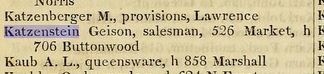
Gerson Katzenstein in the 1856 Philadelphia directory

Gerson Katzenstein in the 1856 Philadelphia directory

Gerson Katzenstein and family 1860 US census Year: 1860; Census Place: Philadelphia Ward 13, Philadelphia, Pennsylvania; Roll: M653_1163; Page: 519; Image: 105; Family History Library Film: 805163

Gerson Katzenstein and family 1860 US census
Year: 1860; Census Place: Philadelphia Ward 13, Philadelphia, Pennsylvania; Roll: M653_1163; Page: 519; Image: 105; Family History Library Film: 805163

On August 17, 1863, Gerson and Eva had their sixth and final child, my great-grandmother Hilda.

The family suffered a terrible loss on December 17, 1866, when their eight year old daughter Hannah died from scarlet fever.  She was buried at Adath Jeshurun cemetery in Philadelphia. I have to wonder what impact that had on the family, especially little three year old Hilda, who must have been very frightened and confused.

Hannah Katzenstein death certificate "Pennsylvania, Philadelphia City Death Certificates, 1803-1915," database with images, FamilySearch (https://familysearch.org/ark:/61903/3:1:S3HY-DTXQ-JWY?cc=1320976&wc=9FRX-W38%3A1073285701 : 16 May 2014), > image 316 of 1079; Philadelphia City Archives and Historical Society of Pennsylvania, Philadelphia.

Hannah Katzenstein death certificate
“Pennsylvania, Philadelphia City Death Certificates, 1803-1915,” database with images, FamilySearch (https://familysearch.org/ark:/61903/3:1:S3HY-DTXQ-JWY?cc=1320976&wc=9FRX-W38%3A1073285701 : 16 May 2014), > image 316 of 1079; Philadelphia City Archives and Historical Society of Pennsylvania, Philadelphia.

In 1870, Gerson and Eva were living with their five surviving children.  Scholum was listed as Joseph and was 22; Jacob was 18, Brendina 15, Perry 14, and Hilda was seven.  The 1870 census was taken twice because there were felt to be errors in the first enumeration.  For the Katzenstein family, the first enumeration is barely legible and is missing some of the children, but indicates that Gerson was working as a clerk in a store.  The second enumeration is quite clear and includes all the children, but has no information about occupations.

gerson-katzenstein-1870-census-2

Gerson Katzenstein on 1870 census, first enumeration Year: 1870; Census Place: Philadelphia Ward 16 District 48, Philadelphia, Pennsylvania

gerson-katzenstein-1870-census-1

Gerson Katzenstein and family 1870 census, second enumeration Year: 1870; Census Place: Philadelphia Ward 16 Dist 48 (2nd Enum), Philadelphia, Pennsylvania; Roll: M593_1429; Page: 708B; Image: 258; Family History Library Film: 552928

Brendina Katzenstein, the oldest daughter and third child of Gerson and Eva, was the first to marry.  According to the 1900 census, she married Jacob Schlesinger in 1871 when she was only eighteen years old.  It took some serious digging and the help of the German Genealogy Facebook group to find some background on Jacob.  First, from his death notice, I saw that he was born in “Epplagan” in Germany.

jacob-schlesinger-death-notice

Nick in the German Genealogy group figured out that that was Eppingen.  I then searched the Landesarchiv for Baden Wurttemburg and found Jacob’s birth record, which Nick helped me translate:

Jacob Schlesinger birth record from Eppingen

Jacob Schlesinger birth record from Eppingen,  Landesarchiv Baden-Wurtenberg, 390 Nr. 1320, 1 Band Gliederungssymbol Eppingen, israelitische Gemeinde: Standesbuch 1811-1870 Bild 235

The child was born on March 3rd, 1843 and named Jacob. The father was Jacob (?) Schlesinger, a schützbürger (see note below) and hand[e]lsmann (merchant) and his wife Guste? born Sülzberger.

[UPDATE: Thanks to Dorothee Lottmann-Kaeseler for explaining the word “schutzburger” and providing a cite with this explanation: The “Law on the Situation of the Jews” (“Gesetz über die Verhältnisse der Juden”) from 1809 recognized the Jewish religious community as a church. Constitutionally, Jews were to be treated as free citizens. Their position in the municipalities did not change however, they remained only “protected citizens” (“Schutzbürger”) who did not have the right to be elected to a local council and did not have rights of usage of the common land.]

Nick wasn’t sure whether Jacob’s father’s name was Jacob, and I was skeptical of the fact that his father would also have been a Jacob.  Looking at the record itself, it certainly looks like “Jacob” was crossed out and something else was written over it.  Perhaps the scribe who entered the record confused the child’s name and the father’s name.

Although I could not find Jacob Schlesinger on any US census record before 1880, I was able to locate him in a number of Philadelphia directories where he was living at the same address with men named Abraham, Israel, and Myer Schlesinger, all of whom, like Jacob, were working as butchers.  I assumed these were his relatives, and so I searched for information about them.

I found a passenger manifest that shows an Israel Schlesinger and his family arriving in the US in 1860; along with Israel was his wife Gustel or Gurtel, sons Maier (26) and Abraham (11), and two daughters, Fanny (20) and Malchen (15).  There was no son named Jacob on this manifest.

Family of Israel Schlesinger 1860 ship manifest Year: 1860; Arrival: New York, New York; Microfilm Serial: M237, 1820-1897; Microfilm Roll: Roll 205; Line: 1; List Number: 918 Description Ship or Roll Number : Roll 205 Source Information Ancestry.com. New York, Passenger Lists, 1820-1957

Family of Israel Schlesinger 1860 ship manifest
Year: 1860; Arrival: New York, New York; Microfilm Serial: M237, 1820-1897; Microfilm Roll: Roll 205; Line: 1; List Number: 918
Description
Ship or Roll Number : Roll 205
Source Information
Ancestry.com. New York, Passenger Lists, 1820-1957

Then I found another manifest listing a fourteen year old named Jacob Schlesinger arriving in 1857 with what appears to be an older sibling named Hagar.  Since my Jacob Schlesinger reported on the 1910 census that he’d arrived in 1857 (and in 1855 according to the 1900 census) and he would have been fourteen in 1857, I assumed that this was the right Jacob.  Further research uncovered a Hagar Schlesinger, a woman of the right age, who was living in Philadelphia in 1885, so she was probably his sister.

Jacob and Hagar Schlesinger 1857 ship manifest Year: 1857; Arrival: New York, New York; Microfilm Serial: M237, 1820-1897; Microfilm Roll: Roll 173; Line: 1; List Number: 497

Jacob and Hagar Schlesinger 1857 ship manifest
Year: 1857; Arrival: New York, New York; Microfilm Serial: M237, 1820-1897; Microfilm Roll: Roll 173; Line: 1; List Number: 497

But I still had no proof that this Jacob was the son of Israel Schlesinger.  He could have been just a nephew or a cousin.  So I searched for a birth record for one of Israel’s sons and found this one for Myer, as translated by Nick:

Myer Schlesinger birth record landesarchiv_baden-wuerttemberg_generallandesarchiv_karlsruhe_390_nr-_1320_bild_174_4-1128670-174.jpg

Myer Schlesinger birth record
landesarchiv_baden-wuerttemberg_generallandesarchiv_karlsruhe_390_nr-_1320_bild_174_4-1128670-174.jpg

The child was born June 4th, 1834, named Mozes and the parents are Israel Schlesinger and Geitel Si?lzberger.

Myer was also the son of Geitel Sulzberger and Israel (not Jacob) Schlesinger.  Looking back at Jacob’s birth record, it does seem that “Israel” was written over “Jacob” and that thus Jacob’s father was also Israel Schlesinger.  I also found a birth record for Hagar Schlesinger; she also was the daughter of Israel and Geitel.

Thus, I feel fairly comfortable concluding that my Jacob Schlesinger was a son of Israel Schlesinger from Eppingen, especially since he and Israel were living at the same address in 1865, according to the Philadelphia directory for that year. In addition, Jacob, like Israel, Myer, and Abraham, was a butcher in Philadelphia, as seen in numerous entries in the Philadelphia city directories as well as census reports.

Brendina and Jacob Schlesinger had three children listed on the 1880 census: Heloise (5), Solomon (4), and Alfred (1). Jacob was still working as a butcher.  Brendina and Jacob would have a fourth child, Sidney, in 1880, and a fifth, Aimee, born in 1887.

Jacob and Brendina Schlesinger and family 1880 census Year: 1880; Census Place: Philadelphia, Philadelphia, Pennsylvania; Roll: 1176; Family History Film: 1255176; Page: 156A; Enumeration District: 301; Image: 0314

Jacob and Brendina Schlesinger and family
1880 census
Year: 1880; Census Place: Philadelphia, Philadelphia, Pennsylvania; Roll: 1176; Family History Film: 1255176; Page: 156A; Enumeration District: 301; Image: 0314


The 1870s were also active years for Brendina’s three brothers. The oldest brother, Scholum Joseph, had lived in many places since coming with his family to the US.  An 1896 profile of him reported that he had left his family for Leavenworth, Kansas, when he was fourteen to learn how to be a cigar maker, but since he did not arrive until he was eighteen in 1856, that seems more myth than truth.  The profile goes on to state that after being in Kansas for a number of years, he returned to Philadelphia, but eventually gave up the cigar trade because of health concerns.  The article continues by saying that he then “went to Winchester, VA., and took a clerkship, remaining for five years. Thence he went to Uhrichsville, Ohio, thence to New Castle and on the nineteenth of April 1871, he came to Washington [Pennsylvania].”  “The Saturday Evening Supper Table,” Washington, Pennsylvania, June 27, 1896, found here (my cousin Roger Cibella’s genealogy website).

The U.S. and Canada, Passenger and Immigration Lists Index, 1500s-1900s, database on Ancestry, confirms that by 1873, Scholum, also known as S.J. or Joseph Katzenstein, had moved to Washington, Pennsylvania.  That is, he moved to the small town in western Pennsylvania where his mother’s uncle Simon Goldschmidt and his children were living at that time.  Readers with excellent memories may recall that Simon Goldschmidt was married to Fanny Schoenthal, my great-grandfather Isidore Schoenthal’s sister. By 1881 Isidore was also living in Washington, Pennsylvania.

S.J.’s move to Washington, Pennsylvania, may have had long lasting repercussions for my family, as I am fairly confident that he was the one who engineered the introduction of his younger sister, my great-grandmother Hilda, to Isidore Schoenthal, my great-grandfather.

The Daily Republican (Monongahela, Pennsylvania) 11 Aug 1887, Thu • Page 4

The Daily Republican
(Monongahela, Pennsylvania)
11 Aug 1887, Thu • Page 4

S.J Katzenstein married Henrietta Sigmund in 1875.  Henrietta was born in 1851 in Baltimore to Ella Goldschmidt and Albert Sigmund. That added yet another twist to my family tree because Ella Goldschmidt was the daughter of Meyer Goldschmidt whose brothers were Seligmann Goldschmidt, father of Eva Goldschmidt Katzenstein, and Simon Goldschmidt, husband of Fanny Schoenthal.  In other words, Eva Goldschmidt Katzenstein was Ella Goldschmidt Sigmund’s first cousin, meaning that S.J. Katzenstein married his maternal second cousin, Henrietta Sigmund.

ella-goldschmidt-to-eva-goldschmidt

But let me stay focused on the Katzensteins rather than diving into the Goldschmidt rabbit hole.

S.J. and Henrietta, who was also known as Dot or Dottie, had a daughter Moynelle in 1879.  S.J., who is listed as Joseph on the 1880 census, was working as a clothing merchant in Washington, Pennsylvania. He and Henrietta would have five more children: Milton (1881), Howard (1882), Ivan (1884), Earl (1885), and Vernon (1892).

S. Joseph Katzenstein and family 1880 census Year: 1880; Census Place: Washington, Washington, Pennsylvania; Roll: 1202; Family History Film: 1255202; Page: 577A; Enumeration District: 270

S. Joseph Katzenstein and family 1880 census
Year: 1880; Census Place: Washington, Washington, Pennsylvania; Roll: 1202; Family History Film: 1255202; Page: 577A; Enumeration District: 270

S.J. was not the only child of Gerson and Eva Katzenstein to leave Philadelphia for western Pennsylvania in the 1870s.  In 1878, Perry Katzenstein, the third brother, was listed in the Pittsburgh directory as a clerk; the following year his brother Jacob joined him.  Both were living at 25 Second Avenue and working as salesmen.  Although I cannot find either of them on the 1880 census, both were listed in the 1881 Pittsburgh directory, still working as salesmen and still living together, though now at 188 Wylie Avenue. (Perry also appears in the 1880 directory, but Jacob does not.)

As for their parents and little sister Hilda, they were still living in Philadelphia in 1880.  Gerson continued to work as a clerk in a store.  Living with them, in addition to a number of boarders, was Louis Mansbach, listed as Gerson’s nephew, age 31, and born in “Prussia.” At first I thought this was Louis Mansbach, son of H.H. Mansbach, who would have been Gerson’s great-nephew.  But that Louis Mansbach was far too young and born in the US. So who was this Louis Mansbach?

Year: 1880; Census Place: Philadelphia, Philadelphia, Pennsylvania; Roll: 1173; Family History Film: 1255173; Page: 274B; Enumeration District: 219; Image: 0561

Year: 1880; Census Place: Philadelphia, Philadelphia, Pennsylvania; Roll: 1173; Family History Film: 1255173; Page: 274B; Enumeration District: 219; Image: 0561

Well, remember that post where I was trying to sort out all the different men named Abraham Mansbach? One of them, whom I called Abraham II, was the son of Leiser Mansbach and grandson of Abraham Mansbach I.  Abraham II was the brother of Marum Mansbach who married Hannchen Katzenstein, Gerson Katzenstein’s half-sister.  And Abraham II had a son in 1849 who was named for his grandfather: Leiser Mansbach II. He was therefore the nephew of Marum Mansbach and Hannchen Katzenstein.  Leiser became Louis, and he was living with Gerson and Eva Katzenstein in 1880, working as a veterinary surgeon.

And so you might be thinking, “Well, he wasn’t Gerson’s nephew.  He was Gerson’s brother-in-law’s nephew.” And you might be thinking, “Perhaps Gerson was just being liberal in using the term ‘nephew.’”

But, alas, it’s not that simple. Once again there is a twist in the tree.  Louis Mansbach’s mother was Sarah Goldschmidt, Eva Goldschmidt’s sister.  So Louis Mansbach was in fact Eva Goldschmidt Katzenstein’s nephew as well as Gerson’s brother-in-law’s nephew.

leiser-mansbach-to-gerson-katzenstein


And on that confusing note, I am going to go get a breath of fresh air and curse the endogamy gods who make using DNA results so utterly pointless in my family research.


The Katzenstein Clan: Who Got Here First?

One of the main questions I had about Gerson Katzenstein, my great-great-grandfather, was why did he come to the United States?  Did he have other relatives who had paved the way, or was he the first in his family to arrive?

When I first did some research about Gerson almost five years ago, I was unable to find any relatives aside from his wife and children, and so I had no information about the rest of his family.  But thanks to the work of Barbara Greve and David Baron, I now have a long list of names of relatives, including the names of Gerson’s siblings.  I thought that there might have been other relatives living in the United States when Gerson arrived that I’d not known about during my initial research several years ago.

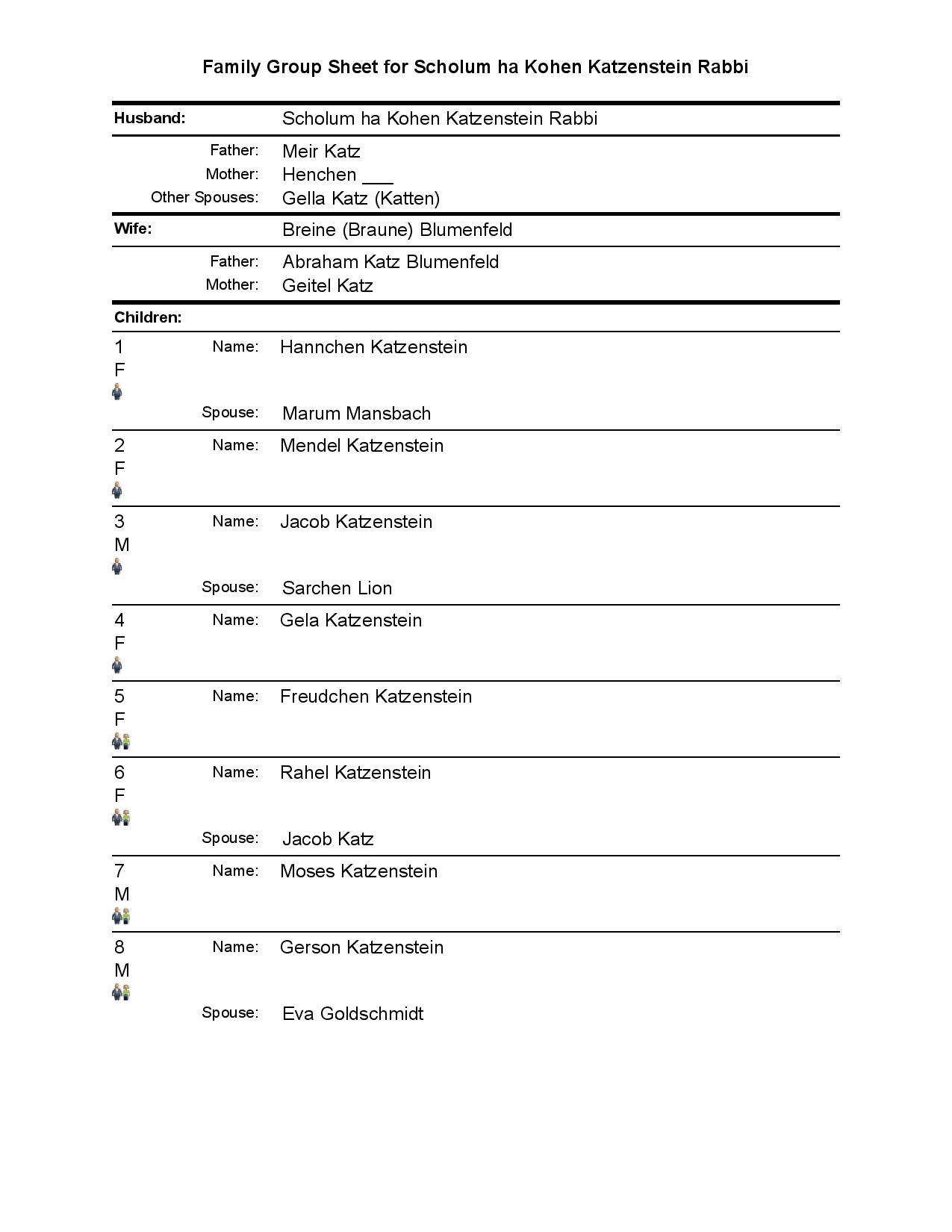
What I learned from Barbara Greve’s work was that Gerson was one of the eight children of Scholem Katzenstein; there were four half-siblings born to Scholem’s first wife, Gella: Hannchen (1798-1840), Mendel, who died as an infant in 1799, Jacob (1803-?), and Gela, who also died as an infant in 1808.  Gerson had three full siblings born to his mother, Breine Blumenfeld: Freudchen (1809-1818), Rahel (1813-1861), and Moses, for whom the only record is a birth record dated November 4, 1814.  Perhaps Moses also had died as an infant. Thus, of the eight children of Scholem Katzenstein, the only ones for whom there are records indicating survival to adulthood are Gerson, Hannchen, Jacob, and Rahel.

family-group-sheet-for-scholum-ha-kohen-katzenstein-rabbi-page-001


Gerson’s birth is recorded as somewhere between 1811 and 1815, depending on the source.  He married Eva Goldschmidt of Oberlistingen sometime before 1848, when their first child, Scholem, was born in Jesberg.  Two more children followed, Jacob in 1851 and Brendina (Branche in German—presumably named for Gerson’s mother) in 1853.

Gerson, Eva, and their three children left Germany and arrived in New York City on July 3, 1856.  On the ship manifest, Gerson listed his occupation as a butcher and their final destination as Philadelphia.

Gerson Katzenstein and family on 1856 ship manifest Year: 1856; Arrival: New York, New York; Microfilm Serial: M237, 1820-1897; Microfilm Roll: Roll 164; Line: 1; List Number: 589

Gerson Katzenstein and family on 1856 ship manifest
Year: 1856; Arrival: New York, New York; Microfilm Serial: M237, 1820-1897; Microfilm Roll: Roll 164; Line: 1; List Number: 589

Just a little over a month later, Eva gave birth to their fourth child, Perry, who was born in Philadelphia on August 19, 1856.  Eva had obviously been far into her pregnancy when they left Germany. Why did they leave then? Why did they go to Philadelphia? Was there another family member there? Had any of Gerson’s siblings preceded them? Or a cousin?[i] Did his wife Eva have family there?

I knew that Eva Goldschmidt had relatives already in the US.  Her uncle Simon Goldschmidt had arrived in 1845 with his wife Fradchen Schoenthal, who was the aunt of Eva’s future son-in-law, Isidore Schoenthal, my great-grandfather.  They were living in Pittsburgh in 1850.  In 1860, Simon, at that point a widower, was living with his son Jacob in Washington, Pennsylvania. But no one from the Goldschmidt family was living in Philadelphia in 1856 when Gerson and Eva and their family arrived, at least as far as I can tell.

I decided to look more closely at Gerson’s siblings to see whether they or their children had emigrated.  According to the work done by Barbara Greve and David Baron, Gerson’s half-brother Jacob married Sarchen Lion in 1829 in Jesberg, and they had nine children: Gelle (1829), presumably named for Jacob’s deceased mother, Michaele (1832), Schalum (1834); Rebecca (1826), Johanna (1838), Pauline (1841), Baruch (1844), Meier (1849), and Levi (1851).  From the Greve/Baron research, it appears that neither Jacob nor any of these children left Germany.

As for Gerson’s sister, Rahel, she married Jacob Katz, and they had six children: Blumchen (1838), Moses (1839), Meier (1842), Abraham (1852), Samuel (1853), and Sanchen (1854). Of these six children, only Abraham and Samuel emigrated from Germany.  According to the 1900 census, Abraham immigrated to the United States in 1872, many years after Gerson’s departure from Jesberg; he lived in Kentucky for many years.

Abraham J Katz and family 1900 US census Year: 1900; Census Place: Louisville Ward 5, Jefferson, Kentucky; Roll: 530; Page: 3A; Enumeration District: 0053; FHL microfilm: 1240530

Abraham J Katz and family 1900 US census, line 39
Year: 1900; Census Place: Louisville Ward 5, Jefferson, Kentucky; Roll: 530; Page: 3A; Enumeration District: 0053; FHL microfilm: 1240530

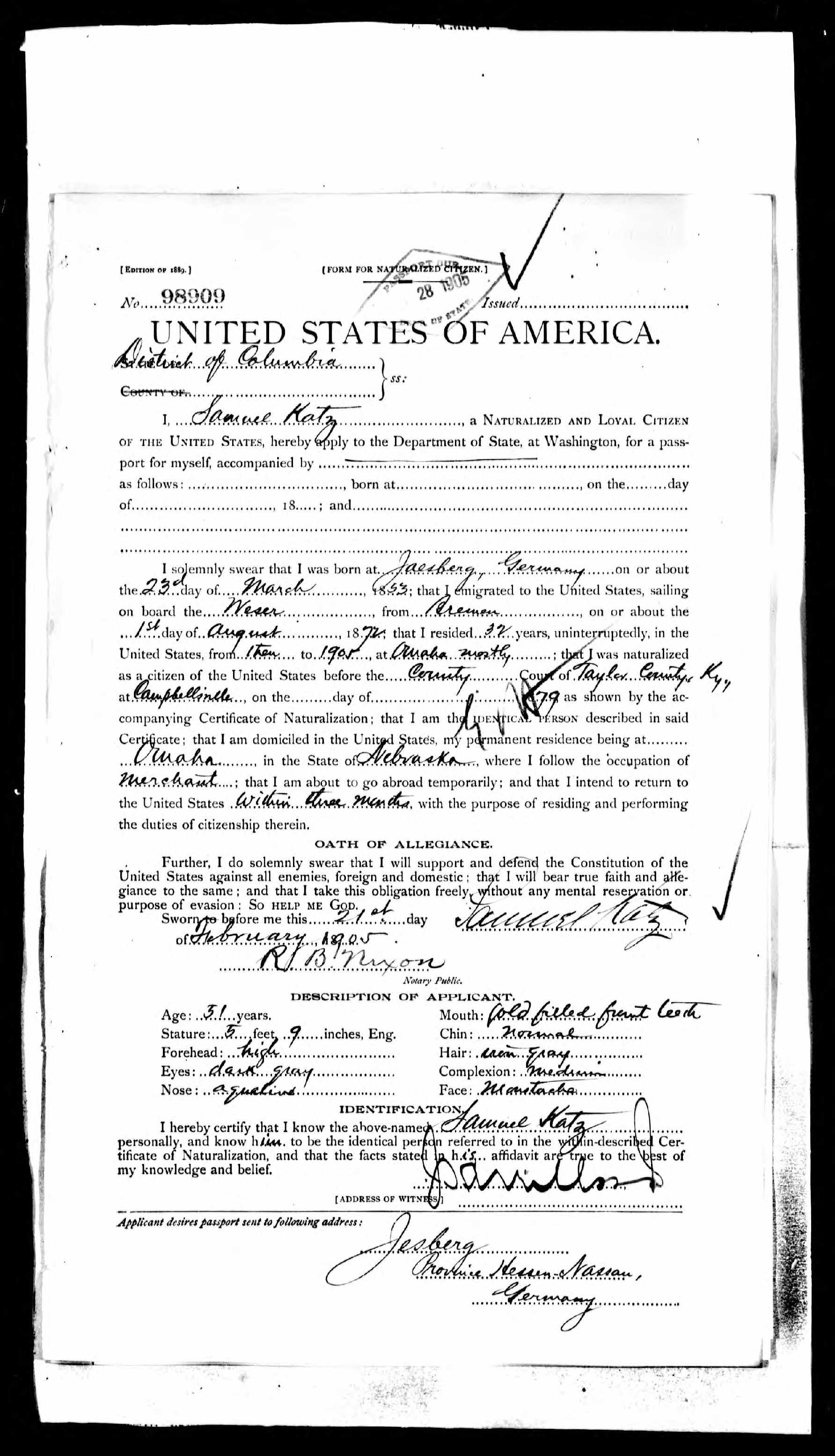
Samuel also emigrated in 1872, and also lived in Kentucky before moving and settling in Omaha, Nebraska. Rahel’s other four children did not leave Germany, although some of the next generation did. Both Samuel and Abraham thus arrived in the United States long after their uncle Gerson had emigrated in 1856, and they settled far from Philadelphia where their uncle was living.

Samuel Katz 1905 passport application National Archives and Records Administration (NARA); Washington D.C.; NARA Series: Passport Applications, 1795-1905; Roll #: 669; Volume #: Roll 669 - 01 Feb 1905-28 Feb 1905

Samuel Katz 1905 passport application
National Archives and Records Administration (NARA); Washington D.C.; NARA Series: Passport Applications, 1795-1905; Roll #: 669; Volume #: Roll 669 – 01 Feb 1905-28 Feb 1905


The remaining sibling who survived to adulthood was Gerson’s half-sister, Hannchen. She married Marum Mansbach, who was from Maden, Germany, which is where Hannchen and Marum lived after marrying.  They had three children born in Maden: Gelle (later Henrietta) (b. 1833), Abraham (b. 1835), and Hendel (later Harry) (b. 1840).  Hannchen died the day Harry was born, so Marum was left with three young children including a newborn to raise on his own. These children and their father ended up in the US, but when had they emigrated? Were they the ones who led the way for Gerson, Eva, and their children in 1856?

I went back to look at the documents relating to Gerson that I’d collected years back, and I started with the ship manifest pictured above.  This time I noticed something I’d not seen before.  Right below the family of Gerson Katzenstein were the names of two more people: Heinemann Mansbach, a sixteen year old male who was a peddler and headed for “Libanon,” and Malchen Mansbach, a sixteen year old female headed to Baltimore.  Both were from Maden, Germany.

Ship manifest close up Year: 1856; Arrival: New York, New York; Microfilm Serial: M237, 1820-1897; Microfilm Roll: Roll 164; Line: 1; List Number: 589

Ship manifest close up
Year: 1856; Arrival: New York, New York; Microfilm Serial: M237, 1820-1897; Microfilm Roll: Roll 164; Line: 1; List Number: 589

I hadn’t seen any connection to the Katzensteins originally since the two Mansbachs were from Maden, not Jesberg, and because they were headed to different cities, not Philadelphia.  Plus I had no reason to see any connection to anyone named Mansbach.  But now, thanks to the Greve/Baron work, I knew that Gerson had a niece and nephew from Maden with the surname Mansbach.  Could Heinemann Mansbach be the person known later as Harry Mansbach? Could Malchen Mansbach be Henrietta, his older sister? She would have been 23 in 1856, not 16, but perhaps she, like so many others, had lied about her age.  Or could this be an entirely different Mansbach not even related to Gerson Katzenstein?

And was there anyone from the Mansbach family already in the US, and if so, where? Why was Malchen going to Baltimore and Heinemann to “Libanon”? And where is “Libanon”?  There is a Lebanon, Pennsylvania about 90 miles west of Philadelphia, so perhaps that is where Heinemann was headed.  But why? A search of the 1860 census for Lebanon, PA, for those born in Germany did not uncover anyone who appears to have been connected to the Mansbach/Katzenstein family.

Map of Pennsylvania highlighting Lebanon County

Map of Pennsylvania highlighting Lebanon County (Photo credit: Wikipedia)

Then I wondered about Hannchen Katzenstein and Marum Mansbach’s older son Abraham. Where was he when his brother was apparently sailing with their uncle Gerson? I searched for him and found an Abraham Mansbach on an 1852 ship manifest; no age was given, but he was a merchant from Hesse. The ship arrived in Baltimore on December 14, 1852. Gerson’s nephew Abraham Mansbach would have been seventeen in 1852.  This could have been him.

abraham-mansbach-1852-passenger-list

Abraham Mansbach on 1852 passenger list “Maryland, Baltimore Passenger Lists, 1820-1948,” database with images, FamilySearch (https://familysearch.org/pal:/MM9.3.1/TH-1961-32011-12875-22?cc=2018318 : 25 September 2015), 1820-1891 (NARA M255, M596) > 9 – Jun 2, 1852-Aug 29, 1853 > image 503 of 890; citing NARA microfilm publications M255, M596 and T844 (Washington, D.C.: National Archives and Records Administration, n.d.).

abraham-mansbach-1852-immigration-card

Abraham Mansbach 1852 immigration card “Maryland, Baltimore Passenger Lists Index, 1820-1897,” database with images, FamilySearch (https://familysearch.org/pal:/MM9.3.1/TH-1942-37337-15431-34?cc=2173933 : 17 June 2014), NARA M327, Roll 98, No. M462-M524, 1820-1897 > image 2545 of 3335; citing NARA microfilm publication M327 (Washington, D.C.: National Archives and Records Administration, n.d.).


So perhaps Abraham Mansbach, Gerson’s nephew, was the first of the Katzenstein clan to come to the US.  I don’t know whether he stayed in Baltimore or not, but by 1860, it appears that he was living in Philadelphia with his uncle Gerson and the other members of the Katzenstein family:

Gerson Katzenstein and family 1860 US census Year: 1860; Census Place: Philadelphia Ward 13, Philadelphia, Pennsylvania; Roll: M653_1163; Page: 519; Image: 105; Family History Library Film: 805163

Gerson Katzenstein and family 1860 US census
Year: 1860; Census Place: Philadelphia Ward 13, Philadelphia, Pennsylvania; Roll: M653_1163; Page: 519; Image: 105; Family History Library Film: 805163


Gerson was working as a salesman and had a personal estate worth $400.  He and Eva had had a fifth child, Hannah, who was a year old.  Their oldest child Scholem was now using the name Joe and was twelve years old; Jacob was nine, Brendina was six, and Perry was three.

Gerson Katzenstein in the 1859 Philadelphia directory

Gerson Katzenstein in the 1859 Philadelphia directory

Living with them were a seventeen year old clerk named Benjamin Levi and a 24 year old bookkeeper named David Frank.  In addition, there was a 25 year old salesman named Abraham Anspach; this could have been Abraham Mansbach, Gerson’s nephew.  Finally, there was a twenty year old domestic named “Marley Manspach;” perhaps this was the same person as the Malchen Mansbach who was listed on the ship manifest.

Closeup of Katzensteins and Mansbachs on 1860 census

Closeup of Katzensteins and Mansbachs on 1860 census

But was Malchen/Marley really the daughter named Henrietta who would have been 29 in 1860, not 20? And where was Heinemann/Harry living if not with his brother and uncle? It’s too bad that the 1860 census did not include information about the relationships among those living in a household.  That might have cleared some of this up.

But what did seem clear was that by 1860 my Katzenstein great-great-grandparents and the first four of their children were living in Philadelphia.  It also seemed likely that at least two of the children of Gerson’s half-sister Hannchen and her husband Marum Mansbach had also arrived in the United States by then.

But many questions remained.  Fortunately, David Baron helped me find some answers.

**************************

I admit that it’s been hard for me to get back into genealogy right now, but I am trying to find ways to deal with all my anger and grief, and while I look for ways of fighting back against Trumpism, I also am trying to find ways of clearing my head.  Genealogy has done that for me before, and I am hoping it will help me now. This post was written before the election, and now I am trying to work on the next one.


[i] I also went through the rest of the family report prepared by David Baron to see if any of the more distant Katzenstein or Katz relatives had arrived in the US before 1856.  There were none who arrived that early, although there were a few who were in the US by the 1890s and more who came after Hitler came to power.

The Screenwriter and the Real Estate Mogul

This is the story of two boys who lost their mother before they were even four years old and who, despite that tragedy, grew up to be very successful.

As I wrote here, my cousin Hattie Baer died at age 33 in 1910.  Hattie and her husband Meyer Herman had had two sons, Justin Baer Herman and Richard B. Herman; Justin was three when his mother died, and Richard was just a few months old.  Five years later in 1915, Hattie’s sister Amanda married her brother-in-law Meyer when those boys were still only eight and five years old, respectively.

Meyer was in the clothing business.  In fact, according to one cemetery record, he worked for the Snellenburg Clothing Company, a clothing manufacturing company and a department store in Philadelphia.

Meyer Herman and Hattie and Amanda burial

Historical Society of Pennsylvania; Philadelphia, Pennsylvania; Collection Name: Historic Pennsylvania Church and Town Records

In one of those “small world moments,” I realized that Meyer Herman was working for a company that was owned by the family of another of my relatives: Carrie Snellenburg, who married my great-great-uncle Joseph Cohen, my great-grandfather Emanuel Cohen’s older brother.  The twisted family tree creaks one more time.

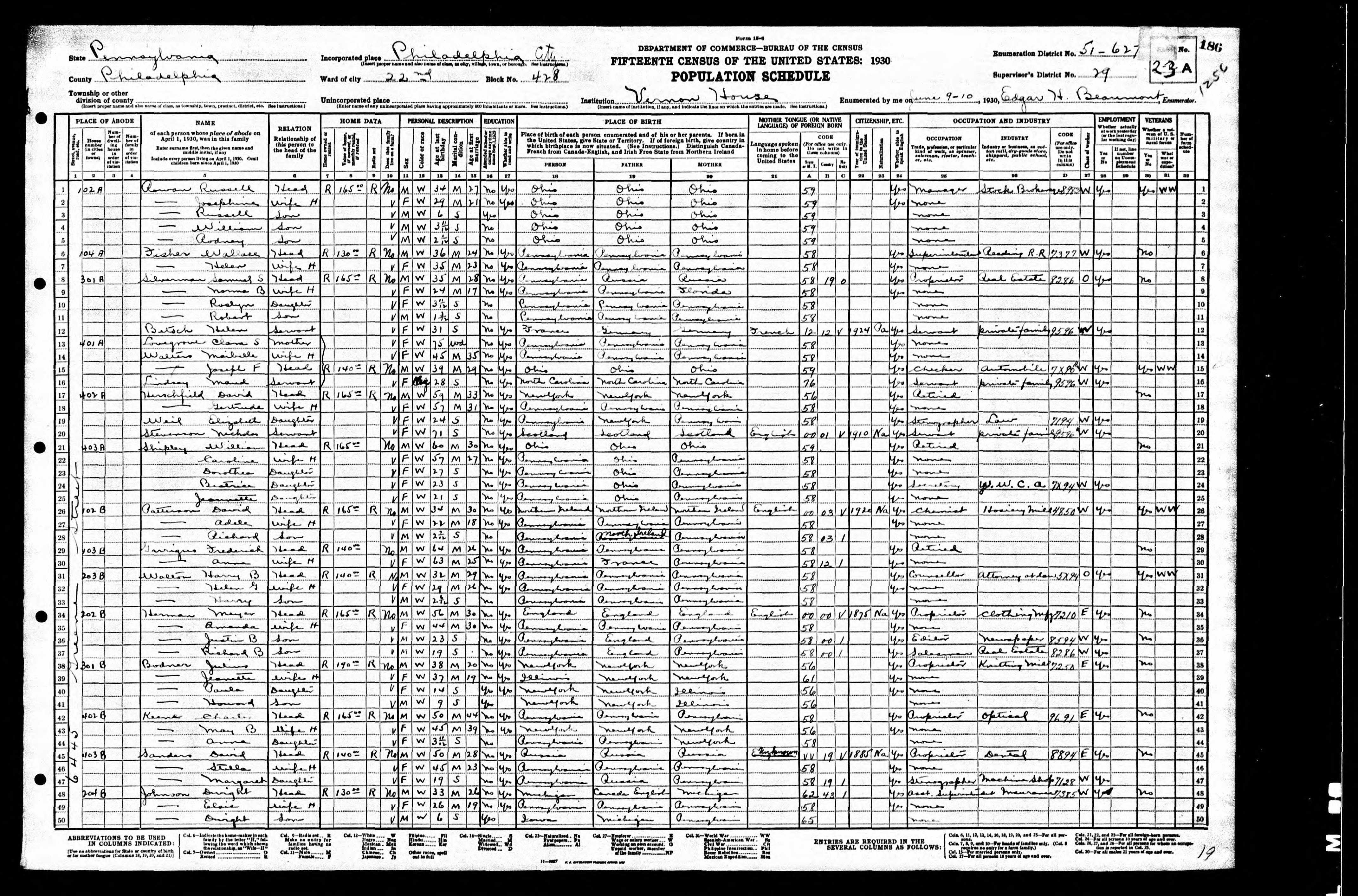
By 1930 both of the sons of Meyer Herman and Hattie Baer (nephews and stepsons of Amanda Baer) were working, Justin as a newspaper editor, Richard as a real estate salesman.  Meyer, Amanda, Justin, and Richard were all still living together in Philadelphia.  Justin was 23, Richard 19 at the time of the 1930 census.

Meyer and Amanda Herman and sons 1930 census Year: 1930; Census Place: Philadelphia, Philadelphia, Pennsylvania; Roll: 2104; Page: 23A; Enumeration District: 0627; Image: 902.0; FHL microfilm: 2341838

Meyer and Amanda Herman and sons 1930 census
Year: 1930; Census Place: Philadelphia, Philadelphia, Pennsylvania; Roll: 2104; Page: 23A; Enumeration District: 0627; Image: 902.0; FHL microfilm: 2341838

Ten years later Meyer and Amanda were still living in Philadelphia, and Meyer was still working as a clothing salesman.  He was 69 years old, Amanda was 58.  Justin and Richard were no longer living with them.  Both had already established themselves in their chosen careers.

After graduating from the Pennsylvania Academy of Fine Art, Justin had become a successful writer, cartoonist, and screenwriter. He wrote for The Philadelphia Record as a reporter and also established a magazine, The Town Crier, during the early 1930s.  He then moved to New York by 1935, where he was a contributor of poems, short stories, and cartoons to The New Yorker magazine.  During that decade he also starting writing screenplays for short films.  Between 1934 and 1940, he wrote nineteen screenplays for short films, working for Paramount Pictures.  “Justin B. Herman Dead at 76; Writer and Producer of Films,” The New York Times, December 10, 1983.    As of 1940, he was single and still living in New York City.

Pennsylvania Academy of the Fine Arts, 118-124...

Pennsylvania Academy of the Fine Arts, 118-124 North Broad Street, Philadelphia, PA 19102, built 1872-75, Frank Furness, architect, William A. Armstrong, builder, National Historic Landmark, 1975. Museum of the Pennsylvania Academy, the oldest art institution in the United States. (Photo credit: Wikipedia)

Meanwhile, his younger brother Richard was also doing quite well during the 1930s.  According to his obituary, Richard “got an early start in the business. He convinced his family and teachers that he was bright, and in elementary school, he was permitted to skip two grades. He entered high school when he was 12, and at 17 was working in real estate for the Lionel Friedman Co. In 1933, at age 23, he founded his own real estate firm. Concentrating on major properties, he built Richard B. Herman & Co. into one of the largest real estate firms in Philadelphia. His forte was real estate investment and management.”  “RICHARD B. HERMAN, 71, REAL ESTATE, CIVIC LEADER,” The Philadelphia Inquirer, June 27, 1982, GenealogyBank.com (http://www.genealogybank.com/doc/obituaries/obit/0FBAE8CA0B3A0215-0FBAE8CA0B3A0215 : accessed 5 July 2016).

As of the 1940 census, Richard had married Marion Cohn, and they were living in Philadelphia.  Their son was born later that year.

On August 25, 1941, Meyer Herman died from coronary thrombosis at age 70.  He had survived the loss of his first wife, Hattie Baer, at a very young age and raised two very young sons in the aftermath of her death before marrying Hattie’s sister Amanda five years later.  He must have been very proud of those two sons.

Meyer Herman death certificate Ancestry.com. Pennsylvania, Death Certificates, 1906-1963 [database on-line]. Provo, UT, USA: Ancestry.com Operations, Inc., 2014. Original data: Pennsylvania (State). Death certificates, 1906–1963. Series 11.90 (1,905 cartons). Records of the Pennsylvania Department of Health, Record Group 11. Pennsylvania Historical and Museum Commission, Harrisburg, Pennsylvania.

Meyer Herman death certificate
Ancestry.com. Pennsylvania, Death Certificates, 1906-1963 [database on-line]. Provo, UT, USA: Ancestry.com Operations, Inc., 2014.
Original data: Pennsylvania (State). Death certificates, 1906–1963. Series 11.90 (1,905 cartons). Records of the Pennsylvania Department of Health, Record Group 11. Pennsylvania Historical and Museum Commission, Harrisburg, Pennsylvania.

During the 1940s Justin Baer Herman married Alma Baer (as far as I can tell, the fact that her surname was Baer was coincidental; she does not appear to have been related to Jacob Baer’s family).  They would have two daughters.  Justin continued to be a successful screenwriter for Paramount.  Two of the films he wrote were nominated for Academy Awards in the category of Best Short Subject.  According to the Imdb database, he was credited as the writer on 61 films between 1934 and 1955 and as director on 49 of those films, producer on forty.  His obituary claimed even higher numbers: “Mr. Herman produced 118 short subjects in 35 years of film making. Three of them were nominated for Academy Awards – ”Life Line to Hong Kong,” ”Roller Derby” and ”Three Kisses.” “Justin B. Herman Dead at 76; Writer and Producer of Films,” The New York Times, December 10, 1983.

Richard also continued to have success in his career.  His obituary reports that:

One of the original developers of Penn Center, he played a major role in the revitalization of Center City. He helped build, and his firm operated, many of the buildings added to the city’s skyline since 1950. …  Working in Penn Center, he was responsible for much of its growth through such transactions as the sale for Penn Central of the 16th and Market Street sites on which stand such buildings as the Central Penn National Building.   He was also responsible for the sale of the Suburban Station Building to the late Matthew H. McCloskey Jr., and the construction of the IBM Building.  When major buildings were placed on the market, he usually was involved – he handled the sale of the Curtis Building, for example. [As of 1971, his company]  was responsible for the operation and leasing of more than 30 major office buildings containing 4.5 million square feet of space.

In fact, Richard’s real estate development firm was responsible for building the huge apartment building, The Philadelphian, where my aunt Eva Cohen lived for many years.

"Philadelphia to Have Largest Apartment, Camden Courier Post, Saturday, May 6, 1961, p. 2

“Philadelphia to Have Largest Apartment, Camden Courier Post, Saturday, May 6, 1961, p. 2

The Philadelphian

The Philadelphian

Unfortunately, Richard suffered a tragedy in his personal life.  On February 28, 1953, his nine year old daughter Barbara died from acute cardiac dilatation.

Barbara Herman death certificate Ancestry.com. Pennsylvania, Death Certificates, 1906-1963 [database on-line]. Provo, UT, USA: Ancestry.com Operations, Inc., 2014. Original data: Pennsylvania (State). Death certificates, 1906–1963. Series 11.90 (1,905 cartons). Records of the Pennsylvania Department of Health, Record Group 11. Pennsylvania Historical and Museum Commission, Harrisburg, Pennsylvania.

Barbara Herman death certificate
Ancestry.com. Pennsylvania, Death Certificates, 1906-1963 [database on-line]. Provo, UT, USA: Ancestry.com Operations, Inc., 2014.
Original data: Pennsylvania (State). Death certificates, 1906–1963. Series 11.90 (1,905 cartons). Records of the Pennsylvania Department of Health, Record Group 11. Pennsylvania Historical and Museum Commission, Harrisburg, Pennsylvania.

 UPDATE: Luanne, a fellow genealogy blogger, asked what I knew about Barbara’s cause of death, so I asked my brother/medical consultant.   He said, “something like viral myocarditis that resulted in cardiogenic shock…would be the most likely diagnosis in a 9 year old.  Acute cardiac dilatation isn’t really a diagnosis, it’s a finding or a descriptive term.[It means an acutely enlarged heart.] Rapid onset cardiogenic shock can also be caused by an MI, valve dysfunction, wall rupture and dysrhythmias, but these would be pretty unusual in a 9 year old. It is also possible she had septic shock which, in the end, caused her heart to dilate (enlarge) and fail.”  For those (like me) who need a definition of cardiogenic shock, MedlinePlus says, “Cardiogenic shock is when the heart has been damaged so much that it is unable to supply enough blood to the organs of the body.”

Justin and Richard’s aunt and stepmother Amanda Baer died on July 28, 1969; she was 89 years old.  She was buried in Mt Sinai cemetery in the same lot as her husband, Meyer Herman, and her sister, Hattie Baer, Meyer’s first wife. Meyer was buried between his two wives, the two Baer sisters.

Meyer Herman and Hattie and Amanda burial

Mt Sinai cemetery record of burials of Amanda Baer Herman, Meyer Herman, and Hattie Baer Herman

Like Meyer, Amanda must have been very proud of her two nephews, Justin and Richard, whom she had helped raise perhaps even before she had married their father in 1915.

Richard Herman died on June 25, 1982.  He was only 72 years old.  I have already quoted extensively from his Philadelphia Inquirer obituary, but want to add these additional insights into who he was beyond a highly successful real estate developer:

He was involved in a wide range of activities. … He was vice president and a member of the board of the Medical College of Pennsylvania, a member of the board of trustees of the Eastern Pennsylvania Psychiatric Institute, a former chairman of the Easter Seal drive, and served on the board of the Athenaeum of Philadelphia. 

Mr. Herman was a member of the prestigious Committee of 70, and a director of the Philadelphia Museum School of Art and the Franklin Institute. He was former chairman of the nonsectarian National Jewish Hospital in Denver and of divisions of United Fund and United Way drives.   He was active in the Rittenhouse Astronomical Society, the Pennsylvania Historical Society, and the Philadelphia Art Alliance.

Mr. Herman was the only man to head both the Society of American Magicians and the International Brotherhood of Magicians simultaneously.

He was a member of the Citizens Council on City Planning and the Germantown Historical Society.

He was a man with an endless curiosity and an I.Q. high enough to make him eligible for membership in Mensa, an organization for the very intelligent. He taught himself art, sculpture and music. He learned to play the organ on his own. He had his own observatory.

His art was displayed in his home and his office, accompanying his collections of such things as pipes. He also collected instruments related to astrology and medicine, children’s toys and signs.

Richard B. Herman ad

His brother Justin died just one year later on December 3, 1983.  He was 76 years old and died of emphysema.  “Justin B. Herman Dead at 76; Writer and Producer of Films,” The New York Times, December 10, 1983.

These two men who lost their mother before either was four years old certainly left their mark in their respective fields, one an Oscar nominated screenwriter, the other a highly successful real estate developer and civic leader.

The Family of Amalia Hamberg Baer, the Administratrix

Back in May, I wrote about the sad saga of Charles Hamberg and his son Samuel Hamberg.  Charles, my great-grandfather Isidore Schoenthal’s first cousin, had lost two wives—one was murdered, one died quite young.  He had then committed suicide, leaving his nine year old son Samuel an orphan.  Charles’ estate was administered by another cousin, Amalia Hamberg Baer, who at the time was living in western Pennsylvania where my great-grandfather and many other Hamberg relatives were then living.

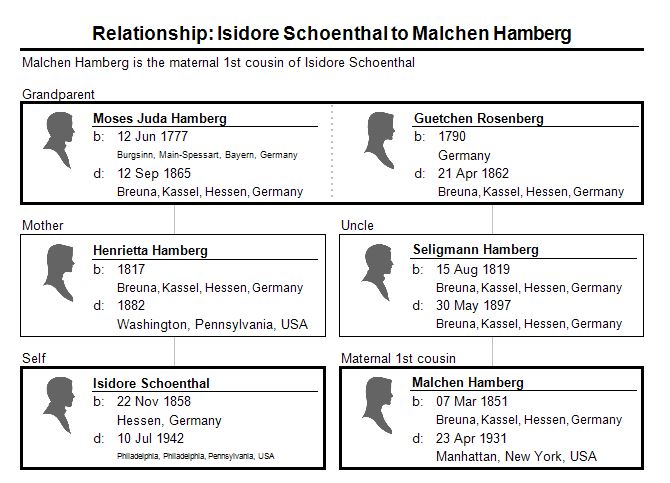
In fact, Amalia (born Malchen) was a first cousin to Isidore Schoenthal, my great-grandfather:

corrected relationship isidore schoenthal to malchen hamberg


She had come to the US from Breuna, Germany, in 1871, and had married Jacob Baer in 1873, according to the 1900 census. (For more on how I linked Amalia Hamberg to Jacob Baer, see my earlier post.)  Jacob was born in the Rhein Pfalz[1] region of Germany in about 1851 and had immigrated to the US in 1867, according to several census records.  From entries in the Pittsburgh city directories, he appears to have settled in the Pittsburgh area.

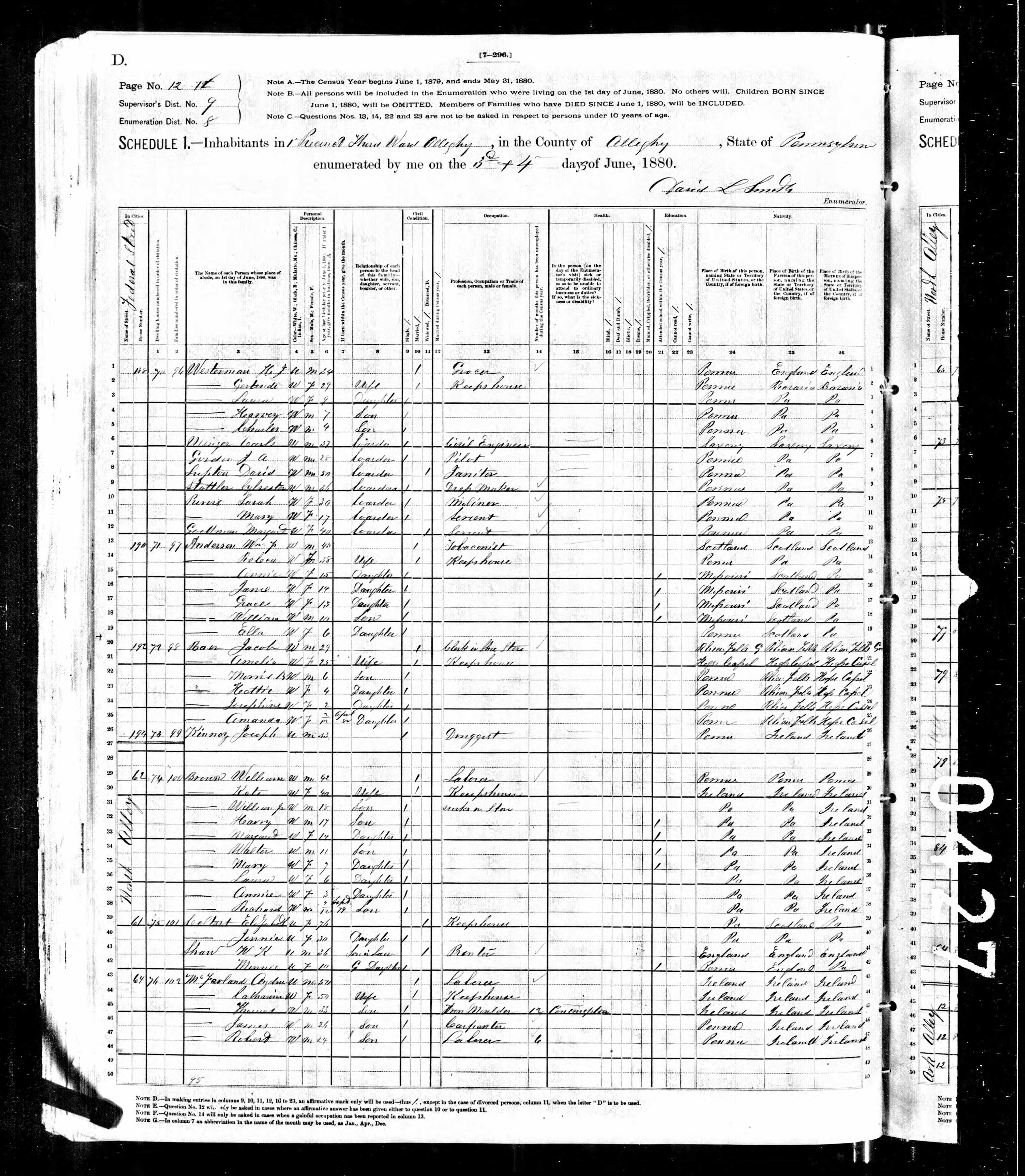
In 1880, Jacob and Amalia were living in Allegheny, Pennsylvania (now part of Pittsburgh), and Jacob was working as a clerk in a shoe store.  They already had four children: Maurice Jay (1874), Hattie (1876), Josephine (1878), Amanda (1880).

Jacob and Amalia Hamberg Baer 1880 US census Year: 1880; Census Place: Allegheny, Allegheny, Pennsylvania; Roll: 1086; Family History Film: 1255086; Page: 198D; Enumeration District: 008; Image: 0402

Jacob and Amalia Hamberg Baer 1880 US census
Year: 1880; Census Place: Allegheny, Allegheny, Pennsylvania; Roll: 1086; Family History Film: 1255086; Page: 198D; Enumeration District: 008; Image: 0402


Between 1880 and 1891, they would have five more children: Flora (1882), Tilda (1884), Elsie Victoria (1886), Alfred (1889), and Lawrence (1891). (The birth years for the daughters as reported in various records are all over the place as they kept making themselves younger as the years went on, so I am relying on the 1880 and 1900 census records when they were still probably young enough not to lie about their ages.)  During those years, Jacob was listed as a salesman in the Pittsburgh city directories.

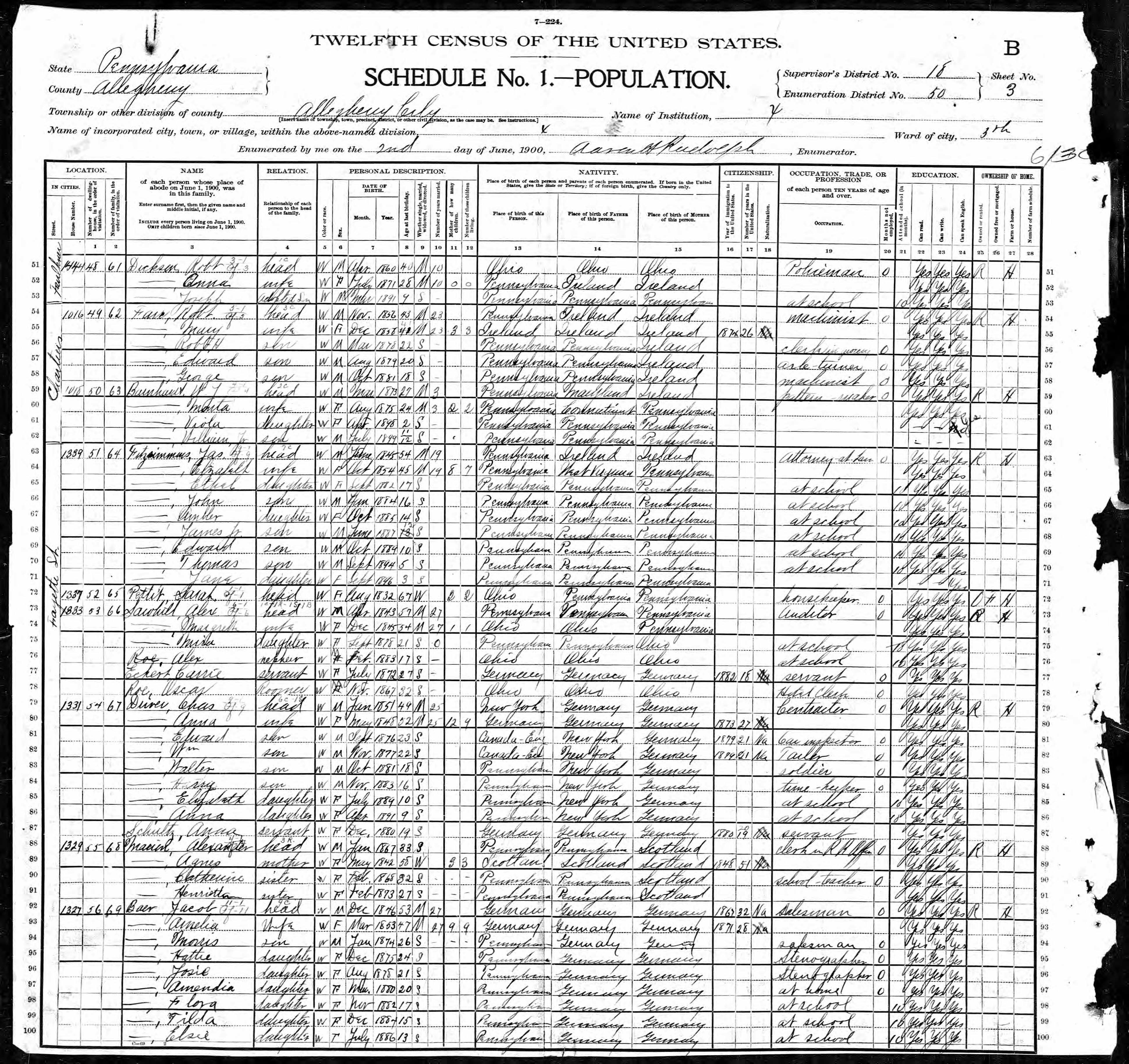
In 1900, Jacob and Amalia were still living in Allegheny with all nine of their children.  Jacob continued to work as a salesman, as did their son Maurice (Morris here, now 26).  Hattie (24) and Josephine (Josie here, now 21) were working as stenographers.  The rest of the children were not employed.

Amalia Baer 1900 census p 1

Jacob and Amalia Hamberg Baer 1900 census Year: 1900; Census Place: Allegheny Ward 5, Allegheny, Pennsylvania; Roll: 1356; Enumeration District: 0050; FHL microfilm: 1241356

Jacob and Amalia Hamberg Baer 1900 census
Year: 1900; Census Place: Allegheny Ward 5, Allegheny, Pennsylvania; Roll: 1356; Enumeration District: 0050; FHL microfilm: 1241356


In the next decade many of the children began to move on to their own lives.  In fact, even before 1900, Maurice, the oldest child, had ventured quite far from Pittsburgh.  As I will write about in a post to follow this one, Maurice moved to Attleboro, Massachusetts,[2] and established a very successful jewelry business in which four of the siblings’ families would be involved, that is, Maurice, Tilda, Elsie, and Lawrence.  This post will focus on the other five siblings—Hattie, Josephine, Flora, Amanda, and Alfred—and their parents, Amalia and Jacob.

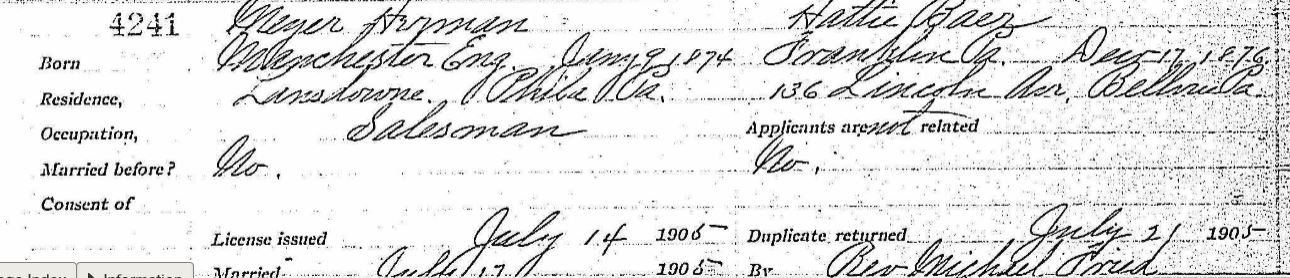
On July 17, 1905, Hattie Baer, the second child who was then 29, married Meyer Herman, a clothing salesman living in Philadelphia who was born in Manchester, England.

Marriage record of Hattie Baer and Meyer Herman Pennsylvania, County Marriages, 1885-1950," database with images, FamilySearch (https://familysearch.org/pal:/MM9.3.1/TH-1951-21130-27078-9?cc=1589502 : accessed 12 May 2016), 004264779 > image 383 of 454; county courthouses, Pennsylvania.

Marriage record of Hattie Baer and Meyer Herman
Pennsylvania, County Marriages, 1885-1950,” database with images, FamilySearch (https://familysearch.org/pal:/MM9.3.1/TH-1951-21130-27078-9?cc=1589502 : accessed 12 May 2016), 004264779 > image 383 of 454; county courthouses, Pennsylvania.

They settled in Philadelphia, where they had two sons, Justin Baer Herman, born in April, 1907, and Richard B. Herman, born in July, 1910.  Then tragically, Hattie died on October 15, 1910, of a perforated bowel and peritonitis.  She was only 33 years old when she died, and she left behind a three year old toddler and a two and a half month old infant son.

Hattie Baer Herman death certificate Ancestry.com. Pennsylvania, Death Certificates, 1906-1963 [database on-line]. Provo, UT, USA: Ancestry.com Operations, Inc., 2014. Original data: Pennsylvania (State). Death certificates, 1906–1963. Series 11.90 (1,905 cartons). Records of the Pennsylvania Department of Health, Record Group 11. Pennsylvania Historical and Museum Commission, Harrisburg, Pennsylvania.

Hattie Baer Herman death certificate
Ancestry.com. Pennsylvania, Death Certificates, 1906-1963 [database on-line]. Provo, UT, USA: Ancestry.com Operations, Inc., 2014.
Original data: Pennsylvania (State). Death certificates, 1906–1963. Series 11.90 (1,905 cartons). Records of the Pennsylvania Department of Health, Record Group 11. Pennsylvania Historical and Museum Commission, Harrisburg, Pennsylvania.

Five years later in 1915, Hattie’s younger sister Amanda married her brother-in-law Meyer Herman in Philadelphia and took on the responsibility for raising her two nephews, Justin and Richard, then just eight and five years old.  In 1920, Meyer was still a clothing salesman, and the family continued to live in Philadelphia.

Meyer and Amanda Baer Herman 1920 census Year: 1920; Census Place: Philadelphia Ward 22, Philadelphia, Pennsylvania; Roll: T625_1623; Page: 8A; Enumeration District: 591; Image: 961

Meyer and Amanda Baer Herman 1920 census
Year: 1920; Census Place: Philadelphia Ward 22, Philadelphia, Pennsylvania; Roll: T625_1623; Page: 8A; Enumeration District: 591; Image: 961

Ten years later in 1930, Meyer had moved from being a salesman to being the owner of a clothing manufacturing business.  The two sons were also working; Justin, now 23, was a newspaper editor, and Richard, now 19, was selling real estate.  Both were still living at home with Meyer and Amanda in Philadelphia.

Herman and Amanda Baer Herman 1930 census Year: 1930; Census Place: Philadelphia, Philadelphia, Pennsylvania; Roll: 2104; Page: 23A; Enumeration District: 0627; Image: 902.0; FHL microfilm: 2341838

Herman and Amanda Baer Herman 1930 census
Year: 1930; Census Place: Philadelphia, Philadelphia, Pennsylvania; Roll: 2104; Page: 23A; Enumeration District: 0627; Image: 902.0; FHL microfilm: 2341838

Meanwhile, the third child of Amalia and Jacob Baer, Josephine, had married Morris Alon Green on January 2, 1906.  Morris was a Pittsburgh native, born there on February 17, 1875, the son of Abraham Green, an immigrant from Holland, and Jeanette Bloomberg, born in Germany.  In 1900, Morris was living with his parents in Pittsburgh and working as a bookkeeper.

Marriage record of Morris Green and Josephine Baer Pennsylvania, County Marriages, 1885-1950," database with images, FamilySearch (https://familysearch.org/pal:/MM9.3.1/TH-1942-20622-18713-16?cc=1589502 : accessed 10 June 2016), 004811570 > image 334 of 449; county courthouses, Pennsylvania.

Marriage record of Morris Green and Josephine Baer
Pennsylvania, County Marriages, 1885-1950,” database with images, FamilySearch (https://familysearch.org/pal:/MM9.3.1/TH-1942-20622-18713-16?cc=1589502 : accessed 10 June 2016), 004811570 > image 334 of 449; county courthouses, Pennsylvania.

Josephine and Morris settled in Pittsburgh where their son Alan Baer Green was born on October 30, 1906.  In 1910, the Greens were living in Pittsburgh as boarders in the household of another family, and Morris was working as a claims agent.

Morris and Josephine Baer Green on 1910 census Year: 1910; Census Place: Pittsburgh Ward 8, Allegheny, Pennsylvania; Roll: T624_1301; Page: 2A; Enumeration District: 0379; FHL microfilm: 1375314

Morris and Josephine Baer Green on 1910 census
Year: 1910; Census Place: Pittsburgh Ward 8, Allegheny, Pennsylvania; Roll: T624_1301; Page: 2A; Enumeration District: 0379; FHL microfilm: 1375314

The next several years must have been successful ones for Morris because by 1918, he was the general agent and executive of the Crucible Steel Company and by 1920 he and Josephine and their son Alan were living in their own (rented) home with a nurse and servant residing with them.

Morris A Green, World War I draft registration Registration State: Pennsylvania; Registration County: Allegheny; Roll: 1909239; Draft Board: 11

Morris A Green, World War I draft registration
Registration State: Pennsylvania; Registration County: Allegheny; Roll: 1909239; Draft Board: 11

By 1925, Josephine and Morris had left western Pennsylvania for New York City, where they were living at the Hotel Alexander at 150 West 103rd Street.  Their son Alan is not listed as living with them; perhaps he was away at college as he would have been nineteen at that time.  In 1930, Alan was living with his parents in Manhattan, working in advertising.  His father Morris listed his occupation/industry as “financial.”

Morris and Josephine Baer Green and Alan Baer Green, 1930 census Year: 1930; Census Place: Manhattan, New York, New York; Roll: 1556; Page: 19A; Enumeration District: 0443; Image: 762.0; FHL microfilm: 2341291

Morris and Josephine Baer Green and Alan Baer Green, 1930 census
Year: 1930; Census Place: Manhattan, New York, New York; Roll: 1556; Page: 19A; Enumeration District: 0443; Image: 762.0; FHL microfilm: 2341291

The fifth child of Amalia and Jacob was Flora.  In 1907, she is listed in the Pittsburgh city directory as a teacher, residing in Bellevue, a town near Pittsburgh. In 1910, when she was 28 (although listed as 24 on the 1910 census), she was still single and living with her parents and not employed outside the home.

Jacob and Amalia Schoenthal Baer and family 1910 census Year: 1910; Census Place: Pittsburgh Ward 14, Allegheny, Pennsylvania; Roll: T624_1304; Page: 6B; Enumeration District: 0468; FHL microfilm: 1375317

Jacob and Amalia Schoenthal Baer and family 1910 census
Year: 1910; Census Place: Pittsburgh Ward 14, Allegheny, Pennsylvania; Roll: T624_1304; Page: 6B; Enumeration District: 0468; FHL microfilm: 1375317


In 1915, she married Julius Adler.  Julius was the son of Simon Adler, a German immigrant who in 1880 was living in Memphis, Tennessee, working in a shoe store.  Julius’ mother Elizabeth was a native of Missouri; she married Simon in 1881, and they had four children born in Memphis between 1882 and 1887, when their youngest son Julius was born.  By 1900, the family had relocated to Philadelphia.

According to his obituary, Julius graduated from the University of Pennsylvania with a degree in engineering in 1908.  In 1910, he was teaching at the University of Washington in Seattle.  But by 1915 he had returned to Philadelphia, where he married Flora Baer.  In 1917, they were living in Harrisburg, Pennsylvania, where Julius was working as a civil engineer for the state highway department.  They would have three children, Stanley, Jerrold, and Amy, born between 1917 and 1920.

Julius Adler, World War I draft registration Registration State: Pennsylvania; Registration County: Dauphin; Roll: 1893237; Draft Board: 3

Julius Adler, World War I draft registration
Registration State: Pennsylvania; Registration County: Dauphin; Roll: 1893237; Draft Board: 3

In 1920, the family had returned to Philadelphia, where Julius was now employed as a technical engineer for an oil company.  According to his obituary, during the 1920s, Julius was working as the deputy chief of the Philadelphia highway department and was involved in supervising the construction of the Benjamin Franklin Bridge, the bridge that spans the Delaware River connecting Philadelphia to Camden, New Jersey (originally called the Delaware River Bridge).  In 1930, Julius and Flora and their two sons continued to live in Philadelphia, Julius working as a civil engineer.

Benjamin Franklin Bridge linking Camden, NJ wi...

Benjamin Franklin Bridge linking Camden, NJ with Philadelphia, PA – Taken from the 22nd floor of Waterfront Square (Photo credit: Wikipedia)

Alfred, the second youngest child of Amalia and Jacob, was the only other child not involved with the Attleboro jewelry business.  In 1900, he was living with his family in Pittsburgh, but he is not listed with them in 1910, when he would have been 21 years old.  There is an Alfred H. Baer listed in the 1907 Pittsburgh directory, working as a clerk, but I am not sure that that is the same person.  According to his registration for the draft in World War I, Alfred was living in a sanitarium and “mentally incapacitated for work of any kind.”

Alfred Baer ww1 draft reg

Alfred Baer, World War I draft registration Registration State: Pennsylvania; Registration County: Philadelphia; Roll: 1907636; Draft Board: 17

Five years later, at age 34, Alfred died on December 13, 1923.  He was buried where his sister Hattie was buried and where later his parents, his sister Flora, and his brother Maurice would be buried at Mt. Sinai cemetery in Philadelphia. I was unable to locate a death certificate, so I do not know the cause of death.  According to his burial record, he was residing in Stamford, Connecticut, at the time of his death.

Thus, by 1930, Amalia (Hamberg) and Jacob Baer had lost two of their children, Hattie and Alfred. Their other children were doing quite well.  Amanda and Flora had moved to Philadelphia with their husbands and children, and Josephine was living in New York City with her husband and son.  The other four children were also living away from Pittsburgh, as we will see in the next post.

Even Jacob and Amalia had left Pittsburgh by that time.  In fact, sometime between 1918 and 1922, they had moved to Atlantic City.  In 1922, they were listed in the Atlantic City directory, living at The Amsterdam in Atlantic City.  The following year on March 27, 1923, their children honored their parents on the occasion of their 50th wedding anniversary with a dinner at the Esplanade Hotel in New York City.

Jacob and Amalia Baer anniversary party


In 1930 Jacob and Amalia, now 83 and 79 (although the 1930 census says 77), were living at 250 West 103rd Street in New York City, with Jacob listed as the head of household for what appears to be a small hotel; there are 28 guests listed as living with them.  Their daughter Josephine was living not too far away at 666 West End Avenue.

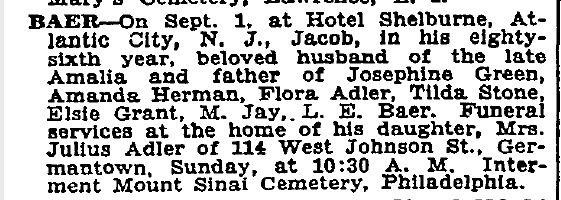
Amalia Baer, born Malchen Hamberg in Breuna, Germany, died on April 23, 1931, in New York City.  She was 80 years old.  She was buried in Mt. Sinai cemetery in Philadelphia where the two children who predeceased her, Hattie and Alfred, were buried.  A year later her husband Jacob died on September 1, 1932.  He was 85 years old, and he was buried with his wife and children in Mt. Sinai cemetery.  His death notice ran in the September 3, 1932 issue of The New York Times:

NY Times, September 3, 1932

NY Times, September 3, 1932

In my next post, I will write about the four children of Amalia and Jacob who were involved in the jewelry business in Attleboro, Massachusetts.  Then in a subsequent post I will report on what later happened to the children and the grandchildren of Jacob and Amalia (Hamberg) Baer.


[1] Thank you to Michael Palmer and Cathy Meder-Dempsey of the German Genealogy group on Facebook for helping me decipher Jacob’s birthplace.

[2] I am not sure why Maurice is listed as living in Pittsburgh on the 1900 census as several reports indicate he had established the business in Attleboro before then.  Perhaps he was still traveling back and forth between Pennsylvania and Massachusetts at that time.

How Descendants Bear the Scars of their Forebears: The Legacy of Charles Hamberg and His Son Samuel

As my last several posts have described, Samuel T. Hamberg lived an interesting and in many ways sad life.  His mother Lena Goodman Hamberg died when he was nine; his father Charles Baruch Hamberg killed himself when Samuel was eleven.  Samuel was adopted by his second cousin, Henry Schoenthal, and moved to Washington, Pennsylvania, from Columbia, South Carolina.  He even probably lived with my great-grandfather Isidore Schoenthal, also his second cousin, for some time.  I feel some emotional connection to this poor orphaned boy.

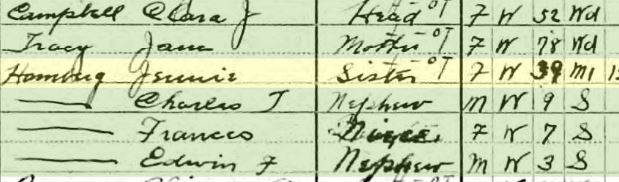
Then he moved to Philadelphia where he attended and graduated from the Philadelphia College of Pharmacy.  He started to work as a pharmacist, married Jennie Tracy, moved to Camden, New Jersey, and had three children, Charles, Frances, and Edwin, with his wife Jennie.  His life seemed to be remarkably successful and happy for someone who had suffered so much trauma as a young child.

But perhaps there was just an outward appearance of happiness and success.  By 1910, Samuel was no longer living with his wife and children.  Even after Jennie died at a young age in 1917 when her children were not yet grown, Samuel did not come back to live with his children.  Instead, they lived with their aunt, Jennie’s widowed sister, Clara Campbell.

Jennie Hamberg and children 1910 census Year: 1910; Census Place: Camden Ward 12, Camden, New Jersey; Roll: T624_874; Page: 13A; Enumeration District: 0080; FHL microfilm: 1374887

Jennie Hamberg and children 1910 census
Year: 1910; Census Place: Camden Ward 12, Camden, New Jersey; Roll: T624_874; Page: 13A; Enumeration District: 0080; FHL microfilm: 1374887

Samuel lived in Pittsburgh for some time, working as an investigator for the state, and then by 1930 was back in Philadelphia living with a woman from western Pennsylvania named Cecelia Link.  Cecelia died in 1934.  And I have absolutely no idea what happened to Samuel after 1930.

I can’t find him on the 1940 census anywhere; I can’t find him in any city directory.  I can’t find him in any newspaper articles.  And I can’t find him on any death record. I called the cemetery where Jennie was buried.  He’s not there.  I contacted the Philadelphia College of Pharmacy, but received no response.  I have run out of ideas.  A solid brick wall.  I am still searching and hoping to find out more about the rest of his life, but I worry that Samuel’s life ended poorly.

English: A brick wall (stretcher bond) Françai...

English: A brick wall (stretcher bond) Français : Un mur de briques (Appareil en paneresses). (Photo credit: Wikipedia)

As for his children, in 1920 they were still living at 126 Dudley Street in Camden, but with only their aunt Clara Campbell (Jennie’s sister, a widow) as the adult in the household.  Charles, now nineteen, was working as a bonds salesman.  Frances, now sixteen, was working as a clerk in an insurance company, and Edwin, thirteen, was not employed.

Samuel Hamberg's children 1920 census Year: 1920; Census Place: Camden Ward 12, Camden, New Jersey; Roll: T625_1024; Page: 5A; Enumeration District: 84; Image: 182

Samuel Hamberg’s children 1920 census
Year: 1920; Census Place: Camden Ward 12, Camden, New Jersey; Roll: T625_1024; Page: 5A; Enumeration District: 84; Image: 182


In 1924, Charles and his sister Frances were still living together, but at a new address—2931 Mickle Street in Camden.  They also appear to have changed the spelling of their surname from Hamberg to Hamburg. Were they disassociating from their father? Why would they change the E to a U?

Charles was working as a salesman, Frances as a clerk.  Edwin, who would have been only seventeen, was not listed in the directory.  In 1926, Charles and Frances were living at yet another address—2918 Carman Street—and still working at the same occupations. Their surname is once again spelled Hamburg.  Edwin is still not listed.

And then Charles and Frances disappear.  They are not listed in the 1927 or 1928 Camden directories nor is Edwin.  But in 1929 Edwin does appear in the directory—as Edwin F. Hampton, a salesman residing at 67 South 29th Street in Camden. The 1929 directory has him with the same name, residing at the same address and indicating that he was a salesman in Philadelphia.

Edwin had apparently changed his surname also–from Hamberg to Hampton.  I knew this was the correct Edwin because on the 1930 census Edwin Hampton was living in Camden, NJ, with his aunt Clara Campbell, the same aunt who had taken care of Edwin and his siblings after their mother died in 1917. Edwin was married, and his wife’s name was Edna.  Edwin was working as a weather-stripping contractor, Edna as a bookkeeper in a dairy. Both were 24 and were married at 23, so about a year before the 1930 census.

Edwin Hampton 1930 census Year: 1930; Census Place: Camden, Camden, New Jersey; Roll: 1322; Page: 16B; Enumeration District: 0057; Image: 137.0; FHL microfilm: 2341057

Edwin Hampton 1930 census
Year: 1930; Census Place: Camden, Camden, New Jersey; Roll: 1322; Page: 16B; Enumeration District: 0057; Image: 137.0; FHL microfilm: 2341057


I don’t know how long the marriage between Edwin and Edna lasted, but in 1939 Edwin married Ruth V. Peterson, and he is listed on the 1940 census with this second wife, Ruth. Edwin was now working as a driver for an oil company, and they had a two year old daughter.  I again knew this was the correct Edwin because also living with them was Edwin’s aunt, Clara Campbell.  Ruth and Edwin were still living in Camden in 1943, according to the city directory for that year.

Edwin Hampton 1940 census Year: 1940; Census Place: Pennsauken, Camden, New Jersey; Roll: T627_2323; Page: 11A; Enumeration District: 4-116

Edwin Hampton 1940 census
Year: 1940; Census Place: Pennsauken, Camden, New Jersey; Roll: T627_2323; Page: 11A; Enumeration District: 4-116

After that there were no other records I could find for Edwin.  I did, however, find his wife Ruth’s obituary from June 25, 1995, which revealed both where she was to be buried, Bethel Memorial Park in Pennsauken, New Jersey, and that she was a widow when she died.  Thus, I knew that Edwin had died prior to June 1995.  I called the Bethel Memorial Park cemetery and asked if they had any information about Edwin.  I learned that he was buried there on November 23, 1970.  Even with that information, I could not find an exact date of death.  Edwin isn’t even listed in the Social Security Death Index.

What about his siblings, Charles and Frances?

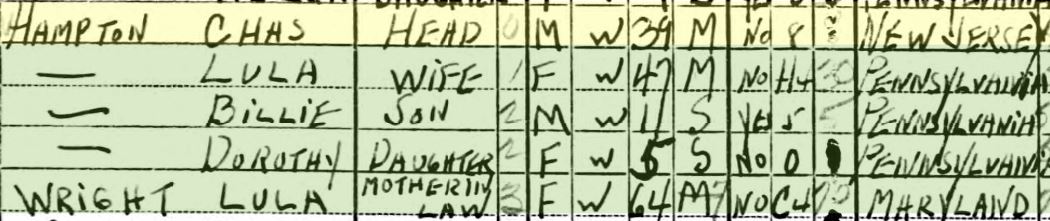
Knowing that Edwin had changed his surname to Hampton, I searched for Charles under that surname as well. There was a Charles T. Hampton in the 1930 census, listed as in the insurance business and residing at 2617 North 33rd Street in Philadelphia. He was married to a woman named Lula (and her mother Lula Wright was living with them), and the census indicated that they had been married about three years. I found a marriage record for Charles T. Hampton and Lula Wright in Philadelphia in 1927.  In 1930 at the time of the census, they had an eighteen month old son.

Charles Hampton 1930 census Year: 1930; Census Place: Philadelphia, Philadelphia, Pennsylvania; Roll: 2113; Page: 3B; Enumeration District: 0696; Image: 546.0; FHL microfilm: 2341847

Charles Hampton 1930 census
Year: 1930; Census Place: Philadelphia, Philadelphia, Pennsylvania; Roll: 2113; Page: 3B; Enumeration District: 0696; Image: 546.0; FHL microfilm: 2341847

At first I was not at all convinced that this was the right Charles.  He was 32, a few years older than my Charles T. Hamberg would have been in 1930.  The census said he was born in Pennsylvania, where Charles was in fact born, but the census also said that Charles Hampton’s father was born in Pennsylvania instead of South Carolina where Samuel Hamberg had been born.  That error and the age discrepancy gave me reason to doubt that this was Charles Hamberg.

That doubt increased substantially when I found another Charles T. Hampton on the 1900 census living in Aston, Pennsylvania, a seven month old baby who would have been close to the right age to match the Charles T. Hampton I’d found on the 1930 census.  That Charles was the son of Charles and Elsie Hampton.

Some of the doubt was erased, however, when I found those Hamptons on the 1910 and 1920 census and learned that the Charles Hampton born in October 1899 was in fact Charles August Hampton and that in 1930 Charles August Hampton was living in Chattanooga, Tennessee, married to a woman named Mary.

Although that eliminated that Charles Hampton, I still hadn’t confirmed that the Charles T. Hampton married to Lula Wright was in fact born Charles Hamberg, son of Samuel Hamberg and Jenny Tracey.  So I continued to look for more clues about Charles T. Hampton.

I found him with his family on the 1940 census.  He was still married to Lula, and they now had two children, an eleven year old son and a five year old daughter.  Lula’s mother was still living with them.  Charles was a life insurance salesman.  And this time his age was reported as 39, meaning he was born in 1900 or 1901, which is consistent with the birth year for Charles Hamberg.  I was now more convinced that this could be the right person.

Charles Hampton 1940 census Year: 1940; Census Place: Philadelphia, Philadelphia, Pennsylvania; Roll: T627_3714; Page: 3B; Enumeration District: 51-873

Charles Hampton 1940 census
Year: 1940; Census Place: Philadelphia, Philadelphia, Pennsylvania; Roll: T627_3714; Page: 3B; Enumeration District: 51-873

Could be, but was it?   Lula Wright Hampton died on October 4, 1955, from ovarian cancer.  Her husband Charles signed the death certificate as the informant, so I knew that Charles T. Hampton was still living as of October 4, 1955.  Lula was buried at Mt. Peace cemetery in Philadelphia.

Lula Wright Hampton death certificate Ancestry.com. Pennsylvania, Death Certificates, 1906-1963 [database on-line]. Provo, UT, USA: Ancestry.com Operations, Inc., 2014. Original data: Pennsylvania (State). Death certificates, 1906–1963. Series 11.90 (1,905 cartons). Records of the Pennsylvania Department of Health, Record Group 11. Pennsylvania Historical and Museum Commission, Harrisburg, Pennsylvania.

Lula Wright Hampton death certificate
Ancestry.com. Pennsylvania, Death Certificates, 1906-1963 [database on-line]. Provo, UT, USA: Ancestry.com Operations, Inc., 2014.
Original data: Pennsylvania (State). Death certificates, 1906–1963. Series 11.90 (1,905 cartons). Records of the Pennsylvania Department of Health, Record Group 11. Pennsylvania Historical and Museum Commission, Harrisburg, Pennsylvania.

And then I found an important clue: a June 10, 1968 bill submitted by the Oliver H. Bair funeral home for services rendered in connection with the funeral of Charles T. Hampton and his burial at Mt. Peace cemetery.  The same cemetery where Lula Hampton had been buried in 1955.  And the most revealing bit of information on that bill was that it had been submitted to Mr. Edwin F. Hampton.  That is, the brother of Charles T. Hampton.  For me, that was the one piece I needed to tie Charles T. Hampton, husband of Lula, to Charles T. Hamberg, son of Samuel: his funeral had been paid for by his brother, Edwin F. Hampton, born Edwin F. Hamberg.

Bill for funeral of Charles T. Hampton, June 1968 Ancestry.com. Pennsylvania, Oliver H. Bair Funeral Records Indexes, 1920-1980 [database on-line]. Provo, UT, USA: Ancestry.com Operations, Inc., 2012. Original data: Oliver H. Bair Funeral Records. Philadelphia, Pennsylvania: Historical Society of Pennsylvania.

Bill for funeral of Charles T. Hampton, June 1968
Ancestry.com. Pennsylvania, Oliver H. Bair Funeral Records Indexes, 1920-1980 [database on-line]. Provo, UT, USA: Ancestry.com Operations, Inc., 2012.
Original data: Oliver H. Bair Funeral Records. Philadelphia, Pennsylvania: Historical Society of Pennsylvania.

That left one more sibling to find: Frances D. Hamberg, born in 1903 or so, whom I’d last found in the 1926 Camden directory, living with her brother Charles and working as a clerk.  As is so often the case with women, she seemed to disappear.  I assumed she’d married, but I couldn’t find a marriage record.

Once again, one small clue broke down the wall.  Someone with a private tree on Ancestry had someone on their tree named Dorothy Whitman, wife of Frank E. Whitman, indicating that Dorothy Whitman was born Frances Dorothy Hamburg. [1]  I figured it was a clue worth pursuing.

And it indeed was.  I found a marriage record dated October 4, 1924 for Frank Eugene Whitman and Frances Dorothy Hamburg from the Holy Trinity Episcopal Church in Philadelphia.  And I knew this was the right Frances D. Hambe/urg because one of the witnesses at the wedding was her brother, Charles T. Hamburg (before he changed his surname to Hampton).  See the last entry on the document below:

Historical Society of Pennsylvania; Philadelphia, Pennsylvania; Collection Name: Historic Pennsylvania Church and Town Records; Reel: 1018 Description Organization Name : Holy Trinity Episcopal Church

Historical Society of Pennsylvania; Philadelphia, Pennsylvania; Collection Name: Historic Pennsylvania Church and Town Records; Reel: 1018
Description
Organization Name : Holy Trinity Episcopal Church


Frank E. Whitman had been previously married to Mildred Mendenhall, with whom he’d had a son in 1919 named Frank E. Whitman, Jr.  Mildred had died on January 31, 1920, from influenza during the epidemic that killed so many people.  Her infant son, like Samuel T. Hamberg and then like Samuel’s own three children, was left motherless.

There are some strange occurrences in the directory entries for Frank and for Frances in the years right after they married.  In 1925, Frank is listed in the Philadelphia directory as a salesman, living at 3450A Angora Street.  But in 1926, Frances is listed as Frances Hamburg in the Camden directory, living at the same address as her brother Charles, 2918 Carman Street. If she had married Frank in 1924, why was she still using Hamburg, and why was she living in Camden with her brother?

Finally, in 1927 Frank and Frances are listed together at 67 South 29th Street in Camden, the same address where Frances’ brother Edwin Hampton was living. Frank and Frances are listed again at the address two years later in the 1929 Camden directory.

But I cannot find Frank and Frances anywhere on the 1930 census—not in Camden, not in Philadelphia, not in any other place.  On the other hand, I did find Frank’s son from his first marriage living with his grandparents, Frank Sr.’s parents, in Philadelphia.  He was also living with them in 1940, so it appears that he was raised by his paternal grandparents, not his father and stepmother, just as his stepmother Frances had been raised by her aunt, not her father after her mother died.

So where were Frank and Frances in 1930? I don’t know.  They don’t reappear on any records until the 1940 census when they are listed as living at 215 Walnut Lane in Philadelphia, Apt. A202.  Frances is now using her middle name Dorothy as her first name.  Frank was working as a plant manager for a petroleum company.  They had been living at the same place in 1935, and they were still living there two years later when Frank registered for the World War II draft.

Frank and Dorothy Whitman 1940 census Year: 1940; Census Place: Philadelphia, Philadelphia, Pennsylvania; Roll: T627_3704; Page: 14A; Enumeration District: 51-553

Frank and Dorothy Whitman 1940 census
Year: 1940; Census Place: Philadelphia, Philadelphia, Pennsylvania; Roll: T627_3704; Page: 14A; Enumeration District: 51-553


Frank and Frances Dorothy (Hambe/urg) Whitman both died in Florida, Frank in 1981, Frances Dorothy in 1998. She was 95 years old.  As far as I can tell, they did not have children together, but without the 1930 census, I cannot be certain.  Her obituary had no personal information at all.

Thus ends the saga of Charles Hamberg, born Baruch Hamberg in Breuna, Germany.  As a young man, he immigrated in 1852 with his cousin Abraham, who died less than two years later.  Charles married Mary Hanchey in 1853, and she was murdered in Columbia, South Carolina, in 1866.  Charles remarried, and with his second wife Lena, he had one child, Samuel.  Then, as stated above, after Lena died and Charles took his own life, Samuel moved to western Pennsylvania where he grew up with his Schoenthal cousins.  As described above and in my prior post, Samuel’s own life was a rollercoaster—a tragic childhood, a promising young adulthood, and then a life that seemed to fray around the edges.

As Samuel must have borne the scars of his tragic childhood, so did his children.  They also lost their mother at a young age.  They also seemed to lose their father early in their lives, although not to death.  They all changed their surnames, perhaps to distance themselves from that father.  Charles Baruch Hamberg’s legacy appears to be a sad one, though without a few more answers, it is hard to know for sure.


[1] Although the tree was private, Ancestry will list names from a private tree; you just can’t see the details of the tree without permission of the owner.  .

Hettie’s Spirit Lives On: Her Children Walter and Blanche

In my last two posts about Hettie Schoenthal, I was very fortunate because Hettie and her son Walter had written down their own memories and stories, making their lives so much more vivid and authentic than I could have ever done myself.  The wonderful photographs that their family provided also helped me tell the story of Hettie Schoenthal, her husband Henry Stein, and their two children, Walter and Blanche.

Hettie Schoenthal, 1906 Courtesy of her family

Hettie Schoenthal, 1906
Courtesy of her family

It was a reminder of how important it is for all of us to write about our own lives and to take and preserve photographs so that someday our descendants will benefit from these shared words.  My newly discovered cousin Sharon Lippincott, daughter-in-law of Blanche Stein Lippincott, writes  about the art of writing memoirs at her blog, The Heart and Craft of Life Writing, and has also published books on that subject.

In this post, I hope to convey how Hettie’s optimistic and energetic personality left its mark on her two children, both of whom also lived long and happy lives and were well-loved by many.  All photos are courtesy of their family.

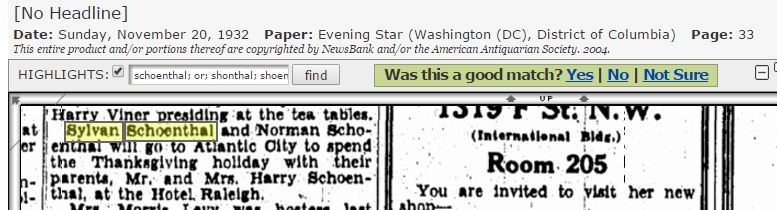
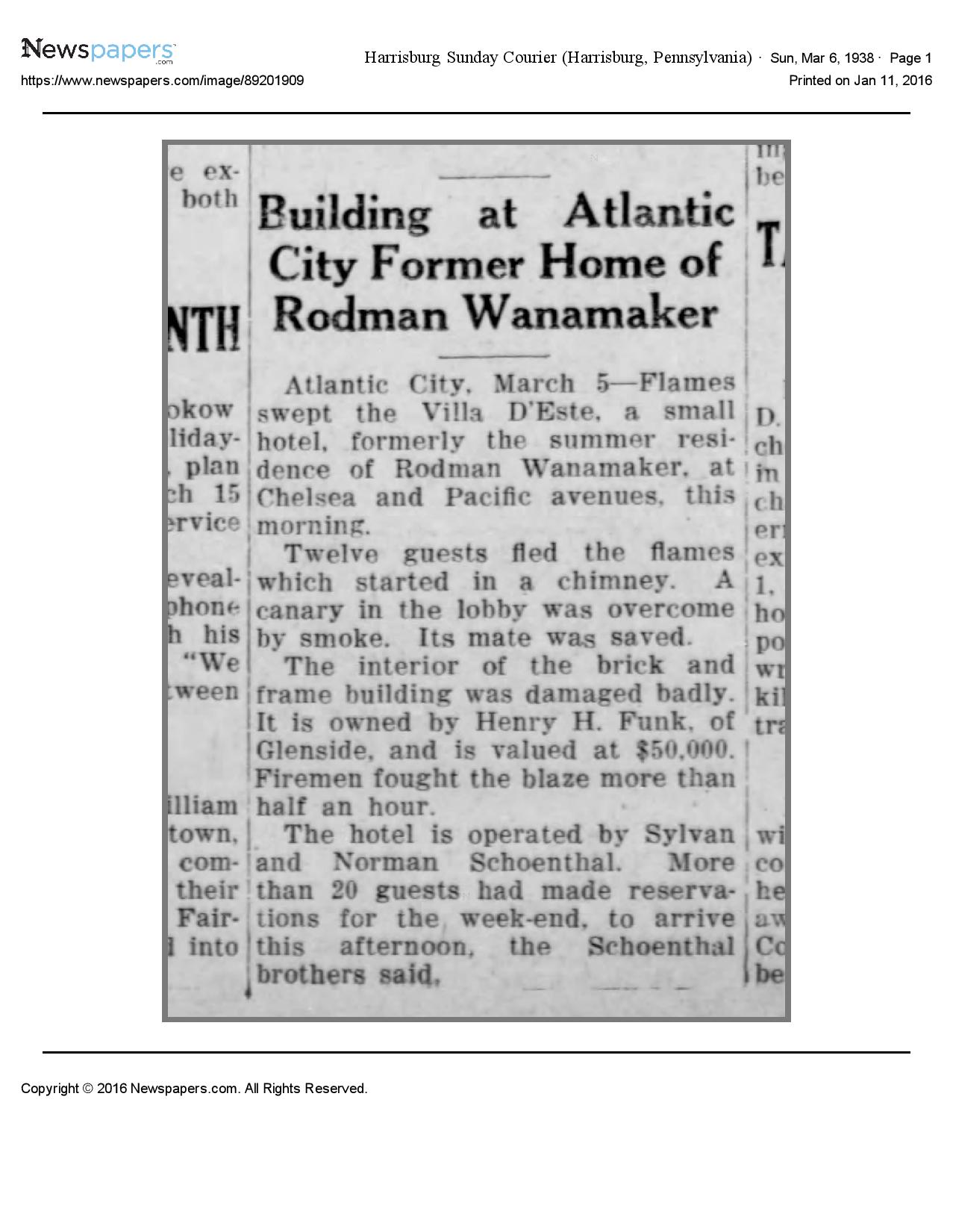
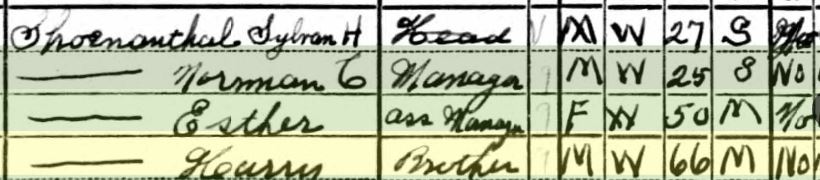
Hettie and Henry had moved east from Arizona to Philadelphia in 1924, and a few years later their son Walter left home and moved to Atlantic City to work in his aunt’s hotel there, as seen on the 1930 census.  Walter remained in the Atlantic City area for the rest of his life, working in a restaurant and as a salesman over the years.  He married Ruth Levaur in 1938, and they had one daughter.

His sister Blanche also married in the 1930s, marrying Ezra Parvin Lippincott in 1937.  Ezra was a New Jersey native and a graduate of Rutgers University, and he worked as a banker and in the insurance business. They lived in New Jersey and had two children, a son and a daughter.  Sadly, Ezra died in 1969, leaving Blanche as a widow at only 57.

Blanche Stein Lippincott, 1938

Blanche Stein Lippincott, 1938


Blanche Stein Lippincott 1962

Blanche Stein Lippincott 1962


I don’t have a lot of “official” records about Walter or Blanche after 1940, but I don’t need them to convey the character and personality of these two people. Other people have already written about them both.

Both Walter and Blanche must have inherited their mother’s gene for longevity.  Walter died in 2007 at age 96, and Blanche died in 2013 when she was 101 years old.

Walter Stein in Atlantic City, 1987 courtesy of the family

Walter Stein in Atlantic City, 1987
courtesy of the family

Walter’s obituary from the Press of Atlantic City gives a vivid portrait of the man who spent his childhood with burros and snakes in Ray, Arizona:

Walter was born in Tucson, Territory of Arizona on October 9, 1910. He was recognized as a pioneer. He spent his childhood in Ray, Arizona in a mining camp and took pleasure in saying that his boyhood was what every boy dreams of. The family moved to Philadelphia in 1923, where Walter graduated from high school. In 1929 he went to Atlantic City for a vacation and never left the area except for four years. He met and married Ruth Levaur in 1938. They recently celebrated their 68th anniversary.

Walter was a fine fisherman, a championship bowler and a prize-winning marksman. He served on many boards, but his favorite was the 23 years he served on the Board of Friends of the (PAC) Performing Arts Center of Stockton College. Walter had a deep love of the theater. Some of his happiest moments were spent with Ruth and friends at the Metropolitan Opera, the Philadelphia Orchestra, the Ballet, the theater and museums. He was Vice President of Atlantic Beverage for 35 years. ….

Walter was loved and respected by all who knew him. His sense of humor, his positive spirit and generous nature placed him in a class by himself. He was often referred to as a man of all seasons, and he truly was.


Walter and Ruth Stein, 2002 at Blanche's 90th birthday celebration

Walter and Ruth Stein, 2002 at Blanche’s 90th birthday celebration


Blanche also seems to have inherited her mother’s optimistic and adventurous spirit; her daughter-in-law Sharon wrote this about her on her blog on the occasion of Blanche’s 100th birthday:

Blanche was born 100 years ago in Tucson, in the newly admitted state of Arizona. Her family soon moved to Ray, Arizona, a now deserted copper mining community, where they lived until she was about twelve. When the copper industry declined, her parents, along with a few aunts and uncles, decided to move back to Philadelphia.  ….

If you asked her, she’d tell you she has had a rather ordinary life, and so it may seem to some. She’s never done anything truly flamboyant. She hasn’t set records, started a business, or written a best-seller. But she has tackled life with gusto, always open to new adventures and experiences. ….

Perhaps her  most important attribute is her devotion to family, friends and community. ….  No family member or friend ever has to ask for help – things are taken care of, often before the need is recognized. She always has something good to say about anyone she speaks of, and she excels at showing gratitude and appreciation. …

I could not ask for a sweeter, more supportive and helpful mother-in-law, nor is anyone prouder than she of her two children and their spouses, her five grandchildren and their spouses, and her six great-grandchildren. She is the most optimistic person I know, and should I live to be 100, I hope I’ll be as vital and involved as she continues to be.

Blanche Stein Lippincott, 1984

Blanche Stein Lippincott, 1984


Blanche Stein Lippincott with her great-granddaughter 1996

Blanche Stein Lippincott with her great-granddaughter 1996

You can read the rest of Sharon’s tribute to her mother-in-law Blanche at her blog here. 

I feel very privileged to be even distantly related to Hettie and her children, who were, respectively, my first cousin, twice removed (my grandmother’s first cousin) and my second cousins, once removed (my father’s second cousins).  It’s just too bad that I missed the opportunity to know them in person, given how long and how close by they all lived.

Blanche and Walter, August 9, 2006 courtesy of the family

Blanche and Walter, August 9, 2006
courtesy of the family


Blanche, Hettie, and Walter Stein

Blanche, Hettie, and Walter Stein

This post completes my research of the family of Simon Schoenthal and Rose Mansbach and their many children.  This has been a line of the family that has been a joy to research.  Although there were a few sad stories, this was a family of people who lived long lives and seemed to enjoy those lives.   They stayed close to one another even though at times they were separated by long distances.  And most of them spent much of their lives close to their childhood hometown of Atlantic City, New Jersey, once called the World’s Playground.

Unfortunately, the next chapter—the story of Simon’s brother Jakob and his family—is not as joyful.


Part II: Hettie Schoenthal, An Indomitable Spirit

In my prior post, we saw how Hettie Schoenthal Stein described the early part of her life in the memoirs she wrote to her grandson Ezra Parvin Lippincott, Jr., in 1973 and 1974.  After a childhood in Atlantic City with her many siblings, she had followed her sister Gertrude to Tucson, Arizona, married Henry Stein, and then moved with him and their two children Walter and Blanche to Ray, Arizona, a mining town over ninety miles from Tucson.

Walter and Blanche Stein, c. 1915 courtesy of their family

Walter and Blanche Stein, c. 1915
courtesy of their family

The FamilySearch.org website provided these insights into what might have attracted Hettie and Henry to Ray, Arizona:

The small town of Ray, Arizona, located in the south central portion of Pinal County, was founded in 1870.  By 1873, prospectors were engaged in silver mining and by 1880 high grade copper ore was being mined in Ray. The original founders were most likely a group of copper miners operating a small mine in this copper rich area. One of the miners, Mr. Bullinger, is said to have named the town Ray, after his daughter, Ray Bullinger. By 1909 The Arizona Hercules Copper Company had purchased the rights to the mine and constructed the town as a company town.  The mining operation in Ray enjoyed a worldwide reputation because of the innovative mining practices employed in the underground mine.

Ray, Arizona copper mine y Palmercokingcoal (Own work) [CC BY-SA 4.0 (http://creativecommons.org/licenses/by-sa/4.0)], via Wikimedia Commons

Ray, Arizona copper mine 1916
y Palmercokingcoal (Own work) [CC BY-SA 4.0 (http://creativecommons.org/licenses/by-sa/4.0)%5D, via Wikimedia Commons

The FamilySearch page also conveys a sense of what life was like in Ray in the early 20th century:

The original town of Ray consisted of one short main street with small businesses on both sides of the street. By 1909 the company had constructed a hospital and there are birth certificates from the hospital that date back to 1910. There was usually a doctor in Ray and the hospital employed at least 3 nurses and a cook according to Census Records. …  The elementary school (Lincoln Elementary) had grades 1 through 8 in eight classrooms. …. Ray High School was a short walk uphill from the elementary school.  ….  Ray didn’t have a newspaper, but people in the small town subscribed to The Arizona Republic, a newspaper in Phoenix. Ray had four churches….

Obviously, Ray was a booming town by the time Hettie and Henry moved there in the mid-1910s or so.

Ray, Arizona 1916 By Palmercokingcoal (Own work) [CC BY-SA 4.0 (http://creativecommons.org/licenses/by-sa/4.0)], via Wikimedia Commons

Ray, Arizona 1916
By Palmercokingcoal (Own work) [CC BY-SA 4.0 (http://creativecommons.org/licenses/by-sa/4.0)%5D, via Wikimedia Commons

Walter, their son, wrote about his own perspective on the town and his family’s life there:

To my knowledge the Steins and Millers were the only Jews living in Ray. My uncle Jake [Jacob Miller, Gertrude Schoenthal’s husband] and his brother, also called Uncle, had a dry goods and shoe store, and a general merchandise and grocery store. The general merchandise had hardware, mining equipment, farm equipment, guns, and shells. My dad ran the bakery and delivery of bread and pastries from a wagon, pulled by a horse (named Tom). One day my dad stopped for lunch at home with the bakery wagon. While he was having lunch, something frightened Tom and he bolted. There were bakery products all over the neighborhood. Tom was caught and calmed. Tom was not hurt.

My cousin (Harry) [Gertrude Schoenthal Miller’s son] used to spend the summer in Ray. He lived in Tucson and went to school there. While in Ray, Harry worked in the store. His job was to solicit orders at the houses in the residential sections of Ray. This was done on horseback.

The big event at the grocery store was uploading one hundred pound bags of flour, sugar, and salt that were skidded into the cellar on a slide. Lots of fun! We kids rode on the bags.

(From “Recollections,” by Walter Stein.)

From this excerpt, I get the impression, consistent with what I wrote about here, that Jacob Miller had moved to Ray, but left his wife Gertrude and family behind, perhaps so that his children could continue to go to school in Tucson.


Ray, Arizona 1916 By Palmercokingcoal (Own work) [CC BY-SA 4.0 (http://creativecommons.org/licenses/by-sa/4.0)], via Wikimedia Commons

Ray, Arizona 1916
By Palmercokingcoal (Own work) [CC BY-SA 4.0 (http://creativecommons.org/licenses/by-sa/4.0)%5D, via Wikimedia Commons


Walter’s description of his boyhood in Ray in many ways sounds idyllic:

I got in the swing of things, with friends I had made. Rode burros, mules, and spent plenty of time in the ball park. The burros ran loose, so you could grab one and jump on his back. If the burro was inclined to go, it was fine. If not, the burro would not move.

The mules were used at the copper mines. My friend Joe Garcia (his father took care of the mules) and I would go to the corral. One of us would bring one of the mules over to the side of the corral. The other one would climb up the side of the corral as the mules were too big for us to get on.

One thing that was standard at every house we lived in in Ray was a chicken coop with two to three dozen chickens and one or two roosters. Of course it does not take too many guesses as to who was assigned the care, feeding, and cleaning of the coop. Also a couple of rabbits and a dog (pedigree unknown).

(From “Recollections,” by Walter Stein.)

Walter Stein, c. 1919 when he was nine years old courtesy of the family

Walter Stein, c. 1919 when he was nine years old
courtesy of the family

Blanche Stein, c. 1920, when she was seven courtesy of the family

Blanche Stein, c. 1920, when she was seven
courtesy of the family

From Walter’s perspective, it was wonderful place to grow up, but their life in Ray had some challenges.  Walter described their two homes in Ray:

Our first house was placed on the side of a hill with one door. The back of the house was against the hill. To reach the house you walked up steps that also took care of other householders on the hill. I cannot remember the location of the outhouse. I do remember to bathe, water was heated on the stove and then poured into a galvanized tub that had been placed on the floor.

We didn’t live there very long. Our next house was in back of the ball park. This house had both front and back doors. Standard out house. No bathroom. After we had lived there a short time, Dad had a bathroom built. Still must use out house. Bathroom contained washstand and tub. In summer to bathe, one ran water into tub, and then waited for the water to cool. The water pipes from the reservoir laid on top of the ground and the sun heated the water too hot to bathe until it cooled.

(From “Recollections,” by Walter Stein.)


Embed from Getty Images

Hettie[1] had less fond memories of their house in Ray:

I will tell you a little about the house. It was up on a hill, just four rooms no bath or toilet. It was terrible. I did not think I could live there, but we did. Your grandfather and a helper built a room and we bought a tub. The pipes had to be on top of the ground. Well, the sun was so hot we had to draw the water and let it stand for hours before bathing.

Hettie leading a donkey

Hettie leading a donkey

The accommodations were not the only challenges.  The wildlife and the weather also provided challenges.  Hettie recalled:

One day I was stung by a wasp and another time a Scorpin this happened in Ray Ariz. We lived up on a hill. We had a few chickens and it was so hot some time when I gathered they were hard boiled and this is (no joke)

Once I remember I came across some eggs in a nest and I took them and put them in the ice box. In those days we had to buy ice. A little later on I opened one egg and found a little chicken so I hurried and put the others back in the nest and a few hatched and I called them my ice box chicks. …

I learned to ride horseback. One day my brother Maurice took me riding. We rode to the Mission that was about ten miles out of town and a big rattle snake got in front of my horse, so my bro. got down from his horse and stoned it to death and had a belt made for me. It was very pretty.

English: Arizona Black Rattlesnake

English: Arizona Black Rattlesnake (Photo credit: Wikipedia)

I found it interesting that Maurice, one of the brothers who lived in Chicago, traveled out to Ray, Arizona, to see his little sister Hettie.  It seems that even though the siblings were quite spread out across the US, they still stayed in touch and even saw each other. Hettie also mentioned that in 1969 she visited her brother who lived in Los Angeles, that is, her younger brother Sidney.  And here is a photograph of her brother Martin with his niece Juliet Miller and nephew Walter Stein, possibly taken in Arizona when he visited from Chicago.


Martin Schoenthal, Juliet Miller Ferrin, and Walter Stein

Martin Schoenthal, Juliet Miller Ferrin, and Walter Stein


Here is Martin with Blanche, Gertrude, Hettie, and Walter.

Martin Schoenthal, Gertrude Sch., Hettie Sch Blanche Walter

Blanche Stein, Martin Schoenthal, Gertude Schoenthal Miller, Hettie Schoenthal Stein, and Walter Stein c. early 1920s


One of the most amusing anecdotes Hettie shared in her memoirs involved the time her son Walter had to have surgery in Phoenix and she rented a room to stay with him while he had post-operative care:

After Walter got out of the Hospital I thought it would be nice if I could get a little apt near the Hospital as he had to go for treatments. Then I could have Blanche with me, so I found one. It had all new linens and silver and looked so nice. Your grandfather [Henry Stein] brought your mother [Blanche] up that weekend and the next day he was walking in the hall and a girl invited him in her apt. Then when he came in he said what kind of place I was in. Well, I was in a fast house. The first day I was there when Walter and I came out of the apt a couple of men smiled at me and I thought it was just because Walter’s head was bandaged. In the west people were very friendly. A lot of people asked me what happened to the boy and wished for a speady recovery. I moved out of there in a hurry.

Poor Hettie—she must have been mortified to realize she had taken her son to a “house of ill repute!”

In either 1923 or 1924 (various sources differ), Hettie, Henry, and their children left Ray, Arizona.[2]  This was also when Gertrude and her family left Arizona to return to Atlantic City, as I wrote about here.  Hettie’s description of their travels is colorful:

Now it is March 24, 1924 we are leaving the west to make our home in Phila. My brother-in-law [Jacob Miller] and your grandfather [Henry Stein] were driving to Phila. I forget what city it was but they put the car in a garage and it caught fire and every body lost there cars.

They had to take the train the rest of the way. When they arrived in Phila, they phoned us. We left the next day and a couple days later we had one stop over for one hour so my sister Gertie, your mother [Blanche] who at that time was about 12 years old and Walter took a walk. We were crossing the street when a car came along and I was run over. It was like in the movies. I was down and before you knew it I was up. All I could say is Thank God I am O.K. one wheel ran over my thigh. This man wanted to take me to the hospital but I said no. I think he gave me a card with his name and address on so in case I had any ill affects from it I should let him know. When we got to Chicago my two brothers [Maurice and Martin] wanted me to go to the hospital but I said I am O.K. I know God was with me.

(Perhaps the photographs of Martin with Gertrude and Hettie, shown above, were taken when the families stopped in Chicago.)

A few things struck me as interesting about this passage.  First, I was impressed by the fact that Gertrude and Hettie traveled alone by train with their children across the country while their husbands waited for them on the East Coast.  Also, once again there is evidence that these widely separated siblings stayed close, as Maurice and Martin, the two brothers in Chicago, urged their younger sister to go to the hospital.  But mostly I was struck by Hettie’s spirit, which seemed as resilient as her body, jumping up after being run over by a car.

Once they reached the East Coast, Gertrude went on to Atlantic City where she and Jacob became involved in the hotel business.  Hettie and Henry settled in Camden, New Jersey, and then in Philadelphia:

My sister husband and your Grand father bought a moving picture house in Camden N.J. we had that for a while then sold it and moved to Holmesburg Pa. that is part of Phila. I was the cashier, your grandfather was the ticket taker and your uncle Walter helped the operator. We all got along nicely.

I had lots of fun. There were three German men who came most every night so one night I said in german do you speak german? Well you should have heard them. I made them understand I only knew a few words but my husband understood better. They told me they came to learn the English language.

Hettie, the daughter of two German immigrants, knew only a few words of German.  In some ways, that is rather remarkable as it indicates how fluent her parents were in English.  But it is also somewhat sad that they did not pass on to their children the language of their native country.

Blanche Stein, high school graduation picture

Blanche Stein, high school graduation picture.  Courtesy of the family

In 1930, Henry was working as a hosiery salesman.  Walter was living with his aunt and uncle, Gertrude and Jacob Miller, and working in their hotel as a bellman.  Blanche was still living at home in Philadelphia, working as a typist.

Blanche Stein and Hettie Schoenthal Stein, 1930, Mayfair, PA courtesy of the family

Blanche Stein and Hettie Schoenthal Stein, 1930, Mayfair, PA
courtesy of the family

By 1940 Blanche and Walter had both married (more on that in my next post), and Hettie and Henry were living in Philadelphia.  Henry was now an office equipment salesman.

Henry Stein Courtesy of the family

Henry Stein
Courtesy of the family

Around this time, Hettie’s nephew Bob Klein, son of her sister Estelle and Leon Klein, came to live with them.

We had a five room apt. My nephew Bob Klein lived with us. I loved to paint so I did all the painting when I got the brush in my hand there was not telling where I would stop. I painted the toilet seat and forgot to put a sign on and Bob sat down you can guess the rest.

During World War II, Hettie volunteered for the Allied Prisoner of War Service.  While doing so, she made connections that led to a home-based business for her:

In Phila I volunteered one day a week for the Allied Prisoner of War Service that was in 1944 we shipped food to the War Zone. We had to show a card before we were admitted. One day one of the ladies asked me what I was to to do after we finish work so I said I am going to go get some yarn to make a wooley dog so they wanted to see them so the next week I took a couple in and they wanted to buy them so I realy got in business. Then your grandfather told one of his customers*, a florist, about my dogs. He wanted to see them, so I took six with me. He liked them so much he bought them and put them in the window. Some sailors came along and bought all six. I no more than got home when the phone rang and it was Mr. Jones. He said the dogs were gone and he would like to have 50 at once. I stayed up all night and took him what I had made the next day.

A salesman from Chicago saw them at the Florist and wanted to know how he could get in touch with me. He came to see me and ordered all I could make I had my sister Estelle and your mother and your grandpa helping and I sent him as many as I could. Then I had others that wanted them for there stores, my business got to big for me. I had to drop it.

Sadly, Henry Stein died on February 16, 1951, from prostate cancer; he was 79 years old.

Henry and Hettie (Schoenthal) Stein, 1951 courtesy of the family

Henry and Hettie (Schoenthal) Stein, 1951
courtesy of the family


After he died, Hettie lived for some time with a friend and for many years on her own in Atlantic City.  She continued to have a very full and active life, as you can see from these photographs.

Hettie Stein, 75th birthday April 24, 1961 courtesy of the family

Hettie Stein, 75th birthday April 24, 1961
courtesy of the family

Hettie Schoenthal Stein, 85th birthday 1971

Hettie Schoenthal Stein, 85th birthday 1971

Even at 88, she was still volunteering for her synagogue’s rummage sale.

Hettie Stein's 90th birthday 1976

Hettie Stein’s 90th birthday 1976 with Blanche and Walter. Courtesy of the family.

When she was 95, Hettie moved in with her daughter Blanche in Medford, New Jersey. When Hettie turned 100, it was written up in the May 8, issue of the Central Record, the local newspaper for Medford, New Jersey:

Hettie Stein Celebrates 100 part one

Hettie Stein Celebrates 100 part two

Reading this interview warmed my heart.  Even at 100, Hettie remained upbeat, gracious, and independent.  Her description of her childhood—“We were one happy family.  We would all do for the other, and we all got along nicely”–is certainly consistent with the photographs, the writings, and the facts I’ve seen and read about Hettie and her siblings.

Hettie survived her much beloved husband Henry by almost 38 years, dying on January 15, 1989, when she was just a few months shy of her 103rd birthday.  She, like so many of her siblings, was blessed with remarkable longevity.


I will close this post with the closing words of Hettie’s 1974 memoir, as they best convey the spirit and personality of this adventurous and upbeat woman:

Well, this all happened in my life time. I did have two men that wanted to marry me and two weeks ago the third one asked me. I was walking on the Boardwalk and a man I met about ten years ago came up to me and said, “Can I walk with you?” So I said yes. I knew his wife. She passed away a year ago. He wanted me to go to his apt for dinner. He had made a lamb stew. I thanked him and said my dinner was waiting for me. We talked for awhile and then he asked me if I would marry him. He has money, two sons, one a Dr., the other a Dentist and he is very good looking. But I am happy as I am.

I must tell you, I was getting some telephone calls from some man or boy. He kept telling me he wanted to come see me and give me some loving and I would hang up. On Sat. morning my son Walter took me shopping and when we came home the phone rang and it was the same person. I said wait, and I will let you talk to my husband. He hung up in a hurry and that was the end of that.

Two day is the 4th of July, 1974. A beautiful day. Your Ma [Blanche] called me. I am so happy she is enjoying life.

Hettie Excerpt 2


[1] All of the quotes by Hettie Schoenthal Stein are from her memoir, “This is My Life,” written in 1973-1974 for her grandson, Ezra Parvin Lippincott, Jr.

[2]  In the 1950s, the company that owned the copper mine in Ray expanded the mining area and moved the residents to a nearby town it built.  Today Ray is a ghost town.

The Gift of Photography: Bringing Faces to the Names

I know I just posted yesterday, but I am so excited by the photographs I received last night that I can’t wait to share them.  I have been very fortunate to connect with the family of one of Simon and Rose (Mansbach) Schoenthal’s children, the descendants of their daughter Hettie, whose life story I’ve yet to tell.  The family very generously shared with me a multitude of photographs, and I will share many of them on the blog in upcoming posts.

But some of these photographs are of family members about whom I have already posted.  I’ve added those photographs to the appropriate posts, but since I know it’s unlikely that people will go back to find those photographs, I wanted to share some of them here.  All of the photographs here are courtesy of the family of Ezra Parvin Lippincott, Jr., Hettie Schoenthal Stein’s grandson.

First, here are photographs of Simon Schoenthal and Rose Mansbach, the patriarch and matriarch of this large family:

Rose Mansbach Schoenthal

Rose Mansbach Schoenthal

Simon Schoenthal, my great-great-uncle

Simon Schoenthal, my great-great-uncle

Simon and Rose had ten children; their first two were twins, Harry and Ida.  Ida died when she was a young teenager, so I was very touched to see this photograph of Simon with the twins, taken in 1875 when they were two years old.

Simon Schoenthal with twins Harry and Ida 1875 Courtesy of the family of Hettie Schoenthal Stein

Simon Schoenthal with twins Harry and Ida 1875
Courtesy of the family of Hettie Schoenthal Stein

And here is a collage of photographs of the nine surviving children: Harry, Gertrude, Louis, Maurice, Martin, Jacob, Hettie, Estelle, and Sidney.  They were my grandmother Eva Schoenthal Cohen’s first cousins.

The nine surviving children of Simon and Rose (Mansbach) Schoenthal Photo courtesy of the family of Hettie Schoenthal Stein

The nine surviving children of Simon and Rose (Mansbach) Schoenthal
Photo courtesy of the family of Hettie Schoenthal Stein

Looking at all those faces, I cannot help but admire their mother Rose, especially knowing now how close these siblings were to each other.  Here are some additional photographs of Rose Mansbach Schoenthal:

Rose Mansbach Schoenthal courtesy of the family of Hettie Schoenthal Stein

Rose Mansbach Schoenthal
courtesy of the family of Hettie Schoenthal Stein

Rose Schoenthal -1916

Rose Mansbach Schoenthal 1916

Harry, the oldest surviving child, had a liquor business in Philadelphia for some time before returning to Atlantic City and working in the hotel business there.  I believe this photograph must be related to his Philadelphia business:

Uncle Harry's Beer Business Courtesy of the family of Hettie Schoenthal Stein

Uncle Harry’s Beer Businesss
Courtesy of the family of Hettie Schoenthal Stein

I am not sure, but perhaps one of those men is Harry himself.

I loved this photograph of Arthur H. Ferrin, who married Juliet Miller, the daughter of Jacob J. and Gertrude (Schoenthal) Miller.  You can tell that Arthur was a Tucson native:

Arthur  H. Ferrin 1905 courtesy of the family of Hettie Schoenthal Stein

Arthur H. Ferrin 1905
courtesy of the family of Hettie Schoenthal Stein

There are many more to come, but I didn’t want these to get lost in the shuffle.


Jews in Arizona: Gertrude Schoenthal Miller and Her Family

As we will see, Harry Schoenthal and his sons were not the only descendants of Simon and Rose (Mansbach) Schoenthal to spend much of their lives in Atlantic City; five of Harry’s siblings also spent most of their lives there.  Harry’s younger sister Gertrude had left Atlantic City for Arizona after she married Jacob J. Miller in 1898, but she returned to Atlantic City, albeit a quarter century later.

Gertrude Schoenthal Miller Courtesy of the family of Hettie Schoenthal Stein

Gertrude Schoenthal Miller
Courtesy of the family of Hettie Schoenthal Stein


As I wrote earlier, Jacob Miller was a German immigrant who had arrived in the US in the 1880s (records are in conflict as to whether it was 1880, 1882, or 1888, but 1882 is supported by three different records so may be the most accurate date). I don’t know how Jacob met Gertrude or where Jacob was living before he married Gertrude, but they must have moved to Arizona not long after they married because Jacob was listed in the Tucson directory in the cigar business in 1899. On the 1900 census, Jacob and Gertrude and their infant daughter Juliet (sometimes spelled Juliette) were living in Pima County, Arizona, where Jacob was a grocer.  (Tucson is in Pima County, so I assume they were living in or near Tucson but the enumeration sheet does not identify the city, only the county.)

Map of Arizona highlighting Pima County

Map of Arizona highlighting Pima County (Photo credit: Wikipedia)


When I looked further down the enumeration sheet where Jacob and Gertrude and Juliet were listed, I noticed that there were two other Millers just a few entries below that of Jacob and Gertrude: Albert Miller and his brother Solomon.  The census record reports that Albert and Solomon were also born in Germany and that Albert was also a grocer (Solomon a store clerk).  A little further research into the backgrounds of Albert and Solomon confirmed my hunch that these were Jacob’s brothers.  Albert had been in Arizona since at least 1896; he had married his wife Fanny Goldbaum in Pima County on January 19, 1896.  Research into Fanny’s background revealed that she had been living in Pima County since at least 1880 when she was just four years old.

Jacob Miller and family and his brothers on 1900 census Year: 1900; Census Place: Precinct 1, Pima, Arizona Territory; Roll: 47; Page: 18B; Enumeration District: 0049; FHL microfilm: 1240047

Jacob Miller and family and his brothers on 1900 census
Year: 1900; Census Place: Precinct 1, Pima, Arizona Territory; Roll: 47; Page: 18B; Enumeration District: 0049; FHL microfilm: 1240047

Based on these observations, my hunch is that Albert, the oldest brother, must have moved out west to Arizona sometime before 1896 and then lured his two younger brothers, Jacob and Solomon, to join him out there.  It reminds me of the story of Bernard Seligman, my great-great-grandfather, who followed his older brother Sigmund to Santa Fe and was then followed by their younger brother Adolf to that city as well.

I am sure that like my Seligmann ancestors, the Miller brothers were among a very small number of Jewish settlers in Arizona during that time.  According to the Arizona Jewish History Museum, there was no synagogue in the entire Arizona Territory until Eva Mansfield purchased land to build one in Tucson in 1900.  The history of the Jewish community of Tucson is also discussed on the Jewish Virtual Library website:

The total Jewish population of Arizona in the 1880s was estimated at about 50 people, so the numbers in Tucson must have been fewer. ….

Almost none of the descendants of the pioneer families are counted among the Jews of Tucson today. Many of the original Jewish settlers fled to other parts of the West or the nation in the late 1880s and 1890s when an economic depression hit the Arizona territory. Moreover, those Jews who had already made money left the community because of the unbearable heat, often over 100 degrees Fahrenheit, which could last sometimes from May through October.

In the early 20th century a number of Jews remained in Tucson as is evidenced by the presence of a Hebrew Ladies’ Benevolent Society and the building in 1910 of the first Jewish temple in Arizona: Temple Emanu-el (Reform).

Until World War II, and even among some of the pioneers, the Jews who arrived in Tucson came because someone in the family needed the dry air for his/her health.

So Jacob and his brothers appear to have settled in Arizona and stayed when many others, Jewish and non-Jewish, had left.  Had they been drawn to the dry air for their health? Or did they see opportunities where others did not?

Stone Street Synagogue, first synagogue in Arizona 1914 Found at http://www.jmaw.org/temple-emanuel-tucson-synagogue/

Stone Street Synagogue, first synagogue in Arizona
1914
Found at http://www.jmaw.org/temple-emanuel-tucson-synagogue/


Jacob and Gertrude had their second child, Harry, in Arizona in 1902.  According to the 1910 census, however, their third son Sylvester was born in 1906 in New Jersey, so perhaps Jacob and Gertrude had returned to the east coast for some time in 1906, but they then had returned to Arizona by 1910.  Jacob was the manager of the liquor department of a wholesale store in Tucson, Arizona, according to the 1910 census record.
Jacob Miller and family 1910 US census Year: 1910; Census Place: Tucson Ward 2, Pima, Arizona; Roll: T624_41; Page: 7A; Enumeration District: 0104; FHL microfilm: 1374054

Jacob Miller and family 1910 US census
Year: 1910; Census Place: Tucson Ward 2, Pima, Arizona; Roll: T624_41; Page: 7A; Enumeration District: 0104; FHL microfilm: 1374054


When he registered for the draft in 1918, Jacob was living in Ray, Pinal County, Arizona, and working for himself as a merchant.  The 1920 census confused me because Jacob is listed twice: one enumeration page dated January 21, 1920, has him living with his brother Albert in Ray, Arizona, where Jacob was again working as a grocery store merchant and Albert as a dry goods store merchant.  Both were still married according to that record.  The other enumeration page from the 1920 census that includes Jacob , dated January 10-12, 1920, has him living in Tucson with Gertrude and his three children and working as the proprietor of a general merchandise store.  Did Jacob move between January 12 and January 21? Or was he living in Ray while his family lived in Tucson? Tucson is 90 miles from Ray, so he was not commuting from home.  Perhaps Jacob and Albert believed that there were better bisiness opportunities for merchants in Ray, but that there families would be better off in Tucson.


Jacob Miller with family 1920 census Year: 1920; Census Place: Tucson Ward 1, Pima, Arizona; Roll: T625_50; Page: 12A; Enumeration District: 97; Image: 876

Jacob Miller with family 1920 census
Year: 1920; Census Place: Tucson Ward 1, Pima, Arizona; Roll: T625_50; Page: 12A; Enumeration District: 97; Image: 876

Jacob Miller 1920 census with brother

Jacob Miller and brother 1920 US census Year: 1920; Census Place: Ray, Pinal, Arizona; Roll: T625_51; Page: 14B; Enumeration District: 114; Image: 389

It does seem that Jacob stayed in Ray for too long.  The 1922 Tucson, Arizona, city directory lists Jacob Miller as a grocer, living with Gertrude; there are also separate listings for their children Juliet and Harry, described as students, living at the same address as their parents. The 1923 directory for Tucson has the same entries.  But the 1924 Tucson directory does not have any of them listed.

Like those who had left Arizona before them, as mentioned above, Jacob and Gertrude left Arizona and returned to the east.  The family must have moved to Atlantic City sometime after 1923 and before 1926, because they appear in the 1926 directory for Atlantic City. The family was residing at 141 St. James Avenue, which was the address for the Hotel Lockhart.  Jacob was working for the Hotel Lockhart as was his son Harry; Sylvester was working at the Rittenhouse Hotel. Gertrude’s mother, Rosa Mansbach Schoenthal, was also living at the Hotel Lockhart that year. The owner of the Hotel Lockhart in 1919-1920 was Mrs. J. Wirtschafter, the mother of Esther Wirtschafter, who was the wife of Harry Schoenthal, Gertrude’s brother.  Thus, Jacob and Gertrude were living in a hotel owned by Harry’s mother-in-law.  And it was at that same address, 141 St. James Avenue, that Harry and Esther Schoenthal had been living in 1920.

Thus, Gertrude’s brother Harry Schoenthal made it easier for his sister to return to Atlantic City by providing job opportunities for  her husband Jacob and her sons Harry and Sylvester as well as providing a place for them all to live at the Hotel Lockhart.

In 1925, Gertrude and Jacob’s daughter Juliet married Arthur Ferrin in Philadelphia.  Arthur was not from Philadelphia or from Atlantic City.  He was born in 1881 in Tucson, Arizona, making him almost twenty years older than Juliet.

Arthur  H. Ferrin 1905 courtesy of the family of Hettie Schoenthal Stein

Arthur H. Ferrin 1905
courtesy of the family of Hettie Schoenthal Stein

He had been previously married to a woman named Jennie Della Owens, with whom he had had a son named Harold in 1915. Jennie had died in 1919.  In 1920, Arthur was listed on the census in Graham, Arizona, married to a woman named Marie, who was only nineteen.  Marie died in San Francisco, California, a year and half later on September 1, 1921, from typhoid fever. She was just 21 years old.  From the death certificate, it appears that she had arrived in California just 14 days earlier.

Marie Jacobson Ferrin death record Ancestry.com. California, San Francisco Area Funeral Home Records, 1895-1985 [database on-line]. Provo, UT, USA: Ancestry.com Operations, Inc., 2010. Original data: San Francisco Area Funeral Home Records, 1895-1985. Microfilm publication, 1129 rolls. Researchity. San Francisco, California.

Marie Jacobson Ferrin death record
Ancestry.com. California, San Francisco Area Funeral Home Records, 1895-1985 [database on-line]. Provo, UT, USA: Ancestry.com Operations, Inc., 2010.
Original data: San Francisco Area Funeral Home Records, 1895-1985. Microfilm publication, 1129 rolls. Researchity. San Francisco, California.

So Juliet’s husband Arthur had been twice widowed when he married her in 1925.  Juliet and Arthur were living in Tucson in 1926, but by March 1929, they had also moved to Atlantic City as their first child, Helene, was born there that month.  On the 1930 census, Juliet, her husband Arthur, his son Harold, and their daughter Helene were living with Juliet’s parents and her brother Harry at 141 St. James Avenue, the address of the Hotel Lockhart. Jacob Miller was now listed as the hotel proprietor; his son Harry was working as a clerk, and his son-in-law Arthur was working as a waiter, both at the hotel.  (Arthur seemed to have shaved several years off his age; he was born in 1881, but later records say 1884, and on the 1930 census, when he should have been listed as 48 or 49, his age is reported as 42.)

Jacob Miller, Arthur Ferrin, and families 1930 US census Year: 1930; Census Place: Atlantic City, Atlantic, New Jersey; Roll: 1308; Page: 16B; Enumeration District: 0017; Image: 744.0; FHL microfilm: 2341043

Jacob Miller, Arthur Ferrin, and families
1930 US census
Year: 1930; Census Place: Atlantic City, Atlantic, New Jersey; Roll: 1308; Page: 16B; Enumeration District: 0017; Image: 744.0; FHL microfilm: 2341043

Thus, by 1930, yet another household of the Simon Schoenthal family was living and working in the Atlantic City hospitality business.

Meanwhile, Gertrude and Jacob’s youngest child Sylvester Miller was a student at the University of Pennsylvania in the late 1920s and became a licensed dentist in Pennsylvania on July 19, 1928.  He married Isabella Lazarus in Philadelphia in 1933.  She was a Philadelphia native, the daughter of Joseph Lazarus and Aimee Frechie.    Joseph was a manufacturer of shirtwaists. Sylvester and Isabella would have two children during the 1930s. Isabella became an artist of some note.  You can see one of her paintings here.

When I saw the name Frechie, I knew it was familiar and checked my tree.  Harry Frechie, also born in Philadelphia about four years after Aimee, had married Minnie Cohen, my great-grandfather Emanuel Cohen’s niece.  Could Harry and Aimee be related? Both had fathers from Antwerp, Belgium, and they both had settled in Philadelphia.  Harry’s father Ephraim was an auctioneer. Aimee’s father Meyer Solomon was a cigar manufacturer.  They were buried in different cemeteries, and I could not find the name of Meyer’s parents to compare to the parents of Ephraim.  I’ve no idea how common a name Frechie is in Belgium, so perhaps it’s just a coincidence.  But if Aimee and Harry were in fact cousins, it would be one more twisted branch of my ever-growing family tree.

Harry Miller also married in the 1930s.  He married Mildred Pimes who was a Washington, DC, native, daughter of Max Pimes, a tailor born in England, and Ray or Rachel Frankfurther, a Virginia native. Harry and Mildred’s first child was born in August 1935 in Atlantic City so presumably they were married sometime in 1934 or before.  They would have a second child a few years later.


http://www.gettyimages.com/detail/81773508


Thus, by 1940, all three of Gertrude (Schoenthal) and Jacob Miller’s children were married, and there were seven grandchildren, five living in the Atlantic City environs and two not too far away in Philadelphia.  According to the 1940 census, Jacob was working at a restaurant; he was 66 years old, and Gertrude was 63. They were living at 4 Bartram Street in Atlantic City.

Both the 1938 and the 1941 Atlantic City directories list their daughter Juliet and her husband Arthur Ferrin living at 4 South Cambridge Street in Ventnor City; Juliet was the vice-president and Arthur was the secretary-treasurer of Atlantic Beverage Company, where his son Harold was also employed. (In the 1941 directory, Harold is listed with his wife Dorothy and residing at a different address.)  The 1940 census is consistent with these listings.

Harry Miller and his family were living in Margate City, another community near Atlantic City, in 1940.  Harry was a partner in a beverage company; the 1941 Atlantic City directory is more specific.  Harry was the president of Atlantic Beverage Company.[1]  The directory identified the company as a beer distributor.

Sylvester Miller was practicing dentistry and living with his family in Philadelphia.

Jacob Miller died on October 18, 1949, from coronary thrombosis and a heart attack; he was 76 years old and was buried at Mt. Sinai cemetery in Philadelphia. (There was a coroner’s inquest and thus two certificates.)

Jacob J. Miller death certificate before inquest Ancestry.com. Pennsylvania, Death Certificates, 1906-1963 [database on-line]. Provo, UT, USA: Ancestry.com Operations, Inc., 2014. Original data: Pennsylvania (State). Death certificates, 1906–1963. Series 11.90 (1,905 cartons). Records of the Pennsylvania Department of Health, Record Group 11. Pennsylvania Historical and Museum Commission, Harrisburg, Pennsylvania.

Jacob J. Miller death certificate before inquest
Ancestry.com. Pennsylvania, Death Certificates, 1906-1963 [database on-line]. Provo, UT, USA: Ancestry.com Operations, Inc., 2014.
Original data: Pennsylvania (State). Death certificates, 1906–1963. Series 11.90 (1,905 cartons). Records of the Pennsylvania Department of Health, Record Group 11. Pennsylvania Historical and Museum Commission, Harrisburg, Pennsylvania.

Jacob J Miller death certificate after inquest Ancestry.com. Pennsylvania, Death Certificates, 1906-1963 [database on-line]. Provo, UT, USA: Ancestry.com Operations, Inc., 2014. Original data: Pennsylvania (State). Death certificates, 1906–1963. Series 11.90 (1,905 cartons). Records of the Pennsylvania Department of Health, Record Group 11. Pennsylvania Historical and Museum Commission, Harrisburg, Pennsylvania.

Jacob J Miller death certificate after inquest
Ancestry.com. Pennsylvania, Death Certificates, 1906-1963 [database on-line]. Provo, UT, USA: Ancestry.com Operations, Inc., 2014.
Original data: Pennsylvania (State). Death certificates, 1906–1963. Series 11.90 (1,905 cartons). Records of the Pennsylvania Department of Health, Record Group 11. Pennsylvania Historical and Museum Commission, Harrisburg, Pennsylvania.

His wife, my first cousin twice removed Gertrude Schoenthal, died almost thirteen years later on January 4, 1962.  She was 86 years old and was buried with Jacob at Mt. Sinai cemetery. (Gertrude must have died outside of Pennsylvania because there is no death certificate for her in the Pennsylvania death certificate database on Ancestry.)

Juliet Miller Ferrin lived to be 102; her husband Arthur Ferrin lived to 104.  I could not find death records for Harry Miller or his wife Mildred, but another genealogy researcher claimed that Harry died in 1983 when he was 81 and that Sylvester Miller, the youngest child, died in 1980 when he was 74.   I am still trying to confirm that information and have tried contacting a couple of presumed descendants, but have not heard back.  Isabelle Lazarus Miller died on May 21, 1996.

I had no luck finding any newspaper articles about Gertrude and Jacob or any of their children.  Maybe I will hear from a descendant and learn stories about Gertrude and her family that will go beyond the facts revealed in the census records, directories, and death certificates.  There must be some good family stories about living in Tucson in the first part of the 20th century and about living in Atlantic City when it was the “World’s Playground.”


[1] I don’t know whether there is any connection between the Atlantic Beverage Company run by Harry Miller and his sister Juliet Ferrin and her husband Arthur Ferrin and the Atlantic Wine and Liquor Company with which Harry Schoenthal, Gertrude’s brother, had been associated in 1900.

Under the Boardwalk: My Cousins, the Atlantic City Hoteliers

I admit it. I have been avoiding Simon Schoenthal.  Not for any bad reason, but simply because he and his wife Rose Mansbach had ten children. Ten.  I just couldn’t get myself motivated to follow up on their ten children, each of whom was my first cousin, twice removed.  That is, those ten children were my grandmother Eva Schoenthal Cohen’s first cousins.  And once she married and moved to Philadelphia in 1923, she was living not far from most of these cousins.  Maybe she knew them well.  I should be more motivated, but I’ve been procrastinating simply because I was overwhelmed by the number of children to research.
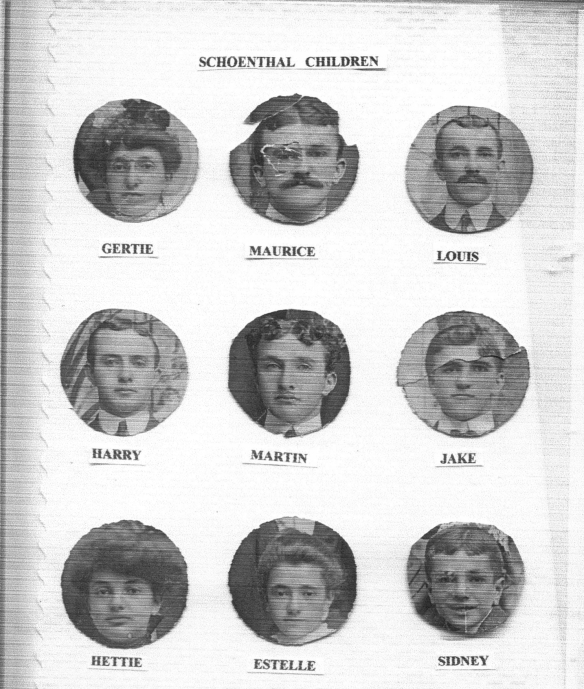
The nine surviving children of Simon and Rose (Mansbach) Schoenthal Photo courtesy of the family of Hettie Schoenthal Stein

The nine surviving children of Simon and Rose (Mansbach) Schoenthal
Photo courtesy of the family of Hettie Schoenthal Stein

But it’s a new year, and the time is now, so here we go.  First, to recap what I’ve already written about Simon and Rose and their children.  Simon was the fifth child of Levi Schoenthal and Henriette Hamberg and was born on February 14, 1849.  He was nine years older than my great-grandfather, his brother Isidore.  Along with his sister Amalie, Simon arrived in Washington, Pennsylvania, in 1867, a year after their older brother Henry had settled there. Simon was a bookbinder and occupied in that trade for many years after he first came to the US.  In 1872, Simon married Rose Mansbach, and in the 1870s they had five children: Ida (1873), Harry (1873), Gertrude (1875), Louis (1877), and Maurice (1878).

By 1880, Simon, Rose and their children had moved to Philadelphia, where Simon continued to work as a bookbinder.  They had five more children in Philadelphia: Martin (1881), Jacob (1883), Hettie (1885), Estelle (1888), and Sidney (1891).  Their oldest daughter, Ida, twin of Harry, died in 1887 from heart disease, leaving nine living children.
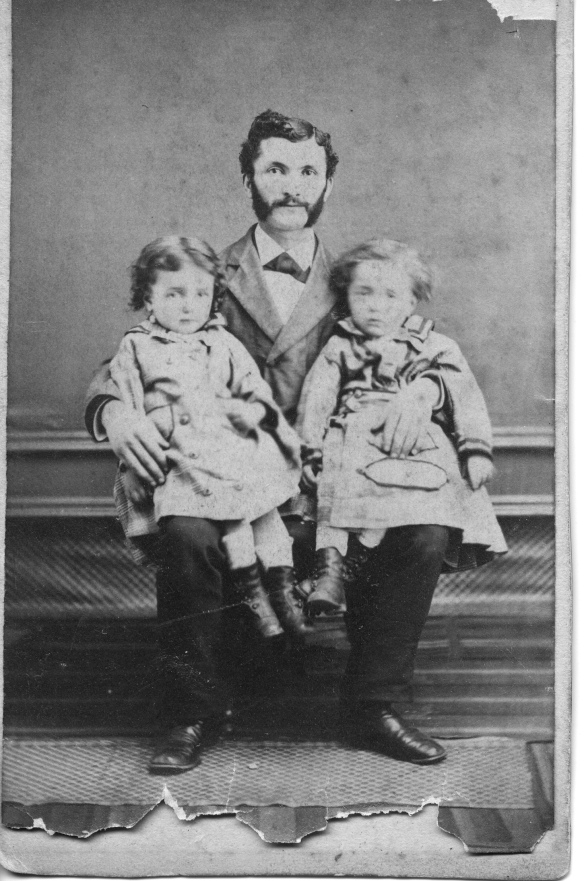
Simon Schoenthal with twins Harry and Ida 1875 Courtesy of the family of Hettie Schoenthal Stein

Simon Schoenthal with twins Harry and Ida 1875
Courtesy of the family of Hettie Schoenthal Stein

In the 1890s, Simon left the bookbinding business and turned to other fields.  He sold cigars early in the decade, and then by 1898 he and his family had relocated to Atlantic City, where he had a “bric-a-brac” store.

What brought them to Atlantic City? In fact, what had led Simon and Rose to move from Philadelphia to Atlantic City in the first place? I’ve been to Atlantic City twice since its revitalization in the 1980s, and I’ve played Monopoly since I was a little girl and know many of the famous street names from that game—Pacific, Illinois, Indiana, Mediterranean, Park Place, and, of course, the Boardwalk.  But I didn’t know much about the history of the city or what it was like in the late 19th century and early decades of the 20th when Simon Schoenthal and his children were living and working there.


http://www.gettyimages.com/detail/114528288

The official website for Atlantic City provides a fairly detailed history of the city.  Up until the mid-19th century, the island upon which Atlantic City was built was a fairly unsettled place.  Originally settled by the Lenni-Lenape Indians, the first permanent settlement by non-native Americans was not established until 1785 when Jeremiah Leeds settled there.  As late as 1850, there were only seven permanent homes on the island, all belonging to Leeds and his descendants.  Then in 1854, the first railroad line was completed, connecting Atlantic City to Camden, New Jersey, and in 1870 the first official road was completed.


http://www.gettyimages.com/detail/121332673

At that point, Atlantic City was attracting visitors:

By 1878, one railroad couldn’t handle all the passengers wanting to go to the Shore, so the Narrow Gauge Line to Philadelphia was constructed. At this point massive hotels like the United States and the Surf House, as well as smaller rooming houses, had sprung up all over town. The first commercial hotel the Belloe House, located at Massachusetts and Atlantic Ave., was built in 1853, and operated till 1902. The United States Hotel took up a full city block between Atlantic, Pacific, Delaware, and Maryland (the current site of the Showboat Parking lot). These grand hotels were not only impressive in size, but featured the most updated amenities, and were considered quite luxurious for the time.

There were beautiful hotels, elegant restaurants, and convenient transportation, but the businessmen of Atlantic City had one big problem to contend with…SAND. It was everywhere, from the train cars to the hotel lobbies. In 1870, Alexander Boardman, a conductor on the Atlantic City-Camden Railroad, was asked to think up a way to keep the sand out of the hotels and rail cars. Boardman, along with a hotel owner Jacob Keim, presented an idea to City Council. In 1870, and costing half the town’s tax revenue that year, an eight foot wide wooden foot walk was built from the beach into town. This first Boardwalk, which was taken up during the winter, was replaced with another larger structure in 1880.

….

On Weds. June 16, 1880, Atlantic City was formally opened. With fanfare the likes few in the area had seen, a resort was born. By the census of 1900, there were over 27,000 residents in Atlantic City, up from a mere 250 just 45 years before.


The PBS website provided this description of Atlantic City in its early days:

The city boasted a prototype rollercoaster by the late 1880s. In the decades around the turn of the twentieth century, middle and working class Philadephians, and soon others from up and down the East Coast, would come to play by the seaside. Vendors hawked their wares. James’ Saltwater Taffy became “Famous the World Over.” Mechanical marvels took tourists on daring rides that made their stomachs turn. Children rode carousels, and families dined in seaside cafes. Concerts were held on the sand every evening and the many hotels up and down the shore held gala dances.

Atlantic City seemed to have developed two personalities. On the one hand, the resort was promoted as a restful and wholesome vacation spot, offering sun and surf. On the other hand, tourists reveled in the boisterous atmosphere spawned by a festival of midways, numerous amusement piers (such as the one H.J. Heinz purchased to popularize his 57 varieties of pickles), and a selection of rollicking rides.

English: Glossy postcard reads "A Mile St...

English: Glossy postcard reads “A Mile Straightaway Stretch of the World-famous Atlantic City Boardwalk.” Back is divided. Published by Chilton Company, Phila., Pa., U.S.A. 4 (Photo credit: Wikipedia)

Thus, my relatives arrived as the city was booming, and it must have seemed a place of great opportunities for them and their children. In 1900, the older children of Simon and Rose Schoenthal were young adults. Harry was a student at Juniata College in Huntingdon, Pennsylvania; Louis, Martin, and Jacob were still living at home with their parents, but working: Louis was selling cigars, and Martin and Jacob were working in the laundry business. Maurice was not listed in the 1900 census, as far as I can tell, but he also was living in Atlantic City in the early 1900s, according to the 1904 Atlantic City directory.  In fact, four of the brothers appeared to be working in a related business at that time.  All four brothers were living at 22 Delaware Avenue in Atlantic City.  It appears that Martin and Jacob were running a laundry called Incomparable Laundry at 1432-1434 Atlantic Avenue and that Louis was running a cigar, tobacco, stationery and sporting goods business at the same location.  Louis also listed a billiards and pool hall on “S Virginia av n Beach.”  Maurice is listed as a manager at “S Virginia av, Ocean end.” The three youngest children, Hettie, Sidney, and Estelle, were still young and living at home in 1900.

English: Postcard published by the Post Card D...

English: Postcard published by the Post Card Distributing Co., Atlantic City, New Jersey, USA. Back is divided. (Photo credit: Wikipedia)


The oldest daughter, Gertrude, had married Jacob Miller in 1898, and they were living in Pima, Arizona, where they would have three children: Juliette (1900), Harry (1902), and Sylvester (1905).  The last child, Sylvester, was likely named for Simon Schoenthal, who died on March 26, 1904, when he was only 55 years old.

So what happened to the nine surviving children of Simon Schoenthal after he died?  For one thing, most of them lived long lives, especially for that generation.  Martin lived to only 67, but Hettie lived to be 103 and Sidney lived to be 100.  All the rest at least lived into their 80s.[1]  Almost all of them were married and had children and then grandchildren.  That’s a lot of years and a lot of people. You can see why I was procrastinating.

So let me start with the oldest, Harry, who was born in 1873, and as of 1902, was working for the Atlantic Wine and Liquor Company and living at 931 Atlantic Avenue in Atlantic City.  (His brothers Jacob, Louis, and Martin were living at 1434 Atlantic Avenue.)

Harry Schoenthal Courtesy of the family of Hettie Schoenthal Stein

Harry Schoenthal
Courtesy of the family of Hettie Schoenthal Stein

Harry does not appear in the Atlantic City directories between 1903 and 1910, whereas his younger brothers are listed in those years.  Harry does appear, however, in the 1910 census, living in Philadelphia, where he was boarding with a family named Wirtschafter.  The head of the household, Joseph Wirtschafter, and his wife and three children had several other boarders living in their household in addition to Harry.  Harry’s occupation is listed as the owner of a retail saloon, and Joseph’s occupation was a laborer in a liquor establishment.  Perhaps Harry’s landlord was working for him.

This photograph, shared with me by the family of Harry’s sister Hettie, is labeled “Uncle Harry’s Beer Business ? Philadelphia,” so I assume it refers to the liquor business owned by Harry Schoenthal.
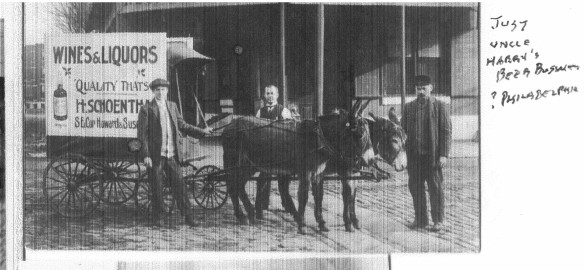
Uncle Harry's Beer Business Courtesy of the family of Hettie Schoenthal Stein

Uncle Harry’s Beer Business
Courtesy of the family of Hettie Schoenthal Stein

One of Joseph Wirtschafter’s children on the 1910 census was a 21 year old daughter named Esther.  Later that year, Harry, who was sixteen years older than Esther, married her.  In 1912, their first child, Sylvan Harry Schoenthal, was born (presumably named for Harry’s father Simon) and in 1914, their second son, Norman, was born.   In 1918, they were living in Philadelphia at 2153 North Howard Street, according to Harry’s draft registration for World War I.  Harry listed his occupation as “merchant” and was self-employed.

Registration State: Pennsylvania; Registration County: Philadelphia; Roll: 1907615; Draft Board: 12

Registration State: Pennsylvania; Registration County: Philadelphia; Roll: 1907615; Draft Board: 12

By 1920, however, Harry’s circumstances had changed. His in-laws, Joseph and Jennie Wirtschafter, had relocated to Atlantic City and were the proprietors of a hotel located at 139 St. James Place. According to the Atlantic City directory, the name of the hotel at that address was the St. James Hotel.  Harry and Esther and their two sons were also living at the same address in Atlantic City, where Harry was now employed as a clerk in the hotel. His mother Rose and his thirty year old sister Estelle (listed as Stella) were also living with them.  The 1922 Atlantic City directory lists Esther Schoenthal and her brother Charles Wirtschafter as the hotel proprietors at 139 St. James Place.

According to Wikipedia, this was a good time to be in the hospitality business in Atlantic City:

The 1920s, with tourism at its peak, are considered by many historians as Atlantic City’s golden age. During Prohibition, which was enacted nationally in 1919 and lasted until 1933, much liquor was consumed and gambling regularly took place in the back rooms of nightclubs and restaurants. It was during Prohibition that racketeer and political boss Enoch L. “Nucky” Johnson rose to power. Prohibition was largely unenforced in Atlantic City, and, because alcohol that had been smuggled into the city with the acquiescence of local officials could be readily obtained at restaurants and other establishments, the resort’s popularity grew further. The city then dubbed itself as “The World’s Playground”. [footnotes omitted]

The city’s website reports a similar view of the city’s popularity in this era:

Atlantic City became “the” place to go. Entertainers from vaudeville to Hollywood graced the stages of the piers. Glamorous Hotels like Haddon Hall, The Traymore, The Shelburne and The Marlborough-Blenheim drew guests from all over the world.

PBS had this to say about Atlantic City in the 1920s and 1930s:

By the 1920s, Atlantic City also had become a pre-Broadway show tryout town, a practice that continued until 1935. With the entrance of show business, the resort increasingly attracted celebrities who added a special element of glamour. Even as the city declined as a Broadway showcase, the celebrities continued to grace the city in the decades to come. Over the years people like Sophie Tucker, Jimmy Durante, Fanny Brice, Harry Houdini, Milton Berle, Martha Raye, Guy Lombardo, Irving Berlin, Frank Sinatra, Dean Martin, Jerry Lewis, Marilyn Monroe, and many more would be spotted around town.

Its tourism and light-hearted revelry made Atlantic City the perfect spot to hold the first Miss America Pageant on September 8th, 1921.

Though the economy hit hard times in the 1930s, people continued to flock to Atlantic City. It became even more well known when it became the city featured in the Depression-era hit game, Monopoly, where players handled large sums of money and strategized to buy the best property along the boardwalk.

Monopoly board on white bg

Monopoly board on white bg (Photo credit: Wikipedia)


According to a passenger manifest dated February 16, 1925, Harry and Esther were living at the Hotel Raleigh, located at 170 St. Charles Place in Atlantic City.  This is consistent with the 1930 census record for Harry and Esther, which has them living at 170 St. Charles Place in a hotel.  The census reports that they were the father-in-law and mother-in-law of the heads of household, which had me quite confused for a while.

Year: 1930; Census Place: Atlantic City, Atlantic, New Jersey; Roll: 1308; Page: 18A; Enumeration District: 0007; Image: 402.0; FHL microfilm: 2341043

Year: 1930; Census Place: Atlantic City, Atlantic, New Jersey; Roll: 1308; Page: 18A; Enumeration District: 0007; Image: 402.0; FHL microfilm: 2341043

Harry and Esther had sons who were eighteen and sixteen in 1930, so it made little sense.  Reading through the record of all those listed at 170 St. Charles Place, I found that the head of the household was Charles Wirtschafter, Esther’s brother.  Harry, now 56, was listed as retired, and Charles must have been running the hotel.  Esther and Charles’ father Joseph Wirtschafter, now a widower, was also living in the hotel.  So Harry and Esther were actually brother-in-law and sister of the head of household.

Raleigh Hotel, Atlantic City, found at http://www.monopolycity.com/ac_earlyhotels.html

Raleigh Hotel, Atlantic City, found at http://www.monopolycity.com/ac_earlyhotels.html

As for their two sons Sylvan and Norman, neither one was listed as living with their parents on the 1930 census.  In 1930-1931, Sylvan, then 18-19, was a freshman at Franklin and Marshall, according to the F&M 1931 yearbook. But where was he when the census was taken early in 1930? Norman was only sixteen in 1930—where could he have been? Boarding school? Living somewhere else? Just skipped by the enumerator?  I don’t know.  But neither appears on the 1930 census.

I found this family Jewish New Year’s greeting in the September 11, 1931 issue of the Jewish Chronicle of Newark, New Jersey (p. 28) in which Norman and Sylvan were included as well as their parents and the family of Charles Wirtschafter, all apparently still associated with the Hotel Raleigh:

1931 Rosh Hashanah greetings Harry Schoenthal and family


But then I also found this little social news item in the November 20, 1932 issue of the Washington (DC) Evening Star (p. 33):

Sylvan and Norman Schoenthal 1932 in DC paper

If Sylvan and Norman were going to Atlantic City for Thanksgiving, the implication is that neither son was living in Atlantic City at that point but rather presumably in Washington, DC, where the newspaper was published.  I did find Sylvan listed in both the 1933 and 1934 Washington, DC, city directory; in both years he was working at in the Shoreham Hotel and living at 2709 Woodley Road.  According to the 1940 census, Sylvan was still living in Washington, DC, in 1935.

As for Norman, he is not listed in the Washington, DC, city directories during the 1930s.   The earliest directory listing I have for him is the 1938 Atlantic City directory where both he and his brother Sylvan are listed as working at the Villa D’Este  hotel (located at 3100 Pacific Avenue) and living at 102 South Chelsea Street in that city.  Well, actually there is no separate listing for Sylvan, but rather one for a Mrs. Sylvan Schoenthal at that same address.  I believe that the directory editor mistakenly thought Sylvan was a woman and the wife of Norman Schoenthal.

Harry, Esther, Norman, and Sylvan Schoenthal 1938 Atlantic City directory Ancestry.com. U.S. City Directories, 1822-1995 [database on-line]. Provo, UT, USA: Ancestry.com Operations, Inc., 2011. Original data: Original sources vary according to directory.

Harry, Esther, Norman, and Sylvan Schoenthal 1938 Atlantic City directory
Ancestry.com. U.S. City Directories, 1822-1995 [database on-line]. Provo, UT, USA: Ancestry.com Operations, Inc., 2011.
Original data: Original sources vary according to directory.

In this same listing, you can see that Norman and Sylvan’s parents, Harry and Esther (Wirtschafter) Schoenthal, were also residing at 102 South Chelsea Street, but still working at the Hotel Raleigh.

In March 1938, there was a fire at the Villa D’Este hotel operated by Sylvan and Norman Schoenthal:

JPG Villa deste fire 1938 Sylvan and Norman Schoenthal-page-001

As the article indicates, the Villa D’Este hotel was not owned by the Schoenthal brothers, but managed by them.

In 1940, Harry, Esther, Sylvan and Norman were all still living together in Atlantic City, but no street address is indicated on the census record.  The record also has some of the relationships confused.  Sylvan is listed as the head of the household (and as single, making me doubt even more the 1938 directory listing for a “Mrs. Sylvan Schoenthal”); Norman is listed as the manager.  Their mother Esther is listed as the assistant manager, and their father Harry is listed as “Brother.”  How many think that Harry was the manager and Norman the brother? Or was Harry really the head of household and Sylvan the manager?  One thing is certain:  Harry was not Sylvan’s brother.
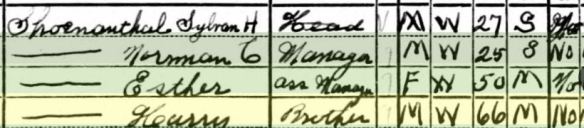
Year: 1940; Census Place: Atlantic City, Atlantic, New Jersey; Roll: T627_2301; Page: 82A; Enumeration District: 1-62

Year: 1940; Census Place: Atlantic City, Atlantic, New Jersey; Roll: T627_2301; Page: 82A; Enumeration District: 1-62

In addition, the census identified Sylvan as the hotel proprietor, Norman and Esther as partners, and has no occupation or title given for Harry.  I am not sure what to make of that, but my guess is that the line for “Harry” was really describing Norman and vice versa.  Also, the news article above indicated that Sylvan did not own the Hotel D’Este, so was this a different hotel? Or had he purchased it since 1938? Or is the census record inaccurate on this point as well?  I don’t know.

Year: 1940; Census Place: Atlantic City, Atlantic, New Jersey; Roll: T627_2301; Page: 82A; Enumeration District: 1-62

Year: 1940; Census Place: Atlantic City, Atlantic, New Jersey; Roll: T627_2301; Page: 82A; Enumeration District: 1-62


Sigh.  More errors and ambiguities in census records….

Although the 1940 census record for Harry and his family did not include a street address or hotel name, in 1941, all four family members are listing in the Atlantic City directory as residing still at 102 South Chelsea Street, and Sylvan and Harry have the notation “Villa D’Este” next to their names, as they did in the 1938 directory.  So the fire did not result in closing down the hotel.

Both Sylvan and Norman served in the military during World War II; Norman enlisted in the army on February 24, 1942, for the duration of the war, and his brother Sylvan enlisted on September 5, 1942, also for the duration of the war.  Norman’s record with the Jewish Welfare Board about his military service indicates that he was wounded during his time in the service, but I could not find any further details.

Ancestry.com. U.S., WWII Jewish Servicemen Cards, 1942-1947 [database on-line]. Provo, UT, USA: Ancestry.com Operations, Inc. Original data: Alphabetical Master Cards, 1942–1947; Series VI, Card Files—Bureau of War Records, Master Index Cards, 1943–1947; National Jewish Welfare Board, Bureau of War Records, 1940–1969; I-52; boxes 273–362. New York, New York: American Jewish Historical Society, Center for Jewish History.

Ancestry.com. U.S., WWII Jewish Servicemen Cards, 1942-1947 [database on-line]. Provo, UT, USA: Ancestry.com Operations, Inc.
Original data: Alphabetical Master Cards, 1942–1947; Series VI, Card Files—Bureau of War Records, Master Index Cards, 1943–1947; National Jewish Welfare Board, Bureau of War Records, 1940–1969; I-52; boxes 273–362. New York, New York: American Jewish Historical Society, Center for Jewish History.

After the war, both Sylvan and Norman returned to their parents’ home at 102 South Chelsea Street.  Sylvan was now married to a woman named Rose, according to the 1946 Atlantic City directory, and Norman was still associated with the Villa D’Este hotel.  But the 1950 directory only includes Sylvan and Rose, still at 102 South Chelsea and still associated with the Villa D’Este. In 1952, Sylvan continued to be the manager of the Villa D’Este hotel, as seen in this advertisement; note that he is described as the “owner-mgr,” so perhaps he had purchased the hotel after the 1938 fire and thus the 1940 census record could be correct in describing him as the proprietor of a hotel:

Sylvan Schoenthal ad villa deste 1952 Richmond VA paper


Harry, Esther, and Norman are not listed in the 1950 Atlantic City directory. It is not really too surprising that they had left Atlantic City by then.  As the city’s own website reports:

Atlantic City’s future seemed bright, until World War II. After the war, the public seemed to stop its love affair with The World’s Favorite Playground. Possibly because of the public’s access to national air travel, the shift of the population westward, the general deterioration of the city, or a shift in the public’s taste for more sophisticated entertainment, Atlantic City lost much of its shine; and most of its tourists.

It appears that Norman moved to West Palm Beach, Florida, sometime after 1946.  He is listed in the 1951 and 1953 directories for that city with a wife named Harriet.  In both directories, he is listed as the manager of Spanish Courts.  A search on newspapers.com brought up this article from the December 13, 1950, Palm Beach Post (p. 4):
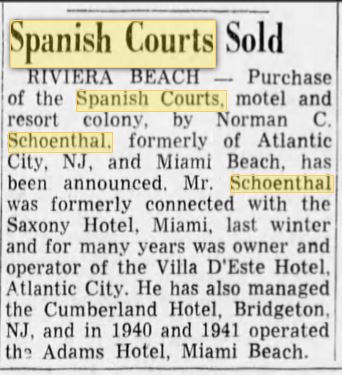
Normal Schoenthal buys Spanish Courts Palm Beach Post article

Interestingly, it appears that Norman had been in Florida before the war, returned after the war to Atlantic City, and then again returned to Florida.  Norman became active in the local business association and was elected president of the Palm Beach County Chapter of the Florida State Motor Courts Association, according to the April 27, 1951, issue of the Palm Beach Post (p. 15).

Norman’s parents, Harry and Esther Schoenthal, must have also moved to Florida in the 1950s because Harry died in Palm Beach on September 23, 1954.  He was 81 years old.  According to the records at Mt. Sinai cemetery in Philadelphia where he was buried, he had been a resident of West Palm Beach, Florida, when he died.  He was buried near his parents, Simon and Rose (Mansbach) Schoenthal.

Historical Society of Pennsylvania; Philadelphia, Pennsylvania; Collection Name: Historic Pennsylvania Church and Town Records

Historical Society of Pennsylvania; Philadelphia, Pennsylvania; Collection Name: Historic Pennsylvania Church and Town Records

Norman and Harriet divorced in 1954, and she relocated to NYC, where she became a very well-known publicist in the furniture industry and was president of Harriet Schoenthal Inc., a New York advertising, marketing and public relations firm. As far as I can tell, Norman and Harriet had not had any children.  On October 26, 1954, the Palm Beach Post (p. 1) reported that Norman had sold the Spanish Courts motor court for $175,000.  (Later news articles reveal that in 2002 there were plans to tear down the Spanish Courts motel for a new development, but that must not have happened because as recently as 2013, the Palm Beach Post reported new plans to raze the site for redevelopment.)

Sadly, a year later Norman Schoenthal died on September 15, 1955; he was only 41 years old.   He also was buried at Mt. Sinai in Philadelphia where his father and his grandparents were buried.  According to the cemetery records, he was a resident of Atlantic City when he died and thus I assumed he must have returned there after his divorce and the sale of his business.
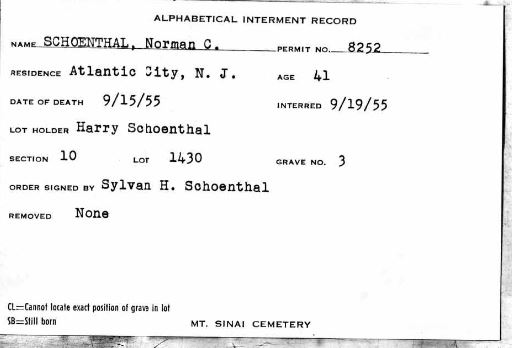
Historical Society of Pennsylvania; Philadelphia, Pennsylvania; Collection Name: Historic Pennsylvania Church and Town Records

Historical Society of Pennsylvania; Philadelphia, Pennsylvania; Collection Name: Historic Pennsylvania Church and Town Records

But he was only 41, and I wondered what had been the cause of his death.  I could not find an obituary or a death certificate online.  I thought he might have died in New Jersey, which does not have death records online, so I asked my New Jersey researcher to check the archives in Trenton, but she reported back that there was no death certificate for Norman Schoenthal in New Jersey.  I was stumped, so I turned to Tracing the Tribe, the Jewish genealogy group on Facebook, and as always received great assistance.   One group member there, Stacy, located Norman’s death certificate in the Delaware records:

Norman C. Schoenthal death certificate Delaware Death Records, 1855-1961," database with images, FamilySearch (https://familysearch.org/ark:/61903/1:1:KX3F-P3J : accessed 14 January 2016), Norman C Schoenthal, 15 Sep 1955; citing Wilmington, New Castle, Delaware, United States, Hall of Records, Dover; FHL microfilm

Norman C. Schoenthal death certificate
Delaware Death Records, 1855-1961,” database with images, FamilySearch (https://familysearch.org/ark:/61903/1:1:KX3F-P3J : accessed 14 January 2016), Norman C Schoenthal, 15 Sep 1955; citing Wilmington, New Castle, Delaware, United States, Hall of Records, Dover; FHL microfilm

There is a lot to digest here.  First, this is obviously the right person, given the parents’ names, occupation, informant’s name, burial place, and former wife’s name.  But what was he doing in Delaware? And why is his residence address in Washington, DC, not Atlantic City or Florida or Delaware?  Mt. Sinai’s records reported his residence as Atlantic City.  The address in Washington, 3801 Connecticut Avenue, is an apartment building.

The cause of death is very disturbing.  Norman was run over by a truck, resulting in a fractured skull and crushed chest.  The coroner originally typed “accident” on the death certificate, but then that was crossed out and “suicide” was handwritten above it.  What had happened that led the coroner to change his conclusion? The certificate states that the injuries occurred in Farnhurst, Delaware.  When I Googled Farnhurst, the first thing that popped up was “Farnhurst Delaware State Hospital,” once known as the Delaware State Hospital for the Insane at Farnhurst.  Had Norman been a patient there? I could not find a Fairview Avenue in Farnhurst on current maps, only one in Wilmington, which is about six miles from Farnhurst.  I am hoping to learn more and have contacted the Wilmington Public Library Reference Department to see if they can locate a news article about Norman’s terrible death.

As for his survivors, his mother Esther had returned to Atlantic City after living in Florida; she is listed in the 1957 Atlantic City directory.  As the informant on his brother Norman’s death certificate, Sylvan had given his address as the Hotel Mark in Atlantic City. Sylvan had married a woman named Rose by 1954, as they are listed together in that year’s Atlantic City directory as well as in the 1956 directory for that city.  But they are not listed in the 1957 Atlantic City directory.  It seems that Sylvan and Rose had moved to Florida.  In January 1960, Sylvan and Rose were divorced in Dade County, Florida. It must not have been an amicable divorce as there was some post-divorce litigation. See Schoenthal v. Schoenthal, 138 So.2d 802 (Fla. Dist. Ct. App. 1962).

Sylvan remained in Florida after his divorce.  There are two entries in the Florida Marriage Index and one in the Florida Divorce Index indicating that Sylvan was married and divorced again and then married one more time in 1971 to Doris Lippman, to whom he was married for 27 years until he died. (Although the Marriage Index indicates that her name was Dorothy Rosner, I am quite certain that it was in fact Doris Lippman; Doris’ stepfather was named Rosner, and Sylvan’s obituary indicates that he and Doris were married in the same year as the index entry for Sylvan’s marriage to “Dorothy Rosner.”)

Esther Wirtschafter Schoenthal died on October 21, 1969; she was 80 years old.  She was buried with her husband Harry and her son Norman in Mt. Sinai cemetery in Philadelphia.  Her burial record indicates that she was still residing in Atlantic City at the time of her death.

Historical Society of Pennsylvania; Philadelphia, Pennsylvania; Collection Name: Historic Pennsylvania Church and Town Records

Historical Society of Pennsylvania; Philadelphia, Pennsylvania; Collection Name: Historic Pennsylvania Church and Town Records

Sylvan Schoenthal, the only remaining member of his immediate family, continued to live in Miami, Florida, for the rest of his life.  He died on December 28, 1998, when he was 86 years old, according to his obituary in the December 31, 1998, issue of the Palm Beach Post (p. 95).  According to the obituary, Sylvan had moved to Miami in 1942, but that is not consistent with the directories and other sources I located.  He apparently was also in the hotel business in Florida.  In addition, he had three children, whom I am now trying to locate.  I have been in touch with his step-great-granddaughter, who reported that he was a kind man, well-loved by her great-grandmother’s family.  It would be interesting to hear any family stories about the Schoenthal family’s life in the hotel business in Atlantic City in its heyday.


[1] As we will see, I could not find anything about when Maurice died, so I don’t know how long he lived.