In Memory of Murray Leonard: May 4, 1922-March 27, 2016

Murray Leonard

Murray Leonard

My second cousin Richard Leonard contacted me to let me know that his father, Murray Leonard (born Murray Leonard Goldschlager) had passed away on March 27, 2016, in Tucson, Arizona.  Murray was my mother’s first cousin.  He was the son of David Goldschlager, my grandfather’s younger brother, and Rebecca Schwarz.  He was named for his grandfather, my great-grandfather Moritz Lieb Goldschlager, and shared the same Hebrew name with his first cousin, my uncle Maurice Goldschlager.

I never had the chance to meet Murray, but I know from Richard how well loved he was.  With Richard’s permission, I am quoting from Murray’s obituary and Richard’s own personal tribute:

Murray Leonard, 93, of Tucson, Arizona, passed away peacefully on March 27th 2016. He was born in Scranton, Pennsylvania on May 4th 1922.

Murray grew up in The Bronx, following all the NY Yankee greats.

David Rebecca Sidney and Murray at Brighton Beach

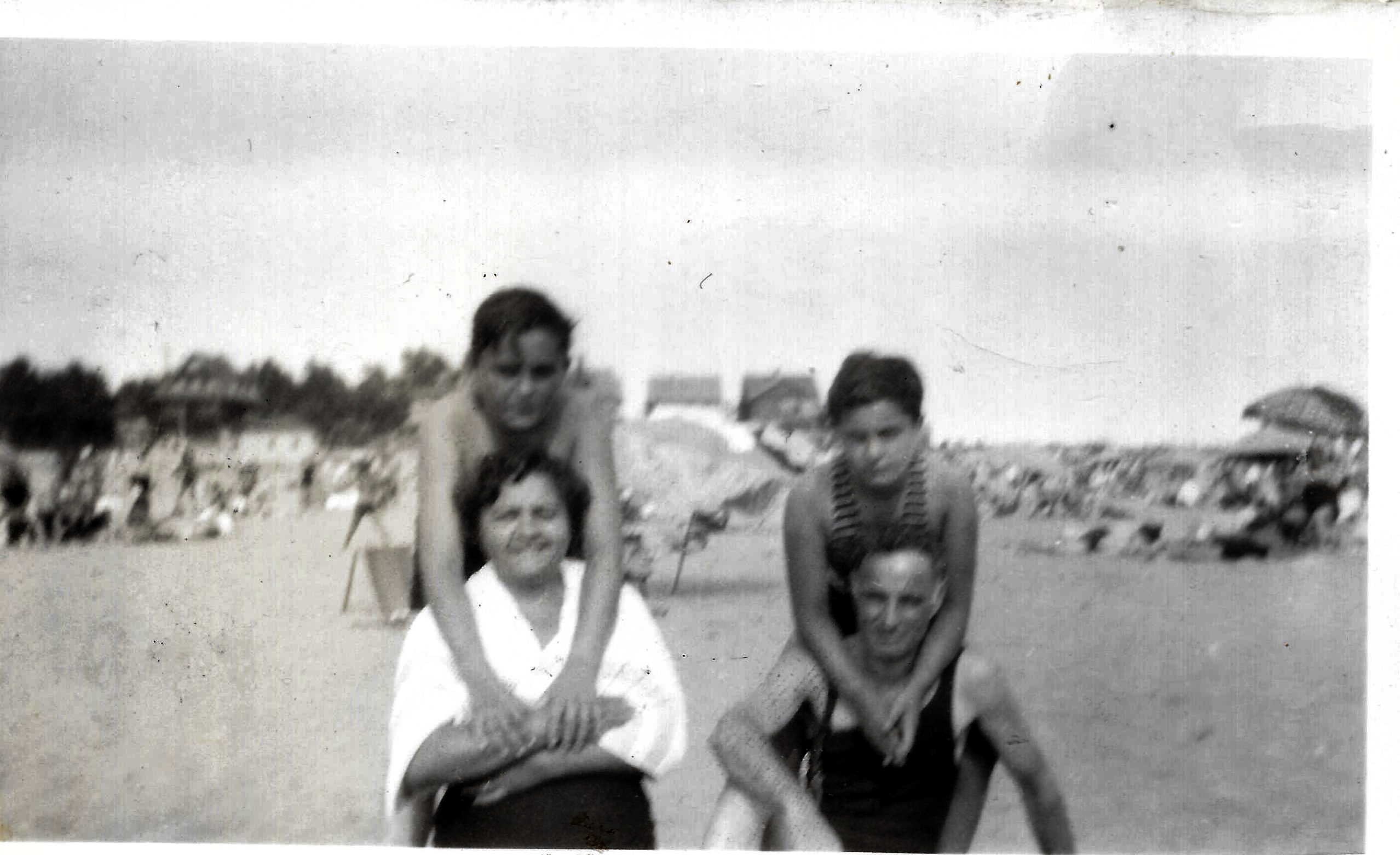
Murray, Sidney, Rebecca and David Goldschlager at Brighton Beach

David and Murray Goldschlager

David and Murray Leonard Goldschlager


When World War Two broke out he answered his country’s call to duty as a PFC in the US Army (83rd Reconnaissance Troup, 83rd Division), participating in the Battle of the Bulge, sustaining injuries and was awarded a Purple Heart.

Ancestry.com. U.S., WWII Jewish Servicemen Cards, 1942-1947 [database on-line]. Provo, UT, USA: Ancestry.com Operations, Inc. Original data: Alphabetical Master Cards, 1942–1947; Series VI, Card Files—Bureau of War Records, Master Index Cards, 1943–1947; National Jewish Welfare Board, Bureau of War Records, 1940–1969; I-52; boxes 273–362. New York, New York: American Jewish Historical Society, Center for Jewish History.

Ancestry.com. U.S., WWII Jewish Servicemen Cards, 1942-1947 [database on-line]. Provo, UT, USA: Ancestry.com Operations, Inc.
Original data: Alphabetical Master Cards, 1942–1947; Series VI, Card Files—Bureau of War Records, Master Index Cards, 1943–1947; National Jewish Welfare Board, Bureau of War Records, 1940–1969; I-52; boxes 273–362. New York, New York: American Jewish Historical Society, Center for Jewish History.

After getting married to the love of his life Edna in 1958, he moved to Tucson, Arizona to pursue a career in the mail-order and retail women’s clothing business with his wife at Old Pueblo Traders and the Vicki Wayne retail stores, retiring at the age of 78.   

He was a keen golfer and enjoyed playing with his buddies as part of the ‘Grumpy Old Men” golfing group, playing until he was 87. He also enjoyed playing the US stock market/investing mostly on his own, including reading the Wall Street Journal every day.

Murray_Leonard_Lacey_Busby_Hadwin_Layla_Hadwin_11_JAN_2014

Murray Leonard


He is survived by a son, Richard (Stephanie) and loving wife of 57 years, Edna Leonard. He was preceded in death by his brother Sidney Goldschlager (Nora) of Rumson, New Jersey and parents, David and Rebecca Goldschlager, who immigrated to the US [from] Iași, Romania. He is also lovingly remembered by all his nieces and nephews as fun-loving “Uncle Mursh”, who would do anything for a laugh.

Richard wrote:

He was a fantastic father, patriotic American and overall great guy. He heeded his country’s call to duty fighting in WWII, seeing combat action in the Battle of the Bulge (getting wounded and was awarded a Purple Heart). A successful businessman retiring at the age of 78, he also was a keen golfer, playing until he was 87. He will be certainly missed but the great memories will always remain! Time to toast him with a Tanqueray & Tonic, his favorite drink!

I will be sure to have that Tanqueray & Tonic in his memory and will think of my cousin Murray, the son of Romanian immigrants who grew up to live the life his parents must have dreamed for him: a long and happy marriage and a loving son, a successful business, and dedicated service to the country that his parents had adopted as their own when coming here as young adults in the early 20th century.

May his memory be for a blessing, and may his family be comforted by their memories.

Murray Leonard older


My Grandfather’s Notebook: A Post-Script, And Merry Christmas to All Who Celebrate!

Although I do not celebrate Christmas, I always enjoy the lights and trees and music and spirit of these days, and it struck me as entirely consistent with that spirit when I received the following comment on my last post from TK, a fellow genealogy blogger:

Amy, I enjoyed your post, and I’ve staged a little concert for you based on your grandfather’s list of musical pieces. It’s on my blog, Before My Time. It’s video-intensive, so it takes time to load. I found videos for all but four of the songs. Enjoy!

You can see TK’s blog post here and listen to all the music yourself. What a truly generous and kind gift this was—a compilation of the music listed in my grandfather’s little pocket calendar.  Thank you so much, TK!  I truly enjoyed listening to every piece of music.

One thing that struck me after reading TK’s blog post and listening to the music was that many of these pieces of music seemed to be student pieces, fairly short and simple pieces of music that a student taking piano lessons might play. But my grandparents certainly did not have a piano in the house, nor had I ever heard of anyone in the family playing the piano.

But I then thought about my cousin Beth’s comment on Facebook that her father, my uncle, had played the violin for many years and was quite accomplished.  Were these pieces that he played?

I decided to go back and examine the handwriting more carefully.  After comparing the writing to that of my grandfather, grandmother, aunt, uncle, and mother, I now think that my uncle probably wrote the list.  What do you all think?

Here is the music page (you will have to click and zoom to see the handwriting clearly enough):

Grandpa notebook music

Here is my grandfather’s writing:

Grandpa notebook page 7 more notes about Maurice and hospital

This is what I thousht was my aunt’s handwriting as a child, which also looks somewhat like that on the music page: adult:

Grandpa Notebook 3 aunt elaine playing school

But this is her handwriting as an adult, and it’s very different, so maybe that’s not my aunt’s writing above?


Grandpa notebook Aunt Elaine names 1


My uncle wrote this page:

Grandpa notebook 8 maurice hunting notes 1934

This is my mother’s handwriting as a young child:

Grandpa Notebook 2 Mom note about teacher

And my grandmother wrote this page later in life in her 60s and probably wrote some of the entries on the page below it when she was in her 40s:

Grandpa notebook 1964 notes by Grandma

Grandpa Notebook 5 more addresses

So who wrote the page with all the pieces of music listed?  Anyone care to venture an opinion?

****************

For all of you who celebrate, I wish you a wonderful and joyous Christmas.  And if I may borrow and paraphrase the traditional saying, may there be peace on earth and good will to all.


My Grandfather’s Notebook: More than Names, Dates, and Addresses

Notebook cover

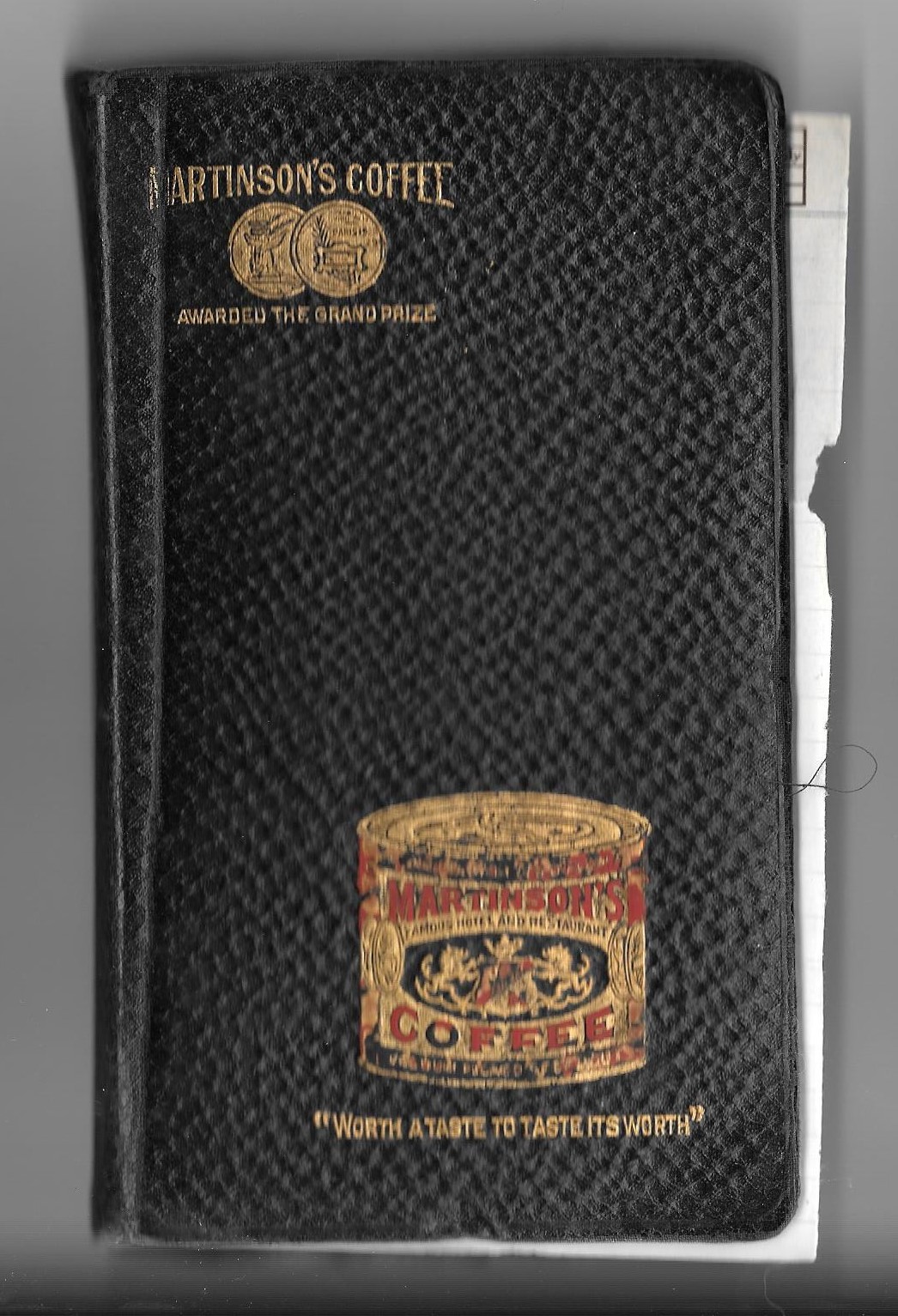
Among the other treasures that turned up in the shoebox of “old papers” that had belonged to my Aunt Elaine was a Martinson Coffee pocket calendar for the year 1930.  My aunt would have been twelve going on thirteen, my Uncle Maurice ten going on eleven, and my mother not yet born when 1930 began. Here’s a photograph of my grandmother and her three children taken in 1931 when that pocket calendar was still relatively new:
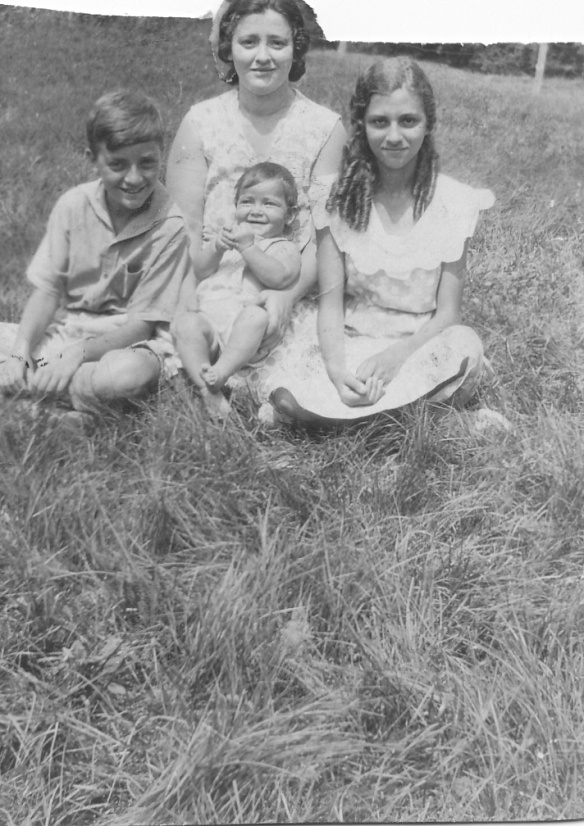
 

Goldschlagers 1931

Goldschlagers 1931

This calendar, however, had to be around for many years as a place where members of the family scribbled notes of all kinds because even my mother eventually made contributions to it. In fact, the most recent entries seem to have been made by my grandmother in 1965 long after my grandfather had died and all her children had married.
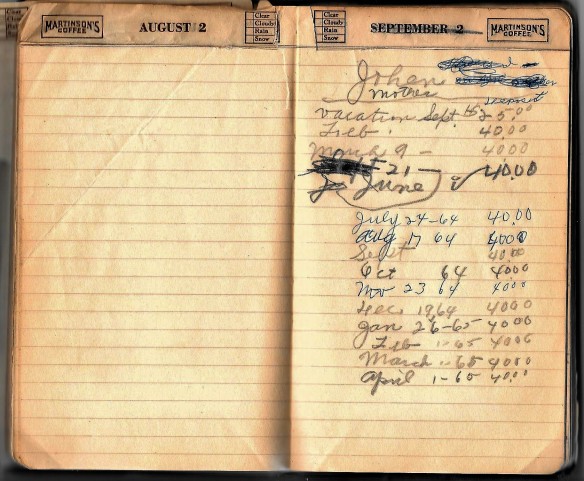
Grandpa notebook 1964 notes by Grandma

I don’t know for sure what “Johen” meant, but I wonder if my grandmother was referring to my father, whose name is John Cohen.

It amazes me that my grandparents kept this little book for so long, and I wonder why it became the repository of so many family notes. I can’t imagine how it stayed around and was used by so many members of the family beginning in 1930 up to 1965.  Today that notebook probably would not have lasted a year (well, it wouldn’t exist since we’d use our smartphones and computer calendars instead.)

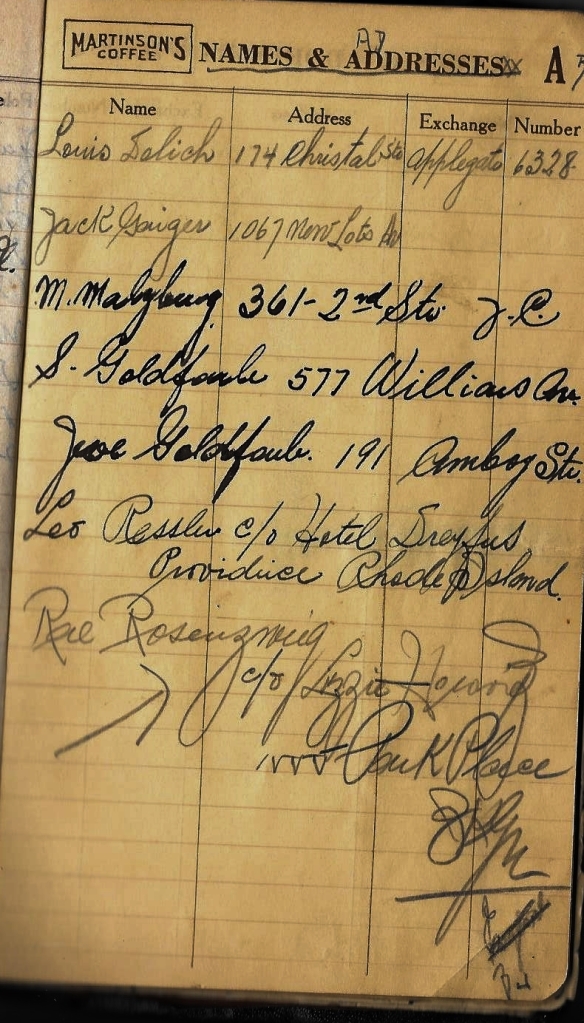
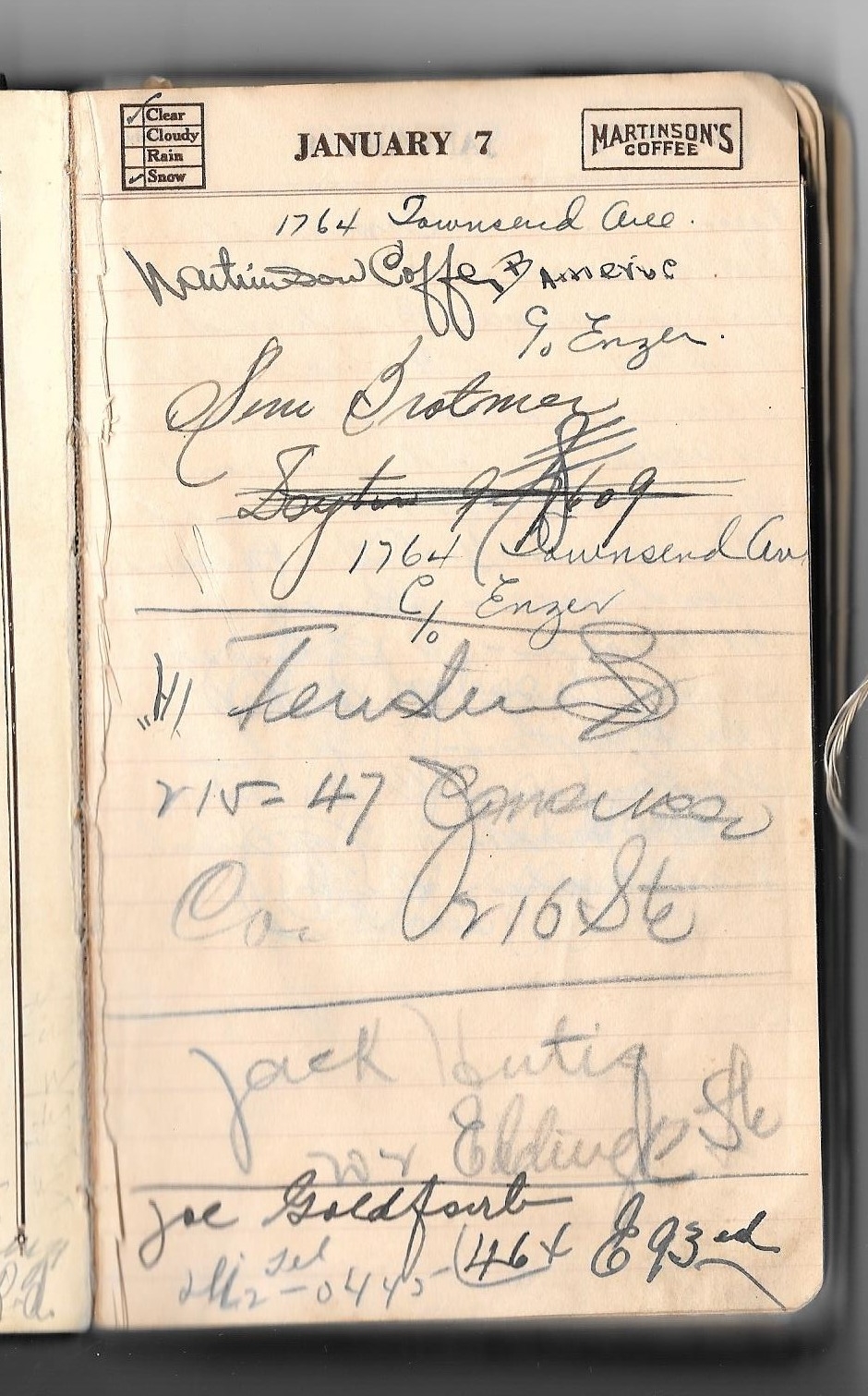
For example, my grandparents used it not only as a calendar but as an address book.  I already posted two of the pages of addresses in an earlier post:
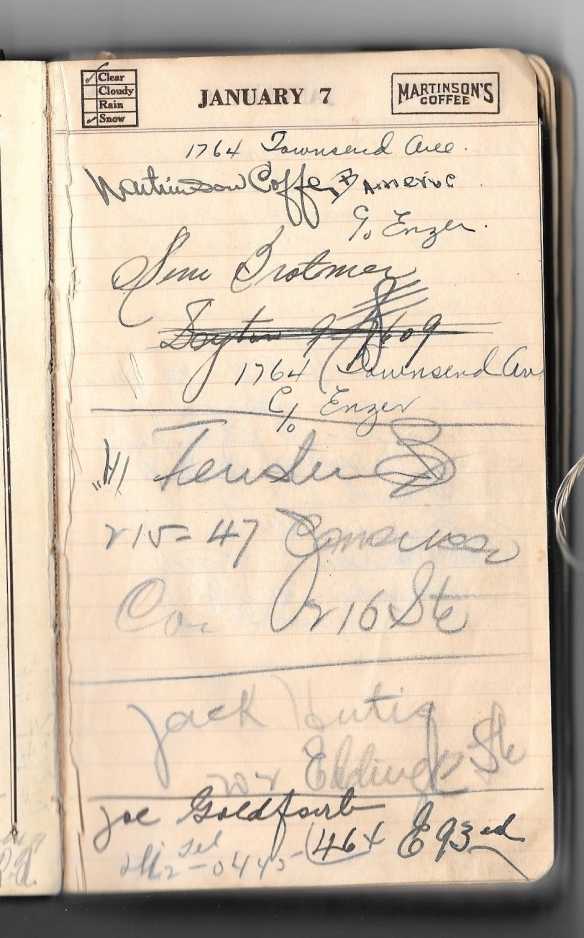
Grandpa Notebook page 1 addresses Joe Goldfarb Grandpa notebook 13 more addresses Joe Goldfarb

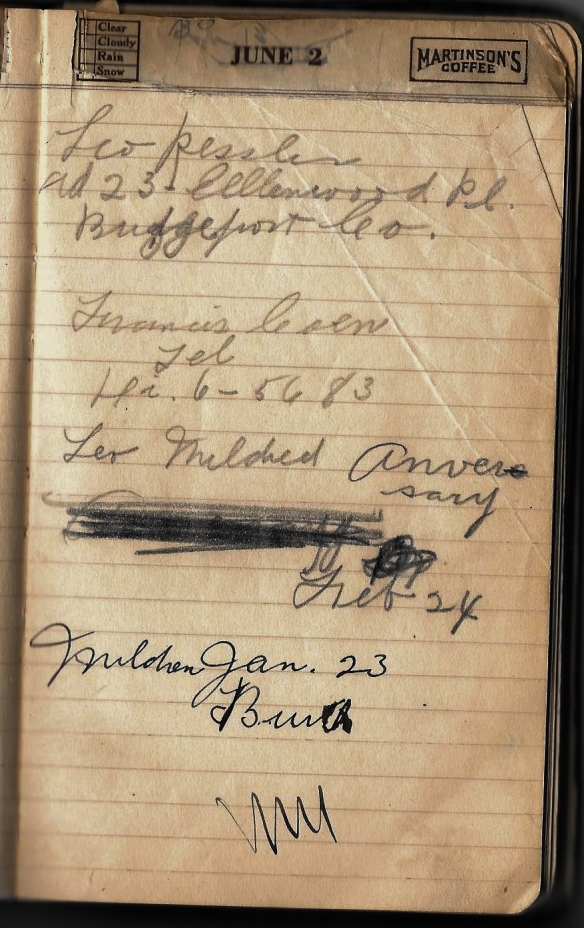
Here are a few more:

Grandpa Notebook 4 more addresses Ressler

Leo Ressler was my mother’s first cousin, son of Tillie Brotman Ressler, my grandmother’s sister.  His wife was Mildred Phillips, and the notebook page records both their wedding anniversary and Mildred’s birthday.  Unfortunately there is no year given for the marriage, but Mildred was still single and living with her mother and stepfather in New Haven, Connecticut, on the 1930 census.  She and Leo lived in Hartford during the late 1930s, and so this entry of an address for Bridgeport must have been long after the 1930 date on this calendar. (They were living in Bridgeport as of the 1940 US census.)  Leo and Mildred owned a dress shop in Connecticut for many years before retiring to Florida.  My mother recalls that Mildred was considered high class by my grandparents and that my aunt was invited to come visit them so she could learn some of Mildred’s sophisticated ways.
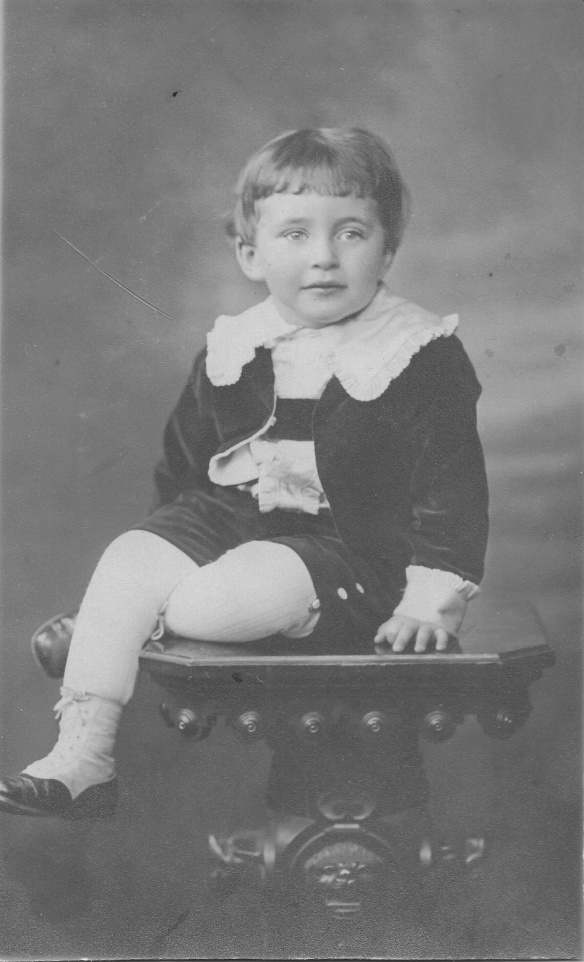
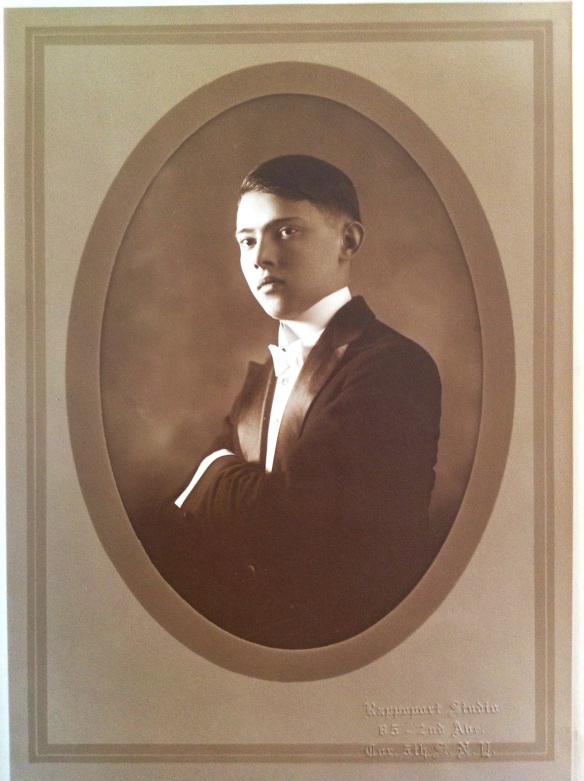
Leo Ressler

Leo Ressler

(I don’t know who Francis Coen would be— another name to research.)

The next two pages had three addresses for my mother’s uncle, Sam Brotman—my grandmother’s brother.  Apparently he moved around a bit, given all the crossed out addresses the notebook includes for him. (There are two more on the first page, above.) I don’t know very much about Uncle Sam except that he was a cab driver and lived alone all his adult life. Yet all these addresses include a “in care of” reference so perhaps he was living with someone named Weinstein for some period of time and someone named Enzer at other times.
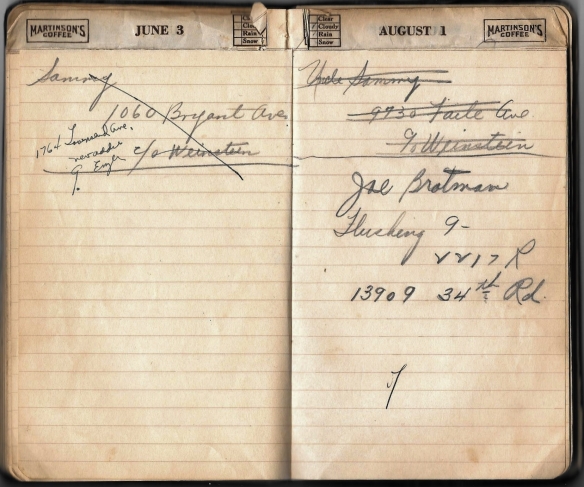
Grandpa Notebook 5 more addresses

Sam Brotman

Sam Brotman

Joe Brotman, the other name on this page, was another of my mother’s first cousins, the son of Hyman Brotman, my grandmother’s brother. I have six different Joseph Brotmans in my family tree, including my great-grandfather, but Hyman’s son is the only one who lived in Queens, where he was living when this address was recorded.
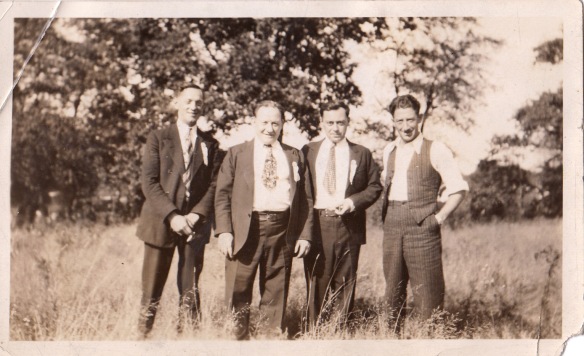
Hyman (second from left) and Joe (far right) and two unknown men

Hyman (second from left) and Joe (far right) and two unknown men

My grandfather also used the calendar to record birthdays for family members.  There are notes on the dates for his birthday as well as that of my grandmother, my aunt, and my mother.  (The pages for June were torn out, so there is none for my uncle.) My mother was born during 1930, and on the appropriate date my grandfather simply wrote, “My daughter’s birthday, Florence, born—-.”

One of my favorite pages (although very hard to read) is the one where my grandfather apparently listed all his favorite pieces of music.  I know that music was one of his passions, one of the few things he remembered fondly about his childhood in Iasi, Romania:
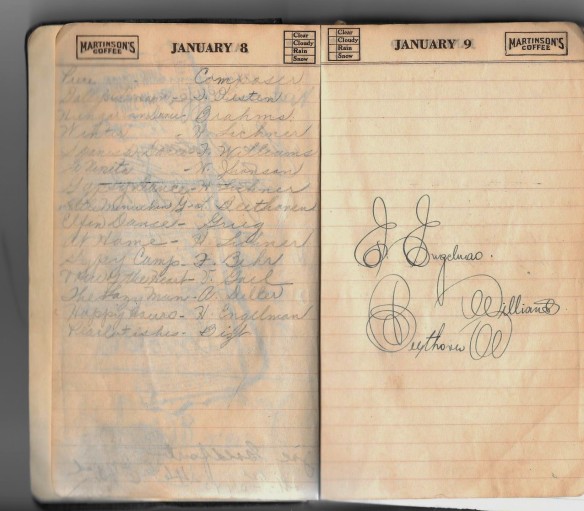
Grandpa notebook music

I can’t make out the names of most of the pieces, but he has works by Beethoven (whose name he wrote with such a flourish on the opposite page), Brahms, Bizet, and Grieg as well as several others.

He also used the notebook as an account book, and there are many pages where he records his paychecks, his Social Security benefits, and Welfare Fund payments.  My grandfather was active in his union, and I assume that the Welfare Fund was administered by the union.  In addition, he kept a record of people they visited or who visited them and other events.
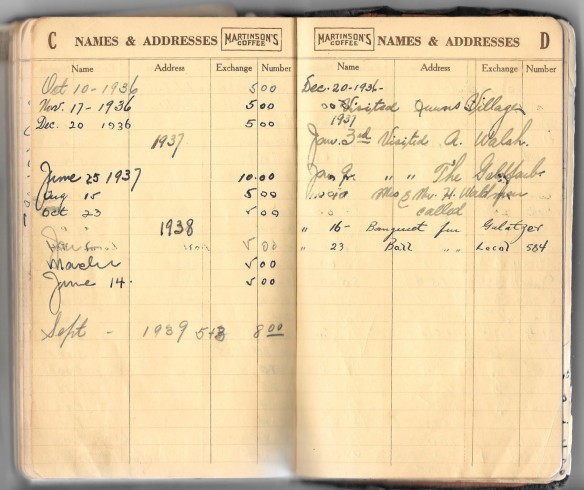
Grandpa notebook money and visits

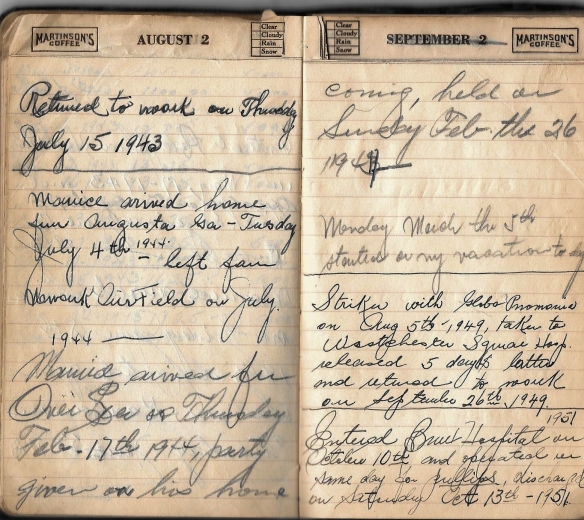
The notebook also contains a number of notes my grandfather made about his health and various other matters.  For example, on these pages he not only recorded financial information; he interspersed notes about the times my uncle came home to visit during his military service in World War II  with notes about his own operations and hospitalizations.
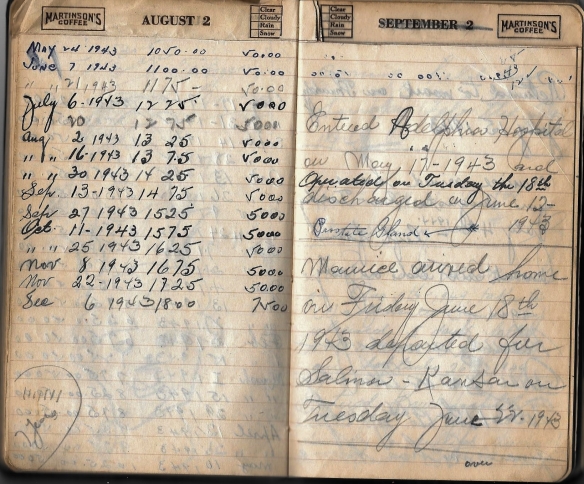
Grandpa Notebook 6 notes about Maurice in service

Grandpa notebook page 7 more notes about Maurice and hospital

Again, all of these were obviously written long after 1930 and as late as 1951 when he had surgery for polyps.  He died just six years later on May 3, 1957.

But perhaps the most interesting and entertaining parts of the notebook are those contributed by my aunt, my uncle, and my mother.  There are many pages like this one with a list of names and then what looks like grades.  My mother believes that my aunt used the notebook to play school, listing her classmates and even her brother and herself as the students and then “grading” them in different subjects.
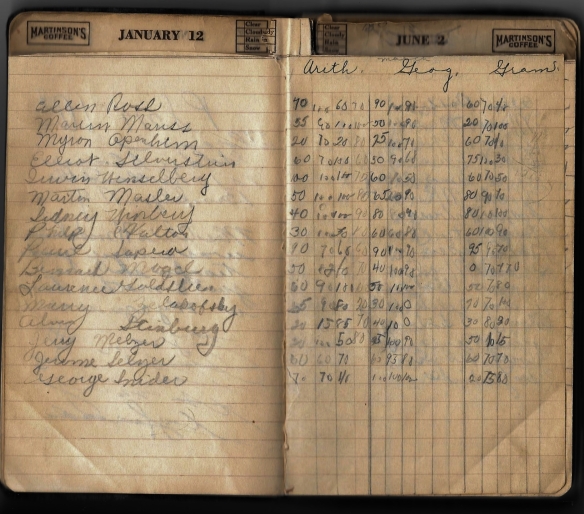
Grandpa Notebook 3 aunt elaine playing school

My aunt also liked to practice writing her name and doodling all over the pages (the top one might have been written by my mother or someone else; I am not sure):
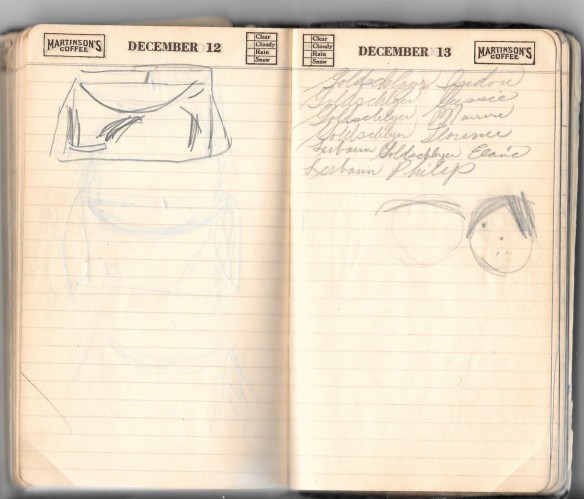
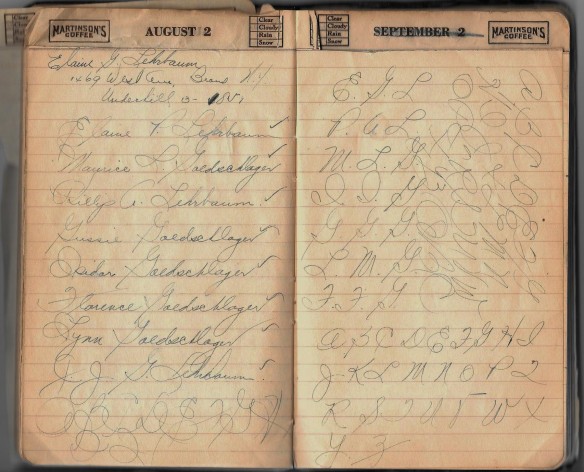
GRandpa notebook Aunt Elaine names earlier

Grandpa notebook Aunt Elaine names 1

These pages were obviously written after my aunt was married as she used her married name (Lehrbaum) and included her husband, my Uncle Phil. The second page also includes my uncle’s wife, my Aunt Lynn, and they weren’t married until 1945, several years after Aunt Elaine had married.  I find it fascinating that even after she was married and out of the house, my aunt still somehow found this notebook a place to scribble.

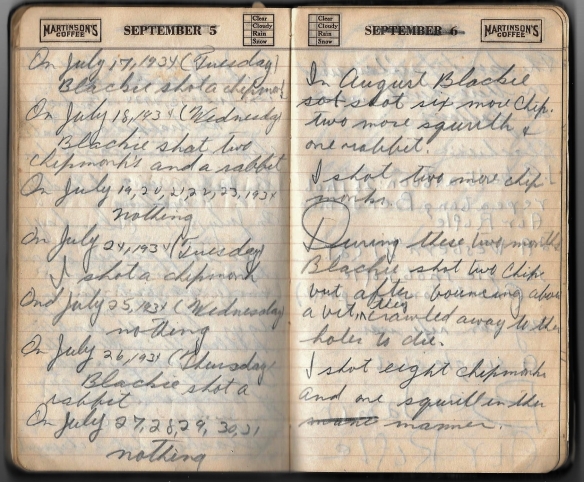
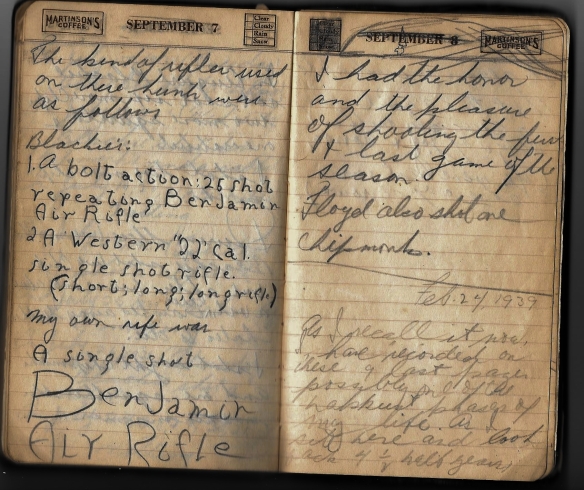
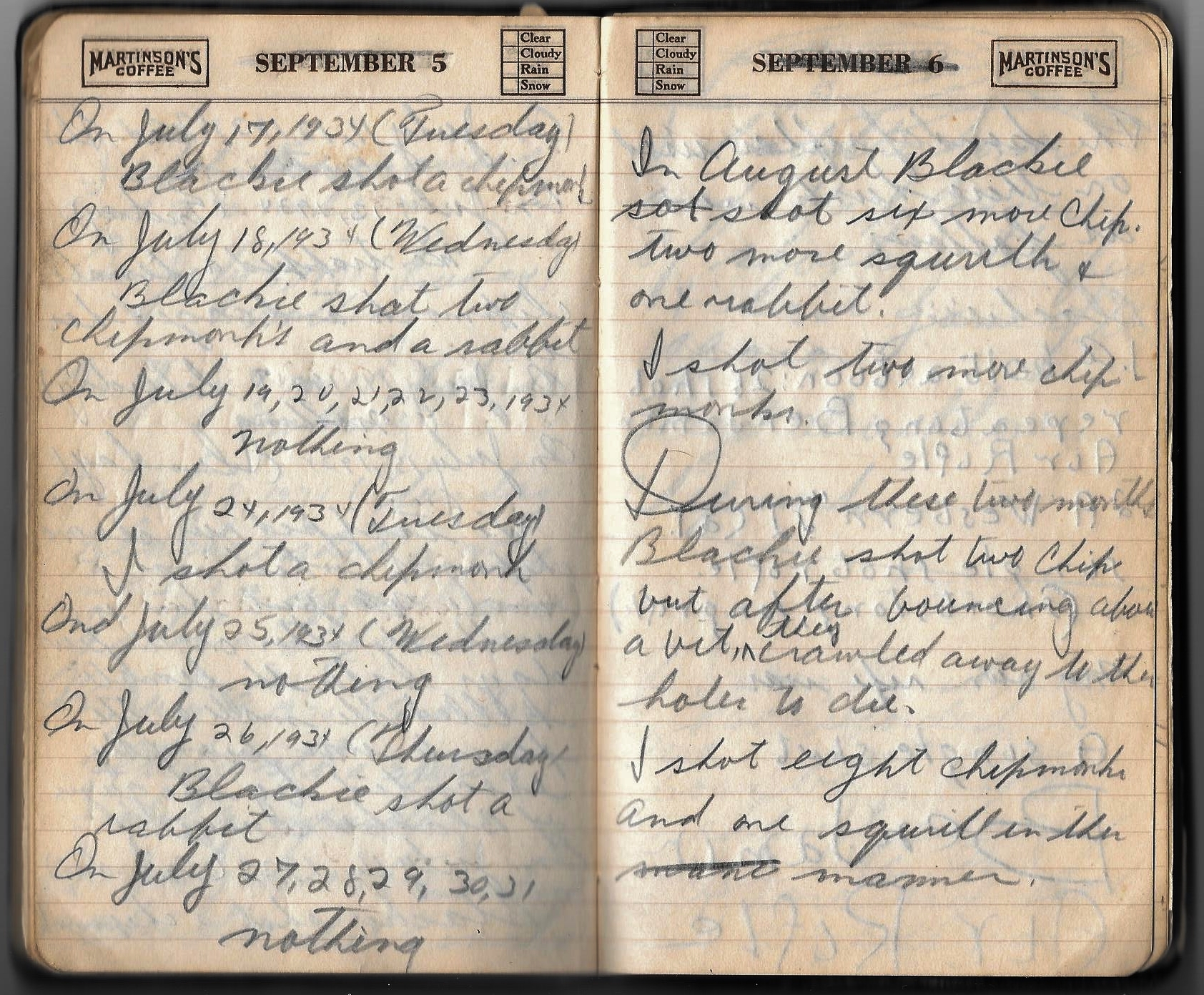
I found the pages my uncle wrote in 1934 about his adventures shooting at chipmunks, squirrels, and rabbits with his friend Blackie both amusing and disturbing.  First, the idea that my uncle was carrying around a real gun at age fifteen is rather horrifying.  Secondly, I always knew my uncle as an animal lover.  He always had a dog (a schnauzer named Schnopsie is the one I remember best), and later on he had several dogs and cats as well as various other animals.  How could he shoot harmless chipmunks, squirrels, and rabbits? But when I asked my cousin Beth about this, she said he always liked to shoot, so she was not surprised.
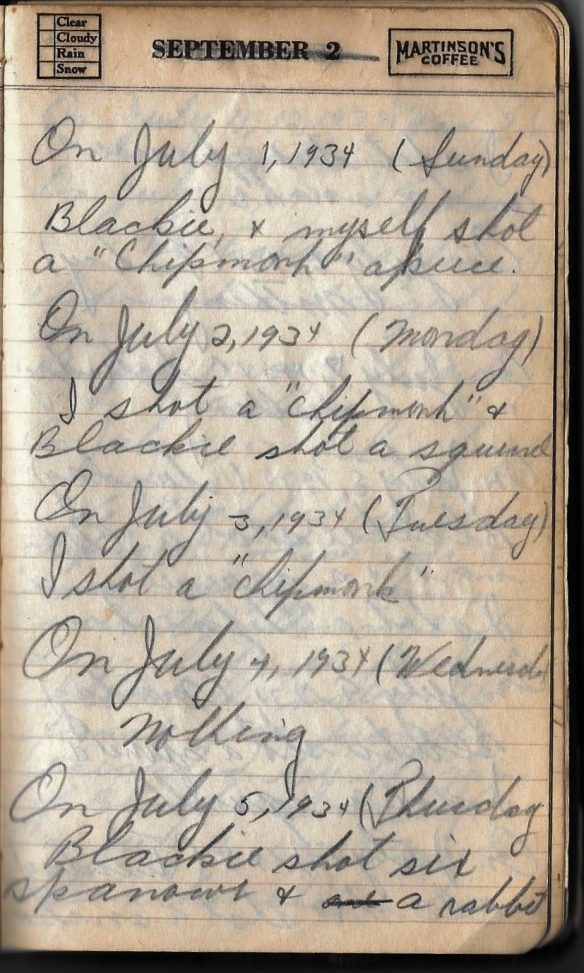
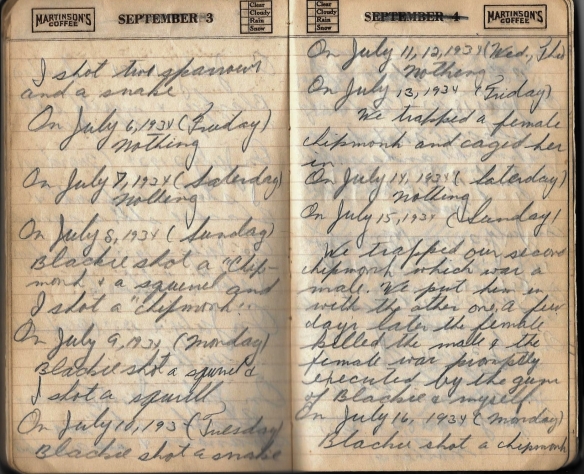
Grandpa notebook 8 maurice hunting notes 1934 Grandpa notebook 9 more hunting Maurice 1934 Grandpa notebook 10 more hunting notes Grandpa notebook 11 hunting notes and final comment in 1939 Grandpa notebook 12 Maurice comment 1939

But it’s amusing also because I can imagine my uncle as a fifteen year old boy having a wild time with his friend Blackie and competing to see who would shoot the most animals that summer.  Below is a photo of my uncle, my aunt, and my mother as well as my grandmother about a year after the summer that my uncle was writing about his hunting adventures.
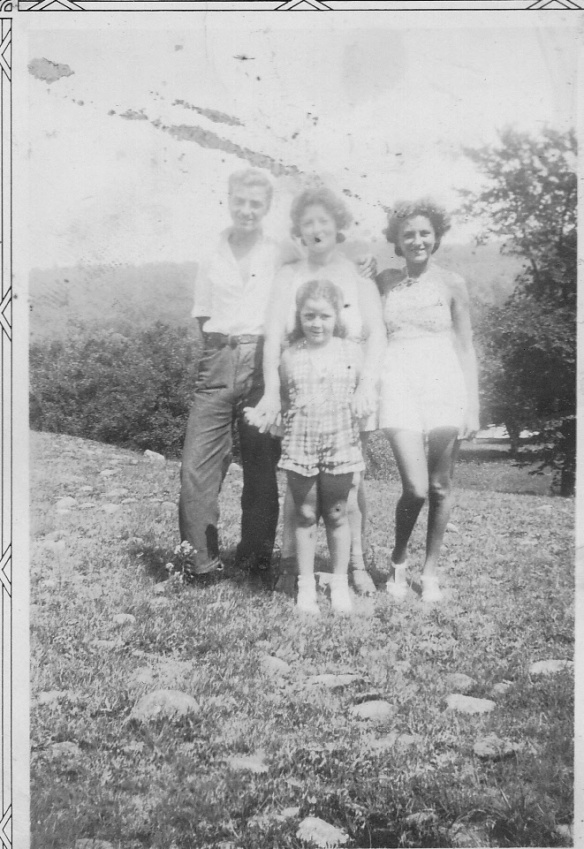
Goldschlagers 1935

Goldschlagers 1935

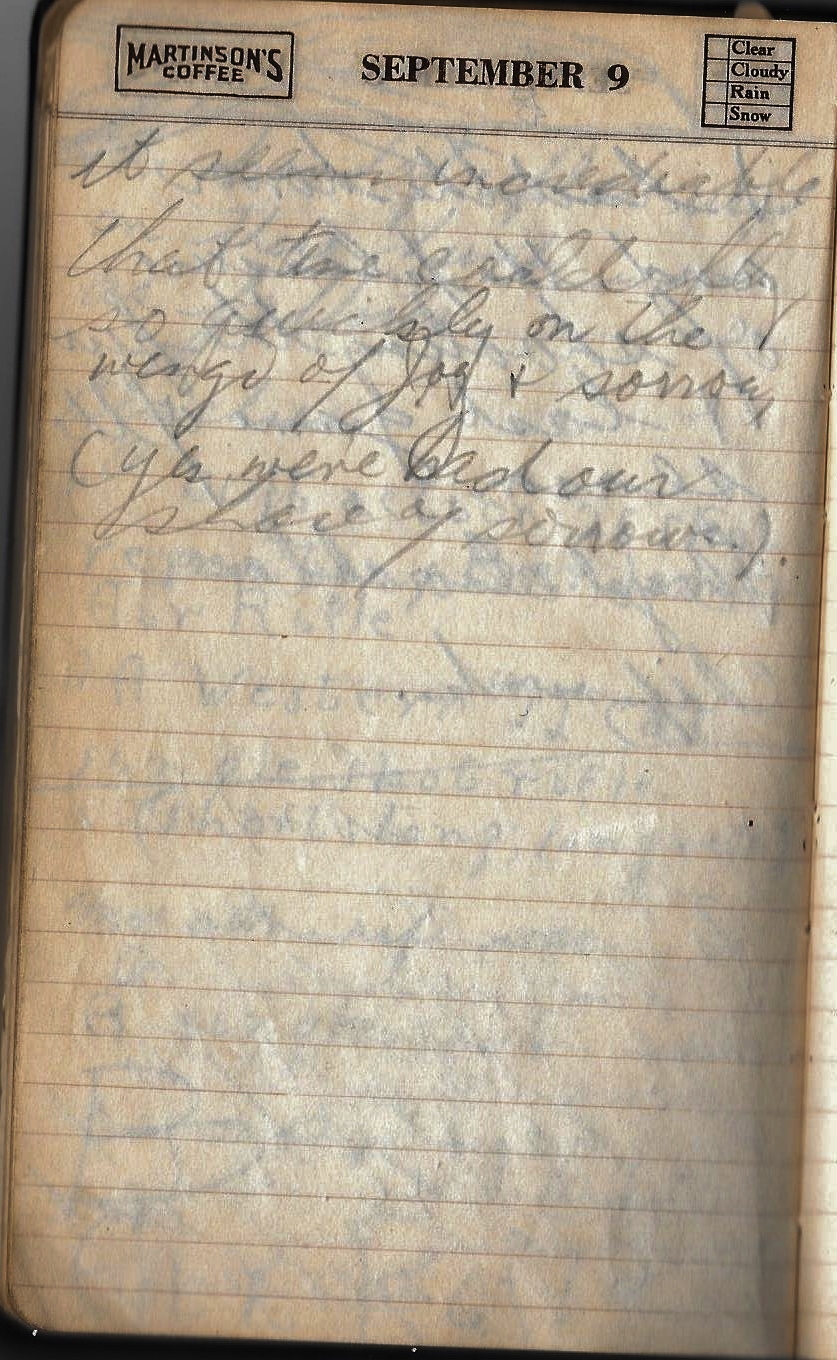
I found the note he wrote four and a half years later on February 24, 1939, when he was almost twenty years old particularly touching and revealing:

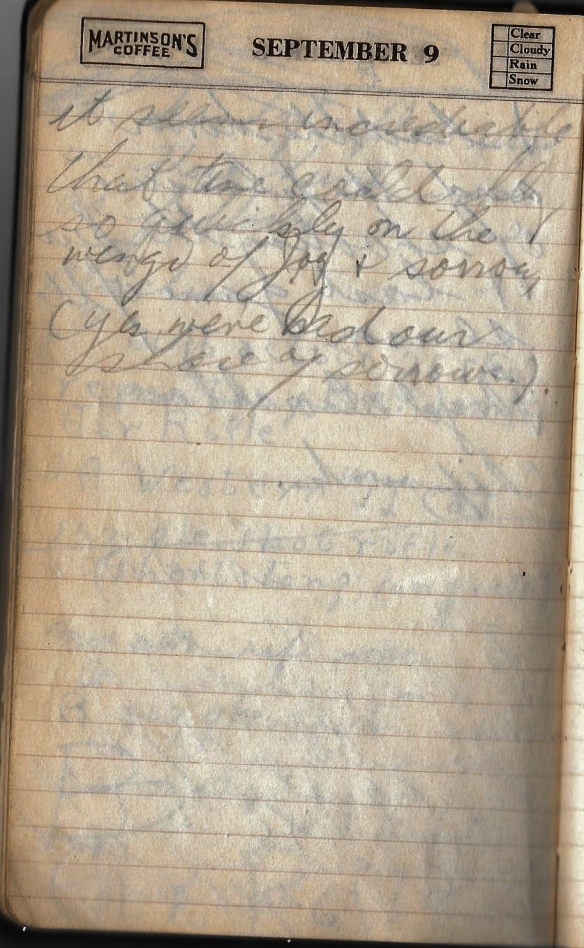
As I recall it now I have recorded on these last nine pages possibly one of the happiest phases of my life.  As I sit here and look back four and a half years it seems incredible that time could fly by so quickly on the wings of joy and sorrow, (yes, we’ve had our share of sorrows).

What were those sorrows? I don’t know what my uncle was referring to specifically or whether he only meant between 1934 and 1939, but in his lifetime, in 1924 his aunt Frieda had died after childbirth as had her baby; his aunt Tillie had lost her husband Aaron, and his grandmother Bessie had died in May 1934, shortly before he wrote about his hunting adventures.  I also imagine that those Depression years were challenging for my grandparents like they were for so many people.

My uncle also must have liked baseball because he kept a box score from a game in the notebook.  Being a baseball fan, I was determined to figure out not only what teams these were, but what game it was:
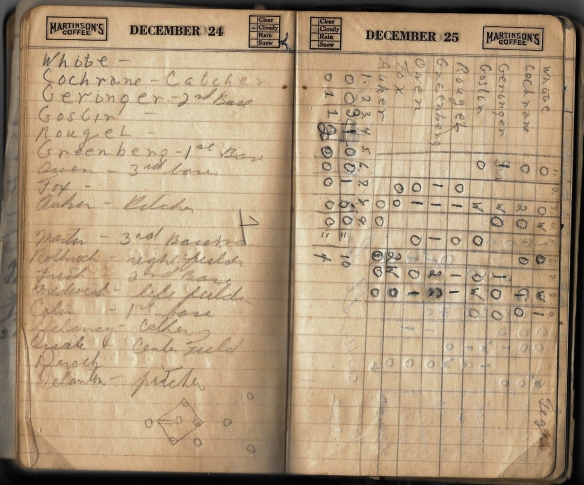
Grandpa notebook 15 box score

After studying the names on team listed on top I realized that it was the Detroit Tigers, probably around 1935.  As soon as I saw Greenberg, I knew it had to be Hank Greenberg and thus the Tigers.  After all, how many baseball players have there been named Greenberg?
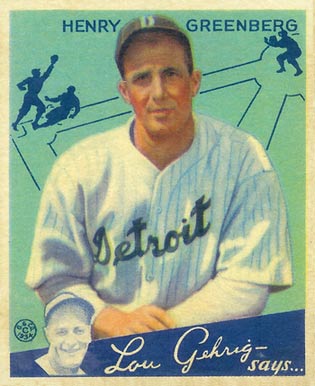
English: 1934 Goudey baseball card of Henry &q...

English: 1934 Goudey baseball card of Henry “Hank” Greenberg of the Detroit Tigers #62. PD-not-renewed. (Photo credit: Wikipedia)

The team at the bottom took some more digging because my uncle’s spelling was, shall we say creative? But the Deroch was a big clue—I assumed it was Leo Durocher, and once I looked up his career and saw that in 1935 he was playing on the St. Louis Cardinals with a catcher named Bill Delancey, an infielder named Collins and another named Frisch, I knew I had found the right team.

English: 1933 Goudey baseball card of Leo Duro...

English: 1933 Goudey baseball card of Leo Durocher of the Cincinnati Reds #147. PD-not-renewed (Photo credit: Wikipedia)


But the National League Cardinals wouldn’t have been playing the American League Tigers in 1935 unless they were in the World Series (oh, for the days before endless post-season playoffs and in-season interleague play!).  So this couldn’t be 1935 because the Tigers played the Cubs in the 1935 World Series.  After a bit more research, I concluded that this was a game from the 1934 World Series between the St. Louis Cardinals and the Detroit Tigers.

http://www.gettyimages.com/detail/573856419


http://www.gettyimages.com/detail/573867867

Since my uncle recorded the final score of the game he was following (presumably on the radio) as 10-4, it wasn’t hard to find out which game this was from the 1934 World Series: Game 4 on October 6, 1934, at Sportsmen’s Park in St. Louis.  Here is a link to the box score of that game as recorded by the Baseball-Reference website. The Tigers evened the series 2-2 by winning that game and then won Game 5 to go up 3-2 in the Series, but badly lost Games 6 and 7 to lose the Series.  I wonder which team my uncle, a boy from Brooklyn, was rooting for. Perhaps the one with the first Jewish player elected to the Baseball Hall of Fame?

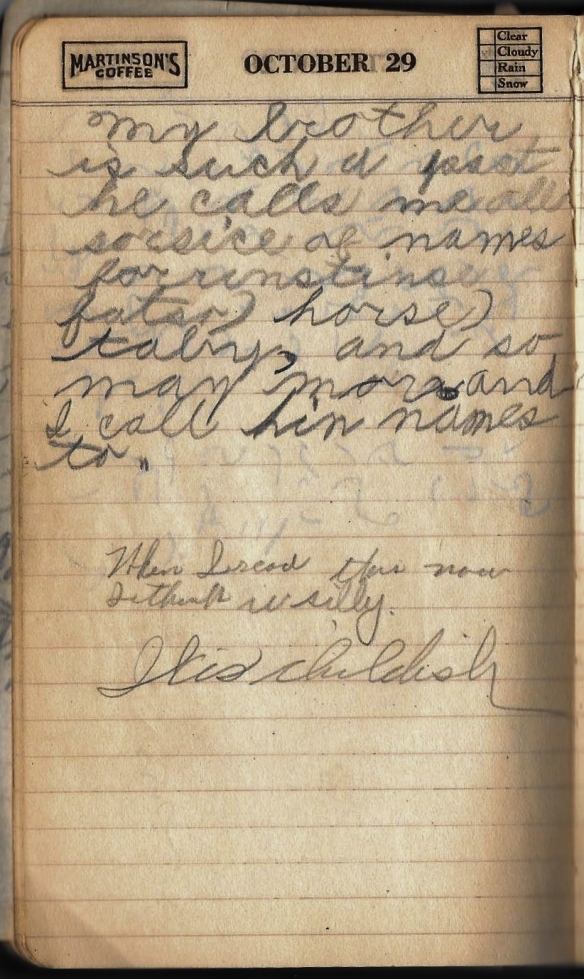
Finally, there are a few short notes from my mother, the baby in the family.  Here she wrote about her big brother teasing her:

My brother is such a pest he calls me all sorts [?] of names for instance fatso, horse, baby and so many and I call him names to.”  I guess my uncle was always a tease—he certainly was as an adult also!
Grandpa notebook 14 Florence comment about Maurice


I wonder how much later she wrote the comment that follows: “When I look at this now I think it silly.  It is childish.”

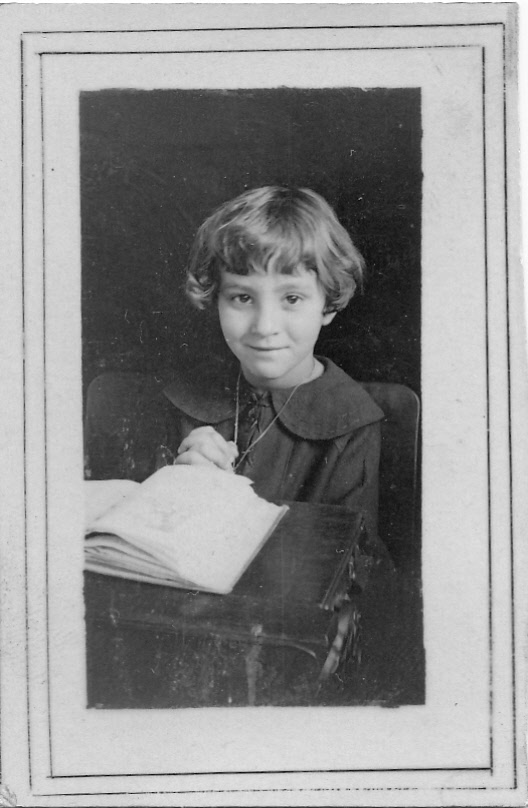
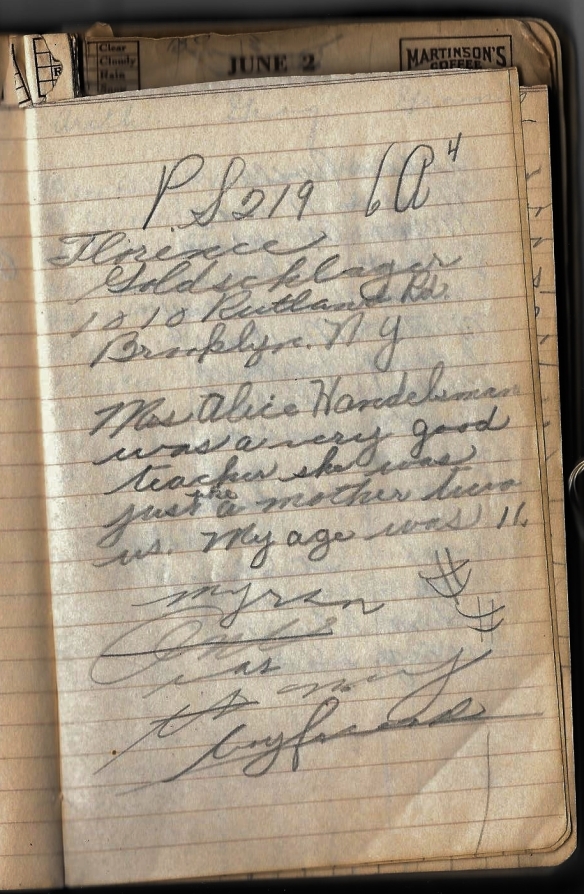
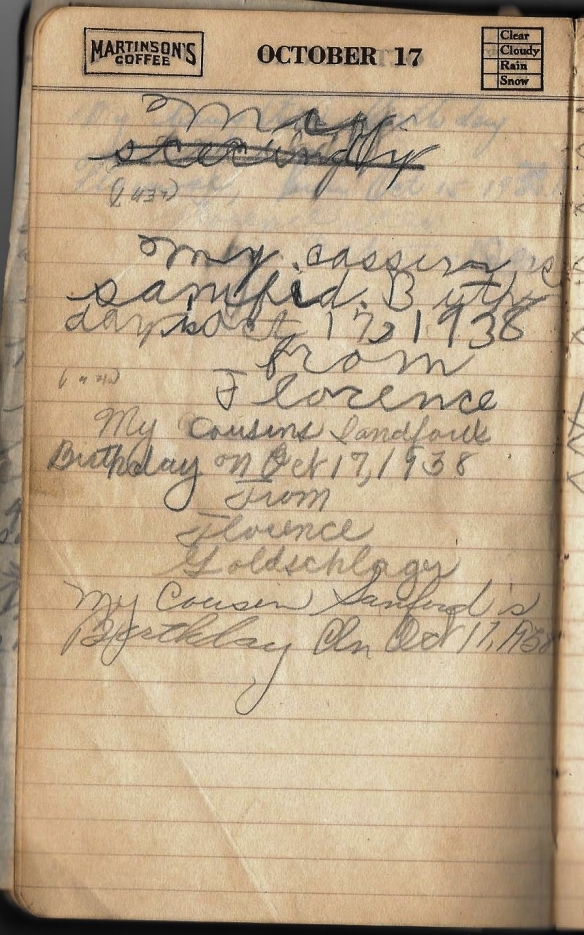
When she was eleven, she wrote about a favorite teacher, Mrs. Alice Handelsman, who was “just like a mother” to her class, and her boyfriend Myron.  On his birthday in the calendar, she listed a favorite cousin, Sanford (or Sandy), Leo and Mildred Ressler’s son; my mother to this day talks about what a beautiful little boy he was and how kind he was to my grandmother.
Grandpa Notebook 2 Mom note about teacher

Grandpa notebook 16 Florence comment re Sandy Ressler


What a gift this little book from 1930 has turned out to be.  It gives me a snapshot into the childhood of my mother and her siblings and some insights into my grandfather as well.  He was obviously a very careful man when it came to money, recording so painstakingly his income and his expenses. These were the Depression years, and my grandfather worked as a driver for a milk company.   My grandparents were not poverty stricken, but they lived from paycheck to paycheck and for many years lived in a small apartment in Brooklyn and then a one bedroom apartment in Parkchester when my mother was a teenager and her siblings were married and out of the house. My grandfather worked the night shift for the milk company, and my mother would share the bed with my grandmother until my grandfather got home in the morning and she got up for school.  But my mother says she never thought of herself as poor because she always had food and clothing and a roof over her head.

We take so much for granted today with our cars and houses and televisions and computers and smartphones. We throw everything away and litter our landfills with our junk.  Our children and grandchildren have iPads and scooters and bikes and more toys and books than all the children in one tenement building in Brooklyn combined had back in the 1930s.  But my mother and her siblings had their imaginations and their friends and their teachers and their families.  And this one little notebook gives us a peak into how they entertained themselves and how they lived together as a family.  It, like my aunt’s baby book, is a real treasure.



A Brotman, Goldschlager, and Rosenzweig Update: The Baby Book

As you know if you’ve been following this blog for a while, my Aunt Elaine preceded me as the family historian for my maternal side.  Several times notes she made or information she gave to others has led me to more information.  Her information has almost without exception proven to be accurate.  For example, she provided me—indirectly—with the names of my grandmother Gussie Brotman’s half-siblings, Abraham, David, Sophie, and Max.  She provided me with the clue that the Brotmanville Brotmans were our close relatives.  She told me how my grandparents met each other in Brooklyn.

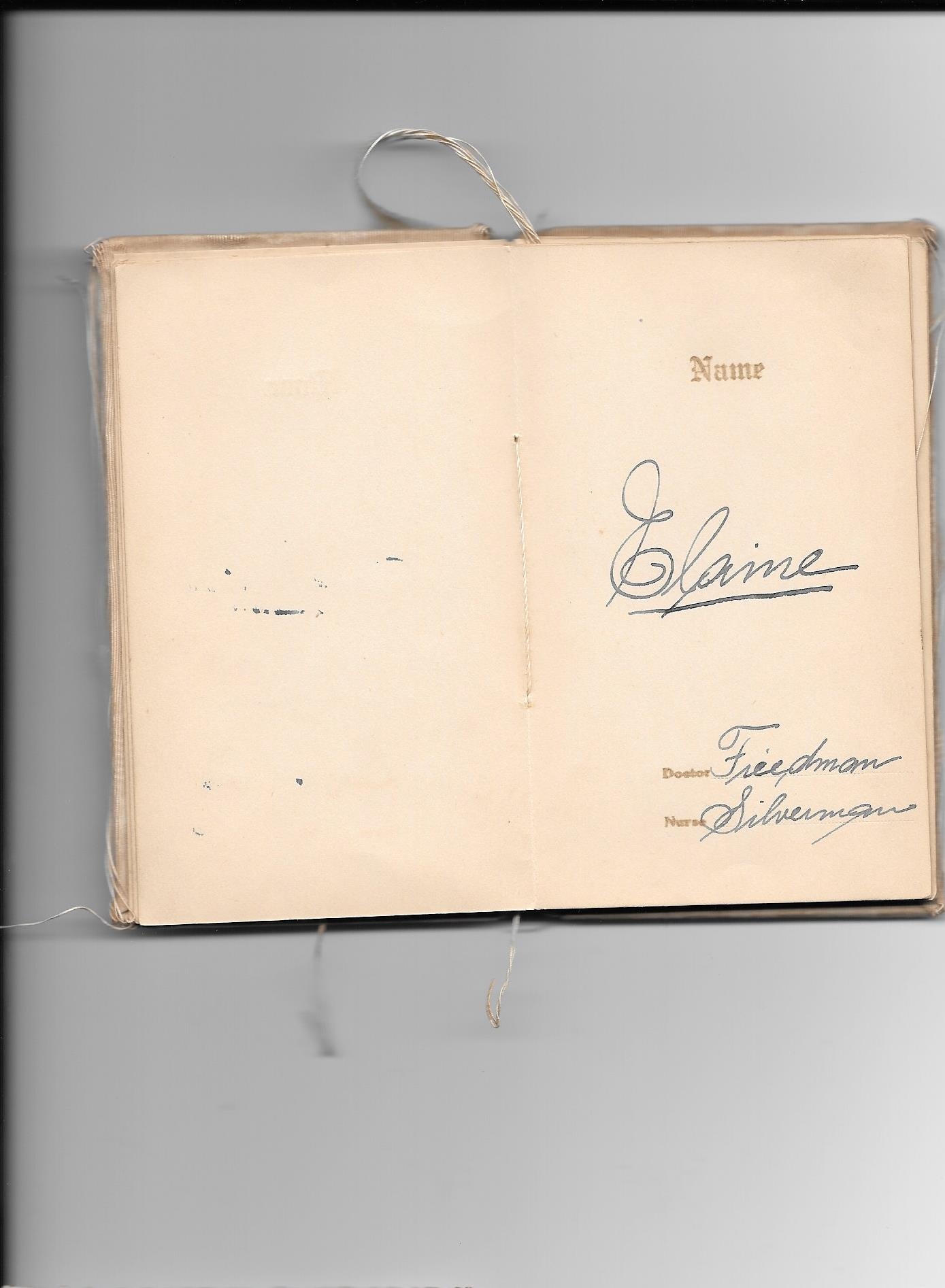
Well, she has done it again.  This time, however, it was not information or notes that she provided, but rather her baby book, which my cousin found in a shoebox of old papers.  It was partially filled out when my aunt was born on October 14, 1917.  Although most of it is blank, the few pages that were filled provide not only further confirmation of relationships about which I was previously aware, but hints at some new ones.

Elaine 1926

Elaine 1926

Here are the pages of the book that have been filled in:

Aunt Elaine baby book p 1

This is my grandfather’s beautifully florid handwriting.  His daughter, my aunt, also had fancy handwriting like this.


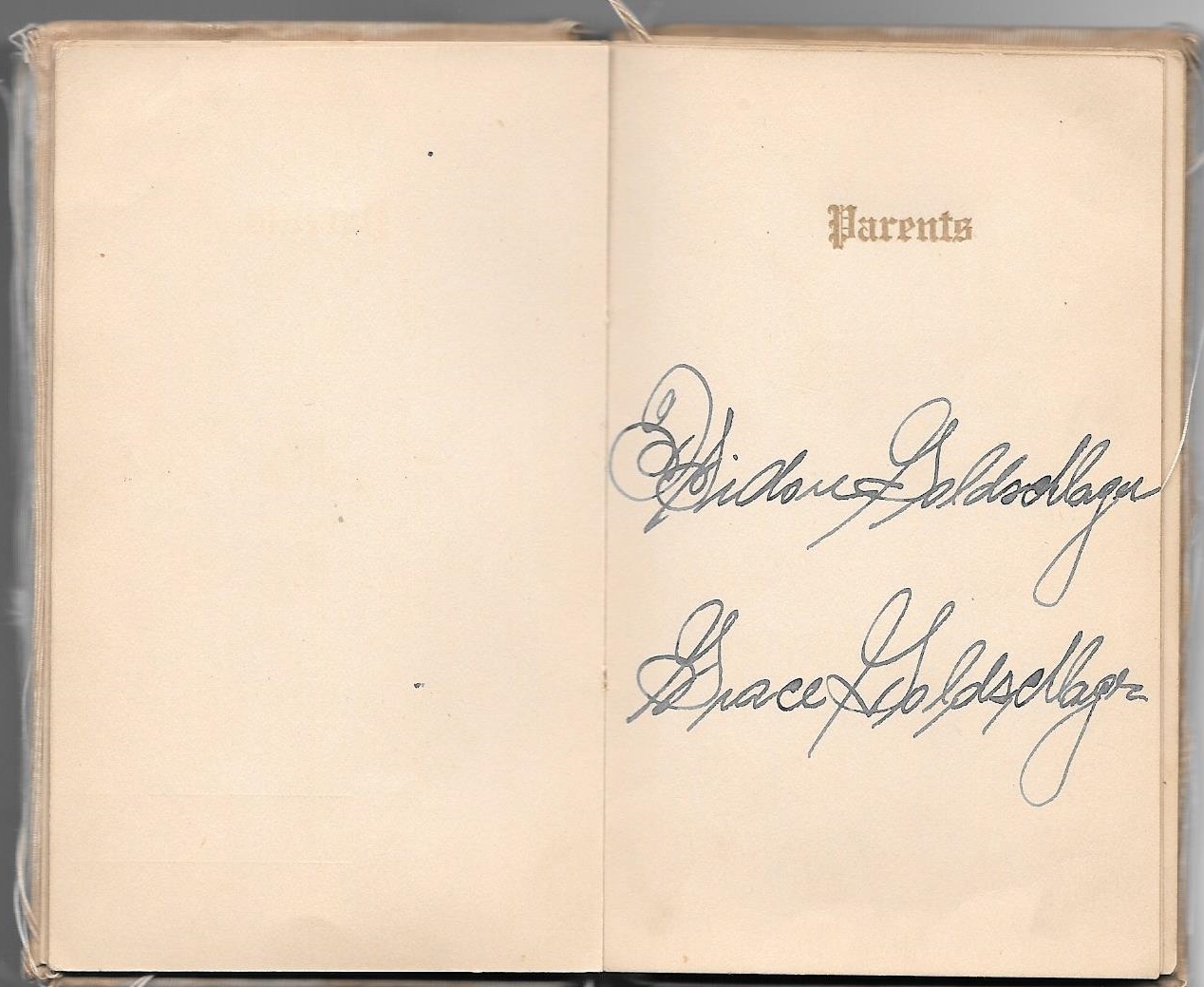
Aunt Elaine baby book p 2

My grandmother was never called Grace, always Gussie.  But family lore is that my grandfather’s family thought Grace was more American.


Aunt Elaine baby book 3

My two maternal great-grandmothers!


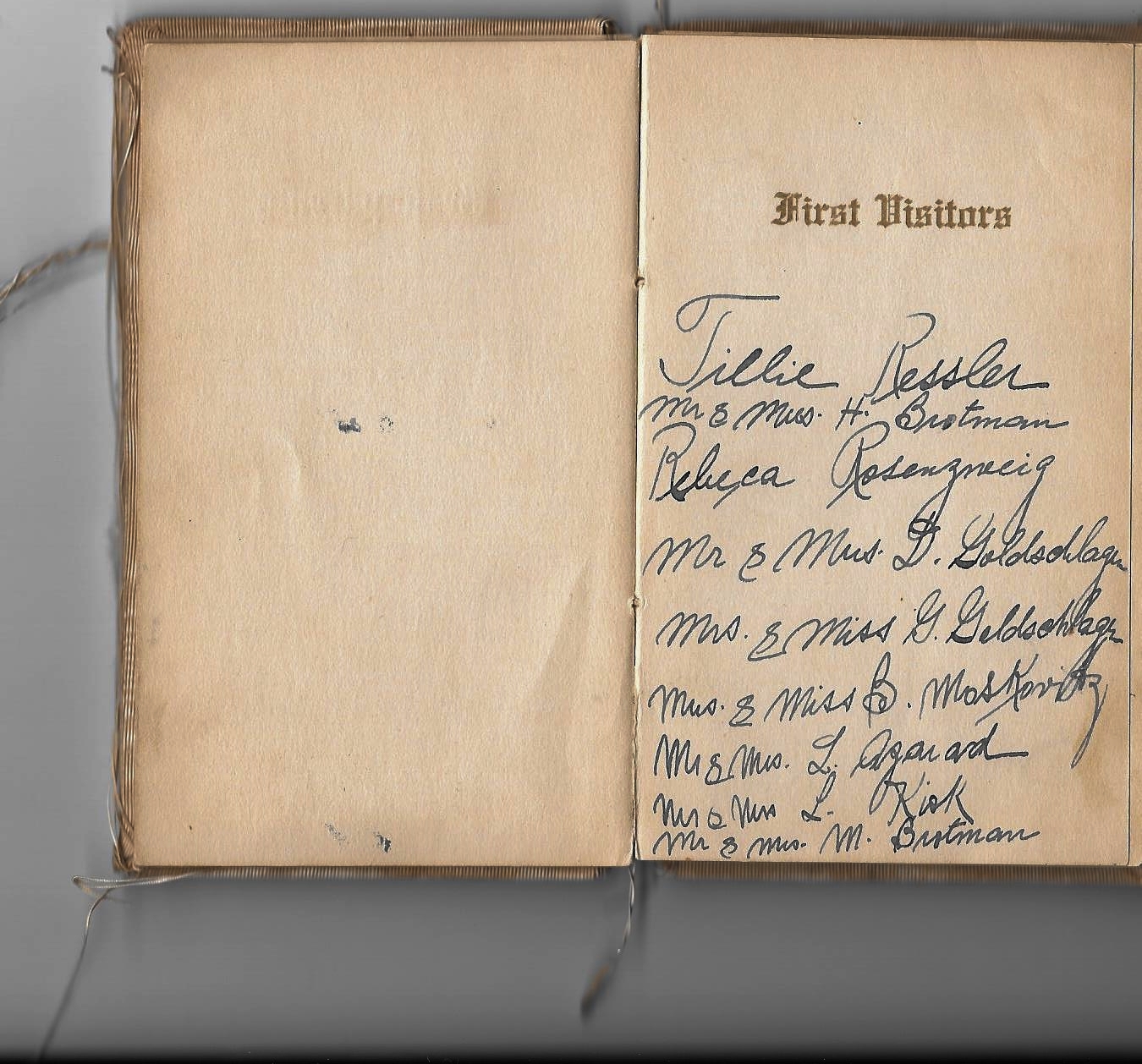
Aunt Elaine baby book 4

Who are these people?

Tillie Ressler—my grandmother’s older sister

Mr. and Mrs. H. Brotman—my grandmother’s brother Hymie and his wife Sophie

Rebecca Rosenzweig—my grandfather’s cousin, daughter of his mother’s brother Gustav Rosenzweig

Mr. and Mrs. D. Goldschlager—my grandfather’s brother David and his wife Rebecca

Mrs. and Miss G. Goldschlager—my great-grandmother Ghitla Rosenzweig Goldschlager and her daughter Betty

Mrs. and Miss B. Moskowitz—my great-grandmother Bessie Brotman Moskowitz and her daughter Frieda

The next two are not familiar, but provide new paths to research.  Can anyone help me decipher the names?

UPDATE: The last two must have been friends.  Mr. and Mrs. Leon and Ray Kiok and her mother Mrs. Frances Azeraad.  I found them all living together in Brooklyn, but not near my grandparents. I am not sure where they would have met.  Leon was born in Poland in 1886, and Ray’s parents were born in Spain.

Finally, Mr. and Mrs. M. Brotman: my grandmother’s half-brother Max Brotman and his wife Sophie

On the following page were more names.

Aunt Elaine baby book 5

Miss E. Shapiro and fiancé—not known yet

Sam Brotman—my grandmother’s younger brother

Mrs. A. Peter and son—I do not know

Mr. and Mrs. A. Brotman—-my grandmother’s half-brother Abraham Brotman and his wife Bessie

Mrs. D. Brotman—Annie nee Salpeter, wife of David Brotman, my grandmother’s half-brother

Mr. and Mrs. Julius Goldfarb—more on them below

The next three are not familiar—Mrs. Louis (?) Yassky, Miss Rose Botomick (?), and Mrs. Tsulie (?) Hecht.  As far as I can tell, these were not relatives, but friends.

I just loved seeing all these names.  Names that I have researched and know are my family, but names I’d not seen in something like this, something that makes it clear that these people were all really connected to my grandparents in a personal way.  I know that sounds odd.  These were the siblings, mothers, and cousins.  But since I grew up without hearing many of these names, it still was wonderful to see them all listed as the first visitors to see my aunt as a newborn in 1917.

I also found the list of gifts fascinating.  My grandparents did not have money for silver and silk, but someone was very generous in giving these items to them for their first-born child.

One final page—the inside of the back cover:

Aunt Elaine baby book 6
A. Rosenzweig—-my grandfather’s cousin, Abraham Rosenzweig, Rebecca’s brother.  I have speculated, based again on a story conveyed by notes from my Aunt Elaine, that it was either Abraham or Rebecca or Sarah who was accompanying my grandfather Isadore on Pacific Street in Brooklyn when he first laid eyes on my grandmother and declared he was going to marry her.

Back to Mr. and Mrs. Julius Goldfarb.  I asked my mother who they were because in a second old item—a notebook my grandfather used for various purposes that was also used by all three of his children at one time or another[1]—the name Joe Goldfarb appeared twice.  Who were these Goldfarbs?

Grandpa Notebook page 1 addresses Joe Goldfarb

Grandpa notebook 13 more addresses Joe Goldfarb

(There’s more great stuff on this page—Sam Brotman is my great-uncle Sam, Feuerstein B. is my great-aunt Betty Goldschlager Feuerstein, Leo Ressler is my mother’s first cousin, her Aunt Tillie’s son; Rae Rosenzweig and Lizzie Horowitz are my grandfather’s first cousins, sisters of Abraham and Rebecca. And there is an S. Goldfarb in addition to Joe.)

My mother said all she could remember was that either Julius or his wife was my grandmother Gussie’s first cousin.  I’d never heard the name Goldfarb before, so what did I do? What all genealogy addicts would do.  I immediately started searching.  And the results of that search will be discussed in a later post once I have filled in more gaps in that story.

But for now, I once again can hear my aunt cheering me on, telling me to keep digging and finding the family stories.

elaine and amy 1953

Aunt Elaine and me 1953


[1] I will share more of that notebook in later posts also.

Old Friends: Braided Forever

My mother has often spoken about how sad she was when her family decided to move from Brooklyn to the Bronx when she was about twelve years old.  There were many reasons she was upset.  For one, she had to leave her dog Sparky behind.  That broke her heart, and she still can’t talk about it without getting emotional.

Sparky 1934


But also she had to leave her best friend Beatty behind. Beatty lived in the same four-family house at 1010 Rutland Road in Brooklyn; she lived right down the hall from my mother.  They had been close friends all through childhood, and although they tried to stay in touch after my mother moved, back in the 1940s that was not at all easy.  Phone calls were expensive, and the trip from Brooklyn to Parkchester in the Bronx was a long one, especially for two young girls.  So over time, they lost touch.

Beatty and my mother c. 1940

Beatty and my mother c. 1940

Not too long ago my mother asked me if I could find Beatty.  She knew her first and last name from when she’d last seen her over 70 years earlier, but she had no idea where she was living or whom she might have married.  I tried to find her, but with so little information I had no luck.  If Beatty had married, it was after the last year of the publicly available NYC marriage index (1937).  The only information I could find related to her siblings, who had passed away.

So you can imagine how excited I was to receive a message on the blog last week from Beatty herself.  She was looking for my mother after seeing her pictures and childhood name on the blog.  I contacted Beatty, and I called my mother.  And I gave them each other’s contact information, and now they are reconnected after over 70 years.  I get the chills (and a warm feeling) whenever I think about it.

One of the stories my mother shared with me was about Passover at Beatty’s house.  Her father led the seder in a very serious way, and as many of us know, a traditional seder can get quite long and quite boring, especially for young children.  To keep themselves from misbehaving and talking, my mother and Beatty would braid the fringes on the beautiful tablecloth that adorned the seder table.  When my mother shared this memory with Beatty, she said that she also had shared that story with her children.

The tablecloth still exists, and even more remarkable, the braids made by my mother and her best friend Beatty are still there as well.  Here is the photograph to prove it.

Beatty's tablecloth

Beatty’s tablecloth

tablecloth with braids 2

My mother was once my Girl Scout troop leader, and one of the songs we sang had the lyrics, “Make new friends, but keep the old.  One is silver, and the other gold.”  My mother and Beatty certainly know the truth of that message.

My Goldschlager Cousins: New Connections and New Photos

Lately it’s been sort of raining Goldschlagers.  First, I received an email from someone named Jeanne who matched me very distantly on the DNA testing website, but who’d spotted that one of my ancestral names was Goldschlager.  Jeanne had had an aunt named Anne Goldschlager; although her aunt was an aunt by marriage only, not genetically, Jeanne had loved her greatly and wondered whether we might be related since Anne Goldschlager’s family also had ties to Romania.

According to Jeanne, Anne’s father Max had moved to Dresden in the early 20th century where Anne and her sister Sabina were born.  In 1939, Max, his wife, and Sabina left Germany to go to Romania (I assume they thought it would be safer), and they left Anne behind.  She was 15 years old.  Somehow Anne got to England and survived the war, but her sister was killed in one of the concentration camps. Her parents survived the war and emigrated to Israel. Here is Sabina’s Page of Testimony at Yad Vashem, which includes this photograph:

Unfortunately, Anne has no biological descendants, and Jeanne knew nothing more about her family tree, so I don’t think I can get any further back to determine if her Goldschlagers were related to mine.

Then around the same time that I heard from Jeanne, my cousin Jim and his wife Jodi emailed me to say that their son Michael was in Spain for the Model UN and had met a fellow student named Eva Goldschlager.  Michael wanted to know if Eva could be related to our Goldschlagers.  After obtaining Eva’s father’s contact information, he and I have emailed several times.  His Goldschlager family is also from Romania—from the town of Siret, which is a little more than 100 miles from Iasi where my grandfather was born.  We’ve not gotten any further than that so far, but are trying to figure out how to learn more.

And then finally just the other day I received a whole bunch of new photographs from my cousin Richard, who lives in Australia but was in the US visiting his parents.  Richard is my second cousin; his father Murray is the son of David Goldschlager, my grandfather’s younger brother.  Although Murray changed his surname a long time ago, he is nevertheless a Goldschlager.  Here are some of the photographs Richard sent me of his grandparents.

Here are three photographs of David and Becky as young people.

David Goldschlager

David Goldschlager


Rebecca Schwartz

Rebecca Schwartz

Rebecca and David Goldschlager

Rebecca and David Goldschlager

Here they are with their sons Murray and Sidney  at Brighton Beach probably in the 1930s:

David and Murray Goldschlager

David and Murray Goldschlager

David Rebecca Sidney and Murray at Brighton Beach

All four Goldschlagers at Brighton Beach


The others were taken when David and Becky had moved to Arizona where Murray and his wife Edna and their son Richard lived.

Richard Leonard and David Goldschlager

Richard and his grandfather David Goldschlager

Richard with his grandparents at his bar mitzvah

At Richard’s bar mitzvah

David and Becky at Richard's bar mitzvah David and Rebecca Goldschlager


Thank you so much to my cousin Richard who so generously shared these photographs with me.  I am so happy to have more pictures of my grandfather’s brother David and his family.


Family Wedding: My Great-Aunt Betty Goldschlager Feuerstein and Her Children

Betty Goldschlager

Betty Goldschlager

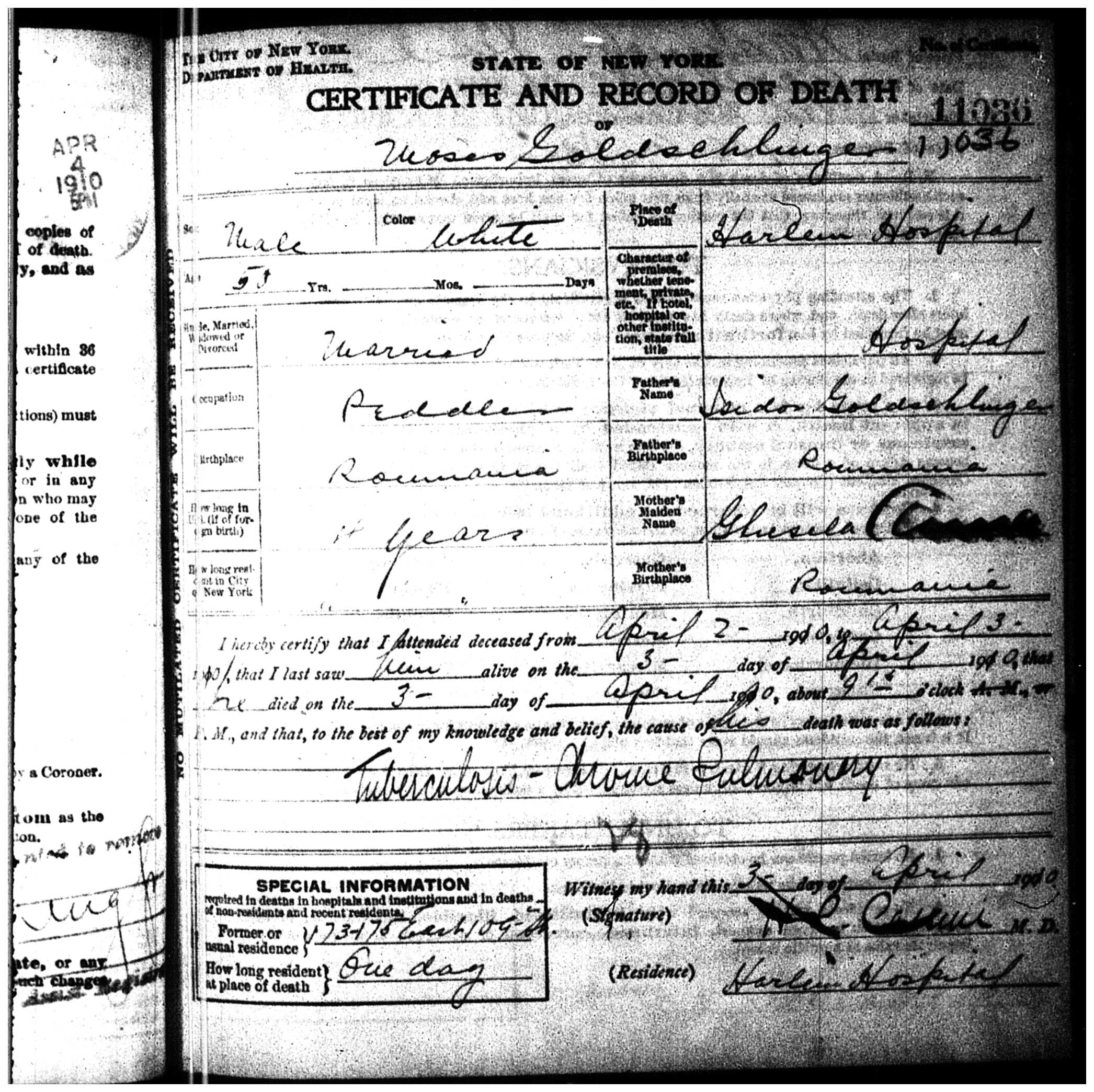
I’ve told the heartbreaking story before of my grandfather Isadore’s little sister Betty Goldschlager.  After sailing alone from Iasi, Romania, just thirteen years old, she arrived at Ellis Island on April 4, 1910, expecting her father Moritz, my great-grandfather, to meet her at the boat.  What she did not know was that her father had died the day before, April 3, 1910, from tuberculosis, just eight months after he himself had arrived in New York.  Betty was detained for a day at Ellis Island until her aunt, Tillie Strolowitz, could meet her and have her discharged.  Only then could Betty have learned that she had missed seeing her father alive by just one day.

Morris Goldschlager death certificate.pdf


betty goldschlager ship manifest part 1

Betty Goldschlager ship manifest part 2

Year: 1910; Arrival: New York, New York; Microfilm Serial: T715, 1897-1957; Microfilm Roll: Roll 1444; Line: 1; Page Number: 193

But Betty Goldschlager survived and in fact thrived in the United States.  She married Isidor Feuerstein in 1921, and they had two daughters, my mother’s first cousins.  Betty’s grandson Barry shared this photograph of his parents’ wedding in 1950.  My great-aunt Betty is standing to the far left.

courtesy of Barry Kenner

courtesy of Barry Kenner

When I look at this photograph, I marvel at the fact that that little girl, who sailed across the ocean by herself and then arrived only to learn that her father had died, somehow had the strength to endure all that and adapt to a foreign country and make a good life for herself, her husband, and her children.

Thank You, Grandpa, for the Gift of My New Cousins

It was about three years ago that I first started wondering more about my grandfather Isadore Goldschlager.  I knew almost nothing about his life before he came to the US in 1904 from Iasi, Romania.  I didn’t know too much about his life when he got to the US either.  It was my interest in his life in particular that first prompted me to go on ancestry.com and start searching for answers.  I soon hit a wall and gave up, only returning to ancestry a year later and starting my search for my Brotman relatives instead.

Then I returned to my grandfather again, a somewhat more experienced researcher, and this time I had better luck.  In fact, as I have written, I found not only his parents—I found his mother’s siblings Gustav and Tillie and Zusi Rosenzweig, and then I found their children and many of their grandchildren and great-grandchildren.  I was able to piece together a better picture of my grandfather’s extended family and even figured out how he met my grandmother Gussie, who happened to be living down the street from his Rosenzweig cousins in 1915 on Pacific Street in Brooklyn.

Last night I got to meet some of my Rosenzweig cousins for the very first time.    Four of the great-great-grandchildren of David and Esther Rosenzweig were there—Gerry, Ron, Michael and me.  Gerry, Ron and Michael are all the great-grandsons of Gustave Rosenzweig, the brother of my great-grandmother Ghitla/Gussie Rosenzweig Goldschlager.  Gerry is the grandson of Abraham Rosenzweig, and Michael and Ron are the grandsons of Joe Rosenzweig, the brother of Abraham.

Here is a picture of Abraham, Joe and Jack Rosenzweig:

Abraham Joseph and John (Jack) Rosenzweig

Abraham Joseph and John (Jack) Rosenzweig

And here is a picture of their first cousin Isadore Goldschlager, my grandfather.

Isadore Goldschlager

Isadore Goldschlager

It was a wonderful evening.  Even though many of us had never, ever met before, we quickly connected and found common bonds—all having grown up in greater New York, all enjoying a good laugh, all loving dogs and our grandchildren (not in that order), and all being unable to digest raw onions.  It was a great time, and even if we never knew each other as children, there was definitely a feeling of family.

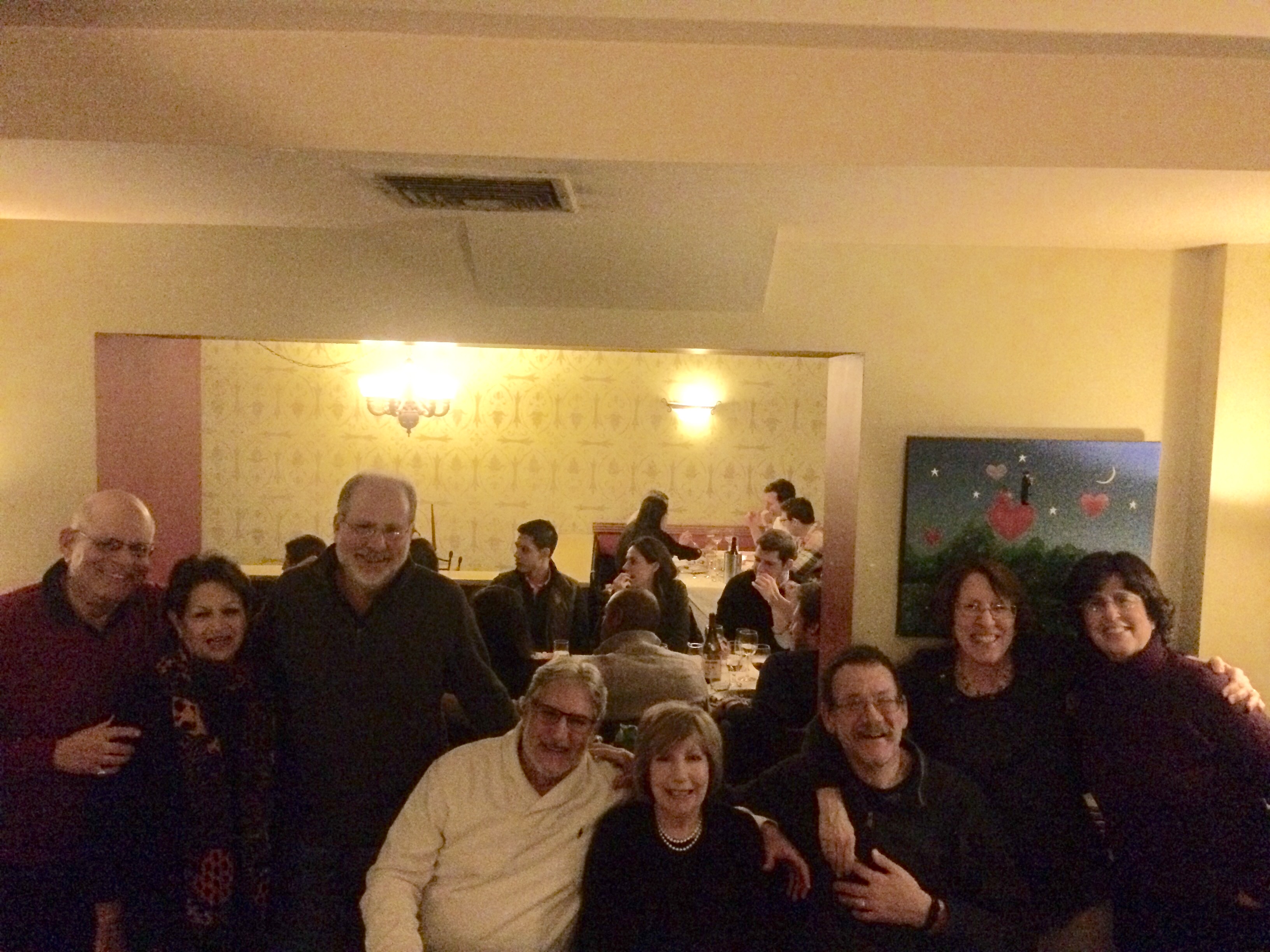
Here we all are with our spouses.  Thanks to the lovely newlywed couple who not only put up with our noisy conversations, but also graciously offered to take this picture (on about five different smartphones).

Rosenzweig cousins Jan 24 2014

So keep looking for your cousins—you will never know how much joy you can experience.

Looking back:  The Cohen Family from Amsterdam to England to Philadelphia and Washington and beyond


Amsterdam coat of arms

Two months ago I wrote a summary of my perspective on the descendants of Jacob and Sarah Jacobs Cohen and their thirteen children, including my great-grandfather Emanuel Cohen.  I wrote about the way they managed to create a large network of pawnshops that provided support for the generations to come.  Many of the Philadelphia Cohens stayed in the pawnshop business into the 20th century.  The generation that followed, those born in the 20th century, began to move away from the pawn business and from Philadelphia.  Descendants began to go to college and to become professionals.  Today the great-great-grandchildren of Jacob and Sarah live all over the country and are engaged in many, many different fields.  Few of us today can imagine living with twelve siblings over a pawnshop in South Philadelphia.  We can’t fathom the idea of losing child after child to diseases that are now controlled by vaccinations and medicine.  We take for granted the relative luxurious conditions in which we live today.

File:Flag of Philadelphia, Pennsylvania.svg

Philadelphia flag


The story of the Cohen family in Washington is much the same in some ways, different in other ways.  Jacob’s brother Moses and his wife Adeline also started out as immigrants in the pawnshop business , first in Baltimore and then Washington.  But unlike Jacob who lived to see his children become adults, Moses Cohen died at age 40 when his younger children were still under ten years old.  Adeline was left to raise those young children on her own as she had likely raised her first born son, Moses Himmel Cohen, on her own until she married Moses Cohen, Sr.  When I look at what those children accomplished and what their children then accomplished, I am in awe of what Adeline was able to do.   For me, the story of the DC Cohens is primarily the story of Adeline Himmel Cohen for it was she, not Moses, who raised the five children who thrived here in the US.  She somehow instilled in those children a drive to overcome the loss of their father, to take risks, to get an education, and to make a living.

Her son Moses, Jr., an immigrant himself, had nine children; his son, Myer, became a lawyer.  To me it is quite remarkable that a first generation American, the son of a Jewish immigrant, was able to go to law school in the late 19th century.  Myer himself went on to raise a large family, including two sons who became doctors and one who became a high ranking official at the United Nations in its early years after World War II.  Moses, Jr.’s other children also lived comfortable lives, working in their own businesses and raising families.  These were first generation Americans who truly worked to find the American dream.

Adeline and Moses, Sr.’s other three children who survived to adulthood, Hart, JM, and Rachel Cohen, all took a big risk and moved, for varying periods of time, to Sioux City, Iowa.  Even their mother Adeline lived out on the prairie for some years.  JM stayed out west, eventually moving to Kansas City; he was able to send his two daughters to college, again something that struck me as remarkable for those times.  His grandchildren were very successful professionally.  Hart, who lost a son to an awful accident, had a more challenging life.  His sister Rachel also had some heartbreak—losing one young child and a granddaughter Adelyn, but she had two grandsons who both appear to have been successful.

Three of the DC Cohen women married three Selinger brothers or cousins.  Their children included doctors, a popular singer, and a daughter who returned to England several generations after her ancestors had left.  The family tree gets quite convoluted when I try to sort out how their descendants are related, both as Cohens and as Selingers.

There were a number of heart-breaking stories to tell about the lives of some of these people, but overall like the Philadelphia Cohens, these were people who endured and survived and generally succeeded in having a good life, at least as far as I can tell.  The DC Cohens, like the Philadelphia Cohens, have descendants living all over the United States and elsewhere and are working in many professions and careers of all types.

flag of Washington, DC

Looking back now at the story of all the Cohens,  all the descendants of Hart Levy Cohen and Rachel Jacobs, I feel immense respect for my great-great-great grandparents.  They left Amsterdam for England, presumably for better economic opportunities than Amsterdam offered at that time.  In England Hart established himself as a merchant, but perhaps being a Dutch Jew in London was not easy, and so all five of Hart and Rachel’s children came to the US, Lewis, Moses, Jacob, Elizabeth, and Jonas, again presumably for even better opportunities than London had offered them.  Eventually Hart himself came to the US, uprooting himself for a second time to cross the Atlantic as a man already in his seventies so that he could be with his children and his grandchildren.  Rachel unfortunately did not survive to make that last move.

Flag of the City of London.svg

The flag of the City of London

Arriving in the US by 1850 in that early wave of Jewish immigration gave my Cohen ancestors a leg up over the Jewish immigrants who arrived thirty to sixty years later, like my Brotman, Goldschlager, and Rosenzweig ancestors.  Of course, the Cohens had the advantage of already speaking English, unlike my Yiddish speaking relatives on my mother’s side.  They also had the advantage of arriving at a time when there wre fewer overall immigrants, Jewish immigrants in particular and thus faced less general hostility than the masses of Jewish, Italian, and other immigrants who arrived in the 1890s and early 20th century.  Also, my Cohen relatives may not have been wealthy when they arrived, but Hart and his children already had experience as merchants and were able to establish their own businesses fairly quickly.  Thus, by the time my mother’s ancestors started arriving and settling in the Lower East Side of NYC or in East Harlem, working in sweatshops and struggling to make ends meet, my father’s ancestors were solidly in the middle and upper classes in Philadelphia, Washington, Sioux City, Kansas City, Detroit, and Baltimore.

When I look at these stories together, I see the story of Jewish immigration in America.  I see a first wave of Jews, speaking English, looking American, and living comfortably, facing a second wave who spoke Yiddish, looked old-fashioned, and lived in poverty.  No wonder there was some tension between the two groups.  No wonder they established different synagogues, different communities, different traditions.

A recent study suggests that all Ashkenazi Jews were descended from a small group of about 350 ancestors.  We all must share some DNA to some extent.  We are really all one family.  But we have always divided ourselves and defined our subgroups differently—Orthodox, Conservative, Reform; Galitizianer or Litvak; Sephardic or Ashkenazi; Israeli or American; so on and so forth.  We really cannot afford to do that in today’s world; we never really could.  Today very few of us make distinctions based on whether our ancestors came in 1850 or 1900 because we are all a mix of both and because we have blurred the economic and cultural distinctions that once were so obvious.  But we still have a long way to go to eradicate the divisions among us and to overcome the prejudices that continue to exist regarding those who are different, whether Jewish or non-Jewish.


My Great-Great-Grandparents’ Marriage Certificate: Small Details Reveal So Much

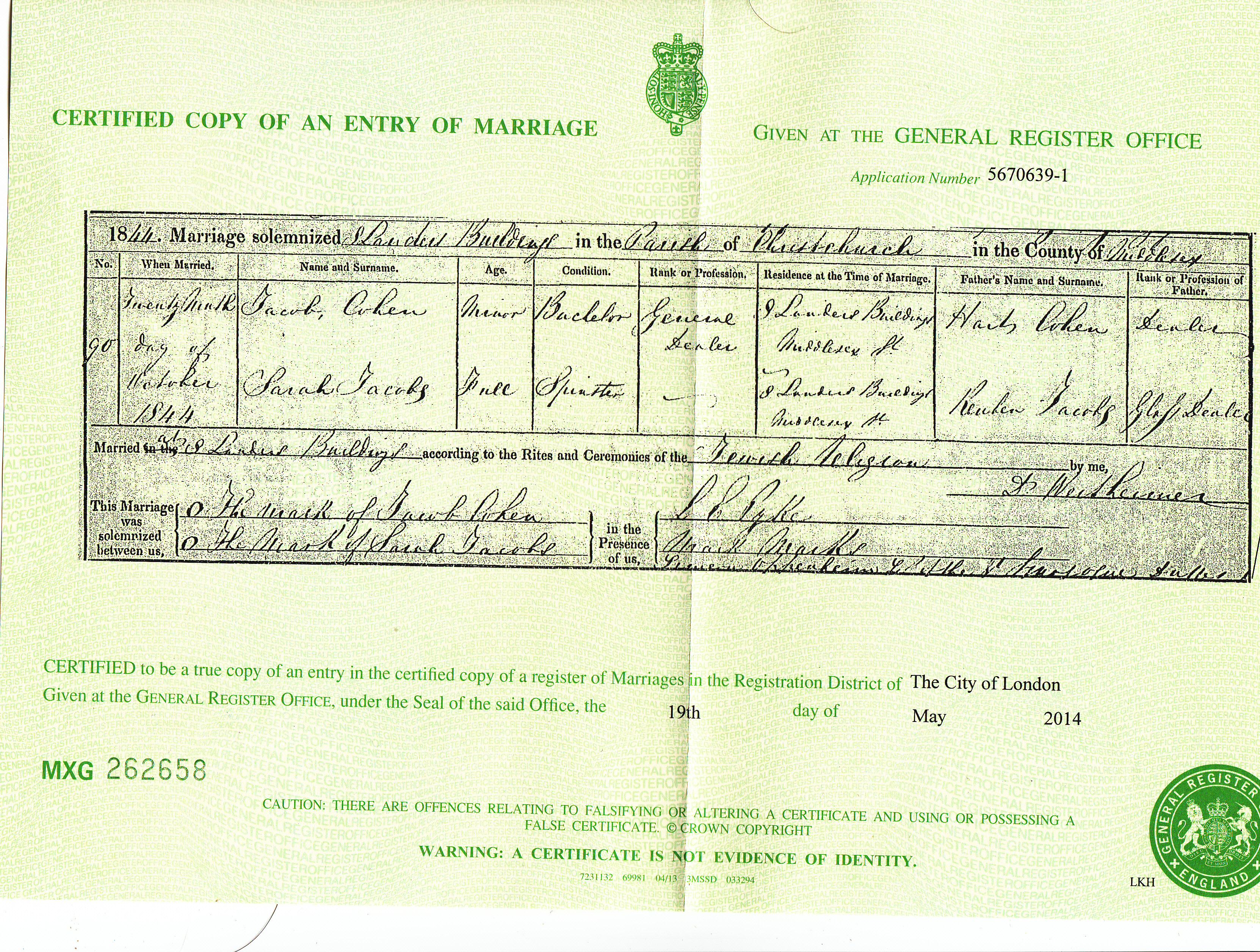
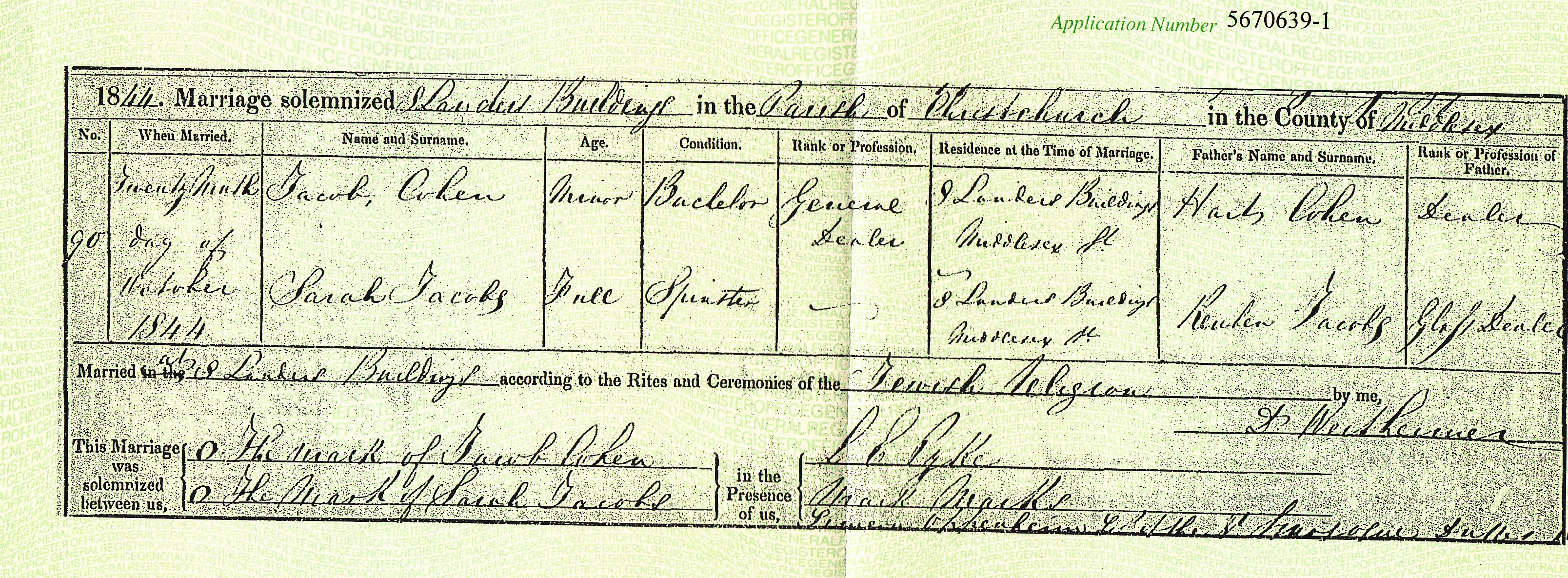
As I celebrate the newest member of my extended family, I am also thinking about my great-great-grandparents, Jacob and Sarah Cohen.  A while back I had sent for their marriage certificate from the General Register Office in England, and the certificate arrived just a few days before Remy was born.  It confirms a number of facts I already knew—that Sarah’s birth name was Jacobs, that her father’s first name was Reuben, that she and Jacob married on October 24, 1844, that Hart, Jacob’s father, was a dealer as was Reuben Jacobs, Sarah’s father (a glass dealer?) and Jacob himself, and that they all lived in Spitalfields, Christchurch, Middlesex County, in England.  But the marriage certificate also revealed a few other interesting details.

Jacob Cohen and Sarah Jacobs marriage certificate

Jacob Cohen and Sarah Jacobs marriage certificate

For example, according to the certificate, Jacob was still a minor, but Sarah was of “full” age.  All the documents I have for Sarah, both from England and the US, place her at least two years younger than Jacob.  I wondered: Was the age of majority younger for women in England in 1844 than it was for men?  The 1841 census puts Rachel’s age that year as 15, meaning she was 18 when she married Jacob, whereas Jacob was only 20.  (When I think about how young they were and then how many children their marriage produced and how many years they were married, it is astounding.)

I did a little research and learned that although a girl could marry at 12 and a boy at 14, parental consent was necessary if either was under 21.  Both men and women were considered minors before they were 21; there was not a double standard.[1] That leaves me perplexed. Was Rachel older or younger than Jacob?  Was the marriage certificate right and all the other documents wrong? One would think that a marriage certificate would be more accurate than census reports, but perhaps this was just a mistake.

Sarah and Jacob marriage cropped

The certificate also indicates that, as with Hart Levy Cohen on his wife Rachel’s death certificate, Jacob and Sarah could not sign the document, but only left their marks on it.  Another question is thus raised: how literate was the population of England at this time?

A little quick research revealed that the literacy rate in England in 1840 was somewhere between 67% and 75% for the working class population.[2]  Another source indicated that based on the ability of brides and bridegrooms to sign their marriage certificates, the literacy rate was even lower among women at that time—around 50%, .  That same source, however, suggested that since writing was taught after reading, simply because someone could not sign his or her name did not mean that he or she could not read.[3]

A third interesting detail on the certificate is that it appears that both Jacob and Sarah were residing at 8 Landers Building at the time they were married.  Since it is not likely they were living together before they were married, this would mean that their families were living in the same building.  Were they childhood friends?  Had their parents as neighbors arranged the marriage? Were they all related in some way? It also appears that the marriage had taken place at this same location, not at a synagogue.  But the record from Synagogue Scribes indicated that they were married at the Great Synagogue, as were Hart and Rachel.  I assume that this was this just a civil certificate completed to comply with civil, not religious, law.  I find it interesting that it states that the ceremony was done “according to the rites and ceremonies of the Jewish religion” despite the fact that it is not a religious document.

It is quite amazing to me how much information and how many questions can be mined from one simple document.  Receiving this document was very exciting, as with receiving Rachel’s death certificate from England.  It ties me directly to my ancestors—people who were born almost 200 years ago, but with whom I have a direct and easily established connection.


[1] See the discussion on RootsChat at http://www.rootschat.com/forum/index.php?topic=643885.0 and also at BritishGenealogy.com at http://www.british-genealogy.com/forums/showthread.php/57256-Age-at-Marriage-Minor

[2]  R.S. Schofield, “Dimensions of Illiteracy in England, 1750-1850) in Literacy and Social Development In the West: A Reader (edited by Harvey J. Graff) (1981), p.201.

[3] “Introduction,” Aspects of the Victorian Book, at http://www.bl.uk/collections/early/victorian/pr_intro.html

Enhanced by Zemanta