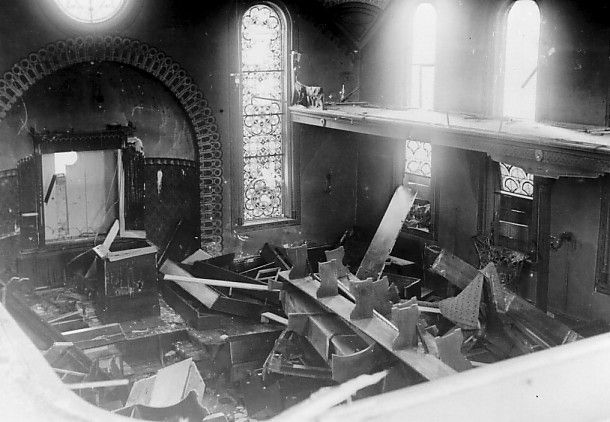
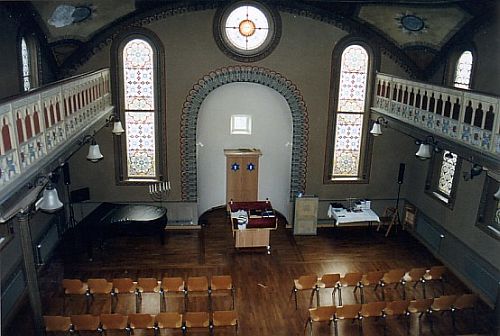
Some Good News, Some Bad News

As I look over the notes and research and documents I have for the other children of Ernst Nusbaum and Clarissa Arnold, I admit that I am not eager to write about the rest of the family.  The post about their oldest son Arthur and his family really brought me down.  And the post prior to that about Myer Nusbaum’s suicide also was very disturbing.  I ended the last post saying that the lives of the other children were not as sad, but on reviewing them again, I am not so sure about that assessment.  But their lives, whatever the sadness, are not to be forgotten simply because it is hard to write and read about them.  They deserve to be remembered just as much as those who succeeded and lived wonderful, happy lives.

Having said that, for now I am going to skip ahead from the oldest child, Arthur, to the two youngest children, Henrietta and Frank, because I need a break from all the heaviness of Arthur.  Not that either Henrietta’s story or Frank’s story is light and airy, but they are a little bit less depressing.  I will, of course, return to the other three siblings and their stories.  Not that they are all bad, but some are pretty tangled, and I still have work to do before I can post.

Before I turn to Henrietta Nusbaum Newhouse and her brother Frank Nusbaum, however, it’s important to return to Clarissa, Ernst’s widow and their mother.  Clarissa survived the death of her son Myer and the death of her husband Ernst in 1894, the death of her son Arthur in 1909 and her grandson Arthur in 1910, the death of her grandson Sidney in 1923, and the death of her granddaughter Stella in 1929.  She also survived the deaths of two other children, one daughter-in-law, and two other grandchildren, all of whom I will write about in later posts.  In 1910 she was living at 2035 Mt. Vernon Street in Philadelphia, and her daughter Henrietta and son-in-law Frank Newhouse were living with her as they had been since 1890.  Clarissa was eighty years old.  She died nine years later on October 2, 1919, of uremia at 89.  She had had a long life with many sad times, but also many years of happiness, I would hope.

Ancestry.com. Pennsylvania, Death Certificates, 1906-1963 [database on-line]. Provo, UT, USA: Ancestry.com Operations, Inc., 2014. Original data: Pennsylvania (State). Death certificates, 1906–1963. Series 11.90 (1,905 cartons). Records of the Pennsylvania Department of Health, Record Group 11. Pennsylvania Historical and Museum Commission, Harrisburg, Pennsylvania.

Ancestry.com. Pennsylvania, Death Certificates, 1906-1963 [database on-line]. Provo, UT, USA: Ancestry.com Operations, Inc., 2014.
Original data: Pennsylvania (State). Death certificates, 1906–1963. Series 11.90 (1,905 cartons). Records of the Pennsylvania Department of Health, Record Group 11. Pennsylvania Historical and Museum Commission, Harrisburg, Pennsylvania.

Philadelphia Inquirer October 5, 1919 p 18

Philadelphia Inquirer October 5, 1919 p 18

Henrietta and Frank Newhouse continued to live at 2035 Mt. Vernon Street for many years after Clarissa died.  Frank, who had been a traveling salesman in 1900, was selling woolen goods in 1910 and in 1920.  By 1930, Frank and Henrietta had relocated to 3601 Powelton Avenue, and Frank was now doing sales for a “picture house.”  I am not sure whether that refers to a movie theater or a photography studio.  Frank was now 76, and Henrietta was 70.

Frank  Newhouse died five years later on February 23, 1935; he was eighty years old.  Henrietta died five years later on January 4, 1940; she also was eighty when she died.  They are both buried at Mt. Sinai cemetery in Philadelphia.  They never had children, so there are no descendants.  Like her mother Clarissa, Henrietta had endured many losses in her life, but she and her husband Frank had had a long marriage and long lives together.

Ancestry.com. Pennsylvania, Death Certificates, 1906-1963 [database on-line]. Provo, UT, USA: Ancestry.com Operations, Inc., 2014. Original data: Pennsylvania (State). Death certificates, 1906–1963. Series 11.90 (1,905 cartons). Records of the Pennsylvania Department of Health, Record Group 11. Pennsylvania Historical and Museum Commission, Harrisburg, Pennsylvania.

Ancestry.com. Pennsylvania, Death Certificates, 1906-1963 [database on-line]. Provo, UT, USA: Ancestry.com Operations, Inc., 2014.
Original data: Pennsylvania (State). Death certificates, 1906–1963. Series 11.90 (1,905 cartons). Records of the Pennsylvania Department of Health, Record Group 11. Pennsylvania Historical and Museum Commission, Harrisburg, Pennsylvania.

Henrietta’s brother Frank, the youngest of the siblings, also lived a long life and had a long marriage.  In 1900, he and his wife Dolly Hills were living with their daughter Loraine in Philadelphia, and Frank was working as an insurance salesman.  In 1901, he was listed as a director of the agency in the city directory, and he was residing at 3206 Mantua Avenue.  In 1920, Frank was still in the insurance business, and the family had relocated to 811 63rd Street; Loraine was now 21 years old.  They also had a boarder and a servant living with them.

In 1905, Frank and Dolly Nusbaum were the victims of a burglary at their home; this short excerpt from an article about the burglary gives a sense of their lifestyle and what they lost:

Frank Nusbaum burglary p 1

FRank burglary p 2 rev

Philadelphia Inquirer, September 9, 1905, p. 6


Loraine married Bertrand [Bertram on some documents] L. Weil in 1921. Bertrand was also a Philadelphian, and his father was in the shirt waist manufacturing business.  Bertrand had been working as a shirt waist salesman in 1910, presumably for his father’s business.  Loraine and Bertrand had one son, Burton L. Weil, born on December 7, 1916, in Pennsylvania.  Sometime thereafter, the family relocated to Atlantic City, New Jersey, where they were residing at the time of Bertrand’s draft registration in 1917.  Bertrand was still engaged in the shirt waist industry, now listing his occupation as a manufacturer.  (His father Abe Weil listed himself as retired on the 1920 census, so perhaps Bertrand had taken over the business.)  In 1920, the family was still living in Atlantic City, and Bertrand was still a shirt waist manufacturer.
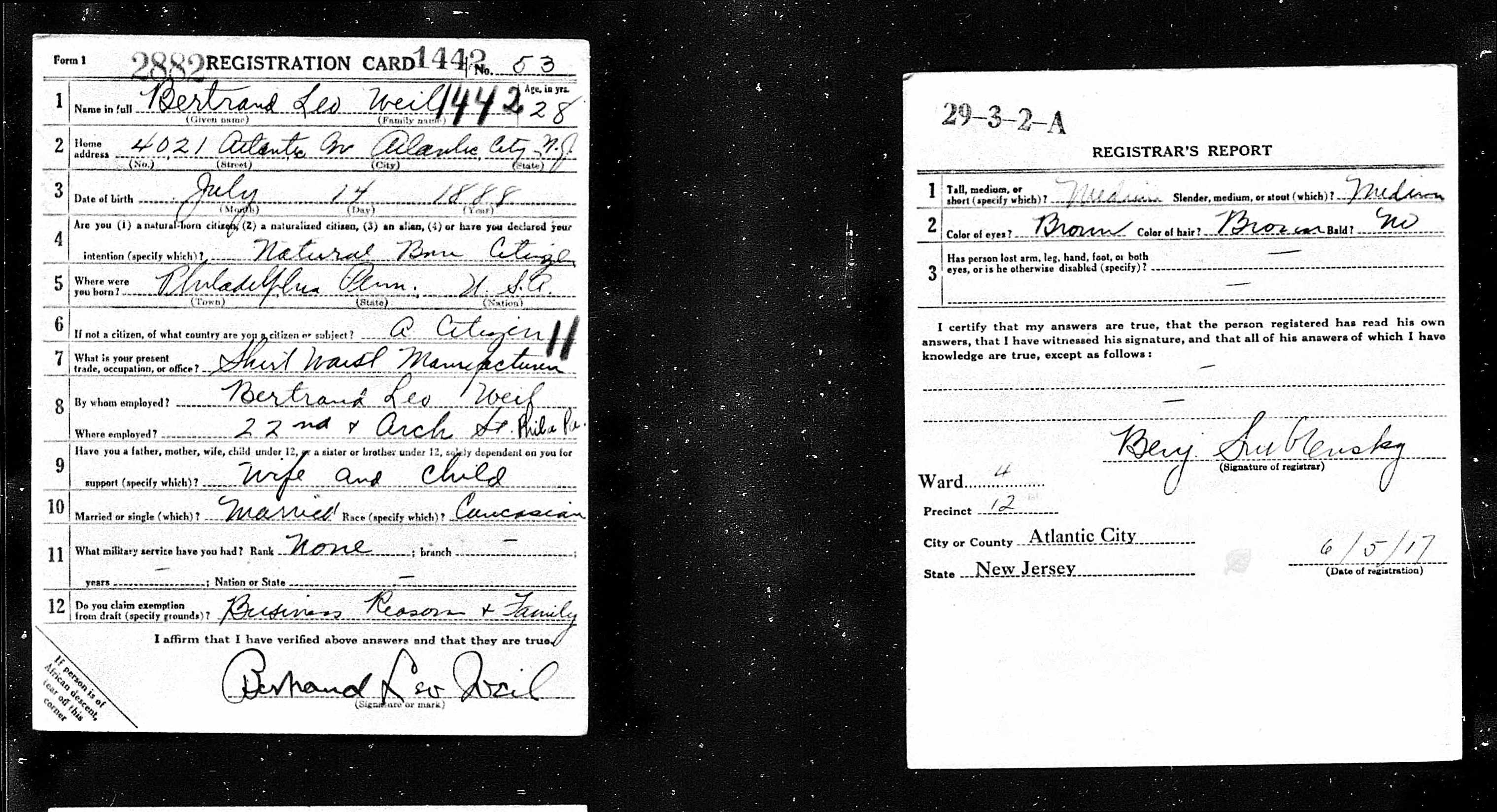
Registration State: New Jersey; Registration County: Atlantic; Roll: 1711902; Draft Board: 2

Registration State: New Jersey; Registration County: Atlantic; Roll: 1711902; Draft Board: 2


In 1930, Frank and Dolly Nusbaum were living at 4840 Pine Street in the Pine Manor Apartments.  Frank, now 68, was still working as the manager of a life insurance business.

It’s not clear what the status was of their daughter Loraine’s marriage in 1930.  Loraine and her son Burton, now 13, were living back in Philadelphia at 241 South 49th Street.  Although Loraine still gave her marital status as married, she is listed as the head of the household.  Bertrand, meanwhile, is listed in the 1930 census as living in New York City, also giving his status as married.  He was living as a lodger in the Hotel New Yorker on Eighth Avenue and working as a “traveler” in the ready-to-wear business.  Had his shirt waist business failed? Was he simply in New York on business when the census was taken?  I do not know.

But six years later, Bertrand died in New York City. On October 20, 1936, he was found dead in his room at the Hotel McAlpin in New York, and after an autopsy, the cause of death was given as “congestion of viscera; fatty infiltration of liver; contusion of head.”  I am not sure what the first refers to exactly, though I found one source online saying that it was not uncommon at one time in New York to use “congestion of the viscera” as a temporary catch-all on death certificates when the cause of death wasn’t yet clear.

Weil, Bertram Death page 1

The second page of the certificate has a handwritten entry dated February 22, 1937, four months after his death, that says “acute chronic alcoholism.”

Weil, Bertram Death page 2

That might explain both the separation from Loraine and the contusion on his head.  I also noted that it was his sister, not his wife, who made the arrangements with the undertaker.  Bertrand was buried at Mt. Sinai in Philadelphia; the plot arrangements were made as well by his sister, not his wife.

Loraine remarried a year later in 1937.  She married Robert Cooke Clarkson, Jr., a mechanical engineer also born in Philadelphia and a 1915 graduate of the University of PennsylvaniaRobert Cook Clarkson Penn bio 1917

Robert had married Anna Armstrong in Philadelphia in 1918, and he was still married and living with her as of the 1930 census.  Since I cannot find a death certificate for Anna, I assume that Robert and Anna divorced, and in 1937, he married Loraine Nusbaum Weil.  Loraine and Robert are listed together on a passenger manifest for a cruise to Bermuda on May 15, 1937, a trip that might very well have been their honeymoon trip.

Year: 1937; Arrival: New York, New York; Microfilm Serial: T715, 1897-1957; Microfilm Roll: Roll 5978; Line: 1; Page Number: 15

Year: 1937; Arrival: New York, New York; Microfilm Serial: T715, 1897-1957; Microfilm Roll: Roll 5978; Line: 1; Page Number: 15

In 1940, Loraine, Robert, her son Burton Weil, and his mother Hannah Weil were all living at 1006 Edmunds Street in Philadelphia.  Robert was working as the mechanical inspector for the Board of Education, and Burton, now 23, was working as a clerk for Campbell Soup Company.  Loraine’s parents, Frank and Dolly Nusbaum, were still living on Pine Street; Frank was retired and 78 years old; Dolly was 76.

The 1940s were a decade of loss for the family.  First, on January 23, 1943, Dolly died at 79 from cachexia or wasting syndrome due to arterial deterioration and senility.  Almost two years later on December 21, 1944, Frank died at age 83 from myocardial deterioration.  They are buried at West Laurel Hill cemetery in Philadelphia.

Ancestry.com. Pennsylvania, Death Certificates, 1906-1963 [database on-line]. Provo, UT, USA: Ancestry.com Operations, Inc., 2014. Original data: Pennsylvania (State). Death certificates, 1906–1963. Series 11.90 (1,905 cartons). Records of the Pennsylvania Department of Health, Record Group 11. Pennsylvania Historical and Museum Commission, Harrisburg, Pennsylvania.

Ancestry.com. Pennsylvania, Death Certificates, 1906-1963 [database on-line]. Provo, UT, USA: Ancestry.com Operations, Inc., 2014.
Original data: Pennsylvania (State). Death certificates, 1906–1963. Series 11.90 (1,905 cartons). Records of the Pennsylvania Department of Health, Record Group 11. Pennsylvania Historical and Museum Commission, Harrisburg, Pennsylvania.

Their grandson Burton Weil had enlisted with the Army Air Corps on October 14, 1940, after two years at the University of Tennessee.  He had fought in World War II as a pilot; he had shot down a German plane before he himself had been shot down over North Africa and captured in Tripoli on January 18, 1943.  He was sent to a German prisoner of war camp and was liberated in May, 1945.  For his service, he was awarded the Distinguished Flying Cross and the Air Medal with three Oak Clusters.

Just a year after his liberation while continuing to serve in the Air Corps in California, on September 20, 1946, he was killed when his plane crashed in Kentucky while he was en route to his home in Philadelphia.

Burton_Weil_obituary-page-001

Ancestry.com. Kentucky, Death Records, 1852-1953 [database on-line]. Provo, UT, USA: Ancestry.com Operations Inc, 2007. Original data: Kentucky. Kentucky Birth, Marriage and Death Records – Microfilm (1852-1910). Microfilm rolls #994027-994058. Kentucky Department for Libraries and Archives, Frankfort, Kentucky.Kentucky. Birth and Death Records: Covington, Lexington, Louisville, and Newport – Microfilm (before 1911). Microfilm rolls #7007125-7007131, 7011804-7011813, 7012974-7013570, 7015456-7015462. Kentucky Department for Libraries and Archives, Frankfort, Kentucky.Kentucky. Vital Statistics Original Death Certificates – Microfilm (1911-1955). Microfilm rolls #7016130-7041803. Kentucky Department for Libraries and Archives, Frankfort, Kentucky.

Ancestry.com. Kentucky, Death Records, 1852-1953 [database on-line]. Provo, UT, USA: Ancestry.com Operations Inc, 2007.
Original data: Kentucky. Kentucky Birth, Marriage and Death Records – Microfilm (1852-1910). Microfilm rolls #994027-994058. Kentucky Department for Libraries and Archives, Frankfort, Kentucky.Kentucky. Birth and Death Records: Covington, Lexington, Louisville, and Newport – Microfilm (before 1911). Microfilm rolls #7007125-7007131, 7011804-7011813, 7012974-7013570, 7015456-7015462. Kentucky Department for Libraries and Archives, Frankfort, Kentucky.Kentucky. Vital Statistics Original Death Certificates – Microfilm (1911-1955). Microfilm rolls #7016130-7041803. Kentucky Department for Libraries and Archives, Frankfort, Kentucky.

Loraine, who lost her mother, then her father, and then her son in such a quick period of time, lost her husband Robert ten years later on October 9, 1956, when he died of a pulmonary embolism.  He was 64 years old.

Ancestry.com. Pennsylvania, Death Certificates, 1906-1963 [database on-line]. Provo, UT, USA: Ancestry.com Operations, Inc., 2014. Original data: Pennsylvania (State). Death certificates, 1906–1963. Series 11.90 (1,905 cartons). Records of the Pennsylvania Department of Health, Record Group 11. Pennsylvania Historical and Museum Commission, Harrisburg, Pennsylvania.

Ancestry.com. Pennsylvania, Death Certificates, 1906-1963 [database on-line]. Provo, UT, USA: Ancestry.com Operations, Inc., 2014.
Original data: Pennsylvania (State). Death certificates, 1906–1963. Series 11.90 (1,905 cartons). Records of the Pennsylvania Department of Health, Record Group 11. Pennsylvania Historical and Museum Commission, Harrisburg, Pennsylvania.


Despite all that heartbreak, Loraine lived another 35 years, dying on February 13, 1991, when she was almost 103 years old.  I wish I knew more about what her life was like after 1956, but sadly I cannot find an obituary.  Loraine is buried with her second husband Robert and her son Burton at Drexel Hill Cemetery.

courtesy of Penny at FindAGrave

courtesy of Penny at FindAGrave

Neither Henrietta Nusbaum Newhouse nor Frank Nusbaum has any living descendants.


My Cousin Wolfgang and The Lessons of History: Will We Ever Learn Those Lessons?

When I started this blog back in October, 2013, I never anticipated that it would help family members find me.  But that has proven to be an incredible unexpected benefit of publishing this blog.  This is one of those stories.

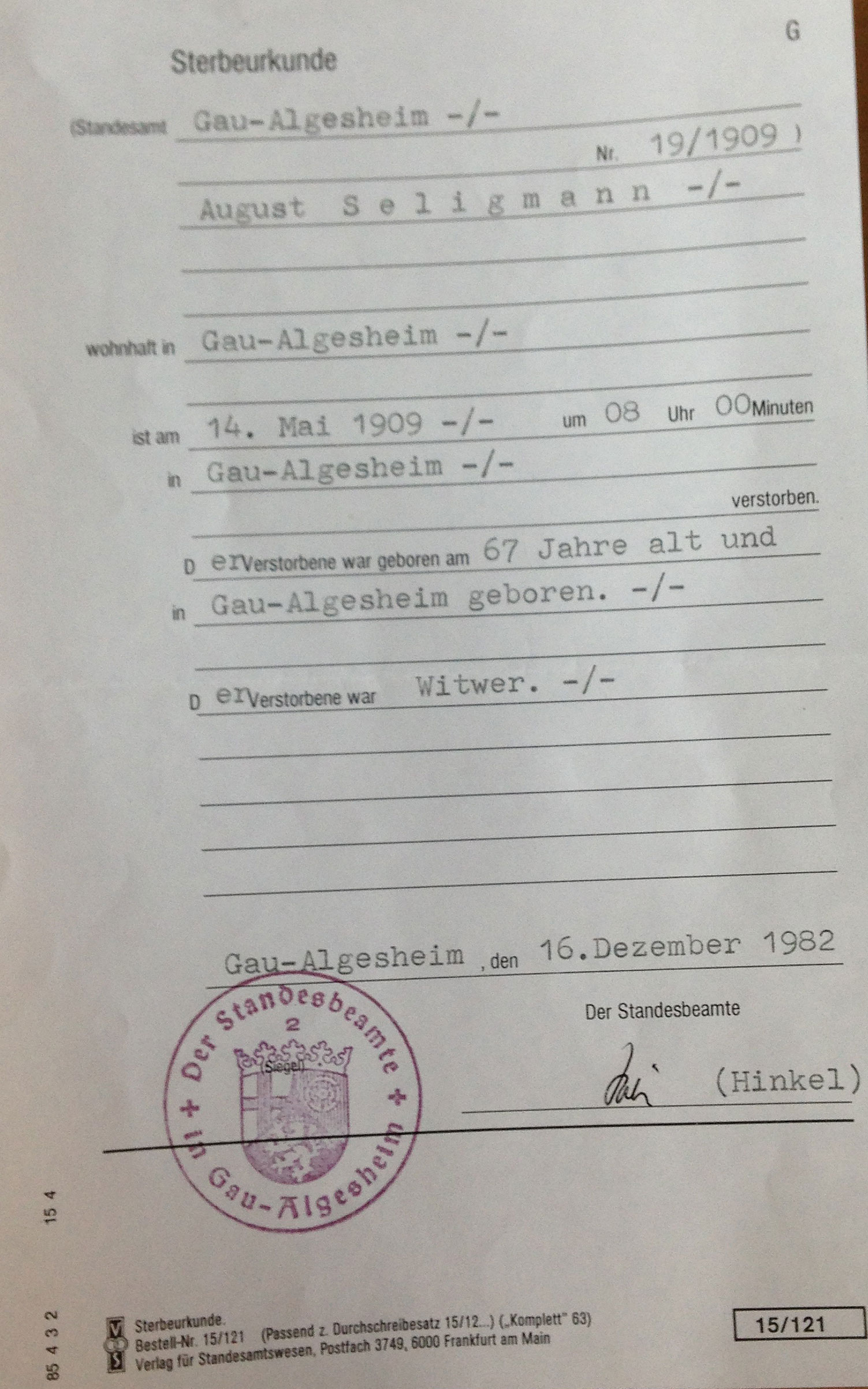
Several weeks ago, I received a comment on the blog from a man named Wolfgang Seligmann, saying he was the son of Walter Seligmann, that he lived near Gau-Algesheim, and that he had found my blog while doing some research on his family.  He asked me to email him, which I did immediately, and we have since exchanged many emails and learned that we are third cousins, once removed:  his great-great-grandparents were Moritz Seligmann and Babetta Schoenfeld, my great-great-great-grandparents.  His great-grandfather August was the brother of Sigmund, Adolph and Bernard Seligman, the three who had settled in Santa Fe in the mid-19th century.   Wolfgang sent me a copy of August’s death certificate.

August Seligmann death certificate

August Seligmann death certificate

(Translations in this post courtesy of Wolfgang Seligmann except where noted: Registry-Office Gau-Algesheim: August Seligmann, living in Gau-Algesheim died the 14th of May 1909 at 8 a.m. in Gau-Algesheim. He was 67 years old and born in Gau-Algesheim. He was a widower.)

Our families had probably not been in touch since Bernard died in 1902 (or perhaps when Adolph died in 1920).  And now through the miracle of the internet and Google, Wolfgang had found my blog with his family’s names in it and had contacted me.  What would our mutual ancestors think of that?  It even seems miraculous to me, and I live in the 21st century.

Fortunately, Wolfgang’s English is excellent (since my knowledge of German is…well, about five words), and so we have been able to exchange some information about our families, and I have learned some answers to questions I had about the Seligmanns who stayed in Germany.  With Wolfgang’s permission, I would like to share some of those stories.

Wolfgang’s grandfather was Julius Seligmann, the second child and oldest son of August Seligmann and his wife Rosa Bergmann.  Julius was born in 1877 in Gau-Algesheim.  As I wrote about here, Julius was one of the Seligmanns written about in Ludwig Hellriegel’s book about the Jews of Gau-Algesheim.  He had been a merchant in the town.  On December 1, 1922, Julius had married a Catholic woman named Magdalena Kleisinger, who was born in Gau-Algesheim on July 9, 1882, and had himself converted to Catholicism.  Julius and Magdalena had two sons, Walter, who was born February 10, 1925, and Herbert, born July 27, 1927.  Julius and his family had left Gau-Algesheim for Bingen in 1939 after closing the store in 1935.

I had wondered why Julius had closed the store and then relocated to Bingen, and I asked Wolfgang what he knew about his grandfather’s life.  According to Wolfgang, his father Walter and uncle Herbert did not like to talk about the past, but Wolfgang knew that when Julius married and converted to Catholicism, his Jewish family was very upset and did not want to associate with him any longer.  In fact, Julius was forced to pay his siblings a substantial amount of money for some reason relating to his store in Gau-Algesheim, and that payment caused him and his family a great deal of financial hardship.  According to Wolfgang, Julius no longer had enough money to pay for his own home, and thus he and his family moved to Bingen in 1939 where they lived with Magdalena’s family or friends for some time.

Julius and Magdalena Seligmann

Julius and Magdalena Seligmann 1960s  Courtesy of Wolfgang Seligmann

The Hellriegel book also made some puzzling (to me) references to the military records of Wolfgang’s father and uncle, saying that they had been “allowed” to enlist in the army, but then were soon after dismissed.  Wolfgang explained that the German authorities did not know how to treat Catholic citizens with Jewish roots.  Wolfgang said that his father Walter had trained to be a pharmacist, but the Nazis would not allow him to work with anything poisonous.  In addition,  his father was not permitted to be in the army; instead  he was ordered by the authorities to work on the Siegfried Line, which was  originally built as a defensive line by the Germans during World War I.  In August 1944, Hitler ordered that it be strengthened and rebuilt, and according to Wikipedia, “20,000 forced labourers and members of the Reichsarbeitsdienst (Reich Labour Service), most of whom were 14–16-year-old boys, attempted to re-equip the line for defence purposes.”  Walter Seligmann was one of those forced laborers.
Map of the Siegfried line.

Map of the Siegfried line. (Photo credit: Wikipedia)

Here is a photograph of Walter Seligmann, Wolfgang’s father:

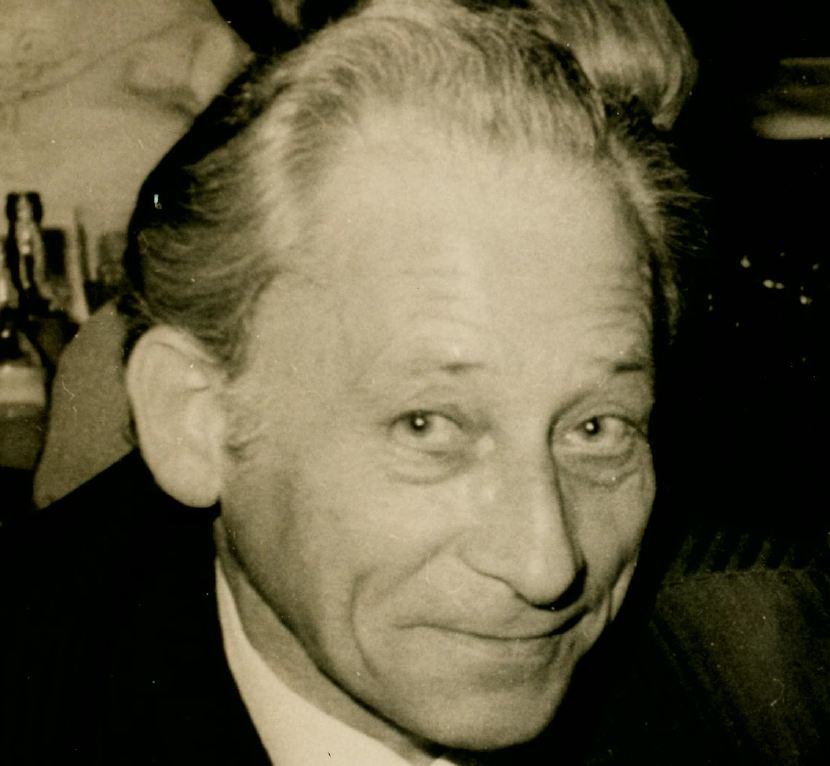
Walter Seligmann  Photo courtesy of Wolfgang Seligmann

Walter Seligmann Photo courtesy of Wolfgang Seligmann

As for Wolfgang’s uncle Herbert, he was sent by the local police to the army, but the army would not accept him.  He was dismissed and sent back to Bingen, where he was required to work in a warehouse until the war ended.

Herbert Seligmann courtesy of Christoph Seligmann

Herbert Seligmann courtesy of Christoph Seligmann

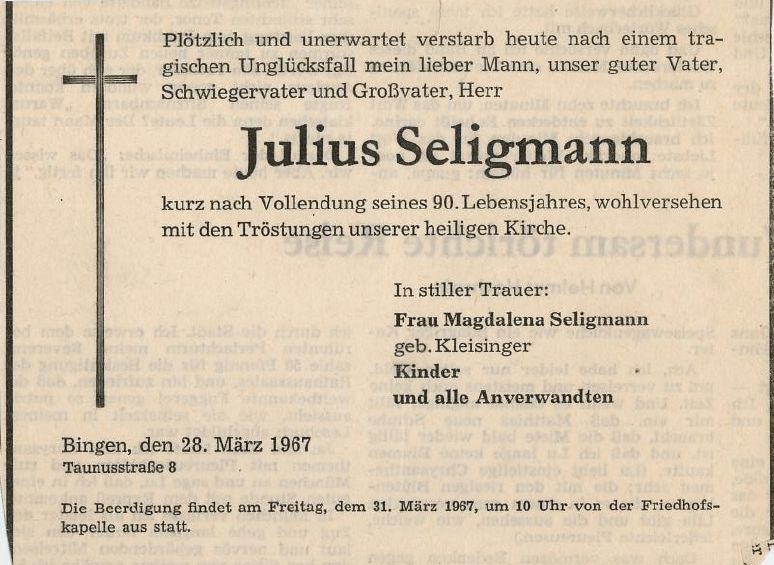
Julius Seligmann died in 1967, and his wife Magdalena died the following year.  Walter Seligmann died in 1993, and his brother Herbert died in 2001.

Julius Seligmann death notice

Julius Seligmann death notice

Magdalena Seligmann death notice

There are some very bitter ironies in these stories.  Julius and his family were not accepted by his Jewish family because they were Catholic, but the Nazis did not accept them either because they had Jewish roots.  As I commented to Wolfgang, prejudice of any sort is so destructive and unacceptable.  His family experienced it from two different directions.

Not that the two examples here can be equated in any way.  Although all prejudice is wrong, prejudice that leads to genocide is utterly reprehensible, an evil beyond comprehension for anyone who has a moral compass.  I have already written about my own personal horror and pain when I realized that I had family who had been murdered by the Nazis.  Wolfgang told me more about some of those who lost their lives to Hitler and his evil forces.

One victim was his great-uncle Moritz Seligmann (the grandson of Moritz Seligmann, my 3x-great-grandfather, and a son of August Seligmann).  My information about his fate comes from two websites that Wolfgang shared with me. According to these two sites, Moritz Seligmann, Julius’ younger brother, was born on June 25, 1881.  He fought in World War I for Germany, spent two years in captivity, and was honored with the Hindenburg Cross or Cross of Honor for his service.  Despite this, in the aftermath of Kristallnacht, on November 11, 1938, Moritz was arrested in Konigstein, where he had been living since 1925.  He was sent to the concentration camp at Buchenwald.

German Cross of Honour 1914-1918

German Cross of Honour 1914-1918 (Photo credit: Wikipedia)

Moritz wrote to the authorities in Konigstein, pointing out that he was the recipient of the Hindenburg Cross.  He was released from Buchenwald in December on the condition that he emigrate by March 31, 1939.  He was required to report to the police in Konigstein twice a week until then, and if he had not emigrated by the deadline, he was to be arrested.  On March 28, 1939, however, the Gestapo lifted the emigration order and the reporting requirement in light of Moritz’s service during World War I.

Here is a copy of the Gestapo letter, lifting the emigration order.  I found this a particularly chilling document to see.

Gestapo letter re Moritz Seligmann

Wolfgang helped me translate this letter as follows: Frankfort, March 20, 1939. Concerning: the “Aktionsjude” Moritz Seligmann born June 25, 1881, Gau-Algesheim, residing in Konigstein.  Seligmann has provided proof that he was a soldier in the World War as a combatant.  Therefore the reporting obligation and emigration order is lifted for him. I would ask the emigration (?) to supervise and notify us here.

As explained to me by Wolfgang and by Wikipedia,  the “Aktionsjude” referred to 26,000 Jews who were deported in the aftermath of Kristallnacht, as was Moritz Seligmann, as part of an effort to frighten other Jews to leave Germany.  Unfortunately, not enough of them did.

Despite the lifting of the order to emigrate, Moritz had hoped to immigrate to the US.  For various bureaucratic reasons described here, he was unable to get clearance to emigrate.  On June 10, 1942, he was picked up by the Nazis and transported somewhere to the east.  Exactly where and when he died is not known.

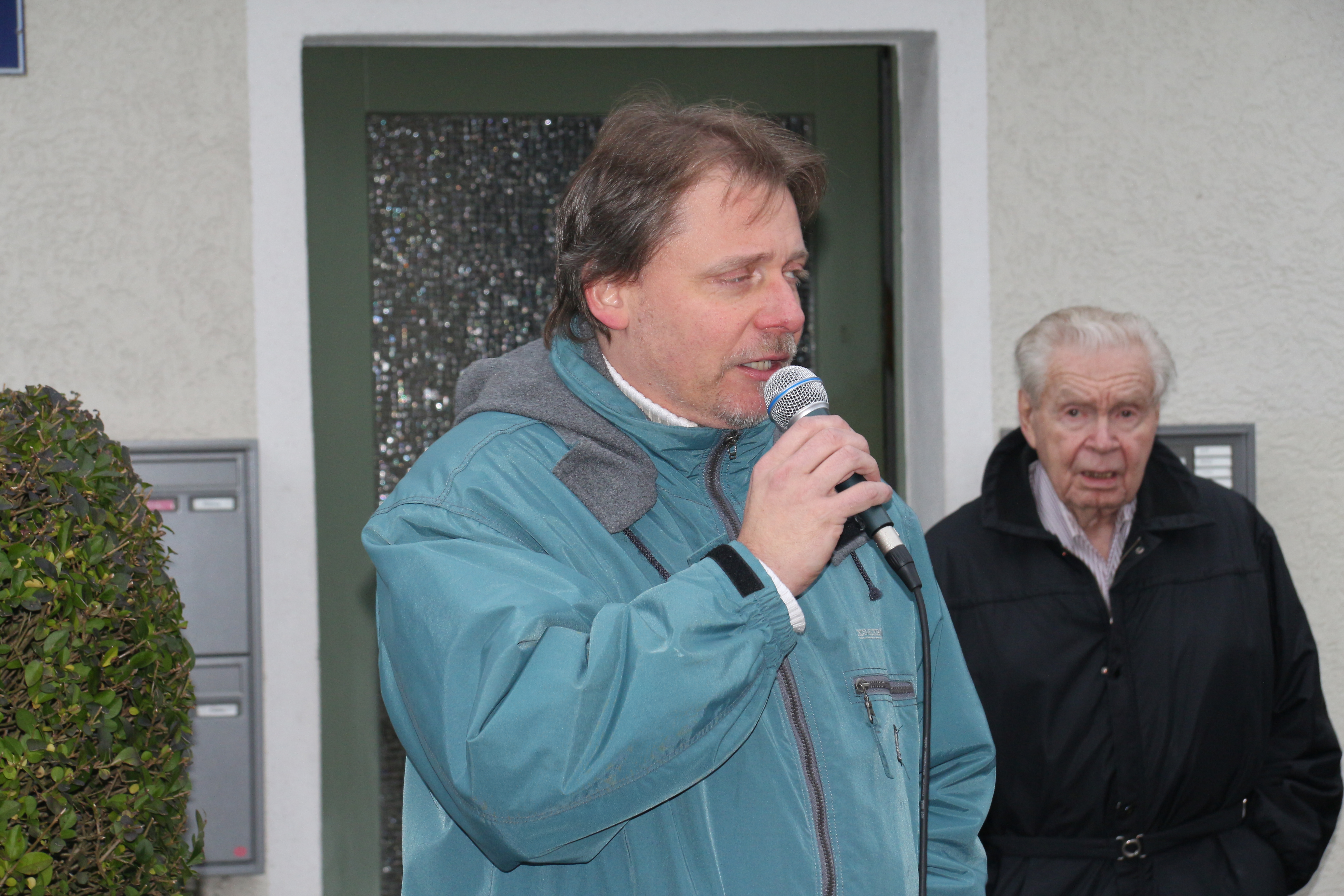
Wolfgang and his family, after researching the fate of Moritz, informed the town of Konigstein of their findings, and the town agreed to place a “stolperstein” in memory of Moritz Seligmann near his home in Konigstein.  A stolperstein (literally, a stumbling blog) is a memorial stone embedded in the ground to memorialize a victim of the Holocaust.  Here is a photograph of Wolfgang at the ceremony when Moritz Seligmann’s stolperstein was installed in Konigstein.

Wolfgang Seligmann

Wolfgang Seligmann  Courtesy of Wolfgang Seligmann

Behind him is a man who knew Moritz and remembered when Moritz was initially arrested in 1938, clinging to his Hindenburg Cross, believing it would save him from the murderous forces of the Nazis.  It may have stalled his murder, but it did not save him.

Wolfgang also told me about the fate of another sibling of his grandfather Julius, his younger sister Anna.  Anna, born in Gau-Algesheim in 1889, had married Hugo Goldmann, and they had a daughter Ruth, born in 1924 in Neunkirchen, a town about 80 miles southwest of Gau-Algesheim, where Anna and Hugo had settled. Between 1939 and 1940, many people from this area near the border with France were evacuated to locations in central Germany, and Anna, Hugo, and Ruth ended up in Halle, Germany, 350 miles to the northeast of Neunkirchen.  On June 1, 1942, they were all deported from Halle to the Sobibor concentration camp where they were all killed.  Click on each name to see the memorial pages established by the town of Halle in memory of Anna, Hugo, and Ruth.

Finally, Wolfgang told me about another member of the family.  Moritz Seligmann (the elder) had had a daughter Caroline with his first wife, Eva Schoenfeld.  Caroline was the half-sister of my great-great-grandfather Bernard. She had married a man named Siegfried Seligmann, perhaps a cousin.  Their son, Emil, died in Wiesbaden on August 9, 1942, when he was 78 years old.

Death record of Emil Seligmann, husband of Carolina Seligmann

Death record of Emil Seligmann, husband of Carolina Seligmann

(Wiesbaden: The Emil Jakob Israel Seligmann, without profession, “israelitisch”  [presumably meaning Jewish], living in Wiesbaden, Gothestraße Nr. 5, died on 9th of August 1942 in his Apartment. He  was born on 23th of December 1863 in Mainz.

Father: Siegfried Seligmann, deceased.  Mother: Karoline Seligmann, nee Seligmann, deceased.  He was widower of Anna Maria Angelika born as Illien. The death was announced by Emil Seligmann, his son, living Goethestraße Nr.5.

The stamp in the left hand margin says:  Wiesbaden, 31th of May 1949.  The “Zwangsvorname”Israel is deleted.  Zwangsvorname translates as “forced first name,” meaning that the name Israel had been required by the Nazis, I assume as a way to identify him as Jewish.

Emil had a son, also named Emil, who died in Buchenwald, as this record attests.

Emil Seligmann-KZ (1)

(To: Miss Christine Seligmann, Wiesbaden, Goethestr. Nr. 5,1

From: Special registry-office in Arolsen-Waldeck, department Buchenwald

Subject: death-certification for Emil-Jakob Seligmann, Your letter from the 1. of March 1950

Based on the documents of the International Tracing Service in Arolsen it is proved, that your brother died on 14th of February 1945 in the Concentration Camp Buchenwald. )

I imagine that this is not the end of the list of the Seligmanns who were murdered during the Holocaust, and I imagine that there are also many other family members I never knew about who were killed by the Nazis, whether they were named Schoenfeld, Nussbaum, Dreyfuss, Goldschlager, Rosenzweig, Cohen, or Brotman or something else.  I just haven’t found them yet.

Wolfgang and I plan to keep on exchanging stories, pictures, documents, and other information.  We have also already talked about meeting someday and walking in the footsteps of our mutual ancestors.  What an honor it will be to be with him as we share our family’s story.

Rosenzweig Update: Who Signed that Death Certificate?

One of the biggest mysteries I encountered in researching my Rosenzweig cousins was the mystery of Lilly Rosenzweig, the first child of Gustave and Gussie Rosenzweig.  Lilly was my grandfather Isadore Goldschlager’s first cousin.  Lilly had married Toscano Bartolino in 1901 and had had a child William with him, born March 9, 1902.  Then just two years later on April 27, 1904, Toscano had died from kidney disease at age 27, leaving Lilly a twenty year old widow with a two year old child.

Bartolini Rosenzweig marriage certificate

Bartolini Rosenzweig marriage certificate


William Bartolini birth certificate

William Bartolini birth certificate

Toscano Bartolini death certificate

Toscano Bartolini death certificate


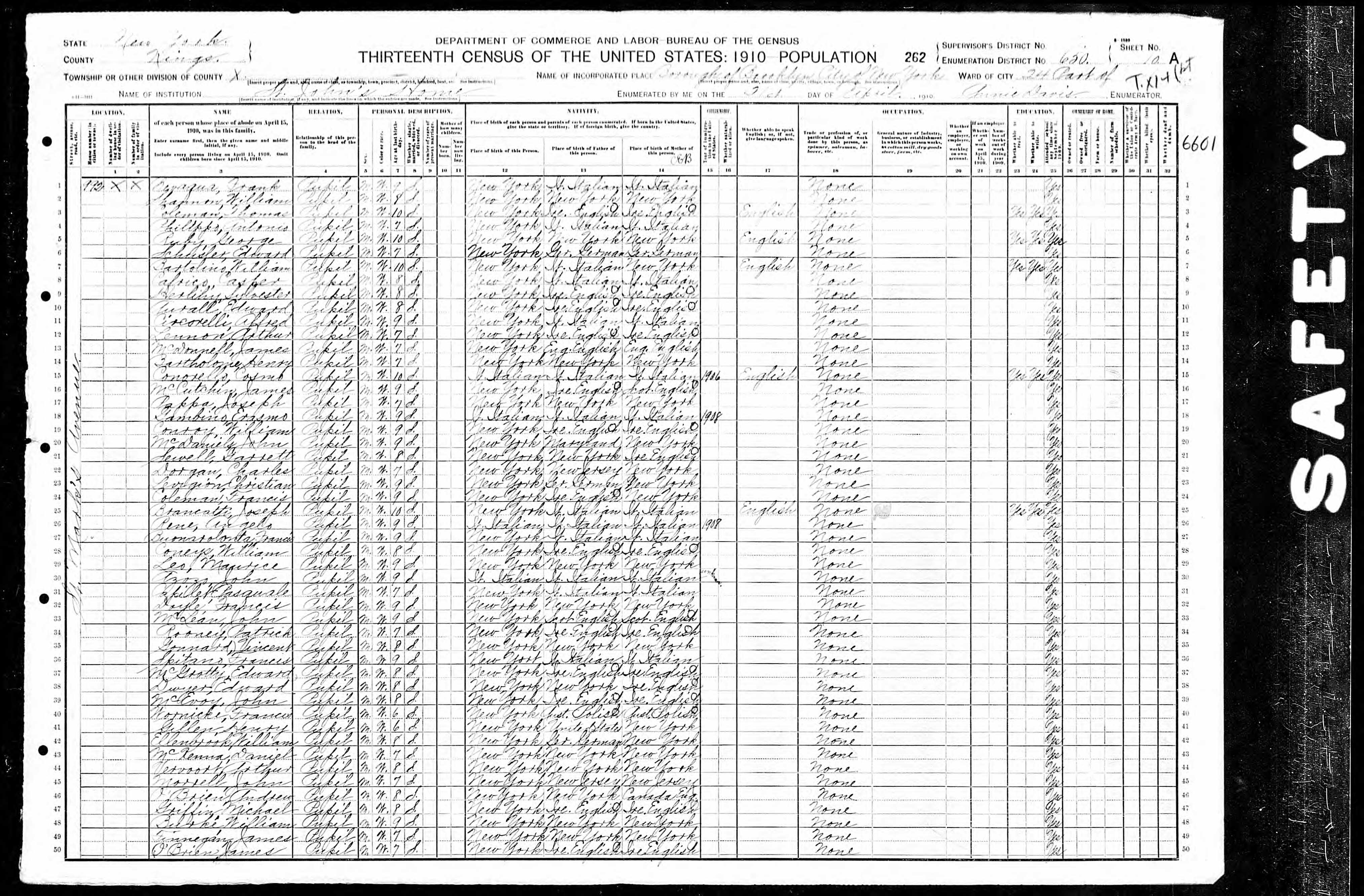
Lilly and her son William were living with Gustave and Gussie in 1905, but by 1910, William was no longer living with his mother and grandparents, but was in St. John’s Home for Boys in Brooklyn.

Gustave Rosenzweig family on the 1905 NYS census

Gustave Rosenzweig family on the 1905 NYS census

William Bartolini 1910 at St John's Home, Brooklyn

William Bartolini 1910 at St John’s Home, Brooklyn


Lilly was still living with her parents in 1910 and working as a nurse.  In 1915, William was at a different residential home, but I could not find Lilly at all on the 1915 NYS census nor could I find her anywhere after that.  None of the great-grandchildren of Gustave and Gussie knew what had happened to her, except that they thought she had remarried and moved to New Jersey at some point.  No one knew her married name or whether she had more children.  I was stuck and could not get any further.

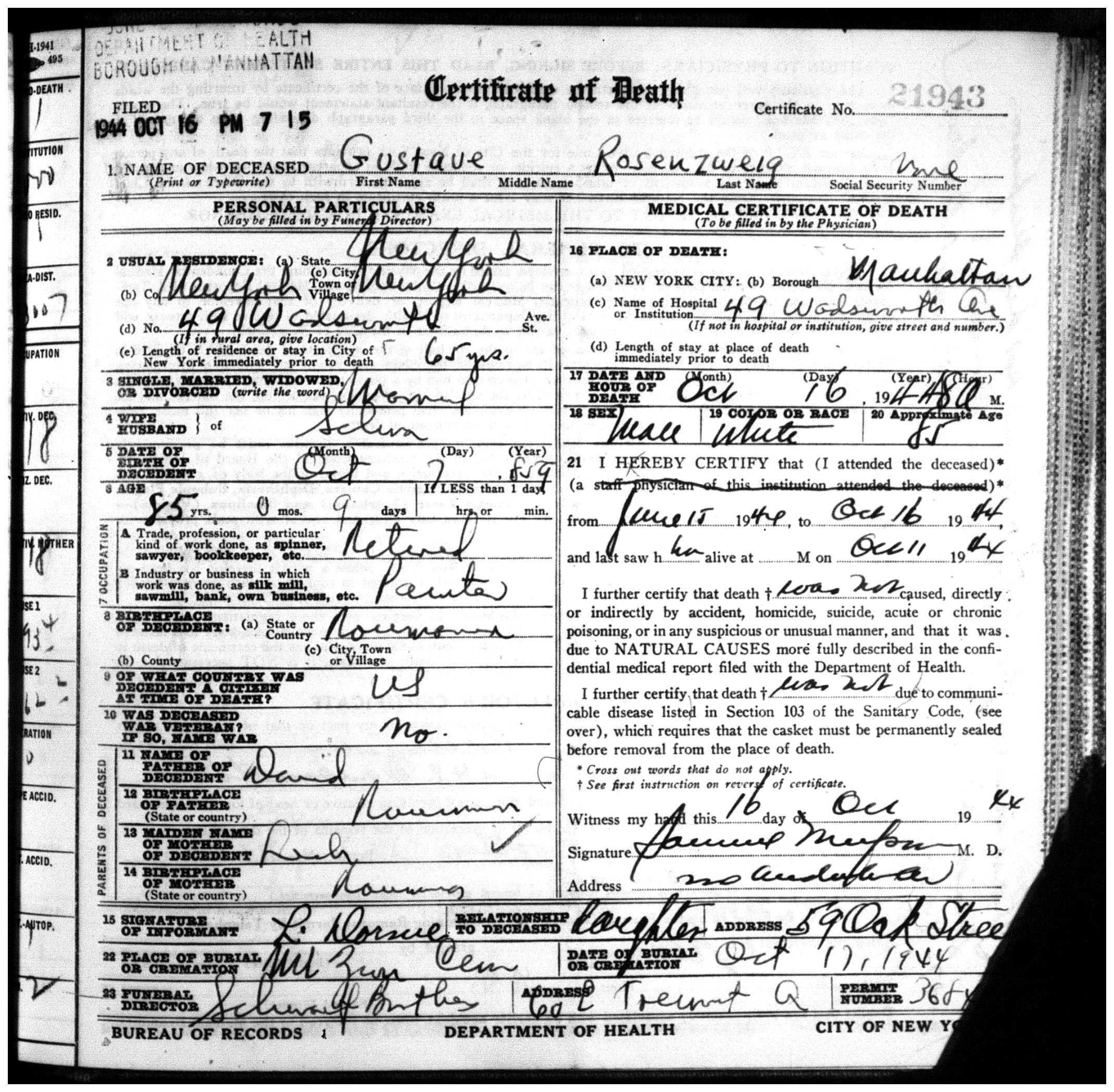
I thought I had a new clue when I obtained Gustave’s 1944 death certificate.  It was signed by an informant I thought might be Lilly.  I posted the signature on the blog, hoping someone would be able to decipher it more clearly than I could, but every possible reading of the signature led me nowhere, even using wildcard searches and as many variations as I could.  I put Lilly aside and figured it was a lost cause.

Gustav Rosenzweig death cert 1

And then? Well, this past weekend I received a call from Harriet, one of Lilly’s nieces.  She not only remembered Lilly well—she remembered the first name of her second husband—Carmen. And she said they had lived in Jersey City. She remembered Lilly fondly and described her as funny and fun-loving, like all the Rosenzweig siblings.

So I now had two more clues.  Lilly had married someone named Carmen, and they had lived in Jersey City, New Jersey.  Armed with just those additional pieces of information, I was able to design a search on FamilySearch using the two first names and the location.  The first result on the results list was a Lilly and Carmen Dorme living in Rutherford, New Jersey in 1940.

Carmen and Lillian Dorme 1940 US census

Carmen and Lillian Dorme 1940 US census


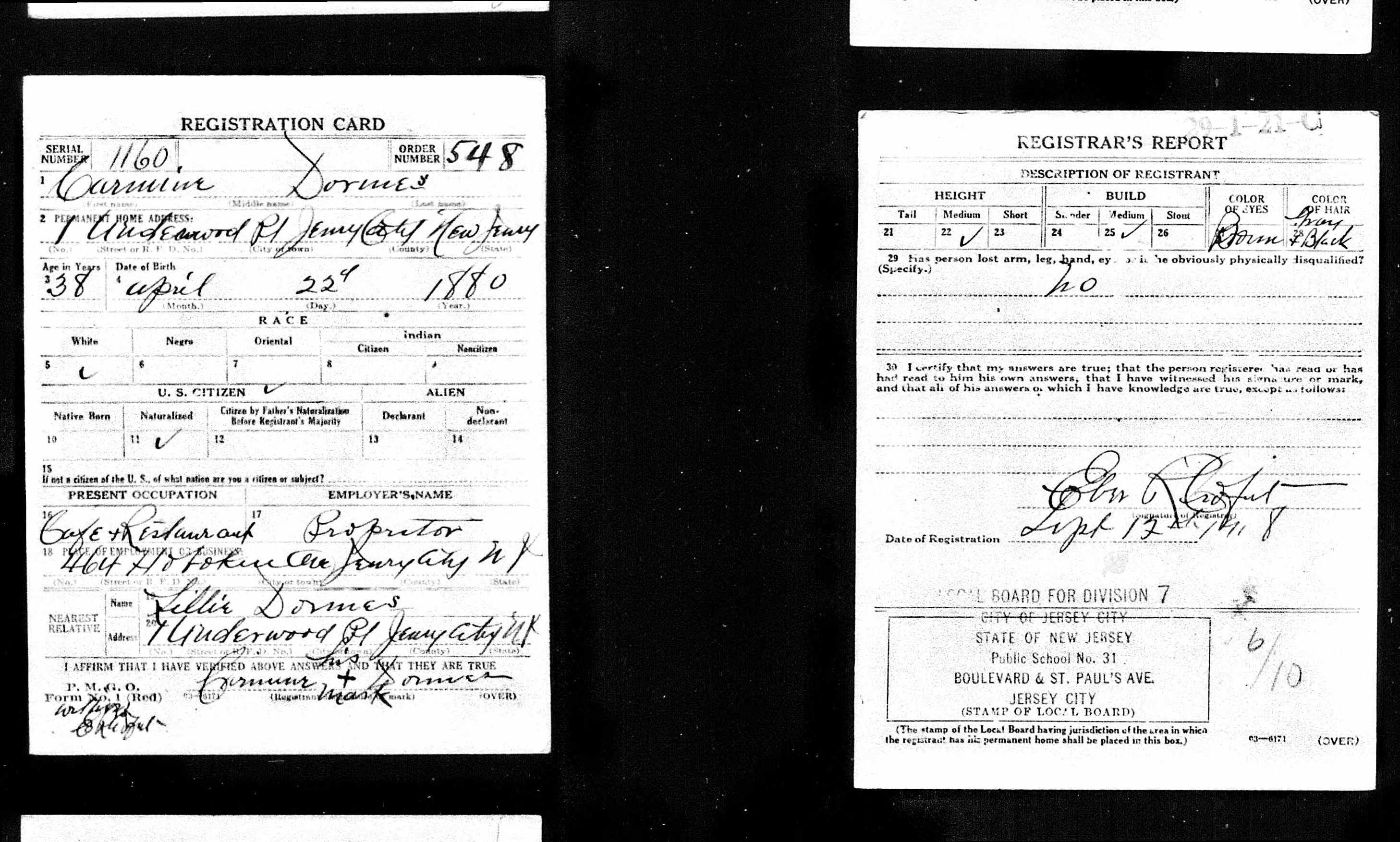
Rutherford was not Jersey City, but it was close by, so I decided to try that surname.  Using Dorme, I was able to search more thoroughly and found that Lilly and Carmen Dorme were already married by 1918 when Carmen  (using Carmine Dormes then) registered for the World War I draft and that they were living in Jersey City.  This had to be my long-missing cousin Lilly.

Carmine Dormes World War I draft registration

Carmine Dormes World War I draft registration


After that, I was also able to find Lilly and Carmen in several Jersey City directories and in the 1930 US census, which revealed that Lilly and Carmen had a child, Louis, who was then sixteen years old.

Dorme family on the 1930 US census

Dorme family on the 1930 US census

Further searching uncovered a Louis Dorme’s entry on the Social Security Death Index, indicating that he was born in New York on May 13, 1913, and had died in 1977.  This was consistent with the age and birthplace for Louis on the 1930 census, so I am reasonably certain that this is the correct person.

I still cannot find the family on the 1920 census, and since they were living in Jersey City both before and after 1920, I assumed that they would have been there then as well.  But although Carmen is listed in both the 1918 and the 1925 Jersey City directories, he is not in the 1922 directory (the intermediate years are not available online).  Harriet thought that Lilly had served as a nurse overseas during World War I, so perhaps that is where the family was located during that period.  I cannot, however, find a military record for Carmen, so I have no way to know for sure where they were during that period.

And although I do know when Louis died (1977) and when Carmen died (1962) from the SSDI, I cannot find Lilly on the SSDI nor can I find any other record of her death.  Harriet does remember Lilly’s death (in fact, Harriet’s mother reported that Lilly’s last words was a request for a corned beef sandwich!), but not the specific year or place.

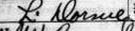
But I do have one clue, and it goes back to Gustave’s death certificate.  As soon as I saw that Lilly’s married name was Dorme, something clicked in my head.  I went back to look at Gustave’s death certificate, and now it seemed strikingly clear that the informant’s name was L. Dorme.

Lilly as informant

How could I not have seen that or found her before?  I just don’t know.  But now I knew that it was in fact Lilly who signed her father’s death certificate.  And so I know that she was still alive as of October 16, 1944, when Gustave died.  I am sure with a few more clues I will be able to narrow down the year and perhaps find her death record as well.

So in the space of one afternoon with the help of a new cousin, I was able to resolve one of the biggest questions I had remaining about my grandfather’s Rosenzweig first cousins.  Thank you, Harriet!


Death Certificates: Answering Some Unanswered Questions

Over the last few weeks I have received a number of death certificates, most for people about whom I have written, so I will also post them as updates to the relevant posts.  But I also wanted to post about them separately for those who might never go back to those original posts.

Three of these were for relatively young men whose deaths puzzled me.  Why had they died so young?  E.g., Simon L.B. Cohen.  He was only 36 when he died on October 24, 1934, after serving valiantly in World War I.  He was my first cousin, twice removed, the first cousin of my grandfather John Nusbaum Cohen.  Simon had faced the horrors of war, been awarded a Distinguished Service Cross by General Pershing for his service, and had been reported killed in action when he was in fact still alive.  He came home and married, but then died only five years after he married.  I had wondered what might have caused such a young man to die after surviving everything he did during the war.

His death certificate reported that his cause of death was glomerulonephritis, chronic myocarditis, and arterial hypertension.  Glomerulonephritis is a form of kidney disease, sometimes triggered by an infection like strep or some other underlying disease.  Overall, it would appear that Simon was just not a healthy 36 year old.  But that’s not the whole story.  The death certificate also described Simon as an “unemployed disabled veteran.”  Although I do not know in what way he was disabled, obviously Simon paid a huge price for what he endured while serving in the military.

Death certificates_0004_NEW

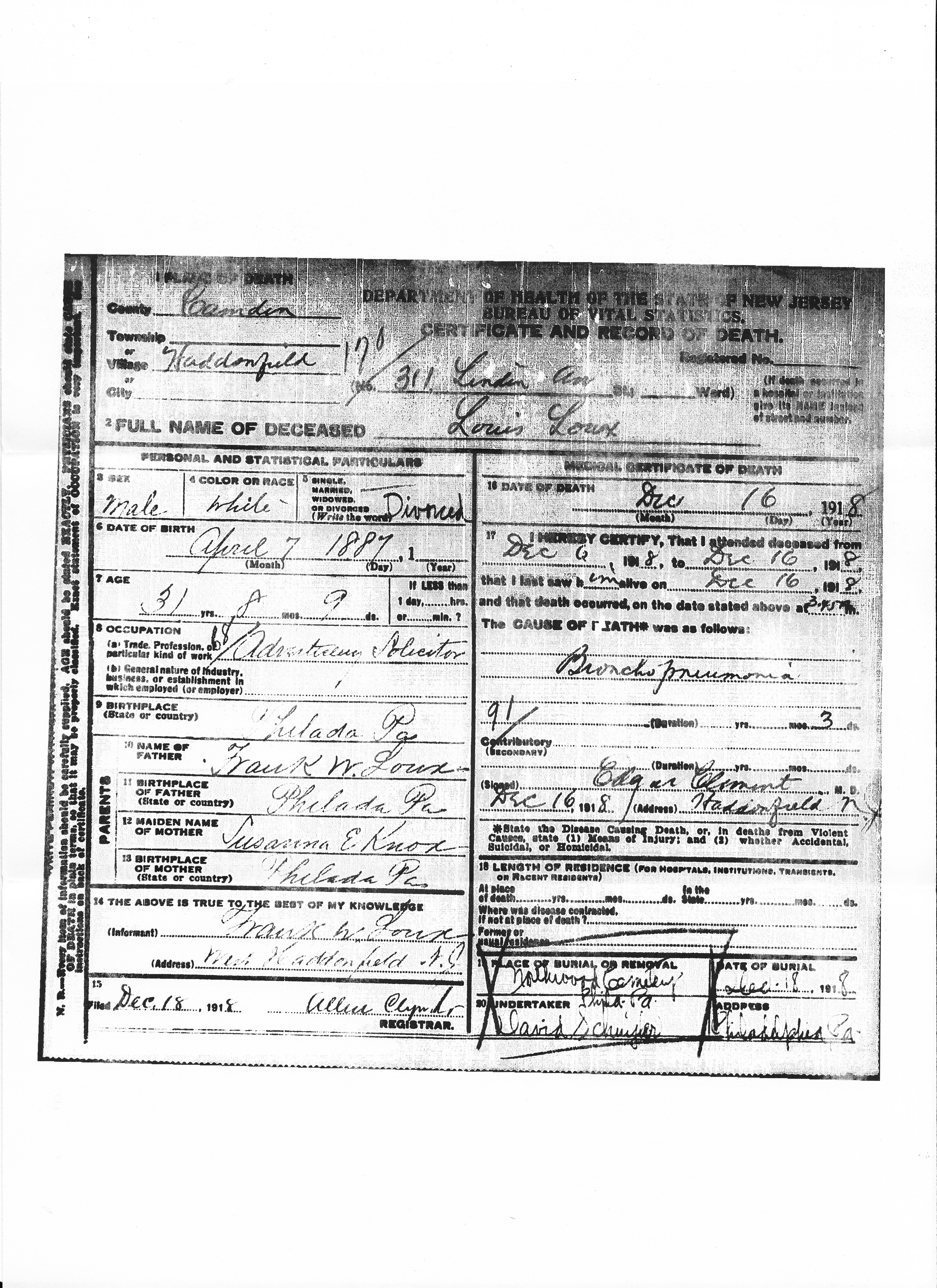
The second young man whose death puzzled me was Louis Loux.  Louis was the husband of Nellie Simon, daughter of Eliza Wiler and Leman Simon.  Louis was thirteen years younger than Nellie.  They had a daughter Florrie, born in 1910, who died from burns caused by matches.  She was only eight years old when she died in September, 1918.  Then her father Louis died just three months later on December 15, 1918.  He was only 36 years old.  I had wondered whether there was some connection between these two terrible deaths.  I knew from the 1920 census that Nellie and Louis had divorced, but I did not and still do not know whether that was before or after their daughter died.  From the death certificate for Louis, I learned that he died from broncho pneumonia. So it would seem that it was perhaps just a terrible sequence of events and that Louis’ death was not in any directly related to the death of his daughter.

Death certificates_0003_NEW

The next death I had wondered about was that of Mervin Simon, the great-grandson of Mathilde Nusbaum and Isaac Dinkelspiel.  He was only 42 years old when he died on August 27, 1942.  He was the son of Leon Simon, who was the son of Moses Simon and Paulina Dinkelspiel.  Mervin died almost a year to do the day after his father Leon.  According to his death certificate, he also died from broncho pneumonia.  Like Simon Cohen, he had no occupation listed on his death certificate.  Even on the 1940 census, neither Mervin nor his brother William had an occupation listed.

Mervyn Simon death certificate

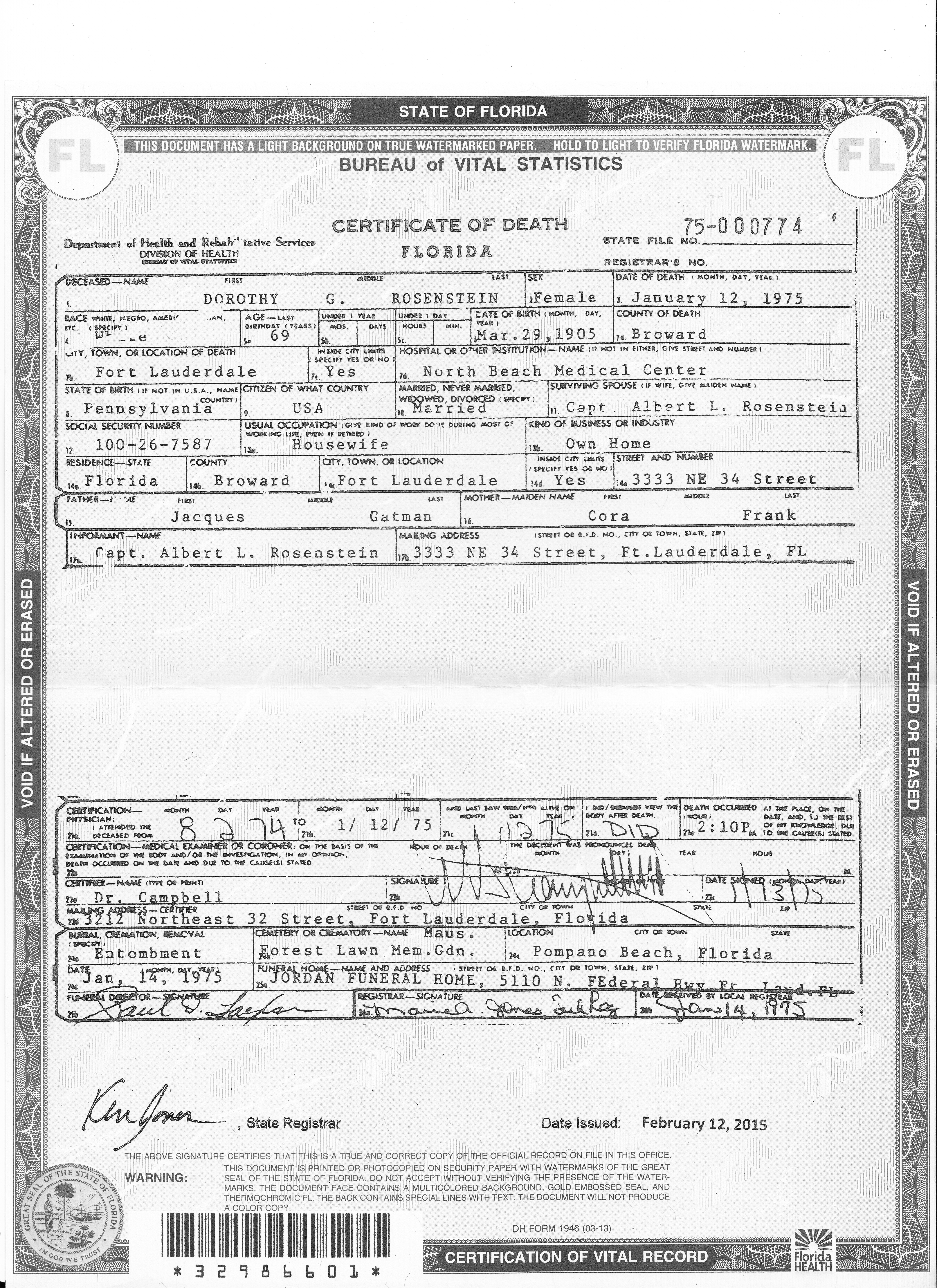
The last death certificate I received in the last few weeks was for Dorothy Gattman Rosenstein.  Dorothy was the daughter of Cora Frank from her first marriage to Jacques Gattman.  Cora was the daughter of Francis Nusbaum and Henry Frank and the granddaughter of Leopold Nusbaum.  Cora’s husband Jacques had died when Dorothy was just a young child, and Cora had remarried and moved to Dayton, Ohio, with her new husband Joseph Lehman and her daughter Dorothy.  I had had a very hard time tracking down what happened to both Cora and Dorothy, and only with the help from a number of kind people had I learned that Dorothy had married Albert Rosenstein from Lancaster, Pennsylvania.  But I wanted the death certificate to corroborate all the other less official evidence I had that this was in fact the same Dorothy Gattman, daughter of Jacques Gattman and Cora Frank.  Her death certificate confirmed that.

Death certificates_0001

Thus, all of these certificates helped put closure on some lingering questions that had bothered me.

And the Tree Keeps Growing: A New Rosenzweig Leaf!

Marvin Shea Sundick photo

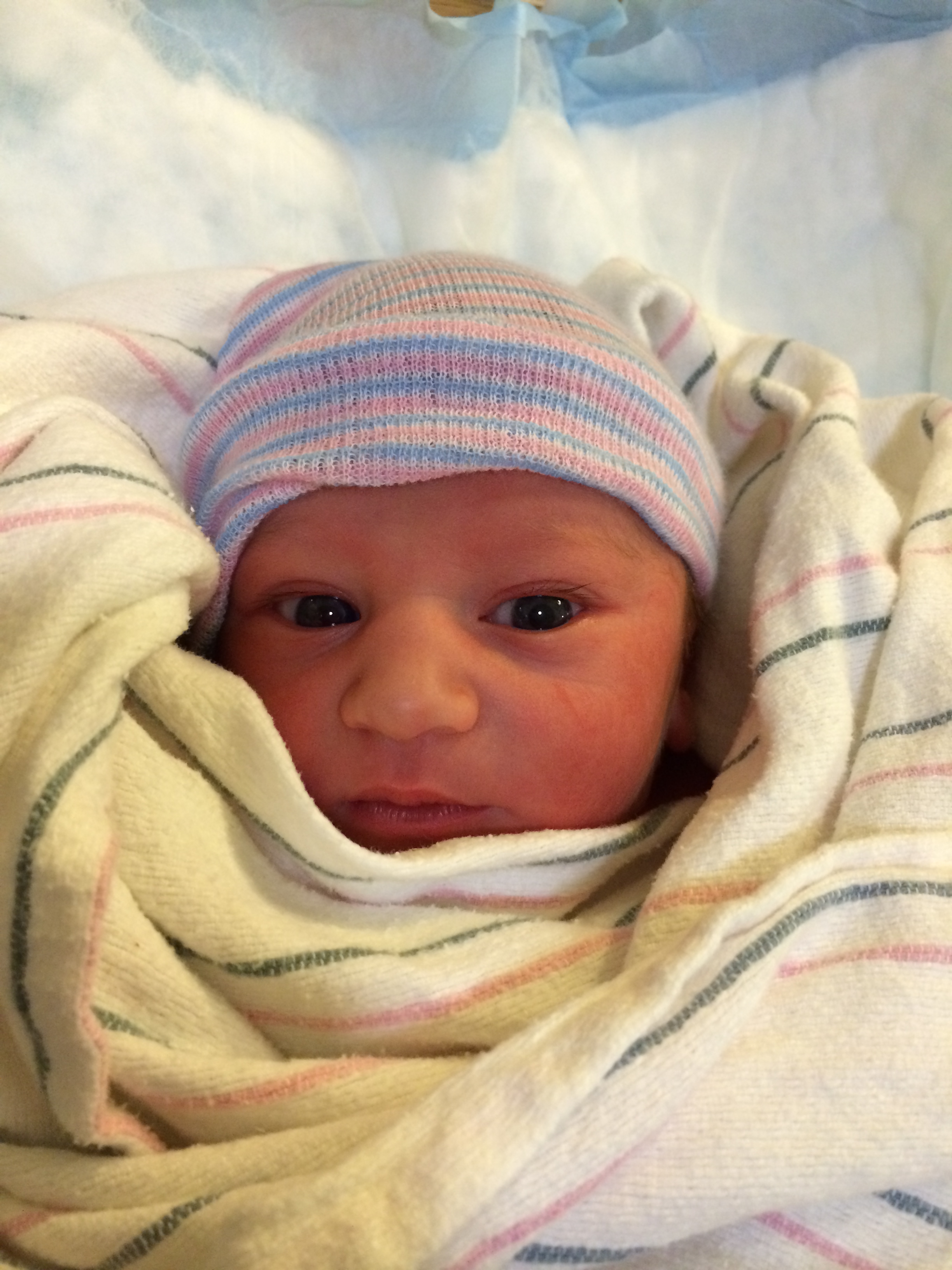
I am delighted to announce that we have another new addition to the Rosenzweig family tree.  Marvin Shea Sundick was born at 12:05 pm on February 20, 2015.  He weighed 7 lbs. 5 oz. and was 20 inches long.  He is the son of Lauren and Bradley Sundick and the brother of Madeline Sundick.  He is the grandson of Robin and Ronald Sundick and of Ellyn Wolfenson, Mick Belzer and Bob Stein.   Marvin is also the great-grandson of Sandy Wolfenson.

Marvin is named for two people. Marvin (in Hebrew, Moshe) is for Lauren’s maternal grandfather, Marvin Wolfenson, who passed away just a year ago.   Shea was to honor the Shapiro family name (the birth name of Marvin’s maternal grandmother Robin).  In Hebrew, Marvin’s middle name is Yisroel for Robin’s father, Israel Shapiro, Brad’s maternal grandfather and Marvin’s great-grandfather.

On his paternal grandfather’s side, Marvin is also the great-grandson of Mildred (nee Rosenzweig) and Seymour Sundick, the great-great-grandson of Joseph and Sadie Rosenzweig, the great-great-great-grandson of Gustav and Gussie Rosenzweig, and the great-great-great-great-grandson of David and Esther Rosenzweig. (That makes him my third cousin twice removed as David and Esther Rosenzweig were my great-great-grandparents, the parents of my great-grandmother Ghitla Rosenzweig Goldschlager.)

Mazel tov to all of his family! And welcome to the family, Marvin!

New Seligmann Discoveries: Erbes-Budesheim and the Schoenfelds, Part I

While you all may have thought that for the last several months I was obsessed with Nusbaums and Dreyfusses (and I guess I was), there were several other things happening in my genealogy life (not to mention my actual life) that I haven’t had a chance to blog about yet.  One of the biggest things was the discovery of documents and information about another line of my family, the Schoenfelds, and another ancestral town, Erbes-Budesheim.

Erbes-Büdesheim in January 2006

Erbes-Büdesheim in January 2006 (Photo credit: Wikipedia)

Who are the Schoenfelds?  Moritz Seligmann, my 3-x great-grandfather from Gau Algesheim, married two Schoenfeld sisters (not at the same time, of course).  First, he married Eva Schoenfeld and had four children with her, and then he married her younger sister, Babetta, my 3-x great-grandmother, the mother of Bernard Seligman, my great-great-grandfather.  Moritz and Babetta had seven children together in addition to the four born to Eva.

Because the birth names of women often disappear, it is all too easy to overlook the family names and lines that end when a woman changes her name to that of her husband.  Although I was always aware of the family names of Goldschlager, Brotman, Cohen, Nusbaum, and Seligman (as well as those from my paternal grandmother’s side, not yet covered on the blog), I had no awareness of a family connection to the names Rosenzweig, Dreyfuss, Jacobs, and Schoenfeld.  Discovering the Schoenfeld name, like discovering those others, was an exciting revelation and addition to my extended family tree.

So how did this happen?  As I wrote back on December 1, Ludwig Hellriegel’s book about the Jews of Gau Algesheim revealed that Moritz Seligmann was born in Gaulsheim and had moved to Gau Algesheim as an adult.  That discovery had led me to the Arbeitskreis Jüdisches Bingen and a woman named Beate Goetz.  Beate sent me the marriage record for Moritz Seligmann and Eva Schoenfeld, which revealed that Eva was the daughter of Bernhard Schoenfeld and Rosina Goldmann from Erbes-Budesheim.  (Now I also know another maternal name—Goldmann.)

Marriage record for Moritz Seligmann and Eva Schoenfeld February 27, 1829 Gaulsheim, Germany

Marriage record for Moritz Seligmann and Eva Schoenfeld February 27, 1829 Gaulsheim, Germany

From there I contacted the registry in Erbes-Budesheim to ask about records for my Schoenfeld ancestors, and within a short period of time, I received several emails from a man named Gerd Braun with an incredible treasure trove of information and records about my Schoenfeld ancestors.

But first, a little about Erbes-Budesheim.  Erbes-Budseheim is a municipality in the Alzey-Worms district of the Rhineland-Palatine state in Germany.  It is located about 25 miles south of Gaulsheim where Moritz Seligmann was born and grew up and about 27 miles south of Gau Algesheim where Moritz and his family eventually settled.  The closest major city is Frankfort, about 46 miles away.

Erbes-Büdesheim in AZ

Erbes-Büdesheim in AZ (Photo credit: Wikipedia)

The town has an ancient history, dating back to the Stone Age, according to Wikipedia.  Like many regions in Germany, it was subject to various wars and conquerors throughout much of its history.  During the Napoleonic era in the late 18th, early 19th century, Erbes-Budesheim and the entire Alzey region were annexed as part of France; after 1815 it was under the control of the Grand Duchy of Hesse.

Although originally a Catholic community, after the Reformation Erbes-Budesheim became a predominantly Protestant community.  Some sources say that there was a small Jewish community in Erbes-Budesheim as early as the 16th century, but as of 1701, there were only 15 Jews (two families) living in the town.  A third family lived there in 1733, but even as late as 1824 and throughout the entire 19th century, the population did not exceed 23 people.  The Jews in Erbes-Budesheim for much of that history joined with Jews from neighboring communities for prayer, education, and burial.

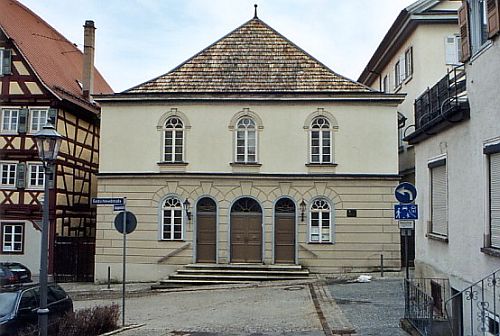
By 1849, however, one Jewish resident named Strauss had dedicated the first floor of his home for prayer services, and it was furnished with the essential elements for a synagogue: Torah scrolls, an ark, a yad, and a shofar, for example.  Perhaps this is where my 4-x great-grandfather Bernhard Schoenfeld went to daven [pray] when he and his family lived in Erbes-Budesheim.

Strauss home where the Erbes-Budesheim Synagogue was located  http://www.alemannia-judaica.de/erbes_buedesheim_synagoge.htm

Strauss home where the Erbes-Budesheim Synagogue was located
http://www.alemannia-judaica.de/erbes_buedesheim_synagoge.htm


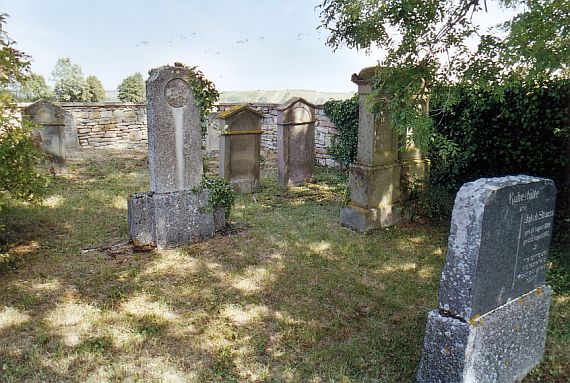
There is also a Jewish cemetery in Erbes-Budesheim.

On this video you can some headstones with the name Schoenfeld from the Erbes-Budesheim cemetery.

By 1939, there were only eight Jews left in the town, and it would appear from the allemannia-judaica website that none of these survived the Holocaust.

Thus, Erbes-Budesheim was never a place where a substantial Jewish community existed, and it makes me wonder what would have brought my ancestors there.  Why would anyone want to be one of a handful of Jews in a community?  In my next post, I will consider that question and share the documents I received from Erbes-Budesheim.

The First Chapter: The Dreyfuss Family

Yeah, I know.  My last post said it was the FINAL chapter of the Dreyfuss family.  How could this one be the first?

Way back on November 18, 2014, I wrote, “More on the Dreyfuss family in a later post.”  Then I proceeded to write about the Nusbaum family and the Dreyfuss family together.  Since two Dreyfuss sisters (Jeanette and Mathilde) had married two Nusbaum brothers (John and Maxwell), it just made sense to follow the stories of the three Dreyfuss sisters (Jeanette, Mathilde and Caroline) along with the stories of the Nusbaum siblings.  But what I never got back to doing was what I had promised back on November 18.  I never got back to the beginning of the Dreyfuss story as I moved forward from the 1840s in America through to the 20th century.  So although my last post was called the “Final Chapter” of the Dreyfuss family, I need to go back and write the first chapter before I can complete the story (as far as I currently know it).

So I need to step backwards in time—both in my time and in the times of the Dreyfuss family before 1840.  Back in the fall when I was researching the family of John Nusbaum, I had a wonderful resource in the family bible owned by my father.  My father had photocopied several pages of handwritten entries for births, deaths, and marriages from the bible , and most of those entries related to the Nusbaum family.  From studying the page for marriages, I learned that John Nusbaum, my three-times great-grandfather, had married Jeanette Dreyfus (as it was spelled there).  And that was the first time I knew the birth name of my three-times great-grandmother.  On the page for births, the second entry after the one for John Nusbaum was one for Jeanette Nusbaum, giving her birth date and her place of birth.  It took me a while to figure out what it said because of the handwriting, but eventually I was able to decipher it and learned that Jeanette was born in “Hechingen in Wurttemberg, Prussia,” as it is inscribed in the bible.

But there was no other Dreyfus(s) on any of the pages in the bible, and I was at that point in time focused on the Nusbaum line.  It wasn’t until weeks later that I realized that the bible’s death entry for Mathilde Pollock was not an entry for a sister of John Nusbaum, but an entry for a sister of Jeanette Dreyfuss (who happened to marry a brother of John Nusbaum) and that the entry for Caroline Wiler was also not a sister of John Nusbaum but another Dreyfuss sister. The big clue was finding 65 year old Mary Dreyfuss  on the 1850 census living with Caroline and Moses Wiler: a head-slapping moment when it occurred to me that it was Jeanette who was keeping the family bible and that, of course, she would record her sisters as well as her husband’s siblings in the family bible.

And then in mid-November I went on JewishGen’s Family Finder page and found Ralph Baer, who was also researching the Dreyfuss family from Hechingen.  I have mentioned Ralph before in the context of the Nusbaum/Dreyfuss family and his generous help with research and translation, but what I had forgotten to write about in my telling of the story of the Nusbaum/Dreyfuss family in the US was what Ralph had helped me learn about my Dreyfuss roots in Hechingen, Germany.

Hechingen, Germany

Hechingen, Germany (Photo credit: Wikipedia)

First, a little about Hechingen.  Today it is in the German state of Baden-Wurttemburg, located about 56 miles north of the Swiss border in southern Germany.  It is about 40 miles from Stuttgart, the state capital.  Although inhabited long before, the city was founded as the capital city of the Counts of Hohenzollern in 1255.  It remained during the Middle Ages a provincial and agricultural community.  During the 16th century, it became a center for art, architecture and music.  Even after the Reformation, it remained a largely Catholic community.  Throughout its pre-19th century history, Hechingen was subjected to many sieges and attacks by other German states as well as by Sweden.

de: Burg Hohenzollern bei Hechingen, Baden-Wür...

de: Burg Hohenzollern bei Hechingen, Baden-Württemberg, Deutschland en:Castle Hohenzollern near Hechingen, Germany (Photo credit: Wikipedia)

According to the Jewish Virtual Library, “There was a small Jewish settlement in Hechingen in the early 16th century, and a house was bought for use as a synagogue by the community of 10 families in 1546. In 1592 the burghers refused to conduct any commercial or financial transactions with Jews, who therefore left the town. There is no trace of Jewish settlement in the town during the next century. In 1701 Prince Frederick William I gave letters of protection lasting 10 years to six Jewish families in the neighboring villages; soon there were Jews living in the city as well. By 1737 there were 30 households, and a synagogue was built in 1761 which existed until 1870.”

The Jewish community blossomed in Hechingen in the late 18th and early 19th century through the efforts of a woman named Chaile Raphael Kaulla.  Her father was a successful entrepreneur and banker, and he provided Chaile with a good education.   She even learned German, not something girls were usually taught in those times.   When her father died, Chaile, being much older than her oldest brother, took over her father’s business; she managed the business very successfully while also raising six children.  Her husband, a Talmudic scholar, did not work.  Chaile and her brother Jacob developed a very good relationship with the authorities in Hechingen and became the leaders of the Jewish community there.  Here is more about Chaile from the Jewish Women’s Archive:

Chaile developed an aristocratic lifestyle, owning an elegant house and a horse-drawn carriage, but she continued to live according to Jewish law. She never forgot the mitzvot and cared for the Jewish community together with her brother, using her connections to the prince. The Kaulla family had their own private synagogue and rabbi. Both sister and brother gave generously to the Jewish as well as to the Christian poor and founded a hostel for needy and migrating Jews in Hechingen. In 1803, they donated a Bet Midrash, a Talmud school, with three rabbinical scholars whom they supported, together with their students and an important library.


The 19th century was a time of economic and industrial growth for the town of Hechingen and for its Jewish residents.  Wikipedia states that “By 1850, Hechingen had started to industrialize, primarily with Jewish enterprises. By 1871 the city had become one of the most important economic centres in the region, with textiles and machine shops among the major industries.”  According to the Jewish Virtual Library, the Jewish community in Hechingen was “prosperous and owned most of the local industries.” The Jewish population reached 809 people in 1842, which was about a quarter of the total population of the town.  This was also around the time that my three-times great-grandmother Jeanette and her sisters and mother would have left, which might seem strange, given how favorable the conditions there seemed to have been.

The Alemannia-Judaica, however, reports that there were some anti-Semitic “disturbances” in the 1840s, and the Dreyfuss sisters were not the only ones to leave.  By 1880, the Jewish population had dropped to 340; by the 1930s it had dropped to only 101.  Like so many other Europeans, Jews and non-Jews, the lure of opportunities elsewhere must have been irresistible.  The Dreyfuss sisters were wise to leave Hechingen because it was no more immune to the destruction and genocide of the Nazis than any other place during the Holocaust.  The synagogue was heavily damaged on Kristallnacht in November, 1938, and most of the Jewish men were sent to Dachau.  In the aftermath, 53 Jews emigrated successfully; the remaining 32 Jewish residents of Hechingen were sent to concentration camps where all but one were murdered by the Nazis.

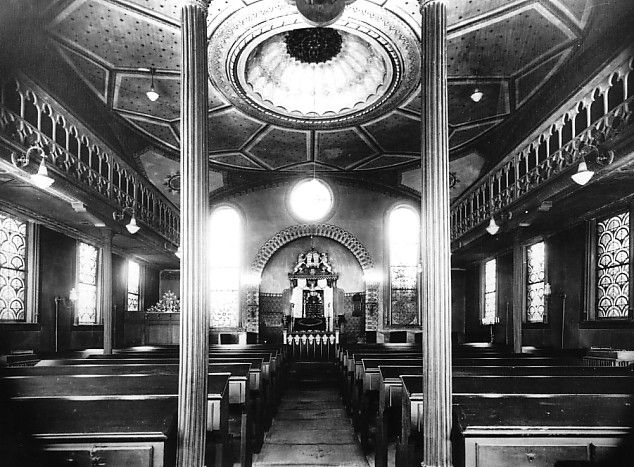
According to another source, “In 1991, the synagogue building was rebuilt as a cultural center, housing an exhibition on Hechingen’s Jewish history. A new Jewish community was founded in Hechingen in 2003.”  More pictures can be found here.


Where did my ancestors fit into this story of Hechingen? I was very, very lucky to find Ralph Baer on the JewishGen Family Finder because Ralph had already done extensive research on all the Hechingen Dreyfuss families years before I stumbled onto the name in the old family bible.  Even though he had not been able to find a connection between his Dreyfuss ancestors and mine, he had included my line in his tree when he’d done his research years ago.  Thus, my first email from Ralph in response to my inquiry as to his Hechingen Dreyfuss family included the following names:

A)3. Samuel (Sanwil) DREYFUß (ZELLER) 25 May 1776 Hechingen – 3 July 1859
Hechingen, married about 1805 to Miriam (Marianna) Samson BERNHEIM 17 May
1787 – 1841

A)31. Jeanette DREYFUß 20 May 1817 Hechingen, married to … NUßBAUM

A)32. Moses DREYFUß 10 February 1819 Hechingen

A)33. Goldel (Golde, Auguste) DREYFUß 16 October 1822 Hechingen,
married to … WEILER

A)34. Mathilde (Magdalena) DREYFUß 30 March 1825 Hechingen, married
to … POLLAK

A)35. Samson DREYFUß about 1827 Hechingen

A)36. Auguste DREYFUß about 1829 Hechingen[1]

There were my 3x-great-grandparents right at line 31, and there at line 33 was Caroline (born Golde) “Weiler” and at line 34 Mathilde “Pollak.”  I knew immediately that Ralph had found the three Dreyfuss sisters listed in my family bible.  Not only did the names line up, but so did the birth dates.  Thus, I now also knew that Jeanette, Caroline, and Mathilde were the daughters of Samuel Dreyfuss Zeller (later documents, as I found, indicated he had changed his surname to Zeller) and Miriam (Marianna) Samson Bernheim, that is, the Mary Dreyfuss I had found on the 1850 census living with her daughter Caroline in Pennsylvania.  (The death date of 1841 given for Miriam Ralph and I later discovered was not correct. I have not, however, found a death record for Miriam, though with two grandchildren named Miriam, one (Miriam Nusbaum, daughter of John Nusbaum and Jeanette Dreyfuss) in 1858, and one in 1859 (Miriam Pollock, daughter of Mathilde Dreyfuss and Moses Pollock, it would appear that Miriam died before 1858.)  In addition, I now had evidence of three other siblings: Moses, Samson, and Auguste.

But, of course, I wanted to see the actual records where Ralph had long ago found my relatives while researching his own.  With his patient assistance, I was able to locate a number of records relating to my Dreyfuss ancestors.  Fortunately, many of the Jewish vital records from the Baden-Wurttemburg region are digitized and available on line, and Ralph walked me step by step through the process of researching those archives and then helped me translate what I had found.  Once again, I struggled with the German script, but with Ralph’s help, I was able to find a number of relevant records.

I am now including the links to them here with a transcription of what is on each record so that I have a record later when I once again have trouble reading the script.  If you are interested in seeing the underlying documents, just click on the links.  The JPG versions were too blurry to read, so I am only posting links to the PDF versions, with two exceptions that were more legible.

Dreyfuss births (1)  Birth Registry for Hechingen 1800-1905

Line 132 Moses Dreyfuss                             Father Samuel                  Mother Miriam geb Bernheim

Line 186 Golde (Augusta) Dreyfuss           Father Samuel                 Mother Miriam geb Bernheim

Line 223 Mathilde Dreyfuss                                                 SAME


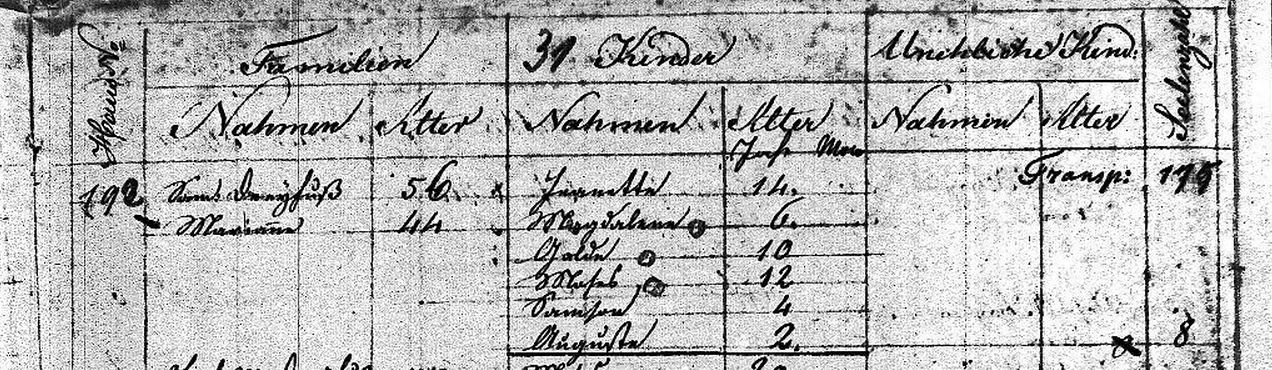
Dreyfuss Family on Archives film 240 bild 31  (Census 1831)

Dreyfuss family on archives film 240 film 31

#192 Samuel Dreyfuss 56 and Marianna 44. Six children: Jeanette 14, Magdalena 6, Golde 10, Moses 12, Samson 4, and Auguste 2.


Golde Auguste Caroline Dreyfuss birth record

First line:    October 16, 1822      Golde (Augusta)         Samuel Dreyfuss               Miriam geb Bernheim


Mathilde Dreyfuss birth record

Sixth line:  March 30 1825          Mathilde                       Samuel Dreyfuss                  Miriam geb Bernheim


Meier Dreyfuss brother of Samuel  Death Record

Parents               Samson Dreyfuss and Jeanette


Moses Dreyfuss birth record

Seventh line:  February 10, 1819    Moses Dreyfuss          Samuel Dreyfuss               Miriam geb Bernheim


Moses Zeller ne Dreyfuss death record Hechingen

Son of Samuel Zeller and Marie geb Bernheimer


Samuel Dreyfuss and family on Hechingen Family Records

Ralph helped me decipher this; otherwise, it would have meant nothing to me:  The name DREYFUSS is underlined with Samuel next to it. Below Samuel is written Zeller.  Below that it says Eltern (parents) Samson, and below that Jeanette(Scheile). To the right is geb. (born) and below that get. (married). The birth date for Samuel is on the right 1776 25 Mai. Between that is written “63 alt geworden” (became 63 years old, his age at the time of the compilation). For marriage it says angebl. (apparently) 1805 with also something in Hebrew. Samuel’s wife is on the right: Miriam, daughter of Samson Bern…and Golde. It also mentions a sister name Sussen right below that. The birth date for Miriam is listed as 17 Merz (March) 1787.  On the bottom are the children. The first one on the left is r Jeanette. In parentheses after her name is NUSSBAUM and below that 20 years old. To the left it states ca. 1817 20 Mai. Also listed are Moses, Mathilde Madel (Pollak), and Auguste (Golde) Weiler with birthdates.  (This was obviously compiled after 1851 since all three sisters are married and Mathilde is already married to Moses Pollock, whom she did not marry until after Maxwell Nusbaum died in 1851.)

Samuel Dreyfuss death record bild 143  (second on page)


Samuel Zeller death p 1 Samuel Zeller death p 2

Bottom of both pages: Samuel Zeller  Hechingen      Samson Dreyfuss and Jeanette    Alterschwaeche (old age)


There are some missing records.  I do not have a separate birth record for Jeanette.  Nor can I find a death record for her mother, my 4x-great-grandmother Miriam Bernheim.  I cannot find any records for the two youngest of the siblings, Samson and Auguste.  I also do not understand why there are two children with the name Auguste.  Perhaps one was a child of a family member who died? There is also a huge gap between the recorded marriage date for Samuel Dreyfuss and Miriam Bernheim of 1806 and the birth date of their oldest child, Jeanette, in 1817.  Did Samuel and Miriam have other children who died, or is their marriage date incorrect?  Samuel would have been 41 in 1817, Miriam would have been 30.  Both Samuel and Miriam had fathers named Samson.  Were both alive in 1819 when Moses was born? If not, it seems odd that their first son would not have been named Samson, unless there had been an earlier born son named Samson who had died.

I don’t know the answers to these questions, but I have answers to so many more questions than I ever expected, thanks to Ralph.  I know the names of my 4x-great-grandparents, Samuel Dreyfuss Zeller and Miriam Bernheim, and the names of my 5x-great-grandparents, Samson and Jeanette Dreyfuss and Samson and Golde Bernheim.  I have the names of the three other siblings of my 3-x great-grandmother Jeanette: Moses, Samson, and Auguste.  And I am not yet done looking for more about my Dreyfuss ancestors and now, my Bernheim ancestors as well.

Once again, I am deeply grateful to Ralph Baer.  Without him, none of this would have been possible.


[1] Together Ralph and I filled in many of the blanks here, enabling both of us to have a more complete record.

The Mystery of Fanny Wiler, Part III:  A Brick Wall Tumbles


Embed from Getty Images

In my last post, I wrote about the family of Caroline Dreyfuss and Moses Wiler—their four children, Eliza, Simon, Fanny, and Clara—and some of the issues that had come up in trying to track the family up to 1900.  I focused primarily on Eliza Wiler and the issues I had finding her children Joseph, Flora, Nellie, Minnie, and Leon, and her husband Leman Simon on the 1900 census after Eliza died in 1897.  What I found was that they were fairly scattered.   Leman and Leon were living as lodgers in one place, Nellie and Minnie as boarders in another place, and Flora was living with her husband Nathan Strouse and son Lester.  I never found Joseph on the 1900 census, but in 1901 he was listed in Philadelphia living at the same address as his father Leman.

I also briefly mentioned Eliza’s siblings, Simon, Fanny, and Clara.  Simon was a single man working and living in a hotel in Philadelphia, Clara had married Daniel Meyers and by 1900 had had 13 children with him, eleven of whom were still living at home.  And Fanny Wiler was still missing.

Or so it seemed. I had stopped looking for her after hitting a brick wall in late December when I wrote about the mystery of Fanny Wiler.  But while searching for information on the various children of Eliza and Leman Simon, I ran across this strange news article from January 1899.

Phil_Times_jan_31_1899_p_10-page-001


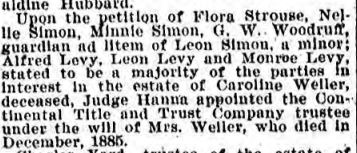
Caroline Dreyfuss W(e)iler (the spelling of the name varied throughout these news stories and documents) had died in 1885, and now fourteen years later three people were challenging the administration of her estate by the executor and trustee, Daniel Meyers, Caroline’s son-in-law and Clara Wiler’s husband.  I knew all the names mentioned but one.  Flora Strouse was Caroline’s granddaughter as was Nellie Simon.  But who was Monroe Levy? That name did not mean anything to me, and although I checked and found one Monroe Levy living in Philadelphia on the 1900 census, he was the 26 year old  son of Joseph and Bella Levy, a couple who had no connection to my family, as far as I could tell.

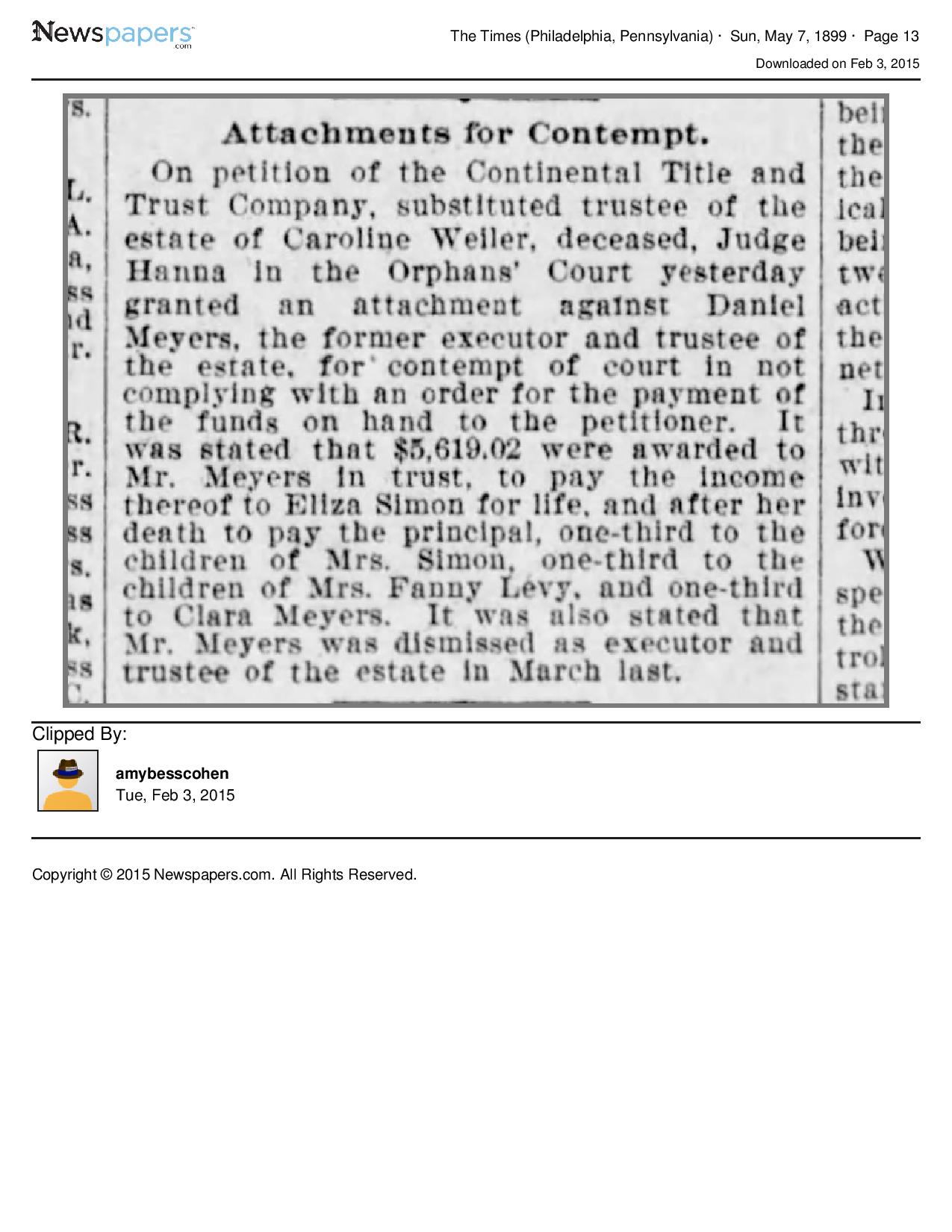
So I looked for follow-up articles about the challenge to Daniel Meyers as executor and located this second article from May, 1899:

Daniel Meyers executor challenge-page-001

Now I understood why this was being litigated almost fifteen years after Caroline died.  The will had appointed Daniel Meyers to be the executor and trustee of the $5,619 estate [estimated to be equivalent to $160,000 in 2015 dollars] and directed him to pay the income from the estate to Caroline’s daughter Eliza Simon for the duration of Eliza’s life; after that, the principal was to be distributed to the grandchildren of Caroline.[1]  Eliza Simon died in August, 1897, and apparently Daniel Meyers never distributed the money to the grandchildren.  Thus, they sued him in 1899, and they won.  The estate was handed over the Continental Title and Trust Company.

But hidden in this little news item was a huge clue to my Fanny Wiler mystery.  The article identifies the three groups of grandchildren: the children of Eliza Simon, the children of Clara Meyers, and the children of Mrs. Fanny Levy.  Mrs. Fanny Levy?  That had to be Caroline’s third daughter, Fanny Wiler!

But then who was Monroe Levy?  His mother’s name was Bella, not Fanny, according to the 1900 census.  So I searched some more.  And I found this news article dated a month before the last one posted above:

Philadelphia Inquirer April 2, 1899, p. 9

Philadelphia Inquirer April 2, 1899, p. 9

This article named four of Eliza Simon’s children (all but Joseph) and three others who together made up a majority of the parties of interest in the challenge to Daniel Meyer’s handling of the estate: Alfred, Leon and Monroe Levy.  (Obviously Daniel and Clara Meyers’ own children were not a party to the challenge.)  Alfred, Leon, and Monroe Levy—-suddenly the light bulb went on.  These had to be Fanny’s children.  But then where was Fanny? And who was Bella, the reported mother of Monroe Levy on the 1900 census?

So I returned to that 1900 census where I had found Monroe Levy and saw that he had three siblings: Alfred, born in 1868, Leon born in 1872, and then Miriam born in 1879.  Monroe was born in 1874.  Could it be that Fanny had died between Monroe’s birth and Miriam’s birth and that Bella was a second wife?

I could not find a death certificate for Fanny Levy, so I searched for death certificates for the three Levy brothers, and sure enough, each of them had a mother named Fannie or Fanny on their death certificate.  Sure, Monroe’s said her name was Fanny Cohen, and Leon’s just said Fannie.  But Alfred’s, the last I found, quite clearly states that his mother’s maiden name was Fannie Weiler.  I had found her!  Fanny Wiler had married Joseph Levy and had three sons between 1868 and 1874.

Ancestry.com. Pennsylvania, Death Certificates, 1906-1963 [database on-line]. Provo, UT, USA: Ancestry.com Operations, Inc., 2014. Original data: Pennsylvania (State). Death certificates, 1906–1963. Series 11.90 (1,905 cartons). Records of the Pennsylvania Department of Health, Record Group 11. Pennsylvania Historical and Museum Commission, Harrisburg, Pennsylvania

Ancestry.com. Pennsylvania, Death Certificates, 1906-1963 [database on-line]. Provo, UT, USA: Ancestry.com Operations, Inc., 2014.
Original data: Pennsylvania (State). Death certificates, 1906–1963. Series 11.90 (1,905 cartons). Records of the Pennsylvania Department of Health, Record Group 11. Pennsylvania Historical and Museum Commission, Harrisburg, Pennsylvania

But then what happened? Who was Bella, and when did she marry Joseph?  Or was she the same person as Fanny using a very different name? I wasn’t sure, so I searched for Miriam’s death certificate.  I had assumed that Miriam was Bella’s child because of the age gap between Monroe and Bella.  When I found Miriam’s death certificate, it confirmed my hunch.  Miriam’s mother was Bella Strouse, not Fanny Wiler or Fanny anything.

Ancestry.com. Pennsylvania, Death Certificates, 1906-1963 [database on-line]. Provo, UT, USA: Ancestry.com Operations, Inc., 2014. Original data: Pennsylvania (State). Death certificates, 1906–1963. Series 11.90 (1,905 cartons). Records of the Pennsylvania Department of Health, Record Group 11. Pennsylvania Historical and Museum Commission, Harrisburg, Pennsylvania.

Ancestry.com. Pennsylvania, Death Certificates, 1906-1963 [database on-line]. Provo, UT, USA: Ancestry.com Operations, Inc., 2014.
Original data: Pennsylvania (State). Death certificates, 1906–1963. Series 11.90 (1,905 cartons). Records of the Pennsylvania Department of Health, Record Group 11. Pennsylvania Historical and Museum Commission, Harrisburg, Pennsylvania.

Bella Strouse?  Hmmm, I thought.  Was she a relative of Nathan Strouse, the husband of Fanny’s niece, Flora Simon Strouse?  I found Bella Strouse Levy’s death certificate, and although her parents were born in Germany as were Nathan’s parents, they had different names.  Perhaps Bella was a cousin.  I need to dig more deeply to be sure.

But Bella is not my real concern or interest here.  It’s Fanny.  Fanny Wiler Levy.  I’d not yet found a marriage or death record for her, but her sons’ death certificates and the news articles naming them as the grandchildren of Caroline Dreyfuss Wiler were really all I needed.  I’d found her.  And, of course, it was when I wasn’t even looking for her.

Then Lyla from the Philadelphia Genealogy group on Facebook posted this document in response to a question I had posted about Fanny:[2]

Levy Wiler wedding registration 1866

If you look at the one that is fourth from the bottom, you will see the registration of the marriage on January 31, 1866 of Joseph Levy, a 27 year old New York merchant born in Germany, and Fanny Wiler, a 26 year old Philadelphia resident born in Harrisburg(h).  There can be no question that this was the marriage of my Fanny Wiler, the mother of Alfred, Leon, and Monroe Levy.

The odd thing that is still bothering me is that I cannot find the Levy family on either the 1870 census, when Joseph, Fanny, and Alfred would have been together, or on the 1880 census, when Joseph, Bella, Alfred, Leon, Monroe, and Miriam would have been living together.  And there is also a document in the New York City births database on familysearch for a Bertha Levi born in November 1866 in New York to Joseph Levi and Fanny Wieler.  I think this might also have been a child of my Fanny, but I cannot find any other document for Bertha.

So there are still some unresolved questions, but the big question has been answered.  I know what happened to Fanny Wiler. She married in 1866, had three, perhaps four children between 1866 and 1874, and then sometime after that, she must have died.  She would have been not yet forty years old.  And she left behind three little boys all under the age of ten.   It might not have been as gruesome as the story of the other Fanny Wyler and Max Michaels, but it was nevertheless a sad story.

I guess I should be grateful to Daniel Meyers for violating his fiduciary duties as a trustee.  But for the lawsuit against him, I might never have found Fanny Wiler.


Embed from Getty Images


[1] I don’t know why Caroline would have favored Eliza in this way.  Eliza was the oldest child, but when Caroline died, she had at least two other children who were still alive.  And Eliza was not the only one who had had children at that point either.

[2] Lyla subscribes to a paid service for access to Philadelphia records, a service I was not aware of until she posted.  I am now waiting for my own subscription to come through so that I can also find these older vital records from the city where so many of my paternal relatives lived and died.  The copy posted here is not very legible, but I was able to make out the names and other essentials for Joseph Levy and Fanny Wiler.

The Children of John and Jeanette Nusbaum from 1890 to 1925

John Nusbaum died in 1889, leaving behind his widow Jeanette and their six children: Adolphus in Peoria, Simon and Frances both in Santa Fe, Julius in Iowa, and Miriam and Lottie both in Philadelphia.  By 1925 Jeanette and all six children were gone.  This post will describe their lives in the decades between 1890 and 1925.

Jeanette and Lottie: In 1890, Jeanette Dreyfuss Nusbaum was a widow, living in Philadelphia with her daughter Lottie.   In 1900, Jeanette and Lottie were still living together in Philadelphia.  According to the 1900 census, they were living as boarders in the home of another German-born widow named Jenette Oberdorf and her children. Lottie was working as a stenographer, according to two Philadelphia directories in the 1890s.

Miriam and Gustavus: In 1890, Miriam and her husband Gustavus Josephs had one surviving child, Florence, who was now ten years old. Their son Jean was born in 1893.  After researching more about Gustavus, I learned that he had served in the Civil War as a musician.  According to Wikipedia, “The rank of Musician was a position held by military band members, particularly during the American Civil War. The rank was just below Corporal, and just above Private. In some units it was more or less equal to the rank of Private.  During the American Civil War, military leaders with the Union and Confederate Armies relied on military musicians to entertain troops, position troops in battle, and stir them on to victory — some actually performing concerts in forward positions during the fighting.”

Perhaps Gustavus is one of the musicians depicted in one of these videos:


He did not, however, pursue music as a profession after the war.  On the 1880 census, he listed his occupation as an embroiderer, and on various city directories in the 1880s he had been listed as a salesman.  In 1894 and 1896, he is listed as being in the curtains business, and in 1897 he is listed in business with Laurence Frank in the cotton goods business under the firm name Josephs and Frank Co.  Then in 1898 he is still in the cotton goods business, but with a new partner, Louis Wertheimer.

On the 1900 census, Gustavus and Miriam were living with their two children, Florence, now nineteen, and Jean, just six years old.  The 1900 census asked women how many children they had had and how many were still living.  For Miriam, the census reported that she had only had two children, both of whom were still living.  This was obviously not true, as Miriam and Gustavus had had two other children, Milton and Gertrude, who had died.  Was this just bad information given by someone who did not know the facts?  Or were Miriam and Gustavus just in denial?

Gustavus’ occupation on the 1900 census was listed as manufacturing without specifying the type of goods.  The 1901 directory, however, indicates that he was in the upholstered goods business.  Then in 1905 he listed his occupation on the directory as “silks.”  It appears that he was still in the silk business as of the 1910 census, but I cannot quite make out the word that follows “silk.”  I believe it says “silk winder.”  According to the Hall Genealogy website list of old occupations, a silk winder “Wound the silk from the silkworm cocoons onto bobbins.”

Interestingly, by 1914 Gustavus had returned to the embroidery business, or perhaps that was what he’d been doing even in 1910 as a silk winder.  He is listed as an embroiderer thereafter in subsequent directories as well, although on the 1920 census he is listed as a manufacturer in the mill industry.  I am not quite sure what to make of Gustavus’ career path.  Were these really all related businesses or even the same business? He certainly seemed to be involved with fabrics throughout in one way or another.

English: A man sitting cross-legged on a stoop...

English: A man sitting cross-legged on a stoop and embroidering a piece of silk. (Photo credit: Wikipedia)

Adolphus and Fanny: In 1890, the oldest child of John and Jeanette, Adolphus Nusbaum, was still living in Peoria with his wife Fanny, but he was no longer in business with his brother younger brother Julius. The last Peoria directory to include Julius was the one published in 1887.  Adolphus is listed with only a residential address in the 1890 and 1891 Peoria directories, but beginning with the 1895 directory, he is listed as being in the feed business.  He was still in the feed business as of the 1900 census and the 1900 Peoria directory.

Then on February 8, 1902, Adolphus died “20 miles from Chicago while en route to Chicago,” according to the Nusbaum family bible.  I did not know what this could possibly mean, and I was even more confused when I found a Philadelphia death certificate for Adolphus, given that the last address I had for him was in Peoria.

adolph nusbaum

adolph nusbaum death rec inquest pending

Why did Philadelphia issue a death certificate?  Why was there a Philadelphia address given as the residence?  And why was there an inquest pending? I am still searching for an answer to the last two questions and some answer as to the results of the inquest, but I found some answers in this article from the February 9, 1902, Chicago Daily Tribune:

Chicago Daily Tribune, February 9, 1902, p. 4

Chicago Daily Tribune, February 9, 1902, p. 4

But this article also raised more questions.  As far as I know, in 1902, Adolphus did not have a brother in Philadelphia, unless Julius had relocated there at that time.  Simon was still living in Santa Fe.  And what had Adolphus been doing in Washington?  He must have been traveling by train.  Did he have a heart attack or stroke while traveling? Was his wife Fanny with him?  I don’t know.  It’s also interesting that despite having lived in Peoria since he was barely in his 20s and having married a woman who had been living in Indiana in 1863, Adolphus was buried at Mt. Sinai cemetery in Philadelphia with the other members of the extended family, including his father John.

UPDATE on the coroner’s report can be found here.

Frances and Bernard: In 1890, two of the children of John and Jeanette continued to live in Santa Fe, my great-great-grandmother Frances Nusbaum Seligman and her brother Simon Nusbaum.  Frances was busy with her charitable and social activities in Santa Fe.  Her children Eva, James, Minnie and Arthur all went off to Swarthmore in Philadelphia in the 1880s, where Minnie died at age eighteen in 1887, as I’ve written about previously.  Frances herself died in July, 1905, two years after her husband Bernard.  She was 59 years old.  As I described when writing about Frances and Bernard, both were warmly praised and well-loved by the Santa Fe community.  Both were buried, however, back in Philadelphia at Mt. Sinai cemetery.

It must have been terrible for Jeanette to lose her son Adolphus in 1902 and her daughter Frances 1905, not that many years after losing her husband John as well as so many grandchildren.  Jeanette herself died on January 12, 1908, from edema of her lungs, according to the death certificate.  She was 90 years old.  She was buried along with her husband, her children Frances and Adolphus, and numerous grandchildren and other relatives at Mt. Sinai cemetery in Philadelphia.

Ancestry.com. Pennsylvania, Death Certificates, 1906-1963 [database on-line]. Provo, UT, USA: Ancestry.com Operations, Inc., 2014.

Ancestry.com. Pennsylvania, Death Certificates, 1906-1963 [database on-line]. Provo, UT, USA: Ancestry.com Operations, Inc., 2014.

Julius: As for Julius Nusbaum, who had once been Adolphus’ business partner in Peoria, as noted above he was last listed in the Peoria directory in 1887 and then disappeared from Peoria.  He next surfaced in 1900 in Grinnell, Iowa, living alone as a single man and working as a tobacco merchant. Grinnell is over two hundred miles from Peoria and over a thousand miles from Philadelphia.

Restored Rock Island Line station in Grinnell,...

Restored Rock Island Line station in Grinnell, built in 1892. Now a restaurant. (Photo credit: Wikipedia)

What had taken him to Iowa and when had he gotten there? Had he gone into the tobacco business for the same reasons that his father John had gone into the cigar business in the mid-1880s?  In 1891 Julius is listed in the Waterloo, Iowa directory as a cigar dealer, and on the 1905 Iowa State Census he is living in Grinnell.  It does not thus seem like he was living in Philadelphia in 1902 when Adolphus and Fannie came to visit.  Was the newspaper just wrong about that detail, or was the 1905 directory wrong? Certainly Adolphus had other family members to visit in Philadelphia, including his mother Jeanette, his sister Lottie, and his sister Miriam and her family.

Julius is not listed in either the 1904 or the 1906 Waterloo, Iowa business directory, and  I cannot find him on the 1910 census anywhere, so I do not know whether he was still living in Iowa at that point. But by 1920 he had returned to Philadelphia, listing his occupation on the 1920 census as a retired cigar merchant and living as a boarder.  Living in the same residence with him in 1920 also as a boarder was a 62 year old widow named Fannie Nusbaum who had been born in Germany; this was obviously Adolphus’ widow, Julius’ sister-in-law.

I could create all kind of romantic stories about Julius and Fannie, but they would be speculative for sure.  Julius had lived with Adolphus and Fannie in Peoria and had been in business with his brother.  Suddenly after working together for over twenty years, Julius left Peoria and moved to Iowa, where he presumably knew no one and where he started an entirely new business selling cigars.  Then Adolphus died in 1902, and I can’t find Julius or Fannie anywhere on the 1910 US census or in city directories.  Ten years later, Julius and Fannie ended up living together in Philadelphia.  Where were they both in 1910?  Of course, it could be completely innocent: a devoted brother taking care of the widow of his older brother.  And it probably was.  I’ve likely read too many novels and seen too many movies.  I have no evidence of any such scandalous events.  I am sure the story is far less interesting than all that.

Simon: Meanwhile, back in Santa Fe, the other Nusbaum brother, Simon, had settled in as part of the community by 1890.  The Santa Fe New Mexican reported in September 1889 that he had returned from a month’s vacation and “looked like a new man,” having gained twenty pounds.  There was no further explanation for the comment, but perhaps Simon had had a rough time after losing his father in January of 1889.  After that, his life seems to have taken a positive turn.  Having served first as a clerk and then as assistant postmaster in Santa Fe, Simon was appointed by President McKinley to be the postmaster there in May, 1898.

His appointment was enthusiastically approved by the press and the people of Santa Fe.  On May 5, 1898, the Santa Fe New Mexican opined on page 2, “As good a piece of news as Santa Fe has received for some time was that of the appointment of Simon Nusbaum to be postmaster of this city.  This appointment was one that had been strongly recommended by the best and leading citizens of this city and indeed by all those desiring a competent official and a honest and proper man in that important office.  Mr. Nusbaum’s political support was also very powerful….He is a skilled accountant and book-keeper, in fact one of the best in the southwest.  He … had held several positions of trust and importance in big business establishments, in this territory and in eastern cities.”

The Santa Fe newspaper also quoted from the Peoria Evening Star, which said, “Years ago Nusbaum & Co. were the great dry goods firm of this city.  One of the members was Simon Nusbaum.  He was a smart, active, pushing man….”  Santa Fe New Mexican, May 19, 1898, p. 2.

Simon was still a single man at that point.  In 1899 he reportedly bought a fruit farm near Tesuque, New Mexico, apparently for a very good price.

Santa Fe New Mexican, September 28, 1899, p. 4

Santa Fe New Mexican, September 28, 1899, p. 4

He later began breeding high bred Belgian hares in partnership with one of his clerks at the post office.

Santa Fe New Mexican, December 6, 1900, p.4

Santa Fe New Mexican, December 6, 1900, p.4

Although Simon was still single as of the 1900 census, he married Dora Rutledge in 1903. It was the first marriage for Simon, who was 57 years old.  Dora was only forty.  She had a daughter from an earlier marriage, Nellie Rogers, who was born in 1897.   Simon and Dora’s son John Bernard Nusbaum, was born on May 15, 1904.  On the 1910 census, Simon was now the assistant New Mexico Territorial Treasurer, and he and Dora and the children must have been living in a boarding house because they had seven lodgers living with them.  In fact, the 1920 census reveals that Simon and Dora were the owners of that boarding house, which was being managed by Dora.  Simon was now 76 years old and Dora was 49.

1916-1925: Years of Loss

When Jeanette Nusbaum died in 1908 at age 90, she had outlived two of her children, Adolphus and Frances, and many of her grandchildren, as well as her husband John.  Four of her children had survived her: Simon, Julius, Miriam and Lottie.  By 1925, all of those children would be gone.  On February 13, 1916, Miriam died of heart disease.  She was 57 years old and survived by her husband Gustavus and two children, Florence, who was 36, and Jean, who was 23.  Gustavus died eight year later at age 75 of pectoris angina.

Ancestry.com. Pennsylvania, Death Certificates, 1906-1963 [database on-line]. Provo, UT, USA: Ancestry.com Operations, Inc., 2014.

Ancestry.com. Pennsylvania, Death Certificates, 1906-1963 [database on-line]. Provo, UT, USA: Ancestry.com Operations, Inc., 2014.

Simon Nusbaum died on February 25, 1921.  He was 76.  Unlike his siblings, he was not buried at Mt Sinai in Philadelphia, but in Santa Fe, where he had lived the last forty or so years of his life.  He was survived by his wife Dora, stepdaughter Nellie, and son John, who was only 16 years old.  Thanks to my cousin Pete, I have a copy of Simon’s obituary.  It reports that Simon had had a stroke in September, 1920 and had not been himself since, but that prior to the stroke, he had been “able to walk around as briskly as he had for decades, and he was a familiar figure in the plaza and sitting on the swing in front of his apartment house on Washington Avenue.”  Here is the full obituary:

simon obit santa fe new mexican feb 25 19221

(Santa Fe New Mexican, February 25, 1921)

I winced at the references to “bad Indians” and “red chiefs,” trying to keep in mind that this was 1921.  I was intrigued by the references to Simon’s time living in Missouri and South Dakota, as I have seen no documentation of his time in either place.  He was still in Philadelphia in 1860 when he was 17, and he was in Peoria starting in 1863 until 1877.  By 1880 he was in Santa Fe.  So perhaps he had spent those years in between in Missouri and South Dakota.

The image of Simon as the postmaster sorting the mail in his nightgown at midnight is wonderful.

Just two years later, Simon’s brother Julius Nusbaum died in Philadelphia on January 3, 1923.  He was 74 years old and died from “Dil of heart, superinduced by acute indigestion.”  I googled this phrase and found that it was often used as description of a cause of death in the early 20th century, but I could not find any medical dictionary that explained what this meant.  Dilation of the heart refers to an enlarged heart that cannot adequately pump blood, what we might refer to today as heart failure.  But I have no idea what “superinduced by acute indigestion” means or whether that is today considered even medically accurate.  Perhaps my medical consultant will fill me in.

Update here.

Ancestry.com. Pennsylvania, Death Certificates, 1906-1963 [database on-line]. Provo, UT, USA: Ancestry.com Operations, Inc., 2014.

Ancestry.com. Pennsylvania, Death Certificates, 1906-1963 [database on-line]. Provo, UT, USA: Ancestry.com Operations, Inc., 2014.

 Finally, the last of the children of John and Jeanette Nusbaum, Lottie died on December 23, 1925, of nephritis and diabetes.  She was 64 years old.  Both Julius and Lottie did not have any children.

Lottie Nusbaum death cert

Thus, as of 1925, all six children of John and Jeanette were gone. Three of them had no children to survive them, Adolphus, Julius, and Lottie.  The other three siblings had together six surviving children: the three surviving children of Frances Nusbaum and Bernard Seligman, Eva, James, and Arthur; the two surviving children of Miriam Nusbaum and Gustavus Josephs, Florence and Jean; and the son of Simon Nusbaum and Dora Rutledge, John Bernard Nusbaum.  If I include Simon’s stepdaughter Nellie, who was after all referred to as his daughter in his obituary, that would make seven surviving children.  And there were the four grandchildren who had died as children, Florence and Minnie Seligman and Milton and Gertrude Josephs.

I have already written about the surviving Seligman children, my great-grandmother Eva and her brothers James and Arthur.  In a later post, I will follow up on the other surviving grandchildren of Jeanette Dreyfuss and John Nusbaum, Florence and Jean Josephs and Nellie and John Nusbaum and their families.


This is NOT a test even if it looks and sounds like one!

As promised, here is a chart to illustrate one possible way that my mother Florence, Elaine and Frieda are all connected.

New PDF Chart showing relationships of Moses Joseph Bessie et al-page-001


There are a LOT of unknowns and assumptions here.

First, we are assuming that Joseph Brotman and Bessie Brot were first cousins, as family lore says.  If so, then one of Joseph’s parents was a sibling to one of Bessie’s parents.  On this chart, I am assuming that Joseph’s father Abraham was a sibling to Bessie’s mother Gittel Brot because I don’t think Abraham would have named a son Joseph if he had a living brother named Joseph.

Second, we are assuming based on DNA results that Joseph Brotman and Moses Brotman were brothers, making their children first cousins and their grandchildren, here Florence and Elaine, second cousins.  The DNA results seem to support that assumption.

Third, we are assuming that Florence and Frieda are also second cousins based on the DNA results, meaning that Gussie Brotman and Sabina Brod were first cousins, meaning that one of Gussie’s parents and one of Sabina’s parents were siblings.  Here, I am making the assumption that Bessie Brot, Gussie’s mother, was the sister of Sabina’s mother, but it could be that Bessie was Sabina’s father’s sister.  I don’t know whether Brod was a name Sabina got from her mother or her father because in Galicia in those times, the state often treated Jewish children as illegitimate if their parents had only a Jewish marriage ceremony and thus assigned the mother’s name to the children instead of the father’s.  So either is possible here.

So what does this all mean? Well, hold on because this is where it gets a bit slippery. Taking the above chart as true (which is still very speculative), it means that Elaine, Florence, and Frieda are all third cousins since they all have the same great-great-grandparents, i.e., whoever were the parents of Abraham Brotman and Gittel Brot.  (I don’t know whether Brotman and Brot were two versions of the same name or two completely different names in the family; both exist as surnames so they could be as unrelated as someone named Rosen is to someone named Rosenberg, for example.)

BUT Elaine and Florence are also second cousins (as well as third cousins) since they are the children of first cousins (Louis and Gussie) and the grandchildren of siblings (Moses and Joseph Brotman).  AND the same is true for Florence and Frieda: they are second cousins because they are the children of first cousins (Gussie and Sabina) and the grandchildren of siblings (Bessie and the parent of Sabina).

Cousin_tree

So my mother is a second cousin to both Elaine and Frieda (since her grandparents were first cousins), BUT Elaine and Frieda are not second cousins, only third cousins.  Their grandparents (Moses Brotman and Sabina’s parent) were not first cousins, just second cousins.

That is consistent with the DNA results which showed my mother as a second cousin to Elaine and also to Frieda but showed Elaine and Frieda as likely third to fifth cousins.

I have no idea whether that is a help or not.  In fact, I think I am more confused now than before.  Please tell me if that makes no sense.  Ask me questions.  Test my thinking.  Please.

And a big THANK YOU to my new cousin Phyllis for helping me sort through all of this!