Searching for Gold….farbs: A Brotman Genealogy Adventure

Today is my grandmother Gussie Brotman Goldschlager’s birthday; she was born on this day in 1895.  And so it is very appropriate that on this day, which also is the third anniversary of this blog, I return to my Brotman family story.  This is the story of the mystery cousins I discovered last fall—the Goldfarbs.

Back on December 7, 2015, I wrote about my aunt’s baby book from 1917, and I mentioned that on the list of those who came to see my aunt as a newborn were a couple named Mr. and Mrs. Julius Goldfarb.  When I asked my mother if she knew who they were, she vaguely recalled that they were somehow cousins of my grandmother, but she wasn’t sure whether the actual cousin was Julius or his wife, whose name she thought might have been Ida.

Aunt Elaine baby book 5

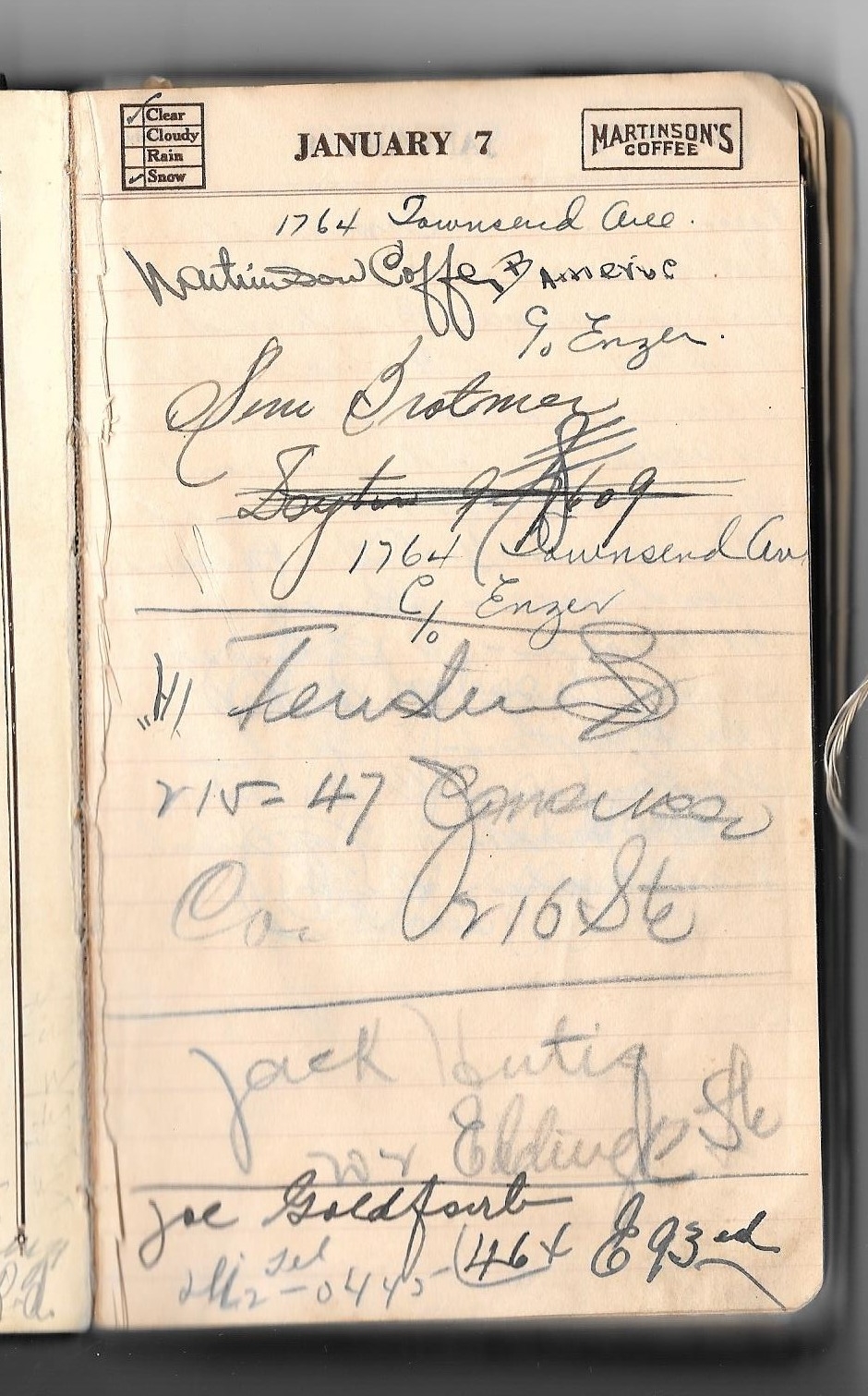
I also wrote back in December about my grandfather’s pocket calendar and notebook and all the wonderful information and insights I found there.  Among those bits of information were addresses for two other people named Goldfarb: S. Goldfarb, who lived at 577 Williams Avenue, and two entries for Joe Goldfarb, one at 464 East 93rd Street and one at 191 Amboy Street.  I assumed these were relatives connected to Julius, but had no idea how.

Grandpa notebook 13 more addresses Joe Goldfarb

Grandpa Notebook page 1 addresses Joe Goldfarb

With those limited hints, I started researching, and I found quite a bit.  In fact, I connected with two of the descendants of Julius and Ida Goldfarb, and I fully intended to write about the Goldfarbs sooner, but somehow the Schoenthals took over my blog, and poor cousin Julius was shelved for over ten months.  Now it’s time to return to this story and reveal what I learned from these tidbits of information.

First, I searched for Julius and Ida Goldfarb because I had two names to work with and because Julius Goldfarb seemed like it would be less common than Joe Goldfarb.  I easily found Julius and Ida and their children on the 1940, 1930, and 1920 census reports; all three reports had them living in Jersey City, New Jersey.  In 1920, Julius was working in a liquor business; in 1930 he was the proprietor of a real estate business, but in 1940 he was again in the liquor business, now working on his own account.

Julius Goldfarb and family 1920 US census lines 70-73 Year: 1920; Census Place: Jersey City Ward 3, Hudson, New Jersey; Roll: T625_1043; Page: 17B; Enumeration District: 135; Image: 1104

Julius Goldfarb and family 1920 US census
lines 70-73
Year: 1920; Census Place: Jersey City Ward 3, Hudson, New Jersey; Roll: T625_1043; Page: 17B; Enumeration District: 135; Image: 1104

The 1920 census said that Julius was born in Austria and was 33 (so born in about 1887); the 1930 census reports his age as 42 and birthplace as Poland.

Julius Goldfarb and family 1930 US census, lines 40-45 Year: 1930; Census Place: Jersey City, Hudson, New Jersey; Roll: 1352; Page: 29A; Enumeration District: 0075; Image: 209.0; FHL microfilm: 2341087

Julius Goldfarb and family 1930 US census, lines 40-45
Year: 1930; Census Place: Jersey City, Hudson, New Jersey; Roll: 1352; Page: 29A; Enumeration District: 0075; Image: 209.0; FHL microfilm: 2341087

On the 1940 census he is 52 and reports his birthplace as Austria.  Julius and Ida had four daughters: Sylvia (1915), Gertrude (1917), Ethel (1923), and Evelyn (1925).

Julius Goldfarb and family 1940 census lines 13-17 Year: 1940; Census Place: Jersey City, Hudson, New Jersey; Roll: T627_2406; Page: 7A; Enumeration District: 24-197

Julius Goldfarb and family 1940 census lines 13-17
Year: 1940; Census Place: Jersey City, Hudson, New Jersey; Roll: T627_2406; Page: 7A; Enumeration District: 24-197

All of this was very interesting, but it didn’t help me figure out if this was the right Julius Goldfarb or how he was related to my grandmother. Or was it Ida who was the relative? So I continued searching.

Julius’ World War I draft registration contained no new information, except the fact that his liquor business in 1917 was a saloon and that he and his family lived at the same address as the saloon: 27 Cole Street.  The draft registration also provided me with a more precise birthdate for Julius, March 18, 1885.

Julius Goldfarb World War I draft registration Registration State: New Jersey; Registration County: Hudson; Roll: 1712213; Draft Board: 10

Julius Goldfarb World War I draft registration
Registration State: New Jersey; Registration County: Hudson; Roll: 1712213; Draft Board: 10

Then things started to get more interesting. I located the World War II draft registration for Julius, and although it had a different birthday, March 12, 1885, instead of March 18, I knew this was the right person, given that the address was the same as the address on the 1940 census for Julius as was the occupation (liquor store) and his wife’s name (Ida).  But the big revelation here was Julius’ birthplace—Grebow, Poland, the same place that my great-uncles Abraham and David Brotman had listed as their residence on the ship manifest when then immigrated to the US.  My heart skipped a beat.  It definitely looked more and more possible that Julius was a cousin.
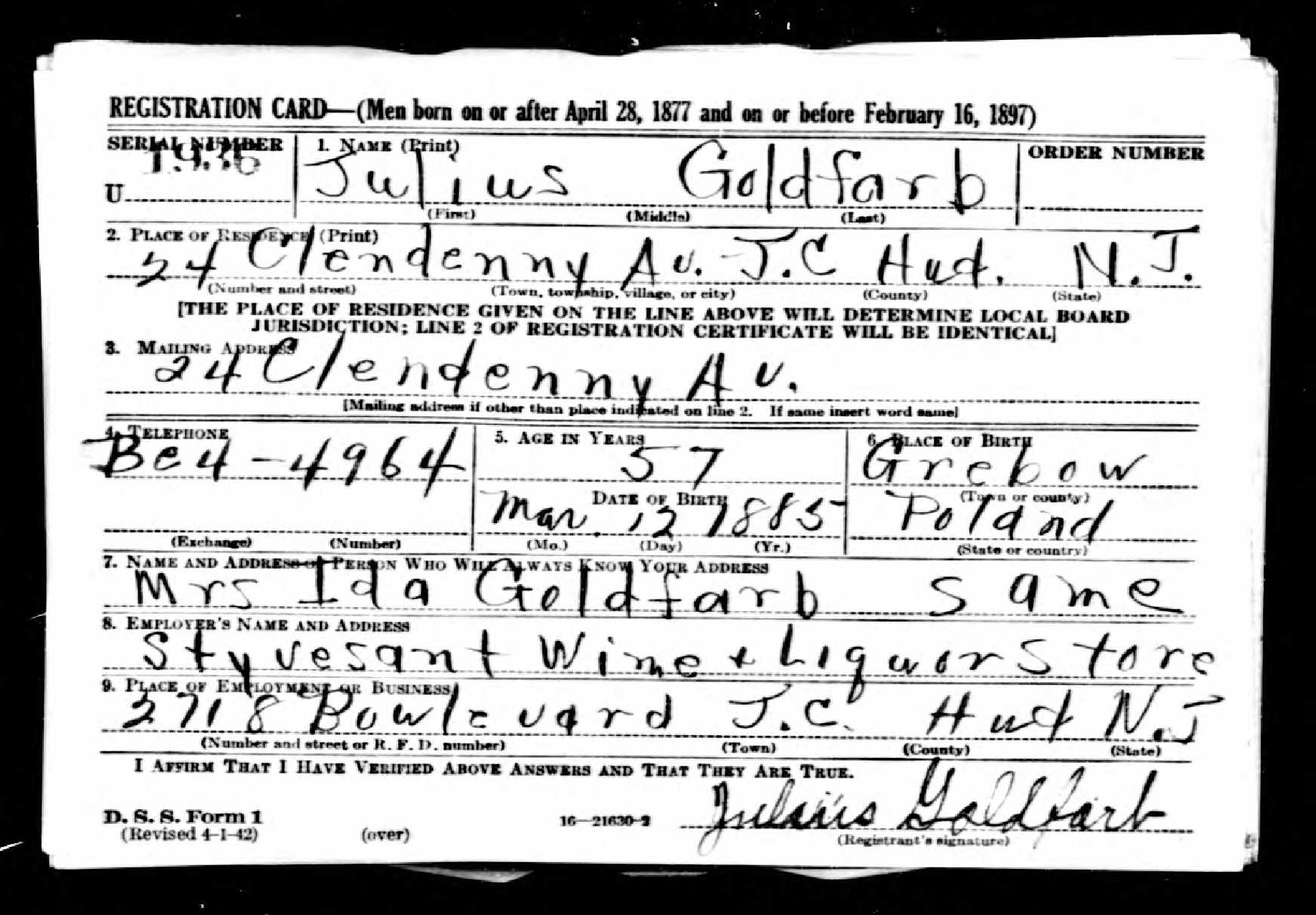
Julius Goldfarb World War II draft registration The National Archives at St. Louis; St. Louis, Missouri; Draft Registration Cards for Fourth Registration for New Jersey, 04/27/1942 - 04/27/1942; NAI Number: 2555983; Record Group Title: Records of the Selective Service System; Record Group Number: 147

Julius Goldfarb World War II draft registration
The National Archives at St. Louis; St. Louis, Missouri; Draft Registration Cards for Fourth Registration for New Jersey, 04/27/1942 – 04/27/1942; NAI Number: 2555983; Record Group Title: Records of the Selective Service System; Record Group Number: 147

So I searched then for a marriage record for Julius and Ida, and on FamilySearch I found the index listing for it, and now I was truly excited.  According to the index on FamilySearch, Julius Goldfarb’s mother was named Sarah Brothman.  I’d seen my great-grandfather’s name spelled that way instead of Brotman (and sometimes Brodman), and it seemed more and more likely that Julius Goldfarb was my relative, probably through my great-grandfather’s side of the family.

The index listing also included Ida’s birth name—Hecht.  I recalled from my aunt’s baby book that there was a visitor named Mrs. Taube Hecht (see the last name listed on the image above).  Now I knew that that was Ida’s mother.

But more importantly, I now knew the names of Julius Goldfarb’s parents, Sam and Sarah, and that enabled me to search for them and find additional records.

On the 1910 census, Sam and Sarah Goldfarb were living on Avenue C in New York City with six children, including Julius, who was then 25.  The others were Morris (23), Bessie (18), Joseph (12), Leo (11), and Rosie (9).  Joe and Leo were born in New Jersey and Rosie in New York, but the rest of the family were listed as born in Austria.  Sam was working as a tailor in a coat factory, Julius as a conductor for a car company (I assume a streetcar company), and Morris as a cutter in a neckwear factory.

From this census record, I now knew that Joe Goldfarb, who was listed twice in my grandfather’s list of addresses, was a brother of Julius and that he was born in about 1898. The 1910 census also revealed when Sam and Sarah had immigrated.  Sam had arrived in 1892, Sarah and the European born children in 1896.

Sam Goldfarb and family 1910 US census, lines 8-17 Year: 1910; Census Place: Manhattan Ward 11, New York, New York; Roll: T624_1012; Page: 17A; Enumeration District: 0259; FHL microfilm: 1375025

Sam Goldfarb and family 1910 US census, lines 8-17
Year: 1910; Census Place: Manhattan Ward 11, New York, New York; Roll: T624_1012; Page: 17A; Enumeration District: 0259; FHL microfilm: 1375025

Knowing the names of the other children of Sam and Sarah Goldfarb helped me locate them on other census records.  The 1915 New York census record proved quite revealing.  Sam and Sarah were still living at 131 Avenue C in New York City with Morris, Bessie, Joseph, Leo, and Rose (Julius was now married), and Sam was still working as a tailor, as was Morris.  When I looked down the page from where Rose Goldfarb is listed at the top of the right hand side of the page, I saw a very familiar name—Hyman Brotman, my grandmother’s brother Hymie.  Hyman and his wife Sophie (spelled Soffie here) and their three sons were living at the same address, in the same building, as the Goldfarbs.

Sam Goldfarb and family 1915 NY census New York State Archives; Albany, New York; State Population Census Schedules, 1915; Election District: 18; Assembly District: 06; City: New York; County: New York; Page: 84

Sam Goldfarb and family 1915 NY census
New York State Archives; Albany, New York; State Population Census Schedules, 1915; Election District: 18; Assembly District: 06; City: New York; County: New York; Page: 84

And then right below the Brotman family was the Hecht family—Jacob and Tillie Hecht and their children.  I assume these were the parents of Ida Hecht Goldfarb, Sam Goldfarb’s wife. (Tillie is often an alternative name for Taube.)  They also were living at 131 Avenue C in the same building as Hyman Brotman and his family and Sarah and Sam Goldfarb.  The coincidences were clearly not just coincidences.

And it only got better.  I found Sam and Sarah Goldfarb on the 1905 New York census, living with seven children—Julius, Morris, Bessie, Joseph, Leo, and Rose, plus another daughter, Gussie, who was seventeen, two years younger than Morris and two years older than Bessie.

Sam Goldfarb and family 1905 NY census New York State Archives; Albany, New York; State Population Census Schedules, 1905; Election District: A.D. 12 E.D. 06; City: Manhattan; County: New York; Page: 32

Sam Goldfarb and family 1905 NY census
New York State Archives; Albany, New York; State Population Census Schedules, 1905; Election District: A.D. 12 E.D. 06; City: Manhattan; County: New York; Page: 32

I assumed that this newly discovered daughter named Gussie had married between the 1905 NY census and the 1910 US census since she was not living with the family in 1910, and my search revealed that she had married Max Katz on April 12, 1910.  I found her marriage on FamilySearch indexed as Josi Gossi Goldfarb, daughter of Sam Goldfarb and “Sarah Brohmen.”  Another piece of the puzzle tying Sarah Goldfarb to my great-grandfather.

But what was even more exciting about the 1905 New York census was what it revealed about where Sam and Sarah Goldfarb and their children were living: 85 Ridge Street in New York City. Why was that exciting? Because my great-grandmother Bessie Brod Brotman was living across the street at 84 Ridge Street in 1905 with my grandmother Gussie and her siblings, Tillie, Frieda, and Sam.  There seemed to be no denying the fact that Sarah Goldfarb was somehow related to my grandmother’s family.

1905-ny-census-for-bessie-brotman-and-family

(My great-grandmother’s name is badly butchered here as Pearl Brauchman, but there’s no question that this is Bessie Brotman and her children, Tilly, Gussie, Frieda, and Sam; when Bessie married Philip Moskowitz, her second husband, in 1908, her address was 84 Ridge Street.)

I also now understood why Julius and Joe Goldfarb would have been listed in the baby book and the address list. In 1905 when she was ten years old, my grandmother was living right across the street from Julius and Joe Goldfarb and their siblings. Joe was just a year or two younger, and like my grandmother, he was the first American born child of his parents.  Of course, Joe Goldfarb would be listed in the address book. Twice, in fact. Of course, Julius and Ida would have come to see my grandparents’ new baby in 1917.

There was still one prior census to find: the 1900 US census.  The Goldfarbs were a little harder to find on this one because Sam was listed as Solomon here, and several of the other names don’t quite match.  Although Sarah is listed as Sarah and Bessie as Bessie, there are two sons listed as Joseph; one, I assume, was Julius, given the approximate age. Morris was listed as Moses, Leo is Lewis, and Gussie as … Kate? Despite these discrepancies, I am quite certain that these are the right Goldfarbs. The immigration years are consistent with the 1910 census; Sam (Solomon) is a tailor.  The parents and older children were born in Austria, and the ages are close if not precisely the same.

Sam Goldfarb and family 1900 US census Year: 1900; Census Place: Pittsgrove, Salem, New Jersey; Roll: 993; Page: 17B; Enumeration District: 0179; FHL microfilm: 1240993

Sam Goldfarb and family 1900 US census
Year: 1900; Census Place: Pittsgrove, Salem, New Jersey; Roll: 993; Page: 17B; Enumeration District: 0179; FHL microfilm: 1240993

Again, what is particularly interesting here is where they were living: in Pittsgrove, New Jersey, where Moses Brotman and his extended family were living in 1900.  In fact, Moses Brotman and his family are listed on the very next page of the census report in 1900. And Moses Brotman was the brother of my great-grandfather Joseph Brotman.  One more piece of evidence that Sarah was a Brotman and related to me through my great-grandfather Joseph Brotman.

Moses Brotman 1900 census

Moses Brotman 1900 census Year: 1900; Census Place: Pittsgrove, Salem, New Jersey; Roll: 993; Page: 18A; Enumeration District: 0179; FHL microfilm: 1240993

I had one more type of document to search for before moving forward and finding more recent records for the Goldfarb family, and those were ship manifests for the Goldfarbs. Although I’ve not yet been able to locate one for Sam Goldfarb, I did find one for Sarah and the children who were born in Europe, Julius, Morris, Gussie, and Bessie.

Sarah Goldfarb and children on ship manifest 1896 The National Archives at Washington, D.C.; Washington, D.C.; Series Title: Passenger Lists of Vessels Arriving at Philadelphia, Pennsylvania; NAI Number: 4492386; Record Group Title: Records of the Immigration and Naturalization Service, 1787-2004; Record Group Number: 85; Series: T840; Roll: 25

Sarah Goldfarb and children on ship manifest 1896
The National Archives at Washington, D.C.; Washington, D.C.; Series Title: Passenger Lists of Vessels Arriving at Philadelphia, Pennsylvania; NAI Number: 4492386; Record Group Title: Records of the Immigration and Naturalization Service, 1787-2004; Record Group Number: 85; Series: T840; Roll: 25

Once again the names don’t match exactly. Sarah is Surah, a Yiddish version of Sarah.  Julius is Joel— Julius must have been the Americanized version of the Hebrew name Joel.  Morris was Moische—again a Yiddish name they changed in America.  Gussie was originally Gitel—as was the case with my grandmother Gussie.  And Bessie was originally Pesie.  The manifest indicates that they were all detained, and I need to find out more about that. It also says that they were going to Surah’s husband, Shlomo Goldfarb.  Shlomo is a Yiddish version of Solomon.  My guess is that Shlomo became “Sam” as the family Americanized their names.  (I also think the enumerator in 1900 heard Gitel as “Kate.”)

And the icing on the cake is that the manifest lists their last residence as Grembow—or more likely, Grebow as Julius listed it on his draft registration almost fifty years later.

So these were my cousins.  I was sure of it.  But was Sarah Brothman/Brohmen Goldfarb my great-grandfather’s sister? How could I determine the answer to that question?  I needed to order some actual records, search more deeply.  More in my next post.


Marx Seligmann, My Four-Times Great-Uncle: His American Family


Embed from Getty Images

Genealogy research is like peeling an onion.  You peel back a layer, study that layer, and feel a good degree of sweet satisfaction, but there are always more layers, and if you are as lucky as I have been with my Seligmann family, you can keep peeling back more and more layers.  Sometimes a new layer brings new tears, sometimes it brings more joy.  The two handwritten family trees that Wolfgang and his mother found in their suitcase revealed several new layers of the Seligmann and Schoenfeld families, including the names of all the siblings of my three-times great-grandparents Moritz Seligmann and Babetta Schoenfeld.

One of those siblings was a younger brother of Moritz named Marx Seligmann.  From the handwritten trees I knew that Marx had married Rosina Loeser and had two daughters with her, Mathilde and Sophie.  I also knew that Marx and Rosina had divorced about ten years after they married or in 1849.  I don’t believe I had seen any evidence of a divorce that far back in time in my family, and I assume that divorce was probably pretty unusual back then, or at least not as common as it is now.

tree 2 page 8

The first tree had a confusing comment about someone coming later to America, but it wasn’t clear whether that was Marx or his ex-wife or his daughters.  The second handwritten tree was more explicit: Marx had remarried and had gone to New York .  The tree seemed to suggest that he’d had a son who married a woman with the birth name Coppel, and that they’d had a daughter who married a film agent.  I searched for Marx based on those assumptions and found the record I posted last time.

Charlotte Seligmann marriage record

Assuming that this is the same Marx Seligmann, he had himself married a woman named Sara Koppel, and they had had a daughter named Charlotte.  Charlotte had married someone named Max Schlesinger.  From that one record, I was able to research further and put together a more complete picture of Marx Seligmann and his descendants.

It appears that Marx and Sara had married not long after Marx’s divorce from Rosina and before leaving Germany because they sailed together as Marx and Sara Seligmann and arrived in New York on August 18, 1849. Marx was 39, Sara 27, and Marx listed his occupation as a merchant. (They are the third and fourth entries from the bottom on the document shown here.)

Marx and Sara Seligmann passenger manifest

Source: Year: 1849; Arrival: New York, New York; Microfilm Serial: M237, 1820-1897; Microfilm Roll: Roll 082; Line: 49; List Number: 1146


A year later according to the census taken on August 26, 1850, they were living in New York City and had a four month old son Siegmund (later Sigmund), so Sara must have been just pregnant when they arrived in New York.  Marx was working as a cigar maker.  They were living in the 13th Ward or the Lower East Side, which then had a large population of German immigrants.

Marx and Sara Seligman 1855 US census

Marx and Sara Seligman 1855 US censusSource Citation Year: 1850; Census Place: New York Ward 13, New York, New York; Roll: M432_550; Page: 200A; Image: 148


Marx filed a declaration of intent to become a US citizen on November 25, 1850.

Marx Seeligman petition for naturalization

By 1860, Marx and Sara had three more children: Jacob, born in 1852; Charlotte, born in 1855; and Mary, born in 1856.  The family was still living in the 13th Ward, and Marx was still employed as a cigar maker.  The only thing that disturbs me about this census record is that it reports that both Marx and Sara were born in Darmstadt.  I assume that Marx, like his siblings, was born in Gaulsheim.  However, given how unreliable census records can be, I am willing to put that aside.

Marx Seligmann 1860 census

Year: 1860; Census Place: New York Ward 13 District 2, New York, New York; Roll: M653_803; Page: 418; Image: 422; Family History Library Film: 803803


By 1870, it appears that Marx had died.  He is not listed with his family on the 1870 census, and in the 1872 NYC directory, Sara is listed as a widow.  I contacted the cemetery where Sara was later buried, but they had no listing for a Marx or Max Seligmann.

According to the 1870 census, Sarah (now spelled with the H) was the head of household.  Sigmund, now 20, was working as a clerk.  Jacob, 17, was working in a cigar store, perhaps following in his father’s footsteps.  Charlotte was 16 and at home, and Mary was 14 and a dressmaker.  They were now living in the 17th Ward, also in the Lower East Side in a neighborhood inhabited by mostly German immigrants.

Sarah Seligmann and family 1870 census

Year: 1870; Census Place: New York Ward 17 District 20, New York, New York; Roll: M593_999; Page: 188A; Image: 377; Family History Library Film: 552498


The first of the children of Marx and Sarah to marry was their youngest child, Mary.  She married Oscar Kornfeld on September 11, 1873, when she was only seventeen years old.  Oscar was only twenty.  Oscar was the son of Charles and Julia Kornfeld, who were born in Austria, according to the 1860 and 1880 census, or Baden, according to the 1870 census.  Oscar’s father was a cigar maker like Mary’s father had been, so I wonder if they had met through their fathers.  Oscar also followed his father into the cigar business.

By 1880, Mary and Oscar had three children.  Their first child, born in 1874, was named Marx, presumably for his grandfather.  In 1877, Rose was born, and then Carrie was born in 1879.  In addition, Mary’s mother Sarah and her brother Sigmund were living with them at 239 East 51st Street in New York.  Both Sigmund and Oscar were working as cigar packers.

Mary and Oscar Kornfeld 1880 census

Mary and Oscar Kornfeld 1880 census Year: 1880; Census Place: New York City, New York, New York; Roll: 893; Family History Film: 1254893; Page: 358B; Enumeration District: 557; Image: 0720

Mary and Oscar had another daughter, Lillian, in 1882.  According to the 1892 New York State census, Mary and Oscar and their family were living in Long Island City in Queens, where Oscar continued to work in the cigar business.

Mary Seligmann and Oscar Kornfeld 1892 NY census

Mary Seligmann and Oscar Kornfeld 1892 NY census  Ancestry.com. New York, State Census, 1892 [database on-line]. Provo, UT, USA: Ancestry.com Operations, Inc., 2012. Original data: New York State Education Department, Office of Cultural Education. 1892 New York State Census. Albany, NY: New York State Library.

By 1900 they were living at 1883 Madison Avenue, and Oscar was still working in the cigar business.  Their three daughters were still living with them, Rose doing housework, Carrie doing office work, and Lillian working as a cashier.  Their son Marx (later Max) married Emma Pisko on April 1, 1900.  I cannot locate them on the 1900 census—perhaps they were away on their honeymoon?

Oscar and Mary Kornfeld 1900 US census Year: 1900; Census Place: Manhattan, New York, New York; Roll: 1119; Enumeration District: 0849; FHL microfilm: 1241119

Oscar and Mary Kornfeld 1900 US census
Year: 1900; Census Place: Manhattan, New York, New York; Roll: 1119; Enumeration District: 0849; FHL microfilm: 1241119


As seen in the first record above, Charlotte Seligmann was the second child of Marx and Sarah Seligmann to marry; she married Max Schlesinger in 1874.  According to the 1880 census, Max Schleslinger was born in Berlin and was working in 1880 as a supervisor in a tie factory, and by 1880 he and Charlotte had three children:  Hattie (or Harriet), born in 1875; Arthur, born in 1876; and Lena, born in 1877.

Max Schlesinger and Charlotte Seligman 1880 US census

Max Schlesinger and Charlotte Seligman 1880 US census Year: 1880; Census Place: New York City, New York, New York; Roll: 894; Family History Film: 1254894; Page: 52C; Enumeration District: 564; Image: 0096

I found a card for Max in the ancestry.com database for U.S. Naturalization Record Indexes indicating that he became a citizen on October 5, 1877, and was living at 315 East 56th Street, not too far from where Charlotte’s mother and siblings were living at that time.  In 1884, they had a fourth child, Louis.

National Archives and Records Administration (NARA); Washington, D.C.; Soundex Index to Petitions for Naturalizations Filed in Federal, State, and Local Courts in New York City, 1792-1906 (M1674); Microfilm Serial: M1674; Microfilm Roll: 251

National Archives and Records Administration (NARA); Washington, D.C.; Soundex Index to Petitions for Naturalizations Filed in Federal, State, and Local Courts in New York City, 1792-1906 (M1674); Microfilm Serial: M1674; Microfilm Roll: 251


In 1900, Charlotte and Max were living at 202 East 123rd Street with just their two youngest children, Lena (listed here as Lillie) and Louis.  Max was still employed in tie manufacturing. Their daughter Hattie (or Harriet) had married George Cain in 1897.  George was a banker, and in 1900, they had a daughter Edith, just born that year. They also were living with George’s sister Lucie.

Max Schlesinger and Charlotte Seligman 1900 census

Max Schlesinger and Charlotte Seligman 1900 census Year: 1900; Census Place: Manhattan, New York, New York; Roll: 1119; Page: 13A; Enumeration District: 0854; FHL microfilm: 1241119

I unfortunately have had no luck locating Max and Charlotte’s son Arthur on the 1900 census or elsewhere.  The name Arthur Schlesinger is more common than you’d think (and that doesn’t include the famous historian Arthur Schlesinger, Jr. or his father, with whom there is no apparent tie), so I’ve not been able to figure out (yet) whether any of the men with that name in New York is the correct one.

Jacob was the next child of Marx and Sarah Seligmann to marry. He married Mathilde Kerbs on April 3, 1881, in New York City.[1]  Mathilde was a German immigrant, and at the time of the 1880 census she was living with her siblings in New York City.  Both of her brothers were in the cigar business as was Jacob, and so once again I think this was a connection made through the family ties to the cigar industry.  Between 1882 and 1888, Jacob and Mathilde had four sons. The first, Max (presumably for his grandfather Marx), was born in 1882, then came Harry (1883), Louis (1885), and Samuel (1888).  In 1900, Jacob was still a cigar packer, and the family was living at 303 East 69th Street.  They would have one more child, Beatrice, in 1902.

Jacob Seligman and Mathilde Kerbs 1900 census

Jacob Seligman and Mathilde Kerbs 1900 census Year: 1900; Census Place: Manhattan, New York, New York; Roll: 1112; Page: 1B; Enumeration District: 0700; FHL microfilm: 1241112

Sigmund, the oldest child of Marx and Sarah Seligmann, was the last to marry.  According to the 1900 census, he married his wife Charlotte in 1882.  From a death notice I found for Sigmund in the New York Times, I learned that Charlotte’s birth name was Koppel.

Sigmund Seligman death notice NYT June 1924

Ancestry.com. Historical Newspapers, Birth, Marriage, & Death Announcements, 1851-2003 [database on-line]. Provo, UT, USA: Ancestry.com Operations Inc, 2006. Original data: The New York Times. New York, NY, USA: The New York Times, 1851-2001.

Thus, the story posted about Marx on the second handwritten tree—that one of his sons had married someone whose birth name was Koppel (or Coppel, as spelled there) —was in fact true.  Both Marx and his son Sigmund married women with that surname.  My guess is that Charlotte Koppel was a relative of Sarah Koppel, Sigmund’s mother.  That guess is supported by two clues: one, Sarah’s mother’s first name was also Charlotte, according to Sarah’s death record, and two, Sigmund’s grandson posted a story on Ancestry.com saying that Sigmund had gone back to Germany to marry Charlotte and suggesting that it had been an arranged marriage.

Death Certificate for Sarah Koppel Seligman, wife of Sigmund

Death Certificate for Sarah Koppel Seligman, wife of Marx

Sigmund and Charlotte had five children between 1883 and 1896: Mary (1883), Max (1884) (another namesake for Marx or perhaps for Sarah’s father Max Koppel?), Leo (1891), Theresa (1894), and Albert (1896).  Sigmund was employed in the insurance industry.  In 1900, they were living at 304 East 117th Street.

Sigmund and Sarah Seligman 1900 US census  Year: 1900; Census Place: Manhattan, New York, New York; Roll: 1123; Page: 3A; Enumeration District: 0933; FHL microfilm: 1241123

Sigmund and Charlotte Seligman 1900 US census
Year: 1900; Census Place: Manhattan, New York, New York; Roll: 1123; Page: 3A; Enumeration District: 0933; FHL microfilm: 1241123


Thus, by 1900, Marx Seligmann had not only four grown children surviving him in the United States (plus the two daughters born of his first marriage); there were also eighteen grandchildren and one great-grandchild to follow him in the United States, including several named Max or Marx in his honor.  Sometimes it amazes me to see just how many descendants one person can have.  As I follow the descendants of Marx Seligmann into the 20th century in my next post, I cannot help but think about all the potential lives that were lost for every person whose life was cut short.


[1] I cannot find Jacob on the 1880 US census.

Looking back:  The Cohen Family from Amsterdam to England to Philadelphia and Washington and beyond


Amsterdam coat of arms

Two months ago I wrote a summary of my perspective on the descendants of Jacob and Sarah Jacobs Cohen and their thirteen children, including my great-grandfather Emanuel Cohen.  I wrote about the way they managed to create a large network of pawnshops that provided support for the generations to come.  Many of the Philadelphia Cohens stayed in the pawnshop business into the 20th century.  The generation that followed, those born in the 20th century, began to move away from the pawn business and from Philadelphia.  Descendants began to go to college and to become professionals.  Today the great-great-grandchildren of Jacob and Sarah live all over the country and are engaged in many, many different fields.  Few of us today can imagine living with twelve siblings over a pawnshop in South Philadelphia.  We can’t fathom the idea of losing child after child to diseases that are now controlled by vaccinations and medicine.  We take for granted the relative luxurious conditions in which we live today.

File:Flag of Philadelphia, Pennsylvania.svg

Philadelphia flag


The story of the Cohen family in Washington is much the same in some ways, different in other ways.  Jacob’s brother Moses and his wife Adeline also started out as immigrants in the pawnshop business , first in Baltimore and then Washington.  But unlike Jacob who lived to see his children become adults, Moses Cohen died at age 40 when his younger children were still under ten years old.  Adeline was left to raise those young children on her own as she had likely raised her first born son, Moses Himmel Cohen, on her own until she married Moses Cohen, Sr.  When I look at what those children accomplished and what their children then accomplished, I am in awe of what Adeline was able to do.   For me, the story of the DC Cohens is primarily the story of Adeline Himmel Cohen for it was she, not Moses, who raised the five children who thrived here in the US.  She somehow instilled in those children a drive to overcome the loss of their father, to take risks, to get an education, and to make a living.

Her son Moses, Jr., an immigrant himself, had nine children; his son, Myer, became a lawyer.  To me it is quite remarkable that a first generation American, the son of a Jewish immigrant, was able to go to law school in the late 19th century.  Myer himself went on to raise a large family, including two sons who became doctors and one who became a high ranking official at the United Nations in its early years after World War II.  Moses, Jr.’s other children also lived comfortable lives, working in their own businesses and raising families.  These were first generation Americans who truly worked to find the American dream.

Adeline and Moses, Sr.’s other three children who survived to adulthood, Hart, JM, and Rachel Cohen, all took a big risk and moved, for varying periods of time, to Sioux City, Iowa.  Even their mother Adeline lived out on the prairie for some years.  JM stayed out west, eventually moving to Kansas City; he was able to send his two daughters to college, again something that struck me as remarkable for those times.  His grandchildren were very successful professionally.  Hart, who lost a son to an awful accident, had a more challenging life.  His sister Rachel also had some heartbreak—losing one young child and a granddaughter Adelyn, but she had two grandsons who both appear to have been successful.

Three of the DC Cohen women married three Selinger brothers or cousins.  Their children included doctors, a popular singer, and a daughter who returned to England several generations after her ancestors had left.  The family tree gets quite convoluted when I try to sort out how their descendants are related, both as Cohens and as Selingers.

There were a number of heart-breaking stories to tell about the lives of some of these people, but overall like the Philadelphia Cohens, these were people who endured and survived and generally succeeded in having a good life, at least as far as I can tell.  The DC Cohens, like the Philadelphia Cohens, have descendants living all over the United States and elsewhere and are working in many professions and careers of all types.

flag of Washington, DC

Looking back now at the story of all the Cohens,  all the descendants of Hart Levy Cohen and Rachel Jacobs, I feel immense respect for my great-great-great grandparents.  They left Amsterdam for England, presumably for better economic opportunities than Amsterdam offered at that time.  In England Hart established himself as a merchant, but perhaps being a Dutch Jew in London was not easy, and so all five of Hart and Rachel’s children came to the US, Lewis, Moses, Jacob, Elizabeth, and Jonas, again presumably for even better opportunities than London had offered them.  Eventually Hart himself came to the US, uprooting himself for a second time to cross the Atlantic as a man already in his seventies so that he could be with his children and his grandchildren.  Rachel unfortunately did not survive to make that last move.

Flag of the City of London.svg

The flag of the City of London

Arriving in the US by 1850 in that early wave of Jewish immigration gave my Cohen ancestors a leg up over the Jewish immigrants who arrived thirty to sixty years later, like my Brotman, Goldschlager, and Rosenzweig ancestors.  Of course, the Cohens had the advantage of already speaking English, unlike my Yiddish speaking relatives on my mother’s side.  They also had the advantage of arriving at a time when there wre fewer overall immigrants, Jewish immigrants in particular and thus faced less general hostility than the masses of Jewish, Italian, and other immigrants who arrived in the 1890s and early 20th century.  Also, my Cohen relatives may not have been wealthy when they arrived, but Hart and his children already had experience as merchants and were able to establish their own businesses fairly quickly.  Thus, by the time my mother’s ancestors started arriving and settling in the Lower East Side of NYC or in East Harlem, working in sweatshops and struggling to make ends meet, my father’s ancestors were solidly in the middle and upper classes in Philadelphia, Washington, Sioux City, Kansas City, Detroit, and Baltimore.

When I look at these stories together, I see the story of Jewish immigration in America.  I see a first wave of Jews, speaking English, looking American, and living comfortably, facing a second wave who spoke Yiddish, looked old-fashioned, and lived in poverty.  No wonder there was some tension between the two groups.  No wonder they established different synagogues, different communities, different traditions.

A recent study suggests that all Ashkenazi Jews were descended from a small group of about 350 ancestors.  We all must share some DNA to some extent.  We are really all one family.  But we have always divided ourselves and defined our subgroups differently—Orthodox, Conservative, Reform; Galitizianer or Litvak; Sephardic or Ashkenazi; Israeli or American; so on and so forth.  We really cannot afford to do that in today’s world; we never really could.  Today very few of us make distinctions based on whether our ancestors came in 1850 or 1900 because we are all a mix of both and because we have blurred the economic and cultural distinctions that once were so obvious.  But we still have a long way to go to eradicate the divisions among us and to overcome the prejudices that continue to exist regarding those who are different, whether Jewish or non-Jewish.


Another new relative: Gustave Rosenzweig

As I wrote yesterday, I was excited in reading the case file of Jankel Srulovici to see that the principal witness who came forward to vouch for him at the hearing to determine his admission into the US was a brother-in-law named Gustave Rosenzweig.  Gustave is the fourth child of my great-grandparents David Rosenzweig and Esther Gelberman whom I have been able to locate.   He was my great-grandmother Ghitla’s older brother and also Tillie and Zusi’s brother.  I had already noted his name on Bertha Strolowitz’s marriage certificate in 1915, but now I have some verification that he was in fact a member of the same family.  Not simply because he testified for Jankel and helped post the bond for his admission, but because he described Jankel and Tillie in his testimony as his brother-in-law and sister.

I have now done research to learn more about this man, my great-great uncle, who had $6000 in assets in 1908 and a painting supply business in Brooklyn and who had already impressed me with his character for helping out his family.  From various records, I have learned that Gustave was born in Romania in September, 1861.  He married his first wife, Gussie, in 1882, according to the 1900 census.

Gustave Rosenzweig and family 1900 census

Gustave Rosenzweig and family 1900 census

It is not at all clear exactly when Gustave and Gussie arrived in NYC, and I have not yet found a ship manifest for either of them.  On his naturalization papers in January of 1892, Gustave wrote that he had arrived on April 12, 1887.

naturalization petition gustave rosenzweig

naturalization petition gustave rosenzweig

Some of the census reports indicate that Gussie and Gustave emigrated in 1881, others say 1888. According to the 1900 census, their first child Lilly was born in Romania in 1884, and if Lilly was born in Romania, the later date seems to be more accurate.  On the other hand, the 1905 and 1910 census reports say that Lilly was born in the United States, and, according to the 1905 census, that Gussie and Gustave had been in the US for 22 years, i.e., since 1883.  At any rate, Gustave and Gussie were certainly in the United States by 1888, and thus he was the earliest of the Rosenzweig children to come to America, at least a few years before Zusi, 13 years before his nephew Isidor Strolowitz, 15 years before my grandfather Isadore Goldschlager, and almost 20 years before Tillie, over 20 years before Ghitla.

Gustave Rosenzweig family on the 1905 NYS census

Gustave Rosenzweig family on the 1905 NYS census

The earliest record I have of Gustave in NYC is an 1892 New York City directory listing him as a painter, living on Eldridge Street in the Lower East Side.  His naturalization papers also indicated that he was a painter, as was Jankel Srulovici and his two sons Isidor and David.  It makes me wonder whether Jankel and Gustave had been in business together as painters back in Iasi.  Jankel would have been about ten years older, so perhaps he trained Gustave and brought him into his business.  Gustave might have felt some sense of gratitude to him as well as brotherly love for his sister Tillie, motivating him even more so to help bring Jankel into the country.

1894 NYC directory

1894 NYC directory

Gussie and Gustave moved several times after 1892—uptown on East 74th Street in 1894, downtown to E. 6th Street in 1900, and to Brooklyn by 1905, where they first lived in Fulton Street and then on Franklin Avenue, where they were living in 1908 at the time of Jankel’s hearing.  Throughout this period of time, Gustav was a painter, eventually owning his own paint supply business, and he and Gussie were having many children: after Lilly came Sarah (1888), Abraham (1890), Rebecca (1894), Jacob (1895), Harry (1897), Joseph (1898), Lizzie (1900) and Rachel (1903).  Apparently there were five others who died, as the 1900 census reports that Gussie had had thirteen children, eight of whom were then living.

It’s mind-boggling on many levels.  First, how did the support and feed all those children and where did they fit them?  And secondly, how did they endure the deaths of five children?  I’ve seen this many times.  In fact, on the 1900 census for Bessie Brotman, my great-grandmother, it reports that she had had nine children, only four of whom where then living.  I cannot imagine how these mothers coped with losing these babies.  Did it make them less able to bond with each newborn, fearing they would not survive, or did it make them cherish each new child even more, knowing how fragile life was and how difficult it was for a child to survive?

In addition, it appears that one of the children who survived infancy, Harry, died as a teenager in 1913.  Perhaps all this did take its toll on the family.  By 1915 it appears that Gustave and Gussie had separated or divorced. Gussie is living alone with the children in 1915; I cannot find Gustav at all on the 1915 census. The census reports for 1920 also had me somewhat confused.  I found Gustave on two reports, one in Brooklyn on Bergen Street, living with the four youngest children, and another in Manhattan on East 110th Street, living as a boarder with another family.  In the Brooklyn census report, Gustave is listed as having no profession; on the Manhattan one it says he was a painter.  And I could not find Gussie anywhere, though the Brooklyn census said that Gustave was divorced.  What I finally concluded was that the Gustave in Brooklyn was really Gussie, despite the fact that it said Gustave and listed him as male.  My guess is that, as was often the case, the census taker was given or heard confusing information and misinterpreted it.   It makes more sense, given the times, that the children would be with their mother and that a woman would not be employed outside the home.  The Manhattan Gustave, the painter, is obviously the actual Gustave Rosenzweig.

Rosenzweigs in Brooklyn 1920

Rosenzweigs in Brooklyn 1920

Gustave Rosenzweig in Manhattan 1920

Gustave Rosenzweig in Manhattan 1920

By 1925 Gustave was remarried to a woman named Selma Nadler.  I was able to find a family tree containing Gustave and Selma which included this photograph, apparently of Selma and Gustave.  Selma had also been previously married and had ten children of her own.

Gustave and Selma Rosenzweig

Gustave and Selma Rosenzweig

Between them, Selma and Gustave had nineteen living children in 1925.  Imagine what that family reunion would look like.  The last record I have for Gustave is the 1930 census.  I have not found him yet on the 1940 census.  I have found two death records for men named Gustave Rosenzweig, one in 1942, the other in 1944.  I have ordered them both to determine whether either one is our Gustave.

Meanwhile, Gussie continued to live with one or more of her children in 1925, 1930 and 1940.  I do not yet have a death record for her either.  I have been able to trace the nine children with varying degrees of success.  Lilly appears to have had a child out of wedlock in 1902 named William who was living with Gustave and Gussie for some time in 1905, but who was placed in an orphanage (father listed as Frank with no surname and deceased) for a short time in 1906. William Rosenzweig at Hebrew Orphanage Then Lilly reappears on the 1910 census living with her parents and without William.  I’ve not yet learned what happened to either Lilly or William.

Similarly, the other four daughters Sarah, Rebecca, Rachel and Lizzie, all became untraceable after they left home since I have no idea what their married names were.  As for the sons, Abraham married and had two daughters, who for similar reasons I cannot find after 1940.  Jacob/Jack also had two daughters, and Joseph I’ve not yet found past 1920.   So at the moment I have not located any current descendants, but I will continue to look to see if I can somehow find out the married names of some of Gustave’s granddaughters.  The NYC marriage index only contains records up to 1937, and these grandchildren would not yet have been married by then; thus, I have no readily available public source to find their married names.  It may take a trip to NYC to see if those records are available in person.  Or perhaps I can find a wedding announcement.

UPDATE: Much of the information in the preceding paragraph has been updated here, here, here, here, here, here, and other posts on the blog on Joseph, Jack, Rebecca and Sarah.

So that is the story of Gustave Rosenzweig as I know it to date: a Romanian born painter who married twice, had nine children, real estate and a painting business, and who came to the rescue of his sister and her family.  It would be wonderful to know what happened once they all settled in America.  Gustave obviously stayed in touch with Tillie and her children, as he was present at Bertha’s wedding.  Did he help out Zusi, his little sister, when her husband died? I had hoped to find her living with him on one of those census reports, but did not.  Did he help out my grandfather when he arrived as a 16 year old boy in NYC in 1904? Did he help out my great-grandmother when she arrived in 1910, a widow without any means of support aside from her children? I certainly wish there was some way of knowing the answers to these questions.  From his conduct at the hearing for Jankel in 1908, I’d like to think that Gustave was there for them all, but we will never know.

Enhanced by Zemanta

Another Addition to the Brotman Family Tree: David Brotman and his wife Annie

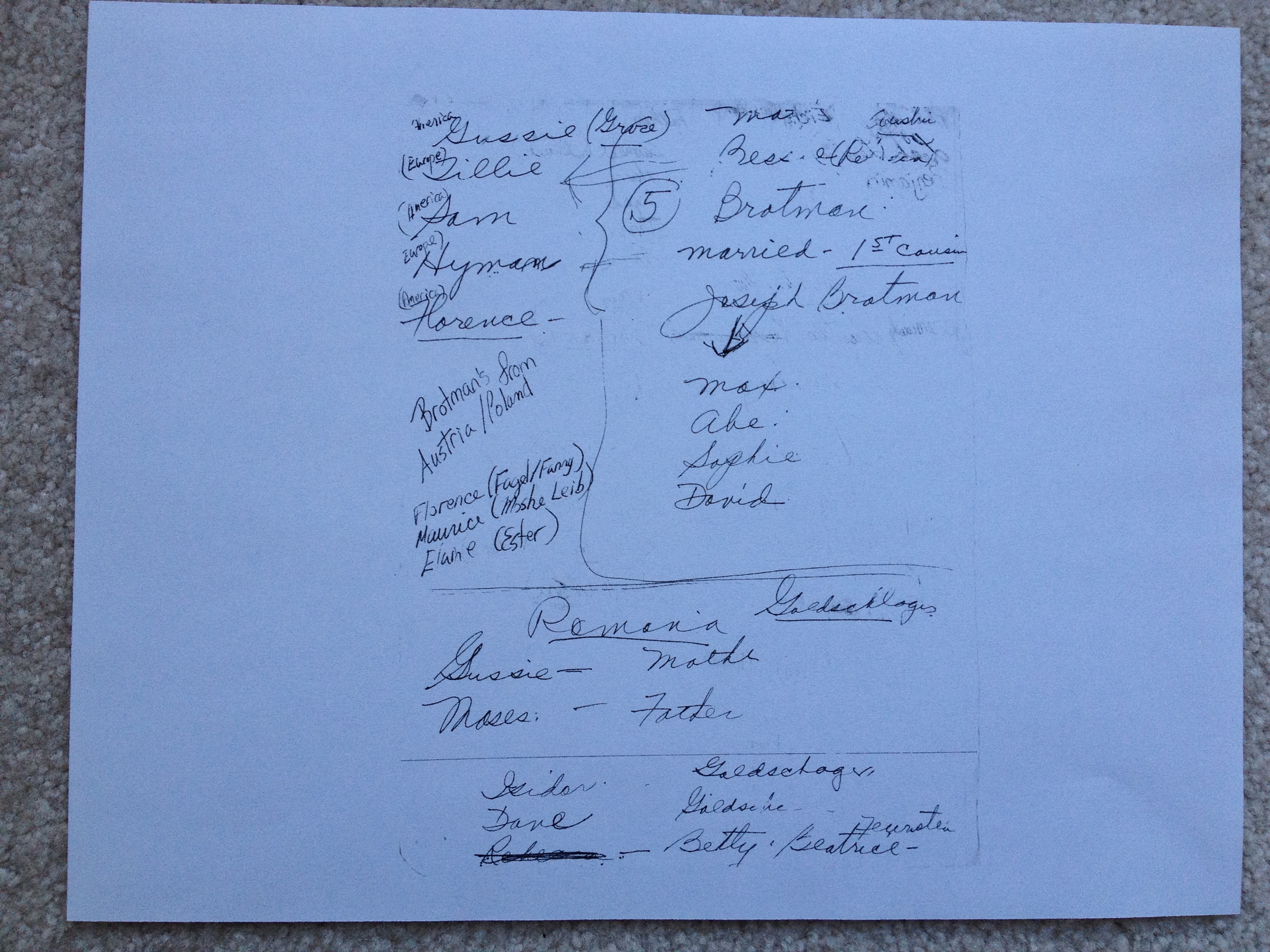
Family Tree drawn by Elaine Goldschlager Lehbraum

Family Tree drawn by Elaine Goldschlager Lehbraum

As you may recall, a couple of weeks ago my cousin Jody made a big discovery: handwritten notes that her mother had made of Joseph Brotman’s children.  It included all the children we already knew about: Bessie’s children Hyman, Tillie, Gussie, Frieda (Florence in her notes) and Sam, as well as the two sons we knew of from Joseph’s first marriage, Abraham and Max.   My brother had recalled that our aunt had said Joseph had had four children from his first marriage, but we did not know the names of the two remaining children, and I had traced every possible Brotman I could find to see if there was a link.  I had hit many dead ends and found nothing that linked these other Brotmans to our family.

My aunt’s notes were a huge discovery because for the first time we had evidence of the names of those two missing children: David and Sophie.  As I wrote when Jody first sent me the tree, I was able to locate a David Brotman from Austria who was a possible match for Joseph’s missing son, but I needed to check further and obtain some documentation in order to be sure.

Well, those documents arrived the other day, and I was so excited to see that on David’s marriage certificate in 1897, he listed his father’s name as Joseph Brotman and his mother’s as Chaye Fortgang.

David Brotman and Annie Salpeter marriage certificate

David Brotman and Annie Salpeter marriage certificate

You may recall that Max had also listed his mother’s name as Chaye on his marriage certificate, so this confirmed that Joseph’s first wife was named Chaye, but now we know her surname as well.

Max Brotman marriage certificate

Max Brotman marriage certificate

In addition, the marriage certificate gave David’s current address as 85 Ridge Street—the same address where Joseph and Bessie were living in 1895 when Gussie was born, according to her birth certificate.

Gussie birth certificate

Gussie birth certificate

This confirmed for me that David was Joseph’s son, Max and Abraham’s full brother, half-brother to Hyman, Tillie, Gussie, Frieda and Sam, and our great-uncle.  I am still in a state of amazement that I was able to find him.  Thank you, Aunt Elaine, for leaving behind this great clue to our family.

Once I had this information confirming the relationship, I located whatever census reports and other records I could find for David and his wife, Annie Salpeter.  I found them on census reports for 1900, 1905, 1910, and 1920.  David was a tailor according to the first three census reports, and he and Annie were living on the Lower East Side until at least 1910. At times Annie’s brother Morris lived with them as well as a cousin Meier, but there were no children listed on any of these census reports.

At the time of his World War I draft registration in 1917, David and Annie had left the Lower East Side and were living at 143 Manhattan Avenue in Brooklyn, which was also their address on the 1920 census report, when David’s occupation was given as a cloak dealer in a “cloak house.”  Annie and David were now 44 years old and still had no children living with them, so I assume that they never had children. So there are no more second cousins to find and probably no pictures of David and Annie.  (But I’ve learned never to say never.)

I’ve yet to find David and Annie on the 1930 or 1940 censuses, but I am still looking.  It seems unlikely that they had left Brooklyn.  I was able to locate a 1946 death certificate for a David Brotman married to Anna living at 10 Sumner Avenue in Brooklyn, and I believe this is the same David, despite the fact that the death certificate has his father’s name as Isaac.  I’ve learned enough to know that death certificates are notoriously unreliable.  I will continue to see if I can find anything about David and Annie after 1920.

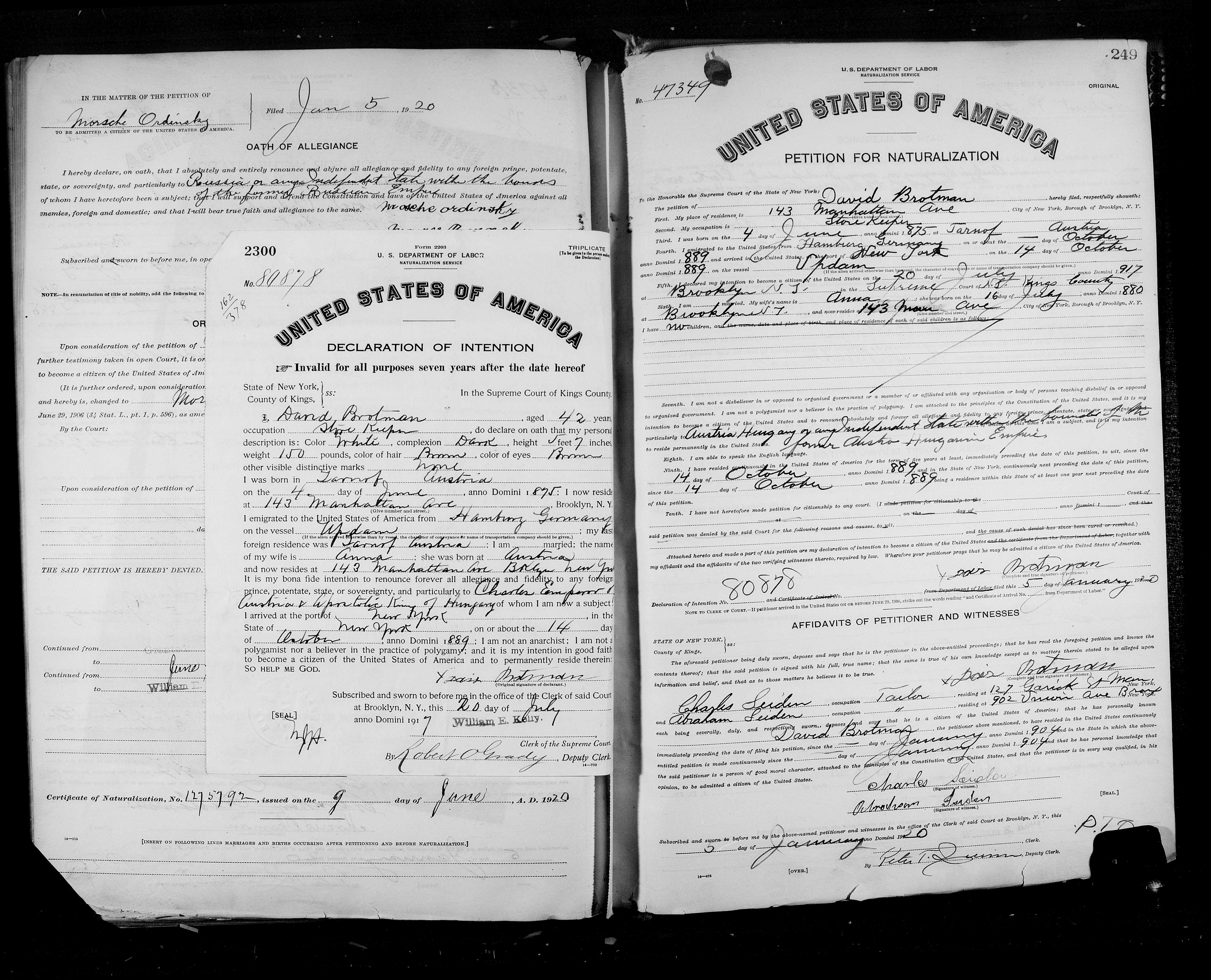
I do have David’s petition for naturalization in 1920, and it indicates that he had arrived in NYC on October 14, 1889, on the “Updam” from Tarnof, Austria.

David Brotman petition for naturalization 1920

David Brotman petition for naturalization 1920

Tarnof could be Tarnow, a city about fifty miles north of Tarnobrzeg/Dzikow and even further from Czchow, the two areas that I have been focusing on as the Brotman hometown based on Hyman’s listing of “Jeekief” and “Giga” on his documents.  But Tarnof could also be Tarnobrzeg, the larger town that is near Dzikow.  So did this new information help our search for our hometown in Galicia or did it just make it more confusing?

That led me to search for the ship manifest for David, now that I knew when he arrived and on what ship.  With some help from Renee, I located a September 4, 1889,  German ship manifest for the Portia, sailing to Rotterdam, listing Dawid Brodmann as a passenger.  I was excited to see that David was traveling with his older brother, Abe Brodmann. I had not previously been able to find Abraham on a ship manifest, so this was another exciting discovery.

David and Abe Brodmann on the Portia 1889

David and Abe Brodmann on the Portia 1889

On the Portia ship manifest, Abe and David are listed as coming from “Grambow, Russland,” not Austria at all, let alone Tarnow, Tarnobrzeg, Dzikow or Czchow.  I would have found this an indication that these were not the right boys, but there is a town right near Tarnobrzeg called Grebow, and according to a 1914 map, Tarnobrzeg was very close to the Russian border. So perhaps our family lived in Grebow? Or maybe that is where Joseph lived with Chaye and then moved to Dzikow when he married Bessie?

On the manifest for the Obdam, sailing from Rotterdam to New York arriving on September 19, 1889, David and Abe are listed as coming from Austria, not Russia, which appears to be correct.

David and Abe Brodman on the Obdam to New York 1889

David and Abe Brodman on the Obdam to New York 1889

There is obviously some confusion and conflict here, but it’s another clue and another place to look for the Brotman home in Galicia. I already have contacted several people researching this area to see if I can uncover more clues.

I have a few more leads to follow to fill in the gaps in David’s life story, and maybe they will even lead me to Sophie, the only remaining child of Joseph to locate.  There is also some potential evidence that will link our family to the Brotmanville Brotmans, but again, I need to do more research before it is worth speculating about that connection.

Enhanced by Zemanta

The American Immigrant Experience: The Brotman Story

I’ve been looking over the data I have for all the people on our family tree, starting with Joseph through the children born in the 21st century.  By looking at the various ways our family members have supported themselves, we can see a snapshot of the American immigrant story.

On Gussie’s birth certificate in 1895, Joseph’s employment is listed as a wood and coal dealer. According to the 1900 US census, Joseph worked as a coal agent in the Lower East Side. His death certificate also listed his employment as coal agent; on Sam’s birth certificate he is described as a coal carrier.  As you can imagine, this was hard and dirty work. In an article on the coal industry in Michigan, a son recalled how is father would look after working at a coal yard in Michigan: “Dad would use twine to tie his pants and cuffs so not so much coal would get on his skin. He looked like a clown with his pants blowing out, neckerchief around his neck….The dust would crawl up his pant legs—he’d soak his feet up to his knees every night.”  Another son of a man who delivered coal recalled how black the water would be in the tub after his father took a bath.

In a website devoted to the history of a coal company based in Camden, New Jersey, there is the following description of the type of work Joseph did:

“The man would arrive in a wagon with sacks of coal neatly stacked on top. He would climb onto the wagon and move the sacks to the edge ready for unloading. His face and hands would be completely black from coal dust and he wore a cap or head cloth, which hung down his back. He would grab hold of a sack at the top, turn round, bend forward and pull it onto his back. He then had to walk quite a few yards to the coal cellar, maybe down some steps and then ‘pour’ the coal out of the bag.”

At that same time, Joseph’s older children were also working.  In the 1900 census, Hyman is listed as working as a buttonhole maker and Tilly as a flower maker, obviously both working in the sweatshops described in Streets.  They were both just teenagers at the time.  (That same census reported that neither Joseph nor Hyman could read, write or speak English at that time.)

Joseph’s children, however, were able to free themselves from these oppressive and backbreaking forms of employment.

Hyman was still working as a buttonhole maker in 1917 according to his draft registration papers and his naturalization papers, but soon thereafter left the sweatshops. In 1920 he was working as a chauffeur.  In 1925 he was working in Jersey City as a confectioner, and in 1930 he was working as a storekeeper in a cigar store (perhaps for Max?) and apparently supporting not only his wife and children, but also his father-in-law and his brother-in-law and his wife.  In 1940 his occupation is listed as a bookseller in a bookshop, and in 1942 he simply listed himself as self-employed on his draft registration card.  We know from his grandchildren and from my mother that at some point he owned a liquor store in Hoboken.  So Hyman went from being a poor boy on the Lower East Side, working in a sweatshop and not speaking or reading English, to an independent business owner over the course of his adult life.

Max, a conductor on the railroad in 1900, had his own cigar business by 1910, which continued to be his source of income through the 1940s. Tillie also left the sweatshop world after she married, and she and her husband Aaron owned a grocery store in Brooklyn.  Gussie, who helped Tillie and Aaron by caring for their children while they ran their grocery store, married Isadore, who worked at a dairy company as a milkman.  Abraham worked as a tailor for almost all of his working life and in a restaurant in Brooklyn later in his life.  Frieda was working as a “finisher” in the feather business, which I assume was in the garment industry, in 1920, not too long before she married.  Sam worked as a stock clerk, then in the Brooklyn Navy Yard, and ultimately as a cab driver in New York City.

Thus, by 1920 or so, all of Joseph’s children had left the Lower East Side and had found occupations that took them out of the sweatshops.   Three of them became independent business owners, and the others found work in various trades that did not involve breathing in coal dust and carrying heavy loads of coal to tenement buildings.

The next generation continued that trend.  Joseph’s grandchildren became professionals and business owners: teachers, a lawyer, a pharmacist, advertising firms, real estate investment, and retail stores.   When I look at the list of occupations of Joseph’s great-grandchildren, my generation, born in the 1940s through the 1960s, that trend continues.  Although there are fewer of us who own our own businesses, consistent with the decline of the small family-owned business throughout the country, there are still a number of entrepreneurs.  We are also lawyers (fifteen of us, including descendants, their spouses and our children), doctors, teachers of all types, and school administrators.  We are involved in business, finance, sales, banking, the computer industry, and the arts.

Our children, those born in the 1970s through the 1990s, continue in these fields and others—there are a number working in the creative arts and the music industry as well as medicine and the health care, finance, law, business, and the restaurant industry.  You name the field—we probably have someone related to us working in the field.

As for the next generation, those who are still  at home going to school, maybe even still in diapers, we’d like to hope that the possibilities are limitless.  Yes, the world is a more competitive place, houses are much more expensive relative to income than they were for us, the cost of a college education is beyond what anyone would consider reasonable, and the economy is tougher and tighter than it was for many of us when we first entered the job market.

But if a 50-something year old man could drag coal from tenement to tenement to support his family, if our grandparents could rise from sweatshops to become storeowners and tradespeople, if our parents could go the next step and become professionals and business owners, then certainly we cannot be anything but grateful and appreciative and hopeful.  After all, it was only 125 or so years ago that our ancestors first stepped off the boat and into the streets of New York City with nothing to their names, speaking a foreign language, and risking all they had known to take a chance that this life could be better than what they had known.

Streets: Conclusion (Bella’s adolescence)

The rest of the book was harder to read.  As Bella turned twelve and became less innocent, she became more aware of the squalor and ugliness of her world.  She wrote, “I was now twelve and acutely conscious of the sordidness of the life about me.  To escape, I hid behind my books and built up a life of my own in the public school I attended on East Broadway and at the settlement house on Madison Street.” (p. 66)

Her mother married one of the long time boarders and soon was pregnant.  Although their first year of marriage seemed fine to Bella, after the baby was born and soon developed a medical condition that left him scarred and covered with sores, her stepfather abandoned her mother, who was already pregnant with another child. They never saw him again. (There is no explanation of her brother’s condition, but it seemed to continue for several years so was not just a short-term childhood illness like measles or chicken pox.)

Supporting an extra child as a single parent created enough of an additional financial burden for Fanny that she and her children had to move to a less desirable street in the Lower East Side, Goerck Street.  Bella described it as a “tough block” where there were several bars, a lumberyard, and a garbage heap.  There were frequent bottle fights.   Most of the residents of the street were Galician Jews, but there were also Hungarian, German and Russian Jews as well as many Italian immigrants.

Fanny and her children moved their belongings to the new tenement with a pushcart, taking several trips to do so. Bella described the new building as follows:

“Our house, like the others, had four families on each floor, two to the rear and two to the front.  There were two windows to the front room which either faced the street or the yard, one window in the kitchen that faced an extremely narrow, lightless airshaft, and in the bedroom a tiny square window that faced the hall. … Separating the front room from the kitchen is what my mother called a ‘blind window.’  It was simply a square hole, framed by woodwork, which allowed some of the front light to filter into the kitchen and stop at the entrance to the bedroom.” (p. 82)

In this small, dark and airless space, Fanny and Bella found cockroaches and rats.  As before, Fanny took in numerous boarders to help her pay the rent and also took on sewing jobs to supplement her income.

Bella graduated from grade school and was determined to go to high school, unlike many of her classmates and friends who had to go to work in one of the factories in order to help support their families.  Fanny was fully supportive of Bella’s desire to go on to high school, even though she was told by many that she was foolish and should make Bella get a job instead.  Bella enrolled at George Washington High School in Manhattan, about two miles away from the Lower East Side, and was excited to be continuing her education.

Bella, however, did also take on a part-time job, working Sundays as a trimmer at a man’s coat shop on their street.  Her mother also received financial assistance and other support from the United Hebrew Charities and worked long, long hours sewing to earn extra income.   When the second baby was born in May, 1913, the charity covered her rent for the time that Fanny could not work. In return, however, the charity wanted Fanny to consider sending Bella to work full time.  Fanny resisted, and Bella continued to go to high school.  Bella resented having to justify her desire to continue school to the charity.

Bella, however, was now much more aware of the precariousness of their financial condition, and it was often a struggle to pay the rent, which was often paid late and in partial payments.  When she was not at school, Bella took care of her two baby brothers while her mother continued to work as much as possible, taking in sewing work.

Bella’s feelings at this time are poignantly conveyed in the memoir:

“I looked at the sleeping tenements and down at the street strewn with garbage and wet newspapers. Was this living?… It was all so hopeless.  When would it end?”  (pp. 103-104)

Although Bella still loved school and had friends with whom she had some good times, it is apparent that she no longer felt the somewhat joyful attitude she had had as a child.  Although it does seem that their financial condition was worse than it might have been earlier, the poverty and squalor she described must also have been very much present in the neighborhood where she lived when she was younger.   It is likely that as Bella was exposed to more of the outside world through school and books, she also became much more discerning and outraged by the conditions of her own world.

When Fanny finally was unable to pay the rent one month in 1914 and received an eviction notice, Bella offered to quit school.  Fanny refused to consider it, saying that Bella was “going to be a lady. Not like me, a schnorrer!” (p.110) Fanny swallowed her pride and begged the United Hebrew Charities for assistance.  They agreed to give her fourteen dollars, which she used to move her family out of the Lower East Side and up to First Avenue and 49th Street (where the UN now sits).  The charity also provided her with some sewing work.

Thus, Fanny and her children left the Lower East Side and moved to what was then called the Dead End neighborhood, an area of slums that were torn down in the 1920s.  This was not a move up, but a move to a cheaper neighborhood.

The last chapter focuses on Bella’s experiences while living in that neighborhood, a more mixed neighborhood where she had many non-Jewish neighbors.  The accommodation was comparable to what they had had on the Lower East Side, a three room tenement apartment.  Fanny was heavily dependent on United Hebrew Charities for support and grew increasingly despondent over her situation and over the health of her older son. At one point her relationship with Bella was so fraught with tension that Fanny lost her temper and began hitting Bella quite violently.  Bella realized that she needed to get away and spent the summer before her senior year working at a boy’s school in the Catskills as a chamber maid and waitress.

Bella somehow managed to graduate from high school while also holding down various part-time jobs, including working in another factory, tutoring, and helping her mother with extra sewing work.  She also continued to take care of her little brothers.  Right after she graduated from George Washington High School in June, 1917, whatever was left of Bella’s childhood innocence ended abruptly when her sickly little brother died from whatever medical condition had burdened him since infancy.  That is where Bella abruptly ends her memoirs as well.

In an afterword written by Lois Raeder Elias[1], who knew Bella for over thirty years, Elias commented that although Bella ultimately found great personal and financial success, saw the world, and knew many important and impressive people, she was permanently scarred and haunted by her years of poverty, growing up on the Lower East Side.  She never felt financially secure and lived always in fear of poverty.

If the chapters about Bella’s early childhood left me feeling somewhat hopeful about how our family lived on the Lower East Side, the rest of the book left me feeling incredibly sad.  How did our grandparents and great-grandparents cope with these conditions? How did Max, Hyman, and Tillie, all of whom were born in Europe, manage to pull themselves out of poverty and become a cigar dealer, a liquor store owner, and a grocery store owner in one generation?  How did all our grandparents manage to support and raise their children, who all somehow managed to achieve comfortable middle class or better lives in good neighborhoods in NYC and its suburbs?

Reading this book filled me with renewed respect and gratitude for our great-grandparents and grandparents.  We should never forget what they accomplished and what a gift that has been for all of us.

Bessie

Bessie


[1] There was a surprise gift inside this book when I received it.  I had ordered the book from a third party vendor through amazon.com, and inside the book I found a handwritten note by Lois Raeder Elias to friends named Sheila and Alan.  The note reads,”At last we have received copies of Bella’s memoirs. We thought they would never come.  This one is for you.  I hope you enjoy it.  I’ll talk to you this weekend.  On to Turkey! Love,  Arthur and Lois.”

I hope that Sheila and Alan, whoever they were, appreciated this book.  I fear that they just passed it on without ever noticing the card left inside by their friends, Arthur and Lois.

Streets: A Memoir of the Lower East Side by Bella Spewack, Part II (up to age 12)

It was interesting to read about Bella’s childhood and developing American and Jewish identity growing up in the Lower East Side.  Not surprisingly, there was a wide range in the level of religious observance among the Jews on the Lower East Side.  Some Jews were very observant. Bella described the household of one of her childhood friends as follows:

“It was a decidedly quiet house—and more so on Friday and Saturday when religious observance forbade everything that would tend to introduce noise.  On Friday before sundown, the four girls of the family would comb their hair, the mother helping the youngest who had to wear hers in curls.  Before going to bed each would draw a cap over the freshly combed and plaited hair.  In the morning, the cap was removed but no comb touched the hair until Sunday morning.”  (p. 53)

On the other hand, Bella and Fanny seemed to live a very secular life.  A few pages after this passage, Bella described how she spent her Friday nights.  She would meet all her girlfriends and play loud and active games of tag and other outdoor games.  Bella also wrote that she felt “no everyday kinship with the synagogue” and “had an idea that it belonged to the menfolk only.”  (p. 47)   She wrote that she only went to the synagogue on holidays.

Bella in fact experienced real confusion over her religious identity and at one point decided that she wanted to be Christian, not Jewish, much to her mother’s dismay.  This desire seemed to have been rooted in Bella’s perception that Christians were more refined: they were gloves, had clean nails, and spoke perfect English.  Some of it may also have been rooted in her experiences with anti-Semitism, such as the time she and her mother were lost, walking in a strange neighborhood, and were accosted by a group of boys who called them sheenies and grabbed and poked at them.

Most of Bella’s childhood years, however, were spent focused on her friends, books, and school.  In the introduction to the book, Ruth Limmer wrote that the schools Bella attended “were both ideal and wretched—wretched in their overcrowding (class size was forty-five to fifty); ideal…in that they were rigid in their demand that the students seriously attend to learning English.”  (p. xx)

The mission of the schools was to Americanize the children of the immigrants (of all backgrounds) by immersing them in English literature, American and British history, physical training and athletics, and culture. Limmer asserted that as a result, parents often became dependent on their children, who spoke English and who were much more comfortable with the American way of doing things.

The schools also tried to instill values, including discipline and obedience.   Limmer wrote: “The routines began when they arrived at school each morning.  No horsing around.  They were required to line up in order of height on sex-segregated lines and, at the bell, were marched silently to their classrooms.”  (p. xxii)  Bella’s description of her day at school is consistent with Limmer’s overview:

“At school, there was first the assembly period when doors rolled back and mediocre schoolrooms became a vast auditorium.  You marched in with your class holding yourself straight and stiff, turning square corners with military exactitude.  You looked out furtively from beneath your lashes to see if your teacher… noticed that your shoulders were back and your stomach in.” (p. 66)

The students would then salute the flag and listen to readings from the Bible every day, apparently a common practice in the NYC public schools until after World War II, a practice that certainly conflicts with Constitutional principles as we understand them today.

Bella was also a regular visitor to the city’s public libraries and spent her school vacations at the library, reading as much as she could.

Seward Park Library

Seward Park Library

Obviously, she was well-served by those crowded schools and those libraries, as she grew up to be not only capable of communicating in English, but to be a very successful professional writer who contributed to the American culture in which she had been immersed.

Bella’s life was very much confined to her neighborhood; she was at least ten years old before she did much venturing outside of the Lower East Side.  Once she and a friend tried to walk to Andrew Carnegie’s house uptown, but got no further than Fourteenth Street, where they were mesmerized by the department store and its escalator.  Another time she participated in a play with other immigrant children organized by the neighborhood settlement house, another agency engaged in Americanizing immigrant children.  The group of children performing the play went as far uptown as 96th Street, which Bella said was as far from the Lower East Side as any of them had ever been.

Otherwise, Bella and her friends stayed in their neighborhood, where she engaged in common childhood activities, including piano lessons and a sewing club.  There is no mention of religious education.  Overall, Bella’s childhood, despite the poverty and those incidents of abuse and anti-Semitism, was a happy one up through age twelve.  She was a smart, studious girl, but one who had many friends and who knew how to have fun.

Perhaps Bella was looking back with rose-colored glasses, but I’d like to take away from her depiction of her childhood a better feeling about my grandmother’s childhood in the Lower East Side with her siblings.  Yes, they did not have an easy life, and losing their father so young must have been terrible.  But they had their sisters and brothers and a mother whom they all adored.  I hope that like Bella, my grandmother also enjoyed school, played games, and had a network of similarly situated friends with whom to share some of the joys of childhood.

Streets: A Memoir of the Lower East Side by Bella Spewack, Part I

I am now reading another memoir, Streets: A Memoir of the Lower East Side.  The author, Bella Spewack, had quite an interesting life.  She moved with her mother, Fanny Cohen, from Transylvania to NYC in 1902 when she was just three years old.  Fanny Cohen was just a teenager herself and had been abandoned by Bella’s father shortly after Bella was born.  They arrived in NYC with no resources, no money, no relatives to help them, and yet somehow Bella grew up to be a successful journalist first and then a very successful Broadway playwright along with her husband, Sam Spewack.  They are perhaps best known for the Tony award-winning play, Kiss Me Kate.

Bella wrote Streets in the 1920s while living in Berlin with her husband as foreign correspondents, but like A World Apart, it was not published until relatively recently (1995).  I chose to read this book to get an idea of what life was like for our family when they were living on the Lower East Side in the 1890s and early 20th century.

Whereas A World Apart failed to convey what life was like for poor Jews living in Galicia, Spewack does not shy away from depicting the hardships endured by Jewish immigrants living on the Lower East Side in the first two decades of the 20th century.  In the first chapter, Spewack describes how her mother scratched together a living in the early years after they first arrived in New York.  Like many young immigrant women, Fanny started by looking for employment as a house servant right after she arrived in the US. Fanny and Bella lived behind a restaurant those first days and shared a bed with two strangers.   When after some time, Fanny finally secured a position as a servant, she found the man of the house at her bedside in the middle of the night.  Fanny left and returned to the restaurant and started looking again.  Her second position was in Canarsie (Brooklyn), where she lasted somewhat longer until Fanny intervened to protect a girl living in that home from sexual assault.

My eyes opened wide when I read that they then returned to the Lower East Side and stayed with a woman they called the Peckacha who lived on Ridge Street. (The woman had a pock-marked face, and I assume that’s what the nickname meant.) This would have been in 1902, the year after Joseph died, when Bessie and the children were living on Ridge Street.  Since Frieda was then five and Gussie was seven, it is entirely possible that little Bella knew our family.  Of course, since there were probably thousands of people living on Ridge Street, it’s also possible and probably likely that they never met, but it made reading this section more meaningful for me as it helped me imagine what life was like for those other two little girls, my grandmother and her little sister.  Unfortunately, Bella’s experience with the Peckacha and her children was not a pleasant one.   The children would pick on her, both verbally and physically, while Fanny was out working.

Bella described Attorney Street, the street one block west of Ridge as like Orchard Street, “a market where fruit and vegetable dealers sell to the street and store vendors.  Cases, bulging with oranges or apples and watermelon, line the streets, while men with live, dirty hands darted among them with eyes that took in everything.  People live on these streets as well, rotting in their cases with the overripe fruits.” (p. 8)

lower east side

Fanny soon decided that she would prefer working in a factory to being a house servant.  Her next job was working as an operator in a ladies’ shirtwaist factory for $7.50 a week.  Bella and Fanny moved to Cannon Street where they lived with a widow named Pincus.  Bella went to a day nursery while her mother was at work.  The nursery was located in the basement of a building on Cannon Street, which Bella described as “gloomy but much warmer than the rooms all of us had just left.”  Overall, Bella’s experience at the day nursery sounded positive, with pleasant caretakers, but the days were very long, stretching past seven at night, and the space was overcrowded with too many babies and young children.

Unfortunately, once again Bella experienced some abuse.  Fanny trusted Mrs. Pincus, her landlady, to get Fanny up and to the nursery, and Mrs. Pincus ended up hitting and pinching Bella, once leaving her with such a huge bruise that Bella had to admit to her mother that Mrs. Pincus was abusing her. These experiences finally led Fanny to decide that she needed to find a place of her own where she would take in boarders to help pay the rent and provide her with some income.  She found a place in a new building on Cannon Street near Rivington Street, a three room apartment (bedroom, kitchen and dining room) with its own bathroom, and took in several boarders.

In the foreword to the book, Ruth Limmer provided a description of early tenement houses: “horrific five- and six- story dwellings that…lacked toilets, running water, fire escapes, and landlord-supplied hear and cooking stoves.” (p. xix)  By 1903, however, newer buildings had been built that were somewhat of an improvement.  “Now each apartment had, in addition to its windowed “front room”…another room that opened onto an air shaft, and interior windows were cut into the walls in order to permit a flow of air.  Little by little, the apartments were fitted with piping for illuminating gas. And instead of backyard privies, families got to share indoor toilets, two per four-apartment floor.  The law also required that fire escapes be affixed to all buildings.”  (p. xix)  The tenements were built on lots originally intended for single family dwellings ( 25 feet by 100 feet), but they housed over twenty families plus boarders in each building.

les interior

I imagine that this is like the apartment that Fanny and Bella were renting in 1903 and likely also what the Brotmans were living in on Ridge Street.  The census from 1900 did not list boarders as living in the Brotman household; perhaps Joseph’s income as a coal carrier/dealer was sufficient to support the family, though I doubt their standard of living would be acceptable to any of us today.

inside tenement

Bella described the many boarders, both men and women, who shared their small space, men sleeping in the kitchen, women in the living room and bedroom with Bella and Fanny.  You can imagine the goose bumps I got when I read that two of the young girls living with them at the beginning were named Frieda and Gussie.  Obviously, those girls were not our Frieda and Gussie, and those were common names for Jewish girls at that time, but nevertheless, once again the book made me realize that I was reading not about some foreign land or a work of fiction, but a work that reflects what life must have been like for the Brotman family living on Ridge Street in 1900.

More to come….

The Lower East Side

The Lower East Side

I just returned from a wonderful weekend in NYC.  Although seeing my grandson Nate (and his parents and his great-grandparents) was the best part of the weekend, I also had an opportunity to do two things I’ve wanted to do for a while: go to the Lower East Side and see where the Brotmans lived in the early 1900s and go to the cemeteries where my great-grandparents and grandparents are buried.  I am going to divide those two experiences into two posts rather than one.  This one will be about the trip to the Lower East Side.

On Saturday morning Harvey and I left our hotel down near Wall Street and walked north through the financial district and Chinatown, under the Brooklyn, Manhattan and Williamsburg bridges, to the Lower East Side. As we crossed streets like Grand, Henry, and Delancey, I tried to imagine what that neighborhood would have been like on a Shabbat morning a century ago.  Now it is a mix of various ethnic groups, but I was surprised to see a number of Orthodox and ultra-Orthodox men dressed for shul, walking past us.  I hadn’t expected to see any sign of a Jewish community surviving there.  As we passed two men dressed in Satmar garb (big furry hats, long black coats, beards and payes), I wondered, “Did Joseph dress anything like that? Were they at all observant? Did they go to shul? Or were they completely non-religious once they got to the US?’  I know that my grandmother had a kosher kitchen at first, but gave that up by the time I knew her.  She was not at all religious, and I know that my grandfather was also not at all religious.  What about your grandparents? Do you know how observant any of them were?

We crossed under the Williamsburg Bridge and then down Broome Street to where it intersected Ridge Street.  Joseph and Bessie lived at 81 Ridge Street in 1900; it is where they lived with Max, Hyman, Tilly, Gussie, Frieda and Sam.   It is also where Joseph died in 1901.  The picture below shows the corner of Broome and Ridge:

Image

We walked down Ridge to where 81 once stood.  There is now a school there, as you can see :Image

Although I was sad that there was no longer a tenement building there, I thought that having a school there was the best possible alternative.  Education helped our predecessors and all of us get to where we are today, so replacing what was probably a run-down tenement building with a modern new school seems appropriate.

Across the street at 80 Ridge is a newer building also, so obviously the original buildings are all gone.

Image

I took these pictures at the corner of Ridge and Rivington where there was an older building.  Perhaps that was more like the one where our family lived.

ImageImage

As we walked up and down the street, I tried to imagine my grandmother being a little girl, living there.  I thought of her being just five years old when her father died, and how awful that must have been for them all.  And I thought of poor baby Samuel who was four months old and would never know his father.  It must have been a sad and very hard time for them all.

New York City is a remarkable place.  The layers of history are all there, and you can feel them as you walk from neighborhood to neighborhood.  Ridge Street is a nice street with clean and newer apartment buildings.  You wouldn’t know today that it once was a crowded street with tenements filled with new immigrants, speaking Yiddish, and struggling to survive in what was supposed to be a place with streets lined with gold.  As we walked past Asian and Latino residents who themselves are likely immigrants or the children of immigrants, I realized how that experience continues to make New York the rich, fascinating and challenging city that it is.  I may have left the New York area long ago, but it still calls out to me as my home.  I am sure the same is true for many of you, whether you are living in Ohio, Virginia, South Carolina, California, Georgia, Connecticut, Massachusetts—or New Jersey or Long Island.

Isn’t it also interesting how some of the fifth generation children have returned to New York City themselves?