I’m Ba-a-a-ck! With an Update on Lillian Rosenzweig

After a week away in the beautiful Florida Keys where we were able to put the miserable New England winter weather behind us and enjoy the outdoors, kayaking, swimming, walking, and seeing wildlife including dolphins and alligators, I am back in New England with the miserable winter temperatures outside, but happy knowing that spring is at least here on the calendar if not in the weather quite yet.  It has to get above freezing soon, doesn’t it?

While I was away I received a number of documents, mostly confirming the hunches I’d had about Lillian and Rebecca Rosenzweig.  Today I will focus on Lillian.  About ten days ago I posted what I knew and thought I knew about Lillian.  I believed that she had married Toscano Bartolini in July, 1901, had had a son William born in March, 1902, and then lost her husband in 1904.  All of those facts are now confirmed by the marriage certificate, William’s birth certificate, and Toscano’s death certificate, all of which I received late last week.

First, as you can see from the marriage certificate, Lillian and Toscano were married by an alderman, not a rabbi, on July 6, 1901. This is clearly the right Lillian Rosenzweig, as her parents’ names are Gustav and Gussie nee Sagg.  According to the certificate, Lillian was then eighteen years old, which would have made her birth date 1883—a year before her parents married.  Lillian must have lied about her age in order to get married without parental consent.  I have speculated elsewhere that she was likely born in 1885 since her parents were married in June, 1884.  Also, Lillian’s address is given as 320 East 9th Street—not in Brooklyn where her parents were living.  She must have moved out before she married Toscano, who was living on Sullivan Street at that time.  These inferences are consistent with the family story that Lillie’s marriage to someone who was not Jewish led to disapproval and perhaps some estrangement from her family.

Bartolini Rosenzweig marriage certificate

Bartolini Rosenzweig marriage certificate

From William’s birth certificate, another inference seems possible.  William was born on March 9, 1902, just eight months after Lillie and Toscano had married.  Perhaps Lillie was already pregnant at the time of the wedding, although I am not sure she would have known that at the time since she would have been just one month pregnant.  It is, of course, entirely possible that William was a month premature. William was born at home—177 Houston Street in NYC.  Interestingly, Lillie’s age is now reported as seventeen—a year younger than she had reported on her marriage certificate a year earlier.  If she was in fact seventeen in March, 1902, her birth year would have been 1885, as I suspected.  It also means she was only sixteen when she married Toscano.

William Bartolini birth certificate

William Bartolini birth certificate

The other interesting fact gathered from this certificate is that Lillie had already had a child before William’s birth, but that that child was no longer living.  When could she have had that child?  Her marriage certificate reported that her marriage to Toscano was her first marriage.  Had she had a child with him before they married? Had she had an out-of-wedlock child with someone else? Had that child really died or had she given that child up for adoption and simply reported it as if he had died?  I have no idea and no idea how to try and figure that out. (It’s also sad that on the 1910 census when Lillie was back living with her parents, she is listed as single and having no children.)

The third document in this trilogy is Toscano’s death certificate.  Toscano died on April 27, 1904, from chronic nephritis, kidney disease, at age 27.  He’d been working as a bartender and died at 69 Carmine Street in NYC.  He had only been in the US for five years, had been married for less than three years, and left behind his 19 year old wife and 2 year old son.  I don’t know what causes chronic nephritis, although it looks like uremia is given as a contributing cause of death.   But I’ve never heard of someone dying at age 27 from that today.

Toscano Bartolini death certificate

Toscano Bartolini death certificate

The rest of the story, as reported earlier, shows a family in disarray.  Lillie and William moved back to Brooklyn and were living with Gustave and Gussie and the family in 1905, indicating at least a temporary reconnection.  In 1906, however, William was living at the Brooklyn Hebrew Orphanage.  Although it appeared that he was released back to his mother for some time, by 1910 William was living at St. John’s Home in Brooklyn and in 1915 at the NY Catholic Protectory.  Lillian, who was living with her parents in 1910 without William, then disappears from the records.

I still have not found either William or Lillian after that.  I don’t know what happened to either of them.  Joseph’s grandchildren told me that at some point Lillie was back in touch with her siblings, but no one knows anything more specific than that.  I will keep looking for some new clue, but for now I’ve hit the proverbial brick wall with Lillie and William Bartolini.

What I do know is an incredibly sad story of a young woman, emigrating with her family from Romania when she was only a young child, having two children before she was eighteen years old, losing one apparently to death and another to institutional care, losing a young husband after just a few years of marriage, and losing the support of her family as well for at least some period of time.  It’s a story to contrast with the story of Leah Strolowitz Adler, the daughter of Tillie Rosenzweig and Jacob Srulovici, who also came to the US as young girl but found the American dream.

The story of Lillie Rosenzweig raises so many questions: how did she, a young Jewish immigrant living in Brooklyn, meet and get involved with a young Italian immigrant who was living in the Lower East Side, not Brooklyn? Who was the father of her first child, and what happened to that child? What happened to William after he left the Catholic Protectory? Did he have any contact with his mother or her family? And what happened to Lillie after 1910? Did she remarry and regain custody of William? Did she also die at a tragically young age? These loose ends make me crazy—I want some endings to the story, but I may have to accept that I may never know what happened.

Enhanced by Zemanta

Abraham Rosenzweig: Update

A week ago I wrote about my search for Gustave Rosenzweig’s son Abraham and the process I used to narrow it down from the thirteen possible Abraham Rosenzweigs who were born in New York between 1885 and 1895 to the one who seemed to be the most likely possibility.  That one was the Abraham who married a woman named Rebecca, had two sons named Max and Irving, and who worked for a bakery company.  But I needed some specific evidence proving that that Abraham was the son of Gustave Rosenzweig.

I searched the New York marriage record index over and over and finally decided that Abraham and Rebecca had not been married in New York City, but in Pennsylvania where Rebecca was born.  Abraham, Gustave’s son, had been stationed in Pennsylvania while in the Navy, and I assume that that was when they met.  I looked for a Pennsylvania marriage record, but have not found it.

I was, however, able to find a death notice for that Abraham in the New York Times dated May 14, 1961.  It named his wife Rebecca, his two sons Max and Irving, and his four grandchildren.

Abraham Rosenzweig death certificate May 14, 1961 NYTimes

Abraham Rosenzweig death certificate May 14, 1961 NYTimes

From this death notice and the date of death I was able to find where he was buried, Mt Lebanon Cemetery in Queens.  I called the cemetery and asked whether there was any record of his father’s name.  The woman there said that they did not keep that kind of record; however, they would take a photograph of the headstone for a fee and email it.  I gave her my credit card number and ordered the photograph.

While waiting for that photograph, I hoped that it would in fact have his full Hebrew name with his father’s name.  If it only had his English name, I’d be back to square one.  It would be hard to obtain a death certificate since he had only died in 1961, barely 50 years ago.  It would mean waiting a few months to get the answer.

But fortunately the headstone does have his full Hebrew name as you can see below:

Abraham Rosenzweig headstone Mt Lebanon Cemetery

Abraham Rosenzweig headstone Mt Lebanon Cemetery

Avraham ben Gedalia ha Levi.  Abraham son of Gedalia the Levite.  Remember that Gustave’s birth name was Ghitale.  Ghitale is the Romanian equivalent of Gedalia, Hebrew for God is great.   Abraham Rosenzweig, the son of Gustave Rosenzweig, married Rebecca from Pennsylvania, worked for a bakery, and had two sons and four grandchildren.  Now I will try to find them.

Enhanced by Zemanta

Joseph Rosenzweig: The Process of Elimination

The other day I wrote about the steps I took to narrow down the thirteen possible Abraham Rosenzweigs in the 1915 NYS census to the one who I am reasonably certain was the Abraham who was the son of Gustave and Gussie Rosenzweig and thus my grandfather’s first cousin.  Over the last two days I have been engaged in the same process to determine which of the many Joseph Rosenzweigs I found in the US and NYS census reports was the younger brother of Abraham and also Gustave’s son.  I am once again reasonably certain that I have found the right Joseph, but I want to record the process I used to get there, both for my own record-keeping and to invite others to question my reasoning and my conclusions.

In many ways the search for the right Joseph was easier than the search for Abraham.  For one thing, there were far fewer Joseph Rosenzweigs than there were Abraham Rosenzweigs.  For another, Joseph was born in 1898 and thus was almost ten years younger than Abraham.  That meant that I had five census reports in which Joseph was living with his parents and siblings: 1900, when he was two years old, 1905 (seven years old), 1910 (twelve years old), 1915 (seventeen years old) and 1920 (22 years old).  I also found what is definitely Joseph’s draft registration and World War I service record; I know these are for the same Joseph because his address on these two forms, 1882 Bergen Street in Brooklyn, is the same address where the family was living in 1920 according to the 1920 US census.

From these documents I learned a fair amount about Joseph’s early adult life.  In 1915 he was employed as a driver’s helper, according to the 1915 census.

Rosenzweigs 1915

Rosenzweigs 1915

In 1917 when he registered for the draft he was working for the BRT, or the Brooklyn Rapid Transit Company, which eventually merged into the BMT or Brooklyn-Manhattan Transit Company.  It is difficult to decipher the handwriting, but it looks like he was a guard for the BRT, perhaps the same as being a driver’s helper as he had reported in 1915.

Joseph Rosenzweig draft registration World War I

Joseph Rosenzweig draft registration World War I

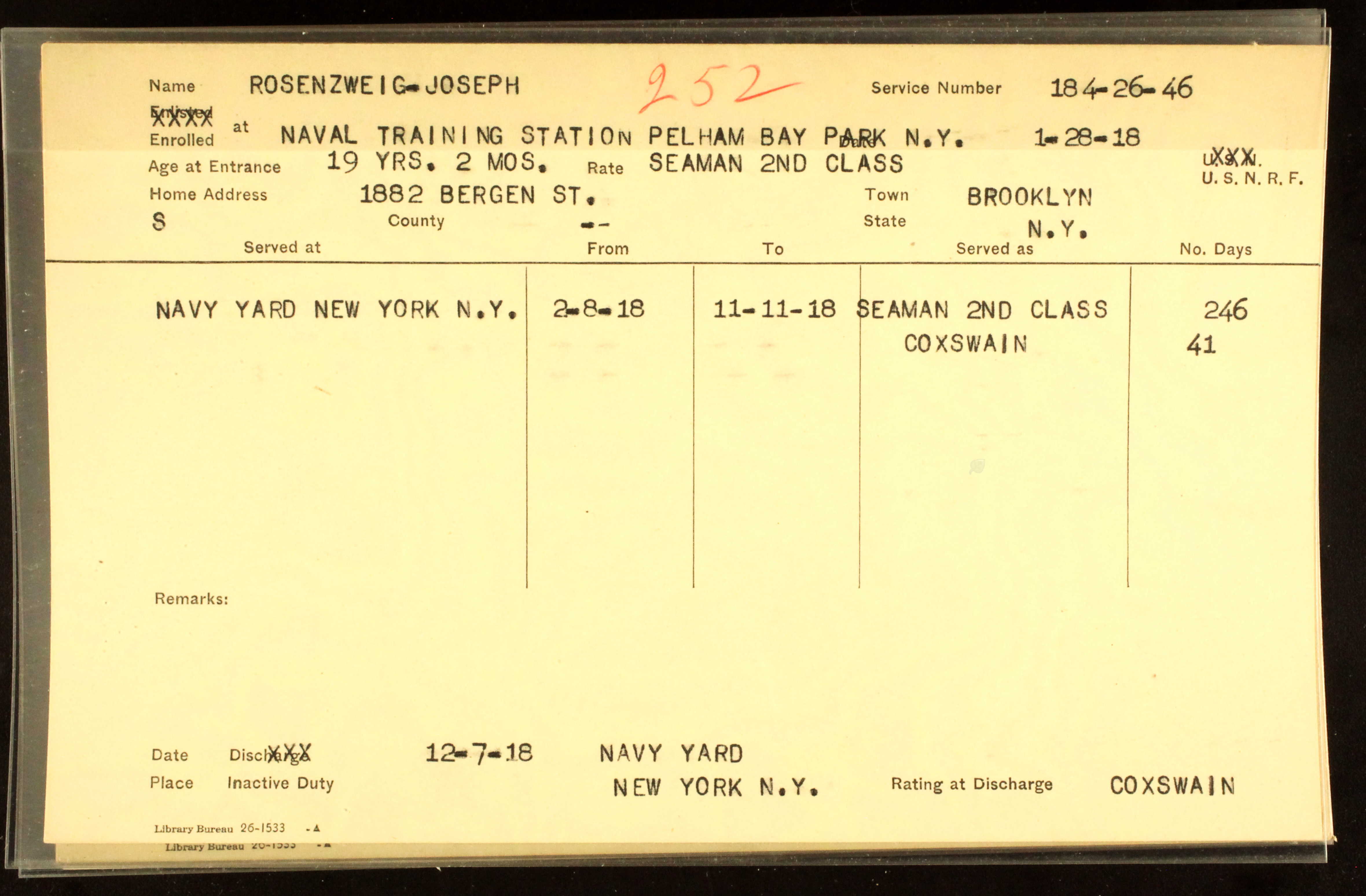
His draft registration also indicated that Joseph was the sole supporter of his mother at this time. By this time Gustave and Gussie had separated or divorced, and on the 1915 census two years before Gussie had been living not only with Joseph, but also with Abraham and Jacob, both already in the US Navy, and Lizzie and Rachel, both still in school and young teenagers. Apparently by 1917, only Joseph was providing support for his mother and presumably his two younger sisters.  According to the 1918 abstract of Joseph’s military service during World War I, he served as a Seaman, Second Class, in the US Navy at the Brooklyn Navy Yard from February 8, 1918 until November 11, 1918, Armistice Day, the end of World War I.

Joseph Rosenzweig military service

Joseph Rosenzweig military service

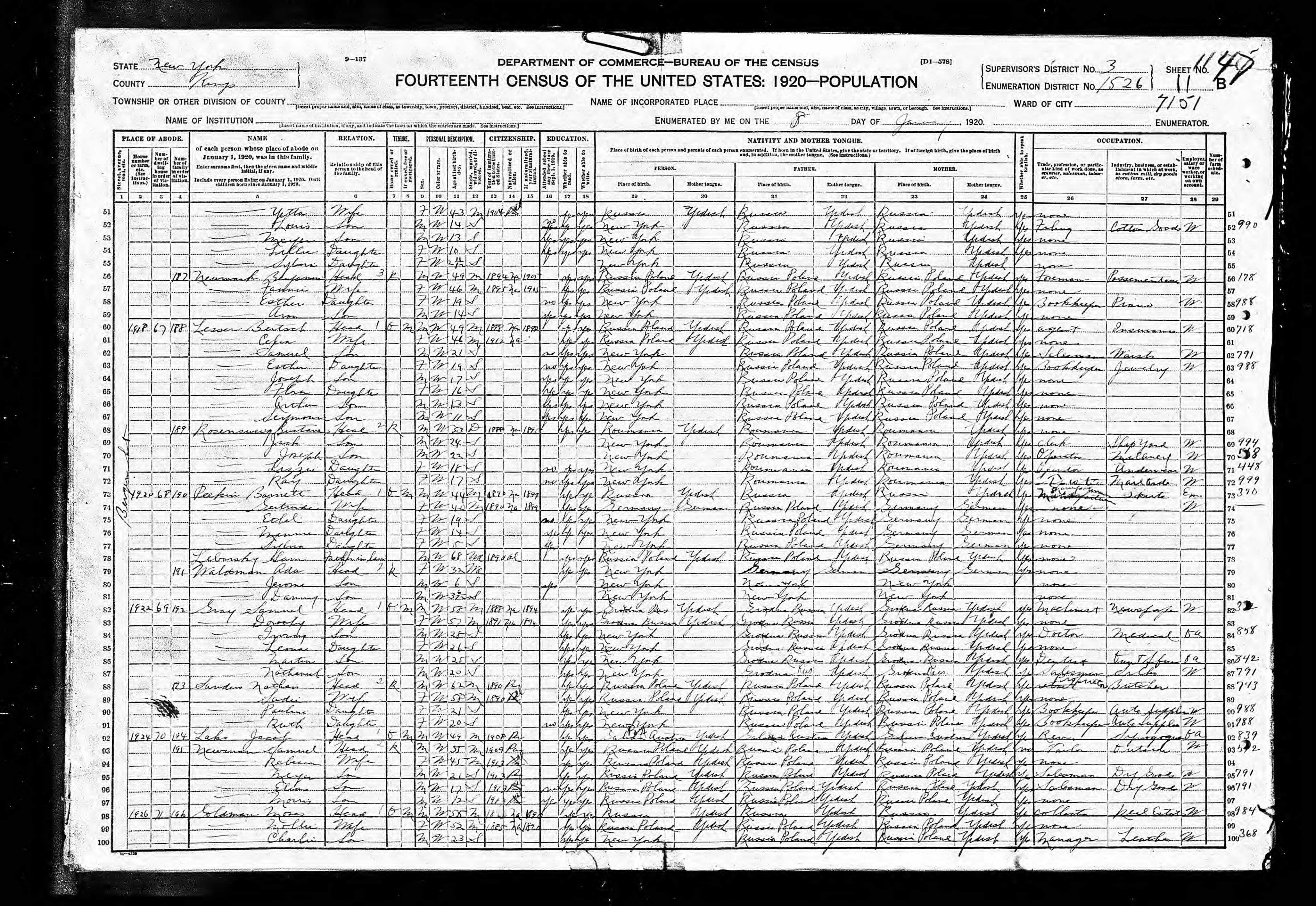
After the war, according to the 1920 US census, Joseph was still living with his mother and Jacob (Jack), Lizzie and Rachel (Ray) at 1882 Bergen Street and working as an operator in a millinery shop; in other words he was a hat maker.  It is this occupation that became critical to my analysis as I moved past the 1920 census to the 1925 NYS census and the 1930 and 1940 US census reports.

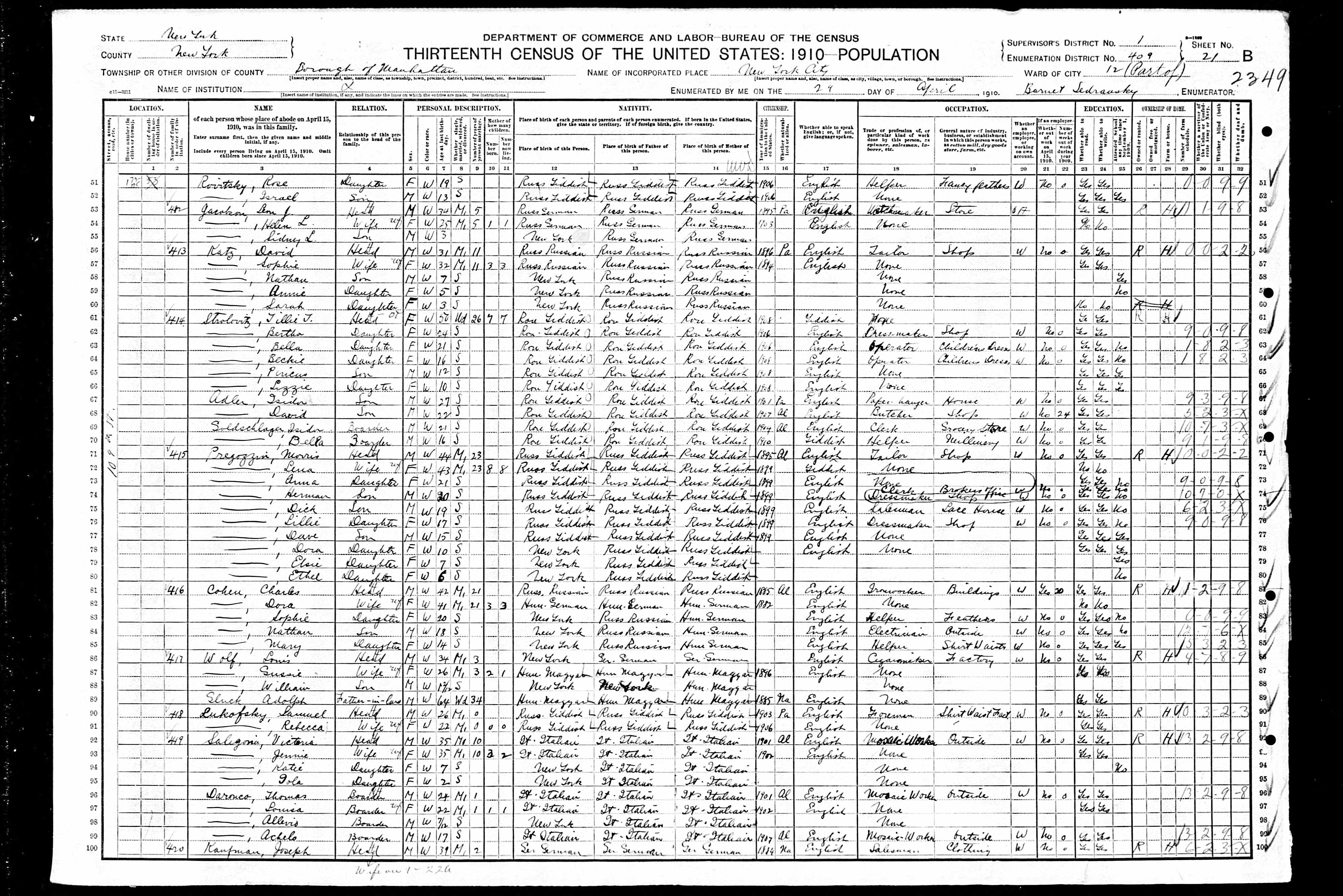
There are only two Joseph Rosenzweigs listed on the 1925 NYS census born in New York around 1898.  One was living with his parents, whose names were Aaron and Rose, so clearly not our Joseph.  The other Joseph was married to a woman named Sadie and had a four year old daughter named Irene.  They were living at 308 East 98th Street in Brooklyn, and most importantly, Joseph’s occupation is listed as a hatter.  His wife Sadie had been in the United States for 12 years and was born in Russia.  Although I have yet to find a marriage record for Joseph and Sadie, it appeared that they must have gotten married in 1920 since they already had a four year old child by 1925.  I will continue to search for their marriage certificate as it will provide more definite evidence that the Joseph who married Sadie was the son of Gustave and Gussie Rosenzweig.

Rosenzweigs 1920 census

Rosenzweigs 1920 census

Joseph and Sadie 1925

Joseph and Sadie 1925

Although I would like additional evidence to link this Joseph to Gustave, I am reasonably certain that it must be the right person.  The age and birthplace are correct, the occupation is the same as the occupation held by Joseph when he was still living at home with his mother, and there was only one other Joseph Rosenzweig listed in this age range in the 1925 NYS census.

Thus, I moved on to the 1930 census to see if any other Joseph Rosenzweigs were included there who could match the right criteria.  On the 1930 census I found two Joseph Rosenzweigs.  The first Joseph was born in 1898, but he was living with a brother named David, and Gustave and Gussie did not have a son named David who survived until 1930.  The second Joseph was the Joseph who married Sadie.  The census reported that he was born in 1897 and had been married to Sadie for ten years, making 1920 again the likely year of their marriage.  Sadie’s sister Tilda Kablanski was living with them, and they now had two daughters, Irene (nine years old) and Mildred (four years old).  They were still living on East 98th Street in Brooklyn, and Joseph was still employed as a hat maker.  There was also a John Rosenzweig who had Romanian parents, which looked promising, and he was living on Albany Avenue in Brooklyn, married to Ethel Bloom.  He was working as a postal clerk.  Although he was born in 1890 and thus older than Gustave’s son and had the wrong name, I held him aside as a possibility.

The only information in the 1930 census for the Joseph that married Sadie that conflicts with what I know about Joseph, Gustave’s son, is that it reports that his parents were born in Russia, not Romania.  I would be more troubled by this if I had not already seen so many errors on census reports: my grandmother’s name listed as Maurica when it was Gussie, my great-grandmother’s name given as Pauline when it was Bessie or Pessel, ages that are inaccurate, relationships described incorrectly, and so on.  I had to remind myself not to use this inconsistency to dismiss Joseph and Sadie; genealogists often are reminded that census takers took information often from neighbors or children or anyone who was around when the occupant was not home.  So given that there were only two Joseph Rosenzweigs of the right age born in NYC listed on the 1930 census, I decided that it was still more likely that the Joseph who married Sadie was Gustave’s son than the John who was almost ten years older and working as a postal clerk or the Joseph who was living with a brother named David.

Joseph and Sadie 1930 census

Joseph and Sadie 1930 census

So I moved ahead to the 1940 census to see if I could find anything that would help to nail down the identity of the correct Joseph.  There were four Josephs (plus the John who married Ethel; since his name was listed as John again, I decided that this was not a census taker’s mistake and eliminated him from my pile.)  Once again, there was Joseph who married Sadie, living with their two daughters Irene and Mildred on Rockaway Parkway in Brooklyn.  Joseph’s birth year was given as 1899 this time, and his occupation was still in hat-making.  There was a second Joseph married to a Sadye, living in Manhattan, but he was older (born in 1894). There was a third Joseph married to a Jenny, also living in Manhattan, who was a salesman of knit goods, but he was also older, born in 1893.  And finally there was a Joseph born in 1897, married to Sarah and living in the Bronx.  He was a clerk in a rubber factory.  Of the four Josephs, it still seemed to me that the one who was most likely Gustave’s son was the Joseph who married Sadie: he lived in Brooklyn, where our Joseph grew up; he was a hatter, which our Joseph had been in 1920; and he was the correct age, unlike two of the other three.

Joseph and Sadie 1940

Joseph and Sadie 1940

Obviously I cannot be 100% sure unless and until I can find a marriage certificate for Joseph and Sadie which reveals his parents’ names or unless and until I can find a descendant of Joseph and Sadie who may know whether their great-grandfather was named Gustave and whether their great-grandmother was named Gussie.  I have sent messages to a few of those descendants, and I am hoping that one of them will be able to help.  In the meantime I will continue to search for more evidence linking Joseph to my great-great uncle Gustave Rosenzweig, in particular the marriage certificate or the death certificate for the Joseph who married Sadie.

Enhanced by Zemanta

Vital Records—American versus Romanian

Romanian flag

Romanian flag (Photo credit: Tudor Girba)

American flag

American flag (Photo credit: Wikipedia)

The other Romanian records I received last week from Marius Chelcu are the birth and marriage records of Gustave Rosenzweig, my great-great uncle, the man who stood up for and posted a bond of Jankel Srulovici, the man who met his nephew Isidor or Srul Srulovici at Ellis Island, and the man who signed as a witness for his niece Bertha at her wedding in 1915.  Although I’ve not yet found any record linking him directly to my grandfather or his siblings, I have to believe that he also helped out my grandfather when he first arrived and probably also helped when my great-grandfather died in 1910 right before his wife and other children arrived.

So I have a great feeling of fondness for Uncle Gustave, and I was very happy that Marius was able to find these records.  There were six pages of documents: a birth record, a record to prove that Gustave and his wife were not related under the Romanian Civil Code, and four pages of marriage records.  Marius explained that these last four are essentially the same, as marriage laws required that there be three announcements of the marriage. (I am not sure what the fourth represents.)  Marius only provided one translation of these four pages, however, so they need to be reviewed more carefully.  I wish I knew Romanian, but looking over these documents I can pick out many words because of their similarity to English, French or Italian.  But it is still hard to compare them, given the handwriting as well as the unfamiliar words.

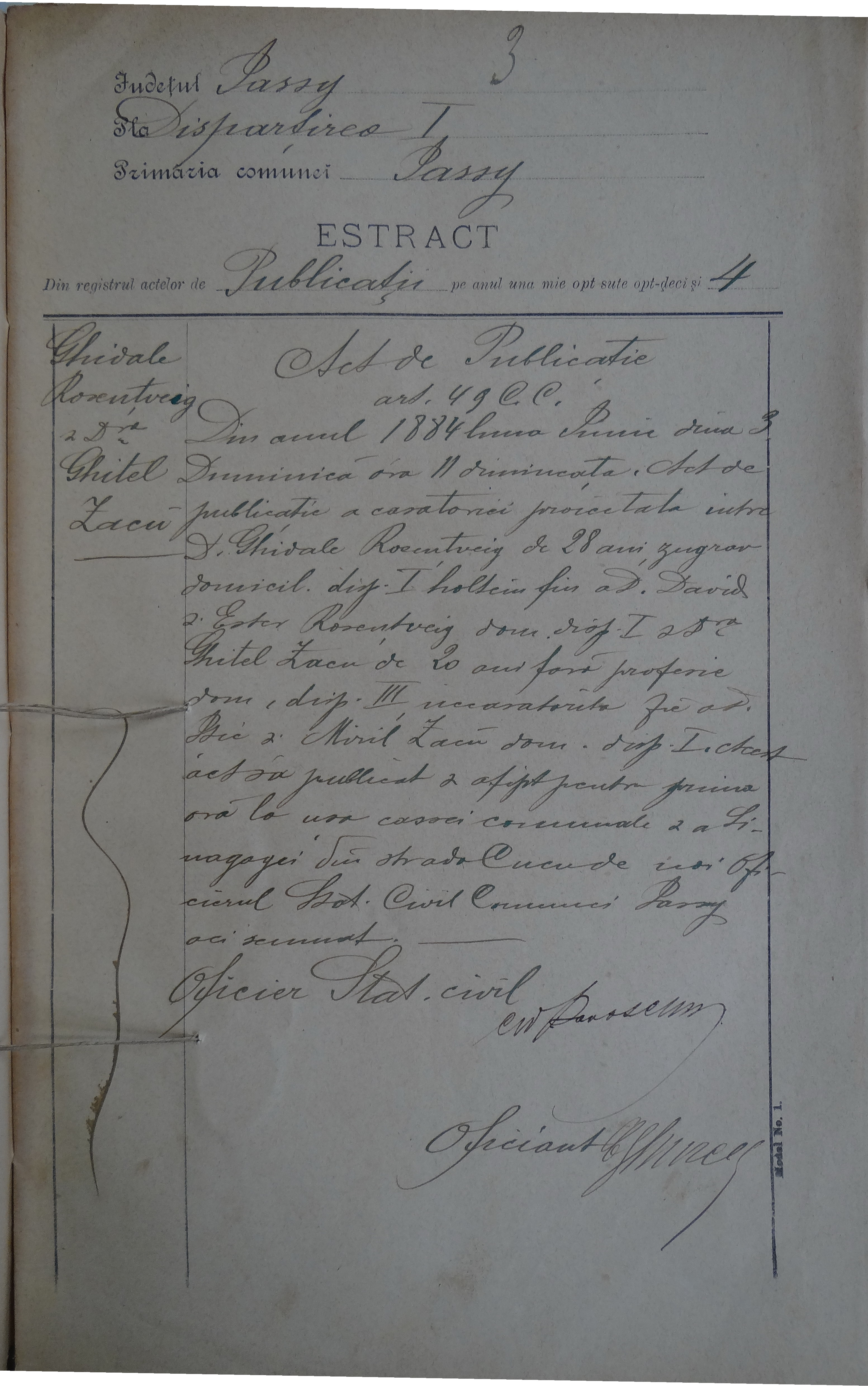
The birth record is not like the records I posted about yesterday, which were actual birth records for David and Rebecca Srulovici, filed at the time of their birth.  Gustave’s record was created at the time of his wedding in June, 1884, to substitute for a missing birth record.  On this document, four witnesses, including his father David Rosenzweig and his father-in-law to be, Itzic Zacu, attest to the fact of Gustave’s birth as Ghidale on June 10, 1856.  This document was important to me for several reasons: it provides not only information about Gustave’s birth date but also the birth year of my great-great grandfather David Rosenzweig.  The record gives David’s age as 60 in 1884, meaning he was born around 1824.  Also, it appears that Itzic Zacu knew Ghidale from birth or at least was willing to attest to that fact, perhaps indicating a close relationship between the Rosenzweig and Zacu families.

Gustave Rosenzweig birth record

Gustave Rosenzweig birth record

translation of birth record

translation of birth record

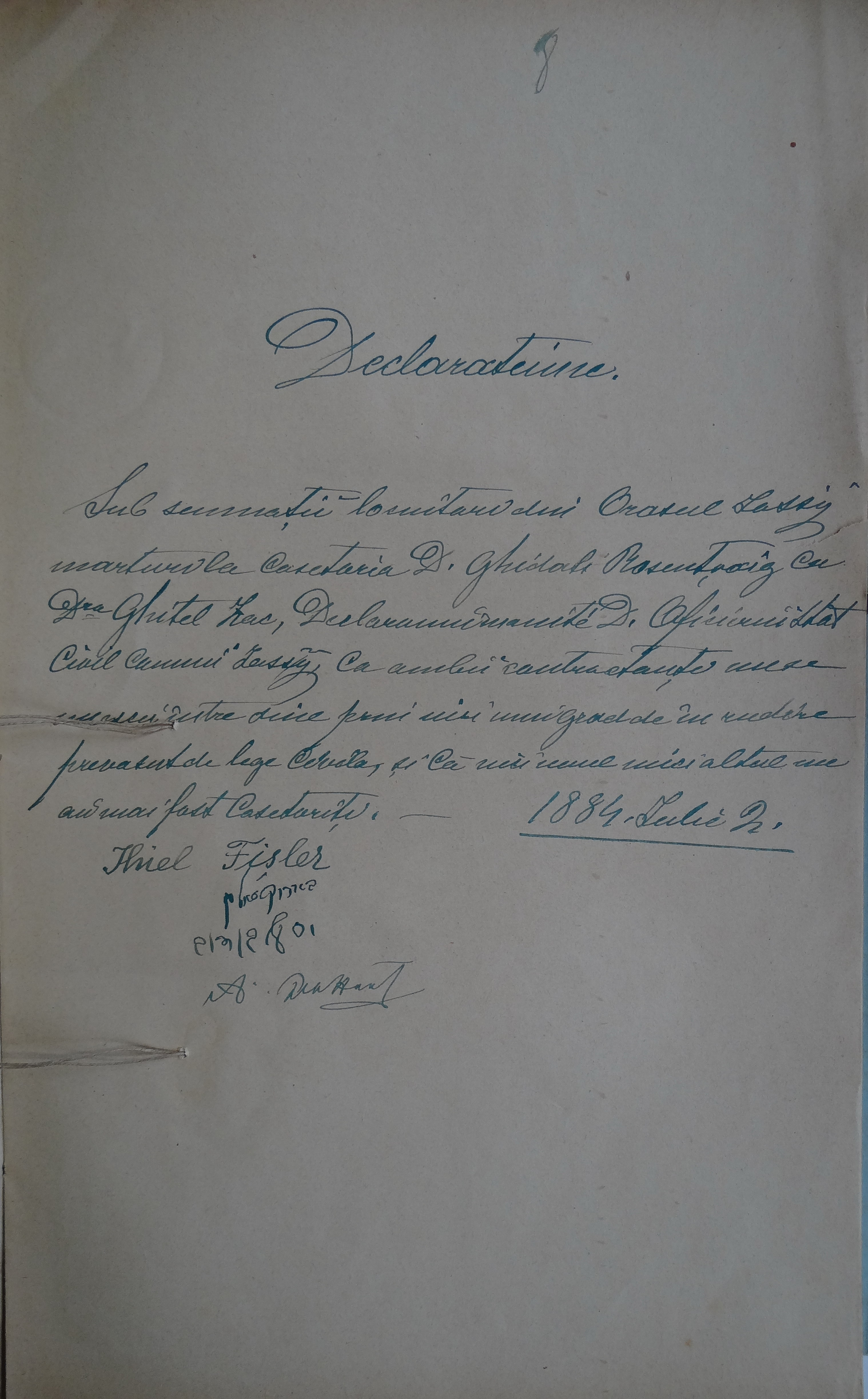
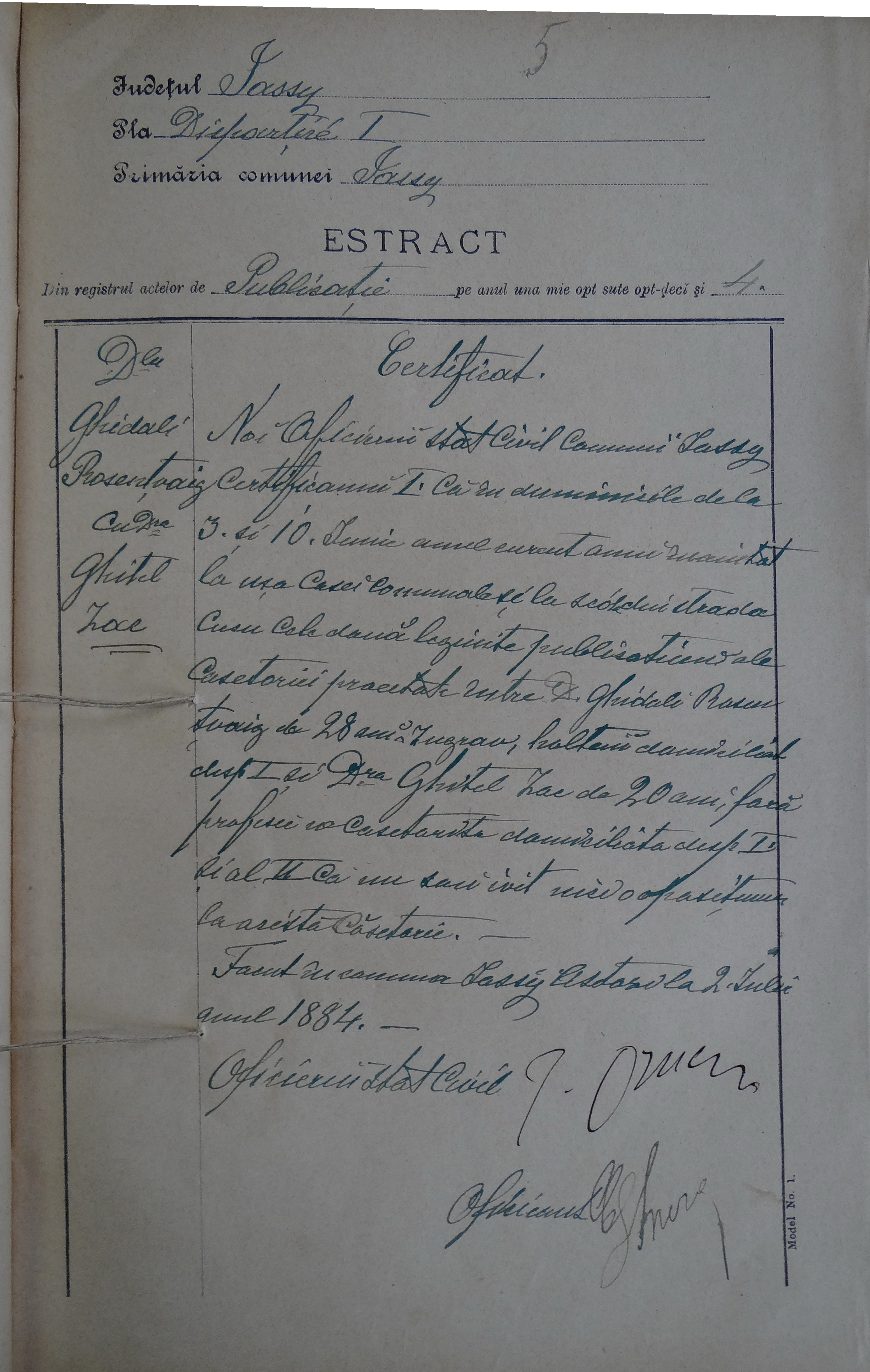
The second document is entitled “Testimony,” according to the translation provided by Marius.  The translation simply reports that Ihiel Fisler, a witness to the wedding, attested to the fact that Ghidale and his bride Ghitla Zacu were not related under the Civil Code.  The actual document, however, has four signatures, two written in Yiddish or Hebrew, two in the Latin alphabet.  I have tried to decipher the ones written in the Hebrew alphabet, but would love some help if anyone knows Hebrew script better than I do.

testimony for Gustave and Gussie

testimony for Gustave and Gussie

translation of testimony

translation of testimony

The remaining pages are the four pages of the marriage record itself, each one repeating what the other said, that is, that Ghidale Rosenzweig, 28 years old, son of David and Esther Rosenzweig, a painter by occupation, wanted to marry Ghitla Zacu, 20 years old, daughter of Itzic and Mirel Zacu, on June 1, 1884.  Unfortunately, the translation Marius provided contains an error; it had the date as September 2, 1887, even though I could see the date was June (Iunie) 1, 1884 myself.  I may ask him to provide a translation of each document separately, as it seems to me that there are some differences.  Take a look and let me know what you think.

Gustave and Gussie Rosenzweig marriage record

Gustave and Gussie Rosenzweig marriage record

Ghidale Rosentzveig with Ghitil Zacu_Marriage Record_1884_3 Ghidale Rosentzveig with Ghitil Zacu_Marriage Record_1884_2 Ghidale Rosentzveig with Ghitil Zacu_Marriage Record_1884_5

translation of marriage record

translation of marriage record

When I reviewed these dates against the other records I have for the birthdates of Gustave and Gussie and their children, I was somewhat puzzled.  According to the 1900 census, Lillie, their first born, was born in July, 1884, a month after the wedding.  I realize that women did get pregnant before marriage even back then, but Gussie would have been eight months pregnant in June, 1884; why would they have waited so long? But then again the same census has Gustave’s birth year as 1861 and Gussie’s as 1862, not 1856 and 1864, as the Romanian records suggest.  And it says Lillie arrived in the US in 1884, whereas Gustave’s naturalization papers clearly indicate that they arrived in 1887.

Does it seem likely that Lillie was born a month after her parents’ wedding?  I went back to look at the 1905 census, and there Lillie or Lillian is listed as 21, giving her a birth year of 1884 as well. On the other hand, on the 1910 census, she is listed as 24 years old, making her birth year 1886, which makes more sense.  Unfortunately, I’ve not yet found any other record for Lillie either after 1910 or before 1900, so I have no further evidence to corroborate either date.  Perhaps Marius will find her Romanian birth record or perhaps I will find more American records.  But which should I trust?  What do you think?

UPDATE: This story on the blog Genealogy Tip of the Day relates to my question.

Enhanced by Zemanta

Romanian birth records

I have received a number of different records from Marius Chelcu, the man who has been doing research for me in Iasi, Romania.  Among those records are the birth records for five of the children of Jankel Srulovici and Tillie Rosenzweig, my great-great aunt.  I now have birth records for Isidore, or Srul, their oldest child, for Bertha, or Bruha, their second child, for David, their third child, and one for Rebecca/Ray, their fourth child.  I also have one for a son who died in infancy, Zissu.  Unfortunately, Marius was unable to find a birth record for either Pincus or Leah.

First, the birth record for Isidore, or Srul, indicates that his birth date was June 9, 1883, and that his parents were Iancu Itzic Strulovici, age 38, and Bruha Thela Strulovici, age 36.  This birth year is consistent with Isidore’s age on the 1910 US census, so it would be appear to be the right child and the right parents.

Isidore (Srul) Strolowitz Adler's birth certificate

Isidore (Srul) Strolowitz Adler’s birth certificate

Strul Strulovici_Birth record_1883-page-001This record provides corroboration that Jankel Srulovici, here named Iacob Itzic Strulovici, was in fact Isidore’s father and that there was no first husband named Adler. The same is true on David, Bertha, and Rebecca’s birth records: Iacob Itzik Strulovici is their father.  There is no indication on any of these  birth records of anyone named Adler, and it thus does seem that the Adler name was chosen by the family sometime after arriving in NYC for reasons that are not yet clear.

If the ages of Jacob and Tillie are correct on Isidore’s birth record, they were born in 1845 and 1847, respectively, contrary to the 1851 and 1860 on their American death records.

The record for their next child, Bertha, has a date of birth of February 16, 1885, and her parents’ names as Iacob Itzic Strulovici, age 39, and Tilla Strulovic, age 36.  Two things raise questions for me here as to whether this is the same mother named in Srul’s birth record.  First, the mother is still 36 years old.  That alone would not concern me, given how inaccurate the ages on these records appear to me.  But her name is different.  Certainly Bruha Tella could be the same person as Tilla, but the child’s name was also Bruha.  Given Jewish naming patterns, it seems quite unlikely that Bruha would give her daughter her own name.  It seems more likely that Bruha had died between 1883 and 1885 and that Iacob had then married Tilla, the mother of Bruha.  But obviously I cannot be sure.

Bertha (Bruha) Strolowitz Adler birth record

Bertha (Bruha) Strolowitz Adler birth record

Bruha Strulovici_Birth record_1885-page-001


The next record  is for David, born on October 22, 1886, in Iasi, to Iacob Itzic Strulovici, 41, and Tela Strulovici, still 36.  Perhaps Tillie just didn’t want to age and she was the mother of all three children?

David Strulovici birth record

David Strulovici birth record

translation of David Strulovici birth record

translation of David Strulovici birth record

Next is the record for Zissu Strulovici, who was born April 1, 1891 and died six days later on April 7, 1891.  At his birth Iacob is listed as 45 and Tillie as 40.  Tillie had finally gotten older than 36.

Zissu Strulovici birth record

Zissu Strulovici birth record

Zissu Strulovici_Birth record_1891-page-001

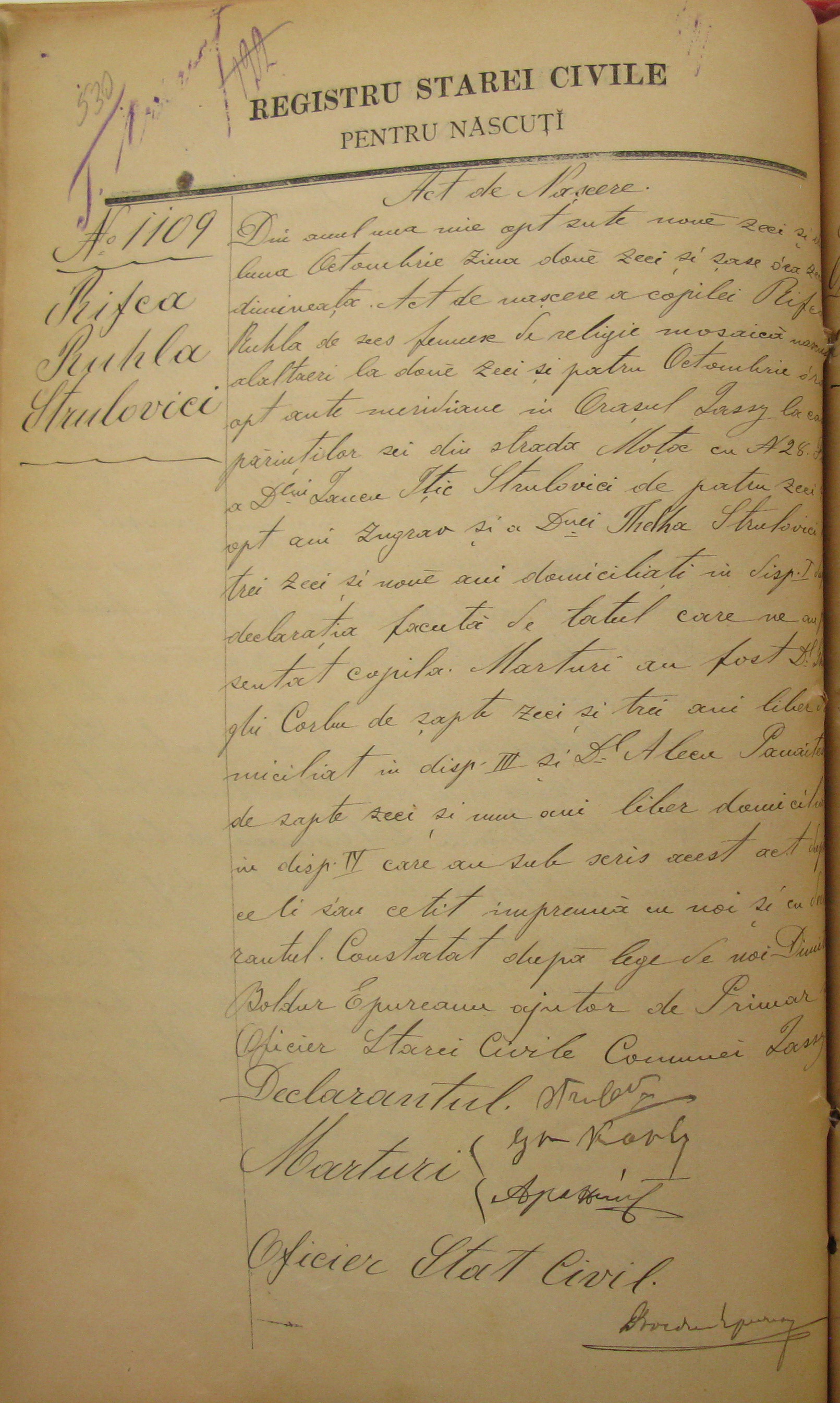
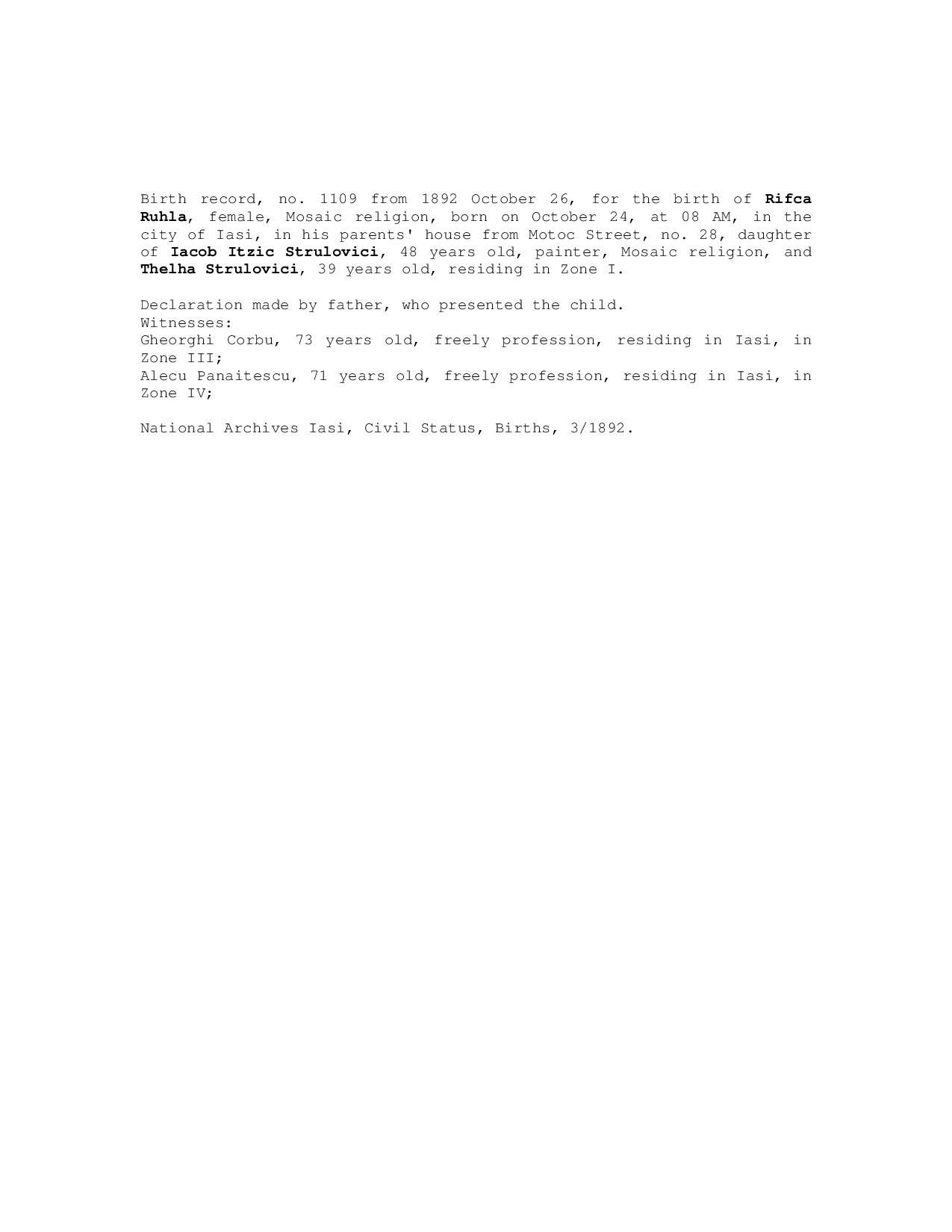
But when Rebecca was born on October 24, 1892,  her father was 48 and her mother 39.  So the best we can say about the accuracy of the Romanian records is that they are consistently inconsistent.

Rifca Ruhla Strulovici birth record

Rifca Ruhla Strulovici birth record


translation of Rifca's birth record

translation of Rifca’s birth record

Assuming then that Jacob was really 48 in 1892, he would have been 63 when he arrived in NYC in December, 1907, eight years older than the 55 he claimed on the manifest and at Ellis Island for his immigration hearing.  Given the typical lifespan back then and the fact that he was reported to be senile by the doctor who examined him at Ellis Island, it does make it seem even more likely that he died not long after being admitted to the US.

I was also interested to see on Isidore, Bertha and David’s birth records that Jacob signed his name in Hebrew or Yiddish.  I can decipher the “Yaakov Itzic Srulov—“ .  It also appears that his older brother Joseph was a witness and signed as “Strulov” on David’s record.  On Rebecca’s birth record six years later, it seems that Jacob signed his name as “Strulov” and not in Hebrew letters, as did the other two witnesses.  It also seems that Strulov could have been written by the same person, presumably Jacob, on both documents as the writing is very similar.

I find great comfort in seeing these documents.  It’s wonderful to have a record of events that happened in the family so long ago, and it gives me hope that all the work I’ve done will survive as well.  It is also very moving to imagine my grandfather’s cousins as babies, their births being recorded for all time by their parents.  Given what I’ve learned about how the lives of these children unfolded and ended, it is particularly poignant to think of them as innocent babies, unaware of their struggles ahead.
Enhanced by Zemanta

Uncle Gustave to the Rescue Again

A key lesson I’ve learned over the months I’ve been doing genealogy work is that it is important to go back and look at documents and information you received over and over again.  Something that seemed unimportant or confusing when first viewed can take on a lot more meaning after you’ve learned more about a family or a person.  So while I am waiting for new documents, I took the opportunity to review some old documents.

I went back to look at the information I had for Isidor Strolowitz Adler, Tillie and Jankel’s oldest child.  I did this because I noticed (for the first time) that on the 1910 US census that Tillie said that she had been married for 27 years.

The Strolovitz Adler family with Isadore and Betty in 1910

The Strolovitz Adler family with Isadore and Betty in 1910

Since she was a widow, the first time I looked at this it did not seem relevant.  This time I thought there might be a clue here as to when Jankel had died.  Assuming that Isidor was born within a year of marriage, as seemed to be the case in so many of the marriages of that era, if Tillie and Jankel were married the year before Isidore’s birth and were married for a total of 27 years, I might get a better estimate of when he died (or disappeared).
So I turned to Isidor’s information and saw that I had an estimated date of birth of 1883 based on the fact that Isidor was listed as 27 on the 1910 census.  According to his death certificate, he was 31 years, two months at the time of his death on April 23, 1915, giving him a birth date of February, 1884.

Isidor Adler death certificate

Isidor Adler death certificate

Since Bertha, the second child, was born in February, 1885, it certainly is feasible that Isidor had been born twelve months earlier.   Unfortunately, these were the only two documents I had for Isidor since he died so soon after arriving in the US.  I am hoping my Iasi researcher will find his birth record (he has located birth records for two of Isidor’s siblings; more on that in a separate post), but I decided to see if I could find a ship manifest for Isidor.

On my entries for Isidor I had two different arrival dates: 1901 and 1903.  His death certificate in 1915 said he’d been in the US for twelve years, giving me 1903.  The 1910 census said that he had arrived in 1901.  Although the 1910 census indicated that Isidor had petitioned for citizenship, I’ve yet to locate that petition.  And I had no ship manifest.  Although I had found ship manifests for all of his siblings and for his parents, I’d not been able to locate one for Isidor.  I’d searched for Isidor, Isaac, Ira, and Israel and all the variations of his last name, but had not found anything.

But this time I vaguely remembered something: in the records for his father’s hearing at Ellis Island, Isidor had been referred to by another name.  I went back to look at those records and found that Isidor had been identified as Srul.

transcript listing Srulovici children

transcript listing Srulovici children

I had learned from one of my JewishGen contacts that Srul was a Yiddish version of Israel—that Srulowitz means son of Israel.  So Srul had become Israel and then Isidor in the US.  The transcript also said that Srul was 26 in January, 1908, making his birth year 1883.

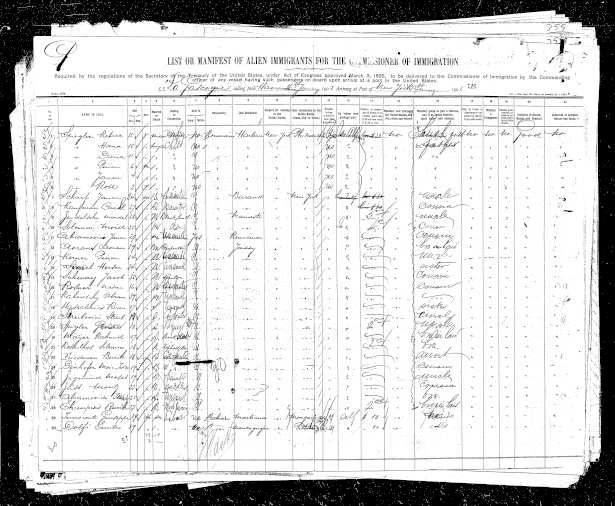
So I went back to the Ellis Island search engine created by Steve Morse and searched again, using Srul, and lo and behold—there it was.  Strul Strulovici, age 19, had arrived on January 12, 1902, from Jassy, Romania, via Hague on the ship La Gascogne.   That would make his birth year either 1883 or 1882.  So I am no more certain of his birth year and thus no more certain of when his parents had married.  But assuming they were married sometime between 1881 and 1883, that would mean that Tillie became a widow between 1908 and 1910, which is what I already assumed.

Strul Strulovici ship manifest

Strul Strulovici ship manifest

But I did learn something new from the manifest.  Under the column asking who was meeting Strul/Isidor in America was the entry “Uncle.”  I have to believe that this was his mother’s brother, Gustave Rosenzweig, my great-great uncle, the same uncle who stood up for Jankel in 1908 and posted a bond, the same Gustave who acted as a witness at his niece’s wedding.  I can only imagine all the other things that this man did that were not documented for eternity.  This new finding gave me the incentive to go back and learn more about Gustave and his children.

Gustave Rosenzweig

Gustave Rosenzweig

So keep reviewing those documents.  You never know what you will learn a second time or third time or even a fourth time through.

Enhanced by Zemanta

Brotman Research: Where I am

Having reached the conclusion last week that I was not going to be able to get any further specific information about where in Galicia my Brotman relatives lived and then realizing that even if Tarnobrzeg was the ancestral home that the records there are very limited and too recent to be of much help, yesterday I went back to look over what I have learned and what is left to be learned about my Brotman relatives.

I have learned an incredible amount.  I know much more about my great-grandparents Joseph and Bessie Brotman and about the life they lived in the Lower East Side.  I have found all five of their children—Hyman, Tillie, Gussie, Frieda and Sam– and know what happened to them: who they married, who their children were, where and when, and in most cases, why they died.  I know what they did for a living and where they lived.  I even have been able to trace what happened to their grandchildren and who they married and the names of their children.  I have seen pictures of almost all these people, except Joseph, Abraham, David, and Frieda.   It’s been an incredible experience, so much more rewarding than I ever expected less than a year ago when I first starting dipping my toe into the waters of genealogy.

I’ve also been able to locate three of Joseph’s four children from his first marriage to a woman likely named Chaye Fortgang.  I have found Abraham, Max and David, but not Sophie.  I have also been able to learn a great deal about their lives, occupations, families, and homes and have located their living descendants.  Although there are a few missing holes in David’s life story and a number of years for which I can find no records, I know that he married a woman named Annie Salpeter and that they did not have children.  I know that he came to America with his older brother Abraham and that he died in 1946 of hypertension.  Only Sophie is missing from the picture, but given that I do not know either what her Yiddish name was in Galicia or her married name in the United States, I am not sure what else I can do to locate her.

There are many unanswered questions, but most of them relate to their life in Galicia—where did they live, what did Joseph do for a living, what happened to his first wife? These questions I cannot answer, and that makes me sad.  Also, when did Joseph arrive in the US?  I cannot find him on a ship manifest, but will keep looking.   I will also try and fill the holes in David’s story and look for Sophie, but overall, I think I have to say that I have reached the end of my search for the Brotman family.[1]

So what does that mean? Obviously, I hope to continue to develop my ties to my new cousins (and my old cousins, of course), and I also hope that they will help to fill out the personal side of the stories of their parents and grandparents.  It will make the family story so much more meaningful and interesting if people contribute stories or profiles or letters or pictures that bring to life their relatives.  I cannot do that on my own.  I didn’t know Abraham, Max, Hyman, or Tillie—but those of you who are their grandchildren certainly did.  I also didn’t know any of Joseph’s grandchildren aside from my mother and her siblings, but my second cousins—their children—must have memories and stories that they want to survive.  Let me know, and I will be happy to interview you or help you write something you’d like to share.

Thank you to all the Brotman cousins who helped me get this far—for answering my emails and my questions, for sending me pictures and telling me stories, for providing me with names and contact information, for sharing whatever you were comfortable sharing.  It’s been an amazing experience to share with you all, my Brotman family.

The rest of my personal journey to find my family will continue with the Goldschlager and Rosenzweig lines and eventually my paternal lines: the Cohens, Schoenthals, Seligmans, Katzensteins, Nusbaums, and so on!


[1] There remains, of course, a possibility of a tie to the Brotmanville Brotmans, but my research has hit a brick wall there as well.  Without being able to trace back to Joseph’s parents and grandparents and Moses Brotman’s parents and grandparents, I will never know whether Joseph and Moses were siblings, cousins, or not related at all.  Brotman is and was a much more common name than I had anticipated, and we could be related distantly to all of them or none of them.  Without better European records, there is just no way of knowing.

Enhanced by Zemanta

Another new relative: Gustave Rosenzweig

As I wrote yesterday, I was excited in reading the case file of Jankel Srulovici to see that the principal witness who came forward to vouch for him at the hearing to determine his admission into the US was a brother-in-law named Gustave Rosenzweig.  Gustave is the fourth child of my great-grandparents David Rosenzweig and Esther Gelberman whom I have been able to locate.   He was my great-grandmother Ghitla’s older brother and also Tillie and Zusi’s brother.  I had already noted his name on Bertha Strolowitz’s marriage certificate in 1915, but now I have some verification that he was in fact a member of the same family.  Not simply because he testified for Jankel and helped post the bond for his admission, but because he described Jankel and Tillie in his testimony as his brother-in-law and sister.

I have now done research to learn more about this man, my great-great uncle, who had $6000 in assets in 1908 and a painting supply business in Brooklyn and who had already impressed me with his character for helping out his family.  From various records, I have learned that Gustave was born in Romania in September, 1861.  He married his first wife, Gussie, in 1882, according to the 1900 census.

Gustave Rosenzweig and family 1900 census

Gustave Rosenzweig and family 1900 census

It is not at all clear exactly when Gustave and Gussie arrived in NYC, and I have not yet found a ship manifest for either of them.  On his naturalization papers in January of 1892, Gustave wrote that he had arrived on April 12, 1887.

naturalization petition gustave rosenzweig

naturalization petition gustave rosenzweig

Some of the census reports indicate that Gussie and Gustave emigrated in 1881, others say 1888. According to the 1900 census, their first child Lilly was born in Romania in 1884, and if Lilly was born in Romania, the later date seems to be more accurate.  On the other hand, the 1905 and 1910 census reports say that Lilly was born in the United States, and, according to the 1905 census, that Gussie and Gustave had been in the US for 22 years, i.e., since 1883.  At any rate, Gustave and Gussie were certainly in the United States by 1888, and thus he was the earliest of the Rosenzweig children to come to America, at least a few years before Zusi, 13 years before his nephew Isidor Strolowitz, 15 years before my grandfather Isadore Goldschlager, and almost 20 years before Tillie, over 20 years before Ghitla.

Gustave Rosenzweig family on the 1905 NYS census

Gustave Rosenzweig family on the 1905 NYS census

The earliest record I have of Gustave in NYC is an 1892 New York City directory listing him as a painter, living on Eldridge Street in the Lower East Side.  His naturalization papers also indicated that he was a painter, as was Jankel Srulovici and his two sons Isidor and David.  It makes me wonder whether Jankel and Gustave had been in business together as painters back in Iasi.  Jankel would have been about ten years older, so perhaps he trained Gustave and brought him into his business.  Gustave might have felt some sense of gratitude to him as well as brotherly love for his sister Tillie, motivating him even more so to help bring Jankel into the country.

1894 NYC directory

1894 NYC directory

Gussie and Gustave moved several times after 1892—uptown on East 74th Street in 1894, downtown to E. 6th Street in 1900, and to Brooklyn by 1905, where they first lived in Fulton Street and then on Franklin Avenue, where they were living in 1908 at the time of Jankel’s hearing.  Throughout this period of time, Gustav was a painter, eventually owning his own paint supply business, and he and Gussie were having many children: after Lilly came Sarah (1888), Abraham (1890), Rebecca (1894), Jacob (1895), Harry (1897), Joseph (1898), Lizzie (1900) and Rachel (1903).  Apparently there were five others who died, as the 1900 census reports that Gussie had had thirteen children, eight of whom were then living.

It’s mind-boggling on many levels.  First, how did the support and feed all those children and where did they fit them?  And secondly, how did they endure the deaths of five children?  I’ve seen this many times.  In fact, on the 1900 census for Bessie Brotman, my great-grandmother, it reports that she had had nine children, only four of whom where then living.  I cannot imagine how these mothers coped with losing these babies.  Did it make them less able to bond with each newborn, fearing they would not survive, or did it make them cherish each new child even more, knowing how fragile life was and how difficult it was for a child to survive?

In addition, it appears that one of the children who survived infancy, Harry, died as a teenager in 1913.  Perhaps all this did take its toll on the family.  By 1915 it appears that Gustave and Gussie had separated or divorced. Gussie is living alone with the children in 1915; I cannot find Gustav at all on the 1915 census. The census reports for 1920 also had me somewhat confused.  I found Gustave on two reports, one in Brooklyn on Bergen Street, living with the four youngest children, and another in Manhattan on East 110th Street, living as a boarder with another family.  In the Brooklyn census report, Gustave is listed as having no profession; on the Manhattan one it says he was a painter.  And I could not find Gussie anywhere, though the Brooklyn census said that Gustave was divorced.  What I finally concluded was that the Gustave in Brooklyn was really Gussie, despite the fact that it said Gustave and listed him as male.  My guess is that, as was often the case, the census taker was given or heard confusing information and misinterpreted it.   It makes more sense, given the times, that the children would be with their mother and that a woman would not be employed outside the home.  The Manhattan Gustave, the painter, is obviously the actual Gustave Rosenzweig.

Rosenzweigs in Brooklyn 1920

Rosenzweigs in Brooklyn 1920

Gustave Rosenzweig in Manhattan 1920

Gustave Rosenzweig in Manhattan 1920

By 1925 Gustave was remarried to a woman named Selma Nadler.  I was able to find a family tree containing Gustave and Selma which included this photograph, apparently of Selma and Gustave.  Selma had also been previously married and had ten children of her own.

Gustave and Selma Rosenzweig

Gustave and Selma Rosenzweig

Between them, Selma and Gustave had nineteen living children in 1925.  Imagine what that family reunion would look like.  The last record I have for Gustave is the 1930 census.  I have not found him yet on the 1940 census.  I have found two death records for men named Gustave Rosenzweig, one in 1942, the other in 1944.  I have ordered them both to determine whether either one is our Gustave.

Meanwhile, Gussie continued to live with one or more of her children in 1925, 1930 and 1940.  I do not yet have a death record for her either.  I have been able to trace the nine children with varying degrees of success.  Lilly appears to have had a child out of wedlock in 1902 named William who was living with Gustave and Gussie for some time in 1905, but who was placed in an orphanage (father listed as Frank with no surname and deceased) for a short time in 1906. William Rosenzweig at Hebrew Orphanage Then Lilly reappears on the 1910 census living with her parents and without William.  I’ve not yet learned what happened to either Lilly or William.

Similarly, the other four daughters Sarah, Rebecca, Rachel and Lizzie, all became untraceable after they left home since I have no idea what their married names were.  As for the sons, Abraham married and had two daughters, who for similar reasons I cannot find after 1940.  Jacob/Jack also had two daughters, and Joseph I’ve not yet found past 1920.   So at the moment I have not located any current descendants, but I will continue to look to see if I can somehow find out the married names of some of Gustave’s granddaughters.  The NYC marriage index only contains records up to 1937, and these grandchildren would not yet have been married by then; thus, I have no readily available public source to find their married names.  It may take a trip to NYC to see if those records are available in person.  Or perhaps I can find a wedding announcement.

UPDATE: Much of the information in the preceding paragraph has been updated here, here, here, here, here, here, and other posts on the blog on Joseph, Jack, Rebecca and Sarah.

So that is the story of Gustave Rosenzweig as I know it to date: a Romanian born painter who married twice, had nine children, real estate and a painting business, and who came to the rescue of his sister and her family.  It would be wonderful to know what happened once they all settled in America.  Gustave obviously stayed in touch with Tillie and her children, as he was present at Bertha’s wedding.  Did he help out Zusi, his little sister, when her husband died? I had hoped to find her living with him on one of those census reports, but did not.  Did he help out my grandfather when he arrived as a 16 year old boy in NYC in 1904? Did he help out my great-grandmother when she arrived in 1910, a widow without any means of support aside from her children? I certainly wish there was some way of knowing the answers to these questions.  From his conduct at the hearing for Jankel in 1908, I’d like to think that Gustave was there for them all, but we will never know.

Enhanced by Zemanta

Itic Jankel Srulovici

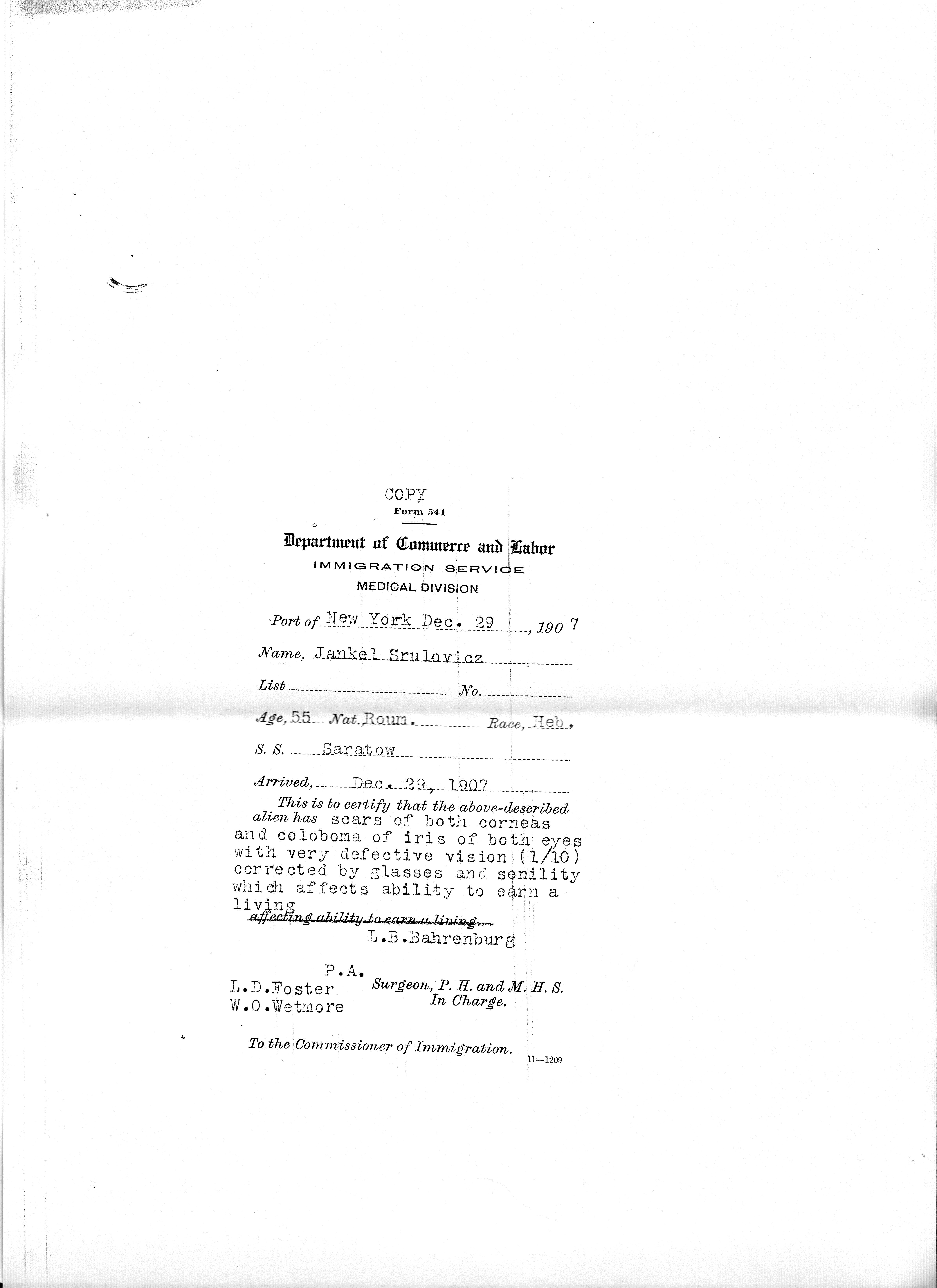
As you may recall, one of the mysteries I was having trouble solving was the fate of Itic Jankel Srulovic, aka Jacob Strolowitz or Adler, aka a number of other possible spellings of both his first and last name.  He was the husband of Tillie Rosenzweig Strolowitz, my great-grandmother Ghitla Rosenzweig Goldschlager’s sister.  He had arrived with his wife and his three youngest children on December 29, 1907, aboard the SS Saratov and had been detained because of problems with his eyes—scars on his corneas and coloboma on both irises.  Family lore suggested that he had never left Ellis Island, either having been deported or dying there, but the passenger manifest was stamped “Admitted,” indicating that a bond had been posted.

I had requested the case file for Jankel Srulovici from NARA, the National Archives and Records Administration in Washington, DC, a few weeks ago, and it arrived yesterday.  I have been studying it ever since.  The papers are fascinating not only because of what they reveal about Jankel and his family, but also because they provide some insight into the times and the experiences of immigrants. I will post scans of the documents in their entirety for those who are interested in the general history as well as those who are interested in the particulars of the family history.

The first document, dated December 31, 1907, is a recommendation from the Acting Commissioner of the Immigration Service, Joseph Murray, that Jankel Srulovic [sic] be admitted to the United States based on a bond of $1000 that was being posted. Commissioner Murray then described Jankel’s eye problems as causing “very defective vision (1/10), corrected by glasses,” but also said that Jankel was suffering from senility which affected his ability to earn a living.  He was only 55 years old; why was he suffering from senility?  What was this diagnosis based upon? There is later testimony that Jankel could not read or write; perhaps the diagnoses was based on his illiteracy, or maybe his illiteracy and his apparent senility was really more a misdiagnosis based on the fact that he did not speak English. Or, of course, perhaps he was really senile.

acting commissioner's recommendation

Enclosed with the recommendation were the report of the doctor’s exam of Jankel, as described in the Acting Commissiner’s letter,doctor's report and a transcript of the hearing held on December 30, 1907.  The transcript names the parties detained and subject to the inquiry as Itie Jankel Srulovic, 55, Roumanian Hebrew, and his wife Tille, 48, and children Riwke [Beckie, then Ray], 15, Pinkus, 9, and Lea, 7.  There is then what I assume to be a translation of some of the testimony given by Jankel.  He named his four older children already residing in the United States, Srul [Isidore], 26, Judel [David?], 21, Brucha [Bertha], 23, and Bluma [Bella], 18.  He testified that he could not read or write, that he was a painter, that he paid his own passage on the Saratov, and that he had $100, which he showed to the hearing officers.  He then was asked whether he had worked before coming to the US or been supported by his children, and he responded, “I supported myself without assistance from my children.”

transcript

transcript

A few things struck me by this testimony. First, I had an immediate reaction of surprise and anger that Jankel was identified by his religion.  Why was the fact that he was “Hebrew” at all relevant, especially in the context of a legal hearing to determine his right to enter the country, a country supposedly founded in large part on the principle of freedom of religious exercise?  Second, I could almost feel Jankel’s humiliation; he was asked whether he needed his children to support him.  He had to admit that he could not read and write.  On the other hand, he had $100—was that a lot or a little for an immigrant to have with them back then? And he had a trade—he was a painter.

The next paragraph made me smile because the next witness was Gustave Rosenzweig.  You may recall that I had noticed on Bertha Strulowitz’s marriage certificate that one of the witnesses was named Gustave Rosenzweig, and I had wondered whether this could be Tillie’s brother and thus also my great-grandmother’s brother.  Well, here he was, testifying at the hearing where the future of Tillie and her husband and children were at stake.  Gustave testified that he wanted [to help?] his sister, brother-in-law and their children.  He said, “I am worth $6000, all told; have a business of Painter Supplies,” and further said, “I will do the best I can for them.”  When asked whether Jankel could work, Gustav responded,”He has no business to work at all.  I will keep him in my house.”  He further testified that Jankel had “four grown children here to take care of them and able to take care of them.”

I was impressed both by the fact that Gustav had $6000 in assets and that he was so generous in coming forward to help his sister and her family.  He could not have been in the US that long himself, and he had to have some concern and fears about facing an official governmental agency, but he stood up for Jankel and his family.  Based on this testimony, the board of inquiry recommended that Jankel be “given this opportunity” to apply for admission on bond.

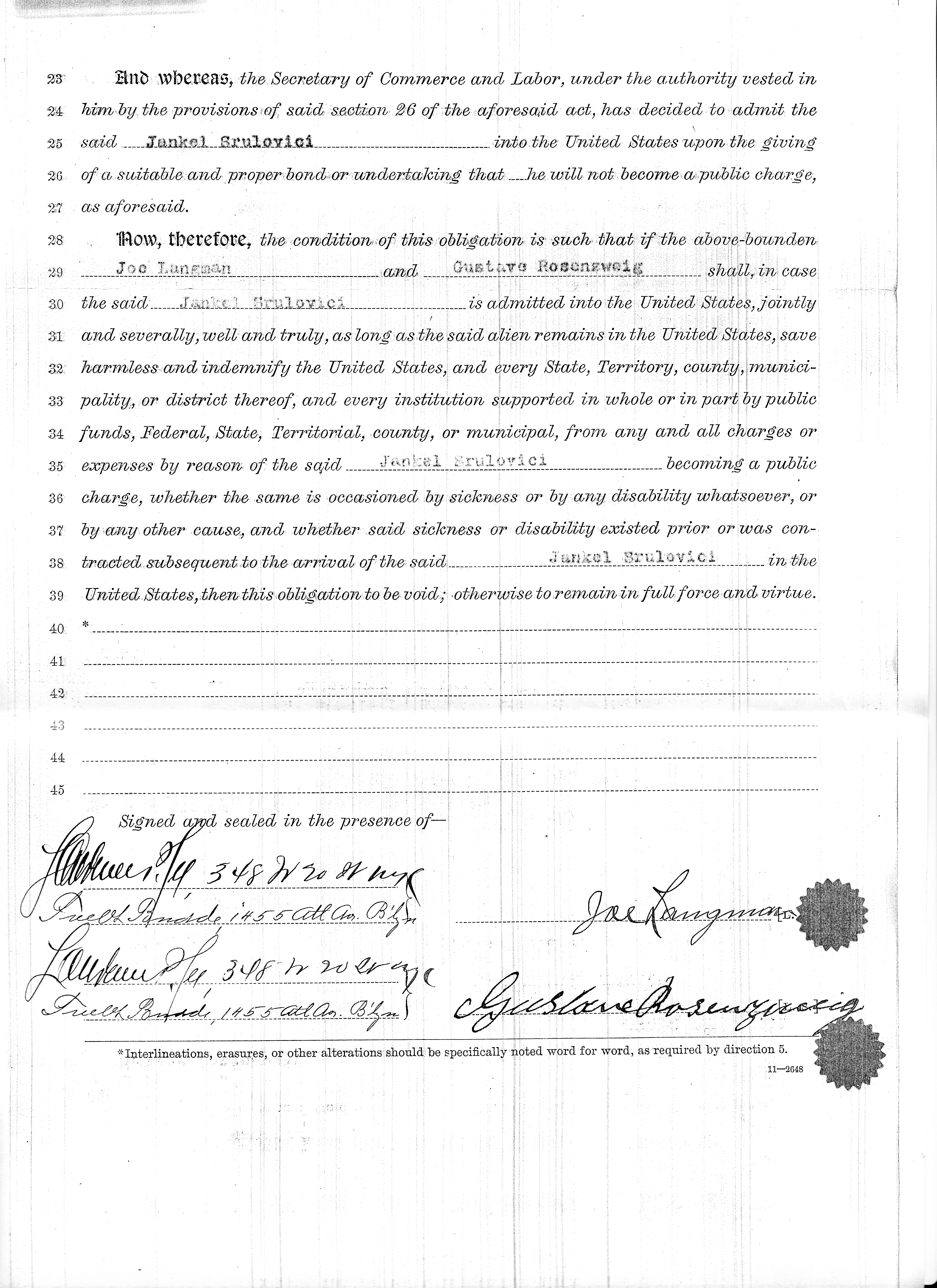
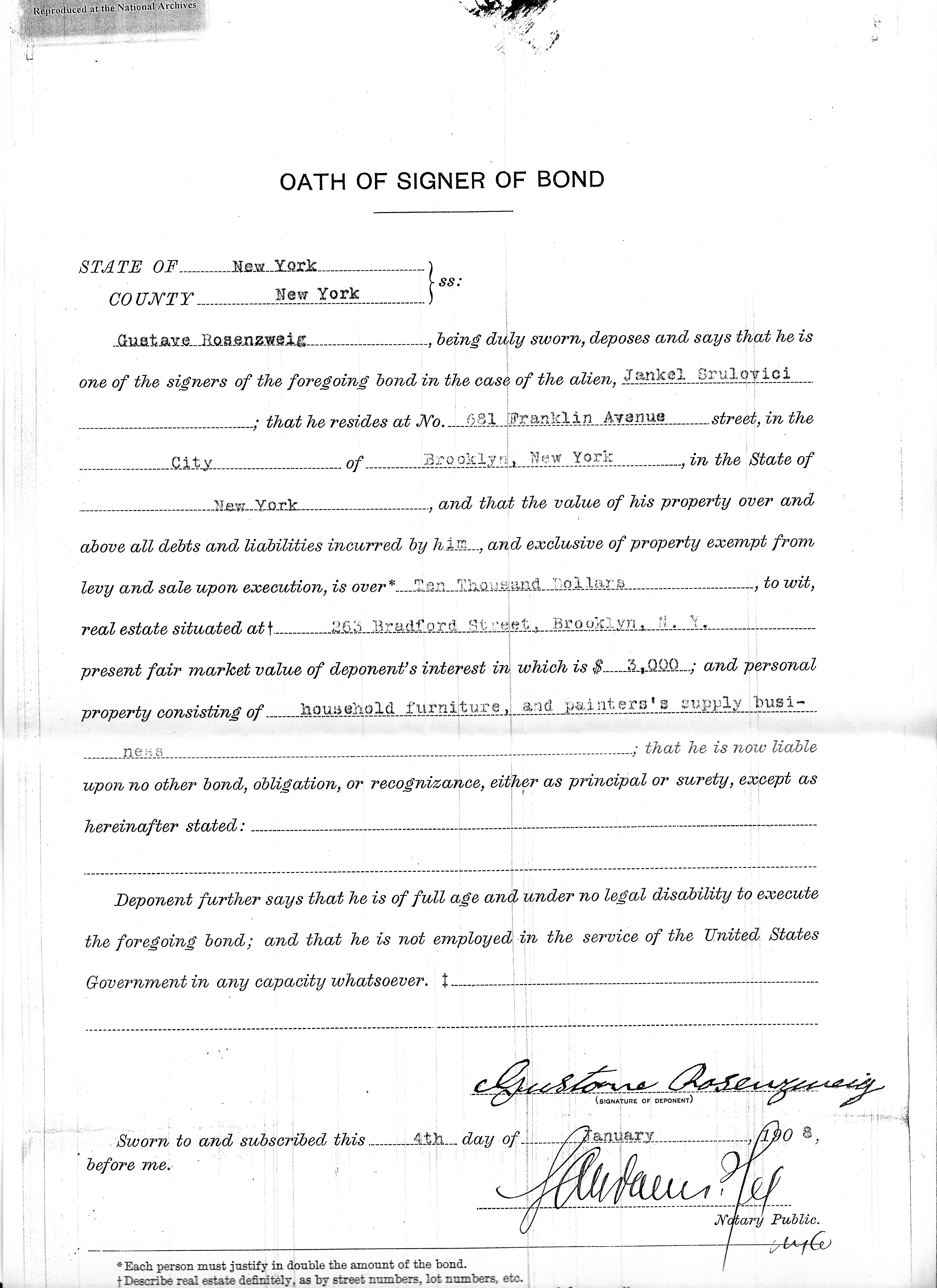
The remaining pages included with the Acting Commissioner’s recommendation are the bond, the application for the bond, and the oaths made by those providing the bond, Gustave Rosenzweig and Joe Langman.  Although I have only done some preliminary research on Joe Langman, it appears that he was also from Iasi and had been in the US for some time before this hearing.  I do not know whether there is any family connection, or whether he was just a landsman helping out another Romanian from Iasi.  Langman signed an oath claiming to have real property in Manhattan worth over $60,000, which must have been quite a substantial sum back then.  Gustave also signed a similar oath, asserting that he had $3000 worth of interest in real estate located in Brooklyn as well as personal property consisting of furniture and his painters’ supply business (presumably worth the other $3000).  Based on these oaths, a bond was issued for $1000 and presented in order that Jankel “shall not become a public charge” and be allowed to enter the country.

bond application p.1

bond application p.1

page 2

page 2

Oath of Joe Langman

Oath of Joe Langman

Oath of Gustave Rosenzweig

Oath of Gustave Rosenzweig

One other interesting thing I noticed about these documents: at the bottom of the page containing the oath is a footnote that reads, “In case signer of bond is a woman, insert here [on a line on the oath] “that deponent is an unmarried woman.” “ I had to stop and think about that for a minute, and then I realized what it meant.  Only an unmarried woman could post a bond because a married woman had no independent claim to property.  Boy, between being Jewish and a married woman, I would have had no rights back in 1908.

The final document in the file is the recommendation of the Commissioner of Immigration Services to the Secretary of Commerce and Labor, agreeing with the Acting Commissioner’s recommendation and recommending that Jankel Srulovici be granted admission on bond.  Although there is no response from the Secretary, I would assume that in general the Secretary deferred to the Commissioner and his hearing officers, and that Jankel and his family were in fact admitted into the United States and that he was not left on Ellis Island or deported.commissioner's recommendation

And yet, despite spending hours again last night searching for some record of his death or a gravesite, I still cannot find anything that reveals what happened to Jankel after January, 1908, when he was admitted, and April 29, 1910, when, according to the 1910 US census, Tillie was already a widow.

I’ve also been tracking down records for Gustav Rosenzweig and Joe Langer, but more on that in the next post.

Enhanced by Zemanta

Another Addition to the Brotman Family Tree: David Brotman and his wife Annie

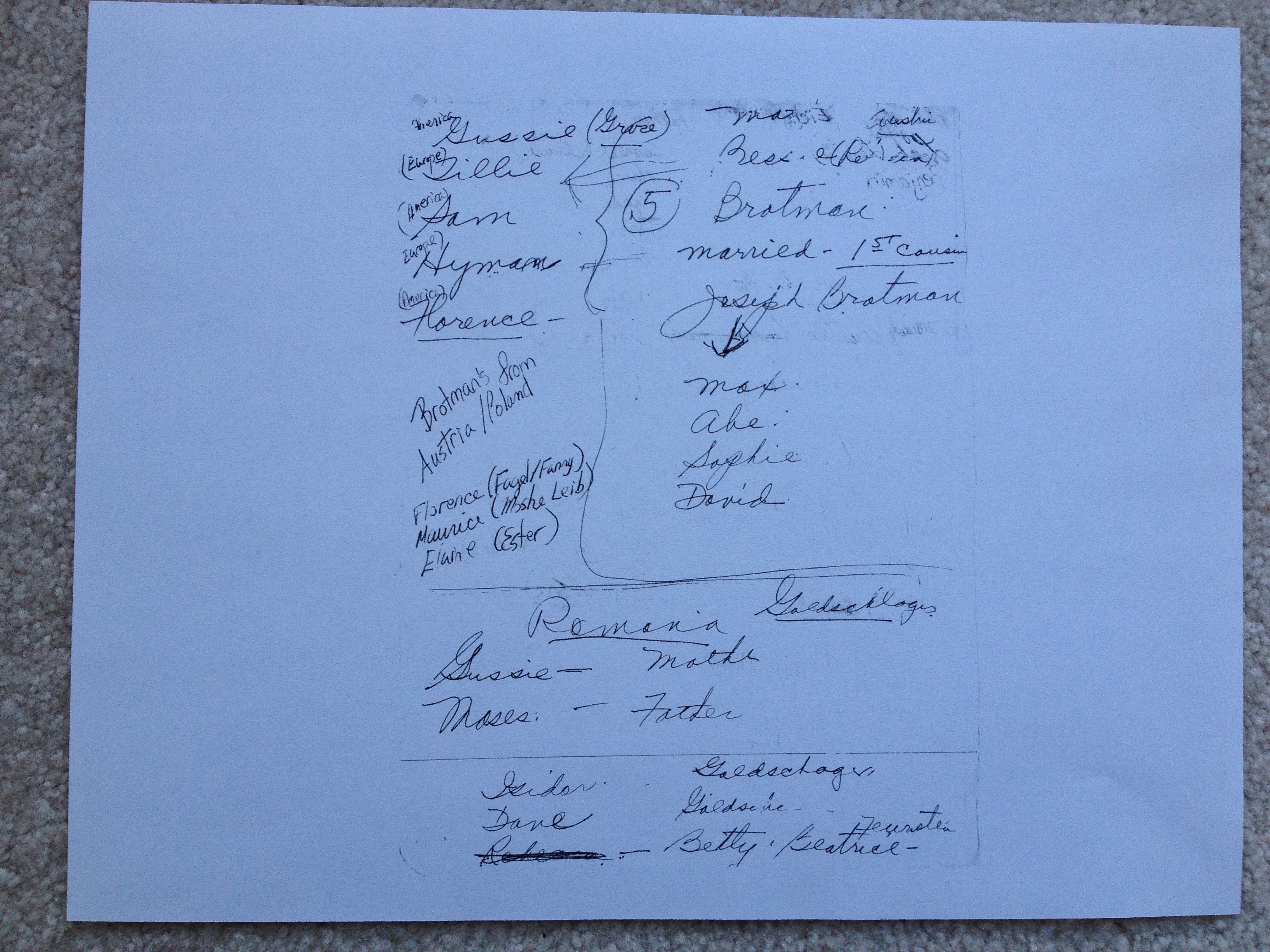
Family Tree drawn by Elaine Goldschlager Lehbraum

Family Tree drawn by Elaine Goldschlager Lehbraum

As you may recall, a couple of weeks ago my cousin Jody made a big discovery: handwritten notes that her mother had made of Joseph Brotman’s children.  It included all the children we already knew about: Bessie’s children Hyman, Tillie, Gussie, Frieda (Florence in her notes) and Sam, as well as the two sons we knew of from Joseph’s first marriage, Abraham and Max.   My brother had recalled that our aunt had said Joseph had had four children from his first marriage, but we did not know the names of the two remaining children, and I had traced every possible Brotman I could find to see if there was a link.  I had hit many dead ends and found nothing that linked these other Brotmans to our family.

My aunt’s notes were a huge discovery because for the first time we had evidence of the names of those two missing children: David and Sophie.  As I wrote when Jody first sent me the tree, I was able to locate a David Brotman from Austria who was a possible match for Joseph’s missing son, but I needed to check further and obtain some documentation in order to be sure.

Well, those documents arrived the other day, and I was so excited to see that on David’s marriage certificate in 1897, he listed his father’s name as Joseph Brotman and his mother’s as Chaye Fortgang.

David Brotman and Annie Salpeter marriage certificate

David Brotman and Annie Salpeter marriage certificate

You may recall that Max had also listed his mother’s name as Chaye on his marriage certificate, so this confirmed that Joseph’s first wife was named Chaye, but now we know her surname as well.

Max Brotman marriage certificate

Max Brotman marriage certificate

In addition, the marriage certificate gave David’s current address as 85 Ridge Street—the same address where Joseph and Bessie were living in 1895 when Gussie was born, according to her birth certificate.

Gussie birth certificate

Gussie birth certificate

This confirmed for me that David was Joseph’s son, Max and Abraham’s full brother, half-brother to Hyman, Tillie, Gussie, Frieda and Sam, and our great-uncle.  I am still in a state of amazement that I was able to find him.  Thank you, Aunt Elaine, for leaving behind this great clue to our family.

Once I had this information confirming the relationship, I located whatever census reports and other records I could find for David and his wife, Annie Salpeter.  I found them on census reports for 1900, 1905, 1910, and 1920.  David was a tailor according to the first three census reports, and he and Annie were living on the Lower East Side until at least 1910. At times Annie’s brother Morris lived with them as well as a cousin Meier, but there were no children listed on any of these census reports.

At the time of his World War I draft registration in 1917, David and Annie had left the Lower East Side and were living at 143 Manhattan Avenue in Brooklyn, which was also their address on the 1920 census report, when David’s occupation was given as a cloak dealer in a “cloak house.”  Annie and David were now 44 years old and still had no children living with them, so I assume that they never had children. So there are no more second cousins to find and probably no pictures of David and Annie.  (But I’ve learned never to say never.)

I’ve yet to find David and Annie on the 1930 or 1940 censuses, but I am still looking.  It seems unlikely that they had left Brooklyn.  I was able to locate a 1946 death certificate for a David Brotman married to Anna living at 10 Sumner Avenue in Brooklyn, and I believe this is the same David, despite the fact that the death certificate has his father’s name as Isaac.  I’ve learned enough to know that death certificates are notoriously unreliable.  I will continue to see if I can find anything about David and Annie after 1920.

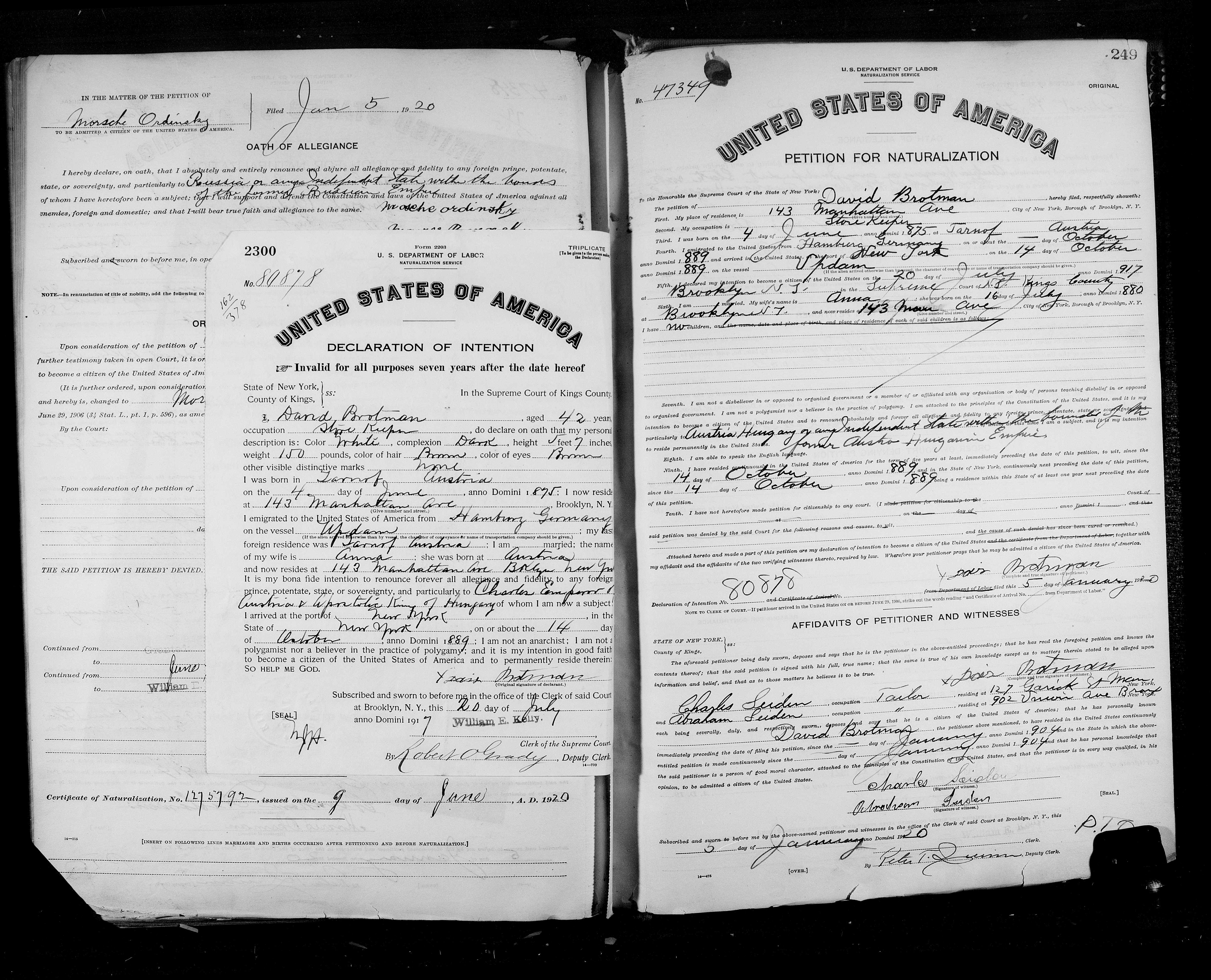
I do have David’s petition for naturalization in 1920, and it indicates that he had arrived in NYC on October 14, 1889, on the “Updam” from Tarnof, Austria.

David Brotman petition for naturalization 1920

David Brotman petition for naturalization 1920

Tarnof could be Tarnow, a city about fifty miles north of Tarnobrzeg/Dzikow and even further from Czchow, the two areas that I have been focusing on as the Brotman hometown based on Hyman’s listing of “Jeekief” and “Giga” on his documents.  But Tarnof could also be Tarnobrzeg, the larger town that is near Dzikow.  So did this new information help our search for our hometown in Galicia or did it just make it more confusing?

That led me to search for the ship manifest for David, now that I knew when he arrived and on what ship.  With some help from Renee, I located a September 4, 1889,  German ship manifest for the Portia, sailing to Rotterdam, listing Dawid Brodmann as a passenger.  I was excited to see that David was traveling with his older brother, Abe Brodmann. I had not previously been able to find Abraham on a ship manifest, so this was another exciting discovery.

David and Abe Brodmann on the Portia 1889

David and Abe Brodmann on the Portia 1889

On the Portia ship manifest, Abe and David are listed as coming from “Grambow, Russland,” not Austria at all, let alone Tarnow, Tarnobrzeg, Dzikow or Czchow.  I would have found this an indication that these were not the right boys, but there is a town right near Tarnobrzeg called Grebow, and according to a 1914 map, Tarnobrzeg was very close to the Russian border. So perhaps our family lived in Grebow? Or maybe that is where Joseph lived with Chaye and then moved to Dzikow when he married Bessie?

On the manifest for the Obdam, sailing from Rotterdam to New York arriving on September 19, 1889, David and Abe are listed as coming from Austria, not Russia, which appears to be correct.

David and Abe Brodman on the Obdam to New York 1889

David and Abe Brodman on the Obdam to New York 1889

There is obviously some confusion and conflict here, but it’s another clue and another place to look for the Brotman home in Galicia. I already have contacted several people researching this area to see if I can uncover more clues.

I have a few more leads to follow to fill in the gaps in David’s life story, and maybe they will even lead me to Sophie, the only remaining child of Joseph to locate.  There is also some potential evidence that will link our family to the Brotmanville Brotmans, but again, I need to do more research before it is worth speculating about that connection.

Enhanced by Zemanta