Where Are Those Missing Manifests? Sarah Goldschmidt Mansbach and Family

By 1870 many members of the Goldschmidt clan had left Germany and settled in Pennsylvania.  My four-times great-uncle Simon Goldschmidt and all his children had emigrated starting in the 1840s and were, for the most part, living in western Pennsylvania by 1870. 1 During this same period six of the eight children of my three-times great-grandparents Seligmann and Hincka (Alexander) Goldschmidt had settled in Philadelphia: Jakob, Levi, my great-great-grandmother Eva, Abraham, Meyer, and Rosa. They were all living in Philadelphia by 1870. Of Seligmann’s family, only Sarah and Bette were still in Germany as of 1870.

Sarah would also eventually join the family in the US, but only after her children had emigrated. In the 1870s and 1880s, all but one of Sarah’s eight surviving children2 came to the United States, and eventually so did Sarah and her husband Abraham Mansbach II. This is their story.

Although I cannot find passenger manifests for all them, it appears that the first to arrive was Merla/Amalie Mansbach, who sailed to the US in 1872 with Henry Schoenthal and his new wife Helene Lilienfeld, as I discussed here.3

Henry Schoenthal and Helene Lilienfeld 1872 ship manifest lines 95 to 98 with Amalie Mansbach
Year: 1872; Arrival: New York, New York; Microfilm Serial: M237, 1820-1897; Microfilm Roll: Roll 359; Line: 1; List Number: 484

I have no record of Amalie from the time of her arrival until the 1880 census, but I assume she must have been living in Pennsylvania, probably in Philadelphia, because according to the 1900 census, in 1879, she married Henry Langer. Henry was 22 years older than Amelia, born in 1831 in Austria; he had immigrated to the US in 1856, and in the 1870s he was living in Philadelphia, working as a furrier, according to the Philadelphia directory for 1870 and a newspaper listing in 1877.4
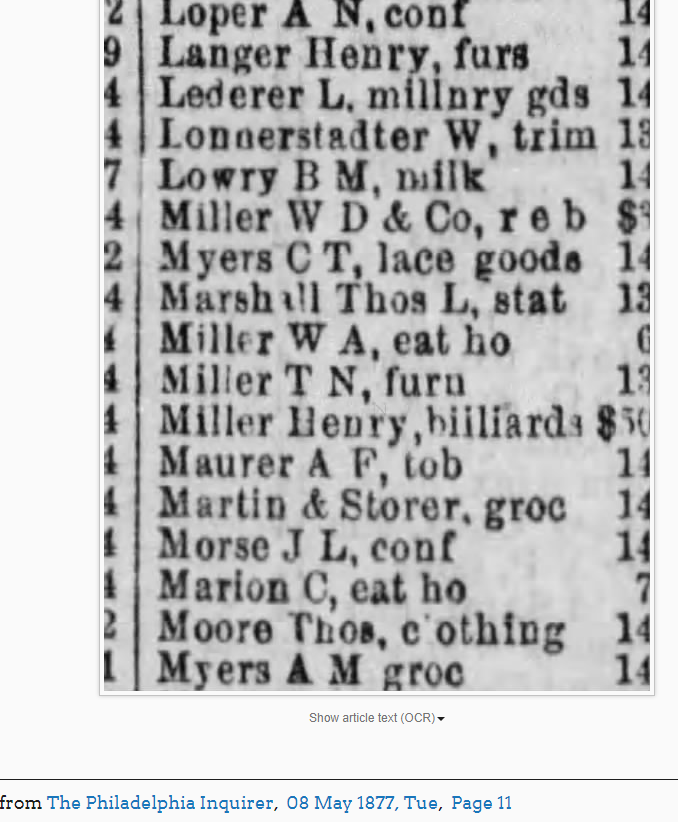
 

Amalie and Henry had relocated to Denver by December 17, 1879,5 when their first child, Joseph Henry Langer, was born. According to the 1880 census, Henry continued to work as a furrier in Denver:

H and A Langer and son 1880 census
Year: 1880; Census Place: Denver, Arapahoe, Colorado; Roll: 88; Page: 116C; Enumeration District: 005

I wondered what had drawn them to Denver. I couldn’t find any other Langers living there at that time, but I then discovered that Colorado had drawn other members of Amalie’s extended family, including her brother Berthold.

Berthold may have been the next child of Sarah and Abraham II to arrive from Germany; although I cannot find a passenger manifest for him, the 1920 census reports that he immigrated to the US in 1874.6 In 1877, he is listed in the Philadelphia directory working as a clerk.

Title: Philadelphia, Pennsylvania, City Directory, 1877
Source Information
Ancestry.com. U.S. City Directories, 1822-1995

But by 1880, he also had relocated to Trinidad, Colorado, where he was living with his cousin Abraham Mansbach V,  the grandson of Marum Mansbach I. Abraham V was a merchant, and Bert was working as a clerk, presumably in his cousin’s store.

Bert Mansbach 1880 census
Year: 1880; Census Place: Trinidad, Las Animas, Colorado; Roll: 92; Page: 65D; Enumeration District: 066

Abraham V had been living in Colorado for some time, as he was naturalized in Denver in 1873,7 so perhaps that was what had drawn his cousin Amalie and her husband Henry Langer to Denver by 1879.

But what had taken Abraham V to Trinidad, a town about 200 miles south of Denver? Looking at the population statistics for Trinidad, I noticed a huge population explosion between 1870, when there were 562 people residing there, and 1880, when there were 2,226.

According to the website Western Mining History:

Trinidad was incorporated in 1876 and became the supply and transportation center for the region’s coal mines. The coal from these mines was highly prized for its quality in creating coking fuels for Colorado’s smelters. As the mines and smelters of Colorado grew into a major industry, Trinidad prospered and became a wealthy commercial center full of stunning Victorian homes and buildings.

Trinidad, Colorado 1907
By Business_section_of_Trinidad,_Colorado.tif: Arthur Russell Allen derivative work: Ori.livneh (Business_section_of_Trinidad,_Colorado.tif) [Public domain], via Wikimedia Commons

Thus, Abraham Mansbach V and his cousin Berthold Mansbach must have chosen Trinidad as a place of great economic opportunity. As they say on that old commercial for Barney’s in New York City, all those people were going to need clothes.


UPDATE: Thanks to Sharon Haimovitz-Civitano of the Branches of our Haimowitz Family Tree and Branches on Civitano Tree blogs, I now have additional insights into why the Mansbachs ended up in Trinidad.  Those insights will be discussed in a later post, but in short, there were members of the extended Goldschmidt-Mansbach family living in Trinidad even before Berthold Mansbach and his cousin Abraham Mansbach V arrived.

But not all the Mansbach siblings chose to settle out west. Sarah and Abraham II’s oldest son Leiser/Louis Mansbach came to the US on December 16, 1876:

Louis (Lassor) Mansbach ship manifest
Year: 1876; Arrival: New York, New York; Microfilm Serial: M237, 1820-1897; Microfilm Roll: Roll 406; Line: 1; List Number: 1160
Ancestry.com. New York, Passenger Lists, 1820-1957


In 1880, he was living with my great-great-grandparents, Gerson Katzenstein and Eva Goldschmidt, who was his aunt, his mother Sarah’s sister. My great-grandmother Hilda, who was then sixteen, was also living at home and thus must have known her first cousin Louis quite well. Louis was 31 years old and was a veterinary surgeon.
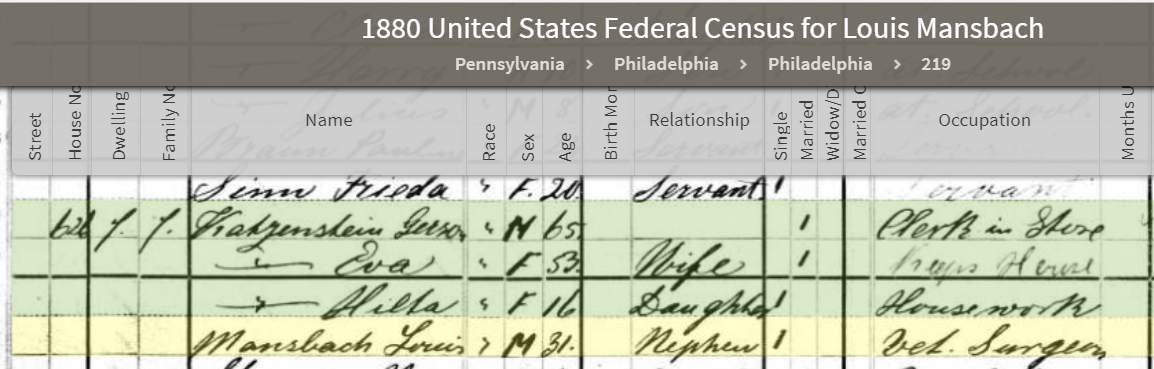
Louis Mansbach in the household of Gerson Katzenstein 1880 census
Year: 1880; Census Place: Philadelphia, Philadelphia, Pennsylvania; Roll: 1173; Page: 274B; Enumeration District: 219

This is the first veterinarian I’ve found in my family.  Formal education of veterinarians in the US was relatively new at that time as the first public veterinary school in the US wasn’t founded until 1879 in Iowa, and the University of Pennsylvania did not start its veterinary school until 1884. Louis may have arrived at just the right time.

I do not have ship manifests for three of the remaining children of Sarah Goldschmidt and Abraham Mansbach II, Hannah, Meyer, and Julius.  I have tried searching on Ancestry and FamilySearch; I tried using stevemorse.org and wild cards and various spellings and different date ranges. Nothing. For Julius, as discussed below, I even had a date of arrival and ship names from his later passport applications, but still—no manifest.  If anyone is willing to try with fresh eyes, I’d be very grateful. But for now I have to rely on other documents to estimate the dates of arrival for Hannah, Meyer, and Julius. Since none of these three appeared on the 1880 census, I am assuming they arrived sometime after the taking of that census in the spring of 1880.

For Hannah Mansbach, census records indicate three different years of arrival: 1880 on the 1900 census, 1881 on the 1920 and 1930 census records, and 1885 on the 1910 census. Usually I’d assume the one closest in time, the 1900 census, would be the most reliable, but at best I can say she arrived sometime between 1880 and 1885.  Since the rest of the family had arrived by 1882, I think 1880-1881 is more likely.8

Census records also conflict regarding the arrival date for Meyer Mansbach. The 1900 census reports that he arrived in 1879, but the 1910 and 1930 census records both report 1882 as his date of arrival.9

For Julius, as noted above, I found information about his arrival on his passport applications, of which there were three—in 1900, 1903, and 1908. All three provide the same date of arrival (June 12, 1881) and the same port of departure (Bremen), but all three have different names for the ship. The 1900 application says he sailed on the Elbe, the 1903 says the Weser, and the 1908 says the Werra.

Julius Mansbach 1900 passport application
National Archives and Records Administration (NARA); Washington D.C.; NARA Series: Passport Applications, 1795-1905; Roll #: 550; Volume #: Roll 550 – 07 May 1900-11 May 1900


Julius Mansbach 1903 passport application
National Archives and Records Administration (NARA); Washington D.C.; NARA Series: Emergency Passport Applications (Issued Abroad), 1877-1907; Roll #: 41; Volume #: Volume 075: Germany

Julius Mansbach 1908 passport application
National Archives and Records Administration (NARA); Washington D.C.; NARA Series: Passport Applications, January 2, 1906 – March 31, 1925; Roll #: 74; Volume #: Roll 0074 – Certificates: 64339-65243, 20 Nov 1908-15 Dec 1908

Julius obviously remembered more or less when he arrived (or maybe departed from Germany), but not the name of his ship. Taking the usual rule that the record made closest in time to an event may be the most reliable, I focused on manifests for the Elbe.

I found a manifest for the Elbe arriving in New York on July 8, 1881, with a passenger named Julius “Halsbach” aged 26 (so ten years older than Julius would have been). That seemed the closest match, and I could not find anything close in date or name on the Weser or the Werra.

Julius Mansbach possible manifest
Year: 1881; Arrival: New York, New York; Microfilm Serial: M237, 1820-1897; Microfilm Roll: Roll 439; Line: 1; List Number: 914
Ancestry.com. New York, Passenger Lists, 1820-1957

It thus seems reasonable to conclude that Hannah, Meyer, and Julius had all arrived by 1881. And so by 1881 all Sarah and Abraham’s eight living children except Kathinka had left Germany.

The following year on October 23, 1882, they were joined by their parents, my three-times great-aunt Sarah Goldschmidt and her husband Abraham Mansbach II, and their youngest daughter Kathinka. Also apparently sailing with them was a twelve year old girl named “Kath. Goldschmidt.” I have yet to identify who this was, but I assume she was the child of one of the Goldschmidt cousins still in Germany.

Abraham Mansbach II and family on passenger manifest
Year: 1882; Arrival: New York, New York; Microfilm Serial: M237, 1820-1897; Microfilm Roll: Roll 459; Line: 1; List Number: 1509


With that final arrival, all but one of the eight children and almost all the grandchildren of my three-times great-grandparents Seligmann Goldschmidt and Hincka Alexander were living the US. Only Bette Goldschmidt and her family were still in Germany.10 It must have been hard to leave Bette behind, but the choice to leave Germany was in the long run a fortunate one for the family of Seligmann and Hincka. And for all of us who are their descendants.

(A big thank you to Amberly Peterson Beck of The Genealogy Girl blog for her brilliant post, Tuesday’s Tip: Awesome & Easy Source Citations in WordPress, which explained how to create footnotes for source citations in an easy and quite useful way. This is my first post experimenting with this technique. Thank you, Amberly!)


  1. I will return to Simon’s family at a later time. For now I am focusing on my closest Goldschmidt relatives, the descendants of Seligmann and Hincka. 
  2. Two died in Germany, Jakob and Hedwig, as discussed in my earlier post
  3. There was also a second eighteen year old woman sailing with them with the same name—Amalie Mansbach. I believe the other Amalie was another relative of Abraham Mansbach II; she was the granddaughter of Marum Mansbach I and sister of Abraham Mansbach V. 
  4. Henry Langer on the 1900 US Census; Year: 1900; Census Place: Denver, Arapahoe, Colorado; Roll: 117; Page: 2;Enumeration District: 0031; FHL microfilm: 1240117′; Philadelphia, Pennsylvania, City Directory, 1870,
    Ancestry.com. U.S. City Directories, 1822-1995 
  5. Joseph Langer, Passport Application, National Archives and Records Administration (NARA); Washington D.C.; NARA Series: Passport Applications, January 2, 1906 – March 31, 1925; Roll #: 933; Volume #: Roll 0933 – Certificates: 122000-122249, 27 Sep 1919-28 Sep 1919 
  6. Berthold Mansbach, 1920 US Census, Year: 1920; Census Place: Albuquerque Ward 3, Bernalillo, New Mexico; Roll: T625_1074; Page: 3B; Enumeration District: 18 
  7. Abraham Mansbach, Naturalization, National Archives at Denver; Broomfield, Colorado; Naturalization Records, Colorado, 1876-1990; ARC Title: Naturalization Cards, 1880 – 1906; NAI Number: 1307044; Record Group Title: Records of the Immigration and Naturalization Service, 1787 – 2004 
  8. Hannah Mansbach on the 1900-1930 US Census records: Year: 1900; Census Place: Philadelphia Ward 20, Philadelphia, Pennsylvania; Roll: 1463; Page: 9; Enumeration District: 0425;FHL microfilm: 1241462; Year: 1910; Census Place: Philadelphia Ward 29, Philadelphia, Pennsylvania; Roll: T624_1399; Page: 2B; Enumeration District: 0692; FHL microfilm: 1375412; Year: 1920; Census Place: Philadelphia Ward 29, Philadelphia, Pennsylvania; Roll: T625_1633; Page: 2A; Enumeration District: 969; Year: 1930; Census Place: Philadelphia, Philadelphia, Pennsylvania; Roll: 2125; Page: 6B; Enumeration District: 0778; FHL microfilm: 2341859 
  9. Meyer Mansbach on 1900-1930 US Census records: Year: 1900; Census Place: Trinidad, Las Animas, Colorado; Roll: 126; Page: 13B; Enumeration District: 0064; FHL microfilm: 1240126; Year: 1910; Census Place: Philadelphia Ward 29, Philadelphia, Pennsylvania; Roll: T624_1399; Page: 2B; Enumeration District: 0692; FHL microfilm: 1375412; Year: 1930; Census Place: Los Angeles, Los Angeles, California; Roll: 136; Page: 3A; Enumeration District: 0108; FHL microfilm: 2339871 
  10. As Bette married her first cousin Jakob Goldschmidt (yes, another one), the son of her father’s brother Lehmann, I will return to her story when I discuss the Goldschmidt family members who stayed in Germany, including Lehmann and many of his descendants. 

More Goldschmidts Become Goldsmiths in Philadelphia

In my last post we saw how my three-times great-uncle Jacob Goldsmith came to the United States and settled in Philadelphia by 1850, then married and had seven children in the 1850s and 1860s.  He also established a retail clothing business on Market Street.

But Jacob was not the only child of Seligmann and Hincka to come to the US as early as the 1850s. His younger brother Abraham was the second of Seligmann and Hincka’s children to come to the US. Abraham was born in March 13, 1832:

Birth record of Abraham Goldschmidt
Geburtsregister der Juden von Oberlistingen (Breuna) 1826-1852 (HHStAW Abt. 365 Nr. 668)AutorHessisches Hauptstaatsarchiv, Wiesbaden, p. 4

Abraham arrived in the US on August 21, 1850, listing his occupation as a merchant:

Abraham Goldschmidt passenger manifest 1850
Year: 1850; Arrival: New York, New York; Microfilm Serial: M237, 1820-1897; Microfilm Roll: Roll 091; Line: 1; List Number: 951


On January 17, 1858, he married Cecelia Adler in Philadelphia.  Cecelia was the daughter of Samuel Adler and Sarah Kargau, and she was born on November 26, 1838, in Würzberg, Germany. She and her parents had immigrated to the US by 1850 and settled in Philadelphia where her father was a merchant.

Marriage record of Abraham Goldschmidt and Cecelia Adler
Historical Society of Pennsylvania; Philadelphia, Pennsylvania; Historic Pennsylvania Church and Town Records; Reel: 792
Organization Name: Congregation Rodeph Shalom
Ancestry.com. Pennsylvania and New Jersey, Church and Town Records, 1669-2013

In 1860, Abraham and Cecelia were living in Philadelphia, where Abraham was a clothier with $15,000 worth of personal property. That he amassed that much money so quickly indicates to me that he must have been either a very successful business person, or either his parents or his in-laws provided a substantial financial cushion. Note that Abraham, like his brother Jacob, had Americanized his name from Goldschmidt to Goldsmith.

Abraham and Cecelia (Adler) Goldsmith 1860 census
Year: 1860; Census Place: Philadelphia Ward 13, Philadelphia, Pennsylvania; Roll: M653_1163; Page: 914; Family History Library Film: 805163

Abraham and Cecelia had six children between 1861 and 1870: Milton (1861), Hildegard (1862), Edwin (1864), Rose (1866), Emily (1868), and Estelle (1870).  In 1870, Abraham now claimed he had $25,000 worth of real estate and $20,000 worth of personal property.  He continued to be in the clothing business. Cecelia’s parents were also living with Abraham and Cecelia and their six children in 1870, as well as three domestic servants [shown on the next page of the census].

Abraham Goldsmith and family 1870 census
Year: 1870; Census Place: Philadelphia Ward 12 District 35, Philadelphia, Pennsylvania; Roll: M593_1396; Page: 133B; Family History Library Film: 552895

Thus, like his older brother Jacob, Abraham was quite well-settled in Philadelphia by 1870.

The youngest son of Seligmann and Hincka, Meyer, was the third brother to immigrate. He was born October 25, 1834, apparently registered with the name Rafael. I still believe that this was the same child later known as Meyer, based on his age on several US records and the fact that the 1900 census says that he was born in October 1834, and there is no other birth registered to Seligmann Goldschmidt and Hincka Alexander for that month and year.

Birth record of Rafael/Meyer Goldschmidt 1834
Geburtsregister der Juden von Oberlistingen (Breuna) 1826-1852 (HHStAW Abt. 365 Nr. 668)AutorHessisches Hauptstaatsarchiv, Wiesbaden, p. 5

Meyer arrived in the US on July 8, 1852. He was seventeen years old.

Meier Goldschmidt passenger manifest
Year: 1852; Arrival: New York, New York; Microfilm Serial: M237, 1820-1897; Microfilm Roll: Roll 116; Line: 1; List Number: 895

According to the 1900 census, in 1859, Meyer married Helene Hohenfels, daughter of Jordan and Adelaide Hohenfels, all of whom had emigrated from Germany to the US by 1850. Meyer and Helene’s first child Eugene was born on October 6, 1859, in Newton, New Jersey, which is about 100 miles north of Philadelphia and sixty miles west of New York City.

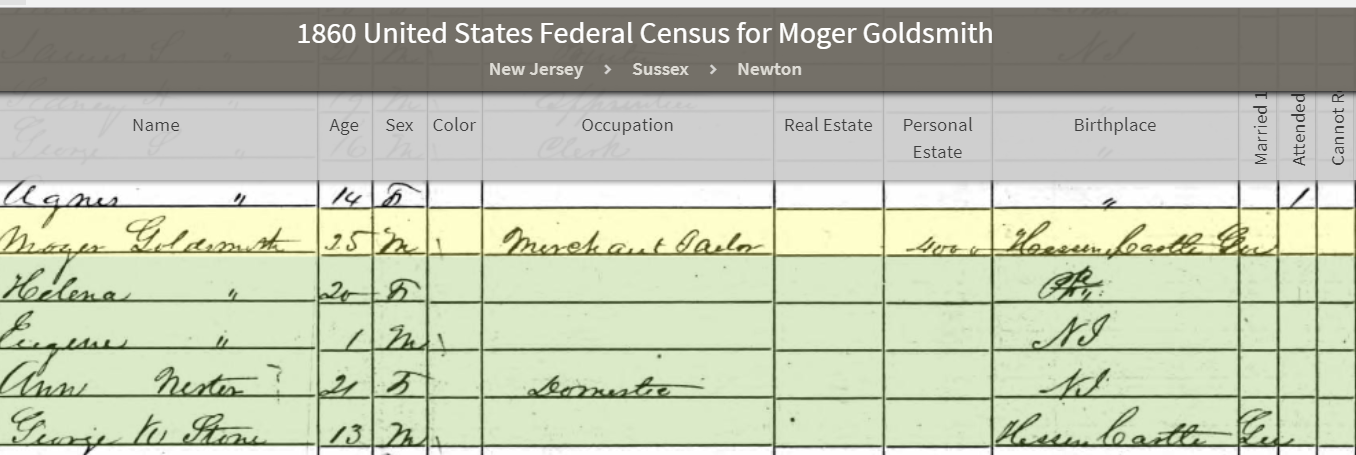
In 1860 Meyer, Helene, and Eugene were living in Newton; Meyer was working as a “merchant tailor” and had $4000 worth of personal property. Also living with them were a servant and a thirteen year old boy named George Stone from the Hesse region, whose relationship to the family I’ve not determined. Like Jacob and Abraham, Meyer had changed the spelling of his surname to Goldsmith.

Meyer Goldsmith and Helene Hohenfels 1860 census
Year: 1860; Census Place: Newton, Sussex, New Jersey; Roll: M653_709; Page: 605; Family History Library Film: 803709


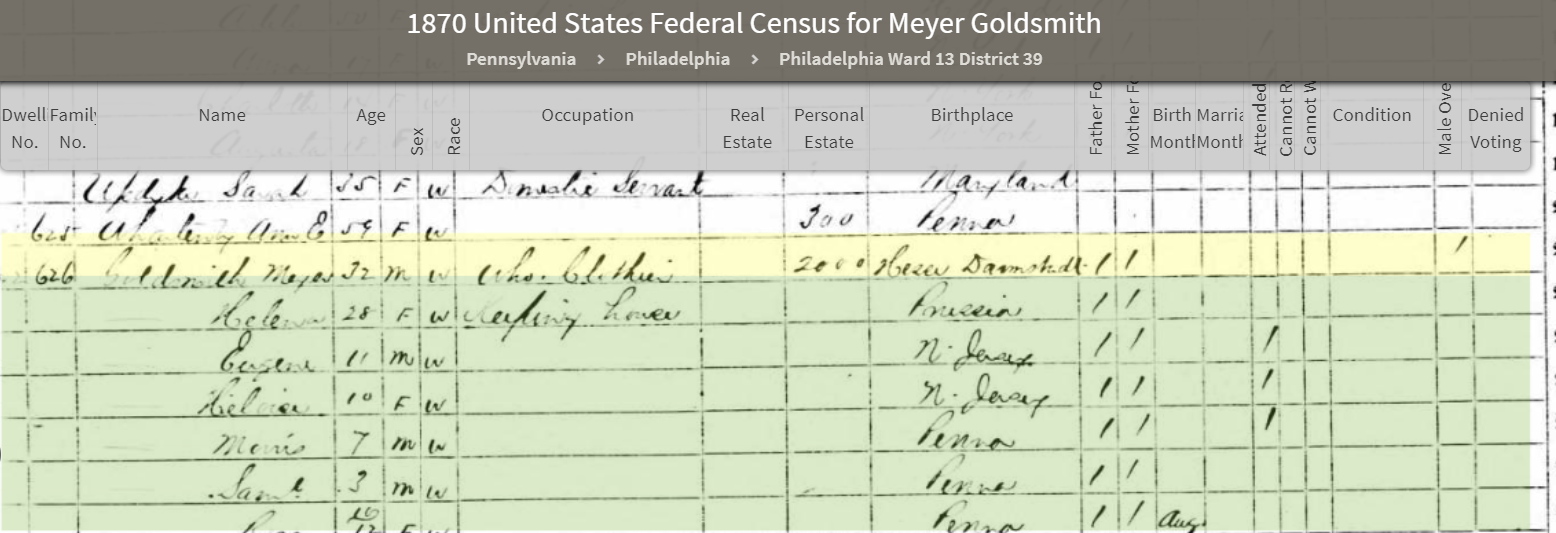
By 1863 or so, Meyer and his family had relocated to Philadelphia where his siblings were living. On the 1870 census, you can see that while his first two children were born in New Jersey, the third, who was seven in 1870, was born in Pennsylvania.  By 1870 Meyer and Helene had five children: Eugene (1859), Heloise (1860), Maurice (1863), Samuel (1867), and Rosa (1869). Meyer was working as a wholesale clothier and claimed $2000 in personal property. (I guess all those children ate into the $4000 worth of savings they’d had in 1860!) A sixth child, Florence, would be born in 1872.

Meyer Goldsmith 1870 census
Year: 1870; Census Place: Philadelphia Ward 13 District 39, Philadelphia, Pennsylvania; Roll: M593_1397; Page: 465A; Family History Library Film: 552896


Levy, the second oldest son of Seligmann and Hincka, was the next to come to the US. He was born November 10, 1824. He arrived in the US on September 20, 1853, and also settled in Philadelphia.

Levy Goldschmidt passenger manifest
Year: 1853; Arrival: New York, New York; Microfilm Serial: M237, 1820-1897; Microfilm Roll: Roll 132; Line: 1; List Number: 991

Two years after arriving he married Henryetta Lebenbach in Philadelphia on March 21, 1855.

Marriage record of Levy Goldschmidt and Henryette Lebenbach
Historical Society of Pennsylvania; Philadelphia, Pennsylvania; Historic Pennsylvania Church and Town Records; Reel: 792

In 1860, they were living in Philadelphia with two daughters, Eva (1856) and Estella (1859). He claimed $7,000 worth of personal property, and like his brothers, was now using the surname Goldsmith. Interestingly, he also seems to have changed the spelling of his first name from Levy to Levi. It looks like Henryette had also adopted a new spelling of her name—Henrietta.

Levi Goldsmith and family 1860 census

Levi was, like his three brothers, in the clothing business. A search of the Philadelphia directories for these years revealed that at least Abraham and Levi were in business together.

Title: Philadelphia, Pennsylvania, City Directory, 1862
Source Information
Ancestry.com. U.S. City Directories, 1822-1995

Goldsmiths in the 1866 Philadelphia directory
Title: Philadelphia, Pennsylvania, City Directory, 1866
Source Information
Ancestry.com. U.S. City Directories, 1822-1995

I say “at least” Abraham and Levi were in business together because I think it’s possible that Jacob was also in the same business.  If you compare these two directory listings, one in 1862, one on 1866, you can see that whereas in 1862 Jacob was at 335 Market Street and Levi and Abraham at 532 Market Street, in 1866 they’d reversed—Jacob was at 532 and Levi and Abraham at 335.

By 1870, Levi (here spelled Levy) and Henrietta had seven children. After Eva and Estella came George (1861), Felix (1862), Helen (1865), Blanche (1868), and Sylvester (1869). Levy reported that he was in the wholesale clothing business and that he had $25,000 in real estate and $50,000 in personal property. He obviously was doing quite well.

Levy Goldsmith and family 1870 census
Year: 1870; Census Place: Philadelphia Ward 20 District 64, Philadelphia, Pennsylvania; Roll: M593_1406; Page: 293B; Family History Library Film: 552905


Although by 1853, all four sons of Seligmann Goldschmidt and Hincka Alexander had thus left Germany for the United States, their four sisters—Sarah, Bette, Eva, and Rose—were still in Germany at that point. But soon enough two of them also would come to the US.

In 1856 my great-great-grandmother Eva Goldschmidt arrived with her husband Gerson Katzenstein, and they, too, settled in Philadelphia, as I’ve written about previously. They came with their three oldest children: Scholum (1848), Jacob (1851), and Brendina (1853). And as noted before, traveling with them were some of the children of Gerson’s sister Hannchen Katzenstein Mansbach, who were also cousins to the children of Eva Goldschmidt’s sister Sarah Goldschmidt Mansbach. As already described, Eva and Gerson would have three more children in the US: Perry (1856), Hannah (1859), and my great-grandmother Hilda (1863).

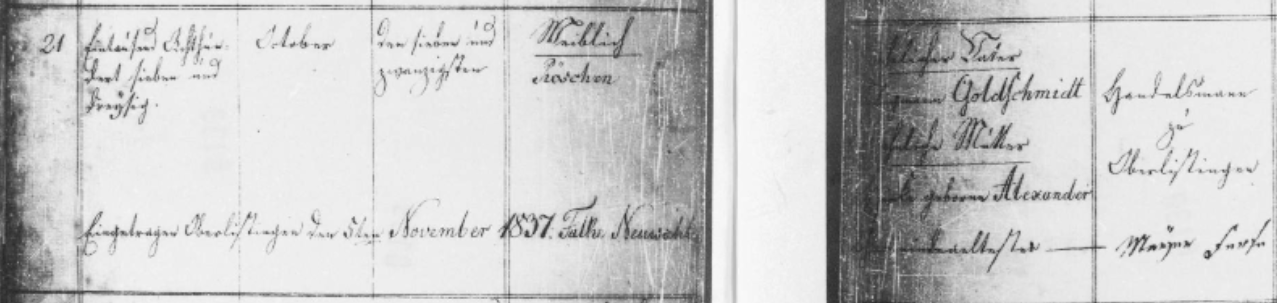
Seligmann and Hincka’s youngest child, Roschen or Rosa, was born on October 27, 1837.

Birth record of Roschen Goldschmidt
Geburtsregister der Juden von Oberlistingen (Breuna) 1826-1852 (HHStAW Abt. 365 Nr. 668)AutorHessisches Hauptstaatsarchiv, Wiesbaden, p. 9

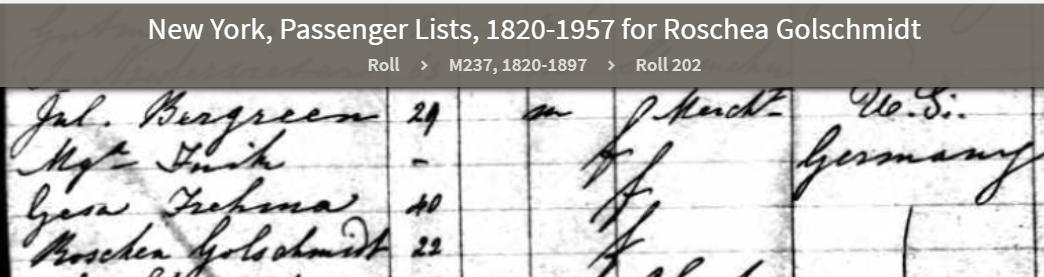
She arrived in the US on July 9, 1860:

Roschen Goldschmidt passenger manifest
Year: 1860; Arrival: New York, New York; Microfilm Serial: M237, 1820-1897; Microfilm Roll: Roll 202; Line: 1; List Number: 597


On January 20, 1864 she married Bernhardt Metz, another German immigrant. They would have four children between 1865 and 1870: Hattie (1865), Paul (1867), Emily (1869), and Bertha (1870). In 1870, they were living in Philadelphia where Bernhardt was a cloak manufacturer. He claimed $10,000 of real estate and $2000 of personal property:

Bernhardt and Rosa (Goldschmidt) Metz 1870 census
Year: 1870; Census Place: Philadelphia Ward 20 District 66, Philadelphia, Pennsylvania; Roll: M593_1407; Page: 438B; Family History Library Film: 552906

Thus, by 1860, all but two of  Seligmann and Hincka’s children had emigrated to the US, and by 1870, those in the US were all living in Philadelphia and married with children; all the sons were working in the clothing industry.

Only two siblings were still in Germany: Sarah, the oldest daughter, and Bette/Biele.  After 1870,  the children of Sarah Goldschmidt and her husband Abraham Mansbach II would also begin to emigrate, followed by Sarah and Abraham themselves in 1882, as discussed in my next post.

Another Jakob Goldschmidt Comes to America

As I wrote in my last post, the earliest Goldschmidts to leave Germany and come to the US were the family of Simon Falcke Goldschmidt, brother of my three-times great-grandfather Seligmann Goldschmidt. Simon had arrived in 1845 with his second wife, my three-times great-aunt Fradchen Schoenthal, and by 1860 he and all his children including those from his first wife Eveline were living in western Pennsylvania, most of them in Washington, Pennsylvania.

During this same period, almost all the children of my three-times great-grandparents Seligmann Goldschmidt and Hincka Alexander were also emigrating, though they chose to settle in Philadelphia, about 300 miles east of their relatives in the western part of the state.

The first of Seligmann and Hincka’s children to arrive was their oldest son Jakob. Jakob was born on October 22, 1822, making him about three years older than his first cousin, Simon’s son, also named Jakob Goldschmidt; both cousins changed their names to Jacob Goldsmith once in the US. To make matters even more confusing, both Jacobs married women named Fannie.  Maybe Seligmann’s Jacob chose to settle in Philadelphia and Simon’s across the state to minimize confusion for some not-yet-born family historian?[1]

To distinguish the two Jacob Goldsmiths I will refer to Seligmann’s son as Uncle Jacob as he was my three-times great-uncle, and I will refer to Simon’s Jacob as Cousin Jacob, as he was my first cousin, four times removed.

Uncle Jacob must have arrived in the US before 1849 because by that time he had married Fannie, and they had had their first child, a daughter named Caroline born on May 7, 1849, in Pennsylvania. In 1850 Uncle Jacob was working as a merchant:

Jacob Goldsmith (Seligmann’s son) and family 1850 census

I could not find Uncle Jacob on the 1860 census at all, but he and Fannie must have been living in Philadelphia in the 1850s and 1860s because they had several more children born there between 1850 and 1860: Emma (1851), Hannah (1855), Philip (1856), and Harry (1858). Their sixth child, Huldah, was born in 1861. (Pennsylvania, Philadelphia City Births, 1860-1906,” database with images, FamilySearch (https://familysearch.org/ark:/61903/1:1:V1M9-7GF : 8 December 2014), Hulda Goldsmith, 18 Jan 1861; citing bk 1 p 252, Department of Records; FHL microfilm 1,289,306.)

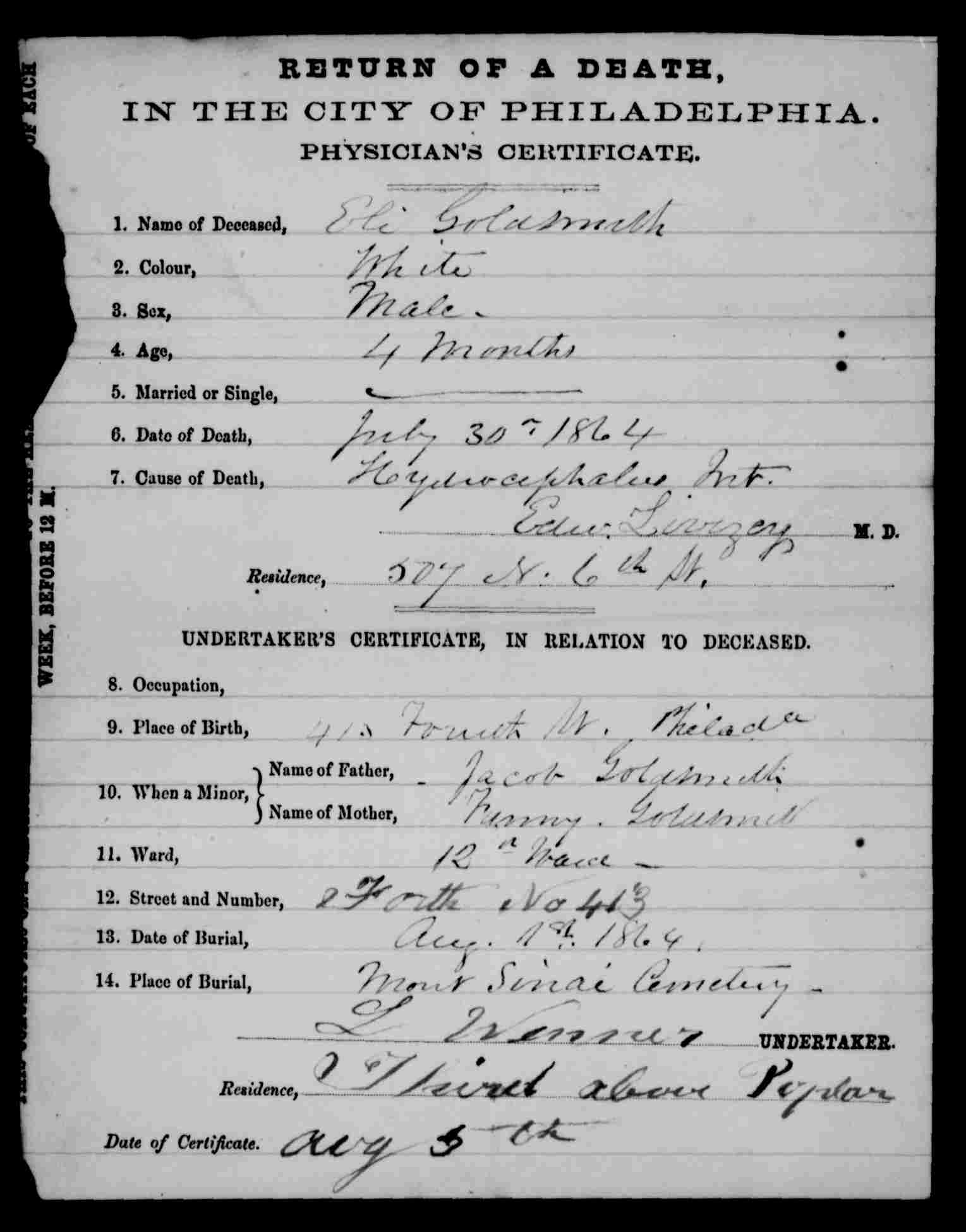
One more child was born to Jacob and Fannie in March 1864, a boy named Eli.  Sadly, he died when he was four months old of hydrocephalus internus,

Eli Goldsmith death record “Pennsylvania, Philadelphia City Death Certificates, 1803-1915,” database with images, FamilySearch (https://familysearch.org/ark:/61903/3:1:S3HT-DHR6-H?cc=1320976&wc=9F5Z-T3D%3A1073282601 : 16 May 2014), 004010010 > image 197 of 1250; Philadelphia City Archives and Historical Society of Pennsylvania, Philadelphia.

Searching the Philadelphia newspapers for 1860-1870, I found this little news item about a donation made by Jacob Goldsmith to support the soldiers fighting in the Civil War; based on Jacob’s business address in the 1862 Philadelphia Directory (338 Market Street, which is at the corner of 4th Street), I am reasonably certain that this refers to my uncle Jacob Goldsmith.

“Soldiers Mittens, ” Philadelphia Public Ledger, November 26, 1861.


I also found an 1868 advertisement for Jacob’s clothing store, which had moved by then to 624 Market Street:

Ad for Jacob Goldsmith’s store
Philadelphia Public Ledger, October 28, 1868

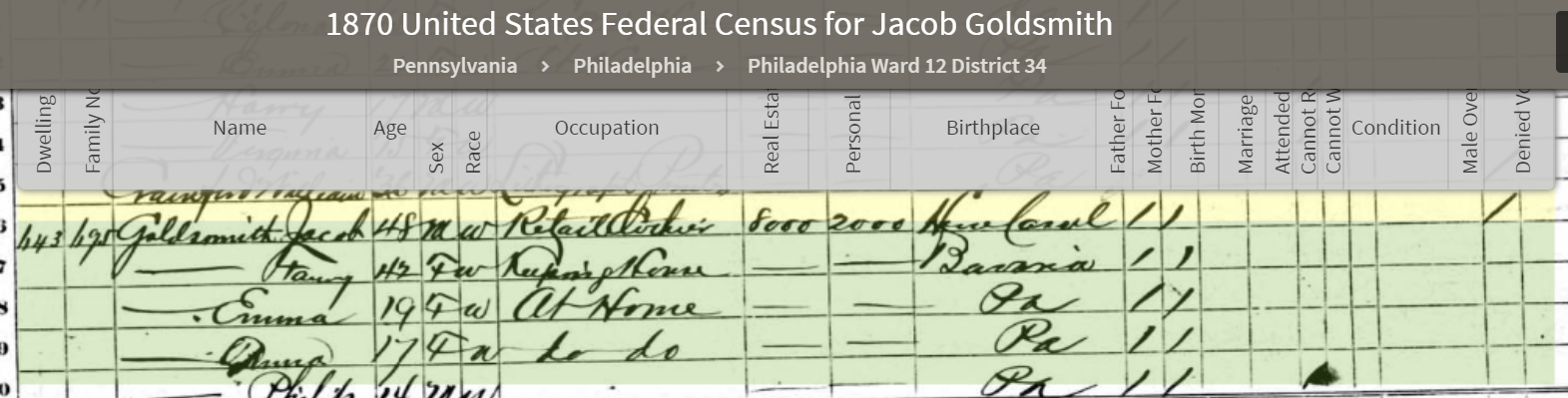
On the 1870 census, Jacob and Fannie were living with their five younger children. Jacob was working as a merchant and claimed he owned $8000 worth of real property and $2000 worth of personal property.

Jacob Goldsmith (Seligmann’s son) and family 1870 census
Year: 1870; Census Place: Philadelphia Ward 12 District 34, Philadelphia, Pennsylvania; Roll: M593_1396; Page: 114A; Family History Library Film: 552895

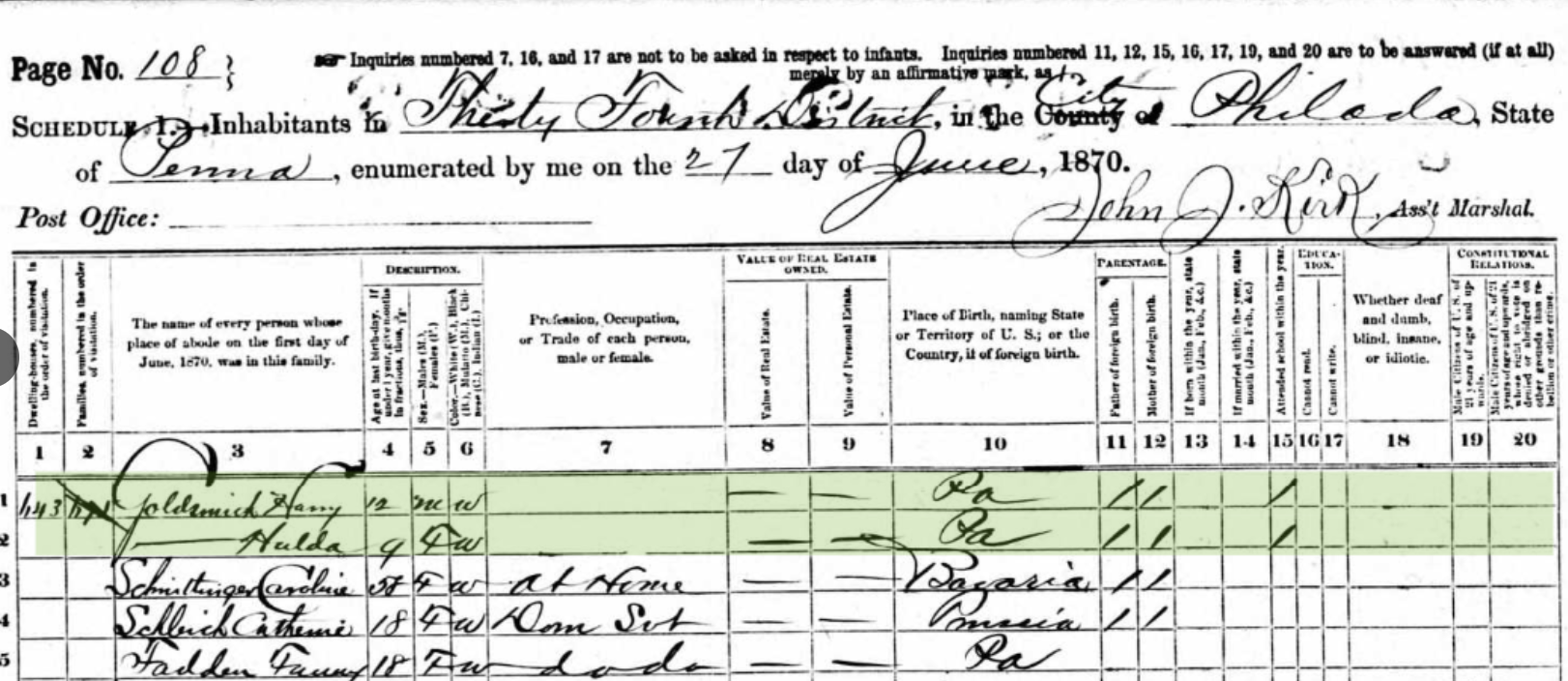
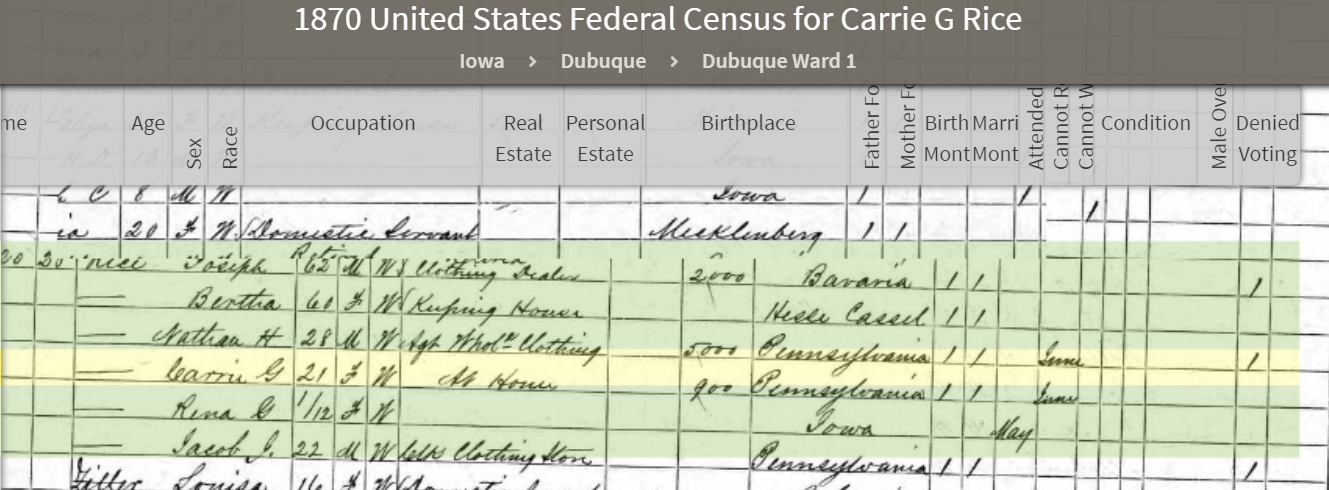
Their oldest daughter Caroline was no longer living at home in 1870, having married Nathan Rice in 1869; Nathan was born in Philadelphia in 1842 to German immigrant parents, Joseph Reiss and Elizabeth/Betsy Kohn (the spelling was later changed to Rice). In 1870 Nathan and Caroline were living in Dubuque, Iowa, with Nathan’s parents, and Nathan was working as an agent for a wholesale clothing company. His father’s occupation was “retired clothing dealer,” so perhaps Nathan was working in his father’s former business. Caroline and Nathan’s first child, Rena, was born in Iowa in the spring of 1870 and was one month old on June 1 when the census was taken.

Caroline Goldschmidt and Nathan Rice on 1870 census
Year: 1870; Census Place: Dubuque Ward 1, Dubuque, Iowa; Roll: M593_389; Page: 61A; Family History Library Film: 545888

Thus, Uncle Jacob was well established in Philadelphia by 1870 with a large and growing family. He also was joined by several of his siblings during this time, as we will see in my next post.


[1] That separation did not last, however. By 1870 Cousin Jacob had moved from Washington to Philadelphia. I spent an entire day trying to decipher which Jacob was which on the 1870 and 1880 census records since both were living in Philadelphia, both had wives named Fannie, both were in the clothing business, and both had many children, including several with the same names. It was a long day!

Walking in Their Footsteps

About two months ago we did a crazy thing.  We drove five and a half hours from western Massachusetts to Philadelphia and spent just 24 hours in the City of Brotherly Love before turning around and returning home.

So how did this crazy thing happen? I had received an email from my third cousin Jan Sluizer. Her great-grandmother Elizabeth Cohen was the sister of my great-grandfather Emanuel Cohen.  We are both the great-great-granddaughters of Jacob Cohen and the three-time great-granddaughters of Hart Levy Cohen.  Jan lives now in California, but she grew up in Philadelphia and was coming east for a high school reunion.  She wanted to know if we could get together.

For several years I have wanted to visit Philadelphia—the place where my earliest American ancestors came in the 1840s, the place where my father was born and raised. Of course, I’d been to Philadelphia many times growing up to visit my grandmother and my aunt.  But I’d never seen where my ancestors lived or were buried. I’d never even seen the places where my father had lived. In fact, I’d never seen Independence Hall or the other historic sights in Philadelphia.

Philadelphia, City Hall

I knew that to do everything I wanted to do, I’d need more than 24 hours. But it has been a hectic fall with far too many weekends away from home.  The most we could do was get there on Saturday and leave on Sunday. And to top it off, a major storm was predicted for Sunday, meaning we’d have to hit the road even earlier than we had once hoped.

It was indeed crazy. But I am so glad we did it.

In the hours we had on Saturday, I managed to accomplish a few of the things I’d wanted to do. First, we took a tour of all the places where my Philadelphia ancestors had lived, starting with my great-great-grandparents Jacob Cohen and Sarah Jacobs and my three-times great-grandparents John Nusbaum and Jeanette Dreyfuss all the way to the last place my father lived in Philadelphia before moving to New York and marrying my mother in 1951.  Here in the order in which my family occupied these places (though not in the order we saw them) are my photographs from that day.

Jacob Cohen lived for many years at 136 South Street. His pawnshop was nearby. And this is where he and my great-great-grandmother Sarah Jacobs raised their thirteen children, including my great-grandfather Emanuel.  I do not think these are the same buildings that were there in the in the mid=19th century, but this is the street where they lived.

136 South Street, where Jacob Cohen and Sarah Jacobs raised their children

South Street, looking towards the river

For decades the Cohens lived in this neighborhood where many of the German Jewish immigrants lived.

But my other early-arriving ancestor John Nusbaum lived on the north side of Philadelphia during this same period at 433 Vine Street and 455 York Street. We drove down these streets, but again the buildings that were there in the era are long gone, and I didn’t take any photographs here. It was mostly warehouse buildings and abandoned or run-down buildings.

Since my Nusbaum ancestor was a successful merchant, I imagine that in his time this area was quite desirable, in fact more desirable than area south of the city where the Cohens lived.  Today, however, the South Street neighborhood is quite chic and inhabited by young professionals and clearly more desirable than the neighborhood where the Nusbaums lived.

Although my great-great-grandparents Bernard Seligman and Frances Nusbaum lived almost their whole married life in Santa Fe, their last years were spent in Philadelphia at 1606 Diamond Street. Bernard died in 1903, and Frances in 1905.  During that same period Bernard’s daughter Eva Seligman Cohen, my great-grandmother, and my great-grandfather Emanuel Cohen were also living on Diamond Street. That neighborhood is also in North Philadelphia.  Here is a Google Streetview of that street today. I don’t think these were the buildings that were there in the early 1900s, but I am not sure.

I had better luck as I moved further into the 20th century.  In 1920 Emanuel Cohen and Eva Seligman Cohen, my great-grandparents, were living on Green Street close to what is now the downtown district of Philadelphia.  It is a lovely tree-lined street with cafes and historic brick townhouses in what is clearly a gentrified neighborhood. I wonder what it was like when my great-grandparents and my grandfather John Cohen lived there in 1920.

2116 Green Street—where in 1920 my great-grandparents Emanuel and Eva Seligman Cohen lived as well as my grandfather John Nusbaum Cohen

We did not have time to get to the West Oak Lane neighborhood in North Philadelphia where my father lived with his parents in 1930 at 6625 North 17th Street, so that’s on my list for when we return.But here is a Google Streetview shot of that street:

6600 block of North 17th Street, Philadelphia

I did find the apartment building where my father and aunt were living with their grandmother Eva Seligman Cohen in 1939 when she died. It is in the downtown area of Philadelphia and still called the Westbury Apartments.

Westbury Apartments on 15th Street where my great-grandmother Eva Seligman Cohen lived with my father and aunt in 1939

In 1940, my father, aunt, and grandmother were living in North Philadelphia at 106 Venango Street.  That building is no longer there unfortunately.  It is now a commercial area with warehouses and factory-like buildings.

But In 1950 they were living on North 21st Street in this building—another lovely tree-lined street not far from the center of the city.

North 21 Street in Philadelphia where my father, aunt, and grandmother lived in 1950

136 North 21st Street, my father’s home in 1950

Touring the city this way was enlightening because it provided some insights into the patterns of gentrification and how they have changed since 1850.  My ancestors for the most part started in the southern part of the city and as they moved up the economic ladder, they moved north of the city to an area that was newer, less crowded, and more “gentrified.” But today that pattern has reversed. Young professionals want to live close to downtown and have returned to the neighborhoods closest to the center of the city like Green Street and South Street.  The neighborhoods around Venango Street and Diamond Street were long ago abandoned by those moving out to the suburbs in the post-World War II period and are now depressed sections of the city.

After a visit to the National Museum of American Jewish History and the Liberty Bell and a walk along Market Street, we met Jan for dinner in the area known as Rittenhouse Square, another gentrified neighborhood with lots of boutiques, bars, and restaurants. Meeting Jan was a delight. We had long ago connected by email when Jan shared all the stories about her father Mervyn Sluizer, Jr., and her grandfather Mervyn, Sr., and the rest of her family. Now we were able to meet face to face, share a meal together, and connect on a deeper level than email allows.

Independence Hall

The Liberty Bell

The following day the rain began, but I was determined to try and see where my ancestors were buried. Our first stop was Mikveh Israel synagogue, where we met Rabbi Albert Gabbai, who took us to the second oldest Jewish cemetery in Philadelphia. Mikveh Israel has been in Philadelphia since before the American Revolution and was where my earliest Cohen ancestors belonged. It was then located about a mile from 136 South Street where Jacob Cohen lived. Although the original building is long, long gone, the synagogue still is in that same neighborhood, now on North 4th Street.  According to the rabbi, it now attracts empty nesters who have moved into downtown Philadelphia. Another example of urban gentrification. Jews who long ago left downtown are now returning in their later years.

Rabbi Gabbai drove us to the Federal Street cemetery, the second oldest Jewish cemetery in Philadelphia, where he patiently and generously guided us with a map to see the gravestones of Jacob and Sarah Cohen as well as the location of Hart Levy Cohen’s grave (his stone has either sunk into the ground or otherwise disappeared).

Federal Street cemetery of Congregation Mikveh Israel

Location of Hart Levy Cohen’s grave. My 3x-great-grandfather

Jacob and Sarah’s grave is marked by one of the largest monuments in the cemetery:

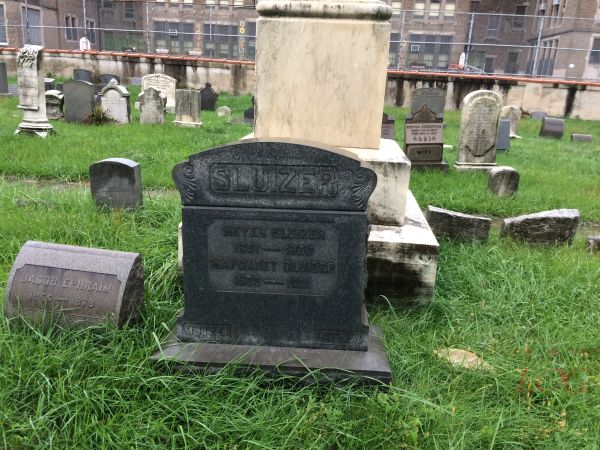
While we walked through the cemetery, I also spotted the stones for Jan’s other great-great-grandparents, Bernard and Margaret Sluizer, and her three-times great-grandmother Jeanette Sluizer. I was very touched when I realized that Bernard and Margaret Sluizer are buried in the plots that abut Jacob and Sarah’s plots.

Grave of Meyer and Margaret Sluizer

I also found a stone for Joseph Jacobs, my 3-times great uncle, brother of Sarah Jacobs Cohen.

Joseph Jacobs, brother of Sarah Jacobs Cohen

Unfortunately, it was pouring by this time, and I could not find any small stones to put on the gravestones to mark my visit, which left me feeling as if I’d let my ancestors down.

After leaving Rabbi Gabbai, we drove north to the two other Philadelphia cemeteries where my ancestors are buried: Mount Sinai and Adath Jeshurun.  Fortunately they are located right next to each other, and I had carefully written down the location of the graves I wanted to visit at Mount Sinai from the records I found on Ancestry. (I did not have that information for Adath Jeshurun, but only a few ancestors are buried there as compared to Mount Sinai.)

Unfortunately, despite my good planning, I had no luck. There was no office and no one at the cemetery; there was no map posted of the cemetery. And there were no obvious markings in the cemetery identifying sections or plots. And it was pouring.

My ever-patient husband sat in the car and drove slowly around as I walked up and down the drives and walkways with an umbrella and in my orthopedic boot,[1] looking for Cohens, Nusbaums, Katzensteins, Schoenthals, and Seligmans.  This was the only one I could find for any of my known relatives:

Simon Schoenthal and family at Mt Sinai cemetery in Philadelphia

This is the stone for Simon Schoenthal, my great-grandfather’s brother, and his wife Rose Mansbach, who was also related to me by the marriage of her cousin Marum Mansbach to my great-great-grandfather Gerson Katzenstein’s sister Hannchen. It also marks the burial place of two of their children, Martin and Harry, as well as Harry’s wife Esther, and their son Norman. I was delighted that I had found this marker, but nevertheless disappointed that I could not find the place where my grandfather John Cohen is buried along with his parents, Emanuel Cohen and Eva Seligman. Nor did I find any of the others I had been hoping to visit.

From there we headed home, leaving Philadelphia exactly 24 hours after we’d arrived. It was a wet and long trip home, but I still was glad we had made this whirlwind visit. I was able to meet Jan, I saw places where my ancestors lived and are buried, and we were introduced to the city where so many of my relatives have lived. It was not enough, so we will have to return. Next time we will need to spend at least 48 hours!


[1] I had broken my ankle a few weeks before the trip. It’s better now.

A Year with the Katzensteins

Hilda Katzenstein Schoenthal, my great-grandmother

When I finish (as much as we ever finish) telling the story of a particular family line, I always have mixed feelings. In some ways I feel a sense of relief—I’ve accomplished my goal. It feels good to know that I’ve covered to the best of my ability the story of my direct ancestors and their descendants in that family as well as the stories of their siblings and their descendants.

But it is also in some ways bittersweet. Each family brings its own color and depth to my family history, and each time I’ve been so fortunate to find living descendants—people who share that history, but know it from a different perspective. As I move away from that story, it feels like leaving a family after a long visit.  You’ve just gotten to know them, and now it’s time to move on. Not that I ever forget, and I always try and stay connected with the cousins I’ve found, but my focus shifts. So it’s a separation, and those are always bittersweet.

I have been studying the Katzenstein family for over a year now, starting with my great-great-grandfather Gerson and his descendants and then on to each of his siblings and their stories. I have found and in some cases met wonderful new cousins—many cousins who descend from Gerson’s sister Rahel and her husband Jacob Katz and who settled in Kentucky and Oklahoma and Nebraska.

Abraham Katz and family c. 1906
courtesy of the Katz family

Jake Katz
Photo found in Stanley Tucker Whitney Houston, Stillwater (Arcadia Publishing 2014), p. 38

There were the descendants of Hannchen Katzenstein Mansbach who lived in West Virginia and Maryland. These are all places where I never imagined I had cousins.

Some of those cousins came as children from Germany with their parents to escape Hitler. Some ended up in the US, others in South America, South Africa, and Israel.

Front row: Eva Baumann, Fred Abrahams, Martin Abrahams, Margot Baumann. Courtesy of Martin Abrahams

Other cousins have roots in the US going back to the Civil War. One cousin fought for the Confederacy during the Civil War.

H.H. Mansbach
Courtesy of John Fazenbaker at FindAGrave
http://www.findagrave.com/cgi-bin/fg.cgi?page=pv&GRid=85694927&PIpi=56133066

My cousins were mostly merchants, and some were cattle ranchers.  One of my great-grandmother’s brothers lost his wife and child in the Johnstown Flood. Some cousins lived incredibly long lives; some died far too young. Some were wealthy; some were not. And some never made it out of Germany. Far too many were killed by the Nazis. One was still singing at 93, and one was killed by a terrorist when he was in his 30s.

It has been a fascinating and rewarding year for me. I have learned so much about this family and about my Jesberg roots—the town where my great-great-grandfather Gerson grew up and the town he left as a young man with three children in 1856 to come to Philadelphia. My great-grandmother Hilda never saw Jesberg, the town where her father was born and where three of her siblings were born. But I did. I was able to visit Jesberg in May and see where my Katzenstein family had its roots. It was a moving experience that would not have been nearly as meaningful if I hadn’t already spent seven months learning about all those Katzenstein ancestors who lived there.

So it is bittersweet to move on.

I have now written about all eight of my great-grandparents—-Joseph Brotman, Bessie Brod, Moritz Goldschlager, Ghitla Rosenzweig, Emanuel Cohen, Eva Mae Seligman, Isidor Schoenthal, and Hilda Katzenstein. Those are eight of the family names with which I had the most familiarity before I ever started down this path.[1] The names ahead are less familiar—the names of some of my great-great-grandparents—Jacobs, Hamberg, Dreyfuss, Goldschmidt, Schoenfeld, Bernheim, Bernstein, and so on. Which one comes next?

Stay tuned. But first some posts to catch up on a few other matters.

[1] I did not know the birth names of my great-grandmothers Bessie and Ghitla. And I did know one more name—Nusbaum, my father’s middle name and the birth name of my great-great-grandmother Frances Nusbaum Seligman.

An Amazing Treasure

I hope everyone who celebrates had a wonderful Thanksgiving filled with gratitude.  This post is about a family heirloom.  It doesn’t belong to me, but it is nevertheless something for which I am grateful because it is part of the legacy of my Katzenstein ancestors. I am just about done writing about the Katzenstein line, but before I move on, I want to share this treasure.

I have referred often on the blog to the work of David Baron, who has done an incredible job of researching the Katzenstein family. David is the husband of Roger Cibella, who is the three-times great-grandson of Gerson Katzenstein, my great-great-grandfather. Roger’s great-great-grandfather was Scholem Joseph Katzenstein, who settled in western Pennsylvania and probably was the one who introduced his little sister Hilda, my great-grandmother, to my great-grandfather Isidore Schoenthal. And Roger is my third cousin, once removed.

Roger owns a siddur (a Jewish prayer book) that belonged to our mutual ancestor, Gerson Katzenstein. The inner pages of the front and back cover of the siddur contain inscriptions by Gerson marking the births of each of his six children beginning with the birth of Roger’s great-great-grandfather Scholem (with the middle name Abraham here, not Joseph, which I found interesting) in 1848 through the birth of my great-grandmother Hilda in 1863.

Roger and David kindly shared with me images of the inscriptions as well as an image of some of the text of the siddur.  They also sent me a translation of the inscriptions and information about the siddur provided by the scholar, Arthur Lagawier.[1] The information below came from Lagawier’s report to Roger and David:

The book is entitled Beit Rachel v’ Sha’ar Hallel-Ya [House of Rachel and Gate of Praise], and it was edited by Rabbi Naftali ben Isaac Ha Cohen. Rabbi Naftali was born in Ostroh, Ukraine, in 1649 and died in 1719. He married Esther Sheindl, the daughter of Rabbi Shmuel Shmelke Zak of Ostroh, and he headed the yeshiva that his father-in-law built for him in that town. After Rabbi Shmuel died, Rabbi Naftali succeeded him as rabbi. Rabbi Naftali and his wife had fourteen children, seven sons and seven daughters.

In 1704 he became the rabbi of Frankfurt, but in 1711, a fire broke out in his home and spread, burning down several hundred homes. Four people died in the fire, and Rabbi Naftali was accused of setting the fire and was put in jail. After he was released, he went to Prague and then Breslau. Rabbi Naftali wrote several books, prayers, and hymns as well as the siddur once owned by Gerson Katzenstein. The prayer book was first published in Amsterdam in 1741, but the one Roger owns is probably a later reprint.

The book includes the daily prayers and those for Shabbat and holidays as well as other holiday readings and commentary on the prayers and other readings.  It also contains the entire book of psalms.

I asked for help on the Tracing the Tribe site in translating the handwritten inscriptions because the translations by Arthur Lagawier did not always read clearly. Thank you so much to Baruch Miller for his work in translating them. I have also included some of the content of Lagawier’s translations.  The inscriptions in the inside of the front cover translate as follows:

For the son later known as S.J. Katzenstein:

My son Shalom Avraham, born on Tuesday night (third day of the week), the 24th of the month of Av, the week of the Torah portion Re’eh, in the year 5608, corresponding to the 23rd of August, 1848. May the Eternal grant my son to learn the Torah, to be married, and to do good deeds throughout his life, amen.  Signed: Gershon Ben Abraham Shalom Ha Cohen, Morah [teacher].

For the second son, known as Jacob:

My son Yakov Solomon, also called Yerkev, on the fifth night of the week, the 2(?) of the first month of Adar, the week of the Torah portion Ki Sisa, in the year 5611, or 1851. He should grow to Torah, the chuppah, and good deeds. Gershon  

For Brendina, the third child:

My daughter Branche, Briencha (Bertha), Born in the month of Kislev in [5]612, according to the non-jewish calendar the year 1853.  May the Eternal grant to her to grow up….Signed: Gershon

(Some parts of these inscriptions were not legible, but one can assume they all followed the formula asking that the children grow up to Torah, chuppah (marriage), and good deeds.)

On the inside of the back cover of the book are the inscriptions for the last three children born to Gerson Katzenstein and Eva Goldschmidt:

For the third son and fourth child, Perry:

My son Pesachya, born Tuesday, the 25th of Av, 5616. He should grow to Torah, the chuppah, and good deeds. August 1856 in Philadelphia. Gershon, son of Avraham Shalom, the righteous kohen.

This is the inscription for their fifth child, Hannah.  Reading this inscription is very sad because Hannah died a week before her seventh birthday in December 1866:

My daughter Henit/Hencha, born on Friday, 17 days in the month of Tevet in [5]619.  May God she grow up strong and do good deeds, get married, amen. Born on December 24th, 1859 in Philadelphia, Signed by  Gershon, son of Avraham Shalom the kohen.

And finally, my great-grandmother Hilda, named for her maternal grandmother Hincka Alexander, wife of Seligmann Goldschmidt:

My daughter Chinke.  Born Monday, three days in Elul, the 17 of September [August] 1863.  May God grant that she will grow up… Signed Gershon, son of Avraham Shalom, the righteous kohen, in Philadelphia.


Leah Cohen of the TTT group pointed out that Gerson described himself as “the small”  or ha-Koten in several inscriptions. Leah, Baruch and I could not understand why he referred to himself this way, unless it was a form of modesty.

Someday perhaps I will get to meet Roger and David and hold this treasure in my hands, but for now I am delighted to have the photographs and the knowledge that this siddur is in good hands with Roger and David.


[1] According to this website, “[Arthur] Lagawier was a frequent lecturer in Judaism at the University of Washington. He taught religious school at Herzl congregation, served as Director of Jewish Education at the Jewish Community Center, and independently founded the Institute of Jewish Studies, where he taught non-profit classes from 1965 to 1969.”

Rebekka and Regina: Sisters with Intertwined Lives

The last two children of Mina Katzenstein and Wolf Katzenstein were Rebekka and Regina, and because their fates are intertwined in several ways, I will discuss both in this post.

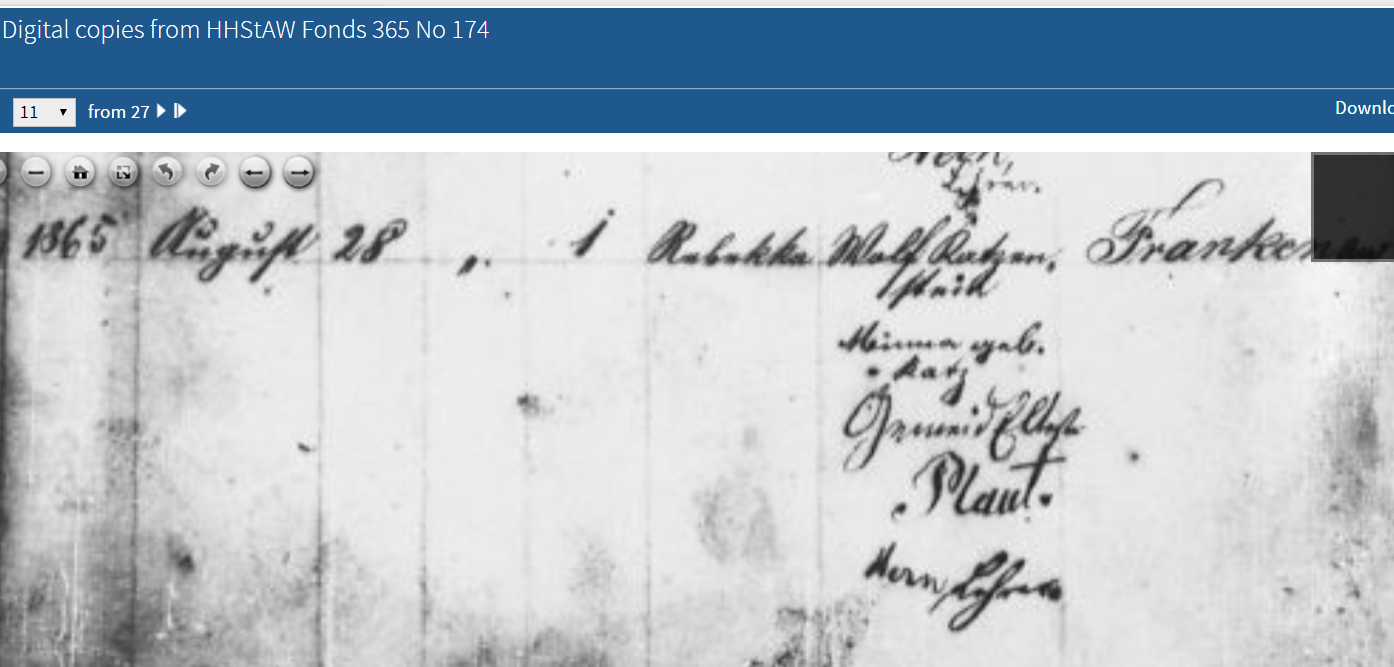
Rebekka was born on August 28, 1865, in Frankenau. Regina was born two years later on September 24, 1867.

Rebekka Katzenstein birth record Arcinsys
HHStAW Fonds 365 No 174

Regina Katzenstein birth record arcinsys
HHStAW Fonds 365 No 174, p. 8

Rebekka married her cousin Salomon Schalom Kneibel Katz (apparently known as Kneibel) on April 30, 1889, as discussed previously.

Marriage of Rebekka Katzenstein and Salomon Kneibel Katz
Hessisches Hauptstaatsarchiv; Wiesbaden, Deutschland; Collection: Personenstandsregister Heiratsregister; Signatur: 920; Laufende Nummer: 3844

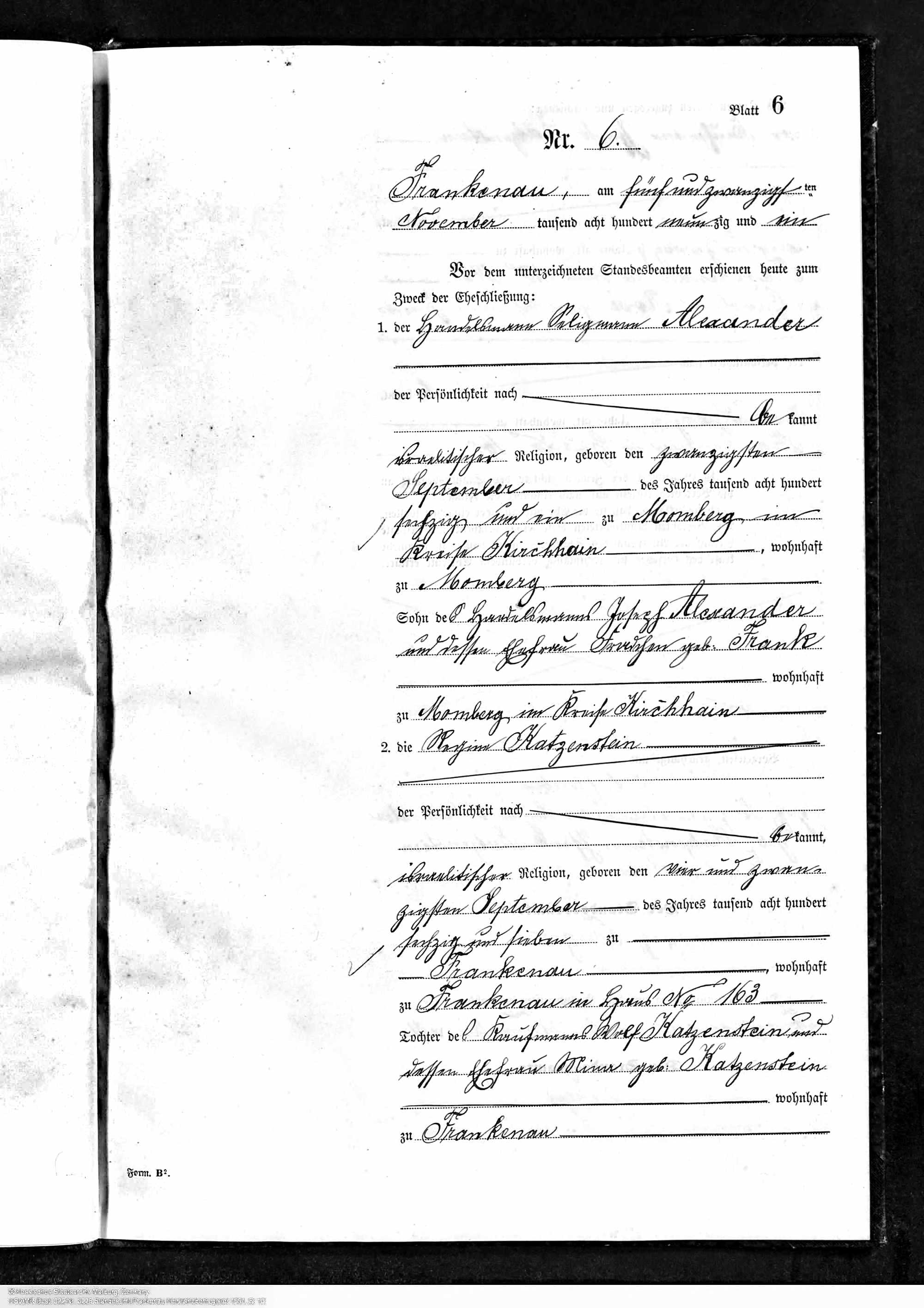
Two and a half years later, on November 25, 1891, Regina Katzenstein married Selig(mann) Alexander in Frankenau. He was born on September 20, 1861, in Momberg, the son of Joseph Alexander and Fradchen Frank.

Marriage of Regina Katzenstein to Selig Alexander
Hessisches Hauptstaatsarchiv; Wiesbaden, Deutschland; Standesamt Frankenau Heiratsnebenregister 1891 (Hstamr Best. 922 Nr. 3226); Collection: Personenstandsregister Heiratsregister; Signatur: 922

Rebekka and Salomon Kneibel Katz had four children, three sons and one daughter. Their first child was Berthold; he was born on May 15, 1890, in Jesberg.

Berthold Katz birth record
HStAMR Best. 920 Nr. 3821 Standesamt Jesberg Geburtsnebenregister 1890, S. 36

Then came Rebekka and Salomon’s only daughter, Therese. She was born November 11, 1891, in Jesberg.

Therese Katz birth record
Hessisches Hauptstaatsarchiv; Wiesbaden, Deutschland; Collection: Personenstandsregister Geburtsregister; Signatur: 920; Laufende Nummer: 3822

Two sons followed Therese. Julius was born May 30, 1893, in Jesberg.

Julius Katz birth record
Hessisches Hauptstaatsarchiv; Wiesbaden, Deutschland; Collection: Personenstandsregister Geburtsregister; Signatur: 920; Laufende Nummer: 3824

And Jakob Katz was born April 14, 1895, in Jesberg.

Jakob Katz birth record
Hessisches Hauptstaatsarchiv; Wiesbaden, Deutschland; Collection: Personenstandsregister Geburtsregister; Signatur: 920; Laufende Nummer: 3826

Meanwhile, Regina and her husband Selig Alexander were also having children in the 1890s. Regina gave birth to seven children, but only four survived infancy. The first child, a girl, was stillborn on January 9, 1893.

Stillborn daughter of Regina Katzenstein and Selig Alexander
Hessisches Hauptstaatsarchiv; Wiesbaden, Deutschland; Personenstandsregister Sterberegister; Bestand: 915; Laufende Nummer: 6560

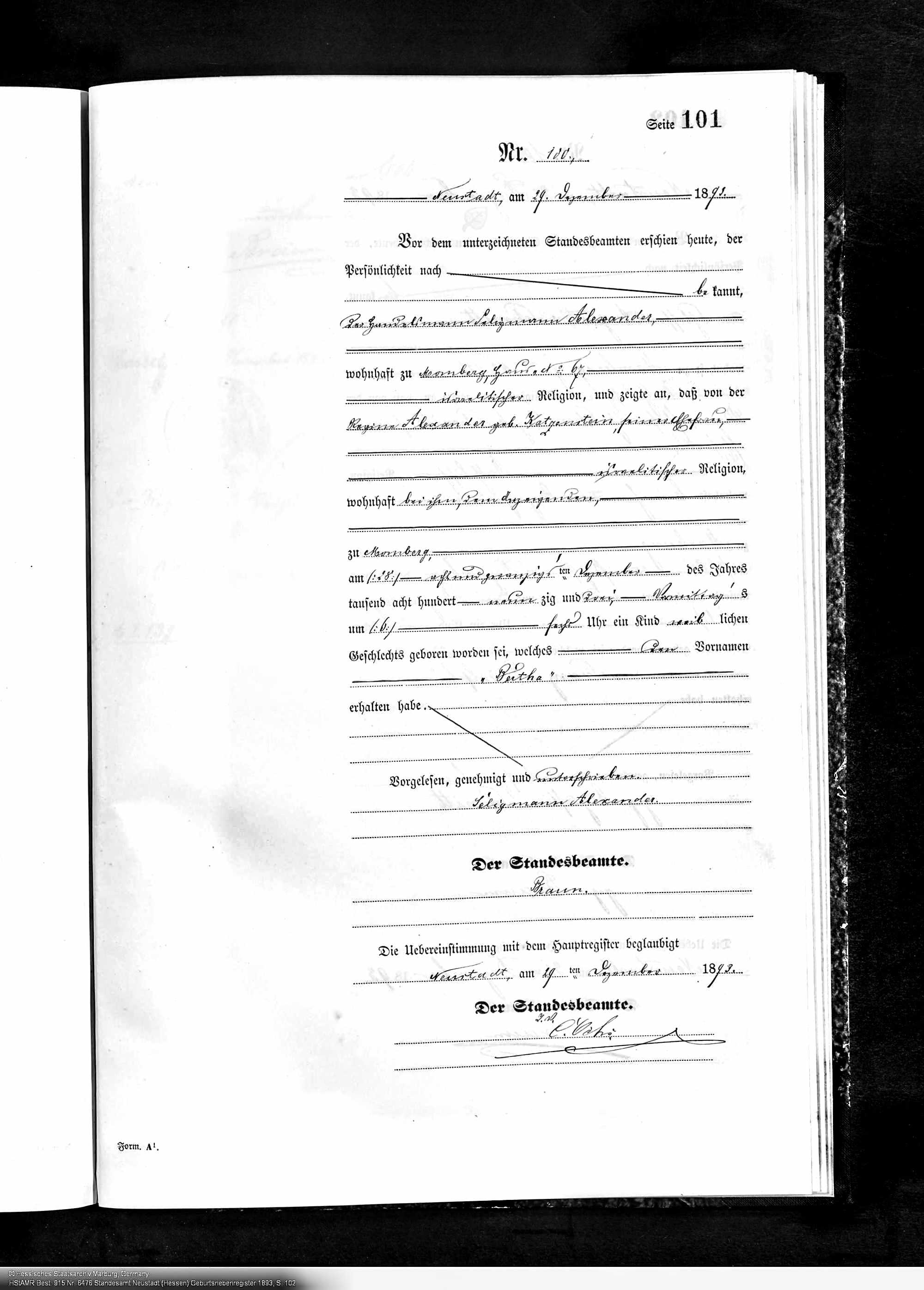
Less than a year later, Regina gave birth to Bertha on December 28, 1893, in Momberg.

Bertha Alexander birth record
Hessisches Hauptstaatsarchiv; Wiesbaden, Deutschland; Collection: Personenstandsregister Geburtsregister; Signatur: 915; Laufende Nummer: 6476

Regina and Selig’s third child was Rosa. She was born in Momberg on January 18, 1896.

Rosa Alexander birth record
Hessisches Hauptstaatsarchiv; Wiesbaden, Deutschland; Collection: Personenstandsregister Geburtsregister; Signatur: 915; Laufende Nummer: 6479

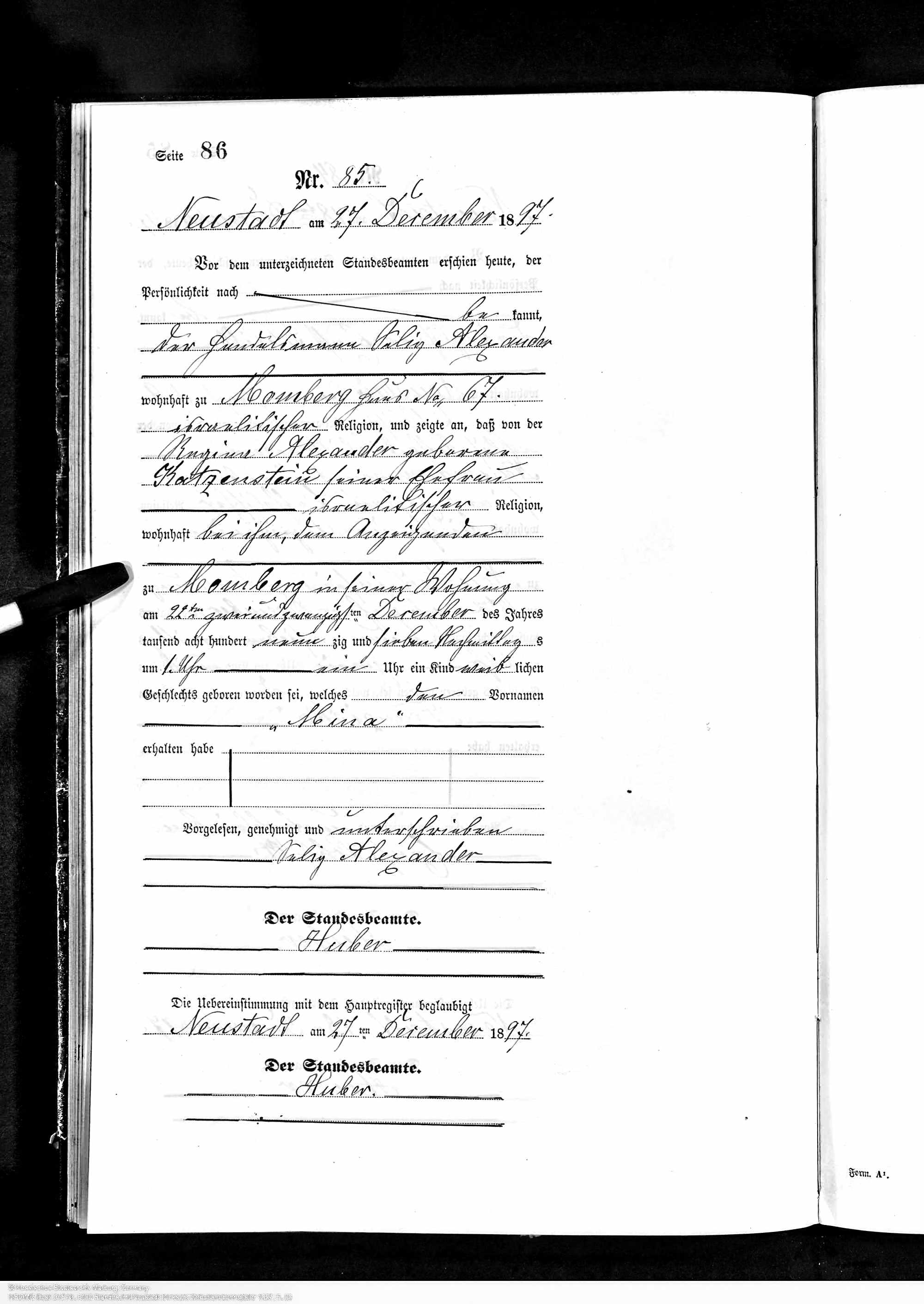
Almost two years after Rosa’s birth, on December 22, 1897, Regina gave birth to her fourth child, Mina, named for Regina’s mother Mina Katzenstein, who had died on September 5, 1896.

Mina Alexander birth record
Hessisches Hauptstaatsarchiv; Wiesbaden, Deutschland; Collection: Personenstandsregister Geburtsregister; Signatur: 915; Laufende Nummer: 6480

After giving birth to Mina, Regina and Selig lost two sons in infancy. Little Joseph Alexander lived only thirteen days, dying on January 24, 1902. His brother Manus lived for two months, dying on March 23, 1903.

Joseph Alexander death record
Hessisches Hauptstaatsarchiv; Wiesbaden, Deutschland; Personenstandsregister Sterberegister; Bestand: 915; Laufende Nummer: 6569

Manus Alexander death record
Hessisches Hauptstaatsarchiv; Wiesbaden, Deutschland; Personenstandsregister Sterberegister; Bestand: 915; Laufende Nummer: 6570

The seventh and last child I have for Regina Katzenstein and Selig Alexander was a son named Samuel, born January 1, 1906, according to a source provided by Barbara Greve, Barbara Haendler-Lachmann’s Schicksale der Juden im alten Landkreis Marburg 1933-1945, Hitzeroth, Marburg 1992, p. 125. Without Barbara Greve’s help, I never would have known about this seventh child as there was no available birth record for him online.

Thus, of the seven children born to Regina and Selig Alexander, only Bertha, Rosa, Mina, and Samuel lived to adulthood.

In many ways the two Katzenstein sisters were following similar paths at the same time, Rebekka in Jesberg, Regina in Momberg, fifteen miles apart. Their lives became even more intertwined on August 21, 1923, when Rebekka’s son Jakob married Regina’s daughter Rosa.

Marriage record of Rosa Alexander and Jakob Katz
Hessisches Hauptstaatsarchiv; Wiesbaden, Deutschland; Collection: Personenstandsregister Heiratsregister; Signatur: 915; Laufende Nummer: 6208

That is, Rosa Alexander married her first cousin, Jakob Katz. They had three daughters who were not only sisters but also second cousins to each other. Rebekka and Regina shared granddaughters who were also their great-nieces. Remember also that Rebekka and her husband Salomon Kneibel were also cousins to each other, so Salomon Kneibel was not only his children’s father but also their cousin and the same for Rebekka.

As for Rebekka and Regina’s other children, they made my life easier by marrying outside of the family.

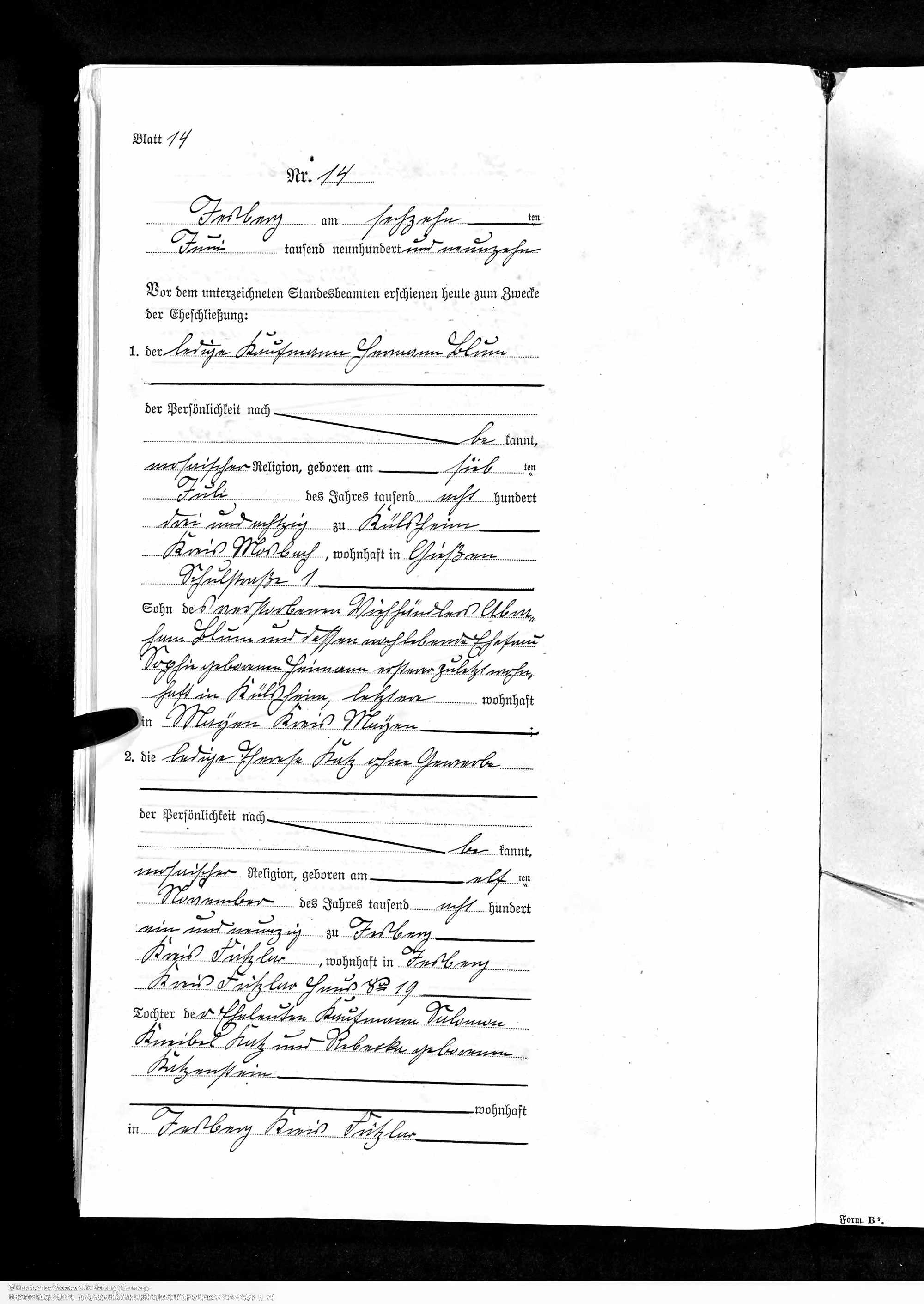
The first to marry was Rebekka’s daughter Therese. On June 16, 1919, she married Hermann Blum, who was born in Kuelsheim on July 7, 1883, son of Abraham and Sophie Blum. I have not been able to identify any children born to Therese and Hermann.

Hessisches Hauptstaatsarchiv; Wiesbaden, Deutschland; Collection: Personenstandsregister Heiratsregister; Signatur: 920; Laufende Nummer: 3872

Rebekka’s oldest son Berthold married Ida Blumenstiel on January 20, 1920. Ida was the daughter of Hugo Blumenstiel and Bertha Weinberg of Mansbach, Germany. She was born July 9, 1893.

Marriage record of Berthold Katz and Ida Blumenstiel
Hessisches Hauptstaatsarchiv; Wiesbaden, Deutschland; Standesamt Hersfeld, Bad Heiratsnebenregister 1920, Eintrags-Nr. 1 – 78; Collection: Personenstandsregister Heiratsregister; Signatur: 907

Berthold and Ida would have two children born in the 1920s, Senta (1921) and Ludwig (1924).

I have not found any marriage record for Rebekka’s son Julius, and, as discussed above, her son Jakob married his cousin Rosa on August 21, 1923, and they had three daughters.

As for Regina’s children, Bertha Alexander married Julius Simon on June 26, 1922, in Momberg. He was the son of Moses Simon and Fanni Katz and was born in Pohl-Goens on May 29, 1891.

Marriage record of Bertha Alexander and Julius Simon
Hessisches Hauptstaatsarchiv; Wiesbaden, Deutschland; Collection: Personenstandsregister Heiratsregister; Signatur: 915; Laufende Nummer: 6207

I have not been able to locate any record of children born to Bertha and Julius, nor do I have any records for them after their marriage, but I am still looking. Thank you to Aaron Knappstein for finding this photograph of Julius Simon on the Vor dem Holocaust – Fotos zum jüdischen Alltagsleben in Hessen website. According to the website, this was taken in 1916 when Julius was a soldier in the Germany army during World War I.

I am still hoping to locate some records that will reveal what happened to Julius Simon and Bertha Alexander.

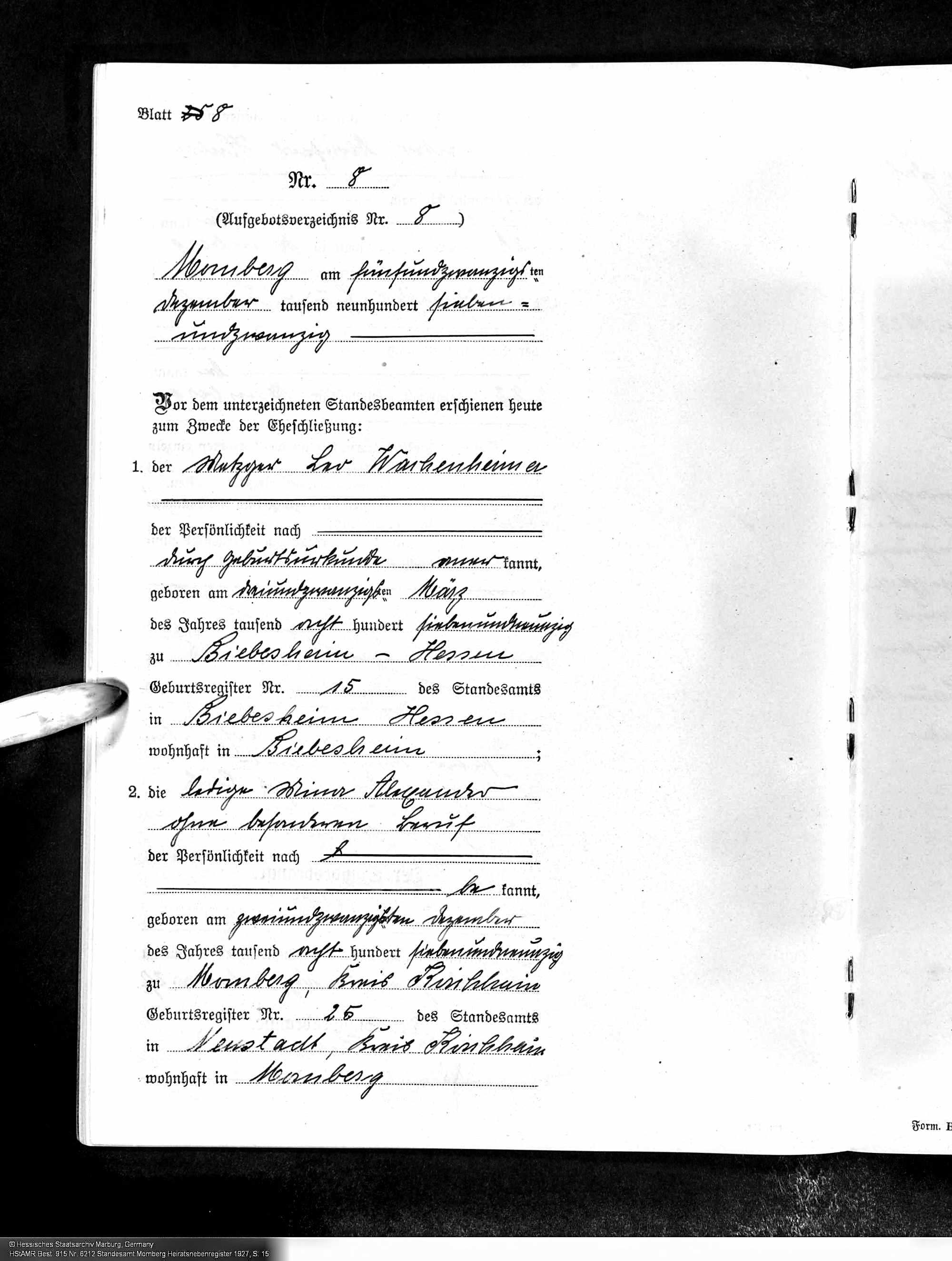
Bertha’s younger sister Rosa Alexander married Jakob Katz, as discussed above. The third sister Mina Alexander married Leo Wachenheimer in Momberg on December 25, 1927. Leo was the son of Meier Wachenheimer and Klara Rothschild; he was born on March 23, 1897, in Biebesheim, Germany. Mina and Leo would have two children.

Marriage record of Mina Alexander and Leo Wacheneimer
Hessisches Hauptstaatsarchiv; Wiesbaden, Deutschland; Collection: Personenstandsregister Heiratsregister; Signatur: 915; Laufende Nummer: 6212

According to Barbara Greve, Regina and Seligmann’s only surviving son, Samuel, married Lottie Weiler in July 1933; Lottie was born in Marburg on January 10, 1913, according to the JOWBR. I do not have names for her parents. Samuel and Lottie had one son, Hans-Joseph Alexander, according to Barbara Greve.

Rebekka Katzenstein Katz died in Jesberg on March 2, 1927; she was only 61 years old. Her husband Salomon Scholum Kneibel Katz died two years later on May 2, 1929.  He was 69.

Death record of Rebekka Katzenstein Katz
Hessisches Hauptstaatsarchiv; Wiesbaden, Deutschland; Personenstandsregister Sterberegister; Bestand: 920; Laufende Nummer: 3918

Here is the photograph I took in the Jesberg cemetery of Rebekka’s grave long before I knew the whole story of their family; sadly, I do not have a photograph of her husband’s gravestone:

The rest of the families of Rebekka and Regina Katzenstein survived into the Nazi era, and it appears that every single one of them left Germany in time—all of Rebekka and Salomon Kneibel’s children and spouses and grandchildren as well as Regina Katzenstein and Selig Alexander and at least three of their four children and spouses and grandchildren. The only couple I’ve been unable to find in any later record or index are Regina’s daughter Bertha and her husband Julius Simon.

Almost all the rest of the families of Rebekka Katzenstein and her sister Regina Katzenstein ended up in Johannesburg, South Africa. Unfortunately, I don’t have any actual records or documents that reveal when the family arrived there or any other information aside from their deaths and burials.

But I was fortunate to connect with John Leach, a relative by marriage of Leo Wachenheimer, husband of Mina Alexander. From John I learned that Leo had been a cattle dealer in Germany and had also worked in his father’s kosher butcher business. Leo was arrested by the Nazis in 1935 for doing business with a non-Jew; when he was released, he escaped from Germany to South Africa, where he opened a kosher butcher shop. Soon many family members followed him, including his wife Mina and their children, his in-laws Regina and Selig Alexander, his sister-in-law Rosa Alexander Katz and her husband Jakob Katz and their three children, and Jakob Katz’s sister Therese Katz and her husband Hermann Blum and Jakob’s brother Julius Katz. They all appear to have spent the rest of their lives in Johannesburg.

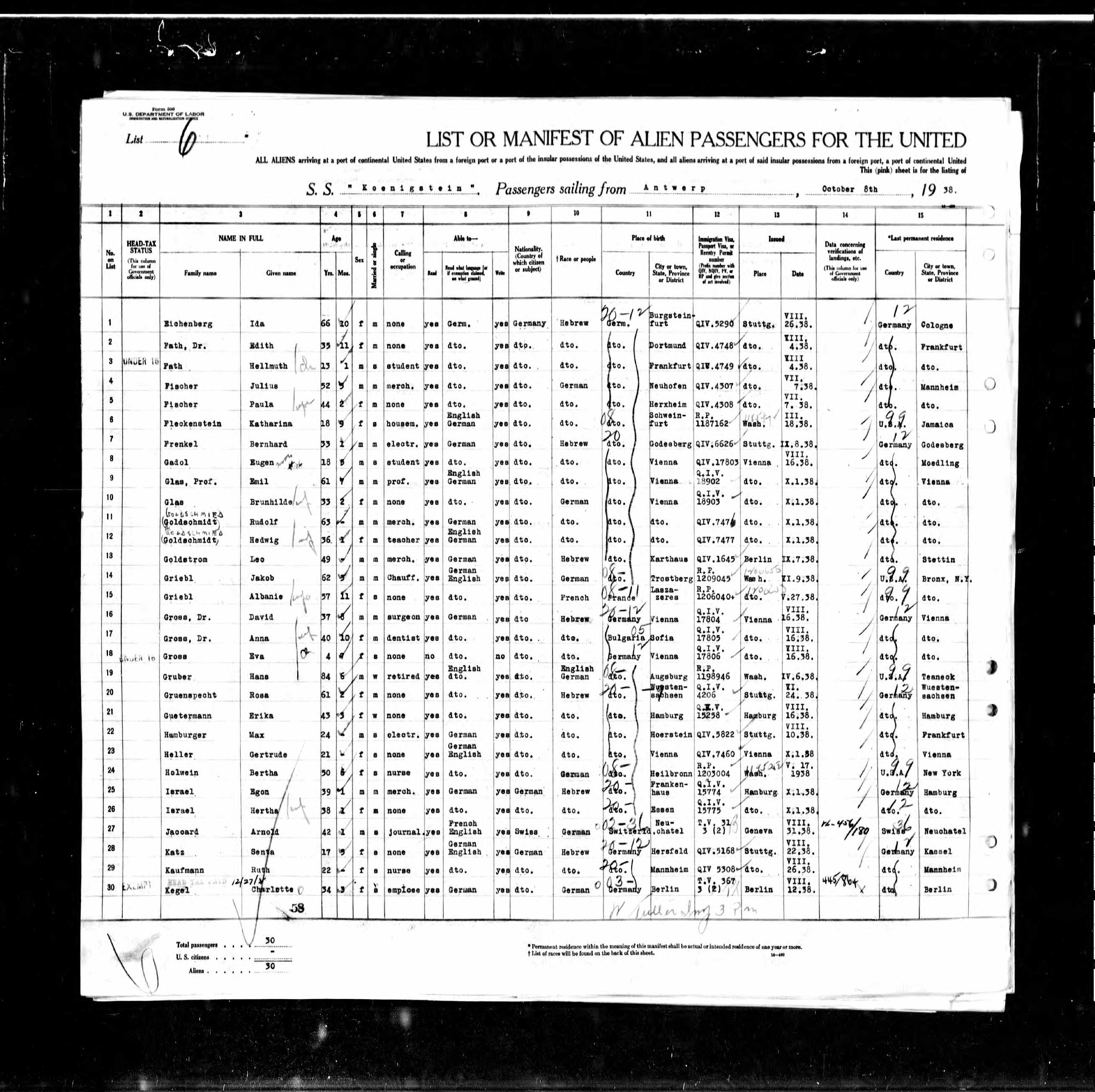
The only descendants of Rebekka or Regina who did not go to South Africa were Rebekka’s son Berthold and his wife Ida and their children, Senta and Ludwig. Instead, they went to the United States. Their daughter Senta arrived first on October 8, 1938, and Berthold, Ida, Ludwig, and Ida’s mother Bertha Blumenstiel arrived on November 25, 1938; they were all going to a cousin, Leo Katzmann in the Bronx:

Senta Katz 1938 passenger manifest
Year: 1938; Arrival: New York, New York; Microfilm Serial: T715, 1897-1957; Microfilm Roll: Roll 6238; Line: 1; Page Number: 176
Ancestry.com. New York, Passenger Lists, 1820-1957

Berthold Katz and family passenger manifest
Year: 1938; Arrival: New York, New York; Microfilm Serial: T715, 1897-1957; Microfilm Roll: Roll 6254; Line: 1; Page Number: 68
Ancestry.com. New York, Passenger Lists, 1820-1957

By 1940, they had settled in Philadelphia where Berthold was working as a salesman for a paper bag company and Senta was working as a packer for a children’s dress company. Bertha’s mother-in-law Bertha Blumenstiel was also living with them.

Berthold Katz and family 1940 US census
Year: 1940; Census Place: Philadelphia, Philadelphia, Pennsylvania; Roll: T627_3733; Page: 1A; Enumeration District: 51-1446

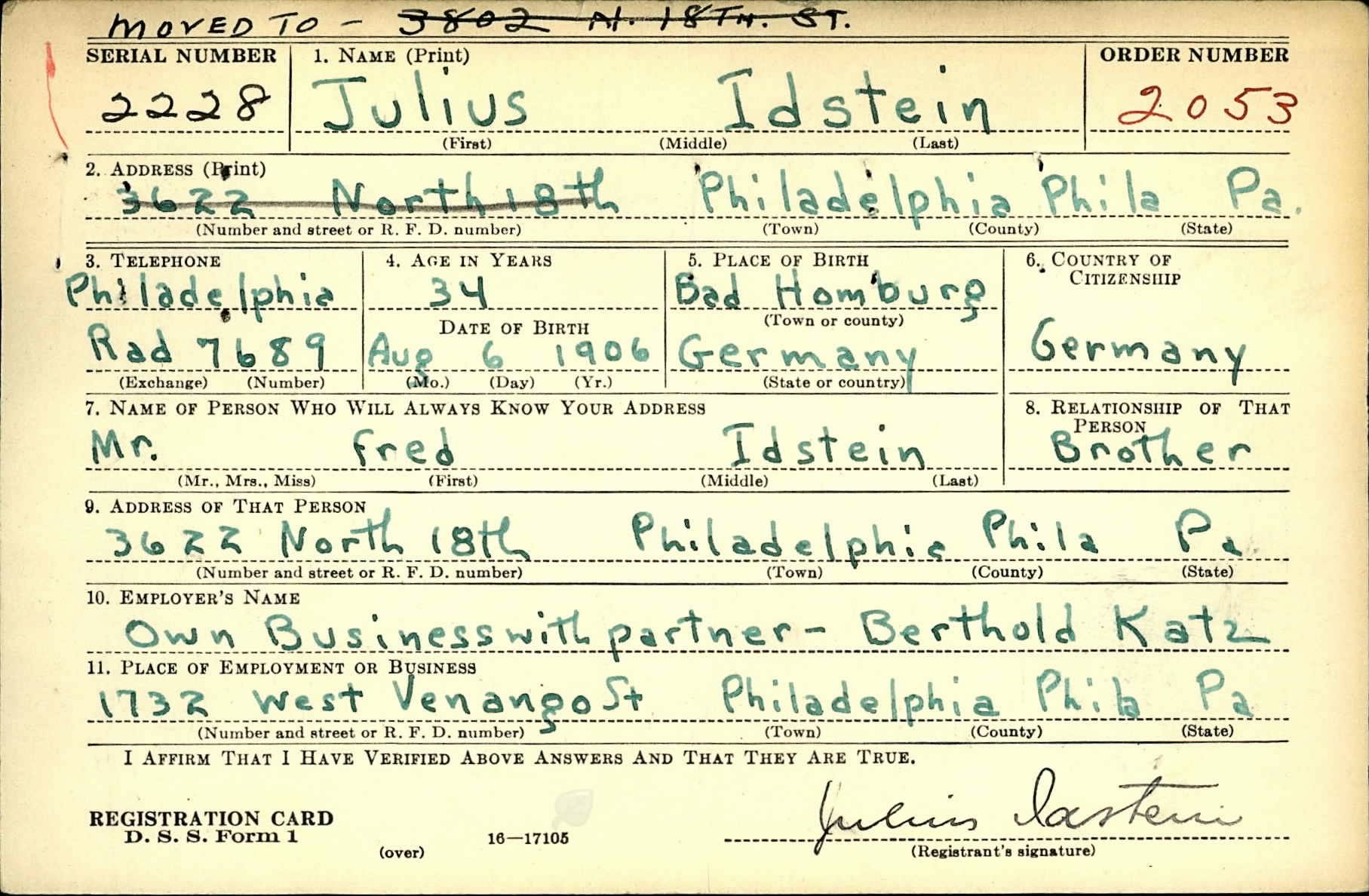
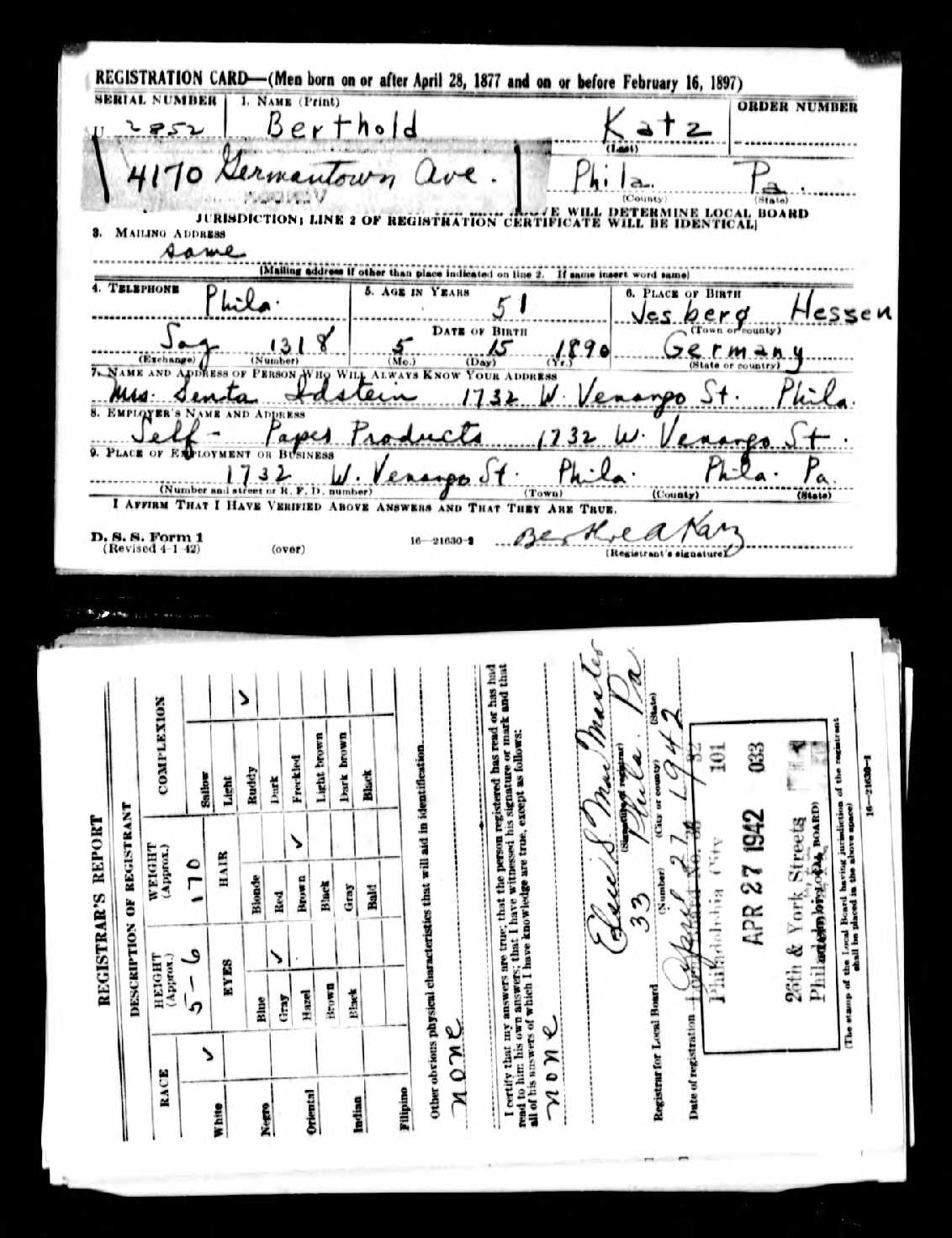
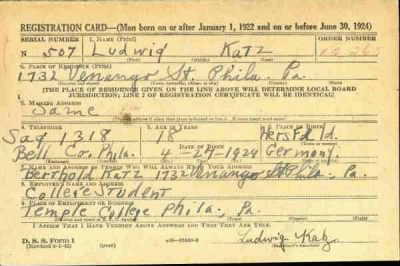
That same year Senta married Julius Idstein, who was also a refugee from Germany. (Philadelphia, Pennsylvania, Marriage Index, 1885-1951)  Julius was born on August 6, 1906, in Bad Homburg, and came to the United States on October 20, 1938. On his World War II draft registration, he reported that he was a partner in business with Berthold Katz, his father-in-law. On Berthold’s registration, he reported that he owned a paper products business. So between his arrival in 1938 and 1942, Berthold had become a business owner in partnership with his son-in-law Julius.

Julius Idstein World War II draft registration
Selective Service Registration Cards, World War II: Multiple Registrations

World War II draft registration for Berthold Katz
The National Archives at St. Louis; St. Louis, Missouri; World War II draft cards (Fourth Registration) for the State of Pennsylvania; Record Group Title: Records of the Selective Service System, 1926-1975; Record Group Number: 147; Series Number: M1951

Sadly, Berthold’s wife Ida died at age 48 of liver cancer on December 29, 1941.

Ida Blumenstiel Katz death certificate
Pennsylvania Historic and Museum Commission; Pennsylvania, USA; Certificate Number Range: 109451-112000

Their son Ludwig was in college at Temple College (now Temple University) in Philadelphia in 1942:

Ludwig Katz World War II draft registration
Selective Service Registration Cards, World War II: Multiple Registrations

In 1943, Berthold remarried; his second wife was Betty Nussbaum, and she also was a German native, born in Mansbach on February 4, 1893. She had come to the US in 1925 on her own; her parents stayed behind where her mother died in 1939 and her father died in the Theriesenstadt concentration camp in 1942. (Philadelphia, Pennsylvania, Marriage Index, 1885-1951)

Berthold died from stomach cancer on March 5, 1959; he was 68 years old; his second wife Betty died in 1977:

Berthold Katz death certificate
Pennsylvania Historic and Museum Commission; Pennsylvania, USA; Certificate Number Range: 026551-029250

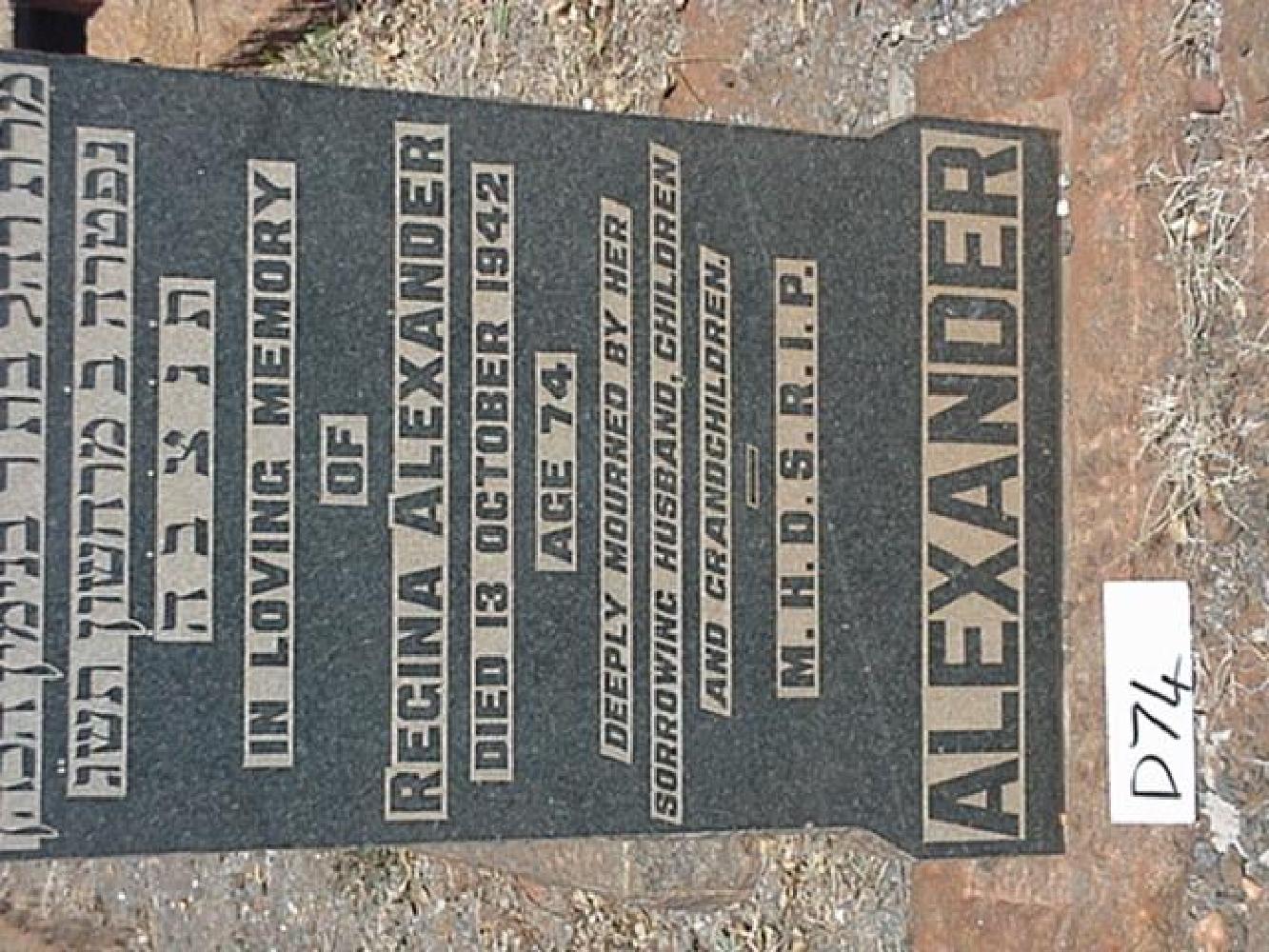
Meanwhile, Berthold’s siblings and first cousins and aunt and uncle were all living in South Africa.  His aunt Regina Katzenstein Alexander died on October 14, 1942, and her husband Selig Alexander died on May 5, 1949; they are buried at West Park Cemetery in Johannesburg. (JewishGen Online World Burial Registry (JOWBR)). Charmaine Rosenberg of the Johannesburg Chevra Kadisha kindly sent me the following photograph of Regina’s headstone:

Headstone of Regina Katzenstein Alexander

Berthold’s daughter Senta and her husband Julius Idstein had five children. Julius died in 1981, and Senta lived until 2003. She was 82 when she died.

Berthold’s son Ludwig became a nuclear physicist and was a senior scientist for Visidyne, Inc. in Burlington, Massachusetts, when he was killed in a car accident on March 18, 1981. He was 57 years old and was survived by his wife and two children. “Ludwig Katz, Swampscott,” Boston Herald (March 25, 1981), p. 40.

As for the family in South Africa, I have no information other than their dates of death and burial place. All those named below are, like Regina Katzenstein and Selig Alexander, buried at the West Park Cemetery in Johannesburg, and all this information comes from the JOWBR on Jewishgen.org and from Charmaine Rosenberg of the Chevra Kadisha in Johannesburg. I am very grateful to Charmaine for providing me with these photographs of the headstones.

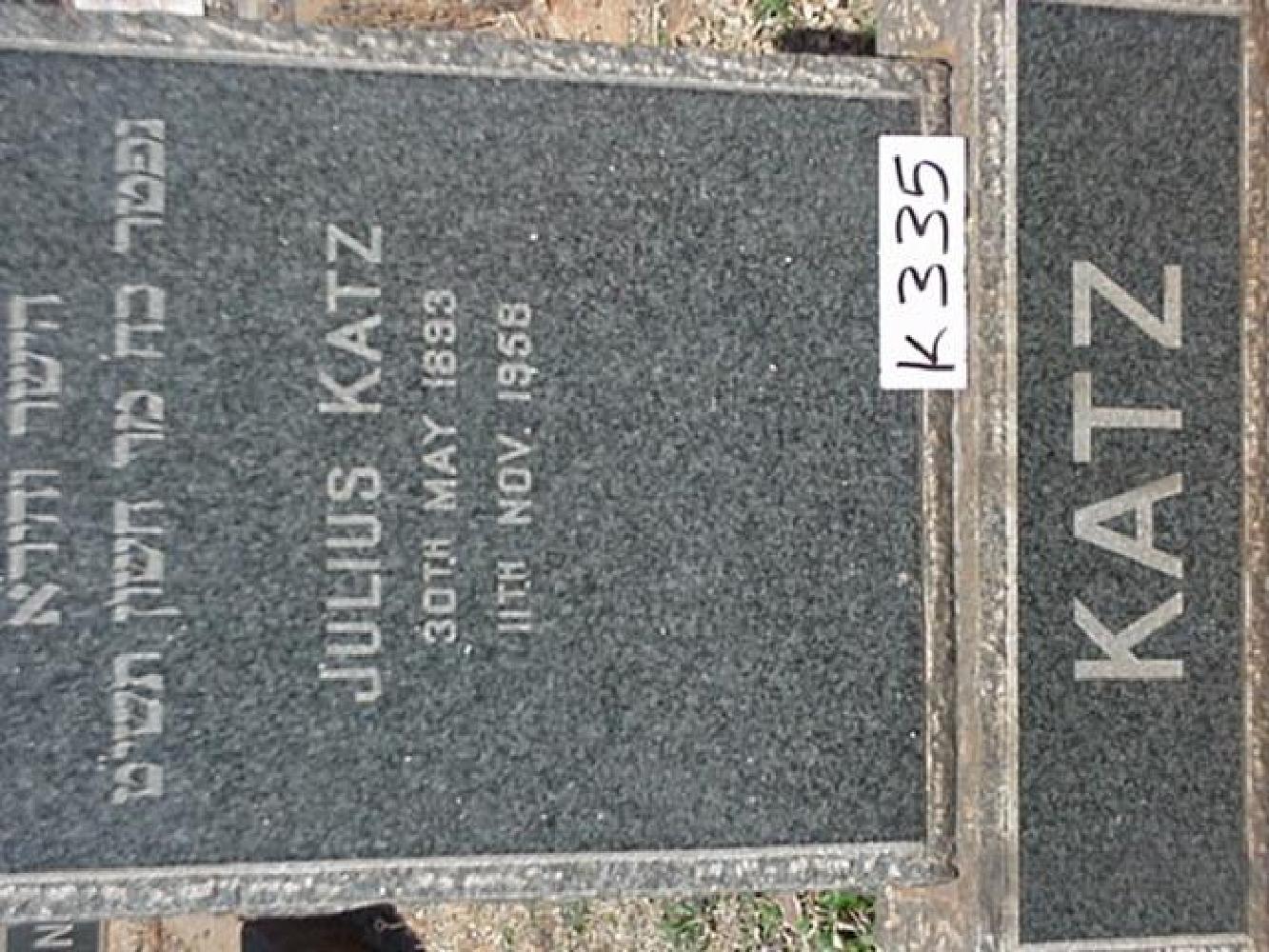
Julius Katz died on November 11, 1958, when he was 65. As far as I know, he never married or had children.

Headstone of Julius Katz

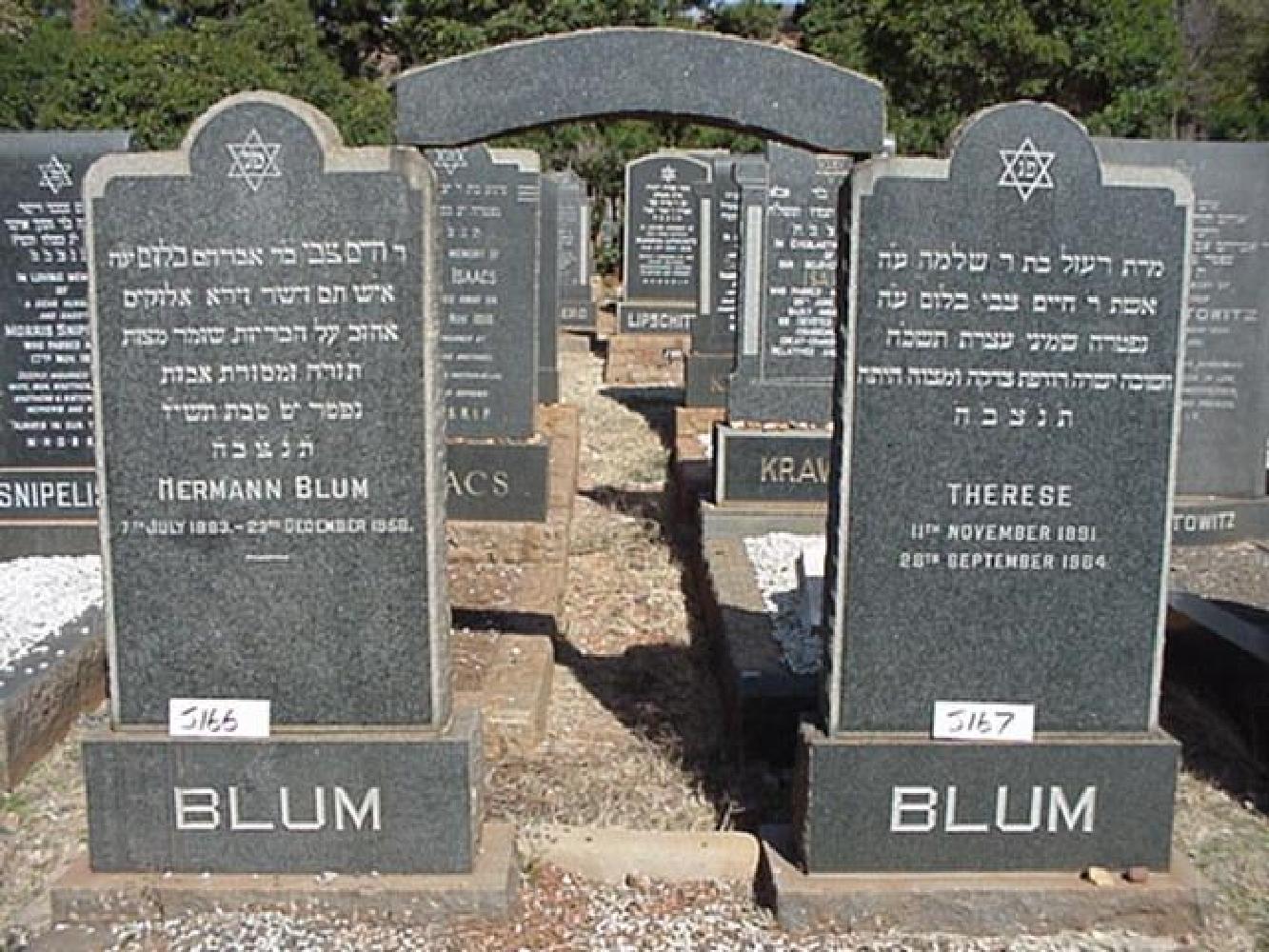
Therese Katz died on September 28, 1964, eight years after her husband Hermann Blum, who died on December 23, 1956. She was 73, he was also 73 when he died. As far as I have been able to determine, they did not have children.

Headstone of Therese Katz Blum and Hermann Blum

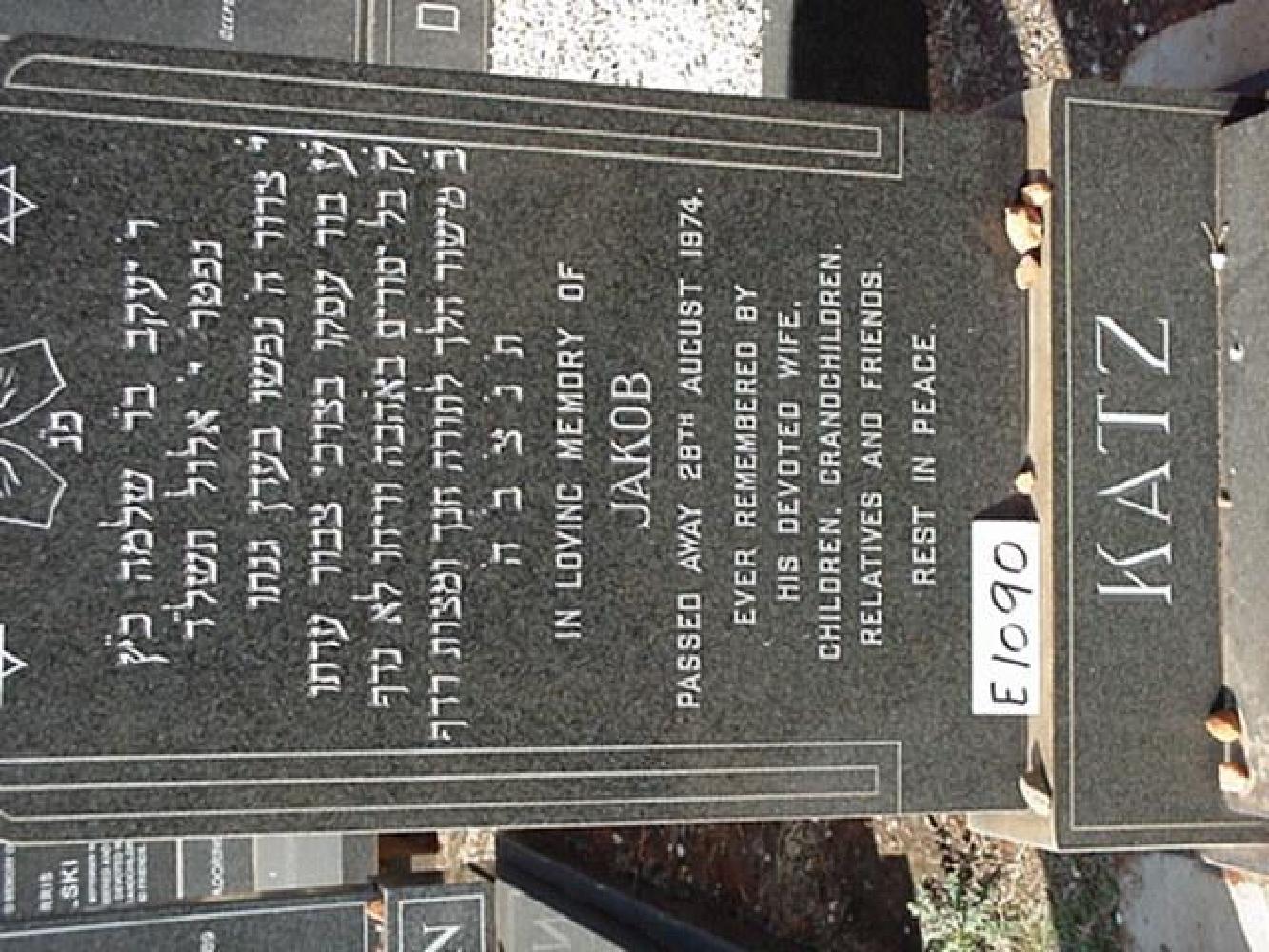
Jakob Katz died on August 24, 1974; he was 79. His wife and first cousin Rosa Alexander Katz outlived him by 23 years. She was almost 101 when she died on June 14, 1997.

Headstone of Jakob Katz

Rosa’s sister Mina Alexander Wachenheimer also outlived her husband by many years. Leo Wachenheimer died on January 23, 1969, when he was 72. Mina survived him by over twenty years, dying on December 23, 1989, when she was 92.

Headstone of Mina (Minna) Alexander Wachenheimer

Headstone of Leo Wachenheimer

Samuel Alexander died on June 21, 1989; he was 83. He had outlived his wife Lotte by seventeen years; she died on January 11, 1972, when she was 59.

Overall, the children of both Rebekka and Regina Katzenstein, daughters of Mina Katzenstein and Wolf Katzenstein, were fortunate to escape from Nazi Germany when they did. Perhaps Leo Wachenheimer’s arrest in 1935 was the key that opened the door to the survival of all of them.


My Great-Grandmother Hilda

I have now written about all of the siblings of my great-grandmother, Hilda Katzenstein Schoenthal, as well as about her parents and some of her aunts, uncles, and cousins.  I still have more of the Katzenstein extended family to discuss, but first I want to look back at the life of my great-grandmother.  Her story has been covered only in bits and pieces through the stories of her husband and children and through the stories of her parents and siblings.  Isn’t that all too often the case with women—that their stories are seen only through the stories of those who surrounded them? Especially since this is Women’s History Month, I wanted to be sure to give my great-grandmother her own page, her own story.

Hilda Katzenstein Schoenthal

Hilda Katzenstein Schoenthal, my great-grandmother

Hilda was the third daughter and sixth and youngest child of her parents, Gerson Katzenstein and Eva Goldschmidt.  She was the third of the six to be born in the United States—in Philadelphia on August 17, 1863.

When Hilda was three years old, her sibling closest in age, Hannah, died at age seven from scarlet fever. Hilda was seven years younger than her brother Perry, who was the second closest to her in age, and so there was a big gap between Hilda and her surviving older siblings. Joe was fifteen years older, Jacob thirteen years older, and Brendena was ten years older than Hilda. My great-grandmother was the baby of the family, and I would imagine that after losing their daughter Hannah, her parents must have been very protective of her.

gerson-katzenstein-1870-census-1

Gerson Katzenstein and family 1870 census, Year: 1870; Census Place: Philadelphia Ward 16 Dist 48 (2nd Enum), Philadelphia, Pennsylvania; Roll: M593_1429; Page: 708B; Image: 96949; Family History Library Film: 552928

Her sister Brendena married Jacob Schlesinger in 1871 when Hilda was just eight years old. By the time Hilda was ten years old in 1873, her oldest brother Joe had moved to Washington, Pennsylvania, and within a few years after that her other two brothers, Jacob and Perry, had also moved to western Pennsylvania.  Thus, Hilda was still quite young when her older siblings left home, leaving her to live with just her parents.

Year: 1880; Census Place: Philadelphia, Philadelphia, Pennsylvania; Roll: 1173; Family History Film: 1255173; Page: 274B; Enumeration District: 219; Image: 0561

Katzenstein family Year: 1880; Census Place: Philadelphia, Philadelphia, Pennsylvania; Roll: 1173; Family History Film: 1255173; Page: 274B; Enumeration District: 219; Image: 0561

But her brother Joe’s move to Washington, Pennsylvania proved fateful for Hilda and for my family as it was there that she met her future husband, my great-grandfather Isidore Schoenthal, who had only arrived in the US a few years earlier from Sielen, Germany.

The Daily Republican
(Monongahela, Pennsylvania)
11 Aug 1887, Thu • Page 4

Hilda married him in 1888 when she was 25 years old and settled with him in Little Washington where he was a china dealer.  Their first son, Lester, was born that same year.

Isidore Schoenthal

Isidore Schoenthal

Then a series of tragic events hit the Katzenstein family. In the spring 1889, Hilda’s brother Jacob lost his wife Ella and both of his sons, one before the Johnstown flood and two as a result of the flood. The following year, my great-grandfather Gerson died at age 75.  Hilda named her second child for her father; Gerson Katzenstein Schoenthal was born on January 20, 1892. A year later Hilda lost her mother, Eva Goldschmidt Katzenstein, on September 6, 1893; she was 66.

Hilda did not have another child until August, 1901, when my great-uncle Harold was born—more than nine years after Gerson.  Just a few months after Harold’s birth, Hilda’s brother Joe died in December, 1901; just over a year and a half later, her brother Perry died in August, 1903.  Hilda was forty years old and had lost her parents and three of her five siblings.  Only Jacob and Brendena remained.

In March, 1904, my great-grandmother Hilda gave birth to her last child and only daughter, my grandmother Eva Schoenthal, named for Hilda’s mother Eva Goldschmidt Katzenstein.

eva-schoenthal-cohen-watermarked

My grandmother, Eva Schoenthal

When my grandmother was just a small child, her parents decided to leave Washington, Pennsylvania, and move to Denver, Colorado, believing that the mountain air would be better for their son Gerson, who had developed asthma.

Thus, Hilda packed up her children and belongings and moved far away from her two remaining siblings: Brendena, who was living with her husband Jacob and family in Philadelphia, and Jacob, who by that time had remarried and was living with his second wife Bertha and their children in Johnstown.  I don’t believe Hilda or Isidore knew anyone in Denver, but somehow they started their lives over in this city far from their families back east.

They remained in Denver for at least twenty years, raising my grandmother and my great-uncles. During the many years that Hilda lived in Denver, her brother Jacob died, and her sister Brendena lost her husband as well as both of her daughters.  It must have been hard to live so far away from all of her family during those painful times.

Isidore, Hilda (Katzenstein), and Eva Schoenthal

Isidore, Hilda (Katzenstein), and Eva Schoenthal in Denver

After many years in Denver, Hilda and Isidore moved back east. Their son Harold had gone back east for college, and my grandmother had moved to Philadelphia after she married my grandfather, John Nusbaum Cohen, in 1923.  She had met him when, after graduating from high school, she’d gone to visit relatives in Philadelphia, probably Brendena’s family.

My father and aunt were born in the 1920s, and they were my great-grandparents’ only grandchildren at that time.  I assume that they were part of the reason that by 1930, my great-grandparents returned to the east and settled in Montclair, New Jersey, where their son Harold lived and not far from my grandmother and my aunt and father.

HIlda (Katzenstein) Schoenthal, Eva (Schoenthal) Cohen, Eva HIlda Cohen, and Harold Schoenthal

HIlda (Katzenstein) Schoenthal, Eva (Schoenthal) Cohen, Eva Hilda Cohen, and Harold Schoenthal

Hilda and Isidore lived in Montclair until 1941 when they moved to Philadelphia so that my grandmother could take care of them, both being elderly and in poor health by that time. Hilda died from pneumonia  on August 17, 1941, just seven months after the move to Philadelphia; she died on her 78th birthday. Her husband Isidore died eleven months later on July 10, 1942.  They were buried at Restland Memorial Park in East Hanover, New Jersey.

Looking back over my great-grandmother’s life, I have several thoughts.  Although she was the baby of the family, she was also the only one who ventured far from where her family lived.  Her brothers left Philadelphia, but never left Pennsylvania; her sister lived in Philadelphia for her entire life after arriving as a child from Germany. Hilda moved across the state to marry Isidore Schoenthal, and Hilda was the only Katzenstein sibling to leave the east, moving with her husband and four children all the way to Colorado.

Her life was also marked by many losses, some quite tragic: a sister died as a young child, her parents died before Hilda was thirty years old, and two of her brothers died before Hilda was forty.  Several nieces and nephews also died prematurely.  Her brother Jacob also predeceased her; she was 52 when he died. So many losses must have had an effect on her perspective on life.

On the other hand, she had a long marriage and four children who grew to adulthood.  She lived to see two of her grandchildren, my father and aunt, grow to be teenagers. My father remembers her as a loving, affectionate, and sweet woman; she loved to cook, and when for a period of time he lived near her in Montclair, she would make lunch for him on school days.

Hilda saw more of America than her parents and siblings, and she lived longer than any of them except for her sister Brendena, who survived her. She endured many losses in her life, but the love she received from her family must have outweighed all that sadness, for my father recalls her as a very loving and positive woman.

Back into the Rabbit Hole…But for a Good Reason!

I thought I had moved on from the story of Marie Wetherill, the woman who married my cousin Joe Schlesinger, but then Janice Webster Brown, creator of the Genealogy Bloggers group on Facebook and the author of the wonderful blog Cow Hampshire Blog, found this incredible article about Marie’s family. And I decided to write this blog post both to honor Marie and her family and to honor Women’s History Month, a tradition I started a year ago after being inspired to do so by Janice herself.

Although the article does not reveal any additional information about Marie’s elusive father Francis Wetherill, it does reveal a great deal about Marie’s own background and the amazing line of women from whom she is descended. The article, “Fourteen Years Over A Century,” appeared in the February 4, 1892 edition of The Philadelphia Inquirer (p. 5) (transcription below):

the_philadelphia_inquirer_thu__feb_4__1892_

On Saturday next Mrs. Anna Catharine Sharp, the oldest inhabitant of Pennsylvania, will celebrate her one-hundred-and fourteenth birthday at her little home, 1226 Fleetwood avenue.  The interest of this remarkable case of longevity is heightened by a series of attending circumstances that mark it as unique.  Not only does this remarkable woman live here, but there are living under the same roof her daughter, granddaughter, great-granddaughter and great-great-granddaughter, making in all representatives of five generations living together.

Mrs. Sharp’s history is interesting.  Her maiden name was Dowell, and her mother was of German extraction.  She was born February 6, 1778, in Cherry alley, and at 15 years of age was confirmed in the German Protestant Church at Sixth and Spruce streets.  When she was 22 years old she married John Sharp, a native of this city, and lived with him at Bush Hill, which though now a thickly built-up portion of the town, was then a farming district.  This was the first change of residence that she ever made.

Her husband was in the war of 1812, and died in 1849. Some years before his death they moved to Knight’s court, and in 1850 she settled in her present home, thus making only three changes of residence and never living outside of this city.

A 73-Year-Old Baby

Her youngest child, Mrs. Smith, was born in 1819, and is consequently 73 years old.  She is living with her mother and takes care of the house for her.  Her grand-daughter, Mrs. Anna E. Wilson [Marie’s grandmother]. a professional nurse, is 43 years old.

Connected with Mrs. Frank Wetherill [Marie’s mother], the great-granddaughter, are also some peculiar circumstances. She is 23 years old, and was born in their present home.  Her oldest child was born in the same room as she was, and her great-grandmother was the nurse who take care of her husband [Frank Wetherill] when he was born.  There is a difference of 112 years between the ages of old Mrs. Sharp and the baby, Florie Wetherill.

Mrs. Sharp retains all her faculties with singular clearness, though in the last six months she has grown slightly deaf. Her hair is still black, with only a slight streak of gray running through it.  Her appetite is good and so are her teeth—which she keeps at night in a tumbler upon the bureau–and she can eat any kind of food that is prepared for the family.  She has never been sick, with the single exception of a slight illness a few years ago.

After her husband’s death she labored as a nurse for thirty-three years, principally among the better class of people.

There will be a quiet reunion of the five generations on Saturday to celebrate the good old lady’s birthday.

This article shed so much more light on how Marie Wetherill, the woman my father remembers so warmly, turned into such a devoted caretaker of her mother-in-law, my great-great-aunt Brendena Katzenstein Schlesinger.  Marie came from a long line of caretakers and women who were devoted to their families. Both Marie’s great-great-grandmother Anna Catharine Dowell Sharp and her grandmother Anna Smith WIlson were nurses. And how strange that Anna Catherine was the nurse who delivered Francis Wetherill, who would later marry her great-granddaughter, Mary Wilson.

They all lived together under one roof for so much of their lives in this little house supposedly at 1226 Fleetwood Avenue in Philadelphia, an address I could not find; however, I think it was at one time called 1226 Nagels Avenue, as Anna Catharine is listed there as John’s widow in the 1861 Philadelphia directory, and then in 1900, Marie, her mother, grandmother, and great-grandmother were living at 1226 Jessup Street.  I believe that the street name was changed, but that Anna Catharine and her family continued to live in the same house, as the article reports.

In fact, by searching on stevemorse.org on the 1880 census for 1226 Jessup Street, I found Anna Catharine’s family living at 1226 Fleetwood Street, so the street name must have been changed from Fleetwood to Jessup sometime after 1892 when the article was written:

1880 census for the family of Anna Catherine Dowell Sharp Year: 1880; Census Place: Philadelphia, Philadelphia, Pennsylvania; Roll: 1179; Family History Film: 1255179; Page: 116D; Enumeration District: 391; Image: 0430

1880 census for the family of Anna Catherine Dowell Sharp
Year: 1880; Census Place: Philadelphia, Philadelphia, Pennsylvania; Roll: 1179; Family History Film: 1255179; Page: 116D; Enumeration District: 391; Image: 0430

Not surprisingly, the relationships as listed are confused on this census report.  First listed is  Anna (Smith) Wilson, Marie’s grandmother, a 32 year old widowed housekeeper. Below her is Jeremiah Smith, a single unemployed 28 year old man, presumably Anna’s brother. Then comes Catherine Sharp, Marie’s great-great-grandmother, then an 82 year old widow.  Following the boarder listed below Catherine is Mamie Wilson, Marie’s mother (also known as Mary), then eleven, and finally a four year old boy named Jeremiah Wilson.  Although it looks like Mamie and Jeremiah are listed as the children of the boarder, quite clearly they are the children of the head of household, Anna (Smith) Wilson. Then I noticed that above Anna Wilson is a listing for Mary Smith at 1226 Fleetwod, this being Marie’s great-grandmother, Mary Ann (Sharp) Smith, a 61 year old widowed dressmaker.

Thus, as of 1880, Marie’s grandmother was a widow raising two children and living with her own mother, a widow, and her grandmother, a widow.  It appears that Mary Ann Sharp Smith, Marie’s great-grandmother, was the only one employed outside the home.

Anna Catharine Dowell Sharp lived almost another full year after her 114th birthday, dying on January 22, 1893.  Her daughter Mary Ann Sharp Smith lived until January 30, 1909; she was 89 when she died.  Anna Catharine’s granddaughter, Anna Smith WIlson (Marie’s grandmother) died just two years after her mother on June 5, 1911; she was only 64. Marie’s mother, Mary/Mamie Wilson Wetherill Pierson, died on June 13, 1948, when she was 78.  And Marie lived to age 93, dying on August 31, 1981. No one came close to reaching Anna Catherine’s almost 115 year long life span.

So in honor of Women’s History Month, I salute Anna Catherine Dowell Sharp.  She was born during the Revolutionary War, married a man who fought in the War of 1812, was a nurse, and was the foremother of a long line of women devoted to their families, including Marie Wetherill Schlesinger, who married my cousin Joe. Anna Catharine Dowell Sharp lived from the early days of our country’s founding through the civil war and almost made it to the 20th century.  What stories she would have to share if we could talk to her today.

But now it really is time to turn back to my own family!

The Blessings and Curses of Census Records: Was Francis Wetherill Still Alive?

In my last post I described how I found my cousin Marie on the 1900 census. Marie was born August 15, 1888, to Francis M. Wetherill, a driver, and Mary Agnes Wilson, in Philadelphia.  Her parents were Philadelphia natives who had married in 1887, and according to Marie’s marriage license for her marriage to my cousin Joe Schlesinger in 1915, her father was deceased by that time.

The 1900 census showed Marie living with her great-grandmother Mary Ann Smith, her grandmother Anne Wilson, her great-uncle Jerry Smith, her mother Mamie Wetherill, and her four siblings: Frank (1883), Florence (1890), Catherine (1893[sic]), and Harry (1897).  (Mary Wilson Wetherill is sometimes listed as Mary, sometimes as Mamie.)

Marie Wetherill and family on 1910 census Year: 1900; Census Place: Philadelphia Ward 20, Philadelphia, Pennsylvania; Roll: 1461; Page: 7A; Enumeration District: 0416; FHL microfilm: 1241461

Marie Wetherill and family on 1900 census
Year: 1900; Census Place: Philadelphia Ward 20, Philadelphia, Pennsylvania; Roll: 1461; Page: 7A; Enumeration District: 0416; FHL microfilm: 1241461

There was one other odd thing about this census record. The child Frank Wetherill was seventeen on this report and born in 1883.  Mamie/Mary Wilson had not married Francis Wetherill until 1887. Was the child Frank really her son?

Then I noticed that although Mamie/Mary reported on the 1900 census that she had only four living children, there were five Wetherill children listed on the census report.  I assume therefore that the seventeen year old Frank Wetherill must not have been Mamie/Mary’s biological son.

I did find a birth record for a Frank Wetherell born April 6, 1883, in Philadelphia to a Frank Wittersall [sic, I assume] and Angelina. I assume this was the same child as the one living with Marie’s family in 1900. Francis Wetherill, Mamie/Mary’s husband, must have been married previously, and the younger Frank must have been his son from that marriage. But why had young Frank stayed with his stepmother Mamie/Mary? Had both his biological parents died by 1900?

Now that I had other family names to use in my search parameters, I was able to locate Marie and her family on the 1910 census.  Again, the census report had some confusing entries. Anna Wilson, Marie’s grandmother, was a head of household, but there was a second head of household listed beneath her: Harry Pearson. He was 44 and worked as a driver for “stove works.”

Marie Wetherill and family on the 1930 census Year: 1910; Census Place: Philadelphia Ward 20, Philadelphia, Pennsylvania; Roll: T624_1394; Page: 5B; Enumeration District: 0342; FHL microfilm: 1375407

Marie Wetherill and family on the 1930 census
Year: 1910; Census Place: Philadelphia Ward 20, Philadelphia, Pennsylvania; Roll: T624_1394; Page: 5B; Enumeration District: 0342; FHL microfilm: 1375407

I would have thought that these were two unrelated households, but then I saw the other names in Harry’s household.  His wife was Mary A., a 44 year old woman who had had six children, five of whom were still living. Listed below her was Marie E. Pearson, a twenty-one year old woman born in Pennsylvania.  Although she is listed as a Pearson here, I believe this is my Marie Wetherill.  The age fits, the birth place fits, and her mother’s name was Mary (or sometimes Mamie).  The listing of Anna Wilson, her grandmother, also supports that assumption.

In addition, two other children listed below Marie had the Wetherill surname, and their ages and names match those of Marie’s siblings from the 1900 census: Florence (20) and Catherine (17). Harry (13), who had been listed as a Wetherill in 1900, here is listed as a Pearson.  In addition, there was a new sibling, Annie Pearson, who was only seven years old. My guess is that the enumerator entered Marie’s surname incorrectly; like Florence and Catherine, she should have been listed as Wetherill. In 1910, Marie was working as a saleswoman at Gimbels; her sister Florence was a dressmaker, and her sister Catherine was doing ironing at a laundry.

Occupations listed for Marie and her sisters on the 1930 census

Occupations listed for Marie and her sisters on the 1930 census

There are a few other confusing things about this census report.  The last entry in the household is for Jerrie E. Wilson, a 34 year old man born in Pennsylvania, listed as the son of Harry Pearson. This must be Anna Wilson’s son, not Harry and Mary (Wilson Wetherill) Pearson’s son. (Or maybe it’s really Jerry Smith, Anna’s brother?)

The census record indicates that Mary and Harry Pearson[1] had been married for sixteen years, meaning since 1893 or 1894. That means that Marie was no more than five or six when her mother remarried.  But on the 1900 census Mary had not been living with a husband, and her name was still given as Wetherill at that time. I don’t know why Mary was listed as a Wetherill in 1900 nor do I know why her son Harry was listed as a Wetherill in 1900 when he was clearly the son of Harry Pearson and, in fact, his junior. [2] I assume just another enumerator mistake.

Thus, Marie’s mother Mary aka Mamie Wilson Wetherill had remarried by 1894 and had had two more children, Harry, Jr., and Annie, with her second husband Harry Pearson. Why Mary and her children were living without Harry and with her mother and grandmother in 1900 remains a mystery.

I also remain perplexed as to why the seventeen year old boy named Frank Wetherill was living with Marie and her family in 1900. If he was not the biological son of Mamie/Mary Wilson Wetherill Pearson, why wasn’t he living with his biological parents?  I’ve had no luck finding the “Angelina” named on the birth record. And I had assumed that Francis, Sr., must have died by 1900, but then I found evidence suggesting otherwise.

First, there is a listing for a Francis M. Wetherill, a driver, in the 1895 Philadelphia directory; this had to be the same man: same exact name, same occupation as that listed on Marie’s birth certificate.  But Mary/Mamie had married Harry Pearson before 1895, so Francis was not deceased when she remarried; they must have divorced.

Marie Wetherill birth record

Marie Wetherill birth record

Then I found a marriage record for a Frank Wetherill to a Maggie Schramm in Camden, New Jersey, dated March 18, 1895. Although I could not find them on the 1900 census, the 1910 census for Camden has a listing for a Frank M. Wetherill married to Margaret, aged 31, married for 14 years; this must be the same couple as that on the marriage record. Frank was a hostler in a livery stable on that census.

Frank Wetherill marriage to Maggie Schramm Ancestry.com. New Jersey, Marriage Records, 1670-1965 [database on-line]. Lehi, UT, USA: Ancestry.com Operations, Inc., 2016.

Frank Wetherill marriage to Maggie Schramm
Ancestry.com. New Jersey, Marriage Records, 1670-1965 [database on-line]. Lehi, UT, USA: Ancestry.com Operations, Inc., 2016.

There is also a listing for a Frank Wetherill in the 1902 Philadelphia directory working as a hostler.

As of 1910, Frank Wetherill (the elder) and Maggie/Margaret were living in Camden and had seven children, including a daughter named Katherine, aged 4.  How odd that Frank named a daughter Katherine in his second marriage when he already had a daughter Catherine from his first marriage. There was also a daughter named Emma, the same name given to Marie on her birth certificate.

Perhaps this is not the same man who was Marie’s father? Maybe it is just another man with the same name, same age, and also born in Pennsylvania? What do you think? Maybe a cousin? But since I’ve found no death record for any Francis/Frank Wetherill before 1915, I am inclined to think that this was in fact Marie’s father.

frank-wetherill-on-1910-census

Frank Wetherill and family on 1910 census Year: 1910; Census Place: Camden Ward 5, Camden, New Jersey; Roll: T624_873; Page: 8A; Enumeration District: 0033; FHL microfilm: 1374886

Frank Wetherill and family on 1910 census
Year: 1910; Census Place: Camden Ward 5, Camden, New Jersey; Roll: T624_873; Page: 8A; Enumeration District: 0033; FHL microfilm: 1374886

This Frank M. Wetherill remained married to Margaret/Maggie and lived with her and their children in Camden until his death in 1942. If he was in fact Marie’s father, it is rather sad that she either believed or at least considered him dead back in 1915 when she married Joe.

There are many unanswered questions remaining about this family, and I could get buried in searching for more about the two men named Frank/Francis M. Wetherill. I cannot find any later record for the younger Frank Wetherill after the 1900 census (although there was another man born in Philadelphia in 1883 named Francis M. Wetherill, but after researching him, I’ve concluded he was from an entirely different family.)  I also remain unsure about whether the Frank Wetherill who married Maggie Schramm was the same Frank Wetherill who had married Mary Wilson and fathered Marie.

But the Wetherills are not my blood relatives, and I’ve unwound enough yarn to get a sense of what Marie Wetherill’s life was like before she married my cousin Joe Schlesinger. So I am making myself stop before I unravel so much yarn that I can’t untie the knots!

Putting together the pieces I now have, it appears that Marie Wetherill Schlesinger did not have an easy childhood.  Before she was six years old, either her father had died or her parents had divorced.  Her mother remarried and had two more children with her second husband, Harry Pearson. Perhaps her mother started calling the child born Emma Virginia Mary/May by the name “Marie” after starting her life over.  One record I found suggests that Francis M. Wetherill’s mother was named Emma; maybe Mary Wilson Wetherill Pearson did not want to carry that name forward.

Marie’s father Francis M. Wetherill may have died, but it seems more likely that he remarried and moved to Camden, where he and his second wife had a large family.  Who knows whether Marie had any contact with him after the divorce. Maybe that’s why she reported that he had died.

When she was 27 in 1915, Marie married my cousin Joe Schlesinger and remained married to him until he died in 1936. Then she lived with her mother-in-law Brendena until she died in 1945. Marie was 57 by then.  Eventually she retired to Bradenton, Florida where her sister Catherine as well as her half-sister Anna Pierson also were living. Marie had thus remained close not only with the family she married into but also with her family of origin.  Despite her interrupted childhood, she is remembered by my father as a loving woman who spent much of her life caring for others.


[1] Some records spell Harry’s surname as Pearson; others as Pierson. I don’t know which is correct. I’ve chosen to use Pearson here just for clarity’s sake.

[2] Three records establish that Harry was the child of Mary/Mamie Wilson and Harry Pearson: a Philadelphia birth record indexed on FamilySearch shows Harry Pearson born on May 20, 1897, son of Harry E. and Mame Pearson; a 1903 baptism record for both Harry, Jr. and Anna Pierson lists their parents as Harry Pierson and Mary A. Pierson; and Harry, Jr.’s military record identifies his parents as Harry Pierson and Mary Wilson.