Another Addition to the Brotman Family Tree: David Brotman and his wife Annie

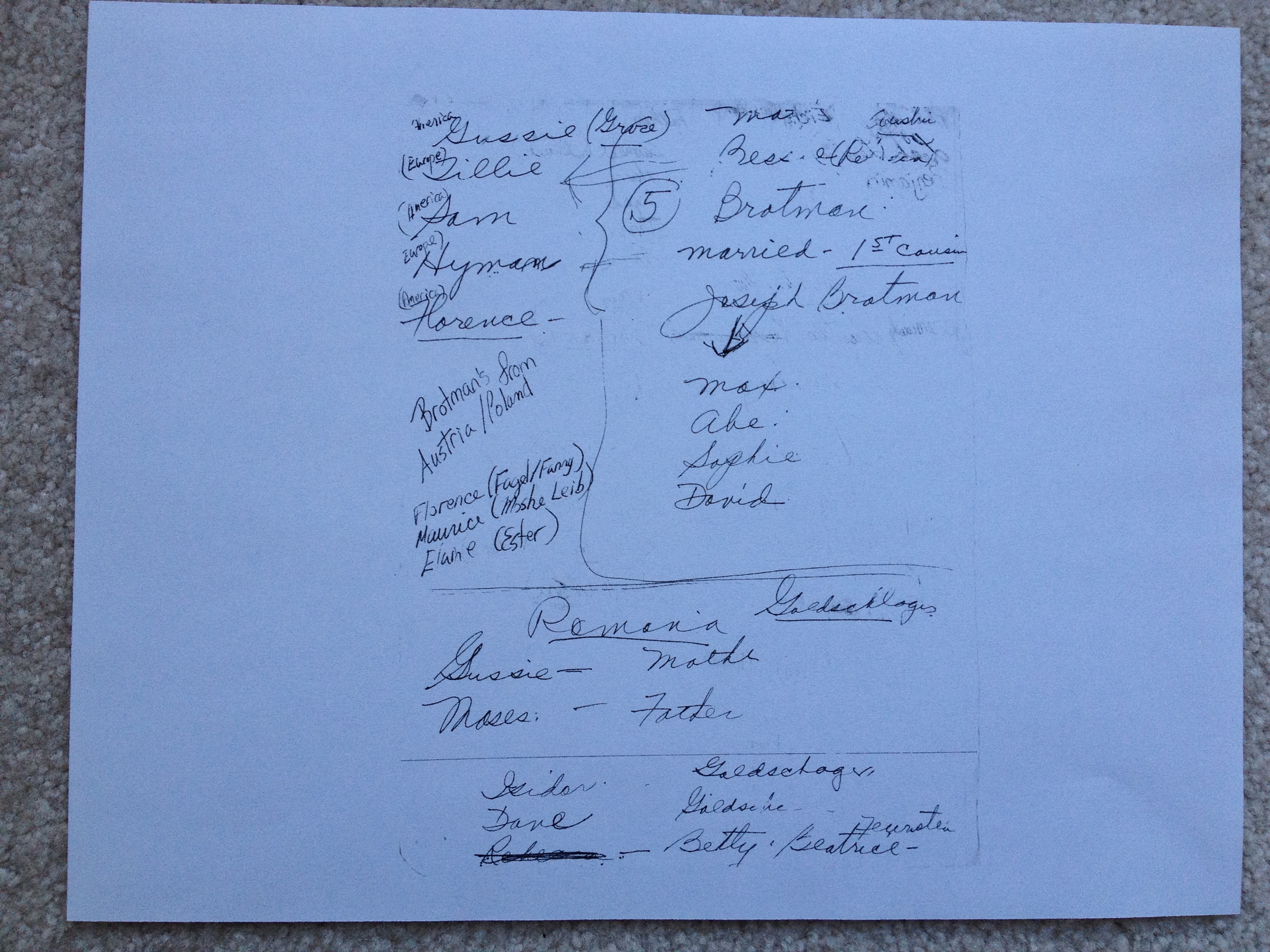
Family Tree drawn by Elaine Goldschlager Lehbraum

Family Tree drawn by Elaine Goldschlager Lehbraum

As you may recall, a couple of weeks ago my cousin Jody made a big discovery: handwritten notes that her mother had made of Joseph Brotman’s children.  It included all the children we already knew about: Bessie’s children Hyman, Tillie, Gussie, Frieda (Florence in her notes) and Sam, as well as the two sons we knew of from Joseph’s first marriage, Abraham and Max.   My brother had recalled that our aunt had said Joseph had had four children from his first marriage, but we did not know the names of the two remaining children, and I had traced every possible Brotman I could find to see if there was a link.  I had hit many dead ends and found nothing that linked these other Brotmans to our family.

My aunt’s notes were a huge discovery because for the first time we had evidence of the names of those two missing children: David and Sophie.  As I wrote when Jody first sent me the tree, I was able to locate a David Brotman from Austria who was a possible match for Joseph’s missing son, but I needed to check further and obtain some documentation in order to be sure.

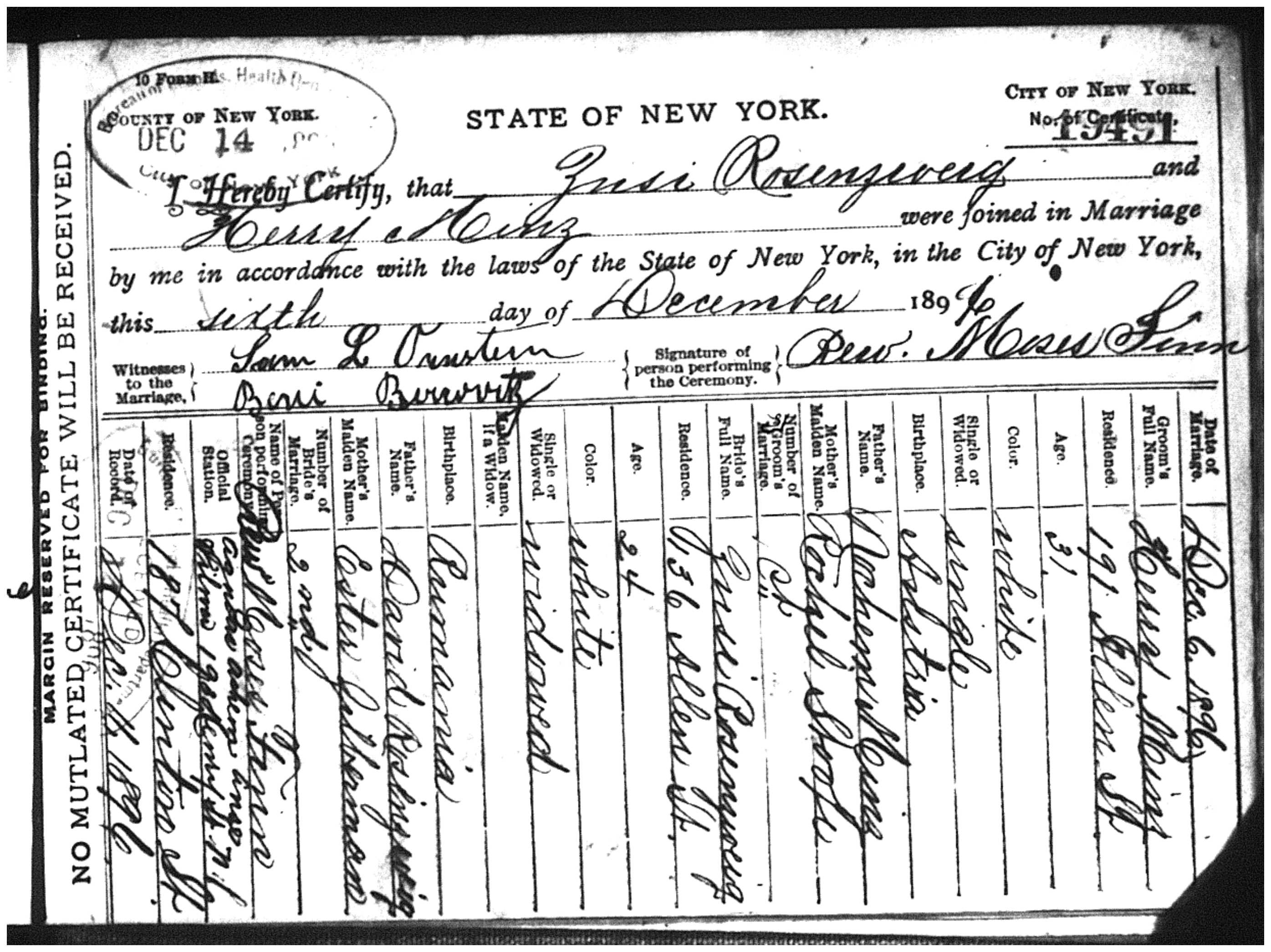
Well, those documents arrived the other day, and I was so excited to see that on David’s marriage certificate in 1897, he listed his father’s name as Joseph Brotman and his mother’s as Chaye Fortgang.

David Brotman and Annie Salpeter marriage certificate

David Brotman and Annie Salpeter marriage certificate

You may recall that Max had also listed his mother’s name as Chaye on his marriage certificate, so this confirmed that Joseph’s first wife was named Chaye, but now we know her surname as well.

Max Brotman marriage certificate

Max Brotman marriage certificate

In addition, the marriage certificate gave David’s current address as 85 Ridge Street—the same address where Joseph and Bessie were living in 1895 when Gussie was born, according to her birth certificate.

Gussie birth certificate

Gussie birth certificate

This confirmed for me that David was Joseph’s son, Max and Abraham’s full brother, half-brother to Hyman, Tillie, Gussie, Frieda and Sam, and our great-uncle.  I am still in a state of amazement that I was able to find him.  Thank you, Aunt Elaine, for leaving behind this great clue to our family.

Once I had this information confirming the relationship, I located whatever census reports and other records I could find for David and his wife, Annie Salpeter.  I found them on census reports for 1900, 1905, 1910, and 1920.  David was a tailor according to the first three census reports, and he and Annie were living on the Lower East Side until at least 1910. At times Annie’s brother Morris lived with them as well as a cousin Meier, but there were no children listed on any of these census reports.

At the time of his World War I draft registration in 1917, David and Annie had left the Lower East Side and were living at 143 Manhattan Avenue in Brooklyn, which was also their address on the 1920 census report, when David’s occupation was given as a cloak dealer in a “cloak house.”  Annie and David were now 44 years old and still had no children living with them, so I assume that they never had children. So there are no more second cousins to find and probably no pictures of David and Annie.  (But I’ve learned never to say never.)

I’ve yet to find David and Annie on the 1930 or 1940 censuses, but I am still looking.  It seems unlikely that they had left Brooklyn.  I was able to locate a 1946 death certificate for a David Brotman married to Anna living at 10 Sumner Avenue in Brooklyn, and I believe this is the same David, despite the fact that the death certificate has his father’s name as Isaac.  I’ve learned enough to know that death certificates are notoriously unreliable.  I will continue to see if I can find anything about David and Annie after 1920.

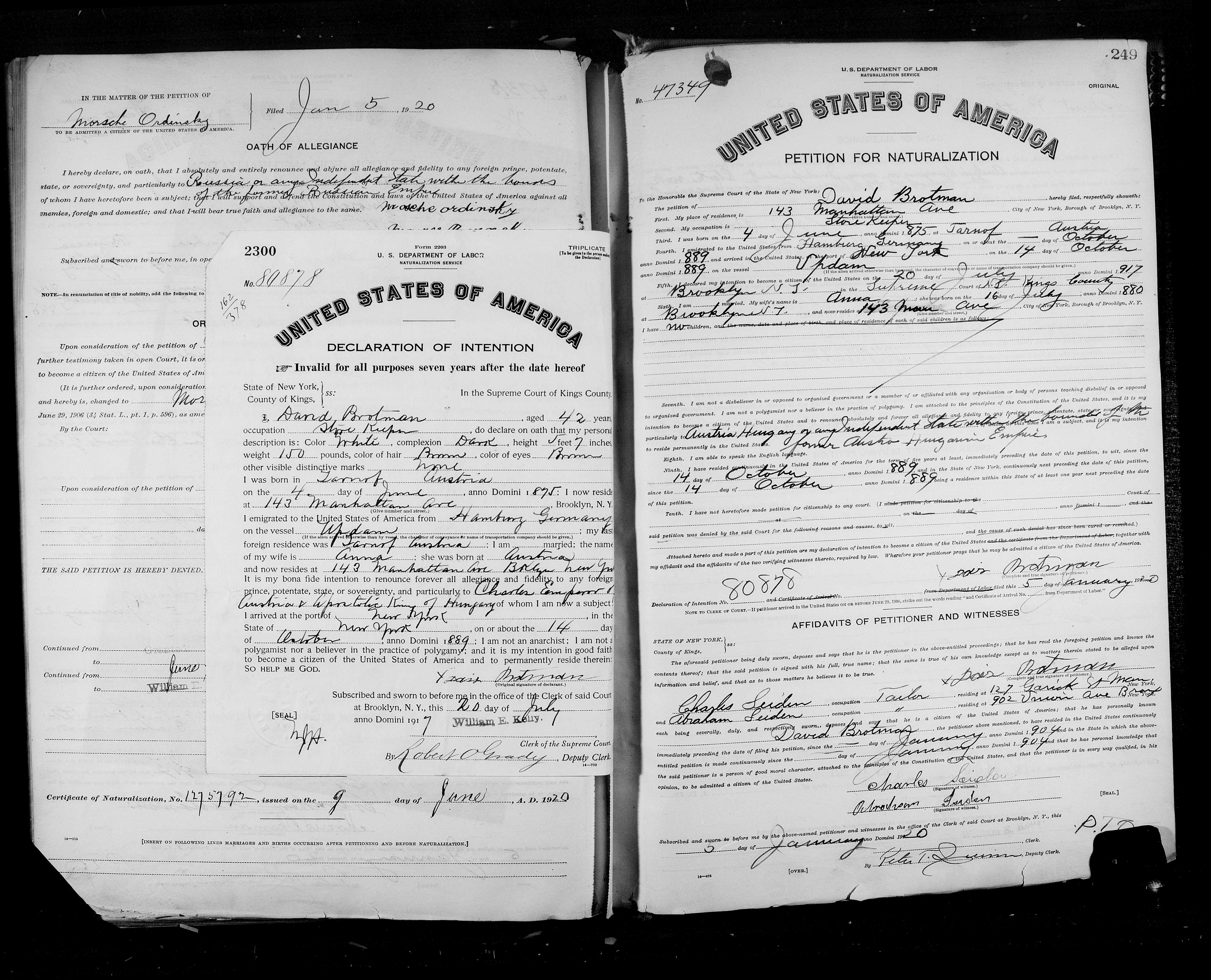
I do have David’s petition for naturalization in 1920, and it indicates that he had arrived in NYC on October 14, 1889, on the “Updam” from Tarnof, Austria.

David Brotman petition for naturalization 1920

David Brotman petition for naturalization 1920

Tarnof could be Tarnow, a city about fifty miles north of Tarnobrzeg/Dzikow and even further from Czchow, the two areas that I have been focusing on as the Brotman hometown based on Hyman’s listing of “Jeekief” and “Giga” on his documents.  But Tarnof could also be Tarnobrzeg, the larger town that is near Dzikow.  So did this new information help our search for our hometown in Galicia or did it just make it more confusing?

That led me to search for the ship manifest for David, now that I knew when he arrived and on what ship.  With some help from Renee, I located a September 4, 1889,  German ship manifest for the Portia, sailing to Rotterdam, listing Dawid Brodmann as a passenger.  I was excited to see that David was traveling with his older brother, Abe Brodmann. I had not previously been able to find Abraham on a ship manifest, so this was another exciting discovery.

David and Abe Brodmann on the Portia 1889

David and Abe Brodmann on the Portia 1889

On the Portia ship manifest, Abe and David are listed as coming from “Grambow, Russland,” not Austria at all, let alone Tarnow, Tarnobrzeg, Dzikow or Czchow.  I would have found this an indication that these were not the right boys, but there is a town right near Tarnobrzeg called Grebow, and according to a 1914 map, Tarnobrzeg was very close to the Russian border. So perhaps our family lived in Grebow? Or maybe that is where Joseph lived with Chaye and then moved to Dzikow when he married Bessie?

On the manifest for the Obdam, sailing from Rotterdam to New York arriving on September 19, 1889, David and Abe are listed as coming from Austria, not Russia, which appears to be correct.

David and Abe Brodman on the Obdam to New York 1889

David and Abe Brodman on the Obdam to New York 1889

There is obviously some confusion and conflict here, but it’s another clue and another place to look for the Brotman home in Galicia. I already have contacted several people researching this area to see if I can uncover more clues.

I have a few more leads to follow to fill in the gaps in David’s life story, and maybe they will even lead me to Sophie, the only remaining child of Joseph to locate.  There is also some potential evidence that will link our family to the Brotmanville Brotmans, but again, I need to do more research before it is worth speculating about that connection.

Enhanced by Zemanta

Maurice Goldschlager

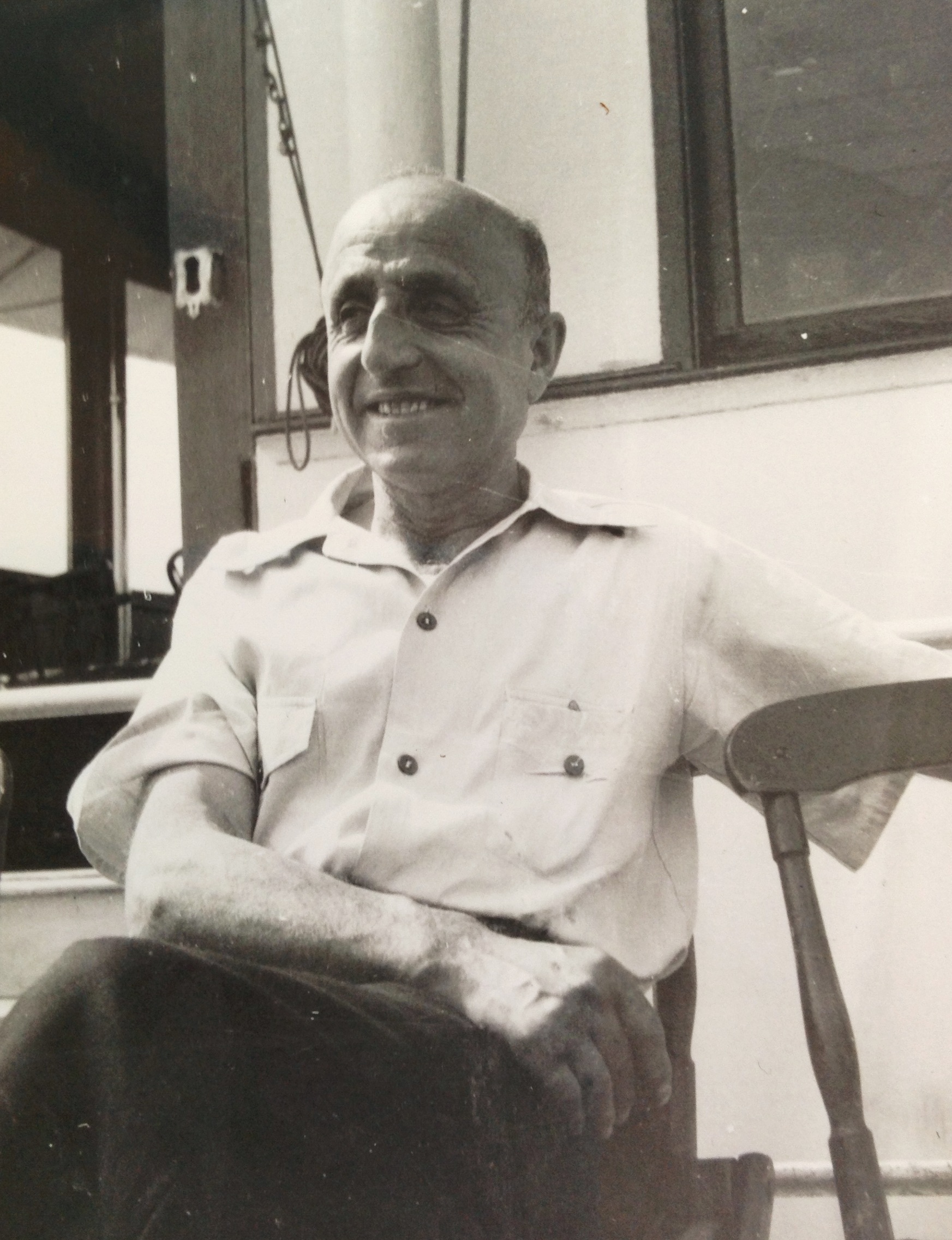
A number of the photographs I received from Robin were of her father, my uncle, Maurice (Mike) Goldschlager.  I asked Robin to provide me with some information about her father’s life to fill in what I know so that I could write a short biography to go with her photos.  Much of this was new information to me.  What I knew of my uncle was that he was a man who had a wonderful sense of humor, a big tease who pinched our ears whenever we saw him, a man who loved his family, animals and the outdoors, a good businessman, a man who had served his country proudly, a man who was full of passion and loved life.

Isadore Gussie Maurice and Elaine about 1923

Isadore Gussie Maurice and Elaine about 1923

Maurice Lawrence (really Leon but he hated that name) was born June 10, 1919, the second child of Isadore and Gussie Goldschlager.  He was named for Isadore’s father, Moritz.  My mother has a book with some notes that her big brother wrote about his activities when he was a boy, and as I recall, he was keeping track of the number of animals he had captured.  I don’t have access to the notebook right now, but that’s my vague recollection.  Once I can get that notebook again, I will update this and scan some of his handwritten notes.

Maurice 1939

Maurice 1939

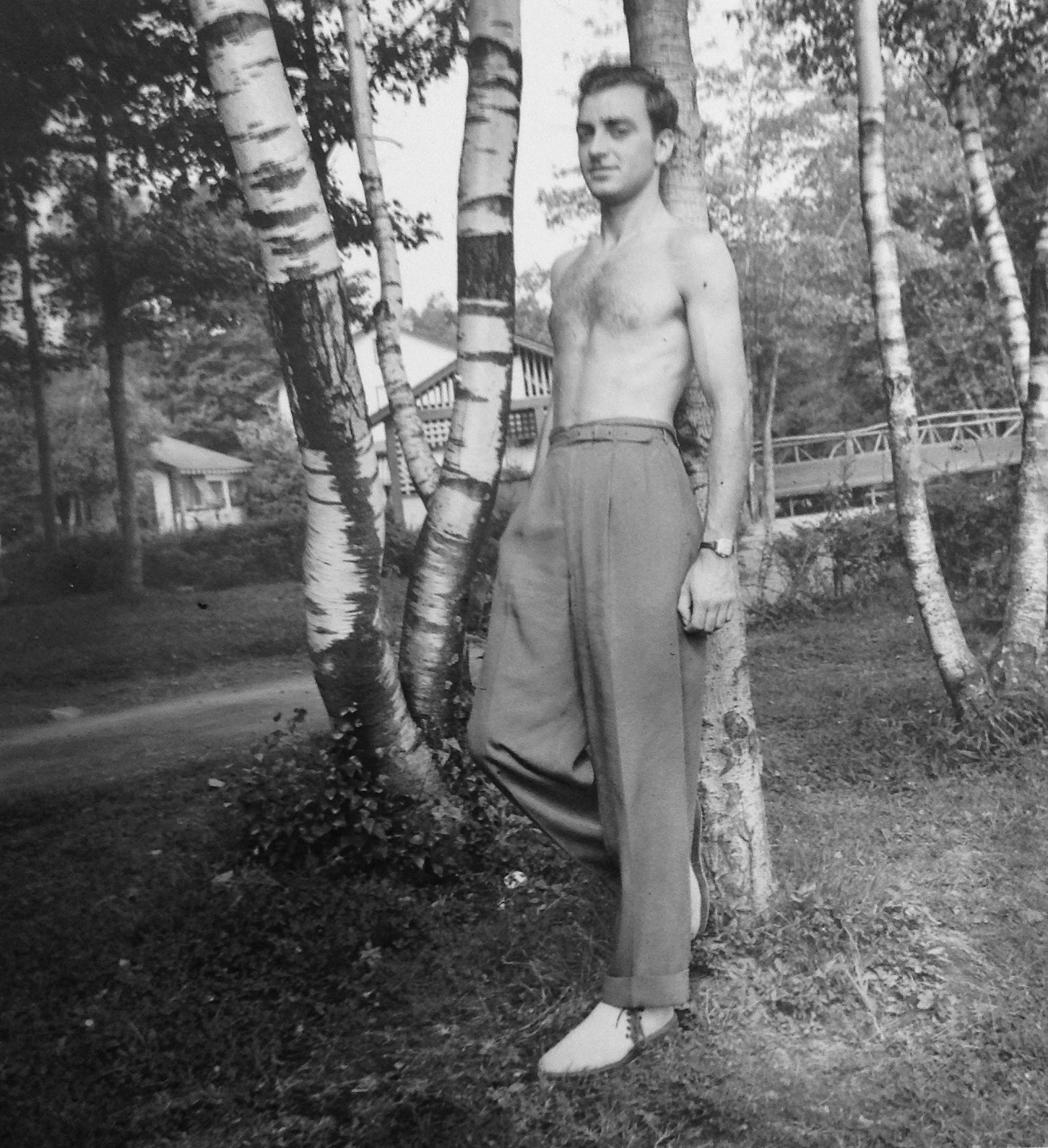
Here is a picture of Maurice in 1941 when he was twenty-two before he enrolled in the Army Air Corps to serve in World War II.

Maurice Labor Day 1941

Maurice Labor Day 1941

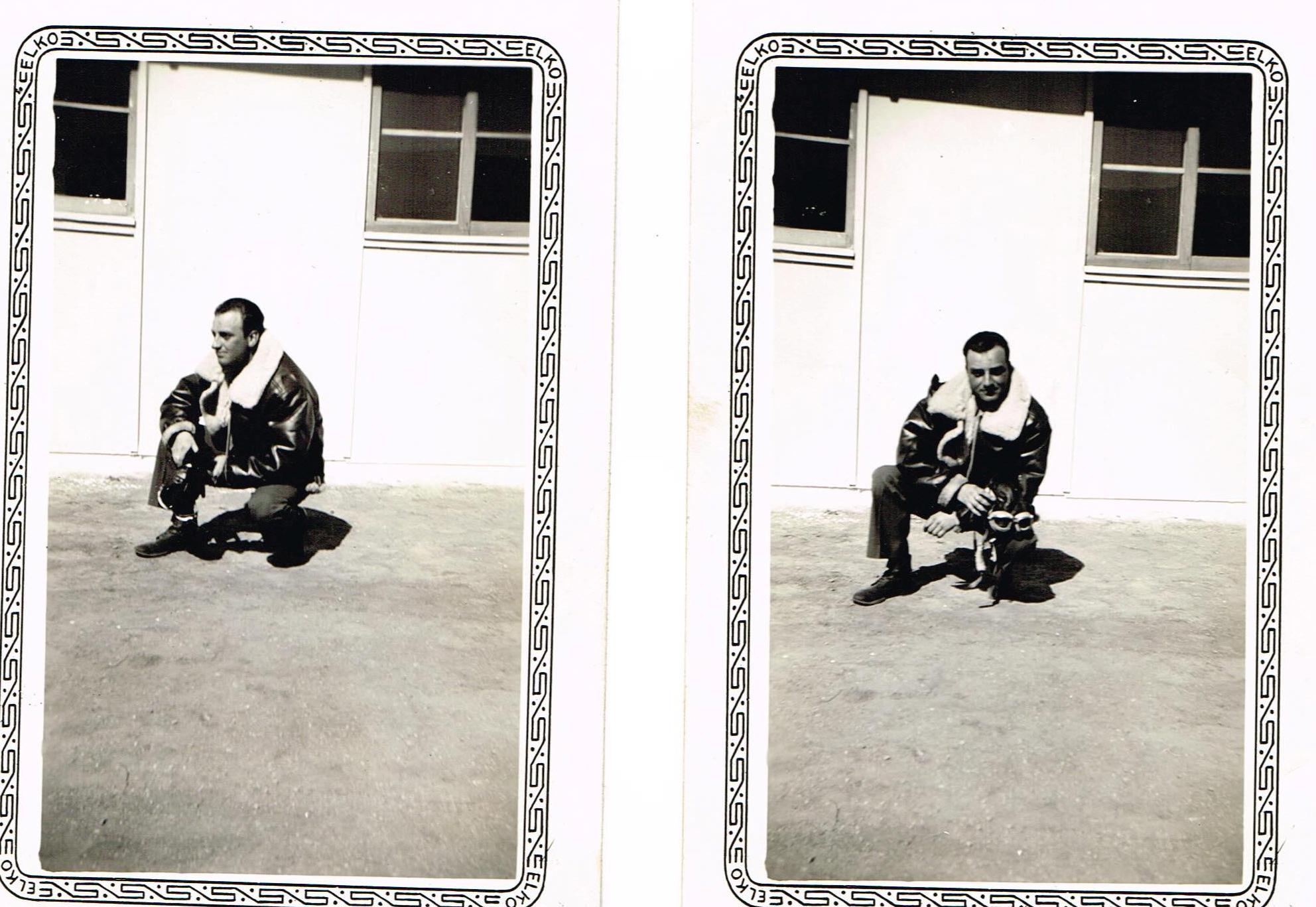
He enrolled on September 25, 1942 and served until the end of the war.  He was a staff sergeant and a tail gunner on a B 12 bomber.  He was stationed in North Africa and flew missions over Italy and France.  The day before he returned to the US, his tent caught fire, and he lost everything but what he was wearing.  Although I never heard my uncle talk specifically about his war experiences, we all knew that he was very proud of his service and remained close to many of his army buddies.  He had his wings made into an ID bracelet which his son Jim now wears in his memory.

Maurice at Aerial Gunnery School in Kingman, AZ

Maurice at Aerial Gunnery School in Kingman, AZ

Maurice 1942

Maurice 1942

Tilly with nephew Maurice 1944

Tilly with nephew Maurice 1944

Maurice 1942

At the end of the war he was stationed in New Jersey where he met Lynn Brodsky.  As Robin reported in my earlier post, it was love at first sight, and they were married on his birthday, June 10, 1945.

Maurice and Lynn 1946

Maurice and Lynn 1946

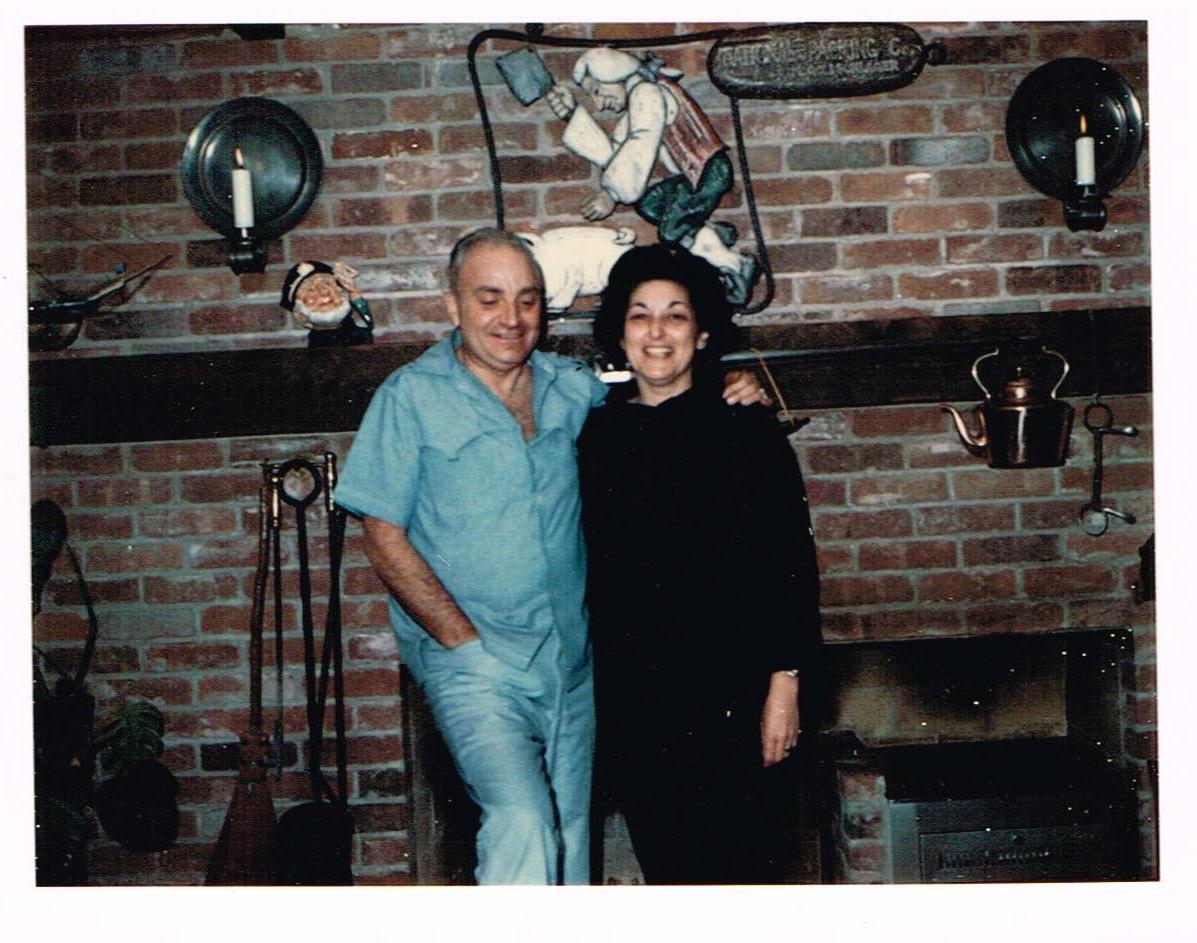
  They settled in New Jersey until Maurice had a run-in with his boss and lost his job.  Lynn’s uncle, Kurt Leopold, owned a meat packing company, Union Meat, in Hartford, Connecticut, and offered Maurice a job and a place to live until he and Lynn could get settled in Connecticut.  Maurice worked for Union Meat for several years and then started his own business with his partners Eric and Kurt Strauss called National Packing.  Lynn had a sign made with the National Packing logo that hung in their family room in West Hartford; my cousin Beth now has it hanging in her kitchen.

National Packing sign on fireplace behind Maurice and Lynn

National Packing sign on fireplace behind Maurice and Lynn

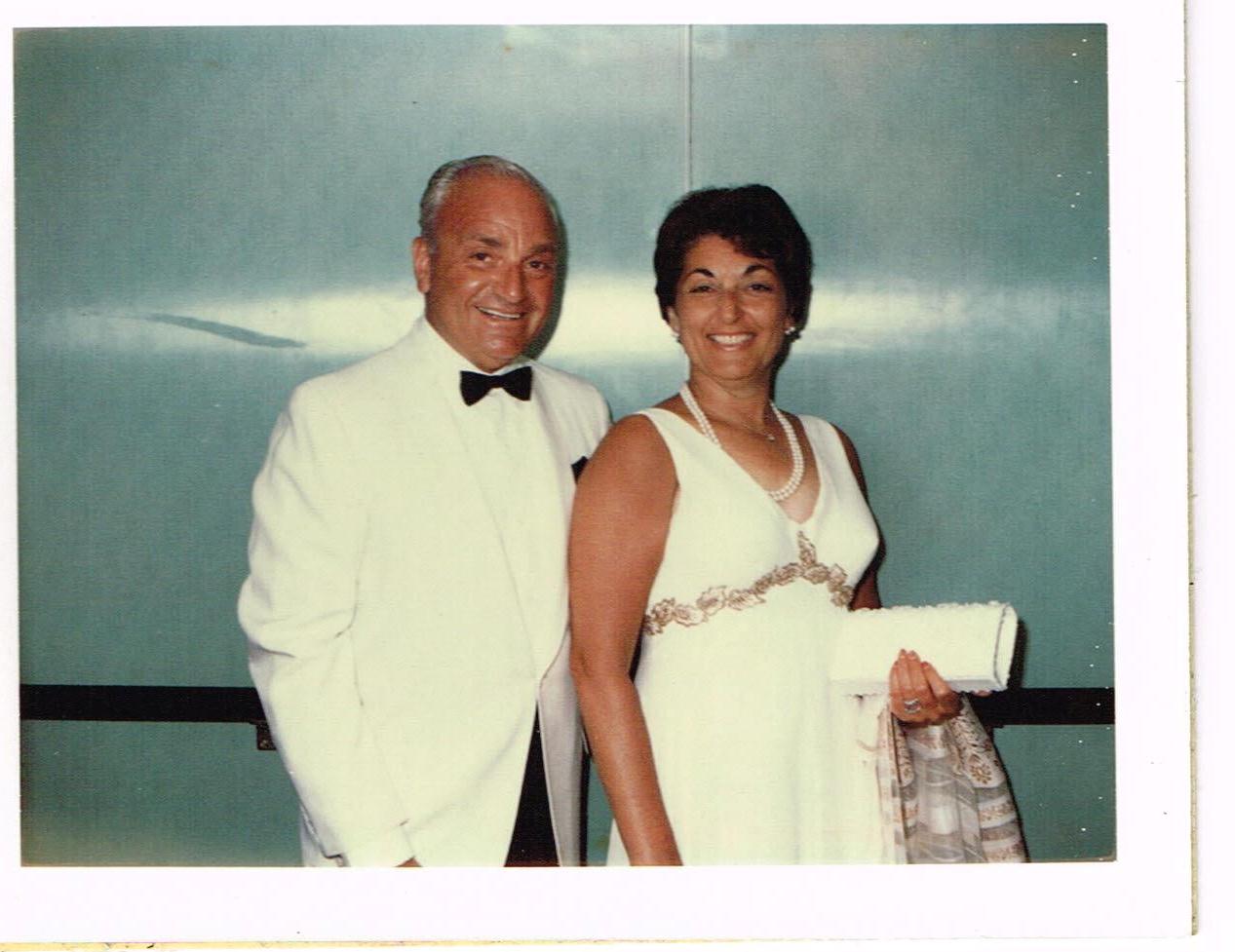
Maurice and Lynn 1967

Maurice and Lynn 1967

Maurice and Lynn had three daughters, my cousins Beth, Suzie and Robin.  Sadly, Lynn’s life was cut short on September 5, 1967 when she died of breast cancer at age 44.

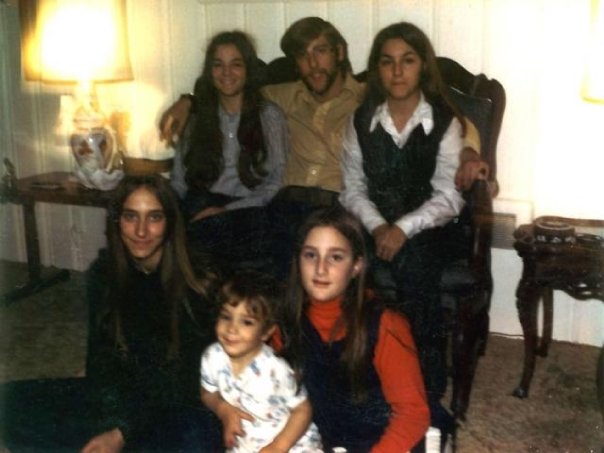
Maurice was very fortunate to find love again with Diane Crone Schaler, who happened to be Lynn’s first cousin.  He and Diane married and had a son, Jim (James Ian).  In addition, Diane had two children from her first marriage, George and Leslie, and they all moved in together in Bloomfield, Connecticut, in a house that not only was filled with teenagers and one small boy, but also lots of animals—dogs, cats, horses, even chickens, ducks and geese, as I recall.

Beth, George, Sue, Leslie, Jim/Jamie, Robin

Beth, George, Sue, Leslie, Jim/Jamie, Robin

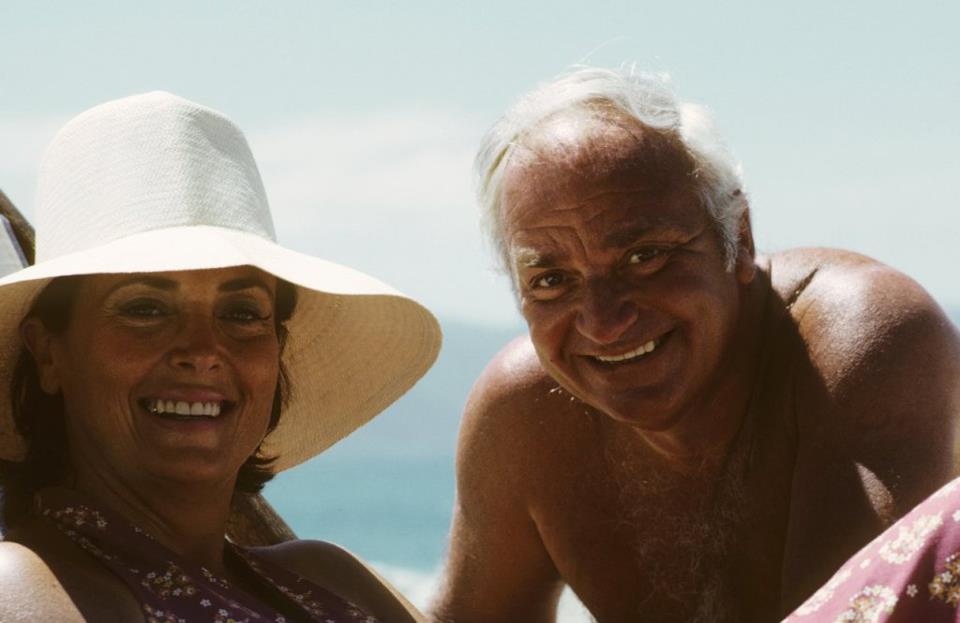
Diane and Maurice

Diane and Maurice

The whole family in BloomfieldThe whole family in Bloomfield plus some visitors

But tragedy struck again on April 24, 1978, when Maurice was killed in a freak accident while riding a lawn mower down an incline on the property in Bloomfield.  He was only 58 years old.   It was hard to believe that a man who was so full of love and life was gone so suddenly.  His name lives on through his many namesakes and in our memories and in these pictures.

.

Enhanced by Zemanta

How did they meet?

Among the photos that Robin sent me last week are these pictures of her parents, Maurice and Lynn Goldschlager, taken in 1949.

Maurice and Lynn Goldschlager Camp Milford 1949

Maurice and Lynn Goldschlager Camp Milford 1949

It was labeled Camp Milford in Connecticut.  I asked Robin if

she knew what Camp Milford was, and she said she thought it was one of those camps for adults that existed back in those days.  I looked it up and found this advertisement and these postcards.

Camp_Milford_ad_1948On the Lake, Camp Milford Kent, CT

Maurice and Lynn did not meet at this camp, but met in New Jersey where my uncle was stationed for some time during World War II.  As Robin tells the story, “The story goes that my dad heard the clicking of her heels walking down the hall and he said to a buddy (before he even laid eyes on my mom) that’s the girl I’m going to marry. And they did.”  They were married soon after on June 10, 1945, with my uncle still in uniform.

My parents, however,  did meet at one of those camps, as did my aunt Elaine and her husband Phillip Lehrbaum. It was a popular way for young Jewish singles to meet back then—away from their parents, but under some kind of supervision.

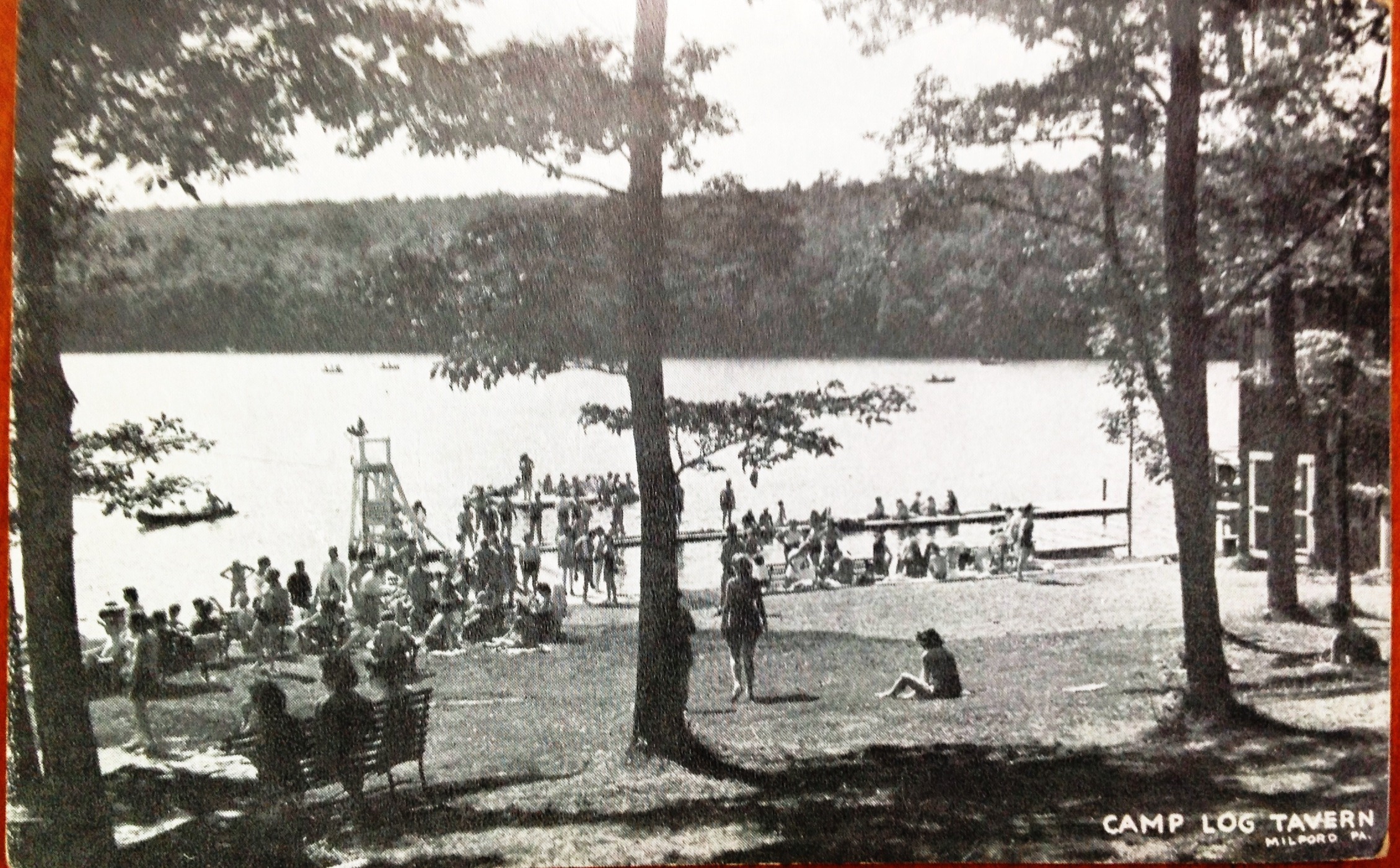
My parents met at Log Tavern in Milford, Pennsylvania (not to be confused with Camp Milford in Connecticut).

Camp Log Tavern Milford, PA

Camp Log Tavern Milford, PA

log tavern from jodylog tavern softball postcard

My aunt and uncle met at Green Mansions in Warrensburg, New York, which became well-known for its theatrical and musical performances.

Ad for Green Mansions in a YMHA newsletter

Ad for Green Mansions in a YMHA newsletter

green mansions

Green Mansions

Green Mansions

Here’s an interview with someone discussing the history of Green Mansions:

It’s too bad these camps no longer exist; they seem like a great idea.  Maybe they were not as efficient as online dating, but at least you met someone face to face, not over bandwidth.  My husband Harvey and I did the next best thing: we met as camp counselors at a YM-YWHA day camp for kids when we were in college.

Thinking about this got me thinking about how my parents met, how my aunts and uncles met.  I am always intrigued by how couples meet.  The stories are usually sweet or funny or romantic or surprising.  They also take on a certain mythic quality.

Florence and John Cohen 1951

Florence and John Cohen 1951

Did my father really first see my mother across the dining room at Log Tavern where he was working as a waiter and immediately tell his friend that she was the girl he was going to marry?

According to another family legend, my Aunt Elaine met her husband when she mistook him for a different man she had met the day before at Green Mansions.  Apparently, my Uncle Phil was not scared off either by her unintentional forwardness or her mistake.  Here they are on their honeymoon visiting Fort Ticonderoga in 1941:

Elaine and Phil 1941

Elaine and Phil 1941

My grandfather Isadore supposedly saw my grandmother sitting in the window of her sister Tillie’s grocery store in Brooklyn and was taken by her beauty.

How did your parents meet? Your grandparents? How did you meet your significant other? If you are willing to share the stories, feel free to use the comment space below or email your stories to me, and I will add them to the blog.

Thank also to Jody for finding the pictures of her parents and the postcard of Log Tavern.  Here are some more of them at Green Mansions.

Elaine and Phil at Green Mansions

    Elaine and Phil at Green Mansions


lap photo green mansions
Be sure to read the comments below
for more stories on “How They Met.”
Enhanced by Zemanta

Betty Goldschlager and Her Daughters Frieda and Estelle: FOUND!

Betty Goldschlager

Betty Goldschlager

I have written about my grandfather’s younger sister, my great-aunt Betty, and her experiences arriving in New York City the day after her father had died of tuberculosis.  But until now I knew very little about her life after those early days.  I knew that she had married Isidor Feuerstein, had two daughters Frieda and Estelle, and had moved to Long Island, where Isidor had a dry goods business near Levittown.  Most of that I knew from my mother, who has clear memories of her aunt, uncle and cousins visiting her in Brooklyn when she was growing up.  My mother commented on what an astute businessman Isidor must have been to have opened a business near Levittown when it was a new community.  She also remembered that her two cousins were beautiful young women, described by my grandfather as Romanian princesses.

But that was all I knew.  My mother thought that Betty and her daughters had all moved out west at some point, and she had lost touch with them long ago.  My search for them turned up a few details—a death certificate for Betty from Phoenix, AZ, census reports from 1930 and 1940, but little else.  Then several months ago, I thought I had a hot lead.  I located a great-nephew of Isidor Feuerstein on ancestry.com, and he knew that Frieda had married a man named Abe Albert and even had a wedding picture of her as well as one taken several years after the wedding.  He believed that Frieda had a daughter named Gail, but was not sure.  He knew that Estelle had married a man named Kenner with a first name that started with I, but did not know whether she had had any children.  He did not know whether either Frieda or Estelle was alive or where they might be living.

Feuerstein Family (Betty at far left)

Feuerstein Family (Betty at far left)

With that new information, I started searching again, and although I was able to locate an Estelle Kenner living in Pembroke Pines, FL, I had no way to be sure that this was the same Estelle.  I could find no real evidence of Frieda.  I searched as many different ways and as many different places as I could, but kept hitting that proverbial brick wall.  So I moved on, focused on David, Isadore, the Strolowitz family, the Schwartz family, etc.

Then the other night I mentioned to Renee (my friend and mentor) in an email that I was still searching for my mother’s two first cousins, Frieda and Estelle.  I woke up the next morning, and there in my Inbox was an email from Renee providing me with Estelle’s wedding announcement, her husband’s obituary, and the names of their three children.  So after months and months of finding nothing on my own, Renee in one evening had solved one of my most frustrating searches.  How did she do it? She had access to yet another database that I was not aware of—something called ProQuest available at certain libraries.

So I was off and running, finding the three Kenner children on Facebook and sending each a message about my research.  Within five minutes, Barry Kenner sent me back a message, and we then spent over an hour on the phone, exchanging information and getting to know each other.  He also gave me contact information for Frieda’s daughter Gayle, and I have now had several email exchanges with her as well.  There is still a lot to learn and more photos and documents to share, but I have answers to many of my unanswered questions.  I have also had an email from Barry’s sister Robyn and hope to hear from his other sister Karyn.  I have lots of new names to add to the Goldschlager family tree and am awaiting more photographs and information about my family.

Betty Goldschlager 1969

Betty Goldschlager 1969

First, Frieda and Estelle are both still alive.  Frieda lives in Arizona, and Estelle in Florida.  Both of their husbands ended up in the same fabric importing business as Isidor Feuerstein.  Irving Kenner had taken over the Long Island business, and Abe Albert started his own business in Arizona.  Frieda and Estelle each had three children—two sons and a daughter for Frieda, two daughters and a son for Estelle.  There are also many grandchildren and great-grandchildren descended from Betty and Isidor.

Frieda and Abe Albert at their wedding in 1943

Frieda and Abe Albert at their wedding in 1943

I have already learned a few interesting facts that I did not know before.  Gayle told me that her grandmother was very proud of her father Moritz, who she said was very dapper and a lamplighter for the theater. She said that there was even a story that before he married, he had run away to the circus!  That gave me an entirely new perspective on Moritz and his life.  Remember he is my great-grandfather who was an orphan by age six.  I had wondered whether he had experienced any happiness in his life. I thought he lit street lamps  This little snippet—a daughter’s memory of him as dapper and of being proud of his occupation, of a man who loved the circus and the theater—gave me a whole new insight into who my great-grandfather was.  Even better, she later sent me a photograph of Moritz.  Just the other day I wrote that I would never see a picture of him or know what he looked like.  Never say never!  Here he is:

Moritz Goldschlager

Moritz Goldschlager

I assume this was taken in Iasi, not New York.  I can see why Betty described her father as dapper. His clothing, his watch chain, the stance, the mustache, the furniture behind him—all this gives me a far different impression of the man who was my great-grandfather than I had imagined.  Somehow I saw him as a peddler, a poor immigrant, because that was what he was in New York, but perhaps their life in Iasi was far more comfortable than I had assumed.

Gayle also said that her grandmother talked about having a tall brother whom she referred to as Uncle Gadalia.  I told her that that must have been David, since Isadore was not tall at all.  She also remembered that she had met David’s son Murray and his wife when they came to Phoenix from Tucson for her brother’s bar mitzvah, but that they lost touch after that.

Barry recalled visiting his grandmother on Long Island and her house with the grand entry staircase that they would slide down as children, using her silk pillows as seats.  He described Betty as a sweet and petite woman whom he recalls making them mashed potatoes with chicken fat instead of butter.  It’s amazing how little stories, little memories can bring alive someone whom I never knew.  Barry shared this picture of the Feuerstein family at his parents’ wedding in 1951.

Betty, Irving's mother, Irving's sister-in law, Frieda, Estelle, Irving, Irving's brother, Abe Albert, and Isidor Feuerstein at Estelle and Irving's wedding

Betty, Irving’s mother, Irving’s sister-in law, Frieda, Estelle, Irving, Irving’s brother, Abe Albert, and Isidor Feuerstein at Estelle and Irving’s wedding

Estelle Feuerstein, Betty's daughter

Estelle Feuerstein, Betty’s daughter

Estelle and Irving KennerEstelle and Irving Kenner 1951

The photos on this page are a combination of the few photos I had of

Frieda and Abe Albert at their wedding in 1943

Frieda and Abe Albert at their wedding in 1943

Betty, Isidor and their daughters and some pictures that Barry shared with me through his Facebook page and some that Gayle sent me.  I am excited to see others and to learn more about these newly discovered cousins.

Frieda and Abe

Frieda and Abe

Estelle

Estelle

Estelle's children Barry Robyn and Karyn 1963Estelle’s children Barry Robyn and Karyn 1963

Frieda and her children Robert, Gayle and Richard

Frieda and her children Robert, Gayle and Richard

Barry Kenner's family

Barry Kenner’s family

Enhanced by Zemanta

Crowd Sourced Genealogy

In yesterday’s New York Times, A.J. Jacobs wrote a mostly facetious article about the phenomenon of crowd sourced genealogy, “Are You My Cousin?”  Crowd sourced genealogy refers to the practice used by some people doing family research where on websites like Geni a researcher can link his or her tree with other trees once a

Image representing Geni as depicted in CrunchBase

Image by None via CrunchBase

common relative is found.  As Jacobs points out, many experienced genealogists have expressed concern about this practice because the trees that are being connected may not be well-researched or accurate.  As a result, people end up incorporating those mistakes into their own trees, and then those mistakes can be repeated over and over again as new people begin linking to these inaccurate trees.

Although ancestry.com is not set up like Geni to promote the idea of one World Family Tree, their site also allows researchers to view other family trees which list people with the same names and dates as those on their own tree.  When I first started using ancestry.com, I relied on this tool to add names to my family tree on my father’s side.  I soon, however, realized that it was a dangerous practice.  I thought I had found some English cousins because we shared a relative named Boomer Cohen.  I contacted them and was very excited—only to be very disappointed and embarrassed when I learned that their Boomer Cohen was not the same as my Boomer Cohen.  Who would have thought there were two women with that name?

I’ve run into other problems with relying on the family trees I find on ancestry.com.  Often trees were created without any documentation, so I can’t double-check to be sure they are accurate.  When I was researching Harry Coopersmith, my great-aunt Frieda’s husband, I found Harry on a tree with parents who did not match the parents I had found after research and with documentation.  It had Harry’s children correctly and his birth and death dates, but the wrong parents.  I contacted the tree owner, Harry’s grandson, and asked him about it because I assumed he was right and I was wrong.  But it turned out he had linked to someone else’s tree with a different Harry Coopersmith and assumed it was his grandfather.  He was very happy (and probably embarrassed) when I was able to provide him with the correct information and the documents to back it up.

As a result, I am very skeptical of sites like Geni and the whole notion of crowd sourced genealogy.  Not that I have stopped looking at those other trees on ancestry—I always do, and I have found many helpful people by doing so.  For example, I found Becky Schwartz Goldschlager’s nephew Jon by finding his family tree on ancestry.  But I have learned to use these trees very carefully.  In fact, when I return to researching my father’s family lines, I will need to go back and pare some limbs from those trees unless and until I can find documentation to back them up.

Jacobs also expressed skepticism, but seems to be overall in favor of crowd sourced genealogy.  As I said, his article is mostly facetious, pointing out the ridiculously long and convoluted paths that connected him to Albert Einstein and Gwynneth Paltrow, among others.  Although the idea of finding hundreds of celebrities and famous people to whom I have some very attenuated connection is somewhat intriguing, it’s not what I am after by engaging in genealogy research.  I want to know more about my real ancestors — who they were, where they lived, and how they lived.  I don’t need to know my great-great-uncle’s wife’s brother’s daughter’s husband’s cousin’s mother’s stepfather was Abraham Lincoln.  What good would that do me?

English: Abraham Lincoln, the sixteenth Presid...

English: Abraham Lincoln, the sixteenth President of the United States. Latviešu: Abrahams Linkolns, sešpadsmitais ASV prezidents. Српски / Srpski: Абрахам Линколн, шеснаести председник Сједињених Америчких Држава. (Photo credit: Wikipedia)

Enhanced by Zemanta

The Stories behind a Photograph

No real time to write this weekend, so I thought I would just post one more of the pictures that Robin sent.  I don’t know when this was taken, and it was a great surprise to realize that there was a photograph of my mother that I had never seen.  I’d love to know more about the picture. It looks like a formal photograph, but it’s not a school photograph because I have seen her high school graduation photograph. So when was it taken? Why was she sitting for a formal photograph? What is the necklace she is wearing?  I will have to ask her when I speak to her.  But it’s a fascinating photograph.  It captures her in so many ways that I know so well, but also sheds a new light that is different from other pictures I’ve seen before.  That’s what makes photographs so interesting—they let you see someone at a particular moment in time, a moment when perhaps you didn’t know them, and let you see who they were then as well as who they are now.

Image

Enhanced by Zemanta

Happy times

Dune on Cape Cod near Provincetown

Dune on Cape Cod near Provincetown (Photo credit: Wikipedia)

Over the last several days, my posts have been tinged with sadness: my great-grandfather’s Moritz’s life story, the death of Pete Seeger, and the tenth anniversary of the death of my cousin Jeff.  So today, thanks to my first cousin Robin, I want to post pictures of some of the happy days shared by my family.  Robin sent me many wonderful photos, and I will post them all sometime over the next several days or so.

But today I want to post the pictures Robin sent of a family vacation to Cape Cod during the summer of 1962, the first family vacation we shared with my Goldschlager cousins, Beth, Suzie and Robin. I found a few others from my collection from that summer and later summers on the Cape.

That 1962 vacation was special in many ways.  It was the first time that our family went to Cape Cod, a place that has become a place we all love beyond words.  It was, in fact, the first time my immediate family went on vacation for more than just a weekend away.  And it was the first time that we shared a vacation with the Goldschlagers.  My Goldschlager cousins lived in West Hartford, which back then seemed to be a million miles away from where we lived in Westchester.  We would see them for holidays and occasional visits, either in New York or in Connecticut, but this was the first time we were able to spend so much time just being together.

It rained many of the days that we were there, but we did not care.  We were just happy to be together.  We drew, played cards and games, polished beach stones, collected shells, swam when it wasn’t raining, watched television, walked on the beach, and just enjoyed each other’s company.

Julie, Suzie, Ira, Beth, Amy and Robin 1962

Julie, Suzie, Ira, Beth, Amy and Robin 1962

Robin 1962

Robin 1962

My immediate family was staying in a small cottage in Wellfleet in Paine’s Hollow, and my cousins were staying at a motel called Horizons in North Truro.  We spent most of our days at Horizons because it was right on the beach and had an outdoor pool.

My parents at Horizons 1962

My parents at Horizons 1962

Amy and Beth at Horizons

Amy and Beth at Horizons

cousins at our Wellfleet cottage

cousins at our Wellfleet cottage

Although my family went on vacation alone in 1963 to a different part of the Cape, in 1964 all the cousins including Jody and Jeff, our Lehrbaum cousins, were together near Lake Sunapee.  Somewhere I have some photos of that vacation.  We all stayed in little cabins on the lake and spent another week together, collecting rocks, playing with frogs, swimming in the lake, even water-skiing for the bigger and more able cousins.  It was another magical time for us, being all together.

In 1965 and 1966, we returned with the Goldschlagers and the Lehrbaums to Horizons and to Cape Cod.  Here are some photos from those vacations.  They are not great photographs (I was using a Brownie or Instamatic), but at least for me, they capture some happy memories:

Jeff 1965

Jeff 1965

Maurice 1966

Maurice 1966

Horizons

My mother, I think?

Jeffrey Horizons

Jeff

Jody Horizons

Jody

Maurice, Elaine and Lynn and a cousin

Maurice, Elaine, a cousin, and Lynn

Jeff at Horizons 1965 or 1966

Jeff at Horizons 1965 or 1966

For many years after 1966, Horizons was the place my immediate family would return to when staying on the Cape for vacations.  In 1976, my cousin Beth and her husband Steven honeymooned there, and we, also newlyweds, met them there and sat around the pool, sharing our wedding stories and our childhood memories.  We took our children there when they were little, and even my grandson stayed there when he was just two months old.  One of the memories that never fails to make us laugh is of my Aunt Elaine coming into our motel room and standing on the bed to rearrange the drapes.  I don’t remember why she was doing it, but the image can still make me laugh. Although we all have found other places to vacation and no longer stay at Horizons, I think for all of us Horizons Motel remains a place with special memories

Those were some of my happiest days—being with my cousins, finding our common bonds, getting to be together as not just cousins but as friends.  Yes, those days were too few and too short, but they left an indelible mark that even now, some 50 years later, allows me to conjure up those days with a smile on my face.

Cape Cod National Seashore.

Cape Cod National Seashore. (Photo credit: Wikipedia)

Enhanced by Zemanta

Where they lived: East Harlem in the Early 20th Century

One of things that puzzled me when I started looking at the census reports for the Goldschlagers between 1905

English: Looking from 96th Street in the south...

English: Looking from 96th Street in the south, northward along Second Avenue towards Spanish Harlem. (Photo credit: Wikipedia)

and 1915 was where they were living.  I had always assumed that my grandfather, like my Brotman ancestors, had settled in the Lower East Side when he arrived in New York.  I thought that was where all poor Jewish immigrants had settled in the late 19th and early 20th century.  Yet at the time of the 1905 census, my grandfather was living at 2213 Second Avenue, near the intersection with 115th Street, in the neighborhood we know as East Harlem or Spanish Harlem.  He was living by himself (at age 17) in a building with some families with Jewish names but mostly families with Italian names.  What was he doing there? Why was he living up there and not on the Lower East Side?

When Moritz arrived, they remained in East Harlem on 109th Street, and after Moritz died, Betty and Isadore moved in with Tillie on 109th Street.  In 1915, all of the surviving Goldschlagers were still living on 109th Street.  Eventually, Isadore moved to Brooklyn, and David, Betty and their mother moved to the Bronx, until Betty and Gisella moved to Bayshore, Long Island in the 1930s.  But why had they started and stayed in East Harlem?

330 East 109th Street today

Some quick research revealed that East Harlem was a huge Jewish community in the early years of the 20th century, but that that community had disappeared and was for the most part forgotten.  As David W. Dunlap wrote in The New York Times in 2002, “On the map of the Jewish diaspora, Harlem is Atlantis. That it was once the third largest Jewish settlement in the world after the Lower East Side and Warsaw — a vibrant hub of industry, artistry and wealth — is all but forgotten. It is as if Jewish Harlem sank 70 years ago beneath the waves of memory, beyond recall.”  Dunlap then described the many signs that Jews once lived in East Harlem in the churches that were once synagogues.

Former Temple Israel Jewish synagogue, now Mt. Olivet Baptist Church. Detail: Star of David.

Mount Olivet Baptist Church in East Harlem, originally Temple Israel

The neighborhood had been rural until the subway and elevated trains arrived around 1880.  Soon after tenement buildings were constructed, and immigrants moved in, first German and Irish immigrants, then Jewish and Italian immigrants.  According to Wikipedia, there were 90,000 Jews living in East Harlem in 1917; however, the neighborhood was predominantly Italian and came to be known as Italian Harlem or Little Italy.  That is consistent with my study of the names in the 1905 census.

Photograph shows 105th Street between Madison and Park avenues in 1929, with traces of Jewish Harlem, including the Hebrew Home for the Aged in Harlem <i>(left)</i> and the synagogue called Beth Hamridash Hagadol of Harlem.

My mother remembers that her father spoke several languages and was quite fluent in Italian.  He must have learned Italian living in East Harlem in his first ten years in New York.   He was not a religious person and had left Romania at least in part to escape the anti-Semitism there.  Perhaps living in a mixed neighborhood made him feel more American, although obviously there was a well-established Jewish community there as well with many synagogues and other institutions.   Maybe it was cheaper than the Lower East Side, maybe the Lower East Side was already filled beyond overcrowding, or maybe East Harlem was a better neighborhood, not a cheaper neighborhood.  I don’t know what drew my grandfather there or why he stayed.

It’s always good to learn something new.  Now I know not only something new about my family, but also something new about the history of New York City and the Jewish immigrants who settled there.

2287 1st Avenue, East Harlem, New York.

2287 1st Avenue, East Harlem, New York. (Photo credit: Wikipedia)

Enhanced by Zemanta

My Great-Grandfather Moritz (Moses ben Ira) Goldschlager

It’s remarkable to me that before I started doing any of this research, I did not even know my grandfather’s father’s name (or his mother’s name).  I still know very little about his life and nothing about his personality, but I know enough to make me sad that I don’t, and likely never will, know more.

From records that my researcher in Iasi was able to find last summer, I know that my great-grandfather was born Moses Lieb in Iasi, Romania in 1855.  His parents were Ira and Beila Goldschlager.  From the birth record created for his marriage, I know that witnesses testified to his birth and to the fact that his father Ira died in 1859 and that his mother Beila died in 1861.

Moses Leib Goldschlager birth record

Moses Leib Goldschlager birth record

Moses birth record transcribed and translated

Moses birth record transcribed and translated page 1

page 2

page 2

In other words, my great-grandfather was an orphan by age six.  I have no idea who took care of him after that.  Perhaps it was one of the several witnesses on this record, men who were old enough to have been a guardian to him.  I have no idea what his childhood was like or how or why his parents both died when he was so young.

The next event for which I have any record is Moses’ marriage record dated September 2, 1887, when he was 32 years old.  Was this his first marriage? Thirty-two seems old for that generation to be married for the first time, but so far no earlier record has shown up.  Perhaps he was married before; perhaps he even had children in that first marriage.  I don’t know.  I don’t know what he was doing between 1855 and 1887, how he survived, where he lived, how he made a living.  But in 1887 he married my great-grandmother, Ghitla Rosentzweig, eighteen years old according to the marriage record, daughter of David and Esther Rosentzweig.  Her father also had died by the time she was married, but her mother was still alive and living in Iasi.  On the marriage record Moses’ occupation is reported as “freely profession,” as translated by my researcher.  I asked him what this means, and he said he believed it meant self-employed.  Since my great-grandmother is listed as “without occupation,” I assume that Moses had some occupation, but it is not identified.

Moses Leib Goldschlager and Ghitla Rosentzvaig marriage record

Moses Leib Goldschlager and Ghitla Rosentzvaig marriage record

Transcription and translation of marraige record

Transcription and translation of marraige record

Their first child, my grandfather Isadore, was born in August, 1888, almost a year after Moses and Ghitla were married.  On his birth record, it says that Moses, now 33, was a lamplighter.  I assume this meant that he lit the gas lamps on the public streets.

UPDATE February 2, 2014:  I just learned today that he lit the lamps in the theater!! And that he was a very dapper dresser.  Thank you, Gayle, Betty’s granddaughter, who reported this information to me.

Interestingly, Ghitla is now reported to be 22, not 19.  (I guess Romanian record keepers faced the same inconsistent age reports as American census takers.)  My grandfather’s name is spelled Ire here, obviously named for Moses’ father Ira Goldschlager.

Ira aka Isidor Goldschlager birth record

Ira aka Isidor Goldschlager birth record

transcription and translation

transcription and translation

Moses and Ghitla’s second child David was born the following year on November 4, 1889. David was presumably named for Ghitla’s father, David.  Moses’ occupation is once again described as “freely profession,” and he is now 34, Ghitla 23.  The Goldschlager family was residing at the same house as the year before at 26 St. Andrew Street in Iasi, depicted below.

David Goldschlager birth record

David Goldschlager birth record

transcription and translation

transcription and translation

The Goldschlager home at 26 St Andrew Street, Iasi

The Goldschlager home at 26 St Andrew Street, Iasi

St_Andrew_Str_no_26_0001

The next record I have for Moses is the ship manifest for when he left Romania and came to the United States.  He sailed from Le Havre on July 31, 1909, to New York.  On the manifest his name is given as Moritz Goldschlager with his occupation listed as a tailor.  It says he was 46 years old, which is about eight years younger than it should be.  It gives his nationality as Roumanian and his “race or people” as Roumanian, but then written over it is “Hebrew.”  Moses/Moritz named his wife Gisella Goldschlager of Jassy as the nearest relative from the country he was leaving and named his son Isidor, my grandfather, of 440 East 147th Street, New York, as the person he was joining at his destination.  The manifest also reveals that Moses was only 5’3” tall and had auburn hair and blue eyes.  That is probably the closest I will ever get to a picture of him.

Ship Manifest of Moritz Goldschlager

Ship Manifest of Moritz Goldschlager

page 2

page 2

UPDATE: I just realized that the 440 East 147th Street must be 110 East 117th Street, as that was the address that my grandfather have given for his aunt Zusia Mintz as the person meeting him when he came to NYC.  Plus 440 East 147th Street is in the Bronx, not Manhattan.

I wonder when he became Moritz, just as I wonder when my grandfather became Isidor (or Isadore; it seemed to change back and forth).  Were these names they used in Romania, or were they adopted to come to America? I assume the former—that Moses and Ira were Hebrew names, Moritz and Isidor secular names, but I don’t know for sure.

Moritz arrived in the United States in August, 1909, and then sadly, the next and last record I have for him is his death certificate, which I just received the other day.  As I’ve written earlier, Moritz died on April 3, 1910, just eight months after he arrived in New York, a day before his daughter Betty arrived, and seven months before his wife and his son David arrived from Romania.  They all arrived apparently without knowing Moritz had died, as they all listed him as the person meeting them at arrival.

I had wondered about his cause of death, and although I know that there is some question about the reliability of death certificates before the professionalization of the medical examiner’s office in the late 1920s, my great-grandfather died in a hospital according to his death certificate, and his death certificate is signed by a medical doctor, not a coroner.  According to the certificate, my great-grandfather died from tuberculosis after being admitted to Harlem Hospital on April 2, 1910.  I wonder how long he had been sick before coming to the hospital.

Moritz Goldschlager death certificate

Moritz Goldschlager death certificate

The certificate also provides some other information and, as often is the case, some misinformation.  It says that Moritz was a peddler, that he was married, and that he was 53 years old, which is closer to the truth than the age listed on the ship manifest.  It says his father’s name was Isidor Goldschlager, which, if true, means that my great-great-grandfather also used Isidor as his secular name and his Hebrew name was Ira.  But the certificate also says that Moritz’s mother’s name was Ghisela and then something that is not legible.  I assume that my grandfather was the informant and that he was confused and gave his mother’s name instead of his father’s mother’s name.

Finally, the death certificate indicates where Moritz and Isadore had been living—173-175 East 109th Street.  According to the 1910 census, this is the same street where Tillie Strolovitz and her seven children were living in 1910, just a few blocks away.  That census is dated April 24, 1910, just 21 days after Moritz had died, 20 days after Betty had arrived.  Isadore and Betty had moved in and were living with their aunt and cousins by that time, obviously taken in by their aunt Tillie shortly after their father’s death.

And that is all I know about Moses ben Ira, Moritz Goldschlager.  He lost his both his parents by the time he was six years old; he married at age 32, had three children, and worked for at least a while as a lamplighter and perhaps as a tailor in Iasi before emigrating in 1909.  He lived for less than a year in New York as a peddler before succumbing to tuberculosis at Harlem Hospital before he ever saw his wife, his younger son, or his daughter again.

Sometimes when I put together these missing links to people I never knew and who no one alive today ever knew, it makes me feel incredibly rewarded and happy.  Sometimes, as with Moritz, it leaves me feeling sad.  What kind of life did he have with so much misery at the beginning and then at the end? I can only hope that in between he found happiness and some comfort with his wife and three children.

Moritz Goldschlager headstone

Moritz Goldschlager headstone

These lost ancestors are part of what motivates me to do this research.  Someone should know that they lived, they suffered, they loved and were loved, and they died.  Moritz had at least two namesakes: Isadore’s son, my uncle Maurice, also named Moses Lieb, and David’s son Murray, also Moses Lieb.  If we count the children who were then named for my uncle Maurice as namesakes of Moritz’s namesake, then there are several more, including my daughter Madeline.  I’d like to think that that adds more meaning to his life—knowing that his name does live on and that his life is now remembered and documented.

Enhanced by Zemanta

Comments and Replies

Once again I am getting a report that my replies to comments are not being received despite subscribing to receive follow-up comments. Is this happening to anyone else? If you submitted a comment and did NOT get a reply from me, then something is wrong. I reply to every comment, even if just to say Thank you. PLEASE LET ME KNOW. Thanks!