Fredericke Katzenstein Goldmann, Part II: Her Daughter Clementine

When Fredericke Katzenstein Goldmann died in 1924, she was survived by her two daughters, Clementine and Meta, and one granddaughter, Clementine’s first child. By 1933, when the Nazis took power in Germany, there were five granddaughters to survive Fredericke—Clementine’s three daughters and Meta’s two daughters. The story of their fate during the Nazi era is not an easy one to tell. This post will focus on Clementine’s family.

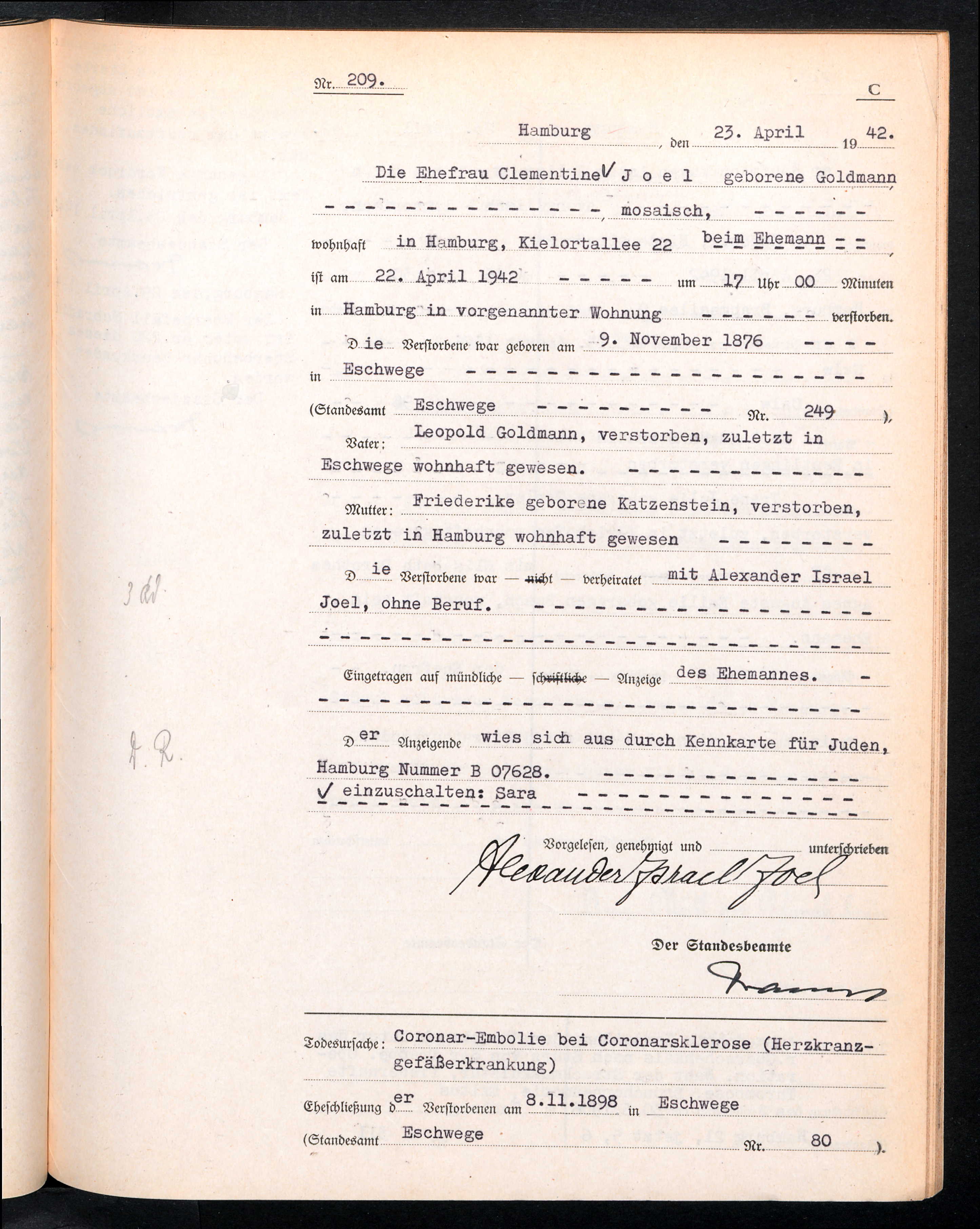
Clementine and her husband Alexander Joel stayed in Germany during the Nazi era until it was too late. Clementine died in Hamburg on April 22, 1942. She was 65 years old.

Clementine Goldmann Joel death record, Year Range and Volume: 1942 Band 01
Ancestry.com. Hamburg, Germany, Deaths, 1874-1950. Original data:Best. 332-5 Standesämter, Personenstandsregister, Sterberegister, 1876-1950, Staatsarchiv Hamburg, Hamburg, Deutschland.

Her husband Alexander Joel was deported to the concentration camp at Terezin on July 17, 1942, and died there on December 21, 1942. He was 71 years old.

Alexander Joel death record, Personenstandsregister Sterberegister; Bestand: 926; Signatur: 607
Year Range: 1956, Ancestry.com. Hesse, Germany, Deaths, 1851-1958.

When I look at those dates, I find it troubling that Clementine’s death coincided fairly closely with the timing of Alexander’s deportation. I find myself speculating about the cause of Clementine’s death. Did she know they were about to be deported? Did she know what was coming and decide to deny the Nazis a chance to kill her? Or was it just coincidence–illness or stress causing her death shortly before her husband’s deportation and death?

UPDATE: Thank you so much to Cathy Meder-Dempsey of Opening Doors in Brick Walls for pointing out to me that in fact the death record above does give Clementine’s cause of death—coronary embolism and coronary artery disease. Cathy also wondered whether Clementine’s death and the fact that Alexander had to report that he was unemployed and had a Jewish identity card precipitated his deportation shortly thereafter.

COMMENT: Elizabeth Foote pointed out in the comments that this record shows Alexander Joel’s wife as Selma Koopman. For reasons explained in my response to this comment (see below), I think this record (which is dated 1956, after the war and 14 years after Alexander’s death) erroneously listed Selma Koopman as his wife. Selma Koopman was married to a different Alexander Joel. In addition, I found naturalization records for Alexander Robert Joel, married to Selma, showing that they immigrated to the US in 1934 and that Alexander died in Cook County, Illinois, in 1955, so obviously the death record above was for the Alexander Joel married to my cousin Clementine.

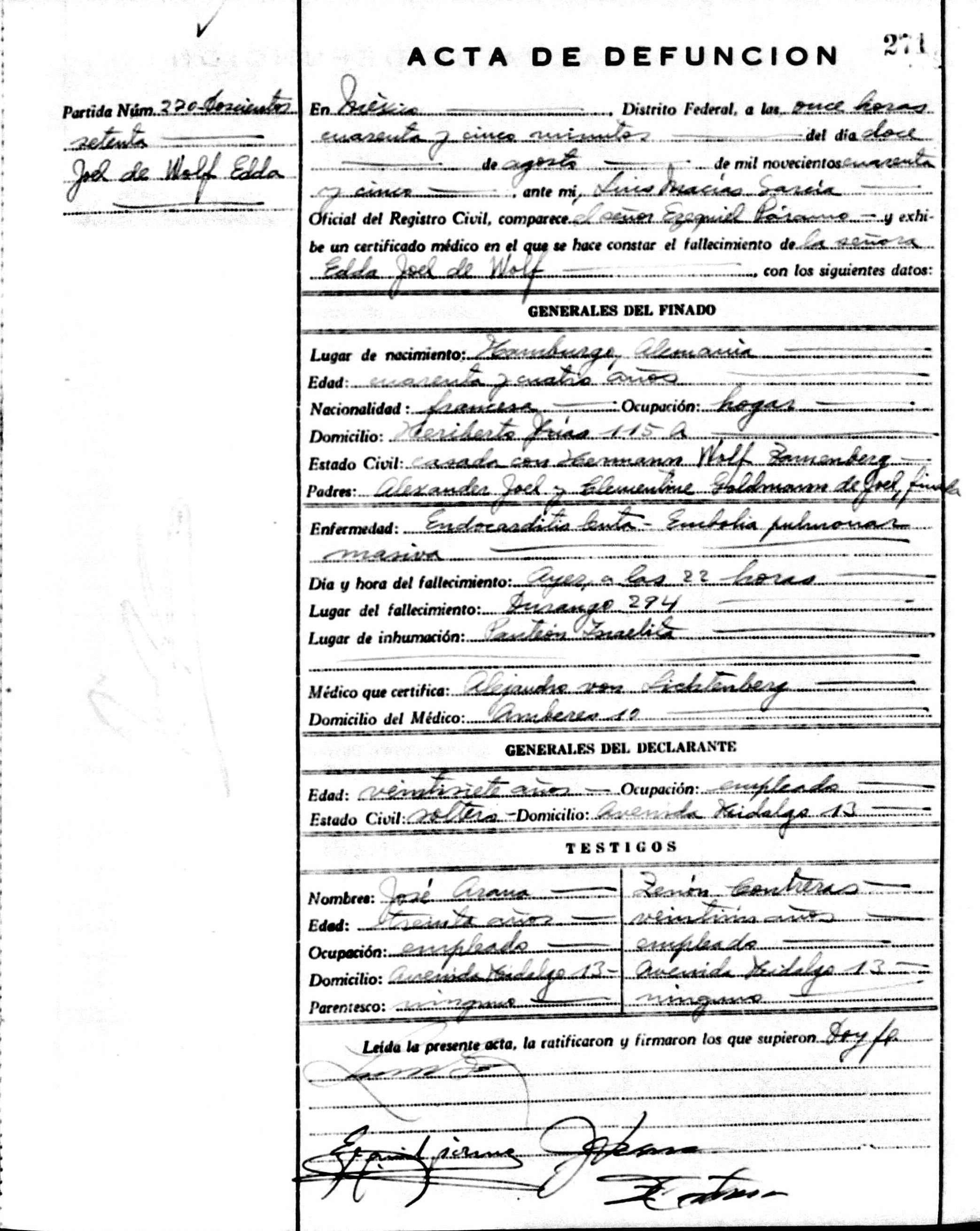
Fortunately, all three of Alexander and Clementine’s daughters survived the Nazi era. Their oldest daughter Edda Joel and her husband Hermann Wolf ended up in Mexico, but I don’t know whether they were there during or only after the war. All I know is that they were both living there when they died in 1945 and 1955, respectively. According to Edda’s death record from Mexico, she was “francesa,” or French, which leads me to believe that she and her family lived in France for some period of time before immigrating to Mexico.

Esther Edda Joel Wolf death record, Archivo de Registro Civil de Distrito Federal (Civil Registry Archives); Federal District, Mexico, Year: 1945, Ancestry.com. Federal District, Mexico, Civil Registration Deaths, 1861-1987

The death record also reports that Edda died from a massive pulmonary embolism and endocarditis and that she was buried in Israel (logar de inhumacion). She was only 44 years old when she died. Had the deaths of her parents and the stress of escaping with her family from Germany contributed to her early death? I don’t know.

Her husband Hermann died ten years later at the age of 57. From the death record, I learned that he had remarried and his widow was Carmen Hebert and that his son Fernando was originally from France, which is consistent with what I inferred from Edda’s death record.

Hermann Wolf Tannenberg death record, Archivo de Registro Civil de Distrito Federal (Civil Registry Archives); Federal District, Mexico, Ancestry.com. Federal District, Mexico, Civil Registration Deaths, 1861-1987

My deep gratitude to Steve Mordecai of Tracing the Tribe who spent a lot of time translating Hermann’s death record from Spanish to English, as quoted below:

In the City of Mexico, Federal District, at 12:00 noon, on the 14th of March 1955, before me, Dr. Fidel Guillen, Head of the office of Civil Registration, presents, Mr. Luis Vidales, of this area, a single man of 50 years, funeral employee, living in Ave Hidalgo 13, in this City; and presents for insertion a document related to the death of an adult, Hermann Wolf Tannenberg, the which was archived in accordance with the law and in part condercente (?) Says: “Mimeco (?) 178. In the City of Cuernavaca, at 18 eighteen hours of the day 13 thirteen of March 1955, nineteen hundred fifty-five, before me, citizen Filipe Rivera Crespo, judge of the Registration of the Civil State, appeared one Mr Fernando Wolf, age 32, thirty-two, a married, businessman or (Merchant), originally of France, and neighbor (or living outside) of Mexico, Federal District, traveling in this City and presented a certificate, archived, which says: “He that medically certifies, legally authorized to exercise his profession: “ an individual male, in the house number 7, of the street de Balsas –Cause of death: Principal illness Myocardial Infarction – Cuernavaca moz (?), 13 March 1955.-Signature of the Medic: Guillermo Vega Campos. – Residence: Degollado 28 – Complementary (?) Data – Day and hour of death 12:45 Sunday 13 March 1955, a male – Hermann Wolf Tannenberg -residence: Balsas #7. – Age 58 – place of birth, Hanover, Germany. Nationality Mexican, occupation – businessman (merchant) – civil status- married – name of father: Mauricio Wolf – mother Clare Tannenberg, (both) deceased. Name of spouse Carmen Hebert, living. – signature of the medic: Guillermo Vega Campos – at the request of the family(?)…. saw to the transfer of the cadaver to the City of Mexico, to be interred (?) Carried out this act in accordance with the family’s instructions (?) Signed: Felipe Rivera Crespo – F. Wolf – J Ferrrer. G (?) – Trio (?)” – Expedited bolete (?) to the Pantean Jardin de Villa Obergon, according to order 3061, of this date, (girade?) by the office of (Pante…?) Departament of the Federal District. Witnessed by Jose Martinez and Valente Lufran, ages 31 and 33. Of the same origen, occupation, civil status and residence of those appearing. Reading this act they ratify and confirm. Given (signed) Luis Vidal, J. Martinez and V. Lufran. [Emphasis added.]

Hermann and Edda were survived by their two sons, Fernando Werner Moshe Wolf, who died in Mexico in 1997, and Pierre Kurt Wolf, who immigrated to the United States and settled in Florida, where he died in 1979.1

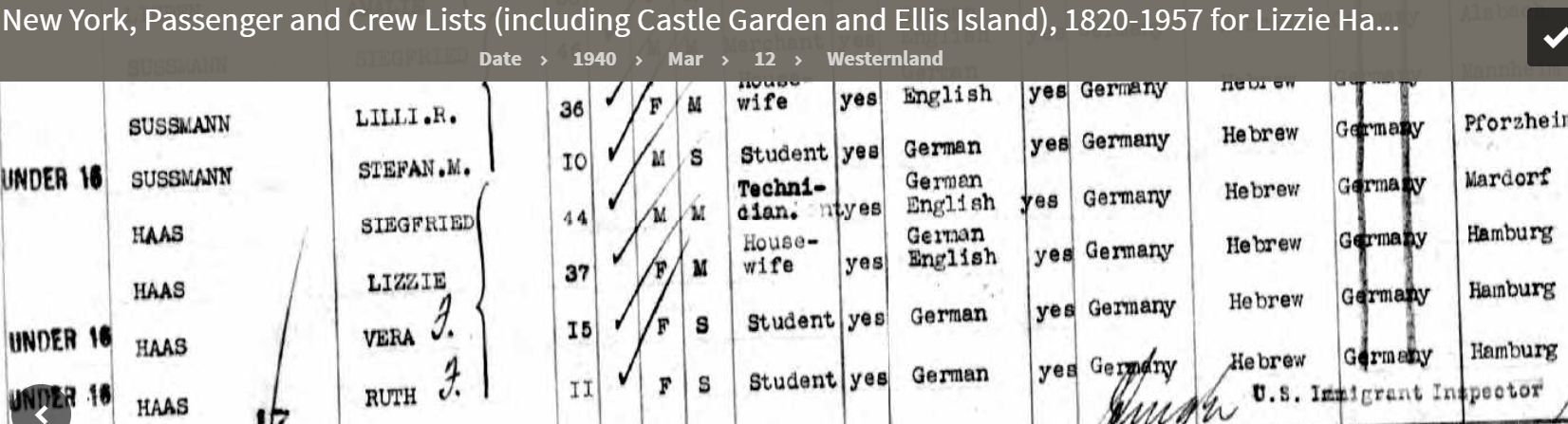
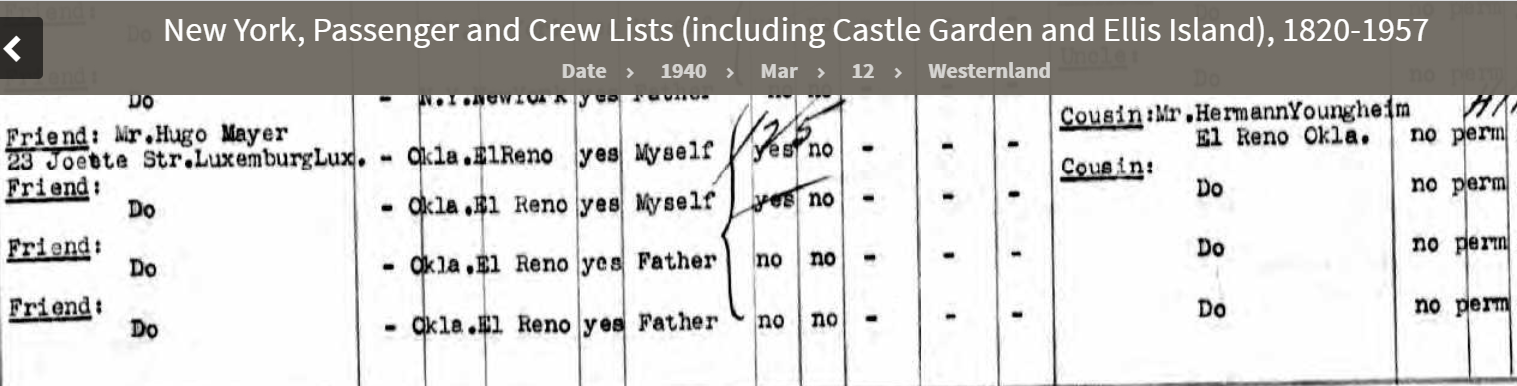
Clementine’s second daughter Lizzie Joel Haas and her husband Siegfried and their two daughters also immigrated from Germany in time to escape the concentration camps. They arrived in the US on March 12, 1940, and were heading to a cousin, Hermann Youngheim of El Reno, Oklahoma.

Siegfried and Lizzie Haas, ship manifest, Ship or Roll Number: Westernland
Ancestry.com. New York, Passenger and Crew Lists (including Castle Garden and Ellis Island), 1820-1957

When I saw the name Youngheim and the Oklahoma address, it struck me that there might be a connection between Hermann Youngheim and my Katz relatives in Oklahoma who were the descendants of Meier Katz and Sprinzchen Jungheim of Jesberg, Germany. And sure enough, Herman Youngheim was the nephew of Sprinzchen Jungheim Katz. And in addition, Herman Youngheim was the son of Fanny Marx Jungheim, the sister of Fredericke Marx Haas, mother of Siegfried Haas.

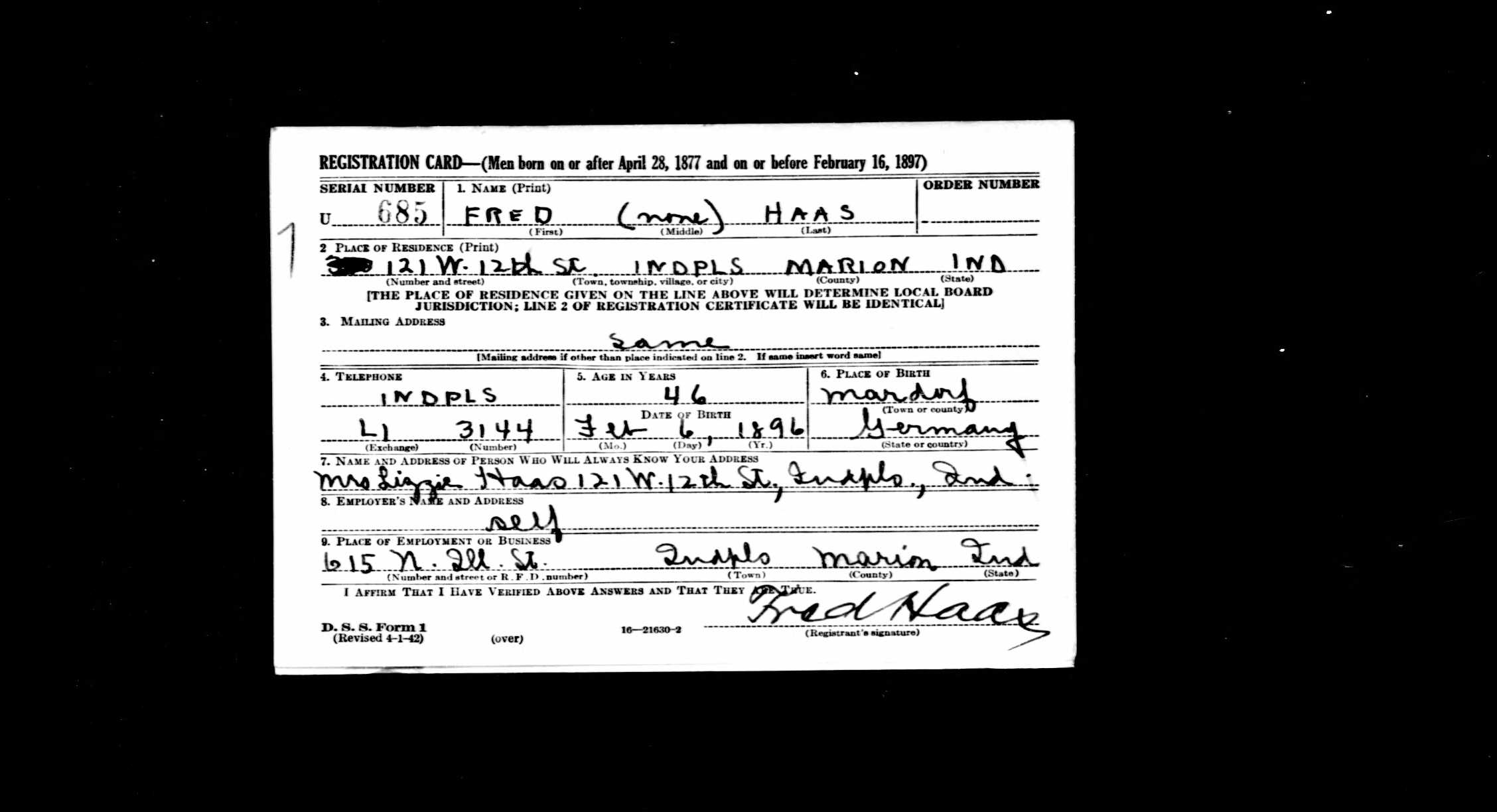
So Herman was Siegfried’s first cousin and must have helped Siegfried, Lizzie and their daughters escape from Germany. Siegfried changed his name to Fred in the US, and by 1942 the family was living in Indianapolis, Indiana, as seen on Fred Haas’ draft registration for World War II.

Fred Haas, World War II draft registration, The National Archives at St. Louis; St. Louis, Missouri; Record Group Title: Records of the Selective Service System; Record Group Number: 147
Ancestry.com. U.S., World War II Draft Registration Cards, 1942

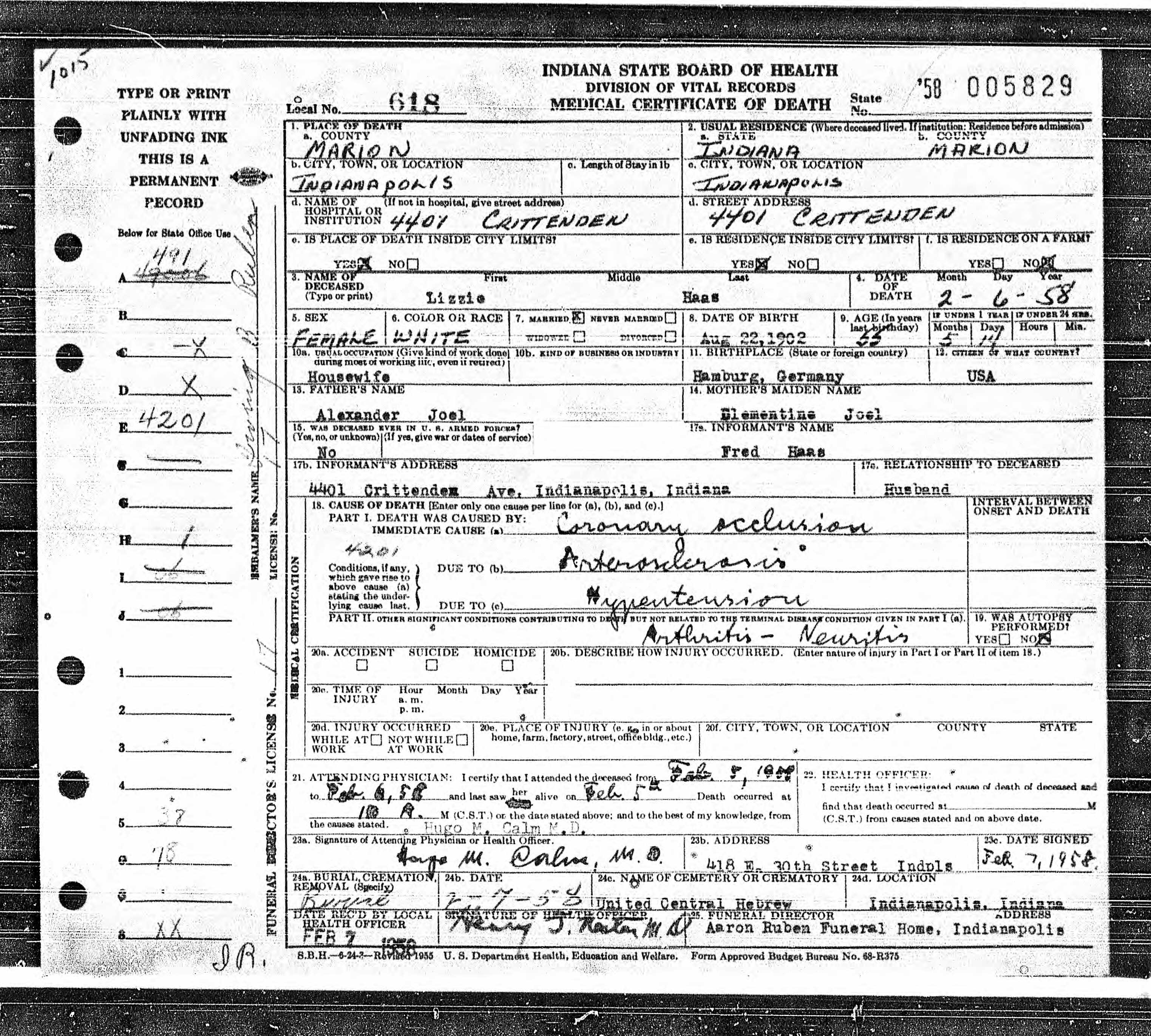
Lizzie died at age 55 in Indianapolis on February 6, 1958.

Lizzie Joel Haas death certificate, Indiana Archives and Records Administration; Indianapolis, IN, USA; Death Certificates; Year: 1958; Roll: 03, Roll Number: 03, Ancestry.com. Indiana, Death Certificates, 1899-2011

Her husband Fred later moved to Florida, where he died on July 27, 1971, at the age of 75.2 They were survived by their daughters and grandchildren.

The youngest Joel sister, Ille, also survived the Holocaust. I don’t have any primary sources for Ille. According to My Heritage, Ille and her husband Walter Cunow lived in Switzerland where Walter died in 1987 and Ille in 1994 and were survived by their two children. Unfortunately I have no further details or sources.

Thus, although Clementine Goldmann and her husband Alexander Joel did not survive the Holocaust, their three daughters all somehow managed to survive, and there are living descendants today to carry on their legacy.

As for Clementine’s younger sister Meta and her husband Adolf Hammerschlag and daughters Lieselotte and Irmgard, their story has more tragic endings, as you will see in my next post.


  1. Pierre Kurt Wolf, Birth Date: 30 Sep 1924, Birth Place: Saarbrucken, Federal Republic of Germany, Death Date: Jun 1979, Father: Hermann W Tannenberg
    Ancestry.com. U.S., Social Security Applications and Claims Index, 1936-2007 
  2. Fred Haas, Social Security Number: 314-12-6142, Birth Date: 6 Feb 1896
    Issue Year: Before 1951, Issue State: Indiana, Last Residence: 33134, Miami, Miami-Dade, Florida, USA, Death Date: Jul 1971, Social Security Administration; Washington D.C., USA; Social Security Death Index, Master File, Ancestry.com. U.S., Social Security Death Index, 1935-2014; https://www.findagrave.com/memorial/180016722/fred-haas 

Fredericke Katzenstein Goldmann, Part I: Her Daughters and Granddaughters

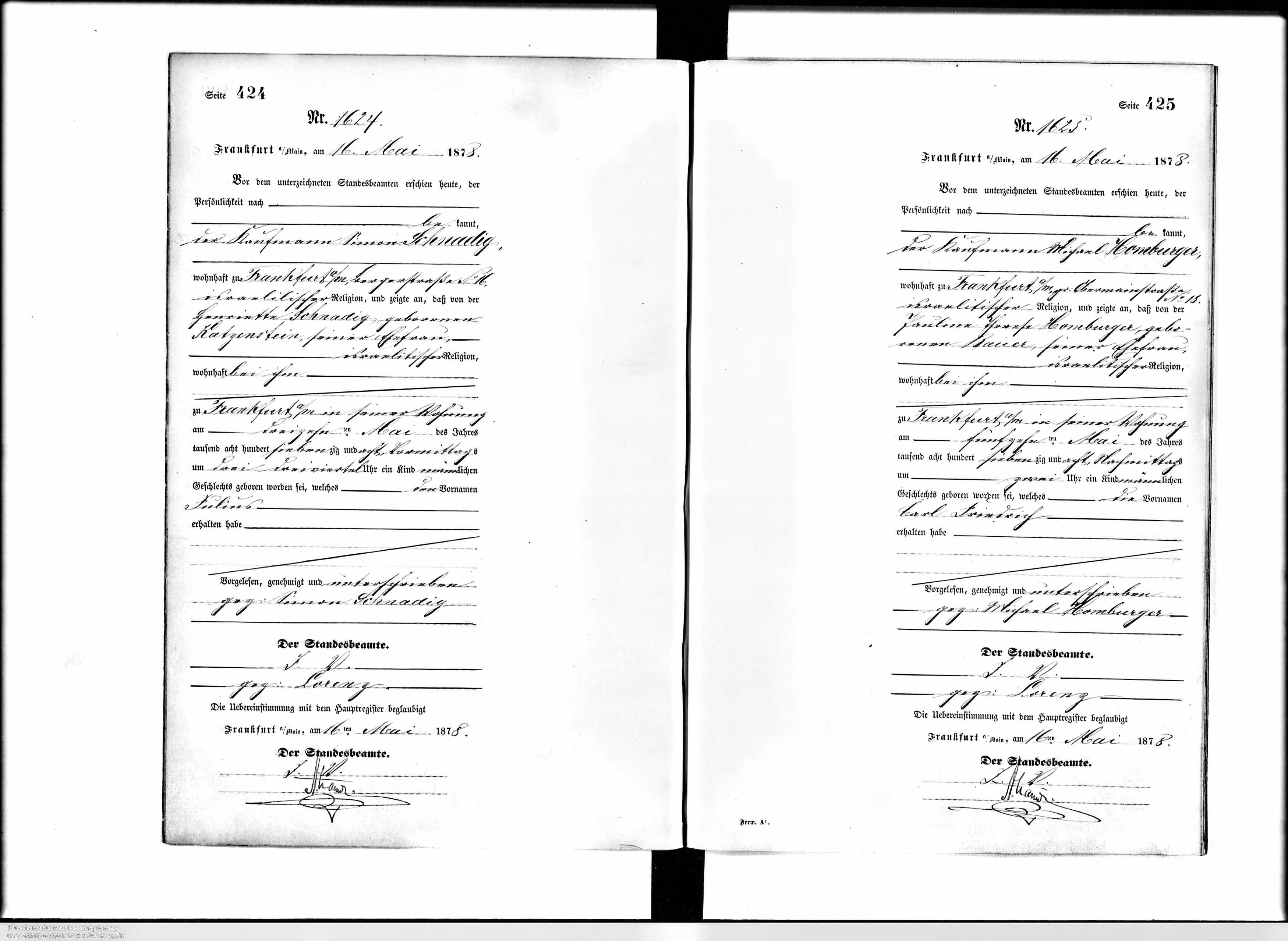
Having told as much as I’ve learned about Helene Katzenstein Werner and her descendants, I will now move on to Amalie Goldschmidt and Juda Katzenstein’s second child Fredericke, born July 13, 1855, in Eschwege. As we saw, she married Leopold Goldmann, also a native of Eschwege, in Eschwege on November 16, 1875.  They settled in Eschwege, where their three children Clementine, Karl, and Meta were born.

Clementine was born on November 9, 1876, just a week short of Fredericke and Leopold’s first anniversary.

Clementine Goldmann, birth record, Hessisches Hauptstaatsarchiv; Wiesbaden, Deutschland; Bestand: 923; Laufende Nummer: 1829, Year Range: 1876, Ancestry.com. Hesse, Germany, Births, 1851-1901

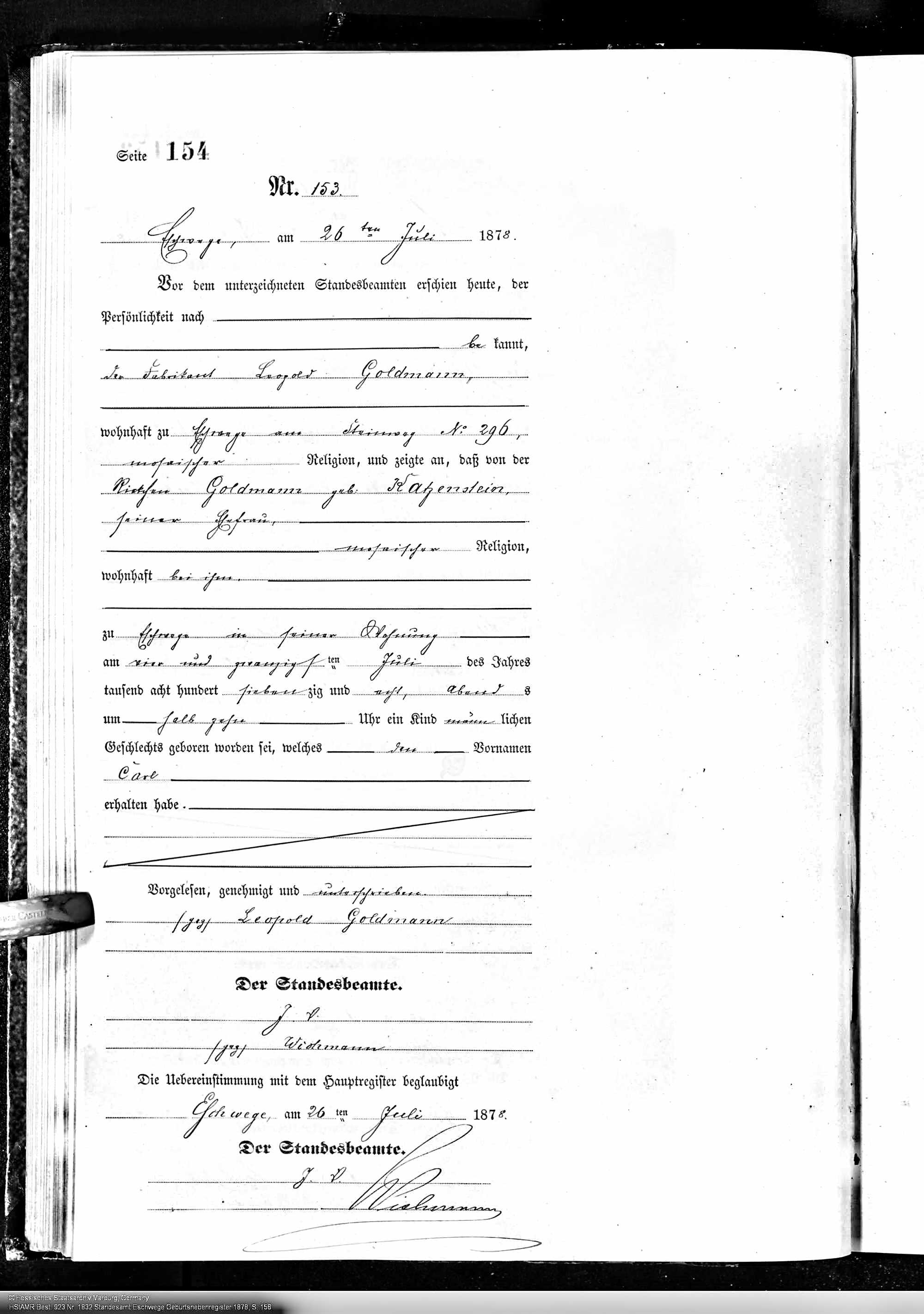
Karl was born July 24, 1878.

Karl Goldmann, birth record, Hessisches Hauptstaatsarchiv; Wiesbaden, Deutschland; Bestand: 923; Laufende Nummer: 1832, Year Range: 1878, Ancestry.com. Hesse, Germany, Births, 1851-1901

And Meta was born September 9, 1884.

Meta Goldmann, birth record, Hessisches Hauptstaatsarchiv; Wiesbaden, Deutschland; Bestand: 923; Laufende Nummer: 1838, Year Range: 1884, Ancestry.com. Hesse, Germany, Births, 1851-1901

(For those who get confused by all the names, here is a family tree chart you can click on to see the relationships.)

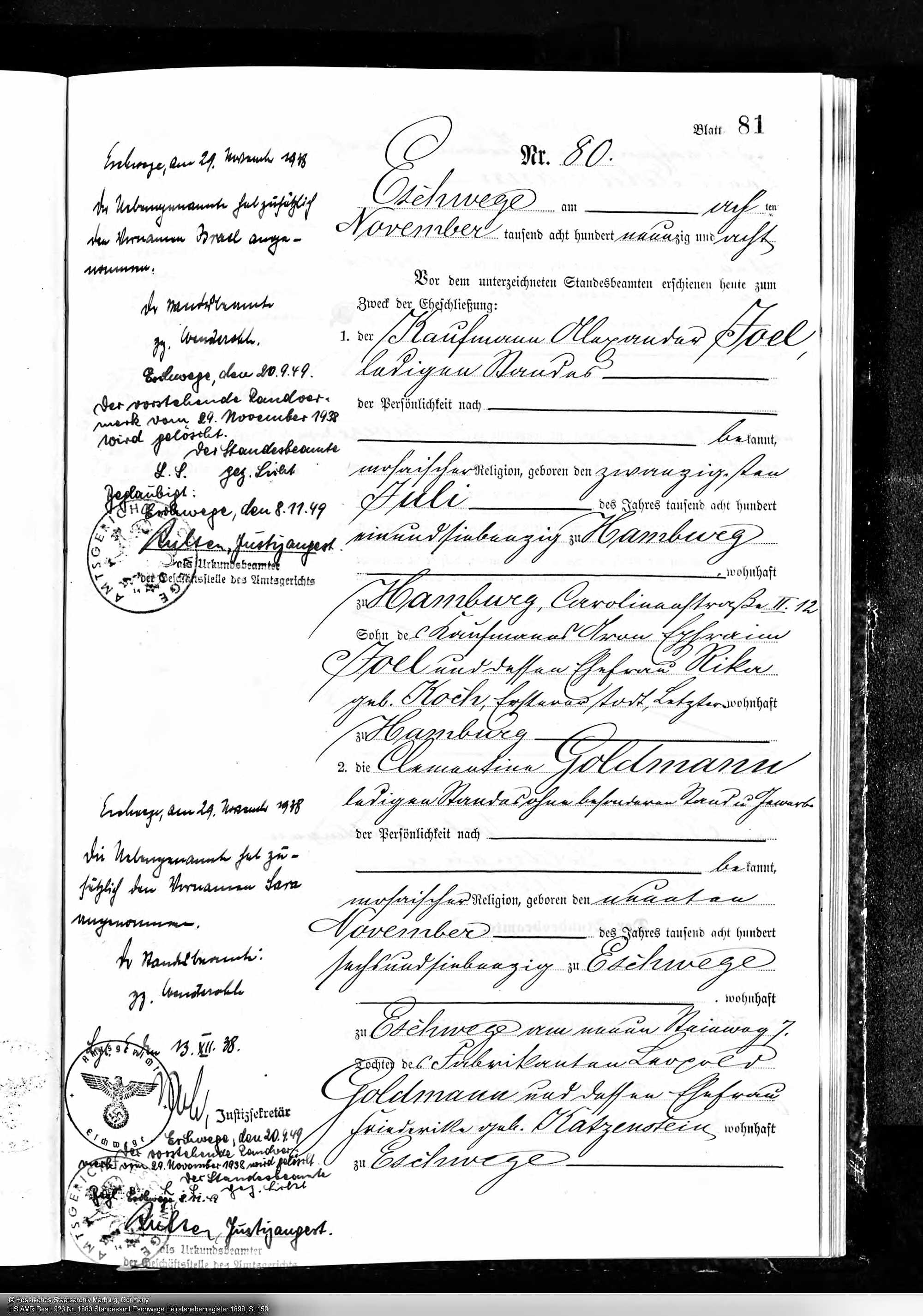
Clementine married Alexander Joel in Eschwege on November 8, 1898, the day before her twenty-second birthday. He was born on July 20, 1871, in Hamburg, to Aron Ephraim Joel and Rika Koch.

Marriage record of Clementine Goldmann and Alexander Joel, Hessisches Hauptstaatsarchiv; Wiesbaden, Deutschland; Bestand: 923; Laufende Nummer: 1883, Year Range: 1898, Ancestry.com. Hesse, Germany, Marriages, 1849-1930

Then, just two months after Clementine’s wedding, her father Leopold died on January 12, 1899, in Eschwege. He was fifty years old and left behind his wife Fredericke, who was 43, and their three children Clementine, Karl, and Meta.

Leopold Goldmann, death record, Personenstandsregister Sterberegister; Bestand: 923; Laufende Nummer: 1944, Year Range: 1899, Ancestry.com. Hesse, Germany, Deaths, 1851-1958

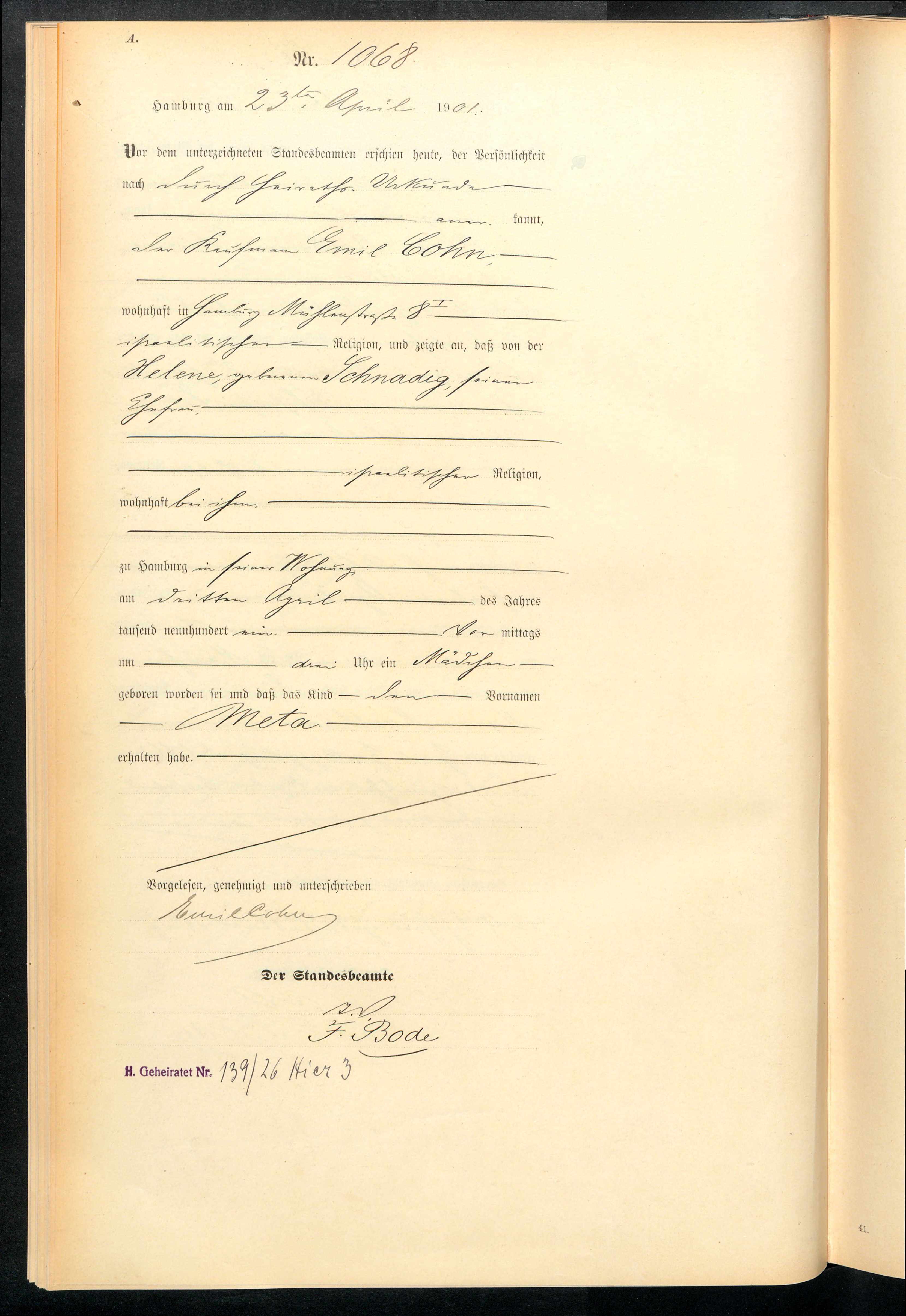
Clementine and Alexander Joel had three daughters. Esther Edda Joel (known as Edda and hereinafter referred to by that name) was born in Hamburg on May 27, 1901.

Esther Edda Joel, birth record, Year Range and Volume: 1901 Band 03
Ancestry.com. Hamburg, Germany, Births, 1874-1901. Original data:Best. 332-5 Standesämter, Personenstandsregister, Sterberegister, 1876-1950, Staatsarchiv Hamburg, Hamburg, Deutschland.

Lizzie Joel was born August 22, 1902, in Hamburg.1 And Ille Joel was born in 1904, also in Hamburg.2

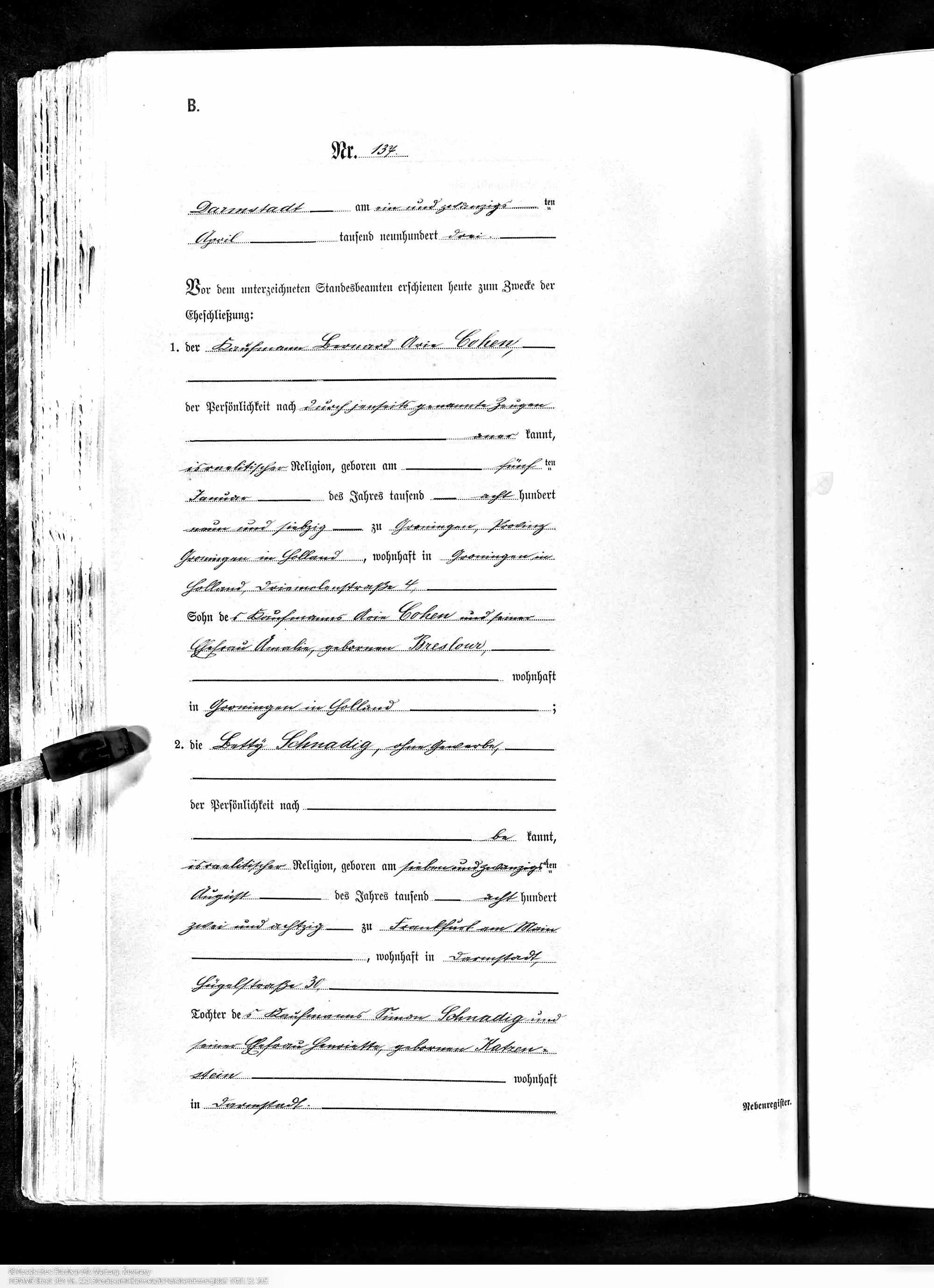
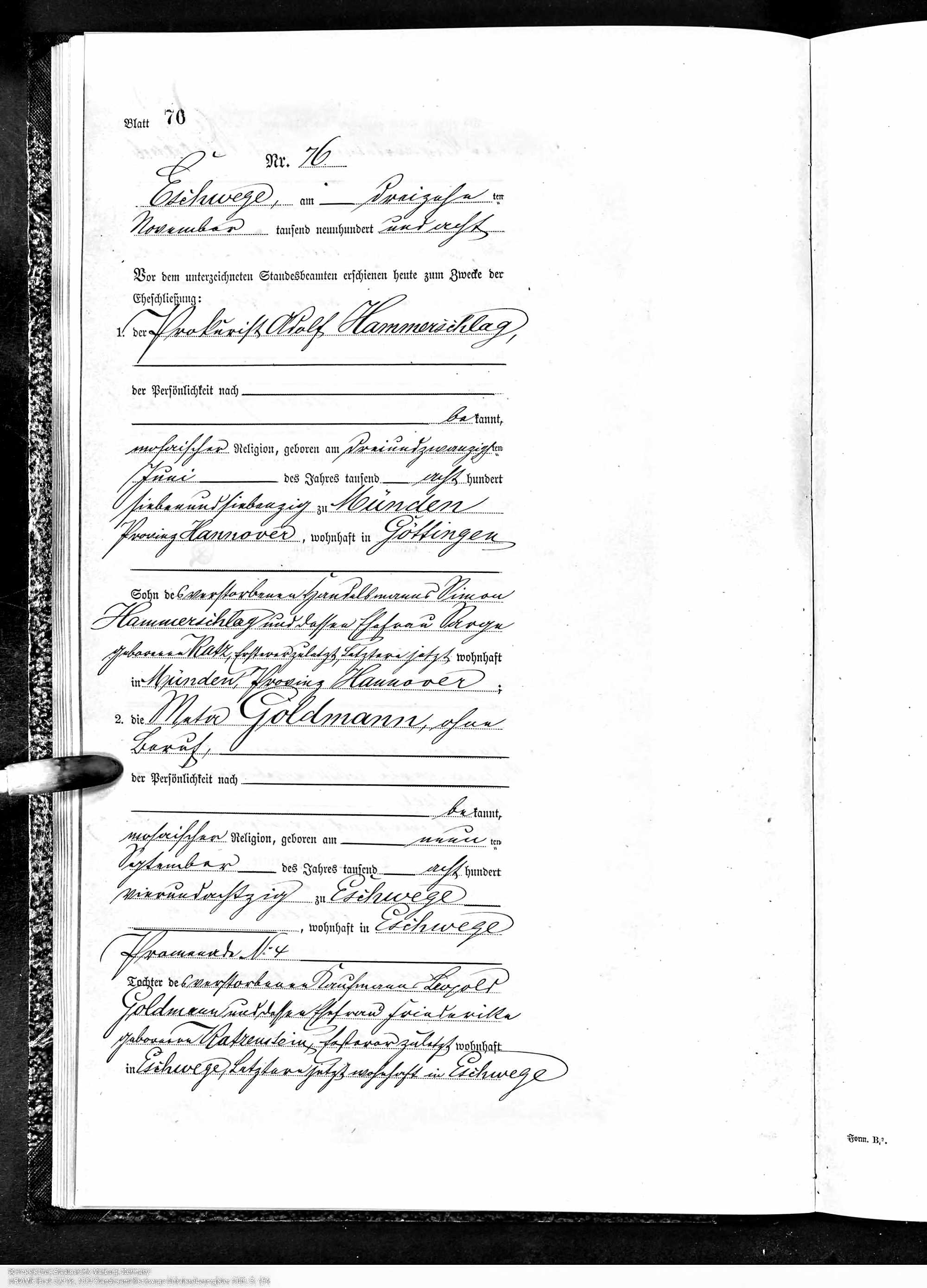
Clementine’s younger sister Meta married Adolf Hammerschlag on November 13, 1908, in Eschwege. Adolf was born June 23, 1877, in Minden, Germany, near Hannover. His parents were Simon Hammerschlag and Sarchen Katz.

Marriage record of Meta Goldmann and Adolf Hammerschlag, Hessisches Hauptstaatsarchiv; Wiesbaden, Deutschland; Bestand: 923, Year Range: 1908, Ancestry.com. Hesse, Germany, Marriages, 1849-1930

Meta and Adolf had two daughters, Lieselotte, born August 10, 1910, in Gottingen, Germany,3 and Irmgard, born March 4, 1915, in Gottingen.4

Clementine and Meta’s brother Karl did not marry and died when he was only 36 on January 30, 1914, in Eschwege. I wish I knew why he died so young.

Karl Goldmann death record, Personenstandsregister Sterberegister; Bestand: 923; Laufende Nummer: 1960, Year Range: 1915, Ancestry.com. Hesse, Germany, Deaths, 1851-1958

In the 1920s, the daughters of Clementine Goldmann and Alexander Joel began to marry. Although I don’t have marriage records, I assume that Clementine’s daughter Edda Joel married Hermann Wolf in the early 1920s because they reportedly had two sons born before 1925, Fernand Moshe Werner and Pierre Kurt, at least one of whom was born in Saarbrucken, a city at the border between France and Germany.5 According to his death record, Hermann was the son of “Mauricio” Wolf and Clare Tannenberg, but since, as we will see, he died in Mexico, I assume that his father’s name was more likely Moritz than Mauricio. Hermann was born in Hannover in 1897.6

Edda Joel’s sister Lizzie also must have married in the 1920s as she also had two children born in that decade, Vera in 1925 and Ruth in 1928.7 Lizzie married Siegfried Haas, who was born in Mardorf, Germany, on February 6, 1896, to Adolf Haas and Fredericke Marx.8

The youngest Joel sister, Ille, also married in the 1920s, I assume, as she had two children in the 1920s. Her husband was Walter Cunow, and unfortunately I have no primary sources for either Ille or Walter, only profiles on My Heritage and Geni that do not provide sources. However, one of the profile managers for their profiles and for those of Ille’s sisters may be a relatively close relative, whom I have contacted but not yet heard back from. At any rate, according to My Heritage, Walter Cunow was born on February 2, 1899, in Berlin to Martin Cunow and Helene Friedenberg.9

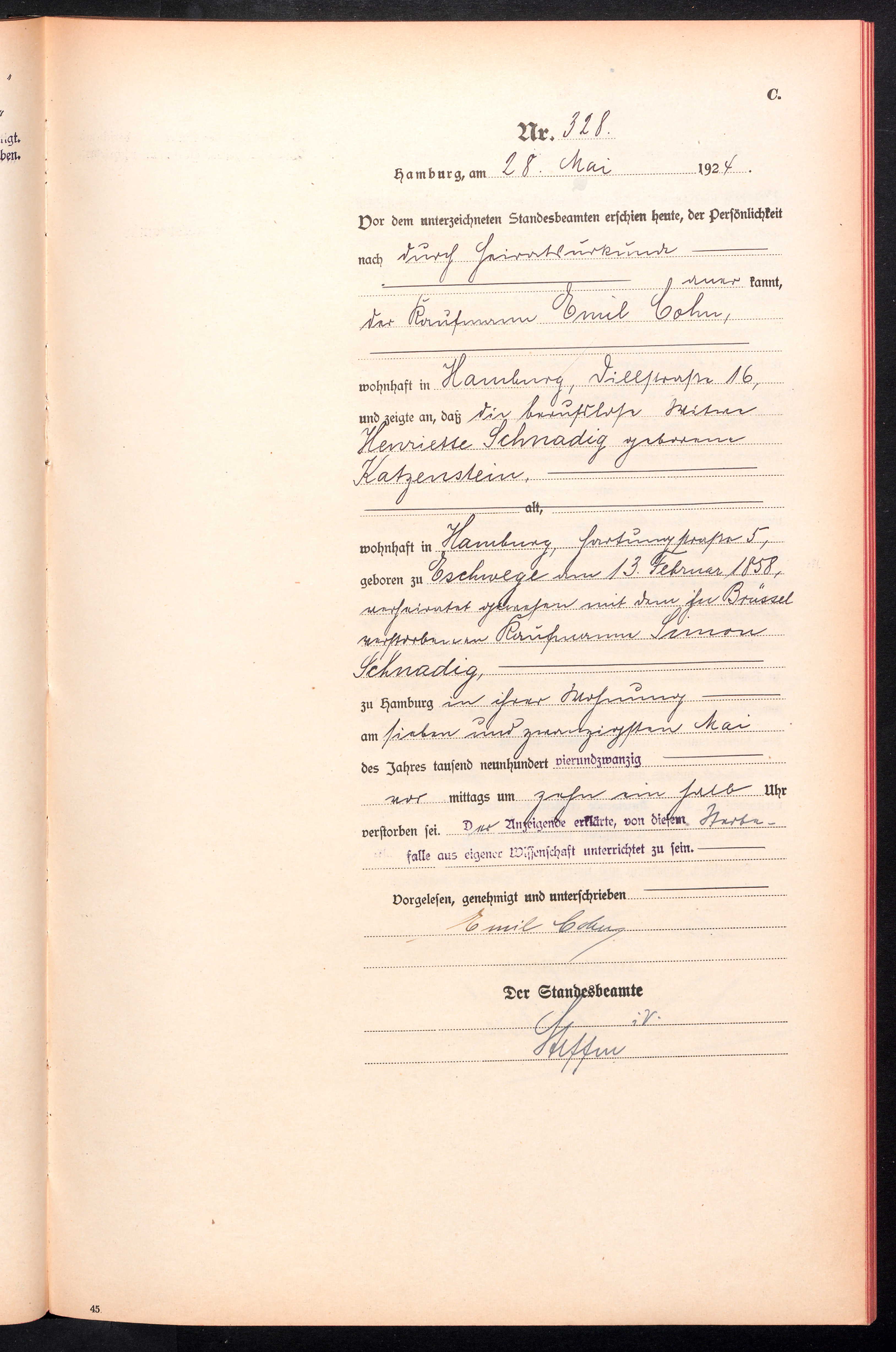
Fredericke lived to see at least some of her granddaughters marry and the birth of her first great-grandchild. She was 68 when she died on February 4, 1924.

Fredericke Katzenstein Goldmann death record, Year Range and Volume: 1924 Band 01
Ancestry.com. Hamburg, Germany, Deaths, 1874-1950. Original data:Best. 332-5 Standesämter, Personenstandsregister, Sterberegister, 1876-1950, Staatsarchiv Hamburg, Hamburg, Deutschland.

Fredericke Katzenstein Goldmann had outlived her husband Leopold by 25 years and her son Karl by ten years. She was survived by her two daughters, Clementine and Meta, her five granddaughters, and that first great-grandchild with the others born after her death. As we will see, she was blessed in some ways to have died before the Nazis took control of Germany in the 1930s.


  1.  Lizzie Haas, [Lizzie Joel] , Gender: Female, Age: 55, Marital status: Married, Birth Date: 22 Aug 1902, Birth Place: Hamburg, Germany, Death Date: 6 Feb 1958, Death Place: Indianapolis, Marion, Indiana, USA, Father: Alexander Joel, Mother: Blementine Joel, Indiana Archives and Records Administration; Indianapolis, IN, USA; Death Certificates; Year: 1958; Roll: 03, Ancestry.com. Indiana, Death Certificates, 1899-2011 
  2. Profile on My Heritage found at https://www.myheritage.com/research/record-1-400415261-19-501023/sprinze-philippine-ilse-cunow-nee-joel-in-myheritage-family-trees 
  3. Yad Vashem entry, found at https://yvng.yadvashem.org/nameDetails.html?language=en&itemId=11476670&ind=1 
  4. Stolpersteine family biography, found at https://www.stolpersteine-hamburg.de/en.php?MAIN_ID=7&BIO_ID=90 
  5. My Heritage profile, found at https://www.myheritage.com/person-19501021_400415261_400415261/edda-esther-joel-wolf; Pierre Kurt Wolf
    Birth Date: 30 Sep 1924, Birth Place: Saarbrucken, Federal Republic of Germany
    Death Date: Jun 1979, Father: Hermann W Tannenberg, Mother: Edda E Joel
    SSN: 262757686, Ancestry.com. U.S., Social Security Applications and Claims Index, 1936-2007 
  6. Hermann Wolf Tannenberg death record, Archivo de Registro Civil de Distrito Federal (Civil Registry Archives); Federal District, Mexico, Ancestry.com. Federal District, Mexico, Civil Registration Deaths, 1861-1987 
  7. See Vera Haas, Birth Date: 4 Feb 1925, Birth Place: Hamburg, Federal Republic of Germany, Death Date: 29 Apr 2007, Father: Fred Haas, Mother: Lizzie Joel
    SSN: 311221178, Ancestry.com. U.S., Social Security Applications and Claims Index, 1936-200; Ruth Friedericke Haas, Birth Date: 21 Sep 1928, Birth Place: Hamburg, Federal Republic of Germany, Death Date: 8 May 1998, Father: Fred Haas, Mother: Lizzie Joel, SSN: 307322906, Ancestry.com. U.S., Social Security Applications and Claims Index, 1936-2007 
  8.  Hessisches Hauptstaatsarchiv; Wiesbaden, Deutschland; Bestand: 915; Laufende Nummer: 5891, Year Range: 1896, Ancestry.com. Hesse, Germany, Births, 1851-1901 
  9. My Heritage profile, found at https://www.myheritage.com/research/record-1-400415261-19-501023/sprinze-philippine-ilse-cunow-nee-joel-in-myheritage-family-trees 

Ruth Bader Ginsburg, 1933-2020

We had just finished our first dinner together as a family since before the pandemic—both of my daughters, my son-in-law, and my grandsons. It was a wonderful meal—lots of laughter and food and candles and blessings. Apples and honey and challah and wine. We were cleaning up in the kitchen, the kids were playing, and suddenly I heard my son-in-law gasp. He stood up, ashen, and whispered, “Ginsburg died.”

All I could say was, “Oh, no.” Then two seconds later. “Oh, no.” It felt like I’d been punched in the stomach. It felt like a personal loss, the death of someone I knew and loved, not the death of someone famous I’d never actually met. We were all stunned. Even my grandsons, ages six and ten, knew who Ruth Bader Ginsburg was and knew how important she was.

We talked about her and her life, and then the next night we all watched “On the Basis of Sex,” a dramatized version of her early career and one of the first legal cases that established that treating men and women differently solely on the basis of gender was unconstitutional. When the movie ended with the shot of the real RBG standing on the steps of the Supreme Court, I cried. She was a hero, a role model, someone who changed the world I lived in and thus changed the course of my life.

She was born in Brooklyn, where my mother was born and raised and where my grandsons now live. Like my mother, she was Jewish and the daughter of an immigrant father and a mother who was first-generation American-born. She went to Cornell University and then was one of only nine women in her class at Harvard Law School in the 1950s. Despite the discrimination she faced there and the skepticism many had about women becoming lawyers, she rose to the top of her class.

Without Ruth Bader Ginsburg and others like her, I never would have dreamed of becoming a lawyer. When I was in high school and the women’s movement was just brewing, I thought girls could only grow up to be three things—a mommy, a nurse, or a teacher. I recall a heated debate with a classmate who was already more awake to the need for change than I where I took the position that a woman had to choose between a career or a family. She couldn’t have both.

All that changed in the four years I was in college, the years that RBG began litigating cases against sex discrimination. By my senior year I’d decided I wanted to go to law school. I wanted to have it all—a family and a career. When I arrived at Harvard Law School in 1975, there were more than ten times the number of women in my entering class than had been there when Ginsburg enrolled. We were still only 20% of the class, but at least there were more of us—thanks to the work of Ginsburg and others. Professors could no longer outwardly treat us as lesser beings than our male classmates, although some may have still thought that way. Without RBG and others, that never would have happened.

When RBG graduated from law school in the late 1950s, she could not get a law firm to hire her despite being on law review and at the top of her class. Twenty years later when I graduated from law school, there were still few women partners in law firms (and none at the firm where I was hired), but firms were hiring women.  Four years later, my firm had two women who were partners (out of over forty partners overall), and almost half of new hires were women.

When I left practice in 1982 to become a law professor, there were only two other women on the faculty of twenty-five; there were many students who expected their professors to be men, preferably older white men in suits, not a young woman with a young child and another on the way. But things changed over the years. More and more women were becoming lawyers, and more were becoming law professors. One of those law professors was Jane Ginsburg, Ruth’s daughter, and I first felt a real personal connection to RBG when I adopted two of her daughter Jane’s casebooks—one on copyright law, one on trademark law—to teach my courses in those subjects. When I retired from law teaching in 2014, women made up a majority of those on the faculty at my school. We had seen a momentous shift in thirty-two years.

So much changed from the time I was in high school and could only dream of becoming either a mother or a nurse or a teacher. So much changed from the day I entered law school until the day I retired almost forty years later. Women went from being outsiders in the legal profession to being a majority of those enrolled in law school and prominent in the profession, though even today there are still too few women partners in big law firms and too much discrimination generally against women in society.

I feel so deeply grateful to Ruth Bader Ginsburg for all these changes. When she was named by Bill Clinton to the US Supreme Court in 1993, I felt as if someone I knew had made it to the highest court in the land. A Jewish woman was on the Supreme Court. Someone who grew up in the time and place in which my mother had grown up. Someone who had had both children and a career. Someone who shared my background and my values. She was only the second woman to be named to the court. She changed it forever. She changed me and my life and my world even before I knew her name.

I am forever indebted to Ruth Bader Ginsburg. No wonder I feel her loss so personally. She was a blessing to every little girl growing up today, to every woman searching for a meaningful life, and to every woman of my generation who benefited from everything she did. She was a blessing to all people whose rights have been denied, who have faced discrimination, or who simply want to see justice and fairness in our society.

May her memory be a blessing forever. May we carry on her legacy.


Two other bloggers wrote posts about Ginsburg that touched me. I recommend them both. You can find them here (“The Heavens Opened for RBG” at Zicharanot), discussing another personal reaction to her death, and here (“Ruth Bader Ginburg, Rest in Power” at wmtc), discussing her opinions on the Supreme Court and their significance. There have been, of course, many other tributes and obituaries published that describe her life and her career and her impact on the law and on society.


Blogging in a Pandemic: Rosh Hashanah 5781

What a very strange time we live in. A year ago I was preoccupied with moving my mother to Massachusetts and trying to help her find a way to settle into her new surroundings. I had no idea what to expect in the year to come. I really had no idea—who could have imagined what 5780, or what we ordinarily call 2020, would bring?

I have not blogged since late April about the way the pandemic has affected my life. Somehow I adjusted to the new, bizarre reality. Doing most things by Zoom, taking walks in new places, social distancing, and wearing masks—it all just started to become some form of an ordinary routine. Yes, there was always this underlying anxiety and fear of getting sick or having someone I care about get sick. But the change in routine became acceptable most of the time. All I kept saying was, “If only I could be with my family—hug and kiss my children and grandchildren—I could accept all these other restrictions.”

During the summer we started moving in that direction. We got tested and spent several days with our grandsons and their parents in August. My younger daughter came to spend my birthday with me, and I couldn’t resist a birthday hug.

The summer almost felt normal in some ways although we were terribly sad to miss our traditional week with the family on the Cape. The beach was hardly crowded, so we could walk without masks and sit and read like we always do.  We didn’t eat out like we ordinarily do, and in town we had to wear masks, but overall being on the Cape was as restorative and relaxing as it always has been.

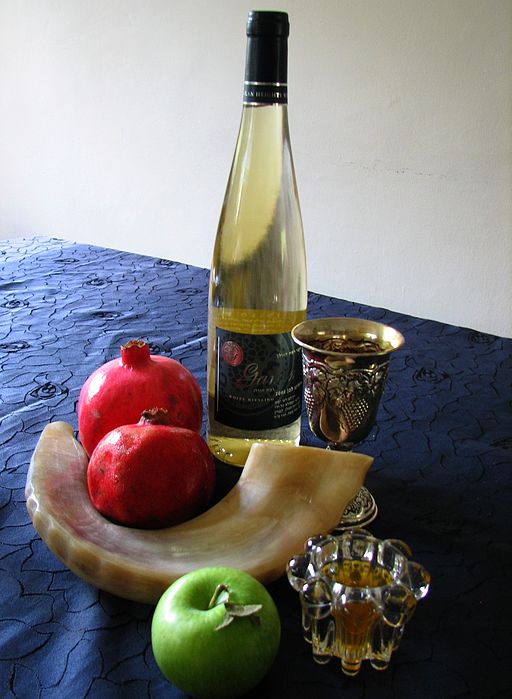
But summer is almost over. Rosh Hashanah is for me the first real sign that fall is upon us. And we spent a lot of time in the last month wondering how in the world we would celebrate the holiday. A Zoom Passover was a novelty and was truly special; but the novelty of Zoom has worn off, and Rosh Hashanah is a different kind of holiday. Passover is centered on the home—the seder is its central ritual. Rosh Hashanah is centered on the synagogue—listening to the service, hearing the shofar, being in the sanctuary, seeing our friends. We can’t be in the synagogue this year. And frankly, watching services by Zoom really isn’t very appealing. Though we will try.

So we’ve decided that we have to do something more than sit home alone and watch a service on our computer. We all got tested this week, and my daughters, son-in-law, and grandsons will be coming to stay with us for the holiday. No amount of apples and honey will be sweeter than that.

By Gilabrand (Own work) [CC BY-SA 3.0 (http://creativecommons.org/licenses/by-sa/3.0)%5D, via Wikimedia Commons

Shana tova to you all. May 5781 be a happier, healthier year for all people all over the world.

(I will be taking a break from blogging until next week.)

Unanswered Questions: Rosa Werner Wormser and Moritz Werner

Although I was able to learn a fair amount about two of the children of Helene Katzenstein and Max Werner, Elsa Werner Loewenthal and Henriette Werner Cohen, it was much more difficult to find information about their other two children, Rosa Werner Wormser and Moritz Werner. I can only report what I’ve learned, primarily from secondary sources, and hope that perhaps by publishing this, someone who knows more about these relatives of mine will find this and provide me with more information and sources. This may be my worst sourced post ever!

Rosa Werner, as we saw, married Josef Wormser in Eschwege in 1908.  According to entries on My Heritage, Rosa and Joseph had four children, Esther (1909), Raphael (1911), Julius (1914), and Helene (1917), all born in Zurich, Switzerland, where Rosa and Joseph had relocated after marrying. It also appears that Rosa and Josef remained in Zurich during the Nazi era and survived, but I have no records of their lives there during that time. According to the information on My Heritage, Josef died in 1940 in Zurich, Rosa thirteen years later in 1953, also in Zurich.

As for their children, three of the four immigrated to Palestine/Israel. I have seen documents1 showing that Esther Wormser immigrated to Palestine, where she married Max Leo Koplowitz, who had immigrated there as early as March 28, 1932, and became a naturalized citizen of Palestine on November 19, 1937. Max was born on March 29, 1907, in Strasbourg when it was under German control before World War I (later and currently part of France). He was an agricultural worker in Palestine. According to a document in his immigration file, he and Esther Wormser married on May 21, 1939, in Petach-Tikvah, and she became a Palestinian citizen by virtue of her marriage to Max Koplowitz.

UPDATE: Thank you to Cathy Meder-Dempsey of Opening Doors in Brick Walls for finding the Strassbourg birth record for Max Koplowitz, which can be located here.

I do not have any further information yet for Esther, although David Baron and Roger Cibella reported that she and Max had two sons born in the 1940s. Max died October 26, 2006, in Israel, according to his gravestone at BillionGraves.com. There was no date or place of death reported for Esther.

BillionGraves.com
Grave record for ישראל מקס קופלוביץ (1907 – 2006), BillionGraves Record 19495247 כפר הרא”ה, Central District, Israel

Update: Thank you to Aaron Knappstein who located Esther’s grave memorial on Billion Graves. She died on 8 Iyar 5739 or May 5, 1979, in Israel.

BillionGraves.com
Grave record for אסתר קופלוביץ (), BillionGraves Record 18779827 כפר הרא”ה, Central District, Israel

Raphael Wormser also immigrated to Israel at some point. My Heritage reports that he married Greta Aufsasser in 1954. According to his gravestone at BillionGraves, he died August 5, 1973.

BillionGraves.com
Grave record for רפאל וורמסר (), BillionGraves Record 12700234 Holon, Central District, Israel

As for Helene Wormser, My Heritage shows that she married Dr. Herman Halberstadt and that they had two children; in addition, My Heritage reports that she died in Jerusalem, but did not provide a date of death.

Update: Thanks again to Aaron Knappstein, who found this entry at Gravez, showing that Helene Wormser Halberstadt died on June 22, 2007, in Israel.

The only Wormser child who did not immigrate to Palestine/Israel was Julius. He remained in Zurich where he married Betty Loewenthal and had several children, according to Baron/Cibella. Julius died in Zurich on May 11, 1989, according to My Heritage.

Thus, my information about the Wormser family is quite thin and based almost completely on My Heritage profiles. I’ve sent a message to the manager of those profiles, but have not heard anything back.

That brings me to Helene Katzenstein and Max Werner’s youngest surviving child, Moritz. We saw that Moritz married Jenny Kahn in Frankfurt in 1918 and that they had a son, Max, born in 1922. The only records I have for Moritz and Jenny after their marriage record are the 1939 England and Wales Register and their exemptions from being deemed enemy aliens in England. Thus, they had immigrated to England by 1939. Unfortunately part of the of the right margin of the 1939 Register is not visible, but it looks like Moritz was the director of London Win(dow?) Display Ltd.

Moritz and Jenny Werner,The National Archives; Kew, London, England; 1939 Register; Reference: RG 101/828B, Enumeration District: BKER, Ancestry.com

He was exempted from being interned as an enemy alien; on this form he described his occupation as the company director of manufacturing company.

The National Archives; Kew, London, England; HO 396 WW2 Internees (Aliens) Index Cards 1939-1947; Reference Number: HO 396/101, Piece Number Description: 101: Internees at Liberty in UK 1939-1942: Wem-Wid, Ancestry.com. UK, World War II Alien Internees, 1939-1945

Here is Jenny’s exemption documentation:

The National Archives; Kew, London, England; HO 396 WW2 Internees (Aliens) Index Cards 1939-1947; Reference Number: HO 396/101, Piece Number Description: 101: Internees at Liberty in UK 1939-1942: Wem-Wid, Ancestry.com. UK, World War II Alien Internees, 1939-1945

This quotation, found on Moritz Werner’s Geni profile and translated by DeepL, from a book written by Anna Maria Zimmer, Juden in Eschwege:Entwicklung und Zerstörung der jüdischen Gemeinde, von den Anfängen bis zur Gegenwart (1993), p. 272, provides some touching details about Moritz Werner and his life during and after the Nazi era:

Moritz Werner was – like his father Max Werner – a partner and manager of the important textile factory Brinkmann since 1916. Because of the National Socialist persecution, Moritz Werner was forced to sell the company and flee to England.

His son Max Heinz Werner recalls this:

“In mid 1938 the purchase was perfected. A Catholic named Rhode from Kassel, who produced goods for the armaments industry, had bought L.S. Brinkmann. After the war, when Rhode was terminally ill, he developed feelings of remorse and tracked down my father Moritz in England. Mr. Rhode asked for a visit and my father and he made a contract, i.e. my father bought the company back – that was at a time when there was no official reparation! In 1949 the takeover was perfected. …

When my father celebrated his 25th anniversary with the company in 1931, the staff donated a bronze plate with a dedication and two knitting hands for him. During the forced sale [1939] the plate suddenly disappeared.

In 1949, when my father was sitting in his office again for the first time, there was a knock at the door and a small delegation of employees came in… They struggled to carry a box containing this bronze plate. Before taking over the company, these employees had fastened the plate in the chimney with strong wires and thus hidden it.”

My Heritage reports that Moritz died in Lugano, Switzerland, on April 27, 1966, and that Jenny died in Chile (no date provided). When had Moritz and Jenny moved from England? Why did he die in Switzerland, she in Chile? So many unanswered questions.

I cannot find their son Max on either the 1939 Register or on an enemy alien registration. Max would have been a teenager at the time. Where could he have been? All I could find for Max was an entry in the England & Wales, Marriage Index on Ancestry for his marriage in 1947 to Clara Amalia Reiss,2 and I know nothing more about Clara or Max except what I found on My Heritage and on David Baron and Roger Cibella’s family report: that Clara was born in Vienna on September 27, 1920, that she and Max had two children, that Clara died on April 6, 2011, and that Max died eight months later on December 9, 2011. According to their profiles on My Heritage, both Max and Clara are buried in Jerusalem.

UPDATE: My cousin Joanne Warner-Loewenthal shared a link with me about Max Werner, her cousin. It reports that he graduated from the University of Leeds in England and became a naturalized English citizen. After the war, however, he returned to Germany to become a director of the LS Brinkmann knitwear company in Eschwege. He also developed an interest in race cars and in photographing racing, as described here.


  1. A month or so ago I saw Max’s immigration file on the Israel Archives and saved the link, but did not download the documents, figuring I’d come back later. Then the Archives shut down for several weeks. They’ve since come back online, but Max’s file is now listed as “not yet scanned.” Fortunately, I took notes on what is in that file, and when it becomes available, I will update this post. 
  2.  Max H Werner, Registration Quarter: Jan-Feb-Mar, Registration District: Hendon
    Inferred County: Middlesex, Spouse: Amalia K Reiss. Volume Number: 5f, Page Number: 529, General Register Office; United Kingdom; Volume: 5f; Page: 529,
    Ancestry.com. England & Wales, Civil Registration Marriage Index, 1916-2005 

Henriette Werner Cohen and Her Children: Escaping from Germany

Helene Katzenstein Werner died in 1912, and her husband Max died seven years later in 1919. Their son Carl was killed fighting for Germany in World War I. Helene and Max were survived by four of their five children—Henriette, Elsa, Rosa, and Moritz—and many grandchildren. What happened to those children and grandchildren when Hitler came to power in 1933?

We know that Elsa and her husband Julius Loewenthal survived and immigrated eventually to the US, as did two of their four children, but their daughter Ruth and her husband were killed in a terrible car accident in Switzerland in 1937, and Ruth’s orphaned daughter Margot was later murdered by the Nazis at Sobibor. Their son Herbert spent the war years in a sanitorium in Zurich and lived the rest of his life in Switzerland.

What about Elsa Werner Loewenthal’s three siblings? What happened to them? As we will see, they all survived, but ended up spread throughout the world. Today’s post is about her sister Henriette Werner Cohen.

Henriette and her family ended up in the United States, as had Elsa. But Henriette first endured the tragedy of losing her husband Julius Cohen. He died on June 7, 1933, in Hamburg, just two months after Hitler’s rise to power; he was 64.

Julius Cohen death record, Year Range and Volume: 1933 Band 01, Ancestry.com. Hamburg, Germany, Deaths, 1874-1950

Julius was survived by Henriette and their three children, Mary, Manfred, and Willy, who all left Germany for the US in the 1930s. Manfred left first; he arrived in the US on December 24, 1936, but the ship manifest indicated that he was only planning to stay for three months. The person he listed as his contact in the US was a cousin, Max Stern. I assume this referred to Hilda Loewenthal’s husband Max Stern, the founder of Hartz Mountain Corporation. Manfred listed his mother as his contact back in Germany; she was still living in Hamburg, but Manfred listed his last residence as Eschwege, his mother’s birthplace. I wonder whether he was working for his uncle/cousin Julius Loewenthal.1

Manfred returned home to Germany, but then came again to the US two years later on April 4, 1938, this time intending to stay permanently. By that time he was married to Caecilie Gundersheimer. Caecilie was born on February 10, 1915,2 the daughter of Samuel Gundersheimer and Bertha Schwarzschild.3  According to the ship manifest, she was born in “Kleinheubad,” Germany, which I assume is a misspelling of Kleinheubach, as I cannot find any place (in Germany or elsewhere) named Kleinheubad. When Caecilie’s parents immigrated to the US the following year, they were going to Reading, Pennsylvania, where Manfred and Caecilie had settled.4

Manfred Cohen, ship manifest, Year: 1938; Arrival: New York, New York, USA; Microfilm Serial: T715, 1897-1957; Line: 1; Page Number: 46, Ship or Roll Number: Queen Mary,
Ancestry.com. New York, Passenger and Crew Lists (including Castle Garden and Ellis Island), 1820-1957

Manfred’s brother Willy Wolf Cohen also immigrated permanently to the US in 1938. He arrived on August 19 of that year, listing his mother Henriette in Hamburg as the person left behind and his brother Manfred of Reading, Pennsylvania as the contact person in the US.5  He filed his declaration of intention to become a US citizen on October 12, 1938, at which time he was living in Reading, presumably with his brother Manfred.

Willy Wolf Cohen, declaration of intention, The National Archives at Washington, D.C.; Washington, D.C.; ARC Title: Naturalization Petition and Record Books for the U.S. District Court for the Northern District of Ohio, Eastern Division, Cleveland, 1907–1946; NAI: M1995; Record Group Title: Records of District Courts of the United States; Record Group Number: 21
Petition Number: 104154 – 104657, Ancestry.com. Ohio, Naturalization Petition and Record Books, 1888-1946

Their mother Henriette and sister Mary finally arrived the following year, January 26, 1939, also listing Manfred as the person they were going to in the United States.6 On the 1940 census, Henriette was living with her son Manfred in Reading, along with his wife and his in-laws.  Manfred was the owner of a mushroom plant there, and his wife Caecilie worked there as well, as did her father Samuel Gundersheimer.

Manfred Cohen, 1940 US census, Census Place: Reading, Berks, Pennsylvania; Roll: m-t0627-03679; Page: 9A; Enumeration District: 70-53, Ancestry.com. 1940 United States Federal Census

But when he registered for the World War II draft in 1942, Manfred listed his employer as the American Photocopy Equipment Company.

Manfred Cohen, World War II draft registration, The National Archives in St. Louis, Missouri; St. Louis, Missouri; WWII Draft Registration Cards for Pennsylvania, 10/16/1940-03/31/1947; Record Group: Records of the Selective Service System, 147; Box: 439, Ancestry.com. U.S., World War II Draft Cards Young Men, 1940-1947

Manfred’s siblings Mary and Willy do not appear on that 1940 census with him and his mother although Mary’s declaration of intention filed on June 26, 1939, shows she was still residing in Reading at that time.

Mary Cohen, declaration of intention, The National Archives at Washington, D.C.; Washington, D.C.; ARC Title: Naturalization Petition and Record Books for the U.S. District Court for the Northern District of Ohio, Eastern Division, Cleveland, 1907–1946; NAI: M1995; Record Group Title: Records of District Courts of the United States; Record Group Number: 21
Petition Number: 104154 – 104657, Ancestry.com. Ohio, Naturalization Petition and Record Books, 1888-1946

I am not certain, but I think I located both Mary and William living in New York at the time of the 1940 census. There is a Mary Cohen, age 35, working as a maid in Brooklyn, who could be Mary as her residence in 1935 was Hamburg, Germany. But Mary would have been 37 in 1940, so I can’t be positive this is the same Mary Cohen, although this is the only Mary Cohen who comes close to matching my Mary.7

There was a Willy Cohen living in Queens, New York, in 1940, married to a woman named Hilda who had last been living in Strasbourg, France.8  But I don’t think this is my Willy; according to my Willy Cohen’s petition for naturalization, filed in June 1944, he didn’t marry his wife, Hildegarde Goldbach, until March 15, 1942, at which time he was living in Cleveland. Hildegarde, who was born on May 13, 1920, in Eschwege, immigrated in August 1940; she was the daughter of Abraham Goldbach and Luise Muller.9

Willy Wolf Cohen, naturalization petition, The National Archives at Washington, D.C.; Washington, D.C.; ARC Title: Naturalization Petition and Record Books for the U.S. District Court for the Northern District of Ohio, Eastern Division, Cleveland, 1907–1946; NAI: M1995; Record Group Title: Records of District Courts of the United States; Record Group Number: 21
Petition Number: 104154 – 104657, Ancestry.com. Ohio, Naturalization Petition and Record Books, 1888-1946

So where was Willy Wolf Cohen in 1940? There is a William H. Cohen living in Manhattan as a lodger on the 1940 census, single, 34 years old, born in Germany, with no occupation listed. Again, I can’t be certain this is the right person, but he is the only other William Cohen on the 1940 census who matches the age and birthplace of my Willy, and as noted on his petition for naturalization, Willy had adopted the name William Henry Cohen in the US, matching “William H. Cohen.”

William H. Cohen, 1940 US census, Census Place: New York, New York, New York; Roll: m-t0627-02641; Page: 9B; Enumeration District: 31-736, Ancestry.com. 1940 United States Federal Census

But not long after the enumeration of the 1940 census, Henriette, Mary, and William all moved to Cleveland, Ohio. As seen above, William’s 1944 petition for naturalization indicates that he’d moved to Cleveland by June 1, 1940; the petition also lists his occupation as a service engineer.

Henriette moved to Cleveland by November 1940, according to her petition for naturalization filed in 1944.10 Mary moved to Cleveland in March 1941, according to her petition for naturalization filed in 1944; she was working as a nurse at that time.11

Comparing all three petitions, it appears that Henriette, Mary and William were all living at the same address, 1040 Parkwood Drive in Cleveland, when they petitioned for naturalization. Henriette’s petition is also interesting in that it reports that by 1944, Manfred had moved to Philadelphia from Reading, Pennsylvania.

Unfortunately, I could not find any information for Henriette or any of her children after the 1940s except for information about their deaths. Henriette died in March 1951 in Cleveland, as seen in this death notice from the Cleveland Plain Dealer of March 21, 1951; she was 69 years old.

Henriette Cohen, obituary, Cleveland Plain Dealer, March 21, 1951, p. 30.

Aside from a 1950 telephone directory listing, I cannot find any other record of Manfred in Philadelphia except for this obituary from the November 30, 1973 Philadelphia Jewish Exponent:

Manfred Cohen, obituary, The Philadelphia Jewish Exponent, November 30, 1973, p. 67

He died on November 18, 1973, in Philadelphia; he was 69, the same age his mother had been when she died and just five years older than his father had been at his death in 1933.

But Henriette’s other two children both lived longer lives. Mary died on February 10, 1993, in Beachwood, Ohio; she was 90.11 William died at 89 on April 9, 1995. 12 Unfortunately I was unable to find an obituary or a death notice for either of them.

Henriette and her children were survived by the children of Manfred and William; Mary has no direct descendants. There are many other descendants living today because Henriette and her children were able to get out of Germany in time.


  1. Manfred Cohen, ship manifest, Year: 1936; Arrival: New York, New York, USA; Microfilm Serial: T715, 1897-1957; Line: 1; Page Number: 203, Ship or Roll Number: Manhattan, Ancestry.com. New York, Passenger and Crew Lists (including Castle Garden and Ellis Island), 1820-1957 
  2. Caecilie Cohen, Social Security Number: 179-14-7310, Birth Date: 10 Feb 1915, Issue Year: Before 1951, Issue State: Pennsylvania, Last Residence: 21215, Baltimore, Baltimore City, Maryland, Death Date: 21 Jan 2010, Social Security Administration; Washington D.C., USA; Social Security Death Index, Master File, Ancestry.com. U.S., Social Security Death Index, 1935-2014 
  3. Obituary of Bertha Gundersheimer, The Philadelphia Inquirer, April 16, 1968, p. 32; Berta Gundersheimer, Maiden Name: Schwarzschild, Birth Date: 6 Sep 1887, Birth Place: Schluchtern, Last Residence: Frankfurt/M., Departure: Emigrated, Date of Departure: 2 Apr 1939, Destination: North America, German Special Interest Group of JewishGen, comp. Germany, Data on 7,400 North Bavarian Jews 
  4. Samuel and Bertha Gundersheimer, ship manifest, Year: 1939; Arrival: New York, New York, USA; Microfilm Serial: T715, 1897-1957; Line: 29; Page Number: 46; Ancestry.com. New York, Passenger and Crew Lists (including Castle Garden and Ellis Island), 1820-1957 
  5. Willy Wolf Cohen, ship manifest, Year: 1938; Arrival: New York, New York, USA; Microfilm Serial: T715, 1897-1957; Line: 3; Page Number: 93, Ancestry.com. New York, Passenger and Crew Lists (including Castle Garden and Ellis Island), 1820-1957 
  6. Henriette Cohen and Mary Cohen, ship manifest, Year: 1939; Arrival: New York, New York, USA; Microfilm Serial: T715, 1897-1957; Line: 10; Page Number: 47, Ancestry.com. New York, Passenger and Crew Lists (including Castle Garden and Ellis Island), 1820-1957 
  7. “United States Census, 1940,” database with images, FamilySearch (https://familysearch.org/ark:/61903/3:1:3QSQ-G9MY-RH6G?cc=2000219&wc=QZXR-H21%3A790105101%2C795835101%2C804245901%2C804301301 : accessed 27 August 2020), New York > Kings > New York City, Brooklyn, Assembly District 18 > 24-2048B New York City, Brooklyn Borough Assembly District 18 (Tract 343 – part) > image 1 of 16; citing Sixteenth Census of the United States, 1940, NARA digital publication T627. Records of the Bureau of the Census, 1790 – 2007, RG 29. Washington, D.C.: National Archives and Records Administration, 2012. 
  8. “United States Census, 1940,” database with images, FamilySearch (https://familysearch.org/ark:/61903/3:1:3QS7-L9MB-GJSV?cc=2000219&wc=QZXT-HLF%3A790105101%2C805603701%2C805654201%2C805688901 : accessed 14 August 2020), New York > Queens > New York City, Queens, Assembly District 3 > 41-679B [from 41-679]: New York City, Queens Borough Assembly District 3 (Tract 271 – part) > image 18 of 30; citing Sixteenth Census of the United States, 1940, NARA digital publication T627. Records of the Bureau of the Census, 1790 – 2007, RG 29. Washington, D.C.: National Archives and Records Administration, 2012. 
  9. Hildegarde Goldbach, petition for naturalization, The National Archives at Washington, D.C.; Washington, D.C.; ARC Title: Naturalization Petition and Record Books for the U.S. District Court for the Northern District of Ohio, Eastern Division, Cleveland, 1907–1946; NAI: M1995; Record Group Title: Records of District Courts of the United States; Record Group Number: 21, Petition Number: 106651 – 107164, Ancestry.com. Ohio, Naturalization Petition and Record Books, 1888-1946. Hildegard Doris Cohen, [Hildegard Doris Goldbach] , Birth Date: 13 May 1920, Birth Place: Eschwege, Federal Republic of Germany, Death Date: Mar 1993, Father: Abraham Goldbach, Mother: Luise Mueller, SSN: 285420684, Ancestry.com. U.S., Social Security Applications and Claims Index, 1936-2007 
  10. Henriette Cohen, Naturalization petition, The National Archives at Washington, D.C.; Washington, D.C.; ARC Title: Naturalization Petition and Record Books for the U.S. District Court for the Northern District of Ohio, Eastern Division, Cleveland, 1907–1946; NAI: M1995; Record Group Title: Records of District Courts of the United States; Record Group Number: 21, Petition Number: 104154 – 104657, Ancestry.com. Ohio, Naturalization Petition and Record Books, 1888-1946 
  11. Mary Cohen, Age: 90, Birth Date: 21 Sep 1902, Death Date: 10 Feb 1993, Death Hospital: Other/Nursing Home, Death Place: Beachwood, Cuyahoga, USA, Father: Cohen, Occupation: Nursing aides, orderlies, and attendants, Ohio Department of Health; Columbus, Ohio; Ohio Deaths, 1908-1932, 1938-1944, and 1958-2007, Ancestry.com and Ohio Department of Health. Ohio, Death Records, 1908-1932, 1938-2018 
  12. William H Cohen, Birth Date: 29 Mar 1906, Death Date: 9 Apr 1995, Claim Date: 14 Dec 1970, SSN: 063144546, Ancestry.com. U.S., Social Security Applications and Claims Index, 1936-2007 

Helene Katzenstein Brinkmann Werner: Losing A Son in World War I

When Amalie Goldschmidt Katzenstein died in 1903, she was survived by four of her children and eleven grandchildren. As we move into the twentieth century, I will focus on each of those four children separately, starting with Amalie’s oldest child, Helene Katzenstein Brinkmann Werner.

We already saw that Helene had first married Moritz Brinkmann in 1872 and that he had died six years later; she then married Max Werner in 1881, and they had three daughters and two sons.

Their first child was Henriette, born on January 15, 1882, in Eschwege.

Henriette Werner birth record, Hessisches Hauptstaatsarchiv; Wiesbaden, Deutschland; Bestand: 923; Laufende Nummer: 1836, Year Range: 1882, Ancestry.com. Hesse, Germany, Births, 1851-1901

Then came Elsa, who was born on June 27, 1883, in Eschwege.

Elsa Werner birth record, Hessisches Hauptstaatsarchiv; Wiesbaden, Deutschland; Bestand: 923; Laufende Nummer: 1837, Year Range: 1883, Ancestry.com. Hesse, Germany, Births, 1851-1901

Rosa, the third daughter, was born in Eschwege on January 15, 1885.

Rosa Werner birth record, Hessisches Hauptstaatsarchiv; Wiesbaden, Deutschland; Bestand: 923; Laufende Nummer: 1839, Year Range: 1885, Ancestry.com. Hesse, Germany, Births, 1851-1901

Moritz was born September 12, 1888, in Eschwege.

Moritz Werner birth record, Hessisches Hauptstaatsarchiv; Wiesbaden, Deutschland; Bestand: 923; Laufende Nummer: 1842, Year Range: 1888, Ancestry.com. Hesse, Germany, Births, 1851-1901

And finally their fifth child Carl was born on February 21, 1894, in Eschwege.

Carl Werner birth record, Hessisches Hauptstaatsarchiv; Wiesbaden, Deutschland; Bestand: 923; Laufende Nummer: 1848, Year Range: 1894, Ancestry.com. Hesse, Germany, Births, 1851-1901

Helene and Max’s children began to marry in the first decade of the 20th century. Henriette Werner married Julius Cohen on November 11, 1901, in Eschwege. Julius was born January 9, 1869, in Altona, Germany, a town neighboring Hamburg, to Salamon Cohen and Emma Moeller.

Henriette Werner marriage to Julius Cohen, Hessisches Hauptstaatsarchiv; Wiesbaden, Deutschland; Bestand: 923; Laufende Nummer: 1886, Year Range: 1901,
Ancestry.com. Hesse, Germany, Marriages, 1849-1930

Henriette and Julius settled in Altona, where their daughter Mary was born on September 21, 1902.1 She was followed by her brother Manfred on June 1, 1904,2 and a second brother, Willy Wolf, on March 29, 1906.3

Henriette’s sister Elsa Werner married Julius Loewenthal on November 16, 1903, in Eschwege; as has already been discussed, Julius was her second cousin as his grandmother Sarah Goldschmidt Stern was the sister of Elsa’s grandmother Amalie Goldschmidt Katzenstein.

Having already discussed the story of Elsa and Julius and their children here and here, as well as in Julius’ memoir, discussed here, here, here and here, I will simply refer you back to those sources.

Helene and Max’s third daughter Rosa Werner married Josef Wormser on June 15, 1908. Joseph was the son of Raphael Wormser and Fanni Hirsch and was born in Karlsruhe, Germany, on October 17, 1874.

Rosa Werner marriage to Josef Wormser, Hessisches Hauptstaatsarchiv; Wiesbaden, Deutschland; Bestand: 923, Year Range: 1908, Ancestry.com. Hesse, Germany, Marriages, 1849-1930

Rosa and Josef had four children, all born in Zurich, Switzerland, where Rosa and Josef had settled. Esther was born on October 13, 1909, Raphael on April 17, 1911, Julius was born on January 8, 1914, and Helene on January 22, 1917.4

Unfortunately, Helene Katzenstein Werner did not live to see the birth of her grandchildren Julius and Helene. She died on December 31, 1912, in Eschwege. She was 58. Her granddaughter Helene Wormser was presumably named for her.

Helene Katzenstein Werner death record, Personenstandsregister Sterberegister; Bestand: 923; Laufende Nummer: 1957, Year Range: 1912, Ancestry.com. Hesse, Germany, Deaths, 1851-1958

In some ways Helene’s death was a blessing because she was spared the suffering caused by World War I, including the death of her son Carl (sometimes spelled Karl) on September 25, 1916, while fighting for Germany. According to his death record filed in Eschwege, he died at the eastern front in Russia-Poland at the Schtschara-Serwetsch battle site. Thank you to the members of the GerSIG group on Facebook for their help in transcribing and translating Carl’s death record:

Karl Werner death record, Personenstandsregister Sterberegister; Bestand: 923; Laufende Nummer: 1962, Year Range: 1916, Ancestry.com. Hesse, Germany, Deaths, 1851-1958

Translation: Eschwege, October 11, 1916 The commander of the replacement battalion Landwehr Infantry Regiment 6 has announced that the non-commissioned officer in the 8th company of this regiment, businessman Karl WERNER, 22 years old, Mosaic religion, living in Eschwege, Friedrich Wilhelmstrasse 48, born in Eschwege, is single , Son of the businessman Max WERNER, residing in Eschwege, and his late wife Helene, née KATZENSTEIN, most recently residing in Eschwege, where the Shchara in Russian Poland died on the twenty-fifth (25) September of the year thousand nine hundred sixteen. The exact time of death has not been established.

The Shchara River is in what is now Belarus, not too far from the border with Poland. As noted on the death record, Carl was a member of the Third Landwehr-Division, Infantry Regiment No. 6. According to Wikipedia, “The 3rd Landwehr Division fought on the Eastern Front in World War I. It was on the front in Poland from the early days, and participated in the Gorlice-Tarnów Offensive, crossing the Vistula in July and advancing toward the Bug, and eventually reaching the line between the Servech and Shchara rivers, where the front stabilized. It remained in the line there until the armistice on the Eastern Front in December 1917.” It was obviously during one of the battles at this front that young Carl Werner was killed; he was only twenty-two years old when he gave his life for Germany.

Third Landwehr Division at the Eastern Front in World War I, found at https://commons.wikimedia.org/wiki/File:Gorlice_bitwa.jpg#filelinks (public domain)

Max Werner died almost exactly three years after his son Carl on October 2, 1919; he was seventy.

Max Werner death record, Personenstandsregister Sterberegister; Bestand: 923; Laufende Nummer: 1965, Year Range: 1919, Ancestry.com. Hesse, Germany, Deaths, 1851-1958

Neither Max nor Helene lived to see the birth of their last grandchild. Their son Moritz married Jenny Kahn on August 19, 1918; Jenny was born May 7, 1894, in Baisingen, Germany. She was the daughter of Moses Kahn and Amalie Marx.

Moritz Werner marriage to Jenny Kahn, Hessisches Hauptstaatsarchiv; Wiesbaden, Deutschland; Bestand: 903, Year Range: 1918, Ancestry.com. Hesse, Germany, Marriages, 1849-1930

Moritz Werner and Jenny Kahn had one child, born in Eschwege in 1922, named Max, presumably for his paternal grandfather Max Werner.5

Thus, Helene Katzenstein and Max Werner were survived by four of their five children and numerous grandchildren. They lost their son Carl in World War I, but despite that sacrifice, Carl’s siblings all had to flee from Germany during the Nazi era. We’ve already seen the fate—some tragic—of Elsa Werner Loewenthal and her family. In the next post we will see what happened to Carl and Elsa’s sister Henriette and her family.


  1. Mary Cohen, naturalization petition, The National Archives at Washington, D.C.; Washington, D.C.; ARC Title: Naturalization Petition and Record Books for the U.S. District Court for the Northern District of Ohio, Eastern Division, Cleveland, 1907–1946; NAI: M1995; Record Group Title: Records of District Courts of the United States; Record Group Number: 21, Ancestry.com. Ohio, Naturalization Petition and Record Books, 1888-1946 
  2. Manfred Cohen, World War II draft registration, The National Archives in St. Louis, Missouri; St. Louis, Missouri; WWII Draft Registration Cards for Pennsylvania, 10/16/1940-03/31/1947; Record Group: Records of the Selective Service System, 147; Box: 439, Ancestry.com. U.S., World War II Draft Cards Young Men, 1940-194 
  3. William Wolf Cohen, World War II draft registration, The National Archives in St. Louis, Missouri; St. Louis, Missouri; Draft Registration Cards for Ohio, 10/16/1940-03/31/1947; Record Group: Records of the Selective Service System, 147; Box: 261,
    Ancestry.com. U.S., World War II Draft Cards Young Men, 1940-1947 
  4. I have no primary sources for these birth dates. They come from family trees on My Heritage and gravestones on BillionGraves. More on that later. 
  5. My source for this date is My Heritage. https://www.myheritage.com/research/record-40000-498970540/max-heinz-werner-in-geni-world-family-tree?s=260189871&indId=externalindividual-c8fe96479a56fe6e8786b0d8055934c5 

Amalie Malchen Goldschmidt and Juda Julius Katzenstein, Part I: A Growing Family

My four-times great-uncle Meyer Goldschmidt and his wife Lea Katzenstein had seven children, six of whom lived to adulthood. I’ve already written about the oldest three: Ella, Sarah, and Jacob Meier. Now I turn to their fourth child, third daughter, Amalie. She was my great-grandmother Eva Goldschmidt Katzenstein’s first cousin.

Amalie was born in Grebenstein, Germany, on June 19, 1826. When she was twenty-six years old, she married Juda (Julius) Callman Katzenstein, the son of Callman Katzenstein and Jettchen Wertheim. He was born May 1, 1824, in Eschwege, where they were married on June 7, 1853, and where they settled.

Marriage record of Malchen Goldschmidt and Juda (Julius) Katzenstein, HHStAW Fonds 365 No 147, p. 26

What I’ve not been able to determine is whether Juda Katzenstein was related to his mother-in-law Lea Katzenstein, who was born in Grebenstein, a town 45 miles from Eschwege. I also have not found any connection to my Katzenstein relatives from Jesberg from either Juda’s family or Lea’s family; Jesberg is about 50 miles from Grebenstein and about 63 miles from Eschwege. Perhaps Katzenstein was just a popular name. Since I can trace all three lines back to before 1800 when surnames were first adopted by Jews, I am not sure there is any way to figure out whether these three lines are genetically connected or not. They may have just adopted the same surname.

Amalie Goldschmidt and Juda Katzenstein had five children, four daughters and one son. Their first born was Helene Katzenstein; she was born on April 21, 1854, in Eschwege.

Helene Katzenstein birth record, HHStAW Fonds 365 No 145, p. 57

A second daughter, Fredericke or Rickchen, was born in Eschwege a year later on July 18, 1855.

Fredericke Katzenstein birth record, HHStAW Fonds 365 No 145, p. 62

Amalie and Juda’s third child Regine died in infancy. She was born on January 1, 1857, and died six days later on January 7, 1857, in Eschwege.

Regina Katzenstein birth record, HHStAW Fonds 365 No 145, p. 64

Regina Katzenstein death record, HHStAW Fonds 365 No 146, p.33

A fourth daughter Henriette was born a year later on February 13, 1858, in Eschwege.

Henriette Katzenstein birth record, HHStAW Fonds 365 No 145, p. 68

Finally, Amalie and Juda’s last child and only son Meyer (presumably named for Amalie’s father Meyer Goldschmidt) was born August 9, 1860, in Eschwege.

Meyer Katzenstein birth record, HHStAW Fonds 365 No 145, p. 75

Thus, Amalie and Juda had four children who survived to adulthood.

By the 1880s, all three surviving daughters—Helene, Fredericke, and Henriette—had married and had children.

As discussed by her cousin Julius Loewenthal in his memoir, as we saw here, Helene Katzenstein was first married to Moritz Brinkmann, the brother of Levi Brinkmann, who was married to Lina Stern, Helene’s first cousin. Lina was the daughter of Sarah Goldschmidt Stern, the sister of Malchen Goldschmidt Katzenstein.

Helene married Moritz on November 19, 1872, in Eschwege, where he also was born. Moritz was born on October 15, 1846, to Susskind Brinkmann and Goldchen Plock.

Helene Katzenstein marriage to Moritz Brinkmann, HHStAW Fonds 365 No 147, p. 46

Sadly, Moritz did not live long after their marriage. He died less than six years later on September 8, 1878, when he was not yet 32 years old. Helene and Moritz had not yet had children.

Moritz Brinkmann death record, HHStAW Fonds 365 No 146, p.60

Helene remarried three years later. Her second husband Max Werner was Levi Brinkmann’s partner in LS Brinkmann in Eschwege, the knitwear company later run by Julius Loewenthal. Max was born in Muensterberg, then part of Prussian territory, now in Poland, on August 11, 1849. He and Helene were married on February 7, 1881. They would have five children: Henriette (1882), Elsa (1883), Rosa (1885), Moritz (1888), and Karl (1894). More to come on the children in my next post.1

Helene Katzenstein marriage to Max Werner, Hessisches Hauptstaatsarchiv; Wiesbaden, Deutschland; Bestand: 923; Laufende Nummer: 1865, Year Range: 1881, Ancestry.com. Hesse, Germany, Marriages, 1849-1930

Helene’s sister Fredericke married Leopold Goldmann on November 16, 1875, in Eschwege. He was also a native of Eschwege, born in 1849 to Philipp Goldmann and Zerlina Jaffa. They would have three children, Clementine (1876), Karl (1878), and Meta (1884).

Fredericke Katzenstein marriage to Leopold Goldmann, Hessisches Hauptstaatsarchiv; Wiesbaden, Deutschland; Bestand: 923; Laufende Nummer: 1858, Description, Year Range: 1875, Ancestry.com. Hesse, Germany, Marriages, 1849-1930

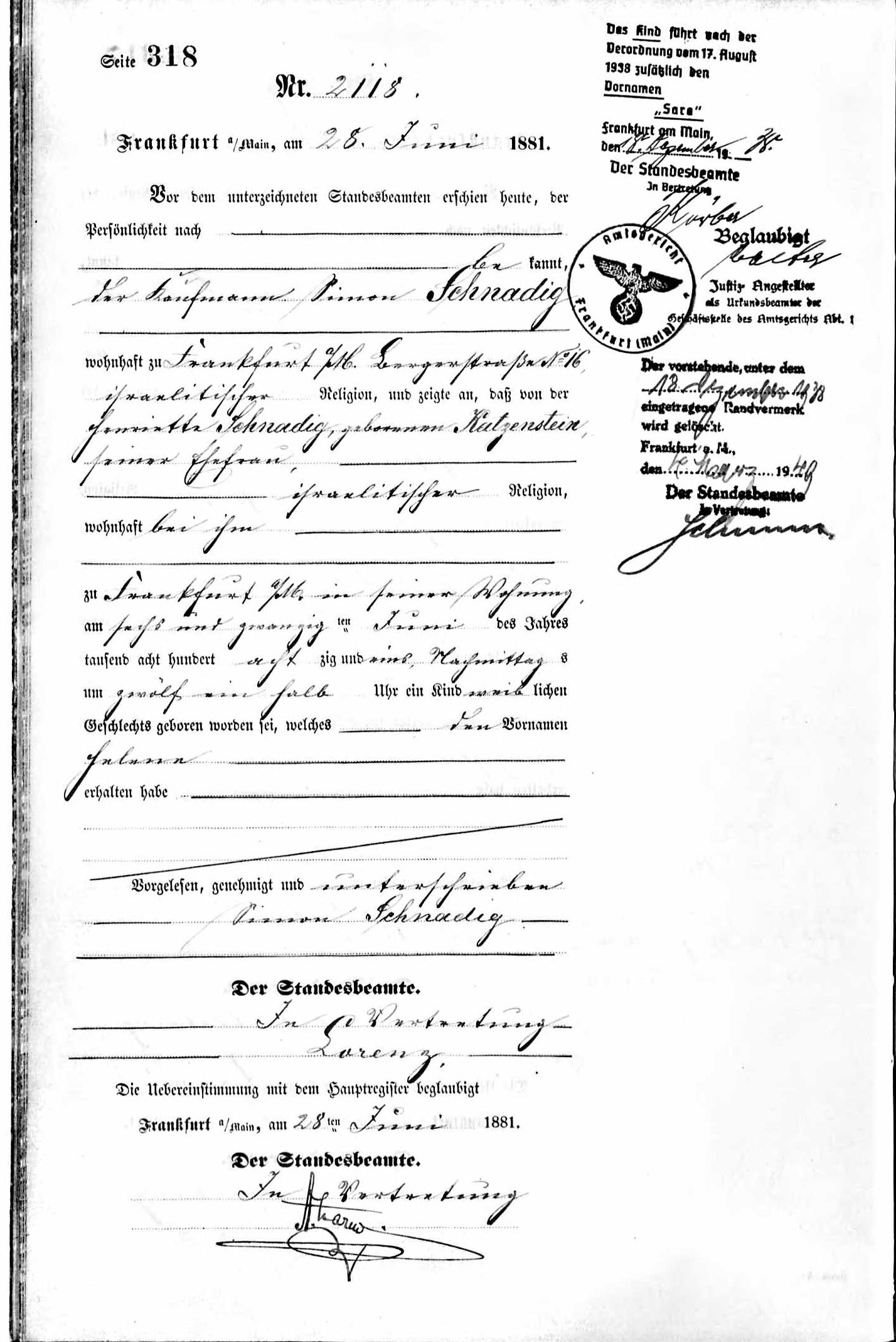
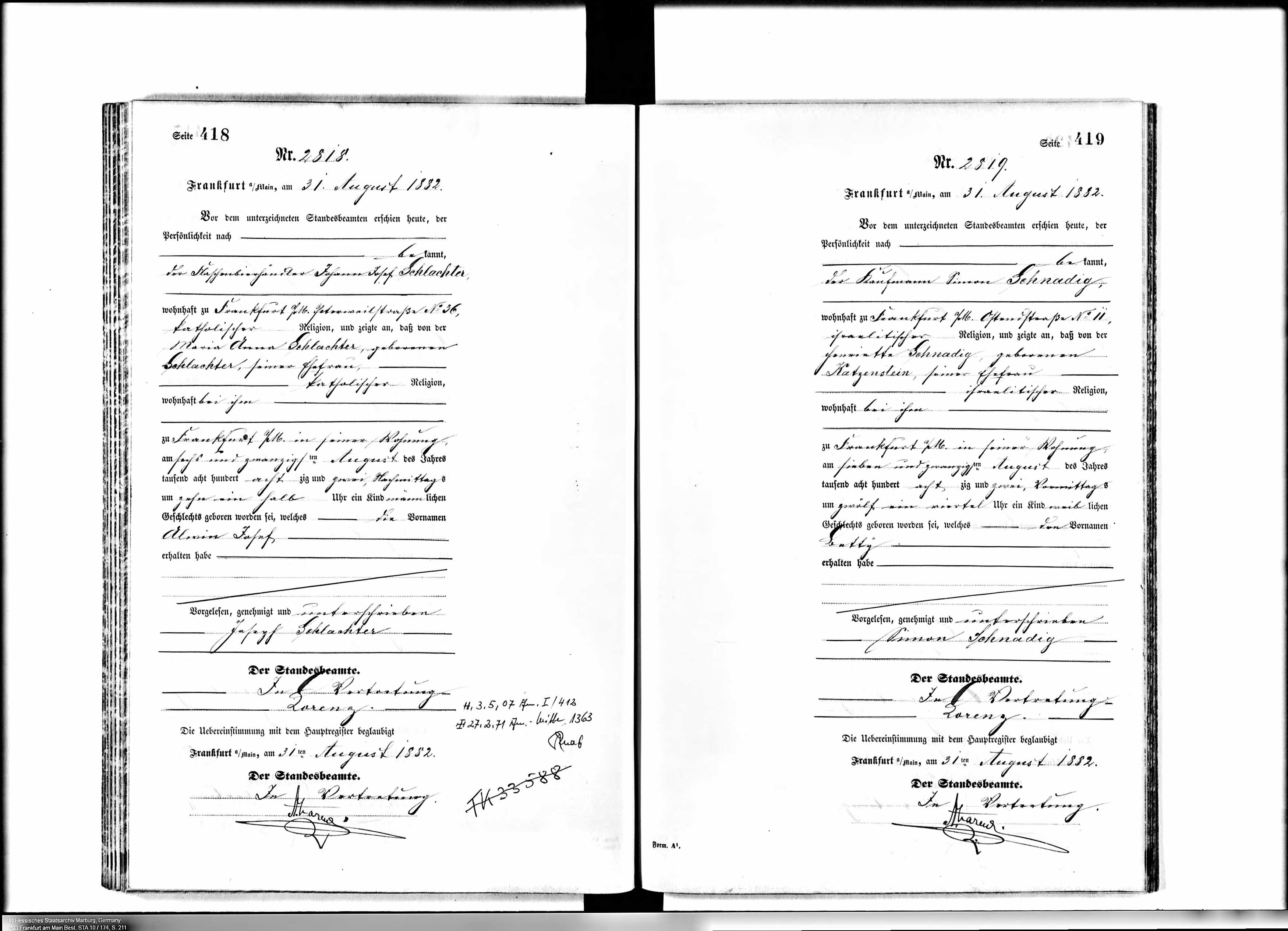
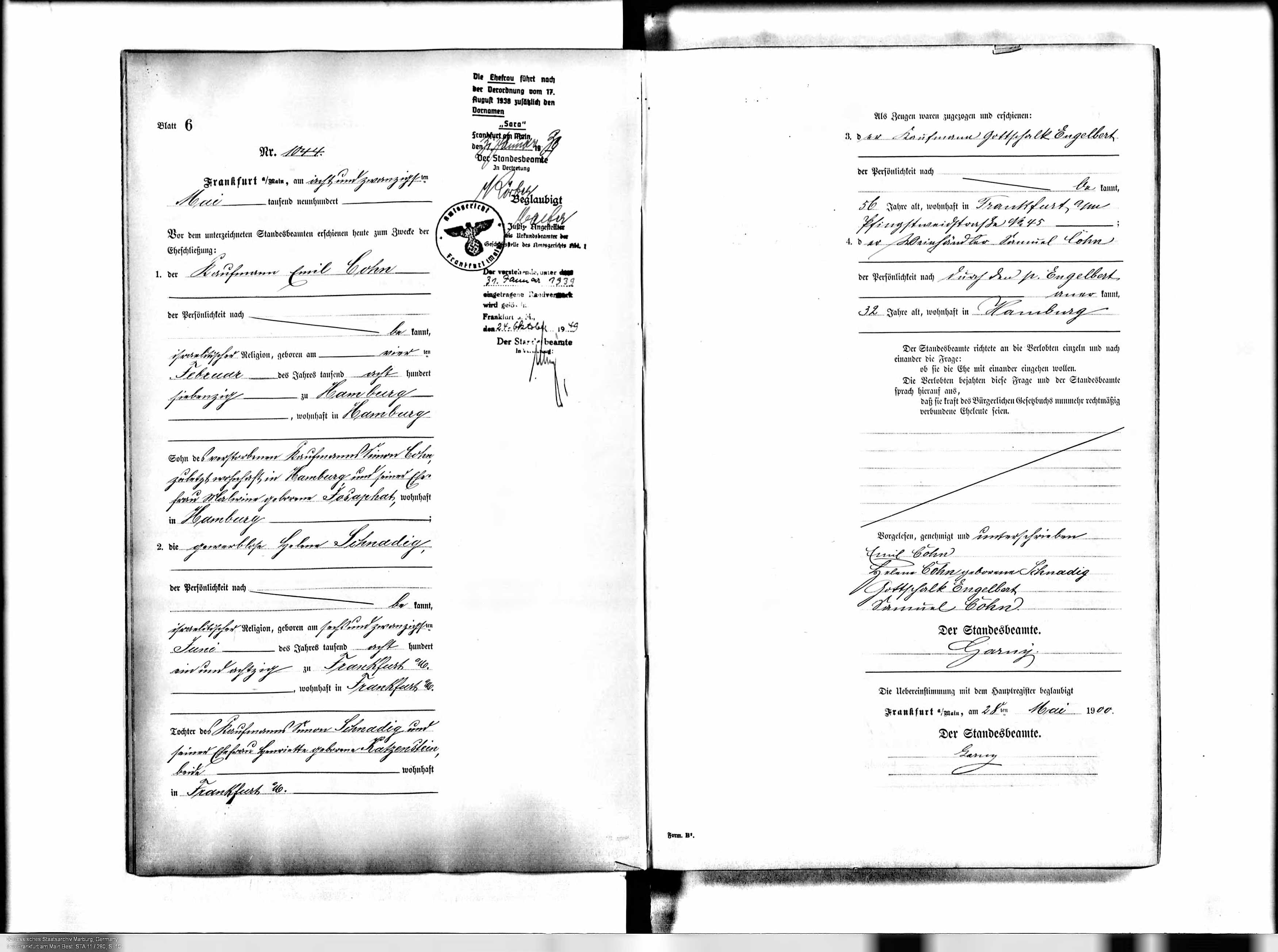
Henriette, the youngest of the three surviving daughters of Amalie and Juda, married Simon Schnadig on August 20, 1877, in Eschwege.  Simon was the son of Joel Schnadig and Johanna Ebertshausen and was born in Heddernheim, a district of Frankfurt, on October 10, 1849.

Henriette Katzenstein marriage to Simon Schnadig, Hessisches Hauptstaatsarchiv; Wiesbaden, Deutschland; Bestand: 923; Laufende Nummer: 1860, Description Year Range: 1877, Ancestry.com. Hesse, Germany, Marriages, 1849-1930

Henriette and Simon had three children, Julius (1878), Helene (1881), and Elsa (1890). Sadly, Julius died when he was only two years old.

Julius Schnadig death record, Personenstandsregister Sterberegister; Bestand: 903; Signatur: 10336, Year Range: 1880, Ancestry.com. Hesse, Germany, Deaths, 1851-1958

As for Amalie and Juda’s only son, Meyer (sometimes spelled Meier or Meir), he left Germany for the United States in 1888, arriving in New York City on October 10 of that year.2 He settled in New York where he married Emma Bachrach on October 27, 1891.3 Emma was also a German immigrant; she was born in Mainz on July 5, 1869, to Jakob Bernhard Bachrach and Sophia Pfann, and had immigrated to the US in the fall of 1889.4 Meyer and Emma had one child, a daughter Sophia, born in New York on August 19, 1892.5

Thus, by 1892, Amalie and Juda had eleven surviving grandchildren, including one born and living in the US. The family had grown steadily since their marriage in 1853, but suffered two losses in the 1890s. Juda Katzenstein died on September 27, 1896, in Eschwege; he was 72 years old and was survived by his wife Amalie, his four surviving children, and his grandchildren.

Juda Katzenstein death record, Personenstandsregister Sterberegister; Bestand: 923; Laufende Nummer: 1941, Year Range: 1896, Ancestry.com. Hesse, Germany, Deaths, 1851-1958

Then three years later Fredericke Katzenstein Goldmann lost her husband Leopold Goldmann on January 12, 1899. He was only 50 years old; he was survived by Fredericke, who was only 44, and their three children.

Leopold Goldmann death record, Personenstandsregister Sterberegister; Bestand: 923; Laufende Nummer: 1944, Year Range: 1899, Ancestry.com. Hesse, Germany, Deaths, 1851-1958

Thus, at the turn of the century, Amalie had lost one child in infancy, one grandchild as a toddler, her husband Juda, and her son-in-law Leopold. She herself died in Eschwege on January 7, 1903, at the age of 76.

Malchen (Amalie) Katzenstein death record.Personenstandsregister Sterberegister; Bestand: 923; Laufende Nummer: 1948, 1903, Ancestry.com. Hesse, Germany, Deaths, 1851-1958

She was survived by four children and eleven grandchildren. Their lives in the 20th century will be told in the posts that follow.


  1. Sources for the births of Amalie and Juda’s grandchildren will be provided in later posts. 
  2. Meier Katzenstein passport application, National Archives and Records Administration (NARA); Washington D.C.; Roll #: 623; Volume #: Roll 623 – 13 May 1903-18 May 1903, Volume: Roll 623 – 13 May 1903-18 May 1903, Ancestry.com. U.S. Passport Applications, 1795-1925 
  3. Meir Katzenstein, Gender: Male, Marriage Date: 27 Oct 1891, Marriage Place: Manhattan, New York, USA, Spouse: Emma Bacharach, Certificate Number: 13220
    Ancestry.com. New York, New York, Extracted Marriage Index, 1866-1937 
  4. Emma Bachrach birth record, Stadtarchiv Mainz; Mainz, Deutschland; Zivilstandsregister, 1798-1875; Signatur: 50 / 72, Year Range: 1869, Ancestry.com. Mainz, Germany, Births, Marriages and Deaths, 1798-1875; Emma Bachrach passport application, National Archives and Records Administration (NARA); Washington D.C.; Roll #: 1994; Volume #: Roll 1994 – Certificates: 179100-179475, 26 May 1922-26 May 1922, Volume: Roll 1994 – Certificates: 179100-179475, 26 May 1922-26 May 1922, Ancestry.com. U.S. Passport Applications, 1795-1925 
  5.  Sophia Katzenstein, Birth Date: 19 Aug 1892, Birth Place: New York, New York
    Certificate Number: 32010, New York City Births, 1891-1902; Title: Births Reported in August, 1892.; Certificate #: 32010, Ancestry.com. New York, New York, Birth Index, 1891-1902 

A Photo And Its Story: Amalie Meyer Bloch in the Netherlands

Before turning to the fourth child of Meyer Goldschmidt and Lea Katzenstein, a quick update from my cousin-by-marriage Ralph Dannheisser, the stepson of my cousin Elizabeth Stern and grandson of Johanna Bloch Dannheisser, the sister of Charles Bloch, who was married to my cousin Amalie Meyer Bloch.

Ralph sent me this photograph of his grandparents, Ludwig and Johanna Bloch Dannheisser, himself as an adorable toddler, and, in the center wearing the lovely hat, his grandmother’s sister-in-law Amalie Meyer Bloch.

Ludwig Dannheisser, Amalie Meyer Bloch, Ralph Dannheisser, Johanna Bloch Dannheisser.  The Hague, May, 1939. Courtesy of Ralph Dannheisser

According to the inscription on the back, it was taken in May, 1939, in The Hague in the Netherlands, when Ralph was a year old. Ralph’s grandparents and his parents had already escaped from Germany to the Netherlands by that time, and Ralph and his parents would leave for the US early in 1940. Tragically, his grandparents did not leave Europe and were sent to the concentration camps where they were murdered in 1944.

This is the first photograph I’ve seen of my cousin Amalie, and it raises more questions that I cannot answer. Why was she in the Netherlands in May, 1939? Had she left Germany for good by that point? Her naturalization papers say that when she came to the US in August 1941, her last residence was in Lisbon, but the ship manifest for her arrival in the US stated that her last permanent residence was Frankfurt, Germany. Neither mentions the Netherlands.

Was her husband Charles with her in the Netherlands in May 1939? He probably had already immigrated to France by then, so perhaps he and Amalie met in the Netherlands as a neutral meeting place? Perhaps Charles took this photograph? Or maybe Charles wasn’t there at all.

We don’t know the answers to any of these questions. But Ralph is certain that the woman standing in the center of this photograph with the big smile was Amalie Meyer Bloch, my third cousin, twice removed, and his great-uncle’s wife.

What amazes me is how happy Ralph, Johanna, and Amalie look. They’d left Germany, faced terrible acts of anti-Semitism, but were still finding something to smile about. Quite remarkable. Another sign of the resilience of human beings and our desire for love over hate.

Thank you, Ralph!

The Memoir of Julius Loewenthal, Part V: Leaving Germany

This is the final chapter in the memoir of my cousin Julius Loewenthal. We saw in the prior chapter how his life began to fall apart after the Nazis took control of Germany and their persecution of the Jews began in 1933. Then the family suffered a great personal tragedy in October 1937 when Julius and Elsa’s daughter Ruth and her husband Leonhard Fulda were killed in a terrible car accident after traveling to Switzerland to find a sanitorium for Herbert Loewenthal, who was struggling with mental illness and was soon after confined to a sanitorium in Zurich.

In this last section of his memoir, Julius writes about the decision to leave Germany and their ultimate departure in December 1938.


Eventually the life of the German Jew became impossible. No longer could we travel. Our passports were taken away. Thus, we finally decided to sell the business. It was a very difficult decision. Our life blood and that of our ancestors was sentimentally involved in this enterprise, its buildings, its history.

If my departure from my desk after 45 years was difficult and slow, my departure from my homeland, however, was made brutally swift and final by the following events. During the night from the 9th to the 10th of November [1938], approximately 30 Nazi Storm Troopers broke into our home in Eschwege. They destroyed everything they could get their hands on. Furniture was broken. Upholstery was cut to shreds, china was broken, even paintings of internationally known artists were cut up. Even the marble window sills were broken in two.  My wife and our servant…had taken refuge in the upstairs bedroom as I was out of town on this night. They [the Nazis] broke into the bedroom, and my wife and [servant] took refuge on the outside balcony where they remained all night because had they been discovered, they would have been killed. It was a very cold and lonely frightful night.

I was reached by phone and came back to Eschwege to find my home in shambles and my wife frightened to the marrow of her bones. On the evening of my return, the Gestapo arrived at my home and told me that on order from higher authority, my life and that of my wife was not in danger. At that time I did not understand in full the meaning of this communication because it was not until later that I found out that nearly all the members of the Jewish congregation were arrested on that day, brutally mistreated, and shipped to the Concentration Camp at Buchenwald. Many, very many, never came back. I, however, had a guardian angel, as I was to find out later.

At night we drove to the Schlosshotel in Kassel where we were accepted and could stay, as in those days no Hotel accepted Jews anymore. We remained there two nights and obtained the necessary papers to emigrate from Germany….

It was the unbelievable energy and presence of mind of my dear wife that brought us through these hours, as it was she who arranged for the damaged silver and furniture to be repaired, arranged the travel papers, and supervised the packing of that which was possible to be taken with us. Thus, we were later able to sell a lot of these items in the USA in order to obtain some money and survive. …

During the second night of our stay in the Hotel in Kassel, the Hotel was checked by the Gestapo. We were not bothered this time, but preferred to move to Frankfurt where no Hotel accepted us. We took refuge in the empty Apartment of my niece Lotte Posen, my brother Siegfried’s daughter. Her husband had been arrested, and she had moved to her parents.

We had arrived on Friday afternoon, and our cousin Sitta Mainz sent us some fish and bread to eat; it was very nice of her. On Saturday morning my niece Lotte came to me and told me I could no longer stay in her Apartment as I resembled her father too much. My wife was at the English Consulate. What could I do? In spite of it being Shabbos, I took a taxi and drove to the English Consul in order to meet my wife. She became very upset when she saw me with my luggage, but she managed to take us to my cousin Selma Frankel, who took us with much love and cooperation and helped us in a very difficult situation. …

We returned once more to Eschwege for the final packing for just a few days and then back to Frankfurt where we stayed at the house of my aunt Hana Stern. [This must refer to Johanna Goldschmidt, wife of Abraham Stern, who was the brother of Julius’ mother Kiele Stern. Johanna was also, however, Kiele Stern’s first cousin, as Kiele’s mother Sarah Goldschmidt was the sister of Johanna’s father Selig Goldschmidt.] The house was occupied by her son-in-law who fled for his life in the middle of the night. [This must refer to Siegfried Oppenheimer, the husband of Alice Stern, as I wrote about here.] It was a terrible feeling as everyone around you took steps to save his naked life. Still living in the house upstairs lived the other son-in-law of my aunt, Albert Mainz [husband of Sitta Stern]. We had a last supper together, and the following morning we travelled to Stuttgart to ask at the American Consul for our visa. When we returned that same night, Albert Mainz and family also had fled. Our fright increased; we were very shaken and terrified. We decided to cross the Border that night. This move was long overdue.

We had just obtained the necessary railroad tickets and travel papers when 3 Gestapo Agents arrived and confiscated all my wife’s jewelry, even though we had received permission on a prior occasion to retain the same and take it with us. Now what? It was my last possession as I knew that none of the money I had left in the Bank would ever be transferred.

At that terrible moment I made a dangerous decision, unheard of in those days and beyond imagination. I called the head of the Internal Revenue for the State of Hessen, the top authority in the State, and requested his intervention. … My guardian angel who had protected me in the past so visibly also protected me now, and the Gestapo Agents were ordered to return the jewelry, which they did with much reluctance. Of course, this individual knew me as the seat of his Bureau was in Kassel and knew very well who I was, as in the past we were the largest taxpayers in the county of Eschwege.

We took the train to Holland. At the Border, the town of Emmrich, the passport control came through. After they had inspected us, the customs inspectors came through. In this sleeping car only people who were emigrating into Holland were travelling. All had to open their luggage and all had to surrender their jewelry and watches. When the inspectors came to me, they read my name and passed on. I did not have to open my bags nor did I have to surrender anything. My wife and myself looked at each other. We could not believe it. Fright was still deep in our bones. In a few minutes we were in Holland and finally able to sleep again. Our guardian angel was indeed a guardian to us.

It was the 8th of December, a dark and rainy day, but a happy day. We were only allowed to take with us 10 Marks in Dutch currency. Thus, I who had left Millions behind was happy to find a room on the third floor of a Pension where we could rest as now we were in a free land, and we were able to eat meat again. We were saved, but unfortunately without our Grandchild Margot. She eventually was brought out by her Grandfather Fulda, who even then still liked it in Germany. At this writing she is still in Amsterdam. I hope and with God’s help I will see her again. …

Thus, our lives’ work, our homes, our fortunes, absolutely everything went to nothing. I cannot express in this writing the feelings in my heart of how they have influenced my views on life itself. However, let me say that this is a Jewish destiny, which has not swayed me one iota in my faith in the Lord of our forefathers.


Julius Loewenthal and his wife Elsa left Holland for England and then immigrated to New York City in May, 1939, where their daughter Hilda and son-in-law Max Stern lived. When Julius wrote this memoir in 1940, his son Garry Warner was enlisted in the British Army. Garry immigrated to New York City a year after the end of World War II.

Garry Warner-Loewenthal, born Karl Werner Loewenthal.
Courtesy of Joanne Warner-Loewenthal

Julius died of a heart attack in Manhattan on November 26, 1946, at the age of 72. I assume he knew before he died that his beloved granddaughter Margot had been murdered by the Nazis at Sobibor along with her other grandparents. Elsa died in 1961, also in New York City.

According to Garry’s notes after his translation of the memoir, the firm of L.S Brinkmann, the knitwear company owned by Levi Brinkmann and later by Julius and his brother-in-law/second cousin Moritz Werner, was re-established after the war by Moritz and Garry and resumed business in 1949. It was once again a very successful business for many years, closing down in 1974.

Garry also commented on the fate of his brother Herbert, who was a patient in a sanitorium in Zurich during the war. He was released in 1953 and cared for by a Swiss guardian. He worked and was well liked and respected in the community. He was “an extremely intelligent and cultured person, a man of many abilities, the least of which was to become a painter.” Herbert died of a heart attack in Zurich in 1962. Garry and his wife and five year old daughter were in Europe at that time and on their way to visit him when he died.

According to his daughter Joanne, Garry continued to work in the knitwear business until 1969. He then moved to West Palm Beach, Florida. He died March 1, 2005, when he was 87. I am so grateful to him for translating his father’s memoir and to Joanne for sharing it with me.

Garry Warner-Loewenthal
Courtesy of Joanne Warner-Loewenthal

These are stories that must be shared. We must never, ever forget what these people endured or their courage and resilience in carrying on after surviving Nazi Germany and the Holocaust.