A Brick Wall Tumbles: The Fates of August Felix Katzenstein and Julius Katzenstein, Orphaned Sons of Meier Katzenstein, Part I

Thanks to my friend Aaron Knappstein and my cousin Richard Bloomfield, an old brick wall has recently come down. Over seven years ago I wrote about the tragic story of Meier Katzenstein and his family. You can find all the sources, citations, and details here. But I will briefly outline their story.

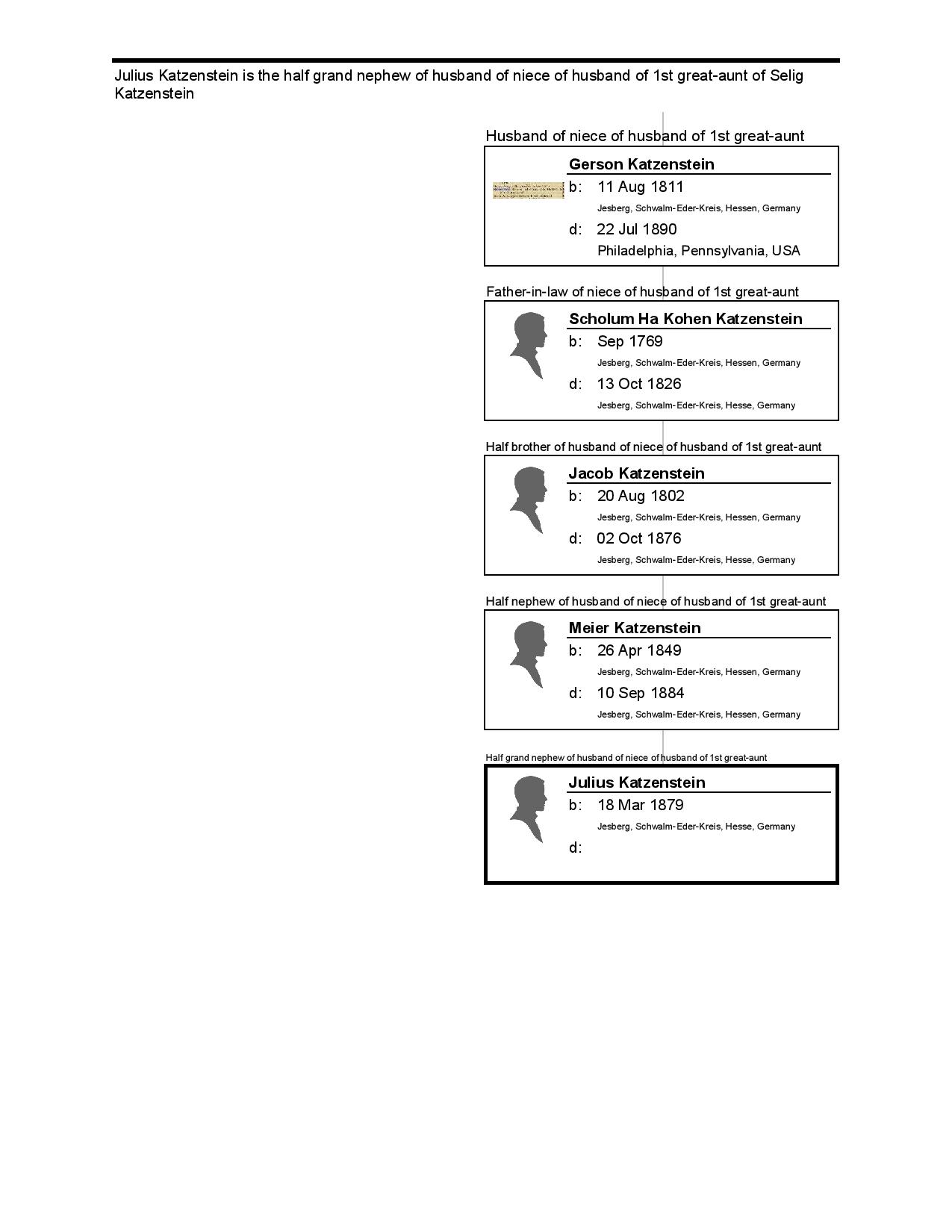
Meier, my great-grandmother Hilda Katzenstein Schoenthal’s first cousin, lost his first wife Auguste Wolf in 1876, shortly after she gave birth to their son August Felix Katzenstein. Meier remarried and had two more children with his second wife Bertha Speier:  Julius Katzenstein, born in 1879, and Ida Katzenstein, born in 1880. Both Ida and her mother Bertha died in April 1881, less than a year after Ida’s birth. Meier was left with two young sons, August, who was five years old, and Julius, who was two.

And then Meier himself died three years later in 1884, leaving August and Julius orphaned at eight and five, respectively. I couldn’t imagine what had happened to those two little boys. Who took care of them? What happened to them? This post will follow up on August, and the one to follow will be about his half-brother Julius.

I had been able to find out some of what happened to August as an adult when I initially wrote about him over seven years. He had married his first cousin, once removed, Rosa Bachenheimer in Kirchain, Germany, in 1900 when he was twenty-four years old. August and Rosa had two children, Margarete and Hans-Peter. All four of them were killed by the Nazis during the Holocaust. I knew that much, but there were still some gaping holes in my research. Where had August lived after his father died? Did he have any grandchildren? If so, did they survive the Holocaust?

So I went back now to to double-check my research and see if I could find anything more about August Felix Katzenstein and his family. I am so glad I did.

First, I learned at Yad Vashem that August and Rosa’s daughter Margarete had married Rudolf Loewenstein and had had two children with him: Klaus, born March 16, 1930, in Soest, Germany, and Klara, born June 9, 1932, in Soest, Germany. Unfortunately, Rudolf, Margarete and their two young children were also killed along with their grandparents and uncle during the Holocaust.

Then I found this Stolpersteine biography of August Katzenstein on a website about the history of the community of Essen, revised in 2024 by Mr. and Mrs. Hülskemper-Niemannn. It provides in part, as translated by Google Translate:

August Katzenstein was orphaned at a very early age. He then lived for a long time in the household of the parents of his future wife Rosa Bachenheimer from Kirchhain, whom he married around the turn of the century. The couple had two children: Margarethe (1901, later Loewenstein) and Hans (1905). August Katzenstein moved with his family to Steele in 1908 and took up a position as a teacher in the one-class Jewish elementary school at Isinger Tor.

After 1933, the Katzensteins’ lives changed radically. In 1937, the Gestapo arrested the couple because they were allegedly managing the assets of a dissolved Jewish organization. After a search of their apartment and rigorous interrogation and warnings, the couple were released. Even worse happened to August Katzenstein, who taught at the Jewish elementary school in Essen on Sachsenstrasse after the Jewish elementary school in Steele was closed, during and after the November pogrom. The apartment on Grendtor (then Ruhrstrasse) was destroyed and looted, and he and his disabled son Hans were arrested. While the 62-year-old father was released from police prison after 11 days, Hans was taken to Dachau despite written requests from his parents, from where he was only released after four weeks.

In the autumn of 1941, the deportation of Jews began across the Reich, including in Essen. … Half a year later, Katzenstein and his entire family were deported to Izbica. 

So now I know who had taken care of August after his father died: Rosa’s parents Sussman Bachenheimer and his wife Esther Ruelf, my second cousin, twice removed. I wrote about them here. I also now know that August had become a teacher and lived in Steele, Germany, a suburb of Essen, Germany.

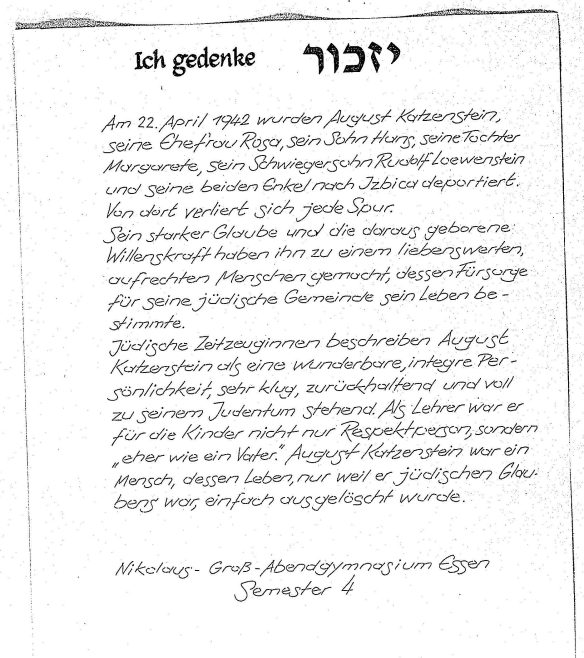
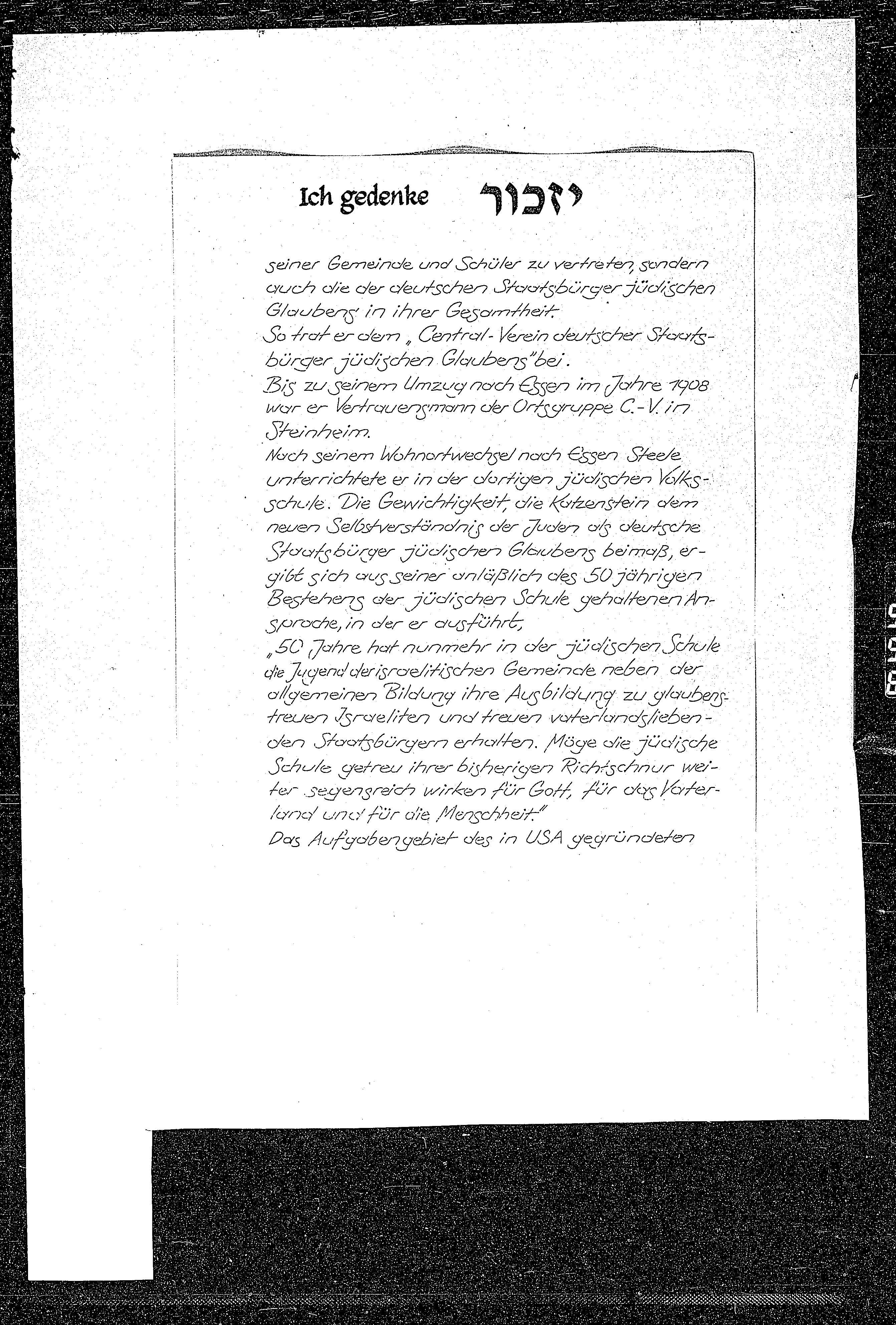
I found additional information about August and his family at Yad Vashem. The website has been updated since I had last researched August Katzenstein, and I found these documents I had not seen before from the Yizkor Book for the Jews of the Essen community who had been killed during the Holocaust. I asked my cousin Richard Bloomfield to translate these pages, and he graciously (and quickly!) agreed to do so.
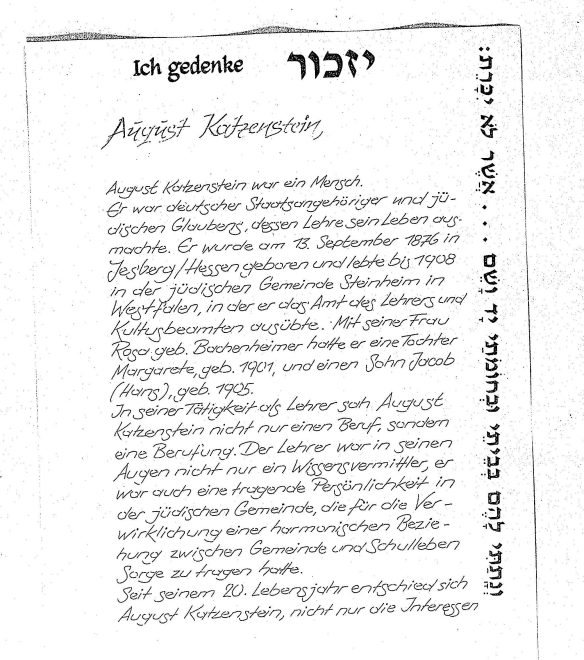
Richard’s translation provides:

August Katzenstein was a Mensch.

He was a German citizen and of the Jewish faith, whose teachings shaped his life. He was born on September 13, 1876, in Jesberg/Hesse and lived in the Jewish community of Steinheim in Westphalia until 1908, where he held the office of teacher and religious official. With his wife Rosa, née Bachenheimer, he had a daughter Margarete, born in 1901, and a son Jacob (Hans), born in 1905.

August Katzenstein saw his work as a teacher not just as a profession, but as a vocation. In his eyes, the teacher was not only an imparter of knowledge, he was also a leading figure in the Jewish community who had to ensure a harmonious relationship between the community and school life.

Beginning at the age of 20, August Katzenstein decided to represent not only the interests of his community and pupils, but also those of German citizens of the Jewish faith as a whole.

He joined the “Central Association of German Citizens of the Jewish Faith” “Central-Verein deutscher Staatsbürger jüdischen Glaubens”.

Until he moved to Essen in 1908, he was a representative of the C.-V. local group in Steinheim.

After moving to Essen Steele, he taught at the Jewish elementary school there. The importance that Katzenstein attached to the new self-image of Jews as German citizens of the Jewish faith can be seen in his speech on the occasion of the 50th anniversary of the Jewish school, in which he states,

“For 50 years now, the youth of the Jewish community has received their education in the Jewish school to become faithful Israelites and loyal citizens who love their fatherland, in addition to their general education. May the Jewish school continue to work beneficially for God, for the fatherland and for humanity, true to its guiding principles.”

The mission of the independent order “Bnai Brith” founded in the USA, spiritual self-education, the promotion of science and art, help for the persecuted and needy and the defense of Jewish citizens in the event of anti-Semitic attacks led August Katzenstein to join the Glück-Auf-Lodge of “Bnai Brith” in Essen in 1911 and of which he was president until April 1935.

Until his retirement in 1937, he also headed the Jewish relief organization in Essen-Steele. But despite his retirement, he did not neglect the members of the community whose employ he had left.

The ban and immediate dissolution of the “Bnai Brith” order by Himmler’s decree of April 10, 1937, resulted in August Katzenstein’s arrest on April 19, 1937, after his apartment and all the rooms of the Glück-Auf-Loge had already been searched two days earlier.

August Katzenstein then had to endure hours of interrogation under threat of state police measures. He was forced to sign a declaration that he had no further property belonging to the Glück-Auf-Lodge at his disposal and that he was not aware of where further material might be hidden, as documented in the Gestapo protocol of the same day.

During the so-called Reichskristallnacht on November 9, 1938, the Katzenstein family’s home at Ruhrstrasse 24 was also severely damaged. One day later, August Katzenstein and his disabled son were arrested again. They were held in the police prison in Essen until November 19, 1938. After his release, August Katzenstein wrote a letter to the Gestapo asking them to release his son, who had been sent to Dachau concentration camp. His son Jacob (Hans) then returned on December 21, 1938.

However, not only the care of his family, but also the suffering of the community entrusted to him had become his life’s purpose. Even the destruction of the school and synagogue as the center of the community during the November pogrom could not break August Katzenstein’s will to live in the Jewish faith.

In January 1939, August Katzenstein carried out his last community-related activity, officiating at the wedding of a young couple in the wife’s parental home.

On April 22, 1942, August Katzenstein, his wife Rosa, his son Hans, his daughter Margarete, his son-in-law Rudolf Loewenstein and his two grandchildren were deported to Izbica. No trace of them remains.

His strong faith and the willpower born of it made him a lovable, upright person whose care for his Jewish community defined his life.

Contemporary Jewish witnesses describe August Katzenstein as a wonderful person of integrity, very wise, reserved and fully committed to his Judaism. As a teacher, he was not only a person of respect for the children, but “more like a father.” August Katzenstein was a man whose life was simply snuffed out because he was Jewish.

Nikolaus-Gross, Abendgymnasium Essen, Semester 4

I wondered whether August’s “retirement” from teaching was voluntary or forced upon him by the Nazis, and although it’s still not clear, Richard also found this article about August’s retirement published on November 1, 1936, in the Jüdische Schulzeitung [Monthly journal for education, instruction and school policy; official publication of the Reich Association of Jewish Teachers’ Associations], (p.6):
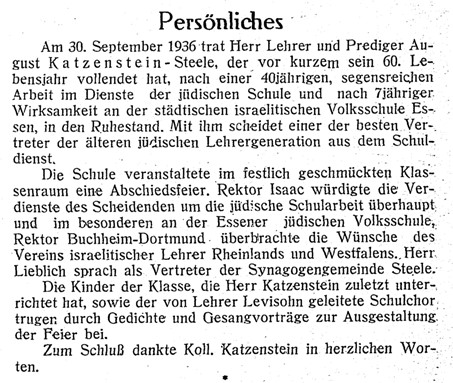
Richard translated the article for me:

On September 30, 1936, after 40 years of beneficial work in the service of Jewish schools and 7 years of work at the local Jewish elementary school in Essen, teacher and preacher August Katzenstein of Essen-Steele, who recently turned 60, retired. With him, one of the best representatives of the older Jewish generation of teachers leaves the teaching profession.

The school held a farewell party in the festively decorated classroom. Principal Isaac paid tribute to the departing teacher’s services to Jewish schools in general and to the Jewish Elementary School in Essen in particular. Principal Buchheim of Dortmund conveyed the wishes of the Association of Israelite Teachers of the Rhineland and Westphalia. Mr. Lieblich spoke as a representative of the Steele Synagogue community.

The children of the class that Mr. Katzenstein taught last, as well as the school choir led by teacher Levisohn, contributed to the ceremony with poems and songs.

Finally, colleague Katzenstein gave a heartfelt thank you.

Obviously, August was a well-loved, well-respected teacher and community leader. His early childhood was quite miserable—losing his mother, then his stepmother and half-sister, then his father—all before he was nine years old. But despite that tragic beginning, he lived a full and productive life, filled with meaning, faith, family, and love. How someone recovers from so much tragedy is amazing to me.

But then the Nazis came to power and destroyed August’s life and his family. I am so glad I went back to see if I could learn more about his life, and I am so grateful to Richard for his translation of the documents from the Essen Yizkor Book and for finding the article about August’s retirement. I found comfort in knowing that despite his tragic beginning and ending, August found fulfillment and meaning in his life.

But what about his younger brother Julius? I had known even less about him when I first researched this family. I couldn’t find anything that revealed what happened to him after his parents died. I couldn’t find a marriage record, a death record, a birth record for any children—-not one thing. Fortunately, he was not listed at Yad Vashem, so presumably had not shared the fate of his brother August. But where had he gone? Who had taken care of this little orphaned boy?

I will report on what I’ve learned about Julius in my next post.



Simon’s Secret! Now Available on Amazon!

Simon’s Secret is now available on Amazon in e-book, paperback, and hardcover!

My third family history novel, Simon’s Secret, is a story inspired by the lives of two of my Goldschmidt relatives, Simon and his daughter Hannah. Simon came to the US in the 1840s with a secret, one he wanted to hide from his family and his new country. His daughter Hannah never understood why he was such a curmudgeon. What was Simon’s secret? Will Hannah ever find out? And will she understand her father better if she does? Like all children, Hannah struggles to understand her father and his secrets.

This book follows the life of the fictionalized version of Simon Goldschmidt from Germany to America. We see how Simon and his family adapt to their new country while also trying to keep the traditions of Judaism that he brought with him from Germany. The story begins in 1826 and extends over a hundred years as we see what happens to Simon, Hannah, and Hannah’s children and grandchildren.

This is a story about a Jewish family, but its lessons are universal. Every generation has its secrets, and every immigrant brings their strengths and weaknesses to their new country as well as the gifts that will come with their descendants.

Celebration of the real Hannah Goldsmith Benedict’s 90th birthday in 1938.

You can find Simon’s Secret here on Amazon. I hope you enjoy it, and if so, please tell your friends and family and leave a review on Amazon.

Thank you!!

New for 2025!

Happy New Year to all my friends, family, and readers! I hope you all had a joyful and safe New Year’s Eve.

My first big news of 2025 is that my newest family history novel will be released at the end of January just thirty days from now. It’s titled Simon’s Story and was inspired by the story of my three-times great-grandfather’s younger brother Simon Goldschmidt. Although Simon’s life was the spark that led me to write this novel, the book itself is fiction wrapped around the skeleton of Simon’s life.

As described on Amazon, “Simon … came to the United States from Germany, a poor Jewish man whose first wife had died, leaving him with young children. After he remarried, he and his new wife and the children came to the United States. But Simon had a secret that he kept from his children. His daughter Hannah struggled all her life to understand her mysterious and aloof father. Why was he so cold, so withdrawn? What made him the way he was?”

The book is available for pre-order on Kindle now and you can find the link here. The paperback version will also be sold on Amazon and will be available on January 31, 2025.

I hope you will consider reading Simon’s Story, and if you enjoy it, please let me know and also please leave a review on Amazon.

Nusbaum Album: Are These My Seligmann Relatives from Germany?

With more realistic expectations but nevertheless high hopes, I awaited Ava’s final work on the Nusbaum Album, some of the photographs from Germany. Although there were some photographs from Stuttgart, Berlin, and Wiesbaden, since I did not know of any relatives living in those places in the mid to late 19th century, I focused on the photographs taken in Bingen and Mainz. Although my closest Seligmann relatives lived in the small town of Gau-Algesheim, both Bingen and Mainz were relatively close by and the closest cities to Gau-Algesheim, and many relatives eventually moved there. It seemed most likely that that my Seligmann relatives would have gone to one of those two cities to be photographed.

I selected three photographs from Mainz, all taken by the same photographer, Carl Hertel, and two from Bingen, both taken by J.B. Hilsdorf. These were all on the back of the first four pages at the beginning of the album whereas other photographs from Germany including from Mainz and Bingen were much later in the album. I hoped that meant the ones earlier in the album were more likely closer relatives.

The first Mainz photograph was dated by Ava as taken between 1873 and 1874; she noted that in 1874, Hertel became a court photographer. She wrote, “Generally, when a photographer was appointed as a court photographer that information would appear on the mounting card in the imprint and after the photographer’s name with the letters HOF. Since there is no indication of this appointment, I am placing the date of the photograph before 1874.”1 In addition, another photograph of Hertel’s found elsewhere with the same imprint was dated 1873.

Ava estimated the age of the man as mid to late 70s based on the lines on his face and the style of his tie. That meant the man was born in about 1800-1804. Ava speculated that this could be my three-times great-grandfather Moritz Seligmann, who was born in 1800. And this time I was able to confirm that speculation because I belatedly remembered that I have an actual photograph of Moritz that I had obtained from a cousin years back:

Moritz Seligmann

So bingo! We had a positive identification!

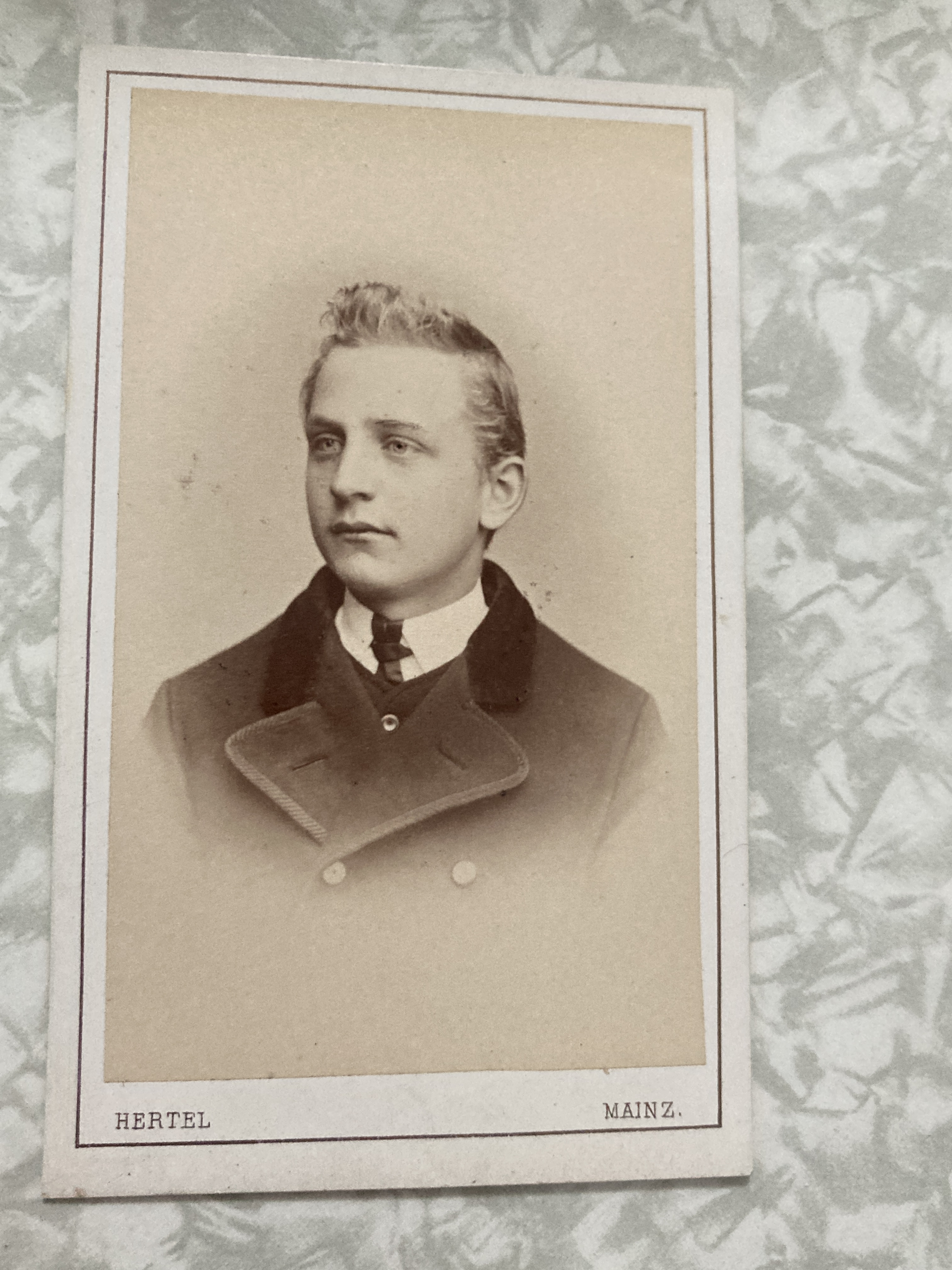
Moving on to the next two Mainz photos, Ava concluded that they also were taken between 1873 and 1874 based on the information she’d already found about Hertel. The first one she believed to be of a man who was in his thirties, perhaps 35, so born in about 1838-1839. The younger man on that same page appeared to her to be eighteen so born in about 1855. Since these photographs were all taken by the same photographer at about the same time, I thought that perhaps these two younger men were sons of Moritz Seligmann, that is, brothers of Bernard, my great-great-grandfather. In addition, they appeared on the second page of Germany photographs right after the photograph of Moritz, who appeared on the first page of the Germany photographs in the album.

Looking at the family tree, I found two possibilities. The older “son” could be Hieronymous Seligmann, born in 1839. The younger “son” could be Moritz’s youngest child, Jakob Seligmann, born in 1853. I was excited at the thought that perhaps I finally had found some relatives I could identify in the album.

I shared my analysis with Ava. She was skeptical that the younger man was Jakob Seligmann because she had identified Jakob in a photograph from a different set of photographs that she had worked on during an earlier project, and she did not see any similarities or enough to believe that the blonde teenager photographed in Mainz was the same person identified as Onkle Jakob in the later photograph.

We went back and forth with me trying my lawyerly best to persuade her that the blonde man could have grown up to be the dark haired Oncle Jakob. But in the end I failed to do so. I have to defer to Ava. She’s the expert, and I am a biased viewer hoping to see what I want to see. But if this was not Jakob Seligmann, who was it? I don’t know. Maybe a nephew or a cousin. Maybe not anyone in the family at all.

Knowing now that the Hertel photographs were likely taken before 1874 as Ava concluded, I looked on my own at the other three Hertel photographs taken in Mainz that appear later in the album:


Who are these three women? I don’t know since I have no photographs to use for comparison. Two of them look too young to be Bernard Seligman’s sisters Mathilde and Pauline, who were born in 1845 and 1847, respectively, and certainly too young to be his half-sister Caroline born in 1833, if the photographs were taken around 1873 as Ava concluded about the other Hertel photographs. And they are too old looking to be the children of any of Bernard’s siblings. So sadly they also will remain unidentified.

The next photograph I asked Ava to analyze is on the same page as the two blonde men except this photograph was taken in Bingen, not Mainz, by J.B. Hilsdorf, who was in business in Bingen from 1861 to 1891, according to Ava’s research. When I believed that the other two men on that page were Hieronymous and Jakob, I speculated that this third man could be their brother August, the only other son of Moritz Seligmann who survived beyond 1853 and was living in Germany.

Based on the size of this particular photograph, Ava dated it in the mid-1860s. She thought the man was between 30 and 35 so born between 1827 and 1834.2 August Seligmann was born in 1841 so too young to be the man in this photograph. In addition, Ava compared this photograph to one I have of August and found them to be dissimilar. It didn’t take as much to persuade me this time.

August Seligmann

That left one last photograph for Ava to analyze, the second photograph from Bingen that I had selected.

It also was taken by J.B. Hilsdorf, and for the same reasons Ava dated it in the mid-1860s. She estimated the woman’s age to be in her late 40s, early 50s, giving her a birth year range of 1812 to 1817. Based on the age and other photographs I have of my three-times great-grandmother Babette Schoenfeld Seligmann, Ava thought there was a good possibility that this photograph was also Babette. Here are the other photographs of Babette that Ava used for comparison.

Ava did an incredible job of researching the photographers and the photographs they’ve taken to come up with reliable time frames for when the album photographs were likely taken. But it is only possible to go so far with identification without known photographs of the people in your family to use for comparison. You can narrow down the possibilities and eliminate those who clearly do not fit within the parameters of the dates, but you can never be 100% confident of the specific identity of the person in the photograph based just on dates and locations. I wish I had more photographs that Ava could have used to make facial comparisons, but I don’t. I have to accept that I may never know who most of these people were.

Fortunately, there were a handful of photographs in the Nusbaum Album that were labeled and that I could on my own identify and place in my family tree. More on those in my next few posts.


  1. Ava Cohn, Analysis of Nusbaum Album #4, March 17, 2024 
  2. Ava Cohn, Analysis of Nusbaum Album #5, April 3 ,2024

The Nusbaum Album: An Introduction

Some of you may recall that last fall I received a call from an antique dealer in Santa Fe who had in her shop a photograph album with the names John Nusbaum and Frances Nusbaum engraved on the front and rear covers, respectively. I immediately knew that this album had belonged to my three-times great-grandfather John Nusbaum and his daughter Frances, my great-great-grandmother. Frances had married my great-great-grandfather Bernard Seligman and moved from Philadelphia to Sante Fe, where they raised their children, as I told in my family history novel, Santa Fe Love Song.

I agreed to purchase the album and when it arrived, I marveled at the collection of almost two hundred photographs of people I hoped were my relatives—or at least I hoped that some of them would be. But except for a handful of those photographs, there were no labels or names to identify the people in them. Almost all, however, had a photographers’ stamp that indicated where they were taken.

The largest group of photographs (43) were taken in Philadelphia, where John Nusbaum had settled after immigrating from Schopfloch, Germany, in about 1840. He had initially been a peddler traveling throughout Pennsylvania, but eventually settled in Philadelphia and established a dry goods store there. He married Jeanette Dreyfuss, another German immigrant, and had six children, my great-grandmother Frances being the third child and oldest daughter. Thus, I assumed many of the Philadelphia photographs were of John and his family as well as of other family members and friends. But who was who? I had no idea.

Not surprisingly, the next largest group of photographs were taken in Germany, including some taken in Mainz and some in Bingen, the two larger cities closest to Gau-Algesheim where Bernard Seligman and his siblings were born and raised. There were also photographs taken in other German cities, such as Stuttgart, Berlin, and Wiesbaden.

There were eight photographs taken in Santa Fe, where Frances Nusbaum had moved with her husband Bernard and their three older children in about 1870. Their youngest child Arthur Seligman was born in Santa Fe, but my great-grandmother Eva Seligman was born in 1866 in Philadelphia.

Three photographs were taken in Harrisburg, Pennsylvania, and several were taken in Lewistown, Pennsylvania, two locations where John and Jeanette’s siblings lived in Pennsylvania, so I assumed that those photographs were likely of those Nusbaum/Dreyfuss cousins. The remaining photographs were taken in other places such as New York City; Montgomery, Alabama; Wheeling, West Virginia; Peoria, Illinois; and St. Louis, Missouri.

Each page in the album has four slots for photographs. On the first four pages of the album, there are two photos, back-to-back, in each slot so that you cannot see the reverse of the photos without pulling them out of the slots. Then starting on the fifth page in the album, there are only four photos on each page, and the reverse of those photos shows through on the back of the slot on the back of the page.

What it took me a long time to realize is that all the photos squeezed into the back of those on the first four pages are photographs from Germany. I think that these photographs from Germany may have been added once all the other slots were filled. They likely belonged to Bernard Seligman and were added after he married Frances. I will get to these photographs in a later post, but my reason for mentioning this here is to indicate that I think that aside from those German photos, the others were probably placed by John, Jeanette, or Frances Nusbaum.

The photographs appear to be somewhat grouped together by the location where the photographs were taken and by photographer. The photographs seem to follow roughly this geographical order: Pennsylvania, including many from Philadelphia, but also Harrisburg and Lewistown; then two pages from Peoria, Illinois; then three pages of Santa Fe photographs; then some from New York City and other places; and then photographs from Germany (plus the ones on the reverse of the first few pages). There are also some that appear in random places within the album, but overall this is how the album is arranged.

Since I only had names on a handful of photographs and since I had no idea when the photographs were taken, I decided to retain the expert services of Ava Cohn, aka Sherlock Cohn, the Photo Genealogist. Long time readers of my blog know that I have had great success hiring Ava in the past to help me identify people in old photographs.

With the financial support of my brother and my cousins Marcia and Terry, I asked Ava to help me with this new project. I also agreed to sell the album after Ava and I were done with it to my cousin Jhette for the price I paid to the antique dealer; that way I had more money to hire Ava. Although I was sad to think that I would not be able to keep the album, I knew that Jhette, another descendant of Bernard Seligman and Frances Nusbaum, would take good care of it.

Because of the large number of photographs and my limited resources, I had to limit the scope of Ava’s work. I asked her only to date the photographs and to estimate the ages of the people in them. I was not asking her to do any identification of the people. I was hoping that with those two bits of dating information, I’d be able to deduce who the people were in the photographs—or at least narrow down the possibilities—by studying my family tree.

I also had to limit her work to about 20-25 of the almost two hundred photographs in the album. I decided to focus on those taken in Philadelphia, Santa Fe, Mainz, and Bingen because I knew that those would most likely be of my direct ancestors. As noted above, I figured that the Harrisburg, Peoria, and Lewistown photographs were of Nusbaum/Dreyfuss cousins. I had no idea who in the family (if anyone) lived in Berlin, Stuttgart, or Wiesbaden, Germany, or for that matter in St. Louis, Wheeling, or Montgomery. I knew of one branch that lived in New York, but not direct ancestors.

But because there were so many photographs taken in Philadelphia, I had to find some way to narrow down Ava’s work so that she could have the best chance of identifying the people in the photographs I chose. Based on her suggestions, we started with the photographs on the first page, figuring that those would most likely be the closest relatives if not the owners of the album; three of those were taken by the same photographer in Philadelphia. The fourth and the very first photograph in the album was taken in Harrisburg. There were two men and two women. In my wildest dreams, I was hoping that they were of John and Jeanette and Frances and Bernard.

Here are those first four photographs:

In my next two posts I will share what I learned from Ava about these four photographs and how I decided to choose the remaining 15-20 photographs for her to analyze. This will be a multipart series of posts devoted to the Nusbaum album.


Levi Rothschild’s Daughters Thekla Rothschild Weinberg and Frieda Rothschild Phillipsohn: One Survived, One Did Not

This is the story of the last two children of Levi Rothschild and Clara Jacob who lived to adulthood, their daughters Thekla and Frieda. Both have heartbreaking stories though Thekla survived and Frieda did not.

The fifth child of Levi and Clara, their daughter Thekla, married Manuel Edward Weinberg on August 19, 1907, in Borken. Manuel was born in Lichenroth, Germany, to Lazarus Weinberg and Karoline Oppenheimer on October 11, 1880.

Thekla Rothschild and Manuel Weinberg marriage record, Hessisches Hauptstaatsarchiv; Wiesbaden, Deutschland; Bestand: 920; Laufende Nummer: 843, Ancestry.com. Hesse, Germany, Marriages, 1849-1930

Thekla and Manuel had a son Hans Herbert Weinberg born in Frankfurt, Germany, on November 2, 1908.1

After Kristallnacht in November 1938, Manuel Weinberg was imprisoned at Buchenwald for a short time,2 and that may have motivated the family to leave Germany. By 1940 if not before, the family had left Germany for France, and according to Yad Vashem, Thekla’s husband Manuel was deported in 1940 to the internment camp near Toulouse, France known as the Recebedou camp.3

According to one website, the camp of Recebedou was created in July 1940 to receive refugees and those who had been evacuated. It was turned into a hospital camp in February 1941. But conditions in the camp deteriorated over time due to the lack of adequate medical care and a shortage of food. By late 1941, there were 739 interns, many of whom were over 60 and ill; 118 of them died in the winter of 1941-1942. Manuel Weinberg was one of those who died; he died on March 4, 1942.4

I don’t know for certain whether Thekla or their son Herbert, as he came to be known, were also interned at Recebedou because there are no documents I can find that indicate that they were. However, I do know that they must have been in France because Herbert and his wife, Edith Seckbach, had a daughter Yvonne born in Toulouse, France sometime in 1943.5  I could not find a marriage record for Herbert and Edith, but according to other records, Edith was born in Wiesbaden, Germany, in about 1918. 6

Wherever they were in France, somehow Thekla, Herbert, Edith, and their baby daughter survived. A document on Ancestry’s collection of Munich, Vienna and Barcelona Jewish Displaced Persons and Refugee Cards, 1943-1959 (JDC) indicates that as of November 1942, Thekla, Herbert, Edith, and Yvonne were in Vigo, Spain, which is almost seven hundred miles from Toulouse, France. How they got there in the midst of the war is a story I do not know.

Ancestry.com. Munich, Vienna and Barcelona Jewish Displaced Persons and Refugee Cards, 1943-1959 (JDC)

From Vigo they went to Madrid as of December 26, 1943. The Refugee Card lists two people as the “parents,” which I assume really means sponsors in this situation. One was Walter Hirschmann, Thekla’s nephew, the son of her sister Betti Rothschild Hirschmann.7 The other, Jacob Bleibtreu, was a banker and later a governor of the New York Stock Exchange who had immigrated to the US from Germany as a young man in 1909. He also was on the Greater New York Army and Navy Committee of the Jewish Welfare Board. Perhaps he knew Walter from the banking and broker business and agreed to help rescue his aunt and other family members.8

On March 23, 1944, Thekla, Herbert, Edith, and Yvonne all arrived in Philadelphia after sailing from Lisbon, Portugal. The ship manifest shows that they all had last been residing in Madrid, Spain, and were heading to Montreal, Canada under the sponsorship of the Joint Distribution Committee. Herbert reported that he was a chemist by occupation.

Thekla Weinberg and family passenger manifest, The National Archives at Washington, D.C.; Washington, D.C.; Series Title: Passenger Lists of Vessels Arriving at Philadelphia, Pennsylvania; NAI Number: 4492386; Record Group Title: Records of the Immigration and Naturalization Service, 1787-2004; Record Group Number: 85; Series: T840; Roll: 177, Ancestry.com. Pennsylvania, U.S., Arriving Passenger and Crew Lists, 1798-1962

Herbert’s wife Edith must not have lived very long after their voyage from Portugal to Philadelphia because on September 8, 1946, Herbert married his second wife, Anna or Anya Grodzky, in Hochelaga, Quebec, Canada. Anna was born in Russia on June 18, 1910, and was a beautician. Herbert is listed as a widower on their marriage record and as a chemist by trade.

Hans Herbert Weinberg marriage to Anna Grodsky, Marriage Sep 8 1946 Westmount, Québec, Canada, Groom Herbert Hans Weinberg, Groom’s birth 1908 Germany, Bride Anna Goodsky, Certificate number upd46-128967, Quebec Marriage Returns, 1926-1997, found at https://www.myheritage.com/research/record-10723-1831907/herbert-hans-weinberg-and-anna-goodsky-in-quebec-marriage-returns

The family all settled in Montreal, where Thekla died on March 11, 1962, at the age of 76.9 Herbert lost his second wife Anna on July 9, 1976.10 He died February 12, 2001, at the age of 92, and was survived by his third wife Sally Lazoff Bailen.11

I have not found any further information about Herbert’s daughter Yvonne despite searching everywhere I could and receiving help from members of Tracing the Tribe. I don’t know whether she died, married, or moved from Canada and changed her name. There just is no trace of her after a mention in her stepmother Anna’s obituary in 1976. She is not mentioned in her father’s obituary in 2001.12

Although Thekla Rothschild Weinberg survived the Holocaust, she lost her husband, her homeland, and, as we will now see, her sister Frieda to the Holocaust.

Frieda was born May 31, 1993, in Borken, Germany.  As we saw, she first married Leonard Marxsohn and was widowed and then married Paul Phillipsohn, with whom she had a daughter Hannelore, born December 3, 1926.

Unfortunately, I have no happy ending for Frieda, Paul, or Hannelore. On June 11, 1942, they were all deported to Theriesenstadt. None of them survived. According to Yad Vashem, Paul died on December 20, 1942. I have no exact dates for Frieda or Hannelore, only that they also died in about 1942.13

Thus ends the story of Levi Rothschild’s family. Although most of them survived the Holocaust and made it to the US, Israel, or Canada, they were scattered across the globe, and their lives were all forever changed. The family members who were killed must have left holes in their hearts forever.


  1. Hans Herbert Kaufmann Weinberg, Gender männlich (Male), Record Type Inventory, Birth Date 02 Nov 1908 (2 Nov 1908), Birth Place Frankfurt am Main,
    Last Residence Frankfurt am Main, Residence Place Frankfurt am Main, Father
    Edmund Weinberg, Mother Thekla Weinberg, Spouse Edith Seckbach, Notes Inventories of personal estates of foreigners and especially German Jews
    Reference Number 02010101 oS, Document ID 70370883, Arolsen Archives, Digital Archive; Bad Arolsen, Germany; Lists of Persecutees 2.1.1.1, Ancestry.com. Free Access: Europe, Registration of Foreigners and German Persecutees, 1939-1947 
  2. Arolsen Archives, 1 Incarceration Documents / 1.1 Camps and Ghettos / 1.1.5 Buchenwald Concentration Camp / 1.1.5.3 Individual Documents male Buchenwald / Individual Files (male) – Concentration Camp Buchenwald / Files with names from SYS and further sub-structure / Files with names from WECK /, Personal file of WEINBERG, EMANEL, born on 11-Oct-1880, Reference Code, 01010503 002.042.476, Number of documents, 1, found at https://collections.arolsen-archives.org/en/document/7388346 
  3. Yad Vashem entries for Manuel Weinberg, found at  https://collections.yadvashem.org/en/names/13545516 and at https://collections.yadvashem.org/en/names/3229127 
  4. See Note 3, supra. 
  5. Yvonne Miriam Weinberg, passenger manifest, The National Archives at Washington, D.C.; Washington, D.C.; Series Title: Passenger Lists of Vessels Arriving at Philadelphia, Pennsylvania; NAI Number: 4492386; Record Group Title: Records of the Immigration and Naturalization Service, 1787-2004; Record Group Number: 85; Series: T840; Roll: 177, Ancestry.com. Pennsylvania, U.S., Arriving Passenger and Crew Lists, 1798-1962 
  6. Edith Weinberg, passenger manifest, The National Archives at Washington, D.C.; Washington, D.C.; Series Title: Passenger Lists of Vessels Arriving at Philadelphia, Pennsylvania; NAI Number: 4492386; Record Group Title: Records of the Immigration and Naturalization Service, 1787-2004; Record Group Number: 85; Series: T840; Roll: 177, Ancestry.com. Pennsylvania, U.S., Arriving Passenger and Crew Lists, 1798-1962. See also Edith Weinberg geb. Seckbach, Arolsen Archives, Digital Archive; Bad Arolsen, Germany; Lists of Persecutees 2.1.1.1, Description Reference Code: 02010101 oS,
    Ancestry.com. Free Access: Europe, Registration of Foreigners and German Persecutees, 1939-1947 
  7. It was Walter’s name on this card that led me to discover that he was the child of Betti and Emanuel Hirschmann. 
  8. “Jacob Bleibtreu, Former Governor of New York Stock Exchange, 90,” The New York Times, December 6, 1976. 
  9. Thekla Weinberg death notice, The Montreal Star, Montreal, Quebec, Canada, Mon, Mar 12, 1962, Page 16. 
  10. Anna (Anya) Weinberg death notice, The Montreal Star, Montreal, Quebec, Canada, Sat, Jul 10, 1976, Page 10. 
  11. Marriage of Herbert Weinberg to Sally Lazoff, Nov 15 1980, Côte St Luc, Québec, Canada, Groom Herbert Weinberg, Groom’s birth Nov 5 1908, Germany, Groom’s age 72, Bride Sally Lazoff, Bride’s birth Aug 15 1917, Québec, Canada, Bride’s age 63, Groom’s father Manuel Weinberg, Groom’s father’s birth Germany, Groom’s mother Thekla Rothschild, Groom’s mother’s birth Germany, Bride’s father Gedaliah Lazoff
    Bride’s father’s birth Russia, Bride’s mother Telia Brasgold, Bride’s mother’s birth Russia
    Certificate number upd80-141452, Quebec Marriage Returns, 1926-1997, found at https://www.myheritage.com/research/record-10723-2419633/herbert-weinberg-and-sally-lazoff-in-quebec-marriage-returns. Herbert Weinberg death notice, The Gazette
    Montreal, Quebec, Canada, Mon, Feb 12, 2001, Page 35. 
  12. Anna (Anya) Weinberg death notice, The Montreal Star, Montreal, Quebec, Canada, Sat, Jul 10, 1976, Page 10. Herbert Weinberg death notice, The Gazette, Montreal, Quebec, Canada, Mon, Feb 12, 2001, Page 35. 
  13. See Yad Vashem entries at https://collections.yadvashem.org/en/names/11607287 for Frieda, https://collections.yadvashem.org/en/names/14969310 for Paul, and https://collections.yadvashem.org/en/names/11607287 for Hannelore. 

Mathilde Rosenbaum Rothschild: Why Didn’t She Leave Germany?

Several readers asked me whether I could learn more about why Mathilde Rosenbaum Rothschild did not go with her husband Hirsch Rothschild and their children to the United States in the 1930s, but stayed in Germany. Tragically Mathilde was eventually killed by the Nazis whereas her husband and children all survived.

I decided to dig a little deeper into Mathilde’s family to see if perhaps she’d stayed to care for elderly parents, but both of her parents died long before the Nazi era.1  Mathilde also had numerous siblings, including one who was killed at Auschwitz, but others escaped—to Israel, to the US, and to South Africa. In fact, this review of my research allowed me to realize something I had not noticed before. Mathilde’s sister Fanni Rosenbaum had married Hirsch Rothschild’s older brother Sigmund. They had escaped to South Africa.

I couldn’t trace all of her siblings, but given that her family was from Schluechtern and that Schluechtern is over 250 miles from Bremen, the city Hirsch listed as his wife’s residence on the passenger manifest, I don’t think that Mathilde was in Bremen to help with a family member.

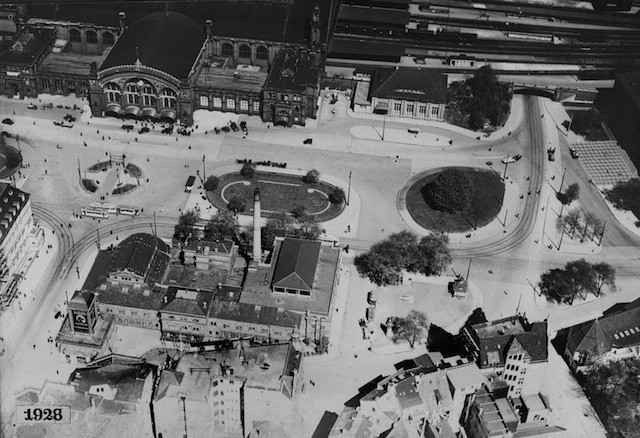
I looked more closely at the address that had been added to Hirsch’s passenger manifest—Bahnhofsplatz 16, in Bremen, thinking that perhaps it was the address of a hospital where Mathilde might have been getting treatment.

Hirsch Rothschild, passenger manifest, p. 2, The National Archives At Washington, D.c.; Washington, D.c.; Series Title: Passenger Lists of Vessels Arriving At Miami, Florida; NAI Number: 2788508; Record Group Title: Records of the Immigration and Naturalization Service, 1787 – 2004; Record Group Number: 85 Description Roll Number: 086 Source Information Ancestry.com. Florida, U.S., Arriving and Departing Passenger and Crew Lists, 1898-1963

But “Bahnhofsplatz” means a plaza or square where the train station is located, and as best I can tell, in the late 1930s there was no hospital located near there. Rather, it was a place where there were hotels for those traveling to Bremen, an indoor swimming pool facility, and other public and private buildings. Although I can’t be certain, Banhofsplatz 16 may have been the address for a hotel in the 1930s.

Bahnhofsplatz-1928 Bremen Germany

Why would Mathilde be living in a hotel in Bremen? When Hirsch left Germany in the late 1930s, he listed his last permanent residence as Delmenhorst, a village about ten miles from Bremen.  It’s possible that Hirsch and Mathilde had been forced out of their home in Delmenhorst by then either by force or for better opportunities and had moved into a hotel in Bremen. As a  Jewish doctor, by 1938-1939, Hirsch would only have been allowed to treat Jewish patients, and Bremen had a larger Jewish population than Delmenhorst.  Although the passenger manifest indicates that Hirsch’s last permanent residence was Delmenhorst, not Bremen, I would think that staying in a hotel near the train station would not be considered a “permanent” residence so Delmenhorst would still have been more accurate.

I still don’t know why Hirsch left without Mathilde. Maybe he thought he’d go first and settle in and then send for her. I also don’t know when Hirsch left Germany because the ship manifest listing his arrival in Florida on December 18, 1939, was for a ship arriving from Havana, Cuba. I searched the Bremen passenger manifests and found two of his children on them—Edith and Edmund—but not Hirsch. And I don’t know how long Hirsch was in Cuba before being allowed to sail to the US. So…anything I write is total speculation on my part.

The only way I’ll be able to find an answer to these questions would be to ask one of Mathilde’s grandchildren. I have located a few of them but have not yet contacted them. Somehow it just feels intrusive to ask them why their grandmother was left behind. For now I am letting this sit as an unanswered question.


  1. Her mother died in 1913. Jeanette Rosenbaum, Maiden Name Sondheimer, Gender weiblich (Female), Death Age 72, Birth Date abt 1841, Death Date 23 Okt 1913 (23 Oct 1913), Death Place Schluechtern (Schlüchtern), Hessen (Hesse), Deutschland (Germany), Civil Registration Office Schluechtern, Father Moses Sondheimer, Mother
    Marianne Sondheimer, Spouse Salomon Rosenbaum, Certificate Number 47, Hessisches Hauptstaatsarchiv; Wiesbaden, Deutschland; Personenstandsregister Sterberegister; Signatur: 5999, Ancestry.com. Hesse, Germany, Deaths, 1851-1958. Her father died in 1925. Salomon Rosenbaum, Gender männlich (Male), Death Age 83
    Birth Date abt 1842, Death Date 14 Juli 1925, Death Place Schluechtern (Schlüchtern), Hessen (Hesse), Deutschland (Germany), Civil Registration Office Schluechtern, Spouse Johannatta Certificate Number 40, Hessisches Hauptstaatsarchiv; Wiesbaden, Deutschland; Personenstandsregister Sterberegister; Signatur: 6011, Ancestry.com. Hesse, Germany, Deaths, 1851-1958 

Levi Rothschild’s son Hirsch: Leaving Germany with a Heavy Heart

Levi Rothschild’s fourth child, Hirsch (also known as Harry) and his three children Gertrude, Edith, and Edmund all managed to leave Germany in time to survive the Holocaust. His wife and their mother Mathilde Rosenbaum, however, did not.

Gertrude, Hirsch’s oldest child, was the first member of the family to come to the US although her husband preceded her. She had married Gustav Rosbasch sometime before 1933, the year their first child was born. Gustav was born in Kremenchug, Russia (maybe now Ukraine?) on August 12, 1901. Gustav, a surgeon, came to the US on October 10, 1934, listing his last residence as Delmenhorst, Germany, a town in the Saxony state of Germany.  He reported his wife Gertrude as the person he had left behind in Delmenhorst, and his uncle Phillip Rosbasch of Rochester, New York, as the person he was going to in the US. 1

Gertrude arrived almost a year later with their two-year-old daughter. They arrived on September 8, 1935, listing their prior residence as Delmenhorst and listing “G. Rosbasch” in Rochester as the person they were going to; “H. Rothschild,” Gertrud’s father, was listed as the person they had left behind in Delmenhorst.2 Gustav and Gertrude had a second child in Rochester a few years after Gertrude’s arrival.

The next member of the family to escape to the US was Edith, Gertrude’s younger sister. She arrived in New York on May 28, 1937, listing her destination as Rochester, New York, where her sister Gertrude was living, and listing her father, “Dr. Rothschild” as the person she’d left behind in Delmenhorst, her prior residence.3

Edith and Gertrud’s brother Edmund arrived a year after Edith on June 24, 1938, in New York with his destination being New York City where his uncle Karl Rosenbaum, his mother’s brother, was living. Edmund identified his occupation as a physician, like his father and his brother-in-law Gustav, and listed his father “Dr. Harry Rothschild” of Delmenhorst as the person he left behind, but Edmund gave his last residence as Basel, Switzerland, not Delmenhorst.4

Thus, the three children of Hirsch and Mathilde Rothschild had all arrived before Kristallnacht in November 1938. Their father Hirsch did not arrive for over another year. His ship sailed from Havana, Cuba, and arrived in Miami on December 17, 1939, three months after World War II had begun. Hirsch listed his occupation as a physician and the person he was going to as his son “Edw. Rothschild” in Rochester, New York. He also listed his last residence as Delmenhorst.

Hirsch Rothschild passenger manifest, The National Archives At Washington, D.c.; Washington, D.c.; Series Title: Passenger Lists of Vessels Arriving At Miami, Florida; NAI Number: 2788508; Record Group Title: Records of the Immigration and Naturalization Service, 1787 – 2004; Record Group Number: 85, Roll Number: 086, Ancestry.com. Florida, U.S., Arriving and Departing Passenger and Crew Lists, 1898-1963

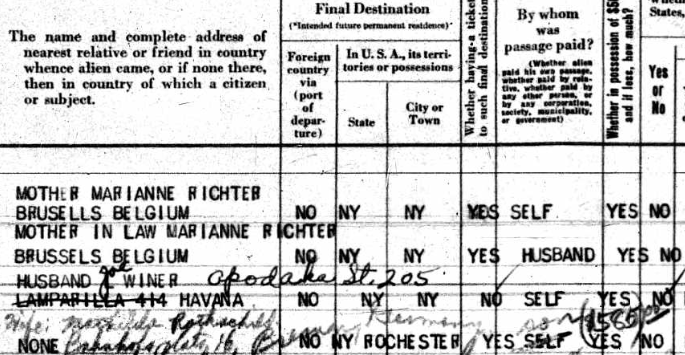
There is a notation on Hirsch’s line on the passenger manifest that reads, “Admitted on appeal 1-3-40.”  Also for the section listing the person left behind in the prior country, where the word None had been typed, someone added in handwriting, “Wife Mathilde Rothschild” living in Bremen, Germany. Another handwritten change indicates that his son had paid his passage; “self” was crossed out.

Were these additions of Mathilde’s name and the fact that his son was paying his way what helped Hirsch win his appeal? Why wouldn’t he have listed Mathilde before? Why was she living in Bremen, not Delmenhorst? When did Hirsch actually leave for Germany? How long had he been in Cuba before sailing from Havana to Miami in December 1939?

These are questions for which I currently do not have answers, just some speculation. Was Mathilde ill and hospitalized in Bremen? Is that why she hadn’t come with Hirsch to the US?

I don’t know, but we do know that by early 1940, Hirsch and his three children and his son-in-law and granddaughter were all safely in the US. Gustav and Gertrude and their two children were living in Rochester, New York, where Gustav was a doctor.5 Edith was also in Rochester, working as a housekeeper for another family.6 Edmund was working as a doctor at the Monroe County (New York) Infirmary and Home for the Aged in Brighton, New York, only four miles from Rochester.7 I could not locate Hirsch/Harry on the 1940 US census, but on April 25, 1942, when he registered for the World War II draft, he was at that time living in Rochester with Gertrude and Gustav and unemployed.

Harry Hirsch Rothschild, World War II draft registraiton, The National Archives At St. Louis; St. Louis, Missouri; World War Ii Draft Cards (Fourth Registration) For the State of New York; Record Group Title: Records of the Selective Service System; Record Group Number: 147; Box or Roll Number: 522, Name Range: Rosser, Roscoe – Rought, Walter, Ancestry.com. U.S., World War II Draft Registration Cards, 1942

But not long after that Hirsch/Harry must have moved to New Rochelle, New York, 350 miles from his children in Rochester, where he found work as the house physician for the Jewish Home for the Aged in New Rochelle. Harry died on April 18, 1945, in New Rochelle; he was 64. Heartbreakingly, his obituary revealed that as of that date with Germany’s surrender just a few weeks away, Harry and his children did not yet know what had happened to Mathilde, their wife and mother. The obituary states that Harry’s wife Mathilde “remained in Germany when Dr. Rothschild left the country. Relatives here have been trying through the Red Cross to learn her fate.”

“Death Claims Ex-Physician to Aged Jews,” Rochester Democrat and Chronicle, April 14, 1945, p. 17

Yad Vashem, however, reveals what had happened to Mathilde. On November 18, 1941, she had been deported to the Minsk ghetto in Belarus where she was murdered on July 28, 1942. She was 57 years old. It must have been devastating for the family to learn this.8

But Mathilde and Harry were survived by all three of their children and by their grandchildren. Their daughter Gertrude and her husband Gustav remained in Rochester, New York, for the rest of their lives, where Gustav continued to practice medicine. He died on January 7, 1992, at the age of 90.9 Gertrude outlived him by five and a half years; she died on July 4, 1997; she was 86 years old.10 They were survived by their children and grandchildren.

Gertrud’s sister Edith married Abram Solomon (Jalomek) in 1943.11 As far as I can tell, they did not have children as none are listed in either of their obituaries. Edith died July 28, 2003, in Rochester, at the age of 92;12 her husband Abram died many years before on June 9, 1971, in Rochester.13

Edmund Rothschild, the youngest child of Hirsch and Mathilde, had registered for the draft on October 16, 1940.

Edmund Rothschild, World War II draft registration, National Archives at St. Louis; St. Louis, Missouri; Wwii Draft Registration Cards For New York State, 10/16/1940 – 03/31/1947; Record Group: Records of the Selective Service System, 147, Name Range: Roth, Cletus-Rotonde, Nicholas
Ancestry.com. U.S., World War II Draft Cards Young Men, 1940-1947

He married Helene Lois Brown on August 17, 1941, in Buffalo, New York.  She was the daughter of David Brown and Lucile Manheim.14 Edmund and Helene would have two children. Edmund served in the US Army during World War II from August 27, 1943, until March 11, 1946.15 Edmund and his family then settled in Springville, New York, where he continued to practice medicine.16

Later Edmund and Helene retired to Fort Myers, Florida, where Helene died at age 71 on April 24, 1993.17 Edmund died in Cleveland, Ohio, almost exactly a year later on April 21, 1994; he was 81.18 According to his obituary in the Springville Journal, Edmund “was an old-fashioned family physician [who] cared not only for his patients but also for their families and their community. His home was always equipped to see patients after hours and house calls were made often.” The obituary also noted that he was a gifted artist. Edmund and Helene are survived by their children and grandchildren.19

The story of the family of Hirsch Rothschild and his family reminds me of how much the US gained when Germany’s persecution of the Jews forced so many to come here. Hirsch, his son Edmund, and his son-in-law Gustav were all doctors educated and trained in Europe. They came to this country as refugees, and Americans benefited from those skills and that education and dedication. But Mathilde Rosenbaum Rothschild’s death at the hands of the Nazis must remind us that the gifts we Americans may have received from those refugees were not given by them without enduring terrible heartbreak and loss on their part.


  1. Gustav Rosbasch, World War II draft registration, National Archives at St. Louis; St. Louis, Missouri; Wwii Draft Registration Cards For New York State, 10/16/1940 – 03/31/1947; Record Group: Records of the Selective Service System, 147, Ancestry.com. U.S., World War II Draft Cards Young Men, 1940-1947; Gustav Rosbasch, passenger manifest, The National Archives in Washington, DC; Washington, DC, USA; Passenger and Crew Lists of Vessels Arriving at New York, New York, 1897-1957; Microfilm Serial or NAID: T715; RG Title: Records of the Immigration and Naturalization Service, 1787-2004; RG: 85, Ship or Roll Number: Scythia, Ancestry.com. New York, U.S., Arriving Passenger and Crew Lists (including Castle Garden and Ellis Island), 1820-1957 
  2. Gertrude Rosbasch, passenger manifest, The National Archives in Washington, DC; Washington, DC, USA; Passenger and Crew Lists of Vessels Arriving at New York, New York, 1897-1957; Microfilm Serial or NAID: T715; RG Title: Records of the Immigration and Naturalization Service, 1787-2004; RG: 85, Ancestry.com. New York, U.S., Arriving Passenger and Crew Lists (including Castle Garden and Ellis Island), 1820-1957 
  3. Edith Rothschild, passenger manifest, The National Archives in Washington, DC; Washington, DC, USA; Passenger and Crew Lists of Vessels Arriving at New York, New York, 1897-1957; Microfilm Serial or NAID: T715; RG Title: Records of the Immigration and Naturalization Service, 1787-2004; RG: 85, Ship or Roll Number: New York, Ancestry.com. New York, U.S., Arriving Passenger and Crew Lists (including Castle Garden and Ellis Island), 1820-1957 
  4. Edmund Rothschild, passenger manifest, The National Archives in Washington, DC; Washington, DC, USA; Passenger and Crew Lists of Vessels Arriving at New York, New York, 1897-1957; Microfilm Serial or NAID: T715; RG Title: Records of the Immigration and Naturalization Service, 1787-2004; RG: 85, Ship or Roll Number: New York, Ancestry.com. New York, U.S., Arriving Passenger and Crew Lists (including Castle Garden and Ellis Island), 1820-1957 
  5. Gustav Rosbasch and family, 1940 US census, Year: 1940; Census Place: Rochester, Monroe, New York; Roll: m-t0627-02848; Page: 4B; Enumeration District: 65-232, Ancestry.com. 1940 United States Federal Census 
  6. Edith Rothschild, 1940 US census, Year: 1940; Census Place: Rochester, Monroe, New York; Roll: m-t0627-02842; Page: 6B; Enumeration District: 65-22, Ancestry.com. 1940 United States Federal Census 
  7. Edmund Rothschild, 1940 US census, Year: 1940; Census Place: Brighton, Monroe, New York; Roll: m-t0627-02678; Page: 14A; Enumeration District: 28-9, Ancestry.com. 1940 United States Federal Census 
  8. Yad Vashem entry found at https://collections.yadvashem.org/en/names/11619667 
  9. Gustav Rosbasch, Social Security Administration; Washington D.C., USA; Social Security Death Index, Master File, Ancestry.com. U.S., Social Security Death Index, 1935-2014 
  10. Gertrude Rosbasch, [Gertrude Rothschild], Gender Female, Birth Date 3 Sep 1910, Birth Place Gudensberg, Death Date 4 Jul 1997, Claim Date 17 May 1973
    Father Harry Rothschild, Mother Mathilde Rosenbaum, Ancestry.com. U.S., Social Security Applications and Claims Index, 1936-2007 
  11. “Marriage Licenses,” Rochester Democrat and Chronicle, October 26, 1943, p. 12 
  12. Edith Miriam Solomon, [Edith Miriam Rothschild], Gender Female, Race White, Birth Date 4 Jul 1911, Birth Place Gudensberg, Federal Republic of Germany, Death Date 28 Jul 2003, Claim Date 19 Jan 1976, Father Harry Rothschild, Mother Mathilde Rosenbaum, Ancestry.com. U.S., Social Security Applications and Claims Index, 1936-2007. 
  13. Abram Solomon, Social Security Number 128-09-6834, Birth Date 18 Nov 1899,
    Issue year Before 1951, Issue State New York, Last Residence 14617, Rochester, Monroe, New York, USA, Death Date Jun 1971, Social Security Administration; Washington D.C., USA; Social Security Death Index, Master File,  Ancestry.com. U.S., Social Security Death Index, 1935-2014 
  14. “Dr. Edward [sic] Rothschild to be Married Soon,” Bradford Evening Star and The Bradford Daily Record, Bradford, Pennsylvania · Friday, August 01, 1941, p. 5; Helene Brown Rothschild, Gender Female, Birth Date 30 Jul 1921, Birth Place Minneapolis, Minnesota, Death Date 24 Apr 1993, Father David Brown, Mother Lucile S Manheim,
    SSN 057382510, Ancestry.com. U.S., Social Security Applications and Claims Index, 1936-2007. 
  15. Edmund S Rothschild, Birth Date 30 Jul 1912, Death Date 21 Apr 1994, Cause of Death Natural, SSN 114342498, Enlistment Branch ARMY, Enlistment Date 27 Aug 1943, Discharge Date 11 Mar 1946, Page number 1, Ancestry.com. U.S., Department of Veterans Affairs BIRLS Death File, 1850-2010. 
  16. “Founder of Medical Group Dies,” Springville Journal, Springville, New York · Thursday, May 05, 1994, p. 6. 
  17. “Helene L. Brown Rothschild,” News-Press, Fort Myers, Florida · Tuesday, April 27, 1993, p. 19; Helene Brown Rothschild, Gender Female, Birth Date 30 Jul 1921, Birth Place Minneapolis, Minnesota, Death Date 24 Apr 1993, Father David Brown, Mother Lucile S Manheim, SSN 057382510, Ancestry.com. U.S., Social Security Applications and Claims Index, 1936-2007. 
  18. See Notes 15 and 16, supra. 
  19. See Note 16, supra. 

Levi Rothschild’s Children Part III: Escaping The Holocaust to South Africa, New York, and Palestine/Israel

Of the six children of Levi Rothschild and Clara Jacob who lived to adulthood in Germany, amazingly all but one escaped from Germany in time to avoid being killed by the Nazis. Only the youngest sibling Frieda was not as fortunate. But that doesn’t mean that there wasn’t suffering and loss endured by the other five. This post will focus on the three oldest children: Sigmund, Betti, and Moses.

Sigmund Rothschild and his wife Fanny Rosenbaum escaped to South Africa. I don’t know when or how they immigrated there, but Fanny died there on August 20, 1942, in Capetown at the age of  62.

Fanny Rosenbaum Rothschild death record, Municipality or Municipality Range: Cape Town
Ancestry.com. Cape Province, South Africa, Civil Deaths, 1895-1972

Her husband Sigmund died in Capetown three years later on December 23, 1945; he was 71.

Sigmund Rothschild death record, Municipality or Municipality Range: Cape Town
Ancestry.com. Cape Province, South Africa, Civil Deaths, 1895-1972

As for Sigmund and Fanny’s son Kurt, I have very little information. An entry in the England & Wales Civil Registration Death Index on Ancestry shows that he died in Lancaster, England, and that the death was registered in September 1997.1 A FindAGrave entry shows his gravestone with the date of death as August 30, 1997.

Find a Grave, database and images (https://www.findagrave.com/memorial/81923216/kurt-rothschild: accessed April 19, 2024), memorial page for Kurt Rothschild (1910–3 Sep 1997), Find a Grave Memorial ID 81923216, citing Lytham Park Cemetery and Crematorium, Lytham Saint Annes, Fylde Borough, Lancashire, England; Maintained by ProgBase (contributor 47278889).

The Ancestry tree that appears to have been created by Kurt’s daughter-in-law shows that Kurt married Erna Erdmann and had one child, who is the home person on that tree. I have not been able to find a marriage record for Kurt and Erna Erdmann or a birth record for their child, so I am hoping that the owner of that tree will respond to the message I sent to help me find out what happened to Kurt Rothschild and his family. But since it’s been well over two months at this point, I am not optimistic that I will hear from her anytime soon.

The second child of Levi and Klara, their daughter Betti, lost her husband Emanuel Hirschmann on November 4, 1932. He died in Fulda, Germany, and was 64.

Emanuel Hirschmann death record, Hessisches Hauptstaatsarchiv; Wiesbaden, Deutschland; Personenstandsregister Sterberegister; Signatur: 2470, Year Range: 1932, Ancestry.com. Hesse, Germany, Deaths, 1851-1958

Their son Walter had married Gertrud Hirschmann on August 6, 1924, in Hanau, Germany. Gertrud was born in Hanau on March 28, 1904, according to their marriage record, but that record does not include her parents’ names. It would appear that Gertrud was likely a relative given the surname and her birth place, but so far I’ve not found any way to connect her to Walter’s Hirschmann relatives.

Walter Hirschmann and Gertrude Hirschmann marriage record, LAGIS Hessen Archives, Standesamt Hanau Heiratsnebenregister 1924 (HStAMR Best. 913 Nr. 1894)AutorHessisches Staatsarchiv MarburgErscheinungsortHanauErscheinungsjahr1924, p. 328

Walter Hirschmann and Gertrude Hirschmann marriage record, p. 2

Walter and Gertrud and their twelve year old daughter immigrated to the US on a December 15, 1938. Walter listed his occupation as a banker and their last residence as Frankfurt, Germany, where his mother “B. Hirschmann” was still residing. They were heading to a friend, L. Schwarzchild, in New York.2

Walter’s mother Betti Rothschild Hirschmann immigrated to the US on March 25, 1939, with a cousin of her husband, Emil Hirschmann, and his wife Paula.

Betti Rothschild passenger manifest, The National Archives in Washington, DC; Washington, DC, USA; Passenger and Crew Lists of Vessels Arriving at New York, New York, 1897-1957; Microfilm Serial or NAID: T715; RG Title: Records of the Immigration and Naturalization Service, 1787-2004; RG: 85, Ship or Roll Number: Veendam, Ancestry.com. New York, U.S., Arriving Passenger and Crew Lists (including Castle Garden and Ellis Island), 1820-1957

On the 1940 census, Betti was living as a lodger in the household of Helena Pessel in New York City, but in the same building as her son Walter and his family at 670 Riverside Drive in New York City. Walter was employed as a salesman.3

On his World War II draft registration, Walter identified his employer as Herbert E. Stern & Company. From his obituary I learned that Herbert E. Stern was also a refugee from Nazi Germany and an investment banker.4

Walter Hirschmann World War II draft registration, National Archives at St. Louis; St. Louis, Missouri; Wwii Draft Registration Cards For New York City, 10/16/1940 – 03/31/1947; Record Group: Records of the Selective Service System, 147, Name Range: Hirsch, Walfgang-Hobbs, Robert, Ancestry.com. U.S., World War II Draft Cards Young Men, 1940-1947

In 1950 Betti was still living in the same building as her son Walter and his family. Walter was still working as a broker and banker. I am very grateful to Eric Ald of Tracing the Tribe who found the 1950 census record for Betti and also a listing on Ancestry in the New York, New York Death Index for a Betty Hirschmann who died on February 15, 1956.5

Walter Hirschmann and Betty Hirschmann, 1950 US census, National Archives at Washington, DC; Washington, D.C.; Seventeenth Census of the United States, 1950; Year: 1950; Census Place: New York, New York, New York; Roll: 6203; Page: 75; Enumeration District: 31-1900, Ancestry.com. 1950 United States Federal Census

Her son Walter Hirschmann died on June 24, 1977, at the age of 77.6 He had been predeceased by his wife Gertrud, who died in December 1966 7 and was survived by their daughter and grandchildren.

Sigmund and Betti’s brother Moses/Moritz Rothschild and his wife Margarete David ended up in Israel/Palestine in the 1930s along with their two children, Ruth, born October 8, 1914, in Magdeburg, Germany, and Herbert (later Yehuda), born December 10, 1921, in Magdeburg. The documents below are immigration documents showing that Moritz and Margarete were in Jerusalem by June 30, 1939; these and the others that follow were found at the Israel Genealogy Research Association website.

Registration form for Margarete David Rothschild reporting to the German Embassy Legation at the German Consulate General Consulate Bizekonsult in Jerusalem, A-B (טפסי הרשמה: A-B), part of the Residents 1938-1939 (תושבים 1938-1939) database, system number פ-500/5, IGRA number 1459. The original records are from Israel State Archives (ארכיון המדינה), and found at the IGRA website.

Registration form for Margarete David Rothschild reporting to the German Embassy Legation at the German Consulate General Consulate Bizekonsult in Jerusalem, A-B (טפסי הרשמה: A-B), part of the Residents 1938-1939 (תושבים 1938-1939) database, system number פ-500/5, IGRA number 1459. The original records are from Israel State Archives (ארכיון המדינה), and found at the IGRA website.

Registration form for Moses Moritz Rothschild, This record comes from the Meldeblaetter: A-B (טפסי הרשמה: A-B), part of the Residents 1938-1939 (תושבים 1938-1939) database, system number פ-500/5, IGRA number 1462. The original records are from Israel State Archives (ארכיון המדינה), and found at the IGRA website.

Registration form for Moses Moritz Rothschild, This record comes from the Meldeblaetter: A-B (טפסי הרשמה: A-B), part of the Residents 1938-1939 (תושבים 1938-1939) database, system number פ-500/5, IGRA number 1462. The original records are from Israel State Archives (ארכיון המדינה), and found at the IGRA website.

Their daughter Ruth had arrived by September 29, 1938.

Registration form for Ruth Rothschild reporting to the German Embassy Legation at the German Consulate General Consulate Bizekonsult in Jerusalem, A-B (טפסי הרשמה: A-B), part of the Residents 1938-1939 (תושבים 1938-1939) database, system number פ-500/5, IGRA number 1465. The original records are from Israel State Archives (ארכיון המדינה), as found at the IGRA website.

Registration form for Ruth Rothschild reporting to the German Embassy Legation at the German Consulate General Consulate Bizekonsult in Jerusalem, A-B (טפסי הרשמה: A-B), part of the Residents 1938-1939 (תושבים 1938-1939) database, system number פ-500/5, IGRA number 1465. The original records are from Israel State Archives (ארכיון המדינה), as found at the IGRA website.

Although I was unable to find a comparable record for Herbert/Yehuda, I found a record showing that he and his father Moritz were on the voter registration list and living at Kfar Yedidya in 1942:

Moritz and Yehuda Rothschild on 1942 Knesset register, This record comes from the Voters List Knesset Israel 1942 (פנקס הבוגרים של כנסת ישראל תש”ב), part of the Voters Knesset Israel 1942 (בוגרים של כנסת ישראל 1942) database, system number 001mush, document number 119, line 59, IGRA number 1107. The original records are from Israel State Archives (ארכיון המדינה), and was found at the IGRA website.

Yehuda married Ruth Hesin, daughter of Avraham and Hava, on April 17, 1949, in Haifa, Israel. She was 22 years old, he was 27.

Yehuda Rothschild marriage record, Marriage/Divorce Certificates (תעודות נישואין / גירושין), part of the Marriages and Divorces 1921-1948 Palestine British (נישואין וגירושין 1948-1921 ארץ ישראל) database, document number 91714, IGRA number 507. The original records are from Israel State Archives (ארכיון המדינה), and was found at the IGRA website.

At this time I have no further records for this family, but we know that at least they escaped from Germany in time to survive the Holocaust.

Thus, the first three children of Levi Rothschild and Clara Jacob all escaped from Nazi Germany in time, but look at what they lost. They were all spread across the globe: Sigmund in South Africa, Betti in the United States, and Moses in Palestine/Israel.

The fourth child of Levi and Klara, their son Hirsch Rothschild, also escaped. He and his wife Mathilde Rosenbaum and their three children Gertrude, Edith, and Edmund ended up, like Betti, in the US. I will write about Hirsch and his family in my next post.


  1. Kurt Rothschild, Death Age 87, Birth Date 30 Mar 1910, Registration Date Sep 1997, Registration district Lancaster, Inferred County Lancashire, Register Number A58B, District and Subdistrict 5871A, Entry Number 166, General Register Office; United Kingdom, Ancestry.com. England & Wales, Civil Registration Death Index, 1916-2007 
  2. Walter Hirschmann and family, passenger manifest, The National Archives in Washington, DC; Washington, DC, USA; Passenger and Crew Lists of Vessels Arriving at New York, New York, 1897-1957; Microfilm Serial or NAID: T715; RG Title: Records of the Immigration and Naturalization Service, 1787-2004; RG: 85, Ancestry.com. New York, U.S., Arriving Passenger and Crew Lists (including Castle Garden and Ellis Island), 1820-1957 
  3. Betti Hirschmann, 1940 US census, Year: 1940; Census Place: New York, New York, New York; Roll: m-t0627-02671; Page: 7B; Enumeration District: 31-1929, Ancestry.com. 1940 United States Federal Census. Walter Hirschmann and family, 1940 US census, Year: 1940; Census Place: New York, New York, New York; Roll: m-t0627-02671; Page: 7A; Enumeration District: 31-1929, Ancestry.com. 1940 United States Federal Census 
  4. “Herbert E. Stern Dead, An Investment Banker,” The New York Times, August 6, 1973, p. 32. 
  5. Betty Hirschmann, Age 75, Birth Date abt 1881, Death Date 15 Feb 1956, Death Place Manhattan, New York, New York, USA, Certificate Number 3638, Ancestry.com. New York, New York, U.S., Death Index, 1949-1965. Although there is a listing for Betti on the SSCAI with her Social Security Number, there is no listing on the SSDI for her under that number or under that date or under her name. Betty Sara Hirschmann, [Betty Sara Rohserild], Gender Female, Race White, Birth Date 14 Sep 1876, Birth Place Borken Hesse, Federal Republic of Germany, Father Levi Rohserild
    Mother, Clara Jacob, SSN 057200860, Notes Feb 1943: Name listed as BETTY SARA HIRSCHMANN, Ancestry.com. U.S., Social Security Applications and Claims Index, 1936-2007. 
  6. Walter Hirschmann death notice, The New York Times, June 27, 1977, p, 30. Walter Hirschmann, Social Security Number 092-14-5701, Birth Date 30 Dec 1899
    Issue year Before 1951, Issue State New York, Last Residence 10023, New York, New York, New York, USA, Death Date Jun 1977 Social Security Administration; Washington D.C., USA; Social Security Death Index, Master File,  Ancestry.com. U.S., Social Security Death Index, 1935-2014 
  7. Gertrud Hirschmann death notice, The New York Times, December 16, 1966, p. 47. 

Levi Rothschild, Part II: His Children Marry and Have Children

Levi Rothschild’s wife Clara Jacob had given birth to nine babies, but only six of those children survived to adulthood: Sigmund, Betty, Moses, Hirsch, Thekla, and Frieda. All six of them married and had children.

Sigmund Rothschild, their oldest child, married Fanni Rosenbaum on May 28, 1906, in Schluechtern, Germany. She was born on December 21, 1879, in Schluechtern to Salomon Rosenbaum and Jeannette Sondheimer.1

Sigmund Rothschild and Fanni Rosenbaum marriage record, Arcinsys Archives of Hessen, HHStAW Fonds 365 No 766, p. 101

According to an Ancestry tree that appears to belong to their granddaughter-in-law, Sigmund and Fanny had at least one child, a son Kurt Rothschild, and although I have no birth record for him because the Borken birth records online do not go up to 1910, that tree reports that he was born on March 30, 1910, in Borken. I have reached out to the tree owner and hope to get more information if she gets back to me. So far after two months I’ve gotten no response. I am not optimistic, but people have found my messages even years after I’ve sent them through Ancestry, so you never know.

Sigmund’s sister Betti Rothschild married Emanuel Hirschmann on December 21, 1898, in Borken. He was born to Loeb Hirschmann and Malchen Strauss on April 12, 1868, in Gross Krotzenburg, Germany.

Betti Rothschild and Emanuel Hirschmann marriage record, Hessisches Hauptstaatsarchiv; Wiesbaden, Deutschland; Bestand: 920; Laufende Nummer: 834, Year Range: 1898, Ancestry.com. Hesse, Germany, Marriages, 1849-1930

For many weeks I could not find records of any children born to Betti and Emanuel. And then I found the name “Walter Hirschman” as a sponsor on an immigration record for one of Betti’s siblings, Thekla, and I thought, “Maybe Walter Hirschman was related to Betti Rothschild and Emanuel Hirschmann?”

Ancestry.com. Munich, Vienna and Barcelona Jewish Displaced Persons and Refugee Cards, 1943-1959 (JDC)

Several clicks through the Hesse files and thirty minutes later I found this birth record for Walter, son of Emanuel and Betti, born in Hanau, Germany, on December 30, 1899.

Walter Hirschmann birth record, LAGIS Hessen Archives, Standesamt Hanau Geburtsnebenregister 1899 (HStAMR Best. 913 Nr. 1780)AutorHessisches Staatsarchiv MarburgErscheinungsortHanauErscheinungsjahr1899, p.323
That made me wonder whether Betti and Emanuel had had other children. Unfortunately, the Hanau birth records online only go up through 1900, and I did not find any other birth records for that couple in that year. If there were children born after 1900, I have not found any other evidence of such children.

The third child of Levi and Clara, Moses or Moritz Rothschild, married Margarete David. I don’t have a marriage record for Moritz and Margarete nor do I have birth records for their children from Germany, but I was able to track down records on the Israel Genealogical Research Association website that helped to fill in those gaps. Margarete was born in Hagen, Germany, on May 27, 1889, to Louis David and  Alwine Harff David.2 Moritz and Margarete had two children, Ruth, born October 8, 1914,3 and Herbert (later Yehuda), born December 10, 1921, in Magdeburg, Germany.4

Hirsch (also known as Harry) Rothschild, the fourth child of Levi Rothschild and Clara Jakob, married Malli (also known as Mathilda) Rosenbaum on November 29, 1909, in Schluechtern, Germany. She was the daughter of Salomon Rosenbaum and Jeanette Sondheimer and was born in Schluechtern on July 20, 1885.5

Hirsch Rothschild and Malli Rosenbaum marriage record, Arcinsys Archives of Hessen, HHStAW Fonds 365 No 766, p. 104

Harry Hirsch Rothschild and Malli Rosenbaum had three children. Gertrude was born September 3, 1910, in Gudensberg, Germany.6 Her sister Edith was born there on July 4, 1911,7 and their brother Edmund Siegfried was born one year later on July 30, 1912.8

The fifth child of Levi and Clara, their daughter Thekla, married Manuel Edward Weinberg on August 19, 1907, in Borken. Manuel was born in Lichenroth, Germany, to Lazarus Weinberg and Karoline Oppenheimer on October 11, 1880.

Thekla Rothschild and Manuel Weinberg marriage record, Hessisches Hauptstaatsarchiv; Wiesbaden, Deutschland; Bestand: 920; Laufende Nummer: 843, Year Range: 1907, Ancestry.com. Hesse, Germany, Marriages, 1849-1930

Thekla and Manuel had a son Hans Herbert Weinberg born in Frankfurt, Germany, on November 2, 1908.9

Finally, the last born of Levi and Clara’s children, their daughter Frieda, married Leopold Marxsohn on November 25, 1920, in Frankfurt. He was born on June 21, 1883, in Koenigstadten, Germany, to Abraham Marxsohn and Emilie Stern.
Frieda Rothschild Leopold Marxsohn marriage record, Hessisches Hauptstaatsarchiv; Wiesbaden, Deutschland; Bestand: 903, Year Range: 1920, Ancestry.com. Hesse, Germany, Marriages, 1849-1930

It appears that Leopold died before November 25, 1925, because on that date Frieda married Paul Phillipsohn in Frankfurt, and she is identified as a widow on their marriage record. I cannot find any death record for Leopold, however, and none of the other trees or other secondary sources have a date for his death. There is a FindAGrave entry for a Leopold Marxsohn who died in 1919 and is buried in Frankfurt,10 but that can’t be the same man unless the date on FindAGrave is incorrect. And there is a Leopold Marxsohn listed in the 1925 Frankfurt directory,11 but that also could be a different man. More exploration is necessary.

In any event, Frieda remarried as noted on November 25, 1925, and her second husband was Paul Phillipsohn. Paul was born on October 15, 1885, in Gandersheim, Germany. I have not yet found the names of his parents.

Frieda Rothschild Marxsohn and Paul Phillipsohn marriage record, Hessisches Hauptstaatsarchiv; Wiesbaden, Deutschland; Bestand: 903, Year Range: 1925, Ancestry.com. Hesse, Germany, Marriages, 1849-1930

Frieda and Paul had one child, a daughter Hannelore, born in Frankfurt on November 3, 1926.12

Thus, by late 1926, when Hannelore Phillipsohn was born, there were eight living grandchildren of Levi Rothschild and Clara Jacob. Sadly, Levi did not live to see all of them born as he had died on October 15, 1913, in Borken at the age of 67.

Levi Rothschild death record, Hessisches Hauptstaatsarchiv; Wiesbaden, Deutschland; Personenstandsregister Sterberegister; Bestand: 902; Laufende Nummer: 920, Year Range: 1913
Ancestry.com. Hesse, Germany, Deaths, 1851-1958

His wife Clara Jacob, however, lived to see all eight of those grandchildren born. She died on November 24, 1929, in Borken when she was 78 years old.

Clara Jacob Rothschild death record, Hessisches Hauptstaatsarchiv; Wiesbaden, Deutschland; Personenstandsregister Sterberegister; Bestand: 913; Laufende Nummer: 920, Year Range: 1929, Ancestry.com. Hesse, Germany, Deaths, 1851-1958

That brings us to the decade of the 1930s, and as you may expect, the lives of all six of Levi and Clara’s children, their spouses, and their children were drastically changed during that decade and the one that followed.


  1. Fanni Rosenbaum birth record, Hessisches Hauptstaatsarchiv; Wiesbaden, Deutschland; Bestand: 913; Signatur: 5881, Ancestry.com. Hesse, Germany, Births, 1851-1901 
  2. Margarete Sara Rothschild, [Margarete Sara David], Birth Date 27 Mai 1889 (27 May 1889), Birth Place Hagen, Last Residence Magdeburg, National Archives and Records Administration (NARA); Washington, DC; Name Index of Jews Whose German Nationality Was Annulled by the Nazi Regime (Berlin Documents Center); Record Group: 242, National Archives Collection of Foreign Records Seized, 1675 – 1958; Record Group ARC ID: 569; Publication Number: T355; Roll: 7, Mosbacher, Eduard – Schafranek, Bruno, Ancestry.com. Germany, Index of Jews Whose German Nationality was Annulled by Nazi Regime, 1935-1944. Also, Registration form for Margarete David Rothschild reporting to the German Embassy Legation at the German Consulate General Consulate Bizekonsult in Jerusalem, A-B (טפסי הרשמה: A-B), part of the Residents 1938-1939 (תושבים 1938-1939) database, system number פ-500/5, IGRA number 1459. The original records are from Israel State Archives (ארכיון המדינה), and found at the IGRA website. See also this Wikipedia article about Margarete’s brother Ferdinand and his life. 
  3. Registration form for Ruth Rothschild reporting to the German Embassy Legation at the German Consulate General Consulate Bizekonsult in Jerusalem, A-B (טפסי הרשמה: A-B), part of the Residents 1938-1939 (תושבים 1938-1939) database, system number פ-500/5, IGRA number 1465. The original records are from Israel State Archives (ארכיון המדינה), as found at the IGRA website
  4.  Yehuda Rothschild marriage record, Marriage/Divorce Certificates (תעודות נישואין / גירושין), part of the Marriages and Divorces 1921-1948 Palestine British (נישואין וגירושין 1948-1921 ארץ ישראל) database, document number 91714, IGRA number 507. The original records are from Israel State Archives (ארכיון המדינה), as found at the IGRA website. 
  5. Malli Rosenbaum birth record, Hessisches Hauptstaatsarchiv; Wiesbaden, Deutschland; Bestand: 913; Signatur: 5887, Ancestry.com. Hesse, Germany, Births, 1851-1901 
  6. Gertrude Rosbasch, [Gertrude Rothschild], Gender Female, Birth Date 3 Sep 1910, Birth Place Gudensberg, Death Date 4 Jul 1997, Claim Date 17 May 1973, Father
    Harry Rothschild, Mother Mathilde Rosenbaum, SSN 054385223, Ancestry.com. U.S., Social Security Applications and Claims Index, 1936-2007. 
  7. Edith Miriam Solomon, [Edith Miriam Rothschild], Gender Female, Race White, Birth Date 4 Jul 1911, Birth Place Gudensberg, Federal Republic of Germany, Death Date 28 Jul 2003, Claim Date 19 Jan 1976, Father Harry Rothschild, Mother Mathilde Rosenbaum, SSN 071180622, Ancestry.com. U.S., Social Security Applications and Claims Index, 1936-2007. 
  8. Edmund Siegfried Rothschild, Gender Male, Race White, Birth Date 30 Jul 1912
    Birth Place Gudensberg, Federal Republic of Germany, Death Date 21 Apr 1994
    Father Harry Rothschild, Mother Mathilda Rosenbaum, SSN 114342498, Ancestry.com. U.S., Social Security Applications and Claims Index, 1936-2007. 
  9. Hans Herbert Weinberg, Gender männlich (Male), Record Type Inventory, Birth Date 02 Nov 1908 (2 Nov 1908), Birth Place Frankfurt am Main, Last Residence Frankfurt am Main, Residence Place Frankfurt am Main, Father Edmund Weinberg
    Mother Thekla Weinberg, Spouse Edith Seckbach, Arolsen Archives, Digital Archive; Bad Arolsen, Germany; Lists of Persecutees 2.1.1.1, Ancestry.com. Free Access: Europe, Registration of Foreigners and German Persecutees, 1939-1947 
  10. Find a Grave, database and images (https://www.findagrave.com/memorial/130472657/leopold-marxsohn: accessed April 8, 2024), memorial page for Leopold Marxsohn (unknown–1919), Find a Grave Memorial ID 130472657, citing Alter Jüdischer Friedhof, Frankfurt am Main, Stadtkreis Frankfurt, Hessen, Germany; Maintained by Athanatos (contributor 46907585). 
  11.  Deutsche National Bibliothek; Leipzig, Deutschland; Publisher: Scherl; Signatur: ZC 811; Laufende Nummer: 1, Ancestry.com. Germany and Surrounding Areas, Address Books, 1815-1974 
  12.  Arolsen Archives, Digital Archive; Bad Arolsen, Germany; Lists of Persecutees 2.1.1.1, Reference Code: 02010101 oS, Ancestry.com. Free Access: Europe, Registration of Foreigners and German Persecutees, 1939-1947; Find a Grave, database and images (https://www.findagrave.com/memorial/109408821/hannelore-philippsohn: accessed April 8, 2024), memorial page for Hannelore Philippsohn (3 Nov 1926–unknown), Find a Grave Memorial ID 109408821; Burial Details Unknown; Maintained by IWPP Custodial Account (contributor 48586138).