Jakob Schoenthal and Charlotte Lilienfeld, Part II: Finding Their Children and Grandchildren

In my last post, I talked about the twisted path I took to find my great-great-uncle Jakob Schoenthal and his wife Charlotte Lilienfeld.  After discovering that their daughter Henriette Schoenthal and her husband Julius Levi had been killed in the Holocaust, I was determined to find out what had happened to Henry Lyons, who was the son of Henriette and Julius Levi and who had filed Pages of Testimony for his parents with Yad Vashem.

I thought that would be easy.  After all, I had a name and a specific address from the Pages of Testimony—99-30 59th Avenue, Rego Park, New York.  And I did almost immediately find a Public Records listing with his name at that address that provided me with his birthdate, October 17, 1919.  But that didn’t tell me much more than what I knew from the Pages of Testimony.

Yad Vashem page of testimony for Henriette Schoenthal Levi


Searching a bit further using the Rego Park address listed on the Pages of Testimony, I found a Pauline Lyons listed at that same address; I assumed that she was Henry’s wife.  Having both names made the search a bit easier since Henry Lyons itself is not exactly a unique name. I was able to use their two names together to find that they are both buried at Calverton National Cemetery and that Henry had died on December 18, 1986, and Pauline on November 30, 2007.  Henry had served in the US military during World War II, beginning his service on November 28, 1942, and thus was entitled to a military burial.  Imagine coming to America as a young man to escape Hitler and then fighting against the country of your birth.

When had he come to the US? Had he and Pauline had children? I wanted to know more.  I assumed Henry had arrived in the US sometime in the mid-to late 1930s.  I also assumed that he had arrived under the surname Levi, not Lyons.  After I wasted a lot of time searching for him under the wrong name, a member of the NYC Genealogy Group found a record for a man named Helmut Levi who had changed his name to Henry Lyons on October 5, 1953, in the city courts in New York.


Helmut Levi change of name to Henry Lyons Ancestry.com. U.S. Naturalization Record Indexes, 1791-1992 (Indexed in World Archives Project) [database on-line]. Provo, UT, USA: Ancestry.com

Helmut Levi change of name to Henry Lyons
Ancestry.com. U.S. Naturalization Record Indexes, 1791-1992 (Indexed in World Archives Project) [database on-line]. Provo, UT, USA: Ancestry.com

Armed with the information about what was probably his original name, I was able to find Helmut Levi on the 1940 census, living as a lodger at 204 West 87th Street in NYC and working as a watchmaker.  I was pretty certain I had found the right person when I saw on the census record that he had been living in Cologne, Germany, in 1935.

I also then found him on a passenger manifest (see line 26 on each page below):

Helmut Levy ship manifest p 1

Helmut Levi ship manifest Henry Lyons

Year: 1939; Arrival: New York, New York; Microfilm Serial: T715, 1897-1957; Microfilm Roll: Roll 6293; Line: 1; Page Number: 188


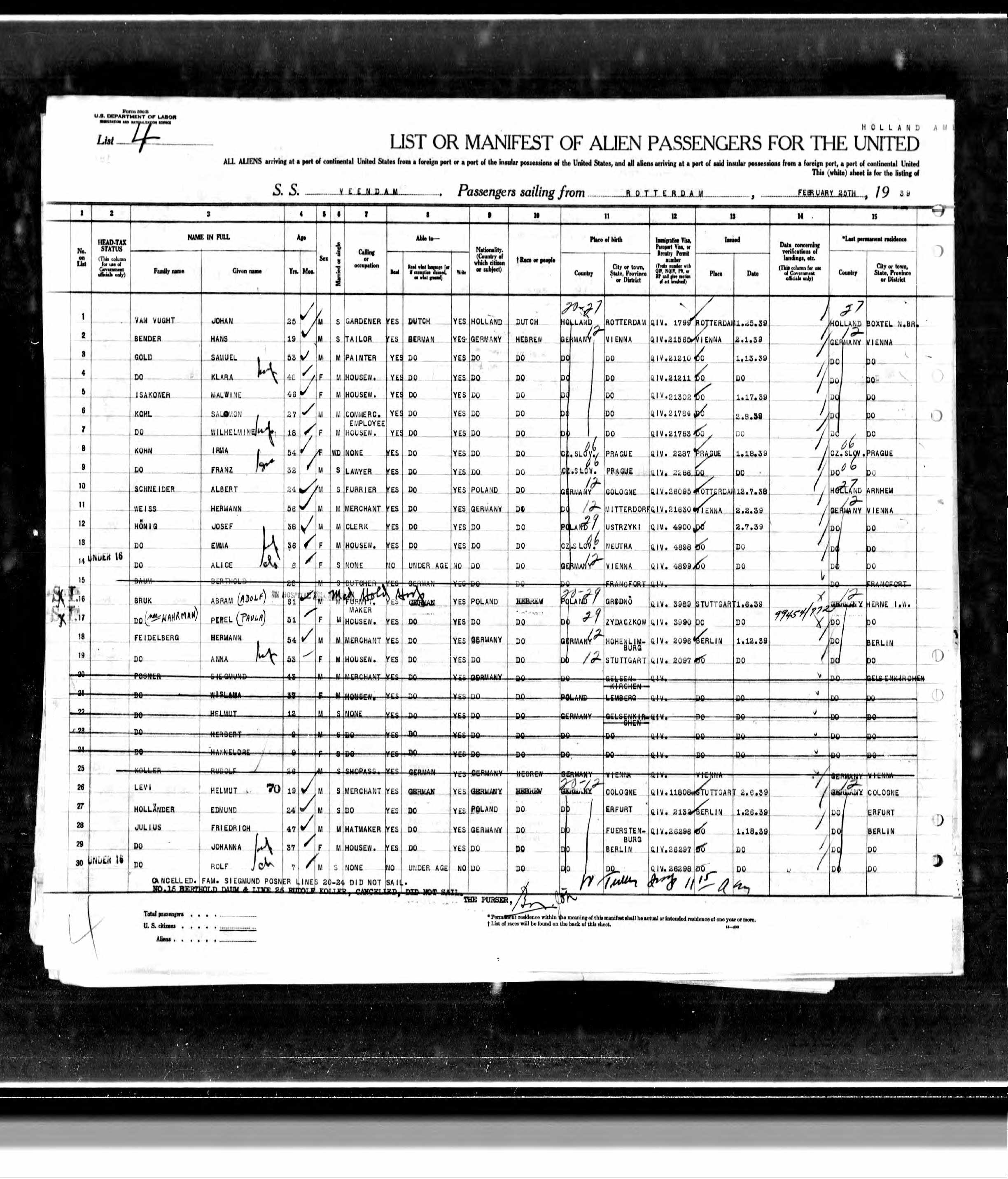
Helmut Levi had arrived in NYC on February 25, 1939.  According to the ship manifest, he was a nineteen year old merchant born and last residing in Cologne, leaving behind his father Julius Levi of Breitstrasse in Cologne and going to his uncle Lee Schoenthal of Washington, Pennsylvania.  This was obviously my cousin, the man later known as Henry Lyons.

I also found him on a second passenger manifest dated July 4, 1948, arriving in NYC from Bremerhaven, Germany.  Henry had returned to Germany after the war.  What a devastating trip that must have been.  The photo below shows what his home city of Cologne looked like after Allied bombing during the war.  Henry had not only lost his parents, but the place where he had lived as a child and a teenager.


By U.S. Department of Defense. Department of the Army. Office of the Chief Signal Officer. [2] [Public domain], via Wikimedia Commons

By U.S. Department of Defense. Department of the Army. Office of the Chief Signal Officer. [2] [Public domain], via Wikimedia Commons

From that 1948 passenger manifest (line 10), I saw that Helmut Levi was then living in Washington, Pennsylvania, where his two uncles, Lee and Meyer, were also living, that is, his mother’s brothers, the two sons of Jakob and Charlotte mentioned in my last post.  Like so many Schoenthal relatives before him, Helmut had spent time living in western Pennsylvania.  The ship manifest also indicated that by 1948, Helmut had married, although Pauline is not listed as traveling with him.


Helmut Levi aka Henry Lyons 1948 ship manifest

Helmut Levi 1948 ship manifest Year: 1948; Arrival: New York, New York; Microfilm Serial: T715, 1897-1957; Microfilm Roll: Roll 7624; Line: 10; Page Number: 9


But I still didn’t know whether Helmut/Henry and Pauline had had children or whether there were other family members I might have missed.  I called Calverton National Cemetery, but they had no additional information.  I searched in the newspaper databases for articles or obituaries that might reveal more about Henry and Pauline Lyons.  At first I limited myself to New York papers, but then I realized that that was too narrow, given that he had once lived in western Pennsylvania.  I broadened my search and found this obituary from the January 19, 1989, Pittsburgh Press:


Erna Schoenthal Haas obit 1989


Who was Erna Haas? And was she Henry’s aunt or Pauline’s aunt? And who was Yohana Stern? I had more work to do.  I searched for Erna Haas, an unusual enough name, and was very excited to find this ship manifest (see lines 15 and 16):


Erna Haas ship manifest p 1

Year: 1938; Arrival: New York, New York; Microfilm Serial: T715, 1897-1957; Microfilm Roll: Roll 6152; Line: 1; Page Number: 174


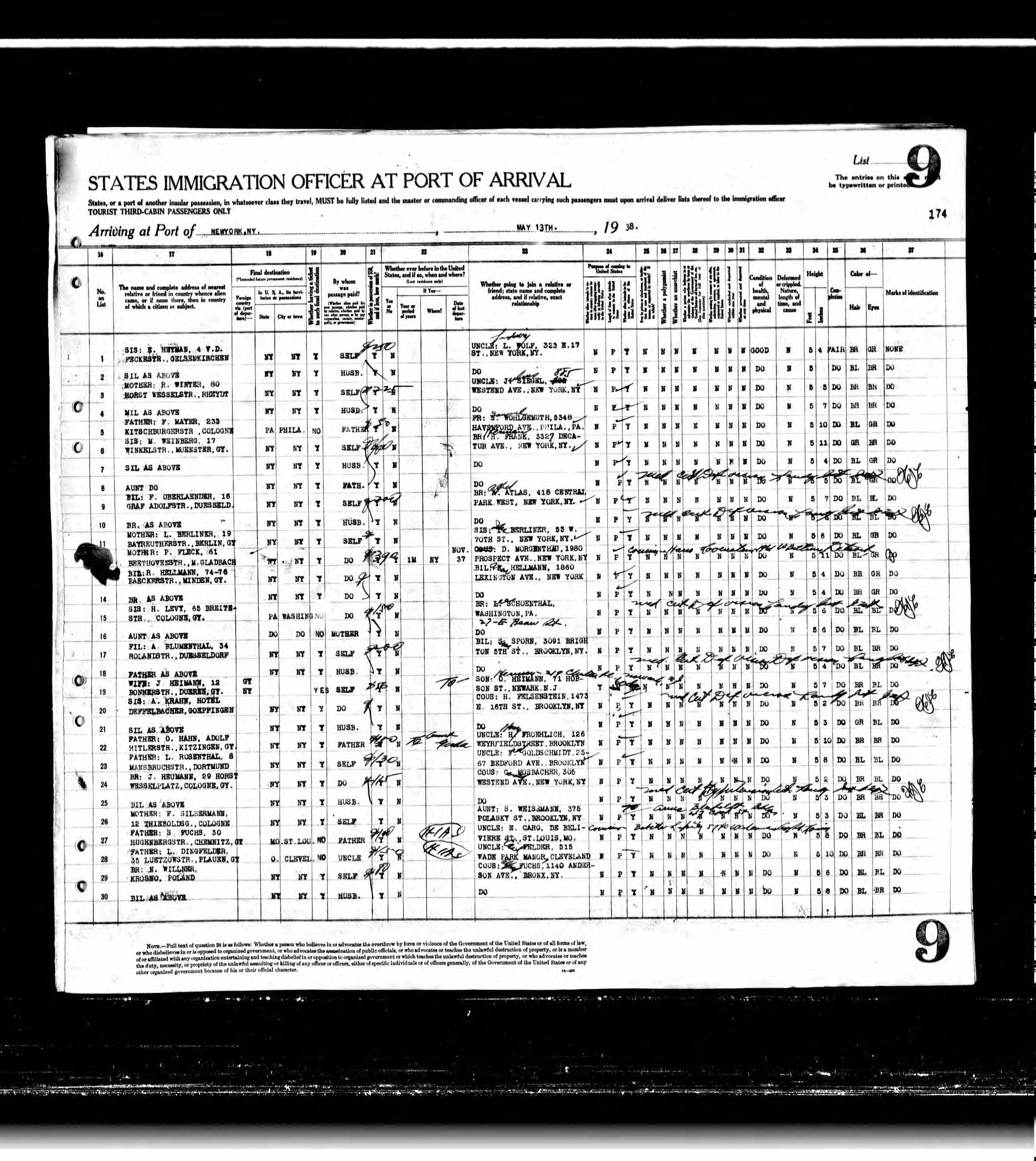
Erna and her twelve year old son Werner had sailed from Hamburg, Germany on May 4, 1938; Erna was a beautician coming from Cologne.  I assumed that therefore her connection would be to Henry, a native of Cologne, not to Pauline, who was American-born.  Turning to the second page of the manifest, my hunch was confirmed (again, see lines 15 and 16):


Erna Haas ship manifest p 2

Year: 1938; Arrival: New York, New York; Microfilm Serial: T715, 1897-1957; Microfilm Roll: Roll 6152; Line: 1; Page Number: 174


Who was the person she named as living in the place she had left? Her sister, H. Levy of Breitstrasse in Cologne—that is, Henriette Schoenthal Levi, who had lived on that street as seen in the Köln directories in my last post. And who was she going to be with in the US? Her brother, Lee Schoenthal in Washington, Pennsylvania.  Erna Haas was another child of Jakob Schoenthal and Charlotte Lilienfeld.  She was also my grandmother’s first cousin.  And the aunt of Henry Lyons.  She was born Erna Schoenthal. I had found a fourth child of Jakob and Charlotte Schoenthal.

In 1940, Erna was listed on the census living with her son Werner in Pittsburgh, Erna working in cosmetics sales, Werner in newspaper sales.  Erna was a widow, so I assume that her husband Arnold had died in Germany, as I have no record of him in the US.  Unfortunately I have not yet found a record for him in Germany either.

But what about Yohana Stern, who had been listed in Erna’s obituary as her sister? I found this obituary for her husband Heinrich while searching for more information about Erna Haas:

Heinrich Stern obit


And then I located a ship manifest for Johanna Stern and Heinrich Stern (lines 3 and 4):


Ship manifest p 1 Johanna Schoenthal and Heinrich Stern


Ship manifest p 2 for Johanna Schoenthal and Heinrich Stern

Year: 1947; Arrival: New York, New York; Microfilm Serial: T715, 1897-1957; Microfilm Roll: Roll 7389; Line: 4; Page Number: 107


They had not arrived in the US until June 10, 1947, when they were 66 and 70 years old.  Notice that Johanna was born in Cologne, presumably around 1880.  How had she and Heinrich survived the Holocaust?  The manifest lists them as “stateless” and notes that they had last resided in “Lyon, France” and that their visas had been issued in “Marseille, France.”

The second page indicates that the person they were leaving behind at their last residence was a friend named Henry Kahnweiler of Paris (more on him in my next post) and the person they were going to see in the US was Johanna’s brother Lee Schoenthal of Washington, Pennsylvania.  Their final destination was Washington, Pennsylvania.  Yohana or Johanna Stern was born Johanna Schoenthal, a fifth child of Jakob and Charlotte Schoenthal. Another of my grandmother’s first cousins.


Thus, Jakob and Charlotte had had five children.  Their two sons Lee and Meyer had emigrated from Germany long before Hitler came to power; they had both settled near their aunt and uncle in Washington, Pennsylvania.    Jakob and Charlotte’s three daughters had stayed behind.  One, Henriette, was murdered by the Nazis with her husband Julius Levi at the Chelmno death camp in 1942, but their son Helmut Levi, aka Henry Lyons, left Germany in 1939 and survived.  Another daughter, Erna, left Germany with her son Werner in 1938.  And finally a third daughter, Johanna, somehow survived the war by going to France, and she and her husband Heinrich Stern came to the US in 1947.

It was a long and twisty road finding these five children, and it was heartbreaking to read of more cousins killed in the Holocaust.  But four of those five children survived and came to the US as did two of Jakob and Charlotte’s grandsons, Henry Lyons and Werner Haas.  More on the lives of these four children and their descendants in my next post.

Part II: The Benefits of Teamwork

So who was Frederick Selinger, and how did he fit into the family? And who was Fanny Selinger’s mother?

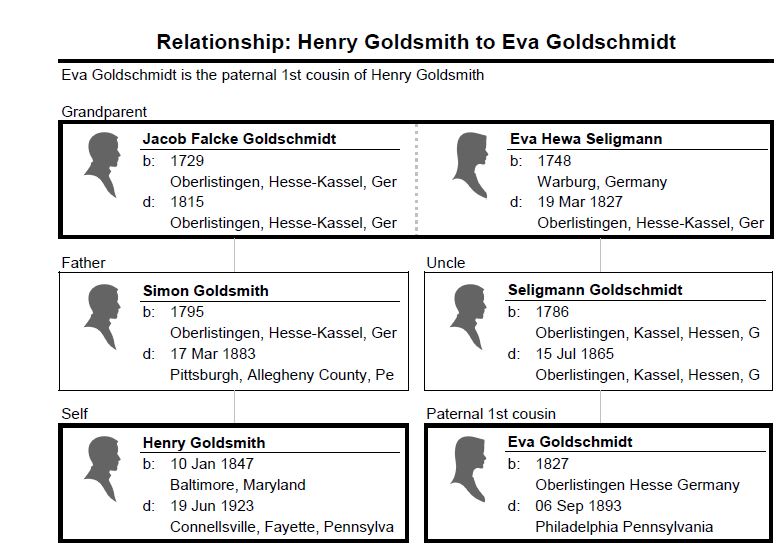
In Part I, I described the research I had done first with Val Collinson in 2014 and then separately with Shirley Allen during the summer and fall of 2015 to try and find the connections between all our various Selinger relatives. Through that research we had established with a fair degree of certainty that Julius and Alfred Selinger, who married two of my Cohen cousins, sisters Augusta and Fanny, were themselves brothers, the sons of Seligmann Selinger and Breinle Hofstadter. We had also established that Helena Selinger Auerbach, who had been Val’s great-grandmother, was a first cousin to Julius and Alfred and the daughter of Abraham Selinger and Rosalia Wilhelmsdorfer.

Relationship_ Julius Selinger to Helena Selinger

We also had established that Fanny Selinger Rosenthal, Shirley’s grandmother, was also a daughter of Abraham Selinger, but Shirley and I had not found any document that revealed whether her grandmother Fanny was a full or half sister to Helena and the other children of Abraham Selinger; we had not found her mother’s name or where she was born.

And I still didn’t know how Frederick Selinger fit into the question.

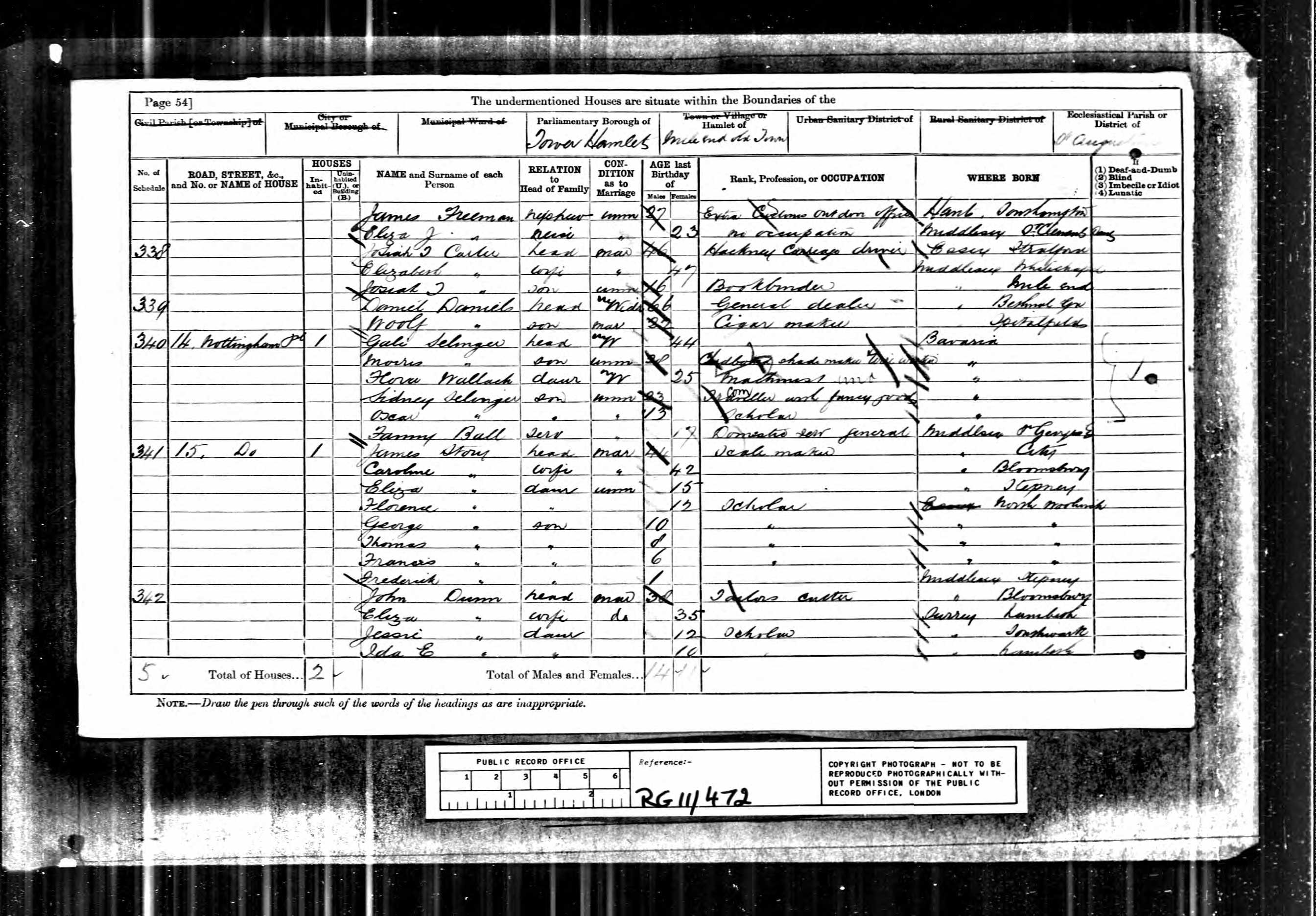
We also knew that Abraham Selinger had immigrated to England by 1871 because he appeared on the 1871 UK census with a second wife, Gali, along with several children: Sigfried, Helena, Cornelia, and Oscar.  By 1881, Abraham had died, and his widow Gali was living with some different children: Morris, Flora, and Sidney, plus Oscar.  Aside from Helena, who were all these children, and where were they born?  I had no birth records for Cornelia, Morris, Flora, Sidney, or Oscar.

So by late November, we had many answers, but many questions remained.

Fast forward again to January 13, when I again heard from Shirley.  She had received a copy of the marriage authorization for Fanny Selinger and Jacob Rosenthal from the Chief Rabbi in London.  It confirmed that Fanny was the daughter of Abraham and that she was born in Hurben, but did not reveal her mother’s name.  Although we did not have any new information, the new communication inspired us to try again to get answers to our primary questions: Who was Fanny Selinger’s mother?  And how did Frederick Selinger fit into the family, if at all?

Fanny Selinger Rosenthal and her husband Jacob Rosenthal and children Gladys, Daniel, and Alfred Courtesy of Shirley Allen

Fanny Selinger Rosenthal and her husband Jacob Rosenthal and children Gladys, Daniel, and Alfred
Courtesy of Shirley Allen

After reviewing everything we had, I decided to post on the German Genealogy group on Facebook for information about records in Ansbach , where Oskar Selinger had claimed to be born on his UK naturalization record.  Although I was unable to find Ansbach birth records for the appropriate years, my friend Matthias did find two websites with information about Abraham Selinger in Ansbach: one, a website listing past and present tobacco businesses in Germany; Abraham Selinger was listed as the manager of Equity and cigar-tobacco factory in Ansbach from 1862 until 1871. Thus, it made sense that Oscar Selinger was born in Ansbach.

The second website was even more revealing.  It was an Ansbach police report from 1870 reporting the arrest on May 31, 1870 of Abraham Selinger from Hurben, manager of a cigar factory,  for fraud.  Perhaps that is why 1871 was both the last date he had the cigar business in Ansbach as well as the first year he appeared on UK records.

But it also meant that the children I believed had been born to Abraham in the 1850s—Frederick, Fanny, Morris, Flora, and Sidney—were probably not born in Ansbach if Abraham’s business there didn’t start until 1862.  So where were they born?  Shirley continued to contact various offices in Germany, and I tried to think of new paths for research.

And then I had the best idea I’d had yet.  While doing all this work with Shirley in 2015, I had somehow forgotten about my correspondence with Val Collinson back in 2014.  Maybe Val had made some new discoveries or would have some new ideas.  I wrote to Val on January 22, 2016, and now we had three heads working on the mysterious Selingers.

Filament Productions

Filament Productions (Photo credit: Wikipedia)

The emails started flying back and forth among the three of us, and it became clear fairly quickly that Val and Shirley had some relatives in common, that is, relatives they both had met or at least had heard of.  I just sat back, enjoying the fact that I had brought these two cousins together.  They both were descendants of Abraham Selinger:  Shirley through his daughter Fanny, Val through his daughter Helena.  We weren’t yet sure whether Helena and Fanny were full or half-sisters, but in any event Shirley and Val, who’d never heard of each other before and who live about 60-100 miles apart in the UK, are third cousins.  I was thrilled that I’d brought these two wonderful family researchers and cousins together.

Shirley and Val both had lots of information about the marriages and descendants of some of the other Selinger siblings and also some wonderful photographs, but neither had any information about Frederick and neither was sure as to the identity of the mother or birthplaces of Fanny, Cornelia, Morris, Flora, or Sidney.

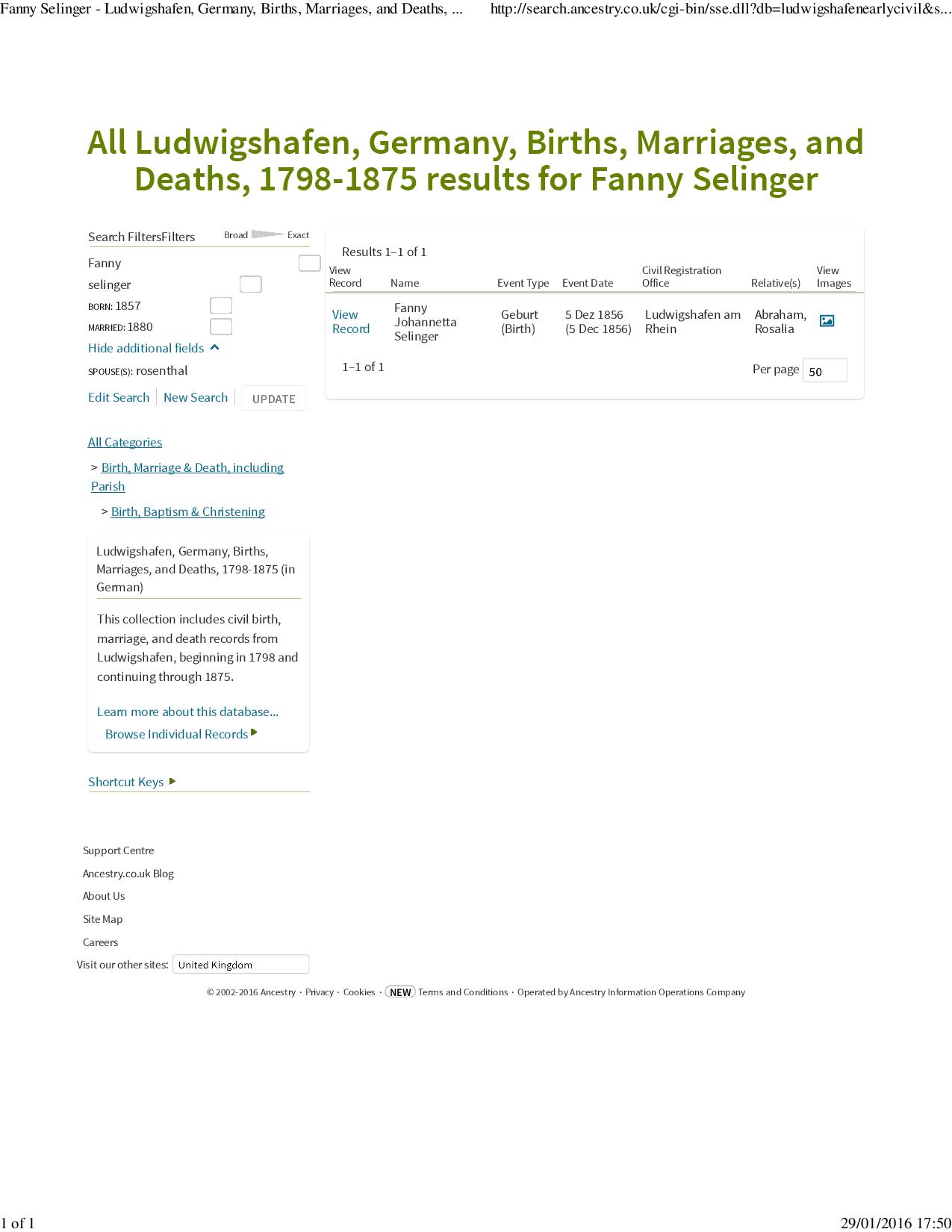
And then on January 29, 2016, the walls started tumbling down.  Val found this on Ancestry:

JPF Ludwigshafen page

Ludwigshafen?? Where was that? It’s a town very close to Mannheim.  Could be this OUR Fanny? Val asked me to follow up because I have the broadest Ancestry subscription (All Access), and I was able to pull up a scan of the actual record.  And not only did I find birth records for Fanny, I found them for three other children, all born to Abraham Selinger and Rosalia Wilhelmsdorfer, his first wife.

The four children born in Ludwigshafen were:  Babetta, born in 1853, died in 1854; Flora, born in 1855 (later Flora Wallach); Fanny, born December 5, 1856; and  Sigmund (later Sidney) born in 1858.  We finally had a birth record for Fanny, and we knew now that she was in fact a full sister to Helena as they were both the daughters of Abraham Selinger and Rosalia Wilhelmsdoerfer.  Val and Shirley were officially third cousins.


Fanny Selinger birth record from Ludwigshafen Ancestry.com. Ludwigshafen, Germany, Births, Marriages, and Deaths, 1798-1875 [database on-line]. Provo, UT, USA: Ancestry.com Operations, Inc., 2015. Original data: Ludwigshafen Zivilstandsregister, 1798-1875. Stadtarchiv Ludwigshafen, Ludwigshafen, Deutschland.

Fanny Selinger birth record from Ludwigshafen
Ancestry.com. Ludwigshafen, Germany, Births, Marriages, and Deaths, 1798-1875 [database on-line]. Provo, UT, USA: Ancestry.com Operations, Inc., 2015.
Original data: Ludwigshafen Zivilstandsregister, 1798-1875. Stadtarchiv Ludwigshafen, Ludwigshafen, Deutschland.

So that left three children whose birthplaces were still unknown: Morris, Cornelia, and, of course, Frederick.  Since Morris and Cornelia were both born before 1862 when the Selinger family arrived in Ansbach and after 1848 when the family had moved to Mannheim, I assumed that they were probably born in Mannheim.  The 1881 census recorded Cornelia’s age as 18, two years younger than Helena, whom they reported as twenty. But even English census records are unreliable.  Helena would have been turning 22 that year; maybe Cornelia was really 19 or 20 and thus born in 1850 or 1851.  The 1881 census said Morris was 28; he was probably born in 1852 since Babetta, the child who died in 1854, was born in 1853, in Ansbach.  Cornelia and Morris would also probably have been the children of Abraham and Rosalia since there were four children born to that couple even after Cornelia and Morris were born.

So I went back to the Mannheim records because my initial search had been only for the years between 1853 to 1859; now I searched the set of records before it, dating from 1842 to 1852.  And there they were, birth records for Cornelia (1850) and Morris (1852).  And Helena (1849).  All three were the children of Abraham Selinger and Rosalia Wilhelmdoerfer.

landesarchiv_baden-wuerttemberg_generallandesarchiv_karlsruhe_390_nr-_2862_bild_147_4-1229196-147 Birth record for Helena Selinger from Hurben

landesarchiv_baden-wuerttemberg_generallandesarchiv_karlsruhe_390_nr-_2862_bild_147_4-1229196-147
Birth record for Helena Selinger from Mannheim (center, left page)


So there are two birth records for Helena, one in Hurben, one in Mannheim.  Go figure.

Meanwhile, Val found yet another document:

Abraham Selinger - Ansbach, Germany JPG

(I cannot understand why neither the Ludwigshafen nor the Ansbach registers showed up for me when I searched.  Val has a magic touch with the search engine logic that I don’t have.)

I then retrieved the image of the actual document:

Abraham Selinger Lutheran register Ansbach


Abraham Selinger family in Ansbach Ancestry.com. Ansbach, Germany, Lutheran Parish Register Extracts, 1550-1920 [database on-line]. Provo, UT, USA: Ancestry.com Operations, Inc., 2015. Original data: Ansbach Lutheran Parish Register Extracts. Digital images Tobias Brenner Collection.

Abraham Selinger family in Ansbach
Ancestry.com. Ansbach, Germany, Lutheran Parish Register Extracts, 1550-1920 [database on-line]. Provo, UT, USA: Ancestry.com Operations, Inc., 2015.
Original data: Ansbach Lutheran Parish Register Extracts. Digital images Tobias Brenner Collection.

This document revealed two more things: that Gali’s birth name was Kohn and that she and Abraham had had another child before Oskar, Isidor, who died when he was an infant. So now I had a record confirming that Oscar was born in Ansbach and that his mother was Gali Kohn, not Rosalia Wilhelmsdoerfer.

Shirley, Val, and I had pretty much closed the circle on the children of Abraham Selinger.  But despite all our efforts, we still had not found one record for Frederick Selinger.  If he was born in 1856 as his passport application and his death certificate indicated, he should have been included with those children born in Ansbach.  He would have been born around the time of Flora or Fanny, maybe even a twin of one of them.  But he wasn’t there. And he wasn’t in the Mannheim records or the Hurben records.

So something did not make sense.  Frederick was not the child of Abraham Selinger with either of his wives.  I was convinced of it now.  So who was he? What was I missing?


P question

P question (Photo credit: Wikipedia)


This is the part of the story where I just want to kick myself.  I went back once again to the Hurben birth records and looked more closely at the children born to Seligman Selinger.  There were nineteen of them.  NINETEEN.  Nine were born to Seligman and his first wife between 1835 and 1844.  They all were born too early to be Frederick.  Ten children were born to Seligman Selinger and his second wife, Breinle Hofstadter, between 1849 and 1866.  There were five girls and five boys from that second marriage.  The five boys were Heinrich (1852), Julius (1853), Sigfried (1855), Hugo (1860), and Alfred (1866).  Julius and Alfred were the two who had married my Cohen cousins Augusta and Fanny.  That left Heinrich, Sigfried, and Hugo. Could any of them be Frederick?

Sigfried.  Hmm, I thought.  That could have become Frederick, maybe?? But he was born December 29, 1855, and Frederick was born in December 1856, according to his US death certificate and his US passport application.  So what, I thought? People lie! He made himself a year younger. The more I thought about it, the more I thought that Sigfried was Frederick.  The disparity in the dates in December for his birthday (the death certificate said December 27, the passport application December 21) didn’t bother me either.  Jews in Europe might not have known their birthday on a Gregorian calendar, only a Jewish calendar.  Frederick might have just known that his birthday was close to Hanukkah and nothing more precise than that.

I went back to Ancestry to look at the records I had for Frederick.  The earliest two—his 1880 marriage record and the 1880 census—list him as Fred, not Frederick.  Fred could be a shortened version of Sigfried, couldn’t it?  So I decided to search for Sigfried Selinger.

Marriage record for Frederick Selinger and Rachel Cohen 1880

Marriage record for Frederick Selinger and Rachel Cohen 1880

And I found this ship manifest from 1872:

Siegfried Selinger ship manifest 1872 to Baltimore The National Archives at Washington, D.C.; Washington, D.C.; Records of the US Customs Service, RG36; NAI Number: 2655153; Record Group Title: Records of the Immigration and Naturalization Service, 1787-2004; Record Group Number: 85

Siegfried Selinger ship manifest 1872 to Baltimore
The National Archives at Washington, D.C.; Washington, D.C.; Records of the US Customs Service, RG36; NAI Number: 2655153; Record Group Title: Records of the Immigration and Naturalization Service, 1787-2004; Record Group Number: 85

Siegfried Selinger, sixteen years old, arrived in Baltimore in June 1872, when Sigfried Selinger of Hurben would in fact have been still sixteen years old.  I thought that this could very well be the man who became Frederick Selinger.  Supporting this assumption was the fact that his marriage record states that he was from Baltimore and that he ended up marrying a woman from Washington, DC, so it would make sense that he would have entered the US through Baltimore, as his naturalization papers indicated.    (They also say he entered the country in June 1871.  People lie!  People forget!)

Frederick Selinger passport application National Archives and Records Administration (NARA); Washington D.C.; NARA Series: Passport Applications, 1795-1905; Roll #: 378; Volume #: Roll 378 - 14 Jul 1891-31 Jul 1891 Description Volume : Roll 378 - 14 Jul 1891-31 Jul 1891

Frederick Selinger passport application
National Archives and Records Administration (NARA); Washington D.C.; NARA Series: Passport Applications, 1795-1905; Roll #: 378; Volume #: Roll 378 – 14 Jul 1891-31 Jul 1891
Description
Volume : Roll 378 – 14 Jul 1891-31 Jul 1891

And when I searched for Fred Selinger in Baltimore, I found two listings in Baltimore directories, one in 1875, one in 1878.  I am quite certain I have found Frederick and now know that he was Sigfried Selinger,  the son of Selinger Seligmann and Breinle Hofstadter.  He was the middle brother to his brothers, Julius and Alfred, who followed him to the US in the following decade and married respectively the aunt (Augusta) and the sister (Fanny) of Frederick’s wife Rachel.

So why do I want to kick myself? Not only because I should have seen this much, much earlier, but because Ralph Bloch in fact told me he thought Sigfried could be Frederick way back in August, 2015.  I’d forgotten that until I reviewed all the old emails to write this blog post.  I probably saw his comment and forgot it or thought that I needed more proof.  And I got caught up in searching for Fanny and the other Selingers and for some reason assumed Frederick had to be the child of Abraham.  I could have so easily searched back then for Sigfried in the US and found what I found just this past week.

But actually I am so glad that I didn’t.  Because if I had done that in August, I might never have continued searching and working with Shirley and Val.  I might never have brought Shirley and Val together, third cousins who’d never known each other before.  I would have missed out on all the fun Val and Shirley and I have had as we worked together to solve this mystery.  That makes this all very worthwhile.

All this, you might say, for people who aren’t even my blood relatives? For people who happened to marry my distant cousins Rachel, Augusta, and Fanny?

It’s moments like this that I want to say, “We are all cousins.  Our families are all entangled.  And every person’s life, every person’s story is worth remembering and is worth memorializing.”


The Benefits of Teamwork: Part I

In my recent post, I mentioned that I had been working with two other researchers on the mystery of the three Selinger men who married my Cohen cousins.  Frederick Selinger had married my cousin Rachel Cohen in 1880 in Washington, DC.  Rachel was the daughter of Moses Cohen, my three times great-uncle (brother of my great-great-grandfather Jacob).  Julius Selinger had married Augusta Cohen in 1884 in Washington, DC; Augusta was the daughter of Moses Cohen, Jr. and niece of Rachel Cohen.  Finally, Alfred Selinger had married Fannie Cohen in Washington, DC, in 1893.  Fannie was also a daughter of Moses Cohen, Jr., also a niece of Rachel Cohen, and a sister of Augusta Cohen.

Julius and Augusta Cohen Selinger passport photos 1922

Julius and Augusta Cohen Selinger passport photos 1922


Way back on July 22, 2014, when I first posted about the three Selinger men, I had speculated that they all had to be related.  Both Julius and Frederick had documents indicating that they had been born in Hurben, Germany.  Alfred and Julius had lived together in DC before they’d married, and Alfred had traveled with Julius and Augusta to Europe before he married Augusta’s sister Fannie.  But I had nothing to support that speculation besides that circumstantial evidence.

Then a month later on August 5, 2014, I wrote about the marriage of Eleanor Selinger to Henry Abbot.  Eleanor was the daughter of Julius Selinger and Augusta Cohen; Henry was the son of Hyams Auerbach (Abbot) and Helena Selinger (some records say Ellen or Helen).  I was curious as to whether Helena Selinger was somehow related to Julius and the other Selinger men, Alfred and Frederick.  I thought that she might be since how else would an American woman have met an Englishman? And the shared name seemed too uncommon to be pure coincidence.


Eleanor Selinger Abbot and Abbot family-page-001

Eleanor Selinger Abbot (center) with the Abbot family Courtesy of Val Collinson


As I wrote then, I had contacted the owner of an Ancestry family tree who turned out to be Eleanor Selinger and Henry Abbot’s great-niece: Val Collinson.  Val and I exchanged a lot of information, but we could not at that time find any definitive evidence linking Helena Selinger, her great-grandmother, to Frederick or Julius or Alfred.  All were born in Germany, but it seemed from the records in different locations.  Helena’s marriage record indicated that her father’s name was Abraham Selinger, whereas Julius had indicated on his passport application that his father was Sigmund Selinger.  We were stumped.  And that was that.  Or so I thought.

Fast forward a full year to August, 2015, when I received a comment on my earlier blog post about Eleanor Selinger and Henry Abbot from someone named Shirley Allen, whose grandparents were Jacob Rosenthal and Fanny Selinger:

Fanny Selinger Rosenthal and her husband Jacob Rosenthal and children Gladys, Daniel, and Alfred Courtesy of Shirley Allen

Fanny Selinger Rosenthal and her husband Jacob Rosenthal and their children Gladys, Daniel, and Alfred
Courtesy of Shirley Allen

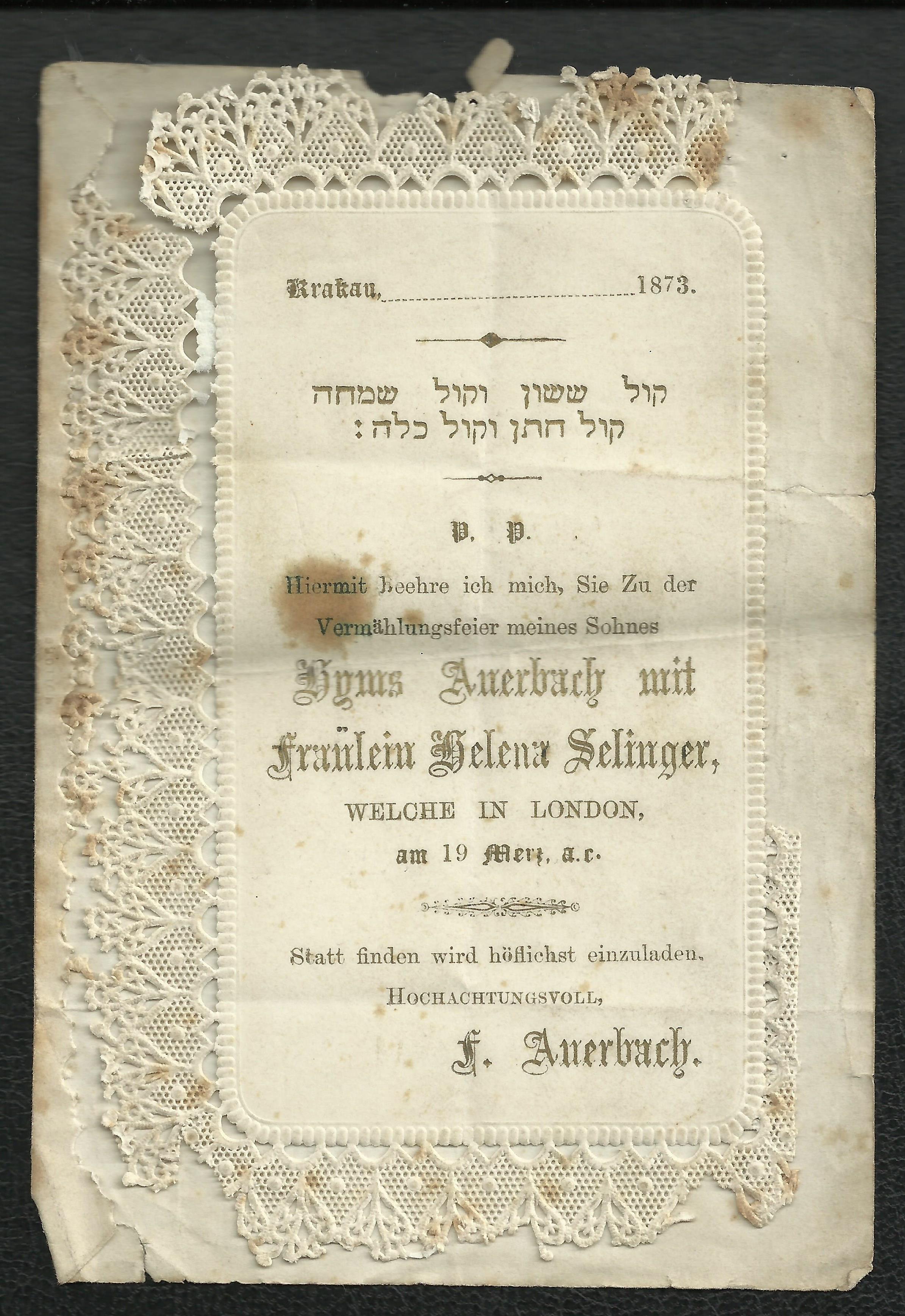
I’ve been delving into my paternal (Rosenthal) family history. I’ve found that my grandfather Jacob Rosenthal was married to Fanny Selinger. Unfortunately I haven’t found anything further about Fanny other than she was born in Germany, probably in 1857. However, I’ve recently come upon a wonderful paper lace invitation to the 1873 wedding of Hyams Auerbach and Helena Selinger that you referred to. What I don’t know is why Fanny would have been invited. Clearly she and Helena were related – but how ?

Needless to say, I was intrigued.  Maybe Fanny Selinger was related to Helena and/or maybe she was related to Julius, Frederick, and Alfred.  Shirley and I communicated by email, and we both started digging.

Invitation to the wedding of Helena Selinger and Hyms Auerbach Courtesy of Shirley Allen

Invitation to the wedding of Helena Selinger and Hyms Auerbach
Courtesy of Shirley Allen


I found a website called Jewish Genealogy of Bavarian Swabia (JGBS) that had records for Hurben and located 25 Selingers in their database, including those for Alfred and for Julius, who were the sons of Seligman Selinger and Breinle Hofstadter and thus were brothers, as I had suspected. Shirley and I both thought that Seligman Selinger had been Americanized to Sigmund by Julius on his passport application and that the birth records for Julius and Alfred confirmed that they were in fact brothers.

I also found a birth record for Helena Selinger, whose father was Abraham Selinger, not Seligman Selinger.  Abraham and his wife Rosalia Wilhelmsdoerfer had six children listed: Seligman (1842), Raphael (1843), Pauline (1845), Karolina (1847), Heinrich (1848), and Helena (1849). Pauline, Karolina, and Heinrich had all died as young children, leaving Seligman, Raphael, and Helena as the surviving children of Abraham.  Here is Helena’s birth record from Hurben in August 1849.

Helena Selinger birth record from Hurben http://jgbs.org/SuperSearch.php?Sp=3&Book=birth&Com=11

Helena Selinger birth record from Hurben (third from bottom)
http://jgbs.org/SuperSearch.php?Sp=3&Book=birth&Com=11


But what about Frederick?  And Fanny? And was there a connection between Helena’s father Abraham and the father of Julius and Alfred, Seligman Selinger?

A little more digging on the JGBS site revealed that both Abraham Selinger and Seligman Selinger were the sons of Joachim Selinger, thus confirming that they were brothers and thus that Helena was a first cousin to Julius and Alfred.

Marriage record from Hurben for Abraham Selinger, son of Joachim, and Rosalia Wilhelmsdoerfer http://jgbs.org/detail.php?book=marriage&id=%206671&mode=

Marriage record from Hurben for Abraham Selinger, son of Joachim, and Rosalia Wilhelmsdoerfer (second in page)
http://jgbs.org/detail.php?book=marriage&id=%206671&mode=


Seligmann Selinger, son of Joachim, marriage to Breinle Hoftsadter

Seligmann Selinger, son of Joachim, marriage to Breinle Hoftsadter (second from bottom) 1848 http://jgbs.org/detail.php?book=marriage&id=%206695&mode=


That meant that Eleanor Selinger, daughter of Julius Selinger, had married her second cousin, Henry Abbot, son of Helena Selinger.


But that still left us wondering about Frederick Selinger and Shirley’s great-grandmother Fanny Selinger.  How did they fit into this picture?

I contacted Ralph Bloch, the webmaster for the JGBS website, and he was extremely helpful.  More helpful than I realized at the time, but more on that later.  Ralph also could not find any evidence that Fanny was born in Hurben, and he reassured me that the birth records for Hurben were quite complete.  He even searched through the original pages to be sure that Fanny hadn’t somehow been missed when the records were indexed. (There was a Fany Selinger born in the 1830s, but that would have been far too early for Shirley’s ancestor.) Ralph also sent a photograph of Seligman Selinger’s headstone, which confirmed that his father’s name was Joachim or Chaim, his Hebrew name.

Seligman Selinger gravestone


So once again we hit the brick wall.  We still had not found either Frederick or Fanny.  Shirley said she would pursue it on her end, and I turned back to the other research I’d been doing when I received Shirley’s comment.

Not much happened again until late November when I heard again from Shirley, telling me that she had received a copy of Fanny Selinger’s marriage certificate, which revealed that Fanny was the daughter of Abraham Selinger.  Now we could link Fanny to Helena, also the daughter of Abraham, as well as to Julius and Alfred, Abraham’s nephews. But we didn’t know if Fanny and Helena were both the daughters of Rosalia Wilhelmsdoerfer.

Shirley’s research of UK records showed that by 1871 Abraham was married to a woman named Gali, and we assumed that Abraham had left Hurben at some point, that his first wife Rosalia had died, and that he had had several children with Gali.  That is what the UK census records from 1871 seemed to reflect. Abraham and Gali were living with Sigfried (28), Helena (20), Cornelia (18), and Oskar (4).  But there was neither a Fanny nor a Frederick.


Abraham Selinger and family 1881 UK census Class: RG10; Piece: 555; Folio: 86; Page: 3; GSU roll: 823397 Description Enumeration District : 10 Source Information Ancestry.com. 1871 England Census [database on-line]. Provo, UT, USA: Ancestry.com Operations Inc, 2004. Original data: Census Returns of England and Wales, 1871. Kew, Surrey, England: The National Archives of the UK (TNA): Public Record Office (PRO), 1871.

Abraham Selinger and family 1881 UK census
Class: RG10; Piece: 555; Folio: 86; Page: 3; GSU roll: 823397
Description
Enumeration District : 10
Source Information
Ancestry.com. 1871 England Census [database on-line]. Provo, UT, USA: Ancestry.com Operations Inc, 2004.
Original data: Census Returns of England and Wales, 1871. Kew, Surrey, England: The National Archives of the UK (TNA): Public Record Office (PRO), 1871.

Abraham died in 1880, and in 1881, Gali was living with four children, but aside from Oskar (13), they were all different from those on the 1871 census: Morris (28), Flora (surname Wallach) (25), and Sidney (23).  Now I was really confused.  Who were these people, and where had they been in 1871?  Flora was presumably married to someone named Wallach and now a widow, but Morris would have been eighteen in 1871 and Sidney only thirteen. Where were they living?  Who were they? None of those children were listed on the Hurben birth register on the JGBS site; in fact, there were no children listed for Abraham Selinger and any wife in Hurben after Helena’s birth in 1849.

Gali Selinger and family 1881 UK census Class: RG11; Piece: 472; Folio: 118; Page: 55; GSU roll: 1341103 Description Enumeration District : 9 Original data: Census Returns of England and Wales, 1881. Kew, Surrey, England: The National Archives of the UK (TNA): Public Record Office (PRO), 1881

Gali Selinger and family 1881 UK census
Class: RG11; Piece: 472; Folio: 118; Page: 55; GSU roll: 1341103
Description
Enumeration District : 9 Original data: Census Returns of England and Wales, 1881. Kew, Surrey, England: The National Archives of the UK (TNA): Public Record Office (PRO), 1881

I assumed that Morris, Flora, Sidney, and Oscar, all born after 1850, were born in a different place and perhaps to a different mother.  Certainly Oskar had to be Gali’s child since he was so much younger than all the rest and only four on the 1871 census.

Searching again on Ancestry, I found a new record:  an entry for Abraham, Rosalia, Seligman, and Raphael Selinger on the Mannheim, Germany, family register dated November 26, 1848.  What were they doing in Mannheim? By that time the three younger children, Pauline, Karolina, and Heinrich, had died.  Perhaps they needed a change of scenery.  But what about Helena? She was born in Hurben in 1849.

Then I found a second Mannheim family register that included Helena, the final entry on the page:


Abraham Selinger and family, Mannheim register Ancestry.com. Mannheim, Germany, Family Registers, 1760-1900 [database on-line]. Provo, UT, USA: Ancestry.com Operations, Inc., 2014. Original data: Polizeipräsidium Mannheim Familienbögen, 1800-1900. Digital images. Stadtarchiv Mannheim — Institut für Stadtgeschichte, Mannheim, Germany.

Abraham Selinger and family, Mannheim register
Ancestry.com. Mannheim, Germany, Family Registers, 1760-1900 [database on-line]. Provo, UT, USA: Ancestry.com Operations, Inc., 2014.
Original data: Polizeipräsidium Mannheim Familienbögen, 1800-1900. Digital images. Stadtarchiv Mannheim — Institut für Stadtgeschichte, Mannheim, Germany.

My friends in the German Genealogy group,  Heike Keohane, Matthias Steinke, and Bradley Hernlem, came to my rescue and translated it to read, “Helene, his daughter, here born the 22 August 1849.”  So Helena’s birth is entered on the Hurben birth records (on the same date) and on the Mannheim records.  I’ve no idea which is the correct birthplace; maybe Rosalia went home to Hurben to give birth and returned to Mannheim afterwards where the family was living.

But perhaps now I could find out where Frederick was born, not to mention Morris, Flora, Sidney, and Oscar. Maybe they were born in Mannheim.  I checked the Mannheim birth records from 1853 through 1866 and found not one person named Selinger.  I checked over and over, looking at each page until my eyes were blurry.  There were no Selingers born in Mannheim during that period that I could find.

Then I discovered that Oskar Selinger had listed Ansbach as his birth place on his UK naturalization papers and thought that perhaps the family had moved from Mannheim to Ansbach.

Oscar Selinger UK naturalization papers The National Archives; Kew, Surrey, England; Duplicate Certificates of Naturalisation, Declarations of British Nationality, and Declarations of Alienage; Class: HO 334; Piece: 54 Description Description : Piece 054: Certificate Numbers A20701 - A21000

Oscar Selinger UK naturalization papers
The National Archives; Kew, Surrey, England; Duplicate Certificates of Naturalisation, Declarations of British Nationality, and Declarations of Alienage; Class: HO 334; Piece: 54
Description
Description : Piece 054: Certificate Numbers A20701 – A21000

I had no luck locating Ansbach birth records for that period, and by then it was Thanksgiving, and other matters distracted me, and I put the Selinger mystery on the back burner.

To be continued…..

Photo Analysis: Why You Should Ask an Expert

Sometimes you need to hire an expert to help with hard questions.  With the help of the genealogy village—my fellow bloggers and the members of the various Facebook groups and JewishGen—I have been able to find and learn more than I ever imagined.  But when it came to some of those mystery photos that bewildered and frustrated me, I decided it was time to find an expert, and the expert who came highly recommended—for good reason—is Ava Cohn, a/k/a Sherlock Cohn, the Photo Genealogist.

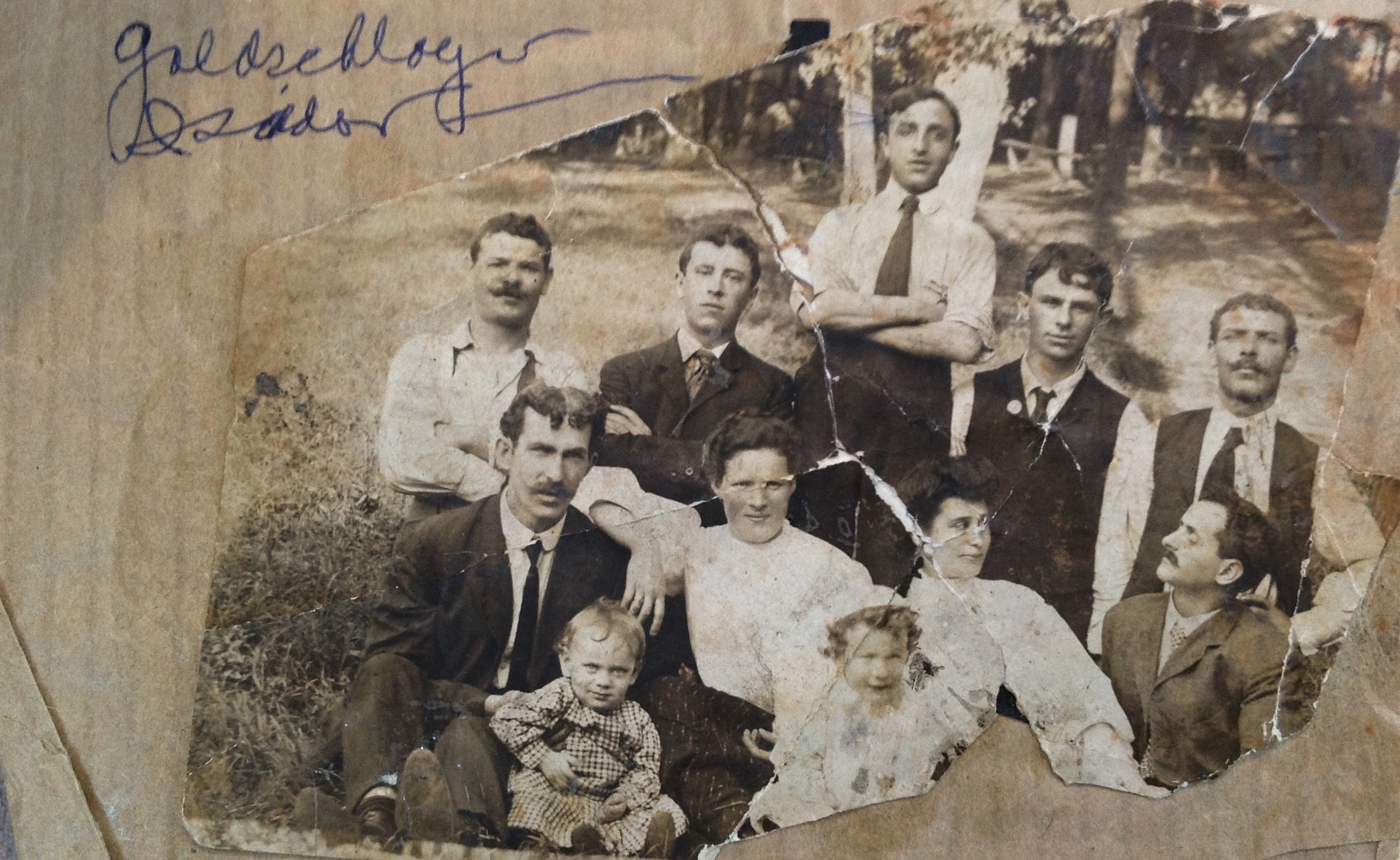
I had originally sent Ava this photo of my grandfather Isadore Goldschlager because I was curious about identifying the other people in the photograph.

Isadore Goldschlager and unknown others

Isadore Goldschlager and unknown others

But Ava and I discussed it, and she concluded that without more information and more photographs, it would be impossible to make much progress identifying total strangers who lived over a hundred years ago. I really appreciated Ava’s honesty, and when she asked if I had any other photographs that might be more amenable to her analysis, I looked back to consider some other options.

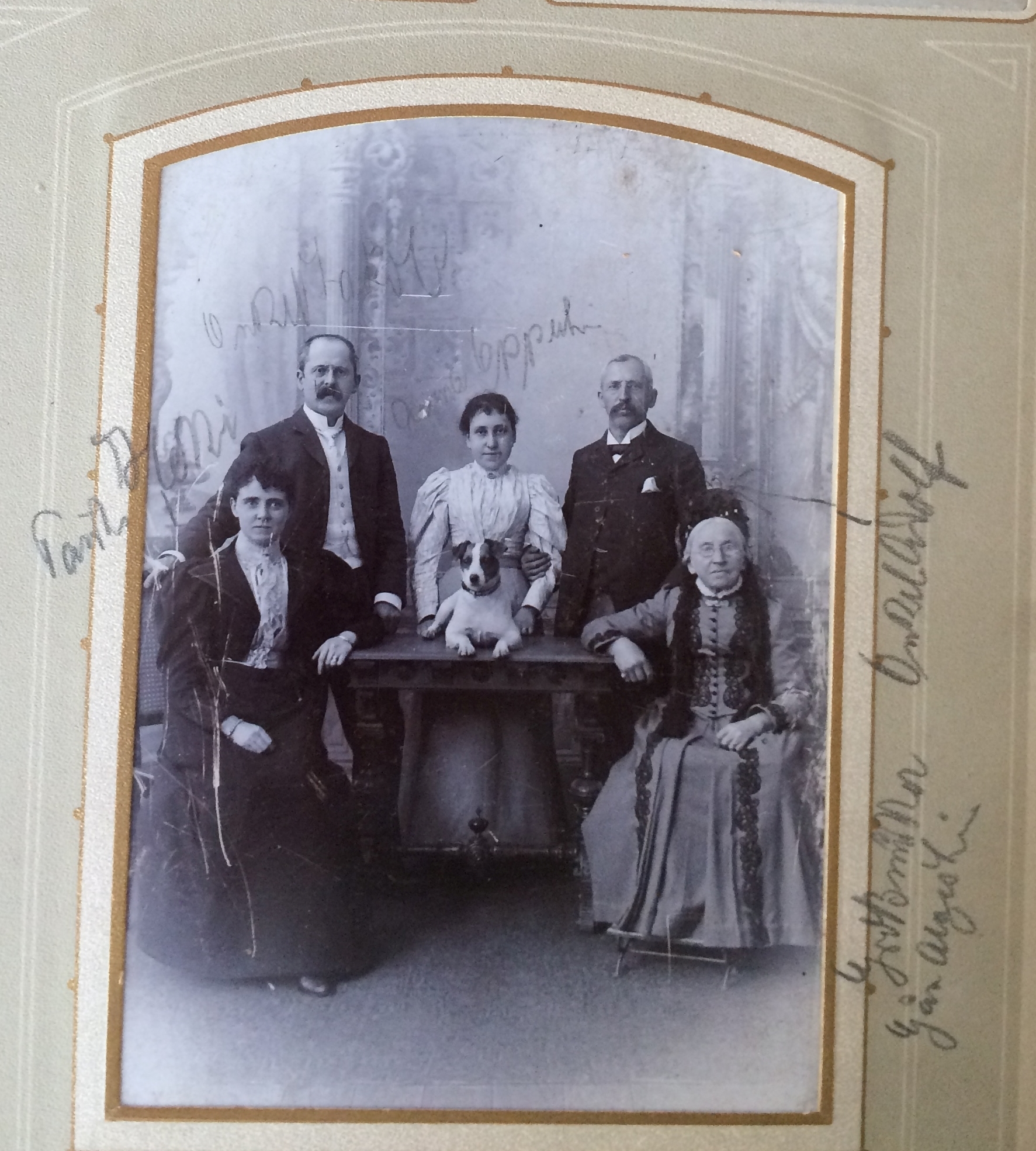
I sent her this photograph from Fred Michel’s album, which I had discussed here and here and here, but about which I remained somewhat mystified.

Uncle Adolf and Grandmother Gau Algesheim

I had concluded tentatively from my own analysis and comparison to other photographs and the inscriptions on the photograph that the older woman was probably my three-times great-grandmother Babetta Schoenfeld Seligmann, and the two men labeled Onkel Adolf and Onkel Jakob were probably Babetta’s sons, Adolf and James, brothers of my great-great grandfather Bernard Seligman.  Adolf, like my great-great-grandfather Bernard, had left Germany and settled in Santa Fe, New Mexico, and James had moved to Great Britain.  I had learned that James was not a common name for boys in Germany in the 19th century so it was likely that he was born Jakob and adopted the name James after emigrating.  Also, my cousin Lotte, who had met James Seligman when she was a young girl, thought that “Onkel Jakob” resembled the man she remembered as James Seligman.

But I was not at all sure who the two younger women were, especially the woman to the left in the photograph.  I’d asked on the blog if anyone could read the inscription near her picture, but no one was certain what it said.  The woman in the center appeared to be labeled Anna Oppenheimer, but I couldn’t understand why she would be in the photo.  Anna Oppenheimer was the daughter of Pauline Seligmann and Maier Oppenheimer and the granddaughter of Babetta.  But why of all the grandchildren would only she be in this photograph, especially since her mother was not included, just two of her uncles?

Ava studied the photograph as well as my blog posts, my family tree for the Seligmann family, and other photographs of the Seligmann family, and then sent me a detailed and thorough analysis of her own conclusions, which I found well-founded, fascinating, and persuasive.  With her permission, I am sharing some of her report.

I thought Ava’s analysis of the overall relationships among those in the photograph based on traditional posing in studio photographs of families was quite interesting:

In the mystery photograph, the family is posed in a typical family grouping of five individuals seated and standing around a large library table upon which is a dog, perhaps the family pet. The photo has been taken in a photographer’s studio with an appropriate backdrop for the time period. The two individuals on the left hand side appear to be a married couple while the elderly woman seated on the right could be mother or grandmother to one or more of the individuals in the photo. The man on the right, probably a son and the young woman in the center holding the dog could be related but are not married to each other.

Ava concluded that the photograph was taken in 1896-1897.  Here is part of the reasoning for her conclusion:

To establish a year for the photograph, I looked at the clothing worn. Since what we know of the family’s comfortable economic status, it is logical that they are wearing up-to-date fashions, for the most part. The elderly woman, as is customary for many older women, is not as fashionable as the two younger women. Her dress, with multiple small buttons down the bodice, is a typical style of the 1880s as is her bonnet. The other two women are wearing clothing from the latter half of the1890s, post 1895. By this point in time the enormous leg-o-mutton sleeves of the 1893-1895 time period have become less full with the vestige of fullness above the elbow.  The man on the left is wearing a high Imperial collar, common in the 1890s.

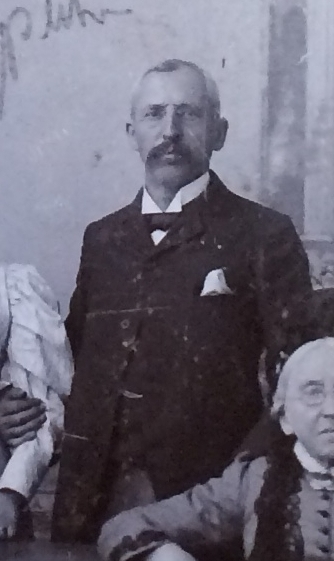
Ava agreed that it was reasonable to conclude that the elderly woman labeled “Grossmutter Gau Algesheim” was Babetta Schoenfeld Seligmann and that the man on the right, labeled Onkel Adolf, was her son Adolf Seligman, brother of Bernard and a resident of Santa Fe in the 1890s.  At that time Adolf was in his fifties (born in 1843) and unmarried.  Ava thought that the man labeled Onkel Adolf in the photo appeared to be in his mid-fifties. Ava did not think the woman in the center was Adolf’s wife, Lucy, since Lucy would have been only about fourteen in the mid-1890s and did not marry Adolf until 1902.


Onkle Adolf

Rather, Ava opined that the woman in the center was in fact Anna Oppenheimer as labeled.  She would have been nineteen or twenty in 1896-1897:

It appears that she is wearing a wedding or engagement ring in the photograph. The writer of the inscription has used Anna’s maiden name, Oppenheimer, as opposed to her married name, Anna Kaufman, so, along with the absence of Max Kaufman in the photograph, I believe that this photo was taken before her marriage to Max. Again, having a marriage certificate for Anna and Max could confirm why the writer used Anna’s maiden name here instead of her married name.

Unfortunately, I do not have a marriage record for Anna, and there is no record of any children born to her and her husband Max Kaufman so it is impossible to determine when exactly they married.

Anna Oppenheimer maybe

That left the two remaining people in the photograph: Onkel Jakob and the woman sitting on the left side of the picture whose name I could not decipher in the inscription.  Ava agreed that “Onkel Jakob” was James Seligman. So who was the other woman?

Ava believes that she was James/Jakob Seligman’s wife, Henrietta Walker Templeton, who was born in England in 1866 and married James Seligman in London in October 1887.  Ava read the inscription next to the woman to be “Tante Heni:”

Tante Glori


Heni is a nickname for Henrietta and clearly shows the relationship with the writer of the inscription because of the informal use of a nickname. Tante (Aunt) could be one by marriage not necessarily by blood. In the mystery photo Heni appears to be about age 30-31.

In addition, Ava interpreted the posing as indicative of a marital relationship between Jakob and the woman seated in front of him, saying, “The manner in which he is posed with his arm around the back of Heni’s chair suggests their relationship.”

This made perfect sense to me.  Ava speculated that perhaps James and Henrietta had come to Gau-Algesheim to celebrate their tenth anniversary with the Seligmann family, which would have been in 1897.  I also recalled that Lotte had mentioned in an email dated July 6, 2015, that James and his English wife (whom Lotte referred to as Hedy) had visited “the continent” once.  Lotte was born in 1921, so would not remember a visit in the 1890s, but the fact that James and his wife visited during Lotte’s lifetime in Germany makes it even more likely that they had in fact visited on earlier occasions.  Lotte also said that James returned after Henrietta’s death in 1928.

Ava even analyzed the dog in the photo.

Given that the same dog appears in both the mystery photograph and the one of Bettina Arnfeld nee Seligmann (born 1875), I thought I’d include that here. It is clearly the same dog. I had considered that the dog may have belonged to the photographer but given how calm he/she appears in the photographs, I believe he was a family pet. The photo of Bettina was taken roughly 3 years after this one, circa 1900. The photo of Bettina may have been an engagement picture as she and Adolf Arnfeld married in 1900.

Bettina Arnfeld nee Seligmann

Bettina Arnfeld nee Seligmann

Anna Oppenheimer maybe

Bettina Seligmann Arnfeld was the daughter of Hyronimus Seligmann, Babetta’s son and brother of Bernard, Adolf, and James, among others.  She was Anna Oppenheimer’s first cousin.  So whose dog was it? Certainly not James or Adolf since neither lived in Germany.  Perhaps the dog belonged to Babetta? She is the only common link between the two young women pictured with the dog.  Babetta died 1899; if Ava is correct and the photograph of Bettina was taken in 1900, perhaps Bettina inherited the dog from her grandmother?

I was quite satisfied and persuaded by Ava’s analysis of the family photograph.  But she didn’t stop there.  I had also supplied her with additional photographs to help with her analysis of the family photograph.  For example, I sent her this one, which I believed was a photograph of Babetta as a young woman.

Uncertain see ava report

I had based that conclusion on the fact that another photograph that I paired with the one of the woman was labeled Grossvatter and thus presumably was my three-times great-grandfather Moritz Seligmann.

Courtesy of the Family of Fred and Ilse Michel

Courtesy of the Family of Fred and Ilse Michel

But Ava disagreed about the identity of the young woman:

I did a comparison of the older photograph of a young woman that you supplied. This photograph is roughly dated circa 1859-1861 based on clothing and hairstyle as well as the type of image, most probably a daguerreotype popular in the 1850s and very early 1860s. The young woman appears to be in her teens and no more than 20 years of age. This eliminates the possibility that this earlier likeness is Babetta who would have been 49-51 years old. But there is a possibility given the provenance of the photograph and the resemblance to Babetta that this is one of her daughters, Pauline or Mathilde. It is unlikely to be her niece/stepdaughter, Caroline. Given that the photo was obtained from the Michel descendants, Pauline is the most likely candidate. Further research, documentation and comparison photographs would be needed to make a positive identification. 

Although I was quite disappointed to think that this was not Babetta, the more I considered Ava’s analysis and the more I looked at the photograph of the young woman and the one of Moritz, the more I realized my error.  The frames on the two photographs are quite different as is the style and the posing.  I had just jumped to the conclusion that because Suzanne had sent these two photographs in the same email that they were of a couple.  That’s why sometimes you need to hire an expert!

Finally, Ava also did an analysis of the wonderful photograph that my cousin Davita had sent of a man she said was her grandfather, Adolf Seligman, and his favorite sister, Minnie, riding camels in Egypt:

gramdfather Adolph and great aunt Minnie_rev

I was quite surprised but also persuaded by what Ava had to say about the identity of the people in this photograph; she is quite certain that the woman is in fact Henrietta Walker Templeton, and the more I studied the photograph, the more I agreed.

The Egypt photo is roughly dated based on her suit and hat as being taken in 1910. That would make Heni 44 years old. Her face has aged from the earlier photo and she’s put on a bit of weight, not uncommon approaching middle age.  She is very stylish in the 1897 photo and likewise in the 1910 one. In both, she has chosen an up-to-date suit rather than a dress. Her dark hair is the same style. Notice the “dip” in her bangs on the right side of her forehead. It’s the same as the earlier photo.  Her eyebrows, nose and mouth are the same as is the overall attitude captured by the photographer.

Tante Heni

Tante Heni


Minnie Seligmann

After I read Ava’s comment, I checked the emails that Lotte had sent me and saw that she had described James’ wife as “big and pompous.”  The woman Ava concluded was Henrietta certainly does have a certain air of superiority in both of the photographs.

Also, I have absolutely no record of any kind supporting the existence of a Seligmann sister named Minnie, so already had had questions about Davita’s description. Thus, I was open to the idea that it was not Minnie, but someone else.  I hadn’t considered Henrietta since I believed that the man was Adolf, as Davita said.  Why would Henrietta from England be riding a camel in Egypt with her brother-in-law Adolf, who lived in Santa Fe?

But Ava raised a question as to whether this was in fact Adolf. If the photograph was taken in 1910, why would Adolf, who had married in 1902 and had three children by 1910, be traveling to Egypt? The more I looked at the earlier photographs of Adolf and Jakob/James, the more I became convinced that the man on the camel is in fact James, not Adolf.  Ava also agreed that it seems quite likely that it is James, not Adolf, in the photograph, but that without more information, we can’t be entirely sure, especially since Davita, the source of the Egypt photograph, believed that it was her grandfather Adolf. (Adolf died before Davita was born, so she had never met him in person and only had this one photograph that she had been told was of her grandfather.)

Adolph Seligman in Egypt

James or Adolf?

Onkel Jakob

James Seligman

Onkle Adolf

Adolf Seligman

Thus, although without more photographs and/or records we cannot be 100% certain, I am persuaded that Ava’s conclusions are correct about the likely identities of the people in the group photograph, the portrait of the young woman, and the Egypt photograph.

It was well worth the fee I paid to have the benefit of Ava’s expertise.  I highly recommend her to anyone who has questions about an old photograph.  If you are interested, you can email Ava at Sherlock.cohn@comcast.net or check out her website at http://sherlockcohn.com/  You will probably have to wait quite a while because her services are very much in demand and she devotes a great deal of time to each project, but it will be worth the wait.

[I was not paid or required by my contract with Ava to advertise her services; I am writing this blog post as a service to others who might be interested.]


.


Julius Schoenthal Mystery: Solved

Last week in my post about my great-grandfather’s siblings and their immigration to the United States between 1866 and 1872, I wrote about one of his presumed brothers, Julius.  Although Julius was mentioned in the Beers biography of Henry Schoenthal as one of the siblings, I could not find any other source to verify that the Julius Schoenthal whom I had located was the right one.  The Beers biography gave no details about Julius other than that he was living in Washington, DC, at the time it was written (1893).  The Julius Schoenthal I had found did live in DC, but aside from that one clue, there was nothing else that linked him to his presumed siblings in Pennsylvania.

What I did learn about that Julius, as described in my earlier post, was that he was born sometime between 1845 (1900 and 1910 census records) and 1847 (the 1880 census)  that he had served in the Franco-Prussian War in 1870-1871, that he had married a woman named Minnie Dahl in 1874, , that he was a shoemaker (like his presumed father, Levi Schoenthal), and that he had four children: Leo (1875), Rosalia (1876), Sylvester (1878), and Moretto (1879).  I also was able to find his card in the Civil War pensions database, which indicated that he had served in the Signal Corps in the US Army; with the help of Lillian from Facebook, I also knew he had enlisted from Chicago in 1873 and been discharged in 1874 in Washington, DC.  What I did not know for sure was whether or not he was in fact the son of Levi Schoenthal, my great-great-grandfather.

Julius SChoenthal new tree


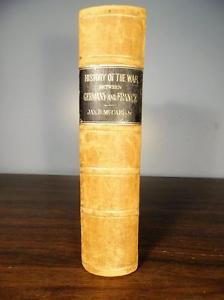
I also did not know when he’d arrived in the US. Then I found a reference to a Julius Schoenthal in an article entitled “History of the War in Europe” in the Washington, Pennsylvania Review and Examiner, dated July 12, 1871 (p.3); he was acting as an agent for a the National Publishing Company of Philadelphia, which had published a book about the Franco-Prussian War.  After a review of the book, the article ends by saying, “It is for sale by subscription only, and Julius Schoenthal, who is the authorized agent for this section, is now canvassing for it.” Given the name, subject matter, and location, I have to believe that this is Julius, the brother of my great-grandfather, and thus that he was already in the US as of July 12, 1871.  He also at least for some time had been in Washington, Pennsylvania, where his siblings and cousins were living.

HIstory of the War between Germany and France cove

I sent away for his full pension file.  I was fortunate to find Deidre Erin of Twisted Twigs on Gnarled Branches who offers to obtain copies of pension records at the National Archives for a reasonable fee. Within a few days I had an excellent and complete copy of Julius Schoenthal’s pension file.

Although the file was 56 pages long, I found all the information I needed on page 6 where Julius reported both his birth date and birthplace: January 30, 1845, in Sielen, Germany.  The fact that Julius was born in Sielen was certainly probative of the fact that he was the son of Levi Schoenthal and Henrietta Hamberg; the fact that he was born before 1846 explained why I had not been able to locate a birth record for him since the online records start in 1846 for Sielen.

Julius Schoenthal pension file pt 1

Julius Schoenthal pension file pt 2


As you can see, the page also lists his wife as Minnie Dahl and the names of his four children.  For my purposes, those overlapping facts tie the Julius Schoenthal who served in the Signal Corps and lived in Washington, DC, was married to Minnie Dahl, and had four children, to the other Schoenthals living in Pennsylvania, including my great-grandfather Isidore.  I still have no idea why he was in Chicago when he enlisted in the Signal Corps.

I also requested a copy of a letter he had reportedly written to President Ulysses S. Grant, according to the index for the archives in the Grant Presidential Collection at Mississippi State University. When I received the materials from Mississippi State University, there were two letters, one in German and in old German script that I could not read; the other in English and quite readable.  After I received some help with the first letter from the Genealogy Translations group on Facebook, it was obvious that it was not written by my relative and had been misfiled in the archives. I was disappointed since this was a lengthy letter, and I had hoped for some useful insights.

Fortunately, the second letter was in fact from Julius, my great-grandfather’s brother, but it was not to President Grant, but rather a letter dated 1884 (when Grant was no longer even President) to the then Secretary of the Treasury asking for a job as a watchman or messenger.  Julius wrote that he was 38 years old (he actually would have been 39 if born in 1845 as he had claimed in his pension files), a US citizen, a veteran of the Signal Corps, and married with four children.  There is also a letter of support included with his letter from a friend who wrote that Julius was “a faithful soldier and would make a very judicious and faithful watchman….”  Unfortunately, I do not think Julius was offered the position since all the later references in his pension file as well as DC city directories in the 1890s indicate that he remained a shoemaker.

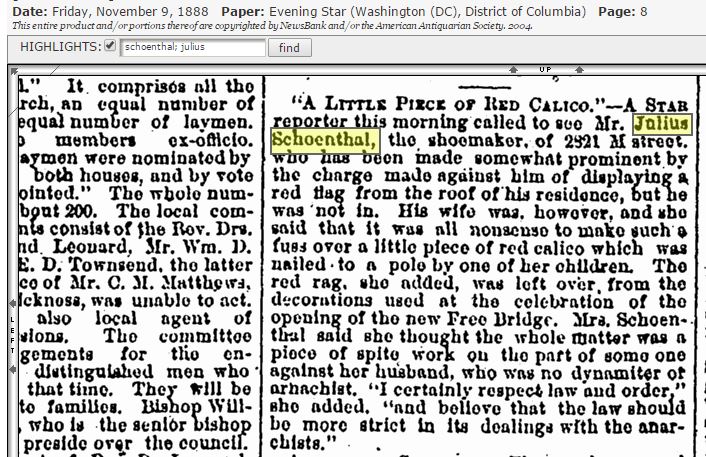
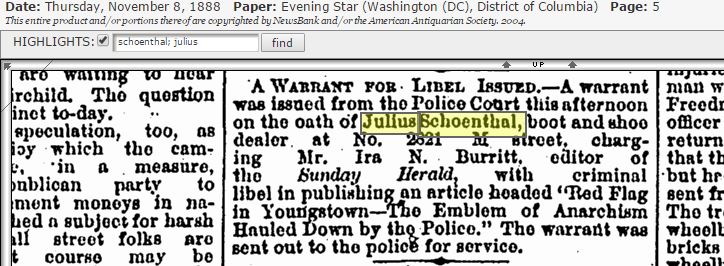
In fact, I am quite certain he was not working for the government based on this newspaper article dated November 9, 1888, from the Washington, DC Evening Star (p. 8):

Julius Schoenthal shoemaker anarchist 1888


Apparently, Julius, still working as a shoemaker, had been accused of being an anarchist because of a red cloth hanging from a pole near his house and had gained some notoriety.  His wife told the reporter that the accusation was false and made by someone out of spite.  Why would someone be seeking to harm Julius, a shoemaker with four young children?  I don’t know.  But obviously Julius did not like these accusations and sued another local paper, the Sunday Herald, for libel:


Julius Schoenthal sues paper for libel 1888


All of this must have taken a toll on Julius. The remainder of the pension file deals with his numerous claims starting in the 1890s  for an increase in his pension allowance based on various disabilities . Julius claimed that while serving in the Signal Corps as a driver of the market-wagon, he contracted various ailments that led to rheumatism, heart and lung disease, throat disease, hearing loss, and catarrh.  Reading his file made me curious about the Signal Corps and also about his claimed ailments.

According to one source, the US Army Signal Corps “began in 1860, with the appointment of Dr. Albert J. Myer, a physician, as Chief Signal Officer. Under his command, the unit transformed sign language used to communicate with deaf persons into a semaphore system incorporating red and white “wigwag” flags. During the Civil War, the Signal Corps operated air balloons and telegraph machines.”  After the Civil War and during the years that Julius Schoenthal served, the country was not at war, and the Signal Corps took on a different mission: weather forecasting.  In her book about the history of the Signal Corps, Rebecca Robbins Raines described the recruitment, training, and responsibilities of those who served in the Signal Corps in its role as national weather forecaster:

The Signal Corps selectively recruited personnel for the weather service-only unmarried men between the ages of twenty-one and forty were eligible-and required them to pass both physical and educational examinations. Upon acceptance, the men enlisted as privates and received at least two months of instruction at Fort Whipple. After an additional six months of duty on station as assistants (later extended to one year), followed by further training at Fort Whipple and appearance before two boards of examination, the men qualified for promotion to “observer-sergeant.” After one year’s service, an observer could again be called before a board for yet another examination.

The work of the observer was often demanding. Three times daily he recorded the following data: temperature; relative humidity; barometric pressure; direction and velocity of the wind; and rain or snow fall. The Corps soon added to this list the daily measurement of river depths at stations along many major rivers. The observer also noted the cloud cover and the general state of the weather. Immediately upon completing his observations, the officer prepared the information for telegraphic transmission to the Signal Office in Washington. In a separate journal he recorded unusual phenomena, such as auroral and meteoric displays. In addition to the three telegraphic reports, he made another set of observations according to local time and mailed them weekly to Washington. The Corps also required a separate midday reading of the instruments, but the observer only forwarded the results if they differed greatly from the earlier readings. At sunset he recorded the appearance of the western sky to be used as an indication of the next day’s weather. In case of severe weather, an observer could be on duty around the clock, making hourly reports to Washington.

[Rebecca Robbins Raines, Getting the Message Through: A Branch History of the U.S. Army Signal Corps (Center of Military History, United States Army, Washington, D.C., 1996), p. 47 (footnotes omitted).  Available online here.]

The Signal Corps Regimental Color

The Signal Corps Regimental Color (Photo credit: Wikipedia)

From what I read in his pension file, Julius was a driver in the Signal Corps, presumably driving the observers to their posts for recording the weather.  As described in one statement in his pension file made by a fellow Signal Corps member, Julius would often be exposed to inclement weather while driving the “market-wagon” and spent time in the military infirmary as a result of illnesses contracted while serving.

One of those illnesses, catarrh, was an illness I’d never heard of before. Back in 1865 it was described this way by the New York Times:

Catarrh is a disease of the mucous membrane of the nasal passages and those cavities of the head communicating with them. Insignifiacnt as it appears in its first stages, it is apt in its progress to become instrumental in causing the loss or impairment of smell, taste, hearing and sight, and of creating serious constitutional derangements, not unfrequently terminating in consumption.

According to the National Health Service in Great Britain, today catarrh is not considered a condition itself, but rather a symptom of colds, allergies, or nasal polyps.  However, the NHS website does say that “[i]n some cases, people can experience chronic catarrh, which is not caused by an allergy or infection and lasts for a long time. The cause of chronic catarrh is unknown but it may be related to an abnormality in the lining of the throat.”


Embed from Getty Images

Julius filed numerous claims over many years beginning in the 1890s.  From what I can tell, it appears that his claims were repeatedly denied.  Whether his illnesses were as severe as he claimed I cannot judge; there were doctors who supported his claims as well as friends, but there were also doctors who concluded otherwise.

In 1899, Minnie Dahl Schoenthal, Julius’ wife, died at 53.  In 1900, Julius was living in Washington, DC, with three of his four children, Leo, Rosalia (Rose), and Moretto, who were all in their early 20s.  Julius was now working as a “collection publisher.”    I am not sure what that means, unless Julius still had some relationship with the National Publishing Company of Philadelphia 30 years after that article in the Washington, Pennsylvania newspaper.  His son Leo was a printer, and Moretto was a cabinet maker.  Rose was not employed.  I cannot locate Sylvester on the 1900 census.

All three of Julius Schoenthal’s sons married in 1901. Sylvester married Alice Butler in Virginia on April 1, 1901.  (That marriage did not last, and on December 17, 1905, Sylvester married Bessie Rose.)  Moretto, the youngest child, married in 1901 as well; on November 14, he married Annie M. Heath.  Their son Arthur Schoenthal was born in 1903.  Finally, the oldest brother, Leo, married Fannie Pach on December 18, 1901.  They had a daughter named Minnie (presumably for Leo’s mother) on September 28, 1902, nine months after marrying.  On March 12, 1905, Julius and Minnie’s only daughter, Rose, married Joseph Pach, younger brother of her sister-in-law Fannie, Leo’s wife.

By 1910, Julius had moved in with Leo and Fannie in Washington, DC; he was now working as a confections merchant.  Leo was working as the assistant sealer of weights for the District of Columbia.  Sylvester and his wife Bessie and daughter Minnie were also still living in DC, where Sylvester was working as a car builder for the Washington Railway Company.  Moretto and his wife Annie and son Arthur were in DC as well where Moretto continued to work as a cabinet maker.

Although her father and three brothers were still living in DC in 1910, Rose Schoenthal and her husband Joseph Pach were living in Uniontown, Alabama, where Joseph owned a retail clothing and shoe business.  I wondered what had taken them there.  In 1910, the population of Uniontown was about 1,800, a 75% increase over its population in 1900, so something must have drawn all those new residents to the town.  I found this insight in the Encyclopedia of Alabama website:

The area remained tied to the agricultural economy after the war. In 1897, the Uniontown Cotton Oil Company was established in the town, one of the first facilities of its kind in the state and one of the first industrial businesses in Perry County; it manufactured cotton seed oil and cotton seed meal. By 1900, the town had cotton gins, cotton warehouses, and a cotton mill. The city also had electricity and telephone services by this time. Less than two decades later, however, Uniontown began to lose population as more people moved off of plantations because of the boll weevil’s ruinous effect on the cotton crop, among other factors. The town remains largely dependent on agricultural activities, including livestock farming, in the surrounding area.

I guess that Joseph Pach saw a town that was experiencing a population and economic boom and decided to start a business there.  But it was over 800 miles from DC, and it must have been quite an adjustment for a young couple who were both born and raised in that larger city.

English: Co-Nita Manor within the Uniontown Hi...

English: Co-Nita Manor within the Uniontown Historic District in Uniontown, Alabama. The district is on the National Register of Historic Places. (Photo credit: Wikipedia)

In 1911, Leo Schoenthal and his superior, Colonel W.C. Haskell made the news for their investigation of fraud by ice dealers in DC who were “short weighting” customers; when some customers filed complaints with the Department of Weights and Measures, the dealers thereafter refused to sell to them.  There was some discussion of criminal prosecution of the dealers.  Here is a headline from an article in the Washington Herald of July 19, 1911 (p. 12):

19 Jul 1911, Page 12 - at Newspapers.com

19 Jul 1911, Page 12 – at Newspapers.com


According to the 1914 directory for Washington, DC, Julius and his three sons were still living in that city that year.  Julius was still living with Leo and was working as a driver.  Leo was the assistant superintendent for weights and measures.  Sylvester’s occupation was listed as “Mach,” which I assume means machinist.  Moretto was now working as an assistant superintendent for the Life Insurance Company of Virginia.  (There was also a Hilda Schoenthal working as a bookkeeper and living on the same block as Leo and Julius; I believe she was the daughter of Henry Schoenthal, brother of Julius.  But more on that in a later post.)

Title : Washington, District of Columbia, City Directory, 1914 Source Information Ancestry.com. U.S. City Directories, 1822-1989 [database on-line]. Provo, UT, USA: Ancestry.com Operations, Inc., 2011.

Title : Washington, District of Columbia, City Directory, 1914
Source Information
Ancestry.com. U.S. City Directories, 1822-1989 [database on-line]. Provo, UT, USA: Ancestry.com Operations, Inc., 2011.

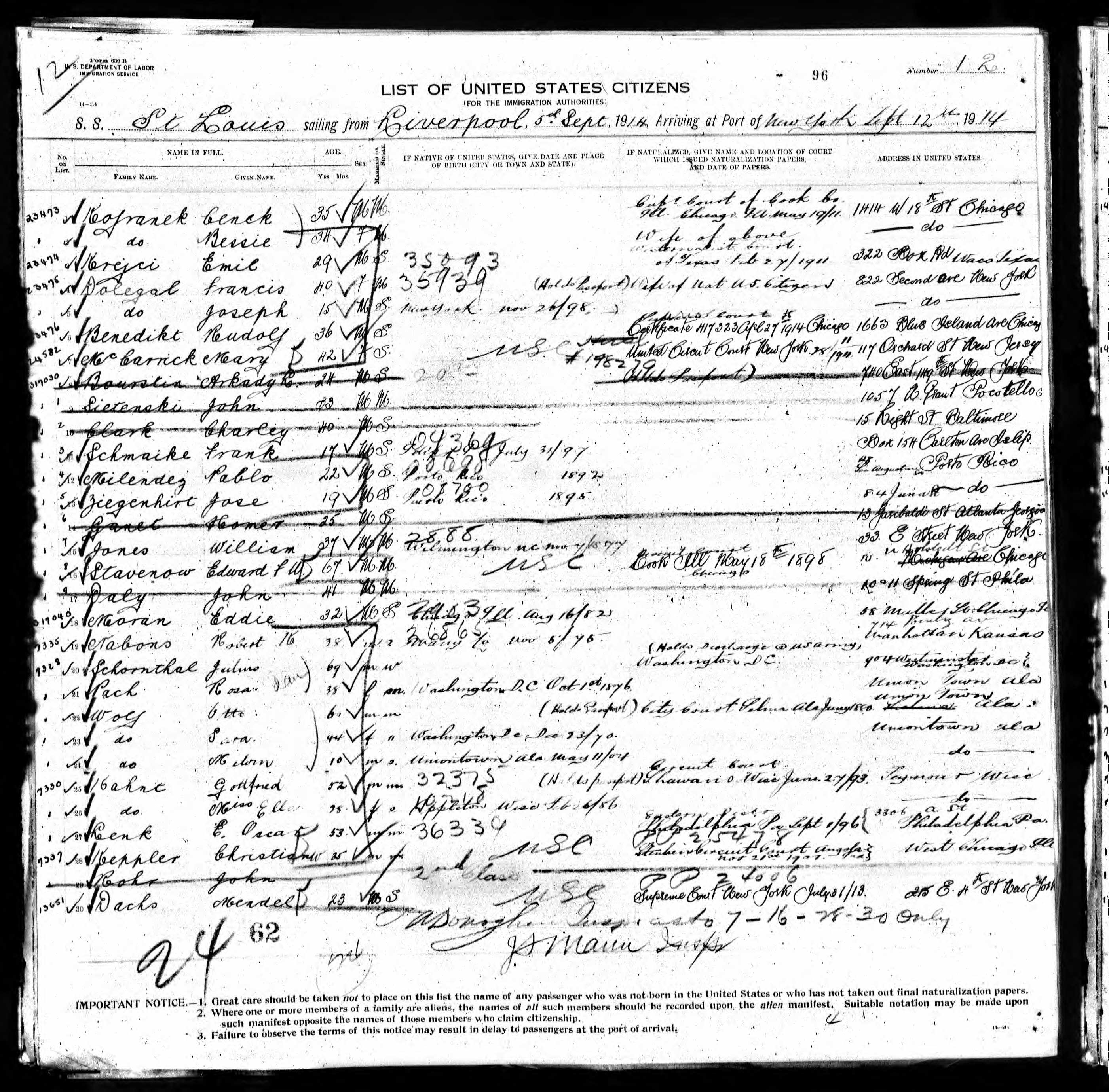
In the summer of 1914, Julius Schoenthal and his daughter Rose Schoenthal Pach traveled to Europe together; on the passenger manifest for their return trip in September, 1914, there is a notation on the entry for Julius, noting that he was naturalized in DC and had been discharged from the US Army.   Was the carrier, or the US generally, suspicious of a foreign-born traveler, given that World War I had just started a few months before?

Passenger Manifest for Julius Schoethal and Rose Schoenthal Pach 1914 Year: 1914; Arrival: New York, New York; Microfilm Serial: T715, 1897-1957; Microfilm Roll: Roll 2368; Line: 1; Page Number: 96

Passenger Manifest for Julius Schoethal and Rose Schoenthal Pach 1914
Year: 1914; Arrival: New York, New York; Microfilm Serial: T715, 1897-1957; Microfilm Roll: Roll 2368; Line: 1; Page Number: 96

It was after this trip that Julius reported that Americans were being well treated by the Germans and that in Berlin the government was closing down hotels that overcharged Americans.  I found it quite interesting that Julius, who had by that time lived in the US for over forty years, still seemed to feel some loyalty to his birth country.  I wonder how he felt once the US went to war against Germany a few years later.

Julius Schoenthal news article re Germany WW I

The family made the newspaper again in 1916 when Leo and his wife Fannie celebrated their 15th wedding anniversary:

Schoenthal party for Leo 15th anniversary

When the US entered World War I, all three of Julius Schoenthal’s sons registered for the draft.  Leo was now the chief inspector for the District of Columbia; Sylvester was a car repairmen for the Washington & Southern Railroad Company; and Moretto was still an insurance agent for the Insurance Company of Virginia.  Their brother-in-law Joseph Pach registered in Uniontown, Alabama, describing himself as a merchant.  It does not appear, however, that any of them served in the war.

Sylvester and his wife Bessie, who had married in 1905, had not had any children listed on the 1910 census, but by 1920 they had two daughters: Margaret, born in 1914, and Helen, born in 1918.  Leo’s daughter Minnie and Moretto’s son Arthur were teenagers by then.  Rose and Joseph did not have any children, as far as I can tell.

On March 2, 1919, Julius Schoenthal died in Uniontown, Alabama; he must have been visiting his daughter Rose when he died.  He was 74 years old and was buried at Washington Hebrew Cemetery in DC, where his wife Minnie had been buried 20 years earlier.

Julius had lived an interesting life, serving in the Germany army and then the US army after immigrating, and then seeking a position in the US government after that service.  He must have felt proud to be a US citizen and a veteran, yet he was accused of being an anarchist in 1888.  That obviously hurt him enough that he sued for libel; also, I have to wonder how he felt after repeatedly having his requests for increased pension payments denied.

He lost his wife at a relatively young age and never remarried.  He had four children, three sons who lived close by throughout his life and a daughter who moved over 800 miles away.  But when he died, he was with his daughter in Alabama, not his sons in DC.  He worked as a shoemaker, a book salesman, and a seller of confections.  He had many family members living in Pennsylvania, but I can find no indication that he had much contact with them after moving to Washington, DC., except for his niece Hilda living down the street in 1910.

As for his children, the three sons were all still living in DC in 1920, all still working at the same occupations.  Rose and her husband Joseph were still in Uniontown, Alabama.  At the time he died, Julius had four grandchildren: Arthur, Minnie, Helen, and Margaret Schoenthal, all living in Washington, DC.

More about his descendants in a subsequent post.


The Memoirs of Lotte’s Sister Doris: Another Perspective on Life in Hitler’s Germany

Many of you enjoyed the memoirs and other writings of my cousin Lotte Furst, which are posted here, here, here, and here.  You will recall that Lotte and her family lived in Mannheim, Germany, and were living a comfortable life in a good home; Lotte’s father was a doctor, and her mother was the granddaughter of Hieronymous Seligmann, younger brother of my great-great-grandfather Bernard Seligman.  When the Nazis came to power, Lotte’s life changed forever.  After suffering through years of anti-Semitism and deprivation of their rights, her family finally decided to leave Germany and came to the United States.  Lotte’s writings described in vivid terms her perspective on all of this as she experienced it as a young girl and then as a young woman.

I recently learned that Lotte’s older sister Doris also wrote a memoir.  Doris was four years older than Lotte, and thus I was curious as to how her perspective was like or different from that of her younger sister.  When Hitler came to power in 1933, Doris was seventeen and thus would have had a more adult-like view of things.  Doris died in 2007, and her daughter Ruth was kind enough to share her mother’s memoirs with me.  Much of it is quite personal, so I am going to focus on those sections that provide insights into the larger questions: what was life like before Hitler came to power, how did it change when he did, and what led to the decision to leave Germany? [All material quoted from Doris Gruenewald’s writings is protected by copyright and may not be used without the permission of her children.]

By Snapshots Of The Past (Parade Place and Kaufhaus Karlsruhe Baden Germany) [CC BY-SA 2.0 (http://creativecommons.org/licenses/by-sa/2.0)], via Wikimedia Commons

By Snapshots Of The Past (Parade Place and Kaufhaus Karlsruhe Baden Germany) [CC BY-SA 2.0 (http://creativecommons.org/licenses/by-sa/2.0)%5D, via Wikimedia Commons

Doris was born in October 1916 in Mannheim; Germany was in the midst of World War I, and her father, Joseph Wiener, was drafted into the German army as a medical officer soon after she was born.  Her mother, Annie Winter Wiener, went with Doris to live with her parents, Samuel and Laura (Seligmann) Winter in Neunkirchen, where Samuel owned a women’s clothing business.  Annie’s brother Ernst had recently been killed while serving in the German army after volunteering against his parents’ wishes.  Doris wrote:

He had been the apple of their eyes and his death dealt a terrible blow to both.  My grandmother wore only black from then on, and my grandfather’s health began to deteriorate.  They also lost their sizable fortune, having bought war bonds as their patriotic duty, which at the end of the war were not worth anything anymore.  My grandfather’s business was dissolved and then reestablished on a much smaller scale.
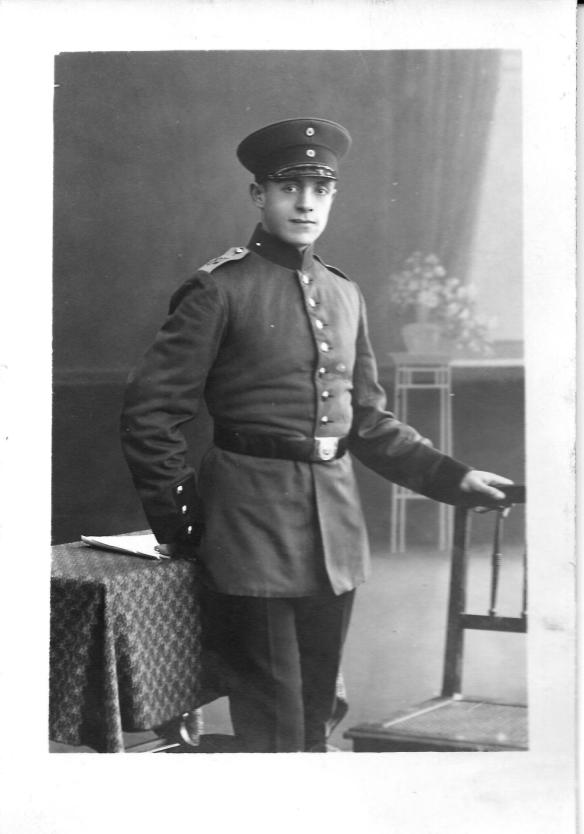
Ernst Winter Courtesy of Lotte Furst

Ernst Winter
Courtesy of Lotte Furst

Doris compared her grandparents’ home in Neunkirchen with her own home in Mannheim:

The house in Neunkirchen had a large garden in back of it, most of which was rented out.  The smallest part, directly behind the house, was used for growing some vegetables and flowers.  I remember loving to play in the garden and watching earthworms after a rain as well as other living creatures.  In Mannheim there was little opportunity for this kind of nature watching as we lived in a built-up urban area with little greenery, other than a well laid out park some distance from our apartment.
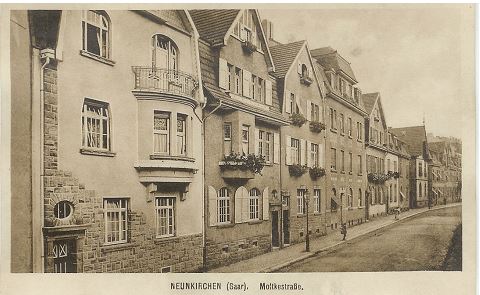
Neunkirchen

Neunkirchen

For several years while the French occupied parts of Germany after World War I, several family members housed French soldiers, and the neighborhood school Doris would have attended was also being used by the French military.  Thus, she had to go to a school somewhat further from her home for those years.  Like her sister Lotte, Doris pursued a highly academic path in school and was one of only six girls out of thirty students in her Gymnasium classes and then the only girl in her class when she reached the final years of her pre-university level education.

This excerpt provides a sense of the family’s lifestyle:

My parents employed a cook and a housemaid, and when my sister and I were still young, a “Kinderfraulein” who used to be an untrained young woman with an interest in children.  In other words, not quite a “governess.”  My father had help in his office and for some time also employed a driver after he developed a painful condition in his left arm, due to having to reach outside the car for shifting gears.  …. 

We had a Bechstein Grand piano in our living room. This instrument had been given to my mother as a young girl. She had really wanted to study music on a professional basis. But her parents felt that “proper” young ladies did not take up that kind of profession and did not allow her to pursue her wish. Instead, they bought her the Bechstein and let her have piano lessons.

I began taking piano lessons at age seven, with a teacher considered among the best in Mannheim. My mother, although an accomplished pianist, no longer played much. But occasionally, she and my father, who had learned to play the violin in his youth, would play duets together. That always was a special treat.

By Annaivanova (Own work) [CC BY-SA 3.0 (http://creativecommons.org/licenses/by-sa/3.0)], via Wikimedia Commons

By Annaivanova (Own work) [CC BY-SA 3.0 (http://creativecommons.org/licenses/by-sa/3.0)%5D, via Wikimedia Commons

I was particularly interested in what Doris wrote about the role of Judaism in the family’s life.

I grew up through the years with some awareness that we were Jewish, without knowing what significance that had then and later. Neither my parents nor my grandparents when I knew them observed any religious tenets. However, I was told that in past years my grandfather had been the head of the Jewish Congregation in Neunkirchen. My grandmother, who was president of the local Red Cross chapter for some time, used to fast on Yom Kippur. She reluctantly told me, when I kept asking her, that she had promised her dying mother to keep that tradition. As for me, I was kept home on the Jewish High Holy Days. My family did not attend any services.  …. 

At eight years of age I happened to be visiting my grandparents at the time of Passover. They had been invited by friends to a large Seder. Unfortunately, nobody thought of explaining to me what that was all about. My grandparents may have assumed that I knew, but I did not. I understood nothing of what was being read in Hebrew or spoken in German. I was utterly bored! Furthermore, when the ceremony asked for tasting the so-called bitter herbs, I bit off a piece of the horseradish on my plate and soon experienced the consequences of that act!

Unfortunately, I think far too many children, here in the US and elsewhere in the world, have that experience at seders.

The family was, however, required to provide some religious instruction because of the school system’s requirements:

There having been no separation of Church and State, religious instruction was part of the official curriculum. The students were separated one period per week according to their denominations. Most were Protestants, some were Catholics, and a few were Jewish. Since the number of Jewish children was so small, and in the case of my first-grade placement non-existent, my parents were required for that year to hire a private instructor in order to comply with the legal requirement. Thus, there suddenly appeared a not very clean looking young man with a greasy book, from which he proceeded to read and attempt to teach me-at six years of age-the Hebrew text. My recollection is that he came to our house only a very few times. I do not know how the religious instruction requirement was fulfilled after that disaster.

When, at fourth grade level, I changed schools, religion was taught by a little old man, a retired rabbi, who was very nice and even made some of what he taught rather interesting. But I developed no feeling for or interest in it at all, as it was totally divorced from the rest of my life.

Then, as Lotte also described, their father decided to withdraw from the Jewish community:

When I was fourteen, my father had some kind of a dispute with the Jewish Community, which was the official agency for collecting taxes. These taxes were legally mandated as a percentage of one’s general income tax obligation. I nearer knew exactly what the problem was, except that it had something to do with the amount owed, to which my father was apparently objecting. The Rabbi came to our house to straighten the matter out. Apparently he was not successful as subsequent events proved. (This rabbi became my brother-in-law at a much later time. He knew that I was far removed from religious observance, but he was always very tolerant and friendly to me.)

Whatever the problem had been, my father decided to leave the Jewish Congregation. Since I was already fourteen years old, I was required to state my personal intention. As I had no ties to the Jewish community, that was no problem for me. From then on I was without any religious affiliation, called “konfessionslos.” In practical terms it meant that I no longer had to attend religious instruction at school. I used the weekly free hour to visit the Art Gallery opposite the school building and saw a lot of very interesting, good art works.
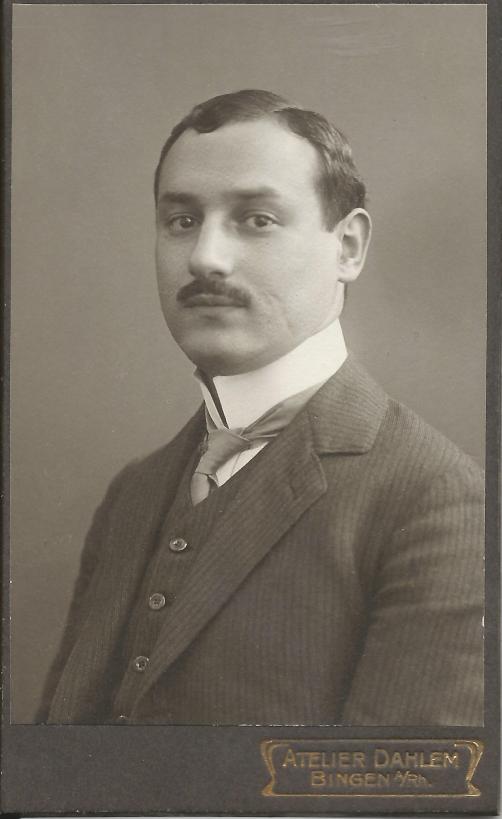
Dr. Joseph Wiener

Dr. Joseph Wiener  Courtesy of Lotte Furst

Of course, the family’s withdrawal from the Jewish community and lack of religious involvement did not make any difference in the eyes of the Nazis once they came to power.  Doris wrote:

Between 1932 and 1935 I had a valid German passport, used during those years primarily for trips to the Saar to visit my grandparents and take the then permitted two hundred German marks to be deposited outside Germany. In those years the Saar was still under the administration of a French post-World-War I governing authority. My grandmother took care of such transactions. By the time I needed a new passport, the Nazis had decided that a big “J” had to be stamped on any so-called non-Aryan, meaning Jewish, person’s passport. Word had gotten around that one of the clerks in the passport office in Mannheim would issue a “clean” document without the dreaded J, for suitable consideration. I went to that office, saw the clerk in question, and for the small sum of five marks was issued a regular passport without the J. I still have this passport as a memento.

When the Nazis assumed power in 1933, we as a family re-joined the Jewish Congregation as a matter of honor. Not that it would have made any difference had we not done so as the Nazis classified people not necessarily by religion but by their so-called racial identity.

German Jewish passports could be used to leave...

An example of German Jewish passport. (Photo credit: Wikipedia)

As Doris approached the end of her time in the local schools in the 1930s, she was both the only girl and the only Jew in her class.  She wrote that things did not change dramatically at school despite the political changes around them, but she did describe one troubling incident:

I entered the classroom in the morning, as usual. Upon approaching my desk, I saw that someone had pasted a viciously antisemitic sticker from the “Sturmer,” a rabidly anti-Jewish paper, on my desk. By that time, one of my classmates had begun wearing the SS uniform. I more or less assumed that he was the culprit, which in the end turned out not to have been the case. However, at that moment I decided not to confront him or anyone else. I sat down at another desk and waited for the right time to act. This came with the second period when the “Klassenlehrer”-the equivalent of our Home Room teacher-was due for his hour. … I waited for this teacher outside the classroom and told him my reason for doing so, adding that I knew there was nothing I could do about official policy and insults, but that I was not willing to put up with personal attacks.

This teacher, who, incidentally, had been an officer in World War I and had lost an arm, rose to the occasion. He and I entered the classroom together, and he immediately asked who had done this deed. Somewhat to my surprise, and perhaps his too, not one of the students admitted having put the sticker on my desk. There was nothing further he could have done: I do not remember whether he spoke to the class, but his earlier behavior had given ample proof of his opinion. … The incident occurred about one week before the final exam, the Abitur. It cast a pall over that important event.


Embed from Getty Images

Imagine being the only girl and the only Jew in the class and standing up for herself that way.  What courage it must have taken to do this.  What if her teacher had not been sympathetic?  Despite this stressful incident, Doris successfully passed the Abitur.  Although Doris was entitled to enroll in the university based on her father’s military service during World War I, Jews were prohibited from enrolling in either law school or medical school.  Instead, Doris decided to audit a few courses while awaiting a visa to leave Germany.  She wrote:

I had known for some time that I had to get out of Germany as there was no future there for me, and I was willing to take whichever came first [she had applied for both a US visa and a certificate to immigrate to Palestine]. However, I admit that I was relieved when the American visa materialized first.

The American Consulate closest to Mannheim was located in Stuttgart. In due course I was summoned for an interview with the American consular officials. I was in a somewhat unusual position in that my father had learned of a legal means of transferring money abroad, which was then discounted at the rate of fifty percent. The permissible amount was sufficient to enable me to show the U.S. Consulate that I had the requisite five thousand dollars for obtaining an immigration visa to the U.S. In this way I did not have to await my application number to come up in regular order, which would have taken a great deal more tame. I got my visa rather quickly. By that time I had also received a so-called Affidavit of Support from one of my grandmother’s cousins, whose father had emigrated in the nineteenth century and had settled in Cleveland, Ohio. This cousin was in very good financial circumstances and readily responded to our request for an affidavit.  …

I was very interested in determining who this cousin might have been.  If she was Laura Seligmann Winter’s cousin, she might have also been a cousin of mine, depending on whether she was a paternal cousin or not.  The only clues I had from Doris’ memoir were her married name (Irma Rosenfeld), her residence in Cleveland, her children: a son who was in his 20s in 1937, a daughter who was married, and another daughter who was a student at Vassar.

I found one Irma Rosenfeld living in Cleveland at that time who had two daughters and a son and was married to a man named Mortimer Centennial Rosenfeld (I assume the middle name was inspired by the fact that Mortimer was born in 1876, the centennial of the Declaration of Independence).  I sent Lotte the photo from that Irma’s passport application, but Lotte was unable to confirm from the photograph that it was the right Irma Rosenfeld.

Irma Rosenfeld and daughter passport photo 1924 Ancestry.com. U.S. Passport Applications, 1795-1925 [database on-line]. Provo, UT, USA: Ancestry.com Operations, Inc., 2007. Original data: Selected Passports. National Archives, Washington, D.C.

Irma Rosenfeld and daughter passport photo 1924
Ancestry.com. U.S. Passport Applications, 1795-1925 [database on-line]. Provo, UT, USA: Ancestry.com Operations, Inc., 2007.
Original data: Selected Passports. National Archives, Washington, D.C.

After reading Doris’ memoir, I went back to all the documents I had for her and examined more closely the passenger manifest for her trip to the US in 1937.  I had not seen the second page of it my first time through, but this time I noticed that it not only named Irma Rosenfeld; it had her street address in Cleveland.  It only took a glance at the 1940 US census for me to confirm that I had in fact found the correct Irma.
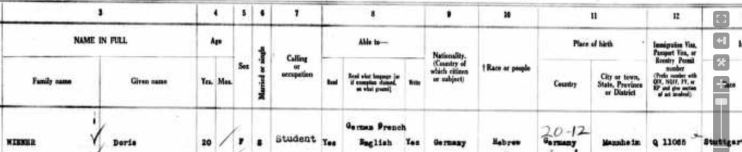
Doris Wiener 1937 ship manifest

Doris Wiener 1937 ship manifest part one

 p2 Ancestry.com. New York, Passenger Lists, 1820-1957 [database on-line]. Provo, UT, USA: Ancestry.com Operations, Inc., 2010. Original data: Passenger Lists of Vessels Arriving at New York, New York, 1820-1897.

p2
Ancestry.com. New York, Passenger Lists, 1820-1957 [database on-line]. Provo, UT, USA: Ancestry.com Operations, Inc., 2010.
Original data: Passenger Lists of Vessels Arriving at New York, New York, 1820-1897.

A little more research revealed that Irma’s birth name had been Irma Levi, daughter of Isaac Levi and Fanny Loeb.  Since Doris and Lotte’s great-grandfather (and my three-times great-uncle) Hieronymous Seligmann had married a woman named Anna Levi, I believe that that is the connection between Doris and Irma.  Anna Levi was a contemporary of Isaac Levi; perhaps they were siblings, and thus Irma Rosenfeld would have been a first cousin, twice removed, of Doris and Lotte, their grandmother Laura’s first cousin.  Obviously, the family had stayed in touch with these American cousins, and even though Irma was American-born and had never met Doris before, she reached out to help her escape the Nazi regime.

Continuing now with Doris and her emigration from Germany:

Necessary preliminaries having been taken care of and good-byes having been said, it was time to arrange for the journey to America. We bought a ticket for me on the SS Washington, a twenty-thousand ton ocean-going passenger boat, and also obtained railroad tickets for me and my mother who wanted to accompany me to Cherbourg, the place of embarkation. …

In Cherbourg I said good-bye to my mother, for whom the separation was very hard, more so than for me. For one thing, I was looking toward something new. But perhaps more importantly, I had unwittingly insulated myself to some degree from the impact of events. This condition lasted for a long time and to some extent gave me some emotional protection….

In contrast to so many, I confess that I had an easy time. Not only was the way for coming to America smoothed. My parents also were well able to pay for my ticket and whatever other expenses arose in connection with my leaving. I was twenty years old at that time.  …
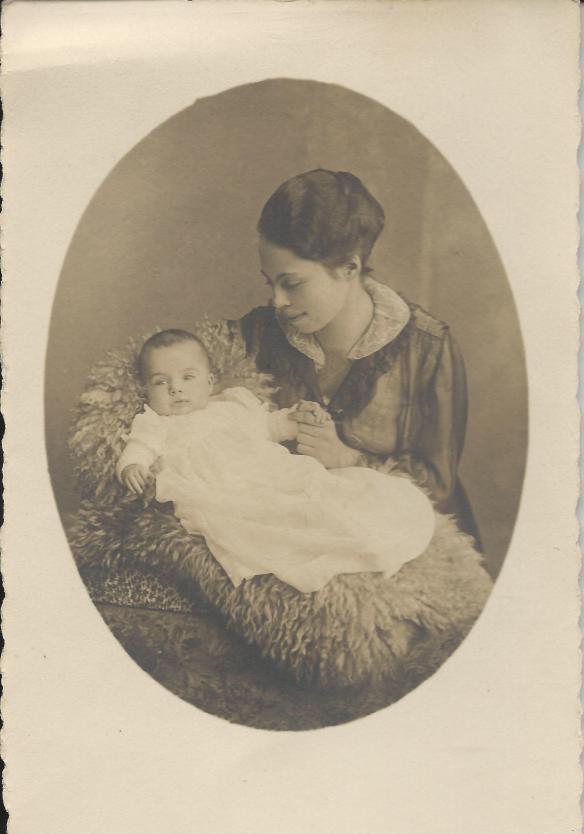
Aenne Wiener and Doris

Doris Wiener and her mother Courtesy of Lotte Furst

Doris explained why her parents and sister did not come with her:

The question has often been asked why my parents and sister did not come at the same time. Like a great many people, my father kept believing that the Hitler episode was just that, and he refused for a long time to see the situation realistically. Not so my mother. She was instrumental in organizing their own as well as her parents’ emigration to Luxembourg, and later their own to America.

Doris wrote that she arrived in New York in 1937 with $400.  Her parents had arranged for friends to meet her at the boat, and Doris stayed with them for a week before moving to her own apartment on the top floor of a building at 96th Street and Central Park West.  Doris also described a visit to Cleveland to see her grandmother’s cousin, Irma Rosenfeld, the woman who had provided the affidavit in support of Doris’ visa, as discussed above. “The slightly more than four weeks I spent with the Rosenfelds were very pleasant, with visits to their country club and other social activities.”  But Doris preferred to remain in New York City.

After returning to New York, Doris soon found employment in a dentist’s office and also soon met her future husband, Ernst Gruenewald.  They were married in May 1938.  Her mother Annie came to New York for the wedding, not only to witness the wedding but also “to gain insight into the international situation uninfluenced by German propaganda.”

My mother had intended to stay in America for about six weeks. But as she listened to the broadcasts available to us, she became increasingly agitated and decided to cut her visit short in order to initiate their emigration from Luxembourg to the United States. She had always been a very intelligent woman capable of making important decisions, many of which were advantageous. She returned to Luxembourg and was able to convince my father that this was the right thing to do. They arrived in the U.S. in April 1939, three weeks after the birth of our first child and about half a year before the outbreak of World War II.

Her grandparents, as we know from Lotte’s memoirs, did not fare as well:

During my childhood I had spent a good deal of time with them in Neunkirchen and was very fond of my grandmother. I knew her only from her mid-forties on, when in my eyes she was an old lady. She was a very reserved but warm person and managed their life very competently. My grandfather was a short, slim man who from the time I knew him as a person, was not well. …  My grandparents had applied for a visa to the United States before the outbreak of World War II, but failed to be granted immigrant status. In retrospect, I am convinced that my grandfather’s condition was the reason, as they had enough money to qualify for a visa. My parents also could have vouched for them. My grandfather ended up in Theresienstadt, where he died of pneumonia, as we were told after the war. My grandmother had suffered a fatal heart attack while still living in Luxembourg.

Doris and her husband Ernst and their family ended up relocating from New York to Chicago for a business opportunity a few years after her parents and Lotte arrived .  During the 1950s, Doris went back to school and obtained her bachelor’s degree while also raising her children; in 1961 she received a masters’ degree in psychology as well.  She then went on to get a Ph.D. in psychology, specializing in neuropsychology, which was itself still a relatively new field.  After obtaining her degree, she worked at Michael Reese Hospital in the Adult Inpatient department where she eventually became the director. Sadly, after twenty years there, she found herself forced out on the basis of their mandatory retirement age.  She had just turned seventy.

By Zol87 from Chicago, Illinois, USA (Michael Reese Hospital) [CC BY-SA 2.0 (http://creativecommons.org/licenses/by-sa/2.0)], via Wikimedia Commons

By Zol87 from Chicago, Illinois, USA (Michael Reese Hospital) [CC BY-SA 2.0 (http://creativecommons.org/licenses/by-sa/2.0)%5D, via Wikimedia Commons

In 1987 Doris and Ernst moved to California, where the winters were milder and where her sister Lotte was living.  Doris had obtained a California license before moving and was able to continue to practice as a psychologist when they moved, but did so only for a short period before retiring.  Ernst died in 1989, and Doris died almost twenty years later in 2007.

It was fascinating to me to read Doris’ memoirs after reading Lotte’s; both sisters wrote so clearly and so powerfully about their lives.  I can see that they had much in common: great intelligence, dedication to hard work and to family, astute powers of observation, and a love of language.  Doris struck me as the more thick-skinned of the two sisters, often talking about her independence and emotional distance from others, even as a young child.  Doris wrote about being somewhat of a loner and keeping her thoughts and feelings to herself.  I would imagine that those qualities served her well as she endured her teen years in Hitler’s Germany and a voyage alone to America in 1937 as well as her adjustment to life in America.

Overall, I am struck by how strong these two women were, both as children in Germany, as new immigrants to the US, and as women experiencing all the changes that came in the years after World War II.    I’d like to think some of that is the Seligmann DNA that we share, but I doubt that I would have been as resilient and brave as they had to be, if I had had to endure the challenges and hardships they did.



Another Twisted Family Tree Story: The Goldsmiths/Goldschmidts

One thing that has amazed me before in my research is how often various lines in my family interconnect, like the Hano, Nusbaums, and Cohens in Philadelphia.  In researching the Schoenthals, I’ve once again encountered one of those twists in my family tree.

In my September 25 post I shared the numerous records I was able to find, with the help of several others, for my Schoenthal ancestors, including the marriage record of my great-great-grandparents, Levi Schoenthal and Jhette (or Henrietta) Hamberg in 1839.  That record revealed that Levi’s father was Heinemann Schoenthal and his mother Hendel (or Handel) Beerenstein.  For the moment that is as far back as I’ve been able to go with my Schoenthal line, though I hope to be able to find more about the earlier history of both the Schoenthal line and the Beerenstein line.

Marriage record for Levi Schoenthal and Jhette Hamberg HHStAW, 365, 386

Marriage record for Levi Schoenthal and Jhette Hamberg
HHStAW, 365, 386

Thanks to the research done by David Baron and my third cousin Roger Cibella, I now know that Heinemann and Hendel had at least one other child, a daughter named Fradchen or Fanny, who was born in 1800 in Sielen, making her twelve years older than her brother Levi. (Hans-Peter Klein has uncovered another sibling, Minna, but that’s a story for another day.)

Unfortunately I’ve not yet found a birth record for Fanny, but there is a marriage record to support that conclusion.  David and Roger sent me a copy of this marriage record dated September 10, 1844 from Oberlistingen, a town very close to Breuna (and now one of the districts of the town Breuna).

Marriage of Simon Goldschmidt and Fradchen Schoenthal HHStAW Abt. 365 Nr. 669, S. 11

Marriage of Simon Goldschmidt and Fradchen Schoenthal
HHStAW Abt. 365 Nr. 669, S. 11

As translated for me by Matthais Steinke, the record records the marriage of Fradchen Schoenthal, daughter of Heinemann Schoenthal and Hendel Beerentstein, to Simon Goldschmidt, son of Jacob Goldschmidt and Hewa Seligmann.  (No, I do not think Hewa Seligmann was related to my Seligmanns, but who knows? But that’s not the twist here.)  The record lists Fanny as 37 years old in 1844, thus born in 1807.  Simon is listed as 42 on the marriage record and is described as a master tailor.

According to David and Roger’s research, Simon had been married once before to Edeline or Ella Katzenstein. (I also don’t know if Simon’s first wife was related to my Katzensteins, but I am looking into that.  But that also is not the twist here.)  Simon and Ella had five children before Ella died in 1840. Their children ranged from Jacob, who was 16 when his mother died, down to Josias, who was only a year old when Ella died. There were also two daughters, Lena and Hewa (Eva), and another son, Joseph.  Four years after Ella died, Simon married Fanny.

Almost exactly a year after their wedding, Simon, Fanny, and Simon’s nine year old daughter Eva (Hewa) from his first marriage emigrated from Germany to the United States, arriving in Baltimore on the ship Marianne on September 20, 1845. Simon listed his occupation as a tailor on the ship manifest.

Passenger manifest for Simon Goldschmidt, Fanny Schoenthal and Eva Goldschmidt Ancestry.com. Baltimore, Passenger Lists, 1820-1964 [database on-line]. Provo, UT, USA: Ancestry.com Operations Inc, 2006. Original data: Selected Passenger and Crew Lists and Manifests. National Archives, Washington, D.C.

Passenger manifest for Simon Goldschmidt, Fanny Schoenthal and Eva Goldschmidt
Ancestry.com. Baltimore, Passenger Lists, 1820-1964 [database on-line]. Provo, UT, USA: Ancestry.com Operations Inc, 2006.
Original data: Selected Passenger and Crew Lists and Manifests. National Archives, Washington, D.C.

On January 10, 1847, Fanny gave birth to a son, Henry.  One year later Fanny and Simon had another child, a daughter named Hannah, born on June 5, 1848.  Both Henry and Hannah were born in Baltimore, Maryland.[1]  In 1850, the family was living in Pittsburgh along with Simon’s two daughters from his first marriage, Eva and Lena.  (The census record has many errors, but it is clear that this is Simon and Fanny’s family even though the record has the names mixed up and the ages inaccurate.)

Simon Goldsmith 1850 US census

Simon Goldsmith and family 1950 US Census Year: 1850; Census Place: Pittsburgh Ward 3, Allegheny, Pennsylvania; Roll: M432_745; Page: 135A; Image: 274

Tragically for the family, just two years after giving birth to Hannah, Fanny died in 1850.  She was buried at Troy Hill Jewish Cemetery in Pittsburgh.   Some readers might remember that that is also where the elusive Fanny Wiler is buried, another mother who left young children behind after an untimely death.

Fanny Schoenthal Goldsmith Troy Hill Pittsburgh

By 1860, Simon Goldsmith had moved with his two young children to Washington, Pennsylvania, a town about 28 miles to the southwest of Pittsburgh.    Simon, Henry, and Hannah were living with Simon’s son from his first marriage, Jacob, who was now 35 years old, according to the 1860 census, and working as a merchant.  Jacob and his wife had six young daughters of their own by 1860, so it must have been quite a crowded household.[2]

Simon Goldsmith and family 1860 US census Year: 1860; Census Place: Washington, Washington, Pennsylvania; Roll: M653_1192; Page: 1188; Image: 627; Family History Library Film: 805192

Simon Goldsmith and family 1860 US census
Year: 1860; Census Place: Washington, Washington, Pennsylvania; Roll: M653_1192; Page: 1188; Image: 627; Family History Library Film: 805192


Washington, Pennsylvania (called “Little Washington” by some locals) was then a town of 3,587 people, according to the 1860 census reports, and had grown by 34% since the prior census in 1850. There was not yet a railroad line to the town at that time.  What drew all those people to this town?  The town’s website does not provide many clues in its history section:

With immigrants from the west of Scotland and the north of Ireland, and with many transferring their homes from the eastern and central parts of Virginia, the vicinity of Washington was settled in 1768. The Pennsylvania legislature passed an act on March 28, 1781, erecting the County of Washington and naming Catfish Camp as the place for holding the first election. This was the first county in the U.S. to bear the name of Washington.

David Hoge laid out a plan of lots immediately after the action of the legislature. His original plot bears the name “Bassett, alias Dandridge Town,” but before the plot was recorded, lines were drawn through “Bassett, alias Dandridge Town” with ink, and the word “Washington” was written above.

The town started with every evidence of progressive tendencies, as the original plot dedicated a tract of ground to the people for recreational purposes. A lot was given for a courthouse where the current building now stands, and Lots 43 and 102, according to the plan, were presented by Mr. Hoge to “His Excellency, General Washington, and Mrs. Washington.” Part of the townsite had been the camp of Tingoocqua, who was a chief in the Kuskuskee tribe of Indians.

The town was incorporated as a borough on February 13, 1810, and became a city of the third class in 1924.

Map of Washington County, Pennsylvania, United...

Map of Washington County, Pennsylvania, United States Public School Districts (Photo credit: Wikipedia)

There is a very detailed history[3] of Washington, Pennsylvania, available online through the University of Pittsburgh Historic Pittsburgh websiteOne tidbit I picked up from this history was that Jacob Goldsmith served on the town council in 1858.

Unfortunately, most of this text is devoted to describing the political history of the area and the individuals who were political leaders, and I could not get a sense of what drew people to the area initially.  Was it the proximity to Pittsburgh? Was it a good location for trade? Was agriculture the primary source of income? Whatever the reason that drew people there initially, the town had existed for many years by the time my relatives arrived.   From the 1860 census, I know that Jacob was a merchant, and I assume that with a town of over 3,500 people, there would have been a large enough population to support many merchants.

English: Map of Washington Pennsylvania from 1897

English: Map of Washington Pennsylvania from 1897 (Photo credit: Wikipedia)

One thing seems clear, however.  When Simon Goldsmith lived in Washington, Pennsylvania, in 1860, there was no synagogue there.  The first synagogue in all of Washington County, Beth Israel, was not founded until 1891. Although my ancestors had lived in small towns in Germany with very small Jewish communities, they had at least had synagogues and schools and cemeteries for their community.  I am not sure that when Simon arrived, there were any such facilities.

Why, you might wonder, am I dwelling on this town in western Pennsylvania where the widower of my great-great-grandfather’s sister lived with his two children? Because six years later, my great-grandfather’s brother Henry Schoenthal arrived in Washington with his wife and children, and some of his siblings followed in the years after.  Last to come in 1881 was my great-grandfather Isidore, accompanied by his mother Henrietta and his sister Rosalie.  And 23 years later in 1904, my grandmother Eva Schoenthal was born in Washington, Pennsylvania, the youngest child and only daughter of Isidore Schoenthal and Hilda Katzenstein.  It seems to me that Henry did not choose Washington randomly, but rather based on the fact that his first cousin Jacob Goldsmith and his aunt’s widower Simon Goldsmith were living there.

But I promised you a twist, and I still haven’t delivered.  Here it is. Simon Goldsmith was not only my great-great-aunt’s husband; he was also my four-times great-uncle himself.   Simon Goldsmith, husband of Fanny Schoenthal, had a brother named Seligmann Goldschmidt.  Seligmann had a daughter named Eva, just as his brother Simon did (both named for their grandmother, Simon and Seligmann’s mother Hewa).  Seligmann’s daughter Eva Goldschmidt was my great-great-grandmother; she married Gerson Katzenstein, my great-great-grandfather, and they were the parents of Hilda Katzenstein, who married Isidore Schoenthal, nephew of Fanny Schoenthal. Hilda Katzenstein and Isidore Schoenthal were my great-grandparents.

Stated as simply as possible, Simon Goldsmith was my four times great-uncle.  His wife Fanny Schoenthal was my three times great-aunt.   My grandmother Eva Schoenthal was a first cousin once removed from Henry Goldsmith, Simon and Fanny’s son, through her father’s side and his mother’s side:

Relationship_ Henry Goldsmith to Eva Schoenthal

She was also his first cousin twice removed through her mother’s side and his father’s side:

Relationship_ Henry Goldsmith to Eva GoldschmidtRelationship_ Eva Schoenthal to Eva Goldschmidt


They may have all left Germany, but they were still marrying within families they knew from back home.  Just another twist in my increasingly twisted family tree.  And more evidence of the limited gene pool created by endogamy and of the limited value of DNA predictions for Ashkenazi Jews.


[1] Fanny’s headstone says she was born in 1800.  I think it’s unlikely that Fanny had two children at ages 47 and 48, which is what she would have been if born in 1800 as her headstone indicates.  If, as her marriage record and the passenger manifest suggest, she was born in 1807, then she would have been having children at 40 and 41, which seems much more realistic.

[2] One thing that bothers me is that I cannot find out what happened to some of the other children of Simon Goldsmith and Ella Katzenstein.  Lena moved to Columbus, Ohio, after marrying Gustav Basch, and Joseph had died as a baby in Germany even before Ella died.  Eva immigrated with her father and step-mother, but then disappeared after the 1850 census; I assume she married. I’ve no idea what happened to Josias; perhaps he died before Simon left Germany, or maybe Simon left him behind with another family member.  Since they are not directly related to me, I am trying not to get too distracted looking for them, but eventually I will have to try and find out what happened to Josias and Eva.

[3] Title: History of Washington County, Pennsylvania: with biographical sketches of many of its pioneers and prominent men

Authors: Crumrine, Boyd, 1838-1916, Ellis, Franklin, 1828-1885, Hungerford, Austin N.

Collection: Historic Pittsburgh General Text Collection

Small World Story: The Hambergs of Breuna

English: Location of Breuna in district Kassel...

English: Location of Breuna in district Kassel, Hesse, Germany Deutsch: Lage von Breuna im Landkreis Kassel, Hessen, Deutschland (Photo credit: Wikipedia)

I am just a bit overwhelmed.  Digging through the archives from Hessen has been quite an adventure.  Not only have I found a great deal of information about the family of my great-grandfather Isidore Schoenthal, but I’ve also been wading through the archives searching for records of my Hamberg ancestors—that is, the family of my great-great-grandmother Henrietta or Jhette Hamberg of Breuna, who married Levi Schoenthal, Isidore’s father.  These German records are amazing.  Unlike my experiences searching for records in Poland for my Brotman ancestors, I am just swamped with information about my German paternal ancestors from Hessen (and I haven’t even begun looking at the records for Isidore’s wife, my great-grandmother Hilda Katzenstein, whose family was also from Hessen).

I am still compiling and editing the Hamberg information, and I am ready to start writing more about what I know about the Schoenthals later this week.  But for now here’s a little bit of what I’ve learned about the Hamberg family.

As mentioned, they were from Breuna.  Breuna is another small town in the Kassel district of Hessen, not too far from Sielen (about 26 km), where the Schoenthals lived.  According to the town’s official website, as translated by Google Translate, Breuna is 758 years old.  I could not find much about its history, but according to the town website, it was under the control of various aristocratic families over the centuries.

Today the original small village of Breuna where my ancestors lived is incorporated into a larger town, also called Breuna, consisting of five districts, one of which is the smaller village of Breuna; another is Oberlistingen, where some of my other relatives not yet discussed lived.  The town’s website described the town as an “Arbeiter-Wohnsitz-Gemeinde” or “worker-resident community,” where most people commute to the larger cities for work.

The town’s website also states:

Particularly noteworthy are the natural, wooded, yet convenient position of the municipality. Pure nature with freeway access! The advantages of a rural environment without having to sacrifice the most important social and cultural institutions and the relative proximity to the North Hessian metropolis of Kassel, the beautiful half-timbered towns Hofgeismar, Wolf Hagen, the spa of Bad Arolsen and the East Westphalian town of Warburg.

The website goes on to point out that although once an agriculture-based economy, Breuna no longer is primarily agricultural.  There are only a few full-time farmers, and they focus on pigs, dairy, and grain.

The population of the larger Breuna town today is about 3700 people, with the smaller district of Breuna consisting of about 1500 people.

As for Breuna’s Jewish history, the Alemannia-Judaica reports that there were four Jewish families in Breuna in 1744 and 1776.  By 1833, there were 53 Jewish residents, and after that the Jewish population started to decline.  There were 29 in 1871, 40 in 1885, 33 in 1895, 23 in 1905, and 14 in 1910.  The overall population of the town was between 900 and 1000 during these years, so the Jewish population was quite a small percentage of the overall population. Most of the Jews were engaged in horse and cattle trading, and some were farmers.    There was a synagogue, a school, a mikvah, a chevra kadisha (burial society), and a cemetery.  There was still a small Jewish community in Breuna when the Nazis came to power in 1933.  Almost none of those who remained survived the Holocaust.

For close to fifty years, the leader of the Jewish community in Breuna was Baruch Hamberg, according to Alemannia-Judaica.  He was my second cousin, three times removed, as described below.   His 75th birthday celebration was written up in one of the local papers in an article describing his prudence and vigor and wishing him many years ahead.

Article about Baruch Hamberg's 75th birthday Jüdischen Wochenzeitung für Kassel, Kurhessen und Waldeck" vom 29. Mai 1931 http://www.alemannia-judaica.de/images/Images%20368/Breuna%20JuedWZKassel%2029051931.jpg

Article about Baruch Hamberg’s 75th birthday
Jüdischen Wochenzeitung für Kassel, Kurhessen und Waldeck” vom 29. Mai 1931
http://www.alemannia-judaica.de/images/Images%20368/Breuna%20JuedWZKassel%2029051931.jpg

How was Baruch related to me? From my research, I’ve learned that Henrietta Hamberg, my great-great-grandmother who married  Levi Schoenthal, was the daughter of Moses Hamberg and Guetchen Rosenberg.  According to at least one record, Moses was a cattle merchant. Moses and Guetchen had nine children (or at least that is how many I have located so far).  One family tree on Geni says that Moses was born in Burgsinn, Bavaria on June 12, 1777, but I’ve not found any definitive source to corroborate that.  That tree also says that Moses’ father was named Juda and that his mother was Rachel Simon, but I am still looking for corroboration of those facts as well.  One reason I am skeptical is that the Hessen archives have a transcription of Moses’ headstone, which indicates that he was born in 1785 and that his father’s name was Huna, not Juda.  On the other hand, the first son born to Moses and Guetchen was named Juda, and that would suggest that perhaps Moses’ father was named Juda.

UPDATE: I’ve now seen, thanks to Hans-Peter Klein, a birth registry for Moses which gives his father’s name as Juda Moses, his mother’s as Rachel Simon, and his birthdate as 1777.  Looking again at the headstone transcription, I now think it says he was 88 years old when he died, not 80, so 1777 as his birth year is consistent with the headstone.  I still cannot explain why it has his father’s name as Huna.

Headstone for Guetchen Rosenberg Hamberg (12) and Moses HambergHHStAW Abt. 365 Nr. 97, S. 6

Headstone inscription for Guetchen Rosenberg Hamberg (12) and Moses Hamberg HHStAW Abt. 365 Nr. 97, S. 6

The Geni tree also asserts that Moses had a brother named Samuel, and I have found many records for Samuel Hamberg and his family.  According to the death record I found for him, he died on December 11, 1857, at age 80, so he would have been born in 1777.

(UPDATE: the same record that listed Moses’ parents and birth year lists Samuel’s birthdate as July 13, 1780.  I can’t explain the discrepancy between the birth registry and the death record except to say that one is incorrect.)

Samuel married Kreschen Baruch, and they had five children.  Their first-born son was also named Juda, lending further weight to the possibility that Juda was the name of the father of both Moses and Samuel.  As you might imagine, having two men named Juda Hamberg in one small town can be quite confusing when looking at birth, marriage, and death records.

To keep them straight, the Breuna records refer to Moses’ son as Juda I, since he was born first (on October 10, 1812, according to the synagogue registry page for Moses and his sons).  Samuel’s son, Juda II, was born in 1820, according to the synagogue registry page for Samuel and his sons.

Eine Vervielfältigung oder Verwendung dieser Seite in anderen elektronischen oder gedruckten Publikationen und deren Veröffentlichung (auch im Internet) ist nur nach vorheriger Genehmigung durch das Hessische Hauptstaatsarchiv, Mosbacher Straße 55, 65187 Wiesbaden, Germany gestattet.

Synagogue Registry for Moses Hamberg and his sons  HHStAW Abt. 365 Nr. 96, S. 5

Synagogue Registry for Samuel Hamberg and his sons HHStAW Abt. 365 Nr. 96, S. 6

Synagogue Registry for Samuel Hamberg and his sons
HHStAW Abt. 365 Nr. 96, S. 6


Juda I was a horse dealer, and he married a woman named Dina Sauer.  They had five children.  Juda II was a merchant, and he married a woman named Breinchein Goldwein.  They had five children also; one of them was the afore-mentioned Baruch Hamberg who led the Breuna Jewish community for almost half a century.

You might wonder why I am bothering to report all this since neither Juda is a direct ancestor of mine.  Well, it’s some background to the small world story referred to in the title of this post.

Stepping back a bit, when I first started researching the Hambergs, the first place I went was to the Jewish Family Finder on JewishGen.org.  I searched for the surname Hamberg in Breuna to see if anyone else was researching that family, and sure enough, there was someone listed, though he’d not been active for many years.  There was no name disclosed, just a researcher ID number, so I sent a message to that researcher, not expecting a response, given how long it had been since that person had used JewishGen.

Then I saw the Geni page for Moses Hamberg, referred to above, and I sent a message to the Profile Manager on that page.  Little did I know that I had in fact sent two messages to the same person since the Profile Manager on Geni was the same person as the researcher listed on the Family Finder on JewishGen.  That person, a man named Rob, contacted me by email later that day, and we began to exchange information.  We exchanged information about the Hambergs and tried to sort out how we were related. (Rob pointed out that someone had made changes to his Geni information since he’d last looked at it, which is one reason I don’t like Geni—complete strangers can go in and change your tree without leaving any sources or explanations for the change.)  We are still working on that, and it’s somewhat confusing because of the two men named Juda Hamberg discussed above.  Rob and I are either fourth or fifth cousins, depending on whether he is a descendant of Moses Hamberg or Samuel Hamberg.  At the moment I think he is the great-grandson of Baruch Hamberg, the renowned leader of the Breuna Jewish community, and thus a descendant of Samuel.

But in addition to exploring the family history, Rob and I also exchanged current information about ourselves.  I mentioned that I lived in western Massachusetts, and Rob said he lived in eastern Massachusetts.  He mentioned the town where he lived (Arlington), and I responded that I also had once lived in Arlington over thirty years ago.  He then said he also had been living in Arlington that far back, and in fact once we exchanged street addresses, we realized that we had lived less than a mile from each other.

Corner of Park Avenue and Mass Avenue in Arlington By John Phelan (Own work) [CC BY 3.0 (http://creativecommons.org/licenses/by/3.0)], via Wikimedia Commons

Corner of Park Avenue and Mass Avenue in Arlington
By John Phelan (Own work) [CC BY 3.0 (http://creativecommons.org/licenses/by/3.0)%5D, via Wikimedia Commons

I then mentioned that we had very good friends who had also lived for a few years in Arlington, but had since moved to a nearby town, and I mentioned their names.  Rob emailed me back, saying that I had to call him because the coincidences were getting just too crazy.  It turns out that our friends have been close friends with Rob and his family for over twenty years.  We had undoubtedly all been at the same family celebrations for our mutual friends, including their daughter’s wedding just last year.

As Rob and I spoke on the phone, I had goosebumps, and I have them again as I write down this story.  Here was someone I had once lived near and with whom I shared good friends and who I might have even met or at least passed by in town or at a wedding.  But we never knew we were cousins, linked as descendants of the Hambergs of Breuna.  Isn’t it a strange and small world?  I am now looking forward to having a chance to share all these crazy coincidences with Rob and his wife and our mutual friends over dinner sometime in the near future.


The Genealogy Village Comes Through Once Again

As I mentioned in my last post, my great-grandfather Isidore Schoenthal was one of twelve children.  He and his siblings were born in Sielen, Germany, the children of Levi Schoenthal and Henrietta Hamberg.  The first helpful source I found about his family was a biography written about Isidore’s older brother Henry in 1893 as part of a commemorative book[1] celebrating Washington County in Pennsylvania, where Henry and Isidore both had settled after immigrating to the United States (the “Beers biography”).  Given that the Beers biography was written while both Henry and Isidore were still living in Washington, Pennsylvania, I was inclined to give it significant weight as a credible summary of Henry’s life to that point and of the background of his family.  I will refer to it in more depth when I focus on Henry himself, but for now I am referring to its assertions regarding the family of Levi and Henrietta (Hamberg) Schoenthal.

English: City Hall in Washington, Pennsylvania...

English: City Hall in Washington, Pennsylvania (in Washington County). (Photo credit: Wikipedia)

According to the Beers biography, Levi Schoenthal was born in 1813 and worked as a shoemaker.  He and his wife Henrietta had twelve children—nine boys and three girls.  Two of their sons died in infancy, but the other ten children survived to adulthood.  Of those ten, nine immigrated to the United States, and eight stayed here.  (The youngest child, Rosalie, returned to Germany to marry, and one son, Jacob, never left Germany.)  Of those who stayed in the United States permanently, my great-grandfather Isidore was the youngest and arrived last, along with his mother and Rosalie, in 1881.

Despite believing that this biography was probably fairly accurate, given that it was written so close to the time of the events reported, I nevertheless wanted to find some original German sources to verify the information.  Fortunately, I was able to verify quite a bit (but not all of it) by searching through the Hessen Archives as well as US records.  I was very lucky to have help from Dorothee Lottmann-Kaeseler (who correctly reminded me after my last post that she had first mentioned Sielen as my Schoenthal ancestral town), Hans-Peter Klein, Matthias Steinke, JewishGen, and the Hessian Archives.

Based first on a search through JewishGen, I was able to find birth records for almost all of the children of Levi and Henrietta in the Hessian State Archives.  The archived birth records available start in 1846, so I could not find records for the three children born before 1846 (Hannah, 1841; Henry, 1843; Julius, 1845), but using JewishGen and then manually scanning through the records, I was able to find birth records for seven of the other nine, including one for one of the two baby boys who had died in infancy.  So far I had not found any birth record for the other baby who died in infancy according to the Beers biography or for Jacob.

The fact that I was able to locate birth records for seven of the children astounded me.  Here are six of the birth records I found:

Amelia (Malchen) Schoenthal birth record January 2, 1847 Hessen Archives HHStAW 365 No 772

Amelia (Malchen) Schoenthal birth record January 2, 1847
Hessen Archives HHStAW 365 No 772


Simon (Sieman) Schoenthal birth record February 14, 1849

Simon (Sieman) Schoenthal birth record February 14, 1849   Hessen Archives HHStAW 365 No 772


Marcus Schoenthal birth record January 26, 1853

Marcus Schoenthal birth record January 26, 1853 Hessen Archives HHStAW 365 No 772

Sadly, Marcus died just ten days later:

Marcus Schoenthal death record Febuary 5, 1853 HHStAW fonds 365 No 773

Marcus Schoenthal death record Febuary 5, 1853
HHStAW fonds 365 No 773


Nathan Schoenthal birth record August 6, 1854

Nathan Schoenthal birth record August 6, 1854 HHStAW 365 No 772


Felix birth for blog

Felix (Seligmann) Schoenthal birth record December 15, 1856 Hessen Archives HHStAW 365 No 772


Rosalie Schoenthal birth record August 17, 1863

Rosalie Schoenthal birth record August 17, 1863 Hessen Archives HHStAW 365 No 772

One of the last birth records I found was the one for my great-grandfather Isidore.  I had scanned through the pages several times looking for his birth record, the one that mattered the most to me, of course.  But I hadn’t seen it, and I started wondering whether he’d been born outside of Sielen.  But then, giving it one last chance, I looked at every baby born in 1858, the birth year I had for Isidore, and saw one with the birth date November 22, 1858.  That date seemed familiar (though first I thought only because that was the day of the year JFK was assassinated in 1963), and when I saw that in fact other records had Isidore’s birth as November 22, 1858, I looked more closely at the record.  The entry was written in more traditional German script than many of the others, but I thought I could make out a word that just might be Levi.

Isidore birth for blog

Isidore (Isaak) Schoenthal birth record November 22, 1858 Hessen Archives HHStAW 365 No 772

So I posted a snapshot of the record to the German Genealogy group on Facebook, and sure enough my always helpful friend Matthias Steinke jumped right in and translated it for me.  Matthias said that for the baby, it says, “Male Gender, Isaac,” and for the parents, “Lewie (??) Schonthal shoemaker and Aesther (??) born Hamberg, legitimate parents.”  It was clear to me that this was the birth record for my great-grandfather.  His Hebrew name must have been Isaac—his secular name Isidore.  My guess is that Henrietta’s Hebrew name was Esther or that it actually says Jhette, which was Henrietta’s name in Germany; and I assume that “Lewie” is actually Levi.  I was very excited that I now had my great-grandfather’s birth record as well as those of most of his siblings.

I was still searching for a birth record for Jacob, however.  I had scoured through the Sielen birth records now multiple times without finding it, but according to a genealogy report prepared by Hans-Peter Klein, Jacob was born in December, 1850.  I went back one more time and found this record:

Jacob Schoenthal birth record December 1850

Jacob Schoenthal birth record December 1850

As you can see, although this reports a baby boy named Jacob born in December, 1850, on the left side of the page, the page with the parents’ information on the right is illegible, at least as scanned by the archives.  But I thought that this must be the record that Hans-Peter relied upon to obtain Jacob’s birthdate.  In addition, however, Hans-Peter located a marriage certificate for Jacob Schoenthal and his wife Charlotte (Lottchen) Lilienfeld, and that also included his birth date as December 22, 1850, as translated by my Facebook friend Matthias Steinke:

Eine Vervielfältigung oder Verwendung dieser Seite in anderen elektronischen oder gedruckten Publikationen und deren Veröffentlichung (auch im Internet) ist nur nach vorheriger Genehmigung durch das Hessische Staatsarchivs Marburg, Friedrichsplatz 15, D-35037 Marburg, Germany gestattet.

Marriage record of Jacob Schoenthal and Charlotte (Lottechen) Lilienfeld HStAMR Best. 920 Nr. 2610 Standesamt Gudensberg Heiratsnebenregister 1879, S. 11

Marriage record of Jacob Schoenthal and Charlotte (Lottechen) Lilienfeld
HStAMR Best. 920 Nr. 2610 Standesamt Gudensberg Heiratsnebenregister 1879, S. 11

5 – Gudensberg the 1st September 1879 – To the below signing registrar came for a marriage 1. the merchant Jacob Schönthal, at the moment shop-assistant in Cologne, identified by the shown certificates and in person by the present Beisen(?) Engelbert, israelic religion, born the 22 December 1850 in Sielen, residing in Cologne, son of the in Sielen deceased shoemaker Levi Schönthal and his wife Jettchen nee Hamberg, residing in Sielen and 2. the Lottchen (called Charlotte) Lilienfeld, known personally, israelic religion, born the 6th April 1855 in Gudensberg in house nr. 215 at her parents. Daughter of the cantor Meyer Lilienfeld I and his wife Hannchen nee Meiberg, residing in Gudensberg. As witnesses were present: 3. the merchant Beisen (?) Engelbert, personally know, 59 years old, residing in Gudensberg in house nr. 218, 4. the shop-assistant Michel Lilienfeld, known personally, 23 years old, residing in Halberstadt. Followed by the sentence whether they intend to marry each other and the signatures.

But it wasn’t over.  Now that I had all these birth records for their children, I wanted to know more about Levi and Henrietta and their parents.  I was very fortunate that Dorothee had recommended that I contact Hans-Peter Klein because he was able to provide me with some of that additional information.  He sent me a copy of the marriage record for Levi Schoenthal and Henrietta Hamberg:

Marriage record for Levi Schoenthal and Jhette Hamberg HHStAW, 365, 386

Marriage record for Levi Schoenthal and Jhette Hamberg
HHStAW, 365, 386

Once again, Matthias came through for me and translated this document:

nr 3, date of marriage 24 July 1839 – groom Levi Schönenthal, shoemaker in Sielen – bride: Jette Hamberg – unmarried in Bräuna(Breuna) age of the groom: 26 years, 9 month and 16 days – age of the bride: 22 years – parents of the groom: Heinemann Schönenthal, merchant in Sielen and Handel nee Beerenstein – parents of the bride: Moses Hamberg, merchant in Bräuna and Gutchen nee Rosenberg. entered in Breuna the 25th July 1839 by Itzig Eichholz

From this record I could now see that Levi (born October 8, 1812)  was the son of Heinemann Schoenthal and Handel Beerenstein, who lived in Sielen, and that Henrietta was the daughter of Moses Hamberg and Guetchen Rosenberg, who lived in Breuna, a town located less than 30 km from Sielen. (More on Breuna and the Hambergs in my next post.)

Now I had another family and three more surnames—Beerenstein, Hamberg, and Rosenberg— to add to my family tree, names I’d never known were those of my ancestors until now.  I now had the names of two more sets of my great-great-great-grandparents.  I now know the names and something about almost half of my great-great-great-grandparents.  I didn’t know any of their names at all when I first started doing genealogy. In fact, I only knew the names of two of my great-great-grandparents.

So thank you from the bottom of my heart to Matthias Steinke, Dorothee Lottmann-Kaeselar, and Hans-Peter Klein for helping me find another generation and another branch of my family.


.


[1] Beers, J. H. and Co., Commemorative Biographical Record of Washington County, Pennsylvania (Chicago: J. H. Beers & Co., 1893). Transcribed March 1997 by Neil and Marilyn Morton of Oswego, IL as part of the Beers Project. Published March 1997 on the Washington County, PA USGenWeb pages at http://www.chartiers.com/.  See http://www.chartiers.com/beers-project/articles/schoenthal-1057.html

The Schoenthals: Where They Came From

Deutsch: Deutsche Bundesländer Karte.

Deutsch: Deutsche Bundesländer Karte. (Photo credit: Wikipedia) (Note the location of Hessen in blue on this map.)

My great-grandfather Isidore Schoenthal came to the United States in 1881; he arrived in New York City on September 3 of that year on the ship Rhein when he was 22 years old.  I had known that he came from Germany, but not exactly where.  His death certificate said he was born in “Celand, Hess, Germany,” and from various other sources about him and his siblings, I concluded that the town where he was born was in fact Sielen, a small town in the Kassel district in the Hesse region of Germany.  Today’s post will focus on what I’ve learned about Sielen, the home town of my Schoenthal ancestors.

Sielen, Germany

Sielen, Germany

It was not that easy to find out very much about Sielen.  The town is so small (510 inhabitants as of 2011[1]) that it doesn’t even have a Wikipedia entry.  The closest major city is Frankfurt, and it is over 200 kilometers away, as are Dusseldorf and Cologne.  From what I can see on Google Maps, Sielen is surrounded for miles and miles by farmland.  The closest town is Trendelburg, which is about four kilometers away. It merits its own Wikipedia page, though that entry is all of three sentences and tells nothing of the history of the town.

Wikipedia reports that the population of Trendelburg was over 5000 people as of 2011, based on this website.  But according to the town’s official website, that number reflects not just the village of Trendelburg itself but the neighboring towns, including Sielen.  Trendelburg proper has just over 1100 residents.   Sielen has 552. Sielen is now considered a district within the larger town of Trendelburg.

Deutsch: Stadt Trendelburg

Deutsch: Stadt Trendelburg (Photo credit: Wikipedia)


From the Trendelburg official website, I was able to learn some information about the history of the town, though relying on Google Translate makes reading the German always somewhat bewildering.  Assuming I am reading most of the general information correctly, the history of Trendelburg as a separate entity began when a castle was built there in the 13th century by Konrad the III, Schoeneburg .  The location was already an important trade center for that region as it was close to a good fording spot on the Diemel River.   Over the next several centuries, the castle was used for many different purposes: a hunting lodge, the offices of the Prussian Forestry Department, and today as a privately-owned hotel and restaurant.

Die Trendelburg - Gesamtansicht, Hessen, Germany

Die Trendelburg – Gesamtansicht, Hessen, Germany (Photo credit: Wikipedia)

The hotel’s website includes some more detailed history of the castle:

With many twists and turns, the Diemel River meanders towards the Weser River. Right by Trendelburg Castle, there is a sharp bend around a rocky ridge which the locals called “Trindirberg” many years ago, probably naming the “mountain” after the village Trende, at the time situated to the west of the ridge but now completely vanished.

Sometime before 1300, Konrad the III of Schöneberg constructed a castle on this “mountain” to protect the main road from Kassel to Bremen. The settlement outside the castle also dates from this period.

Around 1305, Landgrave Heinrich I and the Bishop of Paderborn each purchased one half of the castle. The part belonging to Hessen was a Paderborn fief; the town’s official representatives were the Stoghusens, who lived in the castle for four generations.

In 1443 and 1456, the fortifications were renewed following serious fires. After their reconstruction, Trendelburg Castle was also changed, taking on the shape you see today. The fortifications were extended by a 38 metre high keep with four bretèches and a curtain wall in the shape of a pentagon with four small round towers. In the living quarters, which were erected in the 15th and the 17th century respectively, the remains of a late Gothic chapel with ribbed vaults have been preserved; the Trendelburg register office now uses this space for its civil wedding ceremonies. 

In the Thirty Years’ War, the castle was occupied by Tilly’s troops, and in 1637, it was destroyed by the Croats. In the Seven Years’ War, Trendelburg Castle was occupied by the French until they were driven off by Ferdinand V, the Duke of Brunswick, through artillery fire.

In 1901, military man Oberst Adalbert von Stockhausen, in all likelihood a descendant of the Stoghusens of old, bought the castle.

Taken over by the Dr. Lohbeck Group in 1996, the castle’s long-term future was secured by its conversion into a hotel for discerning visitors.

According to the hotel’s website, this is the castle where Rapunzel lived and let down her hair.  There is even a weekly “re-enactment” of this fairy tale at the castle.


Embed from Getty Images

The Trendelburg official website also contains some information about the history of Sielen itself. The village is bordered on one side by the Diemel River and surrounded by limestone hills. According to the website, a stone ax found in Sielen dated back to 6000 years ago, and a cemetery back to 1000 B.C.E.  A mill dating from 1243 remains as a ruin.

So what were my ancestors doing in this tiny village back in the 19th century and maybe before?  What kind of Jewish life could there have been? According to the Alemannia-Judaica website, there was a very small Jewish community in Sielen at least from the early 19th century.  In 1835, there were 38 Jewish residents; in 1861, there were 48.  By 1905, there were only fourteen Jewish residents, and by 1924, there were just four Jewish residents remaining. Like my own relatives, the Jewish residents either had emigrated outside of Germany or moved to the bigger cities.  During the Nazi era, those few remaining Jews in Sielen either left the area or were killed during the Holocaust.

Despite the tiny size of the Jewish community, there was a synagogue in Sielen from about 1817.  Originally a home owned by Moses Herzbach was used for prayer services, but in 1817, seven Jewish families sought permission from town officials to build a synagogue as an addition to Herzbach’s home.  Permission was granted, and Herzbach financed the construction of the synagogue.

There was also a Jewish school and a cemetery.  According to Alemannia-Judaica, at first Jews were buried in a cemetery in Trendelburg, but around 1846, a separate cemetery was established in Sielen on the road between Sielen and Trendelburg.  There are 26 graves there, including that of my great-great-grandfather Levi Schoenthal, as I will discuss in a later post.

Down the road in Trendelburg there was also a Jewish community with its own synagogue, cemetery, and school.  That community dates back to 1676, but also was quite small.  In 1731 there were 21 Jewish residents; the Jewish population peaked in 1827 at 31, but was down to just 12 by 1895.  There was a Jewish school in Trendelburg, where my great-grandfather’s brother Henry Schoenthal was a teacher before he immigrated to the United States.  There was also a mikveh, the ruins of which were discovered in 2001 during renovations and which can now be seen as a tourist attraction.  By Hitler’s time, there were only a handful of Jews remaining in Trendelburg, and they died in the Holocaust.

How did these Jews make a living in these small towns where the number of Jewish residents was so small? What were their lives like? I can’t say that I am surprised that my great-grandfather Isidore Schoenthal and almost all of his siblings left Sielen by the 1880s; my great-grandfather had ten siblings who survived to adulthood.  What kind of opportunities could they find in this small, rural town? Probably very few, and so they left and ended up all over the United States: Pennsylvania, New York, New Jersey, Colorado, Arizona, California, Illinois, Ohio, Florida, and so on.  They learned English, they worked hard and survived, and they became Americans.    Like Joseph and Bessie Brotman, Isadore Goldschlager, Bernard Seligman, John Nusbaum and Jeanette Dreyfuss, and Jacob Cohen and Sarah Jacobs, they took the risk of leaving behind what they knew so that they could make a better life for themselves and their descendants.  How fortunate I am to be one of those descendants.

English: Location of Trendelburg in district K...

English: Location of Trendelburg in district Kassel, Hesse, Germany Deutsch: Lage von Trendelburg im Landkreis Kassel, Hessen, Deutschland (Photo credit: Wikipedia)


[1]   http://www.citypopulation.de/php/germany-settlements-hessen.php?cityid=06633025_0B18

[i] http://www.citypopulation.de/php/germany-settlements-hessen.php?cityid=06633025_0B18