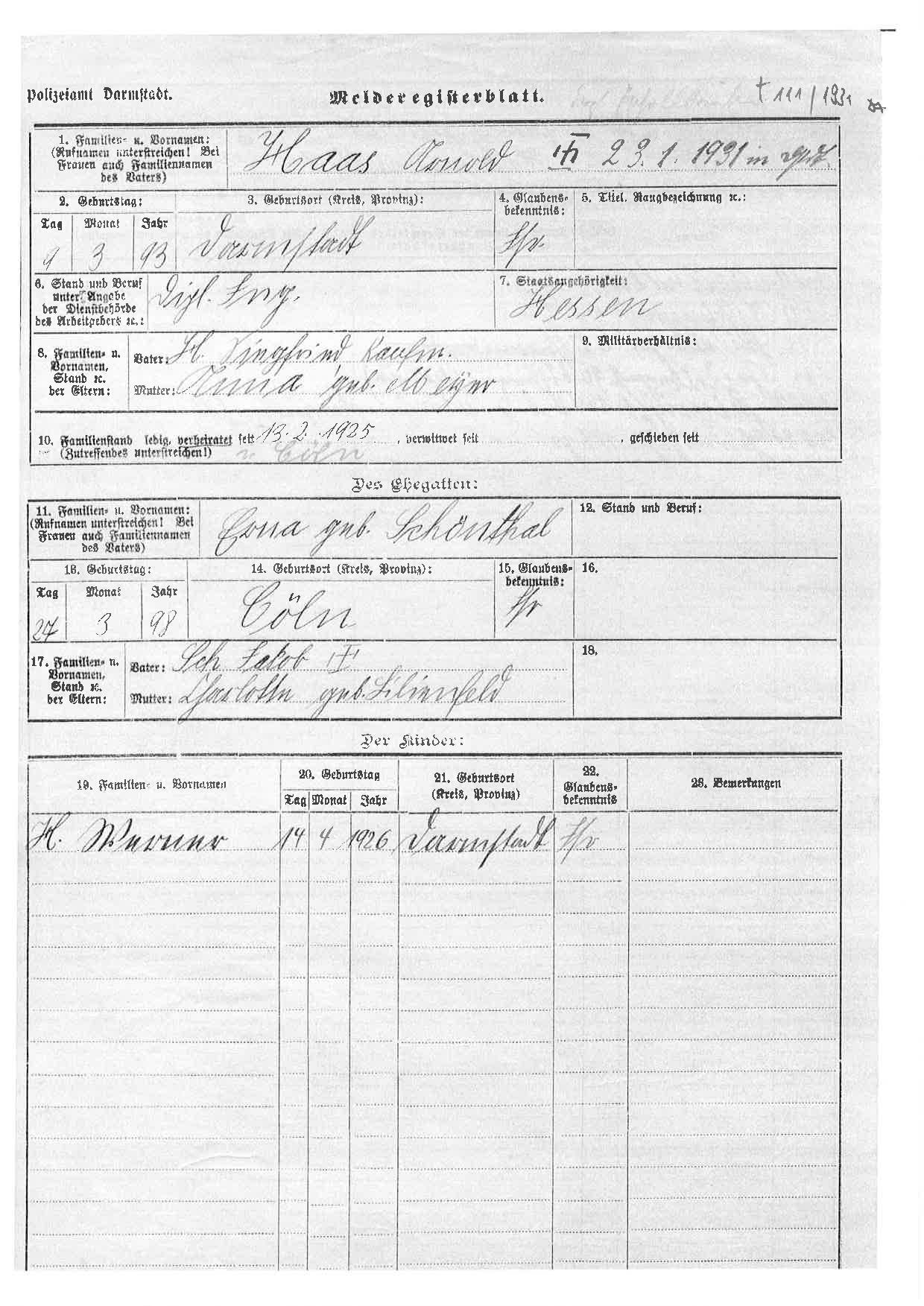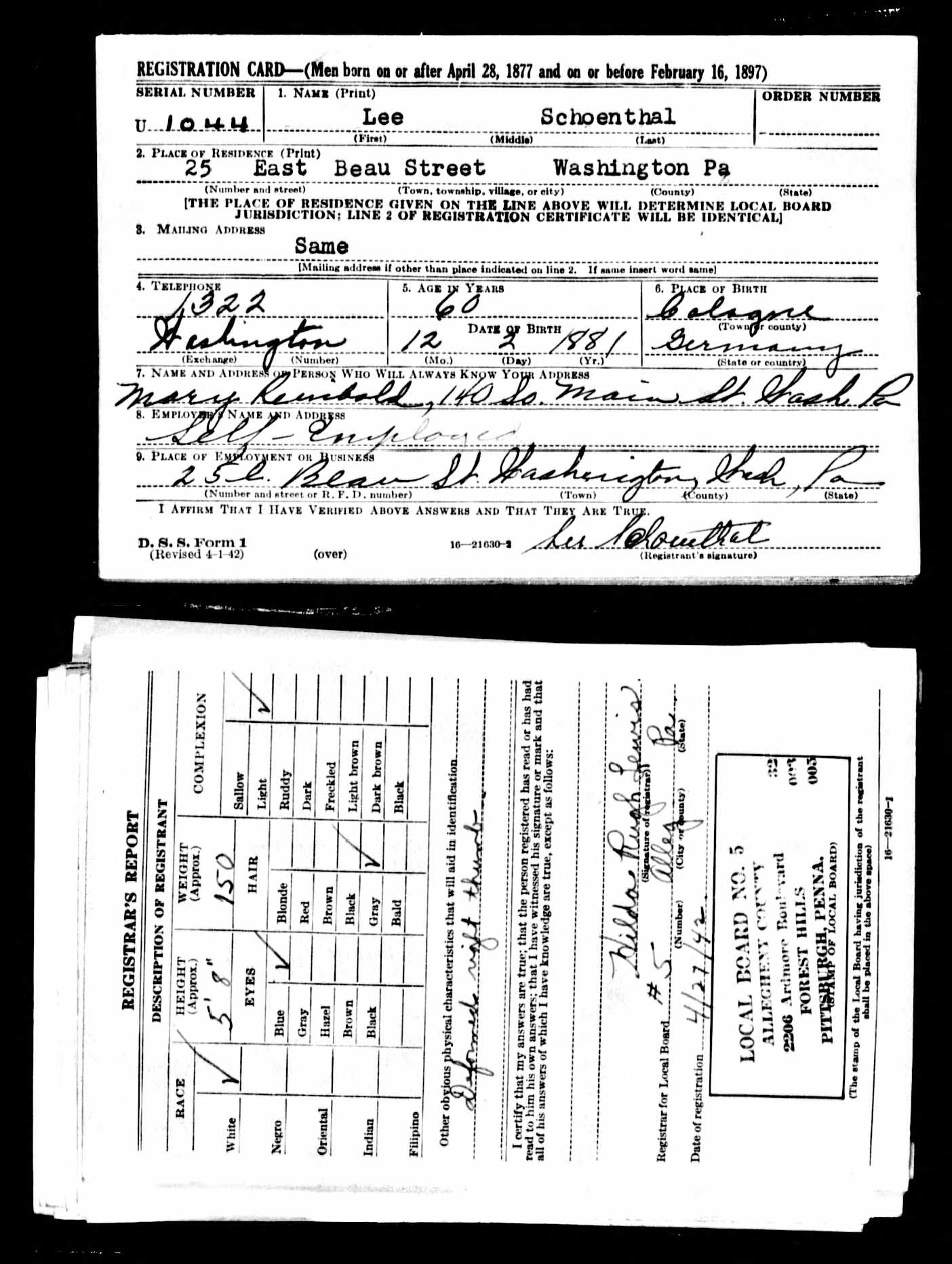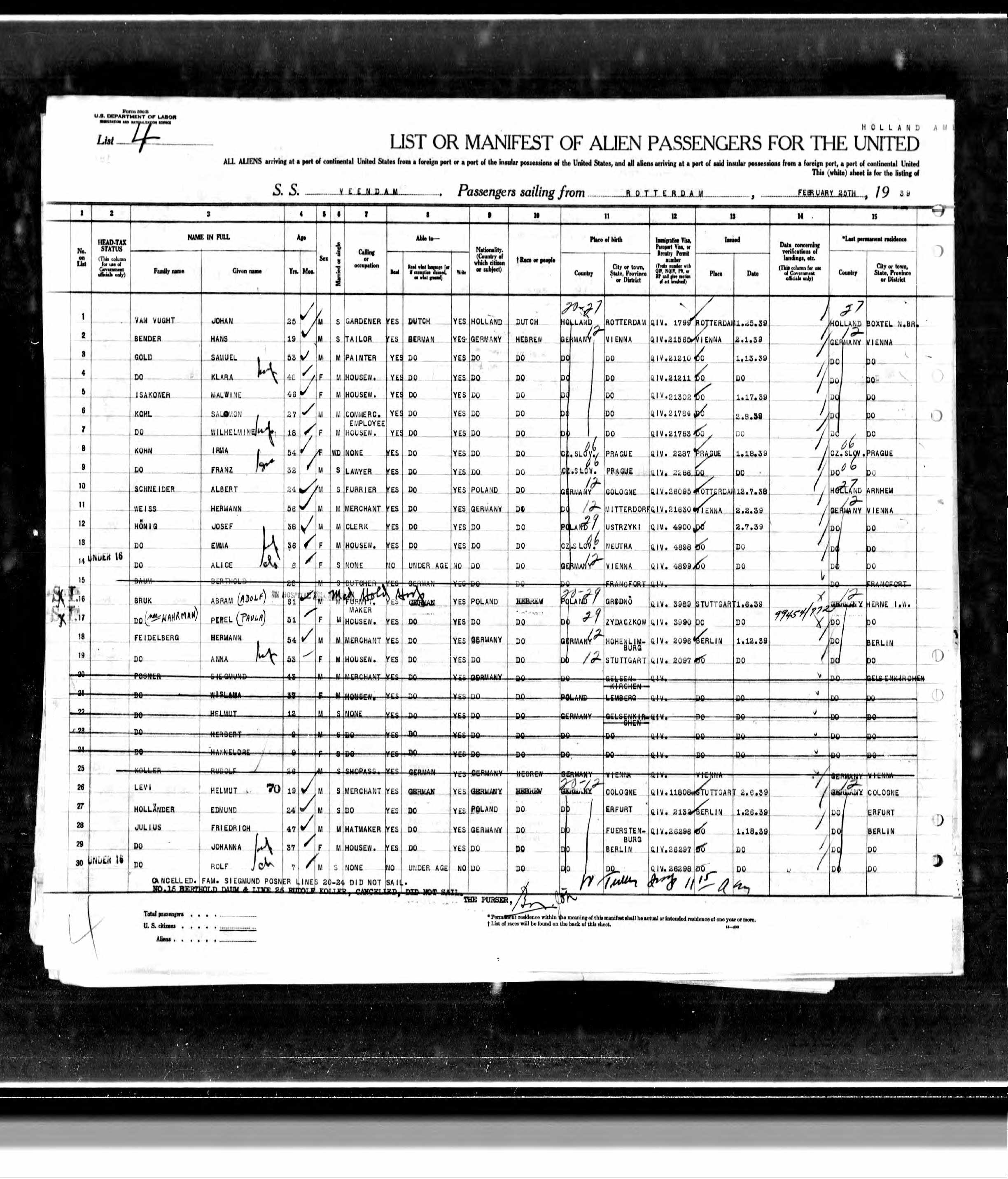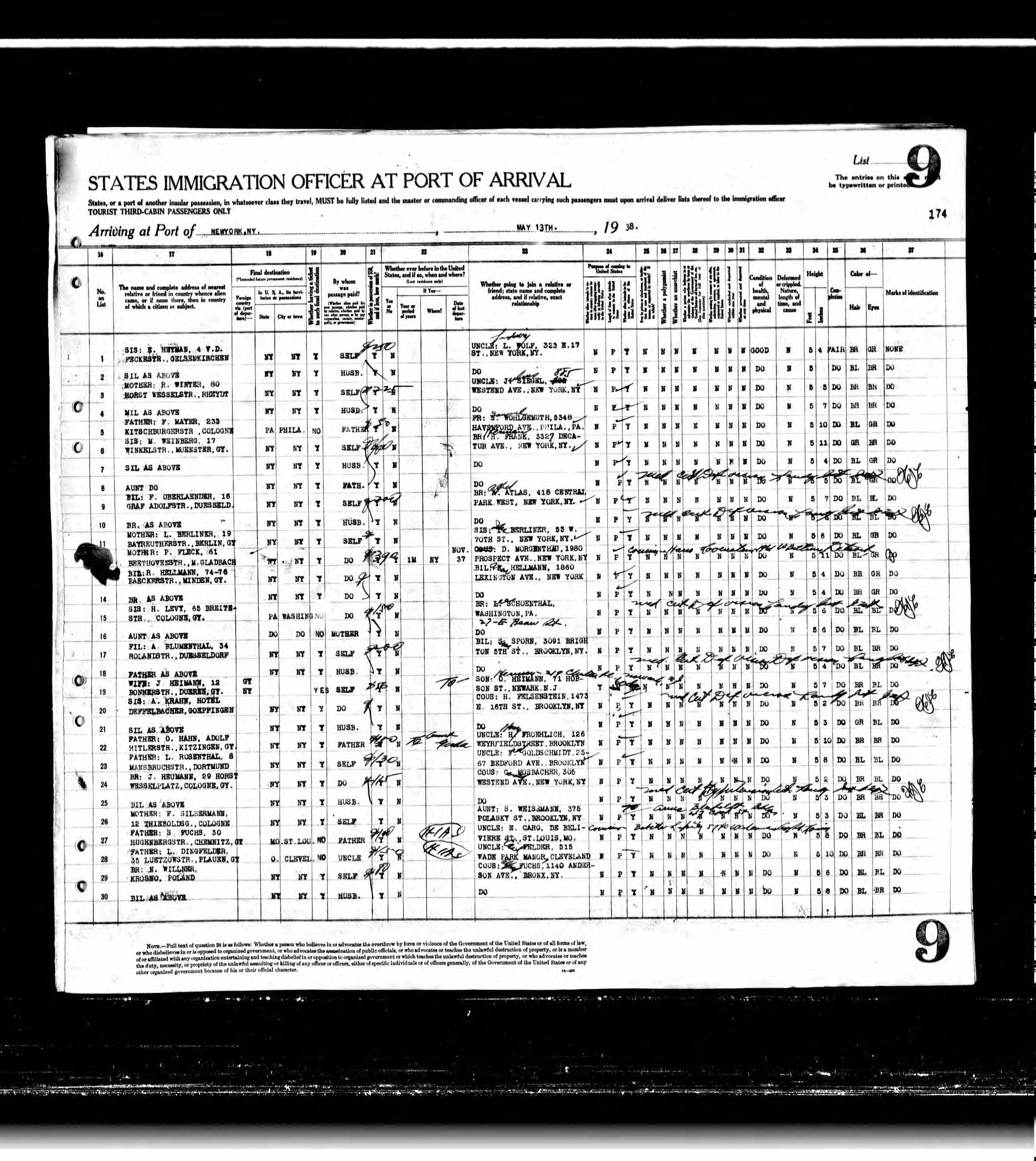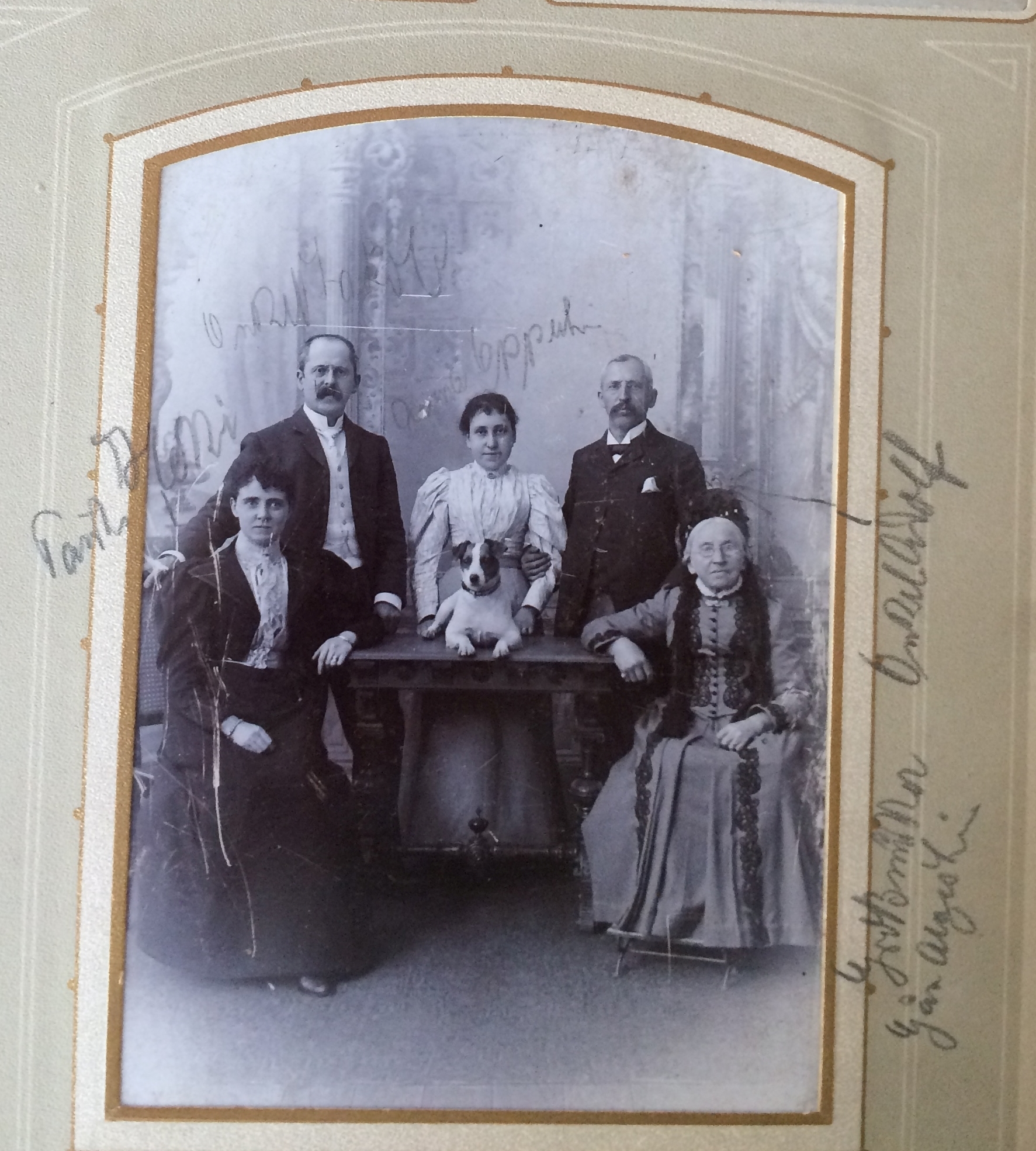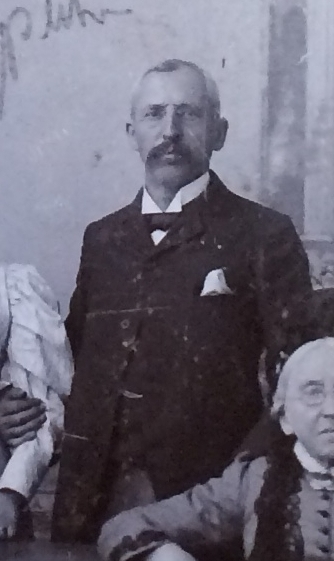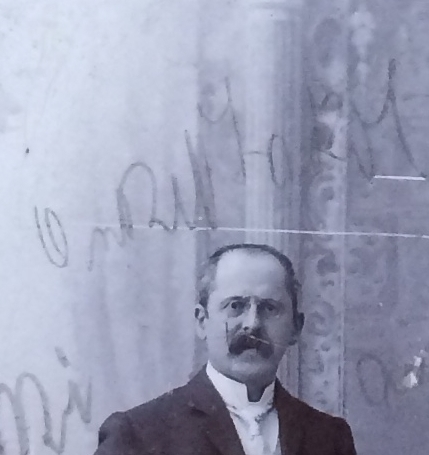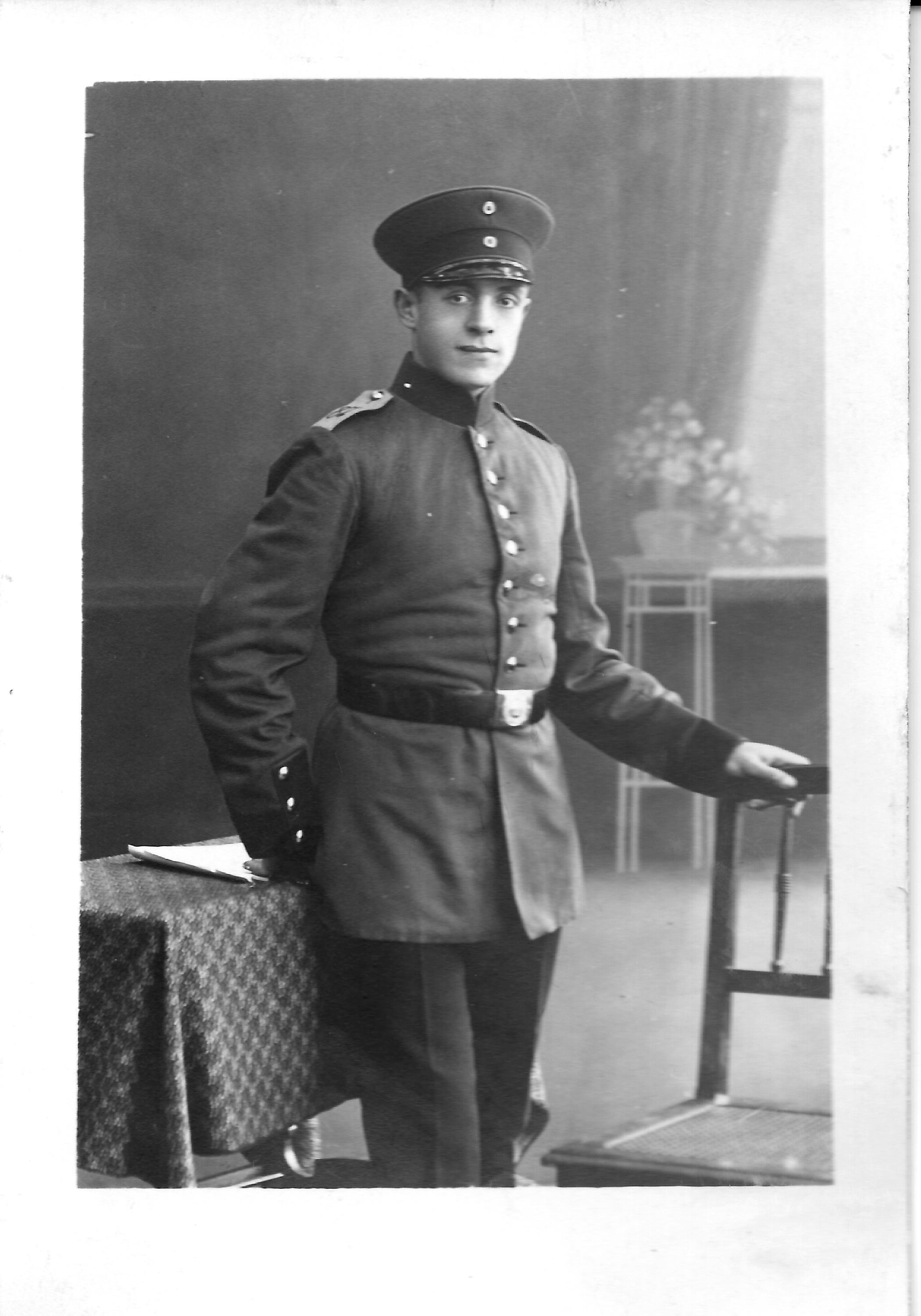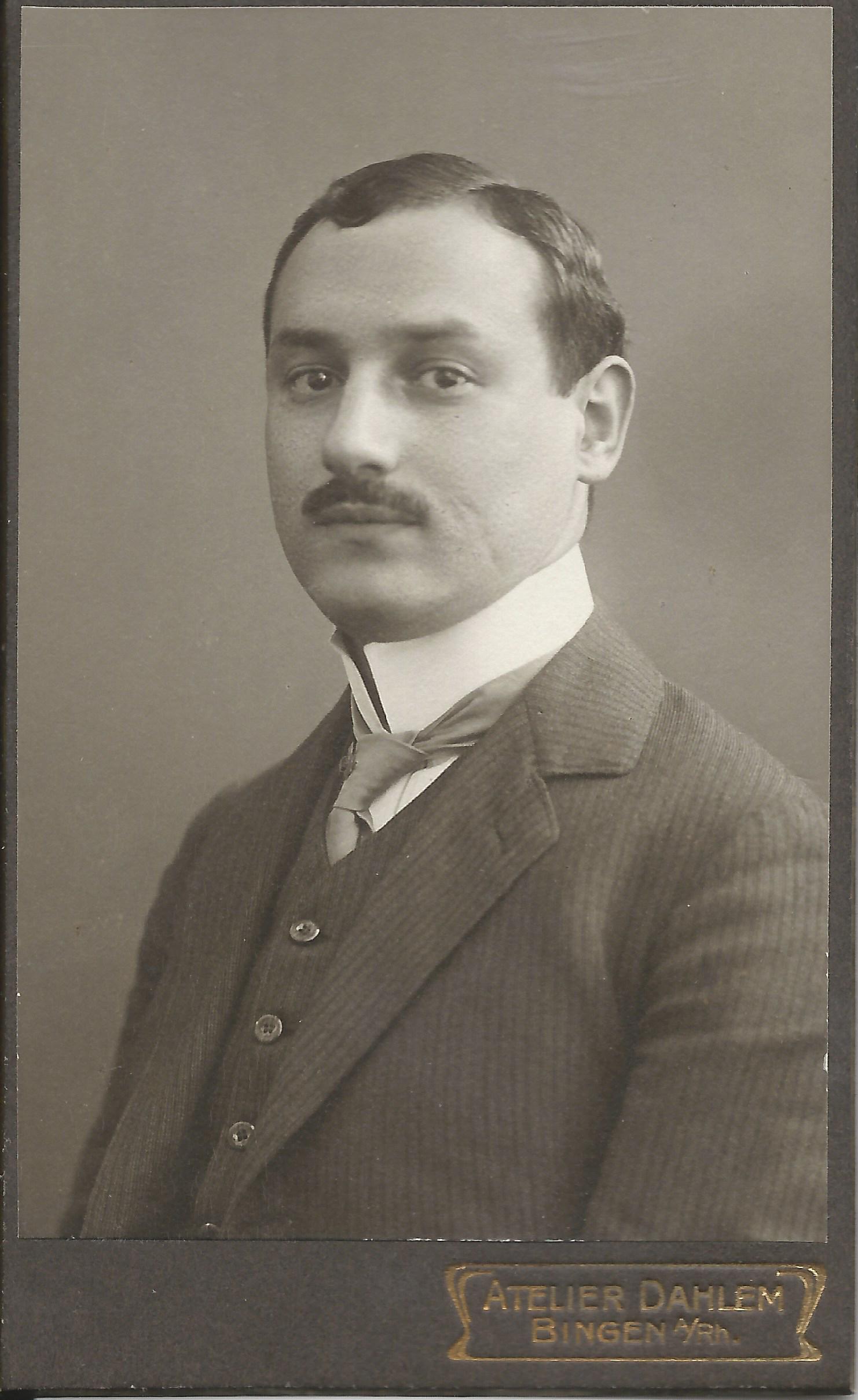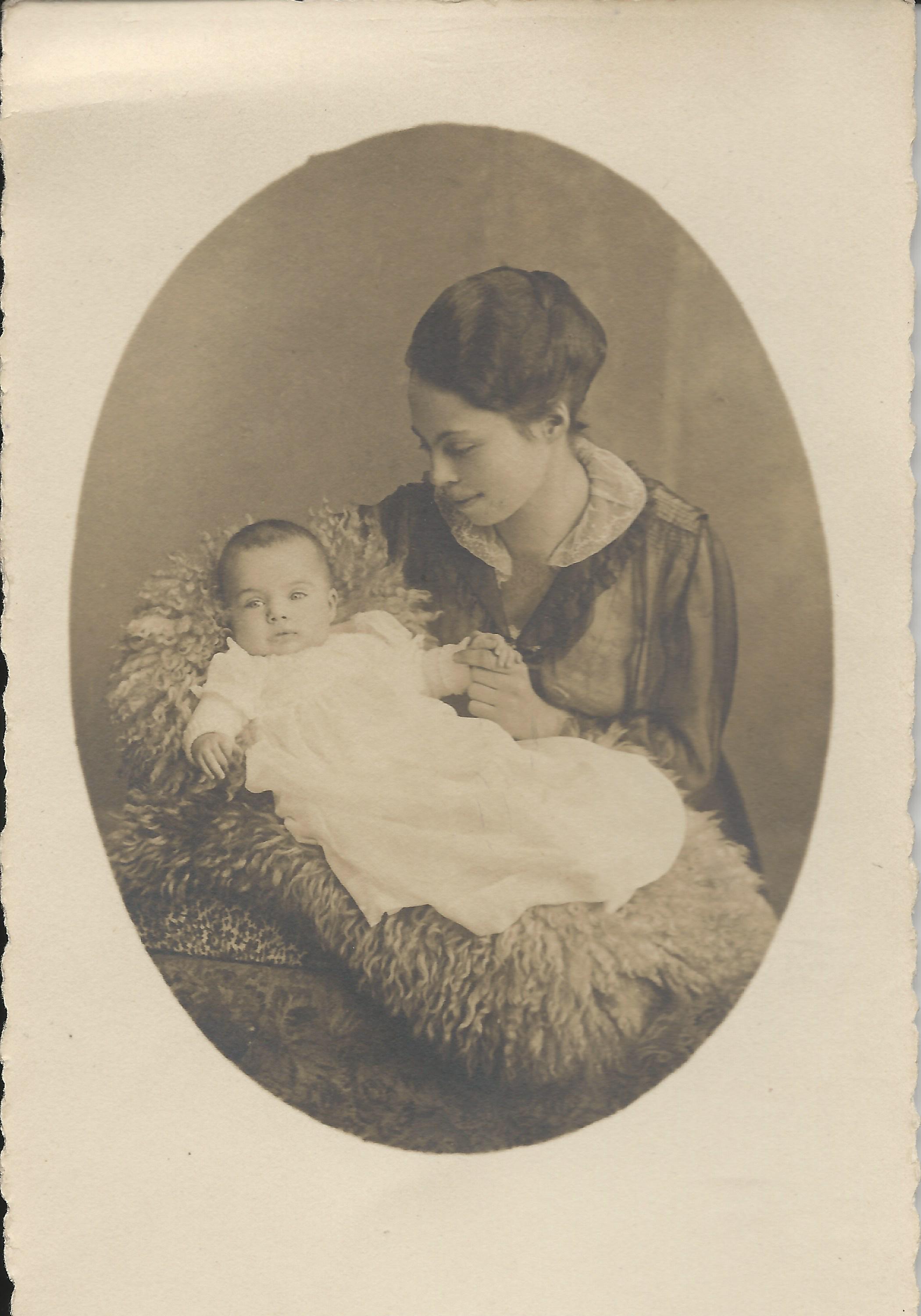
Julius Schoenthal Mystery: Solved

Last week in my post about my great-grandfather’s siblings and their immigration to the United States between 1866 and 1872, I wrote about one of his presumed brothers, Julius.  Although Julius was mentioned in the Beers biography of Henry Schoenthal as one of the siblings, I could not find any other source to verify that the Julius Schoenthal whom I had located was the right one.  The Beers biography gave no details about Julius other than that he was living in Washington, DC, at the time it was written (1893).  The Julius Schoenthal I had found did live in DC, but aside from that one clue, there was nothing else that linked him to his presumed siblings in Pennsylvania.

What I did learn about that Julius, as described in my earlier post, was that he was born sometime between 1845 (1900 and 1910 census records) and 1847 (the 1880 census)  that he had served in the Franco-Prussian War in 1870-1871, that he had married a woman named Minnie Dahl in 1874, , that he was a shoemaker (like his presumed father, Levi Schoenthal), and that he had four children: Leo (1875), Rosalia (1876), Sylvester (1878), and Moretto (1879).  I also was able to find his card in the Civil War pensions database, which indicated that he had served in the Signal Corps in the US Army; with the help of Lillian from Facebook, I also knew he had enlisted from Chicago in 1873 and been discharged in 1874 in Washington, DC.  What I did not know for sure was whether or not he was in fact the son of Levi Schoenthal, my great-great-grandfather.

Julius SChoenthal new tree


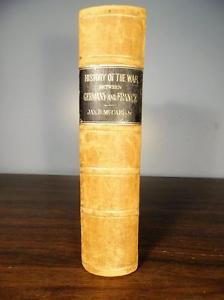
I also did not know when he’d arrived in the US. Then I found a reference to a Julius Schoenthal in an article entitled “History of the War in Europe” in the Washington, Pennsylvania Review and Examiner, dated July 12, 1871 (p.3); he was acting as an agent for a the National Publishing Company of Philadelphia, which had published a book about the Franco-Prussian War.  After a review of the book, the article ends by saying, “It is for sale by subscription only, and Julius Schoenthal, who is the authorized agent for this section, is now canvassing for it.” Given the name, subject matter, and location, I have to believe that this is Julius, the brother of my great-grandfather, and thus that he was already in the US as of July 12, 1871.  He also at least for some time had been in Washington, Pennsylvania, where his siblings and cousins were living.

HIstory of the War between Germany and France cove

I sent away for his full pension file.  I was fortunate to find Deidre Erin of Twisted Twigs on Gnarled Branches who offers to obtain copies of pension records at the National Archives for a reasonable fee. Within a few days I had an excellent and complete copy of Julius Schoenthal’s pension file.

Although the file was 56 pages long, I found all the information I needed on page 6 where Julius reported both his birth date and birthplace: January 30, 1845, in Sielen, Germany.  The fact that Julius was born in Sielen was certainly probative of the fact that he was the son of Levi Schoenthal and Henrietta Hamberg; the fact that he was born before 1846 explained why I had not been able to locate a birth record for him since the online records start in 1846 for Sielen.

Julius Schoenthal pension file pt 1

Julius Schoenthal pension file pt 2


As you can see, the page also lists his wife as Minnie Dahl and the names of his four children.  For my purposes, those overlapping facts tie the Julius Schoenthal who served in the Signal Corps and lived in Washington, DC, was married to Minnie Dahl, and had four children, to the other Schoenthals living in Pennsylvania, including my great-grandfather Isidore.  I still have no idea why he was in Chicago when he enlisted in the Signal Corps.

I also requested a copy of a letter he had reportedly written to President Ulysses S. Grant, according to the index for the archives in the Grant Presidential Collection at Mississippi State University. When I received the materials from Mississippi State University, there were two letters, one in German and in old German script that I could not read; the other in English and quite readable.  After I received some help with the first letter from the Genealogy Translations group on Facebook, it was obvious that it was not written by my relative and had been misfiled in the archives. I was disappointed since this was a lengthy letter, and I had hoped for some useful insights.

Fortunately, the second letter was in fact from Julius, my great-grandfather’s brother, but it was not to President Grant, but rather a letter dated 1884 (when Grant was no longer even President) to the then Secretary of the Treasury asking for a job as a watchman or messenger.  Julius wrote that he was 38 years old (he actually would have been 39 if born in 1845 as he had claimed in his pension files), a US citizen, a veteran of the Signal Corps, and married with four children.  There is also a letter of support included with his letter from a friend who wrote that Julius was “a faithful soldier and would make a very judicious and faithful watchman….”  Unfortunately, I do not think Julius was offered the position since all the later references in his pension file as well as DC city directories in the 1890s indicate that he remained a shoemaker.

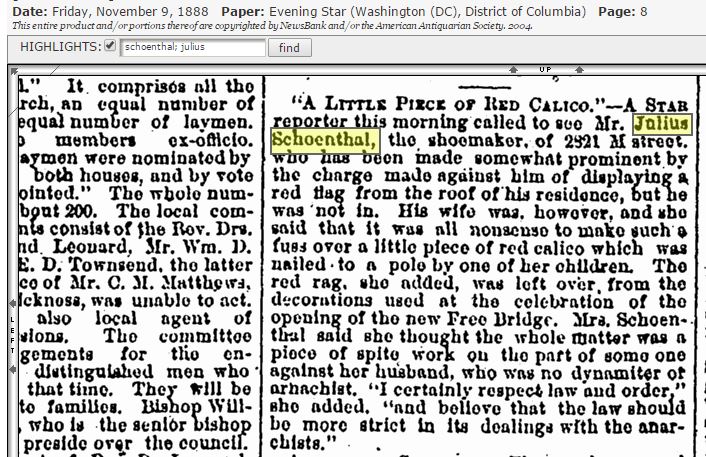
In fact, I am quite certain he was not working for the government based on this newspaper article dated November 9, 1888, from the Washington, DC Evening Star (p. 8):

Julius Schoenthal shoemaker anarchist 1888


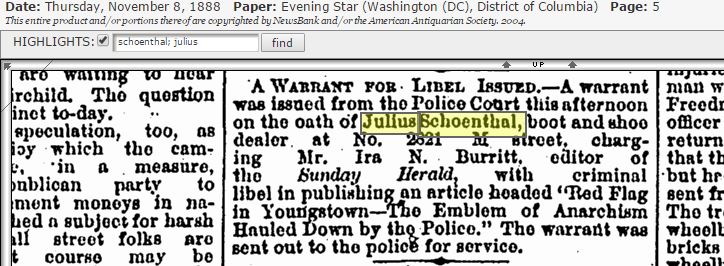
Apparently, Julius, still working as a shoemaker, had been accused of being an anarchist because of a red cloth hanging from a pole near his house and had gained some notoriety.  His wife told the reporter that the accusation was false and made by someone out of spite.  Why would someone be seeking to harm Julius, a shoemaker with four young children?  I don’t know.  But obviously Julius did not like these accusations and sued another local paper, the Sunday Herald, for libel:


Julius Schoenthal sues paper for libel 1888


All of this must have taken a toll on Julius. The remainder of the pension file deals with his numerous claims starting in the 1890s  for an increase in his pension allowance based on various disabilities . Julius claimed that while serving in the Signal Corps as a driver of the market-wagon, he contracted various ailments that led to rheumatism, heart and lung disease, throat disease, hearing loss, and catarrh.  Reading his file made me curious about the Signal Corps and also about his claimed ailments.

According to one source, the US Army Signal Corps “began in 1860, with the appointment of Dr. Albert J. Myer, a physician, as Chief Signal Officer. Under his command, the unit transformed sign language used to communicate with deaf persons into a semaphore system incorporating red and white “wigwag” flags. During the Civil War, the Signal Corps operated air balloons and telegraph machines.”  After the Civil War and during the years that Julius Schoenthal served, the country was not at war, and the Signal Corps took on a different mission: weather forecasting.  In her book about the history of the Signal Corps, Rebecca Robbins Raines described the recruitment, training, and responsibilities of those who served in the Signal Corps in its role as national weather forecaster:

The Signal Corps selectively recruited personnel for the weather service-only unmarried men between the ages of twenty-one and forty were eligible-and required them to pass both physical and educational examinations. Upon acceptance, the men enlisted as privates and received at least two months of instruction at Fort Whipple. After an additional six months of duty on station as assistants (later extended to one year), followed by further training at Fort Whipple and appearance before two boards of examination, the men qualified for promotion to “observer-sergeant.” After one year’s service, an observer could again be called before a board for yet another examination.

The work of the observer was often demanding. Three times daily he recorded the following data: temperature; relative humidity; barometric pressure; direction and velocity of the wind; and rain or snow fall. The Corps soon added to this list the daily measurement of river depths at stations along many major rivers. The observer also noted the cloud cover and the general state of the weather. Immediately upon completing his observations, the officer prepared the information for telegraphic transmission to the Signal Office in Washington. In a separate journal he recorded unusual phenomena, such as auroral and meteoric displays. In addition to the three telegraphic reports, he made another set of observations according to local time and mailed them weekly to Washington. The Corps also required a separate midday reading of the instruments, but the observer only forwarded the results if they differed greatly from the earlier readings. At sunset he recorded the appearance of the western sky to be used as an indication of the next day’s weather. In case of severe weather, an observer could be on duty around the clock, making hourly reports to Washington.

[Rebecca Robbins Raines, Getting the Message Through: A Branch History of the U.S. Army Signal Corps (Center of Military History, United States Army, Washington, D.C., 1996), p. 47 (footnotes omitted).  Available online here.]

The Signal Corps Regimental Color

The Signal Corps Regimental Color (Photo credit: Wikipedia)

From what I read in his pension file, Julius was a driver in the Signal Corps, presumably driving the observers to their posts for recording the weather.  As described in one statement in his pension file made by a fellow Signal Corps member, Julius would often be exposed to inclement weather while driving the “market-wagon” and spent time in the military infirmary as a result of illnesses contracted while serving.

One of those illnesses, catarrh, was an illness I’d never heard of before. Back in 1865 it was described this way by the New York Times:

Catarrh is a disease of the mucous membrane of the nasal passages and those cavities of the head communicating with them. Insignifiacnt as it appears in its first stages, it is apt in its progress to become instrumental in causing the loss or impairment of smell, taste, hearing and sight, and of creating serious constitutional derangements, not unfrequently terminating in consumption.

According to the National Health Service in Great Britain, today catarrh is not considered a condition itself, but rather a symptom of colds, allergies, or nasal polyps.  However, the NHS website does say that “[i]n some cases, people can experience chronic catarrh, which is not caused by an allergy or infection and lasts for a long time. The cause of chronic catarrh is unknown but it may be related to an abnormality in the lining of the throat.”


Embed from Getty Images

Julius filed numerous claims over many years beginning in the 1890s.  From what I can tell, it appears that his claims were repeatedly denied.  Whether his illnesses were as severe as he claimed I cannot judge; there were doctors who supported his claims as well as friends, but there were also doctors who concluded otherwise.

In 1899, Minnie Dahl Schoenthal, Julius’ wife, died at 53.  In 1900, Julius was living in Washington, DC, with three of his four children, Leo, Rosalia (Rose), and Moretto, who were all in their early 20s.  Julius was now working as a “collection publisher.”    I am not sure what that means, unless Julius still had some relationship with the National Publishing Company of Philadelphia 30 years after that article in the Washington, Pennsylvania newspaper.  His son Leo was a printer, and Moretto was a cabinet maker.  Rose was not employed.  I cannot locate Sylvester on the 1900 census.

All three of Julius Schoenthal’s sons married in 1901. Sylvester married Alice Butler in Virginia on April 1, 1901.  (That marriage did not last, and on December 17, 1905, Sylvester married Bessie Rose.)  Moretto, the youngest child, married in 1901 as well; on November 14, he married Annie M. Heath.  Their son Arthur Schoenthal was born in 1903.  Finally, the oldest brother, Leo, married Fannie Pach on December 18, 1901.  They had a daughter named Minnie (presumably for Leo’s mother) on September 28, 1902, nine months after marrying.  On March 12, 1905, Julius and Minnie’s only daughter, Rose, married Joseph Pach, younger brother of her sister-in-law Fannie, Leo’s wife.

By 1910, Julius had moved in with Leo and Fannie in Washington, DC; he was now working as a confections merchant.  Leo was working as the assistant sealer of weights for the District of Columbia.  Sylvester and his wife Bessie and daughter Minnie were also still living in DC, where Sylvester was working as a car builder for the Washington Railway Company.  Moretto and his wife Annie and son Arthur were in DC as well where Moretto continued to work as a cabinet maker.

Although her father and three brothers were still living in DC in 1910, Rose Schoenthal and her husband Joseph Pach were living in Uniontown, Alabama, where Joseph owned a retail clothing and shoe business.  I wondered what had taken them there.  In 1910, the population of Uniontown was about 1,800, a 75% increase over its population in 1900, so something must have drawn all those new residents to the town.  I found this insight in the Encyclopedia of Alabama website:

The area remained tied to the agricultural economy after the war. In 1897, the Uniontown Cotton Oil Company was established in the town, one of the first facilities of its kind in the state and one of the first industrial businesses in Perry County; it manufactured cotton seed oil and cotton seed meal. By 1900, the town had cotton gins, cotton warehouses, and a cotton mill. The city also had electricity and telephone services by this time. Less than two decades later, however, Uniontown began to lose population as more people moved off of plantations because of the boll weevil’s ruinous effect on the cotton crop, among other factors. The town remains largely dependent on agricultural activities, including livestock farming, in the surrounding area.

I guess that Joseph Pach saw a town that was experiencing a population and economic boom and decided to start a business there.  But it was over 800 miles from DC, and it must have been quite an adjustment for a young couple who were both born and raised in that larger city.

English: Co-Nita Manor within the Uniontown Hi...

English: Co-Nita Manor within the Uniontown Historic District in Uniontown, Alabama. The district is on the National Register of Historic Places. (Photo credit: Wikipedia)

In 1911, Leo Schoenthal and his superior, Colonel W.C. Haskell made the news for their investigation of fraud by ice dealers in DC who were “short weighting” customers; when some customers filed complaints with the Department of Weights and Measures, the dealers thereafter refused to sell to them.  There was some discussion of criminal prosecution of the dealers.  Here is a headline from an article in the Washington Herald of July 19, 1911 (p. 12):

19 Jul 1911, Page 12 - at Newspapers.com

19 Jul 1911, Page 12 – at Newspapers.com


According to the 1914 directory for Washington, DC, Julius and his three sons were still living in that city that year.  Julius was still living with Leo and was working as a driver.  Leo was the assistant superintendent for weights and measures.  Sylvester’s occupation was listed as “Mach,” which I assume means machinist.  Moretto was now working as an assistant superintendent for the Life Insurance Company of Virginia.  (There was also a Hilda Schoenthal working as a bookkeeper and living on the same block as Leo and Julius; I believe she was the daughter of Henry Schoenthal, brother of Julius.  But more on that in a later post.)

Title : Washington, District of Columbia, City Directory, 1914 Source Information Ancestry.com. U.S. City Directories, 1822-1989 [database on-line]. Provo, UT, USA: Ancestry.com Operations, Inc., 2011.

Title : Washington, District of Columbia, City Directory, 1914
Source Information
Ancestry.com. U.S. City Directories, 1822-1989 [database on-line]. Provo, UT, USA: Ancestry.com Operations, Inc., 2011.

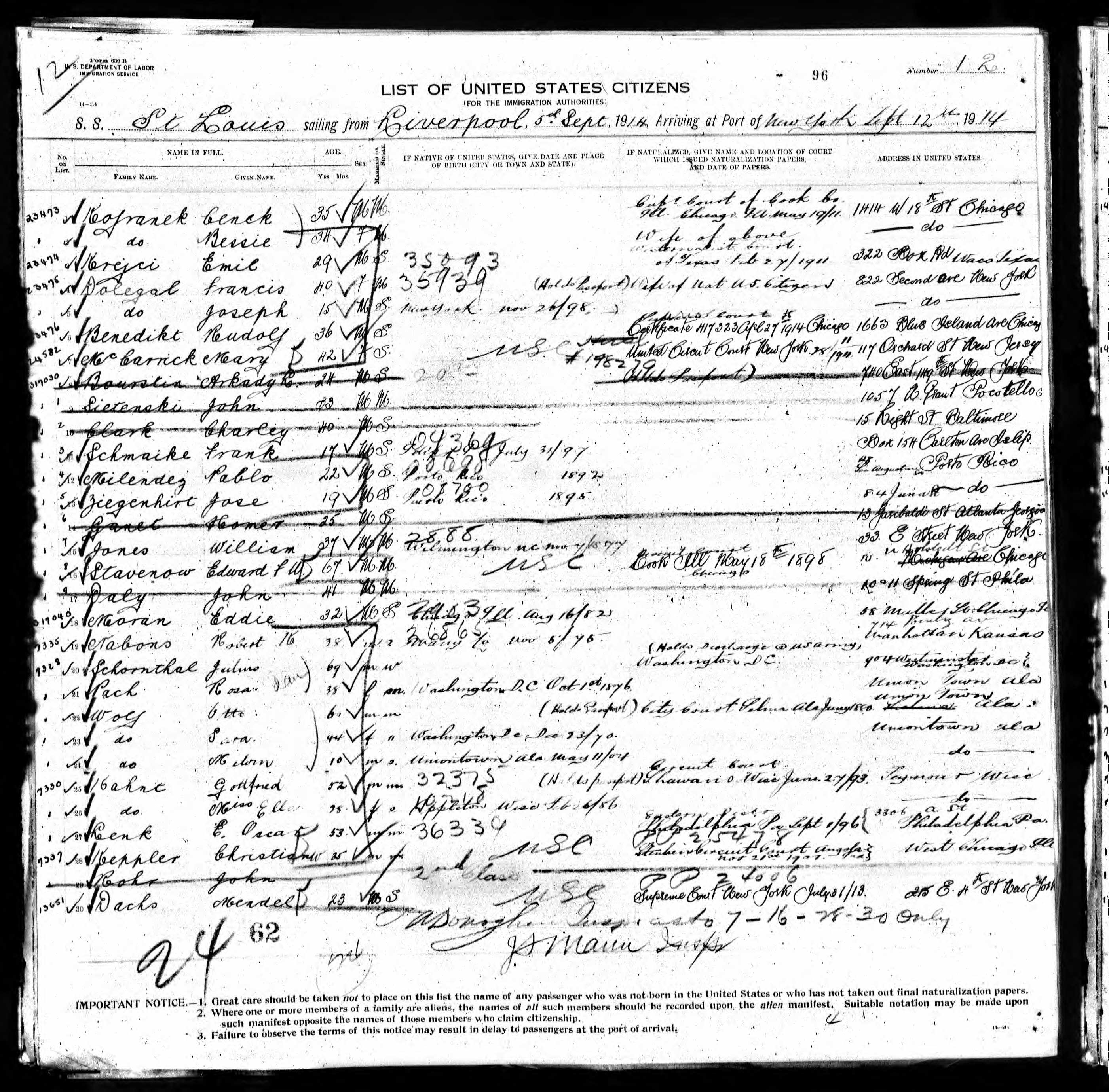
In the summer of 1914, Julius Schoenthal and his daughter Rose Schoenthal Pach traveled to Europe together; on the passenger manifest for their return trip in September, 1914, there is a notation on the entry for Julius, noting that he was naturalized in DC and had been discharged from the US Army.   Was the carrier, or the US generally, suspicious of a foreign-born traveler, given that World War I had just started a few months before?

Passenger Manifest for Julius Schoethal and Rose Schoenthal Pach 1914 Year: 1914; Arrival: New York, New York; Microfilm Serial: T715, 1897-1957; Microfilm Roll: Roll 2368; Line: 1; Page Number: 96

Passenger Manifest for Julius Schoethal and Rose Schoenthal Pach 1914
Year: 1914; Arrival: New York, New York; Microfilm Serial: T715, 1897-1957; Microfilm Roll: Roll 2368; Line: 1; Page Number: 96

It was after this trip that Julius reported that Americans were being well treated by the Germans and that in Berlin the government was closing down hotels that overcharged Americans.  I found it quite interesting that Julius, who had by that time lived in the US for over forty years, still seemed to feel some loyalty to his birth country.  I wonder how he felt once the US went to war against Germany a few years later.

Julius Schoenthal news article re Germany WW I

The family made the newspaper again in 1916 when Leo and his wife Fannie celebrated their 15th wedding anniversary:

Schoenthal party for Leo 15th anniversary

When the US entered World War I, all three of Julius Schoenthal’s sons registered for the draft.  Leo was now the chief inspector for the District of Columbia; Sylvester was a car repairmen for the Washington & Southern Railroad Company; and Moretto was still an insurance agent for the Insurance Company of Virginia.  Their brother-in-law Joseph Pach registered in Uniontown, Alabama, describing himself as a merchant.  It does not appear, however, that any of them served in the war.

Sylvester and his wife Bessie, who had married in 1905, had not had any children listed on the 1910 census, but by 1920 they had two daughters: Margaret, born in 1914, and Helen, born in 1918.  Leo’s daughter Minnie and Moretto’s son Arthur were teenagers by then.  Rose and Joseph did not have any children, as far as I can tell.

On March 2, 1919, Julius Schoenthal died in Uniontown, Alabama; he must have been visiting his daughter Rose when he died.  He was 74 years old and was buried at Washington Hebrew Cemetery in DC, where his wife Minnie had been buried 20 years earlier.

Julius had lived an interesting life, serving in the Germany army and then the US army after immigrating, and then seeking a position in the US government after that service.  He must have felt proud to be a US citizen and a veteran, yet he was accused of being an anarchist in 1888.  That obviously hurt him enough that he sued for libel; also, I have to wonder how he felt after repeatedly having his requests for increased pension payments denied.

He lost his wife at a relatively young age and never remarried.  He had four children, three sons who lived close by throughout his life and a daughter who moved over 800 miles away.  But when he died, he was with his daughter in Alabama, not his sons in DC.  He worked as a shoemaker, a book salesman, and a seller of confections.  He had many family members living in Pennsylvania, but I can find no indication that he had much contact with them after moving to Washington, DC., except for his niece Hilda living down the street in 1910.

As for his children, the three sons were all still living in DC in 1920, all still working at the same occupations.  Rose and her husband Joseph were still in Uniontown, Alabama.  At the time he died, Julius had four grandchildren: Arthur, Minnie, Helen, and Margaret Schoenthal, all living in Washington, DC.

More about his descendants in a subsequent post.


The Memoirs of Lotte’s Sister Doris: Another Perspective on Life in Hitler’s Germany

Many of you enjoyed the memoirs and other writings of my cousin Lotte Furst, which are posted here, here, here, and here.  You will recall that Lotte and her family lived in Mannheim, Germany, and were living a comfortable life in a good home; Lotte’s father was a doctor, and her mother was the granddaughter of Hieronymous Seligmann, younger brother of my great-great-grandfather Bernard Seligman.  When the Nazis came to power, Lotte’s life changed forever.  After suffering through years of anti-Semitism and deprivation of their rights, her family finally decided to leave Germany and came to the United States.  Lotte’s writings described in vivid terms her perspective on all of this as she experienced it as a young girl and then as a young woman.

I recently learned that Lotte’s older sister Doris also wrote a memoir.  Doris was four years older than Lotte, and thus I was curious as to how her perspective was like or different from that of her younger sister.  When Hitler came to power in 1933, Doris was seventeen and thus would have had a more adult-like view of things.  Doris died in 2007, and her daughter Ruth was kind enough to share her mother’s memoirs with me.  Much of it is quite personal, so I am going to focus on those sections that provide insights into the larger questions: what was life like before Hitler came to power, how did it change when he did, and what led to the decision to leave Germany? [All material quoted from Doris Gruenewald’s writings is protected by copyright and may not be used without the permission of her children.]

By Snapshots Of The Past (Parade Place and Kaufhaus Karlsruhe Baden Germany) [CC BY-SA 2.0 (http://creativecommons.org/licenses/by-sa/2.0)], via Wikimedia Commons

By Snapshots Of The Past (Parade Place and Kaufhaus Karlsruhe Baden Germany) [CC BY-SA 2.0 (http://creativecommons.org/licenses/by-sa/2.0)%5D, via Wikimedia Commons

Doris was born in October 1916 in Mannheim; Germany was in the midst of World War I, and her father, Joseph Wiener, was drafted into the German army as a medical officer soon after she was born.  Her mother, Annie Winter Wiener, went with Doris to live with her parents, Samuel and Laura (Seligmann) Winter in Neunkirchen, where Samuel owned a women’s clothing business.  Annie’s brother Ernst had recently been killed while serving in the German army after volunteering against his parents’ wishes.  Doris wrote:

He had been the apple of their eyes and his death dealt a terrible blow to both.  My grandmother wore only black from then on, and my grandfather’s health began to deteriorate.  They also lost their sizable fortune, having bought war bonds as their patriotic duty, which at the end of the war were not worth anything anymore.  My grandfather’s business was dissolved and then reestablished on a much smaller scale.

Ernst Winter Courtesy of Lotte Furst

Ernst Winter
Courtesy of Lotte Furst

Doris compared her grandparents’ home in Neunkirchen with her own home in Mannheim:

The house in Neunkirchen had a large garden in back of it, most of which was rented out.  The smallest part, directly behind the house, was used for growing some vegetables and flowers.  I remember loving to play in the garden and watching earthworms after a rain as well as other living creatures.  In Mannheim there was little opportunity for this kind of nature watching as we lived in a built-up urban area with little greenery, other than a well laid out park some distance from our apartment.

Neunkirchen

Neunkirchen

For several years while the French occupied parts of Germany after World War I, several family members housed French soldiers, and the neighborhood school Doris would have attended was also being used by the French military.  Thus, she had to go to a school somewhat further from her home for those years.  Like her sister Lotte, Doris pursued a highly academic path in school and was one of only six girls out of thirty students in her Gymnasium classes and then the only girl in her class when she reached the final years of her pre-university level education.

This excerpt provides a sense of the family’s lifestyle:

My parents employed a cook and a housemaid, and when my sister and I were still young, a “Kinderfraulein” who used to be an untrained young woman with an interest in children.  In other words, not quite a “governess.”  My father had help in his office and for some time also employed a driver after he developed a painful condition in his left arm, due to having to reach outside the car for shifting gears.  …. 

We had a Bechstein Grand piano in our living room. This instrument had been given to my mother as a young girl. She had really wanted to study music on a professional basis. But her parents felt that “proper” young ladies did not take up that kind of profession and did not allow her to pursue her wish. Instead, they bought her the Bechstein and let her have piano lessons.

I began taking piano lessons at age seven, with a teacher considered among the best in Mannheim. My mother, although an accomplished pianist, no longer played much. But occasionally, she and my father, who had learned to play the violin in his youth, would play duets together. That always was a special treat.

By Annaivanova (Own work) [CC BY-SA 3.0 (http://creativecommons.org/licenses/by-sa/3.0)], via Wikimedia Commons

By Annaivanova (Own work) [CC BY-SA 3.0 (http://creativecommons.org/licenses/by-sa/3.0)%5D, via Wikimedia Commons

I was particularly interested in what Doris wrote about the role of Judaism in the family’s life.

I grew up through the years with some awareness that we were Jewish, without knowing what significance that had then and later. Neither my parents nor my grandparents when I knew them observed any religious tenets. However, I was told that in past years my grandfather had been the head of the Jewish Congregation in Neunkirchen. My grandmother, who was president of the local Red Cross chapter for some time, used to fast on Yom Kippur. She reluctantly told me, when I kept asking her, that she had promised her dying mother to keep that tradition. As for me, I was kept home on the Jewish High Holy Days. My family did not attend any services.  …. 

At eight years of age I happened to be visiting my grandparents at the time of Passover. They had been invited by friends to a large Seder. Unfortunately, nobody thought of explaining to me what that was all about. My grandparents may have assumed that I knew, but I did not. I understood nothing of what was being read in Hebrew or spoken in German. I was utterly bored! Furthermore, when the ceremony asked for tasting the so-called bitter herbs, I bit off a piece of the horseradish on my plate and soon experienced the consequences of that act!

Unfortunately, I think far too many children, here in the US and elsewhere in the world, have that experience at seders.

The family was, however, required to provide some religious instruction because of the school system’s requirements:

There having been no separation of Church and State, religious instruction was part of the official curriculum. The students were separated one period per week according to their denominations. Most were Protestants, some were Catholics, and a few were Jewish. Since the number of Jewish children was so small, and in the case of my first-grade placement non-existent, my parents were required for that year to hire a private instructor in order to comply with the legal requirement. Thus, there suddenly appeared a not very clean looking young man with a greasy book, from which he proceeded to read and attempt to teach me-at six years of age-the Hebrew text. My recollection is that he came to our house only a very few times. I do not know how the religious instruction requirement was fulfilled after that disaster.

When, at fourth grade level, I changed schools, religion was taught by a little old man, a retired rabbi, who was very nice and even made some of what he taught rather interesting. But I developed no feeling for or interest in it at all, as it was totally divorced from the rest of my life.

Then, as Lotte also described, their father decided to withdraw from the Jewish community:

When I was fourteen, my father had some kind of a dispute with the Jewish Community, which was the official agency for collecting taxes. These taxes were legally mandated as a percentage of one’s general income tax obligation. I nearer knew exactly what the problem was, except that it had something to do with the amount owed, to which my father was apparently objecting. The Rabbi came to our house to straighten the matter out. Apparently he was not successful as subsequent events proved. (This rabbi became my brother-in-law at a much later time. He knew that I was far removed from religious observance, but he was always very tolerant and friendly to me.)

Whatever the problem had been, my father decided to leave the Jewish Congregation. Since I was already fourteen years old, I was required to state my personal intention. As I had no ties to the Jewish community, that was no problem for me. From then on I was without any religious affiliation, called “konfessionslos.” In practical terms it meant that I no longer had to attend religious instruction at school. I used the weekly free hour to visit the Art Gallery opposite the school building and saw a lot of very interesting, good art works.

Dr. Joseph Wiener

Dr. Joseph Wiener  Courtesy of Lotte Furst

Of course, the family’s withdrawal from the Jewish community and lack of religious involvement did not make any difference in the eyes of the Nazis once they came to power.  Doris wrote:

Between 1932 and 1935 I had a valid German passport, used during those years primarily for trips to the Saar to visit my grandparents and take the then permitted two hundred German marks to be deposited outside Germany. In those years the Saar was still under the administration of a French post-World-War I governing authority. My grandmother took care of such transactions. By the time I needed a new passport, the Nazis had decided that a big “J” had to be stamped on any so-called non-Aryan, meaning Jewish, person’s passport. Word had gotten around that one of the clerks in the passport office in Mannheim would issue a “clean” document without the dreaded J, for suitable consideration. I went to that office, saw the clerk in question, and for the small sum of five marks was issued a regular passport without the J. I still have this passport as a memento.

When the Nazis assumed power in 1933, we as a family re-joined the Jewish Congregation as a matter of honor. Not that it would have made any difference had we not done so as the Nazis classified people not necessarily by religion but by their so-called racial identity.

German Jewish passports could be used to leave...

An example of German Jewish passport. (Photo credit: Wikipedia)

As Doris approached the end of her time in the local schools in the 1930s, she was both the only girl and the only Jew in her class.  She wrote that things did not change dramatically at school despite the political changes around them, but she did describe one troubling incident:

I entered the classroom in the morning, as usual. Upon approaching my desk, I saw that someone had pasted a viciously antisemitic sticker from the “Sturmer,” a rabidly anti-Jewish paper, on my desk. By that time, one of my classmates had begun wearing the SS uniform. I more or less assumed that he was the culprit, which in the end turned out not to have been the case. However, at that moment I decided not to confront him or anyone else. I sat down at another desk and waited for the right time to act. This came with the second period when the “Klassenlehrer”-the equivalent of our Home Room teacher-was due for his hour. … I waited for this teacher outside the classroom and told him my reason for doing so, adding that I knew there was nothing I could do about official policy and insults, but that I was not willing to put up with personal attacks.

This teacher, who, incidentally, had been an officer in World War I and had lost an arm, rose to the occasion. He and I entered the classroom together, and he immediately asked who had done this deed. Somewhat to my surprise, and perhaps his too, not one of the students admitted having put the sticker on my desk. There was nothing further he could have done: I do not remember whether he spoke to the class, but his earlier behavior had given ample proof of his opinion. … The incident occurred about one week before the final exam, the Abitur. It cast a pall over that important event.


Embed from Getty Images

Imagine being the only girl and the only Jew in the class and standing up for herself that way.  What courage it must have taken to do this.  What if her teacher had not been sympathetic?  Despite this stressful incident, Doris successfully passed the Abitur.  Although Doris was entitled to enroll in the university based on her father’s military service during World War I, Jews were prohibited from enrolling in either law school or medical school.  Instead, Doris decided to audit a few courses while awaiting a visa to leave Germany.  She wrote:

I had known for some time that I had to get out of Germany as there was no future there for me, and I was willing to take whichever came first [she had applied for both a US visa and a certificate to immigrate to Palestine]. However, I admit that I was relieved when the American visa materialized first.

The American Consulate closest to Mannheim was located in Stuttgart. In due course I was summoned for an interview with the American consular officials. I was in a somewhat unusual position in that my father had learned of a legal means of transferring money abroad, which was then discounted at the rate of fifty percent. The permissible amount was sufficient to enable me to show the U.S. Consulate that I had the requisite five thousand dollars for obtaining an immigration visa to the U.S. In this way I did not have to await my application number to come up in regular order, which would have taken a great deal more tame. I got my visa rather quickly. By that time I had also received a so-called Affidavit of Support from one of my grandmother’s cousins, whose father had emigrated in the nineteenth century and had settled in Cleveland, Ohio. This cousin was in very good financial circumstances and readily responded to our request for an affidavit.  …

I was very interested in determining who this cousin might have been.  If she was Laura Seligmann Winter’s cousin, she might have also been a cousin of mine, depending on whether she was a paternal cousin or not.  The only clues I had from Doris’ memoir were her married name (Irma Rosenfeld), her residence in Cleveland, her children: a son who was in his 20s in 1937, a daughter who was married, and another daughter who was a student at Vassar.

I found one Irma Rosenfeld living in Cleveland at that time who had two daughters and a son and was married to a man named Mortimer Centennial Rosenfeld (I assume the middle name was inspired by the fact that Mortimer was born in 1876, the centennial of the Declaration of Independence).  I sent Lotte the photo from that Irma’s passport application, but Lotte was unable to confirm from the photograph that it was the right Irma Rosenfeld.

Irma Rosenfeld and daughter passport photo 1924 Ancestry.com. U.S. Passport Applications, 1795-1925 [database on-line]. Provo, UT, USA: Ancestry.com Operations, Inc., 2007. Original data: Selected Passports. National Archives, Washington, D.C.

Irma Rosenfeld and daughter passport photo 1924
Ancestry.com. U.S. Passport Applications, 1795-1925 [database on-line]. Provo, UT, USA: Ancestry.com Operations, Inc., 2007.
Original data: Selected Passports. National Archives, Washington, D.C.

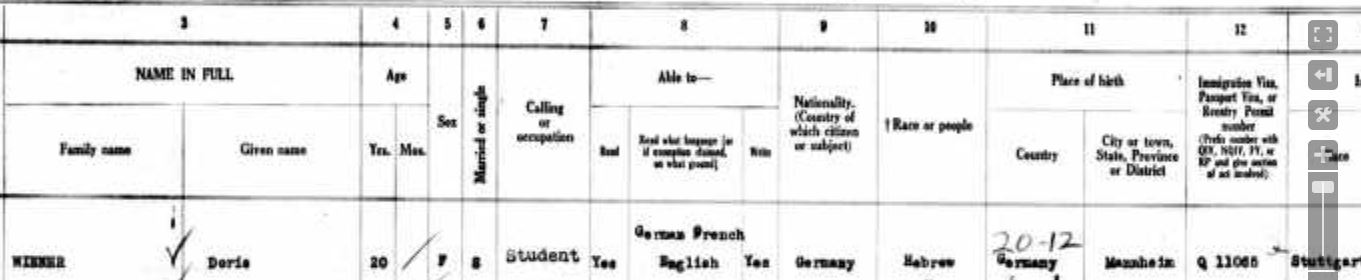
After reading Doris’ memoir, I went back to all the documents I had for her and examined more closely the passenger manifest for her trip to the US in 1937.  I had not seen the second page of it my first time through, but this time I noticed that it not only named Irma Rosenfeld; it had her street address in Cleveland.  It only took a glance at the 1940 US census for me to confirm that I had in fact found the correct Irma.

Doris Wiener 1937 ship manifest

Doris Wiener 1937 ship manifest part one

 p2 Ancestry.com. New York, Passenger Lists, 1820-1957 [database on-line]. Provo, UT, USA: Ancestry.com Operations, Inc., 2010. Original data: Passenger Lists of Vessels Arriving at New York, New York, 1820-1897.

p2
Ancestry.com. New York, Passenger Lists, 1820-1957 [database on-line]. Provo, UT, USA: Ancestry.com Operations, Inc., 2010.
Original data: Passenger Lists of Vessels Arriving at New York, New York, 1820-1897.

A little more research revealed that Irma’s birth name had been Irma Levi, daughter of Isaac Levi and Fanny Loeb.  Since Doris and Lotte’s great-grandfather (and my three-times great-uncle) Hieronymous Seligmann had married a woman named Anna Levi, I believe that that is the connection between Doris and Irma.  Anna Levi was a contemporary of Isaac Levi; perhaps they were siblings, and thus Irma Rosenfeld would have been a first cousin, twice removed, of Doris and Lotte, their grandmother Laura’s first cousin.  Obviously, the family had stayed in touch with these American cousins, and even though Irma was American-born and had never met Doris before, she reached out to help her escape the Nazi regime.

Continuing now with Doris and her emigration from Germany:

Necessary preliminaries having been taken care of and good-byes having been said, it was time to arrange for the journey to America. We bought a ticket for me on the SS Washington, a twenty-thousand ton ocean-going passenger boat, and also obtained railroad tickets for me and my mother who wanted to accompany me to Cherbourg, the place of embarkation. …

In Cherbourg I said good-bye to my mother, for whom the separation was very hard, more so than for me. For one thing, I was looking toward something new. But perhaps more importantly, I had unwittingly insulated myself to some degree from the impact of events. This condition lasted for a long time and to some extent gave me some emotional protection….

In contrast to so many, I confess that I had an easy time. Not only was the way for coming to America smoothed. My parents also were well able to pay for my ticket and whatever other expenses arose in connection with my leaving. I was twenty years old at that time.  …

Aenne Wiener and Doris

Doris Wiener and her mother Courtesy of Lotte Furst

Doris explained why her parents and sister did not come with her:

The question has often been asked why my parents and sister did not come at the same time. Like a great many people, my father kept believing that the Hitler episode was just that, and he refused for a long time to see the situation realistically. Not so my mother. She was instrumental in organizing their own as well as her parents’ emigration to Luxembourg, and later their own to America.

Doris wrote that she arrived in New York in 1937 with $400.  Her parents had arranged for friends to meet her at the boat, and Doris stayed with them for a week before moving to her own apartment on the top floor of a building at 96th Street and Central Park West.  Doris also described a visit to Cleveland to see her grandmother’s cousin, Irma Rosenfeld, the woman who had provided the affidavit in support of Doris’ visa, as discussed above. “The slightly more than four weeks I spent with the Rosenfelds were very pleasant, with visits to their country club and other social activities.”  But Doris preferred to remain in New York City.

After returning to New York, Doris soon found employment in a dentist’s office and also soon met her future husband, Ernst Gruenewald.  They were married in May 1938.  Her mother Annie came to New York for the wedding, not only to witness the wedding but also “to gain insight into the international situation uninfluenced by German propaganda.”

My mother had intended to stay in America for about six weeks. But as she listened to the broadcasts available to us, she became increasingly agitated and decided to cut her visit short in order to initiate their emigration from Luxembourg to the United States. She had always been a very intelligent woman capable of making important decisions, many of which were advantageous. She returned to Luxembourg and was able to convince my father that this was the right thing to do. They arrived in the U.S. in April 1939, three weeks after the birth of our first child and about half a year before the outbreak of World War II.

Her grandparents, as we know from Lotte’s memoirs, did not fare as well:

During my childhood I had spent a good deal of time with them in Neunkirchen and was very fond of my grandmother. I knew her only from her mid-forties on, when in my eyes she was an old lady. She was a very reserved but warm person and managed their life very competently. My grandfather was a short, slim man who from the time I knew him as a person, was not well. …  My grandparents had applied for a visa to the United States before the outbreak of World War II, but failed to be granted immigrant status. In retrospect, I am convinced that my grandfather’s condition was the reason, as they had enough money to qualify for a visa. My parents also could have vouched for them. My grandfather ended up in Theresienstadt, where he died of pneumonia, as we were told after the war. My grandmother had suffered a fatal heart attack while still living in Luxembourg.

Doris and her husband Ernst and their family ended up relocating from New York to Chicago for a business opportunity a few years after her parents and Lotte arrived .  During the 1950s, Doris went back to school and obtained her bachelor’s degree while also raising her children; in 1961 she received a masters’ degree in psychology as well.  She then went on to get a Ph.D. in psychology, specializing in neuropsychology, which was itself still a relatively new field.  After obtaining her degree, she worked at Michael Reese Hospital in the Adult Inpatient department where she eventually became the director. Sadly, after twenty years there, she found herself forced out on the basis of their mandatory retirement age.  She had just turned seventy.

By Zol87 from Chicago, Illinois, USA (Michael Reese Hospital) [CC BY-SA 2.0 (http://creativecommons.org/licenses/by-sa/2.0)], via Wikimedia Commons

By Zol87 from Chicago, Illinois, USA (Michael Reese Hospital) [CC BY-SA 2.0 (http://creativecommons.org/licenses/by-sa/2.0)%5D, via Wikimedia Commons

In 1987 Doris and Ernst moved to California, where the winters were milder and where her sister Lotte was living.  Doris had obtained a California license before moving and was able to continue to practice as a psychologist when they moved, but did so only for a short period before retiring.  Ernst died in 1989, and Doris died almost twenty years later in 2007.

It was fascinating to me to read Doris’ memoirs after reading Lotte’s; both sisters wrote so clearly and so powerfully about their lives.  I can see that they had much in common: great intelligence, dedication to hard work and to family, astute powers of observation, and a love of language.  Doris struck me as the more thick-skinned of the two sisters, often talking about her independence and emotional distance from others, even as a young child.  Doris wrote about being somewhat of a loner and keeping her thoughts and feelings to herself.  I would imagine that those qualities served her well as she endured her teen years in Hitler’s Germany and a voyage alone to America in 1937 as well as her adjustment to life in America.

Overall, I am struck by how strong these two women were, both as children in Germany, as new immigrants to the US, and as women experiencing all the changes that came in the years after World War II.    I’d like to think some of that is the Seligmann DNA that we share, but I doubt that I would have been as resilient and brave as they had to be, if I had had to endure the challenges and hardships they did.


Another Twisted Family Tree Story: The Goldsmiths/Goldschmidts

One thing that has amazed me before in my research is how often various lines in my family interconnect, like the Hano, Nusbaums, and Cohens in Philadelphia.  In researching the Schoenthals, I’ve once again encountered one of those twists in my family tree.

In my September 25 post I shared the numerous records I was able to find, with the help of several others, for my Schoenthal ancestors, including the marriage record of my great-great-grandparents, Levi Schoenthal and Jhette (or Henrietta) Hamberg in 1839.  That record revealed that Levi’s father was Heinemann Schoenthal and his mother Hendel (or Handel) Beerenstein.  For the moment that is as far back as I’ve been able to go with my Schoenthal line, though I hope to be able to find more about the earlier history of both the Schoenthal line and the Beerenstein line.

Marriage record for Levi Schoenthal and Jhette Hamberg HHStAW, 365, 386

Marriage record for Levi Schoenthal and Jhette Hamberg
HHStAW, 365, 386

Thanks to the research done by David Baron and my third cousin Roger Cibella, I now know that Heinemann and Hendel had at least one other child, a daughter named Fradchen or Fanny, who was born in 1800 in Sielen, making her twelve years older than her brother Levi. (Hans-Peter Klein has uncovered another sibling, Minna, but that’s a story for another day.)

Unfortunately I’ve not yet found a birth record for Fanny, but there is a marriage record to support that conclusion.  David and Roger sent me a copy of this marriage record dated September 10, 1844 from Oberlistingen, a town very close to Breuna (and now one of the districts of the town Breuna).

Marriage of Simon Goldschmidt and Fradchen Schoenthal HHStAW Abt. 365 Nr. 669, S. 11

Marriage of Simon Goldschmidt and Fradchen Schoenthal
HHStAW Abt. 365 Nr. 669, S. 11

As translated for me by Matthais Steinke, the record records the marriage of Fradchen Schoenthal, daughter of Heinemann Schoenthal and Hendel Beerentstein, to Simon Goldschmidt, son of Jacob Goldschmidt and Hewa Seligmann.  (No, I do not think Hewa Seligmann was related to my Seligmanns, but who knows? But that’s not the twist here.)  The record lists Fanny as 37 years old in 1844, thus born in 1807.  Simon is listed as 42 on the marriage record and is described as a master tailor.

According to David and Roger’s research, Simon had been married once before to Edeline or Ella Katzenstein. (I also don’t know if Simon’s first wife was related to my Katzensteins, but I am looking into that.  But that also is not the twist here.)  Simon and Ella had five children before Ella died in 1840. Their children ranged from Jacob, who was 16 when his mother died, down to Josias, who was only a year old when Ella died. There were also two daughters, Lena and Hewa (Eva), and another son, Joseph.  Four years after Ella died, Simon married Fanny.

Almost exactly a year after their wedding, Simon, Fanny, and Simon’s nine year old daughter Eva (Hewa) from his first marriage emigrated from Germany to the United States, arriving in Baltimore on the ship Marianne on September 20, 1845. Simon listed his occupation as a tailor on the ship manifest.

Passenger manifest for Simon Goldschmidt, Fanny Schoenthal and Eva Goldschmidt Ancestry.com. Baltimore, Passenger Lists, 1820-1964 [database on-line]. Provo, UT, USA: Ancestry.com Operations Inc, 2006. Original data: Selected Passenger and Crew Lists and Manifests. National Archives, Washington, D.C.

Passenger manifest for Simon Goldschmidt, Fanny Schoenthal and Eva Goldschmidt
Ancestry.com. Baltimore, Passenger Lists, 1820-1964 [database on-line]. Provo, UT, USA: Ancestry.com Operations Inc, 2006.
Original data: Selected Passenger and Crew Lists and Manifests. National Archives, Washington, D.C.

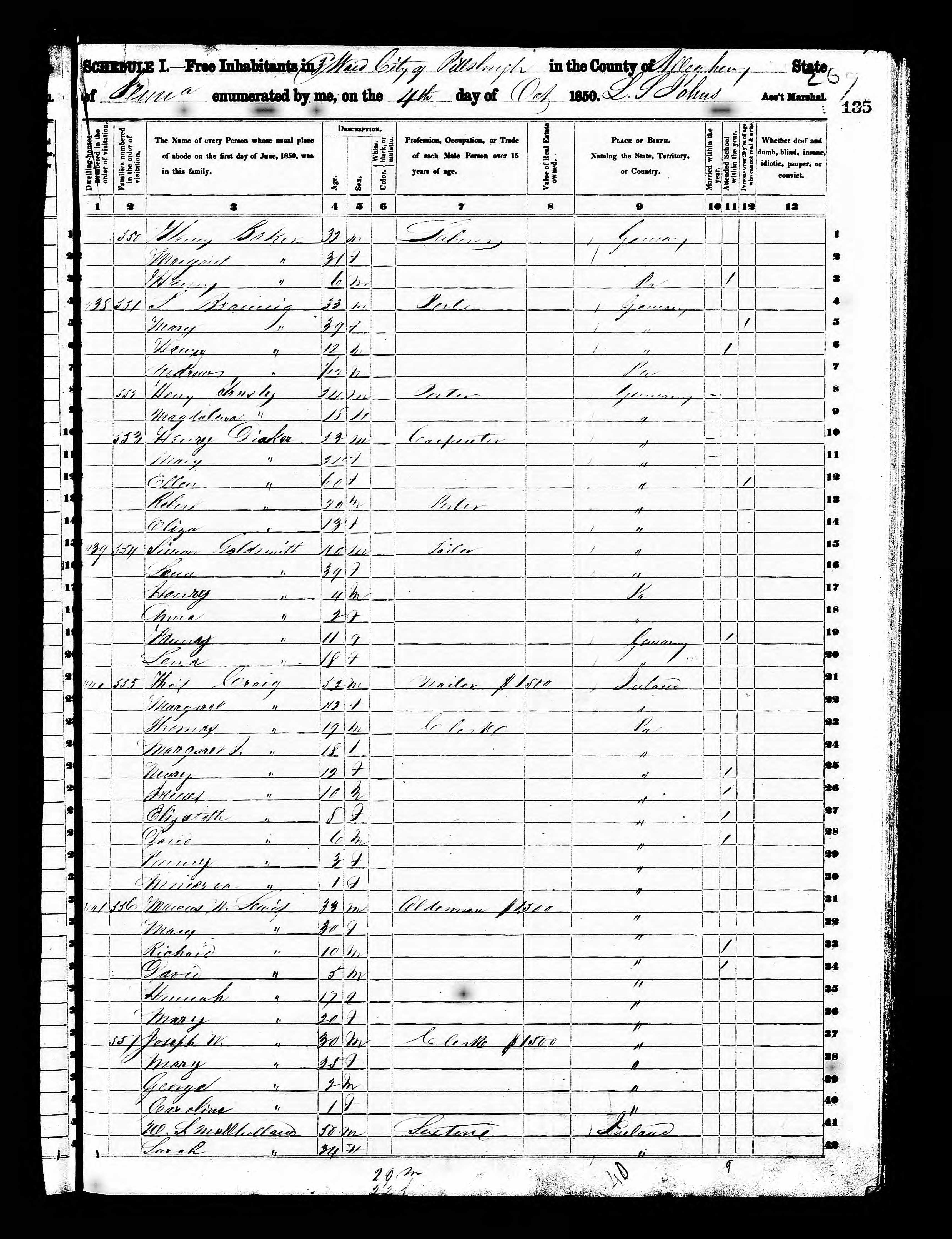
On January 10, 1847, Fanny gave birth to a son, Henry.  One year later Fanny and Simon had another child, a daughter named Hannah, born on June 5, 1848.  Both Henry and Hannah were born in Baltimore, Maryland.[1]  In 1850, the family was living in Pittsburgh along with Simon’s two daughters from his first marriage, Eva and Lena.  (The census record has many errors, but it is clear that this is Simon and Fanny’s family even though the record has the names mixed up and the ages inaccurate.)

Simon Goldsmith 1850 US census

Simon Goldsmith and family 1950 US Census Year: 1850; Census Place: Pittsburgh Ward 3, Allegheny, Pennsylvania; Roll: M432_745; Page: 135A; Image: 274

Tragically for the family, just two years after giving birth to Hannah, Fanny died in 1850.  She was buried at Troy Hill Jewish Cemetery in Pittsburgh.   Some readers might remember that that is also where the elusive Fanny Wiler is buried, another mother who left young children behind after an untimely death.

Fanny Schoenthal Goldsmith Troy Hill Pittsburgh

By 1860, Simon Goldsmith had moved with his two young children to Washington, Pennsylvania, a town about 28 miles to the southwest of Pittsburgh.    Simon, Henry, and Hannah were living with Simon’s son from his first marriage, Jacob, who was now 35 years old, according to the 1860 census, and working as a merchant.  Jacob and his wife had six young daughters of their own by 1860, so it must have been quite a crowded household.[2]

Simon Goldsmith and family 1860 US census Year: 1860; Census Place: Washington, Washington, Pennsylvania; Roll: M653_1192; Page: 1188; Image: 627; Family History Library Film: 805192

Simon Goldsmith and family 1860 US census
Year: 1860; Census Place: Washington, Washington, Pennsylvania; Roll: M653_1192; Page: 1188; Image: 627; Family History Library Film: 805192


Washington, Pennsylvania (called “Little Washington” by some locals) was then a town of 3,587 people, according to the 1860 census reports, and had grown by 34% since the prior census in 1850. There was not yet a railroad line to the town at that time.  What drew all those people to this town?  The town’s website does not provide many clues in its history section:

With immigrants from the west of Scotland and the north of Ireland, and with many transferring their homes from the eastern and central parts of Virginia, the vicinity of Washington was settled in 1768. The Pennsylvania legislature passed an act on March 28, 1781, erecting the County of Washington and naming Catfish Camp as the place for holding the first election. This was the first county in the U.S. to bear the name of Washington.

David Hoge laid out a plan of lots immediately after the action of the legislature. His original plot bears the name “Bassett, alias Dandridge Town,” but before the plot was recorded, lines were drawn through “Bassett, alias Dandridge Town” with ink, and the word “Washington” was written above.

The town started with every evidence of progressive tendencies, as the original plot dedicated a tract of ground to the people for recreational purposes. A lot was given for a courthouse where the current building now stands, and Lots 43 and 102, according to the plan, were presented by Mr. Hoge to “His Excellency, General Washington, and Mrs. Washington.” Part of the townsite had been the camp of Tingoocqua, who was a chief in the Kuskuskee tribe of Indians.

The town was incorporated as a borough on February 13, 1810, and became a city of the third class in 1924.

Map of Washington County, Pennsylvania, United...

Map of Washington County, Pennsylvania, United States Public School Districts (Photo credit: Wikipedia)

There is a very detailed history[3] of Washington, Pennsylvania, available online through the University of Pittsburgh Historic Pittsburgh websiteOne tidbit I picked up from this history was that Jacob Goldsmith served on the town council in 1858.

Unfortunately, most of this text is devoted to describing the political history of the area and the individuals who were political leaders, and I could not get a sense of what drew people to the area initially.  Was it the proximity to Pittsburgh? Was it a good location for trade? Was agriculture the primary source of income? Whatever the reason that drew people there initially, the town had existed for many years by the time my relatives arrived.   From the 1860 census, I know that Jacob was a merchant, and I assume that with a town of over 3,500 people, there would have been a large enough population to support many merchants.

English: Map of Washington Pennsylvania from 1897

English: Map of Washington Pennsylvania from 1897 (Photo credit: Wikipedia)

One thing seems clear, however.  When Simon Goldsmith lived in Washington, Pennsylvania, in 1860, there was no synagogue there.  The first synagogue in all of Washington County, Beth Israel, was not founded until 1891. Although my ancestors had lived in small towns in Germany with very small Jewish communities, they had at least had synagogues and schools and cemeteries for their community.  I am not sure that when Simon arrived, there were any such facilities.

Why, you might wonder, am I dwelling on this town in western Pennsylvania where the widower of my great-great-grandfather’s sister lived with his two children? Because six years later, my great-grandfather’s brother Henry Schoenthal arrived in Washington with his wife and children, and some of his siblings followed in the years after.  Last to come in 1881 was my great-grandfather Isidore, accompanied by his mother Henrietta and his sister Rosalie.  And 23 years later in 1904, my grandmother Eva Schoenthal was born in Washington, Pennsylvania, the youngest child and only daughter of Isidore Schoenthal and Hilda Katzenstein.  It seems to me that Henry did not choose Washington randomly, but rather based on the fact that his first cousin Jacob Goldsmith and his aunt’s widower Simon Goldsmith were living there.

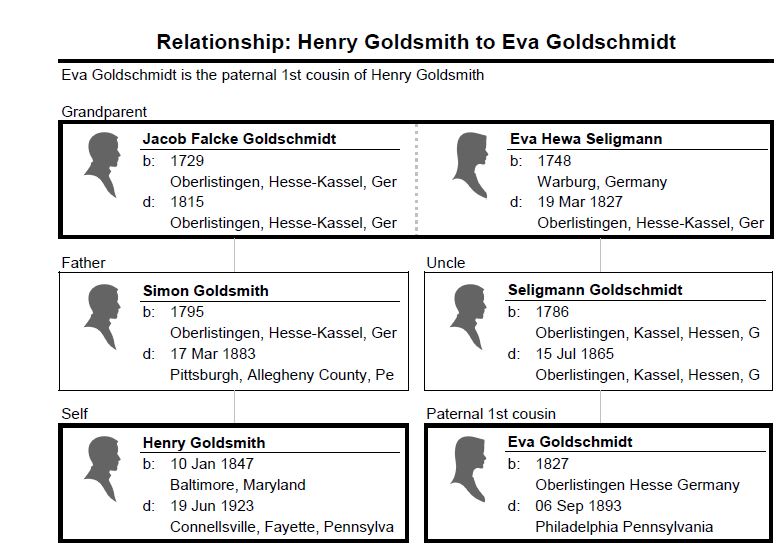
But I promised you a twist, and I still haven’t delivered.  Here it is. Simon Goldsmith was not only my great-great-aunt’s husband; he was also my four-times great-uncle himself.   Simon Goldsmith, husband of Fanny Schoenthal, had a brother named Seligmann Goldschmidt.  Seligmann had a daughter named Eva, just as his brother Simon did (both named for their grandmother, Simon and Seligmann’s mother Hewa).  Seligmann’s daughter Eva Goldschmidt was my great-great-grandmother; she married Gerson Katzenstein, my great-great-grandfather, and they were the parents of Hilda Katzenstein, who married Isidore Schoenthal, nephew of Fanny Schoenthal. Hilda Katzenstein and Isidore Schoenthal were my great-grandparents.

Stated as simply as possible, Simon Goldsmith was my four times great-uncle.  His wife Fanny Schoenthal was my three times great-aunt.   My grandmother Eva Schoenthal was a first cousin once removed from Henry Goldsmith, Simon and Fanny’s son, through her father’s side and his mother’s side:

Relationship_ Henry Goldsmith to Eva Schoenthal

She was also his first cousin twice removed through her mother’s side and his father’s side:

Relationship_ Henry Goldsmith to Eva GoldschmidtRelationship_ Eva Schoenthal to Eva Goldschmidt


They may have all left Germany, but they were still marrying within families they knew from back home.  Just another twist in my increasingly twisted family tree.  And more evidence of the limited gene pool created by endogamy and of the limited value of DNA predictions for Ashkenazi Jews.


[1] Fanny’s headstone says she was born in 1800.  I think it’s unlikely that Fanny had two children at ages 47 and 48, which is what she would have been if born in 1800 as her headstone indicates.  If, as her marriage record and the passenger manifest suggest, she was born in 1807, then she would have been having children at 40 and 41, which seems much more realistic.

[2] One thing that bothers me is that I cannot find out what happened to some of the other children of Simon Goldsmith and Ella Katzenstein.  Lena moved to Columbus, Ohio, after marrying Gustav Basch, and Joseph had died as a baby in Germany even before Ella died.  Eva immigrated with her father and step-mother, but then disappeared after the 1850 census; I assume she married. I’ve no idea what happened to Josias; perhaps he died before Simon left Germany, or maybe Simon left him behind with another family member.  Since they are not directly related to me, I am trying not to get too distracted looking for them, but eventually I will have to try and find out what happened to Josias and Eva.

[3] Title: History of Washington County, Pennsylvania: with biographical sketches of many of its pioneers and prominent men

Authors: Crumrine, Boyd, 1838-1916, Ellis, Franklin, 1828-1885, Hungerford, Austin N.

Collection: Historic Pittsburgh General Text Collection

Small World Story: The Hambergs of Breuna

English: Location of Breuna in district Kassel...

English: Location of Breuna in district Kassel, Hesse, Germany Deutsch: Lage von Breuna im Landkreis Kassel, Hessen, Deutschland (Photo credit: Wikipedia)

I am just a bit overwhelmed.  Digging through the archives from Hessen has been quite an adventure.  Not only have I found a great deal of information about the family of my great-grandfather Isidore Schoenthal, but I’ve also been wading through the archives searching for records of my Hamberg ancestors—that is, the family of my great-great-grandmother Henrietta or Jhette Hamberg of Breuna, who married Levi Schoenthal, Isidore’s father.  These German records are amazing.  Unlike my experiences searching for records in Poland for my Brotman ancestors, I am just swamped with information about my German paternal ancestors from Hessen (and I haven’t even begun looking at the records for Isidore’s wife, my great-grandmother Hilda Katzenstein, whose family was also from Hessen).

I am still compiling and editing the Hamberg information, and I am ready to start writing more about what I know about the Schoenthals later this week.  But for now here’s a little bit of what I’ve learned about the Hamberg family.

As mentioned, they were from Breuna.  Breuna is another small town in the Kassel district of Hessen, not too far from Sielen (about 26 km), where the Schoenthals lived.  According to the town’s official website, as translated by Google Translate, Breuna is 758 years old.  I could not find much about its history, but according to the town website, it was under the control of various aristocratic families over the centuries.

Today the original small village of Breuna where my ancestors lived is incorporated into a larger town, also called Breuna, consisting of five districts, one of which is the smaller village of Breuna; another is Oberlistingen, where some of my other relatives not yet discussed lived.  The town’s website described the town as an “Arbeiter-Wohnsitz-Gemeinde” or “worker-resident community,” where most people commute to the larger cities for work.

The town’s website also states:

Particularly noteworthy are the natural, wooded, yet convenient position of the municipality. Pure nature with freeway access! The advantages of a rural environment without having to sacrifice the most important social and cultural institutions and the relative proximity to the North Hessian metropolis of Kassel, the beautiful half-timbered towns Hofgeismar, Wolf Hagen, the spa of Bad Arolsen and the East Westphalian town of Warburg.

The website goes on to point out that although once an agriculture-based economy, Breuna no longer is primarily agricultural.  There are only a few full-time farmers, and they focus on pigs, dairy, and grain.

The population of the larger Breuna town today is about 3700 people, with the smaller district of Breuna consisting of about 1500 people.

As for Breuna’s Jewish history, the Alemannia-Judaica reports that there were four Jewish families in Breuna in 1744 and 1776.  By 1833, there were 53 Jewish residents, and after that the Jewish population started to decline.  There were 29 in 1871, 40 in 1885, 33 in 1895, 23 in 1905, and 14 in 1910.  The overall population of the town was between 900 and 1000 during these years, so the Jewish population was quite a small percentage of the overall population. Most of the Jews were engaged in horse and cattle trading, and some were farmers.    There was a synagogue, a school, a mikvah, a chevra kadisha (burial society), and a cemetery.  There was still a small Jewish community in Breuna when the Nazis came to power in 1933.  Almost none of those who remained survived the Holocaust.

For close to fifty years, the leader of the Jewish community in Breuna was Baruch Hamberg, according to Alemannia-Judaica.  He was my second cousin, three times removed, as described below.   His 75th birthday celebration was written up in one of the local papers in an article describing his prudence and vigor and wishing him many years ahead.

Article about Baruch Hamberg's 75th birthday Jüdischen Wochenzeitung für Kassel, Kurhessen und Waldeck" vom 29. Mai 1931 http://www.alemannia-judaica.de/images/Images%20368/Breuna%20JuedWZKassel%2029051931.jpg

Article about Baruch Hamberg’s 75th birthday
Jüdischen Wochenzeitung für Kassel, Kurhessen und Waldeck” vom 29. Mai 1931
http://www.alemannia-judaica.de/images/Images%20368/Breuna%20JuedWZKassel%2029051931.jpg

How was Baruch related to me? From my research, I’ve learned that Henrietta Hamberg, my great-great-grandmother who married  Levi Schoenthal, was the daughter of Moses Hamberg and Guetchen Rosenberg.  According to at least one record, Moses was a cattle merchant. Moses and Guetchen had nine children (or at least that is how many I have located so far).  One family tree on Geni says that Moses was born in Burgsinn, Bavaria on June 12, 1777, but I’ve not found any definitive source to corroborate that.  That tree also says that Moses’ father was named Juda and that his mother was Rachel Simon, but I am still looking for corroboration of those facts as well.  One reason I am skeptical is that the Hessen archives have a transcription of Moses’ headstone, which indicates that he was born in 1785 and that his father’s name was Huna, not Juda.  On the other hand, the first son born to Moses and Guetchen was named Juda, and that would suggest that perhaps Moses’ father was named Juda.

UPDATE: I’ve now seen, thanks to Hans-Peter Klein, a birth registry for Moses which gives his father’s name as Juda Moses, his mother’s as Rachel Simon, and his birthdate as 1777.  Looking again at the headstone transcription, I now think it says he was 88 years old when he died, not 80, so 1777 as his birth year is consistent with the headstone.  I still cannot explain why it has his father’s name as Huna.

Headstone for Guetchen Rosenberg Hamberg (12) and Moses HambergHHStAW Abt. 365 Nr. 97, S. 6

Headstone inscription for Guetchen Rosenberg Hamberg (12) and Moses Hamberg HHStAW Abt. 365 Nr. 97, S. 6

The Geni tree also asserts that Moses had a brother named Samuel, and I have found many records for Samuel Hamberg and his family.  According to the death record I found for him, he died on December 11, 1857, at age 80, so he would have been born in 1777.

(UPDATE: the same record that listed Moses’ parents and birth year lists Samuel’s birthdate as July 13, 1780.  I can’t explain the discrepancy between the birth registry and the death record except to say that one is incorrect.)

Samuel married Kreschen Baruch, and they had five children.  Their first-born son was also named Juda, lending further weight to the possibility that Juda was the name of the father of both Moses and Samuel.  As you might imagine, having two men named Juda Hamberg in one small town can be quite confusing when looking at birth, marriage, and death records.

To keep them straight, the Breuna records refer to Moses’ son as Juda I, since he was born first (on October 10, 1812, according to the synagogue registry page for Moses and his sons).  Samuel’s son, Juda II, was born in 1820, according to the synagogue registry page for Samuel and his sons.

Eine Vervielfältigung oder Verwendung dieser Seite in anderen elektronischen oder gedruckten Publikationen und deren Veröffentlichung (auch im Internet) ist nur nach vorheriger Genehmigung durch das Hessische Hauptstaatsarchiv, Mosbacher Straße 55, 65187 Wiesbaden, Germany gestattet.

Synagogue Registry for Moses Hamberg and his sons  HHStAW Abt. 365 Nr. 96, S. 5

Synagogue Registry for Samuel Hamberg and his sons HHStAW Abt. 365 Nr. 96, S. 6

Synagogue Registry for Samuel Hamberg and his sons
HHStAW Abt. 365 Nr. 96, S. 6


Juda I was a horse dealer, and he married a woman named Dina Sauer.  They had five children.  Juda II was a merchant, and he married a woman named Breinchein Goldwein.  They had five children also; one of them was the afore-mentioned Baruch Hamberg who led the Breuna Jewish community for almost half a century.

You might wonder why I am bothering to report all this since neither Juda is a direct ancestor of mine.  Well, it’s some background to the small world story referred to in the title of this post.

Stepping back a bit, when I first started researching the Hambergs, the first place I went was to the Jewish Family Finder on JewishGen.org.  I searched for the surname Hamberg in Breuna to see if anyone else was researching that family, and sure enough, there was someone listed, though he’d not been active for many years.  There was no name disclosed, just a researcher ID number, so I sent a message to that researcher, not expecting a response, given how long it had been since that person had used JewishGen.

Then I saw the Geni page for Moses Hamberg, referred to above, and I sent a message to the Profile Manager on that page.  Little did I know that I had in fact sent two messages to the same person since the Profile Manager on Geni was the same person as the researcher listed on the Family Finder on JewishGen.  That person, a man named Rob, contacted me by email later that day, and we began to exchange information.  We exchanged information about the Hambergs and tried to sort out how we were related. (Rob pointed out that someone had made changes to his Geni information since he’d last looked at it, which is one reason I don’t like Geni—complete strangers can go in and change your tree without leaving any sources or explanations for the change.)  We are still working on that, and it’s somewhat confusing because of the two men named Juda Hamberg discussed above.  Rob and I are either fourth or fifth cousins, depending on whether he is a descendant of Moses Hamberg or Samuel Hamberg.  At the moment I think he is the great-grandson of Baruch Hamberg, the renowned leader of the Breuna Jewish community, and thus a descendant of Samuel.

But in addition to exploring the family history, Rob and I also exchanged current information about ourselves.  I mentioned that I lived in western Massachusetts, and Rob said he lived in eastern Massachusetts.  He mentioned the town where he lived (Arlington), and I responded that I also had once lived in Arlington over thirty years ago.  He then said he also had been living in Arlington that far back, and in fact once we exchanged street addresses, we realized that we had lived less than a mile from each other.

Corner of Park Avenue and Mass Avenue in Arlington By John Phelan (Own work) [CC BY 3.0 (http://creativecommons.org/licenses/by/3.0)], via Wikimedia Commons

Corner of Park Avenue and Mass Avenue in Arlington
By John Phelan (Own work) [CC BY 3.0 (http://creativecommons.org/licenses/by/3.0)%5D, via Wikimedia Commons

I then mentioned that we had very good friends who had also lived for a few years in Arlington, but had since moved to a nearby town, and I mentioned their names.  Rob emailed me back, saying that I had to call him because the coincidences were getting just too crazy.  It turns out that our friends have been close friends with Rob and his family for over twenty years.  We had undoubtedly all been at the same family celebrations for our mutual friends, including their daughter’s wedding just last year.

As Rob and I spoke on the phone, I had goosebumps, and I have them again as I write down this story.  Here was someone I had once lived near and with whom I shared good friends and who I might have even met or at least passed by in town or at a wedding.  But we never knew we were cousins, linked as descendants of the Hambergs of Breuna.  Isn’t it a strange and small world?  I am now looking forward to having a chance to share all these crazy coincidences with Rob and his wife and our mutual friends over dinner sometime in the near future.


The Genealogy Village Comes Through Once Again

As I mentioned in my last post, my great-grandfather Isidore Schoenthal was one of twelve children.  He and his siblings were born in Sielen, Germany, the children of Levi Schoenthal and Henrietta Hamberg.  The first helpful source I found about his family was a biography written about Isidore’s older brother Henry in 1893 as part of a commemorative book[1] celebrating Washington County in Pennsylvania, where Henry and Isidore both had settled after immigrating to the United States (the “Beers biography”).  Given that the Beers biography was written while both Henry and Isidore were still living in Washington, Pennsylvania, I was inclined to give it significant weight as a credible summary of Henry’s life to that point and of the background of his family.  I will refer to it in more depth when I focus on Henry himself, but for now I am referring to its assertions regarding the family of Levi and Henrietta (Hamberg) Schoenthal.

English: City Hall in Washington, Pennsylvania...

English: City Hall in Washington, Pennsylvania (in Washington County). (Photo credit: Wikipedia)

According to the Beers biography, Levi Schoenthal was born in 1813 and worked as a shoemaker.  He and his wife Henrietta had twelve children—nine boys and three girls.  Two of their sons died in infancy, but the other ten children survived to adulthood.  Of those ten, nine immigrated to the United States, and eight stayed here.  (The youngest child, Rosalie, returned to Germany to marry, and one son, Jacob, never left Germany.)  Of those who stayed in the United States permanently, my great-grandfather Isidore was the youngest and arrived last, along with his mother and Rosalie, in 1881.

Despite believing that this biography was probably fairly accurate, given that it was written so close to the time of the events reported, I nevertheless wanted to find some original German sources to verify the information.  Fortunately, I was able to verify quite a bit (but not all of it) by searching through the Hessen Archives as well as US records.  I was very lucky to have help from Dorothee Lottmann-Kaeseler (who correctly reminded me after my last post that she had first mentioned Sielen as my Schoenthal ancestral town), Hans-Peter Klein, Matthias Steinke, JewishGen, and the Hessian Archives.

Based first on a search through JewishGen, I was able to find birth records for almost all of the children of Levi and Henrietta in the Hessian State Archives.  The archived birth records available start in 1846, so I could not find records for the three children born before 1846 (Hannah, 1841; Henry, 1843; Julius, 1845), but using JewishGen and then manually scanning through the records, I was able to find birth records for seven of the other nine, including one for one of the two baby boys who had died in infancy.  So far I had not found any birth record for the other baby who died in infancy according to the Beers biography or for Jacob.

The fact that I was able to locate birth records for seven of the children astounded me.  Here are six of the birth records I found:

Amelia (Malchen) Schoenthal birth record January 2, 1847 Hessen Archives HHStAW 365 No 772

Amelia (Malchen) Schoenthal birth record January 2, 1847
Hessen Archives HHStAW 365 No 772


Simon (Sieman) Schoenthal birth record February 14, 1849

Simon (Sieman) Schoenthal birth record February 14, 1849   Hessen Archives HHStAW 365 No 772


Marcus Schoenthal birth record January 26, 1853

Marcus Schoenthal birth record January 26, 1853 Hessen Archives HHStAW 365 No 772

Sadly, Marcus died just ten days later:

Marcus Schoenthal death record Febuary 5, 1853 HHStAW fonds 365 No 773

Marcus Schoenthal death record Febuary 5, 1853
HHStAW fonds 365 No 773


Nathan Schoenthal birth record August 6, 1854

Nathan Schoenthal birth record August 6, 1854 HHStAW 365 No 772


Felix birth for blog

Felix (Seligmann) Schoenthal birth record December 15, 1856 Hessen Archives HHStAW 365 No 772


Rosalie Schoenthal birth record August 17, 1863

Rosalie Schoenthal birth record August 17, 1863 Hessen Archives HHStAW 365 No 772

One of the last birth records I found was the one for my great-grandfather Isidore.  I had scanned through the pages several times looking for his birth record, the one that mattered the most to me, of course.  But I hadn’t seen it, and I started wondering whether he’d been born outside of Sielen.  But then, giving it one last chance, I looked at every baby born in 1858, the birth year I had for Isidore, and saw one with the birth date November 22, 1858.  That date seemed familiar (though first I thought only because that was the day of the year JFK was assassinated in 1963), and when I saw that in fact other records had Isidore’s birth as November 22, 1858, I looked more closely at the record.  The entry was written in more traditional German script than many of the others, but I thought I could make out a word that just might be Levi.

Isidore birth for blog

Isidore (Isaak) Schoenthal birth record November 22, 1858 Hessen Archives HHStAW 365 No 772

So I posted a snapshot of the record to the German Genealogy group on Facebook, and sure enough my always helpful friend Matthias Steinke jumped right in and translated it for me.  Matthias said that for the baby, it says, “Male Gender, Isaac,” and for the parents, “Lewie (??) Schonthal shoemaker and Aesther (??) born Hamberg, legitimate parents.”  It was clear to me that this was the birth record for my great-grandfather.  His Hebrew name must have been Isaac—his secular name Isidore.  My guess is that Henrietta’s Hebrew name was Esther or that it actually says Jhette, which was Henrietta’s name in Germany; and I assume that “Lewie” is actually Levi.  I was very excited that I now had my great-grandfather’s birth record as well as those of most of his siblings.

I was still searching for a birth record for Jacob, however.  I had scoured through the Sielen birth records now multiple times without finding it, but according to a genealogy report prepared by Hans-Peter Klein, Jacob was born in December, 1850.  I went back one more time and found this record:

Jacob Schoenthal birth record December 1850

Jacob Schoenthal birth record December 1850

As you can see, although this reports a baby boy named Jacob born in December, 1850, on the left side of the page, the page with the parents’ information on the right is illegible, at least as scanned by the archives.  But I thought that this must be the record that Hans-Peter relied upon to obtain Jacob’s birthdate.  In addition, however, Hans-Peter located a marriage certificate for Jacob Schoenthal and his wife Charlotte (Lottchen) Lilienfeld, and that also included his birth date as December 22, 1850, as translated by my Facebook friend Matthias Steinke:

Eine Vervielfältigung oder Verwendung dieser Seite in anderen elektronischen oder gedruckten Publikationen und deren Veröffentlichung (auch im Internet) ist nur nach vorheriger Genehmigung durch das Hessische Staatsarchivs Marburg, Friedrichsplatz 15, D-35037 Marburg, Germany gestattet.

Marriage record of Jacob Schoenthal and Charlotte (Lottechen) Lilienfeld HStAMR Best. 920 Nr. 2610 Standesamt Gudensberg Heiratsnebenregister 1879, S. 11

Marriage record of Jacob Schoenthal and Charlotte (Lottechen) Lilienfeld
HStAMR Best. 920 Nr. 2610 Standesamt Gudensberg Heiratsnebenregister 1879, S. 11

5 – Gudensberg the 1st September 1879 – To the below signing registrar came for a marriage 1. the merchant Jacob Schönthal, at the moment shop-assistant in Cologne, identified by the shown certificates and in person by the present Beisen(?) Engelbert, israelic religion, born the 22 December 1850 in Sielen, residing in Cologne, son of the in Sielen deceased shoemaker Levi Schönthal and his wife Jettchen nee Hamberg, residing in Sielen and 2. the Lottchen (called Charlotte) Lilienfeld, known personally, israelic religion, born the 6th April 1855 in Gudensberg in house nr. 215 at her parents. Daughter of the cantor Meyer Lilienfeld I and his wife Hannchen nee Meiberg, residing in Gudensberg. As witnesses were present: 3. the merchant Beisen (?) Engelbert, personally know, 59 years old, residing in Gudensberg in house nr. 218, 4. the shop-assistant Michel Lilienfeld, known personally, 23 years old, residing in Halberstadt. Followed by the sentence whether they intend to marry each other and the signatures.

But it wasn’t over.  Now that I had all these birth records for their children, I wanted to know more about Levi and Henrietta and their parents.  I was very fortunate that Dorothee had recommended that I contact Hans-Peter Klein because he was able to provide me with some of that additional information.  He sent me a copy of the marriage record for Levi Schoenthal and Henrietta Hamberg:

Marriage record for Levi Schoenthal and Jhette Hamberg HHStAW, 365, 386

Marriage record for Levi Schoenthal and Jhette Hamberg
HHStAW, 365, 386

Once again, Matthias came through for me and translated this document:

nr 3, date of marriage 24 July 1839 – groom Levi Schönenthal, shoemaker in Sielen – bride: Jette Hamberg – unmarried in Bräuna(Breuna) age of the groom: 26 years, 9 month and 16 days – age of the bride: 22 years – parents of the groom: Heinemann Schönenthal, merchant in Sielen and Handel nee Beerenstein – parents of the bride: Moses Hamberg, merchant in Bräuna and Gutchen nee Rosenberg. entered in Breuna the 25th July 1839 by Itzig Eichholz

From this record I could now see that Levi (born October 8, 1812)  was the son of Heinemann Schoenthal and Handel Beerenstein, who lived in Sielen, and that Henrietta was the daughter of Moses Hamberg and Guetchen Rosenberg, who lived in Breuna, a town located less than 30 km from Sielen. (More on Breuna and the Hambergs in my next post.)

Now I had another family and three more surnames—Beerenstein, Hamberg, and Rosenberg— to add to my family tree, names I’d never known were those of my ancestors until now.  I now had the names of two more sets of my great-great-great-grandparents.  I now know the names and something about almost half of my great-great-great-grandparents.  I didn’t know any of their names at all when I first started doing genealogy. In fact, I only knew the names of two of my great-great-grandparents.

So thank you from the bottom of my heart to Matthias Steinke, Dorothee Lottmann-Kaeselar, and Hans-Peter Klein for helping me find another generation and another branch of my family.


.


[1] Beers, J. H. and Co., Commemorative Biographical Record of Washington County, Pennsylvania (Chicago: J. H. Beers & Co., 1893). Transcribed March 1997 by Neil and Marilyn Morton of Oswego, IL as part of the Beers Project. Published March 1997 on the Washington County, PA USGenWeb pages at http://www.chartiers.com/.  See http://www.chartiers.com/beers-project/articles/schoenthal-1057.html

The Schoenthals: Where They Came From

Deutsch: Deutsche Bundesländer Karte.

Deutsch: Deutsche Bundesländer Karte. (Photo credit: Wikipedia) (Note the location of Hessen in blue on this map.)

My great-grandfather Isidore Schoenthal came to the United States in 1881; he arrived in New York City on September 3 of that year on the ship Rhein when he was 22 years old.  I had known that he came from Germany, but not exactly where.  His death certificate said he was born in “Celand, Hess, Germany,” and from various other sources about him and his siblings, I concluded that the town where he was born was in fact Sielen, a small town in the Kassel district in the Hesse region of Germany.  Today’s post will focus on what I’ve learned about Sielen, the home town of my Schoenthal ancestors.

Sielen, Germany

Sielen, Germany

It was not that easy to find out very much about Sielen.  The town is so small (510 inhabitants as of 2011[1]) that it doesn’t even have a Wikipedia entry.  The closest major city is Frankfurt, and it is over 200 kilometers away, as are Dusseldorf and Cologne.  From what I can see on Google Maps, Sielen is surrounded for miles and miles by farmland.  The closest town is Trendelburg, which is about four kilometers away. It merits its own Wikipedia page, though that entry is all of three sentences and tells nothing of the history of the town.

Wikipedia reports that the population of Trendelburg was over 5000 people as of 2011, based on this website.  But according to the town’s official website, that number reflects not just the village of Trendelburg itself but the neighboring towns, including Sielen.  Trendelburg proper has just over 1100 residents.   Sielen has 552. Sielen is now considered a district within the larger town of Trendelburg.

Deutsch: Stadt Trendelburg

Deutsch: Stadt Trendelburg (Photo credit: Wikipedia)


From the Trendelburg official website, I was able to learn some information about the history of the town, though relying on Google Translate makes reading the German always somewhat bewildering.  Assuming I am reading most of the general information correctly, the history of Trendelburg as a separate entity began when a castle was built there in the 13th century by Konrad the III, Schoeneburg .  The location was already an important trade center for that region as it was close to a good fording spot on the Diemel River.   Over the next several centuries, the castle was used for many different purposes: a hunting lodge, the offices of the Prussian Forestry Department, and today as a privately-owned hotel and restaurant.

Die Trendelburg - Gesamtansicht, Hessen, Germany

Die Trendelburg – Gesamtansicht, Hessen, Germany (Photo credit: Wikipedia)

The hotel’s website includes some more detailed history of the castle:

With many twists and turns, the Diemel River meanders towards the Weser River. Right by Trendelburg Castle, there is a sharp bend around a rocky ridge which the locals called “Trindirberg” many years ago, probably naming the “mountain” after the village Trende, at the time situated to the west of the ridge but now completely vanished.

Sometime before 1300, Konrad the III of Schöneberg constructed a castle on this “mountain” to protect the main road from Kassel to Bremen. The settlement outside the castle also dates from this period.

Around 1305, Landgrave Heinrich I and the Bishop of Paderborn each purchased one half of the castle. The part belonging to Hessen was a Paderborn fief; the town’s official representatives were the Stoghusens, who lived in the castle for four generations.

In 1443 and 1456, the fortifications were renewed following serious fires. After their reconstruction, Trendelburg Castle was also changed, taking on the shape you see today. The fortifications were extended by a 38 metre high keep with four bretèches and a curtain wall in the shape of a pentagon with four small round towers. In the living quarters, which were erected in the 15th and the 17th century respectively, the remains of a late Gothic chapel with ribbed vaults have been preserved; the Trendelburg register office now uses this space for its civil wedding ceremonies. 

In the Thirty Years’ War, the castle was occupied by Tilly’s troops, and in 1637, it was destroyed by the Croats. In the Seven Years’ War, Trendelburg Castle was occupied by the French until they were driven off by Ferdinand V, the Duke of Brunswick, through artillery fire.

In 1901, military man Oberst Adalbert von Stockhausen, in all likelihood a descendant of the Stoghusens of old, bought the castle.

Taken over by the Dr. Lohbeck Group in 1996, the castle’s long-term future was secured by its conversion into a hotel for discerning visitors.

According to the hotel’s website, this is the castle where Rapunzel lived and let down her hair.  There is even a weekly “re-enactment” of this fairy tale at the castle.


Embed from Getty Images

The Trendelburg official website also contains some information about the history of Sielen itself. The village is bordered on one side by the Diemel River and surrounded by limestone hills. According to the website, a stone ax found in Sielen dated back to 6000 years ago, and a cemetery back to 1000 B.C.E.  A mill dating from 1243 remains as a ruin.

So what were my ancestors doing in this tiny village back in the 19th century and maybe before?  What kind of Jewish life could there have been? According to the Alemannia-Judaica website, there was a very small Jewish community in Sielen at least from the early 19th century.  In 1835, there were 38 Jewish residents; in 1861, there were 48.  By 1905, there were only fourteen Jewish residents, and by 1924, there were just four Jewish residents remaining. Like my own relatives, the Jewish residents either had emigrated outside of Germany or moved to the bigger cities.  During the Nazi era, those few remaining Jews in Sielen either left the area or were killed during the Holocaust.

Despite the tiny size of the Jewish community, there was a synagogue in Sielen from about 1817.  Originally a home owned by Moses Herzbach was used for prayer services, but in 1817, seven Jewish families sought permission from town officials to build a synagogue as an addition to Herzbach’s home.  Permission was granted, and Herzbach financed the construction of the synagogue.

There was also a Jewish school and a cemetery.  According to Alemannia-Judaica, at first Jews were buried in a cemetery in Trendelburg, but around 1846, a separate cemetery was established in Sielen on the road between Sielen and Trendelburg.  There are 26 graves there, including that of my great-great-grandfather Levi Schoenthal, as I will discuss in a later post.

Down the road in Trendelburg there was also a Jewish community with its own synagogue, cemetery, and school.  That community dates back to 1676, but also was quite small.  In 1731 there were 21 Jewish residents; the Jewish population peaked in 1827 at 31, but was down to just 12 by 1895.  There was a Jewish school in Trendelburg, where my great-grandfather’s brother Henry Schoenthal was a teacher before he immigrated to the United States.  There was also a mikveh, the ruins of which were discovered in 2001 during renovations and which can now be seen as a tourist attraction.  By Hitler’s time, there were only a handful of Jews remaining in Trendelburg, and they died in the Holocaust.

How did these Jews make a living in these small towns where the number of Jewish residents was so small? What were their lives like? I can’t say that I am surprised that my great-grandfather Isidore Schoenthal and almost all of his siblings left Sielen by the 1880s; my great-grandfather had ten siblings who survived to adulthood.  What kind of opportunities could they find in this small, rural town? Probably very few, and so they left and ended up all over the United States: Pennsylvania, New York, New Jersey, Colorado, Arizona, California, Illinois, Ohio, Florida, and so on.  They learned English, they worked hard and survived, and they became Americans.    Like Joseph and Bessie Brotman, Isadore Goldschlager, Bernard Seligman, John Nusbaum and Jeanette Dreyfuss, and Jacob Cohen and Sarah Jacobs, they took the risk of leaving behind what they knew so that they could make a better life for themselves and their descendants.  How fortunate I am to be one of those descendants.

English: Location of Trendelburg in district K...

English: Location of Trendelburg in district Kassel, Hesse, Germany Deutsch: Lage von Trendelburg im Landkreis Kassel, Hessen, Deutschland (Photo credit: Wikipedia)


[1]   http://www.citypopulation.de/php/germany-settlements-hessen.php?cityid=06633025_0B18

[i] http://www.citypopulation.de/php/germany-settlements-hessen.php?cityid=06633025_0B18

Lotte’s Story: A Post-Script

The response I received to the writings of my cousin Lotte was overwhelming.  People were very moved by her life story and by her writing. (You can find her story here, here, and here.)  Lotte has generously shared some additional writings and photographs about her family and her life, which I will share with you, with her consent.  (All of Lotte’s writings are protected by copyright and may not be reproduced without her permission.)

First, a reminder of how I am related to Lotte:

Lotte to me


For those who have not read the first installment of Lotte’s story, a brief recap:  Lotte grew up in Mannheim, Germany, with her parents, Joseph and Aennie (Winter) Wiener and her older sister Doris.  Her father Joseph was a doctor in Mannheim, and her family was living a comfortable life there.  Lotte was an excellent student and was enjoying a good life until the Nazis came to power in 1933.

Aenne Wiener and Doris

Aenne and Doris Wiener c. 1916

Joseph Wiener earlier picture

Dr. Joseph Wiener

Her grandparents, Laura (Seligmann) and Samuel Oscar Winter lived not too far away in Neunkirchen, where her grandfather was in business with his brother-in-law, Laura’s brother Jakob Seligmann.  Lotte described what it was like to visit her grandparents:

MY GRANDPARENTS’ HOUSE

Neunkirchen

It was a foregone conclusion that I spent most of my Christmas and Easter and also a couple of summer vacations at my grandparents’ house. I never was asked whether I wanted to go there. If so, the answer would have been “yes”. I liked them.

They lived in Neunkirchen in the Saarland, an area of coal mining and steel production administered by the League of Nations at that time. Their three-story attached row house was at Moltkestrasse 23, a nice residential neighborhood. A buzzer would open the front door after which another door with a glass panel opened to a short corridor. To the right on the first floor, called parterre, there was a fairly large carpeted and well-furnished salon and a quite formal dining room. Both rooms were dark and hardly ever used. The smelled a bit dank and musty. But to the left of the dining room a glass-beaded curtain opened to a long, enclosed, bright veranda where my grandmother kept a number of house plants including some she called amaryllis, her pride and joy. And yes, there was a rope-operated dumb-waiter from the kitchen above to the dining room. I used to love pulling those ropes and playing with it.

A toilet with a small hand basin and a spindle full of squares of cut newspaper, hardly to be called toilet tissue, was located half-way up the stairway  to the middle floor, the actual living quarters. The living room was fairly bright and not anywhere as elegant as the downstairs salon. The main attraction were my grandfather’s rocking chair and the blue and white KKL (Jewish National Fund) box filled with a number of coins. I liked to manipulate them out with a knitting needle. Of course I replaced them immediately. I knew the money was for a far-away country called Palestine.

Gilabrand at en.wikipedia [CC BY 3.0 (http://creativecommons.org/licenses/by/3.0)], from Wikimedia Commons

Gilabrand at en.wikipedia [CC BY 3.0 (http://creativecommons.org/licenses/by/3.0)%5D, from Wikimedia Commons

Next to the living room was the fairly spacious master bedroom, dark and gloomy and actually taboo for me. But the bathroom was bright and big and quite an attraction for me because I could come in while my grandfather was still brushing his teeth and whistling while doing so. He used to announce that he was the only person with that capacity because he had false teeth. Oh, and of course the kitchen was on that floor but I did not spend much time in it and don’t remember the details, except that it opened up to a balcony where we would sometimes eat. On those occasions we had to constantly wipe off the ever-present soot that came from the coal mines.

The landing half-way up to the third floor featured an ice box. Not much food was stored in it. Certainly nothing kept there tasted fresh. We had to watch out for the sound of drip-drip-dripping water which meant the molten ice had filled the basin below it almost to capacity.

I slept in the first of the three bedrooms on the third floor, up a creaky stairway. It was pretty dark too with a large bed and a dresser. It also smelled pretty musty and the bed springs were making all kinds of noises. A large limp rag doll with a porcelain head and eyes that would open and close greeted me on the bed. It was the ugliest thing I can remember, but my grandmother thought I would like to play with it since it had been my mother’s. I hated it and tucked it away in a drawer very quickly. Early in the morning I could hear the crowing of roosters. Kickeri-kee they went. Kickeri-kee. On Sunday mornings that sound was joined by the ringing of several church bells. After all, Neunkirchen means nine churches. It did not wake me since I was not asleep any more but had to stay upstairs until I could get into the bathroom. On the way downstairs I was greeted by the aroma of freshly brewed coffee.

Two more rooms were located on that floor. One was a large storage room, mostly unused. The other was the former bedroom of my uncle, my mother’s brother, who was killed early in World War I. I was not allowed to enter that room. Probably it was locked. I believe it was kept exactly the way my uncle had left it. My grandparents never talked about it but never got over it. My grandmother only wore black or grey clothes.

Of course the house also featured a basement. There were at least two parts to it, one a coal cellar, unpleasant with a dusty smell all of its own, and a fruit cellar. That was a delightful place. I loved to go downstairs and inhale the aroma of apples, yeast cakes, apple pies and other goodies which were stored in the cool basement room.

The house really was quite gloomy and I probably was bored during my visits. But I never felt unhappy there. That was the way it was. And my grandparents certainly loved my visits and I loved them for it.

Her writing is so vivid that I can easily picture this large and dark house that she visited as a small child.  It’s incredible to me how clearly she remembers this house and these visits.

Samuel, Laura, and Anna Winter and Jakob Seligmann

Lotte’s grandparents Samuel and Laura Winter, her mother Anna (Winter) Wiener, and her great-uncle Jakob Seligmann


Lotte also has painted a wonderful portrait in words of her great-uncle Jakob Seligmann, depicted above, far right:

Onkel Jakob

He was a good-looking man. Portly and erect. He had a rosy complexion, a well cared-for short white beard, short white hair surrounding his mostly bold pate, an aquiline nose. Portly, I said. His belly protruded just enough to display a heavy golden watch on a chain. That was Onkel Jakob, my grandmother’s brother and thus my mother’s uncle. He was my grandfather’s business partner.

He was very fastidious. His shoes were always shined and a crisp handkerchief was tucked in his left upper coat pocket. He spoke clearly and slowly in a baritone voice. He showed up at the office at exactly the same time every day. On Sundays at 10 o’clock he walked to the train station, about 20 minutes from where he lived, in order to check the correct time and reset his watch if necessary. He wanted to make sure his gold watch, so prominently displayed on his belly, was correct. Once the watch was set, he might pick me up at my grandparent’s house in Neunkirchen. He took me and perhaps my sister too for a walk in the nearby woods, right behind my grandparent’s store. Sometimes Herr Eisenbeis, the owner of the building, would join us. He was a hunter and carried a long rifle. He actually was looking for deer in the birch woods. I never saw him shooting any but I did see a number of deer. Herr Eisenbeis was stocky and short. He was dressed in a green hunter’s outfit. He spoke in staccato sentences and was very abrupt and very Prussian. I did not like him very much.

But back to Onkel Jakob. I did like him and I also liked Tante Anna, his wife, who was quite beautiful and a wonderful cook. She served different kinds of food from those my grandmother made because she was not Jewish and was born in Hamburg in northern Germany. She had a brother in Kalamazoo. I remember because that name sounded very funny.

Onkel Jakob’s life seemed to be run strictly by the rules. He was pedantic, to say the least. But something went utterly against those rules. He never brought Tante Anna to my grandparent’s house. Somehow I found out that she was not welcome there because she was a shikse and because she had been Onkel Jakob’s housekeeper for many years and that they had only recently been married. It was not fair. She was a good woman who went with Onkel Jakob when he had to leave Neunkirchen to move to Luxembourg during the Hitler years. She was the one who kept in touch with my mother as long as she could after World War II broke out. Through her we learned that my grandmother collapsed on the doorsteps and died when the Nazis marched in. That my grandfather had been deported. And that Onkel Jakob had died before the same fate could happen to him. That both he and my grandmother were buried in the Jewish cemetery in Luxembourg for which she supplied the address. She finally moved back to Hamburg where she had some family. After that we did not hear from her again.

I remember Onkel Jakob as a very pedantic man. But along with him I also remember Tante Anna who was a kind and good woman.

As she wrote in Part II of her story, her grandparents and her great-uncle all moved to Luxembourg around 1935 to escape the Nazis.  They were, however, unable to come to the United States when Lotte and her parents left in 1939, and all three died during the Holocaust.  There is a memorial stone for the three of them in Luxembourg.

Winter stone


Fortunately, Lotte, her sister, and her parents were able to move first from Germany to Luxembourg and then to the United States in 1939 where Lotte successfully completed nursing school.


Lotte

Lotte

I was curious about what had happened to her father Joseph Wiener after he came to the US.  He’d been a doctor in Germany, and I asked Lotte whether he had been able to continue practicing medicine after coming to the US to escape the Nazis.  She shared this essay:

FACING DIFFICULTIES

Imagine having to learn a new language, having to take difficult tests in it, living in a completely new environment and under completely different circumstances, and making the best of it, all at the age of 56 which was considered “getting there” agewise at the time? That’s what happened to my father.

Under duress he had to give up his medical practice in Germany. Other than his native German he knew a little French and of course had studied Latin and Greek in highschool. In Luxembourg where we lived for a year he had no way of working in his profession. Knowing that it was just an interim stop he began to study English. “1000 Words of English” was his first textbook. It was over-simplified and actually quite hilarious. “Do you like this girl?” was the beginning of one of the dialogues. “I not only like her, I love her” it went on. “She has millions of dollars”. That kind of thing really was not adequate , but he learned. My mother who did speak English fairly well taught him some more. And then we left for America.

He felt very strange but he knew he had to make the best of it. He learned that he would have to take the New York State Boards in order to practice medicine. Anatomy, physiology, pharmacology, psychology, the whole works. He plowed right into it. The English language came “as you go” so to speak. He might have taken a course or two, I don’t quite remember. His pronunciation was not great, but then neither was mine.

Meanwhile I started nursing school. Since I had a few of the same courses, though in drastically abridged form, I helped him some whenever I had a chance to get home. He really worked hard at it. He also found time to play the stock market, thanks to two very good advisors whom he knew from before. Whatever little money my parents had managed to smuggle or take out of Germany needed to be augmented in order provide for a decent living. He had no illusions about the income from his medical practice, whenever that would materialize. But the war had started, the market was going up, and as I said, he had some very good advisors who went for safety and not for speculation.

After studying for almost two years my father applied for the State Boards. Miraculously he passed almost all of the difficult courses. All except one in a course called “Hygiene”. The Board, consisting of physicians eager to keep out the new competition g by German immigrants, could not in good conscience let him pass. So he had to take a refresher course and an additional exam, fortunately just in the one subject.

Now he would be able to hang out his shingle. My parents moved from apartment B61, on the sixth floor of the Park Chateau building at 8409 Talbot Street,  Kew Gardens, to a spacious five-room one on the ground floor in the A building. My sister, her husband and their little girl, who had been sharing the upstairs apartment with my parents, moved to their own place a  convenient distance away. My father bought second-hand equipment for his office. He posted a sign reading “Joseph Wiener, M.D. Physician” or something like that at the front of the building. I must explain that it was and probably still is quite customary for New York physicians to practice out of their living accommodations. No need to rent a special office space.

I remember the “Field of Dreams” movie with the theme “when you build it, they will come”. Well my father opened his office and a few patients came. Not too many, but at least it was a start. By now he was 58 or 59 years old and not too anxious to establish a large practice. He definitely did not to drive a car any more. His clients would have to live in walking distance. That worked out just fine. The neighborhood with its small homes and working-class occupants which started right behind the Park Chateau building turned out to be just what he needed. They did not come in droves. Just enough to keep him happily satisfied. He charged $3.00 for an office visit. Sometimes he did not charge anything. He made house calls by walking there. He joined the local AMA chapter and enjoyed going to their meetings. I suppose he was glad to get away from home once in a while. He also looked forward to what they called “collation” on the invitations. It took a while to figure out that meant refreshments. For several summers he worked  as the physician at a summer camp in the Catskills. The kids and also heir parents loved him and respected him. He had a great time there.

But then his health gave out. His arteriosclerotic heart grew weary. It took a few years before it went into failure. A few critical episodes followed. And yet he was determined to face this fact. Released after an early April stay in an oxygen tent at the local hospital, he proceeded to file his income tax. He knew his house was in order. He knew my mother was well provided for. And then he went to sleep. No longer did he have to face any difficulties.

Joseph Wiener MD

Dr. Joseph Wiener

You can see the sadness in Joseph’s eyes (as well as his strength) in this later photograph as compared to the one above that was taken in the pre-Hitler era.

I also asked Lotte about her own adjustment—in particular, how she was able to do so well in her studies, given that English was not even her first language.  She shared with me this essay:

MOTHER TONGUE

It is obvious. The moment I open my mouth, people recognize my accent. “Charming”, they may say. “Annoying”, it seems to me. I can’t hear it myself, except when I listen to my own phone message. “That’s me?” It sure does not sound like it. It sounds like a stranger.

Whether I like it or not, German is my mother tongue. That’s what I spoke exclusively until I was seventeen. That’s what my schooling and much of my thinking are based on. That’s what influenced my formative years. But that’s not what I spoke for many years. After all, I left Germany under the pressure of the Hitler years. When I left, I was sure I would never look back, never return again and never want to be involved with anything German. I had to start a new life. And when I met my husband who was from Vienna which after all is not Germany, we hardly ever spoke German. It was during the war, and the language was not welcome. Besides, in Austria they use a number of different terms for everyday common things, and we would begin to argue who was right. So we dropped it and just spoke English.

Learning English was not difficult for me. For a while I took English as an elective in high school.At age sixteen I took some private lessons at a Berlitz School where you are immersed in the foreign language. My courses included conversation, shorthand  and commercial correspondence. With my German and a strong background in French it came easily. The study of Latin and Greek was very handy to understand grammar and vocabulary. But the pronunciation! German is a phonetic language while English is not. That caused – and causes – some trouble. While I pride myself in being completely fluent in English, I still may pronounce certain words the way I think they should be pronounced, the way I can sound them out. That is especially true with proper names many of which have been anglicized, for no good reason so it seems. Why for example should Verdi be pronounced “Voedy” when in Italian it is VERDI, or “Aphrodite” sound like “Aphrodaite” while the I in Greek is just that: “EE”? Well, so much for that.

I do think and figure almost exclusively in English. But sometimes an old German adage creeps in. And oh how many such words can be found in that language. There is a saying of wisdom for just about everything. And certain words simply cannot be translated – they are idiomatic. Just like the Yiddish schlemiel, or chutzpah. There is no English word for that.

I can still converse fairly fluently in my erstwhile mother tongue. People who did not know about my background would comment that for an American I spoke very good German. Little did they know. But when it comes to writing it becomes more difficult. For many years I had a lively correspondence with one of my high school friends who did not speak English. Often I would have to beat around the bush, so to speak, and find some alternate, perhaps awkward way to describe what I wanted to say. And reading German books or communications. Those convoluted intertwined interminably long sentences. English is much more direct.

Somehow I cannot think of English as being my mother tongue. It is not, although it is what I use almost exclusively. Somewhere, deep in the crevices of my brain my German background prevails. Sometimes it comes to the fore. After all, that is my mother tongue.

There is no question that Lotte has mastered the English language; very few of us for whom English is our mother tongue can express ourselves as well as she does in her adopted language.

Once again, I was and continue to be struck by how determined and how positive Lotte was as a young woman and how she has remained so to this day.  These more recent photographs of her show her indomitable spirit in her smile and in the light in her eyes.

Uli and Lotte 1988

Lotte and her husband Uli 1988

Lotte Furst in 2006

Lotte in 2006


Moritz James Oppenheimer: The (More) Complete Story

Several weeks ago I received a comment on the blog from Angelika Oppenheimer, the granddaughter of Moritz James Oppenheimer, whose life I wrote about here.  He was the successful businessman who owned the horse breeding farm in Germany that was appropriated by the Nazis.  Moritz Oppenheimer died in 1941, an apparent suicide after being “visited” by the Gestapo.

Angelika found the blog because she was interested in knowing more about her grandfather’s family, and I am grateful because I now have learned more about her grandfather’s life and about the lives of his children and grandchildren.

Angelika Oppenheimer

Angelika Oppenheimer photo courtesy of Angelika

Angelika is my third cousin, once removed.  Here is a chart explaining our relationship:

Angelika to me chart


Moritz James Oppenheimer was born in 1879 in Butzbach, Germany, the youngest child of Maier Oppenheimer and Pauline Seligmann.  As seen above, he was the grandchild of Moritz Seligmann and Babetta Schoenfeld, my three-times great-grandparents.  Here is a photo of him as a young man from Fred Michel’s photo album,

Moritz Oppenheimer

Moritz Oppenheimer Photo courtesy of the Michel family

According to a resume provided to me by Angelika, in 1901 he founded the Mitteldeutsche Papierwarenfabrik situated in the Hanauer Landstraße and the Rheinische Sackfabrik.  Moritz was a member of the board of directors of several companies throughout Germany, including the Kostheimer Cellulose und Papierfabrik (Kostheim-Mainz), the Danziger Verpackungsindustrie at Danzig, the Fabbrica Italiana Sacchi Ercole at Villanovetta, the Mechanische Papiersackfabrik A.G. at Saarbrücken, the Sankt Georg Verlag at Berlin and the Bayrische Reitschule at Munich.

Emma Neuhoff and Moritz James Oppenheimer photo courtesy of Angelika Oppenheimer

Emma Neuhoff and Moritz James Oppenheimer
photo courtesy of Angelika Oppenheimer

Sometime before 1902, Moritz married Emma Katherina Neuhoff, who was not Jewish.  According to Angelika, she was a descendant of Theodor Neuhoff, born in Cologne, Germany, who traveled throughout Europe and was at one time the king of Corsica.  According to Wikipedia, “At Genoa, Neuhoff made the acquaintance of some Corsican rebels and exiles, and persuaded them that he could free their country from Genoese tyranny if they made him king of the island. With the help of the Bey of Tunis, he landed in Corsica in March 1736 with military aid. The islanders, whose campaign had not been successful, elected and crowned him king. He assumed the title of King Theodore I, issued edicts, instituted an order of knighthood, and waged war on the Genoese, at first with some success. But in-fighting among the rebels soon led to their defeat.”

Theodore Neuhoff

Theodor Neuhoff

Emma Neuhoff was a gifted musician and an excellent horsewoman, according to her granddaughter Angelika.

Emma Neuhoff Oppenheimer

Emma Neuhoff Oppenheimer  Photo courtesy of Angelika Oppenheimer

Here are two pages from a German magazine discussing M.J Oppenheimer and his wife Emma.  I think it’s a publication about thoroughbred breeding and racing, but I cannot read the pages.  Perhaps some kind German-speaking reader can help?

Familiengeschiche 2 Familiengeschichte3

(Angelika told me that the drawing of Emma illustrating this article was commissioned by the Historical Museum of Frankfort based on Emma’s reputation as an excellent horsewoman.)

Moritz and Emma had two children: Paula (1902) and Walter (1904), Angelika’s father.  Paula married a Catholic man named Rudolf Spiegler, a doctor, and converted to Catholicism; they had two children, Gabriele and Wolfgang. Paula and her family did not face any persecution during the war.

As for Angelika’s father Walter, he married Suzanne Zier on December 23, 1933.  Walter had been raised and baptized as a Christian, and his wife also was not Jewish, yet Walter faced substantial discrimination during the Nazi era.  In April 1945, as the war in Europe was ending, he wrote the following essay, describing both his own life and what happened to his father Moritz after the Nazis came to power:

27 April 1945

Biographical memorandum

I was born on 10 July 1904, son of the industrialist and thoroughbred horse-breeder Consul M.J. Oppenheimer, in Frankfurt am Main. After three years at preparatory school, I attended the Goethe Gymnasium in that city for nine years; I left school, having obtained my school leaving certificate (Abitur), at Easter 1923. After studying for six terms at Frankfurt University (Law and National Economy), I sat the examination for articled clerk at the Frankfurt Higher Regional Court [Oberlandesgericht]. After a period as an articled clerk at the court in Frankfurt, in 1927 I took my doctorate under Professor de Boor. After a lengthy period of practical training as a fitter in an engineering works, and as a paper-maker in paper-mills, I then joined my father’s paper-products company, the Mitteldeutsche mechanische Papierwarenfabrik, in Frankfurt. From 1931 I was Chief Company Secretary of this company belonging to my father as sole owner. At that time it was the largest company of its kind in Germany, and for a period employed together with its subsidiaries more than 1,000 people. In 1932 I built a major subsidiary factory for my father’s company in Berlin.

My father was arrested in the autumn of 1933, at the instigation of two [NSDAP] party members (August Hartmann and Helmut Vögler) working in collaboration with the NSDAP. His entire assets were put in the hands of the lawyer [Rechtsanwalt] Max-Ernst Cuntz as prospective administrator. A bankruptcy was thus brought about, and the assets liquidated at the lowest rate, the said lawyer Cuntz selling each item at a rate far below its value, for the most part at one twentieth of purchase value. The stud farm and stables, for example (probably the biggest and best of their kind in Germany), were disposed of at a price below the level of profits from racing for the following year. The case was similar in respect of the factories, share portfolios, Hippodrome A (whose director I also was, and all shares in which belonged to my father), etc. I myself was immediately removed without compensation from all my posts by the lawyer Cuntz, on the grounds of my non-Arian status. I was also compelled to surrender my own stables, representing an approximate worth of between 70,000 and 100,000 Reichsmark, without receiving any compensation. My father was also quite illegally disqualified from receiving the stud prize. To satisfy the rules in this latter regard, for years my mother and I continued to hold two mares for my father, so that he could legally be assigned 10% of all racing prizes won by horses bred by him, in accordance with stud rules: except with the proviso that no stud prizes could be paid out to a Jew; the authorities retained this annual sum, comprising up to 100,000 Reichsmark, and finally had it credited either to themselves or to the Union Klub. My father, who was perfectly healthy, became ill owing to ill-treatment during his detention. He was declared unfit for detention in 1934/5, and finally took his own life when he was about to be arrested again in 1941 preparatory to being sent to a camp.

I myself with my mother had founded the company Paverk, Gesellschaft für Papierverarbeitung in December 1933. As I could not appear in person as a holder of shares in a limited company, an Arian uncle of my mother acted for me. Then, in 1937, I transferred this share in trust to my father-in-law Otto Zier, now [April 1945] of Friedberg in Hessen, Dieffenbachstrasse 25, together with a further 20,000 Reichsmark of shares created in settlement of my assets, so that, of the total sum of 40,000 Reichsmark in shares of the above company, 10,000 Reichsmark of my mother’s and 30,000 of mine belonged in trust to my father-in-law. By the beginning of the war, however, with a nominal capital of 40,000 Reichsmark the company had an actual value of some 250,000 to 300,000 Reichsmark, as, thanks to the diligent efforts of my employees, the company had been highly successful under my stewardship.

My wife having died suddenly from pneumonia in April 1935, at the beginning of 1941 my father-in-law saw fit to attempt to misappropriate the shares that had been transferred to him in trust. As, owing to my status as a person of mixed blood, I myself could not appear as a plaintiff, I assigned my claim to my mother, who instituted legal proceedings and won her case, at both first and second instance. The papers relating to the case are still available in their entirety: reference 2/5 2/9 0 30/41. These papers clearly demonstrate how Zier attempted to influence the court using the entire gamut of National-Socialist arguments, with reports against me and the company being sent to all sections of the Party, including district and financial counsellors (Kreis- und Wirtschafts-berater – [advisors to the Gauleiter under National Socialism]) Eckhardt, Degenhardt, and Avieny, the DAF [Deutsche ArbeitsFront – national trades union organisation under the National Socialists], the Gestapo, etc. At last instance, the High Court [Reichsgericht] awarded my mother only 10,000 Reichsmark unconditionally, while presuming improper concealment [unsittliche Tarnung] in respect of the remaining 20,000 Reichsmark. This finding is the subject of a new trial before the District Court [Landgericht] in Frankfurt (2/5 0 36/44), over whose outcome in my mother’s favour there may be little reason to doubt. Quite apart from these machinations on Zier’s part, which caused not only the Paverk company but also my mother and myself endless spiritual and material harm, we had also much else to suffer at the hands of the NSDAP.

When the company was heavily bombed in 1943, and totally bombed out in February 1944, Herr Hermann of the Gauwirtschaftskammer [regional economic organization under National Socialism] prevented the rebuilding of the plant and re-acquisition of machines. In addition, I myself was arrested by the Gestapo in the autumn of 1942, the only charge against me being my engagement to an Arian woman in contravention of the rules. I was not released again until 28 May 1943. My entire household effects to the value of about 70,000 Reichsmark (peacetime value), including art collections etc., had meanwhile been taken, and the Gestapo official Wildhirt installed in my flat. In 1943, my fiancée was conscripted to work at the Mayfahrt company under the harshest of conditions at the direct instigation of the Gestapo. The main initiator in these matters was Zier, who did not, however, proceed in his own name, but employed the services of his friends Fabian-Gramlich (insofar as I have been able to determine up to now), while my furniture was removed by a painter by the name of Baumann, who did work for the police.

I married on 11 April 1945, immediately after the liberation by the Americans. I was allocated a flat at Freiherr vom Stein Strasse 56/1, which I immediately had redecorated and furnished with furniture belonging to my wife, only to have the flat abruptly requisitioned by US soldiers on 26 April 1945.

Initialled “W.O.” at Frankfurt am Main on 27 April 1945

I, David M.B. Richardson MCIoL, certify this to be a true and fair translation of a photocopied document in German provided to me by Frau Angelika Oppenheimer, daughter of Walter Oppenheimer.

Westcliff-on-Sea, 11 August 2015.

Walter’s essay reveals so much about the hate-filled and carefully plotted system used by the Nazis to crush, humiliate, and destroy the Jews.  First, they stripped them of their property, then they stripped them of their dignity, and finally they killed them and stripped them of their lives.  Moritz Oppenheimer, a man of great wealth, was brought to his knees by the Nazis and demoralized to the point that he took his own life rather than be subjected to further humiliation and abuse and ultimately murdered. One aspect of that humiliation and abuse not mentioned in Walter’s essay was the forced annulment of his marriage to Emma Neuhoff because of Moritz’s Jewish background.

Moritz and Emma’s son Walter, a highly educated and successful man in his own right and not even raised as a Jew, was denied his property and his rights and had his own father-in-law betray him and his trust after his first wife died in 1935.  According to Angelika, Walter’s brother-in-law was in the SS.  Only because Walter had a non-Jewish mother who bribed the local Nazi official in Frankfort was he allowed to survive.

As he wrote above, Walter married his second wife, Elsa Lina Wiegandt, in 1945, and they had a daughter, my cousin Angelika.   In 1946, Walter sought the return of the property that had been taken from him by the Gestapo, primarily the books he treasured so much.  Here is the letter he wrote and Angelika’s translation of that letter:

Walter Oppenheimer letter

Dr. Walter Oppenheimer                                  Frankfurt a. M., den 25. Oktober 1946          Niedenau 45

An das Archival Depot

Offenbach am Main

Mainstraße 167

Concerning: stolen books

With polite reference to the notice published the 22nd October under the above mentioned headword in the ‘Frankfurter Rundschau’, I take the liberty of presenting you the following:

I was arrested by the Gestapo the 26th October 1942 for purely political and racial reasons. My apartment was handed over to the Gestapo officer Wildhirt while my furniture was first and foremost transferred by a Gestapo agent to the second principal of the Gestapo here, Mister Grosse. The biggest part of my library was taken away with it. A part of the books was rubber-stamped with my name but the bigger part of it was without the name of the legitimate owner.

If there are any books of mine in your office, I ask you nicely to furnish information to me. Especially the following books mean much to me:

A 17-vlume gilt-edged edition of GOETHE in red morocco leather;

A complete half leather edition of HAUFF with gold ornament on the spine;

A half leather edition of KLEIST’s writings with gold ornament on the spine;

MUTHER: 3 volumes of history of painting, green cloth binding;

SPRINGER: 5 volumes on art history, half cloth binding and cloth binding respectively;

20 – 25 volumes of monographs on artists, partly half leather editions, partly with half cloth binding and cloth binding respectively, red with gold ornament, edition of the Stuttgarter Verlagsanstalt;

A five volume edition of HÖLDERLIN, grey pasteboards.

Many thanks indeed for your efforts in anticipation.

With all due respect to you!

I was impressed by the diversity of subjects in his library and by how much he valued his books. I also was struck by how polite and almost deferential he was in asking for the return of what was already rightfully his own.   At least some of the books were returned and remain today with Angelika.  Here is a photo of her father Walter.

Walter Oppenheimer 1972 courtesy of Angelika Oppenheimer

Walter Oppenheimer 
courtesy of Angelika Oppenheimer

Angelika shared this photograph of her family and friends at her Lutheran confirmation celebration taken in about 1961.

Angelika's confirmation Courtesy of Angelika Oppenheimer

Angelika’s confirmation c. 1961
Courtesy of Angelika Oppenheimer

From left to right: Paula Oppenheimer Spiegler (paternal aunt) , Emma Neuhoff Oppenheimer (grandmother), Christiane Wiegandt (Angelika’s maternal cousin), Christiane Bott (classmate), Sylvia Berres (classmate), Elsa (nee Wiegandt) Oppenheimer (Angelika’s mother), Angelika,, Walter Oppenheimer (Angelika’s father), Karl Wiegandt (Angelika’s maternal uncle), Karli (Angelika’s maternal cousin), Annie Wiegandt (wife of Karl), Herta Dorner (friend), Gabriele Spiegler (Paula’s daughter), either Wolfgang Spiegler or Gabriele’s husband.

I feel very fortunate that Angelika was able to find me through this blog.  Her family’s story is yet another lesson in the destructive power of prejudice, on the one hand, and the ultimate power that human beings have to survive and overcome those destructive forces, on the other.

Angelika and I have lived very different lives; we grew up with different religious backgrounds, we live in different countries, we speak different languages.  My immediate family lived through World War II in relative safety; hers was scarred forever.  But despite those differences, we know that we share a common history that ties us together as cousins.  Isn’t that remarkable?


Lotte’s Story, Part III: Coming to and Settling into America

In Parts I and II of Lotte’s story, we saw how my cousin Lotte’s idyllic childhood as the daughter of a successful doctor in Mannheim, Germany, was shattered after Hitler and the Nazis came to power in Germany in 1933.  By 1937, her sister Doris had left for the US, and a year later, Lotte and her parents Joseph and Anna (Winter) Wiener had moved to Luxembourg, where Anna’s parents, Samuel and Laura (Seligmann) Winter had already relocated.

After visiting her daughter Doris in the US, Anna returned to Luxembourg and convinced Joseph that they also should relocate there.  First, they had to obtain visas to travel to the US.  Lotte wrote:

The nearest American consulate was in Antwerp, Belgium, necessitating a fairly long trip. My grandparents were rather disabled by that time and in no condition to undertake the long journey. Reluctantly, we had to leave them behind when we made the trip. After a long wait we were admitted to the consul’s office where he sat, pipe in the corner of his mouth and feet on his huge executive desk. A most unfriendly man, he asked my parents all the necessary questions. When my turn came up, he quizzed me in some of the simplest arithmetic questions. When he was satisfied that I was not imbecile, he condescended to tell us that we could expect the visas in “six months to one hundred years”. Fortunately it took only a little over six months before we could sail.

While waiting for the visas to come through, Lotte worked at a baby hospital in Luxembourg.  She worked long hours taking care of the infants, and in the end she earned a Red Cross certificate, which proved to be quite valuable when she later applied to nursing school in New York.

The atmosphere in Luxembourg grew increasingly tense.  After the Munich agreement allowed Germany to take over the Sudetenland in Czechoslovakia in the fall of 1938, more and more Jewish refugees were leaving Germany for Luxembourg.

Bundesarchiv, Bild 183-R69173 / CC-BY-SA [CC BY-SA 3.0 de (http://creativecommons.org/licenses/by-sa/3.0/de/deed.en)], via Wikimedia Commons

Signing the Munich Agreement
From left to right: Chamberlain, Daladier, Hitler, Mussolini, and Ciano pictured. Bundesarchiv, Bild 183-R69173 / CC-BY-SA [CC BY-SA 3.0 de (http://creativecommons.org/licenses/by-sa/3.0/de/deed.en)%5D, via Wikimedia Commons

As Lotte described it:

Many Jewish refugees had arrived in Luxembourg, many only with their fur coats and jewelry in assets. Having nothing else to do but to wait for the possibility of a visa, most unlikely on the Austrian and Hungarian quotas, they spent a lot of time in the local cafés. That in turn aroused a certain amount of the latent antisemitism in the population. Or maybe it was not so latent. My roommate at the hospital, a devoutly Catholic young lady who went to mass almost every morning, confided in me that she needed to “confess” to the priest that she was sharing her room with a Jewish girl. She had to admit, however, that I neither had horns nor did anything evil as far as she knew.

It was becoming very clear that there would be a war in Europe, and the events of Kristallnacht in November, 1938, also frightened those who were still in Luxembourg.

Finally, in April 1939, Lotte and her parents received their visas and could leave for the United States.   There was, however, no way to take Lotte’s grandparents, Laura and Samuel, with them.

Tickets for the voyage were booked, and soon my parents and I found ourselves on a train to Le Havre without them. We never were to see them again. As we found out later, Oma died of a heart attack while looking for an apartment, having been evicted when the German army took over Luxembourg in the spring of 1940. Opa was deported to Theresienstadt where he reportedly died “of natural causes”.

When I think about these separations, it tears me apart.  I cannot imagine leaving my parents behind, as Annie Winter Wiener was forced to do.  Anyone who has seen the recent movie “A Woman in Gold” will remember the scene when Maria Altmann leaves her parents behind in Vienna for similar reasons.  It’s a scene that breaks your heart and stays with you long after the movie ends with Maria victorious in her legal battles over the Klimt painting.  Maria was a real person, just as Lotte is a real person.  These are not Hollywood stories written just to wring tears from viewers.  These are the lives and the experiences that thousands and thousands of people endured.

But somehow these people, including Lotte and her parents, survived and found the strength to move on.  Lotte’s description of her sea voyage to America, leaving her grandparents and her homeland forever, reveals that tenacity, the strength, that courage.

Below is the ship manifest listing, on lines 6,7, and 8, Lotte and her parents (her real first name is Leonore) and a photograph of the George Washington, the ship that brought them to the US.

Year: 1939; Arrival: New York, New York; Microfilm Serial: T715, 1897-1957; Microfilm Roll: Roll 6313; Line: 1; Page Number: 176

Year: 1939; Arrival: New York, New York; Microfilm Serial: T715, 1897-1957; Microfilm Roll: Roll 6313; Line: 1; Page Number: 176

The George Washington, the ship that Lotte and her parents sailed on to the US in 1939 Ancestry.com. Passenger Ships and Images [database on-line]. Provo, UT, USA: Ancestry.com Operations Inc, 2007. Original data: Various maritime reference sources.

The George Washington, the ship that Lotte and her parents sailed on to the US in 1939
Ancestry.com. Passenger Ships and Images [database on-line]. Provo, UT, USA: Ancestry.com Operations Inc, 2007.
Original data: Various maritime reference sources.

Lotte chose to write this section in the third person, which I found interesting and revealing.  Was she distancing herself from that teenaged girl who was herself distancing herself from her past?

It was a grey and rainy day in April of 1939. A wet and blistery wind blew, adding to the girl’s anxiety. The security of her world had been shattered, slowly at first, but then with increasing speed and ferocity. Her best friend had been left behind – without her being able to say a proper good-bye – perhaps they would never have a chance to see each other again. Here she stood at the pier in Le Havre, ready to embark on the longest journey of her young life. Slowly she and her parents stepped on the planks of the ship, the ocean liner which would bring them from a Europe threatened by the certain relentless march toward war to the vast and unknown entity of America which lay before her.

The voyage was stormy and rough. The ship rocked from side to side with the huge waves. Most of the time she felt sick. Staying in the cabin was awful. When she stepped on deck, she felt even worse. Looking at the ominous grey sky above as well as watching the wildly moving waves below made her dizzy. Eating became a nightmare. Keeping any food down was impossible. They suggested broth. That wouldn’t work. Eating a baked potato– who had ever heard of a baked potato before? The English spoken on board did not sound at all like what she had learned in school. The ship’s entertainment was provided by an enormously fat and very jolly man with the incongruous name of “Tiny”. Was everybody crazy?

Finally, during the fifth night, the storm passed, and in the morning the sea was calm and the sun shone brightly. She stepped outside and saw to her right the exhilarating sight she had been told to expect: New York Harbor with the Statue of Liberty. Suddenly she felt well. Her excitement grew. Soon she would be able to set foot on the land which would be her new home. She resolved that she would accept whatever there was. She would not compare things with what had been.

Statue of Liberty National Monument, Ellis Isl...

Statue of Liberty National Monument, Ellis Island and Liberty Island, Manhattan, in New York County (Photo credit: Wikipedia)

Lotte seemed to stay true to those resolutions.  She quickly adapted to life in New York City, working as a babysitter while awaiting acceptance to a nursing program.  She was accepted into Cornell University-New York Hospital’s nursing program for the fall of September, 1939, less than six months after her arrival in New York.  Lotte wrote about some of the culture shock she experienced when she began her nursing studies in New York:

Once I was notified that I had been accepted at the prestigious Cornell University – New York Hospital School of Nursing, it took me exactly one week to purchase the few required items and to pack my suitcase. Actually admissions had been closed quite a while before, but they had made an exception for me. Of course I had lost no time getting all my documents together and to have my credentials translated and notarized. I had taken a six-week crash course at a private school in Manhattan, located on Sixth Avenue behind the Public Library. How I had sweated that summer, taking the Subway from Kew Gardens to Times Square and back, and then to take the Regents exams! The courses, American History, 4th Year English, and Civics, were required in order to obtain a “Nurse Qualifying Certificate”.

So one fine September morning in 1939 my father and I, all of 18 years old, set out to travel from Kew Gardens, Queens, to the nurses’ residence on York Avenue in mid-Manhattan. With two big suitcases we walked to the subway station, went downstairs, took the  train to 59th Street and Lexington Avenue, dragged the suitcases back upstairs, walked to the Second or Third Avenue Elevated which was still running at that time, and then walked to the York Avenue address. As we entered, we saw several taxis pulling up, bringing some of my new classmates to the same destination. Only they did it the easy way. It had never occurred to us to take a cab as money was very tight. I said goodbye to my father and went about to register and to get settled in my new quarters.

The schedule of activities for the first day included a four o’clock tea for all the newcomers in the formal and somewhat stuffy library. True to my nature I was there right on time, the first one to appear, to be exact. All the others were still busy taking showers and changing into the kind of clothes you were supposed to wear for an afternoon tea. Little did I know that that was the thing to do. I was still in my travel outfit and felt rather sweaty. Well, I entered the library and found a stunning-looking white-haired woman in a gorgeous red dress seated at the solid oak table, “pouring” tea. I learned that she would be one of my nursing instructors. Soon the other students came, and we began to get acquainted.

*****

During the first six months the emphasis was on academics. Actually one of the entrance requirements had been one year of chemistry. Most of my classmates had two years of college with all the needed requirements behind them, while I had barely obtained my high school equivalent certificate. My European education had been superior in some ways, but badly missing in science. I did not even know how to balance a chemical equation. So here I was supposed to obtain a basic knowledge of inorganic as well as organic chemistry in all of six weeks. It seemed like it was going to be a disaster. But with the help of a fellow student who had dropped out of medical school, and with the kindness and understanding Miss Rynbergen, my teacher, showed to me, I did overcome that hurdle and even managed to get an “A” in the course. None of the other courses presented any problems, at least not academically.


Obviously, Lotte was an extremely gifted student.   She had neither the academic background nor the social benefits of most of her classmates, yet she excelled in her studies, even though English was her second language.  In fact, Lotte did so well that she tried to be admitted to NYU Medical School and met with the dean to discuss her application.  Here is what happened:

I had mustered a lot of courage. After two years of practicing hospital nursing I really wanted to pursue the ambition I had nurtured since childhood – to become a doctor like my father. Thus I marched up the long corridor at my hospital’s medical school and entered the dean’s office. Of course the visit had been properly scheduled ahead of time. The dean, bespectacled, grey-haired, lean and stern-looking, listened to my brief story: that I was dissatisfied with the prospect of my future nursing career, and that I really would like to find out how I could be admitted to the medical school. The man just took one look at me and smiled. “My dear, you are asking for the impossible. First of all, you are a woman. There is quite a limit placed on the number of females at our school. Secondly, you lack the necessary college preparation. It would take several years for you to catch up with our requirements. Thirdly, you are Jewish. Do you know what that means? All kinds of difficulties along the way! You’d better forget about it.”  

Lotte must have been devastated.  She was being discriminated against as a woman and as a Jew.  The fact that she had excelled in the nursing program was not enough to outweigh her limited pre-nursing school education.  She had left Germany to escape anti-Semitism, and here it was, thrown in her face again.

In 1942, as World War II was in full force with the US now itself involved, Lotte graduated from nursing school and began working the night shift in the internal medicine department at New York Hospital.  The family received news of Samuel Winter’s deportation to Theriesenstadt, and the news overall was quite disturbing.  Lotte somehow kept a positive outlook.

Terezin

Terezin

My mother was desperate. This war is going to end in a terrible nightmare of defeat, she stated. But I, being young and more optimistic by nature, I just KNEW that good had to prevail over evil, that things would eventually come out all right. I knew that history had its ups and downs. This was a down. Sooner or later there would be an up. I wrote so to my friends. I never gave up hope. In the end, I was right.

How incredible is it for Lotte to have concluded, after all she had experienced and all she would soon learn about her relatives in Europe, “that things would eventually come out all right?”  It truly takes a real strength of character and a positive view of the world to see things that way.  I greatly admire her for that depth of character and strength.

There is much more in Lotte’s memoirs—stories about how she met her husband, their courtship and wedding, and their happy marriage of 58 years.  There are stories about their travels and anecdotes about various events in Lotte’s adult life.  But I will end Lotte’s story with one that I think says so much about her—who she was as a child and who she is today.  It’s a story that brought tears to my eyes.  It has nothing to do with the Holocaust or the war per se; it’s about an incredibly sensitive and generous woman.  I hope you find it as powerful as I did.

A PRIZED POSSESSION

There was a piece which was part of me. Ever since I was a teenager it went with me wherever I moved. But it is no longer in my possession. I gave it away. But I do hope that whoever uses it now appreciates what I did and gets as much enjoyment from it as it gave me at one time. It was my violin, my beautiful Italian violin bearing a label, glued to the inside, reading

 “Matteo Albani fecit Bolzano anno 1698″.

How did I receive this beautiful instrument, and why did I dispose of it the way I did? It’s a long story which began in 1937 when my parents began to make preparations for our eventual emigration from Germany to the United States. Since they had been able to put aside a sizable sum of money which could not be legally transferred abroad, they had to find various ways to buy objects of value which might be suitable for a later sale in the U.S. or which might be useful to us. My mother schemed and bought a trousseau for my sister and also for me. They bought two Leica cameras, modern lamps, clothing and many other articles. But my father, who had at one time played the violin, insisted that he wanted to buy me a fine instrument which hopefully would not have to be sold so soon.

That’s why he traveled with me to Stuttgart, a city about two hours away, where, with the help of my violin teacher, he had located an internationally known dealer of fine string instruments, Hamma & Company, which incidentally is still in business at the present time. I did not have much to say in the matter, but between my father and my teacher they found a suitable violin, full size but not too large, for the acceptable  price of DM 3,000.00, bargained down to DM 2,200.00, a substantial sum of money at that time. Proud as a peacock I traveled home with my new possession, my princess, carefully wrapped in a blue silk cloth and placed in a light brown leather case with light blue plush lining.

Now I must describe my pride and joy: It was beautiful to look at with its light orange-brownish varnish. The top was made of spruce with fine, even grain. The back, pleasantly curved for an aesthetic feel of form, was made of two pieces of maple with small, faint flames. The label, mentioned above, was found on the inside, to be seen through the F-shaped openings on the top. Later on I was assured that the label was authentic, and that the violin really was the work of Matteo Albani, a highly respected violin maker, and that it was a fine example of his work.

Yes, it was beautiful to look at, and beautiful to feel. But the most important quality of such an instrument is, of course, its sound. Played by my teacher it sounded magnificent. My own technique left something to be desired, but I had received the impetus to improve, and I worked hard at it. Friends in my chamber-music group admired it, envied me for it. I took good care of it. I treated it like the princess it was, what with the silk wrap and plush lining of the case.

From now on the violin went with me wherever fate took me. In 1938 we left Germany. After one year in Luxembourg we embarked for New York where I ended up living in my hospital’s Nurses’ Residence. I did not have much time to practice or to play, but I did have my own private room where I could do so at various times. I also once participated in a talent show where I played something or other in a miserable performance. My fellow student nurses were not very kind. They made a number of nasty cracks about my playing, but assured me that it was all meant in good humor.

My violin was with me on Pearl Harbor Day. I had been playing some chamber music on a rare, free Sunday afternoon and found myself on the platform of the A-train subway in Washington Heights when the terrible news broke. I will never forget it.

Later on, while raising my family and through most of my married years, I played only sporadically, sometimes in orchestras, sometimes in chamber music groups. At one time I even took some more lessons. But I found that I did not have it in me to work at it the way I needed to in order to really improve. Most of the time my precious fiddle was locked up in a hall closet. Yet I knew it was there.

And then disaster struck. At pretty much the same time I developed arthritis and a great clumsiness in my fingers along with a noticeable loss of hearing. The latter distorted many of the higher frequency sounds, thus making it impossible for me to play with the required accuracy. I grew discouraged and finally gave up. Much as I loved my violin, I knew that it was no longer of service to me. I also knew that it had appreciated greatly in value. Thus I made a very painful decision.

Selling my violin would have been like selling a piece of me. Leaving it to my children might create problems and certainly cause unnecessary difficulties. Yet it was not doing me any good. So I decided that I would give it to someone who would truly appreciate it. I made a number of inquiries and soon learned that there was a place for my intended gift right here in town. The non-profit Colburn Foundation collects instruments for use by aspiring artists, to be loaned and returned when they can afford to buy their own.

The decision was easy, the execution was hard. On one rainy afternoon in 1996 my husband and I traveled to the magnificent Colburn mansion in the Hollywood Hills. We were greeted quite cordially and even received a tour of the estate. That’s where we left my beautiful princess, still wrapped in blue silk and in her blue plush-lined leather case, to be given to someone who really needed it. I never found out to whom it was given, but I do hope he or she is taking good care of it. After all, although the wound has healed, it was a part of me.

For me, that final sentence says it all.  It is not only about her lost violin, but also about every other loss she suffered:  her grandparents, her home, her friends, her school, her country, her language.

An Albani violin

An Albani violin

Perhaps someone reading this will know the fate of Lotte’s beloved violin.  If so, like Lotte, I hope it is being well taken care of and played with all the heart and soul and passion that Lotte herself has demonstrated through her writing and throughout her life.

Thank you, Lotte, for sharing your life story with us.

My Cousin Lotte’s Story, Part I: A Childhood in Germany during the Weimar Republic (1918-1933)

It has been a true blessing to connect with my cousin Lotte.   Lotte is the daughter of Joseph and Anna (nee Winter) Wiener.  Her mother Anna was the daughter of Rosina Laura Seligmann. Laura was the daughter of Hieronymous Seligmann, brother of my great-great-grandfather Bernard and son of Moritz and Babetta Seligmann, my three-times great-grandparents.  Thus, Lotte is my third cousin, once removed.  Her story is a remarkable story.

Relationship_ Amy Cohen to Leonore Lotte Wiener

Lotte was born in Mannheim, Germany, in 1921, and she left Germany with her parents in the late 1930s to escape Hitler and the Nazis.  Her education in Germany was cut short as a result, yet she came to the United States and successfully completed a nursing program in New York City shortly after immigrating.  But I cannot do Lotte’s story justice.  Fortunately, I do not have to because Lotte shared with me her memoirs and much of her other writing as well as some anecdotes she shared by email.  With Lotte’s permission, I am going to share some excerpts from her own writing and some of those anecdotes.

I am also including a link to her memoirs for anyone who wants to read them in their entirety.  You won’t be disappointed.  Lotte’s writing is poetic, evocative, and very moving.  This post will cover Lotte’s early life in Germany; subsequent posts will cover her life once Hitler came to power and then Lotte’s early years adjusting to life in the United States.  (To read Lotte’s memoirs in their entirety, click on My Story Lotte Wiener Furst. Copyright Lotte Wiener Furst 2015. Not to be reproduced in whole or in part without permission of the author.)

Lotte described her maternal grandparents Samuel Oskar Winter and Rosalind Laura Seligmann in these words:

My grandfather, born in Hülchrath, Westphalia, founded and owned a large dry-goods store. He had served his apprenticeship in a similar but larger store in Düsseldorf, having had to leave school at age fourteen because his mother was impoverished. He had a sister who never married, and a brother who later lived in Saarbrücken with his wife and two daughters, where he died quite young of syphilis. My grandfather was small of stature, but had a formidable mind and a keen, dry sense of humor. For quite a few years he served as a trustee of the local synagogue although he was not particularly observant.

My maternal grandmother was one of five siblings. Her family owned a vineyard in Gau-Algesheim, near Bingen, a place where my mother spent part of her childhood and which she always remembered very fondly. My grandmother also had left school at the age of fourteen in order to take care of her mother who was dying of tuberculosis, and to whom she had promised to always fast on Yom Kippur, and to observe Passover, promises she kept very faithfully. She loved poetry and could recite beautifully many of the sometimes very lengthy poems by the beloved German poets Goethe and Schiller. While my mother was growing up, my grandmother kept the books and otherwise assisted in the store. Keeping house was the task of Tante Yettchen, her spinster sister-in-law.

Laura Seligmann Wiener with two of her sisters, Bettina Seligmann Arnfeld and Johanna Seligmann Bielefeld Courtesy of Lotte Furst

Laura Seligmann Winter with two of her sisters, Bettina Seligmann Arnfeld and Johanna Seligmann Bielefeld
Courtesy of Lotte Furst

Samuel and Laura Winter had two children, Lotte’s mother Anna and her uncle Ernst.  Ernst was killed fighting for the Kaiser’s army in World War I:

My mother had one brother, Ernst, one year her junior. At the beginning of World War I he enlisted in the German army along with all of his classmates, much to the horror of his parents. He was killed six weeks later in the first Marne battle. My grandparents never recovered from the shock. I never saw my grandmother in anything but grey or black clothing. My uncle’s room was left untouched, and I was never allowed to enter it. My grandfather lost all his drive for maintaining the business, gave up his large store and became a partner in a much smaller one which was now mostly run by my grandmother’s brother, Uncle Jack, a very distinguished-looking but not very capable gentleman.

(“Uncle Jack” was Laura’s older brother Jacob, about whom I wrote here.)

Ernst Winter Courtesy of Lotte Furst

Ernst Winter
Courtesy of Lotte Furst

How painful it must have been for Samuel and Laura to lose their son and then have the country he fought for betray them less than twenty years later.

As for Lotte’s mother Anna or Aennie, she was afforded a fine education as the daughter of a successful merchant:

My mother’s higher education consisted of a year or two in a finishing school, followed by some time in England where one of my grandmother’s uncles had established his residence. Her stay there was cut short, however, because this uncle, who owned several hotels and was very wealthy, made some unsolicited advances, and she fled in terror. The time spent in England provided her with an excellent chance to learn the language, which turned out to be quite an asset later on. She also was an accomplished pianist. Actually she aspired to become a concert pianist or at least a teacher of piano, but my grandparents felt that to be entirely inappropriate for a young lady of good bourgois upbringing. Their denial made her very unhappy but was mitigated somewhat when she received a beautiful black Bechstein grand piano as a wedding gift.

Samuel, Laura, and Anna Winter and Jakob Seligmann

Samuel, Laura, and Anna Winter and Jakob Seligmann (Laura’s brother) Courtesy of Lotte Furst

The uncle in England referred to above was, of course, James Seligman, born Jakob Seligmann, the younger brother of Hieronymous and Bernard Seligmann, the same James Seligman whose estate created quite a ripple of activity in the family and provided me with all those Westminster Bank family trees.  Lotte also shared with me her own memories of James Seligman.  According to Lotte, “[James] owned one or several hotels in Scotland/England. He lived in one of them. Together with his wife Hedy he visited his family on the continent once. She was a big and very pompous woman. After her death he visited the family again to distribute her belongings. Everybody went out of the way to serve him fancy dinners. My mother hired a caterer and we had “omelet surprise” for dessert. My grandmother Laura made a very simple home-cooked meal which he found the best he’d had. “

James married Claire, his second wife, shortly after his first wife Hedy died.  Claire had been his nurse.  When James died, Claire had the right to the income from his estate for her life; when she died, the principal was distributed to the various heirs found by the Westminster Bank.  According to Lotte, her mother’s estate received $200 in 1985.  I guess I can’t cry too much over the fact that the Westminster Bank failed to find my father and my aunt while doing their investigation since it seems their inheritance would have been about $100 each, if that much.

My heart went out to Lotte’s mother Anna Winter, a young girl with dreams of being a concert pianist, whose dreams were thwarted by society’s limited ideas of what a woman could be back in those times.  Anna married Joseph Wiener in December, 1915.  Joseph was in the Germany army at the time and was a doctor; after completing his service during World War I, he and Anna and their first daughter Doris moved to Mannheim where he established his medical practice.  Lotte was born there a few years later during the years of the Weimar Republic.

Lotte’s description of her childhood home creates a vivid picture:

We lived on the second floor of a six story apartment building. There were two units on each floor. Our living quarters occupied one of these units while my father’s office and the maids’ quarters were situated in the other half. The office consisted of my father’s consultation room and a large waiting area where 20 – 30 chairs were lined up along the four walls, together with a coat rack and a spittoon. Doris and I shared one of the two family bedrooms, while the maids had to sleep in a very small and primitively furnished room, I am ashamed to say. They were not allowed to use our toilet, I am ashamed to say. … In addition to the maids, we had a part-time nanny and, for a few years at least, a part-time chauffeur who was mostly busy driving my father who had to make innumerable house calls. In 1923 or 1924 my parents had bought their first car, a black Benz, which unfortunately came to a sad ending when the chauffeur “borrowed” it for a joy ride and totally crashed it. The car was replaced by a green Buick, the driver was fired, and my father did his own navigating from then on.

****

Originally we had separate stoves in the various rooms, one of them a real pot-belly stove called “Der Amerikaner”. But in approximately 1928 my parents obtained permission to remodel our two apartments, and central heating was installed. The furnace, placed in the kitchen, had a large flat surface on which to keep pots of hot water and to make baked apples at times. It also provided a lot of soot. The noise of one of our maids stoking the fire early in the morning usually woke us up.

The living room featured three wall-to-ceiling bookcase units, separated by two bay windows. There was a wealth of information in those books, and my parents placed no restrictions on our choice of reading material. I devoured almost everything: fiction, classics, history, you name it. But I certainly did not retain most of the material I read. Other furniture included three caned armchairs, a round coffee table with marble top, a green velvet-upholstered sofa, and a large oak desk.

A doorway, equipped with a curtain, led to the dining room half a small step above. For a while Doris and I used this setting to put on some improvised shows. The oak dining room table was large and massive. Other than for dining we used it as an improvised ping-pong table when extended. Of course the proportions were not right, and the ball would bounce off when it hit the extension crack in the middle.

…  My parents’ bedroom had mahogany furniture and yellow wallpaper with green and red intertwined garlands. I would stare at them at the times when I was allowed to lie on Mutti’s bed when I was sick, and I thought they were ugly. Doris’ and my bedroom was not so fancy. It was equipped only with two iron beds, a dresser, a night stand, and a clothes closet.

Between the bedrooms was a bathroom, used only for bathing. We had a separate toilet a little further down the hall and next to the kitchen which featured to a stove, oven, furnace, table and two chairs and an icebox, later replaced by a Frigidaire which was usually kept locked.

By Snapshots Of The Past (Parade Place and Kaufhaus Karlsruhe Baden Germany) [CC BY-SA 2.0 (http://creativecommons.org/licenses/by-sa/2.0)], via Wikimedia Commons

Mannheim, Germany  By Snapshots Of The Past (Parade Place and Kaufhaus Karlsruhe Baden Germany) [CC BY-SA 2.0 (http://creativecommons.org/licenses/by-sa/2.0)%5D, via Wikimedia Commons

Lotte also wrote about her parents’ various responsibilities in the household:

My father (Vati) was a very busy general practitioner. He had long office hours and also made numerous house calls every day, frequently to people who lived on the fourth, fifth or sixth floor of walk-up apartments. Elevators were non-existent in the working-class neighborhood where we lived. But he was always home for lunch, the main meal of the day, which was served at 1 PM. Breakfast was not a family affair – Doris and I had rolls with butter and jelly, delivered fresh every morning from the bakery across th street, and a cup of tea before leaving for school which started at 8 AM. During morning recess we had a “second breakfast” consisting of a sandwich which we brought from home. The light evening meal was served at about 7 PM. 

My mother (Mutti) attended to the household: instructing, supervising and hiring and firing the maid(s), and doing the marketing which in itself was a very complicated job. Because many of the nearby merchants were my father’s patients, she had to keep track of with which grocer, which butcher, which baker she had done business last in order to keep all of them happy. Butchers were especially difficult. There were some who had the best and most aged beef, suitable for roasts, and some who carried a poorer quality and therefore were only good for meat that had to be boiled or braised. Sausage came from other sources: regular, ordinary sausage was bought at a nearby store, but kosher sausage with its distinctively different taste came from a Jewish butcher who lived quite a distance away. Vati frequently questioned where the meat came from, and Mutti, quite peeved, would answer “from the fish store”.

In addition to the household chores, Mutti kept my father’s books. At the beginning of each calendar quarter she had to add up all the patients’ slips pertaining to their insurance coverage, and submit them to the local health insurance office and to the few private insurance companies involved. Since Bismarck’s time in the 1880’s Germany had compulsory and comprehensive health insurance laws covering most of the working population. Self-employed and professional people took out their own private insurance. During those busy quarterly events Mutti was extremely nervous and tense. We knew better than asking her any silly questions.

After lunch, Vati usually took a short nap on the living-room sofa, followed, at least in the early years, by a cigar which I helped him light. He then resumed his afternoon office hours while I went back to school or to my music lessons or other activities. At some time during the afternoon I did my homework, never too much of a chore, and practiced my violin music for which I did not need any coaxing because I enjoyed it.

Lotte and her sister spent school vacations visiting Anna’s parents Laura (Seligmann) and Samuel Winter in Neunkirchen:

My grandparents’ (Oma and Opa’s) house had four stories: a large basement with a fruit cellar, a downstairs “salon” and formal dining room with a large veranda which was hardly ever used, another floor with the actual living quarters (living room, bedroom, bathroom and kitchen), and three more bedrooms above that. The rooms were rather small, however. A rarely used dumb waiter connected the kitchen with the downstairs dining room. A mostly unkempt and unplanted  backyard, except for some large clumps of rhubarb, was also featured. The house overlooked a large and frequently used soccer field.

There was not very much to do at the house. I usually accompanied Opa to the store where he spent most of his time. The salesladies and the office help all were very nice. They gave me odds and ends of fancy yarns, remnants of cloth, and various sundries. The secretary let me use the typewriter where, one index finger at a time, I would compose never to be published letters and poems.

Oma meanwhile would be busy with her household chores. Once a week she attended meetings at a housewives’ club, and I would come with her whenever I was visiting. I believe they did some charitable work, but all I know for sure is that they gossiped a lot and always had a big “Kaffeeklatsch”. Every time they saw me, some of these ladies would ask whether I remembered who they were, followed by “my, how you have grown”. The club was the only outside activity Oma allowed herself.

By Daniel Arnold (Photo taken by Daniel Arnold) [CC BY-SA 2.0 de (http://creativecommons.org/licenses/by-sa/2.0/de/deed.en), GFDL (http://www.gnu.org/copyleft/fdl.html) or CC-BY-SA-3.0 (http://creativecommons.org/licenses/by-sa/3.0/)], via Wikimedia Commons

Town Gate, Neunkirchen By Daniel Arnold (Photo taken by Daniel Arnold) [CC BY-SA 2.0 de (http://creativecommons.org/licenses/by-sa/2.0/de/deed.en), GFDL (http://www.gnu.org/copyleft/fdl.html) or CC-BY-SA-3.0 (http://creativecommons.org/licenses/by-sa/3.0/)%5D, via Wikimedia Commons

Lotte wrote a wonderful description of a day she spent with her Opa, but it is quite long, so I will leave it for those who wish to read her entire memoir.  I do want to include this description of her Oma, Laura Seligmann Winter:

My grandmother, Oma, was a fairly short, fairly plump woman. Her body, always dressed in rather shapeless grey clothes and bulging a bit in the center, did not seem to have any remarkable form of its own. But her oval face was kind and full of expression. Severely myopic, she had protuberant grey eyes. To help her poor eyesight, she used a lorgnette for reading. I don’t recall her ever wearing glasses. She also suffered from rheumatic heart disease, the result of rheumatic fever early in life, which incapacitated her a lot and finally contributed to her death.

To maintain her wavy, well-coiffured hairdo, Oma allowed herself the only luxury I was aware of. Once or twice a month she used the services of a hairdresser who came to her home to wash and set her hair, embellished by the use of a hot iron. She probably coordinated those appointments with the meeting dates of the “Hausfrauenverein” ( housewives’ club), a gathering of mostly Jewish old – or so it seemed to me – women who fairly fell over me when Oma took me along during my visits, exclaiming how I had grown and wondering if I still remembered their names. Whether the club members did anything socially worthwhile I do not know. I suppose they did. But I do know that they gossiped a lot while enjoying afternoon coffee and cake.

Oma’s most remarkable talent was her gift to recite poetry. With only a grade-school education, she had managed to memorize a great many of the famous German poems written in the eighteenth and nineteenth century, noticeably poems by Goethe, her hero, and also by Schiller. A glorified picture of Goethe adorned a wall in her kitchen, leading, to her bemusement, to a question by her milkman who wondered if that handsome man had been her father.

Laura Rosina Winter nee Seligmann

Rosina Laura Seligmann Winter, Lotte’s grandmother

For more on Lotte’s grandparents and their home, read MY GRANDPARENTS HOUSE by Lotte (Copyright Lotte Wiener Furst 2015. Not to be reproduced in whole or in part without permission of the author.)

Lotte, an exceptional student, also wrote about her early school experiences:

From first through fourth grade I attended the Hildaschule, the public school for girls in the district where I lived and about three blocks from our apartment. My first impression of the first grade classroom was that it smelled bad and was very noisy, featuring an enrollment of about 40 anxious little girls. The teacher was very strict – a real no-nonsense person by the name of Mrs. Seltenreich. The slightest kind of misdemeanor was usually punished by a sharp blow with a cane on the poor kid’s outstretched fingers. It required a great deal of courage to oblige her. I must admit that I never was in that predicament since I was a very good little girl. But I had one great shortcoming: From the very beginning my handwriting was very poor. I never earned anything better than a “3″ (on a scale of 1-5) in that course. Later, when we started to write with ink, I did not produce one paper without a smudge or an inkblot. I never could shake that weakness, and only with the advent of the computer did I learn to produce more or less perfect papers without any visible corrections.

Mrs. Seltenreich was replaced by Fräulein Unger from second to fourth grade. She was a very kind, stout elderly lady who really loved teaching, trying some innovative methods, thus commanding respect without the cruelty shown by her predecessor. I had one girlfriend at that time but did not spend much time with her. Once I accompanied her to the Catholic church across the street from the school, and she showed me how to make the sign of the cross and how to kneel, which I did because I did not know any better. When I told my mother, she instructed me never to do that again. I, however, knew hardly anything about my own religion except for the fact that I was Jewish and therefore different.

School hours were during the morning.  In the afternoon I usually went to a park with my nanny during the early school years. There I mostly played by myself or perhaps with one other child, sheltered kid that I was. In school we also had to attend an outdoor playtime session once a week. I did not like it too much because I did not know the games which most of the girls had played frequently. I was rather ignorant in social skills and did not participate very well.

In fourth grade I befriended a girl by the name of Johanna who lived on a river boat which made periodic stops in Mannheim, traveling up the Rhine from Holland. During those stops she attended my school. I proudly presented her to the handicrafts instructor (embroidery, crocheting and knitting were compulsory and part of the curriculum), only to be asked if she was also a Yid (which she was not). My mother was infuriated when I told her about this, so much so that she went to the School Board to complain. After all, we were living in Germany during the time of the democratic Weimar Republic. Discrimination supposedly was not allowed. I never found out if the teacher was reprimanded.

Reading this made me realize how drastically German society changed once Hitler came to power.  Here was Lotte’s mother, a Jewish woman, daring to complain about an anti-Semitic remark made by a teacher.  Just a few years later such anti-Semitism was the official law of the land.

After her early years in the girls’ school, Lotte was one of a small number of girls who were admitted to the almost all-male Karl-Friedrich Gymnasium, where she had to work extra hard and even box some of the boys in order to prove herself and win approval from her teachers. Lotte also spent many hours in the nearby art museum. She loved music and was exposed to music throughout her childhood.  She started taking violin lessons when she was eight years old and had the same teacher for nine years until she and her family emigrated.

Karl-Friedrich-Gymnasium Mannheim

Karl-Friedrich-Gymnasium Mannheim (Photo credit: Wikipedia)

Although her grandmother Laura always fasted on Yom Kippur and observed Passover, as she had promised her mother, Lotte grew up with very little exposure to Judasim.  She wrote:

Prior to the Nazi rise to power I had a very cursory knowledge of the fact that I was Jewish. My parents were totally non‑religious. They agreed with Karl Marx that religion was “the opiate of the masses”. My father even resigned from the Jewish community since he did not see why he should pay the obligatory cultural tax. In school I was listed as “without religious affiliation.” None of the Jewish holidays were observed at our house.

But Lotte’s grandparents and other relatives of her grandmother Laura did provide her with some knowledge and experience with Jewish rituals and holidays:

But at my grandparent’s house I learned a little more about Jewish customs. My grandmother fasted on Yom Kippur. They only ate matzot during Passover. Best of all, they had a blue and white KKL (Jewish National Fund) box on their living room chest. Only pennies were inside, as I found out when I tried to fish out the money with a crochet hook (I always replaced the money, I only did it because 1 was utterly bored and had nothing else to do). But I do remember the outline of Palestine on the box, and I learned that it was the Jewish homeland far away.

Gilabrand at en.wikipedia [CC BY 3.0 (http://creativecommons.org/licenses/by/3.0)], from Wikimedia Commons

Gilabrand at en.wikipedia [CC BY 3.0 (http://creativecommons.org/licenses/by/3.0)%5D, from Wikimedia Commons

There also were some more observant relatives in Neunkirchen. One, a cousin of my grandmother, was married to the orthodox owner of a dairy store who did not make much money but beat up his poor wife and his three children every once in a while. I remember their son celebrating his bar‑mitzvah. A lot of complete strangers (to me) were assembled, including a very distinguished‑looking rabbi. Following the ceremony and the lunch people sat around talking and telling jokes. Since the rabbi looked so distinguished with his white beard, I asked him to write a word on a slip of paper as part of a puzzle I wanted to present. Well … The good rabbi told me very kindly that he did not write on schabbes, and that’s how 1 learned one of the basic rules of Judaism.

Lotte told me that the bar mitzvah boy was Heinz Goldmann, son of Anna Seligmann and Hugo Goldmann.  Anna was the daughter of August Seligmann, my three-times great-uncle.  Anna, Hugo, and their children were all killed in the Holocaust.

Overall, Lotte’s description of her childhood suggests that she had a very happy and comfortable childhood: a childhood free of economic or other struggles, a loving family, vacations and trips, school and art and music, and grandparents whom she adored.  All of this would come to what must have been a shocking, heart-wrenching, and tragic end as Lotte entered adolescence and Hitler came to power.