Ernest Lion’s The Fountain at the Crossroad: An Unforgettable Book

I am very excited to announce that Ernest Lion’s memoir, The Fountain at the Crossroad, has now been published and is available on Amazon.com both as a paperback ($10.50) and an ebook ($2.99). [UPDATE: the Kindle version is now available!] It has been my honor and privilege to bring this book to the public with the permission and assistance of Ernest’s son Tom.  I did this because I found the book unforgettable and because I don’t want Ernest or his life to be forgotten.  Tom and I are not deriving any financial gain from sales of the book. All net proceeds received from sales of the book will be donated to the United States Holocaust Memorial Museum in memory of Ernest Lion.

I have written about some aspects of Ernest’s life on the blog as he was married to my cousin, Liesel Mosbach, granddaughter of Rosalie Schoenthal, my grandfather’s sister.  Ernest and Liesel were deported from Germany to Auschwitz in early 1943; Liesel was murdered there, but Ernest survived.

The story of what he endured and how he survived is moving and horrifying.  His determination and courage in the face of unimaginable suffering is a story of what it means to be human when you are surrounded by inhumanity. And Ernest’s escape from the Nazis kept me on the edge of my seat even though I knew that he would survive.

But the book is not only about Ernest’s experience during the Holocaust.  It also tells the story of his childhood growing up with his parents in Germany and of his early adulthood when he dreamed of being an actor.  In addition, Ernest wrote about his life after the war—how he rebuilt his life in the US, starting all over, scarred by his experiences, but nevertheless determined to have a full and meaningful life.

Ernest only started talking about his Holocaust experiences late in his life, and then he was persuaded to write his memoirs.  In doing so, he relived much of the pain, but also reached a very poignant conclusion about the value of his own life.

If you have an interest in history, in World War II, in the Holocaust, in fact, if you have an interest in human beings and what they are made of, you should read this book. You can find it here.

Mathilde’s Brothers: Wilhelm, Isidor, and Karl Gross

Mathilde Gross Mayer, my distant cousin and the author of Die Alte und Die Neue Welt, had three younger brothers in addition to her younger sister Anna about whom I wrote in my last post.  In this post, I will tell what happened to the three brothers. In order to learn a little more about them, I decided to use my little bit of German (along with a dictionary and Google Translate) to try and read some of Mathilde’s book myself, in particular Chapter 4, which is entitled “Geschwister,” or siblings.  I also relied on the family biography on the Arbeitskreis Judische Bingen website  in addition to traditional genealogy sources.

Family View Report for Bertha Seligmann-page-001

Wilhelm, the third child of Bertha Seligmann and Bernhard Gross, was born on April 14, 1872, in Bingen.  He married Sophie Hirsch, who was a relative of his sister Anna’s husband, Wilhelm Lichter, and they, like Anna and her family, settled in Stuttgart. They had a son, Bernhard, born in Stuttgart in 1905; he was presumably named for his grandfather Bernhard, who had died from carbon monoxide poisoning in 1901.  According to Mathilde’s book (pp. 48-50), Wilhelm suffered from mental illness and was institutionalized for many years, dying in a sanatorium in Wurttemberg in 1928.

When Hitler came to power in 1933, Wilhelm’s widow Sophie  and son Bernhard Gross immigrated to Rio de Janeiros, Brazil, where Bernhard became a very successful and well-known physicist. He was appointed to the staff of the National Institute of Technology in Rio and eventually became the director.  He also served on various scientific committees of the United Nations and traveled all over the world serving on those committees; later, he was the director of the Brazilian National Commission of Nuclear Energy.  You can read more about his life and career here and here and here.  He died at age 97 in 2002 in Brazil.

Mathilde’s second brother Isidor, whom I’ve mentioned before for his role as a contributor to Mathilde’s book, was born on September 25, 1873, in Bingen.  He married Klara Emrich, and like his sister and her husband, Anna (Gross) and Wilhelm Lichter, Isidor and Klara settled in Stuttgart where Isidor worked as a banker. Isidor and Klara had one child born in 1903 and presumably also named for his grandfather; his name was Hans Bernard Gross.  When Wilhelm’s widow and son, Sophie and Bernard Gross, left for Brazil in 1933, they took Isidor’s son Hans with them as well, according to the Arbeitskreis Judische-Bingen website.  Hans was at that time a law student.

Isidor and Klara were not yet ready to leave Germany in 1933.  As indicated by a September, 1937 ship manifest, Isidor and Klara sailed from Buenos Aires, Argentina, to Southampton, England; the manifest shows that their last permanent residence was in Germany and that they were going to stay at a hotel in London, but that their “country of intended future permanent residence” was a foreign country outside of the United Kingdom.  (It looks like the far right column says “..o de Jan,” so I assume that Isidor and Klara had been visiting Hans in Rio.)

Isidor and Klara (Emrich) Gross on 1937 ship manifest The National Archives of the UK; Kew, Surrey, England; Board of Trade: Commercial and Statistical Department and successors: Inwards Passenger Lists.; Class: BT26; Piece: 1138; Item: 48

Isidor and Klara (Emrich) Gross on 1937 ship manifest
The National Archives of the UK; Kew, Surrey, England; Board of Trade: Commercial and Statistical Department and successors: Inwards Passenger Lists.; Class: BT26; Piece: 1138; Item: 48

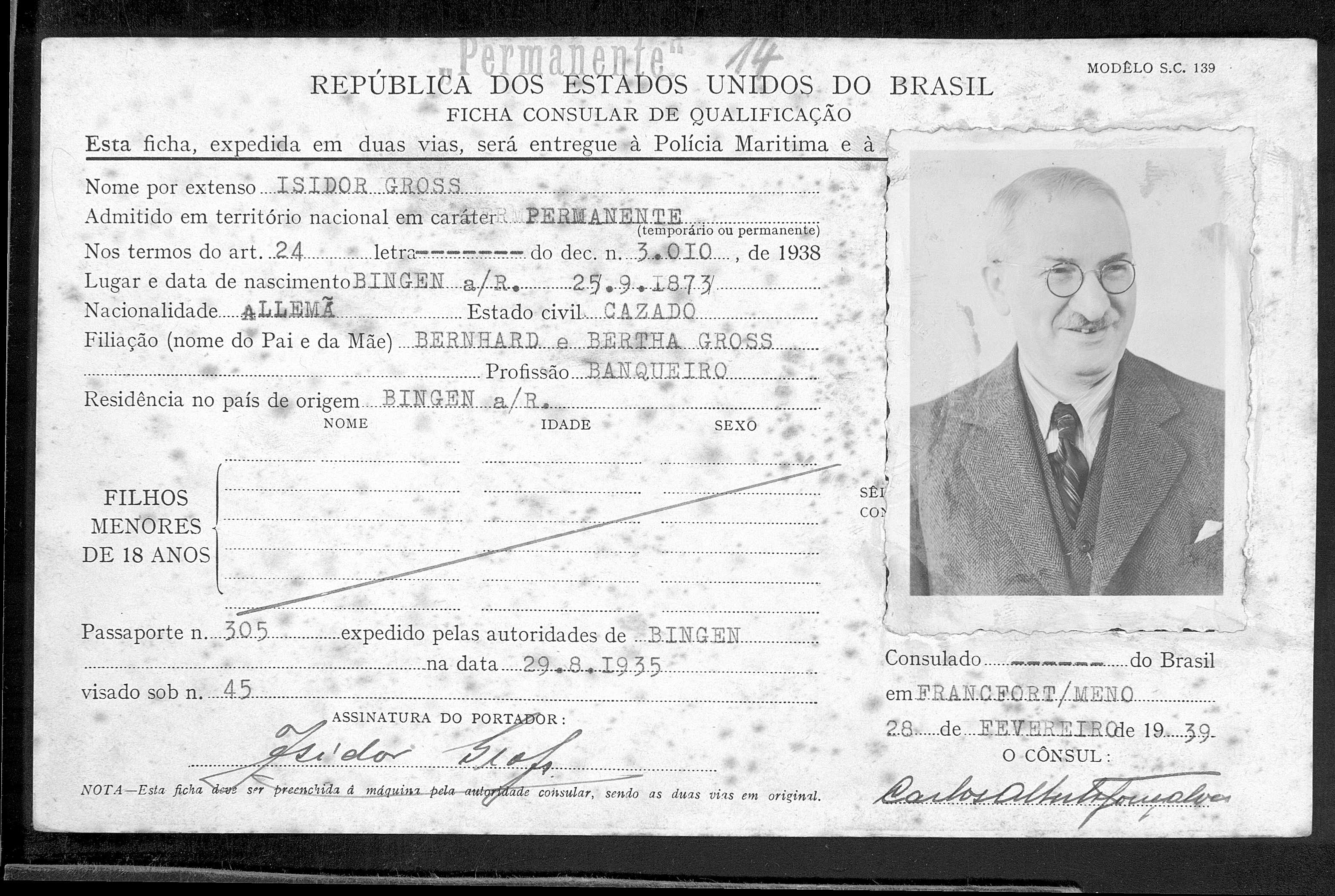
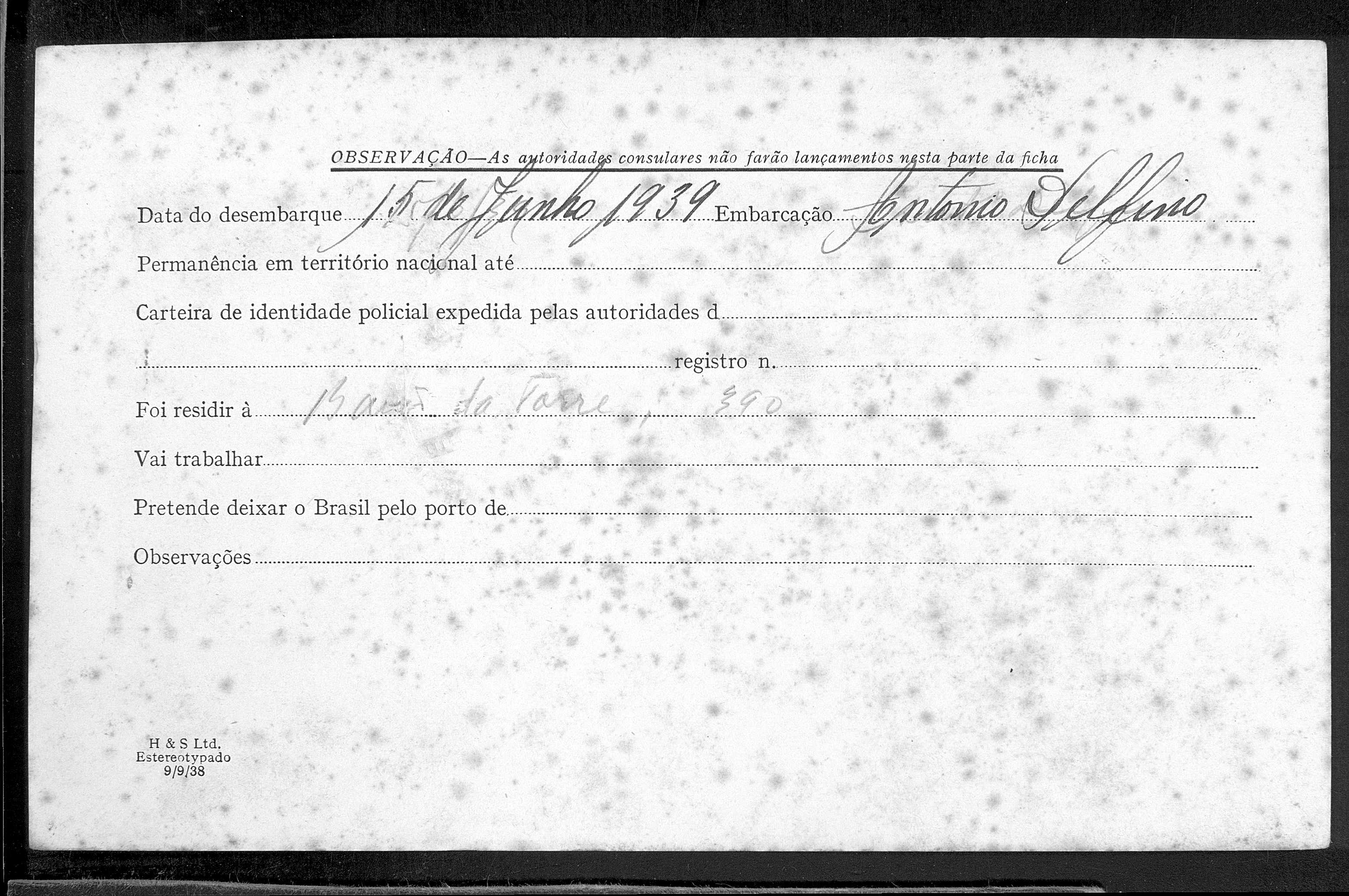
The immigration cards below indicate that Isidor and Klara moved to Brazil in June 1939:

isidor-gross-brazil-immigration-card-from-famsearch-p-1

Brasil, Cartões de Imigração, 1900-1965,” database with images, FamilySearch (https://familysearch.org/pal:/MM9.3.1/TH-1951-22436-27549-86?cc=1932363 : 10 November 2014), Group 4 > 004914427 > image 44 of 203; Arquivo Nacional, Rio de Janeiro (National Archives, Rio de Janeiro).

isidor-gross-brazil-immigration-card-p-2

Brasil, Cartões de Imigração, 1900-1965,” database with images, FamilySearch (https://familysearch.org/pal:/MM9.3.1/TH-1951-22436-27549-86?cc=1932363 : 10 November 2014), Group 4 > 004914427 > image 44 of 203; Arquivo Nacional, Rio de Janeiro (National Archives, Rio de Janeiro).

klara-emrich-gross-brazil-immigration-card-from-family-search

Brasil, Cartões de Imigração, 1900-1965,” database with images, FamilySearch (https://familysearch.org/pal:/MM9.3.1/TH-267-12579-62878-12?cc=1932363 : 10 November 2014), Group 1 > 004551542 > image 34 of 203; Arquivo Nacional, Rio de Janeiro (National Archives, Rio de Janeiro)

klara-emrich-gross-brazil-immigration-card-from-family-search-p-2

Brasil, Cartões de Imigração, 1900-1965,” database with images, FamilySearch (https://familysearch.org/pal:/MM9.3.1/TH-267-12579-62878-12?cc=1932363 : 10 November 2014), Group 1 > 004551542 > image 34 of 203; Arquivo Nacional, Rio de Janeiro (National Archives, Rio de Janeiro)

They both lived the rest of their lives in Brazil, as did their son Hans.  Isidor died and is buried in Petropolis in 1950; Klara is also buried there; she died in 1969.  Hans died in Rio de Janeiro in 1979.

(Thank you to Andre Convers of the LatAmSIG on JewishGen.org for finding the information about Klara and Isidor’s deaths and burial for me; they are listed in Egon and Frieda Wolff’s book, Sepulturas de Israelitas Il, p.100; Sophie Gross, widow of Wilhelm Gross, is listed on p. 101 and also buried in Petropolis, but her date of death says “19.5” so I assume it was partially illegible. There are also several people named Emrich on p. 100, presumably relatives of Klara Emrich Gross.)

Egon and Frieda Wolf, Sepulturas de Israelitas II, p. 100 (Petropolis Municipal Cemetery)

Egon and Frieda Wolf, Sepulturas de Israelitas II, p. 100 (Petropolis Municipal Cemetery)

cemetery-information-for-sophie-gross

Egon and Frieda Wolf, Sepulturas de Israelitas II, p. 101 (Petropolis Municipal Cemetery)

Unfortunately, the youngest child and third son of Bertha Seligmann and Bernhard Gross was not as fortunate as his older brother Isidor or his sister Mathilde.  Karl Gross was born on March 6, 1876, in Bingen, Germany.  According to the Arbeitskreis Judische Bingen page dedicated to Karl, he married Agnes Neuberger, and they had two daughters.  Bertha was born in 1906 and presumably named for Karl’s mother, Bertha Seligmann Gross, who had died with her husband in 1901 from carbon monoxide poisoning; sadly, Bertha suffered brain damage at birth and required special care.

A second daughter, Ilse, was born in 1921, after Karl returned from service in the Germany army during World War I. He had served from August, 1914, through the end of the war and was honored several times for his service.

After returning from the war, Karl worked in the Gross family winemaking business.  Two years Hitler’s rise to power, he and Agnes decided to send fourteen year old Ilse to the International School in Geneva, Switzerland in 1935. In 1938, when she was just seventeen, Ilse left Switzerland for England.

Karl and Agnes, however, stayed in Germany to be near their other daughter, Bertha. In December, 1940, the German Reich required that Bertha be admitted to the Israelite Hospital and Sanatorium in Bendorf-Sayn, also known as the Jacoby Institute. It had been founded almost a century before as a mental institution for Jewish patients.  Its role was altered terribly by the Nazis.

According to this website,

During the first years of National Socialism the Jacoby Institute was left in relative peace; probably as an acknowledgement of the fact that it was an important employer for Sayn and the region. ….A circular decree issued by the Ministry of the Interior on 12th December 1940 decreed that “mentally ill Jews” were only to be accommodated in Sayn because “a cohabitation of Germans and Jews is not acceptable in any length of time” (illustr. 7). The option of concentrating all the patients in one location served as preparation of their deportation. In the course of five transports (between March and November 1942) 573 people were taken to the death camps in the East.

Bertha Gross was one of those 573 people; she was deported to a concentration camp in Izbica, Poland, where she died.

Karl and Klara Gross also were killed in the Holocaust. They were sent to Theriesenstadt on July 27, 1942, where Karl worked as a stretcher-bearer until he died on February 1, 1944.  In October, 1944, Klara was deported from Theriesenstadt to Auschwitz where she was murdered.

karl-gross-and-family-stolpersteine-from-judische-bingen

Stolpersteins for Karl Gross, Agnes Gross, and Bertha Gross http://www.juedisches-bingen.de/?id=54

Their younger daughter Ilse, however, survived, and like so many in this family, she ultimately thrived. As described in her obituary, after leaving Switzerland for England in 1938, at first she worked as an unpaid mother’s helper.  After England was at war with Germany, however, Ilse, along with many other Jewish refugees from the Nazis, was imprisoned as an “enemy alien” in an internment camp on the Isle of Man, according to her obituary. 

Ilse, who had been writing poetry in German since she was a teenager, began writing short stories in English while in the camp and continued her writing after she was released in 1941.  In 1948, she married Kit Barker, a British artist.  Ilse began writing under the pseudonym Kathrine Talbot and published a number of well-regarded works, including three novels, many articles, and short stories.  She died in 2006, and her obituary in The Guardian includes an extensive description not only of her life but of her work.  “Ilse Barker,” The Guardian (June 2, 2006), located here.

Thus, Mathilde Gross Mayer lost both her sister Anna and her brother Karl in the Holocaust, as well as their spouses, Wilhelm Richter and Klara Emrich, respectively; her niece Bertha also was a victim of the Nazis.  Her brother Wilhelm had died years before, so Mathilde’s only surviving sibling after 1944 was her brother Isidor, who had immigrated to Brazil along with his wife and son and Wilhelm’s widow and son and thus lived a continent away from where Mathilde was in New Rochelle, New York.

Although Mathilde was fortunate that all of her children and grandchildren and almost all her nieces and nephews had survived the Holocaust, there is no overstating the tragedy she endured—from the loss of her parents in 1901, the loss of her husband in 1934, the uprooting of her children, grandchildren, and herself from their homeland, and the cruel deaths of a number of her family members at the hands of the Nazis.

Perhaps now you can better understand why I want to be able to read her book and get a feel for the real person who endured so much and lived so long.


A Family Uprooted by the Nazis: Mathilde Gross Mayer and Her Family

My last post ended with the tragic deaths in November 1901 of my cousin Bertha Seligmann and her husband Bernhard Gross; they had died from carbon monoxide poisoning while in their own home in Bingen, Germany.  Bertha was the first cousin of my great-great-grandfather, Bernard Seligmann.  We are both descendants of my 4x-great-grandfather, Jacob Seligmann.

Much of what I have learned about the life of Bertha and Bernhard came from the memoir written by their daughter Mathilde, Die Alte und Die Neue Welt (1951). As I mentioned in the last two posts, Mathilde lived a hundred years, from 1869 until 1969, and resided on two continents during her remarkable life, first in Germany, then in the United States.  This post will focus on Mathilde and her family and descendants and their lives after 1901.

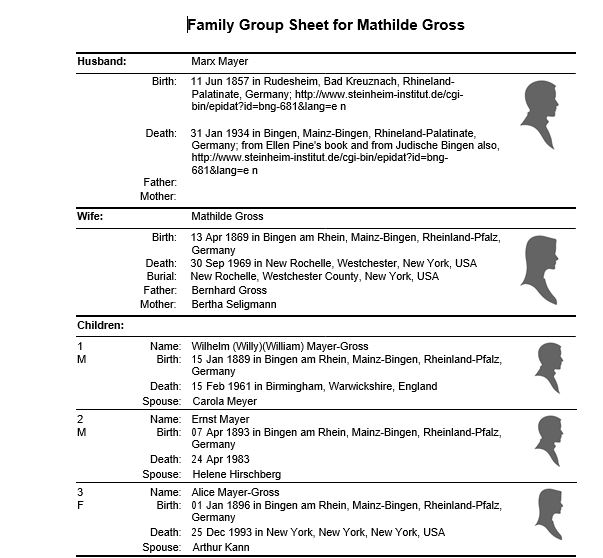
Mathilde was the oldest of Bertha and Bernhard’s five children. [1]  As stated above, she was born in 1869, and she married Marx Mayer in 1888. They had three children: Wilhelm (known as Willy) Mayer-Gross (1889), Ernst (1893), and Alice (1896).  All three would live interesting lives.
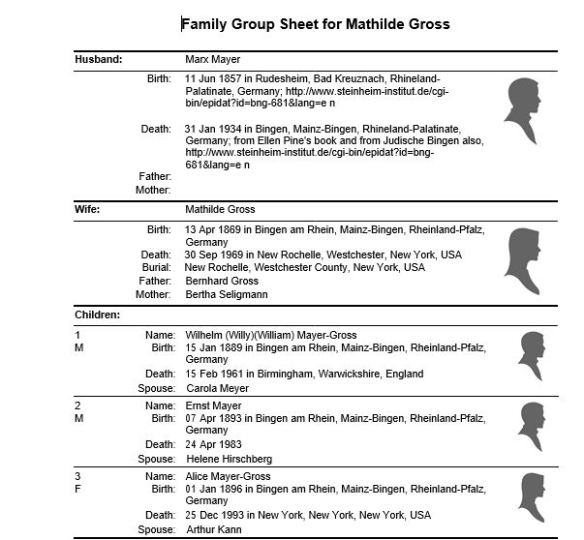
jpf-family-sheet-for-mathilde-gross-mayer

Although Alice Mayer was the youngest of the children of Mathilde Gross and Marx Mayer, I am going to write about her first because it is her daughter, Ellen Kann Pine, whose book One Life in Two Worlds (self-published, 2009) provided me with insights into the life of the Mayer family in the 1920s and 1930s.  All the facts related in this post came from Ellen Kann Pine’s memoir, except where noted.
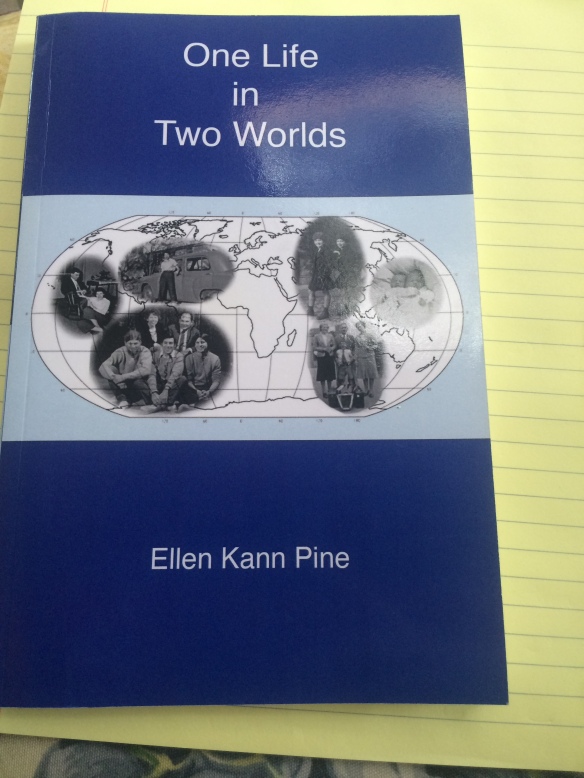
20160810_174631600_iOS

According to Ellen’s memoir, her mother Alice Mayer married Arthur Kann, whose father was in the wholesale grain business in the Bingen area.  Their twin daughters Ellen and Hannelore were born in 1921 in Bingen.  Ellen’s description of her childhood growing up in Bingen sounds quite idyllic.  She describes Bingen in those days as the largest town in the area with about 10,000 residents.

Her family shared a house with her father’s brother Julius Kann and his wife.  The house was on the edge of town and was located across the street from Ellen’s grandparents, Mathilde (Gross) and Marx Mayer.  She saw her grandparents every day.  Ellen wrote:

No day passed without a visit from one or both of them.  Our Grandfather (Opapa) was usually the first to come.  He always brought each of us a piece of chocolate wrapped in foil in the shape of a coin. …Our Grandmother (Omama) usually visited in the afternoon and she was always interested in what we had been doing and asked us to tell her.

Pine, p. 7.

Their grandmother Mathilde would take them for walks in the neighborhood every day.  In addition, numerous aunts, uncles, and cousins lived nearby.  The town was small enough that most people knew each other, and the Kann home had a big enough yard for the children to play.

In 1927, the twins started school at the local Volksschule where both Jewish and Christian children attended. At that time, they became more aware of their Jewish background.  As Ellen described, “[i]n Germany, religious instruction was part of the overall curriculum and was taught during regular school hours by clergy of each denomination.”  Pine, p. 20.  Ellen and Hannelore were taught by their cantor and received instruction in Hebrew and Bible stories.

The family had Shabbat dinners with their Mayer grandparents and celebrated the Jewish holidays together.  The Kann family also liked to travel, and Ellen recalled family trips to the Netherlands, Yugoslavia, Switzerland, and Austria during her childhood.

Ellen’s uncles Wilhelm and Ernst, the sons of Mathilde Gross and Marx Mayer, were also living comfortable lives in Germany in the years before Hitler came to power. Wilhelm became a renowned psychiatrist.  According to Edward Shorter’s A Historical Dictionary of Psychiatry (Oxford University Press, Feb 17, 2005), Wilhelm studied medicine at the University of Heidelberg and then further specialized in psychiatry at Heidelberg.  His doctoral thesis was on “the phenomenology of abnormal feelings of happiness,” and by 1929, he was an assistant professor of psychiatry in Heidelberg.

On the personal side, according to Shorter’s book, Wilhelm had married in 1919; his wife was Carola Meyer, and they had one child.  Around the time of his marriage, Wilhelm adopted the surname Mayer-Gross, hyphenating his mother’s maiden name with his father’s surname.

Wilhelm’s younger brother Ernst served in the German military during World War I. Once again Matthias Steinke helped me out and translated the documents reporting Ernst’s military record.  According to Matt’s translation, Ernst served in the military first from October 1907 until September 1909 as a private in the 9th Infantry Regiment in Zabern.  Then when World War I started, he was on active duty from August 1914 until September 1918, again serving in the infantry.  He was a bona fide war hero for Germany.

He fought in over twenty battles all over Europe: in France, in Italy, in Bukovina and Slovenia, and at the border of Greece.  On the 5th of October he was shot in the back during a battle near Lille, France, but returned to the front by June, 1915, where he fought in a battle near Tirol. Beginning in December, 1914, he served as a ski trooper for some of his time in the army. His service ended when he was sent to the hospital in September, 1918, with influenza.  His rank at the end of his service was a reserve lieutenant.  He received several commendations for his service including the Prussian Iron Cross, the Edelweiss medal, and two Hessian orders.
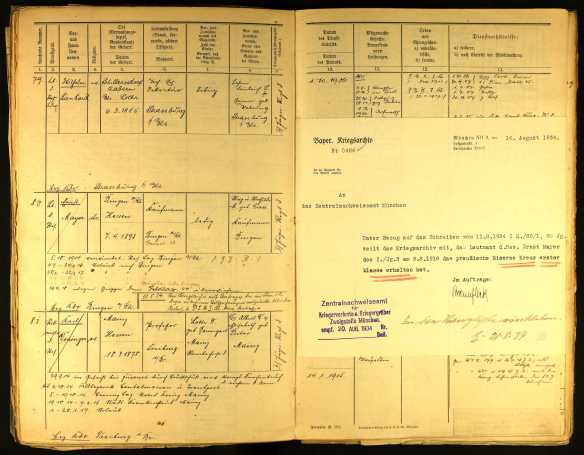
Bavaria, Germany, World War I, Personnel Rosters, 1914-1918, for Ernst Mayer Bayerisches Hauptstaatsarchiv; Mnchen; Abteilung IV Kriegsarchiv. Kriegstammrollen, 1914-1918; Volume: 11697. Kriegsstammrolle: Bd.1
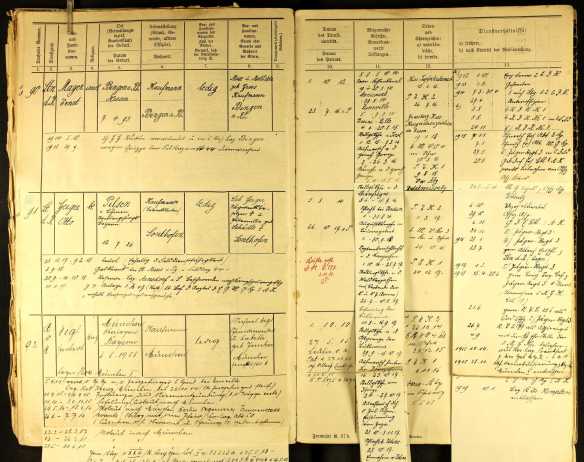
Bavaria, Germany, World War I, Personnel Rosters, 1914-1918, for Ernst Mayer
Bayerisches Hauptstaatsarchiv; Mnchen; Abteilung IV Kriegsarchiv. Kriegstammrollen, 1914-1918; Volume: 11697. Kriegsstammrolle: Bd.1

Ernst Mayer WW1 military register 6

Bavaria, Germany, World War I, Personnel Rosters, 1914-1918, for Ernst Mayer Bayerisches Hauptstaatsarchiv; Mnchen; Abteilung IV Kriegsarchiv. Kriegstammrollen, 1914-1918; Volume: 11697. Kriegsstammrolle: Bd.1

After the war, Ernst became the owner of a successful publishing house in Berlin, Mauritius Verlag.  He married Helene Hirschberg, and they had two daughters and were living in Berlin.

Thus, as of 1933, Mathilde (Gross) and Marx Mayer and their three children were successful citizens of Germany.  The world and lives of all these members of the family changed drastically with the election of Hitler as chancellor in 1933.

Ellen Kann Pine was then twelve years old and remembers well how things changed in Bingen.  She wrote:

As soon as Hitler became chancellor, fierce looking men wearing different colored uniforms appeared everywhere. … Part of the uniform was a red armband with a large black swastika on a white background.  Almost all teenagers of both sexes belonged to the Hitler Youth and wore similar brown uniforms and red armbands.  They all were disturbing and frightening as they marched in the streets day and night carrying Nazi flags and singing Horst-Wessel Lied and other vicious anti-Semitic songs. Swastikas were painted everywhere: on walls, on buildings, on flags, and on women’s brown blouses. …. 

It was soon obvious that the anti-Semitic propaganda and lies that abounded in the streets had their desired effect.  It helped turn our previously friendly and courteous Christian neighbors and their children into hostile anti-Semites.  Now we rarely went for walks, and when we did, we kept strictly to ourselves.  We could not go shopping, or to the movies, or a theater, since most of these activities were out of bounds for Jews.

Pine, pp. 35-36.

Things changed for Ellen and her sister at school as well because they were Jewish. Friends ignored them, as did their teachers.

Adding to the family’s stress and sorrow was the heartbreaking death of Mathilde’s husband and the family patriarch, Marx Mayer. Ellen wrote:

Our beloved Opapa died in 1934.  It was the first family death we experienced and it was wrenching.  I cannot forget the look on our Omama’s face when we came to visit her.  Sitting on the sofa, she looked utterly lonely and sad with grief.

Pine, p. 29

After September, 1935, with the passage of the Nuremberg Laws, Ellen and her siblings could no longer attend school at all. Their father also lost his job as director of a synthetic fertilizer company.  The family made the important but painful decision to send the twins and their younger brother to boarding school in England.  For two years from 1936 until 1938, the children lived away from their parents.  Ellen wrote movingly about the experience and the issues the children had adjusting to life away from home.

Fortunately their uncle, Willy Mayer-Gross, was in England and was a source of comfort and support for the children while they lived there. The Nazi laws prohibiting Jewish doctors from practicing medicine on non-Jewish patients and other restrictions had led Willy to emigrate in 1933.  He was able to obtain funding through a Rockefeller Foundation grant to go to England to work and live.  His niece Ellen Kann Pine wrote this about her uncle Willy:

Learning a new language, a new culture, new ways of treating patients, and having to retake his medica exams made his first years there very difficult.  Although Uncle W. was in his forties he persevered, brought his family to England and was able to continue his research.  … He was our guardian and his support was invaluable when my sister and I entered boarding school in England in 1936.

Pine, p. 32

Willy did in fact have a remarkable career in England; Edward Shorter described him as the “Importer of German scientific rigor and psychopathological thinking to English psychiatry.” A Historical Dictionary of Psychiatry (Oxford University Press, Feb 17, 2005).

According to the Whonamedit website:

In the 1933 Mayer-Gross came to the Bethlem Royal Hospital, London, to work with Edward Mapother, who provided fellowships for German academics who were fleeing Hitler, such as Guttmann and Mayer-Gross. He worked at the hospital from 1933 to 1939, when he became a licentiate of the Royal College pf Physicians and the Royal College of Surgeons. He subsequently became senior fellow with the department of experimental psychiatry, Birmingham Medical School 1958; Director of Research, Uffcalme Clinic. He was a fellow of the British Eugenics Society 1946, 1957. It was Mayer-Gross who first suggested, in about 1955, that tranquilizers converted one psychosis into another. Wilhelm Mayer-Gross was the winner of the Administrative Psychiatry Award for 1958.

Willy’s younger brother Ernst also suffered due to the Nazi persecution of Jews.  Despite his distinguished service to Germany during World War I, like other Jewish business owners he was forced to sell his publishing business in accordance with the Nazi policies requiring “Aryanization” of all businesses.  Like his brother Willy, Ernst decided to leave Germany once he’d lost his business.

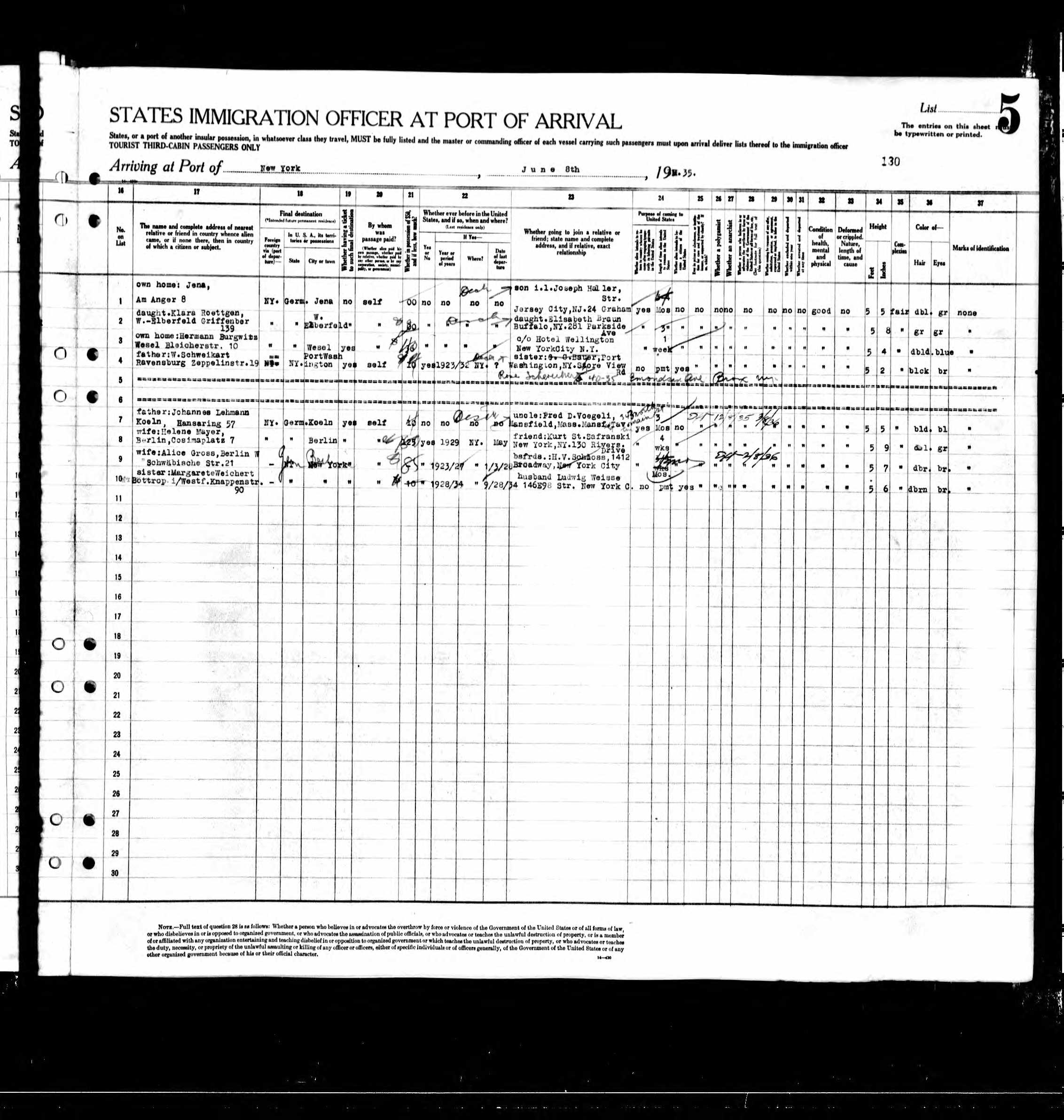
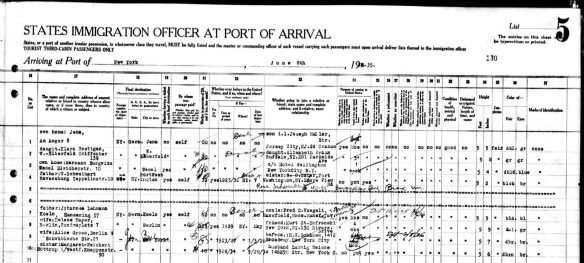
He arrived in New York on June 8, 1935, leaving his family behind until he could bring them over as well.
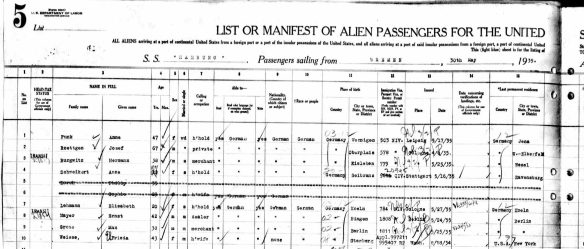
Ernst Mayer passenger manifest 1935

Ernst Mayer passenger manifest 1935 page 2

Ernst Mayer passenger manifest, June 8, 1935, line 8 Ancestry.com. New York, Passenger Lists, 1820-1957 [database on-line]. Provo, UT, USA: Ancestry.com Operations, Inc., 2010. Original data: Passenger Lists of Vessels Arriving at New York, New York, 1820-1897. Microfilm Publication M237, 675 rolls. NAI: 6256867.

Soon after arriving in New York, he and two other German Jewish refugees, Kurt Safranski (whom Ernst had listed as his contact in NY on the manifest) and Kurt Kornfeld, formed Black Star Publishing Company.  Marvin Hefferman wrote in the New York Times blog “Lens” on July 15, 2013, that Ernst Mayer and his partners were “innovators in Germany’s picture press and publishing world and fled from the Nazis.  Their New York-based company commissioned and brokered the use of photographs that documented important events, the comings and goings of notables, and human interest stories.” Marvin Hefferman, “Black Star Shines Anew,” The New York Times (July 15, 2013), available here.

Among their early clients were the magazines Life, Look, The Saturday Evening Post, and Collier’s, which retained their services for the procurement of photographs. The Black Star company’s website describes Ernst’s important role in the success of Black Star:

It was Mayer who made the decisive step uptown into the Rockefeller Center to Time Inc. He brought with him an enormous pile of essays from photographers including Fritz Goro and Paul Wolff, whom he had brought safely from Berlin to New York.  Soon after, the chief editors of Life Magazine had chosen Black Star as one of their main suppliers of pictures. Emigre photojournalists viewed the agency as their best means of gaining access to the magazine. For the mostly Jewish photographers, Black Star was a piece of Europe in the middle of New York.… According to photo historian Marianne Fulton, Life brought Black Star 30 to 40 per cent of its business. Black Star, in turn, contributed to Life becoming the most popular magazine in America for nearly three decades, with tens of millions of readers.

A little over a year after arriving himself, Ernst was able to bring his wife and daughter to the United States on August 11, 1936.[2]
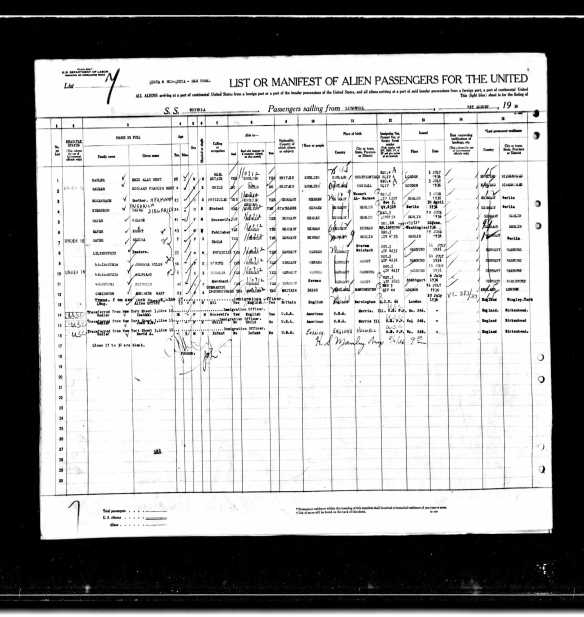
Ernst Mayer and family August 1936 manifest

Ernst Mayer and family passenger manifest August 11, 1936 Ancestry.com. New York, Passenger Lists, 1820-1957 [database on-line]. Provo, UT, USA: Ancestry.com Operations, Inc., 2010. Original data: Passenger Lists of Vessels Arriving at New York, New York, 1820-1897. Microfilm Publication M237, 675 rolls. NAI: 6256867.

Ernst Mayer and family passenger manifest August 11, 1936
Ancestry.com. New York, Passenger Lists, 1820-1957 [database on-line]. Provo, UT, USA: Ancestry.com Operations, Inc., 2010.
Original data: Passenger Lists of Vessels Arriving at New York, New York, 1820-1897. Microfilm Publication M237, 675 rolls. NAI: 6256867.

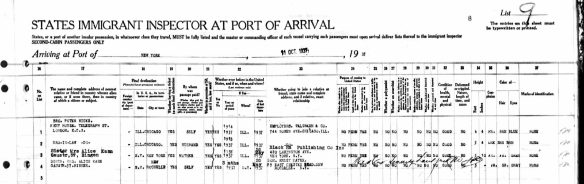
One year after that, on October 11, 1937, he returned once more to Germany to bring his mother Mathilde back to the US.[3]  As you can see, the manifest shows they left from England, not Germany.  Ellen Kann Pine wrote that her grandmother Mathilde came to see her and her sister at boarding school in England before leaving for the US.
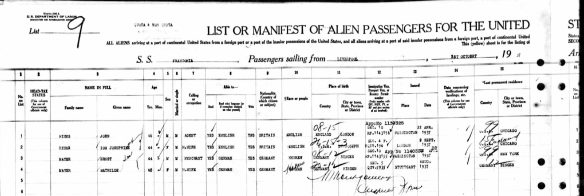
Mathilde Mayer passenger manifest October 1 1937

Mathilde Mayer passenger manifest October 1 1937 page 2

Mathilde Mayer and Ernst Mayer on passenger manifest, October 11, 1937 Ancestry.com. New York, Passenger Lists, 1820-1957 [database on-line]. Provo, UT, USA: Ancestry.com Operations, Inc., 2010. Original data: Passenger Lists of Vessels Arriving at New York, New York, 1820-1897. Microfilm Publication M237, 675 rolls. NAI: 6256867.

Ernst and his family and his mother were all living in New Rochelle, New York, at that time.

In August, 1938, the daughters of Alice Mayer Kann, Ellen and Hannelore, left England to come to the US.  Their parents and brother followed a month later, and the Kann family also settled in New Rochelle, New York.  Thus, by the fall of 1938, just a few months before Kristallnacht and the increased violence against Jews in Europe that followed, all of Mathilde’s children and grandchildren were safely out of Germany, as was she.

I will leave for another day what Mathilde’s life was like once she got to America—that is, until I can read the rest of her memoir.  As for her granddaughter Ellen Kann Pine, like her two uncles Willy and Ernst, she not only survived, she thrived—she worked hard, ultimately obtained a Ph.D. in biochemistry, and became a successful research scientist.  I highly recommend her memoir as another lesson in the resilience of people and their ability to start life over in a new place and find not only security but happiness.  Her book is available on Amazon here.

Sadly, Ernst Mayer’s wife Helene Hirschberg died on July 19, 1945, at age fifty.  Willy Mayer-Gross died in 1961; he was 72.  Mathilda outlived her oldest child, dying at 100 in 1969.  Her other two children also lived long lives.  Ernst died at ninety in 1983, and Alice died in 1993 when she was 97. Her husband Arthur Kann had died many years before in 1966 when he was 83.

My cousin Mathilde had suffered greatly during her life: she had lost her parents in a terrible tragedy, her husband had died too soon, and she had been forced to leave her homeland and the place where her family had lived for hundreds of years.  But she and her three children and all of her grandchildren escaped Nazi Germany in time and survived.  Although all of them suffered from the Nazi treatment of Jews, they all found success. It’s hard to say they were lucky, given what they’d endured, but they at least survived.

Other members of their extended family were not as fortunate.


[1] Later posts will relate what happened to Mathilde’s siblings and their families.


[2] Ernst and Helene Mayer had another daughter Dorothea, who had died before the family left Germany.

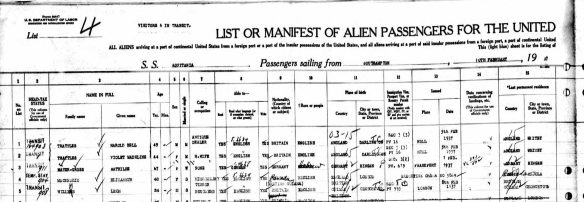
[3] It appears that Mathilde was listed on an earlier ship manifest to leave Germany in February, 1937. There is a notation “Ext. 9/17/37,” which I assume meant she extended her ticket for an additional seven months. Perhaps she did not want to sail alone, and it was only when Ernst returned to bring her back in October that she came to the US.  Or maybe she did come in February and returned because there is another notation that says “RT.”  Return trip? I am not sure.
Mathilde Mayer-Gross on passenger manifest February 1937

Mathilde Mayer-Gross on passenger manifest Feb 1937 page 2

Mathilde Mayer-Gross listed on February 1937 manifest Ancestry.com. New York, Passenger Lists, 1820-1957 [database on-line]. Provo, UT, USA: Ancestry.com Operations, Inc., 2010. Original data: Passenger Lists of Vessels Arriving at New York, New York, 1820-1897. Microfilm Publication M237, 675 rolls. NAI: 6256867.

Life in Bingen, Germany 1850-1901: The Family of Martha and Benjamin Seligmann

As I wrote last time, Mathilde Gross Mayer (known sometimes as Mathilde Mayer-Gross) lived a long life—a hundred years that spanned two centuries (1869-1969) and two countries—Germany until she was 68 and then the United States for the last 32 years of her life. Her autobiography, Die Alte and Die Neu Welt, records the story of her remarkable life.  I have read the small portion of her autobiography that I had translated by Ute Brandenburg.[1]  I hope to read the book in its entirety once I know enough German to make that possible.

Mathilde Mayer book cover

But from the excerpt I’ve read in translation along with information I obtained from other sources, I have learned quite a bit about Mathilde’s family and her early life in Germany.

First, a little background. As I wrote last time, Mathilde was my second cousin, three times removed. Her great-grandparents were my four-times great-grandparents, Jacob Seligmann and Martha Mayer.  Jacob and Martha had ten children, including Moritz Seligmann, my three-times great-grandfather, and Martha Seligmann, Mathilde’s grandmother.Relationship_ Amy Cohen to Mathilde Gross part 1

Relationship_ Amy Cohen to Mathilde Gross part 2


I have written about Moritz and his family in several places.  His son Bernhard (later Bernard), my great-great-grandfather, was one of the Seligmann brothers who came to the United States and settled in Santa Fe where they established the important trading business known as Seligman Brothers.

Courtesy of the Family of Fred and Ilse Michel

Moritz Seligmann, Courtesy of the Family of Fred and Ilse Michel

Bernard Seligman

Bernard Seligman

I have also written about Martha and how I discovered, thanks to the family tree discovered by my cousin Wolfgang, that in 1824 she married her first cousin (and also my cousin) Benjamin Seligmann, son of Hirsch Seligmann, who was Jacob Seligmann’s brother.  Martha and Benjamin lived in Bingen, Germany, where they had seven children: Siegfried (1824), Emilia (1826), Hermann (1828), Karolina (1831), Ferdinand (1836), Lambert (1838), and Bertha (1841).

tree 2 pages 2 and 3

Emil Seligmann’s handwritten tree courtesy of Wolfgang Seligmann

The facts below are all based on Mathilde’s book, except where noted.  All quotations are from the translation by Ute Brandeburg of Chapter 2 of Mathilde’s book.

Benjamin Seligmann was initially in the scrap metal business and then later in the money changing business, but according to his grandson Isidor Gross (who contributed to his sister Mathilde’s book), Benjamin was actually more academically inclined by nature.  It was his wife Martha and their sons Lambert and Ferdinand who really ran the business. Benjamin and two of his sons, Lambert and Hermann, also served as accountants for the Jewish congregation in Bingen.

Isidor wrote about his uncle Ferdinand that he had traveled to Paris and when he returned, he brought home a top hat.  “He would promenade around Bingen, wearing this hat and using a skinny walking stick, just as he had in Paris.” (DADNW, p. 10).  As a result, he earned the nickname “Hat,” and Isidor and Mathilde referred to Ferdinand as “Uncle Hat.”

After their father Benjamin died in 1862, his sons Ferdinand and Lambert took over the business, which was eventually renamed “Ferdinand Seligmann.”  Neither Ferdinand nor Lambert ever married, and they lived together in Bingen and were known as Die Herren, or The Gentlemen.  A third brother, Hermann, also never married; he was for a time involved in the business, but ran into some financial troubles and was bought out by Ferdinand.

The oldest child of Martha and Benjamin, Siegfried, married his first cousin, Carolina, who was a daughter of Moritz Seligmann, my three-times great-grandfather.  Siegfried and Carolina had seven children together, including Emil, the one presumed to have recorded the family tree I discussed here.  Emilia, the second child of Benjamin and Martha Seligmann, married Salomon Lorch and had four children. Karolina Seligmann (Benjamin and Martha’s daughter, not the one who married Siegfried) married Sigmund Marx; I don’t have any record of children born to that couple.

Bertha Seligmann, the youngest child of Benjamin and Martha and the mother of Mathilde and Isidor, married Bernhard Gross on June 30, 1868.  Bernhard was the son of Wolfgang Gross and Fanny Nathan, who lived in Gau-Bickelheim where Wolfgang was in the wine business, working with his sons Bernhard, Moses, and Julius.

The marriage contract between Bertha Seligmann and Bernhard Gross is included in Mathilde’s book and reveals the contributions that each side made to the marriage. It is quite apparent that this couple came from families of some means.

Bertha brought clothing and personal items worth 850 gulden and house furnishings worth 350 gulden to the marriage as well as 2000 gulden in cash.  Her mother also made a gift of 3500 gulden to the couple (to be deducted from Bertha’s inheritance). Bertha’s brother Siegfried promised to pay the rent on the couple’s home in Bingen for two years, or a total of 260 gulden.

Bernhard also contributed to the marriage.  He brought 300 guldens’ worth of personal items and clothing and 418 gulden’s worth of home furnishings.  His parents provided a gift of 2000 gulden to the couple (also to be deducted from their son’s inheritance).

Thus, Bertha’s contribution amounted to 6,960 gulden, and Bernhard’s was 2,718 gulden.  As converted by Isidor Gross in 1938 as described in his sister’s book, that combined amount would have been equivalent to about 16,000 goldmarks in 1938.  According to one source, in 1938 there were 2.49 marks to a dollar, so that would mean that 16,000 marks was equivalent to $6425 in 1938.  Using an inflation calculator, I calculated that $6425 in 1938 would be worth about $108,000 today.  Not a bad start for a young couple.

When they married, Bertha and Bernhard moved to an apartment in Bingen where less than a year later their first child, Mathilde, was born on April 14, 1869.  She was followed by her sister Anna a year later, her brother Wilhelm in 1872, and then her brother Isidor in 1873.  By the time Isidor was born, the family had moved to a house of their own.  The prior owner, a baker, continued to occupy the first floor, which he used for his business, and a police officer lived on the third floor.  Isidor described the house as “a large building with a passageway to Eselgasse, where the driveway was located.  The courtyard and back buildings offered us children much space to play.” DADNW, p. 16  A sixth child was born to Bertha and Bernhard in March 1876, a son Karl.

Mathilde described her father Bernhard as “a highly respected citizen who had no enemies, did much for the common good, and helped however and wherever he could.  He supported the congregation in word and deed, and whenever possible he went to Saturday services.” DADNW, p.18  She continued:

Father was a hardworking, ambitious businessman.  He was well liked with the customers.  Nearly every morning, he would head out early to the train station, his bags heavy with wine samples.  But he never left the house without first bringing a little sample of his breakfast, bread rolls with egg, a “morsel.” As he called it, to the children’s bed….. Although he was often serious and judicious, he did have a cheerful disposition and was always in a good and light-hearted mood when attending social and family events….Despite his occupation, which had him taste alcohol on a daily basis, he always sought moderation in drinking.  He could not tolerate more than two or three glasses of good wine; then he would become exceedingly merry, climb onto chairs and tables, stretch out his arms, and exclaim: “My dear friends, this is the world!”

DADNW, p. 18

Mathilde’s portrait of her mother Bertha Seligmann Gross, is quite different:

She was serious and strict, with herself as well as others.  She rarely participated in fun and laughter. … Mother strove to manage the household with as much frugality as possible.  The boys often came home with holes in the bottoms of their pants and the knees of their socks.  [Heels?] Sometimes there would be a pat on the backside.  Then [I] would have to spend [my] Saturday evenings and Sundays mending the work day clothes and darning the socks instead of reading or going to visit [my] girlfriends. ….  There would many weeks where I had to polish the metal stove pipes with scouring paper until they shone before I could return to school at 2 o’clock.  Mother was a heavy-handed person who did not know how to make life easier for herself and others.

DADNW, pp.19-20

Mathilde also wrote about her brothers that they were “wild and spunky.  They were always up for pranks, didn’t spend much time in the books, and went outside the moment Mother looked the other way.”  DADNW, p. 18.

Obviously as the oldest child and daughter, Mathilde had a lot of responsibilities, but she did have some happy childhood memories.  She enjoyed ballroom dancing lessons, and she and her sister Anna spent school holidays with her mother’s brother Siegfried Seligmann and his family in nearby Mainz.  She also spent some time in 1885 when she was sixteen living with her Uncle Hat (Ferdinand) in Nancy in Alsace, but was not happy going to school there and returned to her family in Bingen.

The family of Bertha and Bernhard Gross moved a few times in Bingen to accommodate their growing family.  The second home was bigger, but needed work. Isidor wrote, “There was no gas, no plumbing, no electric light, and the toilets were very primitive.  They were outside the apartment, which was quite unpleasant in the winter and in bad weather.” DADNW, p. 17  Mathilde also described the house’s shortcomings: “only kerosene lamps that needed to be cleaned every morning, no warm water, and only much later running water—before that one had to fetch water in pails from the pump in the courtyard.  It was a lot of work to keep three or four stoves going in the wintertime.” DADNW, p. 20


On April 11, 1888, Mathilde married Marx Mayer, a man one of her aunts had introduced to her.  On the Judische-Bingen site I found Mathilde’s description of her husband:

My husband Marx was a cheerful person, a life-affirming character, who knew how to make friends everywhere.  He was a good dancer, loved to dance, and we seldom missed seeing the New Year begin at the New Year’s ball in Caecilienverein. 

Mathilde went on to describe the yearly three-day carnival celebration in Bingen, which Marx enjoyed greatly, often staying out until four in the morning.[2]

Mathilde and Marx had three children between 1889 and 1896: Wilhelm, Ernst, and Anna. Mathilde’s siblings also married in these years.  Her sister Anna married Willhelm Lichter; her brother Wilhelm married Sophie Hirsch.  Isidor married Clara Emmerich, and Karl married Agnes Neuberger.  They all would have at least one child.

With their children all grown, Bertha and Bernhard decided to purchase another home at Mainzer Strasse 16 in Bingen, though it needed substantial renovations.  Bertha and Bernard moved into the house in late 1898.  Sadly, they only lived in the house for a few years because on November 1, 1901, both Bernhard and Bertha were killed by carbon monoxide poisoning that had resulted from some faulty renovations being made on the house.  Bernhard was only 61, Bertha just 60 when they died.

Headstones for Bertha Seligmann Gross and Bernhard Gross in the Jewish cemetery in Bingen http://www.juedisches-bingen.de/43.0.html

Headstones for Bertha Seligmann Gross and Bernhard Gross in the Jewish cemetery in Bingen
http://www.juedisches-bingen.de/43.0.html

Mathilde wrote of how she learned the news of her parents’ awful death:

On that fateful Thursday morning when Emil Seligmann [son of Siegfried and Caroline Seligmann and Mathilde’s first cousin] came to get me and then told me, as we were walking, of the accident, he lead me over Schlossberg rather than through town where people already knew and would have stared at me.  I could not immediately comprehend the scale of the tragedy that had befallen us.  DADNW, p. 19.

Understandably, Mathilde was devastated.  She wrote that her father’s death “was a heavy blow that left a big void.”  DADNW, p. 19.

Thus, the new century did not begin well for the family of Bertha Seligmann and Bernhard Gross.  In fact, it was a century marked by a great deal of tragedy for the family.  Although I cannot yet read enough of Mathilde’s book to provide a reliable translation of her own words for the years that followed her parents’ deaths, I have been able to learn more about the fate of her family from other sources and will reveal what happened to them all in posts to follow.

Family View Report for Bertha Seligmann-page-001


[1] Ute Brandenburg provides professional translation services for German texts, including texts written in the old German script.  You can see her website at  https://germanscriptexperts.com/   References to translated quotes from the German version of Mathilde’s book are indicated by “DADNW” and the appropriate page numbers.  All translations of the book were done by Ute Brandenburg.

[2] Unfortunately, Google Translate’s translation of these pages is quite awful, so I am hoping to obtain a better translation.

The Little Sister Who Went Back Home: Rosalie Schoenthal, Part I


Finally I have come to the youngest of my great-grandfather’s siblings, the only one born after he was, his younger sister Rosalie.   Her story is even more tragic than that of her brother Jakob.

Rosalie was born in Sielen, Germany, in 1863, five years after my great-grandfather Isidore.  As I wrote earlier, she came with her mother and Isidore to the United States in 1881 when she was eighteen, but returned to Germany to marry Willy Heymann of Geldern, to whom she was apparently engaged even before leaving Germany. They were married on December 8, 1884, in Geldern.


I was fortunate that there were numerous sources available that provided me with information about Rosalie, Willy, and their family.  Two German websites had biographies of Willy and Rosalie Heymann and their children.  One, a site about the Geldern Jewish community, indicated that Willy and Rosalie had had six children, although it only named two of them, Helene and Hilda.  A second website containing information about the Heymann family was the Steinheim Institute site, which confirmed the fact that there had been six children and provided the names and birth years of all six as well as other pertinent facts that helped me with my research of Rosalie’s children.

From these two sources, I learned that Willy was a horse trader like his father Levi Heymann and was born in Geldern in February, 1857.  Geldern is about 150 miles from Sielen, so I’ve no idea how Rosalie and Willy knew each other; perhaps their fathers had known each other.  Willy and Rosalie settled in Geldern; their six children were: Lionel, born in 1887 and presumably named for Rosalie’s father, my great-great grandfather Levi Schoenthal; Johanna, born in 1889; Helene, born in 1890 (perhaps named for Henriette Hamberg, Rosalie’s mother), Max, 1893; Walter, 1896; and Hilda, born in 1898.

The Geldern site had a photograph of the Heymann home in Geldern, depicted below.


Home of Willy and Rosalie Schoenthal Heymann in Geldern http://hv-geldern.de/images/juden/juden.htm

Home of Willy and Rosalie Schoenthal Heymann in Geldern
http://hv-geldern.de/images/juden/juden.htm

The Steinheim Institute site reported that Rosalie died on August 7, 1937, when she was 74 and that Willy Heymann died on January 15, 1939; it provided this description of his death:

Willy Heymann wurde nach seinem Tod von dem 14jährigen Fritz Davids, der erst kurze Zeit zuvor aus dem KZ Dachau zurückgekehrt war, in das man ihn nach der Pogromnacht mit seinem Vater verschleppt hatte, ganz alleine und heimlich zum Friedhof gebracht und begraben.

Translated by a member of the German Genealogy Facebook group as:

After his death, Willy Heyman was brought secretly to the cemetery and buried by 14 year old Fritz Davids alone, who had returned only a short time before from the concentration camp of Dachau where he had been brought with his father after the [Kristallnacht, Nov. 9, 1938].

How would you interpret that sentence? Does it mean that Willy had died outside of Geldern and been secretly returned by this fourteen year old boy? Had Willy also been at Dachau or just Fritz and his father? Or does it mean that Willy and Fritz’s father had been brought to Dachau after Kristallnacht? Does the “he” in that last phrase refer to Willy or Fritz?  I am inclined to think that Willy was at Dachau because otherwise, why would he have had to have been secretly brought to the Geldern cemetery?

UPDATE:  Thanks to Renate Adolfs and Cathy Meder-Dempsey, I now have more information about what happened to Willy, and it is awful.  Both Renate and Cathy found a link here that describes the terrible fate of Willy Heymann.  As translated by Cathy, this is the full story:

Aus dem KZ zurück, muß Fritz Davids schon zwei Monate später miterleben, wie schlimm es mittlerweile den Juden erging. Selbst vor dem Tod hat man nämlich keine Achtung mehr : Der Jude Willy Heymann war fast 84-jährig verstorben. Da ihn niemand begraben wollte oder konnte, lädt der 14-jährige Fritz die Leiche auf eine Schubkarre und fährt sie im Morgengrauen zum Boeckelter Weg auf den jüdischen Friedhof, wo er, ganz der ‚Würde” der Zeit entsprechend, dem alten Mann ein Grab schaufelt und den Kaddish spricht. Auch David Cain und Jakob Heymann wurden unter solchen entwürdigenden Umständen begraben.

Recently back from the concentration camp, Fritz Davids experienced, two months later, how bad the Jews had fared. There was no respect even for the dead. The Jew Willy Heymann died at the age of almost 84 years old. Since nobody wanted to bury him or could, the 14-year-old Fritz put the corpse in a wheelbarrow and at dawn wheeled it to Boeckelter Weg (street name) to the Jewish cemetery, where he, fully in dignity of the time, shoveled a grave for the old man and spoke the Kaddish. David Cain and Jacob Heymann were also buried under such humiliating circumstances.

Thank you, Renate and Cathy, for allowing me to memorialize Willy Heymann more completely.


The information about Willy and Rosalie and their children was also confirmed by a third source, Juden in der Geschichte des Gelderlandes (2002), a book edited by Gerd Halmanns and Bernhard Keuck that contains information, photographs, articles, documents, and maps of the Jewish communities in Geldern and the surrounding townsRodney Eisfelder from the GermanSIG of JewishGen kindly sent me a copy of page 370 from that book, which lists information about Willy Heymann and his family.  That page also provided me with numerous clues about the Heymann children.

page 370 for blog

From these sources, I knew that Lionel Heymann, the oldest child, had moved to Chicago, but I found out that before he immigrated to the US, he had left Germany for England; he is listed on the 1911 English census as a 24 year old German national, living in London and working as a hotel waiter.


Lionel Heymann 1911 UK census Ancestry.com. 1911 England Census [database on-line]. Provo, UT, USA: Ancestry.com Operations, Inc., 2011. Original data: Census Returns of England and Wales, 1911. Kew, Surrey, England: The National Archives of the UK (TNA), 1911. Data imaged from the National Archives, London, England.

Lionel Heymann 1911 UK census
Ancestry.com. 1911 England Census [database on-line]. Provo, UT, USA: Ancestry.com Operations, Inc., 2011.
Original data: Census Returns of England and Wales, 1911. Kew, Surrey, England: The National Archives of the UK (TNA), 1911. Data imaged from the National Archives, London, England.

In 1912 he sailed from England to Algiers, still a German citizen, but listing his intended future permanent residence as Switzerland.  He was working as a hotel manager, according to the ship manifest.


Lionel Heymann 1912 passenger manifest Ancestry.com. UK, Outward Passenger Lists, 1890-1960 [database on-line]. Provo, UT, USA: Ancestry.com Operations, Inc., 2012. Original data: Board of Trade: Commercial and Statistical Department and successors: Outwards Passenger Lists. BT27. Records of the Commercial, Companies, Labour, Railways and Statistics Departments. Records of the Board of Trade and of successor and related bodies. The National Archives, Kew, Richmond, Surrey, England.

Lionel Heymann 1912 passenger manifest
Ancestry.com. UK, Outward Passenger Lists, 1890-1960 [database on-line]. Provo, UT, USA: Ancestry.com Operations, Inc., 2012.
Original data: Board of Trade: Commercial and Statistical Department and successors: Outwards Passenger Lists. BT27. Records of the Commercial, Companies, Labour, Railways and Statistics Departments. Records of the Board of Trade and of successor and related bodies. The National Archives, Kew, Richmond, Surrey, England.

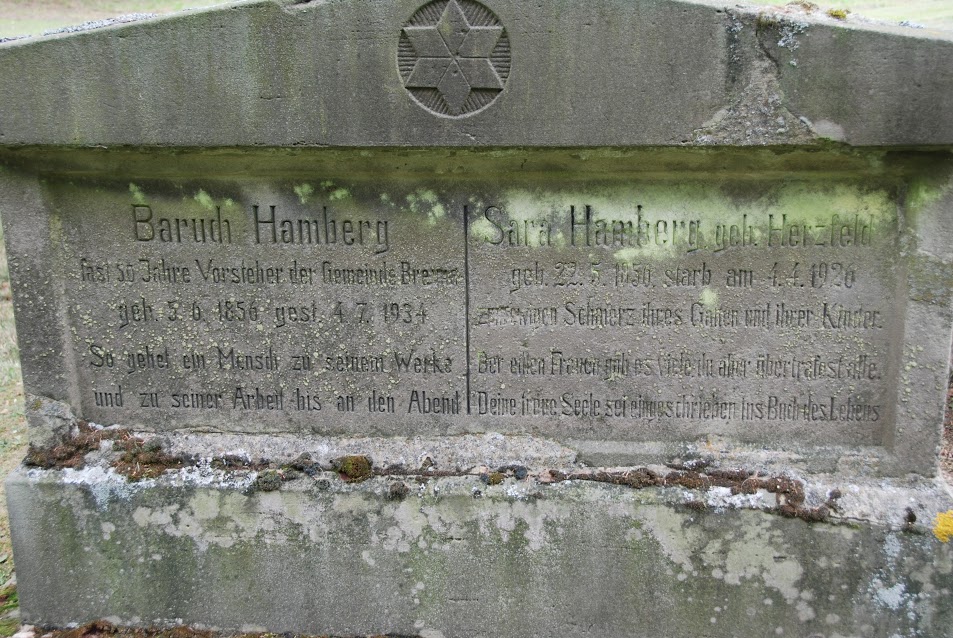
He next surfaced on a passenger ship manifest for a ship sailing from England to New York in 1924. He was still a German citizen, stating that his last permanent residence was Geldern, Germany, and listing his father “Wilhelm Hyman” of Geldern as his contact in that place.  He said that he was going to his uncle Harry Schoenthal of 260 Riverside Drive in New York City.  At first I was thrown by this, but then realized he must have meant Henry Schoenthal, his mother’s oldest brother, who was in fact living in New York at that time.  Lionel indicated on this manifest that he intended to settle permanently in the United States.


Lionel Heymann 1924 passenger manifest Ancestry.com. New York, Passenger Lists, 1820-1957 [database on-line]. Provo, UT, USA: Ancestry.com Operations, Inc., 2010. Original data: Passenger Lists of Vessels Arriving at New York, New York, 1820-1897. Microfilm Publication M237, 675 rolls. NAI: 6256867.
Lionel Heymann 1924 passenger manifest
Ancestry.com. New York, Passenger Lists, 1820-1957 [database on-line]. Provo, UT, USA: Ancestry.com Operations, Inc., 2010.
Original data: Passenger Lists of Vessels Arriving at New York, New York, 1820-1897. Microfilm Publication M237, 675 rolls. NAI: 6256867.
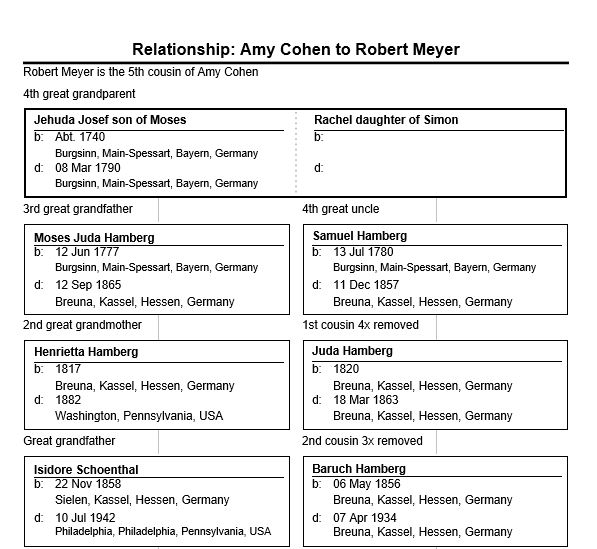
By 1928, Lionel was living in Chicago and working as a waiter, as reflected on this October 30, 1928 passenger manifest.  He was still an alien resident, listing his father again as his contact in Germany, but providing his Chicago address as his permanent address.  He was returning from Germany, so he probably had been visiting his family back home.


Lionel Heymann 1928 passenger manifest Year: 1928; Arrival: New York, New York; Microfilm Serial: T715, 1897-1957; Microfilm Roll: Roll 4280; Line: 1; Page Number: 200

Lionel Heymann 1928 passenger manifest
Year: 1928; Arrival: New York, New York; Microfilm Serial: T715, 1897-1957; Microfilm Roll: Roll 4280; Line: 1; Page Number: 200


Interestingly, Lionel’s younger brother Walter had arrived in the US just a few months earlier in June, 1928.  This was consistent with the information in the above-mentioned  sources—that is,  that Walter also had ended up in Chicago. On the ship manifest for Walter’s arrival it reports that Walter was a cook, that he was 32, that his last residence had been Cologne, Germany, and that he was heading for Chicago where his brother Lionel resided.


Walter Heymann 1928 ship manifest Year: 1928; Arrival: New York, New York; Microfilm Serial: T715, 1897-1957; Microfilm Roll: Roll 4373; Line: 1; Page Number: 141

Walter Heymann 1928 ship manifest
Year: 1928; Arrival: New York, New York; Microfilm Serial: T715, 1897-1957; Microfilm Roll: Roll 4373; Line: 1; Page Number: 141


After searching the 1930 census as many ways as I could, including using Lionel’s address as given on both the 1928 ship manifests and his 1933 naturalization papers (1411 Winnemac Avenue), I concluded that the census enumerator had completely missed that address.  The listings include 1409 and 1413, but not 1411.  Just my luck.

Although I could not find Lionel on the 1930 census, Walter is listed on that census, living as a lodger in Chicago and working as a chef in a hotel.  He was then 34 years old and had been in the US for two years and had filed his papers for citizenship.

As mentioned, Lionel became a naturalized US citizen in 1933.

Ancestry.com. U.S. Naturalization Record Indexes, 1791-1992 (Indexed in World Archives Project) [database on-line]. Provo, UT, USA: Ancestry.com Operations, Inc., 2010.

Ancestry.com. U.S. Naturalization Record Indexes, 1791-1992 (Indexed in World Archives Project) [database on-line]. Provo, UT, USA: Ancestry.com Operations, Inc., 2010.

According to the Cook County, Illinois Marriage Index, Walter Heymann married Lucie Goldschmied on March 16, 1934.  Lucie was born in Frankfurt, Germany, on February 11, 1908, the daughter of Miksa (later Americanized to Michael) Goldschmied, a Hungarian native, and Bertha Hirschberg, a native of Eschbach, Germany.  Lucie first came to the US in 1928, according to the 1930 census, which has her listed as residing at the Moraine Hotel in Highland Park, Illinois (a suburb of Chicago), where she was employed as a pantry servant.  I assume that this was the same hotel where Walter was employed as a chef.

The Chicago Tribune described the history of the Moraine Hotel in an article published on May 11, 1986:

In the early years of this century, the Hotel Moraine-on-the-Lake sparkled as a North Shore glamor resort. Built on 15 acres overlooking Lake Michigan in Highland Park, the hostelry opened in 1900 with 140 rooms.

The Moraine immediately caught the eye of the rich and famous. Glancing through old guest registries (now in the Highland Park Historical Society), you`ll spot some well-known Chicago names–the Marshall Field family, the Swifts, the Pullmans, the Florsheims, and many others.

Guests came from all over the U.S. and even from abroad. Some of the more affluent even traveled with their chauffeurs and maids.

…   The heyday of the Moraine continued into the 1920s, when the increasing number of guests necessitated additions to the hotel. Then came the Depression and even the Moraine was not spared–it declared bankruptcy in 1937.
By 1939, the once-grand hotel had become a barracks for military officers. But sunnier days were just around the corner. In 1942, the hotel was purchased, rehabbed, and reopened. It regained some of its former glory and operated until 1969, when the last guest checked out.

In 1972, the Hotel Moraine-on-the-Lake itself checked out. It was torn down and the site was turned into a public park.

“North Shore Glamor Hotel Reborn,” Chicago Tribune, May 11, 1986


If this is indeed where Walter and Lucie were working when they met, they were certainly working in quite a grand place.

Max Heymann, the middle brother, was still back in Germany during this period, but he finally came to the US with his wife Frieda and their eleven year old son Klaus on January 7, 1939, escaping from Nazi Germany.  They had been most recently living in Essen, Germany, where Klaus was born.  Max listed his occupation as a merchant, his father Willy Heymann as the person he was leaving behind, and his brother Lionel as the person he was going to in the US.  I was surprised to see that Lionel was then living in Detroit, not Chicago.


Max and Frieda Heymann 1939 ship manifest Year: 1939; Arrival: New York, New York; Microfilm Serial: T715, 1897-1957; Microfilm Roll: Roll 6274; Line: 1; Page Number: 8

Max and Frieda Heymann 1939 ship manifest
Year: 1939; Arrival: New York, New York; Microfilm Serial: T715, 1897-1957; Microfilm Roll: Roll 6274; Line: 1; Page Number: 8


By 1940, all three of the sons of Rosalie Schoenthal and Willy Heymann were living in Chicago.  According to the 1940 census, Lionel was living in the household of his brother Max in 1940, apparently having returned from Detroit.  Lionel was now the head waiter at a hotel, according to the census.  Max was a salesman for a paper box manufacturing company. Lionel, Max, Frieda, and Klaus were living at 1441 Belle Plaine Avenue in Chicago.

Walter and his wife Lucie as well as Lucie’s recently arrived parents, Michael and Bertha Goldschmied, were living a mile away from Max and Lionel at 3325 North Paulina Street in Chicago.  Walter was continuing to work as the cook in a hotel, and Lucie was working as a waitress, perhaps in the same hotel restaurant.  Lucie and Walter did not have any children.

All three brothers registered for the World War II draft in 1942.  According to those registrations, Lionel was still living with Max on Belle Plaine Avenue and working for the Blackstone Hotel.  Max was now working for Parfeit Powder Puff Company in Chicago. Walter was still living on North Paulina Street and working for “Martin,” a restaurant.


Lionel Heymann World War II draft registration Ancestry.com. U.S., World War II Draft Registration Cards, 1942 [database on-line]. Provo, UT, USA: Ancestry.com Operations, Inc., 2010. Original data: United States, Selective Service System. Selective Service Registration Cards, World War II: Fourth Registration.

Lionel Heymann World War II draft registration
Ancestry.com. U.S., World War II Draft Registration Cards, 1942 [database on-line]. Provo, UT, USA: Ancestry.com Operations, Inc., 2010.
Original data: United States, Selective Service System. Selective Service Registration Cards, World War II: Fourth Registration.

Max Heymann World War II draft registration Ancestry.com. U.S., World War II Draft Registration Cards, 1942 [database on-line]. Provo, UT, USA: Ancestry.com Operations, Inc., 2010. Original data: United States, Selective Service System. Selective Service Registration Cards, World War II: Fourth Registration

Max Heymann World War II draft registration
Ancestry.com. U.S., World War II Draft Registration Cards, 1942 [database on-line]. Provo, UT, USA: Ancestry.com Operations, Inc., 2010.
Original data: United States, Selective Service System. Selective Service Registration Cards, World War II: Fourth Registration

Walter Heymann World War II draft registration Ancestry.com. U.S., World War II Draft Registration Cards, 1942 [database on-line]. Provo, UT, USA: Ancestry.com Operations, Inc., 2010. Original data: United States, Selective Service System. Selective Service Registration Cards, World War II: Fourth Registrati

Walter Heymann World War II draft registration
Ancestry.com. U.S., World War II Draft Registration Cards, 1942 [database on-line]. Provo, UT, USA: Ancestry.com Operations, Inc., 2010.
Original data: United States, Selective Service System. Selective Service Registration Cards, World War II: Fourth Registrati

Max died a year later on May 31, 1943.  He was only 49 years old.  Walter died ten years after his brother Max on August 14, 1953; he was only 57.  Did the stress of uprooting themselves and worrying about their relatives back home contribute to their early deaths? I don’t know.

Lionel, the oldest brother, lived the longest.  He died on November 29, 1966, when he was 79 years old.  I was fortunate to find both a death notice and an obituary for Lionel (but none for his brothers).  Those two records revealed more about Lionel than I’d been able to glean from the passenger ship manifests or the census records.  He’d had a whole other life not reported on those documents.

More on that in my next post.


Fighting their Native Country in World War II: Jakob Schoenthal’s Grandsons

As I wrote last time, the two sons of Jakob Schoenthal and Charlotte Lilienfeld had arrived in the US long before Hitler came to power in Germany.  They were working as tailors and living in Washington, Pennsylvania, where their uncles and aunt had lived for many years.  Then Hitler came to power, and their family back home was in danger.

In 1938, Lee and Meyer’s sister Erna arrived from Germany with her son Werner.  I have now learned more about Erna’s husband Arnold Haas.  He was born in Darmstadt, Germany, in 1893, and had served his native country during World War I.  He and Erna Schoenthal had married on February 13, 1925, and their son Werner was born on April 14, 1926.  Then Arnold died at age 38 on January 23, 1931, leaving behind his young widow Erna and his not-yet five year old son Werner.  Fortunately Erna had the good sense to leave Germany in May, 1938, and bring her son and herself to safety in the US.  In 1940, they were living in Pittsburgh.

Darmstadt register for Arnold Haas and family indicating birth, marriage, and death of Haas and birth of son Werner

Darmstadt register for Arnold Haas and family indicating birth, marriage, and death of Arnold Haas and birth of son Werner

Helmut Levi, the son of Julius and Henriette (Schoenthal) Levi, had also arrived by then and was living in New York City.  Both Helmut and Werner soon found themselves fighting their former homeland when the US entered World War II at the end of 1941 after the bombing of Pearl Harbor.

Werner Haas joined the US Navy on March 15, 1944, when he was 18, and served until March 6, 1946.  He spent time at the Naval Air Stations in Norfolk, Virginia, and in Corpus Christi, Texas, before being assigned to the Destroyer Escort USS Wesson in June, 1945.  According to Michael Moskow, who has done extensive research on Jewish military service during World War II, the Wesson had been struck by a kamikazi in April, 1945, two months before Werner was assigned to that vessel.

As seen in the caption on the photo below, the Wesson was “in overhaul” from May to July 1945, so it would seem likely that Werner was working on her repairs when he was first assigned to that ship.  Werner served as a fireman on the destroyer; according to this site about military careers, “The training received as a Fireman or in the related engineering skill specialties is equivalent to that received as an electrician, electrical or power plant/co-generation plant operator or supervisor, diesel mechanic, or electronics repair technician.”  From various military records it appears that Werner was assigned to the Wesson for at least a year and was then assigned to two other naval ships.


English: 26 June 1945: Mare Island Naval Shipy...

English: 26 June 1945: Mare Island Naval Shipyard, San Francisco, Cal. – Forward plan view of USS Wesson (DE 184) at Mare Island. She was in overhaul at the yard from 16 May to 1 July 1945. USS Blessman (APD 48) inboard of Wesson and USS Hazelwood (DD 531) is on the opposite side of the pier. (U.S. Navy photo #DE-184-4842-45) (Photo credit: Wikipedia)


Werner’s older cousin Helmut Levi served in the US Army, enlisting on November 28, 1942.  He served as a private and then a corporal during the course of World War II.   Although I am still looking for more information about Helmut’s service during the war, I was able with the help of Michael Moskow to find this letter that Helmut Levi (presumably the same one) wrote to Yank magazine in September, 1944:


Pvt Helmut Levi letter to Yank magazine, September 29, 1944, p 14

Pvt Helmut Levi letter to Yank magazine, September 29, 1944, p 14, found at http://www.unz.org/Pub/Yank-1944sep29-00014


Not surprisingly, Helmut had strong feelings about the need for Germany (and Japan) to be occupied and supervised carefully after the war.  It appears that he was stationed in Britain in September, 1944, just months after the D-Day invasion and the beginning of the Allies’ advances in France against Germany.  During that time, Helmut’s aunt and uncle, Johanna (Schoenthal) and Heinrich Stern, were living in France, hiding from the Nazis. His parents had already been killed at the Chelmno death camp.

Lee and Meyer both registered for the World War II draft, though being almost in their sixties when the war began, neither served in the military during the war.  Note that Meyer was both working for and living with Lee in April 1942.  (Lee seems to have listed his work address as his residence.)  Although Meyer listed his brother Lee as the person who would always know his address, Lee listed someone named Mary Reinbold, who as listed in the 1940 census, was then a 39 year old single woman living with her father and brothers and working as a telephone operator.


Lee Schoenthal World War II draft registration The National Archives at St. Louis; St. Louis, Missouri; World War II draft cards (Fourth Registration) for the State of Pennsylvania; State Headquarters: Pennsylvania; Microfilm Series: M1951; Microfilm Roll: 278

Lee Schoenthal World War II draft registration
The National Archives at St. Louis; St. Louis, Missouri; World War II draft cards (Fourth Registration) for the State of Pennsylvania; State Headquarters: Pennsylvania; Microfilm Series: M1951; Microfilm Roll: 278


Meyer N Schoenthal World War II draft registration Ancestry.com. U.S., World War II Draft Registration Cards, 1942 [database on-line]. Provo, UT, USA: Ancestry.com Operations, Inc., 2010.

Meyer N Schoenthal World War II draft registration
Ancestry.com. U.S., World War II Draft Registration Cards, 1942 [database on-line]. Provo, UT, USA: Ancestry.com Operations, Inc., 2010.

Why wouldn’t Lee have listed Meyer as his contact just as Meyer had listed him? More on that in a later post.

Once the war ended, the family apparently spent a year trying to learn what had happened to Henriette Schoenthal and Julius Levi.  My heart broke when, with Michael Moskow’s help,  I found this notice in the June 14, 1946 issue of Aufbau, the newspaper published beginning in the 1930s for German Jewish immigrants in the United States:


Aufbau June 14, 1946

Aufbau June 14, 1946 found at http://archive.org/stream/aufbau1219461946germ#page/n475/mode/1up


Translation: After a one year search in Europe, we today know that our beloved parents and siblings, Julius Levi and Henriette Levi (nee Schoenthal) from Cologne have fallen to the Nazi terror …. [followed by the names of their son and their siblings].

By the time Helmut Levi had enlisted in the US Army in November 1942, his parents had already been murdered by the Nazis.  It must have just been unbearable for him to realize that while he had been fighting to defeat Hitler and the Nazis, it had already been too late to save his parents.

This notice also indicates that as of June 14, 1946, Helmut was still in the Army; although I am not sure what “Liaison Sec” refers to, G-2 is military shorthand for military intelligence staff.  It appears that Helmut was doing some kind of intelligence work in Berlin after the war, which makes sense, given his familiarity with Germany and the German language.  Being in Berlin may have also allowed him to search more quickly for what had happened to his parents.

As for Johanna Schoenthal Stern and her husband Heinrich Stern, they arrived in the US in 1947 from France.  As I mentioned in my prior post, Johanna and Heinrich had listed a friend named Henry Kahnweiler of Paris as their contact person in France.  I was curious as to who he was and how Johanna and Heinrich were connected to him.  I wanted to know more about their story—how and when did they go to France? How did they survive the Nazi occupation of France? Had they had children who had not survived the war?

Although I don’t have all the answers, I now have at least some answers to those questions.  I will address those in my next post.


Jakob Schoenthal and Charlotte Lilienfeld, Part II: Finding Their Children and Grandchildren

In my last post, I talked about the twisted path I took to find my great-great-uncle Jakob Schoenthal and his wife Charlotte Lilienfeld.  After discovering that their daughter Henriette Schoenthal and her husband Julius Levi had been killed in the Holocaust, I was determined to find out what had happened to Henry Lyons, who was the son of Henriette and Julius Levi and who had filed Pages of Testimony for his parents with Yad Vashem.

I thought that would be easy.  After all, I had a name and a specific address from the Pages of Testimony—99-30 59th Avenue, Rego Park, New York.  And I did almost immediately find a Public Records listing with his name at that address that provided me with his birthdate, October 17, 1919.  But that didn’t tell me much more than what I knew from the Pages of Testimony.

Yad Vashem page of testimony for Henriette Schoenthal Levi


Searching a bit further using the Rego Park address listed on the Pages of Testimony, I found a Pauline Lyons listed at that same address; I assumed that she was Henry’s wife.  Having both names made the search a bit easier since Henry Lyons itself is not exactly a unique name. I was able to use their two names together to find that they are both buried at Calverton National Cemetery and that Henry had died on December 18, 1986, and Pauline on November 30, 2007.  Henry had served in the US military during World War II, beginning his service on November 28, 1942, and thus was entitled to a military burial.  Imagine coming to America as a young man to escape Hitler and then fighting against the country of your birth.

When had he come to the US? Had he and Pauline had children? I wanted to know more.  I assumed Henry had arrived in the US sometime in the mid-to late 1930s.  I also assumed that he had arrived under the surname Levi, not Lyons.  After I wasted a lot of time searching for him under the wrong name, a member of the NYC Genealogy Group found a record for a man named Helmut Levi who had changed his name to Henry Lyons on October 5, 1953, in the city courts in New York.


Helmut Levi change of name to Henry Lyons Ancestry.com. U.S. Naturalization Record Indexes, 1791-1992 (Indexed in World Archives Project) [database on-line]. Provo, UT, USA: Ancestry.com

Helmut Levi change of name to Henry Lyons
Ancestry.com. U.S. Naturalization Record Indexes, 1791-1992 (Indexed in World Archives Project) [database on-line]. Provo, UT, USA: Ancestry.com

Armed with the information about what was probably his original name, I was able to find Helmut Levi on the 1940 census, living as a lodger at 204 West 87th Street in NYC and working as a watchmaker.  I was pretty certain I had found the right person when I saw on the census record that he had been living in Cologne, Germany, in 1935.

I also then found him on a passenger manifest (see line 26 on each page below):

Helmut Levy ship manifest p 1

Helmut Levi ship manifest Henry Lyons

Year: 1939; Arrival: New York, New York; Microfilm Serial: T715, 1897-1957; Microfilm Roll: Roll 6293; Line: 1; Page Number: 188


Helmut Levi had arrived in NYC on February 25, 1939.  According to the ship manifest, he was a nineteen year old merchant born and last residing in Cologne, leaving behind his father Julius Levi of Breitstrasse in Cologne and going to his uncle Lee Schoenthal of Washington, Pennsylvania.  This was obviously my cousin, the man later known as Henry Lyons.

I also found him on a second passenger manifest dated July 4, 1948, arriving in NYC from Bremerhaven, Germany.  Henry had returned to Germany after the war.  What a devastating trip that must have been.  The photo below shows what his home city of Cologne looked like after Allied bombing during the war.  Henry had not only lost his parents, but the place where he had lived as a child and a teenager.


By U.S. Department of Defense. Department of the Army. Office of the Chief Signal Officer. [2] [Public domain], via Wikimedia Commons

By U.S. Department of Defense. Department of the Army. Office of the Chief Signal Officer. [2] [Public domain], via Wikimedia Commons

From that 1948 passenger manifest (line 10), I saw that Helmut Levi was then living in Washington, Pennsylvania, where his two uncles, Lee and Meyer, were also living, that is, his mother’s brothers, the two sons of Jakob and Charlotte mentioned in my last post.  Like so many Schoenthal relatives before him, Helmut had spent time living in western Pennsylvania.  The ship manifest also indicated that by 1948, Helmut had married, although Pauline is not listed as traveling with him.


Helmut Levi aka Henry Lyons 1948 ship manifest

Helmut Levi 1948 ship manifest Year: 1948; Arrival: New York, New York; Microfilm Serial: T715, 1897-1957; Microfilm Roll: Roll 7624; Line: 10; Page Number: 9


But I still didn’t know whether Helmut/Henry and Pauline had had children or whether there were other family members I might have missed.  I called Calverton National Cemetery, but they had no additional information.  I searched in the newspaper databases for articles or obituaries that might reveal more about Henry and Pauline Lyons.  At first I limited myself to New York papers, but then I realized that that was too narrow, given that he had once lived in western Pennsylvania.  I broadened my search and found this obituary from the January 19, 1989, Pittsburgh Press:


Erna Schoenthal Haas obit 1989


Who was Erna Haas? And was she Henry’s aunt or Pauline’s aunt? And who was Yohana Stern? I had more work to do.  I searched for Erna Haas, an unusual enough name, and was very excited to find this ship manifest (see lines 15 and 16):


Erna Haas ship manifest p 1

Year: 1938; Arrival: New York, New York; Microfilm Serial: T715, 1897-1957; Microfilm Roll: Roll 6152; Line: 1; Page Number: 174


Erna and her twelve year old son Werner had sailed from Hamburg, Germany on May 4, 1938; Erna was a beautician coming from Cologne.  I assumed that therefore her connection would be to Henry, a native of Cologne, not to Pauline, who was American-born.  Turning to the second page of the manifest, my hunch was confirmed (again, see lines 15 and 16):


Erna Haas ship manifest p 2

Year: 1938; Arrival: New York, New York; Microfilm Serial: T715, 1897-1957; Microfilm Roll: Roll 6152; Line: 1; Page Number: 174


Who was the person she named as living in the place she had left? Her sister, H. Levy of Breitstrasse in Cologne—that is, Henriette Schoenthal Levi, who had lived on that street as seen in the Köln directories in my last post. And who was she going to be with in the US? Her brother, Lee Schoenthal in Washington, Pennsylvania.  Erna Haas was another child of Jakob Schoenthal and Charlotte Lilienfeld.  She was also my grandmother’s first cousin.  And the aunt of Henry Lyons.  She was born Erna Schoenthal. I had found a fourth child of Jakob and Charlotte Schoenthal.

In 1940, Erna was listed on the census living with her son Werner in Pittsburgh, Erna working in cosmetics sales, Werner in newspaper sales.  Erna was a widow, so I assume that her husband Arnold had died in Germany, as I have no record of him in the US.  Unfortunately I have not yet found a record for him in Germany either.

But what about Yohana Stern, who had been listed in Erna’s obituary as her sister? I found this obituary for her husband Heinrich while searching for more information about Erna Haas:

Heinrich Stern obit


And then I located a ship manifest for Johanna Stern and Heinrich Stern (lines 3 and 4):


Ship manifest p 1 Johanna Schoenthal and Heinrich Stern


Ship manifest p 2 for Johanna Schoenthal and Heinrich Stern

Year: 1947; Arrival: New York, New York; Microfilm Serial: T715, 1897-1957; Microfilm Roll: Roll 7389; Line: 4; Page Number: 107


They had not arrived in the US until June 10, 1947, when they were 66 and 70 years old.  Notice that Johanna was born in Cologne, presumably around 1880.  How had she and Heinrich survived the Holocaust?  The manifest lists them as “stateless” and notes that they had last resided in “Lyon, France” and that their visas had been issued in “Marseille, France.”

The second page indicates that the person they were leaving behind at their last residence was a friend named Henry Kahnweiler of Paris (more on him in my next post) and the person they were going to see in the US was Johanna’s brother Lee Schoenthal of Washington, Pennsylvania.  Their final destination was Washington, Pennsylvania.  Yohana or Johanna Stern was born Johanna Schoenthal, a fifth child of Jakob and Charlotte Schoenthal. Another of my grandmother’s first cousins.


Thus, Jakob and Charlotte had had five children.  Their two sons Lee and Meyer had emigrated from Germany long before Hitler came to power; they had both settled near their aunt and uncle in Washington, Pennsylvania.    Jakob and Charlotte’s three daughters had stayed behind.  One, Henriette, was murdered by the Nazis with her husband Julius Levi at the Chelmno death camp in 1942, but their son Helmut Levi, aka Henry Lyons, left Germany in 1939 and survived.  Another daughter, Erna, left Germany with her son Werner in 1938.  And finally a third daughter, Johanna, somehow survived the war by going to France, and she and her husband Heinrich Stern came to the US in 1947.

It was a long and twisty road finding these five children, and it was heartbreaking to read of more cousins killed in the Holocaust.  But four of those five children survived and came to the US as did two of Jakob and Charlotte’s grandsons, Henry Lyons and Werner Haas.  More on the lives of these four children and their descendants in my next post.

Part II: The Benefits of Teamwork

So who was Frederick Selinger, and how did he fit into the family? And who was Fanny Selinger’s mother?

In Part I, I described the research I had done first with Val Collinson in 2014 and then separately with Shirley Allen during the summer and fall of 2015 to try and find the connections between all our various Selinger relatives. Through that research we had established with a fair degree of certainty that Julius and Alfred Selinger, who married two of my Cohen cousins, sisters Augusta and Fanny, were themselves brothers, the sons of Seligmann Selinger and Breinle Hofstadter. We had also established that Helena Selinger Auerbach, who had been Val’s great-grandmother, was a first cousin to Julius and Alfred and the daughter of Abraham Selinger and Rosalia Wilhelmsdorfer.

Relationship_ Julius Selinger to Helena Selinger

We also had established that Fanny Selinger Rosenthal, Shirley’s grandmother, was also a daughter of Abraham Selinger, but Shirley and I had not found any document that revealed whether her grandmother Fanny was a full or half sister to Helena and the other children of Abraham Selinger; we had not found her mother’s name or where she was born.

And I still didn’t know how Frederick Selinger fit into the question.

We also knew that Abraham Selinger had immigrated to England by 1871 because he appeared on the 1871 UK census with a second wife, Gali, along with several children: Sigfried, Helena, Cornelia, and Oscar.  By 1881, Abraham had died, and his widow Gali was living with some different children: Morris, Flora, and Sidney, plus Oscar.  Aside from Helena, who were all these children, and where were they born?  I had no birth records for Cornelia, Morris, Flora, Sidney, or Oscar.

So by late November, we had many answers, but many questions remained.

Fast forward again to January 13, when I again heard from Shirley.  She had received a copy of the marriage authorization for Fanny Selinger and Jacob Rosenthal from the Chief Rabbi in London.  It confirmed that Fanny was the daughter of Abraham and that she was born in Hurben, but did not reveal her mother’s name.  Although we did not have any new information, the new communication inspired us to try again to get answers to our primary questions: Who was Fanny Selinger’s mother?  And how did Frederick Selinger fit into the family, if at all?

Fanny Selinger Rosenthal and her husband Jacob Rosenthal and children Gladys, Daniel, and Alfred Courtesy of Shirley Allen

Fanny Selinger Rosenthal and her husband Jacob Rosenthal and children Gladys, Daniel, and Alfred
Courtesy of Shirley Allen

After reviewing everything we had, I decided to post on the German Genealogy group on Facebook for information about records in Ansbach , where Oskar Selinger had claimed to be born on his UK naturalization record.  Although I was unable to find Ansbach birth records for the appropriate years, my friend Matthias did find two websites with information about Abraham Selinger in Ansbach: one, a website listing past and present tobacco businesses in Germany; Abraham Selinger was listed as the manager of Equity and cigar-tobacco factory in Ansbach from 1862 until 1871. Thus, it made sense that Oscar Selinger was born in Ansbach.

The second website was even more revealing.  It was an Ansbach police report from 1870 reporting the arrest on May 31, 1870 of Abraham Selinger from Hurben, manager of a cigar factory,  for fraud.  Perhaps that is why 1871 was both the last date he had the cigar business in Ansbach as well as the first year he appeared on UK records.

But it also meant that the children I believed had been born to Abraham in the 1850s—Frederick, Fanny, Morris, Flora, and Sidney—were probably not born in Ansbach if Abraham’s business there didn’t start until 1862.  So where were they born?  Shirley continued to contact various offices in Germany, and I tried to think of new paths for research.

And then I had the best idea I’d had yet.  While doing all this work with Shirley in 2015, I had somehow forgotten about my correspondence with Val Collinson back in 2014.  Maybe Val had made some new discoveries or would have some new ideas.  I wrote to Val on January 22, 2016, and now we had three heads working on the mysterious Selingers.

Filament Productions

Filament Productions (Photo credit: Wikipedia)

The emails started flying back and forth among the three of us, and it became clear fairly quickly that Val and Shirley had some relatives in common, that is, relatives they both had met or at least had heard of.  I just sat back, enjoying the fact that I had brought these two cousins together.  They both were descendants of Abraham Selinger:  Shirley through his daughter Fanny, Val through his daughter Helena.  We weren’t yet sure whether Helena and Fanny were full or half-sisters, but in any event Shirley and Val, who’d never heard of each other before and who live about 60-100 miles apart in the UK, are third cousins.  I was thrilled that I’d brought these two wonderful family researchers and cousins together.

Shirley and Val both had lots of information about the marriages and descendants of some of the other Selinger siblings and also some wonderful photographs, but neither had any information about Frederick and neither was sure as to the identity of the mother or birthplaces of Fanny, Cornelia, Morris, Flora, or Sidney.

And then on January 29, 2016, the walls started tumbling down.  Val found this on Ancestry:

JPF Ludwigshafen page

Ludwigshafen?? Where was that? It’s a town very close to Mannheim.  Could be this OUR Fanny? Val asked me to follow up because I have the broadest Ancestry subscription (All Access), and I was able to pull up a scan of the actual record.  And not only did I find birth records for Fanny, I found them for three other children, all born to Abraham Selinger and Rosalia Wilhelmsdorfer, his first wife.

The four children born in Ludwigshafen were:  Babetta, born in 1853, died in 1854; Flora, born in 1855 (later Flora Wallach); Fanny, born December 5, 1856; and  Sigmund (later Sidney) born in 1858.  We finally had a birth record for Fanny, and we knew now that she was in fact a full sister to Helena as they were both the daughters of Abraham Selinger and Rosalia Wilhelmsdoerfer.  Val and Shirley were officially third cousins.


Fanny Selinger birth record from Ludwigshafen Ancestry.com. Ludwigshafen, Germany, Births, Marriages, and Deaths, 1798-1875 [database on-line]. Provo, UT, USA: Ancestry.com Operations, Inc., 2015. Original data: Ludwigshafen Zivilstandsregister, 1798-1875. Stadtarchiv Ludwigshafen, Ludwigshafen, Deutschland.

Fanny Selinger birth record from Ludwigshafen
Ancestry.com. Ludwigshafen, Germany, Births, Marriages, and Deaths, 1798-1875 [database on-line]. Provo, UT, USA: Ancestry.com Operations, Inc., 2015.
Original data: Ludwigshafen Zivilstandsregister, 1798-1875. Stadtarchiv Ludwigshafen, Ludwigshafen, Deutschland.

So that left three children whose birthplaces were still unknown: Morris, Cornelia, and, of course, Frederick.  Since Morris and Cornelia were both born before 1862 when the Selinger family arrived in Ansbach and after 1848 when the family had moved to Mannheim, I assumed that they were probably born in Mannheim.  The 1881 census recorded Cornelia’s age as 18, two years younger than Helena, whom they reported as twenty. But even English census records are unreliable.  Helena would have been turning 22 that year; maybe Cornelia was really 19 or 20 and thus born in 1850 or 1851.  The 1881 census said Morris was 28; he was probably born in 1852 since Babetta, the child who died in 1854, was born in 1853, in Ansbach.  Cornelia and Morris would also probably have been the children of Abraham and Rosalia since there were four children born to that couple even after Cornelia and Morris were born.

So I went back to the Mannheim records because my initial search had been only for the years between 1853 to 1859; now I searched the set of records before it, dating from 1842 to 1852.  And there they were, birth records for Cornelia (1850) and Morris (1852).  And Helena (1849).  All three were the children of Abraham Selinger and Rosalia Wilhelmdoerfer.

landesarchiv_baden-wuerttemberg_generallandesarchiv_karlsruhe_390_nr-_2862_bild_147_4-1229196-147 Birth record for Helena Selinger from Hurben

landesarchiv_baden-wuerttemberg_generallandesarchiv_karlsruhe_390_nr-_2862_bild_147_4-1229196-147
Birth record for Helena Selinger from Mannheim (center, left page)


So there are two birth records for Helena, one in Hurben, one in Mannheim.  Go figure.

Meanwhile, Val found yet another document:

Abraham Selinger - Ansbach, Germany JPG

(I cannot understand why neither the Ludwigshafen nor the Ansbach registers showed up for me when I searched.  Val has a magic touch with the search engine logic that I don’t have.)

I then retrieved the image of the actual document:

Abraham Selinger Lutheran register Ansbach


Abraham Selinger family in Ansbach Ancestry.com. Ansbach, Germany, Lutheran Parish Register Extracts, 1550-1920 [database on-line]. Provo, UT, USA: Ancestry.com Operations, Inc., 2015. Original data: Ansbach Lutheran Parish Register Extracts. Digital images Tobias Brenner Collection.

Abraham Selinger family in Ansbach
Ancestry.com. Ansbach, Germany, Lutheran Parish Register Extracts, 1550-1920 [database on-line]. Provo, UT, USA: Ancestry.com Operations, Inc., 2015.
Original data: Ansbach Lutheran Parish Register Extracts. Digital images Tobias Brenner Collection.

This document revealed two more things: that Gali’s birth name was Kohn and that she and Abraham had had another child before Oskar, Isidor, who died when he was an infant. So now I had a record confirming that Oscar was born in Ansbach and that his mother was Gali Kohn, not Rosalia Wilhelmsdoerfer.

Shirley, Val, and I had pretty much closed the circle on the children of Abraham Selinger.  But despite all our efforts, we still had not found one record for Frederick Selinger.  If he was born in 1856 as his passport application and his death certificate indicated, he should have been included with those children born in Ansbach.  He would have been born around the time of Flora or Fanny, maybe even a twin of one of them.  But he wasn’t there. And he wasn’t in the Mannheim records or the Hurben records.

So something did not make sense.  Frederick was not the child of Abraham Selinger with either of his wives.  I was convinced of it now.  So who was he? What was I missing?


P question

P question (Photo credit: Wikipedia)


This is the part of the story where I just want to kick myself.  I went back once again to the Hurben birth records and looked more closely at the children born to Seligman Selinger.  There were nineteen of them.  NINETEEN.  Nine were born to Seligman and his first wife between 1835 and 1844.  They all were born too early to be Frederick.  Ten children were born to Seligman Selinger and his second wife, Breinle Hofstadter, between 1849 and 1866.  There were five girls and five boys from that second marriage.  The five boys were Heinrich (1852), Julius (1853), Sigfried (1855), Hugo (1860), and Alfred (1866).  Julius and Alfred were the two who had married my Cohen cousins Augusta and Fanny.  That left Heinrich, Sigfried, and Hugo. Could any of them be Frederick?

Sigfried.  Hmm, I thought.  That could have become Frederick, maybe?? But he was born December 29, 1855, and Frederick was born in December 1856, according to his US death certificate and his US passport application.  So what, I thought? People lie! He made himself a year younger. The more I thought about it, the more I thought that Sigfried was Frederick.  The disparity in the dates in December for his birthday (the death certificate said December 27, the passport application December 21) didn’t bother me either.  Jews in Europe might not have known their birthday on a Gregorian calendar, only a Jewish calendar.  Frederick might have just known that his birthday was close to Hanukkah and nothing more precise than that.

I went back to Ancestry to look at the records I had for Frederick.  The earliest two—his 1880 marriage record and the 1880 census—list him as Fred, not Frederick.  Fred could be a shortened version of Sigfried, couldn’t it?  So I decided to search for Sigfried Selinger.

Marriage record for Frederick Selinger and Rachel Cohen 1880

Marriage record for Frederick Selinger and Rachel Cohen 1880

And I found this ship manifest from 1872:

Siegfried Selinger ship manifest 1872 to Baltimore The National Archives at Washington, D.C.; Washington, D.C.; Records of the US Customs Service, RG36; NAI Number: 2655153; Record Group Title: Records of the Immigration and Naturalization Service, 1787-2004; Record Group Number: 85

Siegfried Selinger ship manifest 1872 to Baltimore
The National Archives at Washington, D.C.; Washington, D.C.; Records of the US Customs Service, RG36; NAI Number: 2655153; Record Group Title: Records of the Immigration and Naturalization Service, 1787-2004; Record Group Number: 85

Siegfried Selinger, sixteen years old, arrived in Baltimore in June 1872, when Sigfried Selinger of Hurben would in fact have been still sixteen years old.  I thought that this could very well be the man who became Frederick Selinger.  Supporting this assumption was the fact that his marriage record states that he was from Baltimore and that he ended up marrying a woman from Washington, DC, so it would make sense that he would have entered the US through Baltimore, as his naturalization papers indicated.    (They also say he entered the country in June 1871.  People lie!  People forget!)

Frederick Selinger passport application National Archives and Records Administration (NARA); Washington D.C.; NARA Series: Passport Applications, 1795-1905; Roll #: 378; Volume #: Roll 378 - 14 Jul 1891-31 Jul 1891 Description Volume : Roll 378 - 14 Jul 1891-31 Jul 1891

Frederick Selinger passport application
National Archives and Records Administration (NARA); Washington D.C.; NARA Series: Passport Applications, 1795-1905; Roll #: 378; Volume #: Roll 378 – 14 Jul 1891-31 Jul 1891
Description
Volume : Roll 378 – 14 Jul 1891-31 Jul 1891

And when I searched for Fred Selinger in Baltimore, I found two listings in Baltimore directories, one in 1875, one in 1878.  I am quite certain I have found Frederick and now know that he was Sigfried Selinger,  the son of Selinger Seligmann and Breinle Hofstadter.  He was the middle brother to his brothers, Julius and Alfred, who followed him to the US in the following decade and married respectively the aunt (Augusta) and the sister (Fanny) of Frederick’s wife Rachel.

So why do I want to kick myself? Not only because I should have seen this much, much earlier, but because Ralph Bloch in fact told me he thought Sigfried could be Frederick way back in August, 2015.  I’d forgotten that until I reviewed all the old emails to write this blog post.  I probably saw his comment and forgot it or thought that I needed more proof.  And I got caught up in searching for Fanny and the other Selingers and for some reason assumed Frederick had to be the child of Abraham.  I could have so easily searched back then for Sigfried in the US and found what I found just this past week.

But actually I am so glad that I didn’t.  Because if I had done that in August, I might never have continued searching and working with Shirley and Val.  I might never have brought Shirley and Val together, third cousins who’d never known each other before.  I would have missed out on all the fun Val and Shirley and I have had as we worked together to solve this mystery.  That makes this all very worthwhile.

All this, you might say, for people who aren’t even my blood relatives? For people who happened to marry my distant cousins Rachel, Augusta, and Fanny?

It’s moments like this that I want to say, “We are all cousins.  Our families are all entangled.  And every person’s life, every person’s story is worth remembering and is worth memorializing.”


The Benefits of Teamwork: Part I

In my recent post, I mentioned that I had been working with two other researchers on the mystery of the three Selinger men who married my Cohen cousins.  Frederick Selinger had married my cousin Rachel Cohen in 1880 in Washington, DC.  Rachel was the daughter of Moses Cohen, my three times great-uncle (brother of my great-great-grandfather Jacob).  Julius Selinger had married Augusta Cohen in 1884 in Washington, DC; Augusta was the daughter of Moses Cohen, Jr. and niece of Rachel Cohen.  Finally, Alfred Selinger had married Fannie Cohen in Washington, DC, in 1893.  Fannie was also a daughter of Moses Cohen, Jr., also a niece of Rachel Cohen, and a sister of Augusta Cohen.

Julius and Augusta Cohen Selinger passport photos 1922

Julius and Augusta Cohen Selinger passport photos 1922


Way back on July 22, 2014, when I first posted about the three Selinger men, I had speculated that they all had to be related.  Both Julius and Frederick had documents indicating that they had been born in Hurben, Germany.  Alfred and Julius had lived together in DC before they’d married, and Alfred had traveled with Julius and Augusta to Europe before he married Augusta’s sister Fannie.  But I had nothing to support that speculation besides that circumstantial evidence.

Then a month later on August 5, 2014, I wrote about the marriage of Eleanor Selinger to Henry Abbot.  Eleanor was the daughter of Julius Selinger and Augusta Cohen; Henry was the son of Hyams Auerbach (Abbot) and Helena Selinger (some records say Ellen or Helen).  I was curious as to whether Helena Selinger was somehow related to Julius and the other Selinger men, Alfred and Frederick.  I thought that she might be since how else would an American woman have met an Englishman? And the shared name seemed too uncommon to be pure coincidence.


Eleanor Selinger Abbot and Abbot family-page-001

Eleanor Selinger Abbot (center) with the Abbot family Courtesy of Val Collinson


As I wrote then, I had contacted the owner of an Ancestry family tree who turned out to be Eleanor Selinger and Henry Abbot’s great-niece: Val Collinson.  Val and I exchanged a lot of information, but we could not at that time find any definitive evidence linking Helena Selinger, her great-grandmother, to Frederick or Julius or Alfred.  All were born in Germany, but it seemed from the records in different locations.  Helena’s marriage record indicated that her father’s name was Abraham Selinger, whereas Julius had indicated on his passport application that his father was Sigmund Selinger.  We were stumped.  And that was that.  Or so I thought.

Fast forward a full year to August, 2015, when I received a comment on my earlier blog post about Eleanor Selinger and Henry Abbot from someone named Shirley Allen, whose grandparents were Jacob Rosenthal and Fanny Selinger:

Fanny Selinger Rosenthal and her husband Jacob Rosenthal and children Gladys, Daniel, and Alfred Courtesy of Shirley Allen

Fanny Selinger Rosenthal and her husband Jacob Rosenthal and their children Gladys, Daniel, and Alfred
Courtesy of Shirley Allen

I’ve been delving into my paternal (Rosenthal) family history. I’ve found that my grandfather Jacob Rosenthal was married to Fanny Selinger. Unfortunately I haven’t found anything further about Fanny other than she was born in Germany, probably in 1857. However, I’ve recently come upon a wonderful paper lace invitation to the 1873 wedding of Hyams Auerbach and Helena Selinger that you referred to. What I don’t know is why Fanny would have been invited. Clearly she and Helena were related – but how ?

Needless to say, I was intrigued.  Maybe Fanny Selinger was related to Helena and/or maybe she was related to Julius, Frederick, and Alfred.  Shirley and I communicated by email, and we both started digging.

Invitation to the wedding of Helena Selinger and Hyms Auerbach Courtesy of Shirley Allen

Invitation to the wedding of Helena Selinger and Hyms Auerbach
Courtesy of Shirley Allen


I found a website called Jewish Genealogy of Bavarian Swabia (JGBS) that had records for Hurben and located 25 Selingers in their database, including those for Alfred and for Julius, who were the sons of Seligman Selinger and Breinle Hofstadter and thus were brothers, as I had suspected. Shirley and I both thought that Seligman Selinger had been Americanized to Sigmund by Julius on his passport application and that the birth records for Julius and Alfred confirmed that they were in fact brothers.

I also found a birth record for Helena Selinger, whose father was Abraham Selinger, not Seligman Selinger.  Abraham and his wife Rosalia Wilhelmsdoerfer had six children listed: Seligman (1842), Raphael (1843), Pauline (1845), Karolina (1847), Heinrich (1848), and Helena (1849). Pauline, Karolina, and Heinrich had all died as young children, leaving Seligman, Raphael, and Helena as the surviving children of Abraham.  Here is Helena’s birth record from Hurben in August 1849.

Helena Selinger birth record from Hurben http://jgbs.org/SuperSearch.php?Sp=3&Book=birth&Com=11

Helena Selinger birth record from Hurben (third from bottom)
http://jgbs.org/SuperSearch.php?Sp=3&Book=birth&Com=11


But what about Frederick?  And Fanny? And was there a connection between Helena’s father Abraham and the father of Julius and Alfred, Seligman Selinger?

A little more digging on the JGBS site revealed that both Abraham Selinger and Seligman Selinger were the sons of Joachim Selinger, thus confirming that they were brothers and thus that Helena was a first cousin to Julius and Alfred.

Marriage record from Hurben for Abraham Selinger, son of Joachim, and Rosalia Wilhelmsdoerfer http://jgbs.org/detail.php?book=marriage&id=%206671&mode=

Marriage record from Hurben for Abraham Selinger, son of Joachim, and Rosalia Wilhelmsdoerfer (second in page)
http://jgbs.org/detail.php?book=marriage&id=%206671&mode=


Seligmann Selinger, son of Joachim, marriage to Breinle Hoftsadter

Seligmann Selinger, son of Joachim, marriage to Breinle Hoftsadter (second from bottom) 1848 http://jgbs.org/detail.php?book=marriage&id=%206695&mode=


That meant that Eleanor Selinger, daughter of Julius Selinger, had married her second cousin, Henry Abbot, son of Helena Selinger.


But that still left us wondering about Frederick Selinger and Shirley’s great-grandmother Fanny Selinger.  How did they fit into this picture?

I contacted Ralph Bloch, the webmaster for the JGBS website, and he was extremely helpful.  More helpful than I realized at the time, but more on that later.  Ralph also could not find any evidence that Fanny was born in Hurben, and he reassured me that the birth records for Hurben were quite complete.  He even searched through the original pages to be sure that Fanny hadn’t somehow been missed when the records were indexed. (There was a Fany Selinger born in the 1830s, but that would have been far too early for Shirley’s ancestor.) Ralph also sent a photograph of Seligman Selinger’s headstone, which confirmed that his father’s name was Joachim or Chaim, his Hebrew name.

Seligman Selinger gravestone


So once again we hit the brick wall.  We still had not found either Frederick or Fanny.  Shirley said she would pursue it on her end, and I turned back to the other research I’d been doing when I received Shirley’s comment.

Not much happened again until late November when I heard again from Shirley, telling me that she had received a copy of Fanny Selinger’s marriage certificate, which revealed that Fanny was the daughter of Abraham Selinger.  Now we could link Fanny to Helena, also the daughter of Abraham, as well as to Julius and Alfred, Abraham’s nephews. But we didn’t know if Fanny and Helena were both the daughters of Rosalia Wilhelmsdoerfer.

Shirley’s research of UK records showed that by 1871 Abraham was married to a woman named Gali, and we assumed that Abraham had left Hurben at some point, that his first wife Rosalia had died, and that he had had several children with Gali.  That is what the UK census records from 1871 seemed to reflect. Abraham and Gali were living with Sigfried (28), Helena (20), Cornelia (18), and Oskar (4).  But there was neither a Fanny nor a Frederick.


Abraham Selinger and family 1881 UK census Class: RG10; Piece: 555; Folio: 86; Page: 3; GSU roll: 823397 Description Enumeration District : 10 Source Information Ancestry.com. 1871 England Census [database on-line]. Provo, UT, USA: Ancestry.com Operations Inc, 2004. Original data: Census Returns of England and Wales, 1871. Kew, Surrey, England: The National Archives of the UK (TNA): Public Record Office (PRO), 1871.

Abraham Selinger and family 1881 UK census
Class: RG10; Piece: 555; Folio: 86; Page: 3; GSU roll: 823397
Description
Enumeration District : 10
Source Information
Ancestry.com. 1871 England Census [database on-line]. Provo, UT, USA: Ancestry.com Operations Inc, 2004.
Original data: Census Returns of England and Wales, 1871. Kew, Surrey, England: The National Archives of the UK (TNA): Public Record Office (PRO), 1871.

Abraham died in 1880, and in 1881, Gali was living with four children, but aside from Oskar (13), they were all different from those on the 1871 census: Morris (28), Flora (surname Wallach) (25), and Sidney (23).  Now I was really confused.  Who were these people, and where had they been in 1871?  Flora was presumably married to someone named Wallach and now a widow, but Morris would have been eighteen in 1871 and Sidney only thirteen. Where were they living?  Who were they? None of those children were listed on the Hurben birth register on the JGBS site; in fact, there were no children listed for Abraham Selinger and any wife in Hurben after Helena’s birth in 1849.

Gali Selinger and family 1881 UK census Class: RG11; Piece: 472; Folio: 118; Page: 55; GSU roll: 1341103 Description Enumeration District : 9 Original data: Census Returns of England and Wales, 1881. Kew, Surrey, England: The National Archives of the UK (TNA): Public Record Office (PRO), 1881

Gali Selinger and family 1881 UK census
Class: RG11; Piece: 472; Folio: 118; Page: 55; GSU roll: 1341103
Description
Enumeration District : 9 Original data: Census Returns of England and Wales, 1881. Kew, Surrey, England: The National Archives of the UK (TNA): Public Record Office (PRO), 1881

I assumed that Morris, Flora, Sidney, and Oscar, all born after 1850, were born in a different place and perhaps to a different mother.  Certainly Oskar had to be Gali’s child since he was so much younger than all the rest and only four on the 1871 census.

Searching again on Ancestry, I found a new record:  an entry for Abraham, Rosalia, Seligman, and Raphael Selinger on the Mannheim, Germany, family register dated November 26, 1848.  What were they doing in Mannheim? By that time the three younger children, Pauline, Karolina, and Heinrich, had died.  Perhaps they needed a change of scenery.  But what about Helena? She was born in Hurben in 1849.

Then I found a second Mannheim family register that included Helena, the final entry on the page:


Abraham Selinger and family, Mannheim register Ancestry.com. Mannheim, Germany, Family Registers, 1760-1900 [database on-line]. Provo, UT, USA: Ancestry.com Operations, Inc., 2014. Original data: Polizeipräsidium Mannheim Familienbögen, 1800-1900. Digital images. Stadtarchiv Mannheim — Institut für Stadtgeschichte, Mannheim, Germany.

Abraham Selinger and family, Mannheim register
Ancestry.com. Mannheim, Germany, Family Registers, 1760-1900 [database on-line]. Provo, UT, USA: Ancestry.com Operations, Inc., 2014.
Original data: Polizeipräsidium Mannheim Familienbögen, 1800-1900. Digital images. Stadtarchiv Mannheim — Institut für Stadtgeschichte, Mannheim, Germany.

My friends in the German Genealogy group,  Heike Keohane, Matthias Steinke, and Bradley Hernlem, came to my rescue and translated it to read, “Helene, his daughter, here born the 22 August 1849.”  So Helena’s birth is entered on the Hurben birth records (on the same date) and on the Mannheim records.  I’ve no idea which is the correct birthplace; maybe Rosalia went home to Hurben to give birth and returned to Mannheim afterwards where the family was living.

But perhaps now I could find out where Frederick was born, not to mention Morris, Flora, Sidney, and Oscar. Maybe they were born in Mannheim.  I checked the Mannheim birth records from 1853 through 1866 and found not one person named Selinger.  I checked over and over, looking at each page until my eyes were blurry.  There were no Selingers born in Mannheim during that period that I could find.

Then I discovered that Oskar Selinger had listed Ansbach as his birth place on his UK naturalization papers and thought that perhaps the family had moved from Mannheim to Ansbach.

Oscar Selinger UK naturalization papers The National Archives; Kew, Surrey, England; Duplicate Certificates of Naturalisation, Declarations of British Nationality, and Declarations of Alienage; Class: HO 334; Piece: 54 Description Description : Piece 054: Certificate Numbers A20701 - A21000

Oscar Selinger UK naturalization papers
The National Archives; Kew, Surrey, England; Duplicate Certificates of Naturalisation, Declarations of British Nationality, and Declarations of Alienage; Class: HO 334; Piece: 54
Description
Description : Piece 054: Certificate Numbers A20701 – A21000

I had no luck locating Ansbach birth records for that period, and by then it was Thanksgiving, and other matters distracted me, and I put the Selinger mystery on the back burner.

To be continued…..

Photo Analysis: Why You Should Ask an Expert

Sometimes you need to hire an expert to help with hard questions.  With the help of the genealogy village—my fellow bloggers and the members of the various Facebook groups and JewishGen—I have been able to find and learn more than I ever imagined.  But when it came to some of those mystery photos that bewildered and frustrated me, I decided it was time to find an expert, and the expert who came highly recommended—for good reason—is Ava Cohn, a/k/a Sherlock Cohn, the Photo Genealogist.

I had originally sent Ava this photo of my grandfather Isadore Goldschlager because I was curious about identifying the other people in the photograph.

Isadore Goldschlager and unknown others

Isadore Goldschlager and unknown others

But Ava and I discussed it, and she concluded that without more information and more photographs, it would be impossible to make much progress identifying total strangers who lived over a hundred years ago. I really appreciated Ava’s honesty, and when she asked if I had any other photographs that might be more amenable to her analysis, I looked back to consider some other options.

I sent her this photograph from Fred Michel’s album, which I had discussed here and here and here, but about which I remained somewhat mystified.

Uncle Adolf and Grandmother Gau Algesheim

I had concluded tentatively from my own analysis and comparison to other photographs and the inscriptions on the photograph that the older woman was probably my three-times great-grandmother Babetta Schoenfeld Seligmann, and the two men labeled Onkel Adolf and Onkel Jakob were probably Babetta’s sons, Adolf and James, brothers of my great-great grandfather Bernard Seligman.  Adolf, like my great-great-grandfather Bernard, had left Germany and settled in Santa Fe, New Mexico, and James had moved to Great Britain.  I had learned that James was not a common name for boys in Germany in the 19th century so it was likely that he was born Jakob and adopted the name James after emigrating.  Also, my cousin Lotte, who had met James Seligman when she was a young girl, thought that “Onkel Jakob” resembled the man she remembered as James Seligman.

But I was not at all sure who the two younger women were, especially the woman to the left in the photograph.  I’d asked on the blog if anyone could read the inscription near her picture, but no one was certain what it said.  The woman in the center appeared to be labeled Anna Oppenheimer, but I couldn’t understand why she would be in the photo.  Anna Oppenheimer was the daughter of Pauline Seligmann and Maier Oppenheimer and the granddaughter of Babetta.  But why of all the grandchildren would only she be in this photograph, especially since her mother was not included, just two of her uncles?

Ava studied the photograph as well as my blog posts, my family tree for the Seligmann family, and other photographs of the Seligmann family, and then sent me a detailed and thorough analysis of her own conclusions, which I found well-founded, fascinating, and persuasive.  With her permission, I am sharing some of her report.

I thought Ava’s analysis of the overall relationships among those in the photograph based on traditional posing in studio photographs of families was quite interesting:

In the mystery photograph, the family is posed in a typical family grouping of five individuals seated and standing around a large library table upon which is a dog, perhaps the family pet. The photo has been taken in a photographer’s studio with an appropriate backdrop for the time period. The two individuals on the left hand side appear to be a married couple while the elderly woman seated on the right could be mother or grandmother to one or more of the individuals in the photo. The man on the right, probably a son and the young woman in the center holding the dog could be related but are not married to each other.

Ava concluded that the photograph was taken in 1896-1897.  Here is part of the reasoning for her conclusion:

To establish a year for the photograph, I looked at the clothing worn. Since what we know of the family’s comfortable economic status, it is logical that they are wearing up-to-date fashions, for the most part. The elderly woman, as is customary for many older women, is not as fashionable as the two younger women. Her dress, with multiple small buttons down the bodice, is a typical style of the 1880s as is her bonnet. The other two women are wearing clothing from the latter half of the1890s, post 1895. By this point in time the enormous leg-o-mutton sleeves of the 1893-1895 time period have become less full with the vestige of fullness above the elbow.  The man on the left is wearing a high Imperial collar, common in the 1890s.

Ava agreed that it was reasonable to conclude that the elderly woman labeled “Grossmutter Gau Algesheim” was Babetta Schoenfeld Seligmann and that the man on the right, labeled Onkel Adolf, was her son Adolf Seligman, brother of Bernard and a resident of Santa Fe in the 1890s.  At that time Adolf was in his fifties (born in 1843) and unmarried.  Ava thought that the man labeled Onkel Adolf in the photo appeared to be in his mid-fifties. Ava did not think the woman in the center was Adolf’s wife, Lucy, since Lucy would have been only about fourteen in the mid-1890s and did not marry Adolf until 1902.


Onkle Adolf

Rather, Ava opined that the woman in the center was in fact Anna Oppenheimer as labeled.  She would have been nineteen or twenty in 1896-1897:

It appears that she is wearing a wedding or engagement ring in the photograph. The writer of the inscription has used Anna’s maiden name, Oppenheimer, as opposed to her married name, Anna Kaufman, so, along with the absence of Max Kaufman in the photograph, I believe that this photo was taken before her marriage to Max. Again, having a marriage certificate for Anna and Max could confirm why the writer used Anna’s maiden name here instead of her married name.

Unfortunately, I do not have a marriage record for Anna, and there is no record of any children born to her and her husband Max Kaufman so it is impossible to determine when exactly they married.

Anna Oppenheimer maybe

That left the two remaining people in the photograph: Onkel Jakob and the woman sitting on the left side of the picture whose name I could not decipher in the inscription.  Ava agreed that “Onkel Jakob” was James Seligman. So who was the other woman?

Ava believes that she was James/Jakob Seligman’s wife, Henrietta Walker Templeton, who was born in England in 1866 and married James Seligman in London in October 1887.  Ava read the inscription next to the woman to be “Tante Heni:”

Tante Glori


Heni is a nickname for Henrietta and clearly shows the relationship with the writer of the inscription because of the informal use of a nickname. Tante (Aunt) could be one by marriage not necessarily by blood. In the mystery photo Heni appears to be about age 30-31.

In addition, Ava interpreted the posing as indicative of a marital relationship between Jakob and the woman seated in front of him, saying, “The manner in which he is posed with his arm around the back of Heni’s chair suggests their relationship.”

This made perfect sense to me.  Ava speculated that perhaps James and Henrietta had come to Gau-Algesheim to celebrate their tenth anniversary with the Seligmann family, which would have been in 1897.  I also recalled that Lotte had mentioned in an email dated July 6, 2015, that James and his English wife (whom Lotte referred to as Hedy) had visited “the continent” once.  Lotte was born in 1921, so would not remember a visit in the 1890s, but the fact that James and his wife visited during Lotte’s lifetime in Germany makes it even more likely that they had in fact visited on earlier occasions.  Lotte also said that James returned after Henrietta’s death in 1928.

Ava even analyzed the dog in the photo.

Given that the same dog appears in both the mystery photograph and the one of Bettina Arnfeld nee Seligmann (born 1875), I thought I’d include that here. It is clearly the same dog. I had considered that the dog may have belonged to the photographer but given how calm he/she appears in the photographs, I believe he was a family pet. The photo of Bettina was taken roughly 3 years after this one, circa 1900. The photo of Bettina may have been an engagement picture as she and Adolf Arnfeld married in 1900.

Bettina Arnfeld nee Seligmann

Bettina Arnfeld nee Seligmann

Anna Oppenheimer maybe

Bettina Seligmann Arnfeld was the daughter of Hyronimus Seligmann, Babetta’s son and brother of Bernard, Adolf, and James, among others.  She was Anna Oppenheimer’s first cousin.  So whose dog was it? Certainly not James or Adolf since neither lived in Germany.  Perhaps the dog belonged to Babetta? She is the only common link between the two young women pictured with the dog.  Babetta died 1899; if Ava is correct and the photograph of Bettina was taken in 1900, perhaps Bettina inherited the dog from her grandmother?

I was quite satisfied and persuaded by Ava’s analysis of the family photograph.  But she didn’t stop there.  I had also supplied her with additional photographs to help with her analysis of the family photograph.  For example, I sent her this one, which I believed was a photograph of Babetta as a young woman.

Uncertain see ava report

I had based that conclusion on the fact that another photograph that I paired with the one of the woman was labeled Grossvatter and thus presumably was my three-times great-grandfather Moritz Seligmann.

Courtesy of the Family of Fred and Ilse Michel

Courtesy of the Family of Fred and Ilse Michel

But Ava disagreed about the identity of the young woman:

I did a comparison of the older photograph of a young woman that you supplied. This photograph is roughly dated circa 1859-1861 based on clothing and hairstyle as well as the type of image, most probably a daguerreotype popular in the 1850s and very early 1860s. The young woman appears to be in her teens and no more than 20 years of age. This eliminates the possibility that this earlier likeness is Babetta who would have been 49-51 years old. But there is a possibility given the provenance of the photograph and the resemblance to Babetta that this is one of her daughters, Pauline or Mathilde. It is unlikely to be her niece/stepdaughter, Caroline. Given that the photo was obtained from the Michel descendants, Pauline is the most likely candidate. Further research, documentation and comparison photographs would be needed to make a positive identification. 

Although I was quite disappointed to think that this was not Babetta, the more I considered Ava’s analysis and the more I looked at the photograph of the young woman and the one of Moritz, the more I realized my error.  The frames on the two photographs are quite different as is the style and the posing.  I had just jumped to the conclusion that because Suzanne had sent these two photographs in the same email that they were of a couple.  That’s why sometimes you need to hire an expert!

Finally, Ava also did an analysis of the wonderful photograph that my cousin Davita had sent of a man she said was her grandfather, Adolf Seligman, and his favorite sister, Minnie, riding camels in Egypt:

gramdfather Adolph and great aunt Minnie_rev

I was quite surprised but also persuaded by what Ava had to say about the identity of the people in this photograph; she is quite certain that the woman is in fact Henrietta Walker Templeton, and the more I studied the photograph, the more I agreed.

The Egypt photo is roughly dated based on her suit and hat as being taken in 1910. That would make Heni 44 years old. Her face has aged from the earlier photo and she’s put on a bit of weight, not uncommon approaching middle age.  She is very stylish in the 1897 photo and likewise in the 1910 one. In both, she has chosen an up-to-date suit rather than a dress. Her dark hair is the same style. Notice the “dip” in her bangs on the right side of her forehead. It’s the same as the earlier photo.  Her eyebrows, nose and mouth are the same as is the overall attitude captured by the photographer.

Tante Heni

Tante Heni


Minnie Seligmann

After I read Ava’s comment, I checked the emails that Lotte had sent me and saw that she had described James’ wife as “big and pompous.”  The woman Ava concluded was Henrietta certainly does have a certain air of superiority in both of the photographs.

Also, I have absolutely no record of any kind supporting the existence of a Seligmann sister named Minnie, so already had had questions about Davita’s description. Thus, I was open to the idea that it was not Minnie, but someone else.  I hadn’t considered Henrietta since I believed that the man was Adolf, as Davita said.  Why would Henrietta from England be riding a camel in Egypt with her brother-in-law Adolf, who lived in Santa Fe?

But Ava raised a question as to whether this was in fact Adolf. If the photograph was taken in 1910, why would Adolf, who had married in 1902 and had three children by 1910, be traveling to Egypt? The more I looked at the earlier photographs of Adolf and Jakob/James, the more I became convinced that the man on the camel is in fact James, not Adolf.  Ava also agreed that it seems quite likely that it is James, not Adolf, in the photograph, but that without more information, we can’t be entirely sure, especially since Davita, the source of the Egypt photograph, believed that it was her grandfather Adolf. (Adolf died before Davita was born, so she had never met him in person and only had this one photograph that she had been told was of her grandfather.)

Adolph Seligman in Egypt

James or Adolf?

Onkel Jakob

James Seligman

Onkle Adolf

Adolf Seligman

Thus, although without more photographs and/or records we cannot be 100% certain, I am persuaded that Ava’s conclusions are correct about the likely identities of the people in the group photograph, the portrait of the young woman, and the Egypt photograph.

It was well worth the fee I paid to have the benefit of Ava’s expertise.  I highly recommend her to anyone who has questions about an old photograph.  If you are interested, you can email Ava at Sherlock.cohn@comcast.net or check out her website at http://sherlockcohn.com/  You will probably have to wait quite a while because her services are very much in demand and she devotes a great deal of time to each project, but it will be worth the wait.

[I was not paid or required by my contract with Ava to advertise her services; I am writing this blog post as a service to others who might be interested.]


.