My Ever-growing Seligmann Family Tree

Of all my family lines, I have had the best luck with my Seligmann line. First, early on I found my cousin Pete, Arthur Seligman’s grandson, who had a wealth of information about the New Mexico Seligmans.  Then I was lucky to find people in Germany who provided me with the copies of vital records for Moritz Seligmann and his family as well as a book about the Jews of Gau-Algesheim.  From those sources, I learned the names of many of my German ancestors.

Then my cousin Wolfgang found my blog, and he has provided me with invaluable information and documents as well as his continuing help in deciphering and translating what he found in his cousin’s suitcase.  From there I was able to find my cousin Suzanne, who has provided me not only with more information and more documents but also with priceless photographs of many of my Seligmann relatives.

And now I have connected with two more cousins: George, an American descendant of Hieronymous Seligmann, a brother of my great-great-grandfather Bernard, and Davita, a descendant of Adolph Seligman, also my great-great-grandfather’s brother, who also settled in Santa Fe..  And from George and Davita I hope to learn even more about the family.

Right before I left and then while I was away, Wolfgang and Suzanne sent a bunch of new documents and new photographs that I want to share.  I am not even sure where to begin.  I think I will start with the newly discovered Westminster Bank document revealing the names of all the children of Hieronymous Seligmann; it answered some of the questions left open by my posts about the list of heirs to the estate of English James Seligman.

Westminster Bank family tree for Hieronymous Seligmann

Westminster Bank family tree for Hieronymous Seligmann

This must have been the family tree that Elsa Oppenheimer had found erroneous as described in her letter of July 9, 1984.  She had asserted that Hieronymous did not have a daughter named Johanna or Elizabeth (Bettina, on the tree), as the Bank’s tree indicated.  But Elsa also said that Moritz did not have a son named Adolph, and she was wrong about that.  I now think she was also wrong about Johanna and Bettina.  How do I know she was wrong?  Because there are pictures of both of these women in the photograph album that belonged to their cousin, Fred Michel.

First, here is a picture of Johanna Seligmann Bielefeld from the Michel album.  Despite Elsa’s protestations, Johanna was clearly the daughter of one of the Seligmann sons, and there is no reason to think that she was not a sibling of Jack, Rosina Laura, and Mathilde, as indicated on the Bank tree, and thus a daughter of Hieronymous.

Johanna Bielefeld nee Seligmann

Johanna Bielefeld nee Seligmann

As I posted earlier, Johanna married Alfred Bielefeld, and they had two children, Hans and Lily, both of whom immigrated to the United States.  Alfred and Johanna were both deported to Terezin, where Alfred died.  With the help of the archivist at Terezin, I was able to locate Alfred’s death certificate.

Albert Bielefeld death certificate from Terezin

Alfred Bielefeld death certificate from Terezin

From what I can interpret here, Alfred died from myocardial deterioration and cellulitis.  Johanna did not die at Terezin, but was later transported to Auschwitz, where she was killed.

As for Bettina, this beautiful photograph appears in the Michel photo album.

Bettina Arnfeld nee Seligmann

Bettina Arnfeld nee Seligmann

Wolfgang located a page in German for the stolperstein placed in her memory in Muelheim-Ruhr.

Stolperstein for Bettina Seligmann Arnfeld

Stolperstein for Bettina Seligmann Arnfeld   By RalfHuels (Own work) [CC BY-SA 4.0 (http://creativecommons.org/licenses/by-sa/4.0)%5D, via Wikimedia Commons

According to this page, Bettina was born in Gau-Algesheim on March 17, 1875, the daughter of Hieronymous Seligmann and Anna Levi.  She attended school in Bingen and married Adolf Arnfeld in 1900.  Adolf was in the fabric and clothing business in Mulheim-Ruhr, and he and Bettina were living there when their son Heinz was born in 1902.  Adolf died in 1927, and Bettina was still living in Mulheim when she was deported to Terezin on July 21, 1942.  She died six months later at Terezin from pneumonia.  Here is yet another chilling death certificate issued by the Nazis.

Bettina Seligmann Arnfeld death certificate from Terezin

Bettina Seligmann Arnfeld death certificate from Terezin

Unfortunately, I was not able to locate these death records while at Terezin so was unable to locate the specific gravesite where Albert Bielefeld and Bettina Arnfeld were buried.

Bettina’s biography also discussed her son Heinz.  After initially working for his father’s company, Heinz became an attorney and worked as a clerk in the court system until dismissed in 1933 under the anti-Semitic laws adopted by the Nazis.  He was imprisoned for a period of time in 1938 at Dachau (mostly likely in the aftermath of Kristallnacht), but was released.  He immigrated to England in 1939, where he married Liselotte Schondorff in 1945.  Heinz died in England on May 4, 1961.  I have not located any descendants.

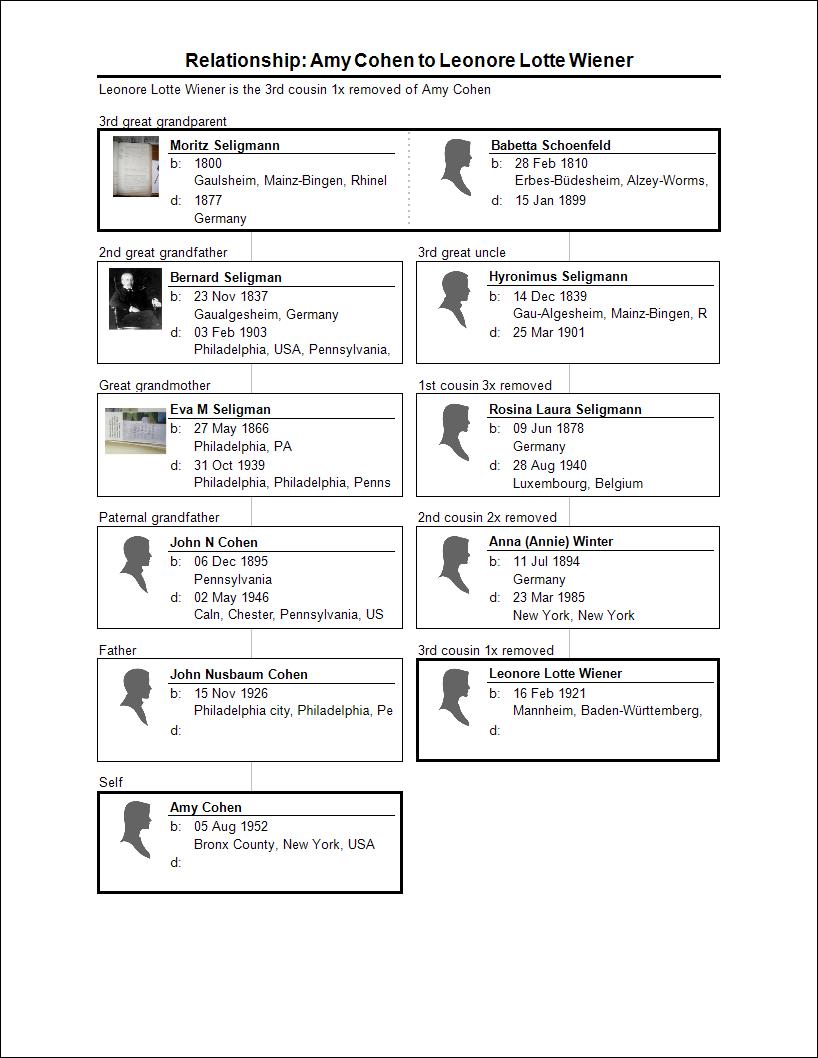
Based on the photographs and the other information and documentation, I think it is quite evident that both Johanna and Bettina were the daughters of Hieronymous Seligmann, the younger brother of Bernard Seligman, my three-times great-grandfather.

There were two other names I was not certain about when I wrote about the list of heirs to the estate of English James Seligmann: Anna Wolf and Bettina Ochs.  I think I now have answers for those as well, with the help of Wolfgang and the photographs from Suzanne.

The list of heirs to English James Seligman’s estate had listed Anna Wolf right below Johanna Bielefeld and Bettina Arnfeld and referred to Johanna as her aunt.  It also indicated that Anna had died in December 1935 in Mulheim-Ruhr, the town where Bettina had lived.

heirs list p 1

On the Hieronymous family tree from the Westminster Bank, depicted above, one of his daughters, Mathilde Wolf, is listed as having a daughter Anna, who died in 1935. This certainly seems to indicate that the Anna Wolf on the list of heirs was the daughter of Mathilde, sister to both Johanna and Bettina.  That assumption is further supported by this photograph of what appears to be a stock certificate with the name Mathilde Wolf geb. (born) Seligmann written upon it.  I don’t know what happened to Mathilde or her husband or why she herself is not listed as an heir instead of her daughter Anna.

Mathilde Wolf geb Seligmann

There are several photographs of unidentified couples from the Michel album.  Perhaps one of these is Mathilde Seligmann Wolf and her husband; perhaps one is a photograph of Bettina Seligmann Arnfeld and her husband.  I don’t know.  I will post some of these in a subsequent post and ask for help from all of you.

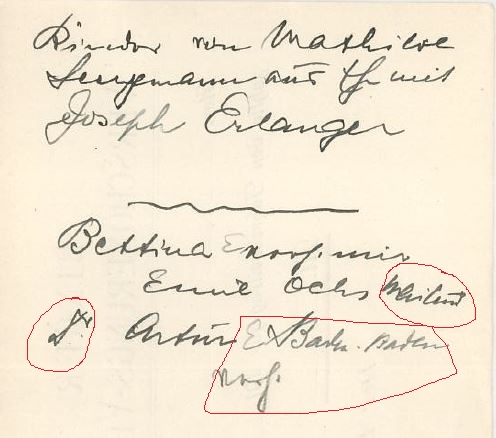
As for Bettina Ochs, I had been quite perplexed by her name on the list of James Seligman’s heirs.  As I wrote, she is listed as Frau Bettina Ochs from Milan, Italy.  Ochs thus appeared to be her married name, so I had thought her birth name must have been Seligmann or Oppenheimer, but the list names her brother as Arthur Erlanger, suggesting that Bettina’s birth name was Erlanger.  So who was she, and how was she related to the Seligmanns?

Heirs List p 2

I was stumped.

Until I saw this photograph:

Emil Ochs and wife, daughter of Mathilde Erlanger geb Seligmann

Emil Ochs and wife, daughter of Mathilde Erlanger geb Seligmann

It says “Emil Ochs and wife, daughter of Mathilde Erlanger nee Seligmann.” So Bettina Ochs was the daughter of a Mathilde Seligmann, who had married someone named Erlanger.  But which Mathilde Seligmann?

Thanks to Wolfgang, I now have an answer.  Wolfgang found a page on Geni.com, another genealogy website, for Mathilde Erlanger nee Seligmann, which identified her as the daughter of Moritz and Babetta Seligmann. I looked back at my notes for the children of Moritz and Babetta, and sure enough there was a daughter named Mathilde for whom I had had no information beyond her birth date of January 31, 1845, which came from the records I’d obtained from Gau-Algesheim.  Now from the Geni page, the list of heirs, and the photograph, I know her married name and the names of her children, Bettina and Arthur, and I know Bettina’s husband’s name, Emil.  Unfortunately, however, I do not know what happened to Mathilde, her husband, Arthur or Bettina and Emil.  I don’t know why Bettina was listed as living in Milan or why she had an English lawyer, according to the list of heirs.  I don’t know why her brother was only listed as a secondary heir.

The only other record I have for Bettina so far is from the JewishGen database labeled “Switzerland, Jewish Arrivals 1938-1945,” which includes a listing for “Bettina Ochs-Erlanger (Bettina Oberdorfer).”  That listing says her nationality was Italian and that she arrived in Switzerland on August 5, 1944.  Where did she go from there?  Why is she also listed as Oberdorfer? What happened to Emil?  I don’t know.

So as always, some questions have been answered, leading to more to be answered.  Next post I will look at some of the other photographs from the album of Fred Michel.

What Did They Know, and When Did They Know It?

As I’ve learned about the numerous members of my Seligmann family who were killed during the Holocaust, one of the questions that has bothered me was whether or not their American relatives were aware of what was going on in Germany.  This, of course, is part of the larger question of what Americans, Jewish or not, knew about Hitler and his plans to murder the world’s entire Jewish population. Certainly people were aware of the anti-Semitic laws and practices, of Kristallnacht, of some violence against Jews, but to what extent were they aware of the seriousness, the severity of the situation, of the plans for genocide?  We all know stories of immigrants who were denied entry, including full ships turned away from American ports.  Historians have written about the failure of the Roosevelt Administration to respond to pleas for help from those who were very much aware of what was happening in Germany and elsewhere in Europe.

But what did my own family know? Did my Seligman relatives here in the US know what was happening to their cousins in Germany?  In 1935 when the Nuremberg Laws were enacted in Germany, depriving Jews of their citizenship and imposing many other restrictions on their lives and livelihoods, both my great-grandmother Eva Seligman Cohen and her younger brother James Seligman, my great-great-uncle, were still alive (their youngest brother Arthur had died in 1933).  Did they even know they had cousins living in Germany? Were they in touch with them? Did they know what was going on there?

To some extent those questions now have some answers, thanks to a series of letters from and to Fred Michel sent to me by his children.  Fred Michel’s grandfather August Seligmann was the younger brother of Bernard Seligman, the father of Eva and James and my great-great-grandfather. Fred was thus the first cousin once removed of my great-grandmother and her brother.  I wrote previously that in Fred Michel’s citizenship application he had identified James Seligman of Santa Fe as his sponsor for immigrating to the United States in 1937.  Fred’s children have some letters written by James Seligman regarding the immigration of his German cousin that shed some light on my questions.

The earliest letter in this particular collection is one from James Seligman to George G. Harburger of Metropolitan Life Insurance in New York City, dated December 22, 1936.  In this letter, James was writing in response to a letter from Mr. Harburger regarding a letter that had been sent from Frankfort, Germany, to Bernard and August Seligman, which an Ernest Rubel had delivered to Harburger.  Ernest Rubel was the person whom Fred Michel later listed on his naturalization application as the person to whom he had been coming when he arrived in the US.

James requested that the letter be sent to him, as he was the son of Bernard Seligman. There follows a German translation of the same letter.  I wonder whether James knew German or whether he had someone else do this translation for him.

Courtesy of the Family of Fred and Ilse Michel

Courtesy of the Family of Fred and Ilse Michel

courtesy of the family of Fred and Ilse Michel

courtesy of the family of Fred and Ilse Michel

The next letter in the file is from James Seligman to Fred Michel.  (Note that James addresses the letter to Fritz, which was Fred’s real name before he changed it after immigrating.)  The letter is dated January 25, 1937, and in it James first described the American Seligmans—his father Bernard, his two uncles, Sigmund and Adolf, and his brother Arthur, all of whom had passed away by 1937, and then mentioned that only he and his sister were still living.  His sister, of course, was my great-grandmother Eva.

Courtesy of the Family of Fred and Ilse Michel

Courtesy of the Family of Fred and Ilse Michel

James then addressed the purpose of Fred’s letter to him: his desire to immigrate to the United States.  James warned Fred about the unemployment situation in the US, although recognized that Fred had a friend in the US who could help him.  Fred must have inquired about a possible job in Santa Fe with James, to which James replied, “As regards a job in this city, this would be out of the question as I only have a very small business myself with only one employee and which is all it will stand.”  By 1930, James Seligman was no longer affiliated with Seligman Brothers and had formed his own business, the Old Santa Fe Trading Post, which must have been the business to which he was referring in his letter to Fred Michel.  Fred might very well have been taken aback by this flat-out refusal to help him find a job in Santa Fe.  But James agreed to help Fred by sending an affidavit in support of his immigration and closed by wishing him the best and expressing hopes to meet him some day.

On February 11, 1937, George Harburger wrote to James Seligman to persuade him to help.  It appears from the letter that Ernest Rubel, Fred’s personal friend, had contacted Harburger to ask him to contact James for help.   I am not sure of the various connections there, but George described Fred as someone who had supported his mother all his life and as an intelligent and self-made man who would “never be a burden” to James and then instructed him how to submit an affidavit in support of Fred’s immigration.

James Seligman to Fred Michel first letter and supporting docs-page-005

Courtesy of the Michel Family

James Seligman to Fred Michel first letter and supporting docs-page-004

James then wrote to Fred again on May 10, 1937, advising Fred that the American Consulate had received James’ affidavit and that all was in order, but that they had not yet received an application from Fred himself.  James advised him to do so “as soon as possible.”

James Seligman to Fred Michel first letter and supporting docs-page-008

Courtesy of the Michel Family

Then there was a letter in German which I could not translate, but which the kind people in the Germany Genealogy group on Facebook helped me with:

James Seligman to Fred Michel first letter and supporting docs-page-009

Here is the translation of this letter from Fred Michel to the US Consulate on May 1, 1937:

Subject: Pledge from Mr James Seligman,321 Hilside Ave., Santa Fe,

for Fritz Michel, Leerbachstreet 112/o at Moritz (means in the apartment of Moritz), Frankfurt/Main

To the consulate general of the USA

Dear Mr Consul General!

Attached I’m sending you the missing papers for your examination.

Obtaining the papers I had to learn that my landlord didn’t register me for 3 month (from March until May 1933). Please find the reason for that in the authentication attached. Also you can find in attached transcript of my certificate where I was working during that time. If you wish I can bring the original paper with me. The County Department of Bingen /Rh. ( at the Rhine), where I complained about my certificate of good conduct four times, just sent me the information that the required paper was given to post it to Stuttgart on May 3 to your address.

I own a proper passport.

If I won’t hear from you, I’ll assume that my papers are in order.

Yours respectfully 

Attachments:

4 passport pictures, 2 birth certificates

4 certificates of good conduct

1 transcript of certificate

Reading this letter after I’d had it translated made me angry; it so clearly reflects how difficult some in Germany were making it for Fred to be able to leave, but also how difficult the US was making it for him to arrive.

From other documents we know that Fred Michel was finally allowed to immigrate and arrived in the US on September 24, 1937.  On October 10, 1937, his cousin James wrote to him again, welcoming him to the United States.  Fred must have enclosed a photograph in his letter to James telling him of his arrival because James referred to it as indicating the Fred must have encountered bad weather while crossing the ocean to America.  Fred also must have told James that he had landed a job and was living with friends.

I found the next paragraph of this letter very telling.  James warned Fred that it might take some time to adjust to his new country and then said, “How anyone can live in Germany under that man Hitler I cannot understand but suppose they cannot get away from it all.”  What did he know about Hitler as of September 1937? Were his feelings shared by Americans in general? And isn’t it also revealing that James, the son of a man who had left Germany behind about 80 years earlier, could not imagine why others were not also leaving Germany as his father and Fred Michel had done?  Would James have found it so easy to leave his homeland if the shoes were on the other feet?

James then thanked Fred for a gift he had sent him—a writing set—but says Fred should have saved his money until he “could afford it better.”  Was this insulting to Fred as patronizing? Or did he see it as an older cousin’s concern? James closed by saying, “Let me hear from you from time to time and let me know how you are getting along and what kind of work you are doing as I will always want to know.”  Although I read this as genuine interest and concern, it is not at all clear to me that Fred and James maintained much or any future contact.  Fred’s children seemed to believe that they did not.

courtesy of the Michel family

courtesy of the Michel family

In any case, James died on December 15, 1940, just three years after Fred’s arrival in the US.  Among Fred’s papers was an obituary for his cousin James that he must have saved for many years.  I had not seen this obituary before, and I do not know in what paper it was published or the date and page.  I will not transcribe its content here, but will add it to the post I wrote quite a while back about James Seligman.

james seligman obit edit

James Seligman obit p 2 edit

The next letter in this file was written many years later.  On October 9, 1975, Fred wrote the following letter to Mrs. Randolph Seligman of Albuquerque, New Mexico, thinking she might perhaps be a relative, and identifying his own background and his connection to James Seligman of Santa Fe.

Courtesy of Michel Family

Courtesy of Michel Family

Of greatest interest to me in this letter is this short reference to my great-grandmother: “Once I met Eva Seligman in Philly.”  My great-grandmother died in October 1939, just two years after Fred arrived.  My father was living with her at the time that she likely met Fred Michel.  He doesn’t remember him, though he said the name was familiar, but probably from reading it on the blog.  From what I have learned about my great-grandmother, she was a warm and welcoming person who had several times taken in relatives in need.  I wish I knew more about her meeting with her German-born cousin Fred Michel.

Mrs. Randolph Seligman responded shortly thereafter that although she was not a relative of the Santa Fe Seligmans, the Santa Fe phone directory listed a William Seligman and a Jake Seligman living in Santa Fe. [These were the sons of Adolph Seligman, about whom I wrote here.]  She said they had once met William, known as Willie, years before in his clothing store in Sante Fe.  In November 1975, she wrote again, commenting that it was strange that the two New Mexico families did not know each other, but attributed that to the fact that “they married non-Jews and became affiliated with the Episcopal Church.”  Near the end of her letters she spoke of plans to visit with Willie Seligman in Santa Fe and identified him as a relative of Arthur and James Seligman.  Fred responded to her on January 5, 1976, expressing his delight that she had written to him again and filling her in on his family.

But within what is otherwise a newsy and cheery letter are two sad passages.  After referring to some relatives he remembered from Germany, Fred wrote, “As I write these notes I am amazed how much I know about my family when one considered I left “home” when I was 18, never to return. Finally, in 1972 while in Europe I contacted some survivors. It was an emotional experience we never forget. Some I haven’t seen since Hitler came to power.”[1]  For me, this is a powerful statement in its own understated way.  Here was a man who had left everything behind yet even he is surprised by how much he still remembered of his family and his past.

The other disturbing passage in this letter is in the following paragraph where Fred wrote about the travel plans he and Ilse had made in 1974, including to Santa Fe, where Fred had relatives, and to Georgia, where Ilse had relatives.  Fred wrote that they had discarded those plans “as Ilse reasoned that in spite of her writing after arriving here, she never received an answer and the same goes for my relatives in S.F. [Santa Fe].”  How sad that so many years later Fred and Ilse both still felt hurt by the fact that their American relatives had not stayed in touch with them.

I don’t know how to reconcile that with the welcoming letters that Fred received from James, but obviously there were some hard feelings there, whether justified or not.  I just find it very sad that two people who had lost so much felt so abandoned by their American relatives.

So what did those American Seligman relatives know by 1937 when Fred was trying to escape from Germany?  They knew that they had German relatives, they knew that things were bad for Jews with Hitler in power, and they knew that there were at least some family members who wanted to leave Germany and come to the United States.  Did they do enough? Of course, in retrospect nothing anyone did was enough, given the outcome of the Holocaust.  And it is hard to know sitting here today what more any one individual could or should have done.  Certainly James did what he was asked to do and helped Fred immigrate.  Could he have given him a job? Could he or any of the Seligmans have reached out to these newly arrived cousins in a more committed way? I don’t know, and I can’t judge.  But I do judge our government which closed its eyes and its ears for political and other reasons while thousands and eventually millions were killed.


[1] I don’t know why Fred wrote that he was 18 when he left home.  The US records all give his birth year as 1906, and he came to the US in 1937 when he was 31, not 18.  Perhaps he is referring to leaving home in a more specific way, not leaving Germany.

Two Who Got Away

Way back on November 22, 2014, I wrote very briefly about a cousin named Fred Michel.   He was mentioned in Ludwig Hellriegel’s book about the Jews of Gau-Algesheim as the son of Frances (Franziska) Seligmann and Max (Adolf?) Michel. Frances was the daughter of August Seligmann.  Since August Seligmann was my great-great-grandfather Bernard Seligman’s brother, his grandson Fred Michel would be my second cousin, twice removed.  According to Hellriegel’s book, Fred had escaped to the United States in 1937 after his mother died in 1933.  That was all I knew, and the name Fred Michel was common enough in the US that I had no way of narrowing it down to the right person based on the name alone.

Well, one email from my cousin Wolfgang opened up an entirely new door of research for me.  In his email, Wolfgang mentioned Fred Michel, the nephew of his grandfather Julius.  In that email, Wolfgang said that Fred had settled in Scranton, Pennsylvania.  From that one additional bit of information, I was able to find Fred and his wife Ilse on the 1940 census in Scranton living as boarders in the household of other German immigrants.  I also found them in several Scranton directories.

Year: 1940; Census Place: Scranton, Lackawanna, Pennsylvania; Roll: T627_3685; Page: 7A; Enumeration District: 71-106

Year: 1940; Census Place: Scranton, Lackawanna, Pennsylvania; Roll: T627_3685; Page: 7A; Enumeration District: 71-106

I also found Fred’s enlistment record in the US army in July 1943 on the Ancestry index.   That led me to his Veteran’s Burial Card, showing that he had served from July 1943 until September 1945 and that he had died on August 5, 1992, and was buried at Temple Hesed cemetery in Scranton.

Pennsylvania Historical and Museum Commission; Harrisburg, Pennsylvania; Pennsylvania Veterans Burial Cards, 1929-1990; Archive Collection Number: Series 2-4; Folder Number: 655

Pennsylvania Historical and Museum Commission; Harrisburg, Pennsylvania; Pennsylvania Veterans Burial Cards, 1929-1990; Archive Collection Number: Series 2-4; Folder Number: 655

Since I also had learned that his wife’s name was Ilse, I researched what I could about Ilse.  She was also born in Germany, and at least according to the 1940 census, she’d been living in Frankfort, Germany in 1935.  I found various public records indicating that Ilse and Fred were still living in Scranton as of 1989, and I also found Ilse on the Social Security Death Index, indicating that she had died on July 22, 2002.

But I wanted to know more, and so I googled their names, Fred and Ilse Michel, with Scranton, and I found a gold mine.  Fred and Ilse donated their papers to the Leo Baeck Institute, and the papers have been digitized and are available online.   This is the description provided for the Michel papers, known as the Ilse and Fritz Michel Family Collection, AR 25502, at the Leo Baeck Institute:

“This collection contains personal and official documents pertaining to the family’s immigration to the United States and their situation in Germany as the political climate deteriorated. Included are a large amount of personal letters, supplemented by various other documents from government and military offices, some genealogical and tracing certificates, as well as other various material.”

In addition, the Leo Baeck Institute provided this biographical note for Ilse and Fred Michel:

Fritz (Fred) Michel (1902-1992) was born in Bingen am Rhein, Germany, the son of Adolf Michel and Franziska Michel, née Seligmann. Fred Michel’s wife, Ilse Hess (1911-2003), was born in Leipzig, daughter of Hermann Hess and Helene Hess, née Hirschfeld (1866-1943). Hermann Hess died in 1922 in Frankfurt am Main. After having been denied immigration to the U.S., Ilse’s mother Helene was deported to Theresienstadt in 1942, where she died in 1943.

Fritz (Fred) Michel emigrated from Frankfurt am Main to the U.S. via Antwerp, Belgium, in 1937. In the U.S. he changed his name to Fred. Ilse emigrated a year after that, via Hamburg, in 1938. Upon immigration Fred and Ilse remained separated for about two years, working in various areas in the state of New York, before they eventually settled in Scranton, Pennsylvania, in 1939, where they were married in 1940. There, Ilse started up a millinery business, while Fred maintained a position as bartender. They became naturalized citizens in 1943. The same year Fritz joined the U.S. army and served until 1945. They remained in Scranton for the rest of their lives.

There is truly a treasure trove in the collection—letters, documents, passports, photographs.  Many of the letters are in German, and I am hoping to find some way to translate them.  I also want to obtain permission to post some of the documents included in the collection if I can.

For now I can highlight some of the facts I was able to learn from the documents that are in English. Before coming to the United States in 1937, Fred had worked for Bamberger and Hertz, a men’s clothing store with several locations in Germany; Fred had worked for them in Cologne, Frankfort, and Munich between 1931 and 1936. On the website for the Jewish Museum in Berlin,  I found an article and photograph about Bamberger and Hertz and the effect Nazism had on the business.  The photograph depicts Nazi storm troopers posting leaflets on the store windows, warning people not to patronize this Jewish-owned business.


The article reports:

After the April Boycott sales declined at all the stores. The Saarbrücken branch closed in 1934 and a buyer was found for the Frankfurt store in 1935. The branches in Cologne, Stuttgart and Leipzig were forcibly sold or dissolved in 1938. In October of the same year Siegfried Bamberger managed to sell the Munich business to his trusted long-time employee Johann Hirmer. Although the transaction aroused the Nazis’ suspicions, it was carried out within the bounds of the law.

It is thus not surprising that Fred Michel would have left his home and his long-time employer in 1937.

According to Fred’s application for naturalization as a US citizen, he arrived in the United States on September 24, 1937, aboard the SS Koenigstein, departing from Antwerp, Belgium, and traveling tourist class. He had been examined by US immigration officials in Stuttgart before departing.

Of great interest to me was that Fred listed his sponsor as James Seligman of 324 Hillside Drive in Santa Fe, New MexicoJames Seligman.  This must have been my great-grandmother Eva Seligman’s younger brother James.  How did Fred Michel know him? To me, this makes it evident that my great-grandmother’s family was very much in touch with their relatives still in Germany when Hitler came to power.  What were they thinking about Hitler and the Nazis? How did James get involved with helping Fred?  Perhaps one of those letters in German will reveal more.[1]

James Seligman in Swarthmore register 1920

After arriving in the United States, Fred first lived in New York City and worked at a business called Burrus and Burrus for a year.  He then worked at the Hebrew National Orphan House in Yonkers, New York.  After that, he worked for a furniture company in Canonsburg, Pennsylvania, for a year, and then finally settled in Scranton in June, 1939. He worked in a couple of dress shops and then as a bartender at various clubs up to the time of his citizenship application in 1942.

Washington Avenue, Scranton, Pennsylvania, Uni...

Washington Avenue, Scranton, Pennsylvania, United States. (Photo credit: Wikipedia)

Fred and Ilse were married by a rabbi on January 16, 1940, in Scranton.  As of September, 1942, when they applied for citizenship, Fred and Ilse did not have any children.  After studying at night school, Fred became a naturalized citizen in June, 1943, shortly before he enlisted in the Army, as described above.  According to Fred’s honorable discharge papers from the Army in 1945, he served in Panama during World War II and received a Good Conduct medal, an American Theater Medal, and a World War II Victory medal.  He was responsible for handling secret documents, correspondence, and publications during the war.

World War II Victory Medal.

World War II Victory Medal. (Photo credit: Wikipedia)

Ilse became a naturalized citizen in December, 1943.  She had arrived in New York in April, 1938, after being examined by US immigration in Stuttgart.  She had lived in Woodmere, Long Island, New York, and Mt. Vernon, New York, and New York City before settling in Scranton in December, 1939.  She had worked as a bank teller and for various millinery houses during that time.  Like Fred, she had attended night school to become a US citizen.

After the war, Fred and Ilse attempted to learn what had happened to their family members back home.  Since most of these documents are in German and need to be translated, I will report on their heart-breaking efforts once I can be sure I am reading the documents correctly.

I don’t know from the collection much about Fred and Ilse’s life after the war.  I did find a Letter to the Editor of Life Magazine in the July 20, 1962, issue; it reveals some of the obstacles Fred had to overcome as a young boy and also some of his own nostalgia for his native country, even after all the horrors of the Holocaust:

Wolfgang has a number of letters written by Fred to Walter Seligmann, Wolfgang’s uncle, and he is going to translate those for me.  Wolfgang also sent me a copy of a letter that Fred received from the National Westminster Bank in England in December, 1982, regarding the estate of the other James Seligman, brother of Bernard and August and the other children of Moritz Seligmann and Babetta Schoenfeld.  Like Pete’s family and Wolfgang’s family, Fred received notification of his rights to inherit some of James estate.

Bank to Fred 1

Bank to Fred 2 Bank to Fred 3

I don’t know whether or not Fred ever obtained his share of the estate.  He died ten years after receiving this letter. From Fred’s death certificate, I learned that he had been a quality control officer for a clothing manufacturer.  He and Ilse were members of Temple Hesed in Scranton, and both are buried in its cemetery.

I  have written to the Leo Baeck Institute and am hoping they can help me as well as give me permission to post some of the documents included in the collection.  From what I have read, I only know the surface of what is obviously a much deeper story, a story of two people who escaped and survived, tearing themselves away from their homeland and their family just in time.  What was it like for them to leave? What did they know of what was happening in Germany once they left? How did they adjust to living in the United States? How were they received?

There are so many questions, and I am hoping that the materials I cannot yet read in the collection will answer some of them.


[1] This is also the same James Seligman whose son was Morton Tinslar Seligman, the Navy Commander whose career I described extensively here, here, and here.

The Lost Oppenheimers

My Seligman-Schoenfeld family tree continues to grow, and it continues to break my heart.  Thanks to my cousin Wolfgang, I now know more about another line in the family.  I already knew that my great-great-grandfather Bernard Seligman, who left Germany in the late 1850s and settled in Santa Fe, had a younger sister Paulina.  She was born in Gau-Algesheim in 1847, the daughter of Babetta Schoenfeld and Moritz Seligman.  I had received her birth records several months ago:

paulina seligmann birth record better

I had no record for Paulina aside from this one until I connected with Wolfgang.  It seems that Wolfgang’s family, like my cousin Pete’s family, had been contacted back in the 1980s by the National Westminster Bank in England, the bank handling the estate of James Seligman and looking for his heirs in order to distribute his estate after his wife died.  Just as they had provided Pete’s family with a family tree showing how they were related to James, the bank also provided Wolfgang’s family with a similar tree.  (I still don’t know why my father and his sister were not contacted, but that’s water under the bridge.)  James was, of course, a brother of Paulina and of Wolfgang’s great-grandfather August  just as he was a brother of Bernard.

You can see a PDF of Paulina’s section of the family tree provided to Wolfgang’s family by clicking here:

Pauline Seligmann Oppenheimer family tree

As you can see, it identifies the husband and descendants of Paulina Seligmann (here called Pauline).[1]  Paulina had married Maier Oppenheimer, and they had had five children:  Joseph (November 22, 1874), Martha (March 1, 1876), Anna (March 14, 1877), Ella (June 24, 1878), and Moritz James (June 10, 1879).  Her husband Maier died on June 8, 1900; he was 51 years old.  Although it is hard to read clearly, it looks like their daughter Anna died when she was only 31 years old in 1908.  She had married Max Kaufman, but did not have any children.  Paulina died April 10, 1926 when she was 79 years old.

Fortunately, Paulina did not live to see what happened to her children.  Although the other four children survived into the Nazi era, only one of the four was alive after the war had ended.  Ella, who never married, died in an “unknown concentration camp,” according to the bank’s tree.  Joseph died on October 21, 1940; one record on Ancestry.com shows that a Joseph Oppenheimer with the same birth and death dates shown on the bank’s family tree died as a prisoner at the Dachau concentration camp.  Joseph was married to Marie Johanna, but they had not had any children, according to the bank’s tree.  Martha, who did survive the war and died in 1967 when she was 91 years old according to the tree, lost two children in the Holocaust: Trude and Paul.  The bank’s tree did not include a name of a husband.

English: View of prisoners' barracks soon afte...

English: View of prisoners’ barracks soon after the liberation of the Dachau concentration camp Deutsch: Blick auf die Gefangenen Baracken kurz nach der Befreifung des KZs-Dachau. (Photo credit: Wikipedia)

Wolfgang was able to provide me with a little more information about the youngest child, Moritz James Oppenheimer, as gleaned from these two sources: a 1952 article from Der Spiegel and a website for a German company that supplies horse dressage and other equipment.   (Although both articles are in German, Wolfgang translated them for me.)  Moritz had owned a paper factory in Frankfort before the war as well as a successful horse stud farm where thoroughbred horses were raised and sold. I found this website about the stud farm as it exists today.  Obviously, Moritz Oppenheimer was quite well-to-do. In fact, Wolfgang’s grandfather Julius had written to his cousin Moritz for financial help after he lost his store in Gau-Algesheim.

The horse farm once owned by MJ Oppenheimer as it looks today

The horse farm once owned by MJ Oppenheimer as it looks today

After the Nazis came to power, Moritz had his marriage dissolved in 1936 because his wife, Emma Katherine Neuhoff, was not Jewish.  Wolfgang explained that this was often done under Nazi rule to those in interfaith marriages.  Then Moritz had his factory seized by the Nazis under the Nuremberg Laws, forcing him into bankruptcy.  As a result, he had to sell his horse farm in order to raise money.  The horse farm was sold to Baron Dr. Heinrich von Thyssen-Bornemisza, who was able to purchase the land, many valuable stallions and mares, and much more for just a few hundred thousand Deutsche marks.[2]  On May 9, 1941, the Gestapo visited Moritz in his apartment in Wiesbaden; shortly thereafter he was found dead in the apartment.  It was ruled a suicide.

Moritz had two children who survived him: a son Jur Georg Emil Walter Oppenheimer (born July 10, 1904) and Paula Herta Oppenheimer (April 11, 1902). The son married Elsa Lina, and they had one child, Angelika Emma Sybille, born in 1946.  Paula married someone named Spiegler and was still alive at the time that the bank prepared the family tree in the 1980s.

A stolpersteine was placed in front of Moritz’s residence in Frankfort at Schumannstrasse 15, depicted below.

By Karsten Ratzke (Own work) [CC0], via Wikimedia Commons

By Karsten Ratzke (Own work) [CC0], via Wikimedia Commons

Moritz, Ella, Joseph, Anna, and Martha: These were my great-grandmother Eva Seligman Cohen’s first cousins.  I wonder if she knew of them and her other German cousins.   Did her sons know of them? Did they know that Hitler had murdered many of these cousins?  Certainly my father didn’t know of them, nor did I.  Until now.


[1] I have not yet been able to find records to verify most of the facts on this family tree, but am trying to locate sources.


[2] According to one source, a US dollar in 1940 was worth about 2.5 deutsche marks, so 200,000 DM would have been equivalent to $80,000.  That would be worth about $1.3 million dollars today.    http://www.history.ucsb.edu/faculty/marcuse/projects/currency.htm#infcalc     http://www.westegg.com/inflation/   One prize thoroughbred horse today can command much more than that.


Passover 2015: The American Jewish Story

Handmade shmura matzo used at the Passover Sed...

Handmade shmura matzo used at the Passover Seder especially for the mitzvot of eating matzo and afikoman. (Photo credit: Wikipedia)

A year ago I was feeling disconnected from Passover until I heard my grandson tell us the story of Passover in a way that made it feel new and exciting and different all over again.  This year his little brother will experience his first seder, though at only ten months, that experience will likely be short and quite unfocused.  Just a lot of really noisy people sitting around a table eating food that he neither can nor would want to eat.  But it’s a new reminder that every generation and every child experiences Passover as a new experience, allowing all of us who are jaded and detached to be able to relive our own early experiences with this special holiday.

Last year I entered into Passover thinking about my mother’s ancestors, the Brotmans, the Goldschlagers, and the Rosenzweigs.  I focused on their exodus from the oppression and poverty and anti-Semitism of Galicia and Romania and their courage and the desire for freedom that led them to leave all they knew to cross the continent and then the ocean and come to New York City, where they again lived in poverty but with greater hopes for a life of freedom and economic opportunity.  And they attained their goals if not in that first generation, certainly by the third and fourth generations.

Poor Jews taking home free matzohs, New York

Poor Jews taking home free matzohs, New York (Photo credit: Wikipedia)

For the last year now, I have been researching, studying and writing about my father’s paternal relatives.  It has taken just about a full year to cover the Cohens, the Jacobs (with whom I actually need to do more work), the Seligmans, the Schoenfelds, the Nusbaums, and the Dreyfusses.  Soon I will start my father’s maternal relatives—the Schoenthals and Katzensteins and whatever other surnames pop up along the way.  Researching my father’s families has been so different from my mother’s, and I can go so much further back.  I can’t get back much before 1840 with my mother’s family and have absolutely no records before 1885 or so for any of them.  Although I have a number of Romanian records for my Rosenzweig and Goldschlager relatives, I have no records at all from Europe for my great-grandparents Joseph and Bessie Brotman, despite hours and hours of searching and even DNA testing.

In contrast, my father’s ancestors have provided me with a rich opportunity to learn about Jews in Amsterdam, London, and especially the towns of Gau-Algesheim, Erbes-Budesheim, Bingen, and Schopfloch, Germany.  I have been able to find records all the way back to 1800 or so for almost every line.  I’ve had amazing help along the way on both sides of the Atlantic, and I’ve even learned a little German to boot.  My father’s families were pawnbrokers and peddlers and clothing merchants; they were pioneers and politicians and war heroes.


http://www.gettyimages.com/detail/182866324
Harrisburg Market Square with Leo Nusbaum store

Harrisburg Market Square with Leo Nusbaum store

They came to the United States in the 1840s and 1850s, and most of them suffered terrible heartbreaks, economic struggles, and early deaths.  Most of them settled in Philadelphia and other parts of Pennsylvania and New Jersey, but there were those who went to places that I’d never think a Jewish immigrant would go: Iowa, Texas, Illinois, Michigan, California, and, of course, New Mexico.  Many married outside the Jewish community and assimilated into American culture far more so than my mother’s relatives.  Ultimately, the Cohens/Jacobs and Seligmans/Schoenfelds and Nusbaums/Dreyfusses were successful; they found the American dream, and they embraced it.

But there is a very sad underside to this story of American success.  It’s the story of those who did not leave Europe.  For the first time in my life I confronted the reality that the Holocaust did not just happen to other families, to other Jews.  Not that I have not been deeply affected by the Holocaust all my life; ever since I read Anne Frank’s diary as a child, I’ve identified with and cried for all those who were murdered by the Nazis.  But I never knew that I had relatives left behind in Germany who were part of that slaughter.  I am still finding more, and I will write about them soon.  The list of names of my cousins who died in the Holocaust grows longer and longer, and I realize more than ever how grateful I should be to Bernard Seligman, John and Jeanette (Dreyfuss) Nusbaum, and Jacob and Sarah (Jacobs) Cohen for leaving Europe and taking a chance on the new country across the ocean.

memorial plaque gau aldesheim

So this year for Passover I will be thinking about that first major migration of Jews from Europe to America.  I will be feeling thankful for the risks my ancestors took, and I will be feeling the loss of not only all those who were killed in the Holocaust, but the loss of all the children and grandchildren who would have been born but for those deaths.

And overall I will be celebrating family, freedom, and faith—faith that the world can be a better place and that human beings can be their best selves and live good and meaningful lives.  May all of you have a wonderful weekend—be it Passover or Easter or perhaps just another weekend in April for you.   Celebrate all the good things in life in whatever way you can.


Embed from Getty Images

My Cousin Wolfgang and The Lessons of History: Will We Ever Learn Those Lessons?

When I started this blog back in October, 2013, I never anticipated that it would help family members find me.  But that has proven to be an incredible unexpected benefit of publishing this blog.  This is one of those stories.

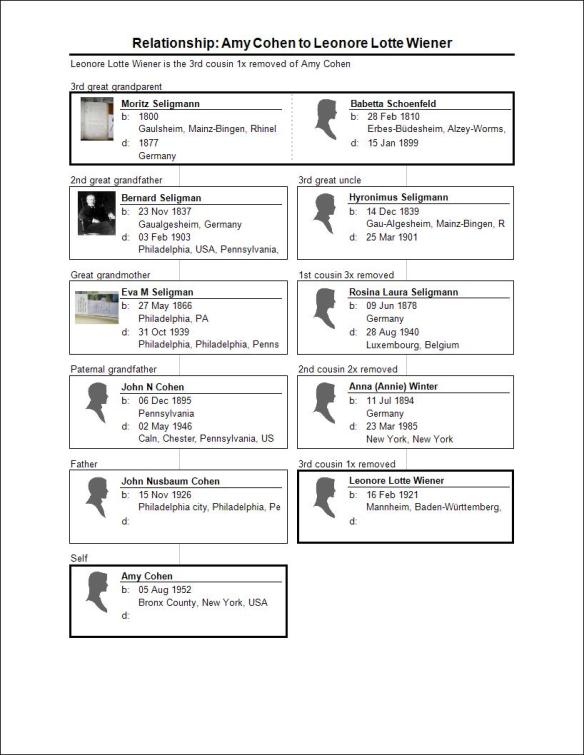
Several weeks ago, I received a comment on the blog from a man named Wolfgang Seligmann, saying he was the son of Walter Seligmann, that he lived near Gau-Algesheim, and that he had found my blog while doing some research on his family.  He asked me to email him, which I did immediately, and we have since exchanged many emails and learned that we are third cousins, once removed:  his great-great-grandparents were Moritz Seligmann and Babetta Schoenfeld, my great-great-great-grandparents.  His great-grandfather August was the brother of Sigmund, Adolph and Bernard Seligman, the three who had settled in Santa Fe in the mid-19th century.   Wolfgang sent me a copy of August’s death certificate.

August Seligmann death certificate

August Seligmann death certificate

(Translations in this post courtesy of Wolfgang Seligmann except where noted: Registry-Office Gau-Algesheim: August Seligmann, living in Gau-Algesheim died the 14th of May 1909 at 8 a.m. in Gau-Algesheim. He was 67 years old and born in Gau-Algesheim. He was a widower.)

Our families had probably not been in touch since Bernard died in 1902 (or perhaps when Adolph died in 1920).  And now through the miracle of the internet and Google, Wolfgang had found my blog with his family’s names in it and had contacted me.  What would our mutual ancestors think of that?  It even seems miraculous to me, and I live in the 21st century.

Fortunately, Wolfgang’s English is excellent (since my knowledge of German is…well, about five words), and so we have been able to exchange some information about our families, and I have learned some answers to questions I had about the Seligmanns who stayed in Germany.  With Wolfgang’s permission, I would like to share some of those stories.

Wolfgang’s grandfather was Julius Seligmann, the second child and oldest son of August Seligmann and his wife Rosa Bergmann.  Julius was born in 1877 in Gau-Algesheim.  As I wrote about here, Julius was one of the Seligmanns written about in Ludwig Hellriegel’s book about the Jews of Gau-Algesheim.  He had been a merchant in the town.  On December 1, 1922, Julius had married a Catholic woman named Magdalena Kleisinger, who was born in Gau-Algesheim on July 9, 1882, and had himself converted to Catholicism.  Julius and Magdalena had two sons, Walter, who was born February 10, 1925, and Herbert, born July 27, 1927.  Julius and his family had left Gau-Algesheim for Bingen in 1939 after closing the store in 1935.

I had wondered why Julius had closed the store and then relocated to Bingen, and I asked Wolfgang what he knew about his grandfather’s life.  According to Wolfgang, his father Walter and uncle Herbert did not like to talk about the past, but Wolfgang knew that when Julius married and converted to Catholicism, his Jewish family was very upset and did not want to associate with him any longer.  In fact, Julius was forced to pay his siblings a substantial amount of money for some reason relating to his store in Gau-Algesheim, and that payment caused him and his family a great deal of financial hardship.  According to Wolfgang, Julius no longer had enough money to pay for his own home, and thus he and his family moved to Bingen in 1939 where they lived with Magdalena’s family or friends for some time.

Julius and Magdalena Seligmann

Julius and Magdalena Seligmann 1960s  Courtesy of Wolfgang Seligmann

The Hellriegel book also made some puzzling (to me) references to the military records of Wolfgang’s father and uncle, saying that they had been “allowed” to enlist in the army, but then were soon after dismissed.  Wolfgang explained that the German authorities did not know how to treat Catholic citizens with Jewish roots.  Wolfgang said that his father Walter had trained to be a pharmacist, but the Nazis would not allow him to work with anything poisonous.  In addition,  his father was not permitted to be in the army; instead  he was ordered by the authorities to work on the Siegfried Line, which was  originally built as a defensive line by the Germans during World War I.  In August 1944, Hitler ordered that it be strengthened and rebuilt, and according to Wikipedia, “20,000 forced labourers and members of the Reichsarbeitsdienst (Reich Labour Service), most of whom were 14–16-year-old boys, attempted to re-equip the line for defence purposes.”  Walter Seligmann was one of those forced laborers.

Map of the Siegfried line.

Map of the Siegfried line. (Photo credit: Wikipedia)

Here is a photograph of Walter Seligmann, Wolfgang’s father:

Walter Seligmann  Photo courtesy of Wolfgang Seligmann

Walter Seligmann Photo courtesy of Wolfgang Seligmann

As for Wolfgang’s uncle Herbert, he was sent by the local police to the army, but the army would not accept him.  He was dismissed and sent back to Bingen, where he was required to work in a warehouse until the war ended.

Herbert Seligmann courtesy of Christoph Seligmann

Herbert Seligmann courtesy of Christoph Seligmann

Julius Seligmann died in 1967, and his wife Magdalena died the following year.  Walter Seligmann died in 1993, and his brother Herbert died in 2001.

Julius Seligmann death notice

Julius Seligmann death notice

Magdalena Seligmann death notice

There are some very bitter ironies in these stories.  Julius and his family were not accepted by his Jewish family because they were Catholic, but the Nazis did not accept them either because they had Jewish roots.  As I commented to Wolfgang, prejudice of any sort is so destructive and unacceptable.  His family experienced it from two different directions.

Not that the two examples here can be equated in any way.  Although all prejudice is wrong, prejudice that leads to genocide is utterly reprehensible, an evil beyond comprehension for anyone who has a moral compass.  I have already written about my own personal horror and pain when I realized that I had family who had been murdered by the Nazis.  Wolfgang told me more about some of those who lost their lives to Hitler and his evil forces.

One victim was his great-uncle Moritz Seligmann (the grandson of Moritz Seligmann, my 3x-great-grandfather, and a son of August Seligmann).  My information about his fate comes from two websites that Wolfgang shared with me. According to these two sites, Moritz Seligmann, Julius’ younger brother, was born on June 25, 1881.  He fought in World War I for Germany, spent two years in captivity, and was honored with the Hindenburg Cross or Cross of Honor for his service.  Despite this, in the aftermath of Kristallnacht, on November 11, 1938, Moritz was arrested in Konigstein, where he had been living since 1925.  He was sent to the concentration camp at Buchenwald.

German Cross of Honour 1914-1918

German Cross of Honour 1914-1918 (Photo credit: Wikipedia)

Moritz wrote to the authorities in Konigstein, pointing out that he was the recipient of the Hindenburg Cross.  He was released from Buchenwald in December on the condition that he emigrate by March 31, 1939.  He was required to report to the police in Konigstein twice a week until then, and if he had not emigrated by the deadline, he was to be arrested.  On March 28, 1939, however, the Gestapo lifted the emigration order and the reporting requirement in light of Moritz’s service during World War I.

Here is a copy of the Gestapo letter, lifting the emigration order.  I found this a particularly chilling document to see.

Gestapo letter re Moritz Seligmann

Wolfgang helped me translate this letter as follows: Frankfort, March 20, 1939. Concerning: the “Aktionsjude” Moritz Seligmann born June 25, 1881, Gau-Algesheim, residing in Konigstein.  Seligmann has provided proof that he was a soldier in the World War as a combatant.  Therefore the reporting obligation and emigration order is lifted for him. I would ask the emigration (?) to supervise and notify us here.

As explained to me by Wolfgang and by Wikipedia,  the “Aktionsjude” referred to 26,000 Jews who were deported in the aftermath of Kristallnacht, as was Moritz Seligmann, as part of an effort to frighten other Jews to leave Germany.  Unfortunately, not enough of them did.

Despite the lifting of the order to emigrate, Moritz had hoped to immigrate to the US.  For various bureaucratic reasons described here, he was unable to get clearance to emigrate.  On June 10, 1942, he was picked up by the Nazis and transported somewhere to the east.  Exactly where and when he died is not known.

Wolfgang and his family, after researching the fate of Moritz, informed the town of Konigstein of their findings, and the town agreed to place a “stolperstein” in memory of Moritz Seligmann near his home in Konigstein.  A stolperstein (literally, a stumbling blog) is a memorial stone embedded in the ground to memorialize a victim of the Holocaust.  Here is a photograph of Wolfgang at the ceremony when Moritz Seligmann’s stolperstein was installed in Konigstein.

Wolfgang Seligmann

Wolfgang Seligmann  Courtesy of Wolfgang Seligmann

Behind him is a man who knew Moritz and remembered when Moritz was initially arrested in 1938, clinging to his Hindenburg Cross, believing it would save him from the murderous forces of the Nazis.  It may have stalled his murder, but it did not save him.

Wolfgang also told me about the fate of another sibling of his grandfather Julius, his younger sister Anna.  Anna, born in Gau-Algesheim in 1889, had married Hugo Goldmann, and they had a daughter Ruth, born in 1924 in Neunkirchen, a town about 80 miles southwest of Gau-Algesheim, where Anna and Hugo had settled. Between 1939 and 1940, many people from this area near the border with France were evacuated to locations in central Germany, and Anna, Hugo, and Ruth ended up in Halle, Germany, 350 miles to the northeast of Neunkirchen.  On June 1, 1942, they were all deported from Halle to the Sobibor concentration camp where they were all killed.  Click on each name to see the memorial pages established by the town of Halle in memory of Anna, Hugo, and Ruth.

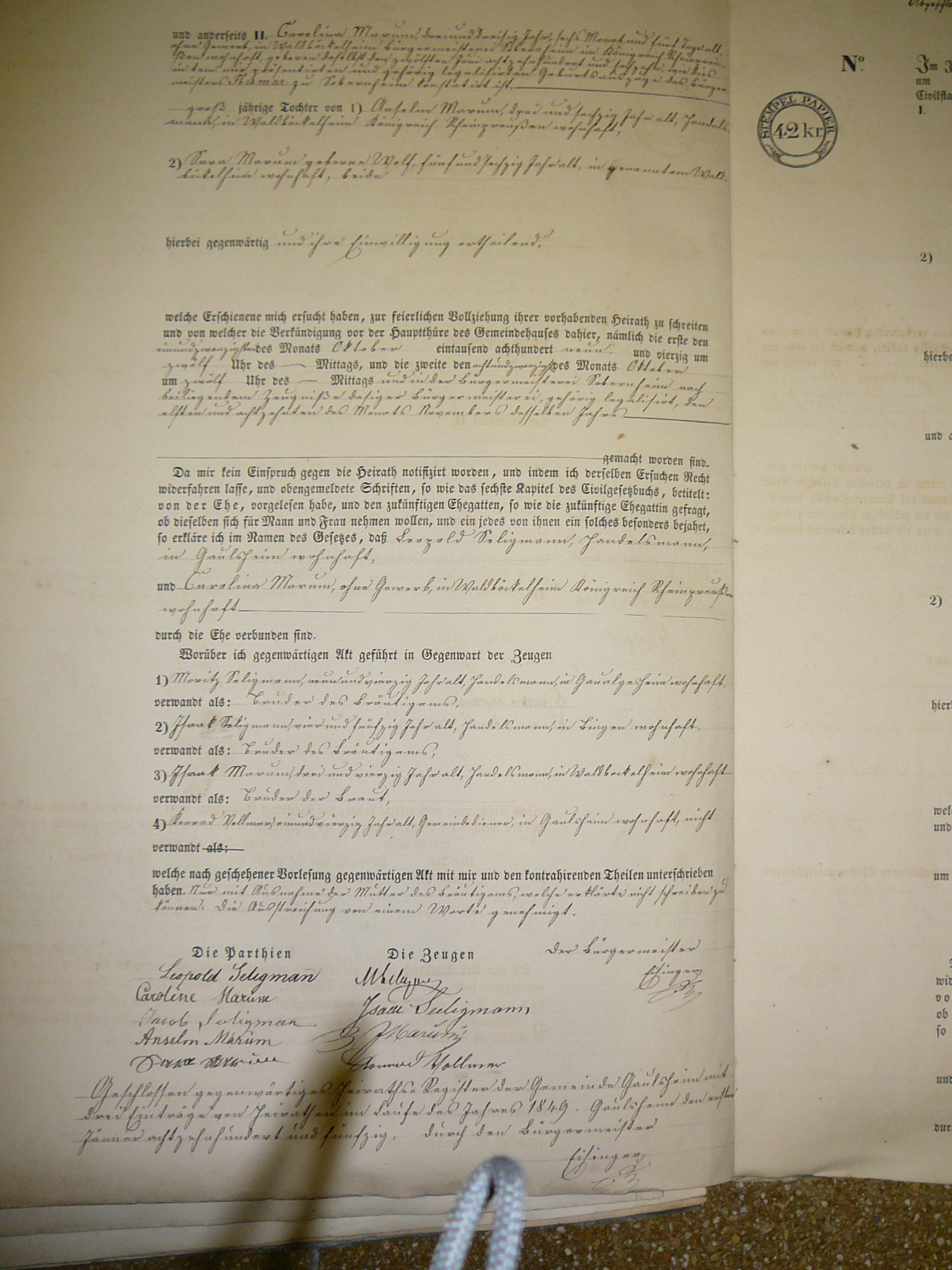
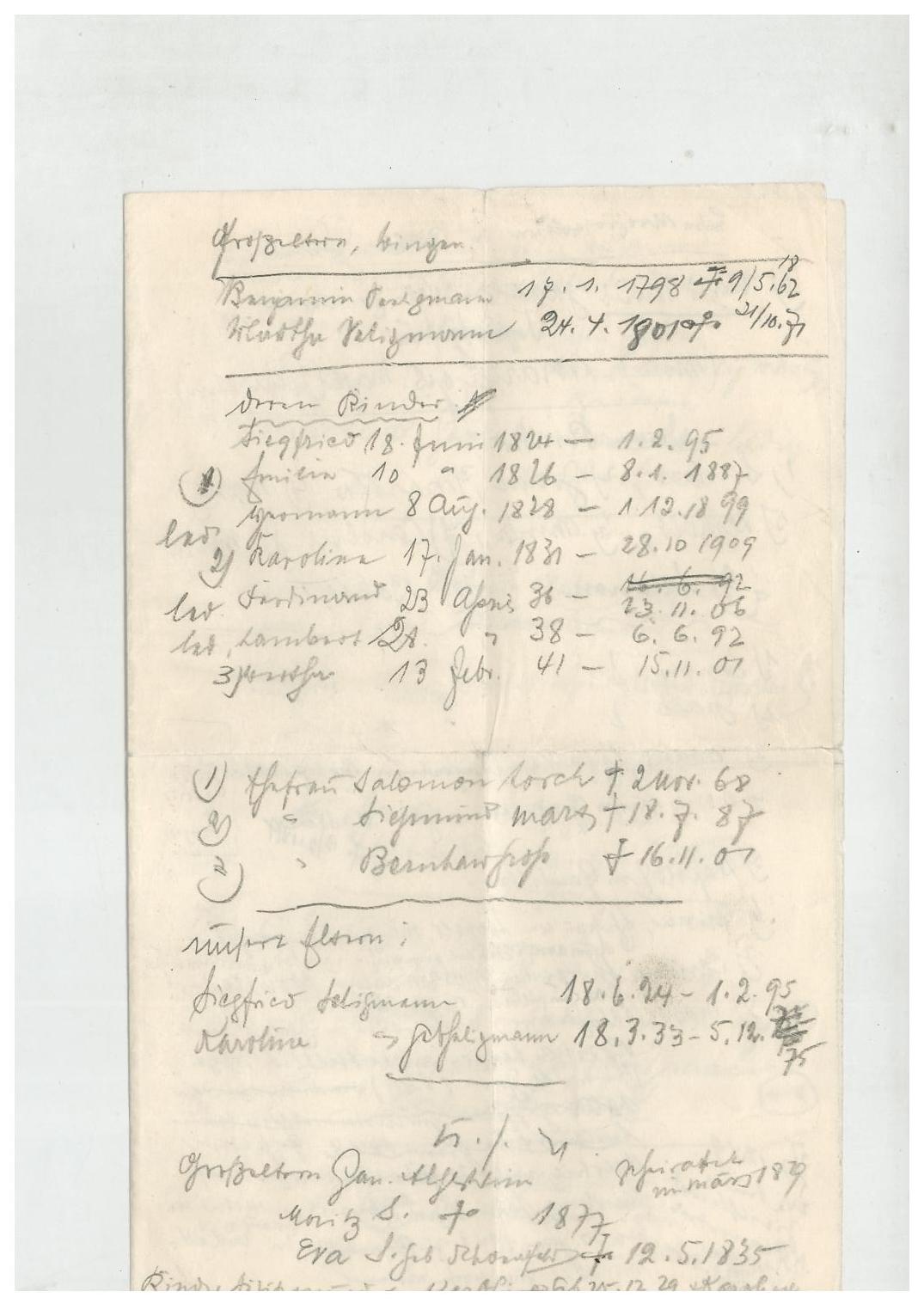
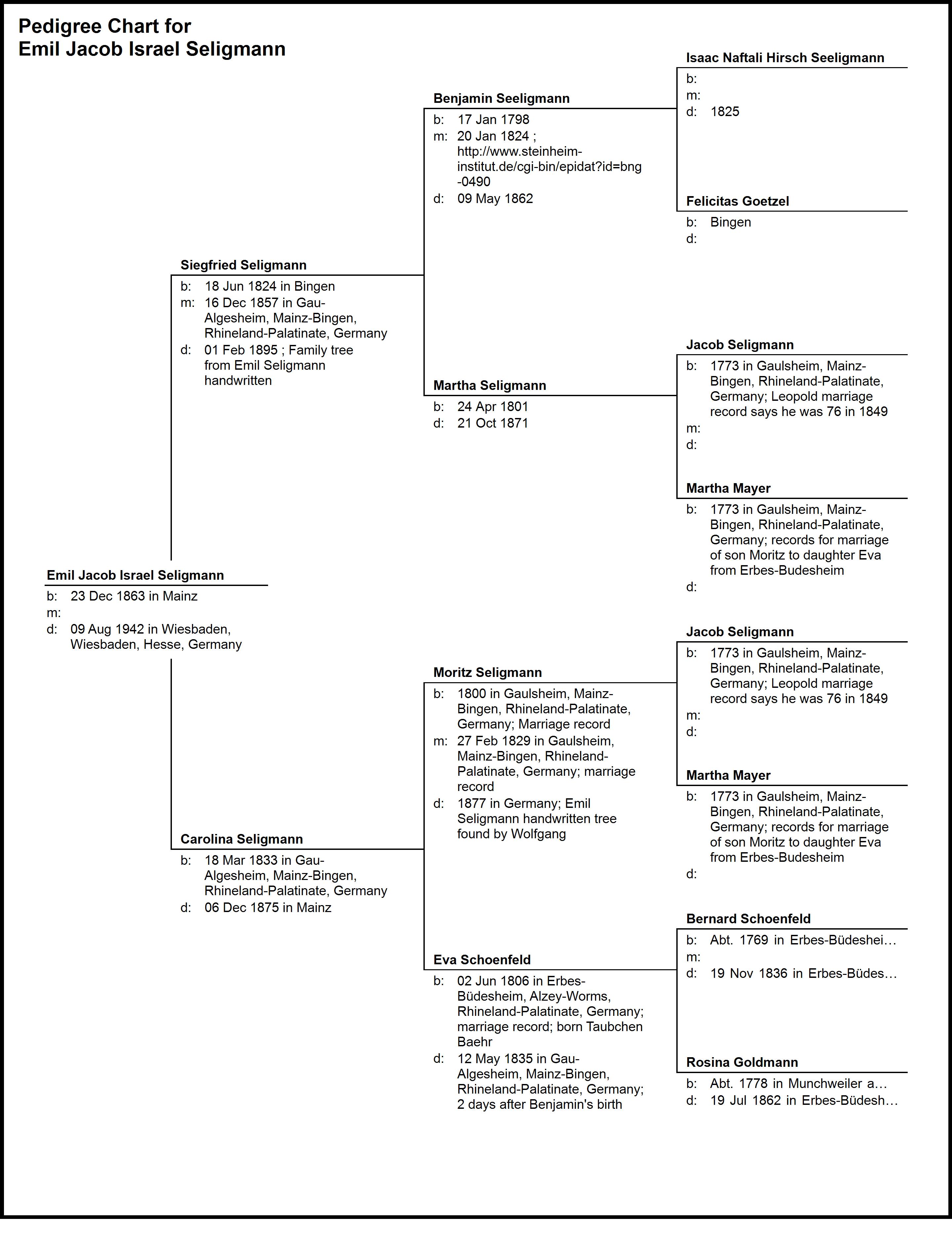
Finally, Wolfgang told me about another member of the family.  Moritz Seligmann (the elder) had had a daughter Caroline with his first wife, Eva Schoenfeld.  Caroline was the half-sister of my great-great-grandfather Bernard. She had married a man named Siegfried Seligmann, perhaps a cousin.  Their son, Emil, died in Wiesbaden on August 9, 1942, when he was 78 years old.
Death record of Emil Seligmann, husband of Carolina Seligmann

Death record of Emil Seligmann, husband of Carolina Seligmann

(Wiesbaden: The Emil Jakob Israel Seligmann, without profession, “israelitisch”  [presumably meaning Jewish], living in Wiesbaden, Gothestraße Nr. 5, died on 9th of August 1942 in his Apartment. He  was born on 23th of December 1863 in Mainz.

Father: Siegfried Seligmann, deceased.  Mother: Karoline Seligmann, nee Seligmann, deceased.  He was widower of Anna Maria Angelika born as Illien. The death was announced by Emil Seligmann, his son, living Goethestraße Nr.5.

The stamp in the left hand margin says:  Wiesbaden, 31th of May 1949.  The “Zwangsvorname”Israel is deleted.  Zwangsvorname translates as “forced first name,” meaning that the name Israel had been required by the Nazis, I assume as a way to identify him as Jewish.

Emil had a son, also named Emil, who died in Buchenwald, as this record attests.

Emil Seligmann-KZ (1)

(To: Miss Christine Seligmann, Wiesbaden, Goethestr. Nr. 5,1

From: Special registry-office in Arolsen-Waldeck, department Buchenwald

Subject: death-certification for Emil-Jakob Seligmann, Your letter from the 1. of March 1950

Based on the documents of the International Tracing Service in Arolsen it is proved, that your brother died on 14th of February 1945 in the Concentration Camp Buchenwald. )

I imagine that this is not the end of the list of the Seligmanns who were murdered during the Holocaust, and I imagine that there are also many other family members I never knew about who were killed by the Nazis, whether they were named Schoenfeld, Nussbaum, Dreyfuss, Goldschlager, Rosenzweig, Cohen, or Brotman or something else.  I just haven’t found them yet.

Wolfgang and I plan to keep on exchanging stories, pictures, documents, and other information.  We have also already talked about meeting someday and walking in the footsteps of our mutual ancestors.  What an honor it will be to be with him as we share our family’s story.

The Schoenfelds and Erbes-Budesheim: Part II

In my last post, I wrote about Erbes-Budesheim, the German town where my Schoenfeld ancestors lived, where my 3x-great-grandmother was born, and where my 4x- and 5x-great-grandparents lived.   From the records I was able to obtain, I know that my 4x-great-grandparents Bernhard Schoenfeld and Rosina Goldmann were married and living in Erbes-Budesheim by 1804 when their first child Benedict Baehr was born.

As explained to me by Gerd Braun, the man in Erbes-Budesheim who sent me the documents,  when the French took over control of the region, one thing that they did in 1808 was order the Jewish residents to adopt surnames akin to those used by the Christian population.  Before that, Jews used patronymics.  Thus, before 1808, Bernhard Schoenfeld was named Baer (ben) Salomon[1] and Rosina was Rosina (bat) Benjamin.  The two children born before 1808 were named Benedict (ben) Baer and Taubchen (bat) Baer.  Taubchen was renamed Eva Schoenfeld after 1808.

Here is the birth record for Benedict.  (All the records before 1816 are in French, and my high school French classes came in handy.)  The translations for all of the documents below are in italics.

Benedict Baer birth record 1804

Benedict Baer birth record 1804

Act of birth of Benedict Baer born the 15th of Frimaire[2] at 10 in the morning, the legitimate son of Baer Salomon, merchant, living in Erbesbudesheim, and of Rosine nee Benjamin of Munchweiler.  The sex of the child has been recognized as masculine.  [Witnesses and signatures]

Benedict died just eight months later.

Benedict Baer death record 1805

Benedict Baer death record 1805

Act of death of Benedict Baer, died the 17th of Messidor[3] at 7 in the evening, eight months old, born in Erbesbudesheim and living in Erbesbudesheim.  Son of Baer Salomon and Roes nee Benjamin.  On the declaration made by Baer Salomon, his father, resident of Erbesbudesheim and a merchant, and Francois Colin, resident of Erbesbudeshem, a barber and a neighbor.

A year later, Taubechen (who became Eva) was born:

Birth record of Taubchen Baer/Eva Schoenfeld 1806

Birth record of Taubchen Baer/Eva Schoenfeld 1806

Act of birth:  In the year 1806 on the 2d of June in the afternoon appeared before the mayor of Erbesbudesheim… Baehr Salomon, a merchant, 34 years old, living in Erbesbudesheim, No. 66, and presented to us a female child of him and his legal wife Rosine nee Benjamin born the 2d of June at 5 in the morning and also stated that he wanted to give the child the name Taubchen.  [Witnesses and signatures.]

The children born after 1808 were given the name Schoenfeld, including my 3-x great-grandmother, Babetta.  You will see that on this record, Bernard and Rosine are referred to with surnames.

Babete Schoenfeld birth record 1806

Babete Schoenfeld birth record 1806

In the year 1810, the 28th of February, at nine in the morning, Bernard Schoenfeld, 37 years old, a merchant, and a resident of Erbesbudesheim,appeared before Andre Cronenberger, Mayor of Erbesbudesheim and presented a female child born the 28th of February in the morning of himself and Rosine nee Goldmann, his wife, and also declared that he wanted to give the child the name of Babet. [Witnesses and signatures]

In addition, I received records for other children of Bernard and Rosina Schoenfeld, ancestors I’d not known about before.  The first two are in French, but the last two are in German because they occurred when the region was back under German control.  The two in French follow the format and content of those above and evidence the births of a daughter Marianne, born June 29, 1812, and a daughter Rebecque, born July 20, 1814.

Birth record of Marianna Schoenfled 1812

Birth record of Marianna Schoenfled 1812

Birth record of Rebecque Schoenfeld 1814

Birth record of Rebecque Schoenfeld 1814

The last two are in German.  Thank you to Matthias Steinke for the translations. The first record is for the birth of another daughter, Zibora, in 1818.


Birtn record of Zibora Schoenfeld 1818

Birtn record of Zibora Schoenfeld 1818

In the year 1818, the 23rd of May came to me, the mayor and official for the civil registration of the comunity of Erbesbuedesheim, county of Alzey, Bernhard Schoenfeld, 45 years old, merchant, residing in Erbesbuedesheim, who reported, that at the 22nd of May at 11 o´clock in the night a child of female sex, which he showed me, was born and whom he intends to give the first name Zibora, and which he declared to have fathered with his wife Rosina Goldmann, 35 old, residing in Erbesbuedesheim.  The child was born in the Hauptstr. nr. 77. This declaration and presentation happened in presence of the witnesses Johannes Knobloch, 55 years old, farmer, in Erbesbuedesheim residing and Jacob Landesberg, 29 years old, farmer, in Erbesbuedesheim  residing, and have the father and the witnesses signed his birth-record and it was read to them. Signatures

The last child of Bernard and Rosine for whom I have a record was their daughter Saara, born in 1820:

Birth Record of Saara Schoenfeld 1820

Birth Record of Saara Schoenfeld 1820

In the year 1820 the fifteenth of October at twelve o´clock midday came to me, mayor and official for the civil registration of the comunity Erbes-Buedesheim Bernhard Schoenfeld, 51 years old, merchant, residing in Erbes-Buedesheim, who reported, that at the fifteenth October at two o´clock in the morning a child of female sex, whom he showed me, was born and whom he intends to give the name Saara, and he also reported, that he fathered the child with Rosina Goldmann, 41 years old, residing in Erbes-Buedesheim, his legal wife. This declaration and showing happened in presence of the witness Johannes Knobloch, 57 years old, farmer, and Jakob Landsberg, 28 years old, merchant, both residing in Erbes-Buedesheim, and have the father and the witnesses with me this present birth-certificate after it was read to them, signed. Signatures

In the midst of all these births, there was also a death.  On February 16, 1813, Salomon Schoenfeld, father of Bernard Schoenfeld, died at age 63 (or is that soixant treize meaning 73?).  His occupation was given as “cultivateur,” or cultivator, which I assume means that he was a farmer.  The witnesses to his death included Benoit Schoenfeld, his son, age 23, a “propietaire”  or owner, but no indication of what he owned.  This must have been a younger brother of Bernard since in 1813 Bernard would have been at least 40 years old.  (His age seems to vary from birth record to birth record.)

Death Record of Salomon Schoenfeld 1813

Death Record of Salomon Schoenfeld 1813


There is also a record for the birth of the child of an Isaac Schoenfeld and a Barbe Goldmann who is probably also a family member, though I am not sure what the exact connection was between these Goldmanns and Schoenfelds and Bernhard and Rosina, my 4x great-grandparents. But the number of marriages between a Schoenfeld man and a Goldmann woman are somewhat revealing.  Here is a third such marriage, this one between Rebeka (Rebecque) Schoenfeld, the daughter of Bernhard and Rosina,  and Salomon Goldmann.  Is it any surprise that Ashkenazi Jews come up with thousands of matches when DNA testing is done?  We are all interrelated at so many different levels.

Marriage Record for Rebecque/Rebkah Schoenfeld and Salomon Goldmann

Marriage Record for Rebecque/Rebkah Schoenfeld and Salomon Goldmann


In the year 1834 on the fifteenth October at ten o´clock pre midday came to me, Andreas Cronenberger mayor and official for the civil registration of the comunity Erbes-Buedesheim, county of Alzey:

Salomon Goldmann, 42 years old, merchant, residing in Kirchheimbolanden, Rhein-county, Bavaria, born in …thal, like it was presented to me by a certificate of the district-court Kirchheimbolanden from the 24th of December 1807, which was certified by the district-court in Mainz, the adult son of 1. Joseph Goldmann, 75 years old, during his lifetime a merchant in Kirchheimbolanden, deceased there the 8th of  November, 1800 (some parts here were cut off) 2. Friederike Goldmann, widow, nee Goldmann, 62 years old, without profession residing in Kirchheimbolanden and here present and giving her confirmation and who declared to be unable to write.

And on the other hand, Rebeka Schoenfeld (Schönfeld), 20 years old, born in Erbebudesheim in 1814, like I have seen in the present birth-register of the year 1814, without profession, in Erbes-Buedsheim residing.

Minor daughter of 1. Bernhard Schoenfeld, 62 years old, merchant and owner of a manor, in Erbes-Buedesheim residing. 2. Rosina Schoenfeld nee Goldmann, 55 years old, without profession, in Erbes-Buedesheim residing, both are present and giving their confirmation.

The appearing people asked me to do the marriage. The proclamation was published at the main-door of the comunity-building the September 24, 1834 at noon and the second the September 26 at noon in Erbes-Buedesheim and in Kirchheimbolanden the 14th of September the first time and the 21st of September of the same year the second time was made.

Due to the case, that no objections against this marriage appeared, and after reading the sixth chapter of the civil-rights-lawbook which is titled „about the marriage“ I asked them whether they want to marry each other. Both confirmed this question and I declared that Salomon Goldmann, widower from Kirchheimbolanden and the maiden Rebeka Schoenfeld of Erbes-Buedesheim are from now on connected by the matrimony.

About this act this certificate was made in presence of the following witnesses:

Georg Peter Erbach, 54 years old, member of the regional council and manor-owner in Erbes-Buedesheim, a neighbour of the bride, not related.  Johannes Klippel, 45 years old, farmer in Erbes-Buedesheim, not related, a neighbour of the bride, Christoph Zopf, 49 years old, farmer in Erbes-Buedesheim, not related, a neighbour of the bride,  Johannes Härter, 82 years old, comunity-servant in Erbes-Buedesheim, not related, a neighbour of the bride. After happened reading have all parts this document with me signed. Signatures

I have a couple of observations about this marriage certificate.  First, the groom was a widower and 24 years older than the bride.  Also, Rebeka was younger than her sister Babete or Babetta, my 3x-great-grandmother, yet married before her, even though this would appear to have been an arranged marriage.  Did Babetta object to marrying Salomon? Or did Salomon choose Rebeka over her older sister?

Also, I was struck by the fact that Bernard was described not just as a merchant, as he had been in the records of his children’s births, but as the owner of a manor.  Perhaps this explains why my Schoenfeld relatives were living in this small village with almost no Jewish residents.  Bernard must have  been quite successful to be a manor owner.

Two years after this wedding, Bernard Schoenfeld died.

Death record of Bernard Schoenfeld 1836

Death record of Bernard Schoenfeld 1836

In the year 1836 November 20th, at eight o´clock pre midday came to me, Andreas Cronenberger, mayor and official for the civil registration of the comunity Erbes-Buedesheim, county of Alzey, 1. the Jakob Landsberg, 46 years old, merchant in Erbes-Buedesheim residing, related as uncle of the below named deceased, and 2. Leopold Schoenfeld, 42 years old, merchant, in Erbes-Buedesheim residing, related as sibling of the below named deceased, and have reported to me that Bernhard Schoenfeld, 67 years old, merchant and manor-owner, born and residing in Erbes-Bueresheim, married to Rosina Schoenfeld, nee Goldmann ,56 years old, without profession, residing in Erbes-Buedesheim. Parents were: Salomon Schoenfeld, during lifetime merchant and manor-owner in  Erbes-Buedesheim, 2. Gertrude Schoenfeld nee Judah, during lifetime also residing in Erbes-Buedesheim.

Died November 1836 at three o´clock past midday in house nr 85 in the Hauptstrasse (Mainstreet) here is deceased and have the here present this certificate after it was read to them with me undersigned.

In this record, Bernard’s father Salomon is described as a merchant and manor owner, not a cultivator.  I am not sure how to reconcile that with the earlier record of Salomon’s death. The above record also reveals two more relatives: Leopold Schoenfeld, another brother of Bernard, and Jakob Landsberg, an uncle.  But Jakob Landsberg was over 20 years younger than Bernard.  Perhaps he was a nephew?  Leopold Schoenfeld’s headstone appeared in the video I posted in the last post.  Here’s a screenshot from that video:

Leopold Schoenfeld headstone

Leopold Schoenfeld headstone

Just a few months after Bernard Schoenfeld died, his daughter Babete, my 3-x great-grandmother, married Moritz Seligmann on February 14, 1837.

Marriage record of Babete Schoenfeld and Moritz Seligmann 1837

Marriage record of Babete Schoenfeld and Moritz Seligmann 1837

In the year 1837 the 14th of the month February, at three o´clock past midday to me, Peter Cronenberger, mayor and official for the civil registration of the comunity Erbes-Buedesheim, county of Alzey came:

Moritz Seligmann, 38 years old, widower of Eva Seligmann, nee Schoenfeld, deceased in Gaulsheim the 12th of May 1835 as it is written in the death-register of the comunity Gaulsheim of the year 1835, merchant, in Gau Algesheim residing, like it is in the birth-records of the community Gau Algesheim to find, adult son of 1. Jacob Seligmann, 63 years old, merchant, in Gaulsheim residing, 2. Martha Seligmann nee Mayer, 63 years old, in Gaulsheim residing, both not present, but giving their permission to this marriage according a notary-certificate of the notary Wieger in Gaulsheim from the 6th of February, 1837,

and on the other hand, Babete Schoenfeld, 26 years old, without profession, in Erbes-Buedesheim residing, born the February 28, 1810, like it is stated in the birth-register of the comunity Erbes-Buedesheim of the year 1810, adult daughter of 1. Bernhard Schoenfeld, during lifetime merchant, in Erbes-Buedesheim residing, deceased 19th of November 1836, as it is stated in the death-register of the comunity Erbes-Buedesheim, 2. Rosina Schoenfeld, nee Goldmann , 56 years old, in Erbes-Buedesheim residing, last named here present and consenting to the marriage. ….

Due to the case, that no objections against this marriage appeared, and after reading the sixth chapter of the civil-rights-lawbook which is titled ‘about the marriage,“ I asked them whether they want to marry each other. Both confirmed this question and I declared that Moritz Seligmann, merchant in Gau Algesheim residing and Babete Schoenfeld, without profession in Erbes-Buedesheim residing, are from now on legally connected by the matrimony.

About this act I made this certificate in the presence of the following witnesses: [Witnesses and signatures]

This marriage record answered a question that I had had about the two sisters both marrying Moritz Seligmann.  According to this record, Eva Schoenfeld had died on May 12, 1835.  Eva died in the aftermath of giving birth to her fourth child, Benjamin, who was born on May 10, 1835.

Her sister Babetta (as it was later spelled) became the instant mother of Eva’s four children, who then ranged in age from Benjamin, not yet two years old, to eight year old Sigmund, who would be the first to come to the US and settle in Santa Fe.  Babetta not only had these four children to care for; she must also have become  pregnant almost immediately after the wedding because my great-great-grandfather Bernard Seligman, obviously named for Babetta’s father Bernard Schoenfeld who had died the year before, was born on November 23, 1837, just nine months and nine days after the marriage.

The last record I received from Erbes-Budesheim was the death record for Rosina Goldmann Schoenfeld, dated July 19, 1862.  She was 84 years old.  She was my 4-x great-grandmother.  All I know about her is where she was born, her father’s name, her husband’s name, and the names of her children and some of her grandchildren.  I know that she lost one child at eight months old, an adult daughter in the aftermath of childbirth, and her husband almost thirty years before she died.  It’s not a lot, but it is remarkable to me that I know even that much about a woman who was born in the 18th century in Germany.

Death record of Rosina Goldmann Schoenfeld 1862

Death record of Rosina Goldmann Schoenfeld 1862

So what have I learned about my Schoenfeld ancestors and their lives in Erbes-Budesheim from all these documents?  First, they must have been one of only a very few Jewish families in Erbes-Budesheim if the total Jewish population was just 23 people.  Second, they must have been fairly comfortable living in that small town, living as merchants and manor owners.   But there was no future for their family in the town.  Bernard Schoenfeld and Rosina Goldmann had only daughters who survived to adulthood.   To find marriage partners for their daughters, Bernard and Rosina had to look outside of Erbes-Budesheim.  Their 20 year old daughter Rebeka Schoenfeld married a 44 year old widower from a town in Bavaria, about ten miles from Erbes-Budesheim.  Their daughter Eva married Moritz Seligmann and moved to Gau-Algesheim.  Then their daughter Babetta,  my 3-x great-grandmother, married Moritz after her sister died.  These young women must have had no choice but to marry and move away from Erbes-Budesheim.  No wonder the town’s Jewish population never grew and eventually declined and disappeared.

But the cemetery still exists, and Erbes-Budesheim is one more town to add to my list of ancestral towns I’d like to visit one day.


[1] Gerd Braun did not use the Hebrew terms “ben” or “bat” for son or daughter of, but simply referred to them as, for example, Baehr Salomon.  I am assuming, however, based on Jewish practice, that the second name would have been the father’s first name.  Thus, Baehr Salomon is really Baehr son of (ben) Salomon.

[2] According to Wikipedia,  Frimaire “was the third month in the French Republican Calendar. The month was named after the French word frimas, which means frost. Frimaire was the third month of the autumn quarter (mois d’automne). It started between November 21 and November 23. It ended between December 20 and December 22. It follows the Brumaire and precedes the Nivôse.”  Benedict was thus born about December 6.

[3] Messidor in the French Republic Calendar was equivalent to June 19 to July 18.  The 17th would be equivalent to July 6.

New Seligmann Discoveries: Erbes-Budesheim and the Schoenfelds, Part I

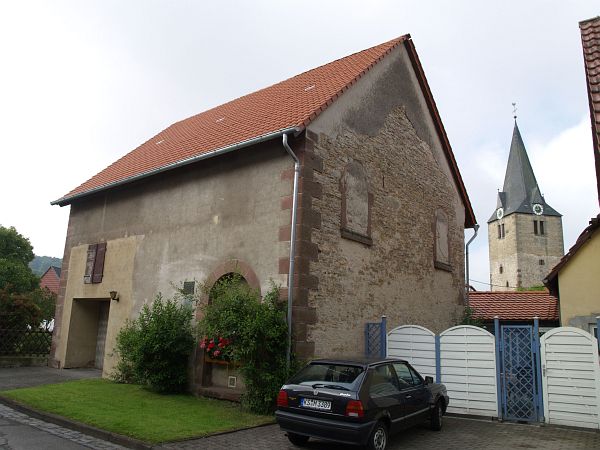
While you all may have thought that for the last several months I was obsessed with Nusbaums and Dreyfusses (and I guess I was), there were several other things happening in my genealogy life (not to mention my actual life) that I haven’t had a chance to blog about yet.  One of the biggest things was the discovery of documents and information about another line of my family, the Schoenfelds, and another ancestral town, Erbes-Budesheim.

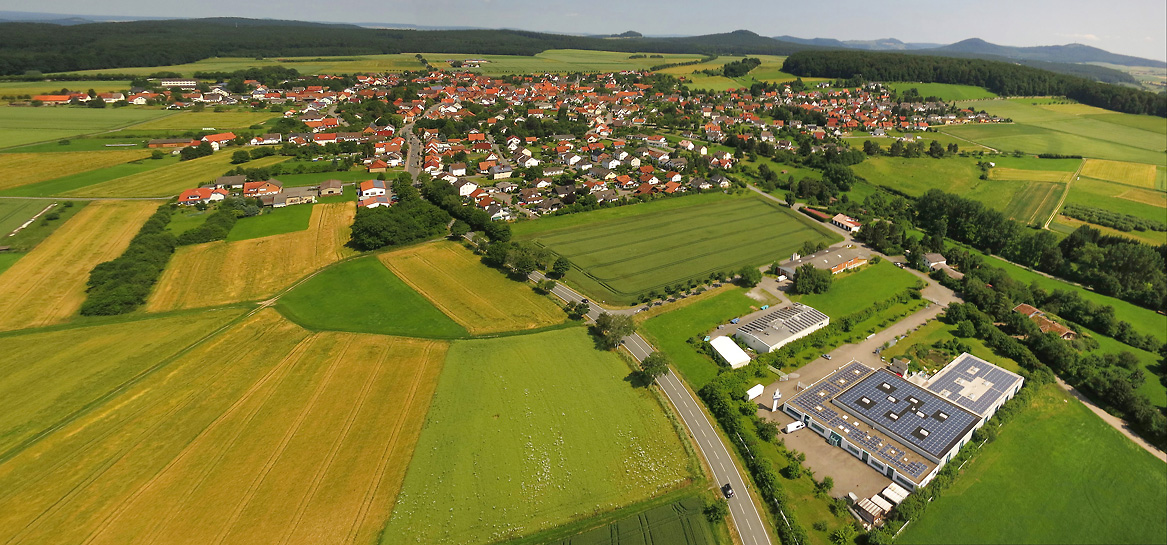
Erbes-Büdesheim in January 2006

Erbes-Büdesheim in January 2006 (Photo credit: Wikipedia)

Who are the Schoenfelds?  Moritz Seligmann, my 3-x great-grandfather from Gau Algesheim, married two Schoenfeld sisters (not at the same time, of course).  First, he married Eva Schoenfeld and had four children with her, and then he married her younger sister, Babetta, my 3-x great-grandmother, the mother of Bernard Seligman, my great-great-grandfather.  Moritz and Babetta had seven children together in addition to the four born to Eva.

Because the birth names of women often disappear, it is all too easy to overlook the family names and lines that end when a woman changes her name to that of her husband.  Although I was always aware of the family names of Goldschlager, Brotman, Cohen, Nusbaum, and Seligman (as well as those from my paternal grandmother’s side, not yet covered on the blog), I had no awareness of a family connection to the names Rosenzweig, Dreyfuss, Jacobs, and Schoenfeld.  Discovering the Schoenfeld name, like discovering those others, was an exciting revelation and addition to my extended family tree.

So how did this happen?  As I wrote back on December 1, Ludwig Hellriegel’s book about the Jews of Gau Algesheim revealed that Moritz Seligmann was born in Gaulsheim and had moved to Gau Algesheim as an adult.  That discovery had led me to the Arbeitskreis Jüdisches Bingen and a woman named Beate Goetz.  Beate sent me the marriage record for Moritz Seligmann and Eva Schoenfeld, which revealed that Eva was the daughter of Bernhard Schoenfeld and Rosina Goldmann from Erbes-Budesheim.  (Now I also know another maternal name—Goldmann.)

Marriage record for Moritz Seligmann and Eva Schoenfeld February 27, 1829 Gaulsheim, Germany

Marriage record for Moritz Seligmann and Eva Schoenfeld February 27, 1829 Gaulsheim, Germany

From there I contacted the registry in Erbes-Budesheim to ask about records for my Schoenfeld ancestors, and within a short period of time, I received several emails from a man named Gerd Braun with an incredible treasure trove of information and records about my Schoenfeld ancestors.

But first, a little about Erbes-Budesheim.  Erbes-Budseheim is a municipality in the Alzey-Worms district of the Rhineland-Palatine state in Germany.  It is located about 25 miles south of Gaulsheim where Moritz Seligmann was born and grew up and about 27 miles south of Gau Algesheim where Moritz and his family eventually settled.  The closest major city is Frankfort, about 46 miles away.

Erbes-Büdesheim in AZ

Erbes-Büdesheim in AZ (Photo credit: Wikipedia)

The town has an ancient history, dating back to the Stone Age, according to Wikipedia.  Like many regions in Germany, it was subject to various wars and conquerors throughout much of its history.  During the Napoleonic era in the late 18th, early 19th century, Erbes-Budesheim and the entire Alzey region were annexed as part of France; after 1815 it was under the control of the Grand Duchy of Hesse.

Although originally a Catholic community, after the Reformation Erbes-Budesheim became a predominantly Protestant community.  Some sources say that there was a small Jewish community in Erbes-Budesheim as early as the 16th century, but as of 1701, there were only 15 Jews (two families) living in the town.  A third family lived there in 1733, but even as late as 1824 and throughout the entire 19th century, the population did not exceed 23 people.  The Jews in Erbes-Budesheim for much of that history joined with Jews from neighboring communities for prayer, education, and burial.

By 1849, however, one Jewish resident named Strauss had dedicated the first floor of his home for prayer services, and it was furnished with the essential elements for a synagogue: Torah scrolls, an ark, a yad, and a shofar, for example.  Perhaps this is where my 4-x great-grandfather Bernhard Schoenfeld went to daven [pray] when he and his family lived in Erbes-Budesheim.

Strauss home where the Erbes-Budesheim Synagogue was located  http://www.alemannia-judaica.de/erbes_buedesheim_synagoge.htm

Strauss home where the Erbes-Budesheim Synagogue was located
http://www.alemannia-judaica.de/erbes_buedesheim_synagoge.htm


There is also a Jewish cemetery in Erbes-Budesheim.

On this video you can some headstones with the name Schoenfeld from the Erbes-Budesheim cemetery.

By 1939, there were only eight Jews left in the town, and it would appear from the allemannia-judaica website that none of these survived the Holocaust.

Thus, Erbes-Budesheim was never a place where a substantial Jewish community existed, and it makes me wonder what would have brought my ancestors there.  Why would anyone want to be one of a handful of Jews in a community?  In my next post, I will consider that question and share the documents I received from Erbes-Budesheim.

More Blessings and More Insight into My Seligmann Ancestors

This morning I woke up to another email that made me smile to start my day. But to understand why, I need to backtrack a bit.

One of the passages that was translated by Ralph Baer from Ludwig Hellriegel’s book on the history of the Jews of Gau-Algesheim indicated that Moritz Seligmann had originally come from Gaulsheim, a town that is only five miles from Gau-Algesheim.  In this passage, Hellriegel described Moritz Seligmann’s attempt to get permission to move to Gau-Algesheim in 1828.  He was denied permission the first time because the mayor concluded that there were already too many Jews in the town.  He then appealed, and although the mayor still wanted to deny him permission, Seligmann prevailed because he was legally entitled to move to the town.

This passage gave me a clue as to where Moritz, my three-times great-grandfather, might have been born, and Ralph suggested I contact the archives in Gaulsheim for more information.  I found an organization called Arbeitskreis Judische Bingen, or a study group of Jews in Bingen. (Bingen now includes the town of Gaulsheim.)  I wrote to the organization, asking for any information that they might have on Moritz Seligmann or his family.

And that brings me to my happy morning email.  A woman from the Arbeitskreis named Beate Goetz sent me a copy of the marriage record for Moritz Seligmann and Eva Schoenfeld.  Not only did this email confirm that Moritz was born in Gaulsheim (on January 10, 1800) and that he married Eva Schoenfeld (on February 27, 1829), it told me the names of my four-times great-grandparents, Jacob Seligmann and Martha nee Jacob/Mayer (my guess is that Mayer was the surname adopted by her father Jacob when surnames were required in the early 19th century).

In addition, I know now when Eva Schoenfeld was born (June 2, 1806) and where she was born (in Erbes-Budenheim), and I know her parents’ names: Bernhard Schoenfeld and Rosina Goldmann.  Assuming that Eva and Babetta, Moritz’s second wife, were sisters, Bernhard and Rosina were also my four-times great-grandparents.  Now I need to see what records I can find in Erbes-Budenheim to determine if in fact Eva and Babetta were sisters.  Beate said that she would also continue to look for a birth record for Moritz (who was born Moises) and any other relevant records.

Marriage record for Moritz Seligmann and Eva Schoenfeld February 27, 1829 Gaulsheim, Germany

Marriage record for Moritz Seligmann and Eva Schoenfeld February 27, 1829 Gaulsheim, Germany

I also know from Ralph’s additional translation of the marriage record that Jacob Seligmann and Bernhard Schoenfeld were both traders as was Moritz.  The record also indicated that the bride’s parents did not attend the wedding; as Ralph explained, this was probably a second ceremony for purposes of civil law and thus not as important as the religious wedding ceremony, which presumably the couple’s parents did attend.

Thus, thanks to Ralph Baer’s translation of a passage in the Hellriegel book, I now have learned the names of four more of my ancestors.

The Hellriegel book just continues to be a treasure chest of information.  Thanks to Matthias Steinke, I also have a translation of another few passages of Ludwig Hellriegel’s book, which shed some additional light on the character of my ancestor Moritz Seligmann.

In one passage, Hellriegel discussed the education of Jewish children in Gau-Algesheim.  He reported that until 1841, Jewish boys were taught Hebrew and other important subjects by their fathers, but in 1841 they were permitted to attend the Christian school in town.  Apparently, this was difficult for the Jewish children, so Moritz Seligmann applied in 1850 to remove his children from the school.  He then hired a private teacher named Benjamin Mayer from Essenheim to come to Gau-Algesheim to teach the children. (Essenheim is about ten miles from Gau-Algesheim.)

Apparently, however, Mayer ran into trouble in Gau-Algesheim for speaking badly about the Catholic Church, saying in front of the children and two other witnesses that those who believe in the Catholic faith are “downright stupid.”  He reportedly left Gau-Algesheim shortly after this incident.

I found this passage interesting in many ways, but mostly for what it told me about my great-great-great-grandfather Moritz.  He was a man who was determined to see that his children received a good education and in a setting where they were comfortable. That is a value that has certainly been passed down the generations in my family.  Moritz also was apparently a man of some means since he had the money to hire a private teacher.

Coat of arms of Gau-Algesheim

Coat of arms of Gau-Algesheim (Photo credit: Wikipedia)

Matthias also helped me better understand a passage about Moritz and his knowledge of German.  According to Matthias’ reading of this paragraph, Moritz had some role in the synagogue as an educated man.  He was in charge of writing the lists of Hebrew prayers to be assigned to those who made contributions to the synagogue.  (This is somewhat unclear to me.  Perhaps these were prayers for certain members to lead or perhaps these were prayers for the benefit of certain members, or maybe the book is referring to payment in order to receive the honor of reading Torah in synagogue.)

A man from Mainz, Mr. Landauer, commented that Moritz was able to write German very well in compiling these lists, but that he had trouble with “unpunctured” Hebrew.  I asked Ralph Baer what he thought unpunctured would mean in this context, and he explained that the German word could also be translated as undotted and that the reference to undotted Hebrew most likely meant that Moritz had a hard time reading Hebrew without vowel markings.  So Moritz was more fluent in writing and reading in German than he was in Hebrew.

1024px-Hebrew_Alphabet.svg

By Assyrio (Own work) [Public domain], via Wikimedia Commons


The final passage that Matthias helped me understand involved Julius Seligmann, the grandson of Moritz and son of August Seligmann, discussed previously.  He was the Seligmann who converted to Catholicism upon marrying a Catholic woman.  What I had not been able to understand before were references to Julius closing his business in 1935 in Gau-Algesheim and being the last Jew in Gau-Algesheim when he and his family left in 1939.  He and his family moved to Bingen, and the book states that there the police chief did nothing against him and that his two sons Herbert and Walter were even allowed to enlist in the army, although dismissed shortly afterwards.

With a better idea of what the words say, I now think that I understand the significance of this passage.  It seems that Julius, despite converting, was still seen as a Jew when the Nazis came to power and thus was forced to close his business.  However, once he relocated to Bingen, he was not harassed by the police, perhaps because they did not know he was Jewish.  And perhaps the significance of the sons being able to enlist also relates to this ability to deny their Jewish roots, at least for a short time.

I am obviously still reading between the lines, and without being able to read the entire book and read everything in context, I fear that I may be misreading some of these isolated passages.  It’s a long term project to be able to understand the whole book and the whole story of the Jews of Gau-Algesheim.  But already this little book has enabled me to learn so much more about my Seligmann ancestors.

By the way, Seligmann means “blessed man” in German.  The more I learn about the Seligman(n)s, both German and American, the more it seems to be an appropriate surname for the family to have adopted, especially for those Seligmans who were fortunate enough to have left Germany before the Holocaust.


A Package from Germany, Part II: Did Moritz Seligmann Have Two Wives?

Gau-Algesheim, Rathaus am Marktplatz

Gau-Algesheim, Rathaus am Marktplatz (Photo credit: Wikipedia) (Town Hall)

As I mentioned in my last post, the package I received from Germany included both a book about Gau-Algesheim and photocopies of the birth records for Bernard Seligman and his siblings.  Unfortunately for me, the birth records were all in German and were half in Germanic font and half in handwritten old German script.  I could pick out names, and most meaningfully, I could see the signature of my great-great-great-grandfather Moritz Seligmann on all the records.  But I could not read any of the text.  Not the typeface print on the form, and certainly not the handwritten script.

Bernard Seligman's birth record

Bernard Seligman’s birth record

JewishGen has a function called ViewMate where you can upload documents and ask JewishGen members for help in translation.  I decided to try that first.  Unfortunately, ViewMate limits the size of the documents you can upload to a relatively small size, and once I reduced the records to the requisite size, they were hardly legible.  Plus ViewMate takes several days; your document has to be submitted to the site, approved, and then it will be posted.  Then you have to send an email to the listserv and ask for help in translating the documents up uploaded.  Then you have to wait for someone to see your email and respond.  And you can only do five documents in a week.  This seemed a bit frustrating for me in this day of instant communications.

So I turned once again to Facebook.  There is a group on Facebook for German Genealogy, and I asked a question about obtaining translations of German records.  Someone there referred me to a different group that exists just for that purpose: German Genealogy Transcriptions.  I joined the group, and I posted the record for Bernhard Seligmann depicted above, asking if anyone could help me translate it and other records like it.

Within two hours, I heard from a group member, Matthias Steinke, who translated that first document and then spent the next couple of hours—no exaggeration—helping me with all the others.  I was just blown away by his generosity as well as his ability to decipher that script from a small scanned photograph of the document.  Matthias, if you are reading this, once again I thank you from the bottom of my heart.

So what does that birth record for Bernhard Seligmann say?  This is the translation Matthias provided, as modified based on some of the later records he reviewed:

In the year thousand eighteen hundred thirtyandseven, the twentythird November at eleven o´clock pre midday came to me, Quirin Ewen, mayor and official for the civil registration of the comunity Gau-Algesheim, county Ober-Ingelheim, Moritz Seligmann, thirtyseven years old, merchant, residing in Gau-Algesheim and declared, that at the twentythird November Eighteen hundred thirtyseven at one o´clock in the morning in the Blosselgasse nr. 98, Babetta nee Schönfeld, twentyseven years old, wife of the named Moritz Seligmann, here residing gave birth to a child of male sex, who was showed to me and who got the first name Bernhard. The declaration and showing happened in presence of the witnesses: 1. Johann Kleissinger, thirty years old, church-clerk in Gau-Algesheim residing 2. Johann Wessel (?), thirtyfive years old, tax-messenger in Gau-Algesheim residing. [signatures]

There were nine records all together, and for the others I only needed the basic data: names, ages, dates, and addresses, since I now knew what the form template was asking based on this first translation.  All the basic dates and names for the children were consistent with the information I had been originally provided by Bernie Brettschneider from Gau-Algesheim, but now I had copies of the actual records to verify that information.

Plus I now had an address for where the family was living during the years from Sigmund’s birth in 1829 until Paulina’s birth in 1847.  Although the house numbers vary, throughout all those years the Seligmann family was living on Flossergasse (apparently rafter alley). (Bernard’s said Blossergasse, but all the others said Flossergasse.)   I was able to locate Flosserstrasse on the map as well as Langgasse where August and Hyronimus later lived.  I assume Flossergasse was either off of Flosserstrasse or the street was renamed at some point.


But the records also revealed a mystery.  For Sigmund (1829), Carolina (1833), and Benjamin (1835), the mother’s name is Eva nee Schonfeld.  But starting with Bernhard in 1837, the mother’s name is given as Babetta or Barbara nee Schonfeld for Bernhard (1837), Hyronimus (1839), August (1841), Adolph (1843), Mathilde (1845), and Paulina (1847).

At first I thought that Eva had changed her name, but Matthias pointed out that the ages did not quite line up.  Not all the birth records included a reference to the age of the mother, but in  March, 1833 Eva was 26, meaning a birth year of 1806/7, depending on the month of her birthday. In May, 1835, she was 28, so that is consistent with the same birth year range.  But on Bernhard’s birth record, Babette nee Schonfeld is 27 in 1837, meaning a birth year of 1809 or 1810.  Two years later on December 14, 1839, she was 30, meaning her birth year was most likely in 1809.  The other birth records are also consistent with a birth year for Babette in 1809.

So unless Eva both changed her name and lied about her age on the later birth records, it would appear that Sigmund, Carolina, and Benjamin had a different mother than their younger siblings and also perhaps that Moritz married Eva’s younger sister sometime between 1835 when Benjamin was born and 1837 when my great-great-grandfather was born.

Thanks again to Matthias Steinke for his incredible generosity and great skills in transcribing and translating from German to English.  Thank you also to Ralph Baer who has also  been a tremendous help. Ralph is the JewishGenner who has been helping me with my Nussbaum/Dreyfuss relatives as well as generally with German records and German translations.  Both Ralph and Matthias are also helping me with the Gau-Algesheim book as I try and confirm and understand the passages about the Seligmanns.

As Thanksgiving approaches, I am filled with gratitude for all the help I have received as I continue on this path to find my family—from the readers who comment and send me helpful suggestions to the people on Facebook who jump in to help, to the people at various libraries and historical societies who respond to my inquiries, and to the people at JewishGen who have helped me solve many mysteries.  As I’ve said several times, the generosity of the genealogy community is an inspiration.  If only the whole world was as giving and helpful as the people I have met in the genealogy world.