Passover 2024: Our Seder

Why was this seder different from all other seders?

There were so many reasons, starting with the fact that it took place at our daughter and son-in-law’s home in Brooklyn. And it was a much smaller crowd than we usually have. It was just the seven of us—our older daughter and her husband and their two children, our younger daughter, my husband, and myself. The other relatives and friends who usually attend were not able to join us this year.

It was a beautiful seder. My daughter took special care to create a festive seder table. My son-in-law made delicious and allergen-safe charoset. We brought in food from our favorite kosher restaurant. We all felt at home and comfortable, and there were lots of laughs and stories and good food and wine and even some tears. We used our usual Haggadahs and the silly stuffed toys to represent the plagues, and, of course, there were wine and grape juice spills on the white tablecloth, afikomen hidden and found, and macaroons and candy fruit slices to end the meal.

Because we were in a new place with a smaller group, we had a chance to have a different experience and a new perspective on the holiday. The fact that I wasn’t hosting meant more opportunities for me to reflect and observe than I usually have when I am worried about getting everything ready and coordinating when to heat and cook all the food. And I think all of us were reminded that the holiday carries its beauty and its meaning wherever you are and with all who are there—be it seven or seventy.

Of course, the events in the Middle East and here in America also put the holiday in a very different context this year, and there were times that the words in the Haggadah resonated in new ways and with greater power. What struck me most powerfully was how the Haggadah is both universal and particularistic in its messages. The central message is certainly specific to Jews in most ways—the story of our liberation from slavery and oppression to freedom. But within that message is also the more universalistic message that all people deserve to be free from slavery and oppression. We are told not to oppress the stranger because we know what it is like to be a stranger. We are told to welcome all who are hungry to our table—not just Jews, but anyone who is hungry.

The part of the seder this year that moved me the most, however, was the story of the ten plagues. We read this section every single year, but I had never actually focused on what it says. It’s not just to remember that God sent ten plagues to convince Pharoah to free the Jewish slaves—blood, frogs, lice, flies, murrain, boils, locusts, darkness, and the slaying of the first born. The Haggadah instructs us to diminish the wine in our cups as we recite each of these plagues so that we diminish our own joy as we remember the pain inflicted upon the Egyptians.

Lawrence Alma-Tadema, CC BY-SA 2.5 <https://creativecommons.org/licenses/by-sa/2.5&gt;, via Wikimedia Commons

In other words, we are supposed to empathize with the Egyptians. I cannot help but see the parallels to what is happening now in Gaza. As Jews we are reminded that even those who oppress us deserve our sympathy when they suffer pain. To be a good Jew, a good person, means to feel not just our own pain but also the pain of others.

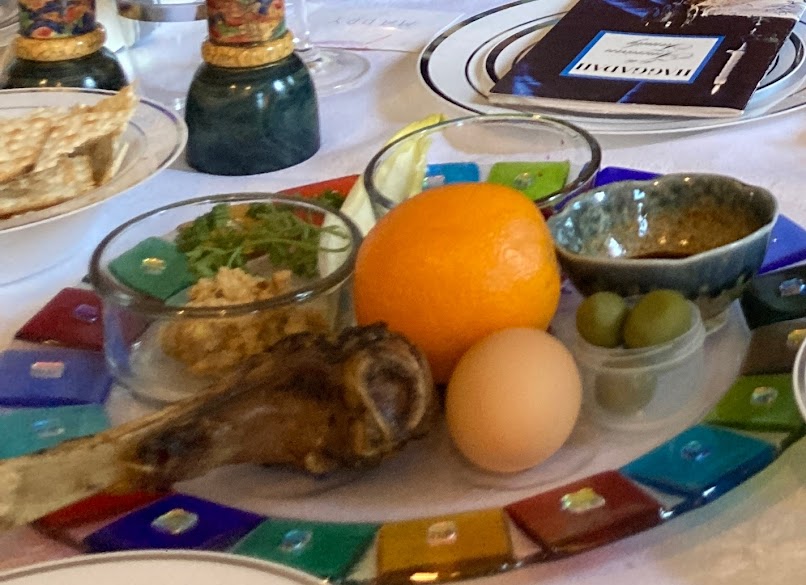
Our seder table this year in Brooklyn also reflected these particularistic and universal lessons of the Haggadah. We had all the traditional symbols—the shankbone, the egg, the charoset, the moror, the parsley for dipping in salt water, the matzah, Elijah’s Cup—the symbols of suffering and of liberation. But we also had some non-traditional symbols.

Two we have incorporated for years now to reflect the central role that women have played and continue to play in Jewish history and life: Miriam’s Cup and an orange. Miriam’s Cup reminds us that women played a role in our liberation from Egypt. And the orange comes from a story about something that was said when the liberal Jewish movements were considering changes that would give women the same rights as men to stand on the bimah and read Torah. Apparently, one opponent of those changes stated, “A woman belongs on the bimah like an orange belongs on the seder plate.” So now we have an orange on our seder plate every year because, yes, women belong on the bimah and in all aspects of Jewish practice.

But this year we added two new symbols to the seder table: olives, at the suggestion of our children’s rabbi in Brooklyn, to express our desire for peace with the Palestinians, and, at the suggestion of my younger grandchild, soy sauce to reflect that there are other cultures in the world in addition to ours.

Our seder might not fit with everyone’s traditions or values, but it most certainly reflected ours. It was beautiful, powerful, moving, and memorable.


Pittsburgh

Where do I start to express how I feel about what happened in Pittsburgh? Do I tell you how my heart didn’t stop racing all day on Saturday from when I first heard the news?  That I am just too sad and scared to be angry? That I feel like an outsider in my own country?

I didn’t know any of the individuals killed or injured in Pittsburgh, but I knew every single one of them. They are my friends and neighbors, my fellow congregants, my family, my ancestors. Yes, I have some actual ties to Pittsburgh—relatives from long ago who lived there including my great-grandfather, friends who grew up there, a brother who once lived there, and so on. But even if I didn’t, I knew these people. Because they were like me, a Jewish person living in America taking for granted all too often that we are safe. That it can never happen here. That people are basically good, that evil will not prevail.

Now I am not so sure. More and more we see the evil prevailing, the anger fanned, the hatred accepted and even condoned. Whether it is directed against someone because of their religion—be it Judaism, Islam, Buddhism, Hinduism, or Christianity—or their skin color or their sexual orientation or their gender or their age or their nationality, the hatred is not only there, it is being acted upon. And it is not being condemned by our federal government in strong enough terms to be credible. In fact, it is encouraged.

I am beginning to lose faith in people. I no longer feel safe, I no longer believe it could never happen here. I have learned from studying my family history and Jewish history in general how much hatred and oppression and discrimination and violence have shaped my own history. Many of my ancestors came to this country in order to escape anti-Semitism and the oppression and lack of opportunity they faced in Europe. When I learned how many of my not-so-distant relatives died in the Holocaust or survived it against all odds or escaped just in time, I felt so grateful for America. America was supposed to be different. But is it really so different now?

Of course, in some ways it is. In Pittsburgh, the police took bullets to protect Jews. The mayor condemned what happened. The government there was not afraid to help the victims or condemn the murderer. On Facebook I am heartened when I see non-Jews standing up and making any kind of statement condemning what happened. We attended a gathering at our synagogue, and I was touched to see representatives there from other faiths and government officials pledging to stand by us. The service ended with the singing of The Star Spangled Banner and Hatikvah. As the rabbi said, we sing The Star Spangled Banner, the American national anthem, because this is our home.  And we sing Hatikvah, the Israeli national anthem which means “the hope,” because we are Jews and to remind us that that we must never abandon hope.

And as I write this, I realize that I am not afraid to publish these thoughts. Because somewhere deep inside I must still trust that I will be safe here. But not as much as I once did.

Tomorrow I will return to telling my family’s story—with even more urgency than before. Because people—not just my people, not just my family—need to know what we as Jews have endured and what we have learned, what we have suffered and what we have contributed. And people need to understand the dreams that brought our ancestors here. We must not let those dreams die.

Looking Back and Looking Forward: A Story for the New Year

For Rosh Hashanah this year, I want to share a story about one of my cousins. His life is a true example of how we as human beings are capable not only of inconceivable evil but more importantly of boundless love and undying hope and gratitude.

When we talk about the Holocaust, the number six million is both overwhelming and numbing. Our minds can’t grasp what six million people looks like—what six million of anything would look like. Visiting the camps makes that number somewhat more comprehensible; when we visited Auschwitz in 2015 and saw the huge piles of eyeglasses, of shoes, of suitcases, each representing one of those six million killed, it made the scope of the horror more visceral. It gave us a concrete, visual way of imagining each of those killed. This video also helps to illustrate the immensity of that number:


But for me, it is the individual stories of those people who were killed that leave the biggest impact. If we read one story about one of the six million who were killed each day for our entire life, we still would hardly make a dent in the total numbers. Assuming we read a story a day for eighty years, we would still have read fewer than 30,000 stories—learned about only 30,000 of the six million who were killed. And that doesn’t even include the horrifying stories of many of the survivors—those who survived the camps, those who spent the years in hiding, those who escaped but who had lost their families and homes forever.

This is the story of a cousin whose life was forever changed because of the Nazis. He wishes to remain anonymous, so I will refer to him simply as J. J is my fifth cousin, another descendant of Jakob Falcke; his family left Oberlistingen, Germany at the end of the 19th century and moved to the Netherlands, where for many generations the men were butchers and cattle traders or worked in the textile and clothing business. J’s father was a butcher.

Their quiet lives were forever altered after the Nazis invaded the Netherlands in May, 1940. J’s father was taken to Mauthausen concentration camp, where he was killed in October, 1941. J, who was just a young boy, and his mother and younger sister were left behind. When it became clear that the Nazis were going to start deporting all the Jews in Holland to concentration camps, J’s mother placed her two children in an orphanage in Utrecht, believing that the Nazis would not deport children because they would be too young to work. J’s mother and her sisters went into hiding with a non-Jewish family.

Description: Jewish Memorial in Mauthausen Concentration Camp, Austria main courtyard. 
Source: https://commons.wikimedia.org/wiki/File:Mauthausen-Jewish_memorial.jpg
Photographer: Gianmaria Visconti
Year: 2002

But then in December, 1942, those living in the orphanage were moved from Utrecht to the ghetto in Amsterdam, and J’s mother realized that her children were in imminent danger. She tried to get her children released from the orphanage, but it was impossible. Instead, a cousin who was working at a hospital in Amsterdam somehow managed to kidnap the children and bring them to a safe place in Amsterdam where J and his sister could then be placed in hiding.

At that point J’s mother relinquished her spot in the home where she and her sisters had been hiding so that her son, my cousin J, would have a safe place to hide. His sister was hidden somewhere else. J’s mother moved to different hiding places, but she was eventually discovered by the Nazis in the fall of 1943. She was deported to Auschwitz where she was murdered in October 1943. As J expressed it to me, she had given everything so that her children would survive.

Deportation of Jews from Amsterdam
By Anonymous (National Archives) [Public domain], via Wikimedia Commons

J and his sister survived the war in their hiding places. After the war, his sister immigrated to Israel, where she still lives. J stayed in the Netherlands and continued to live with the brave couple who had kept first his mother and aunts safe and then kept him safe. He described them as being like grandparents to him. They made it possible for him to go to college, where he trained to become a veterinarian.

Despite the horrible losses he experienced as a young boy, J has led a remarkably productive and happy life. In addition to achieving professional success, he has been married since 1958 and has four children, ten grandchildren, and one great-grandchild.  He is another example of the resilience of human beings who, in the face of the darkest evil and the most heinous cruelty, somehow emerge into the light and are able to give and receive love and find the good and the beautiful in our world.

For me this is an appropriate story for Rosh Hashanah,  It reminds us that although we must always look back and remember, we also have to look forward with hope. We must be cognizant of all that is evil in the world, but we must embrace all that is good and beautiful.

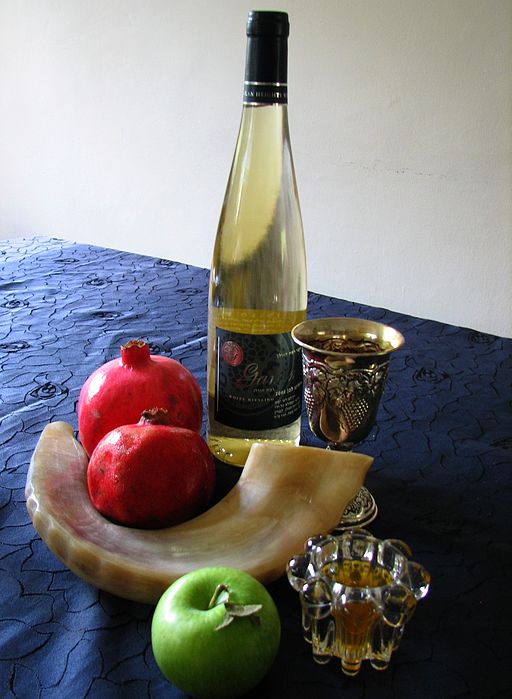
May we all find the light of love and share all that is good and beautiful in the coming year.

L’shanah tova! A good year to you all, family and friends!

By Gilabrand (Own work) [CC BY-SA 3.0 (http://creativecommons.org/licenses/by-sa/3.0)%5D, via Wikimedia Commons

An Amazing Treasure

I hope everyone who celebrates had a wonderful Thanksgiving filled with gratitude.  This post is about a family heirloom.  It doesn’t belong to me, but it is nevertheless something for which I am grateful because it is part of the legacy of my Katzenstein ancestors. I am just about done writing about the Katzenstein line, but before I move on, I want to share this treasure.

I have referred often on the blog to the work of David Baron, who has done an incredible job of researching the Katzenstein family. David is the husband of Roger Cibella, who is the three-times great-grandson of Gerson Katzenstein, my great-great-grandfather. Roger’s great-great-grandfather was Scholem Joseph Katzenstein, who settled in western Pennsylvania and probably was the one who introduced his little sister Hilda, my great-grandmother, to my great-grandfather Isidore Schoenthal. And Roger is my third cousin, once removed.

Roger owns a siddur (a Jewish prayer book) that belonged to our mutual ancestor, Gerson Katzenstein. The inner pages of the front and back cover of the siddur contain inscriptions by Gerson marking the births of each of his six children beginning with the birth of Roger’s great-great-grandfather Scholem (with the middle name Abraham here, not Joseph, which I found interesting) in 1848 through the birth of my great-grandmother Hilda in 1863.

Roger and David kindly shared with me images of the inscriptions as well as an image of some of the text of the siddur.  They also sent me a translation of the inscriptions and information about the siddur provided by the scholar, Arthur Lagawier.[1] The information below came from Lagawier’s report to Roger and David:

The book is entitled Beit Rachel v’ Sha’ar Hallel-Ya [House of Rachel and Gate of Praise], and it was edited by Rabbi Naftali ben Isaac Ha Cohen. Rabbi Naftali was born in Ostroh, Ukraine, in 1649 and died in 1719. He married Esther Sheindl, the daughter of Rabbi Shmuel Shmelke Zak of Ostroh, and he headed the yeshiva that his father-in-law built for him in that town. After Rabbi Shmuel died, Rabbi Naftali succeeded him as rabbi. Rabbi Naftali and his wife had fourteen children, seven sons and seven daughters.

In 1704 he became the rabbi of Frankfurt, but in 1711, a fire broke out in his home and spread, burning down several hundred homes. Four people died in the fire, and Rabbi Naftali was accused of setting the fire and was put in jail. After he was released, he went to Prague and then Breslau. Rabbi Naftali wrote several books, prayers, and hymns as well as the siddur once owned by Gerson Katzenstein. The prayer book was first published in Amsterdam in 1741, but the one Roger owns is probably a later reprint.

The book includes the daily prayers and those for Shabbat and holidays as well as other holiday readings and commentary on the prayers and other readings.  It also contains the entire book of psalms.

I asked for help on the Tracing the Tribe site in translating the handwritten inscriptions because the translations by Arthur Lagawier did not always read clearly. Thank you so much to Baruch Miller for his work in translating them. I have also included some of the content of Lagawier’s translations.  The inscriptions in the inside of the front cover translate as follows:

For the son later known as S.J. Katzenstein:

My son Shalom Avraham, born on Tuesday night (third day of the week), the 24th of the month of Av, the week of the Torah portion Re’eh, in the year 5608, corresponding to the 23rd of August, 1848. May the Eternal grant my son to learn the Torah, to be married, and to do good deeds throughout his life, amen.  Signed: Gershon Ben Abraham Shalom Ha Cohen, Morah [teacher].

For the second son, known as Jacob:

My son Yakov Solomon, also called Yerkev, on the fifth night of the week, the 2(?) of the first month of Adar, the week of the Torah portion Ki Sisa, in the year 5611, or 1851. He should grow to Torah, the chuppah, and good deeds. Gershon  

For Brendina, the third child:

My daughter Branche, Briencha (Bertha), Born in the month of Kislev in [5]612, according to the non-jewish calendar the year 1853.  May the Eternal grant to her to grow up….Signed: Gershon

(Some parts of these inscriptions were not legible, but one can assume they all followed the formula asking that the children grow up to Torah, chuppah (marriage), and good deeds.)

On the inside of the back cover of the book are the inscriptions for the last three children born to Gerson Katzenstein and Eva Goldschmidt:

For the third son and fourth child, Perry:

My son Pesachya, born Tuesday, the 25th of Av, 5616. He should grow to Torah, the chuppah, and good deeds. August 1856 in Philadelphia. Gershon, son of Avraham Shalom, the righteous kohen.

This is the inscription for their fifth child, Hannah.  Reading this inscription is very sad because Hannah died a week before her seventh birthday in December 1866:

My daughter Henit/Hencha, born on Friday, 17 days in the month of Tevet in [5]619.  May God she grow up strong and do good deeds, get married, amen. Born on December 24th, 1859 in Philadelphia, Signed by  Gershon, son of Avraham Shalom the kohen.

And finally, my great-grandmother Hilda, named for her maternal grandmother Hincka Alexander, wife of Seligmann Goldschmidt:

My daughter Chinke.  Born Monday, three days in Elul, the 17 of September [August] 1863.  May God grant that she will grow up… Signed Gershon, son of Avraham Shalom, the righteous kohen, in Philadelphia.


Leah Cohen of the TTT group pointed out that Gerson described himself as “the small”  or ha-Koten in several inscriptions. Leah, Baruch and I could not understand why he referred to himself this way, unless it was a form of modesty.

Someday perhaps I will get to meet Roger and David and hold this treasure in my hands, but for now I am delighted to have the photographs and the knowledge that this siddur is in good hands with Roger and David.


[1] According to this website, “[Arthur] Lagawier was a frequent lecturer in Judaism at the University of Washington. He taught religious school at Herzl congregation, served as Director of Jewish Education at the Jewish Community Center, and independently founded the Institute of Jewish Studies, where he taught non-profit classes from 1965 to 1969.”

First Stop on Our Trip to Germany: Mainz

We spent our first day and a half in Germany in the beautiful and ancient city of Mainz, a city with a population of about 200,000 people and a city that was once an important center for Jewish learning and culture. Our visit there created some cognitive dissonance for me as we experienced such incredible beauty and also memories of such horrific ugliness.

We flew into Frankfurt Airport on May 2 and found the train to Mainz.  Once on the train, we were not entirely sure that we’d gotten on the right train.  Despite a full year of learning German online, I could not make out one word of the train announcements.  Fortunately, a very kind man sitting across from us realized we were confused and reassured us that we were on the right train and that he would tell us when to get off.  From the start, we were favorably impressed with the people in Germany.

Our hotel, the Mainz Hilton, was right on the Rhine; it is a large American-style hotel with large rooms and all the amenities.

The Rhine

We were exhausted after the overnight flight and took a short rest before meeting Wolfgang at 1:30.  And the adrenaline kept us going. I had so anticipated meeting my cousin Wolfgang.  We had been emailing each other for over two years on a regular basis, at first mostly about family history, but as time went on more often exchanging current information—about our families, our lives, politics, German and English, and life in general.  Meeting him in person for the first time, I felt as if I must have already met him and spent time with him. The connection was immediate, and he was just as I imagined based on his emails.  A warm and open person, sensitive and kind, intelligent and perceptive.  And with a delightful sense of humor.

My cousin Wolfgang and me

Wolfgang had planned a walk through the sights closest to our hotel and then a tram tour around the city to see some of the sites that were further out. We strolled along the Rhine for a bit.  The weather was rainy and quite cool, but it did not put a damper on my spirits. We passed a sculpture reflecting the division of Germany after World War II and its reunification in 1990.

We walked past a 15th century watch tower known as the Holzturm (“wooden tower); it was destroyed by bombing in World War II but reconstructed and restored to its original appearance.

Then Wolfgang showed us the house where Johanna Seligmann and Alfred Bielefeld had lived.  Johanna was my first cousin, three times removed.  She was the daughter of Hyronimus Seligmann, brother of my great-great-grandfather Bernard Seligman.  Alfred, her husband, was a wine merchant in Mainz.  Both were killed in the Holocaust.  They were deported to Terezin first, where Alfred died in 1945; Johanna was then sent to Auschwitz, where she was killed in 1945.  Their children, Hans and Lily, survived and lived in the United States.  I wrote about Johanna and her family here and here.

Johanna Bielefeld nee Seligmann

Bielelfed house in Mainz

Just around the corner from where the Bielefelds lived was the so-called “Jew House” where the Nazis moved Jewish families before deporting them.  Although the house itself no longer exists, this is where it was located:

We then visited a beautiful 18th century church, St. Augustine, with an elaborately decorated interior:

St Augustine church in Mainz

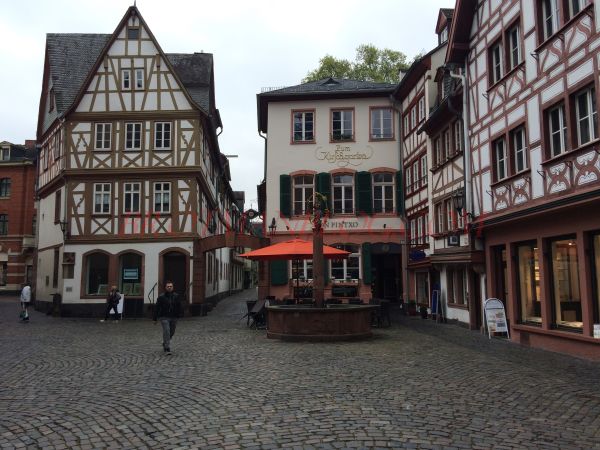
Perhaps my favorite spot in Mainz was the Kirschgarten—a small square framed by several half-timber houses, some now restaurants.  This little square captured exactly what I expected an old German city or town to look like—something out of Hansel and Gretel or some other fairy tale. The oldest house in Mainz is located in the Kirschgarten:

Kirschgarten in Mainz

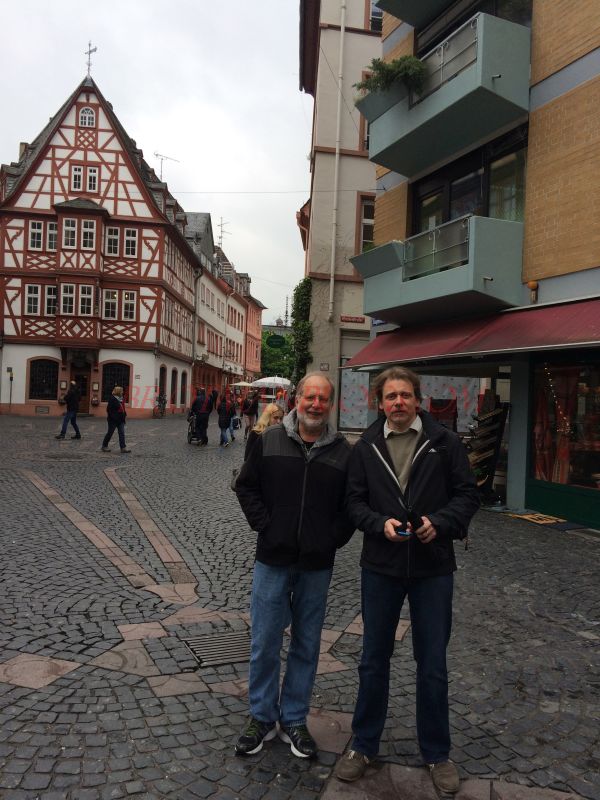
Everywhere we turned there were beautiful half-timber buildings, sometimes right next to a post-war building.

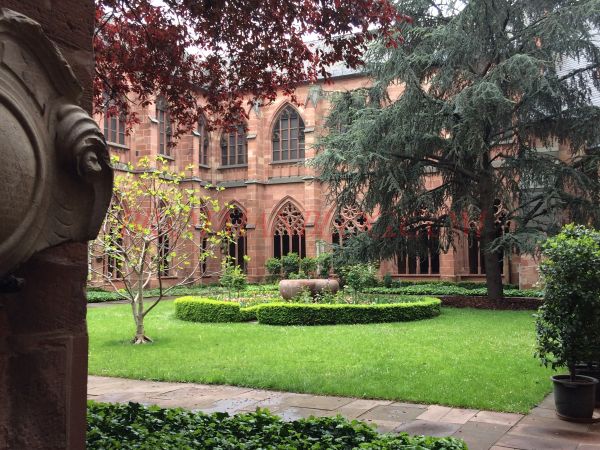
We then visited the Dom, or cathedral, a large Romanesque sandstone structure located on the main market square in Mainz. The cathedral’s oldest sections are a thousand years old with later additions over the years.  It was damaged by bombing in World War II, but restored afterwards.  The cloister is a peaceful place for contemplation, and the high vaulted ceiling in the main part of the cathedral forces you to look upwards.  It is an impressive and inspiring building.

Mainz Marktplatz

Cloister at the cathedral in Mainz

At this point we caught the little tram that took us on a tour around other parts of the city, passing the Rathaus (town hall), the Schloss (a palace more than a castle), the new synagogue, and the building where the Gestapo was housed during World War II. I couldn’t get any photos of these sites as we were moving too fast, but I was glad to be seated and not walking at that point. I asked Wolfgang if we could come back the next day to see the synagogue.

As I wrote here, our first stop on Wednesday was our visit with Wolfgang’s mother Annlis, a time I will never forget.

Then we continued our tour of Mainz.  We passed the location where Fritz/Fred Michel once owned a store.  Fred Michel was the son of Franzeska Seligmann and the grandson of August Seligmann, Wolfgang’s great-grandfather and another brother of my great-great-grandfather Bernard. Fred and his wife Ilse came to the US in the 1930s and settled in Scranton, Pennsylvania.  I wrote about Fred, his mother, and his family here.

Fred Michel and Franziska Seligmann Michel
Courtesy of the Family of Fred and Ilse Michel

Location of Fred Michel’s store in Mainz

We then walked up the steep hill to St. Stephen’s church, where there are a number of windows designed by Marc Chagall.  The contrast between the thousand year old medieval structure and the gorgeous blue Chagall windows is striking. Like so many other buildings in Mainz, this church was damaged by bombing during World War II.  According to Wikipedia, the priest at St. Stephens, Monsignor Klaus Mayer, was a friend of Marc Chagall and approached him in the 1970s to design new windows. This is the only church in Germany for which Chagall designed windows, and he saw it as a way of expressing his hope for peace between Christians and Jews.  To see the work of a Jewish artist and his depictions of figures from the Jewish bible inside a medieval Catholic church was very moving.

St Stephen’s church in Mainz with Chagall windows

We then walked back to the hotel to pick up our luggage and Wolfgang drove us to see the new synagogue.  I knew before coming that Mainz had a long and very important history as a Jewish community. According to several sources, Mainz had a Jewish community at least as early as the tenth century. Rabbi Gershom ben Judah, known as “the light of the diaspora,” was an early important leader of the Mainz Jewish community, and his codification of Jewish law was accepted in many other communities in Europe as well.

The Jews, however, were expelled from the city in the eleventh century; they returned later, but then a thousand were killed during the first Crusade during the twelfth century.  Later, many died from the Black Death and from persecution. For several centuries there was not much of a Jewish community in Mainz. The community began to grow again in the 18th and 19th centuries. Synagogues were constructed, and Jews for some time lived in peace in the community. By 1900, there were 3000 Jews living in Mainz, according to JewishGen.org

On November 9, 1938, the Mainz synagogues were attacked as part of Kristallnacht and burnt and in some cases destroyed; there were over 200 synagogues at that time in Mainz, including the largest synagogue, Neue Synagogue, which was completely destroyed. Most of the Jews who remained in Mainz, including my Bielefeld cousins, were eventually deported and killed.

But today there is hope.  A new synagogue was built on the site of the former Neue Synagogue in 2010, and it is an imposing structure.  As this article describes, it was consider a symbol of hope for the revival of Jewish life in Germany. Outside the synagogue stand pillars from the original synagogue, a permanent reminder of what had existed and what was destroyed. The city now has about a thousand Jews who are affiliated with the synagogue as well as many others who are not.

The website of Manuel Herz, the architect who designed the new synagogue, provides a great deal of information about the history and about the reasons for the choices made in naming and designing this new building.  The synagogue is called Meor Hagolah, which means “Light of the Diaspora,” the name used to refer to Gershom ben Judah because of his wisdom and his broad-reaching influence on the practice of Judaism. The Hebrew words on the door to the synagogue are translated as “Light of the Diaspora Synagogue Mainz.”

Meor Hagodah Synagogue Mainz

The building’s shape is supposed to evoke the Hebrew word Kedushah, meaning holiness and referring to one of the sections of the Amidah prayer. I must admit I could not see the letters no matter where I stood outside the building, but I like the concept. The building overall is quite imposing and, in my opinion, not very welcoming.  It looks more like a fortress than a house of prayer.  Maybe that is in part the point: that this is a safe place that will not be destroyed again.

We stopped at the historic Mainz cemetery on our way out of town.  I have no known family members there, and we could not go inside, but the age and number of the gravestones there are another reminder that there was once a large and important Jewish community there.

Mainz Jewish cemetery

Mainz is truly a beautiful city, and despite all the damage inflicted during the war, it retains its charm, its character, and its architectural beauty. It is hard to imagine, amidst all that beauty and all those churches, how the Jewish community that lived there so long could have been destroyed.  But it is also important to look forward. I left the city feeling hopeful, knowing that a new synagogue and a growing new Jewish community exist in the city of Mainz.


Jacob Katzenstein: Before, During, and After the Flood

My great-great-uncle Jacob Katzenstein was, like his sister Brendena, a man who faced a great deal of tragedy but managed to survive and, in his case, start all over with a new family.  In 1889, he lost first born child, Milton, at age two and a half, and then both his wife, Ella Bohm, and his other young son Edwin in the devastating Johnstown flood.  I’ve written about Jacob and these events in prior posts.

In one of those posts, I also described my search for more information about Ella Bohm and my hypothesis that she was the daughter of Marcus Bohm and Eva Goldsmith; I assumed Eva was her mother as Ella is listed on the 1880 census as the niece of Jacob Goldsmith, Eva’s brother.  Eva Goldsmith was also my distant cousin—her mother was Fradchen Schoenthal, my great-grandfather Isidore’s sister; her father was Simon Goldschmidt, my great-grandmother Eva Goldschmidt’s uncle.  And if I am right that Ella Bohm was Eva Goldsmith’s daughter, then Ella married her cousin when she married Jacob Katzenstein, as he was Eva Goldschmidt’s son.
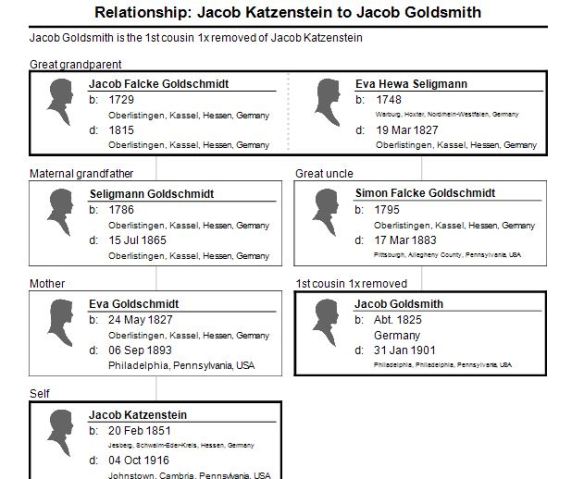
jacob-katzenstein-to-jacob-goldsmith

But I had no definitive proof that Eva Goldsmith was Ella’s mother.  I also had not been able to find out when Jacob Katzenstein married Ella or why their first-born son Milton died.  On my cousin Roger’s old genealogy website, he had included a quote about Jacob from a book called The Horse Died at Windber: A History of Johnstown’s Jews of Pennsylvania by Leonard Winograd (Wyndham Hall Press, 1988).  I decided to track down this book to see if it revealed any more information about Jacob Katzenstein and Ella Bohm and their lives.

I was able to borrow a copy of the book through the Interlibrary Loan system from my former employer, Western New England University, and have now read the book.  Unfortunately it did not answer my two principal questions.  I still don’t know for sure who was Ella Bohm’s mother, and I still don’t know what caused the death of little Milton. I did, however, learn more about Ella’s father Marcus Bohm, about Jacob Katzenstein and his second wife Bertha and their children, and about the Johnstown Jewish community at that time and its history.

According to Winograd, in the second half of the 19th century when many Jewish immigrants started arriving from Europe, many made a living as peddlers, as I’ve written about previously. Pittsburgh was a popular hub where these peddlers would obtain their wares and then travel by foot or horse and wagon or train to the various small towns in western Pennsylvania. Winograd states that by 1882 there were 250 to 300 peddlers operating this way out of Pittsburgh. (Winograd, p. 12)

Eventually these peddlers would find a particular town to settle in and would set up store as a merchant in the town. But Pittsburgh remained the center for Jewish life.  These merchants and peddlers would attend synagogue there, participate in Jewish communal life there, and be buried there. Often they would move on from one town to another or return to Pittsburgh itself. (Winograd, p. 12-13)

Johnstown was a bit too far to be part of this greater Pittsburgh community (65 miles away), and although peddlers and merchants did come through there and even settle temporarily there, it was a more isolated location than the towns that became satellites of Pittsburgh.  Thus, its social, economic, and religious life was independent of the Pittsburgh influence.


Winograd reported that Johnstown had a population growth spurt between 1850 and 1860, jumping from 1,260 to 4,185.  In 1856, there were nine churches in Johnstown, but no synagogue (although there was apparently an attempt to start one in 1854).  The Jewish families in the town had services in their homes; there was not a large enough population to support the establishment of a synagogue at that time. (Winograd, p. 26) In 1864, the Jewish merchants in town formed a merchants’ association regulating store hours. Most of these merchants came from the Hesse region of Germany, as did Jacob Katzenstein. (Winograd, p. 48)

Two of those early merchants in the 1860s were Sol and Emanuel Leopold. (Winograd, p.56)  It was their sister Minnie Leopold and her husband Solomon Reineman with whom Marcus Bohm was living in 1910; Solomon Reineman came to Johnstown in 1875. (Winograd, pp. 77-78) Sol and Emanuel Leopold’s other sister Eliza Leopold Miller was Bertha Miller’s mother—that is, Jacob Katzenstein’s mother-in-law when he married Bertha Miller. As Winograd points out in Appendix C to his book (pp. 281-283), many of the Jewish merchants in town were related either directly or through marriage.

According to Winograd, both Marcus Bohm and Jacob Katzenstein came to Johnstown in the 1880s. Here’s what he wrote about Marcus Bohm:
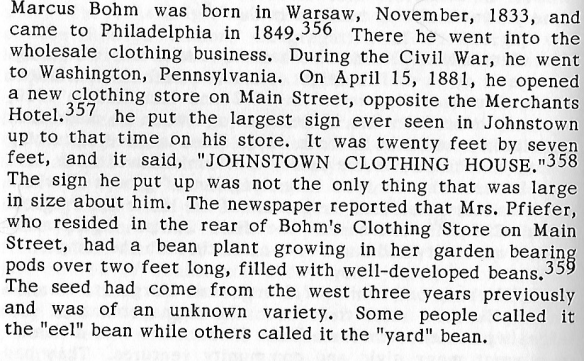
marcus-bohm-in-winograd-book

(Winograd, p. 78)

Winograd wrote that Jacob Katzenstein first came to Johnstown in 1882 as a clerk for another merchant. He married Ella Bohm on March 26, 1883, (Johnstown Daily Tribune, May 16, 1883, p. 4, col. 7).  Winograd even mentioned their wedding.  In discussing what he described as “the first public Jewish wedding” in Johnstown, which took place in 1886, Winograd says, “There had been an earlier Jewish wedding, that of Jacob Katzenstein to Ella Bohm on March 26, 1883, a private ceremony conducted by J.S. Strayer, Esquire.” (Winograd, pp. 93-94)  The implication appears to be that Jacob and Ella might have been the first Jewish couple married in Johnstown. Based on the date, I was able to locate a marriage notice from the May 16, 1883, edition of the Johnstown Daily Tribune (p. 4, col. 7).

According to Winograd, Jacob and Ella lived in rooms over the store of another Johnstown merchant, Sol Hess. Sol Hess was the brother-in-law of Emanuel Leopold, who had married Sol’s sister Hannah. In March 1884, Marcus Bohm moved in with Jacob and Ella and soon thereafter, Marcus lost his own store when an Eastern dealer executed a judgment of $2,625 dollars against him. (Winograd, pp.78-79)

According to Winograd, Jacob moved back to Philadelphia for a few years.  This must have been when Jacob and Ella’s first son Milton was born in 1886, but by June 1887 when Edwin was born, they must have returned to Johnstown. Here is a photograph of Johnstown in 1880s, showing what it must have looked like when Jacob Katzenstein first settled there:

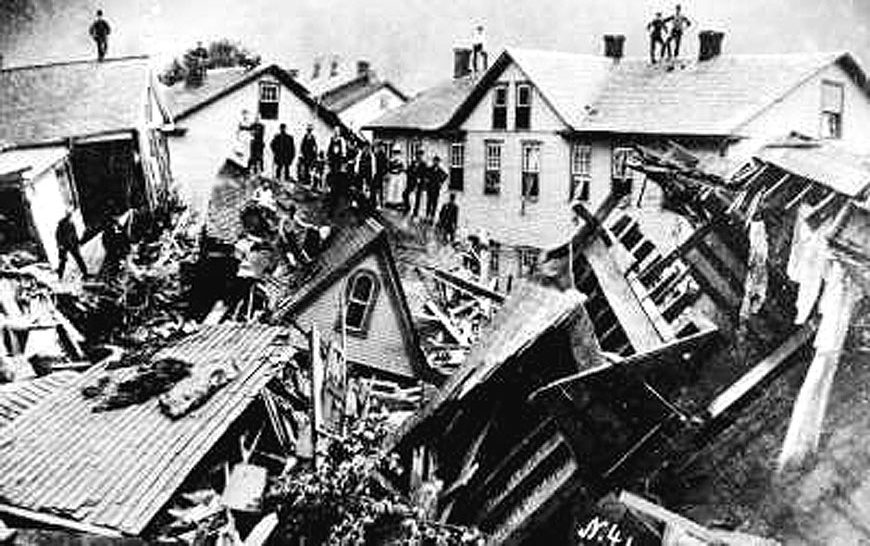
As noted, 1889 was a tragic year for Jacob.  First, there was the tragedy of Milton’s death on April 18, 1889 (Johnstown Daily Tribune (April 18, 1889, p. 4, col. 2), and then the deaths of Ella and Edwin on May 31, 1889, during the flood.  According to Winograd, Ella and little Edwin were in their house on Clinton Street when the flood waters rushed into the city, causing the house to collapse.  After the flood, Jacob lived in one of the temporary structures erected in Johnstown’s Central Park. (Winograd, p. 79)

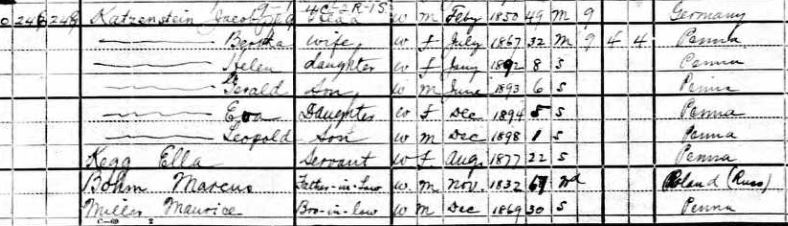
In March 1891, almost two years after losing his two sons and his first wife, Jacob married Bertha Miller, the daughter of Eliza Leopold and Samuel Miller of Pottstown, Pennsylvania. Jacob and Bertha had six children: Helen (1892), Gerald (1893, presumably named for Jacob’s father Gerson Katzenstein), Eva (1894, presumably named for Jacob’s mother Eva Goldschmidt), Leopold (1898), Maurice (1900), and Perry (1904)(named for Jacob’s brother Perry). Jacob was still a clothing merchant.
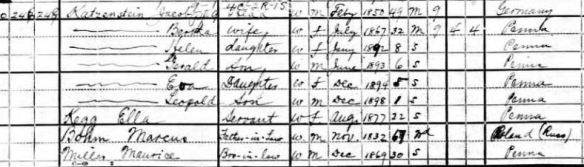
Jacob Katzenstein and family 1900 census Year: 1900; Census Place: Johnstown Ward 1, Cambria, Pennsylvania; Roll: 1388; Page: 12A; Enumeration District: 0124; FHL microfilm: 1241388

Jacob Katzenstein and family 1900 census
Year: 1900; Census Place: Johnstown Ward 1, Cambria, Pennsylvania; Roll: 1388; Page: 12A; Enumeration District: 0124; FHL microfilm: 1241388

It was during the 1880 and 1890s that formal, organized Jewish life really developed in Johnstown. Before that time, the primarily German Jewish residents of the town, who came from a Reform background and, as Winograd observed, identified more as German than Jewish in many ways, had services in their private homes and holiday celebrations with their families, but there were no official synagogues or rabbis in the town. (Winograd, pp. 77, 87-88, 103-107)

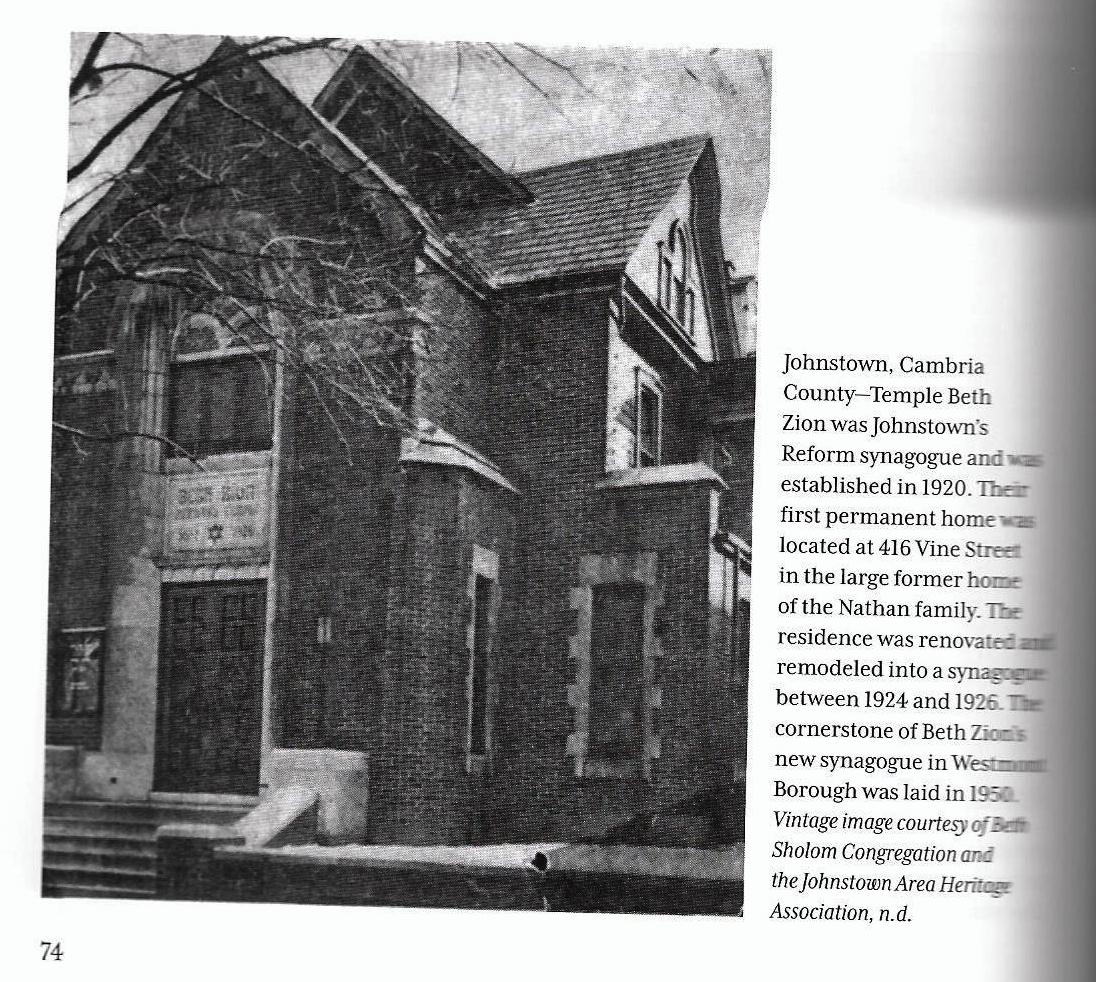
Then, with an influx of Russian Jewish immigrants in the 1880s who came from a more traditional, Orthodox background, there was a demand for more of the organized elements of Jewish communal life, including a synagogue, Hebrew school, and kosher butcher.  (Winograd, pp. 76-77) In the 1890s, two synagogues were organized: Rodeph Shalom for the more Orthodox Jews in town and Beth Zion for the Reform Jews.

Beth Zion grew out of a Jewish social club, the Progress Club, of which Jacob Katzenstein was an organizer and founding member in 1885. (Winograd, pp. 80, 148). The group used their building (known as the Cohen building) for services, but it was not until 1894 that they had their first Reform High Holiday Service; there was still no full time rabbi, and lay people often led services. (Winograd, pp. 148-151)
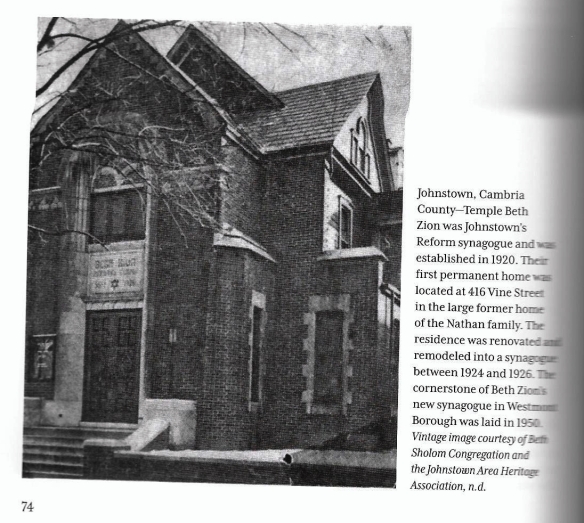
Beth Zion synagogue in Johnstown Courtesy of Julian H. Preisler. The Synagogues of Central and Western Pennsylvania: A Visual Journey (Fonthill Media 2014), p. 74 Courtesy of Beth Shalom Synagogue and the Johnstown Area Heritage Association

Beth Zion synagogue in Johnstown
Courtesy of Julian H. Preisler. The Synagogues of Central and Western Pennsylvania: A Visual Journey (Fonthill Media 2014), p. 74
Courtesy of Beth Shalom Synagogue and the Johnstown Area Heritage Association

Jacob was an officer in Beth Zion Temple. (Winograd, pp. 79-80)  In 1905 he donated five dollars to a fund to provide assistance to Jews in Russia who were being persecuted. (Winograd, pp. 114-116) In 1907, his son Gerald celebrated becoming a bar mitzvah the evening before Rosh Hashana; in 1912 when Gerald’s brother Leo became a bar mitzvah, it also was celebrated during the high holidays. Winograd described the Beth Zion congregation at that time as small, but tightly knit.  (Winograd, pp. 150-151) Obviously, Jacob Katzenstein and his family were active members in this community.

By 1910, Jacob and Bertha’s children ranged in age from five to eighteen and were all still living at home. Jacob listed his occupation as a retail merchant, the owner of a clothing store:

Jacob Katzenstein and family 1910 US census Year: 1910; Census Place: Johnstown Ward 1, Cambria, Pennsylvania; Roll: T624_1323; Page: 11A; Enumeration District: 0118; FHL microfilm: 1375336

Jacob Katzenstein and family 1910 US census
Year: 1910; Census Place: Johnstown Ward 1, Cambria, Pennsylvania; Roll: T624_1323; Page: 11A; Enumeration District: 0118; FHL microfilm: 1375336

Six years later on October 4, 1916, Jacob Schlesinger died at age 65 from chronic myocarditis and acute cholecystitis, an inflammation of the gall bladder. Rabbi Max Moll, a rabbi from Rochester, New York who was in Johnstown for the high holidays, presided at Jacob’s funeral. (Winograd, p. 80) Jacob left behind his wife Bertha and his six children ranging in age from 12 (Perry) up to Helen, who was 24.  In his will, executed on September 6, 1916, a month before he died, he appointed his wife Bertha to be his executrix and left his entire estate to her. Jacob was buried at the Grandview Cemetery in Johnstown.
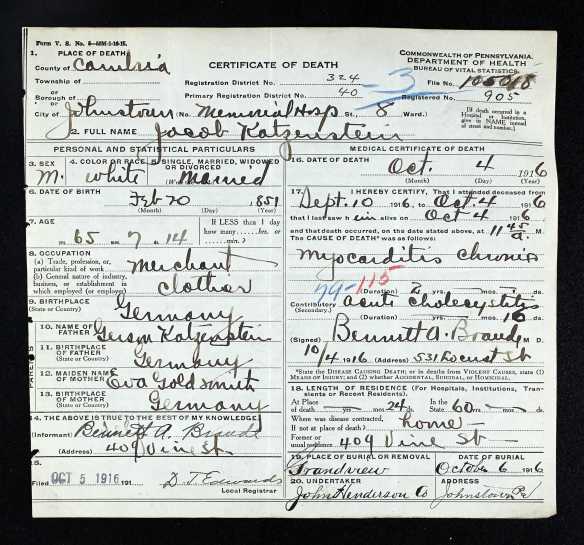
Jacob Katzenstein death certificate Pennsylvania Historic and Museum Commission; Pennsylvania, USA; Certificate Number Range: 102541-105790

Jacob Katzenstein death certificate
Pennsylvania Historic and Museum Commission; Pennsylvania, USA; Certificate Number Range: 102541-105790

My next post will address what happened to his six children.
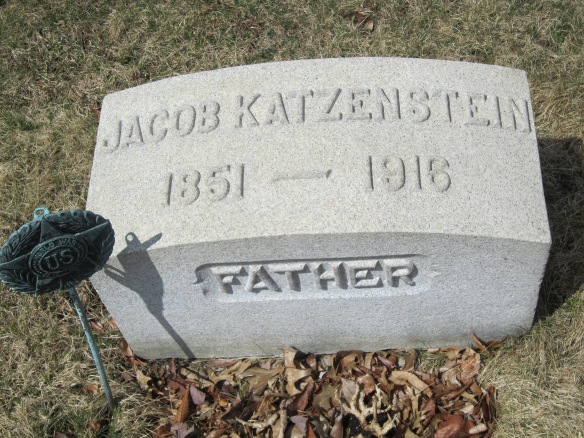
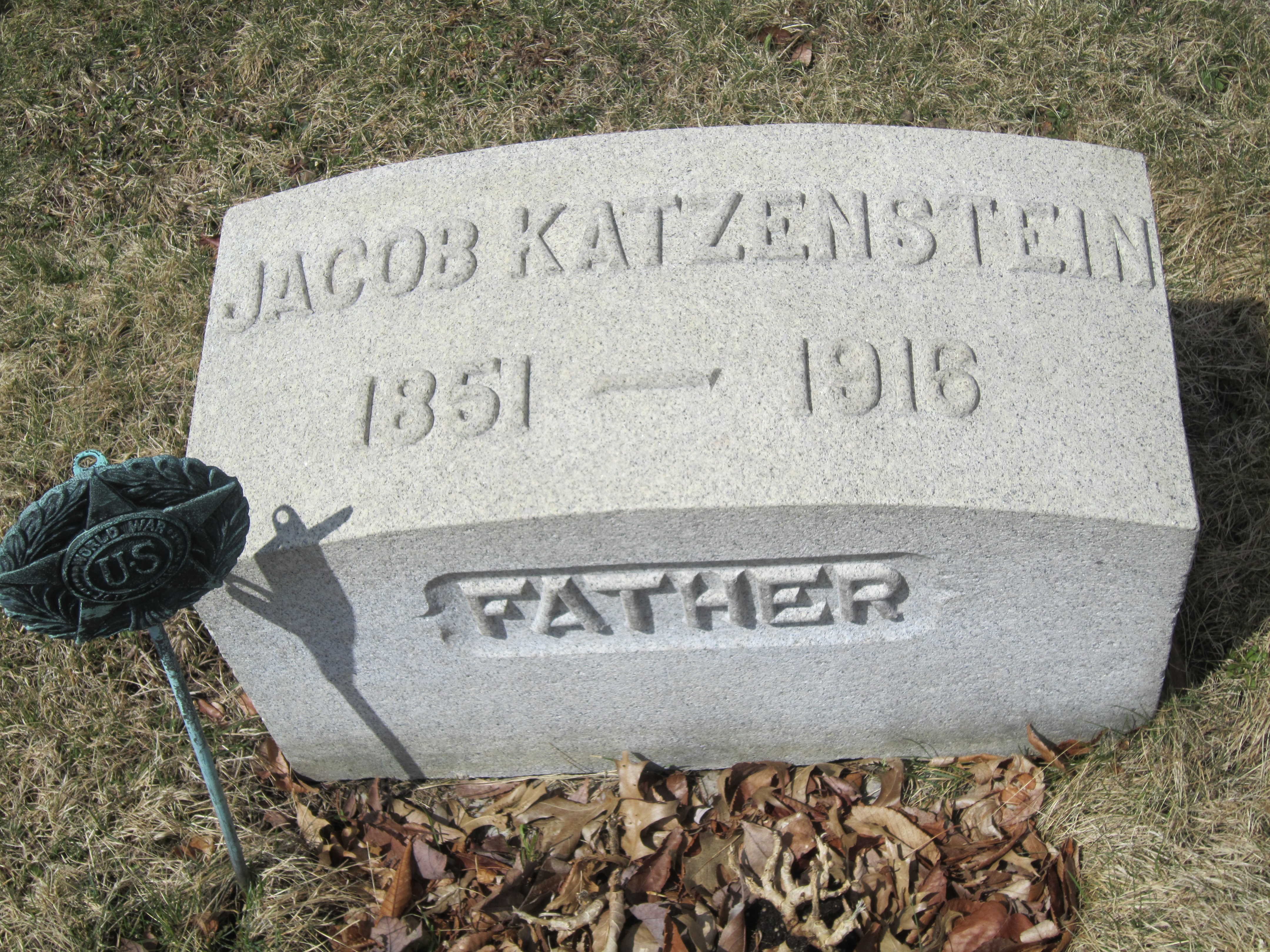
Jacob Katzenstein headstone courtesy of Find-A-Grave Member Brian J. Ensley (#47190867).

Jacob Katzenstein headstone
courtesy of Find-A-Grave Member Brian J. Ensley (#47190867).

(Does anyone know why that World War I sign would be posted near Jacob’s headstone? He died before the US entered the war so was not a veteran.)



A Brief History of Jews in Western Pennsylvania: 1840-1900

Pittsburgh 1874 By Otto Krebs [Public domain], via Wikimedia Commons

Pittsburgh 1874
By Otto Krebs [Public domain], via Wikimedia Commons

One of the questions I had when I started researching my Schoenthal relatives and their lives in western Pennsylvania was what kind of Jewish community existed in that region during the second half of the 19th century.  Learning more about my great-great-uncle Henry Schoenthal made me even more curious about that community.   I now have found two resources that help answer that question.

Susan Melnick, who is doing a project on the history of Jews in western Pennsylvania, told me about Jacob Feldman’s The Jewish Experience in Western Pennsylvania: A History 1755-1945 (1986, The Historical Society of Western Pennsylvania), and I ordered a copy.  According to Feldman, although there were a number of Jews who traveled to the Pittsburgh area to transact trade and a few who even briefly settled in the region or purchased land there for investment in the mid-1700s, there was no established Jewish community in the region until the 19th century.  In fact, Jews were slow to move to Pittsburgh even in the first half of the 19th century even though the Jewish population of the US was growing as many more Jewish immigrants arrived from Europe.  Jews were settling in places like Cleveland, Cincinnati, and New Orleans, but not in Pittsburgh because it was at that point less accessible.  Although Pittsburgh was itself growing as the coal industry and manufacturing developed, there was no real Jewish community in western Pennsylvania’s largest city or elsewhere in the region as of 1840.  (Feldman, pp. 3-12)

Slowly in the early 1840s, Jewish peddlers and merchants began to arrive in Pittsburgh, and some settled there.  But as Feldman wrote, “Certainly, this tiny group of Jews could not muster a minyan, a quorum of ten men aged thirteen and over, for the religious services they held in private homes unless a few itinerant peddlers or visitors also were stopping off in town.” (Feldman, p. 16)

As transportation to and from Pittsburgh improved after 1845, the Jewish population grew, with most of the men engaged in sales of dry goods.  By 1848 Jews had organized a cemetery (Troy Hill), a mourner’s society, and a synagogue in Pittsburgh, Shaare Shamayim. Feldman estimated that by 1850 there were 35 Jewish men in Pittsburgh, three times the number of Jews that had been there just three years earlier—before the cemetery and synagogue had been founded.   These were predominantly immigrants from Germany, Lithuania, and Russia.  They were engaged primarily in making and selling clothing as well as sales of dry goods. (Feldman, 17-20)

Photo courtesy of Lisa Albanese

Troy HIll cemetery Photo courtesy of Lisa Albanese

The arrival of the railroad in the 1850s led to another substantial increase in Pittsburgh’s overall population and economy, and poor economic conditions in Germany also led to an increase in the number of Jewish immigrants leaving Germany and arriving in western Pennsylvania, including my cousins Marcus and Mina (Schoenthal) Rosenberg and Simon and Fanny (Schoenthal) Goldschmidt (later Goldsmith).  Pittsburgh was also experiencing some significant industrial development, including the beginnings of a glass manufacturing industry.  Jews expanded beyond the dry goods and clothing fields to sales of liquor and of livestock.  Many were drovers, like Amalie Schoenthal’s husband, Elias Wolfe. (Feldman, 21-23)

As the Jewish population grew, so did the number of Jewish institutions in Pittsburgh, including a benevolent society to help new arrivals, a burial society, a kosher butcher, and a new synagogue.  A  number of members split from the first synagogue, Shaare Shamayim, and formed Rodef Shalom in 1855.  The population could not support two separate congregations, however, and as more and more members joined Rodef Shalom, Shaare Shamayim suffered and in 1860 merged with Rodef Shalom, which became the name of the surviving synagogue.  In 1861, the cornerstone was laid for a synagogue building, which would be the first building owned by a Jewish congregation not only in Pittsburgh, but anywhere in western Pennsylvania.  It opened to great fanfare in 1862.  (Feldman, 23-31.)

Rodef Shalom Temple, Pittsburgh, Pennsylvania,...

Rodef Shalom Temple, Pittsburgh, Pennsylvania, USA. (Photo credit: Wikipedia) (Current building, not the original)

During the 1860s and 1870s, the Jewish population of Pittsburgh continued to grow.  Rodef Shalom faced challenges as it moved from an Orthodox practice to Reform under the influence of its German-American leaders.  Those who wanted to continue an Orthodox practice left to form Tree of Life congregation.  Because services at Rodef Shalom were conducted in German,  other members left a few years later and formed another new congregation, Emanuel, also Reform but with services in English. Now the Jewish population in the city was large enough to support three congregations.  Thus, by the time some of my Schoenthal ancestors were moving to Pittsburgh in the 1870s and 1880s, there was a well-established Jewish community in Pittsburgh. (Feldman, 33-54)

But what about “Little Washington,” a much smaller town 30 miles from Pittsburgh? What kind of Jewish community existed there when Henry Schoenthal arrived in 1866 and when my great-grandfather arrived fifteen years later in 1881? Feldman reported that in 1853 my cousin Jacob Goldsmith may have been the first Jew in Washington, Pennsylvania,  followed by four more Jews within the next five or six years.  According to Feldman, when one of them, David Wolfe (possibly a relative of Amalie’s husband Elias Wolfe?) was killed accidentally by some rowdy soldiers in 1863, all the other Jews left Little Washington. (Feldman, p. 57)

According to my records, Jacob Goldsmith is listed as living in Washington, PA, even before 1853. The 1850 US census has him listed as living there and working as a tailor.  He was still there for the 1860 census and also registered for the Civil War draft in Washington in 1863. His father Simon, widow of Fanny Schoenthal, was also living in Washington by 1860. And Jacob Goldsmith was still there when his cousin Henry Schoenthal arrived there in 1866, according to Henry’s diary and the Beers biography of Henry, which says that Henry clerked in Jacob’s store for three years after he arrived in Washington.

But Jacob Goldsmith had moved to Philadelphia by 1870 and Simon Goldsmith had returned to Pittsburgh by then as well, so Henry Schoenthal and his family must have been among a very small number of Jewish residents of Washington in 1870.   Feldman noted that in 1860 there were only 250 Jews, “mostly of German origin,” living in western Pennsylvania in places other than Pittsburgh, spread out over an area of about 15,000 square miles, meaning that there were not too many Jews in any one locality.  (Feldman, p. 58)  In places like Washington, the few Jews who lived there would meet in private homes for prayer services. My great-great-uncle Henry was one of those who hosted and led such services. As of 1880, only Pittsburgh and two other towns in western Pennsylvania, Altoona and Erie, had actual synagogues. (Feldman, p. 63)

By 1890, things began to change in Little Washington.  In that year the very small Jewish community established a synagogue, Beth Israel, a congregation which exists to this day.  I was very fortunate to connect with Marilyn A. Posner, a past president of Beth Israel as well as the author of the centennial history of the synagogue, The House of Israel, A Home in Washington: 100 Years of Beth Israel Congregation, 1891-1991 / 5652-5752 (1991, Congregation Beth Israel, Washington, Pennsylvania).  As Posner’s book describes, in 1890 the congregation hired a young rabbi named Jacob Goldfarb as its first spiritual leader.  Rabbi Goldfarb was a recent immigrant from Lithuania.  As described by Posner, “He was fluent in the Lithuanian, Russian, German, Hebrew and Yiddish languages.  He was a mohel, able to perform ritual circumcisions; a shochet, or ritual butcher; a chazzan or cantor; and he studied Talmud and Torah.” (Posner, p. 1.)  If that’s not killing multiple birds with one stone, I don’t know what is!

Photo courtesy of Marilyn Posner from her book, "The House of Israel, A Home in Washington: 100 Years of Beth Israel Congregation, 1891-1991 / 5652-5752

Photo courtesy of Marilyn A. Posner from her book,
“The House of Israel, A Home in Washington: 100 Years of Beth Israel Congregation, 1891-1991 / 5652-5752


Beth Israel’s services were at first held in the home of one of its members, Nathan Samuels.  Then the congregation met in rented facilities for some years.

House of Nathan Samuels in Washiington PA where Beth Israel congregants first met Photo courtesy of Marily Posner from her book, "The House of Israel, A Home in Washington: 100 Years of Beth Israel Congregation, 1891-1991 / 5652-5752

House of Nathan Samuels in Washiington PA where Beth Israel congregants first met
Photo courtesy of Marilyn A. Posner from her book, “The House of Israel, A Home in Washington: 100 Years of Beth Israel Congregation, 1891-1991 / 5652-5752

Among the nine original members of the congregation were four of my relatives, my great-grandfather Isidore Schoenthal and two of his brothers, Henry and Nathan[1], and S.J. Katzenstein, my great-grandmother Hilda’s brother.  (Posner, p. 2).  Henry also became the president of the local branch of B’nai Brith, the Jewish fraternal organization.  (Feldman, p. 231)  My relatives were not, however, on the list of those who signed the original synagogue charter in 1901.  Feldman explained it as follows:

Beth Israel, unlike some nearby synagogues, was not Hungarian or Galician.  When its charter was taken out in 1901, twenty-four of its twenty-seven subscribers were Lithuanian …. The few Germans in Washington, Henry Schoenthal among them, were absent from the charter.

(Feldman, p. 199)

With the synagogue officially chartered, ground was broken for building a permanent home for the congregation and a cornerstone was laid on June 29, 1902.  By that time the Washington Jewish community had become one of the leading Jewish communities in western Pennsylvania outside of Pittsburgh.

Sketch of the original Beth Israel synagogue building. Courtesy of Marilyn Posner from her book, "The House of Israel, A Home in Washington: 100 Years of Beth Israel Congregation, 1891-1991 / 5652-5752

Sketch of the original Beth Israel synagogue building.
Courtesy of Marilyn A. Posner from her book,
“The House of Israel, A Home in Washington: 100 Years of Beth Israel Congregation, 1891-1991 / 5652-5752

With this history in mind, I better understand why my relatives settled in western Pennsylvania and specifically in Washington and why they felt comfortable living there.   Many of the Schoenthal descendants continued to live there for many years, and there are still quite a few living in Pittsburgh to this day.

———-

[1] My research indicates that Nathan was no longer living in western Pennsylvania, let alone Washington, in 1890, but that he had moved to Washington, DC, ten years before and was living in either Richmond, VA, or Philadelphia by 1890.

Shana Tova—A Good Year to All


Embed from Getty Images

Once again I find myself in the midst of the early September craziness after a long, relaxing summer: several family birthdays and anniversaries, school starting (well, not for me anymore, but for my husband), and preparation for the Jewish holidays.  In my spare time, I am trying to put together the pieces of my Schoenthal research slowly but surely.  But for the next week or so, I won’t have much time to write anything coherent about my research, so I will be taking a short break.

That seems appropriate as this is the time of year when I am supposed to be contemplating the year past and making decisions about the year to come.  It’s a time to be thoughtful and thankful.  A time of making amends and making resolutions.

So I wish all who celebrate a wonderful holiday with time for your families and your thoughts.  And for everyone, I wish a new year filled with gratitude, happiness, good health, and love.  And for the world, I will hope for peace and for a way to protect and shelter all those people all over the world who have been uprooted and seen their lives and families destroyed by war, poverty, and hatred.  Today is the 14th anniversary of the day that showed us all what hatred can do. May we finally learn from it.

WTC memorial lights

WTC memorial lights (Photo credit: Wikipedia)

May it be a year when somehow people everywhere find a way to accept differences and respect and honor the humanity of each other.

Shana tova.  A good year to all.


Embed from Getty Images

Yom Hashoah


http://www.gettyimages.com/detail/121859610

In honor of Yom Hashoah, Holocaust Memorial Day, I am posting the links to six of my blog posts in which I discussed the members of my own family who perished in the Holocaust. Six to represent the six million Jews who were slaughtered by the Nazis during World War II.

These are all members of the Seligmann/Schoenfeld family.  I did not even know about them a year ago. And I know that there must have been members of my other family lines who were also murdered during the war.  I just haven’t found them yet.  So in memory of all those who were killed, those we know about and all those we do not yet know about, please read these posts if you have not done so already.  Or even if you have.  We must never forget.

One

Two

Three

Four

Five

Six


English: A lit Yahrtzeit candle, a candle that...

English: A lit Yahrtzeit candle, a candle that is lit on the Hebrew anniversary of a loved one’s death. (Photo credit: Wikipedia)

Passover 2015: The American Jewish Story

Handmade shmura matzo used at the Passover Sed...

Handmade shmura matzo used at the Passover Seder especially for the mitzvot of eating matzo and afikoman. (Photo credit: Wikipedia)

A year ago I was feeling disconnected from Passover until I heard my grandson tell us the story of Passover in a way that made it feel new and exciting and different all over again.  This year his little brother will experience his first seder, though at only ten months, that experience will likely be short and quite unfocused.  Just a lot of really noisy people sitting around a table eating food that he neither can nor would want to eat.  But it’s a new reminder that every generation and every child experiences Passover as a new experience, allowing all of us who are jaded and detached to be able to relive our own early experiences with this special holiday.

Last year I entered into Passover thinking about my mother’s ancestors, the Brotmans, the Goldschlagers, and the Rosenzweigs.  I focused on their exodus from the oppression and poverty and anti-Semitism of Galicia and Romania and their courage and the desire for freedom that led them to leave all they knew to cross the continent and then the ocean and come to New York City, where they again lived in poverty but with greater hopes for a life of freedom and economic opportunity.  And they attained their goals if not in that first generation, certainly by the third and fourth generations.

Poor Jews taking home free matzohs, New York

Poor Jews taking home free matzohs, New York (Photo credit: Wikipedia)

For the last year now, I have been researching, studying and writing about my father’s paternal relatives.  It has taken just about a full year to cover the Cohens, the Jacobs (with whom I actually need to do more work), the Seligmans, the Schoenfelds, the Nusbaums, and the Dreyfusses.  Soon I will start my father’s maternal relatives—the Schoenthals and Katzensteins and whatever other surnames pop up along the way.  Researching my father’s families has been so different from my mother’s, and I can go so much further back.  I can’t get back much before 1840 with my mother’s family and have absolutely no records before 1885 or so for any of them.  Although I have a number of Romanian records for my Rosenzweig and Goldschlager relatives, I have no records at all from Europe for my great-grandparents Joseph and Bessie Brotman, despite hours and hours of searching and even DNA testing.

In contrast, my father’s ancestors have provided me with a rich opportunity to learn about Jews in Amsterdam, London, and especially the towns of Gau-Algesheim, Erbes-Budesheim, Bingen, and Schopfloch, Germany.  I have been able to find records all the way back to 1800 or so for almost every line.  I’ve had amazing help along the way on both sides of the Atlantic, and I’ve even learned a little German to boot.  My father’s families were pawnbrokers and peddlers and clothing merchants; they were pioneers and politicians and war heroes.


http://www.gettyimages.com/detail/182866324
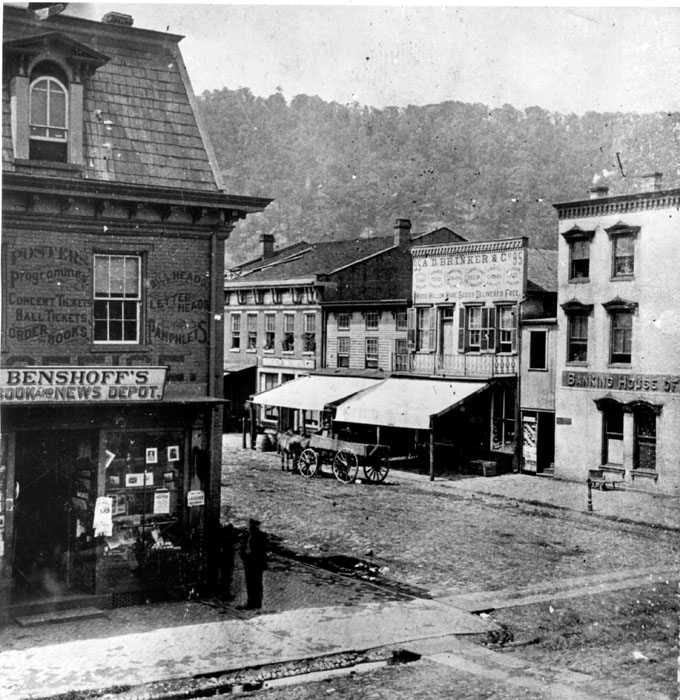
Harrisburg Market Square with Leo Nusbaum store

Harrisburg Market Square with Leo Nusbaum store

They came to the United States in the 1840s and 1850s, and most of them suffered terrible heartbreaks, economic struggles, and early deaths.  Most of them settled in Philadelphia and other parts of Pennsylvania and New Jersey, but there were those who went to places that I’d never think a Jewish immigrant would go: Iowa, Texas, Illinois, Michigan, California, and, of course, New Mexico.  Many married outside the Jewish community and assimilated into American culture far more so than my mother’s relatives.  Ultimately, the Cohens/Jacobs and Seligmans/Schoenfelds and Nusbaums/Dreyfusses were successful; they found the American dream, and they embraced it.

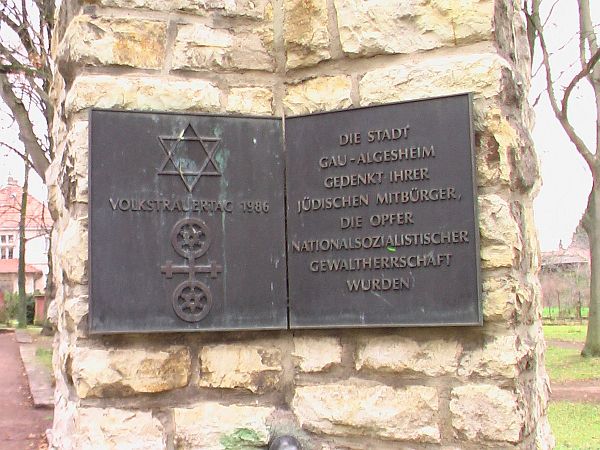
But there is a very sad underside to this story of American success.  It’s the story of those who did not leave Europe.  For the first time in my life I confronted the reality that the Holocaust did not just happen to other families, to other Jews.  Not that I have not been deeply affected by the Holocaust all my life; ever since I read Anne Frank’s diary as a child, I’ve identified with and cried for all those who were murdered by the Nazis.  But I never knew that I had relatives left behind in Germany who were part of that slaughter.  I am still finding more, and I will write about them soon.  The list of names of my cousins who died in the Holocaust grows longer and longer, and I realize more than ever how grateful I should be to Bernard Seligman, John and Jeanette (Dreyfuss) Nusbaum, and Jacob and Sarah (Jacobs) Cohen for leaving Europe and taking a chance on the new country across the ocean.

memorial plaque gau aldesheim

So this year for Passover I will be thinking about that first major migration of Jews from Europe to America.  I will be feeling thankful for the risks my ancestors took, and I will be feeling the loss of not only all those who were killed in the Holocaust, but the loss of all the children and grandchildren who would have been born but for those deaths.

And overall I will be celebrating family, freedom, and faith—faith that the world can be a better place and that human beings can be their best selves and live good and meaningful lives.  May all of you have a wonderful weekend—be it Passover or Easter or perhaps just another weekend in April for you.   Celebrate all the good things in life in whatever way you can.


Embed from Getty Images