Meier Rothschild’s Daughter Gertrud Rothschild Neuhahn and Her Family: How and Where Did They Survive the Holocaust?

Finally, after a few weeks without a post, I return to the children of Meier Rothschild and Bertha Lorge. Meier was the youngest child of Gelle Blumenfeld and my second cousin, three times removed. I am up to his third child, Gertrud.

As with her brothers Berthold and Theodor, I have also struggled to find reliable information about the third child of Meier Rothschild and Bertha Lorge, their daughter Gertrud Rothschild, her husband Gustav Neuhahn, and their daughter Ruth.

I found Gertrud on a passenger manifest card dated January 22, 1962, for a flight to Houston from Mexico City. On that card her residence is given as Tel Aviv, Israel. I could not find a comparable card for Gustav or their children.
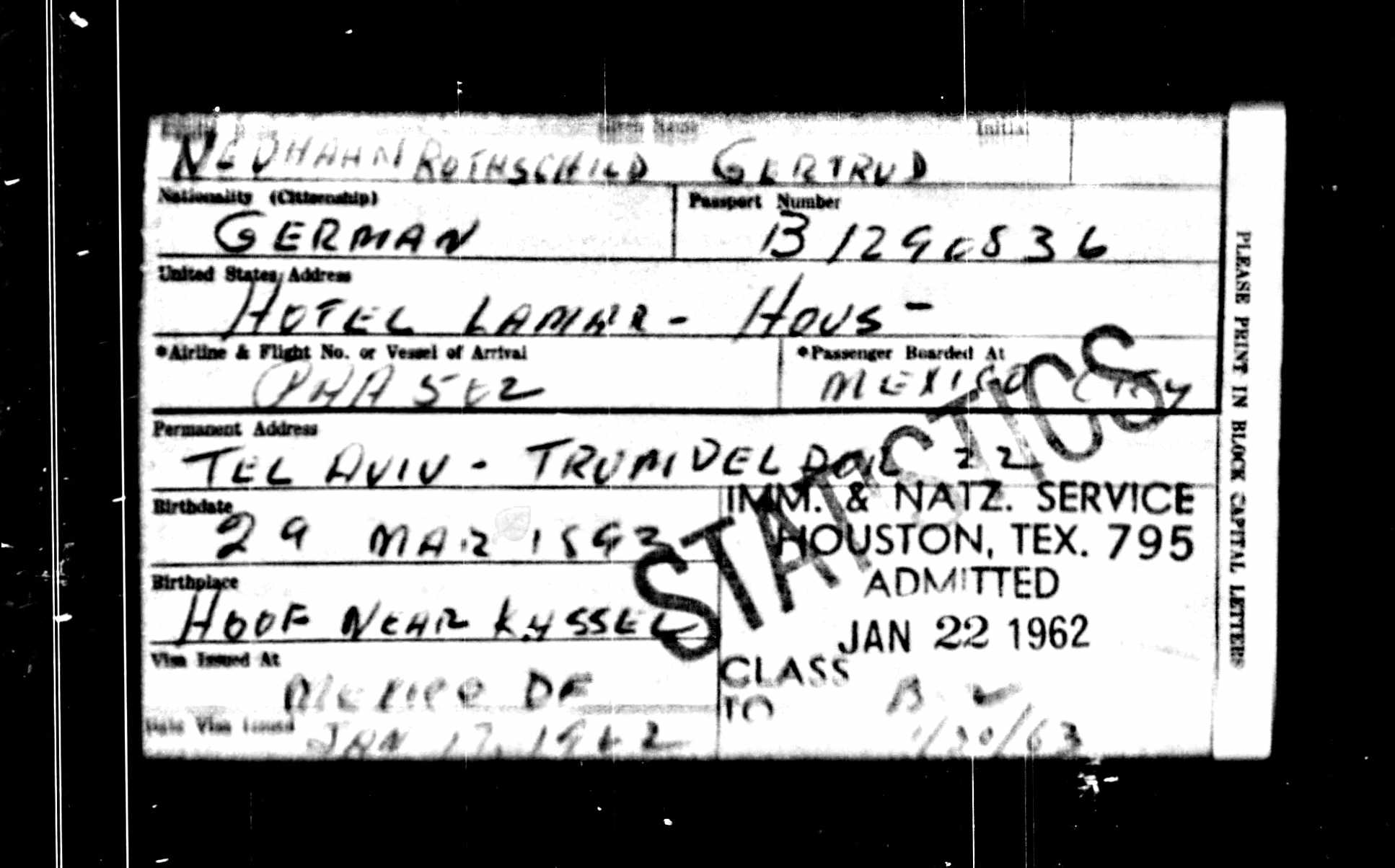
Gertrud Rothschild Neuhahn passenger manifest card, The National Archives At Washington, D.C.; Washington, D.C.; Series Title: Passenger and Crew Manifests of Airplanes Arriving At Houston, Texas; ARC Number: A3982; Record Group Title: Records of the Immigration and Naturalization Service, 1787-2004; Record Group Number: 85, NARA Roll Number: 50, Ancestry.com. Texas, U.S., Arriving and Departing Passenger and Crew Lists, 1893-1963

I searched for them all in Israel and found this interesting document in the Israel Genealogical Research Association (IGRA) website:
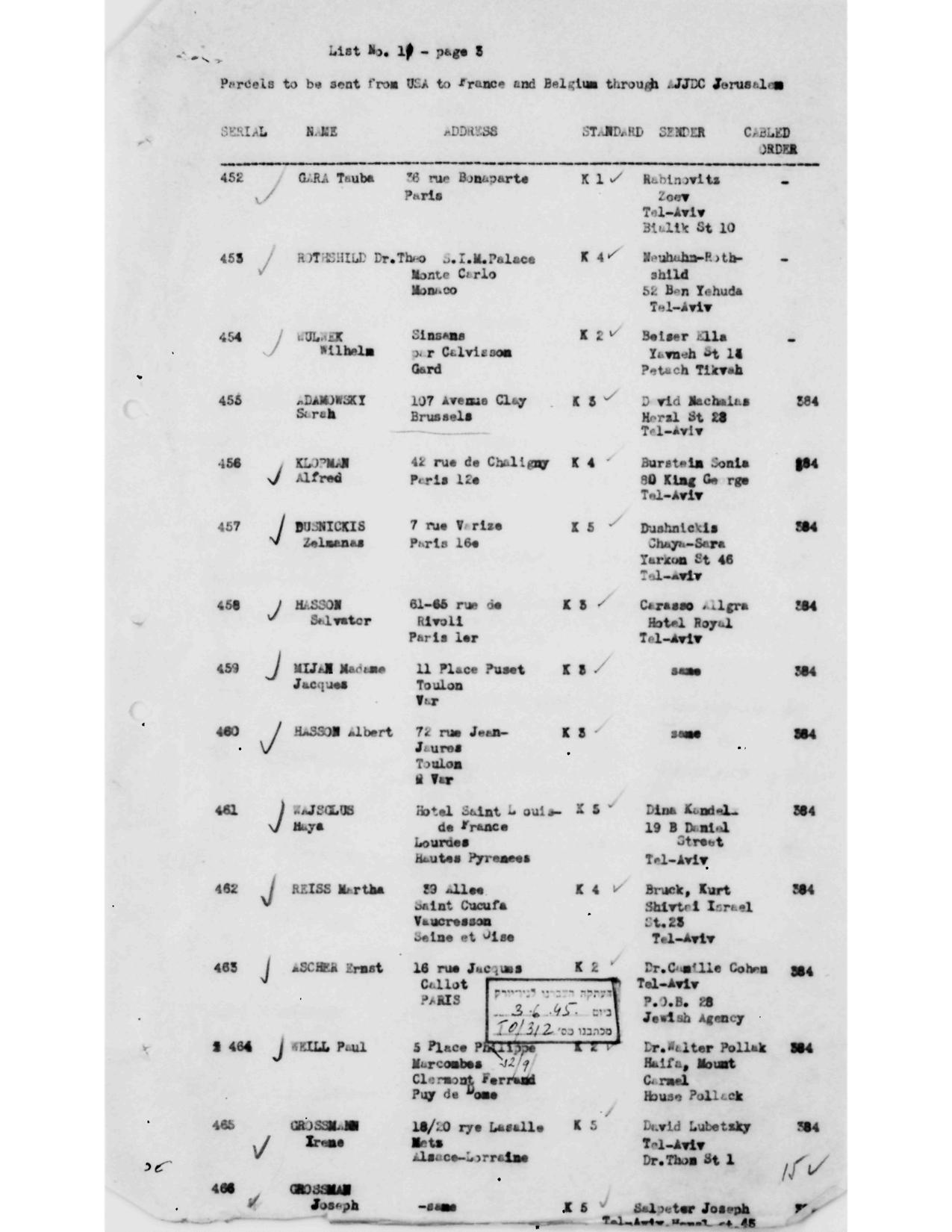
This is a list of packages sent from Israel to people in Europe who were Holocaust survivors; the program was organized by the American Jewish Joint Distribution Committee. One of those sending packages in 1945 was “Neuhahn-Rothschild,” presumably Gertrud, and the intended recipient was Theodor Rothschild, her brother, in Monte Carlo, Monaco. That reaffirms the fact that Theodor was in Monaco and also establishes that Gertrud was in Tel Aviv in 1945, but not anything more.

A search on the IGRA site for Ruth Neuhahn revealed more evidence of the Neuhahn family in Palestine in 1944. A list of registered voters in 1944 shows Ruth, her parents, and a previously undiscovered sister Tirza living in Tel Aviv.
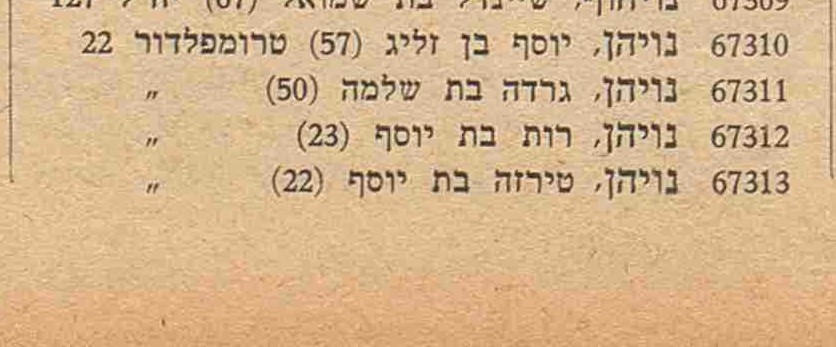
Neuhahn family on 1944 Voters Registration list found at IGRA, https://genealogy.org.il/AID/

This translates as:

Yosef Neuhahn, son of Zelig

Gertrud Neuhahn, daughter of Shlomo

Ruth Neuhahn, daughter of Yosef

Tirza Neuhahn, daughter of Yosef

That matches what I know about Gustav; his father was Selig Neuhahn. Gustav’s Hebrew name must have been Yosef. I was confused by Gertrud’s name since her father was Meier, but perhaps he used Shlomo as his Hebrew name. And I have no prior record for a daughter named Tirza or by any other name. Unfortunately, I cannot find any later record for Tirza Neuhahn.

I did, however, locate a marriage record for Ruth Neuhahn on the IGRA website:
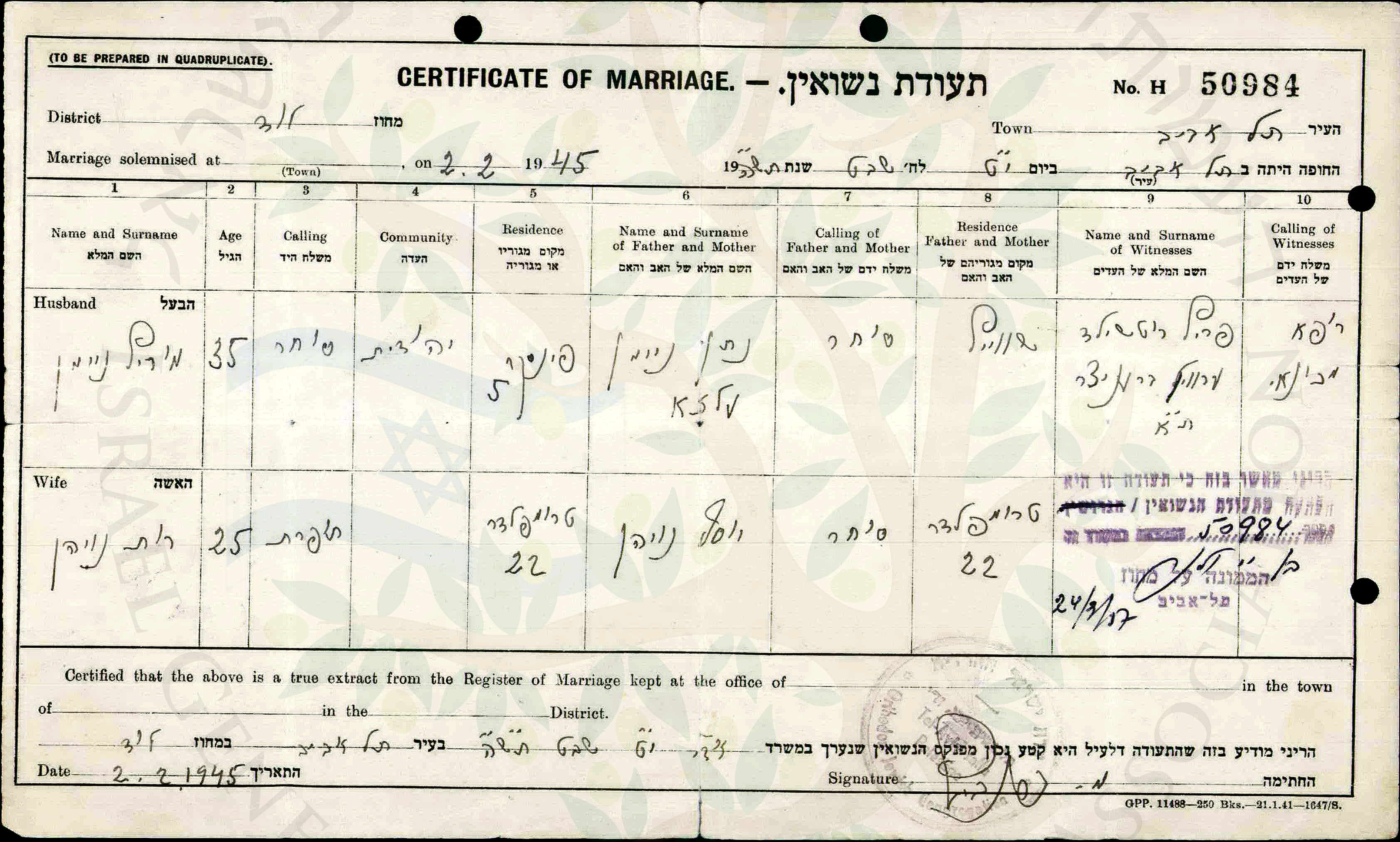
Marriage of Ruth Neuhahn to Moritz Neumann, found at IGRA, https://genealogy.org.il/AID/

The record shows that Ruth Neuhahn, daughter of Yosef and Gertrud Neuhahn, age 22, married Moritz Neumann, son of Shimon and Chaya Neumann, age 35, on  February 2, 1945, in Tel Aviv. Both resided in Petah Tikva, Moritz was a clerk, and Ruth a typist.

On Ancestry I located some passenger manifest cards for Ruth and two women with the same surname and addresses who I presume are her daughters. For example, here is a passenger card for Ruth Neumann in June 1959, stating that her nationality was Israeli, but her residence was in Mexico. She was traveling and staying in San Antonio, Texas. She also traveled in Miami in 1960 and in 1962,1 reporting the same facts. Her residence in Mexico may explain why her mother Gertrud had been flying from Mexico to San Antonio in 1962, as seen above.
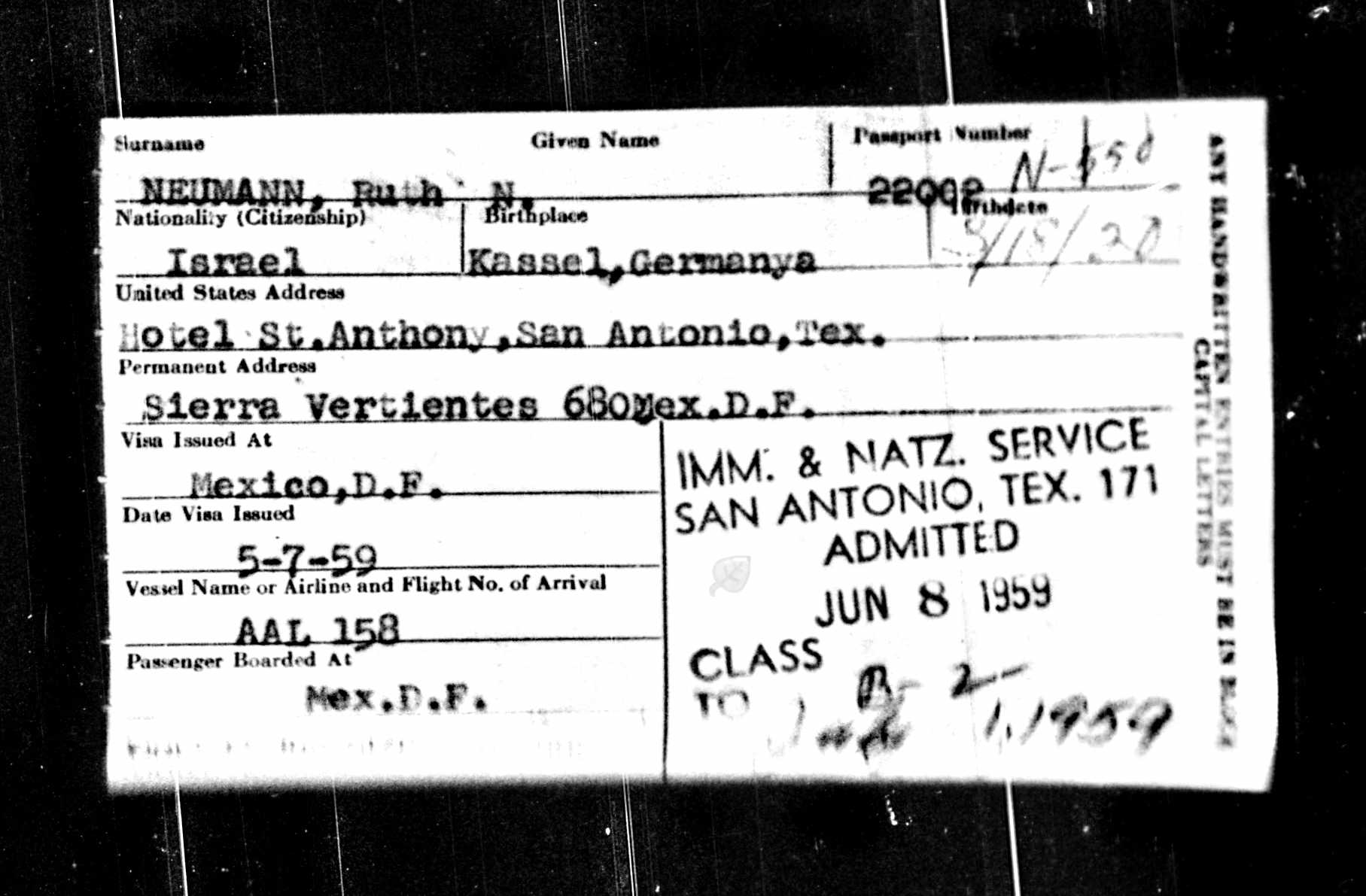
Ruth Neumann passenger manifest card 1959, The National Archives At Washington, D.C.; Washington, D.C.; Series Title: Passenger Manifests of Airplanes Arriving At San Antonio, Texas; ARC Number: A3524; Record Group Title: Records of the Immigration and Naturalization Service, 1787-2004; Record Group Number: 85, NARA Roll Number: 28, Ancestry.com. Texas, U.S., Arriving and Departing Passenger and Crew Lists, 1893-1963

Thus, in 1962 Ruth was still living in Mexico, still an Israeli citizen, and now visiting Miami, Florida. As for her husband Moritz, one tree on Ancestry shows that he died in Mexico City in 2003 and that Ruth died there as well. I have written to the owner of that tree and am hoping that she can share more information about Gertrud, Gustav, and Ruth, and their family.

If I can get more information about Gertrud and her family, I will update the blog. But for now this is the best I can do. The good news is that it appears that all of Gertrud’s family all survived the Holocaust.


  1.  Name Ruth Neumann, Nationality Israeli, Arrival Age 40, Birth Date 18 Mar 1920
    Birth Place Kassel, Germany, Record Type Arrival Arrival Date 2 May 1960, Arrival Place Miami, Florida, USA, Flight Number 150, Airline Guest Aerovias Mexico, The National Archives in Washington, DC; Washington, DC, USA; Series Title: Passenger and Crew Manifests of Airplanes Arriving At Miami, Florida.; NAI Number: A3995; Record Group Title: Records of the Immigration and Naturalization Service, 1787-2004; Record Group Number: 85, Ancestry.com. Florida, U.S., Arriving and Departing Passenger and Crew Lists, 1898-1963; Ruth Neumann, Nationality Israeli, Arrival Age 42, Birth Date 18 Mar 1920, Birth Place Germany, Record Type Arrival, Arrival Date 19 May 1962, Arrival Place Miami, Florida, USA, Flight Number 100, Airline Gam, The National Archives in Washington, DC; Washington, DC, USA; Series Title: Passenger and Crew Manifests of Airplanes Arriving At Miami, Florida.; NAI Number: A3995; Record Group Title: Records of the Immigration and Naturalization Service, 1787-2004; Record Group Number: 85, Ancestry.com. Florida, U.S., Arriving and Departing Passenger and Crew Lists, 1898-1963 

My Cousin Anna Seghers: Activist, Author, and Survivor

The youngest child of Helene Goldschmidt and Salomon Fuld was their daughter Hedwig, born in 1880 and married to Isidor Lutz Reiling. They had one daughter, Netti, born in Mainz, Germany, in 1900. Hedwig was my third cousin, twice removed, and her daughter Netti was my fourth cousin, once removed. Their stories are those of tragedy and triumph.

Hedwig did not share the good fortune of her older siblings. She and her husband Isidor were still living in Mainz in 1940 when Isidor died on March 10 at the age of 72.

Isidor Reiling death record, Year Range: Sterberegister 1940, Band 1
Ancestry.com. Mainz, Germany, Deaths, 1876-1950. Original data: Personenstandsregister, Sterberegister, 1876-1950. Mainz Stadtarchiv.

Hedwig did not get out of Germany in time. She was deported to the ghetto in Plaski, Poland, on March 21, 1942, and was murdered sometime thereafter by the Nazis. The record on Yad Vashem has no date or place of her death.

This Page of Testimony filed by her cousin Regina Blanche Rosenberger1 indicates that she was killed in a concentration camp, but does not name which one or when. Thus, Hedwig was one of the millions of Jews whose deaths were not recorded by the Nazis, but who were murdered by them.

Hedwig Fuld Reiling, Page of Testimony, Yad Vashem at https://tinyurl.com/t6vr4dg

Hedwig and Isidor’s daughter Netti did survive. If you look at the Page of Testimony above, you will see that Hedwig was identified as “mother of the author Anna Seghers.” Anna Seghers was Netti Reiling’s pseudonym, and she was a well-known author. Because of her renown, I was able to find a treasure trove of material about Netti including some old photographs.2

Isidor Reiling was an art expert and antique dealer like so many of his Goldschmidt in-laws. His daughter Netti developed an interest in art history, and in 1920 she moved to Heidelberg to attend the university there. She wrote her doctoral thesis on “Aspects of Jews and Jewishness in the Work of Rembrandt.”

It was while she was at the university in Heidelberg that she joined a group of left-wing intellectuals and met her husband, Laszlo Radvanyi. Laszlo was born in Budapest, Hungary on December 13, 1900. He studied economics and philosophy at the University of Budapest in 1918 and became interested in radical politics. He eventually ended up at the University of Heidelberg and continued his studies there.

In August 1925, Netti and Laszlo were married. Each had adopted a pseudonym for their writings. Netti became Anna Seghers, inspired by a Dutch artist Hercules Seghers whom she had studied at the university. Laszlo’s pseudonym was Johann Lorenz Schmidt after an 18th century German theologian. They had two children, Peter (later known as Pierre)(1926) and Ruth (1928) and were living in Berlin in 1928.

Seghers published her first novel The Revolt of the Fisherman in 1928, the same year she joined the Communist Party in Germany. She published a second book of short stories about poor workers in 1930 and two more books in 1932 and 1933.

Her left-wing views resulted in her books being banned when Hitler came to power in January, 1933, and she was even briefly arrested, according to some sources.  According to her son Pierre, he was sick with scarlet fever at the time, and his mother had taken him to a children’s home in the Black Forest to recover. When she heard of the Reichstag fire on February 27, 1933, she returned to Berlin. The Nazis claimed that communists had set the fire, and Netti/Anna was denounced by a neighbor. The police showed up at their home to arrest her. According to Ruth, the police did not remain long because they were afraid of catching scarlet fever. Whether or not Netti/Anna was ever taken into custody seems unclear.

The family left Germany soon thereafter and escaped to France. They lived in Paris for seven years where Laszlo started a free university for German refugees; he continued to work on anti-fascist, left-wing causes; Netti/Anna published several books during this time and also spent some time in Vienna and in Spain during the Spanish Civil War.

As a Hungarian and known communist, Laszlo/Johann was interned as a “suspected national” by the French in a camp in southern France. When the Nazis invaded France and occupied Paris in the spring of 1940, Netti/Anna and the children hid in Paris until they were able to escape to Marseilles. They were eventually able to free Laszlo and leave France on March 24, 1941, when the family sailed to the US and ultimately Mexico, where they settled.

During their time in Mexico, Anna Seghers wrote her best known book, The Seventh Cross, about seven political prisoners who escape from a Nazi concentration camp. It was first published in the United States and Mexico in 1942 and became the basis of a 1944 film of the same title starring Spencer Tracy, Hume Cronyn, Jessica Tandy, and Agnes Moorehead.

The New York Times review of the film in 1944 is quite interesting. The reviewer, Bosley Crowther, found Spencer Tracy’s performance “splendid” and Jessica Tandy’s “emotionally devastating.” He described the plot as “hair-raising” and the production as filled with “crackling tension and hard-packed realism” and as preserving the “monstrousness” of Segher’s book.3

But Crowther found reason to criticize the film as being too soft on the Germans:

Without in the least overlooking the bestiality of the Nazi brutes nor the miserable self-surrender of German citizens to their black regime, this film … visions a burning zeal for freedom in some German rebels and a core of decency in common folk. …[T]he basic theme…is that in men—even in Germans—there is an instinct for good that cannot be destroyed.….

The big reservation which this writer holds with regard to this film is that regarding the discretion of its theme at this particular time. Without any question, it creates a human sympathy for the people of a nation with whom we are at war and it tends, as have others, to load Germany’s crimes on Nazi backs. Obviously this film can make sentiment for a “soft” peace. It looks as though we are getting a dandy “thriller” at a pretty high price.

I have not yet read the book nor seen the film, but hope to do one or the other while being confined during this pandemic. There are more current reviews of the book, including this one from The New York Review of Books written upon the publication of a new translation of the book in 2018:

The Seventh Cross is one of the most powerful, popular, and influential novels of the twentieth century, a hair raising thriller that helped to alert the world to the grim realities of Nazi Germany and that is no less exciting today than when it was first published in 1942. … Anna Seghers’s novel is not only a supremely suspenseful story of flight and pursuit but also a detailed portrait of a nation in the grip and thrall of totalitarianism.

Anna Seghers wrote a number of other books while living in Mexico. It was also during this time that she learned that her mother had been killed by the Nazis. Nevertheless, after the war she and her family returned to Germany, first West Berlin, later East Berlin. She continued to be a left wing and communist political activist and to write books based on her political views for the rest of her life. She was a loyal supporter of the Soviet Union and East Germany.

Laszlo Radanvanyi died on July 3, 1978, in Berlin. Like his wife, he had remained a political activist as well as a professor. Netti/Anna died five years later on June 1, 1983, in Berlin.

Rüdiger Wölk,  Münster,  CC BY-SA (https://creativecommons.org/licenses/by-sa/2.5)

On November 19, 2000, the German publication Der Welt published an interview with Netti and Laszlo’s two adult children, Pierre and Ruth, which revealed a more personal perspective on their mother. Ruth described her as “very warm, a normal mother,” and Pierre said she was “a very intuitive, extremely sensitive, even compassionate woman.”

Ruth Radanyi died on July 18, 2010 at the age of 82. Her brother Pierre, an author and physicist, is still living as far as I can tell. At this link, you can hear him read one of his mother’s poems.

The story of Netti Reiling/Anna Seghers and her family is yet another example of the literary talents of the Goldschmidt family as well as another example of the courage and resilience of the human spirit in the face of devastating hatred and danger. Although it may be hard to understand how Netti could support the totalitarianism of the Soviet Union, I cannot judge her for her views, given what she endured and what she lost as a young woman.

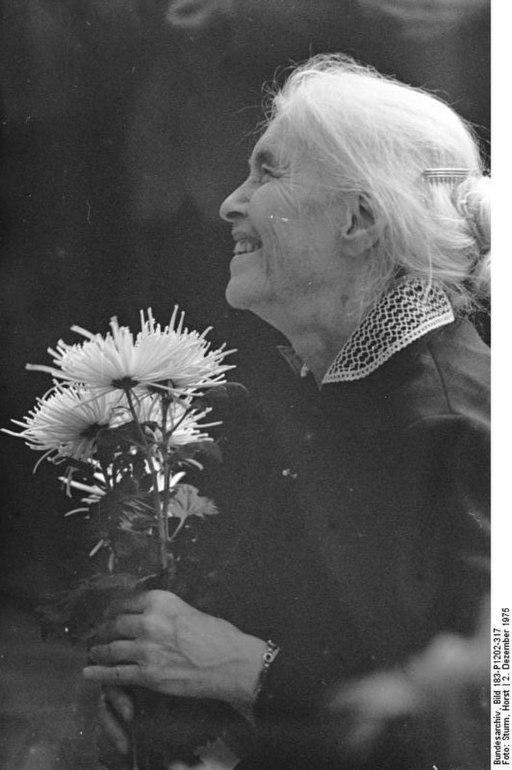
Bundesarchiv, Bild 183-P1202-317 / Sturm, Horst / CC-BY-SA 3.0 / CC BY-SA 3.0 DE (https://creativecommons.org/licenses/by-sa/3.0/de/deed.en)


  1. Regina Blanche Rosenberg was born Regina Blanche Goldschmidt, and she was the daughter of Julius Goldschmidt, younger brother Helene Goldschmidt Fuld, Hedwig Fuld Reiling’s mother. That is, she was Hedwig’s first cousin. Regina immigrated to Canada and died in 1992. More on Regina when I get to her father’s story. 
  2. Since I don’t know when these works were first published, I can’t determine whether they are in the public domain—even though many of them were taken before 1923. See https://www.legalgenealogist.com/2012/03/06/copyright-and-the-old-family-photo/  Thus, I won’t be posting them, tempting as it might be to do so. But if you follow some of the links in the post, you will be able to see the photos. 
  3. Bosley Crowther, “The Seventh Cross, Anti-Nazi Drama, with Spencer Tracy, at Capitol,” The New York Times, September 29, 1944, p. 18.