Milton’s Family Album, Part XIII: The Creative Talent of Milton Goldsmith Himself

Milton Goldsmith devoted the next three pages of his family album to himself and to his wife Sophie. The first page includes photographs and two biographies of Milton.

I wonder how they made this photograph of Milton taken from numerous angles—anyone know how they did this?

UPDATE! According to Ava Cohn, aka Sherlock Cohn the Photo Genealogist, these photographs were done with a folding mirror and were quite common. In fact, Ava shared another one as did another Facebook reader who saw my post.

I don’t know where this biography of Milton was published or when, though it was written no earlier than 1891 as it refers to the publication of his book, Rabbi and Priest, in that year. The biography also appears to have been written while he was still living and working in Philadelphia and before he moved to New York City and married Sophie Hyman in 1899. So it was written some time in the 1890s.

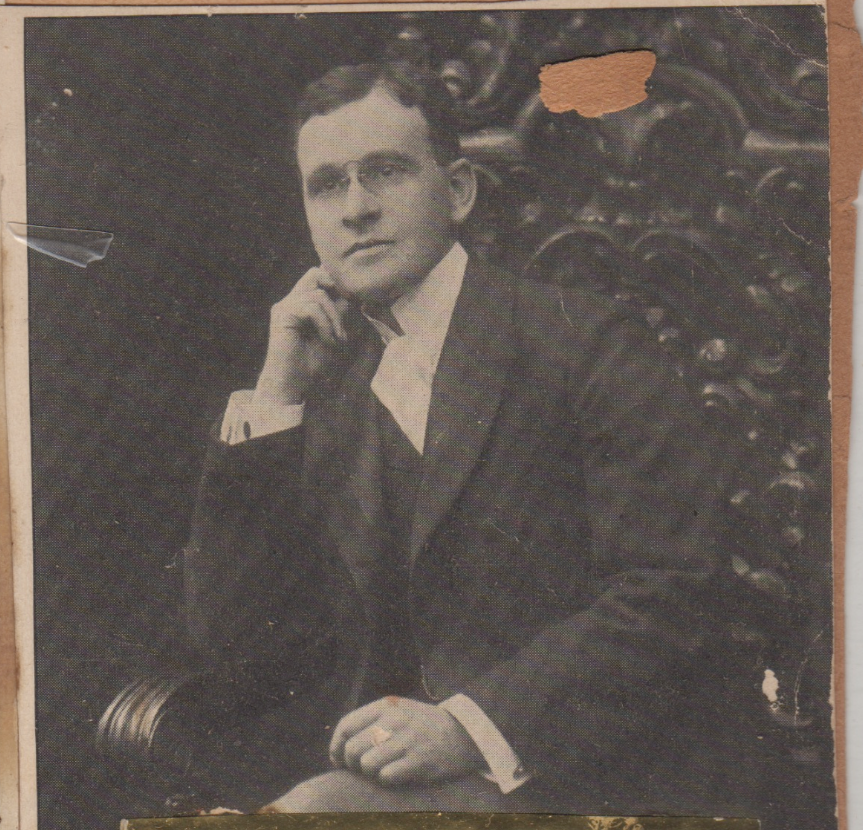
I would think that this photograph of Milton was taken about the same time as the publication of that biography, sometime in the 1890s when he was in his thirties:

This entry about him in Who’s Who was written many years later as it references some of his later publications, including his play, The Little Brother, which was published in 1918.

What I really love about this Who’s Who entry are the insights into Milton’s appearance and personality—that he had blue eyes, a fair complexion, and graying hair, that he was cheerful and optimistic, and that he was a moderate drinker and did not smoke. Most of the other biographical and professional information I had already gleaned from other sources. (There are a fair number of blog posts about Milton’s life and career, e.g., here, and here and here and here and here.)

Speaking of The Little Brother, the next page in Milton’s album is a copy of the program from a performance of that play in 1918:

I had previously written about this play and Tyrone Power’s starring role in it.

Finally, the third page compiled three reviews of a play (undated) in which Milton’s wife Sophie had an important role. The play, The Flight of the Duchess, by Henry Hanby Hay, was an adaptation of a “poetic romance” by Robert Browning and performed by the local Browning Society, a amateur group.

In the article on the left side of the page, the reviewer did not like either the play or the performers, but did praise Sophie’s acting, saying, “Mrs. Goldsmith’s reading of her lines was marked by a distinction and sense that had been welcomed in her associates….”

The second review, at the middle bottom of the page, was overall much kinder and also praised Sophie’s performance as “a striking piece of work.” And the third review, on the right side of the page, was more mixed, but again praised Sophie, saying that “The chief individual honors of performance fell to Mrs. Milton Goldsmith.”

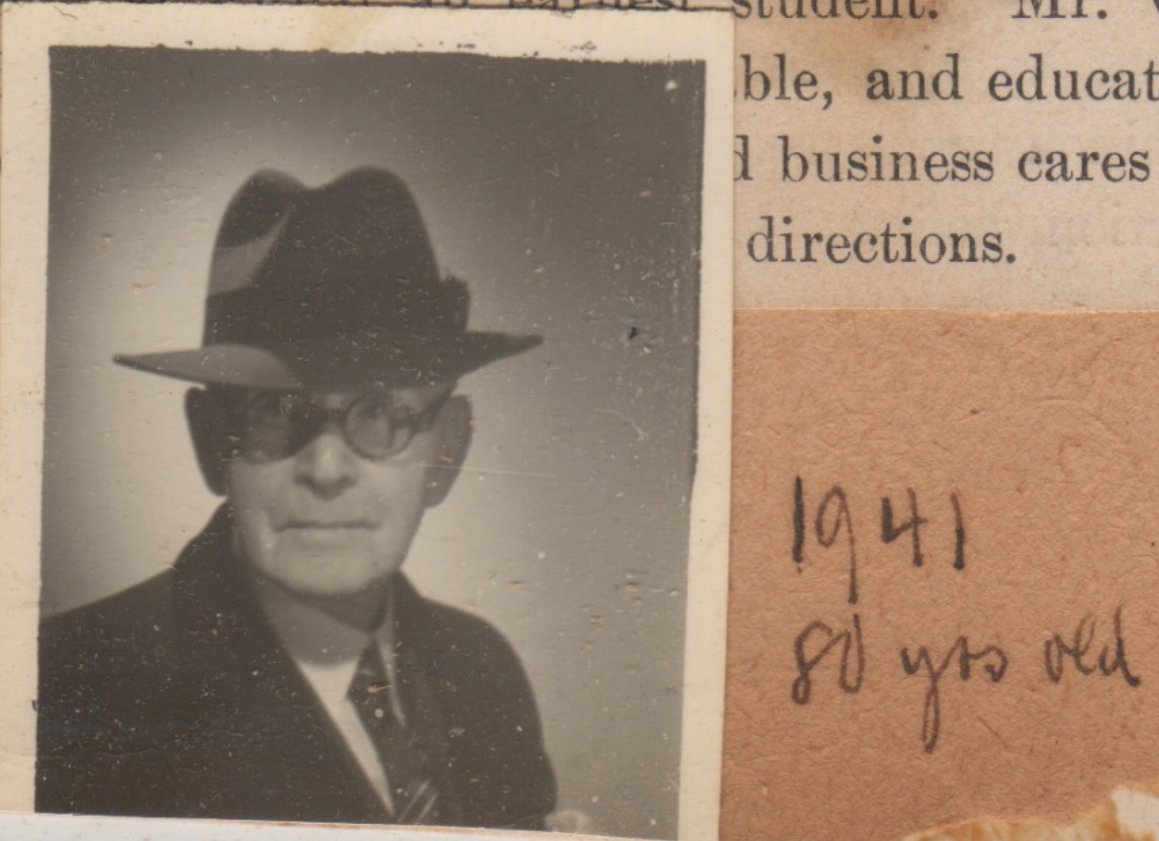
These three pages about Milton and his wife Sophie are appropriate reminders of their many talents. Here is one final photograph of Milton, taken in 1941 when he was eighty years old:

This is Part XIII of an ongoing series of posts based on the family album of Milton Goldsmith, generously shared with me by his granddaughter Sue. See Part I, Part II, Part IIIPart IVPart V,  Part VI, Part VII , Part VIII,  Part IX,  Part X, Part XI and Part XII at the links.

Milton Goldsmith’s Family Album, Part XII: The Mystery of His Stepmother Francis

Will you help me solve a mystery?

The next page in Milton Goldsmith’s family album was devoted to his stepmother, Francis (sometimes spelled Frances) Spanier Goldsmith. But his story about her background and childhood left me with quite a mystery.

Milton was fifteen when his father remarried, and from this tribute to Francis, it is clear that he was extremely fond of and grateful to her.

Francis Spanier Goldsmith, the second wife of Father, Abraham Goldsmith, was born in Germany in 1854. Left an orphan at an early age, she was brought up in the home of Rabbi Krimke of Hanover, Germany. At the age of 20 she came to America, and having an Uncle, Louis Spanier, living in Washington, D.C. she went there for a while but soon settled in Baltimore, and became friends with our cousins, the Siegmunds. It was there that father met her, having been introduced by Mr. S. Father had been a widower for two years with five young children to bring up, and was looking for a wife, a lady with no relatives. He fell in love with Miss Spanier, proposed after two days and married within two months. She was 22 and he past forty. She was an attractive girl, dark-eyed, brunette, speaking a cultivated German but very little English;- of an amiable disposition. Father’s greatest mistake was to keep the parents of his first wife in the house. This naturally led to friction. A brother, Julius Spanier soon came in our home and lived there for a while. Later a sister, Rose, came from Hanover and also lived with us for several years. She eventually married and lived in Birmingham, Ala, where her brother also made his home. Within a year the oldest son, Alfred was born, and within five years there came Bertha, Alice and Louis. The later years of father’s life were embittered by sickness, loss of money and finally a stroke, rendering him helpless. He suffered for 12 years before he passed away in 1902. During that time Francis was an untireing [sic] nurse and faithful companion. She died of a stroke in Philada, 1908.

[handwritten underneath] She was distantly related to Heinrich Heine.]

I found this essay heartwarming, but also sad. Francis was orphaned, married a man  with five children who was more than twenty years older than she was, had to put up with his first wife’s parents, raise five stepchildren plus four of her own, and tend to Abraham when he suffered financial and medical problems. What a hard life! But how much of Milton’s essay was true?

When I first wrote about Francis over a year ago, I noted that I’d been able to find very little about her background, so finding this essay was very exciting because it provided many clues about Francis’ background. I’ve placed in bold above the many hints in Milton’s essay about people and places that I thought might reveal more about Francis.1

For example, who was Rabbi Krimke who allegedly brought up Francis? Was he just some rabbi from Hanover, or did Milton provide such a specific name because he was a well-known rabbi? It turns out that it was the latter. In Die Rabbiner der Emanzipationszeit in den deutschen, böhmischen und großpolnischen Ländern 1781-1871 (Michael Brocke, Julius Carlebach, Carsten Wilke, Walter de Gruyte, eds. 2010)( p. 549), there was this short biography of Rabbi Isaac Jakob Krimke of Hanover:

Here is a partial translation:

Rabbi Isaak Jakob Krimke, born in Hamburg in 24 June 1824, died in Hannover 20 Nov 1886. From orthodox school, 1857 third foundation rabbi at the Michael Davidschen Foundation School in Hannover, at the same time teacher at the Meyer Michael Foundation School and lecturer at the Jewish Teacher seminary, around 1869 first Foundation Rabbi. at the Michael Davidschen Foundation. Married to Rosa Blogg (died 1889), daughter of the Hebrew scholar Salomon Ephraim B.  ….  Was buried in the Jewish cemetery An der Strangriede. The tombstone for the foundation rabbi Isaac Jakob Krimke is preserved; it is adorned with a Magen David and also decorated with strong oak leaves….

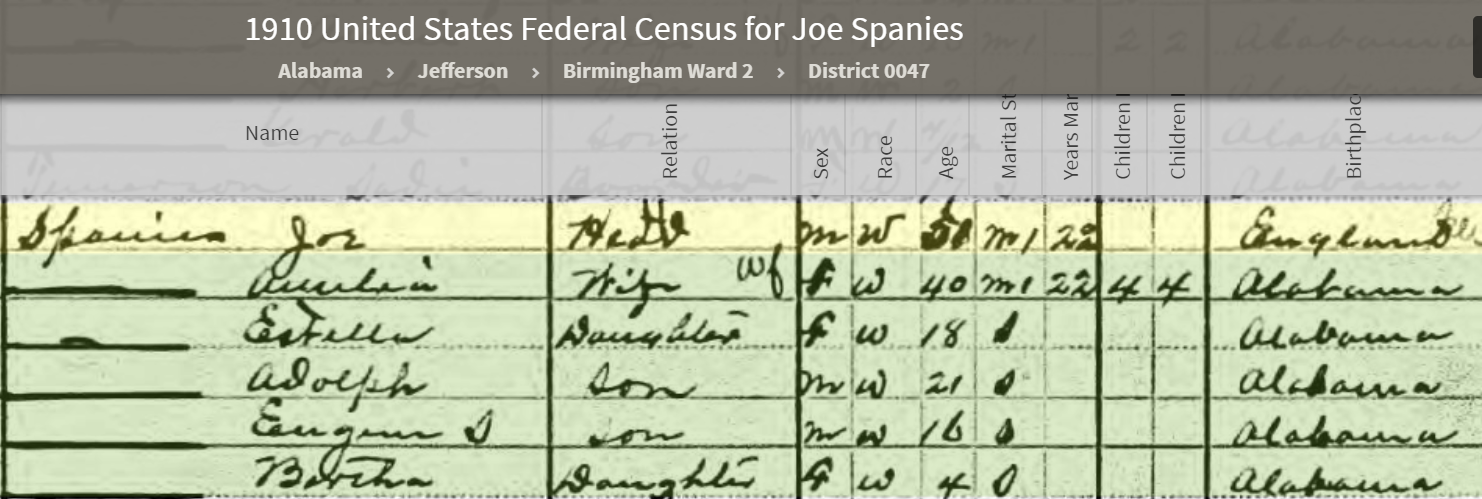
I then fell into a very deep rabbit hole when I tried to track down Louis, Julius, and Rose Spanier, Francis’ uncle, brother, and sister, respectively. I was able to find a Joseph Spanier living with his wife and family in Birmingham, Alabama, on the 1910, 1920 and 1930 census reports.2  But Joseph Spanier was born in England, according to all three census records. I was skeptical as to whether this was Julius Spanier, the brother of Francis Spanier Goldsmith living in Birmingham, as mentioned in Milton’s essay.

Jos. Spanier and family, 1910, US census, Census Place: Birmingham Ward 2, Jefferson, Alabama; Roll: T624_18; Page: 14A; Enumeration District: 0047; FHL microfilm: 1374031
Ancestry.com. 1910 United States Federal Census

But when I searched further for Julius Spanier, I found this page from the 1861 English census:

Spanier family, 1861 English census, Class: RG 9; Piece: 243; Folio: 61; Page: 28; GSU roll: 542598
Enumeration District: 20, Ancestry.com. 1861 England Census

This certainly appears to be the same man described in Milton’s essay and found on the census records for Birmingham, Alabama, as he was the right age, born in England, and had two sisters, one named Frances, one named Rose. Could it just be coincidence? Also, my Francis was the same age as the Frances on the 1861 English census. This certainly appeared to be the same family as the Spanier family described in Milton’s essay about his stepmother.

What really sealed the deal for me were the names of Joseph Spanier’s children in Birmingham, Alabama. His first child was Adolph; Julius Spanier’s father on the 1861 census was Adolphus. Julius Spanier’s mother was Bertha. Joseph Spanier also had a daughter named Bertha.

And consider the names of the first two children Francis Spanier had with Abraham Goldsmith: a son named Alfred, a daughter named Bertha. It all could not simply be coincidence. I hypothesized that Joseph Spanier was born Julius Spanier in England to Adolphus and Bertha Spanier and that Francis Spanier Goldsmith was his sister.

But then things got murky. Look again at the 1861 English census. It shows that Frances was not born in Germany, but in Boston—in the US. Every American record I had for Francis indicated that she was born in Germany, not the United States. How could I square that with the 1861 English census and the connection to the siblings mentioned in Milton’s essay—Julius and Rose?

And if Frances was born in Boston and living in England in 1861, is it really possible that she did not speak much English when she met Abraham in 1876, as Milton claimed in his essay?

Spanier family, 1861 English census, Class: RG 9; Piece: 243; Folio: 61; Page: 28; GSU roll: 542598
Enumeration District: 20, Ancestry.com. 1861 England Census

Then I found a birth record for Frances Spanier born in Boston to “Radolph” and Bertha Spanier on September 10, 1854. “Radolph” was clearly a misspelling of Adolph, and this had to be the same Frances Spanier who appeared on the 1861 English census.  Francis Spanier Goldsmith had a birth date of September 13, 1855, on her death certificate, so just a year and few days different from this Boston birth record (though the death certificate said she was born in Germany.)

“Massachusetts Births, 1841-1915,” database with images, FamilySearch (https://familysearch.org/ark:/61903/3:1:S3HT-XHB7-DJH?cc=1536925&wc=M61J-KNL%3A73565601 : 1 March 2016), 004023162 > image 102 of 857; Massachusetts Archives, Boston.

Frances Spanier Goldsmith death certificate
Pennsylvania Historic and Museum Commission; Pennsylvania, USA; Certificate Number Range: 006001-010000, Ancestry.com. Pennsylvania, Death Certificates, 1906-1966

I also found records showing that Francis Spanier Goldsmith’s uncle Louis was living in Boston in the 1850s.3 It certainly seemed more and more like Francis Spanier Goldsmith was born in Boston, not Germany, as Milton had written and American records reported.

What about the story that she was an orphan and raised by Rabbi Krimke? Francis’ mother Bertha died in England in 1862,4 when Francis was seven or eight years old, so she was partially orphaned as a child. But her father Adolphus died in England in 1873, so Francis was eighteen or nineteen when he died.5 But when Francis immigrated to the US in 1876, the ship manifest stated that she was a resident of Germany, not England.

Franziska Spanier, Year: 1876; Arrival: New York, New York; Microfilm Serial: M237, 1820-1897; Microfilm Roll: Roll 403; Line: 1; List Number: 344, Ancestry.com. New York, Passenger and Crew Lists (including Castle Garden and Ellis Island), 1820-1957

Was Milton’s story just a family myth, or was there some way to reconcile it with these records?

Here is my working hypothesis:

After Bertha Spanier died in 1862, Adolphus was left with five  young children. Francis (then seven or eight) and at least some of her siblings were sent to Hanover, Germany, to live with Rabbi Isaak Jakob Krimke, as the family story goes. By the time Francis immigrated to the US fourteen years later, she might have forgotten most of the English she once knew, so she was speaking only German, and the Goldsmith family only knew that she was an orphan who had come from Germany so assumed she was born there, and the family myth grew and stuck.

How ironic would it be if Francis was, like Milton and his siblings, a child whose mother died, leaving her father with five young children? After all, Francis also ended up marrying a man whose first wife died, leaving him with five young children. Francis may have saved her stepchildren from the fate she might have suffered—being taken away from her father after her mother died and sent to live in a foreign country  with a stranger, who happened to be a well-known rabbi.

What do you think? Am I missing something here? Where else can I look to try and solve this mystery?

This is Part XII of an ongoing series of posts based on the family album of Milton Goldsmith, generously shared with me by his granddaughter Sue. See Part I, Part II, Part IIIPart IVPart V,  Part VI, Part VII , Part VIII,  Part IX,  Part X and Part XI at the links.


  1. I also spent far too much time trying to track down the Siegmund family of Washington, DC, whom Milton described as his cousins. I had no luck figuring this one out and finally forced myself to stop looking. I also resisted the temptation to try and track down the distant connection between Francis Spanier and Heinrich Heine, the great nineteenth century German-Jewish poet. 
  2. Jos. Spanier, 1910 US census, Census Place: Birmingham Ward 2, Jefferson, Alabama; Roll: T624_18; Page: 14A; Enumeration District: 0047; FHL microfilm: 1374031, Ancestry.com. 1910 United States Federal Census; Joe Spanier, 1920 US census, Census Place: Birmingham, Jefferson, Alabama; Roll: T625_25; Page: 21A; Enumeration District: 99, Ancestry.com. 1920 United States Federal Census; Joseph E. Spanier, 1930 US census, Census Place: Birmingham, Jefferson, Alabama; Page: 32B; Enumeration District: 0071; FHL microfilm: 2339762, Ancestry.com. 1930 United States Federal Census 
  3. Birth record for Clara Spanier, daughter of Louis Spanier, Massachusetts Births, 1841-1915,” database with images, FamilySearch (https://familysearch.org/ark:/61903/1:1:FXDT-91R : 11 March 2018), Clara Spanier, 01 Oct 1855, Boston, Massachusetts; citing reference ID #p72 #3222, Massachusetts Archives, Boston; FHL microfilm 1,428,236. 
  4. Bertha Spanier death record, Inferred County: London, Volume: 1c, Page: 147, FreeBMD. England & Wales, Civil Registration Death Index, 1837-1915 
  5. Adolphe Spanier death record, Inferred County: London, Volume: 1d, Page: 577, FreeBMD. England & Wales, Civil Registration Death Index, 1837-1915 

Milton Goldsmith’s Family Album, Part XI: Tributes to His Father Abraham

This is Part X of an ongoing series of posts based on the family album of Milton Goldsmith, so generously shared with me by his granddaughter Sue. See Part I, Part II, Part IIIPart IVPart V,  Part VI, Part VII , Part VIII,  Part IX and Part X at the links.

The next two pages in Milton Goldsmith’s family album focus on his father Abraham. The first of those two pages consists of newspaper articles about Abraham.

Unfortunately I do not know the actual papers from which these articles were clipped, but this obituary was dated within the week after Abraham’s death on January 27, 1902, in Philadelphia:

Abraham was certainly active in his community.  How he had the time while raising all those children and earning a living is bewildering.

The next article that appears on this page relates to a tribute paid to Abraham by United Hebrew Charities at the time of his death:

The next article must have been published while Abraham was still alive. It relates to a resolution adopted by United Hebrew Charities to honor Abraham at the time he resigned from his position as secretary of that organization. Unfortunately the clipping is not in good condition and some of the words are not legible.

The second page of Milton’s tributes to his father Abraham has some items that are more personal.

This biography appears on that page. Again, Milton did not indicate where or when this was published:

This note written by Abraham when his wife Cecelia died seems almost journalistic in tone except for the opening and the last sentence:

My dear Cecilia died on Nov 8th 1874 after a short illness.

She complained of not feeling well on Monday evening the 2nd [?] but did not get [?] sick until the 5th in the PM. 

She was buried on Thursday the 12th November 11 o’clk am at Mount Sinai Cemetery.

Peace to her asked.

To the left and under Abraham’s note about his wife’s death, there is a poem by Milton written sometime in the 1890s, long after his mother died:

I assume this poem was somehow inspired by Milton’s experience losing his mother when he was just thirteen.

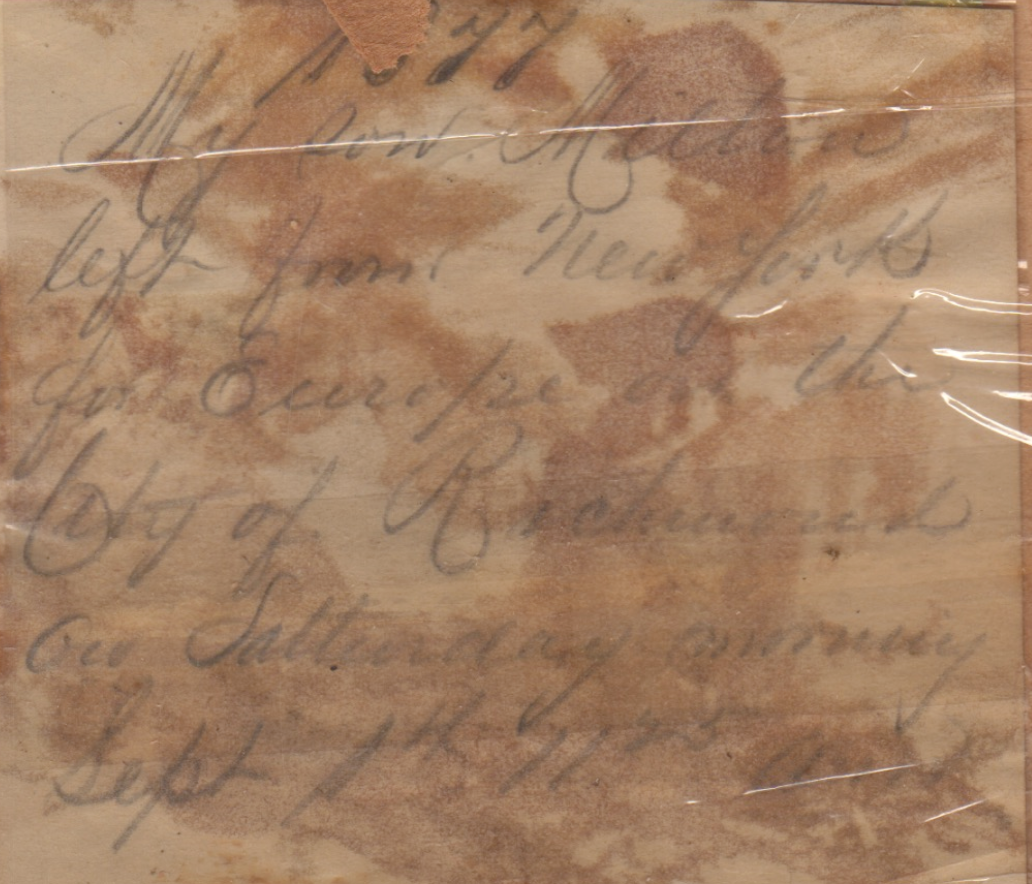
Under the poem he pasted this note written by his father Abraham in 1877:

My son Milton left from New York for Europe on the City of Richmond on Saturday morning Sept [?] 11:25

I do wonder whether there is some connection between the poem and the note. Anyone have any ideas?

The remaining two notes are in German.  I turned to the German Genealogy group for help.

The first note is dated around the same time as the note about Milton’s trip to Europe, September 1877:

The members of the German Genealogy group transcribed this as follows, “Gott sei mit dir! Der liebe Gott behüte und beschütze dich und gebe dir seinen Segen. Amen”

And translated it as, “May God be with you! May the good God keep and protect you and give you His blessing. From your father, Abr(aham) Goldsmith.”

Alfred, Abraham’s first child with Francis, his second wife, was born on August 11, 1877, just 20 days before Abraham wrote this note. I assume this was a prayer for his newborn son. I wonder where it had been kept that Milton found it and preserved it for posterity.

And then finally there is this note:

This one was transcribed by a German Genealogy group member as, “Auf Alle deiner Wegen, bleib Tugendhaft und rein; dann wird der himmlische Segen, stets deine Begleiter sein. Dein Papa, Abr. Goldsmith”

That translates to, “In all your ways, remain virtuous and pure, then heavenly blessings will always be your companions. Your papa, Abr. Goldsmith.”

As this one is dated 1880, I think Abraham wrote this blessing for his daughter Alice, who was born on August 29, 1880.

I wonder whether Abraham wrote these notes of blessing for each of his many children and if so, why only these two have survived. And where did he keep them that Milton found them and preserved them so that they could be read on the internet almost 140 years later?

Milton Goldsmith’s Family Album, Part X: A Son’s Loving Tribute to His Mother

This is Part X of an ongoing series of posts based on the family album of Milton Goldsmith, so generously shared with me by his granddaughter Sue. See Part I, Part II, Part IIIPart IVPart VPart VI, Part VII , Part VIII,  and Part IX at the links.

This is by far the sweetest and saddest page in Milton Goldsmith’s album, a page dedicated to his beloved mother, Cecelia Adler Goldsmith, who died in 1874 when Milton was thirteen years old:

It reads:

Our beloved Mother, who alas, passed away too early and whose death brought not only sorrow, but all kinds of misfortune.

She was the only child of Samuel and Sarah Adler, was born in Germany, but arrived in Philadelphia at the age of one year.  She grew to womanhood, a very beautiful girl;- rather short in stature, round in figure, a head of brown ringlets, – a belle among the Jewesses of her day and circle. She had many admirers.  Father proposed to her over a plate of ice-cream on “Simchas Torah”, a Jewish holiday.  It was in every way a “Love-match” which was only terminated at her death.  She died of peritonitis, which to-day would be called Apendicitis [sic]. A perfect wife, – a wonderful mother, – A woman whose children call her blessed.

She died Nov. 8th 1874, at the age of 35 years. I was 13 at the time of her death, the oldest of six children.

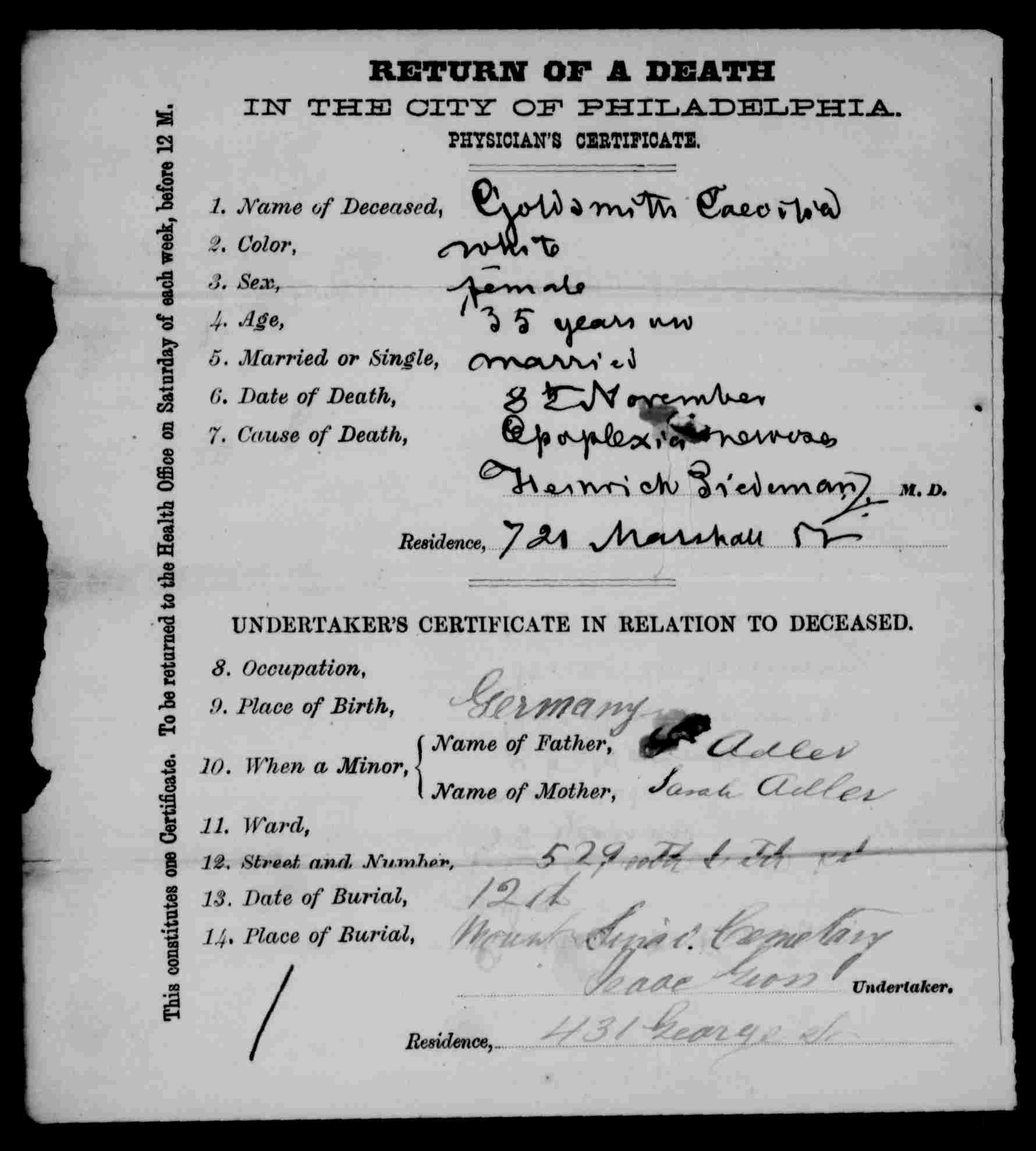
It’s interesting to read what Milton thought was the cause of his mother’s death, which conflicts with her death certificate. According to the death certificate, she died from apoplexia nervosa:

“Pennsylvania, Philadelphia City Death Certificates, 1803-1915,” database with images, FamilySearch (https://familysearch.org/ark:/61903/3:1:S3HT-69HW-K75?cc=1320976&wc=9F52-L29%3A1073307201 : 16 May 2014), 004010206 > image 874 of 1214; Philadelphia City Archives and Historical Society of Pennsylvania, Philadelphia.

In the upper left corner, Milton inserted a piece of Cecelia’s wedding veil:

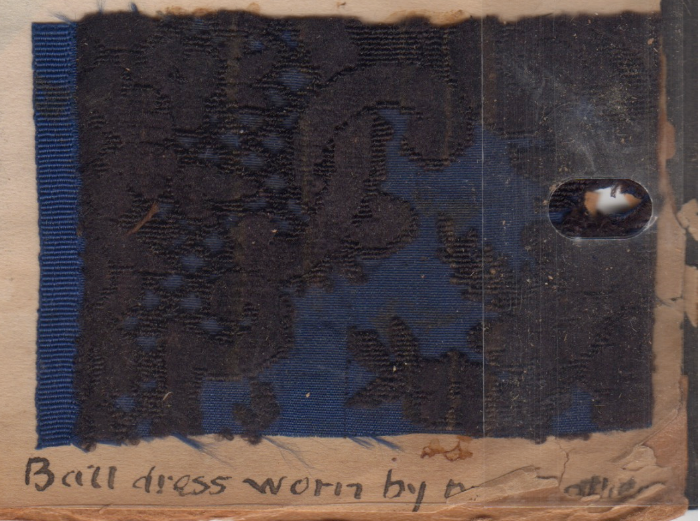
In the lower right corner, he inserted a piece of fabric from one of her ball gowns.

What a sweet and sentimental thing for a son to do. How devastated he and his father and siblings must have been when Cecelia died.


Milton Goldsmith’s Family Album, Part IX: The Missing Babies

This is Part IX of an ongoing series of posts based on the family album of Milton Goldsmith, so generously shared with me by his granddaughter Sue. See Part I, Part II, Part IIIPart IVPart V,  Part VI, Part VII,  and Part VIII at the links.

After reading last week’s post about the birth records found in her grandfather’s family album and the speculation as to why only five of Abraham Goldsmith’s ten children were listed, my cousin Sue went back to the album and realized that she could remove the page with the birth records. On the back were not only birth records for Abraham’s other five children; there was also a sad entry for the death of his first wife Cecelia:

All of the birth entries again confirmed what I’d found in the official records, and once again Abraham entered not only the dates, but the times the babies were born.

For Estella, who often was referred to in records as Estelle, he introduced her as “our sixth baby.”

Then there is the heartbreaking entry for Cecelia:

My beloved wife Cecelia Goldsmith died on Sunday the 8th day of November 1874 at 6 o’clock PM after an illness of 6 days. Hebrew date [inserted in Hebrew]

May she rest in peace.

Abr.Goldsmith

Abraham’s signature here confirmed my hunch that he was the one who wrote all these entries (except the dates of death that occurred after his own death).

The next entry is for Alfred, who was Abraham’s first child with his second wife, Frances Spanier, But there is no break in the record to reflect that Alfred had a different mother from the first six children. He is introduced as “Our seventh boy” [emphasis added], despite the fact that he is the first child of Frances. You may notice that Alfred is the only one on this page who has a date of death.  That’s because those dates were entered by Milton, and the other four on this page—Estella, Bertha, Alice, and Louis—all outlived Milton.

Similarly Bertha is introduced as “Our Baby Bertha.” Then Abraham records the birth of “Baby Alice,” and finally the last child, Louis Seligman. At the end of the entry for Louis, Abraham wrote, “Louis Spanier his [?].”

Can anyone decipher what that says? From a later page in the album I learned who Louis Spanier was—Frances Spanier’s uncle—so Louis Goldsmith’s great-uncle. But that does not say “great-uncle” or “namesake” as far as I can tell.

And I got quite a kick out of the last word on this page: Finished. I don’t know whether Abraham wrote that to indicate the records were now completed or to emphasize that he was ready to be done having children after Number 10!


Milton Goldsmith’s Family Album, Part VIII: Birth Records

This is Part VIII of an ongoing series of posts based on the family album of Milton Goldsmith, so generously shared with me by his granddaughter Sue. See Part I, Part II, Part IIIPart IVPart VPart VI and Part VII at the links.

This record of the births of five of the children of Abraham Goldsmith and Cecelia Adler touched my heart.

I love the florid old script.  Who wrote these entries? Was it Abraham or Cecelia? I wasn’t sure at first, but I was reassured by this record that all the dates I had for the births (and deaths) of these five children were correct.  I loved that the writer added the time of birth, giving a personal touch to the facts.

For the first two entries, there are also Hebrew inscriptions. Thank you to Tracing the Tribe for helping me with these.  For Milton, it says “Mendel Goldsmith born 12 Sivan  5621.” Milton had mentioned on an earlier page that Mendel was his Hebrew name given to him in memory of his maternal grandfather.

The second entry is for Hildegard or Hilda, as she was called on the records I found. How sweet to see the formal name her parents gave her. Hilda died two months before her fourteenth birthday, as I wrote here and as noted on this record. Looking at this entry more carefully, I noted that whoever wrote the entry for her death had also written the entry for her birth.  It is the same handwriting.  And since her mother Cecelia had died in 1874, two years before Hilda died on June 7, 1876, that means that Abraham wrote this entry and all the other birth entries on this record.

No one on Tracing the Tribe was able to translate the Hebrew inscription for Hildegard except to say that it also states her birth date. Her Hebrew name was not legible. I guess Abraham’s Hebrew writing had deteriorated between Milton’s birth and Hilda’s. And the fact that he did not include any Hebrew for the next three children’s birth records may be a sign of his assimilation into secular American society.

It’s also interesting to see how Abraham introduced these entries.  Milton was “our boy.”  Hildegard was “our daughter.” Edwin has no descriptive introduction, nor does Emily, but Rosalinda is “our fourth baby.” (I also never knew that Rose was formally named Rosalinda—what a beautiful name!) I wonder whether Abraham wrote each of these at the time the baby was born or all at once. Since some of these have introductions and others do not, I think each was done separately when each baby was born.

For the last three entries—for Edwin, Rosalinda, and Emily—someone other than Abraham inscribed the information about their deaths. I assume Milton added this information as he outlived all three of those siblings. And there is no death date added to the entry made for Milton.

What is perhaps most perplexing about this page from Milton’s album is the absence of an entry for Abraham and Cecelia’s sixth child, Estelle. Estelle was born on January 20, 1870. Had Abraham lost interest in recording his children’s births by the time his sixth child was born? Or was there a second page that included Estelle (and perhaps Abraham’s four children with his second wife Frances Spanier) that somehow was lost and thus not included in Milton’s album?


Milton Goldsmith’s Family Album, Part VII: Abraham Goldsmith and Cecelia Adler Get Married

This is Part VII of an ongoing series of posts based on the family album of Milton Goldsmith, so generously shared with me by his granddaughter Sue. See Part I, Part II, Part III, Part IV, Part V, and Part VI at the links.

On the page following the photographs of his parents Abraham and Cecelia, Milton included a letter written by his mother on November 5, 1857, which, according to Milton, was shortly before their engagement.

Reading this reminded me of what it was like before cheap phone calls and email made handwritten letters obsolete. When my husband and I were dating the year before our engagement, we also wrote letters back and forth. Of course, we were living several hundred miles apart (but still tried to see each other every weekend) whereas Abraham and Cecelia both were living in Philadelphia. But perhaps letters were the only places they had any ability to communicate privately.

Here is Cecelia’s letter:

Some words were cut off on the right margin and at the bottom, but I have tried to transcribe it as best I can and added some punctuation and capitalization for purposes of clarity. Cecelia was a few weeks short of her nineteenth birthday when she wrote this letter, and Abraham was twenty-five.


                                                                                                         Phil. Nov. 5th

Dear Ab,

The few lines you have written to me give me a great deal of pleasure, for informing me of your health & good night’s rest. I passed an excellent night as[?] my cold is a great deal better though I am rather hoarse yet.  My Dear, I forgot to give you Henrietta’s [?] shawl last night, but it will and[?] as well tonight. I would send over the boy with it, but I am afraid he can not find the place. I am obliged for sending me the book & will look through it as soon as possible. Come early this evening, if you can.

I remain yours forever,

                                                                                                         Cely

If you hear of any thing important & have time, write me a note this [?].


If anyone can read it any better than I did, please let me know.

Appropriately, Milton placed the invitation to his parents’ wedding on the page that followed:

Note that the invitation is dated January 1, 1858, for a wedding to take place on January 27, 1858—less than four weeks later. Today it seems that wedding invitations arrive at least two months in advance (often preceded by Save the Date cards). Also, the wedding was to take place at Cecelia’s parents’ home at 440 North Second Street in Philadelphia, not in a fancy catering hall or hotel or resort, as many are these days. Life was so much simpler back then.

But life was also so much harder. Cecelia died less than seventeen years later on November 8, 1874, from apoplexia nervosa, or a stroke. She was only 35 and left behind her husband Abraham and six children ranging in age from Estelle, who was four, to Milton, who was thirteen.

Milton Goldsmith’s Family Album, Part VI: His Parents, Abraham and Cecelia

This is Part VI of an ongoing series of posts based on the family album of Milton Goldsmith, so generously shared with me by his granddaughter Sue. See Part I, Part II, Part III, Part IV and Part V at the links.

Now that we have seen the pages Milton devoted to his maternal and paternal grandparents, we can turn our attention to those devoted to his parents, Abraham Goldsmith and Cecelia Adler.

First, there is this page:Although they are not labeled, the paired photographs at the bottom must be Cecelia Adler and Abraham Goldsmith. I know this because the photograph on the upper right is one I’ve seen before—I received it from my cousin Julian Reinheimer over a year ago,  labeled as Julian’s great-grandfather, Abraham Goldsmith. So I know that the upper photograph is Abraham, and he is certainly the same man as the man in the photograph at the lower right.

Abraham Goldsmith, courtesy of Julian Reinheimer

I also know that the woman on the left is Cecelia because Julian also sent me this photograph of his great-grandmother Cecelia, and she is the same woman as the woman on the left in the photograph above:

Cecelia Adler, courtesy of Julian Reinheimer

Could the two framed photographs be their wedding photographs?

Cecelia was only nineteen in 1858 when they married, Abraham was six years older or twenty-five. Somehow they look older than that in these photographs, but I am terrible at determining age in these old photographs when people dressed so formally and posed so stiffly without smiling. It’s obvious, however, that these two photographs were taken at the same studio and likely at the same time, given that the same table appears in both. I wonder if there was a date on the reverse, but it is not worth trying to remove the photograph from the album to check.

According to Milton, his grandfather Samuel Adler was not successful in business, but Cecelia certainly is dressed very well in this photograph and is wearing what appears to be a large cameo pendant, similar or perhaps the same as the one in the photograph I received from Julian, seen above. Was this taken after she married Abraham, who was in fact very successful in business? Which photograph appears to be earlier?

Cecelia Adler Goldsmith, courtesy of Sue Jacobson

Finally, there is the photograph labeled “The Homestead in Oberlistingen.” This must have been the house where Abraham and his family lived before he and almost all his siblings immigrated to the United States beginning in the 1840s. So who is the woman standing on the stairs in front of the house? My first hope was that this was Hinka Alexander Goldschmidt, my three-times great-grandmother and Abraham Goldsmith’s mother, Milton’s paternal grandmother.

But then I realized this could not be Hinka. She died in 1860. This looks like a casual snapshop, and thus not something that could have been taken in those early days of photography. In fact, according to the Smithsonian:

Photography emerged in the early 19th century, but well into the 1880s it was a difficult, ponderous thing to do. The reigning forms of photography recorded onto chemically treated plates and paper. Taking a picture required the subjects to sit still for a half minute or more—“torture,” as the social critic Walter Benjamin recalled. Families trooped into studios to get portraits taken, but they were a study in stiffness: everyone sitting ramrod straight, afraid to move—or even to change their expression—for fear of blurring the photo.….Things changed dramatically in 1888 when George Eastman introduced the Kodak camera. A small hand-held box, it cost only $25—about the price of a higher-end iPad in today’s money, which put it in the range of the well-off middle class. And it offered simplicity…

So much to my disappointment, I concluded that this was not Hinka, but some other woman posing on the front steps of what had been the Goldschmidt home in Oberlistingen.

Milton did not write much about Hinka, mentioning her only to say that several girls in the family were named for her (including my great-grandmother Hilda Katzenstein Schoenthal, who was the daughter of Eva Goldschmidt Katzenstein and granddaughter of Hinka Alexander Goldschmidt). Milton obviously never met his grandmother Hinka, who never left Germany and died a year before Milton was born. And unlike the heroic war stories passed down about his grandfather Seligmann Goldschmidt, there were likely no such stories shared about his grandmother. Like women of those times, her life was not in the public sphere, but in the home. So all we know about her is when she was born, who she married, what children were born to her and raised by her, and when she died.

It’s thus not surprising that my heart wanted that to be a photograph of Hinka standing in front of her home, but alas, my brain knew otherwise. I do, however, have this photograph or drawing of Hinka, provided by David Baron and Roger Cibella, who is also her descendant:

Hinka Alexander Goldschmidt. Courtesy of David Baron and Roger Cibella

Jacob Goldsmith, The final chapter: What happened to his son Frank?

As of 1930, only six of Jacob Goldsmith’s fourteen children were still living: Annie, Celia, Frank, Rebecca, Florence, and Gertrude. As seen in my prior posts, Eva died in 1928. In addition, I have written about the deaths of Gertrude in 1937 and Rebecca in 1940. There remain therefore just four siblings to discuss, and by 1945, they were all deceased.

Annie and Celia, the two oldest remaining siblings, both died in 1933. Celia, who’d been living with her sister Florence and her family in 1930, died on January 15, 1933, in Denver, and was buried in Philadelphia on January 18, 1933. She was 73 years old.  Celia never married and has no living descendants.1

Her sister Annie died four months later, on May 29, 1933, in San Francisco.2 She was 77 and was survived by her three children, Josephine, Harry, and Fanny. Sadly, Harry did not outlive his mother by much more than a year. He died at 53 on August 4, 1934, in San Francisco.3 He was survived by his wife Rose, who died in 1969, and his two sisters, Josephine and Fanny. But Josephine also was not destined for a long life. She died less than three years after her brother Harry on April 23, 1937; she was 59. Like their father Augustus who’d died when he was fifty, Josephine and Harry were not blessed with longevity.

Find A Grave, database and images (https://www.findagrave.com : accessed 05 March 2019), memorial page for Fannie Mendelsohn Frank (unknown–1 Sep 1974), Find A Grave Memorial no. 100371723, citing Home of Peace Cemetery and Emanu-El Mausoleum, Colma, San Mateo County, California, USA ; Maintained by Diane Reich (contributor 40197331) .

Of Augustus and Annie’s children, only Fanny lived a good long life. She was 93 when she died on September 1, 1974.4 According to her death notice in the San Francisco Chronicle, she had been a dealer in Oriental art objects.5 Like Josephine, Fanny had never married and had no children, nor did their brother Harry. Thus, there are no living descendants of Annie Goldsmith Frank.

Find A Grave, database and images (https://www.findagrave.com : accessed 05 March 2019), memorial page for Fannie Mendelsohn Frank (unknown–1 Sep 1974), Find A Grave Memorial no. 100371723, citing Home of Peace Cemetery and Emanu-El Mausoleum, Colma, San Mateo County, California, USA ; Maintained by Diane Reich (contributor 40197331) .

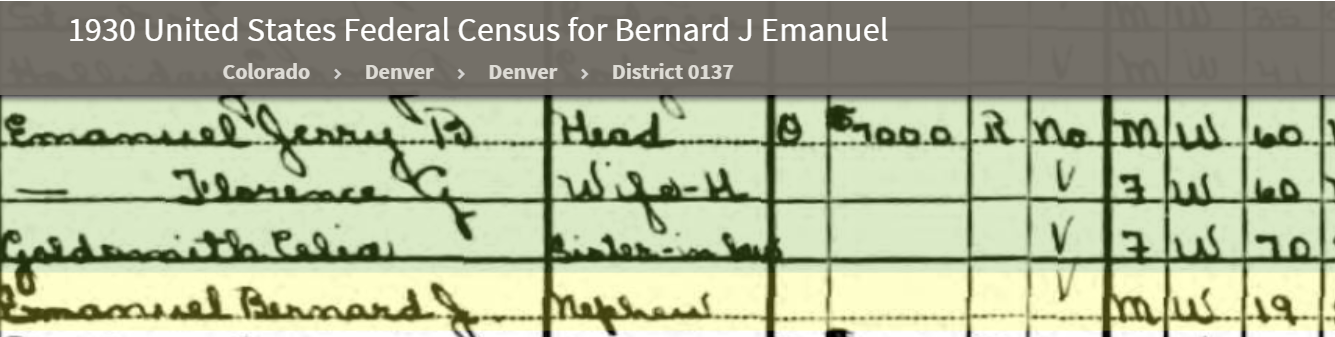
The third remaining child of Jacob Goldsmith was Florence Goldsmith Emanuel. In 1930, Florence was living with her husband Jerry Emanuel in Denver as well as their nephew Bernard, the son of Gertrude Goldsmith and Jacob Emanuel, and Florence’s sister Celia. Jerry was working as a clerk in a wholesale tobacco business. In 1940, they were still living in Denver, now with Jerry’s sister Grace in their home, and Jerry was working as a salesman for a wholesale liquor business.6

Emanuel family, 1930 US census, Census Place: Denver, Denver, Colorado; Page: 2A; Enumeration District: 0137; FHL microfilm: 2339973
Ancestry.com. 1930 United States Federal Census

Florence Goldsmith Emanuel died on August 4, 1942, at the age of 73. Her husband Jerry survived her by another seventeen years. He died on June 16, 1959, and is buried with Florence in Denver. He was 89. Florence and Jerry did not have children, so like so many of Florence’s siblings, there are no living descendants.7

That brings me to the last remaining child of Jacob Goldsmith and Fannie Silverman, their son Frank. In 1930, Frank and his wife Barbara were living in Atlantic City, and Frank was retired.8 On July 25, 1937, Barbara died in Philadelphia; she was 67. Like Frank’s parents and many of his siblings, she was buried at Mt Sinai cemetery in Philadelphia; in fact, she was buried in the same lot as Celia and Rachel Goldsmith and one lot over from her in-laws Jacob and Fannie Goldsmith.9

I mention this because for the longest time I was having no luck finding out when or where Frank Goldsmith died or was buried. In 1940, he was living as a widower in the Albemarle Hotel in Atlantic City, and the 1941 Atlantic City directory lists Frank as a resident.9 But after that he disappeared. I couldn’t find any obituaries or death records, but what really mystified me was that there was no record of his burial with his wife Barbara and his other family members at Mt Sinai cemetery.

I contacted Mt Sinai and learned that the plot that had been reserved for Frank is still unused. Barbara is buried with Frank’s sisters Celia and Rachel and one lot over from Frank’s parents. But Frank is not there. Here are two of the Mt Sinai burial records showing that Barbara and Celia are buried right near each other in lots owned by Frank.

Historical Society of Pennsylvania; Philadelphia, Pennsylvania; Historic Pennsylvania Church and Town Records,  Mt· Sinai Cemetery, Ancestry.com. Pennsylvania and New Jersey, Church and Town Records, 1669-2013

I also hired a researcher to search the New Jersey death certificates in Trenton (since they are not available online). She came up empty. So what had happened to Frank?

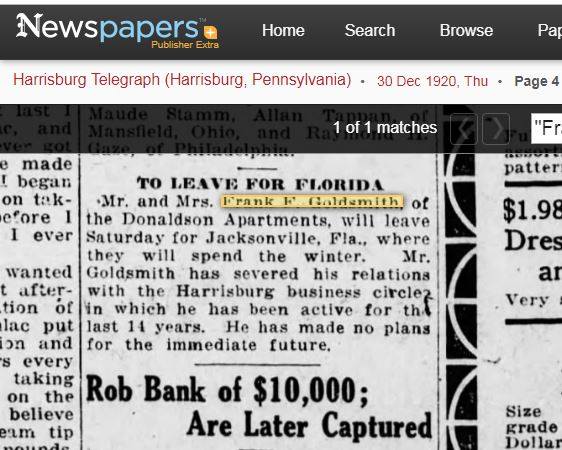
Well, once again Tracing the Tribe, the Jewish genealogy Facebook group, came to the rescue. I posted a question there and received many responses, most of them suggestions for things I’d already done. But one member,  Katherine Dailey Block, found a 1920 newspaper article that mentioned Frank that I had never seen:

“To Leave for Florida,” Harrisburg Telegraph, December 30, 1920, p. 4.

That raised the possibility that Frank might have spent time in Florida more than this one time. I had made the mistake of assuming that, having lived his whole life in Pennsylvania and New Jersey, he must have died in one of those two states. Now I broadened the search to Florida. (Doing a fifty-state search was not helpful since the name Frank Goldsmith is quite common, and I had no way to figure out whether any of them was my Frank.) And this result came up:

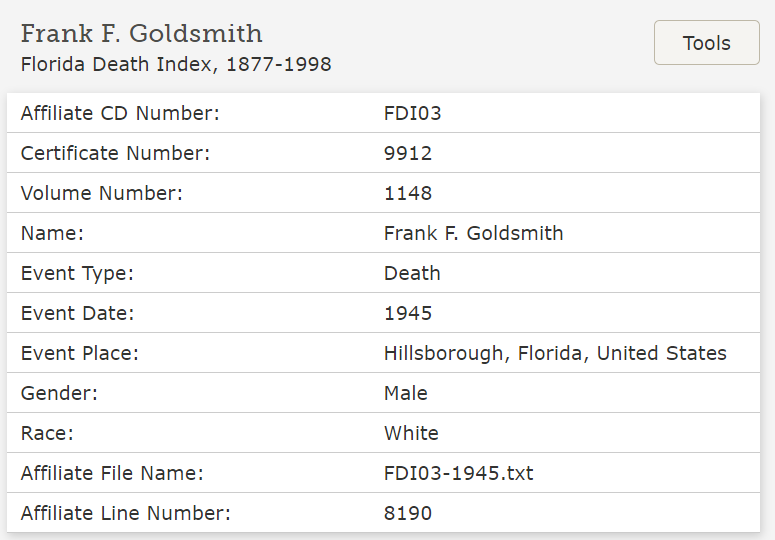
Florida Death Index, 1877-1998,” database, FamilySearch (https://familysearch.org/ark:/61903/1:1:VV91-P84 : 25 December 2014), Frank F. Goldsmith, 1945; from “Florida Death Index, 1877-1998,” index, Ancestry (www.ancestry.com : 2004); citing vol. 1148, certificate number 9912, Florida Department of Health, Office of Vital Records, Jacksonville.

A Frank F. Goldsmith had died in Tampa, Florida in 1945. Could this be my Frank? Tampa is on the opposite coast from Jacksonville as well as much further south. That made me doubt whether this was the same Frank F. Goldsmith. But then I found this record from the 1945 Florida census; notice the second to last entry on the page:

Census Year: 1945, Locality: Precinct 2, County: Hillsborough, Page: 43, Line: 32
Archive Series #: S1371, Roll 20, Frank F. Goldsmith 65
Ancestry.com. Florida, State Census, 1867-1945

There was Frank F. Goldsmith, and when I saw that he was born in Pennsylvania, I was delighted, figuring that this could be my Frank. On the other hand, the census reported that this Frank was 65 years old in 1945 whereas my Frank would have been 82. But it seemed worth ordering a copy of the death certificate from the Florida vital records office to see if it contained information that would either confirm or disprove my hope that this was my cousin Frank.

Unfortunately, here is the death certificate:

As you can see, it has no information about this Frank F. Goldsmith’s wife, parents, birth place, occupation, or much of anything that would help me tie him to my Frank F. Goldsmith. In fact, the age and birth date on the certificate are inconsistent with my Frank Goldsmith, who was born in June 1863, according to the 1900 census, not June of 1878.

Despite these blanks and inconsistencies, my hunch is that this is my Frank. Why? Both Franks have a birth date in June. And on later census records, Frank’s estimated birth year based on his reported age moved later than 1863—1868 in 1910, 1876 in 1920, and 1870 in 1930 and 1940. He seemed to be getting younger as time went on. Maybe by 1945, he was giving a birth year of 1878. And by 1945 there was no one left to inform the hospital of his family’s names or his birth date or age so perhaps whoever completed the death certificate (looks like someone from the funeral home) was just guessing at his age and birth date.

In addition, there is no other Frank F. Goldsmith who fits the parameters of the Frank on the death certificate. Finally, this Frank was to be buried in the “Jew cemetery,” so we know that he was Jewish.

So what do you think? Is this enough to tie the Frank F. Goldsmith who died in Florida to my Frank F. Goldsmith? I know these are thin reeds upon which to make a case, but I think they may have to be enough.

In any event, like his sisters Rachel, Celia, Annie, Emma, Eva and Florence, and his brother Felix, Frank Goldsmith has no living descendants. In fact, it is quite remarkable how few living descendants Jacob Goldsmith and Fannie Silverman have, considering that they had had fourteen children. Five of those fourteen children did not have children of their own: Emma, Rachel, Celia, Frank, and Florence. Four of Jacob and Fannie’s children had no grandchildren: Annie had three children, but none of them had children. Eva had one son, Sidney, who did not have any children, and the same was true of Gertrude’s son Bernard and Felix’s two children Ethel and Clarence. From fourteen children, Jacob and Fannie had twenty grandchildren and only twelve great-grandchildren, and a number of those great-grandchildren also did not have children. From my count, there were only ten great-great-grandchildren. With each generation, instead of growing, the family became smaller.

But that is not the legacy of Jacob and Fannie Goldsmith. Rather, theirs is the remarkable story of two young German immigrants settling in western Pennsylvania and then Philadelphia, raising fourteen children who eventually spanned the continent. From all appearances, many of those fourteen children stayed close, both geographically and presumably emotionally. Many of them lived together, especially the daughters who spent years in Denver together. Like so many first-generation Americans, these fourteen children provided evidence to their parents that the risks they took leaving their home country behind and crossing the ocean were worthwhile. Yes, there was plenty of heartbreak along the way, but overall Jacob, Fannie, and their fourteen children lived comfortably and free from oppression.



  1. Historical Society of Pennsylvania; Philadelphia, Pennsylvania; Historic Pennsylvania Church and Town Records, Ancestry.com. Pennsylvania and New Jersey, Church and Town Records, 1669-2013 
  2. Ancestry.com. California, Death Index, 1905-1939 
  3. Ancestry.com. California, Death Index, 1905-1939 
  4.  Number: 562-66-4663; Issue State: California; Issue Date: 1962, Ancestry.com. U.S., Social Security Death Index, 1935-2014 
  5. San Francisco Chronicle, September 4, 1974, p. 35 
  6. Florence Emanuel, 1940 US census, Census Place: Denver, Denver, Colorado; Roll: m-t0627-00490; Page: 9A; Enumeration District: 16-221B, Ancestry.com. 1940 United States Federal Census 
  7. JewishGen, comp. JewishGen Online Worldwide Burial Registry (JOWBR) 
  8. Frank Goldsmith, 1930 US census, Census Place: Atlantic City, Atlantic, New Jersey; Page: 19B; Enumeration District: 0011; FHL microfilm: 2341043, Ancestry.com. 1930 United States Federal Census 
  9. Historical Society of Pennsylvania; Philadelphia, Pennsylvania; Historic Pennsylvania Church and Town Records,  Mt· Sinai Cemetery, Ancestry.com. Pennsylvania and New Jersey, Church and Town Records, 1669-2013 

Ellena Goldsmith Feldstein and Her Family: Not Blessed with Longevity

When I last posted about the children of Jacob Goldsmith, I was focusing on those of his children who died between 1911 and 1920. In 1910, twelve of Jacob’s fourteen children were still living; Emma and George had already passed away. By the end of 1920, only seven of the remaining children were still living.  Five of the siblings died between 1911 and 1920. We have already seen that  Leonora Goldsmith Jaffa died in 1911, Rachel Goldsmith died in 1915, and Felix Goldsmith died in 1919.

The fourth of Jacob Goldsmith’s children to die between 1911 and 1920 was his oldest child, Ellena Goldsmith Feldstein. Ellena had lost her husband Samuel and her son William in 1908, and on June 20, 1914, she died from cerebral thrombosis. She was sixty years old. She was survived by four of her children: Sylvester, Leon (formerly Leopold), Fannie, and Gertrude.

Ellena Goldsmith Feldstein death certificate, Pennsylvania Historic and Museum Commission; Pennsylvania, USA; Pennsylvania, Death Certificates, 1906-1965; Certificate Number Range: 061391-064480, Ancestry.com. Pennsylvania, Death Certificates, 1906-1966

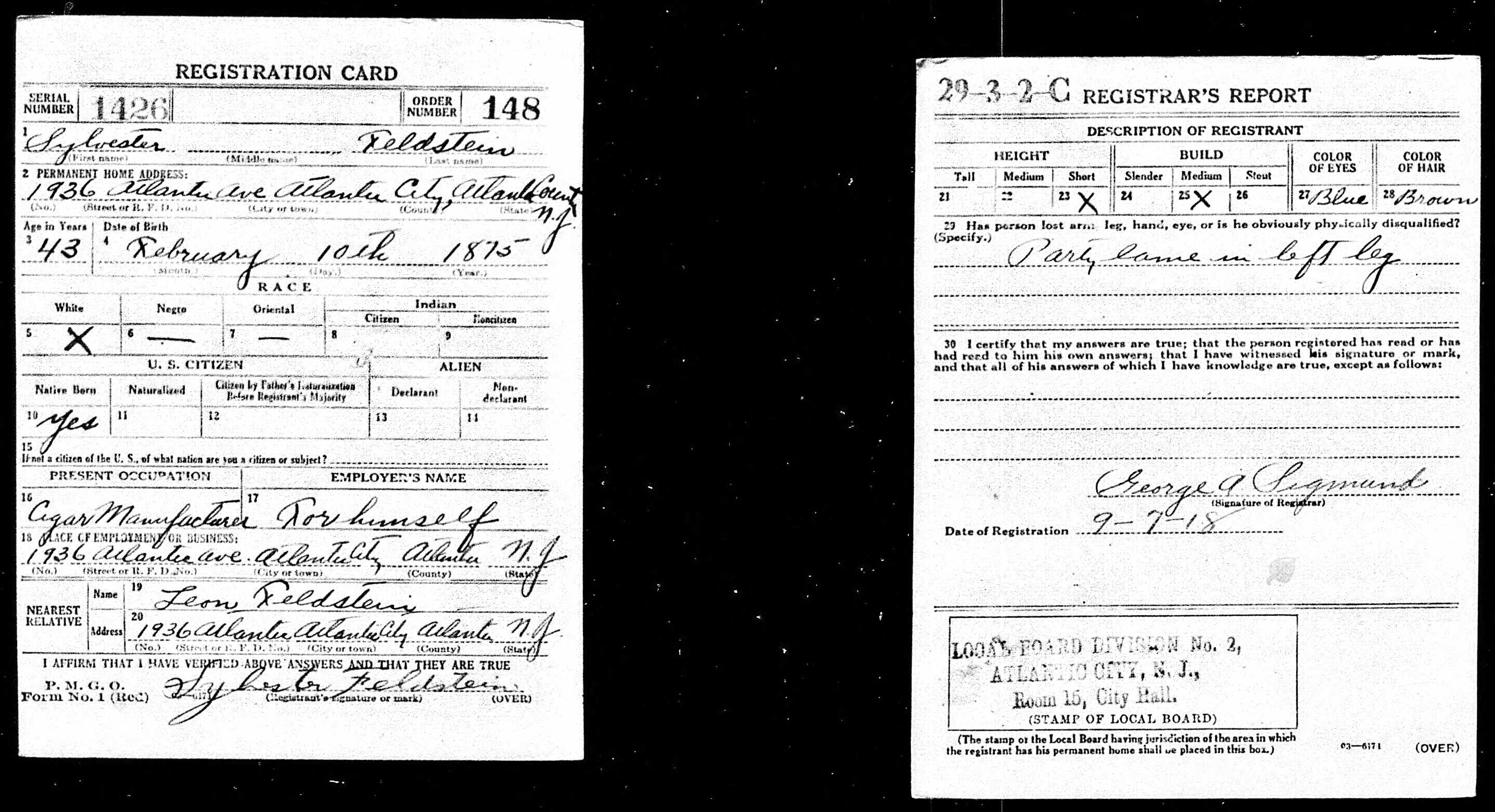
Sylvester had married Selma Lowenstein in 1911 in Philadelphia.1 She was born in Germany on July 12, 1888,2 and had immigrated to the US in 1908.3 Sylvester and Selma settled in Atlantic City where Sylvester was in the cigar business with his brother Leon.4 On March 27, 1914, just two months before Ellena died, Selma gave birth to Samuel Feldstein, obviously named for his grandfather, Sylvester’s father.5 When he registered for the World War I draft, Sylvester was still in the cigar business and reported that he was partly lame in his left leg.

Sylvester Feldstein, World War I draft registration, Registration State: New Jersey; Registration County: Atlantic; Roll: 1711901; Draft Board: 2
Ancestry.com. U.S., World War I Draft Registration Cards, 1917-1918

And then tragedy struck the family again in this decade when Sylvester died at age 44 on July 20, 1919, in Atlantic City, leaving behind his wife Selma and his five-year-old son Samuel.6

In 1920, Selma and her son Samuel were still living in Atlantic City, and Selma was working as a housekeeper in a lodging house.7  By 1930 they had moved to Philadelphia where Selma was now working as a “saleslady” in a department store. Samuel was fifteen years old.8 Ten years later Selma and Samuel were still living in Philadelphia where Selma continued to work in a department store and Samuel was now an inspector for Westinghouse Electric.9 In 1941, Samuel married Cele Hammerschlag,10 and they would have four children. Selma died in 1973, Samuel died in 2004, and Cele in 2009.11

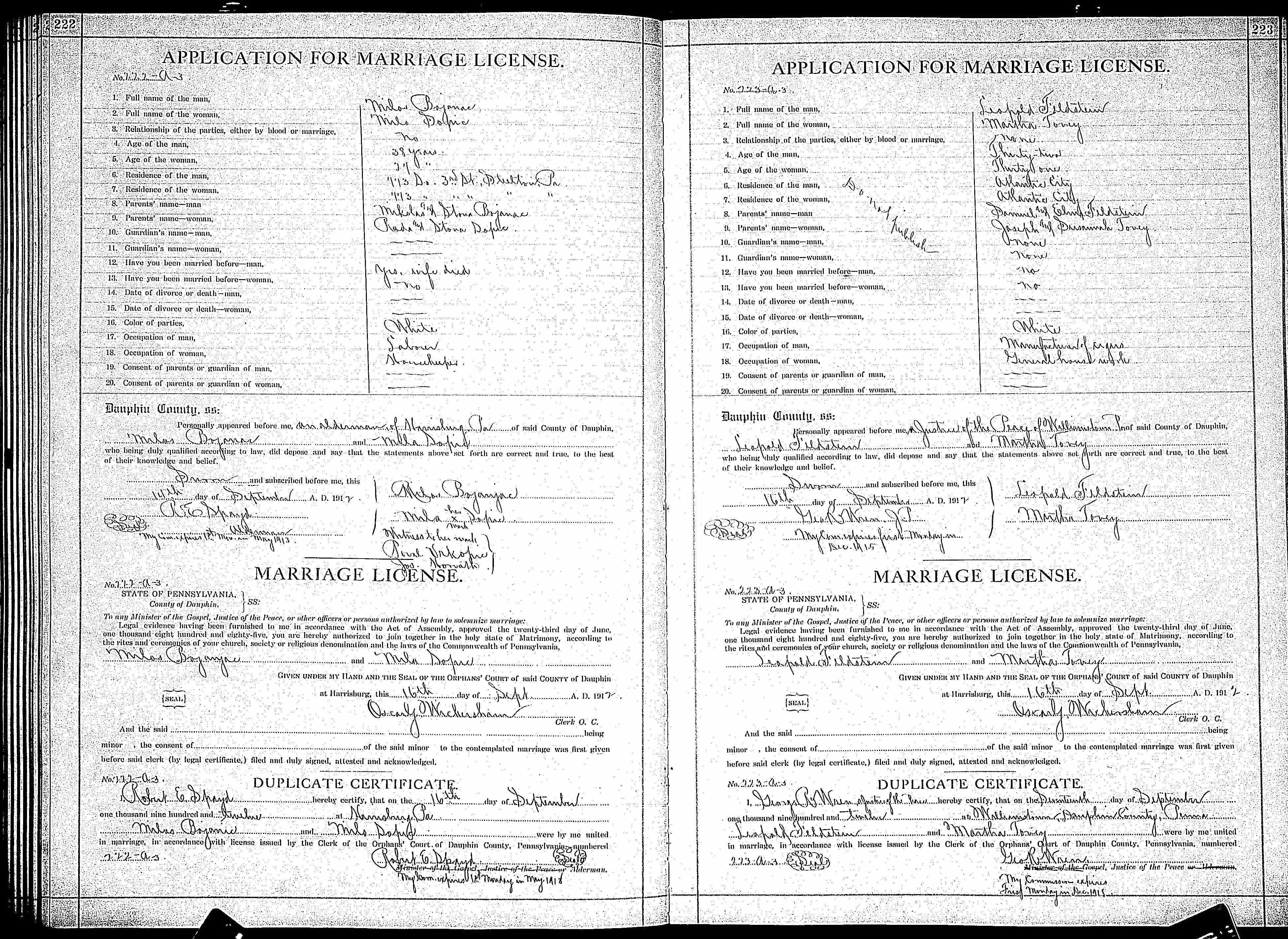
Sylvester’s brother and business partner Leopold also married in the 1910s.  He married Martha Tovey in Williamstown, Pennsylvania, on September 17, 1912.  He was 32, she 31, according to their marriage license. Martha was the daughter of Joseph Tovey and Susannah Curtis, and she was born in England in November, 1881, and immigrated as a baby with her parents on July 1, 1882.12 In 1900, Martha was living as a servant in a household in Williamstown, Pennsylvania, a small town about 115 miles northwest of Philadelphia. In 1910 she was living in Atlantic City, working as a housekeeper.13

Marriage record of Leopold Feldstein and Martha Tovey, Film Number: 000021184
Ancestry.com. Pennsylvania, Marriages, 1852-1968

After they married, Leopold, now using the name Leon, and Martha stayed in Atlantic City, where in 1920, Leon was still in the cigar business, and Martha was not employed.14 In 1930, Martha’s mother was living in their household in Atlantic City.  Leon continued to manufacture cigars, and Martha was a “saleslady” in a cigar store.15 They did not have children. Leon died three years later on September 25, 1933 in Atlantic City.  He was 53. I was unable to find a death record for his widow Martha or any other records that revealed what happened to her after Leon’s death, except for a reference to her as one of her mother Susanna’s survivors in 1942.16

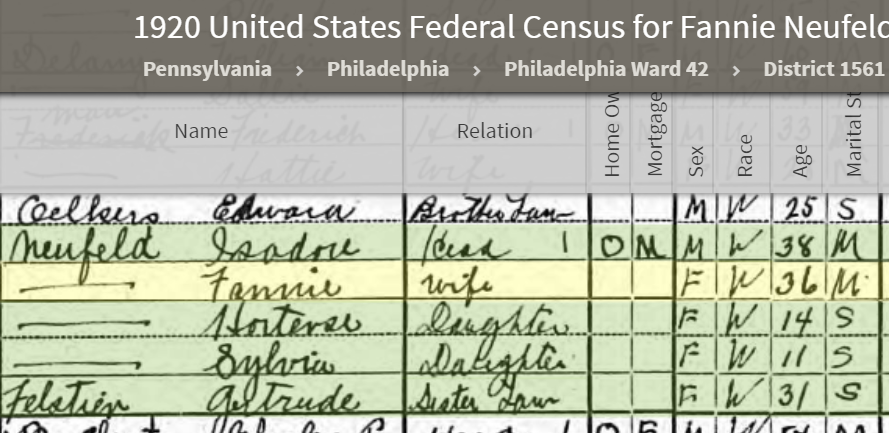
As for Ellena Goldsmith Feldstein’s two daughters, Fannie and Gertrude, as noted in an earlier post, Fannie had married Isidor Neufeld in 1904 and had two children, Hortense (1905) and Sylvia (1908). Isidor was a shirt cutter in a factory, a job he continued to hold in the 1910s. By 1920 he had been promoted to a foreman in the shirt factory. Fannie’s sister Gertrude was also living with them; she was working as a stenographer for a bottle company.

Neufeld family, 1920 US census, Census Place: Philadelphia Ward 42, Philadelphia, Pennsylvania; Roll: T625_1643; Page: 22B; Enumeration District: 1561, Ancestry.com. 1920 United States Federal Census

In 1925, Fannie and Isidor’s daughter Hortense married Philip M. Jacobs in Philadelphia.17 Philip was born on February 21, 1898, in Philadelphia, to Rachael and Reuben Jacobs. In 1920 he’d been working as a men’s clothing salesman and living with his parents in Philadelphia.18  Philip and Hortense had two daughters born in the 1920s. In 1930 they were all living in Philadelphia, and Philip was working in the clothing manufacturing business.19

Fannie, Isidor, their daughter Sylvia, and Fannie’s sister Gertrude were still living together in 1930. Isidor was still the foreman at the shirt factory, Sylvia was a school teacher, and Gertrude was a bookkeeper for a hosiery mill.20

Things changed in the 1930s. Fannie and Isidor Neufeld’s daughter Sylvia married Eugene Fielder Wieder in Philadelphia in 1939.21 Eugene was born October 3, 1891, in Philadelphia, to Albert and Tillie Wieder. His father was a German immigrant, his mother a native Pennsylvanian. His father was a furniture dealer.22

Eugene had been previously married and in 1920 was living with his first wife Edith Wollner and working in shirt manufacturing. 23 I could not locate him on the 1930 census or in any other records until the entry in the Philadelphia marriage index entry for him and Sylvia in 1939.

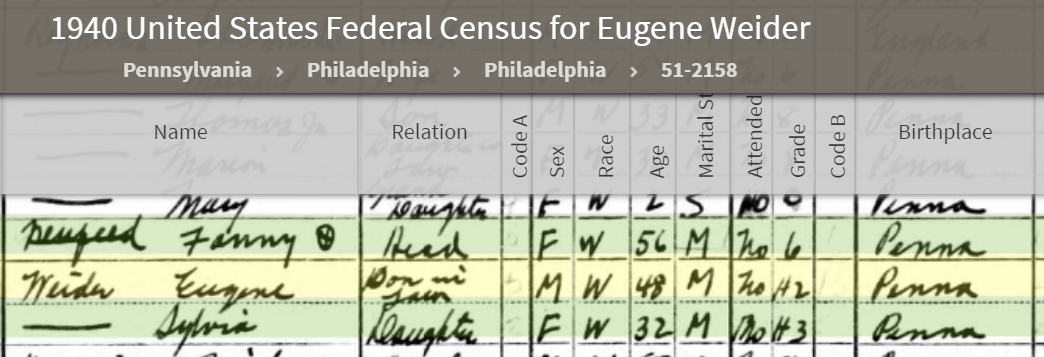
In 1940 Eugene and Sylvia were living with Sylvia’s mother Fannie Goldsmith Neufeld in Philadelphia; Eugene was now a salesman in a retail furniture store, perhaps his father’s business, and Sylvia was teaching school. But where was Fannie’s husband Isidor?

Neufeld and Wieder family 1940 US census, Census Place: Philadelphia, Philadelphia, Pennsylvania; Roll: m-t0627-03753; Page: 2A; Enumeration District: 51-2158
Ancestry.com. 1940 United States Federal Census

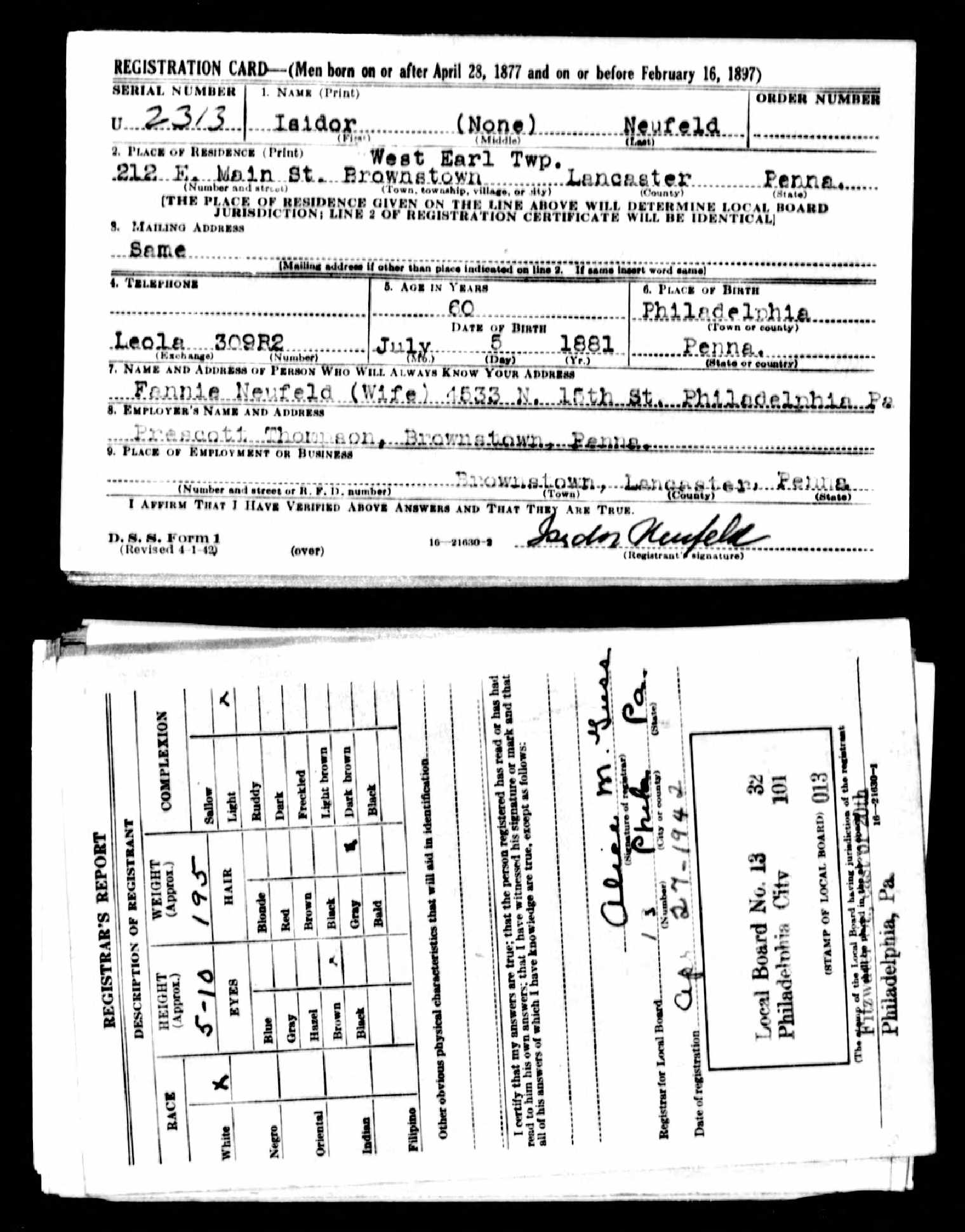
I found him living in Lancaster, Pennsylvania, boarding with a family and working as the foreman in a shirt factory.24 Both he and Fannie listed their marital status as married on the 1940 census, so I assume this was a work-related move necessitated by the Depression. That assumption is reinforced by Isidor’s World War II draft registration two years later; he was still living in Lancaster, but listed Fannie as his wife and his contact person on the registration, giving Fannie’s Philadelphia address.

Isidor Neufeld, World War II draft registration, he National Archives at St. Louis; St. Louis, Missouri; World War II draft cards (Fourth Registration) for the State of Pennsylvania; Record Group Title: Records of the Selective Service System, 1926-1975; Record Group Number: 147; Series Number: M1951, Ancestry.com. U.S., World War II Draft Registration Cards, 1942

Fannie’s sister Gertrude also married in the 1930s. She married Louis Lewin in Philadelphia in 1938; she was 49, he was 53.25  Louis was born in Bellefonte, Pennsylvania, on February 16, 1885.26  His parents were Samuel Lewin, a German-born clothing merchant, and Helen Obendorf, who was born in Maryland. Louis’ father died in 1904, and by 1906, his family had moved to Baltimore, where his mother’s family lived.27 In 1910 Louis was living with his mother and other relatives and working as a dry goods salesman. By 1920, he was married to a woman named Louisa and living in Philadelphia, but in 1930 he was divorced and back in Baltimore, working as a clerk in the post office, and living as a lodger.28 After he and Gertrude married, they were living in Philadelphia where Louis was a candy salesman and Gertrude a secretary in a law office in 1940.

Louis Lewin and Gertrude Feldstein Lewin, 1940 US census, Census Place: Philadelphia, Philadelphia, Pennsylvania; Roll: m-t0627-03752; Page: 61A; Enumeration District: 51-2122
Ancestry.com. 1940 United States Federal Census

Sadly, Gertrude died just three years later at the age of 55 from hypertensive cardiovascular disease and cerebral hemorrhage.

Pennsylvania Historic and Museum Commission; Pennsylvania, USA; Pennsylvania, Death Certificates, 1906-1965; Certificate Number Range: 094201-096650
Ancestry.com. Pennsylvania, Death Certificates, 1906-1966

Of the five children born to Ellena Goldsmith and Samuel Feldstein, only Fannie was left after Gertrude died in 1943. And then Fannie suffered yet another terrible loss when her younger daughter Sylvia died from breast cancer on January 28, 1953, at the age of 44.

Pennsylvania Historic and Museum Commission; Pennsylvania, USA; Pennsylvania, Death Certificates, 1906-1965; Certificate Number Range: 007651-010350
Ancestry.com. Pennsylvania, Death Certificates, 1906-1966

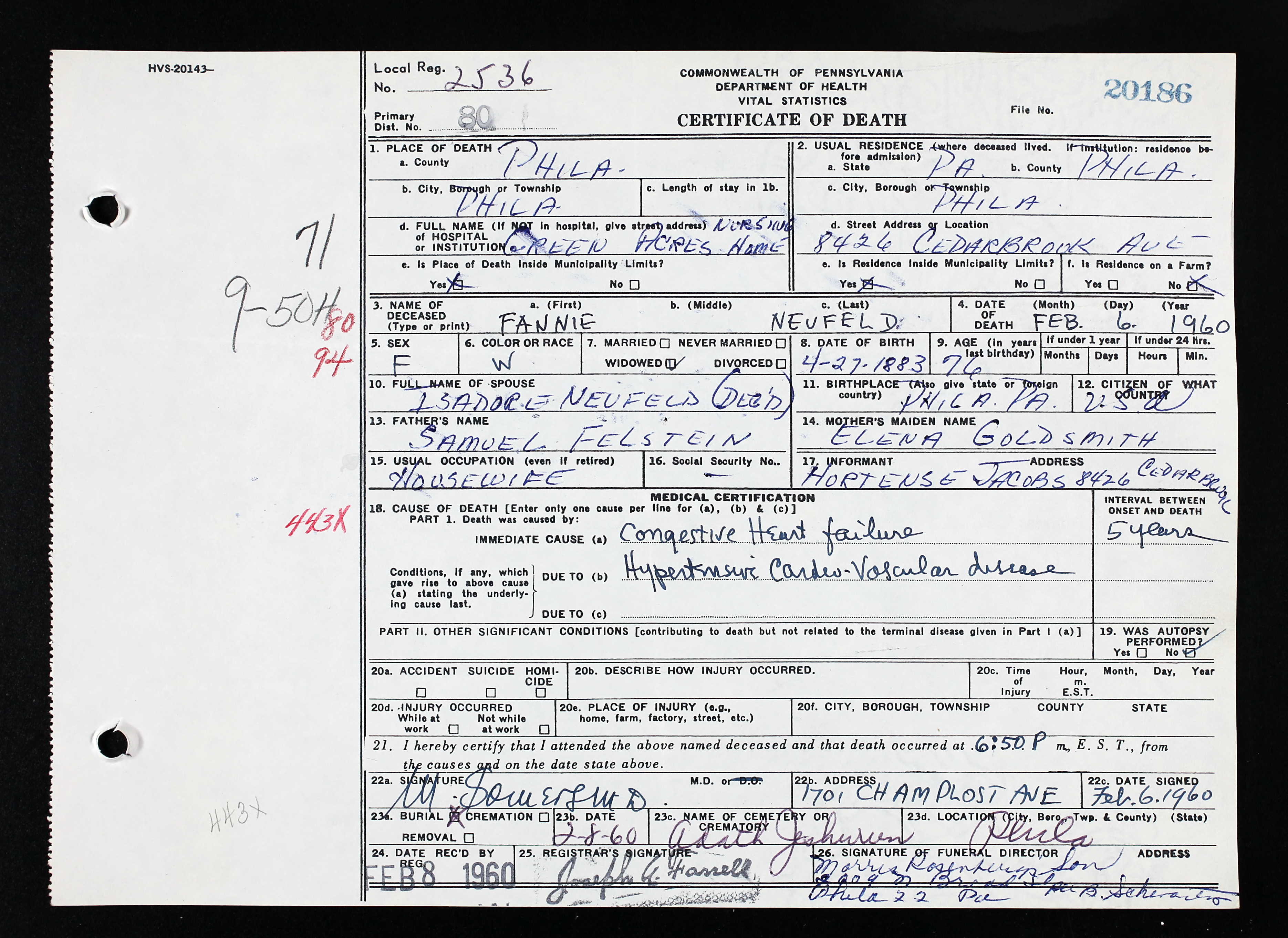
Almost exactly two years later Fannie lost her husband Isidor Neufeld on January 13, 1955; he was 73 and died from prostate cancer.29 Fannie survived him for five years, dying at age 76 from congestive heart failure and hypertensive cardiovascular disease on February 6, 1960. According to her death certificate she had suffered from heart disease for five years, so from about the time she lost her husband.

Pennsylvania Historic and Museum Commission; Pennsylvania, USA; Pennsylvania, Death Certificates, 1906-1965; Certificate Number Range: 019051-021750
Ancestry.com. Pennsylvania, Death Certificates, 1906-1966

She was survived by her remaining daughter, Hortense Neufeld Jacobs, and two granddaughters. Hortense died in 1983 at 77.30

Ellena Goldsmith and Samuel Feldstein’s family was not blessed with longevity. Ellena was sixty when she died, Samuel 61. Fannie Feldstein Neufeld was their only child to live past sixty; Arthur had died before his first birthday, William at 31, Sylvester at 44, Leon at 53, and then Gertrude at 55. Of those six children, only two had children of their own: Fannie’s two daughters Hortense and Sylvia, and Sylvester’s son Samuel. And Sylvia’s life was also cut short prematurely at 44.  Of all the children and grandchildren of Ellena and Samuel, only Fannie, Hortense, and Samuel lived past seventy. Samuel truly avoided the family’s bad DNA as he lived to age ninety, dying in 2004. He must have inherited those good genes from his mother Selma, who lived to 84, unlike her husband Sylvester who died at 44.


  1. Marriage License Number: 264923, Digital GSU Number: 4140424, Ancestry.com. Philadelphia, Pennsylvania, Marriage Index, 1885-1951 
  2.  Selma Feldstein, SSN: 164-10-7288, Born: 12 Jul 1888, Died: Jun 1973,
    Ancestry.com. U.S., Social Security Death Index, 1935-2014 
  3. Selma Feldstein, 1920 US census, Census Place: Atlantic City Ward 2, Atlantic, New Jersey; Roll: T625_1015; Page: 6B; Enumeration District: 11, Ancestry.com. 1920 United States Federal Census 
  4. Atlantic City, New Jersey, City Directory, 1912, Ancestry.com. U.S. City Directories, 1822-1995 
  5.  SSN: 185014552, Ancestry.com. U.S., Social Security Applications and Claims Index, 1936-2007 
  6. Philadelphia Inquirer, July 22, 1919, p. 17. 
  7. Selma Feldstein, 1920 US census, Census Place: Atlantic City Ward 2, Atlantic, New Jersey; Roll: T625_1015; Page: 6B; Enumeration District: 11, Ancestry.com. 1920 United States Federal Census 
  8. Selma Feldstein, 1930 US census, Census Place: Philadelphia, Philadelphia, Pennsylvania; Page: 4A; Enumeration District: 1074; FHL microfilm: 2341869,
    Ancestry.com. 1930 United States Federal Census 
  9. Selma Feldstein, 1940 US census, Census Place: Philadelphia, Philadelphia, Pennsylvania; Roll: m-t0627-03724; Page: 13B; Enumeration District: 51-1172,
    Ancestry.com. 1940 United States Federal Census 
  10. Marriage Year: 1941, Marriage License Number: 730487, Digital GSU Number: 4143600, Ancestry.com. Philadelphia, Pennsylvania, Marriage Index, 1885-1951 
  11. Selma Feldstein, SSN: 164-10-7288, Born: 12 Jul 1888, Died: Jun 1973,
    Ancestry.com. U.S., Social Security Death Index, 1935-2014. Samuel V. Feldstein
    SSN: 185-01-4552, Born: 26 Mar 1914, Died: 20 Dec 2004, Ancestry.com. U.S., Social Security Death Index, 1935-2014. Cele H. Feldstein, Born: 3 Oct 1918, Died: 3 Jul 2009
    Ancestry.com. U.S., Social Security Death Index, 1935-2014 
  12.  Martha Tovey, Registration Year: 1881, Registration Quarter: Oct-Nov-Dec
    Registration district: Kendal, Volume: 10b, Page: 674, FreeBMD. England & Wales, Civil Registration Birth Index, 1837-1915. Ship manifest,  Year: 1882; Arrival: New York, New York; Microfilm Serial: M237, 1820-1897; Microfilm Roll: Roll 454; Line: 16; List Number: 907, Ancestry.com. New York, Passenger and Crew Lists (including Castle Garden and Ellis Island), 1820-1957 
  13. Tovey family, 1900 US census, Census Place: Williamstown, Dauphin, Pennsylvania; Page: 16; Enumeration District: 0110; FHL microfilm: 1241404,  Ancestry.com. 1900 United States Federal Census; Martha Tovey, 1910 US census, Census Place: Atlantic City Ward 3, Atlantic, New Jersey; Roll: T624_867; Page: 15B; Enumeration District: 0018; FHL microfilm: 1374880, Ancestry.com. 1910 United States Federal Census 
  14. Leon Feldstein, 1920 US census, Census Place: Atlantic City Ward 3, Atlantic, New Jersey; Roll: T625_1015; Page: 14B; Enumeration District: 26, Ancestry.com. 1920 United States Federal Census 
  15. Leon Feldstein, 1930 US census, Census Place: Atlantic City, Atlantic, New Jersey; Page: 11B; Enumeration District: 0022; FHL microfilm: 2341043, Ancestry.com. 1930 United States Federal Census 
  16.   The Philadelphia Inquirer, 28 Sep 1933, Thu, Page 23. “Mrs. Susanna Tovey,”  Lykens (PA) Register, 24 Apr 1942, Fri, Page 4. 
  17. Marriage License Number: 507659, Digital GSU Number: 4141807,
    Ancestry.com. Philadelphia, Pennsylvania, Marriage Index, 1885-1951 
  18. Philip Jacobs, World War I draft registration, Registration State: Pennsylvania; Registration County: Philadelphia; Roll: 1907760; Draft Board: 37, Ancestry.com. U.S., World War I Draft Registration Cards, 1917-1918. Jacobs family, 1920 US census, Census Place: Philadelphia Ward 20, Philadelphia, Pennsylvania; Roll: T625_1616; Page: 9B; Enumeration District: 451, Ancestry.com. 1920 United States Federal Census 
  19. Philip Jacobs, 1930 US census, Census Place: Philadelphia, Philadelphia, Pennsylvania; Page: 4A; Enumeration District: 1048; FHL microfilm: 2341868, Ancestry.com. 1930 United States Federal Census 
  20. Feldstein family, 1930 US census, Census Place: Philadelphia, Philadelphia, Pennsylvania; Page: 15B; Enumeration District: 1080; FHL microfilm: 2341870, Ancestry.com. 1930 United States Federal Census 
  21.  Marriage Year: 1939, Marriage License Number: 699905,Ancestry.com. Philadelphia, Pennsylvania, Marriage Index, 1885-1951 
  22. Eugene Wieder, Death Certificate Number: 8990, Pennsylvania Historic and Museum Commission; Pennsylvania, USA; Pennsylvania, Death Certificates, 1906-1965; Certificate Number Range: 007351-010050, Ancestry.com. Pennsylvania, Death Certificates, 1906-1966. Wieder family, 1910 US census, Census Place: Philadelphia Ward 28, Philadelphia, Pennsylvania; Roll: T624_1402; Page: 5B; Enumeration District: 0630; FHL microfilm: 1375415, Ancestry.com. 1910 United States Federal Census 
  23. Eugene Wieder, 1920 US census, Census Place: Philadelphia Ward 20, Philadelphia, Pennsylvania; Roll: T625_1616; Page: 11A; Enumeration District: 451,
    Ancestry.com. 1920 United States Federal Census 
  24. Isidor Neufeld, 1940 US census, Census Place: West Earl, Lancaster, Pennsylvania; Roll: m-t0627-03535; Page: 7B; Enumeration District: 36-158, Ancestry.com. 1940 United States Federal Census 
  25. Marriage Year: 1938, Marriage License Number: 686632, Digital GSU Number: 4141695, Ancestry.com. Philadelphia, Pennsylvania, Marriage Index, 1885-1951 
  26. Louis Lewin, World War I draft registration,  Registration State: Pennsylvania; Registration County: Philadelphia; Roll: 1907611; Draft Board: 09,
    Ancestry.com. U.S., World War I Draft Registration Cards, 1917-1918 
  27. Lewin, 1900 US census, Census Place: Bellefonte, Centre, Pennsylvania; Page: 5; Enumeration District: 0001; FHL microfilm: 1241391, Ancestry.com. 1900 United States Federal Census.  “Pennsylvania, Philadelphia City Death Certificates, 1803-1915,” database with images, FamilySearch (https://familysearch.org/ark:/61903/3:1:S3HY-6QM9-HP2?cc=1320976&wc=9FR2-N3D%3A1073107602 : 16 May 2014), 004008656 > image 211 of 524; Philadelphia City Archives and Historical Society of Pennsylvania, Philadelphia. Baltimore, Maryland, City Directory, 1906, Ancestry.com. U.S. City Directories, 1822-1995 
  28. Louis Lewin, 1910 US census, Census Place: Baltimore Ward 14, Baltimore (Independent City), Maryland; Roll: T624_557; Page: 11A; Enumeration District: 0236; FHL microfilm: 1374570; Ancestry.com. 1910 United States Federal Census. Louis Lewin 1920 US census, Census Place: Philadelphia Ward 15, Philadelphia, Pennsylvania; Roll: T625_1621; Page: 16B; Enumeration District: 309, Ancestry.com. 1920 United States Federal Census. Louis Lewin, 1930 US census, Census Place: Baltimore, Blank, Maryland; Page: 11B; Enumeration District: 0164; FHL microfilm: 2340590, Ancestry.com. 1930 United States Federal Census 
  29. Isidor Neufeld death certificate 7955, Pennsylvania Historic and Museum Commission; Pennsylvania, USA; Pennsylvania, Death Certificates, 1906-1965; Certificate Number Range: 005401-008100, Ancestry.com. Pennsylvania, Death Certificates, 1906-1966 
  30. Number: 182-30-5349; Issue State: Pennsylvania; Issue Date: 1954-1955, Ancestry.com. U.S., Social Security Death Index, 1935-201