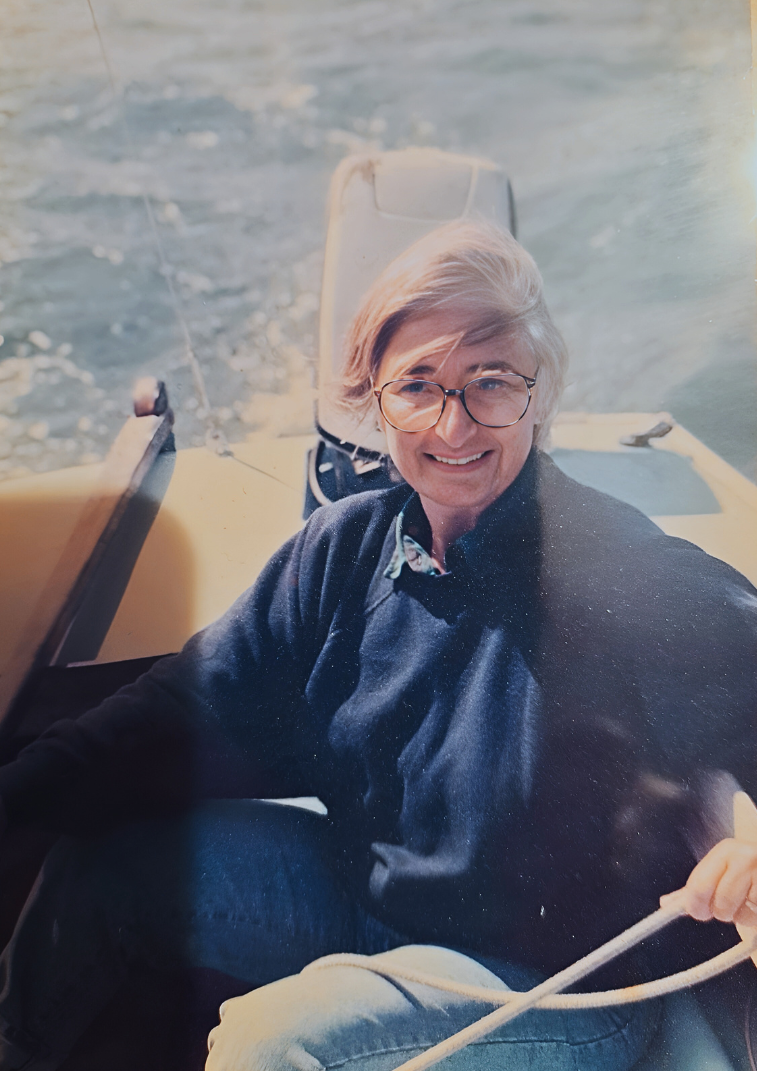
In Memory of My Cousin Sue

My cousin Sue, sailing. Courtesy of Lisa Wartur

I lost a dear cousin on August 25, 2025, my cousin Sue (Leyner) Wartur (1938-2025). Sue was my third cousin and also my half second cousin, once removed, making us double cousins. Sue’s grandfather Julius Goldfarb was my maternal grandmother’s first cousin. And Sue’s grandmother Ida Hecht Goldfarb was the daughter of Taube Brotman Hecht, my grandmother’s half-sister. Sue and I were doubly bonded by our mutual family trees.

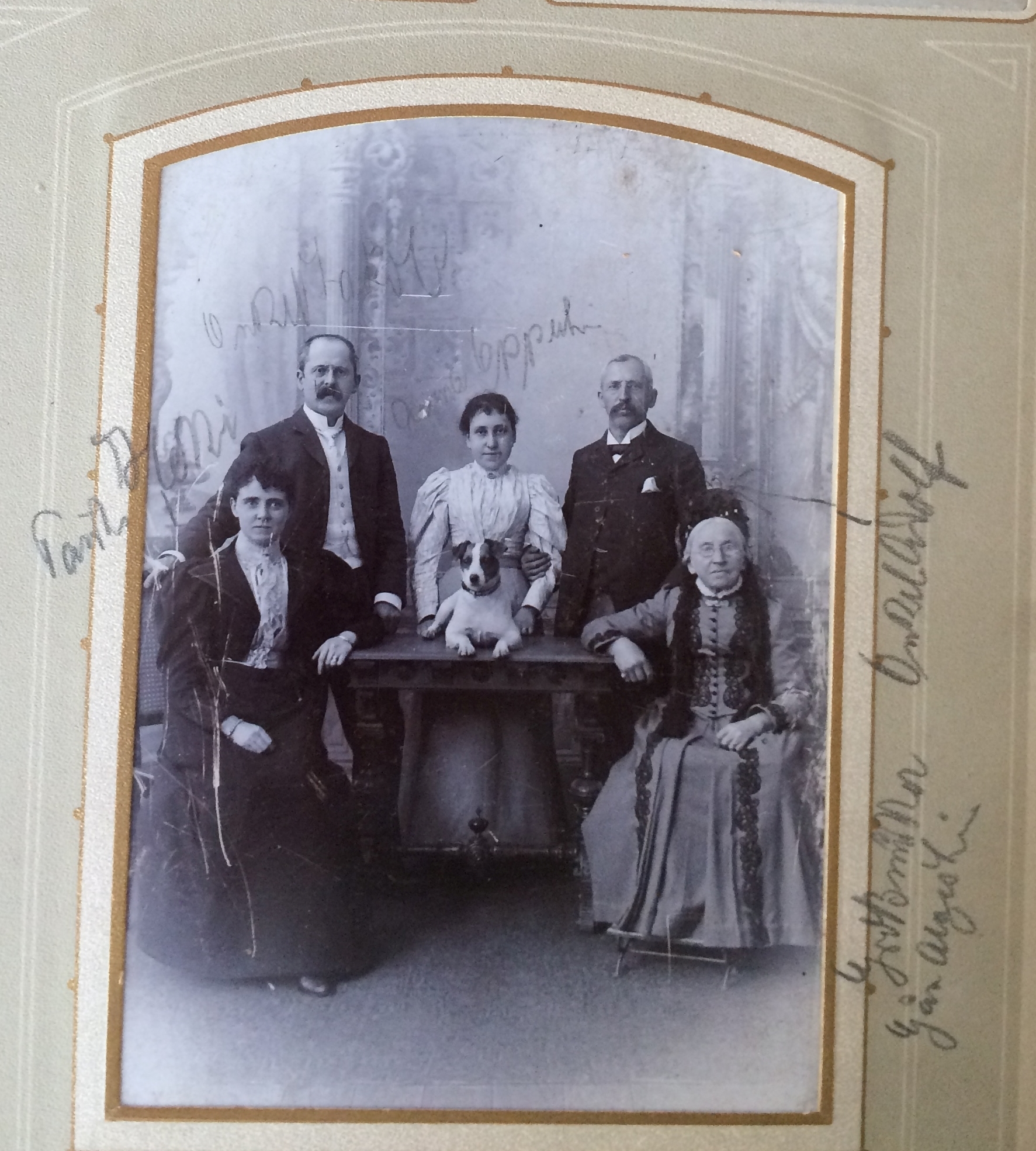
Ida Hecht Goldfarb and Sue Leyner, July 1938. Courtesy of Sue Leyner Wartur.

I didn’t know Sue until March 2016 when I found Sue’s daughter Lisa while searching for descendants of my grandmother’s Goldfarb cousins. Lisa connected me with her mother, and immediately I felt like I had known both Sue and Lisa all my life.

We were bonded by more than just genetics. Although we never met in person, Sue and I exchanged many emails over the nine and a half years we knew each other. It didn’t matter that we never met in person (though I wish we had) because through those emails, we learned a lot about each other and developed an affection and a bond that you wouldn’t imagine two people who never met could share. We had one magical zoom in October 2023—seeing Sue’s face and hearing her voice made that bond even deeper.

Sue shared with me many photographs and stories about her beloved grandparents and all her cousins and their times together at the beach house owned by her grandparents. Over the years we learned that not only did we share DNA and a love of family history, but we also shared a love of the beach (Sue’s on Long Island, mine here on Cape Cod), a love for Italy, a passion for words and writing, and a devotion to Judaism. We agreed on politics and on the need for hope in a world filled with reasons for despair.

Sue adored above all else her husband Larry and her daughter Lisa. Here are some of Lisa’s favorite photographs of her mother.

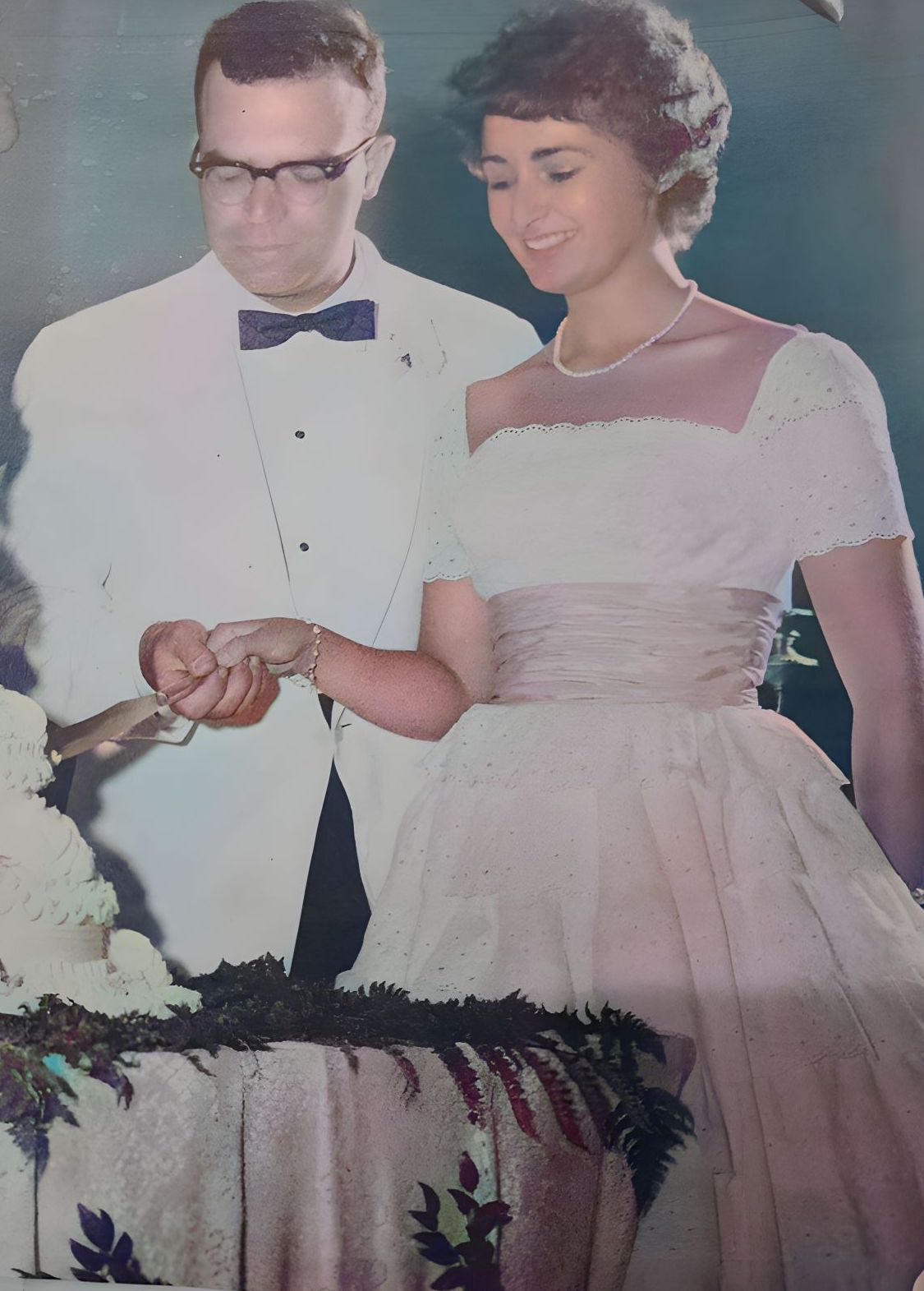
Sue and Larry Wartur on the wedding day in 1959

Sue and Lisa

Lisa, Larry and Sue

Sue’s emails often made me laugh—-her sense of humor and of the absurd was delightful and insightful. And over those nine years we shared some heartbreaks as well. The illness and death of her beloved husband Larry, the deaths of both of my parents, and finally her own health struggles.

When Sue was diagnosed with pancreatic cancer in March, she was determined to fight to survive and went through a long series of treatments. And then, just days after her oncologist had announced that despite all the odds, Sue was cancer-free, Sue collapsed while at synagogue and died a couple of days later from a brain aneurysm. The cruel irony of that has left all who loved her shocked and heartbroken.

Although I couldn’t get to Long Island for the funeral, I was able to watch it through the magic of the internet. It was one of the most moving and beautiful funerals I’ve seen because it was so filled with love and sadness. But mostly love. Everyone who spoke had obviously been forever touched by Sue and loved her deeply. Even the rabbi cried when talking about Sue.

I did not know Sue for most of her life, a life that was filled with so many accomplishments, adventures, and love. Please read the obituary below to learn more about her remarkable life. I can’t tell you how moved I was to see that Lisa, Sue’s daughter and my wonderful cousin, included me among the cousins who were mourning Sue.

https://www.easthamptonstar.com/obituaries/202593/susan-leyner-wartur

Sue, your memory will always be a blessing for me, and I know it will be a blessing for Lisa, Steven, Debrah, and all those family members, friends, former students, and others who loved and adored you.

Sue at the beach, her favorite place. Photo courtesy of her daughter Lisa Wartur

Gerson Rothschild’s Family: Some Additional Photographs

During the course of my emails and conversations with the descendants of Clara Rothschild and Moritz Katz, I received some photographs of family members about whom I’d previously posted. I will add these to those earlier posts, but since many readers will not be going back to posts they’ve already read, I also wanted to post them here.

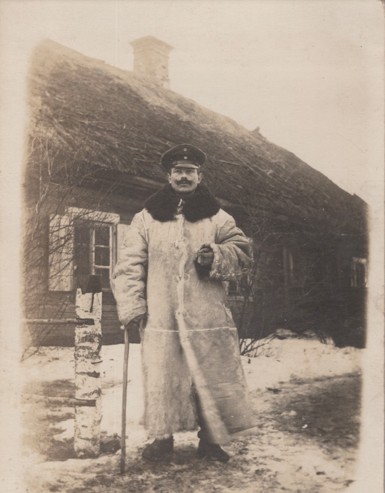
First, this is a photo of Gerson Rothschild and Frommet “Fanny” Kugelmann’s oldest child to survive infancy, Siegmund Rothschild, whom I wrote about here.

Siegmund Rothschild c. 1915
Courtesy of the family

I don’t know when this was taken, but it appears he was wearing a cap from some kind of uniform. Siegmund was born in 1884 and looks perhaps in his thirties here, so perhaps this was taken during World War I. A Google Image search using the picture of Siegmund’s cap turned up several photos of soldiers in the German army during World War I wearing similar caps. I asked Siegmund’s grandson Alex whether his grandfather had fought for Germany in World War I, and Alex told me that he had and that he’d felt betrayed by his country after the Nazis took over and started persecuting Jews, including those who had served in the German army twenty years before.

This photograph is of Siegmund, his sons, and his wife Elise taken in 1938. From left to right are Siegmund, Werner, Ernst, and Elise.

Siegmund, Werner, Ernst, and Elise (Bloch) Rothschild, January 1938. Courtesy of the family.

This photograph is of Siegmund’s wife Elise and their son Ernest in the laundromat they owned in New York City in the 1950s.

Elise Bloch Rothschild and her son Ernest in their laundromat. Courtesy of the family

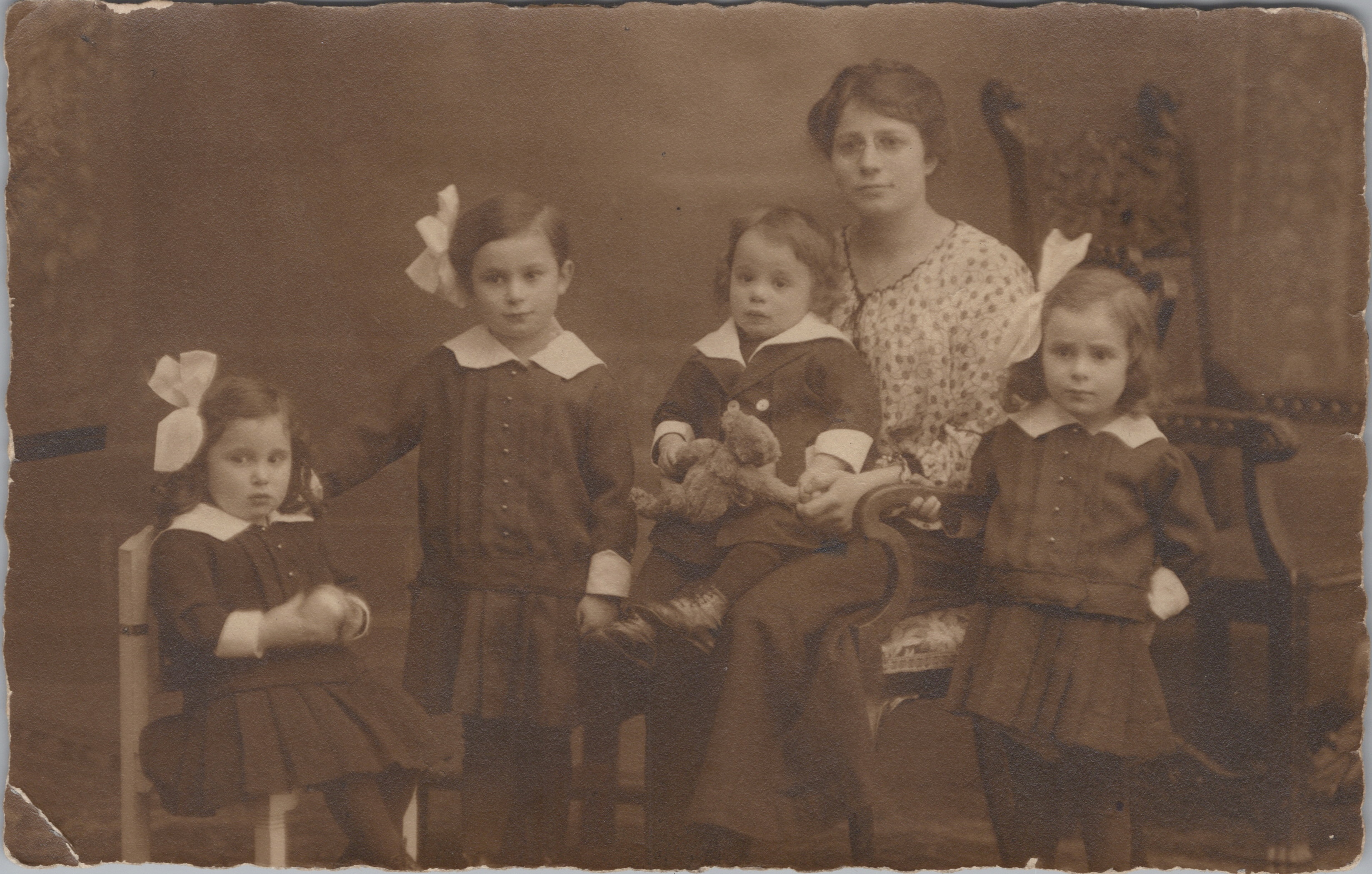
The fourth photo is of Auguste Rothschild Feldheim, whose life I wrote about here. Auguste married Wolf Feldheim in 1919, three years after his first wife Johanna died. This photograph must have been taken around the time Auguste married Wolf, and she is surrounded by Wolf’s children from his first marriage. On her lap is Arthur, later known as Aharon, who was born shortly before his mother died in April 1916. The little girls are from left Else (born in 1914), Ruth (1912), and Selma (1913). Ruth was the daughter who married Jonas Tiefenbrunner and survived the war in Belgium, helping her husband protect and care for Jewish children in an orphanage there. Aharon and Selma ended up in Israel. Else was killed in the Holocaust.

Auguste Rothschild Feldheim with her four stepchildren. Courtesy of the family

When I look at this photograph of these little children, all I can see is a haunted sad look in their eyes. A photograph definitely tells a story without words.

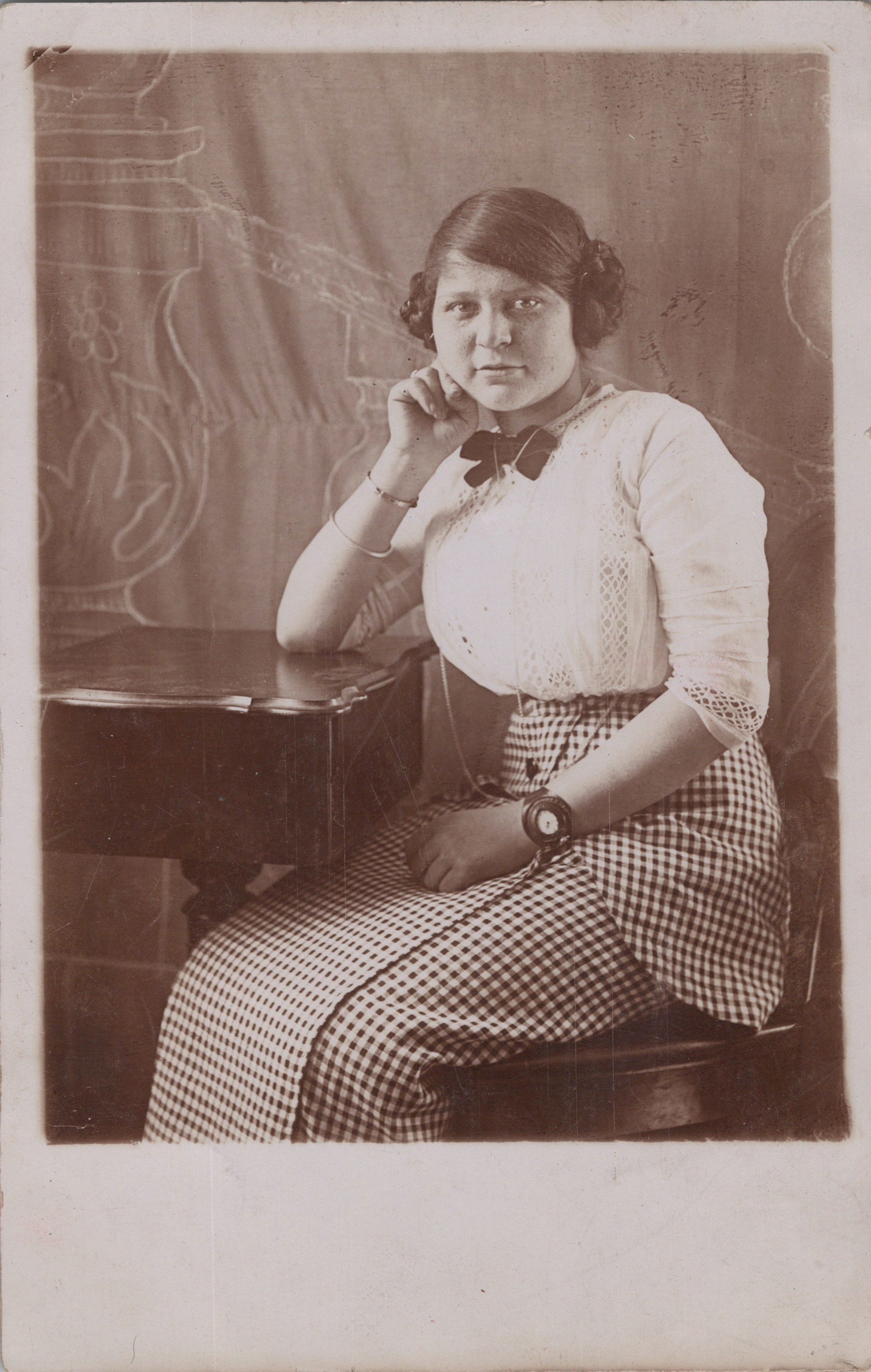
Finally, this photograph may be of Jenny Rothschild Abraham and her husband Salomon Abraham, but Judy, who sent me these photos, was not certain.

Maybe Jenny Rothschild Abraham and her husband Salomon Abraham
Courtesy of the family

When I compare this woman’s face to the photos I have of two of the other Rothschild daughters—-Auguste and Clara—-I definitely see a resemblance. But I do not have Ava Cohn’s skills so I can’t tell for certain whether this is Jenny or any of the other Rothschild daughters or somebody completely unrelated. I think Ava would say that we’d need more photos to be sure. What do you think?

Now I will go back to the posts for these cousins and add their photographs to the appropriate posts. And with that, I will move on to the next child of Gelle Blumenfeld and Simon Rothschild, their ninth child, Malchen Rothschild.

Clara Rothschild Katz, Part I: Living in and Escaping from Germany

Doing family history research is a labor of love. I have said that many times over the almost fifteen years that I’ve been engaged in this work. Being able to honor the memories of those I never knew but who are somehow related to me is a joy and a privilege. Connecting with and getting to know so many living “long-lost” cousins has given me great joy.

Researching the family of Clara Rothschild and Moritz Katz has led me to a really special opportunity for such joy—-the opportunity to talk to their son Hal Katz, my one-hundred-year-old fourth cousin, once removed. Imagine having lived through an entire century and seeing all the horrors and all the miracles since 1924—the Holocaust, World War II, the creation of the state of Israel, the Cold War, the social activism and unrest of the 1960s and the 1970s, the Vietnam War, all the civil rights movements, the election of the first African-American president, the COVID pandemic, and the introduction of so many scientific inventions good and bad—-the atomic bomb, television, cell phones, the internet, and now AI. It’s mind-boggling how much the world has changed in the last hundred years.

Hal Katz has lived through it all, starting as a small boy in Germany, living in a small town, escaping from Germany in 1938 shortly after his bar mitzvah, settling in New York City as a young teenager, fighting for the US in World War II, building a lifelong career with General Electric, marrying and having children, and now still living on his own, playing bridge, and talking to me on Zoom as if it were the most natural thing in the world. Over the course of three Zoom calls, I have been blessed to talk to Hal as well as his daughter, his nieces, his nephew, and another Rothschild cousin, all of whom are my cousins.

And so now as I turn to the story of the sixth of Gerson and Fanny’s children who lived to adulthood, their daughter Clara Rothschild, I feel so fortunate that I was able to hear her story and the stories of her family from her son Helmut Harold “Hal” Katz. Unless otherwise indicated, the information in this post came from Zoom calls or emails with Hal and members of the family or from interviews with Hal or Hal’s brother Otto done by Otto’s daughter Judy, Hal’s niece.1

As we saw, Clara Rothschild was born on July 15, 1891, in Waltersbrueck, Germany.  According to Hal, this photograph of Clara was probably taken when she was nineteen and working as an apprentice bookkeeper in a dry goods store.

Clara Rothschild c. 1910
Courtesy of the family

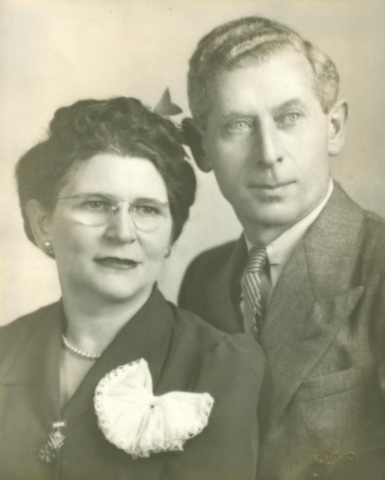
On November 1, 1921, she married Moritz Katz, who was born in Neuenhain, Germany, on November 4, 1894. Here is a photograph of Moritz taken in 1912 when he was eighteen, a photograph of Clara in the 1920s, and an undated one of Clara and Moritz taken years later.

Moritz Katz in 1912. Courtesy of the family.

Clara Rothschild in the 1920s. Courtesy of the family.

Clara Rothschild and Moritz Katz undated
Courtesy of the family

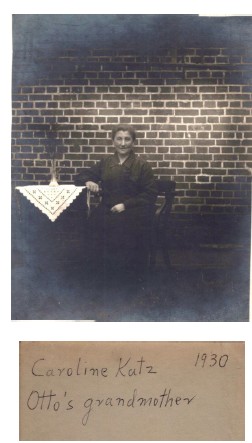
Clara and Moritz had three children, Otto, born in 1922, Helmut (Hal) born in 1924, and Ilse, born in 1928. Hal told me that until he was six years old, he and his family lived with his paternal grandmother, Caroline Rosenblatt Katz, in Neuenhain. His paternal grandfather Jacob Katz had died many years before in 1899. Neuenhain was a very small village, about two hundred people. Hal’s parents and grandmother ran a grocery business out of their home selling produce grown on their farm. This is a photograph of Hal’s paternal grandmother Caroline in 1930 in Neuenhain.

Caroline Katz 1930. Courtesy of the family

Hal said that they were the only Jewish family in the village, and he never understood how his father had become so knowledgeable about Judaism and Hebrew since there was no Hebrew school in Neuenhain. The closest synagogue was within walking distance, but it was a challenge finding the ten men to make a minyan. His father was able to lead services and even acted as the kosher butcher on the side.

Here is a beautiful photograph of Hal with his older brother Otto taken when they lived in Neuenhain. Hal looks no more than two years old, so this photograph was probably taken in about 1925-1926.

Otto and Helmut Katz, c. 1925-1926. Courtesy of the family

I asked Hal what he remembered about his maternal grandfather Gerson Rothschild, and he told me that he was in the coal business. He also said that the first funeral he ever went to was Gerson’s funeral in 1930 when Hal would have been six years old.

When Hal was six, the family moved to a larger town, Borken, which was about six miles from Neuenhain and had a population of about two thousand people and more of a Jewish community than Neuenhain. There his father Moritz had a business selling the raw materials needed to make clothing. Hal compared it to being a peddler. From the way Hal spoke, it sounds like those early years of his life were happy and secure. He had many cousins from his Rothschild side—-all the children of his mother’s siblings—who were living in other towns in the Hessen region. He also had many relatives from his Katz side.

This is a photograph of the three Katz siblings taken in Borken in 1934. It was probably Ilse’s first day of school since she is holding a cone filled with candy traditionally given to children in Germany on their first day of school.

Otto, Ilse, and Hal Katz 1934 in Borken. Courtesy of the family

Of course, everything changed after Hitler came to power. In an interview Judy did with her father Otto, he reported that once the Nazis came to power, the children had to change schools as they were no longer allowed to go to school with Christians, so they went to a Jewish school. In addition, the family was forced to sell their land and their business and lived on the money from those sales until that money ran out.

In 1937 when he was fifteen, Otto left school and was doing an apprenticeship in a retail clothing store in Wolfhagen, a town about 40 miles north of Borken. Apparently this was a common practice—-to send a teenage boy to live with another Jewish family and learn a trade. In an interview with his daughter Judy,  Otto said that the store had so little business that he spent his days gardening. One day Otto was riding his bike in Wolfhagen and a group of Hitler Youths tried to take his bike from him; Otto hit them with the bike pump and escaped. When Otto told the man with whom he was apprenticing what had happened, that man contacted Moritz.

Moritz went to Wolfhagen and took Otto to Kassel to stay with relatives for six months. Fortunately, Moritz had had the foresight to see what was happening with the Nazis, and this gave him the extra incentive to work on getting them out of the country. He was able to get the necessary papers to leave Germany with the help of the Hebrew Immigration Aid Society and a sponsor named Albert Decker. First, Moritz left with Otto and went to Hamburg where the two of them were able to board a ship and travel to America. Leaving Clara, Hal, and Ilse behind was very difficult because none of them knew when they would see each other again.

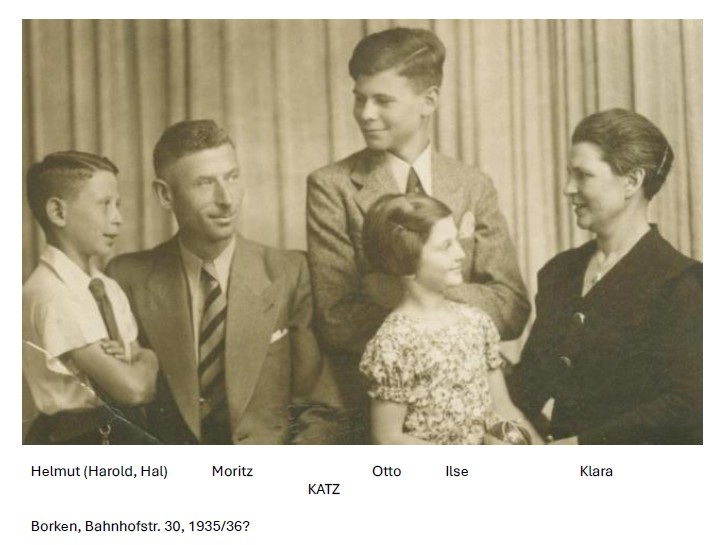
Hal believes this family photograph was taken not too long before Moritz and Otto left Borken for the US.

Katz family in Borken, maybe 1936. Courtesy of the family

Moritz and Otto arrived in New York on August 27, 1937.2

Fortunately, Clara was able to leave with Hal and Ilse eight months later, just a few months after Hal celebrated his bar mitzvah in Borken without his father or brother. In an interview Judy did with Hal in 2023, Hal told her that Clara and the children were living with a family from Borken, the Blums, until April 8,1938 when they left to go to the US. First, they took a train to Antwerp, where they stayed with the Tiefenbrunners at the orphanage they were running. (See earlier blog post here.) Then they boarded a freighter, a slower moving form of transport that was crowded with mostly Jewish people escaping Hitler. This photograph was taken before they boarded the ship to leave Germany on April 11, 1938.

Clara, Ilse, and Hal (on the right side of the photo) on the day they left Germany for the US in 1938. Courtesy of the family

They arrived in New York after an uncomfortable eleven day journey on April 21, 1938.3

Thanks to Moritz’s foresight, he and Clara and their children were now safely out of Germany, and they were the first ones in the extended Rothschild family to get out—-before Siegmund and before Max, Clara’s brothers.

And as we have already seen, most of the rest of the family did not escape in time. Hal said that his parents did all they could to get other family members out, but unfortunately as we have seen and as we will see, those efforts did not succeed. Hal said that they eventually lost contact with those still in Germany. When I asked why those who remained—-e.g., Clara’s sisters Katchen, Auguste, Jenny, Rosa and Amalie—-hadn’t also tried to get out of Europe when Moritz and Clara did, Hal said he thought they all just believed it would all blow over and that they would be safe.

But Clara, Moritz, Otto, Hal, and Ilse were now in New York, starting over in a new country.

More on that to come in my next post.


  1. Zoom calls with Hal Katz and family, May and June 2025. Interviews with Hal and Otto over the years by Judy Katz. 
  2. Moritz Katz, ship manifest, Departure Port Hamburg, Germany, Arrival Date 27 Aug 1937, Arrival Port New York, New York, USA, Ship Name Hansa  The National Archives in Washington, DC; Washington, DC, USA; Passenger and Crew Lists of Vessels Arriving at New York, New York, 1897-1957; Microfilm Serial or NAID: T715; RG Title: Records of the Immigration and Naturalization Service, 1787-2004; RG: 85, Ancestry.com. New York, U.S., Arriving Passenger and Crew Lists (including Castle Garden and Ellis Island), 1820-1957 
  3. Clara Katz ship manifest, Place of Origin Germany, Departure Port Antwerp, Belgium, Arrival Date 21 Apr 1938, Arrival Port New York, New York, USA
    Ship Name Gerolstein, The National Archives in Washington, DC; Washington, DC, USA; Passenger and Crew Lists of Vessels Arriving at New York, New York, 1897-1957; Microfilm Serial or NAID: T715; RG Title: Records of the Immigration and Naturalization Service, 1787-2004; RG: 85, Ancestry.com. New York, U.S., Arriving Passenger and Crew Lists (including Castle Garden and Ellis Island), 1820-1957 

Six Days in Merry Old England

We just returned from a wonderful trip to England where our daughter Maddy ran her eighth marathon and her first one outside of the United States. It was, as it always is,  a bit nerve-racking to think of her running 26.2 miles, especially alone and in a foreign country, but as always she came through, despite the unusually warm weather and the unknown city. We were delighted to see her at Mile 6 and then after she finished in St. James Park.

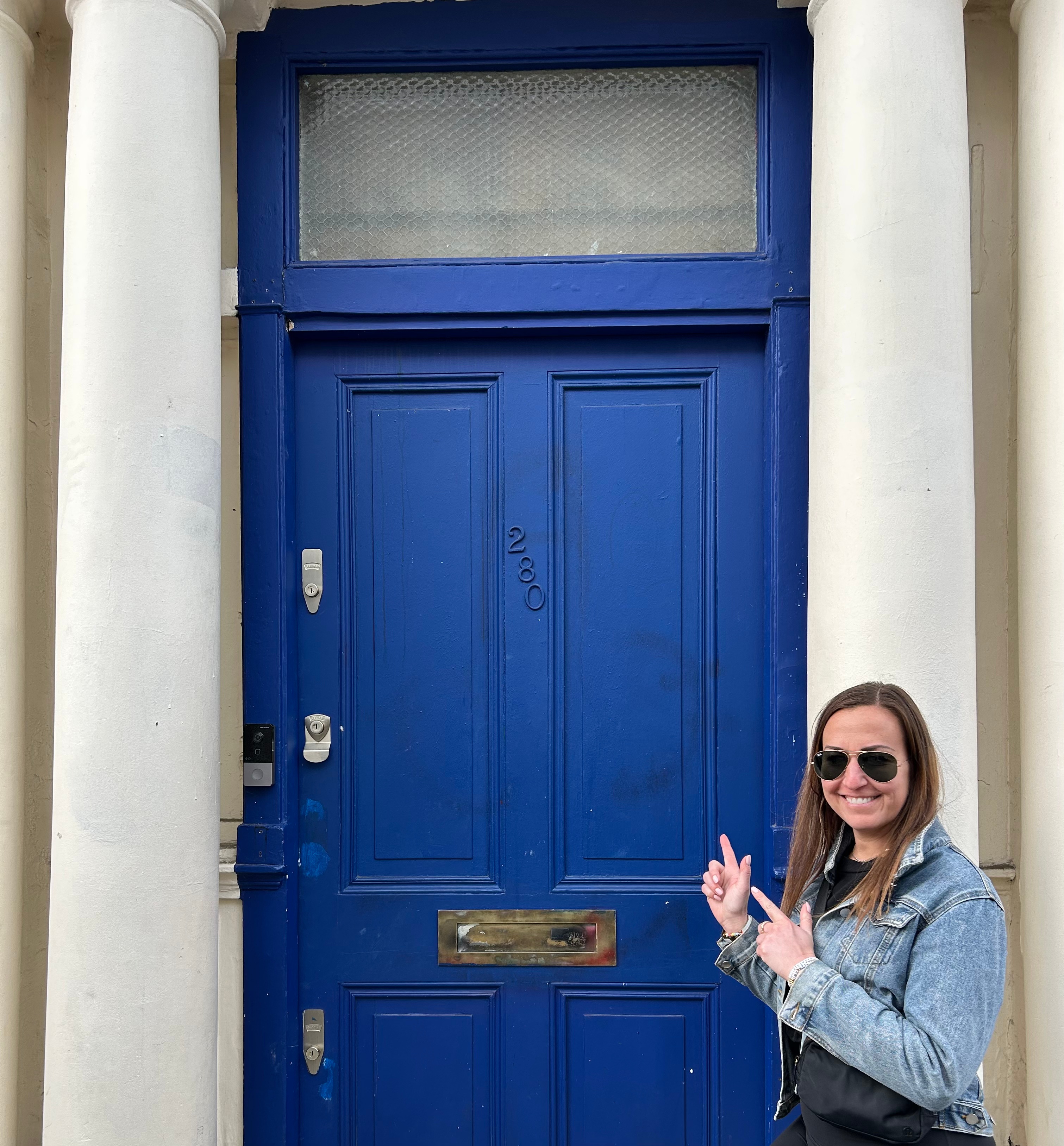
We are so grateful to Maddy for getting us to go to England, our first trip outside the country since COVID (and England was the last place we visited outside the US before COVID in 2019). We kept this tour focused on fun and new adventures, a tour of Notting Hill (and we’d watched the movie this winter together to refresh our memories) and a pub tour of SoHo.

Notting Hill tour:

Ben, our guide, in front of George Orwell’s house in Notting Hill

Banksy art in Notting Hill

Notting Hill—where parts of the Paddington Bear movies were filmed

Alas, Hugh Grant and Julia Roberts were not around…

SoHo pub tour:

Carlos, our guide, and most of the tour group enjoying one last beer

After Maddy left to return to Boston, we traveled north to Liverpool, fulfilling a definite bucket list item for me. I fell in love with the Beatles in February 1964 when I was eleven, and that love has never faded. Seeing where the four young teenagers lived and met and first played together was heartwarming and exciting. Little eleven year old Amy could not believe she played Paul’s piano or stood in the churchyard where Paul and John first met or met Pete Best’s nephew, who gave us a tour of the Casbah where the Beatles (with Pete, not Ringo) first played together as a band.

Mural dedicated to Ringo down the alley from where he grew up

St Peter’s Church where Paul first met John playing with the Quarrymen at a church festival

Did you know there was a real Eleanor Rigby? She is buried in the graveyard at St Peter’s where John was a choirboy and where he first met Paul

John’s childhood home

The kitchen in John’s home

Outside John’s home

Paul’s childhood home

Paul’s backyard and outhouse

Paul’s piano (which I played!) where he and John wrote many of their early songs

George’s childhood home

Alley where George lived

Gate to Strawberry Fields

There are stones with quotations from John’s songs throughout Strawberry Fields

Inside the Casbah on a tour with the nephew of Pete Best, the original drummer for the Beatles

The Casbah stage

If you know the lyrics to Penny Lane, you’ll know what this store is.

Some of you have likely seen some of these photos on Facebook, but I wanted to share these with those blog readers who may not be on Facebook with me.

Special thanks to my cousin Mark Morreau, who met us in Notting Hill and helped us navigate the Underground back to our hotel, and to our tour guides in London and Liverpool, Ben, Carlos, and Dave.

Cousin Meetings: Richard and Max Meet in Merano, Max and I Meet on Cape Cod

One of the greatest gifts I’ve received through my genealogy research is connecting with and getting to know new cousins. Some are as close as second cousins, some as distant as fifth or even sixth cousins. But none of that seems to matter once we have connected.

Sometimes these connections are only through email. Sometimes they are by phone. And sometimes I have been able to connect with cousins and get to see their faces and get to know them through Zoom. There are cousins from all over the US and the world with whom I have emailed, phoned, and/or zoomed—some as far away as Israel, Germany, France, Switzerland, England, and Australia, some as close as right here in Massachusetts.

I’ve been especially blessed when I’ve gotten to meet and spend time with a cousin in person. And that has happened far more times than I’d ever, ever have predicted. I have had meals with cousins in all kinds of places—in western Massachusetts where I once lived and on Cape Cod where I now live, in Florida and in New York City, in Boston and in Philadelphia, and even overseas—in Germany and in London. Each time it has been a truly joyful experience. Even though we had never met before and even though our connection may go back several generations to an ancestor we never knew, there was still something magical about meeting a cousin.

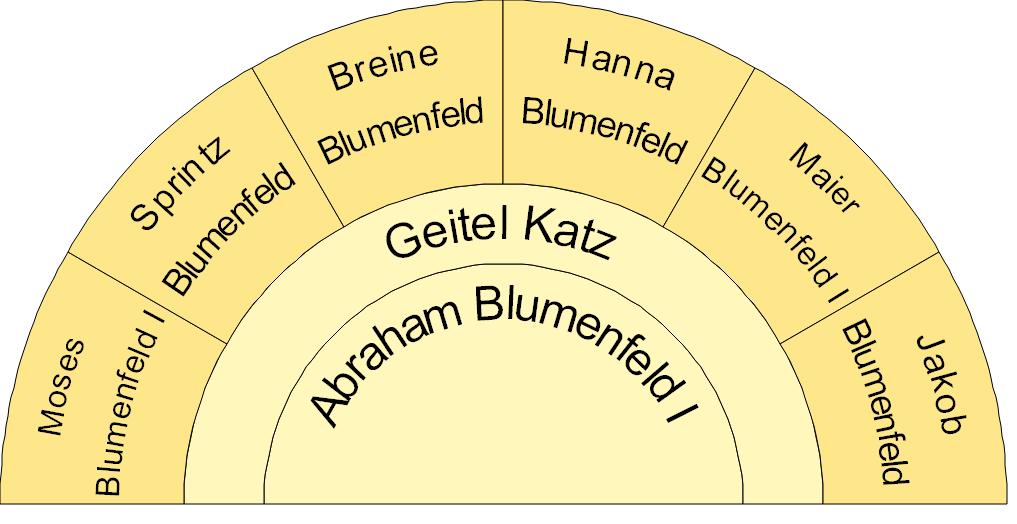
So I was somewhat envious but also thrilled when I learned that two cousins I’d found through my research and then connected to each other—Richard Bloomfield and Max Bermann—were able to meet in Merano, Italy, this past spring. Richard is my fifth cousin through his 3x-great-grandfather Jakob Blumenfeld, a younger brother of my 3x-great-grandmother Breine Blumenfeld; Max is also my fifth cousin, but through his 3x-great-grandfather Moses Blumenfeld, an older brother of Breine Blumenfeld, my 3x-great-grandmother. And Richard and Max are fifth cousins to each other; we are all the 4x-great-grandchildren of Abraham and Geitel (Katz) Blumenfeld.

Although I had zoomed and emailed with Max and Richard many times, I had never met either of them—until last Thursday, that is, when my husband and I had dinner with Max and his wife Glenna here on Cape Cod. Again, it was a magical and joyful experience. The warmth and connection were authentic and immediate, and we found so much to talk about in the three hours we sat at Fin, an amazing restaurant in Dennis. When we looked around at 10 pm, we realized we were the only ones left in the restaurant; the staff were all sitting around the bar politely not disturbing us, but obviously waiting for us to leave. After repeated promises to get together again, we all hugged goodbye, leaving as not just cousins but four new friends.

At dinner Max and Glenna told us about their trip in May, 2024, to Merano and meeting Richard and his wife Irma there. Why, you might ask, did they meet in Merano, Italy, a town not far from the Austrian border when Richard lives in Switzerland and Max in Massachusetts?

Well, that requires some background about Max’s life. I’ve shared Max’s story before on the blog, and I hope you will go back to the earlier blog posts for more details and photographs as well as for my sources for the information below. Also, Richard wrote a comprehensive biography of Max’s family.

But here is a very brief overview of why Max was visiting Merano:

Max’s mother was Edith Blumenfeld, daughter of Max Blumenfeld and Anna Grunwald. She married Joseph Bermann, Max’s father, in 1935.1 Joseph was born in Merano, Italy, where his father Max Bermann was a doctor and the director of the Waldpark Sanitarium. Joseph also became a doctor and worked there as well. After marrying, Edith and Joseph settled in Merano.

My cousin Max, grandson of both Max Blumenfeld and Max Bermann and named for both, was born in Merano a few years after his parents’ marriage. His father Joseph left Merano for the US in 1939 to escape from the Nazi and Fascist persecution and the impending war, intending to send for Edith, Max, and Max’s older sister Margherita once he was settled. But World Was II intervened, and Edith and the children could not get out of Europe.

They soon left Merano for Milan and then for the countryside of Italy where they hid their Jewish identity while Edith worked for the resistance as a courier. Once the war ended, Edith brought the children to the US, and they were reunited with Joseph. The story of how Edith kept herself, her mother, and her children safe during the war is a remarkable one and is described here on my blog and in Richard’s biography of Max’s family.

Max had never been back to Merano, his birthplace, after immigrating to the US in 1946, and he and his wife Glenna decided to visit there this year. The visit was motivated in part to see a painting of Max’s paternal grandfather, Max Bermann, a painting that Joseph Bermann had brought with him to the US in 1939 and that had been in Max’s parents’ home in New York City. It had then hung in Max and Glenna’s home for many years. Because he wanted to be sure that the painting was preserved in a safe and appropriate place in perpetuity, Max decided to donate the painting to the Jewish Museum in Merano, his birthplace and his father’s family home for many years. After shipping the painting there last year, Max and Glenna wanted to see it in its new home in Merano.

Meanwhile, Richard, born and raised in the United States, lives near St. Gallen, Switzerland, and thus about five hours from Merano. Richard had helped to connect Max with the Merano Jewish Museum, and when Richard learned that Max and Glenna were coming to Merano, he asked whether he and his wife Irma could meet them there. Max and Glenna were delighted.

Richard has generously shared with me some of the photographs of their meeting and an essay he wrote about the experience. I will quote parts of what he wrote rather than trying to paraphrase it.2 I am also going to include some of his photographs.


Last Sunday we [Richard and Irma, his wife] stood on the balcony of our hotel room in Meran and looked across the Passer River at the Hotel Meraner Hof where Max and Glenna were going to be staying. It had been just two and a half weeks since Max had written me that he and Glenna were going to travel to Meran. Max had donated a painting of his grandfather [Max Bermann] to the Jewish Museum in Meran and wanted to have the experience of seeing it on display. When I asked Max if he would mind if Irma and I came to meet them there, Max wrote that he found that touching. Although we are 5th cousins, i.e. relatives, and had had email and Zoom contact, we didn’t want to intrude on Max’s first trip back to his place of birth since leaving it at age 2.

Our first live encounter took place when we waved to each other from our balcony to their terrasse. Shortly thereafter, we greeted each other with big hugs, sat down for a drink and exchanged the special, personal gifts we had brought for each other. We were joined by Sabine Mayr, researcher and co-worker at the Jewish Museum, and the museum’s director Joachim Innerhofer. Joachim and Sabine welcomed us like VIPs: Max, the long-lost son; I, the person who had connected Max with the museum in Meran and provided them with lots of information from my family research; Glenna and Irma as though they were long lost members of the Jewish community in Meran.

Remembering the adage that the way to the heart is through the stomach, we headed off to a restaurant for dinner. Unfortunately, Joachim had an appointment and couldn’t join us. Maybe we should have had an empty chair at the table for Amy, the person who had done the matchmaking between Max and me (and lots of other cousins!).
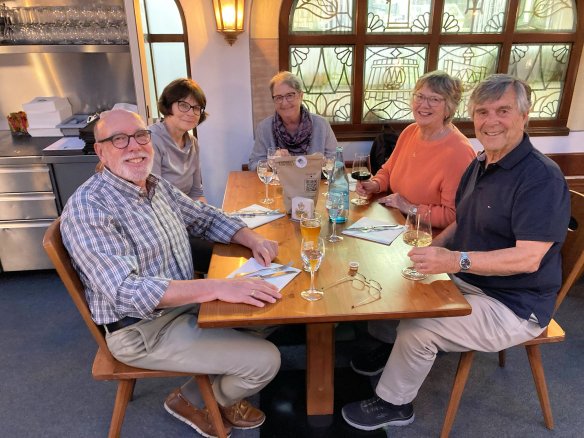
Richard, Sabina Mayr, Irma, Glenna, and Max

Monday morning we visited the synagogue and museum just behind Max and Glenna’s hotel. The first synagogue in Tirol was dedicated on 27 March 1901 and the interior has survived in its original form. When the Nazis removed the pews to use the room as a horse stall, the people of Meran saved them and returned them after the war. The very attractive Jewish Museum of Meran is located in the same building.

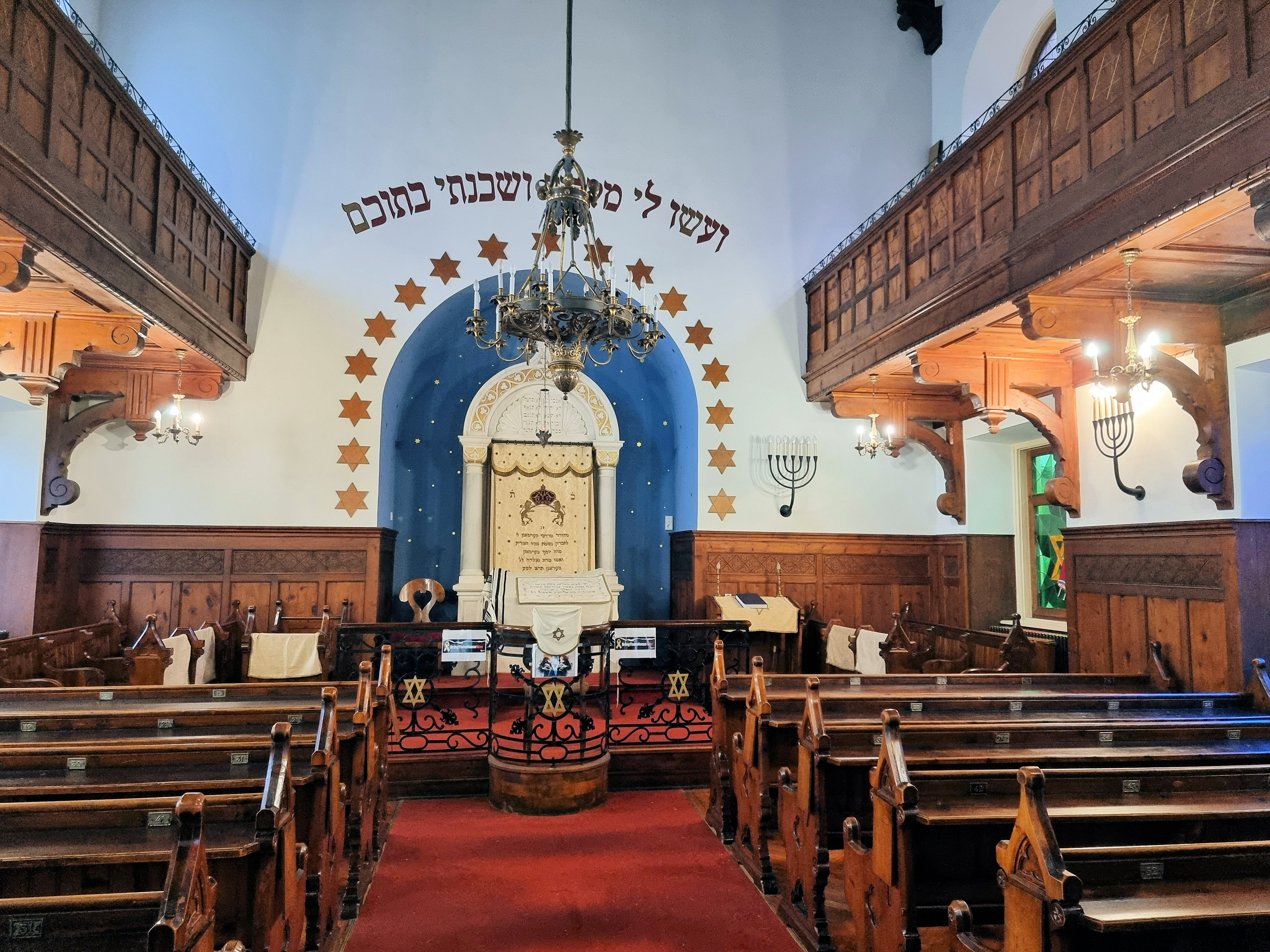
The sanctuary pictured below is warm – comfy – and inviting. Even with just seven rows of pews on the main floor, there is more than enough room for the 50 members of the community. Here is where Max’s family had worshipped. Today services with a rabbi are only held on holidays.
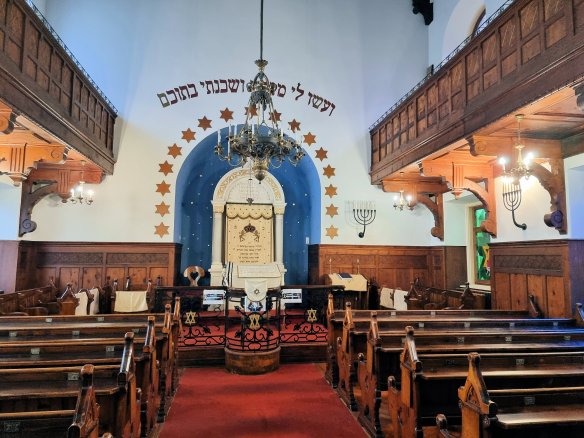
Merano synagogue

Irma, Richard, Max, and Glenna standing in front of the ark in the Merano synagogue

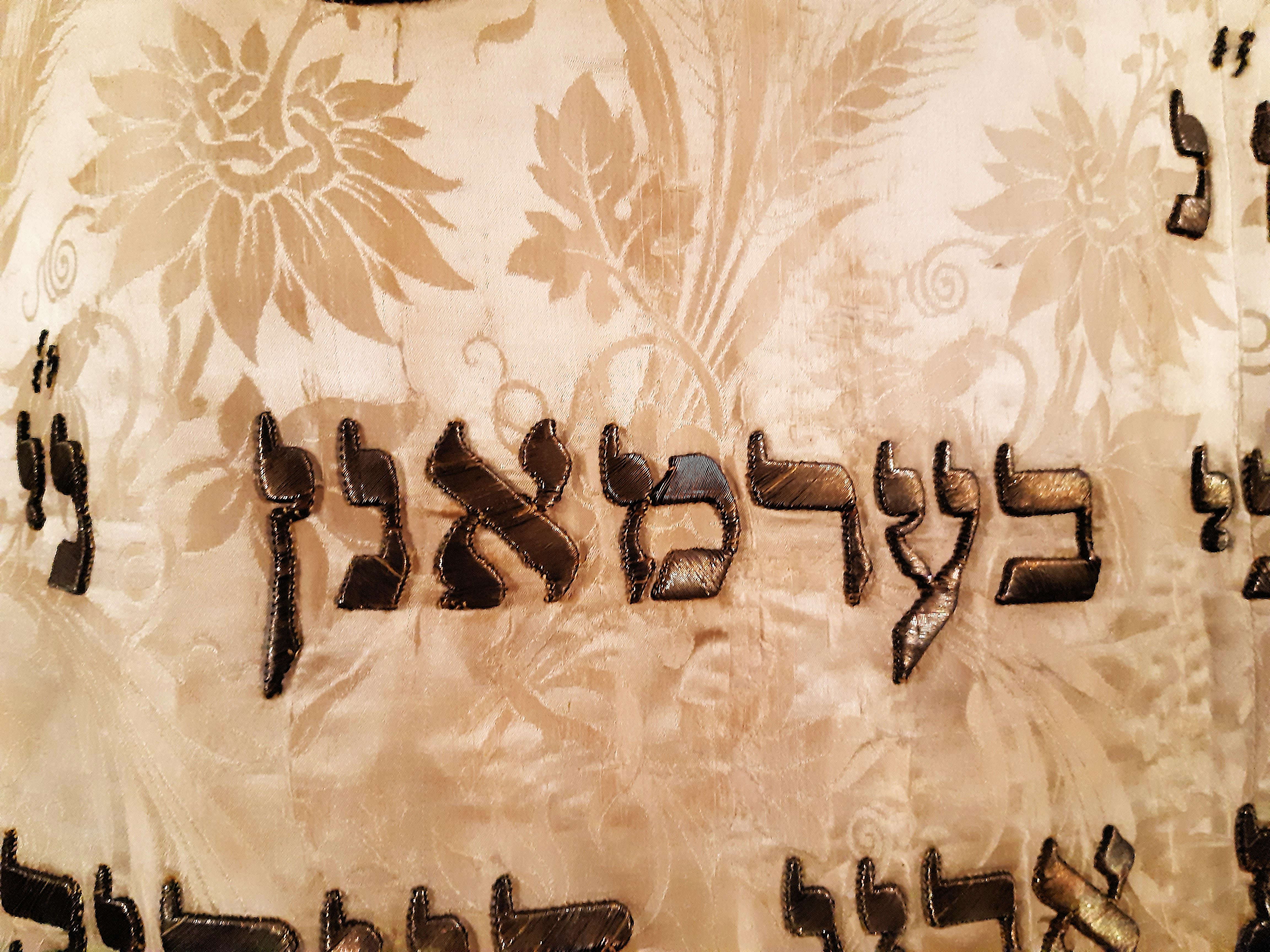
The name Bermann is embroidered into the parochet or curtain that covers the ark

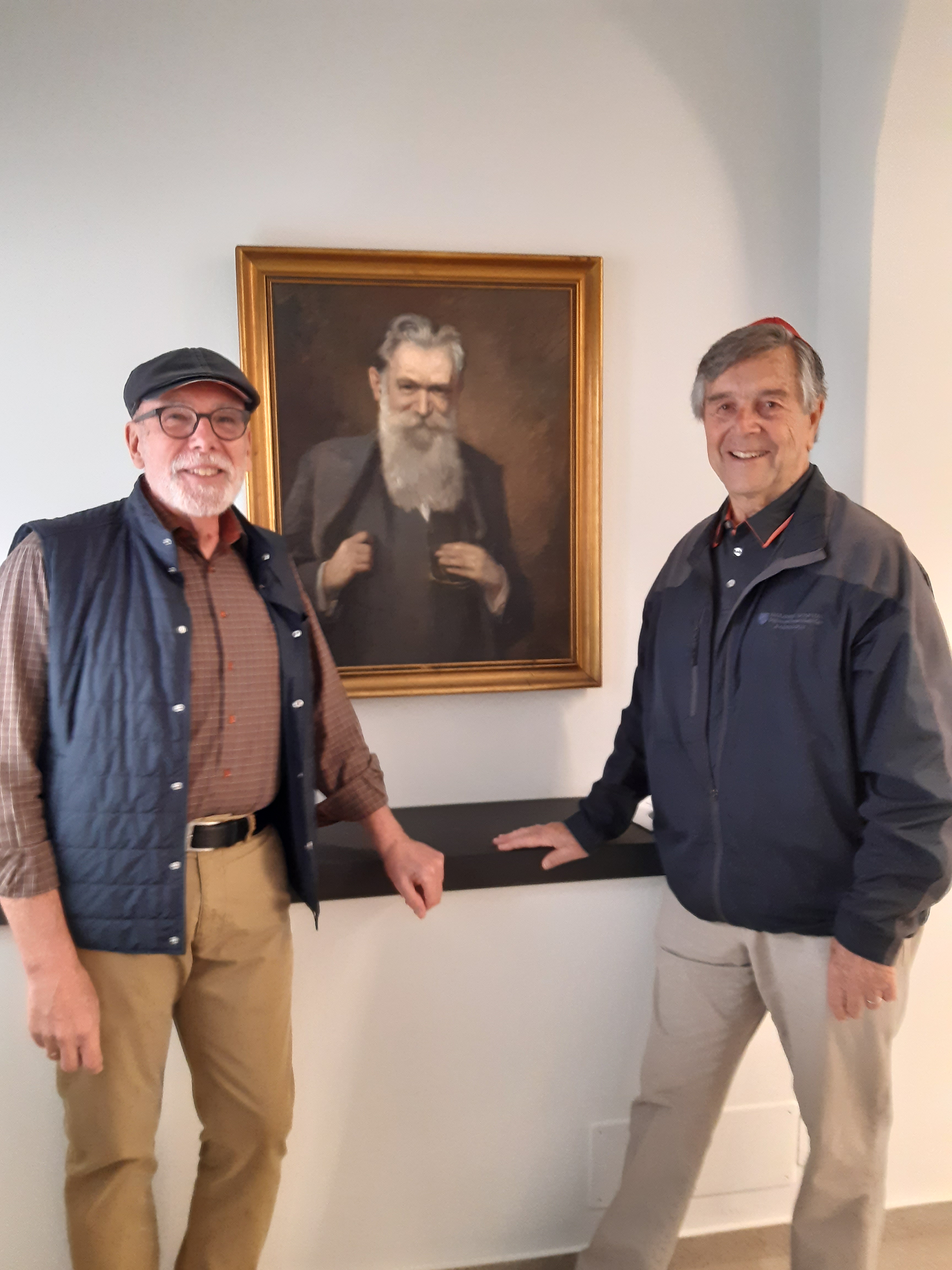
At long last we descended the steps to the museum under the sanctuary. Just around the corner to the right of the entrance Max found his grandfather Max [Bermann]! …

Richard and Max standing in front of the portrait of Max’s paternal grandfather, also named Max Bermann

 This picture of [Max’s relatives’] wedding in 1926 hangs on the other side of the room to the right of [his grandfather] Max’s portrait. When Max saw it, he ex-claimed: “Look, there’s my father!” (1) (1898-1966). Joachim pointed to the right edge of the photo where Max’s grandfather with a long white beard is pictured (2) (1865-1933). “And there’s my grandmother next to him” (3) (1870-1958)….

A rather long and wet walk took us to the Waldpark Sanatorium where Max was born and lived for two years: In 1907, [his grandfather] Doctor Max Bermann acquired the Villa Paulista from John Stoddard and founded the Waldpark Sanatorium, which he ran as a specialist in internal medicine. In the early 1930s, two buildings were added, and in the following years the main building was renovated and enlarged. Claiming that the owners were indebted, the buildings and the large park surrounding them were sold at auction in 1941. (Source: Jewish Meran Walking Tour, Jewish Museum of Meran)

Although Max was only two when he left Meran in 1940, he thinks he remembers a white fence surrounding the Waldpark. Indeed, the fence is still white!

Max’s birthplace in Merano

On Tuesday it did not rain, and the sun eventually came out. A chair lift carried us up to a place above Meran where we had a good view of the city and the surrounding countryside….

….

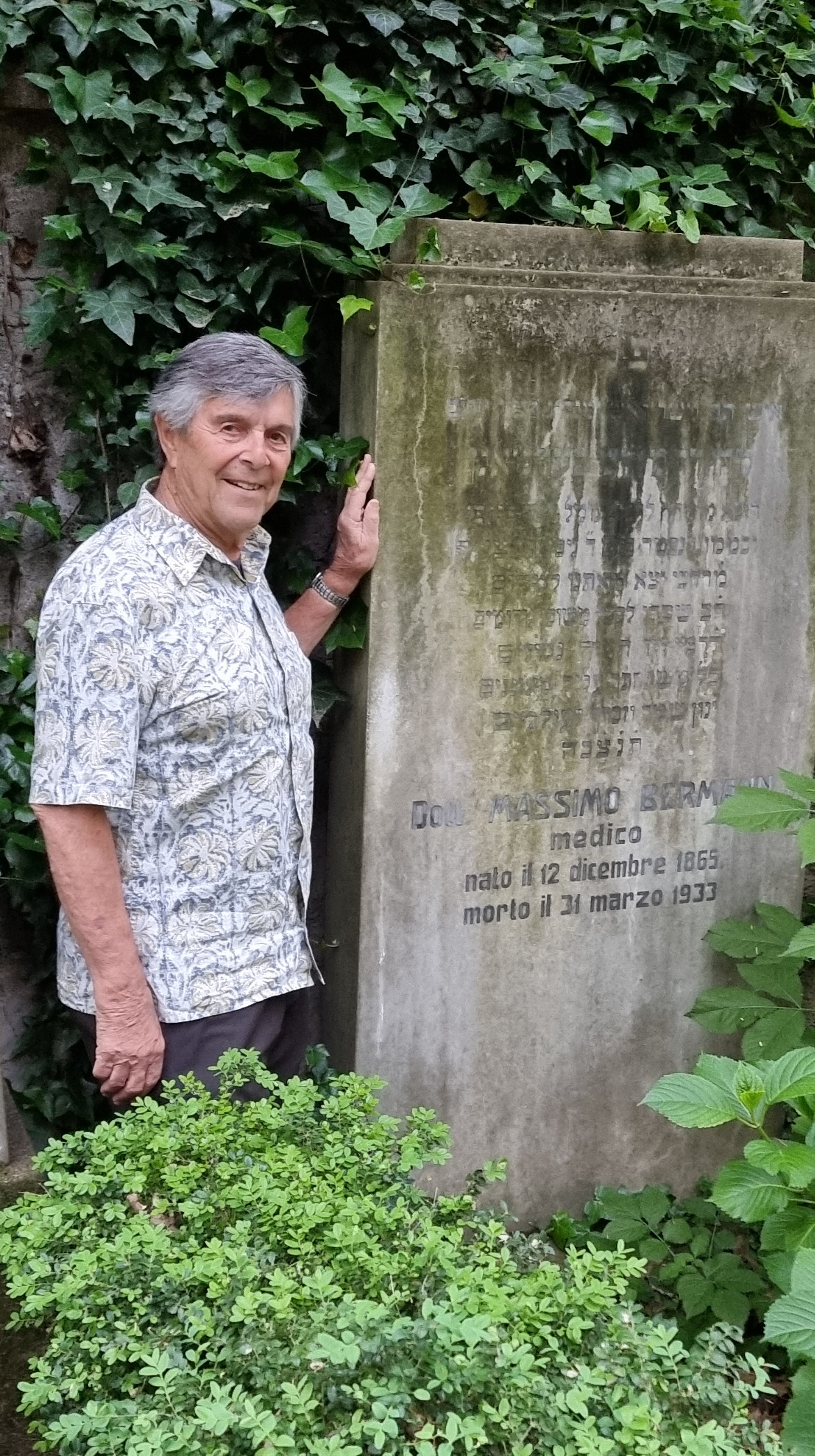
Before dinner we wanted to visit the New (1908!) Jewish Cemetery where members of the Bermann family are buried. After a stop at the memorial for the victims of the Shoah… we went to visit the graves of Max’s grandfathers, Max Bermann and Max Blumenfeld….

Max is standing next to Grandfather Bermann’s headstone, and both of us touched together the gravestone of our common relative Max Blumenfeld (1880-1936). The common roots that Max and I have that we have talked and written about became something living here in the cemetery.”

—————————–

I am so glad that Richard and Max were able to meet and share this moving experience together. It makes me appreciate how fortunate I have been to find so many cousins and to help them find each other.

And now I also have had the special opportunity to spend time with my cousin Max and his wife Glenna and to feel those common roots. His life and mine had such different beginnings—his as a small child hiding from persecution in Italy, mine as a middle class American child growing up in suburban New York after the war, never worrying about antisemitism.

But here we are so many decades later, both living in Massachusetts less than ninety miles apart. In so many ways our lives have taken similar paths despite those very different beginnings, and we have far more in common than those different beginnings would have predicted.

I am so lucky and so grateful for all the gifts that genealogy has brought to my life, especially all my amazing cousins like Richard and Max!

  1. I have seen records that spell his name Joseph, others that spell it Josef. For consistency purposes I have used the American spelling Joseph since he was born Giuseppe and kept that name until he immigrated to the US in 1939. 
  2. Merano was once under Austrian control, but after World War I it became part of Italy. The town uses both the German-Austrian spelling Meran, which Richard uses, and the Italian spelling Merano, which I use. Both are equally acceptable. 

The John Nusbaum Album: Some Final Thoughts

So what is left to talk about regarding the Nusbaum album, you may wonder? Well, Ava Cohn aka Sherlock Cohn analyzed about a quarter of the photographs taken in Philadelphia, all of the Santa Fe photographs, and about a third of the photographs from Germany. Add to that the handful I discussed that had names on them plus the photographs from Peoria, and that means many but not all of the photographs in the album have been discussed or analyzed. What can I say about those others?

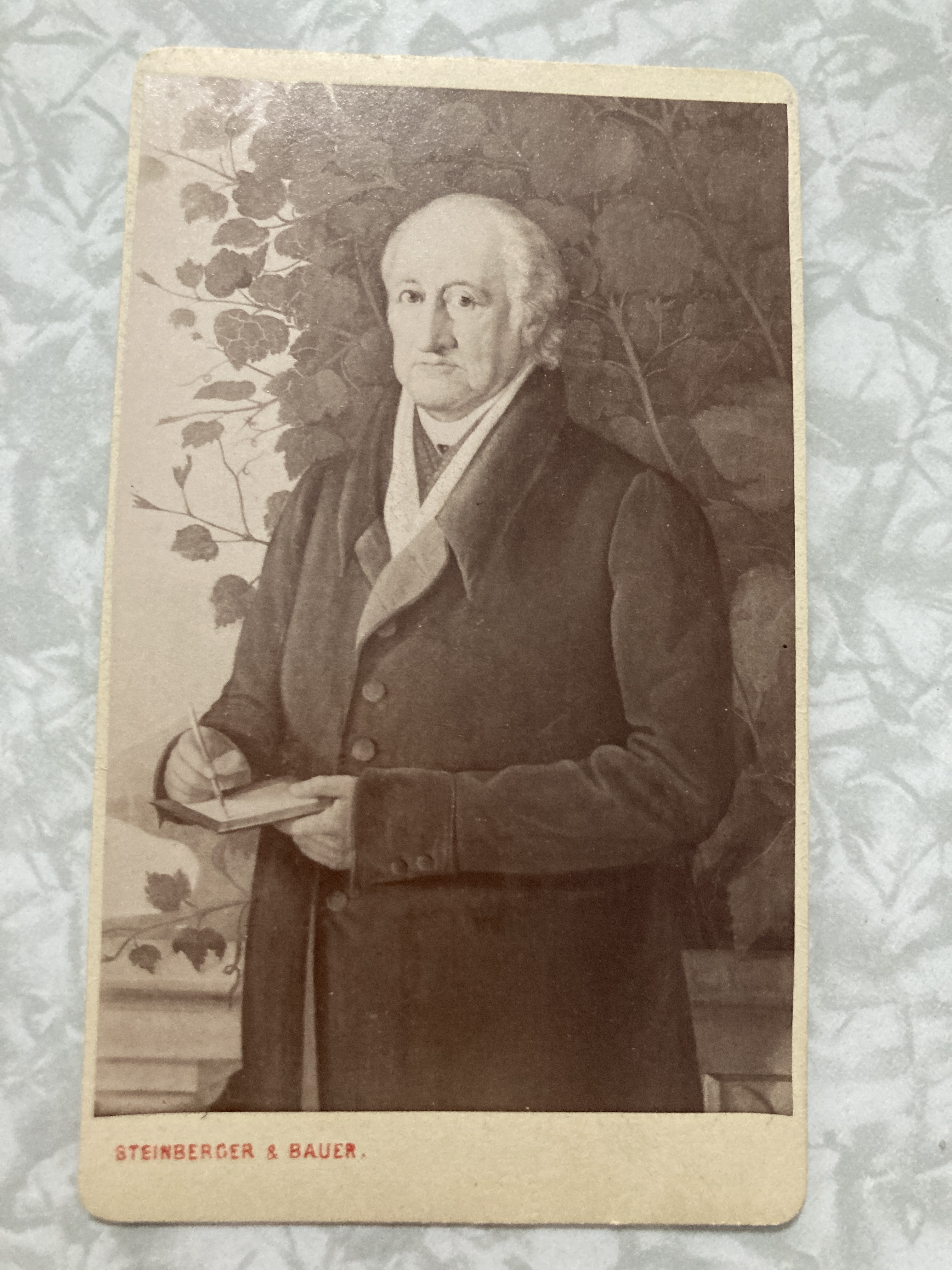
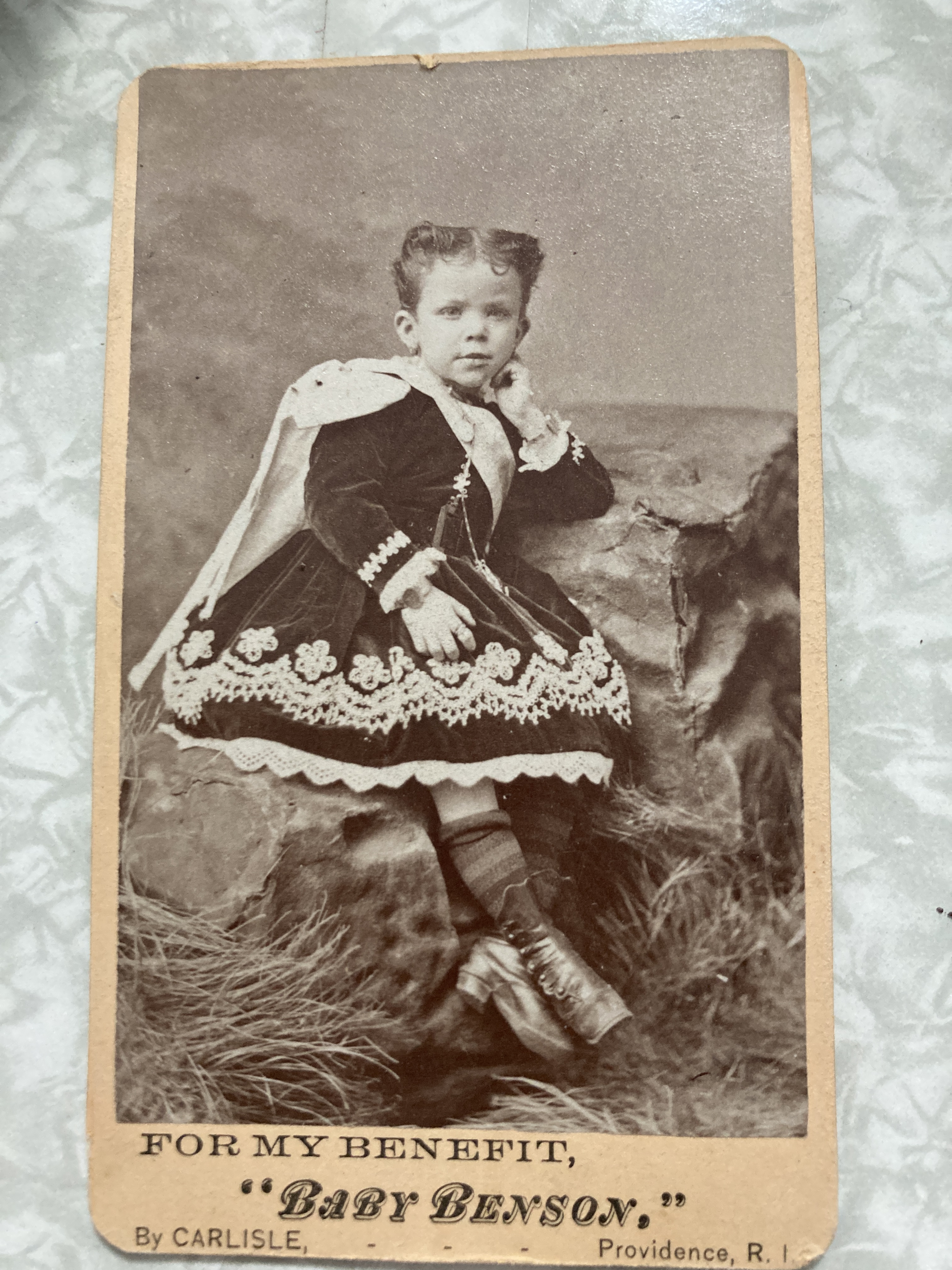
There are some that are more like postcards of famous places or people, e.g., a photograph of a painting of Goethe and one of “Baby Benson,” a child performer popular in the 1870s. But otherwise all the other photographs—at least another forty—are of people who have not been identified.

Goethe

I gave up on the ones from Philadelphia—too many possibilities! An infinite number now that I know that these CDVs could have been given to the Nusbaums by friends, acquaintances, even visitors from other states, as we saw with S.B. Axtell’s CDV left as a calling card. I posted on a Philadelphia genealogy group on Facebook, inviting people to send me photos of their ancestors that I would use to compare with mine, but I had no luck.

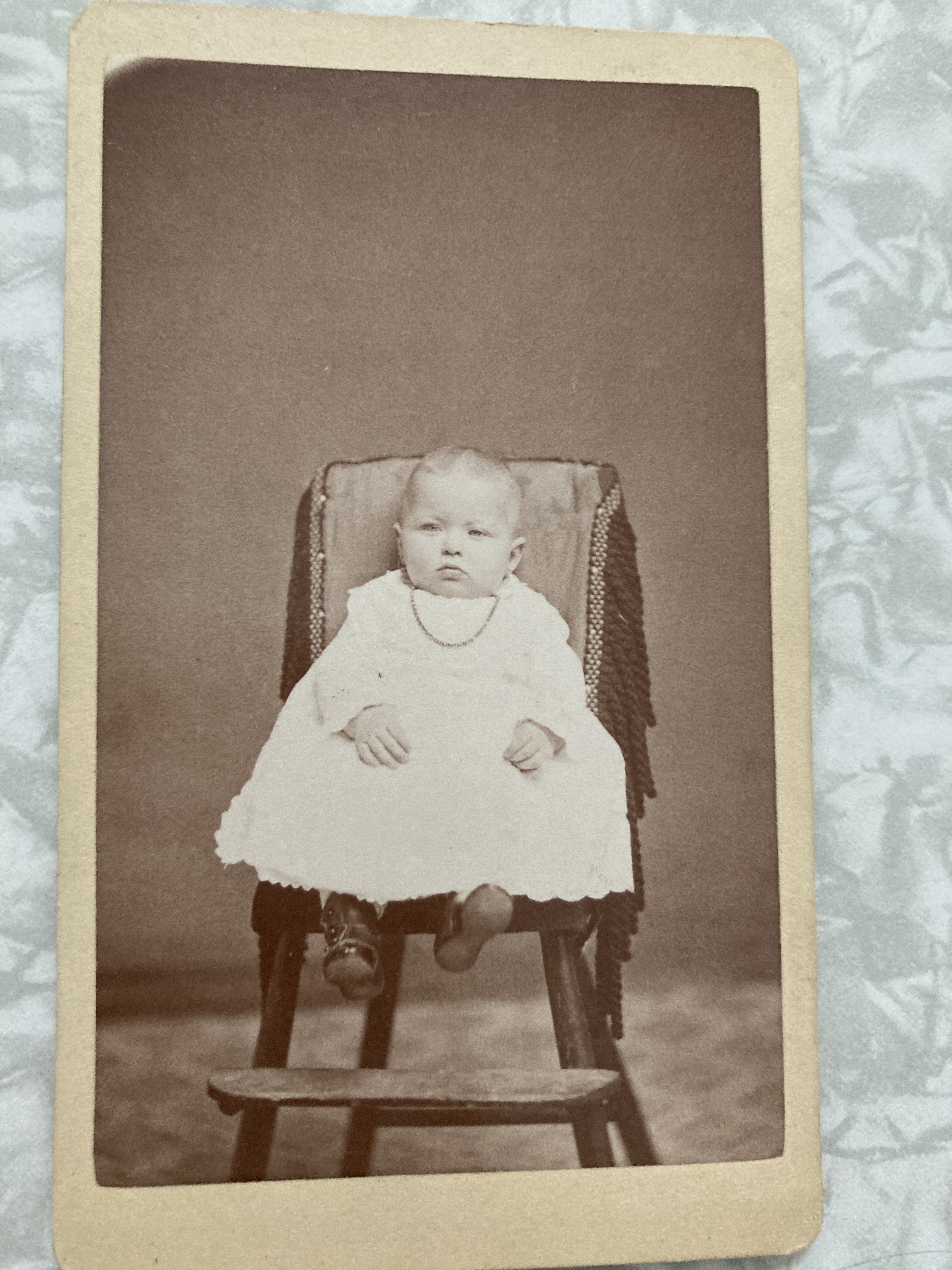
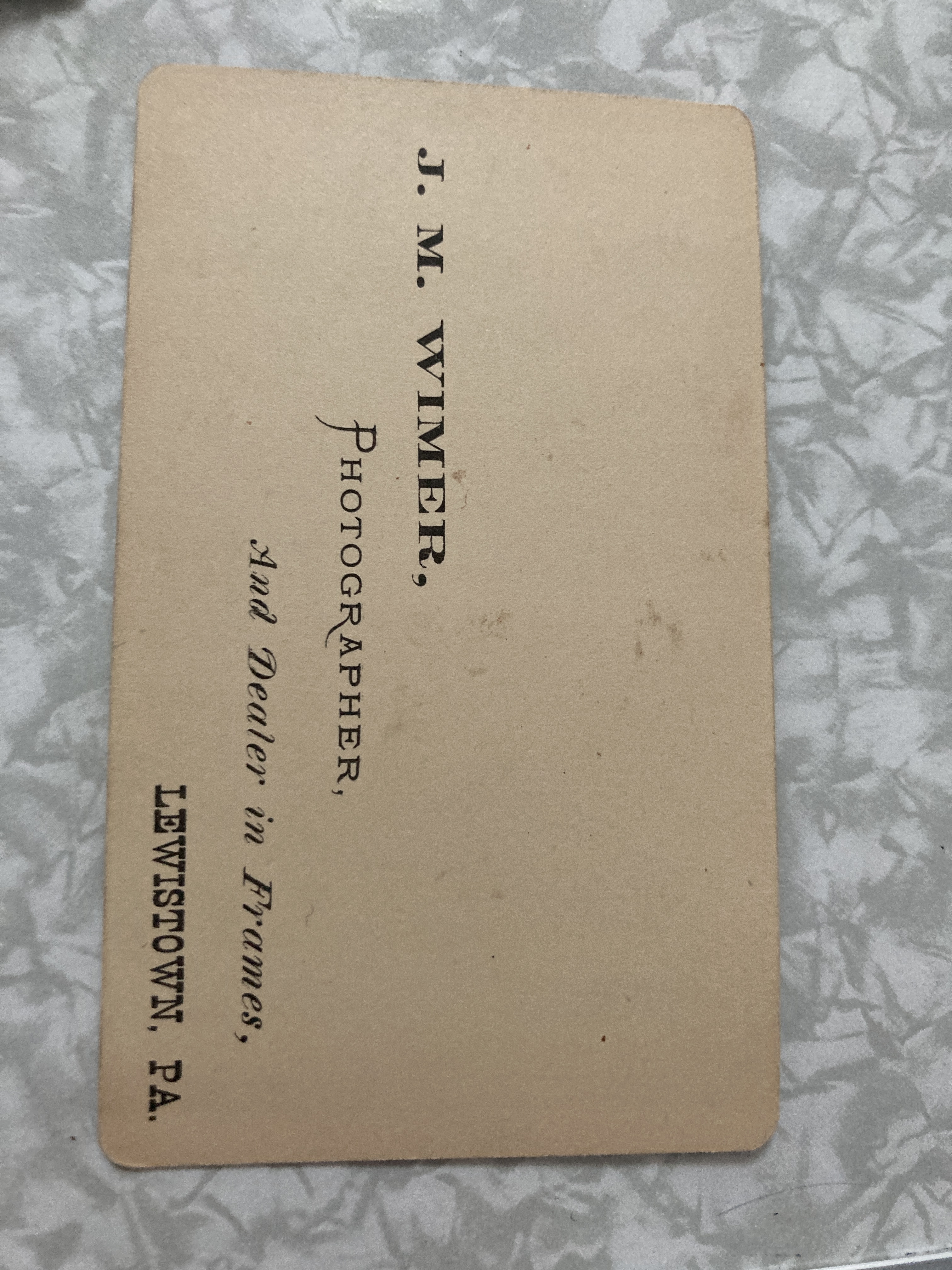
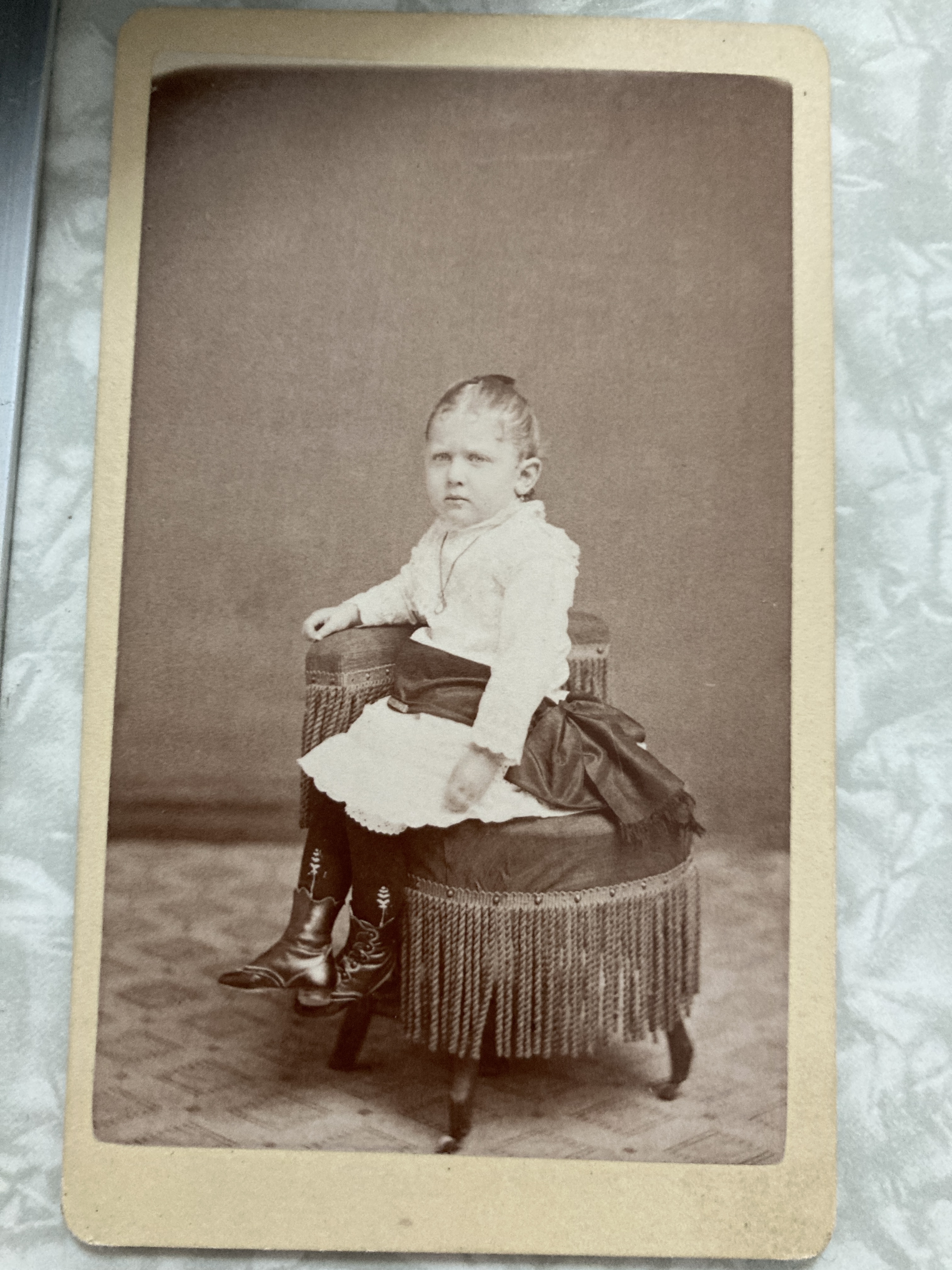
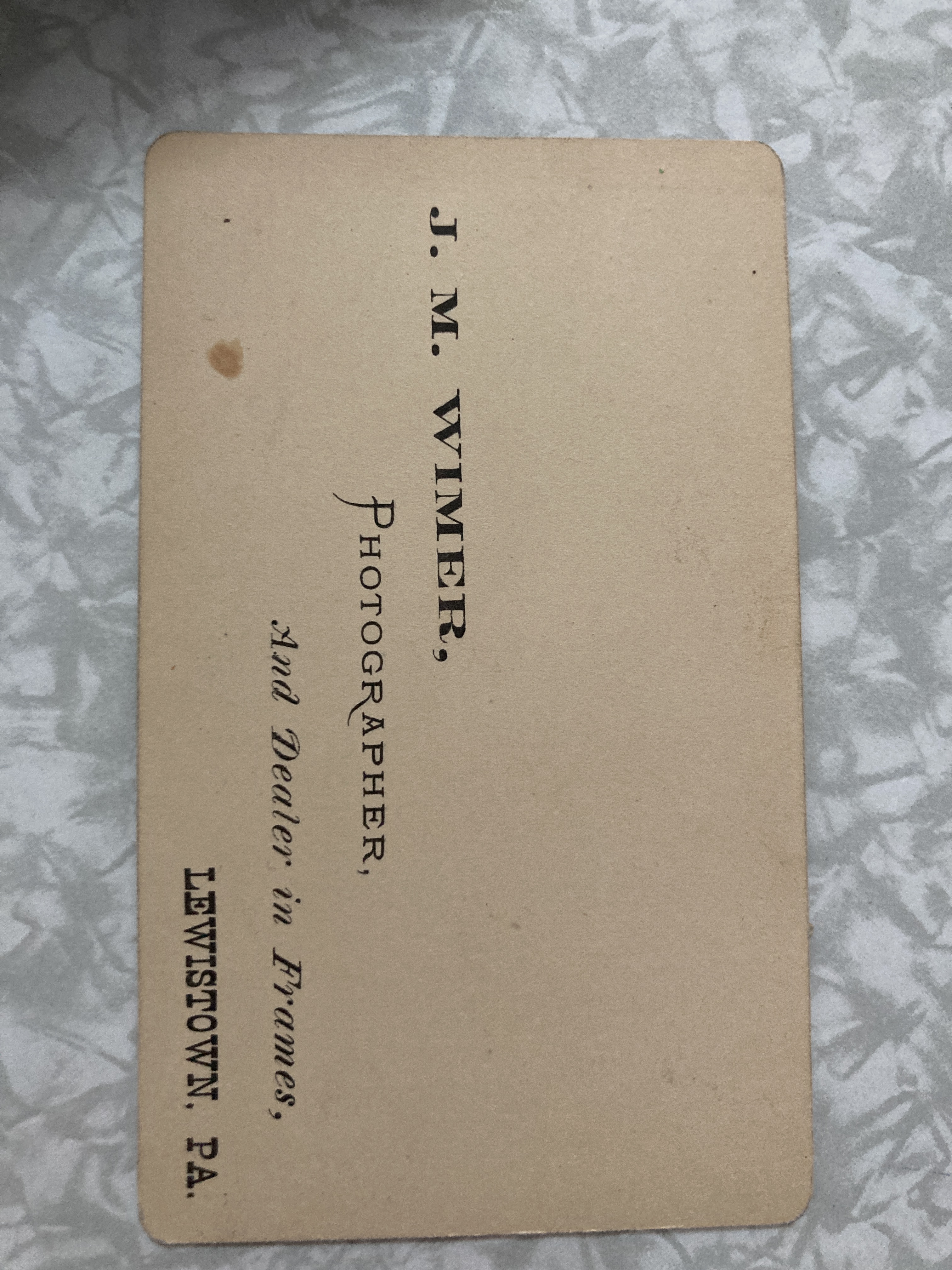
But I thought I could at least make an educated guess about the four photographs of children that were taken in Lewistown, Pennsylvania, all taken by a photographer named J.M. Wimer.

I have only one family on my family tree that lived in Lewistown in the mid-1800s—the family of Mathilde Dreyfuss Nusbaum Pollock. Mathilde Dreyfuss was the sister of my three-times great-grandmother Jeanette Dreyfuss Nusbaum. I at first thought it would be obvious who was who in these photos. As if…

Mathilde was married first to John Nusbaum’s younger brother Meier or Maxwell. They had two children together, Flora in 1848 and Albert in 1851. Tragically, Maxwell was killed in the San Francisco fire of 1851 while traveling there for business. Mathilde married Moses Pollock a few years later and had three children with him: Emanuel (1856), Miriam (1858), and Rosia (1870).

By 1860 Mathilde and her family were living in Harrisburg, Pennsylvania, and by 1870 they were living in Philadelphia. CDVs were first seen in the US in about 1859-1860. Assuming the photographs were taken before Mathilde moved to Harrisburg and thus before 1860, that would mean these photos were taken no earlier than 1859 and no later than 1860, if they are of Mathilde’s children while living in Lewistown. In 1859 Albert Nusbaum would have been eight, Emanuel Pollock would have been three, and Miriam Pollock would have been a year old. Rosia wasn’t yet born, and Flora would have been eleven, but I don’t see an eleven year old girl here. So I thought maybe the older boy was Albert, the baby was Miriam, and one of the others was Emanuel.

But then I remembered that Ava had said that the fringed chairs were not introduced until 1864.

Also, it appears that in the 1850s until sometime after 1870, J.M. Wimer (sometimes spelled Weimer) was living in Mifflintown, Pennsylvania, which is about thirteen miles from Lewistown. He doesn’t show up in Lewistown until the 1880 US census. Newspaper articles from 1871 show him as a resident of Mifflintown. Now thirteen miles doesn’t sound that far in today’s world, but in the horse and buggy era that might take three hours, not exactly a convenient commute.

So perhaps these photos were taken in the 1870s or 1880s. If so, I had no relatives living in Lewistown at that time. And thus, once again, I can’t be certain who these children are.

As for the remaining photographs in the album not taken in Pennsylvania, Santa Fe, or Germany, there are about twelve photographs in the album that were taken in New York City. I have no idea who could be in these photographs. As far as I can tell, assuming that these photographs were also taken some time between 1860 and 1890 like all the others in the album, there were no Nusbaum or Seligman relatives living in New York City during those years. Could they have visited and had photographs taken? Of course. Could these be friends of the family? Certainly. But unless someone comes up with a photograph to match these people, it’s like looking for a needle in a haystack to try and identify them. Or even more impossible.

Then there are the CDVs from places where I cannot find any likely family connections, like Montgomery, Alabama, St. Louis, Missouri, and Wheeling, West Virginia. Sadly, I have no way of knowing who these people could be. They, like so many of the others in the album, will remain a mystery.

And thus, I come to the end of this chapter in my genealogy journey. Out of over one hundred photographs, I have a positive identification of Moritz Seligmann, my three-times great-grandfather, and a probable identification of Babette Schoenfeld Seligmann, his wife, my three-times great-grandmother, based on earlier photographs. I have positive identification of two babies who died as children (Milton Josephs and Eva Dinkelspiel) because their names are on the photographs. Same for two people who were distantly related to me by marriage, the Gardiners, the parents of Doris Gardiner who married Otis Seligman. And also I can identify some people who were not related to me at all—Louis Sulzbacher, Goethe, Baby Benson, and some mysterious visitor named S.B. Axtell.

Beyond that, I have some possible identifications—maybe there’s a photograph or two of John Nusbaum, maybe some of his sons in Peoria, maybe a photograph of Frances Nusbaum, maybe one or two of her sister Miriam—but nothing nearly definite enough to label them as such.

Nevertheless, this has been an exciting and worthwhile adventure. I’ve learned a great deal about CDVs, the dating of photographs, and the names of some Philadelphia, Santa Fe, and German photographers and when and where they worked. I’ve had the great pleasure of collaborating with Ava Cohn in trying to identify the people in the photographs.

I’ve also gained some insights into the lives of my Nusbaum-Seligman relatives from the overall collection of CDVs. They knew many people from many different places, and the photographs appear to be of people who were if not wealthy, certainly not poor. They are well dressed and distinguished looking. Someone was a fan of Goethe, someone was a fan of Baby Benson. And reviewing the album reminded me of one of the tragic realities of life in those times—many children did not live to adulthood, like Milton Josephs and Eva Dinkelspiel. Even if I can’t put names to most of the faces, I have had a glimpse into the lives of my ancestors.

And I have had my hands on a physical object that I know for certain was handled by my three-times great-grandparents John Nusbaum and Jeanette Dreyfuss, by their daughter Frances, my great-great-grandmother, and by her husband Bernard Seligman, and most likely also by my great-grandmother Eva Seligman Cohen and her siblings. Before it ended up in the hands of an antique dealer in Santa Fe, it was in the possession of Eva’s niece and Arthur Seligman’s daughter Joan, Joan’s daughter Adrienne, and Joan’s granddaughter Jhette. It is now back safely in Jhette’s hands. And I instead have the scans of all the photos and that sweet memory of holding the album lovingly in my own hands for several months.

May it stay safe and protected for at least another 160 years.


John Nusbaum Album: Four Photographs With Names, But Who Were They?

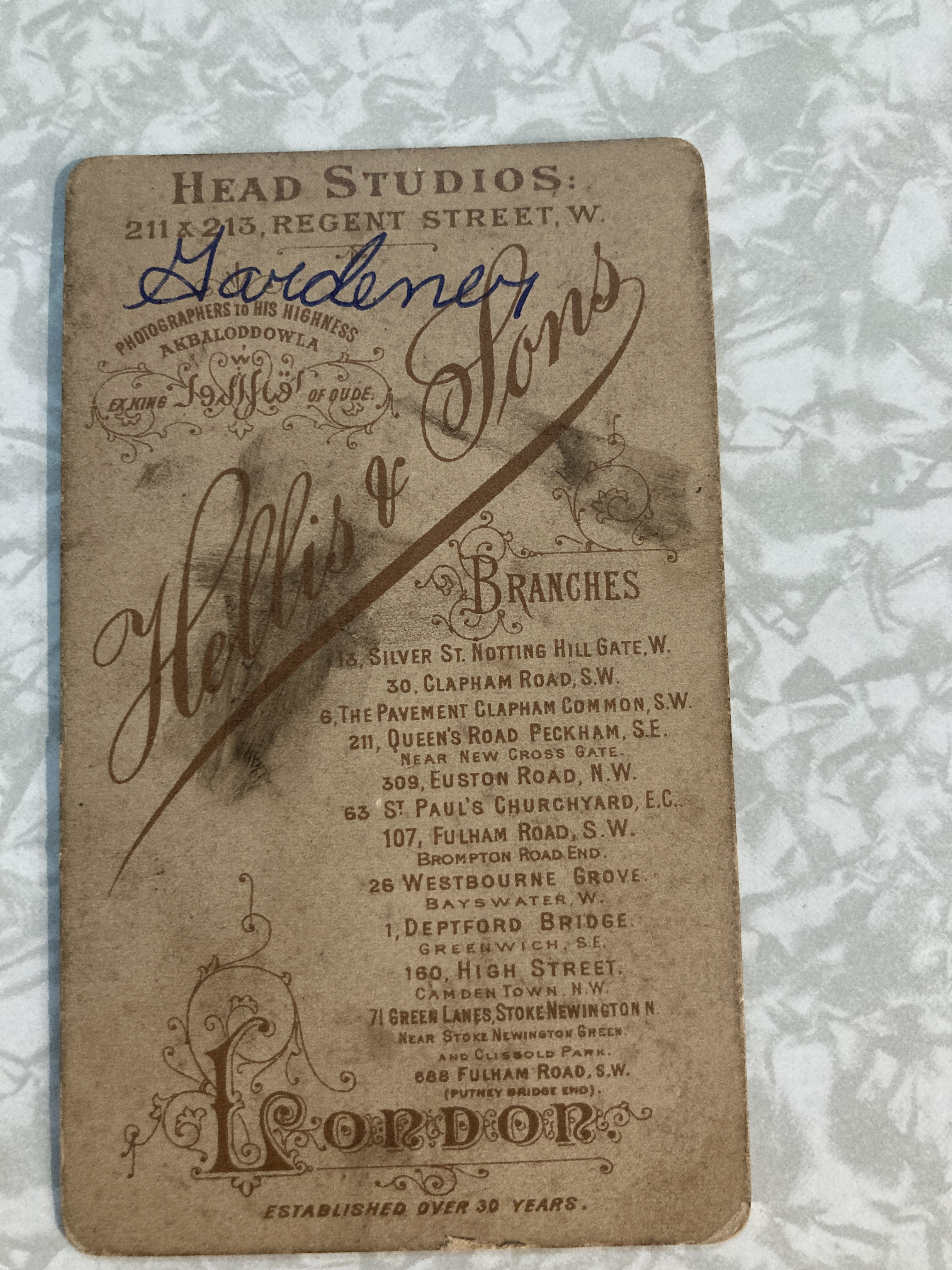
Returning once more to the Nusbaum Album, out of the more than one hundred CDVs in the album, only six had names on them. We saw two in my last post, and this post will discuss the other four that had names on them. Two had the name Gardiner on them:

The one of the man says Hellis & Sons at the bottom; on the reverse it repeats Hellis & Sons and lists all their branches, all in England. The one of the woman was taken by J. Telling Photographers in Bridgend, which is a town in Wales. Ava volunteered that she believed these were taken in the 1880s, the one of the man in the later part of the decade, the one of the woman in the early 1880s. She thought the man appeared to be in his early 20s, meaning he was born sometime in the late 1860s.

Since I had only one Gardiner family on my tree, I was pretty certain who those people might be. Bernard Seligman’s son Arthur, my great-grandmother Eva Seligman’s younger brother, had a son Otis Perry Seligman. Otis married a woman named Doris Gardiner, who was born in Nantymoel, Wales on February 17, 1901. Nantymoel is a village in the county of Bridgend. Doris Gardiner’s parents were George Gardiner, born in about 1864 in Wales, and Mary Ann Wilcox, born in 1866 in Wales.  It certainly appears that these two photographs were of Doris Gardiner’s parents George and Mary Ann.

These photographs appear on a very late page in the album on the reverse side of that page so probably were added after the album was otherwise filled. That makes sense since Doris Gardiner didn’t marry Otis Seligman until July 23, 1921, in Cleveland, Ohio, where Doris and her parents had settled after immigrating to the United States in 1914. Doris may have added these two photographs once she joined the family.

Doris and Otis were the parents of Arthur Seligman II, later known as Arthur “Pete” Scott, my second cousin, once removed. Pete was, as long-time readers may recall, a tremendous help to me when I was researching the Sante Fe branch of the family. His sister Joan Seligman Diamond was the grandmother of my cousin Jhette and a prior owner of the Nusbaum Album.  It certainly makes sense that Doris’ parents George and Mary Ann, grandparents to Pete and Joan, great-great-grandparents of Jhette, would be in this album.

The other two photographs with names on them are not related to me nor, as far as I can tell, anyone else in the family. The first, however, is of a fairly well-known person, Louis Sulzbacher. The back of this photograph has the following words written on it: “Compliments of Louis Sulzbacher, Las Vegas Feb 1878, Mrs. N. Seligman, S.F.”

Louis Sulzbacher

Louis Sulzbach

Louis Sulzbacher was, like Bernard Seligman, a German Jewish immigrant to the United States. The Encyclopedia of Oklahoma History and Culture includes this information about Sulzbacher:

An attorney and a judge of the United States Court for the Indian Territory, Louis M. Sulzbacher was born on May 10, 1842, in Kirchheimbolanden, Bavaria. Coming to the United States in 1859 as a young adult, he settled in New Mexico Territory, read law, was admitted to the bar, and opened a law office in Las Vegas. He remained in the Land of Enchantment for some two decades. In 1869 he married Paulina Flersheim in Kansas City, Missouri. In 1898, during the Spanish-American War, he served with Theodore Roosevelt’s Rough Riders.

In 1900 Pres. William McKinley appointed Sulzbacher to the newly created Supreme Court in the recently formed Territory of Puerto Rico. He served until his appointment to the [Oklahoma] Indian Territory bench. In 1904 Congress created four additional judgeships for the United States Court for the Indian Territory. Pres. Theodore Roosevelt appointed Sulzbacher as judge for the Western District [of Oklahoma].

He served until his appointment to the Indian Territory bench. Leaving the bench at Oklahoma 1907 statehood, Sulzbacher resided in Kansas City for a few years. He then moved to New York City, where he died in Manhattan on January 17, 1915, and was buried in Kansas City.

I have no idea what the connection was to the Seligman family in Santa Fe. I am not even sure who “Mrs. N. Seligman” could be, living in Santa Fe in 1878. Frances was living there at that time, but her initial would be F, not N, or if she were being referred to by her husband Bernard’s name, as women did back then, it would be B. Maybe it says Mn., not Mrs., but even then—I have no idea who that would be. I am going to assume that the N was a mistake and that Sulzbacher gave his CDV to Frances Nusbaum Seligman. Ah, maybe the N was for Nusbaum!
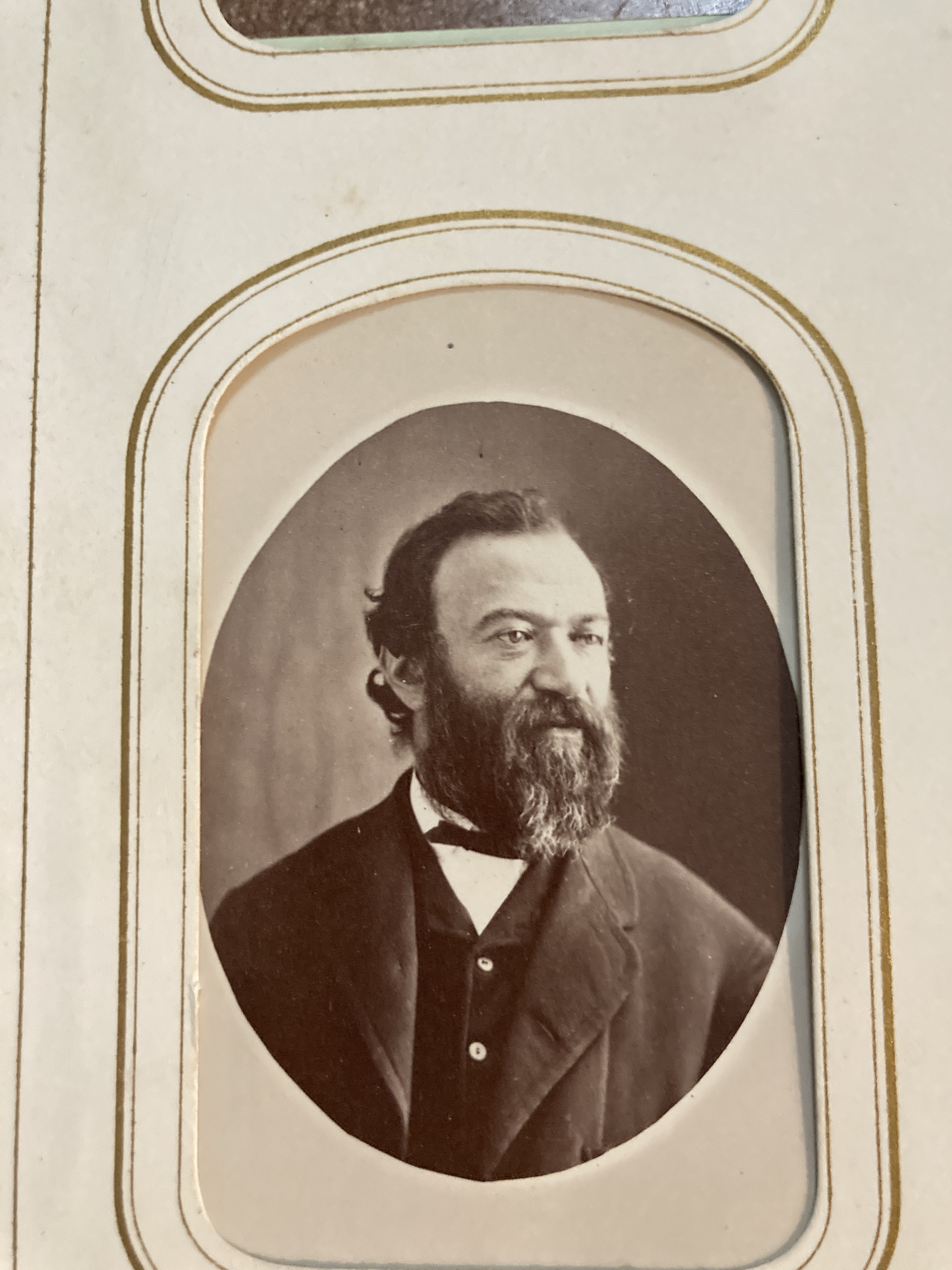
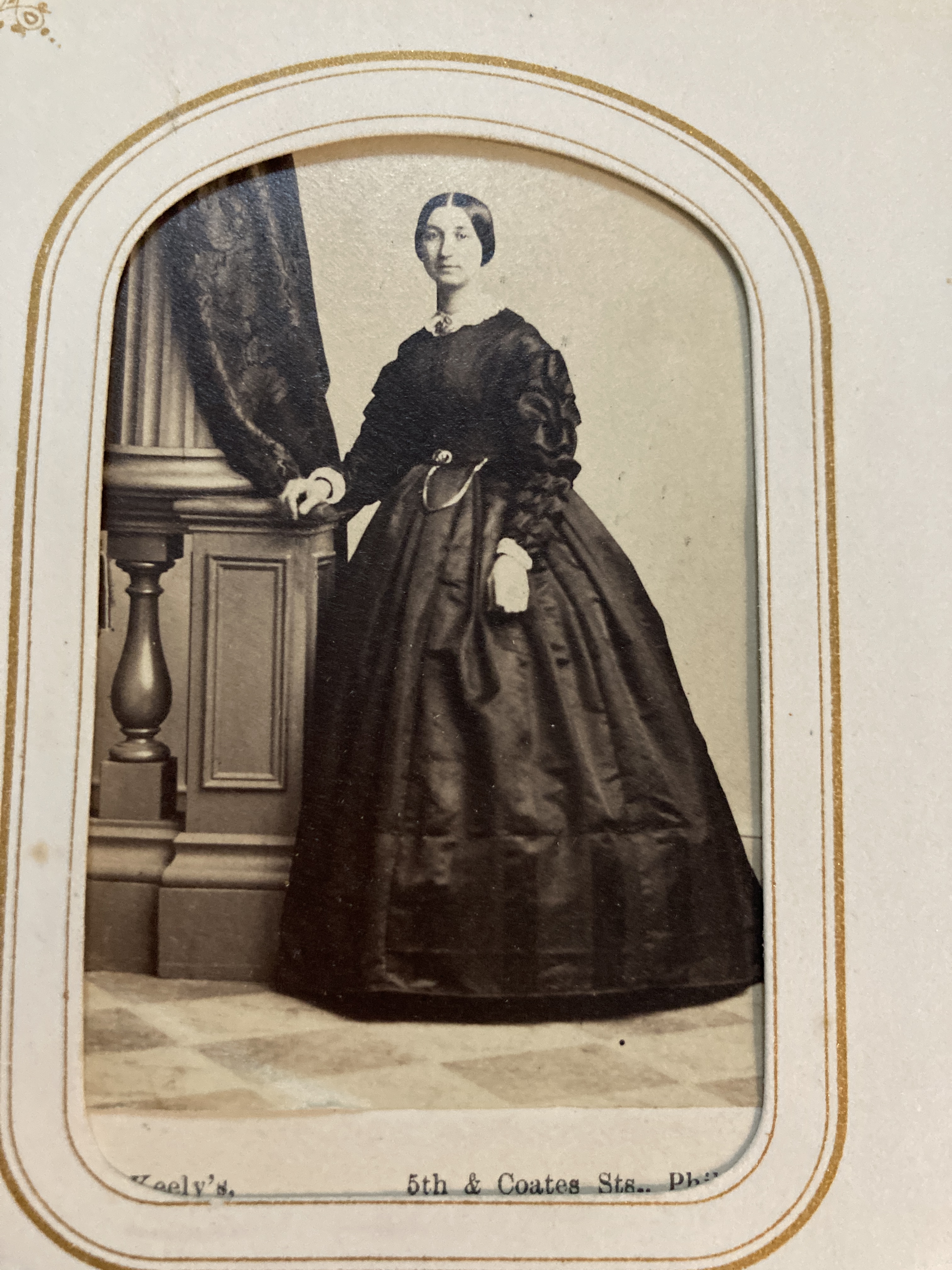
Finally, the only other photograph in the album that has a name written on it is this one:

The back reads as follows: “I am sorry you are not at home—will be in the city in about ten days when I hope to meet you. Yours, S. B. Axtell.”

The photograph is of a woman taken by Keely’s located at 5th and Coates Street in Philadelphia. This is the same photographer who Ava found at that location in Philadelphia directories in the 1850s and 1860s. I am in no position to judge the specific date by the clothing, but assuming this photograph was taken in the Civil War era, just who could S.B. Axtell be?

I found only two people with that surname and a first name that started with S—Samuel Axtell and his wife Sarah Leighty Axtell. Although they were married in 1854 in Athens, Ohio, where they thereafter lived,1 both Samuel and Sarah were Pennsylvania natives.2

Whether or not it was Samuel or Sarah Axtell who stopped by to see someone in Philadelphia, presumably John and Jeanette, is impossible for me to know. It’s the best guess I have.

What this photograph did demonstrate, however, along with the one of Louis Sulzbacher is that there are photographs in the album of people who were not part of either the Nusbaum or the Seligman family. As Ava had been telling me all along, people gave these CDVs to friends and family—as mementos, as gifts, as calling cards.

On that note, my next post will be my final post about the Nusbaum Album, and I will make some attempt to identify the people in some of the remaining photographs or at least to address who in the family could have been living in those locations during the second half of the 19th century. Keeping in mind that (1) they could be friends, not family, and (2) they could be of people visiting that location who don’t necessarily live there, I realize that to some extent this is an exercise in futility. But having gotten this far, why not engage in a bit more speculation?


  1. Sarah Ann Leighty, Gender Female, Marriage Date 12 Jan 1854, Marriage Place Athens, Ohio, USA, Spouse Samuel Axtell, Film Number 000311592, Ancestry.com. Ohio, U.S., County Marriage Records, 1774-1993 
  2. Samuel and Sarah Axtell and family, 1870 US census, Year: 1870; Census Place: Athens, Athens, Ohio; Roll: M593_1171; Page: 45B, Ancestry.com. 1870 United States Federal Census 

John Nusbaum Album: Of Babies Who Died Too Soon and Family in Peoria

Having now discussed many of the photographs that were unlabeled in the Nusbaum Album, I am going to turn to the few photographs that were labeled, making the task of identification much easier. There were only a handful that had names on them or other clues as to who was depicted in the photograph, and two of those appear on the very last page of the album and are of two babies who died as children.

First, there is this photograph with the following inscription under the baby’s picture: “Yours Truly Milton Josephs.” The reverse of that photograph shows that this was taken by George H. Rau Photographers of 922 Girard Avenue in Philadelphia.

Milton Josephs

Milton Josephs was born in Philadelphia on December 28, 1878, to Gustavus Josephs and Miriam Nusbaum. Miriam was the daughter of John and Jeanette Nusbaum and a sister of Frances Nusbaum, so she was my three-times-great-aunt. Her son Milton was John and Jeanette’s grandson and Frances’ nephew. Little Milton died before his second birthday on November 17, 1880. Given that he looks about three or four months old in this photograph, I assume it was taken in early 1879.

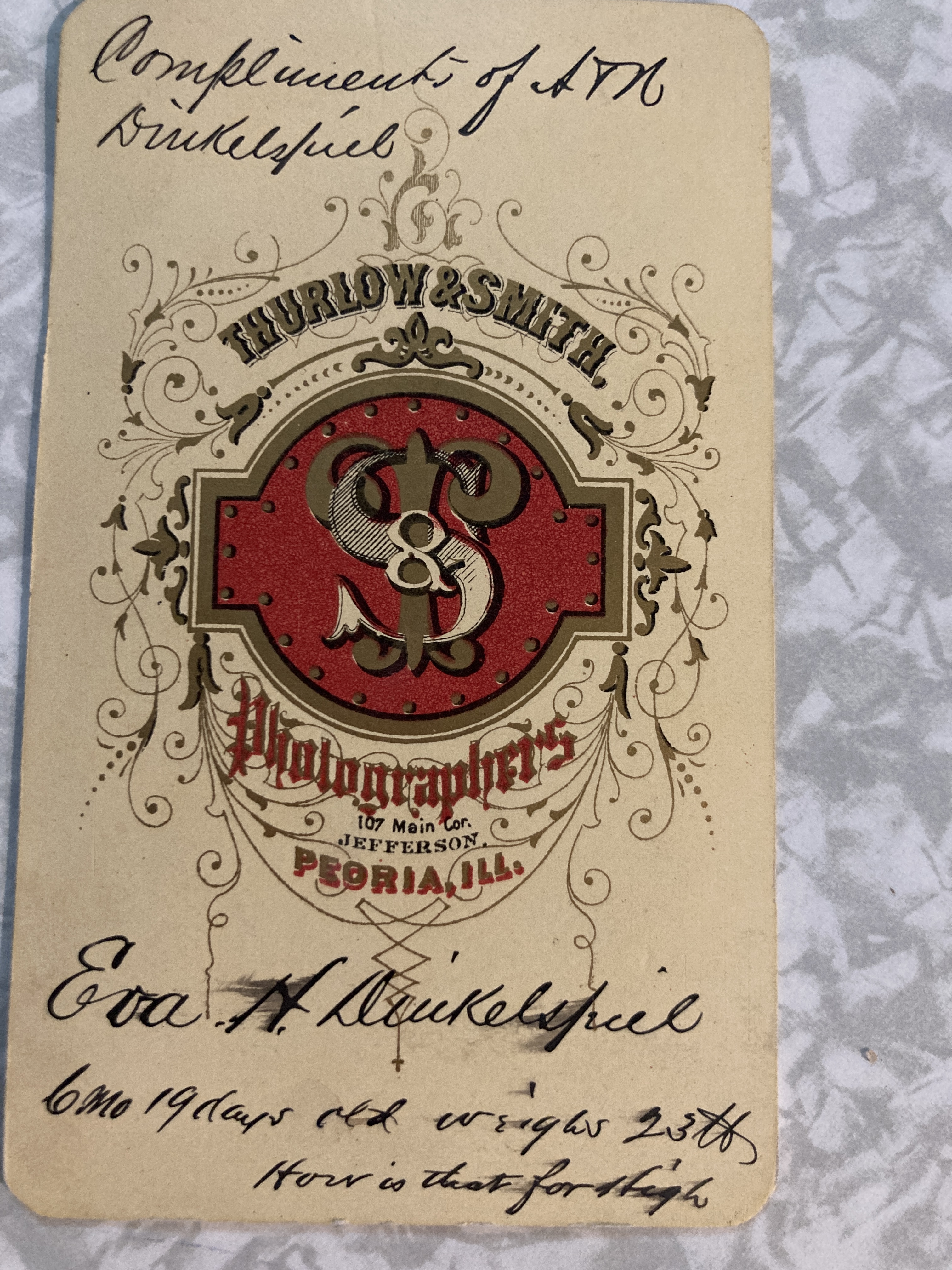
Right next to the photograph of little Milton in the Nusbaum Album is this photograph. It has the following inscription on its reverse side: “Compliments of STN [?] Dinkelspiel. Eva H. Dinkelspiel. 6 mo 19 days old weighs 23 lbs. How’s that for high[?]?“ The photograph was taken by Thurlow & Smith Photographers of 107 Main Cor. Jefferson, Peoria, Illinois.

Eva Helen Dinkelspiel

Eva Helen Dinkelspiel was the daughter of Adolph Dinkelspiel and Nancy Lyon; her paternal grandmother was Mathilda Nusbaum Dinkelspiel, John Nusbaum’s sister. Eva thus was John’s great-niece. Adolph Dinkelspiel was John’s nephew and a first cousin to Frances Nusbaum.  Eva was born on January 25, 1872, in Peoria, Illinois. That means this photograph, taken when she was six months old and nineteen days old, was taken on July 13, 1872,  seven years before the photograph of Milton Josephs, yet they are placed together in the Nusbaum album. Eva, like Milton, died as a child. She was seven years old when she died from scarlet fever on November 28, 1879, in Peoria.

It obviously was not an accident that these two photographs were placed next to each other in the album. They were not taken at the same time or at the same place and although they are both of Nusbaum family members, they were not from the same nuclear family. They had to be placed here because they were both of children who died young. And they died just about a year apart in time.

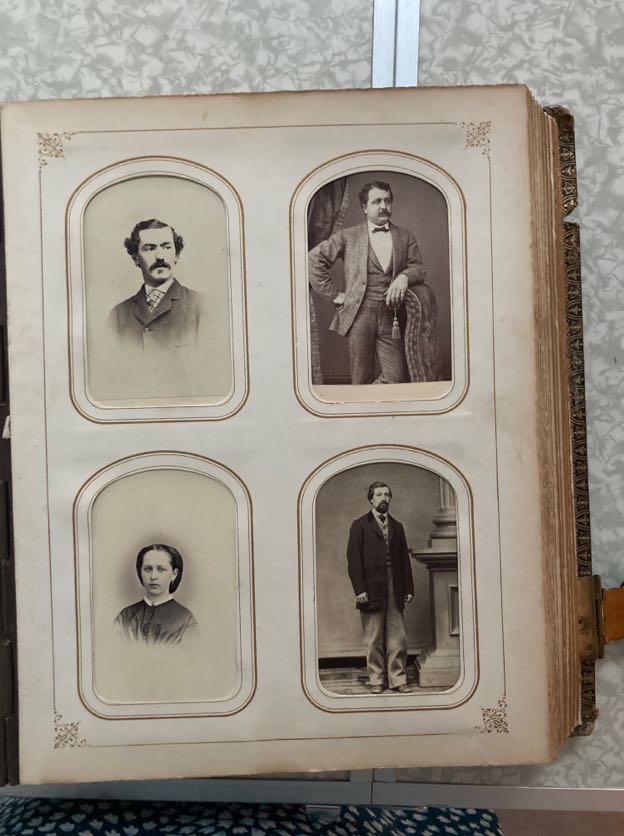
What makes the placement of the photograph of Eva Dinkelspiel also surprising is that the other seven photographs taken in Peoria appear in the album much earlier—at about the midpoint of the album. Here are those two pages:

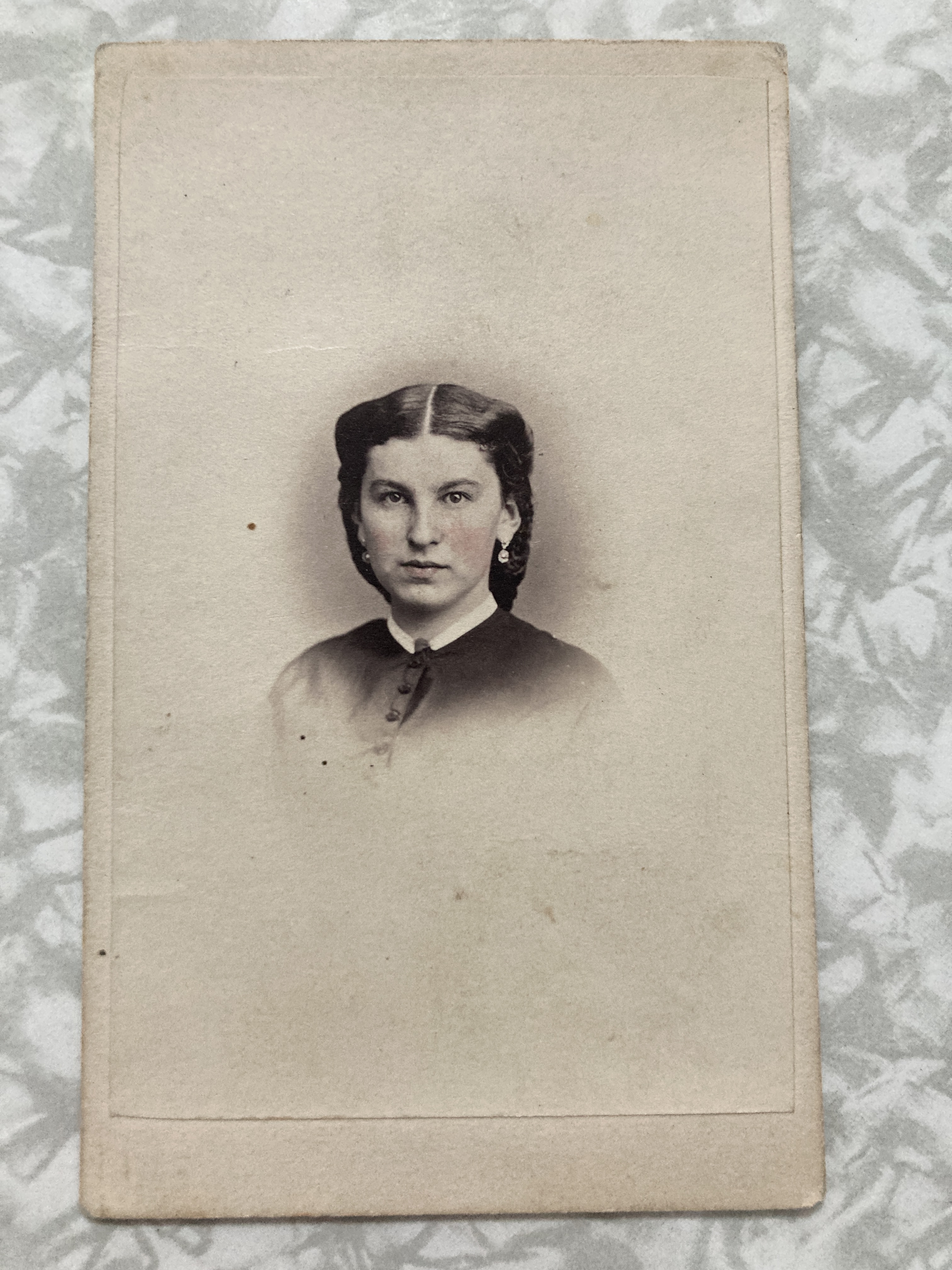
The woman on the lower right of the first of those pages was photographed in Harrisburg, but the other seven—six men and one woman—were photographed in Peoria, by various photographers.   As I was surprised to learn when I first was researching my Nusbaum family, many of them ended up in Peoria. You can read about Peoria and why, when, and how my Nusbaum relatives ended up living there here on my blog. 

John Nusbaum, as noted in that blog post, opened a store in Peoria and is listed in the Peoria directories, but it was his three sons who ran that store during the 1860s and 1870s and who lived in Peoria: Adolphus, Simon and Julius Nusbaum. We’ve already seen that John’s nephew Adolph Dinkelspiel, father of the ill-fated Eva mentioned above, also lived in Peoria during those decades, as did his sister Paulina Dinkelspiel Simon, John’s niece.

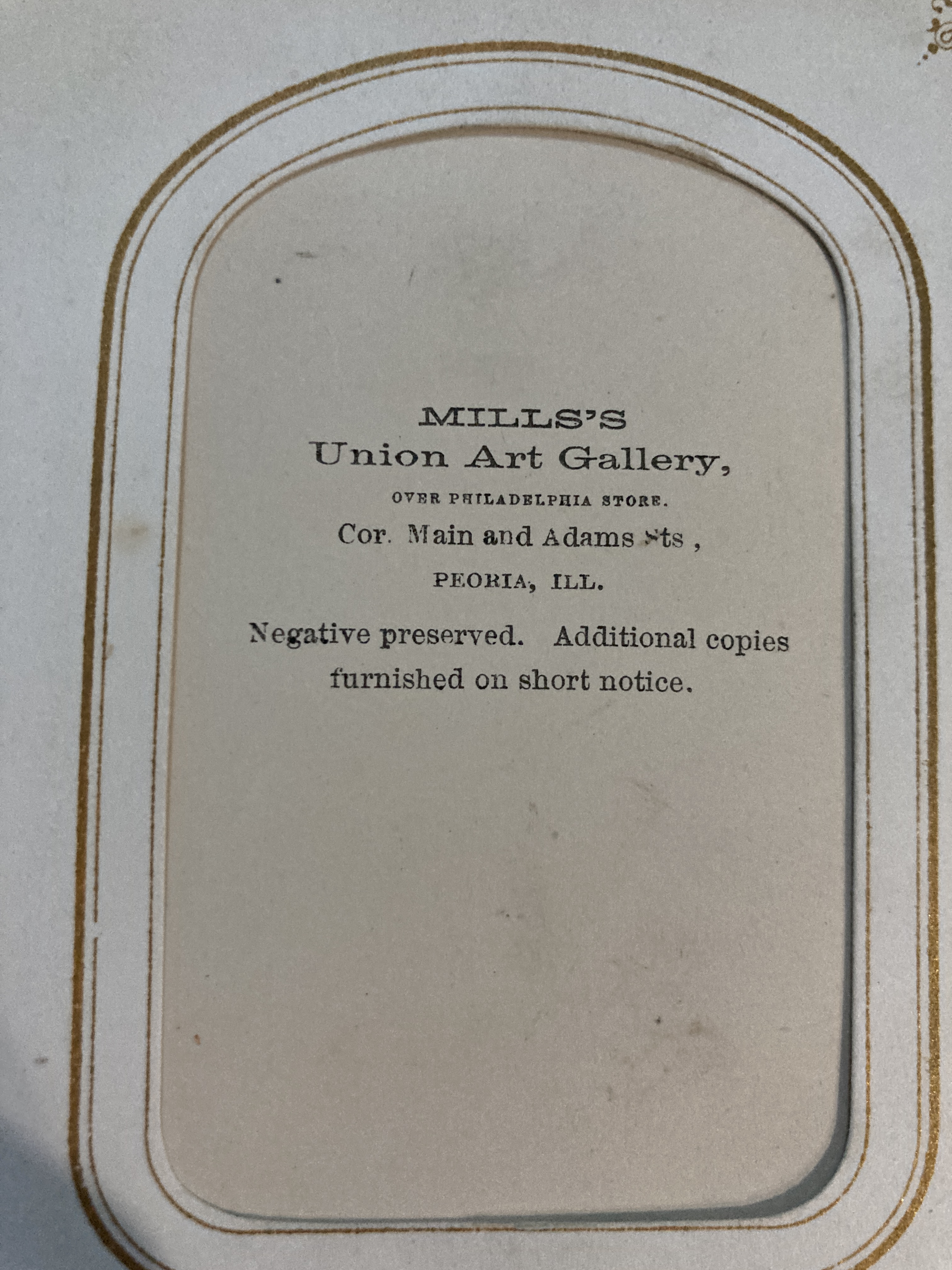
Although I do not have Ava’s expertise about individual photographers, I did find most of the photographers who took the photographs of these seven people in Peoria listed in Peoria directories in the 1860s and 1870s; two of those photographers also included on their CDV insignias the words “over Philadelphia store.” The “Philadelphia store” must have referred to John Nusbaum’s store in Peoria, which was located at Main and Adams, the same location as those two photographers. It seems obvious that the Nusbaum brothers knew these photographers and vice versa.

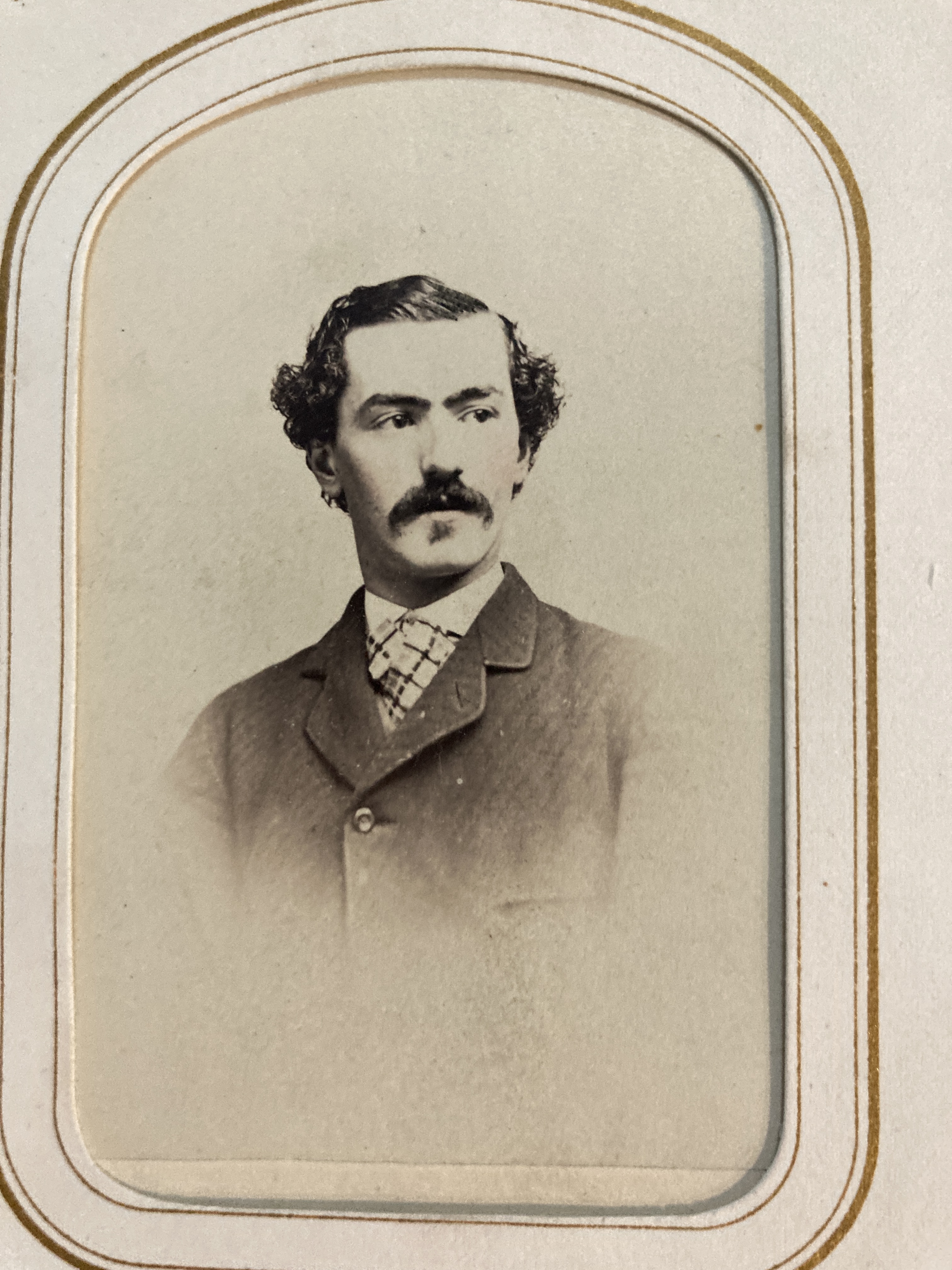
I believe that the seven people in these photographs are probably Nusbaum relatives. These three seem to resemble each other the most.

They also seem to look a bit like the man in the photos who might be John Nusbaum.

I am willing to speculate that they were John and Jeanette’s sons, Frances’ brothers, Adolphus, Simon, and Julius. That thought, however speculative it may be, makes me happy.

Nusbaum Album: Frances Nusbaum Seligman Redux

Before I turn to the photographs that I analyzed on my own (with a few tips from Ava along the way), I want to return to my great-great-grandmother Frances Nusbaum Seligman and my attempts to find her in the album–the album that once belonged to her and has her name on it. Some of this is a review of this post, but with some additional thoughts and images added.

There were several photos in the album that might be Frances based on her birthdate and the date Ava concluded that a photograph might have been taken. For example, on the very first page there is this photograph, which Ava dated as taken in about 1863 when Frances would have been 18; Ava thought the young woman was about 20-22 years old, so just a bit older than Frances would have been. The fact that it appears on the very first page of the album added weight to the possibility that it is Frances.

On the seventh page of the album is this photograph, which Ava also dated as taken in about 1863. Ava thought this woman could be about 25, so slightly older than the one on the first page, but still possibly Frances although Ava ultimately didn’t think so.

Philadelphia c 1863 born abt 1838 maybe Eliza Wiler

Then there is the photograph much later in the album that has an inscription on the back that says it is “Miss Nusbaum” and that it is Joan’s great-grandmother. Ava dated this photograph also in the 1863 time period and thought the woman was a teenager between fifteen and eighteen, placing her birth year very close to Frances’ birth year of 1845. But because this was so late in the album, Ava was skeptical about the inscription.

I added another photograph to this mix just recently. This one was taken in about 1870, and Ava thought the woman in this photograph was about twenty years old, so born in about 1850.

Philadelphia 1869 born about 1848

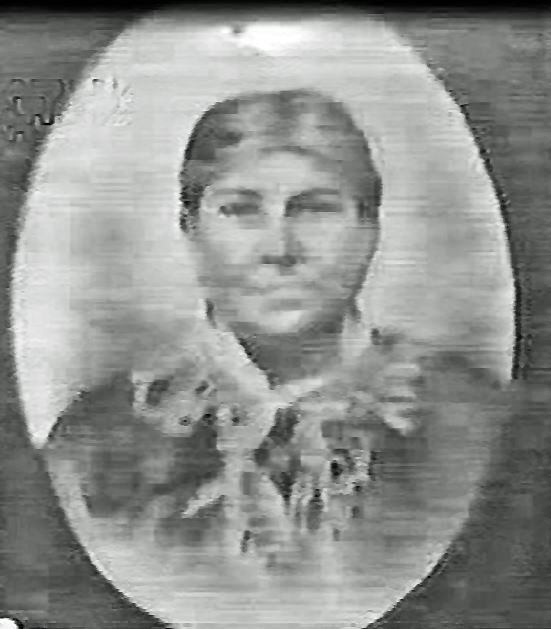
There was also the fuzzy still from a video of a portrait supposedly of Frances Nusbaum Seligman from Arthur Seligman’s house in Santa Fe.

Finally, there is one image I haven’t shared before and that Ava had not previously evaluated. It is not a CDV and it was not inserted into one of the openings in the album, but was just loose inside the album. It is an image of a portrait that sadly was not labeled.

I wondered whether this was a portrait of Frances, but Ava said that this was painted in the late 1840s, early 1850s so could not be Frances. But it possibly could be Frances’ mother, Jeanette Dreyfuss Nusbaum, my three-times great-grandmother.

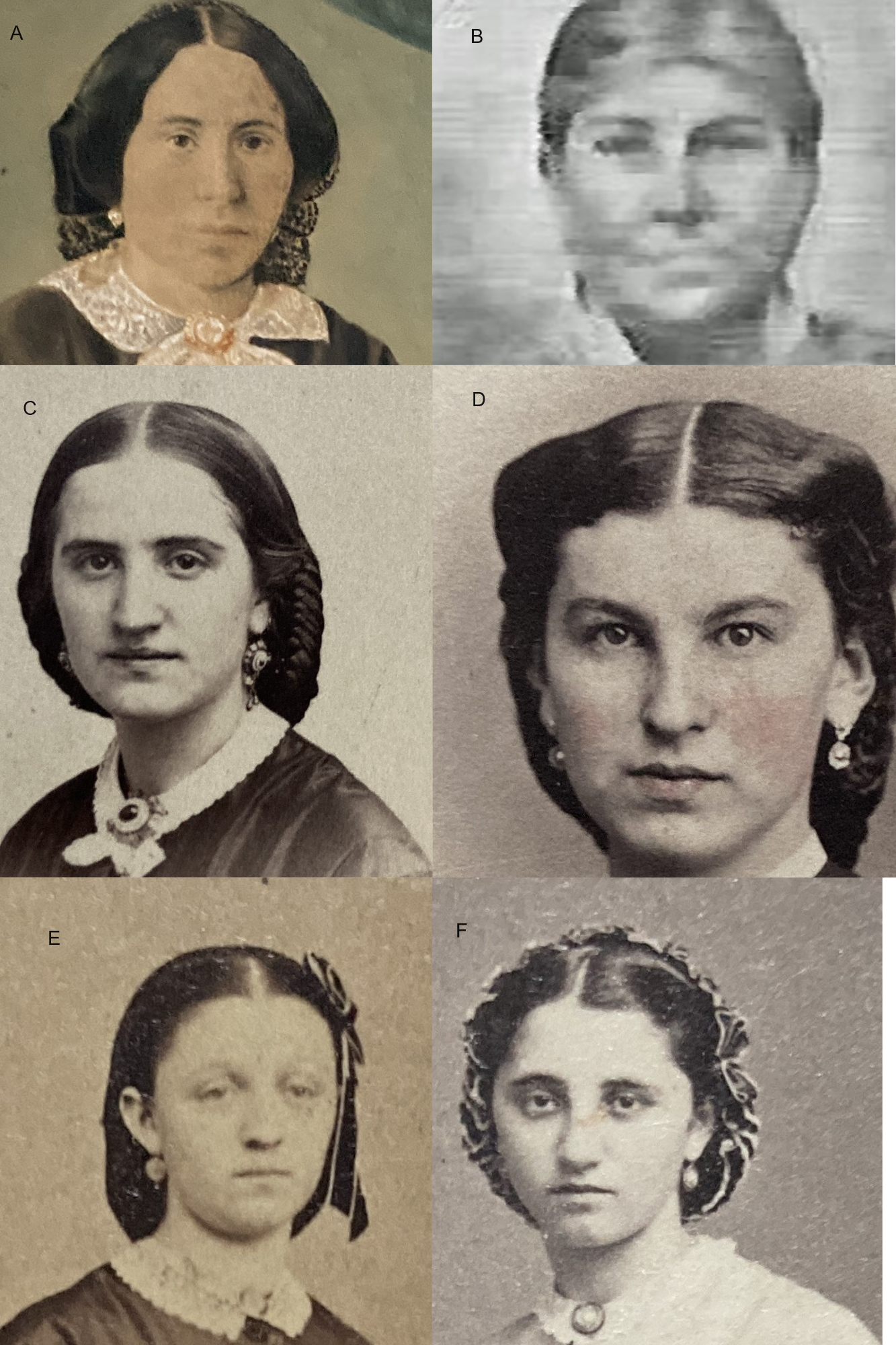
I then put together a collage of all six faces to compare them better:

One thing I noticed right away was that five of the women had similar lips—all but the one labeled D. Her lips were more heart-shaped. The other five had similar mouths. E seemed to have eyes that tilted down whereas all the others had eyes that went straight across. A and B are the portraits, A perhaps of Jeanette, B supposedly Frances. The more I looked at the two remaining images—C and F—the more alike they looked to me.

I ran them through two online face comparison websites, and both said that C and F were the same person. None of the others, however, matched C, F, or any of the others as the same person or even close. I asked Ava if she thought C and F were the same person, and her AI programs also found a match.

But Ava had reasons to doubt whether C and F were the same person. She pointed out that C, taken in 1863 or so, looks older than F, taken in 1870 or so. How could C have gotten younger looking seven years later?

Also, F is in a photograph with a young man who one might assume was her husband. She is wearing a wedding ring, and Frances was married in 1865. But the man in the photograph with F is not Frances Nusbaum’s husband, Bernard. Maybe it’s one of her brothers. But from the photograph one would think the man and woman are a couple.

So…bottom line? I still cannot be sure whether any of these women were Frances.

I have sent scans of the six photographs that were taken in Santa Fe to the New Mexico Jewish Historical Society and to the New Mexico History Museum, both in Santa Fe, hoping that perhaps they have somewhere a photograph of Frances. So far I have not heard back that they do. But I will keep hoping that I can someday figure out which woman in the album is my great-great-grandmother Frances Nusbaum Seligman.

Nusbaum Album: Are These My Seligmann Relatives from Germany?

With more realistic expectations but nevertheless high hopes, I awaited Ava’s final work on the Nusbaum Album, some of the photographs from Germany. Although there were some photographs from Stuttgart, Berlin, and Wiesbaden, since I did not know of any relatives living in those places in the mid to late 19th century, I focused on the photographs taken in Bingen and Mainz. Although my closest Seligmann relatives lived in the small town of Gau-Algesheim, both Bingen and Mainz were relatively close by and the closest cities to Gau-Algesheim, and many relatives eventually moved there. It seemed most likely that that my Seligmann relatives would have gone to one of those two cities to be photographed.

I selected three photographs from Mainz, all taken by the same photographer, Carl Hertel, and two from Bingen, both taken by J.B. Hilsdorf. These were all on the back of the first four pages at the beginning of the album whereas other photographs from Germany including from Mainz and Bingen were much later in the album. I hoped that meant the ones earlier in the album were more likely closer relatives.

The first Mainz photograph was dated by Ava as taken between 1873 and 1874; she noted that in 1874, Hertel became a court photographer. She wrote, “Generally, when a photographer was appointed as a court photographer that information would appear on the mounting card in the imprint and after the photographer’s name with the letters HOF. Since there is no indication of this appointment, I am placing the date of the photograph before 1874.”1 In addition, another photograph of Hertel’s found elsewhere with the same imprint was dated 1873.

Ava estimated the age of the man as mid to late 70s based on the lines on his face and the style of his tie. That meant the man was born in about 1800-1804. Ava speculated that this could be my three-times great-grandfather Moritz Seligmann, who was born in 1800. And this time I was able to confirm that speculation because I belatedly remembered that I have an actual photograph of Moritz that I had obtained from a cousin years back:

Moritz Seligmann

So bingo! We had a positive identification!

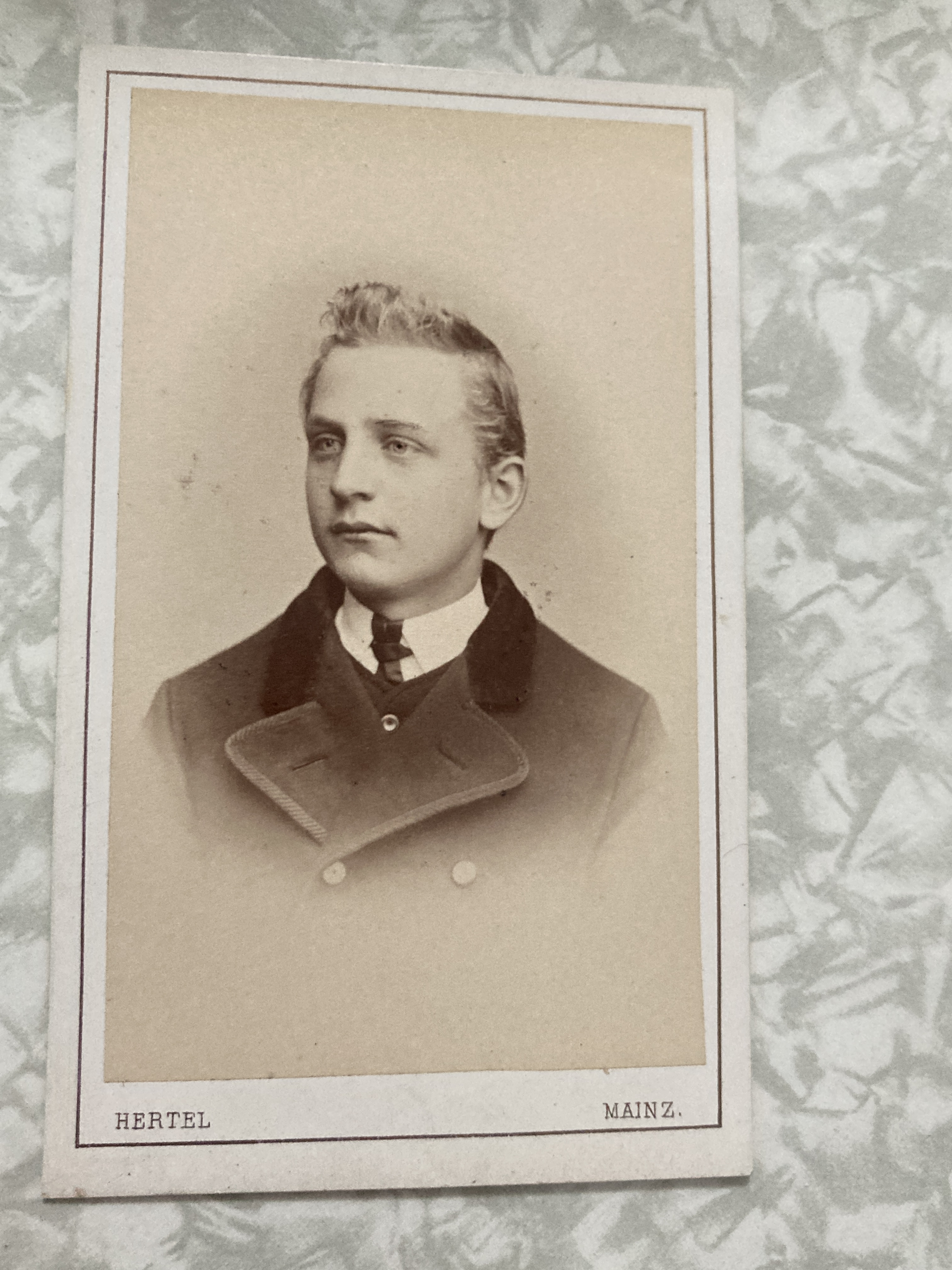
Moving on to the next two Mainz photos, Ava concluded that they also were taken between 1873 and 1874 based on the information she’d already found about Hertel. The first one she believed to be of a man who was in his thirties, perhaps 35, so born in about 1838-1839. The younger man on that same page appeared to her to be eighteen so born in about 1855. Since these photographs were all taken by the same photographer at about the same time, I thought that perhaps these two younger men were sons of Moritz Seligmann, that is, brothers of Bernard, my great-great-grandfather. In addition, they appeared on the second page of Germany photographs right after the photograph of Moritz, who appeared on the first page of the Germany photographs in the album.

Looking at the family tree, I found two possibilities. The older “son” could be Hieronymous Seligmann, born in 1839. The younger “son” could be Moritz’s youngest child, Jakob Seligmann, born in 1853. I was excited at the thought that perhaps I finally had found some relatives I could identify in the album.

I shared my analysis with Ava. She was skeptical that the younger man was Jakob Seligmann because she had identified Jakob in a photograph from a different set of photographs that she had worked on during an earlier project, and she did not see any similarities or enough to believe that the blonde teenager photographed in Mainz was the same person identified as Onkle Jakob in the later photograph.

We went back and forth with me trying my lawyerly best to persuade her that the blonde man could have grown up to be the dark haired Oncle Jakob. But in the end I failed to do so. I have to defer to Ava. She’s the expert, and I am a biased viewer hoping to see what I want to see. But if this was not Jakob Seligmann, who was it? I don’t know. Maybe a nephew or a cousin. Maybe not anyone in the family at all.

Knowing now that the Hertel photographs were likely taken before 1874 as Ava concluded, I looked on my own at the other three Hertel photographs taken in Mainz that appear later in the album:


Who are these three women? I don’t know since I have no photographs to use for comparison. Two of them look too young to be Bernard Seligman’s sisters Mathilde and Pauline, who were born in 1845 and 1847, respectively, and certainly too young to be his half-sister Caroline born in 1833, if the photographs were taken around 1873 as Ava concluded about the other Hertel photographs. And they are too old looking to be the children of any of Bernard’s siblings. So sadly they also will remain unidentified.

The next photograph I asked Ava to analyze is on the same page as the two blonde men except this photograph was taken in Bingen, not Mainz, by J.B. Hilsdorf, who was in business in Bingen from 1861 to 1891, according to Ava’s research. When I believed that the other two men on that page were Hieronymous and Jakob, I speculated that this third man could be their brother August, the only other son of Moritz Seligmann who survived beyond 1853 and was living in Germany.

Based on the size of this particular photograph, Ava dated it in the mid-1860s. She thought the man was between 30 and 35 so born between 1827 and 1834.2 August Seligmann was born in 1841 so too young to be the man in this photograph. In addition, Ava compared this photograph to one I have of August and found them to be dissimilar. It didn’t take as much to persuade me this time.

August Seligmann

That left one last photograph for Ava to analyze, the second photograph from Bingen that I had selected.

It also was taken by J.B. Hilsdorf, and for the same reasons Ava dated it in the mid-1860s. She estimated the woman’s age to be in her late 40s, early 50s, giving her a birth year range of 1812 to 1817. Based on the age and other photographs I have of my three-times great-grandmother Babette Schoenfeld Seligmann, Ava thought there was a good possibility that this photograph was also Babette. Here are the other photographs of Babette that Ava used for comparison.

Ava did an incredible job of researching the photographers and the photographs they’ve taken to come up with reliable time frames for when the album photographs were likely taken. But it is only possible to go so far with identification without known photographs of the people in your family to use for comparison. You can narrow down the possibilities and eliminate those who clearly do not fit within the parameters of the dates, but you can never be 100% confident of the specific identity of the person in the photograph based just on dates and locations. I wish I had more photographs that Ava could have used to make facial comparisons, but I don’t. I have to accept that I may never know who most of these people were.

Fortunately, there were a handful of photographs in the Nusbaum Album that were labeled and that I could on my own identify and place in my family tree. More on those in my next few posts.


  1. Ava Cohn, Analysis of Nusbaum Album #4, March 17, 2024 
  2. Ava Cohn, Analysis of Nusbaum Album #5, April 3 ,2024