A Family’s Life Destroyed: The Story of Anna Gross

As I wrote last time, Mathilde Gross Mayer and her three children, Wilhelm, Ernst, and Alice, all safely emigrated from Germany in the 1930s after the Nazis had taken over.   Not all of her siblings and other relatives were as fortunate.  Mathilde had four younger siblings, Anna, Wilhelm, Isidor, and Karl.  This post will tell the story of Anna Gross, Mathilde’s younger and only sister.  Anna, like Mathilde, was my second cousin, three times removed.  We are both descendants of Jacob Seligmann.

Family View Report for Bertha Seligmann-page-001

If the birth dates provided by her brother Isidor in Mathilde’s book are accurate, Anna Gross was born September 1, 1870, or a year and a half after Mathilde’s birth on April 14, 1869.[1] Anna married William Lichter of Bruchsal in 1892, whose father Leopold Lichter owned a wine distillery.  Anna and William settled in Stuttgart, where they had a son Paul (1893) and a daughter Irma (1898).

family-group-sheet-for-anna-gross-page-001

According to a biography of William and Anna and their family published on a Stolperstein site about the family, in 1916 Wilhelm Lichter purchased a stately house on a large lot with a terrace, courtyard, garage, and a garden with pergolas and two garden sheds.
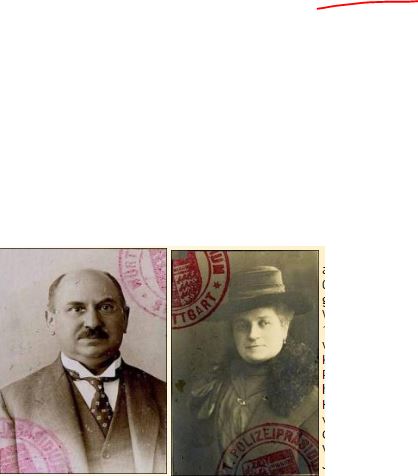
Wilhelm and Anna (Gross) Lichter, 1927 passport photos http://www.stolpersteine-stuttgart.de/index.php?docid=749

Wilhelm and Anna (Gross) Lichter, 1927 passport photos
http://www.stolpersteine-stuttgart.de/index.php?docid=749

According to the Stolperstein site, Anna and Wilhelm’s son Paul Lichter married Marie Hirsch on February 17, 1919; they would have two daughters born in the 1920s, Renate and Lore.

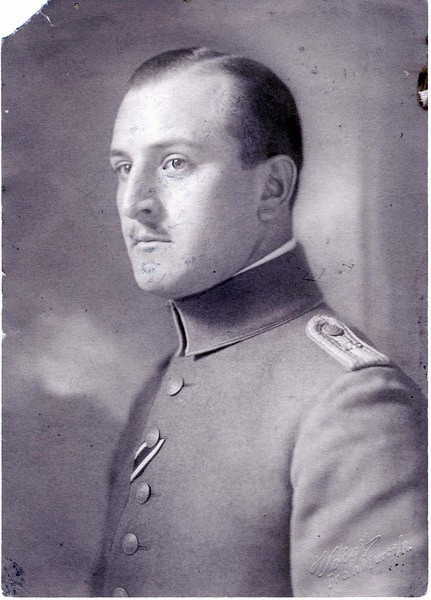
Just nine months after her brother married, Irma Lichter married Max Wronker on November 2, 1919.  Max had served as an officer in the German army during World War I and had been awarded the Iron Cross, Second Class.

Irma Lichter Wronker, courtesy of the Wronker family
Irma Lichter Wronker, courtesy of the Wronker family

Max Wronker during World War I, courtesy of the Wronker family

Max Wronker during World War I, courtesy of the Wronker family

Max and Irma would have two children, a daughter Gerda and a son Erich.

Max Wronker and Irma Lichter Wronker and their two children Gerda and Paul, 1927 Courtesy of the Wronker family

Max Wronker and Irma Lichter Wronker and their two children Gerda and Erich, 1927
Courtesy of the Wronker family

According to the introduction to the family papers on file with the Leo Baeck Institute (Guide to the Papers of the Lili Wronker Family 1843-2002 (AR 25255 / MF 737)), Max was the son of Herman Wronker and Ida Friedeberg of Frankfurt; Herman Wronker was an extremely successful merchant with department stores in a number of cities in Germany.  He also was a founder of a successful cinema business in Frankfurt. According to an October 25, 2007 article in Der Spiegel (“Lili und die Kaufhauskönige”), Herman Wronker was invited in the 1920s by Carl Laemmle of Universal Pictures to come to Hollywood, but Wronker was loyal to Germany and did not want to leave. (Thank you to my cousin Wolfgang for find the Der Spiegel article for me.)

The Der Spiegel article also reported that during the 1920s, the Wronker department store business employed over three thousand people with annual sales exceeding 35 million Reich marks.  When the Depression came in 1929, Herman’s son Max, husband of Irma Lichter, took over the management of the business and was forced to sell two of the Wronker department stores.

Max Wronker had a sister Alice, and I was very fortunate to make a connection through Ancestry.com with Trisha, whose husband is Alice Wronker’s grandson.  Trisha has known several members of the extended Lichter and Wronker families, and she has a wonderful collection of photographs of the family, which she generously shared with me.  The family pictures in this post are all courtesy of Trisha and her family, except where otherwise noted.

Alice Wronker Engel, Irma Lichter Wronker, and Ida Friedeberg Wronker

Alice Wronker Engel, Ida Friedeberg Wronker, and  Irma Lichter Wronker, Courtesy of the Wronker family

First cousins: Ruth , daughter of Alice Wronker Engel and Herman Engel, and Gerda, daughter of Max Wronker and Irma Lichter Wronker Courtesy of the Wronker family

First cousins: Ruth , daughter of Alice Wronker Engel and Herman Engel, and Gerda, daughter of Max Wronker and Irma Lichter Wronker
Courtesy of the Wronker family

Both the Wronker and Lichters families were obviously quite wealthy and living a good life in Germany until the Nazis came to power.  Then everything changed.  According to the same 2007 Der Spiegel article, by the end of March, 1933, the Wronkers were no longer allowed on the premises of their businesses, and the entire business was “aryanized” in 1934.

The article also indicated that at that point Max and Irma (Lichter) Wronker decided to leave Germany and move to France, where Max tried unsuccessfully to start a leather goods company.  He then received a tourist visa to go to Cairo to work as an adviser to a department store business there, but was unable to receive an official work permit and earned so little money that he was forced to sell much of the family’s personal property.

sale-of-effects-cairo

Max and Irma did not come to the United States until after the war ended.

Meanwhile, Anna (Gross) and Wilhelm Lichter also were suffering from Nazi persecution.  As reported in the Stolperstein biography, on April 1, 1938, Irma’s father Wilhelm Lichter sold the lovely home he owned in Stuttgart for 125,000 Reich marks, which was far below its value (according to assessors determining reparations after the war).  Wilhelm and Anna were allowed to rent the second floor of the home after they sold it for a one year term.

On April 26, 1938, the Germans enacted the Decree on the Registration of the Property of Jews pursuant to which all Jews were required to assess all their assets and register them if their value exceeded 5,000 Reich marks.  The Nazis also prohibited Jews from owning or operating a business, except for limited exceptions to allow services rendered by Jews to other Jews.  Additional information about these property deprivations can also be found here in a December 25, 1938 article by the Jewish Telegraphic Agency (“Nazi Restrictions, Special Taxes Strip Jews of Wealth”).

As a result of these regulations, Wilhelm Lichter was forced to pay substantial amounts of money to the German government in 1938.  After Kristallnacht, the government also passed additional laws, increasing substantially the taxes that Jews were forced to pay under the pretext that they were obligated to pay for the damage caused by Kristallnacht.  Wilhelm again was required to use a great deal of his assets to pay for these taxes.

Then, in the aftermath of Kristallnacht on November 9 and 10, 1938, Wilhelm and Anna’s son Paul Lichter was arrested and sent to the concentration camp at Dachau, where he was imprisoned until December 6, 1938.  After he was released, Paul decided to leave Germany with his wife Marie and their children; his two daughters were no longer allowed to attend school after May, 1938, and he had had to sell his business.

In order to emigrate, Paul had to comply with the Reichsfluchtsteuer, or Reich Flight Tax, a tax imposed on those wishing to leave Germany.  As explained by this Alphahistory site, “this law required Jews fleeing Germany to pay a substantial levy before they were granted permission to leave. The flight tax was not an invention of the Nazis; it was passed by the Weimar Republic in 1931 to prevent Germany from being drained of gold, cash reserves and capital. But the Nazi regime expanded and increased the flight tax considerably, revising the law six times during the 1930s. In 1934 the flight tax was increased to 25 per cent of domestic wealth, payable in cash or gold. Further amendments in 1938 required emigrating Jews to leave most of their cash in a Gestapo-controlled bank.”

Another site about the Holocaust indicated that, “As a result of these levies and others, those Jews fortunate enough to emigrate were able to save only a small portion of their assets.  For Jews remaining in Germany after 1938, whatever assets they had left were kept in blocked accounts in specified financial institutions, from which only a modest amount could be withdrawn for their living expenses.”

In order to pay this tax, Paul and Marie had to sell their personal property, including their jewelry, silverware, coffee service, sugar bowls, and candlesticks to a pawnshop and then pay a tax of 67,000 Reich marks, or the equivalent of about $30,000 in 1938 US dollars.  That would be equivalent to almost $500,000 dollars in 2016.

Paul emigrated first, arriving in New York on March 11, 1938.  According to the ship manifest (line 9), he was a liquor dealer.  He listed the person he was going to as a cousin named Meyer Gross living at 30 Parcot Avenue in New Rochelle, New York.

paul-lichter-ship-manifest-1938

Paul Lichter on 1938 ship manifest to NY Ancestry.com. New York, Passenger Lists, 1820-1957 [database on-line]. Provo, UT, USA: Ancestry.com Operations, Inc., 2010. Original data: Passenger Lists of Vessels Arriving at New York, New York, 1820-1897. Microfilm Publication M237, 675 rolls. NAI: 6256867. Records of the U.S. Customs Service, Record Group 36. National Archives at Washington, D.C. Passenger and Crew Lists of Vessels Arriving at New York, New York, 1897-1957. Microfilm Publication T715, 8892 rolls. NAI: 300346. Records of the Immigration and Naturalization Service; National Archives at Washington, D.C. Supplemental Manifests of Alien Passengers and Crew Members Who Arrived on Vessels at New York, New York, Who Were Inspected for Admission, and Related Index, compiled 1887-1952.

Paul Lichter on 1938 ship manifest to NY, line 9
Ancestry.com. New York, Passenger Lists, 1820-1957 [database on-line]. Provo, UT, USA: Ancestry.com Operations, Inc., 2010.
Original data: Passenger Lists of Vessels Arriving at New York, New York, 1820-1897. Microfilm Publication M237, 675 rolls. NAI: 6256867. Records of the U.S. Customs Service, Record Group 36. National Archives at Washington, D.C. Passenger and Crew Lists of Vessels Arriving at New York, New York, 1897-1957. Microfilm Publication T715, 8892 rolls. NAI: 300346. Records of the Immigration and Naturalization Service; National Archives at Washington, D.C. Supplemental Manifests of Alien Passengers and Crew Members Who Arrived on Vessels at New York, New York, Who Were Inspected for Admission, and Related Index, compiled 1887-1952.

That was not a name that was on my tree, but given the surname Gross, I assumed it was a relative of Anna, perhaps on her father’s side.

It also made sense that Paul would be going to New Rochelle since he had family members living in that city.  In fact, 30 Parcot Avenue was only half a mile from where Paul’s cousin Alice Mayer Kann was living in 1940 at 17 Argyle Avenue in New Rochelle as well and just two blocks from where Paul’s cousin Ernst Mayer was living at 94 Hillside Avenue in New Rochelle.

I searched the 1940 census to see if there was a Meyer Gross living at 30 Parcot Road in 1940, and I discovered that Kurt Kornfeld and his family were living at that location in 1940.  Kurt Kornfeld was one of Ernst Mayer;s partners in Black Star Publishing, which they founded after they escaped Nazi Germany, as I discussed here.  And living in the Kornfeld home as a lodger in 1940 was a 72 year old German-born woman named Matilda Mayer, who I believe I am safe in assuming was Mathilde Gross Mayer, Paul’s aunt.

But who then was Meyer Gross? I don’t know.  I checked both the 1938 and 1940 directories for New Rochelle (the 1939 was not available online), and there was no person with that name in either directory.  Since the name was entered by hand on the manifest, perhaps it was written incorrectly by the person entering the name.  Maybe it was “Mathilde Gross,” her birth name?  I don’t know.

On June 8, 1939, Paul and Marie’s eighteen year old daughter Renate sailed to New York alone; she was to be met by another “cousin” Heinz “Anspacher,” who resided at 404 West 116th Street in New York City. (See line 13.)
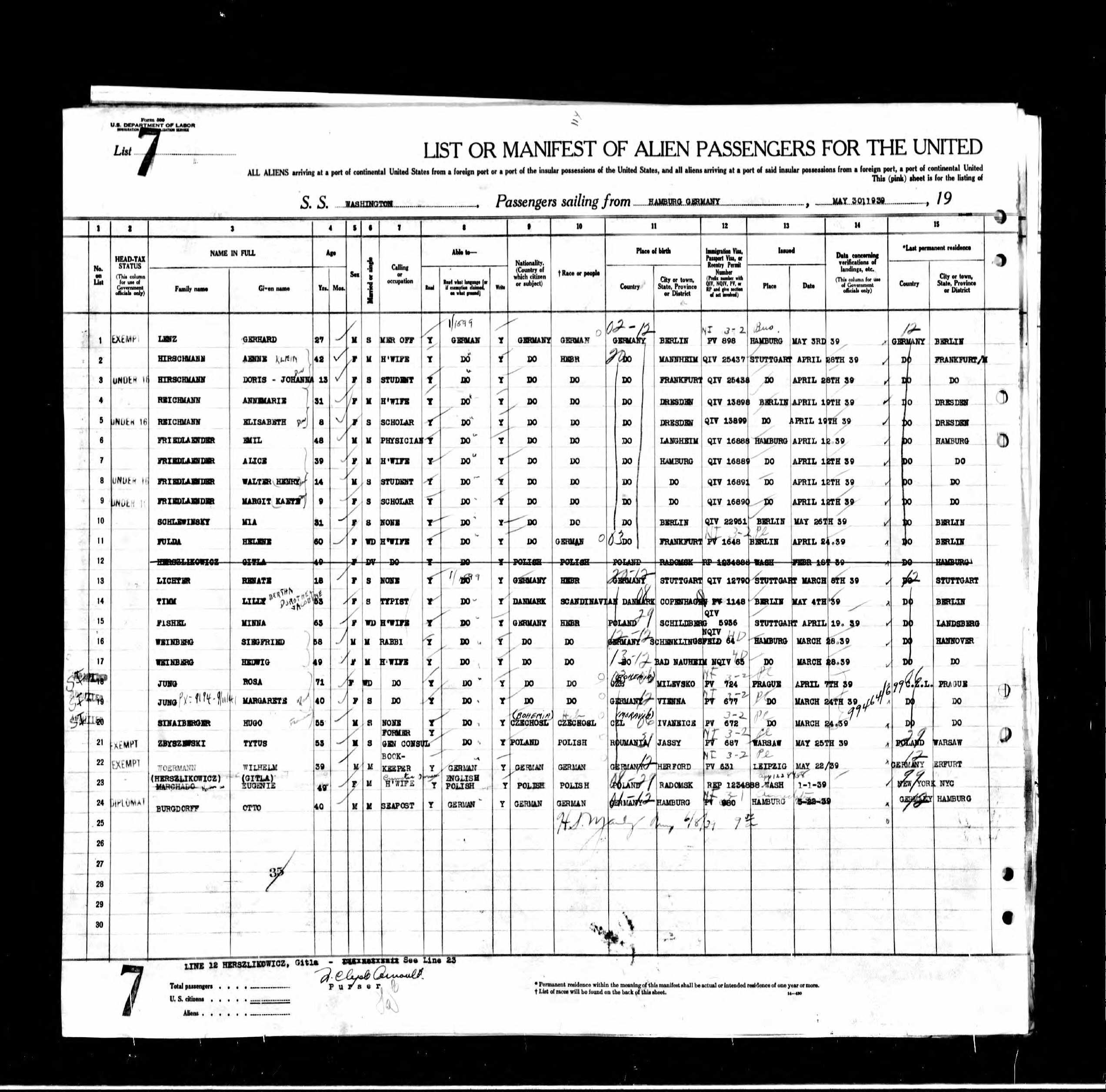
renate-lichter-1939-ship-manifest-line-13

Renate Lichter on 1939 ship manifest, line 13 Ancestry.com. New York, Passenger Lists, 1820-1957 [database on-line]. Provo, UT, USA: Ancestry.com Operations, Inc., 2010. Original data: Passenger Lists of Vessels Arriving at New York, New York, 1820-1897. Microfilm Publication M237, 675 rolls. NAI: 6256867. Records of the U.S. Customs Service, Record Group 36. National Archives at Washington, D.C. Passenger and Crew Lists of Vessels Arriving at New York, New York, 1897-1957. Microfilm Publication T715, 8892 rolls. NAI: 300346. Records of the Immigration and Naturalization Service; National Archives at Washington, D.C. Supplemental Manifests of Alien Passengers and Crew Members Who Arrived on Vessels at New York, New York, Who Were Inspected for Admission, and Related Index, compiled 1887-1952.

Renate Lichter on 1939 ship manifest, line 13
Ancestry.com. New York, Passenger Lists, 1820-1957 [database on-line]. Provo, UT, USA: Ancestry.com Operations, Inc., 2010.
Original data: Passenger Lists of Vessels Arriving at New York, New York, 1820-1897. Microfilm Publication M237, 675 rolls. NAI: 6256867. Records of the U.S. Customs Service, Record Group 36. National Archives at Washington, D.C. Passenger and Crew Lists of Vessels Arriving at New York, New York, 1897-1957. Microfilm Publication T715, 8892 rolls. NAI: 300346. Records of the Immigration and Naturalization Service; National Archives at Washington, D.C. Supplemental Manifests of Alien Passengers and Crew Members Who Arrived on Vessels at New York, New York, Who Were Inspected for Admission, and Related Index, compiled 1887-1952.

That was another name that did not ring any bells for me, so I searched for him.  Although I could not find a Heinz Anspacher, I did find a Heinz Ludwig Ansbacher who had immigrated to the US in 1924 and was born in 1904 in Frankfurt. He was a well-known professor of psychology, and in the 1930s he was studying at Columbia, so living at 404 West 116th Street made sense.

Heinz was the son of Max Ansbacher and Emilia Dinkelspiel, neither of whom appear to have a connection to the Gross or Licther or Hirsch families. Perhaps this was a friend of the family? I don’t know. (I hate paragraphs that end with I don’t know, and that’s the second time in this post.)

But if her father Paul had arrived in 1938, why was Renate going to Heinz Ansbacher in 1939? Had Paul returned to Europe after his trip in 1938? On March 1, 1940, Paul, Marie, and their younger daughter sailed from Liverpool to New York, and although Marie and her daughter listed their last permanent residence as Stuttgart, Paul’s last permanent residence was stated as Birmingham, England.  They all listed Ernst Mayer, Paul’s cousin, as the person they were going to in the United States.

paul-lichter-and-family-on-1940-manifest

Paul, Marie, and Lore Lichter on 1940 ship manifest, lines 13-15 Ancestry.com. New York, Passenger Lists, 1820-1957 [database on-line]. Provo, UT, USA: Ancestry.com Operations, Inc., 2010. Original data: Passenger Lists of Vessels Arriving at New York, New York, 1820-1897. Microfilm Publication M237, 675 rolls. NAI: 6256867. Records of the U.S. Customs Service, Record Group 36. National Archives at Washington, D.C. Passenger and Crew Lists of Vessels Arriving at New York, New York, 1897-1957. Microfilm Publication T715, 8892 rolls. NAI: 300346

Paul, Marie, and Lore Lichter on 1940 ship manifest, lines 13-15
Ancestry.com. New York, Passenger Lists, 1820-1957 [database on-line]. Provo, UT, USA: Ancestry.com Operations, Inc., 2010.
Original data: Passenger Lists of Vessels Arriving at New York, New York, 1820-1897. Microfilm Publication M237, 675 rolls. NAI: 6256867. Records of the U.S. Customs Service, Record Group 36. National Archives at Washington, D.C. Passenger and Crew Lists of Vessels Arriving at New York, New York, 1897-1957. Microfilm Publication T715, 8892 rolls. NAI: 300346

The English ship manifest for their trip leaving from Liverpool is consistent with the New York manifest: Paul is listed as last residing in England, Marie and their daughter in Germany, and Paul is listed with an address in Birmingham, England.  I can only infer that Paul had left the US sometime after his March 1938 arrival and before Renate arrived in June 1939 and was living in England in 1940 when he and the rest of the family joined Renate in New York.

Paul, Marie, and Lore Lichter on the 1940 UK ship manifest Ancestry.com. UK, Outward Passenger Lists, 1890-1960 [database on-line]. Provo, UT, USA: Ancestry.com Operations, Inc., 2012. Original data: Board of Trade: Commercial and Statistical Department and successors: Outwards Passenger Lists. BT27. Records of the Commercial, Companies, Labour, Railways and Statistics Departments. Records of the Board of Trade and of successor and related bodies. The National Archives, Kew, Richmond, Surrey, England.

Paul, Marie, and Lore Lichter on the 1940 UK ship manifest
Ancestry.com. UK, Outward Passenger Lists, 1890-1960 [database on-line]. Provo, UT, USA: Ancestry.com Operations, Inc., 2012.
Original data: Board of Trade: Commercial and Statistical Department and successors: Outwards Passenger Lists. BT27. Records of the Commercial, Companies, Labour, Railways and Statistics Departments. Records of the Board of Trade and of successor and related bodies. The National Archives, Kew, Richmond, Surrey, England.

Although Anna and Wilhelm’s two children and their grandchildren were thus all safely out of Germany by the spring of 1940, Anna and Wilhelm were not as fortunate.  On February 28, 1942, they were forced to move to a Jewish home for the elderly.  (Wilhelm was then 77, Anna 72.)  Then in August, 1942, they entered into an “agreement” whereby they transferred their remaining assets (22,815 Reich marks) in exchange for free accommodations for life at the camp at Theriesenstadt.  On August 23, 1942, Anna and Wilhelm were deported to Theriesenstadt.

Anna died less than a month later on September 18, 1942.  Wilhelm lasted five more months, dying on February 6, 1943.

Stolpersteine for Wilhelm Lichter and Anna Gross Lichter http://www.stolpersteine-stuttgart.de/index.php?docid=749

Stolpersteine for Wilhelm Lichter and Anna Gross Lichter
http://www.stolpersteine-stuttgart.de/index.php?docid=749

Their son-in-law’s parents, Hermann and Ida Wronker, were also murdered; according to Der Spiegel, by 1939, almost all of their property had been confiscated by the Nazis.  In 1941, they were living in France and were sent to the internment camp at Gurs, where they were later deported to Auschwitz.  They were killed there in 1942.
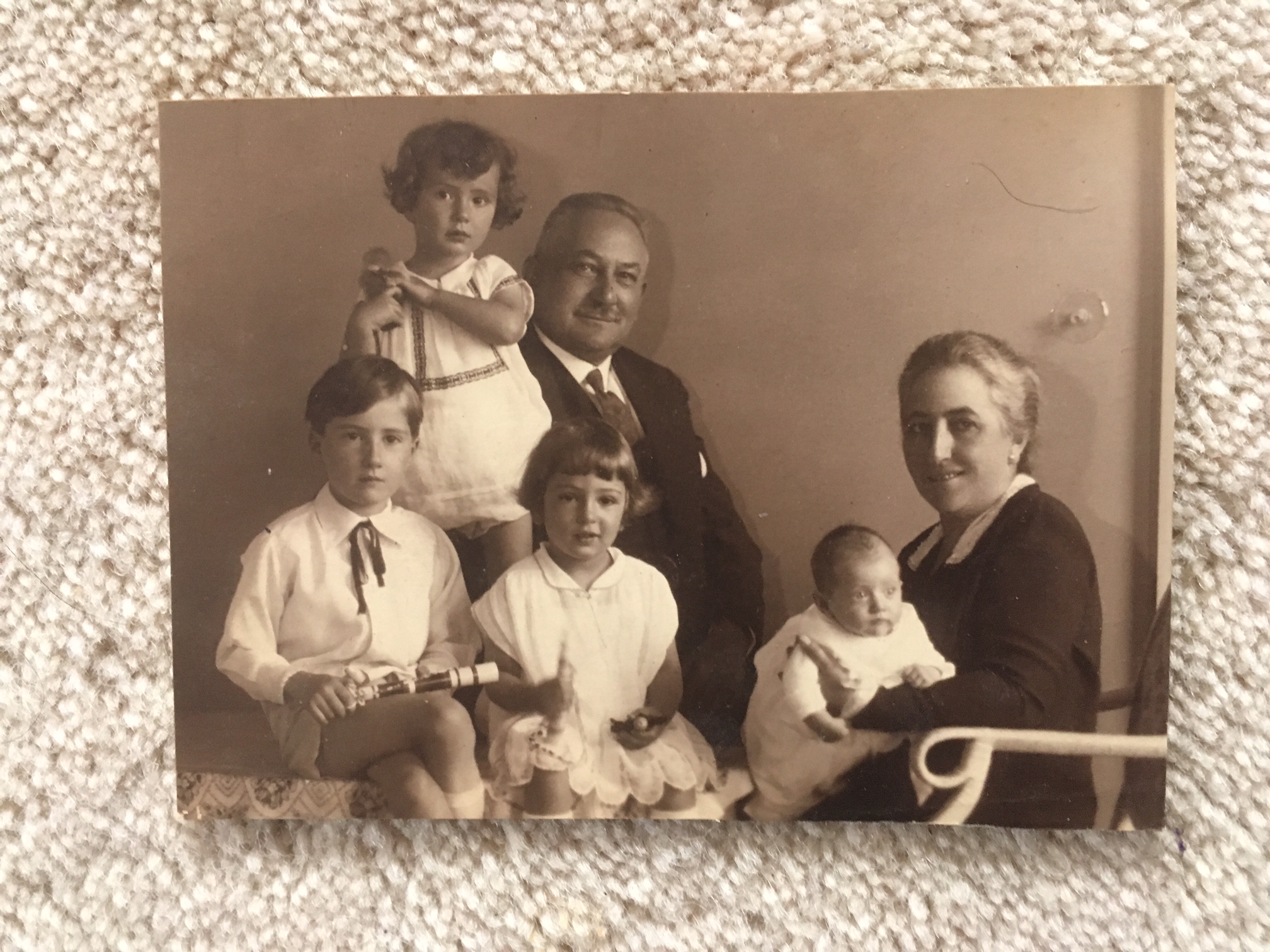
Herman and Ida Wronker with their four grandchildren, Eric, Gerda, Ruth, and Marion

Herman and Ida Wronker with their four grandchildren, Erich, Gerda, Ruth, and Marion, courtesy of the Wronker family

But all the children and grandchildren of Herman and Ida (Friedeberg) Wronker and Anna (Gross) and Wilhelm Lichter survived and, like so many of those who escaped from Nazi Germany, they had to start over with almost nothing.

Here are some members of the extended family years later.

From left to right, standing: Max Wronker, Paul Lichter, Marie Hirsch Lichter, Lilli Cassel Wronker, Renate Lichter, Alice Wronker Engel, Irma Lichter Wronker, Erich .Wronker, unknown, Edith Cassel. Seated, left to right, Marion Engel and two unknown women Courtesy of the Wronker family

From left to right, standing: Max Wronker, Paul Lichter, Marie Hirsch Lichter, Lili Cassel Wronker, Renate Lichter, Alice Wronker Engel, Irma Lichter Wronker, Erich .Wronker, unknown, Edith Cassel.
Seated, left to right, Marion Engel and two unknown women
Courtesy of the Wronker family

I don’t know how people coped with the unfathomable cruelty inflicted upon them and their loved ones, but once again I am inspired by the resilience of the human spirit.


[1] Another secondary source reports that Anna was born on November 1, 1870, but I am going to assume that Anna’s own brother knew her birthday.  I’ve no primary source to use to determine for sure.
A Family Uprooted by the Nazis: Mathilde Gross Mayer and Her Family

My last post ended with the tragic deaths in November 1901 of my cousin Bertha Seligmann and her husband Bernhard Gross; they had died from carbon monoxide poisoning while in their own home in Bingen, Germany.  Bertha was the first cousin of my great-great-grandfather, Bernard Seligmann.  We are both descendants of my 4x-great-grandfather, Jacob Seligmann.

Much of what I have learned about the life of Bertha and Bernhard came from the memoir written by their daughter Mathilde, Die Alte und Die Neue Welt (1951). As I mentioned in the last two posts, Mathilde lived a hundred years, from 1869 until 1969, and resided on two continents during her remarkable life, first in Germany, then in the United States.  This post will focus on Mathilde and her family and descendants and their lives after 1901.

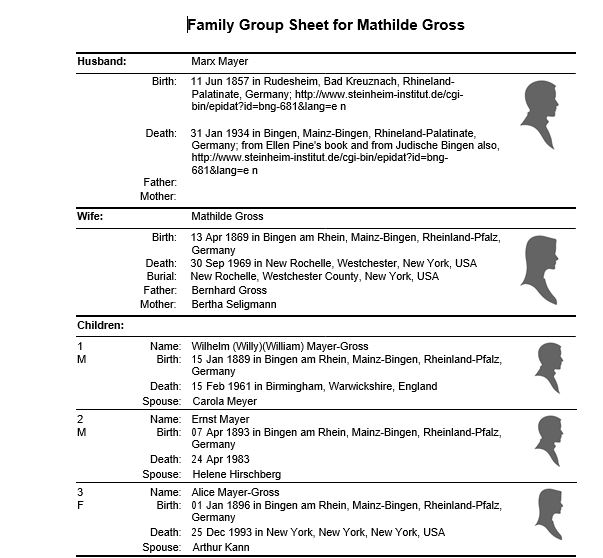
Mathilde was the oldest of Bertha and Bernhard’s five children. [1]  As stated above, she was born in 1869, and she married Marx Mayer in 1888. They had three children: Wilhelm (known as Willy) Mayer-Gross (1889), Ernst (1893), and Alice (1896).  All three would live interesting lives.

jpf-family-sheet-for-mathilde-gross-mayer

Although Alice Mayer was the youngest of the children of Mathilde Gross and Marx Mayer, I am going to write about her first because it is her daughter, Ellen Kann Pine, whose book One Life in Two Worlds (self-published, 2009) provided me with insights into the life of the Mayer family in the 1920s and 1930s.  All the facts related in this post came from Ellen Kann Pine’s memoir, except where noted.

20160810_174631600_iOS

According to Ellen’s memoir, her mother Alice Mayer married Arthur Kann, whose father was in the wholesale grain business in the Bingen area.  Their twin daughters Ellen and Hannelore were born in 1921 in Bingen.  Ellen’s description of her childhood growing up in Bingen sounds quite idyllic.  She describes Bingen in those days as the largest town in the area with about 10,000 residents.

Her family shared a house with her father’s brother Julius Kann and his wife.  The house was on the edge of town and was located across the street from Ellen’s grandparents, Mathilde (Gross) and Marx Mayer.  She saw her grandparents every day.  Ellen wrote:

No day passed without a visit from one or both of them.  Our Grandfather (Opapa) was usually the first to come.  He always brought each of us a piece of chocolate wrapped in foil in the shape of a coin. …Our Grandmother (Omama) usually visited in the afternoon and she was always interested in what we had been doing and asked us to tell her.

Pine, p. 7.

Their grandmother Mathilde would take them for walks in the neighborhood every day.  In addition, numerous aunts, uncles, and cousins lived nearby.  The town was small enough that most people knew each other, and the Kann home had a big enough yard for the children to play.

In 1927, the twins started school at the local Volksschule where both Jewish and Christian children attended. At that time, they became more aware of their Jewish background.  As Ellen described, “[i]n Germany, religious instruction was part of the overall curriculum and was taught during regular school hours by clergy of each denomination.”  Pine, p. 20.  Ellen and Hannelore were taught by their cantor and received instruction in Hebrew and Bible stories.

The family had Shabbat dinners with their Mayer grandparents and celebrated the Jewish holidays together.  The Kann family also liked to travel, and Ellen recalled family trips to the Netherlands, Yugoslavia, Switzerland, and Austria during her childhood.

Ellen’s uncles Wilhelm and Ernst, the sons of Mathilde Gross and Marx Mayer, were also living comfortable lives in Germany in the years before Hitler came to power. Wilhelm became a renowned psychiatrist.  According to Edward Shorter’s A Historical Dictionary of Psychiatry (Oxford University Press, Feb 17, 2005), Wilhelm studied medicine at the University of Heidelberg and then further specialized in psychiatry at Heidelberg.  His doctoral thesis was on “the phenomenology of abnormal feelings of happiness,” and by 1929, he was an assistant professor of psychiatry in Heidelberg.

On the personal side, according to Shorter’s book, Wilhelm had married in 1919; his wife was Carola Meyer, and they had one child.  Around the time of his marriage, Wilhelm adopted the surname Mayer-Gross, hyphenating his mother’s maiden name with his father’s surname.

Wilhelm’s younger brother Ernst served in the German military during World War I. Once again Matthias Steinke helped me out and translated the documents reporting Ernst’s military record.  According to Matt’s translation, Ernst served in the military first from October 1907 until September 1909 as a private in the 9th Infantry Regiment in Zabern.  Then when World War I started, he was on active duty from August 1914 until September 1918, again serving in the infantry.  He was a bona fide war hero for Germany.

He fought in over twenty battles all over Europe: in France, in Italy, in Bukovina and Slovenia, and at the border of Greece.  On the 5th of October he was shot in the back during a battle near Lille, France, but returned to the front by June, 1915, where he fought in a battle near Tirol. Beginning in December, 1914, he served as a ski trooper for some of his time in the army. His service ended when he was sent to the hospital in September, 1918, with influenza.  His rank at the end of his service was a reserve lieutenant.  He received several commendations for his service including the Prussian Iron Cross, the Edelweiss medal, and two Hessian orders.

Bavaria, Germany, World War I, Personnel Rosters, 1914-1918, for Ernst Mayer Bayerisches Hauptstaatsarchiv; Mnchen; Abteilung IV Kriegsarchiv. Kriegstammrollen, 1914-1918; Volume: 11697. Kriegsstammrolle: Bd.1

Bavaria, Germany, World War I, Personnel Rosters, 1914-1918, for Ernst Mayer
Bayerisches Hauptstaatsarchiv; Mnchen; Abteilung IV Kriegsarchiv. Kriegstammrollen, 1914-1918; Volume: 11697. Kriegsstammrolle: Bd.1

Ernst Mayer WW1 military register 6

Bavaria, Germany, World War I, Personnel Rosters, 1914-1918, for Ernst Mayer Bayerisches Hauptstaatsarchiv; Mnchen; Abteilung IV Kriegsarchiv. Kriegstammrollen, 1914-1918; Volume: 11697. Kriegsstammrolle: Bd.1

After the war, Ernst became the owner of a successful publishing house in Berlin, Mauritius Verlag.  He married Helene Hirschberg, and they had two daughters and were living in Berlin.

Thus, as of 1933, Mathilde (Gross) and Marx Mayer and their three children were successful citizens of Germany.  The world and lives of all these members of the family changed drastically with the election of Hitler as chancellor in 1933.

Ellen Kann Pine was then twelve years old and remembers well how things changed in Bingen.  She wrote:

As soon as Hitler became chancellor, fierce looking men wearing different colored uniforms appeared everywhere. … Part of the uniform was a red armband with a large black swastika on a white background.  Almost all teenagers of both sexes belonged to the Hitler Youth and wore similar brown uniforms and red armbands.  They all were disturbing and frightening as they marched in the streets day and night carrying Nazi flags and singing Horst-Wessel Lied and other vicious anti-Semitic songs. Swastikas were painted everywhere: on walls, on buildings, on flags, and on women’s brown blouses. …. 

It was soon obvious that the anti-Semitic propaganda and lies that abounded in the streets had their desired effect.  It helped turn our previously friendly and courteous Christian neighbors and their children into hostile anti-Semites.  Now we rarely went for walks, and when we did, we kept strictly to ourselves.  We could not go shopping, or to the movies, or a theater, since most of these activities were out of bounds for Jews.

Pine, pp. 35-36.

Things changed for Ellen and her sister at school as well because they were Jewish. Friends ignored them, as did their teachers.

Adding to the family’s stress and sorrow was the heartbreaking death of Mathilde’s husband and the family patriarch, Marx Mayer. Ellen wrote:

Our beloved Opapa died in 1934.  It was the first family death we experienced and it was wrenching.  I cannot forget the look on our Omama’s face when we came to visit her.  Sitting on the sofa, she looked utterly lonely and sad with grief.

Pine, p. 29

After September, 1935, with the passage of the Nuremberg Laws, Ellen and her siblings could no longer attend school at all. Their father also lost his job as director of a synthetic fertilizer company.  The family made the important but painful decision to send the twins and their younger brother to boarding school in England.  For two years from 1936 until 1938, the children lived away from their parents.  Ellen wrote movingly about the experience and the issues the children had adjusting to life away from home.

Fortunately their uncle, Willy Mayer-Gross, was in England and was a source of comfort and support for the children while they lived there. The Nazi laws prohibiting Jewish doctors from practicing medicine on non-Jewish patients and other restrictions had led Willy to emigrate in 1933.  He was able to obtain funding through a Rockefeller Foundation grant to go to England to work and live.  His niece Ellen Kann Pine wrote this about her uncle Willy:

Learning a new language, a new culture, new ways of treating patients, and having to retake his medica exams made his first years there very difficult.  Although Uncle W. was in his forties he persevered, brought his family to England and was able to continue his research.  … He was our guardian and his support was invaluable when my sister and I entered boarding school in England in 1936.

Pine, p. 32

Willy did in fact have a remarkable career in England; Edward Shorter described him as the “Importer of German scientific rigor and psychopathological thinking to English psychiatry.” A Historical Dictionary of Psychiatry (Oxford University Press, Feb 17, 2005).

According to the Whonamedit website:

In the 1933 Mayer-Gross came to the Bethlem Royal Hospital, London, to work with Edward Mapother, who provided fellowships for German academics who were fleeing Hitler, such as Guttmann and Mayer-Gross. He worked at the hospital from 1933 to 1939, when he became a licentiate of the Royal College pf Physicians and the Royal College of Surgeons. He subsequently became senior fellow with the department of experimental psychiatry, Birmingham Medical School 1958; Director of Research, Uffcalme Clinic. He was a fellow of the British Eugenics Society 1946, 1957. It was Mayer-Gross who first suggested, in about 1955, that tranquilizers converted one psychosis into another. Wilhelm Mayer-Gross was the winner of the Administrative Psychiatry Award for 1958.

Willy’s younger brother Ernst also suffered due to the Nazi persecution of Jews.  Despite his distinguished service to Germany during World War I, like other Jewish business owners he was forced to sell his publishing business in accordance with the Nazi policies requiring “Aryanization” of all businesses.  Like his brother Willy, Ernst decided to leave Germany once he’d lost his business.

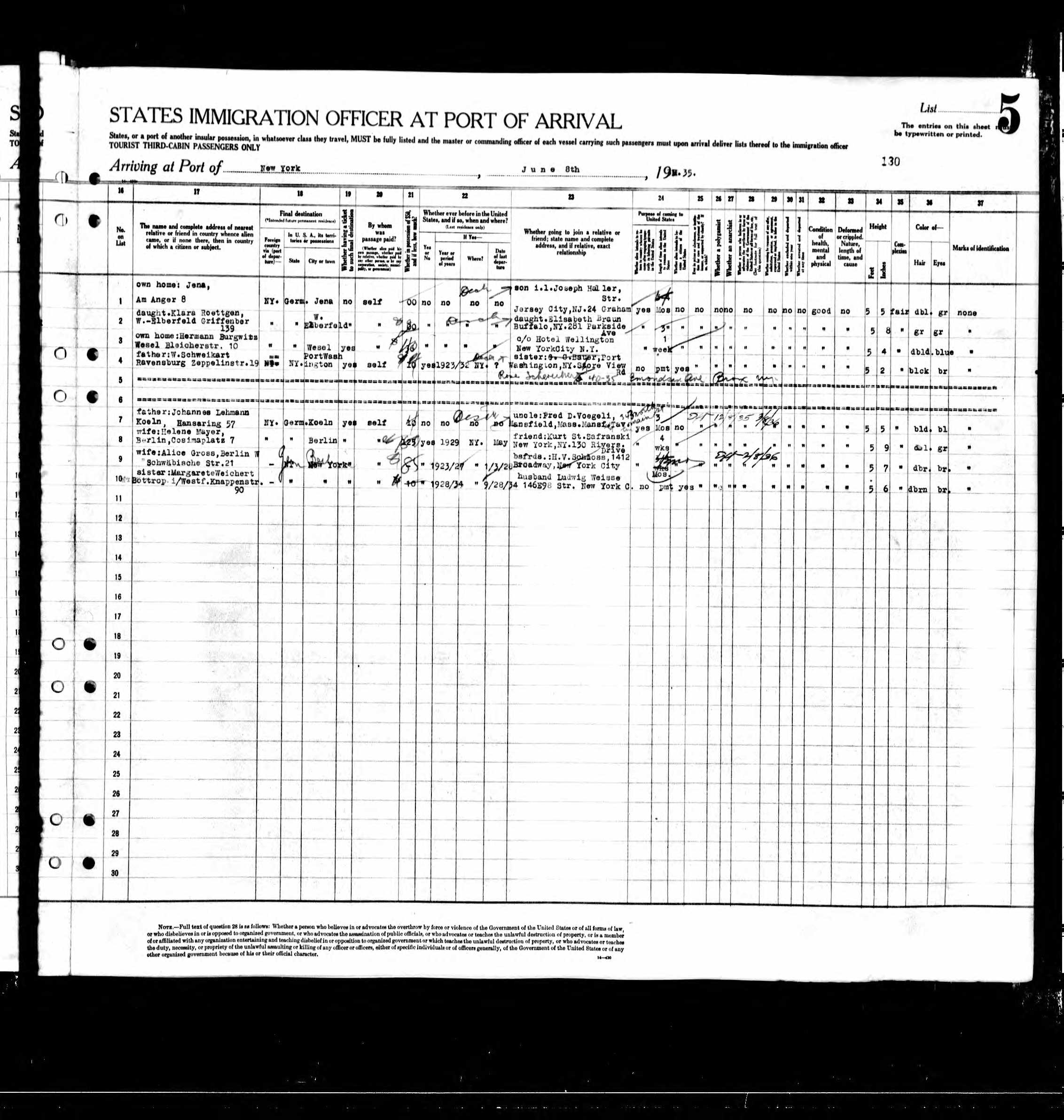
He arrived in New York on June 8, 1935, leaving his family behind until he could bring them over as well.

Ernst Mayer passenger manifest 1935

Ernst Mayer passenger manifest 1935 page 2

Ernst Mayer passenger manifest, June 8, 1935, line 8 Ancestry.com. New York, Passenger Lists, 1820-1957 [database on-line]. Provo, UT, USA: Ancestry.com Operations, Inc., 2010. Original data: Passenger Lists of Vessels Arriving at New York, New York, 1820-1897. Microfilm Publication M237, 675 rolls. NAI: 6256867.

Soon after arriving in New York, he and two other German Jewish refugees, Kurt Safranski (whom Ernst had listed as his contact in NY on the manifest) and Kurt Kornfeld, formed Black Star Publishing Company.  Marvin Hefferman wrote in the New York Times blog “Lens” on July 15, 2013, that Ernst Mayer and his partners were “innovators in Germany’s picture press and publishing world and fled from the Nazis.  Their New York-based company commissioned and brokered the use of photographs that documented important events, the comings and goings of notables, and human interest stories.” Marvin Hefferman, “Black Star Shines Anew,” The New York Times (July 15, 2013), available here.

Among their early clients were the magazines Life, Look, The Saturday Evening Post, and Collier’s, which retained their services for the procurement of photographs. The Black Star company’s website describes Ernst’s important role in the success of Black Star:

It was Mayer who made the decisive step uptown into the Rockefeller Center to Time Inc. He brought with him an enormous pile of essays from photographers including Fritz Goro and Paul Wolff, whom he had brought safely from Berlin to New York.  Soon after, the chief editors of Life Magazine had chosen Black Star as one of their main suppliers of pictures. Emigre photojournalists viewed the agency as their best means of gaining access to the magazine. For the mostly Jewish photographers, Black Star was a piece of Europe in the middle of New York.… According to photo historian Marianne Fulton, Life brought Black Star 30 to 40 per cent of its business. Black Star, in turn, contributed to Life becoming the most popular magazine in America for nearly three decades, with tens of millions of readers.

A little over a year after arriving himself, Ernst was able to bring his wife and daughter to the United States on August 11, 1936.[2]

Ernst Mayer and family August 1936 manifest

Ernst Mayer and family passenger manifest August 11, 1936 Ancestry.com. New York, Passenger Lists, 1820-1957 [database on-line]. Provo, UT, USA: Ancestry.com Operations, Inc., 2010. Original data: Passenger Lists of Vessels Arriving at New York, New York, 1820-1897. Microfilm Publication M237, 675 rolls. NAI: 6256867.

Ernst Mayer and family passenger manifest August 11, 1936
Ancestry.com. New York, Passenger Lists, 1820-1957 [database on-line]. Provo, UT, USA: Ancestry.com Operations, Inc., 2010.
Original data: Passenger Lists of Vessels Arriving at New York, New York, 1820-1897. Microfilm Publication M237, 675 rolls. NAI: 6256867.

One year after that, on October 11, 1937, he returned once more to Germany to bring his mother Mathilde back to the US.[3]  As you can see, the manifest shows they left from England, not Germany.  Ellen Kann Pine wrote that her grandmother Mathilde came to see her and her sister at boarding school in England before leaving for the US.

Mathilde Mayer passenger manifest October 1 1937

Mathilde Mayer passenger manifest October 1 1937 page 2

Mathilde Mayer and Ernst Mayer on passenger manifest, October 11, 1937 Ancestry.com. New York, Passenger Lists, 1820-1957 [database on-line]. Provo, UT, USA: Ancestry.com Operations, Inc., 2010. Original data: Passenger Lists of Vessels Arriving at New York, New York, 1820-1897. Microfilm Publication M237, 675 rolls. NAI: 6256867.

Ernst and his family and his mother were all living in New Rochelle, New York, at that time.

In August, 1938, the daughters of Alice Mayer Kann, Ellen and Hannelore, left England to come to the US.  Their parents and brother followed a month later, and the Kann family also settled in New Rochelle, New York.  Thus, by the fall of 1938, just a few months before Kristallnacht and the increased violence against Jews in Europe that followed, all of Mathilde’s children and grandchildren were safely out of Germany, as was she.

I will leave for another day what Mathilde’s life was like once she got to America—that is, until I can read the rest of her memoir.  As for her granddaughter Ellen Kann Pine, like her two uncles Willy and Ernst, she not only survived, she thrived—she worked hard, ultimately obtained a Ph.D. in biochemistry, and became a successful research scientist.  I highly recommend her memoir as another lesson in the resilience of people and their ability to start life over in a new place and find not only security but happiness.  Her book is available on Amazon here.

Sadly, Ernst Mayer’s wife Helene Hirschberg died on July 19, 1945, at age fifty.  Willy Mayer-Gross died in 1961; he was 72.  Mathilda outlived her oldest child, dying at 100 in 1969.  Her other two children also lived long lives.  Ernst died at ninety in 1983, and Alice died in 1993 when she was 97. Her husband Arthur Kann had died many years before in 1966 when he was 83.

My cousin Mathilde had suffered greatly during her life: she had lost her parents in a terrible tragedy, her husband had died too soon, and she had been forced to leave her homeland and the place where her family had lived for hundreds of years.  But she and her three children and all of her grandchildren escaped Nazi Germany in time and survived.  Although all of them suffered from the Nazi treatment of Jews, they all found success. It’s hard to say they were lucky, given what they’d endured, but they at least survived.

Other members of their extended family were not as fortunate.


[1] Later posts will relate what happened to Mathilde’s siblings and their families.


[2] Ernst and Helene Mayer had another daughter Dorothea, who had died before the family left Germany.

[3] It appears that Mathilde was listed on an earlier ship manifest to leave Germany in February, 1937. There is a notation “Ext. 9/17/37,” which I assume meant she extended her ticket for an additional seven months. Perhaps she did not want to sail alone, and it was only when Ernst returned to bring her back in October that she came to the US.  Or maybe she did come in February and returned because there is another notation that says “RT.”  Return trip? I am not sure.

Mathilde Mayer-Gross on passenger manifest February 1937

Mathilde Mayer-Gross on passenger manifest Feb 1937 page 2

Mathilde Mayer-Gross listed on February 1937 manifest Ancestry.com. New York, Passenger Lists, 1820-1957 [database on-line]. Provo, UT, USA: Ancestry.com Operations, Inc., 2010. Original data: Passenger Lists of Vessels Arriving at New York, New York, 1820-1897. Microfilm Publication M237, 675 rolls. NAI: 6256867.

Letters to Frank: A Close Family Revealed

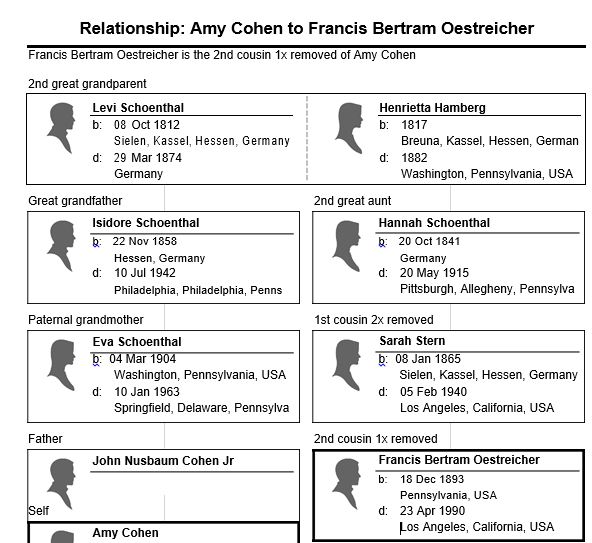
As I mentioned here, included with all the photographs that my cousin Steve scanned and sent to me were a number of letters.  I posted the letter written by Gerald Oestreicher to his family during World War II, and I mentioned that there were also letters written by Gerald’s uncle, Francis Oestreicher, when he was serving during World War I.  Frank was my father’s second cousin, both being the great-grandchildren of Levi Schoenthal and Henriette Hamberg. Thus, he was my second cousin, once removed:

Frank Striker to me relationship chart


There were also some letters written to Frank, as he was known after the war.  In this post I will share the letters written to Frank. The next post will contain the letters written by Frank during World War I.  I’ve transcribed all the letters as close to their original spelling and punctuation as I could, but made some changes just for purposes of readability.  No words were deleted or changed; nothing was added, except where I’ve put my own comments in brackets.

What struck me as meaningful about these letters is what they reveal about the close connections among the Schoenthal siblings—the ten children of my great-great-grandparents Levi Schoenthal and Henriette Hamberg.  These three letters date from 1907 to 1939, and each one shows that this large and extended family knew and cared about each other.

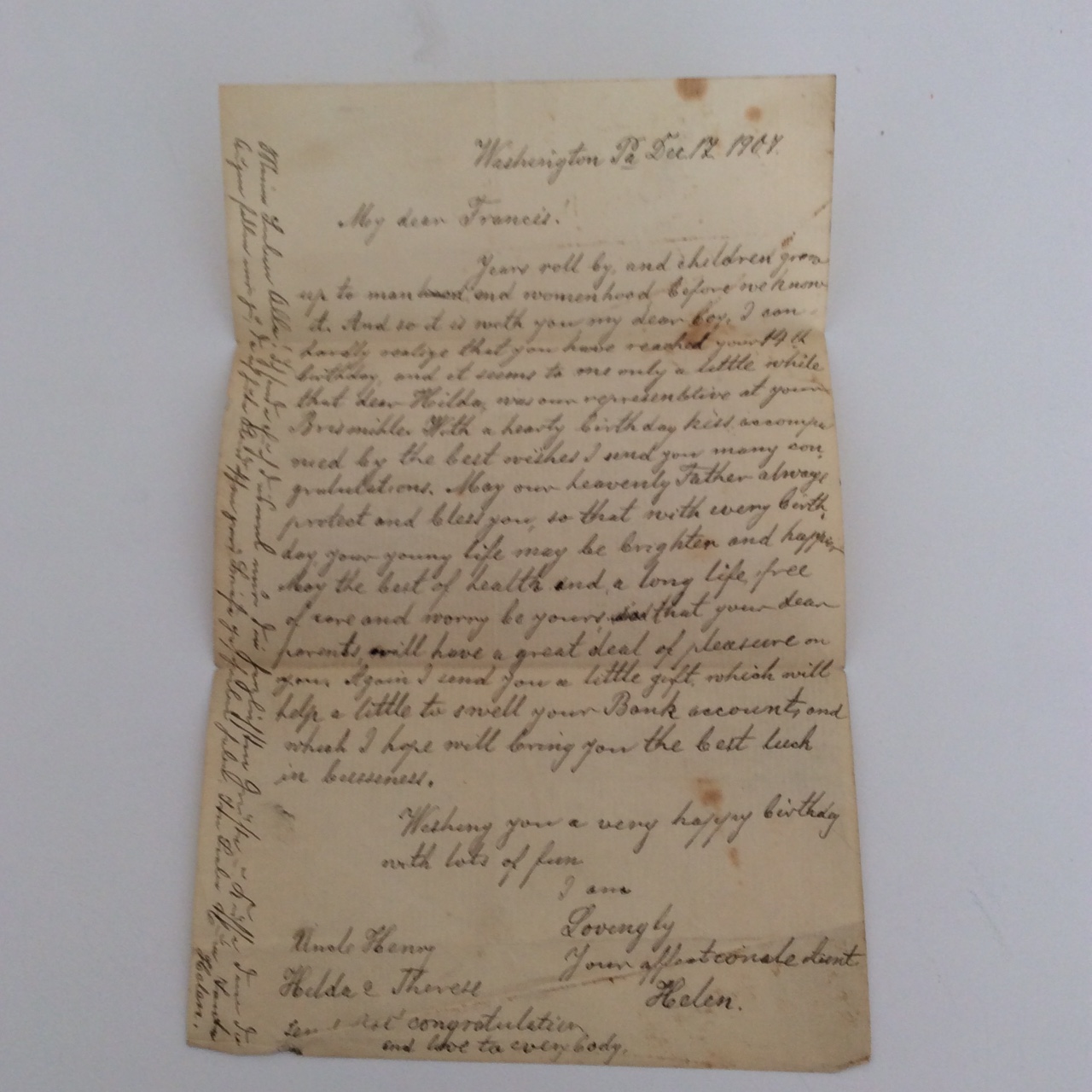
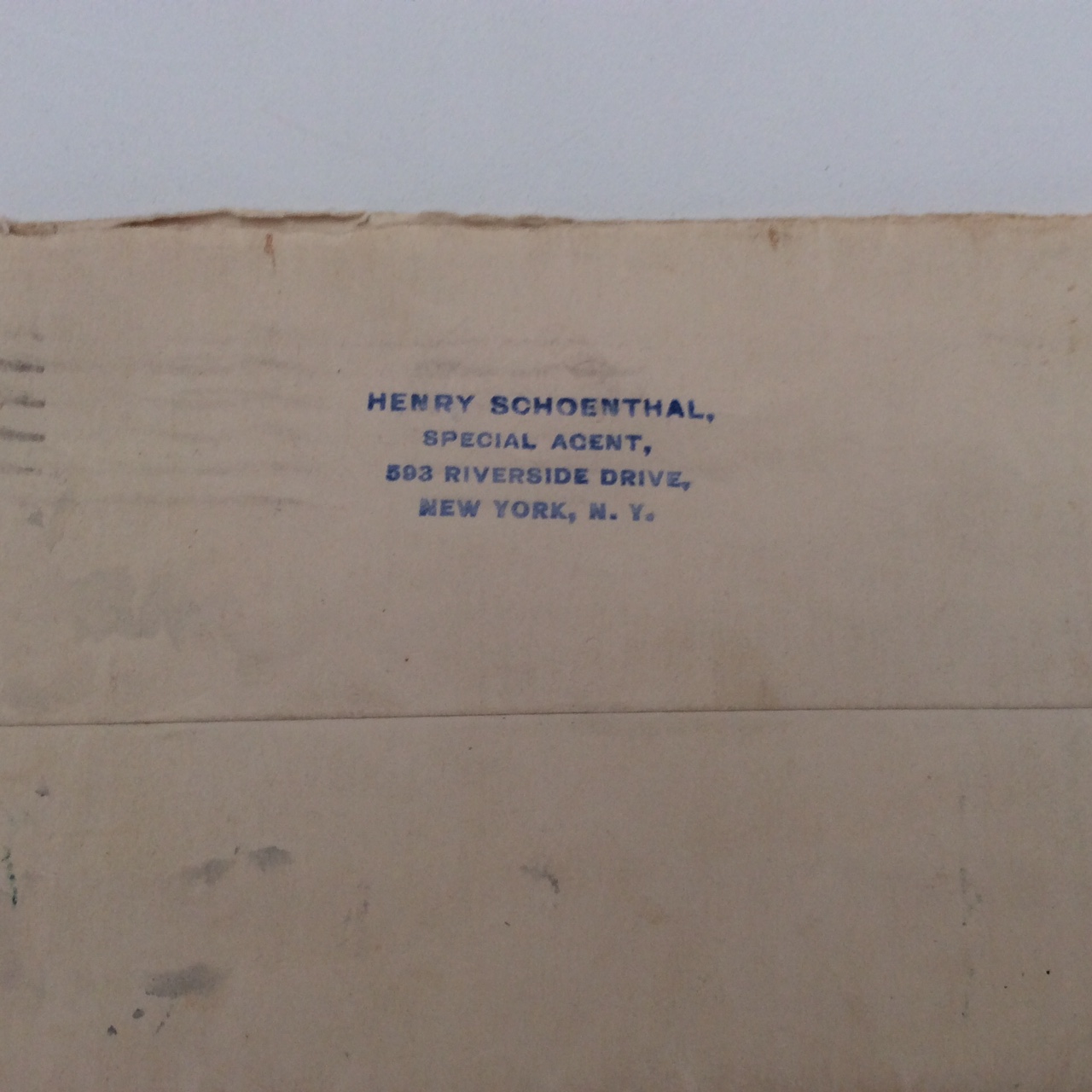
The oldest letter was a letter written by Frank’s great-aunt Helen Lilienfeld Schoenthal, the wife of my great-great-uncle, Henry Schoenthal.  Helen wrote this letter from Washington, Pennsylvania in 1907, to Frank, grandson of her sister-in-law Hannah Schoenthal.

Letter from Helen Lilienfeld Schoenthal dated December 12, 1907 from Washington, PA

IMG_1830

My dear Francis,

Years roll by, and children grow up to man and womenhood before we know it. And so it is with you my dear boy.  I can hardly realize that you have reached your 14th birthday, and it seems to me only a little while that dear Hilda was our representative at your Bris mihle.  With a hearty birthday kiss accompanied by the best wishes I send you many congratulations.  May our heavenly Father always protect and bless you, so that with every birthday your young life may be brighter and happier.  May the best of health and a long life free of care and worry be yours that your dear parents will have a great deal of pleasure on you.  Again I send you a little gift which help a little to swell your Bank account and which I hope will bring you the best luck in business.

Wishing you a very happy birthday with lots of fun.  I am

Lovingly

Your affectionate Aunt Helen

Uncle Henry, Hilda and Therese send their congratulations and love to everybody.

There is also a message written by Helen in German along the margin that I could not read, but with the help of my friend Matthias Steinke in transcribing and translating the old German script, I now know what it says:

My dear all! I am sending you this time only the heartiest greetings and kisses because my eyes close already automatically, because this evening I wrote already a couple of letters. In Love, your aunt, Helen 

Isn’t it interesting that in 1907 after being in the US for 35 years and clearly fluent in English,  Helen reverted to German (and German script) to write to Frank’s parents, Gustav and Sarah Stern Oestreicher? Both Sarah and Gustav were native German speakers, but both also had been in the US for a very long time. I wonder if Frank could read German or was as puzzled as I was by the German script scrawled on the margin of his birthday letter.

Aunt Helen--maybe Lilienfeld Schoenthal

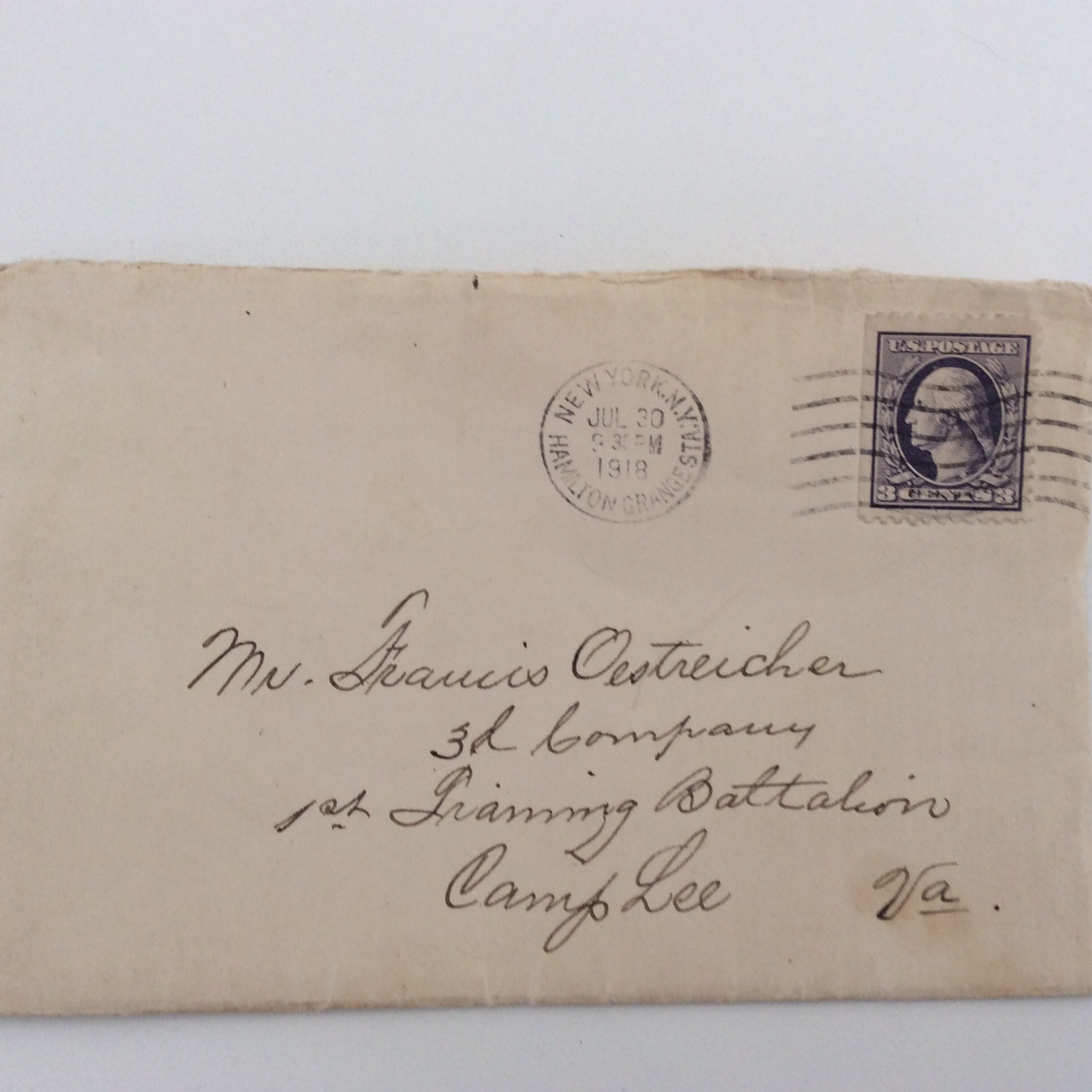
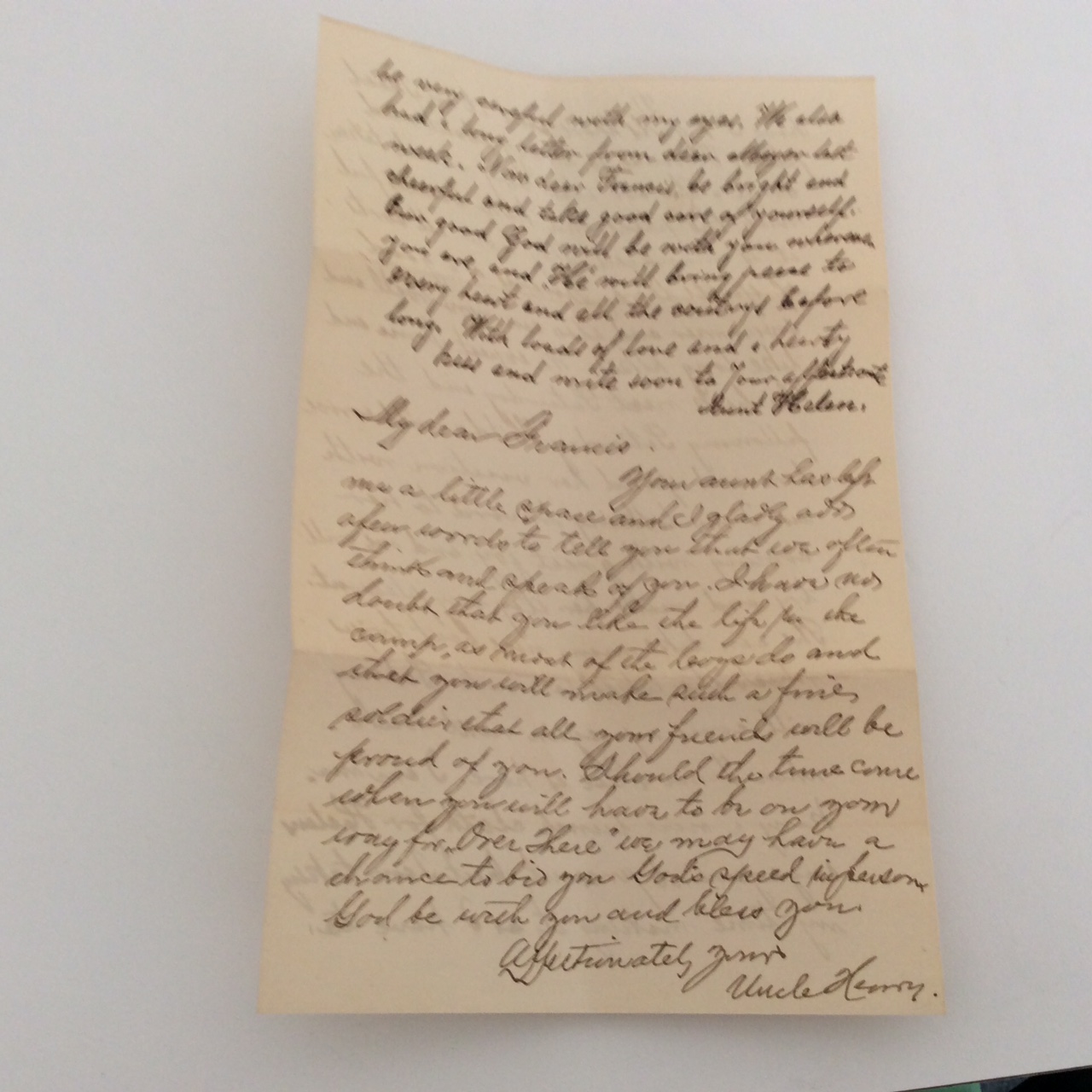
The second letter was written a little over ten years later in July, 1918 when Frank had joined the army, but before he was shipped overseas.  It is also from his great-aunt Helen, with a short addendum by his great-uncle Henry Schoenthal.

Once again, it is evident that Helen and Henry were closely connected to Frank, a child of their niece Sarah Stern, grandson of Henry’s sister Hannah.  I was touched by how much affection there was for this young man, their great-grandnephew.  The letter is also interesting because it talks about Henry and Helen’s own children, their daughter Hilda, their son Lee (born Lionel) and his wife Irma, and Henry and Helen’s granddaughter Florence, who was only thirteen when this letter was written.  Helen did not use any paragraph breaks, but I’ve added some to make the text more easily read.

Letter from Helen Lilienfeld Schoenthal and Henry Schoenthal dated July 30 1918 written from NYC

IMG_1816 IMG_1817 IMG_1818 IMG_1819

IMG_1820


My dear Francis,

I was just thinking to write to your dear parents and ask for your address, when we were agreeably surprised on last Sunday, when your dear brother Sidney came to see us, stayed for supper and until late in the evening.  And so we are able to write to you, as Sidney was glad to give us your ad: for every soldier likes to get letters from some one, and if it is not from a sweetheart, this letter comes from your old Uncle and Aunt, who always loved you. 

I suppose your ears were ringing last Sunday, for Sidney and we talked about you a great deal, and we were glad to hear that you liked soldiers life and also the camp.  Are any boys with you from Pittsburg who you know? And how is the weather in your section?

We have terrible hot spell here since over a week, and I feel the heat very much.  But I am so thankful that we live on such nice open place near the Hudson and get all the fresh air that is going.  There is a good deal of suffering on the East side I know. 

Uncle and I are alone since the 19th of July. Irma & Lee went to the Adirondex Mountains to stay two weeks, as Lee had not been feeling well and needed a rest badly.  They choose this place so that they could be near Florence who is at a girls camp named camp Woodmere.  It is owned by Misses Goldsmith and Kuhn from Philadelphia.  They have 54 girls there and it an ideal place.  Florence is crazy about and Irma & Lee are also very much taken with the place and how beautiful it is managed.  They have all sorts of sports there.  Florence is a good swimmer and also can now [?] and take long hikes. 

We expect Irma and Lee back next Saturday and the following Saturday Hilda will arrive here and spend her vacation with us. I am looking forward to her coming with great joy, and we will try and make her stay very pleasant.  She can take many nice boat trips which she likes so much.  Sidney will come up again next week when Irma & Lee is here. 

I am making a nice lunch cloth for Helen’s engagement present, but I am taking my time making it as I have to be very careful with my eyes. [I assume Helen was Frank’s sister Helen, who married in 1920.] We also had a long letter from dear Meyer [their younger son] last week. 

Now dear Francis, be bright and cheerful and take good care of yourself.  Our good God will be with you wherever you are, and He will bring peace to every heart and all the countrys before long. 

With loads of love and a hearty and write soon to your affectionate Aunt Helen.

 My dear Francis

Your aunt has left me a little space and I gladly add a few words to tell you that we often think and speak of you.  I have no doubt that you like the life in the camp, as most of the boys do and that you will make such a fine soldier that all your friends will be proud of you.  Should the time come when you have to be on your way for “Over There” we may have a chance to bid you God’s speed in person. God be with you and bless you.

Affectionately yours,

Uncle Henry

I read this letter as an attempt by his aunt and uncle to give him their blessing before he went off to war without making him too nervous about what he was about to face.  Frank’s own letters, as we will see, reflect a similar impulse, only he is reassuring those at home that he is and will be okay.

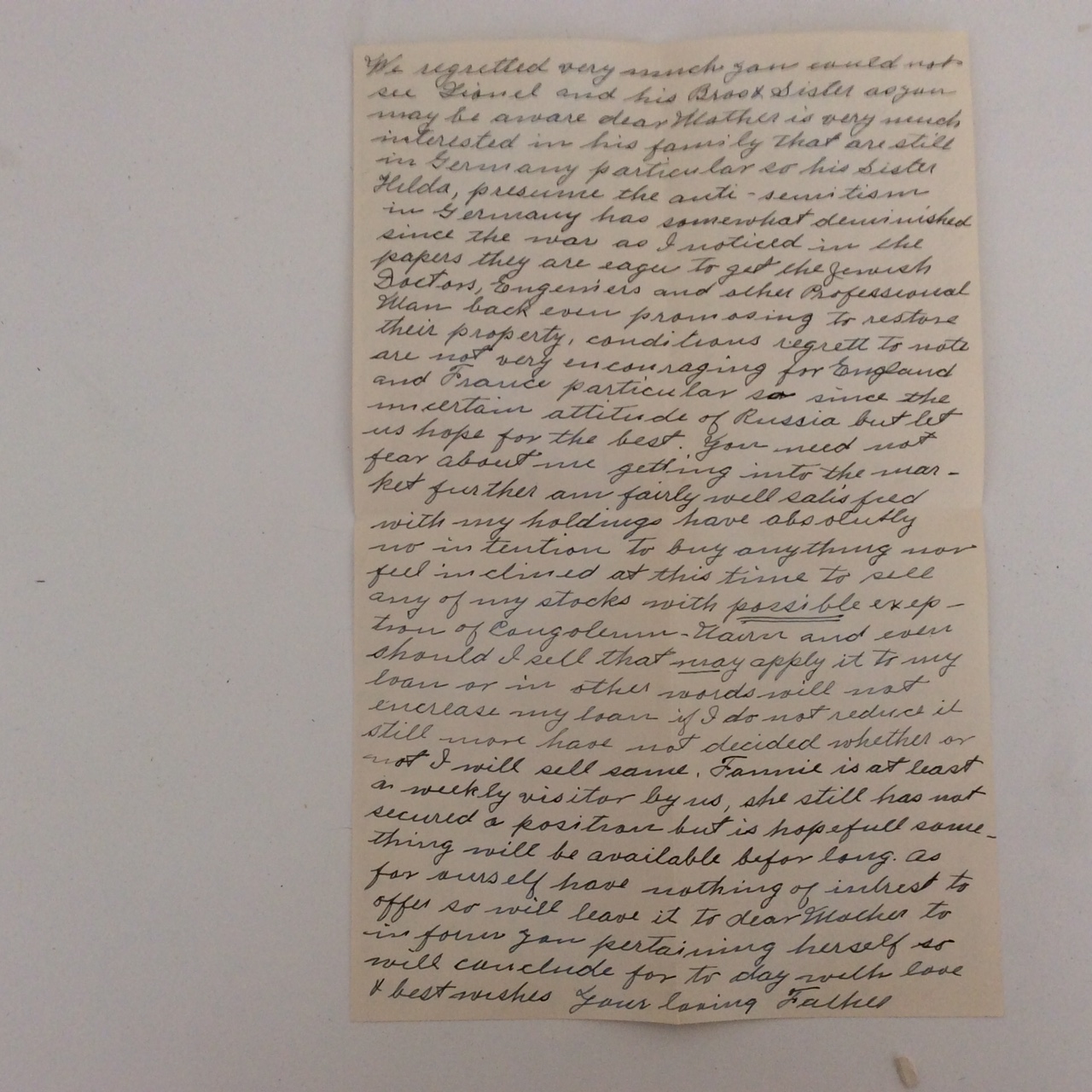
The last letter for this post was written many years later by Frank’s father, Gustav Oestreicher.  It was written in 1939 after Gustav and Sarah had moved to California, as had their daughter Helen.  I am not certain whether Frank was living in Minneapolis or just visiting; the letter is addressed to him at a hotel, and from the content of the letter, I can infer that Frank had recently been to Chicago. I assume he was on the road in his capacity as a traveling salesman.

A little background to help identify the people named in the letter:  First, Gustav mentions the Good family.  He must be referring to Edith Stern and Leo Good and their son Bernard; Edith was Sarah Stern Oestreicher’s younger sister, thus Gustav’s sister-in-law.  In 1939, the Good family was living in Chicago.

Gustav then mentions a Lionel and his brothers and sister and another sister Hilda. At first I thought this referred to the children of Henry and Helen Schoenthal, as they had a son named Lionel, a son Meyer, and a daughter Hilda. But after reading through the letter more carefully, I realized that he was referring to Lionel Heymann, the oldest child of Rosalie Schoenthal and Willy Heymann, about whom I wrote here.  Rosalie was the youngest Schoenthal sibling, sister of Hannah Schoenthal, who was Gustave’s mother-in-law. So Rosalie was Sarah Stern’s aunt.

Here’s why I think Gustav is talking about Lionel Heymann, not Lionel Schoenthal. For one thing, Henry and Helen Schoenthal’s son Lionel was called Lee at this point, not Lionel.  And at the time this letter was written, Lionel Heymann (the photographer) was living in Chicago as were his brothers Walter and Max, so if Frank had seen the Good family, he must have been in Chicago. (I am not sure why Gustav writes that he hoped Frank might see Lionel’s “bros.& sister” since there was no sister at that time living in the US, but perhaps he was referring to Max’s wife Frieda.)

Also, Gustav mentions a sister Hilda who was still in Germany. Henry Schoenthal’s daughter Hilda was not living in Germany, but in Washington, DC, in 1939.  But Lionel Heymann had a sister Hilda who was still in Germany in 1939.  I have written about what happened to Hilda Heymann as well as her sister Helene, who married Julius Mosbach and had two daughters, Liesel and Gretel.  All were killed in the Holocaust.  That fact makes Gustav’s comment even more chilling.  I put those comments in bold below.

I do not know who the Fannie mentioned towards the end of the letter could be.

Letter from Gustav Oestreicher to his son Frank [edited for readability only]

IMG_1990 IMG_1992 IMG_1993

September 16, 1939 from Los Angeles

My dear Francis,

Although late, [I] will begin my letter extending to you my best wishes for a healthy, happy and prosperous new year. [Obviously a reference to Rosh Hashanah, given the September date.] You ought to know you enjoy our good wishes at all times so hope you will pardon the expression of it at a rather late date. As usual we were happy to learn the contents of your recent letter.  It pleased us to learn you enjoyed your visit with the Good family as well as that all of them are getting along nicely.  You evidently misinformed them about our anniversary as we rec’d a very nice letter from them congratulating us for our golden wedding anniversary which will not be until next year. [Gustav and Sara were married in 1940.]

We regretted very much you could not see Lionel and his Bros. & Sister again. [You] May be aware dear Mother is very much interested in his family that are still in Germany particular so his Sister Hilda. [We]  presume the anti-semitism in Germany has somewhat diminished since the war as I noticed in the papers they are eager to get the Jewish Doctors, Engineers and other Professional Man back even promising to restore their property.  Conditions regrett to note are not very encouraging for England and France particular so since the uncertain attitude of Russia but let us hope for the best.

You need not fear about me getting into the market further. Am fairly well satisfied with my holdings. Have absolutely no intention to buy anything nor feel inclined at this time to sell any of my stocks with possible exception of Congoleum-Narin and even should I sell that, may apply it to my loan or in other words will not increase my loan if I do not reduce still more.  Have not decided whether or not I will sell same. 

Fannie is at least a weekly visitor by us.  She still has not secured a position but is hopefull some thing will be available before long.  As for ourselves have nothing of interest to offer so will leave it to dear Mother to inform you pertaining herself so will conclude for to day with love and best wishes. 

Your loving Father

As with the earlier letters from Helen Lilienfeld Schoenthal, this letter reveals the close connections among the many Schoenthal siblings and their children.  I’ve often wondered what the family knew about the two siblings who had stayed in Germany: Jakob Schoenthal and Rosalie Schoenthal.  From Gustav’s letter it is apparent that the family was in touch at least to some extent with those family members who had not immigrated.  They knew that the three Heymann brothers were in Chicago, and they knew that some family members were still in Germany.

Gustav’s hope that anti-Semitism was diminishing in Germany once the war started is so terribly painful to read, knowing what was going to happen not only to Hilda, her sister, and her nieces, but to six million other Jews living in Europe.

Realizing how connected the family was to each other as late as 1939 makes me wonder what happened.  Why didn’t my father even know about all his Schoenthal second cousins like Frank and his siblings? Did my grandmother Eva Schoenthal know any of these people? My guess is that because my great-grandparents moved from western Pennsylvania to Denver when my grandmother was just a small child, not even four years old, she did not grow up with the benefit of knowing all those cousins in western Pennsylvania.  Perhaps if she had, I would not have had to search to find my Oestreicher cousins.  Perhaps we would have always known about each other.

More Names to Remember and Never Forget

As I move towards closure on my Schoenthal family history, this post has been the hardest one to write.  It is a tragic chapter in that history.

As I’ve already written, four of the six children of my great-great-aunt Rosalie Schoenthal and her husband Willy Heymann left Germany before they could be killed by the Nazis. The three sons went to Chicago, and the oldest daughter Johanna went to Sao Paulo. They all survived.  The other two daughters were not so lucky.

The second oldest daughter, Helene, was born in Geldern in November 9, 1890, a year after Johanna.  She married Julius Mosbach, who was the younger brother of Johanna’s first husband, Hermann Mosbach.  After marrying, Julius and Helene were living in Iserlohn, a town about 80 miles east of Geldern.  According to an article written in 2000 by the archivist of Iserlohn, Gotz Bettge, Julius and Helene Mosbach owned a fruit and vegetable business in the town square in Iserlohn.  They had two daughters: Liesel, who was born March 8, 1921, and Gretel, born October 26, 1926.


Iserlohn By No machine-readable author provided. Asio otus assumed (based on copyright claims). [GFDL (http://www.gnu.org/copyleft/fdl.html), CC-BY-SA-3.0 (http://creativecommons.org/licenses/by-sa/3.0/) or CC BY-SA 2.5-2.0-1.0 (http://creativecommons.org/licenses/by-sa/2.5-2.0-1.0)], via Wikimedia Commons

Iserlohn
By No machine-readable author provided. Asio otus assumed (based on copyright claims). [GFDL (http://www.gnu.org/copyleft/fdl.html), CC-BY-SA-3.0 (http://creativecommons.org/licenses/by-sa/3.0/) or CC BY-SA 2.5-2.0-1.0 (http://creativecommons.org/licenses/by-sa/2.5-2.0-1.0)%5D, via Wikimedia Commons


On December 18, 1939, Liesel married Ernst Georg Lion. From the incredibly moving autobiography written by Ernst Lion entitled The Fountain at the Crossroads and available online here, I was able to learn a great deal about his life and also about the lives of Julius, Helene, and their daughters.  All the information and quotes below are from his book unless otherwise indicated.  (Special thanks to Dorothee Lottmann-Kaeseler for sending me some of the additional links and information.)

Ernst was born December 15, 1915, in Brambauer, the son of Leo Lion and Bertha Weinberg Lion.  When Ernst was a very young child, his father Leo was badly injured while serving in the German army during World War I.   Leo Lion considered himself a German patriot.

Ernst grew up as the only Jewish child in Brambauer during the hard years of the Weimar Republic, but his childhood was overall quite happy. Then Hitler came to power, and his life was forever changed.  The Nazis tried to impose a boycott on his father’s business by having a Gestapo member stand in the doorway and take photographs of those who patronized his store.  Ernst’s father insisted that the man leave, even threatening to beat him up.  He did not think the Nazis would be in power for very long.  But then when the Nuremberg laws were enacted in 1935, the family had to sell their home and their store for less than their value and move to Dortmund.

Many members of the extended Lion/Weinberg family left Germany around that time, but Ernst had difficulty getting the necessary visas and permits to go elsewhere even though he had an affidavit of support from a cousin in New York.  Then on November 9, 1938, Ernst was one of thousands of German Jews who were arrested and sent to Buchenwald in the aftermath of Kristallnacht.  In his autobiography he described in graphic detail his experiences there.  It’s horrifying.

Ernst was released a few weeks later and told to leave the country within three weeks.  All the Jewish businesses were now closed, and he was forced to work on street repairs while waiting to emigrate.


Buchenwald Watch Tower undesarchiv, Bild 183-1983-0825-303 / CC-BY-SA 3.0 [CC BY-SA 3.0 de (http://creativecommons.org/licenses/by-sa/3.0/de/deed.en)], via Wikimedia Commons

Buchenwald Watch Tower
undesarchiv, Bild 183-1983-0825-303 / CC-BY-SA 3.0 [CC BY-SA 3.0 de (http://creativecommons.org/licenses/by-sa/3.0/de/deed.en)%5D, via Wikimedia Commons


But then he met Liesel Mosbach in Iserlohn.  He was introduced by his Aunt Selma who lived there, and they immediately took a liking for each other.  At that time Liesel’s family was living in the apartment above their former business, which had been confiscated by the Nazis.  Julius Mosbach had suffered a nervous breakdown as a result of the harassment by the Nazis and the loss of his business, and he was doing very poorly.

Ernst moved to Iserlohn in 1939, where his aunt was able to help him get a job at a metal working company owned by a family that was unsympathetic to the Nazi government and its policies; the owners even provided Ernst with extra food to supplement the very restrictive allotments allowed to the Jews by the Nazis.

When the Nazis then imposed travel restrictions and required Jews to wear the yellow Star of David, Ernst was no longer able to get to Dortmund to visit his parents.  His mother died shortly thereafter, having given up on life, according to his father; Ernst was not even allowed to go to her funeral.

Yellow badge Star of David called "Judens...

Yellow badge Star of David called “Judenstern”. Part of the exhibition in the Jewish Museum Westphalia, Dorsten, Germany. The wording is the German word for Jew (Jude), written in mock-Hebrew script. (Photo credit: Wikipedia)


On December 18, 1939, Ernst and Liesel were married.  As Ernst wrote, although they had no idea what the future would bring, “The secret of maintaining one’s sanity under those conditions is to live as normal a life as one can.” (p. 18)   Unfortunately, that became more and more difficult to do.  Conditions for the Jews continued to worsen, and there was less food available.  People were beginning to hear about Jews being arrested and sent away.

In January, 1941, Julius Masbach was admitted to a mental hospital and died shortly thereafter.  Ernst wrote (p.15):

We soon discovered that we should have opposed the doctor’s decision [to hospitalize Julius], for the Nazis had decided that all institutionalized, so-called “insane” persons no longer had the right to live and had become a burden to society.  They were led into sheds equipped with gasoline engines, which were installed in reverse fashion: the exhaust escaped to the inside of the building.  After they were asphyxiated, the bodies were burned and the ashes delivered to the surviving families.  No one realized that this activity was the rehearsal for later mass destruction of humans.

On April 28, 1942, Helene Heymann Mosbach, my grandmother’s first cousin, and her daughter Gretel, just sixteen years old, were arrested and sent to Zamosc, near Lublin, Poland.  They were never heard from again.  Ernst’s father Leo Lion was also arrested around this time, and Ernst never heard from him again either.

To add to this heartbreaking account, Helene’s sister Hilda, the youngest of the six children of Rosalie Schoenthal and Willy Heymann, was also killed by the Nazis.  Although she is not mentioned in Ernst Lion’s autobiography or on the website memorializing the Mosbach family, according to Yad Vashem, Hilda also had been living in Iserlohn before being sent Zamosc where her sister Helene and niece Gretel had been deported.   I assume that Hilda had moved to Iserlohn to live with her sister Helene after both her mother Rosalie (1937) and her father Willy (1939) had died.

I had not heard of Zamosc before, and my friend Dorothee Lottmann-Kaeseler sent me this link that reveals the absolutely horrifying story of this place.  There are no records of what happened specifically to Helene, Gretel, and Hilda, but it is possible that they were killed in Zamosc itself or deported to the death camp at Majdanek or Belzec or Sobibor, where they were killed.


Crematoria at Majdanek death camp near Lublin, Poland Deutsche Fotothek‎ [CC BY-SA 3.0 de (http://creativecommons.org/licenses/by-sa/3.0/de/deed.en)], via Wikimedia Commons

Crematoria at Majdanek death camp near Lublin, Poland
Deutsche Fotothek‎ [CC BY-SA 3.0 de (http://creativecommons.org/licenses/by-sa/3.0/de/deed.en)%5D, via Wikimedia Commons

On February 26, 1943, Ernst and Liesel received orders to report to a school in Dortmund with just one suitcase each.  There were about a thousand people at the school that night, and everyone was forced to sleep on the floor. Ernst wrote, “They took our wedding bands and watches, telling us that we would not need them where we were going.” (p. 19)

The next morning they were put on a freight train (pp.19-20):

I found myself inside such a freight car among a hundred men, women and children.  The doors were locked; there were no windows to look through.  This precaution would keep us from recognizing our route or destination.  A few buckets for relief, no food or water.  This should be a short ride, I mused.

… Liesel was shoved on this train with me.  At least we were together.  Just twenty-three, she was a thin, wiry lady, strong and energetic.  Her dark eyes expressed the will to endure.  I was twenty-four.  Where was our future?

Although they were told they were being taken to a safe place for resettlement, Ernst was skeptical, as he had good reason to be.  They were being taken to Auschwitz-Birkenau.  When they arrived, they were told to leave their suitcases on the train; then they stepped onto the platform surrounded by SS guards and prisoners in striped uniforms who were helping with the unloading.

Then the men and women were separated.

Ernst wrote, “All the women were led away.  My wife looked at me for one last time before she disappeared.  It was dark now, and I saw her walk away like a shadow.”

He never saw her again.  Liesel Mosbach Lion, my father’s second cousin, was murdered at Auschwitz.


English: Aushwitz I crematoria memorial

English: Aushwitz I crematoria memorial (Photo credit: Wikipedia)


I consider the entire family to be victims of the Holocaust: Rosalie, Willy, Helene, Julius, Liesel, Gretel, and Hilda as well as Leo and Bertha Lion.


Stolperstein for Julius Mosbach and family


Ernst Lion, however, survived.  The story of how he survived is remarkable.  It’s a tale of incredible courage, strength, persistence, and luck. It’s also a horrifying, nightmarish account of how cruel human beings can be to one another.  You should all read it.  I cannot do it justice in a blog post.  You must read it.  Again, you can find it here.  Please read it.

I am so grateful that Ernst, Liesel’s husband, survived and recorded his story and their story for us all to read.  We must never forget.


Cousins Deported to France: The Camp at Gurs

Did you know that during the Holocaust some German Jews were deported not to the camps in the east, but to France? It was a revelation to me.

I left off my last post with a series of questions regarding the fate of my cousin Johanna Schoenthal and her husband Heinrich Stern, both of whom had been living in a hospice in southern France at the end of World War II. Why did they end up in France, and how long had they been there? How had they survived after the Nazis took over France in the spring of 1940? Who was Henry Kahnweiler,  the friend in Paris they named on their 1947 ship manifest when they left France for the US?  Had they had children?

Although I don’t have answers to all those questions, thanks to the United States Holocaust Memorial Museum and the people and sources on JewishGen, I have been able to piece together part of the story of Johanna and Heinrich’s ordeal during World War II.

From the Mannheim Jewish Community database on JewishGen, I learned that Johanna and Heinrich Stern had resided in a town called Karlsruhe before the war.  Karlsruhe is about forty miles from Mannheim.  It is rather distant from Köln, where Johanna was born—almost 200 miles—and from Giessen, where Heinrich was born.  But perhaps more importantly, it is less than twenty miles from the French border.  I don’t know how the Sterns ended up living there or when they had moved there.

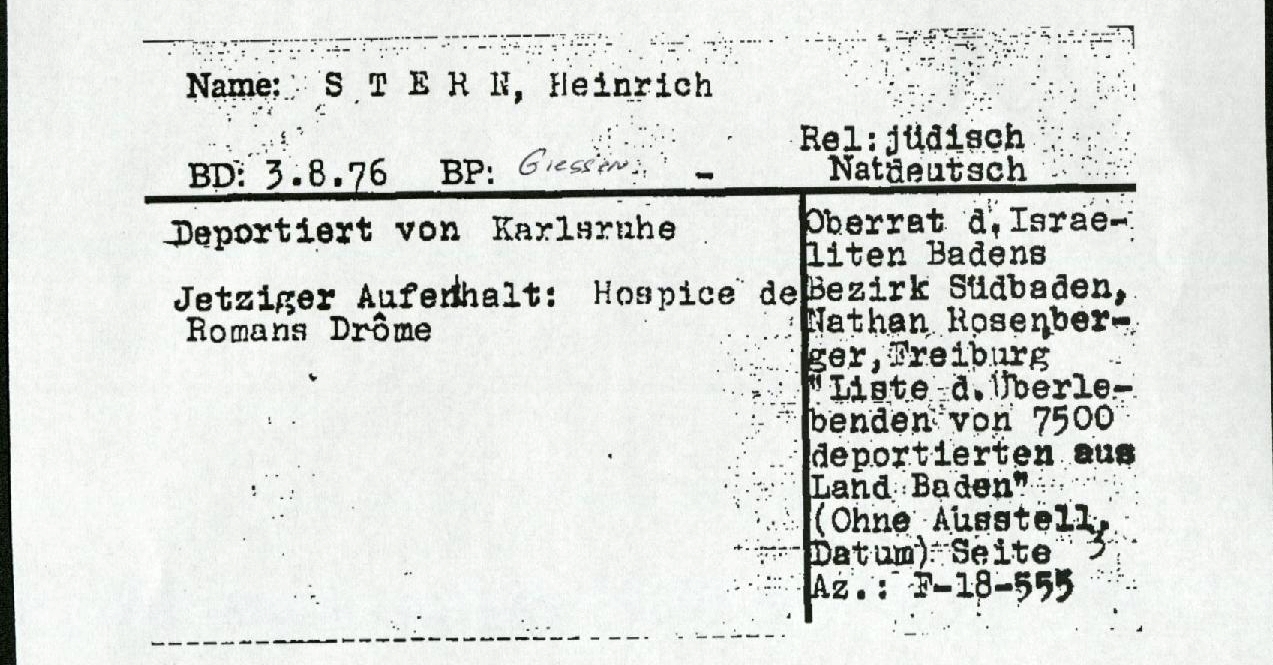
But I do know when they left.  Thanks to Peter Lande at the USHMM, I have learned about a whole new chapter in the history of the Holocaust.  Peter sent me the documents below regarding Johanna and Heinrich Stern:


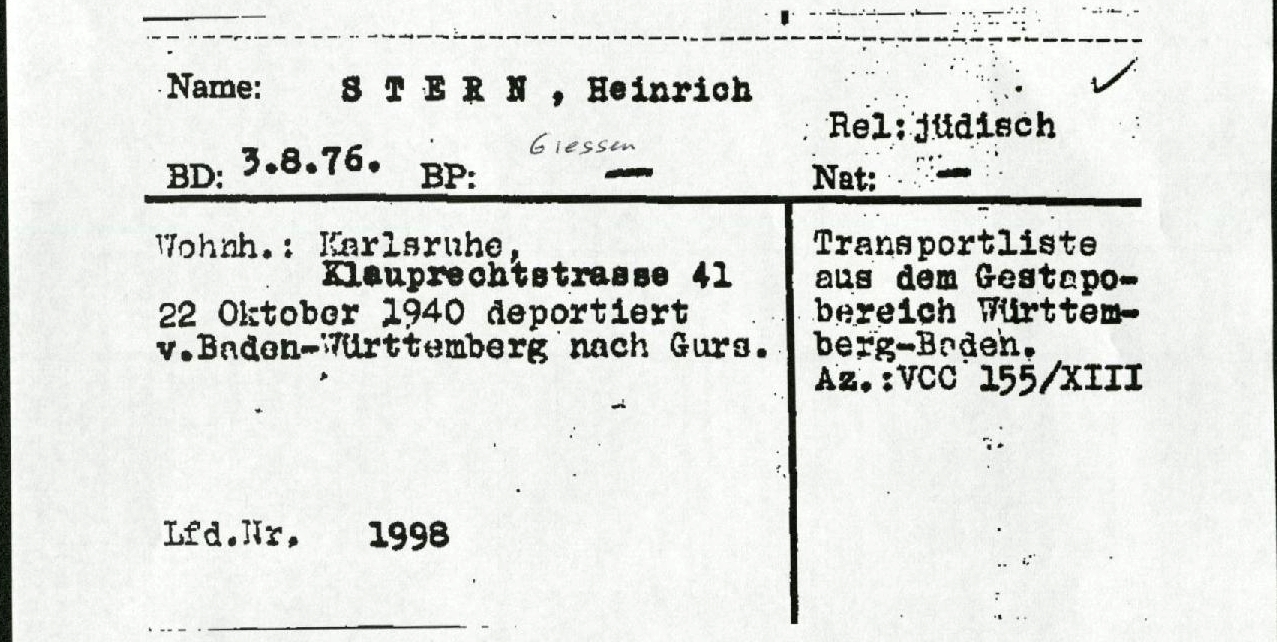
Heinrich Stern ITS card page 1Heinrich Stern ITS card page 2


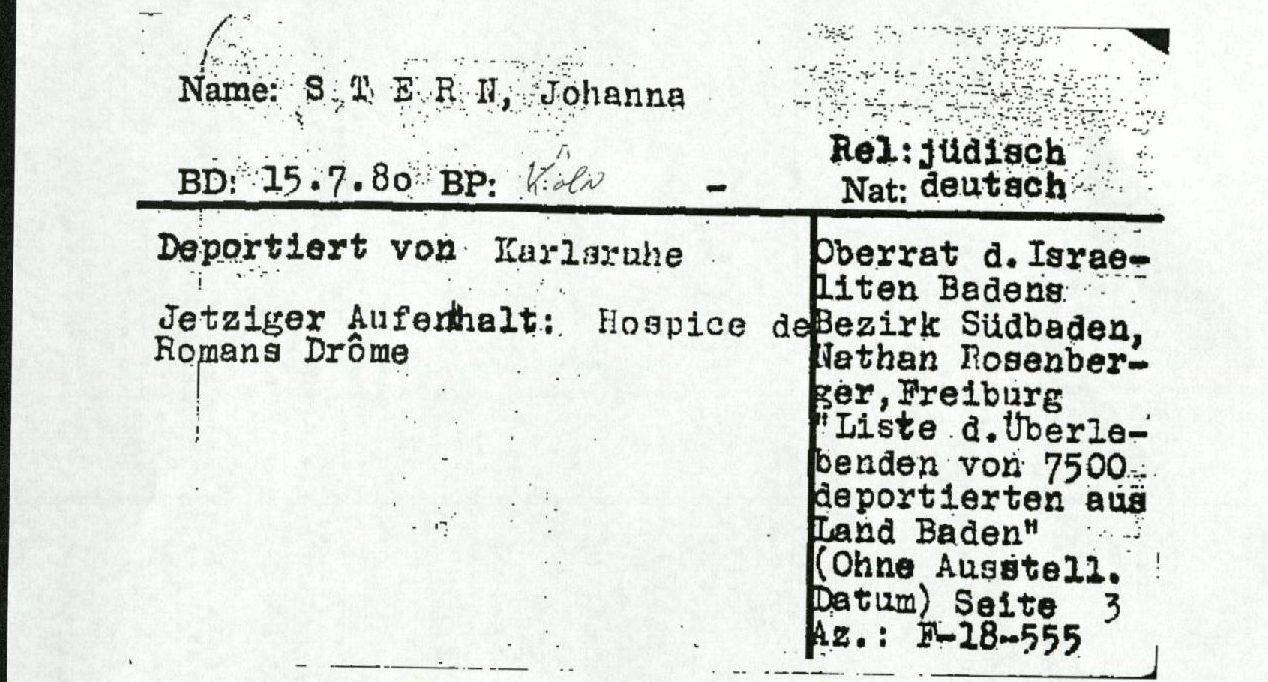
Johanna Stern ITS card


(Translation of first card: Stern, Heinrich, born 3rd August 1876 in Giessen, religion: Jewish, nationality: German – Senior councillor of the Jews in Baden, district South-Baden (source: Nathan Rosenberger, Freiburg: List of survivors of 7.500 deported from the state of Baden), without date, page 3 – ref.-nr. F-18-555 – residence: Karlsruhe, Kleinprechtstr. 41, deported from Karlsruhe at the 22 October 1940 to Gurs in Southern France, current address: Hospice de Romain Drome.

Second card: transport-list from the Gestapo, district Fürstenberg-Baden. ref-nr. VCC 155/XIII.  The third card is the same as the first, except it is for Johanna Stern, born 15th of July, 1880 in Köln. )

These cards were definitely about my cousin Johanna Schoenthal Stern and her husband Heinrich Stern.  The birth dates and places are consistent with the passenger ship manifest and the JewishGen sources I had found, and the place of last residence in Germany and the residence in France are also consistent with those sources and the notice posted by the family in Aufbau in 1946.  These cards told me what had happened to Johanna and Heinrich. They had been deported by the Gestapo from Karlsruhe on October 22, 1940, to a place called Gurs in southern France.

With these clues, I was able to find out more about the fate of the Sterns, not specifically but generally.  In October, 1940, the Nazi officials in charge of the Alsace and Lorraine regions of France as well as the Baden district of Germany decided to deport the Jews from Baden, having already deported those who had been living in Alsace and Lorraine.  This decision, known as the Wagner-Burckel Aktion for the two Nazi officials who planned and implemented it, led to the sudden deportation of approximately 7,500 Jews from the Baden region, including my cousins, the Sterns, who were living in Karlsruhe.  It would be the only deportation of German Jews to the west rather than the east of Germany during the Holocaust.


Railroad tracks to Gurs By Jean Michel Etchecolonea (Own work) [GFDL (http://www.gnu.org/copyleft/fdl.html) or CC BY-SA 3.0], via Wikimedia Commons

Railroad tracks to Gurs
By Jean Michel Etchecolonea (Own work) [GFDL (http://www.gnu.org/copyleft/fdl.html) or CC BY-SA 3.0], via Wikimedia Commons

Manfred Wildmann, a victim of this deportation, provided this chilling account of the deportation itself on his website Our Lives in Europe:

On October 21, 1940, late in the afternoon, my grandfather, as head of the Jewish community, was told to inform all the Jews of Philippsburg that the next day Jews were not allowed to leave their homes.  The next morning the police (it may have been the Gestapo) came to every Jewish house, to inform us that we had one hour to pack after which we would be taken away to an unknown destination.

An hour later, the police came to pick us up to march us to the central square, where a canvas covered truck was waiting for all the 21 Jews of Philippsburg, aged 10 to 80.  The truck took us to Bruchsal, 20 km away which was an assembly point for Jews from the area.  Late that afternoon, we were all marched to the railroad station.  When the train finally came, a passenger train with third class coaches, we were relieved that it was heading south and not north towards Poland.  While we didn’t know any details of what was happening in Poland, we knew that whatever it was, it wasn’t good.  All night long, the train headed south, stopping often to pick up more Jews along the way.  Early in the morning, we crossed the Rhine.  Now we knew that we were in France.

Once in France, the deportees were sent to a French detention camp in Gurs in the Basque region of southern France, near the border with Spain.  Originally built in 1939 by the French to house refugees from the Spanish Civil War, the camp had also been used by the French to detain German Jews as “enemy aliens” in 1940.  After Germany invaded France and the Vichy government was established, the camp came under Vichy control.  When the Jews from Baden arrived on nine trains in October 1940, the Vichy government decided to send them to the camp at Gurs.

According to the USHMM website, “Conditions in the Gurs camp were very primitive. It was overcrowded and there was a constant shortage of water, food, and clothing. During 1940-1941, 800 detainees died of contagious diseases, including typhoid fever and dysentery.”


Manfred Wildmann provided a more detailed and vivid description:

No vegetation grew in the entire Camp, and the constant rain transformed the ground into a sea of mud into which one could sink knee deep and lose one’s shoes.

The barracks of Gurs were of a special construction, with the lower parts of the walls slanting outwards.  They were constructed of rough wooden planks, covered with tar paper, with a wooden floor and a few small windows covered with plasticized chicken wire.  About eighty people were assigned to each.  The only furniture in the barracks was each person’s rolled up straw bag or mattress, suitcases and one cast iron stove in the center to provide a little heat.  Everybody lived sitting either on these straw bags or suitcases.  This is also how we ate, out of empty tin cans or any other suitable container we could find.

Another family memoir about life at Gurs can be found at The Grey Folder Project website by Toby Sonneman.

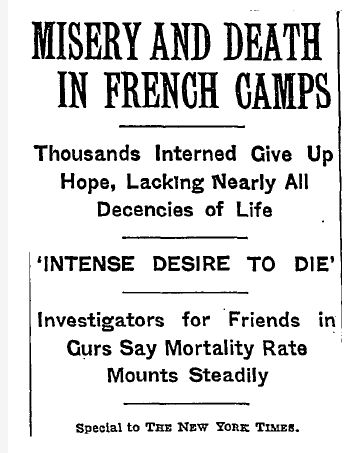
In January, 1941, the New York Times reported on conditions at Gurs, noting that there were fifty doctors providing medical treatment to over 7000 people interned in the camp, trying to “reduce an already high and still mounting mortality rate resulting from lack of food and medicine and unhygienic conditions, the physical resistance of most of the refugees already having been worn down through long suffering.”  The Times article stated that there were over 500 children in the camp and about 1200 people over seventy.   People were suffering from malnutrition, bleeding gums, heart problems, dysentery, typhoid, and lice.  There was severe overcrowding and poor heating and ventilation.  Fifteen to twenty-five people were dying every day.  “Misery and Death in French Camps, ” New York Times, January 26. 1941, p. 24.


New York Times, January 26, 1941, p. 25

New York Times, January 26, 1941, p. 24


What happened to those who survived? According to the USHMM, “1,710 were eventually released, 755 escaped, 1,940 were able to emigrate, and 2,820 men were conscripted into French labor battalions.”  The exact number of those who died of the 7,500 Jews who were deported from Baden is not known, but overall over 1000 people died at Gurs over the course of the war.  Many of those Baden deportees were transferred to other camps and some eventually to Auschwitz.  The USHMM website states, “Between August 6, 1942 and March 3, 1943, Vichy officials turned over 3,907 Jewish prisoners from Gurs to the Germans; the Germans sent the majority of them to the Drancy transit camp outside Paris in northern France. From Drancy, they were deported in six convoys to the extermination camps in occupied Poland, primarily Auschwitz.”


Cemetery for those who died at Gurs By Jean Michel Etchecolonea (Own work) [GFDL (http://www.gnu.org/copyleft/fdl.html) or CC BY-SA 3.0 (http://creativecommons.org/licenses/by-sa/3.0)], via Wikimedia Commons

Cemetery for those who died at Gurs
By Jean Michel Etchecolonea (Own work) [GFDL (http://www.gnu.org/copyleft/fdl.html) or CC BY-SA 3.0 (http://creativecommons.org/licenses/by-sa/3.0)%5D, via Wikimedia Commons

I don’t know how long Johanna and Heinrich were at Gurs or under what circumstances they were able to leave.  Perhaps they were among the 755 who escaped or the 1,710 who were released.  Maybe they were transferred to another camp.  The records that the USHMM had for them end with the cards posted above.

As for Henry Kahnweiler, the man the Sterns named as their contact person in France on the passenger manifest when they left for the US in 1947,  he was the very well-known German-born art dealer, Daniel-Henry Kahnweiler, described by one source “a banker, writer, publisher, and art dealer who became the pioneering champion of Cubism.”  As described by Johanna’s sister, Erna Schoenthal Haas, in the Pittsburgh Jewish Chronicle on June 14, 1989, Kahnweiler was a friend of her brother-in-law, Heinrich Stern, from the days they had both been working at a bank in Germany.  Kahnweiler’s parents had wanted him to be a banker, but instead he’d moved to Paris in 1907, where he soon established himself as a successful art collector and dealer. He became one of the principal dealers in Cubist art and a major dealer in the works of Picasso.

Here is a portrait of Kahnweiler done by the artist Juan Gris:

Deutsch: Juan Gris: Porträt Daniel-Henry Kahnw...

Deutsch: Juan Gris: Porträt Daniel-Henry Kahnweiler, 32,5 x 26 cm, Bleistift auf Papier, Museée National d’Art Moderne, Centre Georges Pompidou, Paris (Photo credit: Wikipedia)


During World War I, France appropriated and sold Kahnweiler’s collection because he was a German national and thus a national of an enemy state.  After spending the war in exile in Switzerland during which time he wrote several important works on Cubism and art history, Kahnweiler returned to Paris in 1920 and started over.  Here is he depicted in 1923 at his gallery in Paris:  standing, Daniel Henry Kahnweiler (r), Juan Gris (c) ; 1st row, Louise Leiris (c).


Embed from Getty Images

But then in the spring of 1940 when the Nazis invaded France, Kahnweiler, like thousands of other Jews living in France, went into hiding in the south of France.  This post describes in detail his ordeal and perhaps reflects the experience of many others including that of Johanna (Schoenthal) and Heinrich Stern.  I don’t know how the Sterns stayed in touch with Kahnweiler during the war, but they obviously knew his Paris address in 1947 when they departed for the US.

I imagine that the Schoenthals in the US—especially Lee, Meyer, and Erna—must have been greatly worried about their sister Johanna and her husband during the war, but by June 14, 1946, they knew that Johanna and Heinrich were alive and where they were living, as is apparent from the notice from the Aufbau regarding the deaths of Henriette and Julius Levi.  That notice indicates that Johanna and Heinrich were then living in a hospital or hospice in a town called Romans in the department of Drome in southeastern France.  I have written to the town of Romans in France to see if they have any information, but so far have not gotten any response.


Aufbau June 14, 1946

Aufbau June 14, 1946

It was almost exactly a year later that Johanna and Heinrich arrived in the US and settled in Pittsburgh.  I can only imagine the joy that the four surviving siblings experienced when they were finally all reunited.  A joy, however, that must have been bittersweet, tempered by the knowledge that their sister Henriette and her husband had not survived and that their sister Johanna and her husband must have suffered greatly in order to survive.

In my next post, I will write about the post-war lives of these four siblings, their spouses, and the two grandsons of Jakob and Charlotte Schoenthal, Werner Haas and Helmut Levi/Henry Lyons.


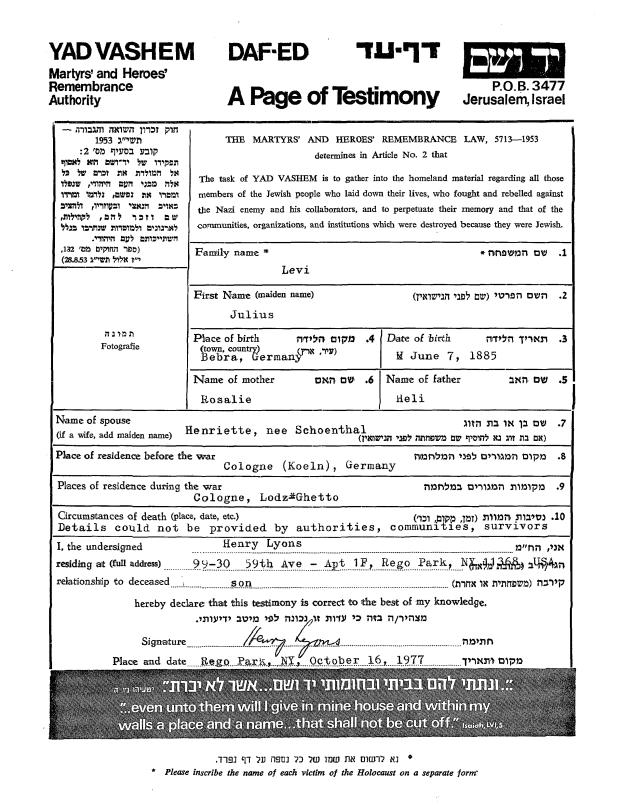
The Brother Who Stayed Behind: Adventures in Genealogy Research

Born just one year after Simon, the next sibling was Jakob Schoenthal. (I am using the German spelling for two reasons.  First, Jakob stayed in Germany and thus that is how he spelled his name.  Second, it helps to distinguish him from his nephew, Simon’s son Jacob.) Finding Jakob’s story was quite a lesson in genealogy research.  It took some lucky breaks and the help of others, and in the end it led to a story of both tragedy and triumph.


Centro de la ciudad de Koln, Alemania Deutsch:...

Köln Germany, where Jakob Schoenthal lived as an adult (Photo credit: Wikipedia)


First, some background. I’ve already written about eight of the ten children of Levi Schoenthal and Henriette Hamberg, my great-great-grandparents.  They were the eight children who came to America between 1866 and 1881 and settled here permanently, including my great-grandfather Isidore Schoenthal.  All of them lived relatively long and seemingly satisfying lives.  They started in western Pennsylvania, but eventually they and/or their children moved far afield across the United States—to California, Illinois, New Jersey, New York, Massachusetts, and elsewhere.  They thrived in America, and they have many descendants still living in this country.

But there were two siblings who did not end up in America.  One, the youngest child, Rosalie, had in fact immigrated to the US in 1881 with her mother Henriette and her brother Isidore, my great-grandfather.  But Rosalie returned to Germany to marry Willy Heymann in 1884, and that decision was in the end one with devastating consequences for her family.  I will write more about Rosalie in a subsequent post.

The only sibling who never left Germany was the sixth child of Levi and Henriette, Jakob, who was born in Sielen in 1850.  I will always wonder why Jakob stayed when almost all of his siblings had emigrated from Germany by 1874.  Jakob was 24 by then, only a year younger than Simon, who had left in 1867. Why did he stay? I don’t know, but my theory is that Jakob stayed to take care of his mother and youngest siblings. By 1874 when his father Levi died, Jakob was the oldest son still in Germany, and there were still some younger siblings at home, including my great-grandfather.  So perhaps Jakob stayed out of a sense of family obligation. As with his sister Rosalie, that decision to stay had tragic consequences.

On September 1, 1879, Jakob married Charlotte Lilienfeld, the younger half-sister of Helen Lilienfeld, who had married Jakob’s brother Henry in 1872 and moved with him to Washington, Pennsylvania.  Charlotte and Helen were both the daughters of Meyer Lilienfeld of Gudensberg, where Henry Schoenthal had once been a teacher before immigrating to the US.

Marriage record of Jakob Schoenthal and Charlotte Lilienfeld Hessisches Hauptstaatsarchiv, Wiesbaden: Trauregister der Juden von Gudensberg 1825-1900 (HHStAW Abt. 365 Nr. 386) 1825-1900

Marriage record of Jakob Schoenthal and Charlotte Lilienfeld
Hessisches Hauptstaatsarchiv, Wiesbaden: Trauregister der Juden von Gudensberg 1825-1900 (HHStAW Abt. 365 Nr. 386, p.42) 1825-1900


For a long time I could not find much more information about Jakob.  I knew from the 1893 Beers biography of Henry Schoenthal that Jakob had then been living in Cologne, Germany in 1893, but I didn’t know if he and Charlotte had had children or if they had ever left Germany or when they had died.

Then while I was researching Henry Schoenthal and his family, I kept coming across two men living in Washingon, Pennsylvania, with the same names as two of Henry’s sons: Meyer and Lee Schoenthal.  At first I thought they were Henry’s sons, but soon it became clear that there were in fact two Meyers and two Lees.  When I found the death certificates for the Meyer and the Lee who were not the sons of Henry Schoenthal, I saw that their parents were Jakob Schoenthal and Charlotte Lilienfeld.


Lee Schoenthal death certificate Ancestry.com. Pennsylvania, Death Certificates, 1906-1963 [database on-line]. Provo, UT, USA: Ancestry.com Operations, Inc., 2014. Original data: Pennsylvania (State). Death certificates, 1906–1963. Series 11.90 (1,905 cartons). Records of the Pennsylvania Department of Health, Record Group 11. Pennsylvania Historical and Museum Commission, Harrisburg, Pennsylvania.

Lee Schoenthal death certificate
Ancestry.com. Pennsylvania, Death Certificates, 1906-1963 [database on-line]. Provo, UT, USA: Ancestry.com Operations, Inc., 2014.
Original data: Pennsylvania (State). Death certificates, 1906–1963. Series 11.90 (1,905 cartons). Records of the Pennsylvania Department of Health, Record Group 11. Pennsylvania Historical and Museum Commission, Harrisburg, Pennsylvania.

I knew then that Jakob and Charlotte had had at least two sons, both of whom had lived in Washington, Pennsylvania, where their Schoenthal uncles Henry and Isidore as well as their aunt Helen Lilienfeld Schoenthal were living.  And, of course, the identical names made sense.  Both Meyers were named for their maternal grandfather, Meyer Lilienfeld, and both Lees were named for their paternal grandfather, Levi Schoenthal.

And then I was stuck.   What else could I learn about Jakob and Charlotte? I asked in the German Genealogy group on Facebook whether there were records available online for Cologne, or Köln, as it is spelled in German, and I learned that there were in fact archives online with birth, marriage, and death records.  Unfortunately, the archives are divided into geographic areas in and around Köln, and I had no idea where in the city Jakob had lived.  In addition, I had no idea what years to search for births or deaths for his family, and the number of records was too overwhelming to search without some parameters.

But then another member of the Genealogy Group suggested I look in city directories to see if I could narrow down where in Köln Jakob and his family had lived.  I learned that there were city directories online that dated as early as 1797 all the way through to the 1960s.  I started searching year by year, and I eventually found many listings for him, starting with one in 1901 and going as late as 1935, and then he disappeared.  Here are a few examples:


Greven's address book for Cologne subtitle:and environment especially Mühlheim am Rhein and lime Author / Edit .: Ant. Carl Greven Publishing company: Greven's Cologne Address Book Publisher Ant. Carl Greven Vintage: 51 Year: 1905

Greven’s address book for Cologne
Author / Edit .: Ant. Carl Greven
Publishing company: Greven’s Cologne Address Book Publisher Ant. Carl Greven
Vintage: 51
Year: 1905


Grevens Adreßbuch 1915 Cologne and environs

Grevens Adreßbuch 1915 Cologne and environs


Greven's address book for Cologne subtitle:and neighborhood and business directory the circles Cologne-Mülheim country and a. Rh. Publishing company: Greven's Cologne Address Book Publisher Ant. Carl Greven Vintage: 67 Year: 1925

Greven’s address book for Cologne
Publishing company: Greven’s Cologne Address Book Publisher Ant. Carl Greven
Vintage: 67
Year: 1925


So I thought Jakob must have died or moved or emigrated around 1935, but not knowing German had once again proven to be a problem.  I posted the 1935 listing on the German Genealogy Facebook page, and my friend Matthias translated it and pointed out that the listing was not for Jakob, but rather for his widow.  He explained that the abbreviation Ww meant “widow,” and when I went back to look at the earlier directories, I saw that the Ww was included in almost all of the listings I had thought were for Jakob Schoenthal.


Greven's address book of Cologne subtitle:and its environs, as well as the address book of the circles Cologne-country Bensberg, Bergisch Gladbach u. Porz, Volume (→ Second volume ) Publishing company: Greven's Cologne Address Book Publisher Ant. Carl Greven Year: 1935

Greven’s address book of Cologne
Gladbach u. Porz, Volume (→ Second volume )
Publishing company: Greven’s Cologne Address Book Publisher Ant. Carl Greven
Year: 1935


I worked all the way back to 1905, seeing that Ww.  There were no directories on the website for 1902-1904, but in 1901, there was no Ww, so I assumed that meant that Jakob was still alive in 1900.  Thus, it seemed likely that Jakob had died sometime between 1901 and 1905.


Greven's address book for the borough Cologne subtitle:and for the environment especially: Mühlheim am Rhein and lime Author / Edit .: Ant. Carl Greven Publishing company: Greven's Cologne Address Book Publisher Ant. Carl Greven Vintage: 47 Year: 1901

Greven’s address book for the borough Cologne
Author / Edit .: Ant. Carl Greven
Publishing company: Greven’s Cologne Address Book Publisher Ant. Carl Greven
Vintage: 47
Year: 1901


From the address on Breite Strasse in the directories, my friends in the Germany Genealogy group thought that Jakob had lived in the central part of Köln.  Having narrowed down the years and the section of the city where he lived, I now combed through the relevant records until I found a death record for Jakob.  He had died on November 19, 1903.  He was only 53 years old when he died.  He was the first of his siblings to die.


Jakob Schoenthal death certificate Das Digitale Historiche Archiv Koln, Civil registry, civil registry Cologne I, deaths, 1903 1903 Vol 03 p.320

Jakob Schoenthal death certificate
Das Digitale Historiche Archiv Koln, Civil registry, civil registry Cologne I, deaths, 1903 1903 Vol 03 p.320


Since 1935 was the last year Jakob’s widow Charlotte was listed, I assumed that she must have died around 1935.  I wrote to the synagogue in Köln to see if they had information about Jakob and Charlotte, and the secretary there informed me that Jakob and Charlotte were both buried in their cemetery and that Charlotte had died on June 17, 1935.  She also confirmed Jakob’s date of death.  So I now knew when both Jakob and Charlotte had died and where they were buried.

But the 1935 Köln directory listing, along with a number of others, also revealed something else.  Notice that right above Jakob’s widow’s listing it says, “Schonthal & Co, Jul. Levi and Frau Jul. Levi,” and some additional text following, including the same address as that listed for Jakob’s widow.

Greven's address book of Cologne subtitle:and its environs, as well as the address book of the circles Cologne-country Bensberg, Bergisch Gladbach u. Porz, Volume (→ Second volume ) Publishing company: Greven's Cologne Address Book Publisher Ant. Carl Greven Year: 1935

Greven’s address book of Cologne
subtitle: and its environs, as well as the address book of the circles Cologne-country Bensberg, Bergisch Gladbach u. Porz, Volume (→ Second volume )
Publishing company: Greven’s Cologne Address Book Publisher Ant. Carl Greven
Year: 1935

My friends in the German Genealogy group explained that the first listing was for a Julius Levi and his wife, Henny nee Schoenthal.  Obviously Henny was Jakob and Charlotte’s daughter, living at the same address as her parents with her husband Julius Levi.

Julius Levi and Henny nee Schoenthal were listed again in 1936 (without a listing for Charlotte), but after that they disappeared.  By then, of course, Jewish-owned businesses were being restricted or closed by the Nazis.  What had happened to Julius and Henny? Had they left Germany, I hoped? Or had they been killed in the Holocaust?

Greven's address book of the Hanseatic City of Cologne subtitle:the circles Cologne-country, the county town of Bergisch Gladbach and Bensberg communities and Porz, Volume (→ Second volume ) Publishing company: Greven's Cologne Address Book Publisher Ant. Carl Greven Vintage: 78 Year: 1936

Greven’s address book of the Hanseatic City of Cologne
Publishing company: Greven’s Cologne Address Book Publisher Ant. Carl Greven
Vintage: 78
Year: 1936

Unfortunately, a search on Yad Vashem revealed that they were both victims of the Nazi atrocities.

Yad Vashem page of testimony for Henriette Schoenthal Levi Yad Vashem page of testimony for Julius Levi

I learned more details from a researcher in Köln named Barbara Becker, who informed me that Julius and Henriette Levi had been first moved to the ghetto in Köln in 1940 and then were deported to Lodz, Poland, on October 30, 1941.  From there they were sent to the death camp in Chelmno on September 10, 1942, where they were murdered by the Nazis.

Lodz Ghetto Bundesarchiv, Bild 137-051639A / CC-BY-SA 3.0 [CC BY-SA 3.0 de (http://creativecommons.org/licenses/by-sa/3.0/de/deed.en)], via Wikimedia Commons

Lodz Ghetto
Bundesarchiv, Bild 137-051639A / CC-BY-SA 3.0 [CC BY-SA 3.0 de (http://creativecommons.org/licenses/by-sa/3.0/de/deed.en)%5D, via Wikimedia Commons

Chelmno death camp 1942 By SS Unknown [Public domain], via Wikimedia Commons

Chelmno death camp 1942
By SS Unknown [Public domain], via Wikimedia Commons


Two more names to add to the growing list of my relatives who were killed during the Holocaust:  Henriette Schoenthal and her husband Julius Levi.  Henriette was probably named for her grandmother, Jakob’s mother Henriette Hamberg, my great-great-grandmother.   Henriette Schoenthal Levi was my first cousin, twice removed.  She was my grandmother Eva Schoenthal Cohen’s first cousin.

When I looked at the Pages of Testimony filed on behalf of Henriette (Schoenthal) and Julius Levi more closely, I saw that they were filed in 1977 by their son, Henry Lyons.  There was even an address for Henry: 99-30 59th Avenue, Rego Park, New York.  My next step had to be locating Henry Lyons, my father’s second cousin.

To be continued….


Moritz James Oppenheimer: The (More) Complete Story

Several weeks ago I received a comment on the blog from Angelika Oppenheimer, the granddaughter of Moritz James Oppenheimer, whose life I wrote about here.  He was the successful businessman who owned the horse breeding farm in Germany that was appropriated by the Nazis.  Moritz Oppenheimer died in 1941, an apparent suicide after being “visited” by the Gestapo.

Angelika found the blog because she was interested in knowing more about her grandfather’s family, and I am grateful because I now have learned more about her grandfather’s life and about the lives of his children and grandchildren.

Angelika Oppenheimer

Angelika Oppenheimer photo courtesy of Angelika

Angelika is my third cousin, once removed.  Here is a chart explaining our relationship:

Angelika to me chart


Moritz James Oppenheimer was born in 1879 in Butzbach, Germany, the youngest child of Maier Oppenheimer and Pauline Seligmann.  As seen above, he was the grandchild of Moritz Seligmann and Babetta Schoenfeld, my three-times great-grandparents.  Here is a photo of him as a young man from Fred Michel’s photo album,

Moritz Oppenheimer

Moritz Oppenheimer Photo courtesy of the Michel family

According to a resume provided to me by Angelika, in 1901 he founded the Mitteldeutsche Papierwarenfabrik situated in the Hanauer Landstraße and the Rheinische Sackfabrik.  Moritz was a member of the board of directors of several companies throughout Germany, including the Kostheimer Cellulose und Papierfabrik (Kostheim-Mainz), the Danziger Verpackungsindustrie at Danzig, the Fabbrica Italiana Sacchi Ercole at Villanovetta, the Mechanische Papiersackfabrik A.G. at Saarbrücken, the Sankt Georg Verlag at Berlin and the Bayrische Reitschule at Munich.

Emma Neuhoff and Moritz James Oppenheimer photo courtesy of Angelika Oppenheimer

Emma Neuhoff and Moritz James Oppenheimer
photo courtesy of Angelika Oppenheimer

Sometime before 1902, Moritz married Emma Katherina Neuhoff, who was not Jewish.  According to Angelika, she was a descendant of Theodor Neuhoff, born in Cologne, Germany, who traveled throughout Europe and was at one time the king of Corsica.  According to Wikipedia, “At Genoa, Neuhoff made the acquaintance of some Corsican rebels and exiles, and persuaded them that he could free their country from Genoese tyranny if they made him king of the island. With the help of the Bey of Tunis, he landed in Corsica in March 1736 with military aid. The islanders, whose campaign had not been successful, elected and crowned him king. He assumed the title of King Theodore I, issued edicts, instituted an order of knighthood, and waged war on the Genoese, at first with some success. But in-fighting among the rebels soon led to their defeat.”

Theodore Neuhoff

Theodor Neuhoff

Emma Neuhoff was a gifted musician and an excellent horsewoman, according to her granddaughter Angelika.

Emma Neuhoff Oppenheimer

Emma Neuhoff Oppenheimer  Photo courtesy of Angelika Oppenheimer

Here are two pages from a German magazine discussing M.J Oppenheimer and his wife Emma.  I think it’s a publication about thoroughbred breeding and racing, but I cannot read the pages.  Perhaps some kind German-speaking reader can help?

Familiengeschiche 2 Familiengeschichte3

(Angelika told me that the drawing of Emma illustrating this article was commissioned by the Historical Museum of Frankfort based on Emma’s reputation as an excellent horsewoman.)

Moritz and Emma had two children: Paula (1902) and Walter (1904), Angelika’s father.  Paula married a Catholic man named Rudolf Spiegler, a doctor, and converted to Catholicism; they had two children, Gabriele and Wolfgang. Paula and her family did not face any persecution during the war.

As for Angelika’s father Walter, he married Suzanne Zier on December 23, 1933.  Walter had been raised and baptized as a Christian, and his wife also was not Jewish, yet Walter faced substantial discrimination during the Nazi era.  In April 1945, as the war in Europe was ending, he wrote the following essay, describing both his own life and what happened to his father Moritz after the Nazis came to power:

27 April 1945

Biographical memorandum

I was born on 10 July 1904, son of the industrialist and thoroughbred horse-breeder Consul M.J. Oppenheimer, in Frankfurt am Main. After three years at preparatory school, I attended the Goethe Gymnasium in that city for nine years; I left school, having obtained my school leaving certificate (Abitur), at Easter 1923. After studying for six terms at Frankfurt University (Law and National Economy), I sat the examination for articled clerk at the Frankfurt Higher Regional Court [Oberlandesgericht]. After a period as an articled clerk at the court in Frankfurt, in 1927 I took my doctorate under Professor de Boor. After a lengthy period of practical training as a fitter in an engineering works, and as a paper-maker in paper-mills, I then joined my father’s paper-products company, the Mitteldeutsche mechanische Papierwarenfabrik, in Frankfurt. From 1931 I was Chief Company Secretary of this company belonging to my father as sole owner. At that time it was the largest company of its kind in Germany, and for a period employed together with its subsidiaries more than 1,000 people. In 1932 I built a major subsidiary factory for my father’s company in Berlin.

My father was arrested in the autumn of 1933, at the instigation of two [NSDAP] party members (August Hartmann and Helmut Vögler) working in collaboration with the NSDAP. His entire assets were put in the hands of the lawyer [Rechtsanwalt] Max-Ernst Cuntz as prospective administrator. A bankruptcy was thus brought about, and the assets liquidated at the lowest rate, the said lawyer Cuntz selling each item at a rate far below its value, for the most part at one twentieth of purchase value. The stud farm and stables, for example (probably the biggest and best of their kind in Germany), were disposed of at a price below the level of profits from racing for the following year. The case was similar in respect of the factories, share portfolios, Hippodrome A (whose director I also was, and all shares in which belonged to my father), etc. I myself was immediately removed without compensation from all my posts by the lawyer Cuntz, on the grounds of my non-Arian status. I was also compelled to surrender my own stables, representing an approximate worth of between 70,000 and 100,000 Reichsmark, without receiving any compensation. My father was also quite illegally disqualified from receiving the stud prize. To satisfy the rules in this latter regard, for years my mother and I continued to hold two mares for my father, so that he could legally be assigned 10% of all racing prizes won by horses bred by him, in accordance with stud rules: except with the proviso that no stud prizes could be paid out to a Jew; the authorities retained this annual sum, comprising up to 100,000 Reichsmark, and finally had it credited either to themselves or to the Union Klub. My father, who was perfectly healthy, became ill owing to ill-treatment during his detention. He was declared unfit for detention in 1934/5, and finally took his own life when he was about to be arrested again in 1941 preparatory to being sent to a camp.

I myself with my mother had founded the company Paverk, Gesellschaft für Papierverarbeitung in December 1933. As I could not appear in person as a holder of shares in a limited company, an Arian uncle of my mother acted for me. Then, in 1937, I transferred this share in trust to my father-in-law Otto Zier, now [April 1945] of Friedberg in Hessen, Dieffenbachstrasse 25, together with a further 20,000 Reichsmark of shares created in settlement of my assets, so that, of the total sum of 40,000 Reichsmark in shares of the above company, 10,000 Reichsmark of my mother’s and 30,000 of mine belonged in trust to my father-in-law. By the beginning of the war, however, with a nominal capital of 40,000 Reichsmark the company had an actual value of some 250,000 to 300,000 Reichsmark, as, thanks to the diligent efforts of my employees, the company had been highly successful under my stewardship.

My wife having died suddenly from pneumonia in April 1935, at the beginning of 1941 my father-in-law saw fit to attempt to misappropriate the shares that had been transferred to him in trust. As, owing to my status as a person of mixed blood, I myself could not appear as a plaintiff, I assigned my claim to my mother, who instituted legal proceedings and won her case, at both first and second instance. The papers relating to the case are still available in their entirety: reference 2/5 2/9 0 30/41. These papers clearly demonstrate how Zier attempted to influence the court using the entire gamut of National-Socialist arguments, with reports against me and the company being sent to all sections of the Party, including district and financial counsellors (Kreis- und Wirtschafts-berater – [advisors to the Gauleiter under National Socialism]) Eckhardt, Degenhardt, and Avieny, the DAF [Deutsche ArbeitsFront – national trades union organisation under the National Socialists], the Gestapo, etc. At last instance, the High Court [Reichsgericht] awarded my mother only 10,000 Reichsmark unconditionally, while presuming improper concealment [unsittliche Tarnung] in respect of the remaining 20,000 Reichsmark. This finding is the subject of a new trial before the District Court [Landgericht] in Frankfurt (2/5 0 36/44), over whose outcome in my mother’s favour there may be little reason to doubt. Quite apart from these machinations on Zier’s part, which caused not only the Paverk company but also my mother and myself endless spiritual and material harm, we had also much else to suffer at the hands of the NSDAP.

When the company was heavily bombed in 1943, and totally bombed out in February 1944, Herr Hermann of the Gauwirtschaftskammer [regional economic organization under National Socialism] prevented the rebuilding of the plant and re-acquisition of machines. In addition, I myself was arrested by the Gestapo in the autumn of 1942, the only charge against me being my engagement to an Arian woman in contravention of the rules. I was not released again until 28 May 1943. My entire household effects to the value of about 70,000 Reichsmark (peacetime value), including art collections etc., had meanwhile been taken, and the Gestapo official Wildhirt installed in my flat. In 1943, my fiancée was conscripted to work at the Mayfahrt company under the harshest of conditions at the direct instigation of the Gestapo. The main initiator in these matters was Zier, who did not, however, proceed in his own name, but employed the services of his friends Fabian-Gramlich (insofar as I have been able to determine up to now), while my furniture was removed by a painter by the name of Baumann, who did work for the police.

I married on 11 April 1945, immediately after the liberation by the Americans. I was allocated a flat at Freiherr vom Stein Strasse 56/1, which I immediately had redecorated and furnished with furniture belonging to my wife, only to have the flat abruptly requisitioned by US soldiers on 26 April 1945.

Initialled “W.O.” at Frankfurt am Main on 27 April 1945

I, David M.B. Richardson MCIoL, certify this to be a true and fair translation of a photocopied document in German provided to me by Frau Angelika Oppenheimer, daughter of Walter Oppenheimer.

Westcliff-on-Sea, 11 August 2015.

Walter’s essay reveals so much about the hate-filled and carefully plotted system used by the Nazis to crush, humiliate, and destroy the Jews.  First, they stripped them of their property, then they stripped them of their dignity, and finally they killed them and stripped them of their lives.  Moritz Oppenheimer, a man of great wealth, was brought to his knees by the Nazis and demoralized to the point that he took his own life rather than be subjected to further humiliation and abuse and ultimately murdered. One aspect of that humiliation and abuse not mentioned in Walter’s essay was the forced annulment of his marriage to Emma Neuhoff because of Moritz’s Jewish background.

Moritz and Emma’s son Walter, a highly educated and successful man in his own right and not even raised as a Jew, was denied his property and his rights and had his own father-in-law betray him and his trust after his first wife died in 1935.  According to Angelika, Walter’s brother-in-law was in the SS.  Only because Walter had a non-Jewish mother who bribed the local Nazi official in Frankfort was he allowed to survive.

As he wrote above, Walter married his second wife, Elsa Lina Wiegandt, in 1945, and they had a daughter, my cousin Angelika.   In 1946, Walter sought the return of the property that had been taken from him by the Gestapo, primarily the books he treasured so much.  Here is the letter he wrote and Angelika’s translation of that letter:

Walter Oppenheimer letter

Dr. Walter Oppenheimer                                  Frankfurt a. M., den 25. Oktober 1946          Niedenau 45

An das Archival Depot

Offenbach am Main

Mainstraße 167

Concerning: stolen books

With polite reference to the notice published the 22nd October under the above mentioned headword in the ‘Frankfurter Rundschau’, I take the liberty of presenting you the following:

I was arrested by the Gestapo the 26th October 1942 for purely political and racial reasons. My apartment was handed over to the Gestapo officer Wildhirt while my furniture was first and foremost transferred by a Gestapo agent to the second principal of the Gestapo here, Mister Grosse. The biggest part of my library was taken away with it. A part of the books was rubber-stamped with my name but the bigger part of it was without the name of the legitimate owner.

If there are any books of mine in your office, I ask you nicely to furnish information to me. Especially the following books mean much to me:

A 17-vlume gilt-edged edition of GOETHE in red morocco leather;

A complete half leather edition of HAUFF with gold ornament on the spine;

A half leather edition of KLEIST’s writings with gold ornament on the spine;

MUTHER: 3 volumes of history of painting, green cloth binding;

SPRINGER: 5 volumes on art history, half cloth binding and cloth binding respectively;

20 – 25 volumes of monographs on artists, partly half leather editions, partly with half cloth binding and cloth binding respectively, red with gold ornament, edition of the Stuttgarter Verlagsanstalt;

A five volume edition of HÖLDERLIN, grey pasteboards.

Many thanks indeed for your efforts in anticipation.

With all due respect to you!

I was impressed by the diversity of subjects in his library and by how much he valued his books. I also was struck by how polite and almost deferential he was in asking for the return of what was already rightfully his own.   At least some of the books were returned and remain today with Angelika.  Here is a photo of her father Walter.

Walter Oppenheimer 1972 courtesy of Angelika Oppenheimer

Walter Oppenheimer 
courtesy of Angelika Oppenheimer

Angelika shared this photograph of her family and friends at her Lutheran confirmation celebration taken in about 1961.

Angelika's confirmation Courtesy of Angelika Oppenheimer

Angelika’s confirmation c. 1961
Courtesy of Angelika Oppenheimer

From left to right: Paula Oppenheimer Spiegler (paternal aunt) , Emma Neuhoff Oppenheimer (grandmother), Christiane Wiegandt (Angelika’s maternal cousin), Christiane Bott (classmate), Sylvia Berres (classmate), Elsa (nee Wiegandt) Oppenheimer (Angelika’s mother), Angelika,, Walter Oppenheimer (Angelika’s father), Karl Wiegandt (Angelika’s maternal uncle), Karli (Angelika’s maternal cousin), Annie Wiegandt (wife of Karl), Herta Dorner (friend), Gabriele Spiegler (Paula’s daughter), either Wolfgang Spiegler or Gabriele’s husband.

I feel very fortunate that Angelika was able to find me through this blog.  Her family’s story is yet another lesson in the destructive power of prejudice, on the one hand, and the ultimate power that human beings have to survive and overcome those destructive forces, on the other.

Angelika and I have lived very different lives; we grew up with different religious backgrounds, we live in different countries, we speak different languages.  My immediate family lived through World War II in relative safety; hers was scarred forever.  But despite those differences, we know that we share a common history that ties us together as cousins.  Isn’t that remarkable?


Lotte’s Story, Part III: Coming to and Settling into America

In Parts I and II of Lotte’s story, we saw how my cousin Lotte’s idyllic childhood as the daughter of a successful doctor in Mannheim, Germany, was shattered after Hitler and the Nazis came to power in Germany in 1933.  By 1937, her sister Doris had left for the US, and a year later, Lotte and her parents Joseph and Anna (Winter) Wiener had moved to Luxembourg, where Anna’s parents, Samuel and Laura (Seligmann) Winter had already relocated.

After visiting her daughter Doris in the US, Anna returned to Luxembourg and convinced Joseph that they also should relocate there.  First, they had to obtain visas to travel to the US.  Lotte wrote:

The nearest American consulate was in Antwerp, Belgium, necessitating a fairly long trip. My grandparents were rather disabled by that time and in no condition to undertake the long journey. Reluctantly, we had to leave them behind when we made the trip. After a long wait we were admitted to the consul’s office where he sat, pipe in the corner of his mouth and feet on his huge executive desk. A most unfriendly man, he asked my parents all the necessary questions. When my turn came up, he quizzed me in some of the simplest arithmetic questions. When he was satisfied that I was not imbecile, he condescended to tell us that we could expect the visas in “six months to one hundred years”. Fortunately it took only a little over six months before we could sail.

While waiting for the visas to come through, Lotte worked at a baby hospital in Luxembourg.  She worked long hours taking care of the infants, and in the end she earned a Red Cross certificate, which proved to be quite valuable when she later applied to nursing school in New York.

The atmosphere in Luxembourg grew increasingly tense.  After the Munich agreement allowed Germany to take over the Sudetenland in Czechoslovakia in the fall of 1938, more and more Jewish refugees were leaving Germany for Luxembourg.

Bundesarchiv, Bild 183-R69173 / CC-BY-SA [CC BY-SA 3.0 de (http://creativecommons.org/licenses/by-sa/3.0/de/deed.en)], via Wikimedia Commons

Signing the Munich Agreement
From left to right: Chamberlain, Daladier, Hitler, Mussolini, and Ciano pictured. Bundesarchiv, Bild 183-R69173 / CC-BY-SA [CC BY-SA 3.0 de (http://creativecommons.org/licenses/by-sa/3.0/de/deed.en)%5D, via Wikimedia Commons

As Lotte described it:

Many Jewish refugees had arrived in Luxembourg, many only with their fur coats and jewelry in assets. Having nothing else to do but to wait for the possibility of a visa, most unlikely on the Austrian and Hungarian quotas, they spent a lot of time in the local cafés. That in turn aroused a certain amount of the latent antisemitism in the population. Or maybe it was not so latent. My roommate at the hospital, a devoutly Catholic young lady who went to mass almost every morning, confided in me that she needed to “confess” to the priest that she was sharing her room with a Jewish girl. She had to admit, however, that I neither had horns nor did anything evil as far as she knew.

It was becoming very clear that there would be a war in Europe, and the events of Kristallnacht in November, 1938, also frightened those who were still in Luxembourg.

Finally, in April 1939, Lotte and her parents received their visas and could leave for the United States.   There was, however, no way to take Lotte’s grandparents, Laura and Samuel, with them.

Tickets for the voyage were booked, and soon my parents and I found ourselves on a train to Le Havre without them. We never were to see them again. As we found out later, Oma died of a heart attack while looking for an apartment, having been evicted when the German army took over Luxembourg in the spring of 1940. Opa was deported to Theresienstadt where he reportedly died “of natural causes”.

When I think about these separations, it tears me apart.  I cannot imagine leaving my parents behind, as Annie Winter Wiener was forced to do.  Anyone who has seen the recent movie “A Woman in Gold” will remember the scene when Maria Altmann leaves her parents behind in Vienna for similar reasons.  It’s a scene that breaks your heart and stays with you long after the movie ends with Maria victorious in her legal battles over the Klimt painting.  Maria was a real person, just as Lotte is a real person.  These are not Hollywood stories written just to wring tears from viewers.  These are the lives and the experiences that thousands and thousands of people endured.

But somehow these people, including Lotte and her parents, survived and found the strength to move on.  Lotte’s description of her sea voyage to America, leaving her grandparents and her homeland forever, reveals that tenacity, the strength, that courage.

Below is the ship manifest listing, on lines 6,7, and 8, Lotte and her parents (her real first name is Leonore) and a photograph of the George Washington, the ship that brought them to the US.

Year: 1939; Arrival: New York, New York; Microfilm Serial: T715, 1897-1957; Microfilm Roll: Roll 6313; Line: 1; Page Number: 176

Year: 1939; Arrival: New York, New York; Microfilm Serial: T715, 1897-1957; Microfilm Roll: Roll 6313; Line: 1; Page Number: 176

The George Washington, the ship that Lotte and her parents sailed on to the US in 1939 Ancestry.com. Passenger Ships and Images [database on-line]. Provo, UT, USA: Ancestry.com Operations Inc, 2007. Original data: Various maritime reference sources.

The George Washington, the ship that Lotte and her parents sailed on to the US in 1939
Ancestry.com. Passenger Ships and Images [database on-line]. Provo, UT, USA: Ancestry.com Operations Inc, 2007.
Original data: Various maritime reference sources.

Lotte chose to write this section in the third person, which I found interesting and revealing.  Was she distancing herself from that teenaged girl who was herself distancing herself from her past?

It was a grey and rainy day in April of 1939. A wet and blistery wind blew, adding to the girl’s anxiety. The security of her world had been shattered, slowly at first, but then with increasing speed and ferocity. Her best friend had been left behind – without her being able to say a proper good-bye – perhaps they would never have a chance to see each other again. Here she stood at the pier in Le Havre, ready to embark on the longest journey of her young life. Slowly she and her parents stepped on the planks of the ship, the ocean liner which would bring them from a Europe threatened by the certain relentless march toward war to the vast and unknown entity of America which lay before her.

The voyage was stormy and rough. The ship rocked from side to side with the huge waves. Most of the time she felt sick. Staying in the cabin was awful. When she stepped on deck, she felt even worse. Looking at the ominous grey sky above as well as watching the wildly moving waves below made her dizzy. Eating became a nightmare. Keeping any food down was impossible. They suggested broth. That wouldn’t work. Eating a baked potato– who had ever heard of a baked potato before? The English spoken on board did not sound at all like what she had learned in school. The ship’s entertainment was provided by an enormously fat and very jolly man with the incongruous name of “Tiny”. Was everybody crazy?

Finally, during the fifth night, the storm passed, and in the morning the sea was calm and the sun shone brightly. She stepped outside and saw to her right the exhilarating sight she had been told to expect: New York Harbor with the Statue of Liberty. Suddenly she felt well. Her excitement grew. Soon she would be able to set foot on the land which would be her new home. She resolved that she would accept whatever there was. She would not compare things with what had been.

Statue of Liberty National Monument, Ellis Isl...

Statue of Liberty National Monument, Ellis Island and Liberty Island, Manhattan, in New York County (Photo credit: Wikipedia)

Lotte seemed to stay true to those resolutions.  She quickly adapted to life in New York City, working as a babysitter while awaiting acceptance to a nursing program.  She was accepted into Cornell University-New York Hospital’s nursing program for the fall of September, 1939, less than six months after her arrival in New York.  Lotte wrote about some of the culture shock she experienced when she began her nursing studies in New York:

Once I was notified that I had been accepted at the prestigious Cornell University – New York Hospital School of Nursing, it took me exactly one week to purchase the few required items and to pack my suitcase. Actually admissions had been closed quite a while before, but they had made an exception for me. Of course I had lost no time getting all my documents together and to have my credentials translated and notarized. I had taken a six-week crash course at a private school in Manhattan, located on Sixth Avenue behind the Public Library. How I had sweated that summer, taking the Subway from Kew Gardens to Times Square and back, and then to take the Regents exams! The courses, American History, 4th Year English, and Civics, were required in order to obtain a “Nurse Qualifying Certificate”.

So one fine September morning in 1939 my father and I, all of 18 years old, set out to travel from Kew Gardens, Queens, to the nurses’ residence on York Avenue in mid-Manhattan. With two big suitcases we walked to the subway station, went downstairs, took the  train to 59th Street and Lexington Avenue, dragged the suitcases back upstairs, walked to the Second or Third Avenue Elevated which was still running at that time, and then walked to the York Avenue address. As we entered, we saw several taxis pulling up, bringing some of my new classmates to the same destination. Only they did it the easy way. It had never occurred to us to take a cab as money was very tight. I said goodbye to my father and went about to register and to get settled in my new quarters.

The schedule of activities for the first day included a four o’clock tea for all the newcomers in the formal and somewhat stuffy library. True to my nature I was there right on time, the first one to appear, to be exact. All the others were still busy taking showers and changing into the kind of clothes you were supposed to wear for an afternoon tea. Little did I know that that was the thing to do. I was still in my travel outfit and felt rather sweaty. Well, I entered the library and found a stunning-looking white-haired woman in a gorgeous red dress seated at the solid oak table, “pouring” tea. I learned that she would be one of my nursing instructors. Soon the other students came, and we began to get acquainted.

*****

During the first six months the emphasis was on academics. Actually one of the entrance requirements had been one year of chemistry. Most of my classmates had two years of college with all the needed requirements behind them, while I had barely obtained my high school equivalent certificate. My European education had been superior in some ways, but badly missing in science. I did not even know how to balance a chemical equation. So here I was supposed to obtain a basic knowledge of inorganic as well as organic chemistry in all of six weeks. It seemed like it was going to be a disaster. But with the help of a fellow student who had dropped out of medical school, and with the kindness and understanding Miss Rynbergen, my teacher, showed to me, I did overcome that hurdle and even managed to get an “A” in the course. None of the other courses presented any problems, at least not academically.


Obviously, Lotte was an extremely gifted student.   She had neither the academic background nor the social benefits of most of her classmates, yet she excelled in her studies, even though English was her second language.  In fact, Lotte did so well that she tried to be admitted to NYU Medical School and met with the dean to discuss her application.  Here is what happened:

I had mustered a lot of courage. After two years of practicing hospital nursing I really wanted to pursue the ambition I had nurtured since childhood – to become a doctor like my father. Thus I marched up the long corridor at my hospital’s medical school and entered the dean’s office. Of course the visit had been properly scheduled ahead of time. The dean, bespectacled, grey-haired, lean and stern-looking, listened to my brief story: that I was dissatisfied with the prospect of my future nursing career, and that I really would like to find out how I could be admitted to the medical school. The man just took one look at me and smiled. “My dear, you are asking for the impossible. First of all, you are a woman. There is quite a limit placed on the number of females at our school. Secondly, you lack the necessary college preparation. It would take several years for you to catch up with our requirements. Thirdly, you are Jewish. Do you know what that means? All kinds of difficulties along the way! You’d better forget about it.”  

Lotte must have been devastated.  She was being discriminated against as a woman and as a Jew.  The fact that she had excelled in the nursing program was not enough to outweigh her limited pre-nursing school education.  She had left Germany to escape anti-Semitism, and here it was, thrown in her face again.

In 1942, as World War II was in full force with the US now itself involved, Lotte graduated from nursing school and began working the night shift in the internal medicine department at New York Hospital.  The family received news of Samuel Winter’s deportation to Theriesenstadt, and the news overall was quite disturbing.  Lotte somehow kept a positive outlook.

Terezin

Terezin

My mother was desperate. This war is going to end in a terrible nightmare of defeat, she stated. But I, being young and more optimistic by nature, I just KNEW that good had to prevail over evil, that things would eventually come out all right. I knew that history had its ups and downs. This was a down. Sooner or later there would be an up. I wrote so to my friends. I never gave up hope. In the end, I was right.

How incredible is it for Lotte to have concluded, after all she had experienced and all she would soon learn about her relatives in Europe, “that things would eventually come out all right?”  It truly takes a real strength of character and a positive view of the world to see things that way.  I greatly admire her for that depth of character and strength.

There is much more in Lotte’s memoirs—stories about how she met her husband, their courtship and wedding, and their happy marriage of 58 years.  There are stories about their travels and anecdotes about various events in Lotte’s adult life.  But I will end Lotte’s story with one that I think says so much about her—who she was as a child and who she is today.  It’s a story that brought tears to my eyes.  It has nothing to do with the Holocaust or the war per se; it’s about an incredibly sensitive and generous woman.  I hope you find it as powerful as I did.

A PRIZED POSSESSION

There was a piece which was part of me. Ever since I was a teenager it went with me wherever I moved. But it is no longer in my possession. I gave it away. But I do hope that whoever uses it now appreciates what I did and gets as much enjoyment from it as it gave me at one time. It was my violin, my beautiful Italian violin bearing a label, glued to the inside, reading

 “Matteo Albani fecit Bolzano anno 1698″.

How did I receive this beautiful instrument, and why did I dispose of it the way I did? It’s a long story which began in 1937 when my parents began to make preparations for our eventual emigration from Germany to the United States. Since they had been able to put aside a sizable sum of money which could not be legally transferred abroad, they had to find various ways to buy objects of value which might be suitable for a later sale in the U.S. or which might be useful to us. My mother schemed and bought a trousseau for my sister and also for me. They bought two Leica cameras, modern lamps, clothing and many other articles. But my father, who had at one time played the violin, insisted that he wanted to buy me a fine instrument which hopefully would not have to be sold so soon.

That’s why he traveled with me to Stuttgart, a city about two hours away, where, with the help of my violin teacher, he had located an internationally known dealer of fine string instruments, Hamma & Company, which incidentally is still in business at the present time. I did not have much to say in the matter, but between my father and my teacher they found a suitable violin, full size but not too large, for the acceptable  price of DM 3,000.00, bargained down to DM 2,200.00, a substantial sum of money at that time. Proud as a peacock I traveled home with my new possession, my princess, carefully wrapped in a blue silk cloth and placed in a light brown leather case with light blue plush lining.

Now I must describe my pride and joy: It was beautiful to look at with its light orange-brownish varnish. The top was made of spruce with fine, even grain. The back, pleasantly curved for an aesthetic feel of form, was made of two pieces of maple with small, faint flames. The label, mentioned above, was found on the inside, to be seen through the F-shaped openings on the top. Later on I was assured that the label was authentic, and that the violin really was the work of Matteo Albani, a highly respected violin maker, and that it was a fine example of his work.

Yes, it was beautiful to look at, and beautiful to feel. But the most important quality of such an instrument is, of course, its sound. Played by my teacher it sounded magnificent. My own technique left something to be desired, but I had received the impetus to improve, and I worked hard at it. Friends in my chamber-music group admired it, envied me for it. I took good care of it. I treated it like the princess it was, what with the silk wrap and plush lining of the case.

From now on the violin went with me wherever fate took me. In 1938 we left Germany. After one year in Luxembourg we embarked for New York where I ended up living in my hospital’s Nurses’ Residence. I did not have much time to practice or to play, but I did have my own private room where I could do so at various times. I also once participated in a talent show where I played something or other in a miserable performance. My fellow student nurses were not very kind. They made a number of nasty cracks about my playing, but assured me that it was all meant in good humor.

My violin was with me on Pearl Harbor Day. I had been playing some chamber music on a rare, free Sunday afternoon and found myself on the platform of the A-train subway in Washington Heights when the terrible news broke. I will never forget it.

Later on, while raising my family and through most of my married years, I played only sporadically, sometimes in orchestras, sometimes in chamber music groups. At one time I even took some more lessons. But I found that I did not have it in me to work at it the way I needed to in order to really improve. Most of the time my precious fiddle was locked up in a hall closet. Yet I knew it was there.

And then disaster struck. At pretty much the same time I developed arthritis and a great clumsiness in my fingers along with a noticeable loss of hearing. The latter distorted many of the higher frequency sounds, thus making it impossible for me to play with the required accuracy. I grew discouraged and finally gave up. Much as I loved my violin, I knew that it was no longer of service to me. I also knew that it had appreciated greatly in value. Thus I made a very painful decision.

Selling my violin would have been like selling a piece of me. Leaving it to my children might create problems and certainly cause unnecessary difficulties. Yet it was not doing me any good. So I decided that I would give it to someone who would truly appreciate it. I made a number of inquiries and soon learned that there was a place for my intended gift right here in town. The non-profit Colburn Foundation collects instruments for use by aspiring artists, to be loaned and returned when they can afford to buy their own.

The decision was easy, the execution was hard. On one rainy afternoon in 1996 my husband and I traveled to the magnificent Colburn mansion in the Hollywood Hills. We were greeted quite cordially and even received a tour of the estate. That’s where we left my beautiful princess, still wrapped in blue silk and in her blue plush-lined leather case, to be given to someone who really needed it. I never found out to whom it was given, but I do hope he or she is taking good care of it. After all, although the wound has healed, it was a part of me.

For me, that final sentence says it all.  It is not only about her lost violin, but also about every other loss she suffered:  her grandparents, her home, her friends, her school, her country, her language.

An Albani violin

An Albani violin

Perhaps someone reading this will know the fate of Lotte’s beloved violin.  If so, like Lotte, I hope it is being well taken care of and played with all the heart and soul and passion that Lotte herself has demonstrated through her writing and throughout her life.

Thank you, Lotte, for sharing your life story with us.

Mystery Photos II: Oppenheimers

I learned something important from my first Mystery Photo post.  Keep it simple.  Too many photos makes it too confusing for people (and for me).  Although a lot of people read the post, almost no one commented.  I did go to Facebook and got some feedback about whether or not these two photos are both Babetta Schoenfeld Seligmann.  Most people said yes, some said no.

old babetta closeup

Courtesy of the Family of Fred and Ilse Michel

Courtesy of the Family of Fred and Ilse Michel

For my second post involving the mystery photos from the Michel album, I want to start with some photographs that are clearly labeled as members of the Oppenheimer family and that present no mystery.  The Oppenheimers were the children of Pauline Seligmann, sister of my great- great-grandfather Bernard.  She and her husband Maier Oppenheimer had five children: Joseph, Martha, Anna, Ella, and Moritz, according to the Westminster Bank‘s family tree for Pauline.

Pauline Seligmann Oppenheimer Family Tree by Westminster Bank

Pauline Seligmann Oppenheimer Family Tree by Westminster Bank

The Michel album included clearly marked photographs of the two sons, Joseph and Moritz, and one of the daughters, Ella.

Joseph Oppenheimer

Joseph Oppenheimer

Oppenheimer2

Joseph Oppenheimer from Butzbach, son of Tante Pauline

Joseph was born in 1875 and died at Dachau Concentration Camp in October, 1940.

Moritz Oppenheimer

Moritz Oppenheimer

I wrote about Moritz Oppenheimer in detail here.  He was the wealthy industrialist who owned the horse breeding farm and who died in May 1941, under suspicious circumstances after being “questioned” by the Gestapo.  Moritz was born in 1879.

How old do Joseph and Moritz appear to be in these photos?  I am guessing between 25 and 35, meaning the photographs were taken between 1900-1910.  Does that seem right?

The third clearly labeled Oppenheimer photograph is this one:

Milla Oppenheimer

To Wolfgang and me, this seemed to say Milla Oppenheimer.  But neither Joseph nor Moritz Oppenheimer married a woman named Milla and there was no sister named Milla.  I posted the photograph on Facebook for some feedback, and one member of Tracing the Tribe pointed out that the M could really be an E, except for the dot over what seems to be an I.  Then another member pointed that the “dot” was really part of the framing around the photograph, not part of the name written on the side.  So I believe that in fact this is Ella Oppenheimer.

According to the family tree for Pauline Seligmann Oppenheimer prepared by the Westminster Bank, Ella never married or had children and died during the Holocaust, although I cannot find her in the Yad Vashem database.  I did find in the JewishGen database entitled “German Towns Project”  an entry for Ella Oppenheimer from Butzbach,  who had been born there June 21, 1878 and had moved to Frankfort in 1939,    (That database was created by asking officials in numerous Jewish towns to list their former Jewish residents and their fate, if known.)  But that database had no information about how or where she died.

So these three photographs are pretty clear to me.  The next possible photograph of one of the five Oppenheimer children is the woman at the center of the photograph I posted last time.

Who are these people?

Who are these people?


Here is a closeup of her face.

Anna Oppenheimer maybe

It certainly looks like it says Anna Oppenheimer over her head, doesn’t it?

label for Anna maybe

Anna, another sister of Joseph, Moritz, and Ella, was born in 1877, and she died in 1908.  In my earlier post, I assumed that the older woman in this photo was Babetta Seligmann, meaning the photo would have been taken in about 1890 or so since Babetta was born in 1810.  But Anna certainly does not look thirteen in this photograph.  How old does she look?

If I guess that she is 30, that would mean the photo was taken in 1907.  That would make Babetta almost a hundred years old.  Or maybe it’s not Babetta.  Maybe the older woman is Pauline Seligmann Oppenheimer, who was also born in Gau Algesheim.   Paulina was born in 1847, so she would have been sixty in 1907.  That woman could be sixty (not that sixty-year old women look like that today).   But then why is she labeled Grandmother?  Pauline was not Franziszka Seligmann’s grandmother; she was her aunt. In the photo of Joseph Oppenheimer, she is referred to as Tante Pauline.

Franziska’s grandmother from Gau-Algesheim was Babetta.  Fred Michel’s maternal grandmother was Rosa Bergmann Seligmann; she did live in Gau-Algesheim.  She was born in 1853 and died in Gau-Algesheim in 1899.  But that woman does not look 45, does she?  I still think the elderly woman is Babetta.

But then how could that be Anna Oppenheimer?  Am I misreading the name above her head?

So my only question for today: could that be Anna Oppenheimer?

That’s it for this post.  I will return to the other people in this photo in a later post once I have some feedback.  I am trying to narrow down the date so I can piece together the other parts of this puzzle.


Auschwitz

I have really been struggling to figure out how to write about our second day in Poland, which started with a trip to the ghetto established by the Nazis in Podgorze, across the river from Krakow, and ended with a trip to Auschwitz.  We had an incredible guide, Tomasz Cebulski from Polin Travel.  He is a scholar in the field of the history of Polish Jewry and the Holocaust as well as an articulate, thoughtful, and sensitive person, and he wanted us to understand on a deeper level the methodology used by the Nazis during the Holocaust.  Without Tomasz and his way of preparing us for Auschwitz, I do not think we would have fully appreciated the horror of what we were seeing.

The ghetto in Podgorze.  The empty chairs evoke the chairs that were left behind by those who had been sitting while awaiting the transports that took them to the camps

The ghetto in Podgorze. The empty chairs evoke the chairs that were left behind by those who had been sitting while awaiting the transports that took them to the camps

Having said that, there is just no way that I can do the same for anyone reading this post.  Most of us have seen photographs; we’ve seen movies and read books about Auschwitz. Many of us have been to Yad Vashem and/or the Holocaust Museum in Washington. We think we understand what happened there.  But we don’t.  Even being there, I still don’t.  The more you learn about it, the less you understand.

What we learned from Tomasz was how ingenious the Nazis were in using psychology and technology and the instinct for greed to enlist not only Germans but citizens of other countries including France, Austria, Hungary, and Poland into their program for annihilating the Jewish population of the world.  And Jews weren’t helpless sheep being led to the slaughter; they also were the victims of the Nazi propaganda machine and its use of psychology to create the impression that somehow all would be fine in the end.   Corporations like IBM and many others saw the opportunities for making fortunes in developing the technology and equipment needed to facilitate the operation of the Nazi death machine.  Jews were also used as slave labor in the companies of many industrialists; Oskar Schindler was the exception, doing something to protect these people who were being forced to work in his factory across the river from Krakow and close to the concentration camp at Plaszow, which we also visited.


Ghetto Wall in Podgorze, built to look like headstones to demoralize the Jewish residents

Ghetto Wall in Podgorze, built to look like headstones to demoralize the Jewish residents

And the world sat back and let it happen, pretending that things could not be that bad, that focusing on the war effort itself was sufficient, and that there really could not be such things as death camps.  That a place like Auschwitz could not exist.  Are we any better today? Just as the Jews could not believe that they would be slaughtered like animals but that things would be okay in the end, so do we all.  We delude ourselves over and over again into believing that we can’t do anything to stop genocide, just as the world did during World War II.  We bend to the profit motive, and we buy into propaganda.  We forget, and we move on.

But Auschwitz is still there.  Although the other death camps were destroyed by the Nazis when they realized that they were losing the war (see Note below), Auschwitz survived more or less intact.  The Nazis did bomb the gas chambers and the crematoria, but there was enough evidence left to show the world what happened there.  And the fact that the Nazis made one serious error—placing the gas chambers and crematoria adjacent to barracks for concentration camp prisoners who could witness how they were being used—also ensured that history would not allow the Nazis to cover up their satanic ways completely.

Auschwitz memorial

Auschwitz is still there.  You can stand on the watchtower, and you can see the foundations of hundreds of barracks almost as far as the eye can see.  You can see the crematoria, the remains of the gas chambers, the barracks, the train tracks.  You can see the confiscated property of the people who were killed there—glasses, suitcases, clothing, ritual objects. Their hair and their prosthetic devices.  The glass case exhibiting baby clothes made me weep.  The clothes of children younger than my grandsons—evidence of the complete evil of these animals who watched babies get carried to their deaths with their mothers.  More than anything else, that devastated me.

How do you walk away from this and still have faith in humanity?  How can you have hope that good and beauty and love will prevail when there is so much capacity for evil? How can you ever trust anyone to be compassionate, fair, understanding?

You just have to.  Because it is just too painful to think that people can be so evil.  Because in fact most of us are good and loving and compassionate and fair.  Because we have no choice but to see the beauty and the love and the hope or we would all just give up and fall into the darkness.  We have to walk away, and we have to get up the next day and embrace life.  Otherwise, the Nazis and all the other evildoers in the world defeat us.  Yes, we need to stand up to evil.  Yes, we cannot close our eyes and hide.  But we also have to go on seeing the good in each other and loving each other as best we can.


*************************

Important Note: Although the other death camps were substantially destroyed by the Nazis to hide their genocidal activities, there is a movement to preserve the limited remains of the Belzec death camp in eastern Poland.  You can read about that project here.  It’s in German, but you can use Google Translate to read it in English.  There is some urgency as the property is to be sold at a public auction on June 22.  Please help preserve this place as another reminder us of our potential for evil and our need to fight against it.

UPDATE:  Due to public pressure, the auction has been cancelled, and the money already collected will be used for preservation.  The organization is no longer collecting donations.