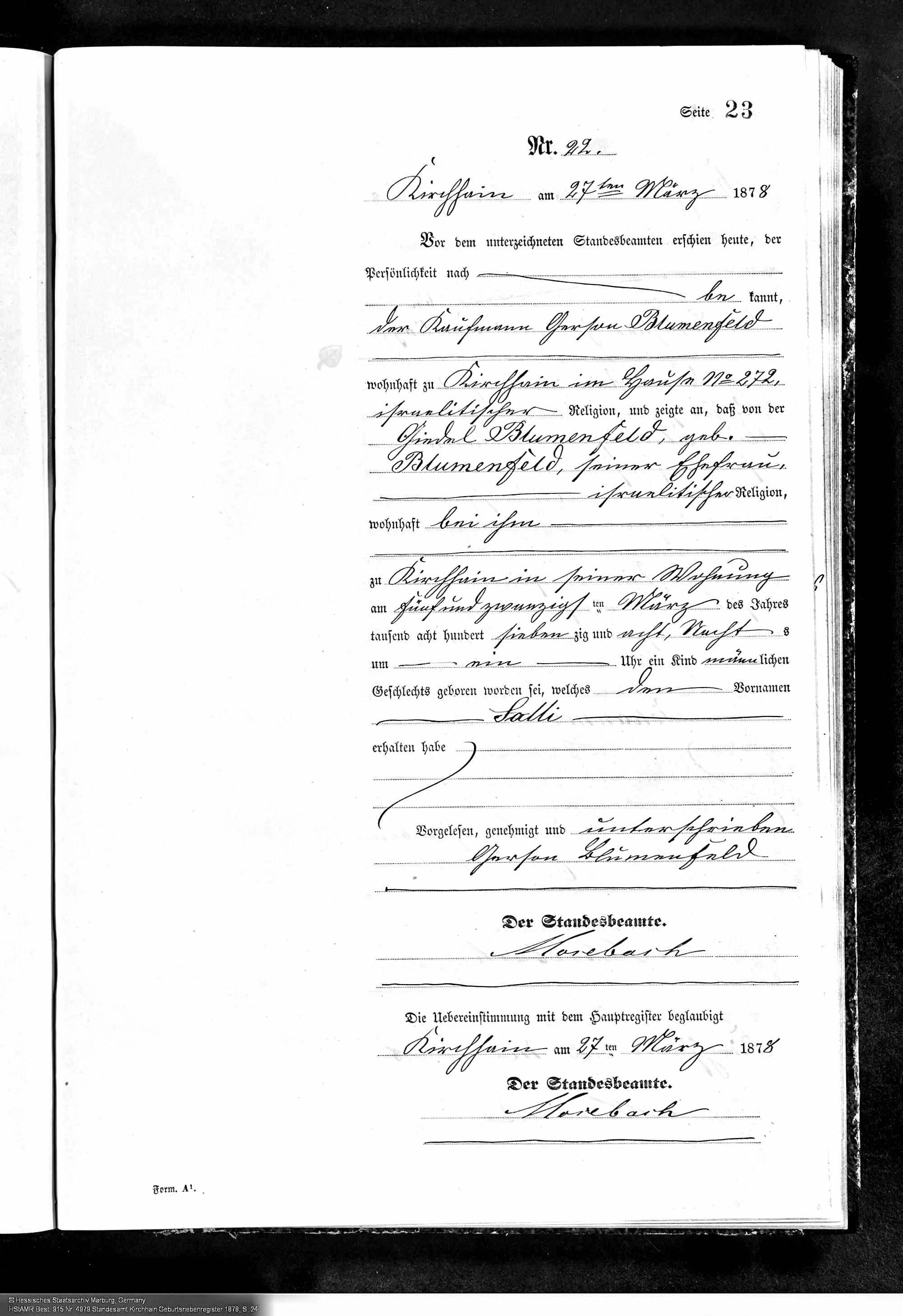
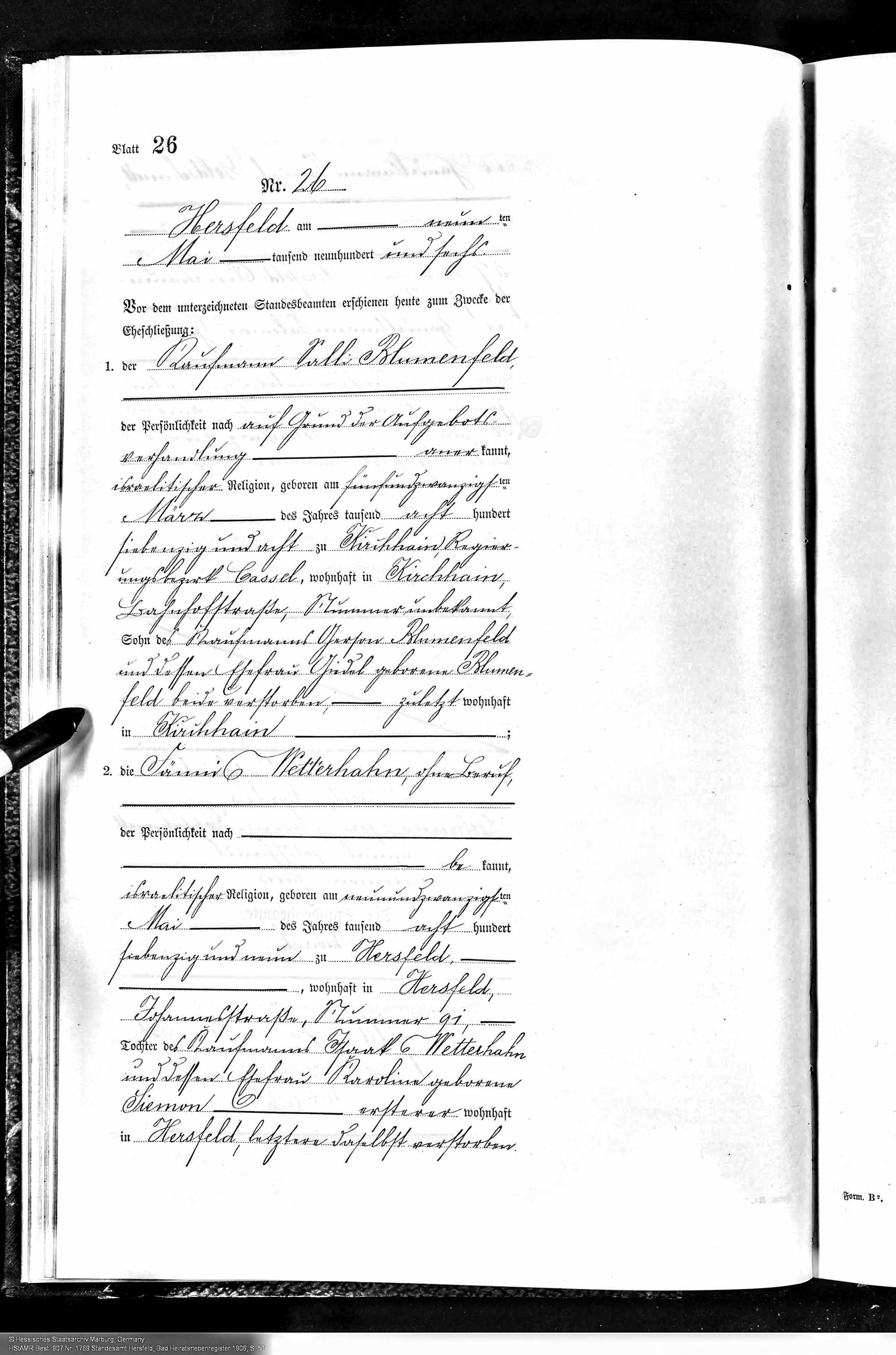
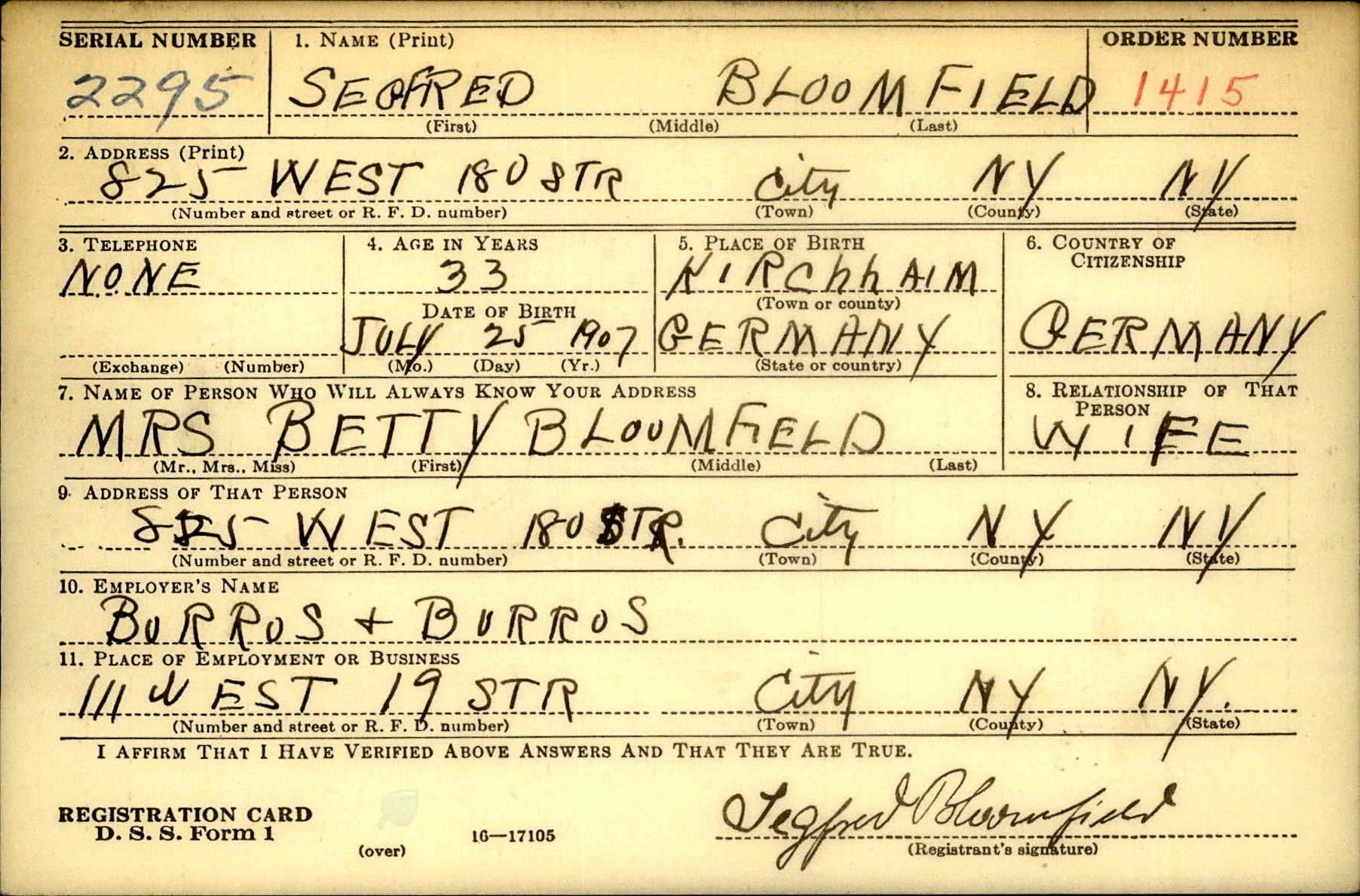
It was a bit of a relief, telling the stories of Max Bloomfield I and his sister Sadie Bloomfield, since both left Germany almost fifty years before the Nazis came to power. Even though both suffered tragic losses—Max lost two young daughters from terrible illnesses and Sadie lost a daughter to a horrible freak accident—I knew that they and their descendants would not be killed in the Holocaust.
Now I return to a sibling who stayed in Germany, but who managed to leave in the 1930s along with his family and escape from Nazi persecution. Hermann Blumenfeld II was the seventh child of Giedel Blumenfeld and Gerson Blumenfeld; he was born on March 26, 1876, in Kirchhain. He lost his mother Giedel when he was only seven years old.
On May 21, 1902, Hermann II married Rickchen Lomnitz in Bischhausen, Germany. She was born in Bischhausen on November 6, 1874, to Salomon Lomnitz and Esther Lorge.

Marriage record of Hermann Blumenfeld II and Rickchen Lomnitz, Hessisches Hauptstaatsarchiv; Wiesbaden, Deutschland; Bestand: 923; Laufende Nummer: 905, Year Range: 1902, Ancestry.com. Hesse, Germany, Marriages, 1849-1930
Hermann II and Rickchen had four sons. First, they had twins; Gustav and Siegwart were born on January 3, 1904, in Marburg, Germany.1 Then came Max, born on December 23, 1905, in Marburg.2
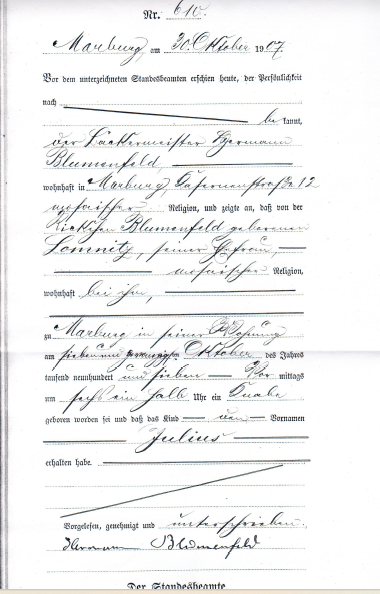
Their fourth son was Julius Blumenfeld, born October 27, 1907, in Marburg. For a long time I was skeptical about the existence of this fourth son, who was listed on several family trees but with no sources.3 I am very grateful to Richard Bloomfield for tracking down the actual birth record for Julius.

Julius Blumenfeld birth record obtained by Richard Bloomfield from Marburg Archives
Before Richard obtained that birth record, the only actual record I could find for a Julius Blumenfeld born on that date was a record of prisoners held at Dachau concentration camp; that record indicates that a man with that name and birth date and place was imprisoned at Dachau on October 26, 1935, and released on July 25, 1936, but it does not indicate who his parents were.4
UPDATE! My gratitude to my cousin Richard Bloomfield who translated this text from the following book: Barbara Händler-Lachmann, Thomas Werther,
Vergessene Geschäfte – verlorene Geschichte, Jüdisches Wirtschaftsleben in Marburg und seine Vernichtung im Nationalsozialismus [Forgotten businesses – lost history: Jewish economic life in Marburg and its destruction under National Socialism]. It provides information about the life of this family before they were forced to escape from Nazi Germany and shows how successful they were until the Nazis destroyed their business and ultimately forced them out of Marburg:
Blumenfeld, Hermann
Café and Pastry Shop
Bahnhofstrasse 27
Opening and Development
In 1901, Hermann Blumenfeld moved from Kirchhain to Marburg. He moved to Wilhelmstrasse 8, where he opened a bakery and pastry shop on September 10, 1901. There is some uncertainty regarding subsequent developments, as address books and business registers contradict one another. On December 15, 1908, he also established a café and pastry shop at Bahnhofstrasse 27. At the same time, however, he had already moved to Kasernenstrasse 12 (today Gutenbergstrasse); a bakery and pastry shop is said to have existed there as well. According to the business register, however, a branch of the business at Bahnhofstrasse 27 was not registered and opened there until April 18, 1911. Shortly thereafter, Hermann Blumenfeld purchased the house at Kasernenstrasse 12, which also included a bakery. After selling this house in 1921, the Blumenfeld family moved to Bahnhofstrasse. During the 1920s, the branch on Kasernenstrasse was closed. Two of Hermann’s sons, Siegward and Max, also became pastry chefs and worked in their father’s business.
Aryanization/Liquidation
After 1933, the café became one of the few places where Marburg’s Jewish citizens could meet outside their homes. A Jewish eyewitness reported that at Blumenfeld’s, it was still possible to have coffee in the evenings. Its convenient location near the train station allowed the business to survive, at least to some extent, for quite some time. However, the sons soon emigrated, so that fewer people had to rely on the café’s income to make ends meet. Hermann Blumenfeld and his wife also began preparing for their own emigration starting in 1937. The assessment by the local NSDAP chapter, which was requested by the authorities for this purpose, describes Blumenfeld’s situation as follows: “Almost since 1933, they have come more into the spotlight … because their ‘café’ became the meeting place for all Jews, which, however, was merely a natural consequence of all other events. The Blumenfelds’ business was not specifically marked as a Jewish business, which resulted in many non-locals visiting it…. Attempts to change this situation were unsuccessful because legal provisions did not permit third parties to post signs with such content. The departure of the Blumenfelds is generally welcomed.” A campaign against the bakery is known to have taken place in 1937. Two signs bearing the inscription “Don’t Buy from Jews” were erected, likely by the district leadership of the NSDAP. The Blumenfeld family was forced to move out of their apartment in May 1938. They moved to Heusingerstrasse 1, where they remained until their departure for New York on June 2, 1938. This date is listed in the business register as the final date of closure for the pastry shop. On May 13, 1938, the Oberhessische Zeitung reported that the bakery had been taken over by master baker Hafner. “As of today, the previously Jewish bakery at 27 Bahnhofstrasse has passed into Aryan hands.”
Franziska Blumenfeld, Hermann’s unmarried sister, worked as a housekeeper; where, is not known. The sons attended the Oberrealschule in Marburg. Gustav became a commercial clerk. In the early 1930s, he had a “general agency for vacuum cleaner brushes” entered in the commercial register; however, this commercial agency was discontinued as early as 1932.
It is known that Siegward had begun an apprenticeship as a dental technician, but his occupation is always listed as “pastry chef” in the address book. He emigrated to South Africa in August 1936.
Max, also a pastry chef, had already moved to Vienna in October 1934. His subsequent fate is unknown.
Julius Blumenfeld became a merchant. He worked in Giessen starting in 1927, moved to Karlstadt/Main in 1929, but registered his return in the winter and, according to the registration card from the Residents’ Registration Office, was traveling as of June 2, 1933. From September 11, 1935, to July 25, 1936, he was imprisoned at the Kislau/Dachau concentration camp. Two weeks after his release, he emigrated to South Africa together with his brother Siegward.
Hermann, his wife Rickchen, and his sister Franziska emigrated to New York, USA, on June 2, 1938.
Sources: StAM, Collection 327/1, NSDAP, No. 5652. StAM, Kassel Regional Office, Collection 1, No. 3982, Vol. 16. StAM, Marburg Cadastral Register II, Building Registers 1910ff. Handwritten student roster of the Martin Luther School, compiled by Dr. Helmut Krause.
Hermann and Rickchen and their sons all escaped from Nazi Germany in the 1930s. Max arrived in the US on July 6, 1936, listing his occupation as a merchant and his prior residence as Vienna.5 His brother Gustav arrived in the US next on October 1, 1937, listing his occupation as a baker and his prior residence as Marburg.6
Then their parents arrived the following year on June 3, 1938, Hermann II listing his occupation as a baker, same as his son Gustav. Traveling with them was Hermann’s younger sister Franziska, the youngest child of Giedel and Gerson Blumenfeld to survive to adulthood and their tenth child. Franziska was 55 and unmarried when she immigrated to the US with her brother Hermann and sister-in-law Rickchen.

Hermann Blumenfeld, ship manifest, Year: 1938; Arrival: New York, New York, USA; Microfilm Serial: T715, 1897-1957; Line: 1; Page Number: 91, Ship or Roll Number: Hansa, Ancestry.com. New York, U.S., Arriving Passenger and Crew Lists (including Castle Garden and Ellis Island), 1820-1957
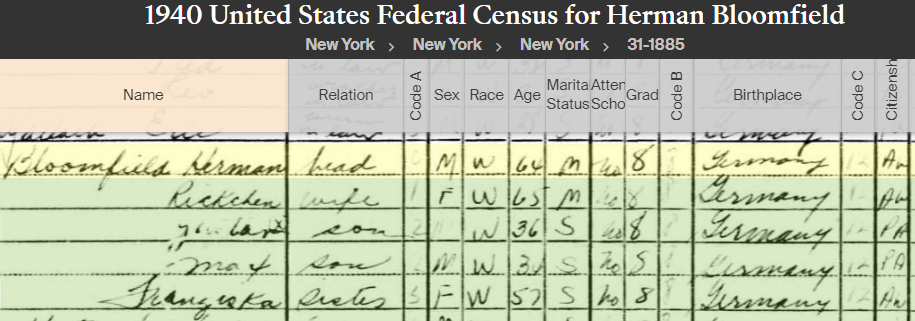
In 1940, Hermann, Rickchen, Gustav and Max were all living together along with Hermann’s sister Franziska in New York. Only Gustav and Max were employed, Gustav as a novelty salesman and Max as an office clerk for a garment company. They had all adopted the surname Bloomfield by then.
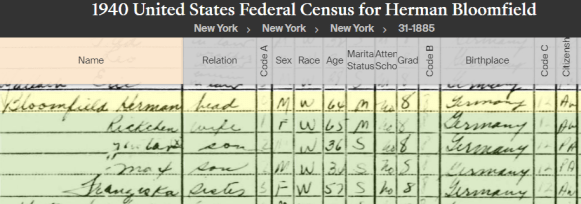
Hermann Blumenfeld and family, 1940 US census, Year: 1940; Census Place: New York, New York, New York; Roll: m-t0627-02670; Page: 22B; Enumeration District: 31-1885, Ancestry.com. 1940 United States Federal Census
Max Bloomfield (II, since he had an uncle who also changed his surname from Blumenfeld to Bloomfield) married Fridl Waldmann Aal, a widow with one child, on September 13, 1941, in New York.7 Fridl was born on March 20, 1909, in Windheim, Germany, and was, like Max, a refugee from Nazi Germany, having arrived on July 6, 1938, with her young daughter.8
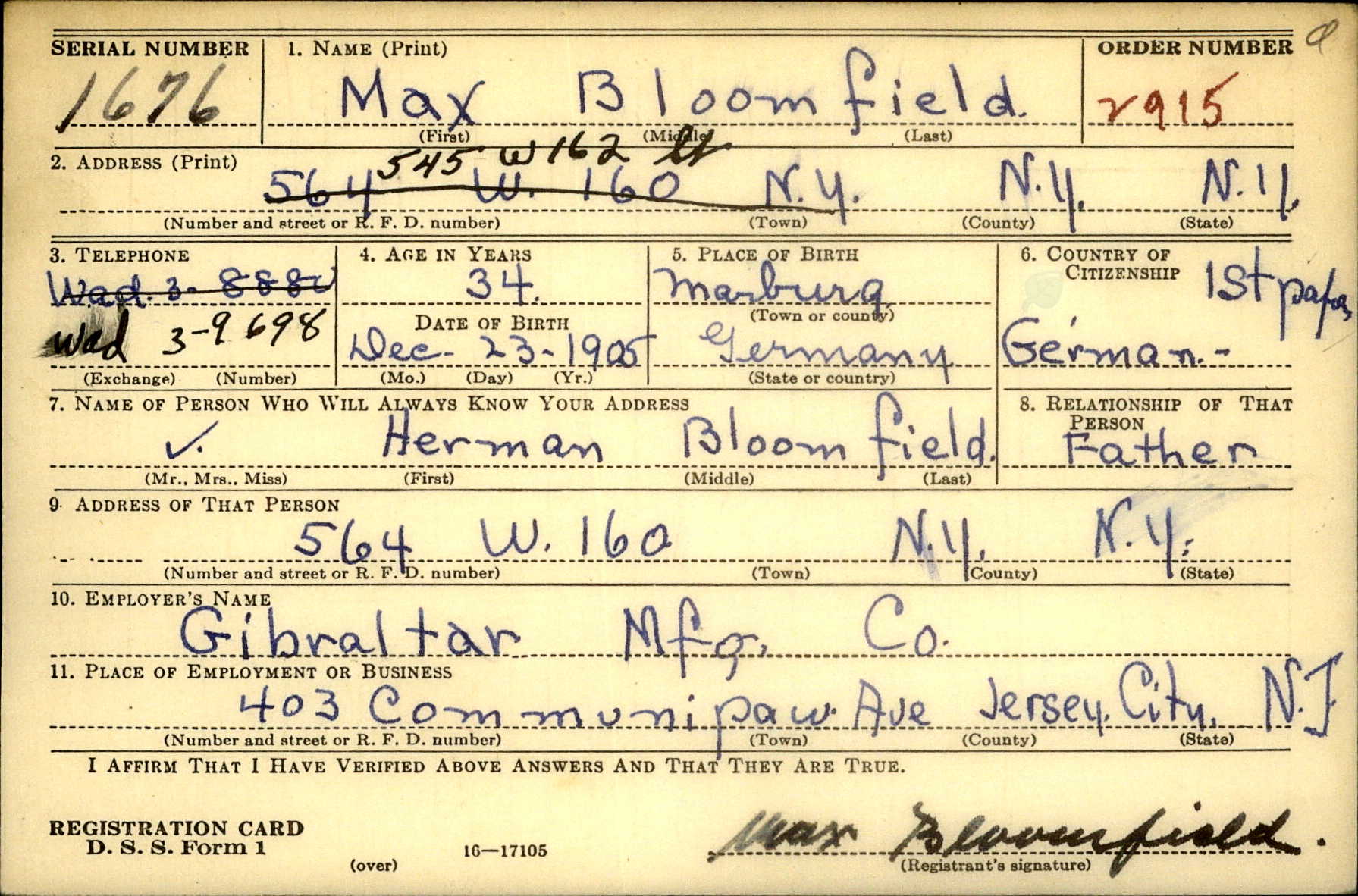
When he registered for the draft in 1942, Max was working for the Gibraltar Manufacturing Company.
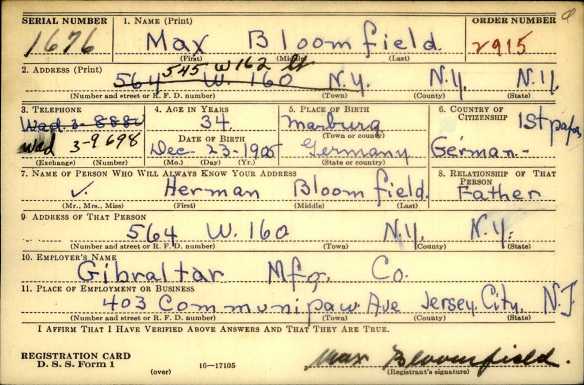
Max Bloomfield II, World War II draft registration, National Archives at St. Louis; St. Louis, Missouri; WWII Draft Registration Cards for New York City, 10/16/1940 – 03/31/1947; Record Group: Records of the Selective Service System, 147, Ancestry.com. U.S., World War II Draft Cards Young Men, 1940-1947
Max’s brother Gustav was self-employed when he registered for the draft, but I do not know what his occupation was; perhaps he’d returned to baking.

Gustav Bloomfield, World War II draft registration, National Archives at St. Louis; St. Louis, Missouri; WWII Draft Registration Cards for New York City, 10/16/1940 – 03/31/1947; Record Group: Records of the Selective Service System, 147, Ancestry.com. U.S., World War II Draft Cards Young Men, 1940-1947
Meanwhile, Hermann II and Rickchen’s other sons, Gustav’s twin Siegwart and the youngest son Julius, had gone to South Africa instead of the United States. Finding out what happened to Julius took the assistance of the genealogy village, in particular, my cousin Richard Bloomfield and Tracing the Tribe member Michael Moritz.
Given that Hermann Blumenfeld II’s naturalization papers listed only three sons—Gustav, Siegwart, and Max—I assumed that Julius must have died before Hermann filed his declaration of intent in 1941 or perhaps even before Hermann and Rickchen immigrated in 1938. But I had no idea when or where Julius died or whether he’d ever left Germany.

Herman Blumenfeld, Declaration of Intention, The National Archives at Philadelphia; Philadelphia, Pennsylvania; NAI Title: Declarations of Intention for Citizenship, 1/19/1842 – 10/29/1959; NAI Number: 4713410; Record Group Title: Records of District Courts of the United States, 1685-2009; Record Group Number: 21, Description: (Roll 610) Declarations of Intention for Citizenship, 1842-1959 (No 481301-482200), Ancestry.com. New York, U.S., State and Federal Naturalization Records, 1794-1943
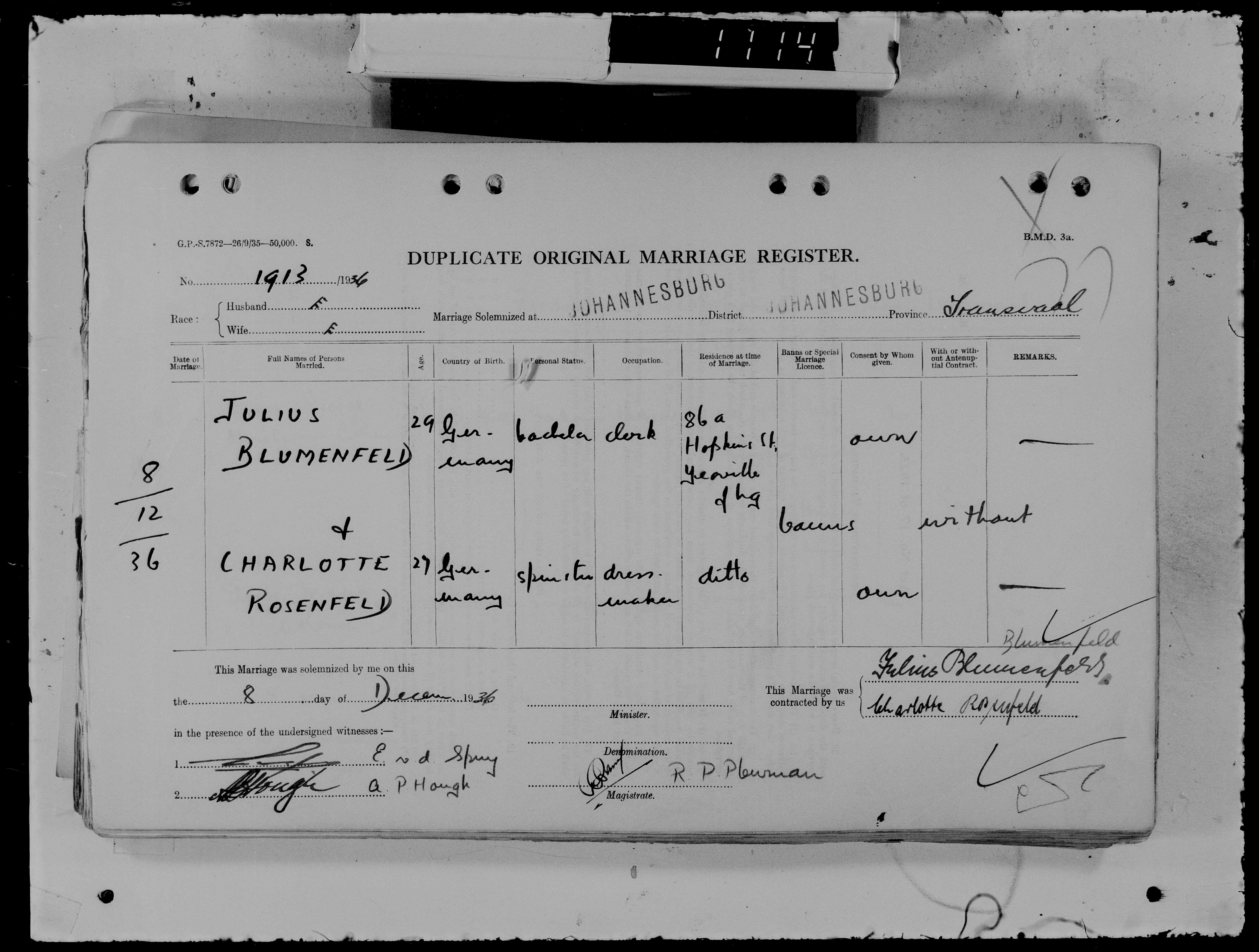
I posted a question on Tracing the Tribe on Facebook. Not long after I posted my question, Michael Moritz again came through for me; he found that Julius had immigrated to South Africa, and then found Julius’ marriage record and death record. On December 8, 1937, in Johannesburg, South Africa, Julius married Charlotte Rosenfeld, who was 27 at that time and born in Germany.
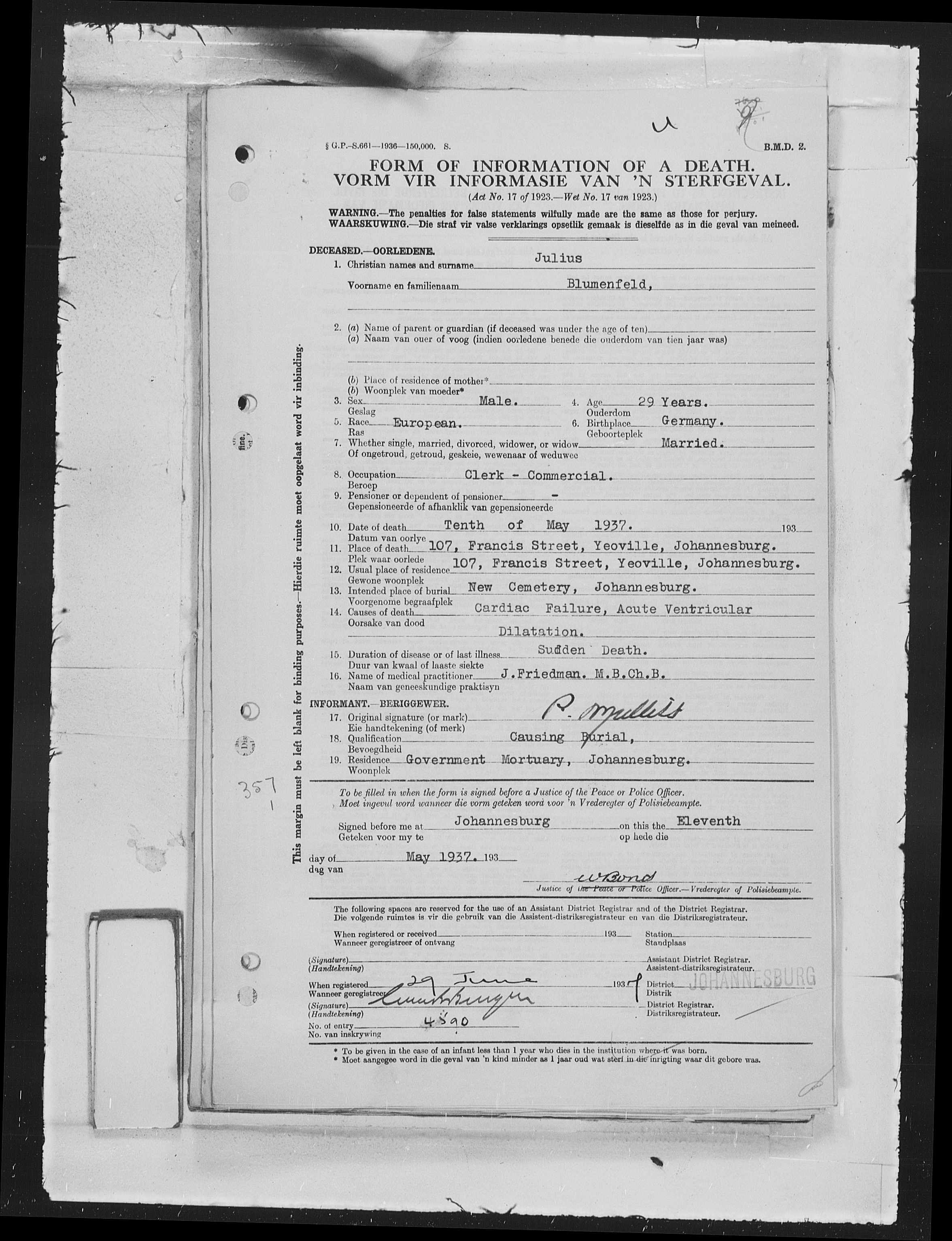
Sadly, Julius died just five months later on May 10, 1937, in Johannesburg, South Africa, from sudden cardiac arrest. He was only 29, and I have little doubt that his experiences at Dachau contributed to his early death.
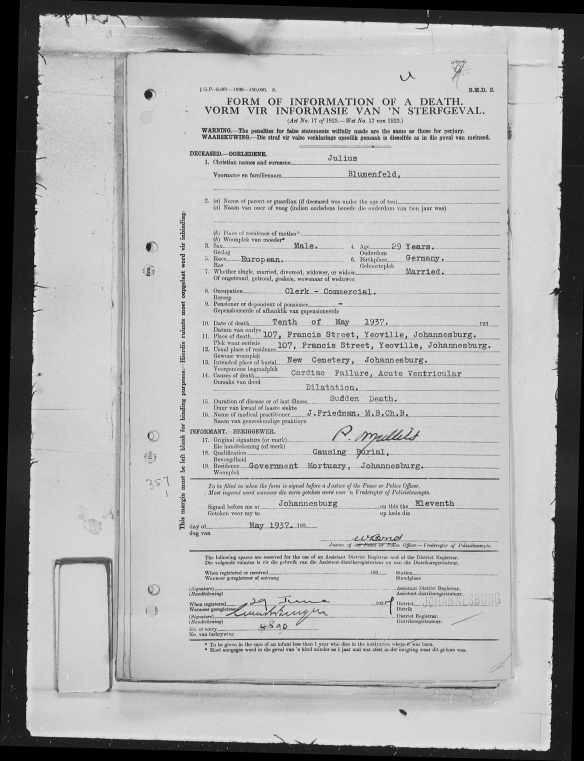
Julius Blumenfeld death certificate, “South Africa, Transvaal, Civil Death, 1869-1954,” database, FamilySearch (https://familysearch.org/ark:/61903/3:1:3Q9M-C9BY-V7P6-W?cc=2998108 : 15 September 2019), > image 1 of 1; Department of the Interior. Registrar of Births, Marriages, and Deaths, Transvaal.
His brother Siegwart also died young. He died in South Africa on June 18,1945, when he was 41, from lymphosarcoma. According to his death certificate, he was single and I assume had no children.
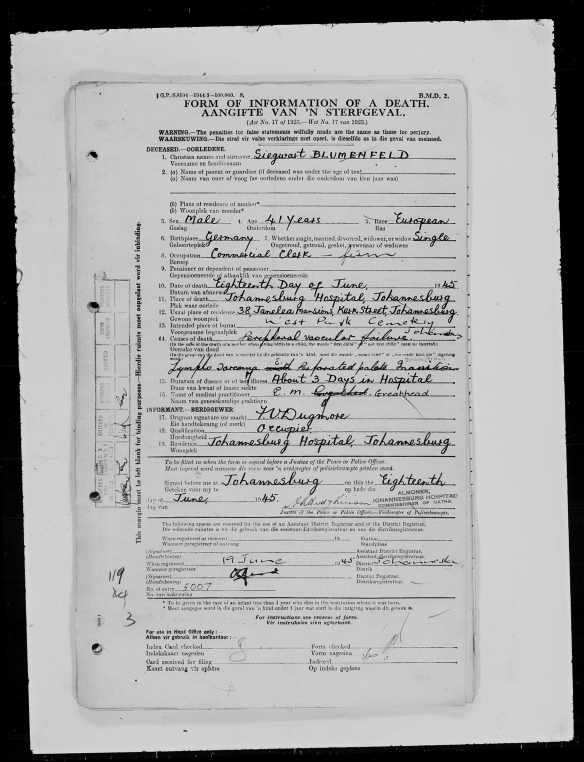
Siegwart Blumenfeld death certificate, “South Africa, Transvaal, Civil Death, 1869-1954,” database, FamilySearch (https://familysearch.org/ark:/61903/1:1:WSSF-4NN2 : 29 October 2019), Siegwart Blumenfeld, 18 Jun 1945; citing Death, Johannesburg, Transvaal, South Africa, Department of the Interior. Registrar of Births, Marriages, and Deaths, Transvaal.
Back in the US, Hermann Blumenfeld II died in New York on August 12, 1944; he was 68.9 His wife Rickchen died six years later on October 19, 1950; she was 75.10 Their son Gustav died on January 28, 1966, at the age of 62;11 as far as I’ve been able to determine, Gustav never married or had children. Max Bloomfield II died in July 1981 at age 75.12 I’ve not found any children from his marriage to Fridl Waldmann, who died at age 96 on September 23, 2005.13
I am hoping that perhaps I’ve missed something and that one of Hermann II and Rickchen’s sons had children and that there are living descendants since this is one of the few branches of Giedel Blumenfeld’s tree that managed to escape Germany in time. But at the moment I have no indication that Hermann Blumenfeld II has any living descendants.
UPDATE 5 30 2022
Good news! I received an email from a distant cousin by marriage who informed me that he had discovered that Max Bloomfield and Fridl Waldmann had a son born in the 1940s. I have now learned a bit about that son, my fifth cousin, who is living in California and has an adult daughter as well. So there are at least two living descendants of Hermann Blumenfeld II.