The Paul Metz Mystery, Part III: George Metz Disappears

In my last post, I described how with my cousin Conrad’s help I had been able to track down Gertrude Cone Metz/Raymond Blumann/Smith Keller up to 1920 when she had been married to or at least living with George W. Keller as well as her son George Metz (named as George Elwood Keller on the 1920 census) and their daughter “Florence,” who Conrad and I decided was actually Ida Jane Keller, the daughter  of Gertrude and George W. Keller born in 1905.

I also noted that by 1925 it appeared that Gertrude and her third “husband” George W. Keller were separated as George W. was living with his parents and with his daughter Ida, who had married Eugene Merker in 1921 but from whom she must have been separated by 1925. Ida and Eugene’s daughter was also living with the Kellers in 1925.

But where were Gertrude and her son George Metz in the 1920s? Conrad found a series of newspaper articles revealing that his father George B. Metz had disappeared for some time in September 1923. The story ran in multiple newspapers throughout the United States as police all over the country were searching for the missing “G.B. Metz.” 1 The New York Times began its coverage on its front page on September 13, 1923, describing how George B. Metz had been hired by H. A. Ross of the Pittsburgh Lamp, Brass and Glass Company two weeks earlier to be their Colorado representative. Ross had received that day a letter from Metz mailed from Denver in which he acknowledged receipt of an expense check, but Ross had also been notified by the Denver police that same morning that Metz had disappeared.2

New York Times, September 13, 1923, p. 1

This same article also reported comments made by Russell B. Cressman, a friend and former co-worker of George Metz at the Gleason-Tiebout Company in New York, manufacturers of electrical appliances, where Metz had worked for seven years, or since about 1916. Cressman described Metz as having “an equable, quiet disposition and was very well liked by his business associates.” According to Cressman, Metz was a bachelor and lived with his mother, Mrs. G.A. Kellar [sic] at 2020 Honeywell Avenue in the Bronx, the same place that Gertrude and her son George and daughter “Florence” had been living with George W. Keller on the 1920 census. Cressman could not provide an explanation for Metz’s disappearance nor could his mother, when asked. According to the article, George’s mother had left for Denver when she heard of his disappearance.3

The paper also reported that George had a girlfriend in New York named Margaret A. Wiquest and that another friend, Eugene O’Donnell, estimated that George had a fortune worth about $50,000-$60,000 as well as a $75,000 life insurance policy.4

According to this and several other articles, the maid found a note in George’s hotel room in Denver, where he had been staying for two weeks. According to the Ogden (Utah) Standard Examiner of September 12, 1923 (p. 2) and many other newspapers, that note read as follows:

I am going on a dangerous mission tonight. If anything should happen that I do not return please forward the personal papers you will find in the small drawer to R.B. Cressman, 200 Fifth Avenue, New York City.

(Signed) G. B. Metz

Personal effects to Mrs. G.A. Keller, 2020 Honeywell avenue, New York City. Catalogue to Pittsburg Lamp, Brass and Glass company. Car to Saunders. [The car was a rental car.]

Detectives then proceeded to examine a will that George Metz had prepared on September 4, 1923, obviously either right before or right after departing New York for Denver. According to another New York Times article dated September 13, 1923,5 the will named Russell B. Cressman as the administrator and left one-third of the estate to Margaret A. Wiquest, his “dearest pal and sweetheart,” unless she was married at the time of George’s death; in that case she was to receive only $500. All of George’s personal belongings were bequeathed to his uncle Frank E. Cone, his jewelry was left to his “stepfather G.W. Kellar,” $1000 was left to his sister, Ida J. Merker, and another $1000 to a trust fund for the education of Ida’s daughter.

The police had two possible theories for George’s disappearance—foul play or suicide. By the next day the New York Times was reporting that the Denver police had developed a third theory—that George was suffering from a temporary mental illness. The Denver police also found a clue that George was on his way to Los Angeles.6

“Metz in California, Denver Police Think,” New York Times, September 14, 1923, p. 22.

The article is most interesting for what it reports “that bears out the theory of mental aberration.”7

One clue was a letter which Metz wrote to his mother in which he said: “I am losing my mind. Have faith in me.”

The police also learned, they said, that Metz’s father, Joseph Metz, disappeared in a similar fashion nearly 25 years ago, just before the son was born, and took his elder son Elwood with him. Nothing ever was heard of them, the police say.[^8]

That was a confirmation of much of what I had suspected: Paul Metz/Joseph Raymond (called Joseph Metz here) was the father of George Metz, and he had disappeared shortly before George was born, taking Elwood with him.

The newspaper also noted that Ida Keller Merker had confirmed these facts, although her report muddies the waters a bit:8

Mrs. Merker confirmed the statement that their father, Joseph Metz, had disappeared with an elder son, Elwood, twenty-five years ago. This had been while the family was living somewhere on the Boston Road in the Bronx, and the pair had never been heard from.

Of course, this can’t be completely right; Paul/Joseph Metz was not Ida’s father. Ida J. Keller was born five years after her half-brother George, and Paul/Joseph Metz could not have been her father if he disappeared five years before she was born. And on the 1900 census, Gertrude was living with Elwood not on Boston Road in the Bronx, but in Ho-ho-kus, New Jersey, and Paul was not in the household. But the important point from my perspective is that this confirmed that Paul Metz had disappeared and taken his son Elwood with him in 1900.

According to the article, George’s girlfriend Margaret A. Wiquest was “taken by surprise at the report of Metz’s mental condition. In their one-year acquaintance, she said, Metz had never shown sign of aberration. He had always been of a cheerful disposition and his last letters had all been in a cheerful key, she added.”9

Fortunately, this story has a happy ending. George was found a month later in Los Angeles, suffering from memory loss:
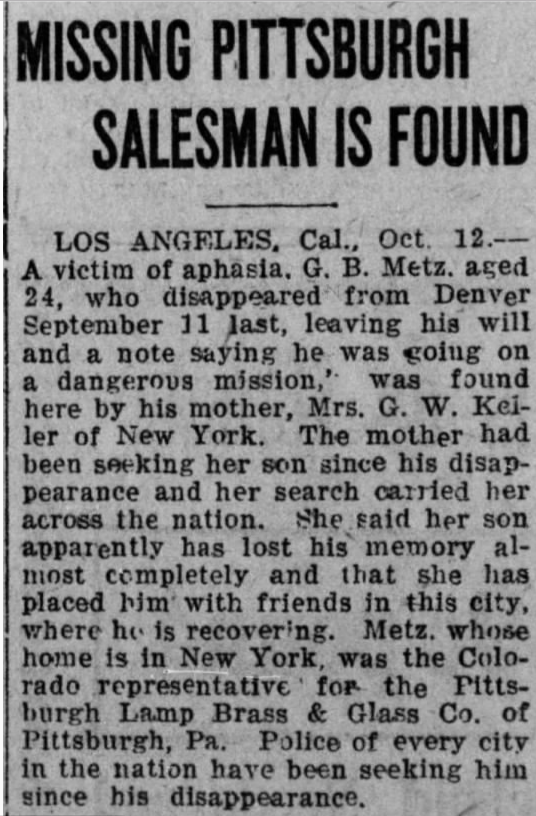
“Missing Pittsburgh Salesman Is Found,” New Castle (Pennsylvania) Herald, 12 Oct 1923, Fri, Page 20.

George apparently returned to New York, but perhaps not to Margaret A. Wiquest. On September 11, 1925, George Metz married Eunice Marian Brown in the Bronx.10 Conrad generously shared these stunning photographs of his parents:

Eunice Marian Brown Metz. Courtesy of Conrad Metz

George B. Metz, courtesy of Conrad Metz

In 1928, they were living in my old hometown, White Plains, New York, where George was working as a “brkman,” or a brakeman.11 According to Conrad, his maternal grandfather, John Brown, was a conductor on the Putnam Division of the New York Central Railroad and helped his son-in-law George get a job with the railroad when George had had difficulty obtaining employment after his disappearance in 1923.  Being a brakeman was a dangerous job, as described on this website:

To apply the brakes, the brakeman would turn a large brake control wheel located atop each freight car of the train. Every brakeman carried a thick brake “club” to help give them leverage in turning the wheel. This meant that they would have to run along the top of the railway cars and leap from one to another in order to apply or release the brakes on each car. Generally, the rear brakeman, or flagman as he was also known, would advance from the end of the train whilst the head brakeman or the conductor would advance from the engine to apply the brakes on each car, one by one. On a moving train, especially in bad weather, the application of brakes was a risky proposition, at best. Worse still, a stuck brake wheel might suddenly free up and throw the brakeman off balance. All too often this would result in the brakeman falling between the cars to his death. Riding in the open, frequently exposed to the bitter cold of winter, the brakeman’s job was fraught with danger.

Conrad told me that his father George himself suffered a broken leg on the job.

In 1930 George, Marian and their son Richard were living in Westwood, New Jersey, and George was once again in the electrical products business, now as a sales manager for the an electrical company. Conrad was born a couple of years later.

George Metz and family 1930 US census, Census Place: Westwood, Bergen, New Jersey; Page: 8B; Enumeration District: 0251; FHL microfilm: 2341052
Ancestry.com. 1930 United States Federal Census

But what about Paul Metz and Elwood Metz? Where had they gone? Who were they now? And would they ever reappear? More on that in my next post, the final chapter in the story of Paul Metz and his sons.


  1. E.g., “Note Left by Missing Man,” The Ogden (Utah) Standard-Examiner, 12 Sep 1923, Wed, Page 2; “Goes on ‘Danger Mission’ And Has Not Come Back,” The (Wilmington, Delaware) Morning News, 13 Sep 1923, Thu, Page 1; “Missing Pittsburgh Salesman Is Found,” New Castle (Pennsylvania) Herald, 12 Oct 1923, Fri, Page 20. 
  2. The New York Times, September 13, 1923, p. 1. 
  3. Ibid. 
  4. Ibid. 
  5. “Missing Man Left Will, Fearing Death,” The New York Times, September 13, p.1. 
  6. “Metz in California, Denver Police Think,” The New York Times, September 14, 1923, p. 22. 
  7. Ibid. 
  8. Ibid. 
  9. Ibid. 
  10. The New York City (Bronx) Marriage Index, Certificate Number 5272 (could be 5273), found at https://archive.org/details/NYC_Marriage_Index_Bronx_1925 
  11. White Plains city directory, 1928, Ancestry.com. U.S. City Directories, 1822-1995 

The Paul Metz Mystery, Part II

As seen in my last post, my cousin Conrad and I came to the conclusion that his grandfather, Paul Metz, had used a false name (Joseph Raymond) on his marriage certificate when he married Gertrude Cone and thus that Paul Metz was in fact the first husband of Gertrude Amelia Cone and the father of their two sons, Elwood, born February 19, 1898, and George, born July 6, 1900.

But Paul Metz/Joseph Raymond was not on the 1900 census with Gertrude and Elwood (George was born after the census enumeration). Where was he? I thought that if we searched for information about Gertrude, Elwood, and George, we might find the answer to what happened to Paul.

According to Conrad, Gertrude next appeared on the 1905 New York State census; she was living in Mount Vernon, New York, with a man named George W. Keller, who was 26. Gertrude is listed as his mother, but she was only 25, so that cannot be right. Apparently that enumerator listed all the wives as “mothers” on that particular census report. There were two children living with them: a son named George, who was five, and a daughter named Ida J., who was two months old.

Gertrude Keller and family 1905 NYS census, New York State Archives; Albany, New York; State Population Census Schedules, 1905; Election District: E.D. 01; City: Mount Vernon Ward 04; County: Westchester. Ancestry.com. New York, State Census, 1905

At first I wasn’t sure why Conrad thought this was his grandmother Gertrude. The New York State census does not identify the state where the individuals were born or much else about them, so I was uncertain. But Conrad knew that his grandmother had at one time been married to George Washington Keller; in fact, he knew of her only with the surname Keller. And he knew he had an “aunt” named Ida Jane. So this had to be Gertrude and her son George (Metz) and daughter Ida on the 1905 NYS census living with George W. Keller.

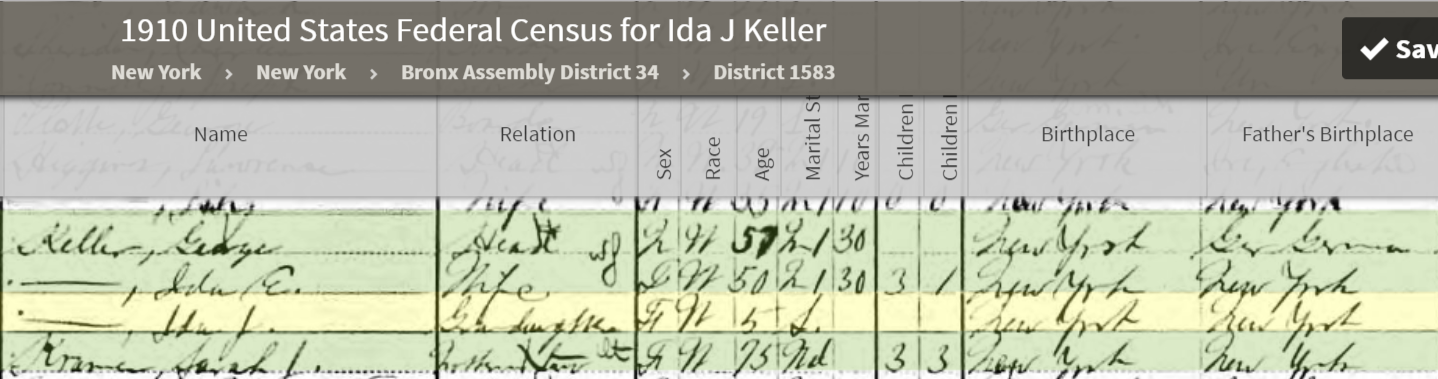
But neither Conrad nor I could locate a marriage record for Gertrude and George W. Keller. Nor could we find a birth record for Ida. Was she in fact the daughter of George Keller and Gertrude Cone? Could Paul Metz have been her father? Well, I found Ida on the 1910 census living with her grandparents—George Keller and Ida Keller, who were George W. Keller’s parents.1  From that I concluded that Ida was in fact the daughter of George W. Keller. But why was she living with her grandparents? Where was her father George? And where was her mother Gertrude?

Ida Keller, 1910 US census, Census Place: Bronx Assembly District 34, New York, New York; Roll: T624_1002; Page: 8A; Enumeration District: 1583; FHL microfilm: 1375015
Ancestry.com. 1910 United States Federal Census

Well, on January 26, 1910, Gertrude had obtained a license to marry another man, William Blumann.2 But on the 1910 census, she was living with a man named William T. Smith. He was a “railroad man.” Living with them was George B. Metz, Paul Metz’s son. The census record reported that it was a second marriage for both William and Gertrude and that Gertrude had three living children, though only George was living with her. It also reported that Gertrude and William Smith had been married for less than a year.

William Smith and family, 1910 US census, Census Place: Manhattan Ward 12, New York, New York; Roll: T624_1014; Page: 6A; Enumeration District: 0311; FHL microfilm: 1375027
Ancestry.com. 1910 United States Federal Census

Was William Smith the same person as William Blumann? Was William Blumann/William T. Smith another alias for Paul Metz? And what had happened to George W. Keller? To answer the first question first, there is this horrifying news article that reveals that in fact William Blumann was the same person as William T. Smith:

“Mother Saved by Son, Madman Ends Own Life,” Wilkes-Barre, Pennsylvania Evening-News, January 20, 1914, p. 2.

So George Metz, just thirteen years old, had saved his mother Gertrude’s life.  This poor young man had witnessed the attempted murder of his mother and the suicide of his stepfather. And also it appears he had been abandoned by his own father, Paul Metz, and another stepfather as well, George W. Keller. He also had lost two siblings somewhere along the way—Elwood and Ida. In thirteen years he had suffered more trauma and loss than most of us experience in a lifetime.

Meanwhile, in 1909 George’s stepfather George W. Keller had married Laurie Ellis Fredette,3 and in 1910 they were living in Mount Vernon, the same town where George W. Keller had previously lived with Gertrude, George Metz, and Ida.4 But Laurie Fredette died on January 27, 1918, in the Bronx,5 leaving George W. Keller a widower. And thus both George W. Keller and Gertrude Cone Raymond/Metz Blumann/Smith were widowed and unmarried as of January 27, 1918.

In 1920 George W. Keller and Gertrude were living together again, listed this time as husband and wife on the census, although we’ve yet to find a marriage record for George W. Keller and Gertrude. They were living at 2020 Honeywell Avenue in the Bronx. George was working for the railroad just as William Blumann Smith had been.

George W Keller and household, 1920 US census, Census Place: Bronx Assembly District 7, Bronx, New York; Roll: T625_1140; Page: 9B; Enumeration District: 373
Ancestry.com. 1920 United States Federal Census

Living with George and Gertrude as their son was “George Elwood Keller,” a nineteen-year-old born in New Jersey who was working in a glass factory. The census record states that both his parents were born in New York.So who was this? Was it Elwood “Raymond,” who would have been 22 in 1920, or was it George Metz, who would have been turning 20 in 1920? Only George was born in New Jersey, and his father—Paul Metz—was born in Pennsylvania, not New York. Conrad and I concluded that this had to be George, not Elwood—in large part because Conrad knew that his father had been living with Gertrude at that time whereas Elwood’s whereabouts during that time were unknown.

Why then would this young man have been listed as George Elwood? It looks like the census enumerator first wrote Elwood and then squeezed in George. Strange… Perhaps Gertrude had her two sons confused.

Even more confusing to me was the fact that this same census record also listed a daughter in the household named Florence, fourteen years old, also born in New Jersey with parents both born in New York. Who in the world was Florence?? Ida Jane Keller would have been fourteen, going on fifteen in 1920. But she was born in New York. Since neither Conrad nor I could find any child of George and/or Gertrude who was named Florence or born in New Jersey in 1905-1906 nor could we find any later record for a Florence Keller of that age who fit, we concluded that “Florence” was really Ida. But why would she be listed as Florence, not Ida? Those names aren’t even close.

You can imagine that by now I was ready to throw a brick at the computer. My head was spinning, and I was drawing more timelines and charts than I’d ever had to before. And things did not get much clearer as I moved forward in time.

In 1921 Ida J. Keller married Eugene Merker in the Bronx.6 But that marriage did not last long because by 1925 Ida was apparently separated from Eugene Merker and living at 1976 Honeywell Avenue in the Bronx with her grandparents George and Ida Keller, her father George W. Keller, and her daughter from her marriage to Eugene; they were living down the block from where Gertrude and George had been living with her son George Metz and their daughter Ida in 1920. Ida was eventually divorced from Eugene in 1930.7 It also appears that by 1925 her father George W. Keller was no longer living with Gertrude. I could not find him on the 1930 census, but I did find that he died in 1936.8

Keller family, 1920 US census, New York State Archives; Albany, New York; State Population Census Schedules, 1925; Election District: 21; Assembly District: 07; City: New York; County: Bronx; Page: 12. Ancestry.com. New York, State Census, 1925

So I had gotten this far, but I still had no answers for the whereabouts of Paul Metz/Joseph Raymond or Elwood Metz/Raymond. Neither Gertrude nor William Blumann Smith nor George W. Keller nor Ida Jane were related to me in anyway except through a chain of marriages. I had researched them and gone in all those circles to try and find Paul Metz and Elwood to no avail.

And then things got stranger. And finally, the brick wall started to fall.


  1. Ancestry.com. New York, County Marriage Records, 1847-1849, 1907-1936. Film Number: 001031478. 
  2.  New York City Municipal Archives; New York, New York; Volume Number: 1. Ancestry.com. New York, New York, Marriage License Indexes, 1907-1995. License Number: 2449. 
  3. Ancestry.com. New York, County Marriage Records, 1847-1849, 1907-1936. Film Number: 001031478. 
  4. George W. Keller household, 1910 US census, Census Place: MT Vernon Ward 2, Westchester, New York; Roll: T624_1089; Page: 10B; Enumeration District: 0062; FHL microfilm: 1375102. Ancestry.com. 1910 United States Federal Census. 
  5.  Ancestry.com. New York, New York, Extracted Death Index, 1862-1948, Certificate Number: 766. 
  6.  New York City Municipal Archives; New York, New York. Ancestry.com. New York, New York, Marriage License Indexes, 1907-1995. License Number: 5510. 
  7. Ancestry.com. Bronx County, New York, Divorce and Civil Case Records, 1914-1995. Volume Number: 2, Page Number: 485, File Number: 1969 
  8. Ancestry.com. New York, New York, Extracted Death Index, 1862-1948. Certificate Number: 1374. 

The Mystery of Paul Metz, Part I

I cannot tell the story of Paul Metz without some introduction of my third cousin, once removed, Conrad Metz, Paul’s grandson. Without Conrad’s help, this story would never have come to light. We collaborated on the research, shared our thoughts about what we found, and ultimately reached the same conclusion about his elusive grandfather.

The story began on June 14, 2018, when I received a message on Ancestry from Conrad, asking me to share my tree because he’d been told I might be a cousin and that I had his grandfather Paul Metz on my Ancestry tree. He said he’d been searching for information about Paul Metz for many years, but all he had was the name on his father’s birth certificate.  I responded that I was delighted to hear from him and more than happy to share my tree and to work with him on searching for more information about his grandfather.

The last official record I had for Paul Metz before Conrad contacted me was the 1880 census when Paul was a teenager living with his parents Rosa and Bernhard in Philadelphia.1 As noted in my last post, Paul was not living with his parents and siblings on the 1900 census. Conrad knew that his grandmother’s name was Gertrude Amelia Cone, but we could not find a marriage record for Gertrude Cone and Paul Metz.

But Conrad had a marriage record for his grandmother Gertrude and a man named Joseph C. Raymond. According to their New Jersey marriage record, they had married on December 10, 1895, in Ramsey, New Jersey.  That record said that Joseph was the son of Albert F. Raymond, born in Michigan, and Rose Weldon, born in England, and that Joseph was born in Philadelphia, Pennsylvania. He was 28 years old, giving him a birth date of 1867.  Gertrude was only seventeen, born in Brooklyn to Edward Cone, born in Maryland, and Jennie Pool, born in Schraalenberg, New Jersey, and Gertrude was then residing in Ramsey, New Jersey, where the wedding took place.

We could not find any records for Joseph Raymond’s parents, Albert Raymond and Rose Weldon. The only other record naming Joseph Raymond that we could find was the birth record for an unnamed son of Joseph Charles Raymond and Gertrude Amelia Cone born on February 19, 1898. According to this record, both Joseph and Gertrude were born in New Jersey, contrary to their marriage record.  Joseph was 29 so born in 1867; Gertrude was 18 so born in 1880, not 1878 as the marriage record suggested.

New York, New York City Births, 1846-1909,” database, FamilySearch (https://familysearch.org/ark:/61903/1:1:2WWM-5R9 : 11 February 2018), Gertrude Amelia Cone in entry for Raymond, 19 Feb 1898; citing Manhattan, New York, New York, United States, reference cn 7239 New York Municipal Archives, New York; FHL microfilm 1,953,125.

On the 1900 census we found a Gertrude Metz living in Ho-ho-kus, New Jersey with a two-year-old son named “Ellwood,” born in February 1898. That Gertrude was born in 1879 in New York whereas the Gertrude on the marriage and birth records was born in New York (or New Jersey) in 1878 (or 1880). That Gertrude’s father was born in Maryland and mother in Schraalenberg, New Jersey, whereas the Gertrude on the 1900 census had a father born in Virginia and a mother born in New Jersey.  Certainly a close but not an exact match. But there was enough—the name, the age and birth place, the son’s birth date—to make Conrad and I believe it possible that this was his grandmother Gertrude and that the child was the baby born to Gertrude Cone and Joseph Charles Raymond on February 19, 1898.

Gertrude Metz 1900 census, Census Place: Hohokus, Bergen, New Jersey; Page: 6; Enumeration District: 0022; FHL microfilm: 1240955
Ancestry.com. 1900 United States Federal Census

But why was she using the surname Metz? The census report listed Gertrude as married, but there was no husband living with her, and we could not find Joseph Raymond  anywhere on the 1900 census. Had she married Paul Metz after Joseph Raymond and given Joseph Raymond’s son the surname of her second husband? If so, where was Paul Metz? We couldn’t find him anywhere on the 1900 census either.  We were confused.

So I did what I always do when I hit a dead end on official records; I searched the newspaper databases. And I found some stories that were disturbing: Paul Metz had been arrested and convicted in New Jersey in the fall of 1898 for theft; in fact, he had committed multiple thefts.

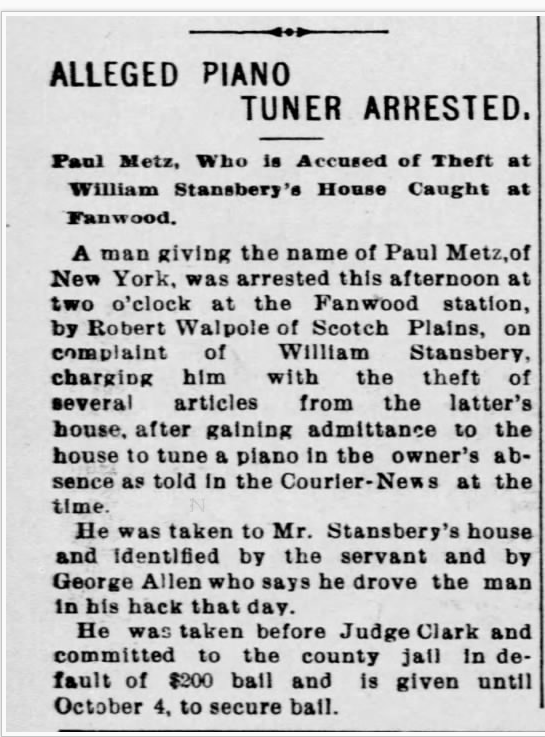
First, I found this article from the September 29, 1998, the Bridgewater (NJ) Courier-News, which reported that Paul Metz had been arrested for the theft of several articles from the home of William Stansbery after Metz had obtained entrance to the home by saying he was there to tune the piano.

“Alleged Piano Tuner Arrested,” (Bridgewater, NJ) Courier-News, September 29, 1898, p. 8

The following day, the same paper reported in more detail how the police had identified Metz as the thief and how they had captured him. The part of the article I found most interesting was this description of Metz: “a perfect gentleman in his manners and a smooth talker.” Also, this article revealed that Metz may have earlier that month used the same “piano tuner” con to steal a silver sugar sifter from a Mrs. Pendleton N. Rogers of Bridgewater.

“Piano Tuner Arrested for Sneak Thieving,” (Bridgewater, NJ) Courier News, September 30, 1898, p. 1

Then on October 4, 1898, the Bridgewater newspaper reported more alleged misconduct by Paul Metz.  According to the Plainfield Bicycle Company in Plainfield, New Jersey, Metz had rented a bicycle from them for one day, but had not returned the bike for six weeks. When they sought action against him, he sent the bicycle back by express delivery. The bike company claimed that they had to pay for the delivery charges as well as repairs on the bike, which came back damaged.

“Metz Was A Wheelman,” (Bridgeton, NJ) Courier News, October 4, 1898, p. 5

The paper also reported that day and the following day that Paul Metz’s wife had come to New Jersey with her baby in her arms to plead with William Stansbery not to press charges against her husband. But the case was already before the grand jury by that time, so it was too late, and Paul was convicted.2

“Mrs. Metz’ Plea for Her Husband,” (Bridgewater, NJ) Courier News, October 4, 1898, p. 5

Yet Paul Metz managed to escape with only a short sentence of six months after his trial. The Courier-News reported on November 4, 1898, that the reason for the light sentence was that Metz had “turned evidence against Wilson and other prisoners in their recent attempt to escape from jail.”

“Metz Gets An Easy Sentence,” (Bridgewater, NJ) Courier-News, November 2, 1898, p. 1

You might ask how I could be sure that this was the same Paul Metz, son of Rosa and Bernhard Metz. In this clipping from the Philadelphia Inquirer, it states that he gave his address as 209 East 61st Street in New York City, which, as I mentioned in my last post, is where Rosa and Bernhard and their three other children were living in 1900.3

Philadelphia Inquirer, September 30, 1898, p.6

Then I found another article, this time from the Port Chester (New York) Journal of September 1, 1898:

As described in this article, a man named Paul Metz was accused of stealing a woman’s purse after gaining entry to her home by claiming to be a piano tuner. This article is rather lengthy, so I will transcribe some of it and summarize the rest:

On Monday, a fellow called at the residence of Mrs. Henry Bailey…for the ostensible purpose of making inquiry for someone. Miss Daisy, daughter of Mrs. Bailey, who had just came [sic] in from the street had laid [sic] her pocket book on a chair. When the fellow walked in the house, the young lady asked him what he wanted. He said he was a piano tunder and was looking for a Mrs. Wilson. …When the fellow was told that no such person lived there he started to walk out. Of course, not suspecting that the fellow was a thief he was not watched. Mrs. Bailey…noticed that as he passed out of the door he picked up the pocket book and thrust it in his pocket.

[Then the article describes how the Deputy Sheriff located the man who had taken the pocket book from Mrs. Bailey’s house, but Mrs. Bailey did not want to press charges.]

The fellow when searched did not have the pocket book nor a cent in money, although it is positive that he stole both in the Bailey house….He carried a satchel, which on opening was found to contain a lot of miscellaneous things, among them a formidable dirk knife…. There were also six bottles of opium and a syringe used for injecting the drug.  From all indications the fellow seemed to be an opium fiend of the first water. ….[Could this have been “of the first order,” not “water”?]

It is known that the fellow has been around town for some days begging for money where he could not work in his piano tuning racket. ….The fellow told such contrary stories, that it is hard to trace him up closely. ….When he was arrested, the fellow who gave his name as Paul Metz said that he lived in New York City and was going there that day…. In his satchel were found a number of checks drawn to the order of bearer, on a Jersey bank, and the fellow later admitted having made out the checks on fictitious persons. …..

Ascertaining the man’s address in New York City, Deputy Sheriff Fitz Roy was sent in search of his pedigree. He found the father of the fellow who said that his son had been a general bad one of years, but within a few years he had married and had seemed to be leading a better life. The fellow’s wife and child arrived here on Tuesday morning, and was in Court when the case was called by the Prosecuting Attorney Walsh before Judge Burns….The case was, therefore, adjourned until this morning, when an effort will be made to hold the man. The belief is general that he must have had the money and managed to hide or throw it away to exculpate himself.

I found no follow-up to this story; Mrs. Bailey had been reluctant to get involved, and there was no money or pocket book found on Paul, so perhaps the matter was dropped. But obviously Paul did not learn his lesson and then committed the same type of fraud in Bridgewater, New Jersey, a few weeks later, as described in the articles above. And it appeared that he was not only a con man and a thief, but also a drug addict.

I was a bit reluctant to share these news clippings with Conrad for fear of upsetting him. But I knew he wanted to have some answers to what had happened to his grandfather, and so I did. Conrad was not the least bit upset, but, as I had hoped, was just glad to have some answers after all his years of searching.

We both reached the same conclusion: Paul Metz had married Gertrude Cone under the assumed name of Joseph Charles Raymond. The biggest clues were right on the marriage record of Joseph Raymond and Gertrude Cone.  “Joseph Raymond” had listed his occupation on the marriage license as a piano tuner, the same occupation that Paul Metz used to con his way into homes where he stole jewelry and other valuables. He had given his address as 209 East 16th Street, a reversal of the numerals of the street in his actual address, 209 East 61st Street. This had to be Paul Metz using a false identity:

In addition, there were no records for a Joseph Charles Raymond born in Philadelphia in about 1867 (the same place and time period when Paul Metz was born) nor for the parents he listed on the marriage certificate. The final clue was that the news stories made it obvious that Paul Metz was a con man—a charming but dishonest con man.

But why had he used an assumed name to marry Gertrude? You would think he would have used an assumed name when he was arrested, not when he married, but perhaps even then he was a man in some kind of trouble and was hiding his true identity.  Did Gertrude know this wasn’t his real name, or was she duped also? Obviously by 1898 she must have known his name was Metz since he was arrested under that name, and by 1900 she was using that surname both for herself and her son Elwood, as seen on the 1900 census.

Assuming that Paul Metz served his full six month sentence, he would have been released from prison in about May 1899. He must have then returned for at least some time to Gertrude because on July 6, 1900, Gertrude gave birth to Conrad’s father George Burt Metz, and Paul Metz was named as his father on the birth certificate with his occupation as piano tuner.

The certificate also stated that this was the second child born of this marriage. That meant that Elwood “Raymond,” the child born to “Joseph Raymond” and Gertrude Cone on February 19, 1898, and who was living with Gertrude on the 1900 census, was likely also the child of Paul Metz and thus George Metz’s full brother and Conrad’s uncle.

But where was Paul when Gertrude gave birth to this second son, George? And why isn’t he listed with Gertrude and Elwood on the 1900 census? More on that in my next post.


  1. Metz family, 1880 US census, Census Place: Philadelphia, Philadelphia, Pennsylvania; Roll: 1186; Page: 290C; Enumeration District: 589. Ancestry.com and The Church of Jesus Christ of Latter-day Saints. 1880 United States Federal Census 
  2. “Metz Must Abide The Law’s Decree,” (Bridgewater, NJ) Courier News, October 5, 1898, p. 1. 
  3. Bernhard Metz family 1900 US census, Census Place: Manhattan, New York, New York; Page: 19; Enumeration District: 0661; FHL microfilm: 1241110. Ancestry.com. 1900 United States Federal Census. 

Rosa Goldschmidt and Bernhard Metz: Two Immigrants Who Found Success and Heartbreak in America

As of September 1853, all four of the sons of Seligmann Goldschmidt and Hincka Alexander, my 3x-great-grandparents, had immigrated to Philadelphia: Jacob, Abraham, Meyer, and Levi. Seligmann and Hincka still had their four daughters in Germany, however: Sarah, Eva, Bette, and Rosa.

Three of those daughters eventually followed their brothers to Philadelphia. First, my great-great-grandmother Eva Goldschmidt Katzenstein immigrated with her husband Gerson and their three oldest children in 1856, as I wrote about here and in several other posts. Then in 1860, Seligmann and Hincka’s youngest child Rosa followed her older siblings to Philadelphia. Sarah, the oldest sibling, would be the last to arrive, coming with her husband in 1882, years after some of her children had already immigrated, as discussed previously. Of the eight siblings, only Bette never left Germany.

The next set of posts will focus on Rosa Goldschmidt and her family. If the stories about her brother Levi and his descendants were overwhelmingly sad, the search for the stories of Rosa’s family was one of the most baffling, surprising, and challenging I’ve encountered since I first started searching for my family history. Stay tuned for some  surprising research successes and discoveries. But first some background on Rosa and her early years in the US, where she experienced both great happiness and terrible sadness.

Rosa Goldschmidt was born on October 27, 1837, in Oberlistingen, Germany.

Roschen Goldschmidt birth record, Geburtsregister der Juden von Oberlistingen (Breuna) 1826-1852 (HHStAW Abt. 365 Nr. 668)AutorHessisches Hauptstaatsarchiv, Wiesbaden

She left Germany when she was 22 and arrived in New York City on July 9, 1860.

Roschen Goldschmidt passenger manifest, Year: 1860; Arrival: New York, New York; Microfilm Serial: M237, 1820-1897; Microfilm Roll: Roll 202; Line: 14; List Number: 597
Ancestry.com. New York, Passenger and Crew Lists (including Castle Garden and Ellis Island), 1820-1957

I assume she must have settled in Philadelphia where all her older siblings were living and where, on January 20, 1864, she married Bernhardt Metz.1 Bernhardt (later Bernhard) was born in Prussia in 1832 and had immigrated in the mid-1850s. He was in the “cloak and mantilla” business in 1862, according to the Philadelphia directory.2

Rosa and Bernhard’s first child, a daughter named Hattie, was born on November 23, 1864.3 A second child, a son named Paul, was born on November 1, 1866.4 Then came another daughter, Emily, born on February 9, 1868.5 A fourth child was born on October 17, 1869, a daughter named Bertha.6 On the 1870 census, they were all living together in Philadelphia. Bernhard was a cloak manufacturer, and he had $10,000 worth of real property and $2000 of personal property. There were two servants living with them also. Like Rosa’s brothers, Bernhard was doing well as a new immigrant in America.

Bernhard Metz family, 1870 US census, Census Place: Philadelphia Ward 20 District 66, Philadelphia, Pennsylvania; Roll: M593_1407; Page: 438B; Family History Library Film: 552906. Ancestry.com. 1870 United States Federal Census.

Rosa and Bernhard had three more sons in the 1870s: Siegfried, born in about 1872 in Pennsylvania,7 Edwin Joseph, born on December 16, 1874, in New York City,8 and Joseph George Metz, born on September 14, 1878, in Philadelphia.9 Thus, it appears that at least for some part of the 1870s, Rosa and Bernhard and their children were living in New York, but then returned to Philadelphia by 1878 where their youngest child was born.

That is also consistent with what I found in the Philadelphia directories. Bernhard had been in business with his brother Joseph since at least the 1860s, and it appears from various directory listings that they must have had business in New York City because in the 1872 Philadelphia directory, Bernhard is listed as residing in New York. However, in 1878 he is listed with a Philadelphia residence.10

But their good fortune changed in 1880. On the 1880 census, Bernhard and Rosa and six of their seven children were listed as living in Philadelphia where Bernhard was working as a merchant.11 Sadly, their son Siegfried had died of cholera morbus (or what we would call gastroenteritis today) on May 19, 1880, in Philadelphia; he was only eight years old.12

Soon thereafter they must have moved back to New York City because Bernhard is listed in several New York City directories in the 1880s and 1890s.13

And the family suffered another tragic loss after moving to New York. On April 3, 1885, Rosa and Bernhard’s seventeen-year-old daughter Emily died from pneumonia [?] in New York City.  The death certificate states that she had lived in New York City for three years at the time of her death, meaning the family had moved to New York in 1882. Emily died in the family residence at 427 East 57th Street. I can’t imagine how losing the second of their seven children affected the family.

New York, New York City Municipal Deaths, 1795-1949,” database, FamilySearch (https://familysearch.org/ark:/61903/1:1:2WJG-J4D : 10 February 2018), Emilie Metz, 03 Apr 1885; citing Death, Manhattan, New York, New York, United States, New York Municipal Archives, New York; FHL microfilm 1,373,964.

Sadly, those were not the only losses the family suffered in the next decade or so.

On October 20, 1887, the oldest daughter Hattie married George Gattel,14 who was born in Berlin, Germany, on June 4, 1861, the son of Moritz Gattel and Ernestine Metzenberg.15 George had immigrated in 1882, and on both his naturalization index card in 1887 and his passport application in 1888, he listed his occupation as salesman.16

Roll Description: G-325; G-400, Ancestry.com. U.S. Naturalization Record Indexes, 1791-1992 (Indexed in World Archives Project)

Hattie and George had an unnamed son born on October 10, 1890;17 I have no further record of that baby, so I assume he may have died. Then Hattie and George had a second child, a daughter Emily born in August 1892,18 obviously named for Hattie’s sister Emily who had died seven years before. In a cruel twist of fate, baby Emily Gattel died less than seven months later on March 25, 1893. Like her namesake, she died from pneumonia. Hattie and her husband George Gattel did not have any more children after the death of their daughter Emily in 1893.

New York, New York City Municipal Deaths, 1795-1949,” database, FamilySearch (https://familysearch.org/ark:/61903/1:1:2WVQ-KFH : 10 February 2018), Emily Gattel, 25 Mar 1893; citing Death, Manhattan, New York, New York, United States, New York Municipal Archives, New York; FHL microfilm 1,412,519.

The losses did not end there. Rosa and Bernhard’s youngest daughter Bertha married Adolf Katzenstein on July 1, 1891, in New York City.19 Adolf was, like George Gattel, a German immigrant; he was born in Einbeck, Germany, on May 5, 1860, according to his passport applications. Those same documents state that he immigrated in April, 1882. Several passport applications report that he was in the import business.20

Bertha and Adolf had a daughter born on April 23, 1892, in New York City. Tragically, Bertha herself died less than two weeks later on May 4, 1892, from puerperal fever, a fever caused by a uterine infection following childbirth.  Bertha and Adolf’s daughter, also named Bertha, was yet another child destined to grow up without her mother.

Ancestry.com. New York, New York, Extracted Death Index, 1862-1948 [

Thus, by 1900, Rosa and Bernhard had lost one of their four sons, Siegfried, two of their three daughters, Emily and Bertha, and two grandchildren, Hattie’s two babies. They were living at 209 East 61st in New York City with and their two youngest sons, Edwin and Joseph George (here listed as George J.), and with their remaining daughter Hattie and her husband George Gattel. Bernhard was still in the import-export business, and Edwin and Joseph George were merchants. Hattie was working as a saleswoman, and her husband George was a commissioner (of what, I do not know). So three of the four surviving adult Metz siblings were living with their parents in 1900.

Bernhard Metz family 1900 US census, Census Place: Manhattan, New York, New York; Page: 19; Enumeration District: 0661; FHL microfilm: 1241110
Ancestry.com. 1900 United States Federal Census

But where was Paul Metz, the oldest son of Rosa and Bernhard, in 1900?

That proved to be quite the mystery.


Wishing all my friends and family who observe Yom Kippur an easy and meaningful fast!


  1. Pennsylvania Marriages, 1709-1940,” database, FamilySearch (https://familysearch.org/ark:/61903/1:1:V26Y-SX9 : 6 December 2014), Bernhard Metz and Rosa Goldsmith, 20 Jan 1864; citing Philadelphia, Philadelphia, Pennsylvania; FHL microfilm 1,765,018. 
  2. Ancestry.com. New York, New York, Extracted Death Index, 1862-1948, Certificate Number 23969. Bernhard Metz and family, 1870 US census, Census Place: Philadelphia Ward 20 District 66, Philadelphia, Pennsylvania; Roll: M593_1407; Page: 438B; Family History Library Film: 552906. Ancestry.com. 1870 United States Federal Census. 1862 Philadelphia directory, Ancestry.com. U.S. City Directories, 1822-1995. 
  3. Pennsylvania, Philadelphia City Births, 1860-1906,” database with images, FamilySearch (https://familysearch.org/ark:/61903/1:1:VBYP-P32 : 10 March 2018), Metz, 23 Nov 1864; citing bk 1864 p 329, Department of Records; FHL microfilm 1,289,309. 
  4. Pennsylvania, Philadelphia City Births, 1860-1906,” database with images, FamilySearch (https://familysearch.org/ark:/61903/1:1:VBY8-TXS : 10 March 2018), Metz, 01 Nov 1866; citing bk 1866 p 320, Department of Records; FHL microfilm 1,289,310. 
  5. Pennsylvania, Philadelphia City Births, 1860-1906,” database with images, FamilySearch (https://familysearch.org/ark:/61903/1:1:VBY8-ZHF : 10 March 2018), Metz, 09 Feb 1868; citing bk 1868 p 20, Department of Records; FHL microfilm 1,289,311. 
  6. Pennsylvania, Philadelphia City Births, 1860-1906,” database with images, FamilySearch (https://familysearch.org/ark:/61903/1:1:VB13-98Y : 10 March 2018), Metz, 17 Oct 1869; citing bk 1869 p 253, Department of Records; FHL microfilm 1,289,313. The Philadelphia birth index shows an October birthdate, but the 1900 census indicates she was born in December, 1869. I assume the birth index is more reliable. 
  7. National Archives and Records Administration (NARA); Washington, D.C.; Non-Population Census Schedules for Pennsylvania, 1850-1880: Mortality; Archive Collection: M1838; Archive Roll Number: 11; Census Year: 1880; Census Place: Philadelphia, Philadelphia, Pennsylvania; Page: 465. Ancestry.com. U.S. Federal Census Mortality Schedules, 1850-1885. 
  8. New York, New York City Births, 1846-1909,” database, FamilySearch (https://familysearch.org/ark:/61903/1:1:27B5-NVH : 11 February 2018), Edwin Jos. Metz, 16 Dec 1874; citing Manhattan, New York, New York, United States, reference cn 149827 New York Municipal Archives, New York; FHL microfilm 1,322,085. 
  9. Pennsylvania, Philadelphia City Births, 1860-1906,” database with images, FamilySearch (https://familysearch.org/ark:/61903/1:1:VBBV-FMH : 9 March 2018), U Metz, 14 Sep 1878; citing p 62, Department of Records; FHL microfilm 1,289,319. 
  10. Philadelphia city directories, 1862-1878, Ancestry.com. U.S. City Directories, 1822-1995. 
  11. Bernhard Metz and family, 1880 US census, Census Place: Philadelphia, Philadelphia, Pennsylvania; Roll: 1186;Page: 290C; Enumeration District: 589. Ancestry.com and The Church of Jesus Christ of Latter-day Saints. 1880 United States Federal Census 
  12. Pennsylvania, Philadelphia City Death Certificates, 1803-1915,” database with images, FamilySearch (https://familysearch.org/ark:/61903/3:1:S3HT-623Q-33?cc=1320976&wc=9FR7-82S%3A1073111102 : 16 May 2014), 004008623 > image 181 of 488; Philadelphia City Archives and Historical Society of Pennsylvania, Philadelphia. 
  13. New York City directories, 1880, 1884, 1886, 1889, 1894, Ancestry.com. U.S. City Directories, 1822-1995. 
  14.  New York, New York City Marriage Records, 1829-1940,” database, FamilySearch (https://familysearch.org/ark:/61903/1:1:2434-KSD : 10 February 2018), George Gattel and Hattie Metz, 20 Oct 1887; citing Marriage, Manhattan, New York, New York, United States, New York City Municipal Archives, New York; FHL microfilm 1,571,009. 
  15. Ancestry.com. Prussian Provinces, Selected Lutheran Baptisms, Marriages, and Burials, 1661-1944. New York, New York City Marriage Records, 1829-1940,” database, FamilySearch (https://familysearch.org/ark:/61903/1:1:24H4-BHF : 10 February 2018), George Gattel and Hattie Metz, 20 Oct 1887; citing Marriage, Manhattan, New York, New York, United States, New York City Municipal Archives, New York; FHL microfilm 1,671,683. 
  16. George Gattel, ship manifest, Staatsarchiv Hamburg; Hamburg, Deutschland; Hamburger Passagierlisten; Microfilm No.: K_1727, Staatsarchiv Hamburg. Hamburg Passenger Lists, 1850-1934. George Gattel, 1888 passport application, National Archives and Records Administration (NARA); Washington D.C.; Roll #: 315; Volume #: Roll 315 – 01 Oct 1888-31 Oct 1888. Ancestry.com. U.S. Passport Applications, 1795-1925 
  17. New York, New York City Births, 1846-1909,” database, FamilySearch (https://familysearch.org/ark:/61903/1:1:2WMB-7ZW : 11 February 2018), Gattel, 10 Oct 1890; citing Manhattan, New York, New York, United States, reference cn 31192 New York Municipal Archives, New York; FHL microfilm 1,322,236. 
  18.  New York, New York City Municipal Deaths, 1795-1949,” database, FamilySearch (https://familysearch.org/ark:/61903/1:1:2WVQ-KFH : 10 February 2018), Emily Gattel, 25 Mar 1893; citing Death, Manhattan, New York, New York, United States, New York Municipal Archives, New York; FHL microfilm 1,412,519. 
  19.  New York, New York City Marriage Records, 1829-1940,” database, FamilySearch (https://familysearch.org/ark:/61903/1:1:24H2-13L : 10 February 2018), Adolf Katzenstein and Bertha Metz, 01 Jul 1891; citing Marriage, Manhattan, New York, New York, United States, New York City Municipal Archives, New York; FHL microfilm 1,452,194. 
  20. E.g, 1892 passport application, National Archives and Records Administration (NARA); Washington D.C.; Roll #: 397; Volume #: Roll 397 – 01 Jul 1892-13 Jul 1892. 1896 passport application, National Archives and Records Administration (NARA); Washington D.C.; Roll #: 459; Volume #: Roll 459 – 01 Feb 1896-29 Feb 1896.  Ancestry.com. U.S. Passport Applications, 1795-1925 

The Final Chapter on Levi Goldsmith and His Family

When Sylvester Goldsmith, the youngest child of Levi and Henrietta Goldsmith, died at age 44 in 1914, he left behind his wife Ida and five young children: Louis (16), Harold (13), Blanchard (11), Estelle (8), and Sarah Frances (2). We saw that Ida stayed in Dubois, Pennsylvania, with Louis, Estelle, and Sarah Frances, but that Harold and Blanchard were sent to Dayton, Ohio, for some time after their father’s death. By 1930, Louis had married Helen Heckman and was working on the railroad in Dubois. Estelle and Sarah Frances were still living with their mother in Dubois, and Estelle was working as a stenographer. Harold was married and still living in Dayton, working as a polisher according to the 1933 Dayton directory, and Blanchard was working as a plasterer and living in Atlantic City.

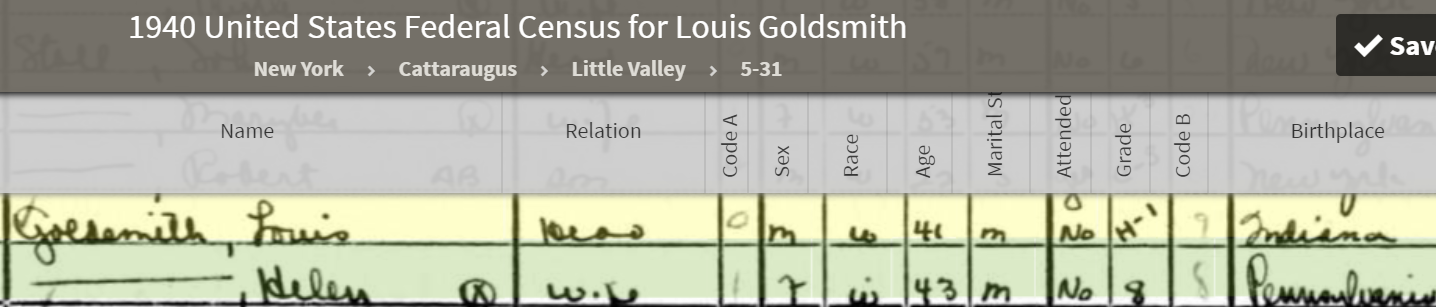
Louis and his wife Helen were living in Dubois for much of the 1930s, but by 1940 they had moved to Little Valley, New York, where Louis was a clerk for the B&O Railroad. As of 1940, they did not have any children.

Louis Goldsmith, 1940 US census, Census Place: Little Valley, Cattaraugus, New York; Roll: m-t0627-02505; Page: 12B; Enumeration District: 5-31
Ancestry.com. 1940 United States Federal Census

Harold and his wife Martha and their child were still living in Dayton in 1940, where Harold was working as a polisher for an electric motor company.1 They were still living in Dayton as late as 1944, but by 1946 they had relocated to Dubois, where Harold’s mother Ida was still living. Perhaps Harold moved back to help care for his mother after Louis moved to New York State. In 1948, he was working for the Vulcan Soot Blower Corporation, and in 1955 he was working as a janitor at the Dubois Deposit Bank at that time.2

By 1940 Blanchard Goldsmith had married a woman named Eleanor, and they were living in Atlantic City where Blanchard was working as a bartender. But I had a hard time finding a marriage record or birth name for Eleanor. There was also a family of three living with them as boarders and a niece, fifteen-year-old Evelyn Carson. The niece’s name was the one clue I had to learn more about Eleanor.

Blanchard Goldsmith, 1940 US Census, Census Place: Atlantic City, Atlantic, New Jersey; Roll: m-t0627-02300; Page: 7A; Enumeration District: 1-26
Ancestry.com. 1940 United States Federal Census

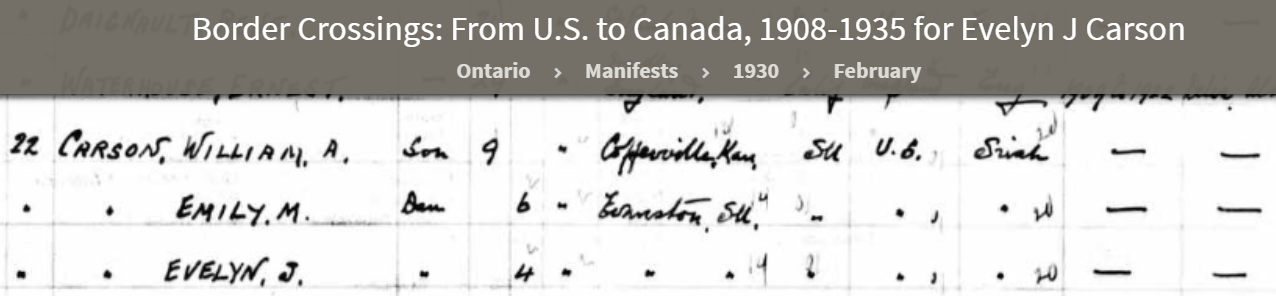
It took some digging, but I found an Evelyn Carson of the same age and birth state on a Border Crossing document traveling with two siblings, Emily and William Carson, with a father W. Carson living in Toronto.

Library and Archives Canada; 1908-1935 Border Entries; Roll: T-15368
Ancestry.com. Border Crossings: From U.S. to Canada, 1908-1935

That led me to search for Emily, William, and Evelyn Carson, and I found the two sisters living with a grandmother named Elizabeth Rourke in Philadelphia in 1940 (Evelyn seemed to be listed twice on the 1940 census).3 Searching backwards, I found that Elizabeth Rourke, born O’Neill, had married Michael Rourke, and they had several children, including an Eleanor and a Gertrude. Gertrude had married a William Carson.4 Putting it all together, I concluded that the Eleanor who married Blanchard Goldsmith must have been Eleanor Rourke, daughter of Elizabeth O’Neill and Michael Rourke. That was quite a long loop just to find a birth name for Blanchard’s first wife—especially since the marriage did not last very long.

In 1950, Blanchard was listed as a bartender in the Atlantic City directory with a different wife named Patricia.5 It also took some digging to find more about Patricia.  She was born Patricia Barry, daughter of Joseph Barry, a sheet metal contractor, and Irene Field. She was born on December 29, 1916, in Atlantic City. She had been previously married to John L. Roth, with whom she’d had one child.6 She and Blanchard would then have two children of their own.

As for Sylvester’s two surviving daughters, Estelle remained in Dubois and by 1936 was married to Harry Lindahl, a moulder for the Dubois Iron Works company, according to the Dubois directory for that year. In 1940 they were living in Dubois with their child, and Harry was still working at the foundry.7

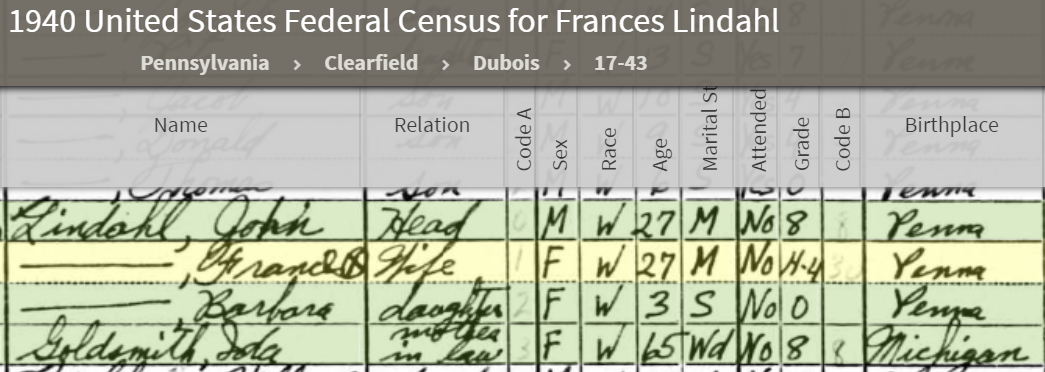
Sarah Frances, now using Frances, also remained in Dubois, where she married her sister Estelle’s brother-in-law, John Lindahl. John and his brother Harry were the sons of Charlie Lindahl, a Swedish immigrant, and Nettie Dinger, a Pennsylvania native.8 In 1940 John was working in a print shop, Frances was working as a stenographer in a wholesale tire store, and they had one child.  Frances’ mother Ida Simms Goldsmith was also living with them.

John Lindahl and family, 1940 US census, Census Place: Dubois, Clearfield, Pennsylvania; Roll: m-t0627-03470; Page: 2A; Enumeration District: 17-43
Ancestry.com. 1940 United States Federal Census

Ida died on December 24, 1960, in Punxsutawney, Pennsylvania, at the age of 86.9 And unlike her husband and so many of his siblings and nieces and nephews as well as their first child Helen, her other children all lived long lives. Louis died on December 5, 1987, at the age of 89.10 Estelle died in April 1990; she was 84. 11 Harold died on May 28, 1994, at age 93.12 Blanchard was 91 when he died December 4, 1994, six months after his brother Harold.13 And Frances, the youngest child of Sylvester Goldsmith, who was the youngest child of Levi Goldsmith, died on September 28, 2000, when she was 88.14

Thus, unlike so many of their extended family members, the five children of Sylvester Goldsmith and Ida Simms who lived to adulthood all made it past 80, and two of them made it into their 90s. They must have gotten their longevity from their mother’s DNA, not that of their father or grandfather.

Thus, I come to the end of the saga of my three-times great-uncle Levi Goldsmith and his family, one of the saddest chapters I’ve researched in a while. There were so many premature deaths that at times it seemed almost unbelievable. Why did Levi draw the short straw when his brothers Jacob, Abraham, and Meyer all seemed to find much good fortune (although each also had a fair amount of heartbreak)? I don’t know. It just shows that heartbreaking stories are not fairly distributed evenly among family members.  Some people just suffer more than their fair share.


  1. Harold Goldsmith, 1940 US census, Census Place: Dayton, Montgomery, Ohio; Roll: m-t0627-03253; Page: 17B; Enumeration District: 94-85. Ancestry.com. 1940 United States Federal Census 
  2. Dayton, Ohio, city directory, 1944, Dubois, Pennsylvania, city directory, 1946, 1948, 1955, Ancestry.com. U.S. City Directories, 1822-1995. 
  3. Evelyn Carson with Elizabeth Rourke, 1940 US census, Census Place: Philadelphia, Philadelphia, Pennsylvania; Roll: m-t0627-03736; Page: 3B; Enumeration District: 51-1599. Ancestry.com. 1940 United States Federal Census 
  4. Michael Rourke and family, 1910 US census, Census Place: Philadelphia Ward 26, Philadelphia, Pennsylvania; Roll: T624_1400; Page: 9A; Enumeration District: 0578; FHL microfilm: 1375413. Ancestry.com. 1910 United States Federal Census. William and Gertrude Carson, 1920 US census, Census Place: Philadelphia Ward 48, Philadelphia, Pennsylvania; Roll: T625_1648; Page: 11B; Enumeration District: 1814. Ancestry.com. 1920 United States Federal Census 
  5. Atlantic City city directory, 1950, Ancestry.com. U.S. City Directories, 1822-1995. 
  6. Patricia Roth, 1940 US census, Year: 1940; Census Place: Atlantic City, Atlantic, New Jersey; Roll: m-t0627-02300;Page: 6A; Enumeration District: 1-19. Ancestry.com. 1940 United States Federal Census 
  7. Harry Lindahl and family, 1940 US census, Census Place: Sandy, Clearfield, Pennsylvania; Roll: m-t0627-03471; Page: 3B; Enumeration District: 17-81. Ancestry.com. 1940 United States Federal Census 
  8. Charles Lindahl and family, 1920 US census, Census Place: Sandy, Clearfield, Pennsylvania; Roll: T625_1553; Page: 13A; Enumeration District: 106. Ancestry.com. 1920 United States Federal Census 
  9.  Pennsylvania Historic and Museum Commission; Pennsylvania, USA; Pennsylvania (State). Death certificates, 1906–1966; Certificate Number Range: 114001-116700. Ancestry.com. Pennsylvania, Death Certificates, 1906-1966. Certificate Number: 114311-60 
  10. Ancestry.com. U.S., Department of Veterans Affairs BIRLS Death File, 1850-2010 
  11. Number: 170-26-3884; Issue State: Pennsylvania; Issue Date: Before 1951. Ancestry.com. U.S., Social Security Death Index, 1935-2014  
  12.  Number: 288-07-3757; Issue State: Ohio; Issue Date: Before 1951. Ancestry.com. U.S., Social Security Death Index, 1935-2014  
  13. Ancestry.com. Florida Death Index, 1877-1998 
  14. Number: 200-05-3391; Issue State: Pennsylvania; Issue Date: Before 1951. Ancestry.com. U.S., Social Security Death Index, 1935-2014 

Looking Back and Looking Forward: A Story for the New Year

For Rosh Hashanah this year, I want to share a story about one of my cousins. His life is a true example of how we as human beings are capable not only of inconceivable evil but more importantly of boundless love and undying hope and gratitude.

When we talk about the Holocaust, the number six million is both overwhelming and numbing. Our minds can’t grasp what six million people looks like—what six million of anything would look like. Visiting the camps makes that number somewhat more comprehensible; when we visited Auschwitz in 2015 and saw the huge piles of eyeglasses, of shoes, of suitcases, each representing one of those six million killed, it made the scope of the horror more visceral. It gave us a concrete, visual way of imagining each of those killed. This video also helps to illustrate the immensity of that number:


But for me, it is the individual stories of those people who were killed that leave the biggest impact. If we read one story about one of the six million who were killed each day for our entire life, we still would hardly make a dent in the total numbers. Assuming we read a story a day for eighty years, we would still have read fewer than 30,000 stories—learned about only 30,000 of the six million who were killed. And that doesn’t even include the horrifying stories of many of the survivors—those who survived the camps, those who spent the years in hiding, those who escaped but who had lost their families and homes forever.

This is the story of a cousin whose life was forever changed because of the Nazis. He wishes to remain anonymous, so I will refer to him simply as J. J is my fifth cousin, another descendant of Jakob Falcke; his family left Oberlistingen, Germany at the end of the 19th century and moved to the Netherlands, where for many generations the men were butchers and cattle traders or worked in the textile and clothing business. J’s father was a butcher.

Their quiet lives were forever altered after the Nazis invaded the Netherlands in May, 1940. J’s father was taken to Mauthausen concentration camp, where he was killed in October, 1941. J, who was just a young boy, and his mother and younger sister were left behind. When it became clear that the Nazis were going to start deporting all the Jews in Holland to concentration camps, J’s mother placed her two children in an orphanage in Utrecht, believing that the Nazis would not deport children because they would be too young to work. J’s mother and her sisters went into hiding with a non-Jewish family.

Description: Jewish Memorial in Mauthausen Concentration Camp, Austria main courtyard. 
Source: https://commons.wikimedia.org/wiki/File:Mauthausen-Jewish_memorial.jpg
Photographer: Gianmaria Visconti
Year: 2002

But then in December, 1942, those living in the orphanage were moved from Utrecht to the ghetto in Amsterdam, and J’s mother realized that her children were in imminent danger. She tried to get her children released from the orphanage, but it was impossible. Instead, a cousin who was working at a hospital in Amsterdam somehow managed to kidnap the children and bring them to a safe place in Amsterdam where J and his sister could then be placed in hiding.

At that point J’s mother relinquished her spot in the home where she and her sisters had been hiding so that her son, my cousin J, would have a safe place to hide. His sister was hidden somewhere else. J’s mother moved to different hiding places, but she was eventually discovered by the Nazis in the fall of 1943. She was deported to Auschwitz where she was murdered in October 1943. As J expressed it to me, she had given everything so that her children would survive.

Deportation of Jews from Amsterdam
By Anonymous (National Archives) [Public domain], via Wikimedia Commons

J and his sister survived the war in their hiding places. After the war, his sister immigrated to Israel, where she still lives. J stayed in the Netherlands and continued to live with the brave couple who had kept first his mother and aunts safe and then kept him safe. He described them as being like grandparents to him. They made it possible for him to go to college, where he trained to become a veterinarian.

Despite the horrible losses he experienced as a young boy, J has led a remarkably productive and happy life. In addition to achieving professional success, he has been married since 1958 and has four children, ten grandchildren, and one great-grandchild.  He is another example of the resilience of human beings who, in the face of the darkest evil and the most heinous cruelty, somehow emerge into the light and are able to give and receive love and find the good and the beautiful in our world.

For me this is an appropriate story for Rosh Hashanah,  It reminds us that although we must always look back and remember, we also have to look forward with hope. We must be cognizant of all that is evil in the world, but we must embrace all that is good and beautiful.

May we all find the light of love and share all that is good and beautiful in the coming year.

L’shanah tova! A good year to you all, family and friends!

By Gilabrand (Own work) [CC BY-SA 3.0 (http://creativecommons.org/licenses/by-sa/3.0)%5D, via Wikimedia Commons

The Descendants of Levi Goldsmith, Part 2: The Families of Helen and Blanche

The three youngest children of my 3x-great-uncle Levi Goldsmith and his wife Henrietta—Helen, Blanche, and Sylvester— had all experienced plenty of tragedy in their lives—loss of siblings and children and/or a spouse and in Sylvester’s case, his own early death. By 1933 when their oldest sister Eva died, Helen and Blanche were the only siblings left from the nine babies born to Levi and Henrietta.

Helen Goldsmith Loeb had lost her husband Harry in 1925, but her three children Armand, Henriete, and Leonard were all still living. As we saw, as of 1930 her daughter Henriete was divorced from Leo Dessauer and was living with her mother and brother Leonard in Philadelphia along with her seven year old son. Armand was married to Rose Kahn and had two children by 1930 and was working as merchant, presumably in the Loeb Warehouse with his brother Leonard. Later in 1930 Leonard had married Florence Mayer.

Helen and her children were all still living in Philadelphia in 1940. Helen was living with her son Leonard and his family (he and Florence had two children by then) in Philadelphia, and Leonard was working as a brewery machinery salesman.1 According to his World War II draft registration, he was self-employed.

Leonard Loeb World War II draft registration, The National Archives in St. Louis, Missouri; St. Louis, Missouri; Record Group: Records of the Selective Service System, 147; Box: 1495
Ancestry.com. U.S. WWII Draft Cards Young Men, 1940-1947

His older brother Armand was also living in Philadelphia with his wife and two children in 1940, and he listed his occupation as the owner of a machinery company.2 His World War II draft registration also states that he was self-employed and at the same address as his brother Leonard, presumably the Loeb Warehouse Company.

Armand Loeb, World War II draft registration, The National Archives at St. Louis; St. Louis, Missouri; World War II draft cards (Fourth Registration) for the State of Pennsylvania; Record Group Title: Records of the Selective Service System, 1926-1975; Record Group Number: 147; Series Number: M1951
Source Information
Ancestry.com. U.S., World War II Draft Registration Cards, 1942

Henriete had remarried by 1935 and moved to Florida with her second husband, Ralph Palmer Brown. Ralph was born in Pennsylvania on November 3, 1892, to Alonzo and Ada Kate Brown; his father was a druggist.3 In 1930 Ralph had been living in Philadelphia with his sister and brother-in-law and working as a sewer inspector.4 By 1935 he and Henriete were married and living in Daytona Beach, Florida. In 1940 Ralph, Henriete, and Henriete’s son Leo Dessauer were living in Daytona Beach, and Ralph was a gas station operator (his own business).

Ralph Brown and family, 1940 US census, Census Place: Daytona Beach, Volusia, Florida; Roll: m-t0627-00620; Page: 42A; Enumeration District: 64-28
Ancestry.com. 1940 United States Federal Census

Blanche Goldsmith Greenbaum, the youngest surviving sibling, had been living in 1930 with her husband Max and their only surviving child of four children, their daughter Helen. Then she suffered another loss—Max died in September 1937.  Unfortunately I have no official source for Max’s death, just a burial record at Mt Sinai cemetery, a FindAGrave entry, and biography at prabook.com. And although Max appears to have been a successful dentist, I could not find an obituary for him either. He was 69 years old when he died. He must not have died in Pennsylvania, or I assume I would have been able to find a death certificate for him.5

As for Blanche’s daughter Helen, she also proved to be an elusive person to track down. The Philadelphia, Pennsylvania Marriage Index on Ancestry listed a marriage to Jay J Feinstein in 1942.6 According to his US Army enlistment records, Jay was born in Russia in 1900, was an insurance salesman, and had enlisted in the army in August 1942, so either soon after or soon before he married Helen.7 I could find no other record showing Helen and Jay together, nor could I find for a long time any record of what had happened to either of them.

Then I found Jay’s veteran’s compensation application dated February 10, 1950, with Jay listed with a different surname—Jay J Mandell—but mentioning that he had served as Jay J Feinstein.  That record also reported that Jay had been married to Helen G. Mandell, whom he had divorced in January 1945, so obviously Helen and Jay’s marriage had not lasted. But I could find nothing more about Helen as either Helen Greenbaum, Helen Feinstein, or Helen Mandell. But I did find one more clue.

Jay Feinstein Mandell, Veteran Compensation file, Box Title: Fegeley, Joseph Smith Jr – Felker, Carl A (Box 242). 
Ancestry.com. Pennsylvania, Veteran Compensation Application Files, WWII, 1950-1966 [database on-line]. Provo, UT, USA: Ancestry.com Operations, Inc., 2015.
Original data: Pennsylvania (State). World War II Veterans Compensation Applications, circa 1950s. Records of the Department of Military and Veterans Affairs, Record Group 19, Series 19.92 (877 cartons). Pennsylvania Historical and Museum Commission, Harrisburg, Pennsylvania.

My next clue as to Helen’s whereabouts came when her mother Blanche died on June 19, 1950, from a cerebral hemorrhage at age 82:

Blanche Goldsmith death certificate, Pennsylvania Historic and Museum Commission; Pennsylvania, USA; Pennsylvania (State). Death certificates, 1906–1966; Certificate Number Range: 054451-056880. Ancestry.com. Pennsylvania, Death Certificates, 1906-1966

Her death notice named her as the “wife of the late Dr. Max Greenbaum and the devoted mother of Helen Bank.”[^8] And Helen Bank was the informant on the death certificate. So I knew that Helen must have married again after divorcing Jay in 1945. Although I could not find one record or newspaper article revealing the first name of her second husband, I was able to find an entry in the Social Security Death Index for a Helen Bank with the same birth date and from Pennsylvania.8 Assuming it is Helen Estella Greenbaum with that Social Security number, she died in December 1984 at age 77. As far as I can tell, Helen had not had children with either of her two husbands.

After Blanche died on June 19, 1950, Helen Goldsmith Loeb was the only child of Levi and Henrietta Goldsmith still living. But she did not outlive her younger sister for very long. Helen died less then seven months later on January 3, 1951; she was 85 years old, which made her the sibling with the greatest longevity. She was survived by her three children: Armand, who died in October 1967,9 Henriete, who died in 1978,10 and Leonard, who died in 1964.11 She also was survived by three grandchildren.

Helen Goldsmith Loeb death certificate, Pennsylvania Historic and Museum Commission; Pennsylvania, USA; Pennsylvania (State). Death certificates, 1906–1966; Certificate Number Range: 006151-008700
Ancestry.com. Pennsylvania, Death Certificates, 1906-1966

Interestingly, Sylvester Goldsmith, who had died so young back in 1914, had five children who were blessed with a longevity that he was denied and that was denied to so many of the descendants of Levi and Henrietta Goldsmith. In my last post about the family of Levi and Henrietta, I will write about his descendants.


  1. Helen Goldsmith Loeb and family, 1940 US census, Census Place: Philadelphia, Philadelphia, Pennsylvania; Roll: m-t0627-03749; Page: 13B; Enumeration District: 51-2006. Ancestry.com. 1940 United States Federal Census 
  2. Armand Loeb and family, 1940 US census, Census Place: Philadelphia, Philadelphia, Pennsylvania; Roll: m-t0627-03749; Page: 3B; Enumeration District: 51-2007. Ancestry.com. 1940 United States Federal Census. 
  3. Alonzo Brown and family, 1900 US census, Census Place: Belle Vernon, Fayette, Pennsylvania; Page: 5; Enumeration District: 0001; FHL microfilm: 1241409. Ancestry.com. 1900 United States Federal Census. Registration State: Pennsylvania; Registration County: Philadelphia; Roll: 1907956; Draft Board: 48. Ancestry.com. U.S., World War I Draft Registration Cards, 1917-1918. 
  4. Ralph Brown, 1930 US census, Census Place: Philadelphia, Philadelphia, Pennsylvania; Page: 11B; Enumeration District: 0444; FHL microfilm: 2341854. Ancestry.com. 1930 United States Federal Census 
  5. Historical Society of Pennsylvania; Philadelphia, Pennsylvania; Historic Pennsylvania Church and Town Records, Ancestry.com. Pennsylvania and New Jersey, Church and Town Records, 1669-2013. Gale Research Company; Detroit, Michigan; Accession Number: 1795533. Ancestry.com. Biography & Genealogy Master Index (BGMI). https://prabook.com/web/max.greenbaum/1064849 
  6. Ancestry.com. Philadelphia, Pennsylvania, Marriage Index, 1885-1951. “Pennsylvania, Philadelphia Marriage Index, 1885–1951.” Index. FamilySearch, Salt Lake City, Utah, 2009. Philadelphia County Pennsylvania Clerk of the Orphans’ Court. “Pennsylvania, Philadelphia marriage license index, 1885-1951.” Clerk of the Orphans’ Court, Philadelphia, Pennsylvania. 
  7. Ancestry.com. U.S., World War II Army Enlistment Records, 1938-1946.Original data: National Archives and Records Administration. Electronic Army Serial Number Merged File, 1938-1946 [Archival Database]; ARC: 1263923. World War II Army Enlistment Records; Records of the National Archives and Records Administration, Record Group 64; National Archives at College Park. College Park, Maryland, U.S.A. 
  8. The Philadelphia Inquirer, June 20, 1950, p. 32. 
  9. Number: 163-28-4324; Issue State: Pennsylvania; Issue Date: 1951-1952. Ancestry.com. U.S., Social Security Death Index, 1935-2014 
  10. Ancestry.com. Florida Death Index, 1877-1998 
  11.  Number: 181-24-0802; Issue State: Pennsylvania; Issue Date: Before 1951. Ancestry.com. U.S., Social Security Death Index, 1935-2014  

The Fate of Levi Goldsmith’s Descendants, Part I: More Early Deaths

The 1930s did not start well for the family of Eva Goldsmith Anathan. Her son-in-law Sim Simon, husband of her daughter Bessie, died on February 1, 1932. Sadly, he had taken his own life. The Philadelphia Inquirer reported that Sim had been in poor health after an operation.1

Then just fourteen months later Eva Goldsmith Anathan, the oldest child of Levi and Henrietta Goldsmith, died on April 27, 1933, in Philadelphia, where she had lived her entire life.  She was 77 years old and had outlived six of her eight younger siblings as well as her ex-husband Nathan Anathan and two of their four children. She died from hypertension and chronic myocarditis. She was survived by two daughters, Helen and Bessie, and her remaining two younger siblings, Helen and Blanche.

Pennsylvania Historic and Museum Commission; Pennsylvania, USA; Pennsylvania (State). Death certificates, 1906–1966; Certificate Number Range: 029001-032000
Ancestry.com. Pennsylvania, Death Certificates, 1906-1966

But the heartbreak did not end there. Five years later Eva’s daughter Bessie Anathan Simon died at age 55 from an acute coronary occlusion.

Pennsylvania Historic and Museum Commission; Pennsylvania, USA; Pennsylvania (State). Death certificates, 1906–1966; Certificate Number Range: 076001-079000
Ancestry.com. Pennsylvania, Death Certificates, 1906-1966

Bessie was survived by her children and by her sister Helen. Her children had lost both their parents and their grandmother within six years. Her sister Helen continued to live in Philadelphia and work as a probation officer as of 1940.2 She somehow beat the odds in her family and lived to age 90, dying on November 15, 1969 in Miami, Florida.3

Unfortunately the family of Estella Goldsmith Rothschild also faced more tragedy in the 1930s, as seen in my earlier post when Estella’s son Herbert lost his wife Nancy to cancer at age 29 in 1931. Herbert moved to New York City in the 1930s, where in 1940 he was working as a paint salesman.4 His son Herbert, Jr., was also living in New York City in 1940, but with his maternal grandmother, Fanny Erber.5 He was only ten years old and had lost his mother before his second birthday. His father was living about eighty blocks away in Manhattan. I assume that Herbert Sr. was not able to care for his young son alone so moved to New York so that his mother-in-law could take care of Herbert, Jr.

Herbert remarried shortly after the enumeration of the 1940 census. According to the New York, New York, Marriage License Index on Ancestry, Herbert Rothschild and Lena M. Beasley applied for a marriage license on August 8, 1940.6 Lena was born in about 1907 in Mississippi to John and Ona Beasley.7  In 1930 she was living as a roomer in New York City working as a private nurse, so she and Herbert must have met in New York.8 Sadly, Herbert died at age 61 in 1955 just fifteen years after they married. He was survived by Lena and his son as well as his brother Jerome.9

Herbert’s older brother Jerome and his wife Carrie and daughter Estella continued to live in Philadelphia, and in 1940 Jerome was still practicing law.10 Jerome continued to live in Philadelphia for the rest of his life. He died from a heart attack at age 80 on July 20, 1964, in Elkins Park, Pennsylvania, a Philadelphia suburb. His obituary reported that he was one of the founders of his law firm, Fox, Rothschild, O’Brien, & Frankel, and that he was active in many civic and Jewish organizations. He had served as the first president of the Philadelphia Jewish Community Relations Council, was on the board of the Philadelphia chapter of the American Jewish Committee, and a past president of the National Conference of Christians and Jews, among many other activities.11 His wife Carrie died six years later on December 19, 1970, at age 86. 12They were survived by their daughter Estelle and their grandchildren.

Pennsylvania Historic and Museum Commission; Pennsylvania, USA; Pennsylvania (State). Death certificates, 1906–1966; Box Number: 2396; Certificate Number Range: 065951-068800
Ancestry.com. Pennsylvania, Death Certificates, 1906-1966

The family of Felix Goldsmith had dispersed in the 1930s, as we saw in my prior post. His daughter Frances was living in New York City, Hortense was living in Indianapolis, and Minna and her family were living in Cleveland, Ohio. Their brother Lee had died in 1929, and their mother died in 1935.

Hortense married in Cleveland on November 11, 1937 for the first time at age 40.13 Her husband Samuel L. Havre was 49; he was born in Cleveland, Ohio on November 8, 1887, the son of Hungarian immigrants, Anton and Yetta Havre.14 His father owned a department store in Cleveland, where Samuel was a salesman. In 1930 he was living with his parents and siblings and working as a manager at the family department store.15 I assume that Minna, who was living in Cleveland, somehow set up her older sister and Samuel Havre.

In 1940 Samuel and Hortense were living in Cleveland in their own household, and Samuel was now the treasurer of the department store.16 But sadly their life together did not last long as Hortense died on April 10, 1947, from a subarachnoid hemorrhage, “bleeding within the subarachnoid space, which is the area between the brain and the tissues that cover the brain.”  Hortense was only 49 years old and had been married for less than ten years at her death. She was survived by her husband Samuel and by her two sisters, Frances and Minna.

Ohio Deaths, 1908-1953,” database with images, FamilySearch (https://familysearch.org/ark:/61903/3:1:S3HT-69H7-YHQ?cc=1307272&wc=MD9X-4P8%3A287602401%2C294184701 : 21 May 2014), 1947 > 22301-25400 > image 512 of 3534.

Minna was living in 1940 with her husband Edwin Goodman in Cleveland and their two daughters, and Edwin was the owner of a lamp manufacturing company.17 But Minna’s marriage was also cut short by a death.  Her husband Edwin died on September 24, 1940, in Cleveland at the age of 44;18 their children were 13 and 9 when he died.  Like their mother, whose father Felix died when she was a toddler, Minna’s children lost their father far too young.

In April 1943 Minna remarried, this time marrying Samuel W. Kern, who was born Samuel Kohn. He had been married before and was divorced when he married Minna. Samuel was an electrical engineer.19 Minna and Samuel remained married for the rest of their lives; Minna died March 10, 1970 when she was 69, and Samuel died the following year in April 1971 at age 74.20

Unfortunately, I have not been able to find out what happened to Felix Goldsmith’s oldest daughter, Frances Lee Goldsmith.  The last record I have for her was the 1930 census, and the last mention I’ve found is in her sister’s Hortense’s obituary in 1947, where she was named as a survivor. She is not mentioned as a survivor in Minna’s obituary or death notice in 1970, so I assume that Frances died sometime between the deaths of her two sisters. But I cannot find a death record, obituary, or any other references between those dates.

Once again, the descendants of Levi Goldsmith seemed cursed with a large number of early deaths. The final two chapters of this sad saga will cover the remaining descendants: the families of Helen, Blanche, and Sylvester Goldsmith.


  1. Certificate Number Range: 010501-013500
    Ancestry.com. Pennsylvania, Death Certificates, 1906-1966.
    Original data: Pennsylvania (State). Death certificates, 1906–1963. Series 11.90 (1,905 cartons). Records of the Pennsylvania Department of Health, Record Group 11. Pennsylvania Historical and Museum Commission, Harrisburg, Pennsylvania. “Man Slashes Throat,” The Philadelphia Inquirer, January 25, 1932, p. 22. 
  2. Helen Anathan, 1940 US census, Census Place: Philadelphia, Philadelphia, Pennsylvania; Roll: m-t0627-03732; Page: 12A; Enumeration District: 51-1426. Ancestry.com. 1940 United States Federal Census 
  3.  Number: 187-36-8712; Issue State: Pennsylvania; Issue Date: 1962. Ancestry.com. U.S., Social Security Death Index, 1935-2014. Original data: Social Security Administration. Social Security Death Index, Master File. Social Security Administration. 
  4. Herbert Rothschild, Sr., 1940 US census, Census Place: New York, New York, New York; Roll: m-t0627-02642; Page: 7A; Enumeration District: 31-768. Ancestry.com. 1940 United States Federal Census  
  5. Herbert Rothschild, Jr., 1940 US census, Census Place: New York, New York, New York; Roll: m-t0627-02677; Page: 13B; Enumeration District: 31-2131. Ancestry.com. 1940 United States Federal Census 
  6.  New York City Municipal Archives; New York, New York; Volume Number: 5. Ancestry.com. New York, New York, Marriage License Indexes, 1907-1995 
  7. John Beasley, 1910 US census, Census Place: Beat 2, Copiah, Mississippi; Roll: T624_737; Page: 8A; Enumeration District: 0047; FHL microfilm: 1374750. Ancestry.com. 1910 United States Federal Census 
  8. Lena Beasley, 1930 US census, Census Place: Manhattan, New York, New York; Page: 3B; Enumeration District: 0912; FHL microfilm: 2341308. Ancestry.com. 1930 United States Federal Census 
  9. Ancestry.com. U.S., Social Security Applications and Claims Index, 1936-2007. SSN: 109127243 
  10. Jerome Rothschild, 1940 US census,  Census Place: Philadelphia, Philadelphia, Pennsylvania; Roll: m-t0627-03754; Page: 1A; Enumeration District: 51-2166. Ancestry.com. 1940 United States Federal Census  
  11. Note that the death certificate was signed by Sidney Goldsmith, MD; he was the grandson of Jacob Goldsmith, Levi’s brother, so he was Jerome’s second cousin. “J.J. Rothschild Dies, Law Firm’s Founder,” The Philadelphia Inquirer, July 21, 1964, p. 30. 
  12. The Philadelphia Inquirer, December 20, 1970, p. 46. 
  13. The Indianapolis News, November 2, 1937, p. 10. “Havre-Goldsmith,” The Virginian Pilot, November 16, 1937, p. 5. 
  14. Series II: Questionnaires: Jews; Record Group Description: (A) General Files, Army and Navy (Boxes 2-4); Box #: 3; Folder #: 9; Box Info: (Box 3) Cleveland: Privates, H-P. Ancestry.com. U.S., WWI Jewish Servicemen Questionnaires, 1918-1921. Ancestry.com. Ohio, Births and Christenings Index, 1774-1973. Original data: “Ohio Births and Christenings, 1821-1962.” Index. FamilySearch, Salt Lake City, Utah, 2009, 2011 
  15. Havre family, 1930 US census, Census Place: Cleveland Heights, Cuyahoga, Ohio; Page: 3A; Enumeration District: 0570; FHL microfilm: 2341518. Ancestry.com. 1930 United States Federal Census 
  16. Samuel and Hortense Havre, 1940 US census, Census Place: Cleveland, Cuyahoga, Ohio; Roll: m-t0627-03222; Page: 11B; Enumeration District: 92-475.  Ancestry.com. 1940 United States Federal Census 
  17. Edwin Goodman and family, 1940 US census, Census Place: Shaker Heights, Cuyahoga, Ohio; Roll: m-t0627-03058; Page: 64A; Enumeration District: 18-280.
    Ancestry.com. 1940 United States Federal Census. 
  18. Ancestry.com. U.S., Social Security Applications and Claims Index, 1936-2007. SSN: 270107526. 
  19.  Cuyahoga County Archive; Cleveland, Ohio; Cuyahoga County, Ohio, Marriage Records, 1810-1973; Volume: 226; Page: 418; Year Range: 1943-1945. Ancestry.com. Cuyahoga County, Ohio, Marriage Records and Indexes, 1810-1973. Ancestry.com. Ohio, County Marriage Records, 1774-1993. 
  20.  Certificate: 016802; Volume: 19998, Certificate: 025315; Volume: 20434; Ancestry.com and Ohio Department of Health. Ohio, Death Records, 1908-1932, 1938-2007. Ancestry.com. U.S., 

Tracy E. Carnes June 30, 1954-August 26, 2018

I am very sad to report that Tracy Carnes, my fourth cousin, once removed, passed away on August 26, 2018. Tracy had been battling cancer for a number of years and was only 64 when she died. She was survived by her partner Rita Goodman and her sisters Rebecca Alden and Virginia Voges.

Tracy had connected with me almost three years ago when she left a comment on my blog saying that she believed we were related through her grandmother, who was born Celia Nusbaum, but known to Tracy and her family as Sally Carnes. Celia’s story had been a challenge for me as she and her husband Inglis Cameron and their son Edward James Cameron had seemingly vanished in the 1920s. Together Tracy and I combined our information, and through further research we learned much more about her grandparents and father, though some questions were left unanswered. We concluded that the family had probably changed their identity and gone into hiding after cooperating with the government in the prosecution of a securities fraud case in Philadelphia. The story of Celia Nusbaum and her family can be found here and here, titled “The Mystery of the Philadelphia Lawyer.”

Over the last few years I had kept up with Tracy through occasional emails and through her page on the CaringBridge website, where she wrote about her medical treatments and about her courageous and determined fight against cancer. Although not raised Jewish, she had returned to Judaism and found much comfort in her faith and in her life with Rita and their pets. My heart goes out to Rita, Beckie, and Ginger, and to all of Tracy’s loved ones.

May her memory be for a blessing.