New Year’s Eve 1919-1920 in Frankfurt, Germany

Two weeks ago I said I was taking a break, trying to figure out where to go next with my research and clearing my head. Well, my head is still not clear, and I still am on the fence about what to do next.

But while I was taking that breather, I heard from multiple new cousins as well as new communications from cousins I’d already found. New photos, new stories, new people. These include new DNA matches on my Brotman line, new photos for my Schoenthal line, new photos for my Seligmann line, a new connection from a Seligmann cousin who also appears to be a Goldschmidt cousin, a new Katzenstein cousin, a set of documents sent by a man living in Oberlistingen about the Goldschmidts, and numerous other questions, comments, or requests coming from my blog, Facebook, or email.  I will blog about many of these once I get my arms wrapped around the details.

All of this has given me a shot in the arm (and yes, I now am fully vaccinated against COVID as well) that I sorely needed. It’s so hard to transition from one research project to another, especially after three years. So these smaller, more focused projects are what I need right now. Especially since I also want to spend some time promoting my new book, Santa Fe Love Song.

Today I want to share an amazing photograph that my cousin Greg Rapp sent me. He cannot identify anyone in the photograph, but Greg is a Goldschmidt cousin (a descendant of Jacob Meier Goldschmidt), and the photo was labeled “New Year’s Eve 1919-1920.” Whether or not we can ever identify anyone in the photograph, it is nevertheless worth sharing. It captures German society during the Weimar Republic. The young women smoking cigarettes evoke that era as does the energy, the expressions, and the postures of all the young people in the picture.

If anyone can identify anyone in this photograph, please let me know.

Santa Fe Love Song: A Family History Novel

I am delighted to announce that my newest novel, Santa Fe Love Song, has been published and is available in both paperback and e-book format on Amazon here. Like my first novel, Pacific Street, Santa Fe Love Song was inspired by the lives of real people—in this case, my great-great-grandparents Bernard Seligman and Frances Nusbaum—and informed by my family history research. But as with my first book, Santa Fe Love Song is first and foremost a work of fiction.

Bernard Seligman, my great-great-grandfather

Frances Nusbaum Seligman, my great-great-grandmother

It is a double love story—a story of Bernard’s passion for his newly adopted home in New Mexico and of his deep love for a young woman in Philadelphia. How will he resolve the conflict between those two loves? That is the heart of the novel.

But this is also an adventure story because the first part of the book tells of Bernard’s arrival from Gau-Algesheim, Germany, his adjustment to life in Philadelphia, and then his challenging and exciting trip on the Santa Fe Trail when he moves out west to work with his brother Sigmund. On that trip Bernard faces many different obstacles and learns to love the American landscape. He transforms from a German Jewish immigrant into an American pioneer and businessman.

Upper left, Bernard Seligman with other merchants and Indians on the Santa Fe Trail

As with Pacific Street, I wrote Santa Fe Love Song with my children and grandchildren in mind. This time I also decided to get my grandsons involved in the project. Nate, 10, and Remy, 6, became my illustrators. As I told them stories about Bernard and Frances, they created drawings that told those stories visually. I am ever so grateful to my two wonderful grandsons for their work, and I hope that someday their grandchildren will cherish these books and the illustrations and honor the memories of their ancestors Bernard and Frances.

I hope that you also will find Santa Fe Love Song a worthwhile and enjoyable read. If you do, please leave a review on Amazon. Thank you! I appreciate all your support.

My Goldschmidt Family Project: Looking Back and Looking Forward

With this post, I come to the end of my Goldschmidt research—at least until I get new updates or make new discoveries. I’ve done my best to find whatever records, stories, and photographs exist for Jacob Falcke Goldschmidt and Eva Reuben Seligmann, my four-times great-grandparents, and their descendants.1

I started blogging about my Goldschmidt relatives a little over three years ago on January 12, 2018, making it the longest of any of my family research projects.  And it’s been such a rich and rewarding journey. I’ve connected with Goldschmidt/Goldsmith cousins in France, England, and all over the United States. Some of those cousins have roots in the US that are as deep as mine—going back to the 1840s when Simon Goldschmidt/Goldsmith arrived or the 1850s when my great-great-grandmother Eva Goldschmidt Katzenstein arrived; some are the children of those who were born and raised in Frankfurt, Germany, and were forced to leave their comfortable and successful lives to escape from the Nazis as recently as the 1930s or 1940s.

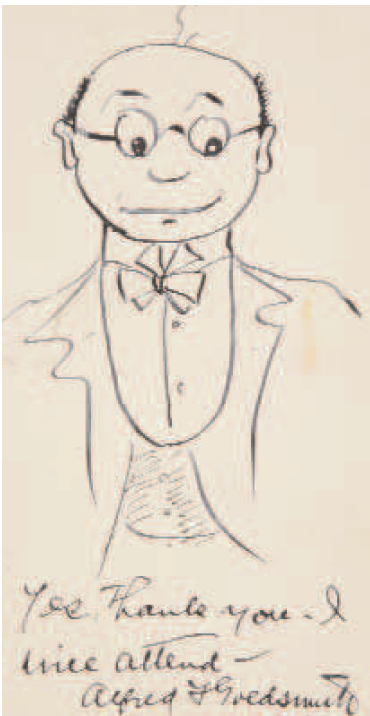
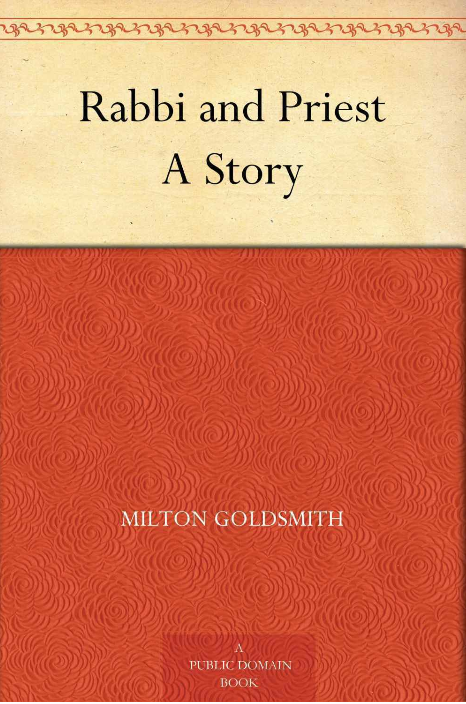
One thread that runs through so much of the Goldschmidt family is an interest in the arts and literature—whether in writing, as with Milton Goldsmith and Anna Seghers, or an interest in antiquarian books, as with Alfred Goldsmith and Emil Offenbacher, or in music like Florence Goldsmith, or  in creating art like William Sigmund and Martha Loewenthal Wolff, or by working as an art historian and curator like Yvonne Hackenbroch, and, of course, then there are the many, many Goldschmidt family members involved in collecting and dealing in art—from the Goldschmidt brothers Jacob Meier and Selig to Julius Falk Goldschmidt to the Freres Tedesco family and so on.

Alfred Goldsmith self-portrait, Joseph J. Felcone, The Old Book Table. A Record of its First Seventy-Five Years, 1931–2005 (New York: The Old Book Table, 2006), p. 5.

Painting by Martha Loewenthal Wolff

Of course, there were also many merchants, entrepreneurs, doctors, lawyers, engineers, and scientists in the Goldschmidt clan. But when I think of my father’s artistic ability and his passion for art, architecture, music, and literature, I attribute it to his Goldschmidt DNA. His mother was artistic, and she was the granddaughter of Eva Goldschmidt. My great-uncle Harold Schoenthal, also a grandchild of Eva Goldschmidt, was also an artist and an architect. My daughter is also very artistic, though she did not pursue it as a career. When I see my grandsons drawing, I think, “It must be their Goldschmidt DNA.” I may not be artistic, but I’d like to think that my love of reading and writing comes from that Goldschmidt DNA as well.

The Seventh Cross by Anna Seghers

The Rabbi and The Priest by Milton Goldsmith

After three years of research, it’s hard to boil down in one post all that I have learned. That research has exposed me to so much of American Jewish history and German Jewish history—from the late eighteenth century right up to 2020. The Goldschmidts kept my brain busy during this pandemic time, and they provided me with some truly memorable Zoom calls with cousins.

It has been an amazing experience. I am indebted to so many of my Goldschmidt cousins that I fear if I make a list, I will leave someone out. But thank you to all of you who shared your family’s photographs, letters, memoirs, documents, and stories. I hope that I’ve served our extended family well by recording the stories of their lives for posterity. And please stay in touch! I want to meet as many of you as I can in person someday soon.

Jean-Baptiste-Camille Corot, Madame Stumpf and Her Daughter, 1872. Courtesy of the National Gallery.
Once owned by the Freres Tedesco Gallery, Paris

A work from the Guelph Treasure
Reliquary of the arm of Saint Blaise (Herzog Anton Ulrich Museum, Dankwarderode Castle). User:Brunswyk, CC BY-SA 3.0 , via Wikimedia Commons. Once owned by J&S Goldschmidt

It’s bittersweet to reach this point and know it’s time to move on to the next project. But I’ve gone as far as I can go in the Goldschmidt research—at least for now.  I need to decide what to do next. I’ve been dipping my toes in several ponds to see which one grabs my attention.

Before I reveal where I am going next, however, I need to take a break for a bit to catch my breath and to catch up on the research it will take to start that new project, whatever it may be. But first, I will introduce my new novel. So stay tuned!


  1. I would be remiss in my duties as a family historian if I didn’t mention that in addition to their four sons Meyer, Seligmann, Lehmann, and Simon, whom I’ve studied in depth, my four-times great-grandparents Jacob Falcke Goldschmidt and Eva Seligmann had a daughter Jette Goldschmidt. She married David Gruenwald of Poembsen, Germany, and they had two children. One died as an infant or was stillborn, but the other, Jacob Gruenwald, was born in 1820, lived to adulthood, married Sarah Nethe, and had fourteen children born between 1847 and 1872. All of this information, however, is based purely on a secondary source, a report in the Alex Bernstein Collection at the Leo Baeck Institute. I’ve tried to locate more information about Jette’s descendants, but so far have not succeeded. If the day comes when I can, I will add Jette’s family to the blog. 

Philipp v Germany: An Update

The Supreme Court issued its opinion in the Guelph Treasure case this week, and unfortunately it was not good news for my cousin Alan Philipp and the other plaintiffs. As I wrote about here, the plaintiffs, heirs to the Consortium of art collectors who once owned the Guelph Treasure, alleged that Germany and its agency, the SPK, had expropriated their property in violation of international law when the Nazis fraudulently and illegally coerced the Consortium into selling the Guelph Treasure to them at a third of its value in June 1935. After unsuccessfully seeking reparations from Germany, the plaintiffs brought their claims in the US federal courts for wrongful expropriation of their property in violation of international law.

The defendants asserted immunity from suit in the US under the Foreign Sovereignty Immunity Act (“FSIA”), claiming that Germany and its agents could not be sued in US courts. The plaintiffs asserted in response that their claims fell within the expropriation exception of the FSIA, which allows claims against foreign nations based on property taken in violation of international law, as I explained here. The plaintiffs argued that the forced sale of the Guelph Treasure to the Nazis had violated international law because it was coerced and consummated as part of the Nazi persecution of Jews during the Holocaust.

The District Court and the Court of Appeals agreed with the plaintiffs that the expropriation exception applied and that the case could be heard in the US federal courts, but the Supreme Court has now reversed those decisions and remanded the case back to the District Court. The Supreme Court held in a unanimous decision that the plaintiffs’ claims did not fit into the expropriation exception of the FSIA if they were claims by German nationals against Germany. They read the “in violation of international law” language in the exception narrowly to refer only to the international law of property, not to international law respecting human rights. Then they addressed the “domestic takings” principle of international property law, which precludes US courts from adjudicating claims by a country’s nationals against that country. The court concluded that the domestic takings rule would apply here and deprive the plaintiffs of their right to have their claims against Germany heard in US courts if the members of the Consortium were nationals of Germany.

The plaintiffs are, however, left with one possible argument to allow the case to go forward in the US courts: that the members of the Consortium were no longer German “nationals” in June 1935 because Nazi persecution of the Jews in Germany destroyed their standing as German nationals, and thus their claim is not a claim by a German national against Germany and thus not precluded under the domestic takings rule. The Supreme Court remanded the case back to the District Court for consideration of that issue.1

The decision is obviously disappointing for the plaintiffs and for other descendants of German Jews who might seek relief in American courts for property stolen by the Nazis. The court’s opinion focuses primarily on the statutory language and legislative history. But the court also made it clear that it was concerned about the policy implications of allowing such claims in the US—in particular, the possibility that a foreign court could likewise adjudicate claims by American nationals against the US for violations of their human rights.

What the court failed to address are the policy implications of its decision. Their ruling means that those descended from Jews who lived in Germany during the Nazi era are deprived of the right to bring property claims in US courts against the country that persecuted them because they were nationals of Germany. The argument on remand should establish that by persecuting, dehumanizing, torturing and killing its Jewish residents because they were considered subhuman and dangerous, Germany forfeited the right to claim that those same Jewish residents were German nationals and thus should be subject to suit in the US under the expropriation exception of the Foreign Sovereign Immunities Act.

You can read the Supreme Court decision here: Philipp v Germany SCOTUS opinion

Photo by Mr. Kjetil Ree., CC BY-SA 3.0 <https://creativecommons.org/licenses/by-sa/3.0&gt;, via Wikimedia Commons


  1. The defendants claimed that the plaintiffs had waived that argument in the lower courts and thus could not revive it now; the Supreme Court said that was also to be determined by the District Court. 

Two Cousins Whose Lives Tell the Overall Story of the Goldschmidts

As I draw to the close of my Goldschmidt family history project, it seemed quite appropriate that I recently received photographs of two members of that family who  exemplify two very different stories of this family’s history, my cousins Herman Goldsmith and Hannah Goldsmith. Hannah was born in America in 1848 and lived until 1939, and Herman was born in Germany in 1912 and lived until 2016.

First I received this photograph of Herman Goldsmith and my cousin Susan and her husband Richard. Susan said it was taken in June 2013 when Herman was 100 years old. He would turn 101 on December 6, 2013, and live until October 27, 2016, just a little over a month before he would have turned 104.

Richard and Susan (Vogel) Neulist and Herman Goldsmith, June 2013. Courtesy of Susan Neulist

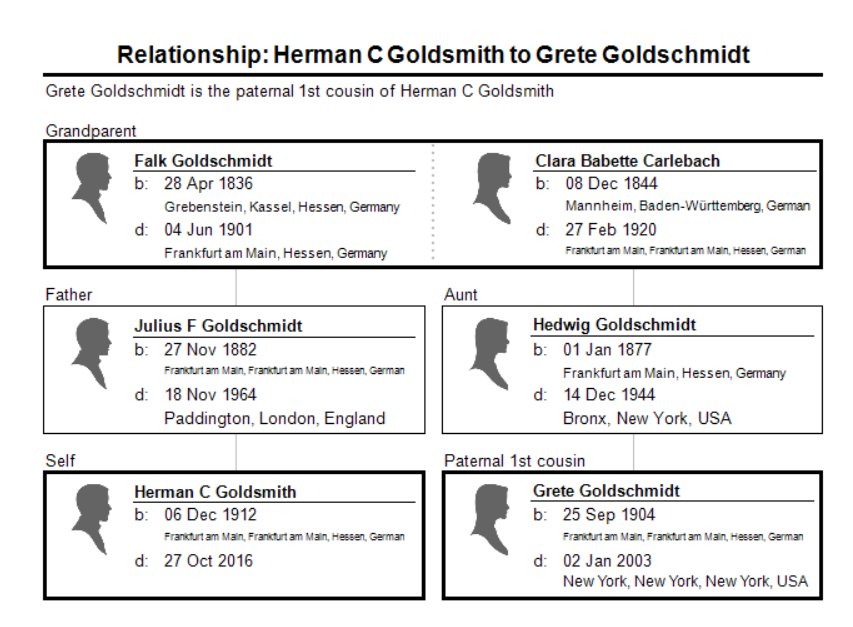
I wrote about Herman here. He was the son of Julius Falk Goldschmidt and Helene “Leni” Goldschmidt. Julius Falk Goldschmidt was the son of Falk Goldschmidt, and Leni Goldschmidt was the granddaughter of Jacob Meier Goldschmidt. Since Falk and Jacob Meier were brothers, Julius and Leni were first cousins, once removed, making Herman his own cousin.
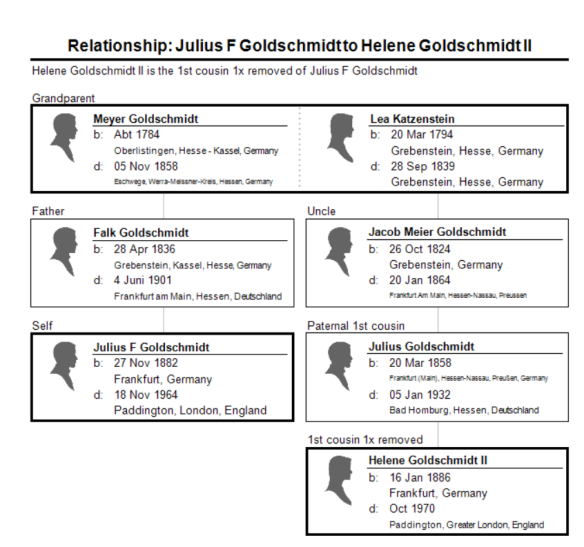
After escaping from Nazi Germany to the US in the 1930s, Herman settled in New York City where so many Goldschmidt family members ended up. He remained in touch with his Goldschmidt relatives. Susan said he visited her grandmother, Grete Goldschmidt Heimerdinger, every week for many years.

Grete was also a double cousin as she was the daughter of Marcel (Maier) Goldschmidt, son of Jacob Meier Goldschmidt, and Hedwig Goldschmidt, daughter of Falk Goldschmidt. Hedwig and Marcel were first cousins, and so like Herman, Grete was her own cousin.

And since Hedwig Goldschmidt, Grete’s mother, and Julius Falk Goldschmidt, Herman’s father, were siblings, Grete and Herman were first cousins, both the grandchildren of Falk Goldschmidt.

But they were also both descended from Jacob Meier Goldschmidt, Herman’s great-grandfather and Grete’s grandfather, so they were also first cousins, once removed, through Herman’s mother Helene “Leni” Goldschmidt and Grete’s father Marcel Goldschmidt. Oy vey! No wonder they were so close! Susan described Herman as “quite the gentleman and full of wonderful stories.” I wish I knew more of his stories.

I also received a wonderful photograph from my cousin, Bruce, the great-great-great-grandson of Fradchen Schoenthal, sister of my great-great-grandfather Levi Schoenthal, and also the great-great-grandson of Simon Goldschmidt, brother of my three-times great-grandfather Seligmann Goldschmidt.

So Bruce is my double cousin. He’s my fourth cousin, once removed, through our Schoenthal side and my fifth cousin through our Goldschmidt side.

Isn’t Jewish genealogy fun?

Anyway, Bruce’s great-great-grandmother was Hannah Goldsmith Benedict, daughter of the above-mentioned Simon Goldschmidt. Hannah and her brother Henry were the first Goldschmidts born in the US, Henry in 1847 and Hannah in 1848. I’ve written much about Hannah and her family—here and here and here  and here and here and here and here. Hannah married Joseph Benedict in 1867, and they had five children, including Jacob Benedict, Bruce’s great-grandfather. Jacob had two daughters with his wife Clara Kaufman: Helen, born in 1907, and Marian, born in 1908. Helen was Bruce’s grandmother.

Bruce told me that this photograph was dated August 24, 1908, and shows Hannah Goldsmith Benedict with her husband Joseph and their two granddaughters Helen and Marian. At that time Jacob Benedict and his family were living in Paducah, Kentucky, and Hannah and Joseph were living in Pittsburgh. Jacob’s brother Herschel was living in Pittsburgh, and his brother Harry was living in Michigan by 1910.  But the photograph was apparently taken in Kenosha, Wisconsin. I wonder how that happened….
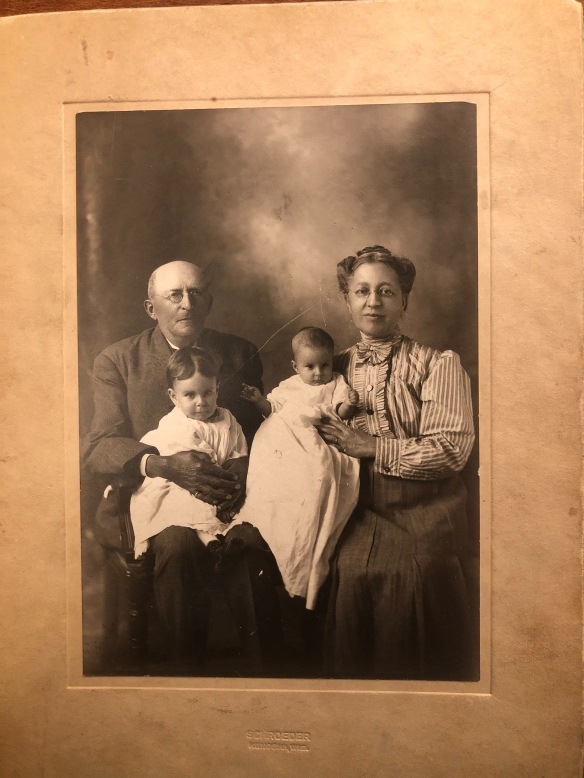
Joseph Benedict, Helen Benedict, Marian Benedict, and Hannah Goldsmith Benedict. August 24, 1908. Courtesy of Bruce Velzy

Another mystery to solve. But seeing one of my earliest American-born relatives with her granddaughters is very exciting.

It’s so fitting to close my Goldschmidt family blog posts with photographs of these two members of the family. Hannah Goldsmith and Herman Goldsmith were first cousins, twice removed, since Hannah’s father Simon Goldschmidt and Herman’s great-grandfather Meyer Goldschmidt were brothers.

Hannah was born in the United States when the country was still very young. She lived through the Civil War, World War I, the Roaring Twenties, and the Great Depression, dying in November 1939 while her German cousins were being persecuted and fleeing from Nazi Germany. She was 91 years old.

Just two months before Hannah died, her cousin Herman arrived in the US as one of those cousins escaping from Germany. Herman Goldsmith was born in 1912 in Frankfurt, Germany, and had grown up in the comfort of the large and well-to-do Goldschmidt family. Unlike Hannah, his life was radically changed by the events of the 1930s. But like Hannah, he saw so much in his lifetime, living until he was almost 104. He not only lived through World War I, the Weimar Republic years, the Depression, and World War II—he saw the radical changes that came after the war—the creation of the state of Israel, the Cold War, the assassination of JFK, the civil rights movement, the women’s movement, the moon landing, the gay rights movement, the rise of the internet, 9/11, and the election of the first Black man to serve as president of the US.

Can you imagine the stories Herman and Hannah could tell each other as well as us?  They lived such different lives in such different places and times, overlapping in time between only 1912 and 1939, but on different continents. But together the lives of Hannah Goldsmith and Herman Goldsmith tell us so much not only about the richness of the Goldschmidt family’s story, but also about the history of Jews in America and in Germany.

Thank you to Susan and to Bruce for sharing these photographs. And thank you to each and everyone of my Goldschmidt cousins who have helped me understand and appreciate our shared history.