My Cousin Lotte’s Story, Part I: A Childhood in Germany during the Weimar Republic (1918-1933)

It has been a true blessing to connect with my cousin Lotte.   Lotte is the daughter of Joseph and Anna (nee Winter) Wiener.  Her mother Anna was the daughter of Rosina Laura Seligmann. Laura was the daughter of Hieronymous Seligmann, brother of my great-great-grandfather Bernard and son of Moritz and Babetta Seligmann, my three-times great-grandparents.  Thus, Lotte is my third cousin, once removed.  Her story is a remarkable story.
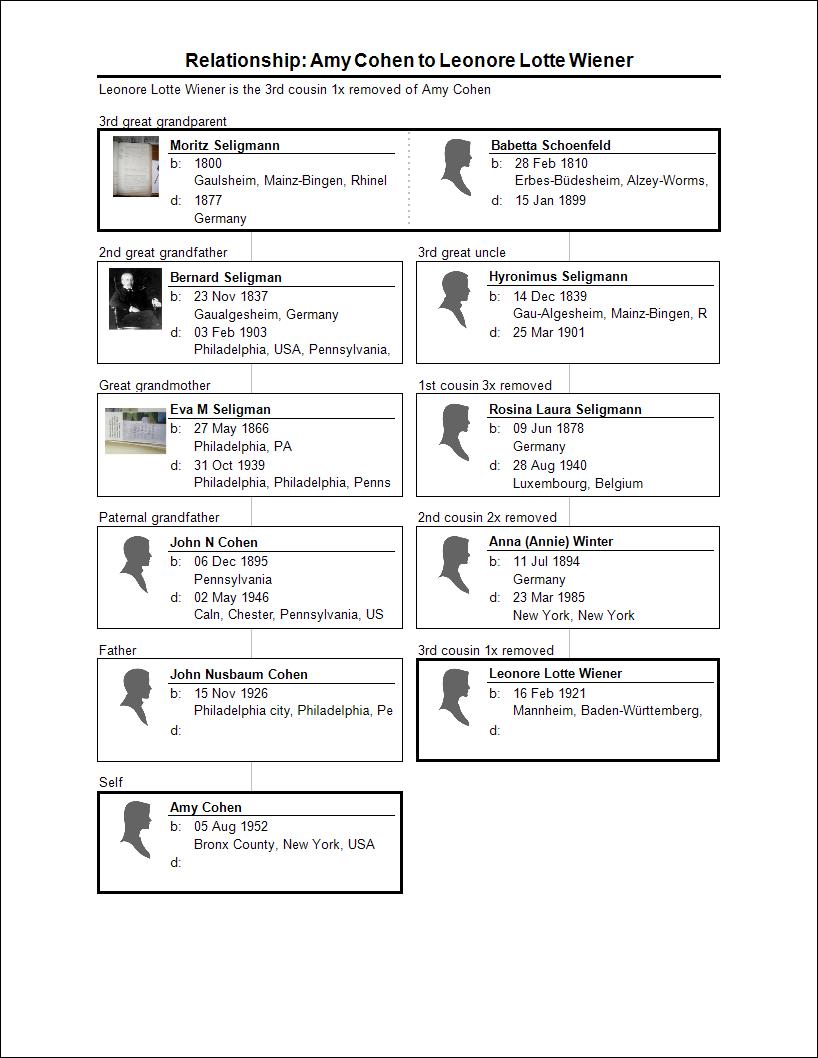
Relationship_ Amy Cohen to Leonore Lotte Wiener

Lotte was born in Mannheim, Germany, in 1921, and she left Germany with her parents in the late 1930s to escape Hitler and the Nazis.  Her education in Germany was cut short as a result, yet she came to the United States and successfully completed a nursing program in New York City shortly after immigrating.  But I cannot do Lotte’s story justice.  Fortunately, I do not have to because Lotte shared with me her memoirs and much of her other writing as well as some anecdotes she shared by email.  With Lotte’s permission, I am going to share some excerpts from her own writing and some of those anecdotes.

I am also including a link to her memoirs for anyone who wants to read them in their entirety.  You won’t be disappointed.  Lotte’s writing is poetic, evocative, and very moving.  This post will cover Lotte’s early life in Germany; subsequent posts will cover her life once Hitler came to power and then Lotte’s early years adjusting to life in the United States.  (To read Lotte’s memoirs in their entirety, click on My Story Lotte Wiener Furst. Copyright Lotte Wiener Furst 2015. Not to be reproduced in whole or in part without permission of the author.)

Lotte described her maternal grandparents Samuel Oskar Winter and Rosalind Laura Seligmann in these words:

My grandfather, born in Hülchrath, Westphalia, founded and owned a large dry-goods store. He had served his apprenticeship in a similar but larger store in Düsseldorf, having had to leave school at age fourteen because his mother was impoverished. He had a sister who never married, and a brother who later lived in Saarbrücken with his wife and two daughters, where he died quite young of syphilis. My grandfather was small of stature, but had a formidable mind and a keen, dry sense of humor. For quite a few years he served as a trustee of the local synagogue although he was not particularly observant.

My maternal grandmother was one of five siblings. Her family owned a vineyard in Gau-Algesheim, near Bingen, a place where my mother spent part of her childhood and which she always remembered very fondly. My grandmother also had left school at the age of fourteen in order to take care of her mother who was dying of tuberculosis, and to whom she had promised to always fast on Yom Kippur, and to observe Passover, promises she kept very faithfully. She loved poetry and could recite beautifully many of the sometimes very lengthy poems by the beloved German poets Goethe and Schiller. While my mother was growing up, my grandmother kept the books and otherwise assisted in the store. Keeping house was the task of Tante Yettchen, her spinster sister-in-law.

Laura Seligmann Wiener with two of her sisters, Bettina Seligmann Arnfeld and Johanna Seligmann Bielefeld Courtesy of Lotte Furst

Laura Seligmann Winter with two of her sisters, Bettina Seligmann Arnfeld and Johanna Seligmann Bielefeld
Courtesy of Lotte Furst

Samuel and Laura Winter had two children, Lotte’s mother Anna and her uncle Ernst.  Ernst was killed fighting for the Kaiser’s army in World War I:

My mother had one brother, Ernst, one year her junior. At the beginning of World War I he enlisted in the German army along with all of his classmates, much to the horror of his parents. He was killed six weeks later in the first Marne battle. My grandparents never recovered from the shock. I never saw my grandmother in anything but grey or black clothing. My uncle’s room was left untouched, and I was never allowed to enter it. My grandfather lost all his drive for maintaining the business, gave up his large store and became a partner in a much smaller one which was now mostly run by my grandmother’s brother, Uncle Jack, a very distinguished-looking but not very capable gentleman.

(“Uncle Jack” was Laura’s older brother Jacob, about whom I wrote here.)
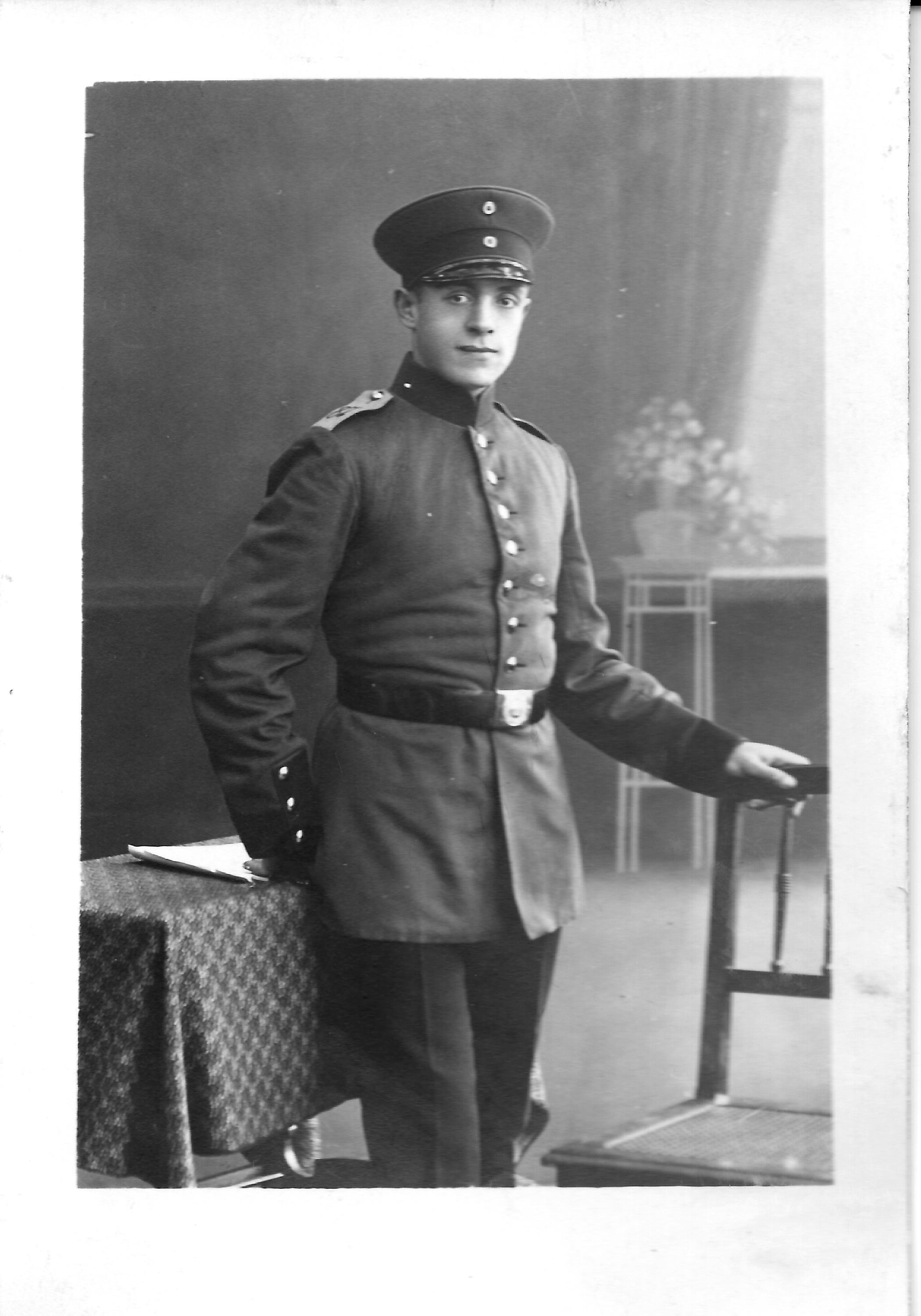
Ernst Winter Courtesy of Lotte Furst

Ernst Winter
Courtesy of Lotte Furst

How painful it must have been for Samuel and Laura to lose their son and then have the country he fought for betray them less than twenty years later.

As for Lotte’s mother Anna or Aennie, she was afforded a fine education as the daughter of a successful merchant:

My mother’s higher education consisted of a year or two in a finishing school, followed by some time in England where one of my grandmother’s uncles had established his residence. Her stay there was cut short, however, because this uncle, who owned several hotels and was very wealthy, made some unsolicited advances, and she fled in terror. The time spent in England provided her with an excellent chance to learn the language, which turned out to be quite an asset later on. She also was an accomplished pianist. Actually she aspired to become a concert pianist or at least a teacher of piano, but my grandparents felt that to be entirely inappropriate for a young lady of good bourgois upbringing. Their denial made her very unhappy but was mitigated somewhat when she received a beautiful black Bechstein grand piano as a wedding gift.

Samuel, Laura, and Anna Winter and Jakob Seligmann

Samuel, Laura, and Anna Winter and Jakob Seligmann (Laura’s brother) Courtesy of Lotte Furst

The uncle in England referred to above was, of course, James Seligman, born Jakob Seligmann, the younger brother of Hieronymous and Bernard Seligmann, the same James Seligman whose estate created quite a ripple of activity in the family and provided me with all those Westminster Bank family trees.  Lotte also shared with me her own memories of James Seligman.  According to Lotte, “[James] owned one or several hotels in Scotland/England. He lived in one of them. Together with his wife Hedy he visited his family on the continent once. She was a big and very pompous woman. After her death he visited the family again to distribute her belongings. Everybody went out of the way to serve him fancy dinners. My mother hired a caterer and we had “omelet surprise” for dessert. My grandmother Laura made a very simple home-cooked meal which he found the best he’d had. “

James married Claire, his second wife, shortly after his first wife Hedy died.  Claire had been his nurse.  When James died, Claire had the right to the income from his estate for her life; when she died, the principal was distributed to the various heirs found by the Westminster Bank.  According to Lotte, her mother’s estate received $200 in 1985.  I guess I can’t cry too much over the fact that the Westminster Bank failed to find my father and my aunt while doing their investigation since it seems their inheritance would have been about $100 each, if that much.

My heart went out to Lotte’s mother Anna Winter, a young girl with dreams of being a concert pianist, whose dreams were thwarted by society’s limited ideas of what a woman could be back in those times.  Anna married Joseph Wiener in December, 1915.  Joseph was in the Germany army at the time and was a doctor; after completing his service during World War I, he and Anna and their first daughter Doris moved to Mannheim where he established his medical practice.  Lotte was born there a few years later during the years of the Weimar Republic.

Lotte’s description of her childhood home creates a vivid picture:

We lived on the second floor of a six story apartment building. There were two units on each floor. Our living quarters occupied one of these units while my father’s office and the maids’ quarters were situated in the other half. The office consisted of my father’s consultation room and a large waiting area where 20 – 30 chairs were lined up along the four walls, together with a coat rack and a spittoon. Doris and I shared one of the two family bedrooms, while the maids had to sleep in a very small and primitively furnished room, I am ashamed to say. They were not allowed to use our toilet, I am ashamed to say. … In addition to the maids, we had a part-time nanny and, for a few years at least, a part-time chauffeur who was mostly busy driving my father who had to make innumerable house calls. In 1923 or 1924 my parents had bought their first car, a black Benz, which unfortunately came to a sad ending when the chauffeur “borrowed” it for a joy ride and totally crashed it. The car was replaced by a green Buick, the driver was fired, and my father did his own navigating from then on.

****

Originally we had separate stoves in the various rooms, one of them a real pot-belly stove called “Der Amerikaner”. But in approximately 1928 my parents obtained permission to remodel our two apartments, and central heating was installed. The furnace, placed in the kitchen, had a large flat surface on which to keep pots of hot water and to make baked apples at times. It also provided a lot of soot. The noise of one of our maids stoking the fire early in the morning usually woke us up.

The living room featured three wall-to-ceiling bookcase units, separated by two bay windows. There was a wealth of information in those books, and my parents placed no restrictions on our choice of reading material. I devoured almost everything: fiction, classics, history, you name it. But I certainly did not retain most of the material I read. Other furniture included three caned armchairs, a round coffee table with marble top, a green velvet-upholstered sofa, and a large oak desk.

A doorway, equipped with a curtain, led to the dining room half a small step above. For a while Doris and I used this setting to put on some improvised shows. The oak dining room table was large and massive. Other than for dining we used it as an improvised ping-pong table when extended. Of course the proportions were not right, and the ball would bounce off when it hit the extension crack in the middle.

…  My parents’ bedroom had mahogany furniture and yellow wallpaper with green and red intertwined garlands. I would stare at them at the times when I was allowed to lie on Mutti’s bed when I was sick, and I thought they were ugly. Doris’ and my bedroom was not so fancy. It was equipped only with two iron beds, a dresser, a night stand, and a clothes closet.

Between the bedrooms was a bathroom, used only for bathing. We had a separate toilet a little further down the hall and next to the kitchen which featured to a stove, oven, furnace, table and two chairs and an icebox, later replaced by a Frigidaire which was usually kept locked.

By Snapshots Of The Past (Parade Place and Kaufhaus Karlsruhe Baden Germany) [CC BY-SA 2.0 (http://creativecommons.org/licenses/by-sa/2.0)], via Wikimedia Commons

Mannheim, Germany  By Snapshots Of The Past (Parade Place and Kaufhaus Karlsruhe Baden Germany) [CC BY-SA 2.0 (http://creativecommons.org/licenses/by-sa/2.0)%5D, via Wikimedia Commons

Lotte also wrote about her parents’ various responsibilities in the household:

My father (Vati) was a very busy general practitioner. He had long office hours and also made numerous house calls every day, frequently to people who lived on the fourth, fifth or sixth floor of walk-up apartments. Elevators were non-existent in the working-class neighborhood where we lived. But he was always home for lunch, the main meal of the day, which was served at 1 PM. Breakfast was not a family affair – Doris and I had rolls with butter and jelly, delivered fresh every morning from the bakery across th street, and a cup of tea before leaving for school which started at 8 AM. During morning recess we had a “second breakfast” consisting of a sandwich which we brought from home. The light evening meal was served at about 7 PM. 

My mother (Mutti) attended to the household: instructing, supervising and hiring and firing the maid(s), and doing the marketing which in itself was a very complicated job. Because many of the nearby merchants were my father’s patients, she had to keep track of with which grocer, which butcher, which baker she had done business last in order to keep all of them happy. Butchers were especially difficult. There were some who had the best and most aged beef, suitable for roasts, and some who carried a poorer quality and therefore were only good for meat that had to be boiled or braised. Sausage came from other sources: regular, ordinary sausage was bought at a nearby store, but kosher sausage with its distinctively different taste came from a Jewish butcher who lived quite a distance away. Vati frequently questioned where the meat came from, and Mutti, quite peeved, would answer “from the fish store”.

In addition to the household chores, Mutti kept my father’s books. At the beginning of each calendar quarter she had to add up all the patients’ slips pertaining to their insurance coverage, and submit them to the local health insurance office and to the few private insurance companies involved. Since Bismarck’s time in the 1880’s Germany had compulsory and comprehensive health insurance laws covering most of the working population. Self-employed and professional people took out their own private insurance. During those busy quarterly events Mutti was extremely nervous and tense. We knew better than asking her any silly questions.

After lunch, Vati usually took a short nap on the living-room sofa, followed, at least in the early years, by a cigar which I helped him light. He then resumed his afternoon office hours while I went back to school or to my music lessons or other activities. At some time during the afternoon I did my homework, never too much of a chore, and practiced my violin music for which I did not need any coaxing because I enjoyed it.

Lotte and her sister spent school vacations visiting Anna’s parents Laura (Seligmann) and Samuel Winter in Neunkirchen:

My grandparents’ (Oma and Opa’s) house had four stories: a large basement with a fruit cellar, a downstairs “salon” and formal dining room with a large veranda which was hardly ever used, another floor with the actual living quarters (living room, bedroom, bathroom and kitchen), and three more bedrooms above that. The rooms were rather small, however. A rarely used dumb waiter connected the kitchen with the downstairs dining room. A mostly unkempt and unplanted  backyard, except for some large clumps of rhubarb, was also featured. The house overlooked a large and frequently used soccer field.

There was not very much to do at the house. I usually accompanied Opa to the store where he spent most of his time. The salesladies and the office help all were very nice. They gave me odds and ends of fancy yarns, remnants of cloth, and various sundries. The secretary let me use the typewriter where, one index finger at a time, I would compose never to be published letters and poems.

Oma meanwhile would be busy with her household chores. Once a week she attended meetings at a housewives’ club, and I would come with her whenever I was visiting. I believe they did some charitable work, but all I know for sure is that they gossiped a lot and always had a big “Kaffeeklatsch”. Every time they saw me, some of these ladies would ask whether I remembered who they were, followed by “my, how you have grown”. The club was the only outside activity Oma allowed herself.

By Daniel Arnold (Photo taken by Daniel Arnold) [CC BY-SA 2.0 de (http://creativecommons.org/licenses/by-sa/2.0/de/deed.en), GFDL (http://www.gnu.org/copyleft/fdl.html) or CC-BY-SA-3.0 (http://creativecommons.org/licenses/by-sa/3.0/)], via Wikimedia Commons

Town Gate, Neunkirchen By Daniel Arnold (Photo taken by Daniel Arnold) [CC BY-SA 2.0 de (http://creativecommons.org/licenses/by-sa/2.0/de/deed.en), GFDL (http://www.gnu.org/copyleft/fdl.html) or CC-BY-SA-3.0 (http://creativecommons.org/licenses/by-sa/3.0/)%5D, via Wikimedia Commons

Lotte wrote a wonderful description of a day she spent with her Opa, but it is quite long, so I will leave it for those who wish to read her entire memoir.  I do want to include this description of her Oma, Laura Seligmann Winter:

My grandmother, Oma, was a fairly short, fairly plump woman. Her body, always dressed in rather shapeless grey clothes and bulging a bit in the center, did not seem to have any remarkable form of its own. But her oval face was kind and full of expression. Severely myopic, she had protuberant grey eyes. To help her poor eyesight, she used a lorgnette for reading. I don’t recall her ever wearing glasses. She also suffered from rheumatic heart disease, the result of rheumatic fever early in life, which incapacitated her a lot and finally contributed to her death.

To maintain her wavy, well-coiffured hairdo, Oma allowed herself the only luxury I was aware of. Once or twice a month she used the services of a hairdresser who came to her home to wash and set her hair, embellished by the use of a hot iron. She probably coordinated those appointments with the meeting dates of the “Hausfrauenverein” ( housewives’ club), a gathering of mostly Jewish old – or so it seemed to me – women who fairly fell over me when Oma took me along during my visits, exclaiming how I had grown and wondering if I still remembered their names. Whether the club members did anything socially worthwhile I do not know. I suppose they did. But I do know that they gossiped a lot while enjoying afternoon coffee and cake.

Oma’s most remarkable talent was her gift to recite poetry. With only a grade-school education, she had managed to memorize a great many of the famous German poems written in the eighteenth and nineteenth century, noticeably poems by Goethe, her hero, and also by Schiller. A glorified picture of Goethe adorned a wall in her kitchen, leading, to her bemusement, to a question by her milkman who wondered if that handsome man had been her father.

Laura Rosina Winter nee Seligmann

Rosina Laura Seligmann Winter, Lotte’s grandmother

For more on Lotte’s grandparents and their home, read MY GRANDPARENTS HOUSE by Lotte (Copyright Lotte Wiener Furst 2015. Not to be reproduced in whole or in part without permission of the author.)

Lotte, an exceptional student, also wrote about her early school experiences:

From first through fourth grade I attended the Hildaschule, the public school for girls in the district where I lived and about three blocks from our apartment. My first impression of the first grade classroom was that it smelled bad and was very noisy, featuring an enrollment of about 40 anxious little girls. The teacher was very strict – a real no-nonsense person by the name of Mrs. Seltenreich. The slightest kind of misdemeanor was usually punished by a sharp blow with a cane on the poor kid’s outstretched fingers. It required a great deal of courage to oblige her. I must admit that I never was in that predicament since I was a very good little girl. But I had one great shortcoming: From the very beginning my handwriting was very poor. I never earned anything better than a “3″ (on a scale of 1-5) in that course. Later, when we started to write with ink, I did not produce one paper without a smudge or an inkblot. I never could shake that weakness, and only with the advent of the computer did I learn to produce more or less perfect papers without any visible corrections.

Mrs. Seltenreich was replaced by Fräulein Unger from second to fourth grade. She was a very kind, stout elderly lady who really loved teaching, trying some innovative methods, thus commanding respect without the cruelty shown by her predecessor. I had one girlfriend at that time but did not spend much time with her. Once I accompanied her to the Catholic church across the street from the school, and she showed me how to make the sign of the cross and how to kneel, which I did because I did not know any better. When I told my mother, she instructed me never to do that again. I, however, knew hardly anything about my own religion except for the fact that I was Jewish and therefore different.

School hours were during the morning.  In the afternoon I usually went to a park with my nanny during the early school years. There I mostly played by myself or perhaps with one other child, sheltered kid that I was. In school we also had to attend an outdoor playtime session once a week. I did not like it too much because I did not know the games which most of the girls had played frequently. I was rather ignorant in social skills and did not participate very well.

In fourth grade I befriended a girl by the name of Johanna who lived on a river boat which made periodic stops in Mannheim, traveling up the Rhine from Holland. During those stops she attended my school. I proudly presented her to the handicrafts instructor (embroidery, crocheting and knitting were compulsory and part of the curriculum), only to be asked if she was also a Yid (which she was not). My mother was infuriated when I told her about this, so much so that she went to the School Board to complain. After all, we were living in Germany during the time of the democratic Weimar Republic. Discrimination supposedly was not allowed. I never found out if the teacher was reprimanded.

Reading this made me realize how drastically German society changed once Hitler came to power.  Here was Lotte’s mother, a Jewish woman, daring to complain about an anti-Semitic remark made by a teacher.  Just a few years later such anti-Semitism was the official law of the land.

After her early years in the girls’ school, Lotte was one of a small number of girls who were admitted to the almost all-male Karl-Friedrich Gymnasium, where she had to work extra hard and even box some of the boys in order to prove herself and win approval from her teachers. Lotte also spent many hours in the nearby art museum. She loved music and was exposed to music throughout her childhood.  She started taking violin lessons when she was eight years old and had the same teacher for nine years until she and her family emigrated.

Karl-Friedrich-Gymnasium Mannheim

Karl-Friedrich-Gymnasium Mannheim (Photo credit: Wikipedia)

Although her grandmother Laura always fasted on Yom Kippur and observed Passover, as she had promised her mother, Lotte grew up with very little exposure to Judasim.  She wrote:

Prior to the Nazi rise to power I had a very cursory knowledge of the fact that I was Jewish. My parents were totally non‑religious. They agreed with Karl Marx that religion was “the opiate of the masses”. My father even resigned from the Jewish community since he did not see why he should pay the obligatory cultural tax. In school I was listed as “without religious affiliation.” None of the Jewish holidays were observed at our house.

But Lotte’s grandparents and other relatives of her grandmother Laura did provide her with some knowledge and experience with Jewish rituals and holidays:

But at my grandparent’s house I learned a little more about Jewish customs. My grandmother fasted on Yom Kippur. They only ate matzot during Passover. Best of all, they had a blue and white KKL (Jewish National Fund) box on their living room chest. Only pennies were inside, as I found out when I tried to fish out the money with a crochet hook (I always replaced the money, I only did it because 1 was utterly bored and had nothing else to do). But I do remember the outline of Palestine on the box, and I learned that it was the Jewish homeland far away.

Gilabrand at en.wikipedia [CC BY 3.0 (http://creativecommons.org/licenses/by/3.0)], from Wikimedia Commons

Gilabrand at en.wikipedia [CC BY 3.0 (http://creativecommons.org/licenses/by/3.0)%5D, from Wikimedia Commons

There also were some more observant relatives in Neunkirchen. One, a cousin of my grandmother, was married to the orthodox owner of a dairy store who did not make much money but beat up his poor wife and his three children every once in a while. I remember their son celebrating his bar‑mitzvah. A lot of complete strangers (to me) were assembled, including a very distinguished‑looking rabbi. Following the ceremony and the lunch people sat around talking and telling jokes. Since the rabbi looked so distinguished with his white beard, I asked him to write a word on a slip of paper as part of a puzzle I wanted to present. Well … The good rabbi told me very kindly that he did not write on schabbes, and that’s how 1 learned one of the basic rules of Judaism.

Lotte told me that the bar mitzvah boy was Heinz Goldmann, son of Anna Seligmann and Hugo Goldmann.  Anna was the daughter of August Seligmann, my three-times great-uncle.  Anna, Hugo, and their children were all killed in the Holocaust.

Overall, Lotte’s description of her childhood suggests that she had a very happy and comfortable childhood: a childhood free of economic or other struggles, a loving family, vacations and trips, school and art and music, and grandparents whom she adored.  All of this would come to what must have been a shocking, heart-wrenching, and tragic end as Lotte entered adolescence and Hitler came to power.


Home Sweet Home

We are back from our trip, and I have so much to say that I don’t even know where or how to start.  Traveling to a different place can change your whole view of the world, of your place in the world, and of yourself.  This trip did that in so many different ways.  I have hundreds of photographs to sort and label, a lot of notes to transcribe and ponder, and so many thoughts and memories floating through my head that I need to write them all down before I forget them.  So I can’t just start blogging in detail about the trip right away.  I will certainly report about the parts of the trip that related directly to my own family—the trip to Poland in particular—once I have it all digested.

For now I have these overall thoughts and a few photographs to share.  First, standing in the former Jewish quarters in Prague, Krakow, Budapest, and Vienna, some of which still have several synagogues (a few even still in operation), is a chilling and horrifying experience.  For me, these places that once bustled with Jewish grandparents, mothers, fathers, and children, going to work and going to school and going to shul, were a graphic and vivid reminder of what the world lost in the Holocaust.  Had it not been for the Nazis, these Jewish communities could and likely would still exist, adding to the culture and economy of these places and of the world just as they did for hundreds of years before their Jewish citizens were murdered.

A street in the former Jewish Quarter of Krakow

A street in the former Jewish Quarter of Krakow

Nothing made this more painfully vivid for me than standing in Tarnobrzeg, the town where my Brotman great-grandparents lived, a town that was once 75% Jewish and where not one Jew lives today.  The only signs that there were once Jews there were a small plaque on the library, a building that had once been the synagogue, and a Star of David near the gate to the neglected Jewish cemetery, where only a handful of headstones remain.

gravestone on the ground in the Jewish cemetery in Tarnobrzeg

gravestone on the ground in the Jewish cemetery in Tarnobrzeg

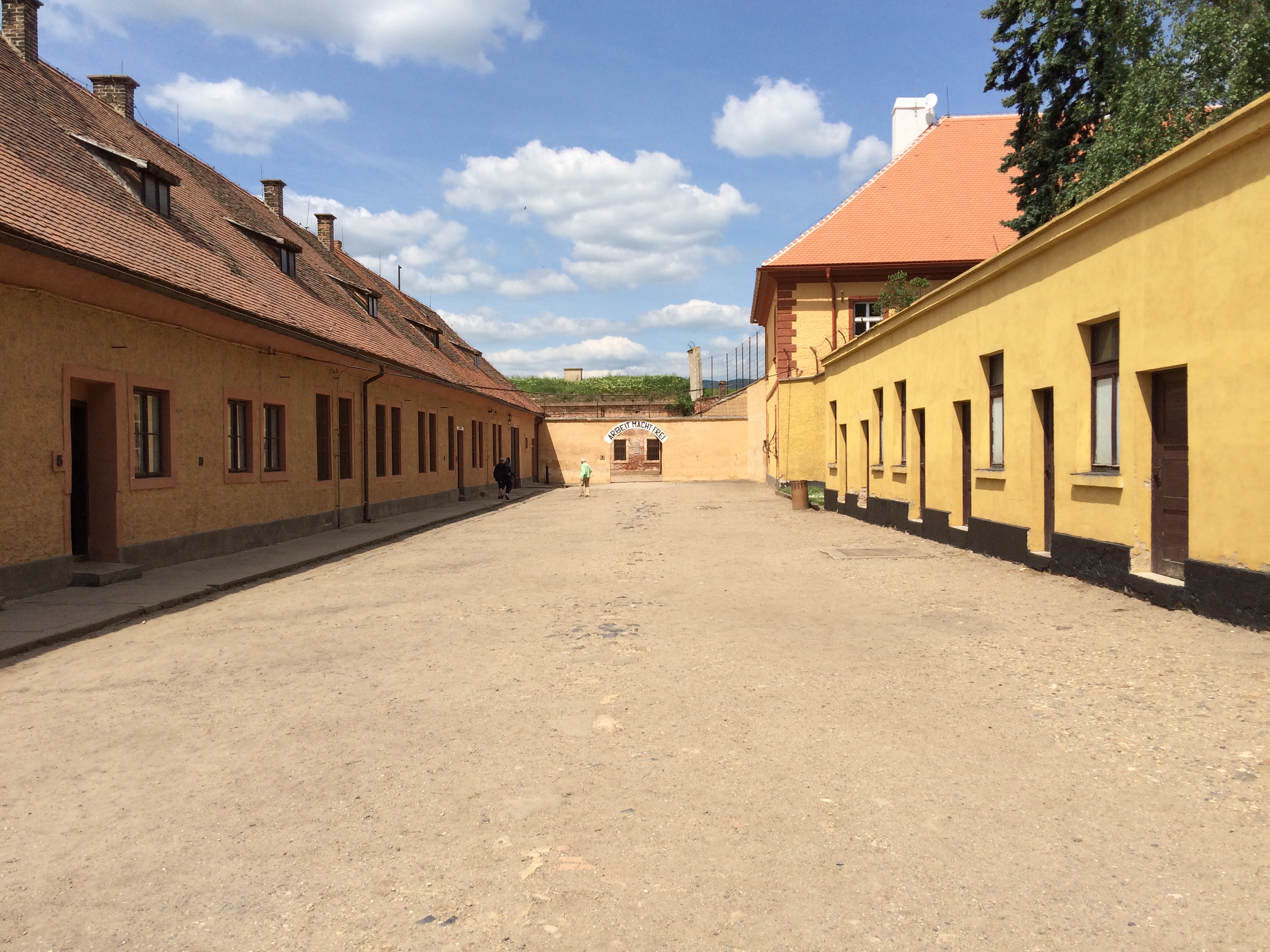
Second, every person, Jewish or not, should visit Terezin and Auschwitz.  I cannot say more.  The places say it all.  You cannot go to these places and not be changed.  No matter what you may have read or seen or heard about the Holocaust, you cannot be prepared for what you experience walking in those places of terror and death.  I have only two photographs of Terezin and no photographs of Auschwitz.  I could not bear to think about taking a photograph while standing where so many were slaughtered.

Terezin

Terezin

Third, I had little idea what life was like under Soviet domination in the Czech Republic, Poland, and Hungary until we met several people who had lived during that era.  We were lucky to have guides in Prague, Poland, and Budapest who had witnessed the changes and were able to describe to us how different life was before and after the Soviets left in the late 1980s, early 1990s.  Today all these places are clearly capitalist, for better in many ways, for worse in others.  Seeing Starbucks and McDonalds and KFC everywhere amidst the old buildings in these gorgeous cities is jolting, but much better than seeing empty store windows and children forced to march at rallies to support the “state.”

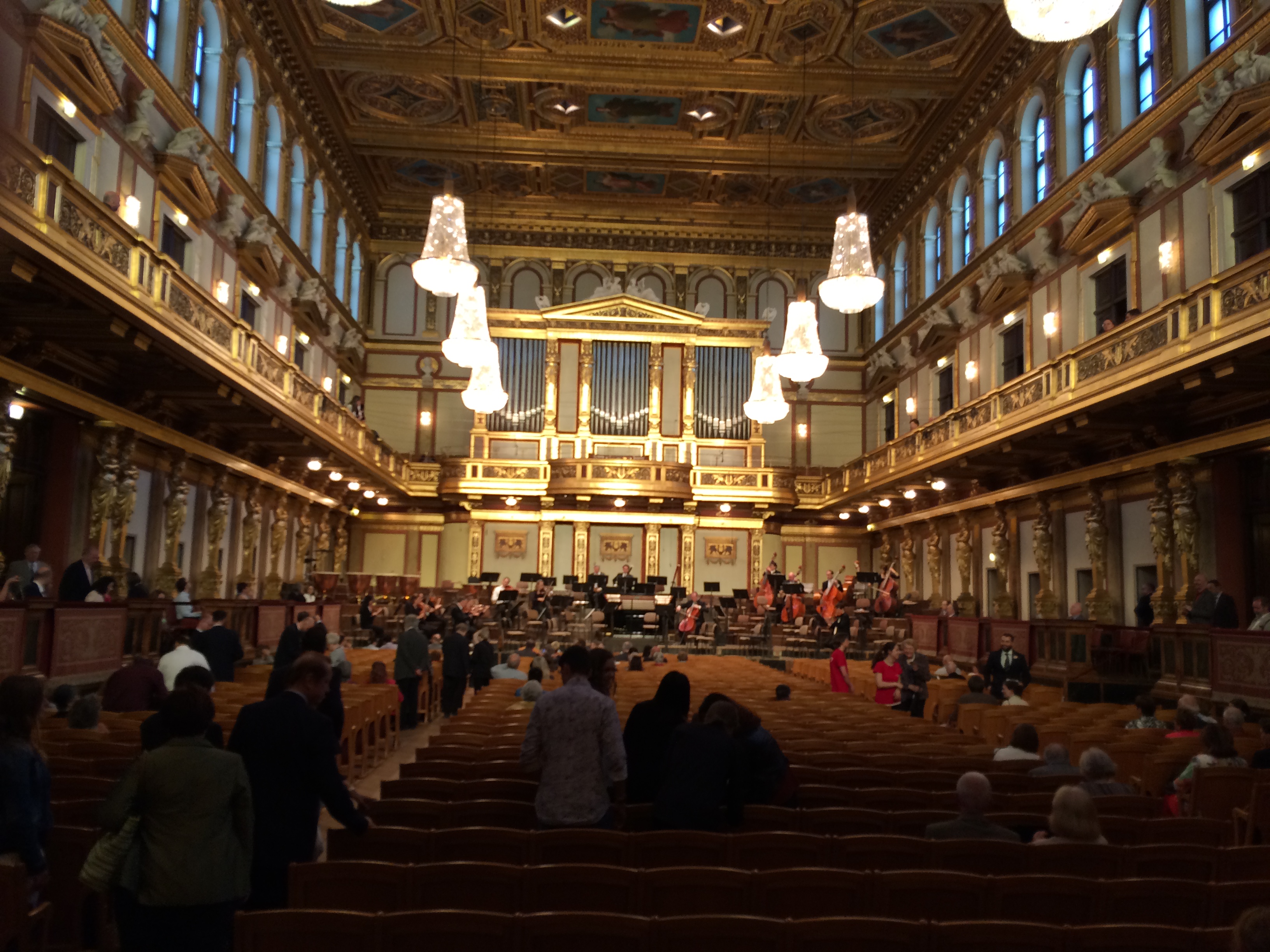
Despite all the sadness that we felt as we learned about the past in these places, overall we experienced these cities as places of joyfulness, liveliness, and overall comfort.  Yes, there were beggars and homeless people, especially in Budapest, and I am sure that outside the areas where tourists congregate there is plenty of poverty and misery.  But each of the cities we visited were beautiful places filled with incredible and fascinating architecture, a huge number of cafes and restaurants and bars, museums teeming with people, cobblestone streets crowded with tourists and tour groups, and the sounds of happy, excited people.  There was music everywhere—in the streets, in the churches, and in the concert halls.

Dohany Synagogue in Budapest

Dohany Synagogue in Budapest

We had an incredible time.  Our tears and sadness were well-balanced with times of pure joy—climbing the tower to see all of Prague, clapping to Klezmer music in Krakow, walking along the river in Budapest, and eating unbelievable pastries in Vienna.  We heard music in every city, we stood in awe in Gothic cathedrals, we watched people laughing and drinking and eating in the cafes, and we walked and walked and walked until our feet were numb.  We had an incredible time.

Musikverein in Vienna

Musikverein in Vienna


The Faces of My Past: The Magic of Photography

I received some remarkable photographs from my cousin Suzanne, the daughter of Fred and Ilse Michel.  Fred, as I wrote about here, was the grandson of August Seligmann, who was my great-great-grandfather Bernard Seligman’s brother.  Fred would have been my grandfather John Nusbaum Cohen’s second cousin, making him my second cousin, twice removed.  Suzanne is thus my third cousin, once removed.

Suzanne sent me a number of photographs, including some taken of prints that had hung in her childhood home in Scranton, Pennsylvania.  For example, here are two prints of Bingen, Germany, the town where Fred Michel lived and also where our mutual ancestor Moritz Seligmann lived (in Gaulsheim, now part of Bingen) before moving to Gau-Algesheim.  It is also close to where my cousin Wolfgang now lives, and he identified the location and some of the structures depicted therein.

Courtesy of the Family of Fred and Ilse Michel

Courtesy of the Family of Fred and Ilse Michel

Courtesy of the Family of Fred and Ilse Michel

Courtesy of the Family of Fred and Ilse Michel

Bingen 3

Courtesy of the Family of Fred and Ilse Michel

These prints show the city of Bingen’s location at the intersection of the Rhine River and the Nahe River.  According to Wolfgang, the tower in the river is called the Mäuseturm or “tower of mice,” and the church on the hill in the top print is the Rochuskapelle or the chapel on Rochus Hill.  Wolfgang said that his grandfather Julius and his family survived the last part of World War II in the Rochus chapel. Wolfgang told me that much of the city of Bingen was destroyed by British bombers in November, 1944.  The bombs destroyed the apartment whereJulius Seligmann and his wife and sons lived, so they moved to the Rochuskappelle, which the monks had opened for those who had lost their homes and their possessions.

On the reverse of the top print is written, “So that you always think of Bingen and your friends: ???-Kathi-Rainer und Christa Güttler. Bingen, Nov,11, 1974.”  The reverse of the second print says, “The loving Ize and his wife to remember Bingen from Gret and Kath Scharer.”   Based on the captions on these photographs from an album that belonged to Fred Michel, these were close friends.

Courtesy of the family of Fred and Ilse Michel

Courtesy of the family of Fred and Ilse Michel

scharers in album

These prints of Bingen before the war and the photographs of Fred’s friends made me think about what was lost during the war.  Not just all the millions of people who died, but also the landscape, the history, and, for the many who were lucky enough to emigrate, their homeland.  Perhaps these old prints and the pictures of his friends helped keep some of those happier memories alive for Fred Michel.

Here is a photograph of Fred Michel and his mother Franziska Seligmann Michel taken when Fred was a young boy, when he likely could never foresee leaving Germany and moving to a place called Scranton:

Fred Michel and Franziska Seligmann Michel  Courtesy of the Family of Fred and Ilse Michel

Fred Michel and Franziska Seligmann Michel
Courtesy of the Family of Fred and Ilse Michel

Here is a photograph of Franziska’s headstone.  She died four years before Fred left for America.

Courtesy of the Family of Fred and Ilse Michel

Courtesy of the Family of Fred and Ilse Michel

I believe these are photographs of Fred as a young man, taken in Munich in 1928, according to the caption:

Courtesy of the Family of Fred and Ilse Michel

Courtesy of the Family of Fred and Ilse Michel

Although he is not identified in the photographs above, here is a photograph of Fred with Ilse and his children sometime around 1960, and it appears to be the same man many years later:

Courtesy of the Family of Fred and Ilse Michel

Courtesy of the Family of Fred and Ilse Michel

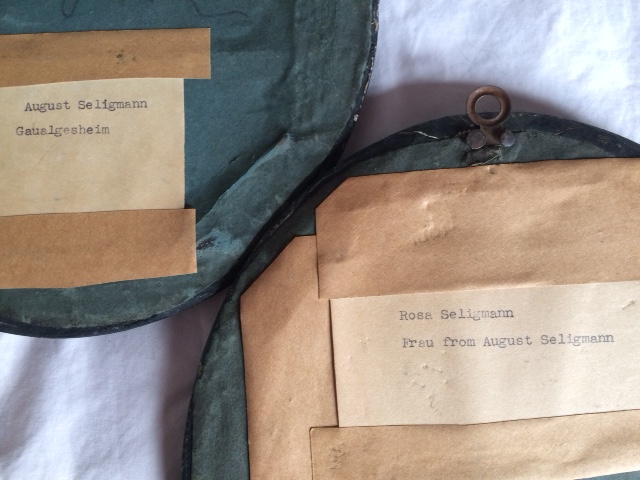
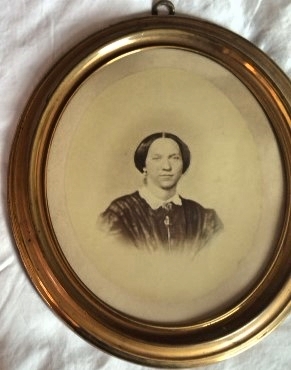
I was quite excited about these two portraits. I know who is in these photographs because of the inscriptions on the reverse:

August Seligmann

August Seligmann Courtesy of the Family of Fred and Ilse Michel

Rosa Goldmann Seligmann

Rosa Bergmann Seligmann Courtesy of the Family of Fred and Ilse Michel

Courtesy of the Family of Fred and Ilse Michel

Courtesy of the Family of Fred and Ilse Michel

August was my great-great-granduncle, the brother of Bernard Seligman.  Here is a picture of Bernard, my great-great-grandfather.  Can you see any resemblance between the two brothers?

Bernard Seligman

Bernard Seligman

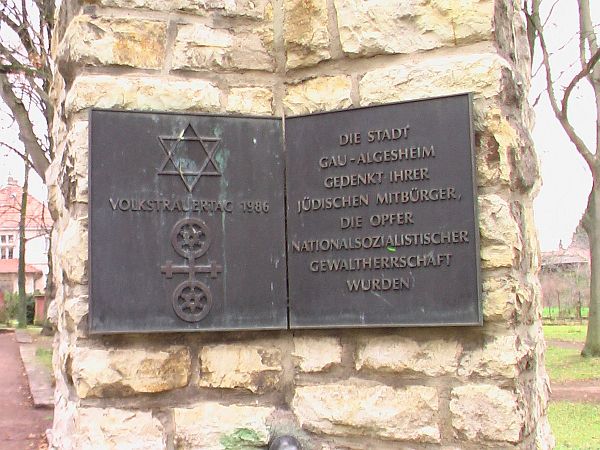
Rosa’s headstone is the one that was terribly defaced in the Gau-Algesheim cemetery.

closeup of Rosa Seligmann headstone

And here are the portraits that intrigue me the most.

Courtesy of the Family of Fred and Ilse Michel

Courtesy of the Family of Fred and Ilse Michel

Courtesy of the Family of Fred and Ilse Michel

Courtesy of the Family of Fred and Ilse Michel

Who are these people?

On the reverse of one of these is the following:

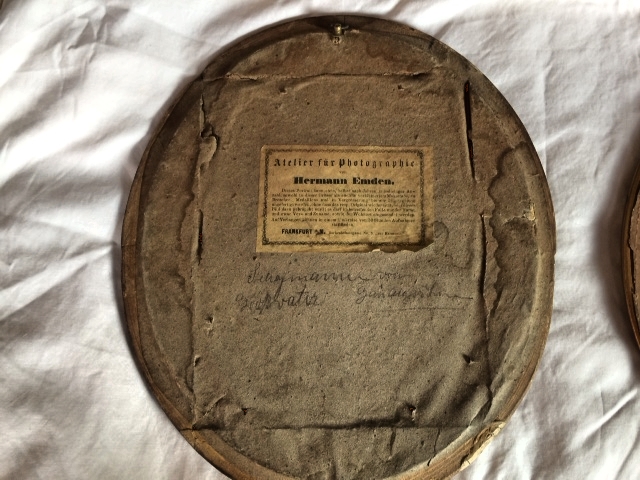
Courtesy of the Family of Fred and Ilse Michel

Courtesy of the Family of Fred and Ilse Michel

By editing and zooming and enlarging the script below the photographer’s information, I was able to see more clearly what was written there:

enhanced snip photo 2

I could decipher Seligmann there as well as von Gau-Algesheim to the right, but I was not able to read the word underneath Seligmann.  I posted the snip of this to the German Genealogy group on Facebook, and two people there confirmed that the word was the German word for “grandfather.”  One of the two also insisted that the name was Schafmann, not Seligmann, but I still am sure that it says Seligmann, and not only because I know that was the family’s name.  What do you think?

So if this man was a Seligmann and a grandfather, who was he?  Since the portrait belonged to Fred Michel, I would have assumed that it was his grandfather, that is, August Seligmann.  But the man in this portrait does not appear to be the same person as the man in the portrait above, which was clearly labeled August Seligmann.  So my thought/hope was that this was the grandfather of Fred’s mother Franzeska, who must have given these old pictures to her only child.  If that is the case, then these two portraits depict my great-great-great-grandparents, Moritz Seligmann and Babetta nee Schonfeld.

But Moritz was born in 1800 and Babetta in 1810.  I wondered whether there would even have been photography portraits like these in their lifetime.  I looked again at the label on the back of the photograph of Moritz and saw that the photographer was Hermann Emden of Frankfort.  I took a chance and googled the name, not expecting anything.  I was quite surprised and happy to get numerous hits for Hermann Emden.  His full name was Hermann Seligmann Emden, and he was a very well-known and successful Jewish photographer and artist.  Here is the entry from the Jewish Encyclopedia for Hermann Seligmann Emden:

German engraver and photographer; born at Frankfort-on-the-Main Oct. 18, 1815; died there Sept. 6, 1875. Early evincing a love for art and unable to afford an academic education, he entered an engraving and lithographic establishment as an apprentice, endeavoring especially to perfect himself in the artistic side of his work. In 1833 he left Frankfort and went to Hersfeld, Darmstadt, and Bonn. His portrait-engraving of Pope Pius IX. and his views of Caub, Bornhofen, and the Maxburg belong to this period. He also turned his attention to photography, then in its infancy, and was one of the first to establish a studio at Frankfort-on-the-Main. He made his reputation as photographer by the work “Der Dom zu Mainz und Seine Denkmäler in 36 Originalphoto-graphien,” to which Lübke refers several times in his “History of Art.” Emden was the first to compose artistic photographic groups (“Die Rastatter Dragoner,” “Die Saarbrücker Ulanen,” etc.), and was also among the first to utilize photography for the study of natural science.

You can see some of his more famous works here.

Once I saw that Emden died in 1875, I was even more certain that these were portraits of Moritz and Babetta Seligmann.  August would have only been 34 when Emden died, and the man in that portrait is quite clearly older than 34.  It has to be his father Moritz. Moritz and Babetta had to be quite comfortable, I would think, having their photographs taken by such a successful photographer.  I also wonder whether Emden was a relative.  Seligmann was a fairly common name, and it was often used as a first name as well as a surname.  But perhaps further research will reveal some familial connection.

But for me what is most important is that I am looking at the faces of my three-times great-grandparents.  I never ever thought that would be possible.

Passover 2015: The American Jewish Story

Handmade shmura matzo used at the Passover Sed...

Handmade shmura matzo used at the Passover Seder especially for the mitzvot of eating matzo and afikoman. (Photo credit: Wikipedia)

A year ago I was feeling disconnected from Passover until I heard my grandson tell us the story of Passover in a way that made it feel new and exciting and different all over again.  This year his little brother will experience his first seder, though at only ten months, that experience will likely be short and quite unfocused.  Just a lot of really noisy people sitting around a table eating food that he neither can nor would want to eat.  But it’s a new reminder that every generation and every child experiences Passover as a new experience, allowing all of us who are jaded and detached to be able to relive our own early experiences with this special holiday.

Last year I entered into Passover thinking about my mother’s ancestors, the Brotmans, the Goldschlagers, and the Rosenzweigs.  I focused on their exodus from the oppression and poverty and anti-Semitism of Galicia and Romania and their courage and the desire for freedom that led them to leave all they knew to cross the continent and then the ocean and come to New York City, where they again lived in poverty but with greater hopes for a life of freedom and economic opportunity.  And they attained their goals if not in that first generation, certainly by the third and fourth generations.

Poor Jews taking home free matzohs, New York

Poor Jews taking home free matzohs, New York (Photo credit: Wikipedia)

For the last year now, I have been researching, studying and writing about my father’s paternal relatives.  It has taken just about a full year to cover the Cohens, the Jacobs (with whom I actually need to do more work), the Seligmans, the Schoenfelds, the Nusbaums, and the Dreyfusses.  Soon I will start my father’s maternal relatives—the Schoenthals and Katzensteins and whatever other surnames pop up along the way.  Researching my father’s families has been so different from my mother’s, and I can go so much further back.  I can’t get back much before 1840 with my mother’s family and have absolutely no records before 1885 or so for any of them.  Although I have a number of Romanian records for my Rosenzweig and Goldschlager relatives, I have no records at all from Europe for my great-grandparents Joseph and Bessie Brotman, despite hours and hours of searching and even DNA testing.

In contrast, my father’s ancestors have provided me with a rich opportunity to learn about Jews in Amsterdam, London, and especially the towns of Gau-Algesheim, Erbes-Budesheim, Bingen, and Schopfloch, Germany.  I have been able to find records all the way back to 1800 or so for almost every line.  I’ve had amazing help along the way on both sides of the Atlantic, and I’ve even learned a little German to boot.  My father’s families were pawnbrokers and peddlers and clothing merchants; they were pioneers and politicians and war heroes.


http://www.gettyimages.com/detail/182866324
Harrisburg Market Square with Leo Nusbaum store

Harrisburg Market Square with Leo Nusbaum store

They came to the United States in the 1840s and 1850s, and most of them suffered terrible heartbreaks, economic struggles, and early deaths.  Most of them settled in Philadelphia and other parts of Pennsylvania and New Jersey, but there were those who went to places that I’d never think a Jewish immigrant would go: Iowa, Texas, Illinois, Michigan, California, and, of course, New Mexico.  Many married outside the Jewish community and assimilated into American culture far more so than my mother’s relatives.  Ultimately, the Cohens/Jacobs and Seligmans/Schoenfelds and Nusbaums/Dreyfusses were successful; they found the American dream, and they embraced it.

But there is a very sad underside to this story of American success.  It’s the story of those who did not leave Europe.  For the first time in my life I confronted the reality that the Holocaust did not just happen to other families, to other Jews.  Not that I have not been deeply affected by the Holocaust all my life; ever since I read Anne Frank’s diary as a child, I’ve identified with and cried for all those who were murdered by the Nazis.  But I never knew that I had relatives left behind in Germany who were part of that slaughter.  I am still finding more, and I will write about them soon.  The list of names of my cousins who died in the Holocaust grows longer and longer, and I realize more than ever how grateful I should be to Bernard Seligman, John and Jeanette (Dreyfuss) Nusbaum, and Jacob and Sarah (Jacobs) Cohen for leaving Europe and taking a chance on the new country across the ocean.

memorial plaque gau aldesheim

So this year for Passover I will be thinking about that first major migration of Jews from Europe to America.  I will be feeling thankful for the risks my ancestors took, and I will be feeling the loss of not only all those who were killed in the Holocaust, but the loss of all the children and grandchildren who would have been born but for those deaths.

And overall I will be celebrating family, freedom, and faith—faith that the world can be a better place and that human beings can be their best selves and live good and meaningful lives.  May all of you have a wonderful weekend—be it Passover or Easter or perhaps just another weekend in April for you.   Celebrate all the good things in life in whatever way you can.


Embed from Getty Images

Does Anybody Really Care about a Fifth Cousin?  Are Collateral Lines Relevant?

y Sg647112c (Own work) [CC BY-SA 3.0 (http://creativecommons.org/licenses/by-sa/3.0)], via Wikimedia Commons

y Sg647112c (Own work) [CC BY-SA 3.0 (http://creativecommons.org/licenses/by-sa/3.0)%5D, via Wikimedia Commons

I have been spending many hours recently researching the children, grandchildren and other descendants of the siblings of my three-times great-grandparents.  Sometimes I find myself thinking, “Why am I researching these people?  They are my third cousins twice removed or my fifth cousins or my second cousins four times removed…or whatever.”  Although I’ve had moments of wondering this before, it’s been especially true for the Nusbaum clan, who for the most part flew under the radar and did not have lots of juicy or interesting stories to tell—they were mostly law abiding merchants; they lived their lives quietly and out of the public eye.  They were not politicians or inventors or criminals or performers.  They did not change history.  Sometimes when I learn that a particular relative had no children, I am relieved.  One more line has been completed.

So why do this?  Does anybody really care about such distant relatives? Do I even care? Is it just my general compulsive need for a sense of completion? For being thorough? Or is there something pushing me forward, person by person, line by line?

Some of it is definitely my neurotic need to finish things.  Until recently I would finish any book I started even if I hated it.  Then finally I realized, “Hey, I hate this book.  I do not need to finish it.”  It was tough, but I started realizing no one was grading me if I put the book away.  And it is not just books.  When we moved into our new home five years ago, I stayed up past 3 am just to put away every last dish, fork, pot, and coffee mug in the kitchen.  Craziness.

But I do think that something else impels me to keep researching and writing about all these distant cousins.  First, it gives me the big picture about the lives of my ancestors.  I start to see trends and patterns.  For example, I would not have seen how important the liquor trade became in the family and the country if I had not followed all those Simon and Nusbaum relatives who started selling liquor in the 1870s.  I would not have understood how important the peddler trade was to early German Jewish immigrants if I did not study all the Nusbaum siblings. I would not have sensed the broad impact of the 1870s depression by studying just my direct ancestors.   And as I move into the 20th century, I would perhaps not have seen how suddenly education became a much bigger factor in the lives of these families as both sons and daughters started getting a college education.

So in order to appreciate the larger society in which our ancestors lived, it is important to research not just your direct line but those collateral to it.  But there is more there.  Because I could do all that research and not blog about these people.  I am no fool; I know that it doesn’t make for sexy reading to follow the life of someone who was born, grew up, sold hats, got married, had children, and died.  So why even bother posting on the blog about that ordinary person? Partly because we all live ordinary lives.  Most people are never in the paper for anything “interesting.” Most of us are not politicians or entertainers or criminals.  Most of us are born, grow up, go to work, have families, and die.  Don’t we matter? Won’t our grandchildren want to be able to tell their grandchildren something about their ancestors?  I hope so.

By Citynoise (Own work) [CC BY-SA 4.0 (http://creativecommons.org/licenses/by-sa/4.0)], via Wikimedia Commons

By Citynoise (Own work) [CC BY-SA 4.0 (http://creativecommons.org/licenses/by-sa/4.0)%5D, via Wikimedia Commons

And then there is this other thing.  It hasn’t happened a lot, but it’s happened to me enough that I know it can happen.  Someone googles their great-grandfather’s name, say Simon Nusbaum, for example.  They land on my blog, and they learn something about their great-grandfather that they never knew—for example, that he was Jewish or that he was the son of a once successful merchant in Philadelphia. And they leave a comment on the blog, and I now have a new cousin with whom I share a family history and some smidgeon of DNA.

Isn’t that worth it?  Right now I am searching for the living descendants of my three-times great-grandparents and their many siblings, and I have found a number of them.  They are mostly my fifth cousins with a few fourth cousins mixed in.  Some I have already emailed, others I will today.  I have not heard back from those I emailed, as is often the case.  Maybe they think I am a crazy person.  Maybe they have no interest today.  But maybe in a month or a year they will wonder about their ancestors and find my blog or find me.

And even if just one of them responds to me, it is worth it.  Maybe they will have a picture of John Nusbaum and Jeanette Dreyfuss or one of their children.  Even if they don’t, I will have helped them learn about their family’s history, and that will make all of this worthwhile.


2014 in review: Thanks and Happy New Year!

As 2014 draws to a close, I look back with gratitude for all the wonderful things I have experienced this year.

First and foremost, on June 5, 2014, my grandson Remy Brandon Fischer was born.  He is now almost seven months old, sitting up, playing with toys, and enchanting all of us with his calm nature and sweet disposition.  Remy and Nate continue to be constant sources of joy in my life.

nate and remy blocks

My family has grown in other ways as well.  Not only have there been new babies across my family lines, I have found more and more new cousins.  This was a year when in April, we had an amazing reunion of the Brotman cousins in New York City.  I got to meet several of my second cousins for the first time as well as their significant others and some of their children.  It was definitely a major highlight of 2014 for me.  I am hoping we can do it again soon, and I am also beginning to think about a reunion for the Rosenzweig/Goldschlager cousins also.

Ten of Joseph and Bessie's great-grandchildren on the Lower East Side

Ten of the great-grandchildren of Joseph and Bessie Brotman having lunch on the Lower East Side

On the Rosenzweig/Goldschlager side, I had a great time having lunch with my cousin Linda and her husband Harvey in Boston.

I have also been blessed with many other new cousins whom I have yet to meet in person, but with whom I have skyped, talked on the phone, or emailed.  My cousin Pete has been a wonderful friend and colleague as we shared the adventures of learning about our Seligman ancestors.  Gracias, mi primo, for it all. Talking to my cousin Marjorie was a special treat, as was skyping with my cousin Richard in Australia, talking to my cousin Jean in Georgia, my cousin Barry in Florida, my cousin Lois and her brother Paul, my Selinger cousins,my Kohl cousins, my Cole cousins, my Bacharach cousins, and my Cohen cousins!  Thanks also to Lou for the wonderful photos of my Cohen relatives. All of these conversations and email exchanges have made this year meaningful and interesting.

In addition, I have been blessed by the help and friendship of so many genealogy researchers this year.  I cannot list them all, but special thanks to my fellow bloggers Wendy, Su, Leslie (Pancho), Luanne, Alex, Stephen, Jana, Mary Anne, Charles, and all the other bloggers who have read and commented on the blog and also provided me with useful tips and research insights.  And thanks to all those who have helped through JewishGen or ancestry or Facebook like Dorothee, Beate, Walter, Ralph, Ned, Renee, Matthias, and many, many others who have helped me in my search.  I apologize for any names I haven’t mentioned, but the list is so long that my aging brain cells cannot retain all the names.

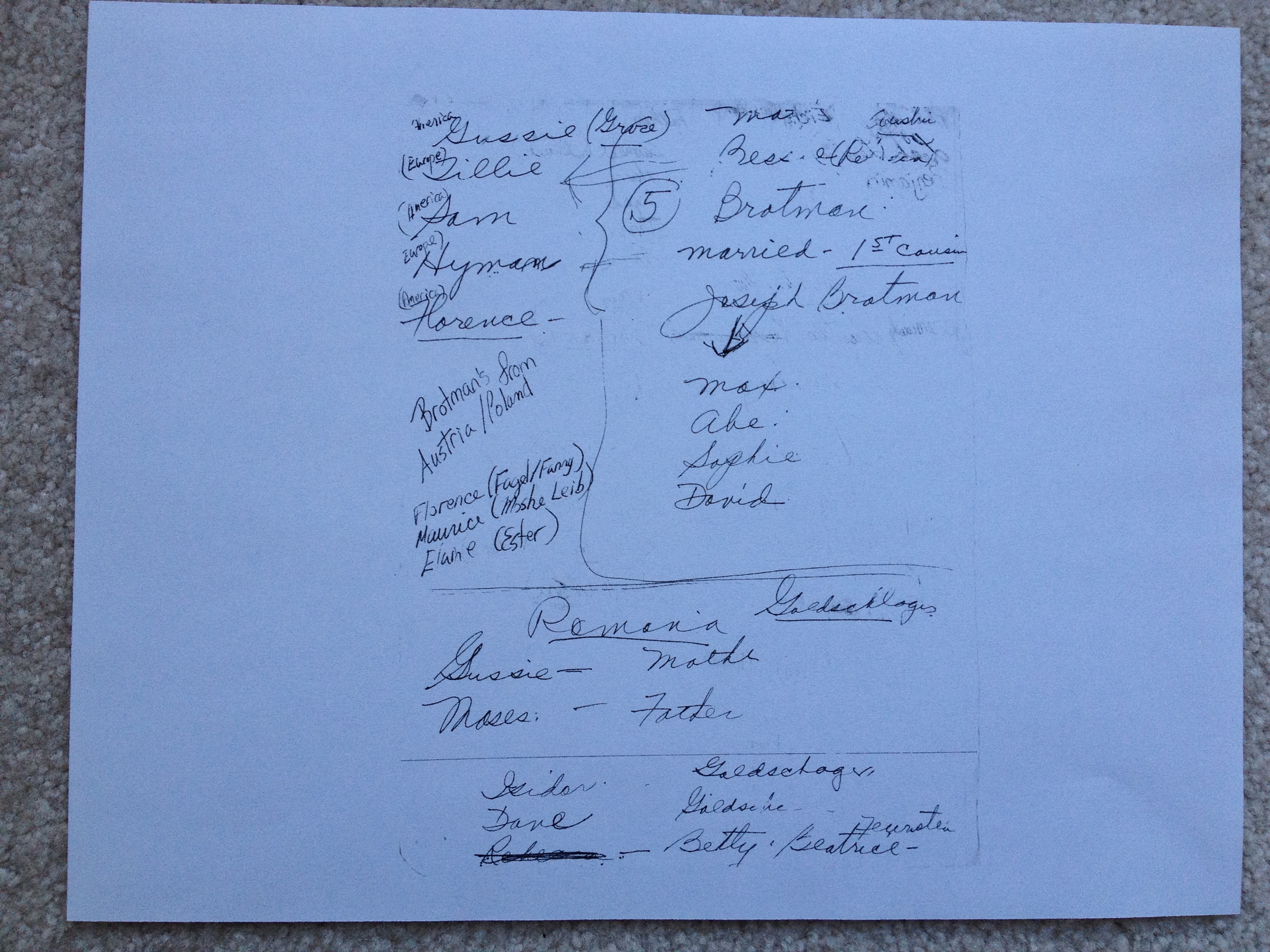
Thanks to all my followers and readers, whether you comment or not, whether you read once a year or every post.  Although I like to think I am writing for posterity—for the future generations who cannot even read yet, it means a lot and makes doing this more fulfilling knowing that there are people out there who are reading what I write.  Special thanks to my brother Ira aka my medical consultant and to Laurel aka my consultant on matters of crime and mystery and to my cousin Jody, who found my aunt’s notes on the Brotman family trees and sent me all the old family photographs from her basement.

Family Tree drawn by Elaine Goldschlager Lehbraum

Family Tree drawn by Elaine Goldschlager Lehbraum

And extra special thanks to my parents, who read every post, answer every question, listen to every boring detail, and support everything I do as they always have.

My daughters may not read every post, or even most posts, but I continue to hope that someday in the future they will be interested in knowing more about their family history and will have this resource to turn to for answers.  My daughters are in my head and in my heart with every word I write, every document I find, and every photo I share.  This is ultimately for them whether they know it or not.


And finally, for Harvey.  Thank you for putting up with my obsession, for supporting it, for listening and hearing, for sharing in the journey, and for taking joy in knowing that this is something that gives me great joy and satisfaction.  As with everything in our lives, I could not do this without your love and support.

Luna

Luna

The year did, of course, have its sad moments.  For me, the loss of my beloved cat Luna still makes my heart ache, but those sad moments just make me that much more grateful for all the happy times that far outweigh the sad times.  In addition to my genealogy adventures, I got to go to the Florida Keys twice this year and spent a great summer on the Cape.  I retired from a job I loved with no regrets, and I am now able to spend my days choosing what to do and when to do it.  I’ve found some meaningful volunteer activities and more time, of course, to research and blog.  I’ve even started writing a novel, something I’ve always dreamed of doing.

So it’s been an amazing year in many ways, and I look forward to another productive and fascinating year ahead in 2015. Coming soon—a big breakthrough on my Brotman line! And more about the Nusbaums, and then on to my father’s maternal lines.

I close with this annual report prepared by the WordPress.com people.  Thank you one and all, and happy New Year! May this be a year of happiness, health, fulfillment, and love for you all.

Here’s an excerpt:

The concert hall at the Sydney Opera House holds 2,700 people. This blog was viewed about 22,000 times in 2014. If it were a concert at Sydney Opera House, it would take about 8 sold-out performances for that many people to see it.

Click here to see the complete report.

Lightness in the Dark

snowmen 2

It’s that time of year again.  It’s so cold out, and the roads can be slippery, sometimes with hard-to-see black ice.  I tend to stay safely inside, enjoying the warmth and comforts of my home.  But the dark and cold can be oppressive, and so I am glad that there are occasions to bring light and joy into our lives during this time of year.  It doesn’t help that my last three posts have been rather depressing, no pun intended.  Reading and writing about the travails of the Nusbaum clan in the 1870s has not been uplifting, to say the least, though it has been interesting.

So I am grateful that Hanukah is starting tonight and that we get to light candles and bring more light into our homes.   The candles kindle memories of my children lighting the menorah over the years, and now they enhance the images of my grandsons’ faces as we light the candles.  The songs, the dreidels, the latkes—all signify joyfulness to me on a personal level and also triumph over all kinds of darkness on a historical and universal level.


Embed from Getty Images


And I am grateful also for the Christmas lights.  Yes, the Christmas lights.  It may not be my holiday, but the lights and trees and wreaths and music are uplifting as well.  They also brighten these cold and dark days.  I may not have Santa Claus coming to my house, but I can still share the excitement that so many children (and their parents) feel about his upcoming visit down their chimneys.

English: Christmas lights Nederlands: Kerstver...

English: Christmas lights Nederlands: Kerstverlichting (Photo credit: Wikipedia)


I am also grateful that I will be getting a break from the ice and cold (though not the darkness) when we head out of town later this week.  The thought of a break from scarves, gloves, hats, and heavy coats is indeed enough to make me smile.

So the blog may be quiet for a bit as I enjoy a short escape from the New England winter.  I have one more post about the 1870s that I will finish before the end of the week, and perhaps I will have a few thoughts to post while away, but the research will have to wait.

Let me take this chance then to wish you all a wonderful holiday season—whether you celebrate Hanukah, Christmas, Kwanzaa, something else, or no holiday at all.  Enjoy any and all of the lights that diminish the darkness of these short winter days.  And may 2015 bring us all good health, happiness, and peace.  I still believe that peace is possible, despite all the darkness of all kinds that surrounds us all.


Empire State Building exhibiting decorative li...

Empire State Building exhibiting decorative lights for both Chanukah and Christmas. (Photo credit: Wikipedia)


Luna

009 (2)

Anyone who knows me at all and anyone who reads this blog regularly knows how much I love my pets.  In fact, I just listed my love of animals as one of seven things to know about me.  So you will know that losing one of my pets is heartbreaking for me.  This one was particularly difficult.

Luna was only six, and as far as we knew, she was healthy and feeling fine.  Nothing seemed wrong—-she was playful, eating, purring, and being her always sweet and affectionate self.  But something was wrong with her heart, and without warning, she died in her sleep earlier this week.

I have written more about Luna here  Luna pdf  for anyone who is interested.  There is a slideshow of her life with her brother Smokey (the gray and white one) and her canine companion Cassie and some of her people here.       I wrote and created these because they help me deal with losing her, so I am not posting the full text here or a lot of pictures, but I am including the links here so I have a record myself and can look back when I want.

For anyone who is also a cat lover, you should know that she was one of the very special ones.


Looking back:  The Cohen Family from Amsterdam to England to Philadelphia and Washington and beyond


Amsterdam coat of arms

Two months ago I wrote a summary of my perspective on the descendants of Jacob and Sarah Jacobs Cohen and their thirteen children, including my great-grandfather Emanuel Cohen.  I wrote about the way they managed to create a large network of pawnshops that provided support for the generations to come.  Many of the Philadelphia Cohens stayed in the pawnshop business into the 20th century.  The generation that followed, those born in the 20th century, began to move away from the pawn business and from Philadelphia.  Descendants began to go to college and to become professionals.  Today the great-great-grandchildren of Jacob and Sarah live all over the country and are engaged in many, many different fields.  Few of us today can imagine living with twelve siblings over a pawnshop in South Philadelphia.  We can’t fathom the idea of losing child after child to diseases that are now controlled by vaccinations and medicine.  We take for granted the relative luxurious conditions in which we live today.

File:Flag of Philadelphia, Pennsylvania.svg

Philadelphia flag


The story of the Cohen family in Washington is much the same in some ways, different in other ways.  Jacob’s brother Moses and his wife Adeline also started out as immigrants in the pawnshop business , first in Baltimore and then Washington.  But unlike Jacob who lived to see his children become adults, Moses Cohen died at age 40 when his younger children were still under ten years old.  Adeline was left to raise those young children on her own as she had likely raised her first born son, Moses Himmel Cohen, on her own until she married Moses Cohen, Sr.  When I look at what those children accomplished and what their children then accomplished, I am in awe of what Adeline was able to do.   For me, the story of the DC Cohens is primarily the story of Adeline Himmel Cohen for it was she, not Moses, who raised the five children who thrived here in the US.  She somehow instilled in those children a drive to overcome the loss of their father, to take risks, to get an education, and to make a living.

Her son Moses, Jr., an immigrant himself, had nine children; his son, Myer, became a lawyer.  To me it is quite remarkable that a first generation American, the son of a Jewish immigrant, was able to go to law school in the late 19th century.  Myer himself went on to raise a large family, including two sons who became doctors and one who became a high ranking official at the United Nations in its early years after World War II.  Moses, Jr.’s other children also lived comfortable lives, working in their own businesses and raising families.  These were first generation Americans who truly worked to find the American dream.

Adeline and Moses, Sr.’s other three children who survived to adulthood, Hart, JM, and Rachel Cohen, all took a big risk and moved, for varying periods of time, to Sioux City, Iowa.  Even their mother Adeline lived out on the prairie for some years.  JM stayed out west, eventually moving to Kansas City; he was able to send his two daughters to college, again something that struck me as remarkable for those times.  His grandchildren were very successful professionally.  Hart, who lost a son to an awful accident, had a more challenging life.  His sister Rachel also had some heartbreak—losing one young child and a granddaughter Adelyn, but she had two grandsons who both appear to have been successful.

Three of the DC Cohen women married three Selinger brothers or cousins.  Their children included doctors, a popular singer, and a daughter who returned to England several generations after her ancestors had left.  The family tree gets quite convoluted when I try to sort out how their descendants are related, both as Cohens and as Selingers.

There were a number of heart-breaking stories to tell about the lives of some of these people, but overall like the Philadelphia Cohens, these were people who endured and survived and generally succeeded in having a good life, at least as far as I can tell.  The DC Cohens, like the Philadelphia Cohens, have descendants living all over the United States and elsewhere and are working in many professions and careers of all types.

flag of Washington, DC

Looking back now at the story of all the Cohens,  all the descendants of Hart Levy Cohen and Rachel Jacobs, I feel immense respect for my great-great-great grandparents.  They left Amsterdam for England, presumably for better economic opportunities than Amsterdam offered at that time.  In England Hart established himself as a merchant, but perhaps being a Dutch Jew in London was not easy, and so all five of Hart and Rachel’s children came to the US, Lewis, Moses, Jacob, Elizabeth, and Jonas, again presumably for even better opportunities than London had offered them.  Eventually Hart himself came to the US, uprooting himself for a second time to cross the Atlantic as a man already in his seventies so that he could be with his children and his grandchildren.  Rachel unfortunately did not survive to make that last move.

Flag of the City of London.svg

The flag of the City of London

Arriving in the US by 1850 in that early wave of Jewish immigration gave my Cohen ancestors a leg up over the Jewish immigrants who arrived thirty to sixty years later, like my Brotman, Goldschlager, and Rosenzweig ancestors.  Of course, the Cohens had the advantage of already speaking English, unlike my Yiddish speaking relatives on my mother’s side.  They also had the advantage of arriving at a time when there wre fewer overall immigrants, Jewish immigrants in particular and thus faced less general hostility than the masses of Jewish, Italian, and other immigrants who arrived in the 1890s and early 20th century.  Also, my Cohen relatives may not have been wealthy when they arrived, but Hart and his children already had experience as merchants and were able to establish their own businesses fairly quickly.  Thus, by the time my mother’s ancestors started arriving and settling in the Lower East Side of NYC or in East Harlem, working in sweatshops and struggling to make ends meet, my father’s ancestors were solidly in the middle and upper classes in Philadelphia, Washington, Sioux City, Kansas City, Detroit, and Baltimore.

When I look at these stories together, I see the story of Jewish immigration in America.  I see a first wave of Jews, speaking English, looking American, and living comfortably, facing a second wave who spoke Yiddish, looked old-fashioned, and lived in poverty.  No wonder there was some tension between the two groups.  No wonder they established different synagogues, different communities, different traditions.

A recent study suggests that all Ashkenazi Jews were descended from a small group of about 350 ancestors.  We all must share some DNA to some extent.  We are really all one family.  But we have always divided ourselves and defined our subgroups differently—Orthodox, Conservative, Reform; Galitizianer or Litvak; Sephardic or Ashkenazi; Israeli or American; so on and so forth.  We really cannot afford to do that in today’s world; we never really could.  Today very few of us make distinctions based on whether our ancestors came in 1850 or 1900 because we are all a mix of both and because we have blurred the economic and cultural distinctions that once were so obvious.  But we still have a long way to go to eradicate the divisions among us and to overcome the prejudices that continue to exist regarding those who are different, whether Jewish or non-Jewish.


Grandsons and Memories

The last five days were spent with my grandsons Nate and, for two of those days, Remy.  Nate came back to our house for three days, and I just had the best time with him, doing not much of anything special, but just enjoying him and seeing life through his eyes.  Being with my grandsons makes me think about how important those first few years of life are—how they form us, teach us about the world, and introduce us to relationships, love, trust, friendship, and family.

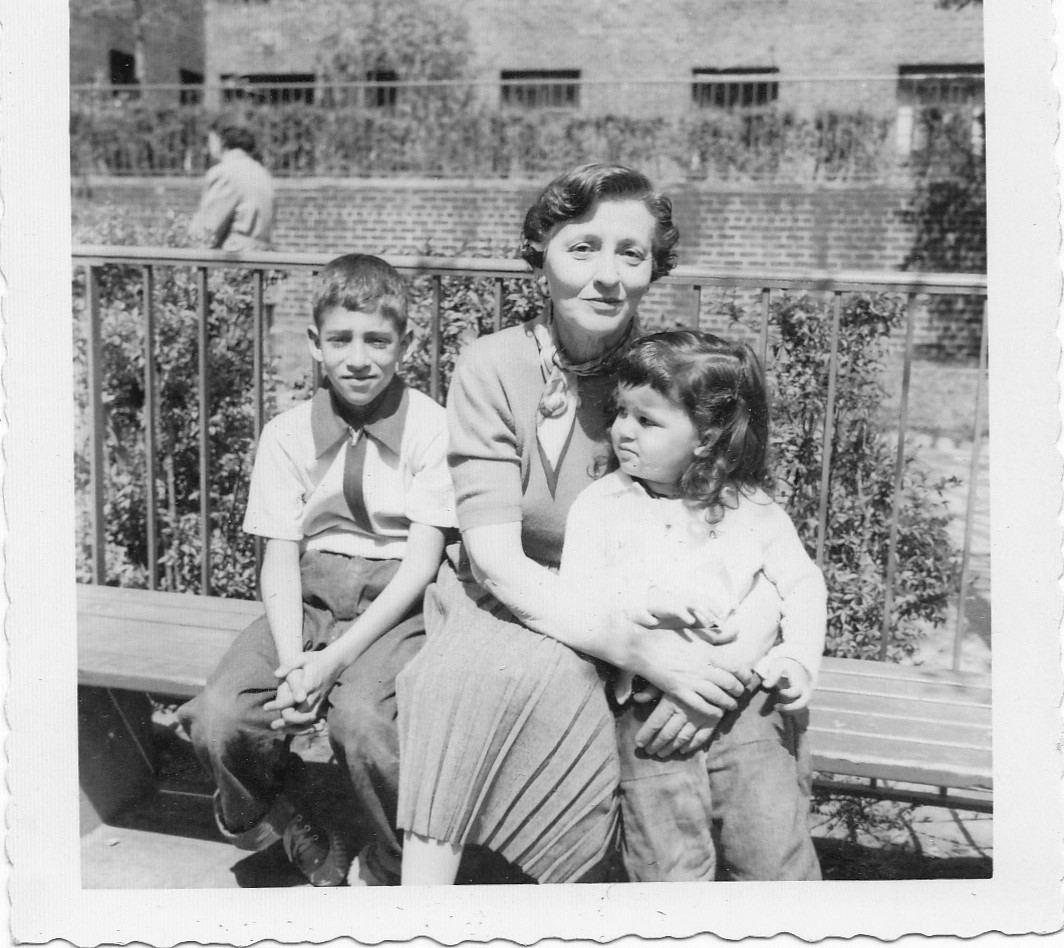
I was fortunate to get a box of old photographs from my cousin Jody a few weeks ago, and I spent one day last week scanning those photos, many of which will eventually get posted on the blog.  But for today, as I think about being with Nate and Remy, I want to recognize those people I spent most of my time with during the early years of my own life—my parents, my grandparents, my aunt and uncle, and my older cousin Jeff.  We all lived within a few minutes of each other in Parkchester, a large apartment complex in the Bronx, and I probably saw them every day or almost every day during those years.  We also spent summers together near Lake Mahopac, New York, on Long Pond.  They called me Kugel, or Amy Kugel, or sometimes just Kug–the only people who ever did.  (My mother still occasionally does.)

They made me feel loved, and they gave me a sense of family that has stayed with me all my life.  I can only hope that we are doing the same for Nate and Remy, even though we don’t live close enough to be with them as much as I was able to be with my grandparents at their ages.   Although I don’t have many specific concrete memories of those years, these photographs capture those magical years of my early life.

amy florence abt 1954

My mother

amy and john 1954 abt

My father

Amy Gussie and Isadore

My Grandparents

elaine and amy 1953

My Aunt Elaine

My cousin Jeff

My cousin Jeff

Jeff and Amy

Jeff

jeff gussie amy 1955 abt

Jeff, my grandmother, and me