Sliding Doors

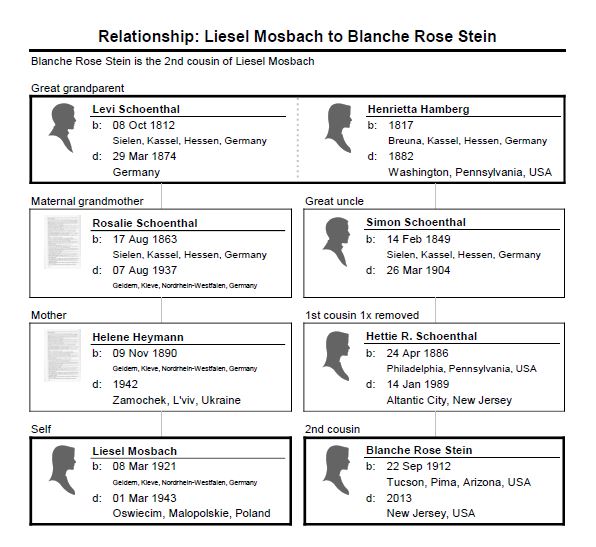
Back in April, I wrote about the family of Rosalie Schoenthal, my great-grandfather’s sister, the one who stayed in Germany to marry Willy Heymann.  Most of what I knew of their fate I learned from the memoir written by Ernest Lion, the man who married Rosalie and Willy’s granddaughter, Liesel Mosbach.  Liesel, her sister, her parents, and her aunt, were all victims of the Holocaust. Ernest Lion memorialized them all in his heartbreaking memoir, The Fountain at the Crossroad.

As I mentioned in a subsequent post written for Yom Hashoah in May, I was so moved by Ernest’s story that I tracked down his son Tom to ask about getting it published so that it could be more widely read.  Since then, I have been working with Tom to edit and format the memoir for publication.  (We’ve run into a few obstacles, but that’s a story for another day.)  I am hoping that sometime soon the book will be available for distribution. When it is, I will post the relevant information on the blog.

But none of this would be possible without the help of another of my cousins by marriage, Sharon.  Sharon is married to the great-grandson of Simon Schoenthal, who was also my great-grandfather’s brother as well as Rosalie Schoenthal Heymann’s brother.  And Sharon, who writes the blog The Heart and Craft of Life Writing, has a great deal of knowledge not only about writing, but also about getting your writing published.  Sharon and her husband were the ones who shared with me the remarkable memoir written by Hettie Schoenthal Stein.  So when I decided to try and get Ernest Lion’s book into a publishable format, I turned to Sharon for help.

Sharon spent hours through email and Skype instructing me on how to turn a typed manuscript into a format that is not only more readable, but also professional looking.  She has been incredibly patient with me, as all this was new to me, and the old brain isn’t quite as flexible as it once was.  I cannot possibly express how grateful I am to her for her help.

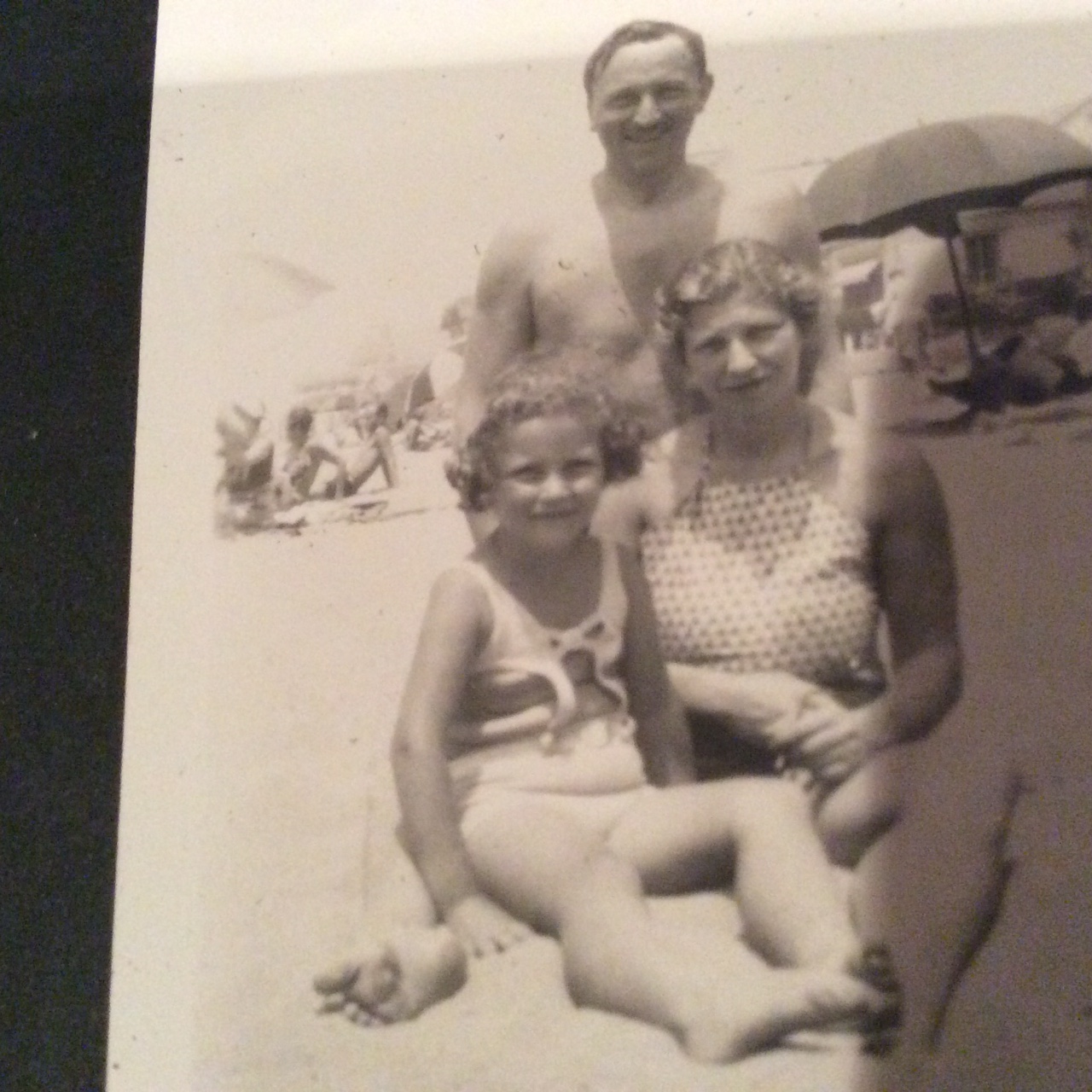
One of the last things we worked on was inserting photographs into the memoir, and as she was doing this, Sharon was struck by the resemblance she saw between Liesel Mosbach Lion, Ernest’s first wife and our mutual cousin, and Sharon’s mother-in-law, Blanche Stein Lippincott.  She sent me a photograph of Blanche and her family that I had not previously seen.

ezzie-blanche-parvin-1940

Blanche Stein Lippincott and her family 1940 Courtesy of the Lippincott family

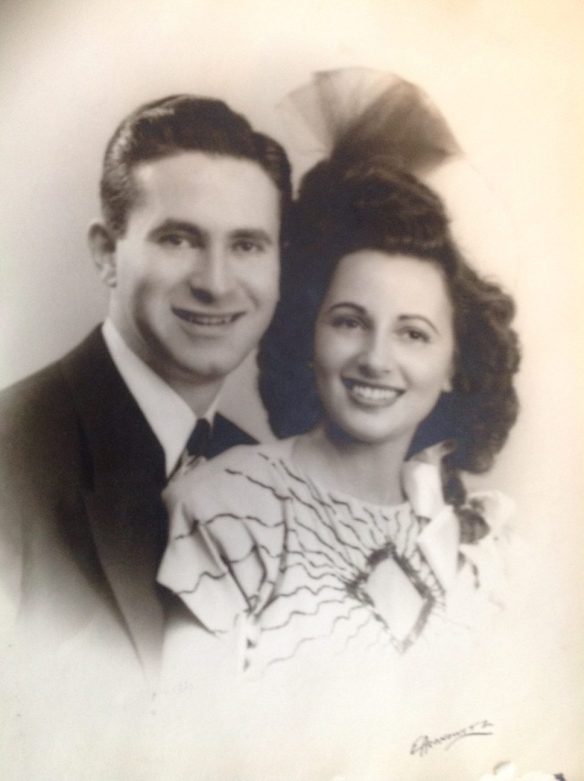
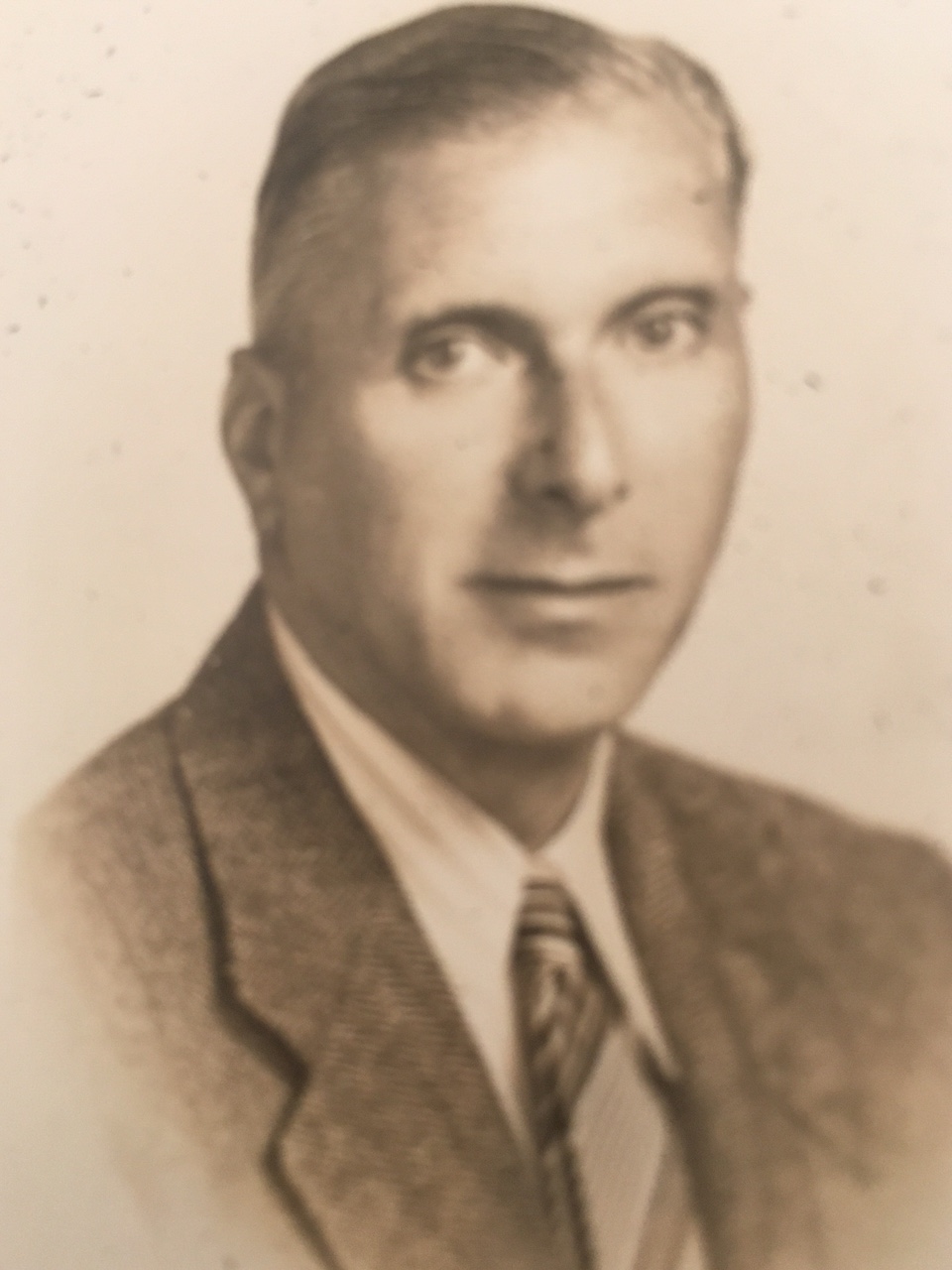
And here is a photograph of Liesel Mosbach and Ernest Lion that I obtained from Ernest’s son to put into his book:

wedding-ernest-liesel-dec-18-1940-600-dpi

Liesel Mosbach and Ernest Lion Courtesy of the Lion Family


The resemblance is striking.  Blanche and Liesel were second cousins, but from these two photographs, they could have been sisters.

jpg-blanche-to-liesel


But what different lives and fates they had, and the expressions on their faces in these two photographs reflect those differences. While Blanche looks healthy and happy, Liesel looks drawn and sad, even on her wedding day.

Blanche was born in 1912 in Tucson, Arizona, and grew up living on the American frontier in the 1910s and 1920s.  Her mother Hattie and her aunt Gertrude had ventured out west after growing up in Philadelphia and Atlantic City.  They did later return to the East, as I’ve written, and Blanche spent the rest of her life living in New Jersey.  She married in 1937 and raised two children with her husband Ezra.  Blanche lived a long and happy life, making it to almost 101 years old before dying in 2013.  Her mother Hettie had made it to 103.

Blanche Stein Lippincott with her great-granddaughter 1996

Blanche Stein Lippincott with her great-granddaughter 1996

In contrast, Liesel lived a short and tragic life.  She was born in 1921 in Germany, where her father Julius Mosbach owned a fruit and vegetable stand. The family was probably living a comfortable enough life until Hitler came to power.  When Liesel married Ernest Lion on December 18, 1939, conditions for Jews were terrible in Germany, and the young couple had no idea what the future would bring.

There would, in fact, be no future. As a result of the Nazi oppression and the loss of his business, Julius Mosbach suffered a nervous breakdown; in 1941, he was sent to an institution where instead of being treated, he was murdered by the Nazis. In 1942, Liesel’s mother, sister, and aunt, and Ernest’s father were all deported and eventually killed in a Nazi concentration camp.  In 1943, Liesel and Ernest were deported to Auschwitz, where Liesel was killed.  Ernest survived and eventually escaped; he became the voice for the whole family.

Thus, Blanche and Liesel, second cousins who looked like sisters, had far different lives and fates.  I can’t help but think, what if Rosalie and Willie had come to the US like almost all of Rosalie’s siblings? What if Liesel and her sister Grete had grown up in Pennsylvania or anywhere else in the United States?

As the president of our synagogue reminded us on Rosh Hashanah, we cannot control where we are born, when we are born, or to whom we are born.  Some of us are blessed with good luck in all of those things while others are not.  We should never take that for granted.

Double Cousins…Everywhere!

The best part of my discoveries of the Goldfarb and Hecht families is that I have found more new cousins, three of whom are my double cousins—Sue, Debrah, and Lisa. They are descendants of Julius Goldfarb and Ida Hecht. Sue’s daughter Lisa shared this wonderful wedding photograph of Julius and Ida.

julius-ida-goldfarb-wedding-from-lisa-wartur

Wedding photograph of Julius Goldfarb, my grandmother’s first cousin, and Ida Hecht, my grandmother’s niece. Courtesy of the Goldfarb/Hecht family


Julius was the son of Sarah Goldfarb, my great-grandmother’s sister; Ida was the daughter of Tillie Hecht, my grandmother’s half-sister.   So I am related to both of them.

Julius and Ida had four daughters, Sylvia, Gertrude, Ethel and Evelyn. Sue, Sylvia’s daughter, shared with me this precious photograph of her grandmother Ida holding her as a baby:

ida-hecht-goldfarb-and-her-granddaughter-sue-1938

Ida Hecht Goldfarb and granddaughter Sue

And Debrah shared this photograph of her grandparents, Julius and Ida, with her mother Evelyn:


Julius, Evelyn, and Ida (Hecht) Goldfarb

Julius, Evelyn, and Ida (Hecht) Goldfarb

One thing I wanted to define is how, if at all, Julius and Ida were related to each other, aside from being husband and wife.  Hecht/Goldfarb family lore says Julius and Ida were “distant cousins.”

Julius was the son of Sarah Goldfarb.  Sarah’s sister Bessie Brotman was the stepmother of Ida’s mother, Toba, as Bessie married Toba’s father Joseph after his Toba’s mother died.  Although that makes things complicated, it does not alone create any genetic connection between Julius and Ida since Bessie (and thus Sarah) had no blood relationship with Toba.

relationship-bessie-brod-to-tillie-brotman

But if Brotman family lore is correct and Bessie and her husband Joseph Brotman were first cousins, then Joseph Brotman and Bessie’s sister Sarah were also first cousins. Sarah’s son Julius married Ida, who was the granddaughter of Sarah’s first cousin Joseph, making Julius and Ida second cousins, once removed.

relationship-of-julius-goldfarb-to-ida-hecht-better

That is, assuming that Joseph and Sarah were first cousins as Brotman family lore reports, Ida and Julius were in fact “distant cousins,” as Hecht/Goldfarb family lore indicates.  So maybe together the Brotman family lore and the Hecht/Goldfarb family lore validate each other.

Sue and Debrah, who are granddaughters of Julius Goldfarb and Ida Hecht, thus are both the great-granddaughters of Sarah Brotman Goldfarb, making them my third cousins on my great-grandmother Bessie’s side, and the great-great-granddaughters of Joseph Brotman, making them also my second cousins, once removed, on my great-grandfather Joseph’s side. (Lisa is one more step removed on both sides.) Renee is my second cousin; her mother Jean Hecht was my mother’s first cousin; her grandmother Toba was my grandmother Gussie’s half-sister. And then I’ve also found a cousin Jan, whose grandfather was Harry Hecht, Toba’s son, and my mother’s first cousin.

inset-from-harry-hecht-photo

Harry Hecht and his wife and children 1945 Courtesy of the family

And, of course, if my great-grandparents Joseph and Bessie Brotman were in fact first cousins, the relationships get even more convoluted. But I think I will skip that calculation.  At least for now.  Maybe some brave soul out there wants to try and figure it out?

With all this shared DNA, I was very curious to see if there were any family resemblances among the various members of the Goldfarb, Hecht, and Brotman families.  My newly found double cousins Debrah, Sue, and Lisa shared some family photos with me, including this one of Toba/ Taube/Tillie Brotman Hecht:

toba-tillie-brotman-hecht

Toba/Taube/Tillie Brotman Hecht Courtesy of the Goldfarb/Hecht family

Here is a photograph of her brother Max Brotman that I’d earlier received from his family:

Max Brotman

Max Brotman, courtesy of the family

Do you see a resemblance? Unfortunately I don’t have any photographs of Toba’s other full siblings, Abraham and David, to help with the comparison.

But here are photographs of Toba’s half-siblings, Hyman, Tillie (Ressler), Sam, and my grandmother Gussie:

Hyman Brotman

Hyman Brotman

Tilly Brotman

Tilly Brotman Ressler

Sam Brotman

Sam Brotman

Gussie Brotman

Gussie Brotman Goldschlager

I can see some similarities—in particular in the shape of the noses.  But it appears that Max and Toba do not have faces that are as round as those of their half-siblings.  Perhaps the shape of their faces was a genetic trait they inherited from their mother Chaye, not their father Joseph Brotman.

Here is one other photograph of the extended Goldfarb and Hecht family.

goldfarb-hecht-family-gathering

Goldfarb Hecht family gathering for Chanukah

Standing on the far left is Julius Goldfarb.  Seated at the head of the table is Ida Hecht Goldfarb.  On the right side of the table starting at the front are two of Ida’s sister, Etta and Jean Hecht.  Also in the photograph are Julius and Ida’s four daughters as well as their spouses and a few of the grandchildren and other cousins.

It’s sad to think that in 1917 Julius and Ida were close enough to my grandmother that they came to visit when my aunt was born, as did Ida’s mother, my grandmother’s sister Toba Hecht, but somehow the families all lost touch, and my mother only has a few  memories of some of the Goldfarbs from her childhood.

On the other hand, I feel very fortunate that now, almost a century after my aunt was born, I know who the Goldfarbs and Hechts were and I am in touch with a number of these “new”  cousins of mine.


More Manna: The Family of Sidney Oestreicher and Esther Siff

In my last post I shared some of the wonderful photographs I received from my cousin Steve of Sarah Stern and Gustav Oestreicher and their three children, Sidney, Frank, and Helen.  This post will focus on the children of Sidney Oestreicher and Esther Siff, Steve’s grandparents.

Their first child Gerald was born in 1916, in Chicago, where Sidney and Esther lived in the early years of their marriage. Their daughter Betty was born three years later in 1919. Sidney was working as a traveling salesman during those years.
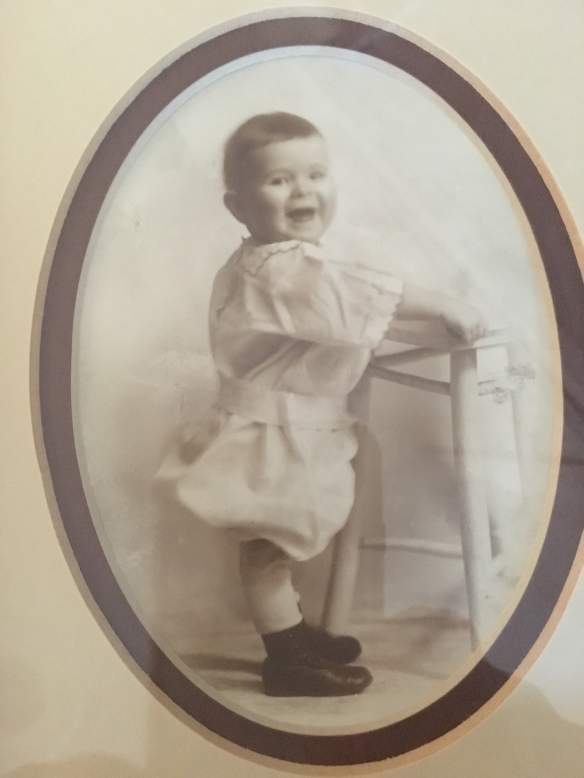
Gerald Oestreicher

Gerald Oestreicher, c. 1917

Gerald and Betty Oestreicher, c. 1922

Gerald and Betty Oestreicher, c. 1923
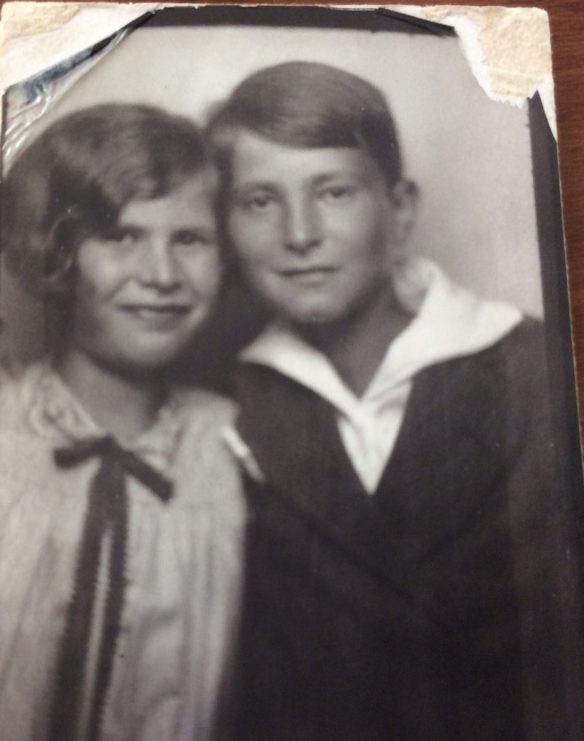
Betty and Gerald Oestreicher

Betty and Gerald Oestreicher, c. 1930

By 1930 Sidney’s father Gustav had retired and moved with Sarah to Atlantic City, and Sidney returned with Esther, Gerald, and Betty to Pittsburgh to help run the family store, The People’s Store.  Sidney and Esther had their third child Elaine in Pittsburgh in 1931.
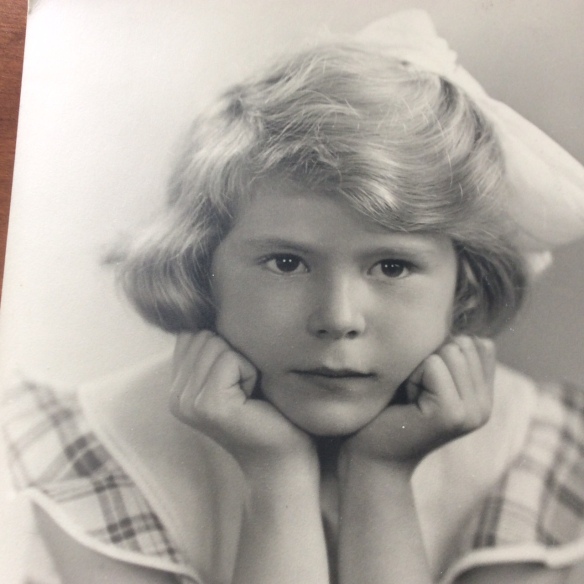
Elaine Oestreicher

Elaine Oestreicher

This photograph below, probably taken in Pittsburgh in the late 1930s, includes the whole family–from left to right, Betty, Sidney, Elaine, Esther, and Gerald.
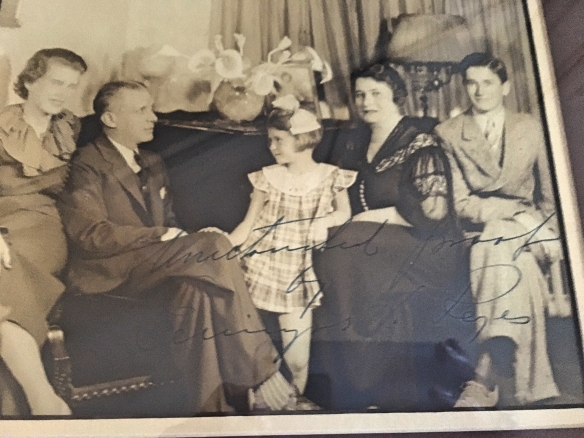
Betty, Sidney, Elaine, Esther, and Gerald

Betty, Sidney, Elaine, Esther, and Gerald

After The People’s Store went bankrupt during the Depression, Sidney had a hard time finding work.  Steve told me that Gerald would sell apples on the street after school to earn money.  Steve also shared this story about his grandmother Esther:

Grandma, Esther Oestreicher, was a homemaker to her three children, but also a very good pinochle player.  Twice a week she would sit down at night with friends and earn a living. 

Once a week or month, there was a raffle at the local theater after the matinee movie.  On one occasion as Gerald and Esther were walking to the theater, she repeatedly announced to neighbors sitting on their stoups, “My son and I are going to the movie where I will win the raffle today.”  This terribly embarrassed my Dad, who said he wanted to tuck his head under his shirt.  Sure enough after the movie ended, Esther won the raffle.  On the way home passing many of those same neighbors on their stoup, she waved the money at them joyfully yelling, ” I told you I would win the raffle.”
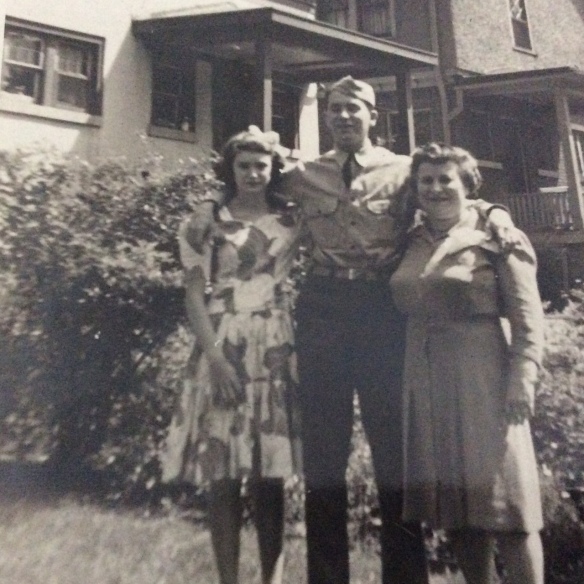
Elaine, Gerald, and Esther Oestreicher

Elaine, Gerald, and Esther Oestreicher

Gerald played saxophone in high school.  In 1937 and 1938, Gerald was a student at Northeastern University in Boston, where he continued to play the saxophone in the university band.
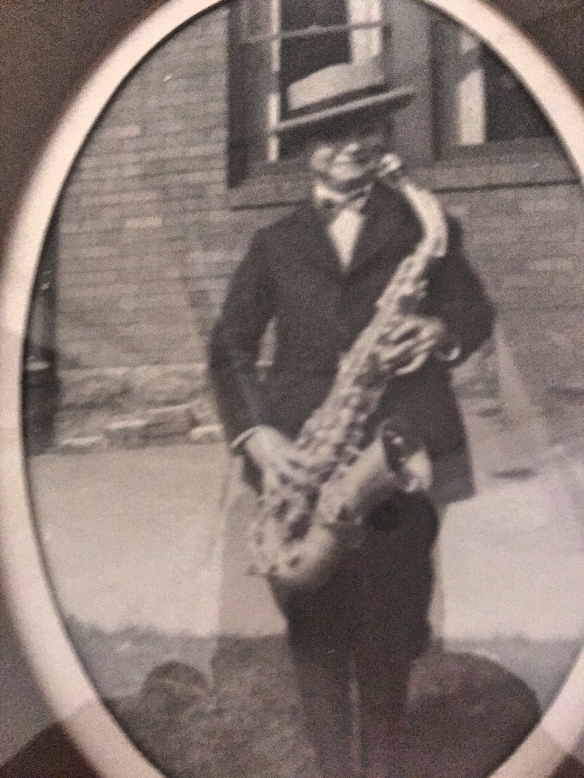
Gerald Oestreicher playing saxophone
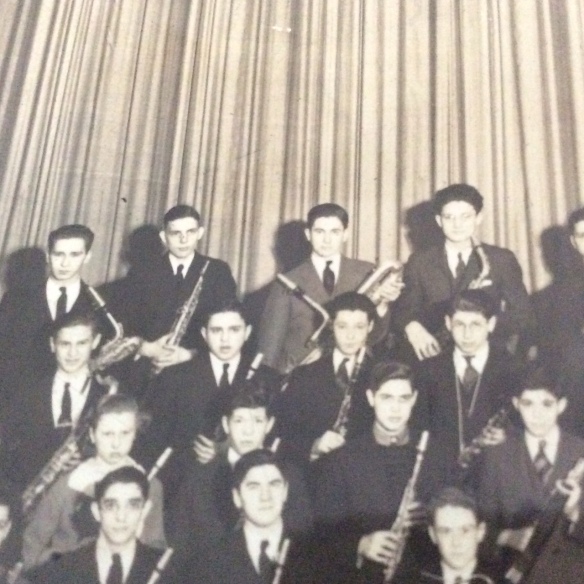
Gerald Oestreicher playing saxophone

IMG_1966

On October 1, 1941, Gerald enlisted in the US Army Air Corps. Here is his draft registration card and his Army identification card. (Note that his name change to Striker is dated December 5, 1945, while he was in the service.)
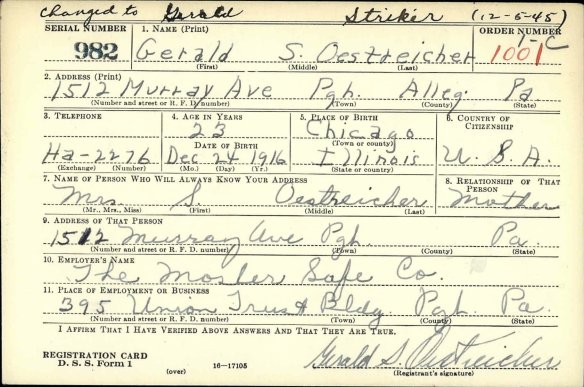
Gerald Oestreicher draft registration for World Wa II
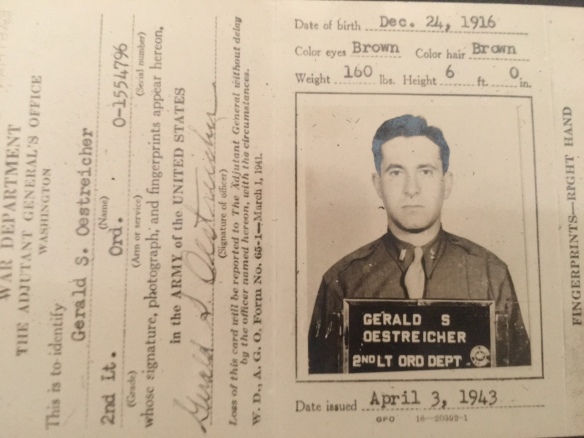
Gerald Oestreicher draft registration for World Wa II

IMG_6973

Steve shared with me the following story about his father’s decision to enlist.  Gerald could see that war was coming, and without consulting with his parents, he decided to enlist in the Army Air Corps.  He had hammerhead toes so his choice of which service to join was limited.  As told by Steve, Gerald had to break the news to his parents the night before he had to report for duty:

The Oestreicher family dinner that night started with nothing out of the ordinary.  Sidney at the head of the table, Esther next to him, Jerry next to his mother on one side, and sister Elaine on the other.  Sister Betty on the other side of her father.  A roast and potatoes in the middle.

Towards the middle of the meal the war was brought up.  There had been little talk from Jerry about it.  My Dad told me his mother at one time looked up,and then straight at him, and dropped her fork on her plate.  “My God, you’ve enlisted.” Jerry responded.  Esther’s eyes teared.  Sidney said,  “When do you leave?”  Jerry announced early tomorrow morning.Sidney became very angry.  Jerry announced he needed to pack and get some sleep.  Sidney offered to take him to the train station, but Jerry insisted no, “I want to say our goodbyes here”. There was a lot of crying by everyone but Sidney.  Jerry announced they should say their goodbye’s that night.  Shortly later Jerry then went to bed.  He left without saying goodbye in the morning.

The next morning Jerry arrived alone at the train station around 6am.  Waiting for him was Sidney, with a sack of food, and advise “stay alive for your mother”.

They waved to each other as the train departed

As you can see from his service record posted below, he had a distinguished record of service during the war.  He attended Officer Candidate School in Aberdeen, Maryland, and a Naval Mine Warfare training center in Yorktown, Virginia.
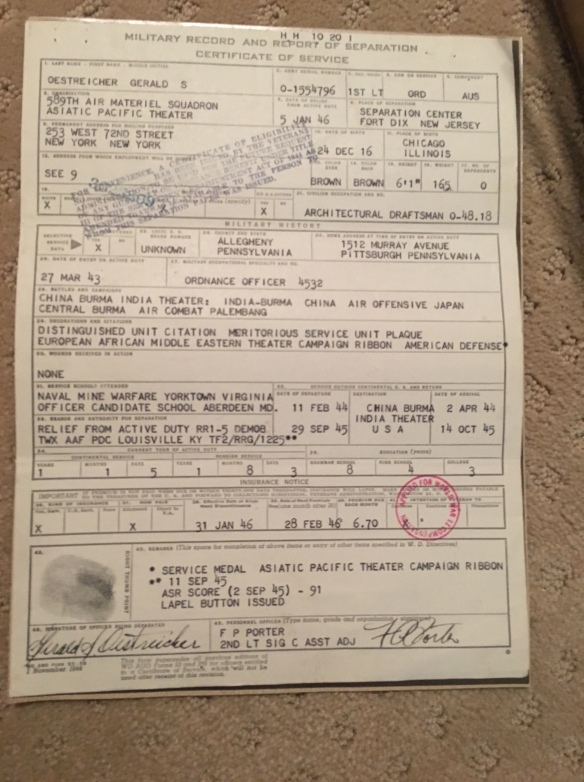
Gerald Striker service record during World War II

Gerald Striker service record during World War II

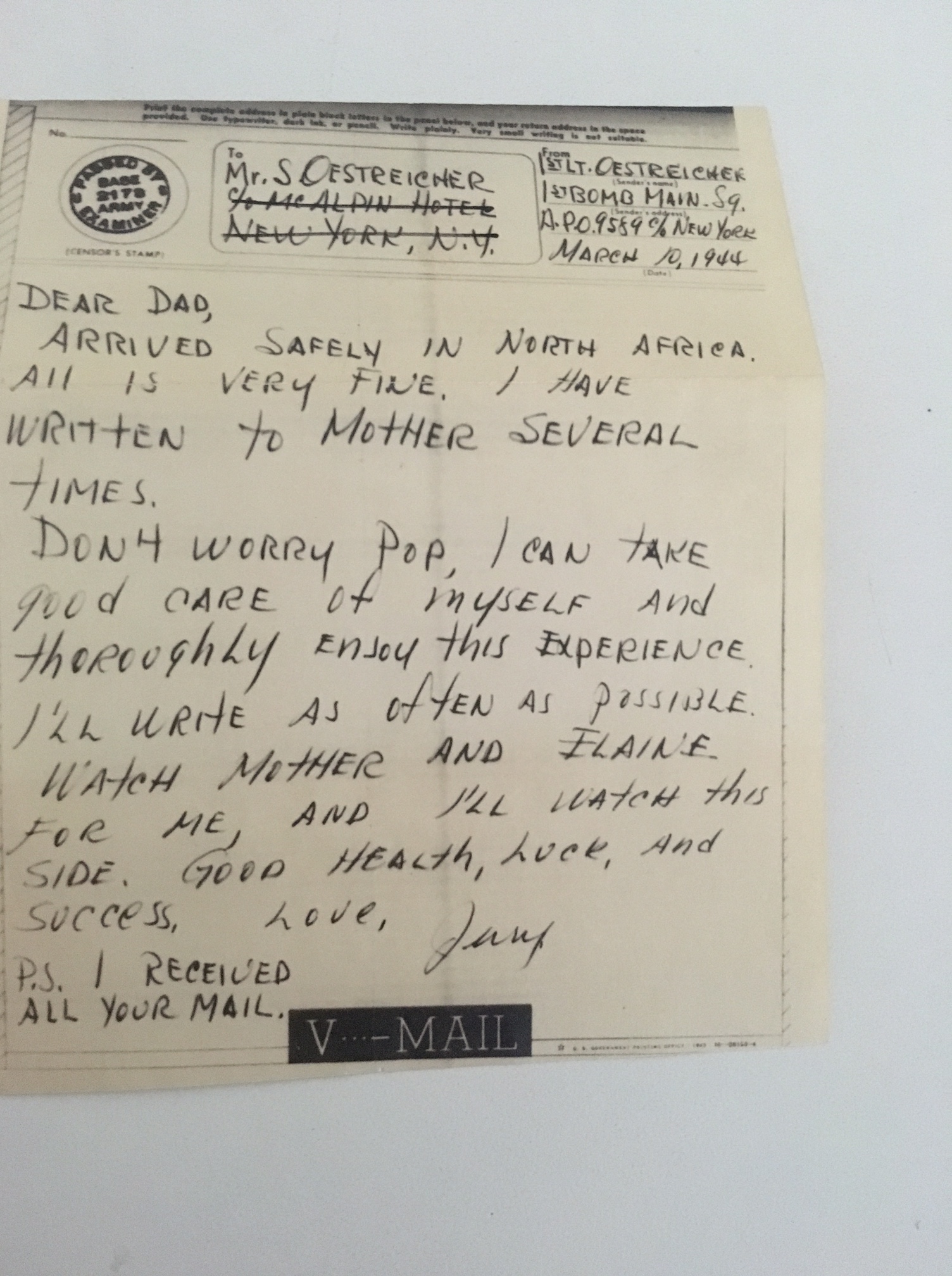
In February, 1944, he shipped out, arriving in North Africa by March 10, 1944, when he wrote the following note to his father Sidney:
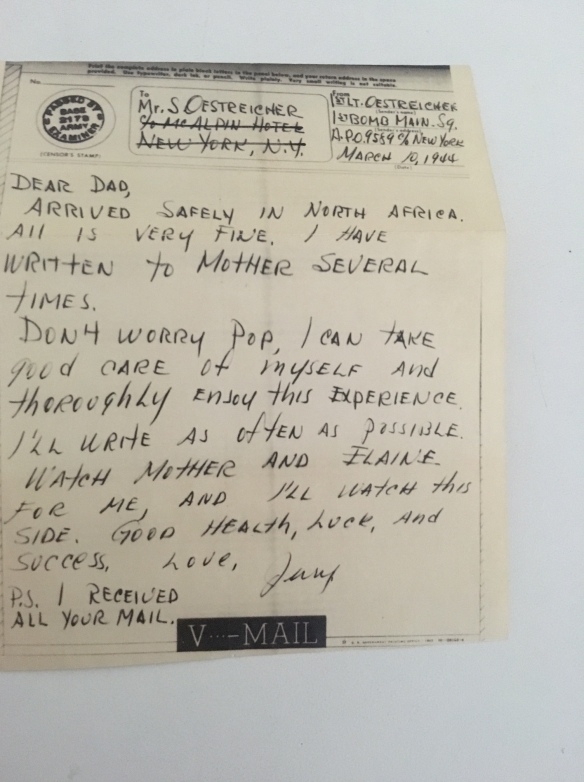
Gerald Oestreicher note to Sidney Oestreicher, March 10, 1944

Gerald Oestreicher note to Sidney Oestreicher, March 10, 1944

What a sweet and reassuring note! Can you imagine thinking that fighting in a war could be an experience one could “thoroughly enjoy”? I certainly can’t.

After some time in North Africa, Gerald was shipped out again, this time to Asia.  While at sea, he wrote the following undated long letter to his family. Please read it, especially the last two pages.  It is truly a look into the heart and mind of a young man about to face combat.
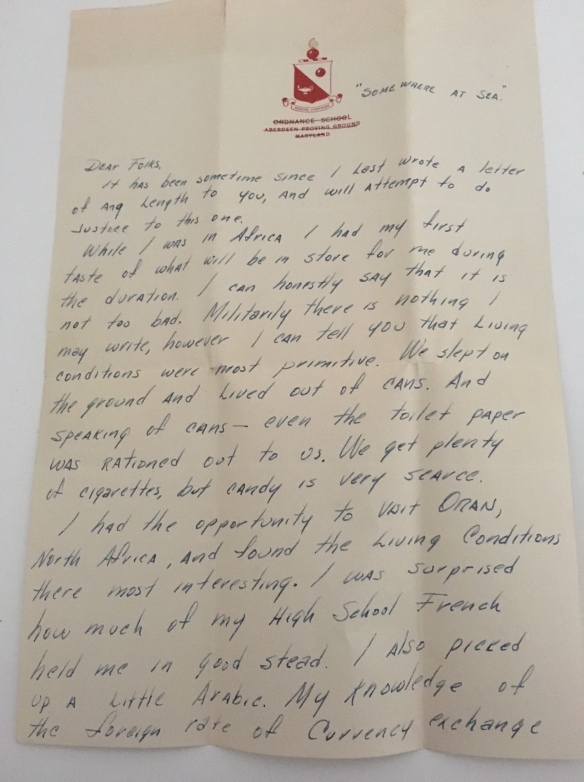
Gerald Striker letter home from WW2 p 1

“Somewhere at Sea”

Dear Folks,

It has been sometime since I last wrote a letter of any length to you, and will attempt to do justice to this one.

While I was in Africa I had my first taste of what will be in store for me during the duration.  I can honestly say that it is not too bad.  Militarily there is nothing I may write, however I can tell you that living conditions were most primitive. We slept on the ground and lived out of cans.  And speaking of cans—even the toilet paper was rationed out to us.  We get plenty of cigarettes, but candy is very scarce.

I had the opportunity to visit Oran, North Africa, and found the living conditions most interesting.  I was surprised how much of my high school French held me in good stead.  I also picked up a little Arabic.  My knowledge of the foreign rate of currency exchange
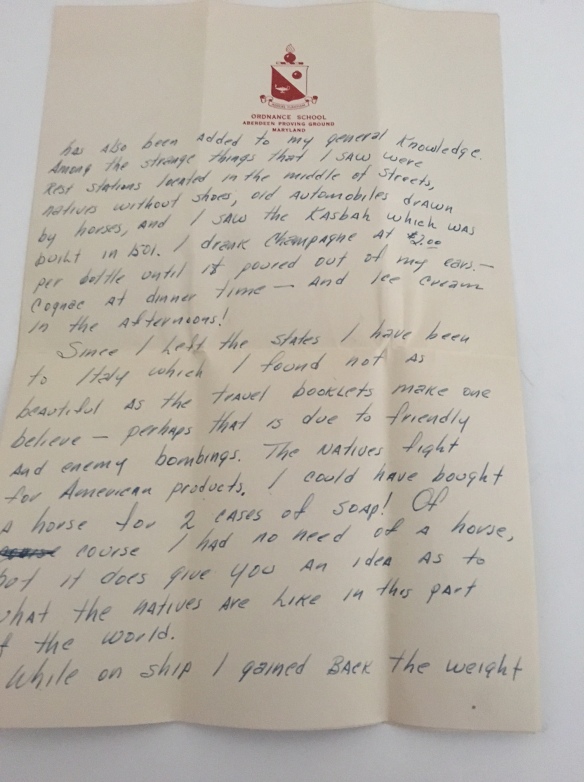
Gerald Striker letter home p2

has been added to my general knowledge.  Among the strange things that I saw were rest stations located in the middle of streets, natives without shoes, and automobiles drawn by horses, and I saw the Kasbah which was built in 1501.  I drank champagne at $2.00 per bottle until it poured out of my ears—cognac at dinner time—and ice cream in the afternoon!

Since I left the states I have been to Italy which I found not as beautiful as the travel booklets make one believe—perhaps that is due to friendly and enemy bombings.  The natives fight for American products.  I could have bought a horse for 2 cases of soap! Of course I had no need of a horse, but it does give you an idea as to what the natives are like in this part of the world.

While on ship I gained back the weight
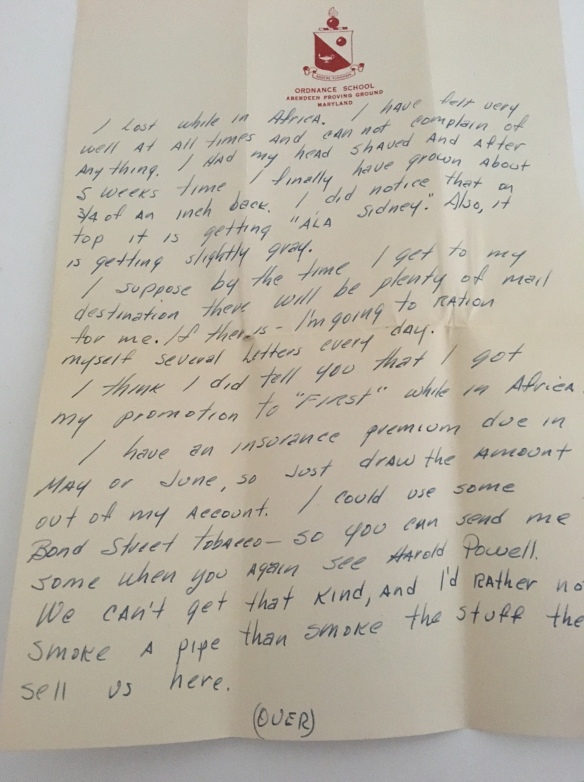
Gerald Striker letter home p3

I lost while in Africa,  I have felt very well at all times and can not complain of anything.  I had my head shaved and after 5 weeks time I finally have grown about 3/4 of an inch back.  I did notice that on top it is getting “a la Sidny.” Also, it is getting slightly gray.

I suppose by the time I get to my destination there will be plenty of mail for me.  If there is—I’m going to ration myself several letters every day.

I think I did tell you that I got my promotion to “first”while in Africa.

I have an insurance premium due in May or June, so just draw the amount out of my account.  I could use some Bond Street tobacco—so you can send me some when you again see Harold Powell.  We can’t get that kind, and I’d rather not smoke a piple than smoke the stuff they sell us here.
Gerald Striker p4

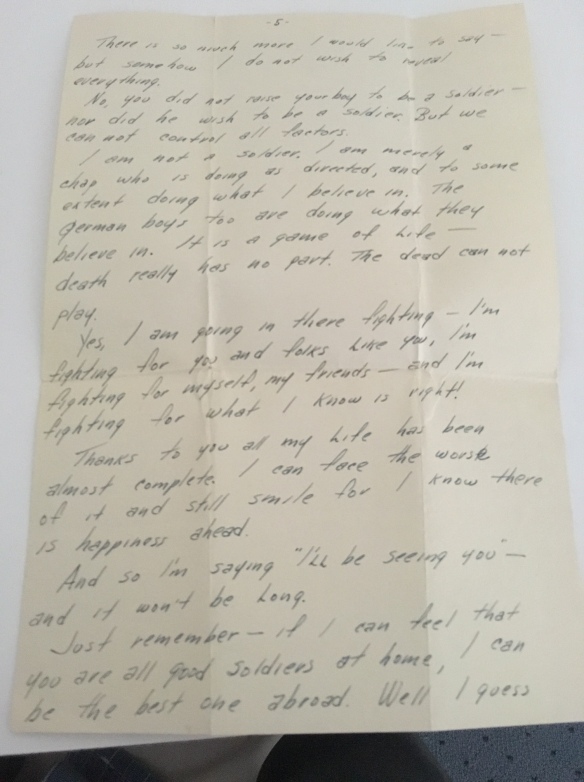
There is so much more I would like to say—but somehow I do not wish to reveal everything.

No, you did not raise your boy to be a soldier nor did he wish to be a soldier.  But we can not control all factors.

I am not a soldier.  I am merely a chap who is doing as directed, and to some extent doing what I believe in.  The German boys too are doing what they believe in.  It is a game of life—death really has no part. The dead can not play.

Yes, I am going in there fighting—I’m fighting for you and folks like you, I’m fighting for myself, my friends—and I’m fighting for what I know is right!

Thanks to you my life has been almost complete.  I can face the worst of it and still smile for I know there is happiness ahead.

And so I’m saying “I’ll be seeing you”—and it won’t be long.

Just remember—if I can feel that you are all good soldiers at home, I can be the best one abroad.  Well I guess
Gerald Striker p5

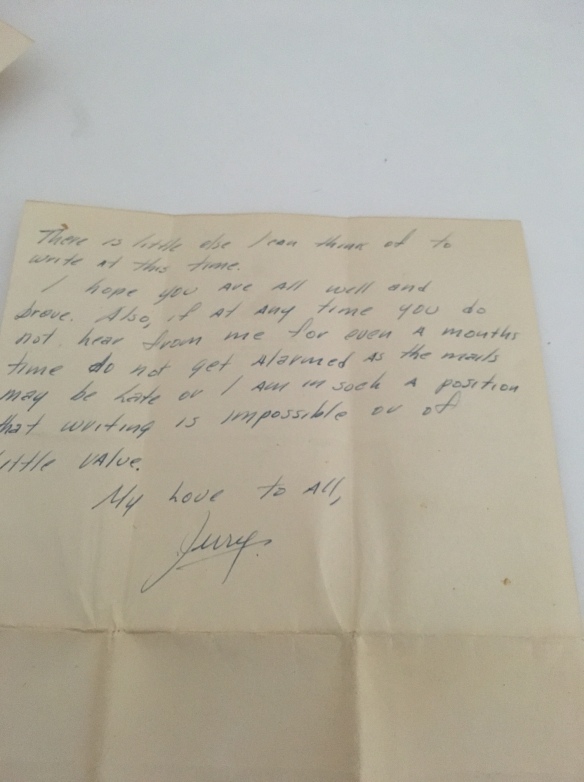
there is little else I can think of to write at this time.

I hope you are all well and brave.  Also, if at any time you do not hear from me for even a months time do not get alarmed as the mails may be late or I am in such a position that writing is impossible or of little value.

My love to all,

Jerry

You can see in this letter that Gerald was still struggling with his parents’ reaction to his enlistment, and despite his brave words, his statement that his “life has been almost complete” seems to suggest that he did worry about being killed in the war.

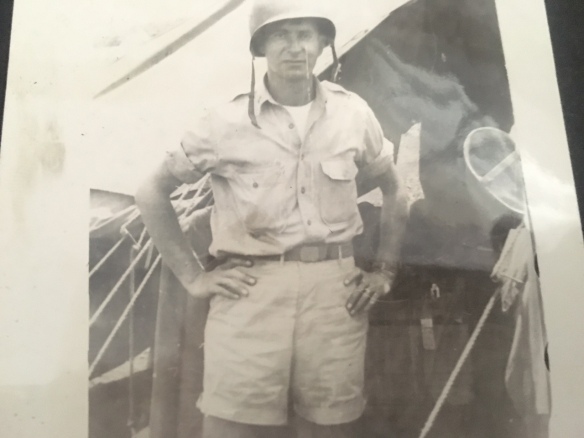
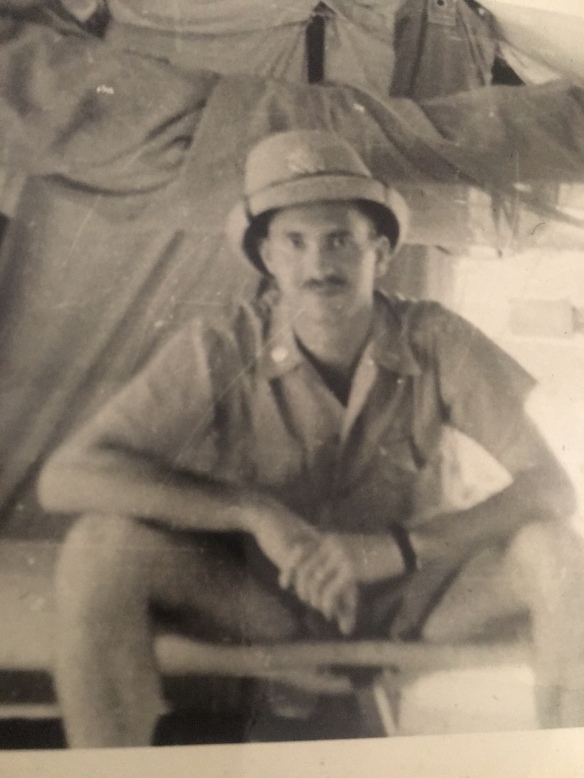
As his service record indicates, after leaving Africa Gerald served as an ordnance officer in the China Burma India theater of the war and received several commendations for his service.  Here are a few photographs of Gerald while serving in World War II.  Steve told me that his father considered his time in the service the best and most exciting time of his life.
IMG_6974 IMG_6978 IMG_6981

Steve also shared this story of his father’s return home from the war:

Four plus years after leaving the U.S, Jerry sailed into New York.  He did not tell anyone when  he would return.  He got to his parents’ apartment and entered a phone booth to call his mother Esther with the intention of announcing he would be home “shortly”. But his little sister Elaine arbitrarily came bounding down the stairs.  But he said she was not his little sister, but a grown young woman.  Then Elaine also spotted him.  Yelling Jerry! Jerry!  she leaped at him.  They both went upstairs to see their mother.

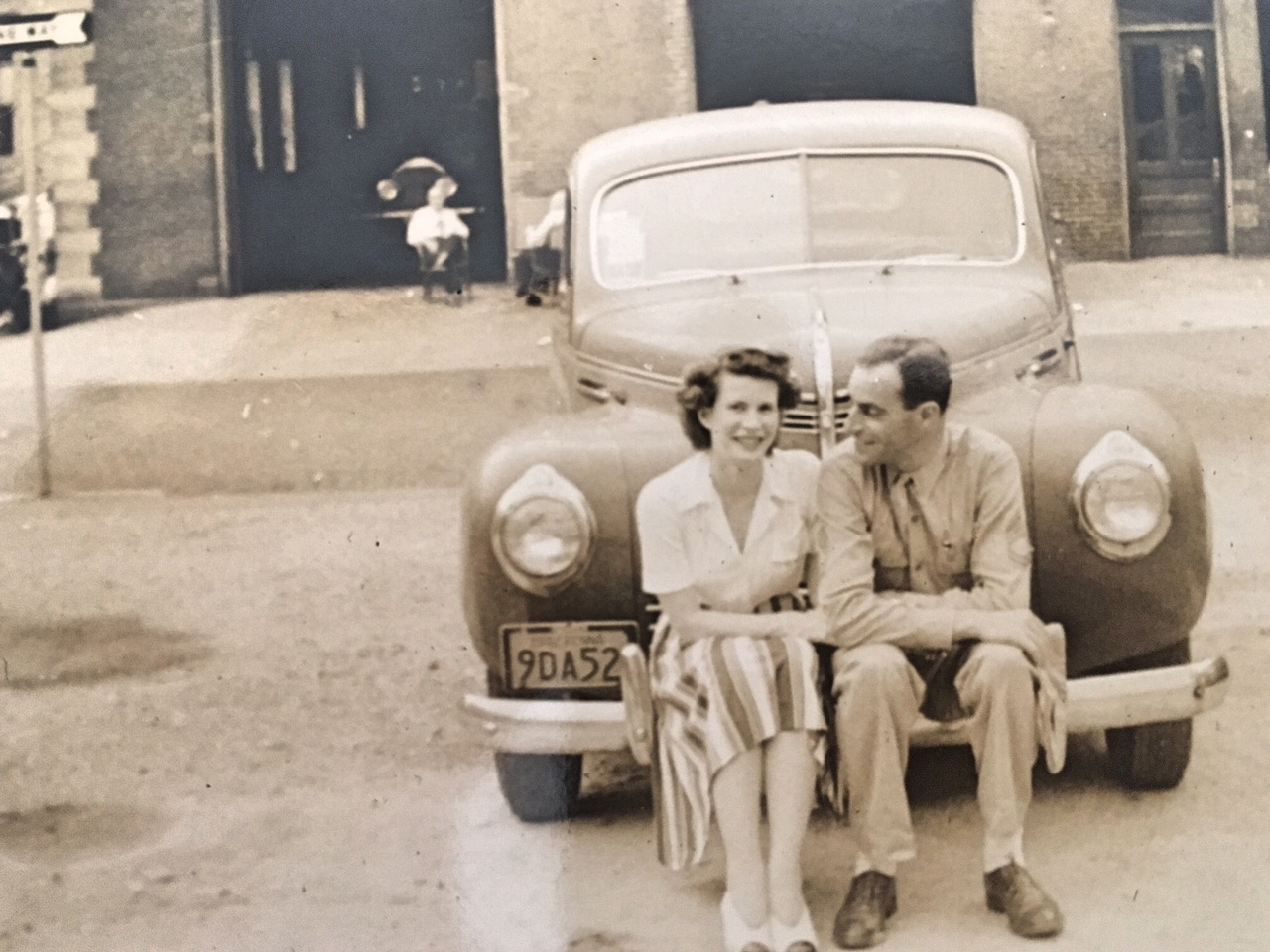
Shortly after the war, Gerald was invited by his Uncle Frank to the Scaroon Manor resort in upstate New York.  There he met a woman who was singing at the resort, Faye Karol, whose real name was Faye Krakower. Her career as a singer was described in my earlier post.  According to Steve, his father Gerald proposed to Faye six days later, and they were married in November, 1946.

Here are some pictures of Faye.
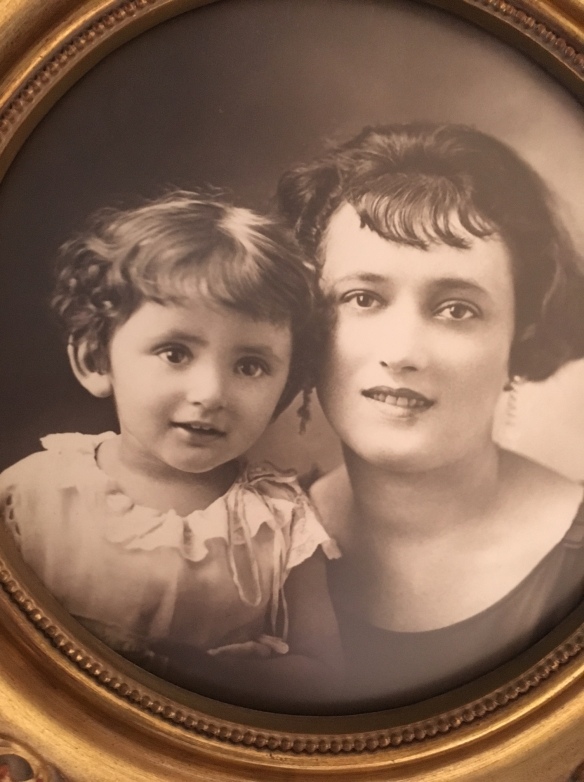
Faye Krakower and her mother Freida
Faye Krakower and her mother Freida

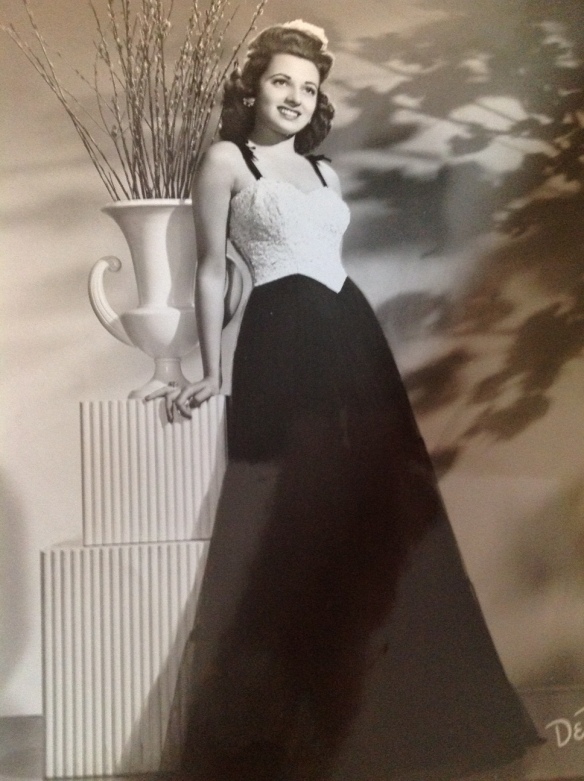
Faye Striker

Gerald and Faye (Krakower) Striker

Gerald and Faye (Krakower) Striker

Gerald and Faye and their son moved to California in 1948 where Gerald worked as a salesman for a number of different clothing lines and other businesses.

Meanwhile, Gerald’s younger sister Betty had married Julius Jacob in 1942.  I wrote about Betty and Julius here.
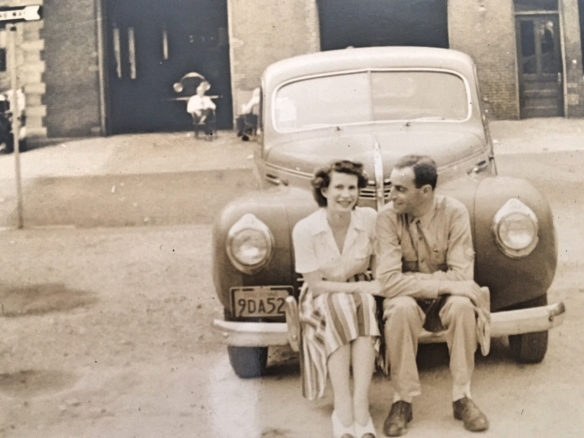
Betty Oestreicher and Julius Jacob
Betty Oestreicher and Julius Jacob

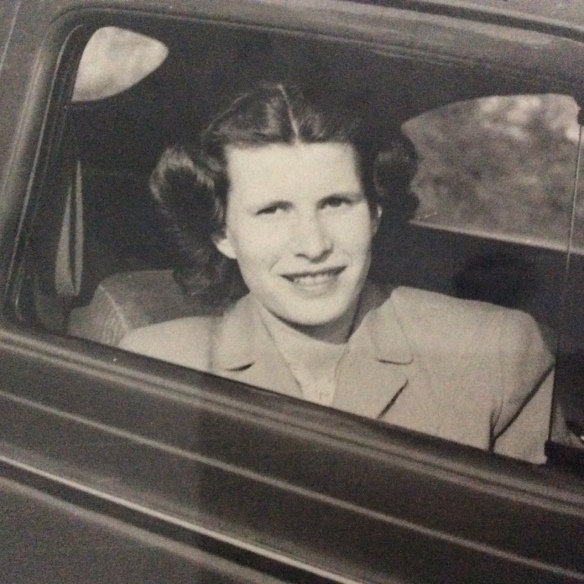
Betty Oestreicher Jacob

Betty Oestreicher Jacob

This is Betty and Gerald’s little sister, Elaine, the one who stayed and lived with Maxine Schulherr Stein in PIttsburgh and started me on the journey that led to all these amazing photographs.
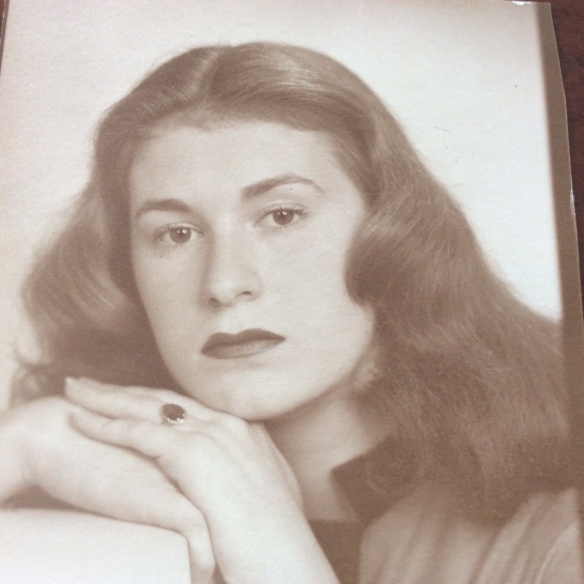
Elaine Oestreicher

Elaine Oestreicher

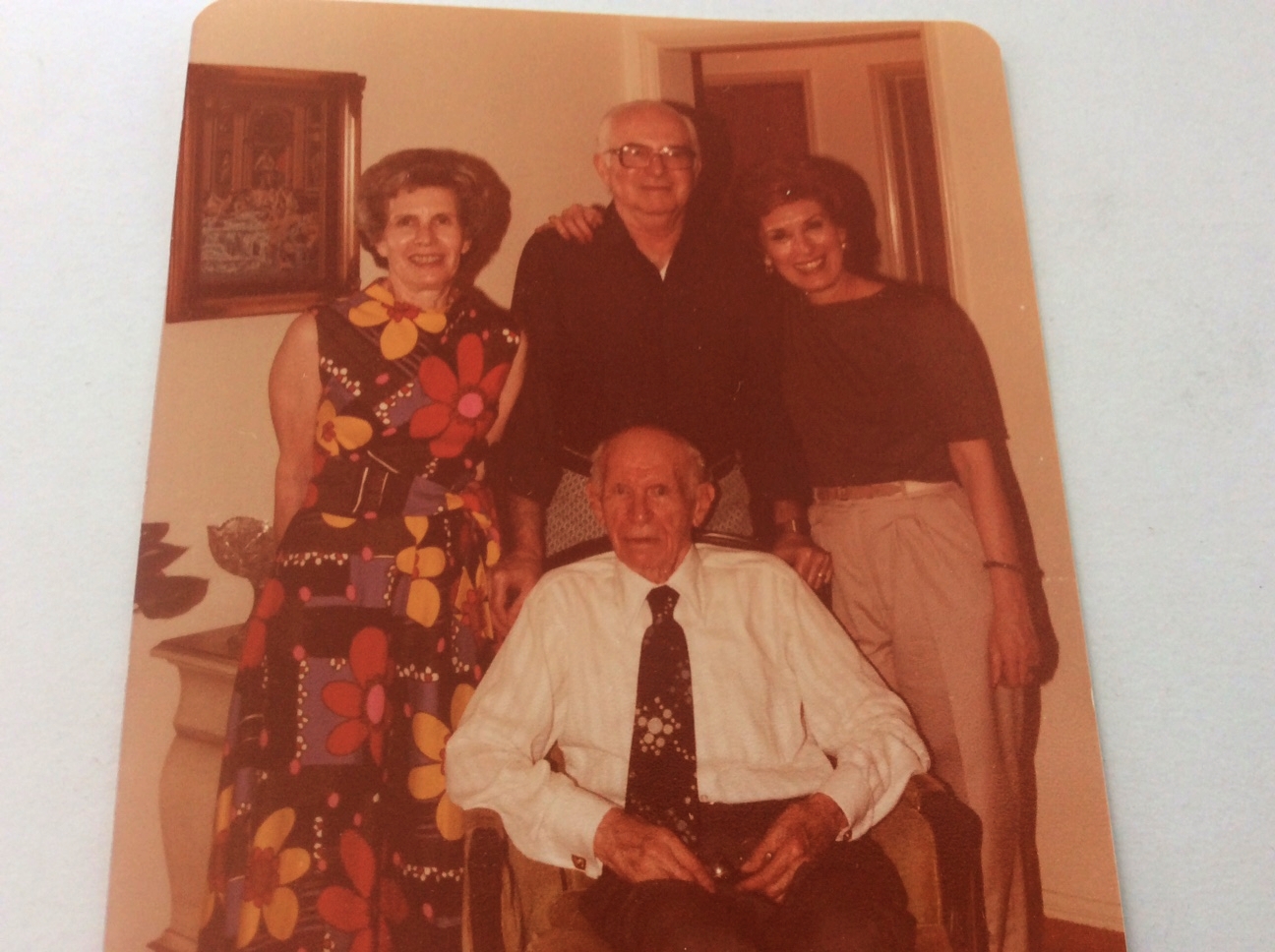
Although Steve shared many more photos of the family, I will end with this one of my cousin Sidney Oestreicher, later in life, with his three adult children, my cousins Gerald, Betty, and Elaine.
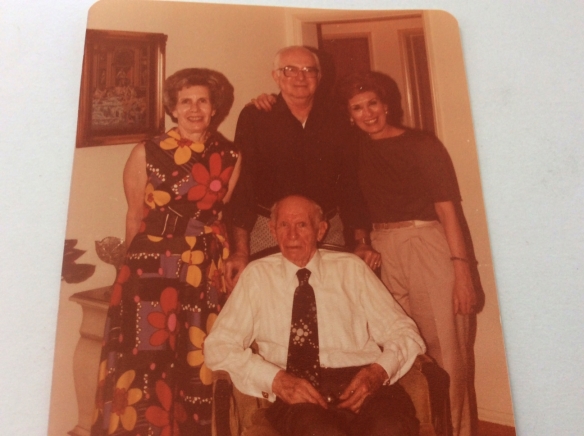
Standing: Betty, Gerald, and Elaine Seated: Sidney Oestreicher Striker

Standing: Betty, Gerald, and Elaine
Seated: Sidney Oestreicher Striker

There are a few more posts to come based on the materials Steve shared with me including the letters written by his uncle Frank Striker during his service in World War I and some letters that were written to Frank by various family members.



Like Manna from Heaven

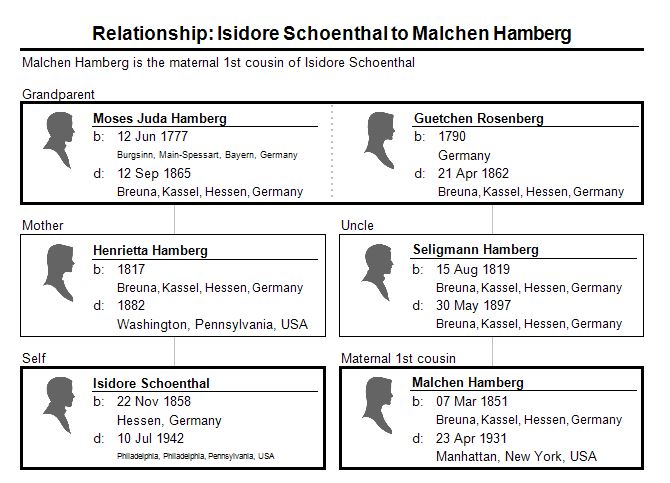
Last Monday I posted about my third cousin, Betty Oestreicher Jacob, who passed away on July 19, 2016.  Betty and I were related through our mutual great-great-grandparents, Levi Schoenthal and Henriette Hamberg.  Her great-grandmother Hannah Schoenthal and my great-grandfather Isidore Schoenthal were sister and brother.  Betty’s grandparents were Sarah Stern, Hannah’s daughter, and Gustav Oestreicher.  Her parents were Sidney (Oestreicher) Striker and Esther Siff

At the time I posted about Betty’s passing, I had only one photograph of Betty and none of her grandparents, parents, or siblings.  But within hours of publishing my post, I received a comment on the blog and then emails from Betty’s nephew, Steve, the son of her brother Gerald.  And Steve generously shared with me numerous photos of all those people and then some. Now I can place faces to the names of the people I have researched and written about.  And what gorgeous photos these are.

In this post, I will share some photographs of Sarah Stern and Gustav Oestreicher and their three children, Sidney, Frank, and Helen.  In a later post, I will share the photos of Sidney’s children, Gerald, Betty, and Elaine.  All are courtesy of Steve Striker, who so generously spent his time scanning and emailing these to me and answering my many questions.

First, here are some photographs of Sarah Stern Oestreicher, my grandmother Eva Schoenthal’s first cousin.  I’ve written about Sarah’s life here.

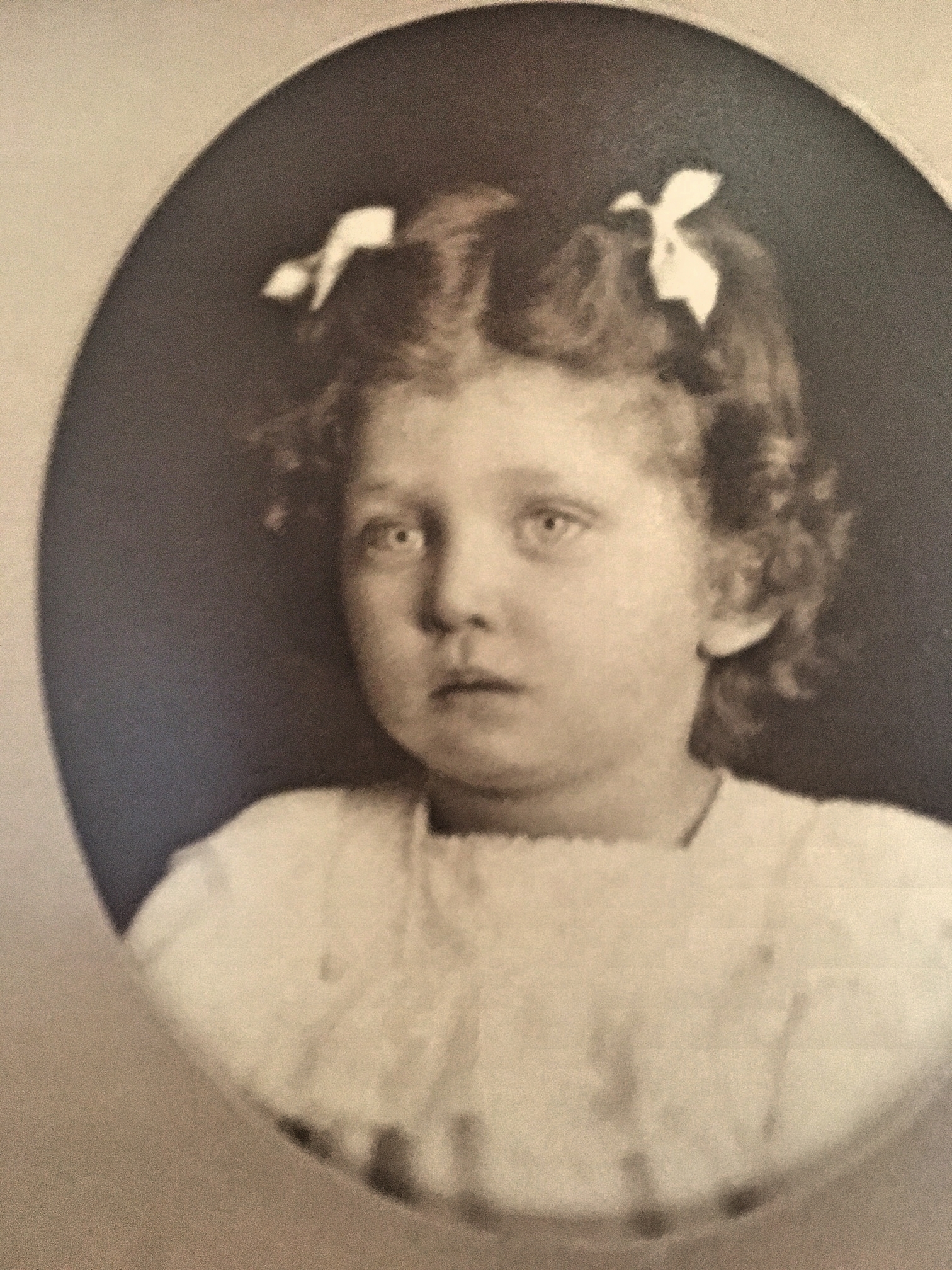
Sarah Stern as a child edited

Sarah Stern as a young child in Germany, probably before her mother married Solomon Stern in 1874. Sarah was born in 1865, so this picture was probably taken between 1870 and 1872.

The photograph below of Sarah was taken in Pittsburgh.  She emigrated to the US by herself around 1884 when she was nineteen years old.

Sarah Stern

Sarah Stern

I assume the photograph below was taken sometime later than the one above, but I am not sure. Does Sarah look older or younger in this photograph? The hairstyle in the one above seems more “contemporary,” but Sarah’s face seems softer and somewhat younger than in the one immediately below.

Sarah Stern Oestreicher

Sarah Stern Oestreicher


A while back I had posted the next photograph, which I’d received from my cousin Maxine Stein, and she and I had wondered whether the woman on the left was Sarah Stern, her grandmother’s sister.  Now I am quite certain that it is in fact Sarah.  What do you think? Is the woman on the far left of the photograph the same woman as the one in the photo directly above?


Jennie Stern Arnold, center, and perhaps Sarah Stern Ostreicher on the right and Edith Stern Good on the right

Jennie Stern Arnold, center, and perhaps Sarah Stern Ostreicher on the left and Edith Stern Good on the right

Sarah married Gustav Oestreicher, the man she met while he was staying at her mother’s boarding house in Pittsburgh in about 1890. Gustav, an immigrant from Austria, was working as an artist and photographer in 1900.

Gustav Oestreicher

Gustav Oestreicher

What a dashing man he was!

Here are Sarah and Gustav’s three children, Sidney (1891), Francis (Frank) (1893), and Helen (1895).  You can see that the children inherited their father’s piercing light-colored eyes.  I would guess that these were taken in the late 1890s, perhaps 1898 or 1899, from the ages of the children.  They were also probably taken at the same time as the photos above of Gustav and Sarah, as all five photos were mounted together in a frame.  Perhaps Gustav himself took these photos.

Sidney Oestreicher

Sidney Oestreicher

Frank Oestreicher as a boy

Helen Oestreicher

This photo of Gustav and Sarah was taken in 1915, when their children were already grown.  By this time Gustav was no longer working as an artist, but was a merchant in Pittsburgh.
Gustav and Sarah Stern Oestreicher

Here is a photograph of the Oestreicher store in Pittsburgh:

Oestreicher store

Here’s a photo of Gustav and Sarah and their three children in about 1910, I’d guess, given the ages of the children. Unfortunately, Sidney’s head was cut off either in the photo itself or in the scan.

Rear: Frank, Helen, Gerald (with head cut off) Front: Gustav and Sarah Oestreicher

Rear: Frank, Helen, Sidney (with head cut off)
Front: Gustav and Sarah Oestreicher

Sidney Oestreicher (later Striker) married Esther Siff on November 16, 1915, in Chicago. Sidney was working as a traveling salesman, and as his daughter Betty told me, he met Esther at a dance in Chicago while there on business.  Esther’s father was also a traveling salesman. (I have more pictures of Sidney and Esther, but will share them in my next post.)

Sidney and Esther 1915

The second son, Francis, better known as Frank, served his country in World War I. (Sidney was exempt as he had a wife and young child.)  The postcard below shows Frank’s dates of service:

Frank postcard with military service dates

He was gone for just over a year—from June 25, 1918, when he left for camp, until July 17, 1919, when he arrived home.  He had gone overseas on September 24, 1918.  As I wrote about here, Frank served in the Meuse Argonne Offensive, one of the most important if not the most important battle in World War I. He was a member of Company C of the 301 Water Tank Train in the American Expeditionary Forces.

According to Richard Rubin’s book, The Last of the Doughboys:The Forgotten Generation and Their Forgotten World War (Houghton Mifflin Harcourt, 2013), p.220, a water tank train was actually a caravan of white trucks used to carry water to the front.  According to his honorable discharge papers, Frank served as a private, which Rubin’s book suggests meant he was likely an assistant driver of one of the trucks.

I found this photograph online depicting Company C of the 301 Water Tank Train.  I wonder if Frank is in the photograph:

Company C, 301 Water Tank Train, H. E. Edwards, Capt. M. J. C. U. S. A., Arthur Armstrong Paler papers, Box 1, World War I Photographs http://bentley.umich.edu/legacy-support/ww1/military-life.php

Company C, 301 Water Tank Train,
H. E. Edwards, Capt. M. J. C. U. S. A., Arthur
Armstrong Paler papers, Box 1, World War I
Photographs
http://bentley.umich.edu/legacy-support/ww1/military-life.php

Francis Oestreicher (Frank Striker) discharge papers

Francis Oestreicher (Frank Striker) discharge papers

As you can see below, he was awarded a Victory medal for his service. (Steve has also sent me some of the letters Frank wrote home during World War I; I will post those separately once I have a chance to review and transcribe them.)

Frank Striker WW1

Francis Oestreicher, later known as Frank Striker

Frank Striker WW1 medal

Frank Striker’s Victory Medal for service in World War I

Gustav and Sarah’s third child was their daughter Helen. Here she is in 1917 when she was 22 years old.

Helen Oestreicher 1917

Helen Oestreicher 1917

As I wrote earlier, Helen married Robert Steel Kann in 1920, but he died a year later at age 26.  Sometime before 1929, she married Aaron Mitchell Siegel, known as Mickie, and they had a daughter Betty.

Helen Oestreicher Kann Siegel and her family

Helen Oestreicher Kann Siegel and her family

I was tickled to see this item in Steve’s collection:

invitation to Henry Schoenthal 50th anniv party

As you can see, it is an invitation to the 50th wedding anniversary celebration in 1922 for Henry Schoenthal and Helen Lilienfeld, about whom I’ve written extensively.  Henry Schoenthal, my great-great-uncle, was Sarah Stern Oestreicher’s uncle, brother of her mother Hannah Schoenthal Stern.

Steve sent me this photo labeled Aunt Helen by his uncle Frank, and I wonder whether this is Helen Lilienfeld Schoenthal, who would have been Frank’s great-aunt.  Frank received a long letter from his great-aunt Helen and great-uncle Henry while he was serving in Europe; the tone and content of that letter suggest that Helen and Henry Schoenthal had a very close relationship with the Oestreicher family. (I will post the letter in a separate post.)

Aunt Helen--maybe Lilienfeld Schoenthal

Frank returned to Pittsburgh after the war and worked as a salesman in the family dry goods store. After the family store went bankrupt in 1933, the Oestreicher family began its migration west to California. Although neither Steve nor his cousin Ron was sure of who first went to California or why, the 1940 census indicates that by 1935 at least Helen and her family and Gustav and Sarah had settled there.  I was not able to locate Frank on the 1930 or the 1940 census,nor do I have any address for him between 1920 and 1942, but his World War II draft registration indicates that by then he was definitely living in California along with his parents and his sister Helen.  Sidney and his family did not move west until the 1940s.

Here is a photograph of the Oestreicher family in Los Angeles in 1936.

Oestreicher family edited 1936

I found this letter written by Sarah Stern Oestreicher to her son Frank in 1933 to be very touching in its religious tone and its affection for her son.  Perhaps it was written around the time that family members were planning to move to California.  From the text of the letter, it appears that Frank had just visited, perhaps before he was leaving to move out west or his parents were.

IMG_9375

IMG_9376

Letter from Sarah Stern Oestreicher to her son Frank, dated January 11, 1933

My dear Francis!

Always remember that The present is under God’s guidance, the future in His keeping. God is guiding, directing, controlling and suplying His children with all good.  His Love and [?] is with you always. Thanking you for all your kindness and the pleasure of having you with us will be the the most pleasant memmories to us.

With my love I remain your devoted Mother. January 11—1933

Here is a photo of Frank in 1940.

Frank Striker 3

One of Steve’s favorite stories about Frank is that he offered to take photographs at Steve’s bar mitzvah, only to discover there was no film left in the camera.  There is only this one photo taken by Frank that day.

IMG_1979

Although Steve has many photographs with Frank with women throughout the years, Frank never married. He died in Los Angeles on April 23, 1990, at the age of 96.  His sister Helen died in 1989 when she was 94.

I am so grateful to my cousin Steve for sharing these amazing photographs with me and allowing me to post them on my blog. There is just nothing better than a photograph to help bring to life the people whose lives I’ve researched.

More photos and stories about the Oestreicher family in my next post.


Ray, Arizona: Home of Gertrude and Hettie Schoenthal

Some of you may remember that about six months ago I wrote about Gertrude and Hettie Schoenthal, two of the daughters of Simon Schoenthal, brother of my great-grandfather Isidore.  Gertrude had married Jacob Miller in 1898 and moved to Arizona. Jacob and his brothers were merchants in the Tucson area. Gertrude’s younger sister Hettie followed her out there around 1906, where she met her husband Henry Stein and eventually settled as well.

Eventually both the Millers and the Steins moved to the small mining town of Ray, Arizona, where they lived for several years before returning to Atlantic City, where most of the members Schoenthal family were still living.   Hettie and her son Walter Stein wrote wonderfully descriptive memoirs of their rough and tumble pioneer life in Ray, Arizona.  I quoted extensively from their writings in this blog post.

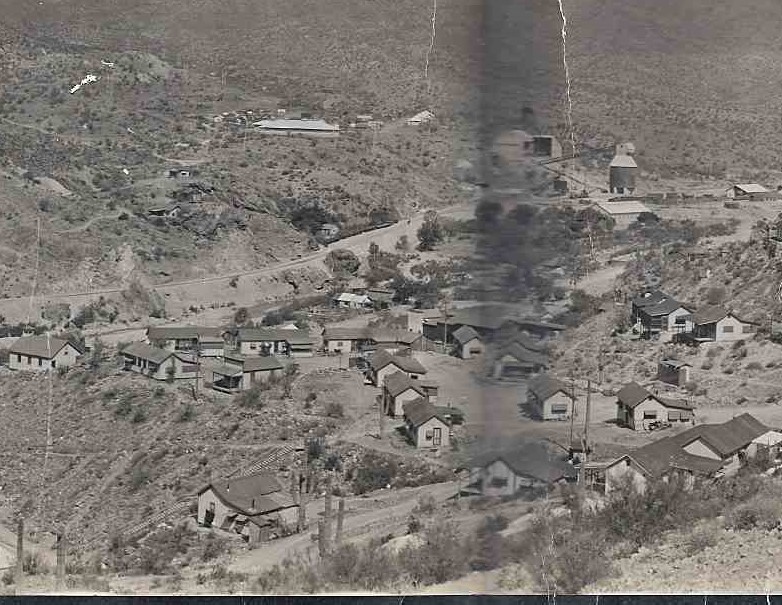
A week ago I was Skyping with Sharon Lippincott, who is married to Ezra Lippincott, grandson of Hettie Schoenthal, and Sharon and Ezra were excited to share with me a photograph that their daughter-in-law had found somewhere on the internet.  It is a panoramic view of Ray, Arizona, taken in the time that Hettie and her sister Gertrude were living there.  In fact, you can see the Miller Brothers store in the photo if you zoom in to the right side of the picture.  Just click, and then click again to zoom in to the photograph to see it more clearly.

Ray Arizona Panarama from Internet

Here’s a closeup of the section showing the Miller store:

Ray Arizona Panarama from Internet (2)

Both Hettie and Walter described their first house in Ray.  Walter wrote:

Our first house was placed on the side of a hill with one door. The back of the house was against the hill. To reach the house you walked up steps that also took care of other householders on the hill. I cannot remember the location of the outhouse. I do remember to bathe, water was heated on the stove and then poured into a galvanized tub that had been placed on the floor.

Hettie’s description is similar:

I will tell you a little about the house. It was up on a hill, just four rooms no bath or toilet. It was terrible. I did not think I could live there, but we did. Your grandfather and a helper built a room and we bought a tub. The pipes had to be on top of the ground. Well, the sun was so hot we had to draw the water and let it stand for hours before bathing.

Can you locate the house in the photograph above?  The houses are all to the far right in the panoramic photograph, and I have a guess as to which one was the home of Hettie Schoenthal and Henry Stein and their children.  Which one do you think it was?  (Look first before looking at my guess at the bottom of this post.)


In my head I am humming the Final Jeopardy theme song.


Here’s my guess:

Ray Arizona Panarama from Internet (3)

See the house in the left foreground with the huge cactus in front?  I think that’s it.  It’s built into the hill, and there is a staircase behind that leads to the other houses.  It looks like the outhouse was right in front of the house.

What do you think?

My thanks to Ezra and Sharon Lippincott and their daughter-in-law Carrie for sharing the photograph with me.

Are These My Great-Uncles?

As I wrote about here, while in Denver, I visited Temple Emanuel where the confirmation class photographs of my grandmother Eva Schoenthal and of her brothers Gerson and Harold were posted on the wall.  It was easy for me to find my grandmother in her class photograph as I knew her face well.  But it was more difficult to identify which boys in the other two class photographs were my great-uncles.

When I got home, I asked my father and also compared the one photograph I have of Gerson and several photographs I have of Harold to see if I could pick out Gerson and Harold in the confirmation class photographs.  Now I think I have, but I’d be interested in whether others agree with me.  My father said he really has no memory of Gerson, but agreed with me as to which boy was Harold.

This is Gerson’s class photograph.

Temple Emanuel 1908 confirmation class with Gerson Schoenthal

Temple Emanuel 1908 confirmation class with Gerson Schoenthal

And this is the only photograph I have of Gerson as an adult:

Dad Uncle Gerson Eva

Here are some closer shots of the faces of the boys in that class:

20160524_170000994_iOS

20160524_170007605_iOS 20160524_170011278_iOS

I think Gerson is the tall boy in the center of the top row (first boy on the left in the bottom photograph and the boy to the far right in the top photograph: same boy).  The one photograph I have of Gerson is of terrible quality, but there is something about the shape of the head and the ears that seems most similar to the boy in the middle.  Do you agree?

Here is Harold’s class photograph:

20160524_165822156_iOS

And here are closeups of the boys in that photo:

20160524_165837031_iOS 20160524_165844844_iOS

I think Harold is the first boy on the left in the top picture.  Here are some other photographs of Harold as a young man:

Hilda (Katzenstein) Schoenthal, Eva Schoenthal Cohen, Eva Hilda Cohen, and Harold Schoenthal

Hilda (Katzenstein) Schoenthal, Eva Schoenthal Cohen, Eva Hilda Cohen, and Harold Schoenthal

Harold Schoenthal

Harold Schoenthal


Again, the ears, the shape of the head, and the mouth seem most similar to the boy on the top left of the first photograph of closeups above.  Do you agree?

It would have been so much easier if they had listed the students in the order in which they were standing instead of alphabetically!


Another Delightful Conversation: My Cousin Maxine

I love it when a cousin finds me.  Usually I am the one searching for them, hoping they will be interested and open to sharing their family histories with me.  So when a cousin finds my blog, it is a delightful experience—I know they are interested, and there is none of the awkwardness of trying to explain who I am and that I am not a scammer trying to get money from them or steal their identity.

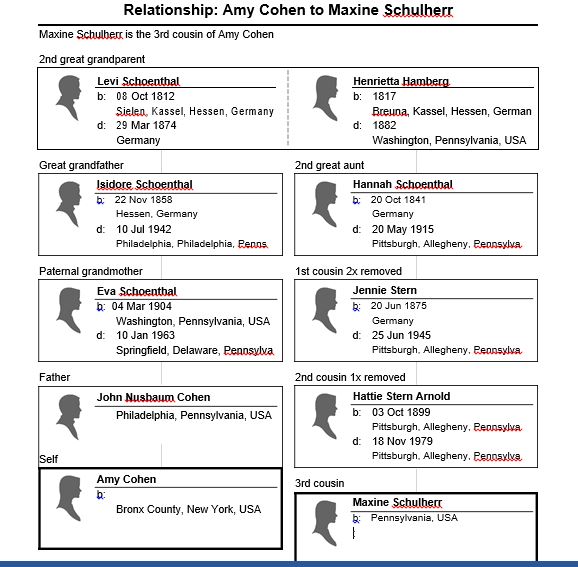
I’ve had that great pleasure again recently when my third cousin Maxine found my blog and left a comment about her connection to me and her family.  Maxine is the daughter of Hattie Arnold and Martin Schulherr, about whom I wrote here.  Maxine’s grandparents were Jennie Stern and Max Arnold, and her great-grandmother was Hannah Schoenthal Stern.  Hannah was my great-grandfather Isidore Schoenthal’s older sister.  Thus, Maxine and I are both the great-great-granddaughters of Levi Schoenthal and Henriette Hamberg.  We are third cousins.

Relationship Amy to Maxine Schulherr


Maxine was born and raised in the Pittsburgh area and has lived there all her life.  We had a wonderful phone conversation and have exchanged many emails since.  Maxine knew many of the cousins about whom I’ve written, including Lee and Meyer Schoenthal, Erna and Werner Haas, and the members of the extended Oestreicher family.  She was able to bring to life many of these people, who thus far had been mostly names and dates and occupations to me.

Her grandmother Jennie lived with Maxine and her parents for a number of years, and Maxine even shared a room with her grandmother during that time.  She knew her well, and so I was hoping that Maxine would have stories about Jennie’s youth.  Jennie came to the United States from Germany in the 1880s with her mother Hannah when she was thirteen years old, and I was interested in hearing any stories about Jennie’s life in Germany or about her experiences as a teenager settling in western Pennsylvania.  But as with so many immigrants, Jennie did not talk about the past.  Maxine said she never heard her grandmother talk about Germany or about her early days in the US.

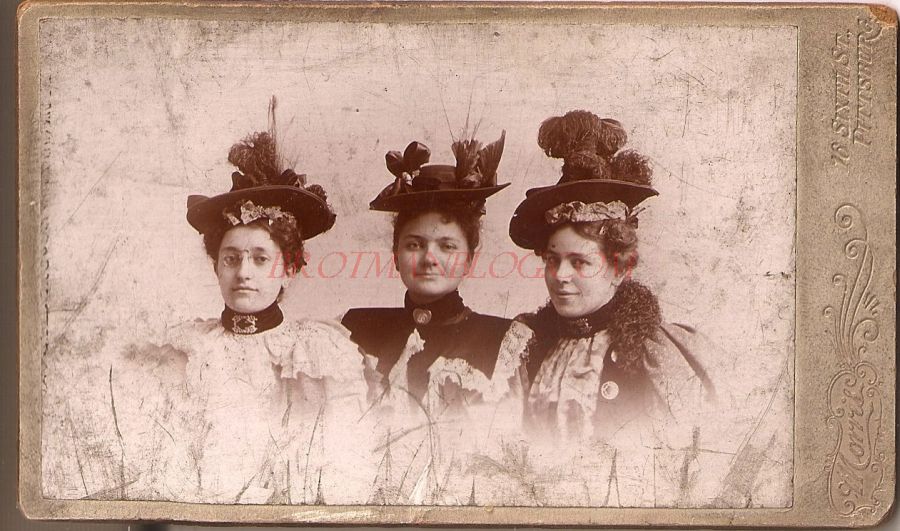
But she did have some old photographs of Jennie with two other women whom we both assume are Jennie’s two sisters, Sarah (on the left) and Edith (on the right). (All photos in this post are courtesy of my cousin Maxine.)

jennie-stern-arnold-and-her-sisters-1

Jennie Stern Arnold, center, and perhaps Sarah Stern Ostreicher on the left and Edith Stern Good on the right

jennie-stern-arnold-and-sisters-2

Stern sisters


Maxine then told me about her grandmother Jennie’s life as an adult in Pennsylvania.  Jennie married Max Arnold, who had originally owned a dairy called Sweet Home Dairy. (Maxine was named for her grandfather Max.)  It was the first dairy to deliver milk to homes in the Pittsburgh area, according to Maxine.  Max had to close the dairy when he had trouble hiring reliable men to come and milk his cows, and he then went into the meat business, as I wrote about here.   Max eventually he retired and his son Sylvan ran the business when Maxine was a child.  Max, Jr., helped his brother Sylvan doing deliveries, but after having several accidents he moved on to other endeavors.

Sylvan closed the meat market when he enlisted in the army during World War II.  He would not have been drafted, given his age, but according to Maxine, Sylvan was looking to get away as his marriage was failing.  He and his first wife Ada divorced, and Sylvan remarried while in the service and stationed in Arkansas.  Based on Maxine’s information, I found a marriage record for Sylvan Arnold and Gladys Evans dated June 20, 1945, in Saline, Arkansas.  He and his second wife Gladys later moved to California, and the family in Pittsburgh never met her.

Here is a photo of Jennie and Max with their first child, Jerome, who was born in 1897.

jennie-stern-and-max-arnold-with-jerome-c-1897-edited

Jennie Stern Arnold, Jerome Arnold, and Max Arnold, Sr. c. 1897


Jennie and Max had five children, and Maxine had this wonderful picture that she believes is of those five:

hattie-arnold-unknown-jerome-max-bernice-and-sylvan-arnold

Children of Jennie Stern Arnold: Hattie, unknown, top; Jerome, possibly Max, Jr., and Bernice, center row; and Sylvan, foreground at bottom, c. 1913

Maxine’s mother Hattie is the girl in the light dress on top next to an unknown girl.  Her uncle Jerome is on the left and her aunt Bernice on the right in the middle row, and her uncle Sylvan is the boy on the ground in the front.

The little boy on the swing might be Max, Junior, but the age seems off, so I’m not sure. Since Jerome looks to be no more than sixteen here, I think this photo is probably dated no later than 1913.  In 1913, Jerome was 16, Hattie 14, Bernice 12, and Sylvan 10, and that does seem to line up with what I think are the maximum ages of the children in the photograph. I actually think they look even younger than those ages.  What do you all think? Are the children older than that?

So if the photo was taken in 1913, Max, Jr. would have been two years old.  Does the little boy on the swing look to be only two years old?  I think he looks at least three or four.  What you think?

From Maxine, I also learned more about the lives of Maxine’s mother Hattie and Hattie’s four siblings. Hattie was very proud to be one of the first women to learn to drive in Pittsburgh.  She was sixteen, and her father brought home a car that he couldn’t drive, but somehow Hattie and her brother Jerome learned to drive it.

Hattie’s sister Bernice was married twice, first to Julius Averback, whom she later divorced.  Maxine was very fond of Julius and recalled that he had taken her to the circus where he bought her a pet chameleon. Maxine told me, “The circus sold chameleons in little boxes with a string around their necks and a  safety pin at the end of the string so you could pin it on your clothes!!”  Even though he was divorced from Bernice at the time, Julius sent Maxine eighteen roses for her eighteenth birthday. Bernice’s second husband was Abe Sultanov.  Bernice did not have children with either husband.

All three of Hattie’s brothers worked in the meat business initially, but Max, Jr. later branched out into the movie theater business, living in Morgantown, West Virginia for some time before returning to the Pittsburgh area where he owned another theater in Verona and then worked in the furniture business after his brother-in-law Abe, Bernice’s second husband, made some connections for him (Abe was a manufacturer’s representative for a line of furniture).  Later on, Max, Jr. owned a drive-in theater in the Pittsburgh area known as the Maple Drive-In.

According to Maxine, her grandmother Jennie as well as Jennie’s older sister Sarah Stern Oestreicher converted to Christian Science at some point in their adult lives. Maxine recalled going to church services with her grandmother.  But Martin and Hattie remained Jewish, and Maxine was confirmed at Rodef Shalom synagogue in 1944, the same synagogue where her mother had been confirmed about thirty years earlier.

Maxine was married to Alan Stein in August, 1948.  She generously shared with me these pictures from her wedding day:


Hattie Martin Maxine Alan Henrietta Stein Alan's mother

Hattie Arnold Schulherr, Martin Schulherr, Maxine Schulherr Stein, Alan Stein, Henrietta Stein (Alan’s mother)

hattie-max-and-bernice

Hattie Arnold Schulherr, Max Arnold, Jr., and Bernice Arnold Averbach Sultanov

Hattie Martin Ceil RIchard Lou Ann daughter of Jerome and ELlen, Maxine, Max. Bernice and Ellen

Hattie Arnold Schulherr, Martin Schulherr, Richard Arnold (son of Max, Jr.), Cecilia Lefkowitz Arnold, Lou Ann Arnold (daughter of Jerome Arnold), Maxine Schulherr Stein, Max Arnold, Jr., Bernice Arnold Averbach Sultanov, and Ellen Schwabrow Arnold

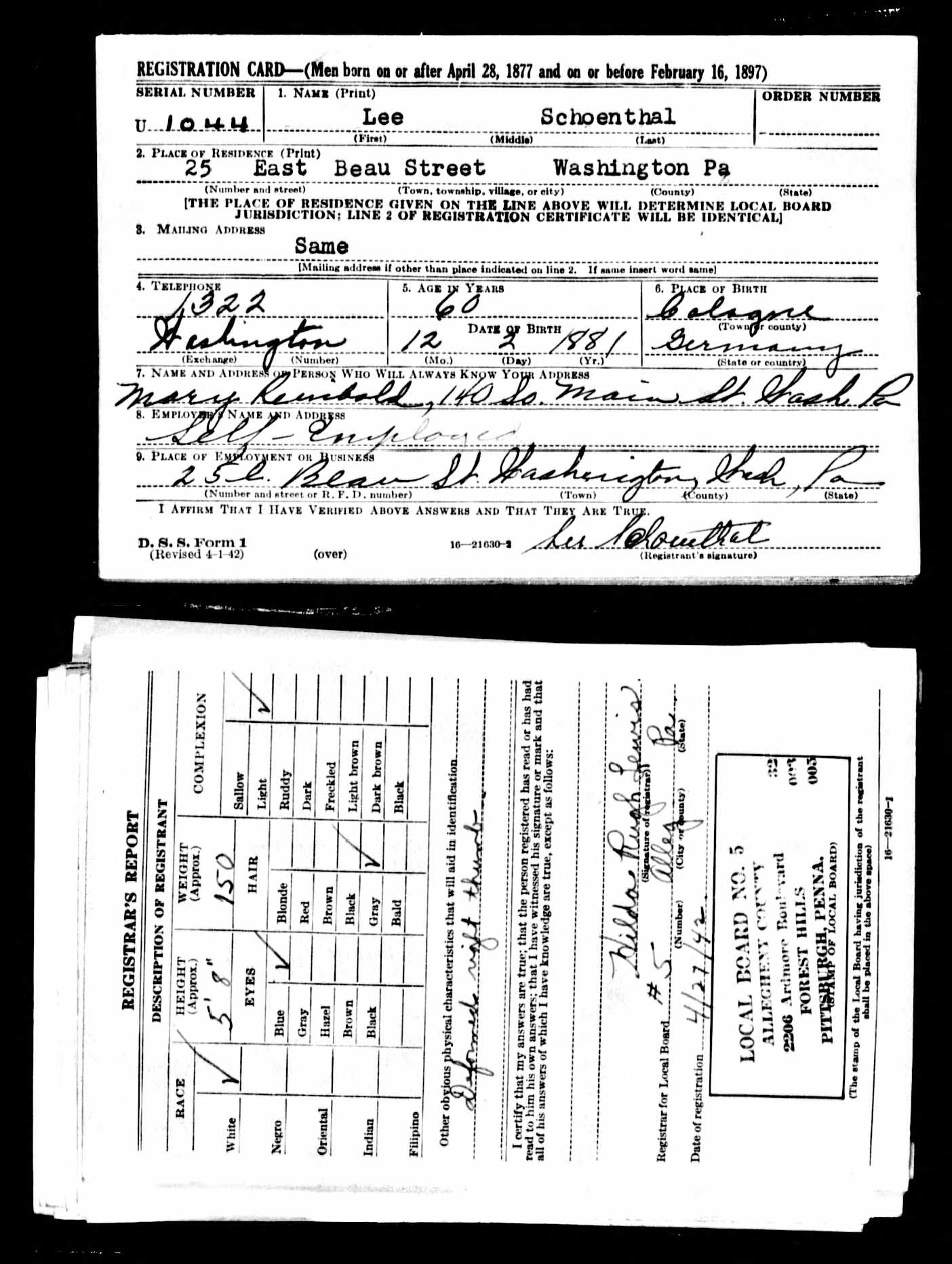
In addition to her grandparents, parents, and aunts and uncles, Maxine also knew our mutual cousins Lee and Meyer Schoenthal quite well, and she was able to answer one of my lingering questions about Lee.  When I wrote about Lee’s draft registration for World War II, I’d been puzzled by the person he’d named as the one who would always know his address, a woman named Mary Reinbold.

Lee Schoenthal World War II draft registration The National Archives at St. Louis; St. Louis, Missouri; World War II draft cards (Fourth Registration) for the State of Pennsylvania; State Headquarters: Pennsylvania; Microfilm Series: M1951; Microfilm Roll: 278

Lee Schoenthal World War II draft registration
The National Archives at St. Louis; St. Louis, Missouri; World War II draft cards (Fourth Registration) for the State of Pennsylvania; State Headquarters: Pennsylvania; Microfilm Series: M1951; Microfilm Roll: 278


Maxine shared with me that Mary Reinbold was Lee’s girlfriend for many years.  They were together a long time but never married because Mary was Catholic and Lee was Jewish.  Maxine recalled that Lee and Mary regularly came to her parents’ home for Sunday dinners.  She remembers them both very fondly.  She said Lee was a successful tailor who sold made-to-order men’s suits; her father Martin owned suits he purchased from Lee.  Lee’s shop was in the basement of building on E. Beau Street in Washington, Pennsylvania.

He must have done quite well, as Maxine told me, “Lee always drove a Lasalle car which in it’s day was in the Cadillac or more expensive class.  And he belonged to a club in  Washington, called the “Arms Club” although he never went hunting.  It was a bar, some tables, slot machines, a dance floor, and other games of chance.” Maxine said that Lee always brought her mother candy that he won at the club.   Her father Martin was also a member of the club, and Maxine visited there as well.  She told me, “I liked to pull the handle on the slot machine and watch the coins come out!!  And Daddy would stand beside me and hand me the quarters.  (I never had to spend my allowance, which then was probably one dollar a week.)”  I just love the images that this anecdote evokes.

Here are some photographs Maxine shared of Lee, Meyer, Mary, her mother Hattie, and herself as a twelve year old, taken in about 1940.

lee-schoenthal-c-1940s

Lee Schoenthal, c. 1940

mary-reinbold-and-lee-schoenthal

Mary Reinbold and Lee Schoenthal, c. 1940

mary-reinbold-meyer-schoenthal-hattie-arnold-schulherr-maxine-schulherr-stein

Mary Reinbold, Meyer Schoenthal, Hattie Arnold Schulherr, and Maxine Schulherr, c. 1940

It’s just wonderful to be able to see the faces that go with the names.

Maxine also remembers Lee and Meyer’s sister Erna Haas and her son Werner, but does not remember Lee and Meyer’s other sister, Johanna, the one who survived the Gurs internment camp in France and came to the US with her husband in 1947.  Since Johanna outlived Lee and Meyer and also lived in Pittsburgh, I was surprised that Maxine had no recollection of meeting her nor any awareness of this fourth sibling.  Perhaps Johanna’s suffering during the war had made her less able to interact with the extended family.

Maxine also knew members of the Oestreicher family, that is, the family of Sarah Stern and Gustav Oestreicher.  Sarah was her grandmother Jennie’s older sister, as discussed here and here.  Maxine knew Sarah’s son Sidney and his children, Gerald, Betty, and Elaine very well.  She said that Elaine had lived with her family for a while in the 1940s when Sidney and his wife Esther moved to New York and Elaine wanted to finish the school year in Pittsburgh.  But Maxine didn’t know what had happened to Elaine or the rest of the family after that and was curious to learn more about her long-lost second cousins.

I told her I would see what else I could find as I also had not yet been able to learn much about the Oestreicher family after about 1940.  With a few clues from Maxine, I was able to find those long-lost Oestreicher cousins.  I will report on what I’ve learned in a later post after I’ve had a chance to speak with my other third cousins, Betty and Elaine.


Quick Update on Lionel Heymann

In my last post, I discussed how I was puzzled to learn that Lionel Heymann had been a well-regarded photographer, but had listed his occupation as a waiter on the census records for 1930 and 1940.  Well, now I have found an explanation.

In the course of looking for a print of one of Lionel’s photographs to purchase (which I’ve not yet been able to locate), I found this bit of information about Lionel online, quoting from the catalog of  the Sixteenth Detroit International Salon of Photography, Photographic Society of Detroit, Detroit Institute of Arts, 1947.

“Started photography as a hobby by joining Fort Dearborn Camera Club in Chicago in 1928. Started professionally January 1945, and conducts a portrait studio in Blackstone Hotel. Conducts a weekly photographic class on portrait and paper negative process. Associated professionally with a photographer in Detroit, 1937-38.”

This explains so much.  First, it explains what Lionel was doing in Detroit when his brother Walter arrived from Germany.  Second, it explains why Lionel did not list photography as his occupation on the 1930 or 1940 census or on his World War II draft registration.  He did not become a professional photographer until 1945.

Lionel Heymann: His Other Life

In my earlier post, I wrote about the three sons of my great-great-aunt Rosalie Schoenthal and her husband Willy Heymann:  Lionel, Walter, and Max.  All three had left Germany and settled in Chicago by 1939.

The oldest brother, Lionel, had arrived first in the 1920s and had consistently reported on passenger manifests and census records that he worked as a hotel waiter.  So I was quite surprised when I found this obituary written when Lionel died in November, 1966:


Ancestry.com. Historical Newspapers, Birth, Marriage, & Death Announcements, 1851-2003 [database on-line].

Chicago Tribune, December 2, 1966, Ancestry.com. Historical Newspapers, Birth, Marriage, & Death Announcements, 1851-2003 [database on-line].

According to the obituary, Lionel Heymann had had a long and distinguished career as a photographer.  The obituary states that he had retired in 1964 after 40 years as a photographer in Chicago, including 25 years as the photographer at the Blackstone Hotel.  That is, although Lionel consistently listed his occupation as a waiter on various government forms, if the obituary is for the same man, he had been working as a photographer since 1924—in other words, since his very earliest days in Chicago.

But was this in fact the same Lionel Heymann?  The name and age and residence in Chicago certainly made it seem so, but there were no named survivors in the obituary, just an unnamed sister living in Brazil.  Could this be my cousin?

I then found a death notice for Lionel Heymann on the same date in the same paper that contained further information about his surviving family:


Ancestry.com. Historical Newspapers, Birth, Marriage, & Death Announcements, 1851-2003 [database on-line].

Chicago Tribune, December 2, 1966, Ancestry.com. Historical Newspapers, Birth, Marriage, & Death Announcements, 1851-2003 [database on-line].

This obviously was my cousin, whose two sisters-in-law were named Frieda and Lucy (or Lucie).  He was in fact the photographer described in the first obituary.

And he was not just a hotel photographer taking snapshots of guests. When I Googled his name and “photographer,” a number of links popped up, listing Lionel as an artist whose works are still being  auctioned by various art houses, online and elsewhere.  Lionel also wrote articles about photography and lectured frequently about the art of portrait photography. His works include portraits, nudes, architectural works, and highly stylized artistic photographs.

Here are two examples of the work done by Lionel Heymann; see the links above for others:

"The Shell", photograph by Lionel Heymann, April 1932 Camera Craft Magazine, accessed at http://s3.amazonaws.com/everystockphoto/fspid30/72/22/91/5/vintage-photograph-cameracraft-7222915-o.jpg

“The Shell”, photograph by Lionel Heymann, April 1932 Camera Craft Magazine, accessed at http://s3.amazonaws.com/everystockphoto/fspid30/72/22/91/5/vintage-photograph-cameracraft-7222915-o.jpg


Photograph by Lionel Heymann of Robert Maynard Hutchins, University of Chicago president (1929-1945) and chancellor (1945-1951), with team members of the Manhattan Project, the program established by the United States government to build the atomic bomb. Standing, from left: Mr. Hutchins, Walter H. Zinn, and Sumner Pike; seated: Farrington Daniels, and Enrico Fermi. University of Chicago Photographic Archive, [apf digital item number, e.g., apf12345], Special Collections Research Center, University of Chicago Library. accessed at http://photoarchive.lib.uchicago.edu/db.xqy?one=apf1-05063.xml

Photograph by Lionel Heymann of Robert Maynard Hutchins, University of Chicago president (1929-1945) and chancellor (1945-1951), with team members of the Manhattan Project, the program established by the United States government to build the atomic bomb. Standing, from left: Mr. Hutchins, Walter H. Zinn, and Sumner Pike; seated: Farrington Daniels, and Enrico Fermi. University of Chicago Photographic Archive, [apf digital item number, e.g., apf12345], Special Collections Research Center, University of Chicago Library. accessed at http://photoarchive.lib.uchicago.edu/db.xqy?one=apf1-05063.xml


Why hadn’t Lionel claimed on the census records and World War II draft registration that he was a photographer? Why wouldn’t he have wanted to reveal that information?  Was it just an avocation, not his livelihood?  Did that change after the 1940s?

UPDATE:  In the course of looking for a print of one of Lionel’s photographs to purchase (which I’ve not yet been able to locate), I found this bit of information about Lionel online, quoting from the catalog of  the Sixteenth Detroit International Salon of Photography, Photographic Society of Detroit, Detroit Institute of Arts, 1947.

“Started photography as a hobby by joining Fort Dearborn Camera Club in Chicago in 1928. Started professionally January 1945, and conducts a portrait studio in Blackstone Hotel. Conducts a weekly photographic class on portrait and paper negative process. Associated professionally with a photographer in Detroit, 1937-38.”

This explains so much.  First, it explains what Lionel was doing in Detroit when his brother Walter arrived in 1938.  Second, it explains why Lionel did not list photography as his occupation on the 1930 or 1940 census or on his World War II draft registration.

The obituary and death notice not only revealed that Lionel was a well-known photographer, but also provided more clues about his family.   First, who was this sister in the death notice named Henny Mosbach Rothschild? And was she the one described as living in Brazil in the obituary? And second, who was the nephew named Robert Heyman?

Since only one of Lionel’s brothers had had a child, I assume that this had to be Klaus Heymann, the son of Lionel’s brother Max. Unfortunately, I’ve not been able to yet find out more about Klaus Heymann/Robert Heyman, but I have requested the military records of a Klaus Robert Heymann from the national archives and hope that those records will relate to my cousin.  If so, I will provide an update.

As for the sister named Henny Mosbach Rothschild, I will address her in my next post.


Hettie’s Spirit Lives On: Her Children Walter and Blanche

In my last two posts about Hettie Schoenthal, I was very fortunate because Hettie and her son Walter had written down their own memories and stories, making their lives so much more vivid and authentic than I could have ever done myself.  The wonderful photographs that their family provided also helped me tell the story of Hettie Schoenthal, her husband Henry Stein, and their two children, Walter and Blanche.

Hettie Schoenthal, 1906 Courtesy of her family

Hettie Schoenthal, 1906
Courtesy of her family

It was a reminder of how important it is for all of us to write about our own lives and to take and preserve photographs so that someday our descendants will benefit from these shared words.  My newly discovered cousin Sharon Lippincott, daughter-in-law of Blanche Stein Lippincott, writes  about the art of writing memoirs at her blog, The Heart and Craft of Life Writing, and has also published books on that subject.

In this post, I hope to convey how Hettie’s optimistic and energetic personality left its mark on her two children, both of whom also lived long and happy lives and were well-loved by many.  All photos are courtesy of their family.

Hettie and Henry had moved east from Arizona to Philadelphia in 1924, and a few years later their son Walter left home and moved to Atlantic City to work in his aunt’s hotel there, as seen on the 1930 census.  Walter remained in the Atlantic City area for the rest of his life, working in a restaurant and as a salesman over the years.  He married Ruth Levaur in 1938, and they had one daughter.
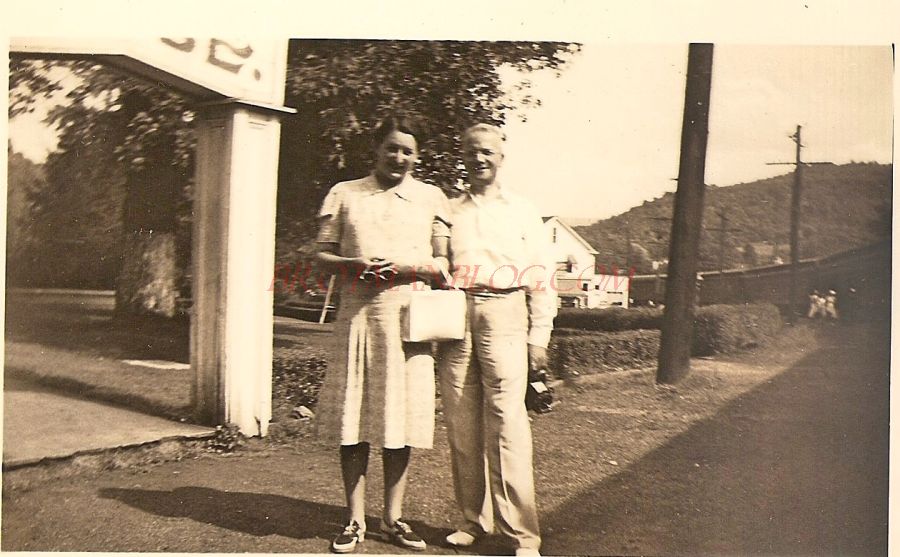
His sister Blanche also married in the 1930s, marrying Ezra Parvin Lippincott in 1937.  Ezra was a New Jersey native and a graduate of Rutgers University, and he worked as a banker and in the insurance business. They lived in New Jersey and had two children, a son and a daughter.  Sadly, Ezra died in 1969, leaving Blanche as a widow at only 57.
Blanche Stein Lippincott, 1938

Blanche Stein Lippincott, 1938


Blanche Stein Lippincott 1962

Blanche Stein Lippincott 1962


I don’t have a lot of “official” records about Walter or Blanche after 1940, but I don’t need them to convey the character and personality of these two people. Other people have already written about them both.

Both Walter and Blanche must have inherited their mother’s gene for longevity.  Walter died in 2007 at age 96, and Blanche died in 2013 when she was 101 years old.

Walter Stein in Atlantic City, 1987 courtesy of the family

Walter Stein in Atlantic City, 1987
courtesy of the family

Walter’s obituary from the Press of Atlantic City gives a vivid portrait of the man who spent his childhood with burros and snakes in Ray, Arizona:

Walter was born in Tucson, Territory of Arizona on October 9, 1910. He was recognized as a pioneer. He spent his childhood in Ray, Arizona in a mining camp and took pleasure in saying that his boyhood was what every boy dreams of. The family moved to Philadelphia in 1923, where Walter graduated from high school. In 1929 he went to Atlantic City for a vacation and never left the area except for four years. He met and married Ruth Levaur in 1938. They recently celebrated their 68th anniversary.

Walter was a fine fisherman, a championship bowler and a prize-winning marksman. He served on many boards, but his favorite was the 23 years he served on the Board of Friends of the (PAC) Performing Arts Center of Stockton College. Walter had a deep love of the theater. Some of his happiest moments were spent with Ruth and friends at the Metropolitan Opera, the Philadelphia Orchestra, the Ballet, the theater and museums. He was Vice President of Atlantic Beverage for 35 years. ….

Walter was loved and respected by all who knew him. His sense of humor, his positive spirit and generous nature placed him in a class by himself. He was often referred to as a man of all seasons, and he truly was.


Walter and Ruth Stein, 2002 at Blanche's 90th birthday celebration

Walter and Ruth Stein, 2002 at Blanche’s 90th birthday celebration


Blanche also seems to have inherited her mother’s optimistic and adventurous spirit; her daughter-in-law Sharon wrote this about her on her blog on the occasion of Blanche’s 100th birthday:

Blanche was born 100 years ago in Tucson, in the newly admitted state of Arizona. Her family soon moved to Ray, Arizona, a now deserted copper mining community, where they lived until she was about twelve. When the copper industry declined, her parents, along with a few aunts and uncles, decided to move back to Philadelphia.  ….

If you asked her, she’d tell you she has had a rather ordinary life, and so it may seem to some. She’s never done anything truly flamboyant. She hasn’t set records, started a business, or written a best-seller. But she has tackled life with gusto, always open to new adventures and experiences. ….

Perhaps her  most important attribute is her devotion to family, friends and community. ….  No family member or friend ever has to ask for help – things are taken care of, often before the need is recognized. She always has something good to say about anyone she speaks of, and she excels at showing gratitude and appreciation. …

I could not ask for a sweeter, more supportive and helpful mother-in-law, nor is anyone prouder than she of her two children and their spouses, her five grandchildren and their spouses, and her six great-grandchildren. She is the most optimistic person I know, and should I live to be 100, I hope I’ll be as vital and involved as she continues to be.

Blanche Stein Lippincott, 1984

Blanche Stein Lippincott, 1984


Blanche Stein Lippincott with her great-granddaughter 1996

Blanche Stein Lippincott with her great-granddaughter 1996

You can read the rest of Sharon’s tribute to her mother-in-law Blanche at her blog here. 

I feel very privileged to be even distantly related to Hettie and her children, who were, respectively, my first cousin, twice removed (my grandmother’s first cousin) and my second cousins, once removed (my father’s second cousins).  It’s just too bad that I missed the opportunity to know them in person, given how long and how close by they all lived.

Blanche and Walter, August 9, 2006 courtesy of the family

Blanche and Walter, August 9, 2006
courtesy of the family


Blanche, Hettie, and Walter Stein

Blanche, Hettie, and Walter Stein

This post completes my research of the family of Simon Schoenthal and Rose Mansbach and their many children.  This has been a line of the family that has been a joy to research.  Although there were a few sad stories, this was a family of people who lived long lives and seemed to enjoy those lives.   They stayed close to one another even though at times they were separated by long distances.  And most of them spent much of their lives close to their childhood hometown of Atlantic City, New Jersey, once called the World’s Playground.

Unfortunately, the next chapter—the story of Simon’s brother Jakob and his family—is not as joyful.