Fredericke Katzenstein Goldmann’s Daughter Meta: A Family Destroyed

Fredericke Katzenstein Goldmann’s older daughter Clementine died in April 1942, just months before her husband Alexander Joel was deported to the concentration camp at Terezin, where he died in December 1942. But their daughters all survived the Holocaust as did their grandchildren.

Clementine’s younger sister Meta was not even that fortunate. She and her husband Adolf Hammerschlag and daughter Lieselotte were all murdered at Auschwitz. The page devoted to their Stolpersteine in Hamburg provides this biographical information:

[Adolph Hammerschlag], his wife Meta, and their daughters Lieselotte (*10 August 1910) and Irmgard (4 March 1915) lived in Göttingen, where he was a wealthy businessman, the co-owner of the grain company Bachmann Bros. …. Since profits fell rapidly after 1933, Hammerschlag moved the offices of his company to his private residence in Göttingen .… In the following years the political situation brought the company to a standstill.

Adolph Hammerschlag was arrested during the November Pogrom in 1938, and his company was “Aryanized” on 21 November. It was taken over by a grain merchant from Göttingen who was one of the first members of the Nazi Party.

After his release, Adolph Hammerschlag and his wife fled to Hamburg to his sister, Mrs. Alexander Joel, [sic: Mrs. Alexander Joel was Adolph’s sister-in-law, not his sister]…. The formerly wealthy couple was now destitute. ….[They were deported to Auschwitz on July 11, 1942, and murdered there.]

Hammerschlag’s daughter Lieselotte Blum and her husband had lived in Brussels since 1939. They were deported to Auschwitz in 1942. His daughter Irmgard married Heinz Baehr in September 1936. The couple was able to emigrate to Haifa in Palestine.

Thus, only Meta’s younger daughter Irmgard survived. The immigration documents for her and her husband Heinz show that they arrived in Palestine in 1937 and became naturalized citizens in 1939.

Irmgard’s husband Heinz died in 1947, according to Geni; he was only 33 years old. Irmgard remarried later, but I don’t know if she had any children with either husband. Irmgard died in Haifa in 1977, according to My Heritage. She was 62.

Thus, Fredericke Katzenstein Goldmann not only lost her husband Leopold and her son Karl before she died—both of her daughters, Clementine and Meta, and their husbands and one of her granddaughters died during the Holocaust. But her four other grandchildren survived as did their children.

Sometimes the randomness of who survived and who did not just overwhelms me.

Unanswered Questions: Rosa Werner Wormser and Moritz Werner

Although I was able to learn a fair amount about two of the children of Helene Katzenstein and Max Werner, Elsa Werner Loewenthal and Henriette Werner Cohen, it was much more difficult to find information about their other two children, Rosa Werner Wormser and Moritz Werner. I can only report what I’ve learned, primarily from secondary sources, and hope that perhaps by publishing this, someone who knows more about these relatives of mine will find this and provide me with more information and sources. This may be my worst sourced post ever!

Rosa Werner, as we saw, married Josef Wormser in Eschwege in 1908.  According to entries on My Heritage, Rosa and Joseph had four children, Esther (1909), Raphael (1911), Julius (1914), and Helene (1917), all born in Zurich, Switzerland, where Rosa and Joseph had relocated after marrying. It also appears that Rosa and Josef remained in Zurich during the Nazi era and survived, but I have no records of their lives there during that time. According to the information on My Heritage, Josef died in 1940 in Zurich, Rosa thirteen years later in 1953, also in Zurich.

As for their children, three of the four immigrated to Palestine/Israel. I have seen documents1 showing that Esther Wormser immigrated to Palestine, where she married Max Leo Koplowitz, who had immigrated there as early as March 28, 1932, and became a naturalized citizen of Palestine on November 19, 1937. Max was born on March 29, 1907, in Strasbourg when it was under German control before World War I (later and currently part of France). He was an agricultural worker in Palestine. According to a document in his immigration file, he and Esther Wormser married on May 21, 1939, in Petach-Tikvah, and she became a Palestinian citizen by virtue of her marriage to Max Koplowitz.

UPDATE: Thank you to Cathy Meder-Dempsey of Opening Doors in Brick Walls for finding the Strassbourg birth record for Max Koplowitz, which can be located here.

I do not have any further information yet for Esther, although David Baron and Roger Cibella reported that she and Max had two sons born in the 1940s. Max died October 26, 2006, in Israel, according to his gravestone at BillionGraves.com. There was no date or place of death reported for Esther.

BillionGraves.com
Grave record for ישראל מקס קופלוביץ (1907 – 2006), BillionGraves Record 19495247 כפר הרא”ה, Central District, Israel

Update: Thank you to Aaron Knappstein who located Esther’s grave memorial on Billion Graves. She died on 8 Iyar 5739 or May 5, 1979, in Israel.

BillionGraves.com
Grave record for אסתר קופלוביץ (), BillionGraves Record 18779827 כפר הרא”ה, Central District, Israel

Raphael Wormser also immigrated to Israel at some point. My Heritage reports that he married Greta Aufsasser in 1954. According to his gravestone at BillionGraves, he died August 5, 1973.

BillionGraves.com
Grave record for רפאל וורמסר (), BillionGraves Record 12700234 Holon, Central District, Israel

As for Helene Wormser, My Heritage shows that she married Dr. Herman Halberstadt and that they had two children; in addition, My Heritage reports that she died in Jerusalem, but did not provide a date of death.

Update: Thanks again to Aaron Knappstein, who found this entry at Gravez, showing that Helene Wormser Halberstadt died on June 22, 2007, in Israel.

The only Wormser child who did not immigrate to Palestine/Israel was Julius. He remained in Zurich where he married Betty Loewenthal and had several children, according to Baron/Cibella. Julius died in Zurich on May 11, 1989, according to My Heritage.

Thus, my information about the Wormser family is quite thin and based almost completely on My Heritage profiles. I’ve sent a message to the manager of those profiles, but have not heard anything back.

That brings me to Helene Katzenstein and Max Werner’s youngest surviving child, Moritz. We saw that Moritz married Jenny Kahn in Frankfurt in 1918 and that they had a son, Max, born in 1922. The only records I have for Moritz and Jenny after their marriage record are the 1939 England and Wales Register and their exemptions from being deemed enemy aliens in England. Thus, they had immigrated to England by 1939. Unfortunately part of the of the right margin of the 1939 Register is not visible, but it looks like Moritz was the director of London Win(dow?) Display Ltd.

Moritz and Jenny Werner,The National Archives; Kew, London, England; 1939 Register; Reference: RG 101/828B, Enumeration District: BKER, Ancestry.com

He was exempted from being interned as an enemy alien; on this form he described his occupation as the company director of manufacturing company.

The National Archives; Kew, London, England; HO 396 WW2 Internees (Aliens) Index Cards 1939-1947; Reference Number: HO 396/101, Piece Number Description: 101: Internees at Liberty in UK 1939-1942: Wem-Wid, Ancestry.com. UK, World War II Alien Internees, 1939-1945

Here is Jenny’s exemption documentation:

The National Archives; Kew, London, England; HO 396 WW2 Internees (Aliens) Index Cards 1939-1947; Reference Number: HO 396/101, Piece Number Description: 101: Internees at Liberty in UK 1939-1942: Wem-Wid, Ancestry.com. UK, World War II Alien Internees, 1939-1945

This quotation, found on Moritz Werner’s Geni profile and translated by DeepL, from a book written by Anna Maria Zimmer, Juden in Eschwege:Entwicklung und Zerstörung der jüdischen Gemeinde, von den Anfängen bis zur Gegenwart (1993), p. 272, provides some touching details about Moritz Werner and his life during and after the Nazi era:

Moritz Werner was – like his father Max Werner – a partner and manager of the important textile factory Brinkmann since 1916. Because of the National Socialist persecution, Moritz Werner was forced to sell the company and flee to England.

His son Max Heinz Werner recalls this:

“In mid 1938 the purchase was perfected. A Catholic named Rhode from Kassel, who produced goods for the armaments industry, had bought L.S. Brinkmann. After the war, when Rhode was terminally ill, he developed feelings of remorse and tracked down my father Moritz in England. Mr. Rhode asked for a visit and my father and he made a contract, i.e. my father bought the company back – that was at a time when there was no official reparation! In 1949 the takeover was perfected. …

When my father celebrated his 25th anniversary with the company in 1931, the staff donated a bronze plate with a dedication and two knitting hands for him. During the forced sale [1939] the plate suddenly disappeared.

In 1949, when my father was sitting in his office again for the first time, there was a knock at the door and a small delegation of employees came in… They struggled to carry a box containing this bronze plate. Before taking over the company, these employees had fastened the plate in the chimney with strong wires and thus hidden it.”

My Heritage reports that Moritz died in Lugano, Switzerland, on April 27, 1966, and that Jenny died in Chile (no date provided). When had Moritz and Jenny moved from England? Why did he die in Switzerland, she in Chile? So many unanswered questions.

I cannot find their son Max on either the 1939 Register or on an enemy alien registration. Max would have been a teenager at the time. Where could he have been? All I could find for Max was an entry in the England & Wales, Marriage Index on Ancestry for his marriage in 1947 to Clara Amalia Reiss,2 and I know nothing more about Clara or Max except what I found on My Heritage and on David Baron and Roger Cibella’s family report: that Clara was born in Vienna on September 27, 1920, that she and Max had two children, that Clara died on April 6, 2011, and that Max died eight months later on December 9, 2011. According to their profiles on My Heritage, both Max and Clara are buried in Jerusalem.

UPDATE: My cousin Joanne Warner-Loewenthal shared a link with me about Max Werner, her cousin. It reports that he graduated from the University of Leeds in England and became a naturalized English citizen. After the war, however, he returned to Germany to become a director of the LS Brinkmann knitwear company in Eschwege. He also developed an interest in race cars and in photographing racing, as described here.


  1. A month or so ago I saw Max’s immigration file on the Israel Archives and saved the link, but did not download the documents, figuring I’d come back later. Then the Archives shut down for several weeks. They’ve since come back online, but Max’s file is now listed as “not yet scanned.” Fortunately, I took notes on what is in that file, and when it becomes available, I will update this post. 
  2.  Max H Werner, Registration Quarter: Jan-Feb-Mar, Registration District: Hendon
    Inferred County: Middlesex, Spouse: Amalia K Reiss. Volume Number: 5f, Page Number: 529, General Register Office; United Kingdom; Volume: 5f; Page: 529,
    Ancestry.com. England & Wales, Civil Registration Marriage Index, 1916-2005 

Martha Loewenthal Wolff’s Family: An Update from Israel

One of the more elusive Goldschmidt family members to research has been Martha Loewenthal Wolff and her family. Martha was the daughter of Kiele Stern and Abraham Loewenthal, the granddaughter of Sarah Goldschmidt and Salomon Stern, and my third cousin, twice removed. Thanks to my friend Aaron Knappstein, I now have more information and documents and even photographs of Martha and her family.

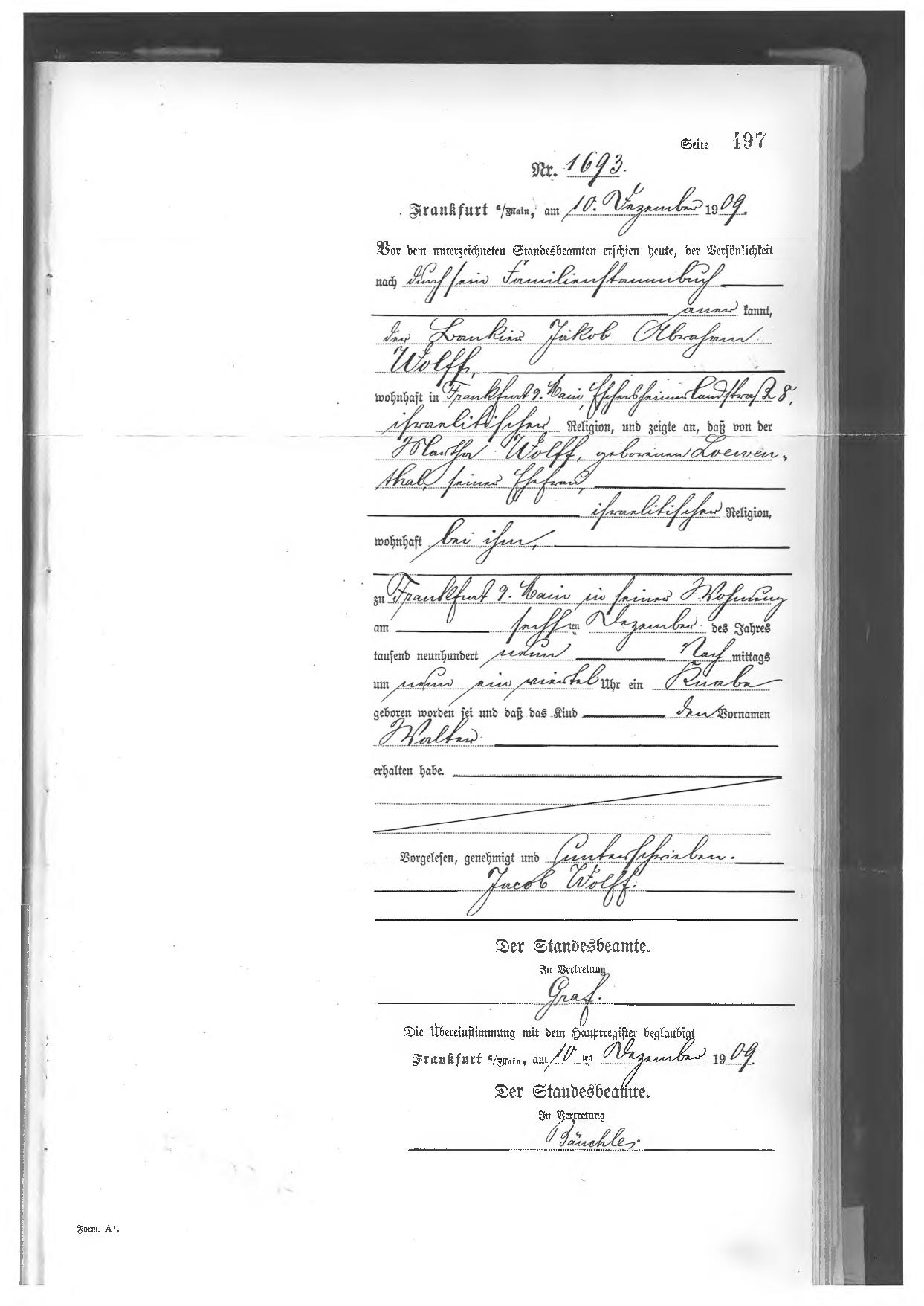
Martha was married to Jakob Wolff, as discussed here, and they had three children: Anna, Hans Anton, and Walter. I was missing birth records for all three children, and Aaron was able to locate all of them.

Birth record of Anna Wolff

Birth record of Hans Anton Abraham Wolff

Birth record of Walter Wolff

Martha died in 1930, and I could not find a death record for her until Aaron located it, as I wrote about here.

After Martha’s death and the Nazi takeover of Germany, Jakob Wolff and all three of their children immigrated to Israel, as I wrote about here.

But I did not know what happened to Jakob or his children after their immigration. And then Aaron came through for me again and located Hans Anton Wolff’s son Benjamin in Israel and connected me to him and his daughter Ravid. Now I have firsthand information about Martha’s family as well as photographs, thanks to Ravid Wolff, my fifth cousin, once removed.

First, some photographs of the family taken before they left Germany.

Jacob and Martha Wolff and their first car Courtesy of the Wolff family

Anna Wolff and her mother Martha Loewenthal Wolff Courtesy of the Wolff family

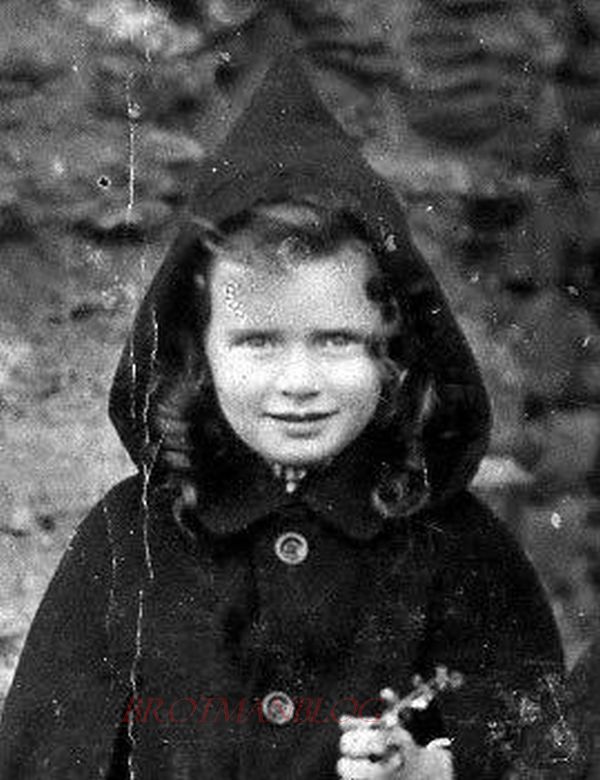
Anna Wolff as a child Courtesy of the Wolff family

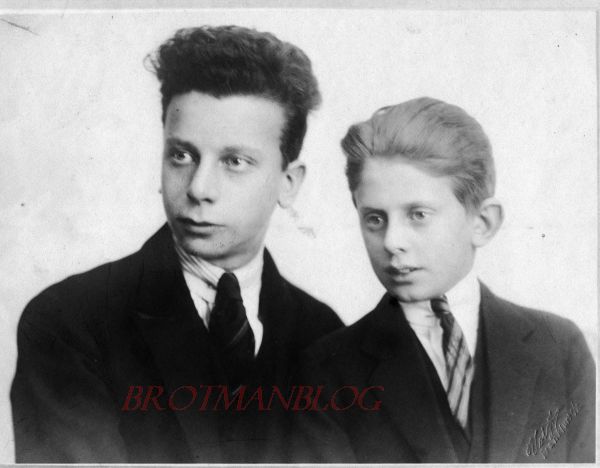
Hans Anton and Walter Wolff Courtesy of the Wolff family

Ravid shared with me that her great-grandmother Martha was a very talented artist and sent me this image of a painting that Martha did while traveling with Jakob in what was then Palestine in the 1920s.

Painting by Martha Loewenthal Wolff

According to Ravid, her great-grandparents Martha and Jakob Wolff owned two banks in Frankfurt, Germany, and were quite wealthy. After Martha died from ovarian cancer in 1930, Jakob married Ilse Gruenebaum. When Hitler came to power, Jakob recognized how dangerous he was and, as a Zionist, decided to leave Germany for Israel (then Palestine) before it was too late. He was able to obtain visas to immigrate for a thousand pounds each, an exorbitant amount of money at that time, but had to leave all his other property and possessions behind. All of it including their home in Frankfurt was confiscated by the Nazis and never returned to the family.

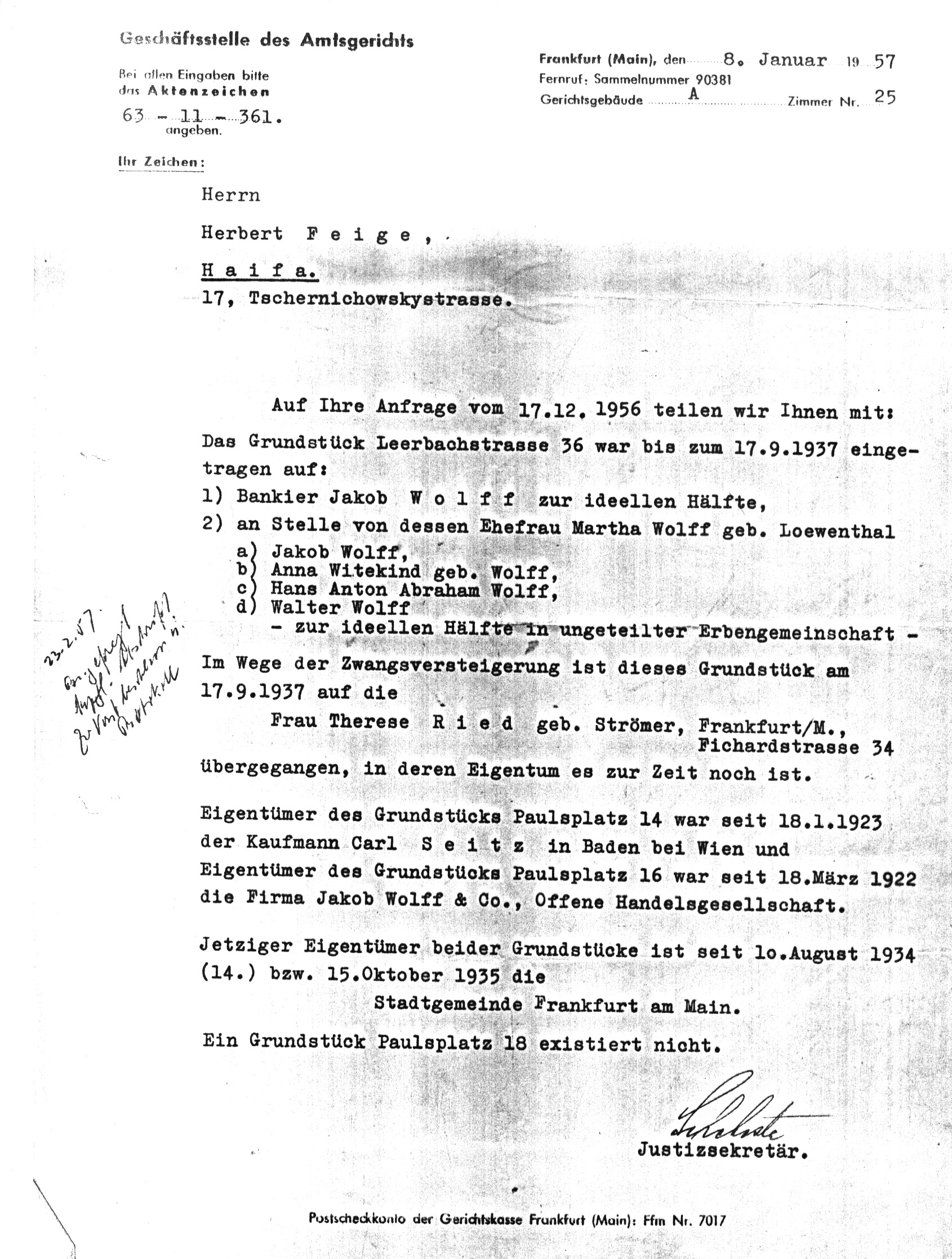
Ravid shared two letters with me that show that the requests for restitution of their property in Frankfurt were denied:

Google Translate helped me translate these letters. The one above translates as:

Upon your request of 17 December 1956, we will inform you: The property Leerbachstrasse 36 was registered until 17 September 1937 on:
Banker Jakob Wolff on the ideal half
Instead of his wife Martha Wolff [names of children] for ideal half in undivided community of heirs. [I am not sure what “ideal half” means.]
In the way of the forced auction, this plot of land on 17 9 1937 is given to Frau Therese Ried geb Stromer, [address]. It is still owned by them.
The owner of the Paulsplatz 14 property was the merchant Carl Seitz in Baden near Vienna in 18 1 1923 and the owner of the Paulsplatz 16 property was the Jakob Wolff & Co., Open Trade Company since 18 March 1922.
The current owner of both properties has been the municipal district of Frankfurt since August 10, 1934 bze, October 15, 1935. A piece of land at Paulsplatz 18 does not exist.

The second letter translated as:

The aforementioned property became the property of the City of Frankfurt on the basis of an additional resolution dated 2 4 1935. The compulsory auction had already started in 1932. The JRSO, which had previously asserted claims for reimbursement for the aforementioned property, accepted its application on Feb. 1, 1951. For your further information, we would like to inform you that the city has always contested a claim for reimbursement.
We hope to have served you with the above statements.

As for Martha and Jakob’s three children, Anna, the oldest, was married to Simon Wittekind when she immigrated, and they had two sons, Aharon and Baruch (as they were known in Israel) who were born in Berlin. Simon was a doctor who wanted to move to South Africa, but Anna felt safer in Israel, so she stayed there with her children.

Anna later married Herbert Feige. According to Ravid, Anna hated Germany and suffered great trauma because of what had happened there and unlike her brother Hans Anton refused to reclaim her German citizenship when that right became available to her. Her sons changed their surname to Yardeni (for the Jordan River) to identify with their new homeland. Ravid did not know exactly when Anna died, only that like her mother Martha, she died young and from cancer.

Ravid’s grandfather was Hans Anton Wolff, the second child of Martha Loewenthal and Jakob Wolff.  He married Susana Meseritz, another refugee from Germany, whom he met in Palestine. They had one child, Ravid’s father Benjamin. Hans had a doctorate in chemistry. He died from colon cancer in 1974, and his wife Susana died in 2002.

Walter, the youngest of the siblings, also married in Palestine/Israel. He owned a hotel in Jerusalem for many years. He and his wife Hedy Buller had two children. Walter died in 1968 in Jerusalem, also from cancer.

I am so indebted to Aaron Knappstein for finding the missing records of the Wolff children and even more so for connecting me to my cousin Ravid. And I am very, very grateful to Ravid for sharing her family’s story with me. Ravid, like her great-grandmother Martha and so many others in the extended Goldschmidt family, has a great interest in and great talents in art. Her photography captures in simple and yet complex ways the beauty of the world around us by using unusual perspectives and contrasting light and colors.

Escaping from Germany to Brazil and Israel: Brick Walls


We’ve already seen that Helene Goldschmidt Fuld’s second child, Minna Fuld, who was born in 1875, had a complicated marital history. First, she married Leo Offenstadt in 1894 when she was eighteen, and that marriage ended in divorce in 1904. She and Leo had had one child, Flora, in 1894. Then Minna married Ladislaus Polacovits in 1906, and he died in 1913; Minna had one child with Ladislaus, Lisolette, who was born in 1907.

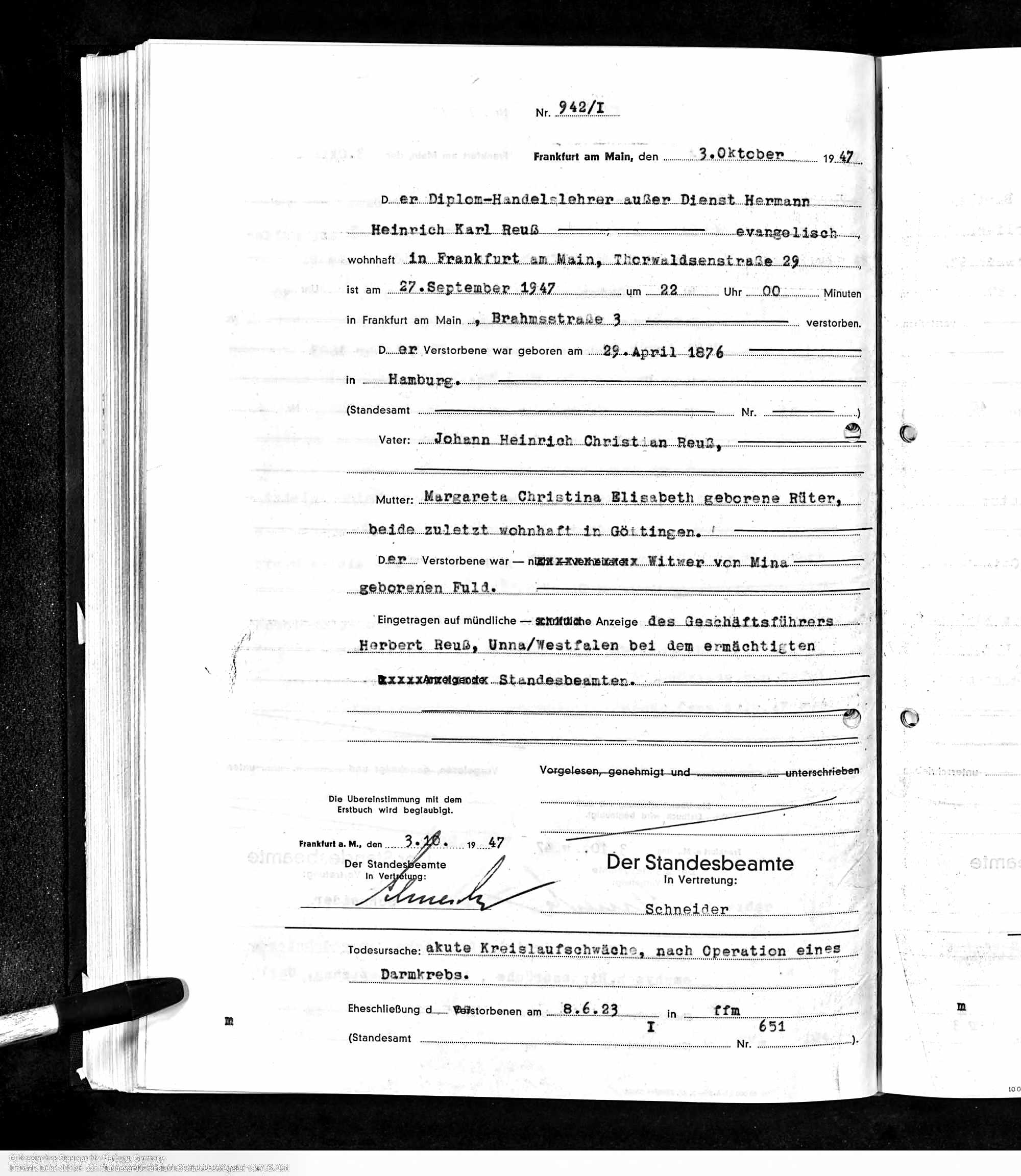
Finally, Minna married Hermann Heinrich Karl Reuss in 1923, with whom she had no children. Hermann is listed in the 1940 Frankfurt directory1 and died in Frankfurt on September 27, 1947.

Hermann Reuss death record, Personenstandsregister Sterberegister; Bestand: 903; Signatur: 225
Year Range: 1947, Ancestry.com. Hesse, Germany, Deaths, 1851-1958

His death certificate indicates that he was a widower at the time of his death. I have no record for Minna’s death, but unsourced trees indicate that she died in Tel Aviv on May 3, 1944. Had Hermann gone with her to Palestine and returned to Germany after she died? Or had Hermann never left Germany?  I don’t know.

As we saw, Minna’s daughter Flora Offenstadt2 married Hermann Durlacher in 1918 and had two children with him, Siegfried Julius Thomas (known as Thomas) and Ulla Louise Sara. Flora and the two children immigrated to Brazil in 1939, as seen in these immigration cards.

Flora Offenstadt Durlacher, Digital GS Number: 004764836
Ancestry.com. Rio de Janeiro, Brazil, Immigration Cards, 1900-1965

Siegfried Julius Thomas Durlacher, Digital GS Number: 004916940
Ancestry.com. Rio de Janeiro, Brazil, Immigration Cards, 1900-1965

Ulla Durlacher, Digital GS Number: 004916940
Ancestry.com. Rio de Janeiro, Brazil, Immigration Cards, 1900-1965

I could not locate any further records for Hermann Durlacher, but several unsourced trees indicate that he died in Sao Paolo, Brazil, on November 15, 1954, so perhaps he also immigrated to Brazil either before, with, or after his family. I don’t know what happened to Flora or her two children after they immigrated to Brazil in 1939. An unsourced tree on Geni reports that Thomas died in Sao Paulo on December 23, 2007.

Minna’s second daughter, Liselotte Polacovits, married Wilhelm Strauss-Reich on June 5, 1928, and had one child, as discussed here. I was not able to find information about their whereabouts during the 1930s, but by 1942 Liselotte and Wilhelm both had Palestinian passports that they renewed in 1947. I was able to locate a marriage record for their son (who may still be living) in England, so perhaps they also ended up in England or maybe they stayed in Israel.

Liselotte Strauss-Reich, Israel Archives, at https://tinyurl.com/wwdy88x

Thus, there is much to do to learn more about Minna and her descendants. So far, however, I’ve hit dead ends and brick walls. Searching online for answers in Brazil and Israel has led me nowhere. Not knowing how to read either Portuguese or Hebrew (except some basic terms) makes the task even more difficult. If anyone has any thoughts, please let me know.


  1.  Title: Amtliches Frankfurter Adressbuch, Deutsche National Bibliothek; Leipzig, Deutschland; Publisher: August Scherl; Signatur: ZC 811; Laufende Nummer: 1, Ancestry.com. Germany and Surrounding Areas, Address Books, 1815-1974 
  2. Flora’s father, Minna’s first husband Leo Offenstadt, died at Theriesenstadt concentration camp on January 9, 1943. See his entry at Yad Vashem at https://tinyurl.com/tz3gz73. 

Escaping from Germany, Part VII: Children Separated from their Parents

This is the final chapter in the story of my cousin Sarah Goldschmidt, daughter of my fourth great-uncle, Meyer Goldschmidt. These last seven chapters about her descendants’ struggles during and for the most part survival of the Nazi era have been an inspiration to me during this pandemic. We need to remember that human beings have survived many other challenges as we continue to fight this one.

The youngest child of Sarah Goldschmidt and Salomon Stern was their son Mayer. As we have seen, Mayer was married to Gella Hirsch, and they had two children, Elsa (1891) and Markus Kurt (1895)(later known as Kurt Marco).

As of 1930, Mayer and Gella were living in Frankfurt. Their daughter Elsa had been married to her second cousin Jacob Schwarzschild, with whom she’d had a daughter Elizabeth (1915). That marriage ended in divorce, and in 1920, Elsa had married Alfred Hirsch, with whom she had three children in the 1920s. Kurt Stern was married to Rhee Mess; they had no children.

With the rise of Hitler, the family began to disperse. Kurt and Rhee left Germany first. From 1918 to 1923, Kurt had worked as an art dealer in Frankfurt with his father and Goldschmidt relatives in the firm of I & S Goldschmidt (more on them to come). He and Rhee had then moved to Paris, where he became an independent art dealer.1 Then they immigrated to the US, arriving in New York on October 4, 1934. Kurt declared his intention to become a US citizen on February 19, 1935, four months after arriving in New York.

Kurt Marco Stern declaration of intention, The National Archives and Records Administration; Washington, D.C.; Petitions for Naturalization from the U.S. District Court for the Southern District of New York, 1897-1944; Series: M1972; Roll: 1256
Archive Roll Descriptions: (Roll 1256) Petition No· 352904 – Petition No· 353350
Ancestry.com. New York, Naturalization Records, 1882-1944

Kurt registered for the US draft on April 26, 1942, at which time he was a self-employed art dealer, living in New York City.

Kurt Stern, World War II draft registration, Ancestry.com. U.S., World War II Draft Registration Cards, 1942

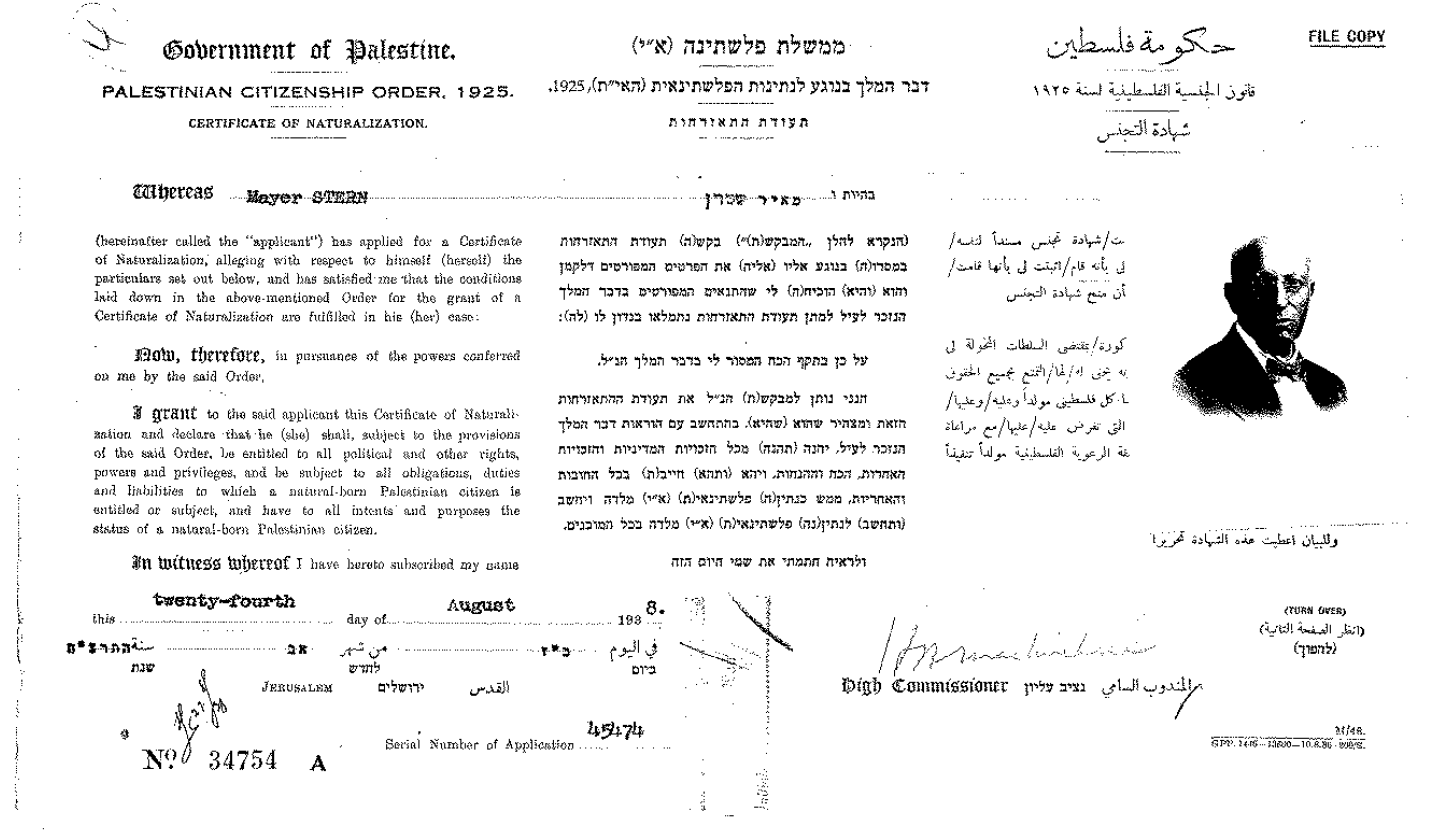
Kurt’s parents Mayer and Gella Stern also left Germany around that time. According to Mayer Stern’s immigration papers, he and Gella arrived in Palestine on April 12, 1935. Sadly, Gella died less than two months later on June 1, 1935, in Haifa. She was 71 years old. Mayer remained in Haifa and became a Palestinian citizen on August 24, 1938.2

Mayer Stern, Palestinian citizenship certificate, found at https://tinyurl.com/ugr2b62

But Mayer did not live much longer. He died on September 15, 1939, in Haifa, where he is buried. He was 78.

The grave site of מאיר שטרן. Cemetery: Haifa Mahane David – Sde Yehoshua Cemetery, Location: Haifa, Haifa District, Israel. Birth: 7 Jan 1861, Death: 15 Sep 1939. Found at https://tinyurl.com/whnye25 Photographer  Nadezda

As for Mayer and Gella’s daughter Elsa Stern Schwarzschild Hirsch, she and her husband Alfred Hirsch and three children also immigrated to Palestine, arriving in 1938, according to their immigration file.3

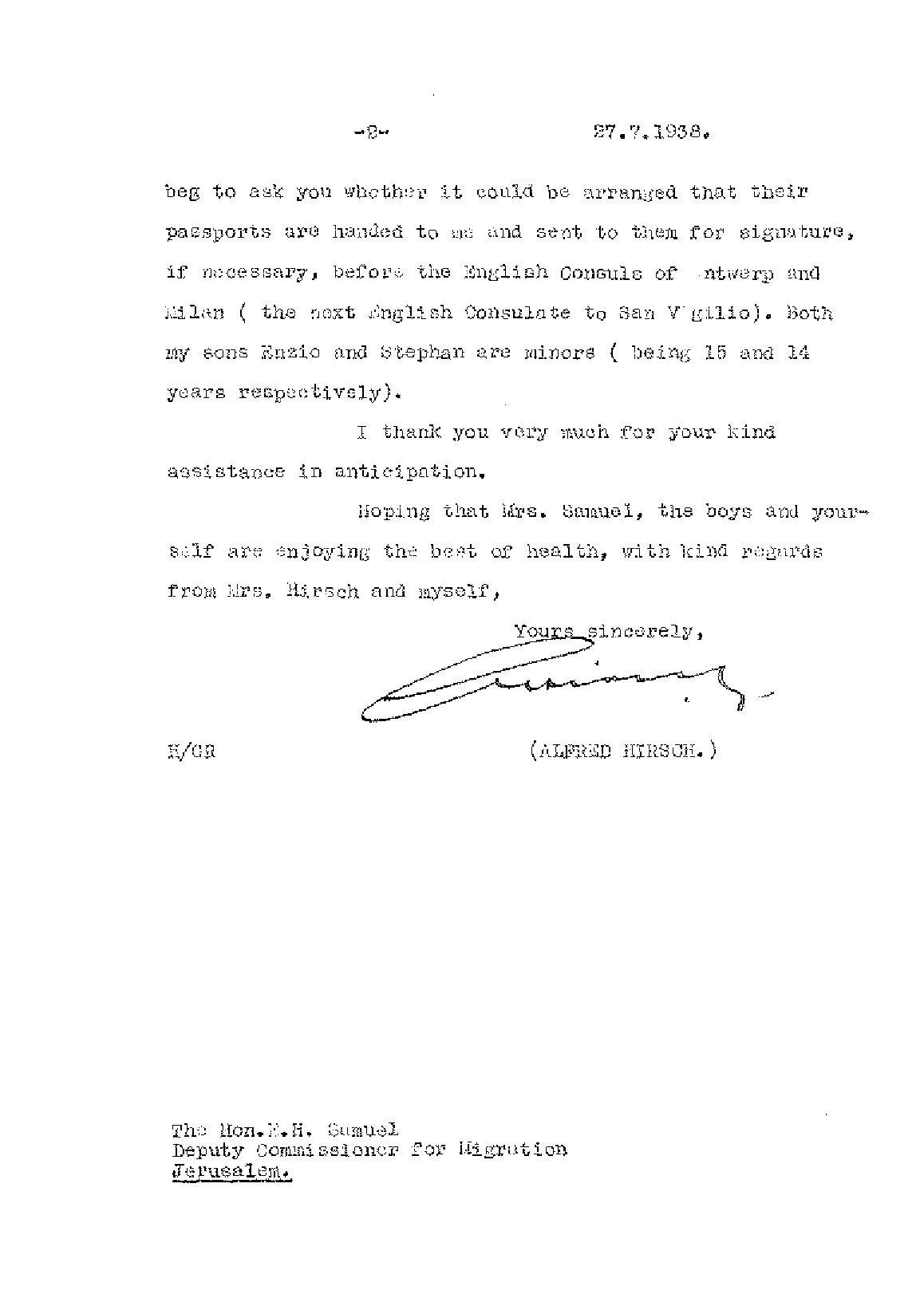
The file includes letters indicating that two of Elsa and Alfred’s children returned to Europe after arriving in Palestine, one to Antwerp to study, the other to Italy for health reasons. Alfred requested that the two children be granted Palestinian passports expeditiously because they each had limited visas from those countries that would expire before they could return to Palestine to sign their new passports.

Alfred received a response that the Palestinian officials would ask the British consul to issue Palestinian passports to the two children once Alfred himself was naturalized. Alfred and Elsa were naturalized on August 14, 1938. Alfred was working as the general manager of the Palestine Milling & Trading Company at that time.4

Elsa and Alfred Hirsch, Palestinian citizenship certificate, found at https://tinyurl.com/vebdvxq

I assume the two children were able to return soon thereafter to Palestine to join their family. But can you imagine the anxiety experienced by them all, thinking that the two young teenagers might be stranded in Europe as the Nazi persecution of Jews intensified in 1938, culminating in Kristallnacht just a few months after Alfred and Elsa received their naturalization certificate?

One of their children immigrated to the US as early as 1940 and was residing without any family members in New York City at the YMHA on the 1940 US census;5 his uncle Kurt was, however, residing in New York at that time, where he was the owner of an “art shop,” according to the census.6

The rest of the family joined them in the US after the war. Alfred and Elsa arrived in New York on December 24, 1946.7 Alfred died less than two months later on February 6, 1947; he was only 56 years old.8 Elsa outlived him by over forty years; she died in Dallas, Texas, on October 4, 1988.  She was 97 years old.9

Elsa’s brother Kurt Stern unfortunately did not have his sister’s longevity. He died on April 16, 1962 at the age of 67 after a long illness, according to his obituary.10 He was survived by his wife Rhee, who died in August 1986 at the age of 91,11 and his sister Elsa and her three children.

Thus ends not only the story of Mayer Stern, but that of his parents Sarah Goldschmidt and Salomon Stern. Their story is overall a story shared by so many German Jews. They went from being successful merchants living in comfort and security, raising children and grandchildren in a country that they saw as their home, to being refugees from the worst kind of persecution and violence anyone can imagine.

Sarah Goldschmidt’s descendants were, however, among the more fortunate ones. Out of all of Sarah’s children and grandchildren and great-grandchildren living in Germany during the Nazi era, only one, little Margot Fulda, just thirteen years old, was murdered by the Nazis. The rest were uprooted from their homes and torn from the comfort they’d known, but were able to escape to Palestine, to England, and to the United States. Their descendants live among us today in places all over the world. How fortunate and blessed we are that they do.

Next I will turn my attention to Sarah’s younger brother Jacob Meier Goldschmidt and his family.


  1. “Kurt M. Stern Dies; Art Dealer Was 67,” The New York Times, April 17, 1962, p.34. 
  2. Mayer Stern, Immigration and Naturalization File, Israel Archives, found at https://tinyurl.com/ugr2b62 
  3. Elsa and Alfred Hirsch, Immigration and Naturalization File, Israel Archives, found at https://tinyurl.com/vebdvxq 
  4. Ibid. 
  5. Stephen Hirsch, 1940 US census, Census Place: New York, New York, New York; Roll: m-t0627-02663; Page: 83B; Enumeration District: 31-1658, Ancestry.com. 1940 United States Federal Census 
  6. Kurt M. Stern, 1940 US census, Census Place: New York, New York, New York; Roll: m-t0627-02656; Page: 2A; Enumeration District: 31-1368, Ancestry.com. 1940 United States Federal Census 
  7. Alfred and Elsa Hirsch, ship manifest, Year: 1946; Arrival: New York, New York; Microfilm Serial: T715, 1897-1957; Microfilm Roll: Roll 7250; Line: 1; Page Number: 10,
    Ancestry.com. New York, Passenger and Crew Lists (including Castle Garden and Ellis Island), 1820-1957 
  8. Ancestry.com. New York, New York, Extracted Death Index, 1862-1948 
  9. Else Hirsch, Social Security Number: 119-36-5922, Birth Date: 4 Jan 1891
    Issue year: 1962, Issue State: New York, Last Residence: 75219, Dallas, Dallas, Texas, USA, Death Date: 4 Oct 1988, Social Security Administration; Washington D.C., USA; Social Security Death Index, Master File, Ancestry.com. U.S., Social Security Death Index, 1935-2014 
  10. Kurt M Stern, Birth Date: 28 Jan 1895, Death Date: 16 Apr 1962, Claim Date: 17 Aug 1962, SSN: 060070787, Ancestry.com. U.S., Social Security Applications and Claims Index, 1936-2007. “Kurt M. Stern Dies; Art Dealer Was 67,” The New York Times, April 17, 1962, p.34. 
  11.  Rhee Stern, Social Security Number: 065-52-1280, Birth Date: 12 Jun 1895
    Issue year: 1973, Issue State: New York, Last Residence: 10028, New York, New York, New York, USA, Death Date: Aug 1986, Social Security Administration; Washington D.C., USA; Social Security Death Index, Master File, Ancestry.com. U.S., Social Security Death Index, 1935-2014 

Escaping from Germany, Part VI: Germany’s Loss, America and Israel’s Gains

Abraham and Johanna (Goldschmidt) Stern’s daughter Clementine had died in 1919 during the 1918 flu epidemic, survived by her husband Siegfried Oppenheimer and three children: Erika (1909), William Erwin (1912), and Sarah Gabriele (1917). After Clementine’s death, Siegfried married her younger sister Alice Lea, with whom he had five more children, all born in the 1920s. All eight of those children as well as Alice and Siegfried themselves escaped from Germany in the 1930s.

The Children of Clementine Stern and Siegfried Oppenheimer

Siegfried and Clementine’s oldest child, Erika Oppenheimer, first escaped to the Netherlands in 1933, but she immigrated to the United States on July 4, 1938, appropriately enough. Two weeks later she married Paul Fromm in Chicago, Illinois, on July 20, 1938. Paul also had arrived on July 4, 1938, so the two may have met and fallen in love on the ship that brought them to the US. Paul was born in Kitzingen, Germany, on September 28, 1906, into a family with a long tradition as vintners. He had been living in Bingen, Germany, before immigrating. Erika and Paul both filed their naturalization papers on August 26, 1938, less than two months after their arrival.

Erika Oppenheimer Fromm, Declaration of Intent, National Archives at Chicago; Chicago, Illinois; ARC Title: Illinois, Petitions for Naturalization, 1906-1991; NAI Number: 593882; Record Group Title: Records of District Courts of the United States, 1685-2009; Record Group Number: RG 21
Description: Petitions for naturalization, v 1185, no 296351-296550, ca 1943-1944
Ancestry.com. Illinois, Federal Naturalization Records, 1856-1991

Paul Fromm, Declaration of Intent, National Archives at Chicago; Chicago, Illinois; ARC Title: Illinois, Petitions for Naturalization, 1906-1991; NAI Number: 593882; Record Group Title: Records of District Courts of the United States, 1685-2009; Record Group Number: RG 21
Description: Petitions for naturalization, v 1185, no 296351-296550, ca 1943-1944
Ancestry.com. Illinois, Federal Naturalization Records, 1856-1991

The 1940 census reports them living in Chicago, where Paul was the proprietor of a wholesale liquor importation business and Erika a psychologist working in a hospital clinic.1 They would have one child born in 1940.

Both Paul and Erika achieved great success in the US. Paul was a very successful wine merchant, but also made his name as a philanthropist who generously supported the arts, music specifically. He created the Fromm Foundation at Harvard to support musicians and composers and musical events such as Tanglewood and the Aspen Music Festival. John Rockwell, the long-time music critic for the New York Times, described Paul Fromm as “the most active and distinguished private patron of contemporary classical music in the United States.” Paul died on the 49th anniversary of his arrival in the US, July 4, 1987.  He was eighty years old.2

Erika also had a distinguished career. She had received her doctorate in psychology from the University of Frankfurt in 1933 before escaping to the Netherlands. After immigrating to the US in 1938, she became a research assistant in psychiatry at the University of Chicago for a few years and then spent years in practice, eventually returning to the faculty at the University of Chicago in 1961, where she became a scholarly expert in the use of hypnosis. Her obituary described some of her professional accomplishments:3

Dr. Fromm considered hypnosis a valuable analytical tool that, when used by a skilled practitioner, could provide access to a patient’s unconscious conflicts and desires. She said hypnosis could induce an altered state of consciousness involving heightened awareness and focus in approximately 1 in 12 people.

She used hypnosis to treat severely disturbed patients as well as victims of incest and those suffering from post-traumatic stress disorders. She also advocated self-hypnosis as a path to self-exploration.

In the 1980’s, Dr. Fromm joined the growing field of behavioral medicine, which uses hypnosis, meditation, biofeedback and other techniques to treat physical ailments. Her book ”Hypnosis and Behavioral Medicine,” written with Dr. Daniel P. Brown and published in 1987, presented research supporting those methods in treating allergies, asthma, migraines and hypertension.

Erika Oppenheimer Fromm died on May 25, 2003, in Chicago. She was 93.4

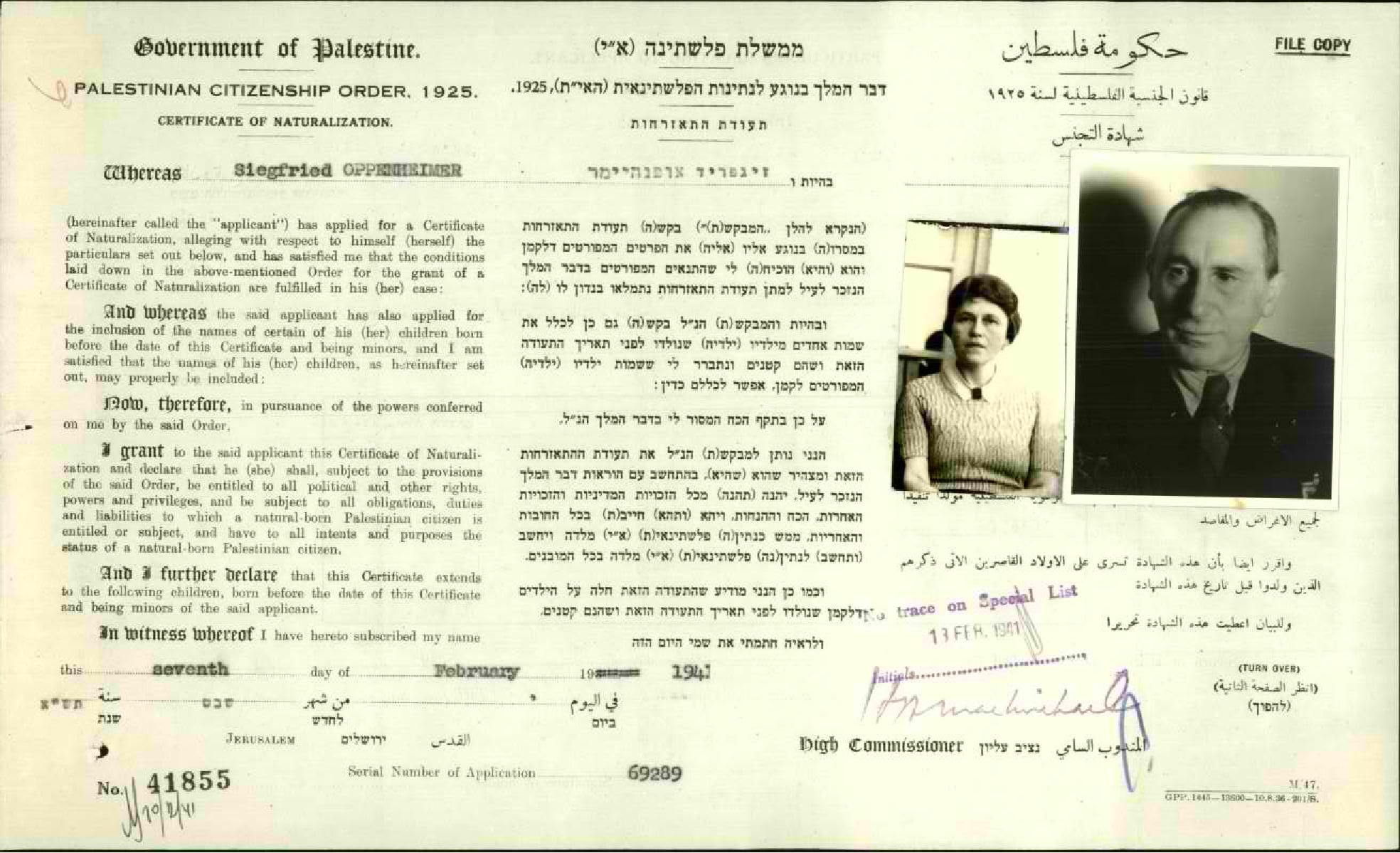
Clementine and Siegfried’s son William Erwin Oppenheimer (often called Erwin) left Germany very early; he arrived in Palestine on November 8, 1933, less than a year after Hitler was elected Chancellor of Germany. By 1938, when he applied for Palestinian citizenship, he was married to Hannie Halpern, who was also a refugee from Germany. She was born in Frankfurt on September 1, 1914. Erwin was then working as a farmer near Rehovoth.5 According to trees on MyHeritage, he died on April 22, 1963, in Jerusalem. He was only fifty years old.

Immigration and Naturalization File, Israel Archives, found at https://www.archives.gov.il/en/archives/#/Archive/0b07170680034dc1/File/0b071706810638e5

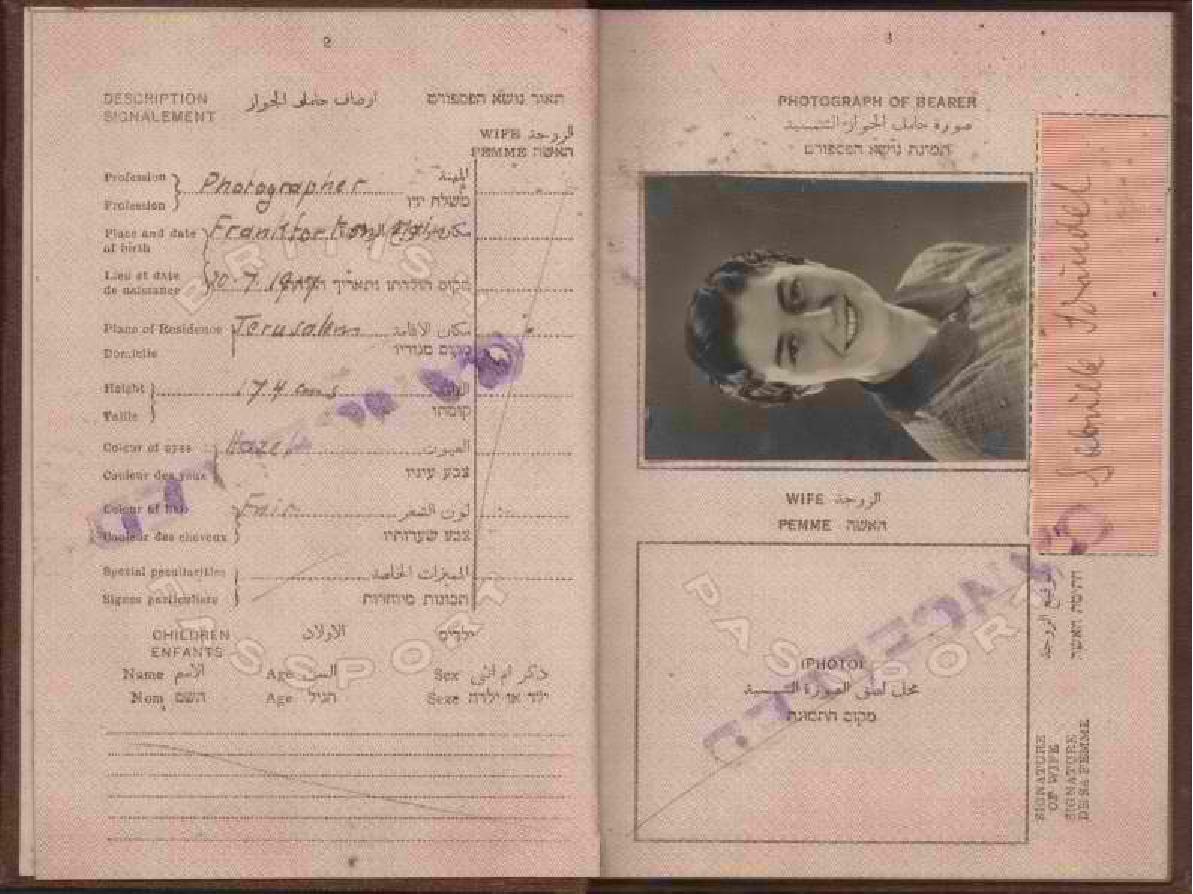
As for Clementine and Siegfried’s younger daughter Sarah Gabriele Oppenheimer, known as Gabriele, I am missing some pieces to Gabriele’s story, but it appears from documents that she had been married to a man named Leon Schindel, whom she divorced in Jerusalem on July 28, 1941.6

Among Gabriele’s immigration documents is her original Palestinian passport, issued on December 2, 1937, so she was already a citizen of Palestine by then. She was a professional photographer, according to her passport.

She married a second time in Tel Aviv on September 11, 1942, to Martin Lederman; he was born in Dresden, Germany, on April 13, 1904, and had immigrated to Palestine on March 26, 1940; he had previously been living in Panama. According to his Palestinian naturalization papers, Martin was a publisher.7

Martin and Gabriele did not remain in Palestine, later Israel, for too long after the war ended.  They made several trips to England and the US after the war, and in June 1949, they indicated on the ship manifest taking them from England to the US that their intended future permanent residence was the “USA.”8  Gabriele became a naturalized US citizen on December 20, 1954,9 and Martin on February 14, 1955.10 They were residing in New York City.

Both Martin and Gabriele lived into their eighties. Martin died on July 9, 1991, at 87,11 and Gabriele died on January 11, 2001, at the age of 83.12 As far as I can tell, they did not have any children.

Alice Stern and Siegfried Oppenheimer

I don’t have many documents for what happened to Alice and Siegfried Oppenheimer before they arrived in Palestine in late 1938. But as we saw in my last post, a letter written by Erich Stern, Siegfried Stern’s son, to his brother Gunther Stern in 1938 on November 13, 1938, revealed that Siegfried Oppenheimer was arrested in the aftermath of Kristallnacht just days before his family planned to travel to Palestine.

But eventually Siegfried and Alice and all five of their children made it to Palestine. Alice and Siegfried Oppenheimer arrived with three youngest of those children, and their two oldest children arrived separately around the same time.13 They all became naturalized citizens of Palestine in 1941.

I do not have death records for Alice or Siegfried, but the research of Cibella/Baron indicates that both died in Israel, Siegfried in 1959, Alice in 1986. All but one of their five children also lived the rest of their lives in Israel; the other child immigrated to the US after the war.

Thus, of the eight children of Clementine and Alice Stern, six ended up in Israel, two in the United States. Clementine, Alice, and Siegfried Oppenheimer have many descendants living in both countries. What Germany lost—e.g., a brilliant psychologist, a philanthropist and entrepreneur, and a photographer–were gifts to the countries that took them in.


  1. Erika and Paul Fromm, 1940 US census, Census Place: Chicago, Cook, Illinois; Roll: m-t0627-00929; Page: 4B; Enumeration District: 103-268, Ancestry.com. 1940 United States Federal Census 
  2. “Paul Fromm dies at 80; was Fromm week patron,” The Berkshire Eagle
    Pittsfield, Massachusetts, 07 Jul 1987, Tue • Page 12. “Paul Fromm, Philanthropist,” Hartford Courant, Hartford, Connecticut, 06 Jul 1987, Mon • Page 128. Paul Fromm
    Social Security Number: 323-12-0163, Birth Date: 28 Sep 1906, Issue State: Illinois
    Last Residence: 60637, Chicago, Cook, Illinois, USA, Death Date: Jul 1987, Social Security Administration; Washington D.C., USA; Social Security Death Index, Master File, Ancestry.com. U.S., Social Security Death Index, 1935-2014 
  3. “Erika Fromm, 93, Psychologist and Expert in Use in Hypnosis,” The New York Times, May 30, 2003, Section B, Page 9. 
  4.  Erika Fromm, Social Security Number: 340-32-7862, Birth Date: 23 Dec 1909
    Issue year: 1955-1956, Issue State: Illinois, Last Residence: 60637, Chicago, Cook, Illinois, USA, Death Date: 25 May 2003, Social Security Administration; Washington D.C., USA; Social Security Death Index, Master File, Ancestry.com. U.S., Social Security Death Index, 1935-2014 
  5. Erwin Oppenheimer, Immigration and Naturalization File, Israel Archives, found at https://tinyurl.com/rxv8ox4 
  6. Martin Lederman and Gabriele Oppenheimer Schindel Lederman, Immigration and Naturalization File, Israel Archives, found at https://tinyurl.com/tbvdq97 
  7. See footnote 6. 
  8. Martin and Gabriele Lederman, ship manifest, Departure Date: 22 Jun 1949
    Port of Departure: Southampton, England, Destination Port: New York, USA,
    Ancestry.com. UK and Ireland, Outward Passenger Lists, 1890-1960 
  9. Martin Lederman, Naturalization Date: 14 Feb 1955, Residence: New York, New York, Ancestry.com. New York, Index to Petitions for Naturalization filed in New York City, 1792-1989 
  10. Gabriele Lederman, Naturalization Date: 20 Dec 1954, Residence: New York, New York, Ancestry.com. New York, Index to Petitions for Naturalization filed in New York City, 1792-1989 
  11.  Martin Lederman, Social Security Number: 060-26-6446, Birth Date: 13 Apr 1904
    Death Date: 9 Jul 1991, Social Security Administration; Washington D.C., USA; Social Security Death Index, Master File, Ancestry.com. U.S., Social Security Death Index, 1935-2014 
  12.  Gabriele Lederman, Social Security Number: 121-54-6243, Birth Date: 20 Jul 1917, Death Date: 11 Jan 2001, Social Security Administration; Washington D.C., USA; Social Security Death Index, Master File, Ancestry.com. U.S., Social Security Death Index, 1935-2014 
  13. Siegfried and Alice Stern Oppenheimer, Immigration and Naturalization File, Israel Archives, at https://tinyurl.com/r7k6qau 

Escaping from Germany, Part IV: Helene and Martha Loewenthal, An Unfinished Research Project

I am really torn. Do I post about my family history in these times when we are all so anxious and focused on the present and the future, not the past? I prepared this post a few weeks ago, and in re-reading it now, I decided that reading about how others faced serious threats to their lives and their family’s lives might provide hope and strength to some who read it. So I am going forward.


Thus far we have seen what happened to three of Abraham Loewenthal and Keile Stern’s children and their children during the Holocaust. This post will report on the two youngest siblings, Helene and Martha, and their families. How did their lives change as a result of the Holocaust?

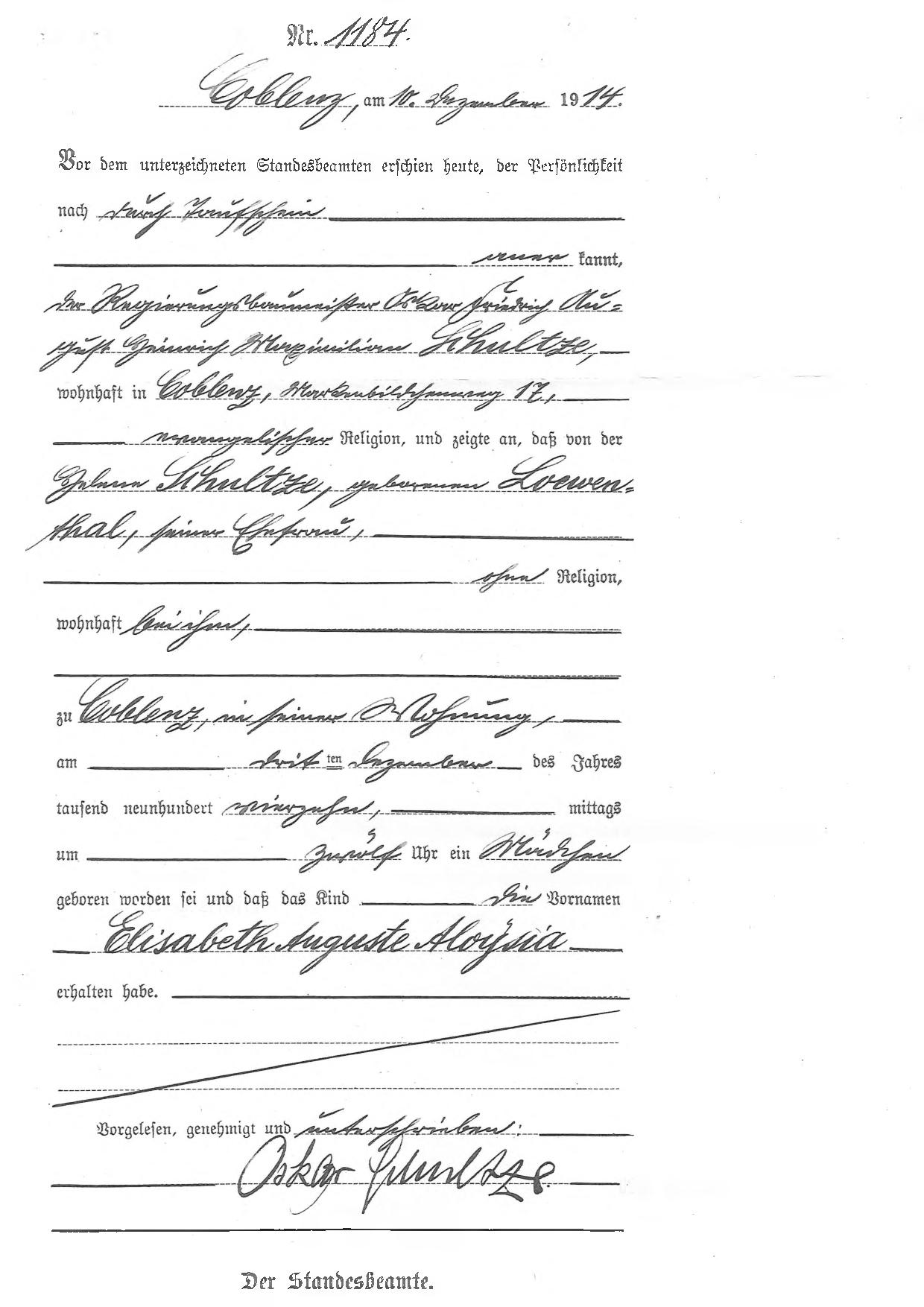
We saw that Helene Loewenthal’s first marriage to Edward Feuchtwanger had not lasted and that in 1913 she had married Oscar Friedrich August Heinrich Maximilian Schultze. They had one child, Elisabeth Auguste Aloysia Schultze, born on December 3, 1914, in Coblenz, Germany, where she was baptized on May 12, 1915. Thanks to my dear friend Aaron Knappstein, I now have Elisabeth’s birth record.

Notice that it indicates that her religion was evanglische, i.e., Protestant.
Elisabeth Schultze, birth record, Coblenz

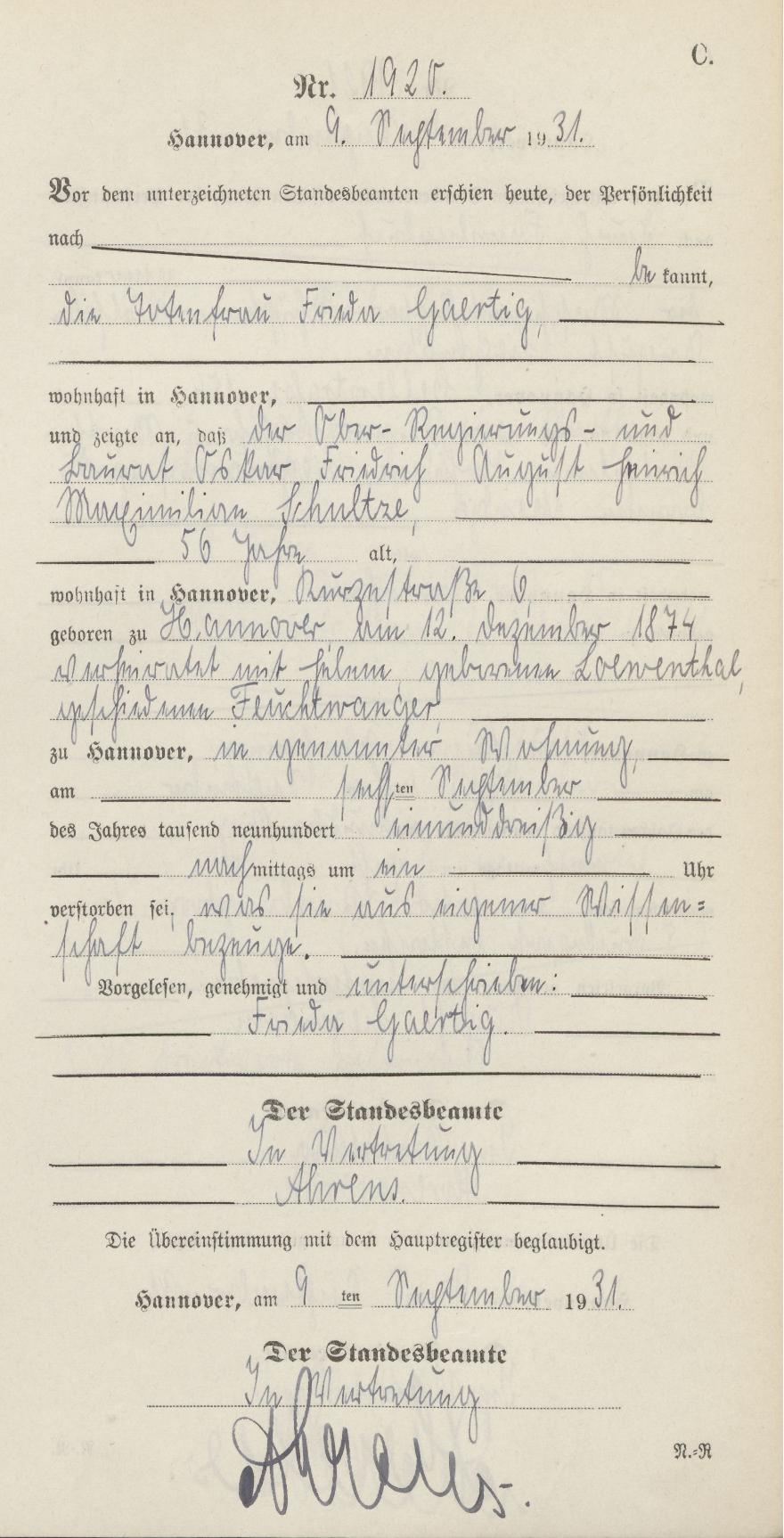
Oscar Schultze died on September 6, 1931, in Hanover, Germany. (Thank you again to Aaron Knappstein for obtaining this death record for me.) He was survived by his widow Helene and daughter Elisabeth.

StadtAH_1_NR_3_08_2_1057_1920_1931 Oscar Schultze death certificate

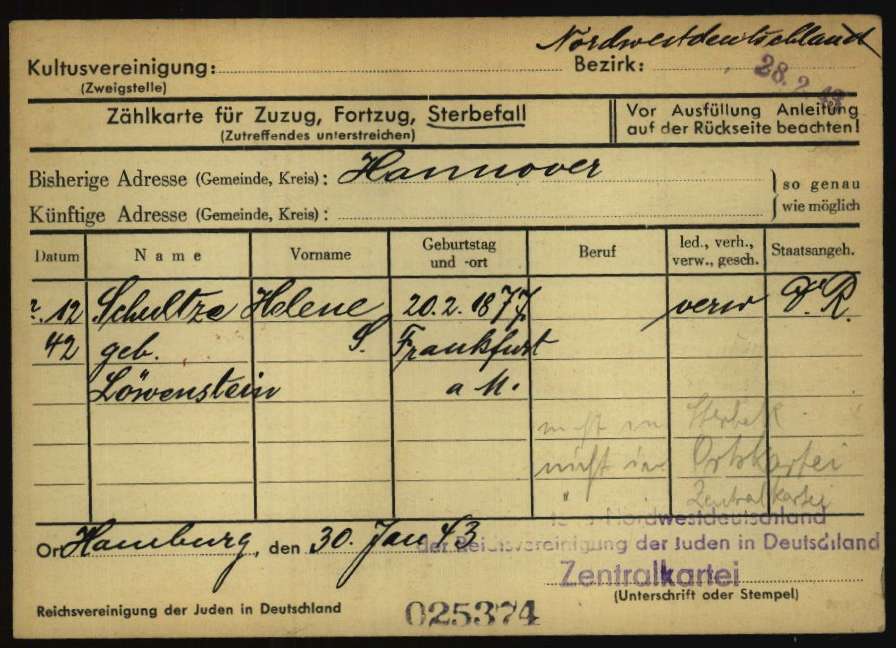
Despite the fact that Elisabeth was raised as a Christian and that her mother Helene had married a Christian, both Elisabeth and Helene were enumerated as minorities on the 1939 Minority Census in Germany, living in Hannover.1 Helene died three years later on November 28, 1942, according to this document found in the Arolsen Archives. She was 65. It incorrectly lists her birth name as Loewenstein, not Loewenthal, but this is definitely my cousin Helene.

1 Incarceration Documents / 1.2 Miscellaneous / 1.2.4 Various Organizations /
1.2.4.1 “Reichsvereinigung der Juden” Card File / 12673184 – HELENE SCHULTZE. ITS Digital Archive, Arolsen Archives

I don’t know what happened to Elisabeth during the Nazi era after 1939. She would have been considered a “Mischling” of the first degree since her mother was born Jewish as were her mother’s parents, and not as a Jew because she was not disqualified from being a Mischling under the criteria enumerated by the Nazis, that is, she was not raised as a Jew nor was she married to one before 1935. Whether she faced any persecution or not is not clear, but we’ve seen that other Mischlings were persecuted.

But Elisabeth did survive the war. As indicated on the annotation to the birth record shown below, Elisabeth married in Hamburg in 1955 and died in Bad Krozingen in 1991. Aaron Knappstein is now looking to see if he can find her marriage and death records. Since it appears that Elisabeth married when she was 41, I assume she did not have children.

Annotation to birth record of Elisabeth Schultze

As for Martha Loewenthal, I have mostly secondary information from my cousins Roger Cibella and David Baron and numerous unsourced family trees on Ancestry and Heritage, but I will report what I can as best I can to do honor to these cousins. We’ve seen already that she married Jakob Wolff and that they had three children in the first decade of the 20th century: Anna, Hans Anton, and Hans Walter.

UPDATE: Thank you once again to Aaron Knappstein, who has located the marriage record for Anna Wolff and Simon Wittekind. They were married on June 7, 1929, in Frankfurt. Simon was the son of Wilhelm Wittekind and Fanny Mendele, and he was born in Bad Kissingen on December 10, 1892. He had served in World War I for Germany.2 He was a doctor.

Less than a year after witnessing her daughter’s marriage, Martha Loewenthal Wolff died on May 19, 1930, in Frankfurt, as we saw.

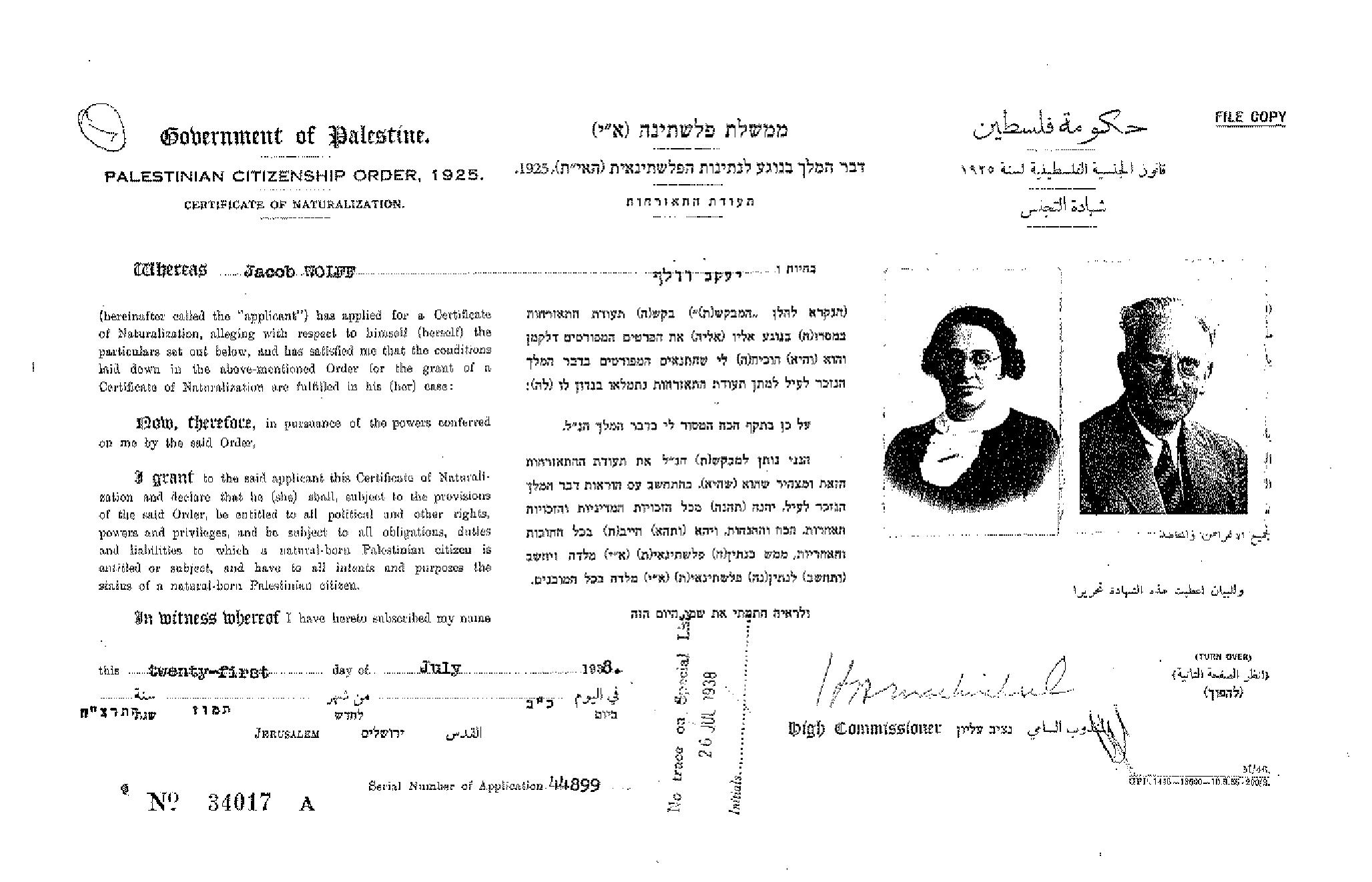
Her widower Jakob Wolff immigrated to Palestine on August 21, 1934. By that time Jakob had remarried; his second wife was Ilse Gruenebaum, born October 27, 1901, in Maden, Germany. They became naturalized citizens of Palestine on July 21, 1938.3

Naturalization Certificate of Jacob and Ilse Wolff found at https://www.archives.gov.il/en/archives/#/Archive/0b07170680034dc1/File/0b07170680e4ea29

MyHeritage reports that Jakob and Martha (Loewenthal) Wolff’s children all also ended up in Palestine/Israel, where they married and had children and have descendants still living in Israel. Their father Jakob died on October 14, 1953, in Israel. He was 77.4

If and when I find more documentation for Elisabeth Schultze and the descendants of Martha Loewenthal Wolff, I will update this post. For now, that brings to a close the stories of the children of Sarah Goldschmidt Stern’s daughter Keile and her husband Abraham Loewenthal. Next I will turn to the families of Keile’s brother Abraham Stern and his wife and cousin, Johanna Goldschmidt, and their fate during and after the Nazi era.


  1. Helene and Elisabeth Schultze, German Federal Archives, Abteilung R (Deutsches Reich), List of Jewish Residents of the German Reich 1933-1945, found at https://tinyurl.com/tyzfaab and at https://tinyurl.com/tjfhud3 
  2.  Bayerisches Hauptstaatsarchiv; München; Abteilung IV Kriegsarchiv. Kriegstammrollen, 1914-1918; Volume: 20351. Kriegsstammrolle, Ancestry.com. Bavaria, Germany, WWI Personnel Rosters, 1914-1918 
  3. Immigration and Naturalization File of Jacob and Ilse Wolff, Israel Archives, found at https://tinyurl.com/r7524xh 
  4. https://tinyurl.com/regavyr 

Escaping from Germany, Part III: A Family Divided Across the World

The story of my cousin Siegfried Loewenthal is the story of how one family ended up separated and spread all over the world in order to escape Nazi Germany.

Abraham Loewenthal and Keile Stern’s younger son Siegfried and his wife Henriette Feuchtwanger had five children, as we have seen: Rosel (or Rosa) (1908), Albert (1909), Louise (1910), Grete (1913), and Lotte (1914).

Rosa Loewenthal married Justin Held in Frankfurt on August 24, 1928. Justin was born in Kulsheim, Germany on October 18, 1900.

Marriage record of Justin Held and Rosa Loewenthal, Hessisches Hauptstaatsarchiv; Wiesbaden, Deutschland; Bestand: 903. Year Range: 1928, Ancestry.com. Hesse, Germany, Marriages, 1849-1930

Rosa and Justin had two daughters born in Germany, one in 1929, one in 1930.

When Hitler came to power in 1933, Siegfried and Henriette’s family began to disperse. First, their son Albert Loewenthal went to Palestine on March 26, 1934.1 I do not have a marriage record for Albert, but my cousins Roger Cibella and David Baron report that he married Hilda Weingarten in Jerusalem on June 12, 1935. Hilda was born in Hamburg, Germany, on April 10, 1911. I do know that they were married by the time they applied to become naturalized citizens of Palestine in April 1938, and they had a son born in Jerusalem in 1937.2 According to Cibella/Baron, Hilda died in Switzerland in 1954, Albert in 1995 in Jerusalem (after marrying two more times and having several more children).

Naturalization certificate for Albert and Hilda Loewenthal, found at https://www.archives.gov.il/en/archives/#/Archive/0b07170680034dc1/File/0b07170680fd584e

By 1939, the rest of Siegfried’s family had also left Germany. Siegfried and Henriette themselves arrived in Palestine on March 20, 1939, and became naturalized citizens in 1941.3 Unfortunately, Siegfried died just a year later in Tel Aviv on February 25, 1942. He was 62 years old and survived by his wife and all five of his children.4

Naturalization certificate of Siegfried and Henriette (Feuchtwanger) Loewenthal, https://www.archives.gov.il/en/archives/#/Archive/0b07170680034dc1/File/0b07170680b9fac4

And those children were all over the world by then. Rosa Loewenthal and Justin Held and their children left for England in 1939 and then immigrated to the United States in 1940.5 They ended up living in New York and becoming naturalized citizens.6 Justin died in 1980,7 Rosa in 1993.8

The National Archives; Kew, London, England; 1939 Register; Reference: RG 101/243J
Enumeration District: AKCZ, Ancestry.com. 1939 England and Wales Register

Louise Loewenthal had married Walter Meier Strauss in Basel, Switzerland. Walter was native to Frankfurt, where he was born on December 18, 1909.9 I was fortunate to find a long biography of Walter written by one of his grandsons and posted on the family genealogy website.  According to this document, Walter was employed by a woolen factory in Frankfurt when he was a teenager, and when he was in his early twenties or in the early 1930s, the company moved to Switzerland, and the owner asked Walter to come with them, which he did. By that time he had been dating Louise Loewenthal for seven years, and they soon married and moved to Basel, Switzerland. According to the grandson’s biography of Walter:

During the War, friends from home that were now in the concentration camps sent him letters about the atrocities that were going on in the War and specifically in the Camps. Trying to help, he established a group consisting of himself… and a few other men from Basel. The group would send very small care packages periodically to the people in the camps. The packages consisted of food such as salami, sardines, and any other small items that the people requested or needed and was small enough that it could be sent. Every sunday they would load up the packages in a car and drive all over Basel putting them in many different mailboxes, for if they were all dumped in one mailbox they would surely not arrive at the camps.

Thus, Louise and Walter were able to survive the Holocaust; Walter’s parents and brother were, however, murdered at Sobibor.10

In 1946, after the war ended, Louise and Walter Strauss and their two children immigrated to the US; Max Stern, husband of Louise’s first cousin Hilda, helped them get a visa. The ship manifest listed Justin Held, Louise’s brother-in-law married to her older sister Rosa, as the person they were going to in the US.11 They settled in New York where Walter once again got a job with a woolen factory. Walter died in 1990 while on a business trip in Switzerland and was buried in Israel.12 Louise died in New York on August 11, 2003; she was 92 and was survived by her two children and her grandchildren.13

Grete Loewenthal immigrated to Palestine, arriving on April 6, 1936. She became a naturalized citizen on November 29, 1938. She was working as an assistant pharmacist at the time and was unmarried.14

Cibella/Baron report that she married Fritz Altar in 1948, but I have no records to verify that fact. I did find two ship manifests, one outgoing from England, one arriving in New York, in May 1958, that list Grete and Fritz Altar, residents of Austria and working as hotel managers.15 The English manifest indicates that they were headed to the US as “the country of intended permanent residence.” But I have found no records showing that Grete and Fritz lived in the US. Fritz died in Vienna on January 30, 1993, and is buried there.16 Unsourced trees on Geni and MyHeritage report that Grete died on September 27, 1995, also in Vienna. I have no verification of that fact.

Lotte Loewenthal also had left Germany by 1939. She and her husband Erich Posen are listed on the 1939 England and Wales Register showing residence in England by 1939. Erich was working as an optical goods salesman.

Lotte Loewenthal and Erich Posen, The National Archives; Kew, London, England; 1939 Register; Reference: RG 101/980H, Enumeration District: BXHY, Ancestry.com. 1939 England and Wales Register

Unfortunately I have no marriage record for Lotte and Erich, but I know this is the correct person because after the war when she and Erich had their first child in January 1946, Lotte had serious complications and her mother Henriette had to get permission to leave Palestine to go to England for a few months to help Lotte with the new baby.16

Immigration and Naturalization File for Siegfried and Henriette (Feuchtwanger) Loewenthal, Israel Archives, found at https://www.archives.gov.il/en/archives/#/Archive/0b07170680034dc1/File/0b07170680b9fac4

Lotte was not destined for a long life. She died at the age of 52 in 1967 in England, survived by her husband Erich and two children.17 Her mother also survived her; Henriette Feuchtwanger Loewenthal died at the age of 93 in Israel, according to the work of Roger Cibella and David Baron.

Despite the lack of sources for some of the stories of Siegfried Loewenthal and his family, there is enough information to conclude that he, his wife, and all five of their children and their grandchildren escaped Germany in time and survived the Holocaust. In doing so, they ended up spread across three continents and three different countries.

There are always costs to these relocations and disruptions. Siegfried’s early death in 1942 certainly could have been just one of those costs.

Gravestone of Siegfried Loewenthal, photograph by Ben Ariel October 17, 2015, found at https://billiongraves.com/grave/%D7%A9%D7%9C%D7%9E%D7%94-%D7%9C%D7%95%D7%95%D7%A0%D7%98%D7%94%D7%9C/18779141?referrer=myheritage

Gravestone of Henriette Feuchtwanger Loewenthal photo by Ben Ariel October 17, 2015 , found at https://billiongraves.com/grave/%D7%A9%D7%9C%D7%9E%D7%94-%D7%9C%D7%95%D7%95%D7%A0%D7%98%D7%94%D7%9C/18779141?referrer=myheritage


  1. Immigration and Naturalization File for Albert and Hilda (Weingarten) Loewenthal, Israel Archives, found at https://tinyurl.com/w33mluf 
  2. Ibid. 
  3. Immigration and Naturalization File for Siegfried and Henriette (Feuchtwanger) Loewenthal, Israel Archives, found at https://tinyurl.com/tjk92a5 
  4. https://tinyurl.com/u3jsyyc 
  5. Rosa and Justin Held and family, passenger ship manifest, Year: 1940; Arrival: New York, New York; Microfilm Serial: T715, 1897-1957; Microfilm Roll: Roll 6459; Line: 16; Page Number: 81, Ancestry.com. New York, Passenger and Crew Lists (including Castle Garden and Ellis Island), 1820-1957 
  6. Name: Rosa Held, Birth Date: 14 Feb 1908, Age: 39, Naturalization Date: 20 Nov 1947, Residence: New York, New York, Title and Location of Court: New York Southern District, Ancestry.com. New York, Index to Petitions for Naturalization filed in New York City, 1792-1989. Justin Held, Birth Date: 18 Oct 1900, Age: 47, Naturalization Date: 15 Jul 1948, Residence: New York, New York, Title and Location of Court: New York Southern District, Ancestry.com. New York, Index to Petitions for Naturalization filed in New York City, 1792-1989. 
  7.  Justin Held, Social Security Number: 092-14-6607, Birth Date: 18 Oct 1900
    Death Date: Dec 1980, Social Security Administration; Washington D.C., USA; Social Security Death Index, Master File, Ancestry.com. U.S., Social Security Death Index, 1935-2014 
  8. Rose Held, Birth Date: 14 Feb 1908, Death Date: Mar 1993, SSN: 095144557,
    Ancestry.com. U.S., Social Security Applications and Claims Index, 1936-2007 
  9. Walter Meier Strauss, Birth Date: 18 Dec 1909, Naturalization Date: 24 Mar 1952,
    Residence: New York, New York, Title and Location of Court: New York Southern District, Ancestry.com. New York, Index to Petitions for Naturalization filed in New York City, 1792-1989 
  10. “My Genealogy Home Page:Information about Walter Meyer Strauss,” Jonathan Strauss, found at https://tinyurl.com/ttlo7rl 
  11. Walter and Louise Strauss and children, ship manifest, Year: 1946; Arrival: New York, New York; Microfilm Serial: T715, 1897-1957; Microfilm Roll: Roll 7161; Line: 1; Page Number: 267, Ancestry.com. New York, Passenger and Crew Lists (including Castle Garden and Ellis Island), 1820-1957 
  12. See footnote 10. Walter M Strauss, Death Date: 15 Oct 1990, SSN: 065246257,
    Ancestry.com. U.S., Social Security Applications and Claims Index, 1936-2007 
  13. Louise Strauss, Death Date: 11 Aug 2003, SSN: 122285989, Ancestry.com. U.S., Social Security Applications and Claims Index, 1936-2007 
  14. Immigration and Naturalization File for Grete Loewenthal, Israel Archives, found at https://tinyurl.com/v5mxvs9 
  15. Fritz and Grete Altar, ship manifest, 15 May 1958, Port of Departure: Southampton, England, Destination Port: New York, USA, Ship Name: Ryndam
    Ancestry.com. UK and Ireland, Outward Passenger Lists, 1890-1960. Grete and Fritz Altar, ship manifest, 24 May 1958, Arrival Place: New York, New York, USA, Ship: Ryndam, The National Archives at Washington, D.C.; Washington, D.C.; NAI Number: 2990227; Record Group Title: Records of the Immigration and Naturalization Service, 1787 – 2004; Record Group Number: 85; Series Number: A4115; NARA Roll Number: 447, Ancestry.com. New York State, Passenger and Crew Lists, 1917-1967 
  16. See multiple letters in Immigration and Naturalization File for Siegfried and Henriette (Feuchtwanger) Loewenthal, Israel Archives, found at https://tinyurl.com/tjk92a5 
  17. Lottie V Posen, Death Age: 52, Registration Date: Jul 1967, Registration district: Hampstead, Inferred County: Greater London, General Register Office; United Kingdom; Volume: 5b; Page: 583, Ancestry.com. England & Wales, Civil Registration Death Index, 1916-2007 

Max Goldschmidt: A Survivor

As seen in my last few posts, although my cousin Betty Goldschmidt and her husband (and our cousin) Jacob Goldschmidt had eight children, I only have adult records for one of them, their son Berthold. Berthold and his wife Mathilde Freudenstein had seven children, but their son Siegfried Goldschmidt was the only child of the seven to live long enough to marry and have a child of his own; Siegfried and his wife Frieda Fanny Pless had one child, a son Max born November 30, 1924, in Frankfurt, Germany.

Siegfried and his wife were among the six million murdered in the Holocaust, but their young son Max, the last known remaining descendant of Betty and Jacob, survived. Max was only eight years old when Hitler came to power and not yet eighteen when his parents were deported in 1942. How had he survived? At first all I knew was that he had immigrated to the US from Israel in 1948, but thanks  to the generous assistance of Elan Oren of the Tracing the Tribe group on Facebook, I have been able to piece together much of the story of Max’s life.

Elan located Max’s file in the Israeli archives, which revealed that Max had escaped to Switzerland at some point during the Nazi era. After the war, Max sailed on the ship Plus Ultra from Barcelona, Spain, to Haifa, arriving in Haifa on June 19, 1945.

From Max Goldschmidt Israeli immigration file: Ship manifest for the Plus Ultra from Barcelona to Haifa, arriving June 19, 1945. Max is on line 94. http://www.archives.gov.il/en/archives/?fbclid=IwAR1y3d5C1X3pi2R1_jyX0MAbgeHLQoNhL6TM7F5P7ZT7CE4sFJgPPuql11A#/Archive/0b0717068002258e/File/0b071706856dcab1

Max’s file in the Israeli archives did not reveal how or when he got to Switzerland or to Barcelona, but Max’s A-file—his US immigration file—from the US Customs and Immigration Service (USCIS) revealed further details.1 According to a German police certificate included in Max’s application to the US Consul in Palestine for an immigration visa in 1947, Max lived in Warburg, Germany, from April 1927 until September 1936. That is also where his parents were residing during that time, according to records  at Yad Vashem.

On Max’s 1947 US visa application he stated that he’d immigrated to Switzerland in January 1939. He was only fourteen at that time. He lived in Basel, Switzerland, from January, 1939, until May, 1945, when he must then have left for Barcelona and ultimately Palestine. As for how he escaped from Germany in 1939, Elan Oren suggested that a Zionist youth group such as HeHalutz  might have helped him get out of Germany.

After arriving in Haifa, Max was transferred to Atlit, a detention camp built by the British, who were then in control of what was then Palestine. With the help of Elan Oren and his translation of Max’s Israeli naturalization file, I learned that Max left Atlit and first lived in Petach Tikvah and then moved to Tel Aviv to live with the Laks family. (More on them in a bit.)

Document that states that Max moved from Petah Tikvah to Tel Aviv where the Laks family lived. Translated by Elan Oren. http://www.archives.gov.il/en/archives/?fbclid=IwAR1y3d5C1X3pi2R1_jyX0MAbgeHLQoNhL6TM7F5P7ZT7CE4sFJgPPuql11A#/Archive/0b0717068002258e/File/0b071706856dcab1

But Max decided not to settle permanently in Israel. Max left Haifa on January 29, 1948, and arrived in New York on February 14, 1948. The manifest lists Max’s occupation as a gardener, his primary languages as English and Hebrew, his last residence as Tel Aviv, Palestine, and his birthplace as Frankfort [sic], Germany.

Max Goldschmidt passenger manifest, Year: 1948; Arrival: New York, New York; Microfilm Serial: T715, 1897-1957; Microfilm Roll: Roll 7546; Line: 19; Page Number: 197, Ancestry.com. New York, Passenger and Crew Lists (including Castle Garden and Ellis Island), 1820-1957

The second page of the manifest lists a friend named Pinil Laks as the contact person from Max’s prior residence of Tel Aviv and an uncle “Bernh Laks” of Blackwood, New Jersey, as the person he was going to join in the United States.

So who were the Laks? Bernhard Laks, also known as Bernhard Lachs, Berek Laks, and Bernard Laks, was married to Rosa Pless,2 who must have been a sister of Frieda Pless Goldschmidt, Max’s mother, since Max identified Bernard as his uncle and Rosa as his aunt on various documents.  Moreover, Bernard Laks (then spelled Bernhard Lachs) was one of the witnesses on the marriage record for Max’s parents, Siegfried and Frieda.

Bernhard Lachs as witness on the marriage record of Siegfried Goldschmidt and Frieda Fanny Pless. Hessisches Hauptstaatsarchiv; Wiesbaden, Deutschland; Bestand: 903
Ancestry.com. Hesse, Germany, Marriages, 1849-1930

When Max arrived at Ellis Island on February 14, 1948, he was denied admission to the United States because he did not have in his possession the immigration visa that he had been granted by the US consul in Palestine on November 17, 1947. A hearing was held on February 18, 1948 before a Board of Special Inquiry, at which Max testified that he had last seen his visa on the day he embarked from Haifa while at customs, that he had left it with his other papers in his baggage, and that while at sea he’d discovered that the visa was missing.

Max also testified that he had no relatives living outside of the US and no money. He stated that he was coming to the US in order to join his relatives, the Laks family of Blackwood, New Jersey, and that his uncle Bernard Laks had paid for his ticket from Haifa. In addition, Max presented an affidavit from Bernard and Rosa Laks in which they, as “his sole surviving relatives,” promised to “receive and care for [Max] and …not permit him to became a public charge.”

Although the Board of Special Inquiry found that Max had a valid Palestinian passport with a stamp indicating that a visa had been issued to him by the US Consulate in Jerusalem, they concluded that he was not admissible without possession of the actual visa. On February 20, 1948, however, the Commissioner of Immigration and Naturalization (INS) recommended that the decision to deport Max be deferred for ninety days to give him time to locate the visa or to obtain a certified copy.

On March 3, 1948, the ninety day stay was granted, and Max was also granted parole during that period, meaning that on March 4, 1948, he was allowed to enter the country though he was required to report in writing on a monthly basis to the Deportation and Parole Section at Ellis Island. Max had thus been detained for eighteen days at Ellis Island before his parole.

On March 18, 1948, his attorney wrote to INS to notify them that the American Consulate in Jerusalem had confirmed that Max had been granted a visa on November 17, 1947, and that the Visa Division in Washington, DC, had been so notified.  On April 8, 1948, the State Department submitted a certified copy of the visa. However, it was not until four months later on August 11, 1948, that an order was entered to re-open Max’s case. A new hearing was scheduled for September 15, 1948.  Fortunately, Max had better luck at this hearing, and he was granted legal admission into the country on September 15, 1948, more than seven months after arriving at Ellis Island on February 14, 1948. (I assume Max had received extensions of the 90 day parole period initially granted in March, 1948.)

Then began the next chapter of his life and more experiences with the slowly grinding wheels of American bureaucracy. He started the process of becoming a US citizen on October 1, 1948, just two weeks after entering the country officially.  But before Max’s papers could be processed, he was inducted into the US Army on January 1, 1949, the very day the government had scheduled a meeting to discuss his citizenship application. He amended his address to reflect that he was now stationed at Fort Dix in New Jersey as a member of the 9th Infantry Division. He was honorably discharged from the army on November 2, 1951, and on March 11, 1955, a certification of his service was issued to INS. His formal petition for naturalization was filed on October 14, 1955, with Bernard and Rosa Laks attesting to his character.

On January 24, 1956, the government received reports from the army that on January 2, 1951, while serving in the army, Max had “stated in substance … that if the Army is an example of democracy, he would take communism” and that on June 4, 1951 while giving a training lecture to his unit, “he introduced the Crusades as an illustrative example in this history of warfare, and then proceeded to interject his own thoughts on the persecution of Jews by Christians at the time of the Crusades, allegedly making rather strong remarks about the Roman Catholic Church. [Max] has at various times in the past tried to turn a topic of conversation into ‘making a case’ for Zionism.”

I suppose Max took the meaning of the First Amendment more literally than the US Army thought appropriate. Whether this had any impact on his citizenship application is not clear. On a page of examiner’s notes dated November 9, 1956, the examiner gave Max a final rating of “deny,” but then that was crossed out, and on May 17, 1957, his application was granted and he was finally issued a certificate of naturalization; he also changed his name to Goldsmith at that time. Despite his service in the US Army, it had taken almost eight years to complete the process of becoming a citizen.

Two months later in July 1957, Max married Shirley Larve in Trenton, New Jersey.3 Shirley was born in Trenton on May 29, 1923, to Joseph and Anna Larve.4 She was 34 when they married, and Max was 32. They did not have any children.

Shirley died at age 70 on July 24, 1993, in Broward County in Florida.5 Her obituary in the South Florida Sun-Sentinel on August 15, 1993, filled in some of the gaps in their lives between 1957 and 1993.  Here are some excerpts:

…Shirley worked during WWII for the U.S. Army Finance Dept. and later for 25 years for the Department of Motor Vehicles, State of NJ, retired supervisor in 1985. Married Max Goldsmith July, 1957, an immigrant to the U.S.A. They resided at various locations throughout the U.S.A. … Her life was devoted to her husband, being a true companion to him who had lost his family of 68 members during the Nazi era.

She served two terms as President of the Ladys Auxiliary of the Jewish War Veterans of the U.S.A. Post 697 in Levittown, PA. A life member in the American Red Star of David for Israel. In 1989 she received the Lady of the Year award of the Star-Faye Post 672. She was very mild mannered, yet forceful. A lady in her own right. Always unpretending with an inherent sense of justice. She had her golds [goals?] and she never let go until accomplished. She had little patience for people who sat around and complained. Although small in stature yet big in ability and courage.

Shirley and Max thus lived in or near Trenton, New Jersey until 1985 when she retired after 25 years working for the Department of Motor Vehicles. (Levittown, Pennsylvania, is less than eight miles from Trenton.) By 1990, they had moved to Pompano Beach, Florida.6

I am troubled by the reference in her obituary to 68 members of Max’s family being killed in the Holocaust. Who were those 68 people? How were they related to Max? Were they his mother’s relatives? Or were they Goldschmidts I just haven’t found? It haunts me.

Max died in Fort Lauderdale, Florida, eleven years after Shirley on July 2, 2004, at age 80.7  He’d endured a great deal in his life—fleeing from his homeland and his family as a young teenager, the murder of his parents, the move to Palestine and then to the US, and all the hassles he endured to become first a legal resident and then a  citizen of the United States.

But I was very comforted after reading Shirley’s obituary; I assume that Max wrote it himself. It is clear from his words that he loved her very deeply and that he felt loved and taken care of by her.  It is wonderful to know how devoted they were to each other, especially after all he’d been through in the first 32 years of his life.

Max Goldsmith, my third cousin, once removed, was a true survivor.  As best I can tell, he was the only and last surviving descendant of  his great-grandparents, Betty Goldschmidt and Jacob Goldschmidt, two first cousins who married each other, both grandchildren of Jacob Falcke Goldschmidt and Eva Reuben Seligmann, my four-times great-grandparents. By remembering Max, I hope to honor not only him, but all those who came before him.


  1. The references in this post to documents relating to Max’s immigration to the US are all from his A-file from USCIS, copies of which are in my possession. References to his immigration to Palestine and his time there are from the Israeli archives here
  2. On the 1937 passenger manifest for Berek and Rosa Laks, the person they named as their closest relative living in their former residence of Frankfurt was E.Pless, identified as Berek’s mother-in-law and Rosa’s mother. From this I inferred that Rosa’s birth name was Pless and that she was the sister of Frieda Pless Goldschmidt, Max’s mother.  Laks family, passenger manifest, Year: 1937; Arrival: New York, New York;Microfilm Serial: T715, 1897-1957;Microfilm Roll: Roll 6022; Line: 1; Page Number: 127, Ancestry.com. New York, Passenger and Crew Lists (including Castle Garden and Ellis Island), 1820-1957 
  3. Certificate Number: 21705, New Jersey State Archives; Trenton, New Jersey; Marriage Indexes; Index Type: Bride; Year Range: 1957; Surname Range: L – Z, Ancestry.com. New Jersey, Marriage Index, 1901-2016 
  4. Ancestry.com. U.S., Social Security Applications and Claims Index, 1936-2007,SSN: 146160447 
  5. Ancestry.com. U.S., Social Security Applications and Claims Index, 1936-2007,SSN: 146160447 
  6.  Ancestry.com. U.S. Public Records Index, 1950-1993, Volume 1. Original data: Voter Registration Lists, Public Record Filings, Historical Residential Records, and Other Household Database Listings. 
  7.  Ancestry.com. U.S., Social Security Applications and Claims Index, 1936-2007, SSN: 129240166 

Julius Simon and Bertha Alexander: Mystery Solved!

Back on October 24, 2017, I wrote about Regina Katzenstein, the daughter of Mina Katzenstein and her husband Wolf Katzenstein. Mina Katzenstein was a daughter of Jacob Katzenstein and Sarchen Lion and was the niece of my great-great-grandfather Gerson Katzenstein. Her daughter Regina was thus my paternal grandmother’s first cousin.

Regina married Selig Alexander of Frankenau, and they had seven children, but only four lived to adulthood: Bertha, Rosa, Mina, and Samuel. I learned that Regina, Seligman, and three of their children had escaped to South Africa in the 1930s, but I had no luck finding out what had happened to their oldest daughter Bertha. I knew she had married Julius Simon of Pohl-Goens in 1922, but that was it. I didn’t know whether they had any children or whether they had survived the Holocaust. They just seemed to have disappeared.

I asked Aaron Knappstein if he could help, and he soon sent me this wonderful photograph of Julius Simon taken when he was serving in the German military during World War I. But I’d given up on ever finding out what had happened to Julius and Bertha after 1922.

And then last week Aaron shocked me by emailing me that he had learned what had happened to Julius Simon and Bertha Alexander. Aaron had written to Dr. Dieter Wolf, the head of the museum and archives for the city of Butzbach, Germany, and Dr. Wolf had responded with detailed information about Julius and Bertha. Now I have closure on one of the most perplexing mysteries in my research of the Katzenstein family.

Dr. Wolf relied on a review of documents including address books from Pohl-Goens but primarily on a book written by Werner Reusch in 1998 entitled Wäi the Bimbel noach ean Polgies gehale hoat. Pohl-Göns in the 20th century (Selbstverlag Butzbach-Ebersgöns 1998). [I have no idea what that title means, and neither did Google Translate.  Does anyone?] UPDATE: See the comment from Michael Zorn below. Michael lives in Pohl-Gons and informed me that the title means “When the Steam Train Stopped in Pohl-Gons.” Thank you, Michael.

The book not only includes information about the family of Julius Simon and Bertha Alexander; it includes several photographs of them. Here is one of Julius and Bertha with both Bertha’s parents and Julius’ parents taken in 1923; I believe the young boy was Julius’ nephew.

Back row: Bertha Alexander, Regina Katzenstein Alexander, Selig Alexander, and Julius Simon in 1923 (found at p. 263 of Werner Reusch’s book, Wäi die Bimbel noach ean Polgies gehale hoat. Pohl-Göns im 20. Jahrhundert.  Selbstverlag Butzbach-Ebersgöns 1998

According to Dr. Wolf and Werner Reusch, Bertha and Julius had two children, a daughter Senta, born in 1926, and a son Martin, who died before his first birthday. He was born on September 9, 1928, and died on January 9, 1929; Martin is buried in Pohl-Goens.  According to Werner Reusch, the Simon family was a distinguished family in the town.

When Julius received a warning that he was going to be arrested by the Nazis in early 1936, he and Bertha and Senta left immediately, first going to Frankfurt for a short time and then to Johannesburg, South Africa, where Bertha’s parents and siblings also settled as well as many of Julius’ relatives. This is a photograph from Reusch’s book of Senta, Julius, and Bertha in 1940 in Johannesburg.

Senta Simon, Julius Simon, and Bertha Alexander Simon, 1940 Johannesburg. Found in Werner’s Reusch’s book Wäi die Bimbel noach ean Polgies gehale hoat. Pohl-Göns im 20. Jahrhundert. Selbstverlag Butzbach-Ebersgöns 1998, p. 264

In 1966, Bertha, Julius, and Senta left South Africa and moved to Israel, where they settled in Rehovoth. Julius died there in January 1987; my cousin Bertha Alexander Simon lived to 101, dying in February 1995. Here is a photograph of her celebrating her 100th birthday in Israel.

Bertha Alexander Simon celebrating her 100th birthday in Israel. Found on p, 264 in Werner Reusch’s book, Wäi die Bimbel noach ean Polgies gehale hoat. Pohl-Göns im 20. Jahrhundert. Selbstverlag Butzbach-Ebersgöns 1998

In addition to their daughter Senta, Bertha and Julius were survived by two granddaughters.

Thank you once again to Aaron Knappstein, who has proven time and time again that he is an excellent and persistent researcher and a good friend.