Why I Am Studying German

Along with researching, blogging, working on my novel, and doing other ordinary things with my days, I have started studying German.  I took French in high school and college, and I learned some Italian from a travel experience I had after college, but I knew no German.  Well, other than a word here and there like Danke and Gesundheit.

So why, you might ask, did I decide to learn German? It certainly is a challenge.  Although I’ve been delighted to see how many words are similar to English (like wein/wine and bier/beer) or Yiddish (like schön/shayne and schmutzig/schmutzy), German grammar is tough.  The sentence structure is hard.  The various cases are confusing; the articles and pronouns are a constant source of bewilderment.  But I am enjoying the challenge.

But that doesn’t address the question of why German.  Sure, I have many ancestors with German roots, and yes, it would be helpful to read the birth, marriage, and death records without depending on the generosity of people like Matthias Steinke, Ute Brandenburg, Ralph Baer, Dorothee Lottmann-Kaeseler. and others.  But I had already figured out the words for birth, death, marriage, mother, father, and even the months of the year.  So why struggle to learn ordinary vocabulary and grammar?

Yes, I am planning a trip to Germany for next year, and I do want to be able to get by as much as possible without expecting people to know English.  But I also know that I won’t be fluent enough really to do that, and I know that most people in Germany involved in the tourist industry will speak English, just as they did in Prague, Budapest, Vienna, and Krakow.

So why bother trying to learn German? It all started with Mathilde Mayer-Gross.  Who was she? She was my second cousin, three times removed:

Relationship_ Amy Cohen to Mathilde Gross part 1

Relationship_ Amy Cohen to Mathilde Gross part 2


That is, Mathilde’s grandmother Martha Seligmann and my three-time great-grandfather Moritz Seligmann were sister and brother.  We are both direct descendants of Jacob Seligmann

Mathilde is also related to me through her grandfather Benjamin Seligmann since he was his wife Martha’s first cousin; Martha’s grandfather Jacob Seligmann and Benjamin’s grandfather Hirsch Seligmann were brothers.

But I digress.


Mathilde was born in Bingen, Germany, in April 1869. She left in 1937 to escape from Nazi persecution when she was almost 68 years old and a grandmother; she lived over thirty years in the United States, dying in September, 1969, when she was a hundred years old.  She wrote a book about her remarkable life called Die Alte und Die Neu Welt.  [The Old and The New World] (1951).

Mathilde Mayer book cover

And I want to read her book.  But I can only find it in German. Ute Brandenburg did a wonderful job of translating one of the chapters, but I can’t afford to pay what it would cost to translate the rest of the book.

I used Google Translate to read some other excerpts from Mathilde’s book that appear on the Arbeitskreis Judische- Bingen website. I also read the memoir written by Mathilde’s granddaughter Ellen Kann Pine, One Life in Two Worlds (2009). But I still want to read Mathilde’s book itself.

20160810_174631600_iOS

So I decided to learn German.  After about four months of using the Duolingo program online, I can write a simple sentence or two to my cousin Wolfgang and his young daughter Milena, and I can understand enough to read simple sentences.  The Duolingo program is wonderful; I study every day about 30 minutes a day, and I am having a lot of fun. But so far my ten year old fourth cousin Milena knows a lot more English than I know German.

duolingo icon

Will I ever be able to read Mathilde’s book? I don’t know.  I may never be fluent enough to read it without a dictionary in hand (and Google Translate), but perhaps I will be able to read and understand enough to satisfy my curiosity about her life.

In the meantime, in my next few posts, I will take a break from the Schoenthal clan, and I will share some of what I learned about Mathilde and her family from the other sources I mentioned, including Arbeitskreis Judische-Bingen, Ellen Kann Pine’s book, and Chapter 2 of Mathilde’s own book as translated by Ute Brandenburg.  Maybe someday I will be able to fill in the rest of the stories of her life.


Letters to Frank: A Close Family Revealed

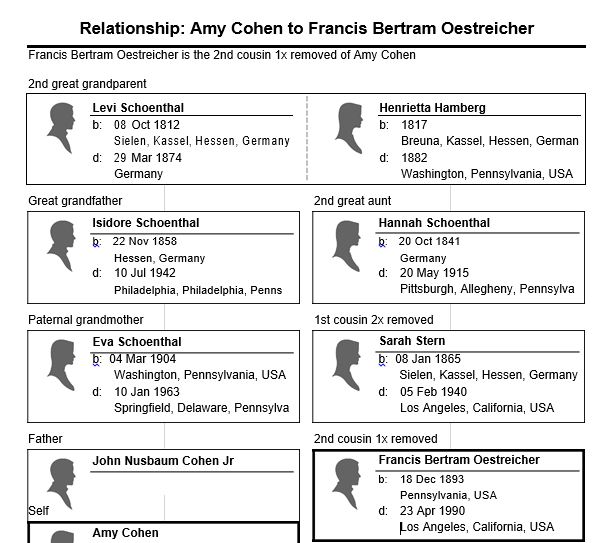
As I mentioned here, included with all the photographs that my cousin Steve scanned and sent to me were a number of letters.  I posted the letter written by Gerald Oestreicher to his family during World War II, and I mentioned that there were also letters written by Gerald’s uncle, Francis Oestreicher, when he was serving during World War I.  Frank was my father’s second cousin, both being the great-grandchildren of Levi Schoenthal and Henriette Hamberg. Thus, he was my second cousin, once removed:

Frank Striker to me relationship chart


There were also some letters written to Frank, as he was known after the war.  In this post I will share the letters written to Frank. The next post will contain the letters written by Frank during World War I.  I’ve transcribed all the letters as close to their original spelling and punctuation as I could, but made some changes just for purposes of readability.  No words were deleted or changed; nothing was added, except where I’ve put my own comments in brackets.

What struck me as meaningful about these letters is what they reveal about the close connections among the Schoenthal siblings—the ten children of my great-great-grandparents Levi Schoenthal and Henriette Hamberg.  These three letters date from 1907 to 1939, and each one shows that this large and extended family knew and cared about each other.

The oldest letter was a letter written by Frank’s great-aunt Helen Lilienfeld Schoenthal, the wife of my great-great-uncle, Henry Schoenthal.  Helen wrote this letter from Washington, Pennsylvania in 1907, to Frank, grandson of her sister-in-law Hannah Schoenthal.

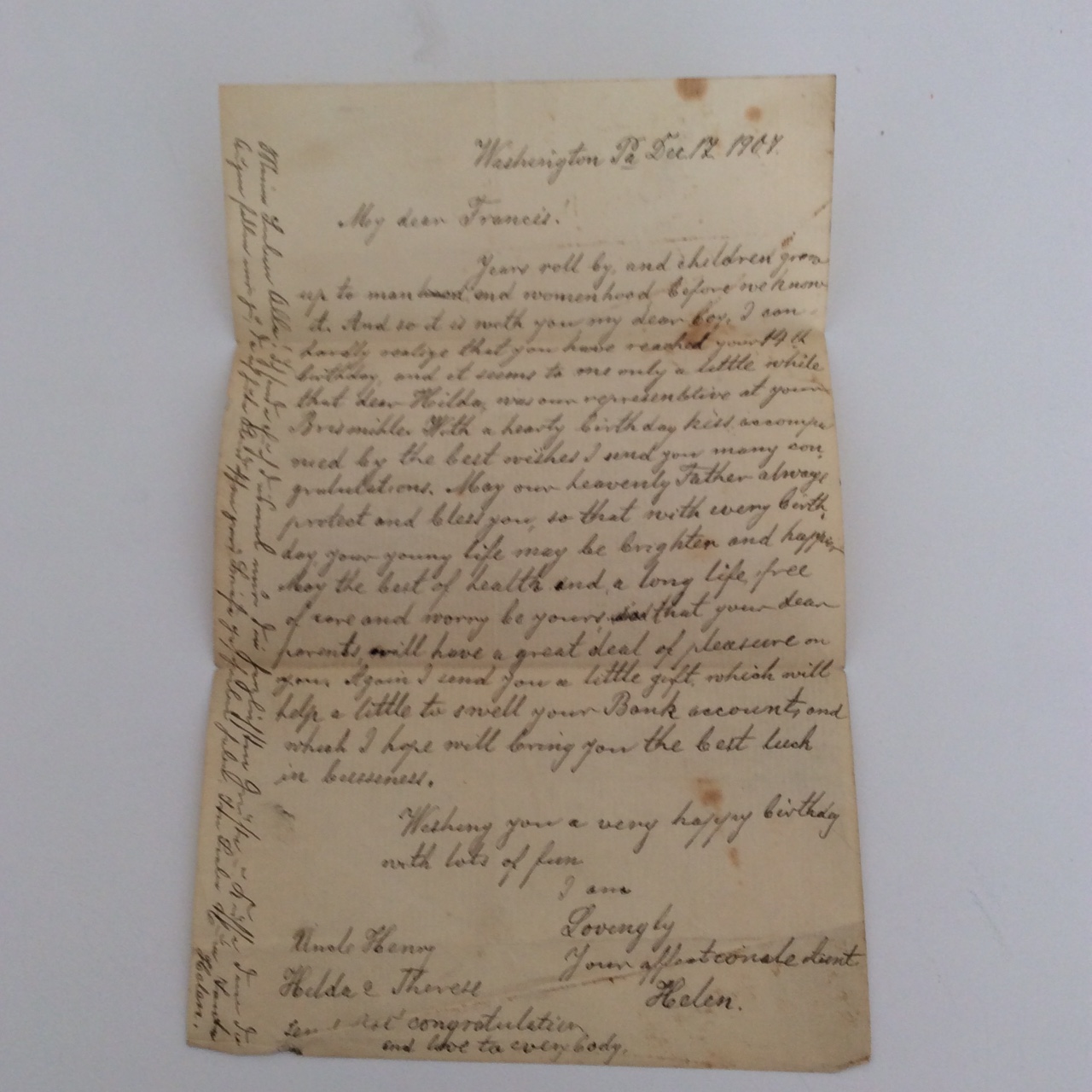
Letter from Helen Lilienfeld Schoenthal dated December 12, 1907 from Washington, PA

IMG_1830

My dear Francis,

Years roll by, and children grow up to man and womenhood before we know it. And so it is with you my dear boy.  I can hardly realize that you have reached your 14th birthday, and it seems to me only a little while that dear Hilda was our representative at your Bris mihle.  With a hearty birthday kiss accompanied by the best wishes I send you many congratulations.  May our heavenly Father always protect and bless you, so that with every birthday your young life may be brighter and happier.  May the best of health and a long life free of care and worry be yours that your dear parents will have a great deal of pleasure on you.  Again I send you a little gift which help a little to swell your Bank account and which I hope will bring you the best luck in business.

Wishing you a very happy birthday with lots of fun.  I am

Lovingly

Your affectionate Aunt Helen

Uncle Henry, Hilda and Therese send their congratulations and love to everybody.

There is also a message written by Helen in German along the margin that I could not read, but with the help of my friend Matthias Steinke in transcribing and translating the old German script, I now know what it says:

My dear all! I am sending you this time only the heartiest greetings and kisses because my eyes close already automatically, because this evening I wrote already a couple of letters. In Love, your aunt, Helen 

Isn’t it interesting that in 1907 after being in the US for 35 years and clearly fluent in English,  Helen reverted to German (and German script) to write to Frank’s parents, Gustav and Sarah Stern Oestreicher? Both Sarah and Gustav were native German speakers, but both also had been in the US for a very long time. I wonder if Frank could read German or was as puzzled as I was by the German script scrawled on the margin of his birthday letter.

Aunt Helen--maybe Lilienfeld Schoenthal

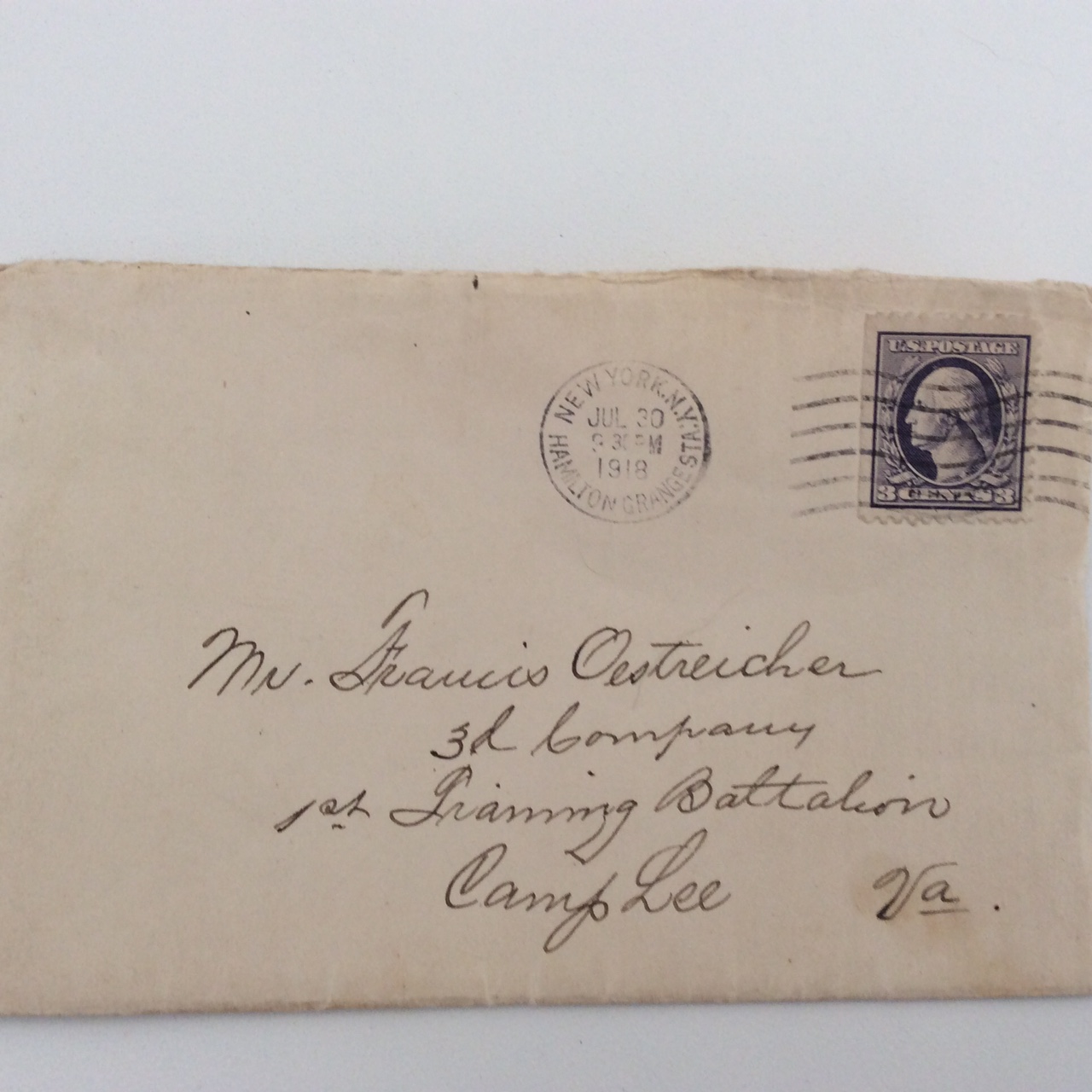
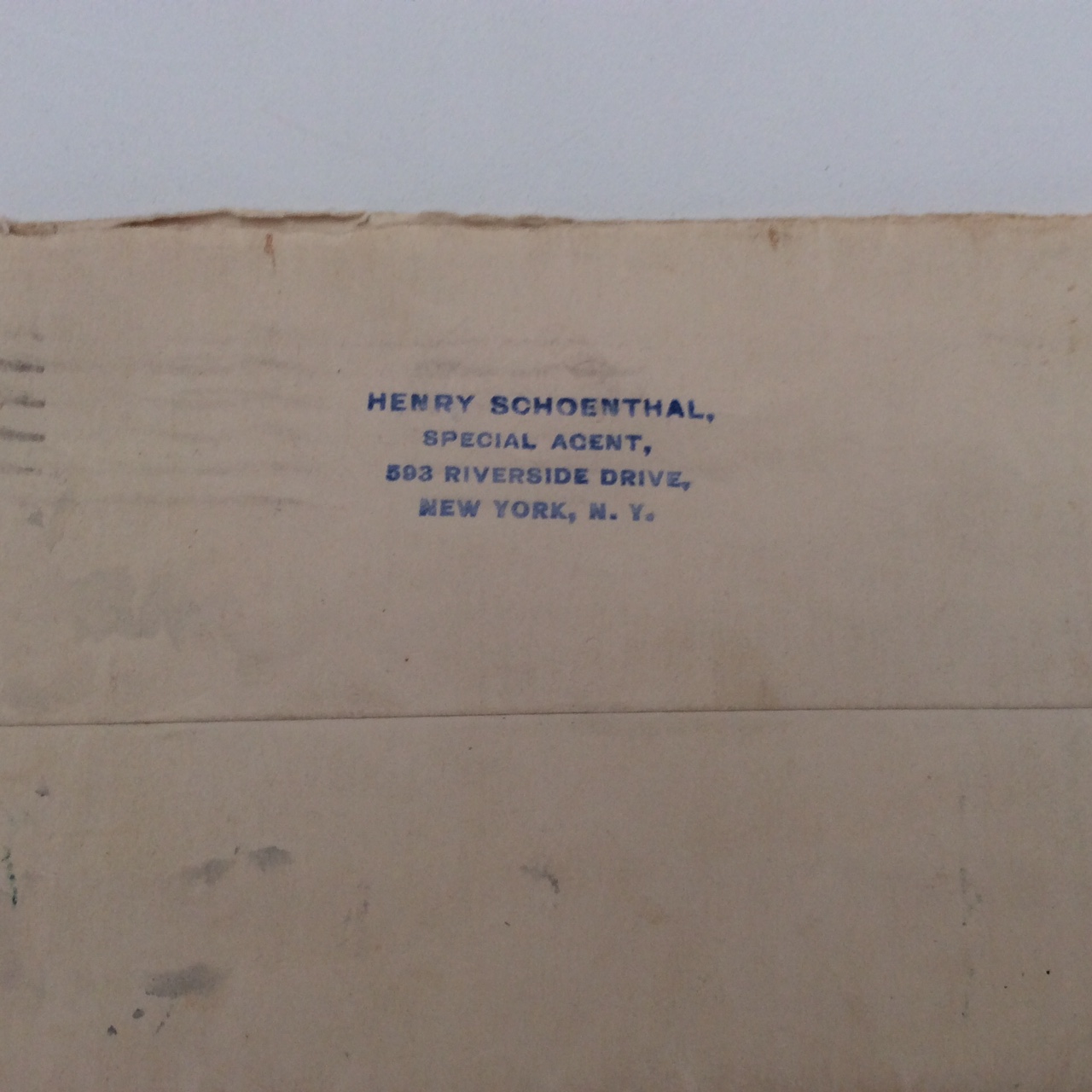
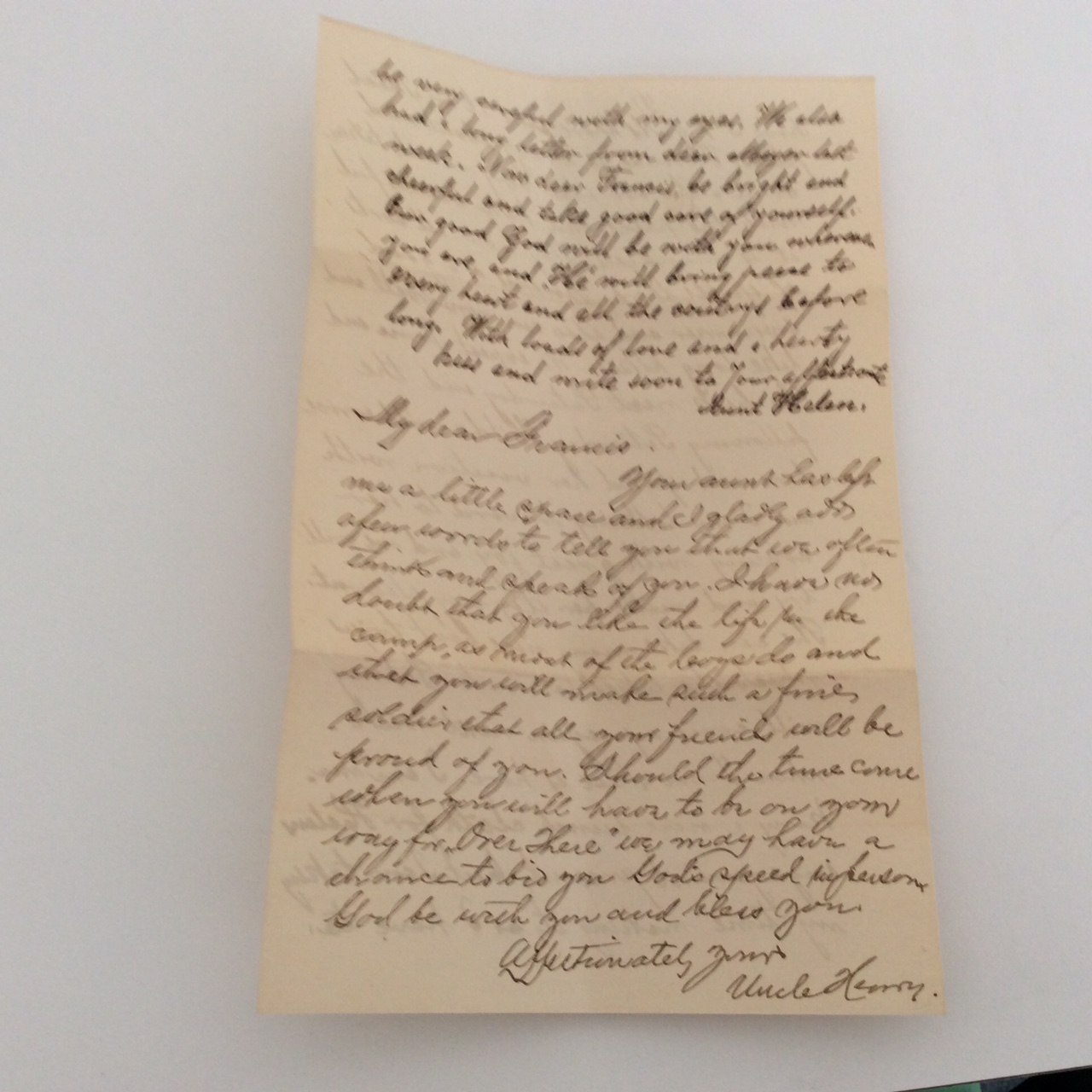
The second letter was written a little over ten years later in July, 1918 when Frank had joined the army, but before he was shipped overseas.  It is also from his great-aunt Helen, with a short addendum by his great-uncle Henry Schoenthal.

Once again, it is evident that Helen and Henry were closely connected to Frank, a child of their niece Sarah Stern, grandson of Henry’s sister Hannah.  I was touched by how much affection there was for this young man, their great-grandnephew.  The letter is also interesting because it talks about Henry and Helen’s own children, their daughter Hilda, their son Lee (born Lionel) and his wife Irma, and Henry and Helen’s granddaughter Florence, who was only thirteen when this letter was written.  Helen did not use any paragraph breaks, but I’ve added some to make the text more easily read.

Letter from Helen Lilienfeld Schoenthal and Henry Schoenthal dated July 30 1918 written from NYC

IMG_1816 IMG_1817 IMG_1818 IMG_1819

IMG_1820


My dear Francis,

I was just thinking to write to your dear parents and ask for your address, when we were agreeably surprised on last Sunday, when your dear brother Sidney came to see us, stayed for supper and until late in the evening.  And so we are able to write to you, as Sidney was glad to give us your ad: for every soldier likes to get letters from some one, and if it is not from a sweetheart, this letter comes from your old Uncle and Aunt, who always loved you. 

I suppose your ears were ringing last Sunday, for Sidney and we talked about you a great deal, and we were glad to hear that you liked soldiers life and also the camp.  Are any boys with you from Pittsburg who you know? And how is the weather in your section?

We have terrible hot spell here since over a week, and I feel the heat very much.  But I am so thankful that we live on such nice open place near the Hudson and get all the fresh air that is going.  There is a good deal of suffering on the East side I know. 

Uncle and I are alone since the 19th of July. Irma & Lee went to the Adirondex Mountains to stay two weeks, as Lee had not been feeling well and needed a rest badly.  They choose this place so that they could be near Florence who is at a girls camp named camp Woodmere.  It is owned by Misses Goldsmith and Kuhn from Philadelphia.  They have 54 girls there and it an ideal place.  Florence is crazy about and Irma & Lee are also very much taken with the place and how beautiful it is managed.  They have all sorts of sports there.  Florence is a good swimmer and also can now [?] and take long hikes. 

We expect Irma and Lee back next Saturday and the following Saturday Hilda will arrive here and spend her vacation with us. I am looking forward to her coming with great joy, and we will try and make her stay very pleasant.  She can take many nice boat trips which she likes so much.  Sidney will come up again next week when Irma & Lee is here. 

I am making a nice lunch cloth for Helen’s engagement present, but I am taking my time making it as I have to be very careful with my eyes. [I assume Helen was Frank’s sister Helen, who married in 1920.] We also had a long letter from dear Meyer [their younger son] last week. 

Now dear Francis, be bright and cheerful and take good care of yourself.  Our good God will be with you wherever you are, and He will bring peace to every heart and all the countrys before long. 

With loads of love and a hearty and write soon to your affectionate Aunt Helen.

 My dear Francis

Your aunt has left me a little space and I gladly add a few words to tell you that we often think and speak of you.  I have no doubt that you like the life in the camp, as most of the boys do and that you will make such a fine soldier that all your friends will be proud of you.  Should the time come when you have to be on your way for “Over There” we may have a chance to bid you God’s speed in person. God be with you and bless you.

Affectionately yours,

Uncle Henry

I read this letter as an attempt by his aunt and uncle to give him their blessing before he went off to war without making him too nervous about what he was about to face.  Frank’s own letters, as we will see, reflect a similar impulse, only he is reassuring those at home that he is and will be okay.

The last letter for this post was written many years later by Frank’s father, Gustav Oestreicher.  It was written in 1939 after Gustav and Sarah had moved to California, as had their daughter Helen.  I am not certain whether Frank was living in Minneapolis or just visiting; the letter is addressed to him at a hotel, and from the content of the letter, I can infer that Frank had recently been to Chicago. I assume he was on the road in his capacity as a traveling salesman.

A little background to help identify the people named in the letter:  First, Gustav mentions the Good family.  He must be referring to Edith Stern and Leo Good and their son Bernard; Edith was Sarah Stern Oestreicher’s younger sister, thus Gustav’s sister-in-law.  In 1939, the Good family was living in Chicago.

Gustav then mentions a Lionel and his brothers and sister and another sister Hilda. At first I thought this referred to the children of Henry and Helen Schoenthal, as they had a son named Lionel, a son Meyer, and a daughter Hilda. But after reading through the letter more carefully, I realized that he was referring to Lionel Heymann, the oldest child of Rosalie Schoenthal and Willy Heymann, about whom I wrote here.  Rosalie was the youngest Schoenthal sibling, sister of Hannah Schoenthal, who was Gustave’s mother-in-law. So Rosalie was Sarah Stern’s aunt.

Here’s why I think Gustav is talking about Lionel Heymann, not Lionel Schoenthal. For one thing, Henry and Helen Schoenthal’s son Lionel was called Lee at this point, not Lionel.  And at the time this letter was written, Lionel Heymann (the photographer) was living in Chicago as were his brothers Walter and Max, so if Frank had seen the Good family, he must have been in Chicago. (I am not sure why Gustav writes that he hoped Frank might see Lionel’s “bros.& sister” since there was no sister at that time living in the US, but perhaps he was referring to Max’s wife Frieda.)

Also, Gustav mentions a sister Hilda who was still in Germany. Henry Schoenthal’s daughter Hilda was not living in Germany, but in Washington, DC, in 1939.  But Lionel Heymann had a sister Hilda who was still in Germany in 1939.  I have written about what happened to Hilda Heymann as well as her sister Helene, who married Julius Mosbach and had two daughters, Liesel and Gretel.  All were killed in the Holocaust.  That fact makes Gustav’s comment even more chilling.  I put those comments in bold below.

I do not know who the Fannie mentioned towards the end of the letter could be.

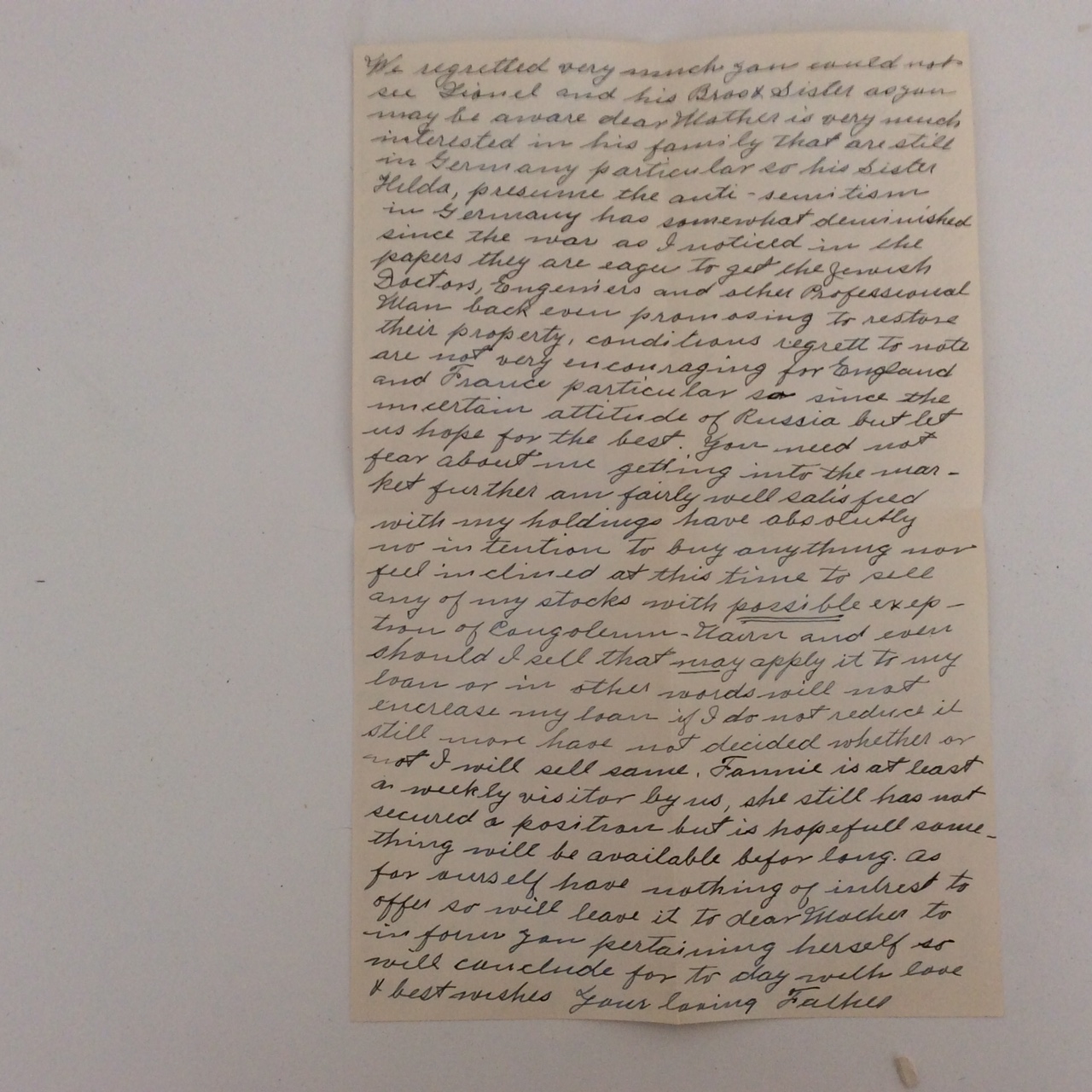
Letter from Gustav Oestreicher to his son Frank [edited for readability only]

IMG_1990 IMG_1992 IMG_1993

September 16, 1939 from Los Angeles

My dear Francis,

Although late, [I] will begin my letter extending to you my best wishes for a healthy, happy and prosperous new year. [Obviously a reference to Rosh Hashanah, given the September date.] You ought to know you enjoy our good wishes at all times so hope you will pardon the expression of it at a rather late date. As usual we were happy to learn the contents of your recent letter.  It pleased us to learn you enjoyed your visit with the Good family as well as that all of them are getting along nicely.  You evidently misinformed them about our anniversary as we rec’d a very nice letter from them congratulating us for our golden wedding anniversary which will not be until next year. [Gustav and Sara were married in 1940.]

We regretted very much you could not see Lionel and his Bros. & Sister again. [You] May be aware dear Mother is very much interested in his family that are still in Germany particular so his Sister Hilda. [We]  presume the anti-semitism in Germany has somewhat diminished since the war as I noticed in the papers they are eager to get the Jewish Doctors, Engineers and other Professional Man back even promising to restore their property.  Conditions regrett to note are not very encouraging for England and France particular so since the uncertain attitude of Russia but let us hope for the best.

You need not fear about me getting into the market further. Am fairly well satisfied with my holdings. Have absolutely no intention to buy anything nor feel inclined at this time to sell any of my stocks with possible exception of Congoleum-Narin and even should I sell that, may apply it to my loan or in other words will not increase my loan if I do not reduce still more.  Have not decided whether or not I will sell same. 

Fannie is at least a weekly visitor by us.  She still has not secured a position but is hopefull some thing will be available before long.  As for ourselves have nothing of interest to offer so will leave it to dear Mother to inform you pertaining herself so will conclude for to day with love and best wishes. 

Your loving Father

As with the earlier letters from Helen Lilienfeld Schoenthal, this letter reveals the close connections among the many Schoenthal siblings and their children.  I’ve often wondered what the family knew about the two siblings who had stayed in Germany: Jakob Schoenthal and Rosalie Schoenthal.  From Gustav’s letter it is apparent that the family was in touch at least to some extent with those family members who had not immigrated.  They knew that the three Heymann brothers were in Chicago, and they knew that some family members were still in Germany.

Gustav’s hope that anti-Semitism was diminishing in Germany once the war started is so terribly painful to read, knowing what was going to happen not only to Hilda, her sister, and her nieces, but to six million other Jews living in Europe.

Realizing how connected the family was to each other as late as 1939 makes me wonder what happened.  Why didn’t my father even know about all his Schoenthal second cousins like Frank and his siblings? Did my grandmother Eva Schoenthal know any of these people? My guess is that because my great-grandparents moved from western Pennsylvania to Denver when my grandmother was just a small child, not even four years old, she did not grow up with the benefit of knowing all those cousins in western Pennsylvania.  Perhaps if she had, I would not have had to search to find my Oestreicher cousins.  Perhaps we would have always known about each other.

More Manna: The Family of Sidney Oestreicher and Esther Siff

In my last post I shared some of the wonderful photographs I received from my cousin Steve of Sarah Stern and Gustav Oestreicher and their three children, Sidney, Frank, and Helen.  This post will focus on the children of Sidney Oestreicher and Esther Siff, Steve’s grandparents.

Their first child Gerald was born in 1916, in Chicago, where Sidney and Esther lived in the early years of their marriage. Their daughter Betty was born three years later in 1919. Sidney was working as a traveling salesman during those years.
Gerald Oestreicher

Gerald Oestreicher, c. 1917

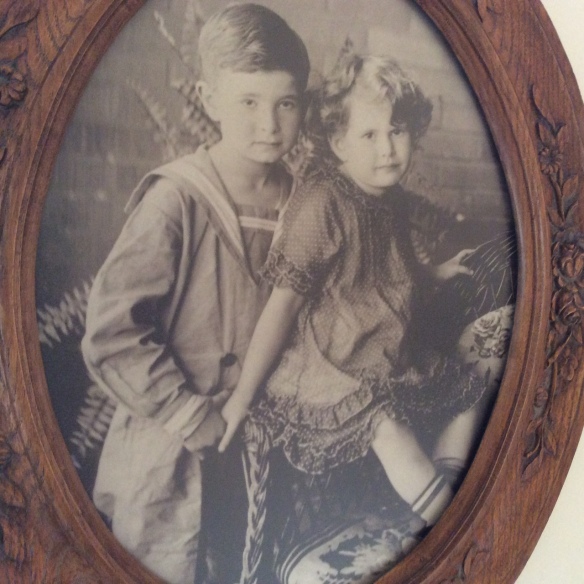
Gerald and Betty Oestreicher, c. 1922

Gerald and Betty Oestreicher, c. 1923
Betty and Gerald Oestreicher

Betty and Gerald Oestreicher, c. 1930

By 1930 Sidney’s father Gustav had retired and moved with Sarah to Atlantic City, and Sidney returned with Esther, Gerald, and Betty to Pittsburgh to help run the family store, The People’s Store.  Sidney and Esther had their third child Elaine in Pittsburgh in 1931.
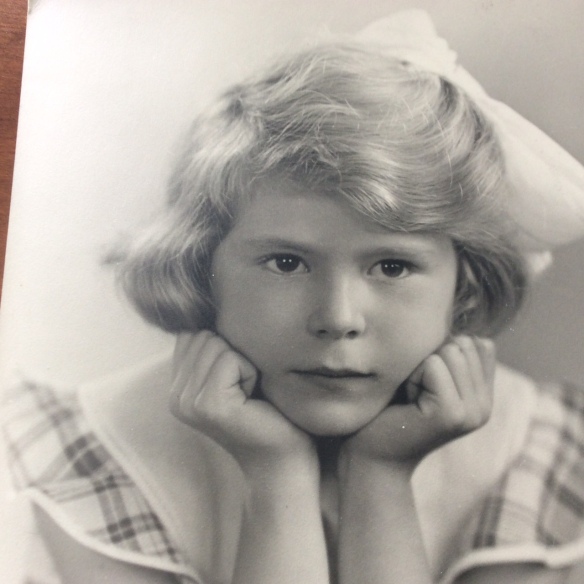
Elaine Oestreicher

Elaine Oestreicher

This photograph below, probably taken in Pittsburgh in the late 1930s, includes the whole family–from left to right, Betty, Sidney, Elaine, Esther, and Gerald.
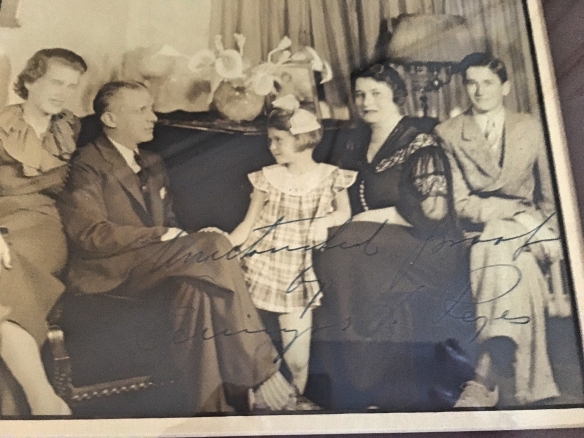
Betty, Sidney, Elaine, Esther, and Gerald

Betty, Sidney, Elaine, Esther, and Gerald

After The People’s Store went bankrupt during the Depression, Sidney had a hard time finding work.  Steve told me that Gerald would sell apples on the street after school to earn money.  Steve also shared this story about his grandmother Esther:

Grandma, Esther Oestreicher, was a homemaker to her three children, but also a very good pinochle player.  Twice a week she would sit down at night with friends and earn a living. 

Once a week or month, there was a raffle at the local theater after the matinee movie.  On one occasion as Gerald and Esther were walking to the theater, she repeatedly announced to neighbors sitting on their stoups, “My son and I are going to the movie where I will win the raffle today.”  This terribly embarrassed my Dad, who said he wanted to tuck his head under his shirt.  Sure enough after the movie ended, Esther won the raffle.  On the way home passing many of those same neighbors on their stoup, she waved the money at them joyfully yelling, ” I told you I would win the raffle.”
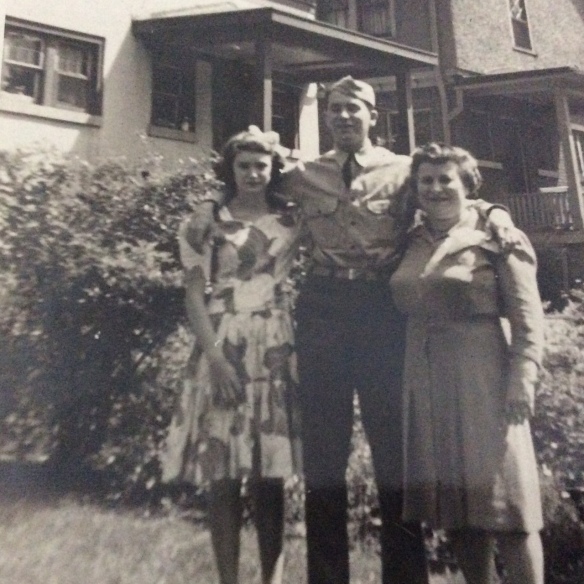
Elaine, Gerald, and Esther Oestreicher

Elaine, Gerald, and Esther Oestreicher

Gerald played saxophone in high school.  In 1937 and 1938, Gerald was a student at Northeastern University in Boston, where he continued to play the saxophone in the university band.
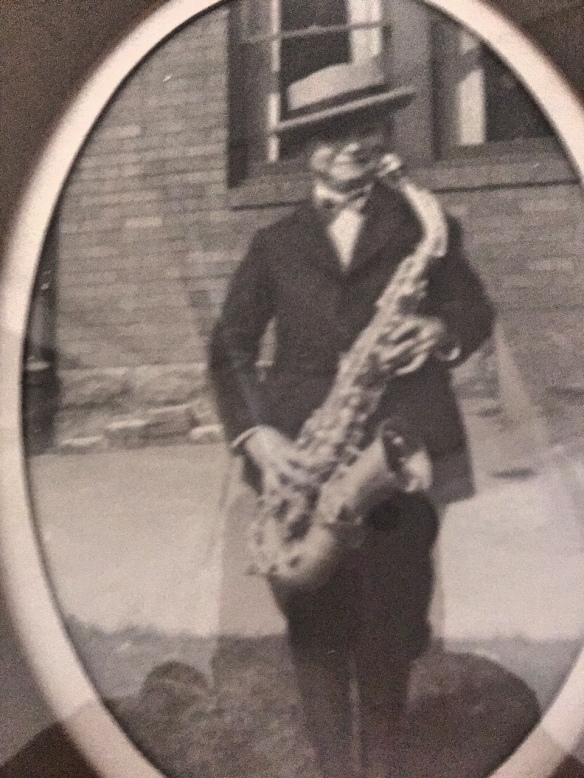
Gerald Oestreicher playing saxophone

Gerald Oestreicher playing saxophone

IMG_1966

On October 1, 1941, Gerald enlisted in the US Army Air Corps. Here is his draft registration card and his Army identification card. (Note that his name change to Striker is dated December 5, 1945, while he was in the service.)
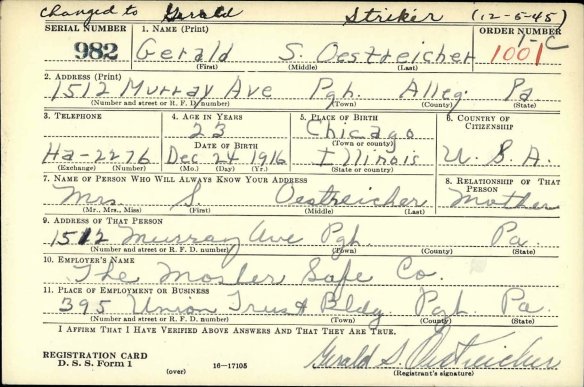
Gerald Oestreicher draft registration for World Wa II
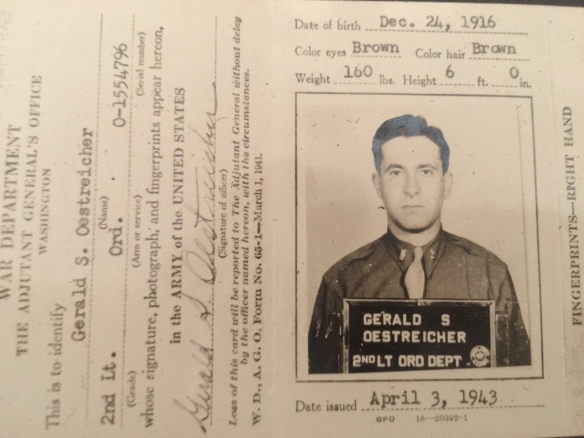
Gerald Oestreicher draft registration for World Wa II

IMG_6973

Steve shared with me the following story about his father’s decision to enlist.  Gerald could see that war was coming, and without consulting with his parents, he decided to enlist in the Army Air Corps.  He had hammerhead toes so his choice of which service to join was limited.  As told by Steve, Gerald had to break the news to his parents the night before he had to report for duty:

The Oestreicher family dinner that night started with nothing out of the ordinary.  Sidney at the head of the table, Esther next to him, Jerry next to his mother on one side, and sister Elaine on the other.  Sister Betty on the other side of her father.  A roast and potatoes in the middle.

Towards the middle of the meal the war was brought up.  There had been little talk from Jerry about it.  My Dad told me his mother at one time looked up,and then straight at him, and dropped her fork on her plate.  “My God, you’ve enlisted.” Jerry responded.  Esther’s eyes teared.  Sidney said,  “When do you leave?”  Jerry announced early tomorrow morning.Sidney became very angry.  Jerry announced he needed to pack and get some sleep.  Sidney offered to take him to the train station, but Jerry insisted no, “I want to say our goodbyes here”. There was a lot of crying by everyone but Sidney.  Jerry announced they should say their goodbye’s that night.  Shortly later Jerry then went to bed.  He left without saying goodbye in the morning.

The next morning Jerry arrived alone at the train station around 6am.  Waiting for him was Sidney, with a sack of food, and advise “stay alive for your mother”.

They waved to each other as the train departed

As you can see from his service record posted below, he had a distinguished record of service during the war.  He attended Officer Candidate School in Aberdeen, Maryland, and a Naval Mine Warfare training center in Yorktown, Virginia.
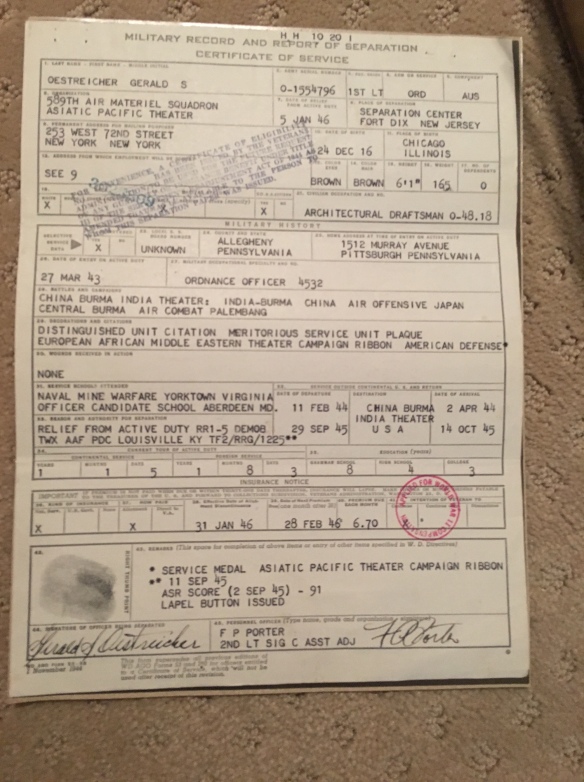
Gerald Striker service record during World War II

Gerald Striker service record during World War II

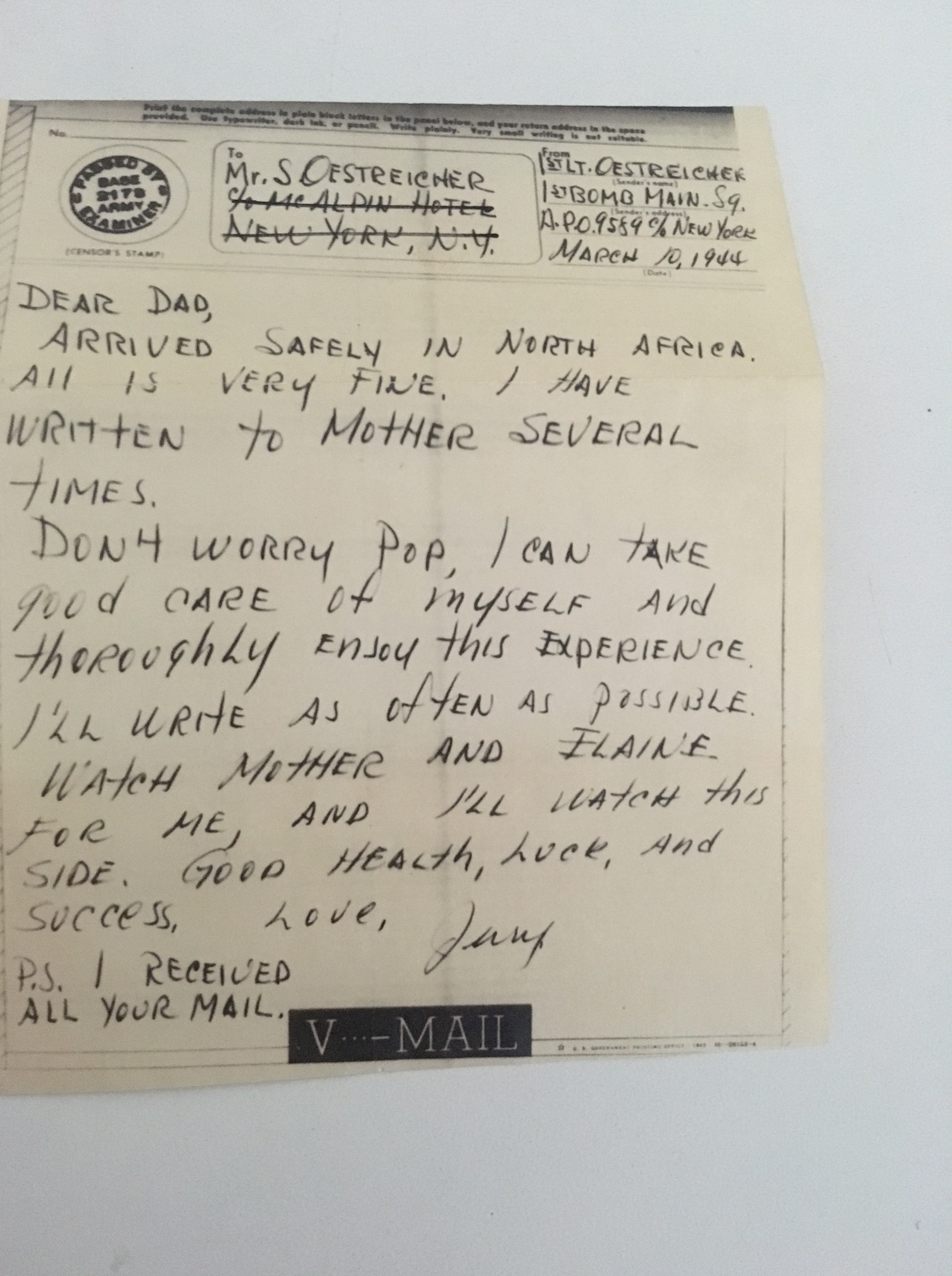
In February, 1944, he shipped out, arriving in North Africa by March 10, 1944, when he wrote the following note to his father Sidney:
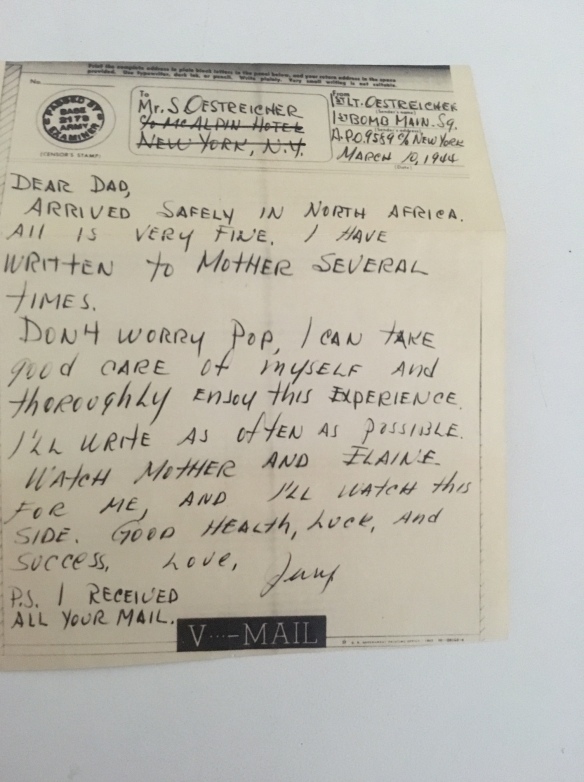
Gerald Oestreicher note to Sidney Oestreicher, March 10, 1944

Gerald Oestreicher note to Sidney Oestreicher, March 10, 1944

What a sweet and reassuring note! Can you imagine thinking that fighting in a war could be an experience one could “thoroughly enjoy”? I certainly can’t.

After some time in North Africa, Gerald was shipped out again, this time to Asia.  While at sea, he wrote the following undated long letter to his family. Please read it, especially the last two pages.  It is truly a look into the heart and mind of a young man about to face combat.
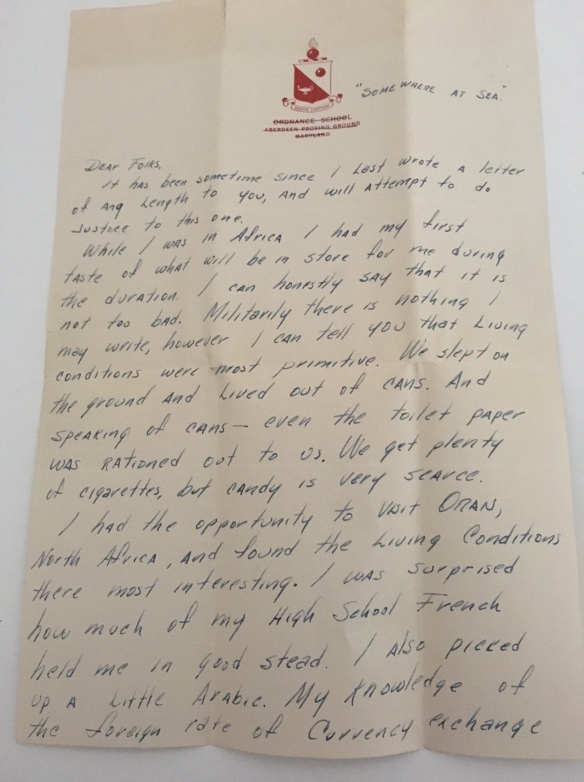
Gerald Striker letter home from WW2 p 1

“Somewhere at Sea”

Dear Folks,

It has been sometime since I last wrote a letter of any length to you, and will attempt to do justice to this one.

While I was in Africa I had my first taste of what will be in store for me during the duration.  I can honestly say that it is not too bad.  Militarily there is nothing I may write, however I can tell you that living conditions were most primitive. We slept on the ground and lived out of cans.  And speaking of cans—even the toilet paper was rationed out to us.  We get plenty of cigarettes, but candy is very scarce.

I had the opportunity to visit Oran, North Africa, and found the living conditions most interesting.  I was surprised how much of my high school French held me in good stead.  I also picked up a little Arabic.  My knowledge of the foreign rate of currency exchange
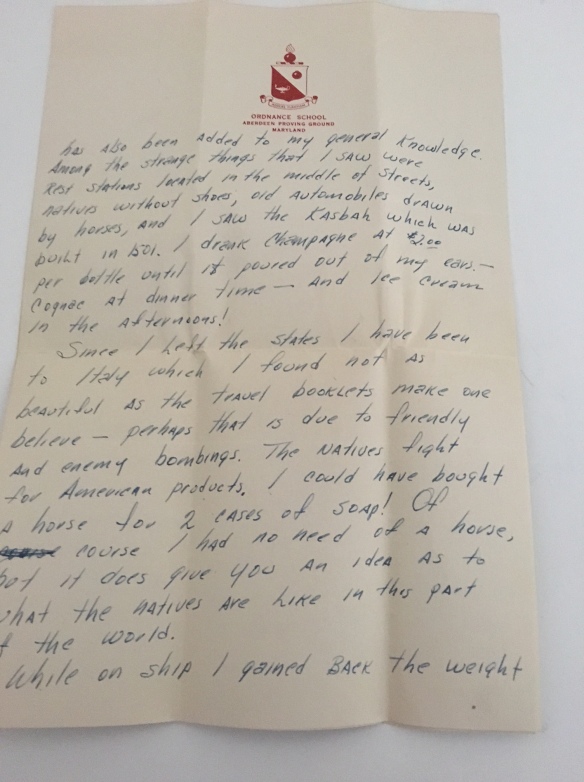
Gerald Striker letter home p2

has been added to my general knowledge.  Among the strange things that I saw were rest stations located in the middle of streets, natives without shoes, and automobiles drawn by horses, and I saw the Kasbah which was built in 1501.  I drank champagne at $2.00 per bottle until it poured out of my ears—cognac at dinner time—and ice cream in the afternoon!

Since I left the states I have been to Italy which I found not as beautiful as the travel booklets make one believe—perhaps that is due to friendly and enemy bombings.  The natives fight for American products.  I could have bought a horse for 2 cases of soap! Of course I had no need of a horse, but it does give you an idea as to what the natives are like in this part of the world.

While on ship I gained back the weight
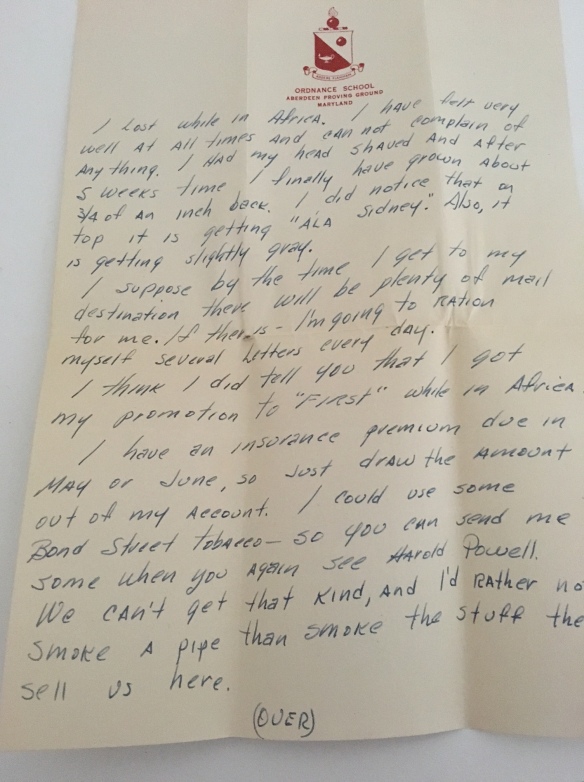
Gerald Striker letter home p3

I lost while in Africa,  I have felt very well at all times and can not complain of anything.  I had my head shaved and after 5 weeks time I finally have grown about 3/4 of an inch back.  I did notice that on top it is getting “a la Sidny.” Also, it is getting slightly gray.

I suppose by the time I get to my destination there will be plenty of mail for me.  If there is—I’m going to ration myself several letters every day.

I think I did tell you that I got my promotion to “first”while in Africa.

I have an insurance premium due in May or June, so just draw the amount out of my account.  I could use some Bond Street tobacco—so you can send me some when you again see Harold Powell.  We can’t get that kind, and I’d rather not smoke a piple than smoke the stuff they sell us here.
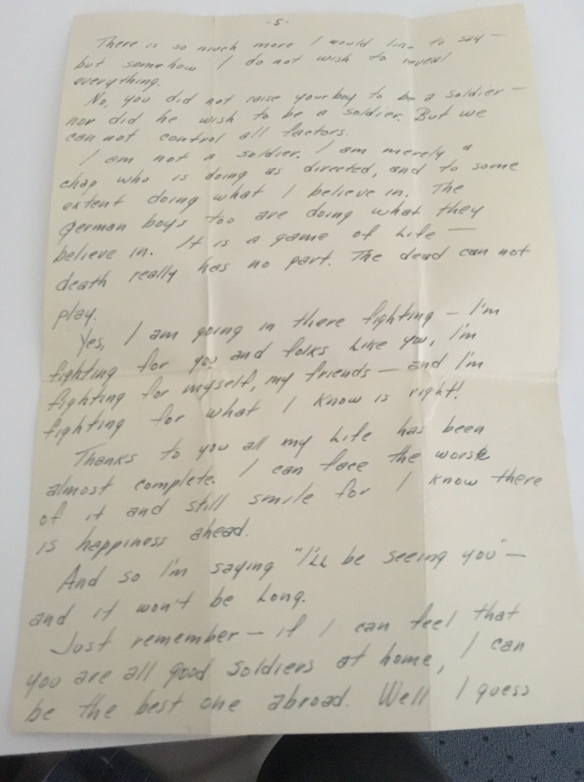
Gerald Striker p4

There is so much more I would like to say—but somehow I do not wish to reveal everything.

No, you did not raise your boy to be a soldier nor did he wish to be a soldier.  But we can not control all factors.

I am not a soldier.  I am merely a chap who is doing as directed, and to some extent doing what I believe in.  The German boys too are doing what they believe in.  It is a game of life—death really has no part. The dead can not play.

Yes, I am going in there fighting—I’m fighting for you and folks like you, I’m fighting for myself, my friends—and I’m fighting for what I know is right!

Thanks to you my life has been almost complete.  I can face the worst of it and still smile for I know there is happiness ahead.

And so I’m saying “I’ll be seeing you”—and it won’t be long.

Just remember—if I can feel that you are all good soldiers at home, I can be the best one abroad.  Well I guess
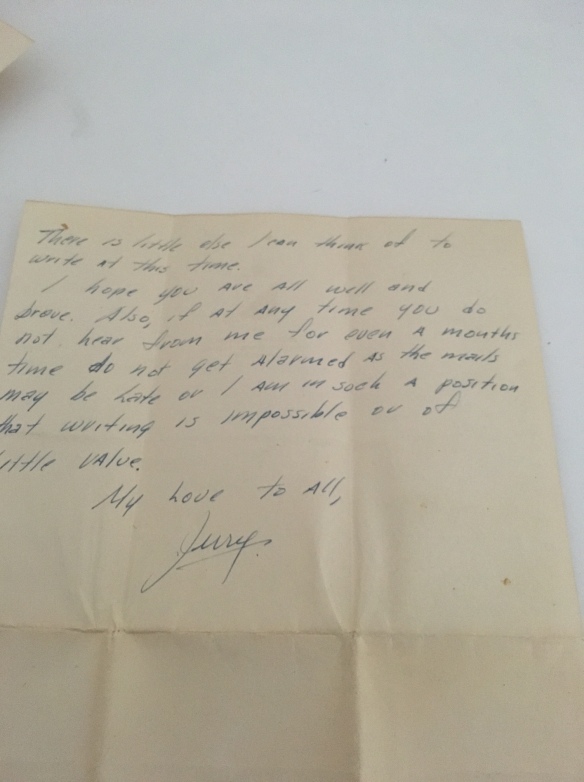
Gerald Striker p5

there is little else I can think of to write at this time.

I hope you are all well and brave.  Also, if at any time you do not hear from me for even a months time do not get alarmed as the mails may be late or I am in such a position that writing is impossible or of little value.

My love to all,

Jerry

You can see in this letter that Gerald was still struggling with his parents’ reaction to his enlistment, and despite his brave words, his statement that his “life has been almost complete” seems to suggest that he did worry about being killed in the war.

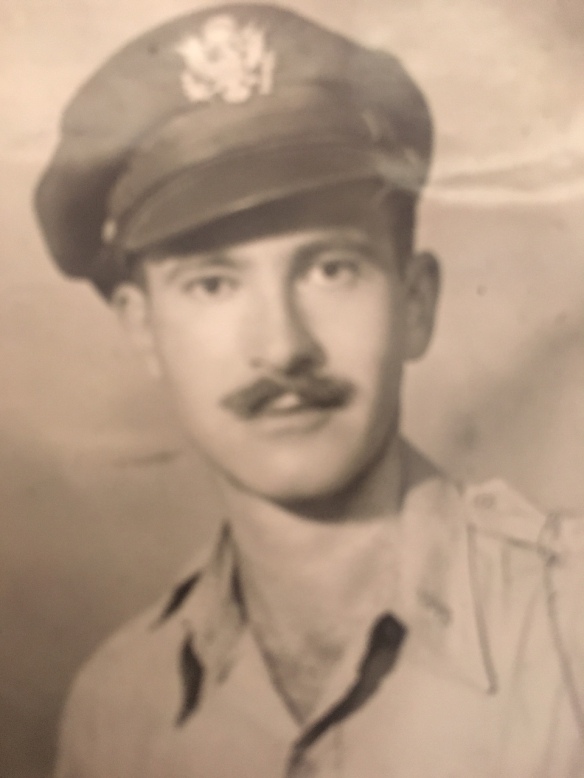
As his service record indicates, after leaving Africa Gerald served as an ordnance officer in the China Burma India theater of the war and received several commendations for his service.  Here are a few photographs of Gerald while serving in World War II.  Steve told me that his father considered his time in the service the best and most exciting time of his life.
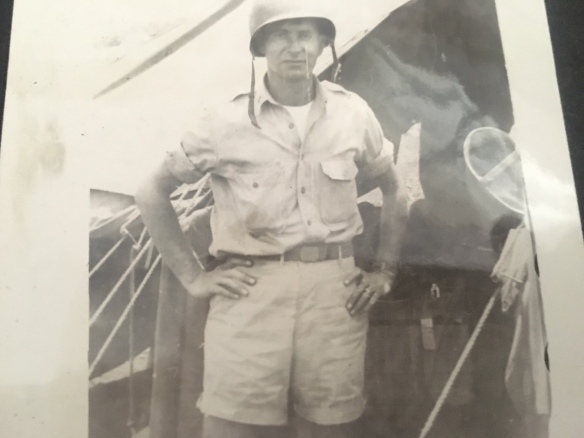
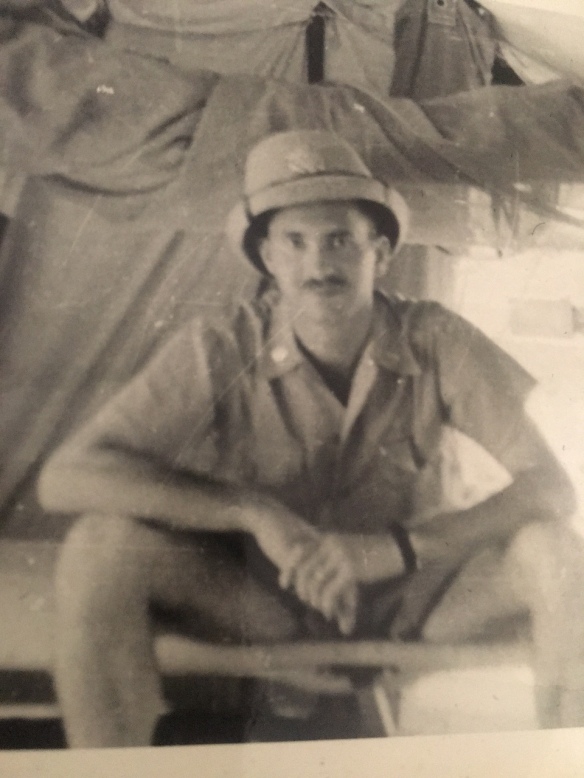
IMG_6974 IMG_6978 IMG_6981

Steve also shared this story of his father’s return home from the war:

Four plus years after leaving the U.S, Jerry sailed into New York.  He did not tell anyone when  he would return.  He got to his parents’ apartment and entered a phone booth to call his mother Esther with the intention of announcing he would be home “shortly”. But his little sister Elaine arbitrarily came bounding down the stairs.  But he said she was not his little sister, but a grown young woman.  Then Elaine also spotted him.  Yelling Jerry! Jerry!  she leaped at him.  They both went upstairs to see their mother.

Shortly after the war, Gerald was invited by his Uncle Frank to the Scaroon Manor resort in upstate New York.  There he met a woman who was singing at the resort, Faye Karol, whose real name was Faye Krakower. Her career as a singer was described in my earlier post.  According to Steve, his father Gerald proposed to Faye six days later, and they were married in November, 1946.

Here are some pictures of Faye.
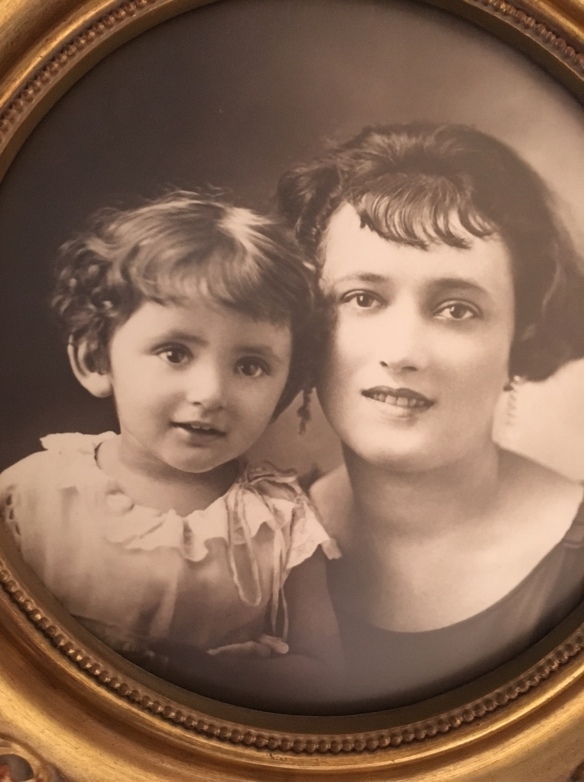
Faye Krakower and her mother Freida
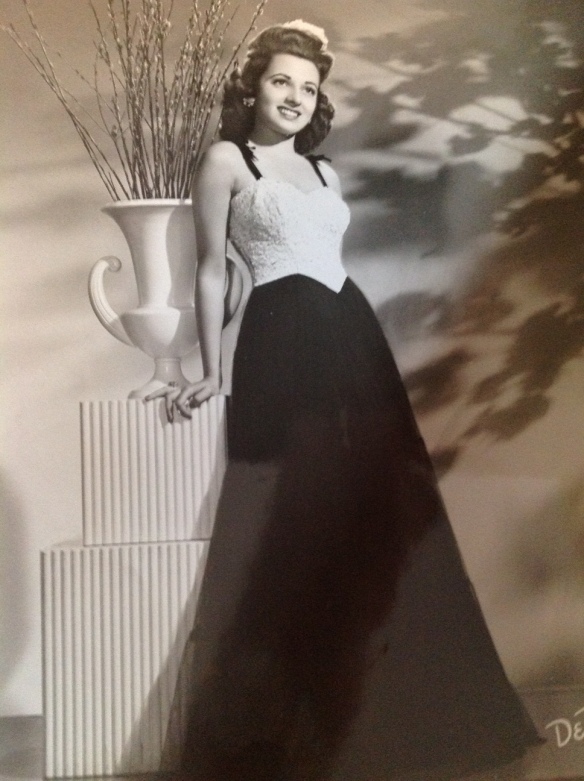
Faye Krakower and her mother Freida

Faye Striker

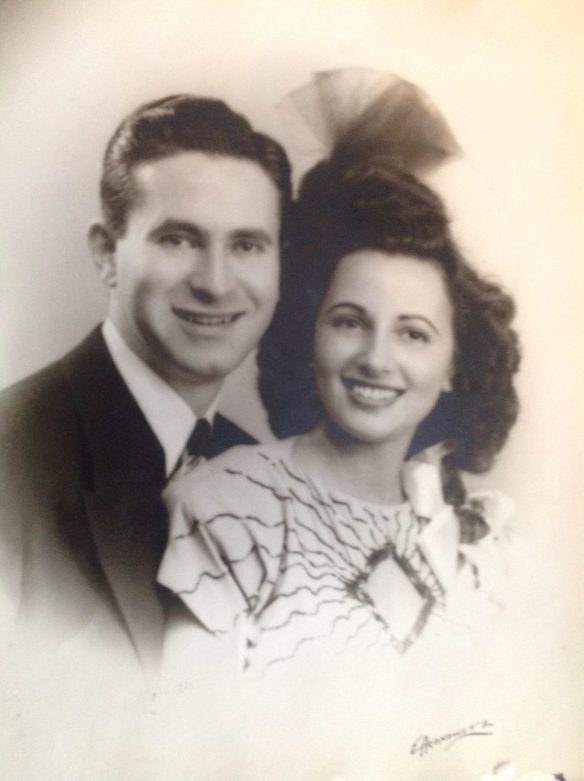
Gerald and Faye (Krakower) Striker

Gerald and Faye (Krakower) Striker

Gerald and Faye and their son moved to California in 1948 where Gerald worked as a salesman for a number of different clothing lines and other businesses.

Meanwhile, Gerald’s younger sister Betty had married Julius Jacob in 1942.  I wrote about Betty and Julius here.

Betty Oestreicher and Julius Jacob
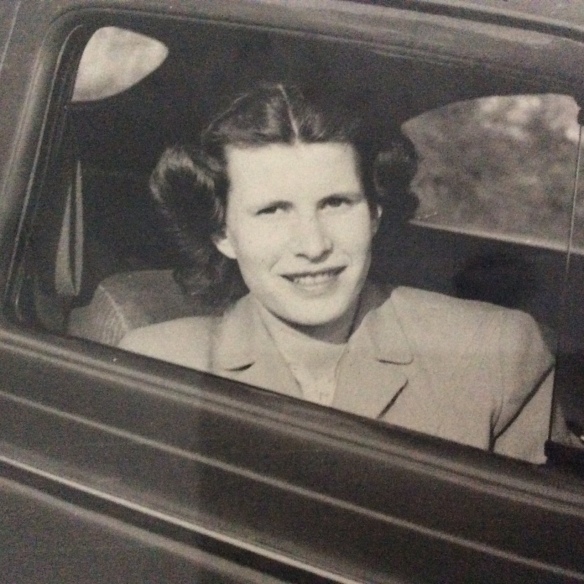
Betty Oestreicher and Julius Jacob

Betty Oestreicher Jacob

Betty Oestreicher Jacob

This is Betty and Gerald’s little sister, Elaine, the one who stayed and lived with Maxine Schulherr Stein in PIttsburgh and started me on the journey that led to all these amazing photographs.
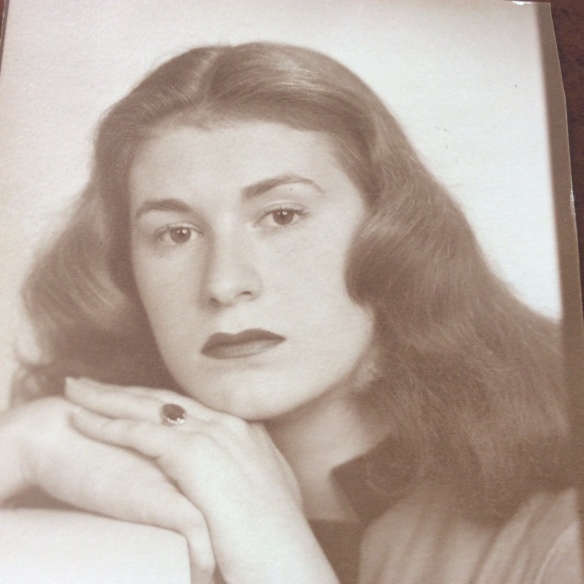
Elaine Oestreicher

Elaine Oestreicher

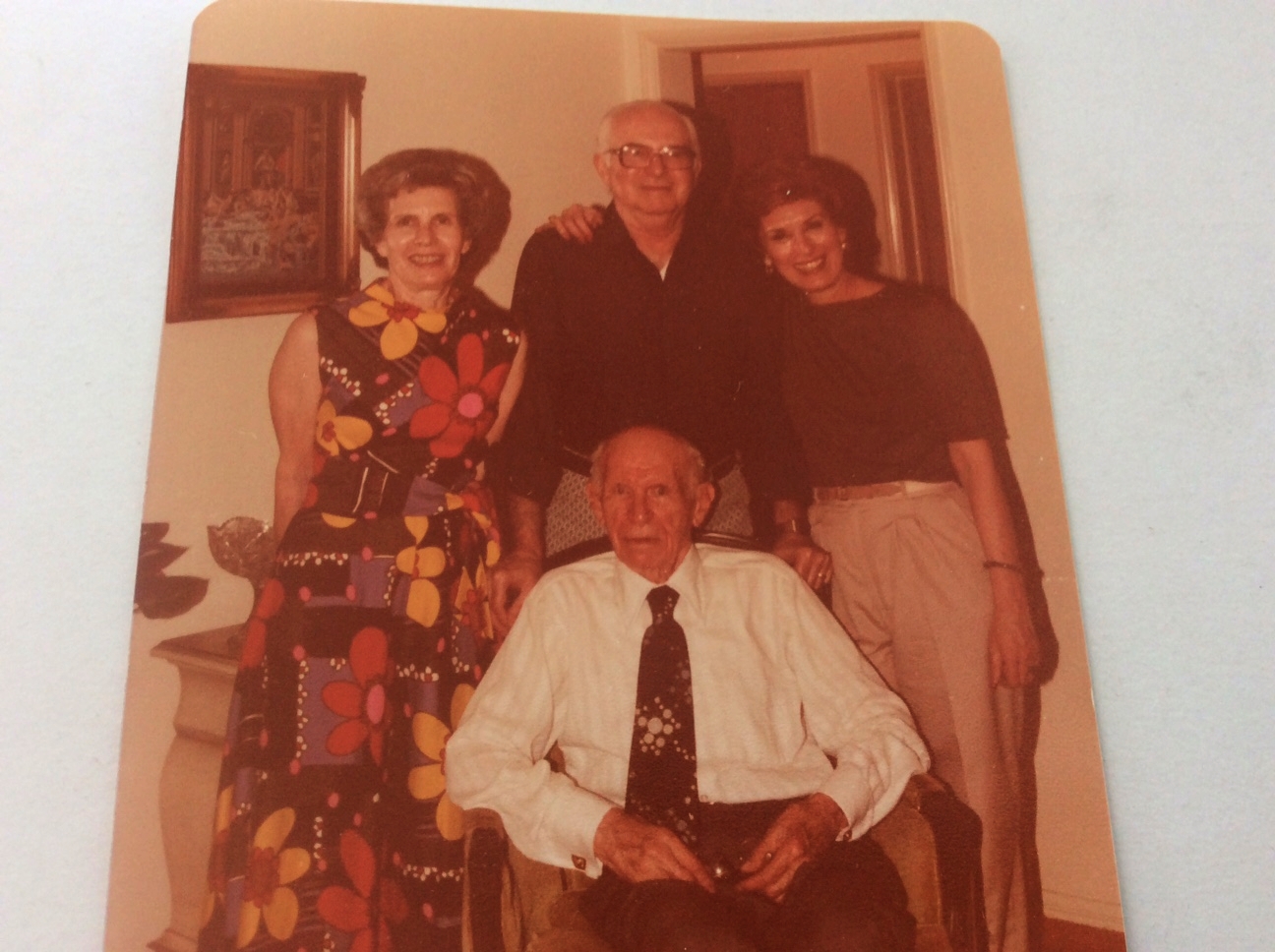
Although Steve shared many more photos of the family, I will end with this one of my cousin Sidney Oestreicher, later in life, with his three adult children, my cousins Gerald, Betty, and Elaine.
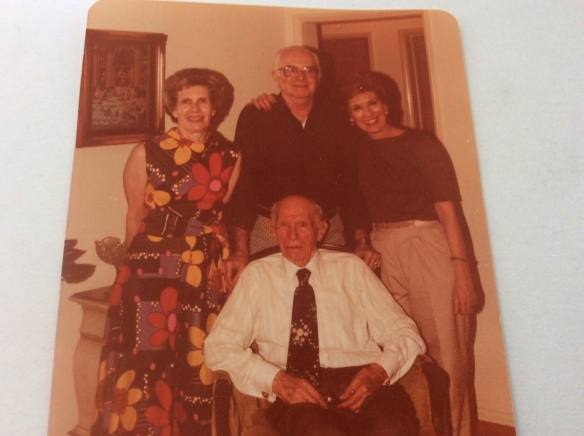
Standing: Betty, Gerald, and Elaine Seated: Sidney Oestreicher Striker

Standing: Betty, Gerald, and Elaine
Seated: Sidney Oestreicher Striker

There are a few more posts to come based on the materials Steve shared with me including the letters written by his uncle Frank Striker during his service in World War I and some letters that were written to Frank by various family members.



Like Manna from Heaven

Last Monday I posted about my third cousin, Betty Oestreicher Jacob, who passed away on July 19, 2016.  Betty and I were related through our mutual great-great-grandparents, Levi Schoenthal and Henriette Hamberg.  Her great-grandmother Hannah Schoenthal and my great-grandfather Isidore Schoenthal were sister and brother.  Betty’s grandparents were Sarah Stern, Hannah’s daughter, and Gustav Oestreicher.  Her parents were Sidney (Oestreicher) Striker and Esther Siff

At the time I posted about Betty’s passing, I had only one photograph of Betty and none of her grandparents, parents, or siblings.  But within hours of publishing my post, I received a comment on the blog and then emails from Betty’s nephew, Steve, the son of her brother Gerald.  And Steve generously shared with me numerous photos of all those people and then some. Now I can place faces to the names of the people I have researched and written about.  And what gorgeous photos these are.

In this post, I will share some photographs of Sarah Stern and Gustav Oestreicher and their three children, Sidney, Frank, and Helen.  In a later post, I will share the photos of Sidney’s children, Gerald, Betty, and Elaine.  All are courtesy of Steve Striker, who so generously spent his time scanning and emailing these to me and answering my many questions.

First, here are some photographs of Sarah Stern Oestreicher, my grandmother Eva Schoenthal’s first cousin.  I’ve written about Sarah’s life here.

Sarah Stern as a child edited

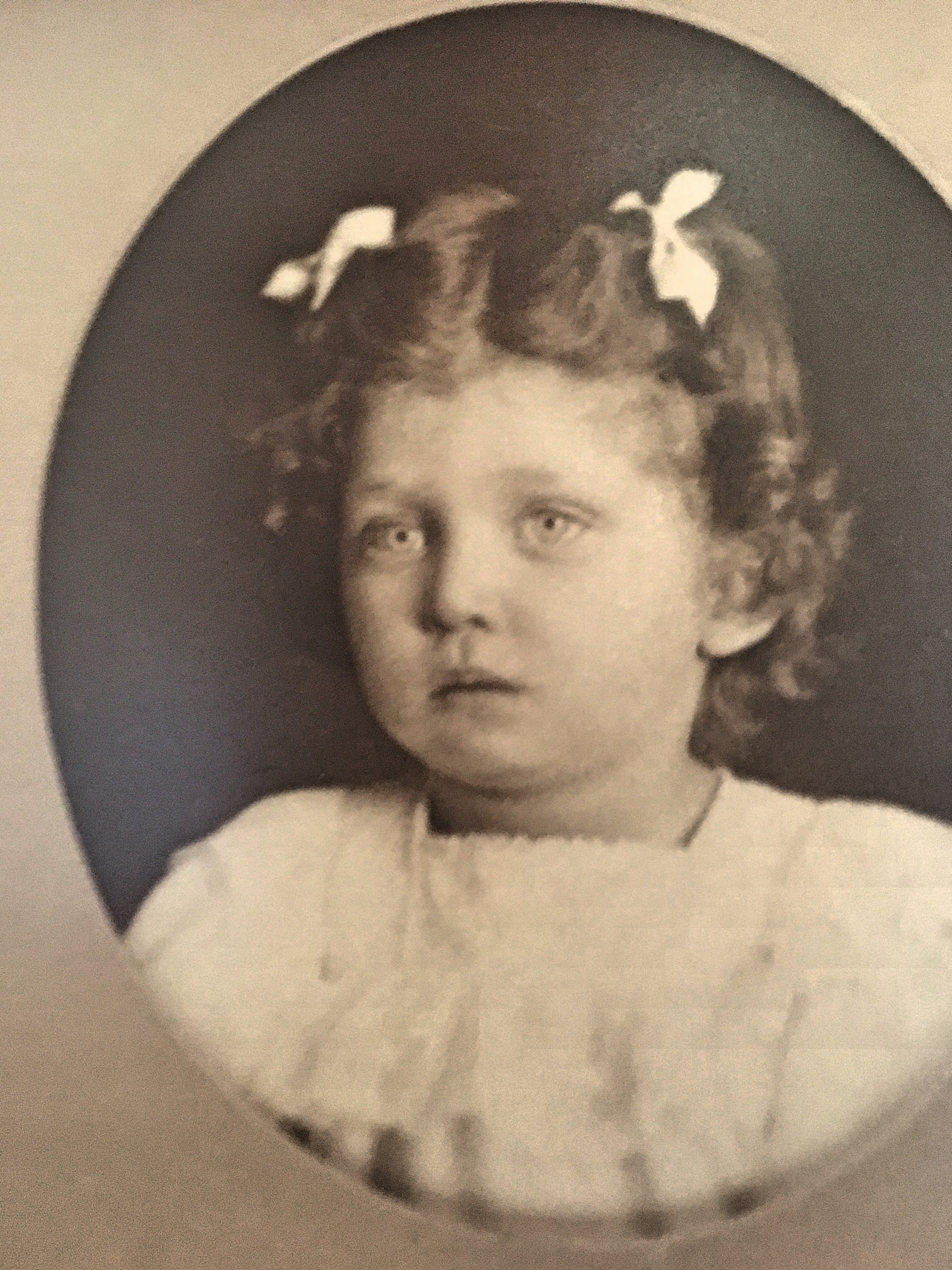
Sarah Stern as a young child in Germany, probably before her mother married Solomon Stern in 1874. Sarah was born in 1865, so this picture was probably taken between 1870 and 1872.

The photograph below of Sarah was taken in Pittsburgh.  She emigrated to the US by herself around 1884 when she was nineteen years old.

Sarah Stern

Sarah Stern

I assume the photograph below was taken sometime later than the one above, but I am not sure. Does Sarah look older or younger in this photograph? The hairstyle in the one above seems more “contemporary,” but Sarah’s face seems softer and somewhat younger than in the one immediately below.

Sarah Stern Oestreicher

Sarah Stern Oestreicher


A while back I had posted the next photograph, which I’d received from my cousin Maxine Stein, and she and I had wondered whether the woman on the left was Sarah Stern, her grandmother’s sister.  Now I am quite certain that it is in fact Sarah.  What do you think? Is the woman on the far left of the photograph the same woman as the one in the photo directly above?


Jennie Stern Arnold, center, and perhaps Sarah Stern Ostreicher on the right and Edith Stern Good on the right

Jennie Stern Arnold, center, and perhaps Sarah Stern Ostreicher on the left and Edith Stern Good on the right

Sarah married Gustav Oestreicher, the man she met while he was staying at her mother’s boarding house in Pittsburgh in about 1890. Gustav, an immigrant from Austria, was working as an artist and photographer in 1900.

Gustav Oestreicher

Gustav Oestreicher

What a dashing man he was!

Here are Sarah and Gustav’s three children, Sidney (1891), Francis (Frank) (1893), and Helen (1895).  You can see that the children inherited their father’s piercing light-colored eyes.  I would guess that these were taken in the late 1890s, perhaps 1898 or 1899, from the ages of the children.  They were also probably taken at the same time as the photos above of Gustav and Sarah, as all five photos were mounted together in a frame.  Perhaps Gustav himself took these photos.

Sidney Oestreicher

Sidney Oestreicher

Frank Oestreicher as a boy

Helen Oestreicher

This photo of Gustav and Sarah was taken in 1915, when their children were already grown.  By this time Gustav was no longer working as an artist, but was a merchant in Pittsburgh.
Gustav and Sarah Stern Oestreicher

Here is a photograph of the Oestreicher store in Pittsburgh:

Oestreicher store

Here’s a photo of Gustav and Sarah and their three children in about 1910, I’d guess, given the ages of the children. Unfortunately, Sidney’s head was cut off either in the photo itself or in the scan.

Rear: Frank, Helen, Gerald (with head cut off) Front: Gustav and Sarah Oestreicher

Rear: Frank, Helen, Sidney (with head cut off)
Front: Gustav and Sarah Oestreicher

Sidney Oestreicher (later Striker) married Esther Siff on November 16, 1915, in Chicago. Sidney was working as a traveling salesman, and as his daughter Betty told me, he met Esther at a dance in Chicago while there on business.  Esther’s father was also a traveling salesman. (I have more pictures of Sidney and Esther, but will share them in my next post.)

Sidney and Esther 1915

The second son, Francis, better known as Frank, served his country in World War I. (Sidney was exempt as he had a wife and young child.)  The postcard below shows Frank’s dates of service:

Frank postcard with military service dates

He was gone for just over a year—from June 25, 1918, when he left for camp, until July 17, 1919, when he arrived home.  He had gone overseas on September 24, 1918.  As I wrote about here, Frank served in the Meuse Argonne Offensive, one of the most important if not the most important battle in World War I. He was a member of Company C of the 301 Water Tank Train in the American Expeditionary Forces.

According to Richard Rubin’s book, The Last of the Doughboys:The Forgotten Generation and Their Forgotten World War (Houghton Mifflin Harcourt, 2013), p.220, a water tank train was actually a caravan of white trucks used to carry water to the front.  According to his honorable discharge papers, Frank served as a private, which Rubin’s book suggests meant he was likely an assistant driver of one of the trucks.

I found this photograph online depicting Company C of the 301 Water Tank Train.  I wonder if Frank is in the photograph:

Company C, 301 Water Tank Train, H. E. Edwards, Capt. M. J. C. U. S. A., Arthur Armstrong Paler papers, Box 1, World War I Photographs http://bentley.umich.edu/legacy-support/ww1/military-life.php

Company C, 301 Water Tank Train,
H. E. Edwards, Capt. M. J. C. U. S. A., Arthur
Armstrong Paler papers, Box 1, World War I
Photographs
http://bentley.umich.edu/legacy-support/ww1/military-life.php

Francis Oestreicher (Frank Striker) discharge papers

Francis Oestreicher (Frank Striker) discharge papers

As you can see below, he was awarded a Victory medal for his service. (Steve has also sent me some of the letters Frank wrote home during World War I; I will post those separately once I have a chance to review and transcribe them.)

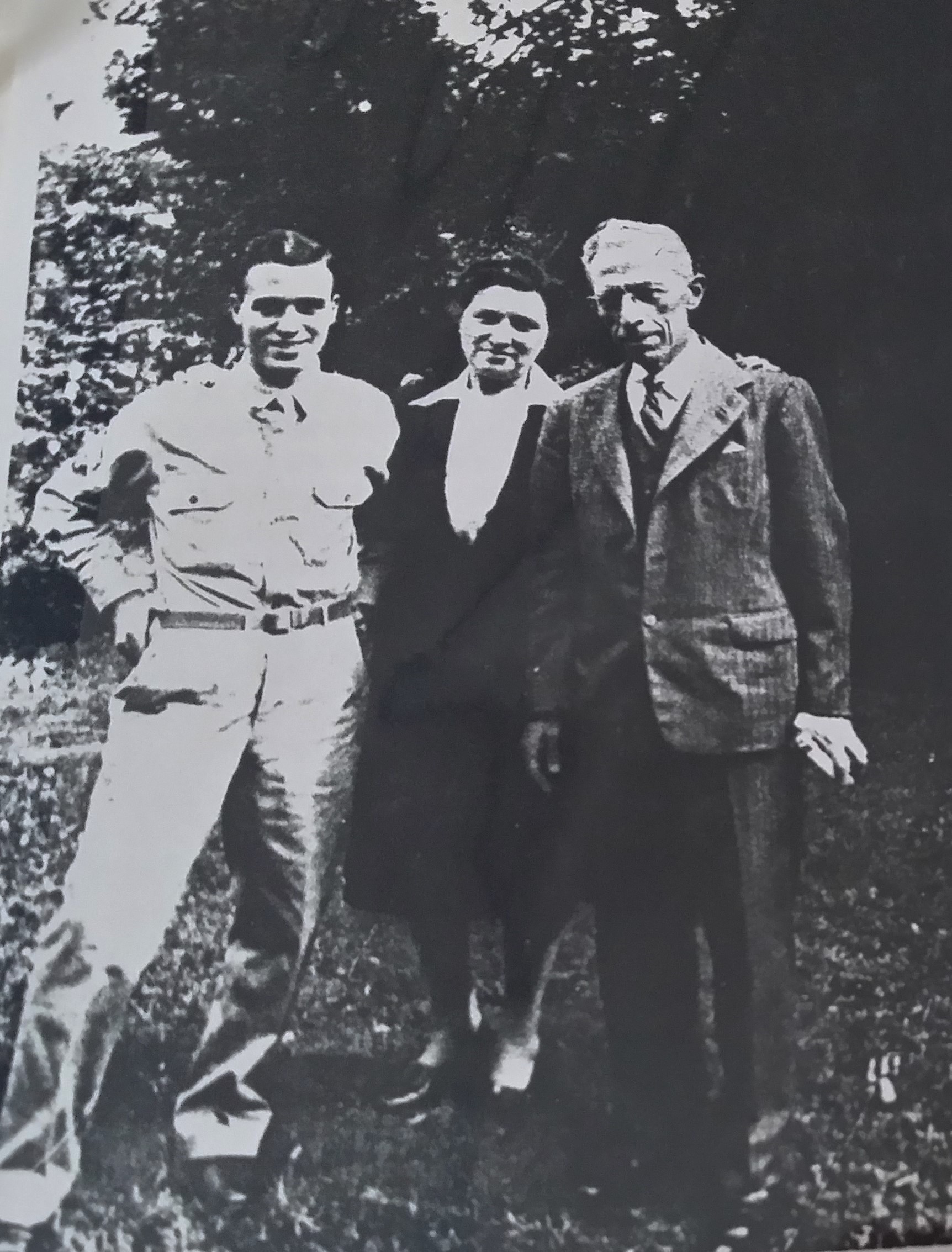
Frank Striker WW1

Francis Oestreicher, later known as Frank Striker

Frank Striker WW1 medal

Frank Striker’s Victory Medal for service in World War I

Gustav and Sarah’s third child was their daughter Helen. Here she is in 1917 when she was 22 years old.

Helen Oestreicher 1917

Helen Oestreicher 1917

As I wrote earlier, Helen married Robert Steel Kann in 1920, but he died a year later at age 26.  Sometime before 1929, she married Aaron Mitchell Siegel, known as Mickie, and they had a daughter Betty.

Helen Oestreicher Kann Siegel and her family

Helen Oestreicher Kann Siegel and her family

I was tickled to see this item in Steve’s collection:

invitation to Henry Schoenthal 50th anniv party

As you can see, it is an invitation to the 50th wedding anniversary celebration in 1922 for Henry Schoenthal and Helen Lilienfeld, about whom I’ve written extensively.  Henry Schoenthal, my great-great-uncle, was Sarah Stern Oestreicher’s uncle, brother of her mother Hannah Schoenthal Stern.

Steve sent me this photo labeled Aunt Helen by his uncle Frank, and I wonder whether this is Helen Lilienfeld Schoenthal, who would have been Frank’s great-aunt.  Frank received a long letter from his great-aunt Helen and great-uncle Henry while he was serving in Europe; the tone and content of that letter suggest that Helen and Henry Schoenthal had a very close relationship with the Oestreicher family. (I will post the letter in a separate post.)

Aunt Helen--maybe Lilienfeld Schoenthal

Frank returned to Pittsburgh after the war and worked as a salesman in the family dry goods store. After the family store went bankrupt in 1933, the Oestreicher family began its migration west to California. Although neither Steve nor his cousin Ron was sure of who first went to California or why, the 1940 census indicates that by 1935 at least Helen and her family and Gustav and Sarah had settled there.  I was not able to locate Frank on the 1930 or the 1940 census,nor do I have any address for him between 1920 and 1942, but his World War II draft registration indicates that by then he was definitely living in California along with his parents and his sister Helen.  Sidney and his family did not move west until the 1940s.

Here is a photograph of the Oestreicher family in Los Angeles in 1936.

Oestreicher family edited 1936

I found this letter written by Sarah Stern Oestreicher to her son Frank in 1933 to be very touching in its religious tone and its affection for her son.  Perhaps it was written around the time that family members were planning to move to California.  From the text of the letter, it appears that Frank had just visited, perhaps before he was leaving to move out west or his parents were.

IMG_9375

IMG_9376

Letter from Sarah Stern Oestreicher to her son Frank, dated January 11, 1933

My dear Francis!

Always remember that The present is under God’s guidance, the future in His keeping. God is guiding, directing, controlling and suplying His children with all good.  His Love and [?] is with you always. Thanking you for all your kindness and the pleasure of having you with us will be the the most pleasant memmories to us.

With my love I remain your devoted Mother. January 11—1933

Here is a photo of Frank in 1940.

Frank Striker 3

One of Steve’s favorite stories about Frank is that he offered to take photographs at Steve’s bar mitzvah, only to discover there was no film left in the camera.  There is only this one photo taken by Frank that day.

IMG_1979

Although Steve has many photographs with Frank with women throughout the years, Frank never married. He died in Los Angeles on April 23, 1990, at the age of 96.  His sister Helen died in 1989 when she was 94.

I am so grateful to my cousin Steve for sharing these amazing photographs with me and allowing me to post them on my blog. There is just nothing better than a photograph to help bring to life the people whose lives I’ve researched.

More photos and stories about the Oestreicher family in my next post.


Don’t Wait to Make Those Calls: My Cousin Betty

This is a post I started back in May before my trip to Colorado and Santa Fe.  I had planned to finish it when I got back, but was distracted and put it aside.  Now I must finish it.  Unfortunately, it no longer has the happy ending it originally had.

As I wrote a few months ago, my newly found third cousin Maxine Schulherr Stein, the great-granddaughter of Hannah Schoenthal Stern (my great-grandfather Isidor Schoenthal’s sister), had lost touch with her second cousins Betty and Elaine, also great-granddaughters of Hannah Schoenthal Stern.

relationship of Maxine Schulherr to Betty Oestreicher

Betty and Elaine’s grandmother Sarah Stern and her husband Gustav Oestreicher had had three children: Sidney, born in 1891; Francis (known as Frank), born in 1893; and Helen, born in 1895.  They’d all lived in the Pittsburgh area at first, but as Sarah and Gustav’s children became adults, they’d eventually left the Pittsburgh area.

Helen had moved to California by 1935 where she and her husband Aaron Siegel and their daughter Betty lived in Los Angeles.  Frank also was living in Los Angeles by 1942.  It was Sidney Oestreicher and his family whom Maxine knew best. She knew that Sidney was married to Esther Siff, and they had had three children: Gerald, Florence Betty (known as Betty), and Elaine.

But Sidney Oestreicher also had left the Pittsburgh area when he moved to New York in the 1940s.  The family had left their youngest child Elaine behind with Maxine’s family so that she could finish the school year in Pittsburgh, according to Maxine.

By the 1950s, all of the members of Sidney Oestreicher’s family had moved to California to be closer to the other members of the family.  Given the distance and the limited modes of communication back then, the family members back in Pittsburgh eventually lost touch with the California branch of the family.   When I spoke with Maxine, she asked me to help her locate the cousins she’d known as a child.

Hattie Martin Maxine Alan Henrietta Stein Alan's mother

Hattie Arnold Schulherr, Martin Schulherr, Maxine Schulherr Stein, Alan Stein, Henrietta Stein

I knew from my own research that Gerald Oestreicher (who, like his father Sidney and his uncle Frank, changed his surname to Striker) had married Faye Krakower and had had two children.  Gerald died in 2014 and Faye in 2015.   But finding Gerald’s sisters Betty and Elaine had proven to be more difficult, as is generally the case with women.

Fortunately, I found one very important clue that helped me find both Betty and Elaine for Maxine (and for me).

Betty Oestreicher engagement announcement

I thus knew that Betty had married a man named Julius H. Jacob.  And from various other records for Julius, I knew that they had lived in the NYC area for some time and that they, like the other Oestreichers/Strikers, had eventually moved to California.  But I had not been able to find their current residence.

Newly motivated by Maxine’s request, I looked again at the engagement announcement and saw that Julius was described as the brother of Mr. and Mrs. Jacob Spear.  Who was that? I inferred that Julius was the brother of Mrs. Spear, not Mr. Spear, given the different surnames, and decided to see what I could find about the Spears.  I found Jacob Spear and his wife Else (presumably born with the surname Jacob) on the 1940 census, but more importantly, I found them both on several family trees on Ancestry.

Although I am generally skeptical of Ancestry trees, one of those trees belonged to a genealogy researcher whose work I trust: Jennifer Spier-Stern.  I contacted Jennifer, and after we exchanged more information and verified the connection between Julius Jacob and Elsie Jacob, Jennifer was able to put me in touch with the son of Jacob Spear and Else Jacob, John.  John is the nephew therefore of Julius Jacob, husband of my cousin Betty Oestreicher.  Not only did John know the whereabouts of his aunt Betty—he had contact information for her son Ron.  And he pointed out that the upcoming weekend would be her 97th birthday.  Now that gave me the chills!

I emailed Ron, and we exchanged several emails.  And Ron gave me the phone numbers for both his mother Betty and his aunt Elaine, who is also still living in California.  In May I had the great pleasure of speaking to two more of my third cousins, Betty Oestreicher Jacob and Elaine Oestreicher Wallace. The following information came from a combination of my conversations with Betty and Elaine and the emails and conversations I had with my cousin Ron.

Betty was remarkably lucid for a 97 year old woman, and she was delighted to answer my questions and reminisce about her family and her life.  Elaine also was warm and excited to share her stories with me.  I had hoped that one of them would have stories about their grandmother, Sarah Stern, who was the first child of Hannah Schoenthal and who had come without her family to the US when she was nineteen years old.  Unfortunately, as was so often the case, both Betty and Elaine said that their grandmother Sarah did not speak about her childhood or about the move to the United States.

I did learn, however, from Betty that Sarah met her future husband, Gustav Oestreicher, when he was staying at the boarding house in Pittsburgh run by her mother, Hannah Schoenthal, my great-grandfather’s oldest sibling.

Betty also told me that her grandmother Sarah suffered from migraines, and after they married, Gustav and she moved to Atlantic City because he thought it would be better for her health.  Sarah also converted to Christian Science, and although Betty and her family remained Jewish, Betty would often accompany her grandmother Sarah to church when she visited her in Atlantic City.

Ron shared with me a particular memory his mother Betty shared with him:

“Once, Sarah and Gustav purchased 300 ice cream cones for children at an orphanage/home for crippled children, and my mother and uncle (Jerry) got to ride along in the truck to deliver them.  Apparently, my mother was the apple of Gustav’s eye.”

I also asked Betty how her father Sidney met her mother Esther Siff, who lived in Chicago.  Betty explained that her father was a traveling salesman, working for a ladies’ lingerie company called Adelson’s.  While traveling to Chicago for work, he attended a dance where he met Esther Siff.  Sidney and Esther lived in Chicago for the early years of their marriage, and their first two children, Gerald and Betty, were born there.  By 1930, however, the family had moved back to Pittsburgh, where their youngest child Elaine was born.

betty-oestreicher-jacob-1940s-ft-devens

Betty Oestreicher Jacob. 1940s Courtesy of Ron Jacob

Betty said that her immediate family moved to New York in the 1940s for her father’s job.  She had married Julius Jacob by that time, and after spending some time in Massachusetts where Julius was stationed at Fort Devens during the war, they ended up moving to New York where Julius worked for Spear & Company.  In 1954 or so, they returned to Pittsburgh, where Julius continued to work for Spear & Company, but the company was not doing well at that point.

In 1956, the family moved to Los Angeles where Julius took a job with Broadway Department Stores.  Betty’s brother Gerald was already living there at that time as was her aunt Helen and uncle Frank.  Sidney and Esther soon followed their children to Los Angeles. Elaine arrived a few years later after her divorce from her first husband, Jerry Kruger. Sadly, Esther Siff Oestreicher/Striker died on her 68th birthday, March 11, 1961.

Thus, by the 1960s, all the members of the Oestreicher family were living in the Los Angeles area: the three children of Sarah Stern and Gustav Oestreicher, Sidney, Frank, and Helen, and all of their children, including Sidney’s three children, Gerald, Betty, and Elaine.

Ron shared with me his memories of his great-uncle Frank and his grandfather Sidney:

“My Uncle Frank, who I adored, was a lifelong bachelor.  He was also quite the world traveler and I was always fascinated to hear of the places he had been.  Spending a fair amount of time traveling by ship, he became quite an accomplished dancer and tennis table player.  (I believe he had trophies for both.)  When we got a ping pong table, he had fun annihilating me.  To be fair, my grandfather, Sidney, taught me how to play gin rummy (for points) and he also had the grandest smile every time he beat me.  Both men were true gentlemen, and they were loving, caring men and enjoyed spending time with us kids.  My grandfather died when he was 94 and my uncle died when he was 96.” 

Ron also sent me this picture of Faye Krakower Striker, his uncle Gerald’s wife:

faye-krakower-striker-professional-photo


Faye had quite an interesting life as a singer before marrying Gerald in 1946.  The following is an excerpt from the eulogy given at her funeral in 2015.

JPG Eulogy of Faye Striker

Even with all this information, I realized when I got off the phone with Betty that I still had more questions about her childhood and adolescence in Pittsburgh.  Did she know the other Schoenthal cousins? What was life like? Were they active in the Jewish community? There were many more things I wanted to discuss with her.

I had planned to call Betty and Elaine again after those initial conversations. But then I left for our trip to Colorado and New Mexico, and when I returned, I was distracted by a number of other matters, and I failed to follow up.

I recently learned that Betty’s health deteriorated while I was away, and sadly she passed away on July 19, 2016.  She had had a good long life with very few health issues, according to her son Ron.  And although I know that anyone who lives 97 years has had a remarkable journey, I am kicking myself for not making that second call.  Betty had been so excited to share her memories with me, and there were so many more questions to ask and stories to hear.

Life is unpredictable, and we can’t assume anything or take anything for granted.

May my cousin Betty rest in peace, and may her family find comfort in all their memories.


The Last Chapter of the Story of Amalia Hamberg

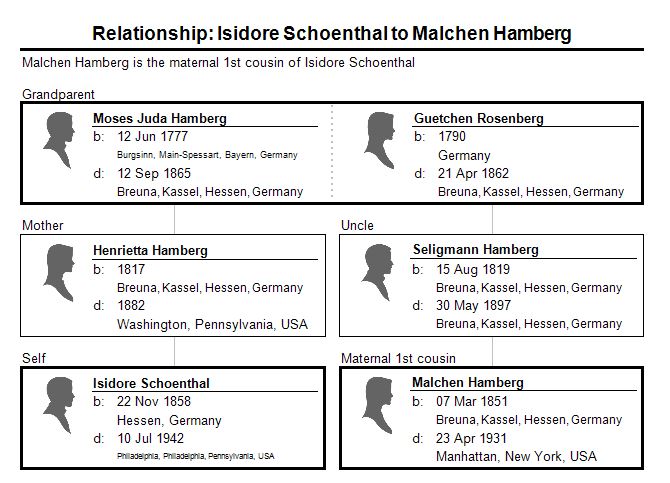
Finally, I come to the two youngest children of Amalia Hamberg and Jacob Baer to survive to adulthood[1]: Elsie Baer Grant and Lawrence Baer.   With this post, I close the chapter on Amalia Hamberg, first cousin of my great-grandfather Isidore Schoenthal, or my first cousin, three times removed.  Her children were my second cousins, twice removed (or my grandmother Eva Schoenthal’s second cousins).

corrected relationship isidore schoenthal to malchen hamberg

Elsie Baer was born in Pittsburgh in 1886 and married Jerome Grant in 1913.  For almost their entire married lives they lived in New York City, where Jerome worked for Baer & Wilde, one of the family jewelry businesses based in Attleboro, Massachusetts.  Elsie and Jerome had two daughters, Marjorie and Elinor.  As of 1930, they were still living in New York City, and Jerome was still working for the family jewelry business.  The same was true in 1940; both daughters were still at home.

In the next decade both daughters married. Marjorie married Richard E. Weinreich, whose family was also in the jewelry business.  Richard’s father, Sol Weinreich, had founded Marvella Pearls, a jewelry wholesale business with his brother in Philadelphia, where Richard was born in 1915.  By 1930, the family and the business had relocated to New York, and by 1940, both Richard and his father were working in the business.

Marvella pearls

I assume that Richard and Marjorie met as a result of the fact that both families were in the jewelry business in New York.  Richard and Marjorie would have one child.  Richard eventually became president of Marvella.  According to this antiques website, “Marvella was purchased by Trifari in the early 1980s and eventually became part of the Liz Claiborne group. As of 2010, jewelry is still being distributed in department stores and other retail outlets on cards bearing the Marvella name.”

Marjorie’s sister Elinor served for over a year with the Red Cross in India in the early 1940s. On December 19, 1946, she married Alan Fredrick Kline of Chicago.

Elinor Grant wedding to Alan Kline 1946 NYTimes-page-001

Alan was a graduate of Dartmouth College and had served in the US Naval Reserves during World War II.  His father Jacob was one of the founders of Kline Brothers, a department store chain that started in Lorain, Ohio, and eventually had a large number of stores in the Midwest.

Suburbanite_Economist_Sun__Oct_28__1973_ article about Kline Bros

Elinor and Alan had two children before Alan died at only 37 years old on October 1, 1950, leaving Elinor with two very young sons.  Elinor would eventually remarry.

Elsie Baer’s husband Jerome Grant died on July 29, 1964; he was 75.  According to the death notices in The New York Times, he was a Mason, a member of The Golden Circle, and a member of the Maiden Lane Outing Club.

Like her sisters Josephine, Tilda, and Amanda, Elsie Baer Grant lived a long life, dying many years after her husband in May 1983 at age 96.

Unfortunately, the daughters of Elsie and Jerome were not blessed with their mother’s longevity.  Marjorie predeceased her mother, dying in May, 1978; she was only 59.  Her sister Elinor died at age 72 on November 2, 1993.

As for Elsie’s younger brother Lawrence, the youngest of the children of Amalia Hamberg and Jacob Baer, he played, as I’ve written here, a critical part in the success of the family jewelry business in Attleboro.  He not only invented the Kum-A-Part cufflinks that made the company highly successful in the 1920s; he also invented and received patents for several other jewelry products.  For example, in 1922, Lawrence received a patent (No.  US 1420232 A) for a jewelry contained, described as “a container which can be carried in the pocket or in a traveling bag or the like or placed in an article of furniture in the home, for holding buckles, brooches, buttons, and any article of jewelry.”  He also received during the 1920s and 1930s patents for a number of other inventions: necktie holders, a belt fastener, a bill holder, a shirt holder, and a display device.

Jewelry holder invented by Lawrence Baer


As noted in my earlier post, Lawrence had married Donna Degen in 1919, and they had one child, a son named John Degen Baer, born in 1921.  As of 1942 when Lawrence registered for the draft, they were still living in Attleboro and Lawrence was still working for the family jewelry business, now known as Swank, Inc.  But by 1946, Lawrence was listed with his second wife, Olivia Ganong, in the West Palm Beach, Florida, city directory.  He and Olivia lived in Florida for the rest of his life.  Lawrence died in May, 1969, in Lake Worth, Florida. He was 77 years old.

His son John remained in Attleboro even after Lawrence remarried and moved to Florida. According to his obituary, John attended Yale and Brown, graduating from Brown in 1943. During World War II, he served in the United States Marine Corps in the Pacific theater and in the occupation of Japan. He married Minette Eleanor Brigham on July 22. 1944.1 John and Minette had two children.

In 1946, the Attleboro city directory lists John as serving in the United States Marine Corps. In 1953, he was the executive vice-president of The Bishop Company in Attleboro.  According to his obituary, John “was the owner and C.E.O. of the Bishop Company, an Ophthalmic Manufacturing Company, which he merged with the Univis Lens Company of Dayton, Ohio in 1960. The merged company, Univis, Inc., was headquartered in Ft. Lauderdale, Florida, with branch manufacturing plants in Puerto Rico, Tennessee, New York and Massachusetts. Univis was sold to Itek, Inc. in 1970.”

In 1963, John was still listed in the Attleboro directory, but that is the last listing I can find for him there. His wife Minette died on February 9, 1966; she was only 44. John then married his second wife Linda Corinne Hill, with whom he had four more children.

After he sold Univis in 1970, John moved to Atlanta, Georgia, where he was executive vice-president of Edwards Baking Company until 1978. His second wife Linda died on April 16, 1978.2 Sometime thereafter John married his third wife, Jane Rollins.

In 1985, he relocated yet again, moving to Blairsville, Georgia, where he started and managed the Truck and Gas Market until 1992, when he retired. John Baer died on November 3, 2015.  He was 94 years old. (Much of this information comes from his obituary, which also includes a number of photographs of John.)


Thus ends the recounting of the lives of all of the children (and the children of the children) of Amalia Hamberg and Jacob Baer: Maurice, Hattie, Josephine, Amanda, Flora, Tilda, Elsie, Alfred, and Lawrence.  I am once again amazed by the fact that two immigrants who came to the United States in the 19th century raised children who achieved such remarkable success both in business and in the arts.

Perhaps it is a lesson to us all about the contributions that immigrants have made and will continue to make this country.  We should be very wary of anyone who seeks to exclude immigrants from this country.  After all, most of us living in the US today are descended from immigrants.


[1] Alfred Baer, the second youngest child, had died years before.


  1. Minette Eleanor Brigham, Gender Female, Age 22, Birth Date abt 1922
    Marriage Date 22 Jul 1944, Marriage Place District of Columbia, USA, Spouse
    John Degen Baer, FHL Roll 002319543, Ancestry.com. District of Columbia, U.S., Marriage Records, 1810-1953 ↩
  2. Linda Baer, Gender Female, Race White, Age 36, Birth Date abt 1942, Residence Place Fulton, Georgia, USA, Death Date 16 Apr 1978, Death Place Fulton, Georgia, USA, Certificate Number 017489, Georgia Health Department, Office of Vital Records; Georgia, USA; Indexes of Vital Records for Georgia: Deaths, 1919-1998; Certificate Number: 017489, Ancestry.com. Georgia, U.S., Death Index, 1919-1998  ↩

The Legacy of Flora Baer Adler

I am back after two weeks with family members—first, a wonderful week with our grandson Nate and then a week with the extended family.  We had gorgeous weather, lots of laughs, and too much good food.  But now things are quiet, and I am returning to finish the story of the children of Amalia Hamberg.

It’s been a long break since I last posted, so I thought it would be helpful to clarify where I was when I left off. I had been discussing the many children of Amalia/Mlalchen Hamberg, who was a first cousin of my great-grandfather Isidore Schoenthal through his mother Henriette Hamberg.

corrected relationship isidore schoenthal to malchen hamberg

I have already discussed six of Amalia’s nine children, including Maurice, Hattie, Josephine, Amanda, Alfred and Tilda.  That leaves three more: Elsie, Lawrence, and the subject of this post, Flora.

Although Hattie Baer died at a young age as did her brother Alfred, most of the other siblings lived long lives.  As we saw in the earlier posts, Amanda lived late into her 90th year, and Josephine lived to 97. Their sister Elsie also lived to 97, and Tilda was within a few months of her 90th birthday.

Unfortunately, their sister Flora did not live as long a life.  As I wrote here, Flora  married Julius Adler, an engineer who had worked for the Philadelphia highway department, supervising the construction of the Benjamin Franklin Bridge.  They had three children between 1917 and 1920, Stanley, Jerrold, and Amy.  Thanks to one of the grandchildren of Flora and Julius, I now have some photographs of the family.

Wedding photograph of Flora Baer and Julius Adler, March 15, 1915 Courtesy of the Adler family

Wedding photograph of Flora Baer and Julius Adler, March 15, 1915
Courtesy of the Adler family

Flora Baer Adler and one of her children

Flora Baer Adler and one of her children


In 1940, all three children were still living at home with their parents in Philadelphia.  Julius listed his occupation as an independent civil engineer.  Their son Stanley was working as a chemical engineer for a chemical company, and their daughter Amy was a social services worker at a hospital.  Jerrold had no occupation listed; perhaps he was still in school.

Flora Baer Adler 1943

Flora Baer Adler 1943, courtesy of the Adler family


Jerrold Adler, Flora Baer Adler, and Julius Adler 1943 Courtesy of the Adler family

Jerrold Adler, Flora Baer Adler, and Julius Adler
1943
Courtesy of the Adler family

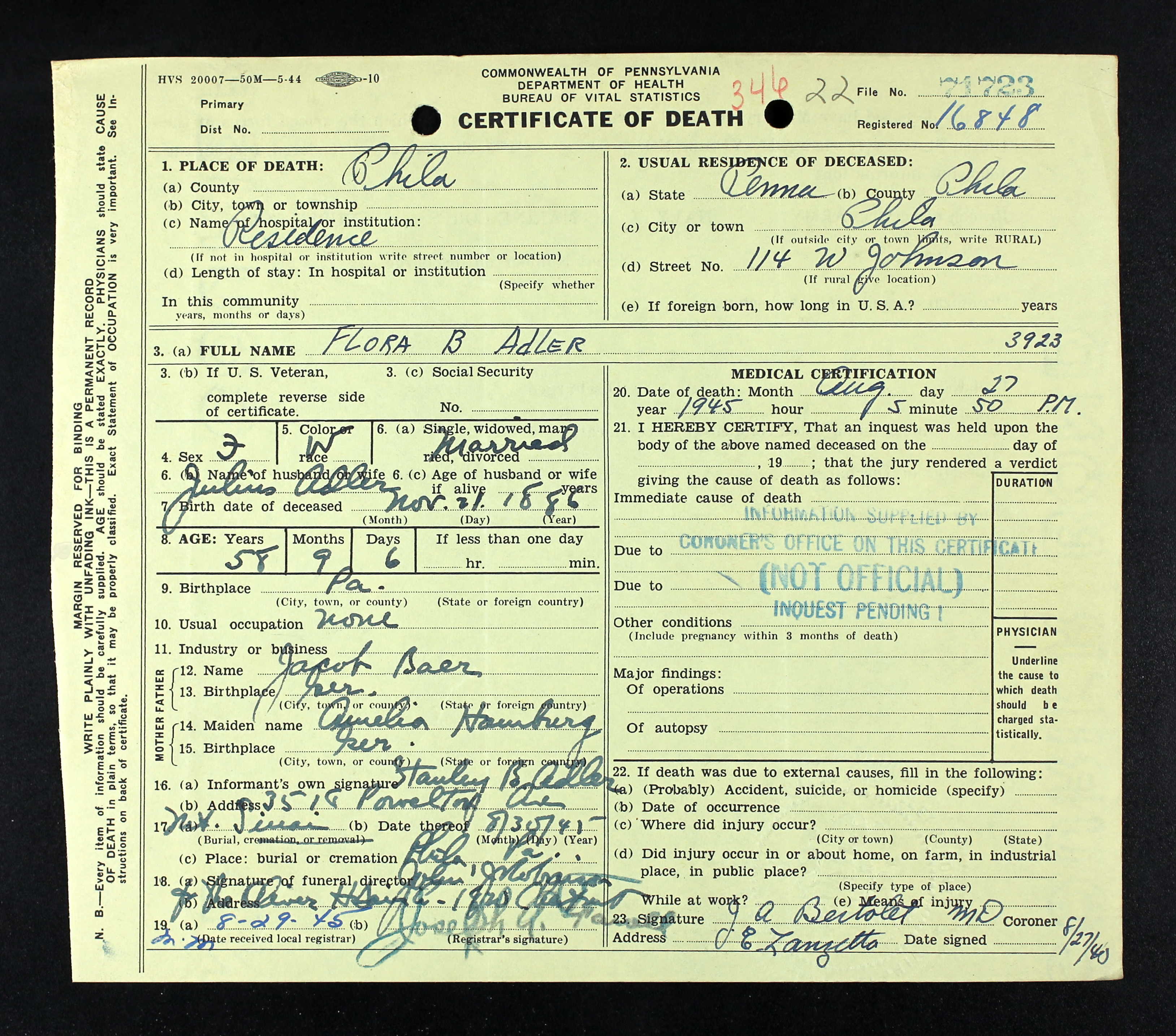
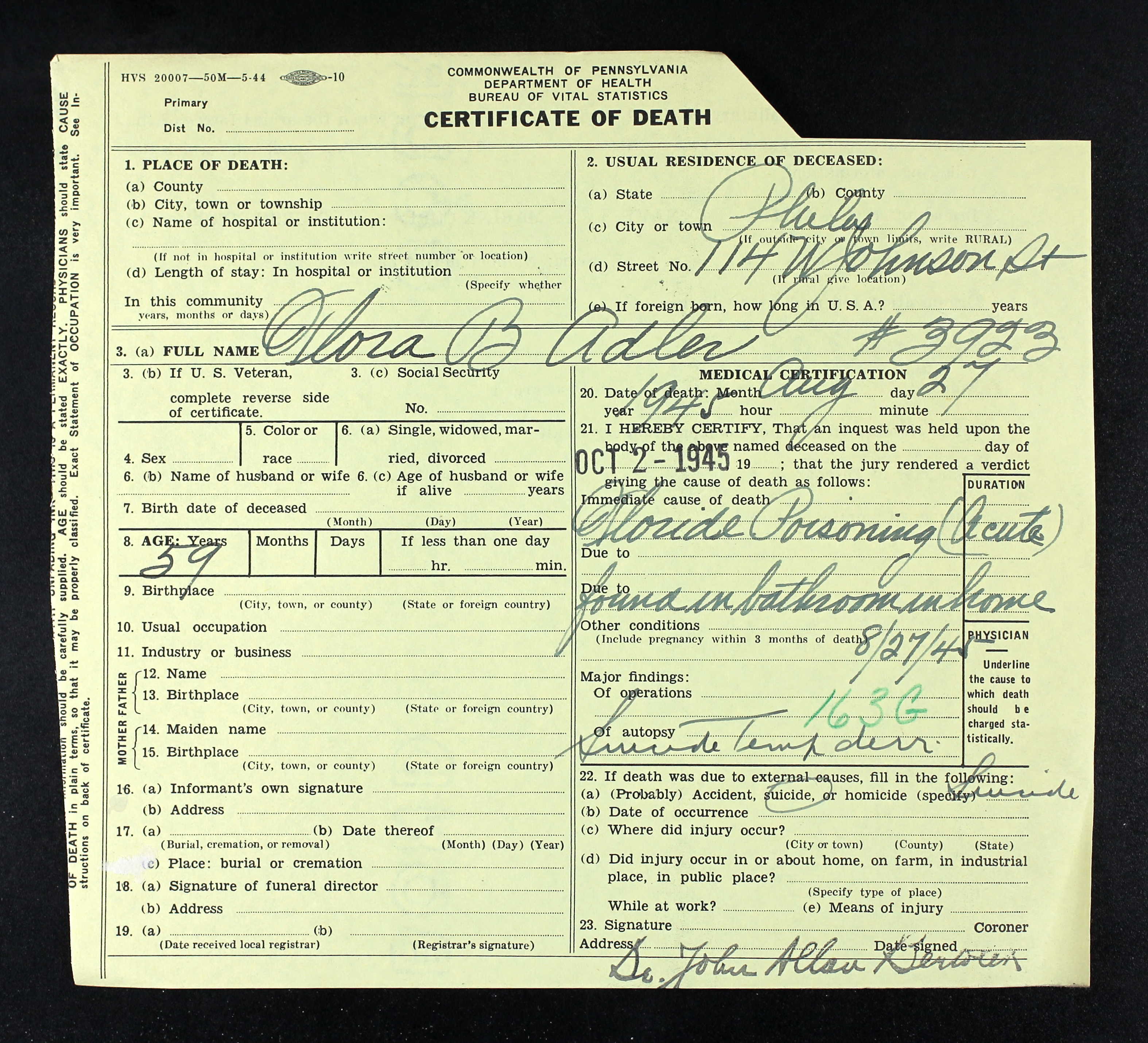
Then tragedy struck.  On August 27, 1945, my cousin Flora died from fluoride poisoning; her death was ruled a suicide by the coroner.

FLora Baer death certificate preliminary

FLora Baer death certificate with coroner result

Ancestry.com. Pennsylvania, Death Certificates, 1906-1963 [database on-line]. Provo, UT, USA: Ancestry.com Operations, Inc., 2014. Original data: Pennsylvania (State). Death certificates, 1906–1963. Series 11.90 (1,905 cartons). Records of the Pennsylvania Department of Health, Record Group 11. Pennsylvania Historical and Museum Commission, Harrisburg, Pennsylvania.

Julius and the three children somehow recovered from this tragedy.  Julius married his second wife Katinka Dannenburg Olsho in 1971 when he was 84 years old.

Julius Adler, 1977 Courtesy of the Adler family

Julius Adler, 1977
Courtesy of the Adler family

When he died in 1993 at the age of 106, the Philadelphia Inquirer published a wonderful tribute to him:

… [Julius Adler] was an erudite man who could quote long passages from Kipling, recite Latin and Greek verse, and speak authoritatively on any of his varied interests, which included growing roses and playing bridge, according to his family.

“This man was unique, just an extraordinary human being,” said Mr. Adler’s son-in-law, Leonard Malamut. “In everything he did, he was top-notch. And he was a man of great dignity. He grew up at a time when decency and ethics and morality were the guiding principles of how one lived.”

Mr. Adler was born in Memphis, Tenn., and moved to Philadelphia as a child. He was a graduate of Central High School’s 109th class in 1904 and a 1908 graduate of the School of Engineering at the University of Pennsylvania, which he attended on an academic scholarship. His family believes he was the oldest living graduate from Central and Penn.

Mr. Adler’s supervision of the Ben Franklin Bridge paving took place when he was deputy chief of the city’s highway department, his son-in-law said. The bridge, when it was built, was called the Delaware River Bridge.  He also supervised the repaving of Broad Street after the construction of the Broad Street Subway.

Mr. Adler taught at the University of Pennsylvania and the University of Washington. He was a member of the Engineers Club of Philadelphia, the American Society of Civil Engineering and the American Society for Testing Materials.

For 70 years, he was a member of Congregation Rodeph Shalom.

Mr. Adler was, as well, a devoted fan of the Phillies. “He could tell you players’ ERAs and batting averages with great accuracy until he was 100,” Malamut said. “I regret that he died in the season the Phillies are having such a great season – that he had to die before the season was over.”

Stanley, Amy, Julius, and Jerrold Adler 1960 Courtesy of the Adler family

Stanley, Amy, Julius, and Jerrold Adler 1960
Courtesy of the Adler family

Julius and Flora’s three children also all lived productive lives.  Their daughter Amy died in 2003 of a heart attack; she was 83.  According to her obituary:

She served as a hospital volunteer when she was a teenager and later studied X-ray technology and electrocardiography.  In 1942, she met Dr. Leonard Malamut when she was working at Jewish Hospital, now Albert Einstein Medical Center. The couple married in 1944.

Dr. Malamut opened a practice near Albert Einstein Medical Center in Olney after serving several years in the Army during World War II. Mrs. Malamut joined him in the office. She managed the practice, keeping the books and helping with electrocardiograms, blood work and other tests.  She enjoyed attending concerts and the theater with Dr. Malamut.

Amy’s older brother Stanley died on April 21, 2006; he was 89 years old.  According to his obituary, like his father, he was an engineer who had graduated from the University of Pennsylvania.  The obituary reported:

During World War II, Stan was an aircraft inspector for the United States Navy. …. He was active in Reform Judaism, scouting, and the American Institute of Chemical Engineers. He wrote many technical papers. His interests included amateur radio, bridge, calculus, gardening, classical music, and a more cooperative world.

Stanley Baer Adler Fold3_Page_1_Selective_Service_Registration_Cards_World_War_II_Multiple_Registrations

Stanley Baer Adler
Fold3_Page_1_Selective_Service_Registration_Cards_World_War_II_Multiple_Registrations

The last surviving child of Flora Baer and Julius Adler was Jerrold, who died on March 5, 2008, when he was, like his brother Stanley, 89 years old.   He had attended the University of Pennsylvania and had served in the army during World War II.

Jerrold Adler draft registration Fold3_Page_1_Selective_Service_Registration_Cards_World_War_II_Multiple_Registrations

Jerrold Adler draft registration
Fold3_Page_1_Selective_Service_Registration_Cards_World_War_II_Multiple_Registrations

Jerrold Adler, courtesy of the Adler family

Jerrold Adler, courtesy of the Adler family

He had married Doris Elaine Getz on October 6, 1946.

Wedding of Jerrold Adler and Doris Getz, October 6, 1946

Wedding of Jerrold Adler and Doris Getz, October 6, 1946

Although Flora’s life ended tragically, she left behind the legacy of three successful children.  Their lives enriched the country that Flora’s mother Amalia had moved to as a young woman back in the 19th century.  They served in our armed forces during World War II and contributed to society through their chosen careers.  Like so many of us, the grandchildren of immigrants, they justified the risks their grandparents took when immigrating to the United States.


Ray, Arizona: Home of Gertrude and Hettie Schoenthal

Some of you may remember that about six months ago I wrote about Gertrude and Hettie Schoenthal, two of the daughters of Simon Schoenthal, brother of my great-grandfather Isidore.  Gertrude had married Jacob Miller in 1898 and moved to Arizona. Jacob and his brothers were merchants in the Tucson area. Gertrude’s younger sister Hettie followed her out there around 1906, where she met her husband Henry Stein and eventually settled as well.

Eventually both the Millers and the Steins moved to the small mining town of Ray, Arizona, where they lived for several years before returning to Atlantic City, where most of the members Schoenthal family were still living.   Hettie and her son Walter Stein wrote wonderfully descriptive memoirs of their rough and tumble pioneer life in Ray, Arizona.  I quoted extensively from their writings in this blog post.

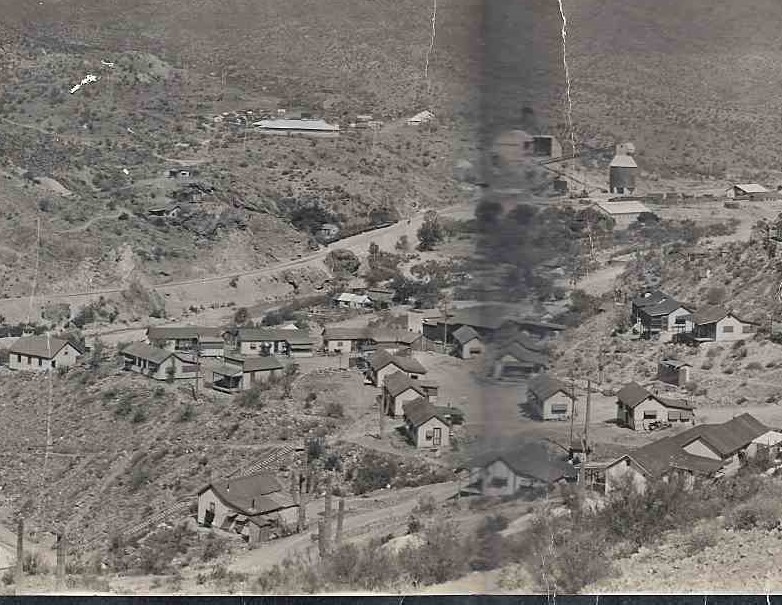
A week ago I was Skyping with Sharon Lippincott, who is married to Ezra Lippincott, grandson of Hettie Schoenthal, and Sharon and Ezra were excited to share with me a photograph that their daughter-in-law had found somewhere on the internet.  It is a panoramic view of Ray, Arizona, taken in the time that Hettie and her sister Gertrude were living there.  In fact, you can see the Miller Brothers store in the photo if you zoom in to the right side of the picture.  Just click, and then click again to zoom in to the photograph to see it more clearly.

Ray Arizona Panarama from Internet

Here’s a closeup of the section showing the Miller store:

Ray Arizona Panarama from Internet (2)

Both Hettie and Walter described their first house in Ray.  Walter wrote:

Our first house was placed on the side of a hill with one door. The back of the house was against the hill. To reach the house you walked up steps that also took care of other householders on the hill. I cannot remember the location of the outhouse. I do remember to bathe, water was heated on the stove and then poured into a galvanized tub that had been placed on the floor.

Hettie’s description is similar:

I will tell you a little about the house. It was up on a hill, just four rooms no bath or toilet. It was terrible. I did not think I could live there, but we did. Your grandfather and a helper built a room and we bought a tub. The pipes had to be on top of the ground. Well, the sun was so hot we had to draw the water and let it stand for hours before bathing.

Can you locate the house in the photograph above?  The houses are all to the far right in the panoramic photograph, and I have a guess as to which one was the home of Hettie Schoenthal and Henry Stein and their children.  Which one do you think it was?  (Look first before looking at my guess at the bottom of this post.)


In my head I am humming the Final Jeopardy theme song.


Here’s my guess:

Ray Arizona Panarama from Internet (3)

See the house in the left foreground with the huge cactus in front?  I think that’s it.  It’s built into the hill, and there is a staircase behind that leads to the other houses.  It looks like the outhouse was right in front of the house.

What do you think?

My thanks to Ezra and Sharon Lippincott and their daughter-in-law Carrie for sharing the photograph with me.

Tilda Baer Stone and Her Children: Massachusetts Cousins

Like Amanda and Josephine, her two older sisters, Tilda Baer lived a long life (a few months shy of ninety) and outlived her husband by close to twenty years.  But she didn’t live in a big city like Philadelphia or New York; she spent her entire adult life in Attleboro, Massachusetts, where she raised her four children.

As written about here, Tilda married Samuel Einstein in about 1907, according to the 1910 census, and their first child, Stephanie, was born in June 1908 in Attleboro.  They had three additional children, Samuel, Jr. (1910), Harriet (1913), and Babette (known as Betty, 1919).  By 1927, the family name had been changed to Stone, which was the name used by all family members thereafter (until the daughters married and adopted their husbands’ surnames, that is).  Samuel was by 1930 the President of Attleboro Manufacturing, and he and Tilda remained in Attleboro for the rest of the lives, living almost all those years at 224 County Street in that town.

Samuel and TIlda Baer Einstein/Stone and children from 1923 passport application National Archives and Records Administration (NARA); Washington D.C.; NARA Series: Passport Applications, January 2, 1906 - March 31, 1925; Roll #: 2295; Volume #: Roll 2295 - Certificates: 304850-305349, 08 Jun 1923-08 Jun 1923

Samuel and TIlda Baer Einstein/Stone and children from 1923 passport application
National Archives and Records Administration (NARA); Washington D.C.; NARA Series: Passport Applications, January 2, 1906 – March 31, 1925; Roll #: 2295; Volume #: Roll 2295 – Certificates: 304850-305349, 08 Jun 1923-08 Jun 1923

Their daughter Stephanie graduated from the National Park Seminary in Washington and the Garland School of Homemaking.  She married “the boy next door” on November 14, 1936—or at least the boy down the street. Her husband was Royal Packer Baker, who was a native of Attleboro like Stephanie and whose family also had lived on County Street (#148) as of 1920.  Royal was four years older than Stephanie, and he came from a family with a long history in Massachusetts and Rhode Island.

Boston Herald, November 15, 1936. p. 61

Boston Herald, November 15, 1936. p. 61


Royal’s father, Harold Baker, was the owner and co-founder of Attleboro Refining Company, a gold, silver, and copper refining business.  According to the website for the Attleboro Area Industrial Museum, which is housed in what was once the Attleboro Refinery Company building:

In 1899, Harold D. Baker and his brother George W. Baker, both of Providence, Rhode Island, formed a partnership to establish the Attleboro Refining Company in Attleboro, Massachusetts. It specialized in the refining of gold, silver and copper byproducts. The refinery followed established refining methods used at that time known as a stripping process. The process dated back to the late 18th Century. Base metals such as copper and zinc were eaten by a compound-acid solution. The precious metals underwent succeeding operations where they were reduced to a certain degree of fineness.

By 1907, however, the Bakers were convinced that better methods were available that would involve lower costs. They experimented with the then-existent electrochemical equipment available and finally succeeded in adapting the ELECTROLYTIC process to jewelers’ scrap. Theirs was the first refinery in New England to do so. The process underwent continuous improvement and development where gold was finally purified to .9991/2 fine and every trace of silver or other precious metal was re-claimed in the chlorination and succeeding copperas processes.[1]

Although his older brother Harold Jr. worked at the family business from the start of his career, Royal started his career taking a different path.  He was a graduate of Dartmouth as well as the University of Virginia, according to the wedding announcement.   By 1935 he was a lawyer practicing in Attleboro.

According to the 1940 census and their wedding announcement above, like their parents Stephanie and Royal also lived on County Street in Attleboro (#170), and Royal was working as an attorney in private practice.  In 1941, their son was born.  In 1946, Royal was listed along with his father and older brother Harold Jr. as an owner of Attleboro Refining, but was still practicing law.  By 1949, however, he was the treasurer of Attleboro Refining and no longer listed himself as a lawyer in the Attleboro directory. (His brother was now the president of the company; their father had died in 1947.)

Former building of Attleboro Refining Company https://c2.staticflickr.com/4/3500/4561405595_a2f6c67d9f_b.jpg

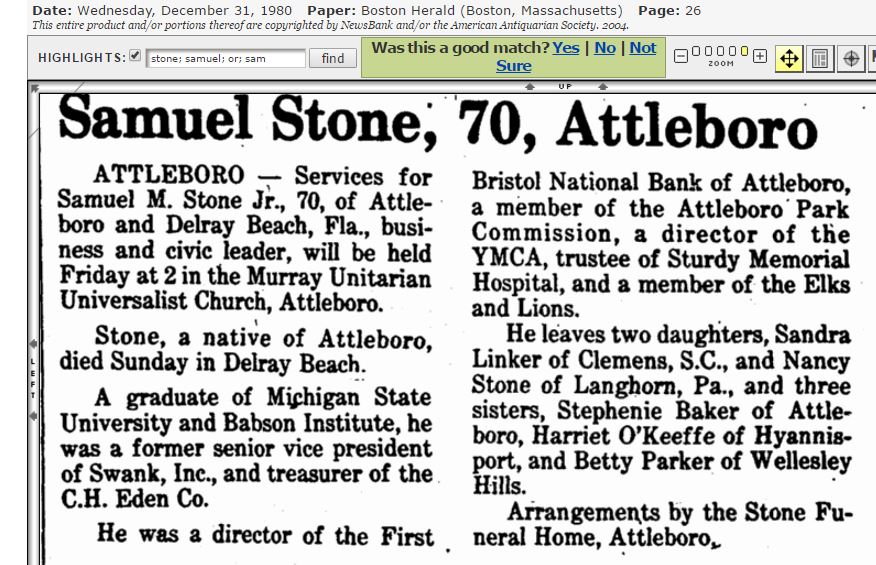
Stephanie’s younger brother Samuel Stone, Jr., graduated from Michigan State University and Babson Institute. In the 1935 Attleboro directory, he is listed as married to “Ruth M” and working as the treasurer of Quaker Silver Company, a company in North Attleboro that manufactured silver products such as flatware, bowls, and salt and pepper shakers.

Ruth M was Ruth Mills, born in Massachusetts on February 5, 1913.  Samuel, Jr. and Ruth had two daughters born in the 1930s, according to the 1940 census, which lists Samuel’s occupation as a jewelry manufacturer.  On the 1939 Attleboro directory, he is listed as the president of C H Eden Co., another jewelry company originally created by his father in 1901 that was acquired in substantial part by Charles Eden in 1903.  (Apparently, Samuel Stone, Sr. and Maurice Baer established a number of separate companies in Attleboro, all engaged in some aspect of jewelry manufacturing.)

By 1946, however, Samuel Jr’s marriage to Ruth had ended as he married his second wife, Marie Eames, on May 1, 1946.  Unfortunately, that marriage did not last either as they were divorced in 1952.

Samuel Stone Jr wedding to Marie Eames

By 1956, Samuel, Jr was listed in the Attleboro directory as the president of Swank, Inc., the successor to Attleboro Manufacturing Company, the company his father first founded with his uncle Maurice Jay Baer back in the late 1890s.

As for the two younger daughters of Tilda Baer and Samuel Stone, Sr., Harriet attended the Northampton School for Girls, then Wheaton College, and received a degree from Simmons College. (Cape Cod Times, September 6, 2002, GenealogyBank.com (http://www.genealogybank.com/doc/obituaries/obit/100B3AE9F09E0868-100B3AE9F09E0868 : accessed 13 July 2016))

In 1941 she married Lionel O’Keeffe.  He was the youngest son of Irish immigrants and was born and raised in Boston.  His father had worked in the grocery business, and in 1930 two of his brothers had been working as purchasing agents for First National Stores, a supermarket chain (later known as Finast).  Lionel was a graduate of Boston Latin High School and Dartmouth College. (Boston Herald, December 22, 1987, p. 53.)

On the 1940 census, he was living as the head of household in the house at 61 Pond Street in Jamaica Plain, the same house where he and his family had lived when he was a child.  But in 1940 he was living there without any other family members, but with a maid.  He listed his occupation as an executive of a chain store, which according to his obituary, was First National Stores.  The following year he married Harriet.

Lionel enlisted in the military on May 8, 1942, and he and Harriet had their first child five months later in September, 1942.  Lionel was discharged from the military on January 3, 1946, having served for the duration of World War II.  He and Harriet would have two more children during the 1940s.  In 1948 they were still living at 61 Pond Road in the Jamaica Pond section of Boston, the same house where Lionel’s family had lived, and Lionel was working as a buyer, according to the Boston directory for that year.  He continued to work for First National Stores for the rest of his career.

The youngest child of Tilda Baer and Samuel Stone was their daughter Babette, also known as Betty.  She graduated from the Northampton School for Girls in 1937 and then graduated from Smith College, later getting a Masters in Social Work from Simmons College.  In 1944, she married John Saunders Parker, known as Jack.  He became a doctor.  They would have two children. (Boston Globe, February 21, 2013.)

Samuel Stone, Sr., the father of Stephanie, Samuel, Harriet, and Babette, died on February 4, 1957, when he was 84 years old.

Samuel Stone Sr obit February 5, 1957 Boston Traveler p 58-page-001

Boston Traveler, February 5, 1957, p. 58

samuel stone obit His wife, my cousin Tilda Baer Stone, daughter of Amalia Hamberg and Jacob Baer, died on August 2, 1974.  She and her husband Samuel are both buried at Woodlawn Cemetery in Attleboro, Massachusetts, the place they called home for their entire married life and where they raised their four children, two of whom also spent almost all of  their lives in Attleboro.

As for the children of Tilda and Samuel, Stephanie’s husband Royal Baker continued to work as the treasurer of Attleboro Refining for the rest of his career.  Then on April 3, 1967, Royal died suddenly at age 62.  A year later Attleboro Refining was sold to another company.  According to the Attleboro Area Industrial Museum website, “on June 26, 1968, Handy & Harman Refining Group, Inc. purchased the Attleboro Refining Company. In November 1973, Handy & Harman left 42 Union Street for a new facility located on Townsend Road in the “new” Attleboro Industrial Park.”   Handy & Harman is still in business today engaged in the recycling of metals.

Royal P Baker death notice April 1967

Stephanie Stone Baker died on March 1, 1993; she was 84.

Her brother Samuel Stone, Jr., died at age 70 on December 28, 1980.

Samuel Stone Jr obit 12 31 1980

The third child, Harriet Stone O’Keeffe, lost her husband Lionel on December 20, 1987.  He was 76 years old.  She lived another fifteen years, dying on September 5, 2002, when she was 88.  According to her obituary, “Mrs. O’Keeffe lived in Brookline for many years and was active in volunteer work. She spent summers in Hyannisport and moved there year-round in 1973. She enjoyed gardening and bridge. She was a member of the Hyannisport Club, the Oyster Harbors Club and the Mid Ocean Club in Bermuda.” (Cape Cod Times, September 6, 2002, GenealogyBank.com (http://www.genealogybank.com/doc/obituaries/obit/100B3AE9F09E0868-100B3AE9F09E0868 : accessed 13 July 2016))

The youngest sibling, Babette, died just three years ago on February 19, 2013, at age 93.  Her obituary reported that:

She loved people and was a frequent volunteer in the activities of her children and an outgoing devoted friend to so many. She was an active volunteer in the Wellesley Community including the Service League of Wellesley, the Garden Club of Wellesley and was a past president of the Smith Club of Wellesley. She devoted many hours to the support of the Boston Symphony Orchestra and loved her Investment Club and Bridge Club, as well as her activities at the Wellesley Country Club, Wianno Club, The Country Club and The Moorings and Riomar Clubs of Vero Beach, Florida. She cherished all the interactions with the people that were brought into her life by these varied interests.  (Boston Globe, February 21, 2013, located at http://www.legacy.com/obituaries/bostonglobe/obituary.aspx?pid=163199572)

I’ve not yet connected with any of the descendants of Tilda Baer and Samuel Stone, but hope to be able to connect with these cousins whose roots are here in Massachusetts where I now live.  They are descendants of two people who seemed to have achieved the American dream—Samuel, a German Jewish immigrant who came to the US as a young teenager and became a highly successful jewelry manufacturer, and my cousin Tilda, the daughter of two German Jewish [2] immigrants who grew up in Pennsylvania; she raised four children, all of whom received a higher education and lived their lives in Massachusetts.
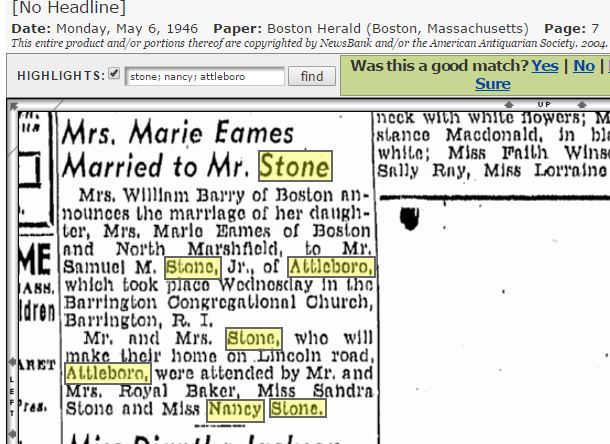


[1] There was a bitter dispute between the Baker brothers in 1918, which apparently ended in with Harold as the sole owner of the company. See “Attleboro Receivership Granted for Attleboro Refining Co. Decree Handed down by Superior Court, Wednesday,” Pawtucket Times, April 11, 1918, p. 12.

[2] It seems that at some point Tilda and Samuel and their children became members of the Universalist Church and no longer identified as Jewish.


Another Writer in the Family: Alan Baer Green

In many ways the life of my cousin Josephine Baer parallels that of her sister Amanda.  As I wrote here, Josephine Baer married Morris Alon Green in January, 1906.  Their son Alan Baer Green was born less than eleven months later.  They were living in Pittsburgh.  In 1918 Morris was an executive with the Crucible Steel Company in Pittsburgh.  In 1925, they were living in New York City, and Morris was working as a manager.  In 1930, they were still living in New York, and Morris listed his occupation as “financial.”  Their son Alan was working in advertising.

In 1931, Alan married Gladys Bun, and they had three sons in the late 1930s.  Although Alan continued to work in the advertising field, like his first cousin Justin Baer Herman, he also became a successful writer.  As reported in his obituary, Alan wrote “Love on the Run,” which became a movie starring Clark Gable and Joan Crawford in 1936.  It is a screwball comedy about two competing newspaper reporters covering the wedding of a socialite.

Love on the Run poster

He also wrote several other books during the 1930s, primarily mysteries, sometimes written under the pseudonym Roger Denbie (co-written with Julian Paul Brodie), sometimes as Glen Burne (co-written with his wife Gladys).

Alan’s parents are listed in the 1938 directory for Los Angeles, so I thought perhaps they had all moved out to Hollywood, but Alan himself is not listed in that directory.  And by 1940, all three were listed as living in New York City in the census.

Josephine Baer and Morris Green 1940 US census Year: 1940; Census Place: New York, New York, New York; Roll: T627_2655; Page: 13B; Enumeration District: 31-1349

Josephine Baer and Morris Green 1940 US census
Year: 1940; Census Place: New York, New York, New York; Roll: T627_2655; Page: 13B; Enumeration District: 31-1349

On the 1940 census, Morris and Josephine were living on East 77th Street, and Morris was retired.  Alan and Gladys and their three sons, ages 2, 1, and eleven months, were living on East 86th Street. They had two nurses living with them.  Alan listed his occupations as “author” and “advertising.”

Alan Baer Green and family 1940 US census Year: 1940; Census Place: New York, New York, New York; Roll: T627_2658; Page: 61B; Enumeration District: 31-1454

Alan Baer Green and family 1940 US census
Year: 1940; Census Place: New York, New York, New York; Roll: T627_2658; Page: 61B; Enumeration District: 31-1454

During World War II, Alan served on the War Writers Board, a privately established organization that worked with the government to create propaganda to promote the war effort.  The US Holocaust Museum had this information about the War Writers Board:

Two days after the Japanese attack on Pearl Harbor, Secretary of the Treasury Henry Morgenthau, Jr., proposed organizing the nation’s writers as civilians “under arms” to promote the war effort. A month later, a group of prominent American authors formed the Writers’ War Board, a private association partially supported by government subsidy. The board coordinated more than 2,000 writers in diverse activities including slogans, poster contests, syndicated articles, poems, radio plays, dramatic skits, government publications, books, advertisements, and war propaganda. In May 1942 and 1943, the board sponsored anniversary observances of the Nazi book burnings to keep alive the connection between the destruction of books and the consequences of intolerance.

Alan and Gladys had moved to Westport, Connecticut, by 1943, where they would live for more than thirty years.  After the war Alan was a founder of the Writers Board for World Government, an outgrowth of the War Writers Board formed to promote peace through a “world federation” of all nations.

In 1950, Alan won an Edgar Award from the Mystery Writers of America for his book, What A Body, which was selected as the best first mystery novel of that year. [1] It is a murder mystery involving a police officer who falls for the niece of the murder victim.

What a Body by Alan Baer Green

On December 9, 1954, Morris Green died at age 79 in Atlantic City, where he and Josephine were then living.  A year later Josephine established a scholarship in his name at the University of Pittsburgh; as reported in the Pittsburgh Post-Gazette, although Morris himself did not have much formal education, he “was always devoted to the higher ideals of higher education.”

Morris Green scholarship


At some point after Morris’ death, Josephine moved closer to her son Alan in Connecticut.  Alan continued to write.  One of his best known books, Mother of Her Country, was published in 1973. It was subtitled, “A Comic Novel about Pornography and Censorship.” Kirkus Review wrote the following about it:

A clean joke about porn which doesn’t run to more than one line but tells you something about publishing in general (Mr. Green was around in it for quite some time) and censorship and those not too fine distinctions to be made between words whether they appeared in the Oxford English Dictionary or Macbeth. Laura Conroy, a vestal virgin from the Midwest comes to New York to get a job in the book business which she does — with a small press — to the consternation of her mother who is the Carry Amelia Nation of something called the Americans for Clean Entertainment. There’s a court case and a tacked on coda re a rediscovered journal as to where George Washington might really have slept but the story’s not really much more than a stretcher to fill the space between brou and haha — however cheerful and sensible its reprimand.

Mother of Her Country by Alan Green

Two years later, Alan Baer Green died on March 10, 1975.  He was 68 years old.  He was survived not only by his wife and three sons, but also by his mother Josephine, who was almost 97 years old. Alan Baer Green obit NYTimes March 11 1975-page-001


Josephine died in August, 1975, less than six months after the death of her son.

So how did Josephine’s life parallel that of her sister Amanda? No, she didn’t marry her sister’s widower and raise two nephews.  But like Amanda, she raised a son who grew up to be a successful writer.  Like Amanda, she survived her husband by many years, 28 for Amanda, 21 for Josephine.  Like Amanda, she lived a long life.  Amanda was 89 when she died, Josephine was 97.


[1] I am not sure how he qualified for this as it seems he had already written and published several mystery novels by that time, but perhaps those didn’t count for some reason.