Auschwitz

I have really been struggling to figure out how to write about our second day in Poland, which started with a trip to the ghetto established by the Nazis in Podgorze, across the river from Krakow, and ended with a trip to Auschwitz.  We had an incredible guide, Tomasz Cebulski from Polin Travel.  He is a scholar in the field of the history of Polish Jewry and the Holocaust as well as an articulate, thoughtful, and sensitive person, and he wanted us to understand on a deeper level the methodology used by the Nazis during the Holocaust.  Without Tomasz and his way of preparing us for Auschwitz, I do not think we would have fully appreciated the horror of what we were seeing.

The ghetto in Podgorze.  The empty chairs evoke the chairs that were left behind by those who had been sitting while awaiting the transports that took them to the camps

The ghetto in Podgorze. The empty chairs evoke the chairs that were left behind by those who had been sitting while awaiting the transports that took them to the camps

Having said that, there is just no way that I can do the same for anyone reading this post.  Most of us have seen photographs; we’ve seen movies and read books about Auschwitz. Many of us have been to Yad Vashem and/or the Holocaust Museum in Washington. We think we understand what happened there.  But we don’t.  Even being there, I still don’t.  The more you learn about it, the less you understand.

What we learned from Tomasz was how ingenious the Nazis were in using psychology and technology and the instinct for greed to enlist not only Germans but citizens of other countries including France, Austria, Hungary, and Poland into their program for annihilating the Jewish population of the world.  And Jews weren’t helpless sheep being led to the slaughter; they also were the victims of the Nazi propaganda machine and its use of psychology to create the impression that somehow all would be fine in the end.   Corporations like IBM and many others saw the opportunities for making fortunes in developing the technology and equipment needed to facilitate the operation of the Nazi death machine.  Jews were also used as slave labor in the companies of many industrialists; Oskar Schindler was the exception, doing something to protect these people who were being forced to work in his factory across the river from Krakow and close to the concentration camp at Plaszow, which we also visited.


Ghetto Wall in Podgorze, built to look like headstones to demoralize the Jewish residents

Ghetto Wall in Podgorze, built to look like headstones to demoralize the Jewish residents

And the world sat back and let it happen, pretending that things could not be that bad, that focusing on the war effort itself was sufficient, and that there really could not be such things as death camps.  That a place like Auschwitz could not exist.  Are we any better today? Just as the Jews could not believe that they would be slaughtered like animals but that things would be okay in the end, so do we all.  We delude ourselves over and over again into believing that we can’t do anything to stop genocide, just as the world did during World War II.  We bend to the profit motive, and we buy into propaganda.  We forget, and we move on.

But Auschwitz is still there.  Although the other death camps were destroyed by the Nazis when they realized that they were losing the war (see Note below), Auschwitz survived more or less intact.  The Nazis did bomb the gas chambers and the crematoria, but there was enough evidence left to show the world what happened there.  And the fact that the Nazis made one serious error—placing the gas chambers and crematoria adjacent to barracks for concentration camp prisoners who could witness how they were being used—also ensured that history would not allow the Nazis to cover up their satanic ways completely.

Auschwitz memorial

Auschwitz is still there.  You can stand on the watchtower, and you can see the foundations of hundreds of barracks almost as far as the eye can see.  You can see the crematoria, the remains of the gas chambers, the barracks, the train tracks.  You can see the confiscated property of the people who were killed there—glasses, suitcases, clothing, ritual objects. Their hair and their prosthetic devices.  The glass case exhibiting baby clothes made me weep.  The clothes of children younger than my grandsons—evidence of the complete evil of these animals who watched babies get carried to their deaths with their mothers.  More than anything else, that devastated me.

How do you walk away from this and still have faith in humanity?  How can you have hope that good and beauty and love will prevail when there is so much capacity for evil? How can you ever trust anyone to be compassionate, fair, understanding?

You just have to.  Because it is just too painful to think that people can be so evil.  Because in fact most of us are good and loving and compassionate and fair.  Because we have no choice but to see the beauty and the love and the hope or we would all just give up and fall into the darkness.  We have to walk away, and we have to get up the next day and embrace life.  Otherwise, the Nazis and all the other evildoers in the world defeat us.  Yes, we need to stand up to evil.  Yes, we cannot close our eyes and hide.  But we also have to go on seeing the good in each other and loving each other as best we can.


*************************

Important Note: Although the other death camps were substantially destroyed by the Nazis to hide their genocidal activities, there is a movement to preserve the limited remains of the Belzec death camp in eastern Poland.  You can read about that project here.  It’s in German, but you can use Google Translate to read it in English.  There is some urgency as the property is to be sold at a public auction on June 22.  Please help preserve this place as another reminder us of our potential for evil and our need to fight against it.

UPDATE:  Due to public pressure, the auction has been cancelled, and the money already collected will be used for preservation.  The organization is no longer collecting donations.

Krakow

We arrived in Krakow after a pretty much sleepless night on the train, and the weather was nasty—very cool and raining hard.  Once again, we overpaid a cabdriver (though not by nearly as much) to get to our hotel at 7 am, where our room was, as expected, not ready.  (Check-in wasn’t until 3 pm.)  But the young man at the reception desk was so friendly and helpful that it immediately changed my outlook.  I highly recommend the Metropolitan Boutique Hotel in Krakow—a small and friendly hotel with an incredibly professional, efficient, and friendly staff.  Although the location on a small side street at first seemed odd, we soon realized how ideal that location was—about ten minutes from the main square in Krakow and even closer to the Jewish Quarter in Kazimierz.

Our sleeping accommodations from Prague to Krakow

Our sleeping accommodations from Prague to Krakow

After breakfast at the hotel, we decided to venture out and see the city.  We took umbrellas, but fortunately we never had to open them; the skies never turned blue, but the rain was gone.  We walked to the market in the main square of Krakow where we had planned to go on two group walking tours that day, one of the Old Town, the other of the Jewish quarter.  When we got to the main square, vendors were just starting to open their stands, and the square itself was fairly empty.  The square is magnificent in size—reportedly, the largest public square in Europe.  There are cafes and shops surrounding the square as well as a number of churches and government buildings.  We wandered around a bit, and there was almost a Fanueil Hall feel to the place—a large indoor market lined with souvenir stands.  Unfortunately, the weather really was not great, but we did take a few photographs.

IMG_2625 Main Square Old Town Krakow 5 24 IMG_2626 Cloth Hall Main Square Old Town Krakow IMG_2627 Krakow Street IMG_2628 Krakow Street scene

Krakow main square krakow

After some deliberation, we decided to go on a tour of the Jewish Quarter in the morning and Old Town in the afternoon with SeeKrakow.  Our tour guide was a middle-aged Polish man who spoke English well, and the group of about sixteen people was quite diverse in background.  We were the only people from an English speaking country.  There were people from Spain, France, Belgium, and Switzerland.  They all understood English; it was embarrassing.  We were the only people in the group who could not speak a second language.  Most of the others could speak three.  The American educational system is an utter failure in preparing our children for the global world we live in.

Anyway, we marched off with our leader (whose name escapes me, perhaps for good reason), and after a few stops, I realized that he was not a good fit for me.  Maybe it was the contrast to Andrea and Helena, our guides in Prague; maybe it was the nature of being on a group rather than private tour.  The tour leader was knowledgeable and pleasant, but I felt that he had a personal agenda to promote instead of providing an in-depth and historical view of the Jewish Quarter.  Over and over his message seemed to be that Poland had always been tolerant and accepting of its Jewish citizens and that the Polish people were also victims of the Holocaust.  What he said is historically accurate in many ways, but it was the way he delivered his message and his seeming defensiveness that troubled me.

After about the first hour, I started to think that (a) I didn’t want to go on the Old Town afternoon tour with this guide, and (b) I didn’t want to continue on the Jewish Quarter tour with this guide.  When we realized that his tour would not give us a chance to enter into any of the synagogues we passed (which he did describe, but at times showed us only the back or side of the building), we made a decision to leave the tour and explained to the guide that we wanted to spend more time in the Quarter rather than continue with the group.

Unfortunately, I had made one serious error in planning our itinerary—I had failed to check a Jewish calendar beforehand, and I had not realized that our one day in Krakow would be the holiday of Shavuot.  That meant that many of the synagogues, at least those still operating as synagogues, would not be open to the public for tours that day.  (It was also the Catholic holiday Pentecost, meaning that many stores and offices were also closed that day.)  If I could have changed one thing on our trip itinerary, I would have added at least another day to our stay in Krakow—not only because of the conflict with Shavuot, but also because we just did not have enough time to do the city justice.

But when you are traveling, you do what you can do.  So over lunch, we realized that we did not have time to see many of the sites in Krakow outside the Jewish Quarter—the Wawel Castle and the churches and other buildings we’d only glimpsed in Old Town.  We also realized that our sleepless night was catching up with us.  So we spent the afternoon wandering through the Jewish Quarter, soaking up what we could, and visiting the places we could enter.  I hope that someday we can return to Krakow and see the city in more depth.

Unlike the Jewish Quarter in Prague, which as I wrote was substantially torn down in the late 19th century, most of the structures from the original Jewish Quarter in Krakow are still standing—the winding cobblestones streets and old worn buildings have been there for hundreds of years.  As our guide said, Krakow’s Jewish quarter is much more “authentic” than that in Prague because it reflects the way the ghetto looked when it was a ghetto. It also reflects more of the wear and tear of time, neglect, and the war.  Here are some photos of the square where the Jewish market once operated; it still operates as a market—a flea market when we were there, although, of course, there are no Jewish vendors or customers today.

IMG_2631 former Jewish marketplace, still a market 5 24 IMG_2633 former Jewish marketplace

We saw six still-existing buildings in the Krakow Jewish Quarter that were once operating synagogues. As with the synagogues in Prague, the only reason they are still standing is that the Nazis found the spaces useful for storage.  The oldest of the existing synagogue buildings, appropriately referred to as the Old Synagogue, was built at the beginning of the 15th century.  Its interior was destroyed by the Nazis, and it was then used for storage during their occupation of Poland.  Today the building is operated as a museum, displaying Jewish ritual objects and a historical exhibition of Krakow before and during the Nazi occupation.

IMG_2641 Old Synagogue IMG_2642 front of Old Synagogue old synagogue 2 old synagogue krakow

The second oldest synagogue still standing is the Remu’h Synagogue.  It is still an active congregation, so we were not able to enter it during our visit, nor we could enter the Old Jewish cemetery that is located adjacent to the synagogue building.  All I could get was the one photograph through the gate.  The Remu’h synagogue was built in the mid-16th century, and its interior also was substantially destroyed by the Nazis and then used for storage.

Remu'h Synagogue

Remu’h Synagogue

Both the Old and the Remu’h synagogues are located on what was the main square in the Jewish quarter where today there are numerous restaurants, many providing “Jewish” dishes on their menus (but not kosher) and klezmer music at night.  It’s a very pretty square, but the faux Jewishness is clearly intended to manipulate Jewish tourists like us, coming to see a world that no longer exists.

IMG_2643 main square in Jewish Quarter Krakow 5 24 IMG_2644 Jewish Quarter Krakow

The High Synagogue was the third synagogue built in Krakow, sometime after the Remu’h but also in the 16th century.  It was called the High Synagogue because the prayer hall was located upstairs.  We were able to climb those stairs and visit the former prayer hall because today it is a museum.  The exhibit there was very moving.  Several families of former Krakow Jews provided photographs to the museum of their families, depicting what their lives were like in the 1920s and 1930s before the Nazis arrived.  I was surprised to see very modern-looking families, engaged in activities like skiing and boating, as opposed to the images I had had in my head of ultra-Orthodox men with payes and long black coats.  As in Prague, by the early 20th century Jews in Krakow were full citizens, no longer required to live in a ghetto.  Many were quite successful merchants, and their families lived very comfortable and modern lives.

IMG_2639 High Synagogue IMG_2640 Jewish quarter Jewish school

Of course, it doesn’t matter whether they were Hasidim or assimilated, but I have to admit it made it easier for me to identify with these people, knowing their lives were not unlike mine.  Reading the stories of what happened to these families was heartbreaking.  Even though someone survived in these families and was thus able to preserve the photographs and the stories, each of these families lost many members during the Holocaust.

The only other synagogue building we could enter was that of the former Kupa Synagogue.  It was built in the 17th century, and like the other synagogues, was severely damaged by the Nazis.  We were able to enter the building and see the prayer hall, where people seemed to be setting up for some event.  We are not sure exactly how this synagogue is used today since it was open for visitors on the holiday.

Back of Kupa Synagogue

Back of Kupa Synagogue showing the ghetto wall


We also stopped to see the outside of the Isaac Synagogue, also built in the 17th century and now the headquarters for Chabad in Krakow, and the newest of the synagogues, the Tempel Synagogue, a Reform synagogue built in the mid-19th century.  Neither was open to visitors.

Tempel Synagogue

Tempel Synagogue

IMG_2638 Izaak Synagogue now Chabad

Isaac Synagogue


But next to the Tempel Synagogue is the JCC of Krakow, which was open and where we spoke with a woman at the reception desk.  She told us that they have 500 members, although only 120 are “registered” Jews.  The JCC provides educational and cultural programming, Shabbat dinners, and holiday celebrations, and aims to revive a Jewish community in Krakow.  It was uplifting to be in this new building and see some signs of hope for the very small Jewish community that exists today in Krakow.

jcc krakow

We ended our walk through the Jewish Quarter on that somewhat high note.  We later returned for dinner at the Klezmer Huis, where we ate “Jewish-style” food and listened to Klezmer music (sung by three young people who I assume are not Jewish, but who were excellent).

IMG_2646 Klezmer Huis IMG_2648 Klezmer Huis harvey IMG_2649 interior of Klezmer Huis IMG_2650 IMG_2652 Klezmer peformers

But although that was fun (if somewhat corny), it did not really cover up the reality.  Before World War II, there were about 65,000 Jews in Krakow, and they made up about 25% of the city’s population.  Today, as I said, there are 120 Jews living in Krakow.  Walking those streets and seeing the old houses once occupied by Jewish families, entering those once flourishing synagogues that are now just museums, seeing those photographs of the families who were destroyed, I could not help but feel thousands of ghosts following us around.  What would Krakow be like today if the descendants of those 65,000 people were alive? My day in Krakow left me angry and very sad.

The second day of our visit to Poland we learned more about what happened to those people.  More on that in my next post.


Home Sweet Home

We are back from our trip, and I have so much to say that I don’t even know where or how to start.  Traveling to a different place can change your whole view of the world, of your place in the world, and of yourself.  This trip did that in so many different ways.  I have hundreds of photographs to sort and label, a lot of notes to transcribe and ponder, and so many thoughts and memories floating through my head that I need to write them all down before I forget them.  So I can’t just start blogging in detail about the trip right away.  I will certainly report about the parts of the trip that related directly to my own family—the trip to Poland in particular—once I have it all digested.

For now I have these overall thoughts and a few photographs to share.  First, standing in the former Jewish quarters in Prague, Krakow, Budapest, and Vienna, some of which still have several synagogues (a few even still in operation), is a chilling and horrifying experience.  For me, these places that once bustled with Jewish grandparents, mothers, fathers, and children, going to work and going to school and going to shul, were a graphic and vivid reminder of what the world lost in the Holocaust.  Had it not been for the Nazis, these Jewish communities could and likely would still exist, adding to the culture and economy of these places and of the world just as they did for hundreds of years before their Jewish citizens were murdered.

A street in the former Jewish Quarter of Krakow

A street in the former Jewish Quarter of Krakow

Nothing made this more painfully vivid for me than standing in Tarnobrzeg, the town where my Brotman great-grandparents lived, a town that was once 75% Jewish and where not one Jew lives today.  The only signs that there were once Jews there were a small plaque on the library, a building that had once been the synagogue, and a Star of David near the gate to the neglected Jewish cemetery, where only a handful of headstones remain.

gravestone on the ground in the Jewish cemetery in Tarnobrzeg

gravestone on the ground in the Jewish cemetery in Tarnobrzeg

Second, every person, Jewish or not, should visit Terezin and Auschwitz.  I cannot say more.  The places say it all.  You cannot go to these places and not be changed.  No matter what you may have read or seen or heard about the Holocaust, you cannot be prepared for what you experience walking in those places of terror and death.  I have only two photographs of Terezin and no photographs of Auschwitz.  I could not bear to think about taking a photograph while standing where so many were slaughtered.

Terezin

Terezin

Third, I had little idea what life was like under Soviet domination in the Czech Republic, Poland, and Hungary until we met several people who had lived during that era.  We were lucky to have guides in Prague, Poland, and Budapest who had witnessed the changes and were able to describe to us how different life was before and after the Soviets left in the late 1980s, early 1990s.  Today all these places are clearly capitalist, for better in many ways, for worse in others.  Seeing Starbucks and McDonalds and KFC everywhere amidst the old buildings in these gorgeous cities is jolting, but much better than seeing empty store windows and children forced to march at rallies to support the “state.”

Despite all the sadness that we felt as we learned about the past in these places, overall we experienced these cities as places of joyfulness, liveliness, and overall comfort.  Yes, there were beggars and homeless people, especially in Budapest, and I am sure that outside the areas where tourists congregate there is plenty of poverty and misery.  But each of the cities we visited were beautiful places filled with incredible and fascinating architecture, a huge number of cafes and restaurants and bars, museums teeming with people, cobblestone streets crowded with tourists and tour groups, and the sounds of happy, excited people.  There was music everywhere—in the streets, in the churches, and in the concert halls.

Dohany Synagogue in Budapest

Dohany Synagogue in Budapest

We had an incredible time.  Our tears and sadness were well-balanced with times of pure joy—climbing the tower to see all of Prague, clapping to Klezmer music in Krakow, walking along the river in Budapest, and eating unbelievable pastries in Vienna.  We heard music in every city, we stood in awe in Gothic cathedrals, we watched people laughing and drinking and eating in the cafes, and we walked and walked and walked until our feet were numb.  We had an incredible time.

Musikverein in Vienna

Musikverein in Vienna


One for the Road: How I Found Another Brotman

This will be my last post before we leave on our trip.  I wanted to leave on a high note with a new discovery—a Brotman line I’d not discovered until the last week or so.  Perhaps this is a good omen for what I might find when in Poland.  I might post a bit while away—depends on internet access, time, and energy.  But I will report on the trip either as it unfolds or after I return, so stay tuned.

*********

In my last post I reported on the conflicting results of my search through the records of the families of Moses and Abraham Brotman of Brotmanville, New Jersey.  I was looking for any shred of evidence that might reveal where they, and thus perhaps my great-grandparents, had lived in Europe.  What I found was that some records said Moses was born in Austria, some said Russia.  Same for Abraham.  And not one record named a town or city.  Thus, I had not gotten any closer to any answers.

But while reviewing the documents I had and checking and double-checking my tree, I did find something somewhat anomalous.  In doing my initial research of Moses’ family, I had not been able to find them on the 1920 census, as I mentioned in my last post.  In trying to find the family, I had searched for each of the children separately, and I had found a Joseph Brotman living in Davenport, Iowa, according to the 1915 Iowa state census.  I admit that I had not looked very carefully (BIG mistake) and had jumped to the conclusion that Moses’ son Joseph had been shipped out to Iowa to live with another family since I couldn’t find Moses or Ida or any of the siblings listed on that census.  (This is one reason I keep my tree private on Ancestry—I’d hate to mislead someone else while I am doing preliminary research.)

But in now reviewing my original preliminary research, this just struck me as strange.  So I went back to look more carefully.  First, I pulled up the census record for Joseph.  Instead of being a list or register as with other census reports, Iowa had separate cards for each resident.  Here is the one for Joseph Brotman:

Joseph Brotman 1915 Iowa census  Ancestry.com. Iowa, State Census Collection, 1836-1925 [database on-line]. Provo, UT, USA: Ancestry.com Operations Inc, 2007. Original data: Microfilm of Iowa State Censuses, 1856, 1885, 1895, 1905, 1915, 1925 as well various special censuses from 1836-1897 obtained from the State Historical Society of Iowa via Heritage Quest

Joseph Brotman 1915 Iowa census
Ancestry.com. Iowa, State Census Collection, 1836-1925 [database on-line]. Provo, UT, USA: Ancestry.com Operations Inc, 2007.
Original data: Microfilm of Iowa State Censuses, 1856, 1885, 1895, 1905, 1915, 1925 as well various special censuses from 1836-1897 obtained from the State Historical Society of Iowa via Heritage Quest

You can see why I made that initial mistake.  He was born the right year (1902) and the right place (New Jersey).  He was Jewish, his father was born in Austria, mother in Russia.  All those facts certainly seemed to suggest that he was the son of Moses and Ida Brotman.  So I had entered this record for Joseph on to my tree in Ancestry.

But this time I took the next step—were there other Brotmans in Davenport on that census? First I saw a Lillian Brotman.  I thought, “Hmmm, maybe two siblings were sent to Iowa?” Remember—Moses had a daughter named Lillian, as did Abraham.  So I looked at Lillian’s entry in the 1915 census.

Lillian Brotman 1915 Iowa census  Ancestry.com. Iowa, State Census Collection, 1836-1925 [database on-line]. Provo, UT, USA: Ancestry.com Operations Inc, 2007. Original data: Microfilm of Iowa State Censuses, 1856, 1885, 1895, 1905, 1915, 1925 as well various special censuses from 1836-1897 obtained from the State Historical Society of Iowa via Heritage Quest.

Lillian Brotman 1915 Iowa census
Ancestry.com. Iowa, State Census Collection, 1836-1925 [database on-line]. Provo, UT, USA: Ancestry.com Operations Inc, 2007.
Original data: Microfilm of Iowa State Censuses, 1856, 1885, 1895, 1905, 1915, 1925 as well various special censuses from 1836-1897 obtained from the State Historical Society of Iowa via Heritage Quest.

She was living at the same address as Joseph, was also born in New Jersey, and had a father born in Austria, a mother in Russia.  Like Joseph, she had been in Iowa for three years.  So I thought that this had to be Joseph’s sister.  But this Lillian was 16 years old, and Moses’ daughter Lillian was born in 1892, so she would have been 23 in 1915. Could it be Abraham’s daughter Lillian? She was the right age, but somehow that just didn’t make much sense.

I decided to go through the cards in the census by flipping backwards from Joseph’s card and then found several other Brotmans at the same address: Albert (2), Eva (37), and May (10).  May also had been born in New Jersey, Albert in Iowa, and Eva in Russia. Who were these people? Were they related to MY Brotmans in some way? I assumed Eva was the mother of these four children, but who was the father? And where was he?

So I searched for the family by using Eva’s names and the names of the children, and I found them on the 1910 census living in Philadelphia.  The husband’s name was Bennie, wife Eva (32), and four children: Lily (11), Florence (10), Joe (8), and May (6).  These ages lined up with the ages of the children on the Iowa census five years later, but the census record said these children were born in Pennsylvania, not New Jersey. The father, Bennie, was 33, born in Austria with parents born in Russia, and had immigrated in 1894, according to the census.  He was a cutter in a clothing business.  He and his wife had been married for 12 years or since 1898.

Bennie Brotman 1910 census

Bennie Brotman 1910 census Source Citation Year: 1910; Census Place: Philadelphia Ward 1, Philadelphia, Pennsylvania; Roll: T624_1386; Page: 11B; Enumeration District: 0019; FHL microfilm: 1375399

Bennie Brotman 1910 census
Source Citation
Year: 1910; Census Place: Philadelphia Ward 1, Philadelphia, Pennsylvania; Roll: T624_1386; Page: 11B; Enumeration District: 0019; FHL microfilm: 1375399

What had happened to their daughter Florence? And where had they been in 1900? Were they related to my Brotmans? I first searched for their missing daughter, and I found an entry in the Iowa, Select Deaths and Burials 1850-1990 database:

Name: Flora Brotman
Gender: Female
Marital Status: Single
Age: 13
Birth Date: 1900
Birth Place: Philadelphia
Death Date: 23 Aug 1913
Death Place: Davenport, Iowa
Burial Date: 24 Aug 1913
Father: Ben Brotman
Mother: Eva Siegel
FHL Film Number: 1480948
Reference ID: p186 r59


This document provided me with Eva’s birth name and Flora’s birthplace.  I thought that the family must have been living in Philadelphia in 1900 if that is where Flora was born, but I could not find them on the 1900 census living in Philadelphia.  I searched again for Flora, and this time found a birth record—not in Philadelphia or even in Pennsylvania, as the death record and 1910 census had reported.  Rather, she was born in, of all places, Pittsgrove, Salem County, New Jersey, on July 19, 1900, to Benj. Brotman (born in Austria) and Eva Sigel (born in Russia).  Once I saw Pittsgrove, my heart beat a little faster.  This more and more seemed like a member of the Brotmanville Brotman family—someone I had not ever located or researched before.  Who was he? How was he related, if at all, to Moses and Abraham?

Name: Flora Brotman
Gender: Female
Birth Date: 19 Jul 1900
Birth Place: PIT, Salem County, New Jersey
Father’s name: Benj Brotman
Father’s Age: 24
Father’s Birth Place: Aug.
Mother’s name: Eve Sigel
Mother’s Age: 22
Mother’s Birth Place: Russia
FHL Film Number: 494247


I searched for them on the 1900 census again, but this time in Pittsgrove, New Jersey.  It took some doing, but finally found Benjamin listed as Bengeman Brotman, listed at the very bottom of the same page as Moses Brotman, just a few households away.  The census reported that he was 24, a cutter, and married for one year.  It stated that he and his parents were born in Austria, that he had immigrated in 1888, and that he was a naturalized citizen.  At the top of the next page were the listings for his wife Eva and daughter Lilly, just a year old.  The other children had not yet been born.

Bengeman Brotman 1900 US census

Bengeman Brotman 1900 US census

Ben Brotman's family 1900 census Year: 1900; Census Place: Pittsgrove, Salem, New Jersey; Roll: 993; Page: 18B; Enumeration District: 0179; FHL microfilm: 1240993

Ben Brotman’s family 1900 census
Year: 1900; Census Place: Pittsgrove, Salem, New Jersey; Roll: 993; Page: 18B; Enumeration District: 0179; FHL microfilm: 1240993


From this census, I knew that Benjamin Brotman had lived in Pittsgrove right near Moses Brotman, had married Eva Siegel and had had at least two children in Pittsgrove before moving to Philadelphia, where they were living in 1910.  By 1913, the family was living in Davenport, Iowa, where their daughter Flora died.  But where was Benjamin in 1915 when the Iowa census was taken? And was he related to Moses Brotman?

Looking one more time, I found him listed in the 1914 Davenport, Iowa, directory as a peddler, living with his wife Eva at the same address where she and the children were listed in the 1915 Iowa census. I also found him in the 1915 directory at that address, but with no occupation listed, and in the 1918 directory at a new address, 1323 Ripley, the same address given for his son Joseph, listed as a chauffeur, and his daughter Lillian, listed as a bookkeeper. A very similar series of entries appears in the 1919 directory. In both Benjamin still had no occupation listed.  If he was living in Davenport in 1914, 1915, 1918 and 1919, why wasn’t he in the Iowa census?

One more search of the I0wa 1915 census produced this result:

Benjamin Brotman 1915 Iowa census Ancestry.com. Iowa, State Census Collection, 1836-1925 [database on-line]. Provo, UT, USA: Ancestry.com Operations Inc, 2007. Original data: Microfilm of Iowa State Censuses, 1856, 1885, 1895, 1905, 1915, 1925 as well various special censuses from 1836-1897 obtained from the State Historical Society of Iowa via Heritage Quest.

Benjamin Brotman 1915 Iowa census
Ancestry.com. Iowa, State Census Collection, 1836-1925 [database on-line]. Provo, UT, USA: Ancestry.com Operations Inc, 2007.
Original data: Microfilm of Iowa State Censuses, 1856, 1885, 1895, 1905, 1915, 1925 as well various special censuses from 1836-1897 obtained from the State Historical Society of Iowa via Heritage Quest.

At first, I didn’t know why this card was separated from the family’s cards.  Looking at this card, however, revealed the reason: Benjamin is described as an invalid, and under “Remarks” it says, “Tuberculosis Hospital.”  He was not living with his family. Benjamin was sick with the dreadful disease that caused suffering for so many and their families.  Perhaps that is also what killed his daughter Flora.  Of note on this card is that his birthplace was Austria and that he had been in the US for 27 years, that is, since 1888, consistent with the 1900 census though not the 1910 census.  Also, as with the other members of the family, Ben had been in Iowa for three years or since about 1912.

But what happened to Ben after 1915? Did he recover? Is that why he appears in the 1918 and 1919 directories? On the 1920 census Ben is listed with Eva and three of their surviving children, Lillian, Joseph, and Albert, and a new son Merle, only four years old.  It would seem that Ben had not only recovered, but had returned home and fathered another child.

Benjamin Brotman 1920 census Year: 1920; Census Place: Rock Island Precinct 4, Rock Island, Illinois; Roll: T625_402; Page: 16A; Enumeration District: 128; Image: 1078

Benjamin Brotman 1920 census
Year: 1920; Census Place: Rock Island Precinct 4, Rock Island, Illinois; Roll: T625_402; Page: 16A; Enumeration District: 128; Image: 1078

The family was living in Rock Island, Illinois, right across the Mississippi River from Davenport, Iowa.  Ben was not employed, but Lillian was a bookkeeper and Joseph a salesman at a general store.  Their daughter May was listed on the 1920 census as an inmate at the Institution for Feeble-Minded Children in Glenwood, Iowa, over 300 miles away from Rock Island.  She was still there ten years later according to the 1930 census.

English: Downtown Davenport, Iowa looking acro...

English: Downtown Davenport, Iowa looking across the Mississippi River from Rock Island, Illinois (Photo credit: Wikipedia)

As I followed the family forward into the 1920s, Benjamin seemed to have died or disappeared.  In the 1921 Rock Island directory, Eva Brotman is listed as a widow. And in the Illinois, County Marriages 1810-1934 database on FamilySearch, I found a marriage listing for Eva Brotman and Abe Abramovitz on July 26, 1923, in Rock Island.  In 1930, Eva was living with her second husband Abe and her two youngest sons, Albert (listed incorrectly as Abe) and Merle (listed incorrectly as Muriel), who were then 18 and 15, respectively.  They were all still living together ten years later, according to the 1940 census.

Eva Siegel Brotman Abromovitz and sons 1930 census Year: 1930; Census Place: Rock Island, Rock Island, Illinois; Roll: 553; Page: 5B; Enumeration District: 0084; Image: 716.0; FHL microfilm: 2340288

Eva Siegel Brotman Abromovitz and sons 1930 census
Year: 1930; Census Place: Rock Island, Rock Island, Illinois; Roll: 553; Page: 5B; Enumeration District: 0084; Image: 716.0; FHL microfilm: 2340288

It seemed I had reached the end of the line for Benjamin Brotman, but I had no death record, and I still had no idea whether he was related to me or to the Brotmanville Brotmans.  I kept searching for a death record, and instead I found this:

Ben Brotman World War I draft registration Registration State: Colorado; Registration County: Denver; Roll: 1544482; Draft Board: 1

Ben Brotman World War I draft registration
Registration State: Colorado; Registration County: Denver; Roll: 1544482; Draft Board: 1

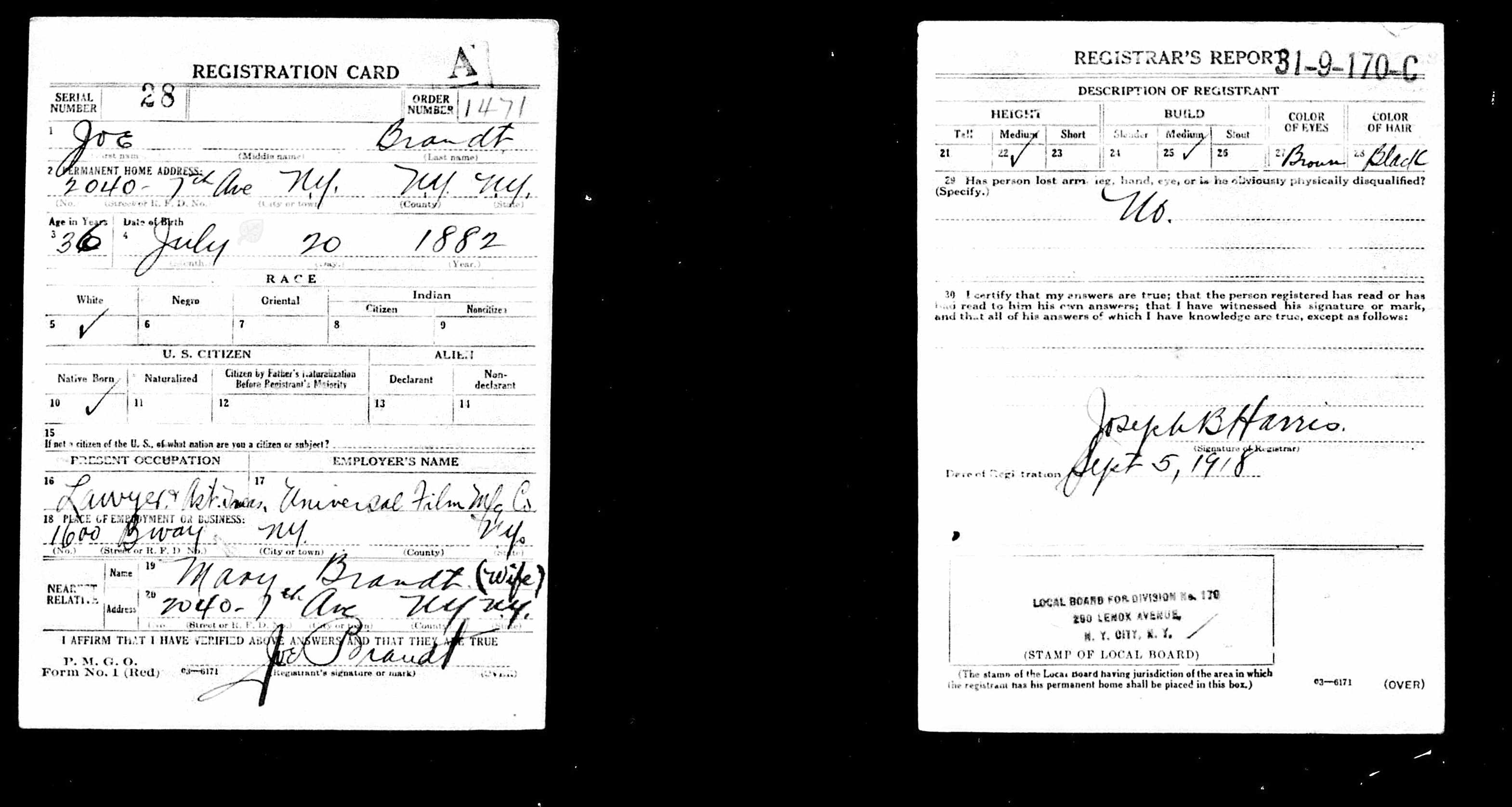
A World War I registration for a Ben Brotman born in 1876, no birthplace listed, living in Denver, Colorado.  I might not have given it much thought but for the name given as his nearest relative: Moses Brotman of Alliance, New Jersey, his father.  Moses Brotman of Alliance is the Brotmanville Moses Brotman (Alliance was the name of the community where the Brotmans settled, part of Pittsgrove, now called Brotmanville.).  This Ben Brotman was his son. The age fit exactly—the Ben Brotman living in Pittsgrove in 1900 was 24, thus born in 1876, just like the Ben Brotman living in Colorado in 1918, son of Moses. I had no child listed for Moses named Benjamin, and if this was in fact his son, he was born before Moses married Chaya/Ida/Clara Rice.  That is, this could be Abraham’s full brother from Moses’ first wife, whose name I did not know.

But could I be sure that this was the Ben Brotman who had lived in Pittsgrove, then Philadelphia, then Davenport, Iowa? And if so, what was he doing in Colorado in 1918 when this draft registration was filed? After all, Ben Brotman, Eva’s husband, had been listed in the 1918 and 1919 Davenport directories.

The draft registration listed the Colorado Ben Brotman as a porter at Oakes Home in Denver.  I googled that name and found that Oakes Home in Denver was an institution for patients suffering from tuberculosis.   Was Ben really an employee there or was he a patient?  There is no indication on his draft registration that he was in poor health and not able to serve in the military.  Had he gone there as a patient and recovered sufficiently to be employed but not yet enough to return to Iowa?

As you might imagine, I was now more than a bit confused.  If this was the same Ben, had he then returned to Iowa at some point in 1918, been there in 1919 and 1920, and then died by 1921, as Eva’s listing in the 1921 Rock Island directory suggested? I needed to find his death certificate, and I had no luck searching online in Iowa, Illinois, or Colorado.  As I’ve done before, I turned to the genealogy village for assistance.

I went to the Tracing the Tribe group on Facebook and found a number of people who volunteered to help me.  One person found an entry on Ancestry from the JewishGen Online World Burial Registry for a Bera Brotman who died on January 4, 1922, who was born about 1877, and who was buried at the Golden Hills Cemetery in Lakewood, Colorado.  It seemed like a long shot.  Was Bera even a man? The birth year was close enough, but if Eva was a widow in 1921, the death date was too late.  There was a phone number for a contact person at the cemetery listed on the entry, so I called him.

Name: Bera Brotman
Birth Date: abt 1877
Death Date: 4 Jan 1922
Age at Death: 45
Burial Plot: 10-097
Burial Place: Lakewood, Colorado, United States
Comments: No gravestone
Cemetery: Golden Hill Cemetery
Cemetery Address: 12000 W. Colfax
Cemetery Burials: 3839
Cemetery Comments: Contact: Neal Price (303) 836-2312

The contact person checked the cemetery records and confirmed the information listed on JOWBR, but gave me one more bit of critical information: Bera’s last residence was the Jewish Consumptive Relief Society in Denver.  By googling the JCRS, I found that JewishGen had a database of records from there, and when I searched for Ben Brotman on the JCRS database, I found this record:

JCRS record for Ben Brotman from JewiishGen

JCRS record for Ben Brotman from JewiishGen

This Ben Brotman had to be the one who had been at one time living in Pittsgrove, New Jersey, and then had moved to Davenport, Iowa.  This was the Ben who had married Eva and had six children.  He had twice been a patient at the JCRS.  First, he’d been admitted when he was 41 or in 1917, when he listed his status as married, and then he’d been admitted again when he was 45 or in 1921, when he listed his status as divorced.  The pieces were starting to come together.  Perhaps Ben had in fact been in Denver in 1917, recovered enough to register for the draft there in 1918, then returned to his family in Davenport sometime in 1918 through 1920.  He then had to return to the JCRS in Denver in 1921, where he died in January, 1922.  By 1921 he and Eva had divorced, and Eva had listed herself as a widow in the directory, as many divorced women did in those days when divorce was stigmatizing.

I emailed the cemetery contact person and explained that I thought Bera was really Ben, and he agreed to change the records.  But I still had some nagging doubts.  Was the Ben Brotman who had died in Colorado in January, 1922, and who had lived in Davenport also the one who was the son of Moses Brotman, as indicated on the draft registration?  I needed the death certificate to be sure, and perhaps it would also tell me where Ben was born, helping to answer the question that had started me down this path in the first place.

I ordered the death certificate, and it finally arrived just the other day.

Benjamin Brotman death certificate

Benjamin Brotman death certificate

Ben Brotman died on January 4, 1922, of pulmonary tuberculosis at the J.C.R.S Sanitorium.  He was 45 years old and born in 1876, and he had been a tailor.  He had contracted TB in Davenport, Iowa, and had had it for ten years, or since 1912, which would mean around the time the family had moved to Iowa.  (That makes me wonder even more whether his daughter Flora had also died of TB, since she died in 1913.)  The doctor at JCRS who signed the death certificate said that he had attended Ben since September 7, 1921, which must have been when he was admitted the second time.  The certificate stated that Ben had been a Denver resident for three months and 28 days, indicating that he had been elsewhere before returning in September.  It also reported his marital status as divorced.  Finally, his place of birth was given as Austria, and his parents were also reported to have been born in Austria.

And then the answer I’d been seeking: his father’s name was Moses.  This was then most definitely the same Benjamin Brotman I had traced from Pittsgrove to Philadelphia to Davenport to Denver to Rock Island and back to Denver.  This was the son of Moses Brotman, my great-grandfather’s brother.

And then the (hopefully accurate) big revelation:  his mother’s name was Lena.  For the first time I had a record of the name of Moses’ wife prior to Ida/Chaya/Clara Rice.  Lena.  She very well might have been the mother of Abraham Brotman.  I don’t know.  There is a big gap between Abraham’s presumed birth year of 1863 and Benjamin’s birth year of 1876.  There must have been other children in between, I’d think.  Or perhaps Lena was Benjamin’s mother, and Abraham’s mother was an even earlier wife of Moses. But since both Abraham and Benjamin named their first daughters Lillian and at around the same time, I think that both of these girls were named for their grandmother Lena, who must have died before 1884 when Moses married his second wife Chaya.

I made one more look back at the records I had for Moses and for Abraham and realized that I had not re-checked the 1895 New Jersey census.  Since it only listed names, not ages or birthplaces, I had not thought it important in my search for where they’d lived in Europe.  Moses and his family are listed on the page before Abraham and his family on that census.   Abraham is listed with Minnie and their first three children, Joseph, Samuel, and Kittella (presumably Gilbert).

Abraham Brotman 1895 NJ census Ancestry.com. New Jersey, State Census, 1895 [database on-line]. Provo, UT, USA: Ancestry.com Operations Inc, 2007. Original data: New Jersey Department of State. 1895 State Census of New Jersey. Trenton, NJ, USA: New Jersey State Archives. 54 reels.

Abraham Brotman 1895 NJ census
Ancestry.com. New Jersey, State Census, 1895 [database on-line]. Provo, UT, USA: Ancestry.com Operations Inc, 2007.
Original data: New Jersey Department of State. 1895 State Census of New Jersey. Trenton, NJ, USA: New Jersey State Archives. 54 reels.

Moses is listed with Clara and the five children they had had by 1895: Sadie, Katie, Lillie, Samuel, and “Abraham.”[1] But also listed with Moses is a name I had overlooked during my preliminary research: Bennie.  He was listed in the 5-20 year old category, and if this was the Ben Brotman of Iowa and Denver, he would have been 19 years old in 1895.  There he was—Benjamin Brotman, the son I had overlooked and who very well could have been the full brother of Abraham Brotman.

Moses Brotman 1895 NJ census Ancestry.com. New Jersey, State Census, 1895 [database on-line]. Provo, UT, USA: Ancestry.com Operations Inc, 2007. Original data: New Jersey Department of State. 1895 State Census of New Jersey. Trenton, NJ, USA: New Jersey State Archives. 54 reels.

Moses Brotman 1895 NJ census
Ancestry.com. New Jersey, State Census, 1895 [database on-line]. Provo, UT, USA: Ancestry.com Operations Inc, 2007.
Original data: New Jersey Department of State. 1895 State Census of New Jersey. Trenton, NJ, USA: New Jersey State Archives. 54 reels.

What I don’t know and will likely never know is why Ben and Eva left New Jersey. Why did he go to Davenport, Iowa?[2]  The whole story is rather sad. He doesn’t even have a headstone at the Golden Hills cemetery.  I have identified some of his descendants, and perhaps when I return, I will try and contact them.

Although I was very excited to find this lost Brotman, unfortunately I still don’t have any record identifying a specific town or city where the Brotmanville Brotmans lived in Europe.  But soon I will head off to Tarnobrzeg, Poland, the town I still think is the most likely ancestral home of my great-grandparents Joseph and Bessie Brotman.


[1] I found this very strange—did Moses really have another son named Abraham? The Abraham listed on the 1895 New Jersey census was five years old or younger, meaning he was born in 1890 or later.  Samuel was born in 1889, but must not yet have turned five; Lily was born in 1892.  The only other child born between 1890 and 1894 was Isaac (who became Irving), not Abraham, so I assume this entry on the 1895 census was a mistake and that “Abraham” was really Isaac.

[2] In doing this research I kept tripping over another Brotman family—a family living in Rock Island that owned the theaters in town.  However, they do not appear to be related.  The patriarch of that family, Jacob Brotman, was born in 1848 in Minsk, Russia, and had lived in London before emigrating to the US sometime after 1901.   Since Joseph and Moses were born around the same time but somewhere in Galicia, it seems unlikely that Jacob was a close relative.  But anything is possible.

A Difficult Life: Julius Seligmann


http://www.gettyimages.com/detail/158503169

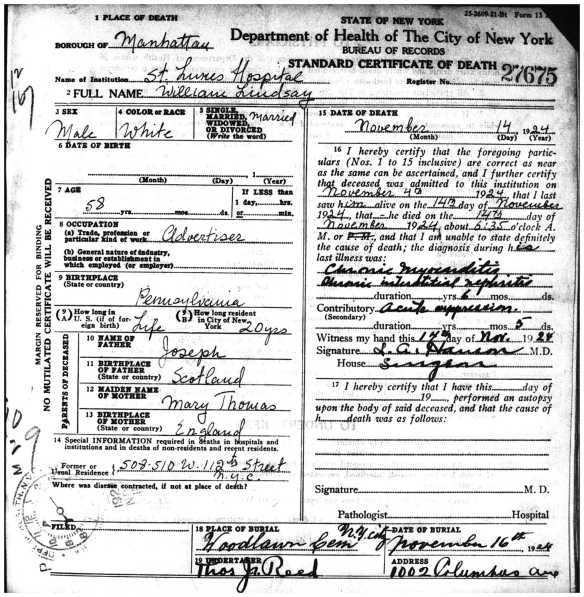
Julius Seligmann, son of August and grandfather of Wolfgang, lived a life filled with conflict.  As I’ve written previously, he was shunned by his family for converting to Catholicism and marrying Magdalena Kleisinger, a Catholic woman. Since their first child Walter was born in February, 1925, I assume that Julius and Magdalena must have married by 1924.  According to family lore, he had to pay his family a substantial sum of money, causing him great financial distress.

Since writing previously about the challenges Julius faced, I’ve learned a bit more, thanks to Wolfgang and some documents he was able to find.  One thing that Julius tried to do to address his financial condition was to secure some money from the estate of his uncle, the James Seligman who moved to England and died in 1930.  Although we now know that James’ widow had control over the estate for the duration of her life and the principal was not to be distributed for over another fifty years, Julius was obviously in great need of money and hoped to be able to get some of what must have been a substantial amount of money.

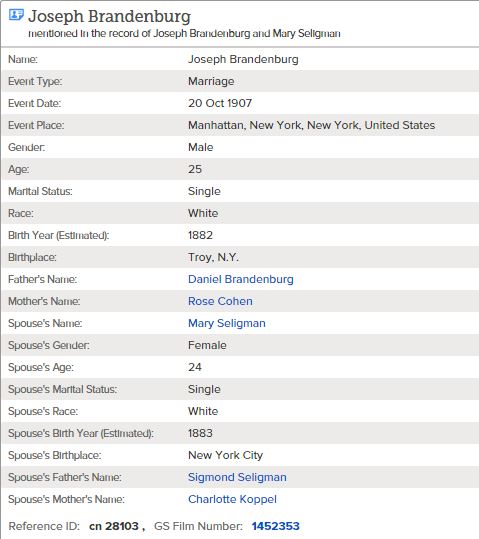
In April, 1931, he wrote the following letter to the lawyers handling the estate of his uncle James:

Lawyers-page-001


As translated by Wolfgang, in this letter Julius was asking the bank how to contact James’ widow in order to ask her for some money.  He wrote that he was having a lot of financial problems after the bank closed down and that he had had to apply for a “Vergleichsverfahren,” which is apparently a method used by debtors that is somewhat like a bankruptcy proceeding.  Julius told the lawyers he was looking for a thousand Reichsmarks in order to take care of his most urgent debts.

In June, 1932, Julius received the following letter from his cousin Moritz Oppenheimer.  Moritz, who I wrote about here, was both a successful businessman and a horse breeder with a large stud farm.

Oppenheimer-page-001

From this letter, as translated by Wolfgang, it would appear that Julius had asked Moritz to go to England to see if they could resolve their claims against the estate of James Seligman.  Moritz had responded that he thought such a trip might be successful and that it was only necessary for one person to go.  (It’s not clear who he thought should go.) But Moritz also wrote that he was traveling and not at home and that Julius should contact him and he would be glad to help.   He also wrote that he was not available on Sundays as he was at the races—horse races, I’d assume.[1]

In September, 1932, Julius wrote the following letter to the German embassy in London, seeking a lawyer there to help him with his claim against the estate of his uncle.

julius letter front-page-001

julius letter front-page-002

According to Wolfgang, Julius wrote in this letter that he had been notified that since his uncle had not had any children, he and other relatives were to inherit 150 to 300 pounds as their inheritance.  He asserted that the widow had promised to pay this money, but had never done so, and that now neither she nor her attorneys were responding to his requests for payment.  He commented that his economic situation was not good and that they needed to do something quickly.

I do not think anything came from any of these attempts to get money from the estate back in 1932 as we know that Julius eventually was forced to close his store in Gau-Algesheim in 1935 and move to Bingen in 1939.

Both the Hellriegel book about Gau-Algesheim and Wolfgang suggested that the chief of police in Bingen had extended protection to Julius and his family despite knowing that Julius had Jewish roots.  Wolfgang recently spoke with someone who knew his father Walter during the war; he told Wolfgang that everyone in the community knew that Julius had come from a Jewish family, but that no one cared.  This man’s father, like the prior in the Rochus chapel I wrote about last time, spoke out against Hitler and the Nazis.  It would appear that there were a good number of people in Bingen who were opposed to the Nazis and did what they could to protect the Jewish citizens. Sadly, however, it was not enough.

Deutsch: Rochus-Kapelle in Bingen am Rhein/Deu...

Deutsch: Rochus-Kapelle in Bingen am Rhein/Deutschland (Photo credit: Wikipedia)


****


[1] Wolfgang also found some discussion of Moritz Oppenheimer on a German internet horse-racing enthusiast’s forum back in 2010.  The participants were discussing the history of the stud farm once owned by Oppenheimer and how he had been driven to bankruptcy by the Nazis, forced to sell the stud farm for a price far below its value, and then died either by his own hand or executed by the Nazis.  http://www.galopper-forum.de/viewtopic.php?f=50&t=2473

The Faces of My Past: The Magic of Photography

I received some remarkable photographs from my cousin Suzanne, the daughter of Fred and Ilse Michel.  Fred, as I wrote about here, was the grandson of August Seligmann, who was my great-great-grandfather Bernard Seligman’s brother.  Fred would have been my grandfather John Nusbaum Cohen’s second cousin, making him my second cousin, twice removed.  Suzanne is thus my third cousin, once removed.

Suzanne sent me a number of photographs, including some taken of prints that had hung in her childhood home in Scranton, Pennsylvania.  For example, here are two prints of Bingen, Germany, the town where Fred Michel lived and also where our mutual ancestor Moritz Seligmann lived (in Gaulsheim, now part of Bingen) before moving to Gau-Algesheim.  It is also close to where my cousin Wolfgang now lives, and he identified the location and some of the structures depicted therein.

Courtesy of the Family of Fred and Ilse Michel

Courtesy of the Family of Fred and Ilse Michel

Courtesy of the Family of Fred and Ilse Michel

Courtesy of the Family of Fred and Ilse Michel

Bingen 3

Courtesy of the Family of Fred and Ilse Michel

These prints show the city of Bingen’s location at the intersection of the Rhine River and the Nahe River.  According to Wolfgang, the tower in the river is called the Mäuseturm or “tower of mice,” and the church on the hill in the top print is the Rochuskapelle or the chapel on Rochus Hill.  Wolfgang said that his grandfather Julius and his family survived the last part of World War II in the Rochus chapel. Wolfgang told me that much of the city of Bingen was destroyed by British bombers in November, 1944.  The bombs destroyed the apartment whereJulius Seligmann and his wife and sons lived, so they moved to the Rochuskappelle, which the monks had opened for those who had lost their homes and their possessions.

On the reverse of the top print is written, “So that you always think of Bingen and your friends: ???-Kathi-Rainer und Christa Güttler. Bingen, Nov,11, 1974.”  The reverse of the second print says, “The loving Ize and his wife to remember Bingen from Gret and Kath Scharer.”   Based on the captions on these photographs from an album that belonged to Fred Michel, these were close friends.

Courtesy of the family of Fred and Ilse Michel

Courtesy of the family of Fred and Ilse Michel

scharers in album

These prints of Bingen before the war and the photographs of Fred’s friends made me think about what was lost during the war.  Not just all the millions of people who died, but also the landscape, the history, and, for the many who were lucky enough to emigrate, their homeland.  Perhaps these old prints and the pictures of his friends helped keep some of those happier memories alive for Fred Michel.

Here is a photograph of Fred Michel and his mother Franziska Seligmann Michel taken when Fred was a young boy, when he likely could never foresee leaving Germany and moving to a place called Scranton:

Fred Michel and Franziska Seligmann Michel  Courtesy of the Family of Fred and Ilse Michel

Fred Michel and Franziska Seligmann Michel
Courtesy of the Family of Fred and Ilse Michel

Here is a photograph of Franziska’s headstone.  She died four years before Fred left for America.

Courtesy of the Family of Fred and Ilse Michel

Courtesy of the Family of Fred and Ilse Michel

I believe these are photographs of Fred as a young man, taken in Munich in 1928, according to the caption:

Courtesy of the Family of Fred and Ilse Michel

Courtesy of the Family of Fred and Ilse Michel

Although he is not identified in the photographs above, here is a photograph of Fred with Ilse and his children sometime around 1960, and it appears to be the same man many years later:

Courtesy of the Family of Fred and Ilse Michel

Courtesy of the Family of Fred and Ilse Michel

I was quite excited about these two portraits. I know who is in these photographs because of the inscriptions on the reverse:

August Seligmann

August Seligmann Courtesy of the Family of Fred and Ilse Michel

Rosa Goldmann Seligmann

Rosa Bergmann Seligmann Courtesy of the Family of Fred and Ilse Michel

Courtesy of the Family of Fred and Ilse Michel

Courtesy of the Family of Fred and Ilse Michel

August was my great-great-granduncle, the brother of Bernard Seligman.  Here is a picture of Bernard, my great-great-grandfather.  Can you see any resemblance between the two brothers?

Bernard Seligman

Bernard Seligman

Rosa’s headstone is the one that was terribly defaced in the Gau-Algesheim cemetery.

closeup of Rosa Seligmann headstone

And here are the portraits that intrigue me the most.

Courtesy of the Family of Fred and Ilse Michel

Courtesy of the Family of Fred and Ilse Michel

Courtesy of the Family of Fred and Ilse Michel

Courtesy of the Family of Fred and Ilse Michel

Who are these people?

On the reverse of one of these is the following:

Courtesy of the Family of Fred and Ilse Michel

Courtesy of the Family of Fred and Ilse Michel

By editing and zooming and enlarging the script below the photographer’s information, I was able to see more clearly what was written there:

enhanced snip photo 2

I could decipher Seligmann there as well as von Gau-Algesheim to the right, but I was not able to read the word underneath Seligmann.  I posted the snip of this to the German Genealogy group on Facebook, and two people there confirmed that the word was the German word for “grandfather.”  One of the two also insisted that the name was Schafmann, not Seligmann, but I still am sure that it says Seligmann, and not only because I know that was the family’s name.  What do you think?

So if this man was a Seligmann and a grandfather, who was he?  Since the portrait belonged to Fred Michel, I would have assumed that it was his grandfather, that is, August Seligmann.  But the man in this portrait does not appear to be the same person as the man in the portrait above, which was clearly labeled August Seligmann.  So my thought/hope was that this was the grandfather of Fred’s mother Franzeska, who must have given these old pictures to her only child.  If that is the case, then these two portraits depict my great-great-great-grandparents, Moritz Seligmann and Babetta nee Schonfeld.

But Moritz was born in 1800 and Babetta in 1810.  I wondered whether there would even have been photography portraits like these in their lifetime.  I looked again at the label on the back of the photograph of Moritz and saw that the photographer was Hermann Emden of Frankfort.  I took a chance and googled the name, not expecting anything.  I was quite surprised and happy to get numerous hits for Hermann Emden.  His full name was Hermann Seligmann Emden, and he was a very well-known and successful Jewish photographer and artist.  Here is the entry from the Jewish Encyclopedia for Hermann Seligmann Emden:

German engraver and photographer; born at Frankfort-on-the-Main Oct. 18, 1815; died there Sept. 6, 1875. Early evincing a love for art and unable to afford an academic education, he entered an engraving and lithographic establishment as an apprentice, endeavoring especially to perfect himself in the artistic side of his work. In 1833 he left Frankfort and went to Hersfeld, Darmstadt, and Bonn. His portrait-engraving of Pope Pius IX. and his views of Caub, Bornhofen, and the Maxburg belong to this period. He also turned his attention to photography, then in its infancy, and was one of the first to establish a studio at Frankfort-on-the-Main. He made his reputation as photographer by the work “Der Dom zu Mainz und Seine Denkmäler in 36 Originalphoto-graphien,” to which Lübke refers several times in his “History of Art.” Emden was the first to compose artistic photographic groups (“Die Rastatter Dragoner,” “Die Saarbrücker Ulanen,” etc.), and was also among the first to utilize photography for the study of natural science.

You can see some of his more famous works here.

Once I saw that Emden died in 1875, I was even more certain that these were portraits of Moritz and Babetta Seligmann.  August would have only been 34 when Emden died, and the man in that portrait is quite clearly older than 34.  It has to be his father Moritz. Moritz and Babetta had to be quite comfortable, I would think, having their photographs taken by such a successful photographer.  I also wonder whether Emden was a relative.  Seligmann was a fairly common name, and it was often used as a first name as well as a surname.  But perhaps further research will reveal some familial connection.

But for me what is most important is that I am looking at the faces of my three-times great-grandparents.  I never ever thought that would be possible.

Some Perspective on my Nusbaum and Dreyfuss Ancestors

Right now I am pretty absorbed in following up on the Seligmann trail in Germany and the US and in preparing for my trip, both in terms of travel details and in terms of trying to find as much information as I can about the Brotmans.  I’ve been spending time going back over the Brotmanville Brotmans, hoping to find some clues I missed before the DNA results corroborated the family story that Joseph and Moses Brotman were brothers.

But before too much time goes by, I want to reflect a bit on my Dreyfuss and Nusbaum ancestors.  In many ways they typify the German Jewish immigrants who arrived in America in the 1840s and 1850s.  They started as peddlers, they eventually became the owners of small dry goods stores in small towns, and for many of them, they remained dry goods or clothing merchants.  Unlike my Cohen relatives, who were pawnbrokers for the most part, or my Seligman relatives, who started as merchants, but became active in politics and civic and military matters in Santa Fe and elsewhere, my Dreyfuss and Nusbaum ancestors began and stayed Pennsylvania merchants, even into the 20th century.

Harrisburg Market Square with Leo Nusbaum store

Harrisburg Market Square with Leo Nusbaum store

In addition, the Dreyfuss and Nusbaum families almost all stayed in Pennsylvania where they started.  There were some who went to Peoria, though most returned to Pennsylvania, and a few who went to Baltimore, but overall the Dreyfuss and Nusbaum families started in small towns in Pennsylvania and in Harrisburg and eventually moved to Philadelphia.  As far as I’ve been able to find them, many if not most of their descendants also stayed in the Philadelphia area.

But beneath what might appear to be a very consistent and predictable pattern of living was a lot of turmoil.  These were families who endured terrible tragedies—many children who died young from disease or from accidents, and many children who lost a parent at a very young age.  Tuberculosis ravaged the family, as did heart disease and kidney disease.  One member of the family died in the Great Fire of San Francisco.  There were also a tragic number of family members who took their own lives.

In addition, this was a family that went from poverty to comfort and then suffered financially when the 1870 Depression struck, causing many of the stores to close and forcing family members into bankruptcy.  Yet the family in general rebounded, started over, and once again became merchants with successful businesses in most cases.

The other pattern I’ve noticed in the Nusbaum and Dreyfuss lines is assimilation.  Although there were certainly examples of intermarriage and conversion among the Cohen and certainly the New Mexican Seligman lines, that tendency to assimilate and move away from Judaism seemed even more widespread among the Dreyfuss and Nusbaum descendants.  There were fewer people buried at places like Mt Sinai in Philadelphia, fewer indications of synagogue membership or other participation in the Jewish community.  Perhaps those early years in the small towns where they were likely the only Jews in town took a toll on the role that Judaism would play in their lives and their identities.

Overall, these two lines were very hard to research and write about.  Not because they were hard to locate, although the Fanny Wiler mystery kept me going for quite a long time.  But because there was just so much unhappiness, so much suffering.  When I think back to their roots, coming from two small towns in Germany, Schopfloch and Hechingen, I wonder whether those early immigrants ever questioned their decision to leave Germany.  I assume they left for economic opportunities and freedom from the discrimination they faced as Jews in Germany.  Presumably they believed they had found both when they arrived and as they settled into life in Pennsylvania.  And in many ways they had.  They were free to worship, or not worship, as they saw fit.  They were able to make a living, own property, even own businesses.  They survived.

Schopfloch

Schopfloch

But all the tragedy and loss they endured had to wear on them in many ways.  Many of the family lines ended without any descendants.  I have had more trouble finding current descendants than I’ve had with the other lines I’ve researched.  I don’t have one relative with the name Nusbaum, aside from my father, whose middle name is Nusbaum.   The family seems to have disappeared, blended into other names, other families, other traditions.

For that reason, as hard as it was, I am happy that I was able to document and tell their story: where it began in Germany, how it continued in Pennsylvania, and what happened between their arrival in the 1840s and in the century that followed.

Where Am I? Where Am I Going? Tarnobrzeg


Polski: Tarnobrzeg, Panorama nocna osiedla Ser...

Polski: Tarnobrzeg, Panorama nocna osiedla Serbinow (Photo credit: Wikipedia)

It’s time to take stock and figure out where I am and where I have been and, of course, where I am going next.  I have “finished” my research on the Dreyfuss and Nusbaum families, and when I say “finished,” I know that as with all my family lines, I am never finished.  I always have more to do—whether it is trying to go back further in time or trying to connect with descendants.  There are a number of unanswered questions, as there always are and always will be.  I will write up something to bring some closure to what I know about these two family lines within the next several days.  But for today, I just want to think about where I am more generally.

I have now done many of my father’s paternal lines.  Starting with the Cohens, I’ve also covered the Seligmans, the Schoenfelds, the Nusbaums, and the Dreyfusses (Dreyfi?), and, of course, all the other names that came with later generations: Sluizer, Weil, Selinger, Bacharach,  Wiler, Simon, Meyers, Dinkelspiel, Hano, and so on.   I’ve also missed a few lines.  I haven’t yet focused on the line that starts with Hart Levy Cohen’s wife, Rachel Jacobs, or with Jacob Cohen’s wife, Sara Jacobs.  I haven’t looked at all at the line that begins with Voegele Welsch, wife of Amson Nusbaum.  And I am sure there are other maternal lines I need to explore.  Of course, those are often the hardest because the names have disappeared from the family, and each of those ancestors dates back close to 200 years ago.  But eventually I will get there.

And next I will explore my father’s maternal lines, the Schoenthals and Katzensteins: more German Jews who came to Pennsylvania in the 1840s or so.  Who knows what stories, what adventures, what heartbreaks I will discover along the way.

But before I turn to the Schoenthal and Katzenstein families, I have several other questions to research and address.  The Seligmann family tree continues to grow both backwards in time and horizontally, thanks to my cousin Wolfgang and all the research he has done.  Their stories continue to fascinate and also horrify me.  I am also in touch with the daughter of Fred and Ilse Michel, and she has shared stories and photographs with me.

There are also lingering questions regarding the Goldschlagers, now that I’ve found two other families with that name and roots in Romania.  We are hoping to hire a Romanian researcher to help us learn more.

And finally, there are those ever elusive Brotmans.  Although I am not putting any more hope (or much time) into using DNA as a tool to find my Brotman ancestors, I still have hope that something will turn up.  Just this past week someone contacted me, asking about Chaye Fortgang, Joseph Brotman’s first wife and the mother of the first four Brotman children, Abraham, Sophie, David, and Max.  He has Fortgang family from Grebow, a town less than ten miles from Tarnobrzeg and also the town that David and Abraham Brotman gave as their home on the ship manifest when immigrating to the US.  Perhaps by researching the Fortgang family, I will also learn about Joseph Brotman and his family.  In addition, I am focused on the Brotmanville Brotmans, hoping that that line will lead to more answers.

English: Gmina Grębów COA Polski: Herb gminy G...

English: Gmina Grębów COA Polski: Herb gminy Grębów (Photo credit: Wikipedia)

In addition, I will be visiting Tarnobrzeg in person in just about a month.  We will be hiring a guide who also does genealogy research, and we will be joined by my newly-found cousin Phyllis, the niece of Frieda, the woman who matched my mother as a close cousin through DNA testing.  Phyllis and I have chosen to believe that our grandmothers were in fact first cousins, and we are hoping to find some evidence to corroborate it.  So although I am not writing about it on the blog, much of my time right now is spent researching for this trip.  Once I am there, I will share my experiences on the blog, so stay tuned.

Photograph of Tarnobrzeg Main Square.

Photograph of Tarnobrzeg Main Square. (Photo credit: Wikipedia)


Too Many Missing Pieces: Part II

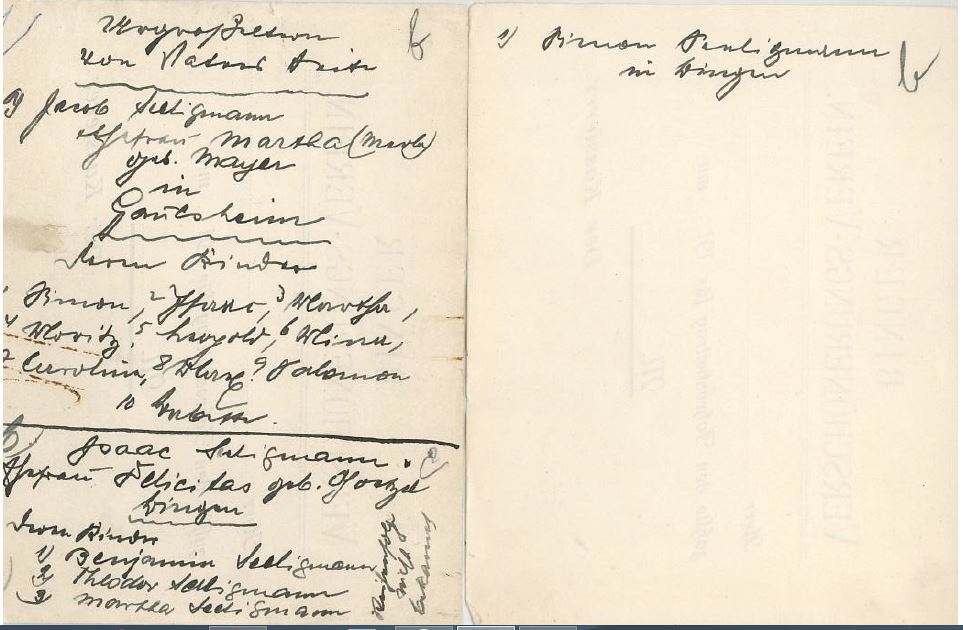
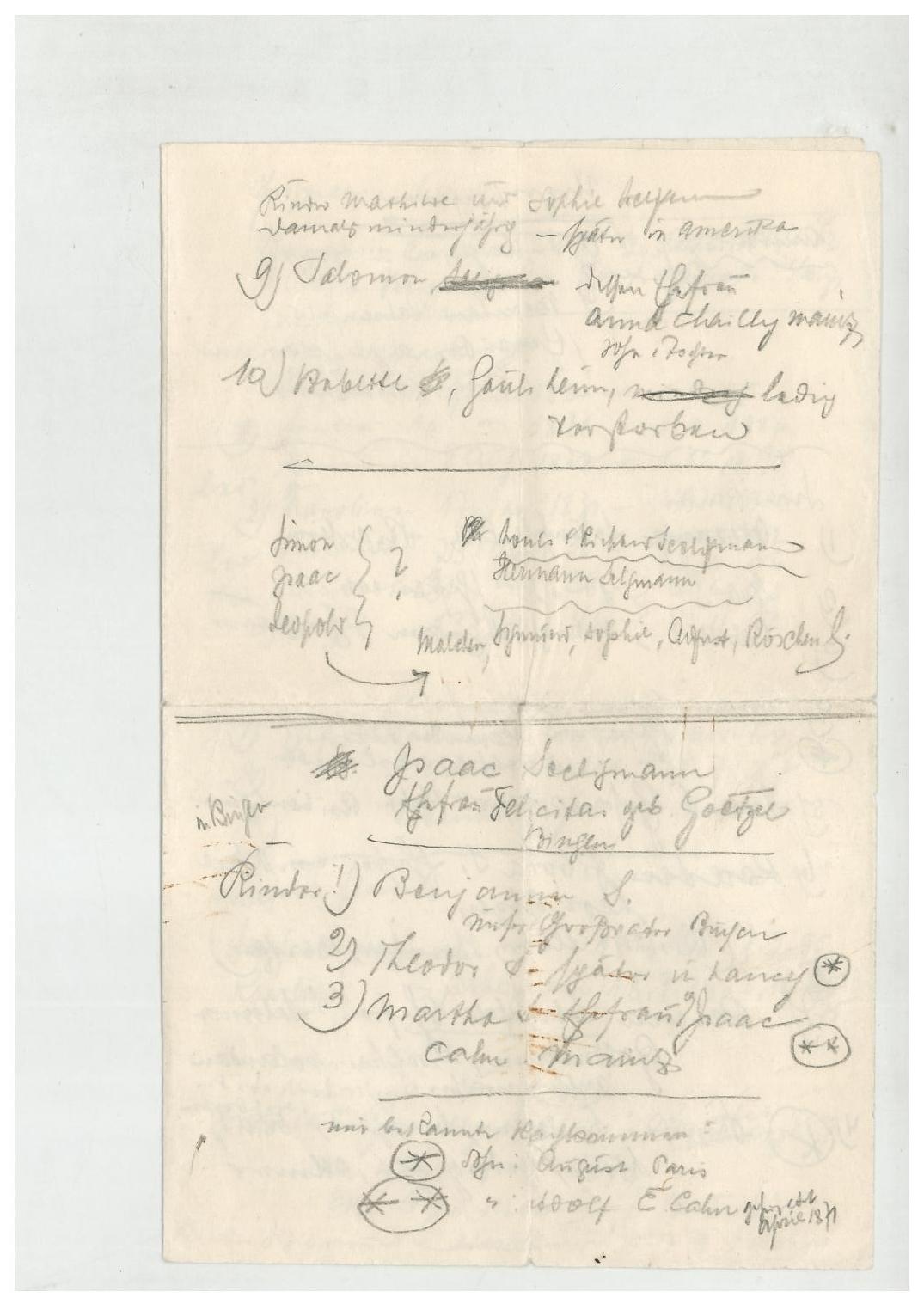
In my last post, I wrote about the list of English James Seligmann’s heirs that my cousin Wolfgang found in his family’s papers.  There were 21 principals named as heirs on that document, and I had discussed all the easily identified ones and some of those that were more difficult to figure out.  I had discussed Numbers 1, 2, 6-13, 15, 16, 19-21.  That left Numbers 3-5,  14, 17, and 18.  Here again is the list of heirs:

heirs list p 1

Heirs List p 2

So let’s start with Number 3, Johanna Bielefeld, the one whom Elsa Oppenheimer had claimed was not a daughter of Hieronymus Seligmann in her July, 1984 letter.

Elsa Oppenheimer 1984 letter-page-001

Elsa Oppenheimer 1984 letter-page-002

Perhaps Elsa was wrong; after all, she was wrong about Adolph Seligman not being the child of Moritz and Babetta, as discussed last time.  Or maybe Johanna was the daughter of Benjamin Seligmann.  I am not sure yet, but I do know that she was born in Gau-Algesheim.  Wolfgang found this registration card for her, dated January 12, 1939, issued by the police in Mainz.  It gives her birth name as Seligmann, her birth date as March 15, 1881, and her birthplace as Gau-Algesheim.  I have written to my contact in Gau-Algesheim, asking him to see if he can find a birth record for Johanna so I can determine who her parents were.  Notice also the large J on her card, indicating that she was Jewish.

Here is the companion card for her husband Alfred Bielefeld:

The list of heirs provided the names of Johanna and Alfred’s children, Hans and Lili (or Lily).  It indicated that Johanna had died as had Hans, he in 1948.  Then it provided a married name for Lili, Mrs. Fred Hecht, and an address on West 97th Street in New York City.  Searching for Hans Bielefeld brought me to someone with that name on the 1940 census, living in Cleveland, Ohio. He was working as an insurance agent, was 37 years old, and had been residing in Mainz, Germany, in 1935.

Year: 1940; Census Place: Cleveland, Cuyahoga, Ohio; Roll: T627_3221; Page: 5A; Enumeration District: 92-451

Year: 1940; Census Place: Cleveland, Cuyahoga, Ohio; Roll: T627_3221; Page: 5A; Enumeration District: 92-451

Further searching found an index listing in the Ohio Deaths database on Ancestry for Hans Bielefeld, indicating he had died on September 13, 1948, the same year of death given on the list of heirs document.  On Fold3.com, I then found naturalization papers for Hans Ludwig Bielefeld, indicating that he was divorced, that he was born on July 1, 1902 in Maine (sic), Germany, and that he had arrived in the US on the SS Gerolstein on July 14, 1938.

Publication Number: M1995 Publication Title: Naturalization Petition and Record Books for the US District Court for the Northern District of Ohio, Eastern Division, Cleveland, 1907-1946 Content Source: NARA National Archives Catalog ID: 1127790 National Archives Catalog Title: Naturalization Petitions, compiled 1867 - 1967 Record Group: 21 Partner: NARA State: Ohio Court: Northern District, Eastern Division Catalog Keywords: Petitions Naturalization Immigration Citizenship Fold3 Publication Year: 2008

Publication Number: M1995
Publication Title: Naturalization Petition and Record Books for the US District Court for the Northern District of Ohio, Eastern Division, Cleveland, 1907-1946
Content Source: NARA
National Archives Catalog ID: 1127790
National Archives Catalog Title: Naturalization Petitions, compiled 1867 – 1967
Record Group: 21
Partner: NARA
State: Ohio
Court: Northern District, Eastern Division
Catalog Keywords: Petitions Naturalization Immigration Citizenship
Fold3 Publication Year: 2008


That led me to a passenger manifest for the SS Gerolstein, where I found Hans listed as a divorced merchant from Mainz.  It seemed like this could be the son of Johanna Seligmann Bielefeld, but I couldn’t be sure.

So I searched for his sister Lili.  I first searched for her as Lili Hecht, but had no luck, so I searched for Lili Bielefeld and found her first on an English ship manifest dated September 18, 1940, from Liverpool bound for Montreal, Quebec.  Lili was listed as 36, having last resided in London, but born in Germany.  Her occupation was given as a domestic.  The age, birthplace and name seemed correct, so I considered it likely that this was the right person.

Ancestry.com. UK, Outward Passenger Lists, 1890-1960 [database on-line]. Provo, UT, USA: Ancestry.com Operations, Inc., 2012.

Ancestry.com. UK, Outward Passenger Lists, 1890-1960 [database on-line]. Provo, UT, USA: Ancestry.com Operations, Inc., 2012.

Then I found her listed with the same information on a US manifest for passengers entering the United States from Canada.  But since Lili did not arrive until September, 1940, she is not listed on the 1940 census, making it extremely difficult to find her in the online databases on Ancestry.  There were a number of Fred Hechts, but how would I know if any of them were married to Lili?

So I turned to Google and entered “Lili Bielenfeld Fred Hecht,” and once again I hit the jackpot.  Like Fred and Ilse Michel, Fred Hecht and Lili Bielenfeld have papers in the collection at the Leo Baeck Institute entitled “Hecht and Gottschalk Family Collection; AR 5605.”  In the biographical note included with this collection, I learned that Fred Hecht came from a German Jewish family with a long history.  I will quote here only the sections relevant to Fred, Lili and Hans:

Jakob and Therese Hecht had a son, Siegfried Max Hecht (alternatively Fritz, later Fred, 1892-1970). Siegfried Hecht became a merchant and served in the German military during World War I. Siegfried and his wife Emma née Cahn divorced in 1939, and he immigrated to the United States in 1940, where he took on the name Fred. He settled in New York City and became a jewelry salesman. In December of 1944, he and Lili née Bielefeld (1904-1977) were married.

The Bielefeld family can be traced back to the late 18th century. The family lived in Karlsruhe, Mainz, and Mannheim until the 1930s, when some members immigrated to the United States. Lili Hecht née Bielefeld was the daughter of Alfred Bielefeld, a wine merchant, and Johanna Bielefeld née Seligmann. Despite efforts to procure passage to the U.S., both Alfred and Johanna perished in the Holocaust. Alfred died in Theresienstadt, and Johanna was deported from Theresienstadt to Auschwitz, where she perished.

Lili Hecht née Bielefeld’s brother Hans Ludwig Bielefeld (1902-1948) was a merchant. He married Lilli née Kiritz in 1933, and the couple divorced in 1936. Hans Ludwig immigrated to the United States under the sponsorship of his cousin, Irma Rosenfeld, and settled in Cleveland, Ohio, where he worked in insurance. After his death, his sister Lili Hecht née Bielefeld was the sole heir to the Bielefeld family property, which she claimed in the 1960s alongside restitution for her parents’ deaths.

Thus, from these papers and this biographical note, I was able to find out a great deal about what had happened to Johanna Seligmann Bielefeld, her husband, and her two children, Hans and Lili.  I will write more about them in a separate post once I have a chance to examine the LBI collection more carefully and obtain translations where necessary.

Number 4 on the list, Bettina Arnfeld, was more difficult to locate, but I found a Bettina Elizabeth Arnfeld listed on FindAGrave  with the notation, “Body Lost or Destroyed.” Her birthdate was given as March 17, 1875.  This may have been the “Elizabeth” whom Elsa claimed was not a child of Hieronymus Seligmann.  I then looked for and found Bettina Elizabeth Arnfeld in the Yad Vashem Database.  The entries there confirmed that her birth name was Seligmann, that she was born on March 17, 1875, and that she had resided in Muelheim Ruhr in Germany at the time she was deported.  She was exterminated at Thieresenstadt on January 23, 1943.

The list of heirs indicated that Bettina had a son, Heinz Arnfeld, living on 22 Gloucester Square in London, and he was not difficult to locate.  I found several entries for Heinz and Liselotte Arnfeld at that address in London, England, Electoral Registers on Ancestry.  I also found Heinz and Liselotte listed in the England & Wales Marriage Index on Ancestry.  They were married in Doncaster, Yorkshire West Riding in 1945. Heinz is also listed as a survivor of the Holocaust in the Shārit ha-plātah database on JewishGen.

Heinz died in 1961 and left his estate to Liselotte; she died in 1988. I do not know whether they had any children.  Since they were married in 1945 when Liselotte was 37, it does not seem likely.

That brings me to Numbers 17 and 18 on the list, putting Numbers 5 and 14 aside for now.  Who were Eva Hansu and Rosa Reisz?  If these were nieces of English James Seligmann, then they had married and changed their surnames, so how could I find them?  Since they were listed right after Emil and Eugen, sons of Carolina Seligmann and Siegfried Seligmann, I went back to the list of Carolina’s children and realized that she had daughters named Eva and Rosa.  Thus, I assumed that Eva became Eva Hansu and Rosa became Rosa Reisz.

I had good luck searching for Rosa Seligmann Reisz.  I knew her daughter’s name was Hedwig Neter from the list of heirs, and that seemed unusual enough that I decided to search for it first.  Sure enough the name came up on a passenger’s manifest dated August 31, 1940, for the ship Cameronia departing from Glasgow, Scotland, for New York.  Sailing with Hedwig was her husband Emil Neter and her mother Rosa Reis.  Emil was a 61 year old manufacturer, Hedwig a 48 year old housewife, and Rosa was 73 without occupation.  They all had last been residing in London and said the US was their intended permanent residence.

Ancestry.com. UK, Outward Passenger Lists, 1890-1960 [database on-line]. Provo, UT, USA: Ancestry.com Operations, Inc., 2012.

Ancestry.com. UK, Outward Passenger Lists, 1890-1960 [database on-line]. Provo, UT, USA: Ancestry.com Operations, Inc., 2012.

According to FindAGrave, Rosa Seligmann Reis died on January 29, 1958, and is buried at Hauptfriedhof in Mannheim, Germany.  Her son-in-law Emil Neter died on July 8, 1971, in Washington, DC, and is also buried at Hauptfriedhof in Mannheim, as is her daughter Hedwig Reis Neter, who died on May 28, 1979, in Washington.  I found it very interesting that after living in the United States all those years, Rosa, Emil, and Hedwig chose as their burial place the country they had escaped so many years before.  A little more searching turned up Hedwig’s birth certificate and a family record from 1891, both of which revealed that Rosa’s husband’s name was Ludwig Reis, son of Callman Reis, a merchant.

Ancestry.com. Mannheim, Germany, Births, 1870-1900 [database on-line]. Provo, UT, USA: Ancestry.com Operations, Inc., 2014. Original data: Personenstandsregister: Geburtsregister Standesamt Mannheim und Vororte 1876-1900, Stadtarchiv Mannheim, Mannheim. Deutschland.

Hedwig Reis Birth Certificiate Ancestry.com. Mannheim, Germany, Births, 1870-1900 [database on-line]. Provo, UT, USA: Ancestry.com Operations, Inc., 2014.
Original data: Personenstandsregister: Geburtsregister Standesamt Mannheim und Vororte 1876-1900, Stadtarchiv Mannheim, Mannheim. Deutschland.

Ancestry.com. Mannheim, Germany, Family Registers, 1760-1900 [database on-line]. Provo, UT, USA: Ancestry.com Operations, Inc., 2014. Original data: Polizeipräsidium Mannheim Familienbögen, 1800-1900. Digital images. Stadtarchiv Mannheim — Institut für Stadtgeschichte, Mannheim, Germany

Ancestry.com. Mannheim, Germany, Family Registers, 1760-1900 [database on-line]. Provo, UT, USA: Ancestry.com Operations, Inc., 2014.
Original data: Polizeipräsidium Mannheim Familienbögen, 1800-1900. Digital images. Stadtarchiv Mannheim — Institut für Stadtgeschichte, Mannheim, Germany

Searching at Hauptfriedhof on FindAGrave, I found that Ludwig had died in 1928 and had been buried at Hauptfriedhof.  It seems that Rosa and her daughter Hedwig wanted to be buried where Ludwig had been buried years before.  With the help of Matthias Steinke in the German Genealogy group on Facebook, I was able to locate the headstone for all four of them at the  Stadtarchiv Mannheim website.


At first I couldn’t find anything about Eva Hansu, Number 17.  I couldn’t find her husband’s first name, and although the heirs’ list gives her daughter’s married name as Alice Kauffman of France, I had not been able to find her either.  Then after Matthias introduced me to the Stadtarchiv Mannheim website where he had found the headstones for Rosa and her family, I decided to search for all people with the birth name Seligmann and found Eva as Eva Seligmann Hanau, not Eva Hansu as I had mistakenly read it on the list of heirs.  It provided the same birth date I’d already found for Eva, March 18, 1861, and it reported her date of death as March 18, 1939.  Her husband was Lion Hanau, born May 24, 1854, in Altforweiler, Germany, and he died February 7, 1921.  The archive also included photographs of their headstone.

As for their daughter, now that I had the correct spelling of her birth name Hanau, I was able to find her marriage certificate for her marriage to Ernst Kaufmann on August 10, 1911.

Marriage cert of Alice Hanau and Ernst Kaufmann

Marriage cert of Hanau Kaufmann p 2

Ancestry.com. Mannheim, Germany, Marriages, 1870-1920 [database on-line]. Provo, UT, USA: Ancestry.com Operations, Inc., 2014. Original data: Personenstandsregister: Heiratsregister Standesamt Mannheim und Vororte, Stadtarchiv Mannheim, Mannheim. Deutschland.

I do not know what happened to either Alice or Ernst during or after the war.

So that leaves me with only two names on the list of heirs for whom I as yet have no answers: Anna Wolf, Number 5, and Bettina Ochs, Number 14.  Anna Wolf is listed as a fraulein, so that is her birth name, not a married name.  It says that Johanna Bielfeld was her aunt, so presumably Anna’s mother was a sister of Johanna.  If, in fact, Johanna was a child of Hieronymus Seligmann, she had two sisters, Mathilde and  Auguste and perhaps Bettina.  I don’t have any information about them aside from what was listed in Elsa’s letter, posted above.  More work to be done.

And Number 14, Bettina Ochs, is even more of a puzzle.  I’d have assumed that Ochs was her married name, Seligmann her birth name.  But the note on the document mentions a brother as her next of kin, and his name was Arthur Erlanger.  That would suggest that Bettina Ochs was born Bettina Erlanger, not Seligmann.  So how is she related? Who was her husband? Which one is the blood relative of English James Seligmann?  I found one listing on JewishGen.org for Bettina Ochs-Erlanger with a secondary name as Bettina Oberdorfer.  She was born May 7, 1870, and her nationality was Italian, consistent with the Milan address provided on the heirs list.  She was listed in the Switzerland, Jewish Arrivals, 1938-1945 database; I can’t see the original document, but the index indicates that she arrived in Switzerland on August 5, 1944.

It’s amazing how much information I could mine from this one little document.  Unfortunately, although I should have gotten great satisfaction from finding so many people and so much information, I ended up feeling very sad and very drained as I added all these names of my cousins to the list of those killed in the Holocaust.  It is beginning to overwhelm me.  So much loss, so much evil.  Incomprehensible.

Putting The Puzzle Together:  Too Many Missing Pieces

Sometimes it is amazing to me how much information you can get from one document—an obituary, a death certificate, a news article.  This time it was a document my cousin Wolfgang Seligmann found in a suitcase.  In fact, I learned so much from this document that I have to divide this post into two separate posts to make each a reasonable length.

What Wolfgang found was a list of names of the heirs to the estate of James Seligman, the son of Moritz and Babetta who had moved to England. (I will refer to him as English James Seligman to distinguish him from the US James Seligman, my great-grandmother’s brother.)   The document is entitled: “J. Seligman Deceased: Statement as of 1st January 1950 of Nephews and Nieces and their Issue, who may take an interest under the Intestacy in the above Estate.”  There are 21 principals named on the document as well as the names of several of the children or relatives of those 21 who might inherit in their place, if the principals were deceased.

heirs list p 1

Heirs List p 2

I have spent a lot of time trying to figure out who these 21 people were and how they were related to English James and also thus to me.  Some of them were very easy to identify.  Number 21 was the easiest:  Mrs. Eva Cohen of Philadelphia was my great-grandmother.  She was deceased by 1950, and unfortunately there was no listing on the document of her heirs, which would have included my father, my aunt, my great-uncle Stanley, and the sons of Maurice Cohen, Buddy and Junior.

Numbers 19 and 20 were also easily identified: Arthur and US James Seligman, my great-grandmother’s brothers and the two other surviving children of Bernard Seligman, English James Seligman’s older brother.  For US James Seligman, Morton is listed as his surviving son.  For Arthur, there is mention of his “oldest son” (he had only one, Otis), and a note that he had been “Governor of Santa Fe” and might be able to find other relatives.  By 1950, however, Arthur and his son Otis were both deceased.  (These careless errors made me a bit skeptical of the Bank’s attention to detail.)

I also knew who Numbers 15 and 16 were: Emil and Eugen Seligmann were the sons of Carolina Seligmann, the half-sister of James, Bernard, and the others, and they were the grandsons of Moritz Seligmann and Eva Schoenfeld.  Emil had died from heart disease in 1942, and Eugen had died at Thierenstadt concentration camp in 1942.  Emil’s son also died during the Holocaust at Buchenwald in 1945.   His daughter Christine was still alive in 1950 when this document was created.

Number 6 is Wolfgang’s grandfather Julius, a son of August Seligmann and grandson of Moritz and Babetta.  He was still alive in 1950.  Number 7 is Moritz Seligmann, the brother of Julius about whom I wrote here.  He had served in World War I for Germany and been awarded the Cross of Honor, but was nevertheless killed during the Holocaust.  Number 8 is Franziska or Frances Seligmann Michel, the mother of Fred Michel, about whom I wrote here.  She was also the child of August Seligmann and the granddaughter of Moritz and Babetta, and had died in 1933.  Her son Fritz (Fred) is also mentioned on the heirs list.

Number 9 is Anna Seligmann Goldmann, the sister of Julius, Moritz, and Franziska and husband of Hugo Goldmann.  Anna, Hugo, and their three young children, Ruth, Grete, and Heinz, were all killed in the Holocaust.

The next four people, Numbers 10 through 13, are all from the Oppenheimer family, written about here.  Joseph, Martha, and Ella were the children of Paulina Seligmann and Meier Oppenheimer.  Paulina was the sister of Bernard, August, and James, and the daughter of Moritz and Babetta Seligmann.  Joseph and Ella both died during the Holocaust.  Martha survived, but her two children Gertrud and Paul did not.  With this document, I now learned that Martha’s married name was Floersheimer, and was able to find Gertrud and Paul in the Yad Vashem database.  Gertrud died at an unknown camp in 1942 after being deported on June 10 of that year from Wiesbaden, and her brother Paul died at a camp in Majdanek, Poland, on August 16, 1942.

Emma Oppenheimer, Number 13, I assume was Emma Neuhoff, the widow of Moritz James Oppenheimer, son of Paulina and a brother of Joseph, Martha, and Ella.  Moritz Oppenheimer, discussed here, had been a successful business person and horse breeder; he was reported to have committed suicide after being visited by the Gestapo in 1942.

That left me with eight unknowns: Numbers 1 through 5 and Numbers 14, 17 and 18.  Some of these I believe I have figured out; others I am not as certain about.  For example, Jack Seligmann, Number 1, has to be the son of a brother of James to have the Seligmann surname.  I knew he was not the son of Sigmund (never married, lived in the US), Bernard (lived in the US), or Adolph (lived in the US).  I assumed I had all the sons of August Seligmann from the records I found and records Wolfgang shared with me.  Salomon Seligmann died when he was 21, so I eliminated him.  That left only two of James’ brothers: Benjamin, a half-brother, and Hyronimus, a full-brother.  I had no records other than birth records for either Benjamin or Hyronimus, and thus, I had no way to determine whether Jack was a son of Benjamin or Hyronimus, but assumed he was the son of one or the other.

Then, while I was trying to puzzle this out, Wolfgang found another document.  It was a letter written in 1984 by Elsa Oppenheimer to the National Westminster Bank regarding the estate of English James Seligman.   (I think Elsa Oppenheimer was the daughter of Jur Oppenheimer, son of Moritz James Oppenheimer, based on the family tree I received from Wolfgang a few weeks ago.)  In her letter to the bank on July 9, 1984, Elsa attempted to correct some errors she felt the bank had made in identifying heirs of English James.    She claimed, for example, that the Bank had incorrectly listed Adolph as a son of Moritz and Babetta because she could not locate a birth record for him; she was wrong about that, however, as here is a copy of his birth record, naming Moritz and Babetta as his parents.

adolph seligman birth record


Elsa also claimed that she knew of all of the children of Hieronymous Seligmann based on birth records, and that they were Jacob and Auguste, twins born on April 8, 1869; Mathilde, born October 4, 1872; and Rosina Laura, born June 9, 1878.  Elsa asserted that Hieronymous did not have daughters named Elizabeth or Johanna.

Elsa Oppenheimer 1984 letter-page-001

Elsa Oppenheimer 1984 letter-page-002

From this letter, I am assuming that Jack Seligmann, Number 1 on the heirs’ list, was Jacob Seligmann, son of Hieronymous Seligmann and thus a grandson of Moritz and Babetta and a nephew of English James Seligman.  His wife Anna is named here as living in Luxembourg as of 1950, so I looked on Yad Vashem and found an entry for a Jacob Seligmann, born on April 8, 1869, married to Anna, a clear match to my Jacob Seligmann.  He was killed in Luxembourg in 1941, according to the Yad Vashem site.    I don’t know whether Jacob and Anna had had any children.

That brings me to Number 2, Laura Winter.  I am assuming that Laura Winter was born Rosina Laura, a daughter of Hieronymous, and married a man named Winter.  The document names a Frau Aennie Wiener as her next of kin and states that Laura and her husband also died in Luxembourg, reinforcing my assumption that she and Jacob were siblings.  Aennie Wiener is listed as residing at 8409 Talbot Street, Kew Gardens, Long Island.

For a while I didn’t know what had happened to Laura Seligmann Winter or her husband, although they were deceased by 1950 according to the list of heirs.  Included, however, in the Ilse and Fritz Michel Collection at the Leo Baeck Institute is one handwritten note that provided some clues.  The note has no title, but is just a list of names: Anna Goldmann, Hugo Goldmann, Grete Goldmann, Heinz Goldmann, Ruth Goldmann, Helene Hess [mother of Ilse Hess Michel], Max Michel, Sophie Michel, Moritz Seligmann, Jacob Seligmann, S Winter, Laura Winter, Martha Florsheimer, Paul Florsheimer, Trude Florsheimer.

Handwritten list of names Fred Michel

What can I infer from this list? I know that Ilse and Fred Michel were actively involved in trying to find family members who were missing after the war.  I know that the Goldmann family, Helene Hess, Moritz Seligmann, Jacob Seligmann, and Paul and Trude Florsheimer were all killed in the Holocaust.  Martha was not, but nevertheless my guess is that these were all people whom Fred and Ilse could not locate after the war.  My hunch was that since the Winters were listed as deceased on the list of heirs document that they also were killed in the Holocaust.

I then searched Yad Vashem’s database again, this time for anyone named Winter living in Luxembourg, and found just one listing—for a Samuel Winter.  It said he was born on October 27, 1863, in Dusseldorf, Germany, and that he was married to Martha Seligmann.  Could Martha Seligmann really be Laura Seligmann? Could there really be two German men with the surname Winter and first initial S living in Luxembourg and married to a woman whose birth name was Seligmann?  I thought the odds were slim, so I used the Related Search function on the Yad Vashem database, searching for anyone with the same surname and from the same residence.

This time I got a list of other Winters from Luxembourg, including a Laura Winter.  The entry did not have a birth date or birth place for Laura, but it said she was the widow of Samuel and that she had been murdered on August 28, 1940. But the entry for Samuel said he was not deported until April, 1943, and died on April 21, 1943, at Thieresenstadt.  So how could Laura have been a widow in 1940?  Was this a different Samuel Winter who was really married to a Martha Seligmann?  I don’t know.


Embed from Getty Images

Fortunately, it was not very difficult to find their daughter, Aennie Wiener since I had her address at 8409 Talbot Avenue in Kew Gardens, a section of Queens in New York City, was listed on the heirs’ document.  Searching for her on Ancestry quickly uncovered Anna and Joseph Wiener living at 8409 Talbot Avenue in Queens.  Their residence in 1935 had been Mannheim, Germany, and they were now 46 and 58 years old, respectively.  Living with them were their daughter Doris Grunewald, her husband Ernst Grunewald, also both German immigrants, and their one year old daughter, Hannah Grunewald, born in New York.

Year: 1940; Census Place: New York, Queens, New York; Roll: T627_2746; Page: 1B; Enumeration District: 41-1373

Year: 1940; Census Place: New York, Queens, New York; Roll: T627_2746; Page: 1B; Enumeration District: 41-1373

I also was able to find ship manifests for Anna, Doris, and Ernst, all of whom came between 1937 and 1938.  Four more who escaped from Nazi Germany. I’ve not yet found any records for any of them after the 1940 census, but I am still looking.  I am particularly interested in finding Hannah.


To be continued…