Another Jakob Goldschmidt Comes to America

As I wrote in my last post, the earliest Goldschmidts to leave Germany and come to the US were the family of Simon Falcke Goldschmidt, brother of my three-times great-grandfather Seligmann Goldschmidt. Simon had arrived in 1845 with his second wife, my three-times great-aunt Fradchen Schoenthal, and by 1860 he and all his children including those from his first wife Eveline were living in western Pennsylvania, most of them in Washington, Pennsylvania.

During this same period, almost all the children of my three-times great-grandparents Seligmann Goldschmidt and Hincka Alexander were also emigrating, though they chose to settle in Philadelphia, about 300 miles east of their relatives in the western part of the state.

The first of Seligmann and Hincka’s children to arrive was their oldest son Jakob. Jakob was born on October 22, 1822, making him about three years older than his first cousin, Simon’s son, also named Jakob Goldschmidt; both cousins changed their names to Jacob Goldsmith once in the US. To make matters even more confusing, both Jacobs married women named Fannie.  Maybe Seligmann’s Jacob chose to settle in Philadelphia and Simon’s across the state to minimize confusion for some not-yet-born family historian?[1]

To distinguish the two Jacob Goldsmiths I will refer to Seligmann’s son as Uncle Jacob as he was my three-times great-uncle, and I will refer to Simon’s Jacob as Cousin Jacob, as he was my first cousin, four times removed.

Uncle Jacob must have arrived in the US before 1849 because by that time he had married Fannie, and they had had their first child, a daughter named Caroline born on May 7, 1849, in Pennsylvania. In 1850 Uncle Jacob was working as a merchant:

Jacob Goldsmith (Seligmann’s son) and family 1850 census

I could not find Uncle Jacob on the 1860 census at all, but he and Fannie must have been living in Philadelphia in the 1850s and 1860s because they had several more children born there between 1850 and 1860: Emma (1851), Hannah (1855), Philip (1856), and Harry (1858). Their sixth child, Huldah, was born in 1861. (Pennsylvania, Philadelphia City Births, 1860-1906,” database with images, FamilySearch (https://familysearch.org/ark:/61903/1:1:V1M9-7GF : 8 December 2014), Hulda Goldsmith, 18 Jan 1861; citing bk 1 p 252, Department of Records; FHL microfilm 1,289,306.)

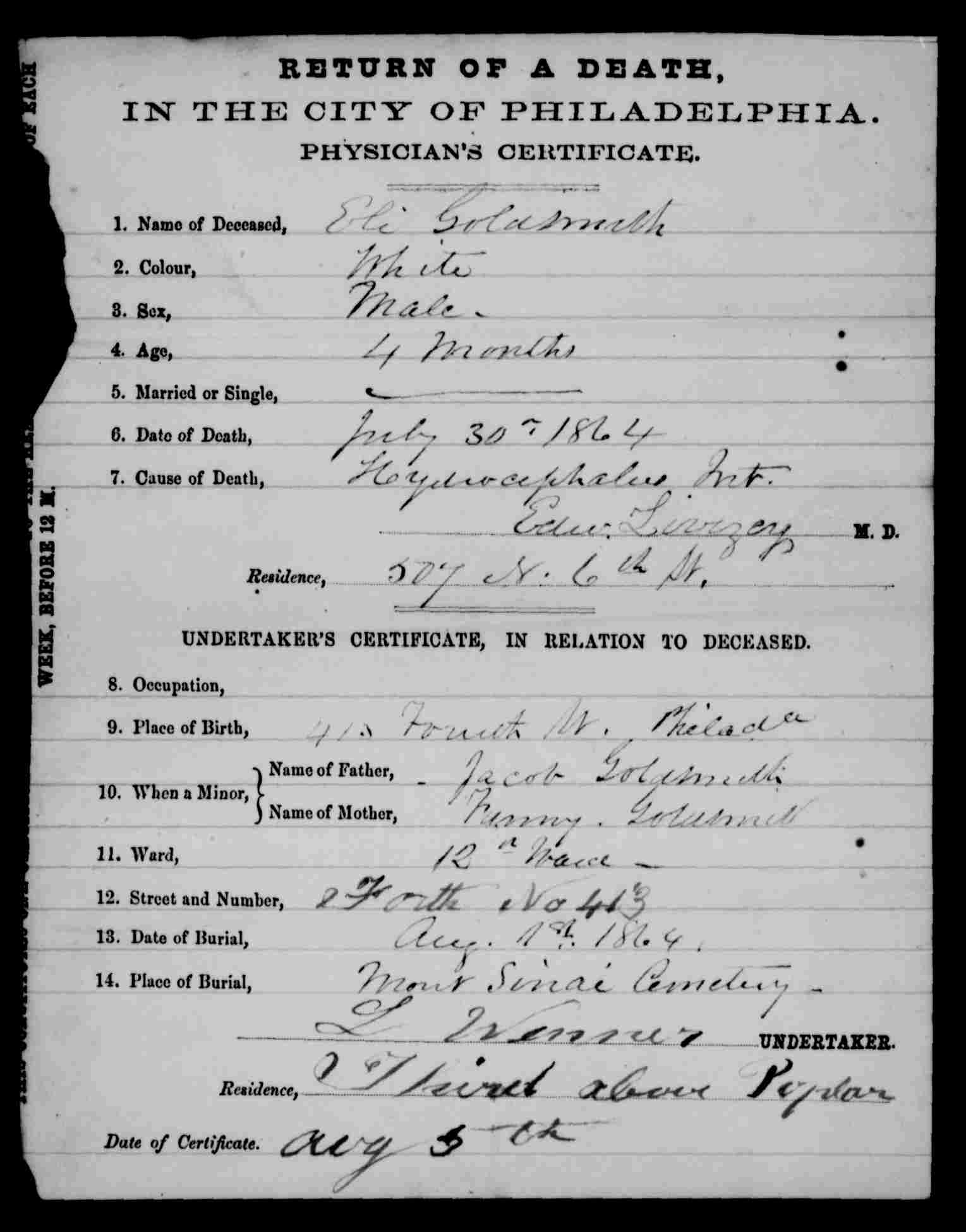
One more child was born to Jacob and Fannie in March 1864, a boy named Eli.  Sadly, he died when he was four months old of hydrocephalus internus,

Eli Goldsmith death record “Pennsylvania, Philadelphia City Death Certificates, 1803-1915,” database with images, FamilySearch (https://familysearch.org/ark:/61903/3:1:S3HT-DHR6-H?cc=1320976&wc=9F5Z-T3D%3A1073282601 : 16 May 2014), 004010010 > image 197 of 1250; Philadelphia City Archives and Historical Society of Pennsylvania, Philadelphia.

Searching the Philadelphia newspapers for 1860-1870, I found this little news item about a donation made by Jacob Goldsmith to support the soldiers fighting in the Civil War; based on Jacob’s business address in the 1862 Philadelphia Directory (338 Market Street, which is at the corner of 4th Street), I am reasonably certain that this refers to my uncle Jacob Goldsmith.

“Soldiers Mittens, ” Philadelphia Public Ledger, November 26, 1861.


I also found an 1868 advertisement for Jacob’s clothing store, which had moved by then to 624 Market Street:

Ad for Jacob Goldsmith’s store
Philadelphia Public Ledger, October 28, 1868

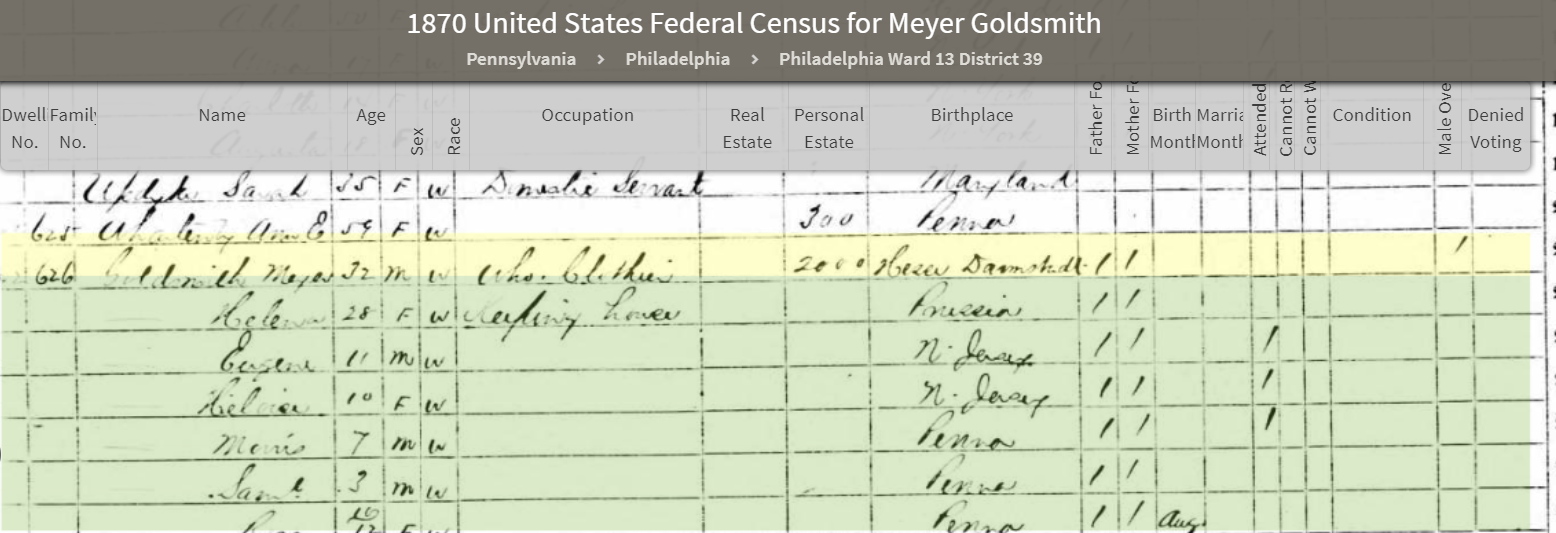
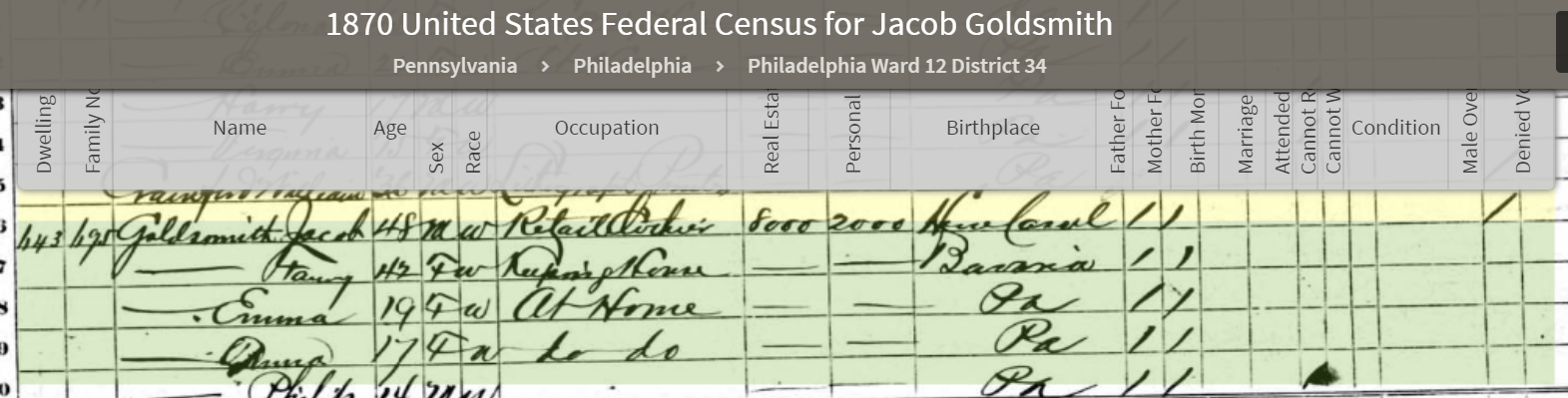
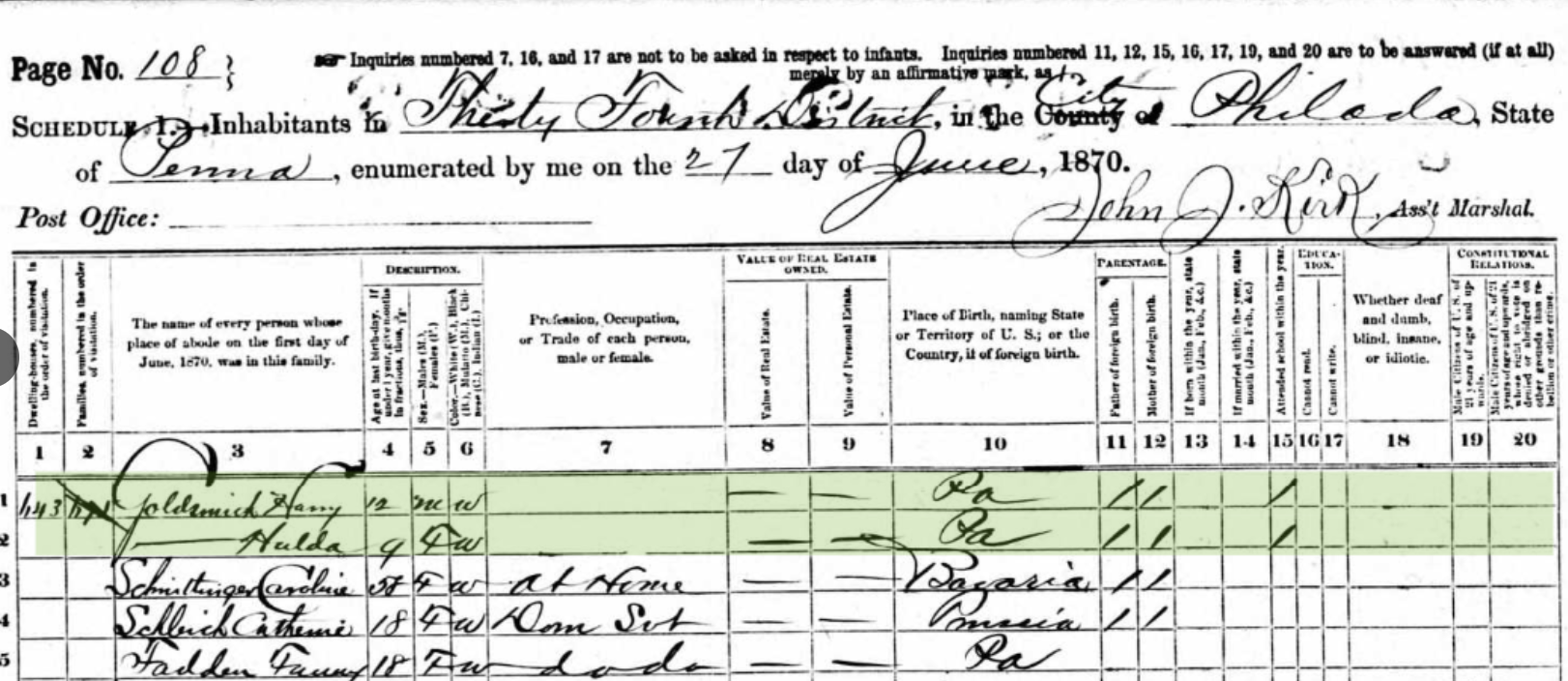
On the 1870 census, Jacob and Fannie were living with their five younger children. Jacob was working as a merchant and claimed he owned $8000 worth of real property and $2000 worth of personal property.

Jacob Goldsmith (Seligmann’s son) and family 1870 census
Year: 1870; Census Place: Philadelphia Ward 12 District 34, Philadelphia, Pennsylvania; Roll: M593_1396; Page: 114A; Family History Library Film: 552895

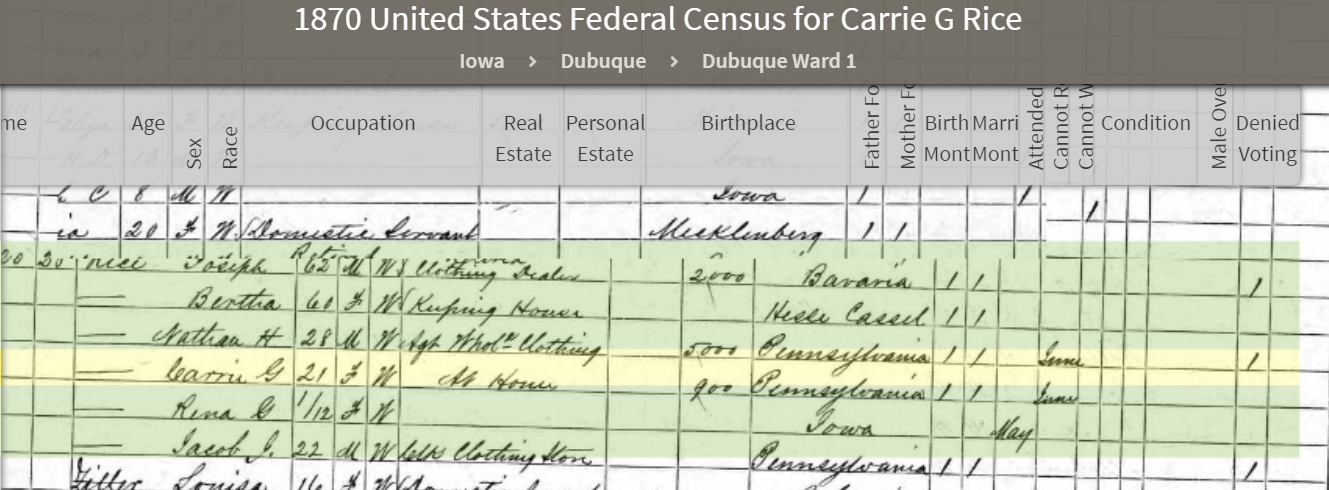
Their oldest daughter Caroline was no longer living at home in 1870, having married Nathan Rice in 1869; Nathan was born in Philadelphia in 1842 to German immigrant parents, Joseph Reiss and Elizabeth/Betsy Kohn (the spelling was later changed to Rice). In 1870 Nathan and Caroline were living in Dubuque, Iowa, with Nathan’s parents, and Nathan was working as an agent for a wholesale clothing company. His father’s occupation was “retired clothing dealer,” so perhaps Nathan was working in his father’s former business. Caroline and Nathan’s first child, Rena, was born in Iowa in the spring of 1870 and was one month old on June 1 when the census was taken.

Caroline Goldschmidt and Nathan Rice on 1870 census
Year: 1870; Census Place: Dubuque Ward 1, Dubuque, Iowa; Roll: M593_389; Page: 61A; Family History Library Film: 545888

Thus, Uncle Jacob was well established in Philadelphia by 1870 with a large and growing family. He also was joined by several of his siblings during this time, as we will see in my next post.


[1] That separation did not last, however. By 1870 Cousin Jacob had moved from Washington to Philadelphia. I spent an entire day trying to decipher which Jacob was which on the 1870 and 1880 census records since both were living in Philadelphia, both had wives named Fannie, both were in the clothing business, and both had many children, including several with the same names. It was a long day!

The Goldschmidts Come to America

I was all set to be logical and sequential and report on each of the children of my three-times great-grandparents Seligmann and Hincka (Alexander) Goldschmidt, starting with their oldest child Sarah Goldschmidt and her husband Abraham Mansbach II. I began their story in this post, but then I realized that I could not tell the rest of the story of the children of Sarah and Abraham without some background regarding the other members of the Goldschmidt family.

What triggered this realization was this ship manifest:

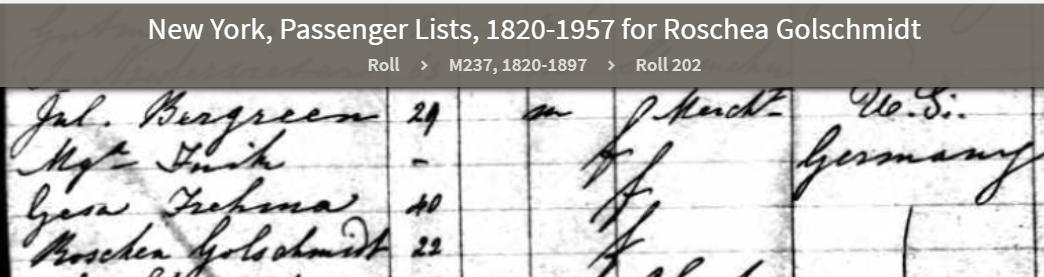
Henry Schoenthal and Helene Lilienfeld with Analie Mansbach on 1872 ship manifest lines 95 to 98
Year: 1872; Arrival: New York, New York; Microfilm Serial: M237, 1820-1897; Microfilm Roll: Roll 359; Line: 1; List Number: 484

Notice that this is the 1872 manifest for Henry Schoenthal, the brother of my great-grandfather Isidore Schoenthal. Henry had settled in Washington, Pennsylvania, in 1866, but then returned to Germany to marry Helen Lilienfeld. Then on May 24, 1872, Henry and Helen returned to the US, as shown on this manifest.

Why am I talking about a Schoenthal in the context of telling the story of the Goldschmidts?

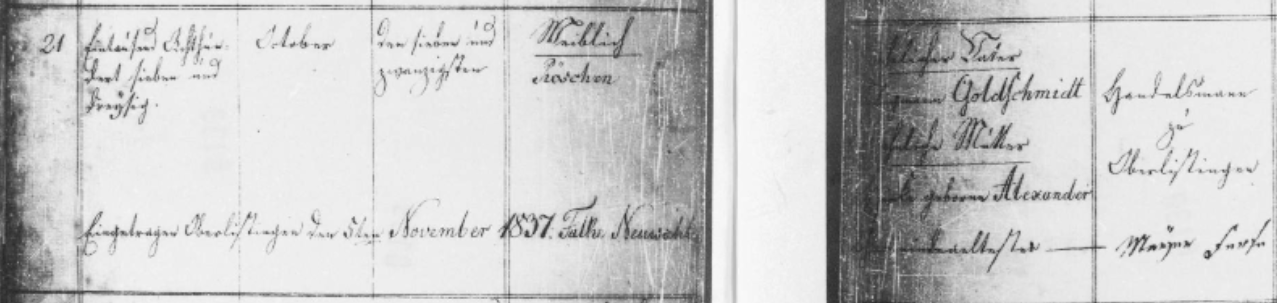
Because on that manifest (lines 6 and 7, above) were two eighteen-year-old women both named Amalie Mansbach who were apparently sailing with Henry and Helen (lines 5 and 8). I believe that one of those two Amalie Mansbachs was Merla Mansbach, the daughter of Sarah Goldschmidt and Abraham Mansbach II. Merla Mansbach was born on December 10, 1853, meaning she would have been eighteen in May, 1872.

Birth record of Merla Mansbach
HHStAW Abt. 365 Nr. 384, p. 55

But why would Merla Mansbach be sailing with Henry Schoenthal? He was from Sielen, his wife Helen was from Gudensberg, and Merla was from Maden—all towns within a reasonable distance of each other in the Hesse region of Germany, with Maden and Gudensberg being very near each other. There had to be a connection.


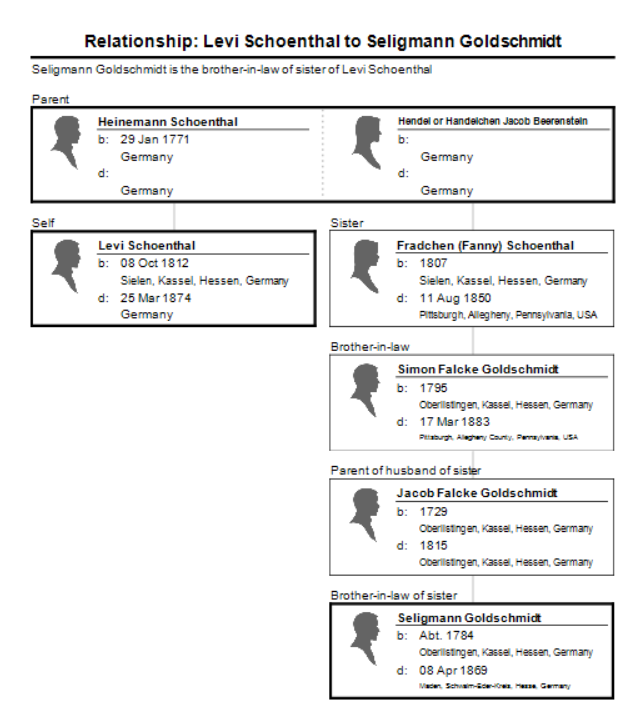
And that drove me back to my earlier posts about Henry Schoenthal and how he ended up in Washington, Pennsylvania, a small town in western Pennsylvania about 30 miles from Pittsburgh. And those posts reminded me that Henry was not the first Schoenthal to settle in western Pennsylvania—his father Levi’s sister (my three-times great-aunt) Fradchen Schoenthal had preceded him some twenty years before.

And Fradchen Schoenthal was married to Simon Falcke Goldschmidt, the brother of Seligmann Goldschmidt and great-uncle of Merla/Amalie Mansbach:


So I am going to digress a bit from the story of the family of my three-times great-grandfather Seligmann Goldschmidt to tell the story of his younger brother Simon Falcke Goldschmidt because telling the story of the Goldschmidt’s immigration to the United States has to start with Simon, who was the first to arrive.

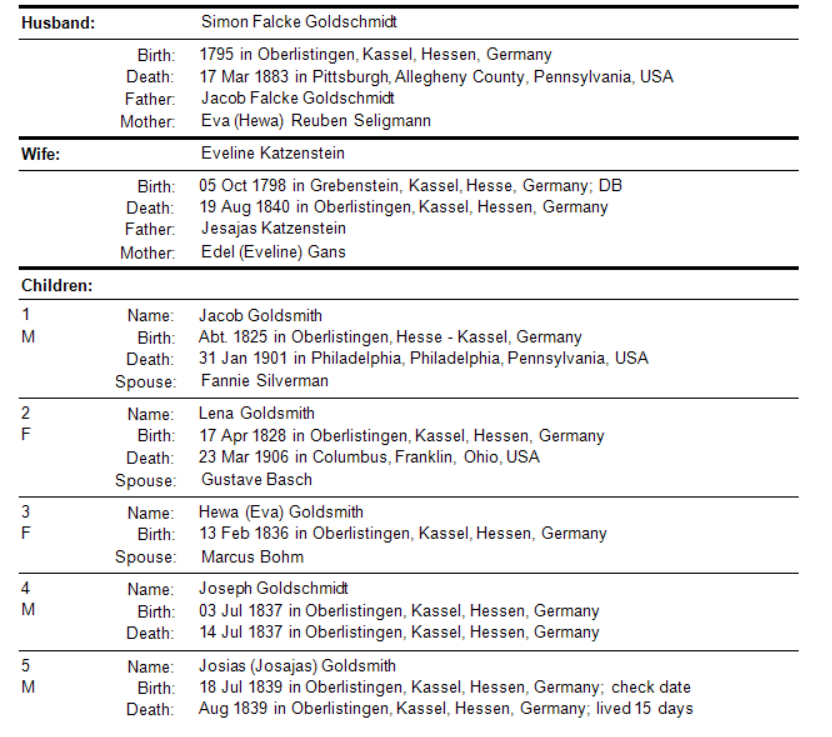
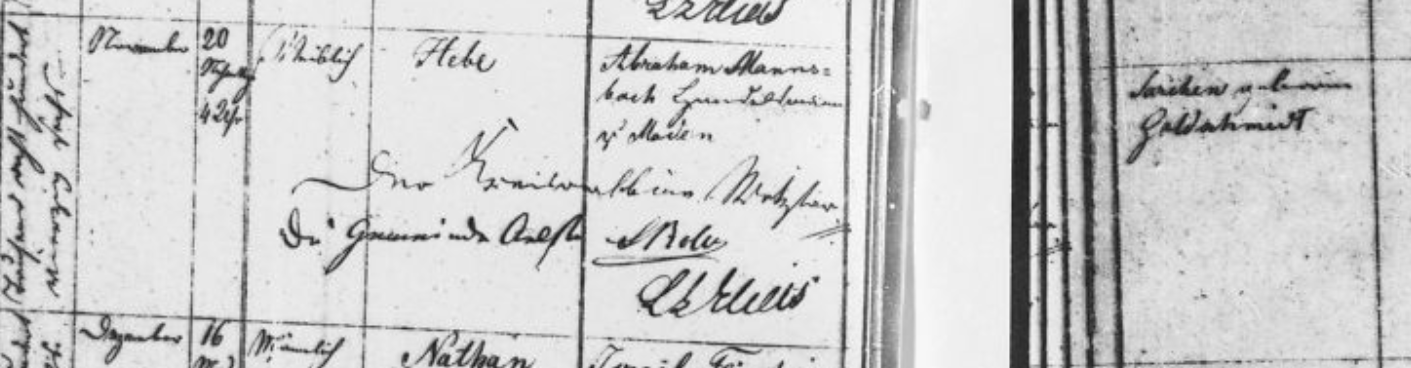
Simon was the youngest of the four sons of Jacob Falcke Goldschmidt and Eva Reuben Seligmann; according to numerous US records, he was born in 1795. In 1822, he married Eveline Katzenstein of Grebenstein (no known familial connection to my Katzensteins). Together they had five children: Jacob (1825), Lena (1828), Hewa “Eva” (1836), Joseph (1837), and Jesajas (1839), all born in Oberlistingen.

Notice the large gap between Lena, born in 1828, and the next child Hewa born in 1836.[1]

David Baron located a record that perhaps provides a reason for that gap; it seems that in 1826 Simon was charged with burglary and attempted robbery. (HStAM Fonds 261 Kriminalakten 1822-1836 No G 40.) I requested a copy of the file from the Marburg archives and learned that the file covers Simon’s appeal of a ten year sentence for his criminal activity. The listing online indicates that the date of appellate decision was December 24, 1830.

The contact person at the Marburg archives did not reveal the outcome of the appeal, so I am now hoping to find someone who might be able to go to Marburg and provide me with a summary (in English) of the judgment. (I could order a copy, but it would be costly and in German. My German has improved, but 130 pages of a legal decision would be too great a challenge!)

Since Simon and Eveline had three more children beginning in 1836, I suppose it’s possible he served some of that ten year sentence. Sadly, Simon and Eveline’s last two babies did not survive. Both Joseph and Jesajas died in infancy.

Joseph Goldschmidt death record
Sterberegister der Juden von Oberlistingen (Breuna) 1827-1852 (HHStAW Abt. 365 Nr. 671), p. 6

Josajas Goldschmidt death record
Sterberegister der Juden von Oberlistingen (Breuna) 1827-1852 (HHStAW Abt. 365 Nr. 671), p. 7

And then Simon lost his wife Eveline as well. She died on August 19, 1840, in Oberlistingen:

Eveline Katzenstein Goldschmidt death record
Sterberegister der Juden von Oberlistingen (Breuna) 1827-1852 (HHStAW Abt. 365 Nr. 671), p. 8

Simon was left on his own to raise his fifteen year old son Jacob, twelve year old daughter Lena, and four year old Hewa/Eva.

Four years after Eveline’s death he married my three-times great-aunt Fradchen Schoenthal on September 10, 1844. Fradchen, the daughter of my three-times great-grandparents Heinemann Schoenthal and Hendel Berenstein, was 37 years old when she married Simon. Thus, as early as 1844, my Schoenthal and Goldschmidt lines had merged, explaining why Merla/Amalia Mansbach would have been sailing with Henry Schoenthal in 1872.

Marriage of Simon Goldschmidt and Fradchen Schoenthal
HHStAW Abt. 365 Nr. 669, S. 11

A year after marrying, Simon and Fradchen left Germany for the United States, arriving in Baltimore with Simon’s youngest daughter Eva on September 20, 1845.

Passenger manifest for Simon Goldschmidt, Fanny Schoenthal and Eva Goldschmidt
Ancestry.com. Baltimore, Passenger Lists, 1820-1964 [database on-line]. Provo, UT, USA: Ancestry.com Operations Inc, 2006.
Original data: Selected Passenger and Crew Lists and Manifests. National Archives, Washington, D.C.

They must have settled first in Baltimore because Simon and Fradchen had two children who were born there, Henry on January 10, 1847, and Hannah on June 5, 1848. I assume that Henry was named for Heinemann Schoenthal and Hannah for Hendel Berenstein Schoenthal, their maternal grandparents and my three-times great-grandparents.

By 1850, Simon and Fradchen (also known as Fanny) were living in Pittsburgh with Henry and Hannah as well as two of Simon’s children from his first marriage, Lena and Eva. Simon was working as a tailor and had Americanized his surname to Goldsmith.[2]

Simon Goldschmidt and family 1850 census
Year: 1850; Census Place: Pittsburgh Ward 3, Allegheny, Pennsylvania; Roll: M432_745; Page: 135A; Image: 274

Simon lost his second wife Fradchen/Fanny soon thereafter; she died on August 11, 1850, at age 43. (The year on the headstone appears to be incorrect; based on the age given on both the marriage record and manifest, Fradchen’s birth year would have been 1807, not 1800. The 1850 census said she was then 39, not 50. Plus it’s unlikely she had children at ages 47 and 48.) She left behind two very young children, Henry and Hannah, as well as her three stepchildren, Jacob, Lena, and Eva, and her husband Simon.


Meanwhile, Simon’s son Jacob from his first marriage had settled in Washington, Pennsylvania, by 1850; he was working as a tailor and living with two other men who were tailors. Like his father Simon, Jacob had changed his surname to Goldsmith.

Jacob Goldsmith (Simon’s son) 1850 US census
Year: 1850; Census Place: Washington, Washington, Pennsylvania; Roll: M432_834; Page: 363A; Image: 244

Sometime after 1850 Jacob married Fannie Silverman. (The 1900 census reports that Jacob, who was then widowed, had been married 51 years, but given that he was still single in 1850, that seems unlikely).

Jacob and Fannie had thirteen children between 1853 and 1871—first, six daughters, then three sons, then another four daughters. Wow. I will report on them in more detail in a later post.  For now, I will only name those born between 1853 and 1860: Ellena (1853), Emma (1854), Anna (1855), Rachel (1857), Leonora (1858), and Celia (1860). Six daughters in seven years.

Sometime after Fradchen died, Simon moved to Washington, Pennsylvania, to be with his son Jacob. In 1860, Simon and his two youngest children, Henry and Hannah, were living with Simon’s son Jacob and Jacob’s wife Fannie and their six daughters. Henry and Hannah were only five and six years older than their oldest nieces, Emma and Anna. I assume that Simon needed Fannie and Jacob’s help in raising Henry and Hannah.

Jacob Goldsmith and family 1860 US census
Year: 1860; Census Place: Washington, Washington, Pennsylvania; Roll: M653_1192; Page: 1188; Image: 627; Family History Library Film: 805192

Simon’s other two children, Lena and Hewa/Eva, were married and on their own by 1860. Lena had married another German immigrant, Gustave Basch in 1856. In 1860, they were living in Connellsville, Pennsylvania, with their first two children, Frank (1858) and Jacob (1859).

Lena Goldschmidt and Gustave Basch and sons 1860 census Year: 1860; Census Place: Connellsville, Fayette, Pennsylvania; Roll: M653_1110; Page: 422; Family History Library Film: 805110


The story of Simon’s other daughter Eva has already been told. She married Marcus Bohm, an immigrant from Warsaw, Poland, and they had a daughter born in 1862 named Ella who married my great-great-uncle Jacob Katzenstein (son of Gerson Katzenstein and Eva Goldschmidt and thus also Ella’s cousin). Ella and one of her sons died in the Johnstown flood in 1889.  With Ella Bohm’s marriage to Jacob Katzenstein, my Goldschmidt and Katzenstein lines had merged.

I won’t repeat the research and story of Eva Goldsmith and Marcus Bohm, but despite further searching, I unfortunately have not yet found any record for either their marriage or Eva’s death. What I have concluded, however, is that Eva had died by 1870 because by then her daughter Ella was living with Eva’s brother Jacob Goldsmith.

Jacob Goldsmith and family on the 1870 census
Year: 1870; Census Place: Philadelphia Ward 12 District 36, Philadelphia, Pennsylvania

Thus, by 1860, all the members of the family of Simon Goldschmidt were living in western Pennsylvania, most of them in Washington, Pennsylvania, where Fradchen’s nephew Henry Schoenthal would arrive six years later, soon followed by his siblings.

By the 1880s, there were thus familial connections between the Goldschmidt family and the Schoenthal family and also between the Goldschmidt family and the Katzenstein family.  These overlapping connections laid the groundwork for the 1888 marriage of my great-grandparents, Isidore Schoenthal and Hilda Katzenstein, whose mother was a Goldschmidt. It’s amazing to see how the many lines in the family came together in the pairing of two of my direct ancestors.

——

[1] I do not have German birth records for Jacob or Lena, only US records. For the last three children, I was able to locate Oberlistingen birth records.

[2] The names on this census are switched around. Simon’s wife was Fanny, not Lena, and his daughter was Eva, not Fanny. Another reminder of how unreliable census records can be.

Update on the Jeweler and the Suffragette: Some Answers, Some Photos

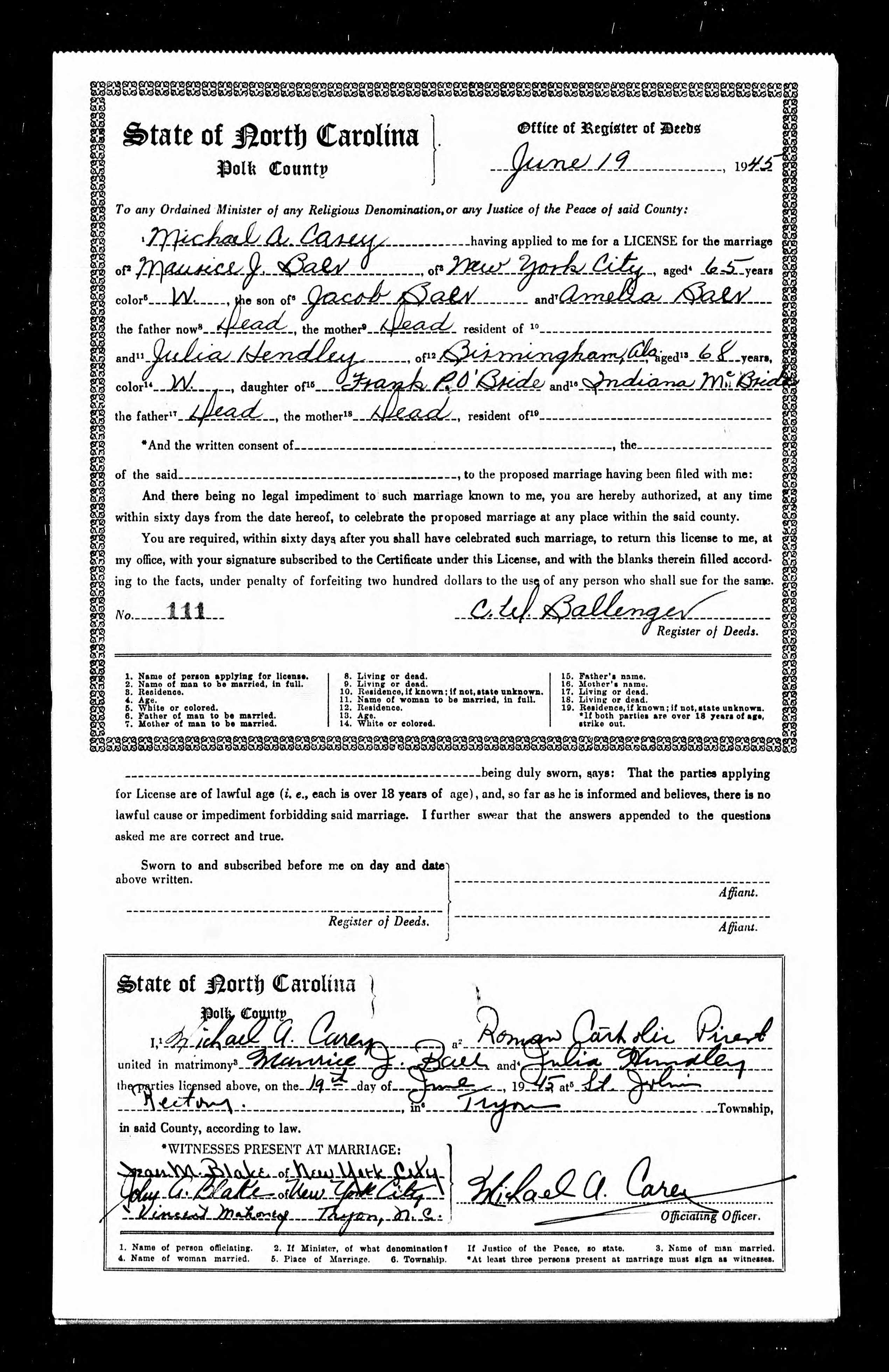
One of the most intriguing stories I’ve researched is the story of my cousin Maurice Jay Baer (known as “MJ”) and his mysterious marriage to Bossie O’Brien Hundley, a well-known activist for women’s suffrage in Alabama. I wrote in detail about Bossie and what I knew of her relationship with MJ Baer in a post entitled “The Jeweler and the Suffragette: Star-crossed Lovers?” in July 2016.   I first learned of their relationship when I discovered the marriage license for MJ and Bossie dated June 19, 1945; they were married in Tryon, North Carolina. Sadly, MJ died less than a year later on April 25, 1946.

Maurice Jay Baer and Julia Hendley marriage license, 1945
Ancestry.com. North Carolina, Marriage Records, 1741-2011 [database on-line]. Provo, UT, USA: Ancestry.com Operations, Inc., 2015.
Original data: North Carolina County Registers of Deeds. Microfilm. Record Group 048. North Carolina State Archives, Raleigh, NC.

I was puzzled that MJ’s family hadn’t known that he was married. Bossie was not named as one of his survivors in his obituary, and MJ was buried with his family in Philadelphia, not where Bossie was later buried in North Carolina. When I’d asked my Baer family relatives about the marriage, no one knew anything about it. In fact, the family believed that he had never married at all.  He was described as the “bachelor uncle.”

Maurice Jay Baer death notice
New York Times, April 27, 1946


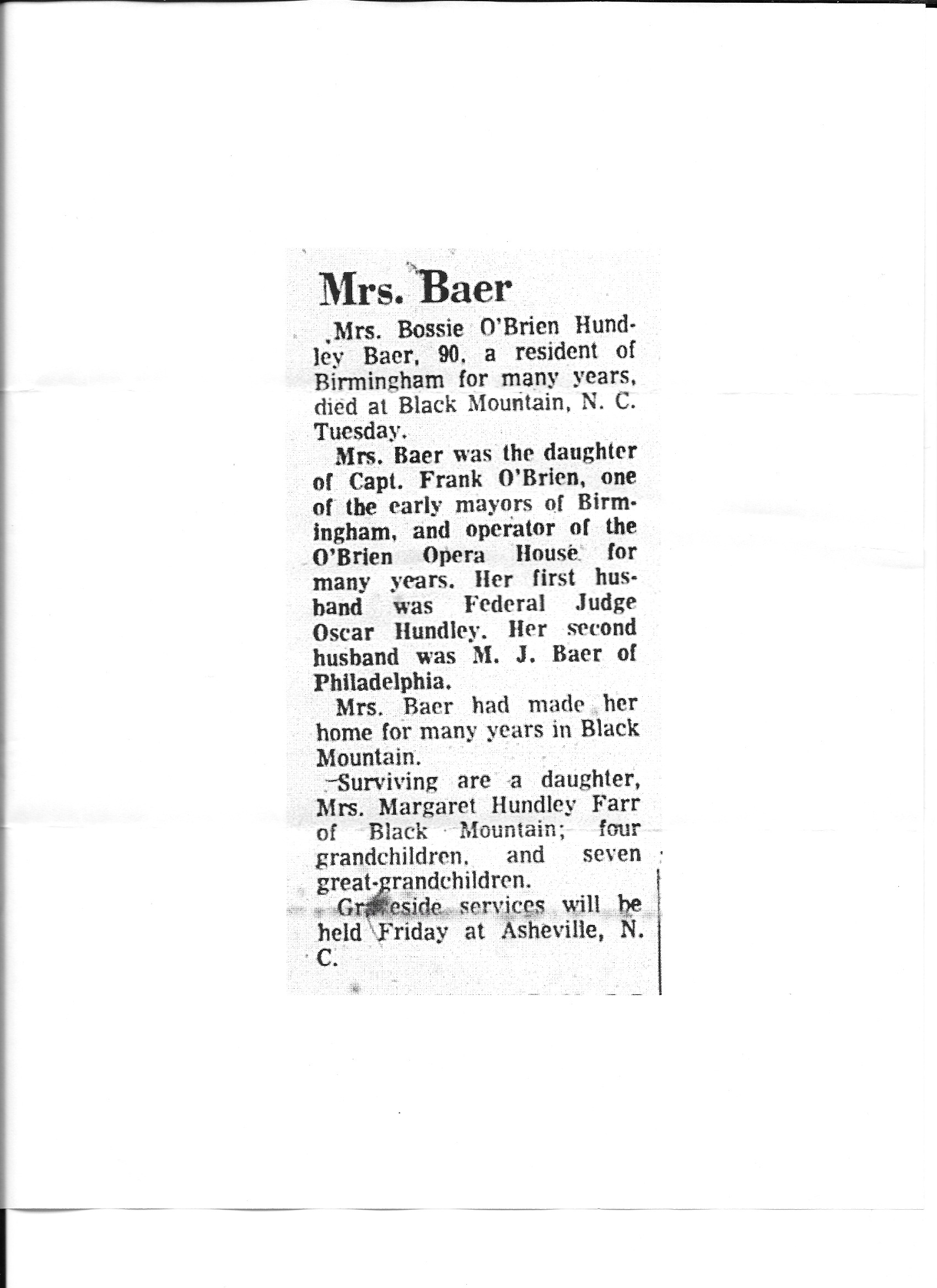
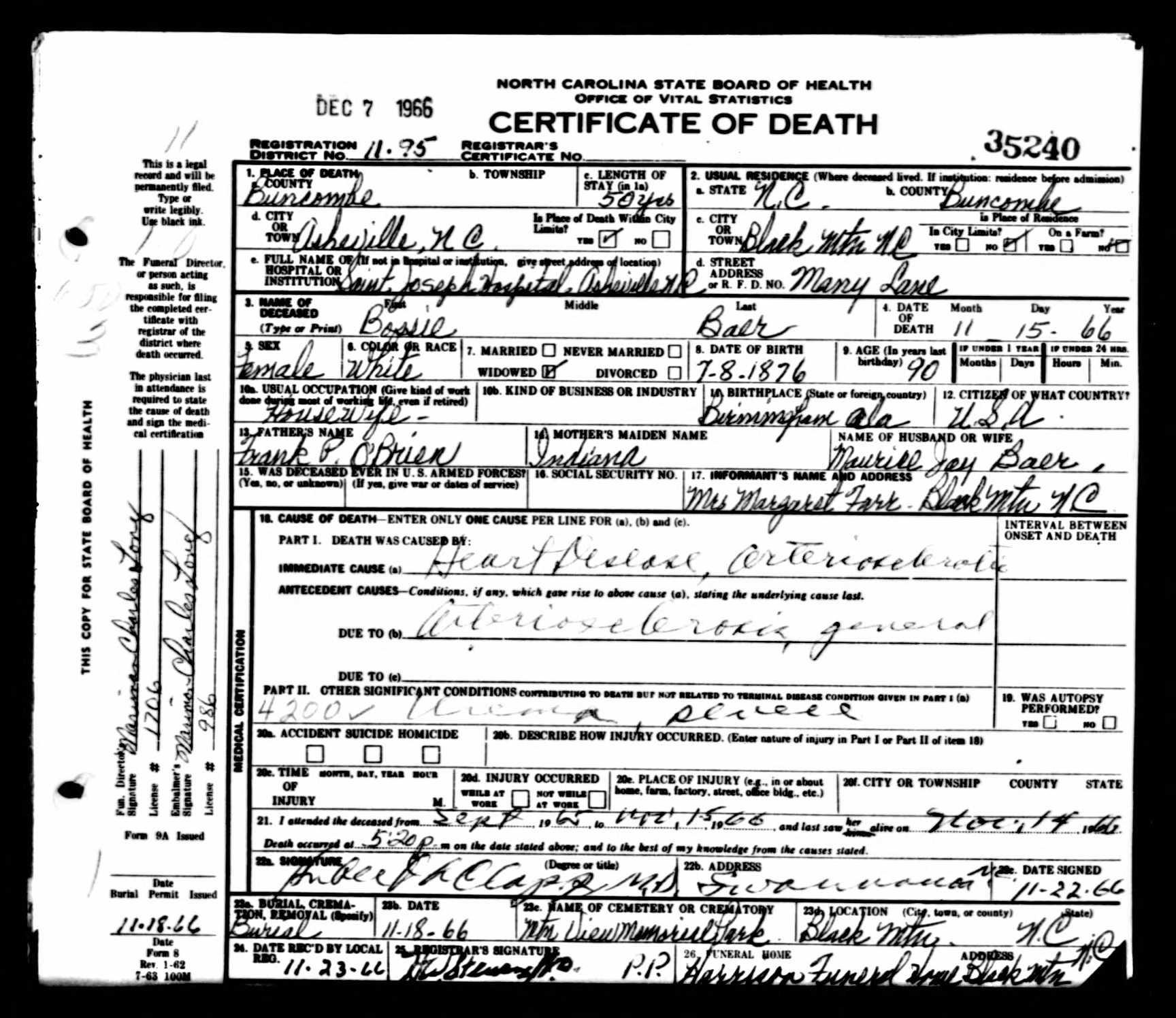
It seemed that Bossie’s family, however, did know about the marriage.  MJ was named as Bossie’s husband on her death certificate, and her obituary mentioned him as her second husband.

The Birmingham News, November 16, 1966, p. 26

Bossie Baer death certificate
Ancestry.com. North Carolina, Death Certificates, 1909-1976 [database on-line]. Provo, UT, USA: Ancestry.com Operations Inc, 2007.
Original data: North Carolina State Board of Health, Bureau of Vital Statistics. North Carolina Death Certificates. Microfilm S.123. Rolls 19-242, 280, 313-682, 1040-1297. North Carolina State Archives, Raleigh, North Carolina.

I was left with so many questions. How had a Jewish man from Massachusetts met a Catholic woman from Alabama? Where did they live after their marriage? How and why did they keep the marriage a secret at least from MJ’s family? I tried to find out more, but had no luck.

Then on May 18, 2017, I received a comment on the blog from Mitchell Brown, who shared that she was Bossie’s great-granddaughter and that she had “known about MJ Baer and his connection to our family all [her] life. The family narrative is that it was the religious differences that kept them from being public about their marriage.”

I was thrilled to hear from Mitchell, and since then, Mitchell and her family have generously shared with me some photographs and some additional insights that have answered many if not all my questions about MJ and Bossie.

Two of Bossie’s granddaughters were the primary sources of that information. Elisabeth Hundley Farr Smith remembers MJ very well as she was born in 1934 and spent many summers with her grandmother Bossie in Black Mountain, North Carolina.  Melinda Farr Brown, Elisabeth’s younger sister, was born in 1942 and does not have any memories of MJ, but knew her grandmother Bossie very well.

Elisabeth wrote that “MJ was as close to a grandfather to me as one can get (and actually became my step grandfather when he and Bossie married).” From the age of six until she was in her twenties, she spent her summers in Black Mountain. Her parents would put her on the train in Philadelphia, and Bossie would meet her at the station in Black Mountain.  MJ also spent the summers there for many years, starting even before he married Bossie; however, Elisabeth recalls that he returned north each fall. Elisabeth wrote that MJ had his own room and bath in Bossie’s house. She recalls taking walks with him and their cocker spaniel Buffy every morning, listening to the radio in the evenings with her grandmother and MJ, driving to town to get a drugstore soda, and engaging in various activities on her own, like writing a newspaper to sell for ten cents. She was just a young child and so was not engaged in much of the adult conversation so had no insights into their relationship or how and when they’d met.

One other interesting note: Elisabeth mentioned that she knew MJ’s nephew Jerry and his wife Elsie. I believe this must be a reference to MJ’s sister Elsie Baer and her husband Jerome Grant. Elisabeth recalled that they lived in New York City and that she even visited them a few times with her grandmother even after MJ died.

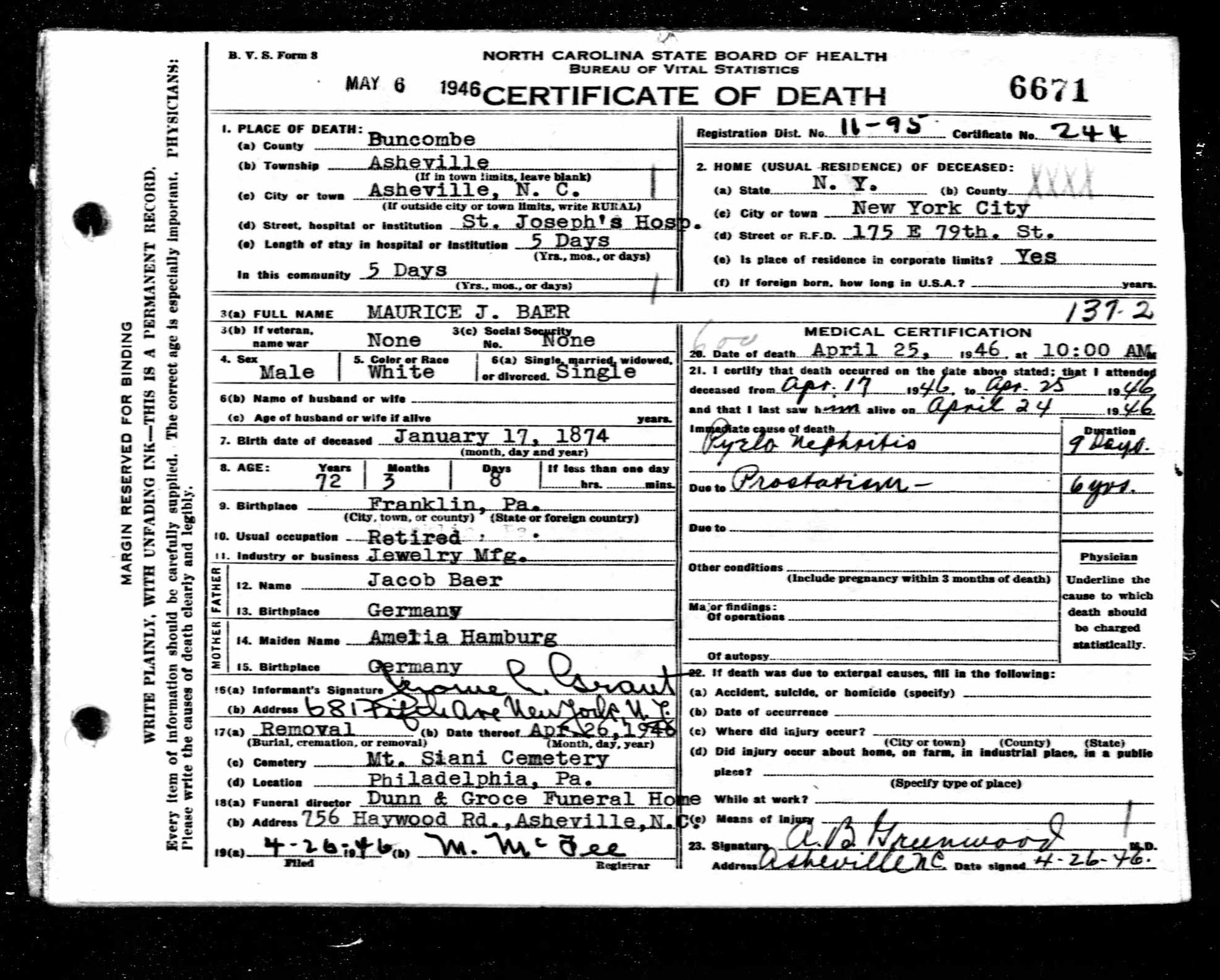
Melinda also recalled meeting Elsie and Jerome. She described a lunch she had at their home in New York City in 1963 where Elsie spoke about the fact that no one had known about the marriage between MJ and Bossie. And when I reviewed MJ’s death certificate, I saw that Jerome had been the informant on that record; strangely enough he reported that MJ was single when he died.  Either Jerome had not known there had been a marriage or he was still covering up the secret marriage from the rest of the Baer family. Melinda said that she didn’t think anyone but Bossie’s daughter Margaret knew about the marriage until after MJ died.

Maurice Jay Baer death certificate
Ancestry.com. North Carolina, Death Certificates, 1909-1976 [database on-line]. Provo, UT, USA: Ancestry.com Operations Inc, 2007.
Original data: North Carolina State Board of Health, Bureau of Vital Statistics. North Carolina Death Certificates. Microfilm S.123. Rolls 19-242, 280, 313-682, 1040-1297. North Carolina State Archives, Raleigh, North Carolina.

It seems that at some point after MJ’s death, the Baer family did learn of his marriage to Bossie. My cousin Mike, who is in fact MJ’s namesake, found a list of family members that was prepared when Mike’s grandfather Samuel Stone, Sr. died in 1957. Samuel Stone was married to Tilda Baer, MJ’s sister. Included on that list of family members was the name “Mrs. Maurice J. Baer, Black Mountain, NC.”

Although I have not obtained a copy of MJ’s will, I had wondered whether he had left any money to Bossie; I still do not know for sure, but Melinda told me that he had left her $1000, so I assume that MJ had also left some of his estate to his wife Bossie and probably to her daughter Margaret and both granddaughters.

As for why the marriage was kept a secret, Melinda recalls that her grandmother said that it was, at least on Bossie’s part, not because of the religious differences but rather because she did not want to be teased about their “personal life.” After all, MJ was 71 and Bossie 69 when they married in 1945.  I suppose some people might have thought it odd for two older people to marry at that point in their lives.

One of the more surprising things I learned from Bossie’s two granddaughters was how long Bossie and MJ had known each other even before they were married. Although neither Elisabeth nor Melinda knew exactly how or when Bossie and MJ met, Melinda shared with me the following page from Bossie’s unpublished book, “With the Passing Years:”

A Tribute to MJ J. Baer

One of the most ennobling influences

of my life was my friendship for twenty

years with MJ J. Baer.  This

beautiful friendship was focused on

June 19, 1945 by our marriage.

 His integrity, appreciation of the best

in art and literature, his personal

charm, fine sense of values and uniform

kindness were forces that built an

unforgettable personality.

Just eight months after our marriage he

died leaving me a beautiful memory.

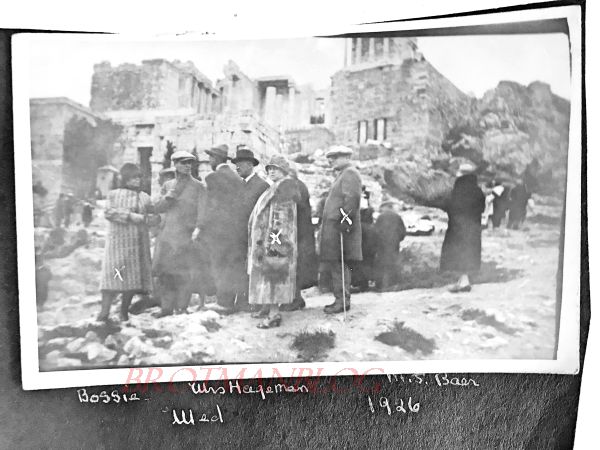
Thus, Bossie had known MJ for twenty years when he died in 1946, meaning she must have met him in about 1926.  On August 14, 1926, MJ returned to New York from a trans-Atlantic trip on the S.S. Verdam. Bossie had also taken a trans-Atlantic trip that year, returning to New York on May 28, 1926, on the S.S. Rotterdam. I don’t know how long either one of them spent in Europe, but at some point their paths crossed, as seen in this photograph that Bossie’s family kindly shared with me:

1926 photo of Bossie Hundley O’Brien and MJ Baer
Courtesy of the Family of Bossie Hundley O’Brien Baer

As you can see, it is dated 1926, and three people are identified in the photograph: Bossie, Mrs. Hageman, and M.J Baer.  It looks as if they were exploring some ruins, perhaps in Greece.

Melinda reviewed a travel diary that her grandmother kept during a trip taken with MJ in 1930 during which they visited Amsterdam’s Jewish Quarter. About that visit, Bossie wrote, “With Cook’s guide we visited the diamond factory of Amsterdam (not interesting), then the old Jewish Quarter and the old Synagogue dating back to the 16th century.  It was here that M.J. told the woman my father was a Christian but my mother was a Jewess!!”

I assume that Bossie was quoting MJ—that is, that he said his father was a Christian, but his mother was Jewish, not that Bossie’s were. In either case, it’s not accurate, as MJ’s father Jacob Baer was most definitely Jewish, as was his mother, Malchen (Amalie/Amelia) Hamberg. Both are buried in a Jewish cemetery, as was MJ. At any rate it is clear that all those trips taken by MJ and Bossie over the years were trips taken together and that travel was a passion they both shared. As noted in my earlier post, both traveled many times to Europe in the 1920s and 1930s, although on different ships, except for one trip in 1930 when they were listed together on the ship manifest:

1930 ship manifest listing both Maurice Jay Baer and Bossie Hundley
Year: 1930; Arrival: New York, New York; Microfilm Serial: T715, 1897-1957; Microfilm Roll: Roll 4849; Line: 1; Page Number: 183

It is also interesting that traveling with MJ was his niece, Stephanie Stone of Attleboro, Massachusetts, my cousin’s Mike’s mother. Stephanie obviously knew Bossie, yet Mike had always believed that his great-uncle had never married.

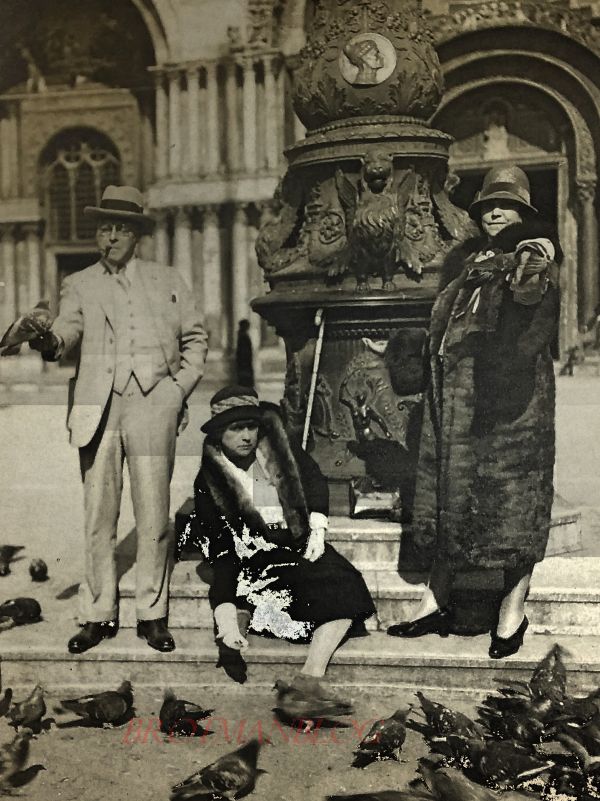
The family generously shared with me the following photographs of Bossie and MJ taken during their many travels together:

Bossie O’Brien and MJ Baer in India
Courtesy of the Family of Bossie Hundley O’Brien Baer

Bossie O’Brien and MJ Baer in Venice
Courtesy of the Family of Bossie Hundley O’Brien Baer

Bossie and MJ aboard ship with monkeys
Courtesy of the Family of Bossie Hundley O’Brien Baer


Over a year and a half ago when I wrote that earlier post about the jeweler and the suffragette, I had little expectation that I would be able to learn more about this mysterious couple.  Thanks to the generosity of Bossie’s family and the magic of the internet, I now have a much fuller picture. MJ and Bossie had a long and close friendship for many years, culminating in their marriage in June 1945. Their marriage may have been cut short by MJ’s untimely death in 1946, but their relationship had obviously been an important and valued part of both of their lives for twenty years.


Yet Another Abraham Mansbach: More Twists in the Tree

As I mentioned in my last post, my three-times great-grandparents Seligmann Goldschmidt and Hincka Alexander had seven children.

Their oldest child was Sarah, born December 1, 1818, in Oberlistingen. Sarah married Abraham Mansbach on October 31, 1843. Abraham Mansbach was a name I’d encountered before when researching my Katzenstein relatives, so I knew I had to dig deeper to see if there was a connection.

Marriage record of Sarah (Sarchen) Goldschmidt and Abraham Mansbach
Trauregister der Juden von Gudensberg 1825-1900 (HHStAW Abt. 365 Nr. 386)AutorHessisches Hauptstaatsarchiv, Wiesbaden, p. 14

Back in November, 2016, I wrote a post entitled “Will the Real Abraham Mansbach Please Stand Up?,” in which I described my attempts to distinguish five different men (all related to each other) named Abraham Mansbach.  The first Abraham Mansbach (Abraham I) died around 1808; the other four included one of his grandsons and three of his great-grandsons.

Abraham I had three sons: Isaac, Leiser, and Marum I.  Leiser in turn had two sons, Abraham II and Marum II, both of whom married into my family. Abraham II married my three-times great-aunt Sarah Goldschmidt, as seen above.

Leiser’s other son, Marum II, married one of my other three-times-great-aunts, Hannchen Katzenstein. Thus, the Mansbachs are related to me both on the Katzenstein side and the Goldschmidt side. (And the Goldschmidts and Katzenstein lines also merged with the marriage of Gerson Katzenstein and Eva Goldschmidt, my great-great-grandparents.)

Marum Mansbach II and Hanchen Katzenstein also had a son named Abraham, whom I labeled Abraham Mansbach III.[1] The fourth and fifth Abraham Mansbachs were other great-grandsons of Abraham I not directly entangled with my relatives.


Anyway……all you need to know for this post is that Sarah Goldschmidt married Abraham Mansbach II, who was born January 12, 1809, in Maden, Germany.  Sarah and Abraham had ten children: Breine (1844), Hewa “Hedwig (1846), Leiser “Louis” (1849), Jacob (1851), Merla “Amelia” (1853), Berthold (1856), Hannah (1858), Meyer (1860), Kathinka (1862), and Julius (1865). In other words, Sarah gave birth to ten children over a 21 year period. All the children were born in Maden.

Thanks to my recently-found cousin Art Mansbach, a great-grandson of Abraham and Sarah, I have a number of photographs of Abraham and Sarah and their children. This one is of Abraham, Sarah, and their youngest child, Julius, Art’s grandfather. Julius appears to be about five years old in this photograph, so this would have been taken in around 1870:

Abraham Mansbach, Julius Mansbach, and Sarah Goldschmidt Mansbach c. 1870
Courtesy of the Mansbach family

Here is one of Sarah with her two youngest sons, Meyer and Juilus. From the ages of the boys, I would estimate that this was taken in the mid-1870s:

Julius Mansbach, Sarah Goldschmidt Mansbach, and Meyer Mansbach c. 1874
Courtesy of the Mansbach family

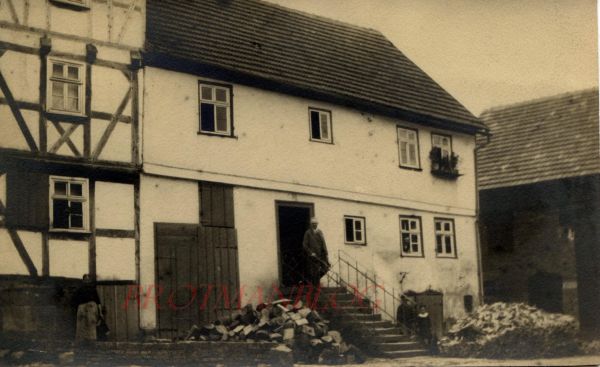
This was the Mansbach home in Maden, Germany:

Home of Abraham and Sarah Goldschmidt Mansbach, Maden, Germany
Courtesy of the Mansbach family

Remarkably, only one of those children did not grow to adulthood.  Jacob, the fourth child, who was born on June 23, 1851, died on September 13, 1853. He was just two years old.

Jacob Mansbach death record
HHStAW Fonds 365 No 387, p. 47


Two other children of Sarah and Abraham II predeceased one or both of their parents, but did live to adulthood: Hedwig and Kathinka.  Kathinka died in the US, so her story will come in a later post. But Hedwig died in Germany.

Hedwig was born on November 20, 1846.

Hedwig/Hewa Mansbach birth record HHStAW Fonds 365 No 384, p.43


On February 16, 1875, she married David Rothschild of Zierenberg, Germany.

Hewa Mansbach and David Rothschild marriage record
HHStAW Fonds 365 No 386, p. 40

Sadly, Hedwig died nine months to the day later on November 16, 1875. Had she died in childbirth? I don’t know. She was only 28 years old when she died. If there was a child, I have not found any record of him or her, and I checked all the births and deaths in Zierenberg in 1875.

Death record for Hedwig Mansbach Rothschild
Description: Geburten, Heiraten Tote 1874-1875
Source Information
Ancestry.com. Hesse, Germany, Lutheran Baptisms, Marriages, and Burials, 1730-1875


Not long after Hedwig’s death, many of her siblings began to leave Germany for the United States. In fact, all but one of the remaining siblings and their parents Sarah and Abraham themselves eventually emigrated. I will continue their stories in subsequent posts.

The only surviving child of Sarah and Abraham who did not emigrate was their first-born child, Breine.

Breine was born on September 27, 1844:

Breine Mansbach birth record
HHStAW Fonds 365 No 384, p. 39


She married Jacob Bensew on February 3, 1870; Jacob was born on January 15, 1840, in Malsfeld, Germany, the son of Heinemann Bensew and Roschen Goldberg.

marriage record for Breine Mansbach and Jacob Bensew
HHStAW Fonds 365 No 386, p. 35


Breine and Jacob had six children—five sons and one daughter: William (1872), Julius (1875), Siegmund (1877), Heinemann (1879), Max (1882), and Frieda (1886). All six of their children would eventually immigrate to the United States, but Breine and Jacob stayed behind and lived the rest of their lives in Germany.

Breine died in Melsungen, Germany, on May 31, 1922, and her husband Jacob in Kassel, Germany, on April 25, 1925.

Death record for Breine Mansbach Bensew
Hessisches Hauptstaatsarchiv; Wiesbaden, Deutschland; Personenstandsregister Sterberegister; Bestand: 920; Laufende Nummer: 4684

Because so much of the rest of the story of the the family of Sarah Goldschmidt and Abraham Mansbach II took place in the US, I will stop here and address the history of the Goldschmidt family’s migration to the US in my next post.

But first one final photograph, this one of Abraham with the four sons who grew to adulthood: Leiser/Louis, Berthold, Meyer, and Julius. I do not know which is which, but all four appear in this photograph with their father. They were all my first cousins, four times removed:

ABraham Mansbach with his four surviving sons: Meyer, Berthold, Louis, and Julius. (Not necessarily in that order.)


[1] Thus, Abraham II was the uncle of Abraham III, my first cousin-three times removed on my Katzenstein line, and he was the husband of my three-times great-aunt Sarah Goldschmidt.

Seligmann Goldschmidt and Hincka Alexander, My 3x-Great-Grandparents of Oberlistingen

I have once again been truly fortunate as I begin my in-depth research of my Goldschmidt line. Not only do I have the benefit of the research done by Roger Cibella and David Baron, but through Roger and David, I have now connected with another Goldschmidt cousin, Art Mansbach, my third cousin, once removed. And Art, the great-great-grandson of Seligmann Goldschmidt and Hincka Alexander, has a treasure trove of pictures and documents and other items related to the Goldschmidt family. Art discovered a box of photographs in his father’s attic, and fortunately most of them were labeled with the names of those depicted. From Roger, David, and Art, I now have a fair amount of information about our mutual ancestors, Seligmann Goldschmidt and Hincka Alexander, as well as pictures of them.

My three-times great-grandfather Seligmann Goldschmidt was born in about 1783-1784 in Oberlistingen, Germany. (His birth date is inferred from his death record, to be discussed below.) He was the oldest son of my four-times great-grandparents Jacob Falcke Goldschmidt and Eva Reuben Seligmann, though he had two older half-brothers from his father’s prior marriages.

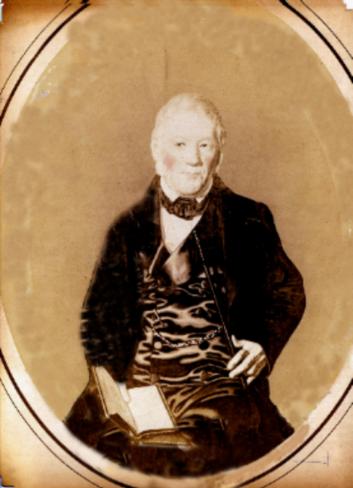
Seligmann Goldschmidt

According to Art and as reported on Roger Cibella and David Baron’s website, Seligmann was by trade a spice merchant. He also fought under General Bluecher against Napoleon at Waterloo and was cited for bravery and given a silver snuff box for his service. Art owns the snuff box and shared these photographs of this heirloom:

Sbox2

Sbox1


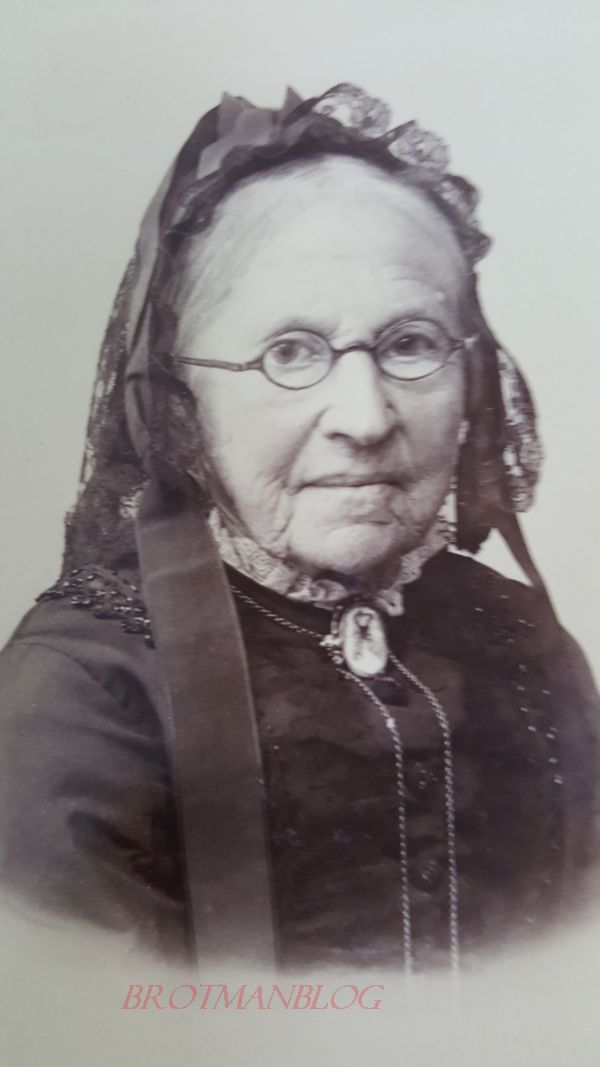
Although I have not found a marriage record, I assume that Seligmann married my three-times great-grandmother Hincka Alexander sometime before December 1, 1818, when their first child was born. According to her death record and gravestone, Hincka was born in Wolfhagen on September 14, 1797. I don’t yet know the names of her parents or whether she had any siblings.

Hincka Alexander Goldschmidt

Seligmann and Hincka had their first child, a daughter named Sarah, on December 1, 1818, according to her death record. Sarah was followed by seven other children: Jacob (1822), Levi (1824), my great-great-grandmother Eva (1827), Beile or Bette (1829 or 1830), Abraham (1832), Meyer (1834), and Rosa (1837).


All but Beile/Bette would end up immigrating to the United States, starting with Jacob who arrived before 1850 and ending with Sarah, who arrived in 1882. Thus, I will be able to report a fair amount about each of their lives and their families and will be devoting separate posts (probably multiple) to each one of them.

Seligmann and Hincka, however, did not leave Germany with their children. Hincka died on January 4, 1860, in Oberlistingen; according to her death record, she was 63 years old:

Hincka Alexander Goldschmidt death record
HHStAW Fonds 365 No 502, p.82


Although the part of the gravestone that included her name is broken off, it is obvious that this is her stone as it identifies her as the wife of Seligmann Goldschmidt and also because the date of death is consistent with that in the record above. Unfortunately, however, it did not enable me to learn Hincka’s full Hebrew name and thus her father’s name:

UPDATE: Thank you to Lara Diamond for pointing out that Hincka’s name is partially legible at the very top of the stone—it says Hincka Sara! But for some reason her father’s name was not included.  Thank you, Lara!

Goldschmidt, Hinka (1860) – Kassel-Bettenhausen“, in: Jüdische Grabstätten <http://www.lagis-hessen.de/en/subjects/idrec/sn/juf/id/6511&gt; (Stand: 24.3.2015)


The inscriptions is translated as follows:

Wife of Seligman Goldschmidt from Oberlistingen.

Born on the 23rd of Elul [5] 557

Died on Thursday, 10th Tewet,

and buried on Friday, the 11th Tewet [5] 620

Jewish era.

Her soul is bound in the bond of life.

Her husband Seligmann died nine years later on April 8, 1869; he was 85 or 86 years old, according to this death record:

Seligmann Goldschmidt death record
HHStAW Fonds 365 No 387, p.70


His headstone is in better shape than that of his wife Hincka:

Goldschmidt, Seligmann (1869) – Obervorschütz“, in: Jüdische Grabstätten <http://www.lagis-hessen.de/en/subjects/idrec/sn/juf/id/13188&gt; (Stand: 8.8.2014)


The inscription is translated as:

a sincere man among the generous ones.

He walked the path of the good.

He distributed his bread among the hungry.

He was God-fearing throughout his life.

Aaron, called Seligmann,

Son of Jacob. Died with a good reputation

on Thursday, the 27th Nisan, and buried

on Friday, the 28th of the month in the year

[5] 629 after the small count. His soul is bound in the bond of life.

One interesting insight here is that Seligmann’s Hebrew name was Aaron.

I love how this inscription revealed a bit about Seligmann’s personality and how he was perceived by his family; I wish the same had been done for Hincka. When Seligmann died in 1869, almost all of his children were in the United States, as had been many of them when their mother Hincka died in 1860. I wonder if they came home to Oberlistingen to bury their parents and whether they helped to determine the language that would go on their parents’ gravestones. Why was their mother’s inscription limited to the bare facts whereas their father’s was more descriptive and loving?

In posts to follow, I will explore the lives and families of each of the children of Seligmann and Hincka.


Several people raised questions about the meaning of “schutzbrief” in my prior post. I am researching those questions and will report back soon.


Introducing the Goldschmidts of Oberlistingen

It’s a new year, and it’s time to start the story of a new line in my family. As I was finishing the history of the Katzenstein family, I pondered which line I should work on next. Growing up, I’d only known the surnames of some of my ancestors: Cohen, Seligmann, Nusbaum, Schoenthal, Katzenstein, Brotman,  and Goldschlager, the lines I’ve focused on so far. I did not ever hear the names Jacobs, Schoenfeld, Hamberg, Goldschmidt, Brod, or Rosenzweig. Those names had disappeared when the women took their husbands’ names and gave their children only their husbands’ names. But after researching the husband’s lines, I learned the birth surnames of their wives. 

So now it’s time to go back and find the stories of these other families. I have decided to start with the Goldschmidt line—the family of my great-great-grandmother Eva Goldschmidt who married Gerson Katzenstein. She was the mother of my great-grandmother Hilda Katzenstein Schoenthal and the grandmother and namesake of my grandmother Eva Schoenthal Cohen. It made sense to start with the Goldschmidts because they are entangled in several ways with both my Katzenstein relatives and my Schoenthal relatives, as you will see. Also, I am intrigued by the idea of following the direct female line of my paternal grandmother–from Eva Schoenthal to Hilda Katzenstein to Eva Goldschmidt.

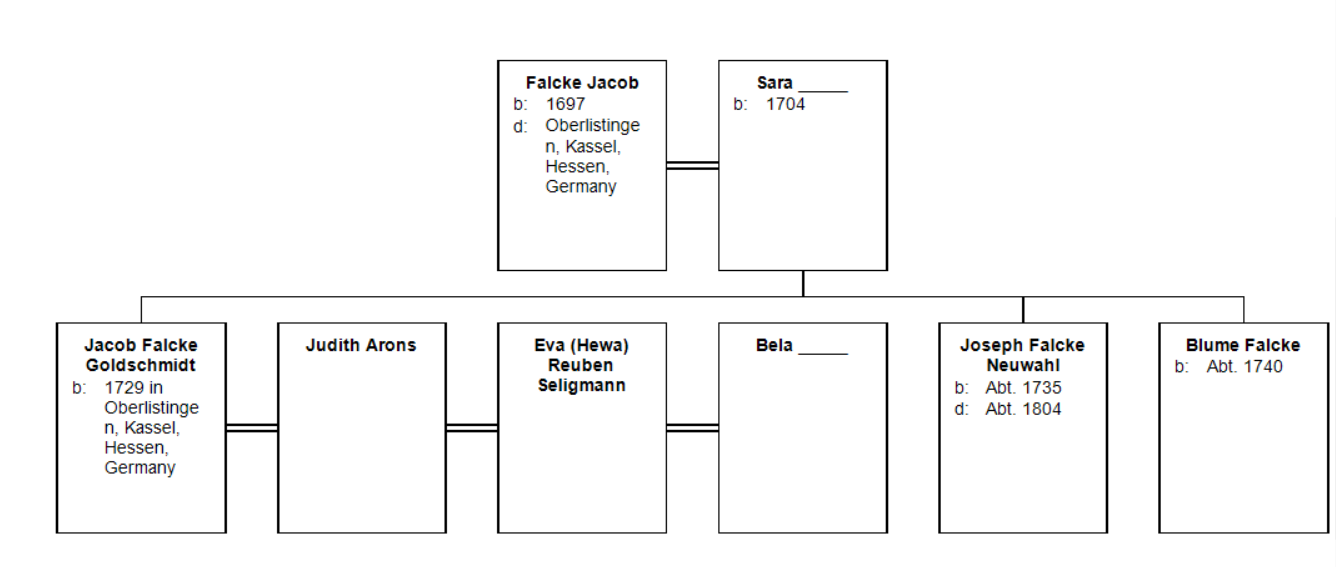
Thanks to the incredible work of David Baron and Roger Cibella, I can trace my Goldschmidt family back to my fifth-great-grandparents, Falcke Jacob, born in about 1697, and his wife Sara (surname unknown), born in about 1704.

My Goldschmidt ancestors came from Oberlistingen in the Hesse region of Germany, just a few miles from the village of Breuna, where my Hamberg ancestors once lived, about fourteen miles from Sielen where my Schoenthal ancestors lived, and about fifty miles north of Jesberg where my Katzenstein relatives lived.  Oberlistingen is in fact a small village within the larger township of Breuna, which also includes Niederlistingen, another small village very close to Oberlistingen. The two villages are sometimes referred together as the two “Listingens.”


Years ago David and Roger put together a website that traced the history of the Goldschmidt family and Oberlistingen and included excerpts from Chapter III of Dieter Carl’s book, Die Juden Geschichte Beider Listingen [The Jewish History of the Two Listingens] (Herausgegeben vom Gemeindevorstand der Gemeinde Breuna, 1999), as translated by Joseph Voss.

According to Dieter Carl, Jews had been expelled from the Hesse region by Duke Phillip the Generous in the mid-16th century in response to pressure from Martin Luther.  Then in 1592 Lord Moritz allowed a few Jews to settle in the region. Eventually more Jews settled in the Hesse region, but restrictions were imposed.

Carl provided this helpful background:

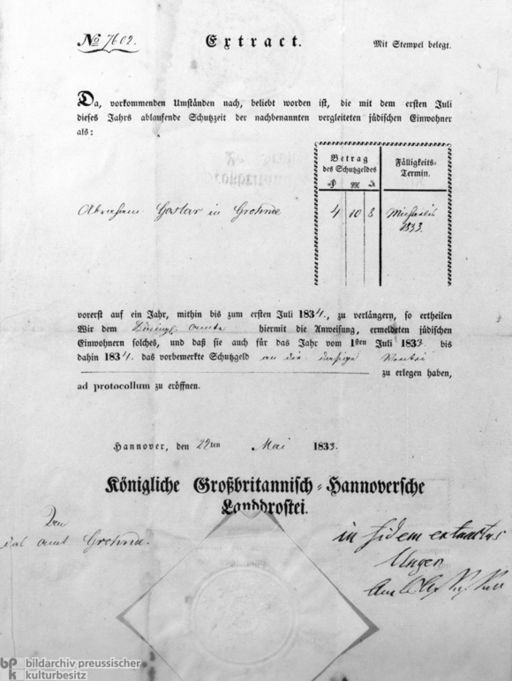
The unique position of the Jews derived from the nature of their religion, on one hand, and, on the other hand, stemmed from the nature of a people who had no citizens rights, who were not fully free, and stood outside of the established Christian society.  Therefore the Jews had gained the special protection of the Feudal lords needed for their security and livelihood for economical activity and housing.  Originally this protection was in the hands of the Kaiser, but in time it transmitted down to local Dukes.  ….  [T]he Dukes of Hessen … gave to certain families a letter “schutzbriefe” of protection–the legal basis for living in these rural areas.  The receiver of the schutzbriefe had to pay a reasonable sum and had to provide other services for the Lord.  The protection letter gave the Jews the legal right to trade and lend money.

For a long time Jews could not become artisans, farmers or civil servants, but only moneylenders or traders.  In order to limit the number of Jews in Hessian towns and villages, the letter could not be inheritable.  In reality though, the letter was passed down from father to eldest son with a small sum paid in order to continue that right.  This was beneficial for the right to do business and who could establish a family; hence the authorities could control the size of the Jewish population.  All the Jews for whatever reason did not possess the Schutzbrief, the youngest sons and unmarried daughters were the so-called “Unvergleitete” or disinherited.  From these large groups were created the Jewish under classes   or “Unterschicht”.  These consisted mainly as the “knechte, or the worker/ servants, the men and women who served the Schutzjuden in their employ.  In part they lived in great poverty and some resorted to begging for their livelihood.

According to Dieter Carl, the first Schutzbrief in Oberlistingen was given in 1724 to someone known as Juden Falcke, as seen in this letter dated October 19, 1724:

I, the undersigned am writing because I am protected by the esteemed sires of Malsburg.  I wish to become a member of the Oberlistingen community with permission to reside there.  I have obtained all of the rights to function in this community as a Jew and who has officially received these rights along with your right to cancel my contract.  Furthermore I am obligated, if the community is in need of money, and if I have the means to provide a loan without interest without damage to myself, I will make an advance to them if the need arises.  All of what is said here and recorded is based on free will and opinion, which my signature authenticates.

Signed 19 October 1724

Juden Falcke

Who was Juden Falcke? Was he related to me?

My fifth-great-grandparents Falcke Jacob and Sara had three children: Jacob Falcke, born in 1729; Joseph Falcke, born in 1734; and Blume Falcke, born in 1740.  Following the March 31, 1808 decree requiring Jews in the region to adopt surnames, Jacob Falcke adopted the surname Goldschmidt. Carl concluded that the “Juden Falcke” who received the first Schutzbrief for Oberlistingen was Jacob Falcke Goldschmidt, my four times great-grandfather. His brother Joseph adopted the surname Neuwahl and eventually also received a Schutzbrief to live in Oberlistingen.

Jacob Falcke Goldschmidt was married three times.  His first wife was named Bela, with whom he had one son; his second wife was Judith Arons, with whom he also had one son. Jacob’s third wife was my four-times great-grandmother, Eva Reuben Seligmann,[1] whom he married on November 24, 1780. [2]

Jacob Falcke Goldschmidt and Eva Reuben Seligmann had four sons:  my three-times great-grandfather Seligmann and his brothers Lehman, Meyer, and Simon. Dieter Carl also listed an unnamed daughter, and David Baron found a reference to this daughter in the Alex Bernstein Collection at the Leo Baeck Institute.  Her name was Jette, and she was born May 4, 1793; she married David Grunewald of Hoexter, Germany—the region that is the focus of Alex Bernstein’s research. According to his research, Jette died on August 4, 1822, and did not have any children.

CORRECTION: David Baron pointed out that I had misread Bernstein’s research. He found that Jette Goldschmidt did have children with David Grunewald before her death. First, a son Jacob Grunewald was born May 5, 1820; a second child was stillborn on July 30, 1822. Jette died five days later, presumably from complications from childbirth. Jacob Grunewald married and had fourteen children. Later I will return to these Goldschmidt cousins and report on them more fully.

Although I am primarily interested in my three-times great-grandfather Seligmann and his descendants, I will also write about his brothers, in part because his brother Simon was married to Fradchen Schoenthal, sister of Levi Schoenthal, my great-great-grandfather from Sielen.  Yes, my family tree continues to twist and bend.


[1] There is no known familial connection between Eva Reuben Seligmann, who was born in Warburg, Germany, and my Seligmann ancestors from Gau-Algesheim.

[2] This information all comes from Dieter Carl’s book as excerpted on the Cibella-Baron website. I will be focusing only on the children of my direct ancestor, Jacob Falcke Goldschmidt.

Two Photos to Identify—Can You Help?

I am back…sort of! Still working on my first Goldschmidt posts, but before I dive into that matter, I have two wonderful new photographs to share, thanks to my cousin by marriage, Ulrike Michel.

Ulrike is married to my fourth cousin, once removed, Torsten Michel. Torsten and I are both descended from Bernard Schoenfeld and Rosina Goldmann, my fourth great-grandparents; Torsten’s great-great-grandmother Ziborah Schoenfeld was the sister of my three-times great-grandmother Babetta Schoenfeld, wife of Moritz Seligmann, my three-times great-grandfather.


I’ve not met Torsten, but when we were in Germany, we spent a day with Ulrike in Heidelberg, as I wrote about here. Ulrike is the family historian in their family, and she and I have been in touch for several years now.

Recently Ulrike found and shared with me two photographs. I am particularly excited by this one that Ulrike believes is Babetta Schoenfeld Seligmann:


Here is the only confirmed photograph I had of Babetta, and I do see a definite resemblance.  But is it the same woman? Or is it perhaps her sister Ziborah, Torsten’s direct ancestor? What do you think?

The second photo Ulrike sent me is this one.  She believes this could be Franziska Seligmann, granddaughter of Moritz Seligmann and Babetta Schoenfeld and my first cousin, three times removed:


Here are the photographs I’d previously found of Franziska:

Franziska Seligmann Michel


Fred Michel and Franziska Seligmann Michel
Courtesy of the Family of Fred and Ilse Michel

Again, there is a definite resemblance, but is it the same woman? What do you think?

One of the mysteries raised by this photograph is why the Michel family would have had a photograph of Babetta’s granddaughter, who lived from 1875-1933.  Was it simply because she was Ziborah Schoenfeld’s great-niece?

Or was there a second connection to the Michel family? Franziska married Adolf Michel, and I have no information about his background. But Ulrike is now researching to see if Adolf Michel was related to her husband’s Michel relatives. She and Wolfgang are meeting in a few weeks to compare notes and see whether there is an additional overlap between the Seligmanns, Schoenfelds, and Michels.

I’d love your feedback on the photographs. Let me know what you think.

Happy New Year!

Happy New Year, everyone!

I am still on my blogging break for the next week or so, but wanted to reach out and thank all of you for reading my stories this year and especially to all of you who helped me by providing researching suggestions, translating documents, and commenting on my posts.  The support I’ve received is very much appreciated and makes this project so much more enjoyable and fulfilling than if I had to do it all alone without feedback and support.

As I look back on 2017, it wasn’t my favorite year in many ways, but in terms of family history, it was a wonderful year. Visiting Germany and getting to see where my ancestors once lived was an incredible experience; what made it particularly special was getting to spend time with my cousin Wolfgang and his family and with my cousin Ulrike and meeting in person some of the many people who have helped me with my research—Dorothee, Beate, Hans-Peter, Ernst, Julia, and Aaron.

In terms of research, 2017 was the year of the Katzensteins, and what a fascinating family they were and are. Visiting Jesberg made all that research come to life as I imagined my great-great-grandfather Gerson walking those streets along with his siblings and cousins.  And connecting with so many of my Katzenstein cousins made this research particularly rewarding and exciting. I have newly-found cousins from all over the US—Oklahoma, Texas, California, Massachusetts (!), Delaware, and so on. I cherish each and every one of the new leaves I’ve been able to add to the family tree.

As I venture into 2018, I look forward to learning the stories of my Goldschmidt ancestors and relatives.  Every family line I research brings me new insights into Jewish history and into my own story. Every new line teaches me how interconnected we human beings truly are—how we have unique personal stories but also share universal stories of love and hate, success and loss, courage and cowardice, creativity and inventiveness, peace and war, sickness and health.

Let us all hope that in 2018 our leaders and our world also recognize our interconnectedness, our need for each other, and our need to help each other. We cannot exist without each other. We are all part of one big family tree.

Rosa Abraham and Isidor Zechermann: A Final Update

The process of finding the story of Rosa Abraham has been a challenging one. At first all I had was her birth record and one passenger manifest for a Rosa Zechermann with the same birth date and birth place.

Ricchen Rosa Abraham birth record Nov 20 1892 Hessisches Hauptstaatsarchiv; Wiesbaden, Deutschland; Collection: Personenstandsregister Geburtsregister; Bestand: 920; Laufende Nummer: 6177

Rosa Abraham passenger card
The National Archives at Washington, D.C.; Washington, D.C.; Series Title: Passenger and Crew Manifests of Airplanes Arriving at Miami, Florida.; NAI Number: 2788541; Record Group Title: Records of the Immigration and Naturalization Service, 1787 – 2004; Record Group Number: 85

Then with the incredible help of members of the Jekkes Facebook group, I learned that Rosa had married Isidor Zechermann and immigrated to Chile to escape Hitler. I had not found a marriage record, but several bits of circumstantial evidence supported that conclusion.

Most recently I’d received Rosa and Isidor’s request for repatriation as German citizens and Rosa’s application for reparations from the German government for the loss of her occupation. I also was able to deduce from various documents and directories that Rosa and Isidor must have married sometime between 1930 and 1932. But I still didn’t have a marriage record that proved when they were married and, perhaps most importantly, that the Rosa who married Isidor was in fact my cousin Rosa Abraham.  All the evidence pointed in that direction, but I had no official record, just secondary sources and circumstantial evidence.

I wrote to the city of Frankfurt to request a marriage record, and Sigrid Kaempfer of the Institut fuer Stadtgeschichte responded not only with Isidor and Rosa’s long sought marriage record, but with three other interesting documents as well. First, that much hoped-for marriage record:

Marriage record of Rosa Abraham and Isidor Zechermann

It states that Isidor Zechermann, merchant, born on February 25, 1878, in Frankfurt and living in Frankfurt, married Ricchen Rosa Abraham, business owner, born on November 20, 1892, in Niederurff, on September 17, 1930, in Frankfurt. Finally, I had the proof I needed to get closure. My cousin Ricchen Rosa Abraham, daughter of Hirsch Abraham and Pauline Ruelf, born on November 20, 1892, was the wife of Isidor Zechermann and had married him in the time period I had determined in my last post about Rosa.

Also of interest—the two witnesses to the marriage were Adele Trier, geb. Abraham, Rosa’s sister, and Alfred Trier, Adele’s husband. Adele and Alfred were the couple Rosa and Isidor went to visit in Queens in 1952, as I wrote about here.

Ms. Kaempfer also sent me a link to Isidor’s birth record, confirming that he was born on February 25, 1878, in Frankfurt. With the help of the German Genealogy group, I learned that Isidor was the son of Schaye Zechermann, a shoemaker, and Fanny Benedikt. (Special thanks to Heike Keohane and Carolina Meyer for their extraordinary help in decoding Schaye’s first name!)

Isidor Zechermann birth record
HStAMR Best. 903 Nr. 8916 Standesamt Mitte (Frankfurt) Geburtsnebenregister 1878, S. 61

And Ms. Kaempfer sent me two documents relating to the businesses operated by Rosa and Isidor. For Rosa, she sent me this record of her tax payments from 1924 through 1932 for her “Damenkonfektion” or ladies’ clothing business. The form also notes the change to her married name Zechermann. And it indicates that Rosa’s business was shut down on August 31, 1938, and deregistered on September 8, 1938, presumably by the Nazis.

Rosa Abraham business record 1924-1938

For Isidor, Ms. Kaempfer sent me the record of his registration as a haberdasher in Frankfurt. He first registered on September 6, 1933.

Isidor Zechermann business registration and deregistration

I am not sure how to interpret the various entries on the first line below the solid line on the right side of this card, which asks about the location and personnel of the management of the business, but the last two notes there—-“isr./isr” —-are quite obviously a reference to the fact that the owner of the business was Jewish (“Israeltisch”). And the red stamped entries on this card—indicating that the business was shut down on August 31, 1938 and deregistered on September 3, 1938—are clearly a reflection of Nazi persecution as presumably was the case with Rosa’s business.

With these final records, I now have closure on the life of Rosa Abraham and Isidor Zechermann.  I know when and where they were born, when and where they married, where they lived and worked in Frankfurt, when they emigrated from Germany and moved to Chile, and when they died. But it truly took a village to get here.

This search has proven once again that this work cannot be done alone and depends on the generosity of many people.  Thank you all! As this year draws to a close, I am mindful of and grateful for all the help I have received in 2017.

Let me take this opportunity to wish all my friends, family, and readers who celebrate Christmas a joyful and loving holiday.  I will be taking a short break from blogging, but will return in 2018 to start the saga of my Goldschmidt family.

Merry Christmas and  Happy New Year! Have a safe and happy holiday, everyone!


The Great Harry Coopersmith Mystery (Almost) Solved!

Back on December 5, 2017, I wrote about the documents I’d received from an Ancestry member named Dale: the death certificate of Frieda Brotman Coopersmith, my grandmother’s sister, and the military discharge papers for her husband Harry Coopersmith.

Thanks to my fellow genealogy bloggers, I re-examined these documents more carefully and observed a few things I’d missed before.

One thing I had not noticed before was that the death certificate was ordered from New York City in 1943, almost twenty years after Frieda’s death. Similarly, the military discharge certificate was recorded in the New York County Clerk’s Office in 1947, something that Cathy Meder-Dempsey of Opening Doors in Brick Walls pointed out to me:

What was happening in the 1940s that would have prompted Harry or one of his sons to order these two documents? As Luanne Castle of The Family Kalamazoo pointed out in her comment on my prior post, there must have been some reason that these documents were ordered and why the military papers were recorded with the city clerk. I’ve yet to figure out the reason, however.

There were also two photographs in Dale’s father’s papers, but neither Dale nor I could identify the men in these two photographs:

In that last post, I went through all the possible theories that Dale and I had discussed about how these papers could have ended up in her father’s possession.  Dale had no idea who Harry or Frieda were; she found me through Ancestry because they are both listed in my tree there.  Dale thought at first the source was her great-aunt Anna Yurdin Haas, but my research and analysis led me to conclude that that was not the likely source as there was no apparent connection or overlap between Harry and Anna and Burton.

Instead, I concluded that it was more likely that the connection was between Dale’s father Howard Halpern and one or more of the sons of Harry Coopersmith from his second marriage: David, Lawrence, and Samuel. Howard grew up in Long Beach, Long Island, New York, just a mile away from Island Park, Long Island, New York, where in 1940 the three Coopersmith brothers were living as boarders in the home of Jacob and Pauline Davis.

After that post was published, I received several suggestions and questions from my readers.  Two, Su Leslie of the blogs Shaking the Tree and Zimmerbitch and Charles Moore of Moore Genealogy, pointed out that sometimes things end up in the hands of complete strangers through random events and that there might have been no relationship between the Halperns and the Coopersmiths.  Others suggested more questions to ask Dale and Harry’s grandson Stan.

I contacted Dale and Stan and asked them some more questions. On the “random distribution” theory Dale told me that her father had been an avid stamp and coin collector and met many people while pursuing those hobbies; he also purchased stamp collections from other collectors. She suggested I ask Stan whether anyone in the family collected stamps. And when I asked Stan, he responded that his father Lawrence had in fact been a stamp collector. Perhaps this was how the papers ended up with Howard? Did he purchase a collection from the Coopersmiths in which these papers had been left inadvertently?

Stan told me that his father had gone to a trade school in Manhattan to become a typesetter and had settled in Seaford, New York, on Long Island after he married.  Stan’s uncles David and Sam owned a printshop in Freeport, New York, and lived with their families in Wantagh, New York, towns that are also on Long Island. Stan also said that his grandfather Harry was living in Bohemia, New York, also on Long Island, at the end of his life.

Learning of these details, Dale pointed out that her father was a reporter for the Long Island newspaper, Newsday, and that her family had lived in Levittown, not far from Wantagh and Freeport. It thus was possible that her father knew the Coopersmiths from work or from stamp collecting.

To see if I could get more answers, I decided to try to contact some of Harry’s other grandchildren, whose names I found in the obituary of one of David Coopersmith’s children. I found two of them on Facebook, and one, David’s daughter, Mindy, was able to provide me with some critical information.

First, she shared this photograph of her father, David Coopersmith:

Comparing this photograph to one of the photographs Dale had sent me, I could see that both photographs were of the same man: Harry’s oldest son David.

Mindy believes that the other photograph—of the man standing behind a Coney Island sign—is her uncle, Larry Coopersmith. Now I knew who the men were in those two photographs—two of Harry Coopersmith’s sons.

Then one of those incredible small-world coincidences occurred. The next day I received an email from my friend and fellow genealogy blogger, Sharon Haimovitz-Civitano of the Branches of our Haimowitz Family Tree and Branches on Civitano Tree blogs.  She had been on Facebook and noticed that I had commented on a photograph that Mindy had posted and wanted to know how I knew Mindy because Mindy was her very close childhood friend. My head was spinning! Sharon said that when she’d read my earlier post about Harry Coopersmith and seen the “mystery photos,” she had in fact thought that one of them resembled her friend Mindy’s father, but she had dismissed the idea, thinking it was too far-fetched—-that Coopersmith was probably a common name and that there was likely no connection despite the resemblance and the fact that Sharon and her friend Mindy had both grown up on Long Island.

I asked Sharon to vouch for me—to assure Mindy that I was honorable and only interested in figuring out who was in the photographs and how they’d ended up with Dale’s father. And she did, and just a short while later, Mindy called me, and we had a lovely chat about our overlapping families.

Mindy told me that her father David had been in the Marines during World War II and that the photographs were taken in the 1940s—consistent with the answer I’d received from Ava Cohn, the Photo Genealogist. Mindy had not known about Harry’s first marriage, and she also did not know who Howard Halpern was or how these photographs and other papers could have ended up with Howard.  Mindy suggested that I speak with her mother Vivian for more information.

The next day I spoke to Vivian, and she confirmed what Mindy had told me and also filled in more of the gaps.  After Nettie was hospitalized, Harry could not find anyone to help him care for his sons, who were all under five years old at that time. He eventually decided to place them in the Hebrew Orphanage in New York City, and the orphanage found the Davis family to act as foster parents. David, Lawrence, and Samuel went to live with the Davis family as small boys and lived there until the two older boys were old enough to join the service during World War II.

Vivian also told me that Harry had himself been a stamp collector and that when he died in 1956, his son David had inherited the stamp collection. David, however, was not a collector so he gave the collection to his brother Sam, who was. Perhaps Sam or one of his children sold Harry’s stamp collection without ever knowing that there were papers and photographs inside.

Vivian and Mindy generously shared with me some photographs of Harry and his family, helping me put faces to the names of this family who were not biologically connected to my own, but whose story was nevertheless tied to my own.

This is Harry Coopersmith during his service in the army during World War I; Vivian said he’d served in Siberia and in the Phillipines:

Harry Coopersmith in World War I
Courtesy of the Coopersmith family

This is Nettie Lichtenstein Coopersmith, Harry’s second wife:

Nettie Lichtenstein Coopersmith Courtesy of the Coopersmith family

And here are two photographs of Harry with his sons, taken after they’d been taken into foster care and thus showing that Harry maintained contact with them during their childhood:

Lawrence Coopersmith, unknown man, Samuel Coopersmith, Harry Coopersmith, and David Coopersmith Courtesy of the Coopersmith family

Harry Coopersmith and his family Courtesy of the Coopersmith family

We may never know how Howard Halpern ended up with the photographs of David and Lawrence, Harry’s discharge papers, and Frieda’s death certificate. It might have been a random event—through, for example, a sale of a stamp collection. Or maybe he knew the Coopersmiths from school or from the community or from work. But somehow he came into possession of these items and kept them safe for a long time.

Thus, the mystery is not completely solved, but the most important questions have been answered. We know the identity of the men in the photographs, and now I can return them to their family. I know more about Harry and his life after Frieda died. And best of all, I’ve found some wonderful people who are connected to me through the tragically brief marriage of Harry Coopersmith to my great-aunt Frieda, my grandmother’s little sister who died far too young.