Writing the immigrant story, in truth or fiction

Thanks so much to Linda Austin of Moonbridgebooks for interviewing me about my novel, Pacific Street.

moonbridgebooks's avatarmoonbridgebooks

“Imagine being a sixteen year old boy, walking across Europe and leaving your whole family behind. Imagine being a young girl, the poor daughter of immigrants, trying to bridge the gap between your parents and the world they now live in.”

The above is from cover copy of Amy Cohen’s new book, Pacific Street. What was life like for immigrants coming to America in waves back in the 1800s and early 1900s? I discovered my Dutch ancestors were a hard-scrabble lot hoping for a better life in the US, a common story. Whether it was better here is debatable, but their journeys helped make me who I am today.

Sharon Lippincott, of The Heart and Craft of Lifewriting, gave a shoutout on Facebook for Amy Cohen and her historical novel, Pacific Street. This is Amy’s first book, and what I read on Amazon’s Search Inside was well-written and…

View original post 777 more words

Why Germany?

Before we left for Germany, we received many strange reactions when we would tell people we were traveling to Germany.  Some people were quite blunt: how could we visit that country after what they did to the Jews in the Holocaust? Others were more subtle and just shrugged and said, “Why would you go there?” Others simply looked bemused.  Some people said, “Just Germany?” I know if we were going to Italy or England, no one would have reacted that way.  Germany just did not seem to be an appealing destination to many of the people we know.

Even when I explained that I was going to see the places where my father’s ancestors had lived and meeting cousins who live in Germany, people reacted strangely. So now that we are back, I can better explain why we went to Germany and why other people might want to go there as well. I will write about the specific experiences we had in the various places we visited in later posts, but first I want to put the trip in perspective and give some overall thoughts about what we saw and what we learned.

First, Germany is a beautiful country with so much to see and experience.  The Rhine River and the rolling hills and wide open green spaces are a delight.

On the Rhine from Bingen to Koblenz

Some of the cities and towns we saw are as charming, interesting, and historically and culturally rich as any we have seen in other places.  In particular, Mainz, Wurzburg, and Heidelberg are beautiful with storybook churches, elegant palaces, and inviting and exciting markets and squares.  The houses range from half-timber fairy tale houses to rococo-decorated merchant homes.

Mainz

In the smaller villages and towns, you get a feeling for how life has been lived in such places for centuries.  They are not like the small town where I now live.  There are clusters of houses around a central square with a church and town hall anchoring that common space.   Surrounding these clusters of homes and buildings are miles and miles of open land.

Countryside near Sielen

Second, people need to see and understand the damage that war can do. The places destroyed by the Nazis—especially the synagogues and cemeteries—are terribly heartbreaking to see, and there are constant reminders of the Jews who were deported and killed by the Nazis. You cannot go any place in Germany without being reminded that there were once Jews there and that they were persecuted and murdered.

Stolpersteine in Bingen

And some of the places we visited—Cologne, Kassel, and Bingen, in particular—were devastated by Allied bombing during the war.  They’ve been rebuilt, but quite often the new architecture is bland and boring. Often people would comment on how beautiful a city had been before the bombing. The Germans live with daily reminders of what their country did during the Third Reich and also what the war cost them.

A street in Cologne showing a Roman arch at the end of a post war street.

I can’t say that as an American Jew, I felt any guilt about the damage my country did to Germany in order to stop the Nazis.  But I also never once heard any of the many Germans we spoke to express resentment or hostility towards the Allies for the harm done to their country.  They seem to understand and accept that the Allied attacks were a necessary response to the aggression and genocide committed by the Nazis. Nevertheless, as the world continues to use violence and destruction as a means of settling disputes, we all should understand the consequences of war—not only in terms of loss of life, but also in terms of loss of culture, history, art, and architecture.

Which brings me to the third important lesson we learned while in Germany.  There are many non-Jewish Germans who are working with a true passion and commitment to preserve and restore the history of the Jewish communities that were wiped out during the Holocaust.  These people by and large are volunteers—good and dedicated people who were born either during or after the war and who are horrified by what the Nazis did.  We spent a great deal of time with six of these people in a number of different towns where my ancestors once lived.

Just a few of the good people we met in Germany (and my husband Harvey)

We asked all of them why they are doing this work.  Their answers varied; one said it was because she’d had a Jewish teacher as a child with whom she’d been very close; another said that it was discovering a former synagogue that had been desecrated; another mentioned that it was learning what had happened to the Jews in his small town that had motivated him to learn more.  They are all warm, thoughtful, and kind people. They became friends.  One man, with tears in his eyes, spoke about his gratitude to the US for the aid it provided to German citizens after World War II.  These people spent many hours with us and did not charge us one cent.  They just wanted to help.  They want Jews to know about the work they are doing; they want us to come and visit and reclaim our history.  They want to help us reclaim that history, and they want us to help them preserve it.

And that’s what I did in Germany.  I stood where my ancestors once stood.  I staked my claim as a person whose family once lived and thrived in the towns of Germany, as a person who is also a part of the history of that place.  I wanted to make a visible statement that Hitler did not win because Jews still exist; we survived, and we are as entitled as anyone to walk the streets of Germany.  By going to Germany and talking to those who live there, I was able to let them know that we have not forgotten what happened during the Third Reich, but we also have not forfeited our claim to our history in those places.

Standing at the graves of my 3x-great-grandparents, Scholum Katzenstein and Breine Blumenfeld in Haarhausen cemetery

I understand that not everyone will feel as I do. And it’s not my intention to change anyone’s mind.  I just want to explain my feelings to those who have asked and will continue to ask me with that skeptical look, “Why would you go to Germany?” Because we can.  Because the Nazis did not win.  Because we have every right to claim our rich heritage and our long history in that country. And because many people who live there want us to do just that.

Annlis Schäfer Seligmann 1924-2017

We have returned from our trip to Germany, and I have many things to share about the experience.  It was a trip filled with many joyous moments as well as many sad and heartbreaking moments.  One of the greatest joys and definitely the saddest moment involved Annlis Seligmann, mother of my dear cousin Wolfgang.

Annlis and Wolfgang

When Wolfgang found my blog almost two and half years ago, it was the result of a family research project he was sharing with his mother.  Annlis was not born a Seligmann; she was born Annlis Schäfer on April 12, 1924.  But in 1965 she married Wolfgang’s father Walter Seligmann, who died in 1993, and she was fascinated with the history of his family.  When the Seligmann family discovered the “magic suitcase” that had belonged to Walter’s brother Herbert, Annlis and Wolfgang began to search through the documents to learn more about the Seligmann family history.  Because Wolfgang could not read the old German script, Annlis had to decipher many of the old records and documents for him.

At some point in this process, Wolfgang discovered my blog, and together the three of us—Annlis, Wolfgang, and I—all worked together to find many of the missing pieces of the Seligmann family.  We were able to figure out how many of the people named in those documents were related to us all.  Without their help, I would not have found many of the Seligmanns who died in the Holocaust or who, like my cousins Lotte Wiener Furst and Fred Michel, were able to escape Germany before it was too late.

So when I was planning my trip to Germany, one of my priorities was to meet not only Wolfgang, his wife Bärbel, and daughter Milena, but also his mother Annlis.  We arrived in Germany on May 2, and the first thing we were scheduled to do on May 3 was meet Annlis.  We went with Wolfgang to the senior residence where she was living in Mainz (like an assisted living facility in the US) first thing that morning. Annlis did not speak English, so I was able to test my baby German.  With Wolfgang’s help, we were able to communicate.

She and Wolfgang showed me some family photographs, and I shared with her photographs of my parents, children, and grandchildren.  We looked through the magic suitcase together (there are still hundreds of letters and postcards still to be translated). Despite the language obstacles, I felt a strong connection to Annlis and was sad to say goodbye when our visit ended.

Annlis had been in declining health in recent months.  Her vision had become so poor that she could no longer read and help translate the documents, but she remained very interested in the family history and, according to Wolfgang, had been very anxious to meet me.  After our visit, she expressed to Wolfgang how happy she had been to meet me.  I was so touched and, of course, felt the same way.

So you can imagine my shock when less than ten days later while still in Germany, I received a message from Wolfgang telling me that his mother had died.  I was stunned and so sad.  And heartbroken for Wolfgang and his family.

Annlis lived a long and full life.  From Wolfgang I know that she grew up in Mainz where she also lived for the last five years of her life.  During World War II, she was working in Bingen.  In September, 1944, she witnessed the murder of an American soldier, Odis Lee Apple, whose plane had been shot down and crashed nearby.  As described here by Wolfgang himself on the website for the radio station where he works, the caretaker for the building where Annlis worked notified the people in the office that an American soldier was walking on the street outside the building.

Annlis and three of her co-workers left the building and followed Apple, whom she described as a man with a friendly face.  Then suddenly the building’s caretaker rushed out onto the street in his SA uniform and shot Apple.  He did not die right away, but was suffering terribly from the gunshot wound.  At some point someone else shot him, and he died.

Street in Bingen where Annlis worked and witnessed the murder of Odis Lee Apple

After the war, the US Army investigated Apple’s death; Annlis provided testimony, and several people were sentenced to prison.  The caretaker, however, had died not long after the shooting during a bombing attack on Bingen.

According to Wolfgang, his mother never forgot this incident and was horrified by what she had witnessed. Even though at that point the US was at war against Germany, Annlis knew it was wrong to kill someone in cold blood like that.

Tribute to Odis Lee Apple at the spot where he was shot

It was not until twenty years after the war that Annlis married Walter Seligmann in 1965.  Together they raised their son Wolfgang in a neighborhood outside of Mainz in an apartment overlooking the valley.  She lived in that apartment until five years before her death when she moved to the building where I met with her on May 3.

Annlis Seligmann lived a good and long life; she had just turned 93 a month before her death.  I feel so privileged and fortunate that I was able to be a part of her life in the last two years and especially that I was able to meet her in person, share some time with her, and give her a hug.  My heart goes out to Wolfgang, Bärbel, Milena, and the entire extended family.  May her memory be a blessing.


Auf Wiedersehen!

Quote

The Blessings and Curses of Old Family Stories

Family stories can often lead you astray, but perhaps more often they can give you clues or corroborate evidence you’ve already uncovered.  In the case of the descendants of Rahel Katzenstein and Jacob Katz, there has been a little of all three.

What I know from the research done by Barbara Greve and David Baron is that Rahel and Jacob had six children: Blumchen, Moses, Meier, Abraham, Sanchen, and Samuel. Abraham and Samuel came to the United States in the years following the Civil War, as I’ve written.  But what about the other four siblings? What could I learn about them?

Fortunately, my cousin Marsha interviewed our mutual cousin Theo Goldenberg in January, 1993, about the family history.  Theo Goldenberg was born and raised in Jesberg; he was the grandson of Meier Katz and came to the US in the 1930s as a young man escaping Nazi Germany. Having grown up in Jesberg with his Katz and Katzenstein relatives, Theo had first-hand knowledge of the family stories and may have been one of the the best people to ask about the siblings of his grandfather Meier.

In his interview with Marsha, Theo named five of the children of Rahel and Jacob: Blumchen, Moses, Meier, Abraham, and Samuel.  He also told Marsha that there had been another daughter who drowned as a small child—presumably that would have been Sanchen, the only other daughter found by Barbara Greve or David Baron. Thus, Theo’s recollection is quite consistent with the list of names I had learned from Barbara Greve and David Baron.

Family lore, however, is that there was another son who came to the United States before Abraham and Samuel and who fought in the Civil War.  The family story is that when Abraham came to the US, he went to New Orleans to look for this brother, but never found him. He was presumed to have been killed in the Civil War.

Theo Goldenberg told Marsha that he was not aware of any other son, and although I have spent a fair amount of time searching, I have found no records that support the existence of this fifth brother (nor did Barbara Greve or David Baron, both of whom have done extensive research on the family).

At first I thought perhaps Moses was this missing brother because I found a Moses Katz who came from the Hesse region and who fought in the Civil War.  He survived the war and settled in Baltimore.  But I could find no tie to the family of Rahel Katzenstein and Jacob Katz, and Marsha’s father Henry pointed out persuasively that if Moses had been in Baltimore, Abraham would have known and easily found him without traveling to New Orleans, especially since Abraham lived in Baltimore when he first came to the US.

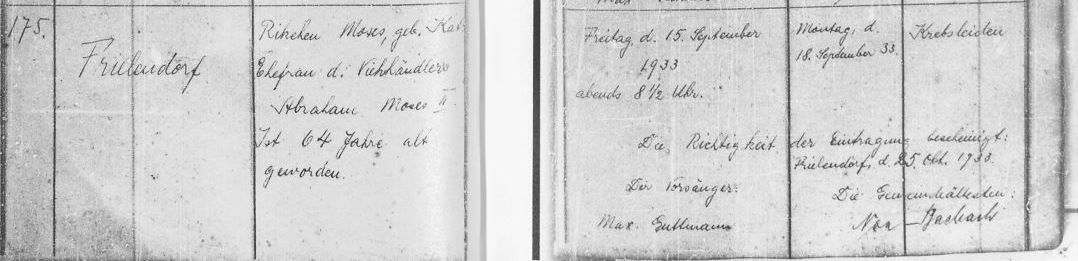
Theo Goldenberg, moreover, told Marsha that Moses never left Germany. Although Marsha commented in her notes that this part of her interview with Theo was somewhat confusing, it appears that Theo told her that Moses had died as a young man after being kicked by a cow in the stomach.  He had, however, been married and had had several children.

David Baron also had information about Moses Katz that indicated that Moses had married Amalia Malchen Wetterhahn in Jesberg, Germany on July 3, 1869, and had had six children born in Jesberg.  I owe David a huge thank you for sending me many of the Katz records from Jesberg and also for teaching me how to find others myself.  Here is one he shared with me, a death record for Moses Katz:

Moses Katz death record, Jesberg Hessisches Staatsarchiv Marburg: Standesamt Jesberg Sterbenebenregister 1898 (HStAMR Best. 920 Nr. 3896) Jesberg 1898, p.32

My FB friend Matthias Steinke once again helped me out and translated the document, and it says nothing about the cause of death, so the “kicked in the stomach” story will have to remain family lore.  Also, Moses Katz died when he was almost sixty—so hardly a “young man.”  Maybe Theo was referring to someone else in the family.

Jesberg, the 9th July 1898
To the below signing registrar came the personally known merchant Markus Katz, residing in Jesberg, house-nr 32/2, and reported, that the merchant Moses Katz, 58 years, 6 month, 11 days, mosaic religion, residing in Jesberg, housenr. 32/2, born in Jesberg, been married to Amalie nee Wetterhan of Jesberg, son of the deceased merchant Jakob Katz and his deceased wife Rael nee Katzenstein of Jesberg, in Jesberg at the 8th July 1898 past midday at 6 o’clock is deceased. The Markus Katz declared, that he knows about the death by his own knowledge. Readed, confirmed and signed Markus Katz – the registrar (signature)

I suppose it’s possible that Moses went to the US, fought in the Civil War, returned to Jesberg after the war and married Amalia in 1869. But that seems unlikely, and wouldn’t Abraham have known that his brother had returned to Jesberg?

Perhaps it was not a brother but a cousin who fought and died in the Civil War? I don’t know.  But at this point I think the evidence does not support the story of this missing brother. However, the story has been passed down through the generations, and I’ve learned that in every family story there is usually some kernel of truth.  I just haven’t found it yet in this story.

Nor can I verify the story about Sanchen’s drowning. If Sanchen died as a young girl, that would have been more than fifty years before Theo’s birth and so perhaps not reliable as a piece of family history (and unfortunately before the earliest Jesberg records that are kept online.)  Yet such a traumatic event might very well have been reliably reported from generation to generation.

As for Blumchen, Theo told Marsha that she had stayed in Germany, married, and had not had any children.  According to David Baron, Blumchen married Heskel Grunenklee of Meimbressen, Germany, and she died on March 9, 1909.  Theo’s story is thus consistent with the research done by David Baron.

Theo had, not surprisingly, the most information about the children of Meier Katz, his grandfather, who died on October 29, 1925, when Theo was eleven.  Unfortunately, there were no insights about Meier in the interview notes.

Meier Katz death record
Hessisches Hauptstaatsarchiv; Wiesbaden, Deutschland; Bestand: 920; Laufendenummer: 3916
Description
Year Range : 1925
Source Information
Ancestry.com. Hesse, Germany, Deaths, 1851-1955 [database on-line]. Provo, UT, USA: Ancestry.com Operations, Inc., 2016.
Original data: Sterberegister und Namensverzeichnisse. Hessisches Hauptstaatsarchiv, Wiesbaden, Deutschland.

Theo’s grandmother Sprinzchen Jungheim Katz died on June 15, 1917, so Theo would have been only three years old when his grandmother died.

Death record of Sprinz Jungheim Katz 1917
Hessisches Hauptstaatsarchiv; Wiesbaden, Deutschland; Bestand: 920; Laufendenummer: 3915

Meier and Sprinzchen had six children: Jacob, Aron, Seligmann, Regina, Karl, and Sol, according to Theo. I have not seen Sol listed anywhere else, and Theo had nothing more to say about him besides his name. However, there was a Salli Katz born to Meier and Sprinzchen on June 14, 1888, who died on January 10, 1892, so I assume that this is the “Sol” referred to by Theo Goldenberg.

Salli Katz birth record
Hessisches Hauptstaatsarchiv; Wiesbaden, Deutschland; Collection: Personenstandsregister Geburtsregister; Bestand: 920; Laufende Nummer: 3819
Description
Year Range : 1888
Source Information
Ancestry.com. Hesse, Germany, Births, 1851-1901 [database on-line]. Lehi, UT, USA: Ancestry.com Operations, Inc., 2016.
Original data: Geburtenregister und Namensverzeichnisse. Hessisches Hauptstaatsarchiv, Wiesbaden, Deutschland.

Salli Katz death record, Hessisches Staatsarchiv Marburg: Standesamt Jesberg Sterbenebenregister 1892 (HStAMR Best. 920 Nr. 3890)
Jesberg 1892, p.2

As translated by Matthias Steinke:

Jesberg at the 10th January 1892 – To the below signing registrar came today the personally known merchant Moses Katz, residing in Jesberg, House nr. 32 1/2 and reported, that Salli Katz, 2 years 6 month 25 days old, mosaic religion, residing in Jesberg, house nr. 28, born in Jesberg, son of the merchant Meier Katz II and his wife Sprinzchen nee Jungheim of Jesberg, in Jesberg at the ninth January of the year 1892, past midday at four o’clock is deceased. The Moses Katz declared, to know about the death by his own knowledge. Readed, confirmed and signed Moses Katz The registrar Appell

[The death record reports that Salli was two and a half years old, but based on the birth record, he was really three and a half years old.]

The other five children of Meier and Sprinzchen—Jacob, Aron, Isaac, Regina, and Karl—all survived to adulthood and all came to the United States, some as early as the 1880s, others as late as the 1930s.  But fortunately they all survived. More on that in the posts to come.  For now, here is a photograph of Meier and Sprinzchen and those five children:

Meier and Sprinzchen (Jungheim) Katz and children

What I learned from all this is that we all should be doing what Marsha did back in 1993; we should be interviewing the older generations in our family, asking questions and taking notes.  Even if some of the information leads us on a few wild goose chases, the stories we will hear will disappear if they are not recorded.  I am so grateful that Marsha had the wisdom to meet with her cousin Theo and ask him to answer her questions about the family back in 1993.  If only I had done the same with my own older relatives 24 years ago…


The Children of Abraham and Amelia (Nahm) Katz 1944-1989

After Abraham and Amelia Katz died, their children almost all continued to live and work in the same places in Oklahoma for most of the rest of their lives.   They were all in some way connected with the dry goods business.

Katz Department Store logo designed by Sidney Pepper, husband of Ann Levine Pepper, daughter of Henrietta Katz Levine

Rachel and Morris Kohlmann continued to live in Bristow, Oklahoma, until at least 1935, but by 1940, they were living in Oklahoma City where Morris owned a shoe store.  By April, 1942, however, when Morris registered for the World War II draft, he and Rachel were living back in Louisville, Kentucky, where they had met and where Morris now owned a business called Jewel Cleaning and Dyers. [Thank you to Janice Webster Brown of Cow Hampshire Blog for pointing out that it says Dyers, not Dryers!]

Morris Kohlmann World War II draft registration
The National Archives at St. Louis; St. Louis, Missouri; Draft Registration Cards for Fourth Registration for Kentucky, 04/27/1942 – 04/27/1942; NAI Number: 7644732; Record Group Title: Records of the Selective Service System; Record Group Number: 147

Morris died in Louisville five years later on April 10, 1947; he was 67 years old.  His death certificate states that he was a shoe salesman at the time of his death.

Morris Kohlmann death certificate
Ancestry.com. Kentucky, Death Records, 1852-1964 [database on-line]. Lehi, UT, USA: Ancestry.com Operations Inc, 2007.
Original data: Kentucky. Kentucky Birth, Marriage and Death Records – Microfilm (1852-1910). Microfilm rolls #994027-994058. Kentucky Department for Libraries and Archives, Frankfort, Kentucky.Kentucky. Birth and Death Records: Covington, Lexington, Louisville, and Newport – Microfilm (before 1911). Microfilm rolls #7007125-7007131, 7011804-7011813, 7012974-7013570, 7015456-7015462. Kentucky Department for Libraries and Archives, Frankfort, Kentucky.Kentucky. Vital Statistics Original Death Certificates – Microfilm (1911-1964). Microfilm rolls #7016130-7041803. Kentucky Department for Libraries and Archives, Frankfort, Kentucky.

Rachel must have returned to Oklahoma after the death of her husband. She died in Sapulpa on January 8, 1953; she was seventy years old.

Rachel Kohlmann headstone
JewishGen, comp. JewishGen Online Worldwide Burial Registry (JOWBR) [database on-line]. Provo, UT, USA: Ancestry.com Operations Inc, 2008.

Lester Katz, the oldest brother, had remained in Sapulpa where he was the owner and manager of the family department store there.

Lester Katz World War II draft registration
The National Archives at St. Louis; St. Louis, Missouri; Draft Registration Cards for Fourth Registration for Oklahoma, 04/27/1942 – 04/27/1942; NAI Number: 576250; Record Group Title: Records of the Selective Service System; Record Group Number: 14

This wonderful photograph shows the five sons of Abraham and Amelia (Nahm) Katz probably sometime in the 1950s:

Ben, Sidney, Mickey, Sigmund and Lester Katz
courtesy of the Katz family

Lester died in Sapulpa on January 17, 1959; he was 73 years old.  The Sapulpa Historical Society sent me a copy of his obituary, but it does not identify the paper in which it appeared.  According to the obituary, Lester had had heart issues prior to his death.  It reported that he had died from a heart attack and had been found by his brother M.J. (Milton) lying on the floor in the family’s store.  The obituary also stated that Lester had been active in several civic organizations and that “he was perhaps as well known in this section as any local merchant.”

Lester Katz headstone
JewishGen, comp. JewishGen Online Worldwide Burial Registry (JOWBR) [database on-line]. Provo, UT, USA: Ancestry.com Operations Inc, 2008.

Lester’s wife Mayme died almost seven years later on December 2, 1965.  They were survived by their daughters.

Sidney and his brother Ben continued to run the Katz Department Store in Ada, Oklahoma, where they both lived.

Sidney Katz World War II draft registration
The National Archives at St. Louis; St. Louis, Missouri; Draft Registration Cards for Fourth Registration for Oklahoma, 04/27/1942 – 04/27/1942; NAI Number: 576250; Record Group Title: Records of the Selective Service System; Record Group Number: 147

Notice that Sidney listed Ben as the person who would always know his address, and Ben did the same on his draft registration:

Ben Katz World War II draf registration
The National Archives at St. Louis; St. Louis, Missouri; Draft Registration Cards for Fourth Registration for Oklahoma, 04/27/1942 – 04/27/1942; NAI Number: 576250; Record Group Title: Records of the Selective Service System; Record Group Number: 147

The family described to me the special relationship between Ben and Sidney.  They worried about each other and always looked out for each other’s best interests.  When Sidney decided to retire, he tried to reduce the inventory in the store so it would cost Ben less to buy him out; Ben, worried that Sidney would not have enough to live on after selling his share, arranged for the inventory to be rebuilt so that he would have to pay Sidney more.  That is a remarkable partnership and relationship—to put family before business and before your own interests.

Here is a photograph of Ben and his wife Sadie and their three children, Henry, Bryna, and Alfred, taken in about 1933:

Sadie, Ben, Henry, Bryna, and Alfred Katz c. 1933

The Katz Department Store in Ada during the 1940s on Rodeo Day:

Ada, Oklahoma 1940s
Courtesy of the Katz family

Sidney and Ben and other unidentified people in the Ada Katz Department Store:

Katz Department Store in Ada, OK with Sidney and Ben Katz
Courtesy of the Katz Family

An advertisement for the Ada store published in the Ada Evening News on March 15, 1953:

Ada Evening News, March 15, 1953

Sidney Katz died in 1961. In another unlabeled obituary I received from the Sapulpa Historical Society, Sidney was described as “universally loved and respected on Main Street by his fellow businessmen and by the hundreds of people he knew in his long career here. He was a man of great energy.  He liked people and gave constantly and unselfishly of his time to a host of civic and community projects.”  The obituary also noted that he enjoyed golf.  Sidney was survived by his wife Eulalia, who died in 1972.

Sidney Katz, photograph from 1961 obituary

Courtesy of FindAGrave member Linda Abelli (#48304482)

Ben died just five years after his brother Sidney on March 25, 1966. He was 73 years old and was survived by his wife Sadie and their three children. His obituary appeared on the first page of the Ada Weekly News of March 25, 1966:

Courtesy of FindAGrave member Jackie (#46788388)

His wife Sadie died in 1983; she was 86. Here is a photograph of Ben and Sadie with their granddaughter Marsha.

After Ben died, his two sons Alfred and Henry took over the Ada store, which they ran until 2004 when they retired.  Following are photographs of the store in Ada:

The family lost two siblings in 1972.  In July, Blanche died in a nursing home in Sapulpa; she was 89 years old and, as far as I can tell, had never worked outside the home or married.  Six months later on December 27, 1972, Florence Katz Frisch died in Sapulpa.  Her husband Sol Frisch had died in 1943; they had been living in Stillwater, Oklahoma at that time, but sometime after Sol’s death, Florence returned to Sapulpa.  Florence had also been predeceased by her only child, Sara Jean Frisch Looney, who died on August 19, 1966, at age 44 from a brain tumor.

JewishGen, comp. JewishGen Online Worldwide Burial Registry (JOWBR) [database on-line]. Provo, UT, USA: Ancestry.com Operations Inc, 2008.

Milton Katz, who was known as Mickey, had returned to Sapulpa in 1944 after spending some time in the east in the construction business, according to a 1973 profile of him in the Sapulpa newspaper.  When he returned, he joined his brother Lester in the Sapulpa store.  Milton married Ruth Billingslea on February 24, 1951, in Benton, Arkansas. Ruth was a widow when she married Milton; she was 48, and he was 49.  Ruth was born in Oklahoma and had been living in Chickasha, the town where Milton’s sister Henrietta lived. Milton and Ruth lived in Sapulpa where, according to Ruth’s obituary in the Sapulpa Herald of Friday, July 9, 2004, she assisted Milton in the Katz Department Store

According to the 1973 article (for which I unfortunately do not have a full citation), Mickey was quite a character, especially in his youth. The article described how he had purchased rain insurance for a Sapulpa high school football game and collected when it rained .3 inches; then he had managed to get the game played anyway by having the field burnt and purchasing cleats for the players.

Milton “Mickey” Katz died in Sapulpa in April 1983 when he was 81 years old; according to his obituary (another unlabeled one I received from the Sapulpa Historical Society), he had served as president of the Chamber of Commerce, the Jaycees, and the Kiwanis Club and as chairman of the Sapulpa Metropolitan Area Planning Commission and of Sapulpa Flood Control.  His wife Ruth survived him by 21 years.  She died in 2004 when she was 101 years old.

Photo of Mickey Katz from 1973 article in Sapulpa newspaper

The last two surviving siblings, Henrietta and Sigmund, both lived long lives.  Henrietta and her husband Ben Levine had remained in Chickasha, Oklahoma.  Ben died in Chickasha on January 2, 1960 at age 71.  Henrietta remained in Chickasha, where she died 28 years later in June, 1988, at age 93; she was survived by her three children.  Ben is buried between Henrietta, his second wife, and her older sister Bertha, his first wife.

Photo by P Black-Avitts (#46910889) of FindAGrave

Sigmund was then the last living child of Abraham and Amelia Katz, but he only survived Henrietta by eight months. He died on February 24, 1989.  Sigmund and his wife Elizabeth had remained in Bristow, Oklahoma, until at least 1942.  In 1940, Sigmund was still working as a merchant, but on his World War II draft registration in 1942, he reported that he was not employed.

Sigmund Katz World War II draft registration
The National Archives at St. Louis; St. Louis, Missouri; Draft Registration Cards for Fourth Registration for Oklahoma, 04/27/1942 – 04/27/1942; NAI Number: 576250; Record Group Title: Records of the Selective Service System; Record Group Number: 147

According to his obituary in the Sapulpa Herald of February 26, 1989, “Mr. Katz worked at the Bristow store from 1922-1941 then associated with the Oklahoma State Employment Service. He resided in Sapulpa from 1952 until 1985, when he moved to Tulsa.”   Sigmund died in Tulsa on February 24, 1989; he was 92 years old.  Elizabeth lived another three years, dying in Tulsa on April 8, 1992; she was 93.  They were survived by their two daughters.

Together, Abraham and Amelia Katz had ten children, eleven grandchildren, and a large number of great and great-great-grandchildren, a number of whom still live in Oklahoma while others are spread throughout the United States.  And I am so fortunate to have been able to find and connect with a number of them.  I am particularly grateful to my cousins Marsha and Henry for generously sharing the photographs and allowing me to share them with you.

The Children of Abraham and Amelia (Nahm) Katz: 1920-1944

In my last two posts, I wrote about Abraham Katz and the decision he made in 1910 to move his family from Louisville, Kentucky to Sapulpa, Oklahoma, where business opportunities seemed more promising for him and his children. By 1920, Abraham Katz and his large family were well-established in Oklahoma.  Four of the ten children were married, one, Bertha, had died at a tragically young age, and five of the ten children were still living at home.

During the 1920s, four of the other Katz children married. Florence, who had been living at home in 1920, had married by 1921.  Her husband was Solomon Frisch, who was born in Springfield, Illinois, but grew up in Athens, Illinois, the same town where Lester Katz’s wife Mayme had grown up.   Solomon was the son of Isaac and Sophia Frisch, who were immigrants from Hungary and Germany, respectively; Isaac was a bookkeeper. In 1917 when he registered for the World War I draft, Solomon had his own store in Athens.

Solomon Frisch World War I draft registration; United States World War I Draft Registration Cards, 1917-1918,” database with images, FamilySearch (https://familysearch.org/ark:/61903/3:1:33SQ-G14V-J6P?cc=1968530&wc=9FCN-RM9%3A928312901%2C928928301 : 14 May 2014), Illinois > image 785 of 2475; citing NARA microfilm publication M1509 (Washington, D.C.: National Archives and Records Administration, n.d.).

Florence and Sol must have married not long after the 1920 census, as their daughter Sarah Jean was born on November 18, 1921. In 1930, they were living in Stillwater, Oklahoma, and Sol was working as a dry goods merchant.  Stillwater was, as mentioned in an earlier post, the town where Abraham Katz’s nephew (and Florence’s first cousin) Jake was also a dry goods merchant, and Sol was working with Jake in Stillwater in the Katz Department Store.

Benjamin Katz also married in the 1920s.  His wife, Sadie Bardine, was the daughter of two Russian immigrants, Isaac and Molly Bardine; Sadie was born in Kansas City, Missouri, where she grew up.  In 1920, she was working as a stenographer in a law office.  Sadie and Ben were married on June 12, 1924, in Kansas City.

Marriage record of Benjamin Katz and Sadie Bardine
Ancestry.com. Missouri, Jackson County Marriage Records, 1840-1985 [database on-line]. Provo, UT, USA: Ancestry.com Operations, Inc., 2015.
Original data: Marriage Records. Jackson County Clerk, Kansas City, Missouri.

According to the Encyclopedia of Southern Jewish Life published by the Goldring Woldenberg Institute of Southern Jewish Life,  “Sadie came from an Orthodox family and found it very daunting to adapt to her husband’s classical Reform Judaism and the difficulty of finding kosher meat in Sapulpa. She lived with Ben in Sapulpa from 1924 until 1926, when Ben decided that a life as a shoe clerk was not enough.”

It was at that point that Ben and Sadie moved to Ada, Oklahoma where in 1926, Ben and his brother Sidney purchased a long-established department store together in Ada, as reported in the April 15, 1926, issue of the Ada Weekly News (p. 4):

A deal will be closed today in which one of Ada’s oldest department stores changes hands and tomorrow morning, unless present plans go amiss, Simpson’s will open its doors under the banner of Katz Department Store.

Sidney and Ben Katz will be in charge of the store here, having arrived here several days ago from Bristow, where they made their home for six years. …

Although the new owners of the store establish this store here as another link to the chain of stores they operate in the Southwest, their desire is to impress the public with their public spirit in the interest and advancement of the town.  …

An extensive and commendable news article in a Bristow paper deplored the loss of Sidney Katz from its business fraternity. “Sidney Katz has been in Bristow for the past six years coming here to open the Bristow store.  During the time he has been a resident of this city, he has been one of the liveliest workers the city has had.  He has had a part in every worth while [sic] move that Bristow civic organizations have made, and members of the organizations say that his loss as a citizen will be felt.

Ben and Sidney ran the store together in Ada for many years. More on that to come.

Abraham and Amelia’s youngest daughter Henrietta also married in the 1920s.  She married her sister Bertha’s widower, Ben Levine, on June 28, 1925. In 1930, they were living with their first two children in Chickasha, Oklahoma, where Ben was (guess) a dry goods merchant.

Marriage record of Henrietta Katz and Ben Levine
Ancestry.com. Oklahoma, County Marriages, 1890-1995 [database on-line]. Lehi, UT, USA: Ancestry.com Operations, Inc., 2016.
Original data: Marriage Records. Oklahoma Marriages. FamilySearch, Salt Lake City, UT.

Chickasha is 134 miles from Sapulpa. According to the Encyclopedia of Southern Jewish Communities published by the Goldring Woldenberg Institute of Southern Jewish Life, in 1919, Chickasha had a Jewish population of about 125 people.  The Encyclopedia reports that, “By far the most prominent and long lasting Jewish business in Chickasha was the Dixie Store, owned by friends and distant cousins Charles I. Miller and Ben Levine. Charles and Ben had opened the store in 1919, and “Charles and Ben became icons in the Chickasha community, running a newspaper ad for their department store every day for over 50 years.”

When Sigmund Katz married Elizabeth Pattison on September 23, 1926, he was the fourth child of Abraham and Amelia to marry since 1920. His wife Elizabeth was the daughter of William Pattison and Ersula Wade.  Her father was born in Ohio, and her mother in Tennessee, where Elizabeth was also born. In 1900, when Elizabeth was four, the family was living in Florence, Alabama, where William was a lumber dealer. By 1920, however, Elizabeth’s father had died, and she and her mother were living with her grandparents in Allen, Oklahoma, where Elizabeth was working as a public school teacher.  Allen is only 19 miles from Ada, where Sigmund’s brothers Ben and Sidney were living.

Marriage record of Sigmund Katz and Elizabeth Pattison
Ancestry.com. Oklahoma, County Marriages, 1890-1995 [database on-line]. Lehi, UT, USA: Ancestry.com Operations, Inc., 2016.
Original data: Marriage Records. Oklahoma Marriages. FamilySearch, Salt Lake City, UT.

In 1930, Sigmund and Elizabeth were living with their first two children in Bristow, Oklahoma, where Sigmund’s sister Rachel was also living.  And yes, Sigmund was also a dry goods merchant.

Rachel and her husband Morris Kohlmann were still living in Bristow in 1930, where Morris continued to work as a dry goods merchant; they had no children.  Lester and his wife Mayme and their children were living in Sapulpa, and Lester was also a dry goods merchant, working in the family store.  Sidney and his wife Eulalia were living in Ada, Oklahoma, where Sidney was the manager of a dry goods store with his brother Ben, as noted above; Sidney and Eulalia did not have children.

By 1930 then, Abraham and his wife (listed as Millie here) were living with only two of their nine surviving children, Blanche and Milton, their youngest child, who was then 28. Abraham, who was now 79 years old, was still working as a merchant, and Milton was working as a clerk in the family store with his father and brother Lester.. Blanche was not employed outside the home, nor was her mother.

Abraham Katz and family 1930 US census
Year: 1930; Census Place: Sapulpa, Creek, Oklahoma; Roll: 1900; Page: 10B; Enumeration District: 0040; Image: 842.0; FHL microfilm: 2341634

Thus, by 1930, Abraham and his sons and sons-in-law had established quite a number of dry goods stores in various towns in Oklahoma.

Abraham J. Katz died on July 29, 1936, at age 85. According to the records of the funeral home, he died of uremic poisoning and heat prostration.

Funeral record of Abraham Katz

The Sapulpa Herald of July 30, 1936, reported his death on its first page:

According to the obituary, Abraham died at home in Sapulpa after being critically ill for two weeks. The obituary also reported that Abraham had lived in Sapulpa since August, 1910, the first time I’ve seen the date so specifically pinpointed.  The obituary also commented that “Mr. Katz has always been one of the communities [sic] most generous donors to charity.  He is well known for his philanthropies here throughout the years.  He has been a member of the Chamber of Commerce for years as well as other local booster organizations.”

Abraham was survived by his wife Amelia, nine of their ten children, and eleven grandchildren.

In 1940, Amelia, who was then 80, was living in Sapulpa with two of her children: Blanche, who was 56 and not employed, and Milton, who was 38 and working as a clerk in Katz Department Store.

Amelia died in Sapulpa on June 16, 1944; she was 84 years old. The Sapulpa Herald of June 17, 1944, reported her death on its first page, describing her as a “well known local woman.”  She and Abraham were buried together at Fairlawn Cemetery in Oklahoma City.

Photo by FindAGrave member P Black Avitts
(#46910889)

Abraham Katz, who came to the US as a teenager shortly after the Civil War and started as a dry goods merchant in a small town in Kentucky, left behind quite a legacy for his children and their descendants.  He and his family had established a series of department stores spread over a number of cities and towns in Oklahoma that would continue to support the family long after Abraham was gone, as we will see in the next post.

Abraham Katz and Family in Oklahoma: The Growing Family Business

As we saw in my last post, sometime around 1910, Abraham and Amelia moved with their ten children from Kentucky to Sapulpa, Oklahoma, where Abraham had been encouraged to move by his nephew Jake Katz to expand the Katz dry goods business. Between 1910 and 1920, four of Abraham and Amelia’s children married and left home and several others went to college or served in the military during those years.

Here is a photograph of Abraham and Amelia and their children taken about ten years after the one I posted in my last post.  Using Milton, the youngest child, as my clue, I think he looks about thirteen in this photograph, meaning it was taken around 1914.  I know it was taken before 1919, for reasons revealed below.

Henry Katz, Abraham and Amelia’s grandson, identified the family members in this photograph.  They are, in the front row from left to right, Henrietta, Amelia, Abraham, Milton, and Bertha.  In the back row from left to right are Ben, Florence, Lester, Blanche, Sidney, Rachel, and Sigmund.

Rachel, the first-born of the ten children, married Morris Kohlmann on June 12, 1912 in Louisville. Morris was born in Germany and had immigrated in 1892, according to the 1900 census.  In 1900 and 1910, Morris had been living in Louisville with his parents. According to this January 1, 1917 article from the Daily Tribune and Daily Mirror of Fort Scott, Kansas, Rachel and Morris had lived in El Dorado Springs, Missouri:

In 1917 when he registered for the World War I draft, Morris reported that he and Rachel were living in Yale, Oklahoma, a small town about 45 miles west of Sapulpa where he owned a store.

Morris Kohlmann World War I draft registration
Registration State: Oklahoma; Registration County: Payne; Roll: 1852069
Description
Draft Card : K
Source Information
Ancestry.com. U.S., World War I Draft Registration Cards, 1917-1918 [database on-line].

On the 1920 census, Rachel and Morris were living in Bristol, Oklahoma, which is about 25 miles southwest of Sapulpa.  Morris reported that he was the owner of a department store.

Rachel’s brother Lester Katz married Mayme Salzenstein just two months after Rachel married Morris—on August 12, 1912, in Chicago.  Mayme was the daughter of Wolf Salzenstein, a German immigrant, and his wife Caroline, who was born in Illinois.  Mayme was also an Illinois native, and her father was a livestock dealer in Athens, Illinois, a small town not far from Springfield, Illinois.  Mayme moved with Lester to Sapulpa, where according to his World War I draft registration, he was a self-employed merchant.  I was unable to locate Lester and Mayme on the 1920 census, but I know from other records that by 1920, they had two daughters, Mildred and Bertha Barbara.

Lester Katz, World War I draft registration
Registration State: Oklahoma; Registration County: Creek; Roll: 1851701; Draft Board: 1
Description
Draft Card : K
Source Information
Ancestry.com. U.S., World War I Draft Registration Cards, 1917-1918 [database on-line]

 When Abraham and Amelia’s second oldest son, Sidney Katz, registered for the World War I draft, he was living in Oilton, Oklahoma, a small town about 34 miles west of Sapulpa.  According to his draft registration, Sidney was working for Katz Department Store.  He was single at that time, but on September 1, 1918, he married Eulalia V Woolsey, who was born in Missouri but had been living with her family in Fort Scott, Kansas, in 1910.  Her father owned a music store there.

Sidney Katz, World War I draft registration
Registration State: Oklahoma; Registration County: Creek; Roll: 1851701; Draft Board: 1
Description
Draft Card : K
Source Information
Ancestry.com. U.S., World War I Draft Registration Cards, 1917-1918 [database on-line]

Apparently the family had some continuing connection to Fort Scott, Kansas, because I found this article about Bertha Katz, the seventh of Abraham and Amelia’s children, in the Fort Scott newspaper, reporting on her marriage to Ben Levine in Sapulpa in January 1918:

Ben Levine was born in Russia and had lived in Dayton, Ohio, after immigrating with his parents in 1890, but in 1910 he was living in Mountain View, Oklahoma, with his mother and his siblings and working as the manager of a dry goods store.  In 1917 he reported on his World War I draft registration that he had his own store in Cordell, Oklahoma.

Ben Levine, World War I draft registration
Registration State: Oklahoma; Registration County: Washita; Roll: 1852244
Description
Draft Card : L
Source Information
Ancestry.com. U.S., World War I Draft Registration Cards, 1917-1918 [database on-line]

Tragically, Ben’s marriage ended rather soon as Bertha Katz died in December 1918, according to her headstone and the family.  She was only 28 years old.  According to the family, Bertha went to meet Ben in New York City when he was being discharged from the military.  While there, she contracted the flu and died in New York, one of the many millions of victims of the flu epidemic of that time.  What a heartbreaking loss that must have been.

Finally, the fifth Katz child who was not living with his family in 1920 was Sigmund, the second youngest son.  According to the family, Sigmund attended what was then Oklahoma A & M in Stillwater and majored in Animal Husbandry. One family legend is that he operated on a duck and mistakenly reattached his leg backwards, causing the duck to swim in circles! (This sounds like more of a family joke than true, but nevertheless part of the family lore.)

On his draft registration card dated June 1918, he reported that he was a student and was living with his family in Sapulpa. (Interestingly, his draft registration reports his birthdate as August 5, 1897, but every other record, including his World War II draft registration says he was born a year earlier—August 5, 1896.)  Sigmund enlisted in the US Army on October 1, 1918, and was discharged on December 16, 1918. He would have been 22 years old. But where was he in 1920?

Sigmund Katz, World War I draft registration
Registration State: Oklahoma; Registration County: Creek; Roll: 1851701; Draft Board: 1
Description
Draft Card : K
Source Information
Ancestry.com. U.S., World War I Draft Registration Cards, 1917-1918 [database on-line]

Although I could not find any Sigmund Katz on the 1920 census, I did find this record of a Sidney Katz, born in Kentucky in 1896, who was living in Louisville and working in the dry goods business.  Since I already had a correct 1920 census record for Sigmund’s older brother Sidney, I knew this was not for him.  The only thing, aside from the incorrect first name, that is inconsistent with this being Sigmund Katz is that it reports that “Sidney’s” parents were born in Russia.  Perhaps his landlady gave the information to the enumerator and assumed his parents were Russian born? What do you think?

Is this Sigmund Katz?
Year: 1920; Census Place: Louisville Ward 9, Jefferson, Kentucky; Roll: T625_579; Page: 9B; Enumeration District: 154; Image: 459

As for the rest of the family, in 1920, Abraham was still working as a dry goods merchant in Sapulpa, and  he and his wife Amelia still had the other five of their ten children living with them: Blanche (27), Florence (25), Ben (23), Henrietta (21), and Milton (18). Henrietta went to Oklahoma A & M like Sigmund where she’d been a member of the Theta sorority. In 1920, she was working as a school teacher.

Ben served in the US Army during World War I, as shown in this photograph:

Ben Katz
Courtesy of the Katz family

In 1920, Ben was working in a shoe store.

Milton, the youngest child, had served as the manager of the high school football team and was known by everyone in Sapulpa.  He attended the University of Illinois. He then came home and worked in the family store in Sapulpa.

Abraham Katz on the 1920 census
Year: 1920; Census Place: Sapulpa, Creek, Oklahoma; Roll: T625_1460; Page: 2B; Enumeration District: 42; Image: 140

Thus, as of 1920, Abraham Katz and all his sons and even his sons-in-law were in the dry goods business.  Four of his children had married, but sadly one, their daughter Bertha, had died shortly after her marriage.  Five of the other children were still living at home, and Sigmund may have been living and working in Louisville, where he was born.  But in the next decade, most of those five children would also marry and move out on their own.

To be continued.


Abraham Katz Moves to Oklahoma

I’ve learned a lot more information about Abraham Katz and his family since connecting with my fourth cousin Marsha and her father Henry. They also generously shared some family photographs with me.  What a blessing it has been!

According to family history notes written by Abraham’s grandson Henry in September, 1988, when Abraham arrived in the US, he lived in Baltimore with a family named Gump who were cousins of his mother (Rahel Katzenstein).  I knew this had to be the same Gumps who were married to my Mansbach cousins, the children of Hannchen Katzenstein Mansbach, who was a sister of both Rahel Katzenstein Katz, Abraham’s mother, and my great-great-grandfather Gerson Katzenstein.

And sure enough, I went back to look at the research I’d done about the Gump family, and there was Abraham, living with Gabriel and Henrietta (Mansbach) Gump in Baltimore on the 1870 census:

Gabriel Gump and family
1870 US census
Year: 1870; Census Place: District 6, Allegany, Maryland

According to the family history notes written by Henry Katz, Abraham lived with the Gumps in Baltimore for about two years and learned English and bookkeeping.  Then he left for New Orleans where there was another family member.  The family does not know the name of that family member (there were no Gumps then living in New Orleans), but family lore is that Abraham was searching for an older brother who had fought in the Civil War and might have gone to New Orleans to look for him.  He never found that brother, and I have no records regarding this brother.  (More on that in a later post.)  While in New Orleans, Abraham chased after a man who was attempting to steal from the family’s business and injured his knee, an injury that affected him for the rest of his life.

After some time in New Orleans, Abraham moved to Horse Cave, Kentucky, married Amelia Nahm, and had ten children, as I’ve described in an earlier post. Here is a photograph of the family home in Horse Cave and one of Amelia:

Katz home in Horse Cave, Kentucky Courtesy of the Katz family

Amelia Nahm Katz, courtesy of the Katz family

The family history notes described Abraham’s business in Horse Cave:

He carried dry goods, hardware, buggies, and Studebaker wagons.  A water well was in the center of his store.  He would barter with the farmers for their products.  He would store eggs and dairy products in a basket in the well.  He later established a second store.

(Henry Katz family history notes, September 30, 1988)

According to the family history notes, when Abraham and Amelia moved their family from Horse Cave to Louisville sometime before 1900, it was to be closer to an established Jewish community. All ten children were living at home in Louisville in 1900, as seen in this census record:

Abraham Kaz and family 1900 US census
Year: 1900; Census Place: Louisville Ward 5, Jefferson, Kentucky; Roll: 530; Page: 3A; Enumeration District: 0053; FHL microfilm: 1240530

In Louisville, Abraham operated a dry goods store as well as a glove factory, according to the family history notes.

Thanks to the generosity of Abraham’s great-granddaughter Marsha, I now have a photograph of Abraham and Amelia and nine their ten children. As best I can tell from the ages and birth order of the children, either Lester or Sidney is missing from this photograph.  Since the youngest child, Milton, was born in 1901 and appears to be about five years old in the photo, I am guessing that this photograph was taken in about 1906—before the family left Kentucky.

My guess is that the back row standing are the two oldest sisters, Rachel and Blanche, with either Lester or Sidney between them.  In the front row from left to right would be Henrietta, Abraham, Ben, Bertha, Florence, Milton, Sigmund, and Amelia:

UPDATE! Thank you so much to Ava Cohn, aka Sherlock Cohn, the Photo Genealogist, upon whose expertise I have relied before. Ava advised me that the clothing styles date this photograph as more like 1900-1901.  Thus, the “missing” child would have been Milton, who wasn’t yet born.  I now think that I was wrong in my identification of the children in the photograph. Looking at the ages of the children again, I now think that in fact they should be identified as follows:

Back row: Rachel, Lester, Blanche. Front row: Henrietta, Abraham, Sidney, Bertha, Florence, Sigmund, Benjamin, and Amelia.  Thank you, Ava!

Abraham Katz and family c. 1906
courtesy of the Katz family

When a recession hit the region around 1908, Abraham’s business was affected, and he faced labor problems in his glove factory. The family history notes go on to describe how Abraham decided to leave Louisville:

During this time his nephews Jake and Ike Katz [to be discussed in a later post] … were enjoying good business in their store in Stillwater, Oklahoma.  Oklahoma had become a state in 1907, and things were booming.  … Abe sent Lester [his oldest son] to Oklahoma to visit his cousins in Stillwater to survey the situation to see if the family would not be better off in a new state.

(Henry Katz family history notes, September 30, 1988)

Lester reported back favorably, but as of 1910, Abraham, Amelia, and eight of their ten children were still living in Louisville, and Abraham was still a merchant in the dry goods business.  The children at home ranged in age from 27 down to eight.

Abraham Katz and family on 1910 census
Year: 1910; Census Place: Louisville Ward 5, Jefferson, Kentucky; Roll: T624_485; Page: 3A; Enumeration District: 0107; FHL microfilm: 1374498

As for the two sons who were not living at home, Sidney, as noted in an earlier post, was living with his uncle Samuel in Omaha (mislabeled as his son):

Katz family on 1910 census
Year: 1910; Census Place: Omaha Ward 11, Douglas, Nebraska; Roll: T624_844; Page: 10B; Enumeration District: 0082; FHL microfilm: 1374857

And Lester was living in Stillwater, Oklahoma, working as a salesman in a dry goods store.  Also boarding with Lester in Stillwater was Lafayette Rothschild, who was Samuel Katz’s brother-in-law and also working as a salesman in a dry goods store.  Both Lester and Lafayette were probably working in the Katz Department Store belonging to Jake Katz.

Lester Katz on 1910 census
Year: 1910; Census Place: Stillwater Ward 3, Payne, Oklahoma; Roll: T624_1269; Page: 12A; Enumeration District: 0200; FHL microfilm: 1375282

Not long after the 1910 census, Abraham Katz and his family moved to Oklahoma, settling in Sapulpa, a town about 15 miles from Tulsa.

Why Sapulpa? Between 1900 and 1910, the population of Sapulpa had exploded, going from 891 people to 8,283 people; by 1920, it was up to 11,634 people.  During that time, industry had begun to develop in Sapulpa, including brick and glass manufacturing. Presumably, Abraham and his nephew Jake saw this as a growing community in need of a dry goods store.

There was no established Jewish community in Sapulpa, but Tulsa was only 15 miles away and had an overall population of 72,075 in 1920 and two synagogues; a Reform synagogue was formed in Tulsa in 1914 and an Orthodox one in 1916.  There were also synagogues during that time in other cities in Oklahoma. Nevertheless, it must have been somewhat of an adjustment for the Katz family after living in Louisville, which had an overall population of 234,891 in 1920 and a big enough Jewish community to support eight synagogues.

The move was a successful one, and Oklahoma continues to be home for many of Abraham and Amelia’s descendants. Here is a photograph of the Katz family home in Sapulpa:

Katz home in Sapulpa
Courtesy of the Katz family

Between 1910 and 1920, many of the Katz children married and moved out of the family home. More in the next post.


A Happy Post for Passover

Passover starts tonight, and the holiday always makes me reflect on history: Jewish history and my own family history.  When I first started on this path about five years ago, I never anticipated how much there was to learn.  I didn’t have an appreciation for what my own ancestors had experienced or how integrated my own family’s history has been with Jewish history—in Europe and in the US.  Nor did I understand how interconnected we all are in so many ways and what a truly small world it is.

One of the great benefits of family history research is finding cousins you never knew about and making connections.  I have been so fortunate in that regard.  I have connected with cousins as close as second cousins and as distant as fifth cousins, cousins who live close by to where I live and cousins who live all over the world, cousins who are in their nineties and cousins who are in their twenties.  Some of these cousins found me, some I found through my research.

It’s always a bit of a shot in the dark when you reach out to a stranger and tell them you are somehow related to him or her.  Sometimes you get no response, sometimes a skeptical response, and sometimes a truly enthusiastic response.  This post is about several truly warm and enthusiastic responses, and they relate to my Katz cousins from Oklahoma.

So a bit of background.  My Katz cousins are all descended as I am from Scholem Katzenstein and Breine Blumenfeld from Jesberg, Germany, my 3x-great-grandparents.  While I am descended from their son Gerson Katzenstein, my Katz cousins are descended from their daughter Rahel Katzenstein and her husband Jacob Katz.  As I wrote previously, Rahel and Jacob had six children.  Thus far, I have written about Samuel and a little bit about Abraham, both of whom came to the US in the 19th century as young men.

I had no information about the other four siblings except for a death date for Meier Katz, whose death record is included in the Hesse, Germany, Deaths, 1851-1955, database on Ancestry:

Meier Katz death record, Jesberg, Germany
Ancestry.com. Hesse, Germany, Deaths, 1851-1955 [database on-line]. Provo, UT, USA: Ancestry.com Operations, Inc., 2016.
Original data: Sterberegister und Namensverzeichnisse. Hessisches Hauptstaatsarchiv, Wiesbaden, Deutschland.

I knew from the Ancestry transcription of the record that Meier had died on October 30, 1925, in Jesberg, but I could not decipher the script to read any of the other details.  I posted the death record on the German Genealogy group on Facebook, and the kind people there provided me with a translation that included the information that the informant was a man named Karl Katz who had been residing at the same address as Meier.

Jesberg, 30. October 1925

Before the undersigning registrar appeared today the personally known merchant [Handelsmann] Karl Katz, residing at Jesberg Haus No. 28, and declared that the retired farmer [Auszüger] and widower [Witwer] Meier Katz I., 83 years 6 months 16 days old, residing at Jesberg with the delaring person, born at Jesberg, has been married to the deceased Sprinzchen née Jungheim lastly residing at Jesberg, died at Jesberg at his domicile on 29. October 1925 8:30 p.m.

The declaring assured that he had direct knowledge of the death. Read out, approved and signed Karl Katz

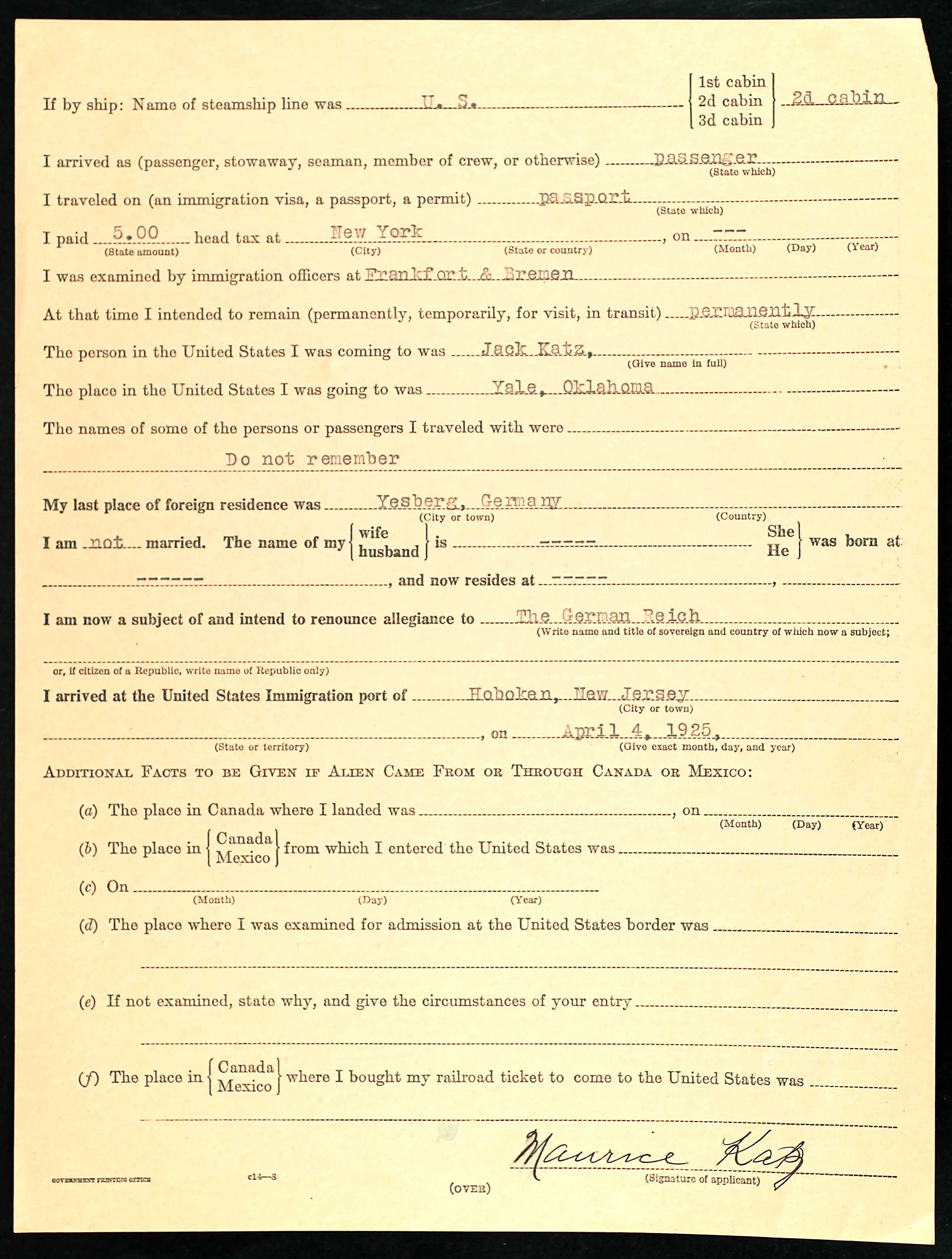
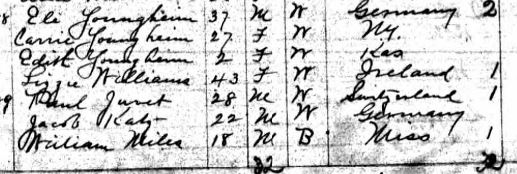
I thought that Karl might be Meier’s son and decided to search for a Karl Katz born in Jesberg, expecting not to find anything or perhaps at most a record from Germany.  But instead I found U.S. naturalization papers for a Karl Katz who had arrived in the US in 1938 and settled in Stillwater, Oklahoma.  I immediately thought this could not be a coincidence—that somehow this Karl Katz had to be related to my other Katz relatives in Oklahoma.  If this Karl Katz was the son of Meier Katz, he was the nephew of Abraham and Samuel Katz.  It made sense that in 1938, escaping from Nazi Germany, he would have come to the place where his father’s brothers were living.

Karl Katz naturalization papers
National Archives and Records Administration; Washington, D.C.; ARC Title: Declarations of Intention for Citizenship , compiled 1908 – 1932; ARC Number: 731206; Record Group Title: Records of District Courts of the United States; Record Group Number: 21

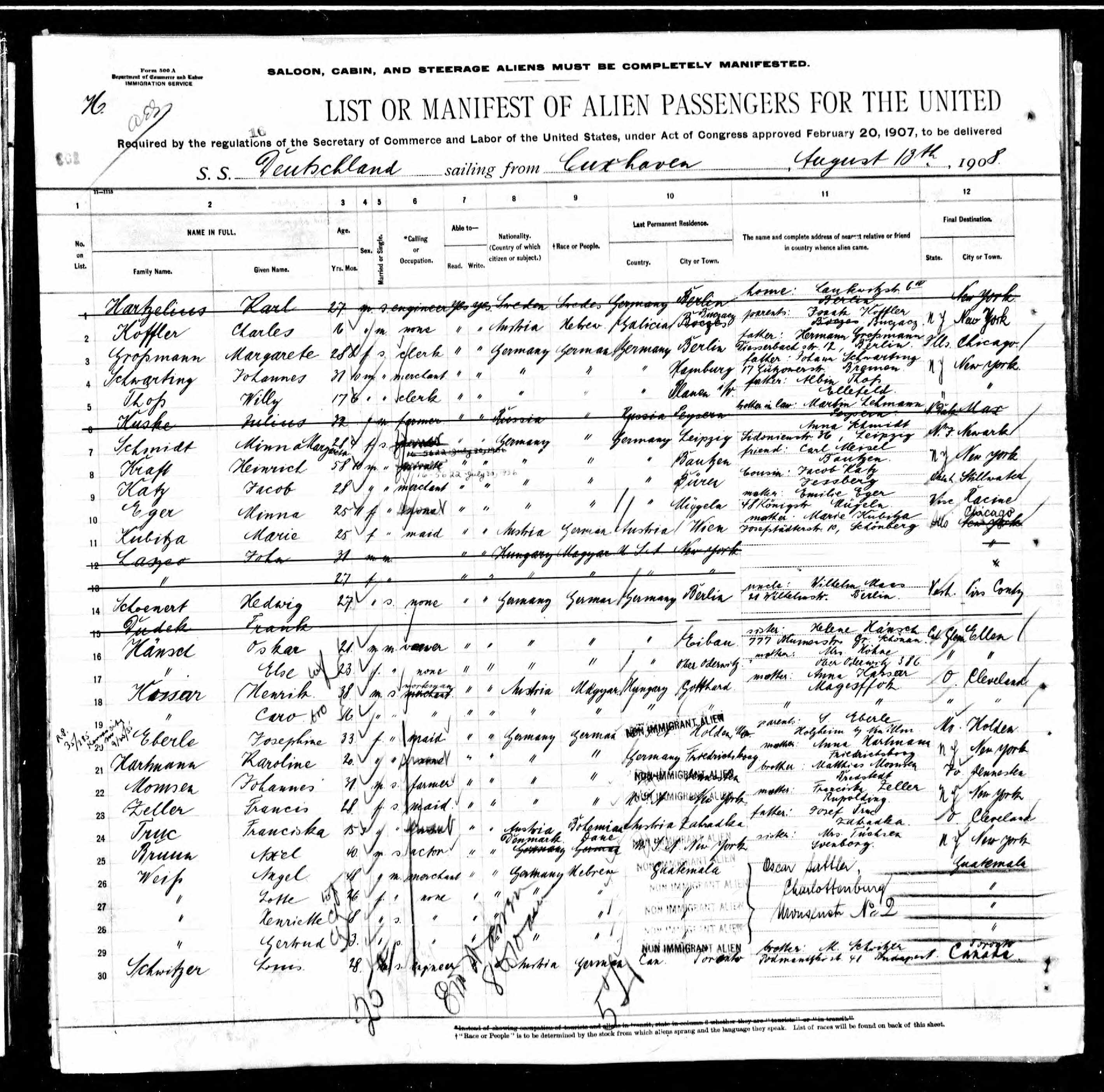
As I did more research, I found the ship manifest for Karl along with his wife and a son.  When I checked the second page, expecting to see that he was going to his uncle Abraham Katz in Oklahoma, I was surprised to see that instead it said he was going to his brother, Jacob Katz, in Stillwater, Oklahoma.  It seemed I had found another son of Meier Katz!

Karl Katz passenger manifest
Ancestry.com. New York, Passenger Lists, 1820-1957 [database on-line]. Provo, UT, USA: Ancestry.com Operations, Inc., 2010.
Original data: Passenger Lists of Vessels Arriving at New York, New York, 1820-1897. Microfilm Publication M237, 675 rolls. NAI: 6256867. Records of the U.S. Customs Service, Record Group 36. National Archives at Washington, D.C. Passenger and Crew Lists of Vessels Arriving at New York, New York, 1897-1957. Microfilm Publication T715, 8892 rolls. NAI: 300346. Records of the Immigration and Naturalization Service; National Archives at Washington, D.C.

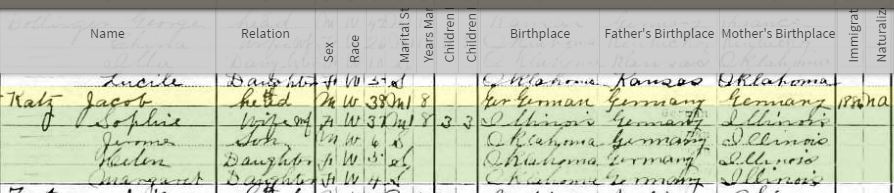
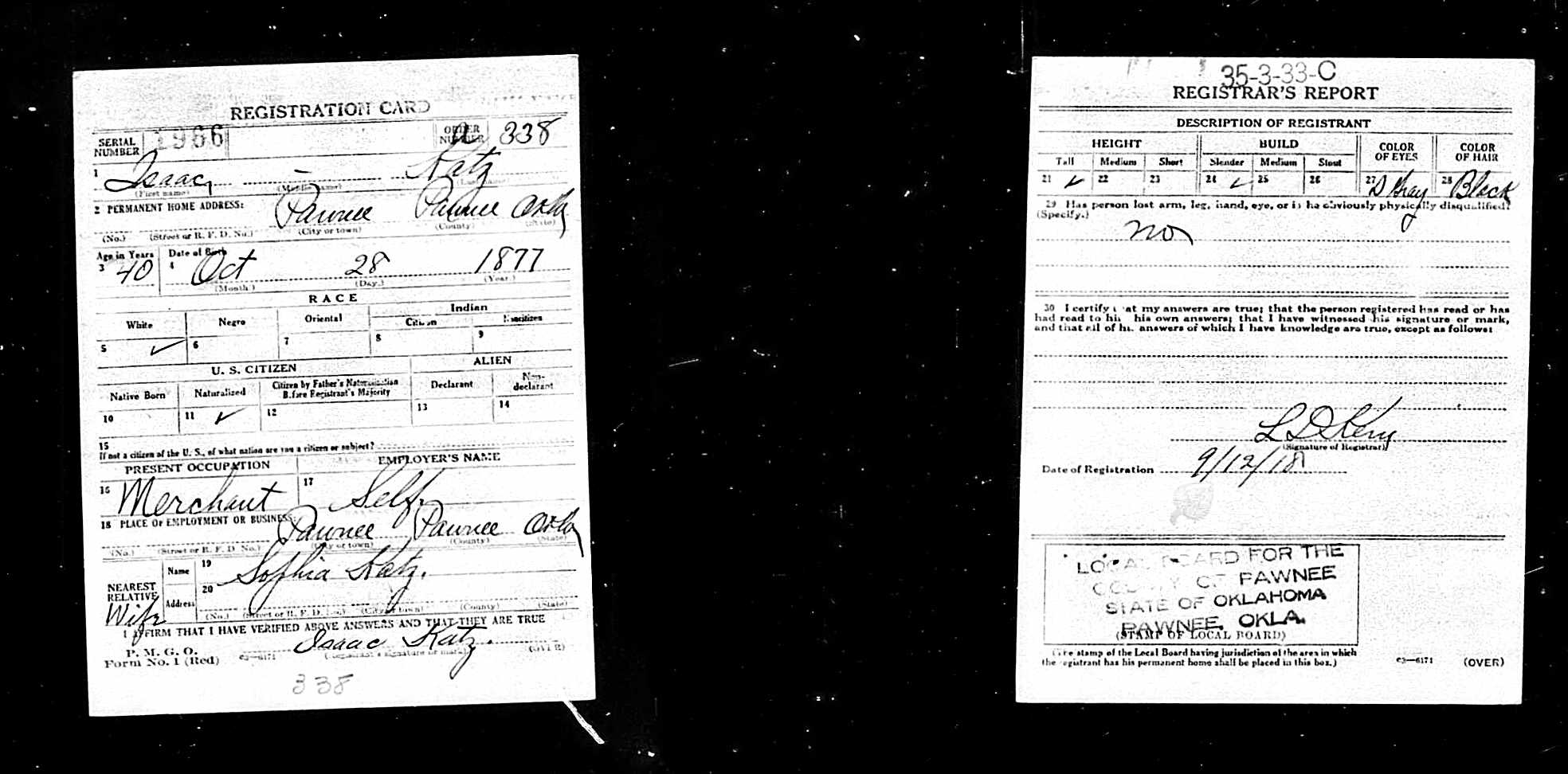
I was quite excited and then started researching Jacob Katz, only to learn that he had been in the US since about 1886 and had been in Stillwater, Oklahoma, since at least 1899 when he’d applied for naturalization.  So he had in fact been in Stillwater long before his uncle Abraham Katz had moved from Kentucky in about 1910. And Jacob was also a merchant, according to the 1900 census.  (More on Jacob and the other children of Meier Katz in posts to come.) And I kept seeing newspaper article references to Katz Department Store.

At that point I decided it was time to learn more about the history of the Katz Department Stores in Oklahoma, so I did a Google search of “Katz Department Store” + Oklahoma. One of the search results was from a blog in which the blog author described herself as a member of the family that had owned the Katz Department Store in Stillwater, Oklahoma.

So, of course, I wrote a comment on the blog, asking the blog owner to contact me and explaining that I thought we might be related.  I knew nothing about how this woman was related to the Katz family, but I figured I had nothing to lose.  Not too long after, my newly found fourth cousin, once removed,  Abbi Goldenberg, responded.  We exchanged a few emails and then a lovely phone conversation that covered not only family history matters, but also what it was like to grow up in the Southwest, cattle ranching, food labeling, politics, and life in general. From Abbi I learned that not only had Meier’s sons Jake and Karl come to the US, but so had all of Meier’s children, whom I will discuss in subsequent posts.

Katz Department Store sign as you enter Stillwater, OK
Courtesy of the Katz family

As if that connection wasn’t exciting enough, I then made another cousin discovery just a few days after finding Abbi. Once again it was indirectly through a Google search.  I had Googled “Abraham Katz + Oklahoma,” looking for an obituary, and one of the search results was a page from Geni.com.  I am generally skeptical of Geni because no sources are cited for the trees there, but the page for Abraham had a wonderfully detailed biography that had been told to the writer by her father, who was Abraham’s grandson.  I sent a message to the writer, Marsha Katz Rothplan, who was the manager of the profile on Geni, and again, within a few hours I received a response.

And this is where the small world story comes into play.  The response was an email I received just as I was about to go to sleep (yes, I check my phone before I go to sleep; bad, I know). Marsha was excited to be in touch, but not only because we happened to be fourth cousins.  She had looked me up on Facebook and realized that I live in the area where she had once lived back in 1988. Although she had grown up in Oklahoma, she had ended up in New England after college and worked at the JCC that my family has belonged to for over thirty years.  Although my eyes were drooping closed, I immediately sent her back a quick email (in fact, I was so excited that I hit “Send” too soon and sent her a three word email the first time).  Chances are very good that at some time while she lived here, we met each other without ever knowing that we were related.  And we know a number of people in common.

To top it off, Marsha was coming to my area that very weekend from across the country, and we arranged to meet for dinner.  We had a wonderful time, and she has provided me with many interesting facts, photographs, and stories about the Oklahoma Katz family.  She’s also connected me to her father and to other family members who have also shared stories and information.  As I now turn to the rest of story of Marsha’s great-grandfather Abraham Katz in my next few posts, I will have the benefit of the insights and photographs shared by Marsha and her family.

My fourth cousin, Marsha, and me April 4 2017

Then just this week, I connected with yet more of my Katz cousins, descendants of Samuel Katz—more wonderful people who responded warmly and with great interest in learning about their ancestors. And one of them is close friends with the nephew of one of our close friends.

With the help of my newly-found cousins, I’ve learned not only more about my Katz relatives, but about a way of life I previously knew nothing about and once again about the reality of how interconnected we all are.  I’ve also added some smart, funny, interesting, and warm women into my life.

Happy Passover to all who celebrate! Remember—everyone you see or speak to may end up being connected to you in more ways than you can imagine!