Pacific Street: Inspired by Facts and Love

Some of you know that since I retired two and a half years ago, I’ve been working on a novel inspired by my grandparents’ lives and the discoveries I’ve made about them and their extended families through my genealogy research.  Well, I finally put my “pen” down and decided to call it done.

Amy Gussie and Isadore

My grandparents, Gussie Brotman and Isadore Goldschlager, and me

It’s been an exciting process for me because ever since I learned to read, I’ve wanted to write a novel.  All through my career when I was writing long, boring articles for law journals, I wished that instead I was writing a novel. Novels have been my refuge all my life. I love being transported to different times and places and seeing into the hearts and minds of all kinds of characters.  I just wanted a chance to try to create some characters of my own.  When I retired, I promised myself that I would give it a try.

One friend reprimanded me when I said I was trying to write a novel.  She said, “Don’t say that.  Say you are writing a novel.”  I was and am insecure about the whole thing.  I never took a fiction writing course, participated in a writing workshop, or wrote any fiction at all, not since I wrote stories as a young child. What did I know?

My only sources of information about writing a novel were all the novels I’d read starting when I read Charlotte’s Web by E.B. White when I was eight years old.  That book transported me in ways that changed the way I felt about reading.  I cried so hard (spoiler alert) when Charlotte died.  And she was just a spider! A fictional spider! How had the author made her so real and moved me to care so much?

Charlotte's Web

Charlotte’s Web (Photo credit: Wikipedia)

Now that I’ve written my own novel, I am even more in awe of the many great authors whose books have moved me so deeply. I am humbled by what those authors were able to do with words, and thus I feel presumptuous trying to promote my own book, despite my friend’s reprimand.

But it was a labor of love—love for family and love for the magic of the written word.  I wrote this book for my children and grandchildren so that they would have a taste of what their ancestors’ lives were like. I had lots of help and inspiration from my family and friends, as I acknowledge at the end of the book.  And so despite this aching feeling of insecurity, I do want to share and promote my book so that others will also know the story I’ve created about my grandparents—grounded in fact, but expanded upon by my imagination.

I hope that you will be tempted to read it.  You can find it on Amazon both as a paperback ($6.99) and as a Kindle ebook ($2.99) at https://www.amazon.com/dp/1541170369

If you do read it, I’d love your feedback.  Thank you!

My Grandmother’s Cologne Cousins: More New Records

Aaron Knappstein, our Cologne guide, really pulled the rabbit out of the hat when he found the Schopfloch death records for my four-times great-grandparents, Amson Nussbaum and Voegele Welsch, but his magic tricks did not end there.  He also was able to locate birth records for a number of the children of Jakob Schoenthal and Charlotte Lilienfeld.

My great-grandfather Isidore Schoenthal had two siblings who did not immigrate to America, and his older brother Jakob was one of them.  Jakob married Charlotte Lilienfeld and was a merchant in Cologne.  He and Charlotte had five children: Johanna, Lee, Meyer, Henriette, and Erna. They were my grandmother Eva’s first cousins.

I’ve told their stories in prior posts.  Four of the children survived the Holocaust.  The two sons, Lee and Meyer, immigrated to the US long before Hitler came to power, and Erna escaped with her son Werner during the 1930s.  Johanna and her husband spent time in the Gurs concentration camp and came to the US after the war.  Tragically, Henriette and her husband were murdered by the Nazis.

Thus far Aaron has located birth records for four of the children: Johanna, Lee, Meyer, and Erna.  I hope that he is able to find the record for Henriette as it would indeed be tragic if her record was the only one that did not survive, just as she was the only sibling who did not survive.

Here are the records that Aaron has thus far located:

Birth record of Johanna Schoenthal (Nr. 3030/1880)

father: Jakob Schönthal (tradesman)
mother: Charlotte Lilienfeld
both jewish religion
Köln, Breitestraße 113

June 5, 1880


birth-record-johanna-schoenthal

Birth record of Lee (Leo) Schoenthal (Nr. 5717/1881)

father: Jakob Schönthal (tradesman)
mother: Charlotte Lilienfeld
both jewish religion
Köln, Breitestraße 113

December 6, 1881


birth-record-of-lee-schoenthal

Birth record Meier Schönthal (no. 606/1883)

father: Jakob Schönthal (tradesman)
mother: Charlotte Lilienfeld
both jewish religion
Köln, Breitestraße 113
February 7, 1883
05.15 in the morning


meyer-schoenthal-birth-recod

Birth Record Erna Schönthal (no. 577/1898)

father: Jakob Schönthal (tradesman)
mother: Charlotte Lilienfeld
both jewish religion
Köln, Breitestraße 85
March 27, 1898
08.15 in the morning

erna-schoenthal-birth-record

Something I Never Expected to See

I want to share two documents that I thought I’d never see.  In preparing for our upcoming trip to Germany, I’ve been trying to find guides who can help me in the various places we plan to visit.  One of those guides is a man named Aaron.  Although Aaron is based in Cologne and will be our guide while we are there, he also asked where else we were visiting and whether we needed any help finding records.

I mentioned to him that probably the one place I had had the worst luck finding any records—online or elsewhere—was Schopfloch, the small town in Bavaria where my Nussbaum ancestors once lived.  Some of you may recall that all I had were the notes left behind by a researcher named Angelika Brosig, who died in 2013.  Angelika had a lot of information about the birthdates of the children of Amson Nussbaum and Voegele Welsch, my four-times great-grandparents, including a name and birthdate for my three-times great-grandfather, Josua Nussbaum, who became John Nusbaum in the United States.  I knew these facts were accurate because they were consistent with the information in the Nussbaum family bible kept first by my three-times great-grandmother Jeanette Dreyfuss Nusbaum and later by my great-grandmother Eva May Seligman Cohen.  But I had no images or transcriptions of original records

Even after contacting several people who knew Angelika Brosig and had worked with her, I had no luck figuring out where she’d gotten this information.  But Aaron had better luck—he found the death records for my four-times great-grandparents, Amson and Voegele.  This gives me hope that perhaps other records exist and that someday I may find them.

Death record of Voegelein Nussbaum

Death record of Voegelein Welsch Nussbaum, October 2, 1842

As transcribed and translated by Leon and Cathy from the German Genealogy group on Facebook, this says:

Vogelein Nussbaum, Wittwe des Amson Nussbaum, geb. Welsch, stirbt in einem Alter von 60 Jahren und 7 Monaten plötzlich am Schleimschlag Sonntag Abends am zweiten /2/ Oktober 1/2 5 Uhr 1842, und wird beerdigt Tags drauf am 3. dess. Abends 5 Uhr. Arzt wird nicht gebraucht. No. 132.
Vögelein Nussbaum, widow of Amson Nussbaum, born Welsch, dies at the age of 60 years and 7 months suddenly due to mucoid impaction on Sunday evening on 2nd October, half before 5 o’clock, 1842, and is buried on the next day in the evening 5 o’clock. Doctor is not needed.

death-record-of-amson-nusbaum-1

Death record of Amson Meier Nussbaum, 1837

Death record of Amson Meier Nussbaum, June 7, 1836

Leon and Cathy translated Amson’s death record to say:

Amson (Meier) Nussbaum, merchant, here no. 132, married, consumption, 8th this evening at 8 o’clock, 58 years old.

Thank you to Aaron for his persistence and hard work in locating these records. And thank you also to Leon and Cathy from the Facebook German Genealogy group!  Danke!!

Are These Two Photographs of the Same Woman?

Sharon, one of my readers and a fellow genealogy blogger, asked in response to my last post whether I thought the woman in this photograph of Lawrence Baer and his son John Degen Baer could be John’s grandmother. Certainly the way his hand rests on her shoulder suggests that she was someone he knew well and felt comfortable with:

Lawrence Baer, John Degen Baer, unknown person, 1924

Lawrence Baer, John Degen Baer, unknown person, 1924

John’s paternal grandmother was Amalia Hamberg, the woman in the photo I’d posted in an earlier post. People thought that photo was taken in the 1880s or about 40 years before the one above:

amalia-hamberg-and-jacob-baer-from-celena-adler-watermarked

Amalia Hamberg and Jacob Baer


Could the woman in the top photo also be Amalia? In 1924, Amalia would have been 73 years old. Her face is obviously much thinner in the later photograph, but are the mouth, nose, and eyes similar? Do you think this is the same woman in both photographs?

And if any of Amalia’s descendants can help, please let me know.

(I tried to use the pictriev tool that Cathy Meder-Dempsey blogged about, but the photo of Amalia and Jacob was too small for pictriev to detect the faces.)

More Gifts of Photographs

In my last post, I shared the wonderful photograph I received of Amalia Hamberg and Jacob Baer from one of their descendants.  Before posting it here, I shared it with other descendants of Amalia and Jacob, and that prompted some of those descendants to share some other photographs. Thank you to the extended Baer family for allowing me to publish these photos.

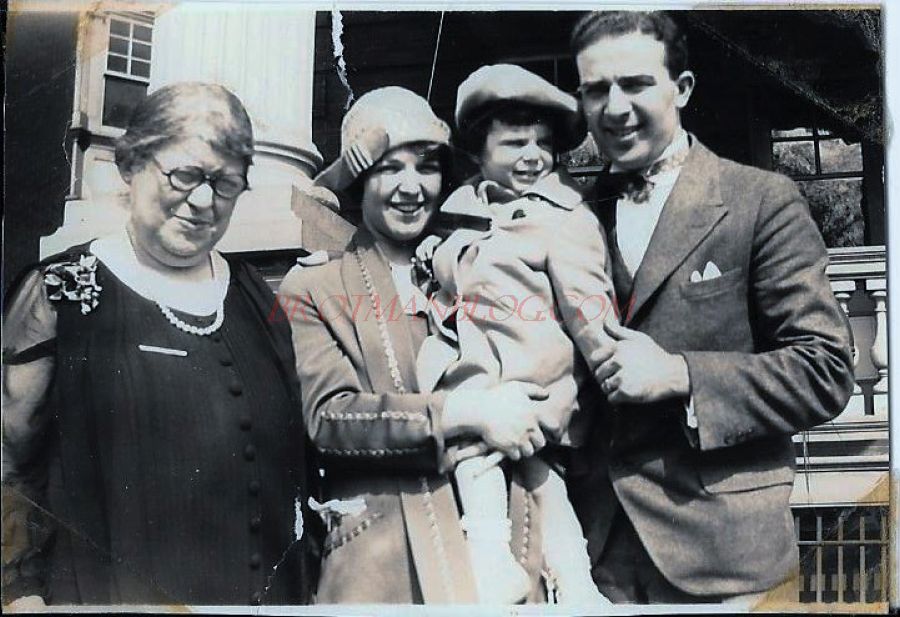
First is a photograph of Lawrence Baer, Amalia and Jacob’s youngest child, born in 1891 in PIttsburgh.  Lawrence became one of the principal innovators and executives at the family-owned jewelry business, Attleboro Manufacturing.  This photograph was taken in 1924.  The little boy in the center is John Degen Baer, Lawrence’s son.  He would have been three years old in this photograph. The individual on the right is not known.

Lawrence Baer, John Degen Baer, unknown person, 1924

Lawrence Baer, John Degen Baer, unknown person, 1924

Here is a photograph of Lawrence Baer’s first wife and John Degen Baer’s mother, Donna Degen.  This photograph was not dated, but it looks like the 1920s to me.

Donna Degen

Donna Degen

This is another picture of their son John, dated 1924:

John Baer, summer of 1924

John Baer, summer of 1924

How adorable is he!

Finally, here is a photograph of Olivia Ganong Baer, Lawrence Baer’s second wife, and Minette Brigham Baer, John Degen Baer’s first wife, with Lawrence in the background.

Olivia Ganong Baer, Minette Brigham Baer, and Lawrence Baer

Olivia Ganong Baer, Minette Brigham Baer, and Lawrence Baer

John Degen Baer grew up to be a very accomplished business leader like his father.  He died just a little over a year ago on November 3, 2015.

According to his obituary,

Baer attended both Yale and Brown Universities, graduating from the latter in 1943. He served in the U.S. Marine Corps during World War II, having been attached to the Second Marine Division in the Pacific theater and int he Occupation of Japan. He resigned his commission in 1950. He was the owner and C.E.O. of the Bishop Company, an Ophthalmic Manufacturing Company, which he merged with the Univis Lens Company of Dayton, Ohio in 1960. The merged company, Univis, Inc., was headquartered in Ft. Lauderdale, Florida, with branch manufacturing plants in Puerto Rico, Tennessee, New York and Massachusetts. Univis was sold to Itek, Inc. in 1970. Mr. Baer established a consulting company in Atlanta, Georgia, and in 1970 joined the Edwards Baking Company as Executive Vice President. He retired from Edwards in 1978. While residing on Sea Island, Georgia, he participated in the construction and management of the Island Retreat and the Island Square apartments.

Baer and his family moved to Blairsville in 1985 where he and his wife founded and managed the Truck & Gas Market. The business closed in March 1992. Baer then retired from all activity. While residing in Massachusetts, Baer served as a member of the Attleboro Zoning Board of Appeal for 12 years. He was also a Director of a local Bank and the Chamber of Commerce. For several years he served as a director of the Optical Manufacturers Association, located in New York City. While living in Oxford, Georgia, Baer was elected and served on the town Council.

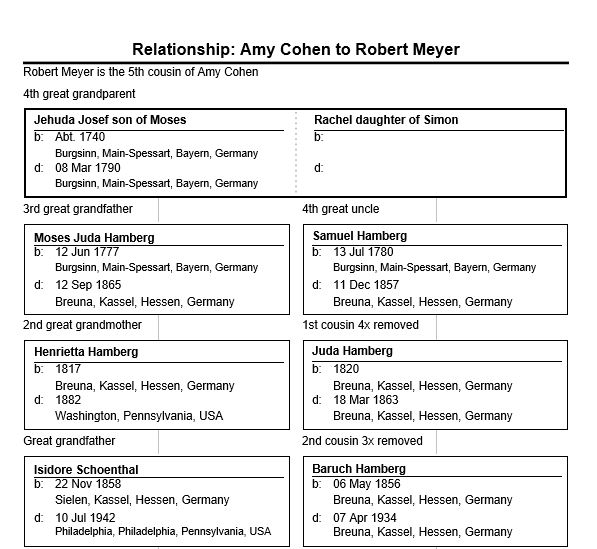
Thank you again to his children for sharing these photos and allowing me to see the faces behind the names of these cousins of mine. Here’s a chart showing how we are related.

relationship-john-baer-to-me

A Special Photograph

While taking a short break from research, I want to share a few photographs and records I’ve received recently, but did not have a chance to post on the blog.

You may recall the series of blog posts I did about Amalia Hamberg and her family.  Amalia, born Malchen, was my great-grandfather Isidore Schoenthal’s first cousin:

corrected relationship isidore schoenthal to malchen hamberg


She acted as the administratrix of the estate of Charles Hamberg, the cousin who lived in South Carolina whose first wife had been murdered and whose son Samuel Hamberg ended up living with Henry Schoenthal in Washington, Pennsylvania after his father died as well.  Amalia had married Jacob Baer, with whom she had nine children, many of whom ended up working for the family jewelry business founded by the oldest brother, Maurice, in Attleboro, Massachusetts.

Well, one of the descendants of Amalia and Jacob Baer found my blog and connected me with his siblings, one of whom graciously shared with me this wonderful photograph of Amalia Hamberg and Jacob Baer. Both Amalia and Jacob lived long lives.  Amalia lived from 1851 until 1931; Jacob from 1847 to 1932. Imagine all the changes they saw—starting in Germany in the middle of the 19th century and living through the Industrial Revolution, the first World War, and the Roaring Twenties.  They raised nine children in western Pennsylvania and must have seen Pittsburgh grow from a small fairly rural area to the home of steel manufacturing.  They lived to see the invention and development of cars and telephones, even airplanes.

amalia-hamberg-and-jacob-baer-from-celena-adler-watermarked

I don’t know when this photograph was taken.  Although Amalia and Jacob may look old because of their attire and Jacob’s seemingly gray hair, their faces have no wrinkles, and the style of dress does not look 20th century to me.  I would guess that they were in their 40s, so perhaps the picture was taken in the 1890s.  What do you think?

I am so excited to have this photograph. Thank you so much to the Adler siblings who shared this with me.

After the Flood, More Tears

In my last two posts I wrote about the tragedies the Katzenstein family endured in 1889 when Jacob Katzenstein, my great-grandmother Hilda’s brother, lost his son Edwin and his wife Ella (who may also have been related to me through my Goldschmidt line) in the devastating Johnstown flood of May 31, 1889. This post will follow up with the rest of my great-great-grandparents’ family.

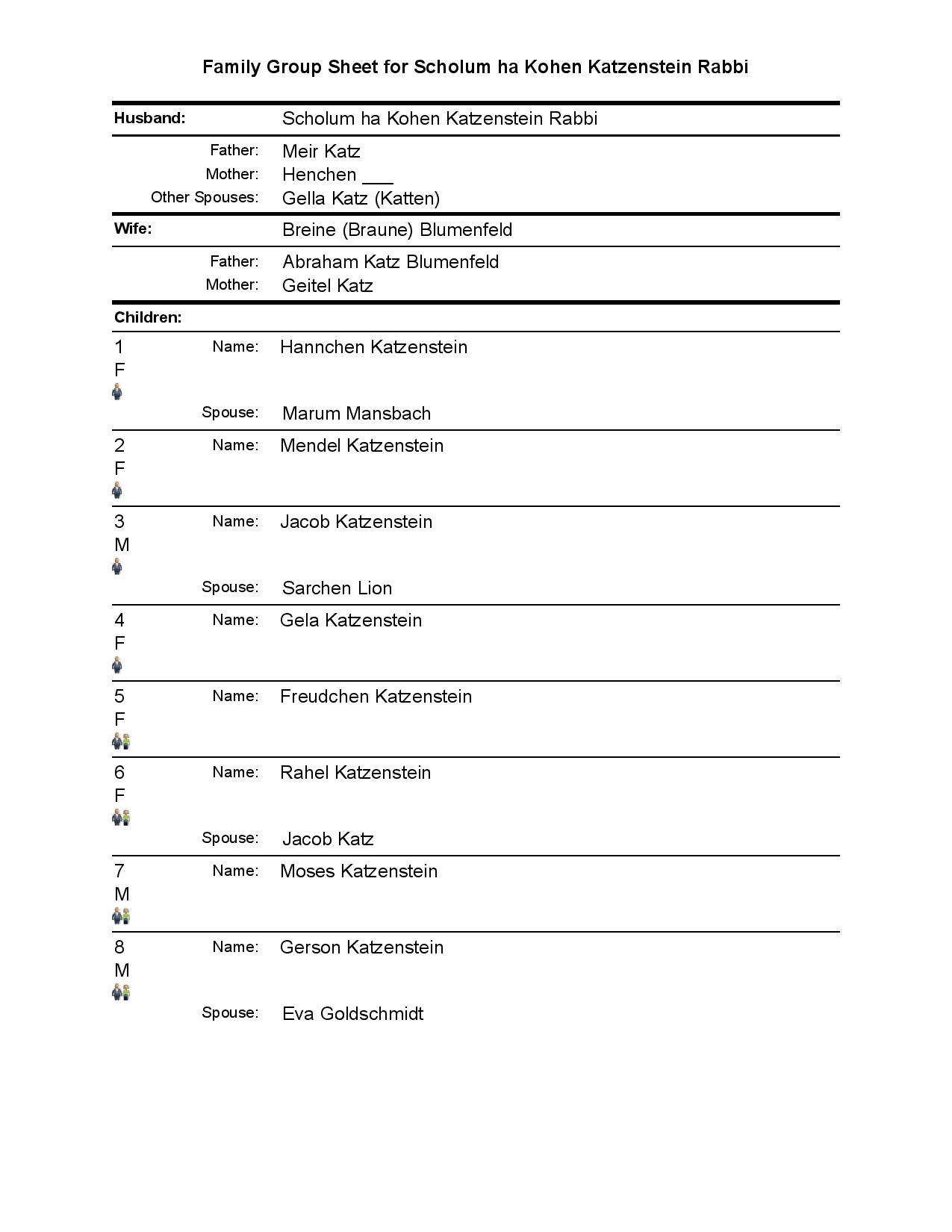
Here is a family group sheet for the family of my great-great-grandparents, Gerson Katzenstein and Eva Goldschmidt and their six children, five of whom survived to adulthood.

family-group-sheet-for-gerson-katzenstein

A little over a year after the flood, on July 22, 1890, my great-great-grandfather Gerson Katzenstein died of dropsy at age 75 in Philadelphia. According to several sources, “dropsy” is an old-fashioned term for edema or swelling of body tissues, whether it’s the brain, the heart, or some other body part or organ.  I don’t know what type of edema afflicted Gerson or why it killed him.  He was buried at Adath Jeshrun cemetery in Philadelphia.

gerson-katzenstein-death-cert

Gerson Katzenstein death certificate “Pennsylvania, Philadelphia City Death Certificates, 1803-1915,” database with images, FamilySearch (https://familysearch.org/ark:/61903/3:1:S3HT-68NW-375?cc=1320976&wc=9FR3-SP8%3A1073244201 : 16 May 2014), > image 340 of 1712; Philadelphia City Archives and Historical Society of Pennsylvania, Philadelphia.

In March, 1891, his son Jacob remarried two years after losing his wife and son in the Johnstown flood.  Jacob married Bertha Miller, the daughter of Samuel Miller and Eliza Leopold, whom I mentioned here.  (As I described, Jacob’s first father-in-law, Marcus Bohm, would later be living with Jacob’s second wife Bertha Miller’s aunt, Minnie Leopold Reineman, in 1910 in Johnstown.)  Bertha’s parents were both born in Germany, and her father Samuel was a “merchant tailor” in Pottstown, Pennsylvania, in 1880.

Jacob Katzenstein wedding to Bertha Miller PHiladelphia Times March 12 1891 p. 3

Jacob Katzenstein wedding to Bertha Miller
PHiladelphia Times March 12 1891 p. 3

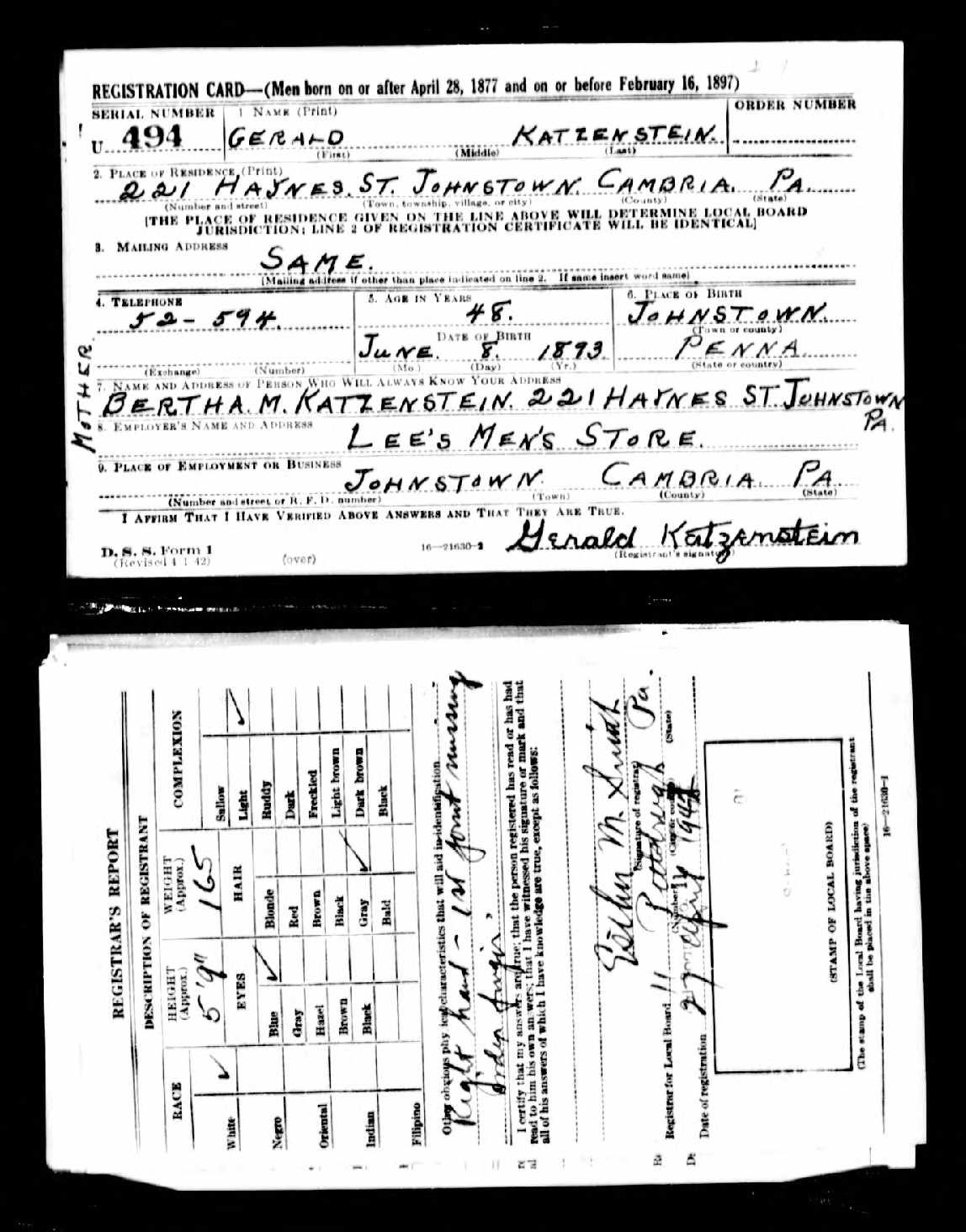
Bertha and Jacob had a child Helen in 1892, and they had a second child on June 8, 1893, whom they named Gerald, presumably for Gerson Katzenstein, Jacob’s father, my great-great-grandfather.  He was not the only grandson named for Gerson.  On January 20, 1892, my great-uncle Gerson Schoenthal was born, son of my great-grandparents Hilda Katzenstein and Isidore Schoenthal. In addition, SJ Katzenstein and his wife Henrietta also had a child possibly named for Gerson: Vernon Glyde, born on February 8, 1892.

My great-great-grandmother, Eva Goldschmidt Katzenstein, died on September 6, 1893.  She was 66 years old and died of “carcinoma ventric omentum.”  According to my medical consultant, today that is called “carcinoma of the ventral omentum, which is a part of the lining of the abdomen near the stomach.”

Eva also had grandchildren named for her, including my grandmother, Eva Schoenthal.  Jacob and Bertha’s third child, born December 2, 1894, was also named Eva.

eva-goldschmidt-katzenstein-death-cert

Eva Goldschmidt Katzenstein death certificate “Pennsylvania, Philadelphia City Death Certificates, 1803-1915,” database with images, FamilySearch (https://familysearch.org/ark:/61903/3:1:S3HY-DY6W-VS?cc=1320976&wc=9FRF-GP8%3A1073237701 : 16 May 2014), > image 1467 of 1730; Philadelphia City Archives and Historical Society of Pennsylvania, Philadelphia.

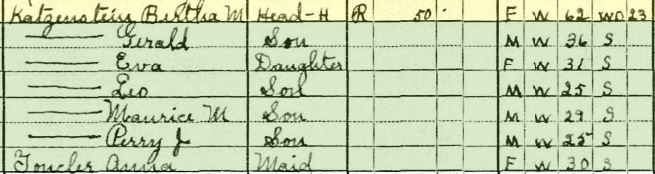
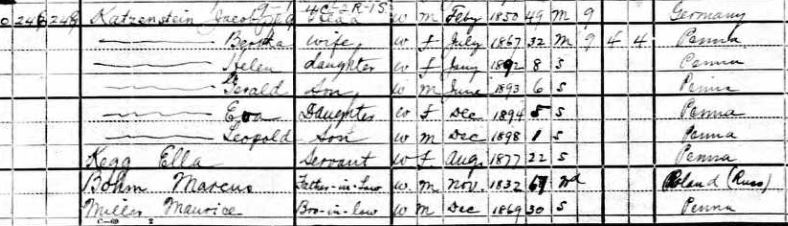
Jacob and Bertha had two more children by 1900: Leopold (1898) and Maurice (1900). As pointed our earlier, they were living in Johnstown in 1900 with Jacob’s first father-in-law Marcus Bohm and Bertha’s brother Maurice.  Jacob was working as a clothing merchant.

Jacob Katzenstein and family 1900 census Year: 1900; Census Place: Johnstown Ward 1, Cambria, Pennsylvania; Roll: 1388; Page: 12A; Enumeration District: 0124; FHL microfilm: 1241388

Jacob Katzenstein and family 1900 census
Year: 1900; Census Place: Johnstown Ward 1, Cambria, Pennsylvania; Roll: 1388; Page: 12A; Enumeration District: 0124; FHL microfilm: 1241388

SJ Katzenstein and his family were living in Washington, Pennsylvania in 1900, where he was still a clothing merchant as well.  Their children were all still at home and at school, except for Howard, who was working as a clerk.

SJ Katzenstein and family 1900 census Year: 1900; Census Place: Washington, Washington, Pennsylvania; Roll: 1494; Page: 16B; Enumeration District: 0173; FHL microfilm: 1241494

SJ Katzenstein and family 1900 census
Year: 1900; Census Place: Washington, Washington, Pennsylvania; Roll: 1494; Page: 16B; Enumeration District: 0173; FHL microfilm: 1241494

Brendina Katzenstein Schlesinger and her family were still in Philadelphia, and her husband Jacob listed his occupation on the 1900 census as a meat salesman.  Their oldest son, Solomon Joseph, was a manager of a laundry, and Alfred was managing a newspaper. Sidney was working as a clerk in a clothing store.  The two daughters, Heloise and Aimee, were not employed.

Brendina and Jacob Schlesinger 1900 census Year: 1900; Census Place: Philadelphia Ward 20, Philadelphia, Pennsylvania; Roll: 1463; Enumeration District: 0421; FHL microfilm: 1241462

Brendina and Jacob Schlesinger 1900 census
Year: 1900; Census Place: Philadelphia Ward 20, Philadelphia, Pennsylvania; Roll: 1463; Enumeration District: 0421; FHL microfilm: 1241462

Perry Katzenstein and his wife Rose were also living in Philadelphia where Perry was in the clothing business.  They had no children.  Rose’s sister Flora Elias was living with them.

Perry and Rose Katzenstein 1900 census Year: 1900; Census Place: Philadelphia Ward 32, Philadelphia, Pennsylvania; Roll: 1474; Page: 4A; Enumeration District: 0830; FHL microfilm: 1241474

Perry and Rose Katzenstein 1900 census
Year: 1900; Census Place: Philadelphia Ward 32, Philadelphia, Pennsylvania; Roll: 1474; Page: 4A; Enumeration District: 0830; FHL microfilm: 1241474

And, as I’ve written before, my great-grandparents Hilda Katzenstein and Isidore Schoenthal were living in Washington, Pennsylvania, with their two older sons, Lester and Gerson, and my great-grandfather was working in the china business there.

HIlda Katzenstein and Isidore Schoenthal 1900 census Year: 1900; Census Place: Washington, Washington, Pennsylvania; Roll: 1495; Page: 4A; Enumeration District: 0175; FHL microfilm: 1241495

HIlda Katzenstein and Isidore Schoenthal 1900 census Year: 1900; Census Place: Washington, Washington, Pennsylvania; Roll: 1495; Page: 4A; Enumeration District: 0175; FHL microfilm: 1241495

So as the century turned, my great-grandmother Hilda and her siblings had lost both of their parents, but the next generation of the family was growing. As of 1900, there were eighteen grandchildren—my grandmother’s first cousins and brothers— and my great-uncle Harold was born on August 28, 1901, bringing the total to nineteen.  My grandmother and one more first cousin were yet to be born.  All of them lived in Pennsylvania, spanning from Philadelphia in the east to Washington in the west with family living in Johnstown in between.

But the start of the 20th century was not very kind to the Katzenstein family.  On December 7, 1901, my great-great-uncle SJ Katzenstein died at age 53.  He left behind his wife Henrietta and six children, ranging in age from Moynelle, who was 22, to Vernon, who was only nine years old.

sj-katzenstein-obit

Then less than two years later, SJ’s younger brother Perry died.  He was just a few days shy of his 47th birthday.  According to his obituary, he had been living in Washington, Pennsylvania, not Philadelphia, at the time of his death.  Perhaps he had taken over SJ’s clothing business. Perry died from appendicitis and peritonitis. He was survived by his wife Rose.

Perry Katzenstein obituary Canonsburg PA Daily Notes August 8, 1903 p.2

Perry Katzenstein obituary Canonsburg PA Daily Notes August 8, 1903 p.2

perry-katzenstein-death-cert

But Rose did not last very long without him. While visiting her sister in Chicago on February 24, 1904, she took her own life.  Her death was ruled a suicide, strangulation by hanging.  Perry’s death must have been too much for her to bear.

rosa-elias-katzenstein-death-cert

Rose Elias Katzenstein death certificate “Pennsylvania, Philadelphia City Death Certificates, 1803-1915,” database with images, FamilySearch (https://familysearch.org/ark:/61903/3:1:S3HT-67QH-3T?cc=1320976&wc=9F5B-VZS%3A1073109202 : 16 May 2014), > image 232 of 538; Philadelphia City Archives and Historical Society of Pennsylvania, Philadelphia.

Rose Elias Katzenstein obituary Williamsport Sun-Gazette, February 26, 1904, p. 5

Rose Elias Katzenstein obituary
Williamsport Sun-Gazette, February 26, 1904, p. 5

Thus, by February, 1904, my great-grandmother Hilda had lost her parents, two of her three brothers, two nephews, and two sisters-in-law.  She also had her fourth and last child that year, my grandmother Eva, who was born on March 4, 1904, shortly after Rose’s death.

eva-schoenthal-cohen-watermarked

Eva Schoenthal Cohen, my grandmother

Jacob Katzenstein and his second wife Bertha also had their final child in 1904; he was born in August 1904 and was named Perry, obviously for Jacob’s brother Perry who had died the year before.

My great-great-grandparents Gerson and Eva (Goldschmidt) Katzenstein were thus survived by 21 grandchildren, including my grandmother Eva.  In posts to come, I will share their stories.

For now, I will be taking a short break from research, but will be sharing some of the photographs and records I’ve received but have not yet had a chance to post.


Who Was Ella Bohm Katzenstein? A Genealogy Adventure

This was truly a genealogy adventure. I’d written most of this post before I made two surprising discoveries that required me to rewrite substantial parts of it. The story of Jacob Katzenstein’s first wife Ella is heartbreaking. She was only 27 when she died in the 1889 Johnstown flood, and for a long time I knew almost nothing about her.  I’ve finally made some headway in learning more about her.

Here’s what I now know about her from various sources, more or less in the order I found them. Her first name was Ella, as seen from the birth record indexed on FamilySearch for her son, Milton B. Katzenstein.

milton-b-katzenstein-birth-record

Her birth surname was Bohm, as seen in a newspaper report of her death and as implicitly confirmed by the fact that Milton’s middle name was Bohm; that fact I learned from Milton’s burial record at Grandview Cemetery in Johnstown.

Philadelphia Jewish Exponent,, June 7, 1889, p. 3

Philadelphia Jewish Exponent,, June 7, 1889, p. 3

I know that Ella was probably born in February 1862, as indicated on the memorial stone placed at Eastview Cemetery in Cumberland, Maryland.   Her father’s name was apparently Marcus Bohm; that fact I inferred from the fact that Ella’s widower Jacob Katzenstein included Marcus in his household on the 1900 census and described him as his father-in-law (even though by that time Jacob had remarried). Ella presumably married Jacob sometime before or around January, 1886, since their son Milton was born in September, 1886. Milton died on April 18, 1889.  I also know that a second child, Edwin, was born June 5, 1887, and that he and Ella were killed in the Johnstown flood on May 31, 1889.

ella-katzenstein-and-edwin-katzenstein-headstone-from-findagrave

But where was Ella before marrying Jacob and having these two little boys?

For the longest time, I could not find her on the 1870  census, no matter how many ways I tried to spell her name, with and without wildcards. And then somehow she popped up after I’d just about given up.  I decided to search for any Ella with a surname starting with Bo born anywhere in about 1862 living in Pennsylvania or any state bordering it.  And there she was, listed as Ella Bohn, living in Philadelphia, an eight year old child born in Pennsylvania.  Her father was not living with her, nor was there anyone else in the household named Bohn or Bohm. So who was she living with?

Ella Bohm (Bohn) on the 1870 census Year: 1870; Census Place: Philadelphia Ward 12 District 36, Philadelphia, Pennsylvania

Ella Bohm (Bohn) on the 1870 census
Year: 1870; Census Place: Philadelphia Ward 12 District 36, Philadelphia, Pennsylvania

I took a deep breath when I saw.  She was living with Jacob Goldsmith. Who was he? The son of Simon Goldschmidt and Fradchen Schoenthal.  Simon Goldschmidt was the brother of my three-times great-grandfather Seligmann Goldschmidt, the father of Eva Goldschmidt Katzenstein, whose son Jacob would later marry Ella Bohm.  And Fradchen Schoenthal was the sister of my three-times great-grandfather Levi Schoenthal, father of Isidore Schoenthal who would later marry Hilda Katzenstein, daughter of Eva Goldschmidt Katzenstein and brother of Jacob Katzenstein, who would later marry Ella Bohm.

jacob-katzenstein-to-jacob-goldsmith

So little Ella Bohm was for some reason living with the first cousin, once removed, of her future husband Jacob Katzenstein.  And with in-law relatives of her future sister-in-law, Hilda Katzenstein, my great-grandmother. And they were all related to me.  Yikes.

But where was her father? Why wasn’t Ella living with him? Why was she living with Jacob Goldsmith? Unfortunately, the 1870 census did not include information about the relationships among those in a household, so I couldn’t tell.

A search for information about Ella’s father Marcus Bohm turned up nothing explicit connecting him to Ella, though I was able to piece together some information about Marcus. He was born November 9, 1834, in Warsaw, Poland, and immigrated to the United States in 1849, arriving in Baltimore.

marcus-bohm-manifest-from-family-search

Maryland, Baltimore Passenger Lists, 1820-1948,” database with images, FamilySearch (https://familysearch.org/ark:/61903/3:1:3QS7-897J-P6W?cc=2018318&wc=MKZ4-GPF%3A1004777901%2C1004778901 : 25 September 2015), 1820-1891 (NARA M255, M596) > image 404 of 688; citing NARA microfilm publications M255, M596 and T844 (Washington, D.C.: National Archives and Records Administration, n.d.).

One document indicates that he was living in Washington, Pennsylvania, in 1853, which, of course, is where many members of my extended family also settled, including Jacob Goldsmith, who was a clothing merchant there as early as 1850, and Jacob Katzenstein’s brother SJ, who arrived around there in about 1871.

It appears that Marcus Bohm owned a clothing store there from at least 1853 from ads I found online in the Washington newspaper.  There was a fire at his store in April, 1860:

Washington Reporter, April 12, 1860, p. 3

Washington Reporter, April 12, 1860, p. 3

I also found an advertisement for Marcus Bohm’s clothing store in the Washington Reporter of August 30, 1860 (p.3):

ad-for-marcus-bohm-1860


But by November, 1860, Marcus was closing down his Washington store:

marcus-bohm-closing-down-store-in-wash-pa-page-001

It seems he then left Washington, Pennsylvania, because according to a New Jersey index of the 1860 census, Marcus was living in Hudson Township, New Jersey, in 1860, although I cannot find him on the actual 1860 census records.  He is listed in the 1867 Trenton, New Jersey, directory as working in the clothing business and living at Madison House. On the 1870 census, he is listed as living in a hotel in Trenton and working as a clothier. There is no wife or child living with him.

Marcus continued to be listed in Trenton city directories in the 1870s up through 1876, and he is consistently listed as a clothing merchant and tailor and living in various hotels in Trenton. But in 1878, he declared bankruptcy in Trenton:

marcus-bohm-bankrupt

Why was his daughter Ella  living with the Goldsmiths in Philadelphia in 1870 and not with her father in Trenton? I decided to dig deeper into the background of Jacob Goldsmith, someone I had not yet really researched as I am (ahem) not yet focused on my Goldschmidt line (yet somehow they keep popping up everywhere).  I searched for him on the 1880 census, and this is what I found:

Jacob Goldsmith's family on 1880 census with Ella "Baum" Year: 1880; Census Place: Philadelphia, Philadelphia, Pennsylvania; Roll: 1173; Family History Film: 1255173; Page: 158D; Enumeration District: 210; Image: 0325

Jacob Goldsmith’s family on 1880 census with Ella “Baum”
Year: 1880; Census Place: Philadelphia, Philadelphia, Pennsylvania; Roll: 1173; Family History Film: 1255173; Page: 158D; Enumeration District: 210; Image: 0325

Jacob, Fanny, and their many children were living in Philadelphia, and living with them was a niece named Ella Baum, age 17.  This had to be Ella Bohm, who would have been turning 18 in 1880.  She was living with Jacob and Fanny Goldsmith because she was their niece! So her mother had to be either Fanny’s sister or Jacob’s sister. For reasons described below, I believe she was the daughter of Jacob’s sister Eva.

Jacob had several sisters, but for all but one, I’d found married names, and they had not married Marcus Bohm.  But there was one sister for whom I’d been unable to find anything more than her name on the passenger manifest with her father Simon and stepmother Fradchen in 1845 and her listing on the 1850 census with her father Simon and stepmother Fanny and several siblings. Her name was Eva Goldschmidt/Goldsmith.

Simon, Fradchen, and Eva Goldschmidt on 1845 passenger manifest The National Archives at Washington, D.C.; Washington, D.C.; Records of the US Customs Service, RG36; NAI Number: 2655153; Record Group Title: Records of the Immigration and Naturalization Service, 1787-2004; Record Group Number: 85

Simon, Fradchen, and Eva Goldschmidt on 1845 passenger manifest
The National Archives at Washington, D.C.; Washington, D.C.; Records of the US Customs Service, RG36; NAI Number: 2655153; Record Group Title: Records of the Immigration and Naturalization Service, 1787-2004; Record Group Number: 85

On the 1850 census, the names seem confused. It shows Simon’s wife’s name as Lena. Her name was Fradchen or Fanny in the US. Simon had a daughter Lena, who is also listed on the census.  And then there is a daughter named Fanny.  I think that daughter was really Eva, and the enumerator somehow thought Fanny was the daughter’s name instead of the wife and heard “Lena” instead of “Eva” for the other daughter’s name and thought that was the wife’s name. (Remember these were recent immigrants whose English might not have been very understandable.)

Simon Goldschmidt and family 1850 census Year: 1850; Census Place: Pittsburgh Ward 3, Allegheny, Pennsylvania; Roll: M432_745; Page: 135A; Image: 274

Simon Goldschmidt and family 1850 census
Year: 1850; Census Place: Pittsburgh Ward 3, Allegheny, Pennsylvania; Roll: M432_745; Page: 135A; Image: 274

But Eva is not listed as living with Simon in 1860 when he and two of her younger half-siblings had moved to Washington, Pennsylvania, to live with her older brother Jacob. So where was she then?  I don’t know, but here’s my theory.

My guess is that Marcus Bohm and Eva Goldsmith, Jacob’s sister, were married sometime around 1860. After their daughter Ella Bohm was born in 1862, Eva either died in childbirth or sometime shortly thereafter and before 1870. Supporting the theory that Eva had died is the fact that her brother Jacob named a child born in 1871 Eva.

I believe that Ella’s widowed father Marcus Bohm moved to New Jersey after losing his wife and his business in Washington, and he left his little daughter to be raised by her uncle, Jacob Goldsmith. That little girl then grew up and married Jacob Katzenstein, who was her second cousin.

I don’t know when she married Jacob. I cannot find Jacob or Ella on the 1880 census, although Jacob was listed in the Pittsburgh directories for 1879 and 1881, the Johnstown directory in 1884, both the Philadelphia and Johnstown directories for 1887, and the Johnstown directory in 1889. When their son Milton was born in 1886, Jacob and Ella must have been living in Philadelphia. And by 1889 they were living in Johnstown.

Where was Ella’s father Marcus in the 1880s? The 1880 census report shows that he was then living in Washington, Pennsylvania, boarding in a hotel there and working in a clothing store.  But by 1884, Marcus had moved to Johnstown, as the 1884 Johnstown directory lists Marcus living at 251 Main Street and working at 272 Main Street in the clothing business. That same directory lists Jacob Katzenstein as a commercial traveler living at 241 Main Street, just a few houses away from Marcus. I assume that Marcus moved to Johnstown because his daughter Ella had by that time married Jacob and was living there, but I don’t know for sure.

After the tragic deaths of his daughter Ella and his two grandsons Milton and Edwin in 1889, Marcus seemed to disappear for some years and does not appear in any city directories. The next record that does include Ella’s father Marcus is the 1900 census where, as noted above, he was living in Johnstown with Jacob Katzenstein and Jacob’s second wife Bertha Miller, their three children, Bertha’s brother Maurice, and a servant.  Marcus is described as Jacob’s father-in-law, widowed, and retired.

Jacob Katzenstein and family 1900 census Year: 1900; Census Place: Johnstown Ward 1, Cambria, Pennsylvania; Roll: 1388; Page: 12A; Enumeration District: 0124; FHL microfilm: 1241388

Jacob Katzenstein and family 1900 census
Year: 1900; Census Place: Johnstown Ward 1, Cambria, Pennsylvania; Roll: 1388; Page: 12A; Enumeration District: 0124; FHL microfilm: 1241388

I find it rather heartwarming that Bertha Miller took in the father of Jacob’s first wife.

Ten years later Marcus was still living in Johnstown, boarding in the household of Solomon Reineman, according to the 1910 census. I thought perhaps Solomon was a relative or married to a relative, but Solomon was born in Germany, not Poland. In 1880, Solomon had been living in Johnstown, so I assume that Marcus had become friendly with him during the 1880s when both were living in Johnstown.

And then I found a connection to Solomon’s wife, Minnie Leopold, though not directly. While researching Jacob’s second wife, Bertha Miller, I saw that her mother was named Eliza Leopold.  The name jumped out at me, and I thought—could there be a connection to Minnie Leopold? A few more steps of research, and lo and behold, I learned that Eliza and Minnie Leopold were sisters! So somehow Marcus Bohm ended up living with his son-in-law’s second wife’s aunt and her husband.

Two years later, however, Marcus had moved to Philadelphia. The 1912 Philadelphia directory lists Marcus Bohm living at 3333 North Broad Street. Four years later on February 25, 1916, Marcus died in Philadelphia.  He was 81 years old and died of chronic emphysema.

Pennsylvania Historic and Museum Commission; Pennsylvania, USA; Certificate Number Range: 021751-024880

Pennsylvania Historic and Museum Commission; Pennsylvania, USA; Certificate Number Range: 021751-024880

He’d been living at the Masonic Home of Pennsylvania, and the informant was William H. Sivel, the superintendent at 3333 North Broad Street, which I assume is the location of the Masonic Home and where Marcus had been residing.  There is no other personal information on the certificate except for Marcus Bohm’s birth date, birth place (Poland), age, and occupation, which the informant described as “gentleman.”  I was unable to find an obituary or any other document that would reveal family information for Marcus, only this death notice.

Philadelphia Inquirer, February 26, 1916, p. 18

Philadelphia Inquirer, February 26, 1916, p. 18

Thus, I was lucky enough to learn a little more about Ella Bohm Katzenstein and can only speculate that her mother was Eva Goldsmith, that Eva Goldsmith Bohm had died, and that Ella had been left to live with the family of Jacob Goldsmith while her father tried to recover from losing his wife and his store in Washington, Pennsylvania.

If I am right in this speculation, it makes her short life even more tragic. It was heartbreaking enough to know that she’d lost her first son Milton and then was killed along with her other son in the Johnstown flood of 1889 when she was only 27. But adding to that the loss of her mother and in some ways her father as a young child makes her story especially poignant.


The Flood

As we saw in my last post, by 1880, four of the five surviving children of Gerson and Eva (Goldschmidt) Katzenstein were on their own.  SJ, their oldest child, was married to his second cousin Henrietta Sigmund and living in Washington, Pennsylvania, where he was a merchant.  Brendina, the older daughter, was married to Jacob Schlesinger and living in Philadelphia, where Jacob worked as a butcher.   Jacob and Perry Katzenstein, the second and third sons of Gerson and Eva, were living together in Pittsburgh and working as salesmen.  Only my great-grandmother Hilda, who was seventeen in 1880, was still living at home with her parents in Philadelphia.

During the 1880s, Gerson and Eva were blessed with many grandchildren. SJ and Henrietta, whose first child Moynelle was born in 1879, had four sons in the 1880s: Milton (1881), Howard (1882), Ivan (1884), and Earl (1885).  Brendina and Jacob already had four children by 1880, Heloise (1874), Solomon Joseph (1875), and Alfred (1879), and a fourth child, Sidney, was born in 1880.  Their daughter Aimee was born seven years later in 1887.

In 1884 or 1885 (sources vary), Perry Katzenstein married Rose Elias, daughter of Samuel Elias and Fanny Greenwald.  Rose was born in Jersey Shore, Pennsylvania, which is, strangely enough, nowhere near the New Jersey shore.  In fact, it’s about 250 miles west of the Atlantic and about 190 miles west of Philadelphia and 180 miles east of Pittsburgh.   Rose’s parents were both German immigrants, and her father was a merchant. In 1880, her father was selling liquor; in 1870, he’d been selling clothing. In 1887, Perry is listed in the Philadelphia directory at the same address as his father, Gerson—870 Marshall Street.

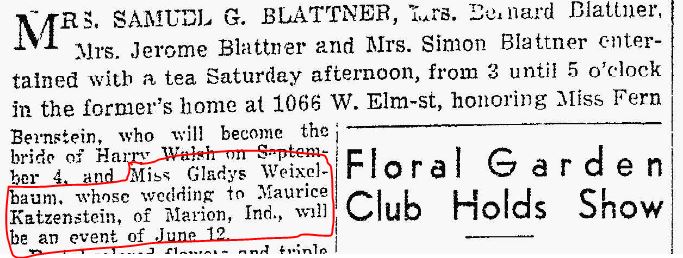
His brother Jacob is listed right down the street at 919 Marshall Street in that same directory for 1887. Sometime before September 16, 1886, Jacob Katzenstein had married Ella Bohm, daughter of Marcus Bohm.  I cannot find any official records for Ella, except for this birth record indexed on FamilySearch:

milton-b-katzenstein-birth-record

Unfortunately, it did not reveal Ella’s original surname or anything else about her.  But it does show that their son Milton was born in Philadelphia in 1886, suggesting that they were all living there at that time.  I found her original surname and her father’s name from other sources, discussed below.

Jacob’s residence during the 1880s is a bit of a mystery.  I cannot find him on the 1880 census.  In 1881, he is listed in the Pittsburgh directory, living with Perry.  In 1884, he is listed in the Johnstown, Pennsylvania, directory, and in 1887, he is listed in both the Johnstown and Philadelphia directories.  I have no idea whether Ella was from Philadelphia, Johnstown, or someplace else. I don’t know where or when she and Jacob were married. I did find this quote about Jacob on my cousin Roger’s old website:

[Jacob] came to Johnstown in 1882, as a clerk for Louis Cohen.  He returned to Philadelphia for a few years but then came back to take charge of the Economy clothing Store which belonged to Amos Sulka and himself. (quoting Leonard Winograd, The Horse Died at Windber: A History of Johnstown’s Jews of Pennsylvania (Wyndham Hall Press, 1988)).

Jacob and Ella had a second son named Edwin born apparently on June 5, 1887, a date I determined from his headstone, as discussed below.  But June 5, 1887 is less than nine months after Milton’s birth date of September 16, 1886.  It seems highly unlikely that a woman could have had two children less than nine months apart. I assume one of those birth dates is off by at least a few months, or that Edwin was premature, or that Ella conceived almost immediately after Milton was born. Or that Ella was not the biological mother of one of those two children.

In 1888, Gerson and Eva saw their youngest child get married.  Hilda, my great-grandmother, married Isidore Schoenthal in Philadelphia. As I’ve written previously, Hilda and Isidore first lived in Pittsburgh, where on December 3, 1888, their first son was born, my great-uncle Lester Schoenthal.

Hilda Katzenstein Schoenthal

Hilda Katzenstein Schoenthal

Thus, by 1888, Gerson and Eva’s children were all married, and there were twelve grandchildren.  Things must have seemed quite good for them all, but in 1889, their fortunes began to change.  First, on April 18, 1889, Jacob and Ella’s son Milton died; he would have been only two and a half years old.  I learned of his death from an entry on FindAGrave showing his headstone at Grandview cemetery in Johnstown:

But the headstone says he was born in 1888, not 1886 as the Philadelphia birth record stated. So I searched the interment database for Grandview cemetery in Johnstown and saw that the interment record indicates that Milton was two when he died in April, 1889, suggesting that the headstone is wrong and the birth record and interment record are right.  Very odd.  I also learned from the interment record that Milton’s middle name was Bohm, his mother’s birth name.

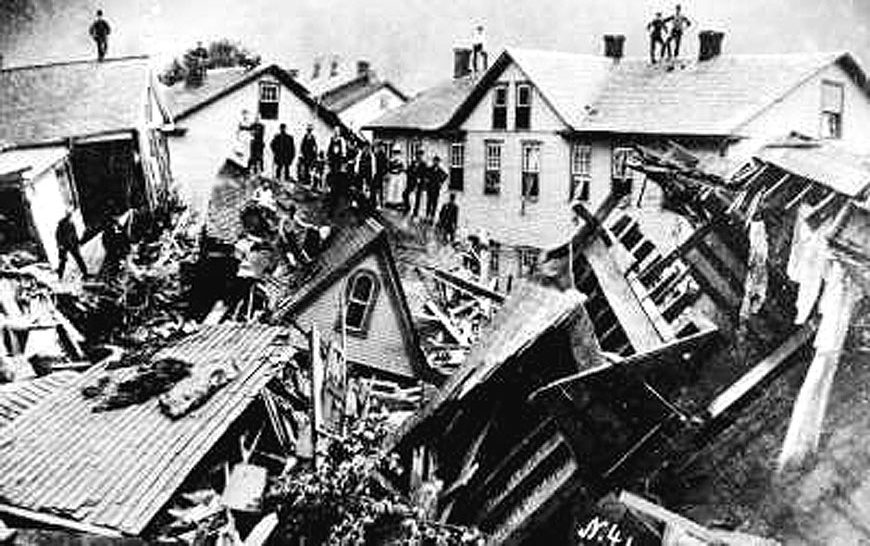
A little over a month after Milton’s death in Johnstown, one of the most tragic events in American history occurred: the Johnstown flood of May 31, 1889. Over two thousand people died that day.  According to the Johnstown Area Heritage Association (JAHA) website, that was the largest loss of civilian life in America in one day until September 11, 2001.

The JAHA website and several other sources describe how after several days of heavy rain, the South Fork dam, which was in need of repairs, collapsed, causing havoc and death as the rushing waters swept everything in its path under and aside.


The aftermath of the Johnstown Flood (Johnstow...

The aftermath of the Johnstown Flood (Johnstown, Pennsylvania). “The Debris above the Pennsylvania Railroad Bridge.” In: “History of the Johnstown Flood”, by Willis Fletcher Johnson, 1889. P. 199. Library Call Number M79.4 J71h. (Photo credit: Wikipedia)

Here is how the JAHA described it:

20 million tons of water rushed down the narrow Conemaugh Valley like a moving mountain of water at an average speed of 40 miles per hour. The “terrible wave” picked up houses, trees, and even trains on its way down the valley. It flattened a railroad bridge. It swept whole towns away as it made its way to the city of Johnstown.

By the time it reached Johnstown the flood didn’t even look like water anymore. People who saw it coming said it looked like a moving, boiling black mountain of junk. 35 feet high at its crest, it had the force of Niagara Falls. Even the best swimmers couldn’t swim in that mess. Many people drowned. For most, the only warning was a thunderous rumble before the water hit.

In minutes, most of downtown Johnstown was destroyed. Survivors clung to roofs, debris, and the few buildings that remained standing. Others who weren’t killed instantly, were swept down the valley to their deaths.

Just when it seemed like it couldn’t get worse, it did. All that wreckage piled up behind the Pennsylvania Railroad’s Stone Bridge. People who managed to survive so far became trapped in the huge pile of debris, all wrapped in a tangle of barbed wire from destroyed Gautier Wire Works. Then the pile, which was 40 feet high and 30 acres across, caught fire!

Four square miles of downtown Johnstown was completely leveled, including about 1600 homes, 280 businesses, and much of the Cambria Iron Company. Even more tragic was the loss of life. 2,209 people are known to have died in the flood waters. 99 whole families perished. 400 children under the age of ten were killed.

Among those who lost their lives in the flood were Ella Bohm Katzenstein, Jacob’s wife, and their younger son, Edwin, who was just five days short of his second birthday.

Philadelphia Jewish Exponent,, June 7, 1889, p. 3

Philadelphia Jewish Exponent,, June 7, 1889, p. 3

Note that this list includes Ella (identified by her birth name incorrectly as Ellen) and her son among those who were killed and Jacob on the list of those who survived.

Jacob Katzenstein had lost his entire family starting with Milton on April 18 and then, 43 days later, he lost Ella and Edwin in the flood.

ella-katzenstein-and-edwin-katzenstein-headstone-from-findagrave

Headstone of Ella and Edwin Katzenstein, FindAGrave, courtesy of Byron http://www.findagrave.com/cgi-bin/fg.cgi?page=gr&GRid=118211407&ref=acom

The headstone allowed me to infer the birthdates for Ella (February 1862) and Edwin (June 5, 1887), as it says Ella was 27 years, six months, and zero days old at her death on May 31, 1889, and that Edwin was one year, eleven months, and six days old that day.

The odd thing is that this headstone is located at Eastview Cemetery in Cumberland, Maryland, not at Grandview Cemetery in Johnstown where Jacob and Ella had buried Milton the month before.  Also, note that the stone says “In Memory of,” an indication to me that it is not marking a grave, but is just operating as a memorial.  Maybe the bodies of Ella and little Edwin were never found. (I’ve contacted the Eastview Cemetery to see if they have more information, but so far they’ve not found any information about the stone, who put it there, or whether Ella and Edwin are in fact buried there.)

But why is this memorial in Cumberland? Jacob was living in Johnstown; his parents were living in Philadelphia. The only Katzenstein family members I know of who were living in Cumberland at that time were some members of the family of H.H. Mansbach, Jacob Katzenstein’s first cousin.  Did the Mansbach family install this memorial?  I am still trying to figure this one out.

It is hard to imagine the devastation caused by this flood. Over two thousand lives lost as well as all the injuries and the destruction of the town itself.  Just as we cannot really grasp the full meaning of  the more than two thousand people who died on 9/11, we cannot truly understand the impact of this tragedy unless we focus on one life at a time and the story of that life. Trying to imagine what this must have been like for Jacob Katzenstein gives me a better sense of how horrifying and devastating the flood must have been, multiplying his story over two thousand times.

English: After the Flood at Johnstown -- Main ...

English: After the Flood at Johnstown — Main Street, a wood engraving (Photo credit: Wikipedia)

It also makes me want to know more about Ella Bohm, the woman he married.  I am still trying to learn more about her.  All I know now is that she was born in February, 1862 (based on that headstone), that her father’s name was Marcus Bohm, that she had two sons, Milton and Edwin, and that both of them died as toddlers.  She was only 27 on May 31, 1889, when she died along with her son Edwin and the 2,207 other people who were killed in the Johnstown flood.

I will write more about her in my next post.


Of Rabbit Holes and Twisted Trees and the Curse of Endogamy

Now that I have emerged from the Mansbach rabbit hole I dove into weeks ago, I can return to the story of my direct ancestors, Gerson Katzenstein and Eva Goldschmidt and their children, including my great-grandmother Hilda Katzenstein.  As I wrote previously, Gerson was one of eight children of Scholum Katzenstein, including four full siblings, two of whom died as children, and three half-siblings, one of whom died as a child. As best I can tell Gerson was the only one of the eight to leave Germany and come to the United States.

Gerson and Eva were married in Oberlistingen in June 1847, and then settled in Gerson’s home town of Jesberg, where they had three children: Scholum (1848, named for Gerson’s father), Jacob (1851), and Brendina (1853, named for Gerson’s mother, Breine Blumenfeld).

marriage-record-of-gerson-katzenstein-and-eva-goldschmidt

Marriage record of Gerson Katzenstein and Eva Goldschmidt HHStAW fonds 365 No 673, Arcinsys Hessen

Gerson and Eva immigrated to the US in 1856 with Scholum, Jacob, and Brendina. A fourth child Perry was born a few months after they had settled in Philadelphia. In 1858, they had a fifth child, Hannah, and in 1860 they were all living in Philadelphia where Gerson was working as a salesman.  As noted in an earlier post, there were three others living in the household, Abraham “Anspach,” who I believe was actually Abraham Mansbach (III), David Frank, a bookkeeper, and Marley Mansbach, who I believe was Abraham Mansbach’s cousin and only related to Gerson through his sister Hannchen’s marriage into the Mansbach family.

Gerson Katzenstein in the 1856 Philadelphia directory

Gerson Katzenstein in the 1856 Philadelphia directory

Gerson Katzenstein and family 1860 US census Year: 1860; Census Place: Philadelphia Ward 13, Philadelphia, Pennsylvania; Roll: M653_1163; Page: 519; Image: 105; Family History Library Film: 805163

Gerson Katzenstein and family 1860 US census
Year: 1860; Census Place: Philadelphia Ward 13, Philadelphia, Pennsylvania; Roll: M653_1163; Page: 519; Image: 105; Family History Library Film: 805163

On August 17, 1863, Gerson and Eva had their sixth and final child, my great-grandmother Hilda.

The family suffered a terrible loss on December 17, 1866, when their eight year old daughter Hannah died from scarlet fever.  She was buried at Adath Jeshurun cemetery in Philadelphia. I have to wonder what impact that had on the family, especially little three year old Hilda, who must have been very frightened and confused.

Hannah Katzenstein death certificate "Pennsylvania, Philadelphia City Death Certificates, 1803-1915," database with images, FamilySearch (https://familysearch.org/ark:/61903/3:1:S3HY-DTXQ-JWY?cc=1320976&wc=9FRX-W38%3A1073285701 : 16 May 2014), > image 316 of 1079; Philadelphia City Archives and Historical Society of Pennsylvania, Philadelphia.

Hannah Katzenstein death certificate
“Pennsylvania, Philadelphia City Death Certificates, 1803-1915,” database with images, FamilySearch (https://familysearch.org/ark:/61903/3:1:S3HY-DTXQ-JWY?cc=1320976&wc=9FRX-W38%3A1073285701 : 16 May 2014), > image 316 of 1079; Philadelphia City Archives and Historical Society of Pennsylvania, Philadelphia.

In 1870, Gerson and Eva were living with their five surviving children.  Scholum was listed as Joseph and was 22; Jacob was 18, Brendina 15, Perry 14, and Hilda was seven.  The 1870 census was taken twice because there were felt to be errors in the first enumeration.  For the Katzenstein family, the first enumeration is barely legible and is missing some of the children, but indicates that Gerson was working as a clerk in a store.  The second enumeration is quite clear and includes all the children, but has no information about occupations.

gerson-katzenstein-1870-census-2

Gerson Katzenstein on 1870 census, first enumeration Year: 1870; Census Place: Philadelphia Ward 16 District 48, Philadelphia, Pennsylvania

gerson-katzenstein-1870-census-1

Gerson Katzenstein and family 1870 census, second enumeration Year: 1870; Census Place: Philadelphia Ward 16 Dist 48 (2nd Enum), Philadelphia, Pennsylvania; Roll: M593_1429; Page: 708B; Image: 258; Family History Library Film: 552928

Brendina Katzenstein, the oldest daughter and third child of Gerson and Eva, was the first to marry.  According to the 1900 census, she married Jacob Schlesinger in 1871 when she was only eighteen years old.  It took some serious digging and the help of the German Genealogy Facebook group to find some background on Jacob.  First, from his death notice, I saw that he was born in “Epplagan” in Germany.

jacob-schlesinger-death-notice

Nick in the German Genealogy group figured out that that was Eppingen.  I then searched the Landesarchiv for Baden Wurttemburg and found Jacob’s birth record, which Nick helped me translate:

Jacob Schlesinger birth record from Eppingen

Jacob Schlesinger birth record from Eppingen,  Landesarchiv Baden-Wurtenberg, 390 Nr. 1320, 1 Band Gliederungssymbol Eppingen, israelitische Gemeinde: Standesbuch 1811-1870 Bild 235

The child was born on March 3rd, 1843 and named Jacob. The father was Jacob (?) Schlesinger, a schützbürger (see note below) and hand[e]lsmann (merchant) and his wife Guste? born Sülzberger.

[UPDATE: Thanks to Dorothee Lottmann-Kaeseler for explaining the word “schutzburger” and providing a cite with this explanation: The “Law on the Situation of the Jews” (“Gesetz über die Verhältnisse der Juden”) from 1809 recognized the Jewish religious community as a church. Constitutionally, Jews were to be treated as free citizens. Their position in the municipalities did not change however, they remained only “protected citizens” (“Schutzbürger”) who did not have the right to be elected to a local council and did not have rights of usage of the common land.]

Nick wasn’t sure whether Jacob’s father’s name was Jacob, and I was skeptical of the fact that his father would also have been a Jacob.  Looking at the record itself, it certainly looks like “Jacob” was crossed out and something else was written over it.  Perhaps the scribe who entered the record confused the child’s name and the father’s name.

Although I could not find Jacob Schlesinger on any US census record before 1880, I was able to locate him in a number of Philadelphia directories where he was living at the same address with men named Abraham, Israel, and Myer Schlesinger, all of whom, like Jacob, were working as butchers.  I assumed these were his relatives, and so I searched for information about them.

I found a passenger manifest that shows an Israel Schlesinger and his family arriving in the US in 1860; along with Israel was his wife Gustel or Gurtel, sons Maier (26) and Abraham (11), and two daughters, Fanny (20) and Malchen (15).  There was no son named Jacob on this manifest.

Family of Israel Schlesinger 1860 ship manifest Year: 1860; Arrival: New York, New York; Microfilm Serial: M237, 1820-1897; Microfilm Roll: Roll 205; Line: 1; List Number: 918 Description Ship or Roll Number : Roll 205 Source Information Ancestry.com. New York, Passenger Lists, 1820-1957

Family of Israel Schlesinger 1860 ship manifest
Year: 1860; Arrival: New York, New York; Microfilm Serial: M237, 1820-1897; Microfilm Roll: Roll 205; Line: 1; List Number: 918
Description
Ship or Roll Number : Roll 205
Source Information
Ancestry.com. New York, Passenger Lists, 1820-1957

Then I found another manifest listing a fourteen year old named Jacob Schlesinger arriving in 1857 with what appears to be an older sibling named Hagar.  Since my Jacob Schlesinger reported on the 1910 census that he’d arrived in 1857 (and in 1855 according to the 1900 census) and he would have been fourteen in 1857, I assumed that this was the right Jacob.  Further research uncovered a Hagar Schlesinger, a woman of the right age, who was living in Philadelphia in 1885, so she was probably his sister.

Jacob and Hagar Schlesinger 1857 ship manifest Year: 1857; Arrival: New York, New York; Microfilm Serial: M237, 1820-1897; Microfilm Roll: Roll 173; Line: 1; List Number: 497

Jacob and Hagar Schlesinger 1857 ship manifest
Year: 1857; Arrival: New York, New York; Microfilm Serial: M237, 1820-1897; Microfilm Roll: Roll 173; Line: 1; List Number: 497

But I still had no proof that this Jacob was the son of Israel Schlesinger.  He could have been just a nephew or a cousin.  So I searched for a birth record for one of Israel’s sons and found this one for Myer, as translated by Nick:

Myer Schlesinger birth record landesarchiv_baden-wuerttemberg_generallandesarchiv_karlsruhe_390_nr-_1320_bild_174_4-1128670-174.jpg

Myer Schlesinger birth record
landesarchiv_baden-wuerttemberg_generallandesarchiv_karlsruhe_390_nr-_1320_bild_174_4-1128670-174.jpg

The child was born June 4th, 1834, named Mozes and the parents are Israel Schlesinger and Geitel Si?lzberger.

Myer was also the son of Geitel Sulzberger and Israel (not Jacob) Schlesinger.  Looking back at Jacob’s birth record, it does seem that “Israel” was written over “Jacob” and that thus Jacob’s father was also Israel Schlesinger.  I also found a birth record for Hagar Schlesinger; she also was the daughter of Israel and Geitel.

Thus, I feel fairly comfortable concluding that my Jacob Schlesinger was a son of Israel Schlesinger from Eppingen, especially since he and Israel were living at the same address in 1865, according to the Philadelphia directory for that year. In addition, Jacob, like Israel, Myer, and Abraham, was a butcher in Philadelphia, as seen in numerous entries in the Philadelphia city directories as well as census reports.

Brendina and Jacob Schlesinger had three children listed on the 1880 census: Heloise (5), Solomon (4), and Alfred (1). Jacob was still working as a butcher.  Brendina and Jacob would have a fourth child, Sidney, in 1880, and a fifth, Aimee, born in 1887.

Jacob and Brendina Schlesinger and family 1880 census Year: 1880; Census Place: Philadelphia, Philadelphia, Pennsylvania; Roll: 1176; Family History Film: 1255176; Page: 156A; Enumeration District: 301; Image: 0314

Jacob and Brendina Schlesinger and family
1880 census
Year: 1880; Census Place: Philadelphia, Philadelphia, Pennsylvania; Roll: 1176; Family History Film: 1255176; Page: 156A; Enumeration District: 301; Image: 0314


The 1870s were also active years for Brendina’s three brothers. The oldest brother, Scholum Joseph, had lived in many places since coming with his family to the US.  An 1896 profile of him reported that he had left his family for Leavenworth, Kansas, when he was fourteen to learn how to be a cigar maker, but since he did not arrive until he was eighteen in 1856, that seems more myth than truth.  The profile goes on to state that after being in Kansas for a number of years, he returned to Philadelphia, but eventually gave up the cigar trade because of health concerns.  The article continues by saying that he then “went to Winchester, VA., and took a clerkship, remaining for five years. Thence he went to Uhrichsville, Ohio, thence to New Castle and on the nineteenth of April 1871, he came to Washington [Pennsylvania].”  “The Saturday Evening Supper Table,” Washington, Pennsylvania, June 27, 1896, found here (my cousin Roger Cibella’s genealogy website).

The U.S. and Canada, Passenger and Immigration Lists Index, 1500s-1900s, database on Ancestry, confirms that by 1873, Scholum, also known as S.J. or Joseph Katzenstein, had moved to Washington, Pennsylvania.  That is, he moved to the small town in western Pennsylvania where his mother’s uncle Simon Goldschmidt and his children were living at that time.  Readers with excellent memories may recall that Simon Goldschmidt was married to Fanny Schoenthal, my great-grandfather Isidore Schoenthal’s sister. By 1881 Isidore was also living in Washington, Pennsylvania.

S.J.’s move to Washington, Pennsylvania, may have had long lasting repercussions for my family, as I am fairly confident that he was the one who engineered the introduction of his younger sister, my great-grandmother Hilda, to Isidore Schoenthal, my great-grandfather.

The Daily Republican (Monongahela, Pennsylvania) 11 Aug 1887, Thu • Page 4

The Daily Republican
(Monongahela, Pennsylvania)
11 Aug 1887, Thu • Page 4

S.J Katzenstein married Henrietta Sigmund in 1875.  Henrietta was born in 1851 in Baltimore to Ella Goldschmidt and Albert Sigmund. That added yet another twist to my family tree because Ella Goldschmidt was the daughter of Meyer Goldschmidt whose brothers were Seligmann Goldschmidt, father of Eva Goldschmidt Katzenstein, and Simon Goldschmidt, husband of Fanny Schoenthal.  In other words, Eva Goldschmidt Katzenstein was Ella Goldschmidt Sigmund’s first cousin, meaning that S.J. Katzenstein married his maternal second cousin, Henrietta Sigmund.

ella-goldschmidt-to-eva-goldschmidt

But let me stay focused on the Katzensteins rather than diving into the Goldschmidt rabbit hole.

S.J. and Henrietta, who was also known as Dot or Dottie, had a daughter Moynelle in 1879.  S.J., who is listed as Joseph on the 1880 census, was working as a clothing merchant in Washington, Pennsylvania. He and Henrietta would have five more children: Milton (1881), Howard (1882), Ivan (1884), Earl (1885), and Vernon (1892).

S. Joseph Katzenstein and family 1880 census Year: 1880; Census Place: Washington, Washington, Pennsylvania; Roll: 1202; Family History Film: 1255202; Page: 577A; Enumeration District: 270

S. Joseph Katzenstein and family 1880 census
Year: 1880; Census Place: Washington, Washington, Pennsylvania; Roll: 1202; Family History Film: 1255202; Page: 577A; Enumeration District: 270

S.J. was not the only child of Gerson and Eva Katzenstein to leave Philadelphia for western Pennsylvania in the 1870s.  In 1878, Perry Katzenstein, the third brother, was listed in the Pittsburgh directory as a clerk; the following year his brother Jacob joined him.  Both were living at 25 Second Avenue and working as salesmen.  Although I cannot find either of them on the 1880 census, both were listed in the 1881 Pittsburgh directory, still working as salesmen and still living together, though now at 188 Wylie Avenue. (Perry also appears in the 1880 directory, but Jacob does not.)

As for their parents and little sister Hilda, they were still living in Philadelphia in 1880.  Gerson continued to work as a clerk in a store.  Living with them, in addition to a number of boarders, was Louis Mansbach, listed as Gerson’s nephew, age 31, and born in “Prussia.” At first I thought this was Louis Mansbach, son of H.H. Mansbach, who would have been Gerson’s great-nephew.  But that Louis Mansbach was far too young and born in the US. So who was this Louis Mansbach?

Year: 1880; Census Place: Philadelphia, Philadelphia, Pennsylvania; Roll: 1173; Family History Film: 1255173; Page: 274B; Enumeration District: 219; Image: 0561

Year: 1880; Census Place: Philadelphia, Philadelphia, Pennsylvania; Roll: 1173; Family History Film: 1255173; Page: 274B; Enumeration District: 219; Image: 0561

Well, remember that post where I was trying to sort out all the different men named Abraham Mansbach? One of them, whom I called Abraham II, was the son of Leiser Mansbach and grandson of Abraham Mansbach I.  Abraham II was the brother of Marum Mansbach who married Hannchen Katzenstein, Gerson Katzenstein’s half-sister.  And Abraham II had a son in 1849 who was named for his grandfather: Leiser Mansbach II. He was therefore the nephew of Marum Mansbach and Hannchen Katzenstein.  Leiser became Louis, and he was living with Gerson and Eva Katzenstein in 1880, working as a veterinary surgeon.

And so you might be thinking, “Well, he wasn’t Gerson’s nephew.  He was Gerson’s brother-in-law’s nephew.” And you might be thinking, “Perhaps Gerson was just being liberal in using the term ‘nephew.’”

But, alas, it’s not that simple. Once again there is a twist in the tree.  Louis Mansbach’s mother was Sarah Goldschmidt, Eva Goldschmidt’s sister.  So Louis Mansbach was in fact Eva Goldschmidt Katzenstein’s nephew as well as Gerson’s brother-in-law’s nephew.

leiser-mansbach-to-gerson-katzenstein


And on that confusing note, I am going to go get a breath of fresh air and curse the endogamy gods who make using DNA results so utterly pointless in my family research.