Will the Real Abraham Mansbach Please Stand Up?

In my prior post about my great-great-grandparents Gerson Katzenstein and Eva Goldschmidt, I was trying to determine whether anyone in either of their families was living in Philadelphia when they immigrated there with their first three children in 1856.  The closest possible relative I could find who might have been there first was someone I thought was Gerson’s nephew Abraham Mansbach, son of his half-sister Hannchen Katzenstein and her husband Marum Mansbach of Maden.

There was an 1852 ship manifest for an Abraham Mansbach, a merchant from Germany, who I thought might be this nephew, but there was no town of origin or age listed on the manifest, so it was hard to know. Also, he had entered the country in Baltimore, not Philadelphia.

abraham-mansbach-1852-immigration-card

Abraham Mansbach 1852 immigration card “Maryland, Baltimore Passenger Lists Index, 1820-1897,” database with images, FamilySearch (https://familysearch.org/pal:/MM9.3.1/TH-1942-37337-15431-34?cc=2173933 : 17 June 2014), NARA M327, Roll 98, No. M462-M524, 1820-1897 > image 2545 of 3335; citing NARA microfilm publication M327 (Washington, D.C.: National Archives and Records Administration, n.d.).

abraham-mansbach-1852-passenger-list

Abraham Mansbach on 1852 passenger list “Maryland, Baltimore Passenger Lists, 1820-1948,” database with images, FamilySearch (https://familysearch.org/pal:/MM9.3.1/TH-1961-32011-12875-22?cc=2018318 : 25 September 2015), 1820-1891 (NARA M255, M596) > 9 – Jun 2, 1852-Aug 29, 1853 > image 503 of 890; citing NARA microfilm publications M255, M596 and T844 (Washington, D.C.: National Archives and Records Administration, n.d.).

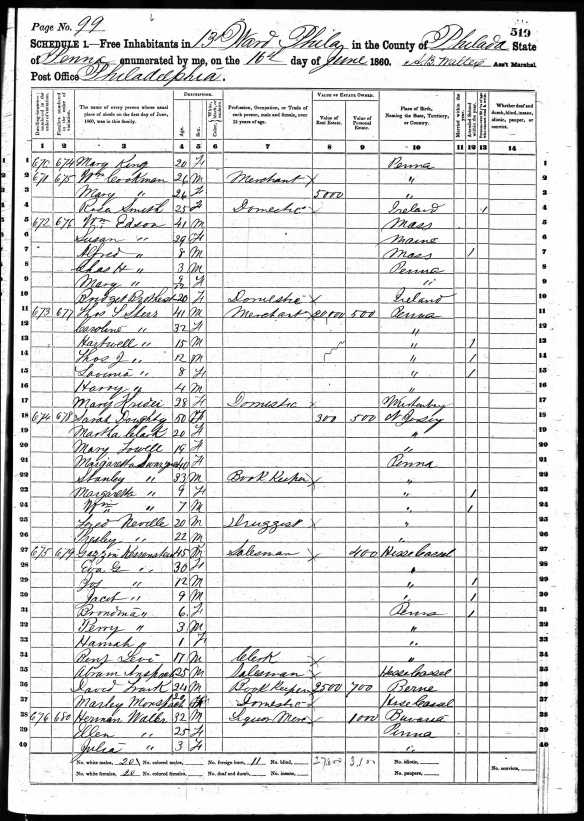
The 1860 census, however, shows that living in the household of Gerson Katzenstein was a 25 year old salesman named Abraham Anspach.  Since Gerson’s nephew Abraham was born in 1835, he would have been 25 in 1860.  It seemed to me that this was in fact the son of Hannchen Katzenstein and Marum Mansbach, Abraham Mansbach.

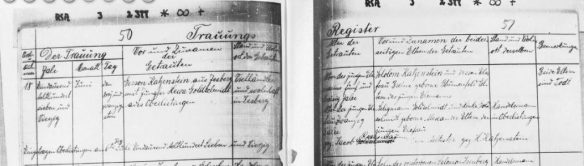
But there was also a 20 year old woman living in the house named Marley Mansbach, and I had at first thought she could be Gerson’s niece and Abraham’s sister Henrietta.  I also thought she was likely the same person who was listed on the 1856 ship manifest right below Gerson Katzenstein and his family: a sixteen year old girl named Malchen Mansbach from Maden. But the ages were off from the birth year I had for Henrietta (1833), and the name Henrietta is quite different from Malchen.  Most Malchens I’d seen adopted the name Amelia or Amalia; most Henriettas had been Jette in Germany, not Malchen.

Plus there was Heinemann Mansbach, the other sixteen year old who had sailed with Gerson and his family and who’d been heading to “Libanon.”  He was not listed on the 1860 census with the Katzenstein family. Who was he, and where was he?

Ship manifest close up Year: 1856; Arrival: New York, New York; Microfilm Serial: M237, 1820-1897; Microfilm Roll: Roll 164; Line: 1; List Number: 589

Ship manifest close up
Year: 1856; Arrival: New York, New York; Microfilm Serial: M237, 1820-1897; Microfilm Roll: Roll 164; Line: 1; List Number: 589

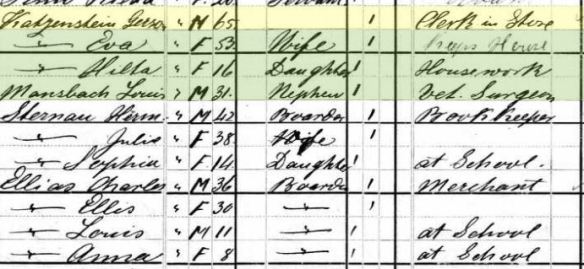
Closeup of Katzensteins and Mansbachs on 1860 census

Closeup of Katzensteins and Mansbachs on 1860 census

So I consulted with David Baron, and what a Pandora’s box that opened! David worked on this Mansbach puzzle quite extensively and discovered that the Katzenstein family was entwined in multiple ways not only with the Mansbach family, but also the Goldschmidt, Jaffa, and Schoenthal families.  Some of this I’d known before, but much of it was new to me and was quite a revelation.  There are siblings who married the siblings of their spouses; cousins who married cousins; and so many overlapping relationships that my head was spinning.  I won’t describe them all here.  I’d lose you all.

But what David sorted out for me did help answer some of the questions posed above. He pointed me to the work done by Hans-Peter Klein on the Mansbach family from Maden. From Hans-Peter’s work I learned that there were FOUR men from Maden named Abraham Mansbach. The first Abraham Mansbach died sometime before 1808.  I will refer to him as Abraham I. He had two sons, Lieser, born in 1770, and Marum, born in either 1769 or 1778 (Marum I).

family-group-sheet-for-abraham-mansbach-i-page-001

Lieser had three sons: Isaak (1799), Marum II (1802), and Abraham II (1809).  So that’s two Abrahams, two Marums.  Still with me? Both Abraham I and Abraham II were clearly born too early to have been the Abraham Mansbach on the 1860 census with Gerson.

family-group-sheet-for-leiser-mansbach-page-001

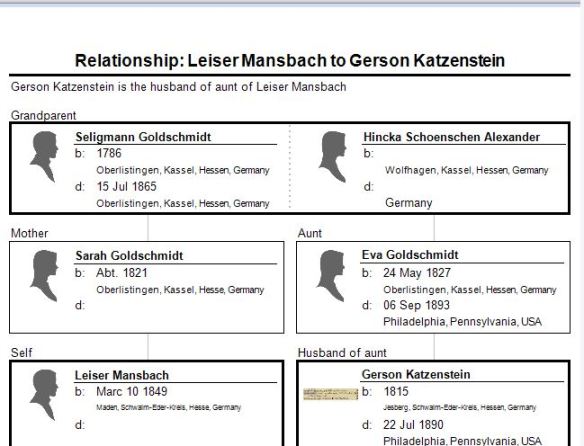
As a distracting aside, let me mention that Lieser’s son Abraham II married Sarah Goldschmidt, Eva Goldschmidt’s sister, making him the brother-in-law of my great-great-grandparents, Gerson Katzenstein and Eva Goldschmidt.  But that’s a story for another day.

Lieser’s son Marum II is the one who married Hannchen Katzenstein, sister of Gerson, and they had Abraham III in 1835.  He’s the one I believe is listed with Gerson on the 1860 census; he also appears to be the first member of the Katzenstein line to come to the US.

family-group-sheet-for-marum-mansbach-page-001

Finally, Lieser’s brother Marum I had a daughter named Schiele (birth year unknown).  Schiele had two children apparently out of wedlock; both took on the surname Mansbach.  They were Abraham IV, born in 1849, and Malchen/Merla, born in 1840.  Thus, Abraham IV was born fourteen years after Gerson’s nephew, Abraham III, and was far too young to have been the Abraham living with Gerson in 1860 or sailing by himself to America in 1852.

descendants-of-marum-mansbach-i-page-001

Thus, I feel quite certain that the Abraham Mansbach on the census and on the 1852 ship manifest was Abraham Mansbach III, son of Hannchen Katzenstein and thus Gerson Katzenstein’s nephew.

In addition, David Baron believes, and it seems right to me, that the girl named Malchen Mansbach listed with Gerson and his family on the 1856 ship manifest and the 1860 census was not Henrietta Mansbach, daughter of Marum Mansbach II and Hannchen Katzenstein, but instead the daughter of Schiele Mansbach and sister of Abraham Mansbach IV.  Schiele’s daughter Malchen was born in 1840, according to Hans-Peter’s research, and so she would have been sixteen in 1856, as reflected on the manifest, and twenty in 1860, as reflected on the 1860 census.  Abraham Mansbach IV, her brother, did not immigrate to the US until 1864.

Having gone down this deep rabbit hole of the extended Mansbach family, I had to pull myself back up and regain my focus.  After all, other than the children of Marum Mansbach II and Hannchen Katzenstein, none of these other Mansbachs are genetically connected to me.  Their stories are surely important and interesting, but I had to get back to the Katzensteins before I became too distracted.

I now feel fairly confident that the Abraham listed with Gerson in 1860 was in fact his nephew, Abraham Mansbach III, son of Hannchen Katzenstein and Marum Mansbach II, but that Malchen/Marley Mansbach was not their daughter Henrietta and thus not Gerson’s niece.  But I still had questions about Hannchen and Marum’s two other children, Heinemann/Harry and Henrietta. In 1860, where was Heinemann Mansbach, the third child of Hanne and Marum, the one who had sailed with Gerson in 1856 and whose destination was apparently Lebanon, PA? And when, if at all, did Henrietta arrive in the US?

More on that in my next few posts.


The Katzenstein Clan: Who Got Here First?

One of the main questions I had about Gerson Katzenstein, my great-great-grandfather, was why did he come to the United States?  Did he have other relatives who had paved the way, or was he the first in his family to arrive?

When I first did some research about Gerson almost five years ago, I was unable to find any relatives aside from his wife and children, and so I had no information about the rest of his family.  But thanks to the work of Barbara Greve and David Baron, I now have a long list of names of relatives, including the names of Gerson’s siblings.  I thought that there might have been other relatives living in the United States when Gerson arrived that I’d not known about during my initial research several years ago.

What I learned from Barbara Greve’s work was that Gerson was one of the eight children of Scholem Katzenstein; there were four half-siblings born to Scholem’s first wife, Gella: Hannchen (1798-1840), Mendel, who died as an infant in 1799, Jacob (1803-?), and Gela, who also died as an infant in 1808.  Gerson had three full siblings born to his mother, Breine Blumenfeld: Freudchen (1809-1818), Rahel (1813-1861), and Moses, for whom the only record is a birth record dated November 4, 1814.  Perhaps Moses also had died as an infant. Thus, of the eight children of Scholem Katzenstein, the only ones for whom there are records indicating survival to adulthood are Gerson, Hannchen, Jacob, and Rahel.

family-group-sheet-for-scholum-ha-kohen-katzenstein-rabbi-page-001


Gerson’s birth is recorded as somewhere between 1811 and 1815, depending on the source.  He married Eva Goldschmidt of Oberlistingen sometime before 1848, when their first child, Scholem, was born in Jesberg.  Two more children followed, Jacob in 1851 and Brendina (Branche in German—presumably named for Gerson’s mother) in 1853.

Gerson, Eva, and their three children left Germany and arrived in New York City on July 3, 1856.  On the ship manifest, Gerson listed his occupation as a butcher and their final destination as Philadelphia.

Gerson Katzenstein and family on 1856 ship manifest Year: 1856; Arrival: New York, New York; Microfilm Serial: M237, 1820-1897; Microfilm Roll: Roll 164; Line: 1; List Number: 589

Gerson Katzenstein and family on 1856 ship manifest
Year: 1856; Arrival: New York, New York; Microfilm Serial: M237, 1820-1897; Microfilm Roll: Roll 164; Line: 1; List Number: 589

Just a little over a month later, Eva gave birth to their fourth child, Perry, who was born in Philadelphia on August 19, 1856.  Eva had obviously been far into her pregnancy when they left Germany. Why did they leave then? Why did they go to Philadelphia? Was there another family member there? Had any of Gerson’s siblings preceded them? Or a cousin?[i] Did his wife Eva have family there?

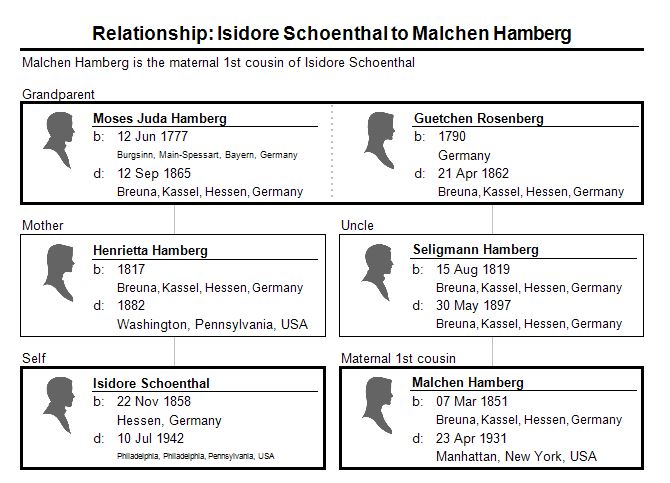
I knew that Eva Goldschmidt had relatives already in the US.  Her uncle Simon Goldschmidt had arrived in 1845 with his wife Fradchen Schoenthal, who was the aunt of Eva’s future son-in-law, Isidore Schoenthal, my great-grandfather.  They were living in Pittsburgh in 1850.  In 1860, Simon, at that point a widower, was living with his son Jacob in Washington, Pennsylvania. But no one from the Goldschmidt family was living in Philadelphia in 1856 when Gerson and Eva and their family arrived, at least as far as I can tell.
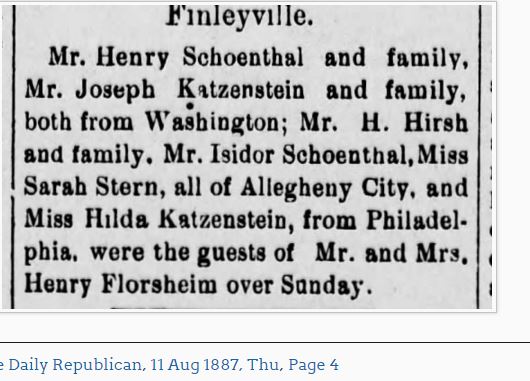
I decided to look more closely at Gerson’s siblings to see whether they or their children had emigrated.  According to the work done by Barbara Greve and David Baron, Gerson’s half-brother Jacob married Sarchen Lion in 1829 in Jesberg, and they had nine children: Gelle (1829), presumably named for Jacob’s deceased mother, Michaele (1832), Schalum (1834); Rebecca (1826), Johanna (1838), Pauline (1841), Baruch (1844), Meier (1849), and Levi (1851).  From the Greve/Baron research, it appears that neither Jacob nor any of these children left Germany.

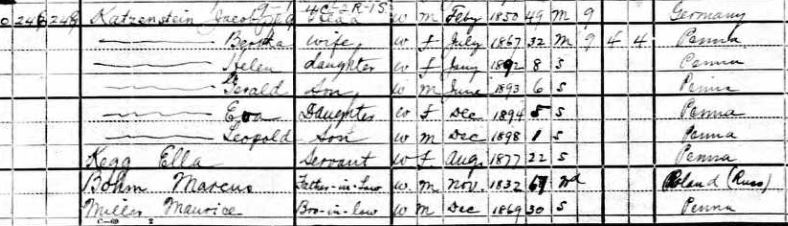
As for Gerson’s sister, Rahel, she married Jacob Katz, and they had six children: Blumchen (1838), Moses (1839), Meier (1842), Abraham (1852), Samuel (1853), and Sanchen (1854). Of these six children, only Abraham and Samuel emigrated from Germany.  According to the 1900 census, Abraham immigrated to the United States in 1872, many years after Gerson’s departure from Jesberg; he lived in Kentucky for many years.

Abraham J Katz and family 1900 US census Year: 1900; Census Place: Louisville Ward 5, Jefferson, Kentucky; Roll: 530; Page: 3A; Enumeration District: 0053; FHL microfilm: 1240530

Abraham J Katz and family 1900 US census, line 39
Year: 1900; Census Place: Louisville Ward 5, Jefferson, Kentucky; Roll: 530; Page: 3A; Enumeration District: 0053; FHL microfilm: 1240530

Samuel also emigrated in 1872, and also lived in Kentucky before moving and settling in Omaha, Nebraska. Rahel’s other four children did not leave Germany, although some of the next generation did. Both Samuel and Abraham thus arrived in the United States long after their uncle Gerson had emigrated in 1856, and they settled far from Philadelphia where their uncle was living.

Samuel Katz 1905 passport application National Archives and Records Administration (NARA); Washington D.C.; NARA Series: Passport Applications, 1795-1905; Roll #: 669; Volume #: Roll 669 - 01 Feb 1905-28 Feb 1905

Samuel Katz 1905 passport application
National Archives and Records Administration (NARA); Washington D.C.; NARA Series: Passport Applications, 1795-1905; Roll #: 669; Volume #: Roll 669 – 01 Feb 1905-28 Feb 1905


The remaining sibling who survived to adulthood was Gerson’s half-sister, Hannchen. She married Marum Mansbach, who was from Maden, Germany, which is where Hannchen and Marum lived after marrying.  They had three children born in Maden: Gelle (later Henrietta) (b. 1833), Abraham (b. 1835), and Hendel (later Harry) (b. 1840).  Hannchen died the day Harry was born, so Marum was left with three young children including a newborn to raise on his own. These children and their father ended up in the US, but when had they emigrated? Were they the ones who led the way for Gerson, Eva, and their children in 1856?

I went back to look at the documents relating to Gerson that I’d collected years back, and I started with the ship manifest pictured above.  This time I noticed something I’d not seen before.  Right below the family of Gerson Katzenstein were the names of two more people: Heinemann Mansbach, a sixteen year old male who was a peddler and headed for “Libanon,” and Malchen Mansbach, a sixteen year old female headed to Baltimore.  Both were from Maden, Germany.

Ship manifest close up Year: 1856; Arrival: New York, New York; Microfilm Serial: M237, 1820-1897; Microfilm Roll: Roll 164; Line: 1; List Number: 589

Ship manifest close up
Year: 1856; Arrival: New York, New York; Microfilm Serial: M237, 1820-1897; Microfilm Roll: Roll 164; Line: 1; List Number: 589

I hadn’t seen any connection to the Katzensteins originally since the two Mansbachs were from Maden, not Jesberg, and because they were headed to different cities, not Philadelphia.  Plus I had no reason to see any connection to anyone named Mansbach.  But now, thanks to the Greve/Baron work, I knew that Gerson had a niece and nephew from Maden with the surname Mansbach.  Could Heinemann Mansbach be the person known later as Harry Mansbach? Could Malchen Mansbach be Henrietta, his older sister? She would have been 23 in 1856, not 16, but perhaps she, like so many others, had lied about her age.  Or could this be an entirely different Mansbach not even related to Gerson Katzenstein?

And was there anyone from the Mansbach family already in the US, and if so, where? Why was Malchen going to Baltimore and Heinemann to “Libanon”? And where is “Libanon”?  There is a Lebanon, Pennsylvania about 90 miles west of Philadelphia, so perhaps that is where Heinemann was headed.  But why? A search of the 1860 census for Lebanon, PA, for those born in Germany did not uncover anyone who appears to have been connected to the Mansbach/Katzenstein family.

Map of Pennsylvania highlighting Lebanon County

Map of Pennsylvania highlighting Lebanon County (Photo credit: Wikipedia)

Then I wondered about Hannchen Katzenstein and Marum Mansbach’s older son Abraham. Where was he when his brother was apparently sailing with their uncle Gerson? I searched for him and found an Abraham Mansbach on an 1852 ship manifest; no age was given, but he was a merchant from Hesse. The ship arrived in Baltimore on December 14, 1852. Gerson’s nephew Abraham Mansbach would have been seventeen in 1852.  This could have been him.

abraham-mansbach-1852-passenger-list

Abraham Mansbach on 1852 passenger list “Maryland, Baltimore Passenger Lists, 1820-1948,” database with images, FamilySearch (https://familysearch.org/pal:/MM9.3.1/TH-1961-32011-12875-22?cc=2018318 : 25 September 2015), 1820-1891 (NARA M255, M596) > 9 – Jun 2, 1852-Aug 29, 1853 > image 503 of 890; citing NARA microfilm publications M255, M596 and T844 (Washington, D.C.: National Archives and Records Administration, n.d.).

abraham-mansbach-1852-immigration-card

Abraham Mansbach 1852 immigration card “Maryland, Baltimore Passenger Lists Index, 1820-1897,” database with images, FamilySearch (https://familysearch.org/pal:/MM9.3.1/TH-1942-37337-15431-34?cc=2173933 : 17 June 2014), NARA M327, Roll 98, No. M462-M524, 1820-1897 > image 2545 of 3335; citing NARA microfilm publication M327 (Washington, D.C.: National Archives and Records Administration, n.d.).


So perhaps Abraham Mansbach, Gerson’s nephew, was the first of the Katzenstein clan to come to the US.  I don’t know whether he stayed in Baltimore or not, but by 1860, it appears that he was living in Philadelphia with his uncle Gerson and the other members of the Katzenstein family:

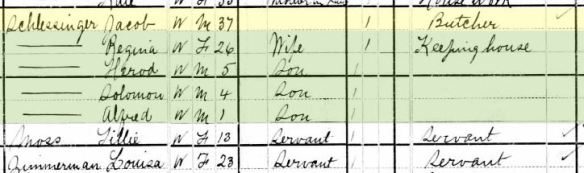
Gerson Katzenstein and family 1860 US census Year: 1860; Census Place: Philadelphia Ward 13, Philadelphia, Pennsylvania; Roll: M653_1163; Page: 519; Image: 105; Family History Library Film: 805163

Gerson Katzenstein and family 1860 US census
Year: 1860; Census Place: Philadelphia Ward 13, Philadelphia, Pennsylvania; Roll: M653_1163; Page: 519; Image: 105; Family History Library Film: 805163


Gerson was working as a salesman and had a personal estate worth $400.  He and Eva had had a fifth child, Hannah, who was a year old.  Their oldest child Scholem was now using the name Joe and was twelve years old; Jacob was nine, Brendina was six, and Perry was three.

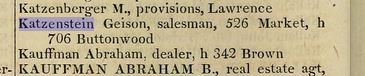
Gerson Katzenstein in the 1859 Philadelphia directory

Gerson Katzenstein in the 1859 Philadelphia directory

Living with them were a seventeen year old clerk named Benjamin Levi and a 24 year old bookkeeper named David Frank.  In addition, there was a 25 year old salesman named Abraham Anspach; this could have been Abraham Mansbach, Gerson’s nephew.  Finally, there was a twenty year old domestic named “Marley Manspach;” perhaps this was the same person as the Malchen Mansbach who was listed on the ship manifest.

Closeup of Katzensteins and Mansbachs on 1860 census

Closeup of Katzensteins and Mansbachs on 1860 census

But was Malchen/Marley really the daughter named Henrietta who would have been 29 in 1860, not 20? And where was Heinemann/Harry living if not with his brother and uncle? It’s too bad that the 1860 census did not include information about the relationships among those living in a household.  That might have cleared some of this up.

But what did seem clear was that by 1860 my Katzenstein great-great-grandparents and the first four of their children were living in Philadelphia.  It also seemed likely that at least two of the children of Gerson’s half-sister Hannchen and her husband Marum Mansbach had also arrived in the United States by then.

But many questions remained.  Fortunately, David Baron helped me find some answers.

**************************

I admit that it’s been hard for me to get back into genealogy right now, but I am trying to find ways to deal with all my anger and grief, and while I look for ways of fighting back against Trumpism, I also am trying to find ways of clearing my head.  Genealogy has done that for me before, and I am hoping it will help me now. This post was written before the election, and now I am trying to work on the next one.


[i] I also went through the rest of the family report prepared by David Baron to see if any of the more distant Katzenstein or Katz relatives had arrived in the US before 1856.  There were none who arrived that early, although there were a few who were in the US by the 1890s and more who came after Hitler came to power.

No Genealogy Today

I can’t bear to talk about the past today because I am too filled with despair about the future.  I have spent the day mourning the election results and reaching out to others who shared my desolation.  I have found myself again and again in tears, sometimes tears of grief for what has happened to our country, sometimes tears of relief when someone has touched me with words of comfort or hope.

In the aftermath of the election results, my daughter shared this photograph of my grandsons.  It made me smile and cry.  It represents all my hopes and all my fears.

nate-and-remy-november-2016

I have gone through at least the first few stages of grief—shock and denial, anger, and now depression.  (I skipped over bargaining, although I did find myself last night saying I’d accept a tie in the Electoral College).

Here’s what I posted on Facebook early Wednesday morning:

I am devastated. Don’t tell me it will all be okay. Don’t tell me to unite behind Trump. It won’t, and I won’t.

I am devastated for my daughters and all the women who believed that America would elect a highly qualified woman over an inexperienced and ignorant man.

I am devastated for all in the LGBTQ community who must see the progress of recent years hanging by a thread.

I am devastated for all people of color, all immigrants, all Muslims, who must feel even more frightened than I do.

I am devastated for those who will see their health insurance disappear.

I am devastated for our planet, which will now see nothing done about climate change.

I am devastated that nothing will be done about gun violence.

I could go on. But mostly I am devastated that my grandsons live in a country filled with so much hate and ignorance.

They say the next stage of grief is acceptance.  I won’t get to that one.  What I hope I can get to is action to fight acceptance.  We need people to unite against these forces of darkness, to work together to protect the rights of those who are most vulnerable, to preserve our rights to choice and to healthcare, to work to protect our planet and the values of free speech, freedom of religion, and freedom from discrimination.  I fear we will instead drift into acceptance.

I admit that I have no idea how we start this movement.  I am hoping that someone with more skills and experience than I have will get us mobilized. Perhaps it will be some of those who felt the Bern, perhaps some of those who fought so hard for Hillary.  Or perhaps it will be someone entirely new.

I want to be a part of whatever it takes to make this country a place where those two little boys pictured above and all those who come after them can grow up without fear and filled with love and hope and acceptance of all people. Where everyone can, regardless of race, religion, sexual orientation, gender, nationality, age, or disability.

As my husband said, our ancestors didn’t come here so that we could give up on our dreams.  We need to mourn first and then pick ourselves up and fight for what we believe.


Introducing The Katz and Katzenstein Families of Jesberg

According to the work done by David Baron, the earliest known Jesberg Katz/enstein ancestor was Bonum Katz ,who was also known as Pinchas ha Kohen.  Those two surnames actually share the same meaning and origins. The name “Katz” is an acronym for Kohen Tzedek or “priest of justice” in Hebrew and is another name like Cohen usually indicating that the father’s family descended from the Cohanim, the priestly tribe traced back to Aaron, Moses’ brother.  It is a fairly common Jewish surname as is Cohen.

All I know about Bonum Katz is that he died in Jesberg sometime after 1720 and that he had at least two children: a son named Schalum Ha Cohen, and a daughter named Jitl Katz.  I don’t know when or where Pinchas was born, what he did for a living, who he married, or when he died.

Deutsch: Reste der Allee im Prinzessingarten b...

Deutsch: Reste der Allee im Prinzessingarten bei Jesberg (Photo credit: Wikipedia)

Nor do I know very much about his son Schalum, though I know a little more about him than I do about Pinchas.  According to the research done by David Baron, Schalum was born about 1720 in Jesberg and died there on February 3, 1774.  He married a woman named Brendelchen, who was born in Treysa, Germany, and who died on May 17, 1776, in Jesberg.

According to David Baron, Schalum and Brendelchen had at least two children: my 4th great-grandfather, Meier Katz, born sometime before 1744, in Jesberg, and his brother Schneuer ha Kohen, also known as Salomon Katz, born in Jesberg on November 11, 1752.[1]  Salomon had ten children with two different wives.

Barbara Greve disagrees with David Baron as to whether or not the Katzenstein line began with Bonum Katz; she believes that that line is separate from the Katzenstein line. Whereas David believes that Schalum and Brendelchen had two sons, Salomon and Meier, Barbara believes that Meier was not their son but part of a separate family.  I have at this point no way of knowing who is right and thus have included both views here for the moment. If Barbara is right, my Katzenstein line would begin with Meier Katz.

Meier Katz, my four times great-grandfather, only had one child: my third great-grandfather Abraham Schalom Ha Cohen, also known as Scholem Meier Katzenstein.  It is interesting that whereas Meier used the surname Katz, his son Scholem used Katzenstein.

Deutsch: Burg Jesberg

Deutsch: Burg Jesberg (Photo credit: Wikipedia)


Scholem Meier Katzenstein, my third great-grandfather, thus may have been the first in my direct line to use the name Katzenstein.  He was born in September 1769 and died on October 13, 1826, in Jesberg. He was an “Ellenwarenhandler,” according to Barbara Greve.  Thanks to the help of the German Genealogy group on Facebook, I learned that Ellenwarenhandler is a term that was used to describe someone who sold dry goods according to specific measurements.

Scholem Katzenstein was married twice, first to Gella Katz (Katten) in January 1795 in Jesberg.[2]  Gella died on January 31, 1808, after giving birth to her fourth child with Scholem, Gela.  The four children born to Gella and Scholem Meier were Hannchen (1798-1840), Mendel (1799-1799), Jacob (1803-1880), and Gela (1808-1808). Only Hannchen and Jacob survived infancy.

Scholem remarried on September 29, 1808; his second wife was my third-great-grandmother, Breine Katz Blumenfeld.  She was born in Momberg, Germany, and David Baron thought was she probably the daughter of Abraham Katz Blumenfeld, and Geidel Katz, who would thus be my fourth-great-grandparents.

Deutsch: Gilsabrücke in Jesberg

Deutsch: Gilsabrücke in Jesberg (Photo credit: Wikipedia)

Scholem and Breine had four children.  The first was Freudchen, born on November 4 1809 in Jesberg; she died September 8, 1818 when she was not yet nine years old.

A second daughter, Rahel, was born on January 15, 1813, in Jesberg.  She married Jacob Katz, also of Jesberg; he and Rahel were cousins.  Jacob was the great-grandson of Bonum Katz; Rahel was the great-great-grandaughter of Bonum Katz. Thus, Rahel and Jacob were second cousins, once removed. Rahel and Jacob had five children.  Rahel died on December 7, 1861, in Jesberg.

(Since Barbara Greve believes that Bonum Katz was not the great-great-grandfather of Rahel, this statement may not be correct.  For the moment I will let it stand, subject to change.)

Scholem and Breine also had a son named Moses, who was born in Jesberg on November 4, 1814.  There was no further information about Moses on David’s family tree.

But most important to me was the remaining child of Scholem and Breine, Gerson Katzenstein, my great-great-grandfather.  Although most American records have Gerson’s birth year at roughly 1815, the German records show that he was born on August 11, 1811, making him the second oldest child and oldest son of Scholem and Breine.  Since Freudchen had died as a child, Gerson was effectively the oldest child, assuming that the Jesberg record as transcribed is more accurate than the US records.

family-group-sheet-for-scholum-ha-kohen-katzenstein-rabbi-page-001

So where do I begin to tell the story of this large family that extends back 300 years? I think it makes sense to start with my great-great-grandfather Gerson Katzenstein and his siblings.


[1] Given the seven year age gap between Salomon and Meier, it seems likely that Schalum and Brendelchen had other children who have not yet been found; the 1744 Jesberg census, for example, lists another son named Mendel, but no other information about him has been found.

[2] Despite the Katz surname, it does not appear that Gella was closely related to the Jesberg Katz/Katzenstein family as she was born in Halsdorf, another Hessian town; but given the marriage patterns in these families, there is likely some connection.

Herding Katz

The title of this post has a double meaning, as you will see.

As I wrote in my last post, about ten years ago when I first found the genealogy page about the Katzenstein and Goldschmidt family compiled by David Baron and Roger Cibella, David (who is their family genealogist) at that point had traced the Katzenstein family line back as far as Gerson Katzenstein, my great-great-grandfather.

Fast forward to 2012 when I began to explore my family’s history and discovered, with the help of others, Barbara Greve’s work, which took the Katzenstein line back yet another generation to Scholum Katzenstein, my three-times great-grandfather.  Now I could trace the family back as early as 1769 when Scholum was born in Jesberg, Germany.  I entered all the data into my Ancestry family tree and thought, “Well, that’s incredible.  But that must be as far as it can go, for sure.”

But I was wrong.  Just recently I spoke again to David Baron, and he provided me with his new 2016 update to the Katzenstein family tree.  Based on more recent data from Barbara Greve’s transcriptions of birth, marriage and death records from Jesberg and from photographs and transcriptions of headstones from the Jewish cemetery for Jesberg, David had been able to extrapolate even more information about the Katzenstein line.

Now he was able to go back three more generations. Scholum Katzenstein’s father was Meier Katz, my four-times great-grandfather.  Meier was the son of Scholum ha Kohen, who was born in about 1720 in Jesberg; he was my five-times great-grandfather; his wife was Brendelchen, my five-times great-grandmother.  Scholum’s father was Pinchas ha Kohen, also known as Bonum Katz.  He was my six-times great-grandfather.  Like all those who followed until Gerson emigrated, Pinchas had died in Jesberg, Germany.

pinchas-to-scholem

gerson-to-me

(Update: As I described in a later post, there is disagreement between Barbara Greve and David Baron as to whether or not Bonum Katz/Pinchas ha Cohen was an ancestor of Meir Katz and thus my Katzenstein line.  I’ve left this post as written subject to reaching some resolution of that disagreement.)

Now that I know how deep my family’s roots are in Jesberg, Germany, I am even more excited that I will be there next year, seeing the place where my Katzenstein ancestors lived at least as far back as the early 1700s.  I will be able to see where they were born, where they lived, where they died, and where they are buried.

So I’ve done some research about this little town in Germany.

Location of Jesberg in district Schwalm-Eder-Kreis

Location of Jesberg in district Schwalm-Eder-Kreis (Photo credit: Wikipedia)

Jesberg is a small town located in the Schwalm-Eder-Kreis district of the state of Hesse in Germany.  It is about forty miles south of Breuna, where my Hamberg relatives lived, and about fifty miles south of Sielen, where my Schoenthal relatives lived.  According to Wikipedia, as of the end of 2015, the population of Jesberg was 2,347 people, and the town’s area is 19.22 square miles.

I could not find much of the history of Jesberg online, but Wikipedia reports that the Linsingen family built the Burg Jesberg, the castle, in 1241.  Beyond that and a reference to the Prinzessgarten built by Maximilian von Hessen, I could not anything else online that describes the general history of Jesberg.  I have written to the town to see if I can learn more about the history and the current economic and social aspects of the town.

Deutsch: Burg Jesberg, Gewölbe

Deutsch: Burg Jesberg, Gewölbe (Photo credit: Wikipedia)

I was surprisingly able to find more information about Jesberg’s Jewish history from several different sources. (See below.) There was first a Jewish presence in Jesberg in 1664. In 1774, there were five Jewish families in Jesberg; two years later there were seven Jewish families.  At least one of those seven families had to have been members of my Katzenstein family.

Although Jews prayed together before 1832 in Jesberg, it wasn’t until that year that a synagogue was built.  It was a two-story building that accommodated 44 men and 41 women; there was also space for a school and an apartment for the teacher, who generally also acted as the cantor and schochet (Kosher butcher).

By 1835, there were 53 Jewish residents of Jesberg.  There was a mikveh and a cemetery, shared with a nearby community.  Jews were engaged in farming, horse and cattle trading, trading of goods, and various other trades.  Jesberg itself was a center for the cattle trade, and David Baron believes that many members of  the Katz/enstein family were engaged in the cattle business.

By 1871, the Jewish population had grown to 77 people, constituting 8% of the overall population of 960 people.  The Jewish population continued to grow, peaking at 89 people in 1905, which was more than 10% of the overall population of the town at that time. During that time period, there were also twenty to thirty children enrolled in the Jewish school.

As the twentieth century progressed, the Jewish population started to decline.  The school closed in 1922, and in 1931, there were only six children receiving religious instruction in Jesberg.  In 1932, the synagogue was renovated in honor of its 100th anniversary.  The Jewish population in 1933 when Hitler came to power was 53 people.

Between 1933, and 1938, 27 Jesberg Jews emigrated from Germany; twenty went to the United States, seven to Palestine.  Two families moved to Frankfurt. After the synagogue was destroyed in November 1938 during Kristallnacht, more Jews left.  But not enough.  At least 25 Jews from Jesberg were killed in the Holocaust, including a number of those from the extended Katz and Katzenstein families.

Jesberg was never a big town, and its Jewish population never exceeded much more than ten percent of the overall population.  But there was once a real Jewish community there: a synagogue, a school, a mikveh, a kosher butcher, and a cemetery. Today there is no Jewish community there.  Nevertheless, I want to see Jesberg just as I want to see Sielen, Breuna, Gau-Algesheim, Bingen, Schopfloch, and all the other towns where my ancestors lived in Germany.

English: Jesberg (Hessen) viewed from the castle

English: Jesberg (Hessen) viewed from the castle (Photo credit: Wikipedia)

Fortunately for me, my last direct ancestor to have been born in Jesberg, Gerson Katzenstein, my great-great-grandfather, emigrated from Germany in the mid-19th century.   Because of that courageous move, my Katzenstein line has flourished.  Not the same can be said for the families of most of Gerson’s siblings and cousins.  More on that in posts to come.


Sources:

The Encyclopedia of Jewish Life Before and During the Holocaust: A-J (Shmuel Spector, Geoffrey Wigoder,  eds., NYU Press, 2001) p. 573.  Found here.

Destroyed German Synagogues and Communities website, found here.

The Alemannia-Judaica site:  http://www.alemannia-judaica.de/jesberg_synagoge.htm

The Work is Never Done

It’s time to move on to the next family line, although there is still so much to do on those I’ve started.  As my most recent discoveries about the Brotman line reveal, there is always more to learn, more to find. I still have collateral lines to complete in the Schoenthal family—the families of my great-great-great-aunts, Mina Schoenthal Rosenberg and Fradchen (Fanny) Schoenthal Goldschmidt. In fact, however, Fanny’s family is intertwined with the next family’s story as well.

Because now it is time to turn to my remaining great-grandparent—my father’s maternal grandmother, Hilda Katzenstein Schoenthal, wife of Isidor Schoenthal and mother of my grandmother, Eva Schoenthal.  Hilda was the daughter of Gerson Katzenstein of Jesberg, Germany, and Eva Goldschmidt of Oberlistingen, Germany.  My grandmother Eva was presumably named for her grandmother, Eva Goldschmidt.

Hilda Katzenstein Schoenthal

Hilda Katzenstein Schoenthal

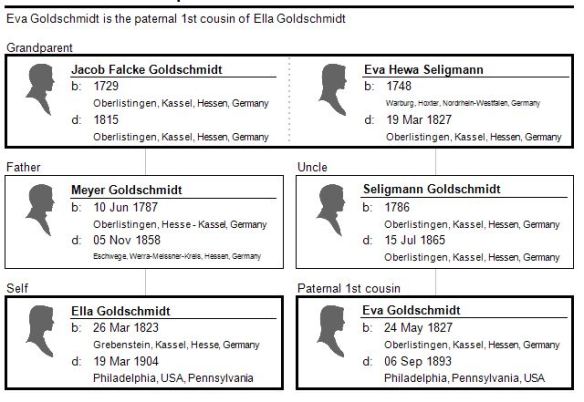
Just over a year ago, I wrote about the crazy twist in my family tree involving Eva Goldschmidt, my great-great-grandmother.  She was the daughter of Seligmann Goldschmidt, a brother of Simon Goldschmidt, who married Fanny Schoenthal, my great-great-grandfather’s brother.


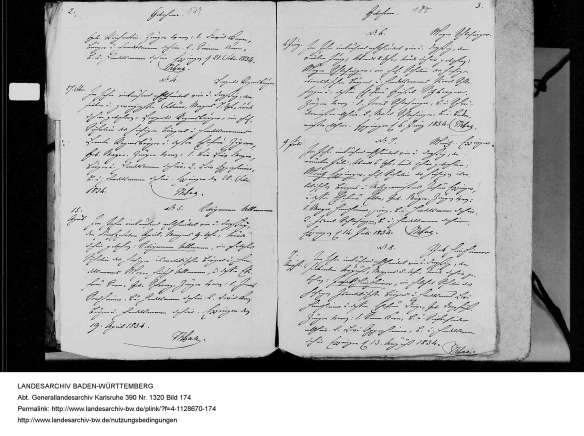
Marriage of Simon Goldschmidt and Fradchen Schoenthal HHStAW Abt. 365 Nr. 669, S. 11

Marriage of Simon Goldschmidt and Fradchen Schoenthal
HHStAW Abt. 365 Nr. 669, S. 11

In other words, my great-grandmother Hilda was a Goldschmidt, and her husband, my great-grandfather Isidore Schoenthal, was the nephew of Fanny Schoenthal Goldschmidt and thus had cousins named Goldschmidt.  In fact, one of those cousins, Simon’s son Jacob Goldschmidt from his first marriage, was likely the first member of the extended family to settle in Washington, Pennsylvania, where my grandmother was born in 1904.   More on the Goldschmidt family tree twist here. And more on the Goldschmidt family to come.

But for now I am going to focus on the Katzenstein side of my great-grandmother Hilda’s family. As I’ve indicated before, when I first started looking into my family’s history, this was the one line that had already been extensively researched by others.  Long before I started my own research, David Baron and Roger Cibella had posted their research on an old Geocities page.  And who even remembers Geocities!? Roger is my third cousin, once removed. I had contacted David and Roger years ago when I somehow fell upon their website (I don’t remember how), and was amazed that they were able to trace my family back to Gerson Katzenstein, my great-great-grandfather.gerson-to-me


And although I was fascinated by their research, I didn’t pursue it further. I hadn’t yet been bitten by the genealogy bug.

Isidore, Hilda (Katzenstein), and Eva Schoenthal

Isidore, Hilda (Katzenstein), and Eva Schoenthal

Then when I was first bitten in 2012 and started to explore genealogy on my own, I found a family tree on Ancestry that included some of my Katzenstein relatives, and I contacted the tree owner, a woman named Jennifer with whom I’ve been in contact ever since as we continue to find ways that our families overlap.  Back in June 2012, Jennifer put me in touch with an entire group of people with ties to the Katzenstein family, and from that group I also received a copy of the extensive report on the Jesberg Katzenstein family that had been done by a researcher named Barbara Greve.

Barbara Greve was born in Berlin, Germany after World War II.  As an adult, she developed an interest in the history of the Jewish communities that had once lived in the Hesse region where she now lived and taught school. She began to research those communities and what had happened to the people who had lived in them, compiling extensive information and genealogies for those Jewish families, including the Katzensteins of Jesberg. In 2010, Greve received the esteemed Obermayer German Jewish History award.  You can read more about her here.

I was both awestruck and overwhelmed by Barbara Greve’s research.  At that point in time I was a total newbie and knew nothing about genealogy research or about my family’s history.  All I had done at that point was the fourteen day free trial on Ancestry, where I had randomly searched for any name I knew from my family’s history. She had traced the Katzenstein line back another whole generation before Gerson Katzenstein to Scholum Katzenstein, my three-times great-grandfather, and included not only Gerson and his descendants, but Gerson’s four siblings and many of their descendants.  Now I could trace the family back as early as 1769 when Scholum was born in Jesberg, Germany.

family-sheet-for-scholem-meier-katzenstein

I had no idea that there were ancient records still in existence in places like Germany.  Seeing all those names and dates going back over 200 years was amazing to me.

My reaction to the Katzenstein research at that time in 2012 was—well, I guess it’s all done.  Nothing much left for me to do.  This was over a year before I started blogging.  I thought just collecting the names and dates was all I needed to do, and someone else had done it.  So I moved away from the Katzensteins and returned to the other lines where the research was not as complete.

And along the way I learned that genealogy is not just about collecting names and dates, although that is a big part of the work.  It’s also about trying to learn the stories of the lives of all those people behind the names and dates.  It’s about putting yourselves in their shoes and recognizing the legacy that we have all inherited from our ancestors.

HIlda (Katzenstein) Schoenthal, Eva (Schoenthal) Cohen, Eva HIlda Cohen, and Harold Schoenthal

HIlda (Katzenstein) Schoenthal, Eva (Schoenthal) Cohen, Eva HIlda Cohen, and Harold Schoenthal

Thus, I now return to the Katzensteins knowing that there is still work to be done.  There are stories to tell about these people, questions to ask, memories to honor. The work is never done.


Ernest Lion’s The Fountain at the Crossroad: An Unforgettable Book

I am very excited to announce that Ernest Lion’s memoir, The Fountain at the Crossroad, has now been published and is available on Amazon.com both as a paperback ($10.50) and an ebook ($2.99). [UPDATE: the Kindle version is now available!] It has been my honor and privilege to bring this book to the public with the permission and assistance of Ernest’s son Tom.  I did this because I found the book unforgettable and because I don’t want Ernest or his life to be forgotten.  Tom and I are not deriving any financial gain from sales of the book. All net proceeds received from sales of the book will be donated to the United States Holocaust Memorial Museum in memory of Ernest Lion.

I have written about some aspects of Ernest’s life on the blog as he was married to my cousin, Liesel Mosbach, granddaughter of Rosalie Schoenthal, my grandfather’s sister.  Ernest and Liesel were deported from Germany to Auschwitz in early 1943; Liesel was murdered there, but Ernest survived.

The story of what he endured and how he survived is moving and horrifying.  His determination and courage in the face of unimaginable suffering is a story of what it means to be human when you are surrounded by inhumanity. And Ernest’s escape from the Nazis kept me on the edge of my seat even though I knew that he would survive.

But the book is not only about Ernest’s experience during the Holocaust.  It also tells the story of his childhood growing up with his parents in Germany and of his early adulthood when he dreamed of being an actor.  In addition, Ernest wrote about his life after the war—how he rebuilt his life in the US, starting all over, scarred by his experiences, but nevertheless determined to have a full and meaningful life.

Ernest only started talking about his Holocaust experiences late in his life, and then he was persuaded to write his memoirs.  In doing so, he relived much of the pain, but also reached a very poignant conclusion about the value of his own life.

If you have an interest in history, in World War II, in the Holocaust, in fact, if you have an interest in human beings and what they are made of, you should read this book. You can find it here.

Mark Twain on Learning German

I am continuing to try and learn German, studying about thirty minutes a day on Duolingo, and at times I feel like I have reached a plateau.  The more words I learn, the more I forget the ones I learned just a month ago.  All those words that end in –ung and/or start with ver- are getting too hard to keep straight.  And why are there at least two words for so many things?  Sure, I know that’s true in English also, but it was a lot easier learning English when my brain was young and flexible and everyone around me spoke it all the time.  Learning German at my age without some immersion is, to the say least, a challenge.

So I took great comfort in Mark Twain’s 1880 essay, “The Awful German Language.” Vera Meyer of the Facebook group “JEWS—Jekkes Engaged Worldwide” (“Jekke” or “yekke” has various specific meanings, but most broadly refers to a person of German-Jewish background) sent me a link to Twain’s essay the other day, and it made me laugh out loud several times over.

By Mathew Brady [Public domain], via Wikimedia Commons

Mark Twain (Samuel Clemens) By Matthew Brady [Public domain], via Wikimedia Commons https://commons.wikimedia.org/wiki/File%3AMark_Twain%2C_Brady-Handy_photo_portrait%2C_Feb_7%2C_1871%2C_cropped.jpg

Twain is one of my favorite authors, but I’d never before read this essay, and if I had, I would not have appreciated it before my own struggles with German.  You can find the entire essay here and I recommend it highly, but I want to quote just a few of my favorite passages.  Favorite because I relate so well to what Twain is saying.

This complaint is one that also gives me great frustration:

Personal pronouns and adjectives are a fruitful nuisance in this language, and should have been left out. For instance, the same sound, sie, means you, and it means she, and it means her, and it means it, and it means they, and it means them. Think of the ragged poverty of a language which has to make one word do the work of six — and a poor little weak thing of only three letters at that. But mainly, think of the exasperation of never knowing which of these meanings the speaker is trying to convey. This explains why, whenever a person says sie to me, I generally try to kill him, if a stranger.

And then there is the endless battle to figure out what is the gender of a particular noun so that you know what articles, pronouns, and adjectives to use:

Every noun has a gender, and there is no sense or system in the distribution; so the gender of each must be learned separately and by heart. There is no other way. To do this one has to have a memory like a memorandum-book. In German, a young lady has no sex, while a turnip has. Think what overwrought reverence that shows for the turnip, and what callous disrespect for the girl. ….

To continue with the German genders: a tree is male, its buds are female, its leaves are neuter; horses are sexless, dogs are male, cats are female — tomcats included, of course; a person’s mouth, neck, bosom, elbows, fingers, nails, feet, and body are of the male sex, and his head is male or neuter according to the word selected to signify it, and not according to the sex of the individual who wears it — for in Germany all the women either male heads or sexless ones; a person’s nose, lips, shoulders, breast, hands, and toes are of the female sex; and his hair, ears, eyes, chin, legs, knees, heart, and conscience haven’t any sex at all. The inventor of the language probably got what he knew about a conscience from hearsay.

And then finally, Twain’s overall lament about learning German:

My philological studies have satisfied me that a gifted person ought to learn English (barring spelling and pronouncing) in thirty hours, French in thirty days, and German in thirty years. It seems manifest, then, that the latter tongue ought to be trimmed down and repaired. If it is to remain as it is, it ought to be gently and reverently set aside among the dead languages, for only the dead have time to learn it.

Alas, at my age, if it really takes thirty years, it will take the rest of my life (if I am very lucky) to learn German.

But like Mark Twain, I will continue to muddle along, at least knowing that I am in good company in my struggles.

Sliding Doors

Back in April, I wrote about the family of Rosalie Schoenthal, my great-grandfather’s sister, the one who stayed in Germany to marry Willy Heymann.  Most of what I knew of their fate I learned from the memoir written by Ernest Lion, the man who married Rosalie and Willy’s granddaughter, Liesel Mosbach.  Liesel, her sister, her parents, and her aunt, were all victims of the Holocaust. Ernest Lion memorialized them all in his heartbreaking memoir, The Fountain at the Crossroad.
As I mentioned in a subsequent post written for Yom Hashoah in May, I was so moved by Ernest’s story that I tracked down his son Tom to ask about getting it published so that it could be more widely read.  Since then, I have been working with Tom to edit and format the memoir for publication.  (We’ve run into a few obstacles, but that’s a story for another day.)  I am hoping that sometime soon the book will be available for distribution. When it is, I will post the relevant information on the blog.

But none of this would be possible without the help of another of my cousins by marriage, Sharon.  Sharon is married to the great-grandson of Simon Schoenthal, who was also my great-grandfather’s brother as well as Rosalie Schoenthal Heymann’s brother.  And Sharon, who writes the blog The Heart and Craft of Life Writing, has a great deal of knowledge not only about writing, but also about getting your writing published.  Sharon and her husband were the ones who shared with me the remarkable memoir written by Hettie Schoenthal Stein.  So when I decided to try and get Ernest Lion’s book into a publishable format, I turned to Sharon for help.

Sharon spent hours through email and Skype instructing me on how to turn a typed manuscript into a format that is not only more readable, but also professional looking.  She has been incredibly patient with me, as all this was new to me, and the old brain isn’t quite as flexible as it once was.  I cannot possibly express how grateful I am to her for her help.

One of the last things we worked on was inserting photographs into the memoir, and as she was doing this, Sharon was struck by the resemblance she saw between Liesel Mosbach Lion, Ernest’s first wife and our mutual cousin, and Sharon’s mother-in-law, Blanche Stein Lippincott.  She sent me a photograph of Blanche and her family that I had not previously seen.

ezzie-blanche-parvin-1940

Blanche Stein Lippincott and her family 1940 Courtesy of the Lippincott family

And here is a photograph of Liesel Mosbach and Ernest Lion that I obtained from Ernest’s son to put into his book:

wedding-ernest-liesel-dec-18-1940-600-dpi

Liesel Mosbach and Ernest Lion Courtesy of the Lion Family


The resemblance is striking.  Blanche and Liesel were second cousins, but from these two photographs, they could have been sisters.

jpg-blanche-to-liesel


But what different lives and fates they had, and the expressions on their faces in these two photographs reflect those differences. While Blanche looks healthy and happy, Liesel looks drawn and sad, even on her wedding day.

Blanche was born in 1912 in Tucson, Arizona, and grew up living on the American frontier in the 1910s and 1920s.  Her mother Hattie and her aunt Gertrude had ventured out west after growing up in Philadelphia and Atlantic City.  They did later return to the East, as I’ve written, and Blanche spent the rest of her life living in New Jersey.  She married in 1937 and raised two children with her husband Ezra.  Blanche lived a long and happy life, making it to almost 101 years old before dying in 2013.  Her mother Hettie had made it to 103.

Blanche Stein Lippincott with her great-granddaughter 1996

Blanche Stein Lippincott with her great-granddaughter 1996

In contrast, Liesel lived a short and tragic life.  She was born in 1921 in Germany, where her father Julius Mosbach owned a fruit and vegetable stand. The family was probably living a comfortable enough life until Hitler came to power.  When Liesel married Ernest Lion on December 18, 1939, conditions for Jews were terrible in Germany, and the young couple had no idea what the future would bring.

There would, in fact, be no future. As a result of the Nazi oppression and the loss of his business, Julius Mosbach suffered a nervous breakdown; in 1941, he was sent to an institution where instead of being treated, he was murdered by the Nazis. In 1942, Liesel’s mother, sister, and aunt, and Ernest’s father were all deported and eventually killed in a Nazi concentration camp.  In 1943, Liesel and Ernest were deported to Auschwitz, where Liesel was killed.  Ernest survived and eventually escaped; he became the voice for the whole family.

Thus, Blanche and Liesel, second cousins who looked like sisters, had far different lives and fates.  I can’t help but think, what if Rosalie and Willie had come to the US like almost all of Rosalie’s siblings? What if Liesel and her sister Grete had grown up in Pennsylvania or anywhere else in the United States?

As the president of our synagogue reminded us on Rosh Hashanah, we cannot control where we are born, when we are born, or to whom we are born.  Some of us are blessed with good luck in all of those things while others are not.  We should never take that for granted.

Double Cousins…Everywhere!

The best part of my discoveries of the Goldfarb and Hecht families is that I have found more new cousins, three of whom are my double cousins—Sue, Debrah, and Lisa. They are descendants of Julius Goldfarb and Ida Hecht. Sue’s daughter Lisa shared this wonderful wedding photograph of Julius and Ida.

julius-ida-goldfarb-wedding-from-lisa-wartur

Wedding photograph of Julius Goldfarb, my grandmother’s first cousin, and Ida Hecht, my grandmother’s niece. Courtesy of the Goldfarb/Hecht family


Julius was the son of Sarah Goldfarb, my great-grandmother’s sister; Ida was the daughter of Tillie Hecht, my grandmother’s half-sister.   So I am related to both of them.

Julius and Ida had four daughters, Sylvia, Gertrude, Ethel and Evelyn. Sue, Sylvia’s daughter, shared with me this precious photograph of her grandmother Ida holding her as a baby:

ida-hecht-goldfarb-and-her-granddaughter-sue-1938

Ida Hecht Goldfarb and granddaughter Sue

And Debrah shared this photograph of her grandparents, Julius and Ida, with her mother Evelyn:


Julius, Evelyn, and Ida (Hecht) Goldfarb

Julius, Evelyn, and Ida (Hecht) Goldfarb

One thing I wanted to define is how, if at all, Julius and Ida were related to each other, aside from being husband and wife.  Hecht/Goldfarb family lore says Julius and Ida were “distant cousins.”

Julius was the son of Sarah Goldfarb.  Sarah’s sister Bessie Brotman was the stepmother of Ida’s mother, Toba, as Bessie married Toba’s father Joseph after his Toba’s mother died.  Although that makes things complicated, it does not alone create any genetic connection between Julius and Ida since Bessie (and thus Sarah) had no blood relationship with Toba.

relationship-bessie-brod-to-tillie-brotman

But if Brotman family lore is correct and Bessie and her husband Joseph Brotman were first cousins, then Joseph Brotman and Bessie’s sister Sarah were also first cousins. Sarah’s son Julius married Ida, who was the granddaughter of Sarah’s first cousin Joseph, making Julius and Ida second cousins, once removed.

relationship-of-julius-goldfarb-to-ida-hecht-better

That is, assuming that Joseph and Sarah were first cousins as Brotman family lore reports, Ida and Julius were in fact “distant cousins,” as Hecht/Goldfarb family lore indicates.  So maybe together the Brotman family lore and the Hecht/Goldfarb family lore validate each other.

Sue and Debrah, who are granddaughters of Julius Goldfarb and Ida Hecht, thus are both the great-granddaughters of Sarah Brotman Goldfarb, making them my third cousins on my great-grandmother Bessie’s side, and the great-great-granddaughters of Joseph Brotman, making them also my second cousins, once removed, on my great-grandfather Joseph’s side. (Lisa is one more step removed on both sides.) Renee is my second cousin; her mother Jean Hecht was my mother’s first cousin; her grandmother Toba was my grandmother Gussie’s half-sister. And then I’ve also found a cousin Jan, whose grandfather was Harry Hecht, Toba’s son, and my mother’s first cousin.

inset-from-harry-hecht-photo

Harry Hecht and his wife and children 1945 Courtesy of the family

And, of course, if my great-grandparents Joseph and Bessie Brotman were in fact first cousins, the relationships get even more convoluted. But I think I will skip that calculation.  At least for now.  Maybe some brave soul out there wants to try and figure it out?

With all this shared DNA, I was very curious to see if there were any family resemblances among the various members of the Goldfarb, Hecht, and Brotman families.  My newly found double cousins Debrah, Sue, and Lisa shared some family photos with me, including this one of Toba/ Taube/Tillie Brotman Hecht:

toba-tillie-brotman-hecht

Toba/Taube/Tillie Brotman Hecht Courtesy of the Goldfarb/Hecht family

Here is a photograph of her brother Max Brotman that I’d earlier received from his family:

Max Brotman

Max Brotman, courtesy of the family

Do you see a resemblance? Unfortunately I don’t have any photographs of Toba’s other full siblings, Abraham and David, to help with the comparison.

But here are photographs of Toba’s half-siblings, Hyman, Tillie (Ressler), Sam, and my grandmother Gussie:

Hyman Brotman

Hyman Brotman

Tilly Brotman

Tilly Brotman Ressler

Sam Brotman

Sam Brotman

Gussie Brotman

Gussie Brotman Goldschlager

I can see some similarities—in particular in the shape of the noses.  But it appears that Max and Toba do not have faces that are as round as those of their half-siblings.  Perhaps the shape of their faces was a genetic trait they inherited from their mother Chaye, not their father Joseph Brotman.

Here is one other photograph of the extended Goldfarb and Hecht family.

goldfarb-hecht-family-gathering

Goldfarb Hecht family gathering for Chanukah

Standing on the far left is Julius Goldfarb.  Seated at the head of the table is Ida Hecht Goldfarb.  On the right side of the table starting at the front are two of Ida’s sister, Etta and Jean Hecht.  Also in the photograph are Julius and Ida’s four daughters as well as their spouses and a few of the grandchildren and other cousins.

It’s sad to think that in 1917 Julius and Ida were close enough to my grandmother that they came to visit when my aunt was born, as did Ida’s mother, my grandmother’s sister Toba Hecht, but somehow the families all lost touch, and my mother only has a few  memories of some of the Goldfarbs from her childhood.

On the other hand, I feel very fortunate that now, almost a century after my aunt was born, I know who the Goldfarbs and Hechts were and I am in touch with a number of these “new”  cousins of mine.