The Fate of Caroline Blumenfeld Hoxter and Her Children: Final Chapter

As we saw, by the middle of 1940, all three of Caroline Blumenfeld Hoxter’s daughters and their families were safely out of Germany. Toni and Gerda were in the US as were their children, and Betty and her family were in Palestine.

But what about their mother Caroline? Last we knew she, having lost her husband Simon in 1932, had been living in Marburg with Toni and her family after Toni’s husband Sally was driven out of his haberdashery business in Hersfeld by Nazi persecution. But Caroline was not with Toni and Sally when they left for America in 1940 nor was she with Gerda and her family when they left Germany in 1939. Nor was Caroline with her daughter Betty in Palestine.

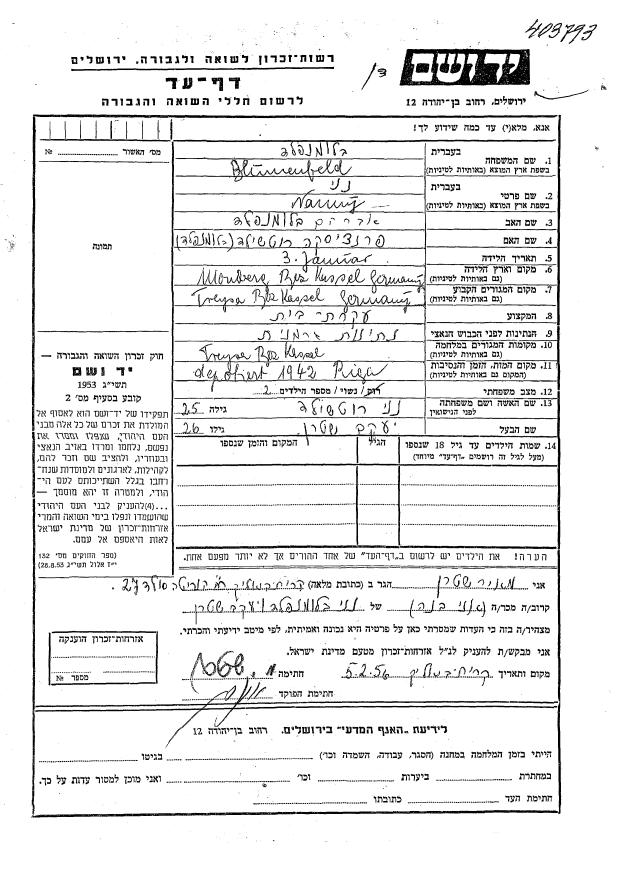
Tragically, Caroline was still in Germany. At some point she moved to Frankfurt, and in 1942 she was taken to Theriesenstadt where she died on February 17, 1942. Her daughter Betty (here spelled Beti) filed this Page of Testimony with Yad Vashem:

Caroline Hoxter, Page of Testimony at Yad Vashem, filed by her daughter Beti Openheimer, found athttps://yvng.yadvashem.org/nameDetails.html?language=en&itemId=1617046&ind=1

In her speech to middle school students in 2020, Caroline’s granddaughter Jane explained why Caroline had been unable to leave Germany with her family:1

Before we left [Germany], my sister and I went to see our grandmother who was blind and could not come with us. Much later she was deported to Thereisenstadt concentration camp. She was then in her late 80s. We were informed that she died of natural causes. Can you imagine for someone that old to travel for three weeks in a cattle car? It is still very hard for me to think about that and accept it.

Jane rightfully questioned whether her grandmother’s death was in fact from “natural causes.” Subjecting an elderly and blind woman to the conditions she must have experienced on that cattle car and then at Theriesenstadt surely contributed to her death as much as if she’d been gassed or shot by the Nazis.

I am very grateful to Andre Guenther from Tracing the Tribe who located Caroline’s death certificate from Theriesenstadt; she died from “enteritis darmkatarrah” or what we might call gastroenteritis.

At no point during the Shoah Foundation interview with Arthur Goldschmidt,2 did the interviewer ask about the fate of his grandmother Caroline Blumenfeld Hoxter, and Arthur did not bring it up himself. I don’t know whether this was an oversight or whether he simply could not bring himself to speak about what happened to his grandmother. I imagine the family must have been devastated by what happened to her. Peter, Jane’s son, told me that his mother still gets emotional when she talks about her grandmother Caroline and what happened to her.

But Caroline was blessed that her three daughters and her grandchildren all escaped and survived the Holocaust.

Her daughter Toni died in New York on April 21, 1956,[^3] two years after her husband Sol, who died on May 13, 1954, in New York.3 Their daughter Miriam died on January 7, 1988, in Queens, New York,4 followed by her husband Rudolf on January 21, 1993, in Los Angeles.5 They were survived by their daughter and her family.

Their son Arthur Goldschmidt shared this photograph of his parents with the Shoah Foundation:

Toni Hoxter and Sally (Sol) Goldschmidt. Arthur Goldschmidt, Interview 8542,  Visual History Archive, USC Shoah Foundation,  November 10, 1995. Accessed 15 August 2021, from the archive of the University of California Shoah Foundation Institute for Visual History and Education, found at https://sfi.usc.edu/what-we-do/collections

Toni’s sister Betty/Beti lived the rest of her life in Israel and died on December 15, 1975, at the age of 86. She was predeceased by her husband Max, who died May 25, 1961, in Israel. They were survived by their daughter Lotte, who married Theo Kleeman in Israel and who died June 26, 1998, in Israel, and their son Shimon, who died August 14, 2012, in Haifa, Israel. Today they have grandchildren and great-grandchildren in Israel.6

The youngest sister Gerda died in New York on April 13 1974,7 two years after her husband Adolf, who died March 18, 1972.8 They were survived by their two daughters. Their daughter Alice Lore Goldschmidt married Richard Oster,9 with whom she had two children. Alice died on January 13, 2014.10

Their other daughter Jane Inge Goldschmidt married Ralph Keibel on August  11, 1950,11. Peter shared with me his parents’ wedding photograph.

Jane and Ralph had two children, including my cousin Peter. Jane is still living and is 98 years old. Imagine—she gave that speech to the Vermont middle school group when she was almost 97 years old. Just remarkable.

As for Arthur Goldschmidt, whose interview helped me tell this story, after World War II he returned to New York City where he met and married his wife Ruth Herz. As he told the story, they met in January 1950, were engaged by April, and married in August 1950. Ruth was also a refugee from Germany. She was born on April 18, 1922, in Holzheim, Germany, to Eugen Isaak Herz and Lilli Weinberg.12 Her father had died in 1932, and her mother was killed in the Holocaust.

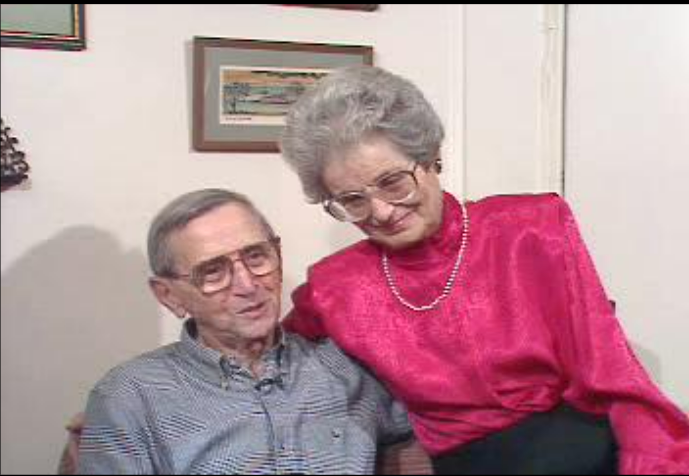
According to her obituary, “Ruth left Germany at age 16 via the Kindertransport and spent nine years on the run, in hiding, in a displaced persons camp, and then came to the US where she was able to build a good life. She met her husband Arthur Goldschmidt on a blind date that blossomed into their beautiful marriage on August 27, 1950.”13 Ruth and Arthur had two children. It was clear from the video of the interview that they both still adored each other 45 years after their marriage began.

Arthur Goldschmidt and his wife Ruth during the Shoah Foundation interview. Arthur Goldschmidt, Interview 8542,  Visual History Archive, USC Shoah Foundation,  November 10, 1995. Accessed 15 August 2021, from the archive of the University of California Shoah Foundation Institute for Visual History and Education, found at https://sfi.usc.edu/what-we-do/collections

Arthur worked for many years at a dairy company on Long Island, so the skills he learned back in the 1930s from the Zionist organization that prepared him to work on a kibbutz in Palestine/Israel held him in good stead. He died on January 15, 2021, in New York; he was 96 years old.14

It was an honor to watch his interview the Shoah Foundation. He was amazingly matter-of-fact through almost the entire interview, answering questions calmly and saying that he and his family survived because they were able to get out early enough. He didn’t seem angry or resentful at all—until the very end when the interviewer asked him a simple and straightforward question about what he hoped the world had learned. He then broke down in tears, unable to speak, finally saying in essence that we must never forget and that we must never let it happen again.15

Today Caroline Blumenfeld Hoxter has many living descendants in Israel and in the US. She may not have survived the Holocaust, but her daughters and their families did, and they and their descendants carry on her legacy.

I am deeply grateful to my cousin Peter Keibel for sharing so much of his information and his family photographs with me and especially for sharing his mother’s speech about her experiences before and during the Holocaust.


And this brings me to the end of not only Caroline Blumenfeld Hoxter’s story and that of her children and grandchildren, but also to the end of the story of Abraham Blumenfeld IIA since Caroline was the youngest of his eight children. Now I will turn to Abraham’s younger siblings. First, his brother Isaak, the second child of my four-times great-uncle Moses Blumenfeld.


  1. Jane Inge Goldschmidt Keibel, Speech to Hazen School, Hardwick, Vermont, 2020, shared by Peter Keibel. ↩
  2. Arthur Goldschmidt, Interview 8542,  Visual History Archive, USC Shoah Foundation,  November 10, 1995. Accessed 15 August 2021, from the archive of the University of California Shoah Foundation Institute for Visual History and Education, found at https://sfi.usc.edu/what-we-do/collections ↩
  3. Toni Goldschmidt, Age: 70, Birth Date: abt 1886, Death Date: 21 Apr 1956, Death Place: Queens, New York, New York, USA, Certificate Number: 4251, Ancestry.com. New York, New York, U.S., Death Index, 1949-1965 ↩
  4. Sol Goldschmidt, Age: 72, Birth Date: abt 1882, Death Date: 13 May 1954, Death Place: Manhattan, New York, New York, USA, Certificate Number: 10469, Ancestry.com. New York, New York, U.S., Death Index, 1949-1965 ↩
  5.  Miriam Lauter, Social Security Number: 112-05-7561, Birth Date: 23 Apr 1911, Issue Year: Before 1951, Issue State: New York, Last Residence: 11375, Flushing, Queens, New York, USA, Death Date: 7 Jan 1988, Social Security Administration; Washington D.C., USA; Social Security Death Index, Master File, Ancestry.com. U.S., Social Security Death Index, 1935-2014 ↩
  6. These dates came from Peter Keibel, Betty’s nephew. Email from Peter Keibel, November 17, 2021.  I have no official records for them. ↩
  7. Date is from her grandson, Peter Keibel, FamilyTree on Ancestry.com, found at https://www.ancestry.com/family-tree/person/tree/52614823/person/372143503930/facts ↩
  8. Date is from his grandson, Peter Keibel, FamilyTree on Ancestry.com, found at https://www.ancestry.com/family-tree/person/tree/52614823/person/372143503930/facts ↩
  9. Alice L Goldsmith, Gender: Female, Marriage License Date: 18 Jul 1950, Marriage License Place: Manhattan, New York City, New York, USA, Spouse: Richard Oster, License Number: 18819, New York City Municipal Archives; New York, New York; Borough: Manhattan; Volume Number: 27, Ancestry.com. New York, New York, U.S., Marriage License Indexes, 1907-2018 ↩
  10. Find a Grave, database and images (https://www.findagrave.com/memorial/130447894/alice-oster : accessed 02 December 2021), memorial page for Alice Oster (unknown–13 Jan 2014), Find a Grave Memorial ID 130447894, citing Mount Hebron Cemetery, Flushing, Queens County, New York, USA ; Maintained by Mom (contributor 48202874) . ↩
  11. From their son Peter Keibel, https://www.ancestry.com/family-tree/person/tree/52614823/person/372143503829/facts ↩
  12. Peter Keibel Ancestry Family Tree, https://www.ancestry.com/family-tree/person/tree/52614823/person/372145394061/facts; Ruth Goldschmidt
    Age: 29, Birth Date: 18 Apr 1922, Issue Date: 12 Jun 1951, State: New York
    Locality, Court: Eastern District of New York, District Court, National Archives and Records Administration (NARA); Washington, D.C.; Index to Naturalization Petitions of the United States District Court for the Eastern District of New York, 1865-1957; Microfilm Serial: M1164; Microfilm Roll: 63, Ancestry.com. U.S., Naturalization Records Indexes, 1794-1995. The other information came from Arthur Goldsdchmidt’s Shoah Foundation interview. Arthur Goldschmidt, Interview 8542,  Visual History Archive, USC Shoah Foundation,  November 10, 1995. Accessed 15 August 2021, from the archive of the University of California Shoah Foundation Institute for Visual History and Education, found at https://sfi.usc.edu/what-we-do/collections ↩
  13. “Goldschmidt, Ruth,” The Baltimore Sun, Baltimore, Maryland, 03 Jan 2021, Sun • Page A14 ↩
  14.  Arthur Goldschmidt, Social Security Number: 099-24-1370, Birth Date: 9 Aug 1913, Issue Year: Before 1951, Issue State: New York, Last Residence: 11415, Jamaica, Queens, New York, Death Date: 15 Jan 2010, Social Security Administration; Washington D.C., USA; Social Security Death Index, Master File, Ancestry.com. U.S., Social Security Death Index, 1935-2014 ↩
  15. Arthur Goldschmidt, Interview 8542,  Visual History Archive, USC Shoah Foundation,  November 10, 1995. Accessed 15 August 2021, from the archive of the University of California Shoah Foundation Institute for Visual History and Education, found at https://sfi.usc.edu/what-we-do/collections ↩

My Cousins on the SS St Louis: The Shameful Conduct of the US Government

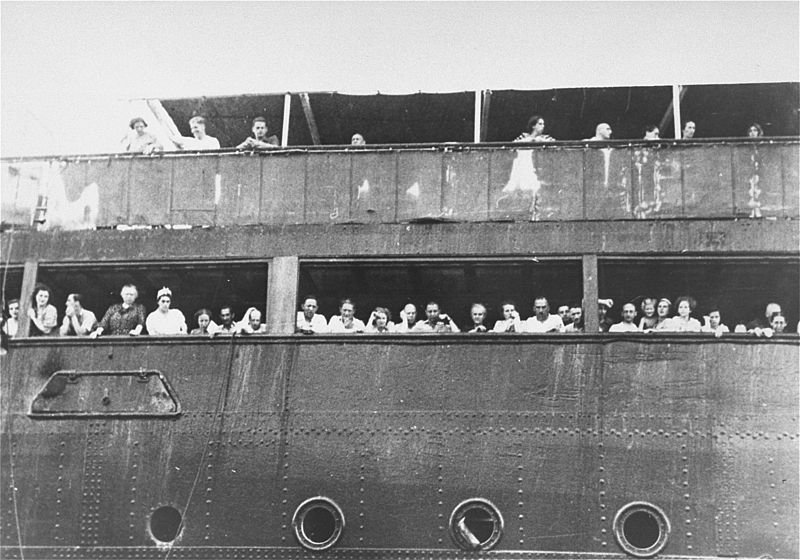
We left off in my last post with the family of Gerda Hoxter and Adolph Goldschmidt about to board the SS St. Louis to go to Cuba and escape from Germany. As described on the US Holocaust Museum website:

On May 13, 1939, the German transatlantic liner St. Louis sailed from Hamburg, Germany, for Havana, Cuba. On the voyage were 937 passengers. Almost all were Jews fleeing from the Third Reich. Most were German citizens, some were from eastern Europe, and a few were officially “stateless.”The majority of the Jewish passengers had applied for US visas, and had planned to stay in Cuba only until they could enter the United States.

Gerda’s daughter Jane provided this more personal account in her speech to middle school students in early 2020:1

May 13, 1939, was a Saturday and the ship sailed in the afternoon. We stood at the railing of the ship to wave good-bye to relatives with a heavy heart. The possibility certainly existed that we were never going to see them again. One of the things we remember was that upon boarding the band was playing Strauss waltzes. In the captain’s daily log, he noted that the mood of the passengers was very solemn, but he was assured that good food and sea air for two weeks will lift the pain that was emanating from the passengers.

We settled into our new routine of shipboard life and day by day the moods lifted. My sister and I made friends with other young people on board. One of these people became my best friend. She lived in upstate NY with her husband who also was a passenger on the St. Louis.

Peter, Jane’s son, shared with me this remarkable photograph of his grandfather Adolf Goldschmidt boarding the St. Louis; he is the man on the far right in the light colored coat, holding a book:

Adolf Goldschmidt aboard the St. Louis. Courtesy of the family

Jane’s story continued:

After a two week voyage, we arrived in the harbor of Havana, Cuba. We were informed that we could not lay anchor at the pier because our credentials had to be checked. Even after they were checked, there were more excuses for not letting us land and disembark. A day before arrival in Cuba the Captain was informed that he cannot lay anchor at a pier, he had to stay in the middle of the harbor. We stayed in the harbor for one week.

We did not want to return to Germany, nothing was left there, no housing, no money – all the savings people had accumulated had to be left to the German government – so we would all be taken to a concentration camp, an impossible thought. We had people on board who were released from concentration camps under the condition never to return to Germany. These men considered mutiny or committing suicide. The captain was very diligent and did not want this to happen.

During that time one man slashed his wrist and jumped overboard. He was saved and taken to a hospital in Havana. His wife was not allowed to visit him, but after his recuperation he was returned to his wife.

Small boats came to the side of the St. Louis with relatives who lived in Cuba to shout encouragements to us. Meanwhile, organizations, Jewish and government, were at work to see what can be done to have us disembark. Also contact was made with almost every country to see if one of them would take us in.

The German propaganda had a field day. No one wanted Jews, Hitler was right in ridding his country of them.

The Captain tried everything to enable us to land. He even went so far and visited the President of Cuba to plead for us. Nothing helped.

Jewish refugees aboard the SS St. Louis attempt to communicate with friends and relatives in Cuba, who were permitted to approach the docked vessel in small boats. |Source=USHMM, courtesy of National Archives and Records Adminis (public domain)

The Holocaust Museum article describes the purported reasons for Cuba’s refusal to admit the refugees—not just anti-Semitism, but economic conditions and anti-immigration sentiment.

So the refugees and others tried to find help in places besides Cuba. As Jane described it:2

From the ship, telegrams were sent to heads of states and Jewish organizations. The children pleaded by telegram with Mrs. Roosevelt for shelter, but no reply came from her or the President. After 10 days in limbo, the captain was told to leave Cuban waters. Very slowly the Captain steered the ship toward the US, toward Miami, hoping that the President would relent and let us land. There were 935 people on board who were seeking refuge. Instead the Coast Guard was on watch to see that no one jumped overboard and swam ashore. We went up the coast to New York and then the captain was informed to hurry home. He was such a decent man that he really did not want to take us back, but he had no alternative. In his log, he wrote that he would scuttle his ship on the English shore if no result was forthcoming, to prevent us returning to Germany. This action cost him his job.

The Holocaust Museum article also described the US indifference to the needs of the refugees:

Sailing so close to Florida that they could see the lights of Miami, some passengers on the St. Louis cabled President Franklin D. Roosevelt asking for refuge. Roosevelt never responded. The State Department and the White House had decided not to take extraordinary measures to permit the refugees to enter the United States. A State Department telegram sent to a passenger stated that the passengers must “await their turns on the waiting list and qualify for and obtain immigration visas before they may be admissible into the United States.” US diplomats in Havana intervened once more with the Cuban government to admit the passengers on a “humanitarian” basis, but without success.

Having nowhere to disembark, the passengers on the St. Louis were forced to return to Europe, where Great Britain, the Netherlands, Belgium, and France responded more humanely than the US or Cuba had to the needs of these refugees.

Jane described what happened next to her family and to others:3

Meanwhile, negotiations went on to find some country that had mercy on us. The passengers were becoming more desperate. Long face and worried looks were on everyone’s faces. We were close to the English Channel when we were informed that four countries were willing to take the passengers. Morris Troper of the European Joint Distribution Committee was responsible for securing that haven. The grateful passengers cabled him that their gratitude was as immense as the ocean on which they have been traveling. It was England, France, Belgium and the Netherlands. You could have heard the biggest sigh when the news was broadcast. Again people made plans and their outlook was improving.

On June 17, we landed in Antwerp, Belgium, and disembarked to immediately go on to a freighter that was provided by the Germans for those who went to France and England.

Our captain really tried his best and risked his life and career for us. Many years later, the surviving passengers signed a petition to recommend him as a righteous gentile, which afforded him a place at the Yad Vashem in Jerusalem.

Our family was sent to France, where my sister, I, and other children were taken in by an orphanage. Our parents and other adults were placed in Le Mans, a city west of Paris. Because no one had money, we were only allowed 10 German Marks (Approximately $80 today) to take out of Germany. We all lived on charity provided by Jewish organizations. During those six months my parents lived in Le Mans, they were supported by the HIAS, a Jewish relief organization that helps immigrants. They lived in a house that was shared with three other couples, one bedroom each, communal kitchen and living room.

When the War broke out, September 1, 1939, all the men were interned as foreigners and the women had to double up. My sister and I and all other children under 18 years were sent by train to OSE homes near Paris. The OSE is a Russian organization that is involved with the care of orphans. These homes were led by a Viennese educator and his wife, a physician. Personally, I enjoyed my stay there, although once the War broke out it got a little scary, especially when the air raid sirens sounded and we had to go to the shelters. The older children took care of the young ones.

But ultimately, after the Nazis took over France, Belgium, and the Netherlands in the spring of 1940, 254 of the over 900 passengers who had been on the St. Louis and had been forced back to Europe in May, 1939, were murdered by the Nazis.

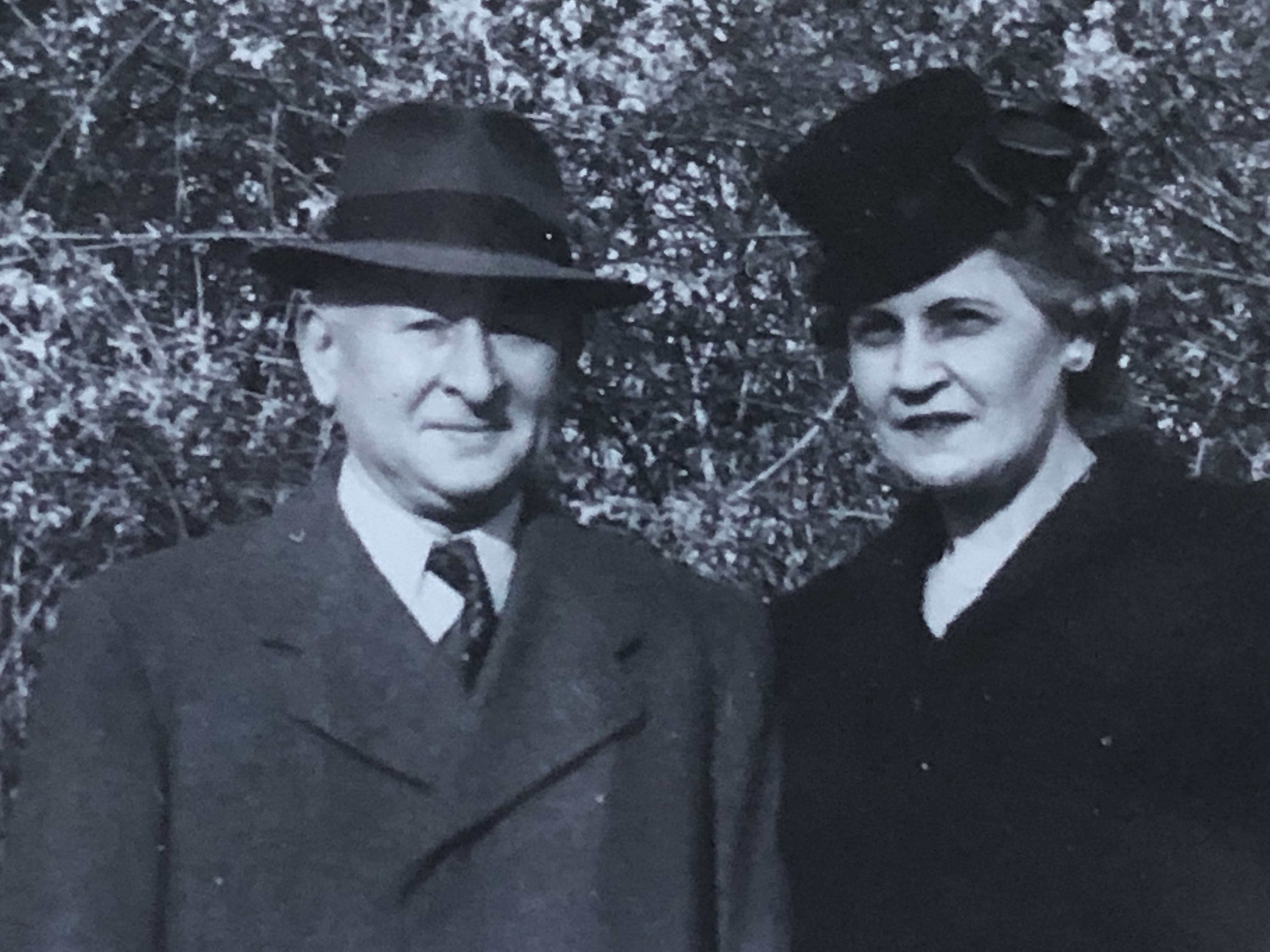
Gerda and her family were among the lucky ones who were able to immigrate successfully to the US. They arrived in New York on January 8, 1940. I don’t know when this photograph of Gerda and Adolf was taken, but from their ages, I assume it was sometime during this era, either before or after they came to the US.

Adolf and Gerda (Hoxter) Goldschmidt. Courtesy of the family

This is one of the most shameful examples of the way the US acted during the 1930s and 1940s, knowing the dangers that Jews were facing in Nazi Germany and elsewhere in Europe, but cold-heartedly turning the other way, refusing to help those in need. I do wonder, however, whether we’ve learned our lesson. Money and jobs (not to mention xenophobia and prejudice) still seem to trump the needs of those who are suffering when it comes to US immigration policy.


  1. Jane Inge Goldschmidt Keibel, Speech to Hazen School, Hardwick, Vermont, 2020, shared by Peter Keibel. ↩
  2. Jane Inge Goldschmidt Keibel, Speech to Hazen School, Hardwick, Vermont, 2020, shared by Peter Keibel. ↩
  3. Jane Inge Goldschmidt Keibel, Speech to Hazen School, Hardwick, Vermont, 2020, shared by Peter Keibel. ↩

The Children and Grandchildren of Caroline Blumenfeld Hoxter: Leaving Germany

Happy New Year, everyone! I hope you had a good holiday season and are safe and healthy. I have been trying to relax and gain some perspective on 2021, a tough year, and prepare for 2022, a year I expect to be just as tough. But genealogy and family history always help me put things in perspective, so I am ready to return and find new meaning and new discoveries in the history of my family.

Let me refresh your memories of where I was back in December 2021. I have been writing about my Blumenfeld branch and more specifically the line that begins with my four-times great-uncle Moses Blumenfeld and goes from his son Abraham Blumenfeld IIA to Abraham’s daughter Caroline Blumenfeld Hoxter. We saw that Caroline’s son Siegmund died fighting for Germany in World War I, that her husband Simon died in 1932, and that her daughter Toni Hoxter Goldschmidt and her family had all escaped from Nazi Germany by 1940.

But what about Caroline herself and her two other daughters, Betty and Gerda? What happened to them and their families?

Again I want to thank the Shoah Foundation for allowing me to have access to the interview done with Arthur Goldschmidt,1 Toni’s son, so that I could learn more about the fate of his family, including that of his aunts Betty and Gerda. I am also deeply grateful to Peter Keibel, grandson of Gerda Hoxter Goldschmidt, for sharing the speech his mother Jane Inge Goldschmidt gave to a middle school in Vermont in early 2020 about her experiences during the Nazi era.

Like Arthur and Miriam, her nephew and niece, Betty Hoxter Oppenheimer and her husband Max and their two children Lotte and Franz Siegmund left Germany not long after Hitler’s rise to power. According to Arthur, Max Oppenheimer was a doctor, and once he was restricted by Nazi law from being able to practice medicine fully, he and his family left for England. But they must not have stayed there long because on November 26, 1934, they arrived in Palestine. Max was a physician, Lotte, their daughter, was an orthopedist, and their son, who became Shimon, was a carpenter. By 1938, they had all obtained citizenship to Palestine.2

Max and Betty (Hoxter) Oppenheimer, Palestinian citizenship cards found at the Israel State Archives, at https://www.archives.gov.il/en/

Lotte Oppenheimer, Palestine citizenship card, found at the Israel State Archives, at https://www.archives.gov.il/en/

The family of Gerda Hoxter Goldschmidt, the youngest child of Caroline Blumenfeld and Simon Hoxter, had a harder time escaping from Germany. Gerda’s daughter Inge Goldschmidt, who became Jane in the US and who is Peter Keibel’s mother, provided this description of her family’s life in Germany before and during the Nazi era in a speech she gave to a middle school in Vermont in early 2020:3

My father owned a department store in that town [Wuppertal]. My sister and I attended public schools. My father was well known because of the store and we were in comfortable circumstances. … In 1933 when Hitler came to power my father’s store was closed to make the population aware that the owner was Jewish and to discourage the people from doing business with a Jewish establishment. Some days later business resumed at a normal rate, but our lives changed. It seems that every year another law was passed that made our lives almost unbearable. We could not attend school any more or use public pools. Park benches were marked where we could sit. [The Nazis] burned books by Jewish authors and … destroyed Jewish businesses. On November 9, 1938, Kristallnacht started, the synagogues, Jewish houses of worship were destroyed. Many Jewish men were sent to concentration camps.

Our parents were well known and liked. Our father was tipped off by an official and was therefore able to leave town and avoid internment. The Gestapo did come to our house to look for him, but we were not molested, and our house was not ransacked. We did not know where he went. Occasionally he called, but those were very tense days for us. His safety was always on our minds. After his return, he was seriously looking to leave the country.

We had received a quota number from the US Embassy, but we were also aware that it was a very high number and there was no way we could leave before a year or two. So my father searched for a country that we could go to while waiting for our quota number. Of course, the store was closed and had to be sold to the Germans for a very minimal amount. He preferred to leave Europe as he did not think it was safe to stay there. America let only a designated number of people to immigrate into their country. My father purchased Visas ($250 for each person which in today’s dollars is $4,362) for Cuba and booked passage on the ocean liner, SS St. Louis that belonged to a German shipping company.

Thus, Gerda and her family were among those who sailed to Cuba on the ill-fated St. Louis in May 1939.

For those who don’t know the story of the St. Louis, it is one example of the shameful and tragic ways the US government failed to respond to the cries for help of those seeking to escape the horrors of the Holocaust. Jane’s telling of the story will continue in my next post.


  1. Arthur Goldschmidt, Interview 8542,  Visual History Archive, USC Shoah Foundation,  November 10, 1995. Accessed 15 August 2021, from the archive of the University of California Shoah Foundation Institute for Visual History and Education, found at https://sfi.usc.edu/what-we-do/collections ↩
  2. The Palestine citizenship papers can be found at the Israel State Archives by searching for their names. Unfortunately, the site does not provide specific links to those results, but the site can be found at https://www.archives.gov.il/en/ ↩
  3. Jane Inge Goldschmidt Keibel, Speech to Hazen School, Hardwick, Vermont, 2020, shared by Peter Keibel. ↩

Moses Blumenfeld IIA’s Grandchildren: Did They Survive The Holocaust?

By 1939, all three of the children of Moses Blumenfeld IIA had died, leaving behind their children, the seven grandchildren of Moses Blumenfeld IIA. Their fates were determined by the Nazis. This post will examine the fates of the children of Moses’ daughter Antonie Blumenfeld Katz and her sister Hedwig Blumenfeld Kaufmann as well as that of Antonie’s husband Moritz Katz.

Antonie’s husband Moritz Katz stayed in Marburg after Antonie died in 1939 until he was deported to Theriesenstadt on September 7, 1942; he was killed there on September 11, 1944, at the age of 73. He and Antonie were survived by their two children, Artur Katz and Margarete Martha Katz Jacobsohn. Those two children survived by leaving Nazi Germany and immigrating to Palestine (now Israel) in the 1930s.

Moritz Katz Page of Testimony at Yad Vashem, found at https://yvng.yadvashem.org/nameDetails.html?language=en&itemId=1627679&ind=1

Artur was a lawyer in Berlin until the Nazis deprived of him his right to practice law after 1933. According to his nephew Yoram Jacobson, Artur soon left for Palestine, where he changed his name to Avraham (which was probably always his Hebrew name). According to a profile on MyHeritage, Avraham was married to Edith (Hannah) Walter, and they had three children. I have no other sources so far to verify that information. Avraham Katz died on October 22, 1978, in Haifa, Israel.

Artur Avraham Katz gravestone on Gravez, found at https://gravez.me/en/deceased/275CF393-EB17-4B26-8BBF-D82EC06FEB94

Antonie’s daughter Margarete Martha Katz had married Friedrich (Fritz) Max Jacobsohn sometime before they immigrated to Israel in 1939. Fritz was born in Hanover, Germany, on July 13, 1899; his father’s name was Abraham. I have no information about his mother. Fritz, an insurance agent, had been taken to Buchenwald Concentration Camp after Kristallnacht in November 1938 and was determined to leave Germany once he was released. With the help of his brother-in-law Avraham Katz, he and Margarete immigrated to Palestine/Israel on July 24, 1939. They became citizens of Palestine on October 20, 1941.1

Margarete and Fritz Jacobsohn Palestine citizen certificate, found at the Israel State Archives website at https://www.archives.gov.il/

Margarete and Fritz had one child, their son Yoram, who was born on November 27, 1944, in Haifa. Yoram Jacobson became a prominent Kabbalist and Hasidic scholar. He taught at several academic institutions in Israel, including Hebrew University and Tel Aviv University, and overseas, including at Harvard. He was also the author of many books and articles. Yoram was married twice and had four children.

Fritz Jacobson died August 24, 1963, in Haifa. He was 64. He was survived by his wife Margarete Katz Jacobson, who died forty years later on April 12, 2003, at the age of 96. They were survived by their son Yoram and his children. Yoram died April 16, 2017, in Israel. He was 72.

Although Moritz Katz died at the hands of the Nazis in Theriesenstadt, the two children he had with Antonie Blumenfeld survived by immigrating to Palestine. Today they have living descendants in Israel.

The story of Antonie’s sister Hedwig Blumenfeld Kaufmann does not end as well.

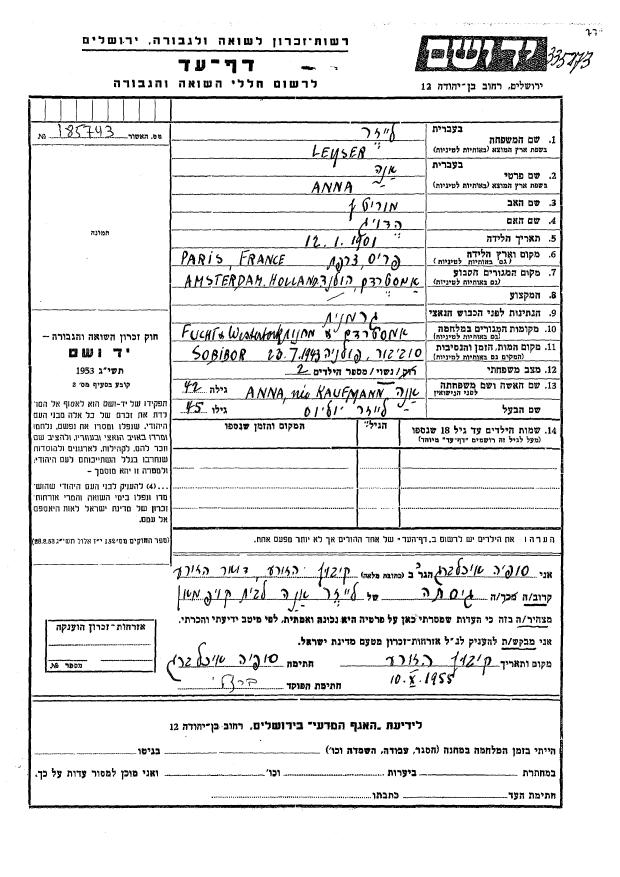
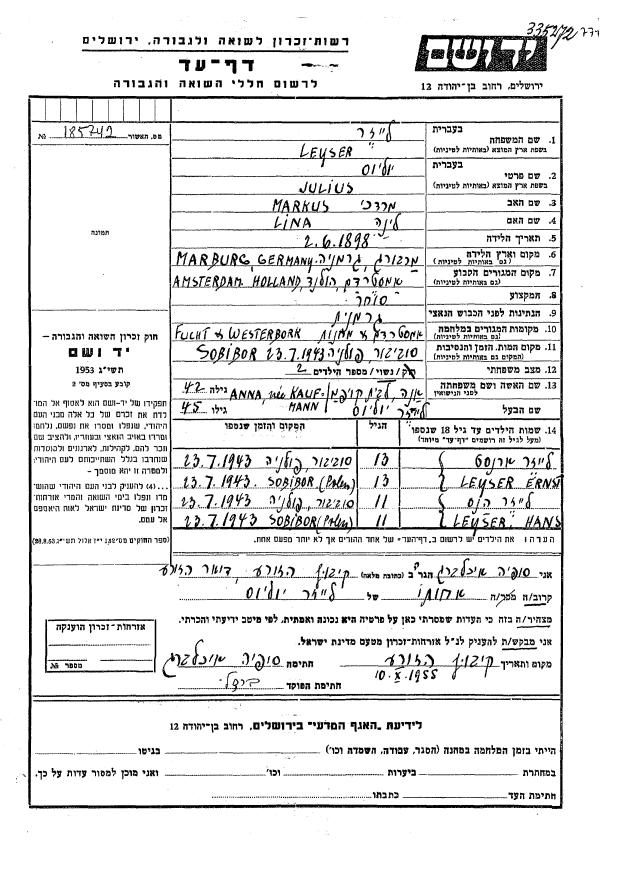
Hedwig’s daughter Anna Kaufmann and her husband Julius Leyser did not go to Palestine with their cousins. They did, however, leave Germany for Amsterdam, but sadly that was not enough to escape the Nazis. Anna, her husband Julius, and their two young sons Ernst and Hans were all deported from the Westerbork detention camp in Amsterdam to the extermination camp at Sobibor on July 23, 1943, and were murdered there. Anna was 42, Julius was 45, Ernst thirteen, and Hans eleven.  An entire family wiped out, including two young boys.

Anna Kaufmann Leyser page of testimony at Yad Vashem, found at https://yvng.yadvashem.org/nameDetails.html?language=en&itemId=3827826&ind=1

Julius Leyser Page of Testimony at Yad Vashem, found at https://yvng.yadvashem.org/nameDetails.html?language=en&itemId=808099&ind=1

Ernst Leyser Page of Testimony at Yad Vashem, found at https://yvng.yadvashem.org/nameDetails.html?language=en&itemId=8897102&ind=1

Hans Leyser page of testimony at Yad Vashem, found at https://yvng.yadvashem.org/nameDetails.html?language=en&itemId=8897103&ind=1

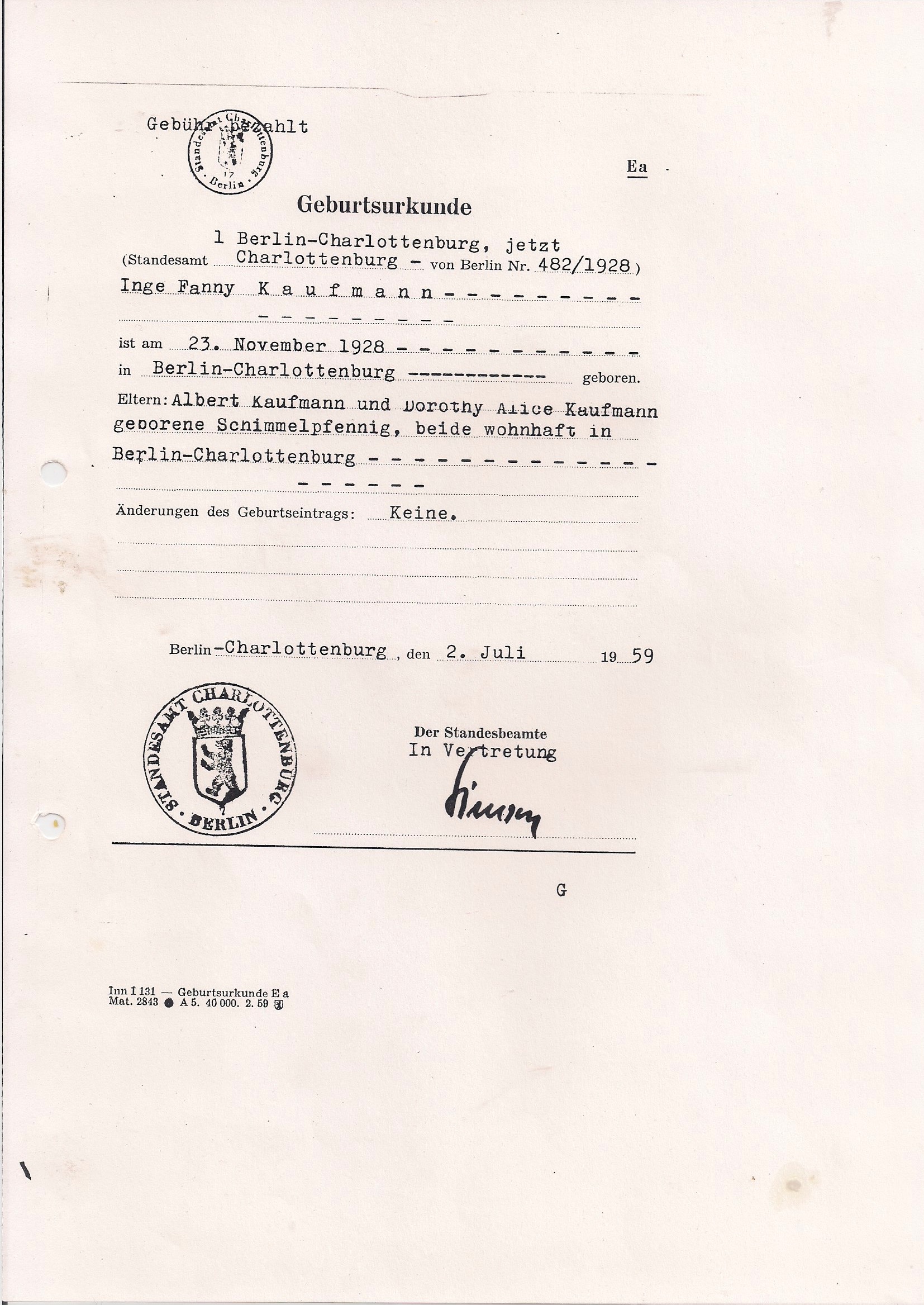
Hedwig’s son Albert Kaufmann survived the Holocaust by immigrating to Brazil. His marriage to his first wife Dorothy had ended before she died on March 31, 1938, in Berlin, Germany.2 Albert had traveled to Brazil in 1924 before he’d married Dorothy, so perhaps he knew it was a good place to immigrate.3 He died in Rio de Janeiro, Brazil on June 10, 1986, at the age of 84. According to his death record, he was survived by his second wife Georgina Correa. She was born in Brazil in 1921, the daughter of José Correa de Mendonça and Anna Emilia da Conceicao.4 The death record indicates that Albert left no children. He died from cancer.

Brasil, Rio de Janeiro, Registro Civil, 1829-2012,” database with images, FamilySearch (https://familysearch.org/ark:/61903/3:1:S3HY-6QQP-KV?cc=1582573&wc=9GYK-DPJ%3A113334201%2C120190503%2C122537201 : 7 January 2019), Rio de Janeiro 02ª Circunscrição Óbitos 1985, Nov-1987, Jan image 172 of 304; Corregedor Geral da Justicia (Inspector General of Justice Offices), Rio de Janeiro.

UPDATE: I received an email today (1/5/22) from the daughter of Paul Blumenfeld. I learned from her that Albert Kaufmann did have a daughter named Inge and that Inge had two sons. So Albert Kaufmann, and thus his mother Hedwig Blumenfeld Kaufmann, do have living descendants!

The story of the family of their brother Ernst will be told in the next post.


  1. The immigration papers for Fritz and Margarete (Katz) Jacobsohn can be found at the Israel State Archives website at https://www.archives.gov.il/. You can also see them here at Friedrich Max Jacobsohn and Margarete Katz immigration documents from Israel Archives. Some of the information in this paragraph also came from the online interview with Fritz and Margerete’s son Yoram, found here. ↩
  2.  Dorothy Kaufmann, Maiden Name: Schimmelpfennig, Gender: weiblich (Female)
    Age: 30, Birth Date: abt 1908, Death Date: 31 Apr 1938, Civil Registration Office: Wilmersdorf, Death Place: Berlin, Berlin, Deutschland (Germany), Certificate Number: 545, Berlin, Deutschland; Landesarchiv Berlin; Personenstandsregister Sterberegister; Laufendenummer: 1625, Ancestry.com. Berlin, Germany, Deaths, 1874-1955 ↩
  3. Albert Kaufmann, ship manifest, Albert Kaufmann, Gender: männlich (Male), Ethnicity/Nationality: Hessen, Marital Status: ledig (Single), Departure Age: 22, Birth Date: abt 1902, Residence Place: Marburg, Departure Date: 9. Jul 1924 (9 Jul 1924)
    Departure Place: Hamburg, Deutschland (Germany), Destination: Buenos Aires
    Arrival Place: La Coruna; Vigo; Rio de Janeiro; Buenos Aires; Brasilien; Uruguay; Argentinien, Occupation: Kaufmann, Ship Name: Württemberg, Shipping Clerk: Hamburg-Amerika Linie (Hamburg-Amerikanische Packetfahrt-Actien-Gesellschaft)
    Shipping Line: Hamburg-Amerika Linie (Hamburg-Amerikanische Packetfahrt-Actien-Gesellschaft), Ship Type: Dampfschiff, Ship Flag: Deutschland, Accommodation: 3. Klasse, Volume: 373-7 I, VIII A 1 Band 316, Staatsarchiv Hamburg; Hamburg, Deutschland; Hamburger Passagierlisten; Volume: 373-7 I, VIII A 1 Band 316; Page: 90; Microfilm No.: K_1856, Staatsarchiv Hamburg. Hamburg Passenger Lists, 1850-1934 ↩
  4. Brasil, Rio de Janeiro, Registro Civil, 1829-2012,” database with images, FamilySearch (https://familysearch.org/ark:/61903/1:1:77HZ-FXW2 : 9 April 2020), Albert Kaufmann in entry for Georgina Correa Kaufmann, ; citing Rio de Janeiro, Rio de Janeiro, Brasil; Corregedor Geral da Justicia (Inspector General of Justice Offices), Rio de Janeiro. ↩

My Cousin Sigmund Livingston, The Founder of the Anti-Defamation League

Although traditional genealogy research tools gave me many of the bare bones details of the life of Sigmund Livingston, it wasn’t until I googled his name after reading his obituary that I learned that he had founded the Anti-Defamation League and was quite an exceptional person. He thus merits his own separate post.

We’ve already seen that Sigmund was a lawyer. According to a biography published on the McLean County Museum of History website, he graduated from the law school at Illinois Wesleyan University in Bloomington in 1894 and was second in his class. After graduating, he and William R. Bach, who had ranked first in the class, became law partners in Bloomington. Their practice was primarily devoted to civil matters.

According to the museum’s biography:1

In numerous newspaper articles, Sigmund was described as extremely intelligent and well respected. One article claimed, “he gives promise of becoming one of the ablest as well as the most prominent attorney in the state.” However, Livingston gave a personal account in his book Must Men Hate? of how, outside of dear friends, he had a “general distrust to overcome” because locals had never known of a Jewish lawyer when he was beginning his career. Livingston recalled that after a few years, he had earned their trust.

Sigmund was involved in many civic activities in Bloomington. He was active in Republican politics and a loyal supporter of the American Red Cross and of efforts to support America and its soldiers in World War I. But he is best remembered for his efforts to support Jewish Americans and to fight anti-semitism. In 1894 he became president of the Bloomington chapter of B’nai Brith, and in 1899 he was elected vice-president of the 6th district of B’nai Brith.

The museum biography described in detail the experience that Sigmund had that motivated him to become more involved in the fight against anti-semitism:

Shortly after the turn of the century, he had an experience that impacted the trajectory of the rest of his life. When he was in Chicago on business, Livingston decided to drop into a vaudeville theater to while away a couple of hours before an appointment. The show began like many others with the usual trained dog acts, jugglers, and acrobats. However, when the show turned to a couple of comedians with a “routine of bum jokes, told in dialect and at the expense of Jews,” Livingston had enough and walked out of the theater. It was this life changing event that made him decide then and there that he would try to do something about the prejudicial caricaturing of Jews.

Livingston was most disgusted with the portrayal of Jewish people in vaudeville shows and films. ….Following the show, Livingston spoke with the managers to make them aware of their cruel and inaccurate depictions of Jews. Surprisingly, the managers were willing to make a change despite them not being aware of their offense.

Believing that publicity would help to alleviate prejudice, in 1908, Livingston established the Publicity Committee of the Publicity Bureau within the B’nai B’rith, which evolved into the Anti-Defamation League (ADL) five years later. The Publicity Committee, based in Bloomington, was created to consider the problem of the defamation of Jews and named Livingston its chairman.

The website for The Pantagraph, the local Bloomington newspaper, published an article on July 11, 2010, about Sigmund and included this description of his involvement in the fight against anti-semitism and the founding and growth of the Anti-Defamation League in 1913.2

[In 1912] Livingston embarked on a lengthy tour of Europe and the Middle East, with stops in Vienna, Jerusalem, Cairo and elsewhere. In London he delivered an address titled “The Condition of the Jew in America,” and in Berlin, at an international meeting of B’nai B’rith, he spoke on the moral necessity of intervening in the internal affairs of sovereign nations “when humanity and civilization dictate.”

The Anti-Defamation League was established in Bloomington in October 1913 as an arm of the B’nai B’rith, with Livingston as its first director.

The museum biography noted that:

The organization had a fairly humble start. The ADL was established in the First National Bank building in Chicago. Livingston started out with only a $200 budget and two desks in his law office, but the ADL quickly grew into a nationwide organization. Members, led by Livingston, planned to campaign along three lines of education, vigilance, and legislation. Livingston believed that hate and fear could be overcome through education and had faith in “the essential goodness of the American people.”

As we saw, Sigmund married his wife Hilda in 1918, and their son Richard was born in 1920. In 1929, after practicing law in Bloomington for 35 years, Sigmund and his family moved to the Chicago area, where he continued to practice law. He was still practicing law there in 1940.3 Here is a photograph of Sigmund and Hilda taken around this time.

Sigmund and Hilda (Freiler) Livingston c. 1940. Courtesy of Art Zemon, found at https://genealogy.zemon.name/gramps/ppl/0/d/b21ea1d3dd971e202d0.html

He also authored ten books as well as continuing his work with the ADL and his other civic activities. His best known book, entitled Must Men Hate, was published in 1944.

Sadly, Sigmund died just two years later on June 13, 1946, at age 73.4 According to his obituary, he was a “leading Chicago corporate counsel” and had been in failing health for the past year. He was survived by his wife Hilda and their son Richard, who was at that time studying at Duke University after serving four years in the Army Air Force.5

Richard Livingston graduated from Duke in 1947, and the following year on May 30, 1948, he married Miriam “Mimi” Spector in New York City. Mimi, the daughter of Samuel and Tessie Spector, had graduated from Wellesley College.6 Richard and Mimi settled in New York and had three children.

Richard’s mother Hilda died February 20, 1962, in Highland Park, Illinois.7

Richard became a successful business owner and moved from New York City to Scarsdale in 1959, where he and his family lived until 1986. He later moved to Larchmont, New York, and also had a home in Boca Raton, Florida. He was not only successful in business; he was active in civic affairs in many different organizations as well as numerous philanthropic endeavors. He died while vacationing in Turkey on October 5, 1994, when he was 74. He was survived by his wife Mimi, their children, and grandchildren.8

Sigmund Livingston was the third of the eight children of Dora and Meyer to be born, and he was the third to die, following his brother Maurice and sister Rosalie. He was born in Germany and came to the US as a young boy with his mother. He was a successful lawyer in Bloomington and Chicago. He definitely made a lasting mark on Bloomington, but also should be remembered by all Jews everywhere for his work with the Anti-Defamation League, which continues today its hard work of fighting not only anti-semitism but all forms of prejudice and discrimination.


  1. A version of the biography that provides citations to its sources can be found at https://mchistory.org/perch/resources/biographies/sigmund-and-hilda-livingston-2021.pdf ↩
  2. “Bloomington Lawyer Led Anti-Semitism Fight,” The Pantagraph, July 11, 2010, found at https://pantagraph.com/special-sections/news/history-and-events/bloomington-lawyer-led-anti-semitism-fight/article_19b023ee-8c8e-11df-badf-001cc4c03286.html ↩
  3. Sigmund Livingston and family, 1930 US census, Year: 1930; Census Place: New Trier, Cook, Illinois; Page: 24A; Enumeration District: 2220; FHL microfilm: 2340238,
    Ancestry.com. 1930 United States Federal Census; 1940 US census, Year: 1940; Census Place: Chicago, Cook, Illinois; Roll: m-t0627-00929; Page: 1B; Enumeration District: 103-257, Ancestry.com. 1940 United States Federal Census ↩
  4. Sigmund Livingston, Birth Date: abt 1873, Death Date: 13 Jun 1946, Death Place: Highland Park, Lake, Illinois, Death Age: 73, Gender: Male, Father Name: Mayer Livingston, Mother Name: Dora Blamenfeld, Spouse Name: Hilda F., FHL Film Number: 1991309, Ancestry.com. Illinois, U.S., Deaths and Stillbirths Index, 1916-1947 ↩
  5. “Sigmund Livingston Dies in Highland Park,” The Pantagraph,
    Bloomington, Illinois, 15 Jun 1946, Sat • Page 3 ↩
  6. “Bride of Former Bloomingtonian,” The Pantagraph, Bloomington, Illinois
    01 Jun 1948, Tue • Page 6 ↩
  7. Find a Grave, database and images (https://www.findagrave.com/memorial/9198509/hilda-v-livingston : accessed 03 November 2021), memorial page for Hilda V Freiler Livingston (25 Apr 1891–20 Feb 1962), Find a Grave Memorial ID 9198509, citing Jewish Cemetery, Bloomington, McLean County, Illinois, USA ; Maintained by Robin Farley Dixson Coon (contributor 46558224) . ↩
  8. “Richard M. Livingston, businessman, philanthropist,” The Daily Times
    Mamaroneck, New York, 11 Oct 1994, Tue • Page 6 ↩

Salomon Blumenfeld’s Children Thekla and Felix: Killed by the Nazis

In April, 1933,  Salomon Blumenfeld’s two children from his first marriage, Thekla Blumenfeld Gruenbaum and Felix Blumenfeld, were both living in Kassel, Germany. All of their children and grandchildren were also still in Germany. With Hitler’s rise to power, some of the family members left Germany not long afterwards. But others were not so fortunate.

Thekla Blumenfeld Gruenbaum was murdered by the Nazis. She was first deported to Theriesenstadt on July 25, 1942.  Two months later on September 26, 1942, she was sent to the extermination camp at Treblinka where she was killed. She was seventy years old. She had lived a hard life—losing her mother when she was just a toddler, being left behind by her father a few years later, losing her husband, and then being killed at Treblinka.

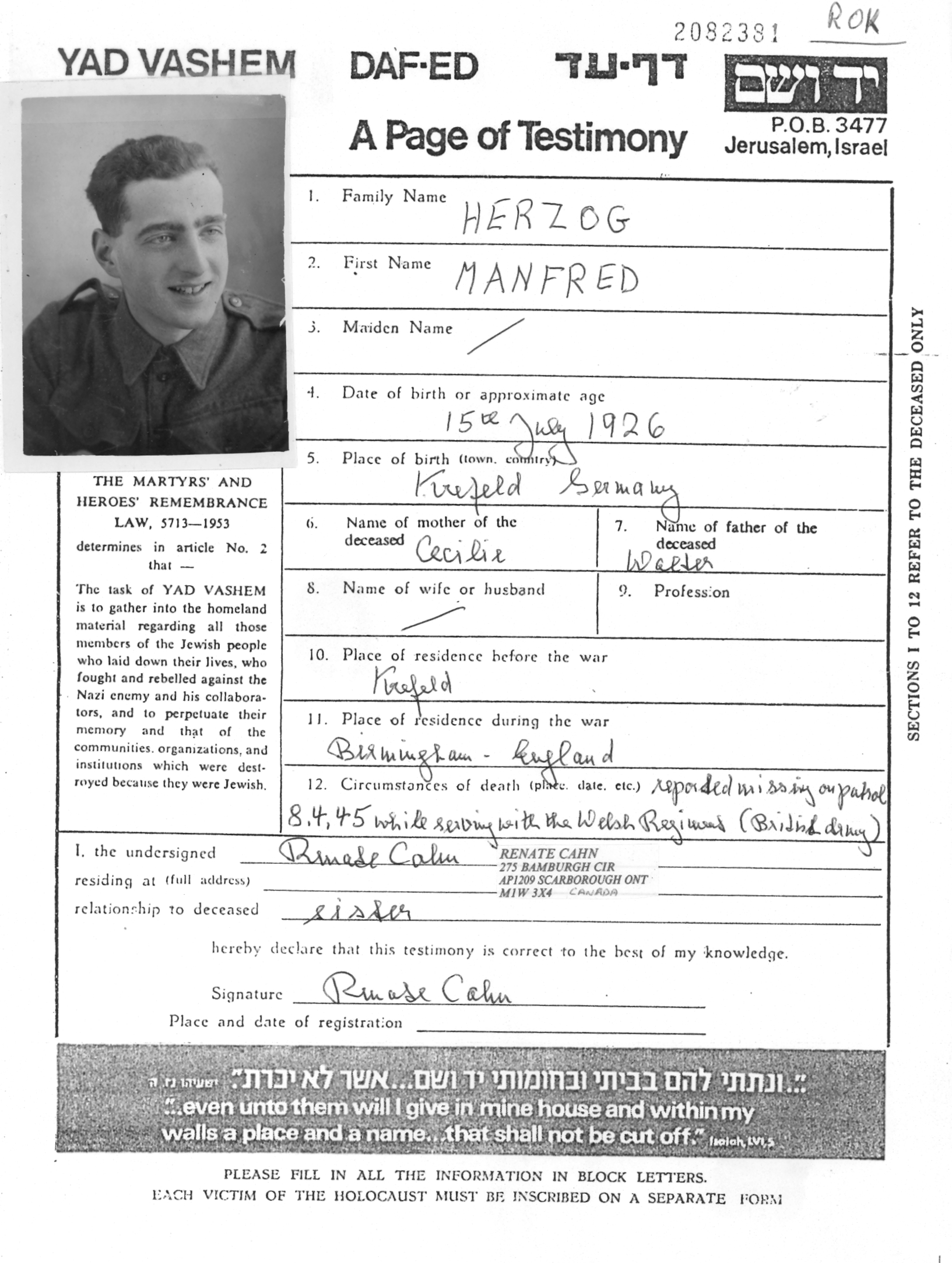
Thekla’s daughter Caecilie and her husband Walter Herzog were living in Krefeld, Germany, before the war. I am still researching where and when, but the evidence indicates that the two children of Caecilie and Walter, Renata and Manfred, were sent to England before the war.1 Walter was a successful silk tie manufacturer and had deposited a fair amount of money in a Swiss banking account; that account was confiscated by the Nazis.2 In December 1941, both Walter and Caecile3 were deported to the concentration camp in Riga, Latvia. Walter was later transferred to Buchenwald where he was “declared dead” on May 8, 1945.

Caecile was sent from Riga to the Stutthof concentration camp.4 The Holocaust Encyclopedia provided this information about the Stutthof camp:5

Conditions in the camp were brutal. Many prisoners died in typhus epidemics that swept the camp in the winter of 1942 and again in 1944. Those whom the SS guards judged too weak or sick to work were gassed in the camp’s small gas chamber. Gassing with Zyklon B View This Term in the Glossary gas began in June 1944. Camp doctors also killed sick or injured prisoners in the infirmary with lethal injections. More than 60,000 people died in the camp.

The Germans used Stutthof prisoners as forced laborers. … In 1944, as forced labor by concentration camp prisoners became increasingly important in armaments production, a Focke-Wulff airplane factory was constructed at Stutthof. Eventually, the Stutthof camp system became a vast network of forced-labor camps….

The evacuation of prisoners from the Stutthof camp system in northern Poland began in January 1945. When the final evacuation began, there were nearly 50,000 prisoners, the overwhelming majority of them Jews, in the Stutthof camp system. About 5,000 prisoners from Stutthof subcamps were marched to the Baltic Sea coast, forced into the water, and machine gunned. The rest of the prisoners were marched in the direction of Lauenburg in eastern Germany. They were cut off by advancing Soviet forces. The Germans forced the surviving prisoners back to Stutthof. Marching in severe winter conditions and treated brutally by SS guards, thousands died during the march.

In late April 1945, the remaining prisoners were removed from Stutthof by sea, since Stutthof was completely encircled by Soviet forces. Again, hundreds of prisoners were forced into the sea and shot. … It has been estimated that over 25,000 prisoners, one in two, died during the evacuation from Stutthof and its subcamps. 

Soviet forces liberated Stutthof on May 9, 1945, and liberated about 100 prisoners who had managed to hide during the final evacuation of the camp.

How did Caecilie manage to survive this ordeal? Was she one of the hundred who were hiding in the camp during its final evacuation? Her odds for survival were overwhelmingly low, yet somehow she did. After time as a displaced person and with the help of HIAS (Hebrew Immigrant Aid Society), she was able to immigrate to the US in July 1946.

Arolesn Archives; Bad Arlosen, Germany, Resettlement Year: 1946, Ancestry.com. Free Acces Africa, Asia and Europe, Passenger Lists of Displaced Persons, 1946-1971

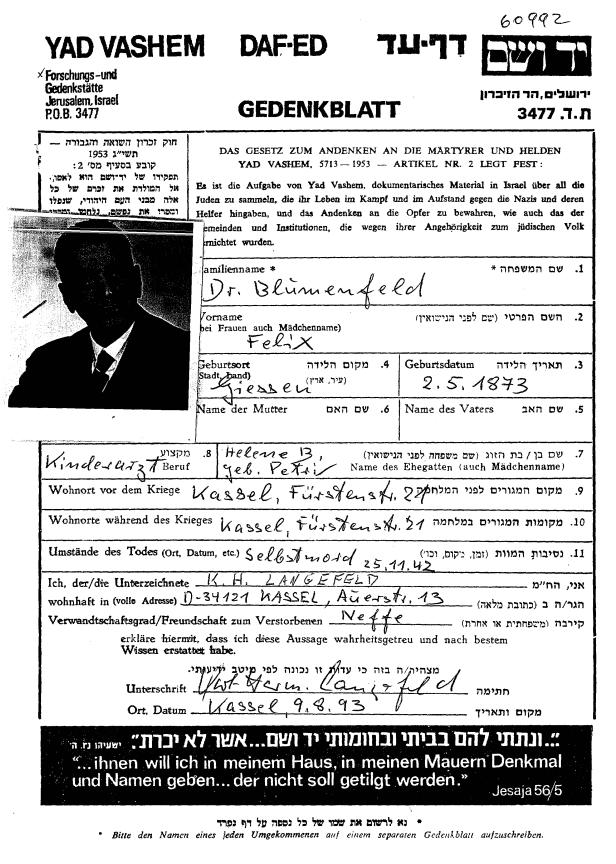
I was able to locate more information about Thekla’s brother Felix Blumenfeld through several sources, including a detailed and well-sourced biography online. Felix had studied medicine at both the University of Marburg and the University of Munich. He served as a ship’s doctor and later as doctor in a POW camp during World War I. As we saw, Felix lost his first wife Thekla Wertheim in 1917, and on February 16, 1920, in Nordhausen, Germany, he married his second wife Helene Petri, who was not Jewish. She was born on October 20, 1894, in Nordhausen, the daughter of Fritz Petri and Bertha Peter. Felix and Helene were living in Kassel, where Felix was a practicing pediatrician.

The detailed biography of Felix I found online describes in great detail all the contributions that Felix made as a doctor and citizen in Kassel.

Encouraged by the high infant mortality rate among children of poor parents, he began to use his position as a doctor and to get involved in society. At his suggestion, milk kitchens were built in which perfectly hygienic milk-grain mixtures were produced as baby food and sold using a deposit bottle system . The products were also given free of charge to the poor.

He also served as the medical director of the children and infant’s home/hospital in the city and also was involved in other charitable and civic organizations.

Despite his service in World War I and all these contributions he made as a doctor and citizen, Felix was persecuted by the Nazis. 

Just a few weeks after the National Socialists came to power on April 1, 1933, as a Jew, he was deprived of the management of the children’s hospital, he was banned from working and had to give up his apartment and practice…. His property and library were confiscated and owing to the fact that his wife Leni was not Jewish, he was initially allowed to live in his summer house a…. He was forced to do auxiliary and road construction work and had to collect rags and scrap at the municipal scrap yard . He was exposed to constant discrimination and surveillance by the Gestapo.

A second biography written for the occasion of the installation of Stolpersteine in Felix Blumenfeld’s honor in Kassel also reported this information and explained that Felix ultimately decided to end his own life in order to avoid deportation and also to protect his wife Helene.

Before killing himself on January 25, 1942, Felix wrote a long letter to his two sons in America, Edgar and Gerd, explaining why he had decided to take his own life. The first part of the letter details some of the abuse and persecution he had endured, and then he ends with these paragraphs, as translated by DeepL:

But enough of that ! Let’s get to the main thing ! Life is no longer bearable for me! All my hope, to which I had clung, was to get out of this hell and to be united with you in a near or distant time. I dare not count on that hope any longer. For with the years of war my years of life also increase. But the worst thing at the present moment is that out of sheer arbitrariness they have deprived me of all my property and referred me to my hands work or to public welfare. Subsequently, they also “expropriated the wife of the Jew”, although since 1939 there had been a legal separation of property, i.e. there was no legal basis for this. Leni was in Berlin and has the prospect of getting part of her property back if she gets a divorce. I want to agree to this divorce in order not to endanger Lenimutter’s livelihood again and again through my person. In that case, however, my life, which has been ruined through no fault of my own, has lost all the more meaning, especially since it is not known what else will be done to us.

Under these circumstances, death seems more desirable to me than an existence with ever new torments. I am therefore leaving this world of meanness, baseness and inhumanity in order to enter eternal peace and to seek the path that leads from darkness to light.

My last thoughts belong to my faithful comrade, on an often thorny path, and to you my beloved children, my Edgar, Gerd, Annchen, Lotte and Little Gerard ! You will be with me in the hour that demands strength and courage. Especially with you, my Gerd, I would have liked to hold a conversation, you dear, you good one! Stay as good as you have been so far, and be the one who makes sure that you always stay together faithfully. Then I am always in your midst and remain eternally connected with you. Without looking backwards, move forward and build a more beautiful life in a hopefully better world. May it be a comforting thought to you that your father is relieved of all fear, worry and pain after his departure. We remain united ! ! You will never forget me, I know that, because my love for you was, is and will be infinite.

V a t e r

*** Translated with http://www.DeepL.com/Translator (free version) ***

Like his sister Thekla, Felix Blumenfeld lost his mother as a baby, then his father, and then his first wife. Nevertheless, he grew up to be a devoted father and pediatrician who contributed greatly to his community. Although not technically murdered by the Nazis, Felix is also rightfully counted among those whose deaths were caused by Nazi persecution.

There was one more death in the family attributable to Nazi Germany. Thekla Blumenfeld Gruenbaum’s grandson, Caecilie and Walter Herzog’s son Manfred, was killed in action while fighting for the Allies in Europe sometime in the spring of 1945.

Thus, the Nazis killed both Thekla and Felix, the two children Salomon Blumenfeld had with his first wife Caecilie Erlanger, as well as Thekla’s son-in-law Walter Herzog; in addition, Thekla’s grandson Manfred Herzog died fighting the Nazis in World War II. I can’t help but think about how Felix and Thekla’s lives would have been different if their father Salomon had taken them with him when he moved to Spain.

They were survived by the rest of the family. Their stories will be told in the next post.


  1. To be discussed in the next post. ↩
  2. Special Master’s Final Report on the Holocaust Victim Assets Litigation (Swiss Banks Settlement), Case No. CV 96-4849 (ERK)(MDG) (Consolidated with CV 96-5161 and CV 97-461) United States District Court, Eastern District of New York, pp.28-30. ↩
  3. Cecilia Herzog [Cecilia Gruenbaum] Birth Date: 26 Apr 1900 Birth Place: Kassel
    Residence: Krefeld Camp: Riga/Stutthof Ancestry.com. Poland, German Jews at Stutthof Concentration Camp, 1940-1945; Entry at the US Holocaust Memorial and Museum at https://www.ushmm.org/online/hsv/person_view.php?PersonId=3187531 ↩
  4. See Note 3. ↩
  5. United States Holocaust Memorial Museum. “Stutthof.” Holocaust Encyclopedia. https://encyclopedia.ushmm.org/content/en/article/stutthof Accessed October 5, 2021. ↩

A Survivor’s Story: The Shoah Foundation Testimony of Inge Goldschmidt Oppenheimer

Antonie Blumenfeld and her husband Siegfried Engelbert died before Hitler came to power in Germany in 1933 and thus were spared seeing that their daughter Margot and her husband Gustav Neuhaus were sent to the Warsaw Ghetto and killed there in September 1942 and that their granddaughter Edith Neuhaus Kempner was killed at Auschwitz just two months later.

They were also spared knowing that their son Julius and his wife Ilse and son Werner were forced to leave Germany in 1939 to escape Hitler, but eventually survived and settled in the United States.

And they were spared knowing the terrible ordeals endured by their youngest child Elfriede and her husband Rudolf Goldschmidt and their children Gunther and Inge.

But we must remember their experiences and honor their memories. Thanks to the Shoah Foundation, we now have extensive interviews with many of the Holocaust survivors, including one with Inge Goldschmidt Oppenheimer, my fifth cousin.

I was privileged to listen to Inge’s interview and will attempt in my own words to tell her story. I am grateful to the Shoah Foundation for allowing me to do so. Except where noted, all the information below came from Inge’s interview.1 All the photographs are courtesy of Inge’s daughter Marsha.

Inge was born to Elfriede Engelbert and Rudolf Goldschmidt on April 13, 1929, in Kassel, Germany, just four years before Hitler came to power. She had almost no memory of life in Germany before the Nazis took control. She and her family lived in Kassel until 1938 when they moved to Cologne. Her memories of life in Kassel were terrible because of the persecution and harassment they faced as Jews. She and her brother Gunther went to a Jewish school and were often beaten up on the way home by Nazi youth members. As a result of incidents like that, the school decided to close fifteen minutes before the non-Jewish schools so that children could get home safely.

Here is a photograph of Inge with her brother Gunther taken in about 1934.

Gunther and Inge Goldschmidt. c. 1934-1935. Courtesy of the family

Inge’s father Rudolf was a veteran of World War I and had suffered a serious head injury while fighting for Germany. As a result, he eventually became paralyzed and wheelchair-bound. The family was living on the pension he received for his service in the war while also being forced to endure the anti-Semitism promoted by the government. Rudolf was very well-informed and followed the news on a radio tuned to the BBC, and although he wanted to leave Germany, his disability and their limited resources made that impossible.

Here is a photograph of Rudolf in uniform during World War I.

Rudolf Goldschmidt, c. 1914-1918. Courtesy of the family

Instead the family decided to leave Kassel and move to Cologne in 1938, believing that in the larger city they would be safer and also that life would be easier because it was less hilly than Kassel and thus easier for Elfriede to push Rudolf’s wheelchair. Here are two photographs of Inge from around this time.

Inge Goldschmidt, c. 1938-1939. Courtesy of the family

Inge and Rudolf Goldschmidt. Courtesy of the family

Gunther celebrated his bar mitzvah in Cologne in the summer of 1938, and a few months later in October his parents registered him for a children’s transport out of Germany to the United States. He ended up in St. Louis living with a foster family for many years. He was only thirteen. Inge was only nine and too young for those transports, so she stayed in Cologne with her parents. The photograph below shows the family at the train station in Cologne the day Gunther left for the US.

Margot Engelbert Neuhaus, Gustav Neuhas, Elfriede Engelbert Goldschmidt, Rudolf Goldschmidt, Inge Goldschmidt, unknown man. 1938. Courtesy of the family

Although things were initially better in Cologne than they had been in Kassel, after Kristallnacht and then once the war started in September 1939, conditions worsened. Their phones were taken, then their bicycles, and they lived in constant fear of being arrested. Then when the Allies started bombing Cologne in the early 1940s, they lived in fear of the bombs and poison gas as well. They moved frequently from one apartment to another and were later rounded up with other Jews and taken to a temporary camp outside of the city. By then they were required to wear the yellow star to identify them as Jews. Inge had hers pinned instead of sewn on as required so that she could sneak out of the camp and shop for the family, removing her star to do so without revealing that she was Jewish.

The star Inge Goldschmidt wore in Germany. Courtesy of the family

Elfriede Engelbert Goldschmidt identity card, 1939. Courtesy of the family

Then in 1942 the family was deported to Theriesenstadt. Inge and her mother Elfriede were in one of the barracks together, and her father Rudolf was in a separate men’s barrack. Interestingly, he was living with other men who were disabled World War I veterans. Inge speculated that but for his service in World War I he never would have been allowed to survive at all, given his physical disability.

Inge’s memories of life in Theriesenstadt are horrendous. She was scared and hungry all the time and often very ill. Her knee became infected, and she had to have it drained in the camp hospital without receiving anesthesia. They lived with bed bugs, lice, and a lack of sanitary facilities. They had no news of what was happening in the war or outside the camp itself.

Inge lived at Theriesenstadt for two years, and then in 1944 she was sent to Auschwitz and separated from her family. She was now fifteen years old and sick with typhus. Despite being sick, she knew enough not to let on and so did not get transported with those who were ill and were instantly killed when they arrived at Auschwitz. The train to Auschwitz was a nightmare—all of them standing packed into the cars with no food and sleeping standing up with only a bucket for a toilet.

She remembered vividly her arrival at Auschwitz. They arrived at night, and it was bitterly cold. The Kapos (Jewish prisoners forced to act as guards and agents for the Nazis) were screaming at them all to move out of the train while armed Nazi guards surrounded them. Inge went with the other women into one large room where they were forced to strip and have their heads shaved. They took cold showers and were disinfected and given rags to wear. She recalled one woman going into labor and giving birth during this ordeal and remembered hearing the women around her screaming when they realized they would never see their children again.

Inge was only at Auschwitz for a few weeks, but her memories of that time and place were seared in her memory. She recalled standing for hours each day in the snow for inspection while the guards selected those who would go to the gas chambers. Once she needed to urinate so badly that she just squatted on the ground and was beaten by the guard for doing so. At one point she was so despondent that she was going to run into the electric fence and kill herself, as she’d seen others do. But a kind woman convinced her not to, and so she survived.

After a few weeks she was selected to be sent to another camp near Leipzig, Germany, called Oederan. Oederan opened in September 1944; three transports brought five hundred women from Auschwitz to work in a munitions factory in a converted thread factory. Inge worked in the munitions factory making bullets; she recounted how she and the other prisoners tried to do things to sabotage the machines, although they knew they could be killed if they were caught. While at Oederan, she saw bright lights in the distance and asked innocently if that was the sun. It was in fact the fires from the Allied bombing of Dresden, which was about 35 miles away. A guard, thinking she was being disrespectful, punched her in the mouth and knocked out one of her teeth.

On April 12, 1945, the day before her 16th birthday, Inge heard that FDR had died, and she was bereft, believing that America was their one hope for survival and that FDR was a hero. But the news about the war was also starting to break through, and there were rumors that the Russians were coming to liberate them. What would she do if she survived to be liberated? What would she learn about the fate of her parents?

To be continued…


  1. Inge Oppenheimer, Interview 11370. Visual History Archive, USC Shoah Foundation, 1996. Accessed 17 August 2021. ↩

Antonie’s Children Margot Engelbert Neuhaus and Julius Engelbert

Antonie Blumenfeld Engelbert, daughter of Baruch Blumenfeld and Emma Docter, died in 1929, and her husband Siegfried Engelbert died three years later. They never knew what was going to happen to their family just a decade after their deaths.

Their oldest daughter Margot and her husband Gustav stayed in Goettingen after Hitler came to power in 1933. After Kristallnacht in November 1938, Gustav was forced by the Nazis to sell his cattle trading business far below its market value, a business that had been in his family since 1858 when it was started by his grandfather. Margot and Gustav were transported on March 31, 1942, to the Warsaw Ghetto, where they were killed on September 30, 1942. Here are the Pages of Testimony on file with Yad Vashem:1

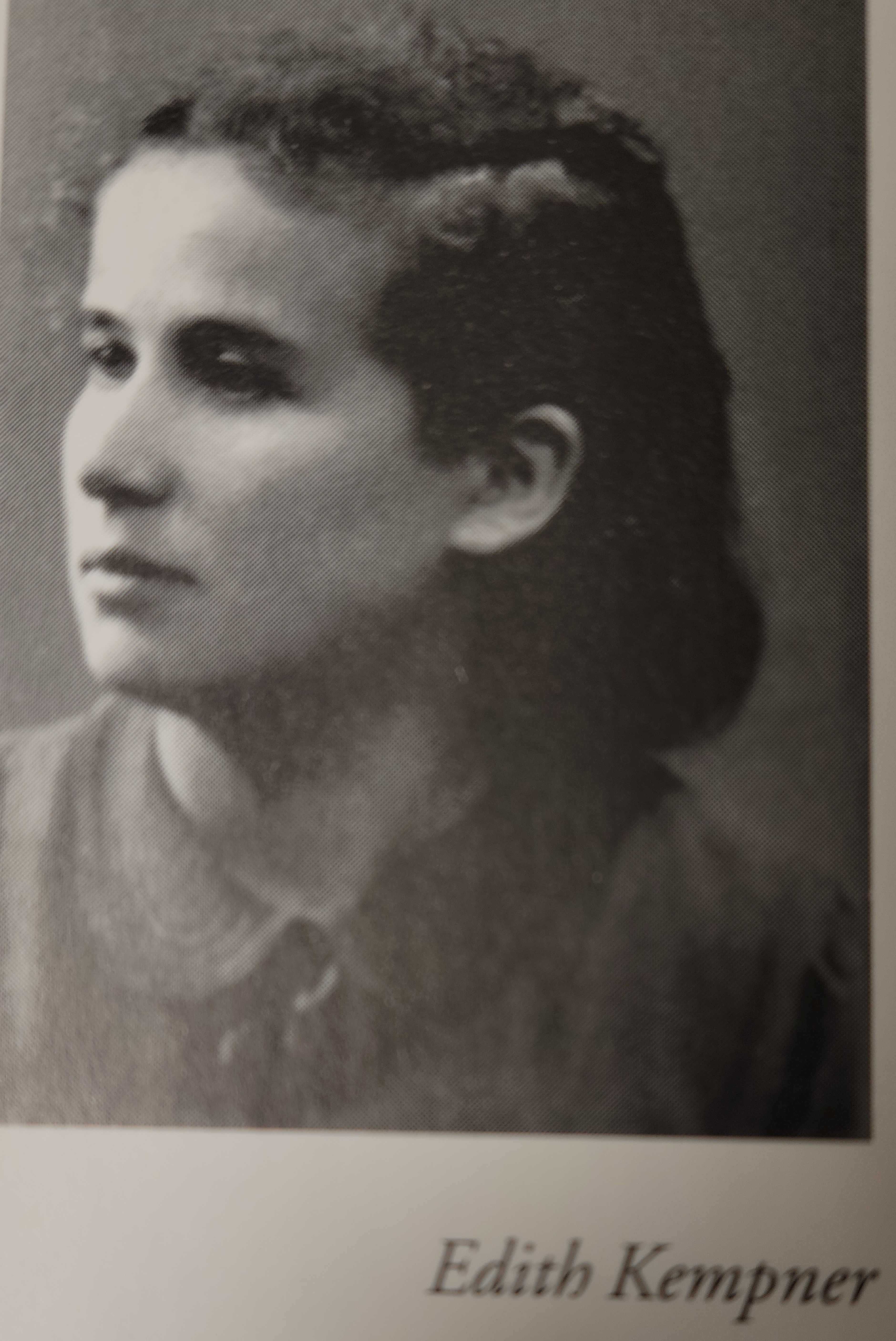
Margot and Gustav’s daughter Edith also was murdered by the Nazis. After she was prohibited from attending the local high school for girls in Goettingen in 1938, she went to Hamburg and then to Berlin, where she met and married her husband Herbert Kempner in 1942. But Herbert and Edith’s marriage was short-lived because on November 29, 1942, they were both deported to Auschwitz and murdered there. I am so grateful to Dennis Aron, who shared with me the entries about Gustav, Margot, and Edith from Die Juedischen Buerger im Kreis Goettingen 1933-1945: Ein Gedenkbuch, including this photograph of Edith. 2

Tragically, Margot and Gustav and their daughter Edith have no living descendants because of the Nazis. Thus, we must all remember them instead.

The other two children of Antonie Blumenfeld and Siegfried Engelbert survived the Holocaust, but not without facing Nazi persecution.

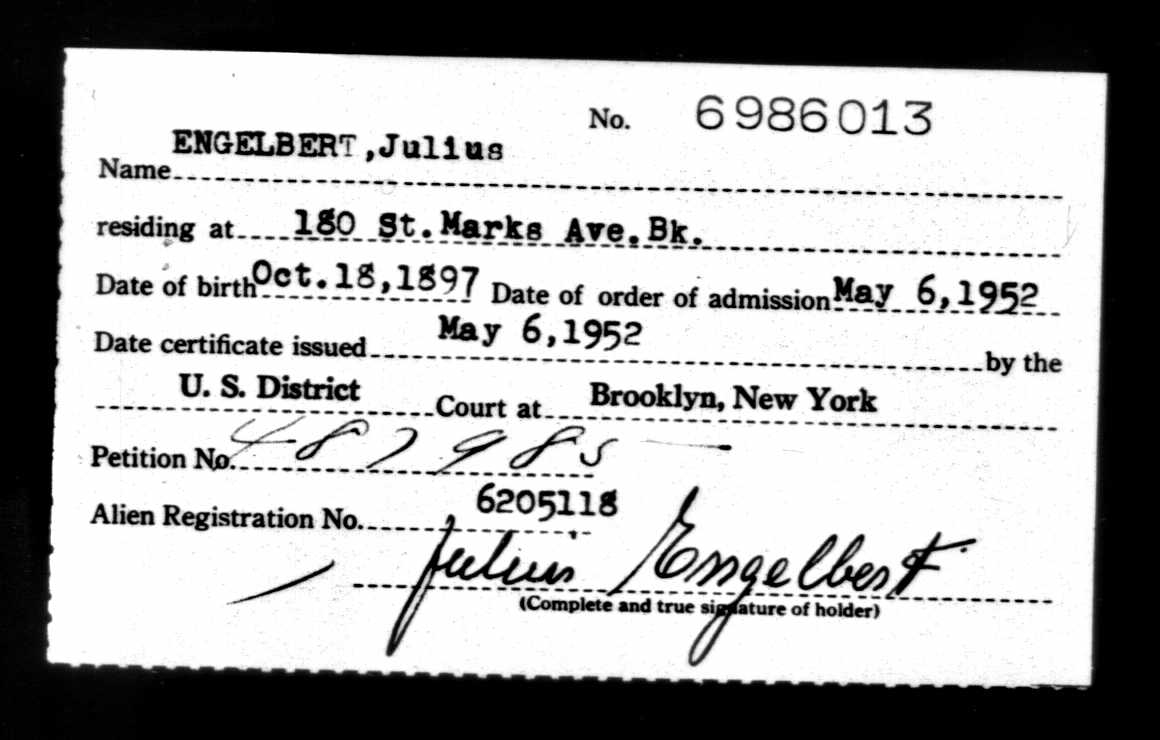
Their son Julius Engelbert, his wife Ilse, and their nine-year-old son Werner fled to Bolivia on September 23, 1939.3 Six years later the family immigrated to the United States, arriving on December 23, 1945.4 They settled in Brooklyn, New York, and they all became US citizens in 1952. Werner Engelbert became a pharmacist after graduating from the College of Pharmacy of the City of New York in 1952.5 According to his niece Marsha, Julius saved the many wonderful photographs published in this series of posts when he fled Germany in 1939. How fortunate we all are that he did.

Ancestry.com. U.S., Naturalization Records Indexes, 1794-1995

Julius Engelbert died in New York on July 25, 1965; he was 67. He was killed in a car accident driving to or from the Catskills.6 His wife Ilse survived him by twenty years, dying in February 1985 at the age of 78.7 Their son Werner died in 2019.8 He was survived by his wife and children and grandchildren.

Elfriede Engelbert Goldschmidt and her family also survived the Holocaust, but their path to survival was more complicated than that of her brother Julius and his family. I was privileged to listen to the testimony that Inge Goldschmidt Oppenheimer, Elfriede’s daughter, gave to the Shoah Foundation in 1996,9 and her story is both heartbreaking and inspiring. I will share her story in my next post.


  1. Margot Engelbert Neuhaus, Yad Vashem, at https://yvng.yadvashem.org/nameDetails.html?language=en&itemId=1306232&ind=2;  Gustav Neuhaus, Yad Vashem at https://yvng.yadvashem.org/nameDetails.html?language=en&itemId=1306229&ind=2. See also Uta Schaefer-Richter and Joerg Klein, Die Juedischen Buerger im Kreis Goettingen 1933-1945: Ein Gedenkbuch (Wallstein Verlag 1992), pp. 190-191. ↩
  2. Uta Schaefer-Richter and Joerg Klein, Die Juedischen Buerger im Kreis Goettingen 1933-1945: Ein Gedenkbuch (Wallstein Verlag 1992), p.190.Die Juedischen Buerger im Kreis Goettingen 1933-1945: Ein Gedenkbuch (Wallstein Verlag Goettingen), p. 126. ↩
  3. Julius Engelbert, Nationality: Deutsch Juden, Record Type: Miscellaneous
    Birth Date: 18 Okt 1897 (18 Oct 1897), Birth Place: Kassel, Residence Place: Kassel Kassel, Notes: Lists of judicial and official files concerning foreigners and German Jews
    Reference Number: 02010101 oS, Document ID: 70443285, Arolsen Archives, Digital Archive; Bad Arolsen, Germany; Lists of Persecutees 2.1.1.1, Ancestry.com. Free Access: Europe, Registration of Foreigners and German Persecutees, 1939-1947 ↩
  4. Joseph Julius Engelbert, ship manifest, Year: 1945; Arrival: New York, New York, USA; Microfilm Serial: T715, 1897-1957; Line: 22; Page Number: 41, Ancestry.com. New York, U.S., Arriving Passenger and Crew Lists (including Castle Garden and Ellis Island), 1820-1957 ↩
  5. Werner J Engelbert, Yearbook Date: 1952, School: College of Pharmacy of the City of New York, School Location: New York, New York, USA, U.S., School Yearbooks, 1880-2012″; School Name: College of Pharmacy of the City of New York; Year: 1952,
    Ancestry.com. U.S., School Yearbooks, 1900-1999 ↩
  6. Julius Engelbert, Gender: Male, Age: 67, Birth Date: abt 1898, Residence Place: Adelphi, Kings, New York, USA, Death Date: 25 Jul 1965, Death Place: New York, USA, New York State Department of Health; Albany, NY, USA; New York State Death Index,
    Ancestry.com. New York State, U.S., Death Index, 1957-1969. Email from Marsha Eidlin, September 25, 2021. ↩
  7. Ilse Engelbert, Social Security Number: 129-22-5815, Birth Date: 31 Mar 1906
    Issue Year: Before 1951, Issue State: New York, Last Residence: 11210, Brooklyn, Kings, New York, USA, Death Date: Feb 1985, Social Security Administration; Washington D.C., USA; Social Security Death Index, Master File, Ancestry.com. U.S., Social Security Death Index, 1935-2014 ↩
  8. https://jewishfunerals.com/service/werner-j-engelbert/ ↩
  9. Inge Oppenheimer, Interview 11370. Visual History Archive, USC Shoah Foundation, 1996. Accessed 17 August 2021. ↩

Philipp v Germany: An Update

The Supreme Court issued its opinion in the Guelph Treasure case this week, and unfortunately it was not good news for my cousin Alan Philipp and the other plaintiffs. As I wrote about here, the plaintiffs, heirs to the Consortium of art collectors who once owned the Guelph Treasure, alleged that Germany and its agency, the SPK, had expropriated their property in violation of international law when the Nazis fraudulently and illegally coerced the Consortium into selling the Guelph Treasure to them at a third of its value in June 1935. After unsuccessfully seeking reparations from Germany, the plaintiffs brought their claims in the US federal courts for wrongful expropriation of their property in violation of international law.

The defendants asserted immunity from suit in the US under the Foreign Sovereignty Immunity Act (“FSIA”), claiming that Germany and its agents could not be sued in US courts. The plaintiffs asserted in response that their claims fell within the expropriation exception of the FSIA, which allows claims against foreign nations based on property taken in violation of international law, as I explained here. The plaintiffs argued that the forced sale of the Guelph Treasure to the Nazis had violated international law because it was coerced and consummated as part of the Nazi persecution of Jews during the Holocaust.

The District Court and the Court of Appeals agreed with the plaintiffs that the expropriation exception applied and that the case could be heard in the US federal courts, but the Supreme Court has now reversed those decisions and remanded the case back to the District Court. The Supreme Court held in a unanimous decision that the plaintiffs’ claims did not fit into the expropriation exception of the FSIA if they were claims by German nationals against Germany. They read the “in violation of international law” language in the exception narrowly to refer only to the international law of property, not to international law respecting human rights. Then they addressed the “domestic takings” principle of international property law, which precludes US courts from adjudicating claims by a country’s nationals against that country. The court concluded that the domestic takings rule would apply here and deprive the plaintiffs of their right to have their claims against Germany heard in US courts if the members of the Consortium were nationals of Germany.

The plaintiffs are, however, left with one possible argument to allow the case to go forward in the US courts: that the members of the Consortium were no longer German “nationals” in June 1935 because Nazi persecution of the Jews in Germany destroyed their standing as German nationals, and thus their claim is not a claim by a German national against Germany and thus not precluded under the domestic takings rule. The Supreme Court remanded the case back to the District Court for consideration of that issue.1

The decision is obviously disappointing for the plaintiffs and for other descendants of German Jews who might seek relief in American courts for property stolen by the Nazis. The court’s opinion focuses primarily on the statutory language and legislative history. But the court also made it clear that it was concerned about the policy implications of allowing such claims in the US—in particular, the possibility that a foreign court could likewise adjudicate claims by American nationals against the US for violations of their human rights.

What the court failed to address are the policy implications of its decision. Their ruling means that those descended from Jews who lived in Germany during the Nazi era are deprived of the right to bring property claims in US courts against the country that persecuted them because they were nationals of Germany. The argument on remand should establish that by persecuting, dehumanizing, torturing and killing its Jewish residents because they were considered subhuman and dangerous, Germany forfeited the right to claim that those same Jewish residents were German nationals and thus should be subject to suit in the US under the expropriation exception of the Foreign Sovereign Immunities Act.

You can read the Supreme Court decision here: Philipp v Germany SCOTUS opinion

Photo by Mr. Kjetil Ree., CC BY-SA 3.0 <https://creativecommons.org/licenses/by-sa/3.0&gt;, via Wikimedia Commons


  1. The defendants claimed that the plaintiffs had waived that argument in the lower courts and thus could not revive it now; the Supreme Court said that was also to be determined by the District Court. ↩

Flora Goldschmidt Schwarzschild’s Family: One Branch Flourished, the Other Extinguished

For Selig and Clementine Goldschmidt’s second daughter Flora Goldschmidt Schwarzchild, the twentieth century started with a sad loss when her husband Emil Schwarzchild died on June 17, 1902, at the age of 45.1

Their daughter Helene Schwarzschild married Joseph Offenbacher the following year on August 28, 1903. Joseph, the son of Lazard Ismael Offenbacher and Karoline Oppenheimer, was born on July 3, 1877, in Paris. The couple settled in Frankfurt.

Helene Schwarzschild Offenbacher marriage record, Hessisches Hauptstaatsarchiv; Wiesbaden, Deutschland; Bestand: 903, Ancestry.com. Hesse, Germany, Marriages, 1849-1930

Helene and Joseph Offenbacher had five children. Paul Offenbacher was born in 1905 and died just five years later on January 13, 1910, in Frankfurt.

Paul Lazard Offenbacher death record, Personenstandsregister Sterberegister; Bestand: 903; Signatur: 10664, Ancestry.com. Hesse, Germany, Deaths, 1851-1958

Emil was born June 11, 1909, in Frankfurt.2 Then came Erich, born in Frankfurt on May 2, 1912.3 Another son, Erwin, was born December 30, 1915, also in Frankfurt.4 And finally Helene and Joseph had a daughter, Irmgard, born in Frankfurt on January 30, 1918.5

Helene Schwarzchild Offenbacher’s older brother Siegfried married five years after she did. He married Bertha Birnbaum on August 7, 1908. She was born on March 7, 1886, in Frankfurt, to Heinemann and Fanny Birnbaum.

Siegfried Schwarzschild marriage record, Hessisches Hauptstaatsarchiv; Wiesbaden, Deutschland; Bestand: 903, Ancestry.com. Hesse, Germany, Marriages, 1849-1930

They had one child, a son Emil Schwarzschild, born July 16, 1909.6

Flora Goldschmidt Schwarzchild thus had five living grandchildren when she died at 63 on June 17, 1922, in Frankfurt.

Flora Goldschmidt Schwarzschild death record, Personenstandsregister Sterberegister; Bestand: 903; Signatur: 10858, Ancestry.com. Hesse, Germany, Deaths, 1851-1958

Sadly, her son Siegfried only survived her by nine years, dying at the age of fifty on February 26, 1929, in Frankfurt.

Siegfried Schwarzschild death record, Personenstandsregister Sterberegister; Bestand: 903; Signatur: 10964, Ancestry.com. Hesse, Germany, Deaths, 1851-1958

Siegfried’s family continued to be plagued with tragedy after he died. Both Siegfried’s widow Bertha and his son Emil Schwarzschild were murdered by the Nazis. Both had escaped from Germany to the Netherlands, where Emil married Judith Bartels in 1938.7 Judith was born in Amsterdam on June 29, 1911, the daughter of Salomon Bartels and Rebecca Hamburger.

According to Yad Vashem, Emil was killed on August 16, 1942, and Judith on September 30, 1942, both at Auschwitz. Emil’s mother Bertha also was killed at Auschwitz. She died on February 26, 1943.  There are thus no living descendants of Siegfried Schwarzschild; his line was extinguished by the Nazis.

Fortunately, Helene Schwarzschild Offenbacher and her family fared far better than the family of her brother Siegfried. They all survived the Holocaust.

Helene and Joseph Offenbacher’s third son Erwin was living in the Netherlands beginning in January 24, 1934 and was issued a Dutch passport in 1938. According to his Dutch passport and his application for Palestinian citizenship, he then immigrated to Palestine on March 23, 1940. He married Hadassah Bacharach in Rishon L’tzion on June 14, 1942, and they had two children born in Israel.

Documents from the Palestinian Immigration File of Erwin Offenbacher from the Israel Archives, found at https://www.archives.gov.il/archives/Archive/0b07170680034dc1/File/0b07170680cc494e

I don’t have any other sources about Erwin, but an entry in Geni submitted by one of his nieces indicates that he died in Tel Aviv on May 30, 2010. He was 94.

Joseph and Helene’s youngest child and only daughter Irmgard also immigrated to Palestine. I could not locate an immigration file for her, but according to Baron and Cibella’s report, she married Carl Benjamin in Tel Aviv in 1938. Unfortunately, I couldn’t find any sources about Carl or their marriage, but I did find a mention of Carl on a website listing a book being auctioned. The book, entitled Photographs of the Ruins of the Atlit Fortress, is a handmade book of photographs taken by Erwin Offenbacher of the Atlit Fortress, a site in Israel. The description of the book indicates that Carl Benjamin wrote the introduction and bound the book. It also says, “The writer of the introduction, Carl (Ya’akov) Benjamin (1911-1976), born in Köln, immigrated to Palestine during the 1930s. Benjamin was married for a while to Offenbacher’s sister, Lina Irmgard (Devorah).”

Erich Offenbacher, the second oldest child of Helene and Joseph Offenbacher, arrived in the US on September 4, 1934, according to his declaration of intention to become a US citizen filed in Pennsylvania on November 22, 1934. He was then residing in Philadelphia where he was a student.

Erich Offenbacher declaration of intention, The National Archives at Philadelphia; Philadelphia, Pennsylvania,  Declarations 1001-1500 (Original), Ancestry.com. Pennsylvania, U.S., Federal Naturalization Records, 1795-1931

Eric, as he later spelled his name, married Gertrude Stern on July 15, 1938, in New York City.8 She was born in Salmunster, Germany, on December 9, 1912, the daughter of Levy Stern and Rosa Neuhaus. When he filed his petition for naturalization in 1940, Eric reported that he was a dentist living in New York, so he must have been a dental student in Philadelphia in 1934 when he filed his declaration of intention.

Eric Offenbacher, petition for naturalization, National Archives and Records Administration; Washington, DC; NAI Title: Index to Petitions for Naturalizations Filed in Federal, State, and Local Courts in New York City, 1792-1906; NAI Number: 5700802; Record Group Title: Records of District Courts of the United States, 1685-2009; Record Group Number: RG 21
Description: (Roll 1237) Petition No· 344551 – Petition No· 345024
Ancestry.com. New York, U.S., State and Federal Naturalization Records, 1794-1943

On the 1940 census, Eric and Gertrude were living in Manhattan and Eric was in private practice as a dentist.9 They would have four children born in the 1940s and 1950s.

Eric’s parents Helene (Schwarzschild) and Joseph Offenbacher arrived in New York on March 28, 1940, and by May, 1940, had declared their intention to become US citizens. On their May, 1940, declarations, they listed the location of their four surviving children. Emil was at that time living in Paris, France; Eric was in New York City, and Erwin and Irmgard were in Palestine.

Helene Schwarzschild Offenbacher declaration of intention, The National Archives at Philadelphia; Philadelphia, Pennsylvania; NAI Title: Declarations of Intention for Citizenship, 1/19/1842 – 10/29/1959; NAI Number: 4713410; Record Group Title: Records of District Courts of the United States, 1685-2009; Record Group Number: 21, Description: (Roll 589) Declarations of Intention for Citizenship, 1842-1959 (No 462401-463200), Ancestry.com. New York, U.S., State and Federal Naturalization Records, 1794-1943

Helene and Joseph are listed on the 1940 US census, living in New York City, in a guest house. Joseph listed his occupation as a metals merchant.10

Their oldest child Emil Offenbacher, who had been in Paris when Joseph and Helene filed their declaration of intention, arrived in the US from Cuba on March 30, 1941. He had married Anna Rapp in Paris on August 23, 1934; she was also a native of Frankfurt, born there on February 25, 1912. 11 Emil was already a successful and well-known book dealer when he arrived in the US. According to a biographical profile of him on the website of the International League of Antiquarian Booksellers, he originally followed his father into the banking world, but in 1931 he started working in an antiquarian bookstore in Munich and then launched his own business in Frankfurt. When the Nazis took power in 1933, he and his wife Anna soon escaped to Paris where they waited for a visa to so they could immigrate to the US.

Emil and Anna had two small children who immigrated with them to the US in 1941. Interestingly, Emil’s parents were sailing with them from Cuba. Perhaps they had gone to help them move with their children.

Emil Offenbacher and family, ship manifiest, Year: 1941; Arrival: New York, New York, USA; Microfilm Serial: T715, 1897-1957; Line: 5; Page Number: 190, Ship or Roll Number: Talamanca
Ancestry.com. New York, U.S., Arriving Passenger and Crew Lists (including Castle Garden and Ellis Island), 1820-1957

Emil reported on his August 1941 declaration of intention that he was a book dealer. He started his business anew in the US, eventually moving to Kew Gardens, Queens, where he ran his antiquarian book business for the rest of his life.

Emil Offenbacher, declaration of intention, The National Archives at Philadelphia; Philadelphia, Pennsylvania; NAI Title: Declarations of Intention for Citizenship, 1/19/1842 – 10/29/1959; NAI Number: 4713410; Record Group Title: Records of District Courts of the United States, 1685-2009; Record Group Number: 21, Description: (Roll 626) Declarations of Intention for Citizenship, 1842-1959 (No 496501-497400), Ancestry.com. New York, U.S., State and Federal Naturalization Records, 1794-1943

Helene and Joseph’s daughter Irmgard, who adopted the name Deborah, immigrated to the US in 1947. She had suffered from health issues, and her mother came to Palestine in 1946 and was granted an extension of her visitor’s visa so that she could wait and travel back to the US with Deborah.12 According to her death notice in The New York Times, Deborah became a professor of sociology at Brooklyn College. She died in New York on April 5, 2004. She was 86.13

Joseph Offenbacher died in New York on June 26, 1945; he was 67.14 Helene Schwarzschild Offenbacher died nine years later on September 30, 1954; she was 72.15

Emil Offenbacher died from lung cancer in Bennington, Vermont, on August 16, 1990. He was 81.16 He was survived by his wife Anna, who died in 2004, and his two children.

According to his obituary in the Seattle Times,17 Eric Offenbacher practiced dentistry in New York for forty years before retiring to Seattle in 1979, where one of his children resided. He was also “a famed musicologist” with a special interest in Mozart. Eric died at the age of 96 in Seattle on January 5, 2009. His wife Gertrude had died on October 18, 2006, in Seattle when she was 93.18 They were survived by their children, grandchildren, and great-grandchildren.

Flora Goldschmidt Schwarzschild today has many living descendants in Israel and in the United States through her daughter Helene Schwarzschild Offenbacher. But her son Siegfried has none because of the Nazis.


  1.  Emil Schwarzschild, Gender: männlich (Male). Age: 45
    Birth Date: abt 1857, Death Date: 10 Jan 1902, Death Place: Frankfurt am Main, Hessen (Hesse), Deutschland (Germany), Civil Registration Office: Frankfurt am Main
    Father: Emanuel Schwarzschild, Mother: Rafel Frenkel, Certificate Number: 99
    Personenstandsregister Sterberegister; Bestand: 903; Signatur: 10559,
    Ancestry.com. Hesse, Germany, Deaths, 1851-1958 ↩
  2.  Emil Offenbacher, Birth Date: 11 Jun 1909, Birth Place: Frankfurt am Main
    National Archives and Records Administration (NARA); Washington, DC; Name Index of Jews Whose German Nationality Was Annulled by the Nazi Regime (Berlin Documents Center); Record Group: 242, National Archives Collection of Foreign Records Seized, 1675 – 1958; Record Group ARC ID: 569; Publication Number: T355; Roll: 7, Mosbacher, Eduard – Schafranek, Bruno, Ancestry.com. Germany, Index of Jews Whose German Nationality was Annulled by Nazi Regime, 1935-1944 ↩
  3.  Erich Offenbacher, Birth Date: 2 Mai 1912, Birth Place: Frankfurt am Main
    National Archives and Records Administration (NARA); Washington, DC; Name Index of Jews Whose German Nationality Was Annulled by the Nazi Regime (Berlin Documents Center); Record Group: 242, National Archives Collection of Foreign Records Seized, 1675 – 1958; Record Group ARC ID: 569; Publication Number: T355; Roll: 7, Mosbacher, Eduard – Schafranek, Bruno, Ancestry.com. Germany, Index of Jews Whose German Nationality was Annulled by Nazi Regime, 1935-1944 ↩
  4.  Erwin Offenbacher, Birth Date: 30 Dez 1915, Birth Place: Frankfurt am Main
    National Archives and Records Administration (NARA); Washington, DC; Name Index of Jews Whose German Nationality Was Annulled by the Nazi Regime (Berlin Documents Center); Record Group: 242, National Archives Collection of Foreign Records Seized, 1675 – 1958; Record Group ARC ID: 569; Publication Number: T355; Roll: 7, Mosbacher, Eduard – Schafranek, Bruno, Ancestry.com. Germany, Index of Jews Whose German Nationality was Annulled by Nazi Regime, 1935-1944 ↩
  5. Irmgard Offenbacher, Birth Date: 20 Jan 1918, Birth Place: Frankfurt am Main
    National Archives and Records Administration (NARA); Washington, DC; Name Index of Jews Whose German Nationality Was Annulled by the Nazi Regime (Berlin Documents Center); Record Group: 242, National Archives Collection of Foreign Records Seized, 1675 – 1958; Record Group ARC ID: 569; Publication Number: T355; Roll: 7, Mosbacher, Eduard – Schafranek, Bruno, Ancestry.com. Germany, Index of Jews Whose German Nationality was Annulled by Nazi Regime, 1935-1944 ↩
  6. Yad Vashem entry found at https://yvng.yadvashem.org/nameDetails.html?language=en&itemId=11630997&ind=0&#160;↩
  7. Family report of David Baron and Roger Cibella. ↩
  8.  Eric Offenbacher, Gender: Male, Marriage License Date: 12 Jul 1938
    Marriage License Place: Manhattan, New York City, New York, USA, Spouse: Gertrude Stern, License Number: 14185, New York City Municipal Archives; New York, New York; Borough: Manhattan; Volume Number: 6, Ancestry.com. New York, New York, U.S., Marriage License Indexes, 1907-2018 ↩
  9. Eric and Gertrude Offenbacher, 1940 US census, Year: 1940; Census Place: New York, New York, New York; Roll: m-t0627-02655; Page: 1B; Enumeration District: 31-1332, Ancestry.com. 1940 United States Federal Census ↩
  10. Joseph and Lena Offenbacher, 1940 US census, Year: 1940; Census Place: New York, New York, New York; Roll: m-t0627-02655; Page: 81A; Enumeration District: 31-1333, Ancestry.com. 1940 United States Federal Census ↩
  11. Anna Offenbacher, declaration of intention, The National Archives at Philadelphia; Philadelphia, Pennsylvania; NAI Title: Declarations of Intention for Citizenship, 1/19/1842 – 10/29/1959; NAI Number: 4713410; Record Group Title: Records of District Courts of the United States, 1685-2009; Record Group Number: 21, Description: (Roll 626) Declarations of Intention for Citizenship, 1842-1959 (No 496501-497400), Ancestry.com. New York, U.S., State and Federal Naturalization Records, 1794-1943 ↩
  12. Helene Offenbacher, Palestinian Immigration file, found at https://www.archives.gov.il/en/archives/Archive/0b0717068002258e/File/0b07170685704ee5&#160;↩
  13. Death Notice, Deborah I. Offenbacher, The New York Times, April 9, 2004, Section B, Page 8 of the National edition. ↩
  14. Joseph Offenbacher, Age: 67, Birth Year: abt 1878, Death Date: 26 Jun 1945
    Death Place: Manhattan, New York, USA, Certificate Number: 14386, Ancestry.com. New York, New York, U.S., Extracted Death Index, 1862-1948 ↩
  15. Baron and Cibella Family Report. ↩
  16.  Emil Offenbacher, Gender: Male, Race: White, Age: 81, Birth Date: 11 Jun 1909
    Birth Place: Frankfurt, Germany, Residence Place: Kew Gardens, Death Date: 16 Aug 1990, Death Place: Bennington, Vermont, USA, Cause of Death: Natural, Metastatic Lung Carcinoma, Date Filed: 17 Aug 1990, Father: Joseph Offenbacher, Mother: Helena Offenbacher, Spouse: Anne Rapp, Vermont State Archives and Records Administration; Montpelier, Vermont, USA; User Box Number: PR-01616; Roll Number: S-31664; Archive Number: PR-2081, Ancestry.com. Vermont, U.S., Death Records, 1909-2008 ↩
  17. The Seattle Times, January 6, 2009, found at https://www.seattletimes.com/entertainment/dr-eric-offenbacher-mozart-scholar-96/&#160;↩
  18. Gertrude Stern Offenbacher, Birth Date: 9 Dec 1912, Birth Place: Salmuenster, Federal Republic of Germany, Death Date: 18 Oct 2006, Father: Levy Stern
    Mother: Rosa Neuhaus, SSN: 155369180, Ancestry.com. U.S., Social Security Applications and Claims Index, 1936-2007 ↩