Levi Rothschild’s Daughters Thekla Rothschild Weinberg and Frieda Rothschild Phillipsohn: One Survived, One Did Not

This is the story of the last two children of Levi Rothschild and Clara Jacob who lived to adulthood, their daughters Thekla and Frieda. Both have heartbreaking stories though Thekla survived and Frieda did not.

The fifth child of Levi and Clara, their daughter Thekla, married Manuel Edward Weinberg on August 19, 1907, in Borken. Manuel was born in Lichenroth, Germany, to Lazarus Weinberg and Karoline Oppenheimer on October 11, 1880.

Thekla Rothschild and Manuel Weinberg marriage record, Hessisches Hauptstaatsarchiv; Wiesbaden, Deutschland; Bestand: 920; Laufende Nummer: 843, Ancestry.com. Hesse, Germany, Marriages, 1849-1930

Thekla and Manuel had a son Hans Herbert Weinberg born in Frankfurt, Germany, on November 2, 1908.1

After Kristallnacht in November 1938, Manuel Weinberg was imprisoned at Buchenwald for a short time,2 and that may have motivated the family to leave Germany. By 1940 if not before, the family had left Germany for France, and according to Yad Vashem, Thekla’s husband Manuel was deported in 1940 to the internment camp near Toulouse, France known as the Recebedou camp.3

According to one website, the camp of Recebedou was created in July 1940 to receive refugees and those who had been evacuated. It was turned into a hospital camp in February 1941. But conditions in the camp deteriorated over time due to the lack of adequate medical care and a shortage of food. By late 1941, there were 739 interns, many of whom were over 60 and ill; 118 of them died in the winter of 1941-1942. Manuel Weinberg was one of those who died; he died on March 4, 1942.4

I don’t know for certain whether Thekla or their son Herbert, as he came to be known, were also interned at Recebedou because there are no documents I can find that indicate that they were. However, I do know that they must have been in France because Herbert and his wife, Edith Seckbach, had a daughter Yvonne born in Toulouse, France sometime in 1943.5  I could not find a marriage record for Herbert and Edith, but according to other records, Edith was born in Wiesbaden, Germany, in about 1918. 6

Wherever they were in France, somehow Thekla, Herbert, Edith, and their baby daughter survived. A document on Ancestry’s collection of Munich, Vienna and Barcelona Jewish Displaced Persons and Refugee Cards, 1943-1959 (JDC) indicates that as of November 1942, Thekla, Herbert, Edith, and Yvonne were in Vigo, Spain, which is almost seven hundred miles from Toulouse, France. How they got there in the midst of the war is a story I do not know.

Ancestry.com. Munich, Vienna and Barcelona Jewish Displaced Persons and Refugee Cards, 1943-1959 (JDC)

From Vigo they went to Madrid as of December 26, 1943. The Refugee Card lists two people as the “parents,” which I assume really means sponsors in this situation. One was Walter Hirschmann, Thekla’s nephew, the son of her sister Betti Rothschild Hirschmann.7 The other, Jacob Bleibtreu, was a banker and later a governor of the New York Stock Exchange who had immigrated to the US from Germany as a young man in 1909. He also was on the Greater New York Army and Navy Committee of the Jewish Welfare Board. Perhaps he knew Walter from the banking and broker business and agreed to help rescue his aunt and other family members.8

On March 23, 1944, Thekla, Herbert, Edith, and Yvonne all arrived in Philadelphia after sailing from Lisbon, Portugal. The ship manifest shows that they all had last been residing in Madrid, Spain, and were heading to Montreal, Canada under the sponsorship of the Joint Distribution Committee. Herbert reported that he was a chemist by occupation.

Thekla Weinberg and family passenger manifest, The National Archives at Washington, D.C.; Washington, D.C.; Series Title: Passenger Lists of Vessels Arriving at Philadelphia, Pennsylvania; NAI Number: 4492386; Record Group Title: Records of the Immigration and Naturalization Service, 1787-2004; Record Group Number: 85; Series: T840; Roll: 177, Ancestry.com. Pennsylvania, U.S., Arriving Passenger and Crew Lists, 1798-1962

Herbert’s wife Edith must not have lived very long after their voyage from Portugal to Philadelphia because on September 8, 1946, Herbert married his second wife, Anna or Anya Grodzky, in Hochelaga, Quebec, Canada. Anna was born in Russia on June 18, 1910, and was a beautician. Herbert is listed as a widower on their marriage record and as a chemist by trade.

Hans Herbert Weinberg marriage to Anna Grodsky, Marriage Sep 8 1946 Westmount, Québec, Canada, Groom Herbert Hans Weinberg, Groom’s birth 1908 Germany, Bride Anna Goodsky, Certificate number upd46-128967, Quebec Marriage Returns, 1926-1997, found at https://www.myheritage.com/research/record-10723-1831907/herbert-hans-weinberg-and-anna-goodsky-in-quebec-marriage-returns

The family all settled in Montreal, where Thekla died on March 11, 1962, at the age of 76.9 Herbert lost his second wife Anna on July 9, 1976.10 He died February 12, 2001, at the age of 92, and was survived by his third wife Sally Lazoff Bailen.11

I have not found any further information about Herbert’s daughter Yvonne despite searching everywhere I could and receiving help from members of Tracing the Tribe. I don’t know whether she died, married, or moved from Canada and changed her name. There just is no trace of her after a mention in her stepmother Anna’s obituary in 1976. She is not mentioned in her father’s obituary in 2001.12

Although Thekla Rothschild Weinberg survived the Holocaust, she lost her husband, her homeland, and, as we will now see, her sister Frieda to the Holocaust.

Frieda was born May 31, 1993, in Borken, Germany.  As we saw, she first married Leonard Marxsohn and was widowed and then married Paul Phillipsohn, with whom she had a daughter Hannelore, born December 3, 1926.

Unfortunately, I have no happy ending for Frieda, Paul, or Hannelore. On June 11, 1942, they were all deported to Theriesenstadt. None of them survived. According to Yad Vashem, Paul died on December 20, 1942. I have no exact dates for Frieda or Hannelore, only that they also died in about 1942.13

Thus ends the story of Levi Rothschild’s family. Although most of them survived the Holocaust and made it to the US, Israel, or Canada, they were scattered across the globe, and their lives were all forever changed. The family members who were killed must have left holes in their hearts forever.


  1. Hans Herbert Kaufmann Weinberg, Gender männlich (Male), Record Type Inventory, Birth Date 02 Nov 1908 (2 Nov 1908), Birth Place Frankfurt am Main,
    Last Residence Frankfurt am Main, Residence Place Frankfurt am Main, Father
    Edmund Weinberg, Mother Thekla Weinberg, Spouse Edith Seckbach, Notes Inventories of personal estates of foreigners and especially German Jews
    Reference Number 02010101 oS, Document ID 70370883, Arolsen Archives, Digital Archive; Bad Arolsen, Germany; Lists of Persecutees 2.1.1.1, Ancestry.com. Free Access: Europe, Registration of Foreigners and German Persecutees, 1939-1947 
  2. Arolsen Archives, 1 Incarceration Documents / 1.1 Camps and Ghettos / 1.1.5 Buchenwald Concentration Camp / 1.1.5.3 Individual Documents male Buchenwald / Individual Files (male) – Concentration Camp Buchenwald / Files with names from SYS and further sub-structure / Files with names from WECK /, Personal file of WEINBERG, EMANEL, born on 11-Oct-1880, Reference Code, 01010503 002.042.476, Number of documents, 1, found at https://collections.arolsen-archives.org/en/document/7388346 
  3. Yad Vashem entries for Manuel Weinberg, found at  https://collections.yadvashem.org/en/names/13545516 and at https://collections.yadvashem.org/en/names/3229127 
  4. See Note 3, supra. 
  5. Yvonne Miriam Weinberg, passenger manifest, The National Archives at Washington, D.C.; Washington, D.C.; Series Title: Passenger Lists of Vessels Arriving at Philadelphia, Pennsylvania; NAI Number: 4492386; Record Group Title: Records of the Immigration and Naturalization Service, 1787-2004; Record Group Number: 85; Series: T840; Roll: 177, Ancestry.com. Pennsylvania, U.S., Arriving Passenger and Crew Lists, 1798-1962 
  6. Edith Weinberg, passenger manifest, The National Archives at Washington, D.C.; Washington, D.C.; Series Title: Passenger Lists of Vessels Arriving at Philadelphia, Pennsylvania; NAI Number: 4492386; Record Group Title: Records of the Immigration and Naturalization Service, 1787-2004; Record Group Number: 85; Series: T840; Roll: 177, Ancestry.com. Pennsylvania, U.S., Arriving Passenger and Crew Lists, 1798-1962. See also Edith Weinberg geb. Seckbach, Arolsen Archives, Digital Archive; Bad Arolsen, Germany; Lists of Persecutees 2.1.1.1, Description Reference Code: 02010101 oS,
    Ancestry.com. Free Access: Europe, Registration of Foreigners and German Persecutees, 1939-1947 
  7. It was Walter’s name on this card that led me to discover that he was the child of Betti and Emanuel Hirschmann. 
  8. “Jacob Bleibtreu, Former Governor of New York Stock Exchange, 90,” The New York Times, December 6, 1976. 
  9. Thekla Weinberg death notice, The Montreal Star, Montreal, Quebec, Canada, Mon, Mar 12, 1962, Page 16. 
  10. Anna (Anya) Weinberg death notice, The Montreal Star, Montreal, Quebec, Canada, Sat, Jul 10, 1976, Page 10. 
  11. Marriage of Herbert Weinberg to Sally Lazoff, Nov 15 1980, Côte St Luc, Québec, Canada, Groom Herbert Weinberg, Groom’s birth Nov 5 1908, Germany, Groom’s age 72, Bride Sally Lazoff, Bride’s birth Aug 15 1917, Québec, Canada, Bride’s age 63, Groom’s father Manuel Weinberg, Groom’s father’s birth Germany, Groom’s mother Thekla Rothschild, Groom’s mother’s birth Germany, Bride’s father Gedaliah Lazoff
    Bride’s father’s birth Russia, Bride’s mother Telia Brasgold, Bride’s mother’s birth Russia
    Certificate number upd80-141452, Quebec Marriage Returns, 1926-1997, found at https://www.myheritage.com/research/record-10723-2419633/herbert-weinberg-and-sally-lazoff-in-quebec-marriage-returns. Herbert Weinberg death notice, The Gazette
    Montreal, Quebec, Canada, Mon, Feb 12, 2001, Page 35. 
  12. Anna (Anya) Weinberg death notice, The Montreal Star, Montreal, Quebec, Canada, Sat, Jul 10, 1976, Page 10. Herbert Weinberg death notice, The Gazette, Montreal, Quebec, Canada, Mon, Feb 12, 2001, Page 35. 
  13. See Yad Vashem entries at https://collections.yadvashem.org/en/names/11607287 for Frieda, https://collections.yadvashem.org/en/names/14969310 for Paul, and https://collections.yadvashem.org/en/names/11607287 for Hannelore. 

Gerson Blumenfeld II, Part IV: Leaving Germany

Three of the four surviving children of Gerson Blumenfeld II made it out of Germany in time to escape from the Nazis.

The family of Mina Blumenfeld Simon were the first descendants of Gerson Blumenfeld II to leave Germany. Mina’s son Josef arrived in New York on February 5, 1937. He listed his occupation as a butcher and his prior residence as Wetzlar, a town near Hermannstein where he was born.

Josef Simon ship manifest, Year: 1937; Arrival: New York, New York, USA; Microfilm Serial: T715, 1897-1957; Line: 10; Page Number: 35, New York Passenger Lists, 1820-1957, Ancestry.com

His brother Kurt arrived eight months later on October 1, 1937; he listed his occupation as a merchant and last residence as Wetzlar.

Kurt Simon ship manifest, Year: 1937; Arrival: New York, New York, USA; Microfilm Serial: T715, 1897-1957; Line: 3; Page Number: 38, Ship or Roll Number: New York, Ancestry.com. New York, U.S., Arriving Passenger and Crew Lists (including Castle Garden and Ellis Island), 1820-1957

The rest of the family—Albert, Mina, and Grete—arrived the following year on August 18, 1938. They also had been living in Wetzlar where Albert was a merchant.

Albert Meta Grete Simon passenger manifest, Year: 1938; Arrival: New York, New York, USA; Microfilm Serial: T715, 1897-1957; Line: 12; Page Number: 8, Ship or Roll Number: Washington
Ancestry.com. New York, U.S., Arriving Passenger and Crew Lists (including Castle Garden and Ellis Island), 1820-1957

Mina had officially changed her name from Mina Blumenfeld Simon to Meta Simon by the time she filed her Declaration of Intention to become a US citizen on January 24, 1939.

Meta Blumenfeld Simon declaration of intention, The National Archives at Philadelphia; Philadelphia, PA; NAI Title: Declarations of Intention For Citizenship, 1/19/1842 – 10/29/1959; NAI Number: 4713410; Record Group Title: Records of District Courts of the United States, 1685-2009; Record Group Number: 21, (Roll 549) Declarations of Intention For Citizenship, 1842-1959 (No 427401-428300), Ancestry.com. New York, U.S., State and Federal Naturalization Records, 1794-1943

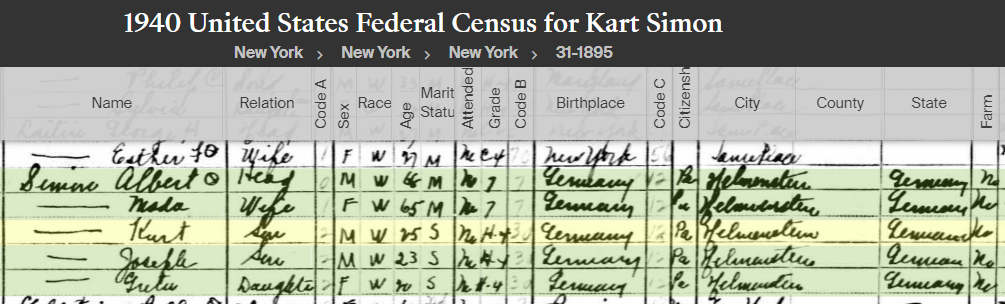
The family was reunited and living together as of the 1940 US census. They were living in New York City, and Albert and his two sons Kurt and Joseph (as spelled here) were working as butchers.

Albert Simon and family 1940 US census, Year: 1940; Census Place: New York, New York, New York; Roll: m-t0627-02670; Page: 11B; Enumeration District: 31-1895, Ancestry.com. 1940 United States Federal Census

Friedrich Blumenfeld and his family, including his mother Berta Alexander Blumenfeld, were the next family members to arrive in the US. They left shortly after Kristallnacht.

I had the great pleasure of Zooming with two of Friedrich’s grandsons last week, Steven and Milton, and they shared with me a story about their grandmother Berta’s reaction to Kristallnacht. Apparently when the Nazis came around to arrest Jewish men in the aftermath of Kristallnacht, Berta was so angry that she took the medals awarded to the family in honor of  Moritz and Isaak, the two sons who died fighting for Germany in World War I, and threw them at the Nazi soldiers, yelling that she had lost two sons already. According to the family, the soldiers backed off and left the family alone. Soon thereafter the family was able to get visas to leave Germany.1

Friedrich, Berta, and their two children arrived in the US on January 13, 1939. Friedrich’s occupation on the ship manifest is listed as shoe manufacturing, but his grandsons told me he was actually a dry goods salesman in Momberg.

Friedrich Blumenfeld and family passenger manifest, Year: 1939; Arrival: New York, New York, USA; Microfilm Serial: T715, 1897-1957; Line: 23; Page Number: 150, Ship or Roll Number: Hansa
Ancestry.com. New York, U.S., Arriving Passenger and Crew Lists (including Castle Garden and Ellis Island), 1820-1957

I cannot locate them on the 1940 census, but on October 16, 1939, they were all living together in the Bronx, according to Friedrich’s Declaration of Intention filed on that date. Friedrich was unemployed at that time.

Friedrich Blumenfeld declaration of intention, The National Archives at Philadelphia; Philadelphia, PA; NAI Title: Declarations of Intention For Citizenship, 1/19/1842 – 10/29/1959; NAI Number: 4713410; Record Group Title: Records of District Courts of the United States, 1685-2009; Record Group Number: 21,  (Roll 567) Declarations of Intention For Citizenship, 1842-1959 (No 444001-444900), Ancestry.com. New York, U.S., State and Federal Naturalization Records, 1794-1943

Katinka Blumenfeld Rosenberg was the last of the children of Gerson Blumenfeld II to escape Nazi Germany in time. Their departure was delayed because, as I learned from Katinka’s son Heinz/Henry, after Kristallnacht, Katinka’s husband Emanuel and son Walter were taken to Buchenwald where Walter spent two months and Emanuel spent five weeks. After they were released in early 1939, the family was determined to leave, but it was very difficult to find a sponsor to help them get permission to immigrate to the US. Finally a stranger from Texas who was not even related to the family came forward with an affidavit and sponsored the family. They took a train to Italy and sailed to the US from Genoa. As Henry and I discussed during our conversation, it is somewhat miraculous that they were to get out of Germany after World War II had started since for so many the borders closed after September 1, 1939.2

Katinka, her husband Emanuel Rosenberg, and their three sons Walter, Guenter, and Heinz arrived in New York on February 1, 1940. Emanuel listed his occupation as a trader, and Momberg was their last residence.

Emanuel Rosenberg and family passenger manifest, Year: 1940; Arrival: New York, New York, USA; Microfilm Serial: T715, 1897-1957; Line: 6; Page Number: 37, Ship or Roll Number: Conte Di Savoia, Ancestry.com. New York, U.S., Arriving Passenger and Crew Lists (including Castle Garden and Ellis Island), 1820-1957

Henry said they at first lived with cousins in the Bronx, but soon moved to Washington Heights in Manhattan where so many German Jewish refugees settled in the 1930s and 1940s. Henry quickly learned English and soon was able to not only catch up with his classmates but to excel in school.3

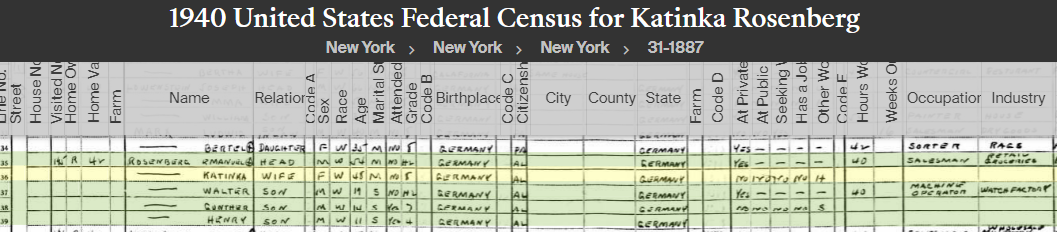
When the 1940 US census was taken a few months after their arrival, the Rosenbergs were all living in New York City. Emanuel was working in a grocery store, and Walter was a machine operator in a watch factory.

Emanuel Rosenberg and family 1940 US census,Year: 1940; Census Place: New York, New York, New York; Roll: m-t0627-02670; Page: 9A; Enumeration District: 31-1887, Ancestry.com. 1940 United States Federal Census

Thus, Mina, Friedrich, and Katinka and their families were able to escape to the US in time and survived the Holocaust.

Tragically, the youngest child of Gerson Blumenfeld II, Sitta Blumenfeld Spier, did not leave Germany in time to escape the Holocaust.  Her family’s story in my next post.


I will be taking next week off to be with my family, who are coming to visit for Thanksgiving. Have a great Thanksgiving to all my US readers!


  1. Zoom with Steven Hamburger and Milton Hamburger, November 10, 2022. 
  2. Phone conversation with Henry Rosenberg, October 30, 2022 
  3. See Note 2, supra. 

Gaps in the Story: How Did Amalie and Charles Bloch Escape from Nazi Germany?

Back in May, I wrote about Amalie Meyer Bloch, the granddaughter of Jacob Meier Goldschmidt and Jettchen Cahn, daughter of Regina Goldschmidt and Aaron Meyer. One question that lingered was how Amalie and her daughter Ilse ended up separated from Amalie’s husband Charles Bloch.

I knew from one of the Arolsen Archives document available through Ancestry that Charles had gone to Paris, and I knew that he eventually rejoined Amalie and Ilse in the US in 1946, reporting that his last address had been in Toulouse, France. But what I didn’t know was when Charles had gone to Paris and where he was in France during the war after Germany’s invasion of France in 1940.

Arolsen Archives, Digital Archive; Bad Arolsen, Germany; Lists of Persecutees 2.1.1.1; Series: 2.1.1.1, Reference Code: 02010101 oS, Ancestry.com. Europe, Registration of Foreigners and German Persecutees, 1939-1947

Barb276, one of my readers, suggested that I contact the ITS (International Tracing Service) and file a request for more information about Charles since not all of their documents are available through the Arolsen Archives. I did as she suggested back in May and was told that it would take ten months to complete the investigation and report back. I prepared myself for a long wait.

You can imagine my surprise when just a week or so ago I received a report back from ITS with more documents about Charles. Those documents don’t really answer my questions, unfortunately, but they did reveal one more piece of the puzzle.

Charles was one of the thousands of Jewish men who were rounded up during and after Kristallnacht in November 1938 and sent to the Buchenwald concentration camp. He was released in December 1938.

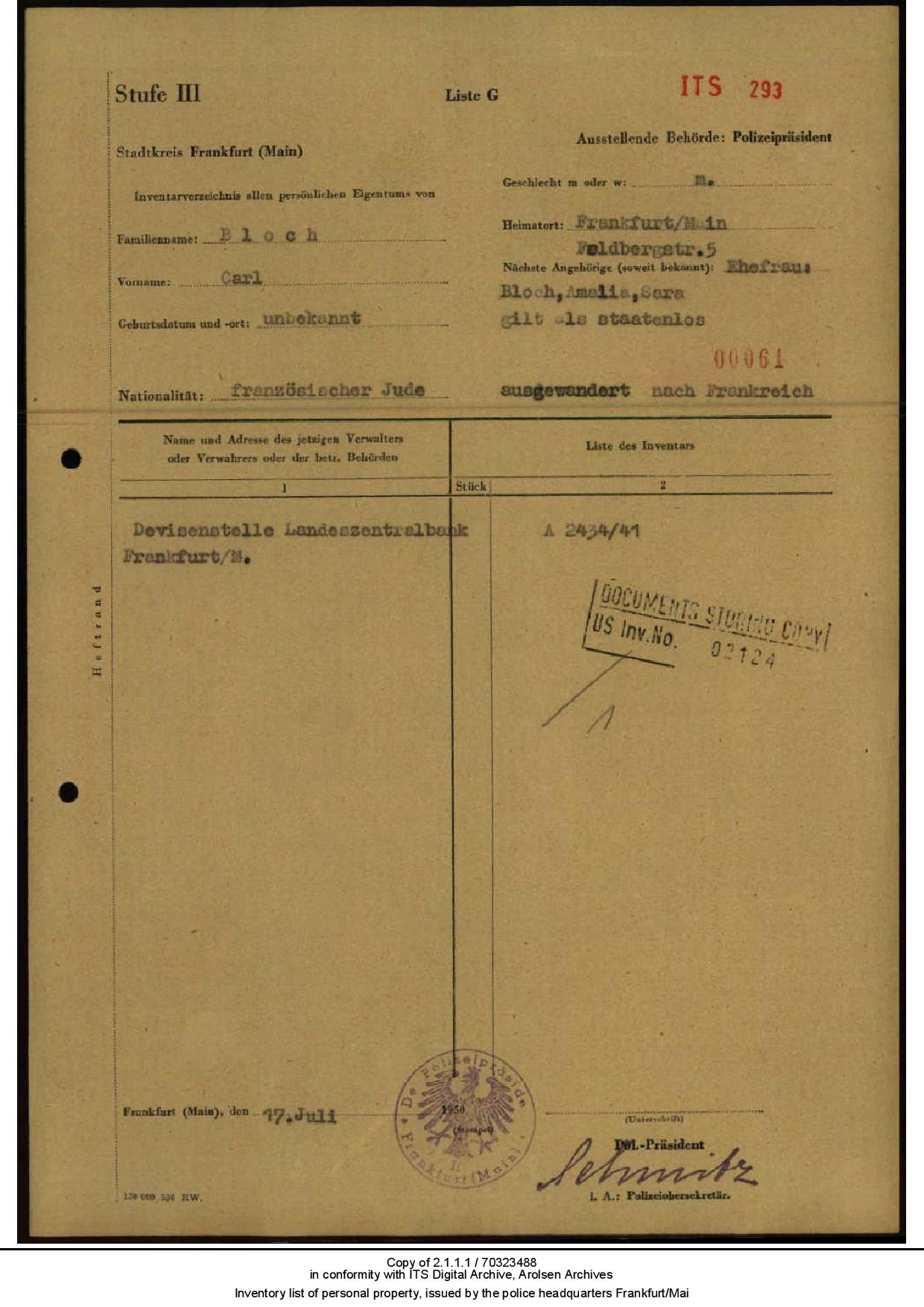
My working hypothesis is that upon his release, he left Germany for France. One of the ITS documents, a property inventory prepared after the war in 1950, described Charles as a “französischer Jude,” a French Jew. I wasn’t sure what to make of that since Charles was also documented as German-born—born in Frankfurt in 1881. That same document also states that Amalie is “gilt als staatenlos,” considered stateless. So maybe the reference to Charles as a French Jew meant that he had become a citizen of France after immigrating there.

It would make sense that Charles would leave Germany in early 1939 after his experience at Buchenwald. As seen in my earlier post, his daughter Ilse had gone to England by 1939. But it seems that Amalie was not in England or France at that point. On her November 27, 1941, declaration of intention to become a US citizen, Amalie reported that Charles was at that time residing in France, Ilse was residing in New York, and that Amalie herself had last resided in Lisbon, Portugal.

Amalie Meyer Bloch, declaration of intent, The National Archives at Philadelphia; Philadelphia, Pennsylvania; NAI Title: Declarations of Intention for Citizenship, 1/19/1842 – 10/29/1959; NAI Number: 4713410; Record Group Title: Records of District Courts of the United States, 1685-2009; Record Group Number: 21
Description: (Roll 641) Declarations of Intention for Citizenship, 1842-1959 (No 510101-511000)
Ancestry.com. New York, State and Federal Naturalization Records, 1794-1943

My hunch is that Amalie stayed behind in Germany longer than her husband and daughter and then somehow escaped to Portugal after the war started. But I could be wrong. My other hunch is that Charles escaped from Paris after the Nazis invaded and somehow survived the war in southern Vichy-controlled France, finally arriving in the US a year after the war. Although I don’t know more about Charles’ time there, I did find a Jewish Telegraphic Agency news release dated April 29, 1941, reporting that Jewish refugees had been expelled from Toulouse. I’ve no idea, however, how that impacted Charles Bloch.

Unfortunately, the ITS documents do not reveal anything about Charles’ time in France during or after the war. Nor do I have any more information about how Amalie ended up in Portugal or when. And since they have no living descendants, I fear I can only rely on my hunches and speculation to fill in these gaps.


How the Nazis Treated Children of Mixed Marriages, Part II: Christine Seligmann

My last post told the tragic story of Emil-Jacob Seligmann, Jr., the great-grandson of my three-times great-grandfather Moritz Seligmann. This post will tell the story of his sister, Christine, known by the family as Christel. Emil, Jr. and Christel were the children of Emil Seligmann, Sr., who was Jewish, and Anna Maria Angelika Illian, who was Catholic, and they were raised as Catholics. But, as we saw in the prior post, Nazis treated those who had two Jewish grandparents as Mischlings in the First Degree. Although they were not thus identified as wholly Jewish, they were nevertheless not Aryan either and, as we saw with Emil, often persecuted. Emil was sent to Buchenwald in August 1944 and died there six months later on February 14, 1945, from poor health and a heart attack.

Christel was not sent to a concentration camp, but she faced persecution as well. In going through various papers that were found in Christel’s apartment after she died in 1982, my cousin Wolfgang located documents that revealed that Christel had applied for reparations from the German government for the harm and losses she suffered during the Nazi era. Those documents (which he has shared with me) reveal what Christel experienced and endured at the hands of the Nazis. The documents are all in German, but with a lot of help from Wolfgang and my elementary understanding of German, I have been able to piece together Christel’s story. You can see the documents I received here: Christine Seligmann dox

The first document was written by Christel on January 3, 1947, outlining her life in Wiesbaden before and during the Nazi era and World War II. She wrote that she was born on July 30, 1903 in Erbach, Germany. Her parents were quite wealthy, so Christel did not need to work. But in 1933 she became a certified baby nurse and began working for mostly Jewish families in that capacity. She was out of work due to poor health (rheumatism) from 1938 to 1942, but in 1942 returned to work for various families.

After losing both of her parents in 1942, Christel stopped working as a baby nurse and instead made a living by renting rooms in her family home. But in August 1944, her situation became much worse. Her brother Emil was arrested and sent to Buchenwald, where he died six months later.

Wolfgang found among Christel’s papers two cards that she received from her brother Emil while he was at Buchenwald. Wolfgang translated and summarized these cards for me.

The first card is dated September 10, 1944. At the top of the page are pre-printed instructions regarding written communications to and from prisoners. Prisoners were allowed to send and receive just two letters a month. The letters had to be written clearly. The rules also state that prisoners were allowed to receive food.

In the body of his message, Emil informed Christel that he was living at Buchenwald and that he was doing well, but he made several requests that he considered urgent. He asked her to send him money (30 Reichsmarken) and a long list of food items: marmalade, canned blackberries and raspberries, sugar, salt, cigarettes, and some cutlery. He also asked for something to treat fleas. He thanked her several times.

His second letter sounded more desperate. It was written in December, 1944, and it is obvious that the conditions and weather had become worse since his first card two months earlier. We can’t tell whether the siblings had exchanged other letters between September and December, but from the content of Emil’s December letter, we know that Christel had at least sent him one package. He wrote that he was happy to have received the package from her because he had been very worried and was glad to know that she was alive. He asked her to write him a letter—so perhaps she had not written to him, just sent the package.

He said that everything in that package was perfect, but that he now needed more money (50 Reichsmarken) and some winter clothing—gloves, earflaps (like ear muffs, I assume), and a winter jacket. He also asked for towels, handkerchiefs, a pen, a spoon, salt, cigarettes, glasses, and marmalade. Emil acknowledged that Christel might be too busy with work to get the items to him quickly and said she should ask the other women in her house for help. He closed by wishing her a good Christmas and sending her kisses.

We don’t know whether Emil heard from Christel again or whether she heard from him. He died less than two months after Christmas on February 14, 1945.

Meanwhile, Christel was having her own problems with the Nazis.  On the same day that Emil was arrested in August, 1944, the Gestapo raided their family’s apartment and forced her to move out on one day’s notice at great cost and with no help. They told her that if her furniture was not removed by the next morning, she would find it on the street. She was able to salvage some, but not all, of her belongings.

From October 1944 until December 1944, she was able to work as a nanny for a Christian woman, but then the Gestapo forced her to take a job in a cardboard factory. She found this work very difficult, and the long walk back and forth every day made matters even worse. Her feet became frostbitten and she developed bladder problems, but despite consulting three different doctors, she was unable to get any of them to give her a medical note to excuse her from work.

Once the war ended and the US army occupied Wiesbaden, Christel’s home was returned to her, but then was soon taken back by the US army to use as living quarters for American soldiers. Christel had just one room to live in. Nine months later her home was returned to her.

Christel filed a claim for reparations from the German government in November, 1953, for the loss of income and value she suffered by being forced from her home by the Gestapo, for the loss of her profession, for the damage to her health, and for the insults and humiliation she endured. She also claimed that a possible marriage was thwarted by the laws imposed by the Nazis. Wolfgang located in Christel’s papers a five-page petition filed by her attorney, Georg Marx, detailing her claims. Unfortunately, the copy I received is a bit too blurry (making it even more difficult to translate the German), but Wolfgang told me that it reiterates much of what Christel herself wrote in 1947 but with more details about her medical ailments.

According to Wolfgang, Christel did receive some money for reparations, but not very much.  She continued to live in her apartment in Wiesbaden for the rest of her life. When she died in 1982, Wolfgang and his father and uncle cleaned out the apartment. Christel was a bit of a hoarder, and there were many, many papers that were simply thrown away, papers that today might tell more of her story and that of her family.

Fortunately, however, Wolfgang’s uncle Herbert saved the “magic suitcase” that was in Christel’s apartment and that has become so critical to the family research that Wolfgang and his mother have done and have shared with me.


More Names to Remember and Never Forget

As I move towards closure on my Schoenthal family history, this post has been the hardest one to write.  It is a tragic chapter in that history.

As I’ve already written, four of the six children of my great-great-aunt Rosalie Schoenthal and her husband Willy Heymann left Germany before they could be killed by the Nazis. The three sons went to Chicago, and the oldest daughter Johanna went to Sao Paulo. They all survived.  The other two daughters were not so lucky.

The second oldest daughter, Helene, was born in Geldern in November 9, 1890, a year after Johanna.  She married Julius Mosbach, who was the younger brother of Johanna’s first husband, Hermann Mosbach.  After marrying, Julius and Helene were living in Iserlohn, a town about 80 miles east of Geldern.  According to an article written in 2000 by the archivist of Iserlohn, Gotz Bettge, Julius and Helene Mosbach owned a fruit and vegetable business in the town square in Iserlohn.  They had two daughters: Liesel, who was born March 8, 1921, and Gretel, born October 26, 1926.


Iserlohn By No machine-readable author provided. Asio otus assumed (based on copyright claims). [GFDL (http://www.gnu.org/copyleft/fdl.html), CC-BY-SA-3.0 (http://creativecommons.org/licenses/by-sa/3.0/) or CC BY-SA 2.5-2.0-1.0 (http://creativecommons.org/licenses/by-sa/2.5-2.0-1.0)], via Wikimedia Commons

Iserlohn
By No machine-readable author provided. Asio otus assumed (based on copyright claims). [GFDL (http://www.gnu.org/copyleft/fdl.html), CC-BY-SA-3.0 (http://creativecommons.org/licenses/by-sa/3.0/) or CC BY-SA 2.5-2.0-1.0 (http://creativecommons.org/licenses/by-sa/2.5-2.0-1.0)%5D, via Wikimedia Commons


On December 18, 1939, Liesel married Ernst Georg Lion. From the incredibly moving autobiography written by Ernst Lion entitled The Fountain at the Crossroads and available online here, I was able to learn a great deal about his life and also about the lives of Julius, Helene, and their daughters.  All the information and quotes below are from his book unless otherwise indicated.  (Special thanks to Dorothee Lottmann-Kaeseler for sending me some of the additional links and information.)

Ernst was born December 15, 1915, in Brambauer, the son of Leo Lion and Bertha Weinberg Lion.  When Ernst was a very young child, his father Leo was badly injured while serving in the German army during World War I.   Leo Lion considered himself a German patriot.

Ernst grew up as the only Jewish child in Brambauer during the hard years of the Weimar Republic, but his childhood was overall quite happy. Then Hitler came to power, and his life was forever changed.  The Nazis tried to impose a boycott on his father’s business by having a Gestapo member stand in the doorway and take photographs of those who patronized his store.  Ernst’s father insisted that the man leave, even threatening to beat him up.  He did not think the Nazis would be in power for very long.  But then when the Nuremberg laws were enacted in 1935, the family had to sell their home and their store for less than their value and move to Dortmund.

Many members of the extended Lion/Weinberg family left Germany around that time, but Ernst had difficulty getting the necessary visas and permits to go elsewhere even though he had an affidavit of support from a cousin in New York.  Then on November 9, 1938, Ernst was one of thousands of German Jews who were arrested and sent to Buchenwald in the aftermath of Kristallnacht.  In his autobiography he described in graphic detail his experiences there.  It’s horrifying.

Ernst was released a few weeks later and told to leave the country within three weeks.  All the Jewish businesses were now closed, and he was forced to work on street repairs while waiting to emigrate.


Buchenwald Watch Tower undesarchiv, Bild 183-1983-0825-303 / CC-BY-SA 3.0 [CC BY-SA 3.0 de (http://creativecommons.org/licenses/by-sa/3.0/de/deed.en)], via Wikimedia Commons

Buchenwald Watch Tower
undesarchiv, Bild 183-1983-0825-303 / CC-BY-SA 3.0 [CC BY-SA 3.0 de (http://creativecommons.org/licenses/by-sa/3.0/de/deed.en)%5D, via Wikimedia Commons


But then he met Liesel Mosbach in Iserlohn.  He was introduced by his Aunt Selma who lived there, and they immediately took a liking for each other.  At that time Liesel’s family was living in the apartment above their former business, which had been confiscated by the Nazis.  Julius Mosbach had suffered a nervous breakdown as a result of the harassment by the Nazis and the loss of his business, and he was doing very poorly.

Ernst moved to Iserlohn in 1939, where his aunt was able to help him get a job at a metal working company owned by a family that was unsympathetic to the Nazi government and its policies; the owners even provided Ernst with extra food to supplement the very restrictive allotments allowed to the Jews by the Nazis.

When the Nazis then imposed travel restrictions and required Jews to wear the yellow Star of David, Ernst was no longer able to get to Dortmund to visit his parents.  His mother died shortly thereafter, having given up on life, according to his father; Ernst was not even allowed to go to her funeral.

Yellow badge Star of David called "Judens...

Yellow badge Star of David called “Judenstern”. Part of the exhibition in the Jewish Museum Westphalia, Dorsten, Germany. The wording is the German word for Jew (Jude), written in mock-Hebrew script. (Photo credit: Wikipedia)


On December 18, 1939, Ernst and Liesel were married.  As Ernst wrote, although they had no idea what the future would bring, “The secret of maintaining one’s sanity under those conditions is to live as normal a life as one can.” (p. 18)   Unfortunately, that became more and more difficult to do.  Conditions for the Jews continued to worsen, and there was less food available.  People were beginning to hear about Jews being arrested and sent away.

In January, 1941, Julius Masbach was admitted to a mental hospital and died shortly thereafter.  Ernst wrote (p.15):

We soon discovered that we should have opposed the doctor’s decision [to hospitalize Julius], for the Nazis had decided that all institutionalized, so-called “insane” persons no longer had the right to live and had become a burden to society.  They were led into sheds equipped with gasoline engines, which were installed in reverse fashion: the exhaust escaped to the inside of the building.  After they were asphyxiated, the bodies were burned and the ashes delivered to the surviving families.  No one realized that this activity was the rehearsal for later mass destruction of humans.

On April 28, 1942, Helene Heymann Mosbach, my grandmother’s first cousin, and her daughter Gretel, just sixteen years old, were arrested and sent to Zamosc, near Lublin, Poland.  They were never heard from again.  Ernst’s father Leo Lion was also arrested around this time, and Ernst never heard from him again either.

To add to this heartbreaking account, Helene’s sister Hilda, the youngest of the six children of Rosalie Schoenthal and Willy Heymann, was also killed by the Nazis.  Although she is not mentioned in Ernst Lion’s autobiography or on the website memorializing the Mosbach family, according to Yad Vashem, Hilda also had been living in Iserlohn before being sent Zamosc where her sister Helene and niece Gretel had been deported.   I assume that Hilda had moved to Iserlohn to live with her sister Helene after both her mother Rosalie (1937) and her father Willy (1939) had died.

I had not heard of Zamosc before, and my friend Dorothee Lottmann-Kaeseler sent me this link that reveals the absolutely horrifying story of this place.  There are no records of what happened specifically to Helene, Gretel, and Hilda, but it is possible that they were killed in Zamosc itself or deported to the death camp at Majdanek or Belzec or Sobibor, where they were killed.


Crematoria at Majdanek death camp near Lublin, Poland Deutsche Fotothek‎ [CC BY-SA 3.0 de (http://creativecommons.org/licenses/by-sa/3.0/de/deed.en)], via Wikimedia Commons

Crematoria at Majdanek death camp near Lublin, Poland
Deutsche Fotothek‎ [CC BY-SA 3.0 de (http://creativecommons.org/licenses/by-sa/3.0/de/deed.en)%5D, via Wikimedia Commons

On February 26, 1943, Ernst and Liesel received orders to report to a school in Dortmund with just one suitcase each.  There were about a thousand people at the school that night, and everyone was forced to sleep on the floor. Ernst wrote, “They took our wedding bands and watches, telling us that we would not need them where we were going.” (p. 19)

The next morning they were put on a freight train (pp.19-20):

I found myself inside such a freight car among a hundred men, women and children.  The doors were locked; there were no windows to look through.  This precaution would keep us from recognizing our route or destination.  A few buckets for relief, no food or water.  This should be a short ride, I mused.

… Liesel was shoved on this train with me.  At least we were together.  Just twenty-three, she was a thin, wiry lady, strong and energetic.  Her dark eyes expressed the will to endure.  I was twenty-four.  Where was our future?

Although they were told they were being taken to a safe place for resettlement, Ernst was skeptical, as he had good reason to be.  They were being taken to Auschwitz-Birkenau.  When they arrived, they were told to leave their suitcases on the train; then they stepped onto the platform surrounded by SS guards and prisoners in striped uniforms who were helping with the unloading.

Then the men and women were separated.

Ernst wrote, “All the women were led away.  My wife looked at me for one last time before she disappeared.  It was dark now, and I saw her walk away like a shadow.”

He never saw her again.  Liesel Mosbach Lion, my father’s second cousin, was murdered at Auschwitz.


English: Aushwitz I crematoria memorial

English: Aushwitz I crematoria memorial (Photo credit: Wikipedia)


I consider the entire family to be victims of the Holocaust: Rosalie, Willy, Helene, Julius, Liesel, Gretel, and Hilda as well as Leo and Bertha Lion.


Stolperstein for Julius Mosbach and family


Ernst Lion, however, survived.  The story of how he survived is remarkable.  It’s a tale of incredible courage, strength, persistence, and luck. It’s also a horrifying, nightmarish account of how cruel human beings can be to one another.  You should all read it.  I cannot do it justice in a blog post.  You must read it.  Again, you can find it here.  Please read it.

I am so grateful that Ernst, Liesel’s husband, survived and recorded his story and their story for us all to read.  We must never forget.


My Cousin Wolfgang and The Lessons of History: Will We Ever Learn Those Lessons?

When I started this blog back in October, 2013, I never anticipated that it would help family members find me.  But that has proven to be an incredible unexpected benefit of publishing this blog.  This is one of those stories.

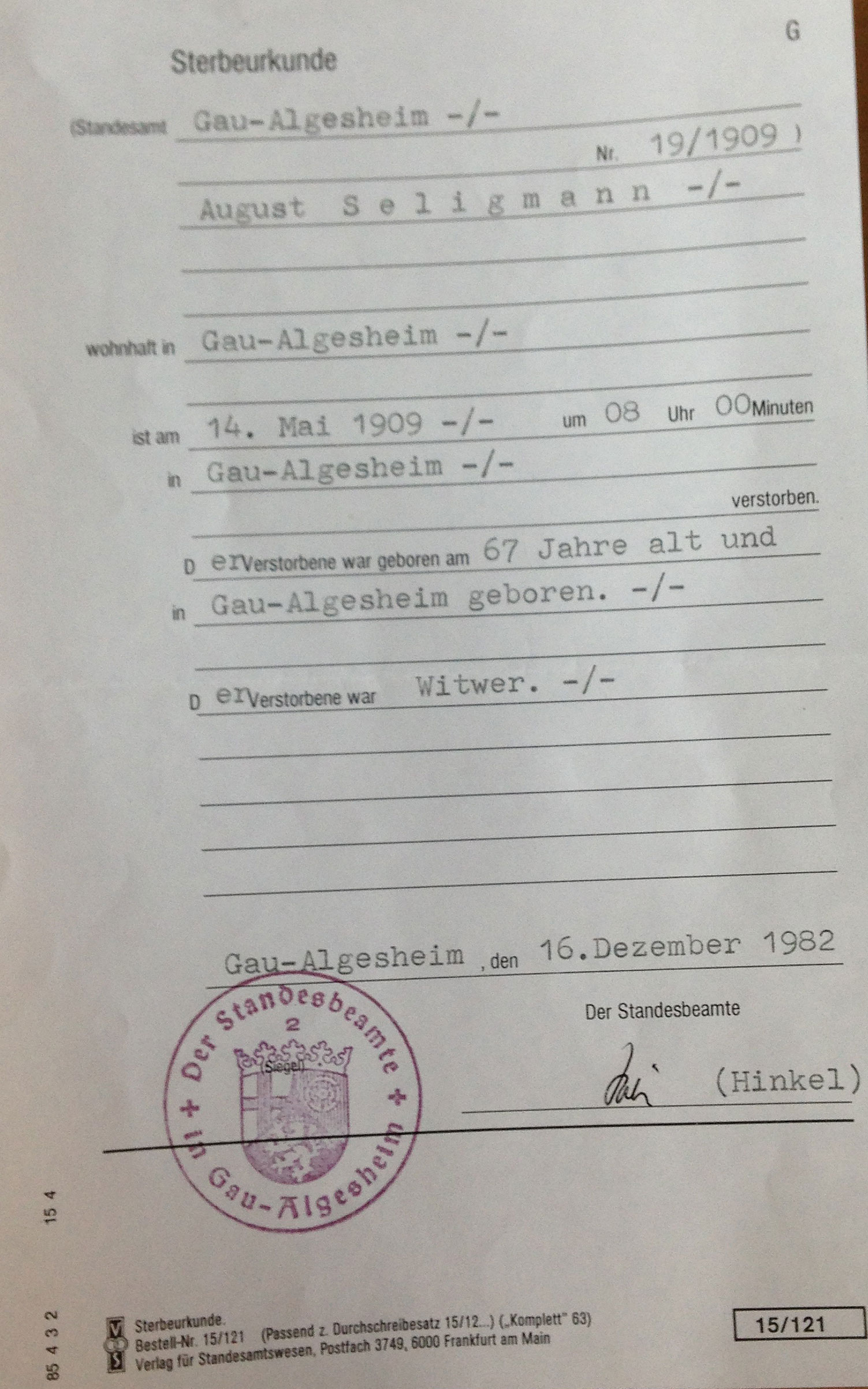
Several weeks ago, I received a comment on the blog from a man named Wolfgang Seligmann, saying he was the son of Walter Seligmann, that he lived near Gau-Algesheim, and that he had found my blog while doing some research on his family.  He asked me to email him, which I did immediately, and we have since exchanged many emails and learned that we are third cousins, once removed:  his great-great-grandparents were Moritz Seligmann and Babetta Schoenfeld, my great-great-great-grandparents.  His great-grandfather August was the brother of Sigmund, Adolph and Bernard Seligman, the three who had settled in Santa Fe in the mid-19th century.   Wolfgang sent me a copy of August’s death certificate.

August Seligmann death certificate

August Seligmann death certificate

(Translations in this post courtesy of Wolfgang Seligmann except where noted: Registry-Office Gau-Algesheim: August Seligmann, living in Gau-Algesheim died the 14th of May 1909 at 8 a.m. in Gau-Algesheim. He was 67 years old and born in Gau-Algesheim. He was a widower.)

Our families had probably not been in touch since Bernard died in 1902 (or perhaps when Adolph died in 1920).  And now through the miracle of the internet and Google, Wolfgang had found my blog with his family’s names in it and had contacted me.  What would our mutual ancestors think of that?  It even seems miraculous to me, and I live in the 21st century.

Fortunately, Wolfgang’s English is excellent (since my knowledge of German is…well, about five words), and so we have been able to exchange some information about our families, and I have learned some answers to questions I had about the Seligmanns who stayed in Germany.  With Wolfgang’s permission, I would like to share some of those stories.

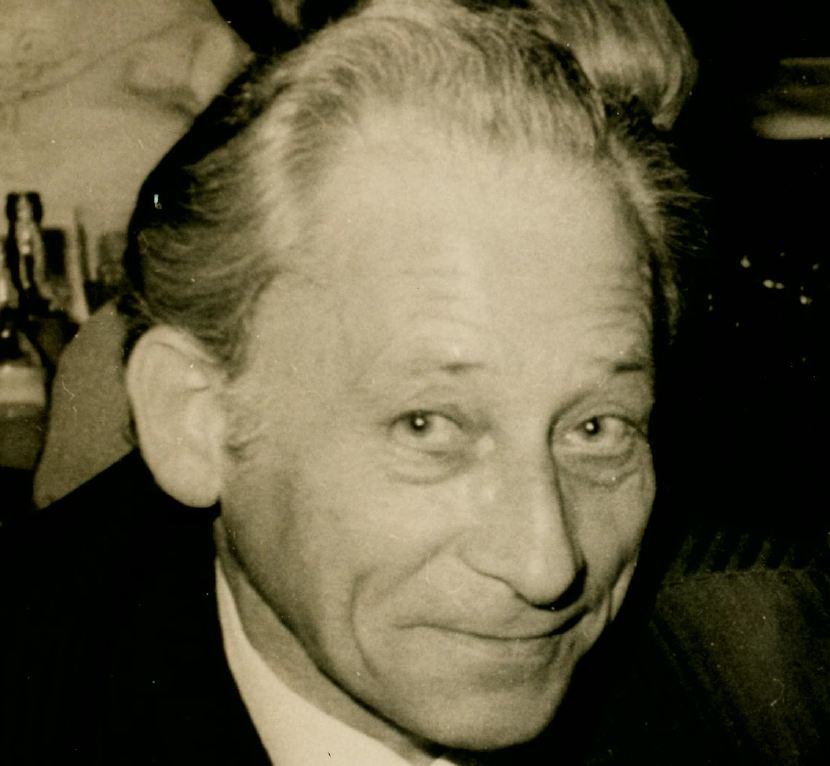
Wolfgang’s grandfather was Julius Seligmann, the second child and oldest son of August Seligmann and his wife Rosa Bergmann.  Julius was born in 1877 in Gau-Algesheim.  As I wrote about here, Julius was one of the Seligmanns written about in Ludwig Hellriegel’s book about the Jews of Gau-Algesheim.  He had been a merchant in the town.  On December 1, 1922, Julius had married a Catholic woman named Magdalena Kleisinger, who was born in Gau-Algesheim on July 9, 1882, and had himself converted to Catholicism.  Julius and Magdalena had two sons, Walter, who was born February 10, 1925, and Herbert, born July 27, 1927.  Julius and his family had left Gau-Algesheim for Bingen in 1939 after closing the store in 1935.

I had wondered why Julius had closed the store and then relocated to Bingen, and I asked Wolfgang what he knew about his grandfather’s life.  According to Wolfgang, his father Walter and uncle Herbert did not like to talk about the past, but Wolfgang knew that when Julius married and converted to Catholicism, his Jewish family was very upset and did not want to associate with him any longer.  In fact, Julius was forced to pay his siblings a substantial amount of money for some reason relating to his store in Gau-Algesheim, and that payment caused him and his family a great deal of financial hardship.  According to Wolfgang, Julius no longer had enough money to pay for his own home, and thus he and his family moved to Bingen in 1939 where they lived with Magdalena’s family or friends for some time.

Julius and Magdalena Seligmann

Julius and Magdalena Seligmann 1960s  Courtesy of Wolfgang Seligmann

The Hellriegel book also made some puzzling (to me) references to the military records of Wolfgang’s father and uncle, saying that they had been “allowed” to enlist in the army, but then were soon after dismissed.  Wolfgang explained that the German authorities did not know how to treat Catholic citizens with Jewish roots.  Wolfgang said that his father Walter had trained to be a pharmacist, but the Nazis would not allow him to work with anything poisonous.  In addition,  his father was not permitted to be in the army; instead  he was ordered by the authorities to work on the Siegfried Line, which was  originally built as a defensive line by the Germans during World War I.  In August 1944, Hitler ordered that it be strengthened and rebuilt, and according to Wikipedia, “20,000 forced labourers and members of the Reichsarbeitsdienst (Reich Labour Service), most of whom were 14–16-year-old boys, attempted to re-equip the line for defence purposes.”  Walter Seligmann was one of those forced laborers.

Map of the Siegfried line.

Map of the Siegfried line. (Photo credit: Wikipedia)

Here is a photograph of Walter Seligmann, Wolfgang’s father:

Walter Seligmann  Photo courtesy of Wolfgang Seligmann

Walter Seligmann Photo courtesy of Wolfgang Seligmann

As for Wolfgang’s uncle Herbert, he was sent by the local police to the army, but the army would not accept him.  He was dismissed and sent back to Bingen, where he was required to work in a warehouse until the war ended.

Herbert Seligmann courtesy of Christoph Seligmann

Herbert Seligmann courtesy of Christoph Seligmann

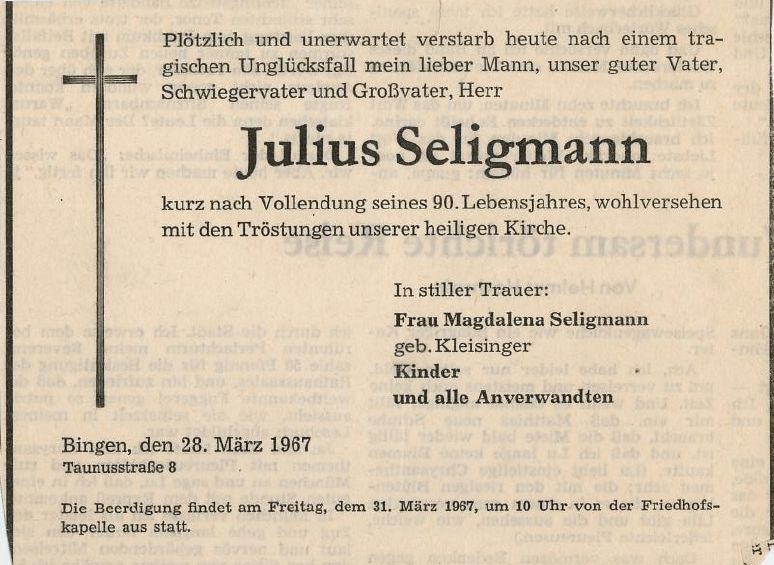
Julius Seligmann died in 1967, and his wife Magdalena died the following year.  Walter Seligmann died in 1993, and his brother Herbert died in 2001.

Julius Seligmann death notice

Julius Seligmann death notice

Magdalena Seligmann death notice

There are some very bitter ironies in these stories.  Julius and his family were not accepted by his Jewish family because they were Catholic, but the Nazis did not accept them either because they had Jewish roots.  As I commented to Wolfgang, prejudice of any sort is so destructive and unacceptable.  His family experienced it from two different directions.

Not that the two examples here can be equated in any way.  Although all prejudice is wrong, prejudice that leads to genocide is utterly reprehensible, an evil beyond comprehension for anyone who has a moral compass.  I have already written about my own personal horror and pain when I realized that I had family who had been murdered by the Nazis.  Wolfgang told me more about some of those who lost their lives to Hitler and his evil forces.

One victim was his great-uncle Moritz Seligmann (the grandson of Moritz Seligmann, my 3x-great-grandfather, and a son of August Seligmann).  My information about his fate comes from two websites that Wolfgang shared with me. According to these two sites, Moritz Seligmann, Julius’ younger brother, was born on June 25, 1881.  He fought in World War I for Germany, spent two years in captivity, and was honored with the Hindenburg Cross or Cross of Honor for his service.  Despite this, in the aftermath of Kristallnacht, on November 11, 1938, Moritz was arrested in Konigstein, where he had been living since 1925.  He was sent to the concentration camp at Buchenwald.

German Cross of Honour 1914-1918

German Cross of Honour 1914-1918 (Photo credit: Wikipedia)

Moritz wrote to the authorities in Konigstein, pointing out that he was the recipient of the Hindenburg Cross.  He was released from Buchenwald in December on the condition that he emigrate by March 31, 1939.  He was required to report to the police in Konigstein twice a week until then, and if he had not emigrated by the deadline, he was to be arrested.  On March 28, 1939, however, the Gestapo lifted the emigration order and the reporting requirement in light of Moritz’s service during World War I.

Here is a copy of the Gestapo letter, lifting the emigration order.  I found this a particularly chilling document to see.

Gestapo letter re Moritz Seligmann

Wolfgang helped me translate this letter as follows: Frankfort, March 20, 1939. Concerning: the “Aktionsjude” Moritz Seligmann born June 25, 1881, Gau-Algesheim, residing in Konigstein.  Seligmann has provided proof that he was a soldier in the World War as a combatant.  Therefore the reporting obligation and emigration order is lifted for him. I would ask the emigration (?) to supervise and notify us here.

As explained to me by Wolfgang and by Wikipedia,  the “Aktionsjude” referred to 26,000 Jews who were deported in the aftermath of Kristallnacht, as was Moritz Seligmann, as part of an effort to frighten other Jews to leave Germany.  Unfortunately, not enough of them did.

Despite the lifting of the order to emigrate, Moritz had hoped to immigrate to the US.  For various bureaucratic reasons described here, he was unable to get clearance to emigrate.  On June 10, 1942, he was picked up by the Nazis and transported somewhere to the east.  Exactly where and when he died is not known.

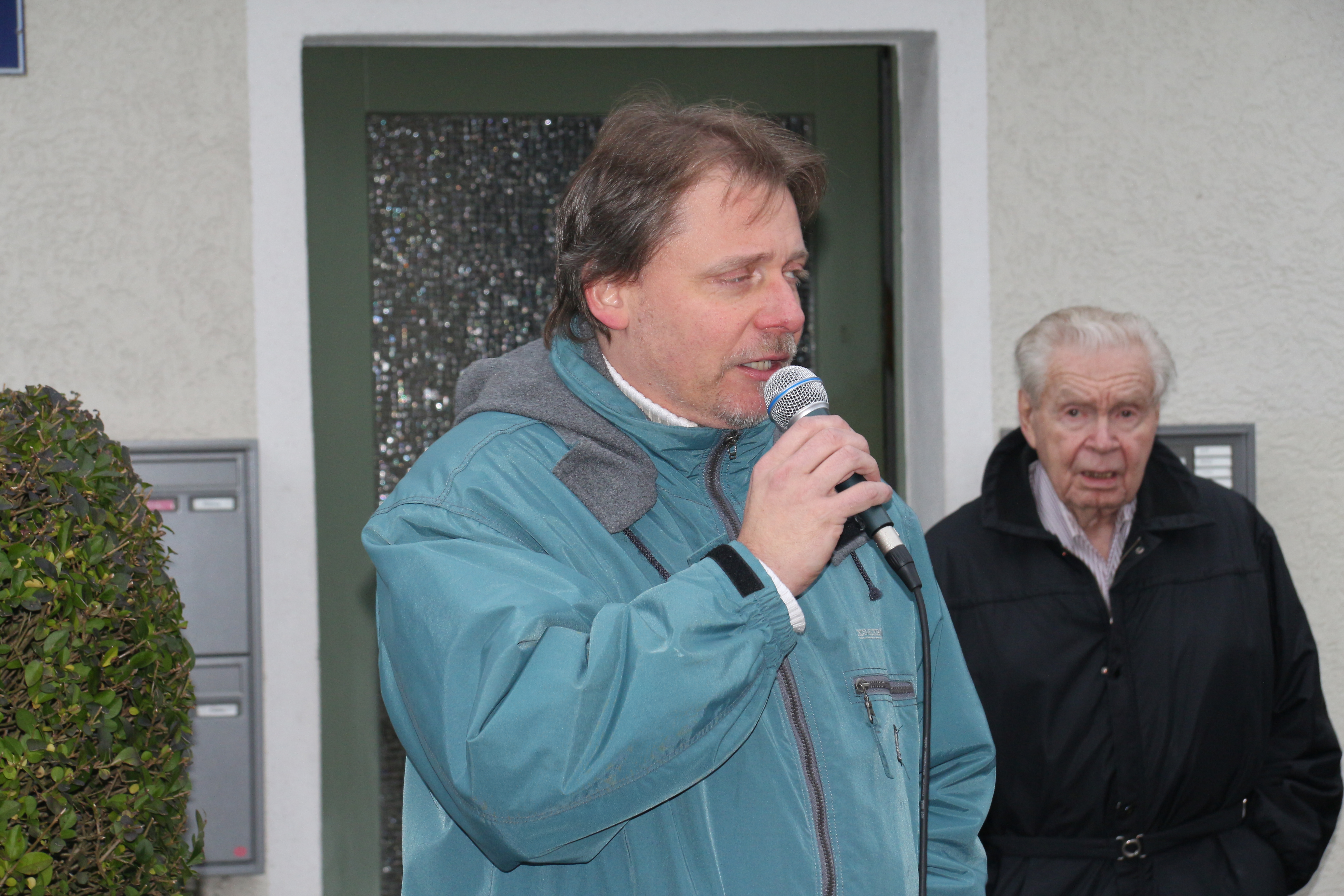
Wolfgang and his family, after researching the fate of Moritz, informed the town of Konigstein of their findings, and the town agreed to place a “stolperstein” in memory of Moritz Seligmann near his home in Konigstein.  A stolperstein (literally, a stumbling blog) is a memorial stone embedded in the ground to memorialize a victim of the Holocaust.  Here is a photograph of Wolfgang at the ceremony when Moritz Seligmann’s stolperstein was installed in Konigstein.

Wolfgang Seligmann

Wolfgang Seligmann  Courtesy of Wolfgang Seligmann

Behind him is a man who knew Moritz and remembered when Moritz was initially arrested in 1938, clinging to his Hindenburg Cross, believing it would save him from the murderous forces of the Nazis.  It may have stalled his murder, but it did not save him.

Wolfgang also told me about the fate of another sibling of his grandfather Julius, his younger sister Anna.  Anna, born in Gau-Algesheim in 1889, had married Hugo Goldmann, and they had a daughter Ruth, born in 1924 in Neunkirchen, a town about 80 miles southwest of Gau-Algesheim, where Anna and Hugo had settled. Between 1939 and 1940, many people from this area near the border with France were evacuated to locations in central Germany, and Anna, Hugo, and Ruth ended up in Halle, Germany, 350 miles to the northeast of Neunkirchen.  On June 1, 1942, they were all deported from Halle to the Sobibor concentration camp where they were all killed.  Click on each name to see the memorial pages established by the town of Halle in memory of Anna, Hugo, and Ruth.

Finally, Wolfgang told me about another member of the family.  Moritz Seligmann (the elder) had had a daughter Caroline with his first wife, Eva Schoenfeld.  Caroline was the half-sister of my great-great-grandfather Bernard. She had married a man named Siegfried Seligmann, perhaps a cousin.  Their son, Emil, died in Wiesbaden on August 9, 1942, when he was 78 years old.

Death record of Emil Seligmann, husband of Carolina Seligmann

Death record of Emil Seligmann, husband of Carolina Seligmann

(Wiesbaden: The Emil Jakob Israel Seligmann, without profession, “israelitisch”  [presumably meaning Jewish], living in Wiesbaden, Gothestraße Nr. 5, died on 9th of August 1942 in his Apartment. He  was born on 23th of December 1863 in Mainz.

Father: Siegfried Seligmann, deceased.  Mother: Karoline Seligmann, nee Seligmann, deceased.  He was widower of Anna Maria Angelika born as Illien. The death was announced by Emil Seligmann, his son, living Goethestraße Nr.5.

The stamp in the left hand margin says:  Wiesbaden, 31th of May 1949.  The “Zwangsvorname”Israel is deleted.  Zwangsvorname translates as “forced first name,” meaning that the name Israel had been required by the Nazis, I assume as a way to identify him as Jewish.

Emil had a son, also named Emil, who died in Buchenwald, as this record attests.

Emil Seligmann-KZ (1)

(To: Miss Christine Seligmann, Wiesbaden, Goethestr. Nr. 5,1

From: Special registry-office in Arolsen-Waldeck, department Buchenwald

Subject: death-certification for Emil-Jakob Seligmann, Your letter from the 1. of March 1950

Based on the documents of the International Tracing Service in Arolsen it is proved, that your brother died on 14th of February 1945 in the Concentration Camp Buchenwald. )

I imagine that this is not the end of the list of the Seligmanns who were murdered during the Holocaust, and I imagine that there are also many other family members I never knew about who were killed by the Nazis, whether they were named Schoenfeld, Nussbaum, Dreyfuss, Goldschlager, Rosenzweig, Cohen, or Brotman or something else.  I just haven’t found them yet.

Wolfgang and I plan to keep on exchanging stories, pictures, documents, and other information.  We have also already talked about meeting someday and walking in the footsteps of our mutual ancestors.  What an honor it will be to be with him as we share our family’s story.