Siegmund Rothschild: Escape from Nazi Germany

It’s been a few weeks since I wrote about the family of Gelle Blumenfeld Rothschild, given the breaks for some updates, Passover, and our trip to England. Today I return to Gelle’s story, specifically the story of her son Gerson Rothschild. In my last post about Gerson, we saw he died in 1930 and was survived by his wife Fanny Kugelmann and eight children.

In my next series of posts, I will write about the eight surviving children of my cousin Gerson Rothschild and his wife Fanny Kugelmann. Only three of those children survived the Holocaust, making this task a very painful one. But I can start with one of those three who survived, the oldest child of Gerson and Fanny, their son Siegmund.

As we saw, Siegmund married Elise Olga Block on December 22, 1919, in Frankfurt, and they had two sons, Ernst, born March 1, 1922, and Werner, born January 12, 1928, both in Frankfurt. There is a wonderful resource about this family on the Projekt Judische Leben Frankfurt am Main website. Based in part on information obtained during a visit to Frankfurt by Werner Rothschild in 2019, the website details the family’s life before, during, and after the Nazi era. Much of the information in this post came from that website.

According to that website, Siegmund Rothschild moved to Frankfurt in 1911 and was known as “a valued historian with good contacts abroad and president of the liberal main synagogue in Frankfurt.”  He taught at Philanthropin, a free Reform Jewish school founded in 1804 in Frankfurt. An article from the Encyclopedia of Jewish History and Culture abstracted here states that the school was “one of the most significant German Jewish Reform projects in the first half of the 19th century.” Siegmund’s wife Elise also taught at Philanthropin on and off between 1913 and 1939.

UPDATE: I learned from Siegmund’s grandson Alex that Siegmund fought for Germany during World War I. Here is a photo of him from that time.
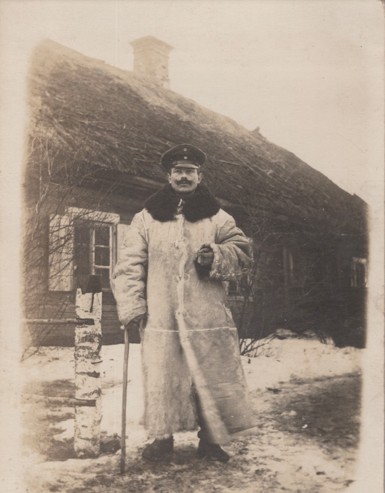
Siegmund Rothschild c. 1915
Courtesy of the family

Siegmund and his family were living a good life in Frankfurt, identifying more as German than Jewish, until Hitler came to power in 1933. Siegmund’s son Werner recalled that one friend joined Hitler Youth and stopped talking to him. Another time while visiting family in Borken, he and his cousins were tormented by Hitler Youth.

Here is the family in January 1938:

Siegmund, Werner, Ernst, and Elise (Bloch) Rothschild, January 1938.

As for Ernst, the older son, according to the Projekt Judische Leben Frankfurt website, he had always dreamed of being a dentist, but under Nazi persecution he was not allowed to pursue the studies to reach that goal. Instead he ended up working as an apprentice in a leather dressing business after leaving school in 1937. But when that business was Aryanized in 1938, Ernst lost his job.

The family’s situation became even more dire in November 1938 with Kristallnacht.  As reported on the Projekt Judische Leben website, “For Werner… the worst day of his young life was the so-called “Reichskristallnacht.” He saw furniture fly out of the windows and buildings burn. Immediately afterwards, his father was picked up by the Gestapo. They gave [Siegmund] ten minutes to pack his things, then they deported him to Buchenwald. Fortunately, [Ernst] was not at home or he would have been arrested too.” Elise did everything she could to get Siegmund released; he was released in December 1938 with orders to leave Germany quickly.

The Projekt Judische Leben Frankfurt website continued, “Siegmund was a broken man when he came home and it took weeks and intensive care from his wife before he regained his strength. As soon as his health permitted, he traveled to England with his son Ernst, with ten Marks in his pocket. More was not allowed per person. The only contact there was with two of Elise’s brothers who had emigrated from Ratibor in 1935 and opened a dental practice in London.”

Meanwhile, Elise and Werner remained in Frankfurt until Elise arranged in 1939 for Werner to leave Germany as part of the Kindertransport program. Werner took the train alone to Hamburg and was forced to strip naked so that the Gestapo could check to be sure he wasn’t taking anything prohibited with him. In Hamburg he took a ship to England, where he  was placed in a youth hostel.1

Once Elise also was able to escape to England, the family was reunited in London and Werner was able to attend school.   The 1939 England & Wales Register shows Siegmund and Elise living in London.2 But after the war started against Germany in September 1939, Ernst was interned as an enemy alien; Siegmund and Elise, however, were exempted from internship. Werner was just a child.
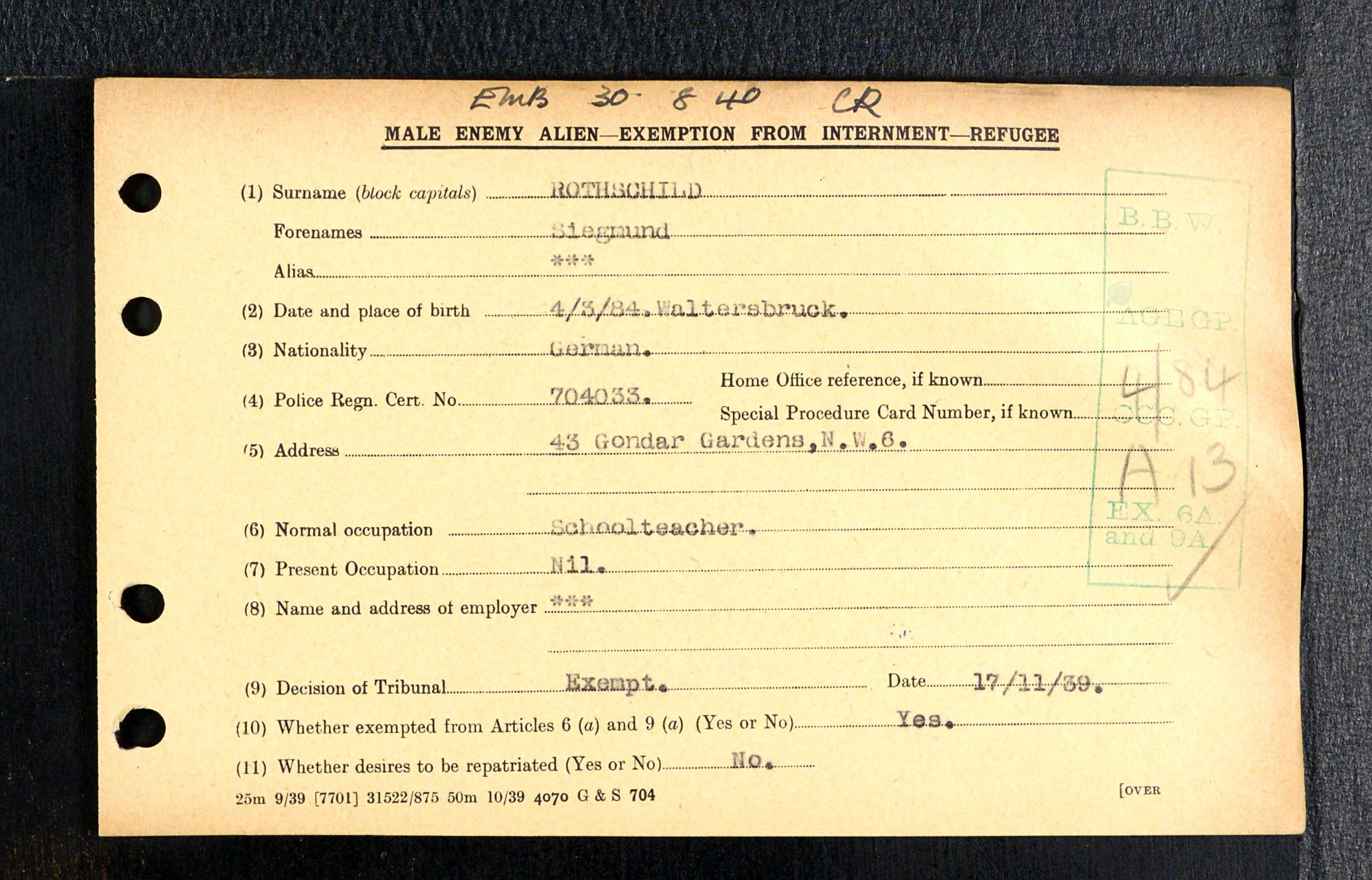
Siegmund Rothschild, The National Archives; Kew, London, England; HO 396 WW2 Internees (Aliens) Index Cards 1939-1947; Reference Number: HO 396/238, Piece Number Description: 238: Dead Index (Wives of Germans Etc) 1941-1947: Rosenber-Schitz, Ancestry.com. UK, World War II Alien Internees, 1939-1945

Elise Rothschild, The National Archives; Kew, London, England; HO 396 WW2 Internees (Aliens) Index Cards 1939-1947; Reference Number: HO 396/238, Piece Number Description: 238: Dead Index (Wives of Germans Etc) 1941-1947: Rosenber-Schitz, Ancestry.com. UK, World War II Alien Internees, 1939-1945

Ernst Rothschild, The National Archives; Kew, London, England; HO 396 WW2 Internees (Aliens) Index Cards 1939-1947; Reference Number: HO 396/193, Ancestry.com. UK, World War II Alien Internees, 1939-1945

Ernst was eventually released, and the family was finally able to immigrate to the United States in the summer of 1940, as we will see. Then they had to start their lives all over again. More on their life in the US in the next post.


  1. Werner Rothschild, Gender Male, Record Type Refugee List, Birth Date 12 Jan 1928, Residence Place Frankfurt, Document Date 22 Mär 1939 (22 Mar 1939)
    Permit Number 3813, United States Holocaust Memorial Museum; Washington, D.C.; Series: Selected Records Relating to Kindertransports; Record Group: RG-59.075; File Number: mh55-704.00000088, Ancestry.com. UK, Selected Records Relating to Kindertransport, 1938-1939 (USHMM) 
  2. Siegmund Rothschild, The National Archives; Kew, London, England; 1939 Register; Reference: RG 101/244E, Description Enumeration District: Akde, Ancestry.com. 1939 England and Wales Register 

Levi Rothschild’s Children Part III: Escaping The Holocaust to South Africa, New York, and Palestine/Israel

Of the six children of Levi Rothschild and Clara Jacob who lived to adulthood in Germany, amazingly all but one escaped from Germany in time to avoid being killed by the Nazis. Only the youngest sibling Frieda was not as fortunate. But that doesn’t mean that there wasn’t suffering and loss endured by the other five. This post will focus on the three oldest children: Sigmund, Betti, and Moses.

Sigmund Rothschild and his wife Fanny Rosenbaum escaped to South Africa. I don’t know when or how they immigrated there, but Fanny died there on August 20, 1942, in Capetown at the age of  62.

Fanny Rosenbaum Rothschild death record, Municipality or Municipality Range: Cape Town
Ancestry.com. Cape Province, South Africa, Civil Deaths, 1895-1972

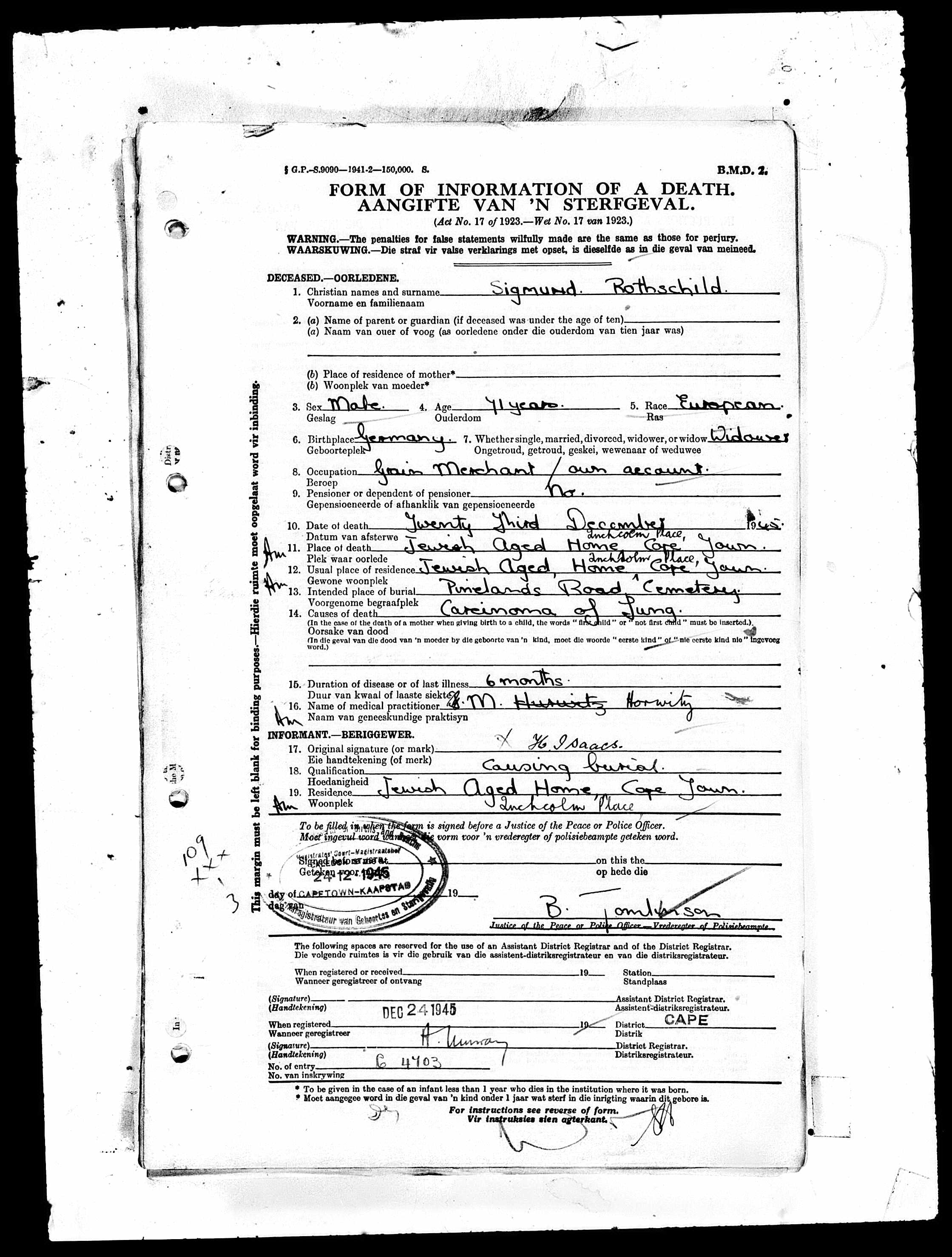
Her husband Sigmund died in Capetown three years later on December 23, 1945; he was 71.

Sigmund Rothschild death record, Municipality or Municipality Range: Cape Town
Ancestry.com. Cape Province, South Africa, Civil Deaths, 1895-1972

As for Sigmund and Fanny’s son Kurt, I have very little information. An entry in the England & Wales Civil Registration Death Index on Ancestry shows that he died in Lancaster, England, and that the death was registered in September 1997.1 A FindAGrave entry shows his gravestone with the date of death as August 30, 1997.

Find a Grave, database and images (https://www.findagrave.com/memorial/81923216/kurt-rothschild: accessed April 19, 2024), memorial page for Kurt Rothschild (1910–3 Sep 1997), Find a Grave Memorial ID 81923216, citing Lytham Park Cemetery and Crematorium, Lytham Saint Annes, Fylde Borough, Lancashire, England; Maintained by ProgBase (contributor 47278889).

The Ancestry tree that appears to have been created by Kurt’s daughter-in-law shows that Kurt married Erna Erdmann and had one child, who is the home person on that tree. I have not been able to find a marriage record for Kurt and Erna Erdmann or a birth record for their child, so I am hoping that the owner of that tree will respond to the message I sent to help me find out what happened to Kurt Rothschild and his family. But since it’s been well over two months at this point, I am not optimistic that I will hear from her anytime soon.

The second child of Levi and Klara, their daughter Betti, lost her husband Emanuel Hirschmann on November 4, 1932. He died in Fulda, Germany, and was 64.

Emanuel Hirschmann death record, Hessisches Hauptstaatsarchiv; Wiesbaden, Deutschland; Personenstandsregister Sterberegister; Signatur: 2470, Year Range: 1932, Ancestry.com. Hesse, Germany, Deaths, 1851-1958

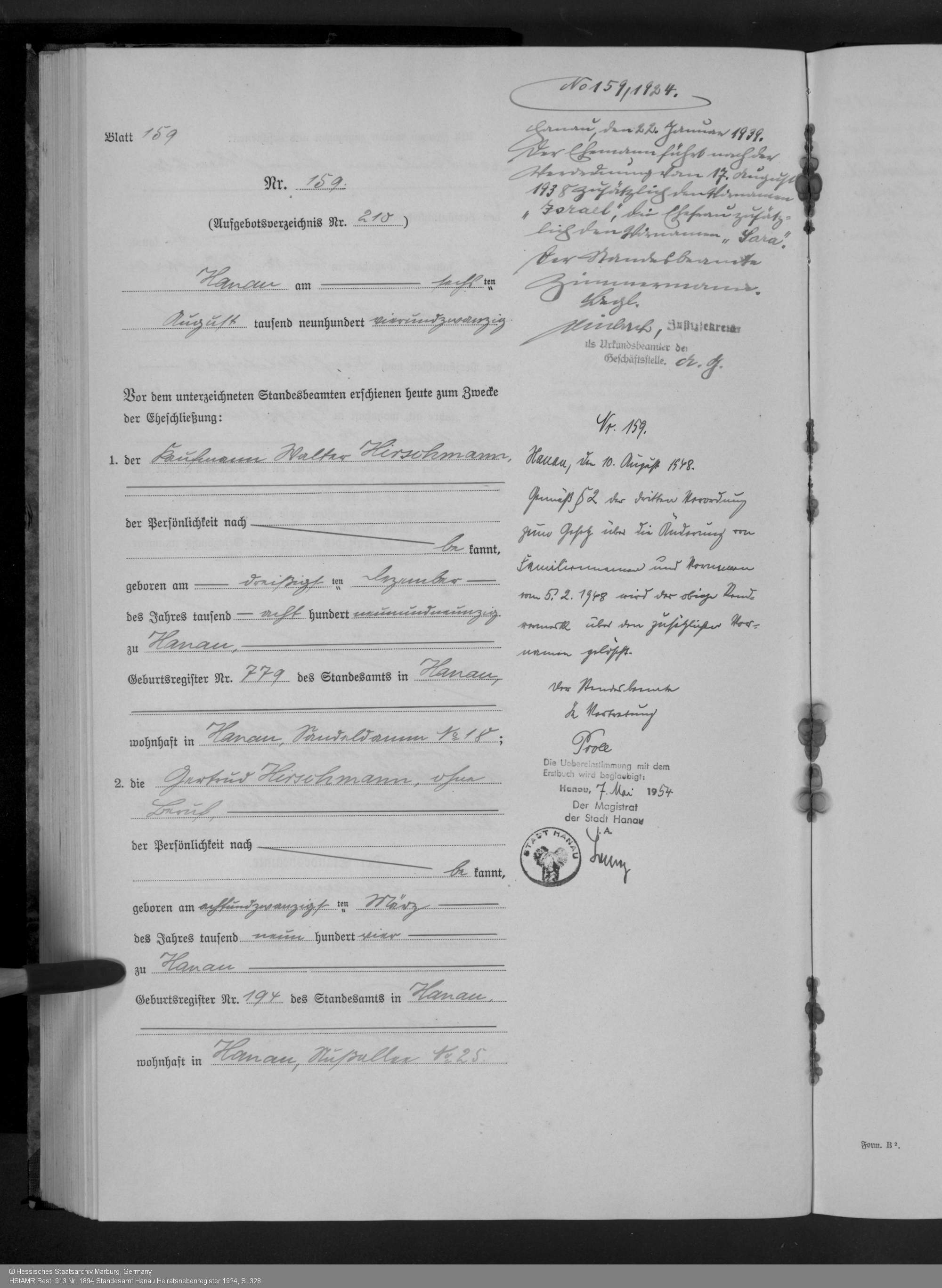
Their son Walter had married Gertrud Hirschmann on August 6, 1924, in Hanau, Germany. Gertrud was born in Hanau on March 28, 1904, according to their marriage record, but that record does not include her parents’ names. It would appear that Gertrud was likely a relative given the surname and her birth place, but so far I’ve not found any way to connect her to Walter’s Hirschmann relatives.

Walter Hirschmann and Gertrude Hirschmann marriage record, LAGIS Hessen Archives, Standesamt Hanau Heiratsnebenregister 1924 (HStAMR Best. 913 Nr. 1894)AutorHessisches Staatsarchiv MarburgErscheinungsortHanauErscheinungsjahr1924, p. 328

Walter Hirschmann and Gertrude Hirschmann marriage record, p. 2

Walter and Gertrud and their twelve year old daughter immigrated to the US on a December 15, 1938. Walter listed his occupation as a banker and their last residence as Frankfurt, Germany, where his mother “B. Hirschmann” was still residing. They were heading to a friend, L. Schwarzchild, in New York.2

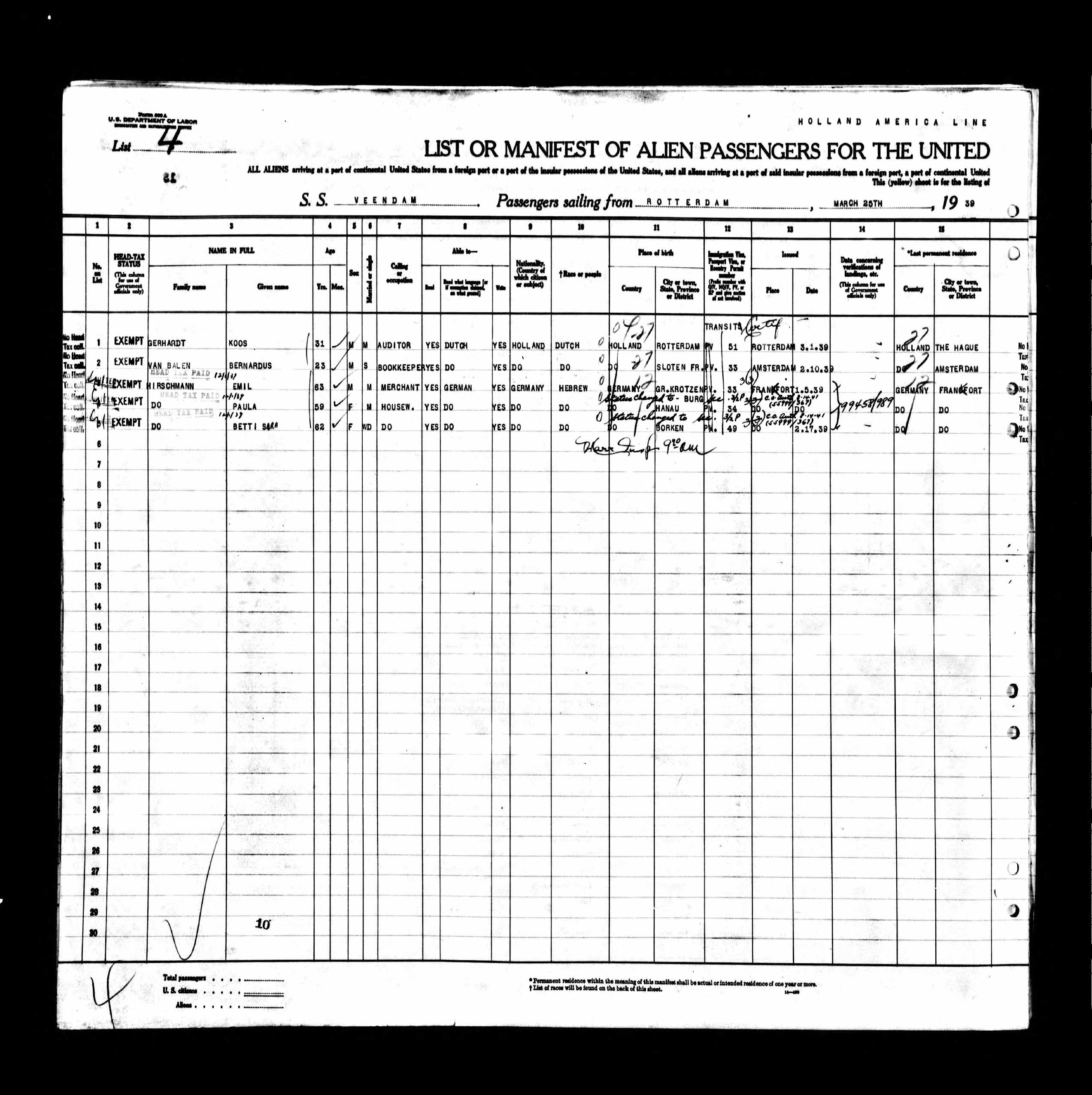
Walter’s mother Betti Rothschild Hirschmann immigrated to the US on March 25, 1939, with a cousin of her husband, Emil Hirschmann, and his wife Paula.

Betti Rothschild passenger manifest, The National Archives in Washington, DC; Washington, DC, USA; Passenger and Crew Lists of Vessels Arriving at New York, New York, 1897-1957; Microfilm Serial or NAID: T715; RG Title: Records of the Immigration and Naturalization Service, 1787-2004; RG: 85, Ship or Roll Number: Veendam, Ancestry.com. New York, U.S., Arriving Passenger and Crew Lists (including Castle Garden and Ellis Island), 1820-1957

On the 1940 census, Betti was living as a lodger in the household of Helena Pessel in New York City, but in the same building as her son Walter and his family at 670 Riverside Drive in New York City. Walter was employed as a salesman.3

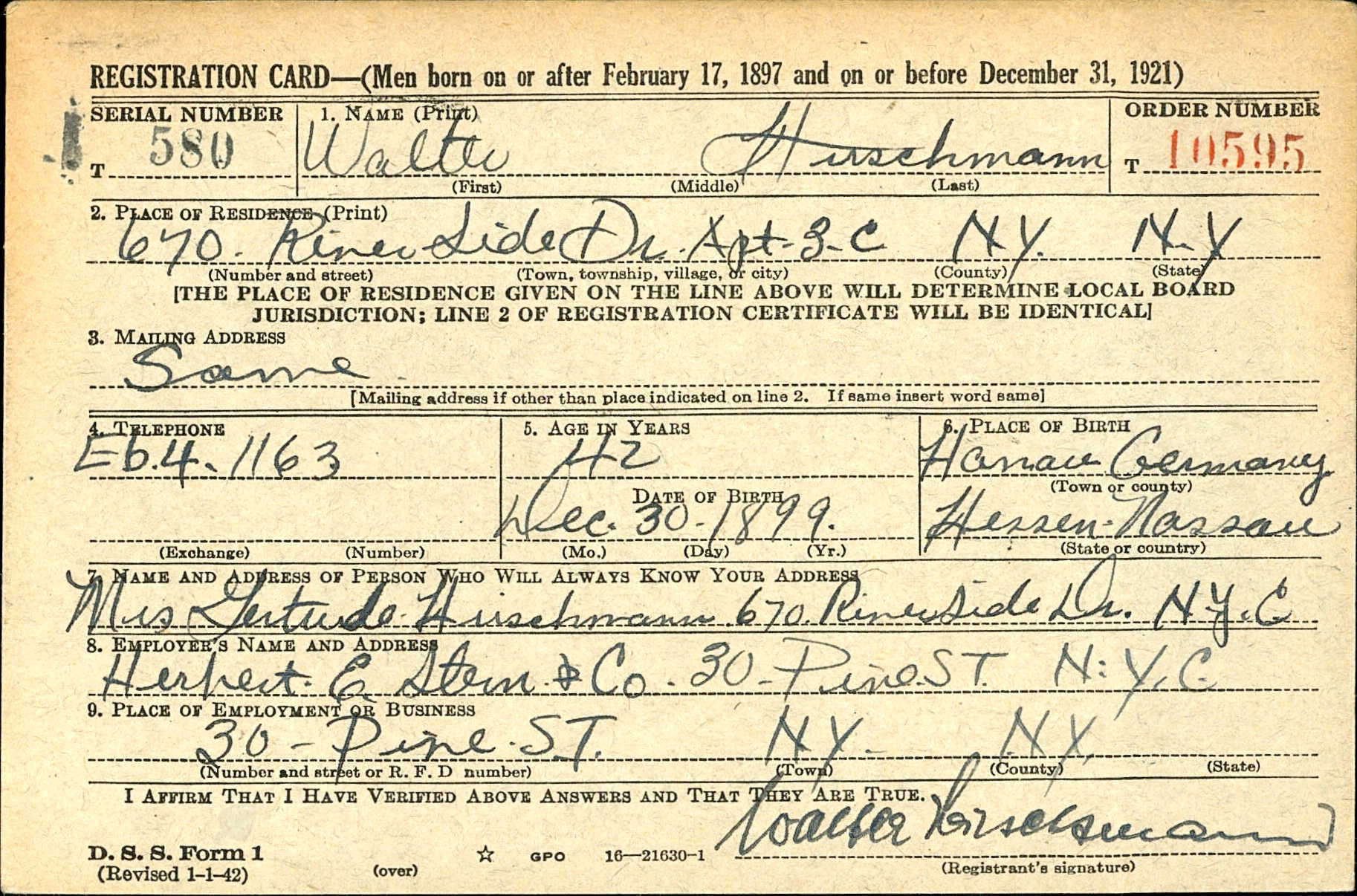
On his World War II draft registration, Walter identified his employer as Herbert E. Stern & Company. From his obituary I learned that Herbert E. Stern was also a refugee from Nazi Germany and an investment banker.4

Walter Hirschmann World War II draft registration, National Archives at St. Louis; St. Louis, Missouri; Wwii Draft Registration Cards For New York City, 10/16/1940 – 03/31/1947; Record Group: Records of the Selective Service System, 147, Name Range: Hirsch, Walfgang-Hobbs, Robert, Ancestry.com. U.S., World War II Draft Cards Young Men, 1940-1947

In 1950 Betti was still living in the same building as her son Walter and his family. Walter was still working as a broker and banker. I am very grateful to Eric Ald of Tracing the Tribe who found the 1950 census record for Betti and also a listing on Ancestry in the New York, New York Death Index for a Betty Hirschmann who died on February 15, 1956.5

Walter Hirschmann and Betty Hirschmann, 1950 US census, National Archives at Washington, DC; Washington, D.C.; Seventeenth Census of the United States, 1950; Year: 1950; Census Place: New York, New York, New York; Roll: 6203; Page: 75; Enumeration District: 31-1900, Ancestry.com. 1950 United States Federal Census

Her son Walter Hirschmann died on June 24, 1977, at the age of 77.6 He had been predeceased by his wife Gertrud, who died in December 1966 7 and was survived by their daughter and grandchildren.

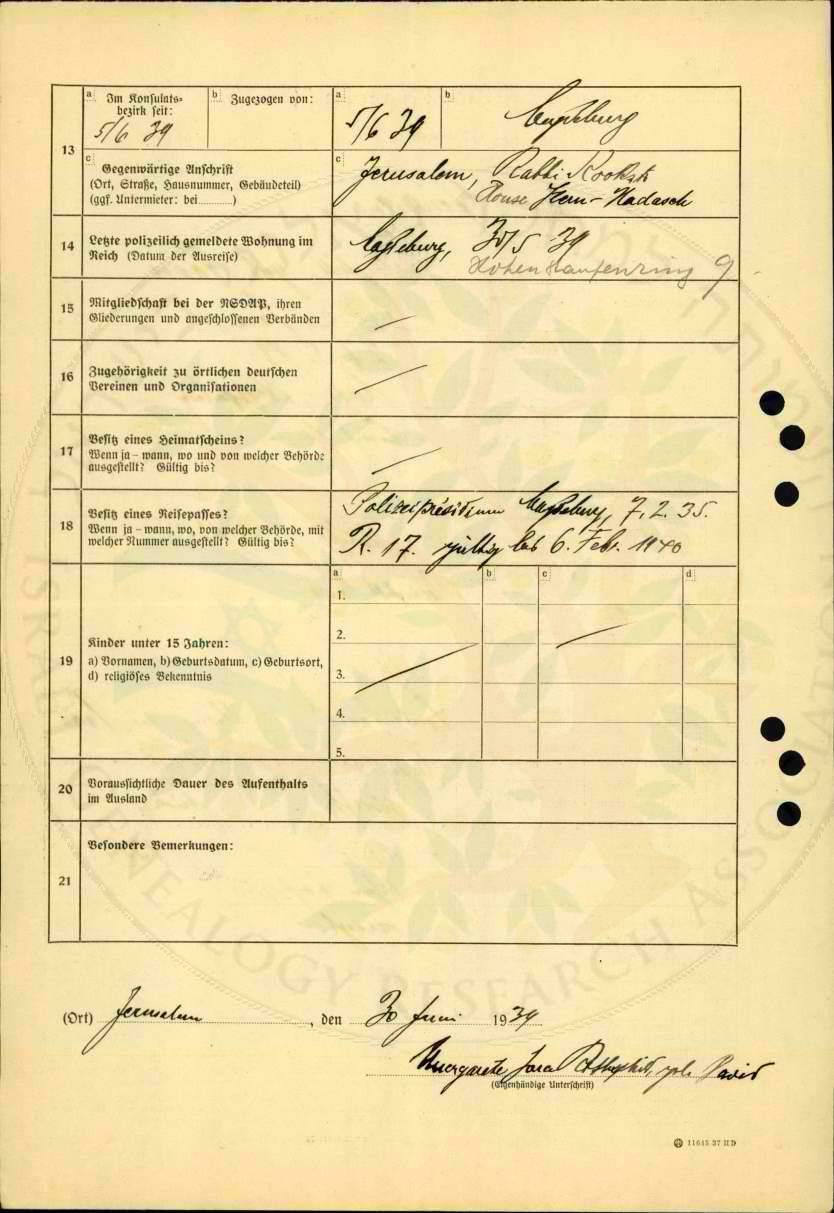
Sigmund and Betti’s brother Moses/Moritz Rothschild and his wife Margarete David ended up in Israel/Palestine in the 1930s along with their two children, Ruth, born October 8, 1914, in Magdeburg, Germany, and Herbert (later Yehuda), born December 10, 1921, in Magdeburg. The documents below are immigration documents showing that Moritz and Margarete were in Jerusalem by June 30, 1939; these and the others that follow were found at the Israel Genealogy Research Association website.

Registration form for Margarete David Rothschild reporting to the German Embassy Legation at the German Consulate General Consulate Bizekonsult in Jerusalem, A-B (טפסי הרשמה: A-B), part of the Residents 1938-1939 (תושבים 1938-1939) database, system number פ-500/5, IGRA number 1459. The original records are from Israel State Archives (ארכיון המדינה), and found at the IGRA website.

Registration form for Margarete David Rothschild reporting to the German Embassy Legation at the German Consulate General Consulate Bizekonsult in Jerusalem, A-B (טפסי הרשמה: A-B), part of the Residents 1938-1939 (תושבים 1938-1939) database, system number פ-500/5, IGRA number 1459. The original records are from Israel State Archives (ארכיון המדינה), and found at the IGRA website.

Registration form for Moses Moritz Rothschild, This record comes from the Meldeblaetter: A-B (טפסי הרשמה: A-B), part of the Residents 1938-1939 (תושבים 1938-1939) database, system number פ-500/5, IGRA number 1462. The original records are from Israel State Archives (ארכיון המדינה), and found at the IGRA website.

Registration form for Moses Moritz Rothschild, This record comes from the Meldeblaetter: A-B (טפסי הרשמה: A-B), part of the Residents 1938-1939 (תושבים 1938-1939) database, system number פ-500/5, IGRA number 1462. The original records are from Israel State Archives (ארכיון המדינה), and found at the IGRA website.

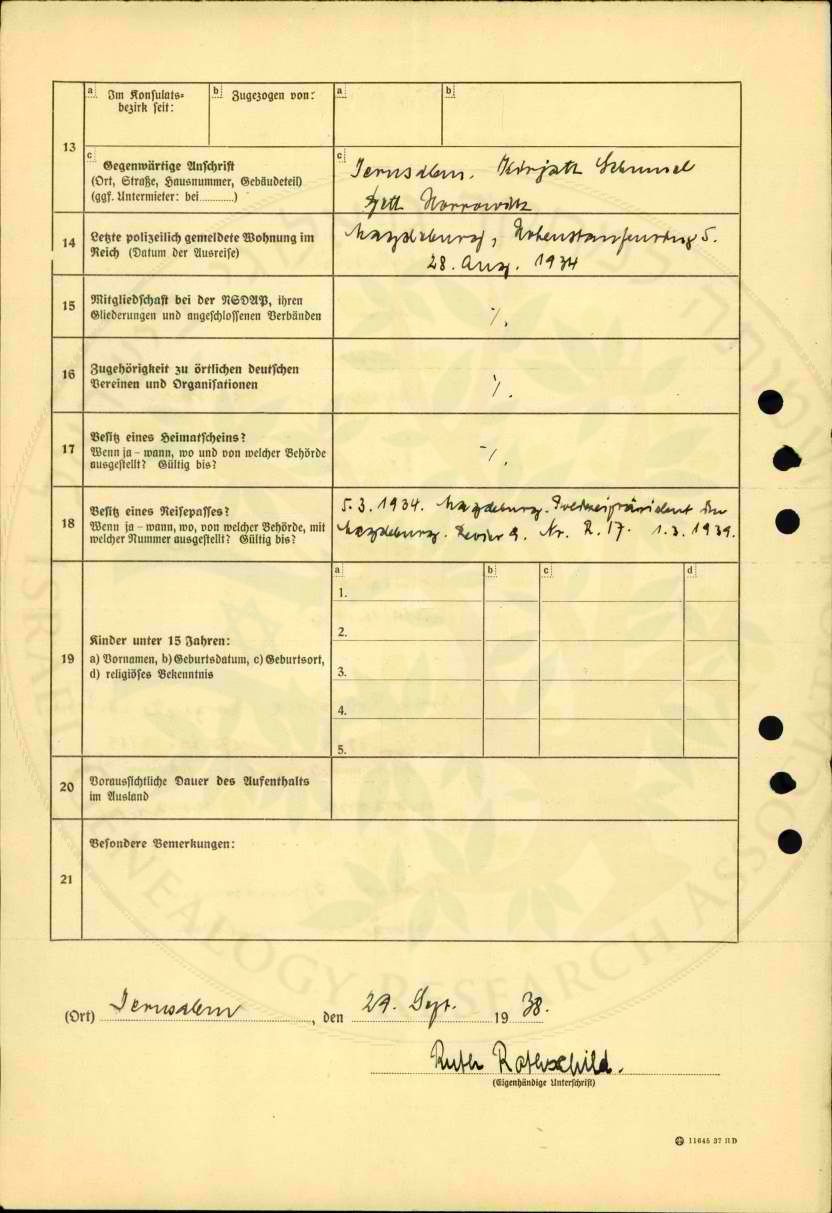
Their daughter Ruth had arrived by September 29, 1938.

Registration form for Ruth Rothschild reporting to the German Embassy Legation at the German Consulate General Consulate Bizekonsult in Jerusalem, A-B (טפסי הרשמה: A-B), part of the Residents 1938-1939 (תושבים 1938-1939) database, system number פ-500/5, IGRA number 1465. The original records are from Israel State Archives (ארכיון המדינה), as found at the IGRA website.

Registration form for Ruth Rothschild reporting to the German Embassy Legation at the German Consulate General Consulate Bizekonsult in Jerusalem, A-B (טפסי הרשמה: A-B), part of the Residents 1938-1939 (תושבים 1938-1939) database, system number פ-500/5, IGRA number 1465. The original records are from Israel State Archives (ארכיון המדינה), as found at the IGRA website.

Although I was unable to find a comparable record for Herbert/Yehuda, I found a record showing that he and his father Moritz were on the voter registration list and living at Kfar Yedidya in 1942:

Moritz and Yehuda Rothschild on 1942 Knesset register, This record comes from the Voters List Knesset Israel 1942 (פנקס הבוגרים של כנסת ישראל תש”ב), part of the Voters Knesset Israel 1942 (בוגרים של כנסת ישראל 1942) database, system number 001mush, document number 119, line 59, IGRA number 1107. The original records are from Israel State Archives (ארכיון המדינה), and was found at the IGRA website.

Yehuda married Ruth Hesin, daughter of Avraham and Hava, on April 17, 1949, in Haifa, Israel. She was 22 years old, he was 27.

Yehuda Rothschild marriage record, Marriage/Divorce Certificates (תעודות נישואין / גירושין), part of the Marriages and Divorces 1921-1948 Palestine British (נישואין וגירושין 1948-1921 ארץ ישראל) database, document number 91714, IGRA number 507. The original records are from Israel State Archives (ארכיון המדינה), and was found at the IGRA website.

At this time I have no further records for this family, but we know that at least they escaped from Germany in time to survive the Holocaust.

Thus, the first three children of Levi Rothschild and Clara Jacob all escaped from Nazi Germany in time, but look at what they lost. They were all spread across the globe: Sigmund in South Africa, Betti in the United States, and Moses in Palestine/Israel.

The fourth child of Levi and Klara, their son Hirsch Rothschild, also escaped. He and his wife Mathilde Rosenbaum and their three children Gertrude, Edith, and Edmund ended up, like Betti, in the US. I will write about Hirsch and his family in my next post.


  1. Kurt Rothschild, Death Age 87, Birth Date 30 Mar 1910, Registration Date Sep 1997, Registration district Lancaster, Inferred County Lancashire, Register Number A58B, District and Subdistrict 5871A, Entry Number 166, General Register Office; United Kingdom, Ancestry.com. England & Wales, Civil Registration Death Index, 1916-2007 
  2. Walter Hirschmann and family, passenger manifest, The National Archives in Washington, DC; Washington, DC, USA; Passenger and Crew Lists of Vessels Arriving at New York, New York, 1897-1957; Microfilm Serial or NAID: T715; RG Title: Records of the Immigration and Naturalization Service, 1787-2004; RG: 85, Ancestry.com. New York, U.S., Arriving Passenger and Crew Lists (including Castle Garden and Ellis Island), 1820-1957 
  3. Betti Hirschmann, 1940 US census, Year: 1940; Census Place: New York, New York, New York; Roll: m-t0627-02671; Page: 7B; Enumeration District: 31-1929, Ancestry.com. 1940 United States Federal Census. Walter Hirschmann and family, 1940 US census, Year: 1940; Census Place: New York, New York, New York; Roll: m-t0627-02671; Page: 7A; Enumeration District: 31-1929, Ancestry.com. 1940 United States Federal Census 
  4. “Herbert E. Stern Dead, An Investment Banker,” The New York Times, August 6, 1973, p. 32. 
  5. Betty Hirschmann, Age 75, Birth Date abt 1881, Death Date 15 Feb 1956, Death Place Manhattan, New York, New York, USA, Certificate Number 3638, Ancestry.com. New York, New York, U.S., Death Index, 1949-1965. Although there is a listing for Betti on the SSCAI with her Social Security Number, there is no listing on the SSDI for her under that number or under that date or under her name. Betty Sara Hirschmann, [Betty Sara Rohserild], Gender Female, Race White, Birth Date 14 Sep 1876, Birth Place Borken Hesse, Federal Republic of Germany, Father Levi Rohserild
    Mother, Clara Jacob, SSN 057200860, Notes Feb 1943: Name listed as BETTY SARA HIRSCHMANN, Ancestry.com. U.S., Social Security Applications and Claims Index, 1936-2007. 
  6. Walter Hirschmann death notice, The New York Times, June 27, 1977, p, 30. Walter Hirschmann, Social Security Number 092-14-5701, Birth Date 30 Dec 1899
    Issue year Before 1951, Issue State New York, Last Residence 10023, New York, New York, New York, USA, Death Date Jun 1977 Social Security Administration; Washington D.C., USA; Social Security Death Index, Master File,  Ancestry.com. U.S., Social Security Death Index, 1935-2014 
  7. Gertrud Hirschmann death notice, The New York Times, December 16, 1966, p. 47. 

Friederike Blumenfeld Schoen’s Son Jakob: Another Family Lost in the Holocaust

Friederike Blumenfeld Schoen died in 1927, as we saw, leaving behind her four surviving children, Jakob, Auguste, Moses, and Isaac, and her grandchildren. Thus, she was spared from experiencing the Holocaust and seeing what would happen to her children and their families.

Her oldest child, Jakob, was living a good life with his wife Hannah Freimark (sometimes known as Johanna, sometimes as Maria Anna.) Their daughter Ruth was born on New Year’s Day in 1924, as seen in this birth announcement published in Der Israelit newspaper in Frankfurt on January 3, 1924.

Der Israelit, 3 January 1924, page 7

Thank you once again to my cousin Richard Bloomfield who located this notice and the others in this post and translated them for me. The birth announcement says, “Jakob Schön and wife Hanna, née Freimark are delighted to announce the healthy [lit. happy, successful] birth of a daughter. Frankfurt am Main, Baumweg 22, 1 January 1924 / 24. Tebet 5684.”

Jakob was working as a successful butcher in Frankfurt. The ad below says, “Wanted for my store, closed on Shabbat and holidays, a young journeyman. Meat Market Jakob Schön, Frankfurt am Main, Uhlandstrasse 50.”

1925-08-27 Der Israelit, page 7

And then his life was cut short when he died on June 22, 1937, at the age of 52. His daughter Ruth was only 13 years old.

Jakob Schoen death record, Hessisches Hauptstaatsarchiv; Wiesbaden, Deutschland; Personenstandsregister Sterberegister; Signatur: 11071; Laufende Nummer: 903
Year Range: 1937, Ancestry.com. Hesse, Germany, Deaths, 1851-1958

Jakob’s obituary reflects how well loved he was by his family and his  community. Richard Bloomfield, who located this obituary as well as the ads and notices above, graciously translated the obituary for me as follows:

Der Israelit, July 1, 1937, p. 11

Suddenly and without warning Jakob Schön’s successful and industrious life came to an end. Together with his wife and daughter a large circle of friends mourns this dutiful man known for his unbending character and his scrupulous business practices. With hard work and great zeal Jakob Schön and his like-minded wife built up his meat market from its small beginnings into a remarkably prospering business which brought him the complete trust of the rabbinate and the supervisory board of the IRG, as well as the respect and friendship of his customers. The Reichsbund Jüdischer Frontsoldaten [National Association of Frontline Soldiers] loses with Jakob Schön an active and faithful member. In earlier years the deceased was a valuable member of the Synagogue Choir of the Jewish Community who gladly gave of his time and energy for the enriching of the worship services. May the family’s intense grief be alleviated by knowing that his memory will last and his S’chus [merit] will live on forever.

It appears that Jakob died suddenly, perhaps of a heart attack or stroke. Although there is nothing in the obituary discussing this, I wonder what effect Nazi oppression and the Nuremburg Laws had on his business and on him personally. Did the stress of dealing with persecution contribute to his sudden death? Was Jakob an uncounted victim of the Holocaust?

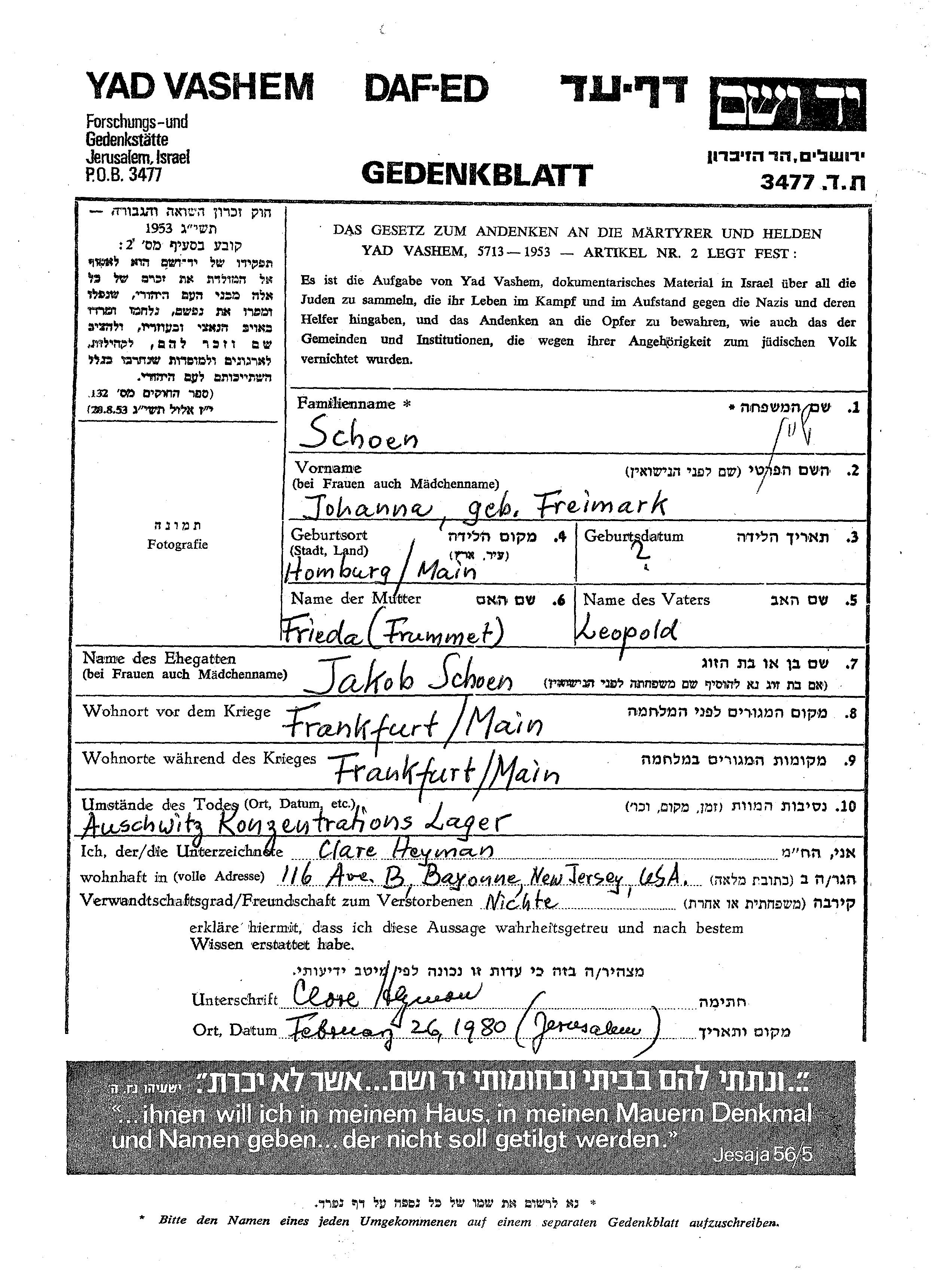
In any event, at least he was spared knowing what would happen to his wife and daughter in the years to come. They did not leave Germany in time, and both were murdered by the Nazis. They were deported from Frankfurt to Theriesenstadt on September 15, 1942, and then to Auschwitz, where they were murdered on October 12, 1944. Hannah was 56, and Ruth only twenty years old.

Johanna Freimark Schoen Page of Testimony, found at https://yvng.yadvashem.org/nameDetails.html?language=en&itemId=1414651&ind=1

May their lives be remembered. May we never forget.


Isaak Rosenberg: A Family With No Survivors

The youngest child of Rebecca Blumenfeld and Mendel Rosenberg was their son Isaak. As we saw, Isaak was born in Rosenthal, Germany, on June 15, 1892, and on December 22, 1922, he married Bella Gans, daughter of Jacob Gans and Esther Ehrenreich, in Niederaula, Germany.

Isaak and Bella had one child, a daughter Rita Rosenberg, born on April 29, 1924 in Frankfurt.

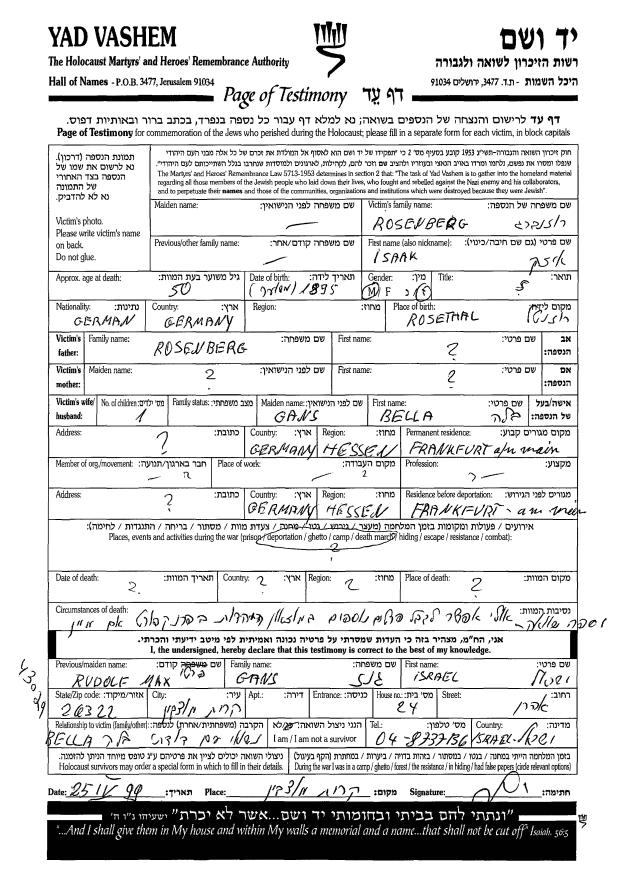
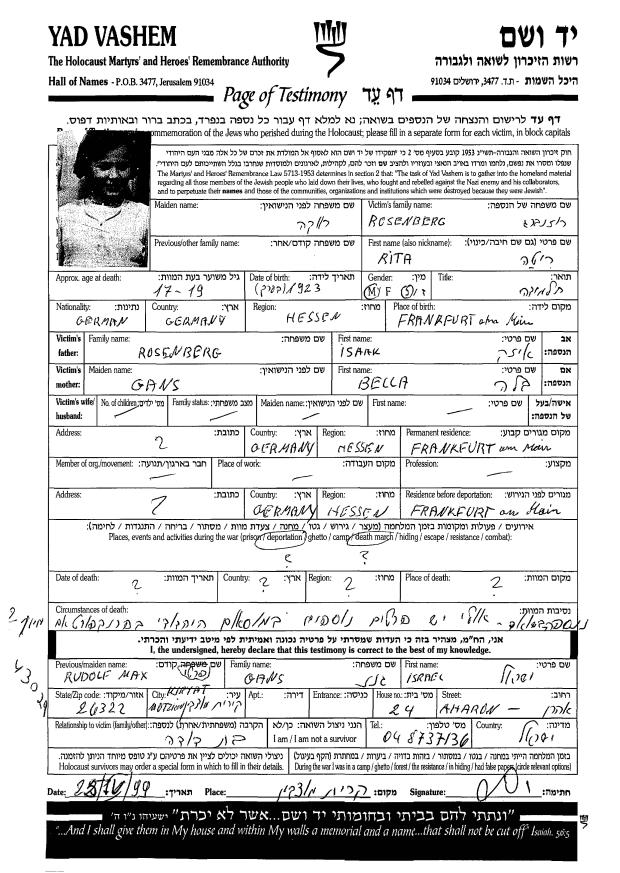
Unfortunately, all of them—Isaak, Bella, and Rita—were murdered by the Nazis. According to Yad Vashem, Isaak was deported from Frankfurt on August 10, 1942, and sent to the concentration camp in Majdanek, Poland, where he was murdered. His wife Bella’s nephew Israel Gans filed this Page of Testimony at Yad Vashem in his memory. The Hebrew written where it says “circumstances of death” merely says “perished in the Holocaust.” (Thank you to Hanna Gafni of Tracing the Tribe on Facebook for translating this line on this Page and the two below.)

The information available regarding the fates of Bella and Rita is far less specific. The Gedenbuch (Memorial Book) only reports that Bella was deported to Poland and killed there; perhaps she was deported on the same date as Isaak and to the same camp, but that isn’t stated. Nor does the Page of Testimony filed at Yad Vashem by Bella’s nephew Israel Gans provide any further details. The line for “Circumstances of Death” translates as “deported to Poland. Her fate is not known. Perished in the Holocaust.”

The information about Rita is even more limited. The Gedenbuch doesn’t even have information about where she was deported to or killed nor does her cousin Israel Gans’ Page of Testimony for her. The Hebrew written where it says “circumstances of death” says “perished in the Holocaust.”


This may be the first time that I have learned of family members who were killed in the Holocaust for whom there are no recorded details of their fates. Did Bella and Rita accompany Isaak to Majdanek? Or was the family separated? The lack of information somehow makes their deaths sting even more. The fact that the Nazis didn’t even document their murders makes it more likely that those deaths would have been somehow swept under the rug. So it is my task here to make sure that their lives and their murders are not forgotten.


That brings me to the end of the story of Rebecca Blumenfeld Rosenberg, the seventh child of Isaak Blumenfeld I and Gelle Strauss. Although Rebecca lost one son, Willi, as a young adult, and her son Isaak and his family were all murdered in the Holocaust, she was survived by seven grandchildren and has descendants still living today in Israel and the United States.

Next I turn to Rebecca’s younger sister, Friederike Blumenfeld, the eighth child of Isaak Blumenfeld I and Gelle Strauss and the last of their children to live to adulthood.

Things People Find on eBay

Back in May 2020, I wrote about Ferdinand Meyer, my third cousin, twice removed, a great-grandson of Meyer Goldschmidt.

As I described in that post, Ferdinand and his two children, Eleanora and Erich, both left Germany in the 1930s to escape from the Nazis. But Ferdinand’s wife Friedericke Jaenecke Meyer stayed behind and did not leave Germany until the summer of 1941, when she came to the US and settled with Ferdinand in the Boston area.

Friedericke was not born Jewish, and I wondered whether she had stayed behind to protect the family’s assets, assuming that she would be safe (though she faced some persecution in Germany for being married to a Jew or perhaps for converting). I still have no answers to that question.

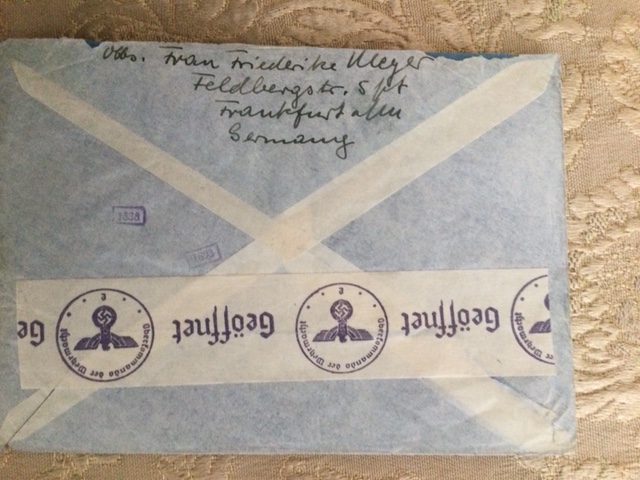
Nevertheless, I was quite tickled when a blog reader commented that he had found on eBay an envelope for a letter sent by Friedericke to Ferdinand, postmarked January 24, 1941.

As you can see, Friedericke was still living in Frankfurt at the time she sent this letter to Ferdinand, who was living on Beacon Street in Boston.

Unfortunately, there was no letter inside the envelope to reveal what was going on in Friedericke’s life and what her thoughts were about what was happening in Germany. By that time the war was raging across Europe, but the US was still a year away from entering the war. What were Friedericke and Ferdinand feeling and thinking? How was Friedericke able to escape when so many Jews were trapped inside Germany by that time?

And how in the world did this envelope end up on eBay?

Life is just filled with mysteries.

My Goldschmidt Family Project: Looking Back and Looking Forward

With this post, I come to the end of my Goldschmidt research—at least until I get new updates or make new discoveries. I’ve done my best to find whatever records, stories, and photographs exist for Jacob Falcke Goldschmidt and Eva Reuben Seligmann, my four-times great-grandparents, and their descendants.1

I started blogging about my Goldschmidt relatives a little over three years ago on January 12, 2018, making it the longest of any of my family research projects.  And it’s been such a rich and rewarding journey. I’ve connected with Goldschmidt/Goldsmith cousins in France, England, and all over the United States. Some of those cousins have roots in the US that are as deep as mine—going back to the 1840s when Simon Goldschmidt/Goldsmith arrived or the 1850s when my great-great-grandmother Eva Goldschmidt Katzenstein arrived; some are the children of those who were born and raised in Frankfurt, Germany, and were forced to leave their comfortable and successful lives to escape from the Nazis as recently as the 1930s or 1940s.

One thread that runs through so much of the Goldschmidt family is an interest in the arts and literature—whether in writing, as with Milton Goldsmith and Anna Seghers, or an interest in antiquarian books, as with Alfred Goldsmith and Emil Offenbacher, or in music like Florence Goldsmith, or  in creating art like William Sigmund and Martha Loewenthal Wolff, or by working as an art historian and curator like Yvonne Hackenbroch, and, of course, then there are the many, many Goldschmidt family members involved in collecting and dealing in art—from the Goldschmidt brothers Jacob Meier and Selig to Julius Falk Goldschmidt to the Freres Tedesco family and so on.

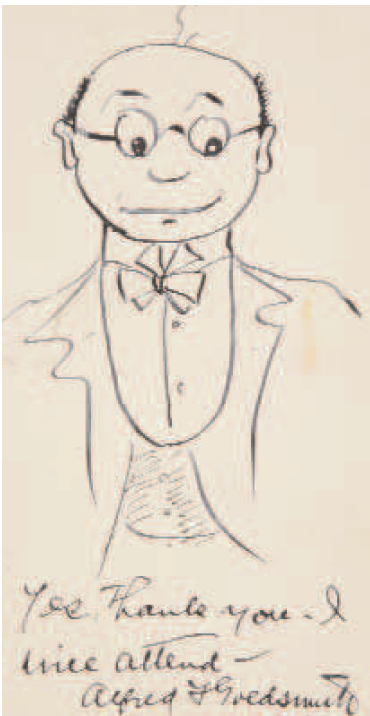
Alfred Goldsmith self-portrait, Joseph J. Felcone, The Old Book Table. A Record of its First Seventy-Five Years, 1931–2005 (New York: The Old Book Table, 2006), p. 5.

Painting by Martha Loewenthal Wolff

Of course, there were also many merchants, entrepreneurs, doctors, lawyers, engineers, and scientists in the Goldschmidt clan. But when I think of my father’s artistic ability and his passion for art, architecture, music, and literature, I attribute it to his Goldschmidt DNA. His mother was artistic, and she was the granddaughter of Eva Goldschmidt. My great-uncle Harold Schoenthal, also a grandchild of Eva Goldschmidt, was also an artist and an architect. My daughter is also very artistic, though she did not pursue it as a career. When I see my grandsons drawing, I think, “It must be their Goldschmidt DNA.” I may not be artistic, but I’d like to think that my love of reading and writing comes from that Goldschmidt DNA as well.

The Seventh Cross by Anna Seghers

The Rabbi and The Priest by Milton Goldsmith

After three years of research, it’s hard to boil down in one post all that I have learned. That research has exposed me to so much of American Jewish history and German Jewish history—from the late eighteenth century right up to 2020. The Goldschmidts kept my brain busy during this pandemic time, and they provided me with some truly memorable Zoom calls with cousins.

It has been an amazing experience. I am indebted to so many of my Goldschmidt cousins that I fear if I make a list, I will leave someone out. But thank you to all of you who shared your family’s photographs, letters, memoirs, documents, and stories. I hope that I’ve served our extended family well by recording the stories of their lives for posterity. And please stay in touch! I want to meet as many of you as I can in person someday soon.

Jean-Baptiste-Camille Corot, Madame Stumpf and Her Daughter, 1872. Courtesy of the National Gallery.
Once owned by the Freres Tedesco Gallery, Paris

A work from the Guelph Treasure
Reliquary of the arm of Saint Blaise (Herzog Anton Ulrich Museum, Dankwarderode Castle). User:Brunswyk, CC BY-SA 3.0 , via Wikimedia Commons. Once owned by J&S Goldschmidt

It’s bittersweet to reach this point and know it’s time to move on to the next project. But I’ve gone as far as I can go in the Goldschmidt research—at least for now.  I need to decide what to do next. I’ve been dipping my toes in several ponds to see which one grabs my attention.

Before I reveal where I am going next, however, I need to take a break for a bit to catch my breath and to catch up on the research it will take to start that new project, whatever it may be. But first, I will introduce my new novel. So stay tuned!


  1. I would be remiss in my duties as a family historian if I didn’t mention that in addition to their four sons Meyer, Seligmann, Lehmann, and Simon, whom I’ve studied in depth, my four-times great-grandparents Jacob Falcke Goldschmidt and Eva Seligmann had a daughter Jette Goldschmidt. She married David Gruenwald of Poembsen, Germany, and they had two children. One died as an infant or was stillborn, but the other, Jacob Gruenwald, was born in 1820, lived to adulthood, married Sarah Nethe, and had fourteen children born between 1847 and 1872. All of this information, however, is based purely on a secondary source, a report in the Alex Bernstein Collection at the Leo Baeck Institute. I’ve tried to locate more information about Jette’s descendants, but so far have not succeeded. If the day comes when I can, I will add Jette’s family to the blog. 

Two Cousins Whose Lives Tell the Overall Story of the Goldschmidts

As I draw to the close of my Goldschmidt family history project, it seemed quite appropriate that I recently received photographs of two members of that family who  exemplify two very different stories of this family’s history, my cousins Herman Goldsmith and Hannah Goldsmith. Hannah was born in America in 1848 and lived until 1939, and Herman was born in Germany in 1912 and lived until 2016.

First I received this photograph of Herman Goldsmith and my cousin Susan and her husband Richard. Susan said it was taken in June 2013 when Herman was 100 years old. He would turn 101 on December 6, 2013, and live until October 27, 2016, just a little over a month before he would have turned 104.

Richard and Susan (Vogel) Neulist and Herman Goldsmith, June 2013. Courtesy of Susan Neulist

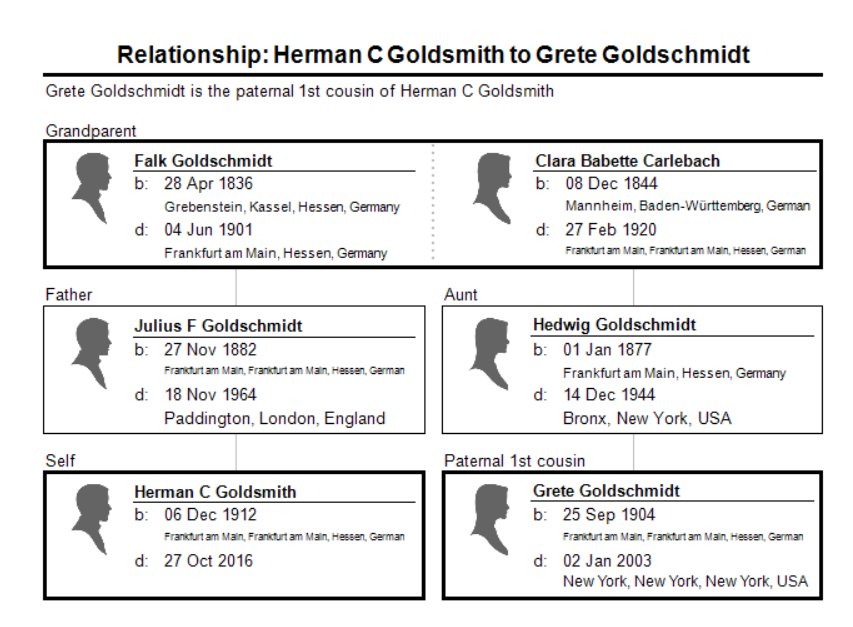
I wrote about Herman here. He was the son of Julius Falk Goldschmidt and Helene “Leni” Goldschmidt. Julius Falk Goldschmidt was the son of Falk Goldschmidt, and Leni Goldschmidt was the granddaughter of Jacob Meier Goldschmidt. Since Falk and Jacob Meier were brothers, Julius and Leni were first cousins, once removed, making Herman his own cousin.

After escaping from Nazi Germany to the US in the 1930s, Herman settled in New York City where so many Goldschmidt family members ended up. He remained in touch with his Goldschmidt relatives. Susan said he visited her grandmother, Grete Goldschmidt Heimerdinger, every week for many years.

Grete was also a double cousin as she was the daughter of Marcel (Maier) Goldschmidt, son of Jacob Meier Goldschmidt, and Hedwig Goldschmidt, daughter of Falk Goldschmidt. Hedwig and Marcel were first cousins, and so like Herman, Grete was her own cousin.

And since Hedwig Goldschmidt, Grete’s mother, and Julius Falk Goldschmidt, Herman’s father, were siblings, Grete and Herman were first cousins, both the grandchildren of Falk Goldschmidt.

But they were also both descended from Jacob Meier Goldschmidt, Herman’s great-grandfather and Grete’s grandfather, so they were also first cousins, once removed, through Herman’s mother Helene “Leni” Goldschmidt and Grete’s father Marcel Goldschmidt. Oy vey! No wonder they were so close! Susan described Herman as “quite the gentleman and full of wonderful stories.” I wish I knew more of his stories.

I also received a wonderful photograph from my cousin, Bruce, the great-great-great-grandson of Fradchen Schoenthal, sister of my great-great-grandfather Levi Schoenthal, and also the great-great-grandson of Simon Goldschmidt, brother of my three-times great-grandfather Seligmann Goldschmidt.

So Bruce is my double cousin. He’s my fourth cousin, once removed, through our Schoenthal side and my fifth cousin through our Goldschmidt side.

Isn’t Jewish genealogy fun?

Anyway, Bruce’s great-great-grandmother was Hannah Goldsmith Benedict, daughter of the above-mentioned Simon Goldschmidt. Hannah and her brother Henry were the first Goldschmidts born in the US, Henry in 1847 and Hannah in 1848. I’ve written much about Hannah and her family—here and here and here  and here and here and here and here. Hannah married Joseph Benedict in 1867, and they had five children, including Jacob Benedict, Bruce’s great-grandfather. Jacob had two daughters with his wife Clara Kaufman: Helen, born in 1907, and Marian, born in 1908. Helen was Bruce’s grandmother.

Bruce told me that this photograph was dated August 24, 1908, and shows Hannah Goldsmith Benedict with her husband Joseph and their two granddaughters Helen and Marian. At that time Jacob Benedict and his family were living in Paducah, Kentucky, and Hannah and Joseph were living in Pittsburgh. Jacob’s brother Herschel was living in Pittsburgh, and his brother Harry was living in Michigan by 1910.  But the photograph was apparently taken in Kenosha, Wisconsin. I wonder how that happened….

Joseph Benedict, Helen Benedict, Marian Benedict, and Hannah Goldsmith Benedict. August 24, 1908. Courtesy of Bruce Velzy

Another mystery to solve. But seeing one of my earliest American-born relatives with her granddaughters is very exciting.

It’s so fitting to close my Goldschmidt family blog posts with photographs of these two members of the family. Hannah Goldsmith and Herman Goldsmith were first cousins, twice removed, since Hannah’s father Simon Goldschmidt and Herman’s great-grandfather Meyer Goldschmidt were brothers.

Hannah was born in the United States when the country was still very young. She lived through the Civil War, World War I, the Roaring Twenties, and the Great Depression, dying in November 1939 while her German cousins were being persecuted and fleeing from Nazi Germany. She was 91 years old.

Just two months before Hannah died, her cousin Herman arrived in the US as one of those cousins escaping from Germany. Herman Goldsmith was born in 1912 in Frankfurt, Germany, and had grown up in the comfort of the large and well-to-do Goldschmidt family. Unlike Hannah, his life was radically changed by the events of the 1930s. But like Hannah, he saw so much in his lifetime, living until he was almost 104. He not only lived through World War I, the Weimar Republic years, the Depression, and World War II—he saw the radical changes that came after the war—the creation of the state of Israel, the Cold War, the assassination of JFK, the civil rights movement, the women’s movement, the moon landing, the gay rights movement, the rise of the internet, 9/11, and the election of the first Black man to serve as president of the US.

Can you imagine the stories Herman and Hannah could tell each other as well as us?  They lived such different lives in such different places and times, overlapping in time between only 1912 and 1939, but on different continents. But together the lives of Hannah Goldsmith and Herman Goldsmith tell us so much not only about the richness of the Goldschmidt family’s story, but also about the history of Jews in America and in Germany.

Thank you to Susan and to Bruce for sharing these photographs. And thank you to each and everyone of my Goldschmidt cousins who have helped me understand and appreciate our shared history.


The Drey Family: More Cousins, More Small World Connections, More Photographs

A few weeks ago another new cousin found me through my blog, and the ensuing emails and additional new cousin connections have resulted in many small-world coincidences as well as a collection of family photographs. So even when I thought I was just about finished with my Goldschmidt family line, I have been reminded once again that this work is never really finished.

Let me start at the beginning. The cousin who first contacted me through my blog, Diane, is my fifth cousin, once removed. She is the daughter of Claude Drey, whose photographs I wrote about here, and the granddaughter of Arthur Drey and Caroline Lilly Cramer, who I now know was always called Lilly, not Caroline. Caroline was the daughter of David Cramer and Clementine Fuld. Here’s a chart showing the rest of our connection:

Diane and I both have children and grandchildren living in Brooklyn. She then connected me to other members of her family, including her first cousins Florence, George, and Linda, who are also my fifth cousins, once removed. They are the children of Dorothy Drey, Claude’s sister and the daughter of Arthur Drey and Lilly Cramer. And here’s where the small world connections piled up. Florence, George, and Linda grew up in White Plains, New York, where I went to junior high and high school. In fact, we lived around the corner from each other. Linda was just one year ahead of me in school. But we never knew of each other’s existence.

Then I learned that George’s wife grew up in Springfield, Massachusetts, and Florence went to college there. I’ve lived right outside of Springfield since 1983. George is a lawyer, and Florence is engaged in genealogical research and activities. And finally, George, Florence, and I are now currently in Florida and not far from each other. But for COVID, we could all easily get together and meet in person. As a result of all these overlapping connections, we all likely know many of the same people, and when we do get together, it will be fun to discover more connections.

And then Diane sent me a collection of family photographs and has given me permission to share them here. Here are some of those photographs.

First, this is a photograph of Clementine Fuld Cramer with her two children Sally and Lilly. Clementine was the daughter of Helene Goldschmidt and Salomon Fuld and the granddaughter of Jacob Meier Goldschmidt. I wrote about Clementine here and here. I am not sure when this would have been taken. If Lilly was not yet married, it had to be taken before January 27, 1919.

Sally Cramer, Clementine Fuld Cramer, Caroline Lilly Cramer. Courtesy of the Drey family

Here are photographs taken on January 27, 1919, when Lilly married Arthur Drey:

Arthur Drey and Lily Cramer, January 1919. Courtesy of the Drey family

Arthur Drey and Lily Cramer, January 1919. Courtesy of the Drey family

Lilly and Arthur Drey had three children. This photograph shows Lilly with their first two children, Claude and Dorothy in 1921 when Dorothy was born.

Lilly Cramer Drey, Claude Drey, Dorothy Drey. c. 1921. Courtesy of the Drey family

Their third child Elizabeth was born five years later in 1926. Here she is as a young child:

Elizabeth Drey c. 1927 Courtesy of the Drey family

This photograph of the entire family was taken in Frankfurt in about 1927 before their lives were forever altered by the Nazis:

Drey family in Frankfurt c. 1927. Courtesy of the Drey family

These photographs of Claude and Dorothy as children were also taken in Germany before the family escaped from Germany to Milan, Italy, in 1933:

Claude Drey c. 1928 Courtesy of the Drey family

Dorothy Drey c. 1932-1933 Courtesy of the Drey family

Diane also shared photographs taken in the US in the 1940s and beyond. What I found most remarkable about those were the photographs of Clementine Fuld Cramer with her great-grandchildren, including Diane, George, and Florence. Clementine died in 1962 at 87. She had lived through the early years of a unified Germany, World War I, the oppression of Jews by the Nazis in the 1930s, immigration to the US during World War II, and the post-war years adjusting to the United States. She lived to see the births of not only her grandchildren but also a number of great-grandchildren. What a remarkable life she had. I bet she had some amazing stories to share.

Clementine Fuld Cramer with one of her great-grandchildren in the US

Finally, I love this photograph of Caroline Lilly Cramer Drey taken in New York City sometime in the 1950s or 1960s. She had held on to the grace and sophisticaion of the world she’d known as a well-to-do woman living in the Frankfurt Jewish community before the Nazi era.

Lilly Cramer Drey in New York City
Courtesy of the Drey family


Falk Goldschmidt Part III: Two of His Daughters Escape to South America

Meyer Goldschmidt’s youngest child Falk Goldschmidt died on June 4, 1901. He was 65 years old when he died and was survived by his wife Clara Babetta Carlebach and their five children, Meier, Helene, Fanny, Hedwig, and Julius, and their grandchildren.

Falk Goldschmidt death record, Personenstandsregister Sterberegister; Bestand: 903; Signatur: 10551, Year Range: 1901, Ancestry.com. Hesse, Germany, Deaths, 1851-1958

The family lost its matriarch when Clara Babetta Carlebach Goldschmidt died on February 27, 1920. She was 75.

Babetta Carlebach Goldschmidt death record, Personenstandsregister Sterberegister; Bestand: 903; Signatur: 10828, Year Range: 1920, Ancestry.com. Hesse, Germany, Deaths, 1851-1958

In the last post we saw that Meier Falk Goldschmidt, Falk’s oldest child, went to the US in about 1890 and died there in 1922. He did not have any children. Falk and Babetta’s two youngest children—Hedwig and Julius Falk—I have already covered in earlier posts because they married cousins who’ve already been discussed. So that leaves the two older daughters, Helene Goldschmidt Igersheimer and Fanny Goldschmidt Loewenthal. I will tell their stories separately in this post.

Helene Goldschmidt Igersheimer and Her Children

Eight years after losing her father Falk, Helene Goldschmidt Igersheimer lost her husband Bernard. He died on September 14, 1909, in Frankfurt; he was 51.1 Helene was a widow at 38.

Helene’s daughter Fanny Flora Igersheimer married Ludwig Selmar Goetz on December 11, 1912, in Frankfurt. Ludwig was born in Berlin on August 13, 1876, to Julius Goetz and Rosalie Badt.

Fanny Flora Igersheimer and Ludwig Goetz marriage record, Hessisches Hauptstaatsarchiv; Wiesbaden, Deutschland; Bestand: 903, Year Range: 1912, Ancestry.com. Hesse, Germany, Marriages, 1849-1930

Fanny and Ludwig had two sons. Erwin Julius Goetz was born in Frankfurt on February 21, 1914.2 His brother Arthur Bernard Edmund Goetz was born October 8, 1915, in Frankfurt.3

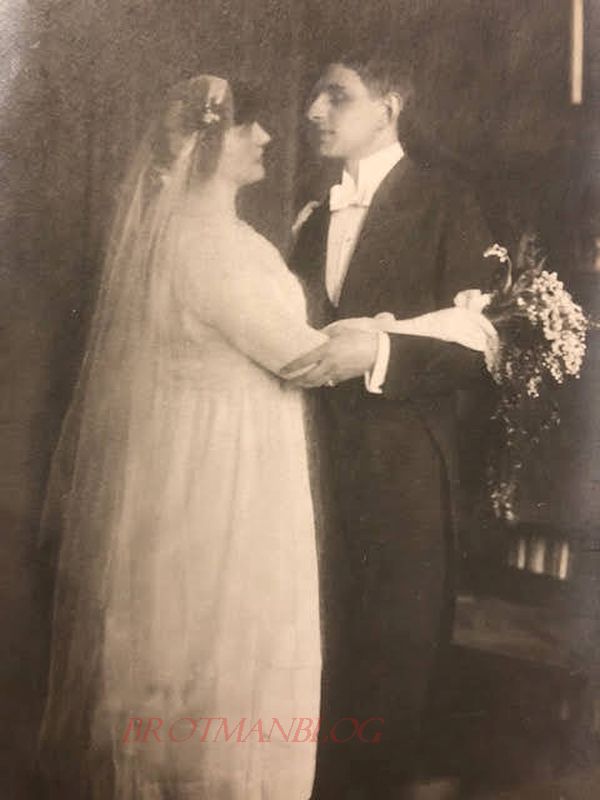
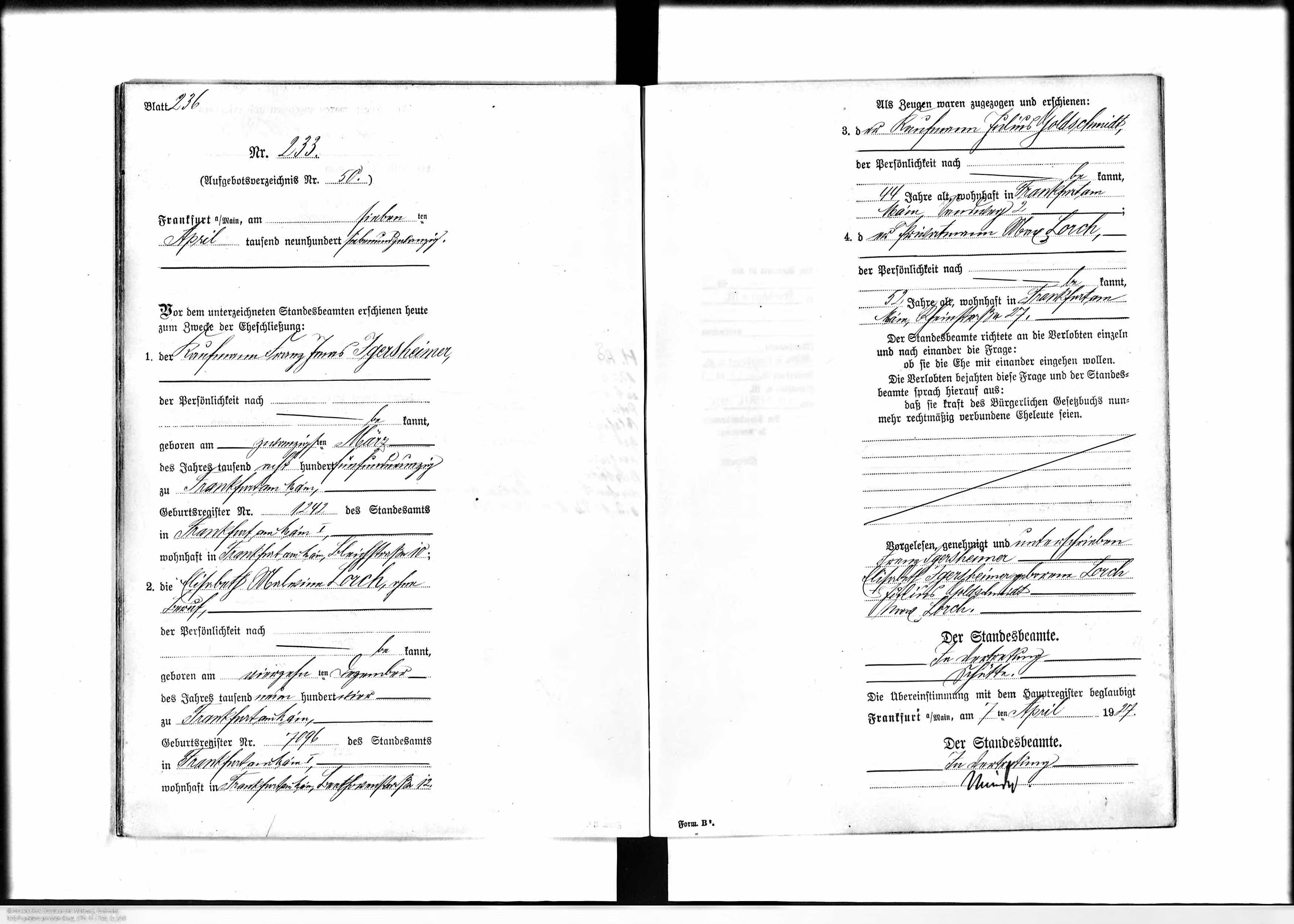
Helene Goldschmidt Igersheimer’s son Franz Jonas Igersheimer married Elizabeth Isabel Malvina Lorch in Frankfurt on April 7, 1927. She was the daughter of Ludwig Lorch and Gisela Koehler and was born on December 14, 1904, in Frankfurt.

Franz Jonas Igersheimer marriage record, Hessisches Hauptstaatsarchiv; Wiesbaden, Deutschland; Bestand: 903, Year Range: 1927, Ancestry.com. Hesse, Germany, Marriages, 1849-1930

Franz and Elizabeth also had two sons, according to Baron and Cibella, both of whom were born in Frankfurt before Hitler’s rise to power.4

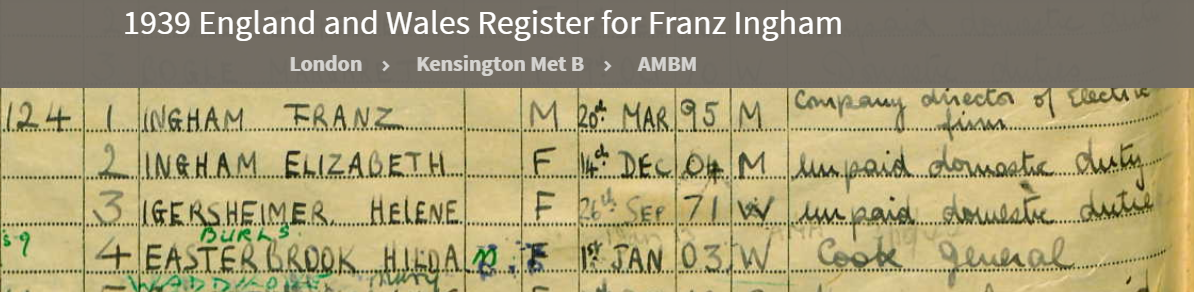
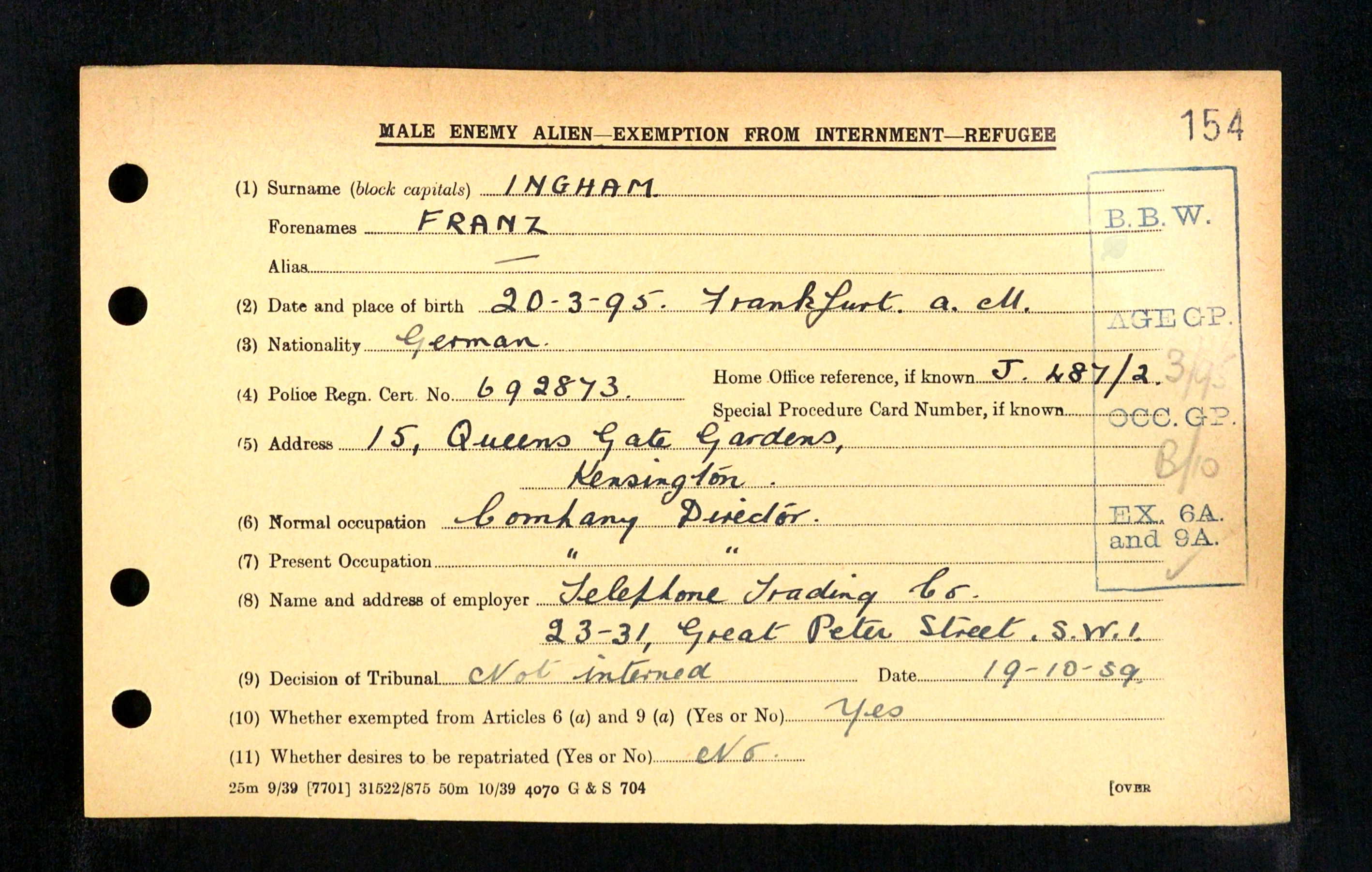
By 1939, Helene Goldschmidt Igersheimer was living in London with her son Franz and his wife Elizabeth. Franz and Elizabeth had changed their surname to Ingham, but Helene had not. Franz was working as a company director of an electric company. Neither of their sons were listed with them on the 1939 Register; perhaps they were in boarding school.

Ingham household, The National Archives; Kew, London, England; 1939 Register; Reference: RG 101/307J, Enumeration District: AMBM, Ancestry.com. 1939 England and Wales Register

On his enemy alien registration, Franz listed his occupation as company director of Telephone Trading Company. It appears that he was found exempt from being sent to an internment camp.

Franz Ingham enemy alient registration, The National Archives; Kew, London, England; HO 396 WW2 Internees (Aliens) Index Cards 1939-1947; Reference Number: HO 396/40
Piece Number Description: 040: Internees at Liberty in UK 1939-1942: I-Iz, Ancestry.com. UK, World War II Alien Internees, 1939-1945

Meanwhile, Helene’s daughter Fanny Flora Igersheimer Goetz and her husband Ludwig Goetz had immigrated to Argentina by 1936. They appear on a 1936 ship manifest leaving England for Argentina, but report that they were already citizens of Argentina where Ludwig, now using the name Luiz, was a farmer in Buenos Aires. I assume they had been visiting Fanny Flora’s mother and brother and family in London and were returning home.

Luiz and Flora Goetz, ship manifest, Ancestry.com. UK and Ireland, Outward Passenger Lists, 1890-1960

Helene Goldschmidt Igersheimer and Franz Jonas Ingham and his family soon followed Fanny Flora and Luiz to Argentina. They are all listed on a ship manifest dated June 22, 1940, leaving England for Argentina, and they indicated that Argentina was their permanent destination.

Franz Ingham and family, ship manifest, Ancestry.com. UK and Ireland, Outward Passenger Lists, 1890-1960

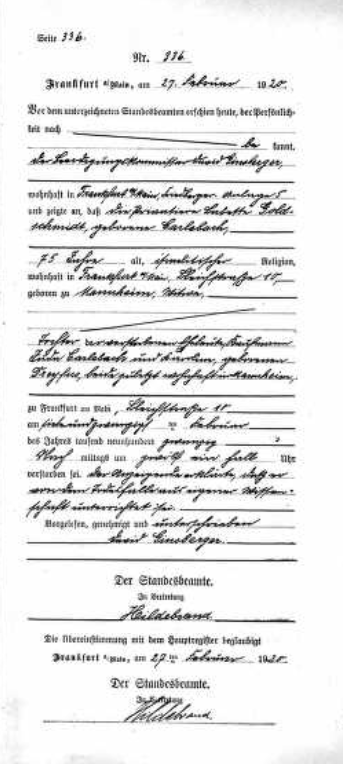
Helene Goldschmidt Igersheimer died only two years after moving to Argentina; she was 71 when she died in Buenos Aires on September 30, 1942.5

From various travel documents it appears that both of Helene’s children and her grandchildren remained in Argentina after the war and for the rest of their lives. I have no other specific sources for them at this point.

Fanny Goldschmidt Loewenthal and Her Son

Fanny Goldschmidt Loewenthal’s son Julius married Else Margarete Cahn, the daughter of Arthur Moritz Cahn and Alice Hellman, in Frankfurt on December 10, 1920. Else was born on January 31, 1900, in Frankfurt. According to Baron and Cibella, Julius and Else had two sons.[^6]

[^6]: Baron and Cibella, Goldschmidt Family Report

Julius Loewenthal marriage record, Hessisches Hauptstaatsarchiv; Wiesbaden, Deutschland; Bestand: 903, Year Range: 1920, Ancestry.com. Hesse, Germany, Marriages, 1849-1930

Then five years later, Fanny Goldschmidt Loewenthal’s husband Siegfried died on August 30, 1925, in Cannes, France. He was 61.6 Thus, like her sister Helene, Fanny was a relatively young woman when she became a widow at 51.

I could not find Fanny Goldschmidt Loewenthal on any record between her children’s birth records in the 1890s and a 1946 Brazil immigration card. She was a widow whose husband had died in 1925 and with only one surviving child, her son Julius. Where could she have been between 1920 and 1945? How did she survive the war? I don’t know.

Fanny Goldschmidt Loewenthal Brazil immigration card, Digital GS Number: 004568863
Ancestry.com. Rio de Janeiro, Brazil, Immigration Cards, 1900-1965

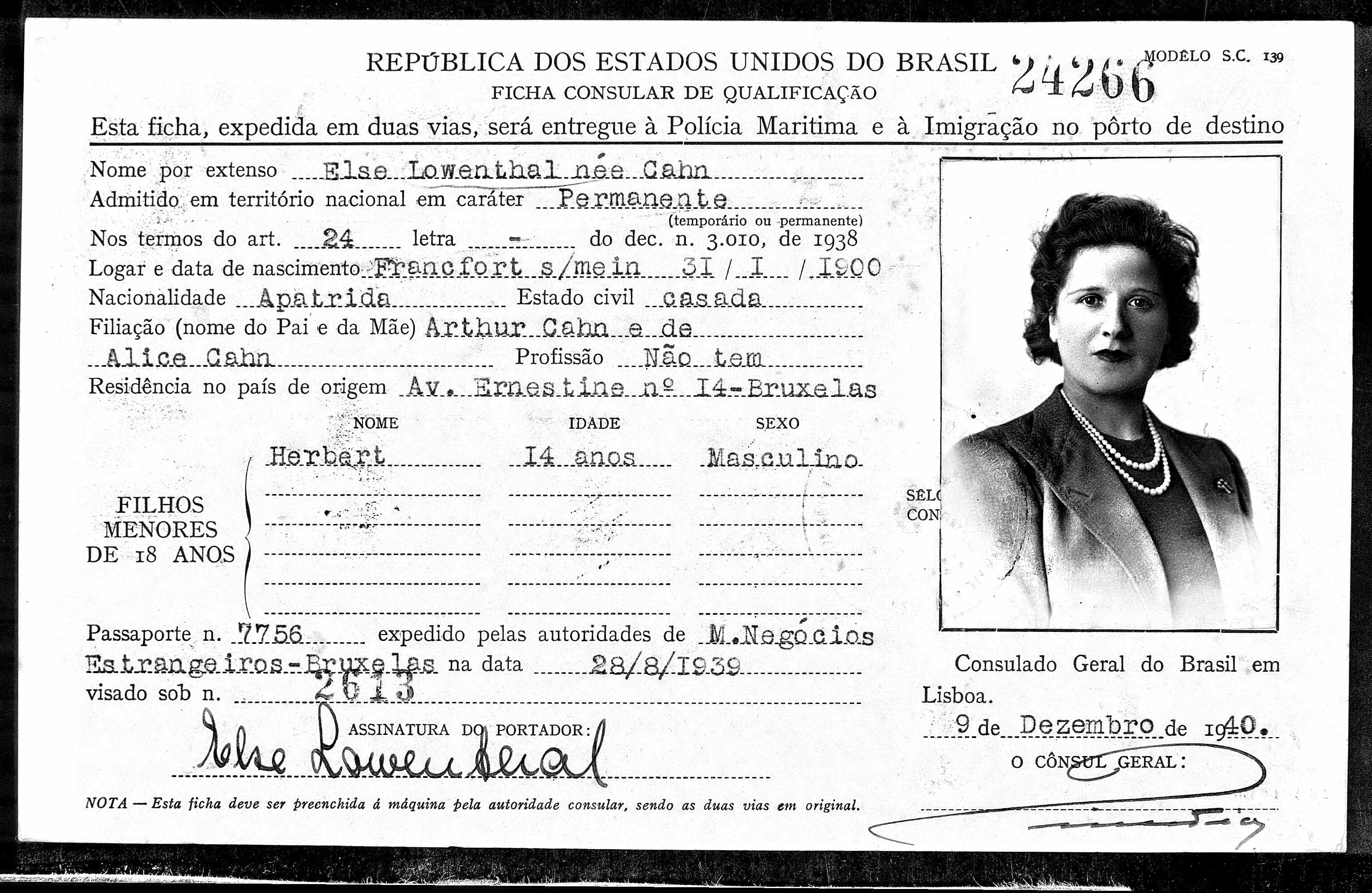
In tracking Julius’ whereabouts, I only had marginally better luck. He appears to have immigrated to Brazil in 1940-1941. He listed his address at his prior residence as being in Brussels. His wife Else arrived with him, also listing Brussels as her last address, and Else listed their son Herbert on her immigration card.

Julius Loewenthal Brazil immigration card, Digital GS Number: 004847850
Ancestry.com. Rio de Janeiro, Brazil, Immigration Cards, 1900-1965

Else Cahn Loewenthal immigration card, Digital GS Number: 004542452
Ancestry.com. Rio de Janeiro, Brazil, Immigration Cards, 1900-1965

Maybe Fanny was with Julius and Else in Brussels, but I have no record that supports that notion. All I have is a Brazil immigration card for Fanny indicating she arrived in Brazil in 1946 after the war was over. Her card indicates that her prior address had been in Frankfurt. Could she have safely survived the Holocaust hiding in Frankfurt?

I wish I had a way to find her story. But I have no further records for Fanny or Julius or Else, except one travel document for Else showing that she was living in Rio de Janeiro in 1961. David Baron and Roger Cibella report that both Fanny and Julius died in Rio de Janeiro, Julius in 1955 and Fanny in 1957.7

Thus, Falk and Babetta Goldschmidt’s widowed daughters Helene and Fanny both escaped from the Nazis to South America with their children and grandchildren, but to two different countries, Helene to Argentina and Fanny to Brazil.


  1.  Bernhard Igersheimer, Age: 53, Birth Date: abt 1856, Death Date: 14 Sep 1909
    Death Place: Frankfurt V, Hessen (Hesse), Deutschland (Germany), Civil Registration Office: Frankfurt V, Father: Jonas Igersheimer, Mother: Sara Igersheimer, Certificate Number: 1119, Personenstandsregister Sterberegister; Bestand: 903; Signatur: 10659,
    Ancestry.com. Hesse, Germany, Deaths, 1851-1958 
  2. Erwin Julio Goetz, Gender: Male, Marital status: Married, Birth Date: 21 fev 1914 (21 Feb 1914), Birth Place: Frankfurt, Arrival Date: 1945, Arrival Place: Rio de Janeiro, Rio de Janeiro, Brazil, FHL Film Number: 004558748, Ancestry.com. Rio de Janeiro, Brazil, Immigration Cards, 1900-1965 
  3. Arturo Bernardo Edmundo Goetz, Marital status: Married, Birth Date: 8 out 1915 (8 Oct 1915), Birth Place: Frankfurt, Arrival Date: 1957, Arrival Place: Rio de Janeiro, Rio de Janeiro, Brazil, Father: Luis Goetz, Mother: Flora Igersheimer, FHL Film Number: 004834211, Ancestry.com. Rio de Janeiro, Brazil, Immigration Cards, 1900-1965 
  4. David Baron and Roger CIbella, Goldschmidt Family Report 
  5. Helene Igersheimer, Death Date: 30 Sep 1942, Death Place: Argentina
    Probate Date: 16 Aug 1944, Probate Registry: Oxford, England, Ancestry.com. England & Wales, National Probate Calendar (Index of Wills and Administrations), 1858-1995 
  6. Ibid. 
  7. Ibid. 

The Children of Falk Goldschmidt and Clara Babetta Carlebach

Falk Goldschmidt and his wife Clara Babetta Carlebach had five children, all born in Frankfurt. First born was Meier Falk Goldschmidt, born on August 8, 1870.

Meier Falk Goldschmidt, birth record, Hessisches Hauptstaatsarchiv; Wiesbaden, Deutschland; Bestand: 903; Signatur: 903_8845, Year Range: 1870, Ancestry.com. Hesse, Germany, Births, 1851-1901

Then came their daughter Helene born on September 26, 1871:

Helene Goldschmidt, birth record, Hessisches Hauptstaatsarchiv; Wiesbaden, Deutschland; Bestand: 903; Signatur: 903_8849, Year Range: 1871, Ancestry.com. Hesse, Germany, Births, 1851-1901

Third born was Fanny on August 18, 1874.

Fanny Goldschmidt, birth record, Hessisches Hauptstaatsarchiv; Wiesbaden, Deutschland; Bestand: 903; Signatur: 903_8858, Year Range: 1874, Ancestry.com. Hesse, Germany, Births, 1851-1901

Their fourth child was Hedwig; she was born on January 1, 1877.

Hedwig Goldschmidt, birth record, Hessisches Hauptstaatsarchiv; Wiesbaden, Deutschland; Bestand: 903; Laufende Nummer: 143, Year Range: 1877, Ancestry.com. Hesse, Germany, Births, 1851-1901

And finally, their youngest child Julius Falk Goldschmidt was born November 27, 1882.

Julius Falk Goldschmidt, birth record, Hessisches Hauptstaatsarchiv; Wiesbaden, Deutschland; Bestand: 903; Signatur: 903_8972, Year Range: 1882, Ancestry.com. Hesse, Germany, Births, 1851-1901

That makes the fifth Meier/Meyer Goldschmidt, the fourth Helene Goldschmidt, the fifth Hedwig Goldschmidt, and the third Julius Goldschmidt on my tree. And that doesn’t even count all the Goldsmiths with those first names. No wonder Meier and Julius used their middle name Falk to identify themselves.

Meier Falk Goldschmidt, their oldest child, immigrated to New York in about 1888 to 1890. I could not find a ship manifest for his first arrival in the US, but those were the dates listed on the 1910 and 1920 census records for Meier.1 Also, on an 1895 ship manifest for his return to the US, he indicated that he was already by that time a US citizen.2 Unfortunately, I could not find naturalization documents for Meier to corroborate that assertion.

I also could not find Meier on the 1900 census. I asked for help from Tracing the Tribe, but no one there was able to find him on that census, nor could they find a ship manifest or naturalization record to establish his date of arrival. Meier just seems to be one of those elusive relatives who does not want to be found.

Fortunately, Meier does appear on both the 1910 and 1920 US census. In 1910 he was single, living in Queens as a boarder, and working as a ribbon salesman.3 In 1920, Meier was living in Manhattan, still single, still working as a ribbon salesman. Although he is listed here as Clair F. Goldschmidt, I am quite certain that this is Meier as all the other facts add up.4

Meier died two years later on February 22, 1922. He was 51 years old. He was buried in New York. As far as I can tell, he never married.5

Meanwhile, Meier’s four younger siblings were all still in Germany. His sister Helene married Bernhard Igersheimer on November 1, 1889. He was the son of Jonas Igersheimer and Sara Dreyfus and was born in Mergentheim, Germany, on April 18, 1856.

Helene Goldschmidt marriage to Bernard Igersheimer, Hessisches Hauptstaatsarchiv; Wiesbaden, Deutschland; Signatur: 9481, Year Range: 1889
Ancestry.com. Hesse, Germany, Marriages, 1849-1930

Helene and Bernard had two children. Fanny Flora Igersheimer was born in Frankfurt on October 6, 1890.

Fanny Flora Igersheimer birth record, Hessisches Hauptstaatsarchiv; Wiesbaden, Deutschland; Bestand: 903; Signatur: 903_9076, Year Range: 1890, Ancestry.com. Hesse, Germany, Births, 1851-1901

Her brother Franz Jonas Igersheimer was born on March 20, 1895, in Frankfurt.

Franz Jonas Igersheimer birth record, Hessisches Hauptstaatsarchiv; Wiesbaden, Deutschland; Bestand: 903; Signatur: 903_9151, Year Range: 1895, Ancestry.com. Hesse, Germany, Births, 1851-1901

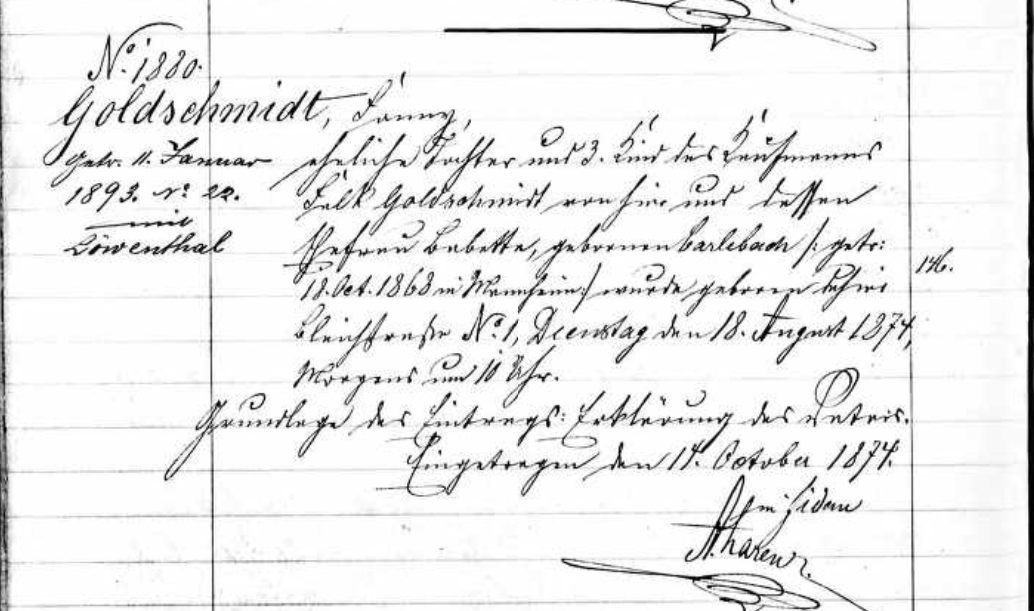
Falk and Clara Babetta’s second daughter Fanny married Siegfried Loewenthal on January 6, 1893 in Frankfurt. Siegfried was born in Wiesbaden on March 27, 1864, to Meyer Loewenthal and Regine Kahn.

Fanny Goldschmidt and Siegfried Loewenthal marriage record, Hessisches Hauptstaatsarchiv; Wiesbaden, Deutschland; Bestand: 903, Year Range: 1893,
Ancestry.com. Hesse, Germany, Marriages, 1849-1930

Fanny and Siegfried had two sons. Julius Loewenthal was born on December 6, 1893, in Frankfurt.

Julius Loewenthal birth record, Hessisches Hauptstaatsarchiv; Wiesbaden, Deutschland; Bestand: 903; Signatur: 903_9125, Year Range: 1893, Ancestry.com. Hesse, Germany, Births, 1851-1901

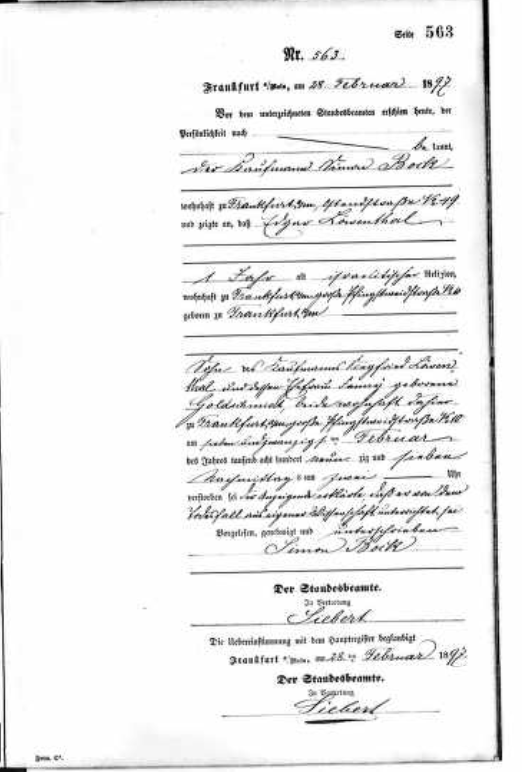
And Edgar Loewenthal was born January 16, 1896.6 Sadly, Edgar died just over a year later on February 27, 1897.

Edgar Loewenthal death record, Personenstandsregister Sterberegister; Bestand: 903; Signatur: 10503, Year Range: 1897, Ancestry.com. Hesse, Germany, Deaths, 1851-1958

The two youngest children of Falk and Clara Babetta I’ve already written about. Their daughter Hedwig married her first cousin Marcel Goldschmidt, son of Falk’s brother Jacob Meier Goldschmidt. They, as I wrote, had four children: Jacob, Nelly, Else, and Grete. Since writing about Hedwig and Marcel, I’ve connected with some of Grete’s descendants and will have an update on that part of the family in a post to follow.

And Falk and Clara Babetta’s youngest child, Julius Falk Goldschmidt, married his first cousin, once removed, Helene “Leni” Goldschmidt, the granddaughter of Jacob Meier Goldschmidt. I’ve also written extensively about them and their two sons, Felix and Herman.

The post to follow will focus on Falk and Clara Babetta and their two other daughters—Helene Goldschmidt Igersheimer and Fanny Goldschmidt Loewenthal—and their families during the 20th century.


  1. Meyer Goldsmith, 1910 US census, Year: 1910; Census Place: Queens Ward 5, Queens, New York; Roll: T624_1068; Page: 5A; Enumeration District: 1248; FHL microfilm: 1375081, Ancestry.com. 1910 United States Federal Census; Clair F. Goldschmidt, 1920 US census, Year: 1920; Census Place: Manhattan Assembly District 15, New York, New York; Roll: T625_1214; Page: 16B; Enumeration District: 1099, Ancestry.com. 1920 United States Federal Census 
  2. M.F. Goldschmidt, ship manifest, Year: 1895; Arrival: New York, New York, USA; Microfilm Serial: M237, 1820-1897; Line: 15; Page Number: 4, Ship or Roll Number: Fürst Bismarck, Ancestry.com. New York, U.S., Arriving Passenger and Crew Lists (including Castle Garden and Ellis Island), 1820-1957 
  3. See note 1, above. 
  4. See note 1, above. 
  5. New York, New York City Municipal Deaths, 1795-1949,” database, FamilySearch (https://familysearch.org/ark:/61903/1:1:2WLT-K79 : 10 February 2018), Meyer F. Goldschmidt, 22 Feb 1922; citing Death, Bronx, New York, New York, United States, New York Municipal Archives, New York; FHL microfilm 2,167,577. 
  6.  Edgar Löwenthal, Gender: männlich (Male), Birth Date: 16 Jan 1896, Birth Place: Frankfurt am Main, Hessen (Hesse), Deutschland (Germany), Civil Registration Office: Frankfurt am Main, Father: Siegfried Löwenthal, Mother: Fannÿ Löwenthal, Certificate Number: 288, Hessisches Hauptstaatsarchiv; Wiesbaden, Deutschland; Bestand: 903; Laufende Nummer: 152, Ancestry.com. Hesse, Germany, Births, 1851-1901