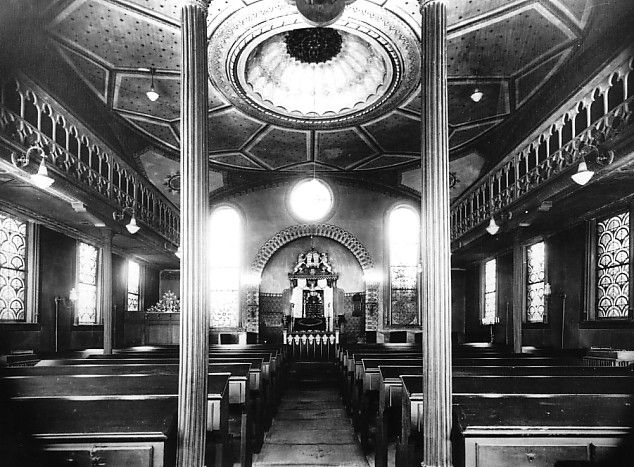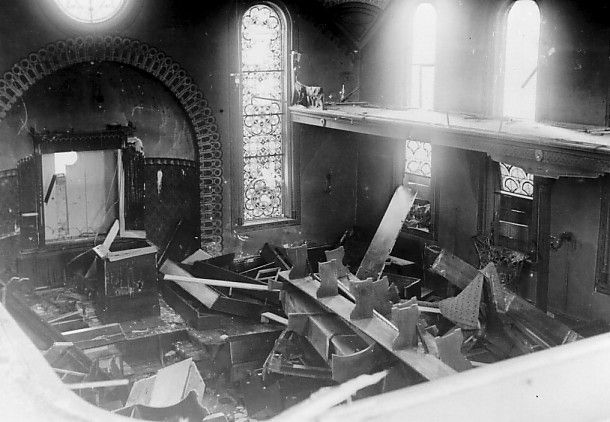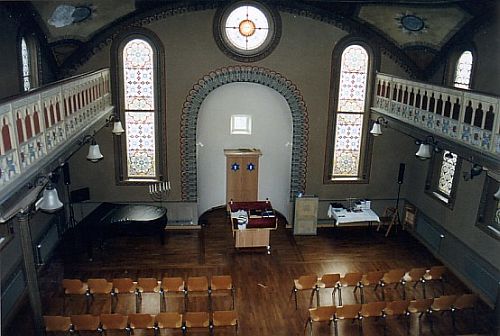
My Cousin Wolfgang and The Lessons of History: Will We Ever Learn Those Lessons?

When I started this blog back in October, 2013, I never anticipated that it would help family members find me.  But that has proven to be an incredible unexpected benefit of publishing this blog.  This is one of those stories.

Several weeks ago, I received a comment on the blog from a man named Wolfgang Seligmann, saying he was the son of Walter Seligmann, that he lived near Gau-Algesheim, and that he had found my blog while doing some research on his family.  He asked me to email him, which I did immediately, and we have since exchanged many emails and learned that we are third cousins, once removed:  his great-great-grandparents were Moritz Seligmann and Babetta Schoenfeld, my great-great-great-grandparents.  His great-grandfather August was the brother of Sigmund, Adolph and Bernard Seligman, the three who had settled in Santa Fe in the mid-19th century.   Wolfgang sent me a copy of August’s death certificate.
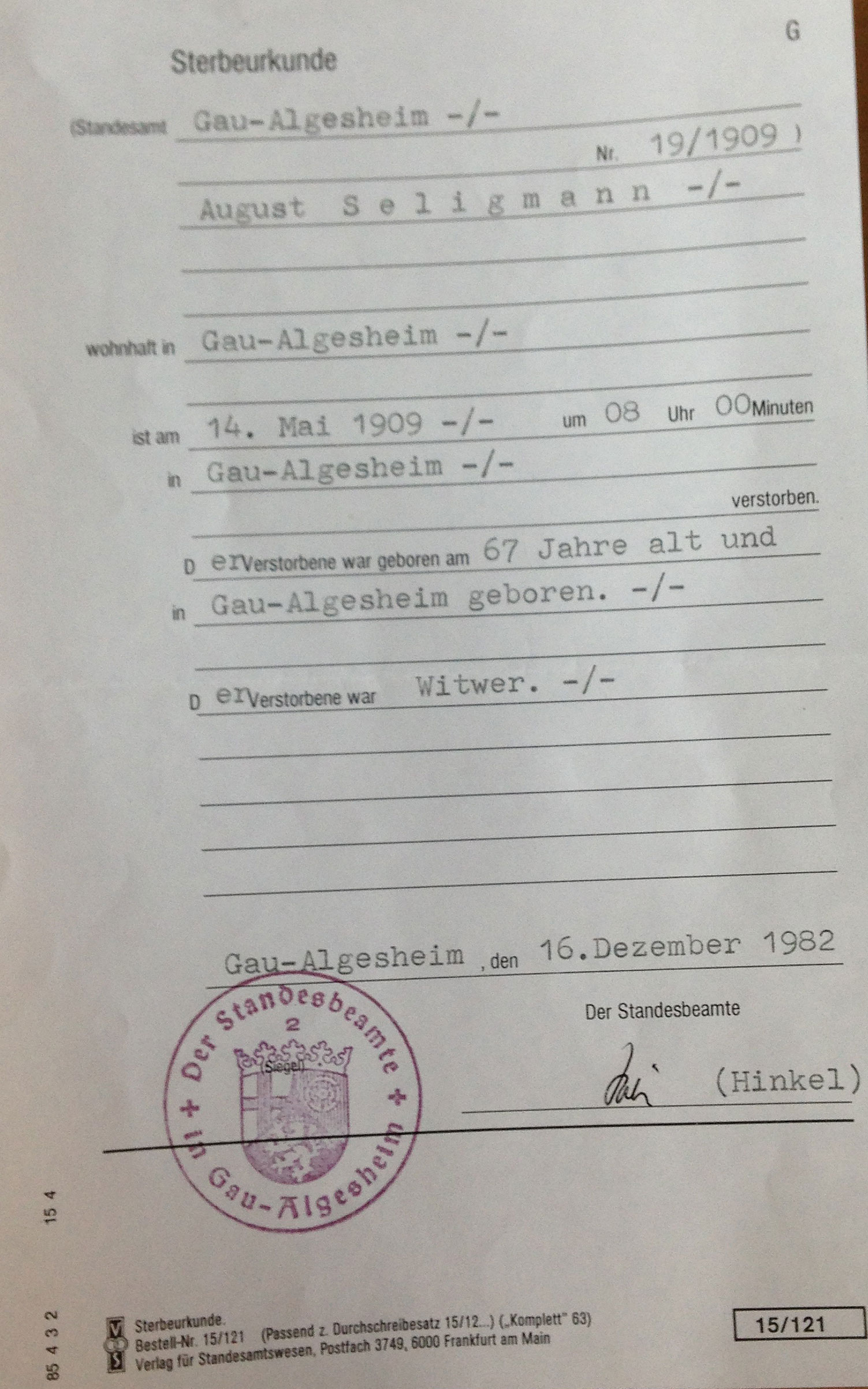
August Seligmann death certificate

August Seligmann death certificate

(Translations in this post courtesy of Wolfgang Seligmann except where noted: Registry-Office Gau-Algesheim: August Seligmann, living in Gau-Algesheim died the 14th of May 1909 at 8 a.m. in Gau-Algesheim. He was 67 years old and born in Gau-Algesheim. He was a widower.)

Our families had probably not been in touch since Bernard died in 1902 (or perhaps when Adolph died in 1920).  And now through the miracle of the internet and Google, Wolfgang had found my blog with his family’s names in it and had contacted me.  What would our mutual ancestors think of that?  It even seems miraculous to me, and I live in the 21st century.

Fortunately, Wolfgang’s English is excellent (since my knowledge of German is…well, about five words), and so we have been able to exchange some information about our families, and I have learned some answers to questions I had about the Seligmanns who stayed in Germany.  With Wolfgang’s permission, I would like to share some of those stories.

Wolfgang’s grandfather was Julius Seligmann, the second child and oldest son of August Seligmann and his wife Rosa Bergmann.  Julius was born in 1877 in Gau-Algesheim.  As I wrote about here, Julius was one of the Seligmanns written about in Ludwig Hellriegel’s book about the Jews of Gau-Algesheim.  He had been a merchant in the town.  On December 1, 1922, Julius had married a Catholic woman named Magdalena Kleisinger, who was born in Gau-Algesheim on July 9, 1882, and had himself converted to Catholicism.  Julius and Magdalena had two sons, Walter, who was born February 10, 1925, and Herbert, born July 27, 1927.  Julius and his family had left Gau-Algesheim for Bingen in 1939 after closing the store in 1935.

I had wondered why Julius had closed the store and then relocated to Bingen, and I asked Wolfgang what he knew about his grandfather’s life.  According to Wolfgang, his father Walter and uncle Herbert did not like to talk about the past, but Wolfgang knew that when Julius married and converted to Catholicism, his Jewish family was very upset and did not want to associate with him any longer.  In fact, Julius was forced to pay his siblings a substantial amount of money for some reason relating to his store in Gau-Algesheim, and that payment caused him and his family a great deal of financial hardship.  According to Wolfgang, Julius no longer had enough money to pay for his own home, and thus he and his family moved to Bingen in 1939 where they lived with Magdalena’s family or friends for some time.

Julius and Magdalena Seligmann

Julius and Magdalena Seligmann 1960s  Courtesy of Wolfgang Seligmann

The Hellriegel book also made some puzzling (to me) references to the military records of Wolfgang’s father and uncle, saying that they had been “allowed” to enlist in the army, but then were soon after dismissed.  Wolfgang explained that the German authorities did not know how to treat Catholic citizens with Jewish roots.  Wolfgang said that his father Walter had trained to be a pharmacist, but the Nazis would not allow him to work with anything poisonous.  In addition,  his father was not permitted to be in the army; instead  he was ordered by the authorities to work on the Siegfried Line, which was  originally built as a defensive line by the Germans during World War I.  In August 1944, Hitler ordered that it be strengthened and rebuilt, and according to Wikipedia, “20,000 forced labourers and members of the Reichsarbeitsdienst (Reich Labour Service), most of whom were 14–16-year-old boys, attempted to re-equip the line for defence purposes.”  Walter Seligmann was one of those forced laborers.

Map of the Siegfried line.

Map of the Siegfried line. (Photo credit: Wikipedia)

Here is a photograph of Walter Seligmann, Wolfgang’s father:
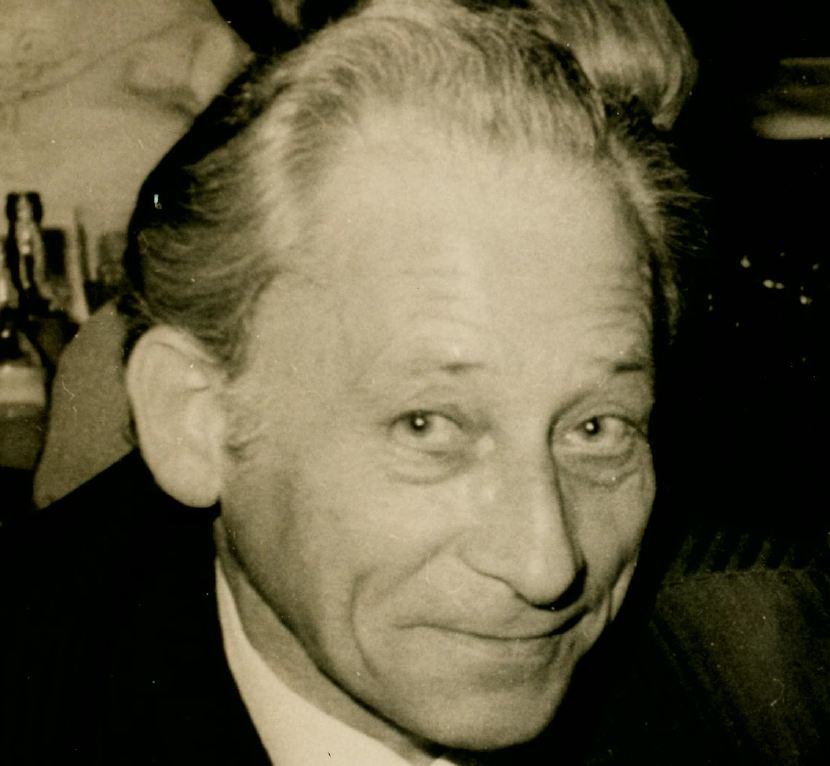
Walter Seligmann  Photo courtesy of Wolfgang Seligmann

Walter Seligmann Photo courtesy of Wolfgang Seligmann

As for Wolfgang’s uncle Herbert, he was sent by the local police to the army, but the army would not accept him.  He was dismissed and sent back to Bingen, where he was required to work in a warehouse until the war ended.

Herbert Seligmann courtesy of Christoph Seligmann

Herbert Seligmann courtesy of Christoph Seligmann

Julius Seligmann died in 1967, and his wife Magdalena died the following year.  Walter Seligmann died in 1993, and his brother Herbert died in 2001.
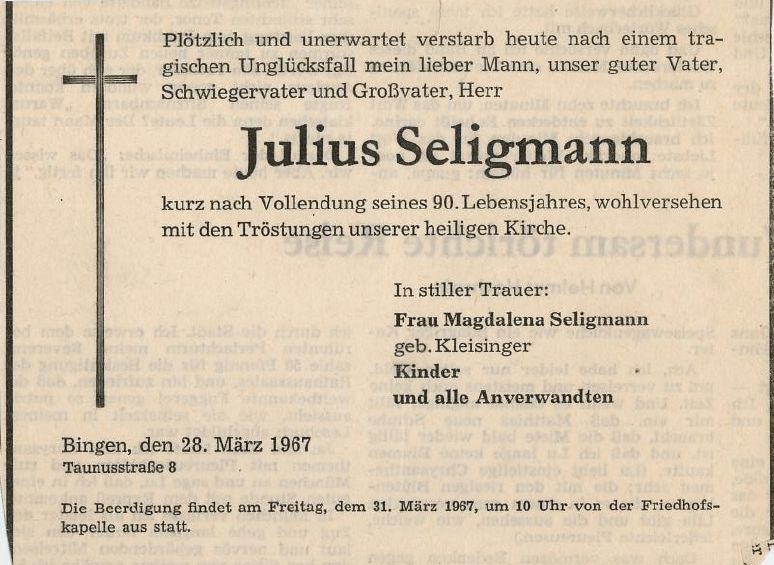
Julius Seligmann death notice

Julius Seligmann death notice

Magdalena Seligmann death notice

There are some very bitter ironies in these stories.  Julius and his family were not accepted by his Jewish family because they were Catholic, but the Nazis did not accept them either because they had Jewish roots.  As I commented to Wolfgang, prejudice of any sort is so destructive and unacceptable.  His family experienced it from two different directions.

Not that the two examples here can be equated in any way.  Although all prejudice is wrong, prejudice that leads to genocide is utterly reprehensible, an evil beyond comprehension for anyone who has a moral compass.  I have already written about my own personal horror and pain when I realized that I had family who had been murdered by the Nazis.  Wolfgang told me more about some of those who lost their lives to Hitler and his evil forces.

One victim was his great-uncle Moritz Seligmann (the grandson of Moritz Seligmann, my 3x-great-grandfather, and a son of August Seligmann).  My information about his fate comes from two websites that Wolfgang shared with me. According to these two sites, Moritz Seligmann, Julius’ younger brother, was born on June 25, 1881.  He fought in World War I for Germany, spent two years in captivity, and was honored with the Hindenburg Cross or Cross of Honor for his service.  Despite this, in the aftermath of Kristallnacht, on November 11, 1938, Moritz was arrested in Konigstein, where he had been living since 1925.  He was sent to the concentration camp at Buchenwald.

German Cross of Honour 1914-1918

German Cross of Honour 1914-1918 (Photo credit: Wikipedia)

Moritz wrote to the authorities in Konigstein, pointing out that he was the recipient of the Hindenburg Cross.  He was released from Buchenwald in December on the condition that he emigrate by March 31, 1939.  He was required to report to the police in Konigstein twice a week until then, and if he had not emigrated by the deadline, he was to be arrested.  On March 28, 1939, however, the Gestapo lifted the emigration order and the reporting requirement in light of Moritz’s service during World War I.

Here is a copy of the Gestapo letter, lifting the emigration order.  I found this a particularly chilling document to see.

Gestapo letter re Moritz Seligmann

Wolfgang helped me translate this letter as follows: Frankfort, March 20, 1939. Concerning: the “Aktionsjude” Moritz Seligmann born June 25, 1881, Gau-Algesheim, residing in Konigstein.  Seligmann has provided proof that he was a soldier in the World War as a combatant.  Therefore the reporting obligation and emigration order is lifted for him. I would ask the emigration (?) to supervise and notify us here.

As explained to me by Wolfgang and by Wikipedia,  the “Aktionsjude” referred to 26,000 Jews who were deported in the aftermath of Kristallnacht, as was Moritz Seligmann, as part of an effort to frighten other Jews to leave Germany.  Unfortunately, not enough of them did.

Despite the lifting of the order to emigrate, Moritz had hoped to immigrate to the US.  For various bureaucratic reasons described here, he was unable to get clearance to emigrate.  On June 10, 1942, he was picked up by the Nazis and transported somewhere to the east.  Exactly where and when he died is not known.

Wolfgang and his family, after researching the fate of Moritz, informed the town of Konigstein of their findings, and the town agreed to place a “stolperstein” in memory of Moritz Seligmann near his home in Konigstein.  A stolperstein (literally, a stumbling blog) is a memorial stone embedded in the ground to memorialize a victim of the Holocaust.  Here is a photograph of Wolfgang at the ceremony when Moritz Seligmann’s stolperstein was installed in Konigstein.
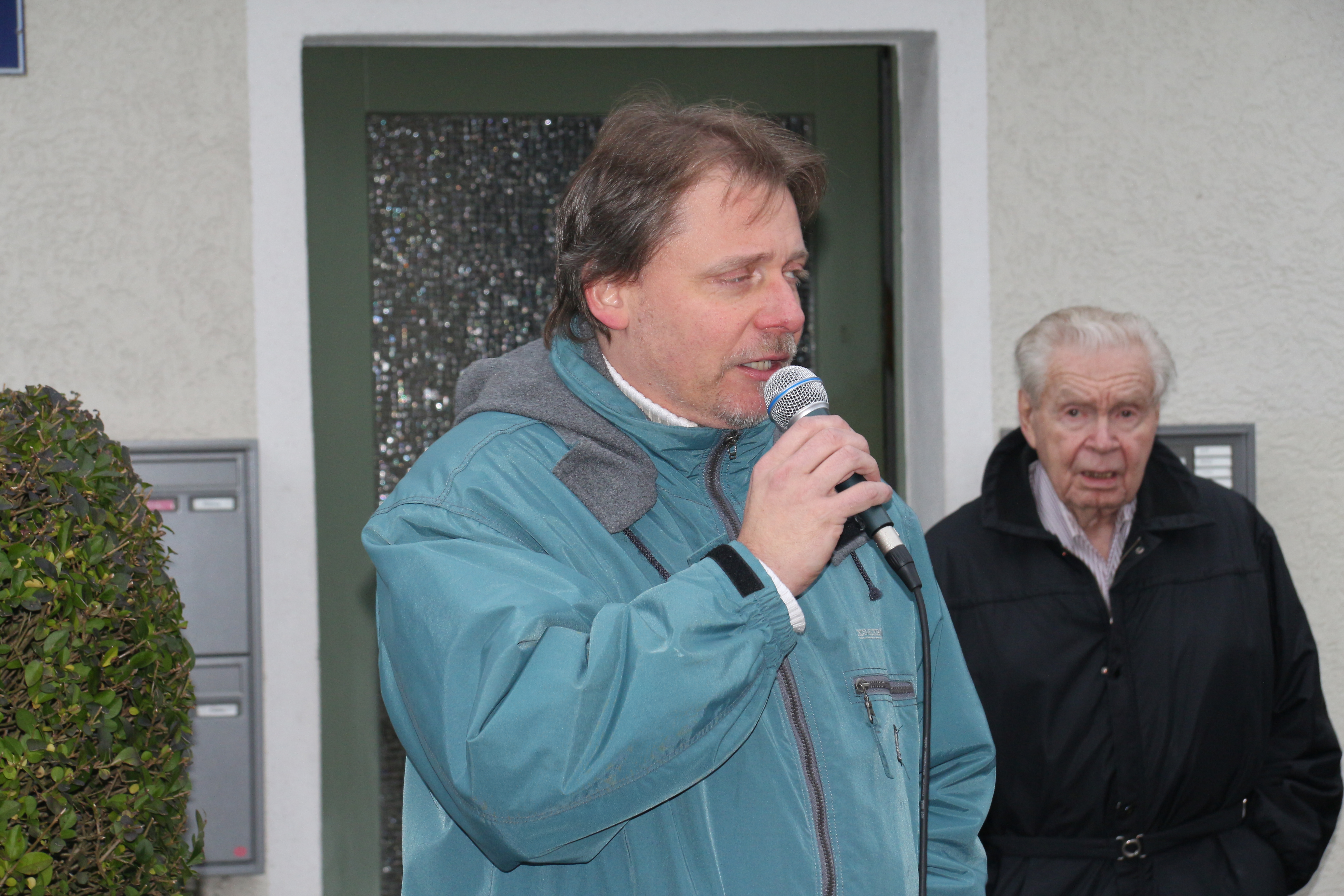
Wolfgang Seligmann

Wolfgang Seligmann  Courtesy of Wolfgang Seligmann

Behind him is a man who knew Moritz and remembered when Moritz was initially arrested in 1938, clinging to his Hindenburg Cross, believing it would save him from the murderous forces of the Nazis.  It may have stalled his murder, but it did not save him.

Wolfgang also told me about the fate of another sibling of his grandfather Julius, his younger sister Anna.  Anna, born in Gau-Algesheim in 1889, had married Hugo Goldmann, and they had a daughter Ruth, born in 1924 in Neunkirchen, a town about 80 miles southwest of Gau-Algesheim, where Anna and Hugo had settled. Between 1939 and 1940, many people from this area near the border with France were evacuated to locations in central Germany, and Anna, Hugo, and Ruth ended up in Halle, Germany, 350 miles to the northeast of Neunkirchen.  On June 1, 1942, they were all deported from Halle to the Sobibor concentration camp where they were all killed.  Click on each name to see the memorial pages established by the town of Halle in memory of Anna, Hugo, and Ruth.

Finally, Wolfgang told me about another member of the family.  Moritz Seligmann (the elder) had had a daughter Caroline with his first wife, Eva Schoenfeld.  Caroline was the half-sister of my great-great-grandfather Bernard. She had married a man named Siegfried Seligmann, perhaps a cousin.  Their son, Emil, died in Wiesbaden on August 9, 1942, when he was 78 years old.

Death record of Emil Seligmann, husband of Carolina Seligmann

Death record of Emil Seligmann, husband of Carolina Seligmann

(Wiesbaden: The Emil Jakob Israel Seligmann, without profession, “israelitisch”  [presumably meaning Jewish], living in Wiesbaden, Gothestraße Nr. 5, died on 9th of August 1942 in his Apartment. He  was born on 23th of December 1863 in Mainz.

Father: Siegfried Seligmann, deceased.  Mother: Karoline Seligmann, nee Seligmann, deceased.  He was widower of Anna Maria Angelika born as Illien. The death was announced by Emil Seligmann, his son, living Goethestraße Nr.5.

The stamp in the left hand margin says:  Wiesbaden, 31th of May 1949.  The “Zwangsvorname”Israel is deleted.  Zwangsvorname translates as “forced first name,” meaning that the name Israel had been required by the Nazis, I assume as a way to identify him as Jewish.

Emil had a son, also named Emil, who died in Buchenwald, as this record attests.

Emil Seligmann-KZ (1)

(To: Miss Christine Seligmann, Wiesbaden, Goethestr. Nr. 5,1

From: Special registry-office in Arolsen-Waldeck, department Buchenwald

Subject: death-certification for Emil-Jakob Seligmann, Your letter from the 1. of March 1950

Based on the documents of the International Tracing Service in Arolsen it is proved, that your brother died on 14th of February 1945 in the Concentration Camp Buchenwald. )

I imagine that this is not the end of the list of the Seligmanns who were murdered during the Holocaust, and I imagine that there are also many other family members I never knew about who were killed by the Nazis, whether they were named Schoenfeld, Nussbaum, Dreyfuss, Goldschlager, Rosenzweig, Cohen, or Brotman or something else.  I just haven’t found them yet.

Wolfgang and I plan to keep on exchanging stories, pictures, documents, and other information.  We have also already talked about meeting someday and walking in the footsteps of our mutual ancestors.  What an honor it will be to be with him as we share our family’s story.

The Schoenfelds and Erbes-Budesheim: Part II

In my last post, I wrote about Erbes-Budesheim, the German town where my Schoenfeld ancestors lived, where my 3x-great-grandmother was born, and where my 4x- and 5x-great-grandparents lived.   From the records I was able to obtain, I know that my 4x-great-grandparents Bernhard Schoenfeld and Rosina Goldmann were married and living in Erbes-Budesheim by 1804 when their first child Benedict Baehr was born.

As explained to me by Gerd Braun, the man in Erbes-Budesheim who sent me the documents,  when the French took over control of the region, one thing that they did in 1808 was order the Jewish residents to adopt surnames akin to those used by the Christian population.  Before that, Jews used patronymics.  Thus, before 1808, Bernhard Schoenfeld was named Baer (ben) Salomon[1] and Rosina was Rosina (bat) Benjamin.  The two children born before 1808 were named Benedict (ben) Baer and Taubchen (bat) Baer.  Taubchen was renamed Eva Schoenfeld after 1808.

Here is the birth record for Benedict.  (All the records before 1816 are in French, and my high school French classes came in handy.)  The translations for all of the documents below are in italics.

Benedict Baer birth record 1804

Benedict Baer birth record 1804

Act of birth of Benedict Baer born the 15th of Frimaire[2] at 10 in the morning, the legitimate son of Baer Salomon, merchant, living in Erbesbudesheim, and of Rosine nee Benjamin of Munchweiler.  The sex of the child has been recognized as masculine.  [Witnesses and signatures]

Benedict died just eight months later.

Benedict Baer death record 1805

Benedict Baer death record 1805

Act of death of Benedict Baer, died the 17th of Messidor[3] at 7 in the evening, eight months old, born in Erbesbudesheim and living in Erbesbudesheim.  Son of Baer Salomon and Roes nee Benjamin.  On the declaration made by Baer Salomon, his father, resident of Erbesbudesheim and a merchant, and Francois Colin, resident of Erbesbudeshem, a barber and a neighbor.

A year later, Taubechen (who became Eva) was born:

Birth record of Taubchen Baer/Eva Schoenfeld 1806

Birth record of Taubchen Baer/Eva Schoenfeld 1806

Act of birth:  In the year 1806 on the 2d of June in the afternoon appeared before the mayor of Erbesbudesheim… Baehr Salomon, a merchant, 34 years old, living in Erbesbudesheim, No. 66, and presented to us a female child of him and his legal wife Rosine nee Benjamin born the 2d of June at 5 in the morning and also stated that he wanted to give the child the name Taubchen.  [Witnesses and signatures.]

The children born after 1808 were given the name Schoenfeld, including my 3-x great-grandmother, Babetta.  You will see that on this record, Bernard and Rosine are referred to with surnames.

Babete Schoenfeld birth record 1806

Babete Schoenfeld birth record 1806

In the year 1810, the 28th of February, at nine in the morning, Bernard Schoenfeld, 37 years old, a merchant, and a resident of Erbesbudesheim,appeared before Andre Cronenberger, Mayor of Erbesbudesheim and presented a female child born the 28th of February in the morning of himself and Rosine nee Goldmann, his wife, and also declared that he wanted to give the child the name of Babet. [Witnesses and signatures]

In addition, I received records for other children of Bernard and Rosina Schoenfeld, ancestors I’d not known about before.  The first two are in French, but the last two are in German because they occurred when the region was back under German control.  The two in French follow the format and content of those above and evidence the births of a daughter Marianne, born June 29, 1812, and a daughter Rebecque, born July 20, 1814.

Birth record of Marianna Schoenfled 1812

Birth record of Marianna Schoenfled 1812

Birth record of Rebecque Schoenfeld 1814

Birth record of Rebecque Schoenfeld 1814

The last two are in German.  Thank you to Matthias Steinke for the translations. The first record is for the birth of another daughter, Zibora, in 1818.


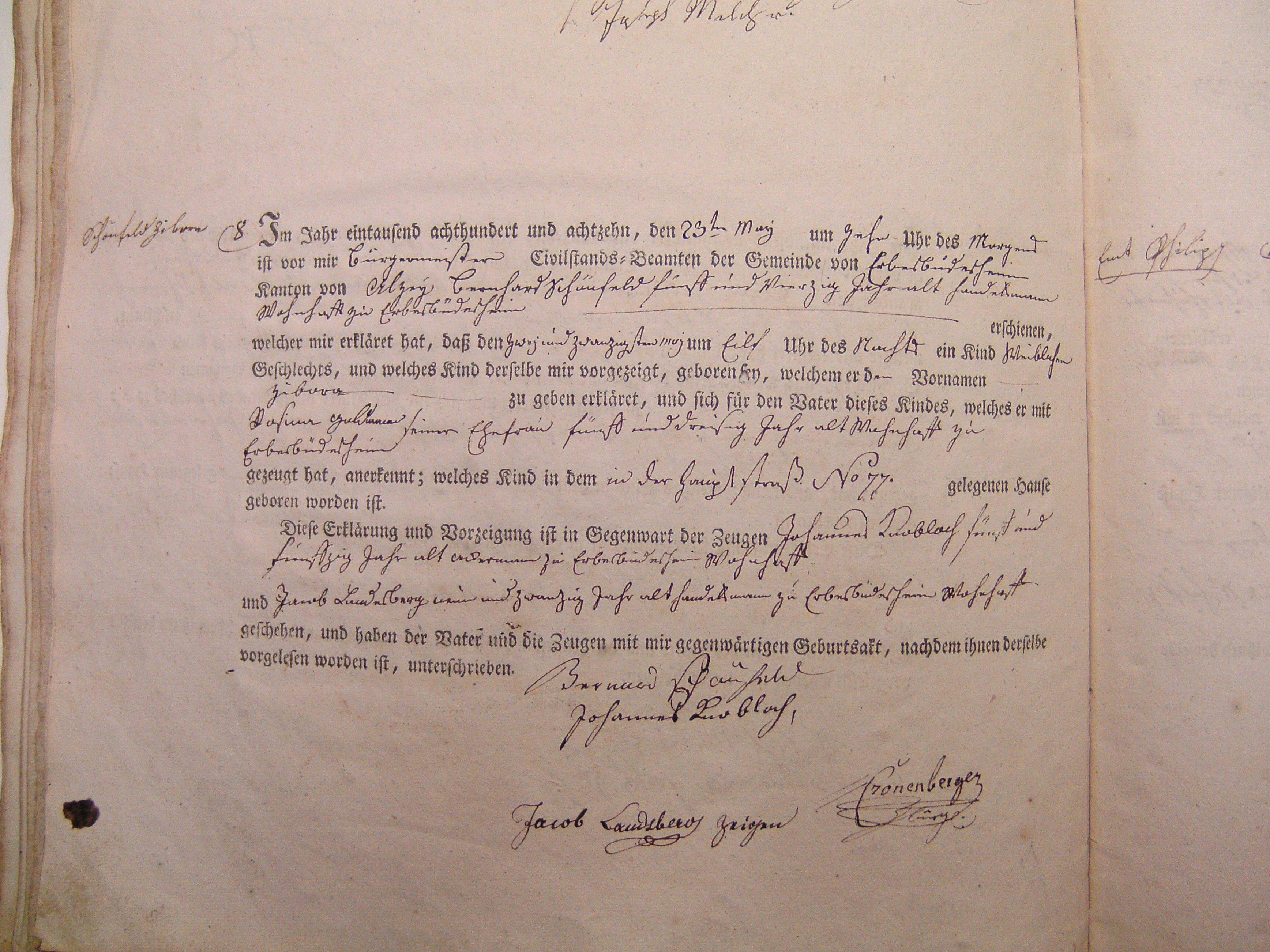
Birtn record of Zibora Schoenfeld 1818

Birtn record of Zibora Schoenfeld 1818

In the year 1818, the 23rd of May came to me, the mayor and official for the civil registration of the comunity of Erbesbuedesheim, county of Alzey, Bernhard Schoenfeld, 45 years old, merchant, residing in Erbesbuedesheim, who reported, that at the 22nd of May at 11 o´clock in the night a child of female sex, which he showed me, was born and whom he intends to give the first name Zibora, and which he declared to have fathered with his wife Rosina Goldmann, 35 old, residing in Erbesbuedesheim.  The child was born in the Hauptstr. nr. 77. This declaration and presentation happened in presence of the witnesses Johannes Knobloch, 55 years old, farmer, in Erbesbuedesheim residing and Jacob Landesberg, 29 years old, farmer, in Erbesbuedesheim  residing, and have the father and the witnesses signed his birth-record and it was read to them. Signatures

The last child of Bernard and Rosine for whom I have a record was their daughter Saara, born in 1820:

Birth Record of Saara Schoenfeld 1820

Birth Record of Saara Schoenfeld 1820

In the year 1820 the fifteenth of October at twelve o´clock midday came to me, mayor and official for the civil registration of the comunity Erbes-Buedesheim Bernhard Schoenfeld, 51 years old, merchant, residing in Erbes-Buedesheim, who reported, that at the fifteenth October at two o´clock in the morning a child of female sex, whom he showed me, was born and whom he intends to give the name Saara, and he also reported, that he fathered the child with Rosina Goldmann, 41 years old, residing in Erbes-Buedesheim, his legal wife. This declaration and showing happened in presence of the witness Johannes Knobloch, 57 years old, farmer, and Jakob Landsberg, 28 years old, merchant, both residing in Erbes-Buedesheim, and have the father and the witnesses with me this present birth-certificate after it was read to them, signed. Signatures

In the midst of all these births, there was also a death.  On February 16, 1813, Salomon Schoenfeld, father of Bernard Schoenfeld, died at age 63 (or is that soixant treize meaning 73?).  His occupation was given as “cultivateur,” or cultivator, which I assume means that he was a farmer.  The witnesses to his death included Benoit Schoenfeld, his son, age 23, a “propietaire”  or owner, but no indication of what he owned.  This must have been a younger brother of Bernard since in 1813 Bernard would have been at least 40 years old.  (His age seems to vary from birth record to birth record.)

Death Record of Salomon Schoenfeld 1813

Death Record of Salomon Schoenfeld 1813


There is also a record for the birth of the child of an Isaac Schoenfeld and a Barbe Goldmann who is probably also a family member, though I am not sure what the exact connection was between these Goldmanns and Schoenfelds and Bernhard and Rosina, my 4x great-grandparents. But the number of marriages between a Schoenfeld man and a Goldmann woman are somewhat revealing.  Here is a third such marriage, this one between Rebeka (Rebecque) Schoenfeld, the daughter of Bernhard and Rosina,  and Salomon Goldmann.  Is it any surprise that Ashkenazi Jews come up with thousands of matches when DNA testing is done?  We are all interrelated at so many different levels.

Marriage Record for Rebecque/Rebkah Schoenfeld and Salomon Goldmann

Marriage Record for Rebecque/Rebkah Schoenfeld and Salomon Goldmann


In the year 1834 on the fifteenth October at ten o´clock pre midday came to me, Andreas Cronenberger mayor and official for the civil registration of the comunity Erbes-Buedesheim, county of Alzey:

Salomon Goldmann, 42 years old, merchant, residing in Kirchheimbolanden, Rhein-county, Bavaria, born in …thal, like it was presented to me by a certificate of the district-court Kirchheimbolanden from the 24th of December 1807, which was certified by the district-court in Mainz, the adult son of 1. Joseph Goldmann, 75 years old, during his lifetime a merchant in Kirchheimbolanden, deceased there the 8th of  November, 1800 (some parts here were cut off) 2. Friederike Goldmann, widow, nee Goldmann, 62 years old, without profession residing in Kirchheimbolanden and here present and giving her confirmation and who declared to be unable to write.

And on the other hand, Rebeka Schoenfeld (Schönfeld), 20 years old, born in Erbebudesheim in 1814, like I have seen in the present birth-register of the year 1814, without profession, in Erbes-Buedsheim residing.

Minor daughter of 1. Bernhard Schoenfeld, 62 years old, merchant and owner of a manor, in Erbes-Buedesheim residing. 2. Rosina Schoenfeld nee Goldmann, 55 years old, without profession, in Erbes-Buedesheim residing, both are present and giving their confirmation.

The appearing people asked me to do the marriage. The proclamation was published at the main-door of the comunity-building the September 24, 1834 at noon and the second the September 26 at noon in Erbes-Buedesheim and in Kirchheimbolanden the 14th of September the first time and the 21st of September of the same year the second time was made.

Due to the case, that no objections against this marriage appeared, and after reading the sixth chapter of the civil-rights-lawbook which is titled „about the marriage“ I asked them whether they want to marry each other. Both confirmed this question and I declared that Salomon Goldmann, widower from Kirchheimbolanden and the maiden Rebeka Schoenfeld of Erbes-Buedesheim are from now on connected by the matrimony.

About this act this certificate was made in presence of the following witnesses:

Georg Peter Erbach, 54 years old, member of the regional council and manor-owner in Erbes-Buedesheim, a neighbour of the bride, not related.  Johannes Klippel, 45 years old, farmer in Erbes-Buedesheim, not related, a neighbour of the bride, Christoph Zopf, 49 years old, farmer in Erbes-Buedesheim, not related, a neighbour of the bride,  Johannes Härter, 82 years old, comunity-servant in Erbes-Buedesheim, not related, a neighbour of the bride. After happened reading have all parts this document with me signed. Signatures

I have a couple of observations about this marriage certificate.  First, the groom was a widower and 24 years older than the bride.  Also, Rebeka was younger than her sister Babete or Babetta, my 3x-great-grandmother, yet married before her, even though this would appear to have been an arranged marriage.  Did Babetta object to marrying Salomon? Or did Salomon choose Rebeka over her older sister?

Also, I was struck by the fact that Bernard was described not just as a merchant, as he had been in the records of his children’s births, but as the owner of a manor.  Perhaps this explains why my Schoenfeld relatives were living in this small village with almost no Jewish residents.  Bernard must have  been quite successful to be a manor owner.

Two years after this wedding, Bernard Schoenfeld died.

Death record of Bernard Schoenfeld 1836

Death record of Bernard Schoenfeld 1836

In the year 1836 November 20th, at eight o´clock pre midday came to me, Andreas Cronenberger, mayor and official for the civil registration of the comunity Erbes-Buedesheim, county of Alzey, 1. the Jakob Landsberg, 46 years old, merchant in Erbes-Buedesheim residing, related as uncle of the below named deceased, and 2. Leopold Schoenfeld, 42 years old, merchant, in Erbes-Buedesheim residing, related as sibling of the below named deceased, and have reported to me that Bernhard Schoenfeld, 67 years old, merchant and manor-owner, born and residing in Erbes-Bueresheim, married to Rosina Schoenfeld, nee Goldmann ,56 years old, without profession, residing in Erbes-Buedesheim. Parents were: Salomon Schoenfeld, during lifetime merchant and manor-owner in  Erbes-Buedesheim, 2. Gertrude Schoenfeld nee Judah, during lifetime also residing in Erbes-Buedesheim.

Died November 1836 at three o´clock past midday in house nr 85 in the Hauptstrasse (Mainstreet) here is deceased and have the here present this certificate after it was read to them with me undersigned.

In this record, Bernard’s father Salomon is described as a merchant and manor owner, not a cultivator.  I am not sure how to reconcile that with the earlier record of Salomon’s death. The above record also reveals two more relatives: Leopold Schoenfeld, another brother of Bernard, and Jakob Landsberg, an uncle.  But Jakob Landsberg was over 20 years younger than Bernard.  Perhaps he was a nephew?  Leopold Schoenfeld’s headstone appeared in the video I posted in the last post.  Here’s a screenshot from that video:

Leopold Schoenfeld headstone

Leopold Schoenfeld headstone

Just a few months after Bernard Schoenfeld died, his daughter Babete, my 3-x great-grandmother, married Moritz Seligmann on February 14, 1837.

Marriage record of Babete Schoenfeld and Moritz Seligmann 1837

Marriage record of Babete Schoenfeld and Moritz Seligmann 1837

In the year 1837 the 14th of the month February, at three o´clock past midday to me, Peter Cronenberger, mayor and official for the civil registration of the comunity Erbes-Buedesheim, county of Alzey came:

Moritz Seligmann, 38 years old, widower of Eva Seligmann, nee Schoenfeld, deceased in Gaulsheim the 12th of May 1835 as it is written in the death-register of the comunity Gaulsheim of the year 1835, merchant, in Gau Algesheim residing, like it is in the birth-records of the community Gau Algesheim to find, adult son of 1. Jacob Seligmann, 63 years old, merchant, in Gaulsheim residing, 2. Martha Seligmann nee Mayer, 63 years old, in Gaulsheim residing, both not present, but giving their permission to this marriage according a notary-certificate of the notary Wieger in Gaulsheim from the 6th of February, 1837,

and on the other hand, Babete Schoenfeld, 26 years old, without profession, in Erbes-Buedesheim residing, born the February 28, 1810, like it is stated in the birth-register of the comunity Erbes-Buedesheim of the year 1810, adult daughter of 1. Bernhard Schoenfeld, during lifetime merchant, in Erbes-Buedesheim residing, deceased 19th of November 1836, as it is stated in the death-register of the comunity Erbes-Buedesheim, 2. Rosina Schoenfeld, nee Goldmann , 56 years old, in Erbes-Buedesheim residing, last named here present and consenting to the marriage. ….

Due to the case, that no objections against this marriage appeared, and after reading the sixth chapter of the civil-rights-lawbook which is titled ‘about the marriage,“ I asked them whether they want to marry each other. Both confirmed this question and I declared that Moritz Seligmann, merchant in Gau Algesheim residing and Babete Schoenfeld, without profession in Erbes-Buedesheim residing, are from now on legally connected by the matrimony.

About this act I made this certificate in the presence of the following witnesses: [Witnesses and signatures]

This marriage record answered a question that I had had about the two sisters both marrying Moritz Seligmann.  According to this record, Eva Schoenfeld had died on May 12, 1835.  Eva died in the aftermath of giving birth to her fourth child, Benjamin, who was born on May 10, 1835.

Her sister Babetta (as it was later spelled) became the instant mother of Eva’s four children, who then ranged in age from Benjamin, not yet two years old, to eight year old Sigmund, who would be the first to come to the US and settle in Santa Fe.  Babetta not only had these four children to care for; she must also have become  pregnant almost immediately after the wedding because my great-great-grandfather Bernard Seligman, obviously named for Babetta’s father Bernard Schoenfeld who had died the year before, was born on November 23, 1837, just nine months and nine days after the marriage.

The last record I received from Erbes-Budesheim was the death record for Rosina Goldmann Schoenfeld, dated July 19, 1862.  She was 84 years old.  She was my 4-x great-grandmother.  All I know about her is where she was born, her father’s name, her husband’s name, and the names of her children and some of her grandchildren.  I know that she lost one child at eight months old, an adult daughter in the aftermath of childbirth, and her husband almost thirty years before she died.  It’s not a lot, but it is remarkable to me that I know even that much about a woman who was born in the 18th century in Germany.

Death record of Rosina Goldmann Schoenfeld 1862

Death record of Rosina Goldmann Schoenfeld 1862

So what have I learned about my Schoenfeld ancestors and their lives in Erbes-Budesheim from all these documents?  First, they must have been one of only a very few Jewish families in Erbes-Budesheim if the total Jewish population was just 23 people.  Second, they must have been fairly comfortable living in that small town, living as merchants and manor owners.   But there was no future for their family in the town.  Bernard Schoenfeld and Rosina Goldmann had only daughters who survived to adulthood.   To find marriage partners for their daughters, Bernard and Rosina had to look outside of Erbes-Budesheim.  Their 20 year old daughter Rebeka Schoenfeld married a 44 year old widower from a town in Bavaria, about ten miles from Erbes-Budesheim.  Their daughter Eva married Moritz Seligmann and moved to Gau-Algesheim.  Then their daughter Babetta,  my 3-x great-grandmother, married Moritz after her sister died.  These young women must have had no choice but to marry and move away from Erbes-Budesheim.  No wonder the town’s Jewish population never grew and eventually declined and disappeared.

But the cemetery still exists, and Erbes-Budesheim is one more town to add to my list of ancestral towns I’d like to visit one day.


[1] Gerd Braun did not use the Hebrew terms “ben” or “bat” for son or daughter of, but simply referred to them as, for example, Baehr Salomon.  I am assuming, however, based on Jewish practice, that the second name would have been the father’s first name.  Thus, Baehr Salomon is really Baehr son of (ben) Salomon.

[2] According to Wikipedia,  Frimaire “was the third month in the French Republican Calendar. The month was named after the French word frimas, which means frost. Frimaire was the third month of the autumn quarter (mois d’automne). It started between November 21 and November 23. It ended between December 20 and December 22. It follows the Brumaire and precedes the Nivôse.”  Benedict was thus born about December 6.

[3] Messidor in the French Republic Calendar was equivalent to June 19 to July 18.  The 17th would be equivalent to July 6.

The First Chapter: The Dreyfuss Family

Yeah, I know.  My last post said it was the FINAL chapter of the Dreyfuss family.  How could this one be the first?

Way back on November 18, 2014, I wrote, “More on the Dreyfuss family in a later post.”  Then I proceeded to write about the Nusbaum family and the Dreyfuss family together.  Since two Dreyfuss sisters (Jeanette and Mathilde) had married two Nusbaum brothers (John and Maxwell), it just made sense to follow the stories of the three Dreyfuss sisters (Jeanette, Mathilde and Caroline) along with the stories of the Nusbaum siblings.  But what I never got back to doing was what I had promised back on November 18.  I never got back to the beginning of the Dreyfuss story as I moved forward from the 1840s in America through to the 20th century.  So although my last post was called the “Final Chapter” of the Dreyfuss family, I need to go back and write the first chapter before I can complete the story (as far as I currently know it).

So I need to step backwards in time—both in my time and in the times of the Dreyfuss family before 1840.  Back in the fall when I was researching the family of John Nusbaum, I had a wonderful resource in the family bible owned by my father.  My father had photocopied several pages of handwritten entries for births, deaths, and marriages from the bible , and most of those entries related to the Nusbaum family.  From studying the page for marriages, I learned that John Nusbaum, my three-times great-grandfather, had married Jeanette Dreyfus (as it was spelled there).  And that was the first time I knew the birth name of my three-times great-grandmother.  On the page for births, the second entry after the one for John Nusbaum was one for Jeanette Nusbaum, giving her birth date and her place of birth.  It took me a while to figure out what it said because of the handwriting, but eventually I was able to decipher it and learned that Jeanette was born in “Hechingen in Wurttemberg, Prussia,” as it is inscribed in the bible.

But there was no other Dreyfus(s) on any of the pages in the bible, and I was at that point in time focused on the Nusbaum line.  It wasn’t until weeks later that I realized that the bible’s death entry for Mathilde Pollock was not an entry for a sister of John Nusbaum, but an entry for a sister of Jeanette Dreyfuss (who happened to marry a brother of John Nusbaum) and that the entry for Caroline Wiler was also not a sister of John Nusbaum but another Dreyfuss sister. The big clue was finding 65 year old Mary Dreyfuss  on the 1850 census living with Caroline and Moses Wiler: a head-slapping moment when it occurred to me that it was Jeanette who was keeping the family bible and that, of course, she would record her sisters as well as her husband’s siblings in the family bible.

And then in mid-November I went on JewishGen’s Family Finder page and found Ralph Baer, who was also researching the Dreyfuss family from Hechingen.  I have mentioned Ralph before in the context of the Nusbaum/Dreyfuss family and his generous help with research and translation, but what I had forgotten to write about in my telling of the story of the Nusbaum/Dreyfuss family in the US was what Ralph had helped me learn about my Dreyfuss roots in Hechingen, Germany.

Hechingen, Germany

Hechingen, Germany (Photo credit: Wikipedia)

First, a little about Hechingen.  Today it is in the German state of Baden-Wurttemburg, located about 56 miles north of the Swiss border in southern Germany.  It is about 40 miles from Stuttgart, the state capital.  Although inhabited long before, the city was founded as the capital city of the Counts of Hohenzollern in 1255.  It remained during the Middle Ages a provincial and agricultural community.  During the 16th century, it became a center for art, architecture and music.  Even after the Reformation, it remained a largely Catholic community.  Throughout its pre-19th century history, Hechingen was subjected to many sieges and attacks by other German states as well as by Sweden.

de: Burg Hohenzollern bei Hechingen, Baden-Wür...

de: Burg Hohenzollern bei Hechingen, Baden-Württemberg, Deutschland en:Castle Hohenzollern near Hechingen, Germany (Photo credit: Wikipedia)

According to the Jewish Virtual Library, “There was a small Jewish settlement in Hechingen in the early 16th century, and a house was bought for use as a synagogue by the community of 10 families in 1546. In 1592 the burghers refused to conduct any commercial or financial transactions with Jews, who therefore left the town. There is no trace of Jewish settlement in the town during the next century. In 1701 Prince Frederick William I gave letters of protection lasting 10 years to six Jewish families in the neighboring villages; soon there were Jews living in the city as well. By 1737 there were 30 households, and a synagogue was built in 1761 which existed until 1870.”

The Jewish community blossomed in Hechingen in the late 18th and early 19th century through the efforts of a woman named Chaile Raphael Kaulla.  Her father was a successful entrepreneur and banker, and he provided Chaile with a good education.   She even learned German, not something girls were usually taught in those times.   When her father died, Chaile, being much older than her oldest brother, took over her father’s business; she managed the business very successfully while also raising six children.  Her husband, a Talmudic scholar, did not work.  Chaile and her brother Jacob developed a very good relationship with the authorities in Hechingen and became the leaders of the Jewish community there.  Here is more about Chaile from the Jewish Women’s Archive:

Chaile developed an aristocratic lifestyle, owning an elegant house and a horse-drawn carriage, but she continued to live according to Jewish law. She never forgot the mitzvot and cared for the Jewish community together with her brother, using her connections to the prince. The Kaulla family had their own private synagogue and rabbi. Both sister and brother gave generously to the Jewish as well as to the Christian poor and founded a hostel for needy and migrating Jews in Hechingen. In 1803, they donated a Bet Midrash, a Talmud school, with three rabbinical scholars whom they supported, together with their students and an important library.


The 19th century was a time of economic and industrial growth for the town of Hechingen and for its Jewish residents.  Wikipedia states that “By 1850, Hechingen had started to industrialize, primarily with Jewish enterprises. By 1871 the city had become one of the most important economic centres in the region, with textiles and machine shops among the major industries.”  According to the Jewish Virtual Library, the Jewish community in Hechingen was “prosperous and owned most of the local industries.” The Jewish population reached 809 people in 1842, which was about a quarter of the total population of the town.  This was also around the time that my three-times great-grandmother Jeanette and her sisters and mother would have left, which might seem strange, given how favorable the conditions there seemed to have been.

The Alemannia-Judaica, however, reports that there were some anti-Semitic “disturbances” in the 1840s, and the Dreyfuss sisters were not the only ones to leave.  By 1880, the Jewish population had dropped to 340; by the 1930s it had dropped to only 101.  Like so many other Europeans, Jews and non-Jews, the lure of opportunities elsewhere must have been irresistible.  The Dreyfuss sisters were wise to leave Hechingen because it was no more immune to the destruction and genocide of the Nazis than any other place during the Holocaust.  The synagogue was heavily damaged on Kristallnacht in November, 1938, and most of the Jewish men were sent to Dachau.  In the aftermath, 53 Jews emigrated successfully; the remaining 32 Jewish residents of Hechingen were sent to concentration camps where all but one were murdered by the Nazis.

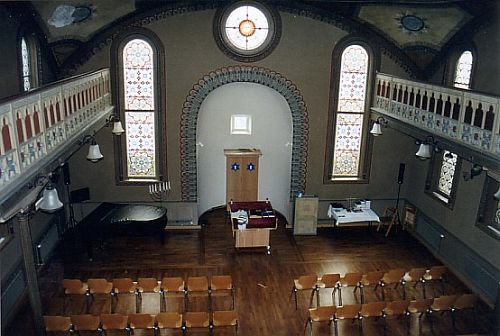
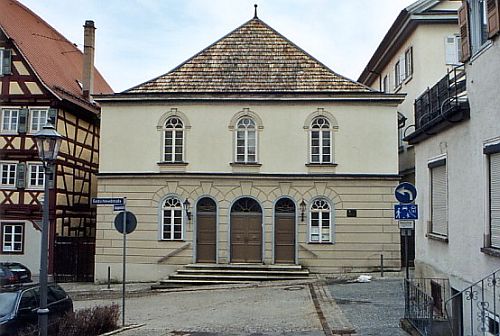
According to another source, “In 1991, the synagogue building was rebuilt as a cultural center, housing an exhibition on Hechingen’s Jewish history. A new Jewish community was founded in Hechingen in 2003.”  More pictures can be found here.


Where did my ancestors fit into this story of Hechingen? I was very, very lucky to find Ralph Baer on the JewishGen Family Finder because Ralph had already done extensive research on all the Hechingen Dreyfuss families years before I stumbled onto the name in the old family bible.  Even though he had not been able to find a connection between his Dreyfuss ancestors and mine, he had included my line in his tree when he’d done his research years ago.  Thus, my first email from Ralph in response to my inquiry as to his Hechingen Dreyfuss family included the following names:

A)3. Samuel (Sanwil) DREYFUß (ZELLER) 25 May 1776 Hechingen – 3 July 1859
Hechingen, married about 1805 to Miriam (Marianna) Samson BERNHEIM 17 May
1787 – 1841

A)31. Jeanette DREYFUß 20 May 1817 Hechingen, married to … NUßBAUM

A)32. Moses DREYFUß 10 February 1819 Hechingen

A)33. Goldel (Golde, Auguste) DREYFUß 16 October 1822 Hechingen,
married to … WEILER

A)34. Mathilde (Magdalena) DREYFUß 30 March 1825 Hechingen, married
to … POLLAK

A)35. Samson DREYFUß about 1827 Hechingen

A)36. Auguste DREYFUß about 1829 Hechingen[1]

There were my 3x-great-grandparents right at line 31, and there at line 33 was Caroline (born Golde) “Weiler” and at line 34 Mathilde “Pollak.”  I knew immediately that Ralph had found the three Dreyfuss sisters listed in my family bible.  Not only did the names line up, but so did the birth dates.  Thus, I now also knew that Jeanette, Caroline, and Mathilde were the daughters of Samuel Dreyfuss Zeller (later documents, as I found, indicated he had changed his surname to Zeller) and Miriam (Marianna) Samson Bernheim, that is, the Mary Dreyfuss I had found on the 1850 census living with her daughter Caroline in Pennsylvania.  (The death date of 1841 given for Miriam Ralph and I later discovered was not correct. I have not, however, found a death record for Miriam, though with two grandchildren named Miriam, one (Miriam Nusbaum, daughter of John Nusbaum and Jeanette Dreyfuss) in 1858, and one in 1859 (Miriam Pollock, daughter of Mathilde Dreyfuss and Moses Pollock, it would appear that Miriam died before 1858.)  In addition, I now had evidence of three other siblings: Moses, Samson, and Auguste.

But, of course, I wanted to see the actual records where Ralph had long ago found my relatives while researching his own.  With his patient assistance, I was able to locate a number of records relating to my Dreyfuss ancestors.  Fortunately, many of the Jewish vital records from the Baden-Wurttemburg region are digitized and available on line, and Ralph walked me step by step through the process of researching those archives and then helped me translate what I had found.  Once again, I struggled with the German script, but with Ralph’s help, I was able to find a number of relevant records.

I am now including the links to them here with a transcription of what is on each record so that I have a record later when I once again have trouble reading the script.  If you are interested in seeing the underlying documents, just click on the links.  The JPG versions were too blurry to read, so I am only posting links to the PDF versions, with two exceptions that were more legible.

Dreyfuss births (1)  Birth Registry for Hechingen 1800-1905

Line 132 Moses Dreyfuss                             Father Samuel                  Mother Miriam geb Bernheim

Line 186 Golde (Augusta) Dreyfuss           Father Samuel                 Mother Miriam geb Bernheim

Line 223 Mathilde Dreyfuss                                                 SAME


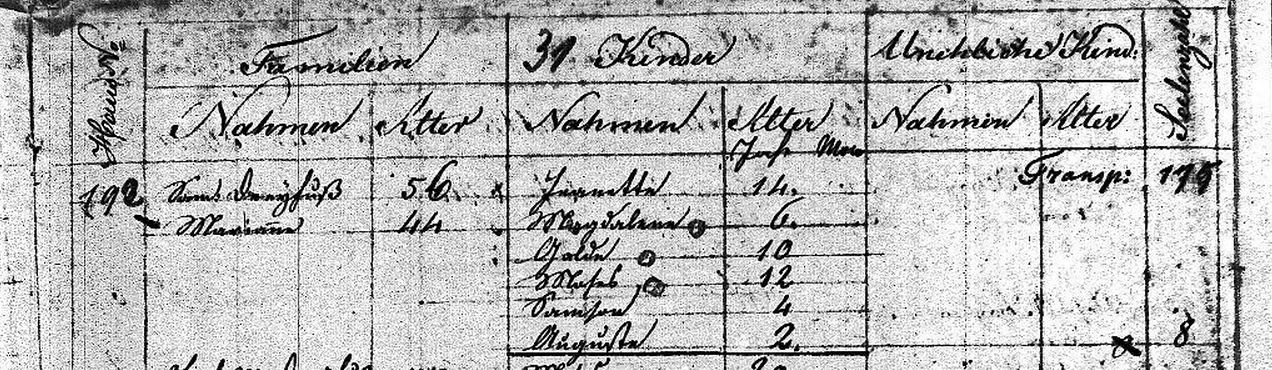
Dreyfuss Family on Archives film 240 bild 31  (Census 1831)

Dreyfuss family on archives film 240 film 31

#192 Samuel Dreyfuss 56 and Marianna 44. Six children: Jeanette 14, Magdalena 6, Golde 10, Moses 12, Samson 4, and Auguste 2.


Golde Auguste Caroline Dreyfuss birth record

First line:    October 16, 1822      Golde (Augusta)         Samuel Dreyfuss               Miriam geb Bernheim


Mathilde Dreyfuss birth record

Sixth line:  March 30 1825          Mathilde                       Samuel Dreyfuss                  Miriam geb Bernheim


Meier Dreyfuss brother of Samuel  Death Record

Parents               Samson Dreyfuss and Jeanette


Moses Dreyfuss birth record

Seventh line:  February 10, 1819    Moses Dreyfuss          Samuel Dreyfuss               Miriam geb Bernheim


Moses Zeller ne Dreyfuss death record Hechingen

Son of Samuel Zeller and Marie geb Bernheimer


Samuel Dreyfuss and family on Hechingen Family Records

Ralph helped me decipher this; otherwise, it would have meant nothing to me:  The name DREYFUSS is underlined with Samuel next to it. Below Samuel is written Zeller.  Below that it says Eltern (parents) Samson, and below that Jeanette(Scheile). To the right is geb. (born) and below that get. (married). The birth date for Samuel is on the right 1776 25 Mai. Between that is written “63 alt geworden” (became 63 years old, his age at the time of the compilation). For marriage it says angebl. (apparently) 1805 with also something in Hebrew. Samuel’s wife is on the right: Miriam, daughter of Samson Bern…and Golde. It also mentions a sister name Sussen right below that. The birth date for Miriam is listed as 17 Merz (March) 1787.  On the bottom are the children. The first one on the left is r Jeanette. In parentheses after her name is NUSSBAUM and below that 20 years old. To the left it states ca. 1817 20 Mai. Also listed are Moses, Mathilde Madel (Pollak), and Auguste (Golde) Weiler with birthdates.  (This was obviously compiled after 1851 since all three sisters are married and Mathilde is already married to Moses Pollock, whom she did not marry until after Maxwell Nusbaum died in 1851.)

Samuel Dreyfuss death record bild 143  (second on page)


Samuel Zeller death p 1 Samuel Zeller death p 2

Bottom of both pages: Samuel Zeller  Hechingen      Samson Dreyfuss and Jeanette    Alterschwaeche (old age)


There are some missing records.  I do not have a separate birth record for Jeanette.  Nor can I find a death record for her mother, my 4x-great-grandmother Miriam Bernheim.  I cannot find any records for the two youngest of the siblings, Samson and Auguste.  I also do not understand why there are two children with the name Auguste.  Perhaps one was a child of a family member who died? There is also a huge gap between the recorded marriage date for Samuel Dreyfuss and Miriam Bernheim of 1806 and the birth date of their oldest child, Jeanette, in 1817.  Did Samuel and Miriam have other children who died, or is their marriage date incorrect?  Samuel would have been 41 in 1817, Miriam would have been 30.  Both Samuel and Miriam had fathers named Samson.  Were both alive in 1819 when Moses was born? If not, it seems odd that their first son would not have been named Samson, unless there had been an earlier born son named Samson who had died.

I don’t know the answers to these questions, but I have answers to so many more questions than I ever expected, thanks to Ralph.  I know the names of my 4x-great-grandparents, Samuel Dreyfuss Zeller and Miriam Bernheim, and the names of my 5x-great-grandparents, Samson and Jeanette Dreyfuss and Samson and Golde Bernheim.  I have the names of the three other siblings of my 3-x great-grandmother Jeanette: Moses, Samson, and Auguste.  And I am not yet done looking for more about my Dreyfuss ancestors and now, my Bernheim ancestors as well.

Once again, I am deeply grateful to Ralph Baer.  Without him, none of this would have been possible.


[1] Together Ralph and I filled in many of the blanks here, enabling both of us to have a more complete record.

Life’s Injustices

The last two posts and the research surrounding them have really been draining.  The sad stories of Minnie Simon and Daniel Meyers in particular were hard to read about and to write about.  And sadly the next decade for the descendants of Caroline Dreyfuss and Moses Wiler is no more uplifting.  In fact, in some ways it’s even worse than the first decade of the 20th century.  But rather than put it off, I want to get it done. Today I will post about the children of Eliza Wiler and Moses Simon; next I will post about the children of Fanny Wiler and Joseph Levy and the children of Clara Wiler and Daniel Meyers. Then maybe I can post some cartoons or funny pictures or pictures of kittens.  Anything but death, disease, and despair.

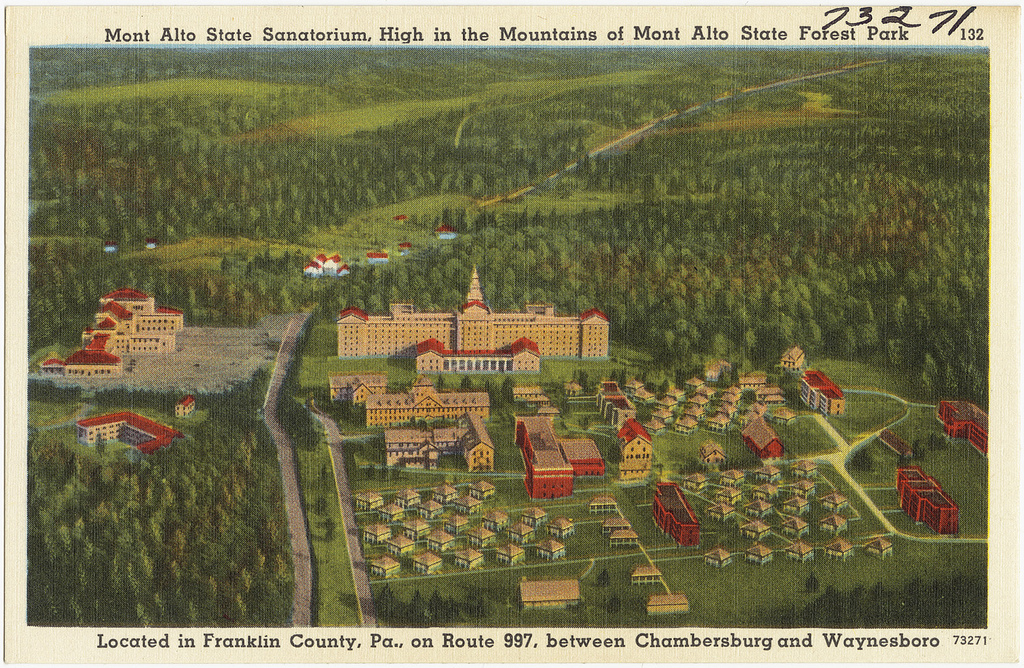
The four surviving children of Eliza Wiler and Leman Simon continued to have far more than their fair share of tragedy in the 1910s.  First, on April 20, 1915, the youngest child Leon died from tuberculosis.  He had been at the Mont Alto Sanitarium in Quincy, Pennsylvania for over a year.  He was only 36 years old.  Having just watched the PBS program about tuberculosis, “The Forgotten Plague,” on February 10, I have a whole new appreciation for the suffering this disease caused.  People could live for years with the disease, coughing, wasting away, and being sent to live in a sanitarium surrounded by others also suffering from these symptoms.  I now better understand how many people were affected by TB and how lucky we all are that medical science eventually figured out not only how to treat it, but also how to prevent it.

Title: Mont Alto State Sanatorium, high in the mountains of Mont Alto State Forest Park, located in Franklin County, Pa., on Route 997, between Chambersburg and Waynesboro   Created/Published: John Myerly Company, Hagerstown, Md.

Title: Mont Alto State Sanatorium, high in the mountains of Mont Alto State Forest Park, located in Franklin County, Pa., on Route 997, between Chambersburg and Waynesboro
Created/Published: John Myerly Company, Hagerstown, Md.

There are a number of strange things about Leon’s death certificate.  First, notice that it says Leon was widowed.  I have no record that he ever married, and since as I pointed out in my last post, I can’t find Leon on the 1910 census, I don’t know whether he married before or after the 1910 census.  In addition, if he was widowed, it means his wife also died very young.

Leon Simon death cert

Ancestry.com. Pennsylvania, Death Certificates, 1906-1963 [database on-line]. Provo, UT, USA: Ancestry.com Operations, Inc., 2014.

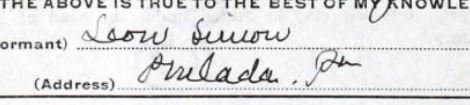
 The second strange thing is the name of the informant: Leon Simon.  Certainly Leon could not have signed his own death certificate.  I checked to see if there was another Leon Simon in the extended family who might have signed, and there was Leon (Dinkelspiel) Simon, the son of Moses Simon and Paulina Dinkelspiel, who was after all Leon (Wiler) Simon’s first cousin.  But that Leon was fifteen years older and lived in Baltimore.  I found it strange that he would be signing the death certificate when Leon the deceased had so many closer relatives living right in Philadelphia.

Leon Simon informant

Then I looked more closely and realized that the handwriting on the signature of the informant matched the handwriting of the local registrar, Wilson Reynolds.  The rest of the handwriting on the certificate matches that of the doctor, William McKelvey, who provided the cause of death.  I am not sure what to make of this except that perhaps Leon had provided all the information about his family to the sanitarium at some earlier point and that the doctor had then filled it out and the registrar just “rubber stamped” it by signing both Leon’s name and his own.

The final interesting piece of information on this certificate is the address provided as Leon’s last address before entering the sanitarium: 2513 South 18th Street.  You may remember that I also had trouble locating Leon’s brother Joseph on the 1910 census because there were so many men with that name in Philadelphia.   Using this address I found Joseph L. Simon living at that same address both on the 1910 and in the 1920 census reports as well as in the 1918 Philadelphia directory.  It is also the address that Joseph gave on the funeral bill for his brother Leon’s funeral in 1915.

Leon Simon funeral bill

On the two census reports, Joseph was married and living with his wife, Mary, who was nineteen years younger than he was.  The 1910 census reports that Joseph and Mary had been married for eight years, meaning they married in 1902. I’ve yet to find a marriage certificate.  Joseph was working as an accountant for a trust company (Providence Life & Trust Co, according to the funeral bill).

Provident Building, 401-09 Chestnut Street, Philadelphia, PA (1888-90, demolished 1945) in 1910. Library of Congress, Prints & Photographs Division, PA,51-PHILA,256A-1

Provident Building, 401-09 Chestnut Street, Philadelphia, PA (1888-90, demolished 1945) in 1910. Library of Congress, Prints & Photographs Division, PA,51-PHILA,256A-1


Mary was born in Virginia, as were both of her parents.  The only part of the 1910 census report that bothers me is that it says that Joseph’s father (Leman) was born in Pennsylvania; he was born in Germany.  It says that Joseph’s mother (Eliza) was born in Virginia; she was born in Pennsylvania.  But overall, it seems that this is definitely my Joseph Simon.  The address on Leon’s death certificate and funeral bill seem quite persuasive evidence of that conclusion.

The 1920 census did not help matters though.  On that census, Joseph’s parents are both listed as born in Virginia.  Very strange.  Could Mary have thought he was a Virginian like she was?  If he married her in 1902 as indicated on the 1910 census, Leman Simon was still alive.  I can’t imagine that a German immigrant sounded like a Virginian even after being in Pennsylvania for almost fifty years. Nevertheless, because they were still living at 2513 South 18th Street, I still believe that this is the right Joseph and Mary Simon.

And then Joseph and Mary disappear.  There are many, many Joseph and Mary Simons listed in directories in many, many places during this time period, yet the 1930 census does not have one  couple that fits my Joseph Simon even as closely as the 1910 and 1920 census reports.  This was the closest fit I could find for Joseph.

JOseph Simon 1930 census

Year: 1930; Census Place: Philadelphia, Philadelphia, Pennsylvania; Roll: 2102; Page: 20A; Enumeration District: 0572; Image: 389.0; FHL microfilm: 2341836

On this census the birth places of Joseph’s parents are correct: Germany and Pennsylvania.  The age is correct.  But the middle initial looks more like an H than an L.  There is no occupation, so that is no help.  Joseph’s marital status is given as single, and he is living at a lodger at what seems to be a very large boarding house.  I think this is Joseph.  If so, what happened to Mary?  Did she die? Did she leave him? I don’t know.  The trail has run dry.  It also ran dry on Joseph.  I cannot find him on the 1940 census nor have I found a record of his death.  He remains an elusive subject.

As for Flora Simon, she had been widowed back in 1901 when Nathan Strouse died, and she had remarried in 1903.  But that marriage did not last.  Although Flora was living with her second husband Albert Heulings in 1910, by 1917 he was married to another woman, Evelyn Cotton, according to both the Cook County, Illinois Marriage Index and his draft registration for World War I.

On the 1920 census, Flora was listed as divorced and living with her son Lester, now 31 years old.  Flora was working as the “keeper of an apartment house,” and Lester was in the advertising business.  There were also three lodgers plus Flora’s sister Nellie. Why was Nellie living with her sister? What had happened to her husband Louis? That’s when I looked and found the death certificate for Florrie Loux, a child I had not known about until I saw the 1920 census and looked for where Louis Loux might have been.

And that’s where the story really turns tragic.

I mentioned in my last post that I couldn’t find Nellie and Louis on the 1910 census and would not have known about their daughter if I had not found her death certificate.

Ancestry.com. Pennsylvania, Death Certificates, 1906-1963 [database on-line]. Provo, UT, USA: Ancestry.com Operations, Inc., 2014. Original data: Pennsylvania (State). Death certificates, 1906–1963. Series 11.90 (1,905 cartons). Records of the Pennsylvania Department of Health, Record Group 11. Pennsylvania Historical and Museum Commission, Harrisburg, Pennsylvania.

Ancestry.com. Pennsylvania, Death Certificates, 1906-1963 [database on-line]. Provo, UT, USA: Ancestry.com Operations, Inc., 2014.
Original data: Pennsylvania (State). Death certificates, 1906–1963. Series 11.90 (1,905 cartons). Records of the Pennsylvania Department of Health, Record Group 11. Pennsylvania Historical and Museum Commission, Harrisburg, Pennsylvania.

Florrie had died on September 21, 1918 from burns accidentally caused by matches.  A seven year old child.  There is nothing I can say to describe the horror I felt when I saw that death certificate.

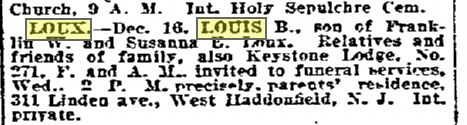
Three months later her father Louis B. Loux died from broncho pneumonia on December 15, 1918.

Philadelphia Inquirer December 17, 1918, p. 19

Philadelphia Inquirer December 17, 1918, p. 19

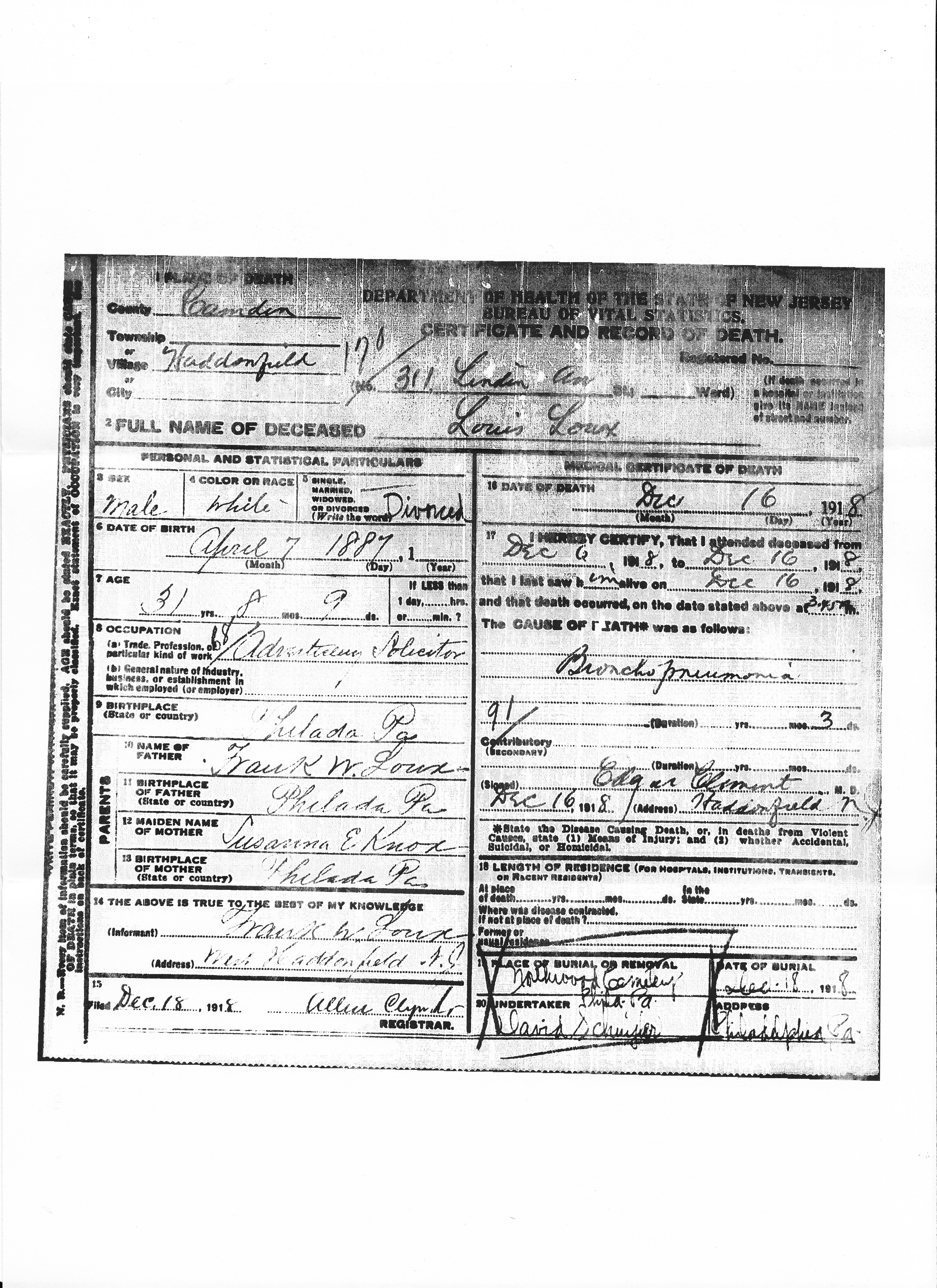
From his World War I draft registration, I know that in 1917 Louis had been working in Philadelphia doing advertising sales for the German Daily Gazette.  The home address he had provided for his 1917 draft registration, however,  was 311 Linden Street, Haddonfield, New Jersey.  The death notice for Louis indicated that that was his parents’ residential address in 1918.  But Florrie’s death certificate indicated that she and Louis both had been living at 128 North 10th Street in Philadelphia when she died.  I was able to obtain the information contained in the death certificate for Louis (I am still waiting the actual document), and it reports that he was divorced at the time of his death.  I cannot tell from these records whether Louis and Nellie had divorced before or after the death of their daughter.

UPDATE:  Here is the death certificate for Louis Loux.

Death certificates_0003_NEW

Think about it: between 1910 and 1920, Leon Simon had died from tuberculosis; Flora Simon, already widowed once, saw another marriage end; Joseph Simon was married, but sometime after 1920, his marriage seems also to have ended either by death or divorce; and Nellie Simon lost both her young daughter and her ex-husband in the space of a few months in 1918.  All this followed a decade where Leon, Flora, Joseph and Nellie had lost both of their parents and their sister Minnie.

Now you can see why I need something to lift my spirits.  Fortunately, as I will cover in my next post,  things were not as bad for the children of Fanny Wiler Levy or the children of Clara Wiler Meyers.  Not as bad.


A Decade of Heartache for Caroline’s Family

The 19th century ended badly for the extended family of Caroline Dreyfuss and Moses Wiler.  Their daughter Eliza Wiler Simon died in August 1897, and their son-in-law Daniel Meyers, Clara’s husband, died in 1902, following several years of financial distress and legal problems.   Unfortunately, it only got worse as the 20th century began.

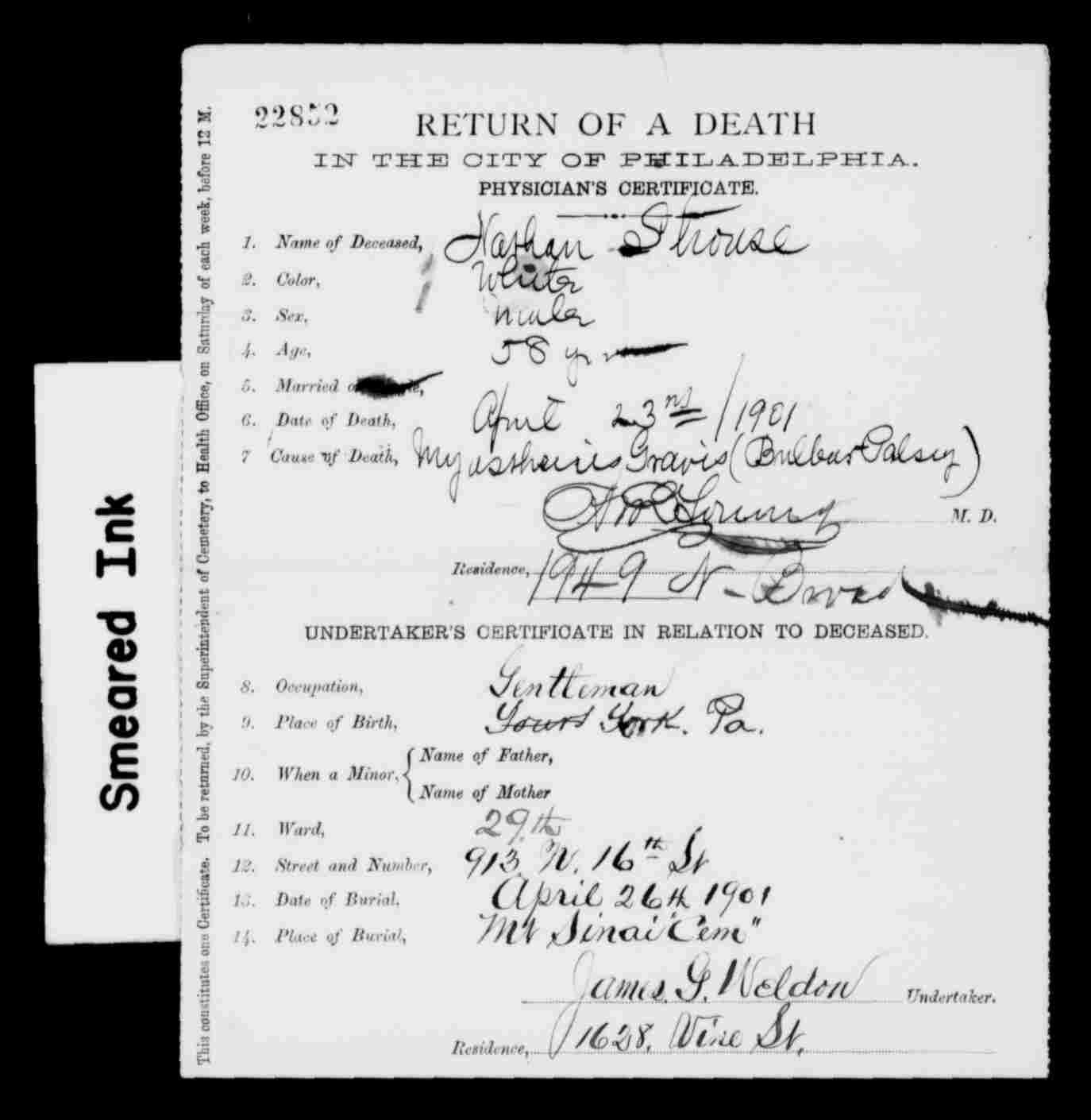
First, on April 23, 1901, Flora Simon’s husband Nathan Strouse died from myasthenia gravis.  He was 24 years older than Flora, but only 58 years old when he died.  Their son Lester was only thirteen years old when he lost his father.  I found it rather interesting that Nathan’s occupation on the death certificate was given as “gentleman.”

Nathan Strouse death certificate

“Pennsylvania, Philadelphia City Death Certificates, 1803-1915,” index and images, FamilySearch (https://familysearch.org/pal:/MM9.1.1/JDLH-SJ1 : accessed 11 February 2015), Nathan Strouse, 23 Apr 1901; citing cn 22852, Philadelphia City Archives and Historical Society of Pennsylvania, Philadelphia; FHL microfilm 1,845,290.


Two years later Flora married Alfred C. Heulings, a New Jersey lawyer who, in contrast to her first husband, was almost twelve years younger than Flora.

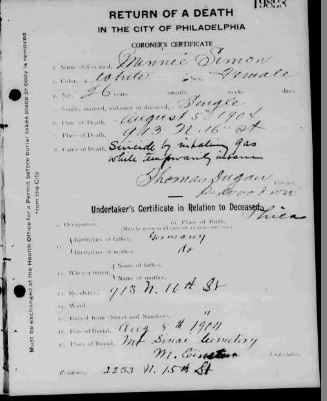
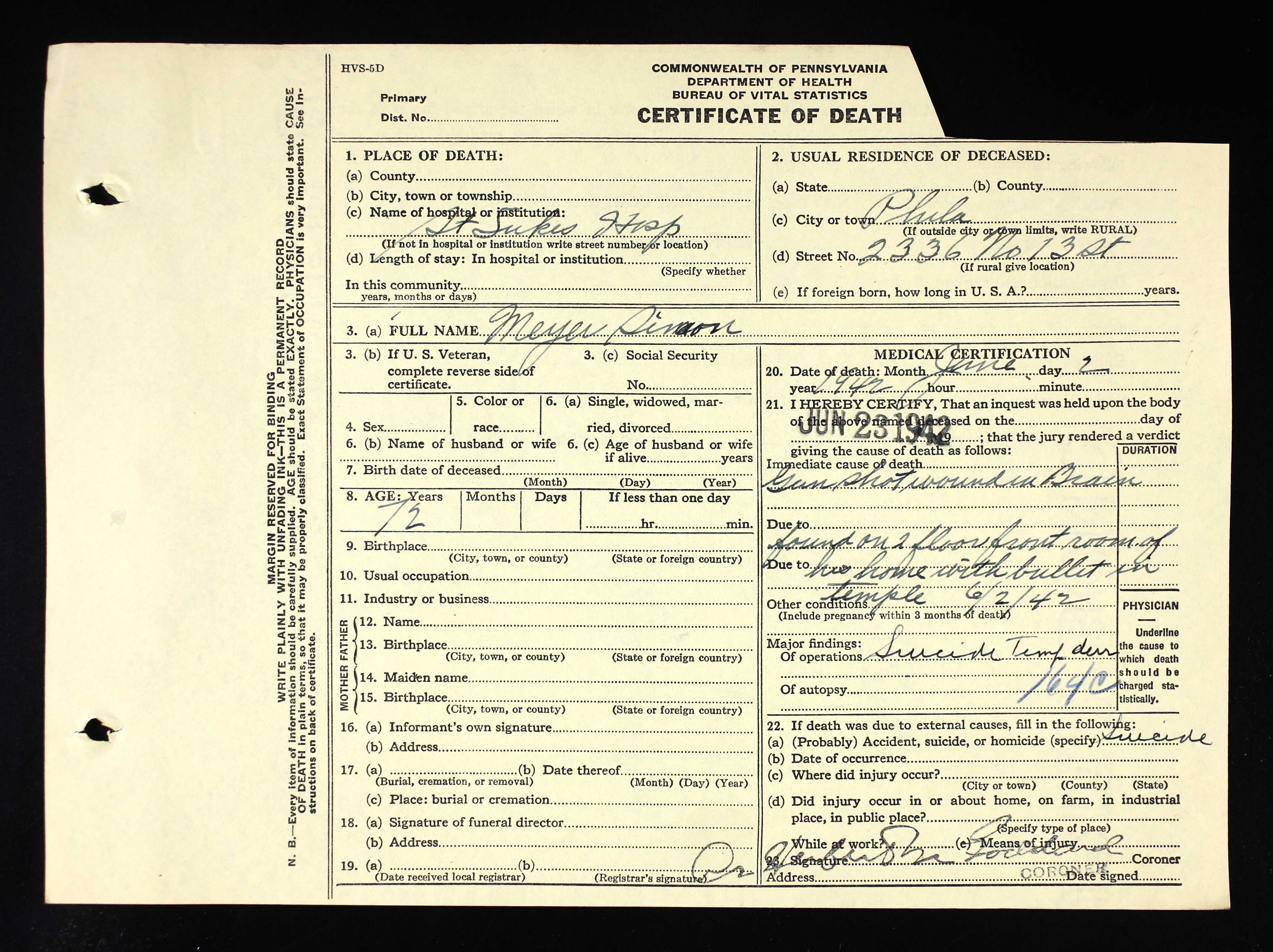
Then in 1904, there was another disaster for the family.  Minnie Simon, the younger daughter of Eliza Wiler and Leman Simon, committed suicide.  Her death certificate stated that she took her life “by inhaling gas while temporarily insane.”

minnie simon death cert 1904

“Pennsylvania, Philadelphia City Death Certificates, 1803-1915,” index and images, FamilySearch (https://familysearch.org/pal:/MM9.1.1/JDGP-4DQ : accessed 11 February 2015), Minnie Simon, 05 Aug 1904; citing cn 19898, Philadelphia City Archives and Historical Society of Pennsylvania, Philadelphia; FHL microfilm 1,004,045.


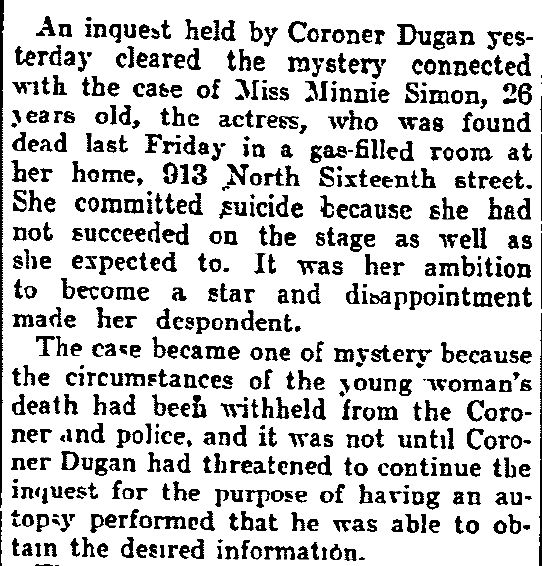
Apparently her death created some controversy based on this news article from the Philadelphia Inquirer, August 9, 1904,  covering the coroner’s inquest:

minnie suicide 1


minnie suicide 2


minnie suicide 3

minnie suicide 4

Paper: Philadelphia Inquirer (Philadelphia, PA) Volume: 151 Issue: 40 Page: 5 August 9, 1904

From Joseph’s description of his sister’s personality, today she might have been diagnosed and treated for bipolar disease or depression.  But in 1904 that was not possible, and so Minnie succumbed to mental illness and took her own life.  She was only 26 years old.

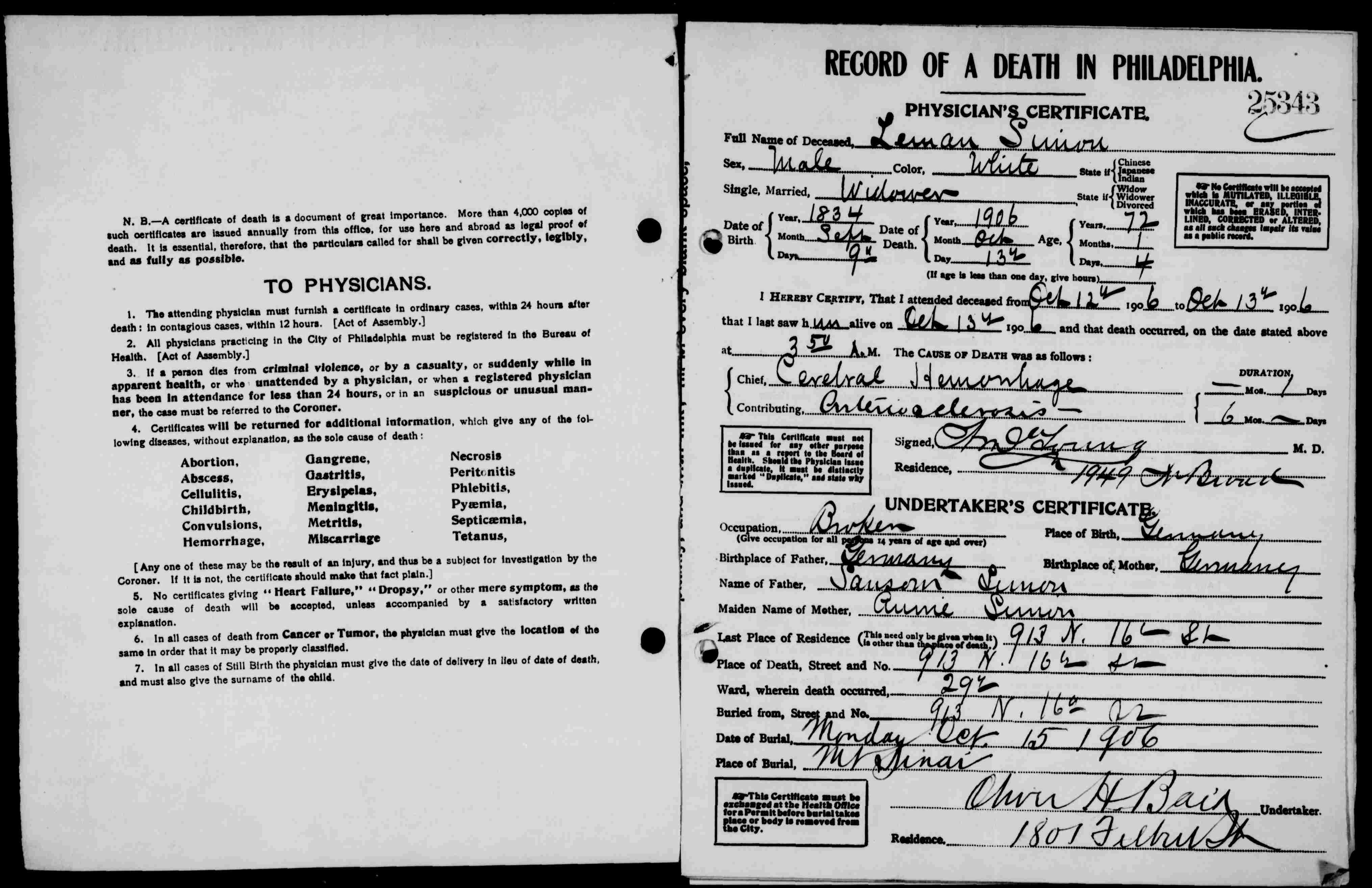
Two years after losing his daughter Minnie and nine years after losing his wife Eliza, Leman Simon passed away on October 13, 1906, from a cerebral hemorrhage.  He was 72 years old.

Leman Simon death cert

“Pennsylvania, Philadelphia City Death Certificates, 1803-1915,” index and images, FamilySearch (https://familysearch.org/pal:/MM9.1.1/JK98-3Q6 : accessed 11 February 2015), Leman Simon, 13 Oct 1906; citing cn 25343, Philadelphia City Archives and Historical Society of Pennsylvania, Philadelphia; FHL microfilm 1,319,469.


Thus, in the ten years between 1897 and 1906, the family lost five members:  Eliza Wiler Simon, Nathan Strouse, Daniel Meyers, Minnie Simon, and Leman Simon.  The Simon family in particular must have been quite devastated.

Not all was sad, however, in the first ten years of the 20th century.  Nellie Simon married Louis Boughen Loux on April 30, 1908.  They were married in the Eleventh Street Methodist Episcopal Church in Philadelphia.  Louis was 21, and Nellie was 33.  Like her sister Flora’s second marriage, this was a marriage between a man and a significantly older woman, which must have been quite unusual in those days.

Thus, by 1910, the family had changed quite a bit.  Leman and Eliza Simon were both gone, as was their daughter Minnie.  Flora was living with her second husband Albert Heulings and her son Lester Strouse at 913 North 16th Street.  Albert was practicing law.  Lester, who had graduated from the University of Pennsylvania in 1909, was now 21 and working in the advertising business for the Quaker City Publicity Company.  There were also two servants in the household.

As for Flora’s siblings, I am once again having a terrible time finding them on the census.  Nellie Simon and her husband Louis Loux had a child Florie born on March 3, 1910, in Philadelphia, but I only know this from Florie’s death certificate.  I cannot find a birth record, nor can I find Nellie and Louis on the 1910 census.  I found a Leon Simon listed in the 1908 Philadelphia directory at 541 Fernon Street, working as a bookkeeper, but he is not at that address on the 1910 census.  Joseph Simon’s address in 1904 was 136 Farson Street in West Philadelphia, according to the news article about his sister Minnie’s death.  But he is not at that address on the 1910 census.  I have some possible listings for Joseph, but given how common his name was, I just am not certain.

As for the family of Clara Wiler Meyers, Clara in 1910 was a widow, still living at the long-time family home at 920 Franklin Street, with nine of her children. Her oldest son Leon Meyers (36 in 1910) had by 1902 become an optician and was still living at home as late as 1904.  In 1910 he was living at 1628 North 13th Street, according to the Philadelphia directory, yet he is not listed there on the 1910 census, nor is he listed on the census at 1904 Somerset Street, where he is listed as residing in the 1911 directory.  I think Leon, like his Simon cousins, just eluded the census taker.  His younger brother, Benjamin Franklin Meyers, 25 years old in 1910, was living as a boarder in Trenton, New Jersey, where he was working as a watch maker in a watch factory.

The other nine Meyers children were still living with their mother Clara.  All were unmarried.  Samuel (34) was like his brother Leon an optician.  Harry (33) was a tailor.  Isador (30) was a “commercial traveler” for a men’s clothing business.  Max (28) was a draftsman for a machine works business. Clarence (24) was a cotton yarn salesman. Frank (22) was an optician like his two older brothers Leon and Samuel.  The three youngest children Lottie (20), Miriam (17), and Milton (14) were all at home and not occupied.

Source Citation Year: 1910; Census Place: Philadelphia Ward 20, Philadelphia, Pennsylvania; Roll: T624_1394; Page: 4B; Enumeration District: 0334; FHL microfilm: 1375407

Source Citation
Year: 1910; Census Place: Philadelphia Ward 20, Philadelphia, Pennsylvania; Roll: T624_1394; Page: 4B; Enumeration District: 0334; FHL microfilm: 1375407

I cannot imagine what this house looked like that accommodated all of those people.  I’ve tried to locate a photograph, but have had no luck.  Google Street View shows a modern apartment building at that address today.

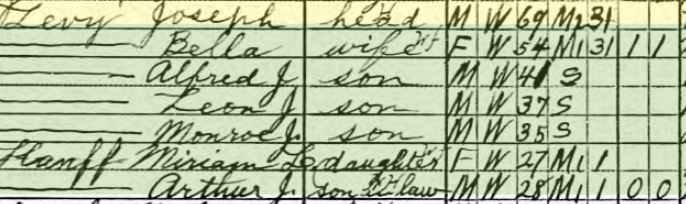
Fanny Wiler Levy’s three sons were also still single and living with their father Joseph and stepmother Bella at home at 2122 Camac Street in 1910.   Their father Joseph Levy was living on his “own income,” according to the 1910 census.  Alfred, now 41, was a lumber salesman, and Leon (37) and Monroe (35) were clothing salesman.  Their half-sister Miriam (27) was married to Arthur Hanff, a traveling shirt salesman.

Levy family 1910

Year: 1910; Census Place: Philadelphia Ward 32, Philadelphia, Pennsylvania; Roll: T624_1403; Page: 10B; Enumeration District: 0750; FHL microfilm: 1375416


Levy occupations 1910

Simon Wiler, the only son of Caroline Dreyfuss and Moses Wiler, was living in a large boarding house on Spruce Street in 1910.  He was working as a salesman in a paper warehouse.  Simon died the following year on October 23, 1911.  He died from shock after a prostatectomy, according to the death certificate.  Although the death certificate says he was residing at 1905 Diamond Street prior to his death, he is not listed there on the 1910 census.  The informant on the certificate was A. Freed, the undertaker, who did not know the names of Simon’s parents, but given the name, the age, and the occupation, it seems reasonable to conclude that this was Simon, the son of Caroline and Moses.  Like the other members of his family, he was buried at Mt. Sinai cemetery.

Ancestry.com. Pennsylvania, Death Certificates, 1906-1963 [database on-line]. Provo, UT, USA: Ancestry.com Operations, Inc., 2014. Original data: Pennsylvania (State). Death certificates, 1906–1963. Series 11.90 (1,905 cartons). Records of the Pennsylvania Department of Health, Record Group 11. Pennsylvania Historical and Museum Commission, Harrisburg, Pennsylvania

Ancestry.com. Pennsylvania, Death Certificates, 1906-1963 [database on-line]. Provo, UT, USA: Ancestry.com Operations, Inc., 2014.
Original data: Pennsylvania (State). Death certificates, 1906–1963. Series 11.90 (1,905 cartons). Records of the Pennsylvania Department of Health, Record Group 11. Pennsylvania Historical and Museum Commission, Harrisburg, Pennsylvania

Thus, as of 1911, the only child of Caroline Dreyfuss and Moses Wiler who was still alive was Clara Wiler Meyers. Between 1897 and 1911, there had been many deaths, but only two weddings and only one birth.  There were a number of adult cousins still living at home with their parents.  The next ten years  brought continued heartache and loss.


Why Did Daniel Meyers Fail to Pay the Beneficiaries of Caroline Dreyfuss Wiler’s Estate?

In my last post, I wrote about the fact that Daniel Meyers, husband of Clara Wiler, had failed to honor the terms of the will of his mother-in-law Caroline Dreyfuss Wiler when he failed to pay Caroline’s grandchildren the money they had been promised.  Why hadn’t Daniel paid? What would have led him to breach his duties as executor and trustee of the estate?

And who was Daniel Meyers? Why was he appointed to be the executor and trustee? Caroline’s husband Moses was still alive when Caroline died as was her son Simon. But Caroline may not have wanted to have her husband or son in charge of the estate in order to have a more “objective” person in charge.  I assume that a woman could not be appointed trustee/executor in 1885, but Caroline had two other sons-in-law, Leman Simon and Joseph Levy.  So why Daniel?  Leman Simon was in Pittsburgh until the mid-1880s; he and Eliza did not move back until around the time or after the time Caroline died, so he was not around.  Perhaps Caroline wanted someone closer to home.  As for Joseph Levy, by 1878, his wife Fanny had died, and he had remarried, so Caroline might not have thought he was an appropriate choice.   Daniel Meyers was in Philadelphia, married to Clara, and in 1885 had a stable business.  He must have seemed like the obvious choice.

Daniel Meyers was, like Leman Simon and Joseph Levy, a German Jewish immigrant.  He was born in 1846 in Bavaria, and according to his passport application, immigrated in 1864.  He and his brother Samuel were in the clothing business together in 1867.  By 1872, a year after marrying Clara Wiler, Daniel was listed in the Philadelphia directory doing business under the firm name D. Meyers and Company in business with Isaac Samler.  The family was living at 718 Fairmount Avenue throughout the 1870s and in 1880, but in 1881, Daniel’s home address is 960 North 7th Street, just a few blocks away.  By 1885 they had moved again to 927 Franklin Street, and then in 1891 to 920 Franklin Street, where they stayed for many years.  In 1886, Isaac Samler retired from the business, and Daniel became the sole propietor of the business that carried his name.

Philadelphia Inquirer December 31, 1886, p. 3

Philadelphia Inquirer December 31, 1886, p. 3

Meanwhile, Daniel and Clara had on average a new baby every year and a half between 1872 and 1896.  Daniel and Clara had five children by 1880 and eight more between 1880 and 1900, but one was stillborn and one, Bertha, died from heart disease before she was ten years old. Thus, Daniel was supporting eleven children as well as Clara and himself in the 1880s and 1890s.  By 1895 the oldest son Leon was working out of house, first as a foreman in 1895 and then as a salesman in 1897, but still living at home. But the other ten children were still at home and not yet working.

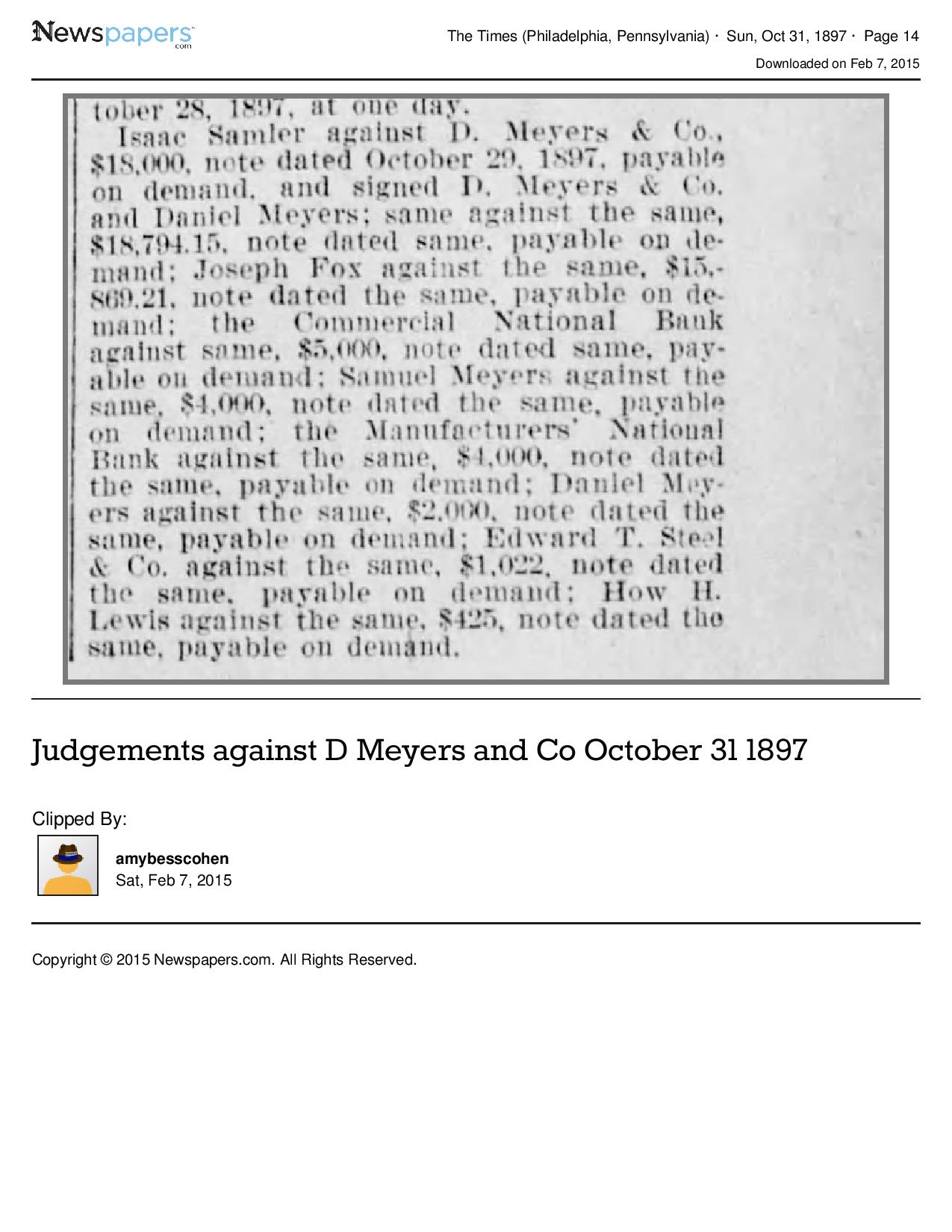
Maybe it was all too much of a financial strain for Daniel. This article from The Philadelphia Times of October 31, 1897, reported a large number of judgments executed against D. Meyers & Co., including two very large ones for over $18,000.  One of those was in favor of Isaac Samler, Daniel’s former partner.  Keep in mind that $18,000 in 1897 would be equivalent to about $500,000 in today’s dollars.

Judgements_against_D_Meyers_and_Co_October_31_1897-page-001

A fellow family historian descended from a relative of Daniel Meyers shared this news story with me that revealed that on November 1, 1897, D. Meyers and Company was forced to close.

Philadelphia Inquirer, November 1, 1897, p. 9

Philadelphia Inquirer, November 1, 1897, p. 9

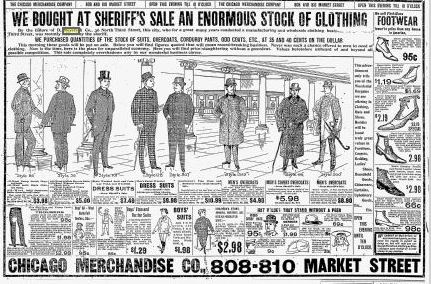
The assets of the business were sold at a sheriff’s sale, as this advertisement, also shared by the fellow family historian, in the Philadelphia Inquirer from November 13, 1897, page 16, revealed:

AD november 13 1897 phil inq p 16

The text says, “We Bought at Sheriff’s Sale an Enormous Stock of Cothing By the failure of D. Meyers & Co., 36 North Third Street, this City, who for a great many years conducted a manufacturing and wholesale clothing business at 36 North Third Street, was recently sold out by the Sheriff.”

There were numerous other attachments brought against Daniel Meyers d/b/a D.Meyers & Co. after the business was closed. I also found the article below indicating that there was a sheriff’s sale of property belonging to Daniel Meyers and D. Meyers and Company in September, 1898, for over $16,000.

Sheriff__039_s_sale_against_Daniel_Meyers-page-001

Perhaps this explains why Daniel did not distribute the principal of Caroline’s estate to her grandchildren as he was legally obligated to do after Eliza Simon died in 1897.   Perhaps that money was gone.

By 1900 six of Daniel and Clara’s sons, Leon, Samuel, Harry, Isadore, Benjamin, and Max, were now working, Samuel as a clothing merchant, Harry as a tailor, Leon, Isadore and Benjamin as salesmen, and Max as a draftsman.  Although this might have alleviated the financial burden carried by Daniel to some extent, it appears not to have been sufficient. The other five younger children were all still at home.  In April, 1902, a judgment was entered against Daniel and Clara in the amount of $5,678, apparently for defaulting on a mortgage loan with a building and loan association.  I can’t help but notice that the amount they owed was almost to the dollar the amount of money that had been the principal in Caroline’s estate.  Had they borrowed this amount to satisfy the attachment obtained by the new trustee of Caroline’s estate and then not had sufficient assets to pay back the lender?

Clara_and_Daniel_Meyers_judgment__against_them_on_mtge-page-001

Six months after this judgment was entered, Daniel Meyers died on October 14, 1902, from “organic disease of the heart, embolism, paralysis, and general atheromas.”  He was sixty years old.  I don’t know what if any relationship there was between his financial troubles, the legal problems, and the resulting family problems, on the one hand, and his health on the other, but I tend to think they were not unrelated.

ennsylvania, Philadelphia City Death Certificates, 1803-1915," index and images, FamilySearch (https://familysearch.org/pal:/MM9.1.1/JD22-R89 : accessed 8 February 2015), Daniel Meyers, 14 Oct 1902; citing cn 7658, Philadelphia City Archives and Historical Society of Pennsylvania, Philadelphia; FHL microfilm 1,853,857.

Pennsylvania, Philadelphia City Death Certificates, 1803-1915,” index and images, FamilySearch (https://familysearch.org/pal:/MM9.1.1/JD22-R89 : accessed 8 February 2015), Daniel Meyers, 14 Oct 1902; citing cn 7658, Philadelphia City Archives and Historical Society of Pennsylvania, Philadelphia; FHL microfilm 1,853,857.


The Grandchildren of John and Jeanette Nusbaum: First Cousins, Four Times Removed

When I last wrote about the direct descendants of my three-times great-grandparents, John and Jeanette (Dreyfuss) Nusbaum, I left off saying that I would return to their surviving grandchildren in a later post.  Having already written about the children of their daughter Frances Nusbaum Seligman, Eva, James, and Arthur, there were four other grandchildren to discuss: the two children of Gustavus and Miriam Nusbaum Josephs, Florence and Jean, and the two children of Simon and Dora Rutledge Nusbaum, Nellie Rogers and John Bernard Nusbaum.  I was hoping that I’d be able to find answers to some remaining questions before posting, but I’ve run into a few tough ones.

Florence Joseph’s story is still incomplete as I hit a brick wall around 1925, but I will share what I do know.  Florence married Louis Siegel in 1903 when she was 23 years old.  Louis, the son of Abraham Siegel and Minnie Rosenthal, was born in Philadelphia on January 11, 1870, making him ten years older than Florence.  In 1910, Florence and Louis were living in New York City, and Louis was working as a traveling salesman, selling athletic goods.

Sometime thereafter, Louis must have become ill.  He died on September 30, 1915, at the State Hospital for the Insane in Norristown, Pennsylvania.  According to his death certificate, he had been ill for three years and had been hospitalized since November 19, 1913.  His cause of death was general paralysis of the insane or paresis.  He was only 43 years old.

Although I only have one document to support this, it appears that in 1913, Florence and Louis had had a child, a daughter Marion.  On the 1920 census, Florence Siegel was living with her father Gustavus Josephs and her brother Jean Josephs, both of whom were working at a mill as manufacturers, presumably of fabrics, as discussed in an earlier post.  Included in the household was a seven year old girl named Marion Siegel.  Although she is described as the daughter of the head of household, it seems apparent that Marion was Florence’s daughter, given her age and her surname.

Gustavus Josephs 1920 census

When her father Gustavus died in May 1924, Florence continued to live in the home at 2020 North Park Avenue; she is listed as a dressmaker in the 1925 Philadelphia directory residing at that address.  Unfortunately, that is the last document I have for Florence.  I cannot find a marriage record or a death record for her, nor can I find any definitive document for her daughter Marion.

There were two other Marion Siegels in the Philadelphia area, but after tracing them both, I had to accept that neither was the right Marion.  One, Marion Siegele, even had a mother named Florence, but that Florence was married to Harry Siegele and that Marion was born in 1918.  The second Marion Siegel seemed more likely, but I was able to find her parents and brother, and they were again not Florence and Louis Siegel.  Maybe my Marion died outside of Pennsylvania before 1930 (she would have been about 17 years old at the time of the census), maybe her mother remarried and Marion took the new husband’s surname.  But I have searched for every Florence and Marion living together as mother and daughter on the 1930 census, and I’ve come up empty.

In searching for Florence and Marion Siegel, however, I did find this obituary of Gustavus Josephs that reveals more about his military service in the Civil War as a musician:

Philadelphia Inquirer May 25, 1924 p. 18

Philadelphia Inquirer May 25, 1924 p. 18

Although I did hit some roadblocks researching Florence, I had better luck with her brother Jean.  Jean was much younger than his sister Florence.  He was born in 1893 and presumably named for his recently deceased grandfather, John Nusbaum.  In fact, Jean’s middle initial is N, perhaps for Nusbaum.  As noted above, Jean worked with his father Gustavus as a mill owner and listed himself as a self-employed manufacturer on his World War I draft registration in 1917.  He married Ruth Breidenbach on March 4, 1920.  Ruth was the daughter of Lazarus and Sophia Breidenback, and her father was an engraver in Philadelphia.  Ruth was born on March 11, 1900, in Pennsylvania.

By 1930, Ruth and Jean had two children, Janet and Jean, Jr.  Jean was still a manufacturer, and the census report for 1930 is more specific as to what he was manufacturing: draperies.  The family was living at 1531 Lindley Avenue in Philadelphia.  The following year Jean and Ruth had a third child, Jay.

In 1940, Jean and Ruth were still living at 1531 Lindley with their three children, and Jean’s occupation was recorded as general manager, textile manufacturer.  Less than a year later, on February 4, 1941, Jean Josephs died from an intestinal obstruction and peritonitis.  He was 47 years old, and his children were still living at home.  Jean’s widow Ruth was 40 years old

Ruth remarried in 1946.  Just six years later, Ruth was widowed once again when her second husband died from heart failure at age 47 on October 3, 1952.  By that time her children were grown.

As for the two children of Simon and Dora Nusbaum, Nellie Rogers Nusbaum was Dora’s daughter from her first marriage.  In about 1921, Nellie married Ellis B. Healy, who owned the Santa Fe Book and Stationery Company.  Nellie’s life was cut short on May 9, 1932, when she died giving birth to her daughter.

simon nusbaum daughter obit

The Santa Fe New Mexican, May 9, 1932

In 1940, Nellie’s widower Ellis and her young daughter were living in Santa Fe with a servant and a lodger.  Ellis listed his occupation as an office supply merchant.  By 1942, Ellis must have remarried as he is listed as “Healy EB (Mildred)” in the 1942 Santa Fe directory, indicating that he had a wife named Mildred.  He still owned the Santa Fe Book and Stationery Company.  He and Mildred were still listed together in 1960.

Although Nellie was not the biological child of Simon Nusbaum, and I do not know whether he ever adopted her legally as she was still listed as his stepdaughter on the 1920 census, she must have adopted his name since her name on her headstone is Nellie Nusbaum Healy.  She is buried at Fairview Cemetery in Santa Fe.

Simon and Dora’s other child, John Bernard Nusbaum, was only sixteen when his father died in 1921.   In 1930, he married Esther Maltby.  They settled in Albuquerque, New Mexico, where John was the vice-president of the Albuquerque Stationery Company.   John was listed as the manager of the stationery store in 1940 and continued to be associated with the company at least as late as 1954.  John and Esther had two daughters.  John died on July 25, 1976, in Albuquerque, but is buried at Fairview Cemetery in Santa Fe where both of his parents are buried.  His wife Esther died in 2002 and is buried there as well.  I have tried contacting some of their descendants, but have not had any responses.

So I am going to focus on finding a descendant of these four cousins of mine in order to fill in some of the gaps and tie up those loose ends.


There Were No Survivors: A Tragic Ending to a Family with Plenty of Tragedy

Some families seem to suffer more misfortune than others.  This is one of those families.  It is the story of the family of Mathilde Dreyfuss, sister of my three-times great-grandmother Jeanette, and her family.  Her first husband was  John Nusbaum’s brother Maxwell Nusbaum, making this particular line related to me both on my Dreyfuss side and my Nusbaum side.  That is, Mathilde and Maxwell’s children are my double first cousins, four times removed.

As I have written, Maxwell Nusbaum and Mathilde Dreyfuss had two children, a daughter Flora born in 1848 and a son Albert born in 1851.  Less than seven months after Albert’s birth, Maxwell died in the 1851 Great Fire in San Francisco.  By 1856 Mathilde had married Moses Pollock, with whom she had three more children, Emanuel, Miriam, and Rosia.  The family lived in Harrisburg for many years, but by 1866 had relocated to Philadelphia.

In the 1870s, the Pollocks were living in Philadelphia where Moses was a dry goods merchant.  Their youngest child Rosia died in 1871 when she was just five months old.

Rosie Pollock daughter of Moses and Mathilde death cert 1871

Pennsylvania, Philadelphia City Death Certificates, 1803-1915,” index and images, FamilySearch (https://familysearch.org/pal:/MM9.1.1/JK3P-DBS : accessed 22 January 2015), Rosie Pollock, 26 Feb 1871; citing 1075, Philadelphia City Archives and Historical Society of Pennsylvania, Philadelphia; FHL microfilm 2,020,735.

Mathilde’s daughter Flora had married Samuel Simon, one of the three brothers to marry into the Nusbaum/Dreyfuss clan, and they had two children in the 1870s, Meyer (mostly likely named for his grandfather Maxwell) and Minnie.  By 1880, Flora and Samuel had moved to Elkton, Maryland, where Samuel was running a hotel.  Meanwhile, Moses and Mathilde (Dreyfuss Nusbaum) Pollock were still in Philadelphia, and the other surviving children—Albert Nusbaum and Emanuel and Miriam Pollock—were still living at home with them, according to the 1880 census. Moses was in the cloak business, Albert was in the liquor trade, and Emanuel was in the dry goods business.  Moses’ line of trade seemed to change to trimmings or finishings during the 1880s and 1890s with various directories listing his businesses as plaiting, laces, embroidery, school bags, and accordion pleating.

Mathilde’s family was struck by tragedy again on September 1, 1885, when Miriam Pollock, just 26 years old, died from consumption or tuberculosis.  Mathilde had lost her first husband to a fire, her daughter Rosia at five months, and then her daughter Miriam at 26.  Sometimes life is just not fair.

miriam pollock death cert FHL 2070682

“Pennsylvania, Philadelphia City Death Certificates, 1803-1915,” index and images, FamilySearch (https://familysearch.org/pal:/MM9.1.1/JFSV-LHQ : accessed 22 January 2015), Miriam Pollock, 01 Sep 1885; citing , Philadelphia City Archives and Historical Society of Pennsylvania, Philadelphia; FHL microfilm 2,070,682.


Then Moses Pollock died on December 5, 1894 of encephalomalacia, defined in Wikipedia as “localized softening of the brain substance, due to hemorrhage or inflammation.”  Like so many other family members, he was buried at Mt. Sinai cemetery in Philadelphia.  He was 69 years old.

Moses Pollock death cert

“Pennsylvania, Philadelphia City Death Certificates, 1803-1915,” index and images, FamilySearch (https://familysearch.org/pal:/MM9.1.1/JKS4-32N : accessed 22 January 2015), Moses Pollock, 05 Dec 1894; citing cn 11116, Philadelphia City Archives and Historical Society of Pennsylvania, Philadelphia; FHL microfilm 1,872,200.

Both Albert Nusbaum and Emanuel Pollock had continued to live with their parents throughout the 1880s and 1890s, and in 1900, they and their mother were still living together at the same address, 934 North Eighth Street.  Mathilde, now widowed twice in addition to losing two children, was working outside the house as a manufacturer of bags—presumably, the school bags listed as one of the items Moses was selling on the last directory entry before his death.  Albert was still a liquor salesman, and Emanuel was selling bicycles.  In addition, Meyer Simon, Flora’s son and Mathilde’s grandson, now 30 years old, was also living with them and was working with his grandmother in the bag manufacturing business as a manager.

Mathilde’s daughter Flora Nusbaum and her husband Samuel Simon, meanwhile, had left Elkton, Maryland, and moved to Baltimore by 1885.  Samuel was in the liquor business, as was his brother Moses, who was married to Paulina Dinkelspiel, Flora’s first cousin.[2]  My hunch is that they were business together.

In 1900, Samuel was still in the liquor business in Baltimore, but his brother Moses had died the year before.  Samuel and Flora still had their daughter Minnie living at home with them, but their son Meyer, as noted above, was living in Philadelphia with his grandmother and uncles Albert and Emanuel and managing the bag manufacturing business.

Although Meyer Simon was listed as single on the 1900 census, the 1910 census reported him as married for 12 years. I figured that this must have been a mistake, especially since he was still living at his grandmother’s address even in the 1901 directory.  It seemed he could not have been married for 12 years in 1910.

But then I found something strange.  After some further research and review, I found in the Pennsylvania, Marriages 1709-1940 data base on familysearch.org a marriage between Meyer Simon and Tillie Perry on September 18, 1897, in Allegheny, Pennsylvania. Meyer’s wife’s name on the 1910 census was Matilda, so I knew this was the correct marriage.  Matilda or Tillie Perry was the daughter of William and Matilda Perry; she was born in Philadelphia in 1876 and baptized in the Episcopal church in 1878. But if Meyer and Matilda were married in 1897, why was Meyer listed as single on the 1900 census, and where was Matilda?[3]

I found Matilda Perry on the 1900 census living with her parents in Philadelphia, and that census report stated that she was married and had been married for three years, which is consistent with the marriage record I found on familysearch. Had Meyer and Matilda married and then lived separately for at least three years?  It seems strange, but perhaps they could not yet afford a place of their own. Or perhaps they were temporarily separated.  Or perhaps the religious differences had made it difficult for those families to support the marriage.    After all, Meyer listed his marital status as single.  I suppose it is also possible that he had kept the marriage a secret from his family.  After all, they were married in Allegheny, not in Philadelphia or in Baltimore where their families lived. Allegheny was a city across the river from Pittsburgh that merged with Pittsburgh in 1907.   It would have been therefore over 300 miles from Philadelphia and about 250 miles from Baltimore.

Thus, as of 1900, Mathilde Dreyfuss Nusbaum Pollock was a widow, living in Philadelphia with her two sons, Albert and Emanuel.  Her daughter Flora was living with her husband Samuel Simon in Baltimore with their daughter Minnie, and their son Meyer was married, but not yet living with his wife Matilda.

The decade that followed must have been a very painful one.  First, on March 21, 1904, Mathilde Pollock died.  She was 79 years old.  The death certificate says she died of old age, which shows you how perspectives on aging and longevity have changed.  It also says that she died from “senile pneumonia,” a term for which I could find no easily understood definition for my non-medical brain to grasp, but which I gather is a form of pneumonia that affects the elderly.  (Feel free to provide a more scientifically accurate definition.)  The death certificate also says that Mathilde had ascites, another term not easily defined but which Wikipedia defines as “gastroenterological term for an accumulation of fluid in the peritoneal cavity.”   Don’t even get me started on trying to understand where the peritoneal cavity is, but from what I read, ascites seems to have something to do with liver disease, often cirrhosis.

Mathilde Pollock death cert

Mathilde’s death was followed three years later by the death of her son Emanuel Pollock on February 16, 1907.  He was only fifty years old and died of tuberculosis.  Three years after that his half-brother Albert Nusbaum died on August 28, 1910 from apoplexy brought on by arteriosclerosis.  He was 59 years old.  Mathilde and both of her sons were buried at Mt. Sinai cemetery.

That left only Flora Nusbaum Simon as the surviving child of Mathilde Dreyfuss Nusbaum Pollock.  She had lost both of her parents and all four of her siblings.  She was also the only child who had children of her own as none of her siblings ever married or had children. Flora and Samuel appear to have relocated from Baltimore to Philadelphia by 1905, the year after her mother died, as Samuel appears in the Philadelphia directory living at 2225 North 13th Street, the same address where the family is listed in the 1910 and 1920 census reports.

Flora’s brother Albert had been living with them at that address in April when the 1910 census was taken, just four months before he died.  Neither Samuel nor Albert nor anyone else in the household was employed at that time, yet they still had a servant living in the home.  Minnie, Flora and Samuel’s daughter, was 27 and single, living with her parents and uncle.  It feels like it must have been a very sad time for the family.

Flora and Samuel’s son Meyer and his wife Matilda were living about two miles away at 2200 Susquehanna Avenue in 1910.  Meyer was a clothing salesman.  There were two boarders living with them, but no children. When Meyer registered for the World War I draft in 1917, he and Matilda were living at 3904 North Marshall Street, two and a half miles north of his parents and his sister.  Meyer was employed as a clothing salesman for Harry C. Kahn and Son, according to his draft registration.

On February 18, 1919, Flora Nusbaum Simon suffered yet another loss when her husband Samuel Simon died from a cerebral hemorrhage at age 79.  She and her daughter Minnie were living together in 1920 at their home at 2225 North 13th Street.  Flora herself died almost four years to the day after her husband Samuel on February 20, 1923.  She was 74 years old and died from chronic interstitial nephritis.  She had outlived all of her siblings by over 13 years.  She, like all the rest of them, was buried at Mt. Sinai cemetery with her husband Samuel.

Ancestry.com. Pennsylvania, Death Certificates, 1906-1963 [database on-line]. Provo, UT, USA: Ancestry.com Operations, Inc., 2014.

Ancestry.com. Pennsylvania, Death Certificates, 1906-1963 [database on-line]. Provo, UT, USA: Ancestry.com Operations, Inc., 2014.

After her mother Flora died, Minnie Simon lived with her brother Meyer and his wife Matilda in the house on North 13th Street where Flora had died, number 2336, across the street from where they had lived for many years at 2225.  Meyer was employed as a clothing salesman, and his niece Matilda (a fifth Matilda in his life) was also living with them.  Meyer lost his sister Minnie six years later when she died from liver cancer on December 14, 1936; she was 63 years old.

Meyer was the only member of his family left.  He had no siblings, no nieces or nephews on his side.  It must have been just too much for him when his wife Matilda then died on April 27, 1940, at age 63 from cerebral thrombosis and chronic nephritis.  Two years later on June 2, 1942, Meyer took his own life.  He was found on the second floor of his home at 2336 North 13th Street with a gunshot wound to his head.  He had no survivors.  Although Meyer was buried with his family at Mt. Sinai, he was not buried with his wife Matilda.  She was buried at a non-denominational cemetery instead (Northwood); because she was not Jewish, she could not be buried at Mt. Sinai.  How sad.

meyer simon death cert pre inquest

Ancestry.com. Pennsylvania, Death Certificates, 1906-1963 [database on-line]. Provo, UT, USA: Ancestry.com Operations, Inc., 2014.

Meyer Simon death cert coroner's inquest

Ancestry.com. Pennsylvania, Death Certificates, 1906-1963 [database on-line]. Provo, UT, USA: Ancestry.com Operations, Inc., 2014.

This story fills me with such sadness.  How lonely Meyer must have been.  He’d lost his grandparents, his parents, his aunts and uncles, his sister, and his wife.  And there were no children or nieces or nephews left to comfort him. Certainly there were other Nusbaum cousins nearby in Philadelphia, but it must not have been enough.

From the start of the story of the life of Meyer’s grandmother Mathilde Dreyfuss, this family suffered such tragedy: Maxwell’s death in the Great Fire of San Francisco and two daughters who died young.  Of Mathilde’s four children who grew to adulthood, only Flora married and had children, and there were no grandchildren to carry on the family line after Flora and Samuel Simon and their two children Meyer and Minnie died.   There are no living descendants of Mathilde Dreyfuss or Maxwell Nusbaum.  No one likely remembers their names.  Except now they have been found and can be remembered for the tough lives they lived and for the courage and hope they must have had when they arrived in Pennsylvania in the middle of the 1800s.


[1] Isaac died without any children in 1870, so unfortunately that was the end of that sibling’s line.

[2] Flora’s father Maxwell Nusbaum was the brother of Paulina Dinkelspiel’s mother, Mathilde Nusbaum Dinkelspiel.

[3] Poor Meyer had at least four Mathilde/Matildas in his life: his mother, his wife, his mother-in-law, and one of his aunts.  And today I don’t know one woman named Mathilde or Matilda or Tillie.

Thank You, Grandpa, for the Gift of My New Cousins

It was about three years ago that I first started wondering more about my grandfather Isadore Goldschlager.  I knew almost nothing about his life before he came to the US in 1904 from Iasi, Romania.  I didn’t know too much about his life when he got to the US either.  It was my interest in his life in particular that first prompted me to go on ancestry.com and start searching for answers.  I soon hit a wall and gave up, only returning to ancestry a year later and starting my search for my Brotman relatives instead.

Then I returned to my grandfather again, a somewhat more experienced researcher, and this time I had better luck.  In fact, as I have written, I found not only his parents—I found his mother’s siblings Gustav and Tillie and Zusi Rosenzweig, and then I found their children and many of their grandchildren and great-grandchildren.  I was able to piece together a better picture of my grandfather’s extended family and even figured out how he met my grandmother Gussie, who happened to be living down the street from his Rosenzweig cousins in 1915 on Pacific Street in Brooklyn.

Last night I got to meet some of my Rosenzweig cousins for the very first time.    Four of the great-great-grandchildren of David and Esther Rosenzweig were there—Gerry, Ron, Michael and me.  Gerry, Ron and Michael are all the great-grandsons of Gustave Rosenzweig, the brother of my great-grandmother Ghitla/Gussie Rosenzweig Goldschlager.  Gerry is the grandson of Abraham Rosenzweig, and Michael and Ron are the grandsons of Joe Rosenzweig, the brother of Abraham.

Here is a picture of Abraham, Joe and Jack Rosenzweig:

Abraham Joseph and John (Jack) Rosenzweig

Abraham Joseph and John (Jack) Rosenzweig

And here is a picture of their first cousin Isadore Goldschlager, my grandfather.

Isadore Goldschlager

Isadore Goldschlager

It was a wonderful evening.  Even though many of us had never, ever met before, we quickly connected and found common bonds—all having grown up in greater New York, all enjoying a good laugh, all loving dogs and our grandchildren (not in that order), and all being unable to digest raw onions.  It was a great time, and even if we never knew each other as children, there was definitely a feeling of family.

Here we all are with our spouses.  Thanks to the lovely newlywed couple who not only put up with our noisy conversations, but also graciously offered to take this picture (on about five different smartphones).

Rosenzweig cousins Jan 24 2014

So keep looking for your cousins—you will never know how much joy you can experience.

Children Losing Parents: The Family of Leopold Nusbaum

I’ve written quite a bit about how terrible it makes me feel when I read about parents losing their children.  The number of babies and young children who died from disease or accidents before the mid-20th century is appalling.  But in the story of the family of Leopold Nusbaum, I saw a different type of tragedy recur a number of times: young children losing a parent.  That pattern began with Leopold Nusbaum’s own daughter. Leopold Nusbaum had died in 1866, predeceased by his four year old son Adolph and survived by his widow Rosa and daughter Francis. Francis was only sixteen when her father died.

Francis had married Henry Frank in 1870, and in 1880 they were living with her mother Rosa and their three children, Leopold (named for his grandfather), Senie and Cora, in Lewistown, Pennsylvania, where Henry was a merchant.  Their fourth child David Henry Frank was born in April 1884.  By 1884 the family had returned to Philadelphia, where Henry was in the cloak manufacturing business with a firm called E. Rubel and Company.  The family was residing at 1234 Marshall Street.  Rosa Nusbaum, Francis’ mother, died February 16, 1887, in Philadelphia.

By 1889 Henry was with a new firm, Patterson, Frank, and Company, still manufacturing cloaks.  By 1894 he had his own firm, H.N. Frank & Co., and the family had relocated to 1633 Franklin Avenue.  The children were now growing up: Leopold was 23, Senie was 18, Cora was 17, and David just ten years old.  By 1899 they had relocated again to 2351 Park Avenue, and Leopold was now a salesman in his father’s business.

The 20th century saw the children of Francis Nusbaum and Henry Frank beginning to move on as adults.  In 1901, Senie married Joseph H. Hinlein.

Senie Frank marriage announcement

Joseph Hinlein was a widower; his wife Clara Falk Hinlein had died at age 29 from an aneurysm in June, 1900, leaving Joseph with three young children: Florette, Stanley, and Milton.  When Senie Frank married Joseph Hinlein, she thus had an instant family.[1]  Joseph Hinlein was a manufacturer.  In 1900 the census merely says he was a manufacturer, but in 1910 it says braids and in 1920 ladies’ trimmings.  I assume the braids were decorative trimmings for women’s clothing.

There are some very strange things about the census records for Joseph and his children.  For one thing, Joseph’s birthplace varies widely from census to census: Germany (1900), Pennsylvania (1910), Wisconsin (1920 and 1930), and Ohio (1940).  His passport application in 1946 lists Prairie du Chien, Wisconsin as his place of birth as does a ship manifest from 1928 for a trip he took with Senie.   Was this evidence of the unreliability of the census reports or of Joseph himself?  A little more digging, and I found Joseph on the 1870 census when he was just a baby, living with his parents in Prairie du Chien, Wisconsin.  That census indicated that Joseph and his parents were born in Bavaria.   Did Joseph forget where he was born in 1920 and thereafter? Or was he lying to be more American? Or perhaps the census taker in 1870 was mistaken or misunderstood where the baby in the home was born.

But there are other strange things about the Hinlein family and the census.  Although Milton is consistently reported as born in September 1895, Stanley is reported as born in 1893 on the 1900 census, but on every document after that his birth year is generally about 1900.  When I found his World War I draft registration, I thought—Aha! That will have his birthdate.  But it was blank except for his name.

Registration State: Pennsylvania; Registration County: Philadelphia; Roll: 1907759; Draft Board: 36

Registration State: Pennsylvania; Registration County: Philadelphia; Roll: 1907759; Draft Board: 36

And Florette’s age is also mysterious.  On the 1900 census it says she was born in December 1898 and only a year old.  But in 1910 she is seventeen years old, meaning a birth year of 1892 or 1893.  Every other census is consistent with the earlier birth year, and her Social Security death index entry and her headstone say she was born in 1892.  Plus she married in 1913; it seems more likely that she was 21 than 15 when she married.  When I examined the 1900 census more closely, although it clearly says December 1898, the “1” for her age could easily have been a “9.”  Maybe the census taker changed the birth year when he thought that she was one, not nine, years old.

Florette Hinlein 1900 census

Florette Hinlein 1900 census

During the 1910s, the three Hinlein children were moving out on their own.  As mentioned above, Florette married in 1913; her husband Jerome Lehman was from New Jersey, and Florette and Jerome settled in Newark, New Jersey where Jerome, a graduate of Princeton, was working in his father’s food business in 1917, according to his World War I draft registration.  Jerome and Florette had one child, a daughter who was born in 1915.[2]  By 1920 they were living in West Orange, New Jersey, and Jerome was now the vice-president of the grocery business.

Florette’s brother Stanley graduated from Princeton University in 1922 (when he was either 22 or 29, depending on which birth year is correct) and also married Beatrice Silverman in Philadelphia that year.  Stanley followed his father Joseph into the braid manufacturing business.  He and Beatrice settled in the Philadelphia area and had a daughter in 1925.

The third Hinlein child was Milton.  He married Reta Greenwald in 1919.  They also settled in Philadelphia.  I need help deciphering Milton’s occupation on the 1920 census.  I think it says “—- trimmings,” so I assume he also like his brother went into his father’s business.  Milton and Reta would have three children in the 1920s.

Milton Hinlein 1920 census

Milton Hinlein 1920 census

Senie’s younger sister Cora Frank had married just two years after Senie.  She married Jacques Jacob Gattman in Philadelphia in 1903.  Jacques was born in 1875 in Mississipppi where his father, a native New Yorker, was a banker.  By 1894, however, the family had relocated to Philadelphia, as Jacques’ father is listed in the Philadelphia directory for that year as a malt merchant.  On the 1900 census, Jacques is living with his parents and working as a salesman.

After marrying in 1903, Cora and Jacques settled in Philadelphia and had a daughter Dorothy in 1905.  Then at age 31, Jacques died from cerebral apoplexy or a stroke on January 19, 1906.  Cora was a 29 year old widow with a baby less than a year old. Her daughter Dorothy, like her Hinlein stepcousins, lost a parent at a very young age.  Cora and Dorothy moved back into Henry and Francis Nusbaum Frank’s home at 2351 Park Avenue, where Cora is listed as residing in the 1908 and 1909 directories as well as on the 1910 census.

Cora remarried in 1913.  Her second husband was Joseph Gustav Lehman.  I immediately thought that there had to be some connection between Joseph Lehman and Jerome Lehman, who married Florette Hinlein, Cora’s stepniece, that same year.  I have yet to find that connection, however. As noted above, Jerome Lehman was born in New Jersey in 1896, and his father Leser Lehman was also born in New Jersey.  Joseph Lehman, on the other hand, was born in Ohio in 1876, and his father Gustav was born in Germany in about 1845. Could there be a connection? Of course.  But I have yet to find it.

Joseph Lehman was 37 when he married Cora; she was 36.  They settled with Cora’s daughter Dorothy in Dayton, Ohio, where Joseph had lived his whole life.  His father Gustav was a dealer in hides, and in 1900 Joseph was working as a bookkeeper.  By 1910 his father had died, and Joseph and his brother Jacob had taken over the hides business.  After marrying Cora in 1913, Joseph became the secretary of the Hewitt Soap Company, according to his World War I draft registration in 1917.  The 1920 census lists his occupation as secretary of a steel company.   The transition from hides to steel is a telling one, revealing the shifts in the US economy by 1920.

Cattle hides

Cattle hides


Dorothy, now a teenager, was living with Joseph and Cora.  Unfortunately, I have been unable to locate Dorothy after 1926 when she was listed as Dorothy Gattmann and as a student in the Dayton city directory.  I cannot find her as Dorothy Lehman or Dorothy Gattmann.  I assume that she married and changed her name, but I don’t know where she lived or who she married.

David Frank, the youngest of the children of Henry and Francis Nusbaum Frank, also was married by 1910.  He married Rhea Heilbron, who was from Reading, Pennsylvania.  They had been married a year at the time of the 1910 census and were living in Philadelphia.  David was working as an inspector in a suit factory.  By 1920 they had relocated to New York City where David was now working as a wholesale merchant in “waists” or women’s clothing.  David and Rhea did not have any children.

The last of the Frank children to marry was the oldest, Leopold Frank.  In 1910 when he was 38 he was living at home and working with his father in the clothing business.  On his passport application dated April 25, 1914, he described himself as single and residing in Philadelphia and a cloak and suit manufacturer.  I cannot locate him on the 1920 census (perhaps he was overseas), but on a June, 1921, ship manifest he is listed as residing at 601 West 115th Street in New York City.  Then, in 1925, Leopold shows up on the NY State census, living with his brother David and sister-in-law Rhea and married to a woman named Nellie.  David and Leopold were both working as dress salesman.  For a long time I could not figure out when Leopold had married Nellie or anything about her life before 1925.

But then I looked over everything again and found some clues.  Also living with David, Rhea, Leopold and Nellie Frank in 1925 was a nineteen year old young man named Raphael Austrian, identified as the nephew of the head of household, that is, David’s nephew.  At first glance I had assumed that this was Rhea’s sibling’s child since the last name, Austrian, did not match any of David’s siblings.  But when I later searched for some history for Nellie on familysearch.org, looking for a woman born around 1885 in Hungary, the first name on the search results list was a Nellie Austrian from the 1905 NY State census.  I almost dismissed this listing because it said Nellie was married.  But when I looked back again at the 1925 NY census and saw Raphael Austrian again, it clicked.  Nellie Austrian was the woman now married to Leopold Frank, and she had a son Raphael who was the nephew of David Frank, the head of household listed in the 1925 census.

David and Rhea Frank's household on the 1925 NYS census

David and Rhea Frank’s household on the 1925 NYS census

So I went back to research Nellie as Nellie Austrian.  On the 1905 census, I found that Nellie was married to an American-born publisher named Julian Austrian.  Further searching for Julian Austrian (thank goodness for some unusual names) revealed that he was born in Reading, Pennsylvania in 1876. In 1900, he was still single and living in Reading.   I was then able to find him and Nellie and Raphael on the 1910 census living in New York City and also on the 1915 NYS census.  Julian’s World War I draft registration reported his occupation as editor and publisher of the F. Stallknecht Publishing Company, and googling that name revealed that they were engaged in the business of trade publications, for example, for the fur trade.

But on October 31, 1919, Julian died of heart failure back home in Berks County, Pennsylvania.  He was just 42 years old.  Once again, there was a young widow, and once again, there was a young child who lost a parent.  Like Francis Nusbaum who lost her father Leopold when she was 16, like the Hinlein children who lost their mother Clara when they were younger than ten years old, like Dorothy Gattman who lost her father Jacques before she could even know him, young Raphael Austrian lost his father when he was only fifteen years old.

In 1920, a year after Julian Austrian died, Raphael and his mother Nellie were living in New York City with a woman named “Diona” Wolkenstein, listed as Nellie’s sister, and from that census entry I finally learned what Nellie’s birth name was, Wolkenstein.  Nellie herself was now listed as a publisher.

I then searched the NYC marriage records for a bride named Nellie Austrian and found one entry for September 30, 1922.  Although the groom’s name was not included in the index, this obviously had to be Nellie’s marriage to Leopold Frank.  Even after marrying Leopold Frank on September 30, 1922, she continued to use the name Nellie Austrian in her listings in the New York City directory as a publisher.  Looking back again at the 1925 census, I now realized that David and Rhea Frank not only had Leopold and Nellie and Raphael living with them; Nellie’s sister “Diona” (indexed as “Siona” here, but more likely “Ilona”) Wolkerstein was also living in the household.

By 1925, all four of the children of Francis Nusbaum and Henry Frank were thus finally on their own.  Senie was living in Philadelphia with her husband Joseph Hinlein, and her three stepchildren were all married and out of the house.  Cora and her husband Joseph Lehman were living in Dayton, Ohio, and her daughter Dorothy was a student.  David Frank and his brother Leopold Frank and their wives were living in New York City where David and Leopold were apparently working together in the dress business.

Their father, Henry Frank, died June 18, 1925, of heart disease.  He is buried at Mt. Sinai cemetery.

Ancestry.com. Pennsylvania, Death Certificates, 1906-1963 [database on-line]. Provo, UT, USA: Ancestry.com Operations, Inc., 2014.

Ancestry.com. Pennsylvania, Death Certificates, 1906-1963 [database on-line]. Provo, UT, USA: Ancestry.com Operations, Inc., 2014.

The 1930s and after

By 1930 Francis Nusbaum Frank, now a widow, had moved in with her daughter Senie and son-in-law Joseph Hinlein in Cheltenham, outside of Philadelphia.  Her daughter Cora and her husband were still in Dayton, Ohio, and Joseph was now in the airplane parts business (maybe the same as the 1920 company, but I cannot tell).  The 1933 directory lists him as the treasurer of the United Aircraft Company, as does the 1936 directory.  Cora’s daughter Dorothy Gattman was no longer living with her mother and stepfather.

As of 1930, David and Rhea Frank were still living in New York City, and David was still in the women’s clothing business. In 1930 Leopold Frank and his wife Nellie were also still in New York; Nellie was still a publisher, and Leopold, like his brother David, was still selling women’s clothing.

In November, 1935, David Frank died at age 53; he was residing in Philadelphia at the time and is buried at Mt. Sinai cemetery.  I’ve been unable to locate a death certificate for him or an obituary, but according to two family trees on ancestry, he died in Atlantic City.  Rhea Frank returned to her home town of Reading, Pennsylvania,[3] where she died seven years later in October, 1941; she was also 53.  They are buried together at Mt. Sinai.

After losing her youngest child David in 1935, Francis Nusbaum Frank died on September 13, 1938, of a stroke.  She was 86 years old.  Like the other family members, she was buried with her husband Henry at Mt. Sinai.

Ancestry.com. Pennsylvania, Death Certificates, 1906-1963 [database on-line]. Provo, UT, USA: Ancestry.com Operations, Inc., 2014.

Ancestry.com. Pennsylvania, Death Certificates, 1906-1963 [database on-line]. Provo, UT, USA: Ancestry.com Operations, Inc., 2014.

In 1940, Senie and Joseph Hinlein were living with their son Stanley Hinlein and his family in Cheltenham.  Joseph Hinlein died in 1950 at 81, and Senie died the following year on May 22, 1951.  She was 74 and died of heart disease.  She and Joseph are buried at Mt. Sinai cemetery in Philadelphia.  Their three children all lived long lives; Florette died in 1993 at 100 years old.  Stanley died in 1983 at 90, and Milton died in 1982 at 87.

Cora and Joseph Lehman were still in Dayton in 1940, and Joseph was the treasurer of an aircraft company.  The last record I have for them is a record of Joseph’s death on June 14, 1959.  Cora was still alive at that point, but I have no further record for her or for her daughter Dorothy Gattman.

Leopold Frank and his wife Nellie seem to have disappeared after 1930.  I cannot find either of them on the 1940 census.  I know that Nellie’s son Raphael was married and living on Long Island in 1940, but I cannot find a trace of his mother or stepfather.

Looking back at the family line that began with Leopold and Rosa Nusbaum, I see a family with a lot of tragedies.  Leopold and Rosa lost their young son Adolph when he was just a little boy.  Their daughter Francis had four children.  The oldest three all had either children or stepchildren who had lost a parent when those children were still quite young.  Both Leopold and Senie married people who had lost a young spouse, and Cora suffered the loss of her first husband at a very young age. (David had no children.)  By 1940, there were no biological descendants of Leopold and Rosa living other than Dorothy Gattman, who I cannot locate.  The family lines of the Hinlein children, who were raised in large part by Senie Frank and whose children undoubtedly saw her as their grandmother, did continue on, and I am hoping to find some of those descendants to fill in some of the gaps left in this story.


[1] Senie and Joseph did not have any biological children together.

[2] Since I have not yet been able to get permission from living descendants, for privacy reasons I am not disclosing the names of those born in or after 1915.

[3] Since Rhea Heilbron, David’s wife, was also from Reading, Pennsylvania, I wonder whether she was friendly with the Austrian family and thus introduced Nellie to Leopold after Julian died.