Abraham Blumenfeld II and His Eight Children

Abraham Blumenfeld II, born September 11, 1811, was the first child and older son of Moses Blumenfeld, brother of my 3x-great-grandmother Breine Blumenfeld Katzenstein, making Abraham my first cousin, four times removed, or, in other words, the first cousin of my great-great-grandfather Gerson Katzenstein. As noted in my earlier post, he was a cattle dealer and butcher and was married to Giedel Strauss on February 5, 1840. She was born on June 19, 1815, so was almost 25 when she married Abraham.

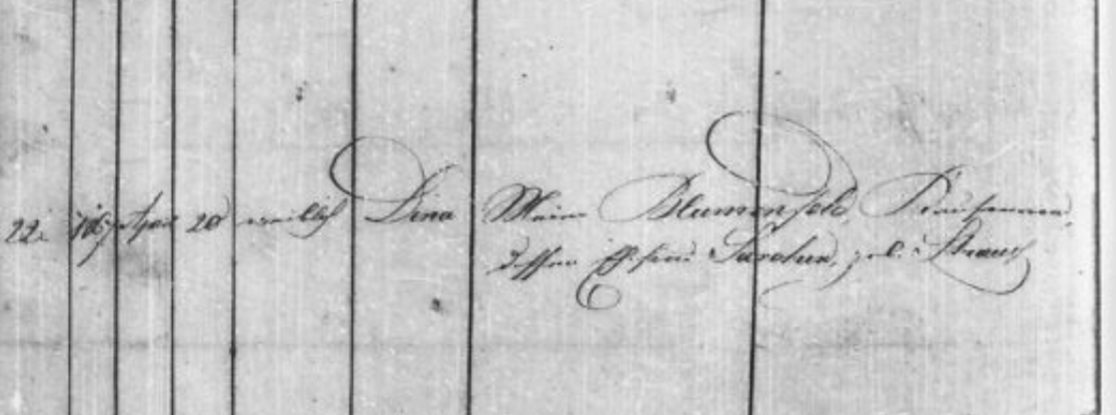
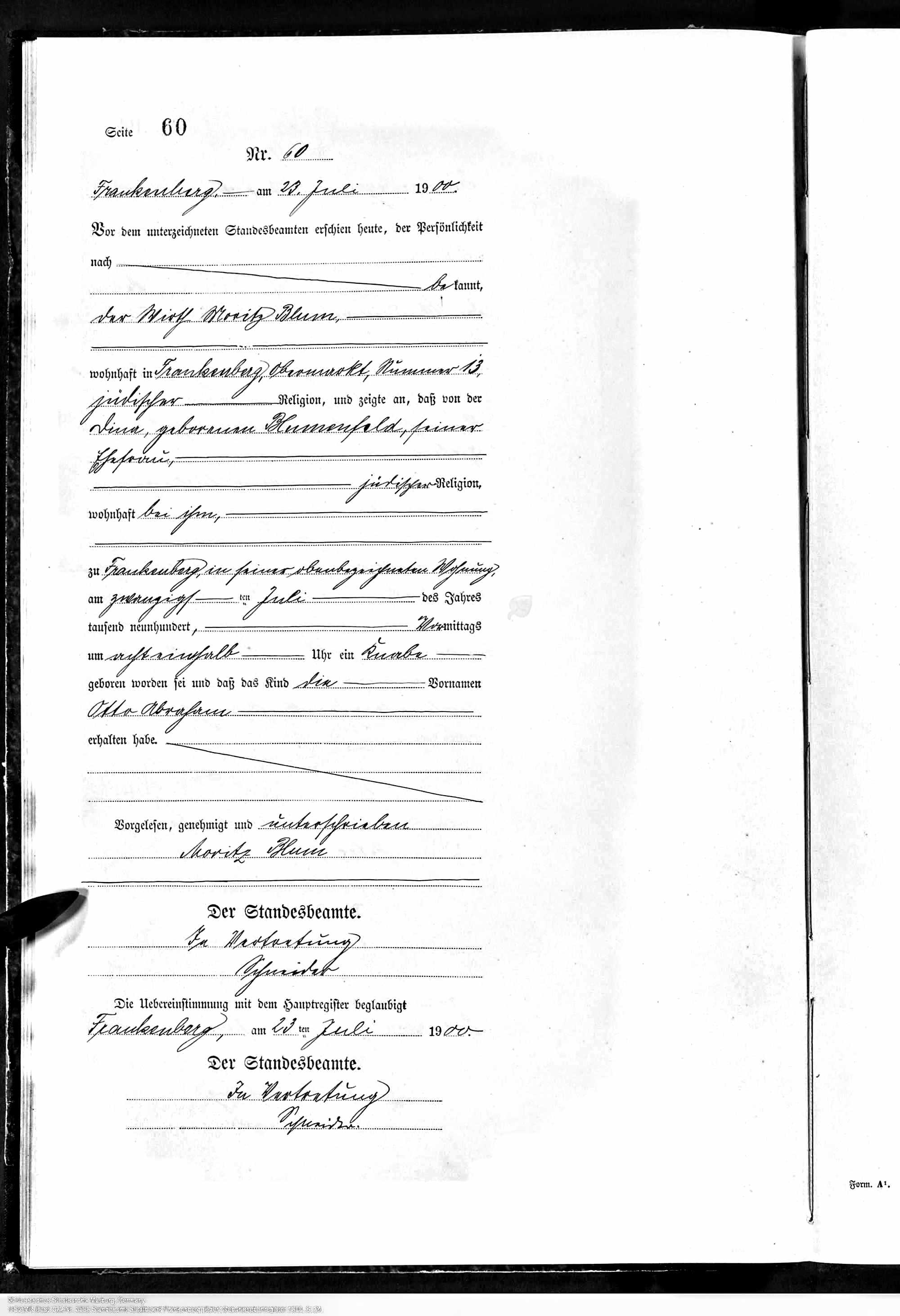
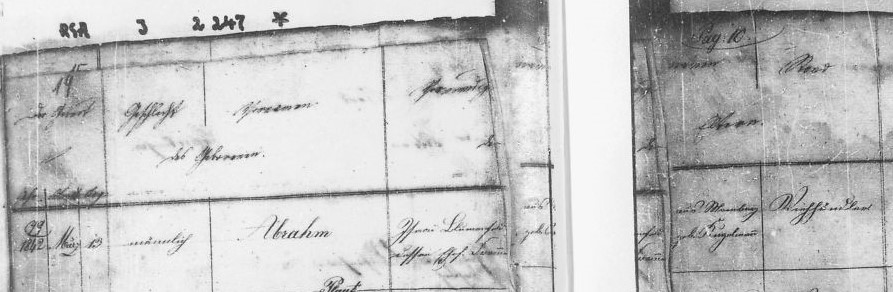
Abraham and Giedel had eight children for whom I could find birth records.  They were all born in Momberg.

Their first born was Meier, born December 11, 1840:

Meier Blumenfeld birth, Arcinsys Archives of Hessen, HHStAW Abt. 365 Nr. 628, S. 11

Then came Baruch (January 29, 1843):

Baruch Blumenfeld birth, Arcinsys Archives of Hessen, HHStAW Fonds 365 No 628, p. 13

Salomon (March 29, 1845):

Salomon Blumenfeld birth, Arcinsys Archives of Hessen, HHStAW Fonds 365 No 628, p. 14

Dusschen (June 27, 1847):

Dusschen Blumenfeld birth, Arcinsys Archives Hessen, HHStAW Fonds 365 No 628, p. 16

Moses, named for his grandfather who died in 1846, was born on December 31, 1849. I will refer to him as Moses Blumenfeld IIA:

Moses Blumenfeld IIA birth, Arcinsys Archives Hessen,HHStAW Fonds 365 No 628, p. 17

Rebecca (March 14, 1852):

Rebecca Blumenfeld birth, Arcinsys Archives, Hessen, HHStAW Fonds 365 No 608, p. 3

Heinemann (October 8, 1854):

Heinemann Blumenfeld birth, Geburtsregister der Juden von Momberg (Neustadt) 1850-1874 (HHStAW Abt. 365 Nr. 608)AutorHessisches Hauptstaatsarchiv, Wiesbaden, p. 4

And finally, Gelle (July 16, 1857):

Gelle Blumenfeld birth, Arcinsys Hessen Archives, HHStAW Fonds 365 No 608, p. 5

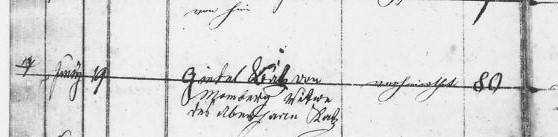
Sadly, one of those children, Rebecca, died before her fourth birthday. She died in Momberg on March 3, 1854.

Rebecca Blumenfeld death, Arcinsys Archives Hessen,HHStAW Abt. 365 Nr. 609, S. 4

I already have discussed Heinemann Blumenfeld because he married Karoline Katzenstein, one of my Katzenstein from Jesberg cousins, so I need not repeat their stories.

That leaves me with six other children of Abraham II and Giedel who lived to adulthood. In this post I will report on their marriages and then in separate posts to come I will report on their children and other descendants.

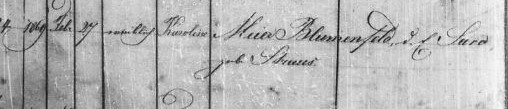
Meier Blumenfeld married Sarah Strauss on January 10, 1866, in Amoeneburg, Germany, where Sarah was born on January 21, 1844.1 Sarah was the daughter of Hirsch Strauss, Meier’s uncle (his mother Giedel’s brother), and thus she and Meier were first cousins. Sarah’s mother was Betty Loewenstein.

Meier Blumenfeld and Sarah Strauss marriage, Arcinsys Archives of Hessen, HHStAW Abt. 365 Nr. 50, S. 11

Meier and Sarah had eight children, one of whom, Martha, died in infancy on April 1, 1881.2

UPDATE: Thank you to Steve Bachenheimer who found a ninth child of Meier and Sarah. Bertha Blumenfeld was born on June 12, 1884, and died nine days later on June 21, 1884. See Bertha Blumenfeld, Gender: weiblich (Female), Birth Date: 12 Jun 1884
Birth Place: Marburg, Hessen (Hesse), Deutschland (Germany), Civil Registration  Office: Marburg, Father: Maier Blumenfeld, Mother: Sara Blumenfeld, Certificate Number: 265, Hessisches Hauptstaatsarchiv; Wiesbaden, Deutschland; Bestand: 915; Laufende Nummer: 5563, Ancestry.com. Hesse, Germany, Births, 1851-1901; Bertha Blumenfeld, Age: 0, Birth Date: abt 1884, Death Date: 21 Jun 1884, Death Place: Marburg, Hessen (Hesse), Deutschland (Germany), Civil Registration Office: Marburg
Father: Maier Blumenfeld, Mother: Sara Blumenfeld, Certificate Number: 192, Personenstandsregister Sterberegister; Bestand: 915; Laufende Nummer: 5664, Ancestry.com. Hesse, Germany, Deaths, 1851-1958

Baruch Blumenfeld married Emma Docter, daughter of Josef Docter and Zerline Wallach, on February 20, 1872, in Neustadt, Germany. Emma was born on February 9, 1848 in Gilserberg, Kirchhain, Germany.3 Her father was a veterinarian.4  Baruch and Emma would have two children.

Baruch Blumenfeld and Emma Docter marriage, Arcinsys Archives of Hessen, HHStAW Fonds 365 No 629, p. 19

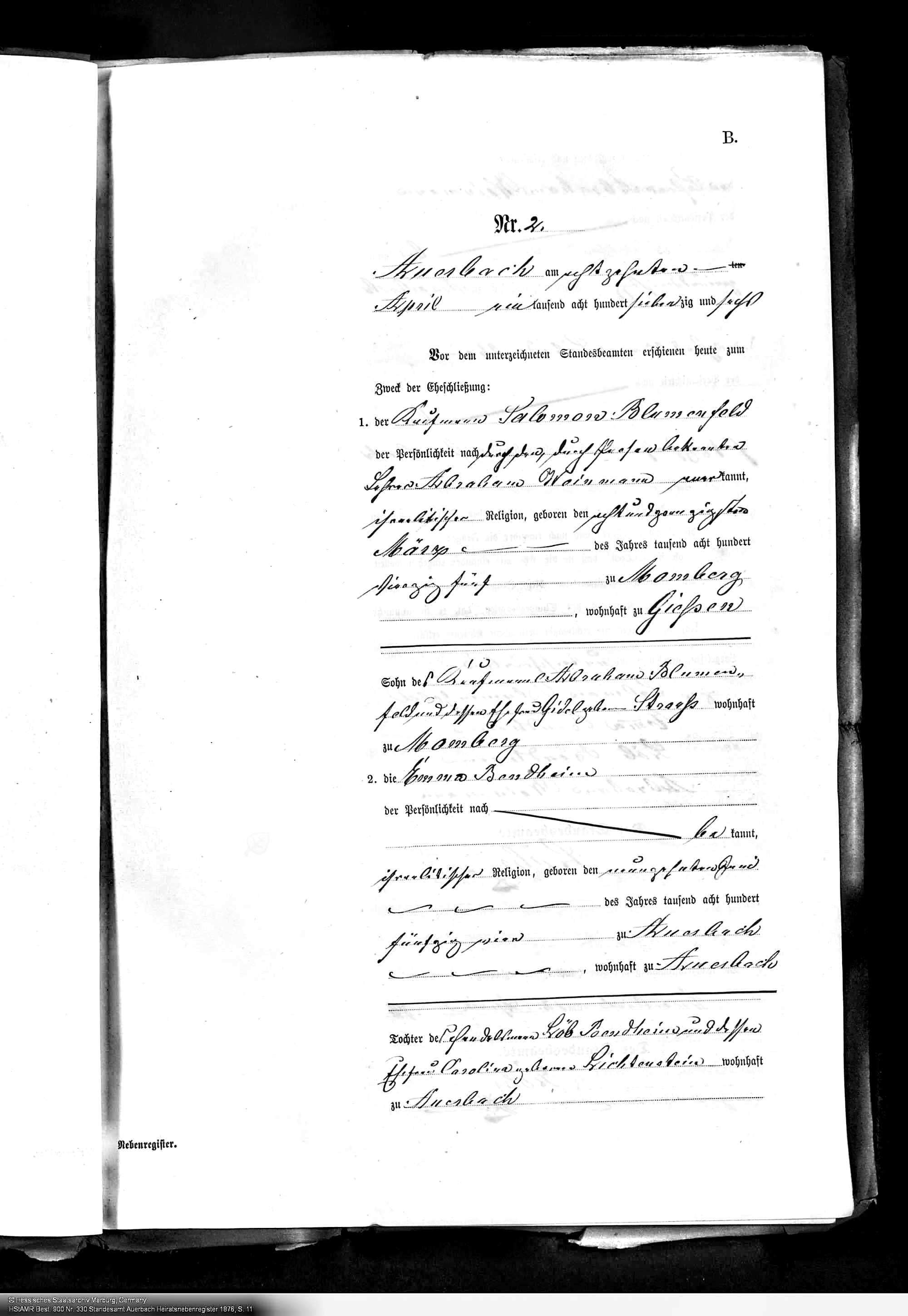
Salomon Blumenfeld married Emma Bendheim in Auerbach, Germany, on April 18, 1876. She was born in Auerbach on June 19, 1854, to Loeb Bendheim and Carolina Lichtenstein. Salomon and Emma had one child born in 1877, Moritz,5 and then in the 1880s they relocated to Huelva, Spain, where Salomon was known as Emanuel and then Manuel. More on that in a later post.

Salomon Blumenfeld and Emma Bendheim marriage, Hessisches Hauptstaatsarchiv; Wiesbaden, Deutschland; Signatur: 330, Year Range: 1876, Ancestry.com. Hesse, Germany, Marriages, 1849-1930

Abraham and Giedel’s oldest daughter Dusschen married Mayer Loewenstein in about 1865. I am still looking for more information about Mayer.

Moses Blumenfeld IIA married Fanny Bachrach, who was born in Rhina, Germany, on October 30, 1853, to Kallman Bachrach and Jette Klebe.6 They were married on May 20, 1875, in Marburg. Moses IIA and Fanny would have five children.

Moses Blumenfeld and Fanny Bachrach marriage, Arcinsys Archives of Hessen, HHStAW Abt. 365 Nr. 585, S. 27

As noted above, Heinemann Blumenfeld’s marriage and family have already been covered in my earlier discussion of my Katzenstein family.

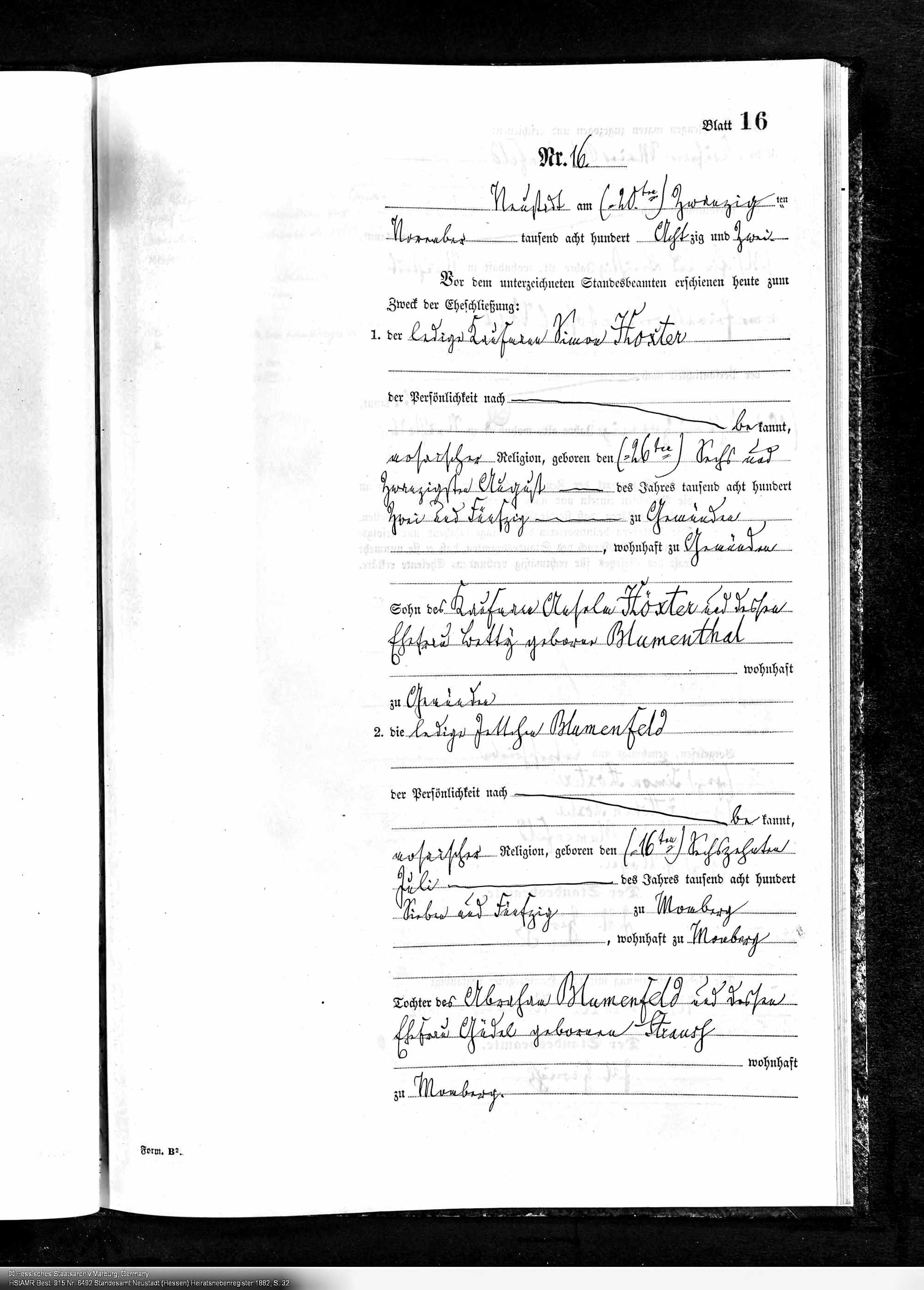
That brings me to the youngest child of Abraham Blumenfeld II and Giedel Strauss for whom I have records, their daughter Gelle Jettchen Blumenfeld, also known as Caroline. She married Simon Hoexter on November 25, 1882. He was born in Gemuenden, Germany, on August 26, 1852, to Anselm Hoexter and Betty Blumenthal.7 Gelle and Simon had four children.

Gelle Jettchen Blumenfeld and Simon Hoexter marriage, Hessisches Hauptstaatsarchiv; Wiesbaden, Deutschland; Bestand: 915; Laufende Nummer: 6492
Year Range: 1882, Ancestry.com. Hesse, Germany, Marriages, 1849-1930

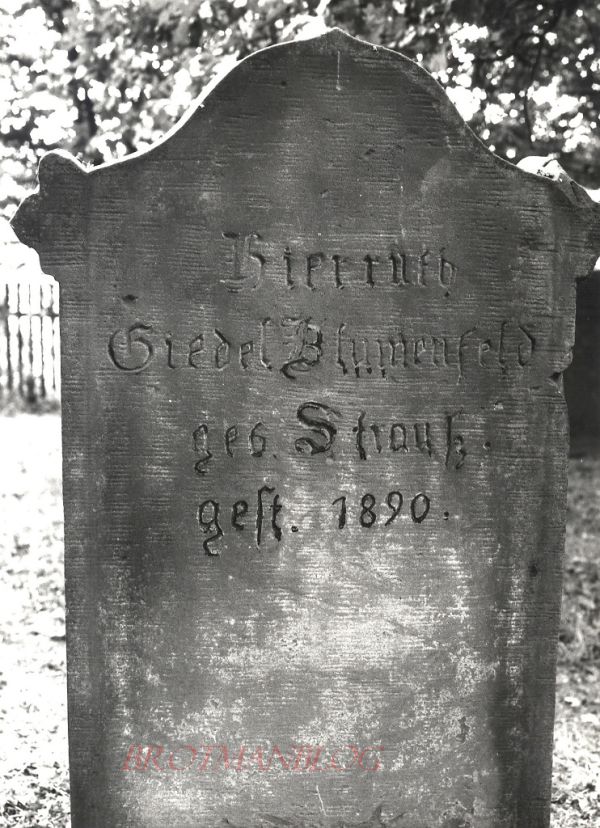
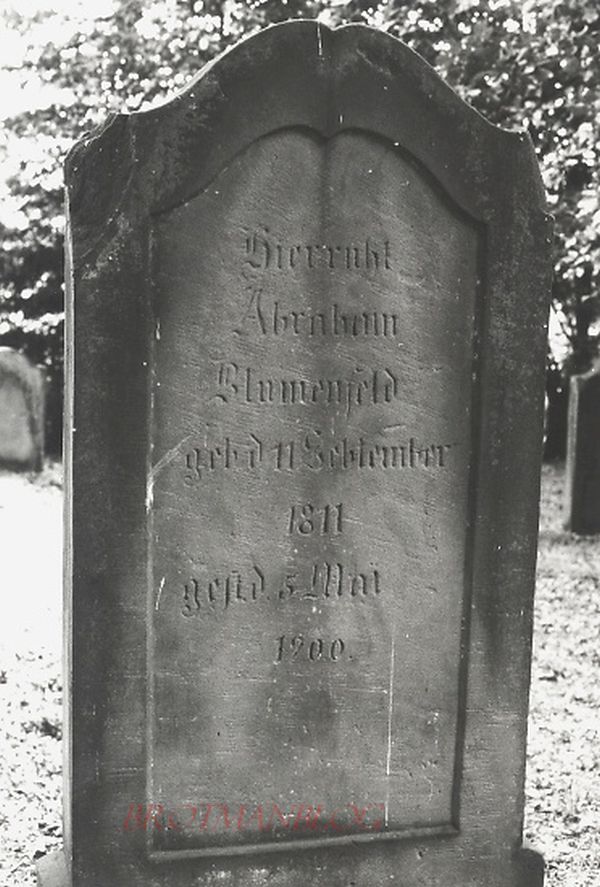
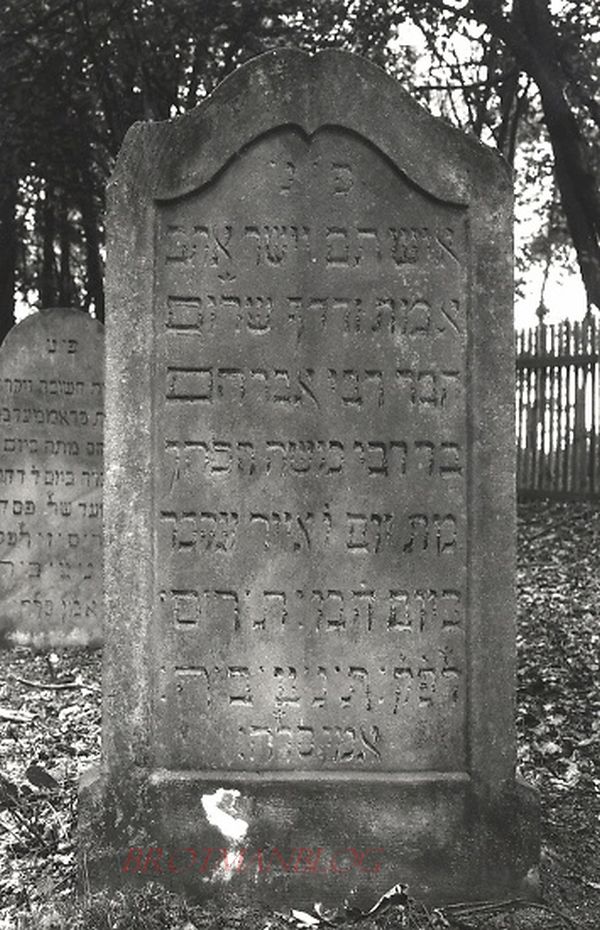
Abraham Blumenfeld II and his wife Giedel Strauss lived to see all of their children marry and the births of all 28 of their grandchildren. Giedel died on August 12, 1890, in Momberg; she was 75.8 Abraham died ten years later on May 15, 1900; he was 88.9 They are both buried at the Jewish cemetery in Neustadt near Momberg.

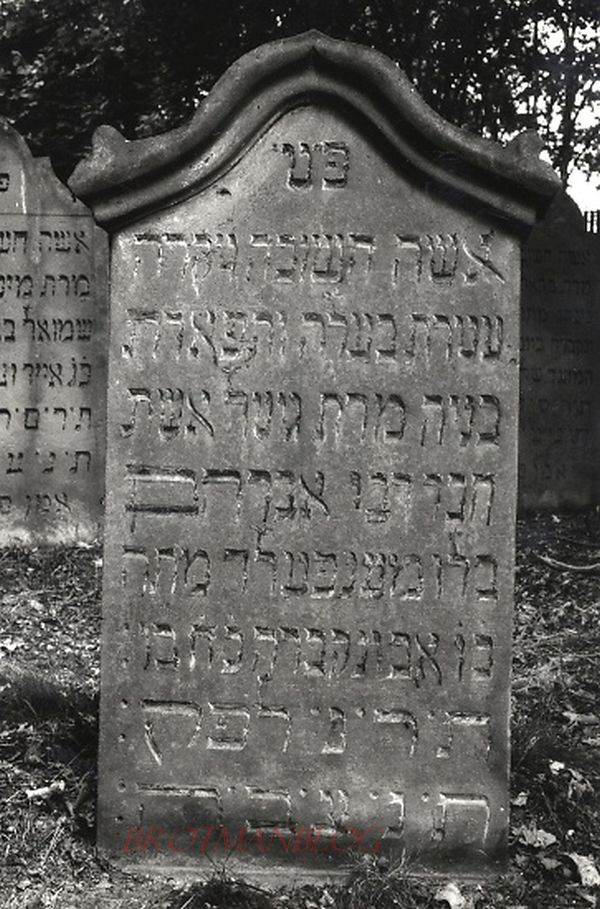
The Hebrew side of Giedel’s stone is translated as:

Here lies 

a respected and respected woman,

her husband’s crown and ornament

of their children. Mrs. Gitel, wife of the

Abraham Blumenfeld. she died

on the 26th of Av, and was buried on the 28th of the same

Her soul is part of the bond of life.

The Hebrew side of Abraham’s stone is translated as:

Here lies

an honest and sincere man, he loved

the truth and was peace-loving:

Abraham, Son of Moses ha-Kohen.

He died on the 6th of Iyyar, and was buried

on the 8th of the same [5] 660

His soul is part of the bond of life,

Amen, Sela.

In the next series of posts, I will tell about the families of the seven children of Abraham II and Giedel who lived to adulthood, starting with their oldest child, Meier, and his descendants.


  1. Blumenfeld, Sara, geborene Strauß (1912) – Marburg, Alter Jüdischer Friedhof“, in: Jüdische Grabstätten <https://www.lagis-hessen.de/en/subjects/idrec/sn/juf/id/17933&gt; (Stand: 1.8.2020) 
  2.  Personenstandsregister Sterberegister; Bestand: 915; Laufende Nummer: 5661,
    Year Range: 1881, Ancestry.com. Hesse, Germany, Deaths, 1851-1958 
  3. Arcinsys Archives of Hessen, HHStAW Fonds 365 No 359, p. 8. 
  4. Alfred Schneider, Die Juedischen Familien im ehemaligen Kreise Kirchain, p. 129 
  5.  Hessisches Hauptstaatsarchiv; Wiesbaden, Deutschland; Signatur: 357, Ancestry.com. Hesse, Germany, Marriages, 1849-1930 
  6. Arcinsys Archives of Hessen, HHStAW Abt. 365 Nr. 687, 49. 
  7. Arcinsys Archives of Hessen, HHStAW Fonds 365 No 351, p. 17. 
  8. Blumenfeld, Giedel geborene Strauß (1890) – Neustadt (bei Marburg)“, in: Jüdische Grabstätten <https://www.lagis-hessen.de/en/subjects/idrec/sn/juf/id/5333&gt; (Stand: 5.6.2012) 
  9. Blumenfeld, Abraham (I) (1900) – Neustadt (bei Marburg)“, in: Jüdische Grabstätten <https://www.lagis-hessen.de/en/subjects/idrec/sn/juf/id/5332&gt; (Stand: 5.6.2012) 

Moses Blumenfeld, My Four-Times Great-Uncle

Moses Blumenfeld was my four-times great-uncle, the older brother of my three-times great-grandmother Breine Blumenfeld Katzenstein. He was born in Momberg in 1778, the first-born child of Abraham and Geidel Katz Blumenfeld, my four-times great-grandparents.

Family register of Moses Blumenfeld, Lagis-Hessen Archives, HHStAW Fonds 365 No 631 p 18

He was a cattle dealer in Momberg and married to Gidel Katz Loeb, daughter of Isaak Katz and Gelle Katz (the name Loeb must have been adopted after her birth when surnames were required of Jews in Germany). Gidel was born in about 1782 in Neustadt, Germany, and she and Moses married sometime in or before 1811 when their first child Abraham (named for his grandfather) was born.

As you can already see, the repetition of the names creates a lot of confusion—especially for me while researching this family. Moses’ son had the same name as Moses’ father, so I will refer to the son as Abraham II. Moses’ wife Gidel has essentially the same name as Moses’ mother Geidel. I am using the alternative spelling to help keep them separate. And there will be more repeating names as I proceed.

Moses and Gidel had three children for whom there are records. Abraham Blumenfeld II was born on September 11, 1811.1 Isaak was born two years later on December 18, 1813.2 Gelle was born in about 1820.3 All three children were born in Momberg.

Abraham II, like his father Moses, became a cattle dealer and a butcher.4  Like his father and his grandfather, he married a woman named Giedel (also spelled Gidel, Geidel, Geitel, Gitel). His wife was Giedel Strauss, daughter of Hahne Strauss and Dusel Loewenstein. She was born on June 19, 1815, in Amoeneburg, Germany. Abraham II and Geidel were married on February 5, 1840.5 They would have seven children to be discussed in posts to come.

Marriage record of Abraham Blumenfed II and Geidel Strauss, Lagis-Hessen Archives. HHStAW Fonds 365 No 629, p. 6

Isaak was also a cattle dealer and butcher like his father and brother.6 He married twice. His first wife was Frommet Kugelmann, daughter of Ezekiel Kugelmann and Knentel Adorn.7 Frommet was born in Wohra, Germany, in about 1821, as her marriage record reports that she was twenty when she married Isaak on August 2, 1841.

Isaak Blumenfeld and Frommet Kugelmann marriage record, Lagis Hessen Archives, HHStAW Abt. 365 Nr. 629, S. 6

Frommet gave birth to their first child, named Abraham Blumenfeld like his uncle and great-grandfather, on March 13, 1842 in Momberg. I will refer to him as Abraham Blumenfeld III.

Abraham Blumenfeld III birth record, Lagis Hessen Archive, HHStAW Abt. 365 Nr. 628, S. 12

Then tragically Frommet died five days later on March 18, 1842. Her death record reports that she was only 19 when she died, which is contrary to the marriage record’s report that she was 20 when she married.

Frommet Kugelmann Blumenfeld death record, Lagis Hessen Archive, HHStAW Abt. 365 Nr. 630, S. 8

Isaak, left with his infant son Abraham III, married a second time on January 10, 1843. His second wife was Gelle Strauss, the sister of his sister-in-law Giedel Strauss, his brother Abraham II’s wife. Gelle, also a daughter of Hahne Strauss and Dusel Loewenstein, was born November 6, 1819, in Amoeneburg.8 Isaak and Gelle had six children together, to be discussed in a later post.

Marriage record of Isaak Blumenfeld and Gelle Strauss, Lagis Hessen Archive, HHStAW Abt. 365 Nr. 629, S. 6

Gelle Blumenfeld (not to be confused with her sister-in-law Gelle Strauss Blumenfeld) married Simon Rothschild on November 15, 1842, when she was reportedly 20. But her death record indicated that she was 67 when she died in 1887,9 which would mean she was born in 1820 and 22 when she married Simon. There is no birth record available to resolve that conflict.

Marriage record of Gelle Blumenfeld and Simon Rothschild, Lagis Hessen Archives, HHStAW Abt. 365 Nr. 629, S. 6

Simon Rothschild was a 29 year old merchant when he married Gelle. He was born in Waltersbrueck on June 22, 1813, to Seligmann Rothschild and Terz Gutheim.10 Simon and Gelle had nine children together, to be discussed in a later post.

Thus, Moses Blumenfeld and Gidel Katz Loeb had two dozen grandchildren from their three children. Gidel died on December 1, 1843, in Momberg; she was 61.

Death record of Gidel Blumenfeld, Lagis Hessen Archives, HHStAW Abt. 365 Nr. 630, S. 9

Blumenfeld, Gietel nee Katz or Löb (1843) – Neustadt (near Marburg)”, in: Jüdische Grabstätten <https://www.lagis-hessen.de/en/subjects/idrec/sn/juf/id/5423&gt; (Status: 5.6.2012)

Her headstone inscription is translated as:

Here lies

the much vaunted woman,

Mrs. Gitel, wife of the Lord

Moses ha-Kohen from Mom (mountain).

She died on Holy Shabbat, and was buried on

Sunday the 10th of the month of Kislev

of the year [5] AD 602 ​​(= 11/22/1841).[^11] And her soul

be bound in the covenant of life until she is raised at the resurrection of the dead,

Amen.

Moses Blumenfeld died three years later on November 20, 1846. He was 68. They are both buried in Momberg. They were survived by their three children and twenty-four grandchildren.

Blumenfeld, Moses (1846) – Neustadt (near Marburg)”, in: Jüdische Grabstätten <https://www.lagis-hessen.de/en/subjects/idrec/sn/juf/id/5289&gt; (status: 5.6 .2012)

Moses’ headstone is translated as:

And he was the priest of the Most High God (Genesis 14:18).

This is the grave monument

the sincere man, the venerable

Lord Moses, son of Abraham

ha-Kohen. He died in good

Call on the 2nd Kislev of the year

[5] 607 ndkZ (= 11/21/1846). May his soul be bound in the covenant of life until he is raised at the resurrection of the dead,

Amen.

Two dozen grandchildren for just one of Breine’s siblings! And each of those grandchildren had children and grandchildren. Where do I begin? How do I organize my blog posts so that I don’t lose track of all those descendants?

In my next set of posts I will explore the family of Abraham Blumenfeld II, the oldest child of Moses and Gidel. He had seven children, as stated. Do I tell the story of each of those children separately? And then return to Abraham’s siblings? I guess so. Whew. This could take a while.


  1. Lagis-Hessen Archives, HHStAW Fonds 365 No 631 p 18. 
  2.  Personenstandsregister Sterberegister; Bestand: 915; Laufende Nummer: 6559. Description, Year Range: 1892, Source Information
    Ancestry.com. Hesse, Germany, Deaths, 1851-1958 
  3. Rothschild, Gelle geborene Blumenfeld (1887) – Haarhausen“, in: Jüdische Grabstätten <https://www.lagis-hessen.de/en/subjects/idrec/sn/juf/id/2291&gt; (Stand: 5.6.2012). Personenstandsregister Sterberegister; Bestand: 920; Laufende Nummer: 8464, Ancestry.com. Hesse, Germany, Deaths, 1851-1958 
  4. Blumenfeld, Abraham (I) (1900) – Neustadt (near Marburg)”, in: Jüdische Grabstätten <https://www.lagis-hessen.de/en/subjects/idrec/sn/juf/id/5332&gt; ( Status: 5.6.2012) 
  5. Blumenfeld, Giedel nee Strauss (1890) – Neustadt (near Marburg)”, in: Jüdische Grabstätten <https://www.lagis-hessen.de/en/subjects/idrec/sn/juf/id/5333&gt; (status no : 5.6.2012) 
  6. Blumenfeld, Isaak (I) (1892) – Neustadt (bei Marburg)“, in: Jüdische Grabstätten <https://www.lagis-hessen.de/en/subjects/idrec/sn/juf/id/5353&gt; (Stand: 5.6.2012) 
  7. Blumenfeld, Frommet geborene Kugelmann (1842) – Neustadt (bei Marburg)“, in: Jüdische Grabstätten <https://www.lagis-hessen.de/en/subjects/idrec/sn/juf/id/5294&gt; (Stand: 5.6.2012) 
  8. Blumenfeld, Gelle nee Strauss (1886) – Neustadt (near Marburg)”, in: Jüdische Grabstätten <https://www.lagis-hessen.de/en/subjects/idrec/sn/juf/id/4499&gt; (status no : 5.6.2012) 
  9.  Personenstandsregister Sterberegister; Bestand: 920; Laufende Nummer: 8464,
    Ancestry.com. Hesse, Germany, Deaths, 1851-1958 
  10. Rothschild, Simon (II) (1895) – Haarhausen”, in: Jüdische Grabstätten <https://www.lagis-hessen.de/en/subjects/idrec/sn/juf/id/2213&gt; (Status: 5.6. 2012) 

Introducing the Blumenfelds

I am back! It was great to spend days with my family and then to start the research on my next project, and now I am ready to dive into that project.

It’s been wonderful to focus on my mother’s side of the family tree these last few months and to discover so many wonderful new Goldfarb and Hecht cousins. There are far fewer long limbs on my mother’s side of the tree because despite years of trying, I cannot get beyond the names of her great- grandparents on either her maternal or paternal side. The records just don’t exist, and those still living have no more information than what I’ve already found. So while I can get as far back as a sixth great-grandparent on some of my father’s lines, my mother’s tree ends with her great-grandparents, about whom I know nothing other than their names.

And so now I return to my father’s side of the tree once again, and I am climbing on one of those longer limbs—the Blumenfelds. Breine Blumenfeld was my three-times great-grandmother. She was born in Momberg in about 1783 and married Scholem Katzenstein of Jesberg in 1808. Their son Gerson was my great-great-grandfather, and he and his wife Eva Goldschmidt immigrated to the US in 1856 and settled in Pennsylvania where my great-grandmother Hilda Katzenstein was born. Hilda married Isidor Schoenthal, and their daughter Eva was my paternal grandmother. I’ve already written extensively about Breine Blumenfeld’s descendants and relatives by writing about Scholem Katzenstein’s family and Eva Goldschmidt’s family and Isidor Schoenthal’s family, and so now it is time to return to Breine’s family of origin—her parents and her siblings.

Unfortunately, I have no primary sources for Breine’s parents. Instead I’ve had to rely on secondary sources—primarily the work of Alfred Schneider, “Die Juedischen Familien im ehemaligen Kreise Kirchain.” In addition, I’ve relied on pages written by Rev. Wilhelm Bach sometime in the 19th century and shared with me by Barbara Greve. There is also information on the Lagis-Hessen site for Jewish gravestones. I also looked at numerous trees on Ancestry, but they also do not have sources for my early Blumenfeld ancestors, and thus I have no idea how reliable they are.

With those disclaimers up front, let me share what these sources reveal about Breine Blumenfeld’s family. Her father was Abraham Katz, born in about 1750 and only 57 when he died in Neustadt bei Marburg, Germany, on December 21, 1807. Breine’s mother was Geidel (or Judith according to Rev. Bach), daughter of Gerson Moses and Fradchen Haas, according to some trees on Ancestry. 1 Geidel2 was about eighty years old when she died in Momberg on July 19, 1834, so born in about 1754. Abraham and Geidel were my four-times great-grandparents, and Geidel’s parents Gerson Moses and Fradchen Haas were my five-times great-grandparents.

I was able to locate Geidel’s gravestone online and learned from that site that it was not until after Abraham died in 1807 that she and her children adopted the surname Blumenfeld as required by the government. (Jews generally did not have surnames before the early 1800s—they used patronymics. Then European countries began requiring Jews to take surnames so they could identify them for tax and other purposes.)

Blumenfeld, Giedel nee Gerson Moses (1834) – Neustadt (near Marburg)”, in: Jüdische Grabstätten <https://www.lagis-hessen.de/en/subjects/idrec/sn/juf/id/5281&gt; ( Status: 5.6.2012)

The inscription is translated as “Here rests Geidel, wife of venerable Abraham ha-Kohen. she died on Sunday the 13th of Tamus, and was buried on Monday of the year [5] 594 AD (= July 20, 1834). Her soul is part of the bond of life.”

My four-times great-grandparents Abraham and Geidel Blumenfeld had six children, all born in Momberg, Germany: Moses (c. 1778), Sprinz (c. 1783), Hanna (c. 1788),  Breine (c. 1784), Maier (c. 1795), and Jakob (c. 1800).2 Given the gaps between many of these births, I wonder whether there were other children born who did not survive and for whom there are no records; alternatively, perhaps Geidel suffered multiple miscarriages. These six children are the only ones for whom I can find any sources, primary or otherwise.

UPDATE: Thank you so much to Jason Hallgarten of the JEKKES group on Facebook for finding Hanna Blumenfeld, a child I had missed in my search.

As noted, Breine’s story has already been told, and thus the posts to follow will focus on her four siblings and their descendants, starting with Moses Blumenfeld, my four-times great-uncle.


  1. There is no actual record of Abraham’s birth, marriage, or death. This information comes from Schneider, p. 129, and from the entry on the Lagis-Hessen gravestone site for Abraham’s wife Geidel. It also appears in numerous Ancestry trees as does the information about Geidel’s parents. The Strauss Family Tree at https://www.ancestry.com/family-tree/person/tree/113124712/person/240106312930/facts seems to be the tree upon which all the other trees relied to come up with these names and dates. 
  2. Citations and images to follow for birth dates. 

My Cousins Rosa, Sophie, and Hugo Blumenfeld: What Drew Them to America?

Three of the nine children of Meier Blumenfeld and Sarah Strauss—Rosa, Sophie, and Hugo—left Germany as young adults and immigrated to the United States. Why did they leave when their siblings stayed behind?

Rosa was born on September 5, 1872, in Marburg.

Rosa Blumenfeld birth record, Arcinsys Archives Hessen, HHStAW Abt. 365 Nr. 584, S. 37

Her younger sister Sophie was born on May 30, 1874, in Marburg.

Sophie Blumenfeld birth record, Arcinsys Archives Hessen, HHStAW Abt. 365 Nr. 584, S. 39

Finally, Hugo, the only son of Meier and Sarah, was born on September 25, 1882, in Marburg.

Hugo Blumenfeld birth record, Hessisches Hauptstaatsarchiv; Wiesbaden, Deutschland; Bestand: 915; Laufende Nummer: 5561, Year Range: 1882, Ancestry.com. Hesse, Germany, Births, 1851-1901

On June 26, 1893, when Rosa was almost 21 and Sophie was nineteen, they arrived in New York on the SS Ems, heading for Kokomo, Indiana, according to the ship manifest. Why did they leave home? And why Kokomo? Kokomo in the 1890s had a very small Jewish population; in fact, there were not enough Jews in Kokomo to establish and support a synagogue until 1942. Why would two young German Jewish women have immigrated to such a place?

Rosa and Sophie Blumenfeld, ship manifest, Year: 1893; Arrival: New York, New York, USA; Microfilm Serial: M237, 1820-1897; Line: 1, Ship or Roll Number: Ems, Ancestry.com. New York, U.S., Arriving Passenger and Crew Lists (including Castle Garden and Ellis Island), 1820-1957

I cannot find any records for either Rosa or Sophie in Kokomo, but in 1900 Rosa was living in Chicago as a boarder with David and Helen Strauss, both of whom had immigrated from Germany. When I saw the surname “Strauss,” I wondered if David Strauss was related to Sarah Strauss, Rosa’s mother.

Rosa Blumenfeld 1900 US census, Year: 1900; Census Place: Chicago Ward 32, Cook, Illinois; Page: 19; Enumeration District: 1025; FHL microfilm: 1240286
Ancestry.com. 1900 United States Federal Census

And so down the rabbit hole I went. And what did I find? David Strauss married Helen Heldman in 1892, and their son Herbert was born in Kokomo, Indiana, in March, 1893, just three months before Rosa and Sophie arrived in the US. Were they coming to care for the baby and help David and Helen? Was David related to their mother?1

I went back to the German records for Sarah Strauss’s parents Hirsch Strauss and Betty Loewenstein and found that indeed Sarah had a younger brother named David, born in 1852 so the right age to be the David Strauss living in Chicago with Sarah’s daughter Rosa in 1900.2 So Rosa was living with her uncle and his family in 1900, and he was obviously the reason she and Sophie had been heading to Kokomo in 1893.

But where was Sophie in 1900? I can’t be certain, but I believe she may have returned to Germany because I found her on another ship manifest coming to the US from Germany on November 2, 1905. Also, her naturalization papers indicate that she had been in the US continuously starting in 1905, not 1893.3

National Archives at Chicago; Chicago, Illinois; ARC Title: Declarations of Intention for Citizenship, 1903-1981; Record Group Title: Records of District Courts of the United States, 1685-2009; Record Group Number: RG 21, Declarations V· 25-30 P 161 1917-1918
Ancestry.com. Illinois, U.S., Federal Naturalization Records, 1856-1991

Meanwhile, Sophie and Rosa’s little brother Hugo arrived on April 27, 1904. His ship manifest indicates that he was coming to his sister Rosa in Chicago and that he was a clerk.

Hugo Blumenfeld ship manifest, Year: 1904; Arrival: New York, New York, USA; Microfilm Serial: T715, 1897-1957; Line: 1; Page Number: 102, Ship or Roll Number: Kronprinz Wilhelm
Ancestry.com. New York, U.S., Arriving Passenger and Crew Lists (including Castle Garden and Ellis Island), 1820-1957 (last entry)

Thus, by 1905, three of Meier and Sarah’s children had settled in Chicago.

Rosa married Ignaz Herzka on January 4, 1905.4 Ignaz was born in Szerat, Hungary, on November 29, 1863, and had immigrated to the US in 1889. In 1900, he and his brother Nathan were living as boarders in Chicago and had their own tailor shop there.5

Rosa and Ignaz had an adopted daughter, Elsa, who, according to the 1910 census, was born in Hungary in 1903.6 This is consistent with what is reported on the 1920 census: that Elsa was born in Budapest, Hungary, and was adopted.7  However, Rosa’s 1924 passport application says that Elsa was born in Chicago on March 22, 1905. It also, however, says that Rosa and Ignaz married on January 4, 1904, when the Chicago marriage index says January 4, 1905.8 Later records including the 1940 US census also say that Elsa was born in Chicago, not Hungary.9  I am not sure which records are accurate with respect to either the date or place of Elsa’s birth.

In any event, in 1910, Ignaz continued to work as a tailor. Sophie was also living with Rosa, Ignaz, and their daughter Elsa in 1910; she was a saleswoman in a delicatessen.

Ignaz Herzka and family, 1920 US census, Year: 1910; Census Place: Chicago Ward 7, Cook, Illinois; Roll: T624_247; Page: 3B; Enumeration District: 0387; FHL microfilm: 1374260
Ancestry.com. 1910 United States Federal Census

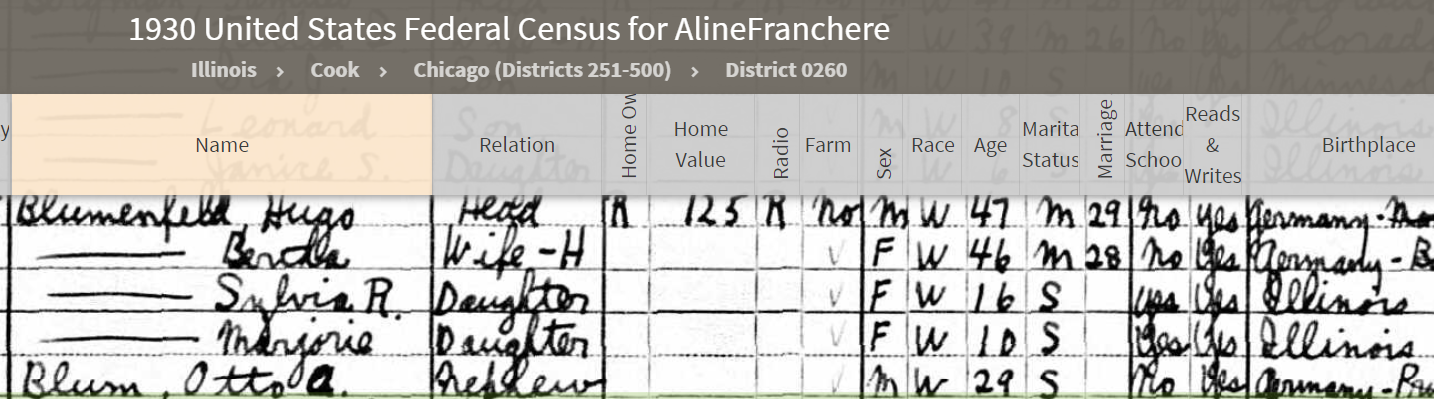
I could not find Hugo on the 1910 census, and perhaps he had returned to Germany for a visit as he had in 1909.10 But in 1911 Hugo became a naturalized United States citizen.11 And on March 24, 1912, he married Bertha Wolf,12 who was also a German immigrant. She was born in Langenbruck, Germany, on March 19, 1884, to Rudolph Wolf and Rosa Stein.13 Hugo and Bertha had two daughters, Sylvia and Marjorie, both born in Chicago.

Thus, long before Hitler came to power, Rosa, Sophie, and Hugo Blumenfeld had all left Germany and were living in Chicago. Their decision to come to America was a blessing for the legacy of their parents Meier Blumenfeld and Sarah Strauss.

The next post will follow their lives from 1910 on.


  1. Dave Strauss, Gender: Male, Marriage Date: 8 Jun 1892, Marriage Place: Hamilton, Ohio, USA, Spouse: Helen Heldman, Film Number: 000344499, Ancestry.com. Ohio, U.S., County Marriage Records, 1774-1993. Herbert Dave Strauss
    Race: White, Marital status: Married, Birth Date: 27 Mar 1893, Birth Place: Indiana, USA
    Residence Date: 1917-1918, Street Address: 5833 Michigan Ave, Residence Place: Chicago, Cook, Illinois, USA, Draft Board: 15, Registration State: Illinois; Registration County: Cook, Ancestry.com. U.S., World War I Draft Registration Cards, 1917-1918 
  2. David Strauss birth record, Geburtsregister der Juden von Amöneburg 1814-1896 (HHStAW Abt. 365 Nr. 49), p. 6. 
  3. Sophie Blumenfeld, ship manifest, Year: 1905; Arrival: New York, New York, USA; Microfilm Serial: T715, 1897-1957; Line: 30; Page Number: 12, Ancestry.com. New York, U.S., Arriving Passenger and Crew Lists (including Castle Garden and Ellis Island), 1820-1957. 
  4. Rose Blumenfeld, Age: 28, Gender: Female, Birth Year: abt 1877
    Marriage Type: Marriage, Marriage Date: 4 Jan 1905, Marriage Place: Chicago, Cook, Illinois, Spouse Name: Ignaz Herzka, Spouse Age: 40, Spouse Gender: Male
    FHL Film Number: 1030380, Ancestry.com. Cook County, Illinois, U.S., Marriages Index, 1871-1920 
  5. Ignaz Herzka, 1900 US census, Year: 1900; Census Place: Chicago Ward 32, Cook, Illinois; Page: 12; Enumeration District: 1034; FHL microfilm: 1240287, Ancestry.com. 1900 United States Federal Census 
  6. Elsa Herzka, 1910 US census, Year: 1910; Census Place: Chicago Ward 7, Cook, Illinois; Roll: T624_247; Page: 3B; Enumeration District: 0387; FHL microfilm: 1374260,
    Ancestry.com. 1910 United States Federal Census 
  7. Elsa Herzka, 1920 US census, Year: 1920; Census Place: Chicago Ward 6, Cook (Chicago), Illinois; Roll: T625_310; Page: 12A; Enumeration District: 340, Ancestry.com. 1920 United States Federal Census 
  8. Rosa Blumenfeld Herzka, 1924 passport application, National Archives and Records Administration (NARA); Washington D.C.; Roll #: 2460; Volume #: Roll 2460 – Certificates: 387350-387849, 03 Apr 1924-04 Apr 1924, Ancestry.com. U.S., Passport Applications, 1795-1925 
  9. Rosa Herzka Blum, 1940 US census, Elsa Blum, Age: 35, Estimated Birth Year: abt 1905, Gender: Female, Race: White, Birthplace: Illinois, Marital Status: Married, Relation to Head of House: Wife, Home in 1940: Chicago, Cook, Illinois, Map of Home in 1940: Chicago, Cook, Illinois, Street: E 53rd Street, Sheet Number: 1B, Year: 1940; Census Place: Chicago, Cook, Illinois; Roll: m-t0627-00929; Page: 1B; Enumeration District: 103-271, Ancestry.com. 1940 United States Federal Census 
  10.  Hugo Blumenfeld, Gender: männlich (Male), Ethnicity/Nationality: Deutschland (German), Marital status: verheiratet (Married), Residence Place: Chicago
    Departure Date: 8 Aug 1909, Departure Place: Hamburg, Deutschland (Germany)
    Arrival Place: Boulogne-sur-Mer; Southampton; New York, Ship Name: Blücher
    Shipping Line: Hamburg-Amerika Linie (Hamburg-Amerikanische Packetfahrt-Actien-Gesellschaft), Ship Type: Dampfschiff, Ship Flag: Deutschland, Emigration: nein
    Accommodation: 2. Klasse, Volume: 373-7 I, VIII A 1 Band 213, Staatsarchiv Hamburg; Hamburg, Deutschland; Hamburger Passagierlisten; Volume: 373-7 I, VIII A 1 Band 213; Page: 1691; Microfilm No.: K_1809, Staatsarchiv Hamburg. Hamburg Passenger Lists, 1850-1934 
  11.  Hugo Blumenfeld, Naturalization Age: 29, Record Type: Naturalization
    Birth Date: 1882, Birth Place: Germany, Naturalization Date: 1911, Naturalization Place: Illinois, Court: District and Circuit Courts, Northern District, Illinois, National Archives at Chicago; Chicago, Illinois; ARC Title: Petitions for Naturalization for the United States District and Circuit Courts, Northern District of Illinois and Immigration and Naturalization Service District 9, 1840-1950; NAI Number: M1285; Record Group Title: Records of the Immigration and Naturalization Service; Record Group Number: RG 85,
    Ancestry.com. Illinois, U.S., Federal Naturalization Records, 1856-1991 
  12. Hugo Blumenfeld, Age: 29, Gender: Male, Birth Year: abt 1883, Marriage Type: Marriage, Marriage Date: 24 Mar 1912, Marriage Place: Chicago, Cook, Illinois, USA
    Spouse Name: Bertha Wolf, Spouse Age: 24, Spouse Gender: Female
    FHL Film Number: 1030518, Ancestry.com. Cook County, Illinois, U.S., Marriages Index, 1871-1920 
  13. Bertha Wolf Blumenfeld, Gender: Female, Birth Date: 19 Mar 1884
    Birth Place: Langenbrucke, Federal Republic of Germany, Father: Rudolph Wolf
    Mother: Rosa Stein, SSN: 342408956, Ancestry.com. U.S., Social Security Applications and Claims Index, 1936-2007 

People Read Footnotes! Another Twist in the Family Tree

Last month when I wrote about the end (for now) of my Goldschmidt family research, I included this footnote on my blog post:

I would be remiss in my duties as a family historian if I didn’t mention that in addition to their four sons Meyer, Seligmann, Lehmann, and Simon, whom I’ve studied in depth, my four-times great-grandparents Jacob Falcke Goldschmidt and Eva Seligmann had a daughter Jette Goldschmidt. She married David Gruenewald of Poembsen, Germany, and they had two children. One died as an infant or was stillborn, but the other, Jacob Gruenewald, was born in 1820, lived to adulthood, married Sarah Nethe, and had fourteen children born between 1847 and 1872. All of this information, however, is based purely on a secondary source, a report in the Alex Bernstein Collection at the Leo Baeck Institute. I’ve tried to locate more information about Jette’s descendants, but so far have not succeeded. If the day comes when I can, I will add Jette’s family to the blog.

I admit that I never expected anyone to read the footnote. After all, it was a footnote, and I wrote it just to be forthcoming and thorough in reporting an area of the Goldschmidt family story that I had not included on my blog.

But much to my surprise and delight, my cousin Ruth read the footnote and emailed me to say she thought we might be related through the Gruenewald family of Poembsen. Ruth is my fourth cousin through my Seligmann family line. Her great-great-grandfather Hieronymous Seligmann was the brother of my great-great-grandfather Bernard Seligman, the subject of my latest novel. We are both descended from Moritz Seligmann and Babette Schoenfeld. As far as I knew, Ruth was not related to me through my Goldschmidt family.

So when I received Ruth’s email, I wanted to know whether we were also related through the Gruenewalds of Poembsen. Ruth had a family tree prepared by memory by her grandfather Simon Gruenewald near the end of his life. I had only the work compiled by Alex Bernstein. Ruth sent me a copy of her grandfather’s tree, and I studied it and compared it to the information I had from Alex Bernstein’s book. I then sent it to David Baron, who had first told me about Alex Bernstein’s book. And he also studied and compared the two trees.


There were a few inconsistencies in the two trees, including most importantly that Ruth’s tree did not list Jette Goldschmidt as David Gruenewald’s first wife. I have written to a contact in Oberlistingen, hoping that there will be a marriage record for Jette and David. Alternatively we hope that there may be records of Jette’s death or of the birth or marriage of her son Jacob that will help us verify that Jette Goldschmidt was married to David Gruenewald and was the mother of Jacob Gruenewald.

Because we assume that Alex Bernstein relied on actual records whereas Ruth knew that her grandfather relied only on his memory. we think for the most part that the Bernstein tree is more reliable than Ruth’s grandfather’s tree.  And it wouldn’t be surprising if Ruth’s grandfather was confused, given that there are at least two Davids, two Simons, two Jacobs, and several Minnas on the Gruenewald tree.

So what did we conclude regarding the relationship between Ruth and Jette Goldschmidt, assuming that David Gruenewald was married to my four-times great-aunt Jette?

There is no genetic connection, only one by marriage. Here is an abbreviated family report for the Gruenewalds of Poembsen.

As you can see, Levi Jehuda had a son Moses. Moses had two sons—David Gruenewald I, who married (we believe) Jette Goldschmidt, and Ruth’s great-great-grandfather Simon Gruenewald I.

But it gets more complicated.  Simon Gruenewald I had a son David Gruenewald II. David Gruenewald II married his first cousin, Minna Gruenewald, the daughter of David Gruenewald I with his second wife, Klara Karenmeyer. Minna Gruenewald was Ruth’s great-grandmother and also the half-sister of my relative Jacob Gruenewald I, David Gruenewald I and Jette Goldschmidt’s son.

Here are some charts, though I am not sure they really help. The first chart shows how Ruth’s great-grandparents were first cousins, Minna the daughter of David Gruenewald I, her husband David Gruenewald II the son of Simon Gruenewald I.

The second chart shows how Ruth is the step-great-great-granddauaghter of Jette Goldschmidt, my three-times great-aunt.

Thus, it appears that my four-times great-aunt Jette Goldschmidt was Ruth’s step-great-great-grandmother. Crazy, isn’t it?

And then David Baron discovered yet another connection. He wrote: “I found another connection with your families. In our Katz/Katzenstein trees we have Bertha Pes Katz daughter of Bonum Katz and Zerline Nussbaum of Jesberg who married Feist Joseph LInz. Pes and Feist Joseph had Betty LInz and Berthold Linz. Betty LInz married Albert Gruenwald and Berthold married Albert’s sister Rebecca Paula Gruenwald, Both Albert and Betty were the children of Hirsch Gruenwald and his wife Mina Gruenwald (born 1834) According to a family tree I found on My Heritage at https://www.myheritage.com/site-family-tree-550062631/fastre – Mina was the daughter of Simon Grunewald and Malchen Rose.”

I admit that I am still working on sorting through that one!

So Ruth is related to me genetically through our shared Seligmann line and also related to me by marriage, albeit distantly, through my Goldschmidt/Gruenewald line and through my Katzenstein/Katz line.

And who knows where else our family lines may have crossed.

In the meantime, Ruth’s grandfather’s tree has provided  clues as to what happened to the descendants of Jette Goldschmidt and David Gruenewald I. I have just connected with one of those descendants and hope to be able to fill out the family tree so that my four-times greataunt Jette Goldschmidt Gruenewald will no longer be relegated to just a footnote.


Things People Find on eBay

Back in May 2020, I wrote about Ferdinand Meyer, my third cousin, twice removed, a great-grandson of Meyer Goldschmidt.

As I described in that post, Ferdinand and his two children, Eleanora and Erich, both left Germany in the 1930s to escape from the Nazis. But Ferdinand’s wife Friedericke Jaenecke Meyer stayed behind and did not leave Germany until the summer of 1941, when she came to the US and settled with Ferdinand in the Boston area.

Friedericke was not born Jewish, and I wondered whether she had stayed behind to protect the family’s assets, assuming that she would be safe (though she faced some persecution in Germany for being married to a Jew or perhaps for converting). I still have no answers to that question.

Nevertheless, I was quite tickled when a blog reader commented that he had found on eBay an envelope for a letter sent by Friedericke to Ferdinand, postmarked January 24, 1941.

As you can see, Friedericke was still living in Frankfurt at the time she sent this letter to Ferdinand, who was living on Beacon Street in Boston.

Unfortunately, there was no letter inside the envelope to reveal what was going on in Friedericke’s life and what her thoughts were about what was happening in Germany. By that time the war was raging across Europe, but the US was still a year away from entering the war. What were Friedericke and Ferdinand feeling and thinking? How was Friedericke able to escape when so many Jews were trapped inside Germany by that time?

And how in the world did this envelope end up on eBay?

Life is just filled with mysteries.

New Year’s Eve 1919-1920 in Frankfurt, Germany

Two weeks ago I said I was taking a break, trying to figure out where to go next with my research and clearing my head. Well, my head is still not clear, and I still am on the fence about what to do next.

But while I was taking that breather, I heard from multiple new cousins as well as new communications from cousins I’d already found. New photos, new stories, new people. These include new DNA matches on my Brotman line, new photos for my Schoenthal line, new photos for my Seligmann line, a new connection from a Seligmann cousin who also appears to be a Goldschmidt cousin, a new Katzenstein cousin, a set of documents sent by a man living in Oberlistingen about the Goldschmidts, and numerous other questions, comments, or requests coming from my blog, Facebook, or email.  I will blog about many of these once I get my arms wrapped around the details.

All of this has given me a shot in the arm (and yes, I now am fully vaccinated against COVID as well) that I sorely needed. It’s so hard to transition from one research project to another, especially after three years. So these smaller, more focused projects are what I need right now. Especially since I also want to spend some time promoting my new book, Santa Fe Love Song.

Today I want to share an amazing photograph that my cousin Greg Rapp sent me. He cannot identify anyone in the photograph, but Greg is a Goldschmidt cousin (a descendant of Jacob Meier Goldschmidt), and the photo was labeled “New Year’s Eve 1919-1920.” Whether or not we can ever identify anyone in the photograph, it is nevertheless worth sharing. It captures German society during the Weimar Republic. The young women smoking cigarettes evoke that era as does the energy, the expressions, and the postures of all the young people in the picture.

If anyone can identify anyone in this photograph, please let me know.

Santa Fe Love Song: A Family History Novel

I am delighted to announce that my newest novel, Santa Fe Love Song, has been published and is available in both paperback and e-book format on Amazon here. Like my first novel, Pacific Street, Santa Fe Love Song was inspired by the lives of real people—in this case, my great-great-grandparents Bernard Seligman and Frances Nusbaum—and informed by my family history research. But as with my first book, Santa Fe Love Song is first and foremost a work of fiction.

Bernard Seligman, my great-great-grandfather

Frances Nusbaum Seligman, my great-great-grandmother

It is a double love story—a story of Bernard’s passion for his newly adopted home in New Mexico and of his deep love for a young woman in Philadelphia. How will he resolve the conflict between those two loves? That is the heart of the novel.

But this is also an adventure story because the first part of the book tells of Bernard’s arrival from Gau-Algesheim, Germany, his adjustment to life in Philadelphia, and then his challenging and exciting trip on the Santa Fe Trail when he moves out west to work with his brother Sigmund. On that trip Bernard faces many different obstacles and learns to love the American landscape. He transforms from a German Jewish immigrant into an American pioneer and businessman.

Upper left, Bernard Seligman with other merchants and Indians on the Santa Fe Trail

As with Pacific Street, I wrote Santa Fe Love Song with my children and grandchildren in mind. This time I also decided to get my grandsons involved in the project. Nate, 10, and Remy, 6, became my illustrators. As I told them stories about Bernard and Frances, they created drawings that told those stories visually. I am ever so grateful to my two wonderful grandsons for their work, and I hope that someday their grandchildren will cherish these books and the illustrations and honor the memories of their ancestors Bernard and Frances.

I hope that you also will find Santa Fe Love Song a worthwhile and enjoyable read. If you do, please leave a review on Amazon. Thank you! I appreciate all your support.

Philipp v Germany: An Update

The Supreme Court issued its opinion in the Guelph Treasure case this week, and unfortunately it was not good news for my cousin Alan Philipp and the other plaintiffs. As I wrote about here, the plaintiffs, heirs to the Consortium of art collectors who once owned the Guelph Treasure, alleged that Germany and its agency, the SPK, had expropriated their property in violation of international law when the Nazis fraudulently and illegally coerced the Consortium into selling the Guelph Treasure to them at a third of its value in June 1935. After unsuccessfully seeking reparations from Germany, the plaintiffs brought their claims in the US federal courts for wrongful expropriation of their property in violation of international law.

The defendants asserted immunity from suit in the US under the Foreign Sovereignty Immunity Act (“FSIA”), claiming that Germany and its agents could not be sued in US courts. The plaintiffs asserted in response that their claims fell within the expropriation exception of the FSIA, which allows claims against foreign nations based on property taken in violation of international law, as I explained here. The plaintiffs argued that the forced sale of the Guelph Treasure to the Nazis had violated international law because it was coerced and consummated as part of the Nazi persecution of Jews during the Holocaust.

The District Court and the Court of Appeals agreed with the plaintiffs that the expropriation exception applied and that the case could be heard in the US federal courts, but the Supreme Court has now reversed those decisions and remanded the case back to the District Court. The Supreme Court held in a unanimous decision that the plaintiffs’ claims did not fit into the expropriation exception of the FSIA if they were claims by German nationals against Germany. They read the “in violation of international law” language in the exception narrowly to refer only to the international law of property, not to international law respecting human rights. Then they addressed the “domestic takings” principle of international property law, which precludes US courts from adjudicating claims by a country’s nationals against that country. The court concluded that the domestic takings rule would apply here and deprive the plaintiffs of their right to have their claims against Germany heard in US courts if the members of the Consortium were nationals of Germany.

The plaintiffs are, however, left with one possible argument to allow the case to go forward in the US courts: that the members of the Consortium were no longer German “nationals” in June 1935 because Nazi persecution of the Jews in Germany destroyed their standing as German nationals, and thus their claim is not a claim by a German national against Germany and thus not precluded under the domestic takings rule. The Supreme Court remanded the case back to the District Court for consideration of that issue.1

The decision is obviously disappointing for the plaintiffs and for other descendants of German Jews who might seek relief in American courts for property stolen by the Nazis. The court’s opinion focuses primarily on the statutory language and legislative history. But the court also made it clear that it was concerned about the policy implications of allowing such claims in the US—in particular, the possibility that a foreign court could likewise adjudicate claims by American nationals against the US for violations of their human rights.

What the court failed to address are the policy implications of its decision. Their ruling means that those descended from Jews who lived in Germany during the Nazi era are deprived of the right to bring property claims in US courts against the country that persecuted them because they were nationals of Germany. The argument on remand should establish that by persecuting, dehumanizing, torturing and killing its Jewish residents because they were considered subhuman and dangerous, Germany forfeited the right to claim that those same Jewish residents were German nationals and thus should be subject to suit in the US under the expropriation exception of the Foreign Sovereign Immunities Act.

You can read the Supreme Court decision here: Philipp v Germany SCOTUS opinion

Photo by Mr. Kjetil Ree., CC BY-SA 3.0 <https://creativecommons.org/licenses/by-sa/3.0&gt;, via Wikimedia Commons


  1. The defendants claimed that the plaintiffs had waived that argument in the lower courts and thus could not revive it now; the Supreme Court said that was also to be determined by the District Court. 

Two Cousins Whose Lives Tell the Overall Story of the Goldschmidts

As I draw to the close of my Goldschmidt family history project, it seemed quite appropriate that I recently received photographs of two members of that family who  exemplify two very different stories of this family’s history, my cousins Herman Goldsmith and Hannah Goldsmith. Hannah was born in America in 1848 and lived until 1939, and Herman was born in Germany in 1912 and lived until 2016.

First I received this photograph of Herman Goldsmith and my cousin Susan and her husband Richard. Susan said it was taken in June 2013 when Herman was 100 years old. He would turn 101 on December 6, 2013, and live until October 27, 2016, just a little over a month before he would have turned 104.

Richard and Susan (Vogel) Neulist and Herman Goldsmith, June 2013. Courtesy of Susan Neulist

I wrote about Herman here. He was the son of Julius Falk Goldschmidt and Helene “Leni” Goldschmidt. Julius Falk Goldschmidt was the son of Falk Goldschmidt, and Leni Goldschmidt was the granddaughter of Jacob Meier Goldschmidt. Since Falk and Jacob Meier were brothers, Julius and Leni were first cousins, once removed, making Herman his own cousin.

After escaping from Nazi Germany to the US in the 1930s, Herman settled in New York City where so many Goldschmidt family members ended up. He remained in touch with his Goldschmidt relatives. Susan said he visited her grandmother, Grete Goldschmidt Heimerdinger, every week for many years.

Grete was also a double cousin as she was the daughter of Marcel (Maier) Goldschmidt, son of Jacob Meier Goldschmidt, and Hedwig Goldschmidt, daughter of Falk Goldschmidt. Hedwig and Marcel were first cousins, and so like Herman, Grete was her own cousin.

And since Hedwig Goldschmidt, Grete’s mother, and Julius Falk Goldschmidt, Herman’s father, were siblings, Grete and Herman were first cousins, both the grandchildren of Falk Goldschmidt.

But they were also both descended from Jacob Meier Goldschmidt, Herman’s great-grandfather and Grete’s grandfather, so they were also first cousins, once removed, through Herman’s mother Helene “Leni” Goldschmidt and Grete’s father Marcel Goldschmidt. Oy vey! No wonder they were so close! Susan described Herman as “quite the gentleman and full of wonderful stories.” I wish I knew more of his stories.

I also received a wonderful photograph from my cousin, Bruce, the great-great-great-grandson of Fradchen Schoenthal, sister of my great-great-grandfather Levi Schoenthal, and also the great-great-grandson of Simon Goldschmidt, brother of my three-times great-grandfather Seligmann Goldschmidt.

So Bruce is my double cousin. He’s my fourth cousin, once removed, through our Schoenthal side and my fifth cousin through our Goldschmidt side.

Isn’t Jewish genealogy fun?

Anyway, Bruce’s great-great-grandmother was Hannah Goldsmith Benedict, daughter of the above-mentioned Simon Goldschmidt. Hannah and her brother Henry were the first Goldschmidts born in the US, Henry in 1847 and Hannah in 1848. I’ve written much about Hannah and her family—here and here and here  and here and here and here and here. Hannah married Joseph Benedict in 1867, and they had five children, including Jacob Benedict, Bruce’s great-grandfather. Jacob had two daughters with his wife Clara Kaufman: Helen, born in 1907, and Marian, born in 1908. Helen was Bruce’s grandmother.

Bruce told me that this photograph was dated August 24, 1908, and shows Hannah Goldsmith Benedict with her husband Joseph and their two granddaughters Helen and Marian. At that time Jacob Benedict and his family were living in Paducah, Kentucky, and Hannah and Joseph were living in Pittsburgh. Jacob’s brother Herschel was living in Pittsburgh, and his brother Harry was living in Michigan by 1910.  But the photograph was apparently taken in Kenosha, Wisconsin. I wonder how that happened….

Joseph Benedict, Helen Benedict, Marian Benedict, and Hannah Goldsmith Benedict. August 24, 1908. Courtesy of Bruce Velzy

Another mystery to solve. But seeing one of my earliest American-born relatives with her granddaughters is very exciting.

It’s so fitting to close my Goldschmidt family blog posts with photographs of these two members of the family. Hannah Goldsmith and Herman Goldsmith were first cousins, twice removed, since Hannah’s father Simon Goldschmidt and Herman’s great-grandfather Meyer Goldschmidt were brothers.

Hannah was born in the United States when the country was still very young. She lived through the Civil War, World War I, the Roaring Twenties, and the Great Depression, dying in November 1939 while her German cousins were being persecuted and fleeing from Nazi Germany. She was 91 years old.

Just two months before Hannah died, her cousin Herman arrived in the US as one of those cousins escaping from Germany. Herman Goldsmith was born in 1912 in Frankfurt, Germany, and had grown up in the comfort of the large and well-to-do Goldschmidt family. Unlike Hannah, his life was radically changed by the events of the 1930s. But like Hannah, he saw so much in his lifetime, living until he was almost 104. He not only lived through World War I, the Weimar Republic years, the Depression, and World War II—he saw the radical changes that came after the war—the creation of the state of Israel, the Cold War, the assassination of JFK, the civil rights movement, the women’s movement, the moon landing, the gay rights movement, the rise of the internet, 9/11, and the election of the first Black man to serve as president of the US.

Can you imagine the stories Herman and Hannah could tell each other as well as us?  They lived such different lives in such different places and times, overlapping in time between only 1912 and 1939, but on different continents. But together the lives of Hannah Goldsmith and Herman Goldsmith tell us so much not only about the richness of the Goldschmidt family’s story, but also about the history of Jews in America and in Germany.

Thank you to Susan and to Bruce for sharing these photographs. And thank you to each and everyone of my Goldschmidt cousins who have helped me understand and appreciate our shared history.