Eleven Babies in Eighteen Years

My cousin Gerson Rothschild’s wife Fanny Kugelmann gave birth to eleven children, starting in 1883 with the last one born eighteen years later in 1901. It is impossible for me to imagine what that was like.

Unfortunately, the first baby, a girl, died at birth (or was stillborn) on March 28, 1883:

Stillborn female child, Hessisches Hauptstaatsarchiv; Wiesbaden, Deutschland; Personenstandsregister Sterberegister; Bestand: 8460; Laufende Nummer: 920
Year Range: 1883, Ancestry.com. Hesse, Germany, Deaths, 1851-1958

The note on the death/birth record was translated by my cousin Richard Bloomfield and reads:

Mrs. Fanni Rothschild née Kugelmann of Jewish religion in the apartment of her husband, the merchant Gerson Rothschild of Jewish religion at Waltersbrück in house no. 2 on the eighth and twentieth of March this year in the afternoon at five o’clock birthed a child of female sex and that this child died in childbirth. Mrs. Waßmuth explained that she had been present at the confinement of Mrs. Fanni Rothschild.

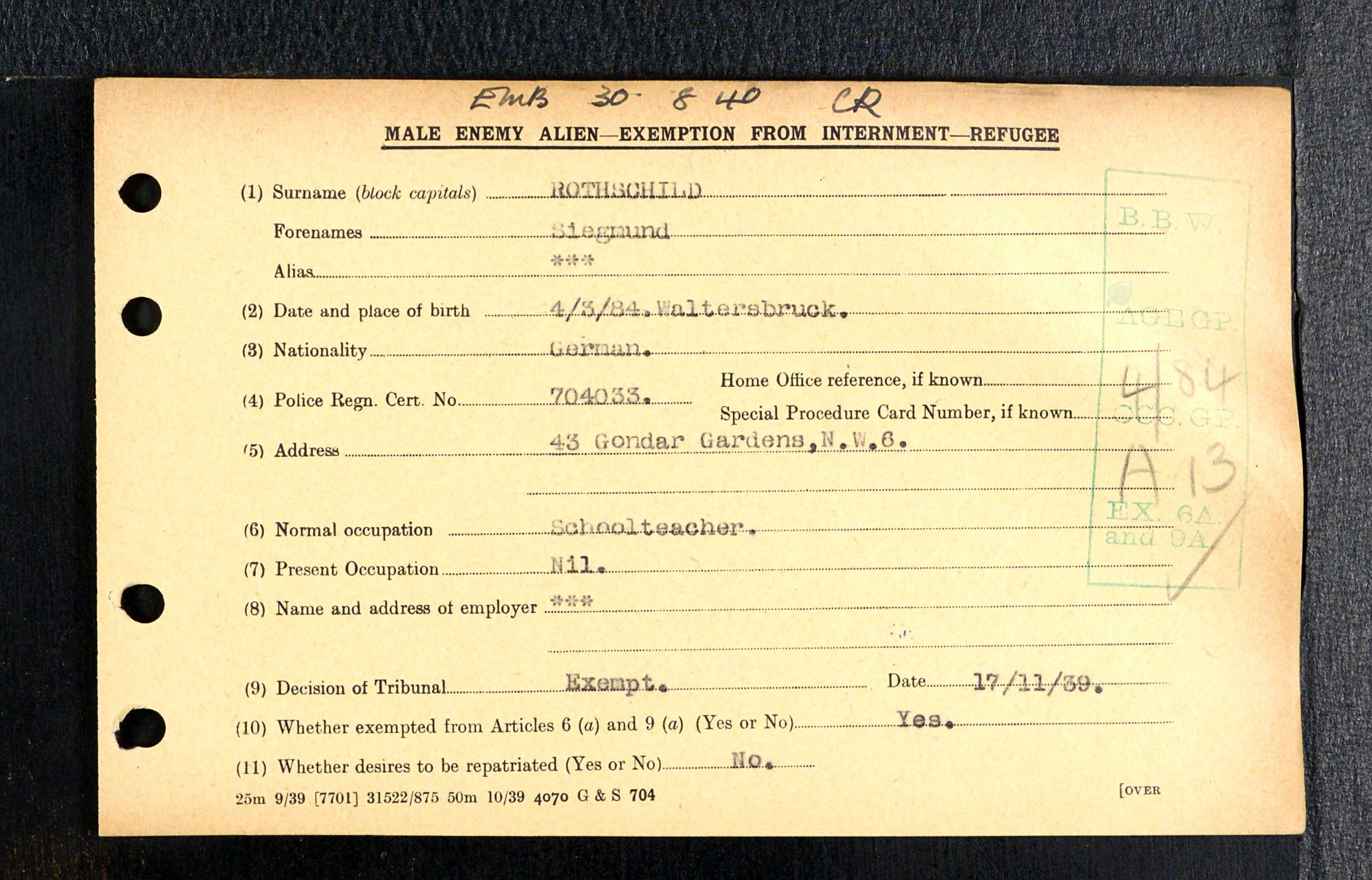
A second child, Siegmund Rothschild, was born less than one year later on March 4, 1884, in Waltersbrueck:

Siegmund Rothschild birth record, Hessisches Hauptstaatsarchiv; Wiesbaden, Deutschland; Bestand: 920; Laufende Nummer: 8386, Year Range: 1884, Ancestry.com. Hesse, Germany, Births, 1851-1901

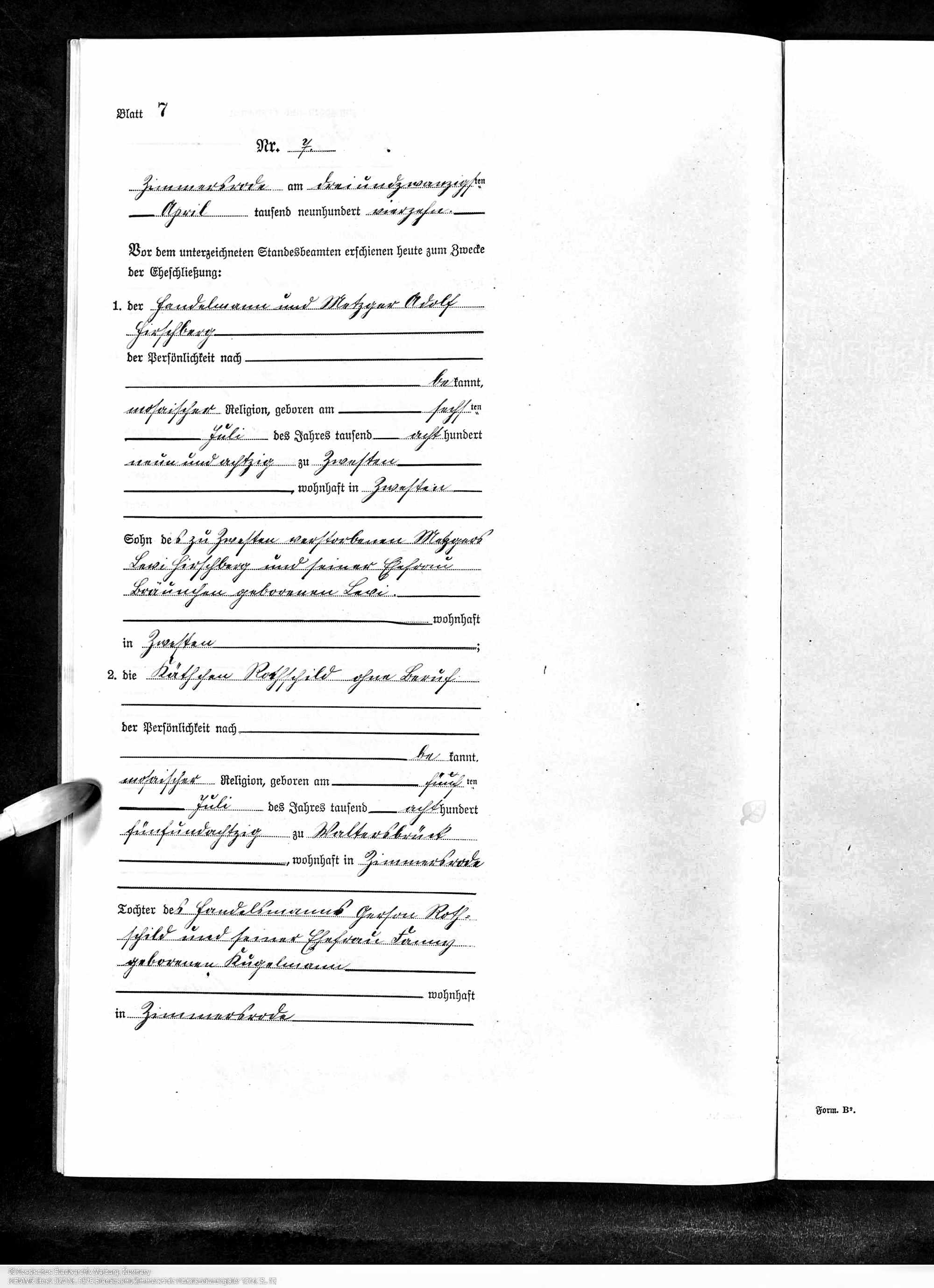
Sixteen months after Siegmund’s arrival, Fanny gave birth to Katchen Rothschild on July 5, 1885, also in Waltersbrueck:

Katchen Rothschild birth record, Hessisches Hauptstaatsarchiv; Wiesbaden, Deutschland; Bestand: 920; Laufende Nummer: 8387, Year Range: 1885, Ancestry.com. Hesse, Germany, Births, 1851-1901

Sixteen months after Katchen came another son, Max, born November 22, 1886, in Waltersbrueck:

Max Rothschild birth record, Hessisches Hauptstaatsarchiv; Wiesbaden, Deutschland; Bestand: 920; Laufende Nummer: 8388, Year Range: 1886, Ancestry.com. Hesse, Germany, Births, 1851-1901

Then Fanny gave birth to another daughter,  Guste or Auguste, in Waltersbrueck on September 11, 1888. Imagine that—-a gap of almost two years after Max. I wonder whether Fanny had miscarried at some point in between Max and Auguste.

Auguste Rothschild birth record, Hessisches Hauptstaatsarchiv; Wiesbaden, Deutschland; Bestand: 920; Laufende Nummer: 8390, Year Range: 1888, Ancestry.com. Hesse, Germany, Births, 1851-1901

Johanette (“Jenny”) Rothschild, Gerson and Fanny’s sixth child, was born on February 13, 1890, also in Waltersbrueck, seventeen months after Auguste:

Johannette Rothschild birth record, Hessisches Hauptstaatsarchiv; Wiesbaden, Deutschland; Bestand: 920; Laufende Nummer: 8392, Year Range: 1890, Ancestry.com. Hesse, Germany, Births, 1851-1901

Their seventh child Clara was born on July 15, 1891, in Waltersbrueck, seventeen months after Jenny:

Clara Rothschild birth record, Hessisches Hauptstaatsarchiv; Wiesbaden, Deutschland; Bestand: 920; Laufende Nummer: 8393, Year Range: 1891, Ancestry.com. Hesse, Germany, Births, 1851-1901

Number eight arrived May 16, 1893, almost two years after Clara; her name was Rosa. She was born in Zimmersrode where the family was now residing. Zimmersrode is a larger town about a mile and a half from Waltersbrueck.

Rosa Rothschild birth record, Hessisches Hauptstaatsarchiv; Wiesbaden, Deutschland; Bestand: 920; Laufende Nummer: 9531, Year Range: 1893, Ancestry.com. Hesse, Germany, Births, 1851-1901

Gerson and Fanny’s ninth child Thoni only lived seven weeks; she was born on April 27, 1895, in Zimmersrode, and died there on June 20, 1895:

Thoni Rothschild birth record, Hessisches Hauptstaatsarchiv; Wiesbaden, Deutschland; Bestand: 920; Laufende Nummer: 9533, Year Range: 1895, Ancestry.com. Hesse, Germany, Births, 1851-1901

Thoni Rothschild death record, Hessisches Hauptstaatsarchiv; Wiesbaden, Deutschland; Personenstandsregister Sterberegister; Bestand: 9610; Laufende Nummer: 920, Year Range: 1895, Ancestry.com. Hesse, Germany, Deaths, 1851-1958

Sadly, their tenth child, like their first child, died at childbirth, this time a boy. Richard also translated the note on this death record for me.

Male Child stillborn of Gerson Rothschild, Hessisches Hauptstaatsarchiv; Wiesbaden, Deutschland; Personenstandsregister Sterberegister; Bestand: 9614; Laufende Nummer: 920
Year Range: 1899, Ancestry.com. Hesse, Germany, Deaths, 1851-1958

Today the personally known tradesman Gerson Rothschild, residing in Zimmersrode, appeared before the undersigned registrar and reported that

The wife of the reporting person of Jewish religion, Fanny Rothschild, née Kugelmann, also of the Jewish religion, gave birth to a male child at two o’clock in the morning on March 28th of this year in the home of the reporting party, and that the child died during birth.

Read, approved and signed

Gerson Rothschild

In a rather creepy coincidence, this baby was delivered on March 28, 1899, exactly sixteen years to the day after Fanny lost her first child in childbirth on March 28, 1883.

Fortunately, Fanny had better fortune with her eleventh and final baby, Amalie Rothschild, born in Zimmersrode on April 26, 1901. I do not have a birth record for Amalie but found her birth date on records from the Nazi era.1

Fanny Kugelmann Rothschild was 43 years old when she gave birth to Amalie, her last child. She had been either pregnant or nursing a baby for almost twenty years. She had suffered losing two of those babies at birth and one at only seven weeks old. But her other eight children survived to adulthood—-until the rise of the Nazis.

Here’s a timeline showing the birth dates of Fanny and Gerson’s eleven babies:

March 28, 1883—March 4, 1884—July 5, 1885—November 22, 1886—September 11, 1888—February 13, 1890—July 15, 1891—May 16, 1893—April 27, 1895—March 28, 1899—April 26, 1901

More on this family in the posts to come.


  1. Amalie Rothschild Stiefel, Arolsen Archives, Digital Archive; Bad Arolsen, Germany; Lists of Persecutees 2.1.1.1, Ancestry.com. Free Access: Europe, Registration of Foreigners and German Persecutees, 1939-1947 

The Blumenfeld-Rothschild Brain Teaser

Here’s a good brain teaser for those of you who like puzzles, especially genealogy relationship puzzles:

Gerson Rothschild was the eighth child born to Gelle Blumenfeld and Simon Rothschild. He was born on May 1, 1855, in Waltersbrueck, Germany.

Gerson Rothschild birth record, Arcinsys Archives of Hesse, HHStAW Fonds 365 No 893, p. 27

Gerson married Frommet “Fanny” Kugelmann on September 13, 1881, in Waltersbrueck. She was born in Wohra, Germany, on September 11, 1857.

Gerson Rothschild marriage to Frommet Kugelmann, Hessisches Hauptstaatsarchiv; Wiesbaden, Deutschland; Bestand: 920; Laufende Nummer: 8407, Ancestry.com. Hesse, Germany, Marriages, 1849-1930

When I saw Frommet Kugelmann’s name, it rang a bell, but I wasn’t sure why. I searched my tree, and sure enough, I had a Frommet Kugelmann already on my tree. I wrote about her here. She had married Isaac Blumenfeld I, Gelle Blumenfeld’s older brother, and had died March 18, 1842, five days after giving birth to her son Abraham Blumenfeld III. She was about twenty years old when she died.

Frommet Kugelmann Blumenfeld death record, Lagis Hessen Archive, HHStAW Abt. 365 Nr. 630, S. 8

But was there a connection between the Frommet Kugelmann who had married Isaac Blumenfeld I and the Frommet Kugelmann who married Isaac’s nephew Gerson Rothschild, Gelle’s son? That was not immediately obvious.

From the marriage record for Gerson and his Frommet (to be referred to hereinafter as Fanny to keep them distinct), I knew that Fanny’s parents were Joseph Kugelmann and Male Katten. After searching for more information about Joseph Kugelmann, I learned that he was the son of Hiskias Kugelmann and Knentel Adorn.1 Flipping back to Isaac Blumenfeld’s wife Frommet, I saw that her parents were also Hiskias Kugelmann and Knentel Adorn.2 In other words, Joseph Kugelmann had named his daughter Frommet Fanny Kugelmann for his deceased sister Frommet Kugelmann, Isaac Blumenfeld’s wife.

Gerson and Fanny were thus related through the marriage of Gerson’s uncle Isaac to Fanny’s aunt and namesake, Frommet Kugelmann.

Gerson and Fanny would have eleven children, though two died at birth and one as an infant.

Here’s the brain teaser.

How were the children of Gerson Rothschild and Fanny Kugelmann related to Abraham Blumenfeld III, the son of Isaac Blumenfeld I and his first wife Frommet Kugelmann?

[Jeopardy! Music plays for thirty seconds…]


Here’s the answer:

They were his first cousins, once removed, on the Kugelmann side because their mother Fanny was Abraham III’s first cousin; Abraham III’s mother Frommet Kugelmann and Fanny’s father Joseph Kugelmann were siblings.

Here’s a chart showing that relationship, using one of Gerson and Fanny’s children (Max Rothschild) as an example:

But they were also related to Abraham III through the Blumenfeld side since Abraham’s father Isaac Blumenfeld I and Gerson’s mother Gelle Blumenfeld Rothschild were siblings, making Abraham and Gerson first cousins, thus making Max Rothschild and  Gerson and Fanny’s other children first cousins, once removed, to Abraham Blumenfeld III through that connection.

There is a third connection through Abraham Blumenfeld III’s marriage to Friedericke Rothschild—-but I will spare you that one.

OK, since you insist, here’s a chart for that one…

So once again, the family tree twists and groans from the weight of its interconnected branches, twigs, and leaves.

Coming up…the stories of the eleven children of Gerson and Fanny.


  1. Joseph Kugelmann death record, Hessisches Hauptstaatsarchiv; Wiesbaden, Deutschland; Personenstandsregister Sterberegister; Bestand: 9981; Laufende Nummer: 915, Description Year Range: 1900, Ancestry.com. Hesse, Germany, Deaths, 1851-1958 
  2. Frommet Kugelmann Blumenfeld death record, Sterberegister der Juden von Neustadt 1824-1875 (HHStAW Abt. 365 Nr. 630), p. 8. Arcinsys Archives of Hessen, at https://arcinsys.hessen.de/arcinsys/digitalisatViewer.action?detailid=v1900007&selectId=45915616 

Gelle Blumenfeld Rothschild’s Middle Children: Isaak, Gitel, and Betty

Returning now to the Blumenfeld branch of my family tree, it’s time to see where I am in that saga. I am still on the oldest child of my four-times great-grandparents Abraham Blumenfeld and Geitel Katz—-their son Moses I. I have completed the stories of Moses’ first two children, Abraham IIA and Isaac I, and have been working through the children of Moses’ youngest child, his daughter Gelle Blumenfeld Rothschild. I have so far covered the first four of Gelle’s twelve children: Seligmannq, Abraham, Levi, and Moses. Here’s a chart to show my slow progress through the Blumenfeld family. I’ve only gotten as far as that arrow on the upper left side.

Now I turn to the next group of Gelle’s children, and for better or worse, there is not a lot to say about the next three: Isaak, Gitel, and Betty, their fifth, sixth, and seventh children.

Isaak is an unsolved brick wall. He was born January 15, 1850, in Zimmersrode. But there is no further record of him. No marriage record, no death record. I have searched high and low, and I’ve noticed that no other researcher on Ancestry or MyHeritage or elsewhere has any dates for Isaak’s death. My hunch is that he died in infancy, perhaps at birth, but I have no record to prove it. Here, however, is his birth record:

Isaak Rothschild birth record, Arcinsys Archives in Hessen, HHStAW Fonds 365 No 893, p.23

I thought perhaps the note on the far right would reveal more about Isaak’s life, but unfortunately it does not. All it says is “war noch nicht eingetragen, geschieht nachtraeglich,” which translates as “was not yet registered, will happen later.”

The child born after Isaak was Gitel Rothschild. Sadly, for her I have both her birth and death records. She was born on January 7, 1852, in Zimmersrode, and died there just over a year later on February 11, 1853.

Gitel Rothschild birth record, Arcinsys Archives of Hessen, HHStAW Fonds 365 No 893, p. 24

Gitel Rothschild death record, Arcinsys Archives of Hessen, HHStAW Fonds 365 No 896, p 21

Following Gitel came Beschen or Betty, born on June 22, 1853, just a few months after her sister Gitel died.

Beschen Rothschild birth record, Arcinsys Archives of Hesse, HHStAW Fonds 365 No 893, p. 25

Fortunately, Betty survived to adulthood. On February 4, 1876, in Kassel, Germany, she married Isaac Rosenblatt, the son of Meier Rosenblatt and Hannchen Loewenberg. Isaac was born in Malsfeld, Germany, on December 31, 1846.

Beschen Rothschild and Isaac Rosenblatt marriage record, Hessisches Hauptstaatsarchiv; Wiesbaden, Deutschland; Bestand: 910, Ancestry.com. Hesse, Germany, Marriages, 1849-1930,

I did not find any records showing children for Betty and Isaac. Isaac died on November 13, 1916, in Kassel.1 Betty died there ten years later on February 28, 1926.

Beschen Rothschild death record, Hessisches Hauptstaatsarchiv; Wiesbaden, Deutschland; Personenstandsregister Sterberegister; Signatur: 5603; Laufende Nummer: 910, Ancestry.com. Hesse, Germany, Deaths, 1851-1958

Thus, there are no known descendants for Isaak, Gitel, or Betty Rothschild as far as I have been able to determine.

The story of Gelle Blumenfeld Rothschild’s ninth child Gerson is a more complete one but filled with tragedy. That story begins in my next post.


  1. Isaak Rösenblatt, [Isaak Rosenblatt] Death Age 69, Birth Date abt 1847,
    Death Date 13 Nov 1916, Death Place Kassel, Hessen (Hesse), Deutschland (Germany), Civil Registration Office Kassel I, Father Meier Rösenblatt Mother
    Hannihan Rösenblatt Certificate Number 1490, Hessisches Hauptstaatsarchiv; Wiesbaden, Deutschland; Personenstandsregister Sterberegister; Signatur: 5546; Laufende Nummer: 910, Ancestry.com. Hesse, Germany, Deaths, 1851-1958 

The Devastating Effects of Terrorism

Today I am honored and moved to share an essay written by my fourth cousin, once removed, Miki Katzenstein Dror. Miki is the daughter of Arie Katzenstein1, an Israeli who was killed by terrorists on February 10, 1970, at the Munich airport while he was traveling with his father Heinz on business.

As I wrote here and here, Arie sacrificed his own life by throwing his body on a grenade, thus saving the lives of many others, including his father, who had fled to Israel from Nazi Germany in the 1930s. Miki and her two siblings were just young children at the time. Because of this horrible act of terror, they grew up without their beloved and courageous father.

Arye Katzenstein Courtesy of his family

As Miki wrote almost a year a half ago, the city of Munich decided to create a memorial to honor the memory of her father Arie and the others who were injured and terrorized on that day in 1970. On February 10, 2025, Miki and her siblings and other family members traveled to Munich to participate in the dedication of that memorial.

This video, in Hebrew but with English subtitles, includes interviews with Miki and her siblings and more information about Arie Katzenstein’s tragic murder. This video in German shows what the memorial looks like and also some images from the ceremony itself, including images of Miki and her brother and sister speaking at the ceremony. It also has some historic footage from coverage of the attack in 1970. Richard Bloomfield has provided me with this translation of the text of the second video.

55 years ago, members of a Palestinian terrorist organization tried to hijack an El Al Israeli airline plane. The victims and the heroes of the attack were commemorated today at the former tower.

Three golden clocks symbolize the times of the three detonations on February 10, 1970. They are located in front of the tower of the former airport in Munich-Riem. The artist Alicja Kwade created the work of art. At today’s inauguration of the memorial, Arie Katzenstein’s three children commemorated their father, who, through his courage, saved the lives of others exactly 55 years ago by throwing himself on a hand grenade. Palestinian terrorists had attacked the passengers during a stopover in Munich, killing the German-Israeli Katzenstein and injuring others. The captain of the aircraft also put up a courageous fight. The extent of the terrorist act had been clearly underestimated, said the mayor of Munich.

[The mayor] “However, I also find it shameful that it has taken half a century for us to finally publicly commemorate the terrible attack here in Munich on February 10, 1970. For this, I apologize. I am glad that we have finally found a worthy way to commemorate it.”

Brainlab, which is now located at the former tower, the city and the family worked closely together.

[Arie’s son] “It will remind people who come here of what happened. And it will make them think.”

A memorial plaque and a website [https://munich1970.de/en/] provide information about the attack. This is to keep the memory of the victims and heroes of Munich-Riem alive.

Here’s a photograph of the memorial:

I asked Miki if she would share with me and my readers her thoughts and feelings about the dedication and the memorial itself. This is what she wrote:

Finally, after fifty-five years, our heroic father was commemorated at the site of his murder in Munich, Germany.

On the afternoon of February 10, 1970, EL AL Flight 435 landed in Munich on its way to London. While waiting for the connecting flight, a squad of three terrorists attacked the passengers by firing pistols and throwing hand grenades.

Our father, the late Arie Katzenstein, who flew with his late father Heinz, for business, threw himself at one of the hand grenades that were thrown at the passengers, thus saving many others, but was killed on the spot.

At his death, he left behind a young widow and three small children between the ages of three months and six years: Miki Dror, Tami Meirovich and Ofer Katzenstein.

About a decade after his death, our mother received a letter from the President of Israel at the time, the late Yitzhak Navon, in which he wrote, among other things, that the State of Israel would cherish the memory of our father among its other heroes. Unfortunately, this promise was never kept, despite our many inquiries on the subject.

On the other hand, about five years ago, representatives of the Munich municipality contacted us, following a request from our German friends. They announced that the municipality intended to commemorate our father at the site of the attack – the old airport in Munich–Riem. As the Germans are using a newer airport these days, the old one is used as a big convention center and a high-tech park. From that moment on, a long process of conversations, meetings and discussions began between us and the Munich municipality regarding the manner of commemoration. At an early point, the high-tech company Brainlab joined the effort. Its offices are currently located in the area where the attack took place.

The company expressed its most generous consent to the existence of the memorial site on its premises and funded a work of art by the famous internationally acclaimed artist Alicja Kwade, to be displayed there.

On February 10, 2025, exactly fifty-five years after the murder of our father, the inauguration ceremony was held in the presence of the President of the Bavarian Parliament, Mrs. Ilse Aigner, the Mayor of Munich, Mr. Dieter Reiter, Founder of Brainlab, Mr. Stefan Viltsmeier, the Consul General of Israel in Munich, Ms. Talia Lador, the artist Alicja Kwade, family members of our Germans friends, other families of the victims and many, many more.

From left to right: Ms. Talia Lador, Consul of Israel to Munich; Mrs. Ilse Aigner, President of Bavarian Parliament; Ofer Katzenstein; Tami Katzenstein; Mr. Dieter Reiter, Mayor of Munich; Miki Katzenstein Dror;  and Mr. Stefan Viltsmeier, founder of Brainlab

During the ceremony, the German dignitaries gave moving speeches, and we, his three children, spoke about our father, his absence, and the long journey that had brought us to this day. In addition, we thanked the German government and their ambassador in Israel for their support in the struggle for the release of the Israeli hostages from Gaza and asked that they not give up until the last of the abductees was brought home.

The Katzenstein family attending the memorial dedication in Munich, February 10, 2025

The singing of opera singers Hagar Sharvit and Noa Beinart and pianist Amiel Bushkevich did not leave a dry eye.

We arrived to the ceremony with a full family lineup, including all of our father’s grandchildren, but unfortunately our mother Bilha, who passed away not long ago, did not get to attend this exciting event. At the end of the ceremony, we read Kaddish, and laid flowers, an Israeli flag, and a scarf of the Hapoel Haifa soccer team – which our father loved so much.

Ofer Katzenstein saying Kaddish at the memorial site for his father Arie Katzenstein

For us, this is a moment of partial closure and unparalleled excitement. After so many years of action, our father’s sacrifice is finally officially recognized.

Now, we have a place where we can come to with our families, relate to, and remember. We couldn’t have asked for more.

We would like to take this opportunity to thank everyone who has helped us over the past few years to get to know our father better, to speak about him and to spread his heroic deeds.

And finally, I’m writing this post on the day that Hamas, the terror organization, released the bodies of Kfir and Ariel Bibas, two babies who were taken to Gaza as hostages more than a year ago. So sad that after 55 years it seems as if nothing has changed, and terror still strike Jews, in Israel and in the world.

When I received the email from Miki sharing this essay, I also was struck by the fact, as Miki observed, that this was the same day that the bodies of the two Bibas children were returned to Israel—two beautiful, innocent babies who were murdered by Hamas after they and their parents were kidnapped by Hamas on October 7, 2023. After first sending the wrong remains, Hamas later released the actual remains of their mother, Shiri Bibas. Their father Yarden Bibas survived his capture and confinement and was released back to Israel, but without his wife and children. Like the children of Arie Katzenstein and so many others, Yarden Bibas has had his family destroyed by terrorism.

Terrorism against Jews began centuries ago with the pogroms that chased some of my ancestors out of Europe, continued with the murder of six million Jews, including many of my relatives, during the Holocaust, and tragically continues to this very day with the nightmare of October 7, 2023, and its aftermath.

And it isn’t only Jews who have suffered because of the hatred, violence, and terror inflicted on one group by another. We still are seeing across the globe the bloodshed and tragedy that hatred produces.

How many more children will grow up without a parent? How many more parents will have to mourn their children? Will we ever learn?

May the memory of Arie Katzenstein be for a blessing, as well as the memories of Kfir, Ariel, and Shiri Bibas, and all the other victims of October 7. And may we someday finally learn, to paraphrase Martin Luther King, that only love can drive out hatred, only light can drive out darkness.


  1. Sometimes transliterated from Hebrew as Aryeh or Arye. 

A Brick Wall Tumbles: The Fates of August Felix Katzenstein and Julius Katzenstein, Orphaned Sons of Meier Katzenstein, Part II

Thanks to some new sources and documents and the help of my cousin Richard Bloomfield, I was able to fill in many of the holes in my earlier research about my cousin August Felix Katzenstein, as we saw in my prior post. August was one of the two surviving sons of Meier Katzenstein; his little half-brother Julius was the other surviving child. Both were orphaned after losing their mothers and then their father Meier.

Despite being orphaned at age eight, August had been raised by his relatives, the Bachenheimers, and had married their daughter Rosa when he was twenty-four. They had had two children, Margarete and Hans Jacob, and two grandchildren, and August had had a brilliant career as a teacher in a Jewish school until his retirement in 1936.

But then the entire family was wiped out by the Nazis—August, his wife Rosa, their two children, and their two grandchildren.

But what about August’s younger half-brother Julius Katzenstein, who was only five when he was orphaned? Had he survived? Did he also get killed by the Nazis? Who took care of him? After my cousin Miki Katzenstein Dror learned of a family in Israel descended from a man named Julius Katzenstein, she asked me if this could possibly be the same Julius Katzenstein. I knew the name was not uncommon, but I figured it was worth searching again for information about little Julius.

I turned to my friend Aaron Knappstein for some help, and after a long wait, Aaron somehow was able to locate records in the archives in Jesberg that revealed more about the life of my cousin Julius Katzenstein. The papers were part of a “certificate of inheritance” file that included the death record for Julius Katzenstein. Julius died on February 3, 1894. He was not yet fifteen years old.

Aaron kindly translated the document below. It reads as follows:

No. 6 – 04.02.1894

The death is announced by Selig Katzenstein, address: Uslar No. 15

Person who died:

Julius Katzenstein, merchant apprentice, 14 years, 11 months and 13 days old, Jewish, address: Uslar 15, born in Jesberg, son of the merchant Meyer Katzenstein and Bertha née Speyer, both dead.

Julius died the 3rd of February 1894 in Uslar No. 15, 10 PM

The second page of the document contains the following information, as translated by Aaron:

  • First wife of Meyer Katzenstein was Auguste née Wolff – she died the 19th of September 1876 – with her he had a son: August Katzenstein, born the 13th of September 1876
  • Second wife was Bertha née Speyer, she died the 8th of April 1881 and with her he had two children: Julius Katzenstein, born the 18th of March 1879 and Ida Katzenstein, born the 2nd of July 1880 – she died the 1st of April 1881.

Sadly, these documents proved that little Julius Katzenstein, the son of Meier Katzenstein and Bertha Speyer, had not lived to adulthood, but had died as a teenager.

What was most puzzling about this information, however, was where Julius had been living and with whom. Julius had lived in the town of Uslar, a town that was more than sixty miles from Jesberg and in a different state, Saxony, not Hesse. And he had been living with a man named Selig Katzenstein—-who was he? Was he a relative? He wasn’t on my family tree, and I had no clue whether he was related to my Katzenstein family. I searched for some familial connection, but could not find one.

I checked with David Baron, who is married to my cousin Roger Cibella and whose Katzenstein research I’ve often relied upon. I asked him if he knew of any connection between “our” Katzenstein family from Jesberg and Selig Katzenstein of Uslar.  He wrote that he had not been able to find any familial connection between our Katzenstein family and the Uslar Katzenstein family except through marriage.

This is what David had found: Selig Katzenstein of Uslar was the grandson of Joseph Katzenstein of Grebenstein. Joseph Katzenstein’s sister Lea Katzenstein of Grebenstein had married Meyer Goldschmidt of Oberlistingen. Are you still with me?

Meyer Goldschmidt was the brother of my three-times great-grandfather Seligmann Goldschmidt, whose daughter Eva Goldschmidt (my great-great-grandmother) married Gerson Katzenstein (my great-great-grandfather) of Jesberg. Gerson Katzenstein was the half-brother of Jacob Katzenstein, who was the grandfather of little Julius Katzenstein.

Now that is one crazy, twisted path from Julius to Selig Katzenstein, but given how small all these little towns were and the relatively small number of Jews living in each of those towns, maybe that was enough of a connection for Julius to end up living in Uslar with Selig. Maybe there is a slightly more direct path, but for now, that’s the best I can do.

Although I am glad I can now complete the story of Meier Katzenstein and his family, it has left me with a terribly empty feeling. They died so young: Meier, his two wives Auguste and Bertha, and two of his three children, Ida and Julius. The only child who managed to survive to adulthood was August, and he and his wife Rosa and their two children Margarete and Hans Jacob and their two grandchildren Klaus and Klara were all murdered by the Nazis.

There are thus no living descendants of Meier Katzenstein. I am glad to have knocked down this brick wall with the invaluable help of Aaron Knappstein and Richard Bloomfield, but I sure wish I had been able to find that somehow someone in this family line had survived.


A Brick Wall Tumbles: The Fates of August Felix Katzenstein and Julius Katzenstein, Orphaned Sons of Meier Katzenstein, Part I

Thanks to my friend Aaron Knappstein and my cousin Richard Bloomfield, an old brick wall has recently come down. Over seven years ago I wrote about the tragic story of Meier Katzenstein and his family. You can find all the sources, citations, and details here. But I will briefly outline their story.

Meier, my great-grandmother Hilda Katzenstein Schoenthal’s first cousin, lost his first wife Auguste Wolf in 1876, shortly after she gave birth to their son August Felix Katzenstein. Meier remarried and had two more children with his second wife Bertha Speier:  Julius Katzenstein, born in 1879, and Ida Katzenstein, born in 1880. Both Ida and her mother Bertha died in April 1881, less than a year after Ida’s birth. Meier was left with two young sons, August, who was five years old, and Julius, who was two.

And then Meier himself died three years later in 1884, leaving August and Julius orphaned at eight and five, respectively. I couldn’t imagine what had happened to those two little boys. Who took care of them? What happened to them? This post will follow up on August, and the one to follow will be about his half-brother Julius.

I had been able to find out some of what happened to August as an adult when I initially wrote about him over seven years. He had married his first cousin, once removed, Rosa Bachenheimer in Kirchain, Germany, in 1900 when he was twenty-four years old. August and Rosa had two children, Margarete and Hans-Peter. All four of them were killed by the Nazis during the Holocaust. I knew that much, but there were still some gaping holes in my research. Where had August lived after his father died? Did he have any grandchildren? If so, did they survive the Holocaust?

So I went back now to to double-check my research and see if I could find anything more about August Felix Katzenstein and his family. I am so glad I did.

First, I learned at Yad Vashem that August and Rosa’s daughter Margarete had married Rudolf Loewenstein and had had two children with him: Klaus, born March 16, 1930, in Soest, Germany, and Klara, born June 9, 1932, in Soest, Germany. Unfortunately, Rudolf, Margarete and their two young children were also killed along with their grandparents and uncle during the Holocaust.

Then I found this Stolpersteine biography of August Katzenstein on a website about the history of the community of Essen, revised in 2024 by Mr. and Mrs. Hülskemper-Niemannn. It provides in part, as translated by Google Translate:

August Katzenstein was orphaned at a very early age. He then lived for a long time in the household of the parents of his future wife Rosa Bachenheimer from Kirchhain, whom he married around the turn of the century. The couple had two children: Margarethe (1901, later Loewenstein) and Hans (1905). August Katzenstein moved with his family to Steele in 1908 and took up a position as a teacher in the one-class Jewish elementary school at Isinger Tor.

After 1933, the Katzensteins’ lives changed radically. In 1937, the Gestapo arrested the couple because they were allegedly managing the assets of a dissolved Jewish organization. After a search of their apartment and rigorous interrogation and warnings, the couple were released. Even worse happened to August Katzenstein, who taught at the Jewish elementary school in Essen on Sachsenstrasse after the Jewish elementary school in Steele was closed, during and after the November pogrom. The apartment on Grendtor (then Ruhrstrasse) was destroyed and looted, and he and his disabled son Hans were arrested. While the 62-year-old father was released from police prison after 11 days, Hans was taken to Dachau despite written requests from his parents, from where he was only released after four weeks.

In the autumn of 1941, the deportation of Jews began across the Reich, including in Essen. … Half a year later, Katzenstein and his entire family were deported to Izbica. 

So now I know who had taken care of August after his father died: Rosa’s parents Sussman Bachenheimer and his wife Esther Ruelf, my second cousin, twice removed. I wrote about them here. I also now know that August had become a teacher and lived in Steele, Germany, a suburb of Essen, Germany.

I found additional information about August and his family at Yad Vashem. The website has been updated since I had last researched August Katzenstein, and I found these documents I had not seen before from the Yizkor Book for the Jews of the Essen community who had been killed during the Holocaust. I asked my cousin Richard Bloomfield to translate these pages, and he graciously (and quickly!) agreed to do so.

Richard’s translation provides:

August Katzenstein was a Mensch.

He was a German citizen and of the Jewish faith, whose teachings shaped his life. He was born on September 13, 1876, in Jesberg/Hesse and lived in the Jewish community of Steinheim in Westphalia until 1908, where he held the office of teacher and religious official. With his wife Rosa, née Bachenheimer, he had a daughter Margarete, born in 1901, and a son Jacob (Hans), born in 1905.

August Katzenstein saw his work as a teacher not just as a profession, but as a vocation. In his eyes, the teacher was not only an imparter of knowledge, he was also a leading figure in the Jewish community who had to ensure a harmonious relationship between the community and school life.

Beginning at the age of 20, August Katzenstein decided to represent not only the interests of his community and pupils, but also those of German citizens of the Jewish faith as a whole.

He joined the “Central Association of German Citizens of the Jewish Faith” “Central-Verein deutscher Staatsbürger jüdischen Glaubens”.

Until he moved to Essen in 1908, he was a representative of the C.-V. local group in Steinheim.

After moving to Essen Steele, he taught at the Jewish elementary school there. The importance that Katzenstein attached to the new self-image of Jews as German citizens of the Jewish faith can be seen in his speech on the occasion of the 50th anniversary of the Jewish school, in which he states,

“For 50 years now, the youth of the Jewish community has received their education in the Jewish school to become faithful Israelites and loyal citizens who love their fatherland, in addition to their general education. May the Jewish school continue to work beneficially for God, for the fatherland and for humanity, true to its guiding principles.”

The mission of the independent order “Bnai Brith” founded in the USA, spiritual self-education, the promotion of science and art, help for the persecuted and needy and the defense of Jewish citizens in the event of anti-Semitic attacks led August Katzenstein to join the Glück-Auf-Lodge of “Bnai Brith” in Essen in 1911 and of which he was president until April 1935.

Until his retirement in 1937, he also headed the Jewish relief organization in Essen-Steele. But despite his retirement, he did not neglect the members of the community whose employ he had left.

The ban and immediate dissolution of the “Bnai Brith” order by Himmler’s decree of April 10, 1937, resulted in August Katzenstein’s arrest on April 19, 1937, after his apartment and all the rooms of the Glück-Auf-Loge had already been searched two days earlier.

August Katzenstein then had to endure hours of interrogation under threat of state police measures. He was forced to sign a declaration that he had no further property belonging to the Glück-Auf-Lodge at his disposal and that he was not aware of where further material might be hidden, as documented in the Gestapo protocol of the same day.

During the so-called Reichskristallnacht on November 9, 1938, the Katzenstein family’s home at Ruhrstrasse 24 was also severely damaged. One day later, August Katzenstein and his disabled son were arrested again. They were held in the police prison in Essen until November 19, 1938. After his release, August Katzenstein wrote a letter to the Gestapo asking them to release his son, who had been sent to Dachau concentration camp. His son Jacob (Hans) then returned on December 21, 1938.

However, not only the care of his family, but also the suffering of the community entrusted to him had become his life’s purpose. Even the destruction of the school and synagogue as the center of the community during the November pogrom could not break August Katzenstein’s will to live in the Jewish faith.

In January 1939, August Katzenstein carried out his last community-related activity, officiating at the wedding of a young couple in the wife’s parental home.

On April 22, 1942, August Katzenstein, his wife Rosa, his son Hans, his daughter Margarete, his son-in-law Rudolf Loewenstein and his two grandchildren were deported to Izbica. No trace of them remains.

His strong faith and the willpower born of it made him a lovable, upright person whose care for his Jewish community defined his life.

Contemporary Jewish witnesses describe August Katzenstein as a wonderful person of integrity, very wise, reserved and fully committed to his Judaism. As a teacher, he was not only a person of respect for the children, but “more like a father.” August Katzenstein was a man whose life was simply snuffed out because he was Jewish.

Nikolaus-Gross, Abendgymnasium Essen, Semester 4

I wondered whether August’s “retirement” from teaching was voluntary or forced upon him by the Nazis, and although it’s still not clear, Richard also found this article about August’s retirement published on November 1, 1936, in the Jüdische Schulzeitung [Monthly journal for education, instruction and school policy; official publication of the Reich Association of Jewish Teachers’ Associations], (p.6):

Richard translated the article for me:

On September 30, 1936, after 40 years of beneficial work in the service of Jewish schools and 7 years of work at the local Jewish elementary school in Essen, teacher and preacher August Katzenstein of Essen-Steele, who recently turned 60, retired. With him, one of the best representatives of the older Jewish generation of teachers leaves the teaching profession.

The school held a farewell party in the festively decorated classroom. Principal Isaac paid tribute to the departing teacher’s services to Jewish schools in general and to the Jewish Elementary School in Essen in particular. Principal Buchheim of Dortmund conveyed the wishes of the Association of Israelite Teachers of the Rhineland and Westphalia. Mr. Lieblich spoke as a representative of the Steele Synagogue community.

The children of the class that Mr. Katzenstein taught last, as well as the school choir led by teacher Levisohn, contributed to the ceremony with poems and songs.

Finally, colleague Katzenstein gave a heartfelt thank you.

Obviously, August was a well-loved, well-respected teacher and community leader. His early childhood was quite miserable—losing his mother, then his stepmother and half-sister, then his father—all before he was nine years old. But despite that tragic beginning, he lived a full and productive life, filled with meaning, faith, family, and love. How someone recovers from so much tragedy is amazing to me.

But then the Nazis came to power and destroyed August’s life and his family. I am so glad I went back to see if I could learn more about his life, and I am so grateful to Richard for his translation of the documents from the Essen Yizkor Book and for finding the article about August’s retirement. I found comfort in knowing that despite his tragic beginning and ending, August found fulfillment and meaning in his life.

But what about his younger brother Julius? I had known even less about him when I first researched this family. I couldn’t find anything that revealed what happened to him after his parents died. I couldn’t find a marriage record, a death record, a birth record for any children—-not one thing. Fortunately, he was not listed at Yad Vashem, so presumably had not shared the fate of his brother August. But where had he gone? Who had taken care of this little orphaned boy?

I will report on what I’ve learned about Julius in my next post.


Simon’s Secret! Now Available on Amazon!

Simon’s Secret is now available on Amazon in e-book, paperback, and hardcover!

My third family history novel, Simon’s Secret, is a story inspired by the lives of two of my Goldschmidt relatives, Simon and his daughter Hannah. Simon came to the US in the 1840s with a secret, one he wanted to hide from his family and his new country. His daughter Hannah never understood why he was such a curmudgeon. What was Simon’s secret? Will Hannah ever find out? And will she understand her father better if she does? Like all children, Hannah struggles to understand her father and his secrets.

This book follows the life of the fictionalized version of Simon Goldschmidt from Germany to America. We see how Simon and his family adapt to their new country while also trying to keep the traditions of Judaism that he brought with him from Germany. The story begins in 1826 and extends over a hundred years as we see what happens to Simon, Hannah, and Hannah’s children and grandchildren.

This is a story about a Jewish family, but its lessons are universal. Every generation has its secrets, and every immigrant brings their strengths and weaknesses to their new country as well as the gifts that will come with their descendants.

Celebration of the real Hannah Goldsmith Benedict’s 90th birthday in 1938.

You can find Simon’s Secret here on Amazon. I hope you enjoy it, and if so, please tell your friends and family and leave a review on Amazon.

Thank you!!

New for 2025!

Happy New Year to all my friends, family, and readers! I hope you all had a joyful and safe New Year’s Eve.

My first big news of 2025 is that my newest family history novel will be released at the end of January just thirty days from now. It’s titled Simon’s Story and was inspired by the story of my three-times great-grandfather’s younger brother Simon Goldschmidt. Although Simon’s life was the spark that led me to write this novel, the book itself is fiction wrapped around the skeleton of Simon’s life.

As described on Amazon, “Simon … came to the United States from Germany, a poor Jewish man whose first wife had died, leaving him with young children. After he remarried, he and his new wife and the children came to the United States. But Simon had a secret that he kept from his children. His daughter Hannah struggled all her life to understand her mysterious and aloof father. Why was he so cold, so withdrawn? What made him the way he was?”

The book is available for pre-order on Kindle now and you can find the link here. The paperback version will also be sold on Amazon and will be available on January 31, 2025.

I hope you will consider reading Simon’s Story, and if you enjoy it, please let me know and also please leave a review on Amazon.

Nusbaum Album: Are These My Seligmann Relatives from Germany?

With more realistic expectations but nevertheless high hopes, I awaited Ava’s final work on the Nusbaum Album, some of the photographs from Germany. Although there were some photographs from Stuttgart, Berlin, and Wiesbaden, since I did not know of any relatives living in those places in the mid to late 19th century, I focused on the photographs taken in Bingen and Mainz. Although my closest Seligmann relatives lived in the small town of Gau-Algesheim, both Bingen and Mainz were relatively close by and the closest cities to Gau-Algesheim, and many relatives eventually moved there. It seemed most likely that that my Seligmann relatives would have gone to one of those two cities to be photographed.

I selected three photographs from Mainz, all taken by the same photographer, Carl Hertel, and two from Bingen, both taken by J.B. Hilsdorf. These were all on the back of the first four pages at the beginning of the album whereas other photographs from Germany including from Mainz and Bingen were much later in the album. I hoped that meant the ones earlier in the album were more likely closer relatives.

The first Mainz photograph was dated by Ava as taken between 1873 and 1874; she noted that in 1874, Hertel became a court photographer. She wrote, “Generally, when a photographer was appointed as a court photographer that information would appear on the mounting card in the imprint and after the photographer’s name with the letters HOF. Since there is no indication of this appointment, I am placing the date of the photograph before 1874.”1 In addition, another photograph of Hertel’s found elsewhere with the same imprint was dated 1873.

Ava estimated the age of the man as mid to late 70s based on the lines on his face and the style of his tie. That meant the man was born in about 1800-1804. Ava speculated that this could be my three-times great-grandfather Moritz Seligmann, who was born in 1800. And this time I was able to confirm that speculation because I belatedly remembered that I have an actual photograph of Moritz that I had obtained from a cousin years back:

Moritz Seligmann

So bingo! We had a positive identification!

Moving on to the next two Mainz photos, Ava concluded that they also were taken between 1873 and 1874 based on the information she’d already found about Hertel. The first one she believed to be of a man who was in his thirties, perhaps 35, so born in about 1838-1839. The younger man on that same page appeared to her to be eighteen so born in about 1855. Since these photographs were all taken by the same photographer at about the same time, I thought that perhaps these two younger men were sons of Moritz Seligmann, that is, brothers of Bernard, my great-great-grandfather. In addition, they appeared on the second page of Germany photographs right after the photograph of Moritz, who appeared on the first page of the Germany photographs in the album.

Looking at the family tree, I found two possibilities. The older “son” could be Hieronymous Seligmann, born in 1839. The younger “son” could be Moritz’s youngest child, Jakob Seligmann, born in 1853. I was excited at the thought that perhaps I finally had found some relatives I could identify in the album.

I shared my analysis with Ava. She was skeptical that the younger man was Jakob Seligmann because she had identified Jakob in a photograph from a different set of photographs that she had worked on during an earlier project, and she did not see any similarities or enough to believe that the blonde teenager photographed in Mainz was the same person identified as Onkle Jakob in the later photograph.

We went back and forth with me trying my lawyerly best to persuade her that the blonde man could have grown up to be the dark haired Oncle Jakob. But in the end I failed to do so. I have to defer to Ava. She’s the expert, and I am a biased viewer hoping to see what I want to see. But if this was not Jakob Seligmann, who was it? I don’t know. Maybe a nephew or a cousin. Maybe not anyone in the family at all.

Knowing now that the Hertel photographs were likely taken before 1874 as Ava concluded, I looked on my own at the other three Hertel photographs taken in Mainz that appear later in the album:


Who are these three women? I don’t know since I have no photographs to use for comparison. Two of them look too young to be Bernard Seligman’s sisters Mathilde and Pauline, who were born in 1845 and 1847, respectively, and certainly too young to be his half-sister Caroline born in 1833, if the photographs were taken around 1873 as Ava concluded about the other Hertel photographs. And they are too old looking to be the children of any of Bernard’s siblings. So sadly they also will remain unidentified.

The next photograph I asked Ava to analyze is on the same page as the two blonde men except this photograph was taken in Bingen, not Mainz, by J.B. Hilsdorf, who was in business in Bingen from 1861 to 1891, according to Ava’s research. When I believed that the other two men on that page were Hieronymous and Jakob, I speculated that this third man could be their brother August, the only other son of Moritz Seligmann who survived beyond 1853 and was living in Germany.

Based on the size of this particular photograph, Ava dated it in the mid-1860s. She thought the man was between 30 and 35 so born between 1827 and 1834.2 August Seligmann was born in 1841 so too young to be the man in this photograph. In addition, Ava compared this photograph to one I have of August and found them to be dissimilar. It didn’t take as much to persuade me this time.

August Seligmann

That left one last photograph for Ava to analyze, the second photograph from Bingen that I had selected.

It also was taken by J.B. Hilsdorf, and for the same reasons Ava dated it in the mid-1860s. She estimated the woman’s age to be in her late 40s, early 50s, giving her a birth year range of 1812 to 1817. Based on the age and other photographs I have of my three-times great-grandmother Babette Schoenfeld Seligmann, Ava thought there was a good possibility that this photograph was also Babette. Here are the other photographs of Babette that Ava used for comparison.

Ava did an incredible job of researching the photographers and the photographs they’ve taken to come up with reliable time frames for when the album photographs were likely taken. But it is only possible to go so far with identification without known photographs of the people in your family to use for comparison. You can narrow down the possibilities and eliminate those who clearly do not fit within the parameters of the dates, but you can never be 100% confident of the specific identity of the person in the photograph based just on dates and locations. I wish I had more photographs that Ava could have used to make facial comparisons, but I don’t. I have to accept that I may never know who most of these people were.

Fortunately, there were a handful of photographs in the Nusbaum Album that were labeled and that I could on my own identify and place in my family tree. More on those in my next few posts.


  1. Ava Cohn, Analysis of Nusbaum Album #4, March 17, 2024 
  2. Ava Cohn, Analysis of Nusbaum Album #5, April 3 ,2024

The Nusbaum Album: An Introduction

Some of you may recall that last fall I received a call from an antique dealer in Santa Fe who had in her shop a photograph album with the names John Nusbaum and Frances Nusbaum engraved on the front and rear covers, respectively. I immediately knew that this album had belonged to my three-times great-grandfather John Nusbaum and his daughter Frances, my great-great-grandmother. Frances had married my great-great-grandfather Bernard Seligman and moved from Philadelphia to Sante Fe, where they raised their children, as I told in my family history novel, Santa Fe Love Song.

I agreed to purchase the album and when it arrived, I marveled at the collection of almost two hundred photographs of people I hoped were my relatives—or at least I hoped that some of them would be. But except for a handful of those photographs, there were no labels or names to identify the people in them. Almost all, however, had a photographers’ stamp that indicated where they were taken.

The largest group of photographs (43) were taken in Philadelphia, where John Nusbaum had settled after immigrating from Schopfloch, Germany, in about 1840. He had initially been a peddler traveling throughout Pennsylvania, but eventually settled in Philadelphia and established a dry goods store there. He married Jeanette Dreyfuss, another German immigrant, and had six children, my great-grandmother Frances being the third child and oldest daughter. Thus, I assumed many of the Philadelphia photographs were of John and his family as well as of other family members and friends. But who was who? I had no idea.

Not surprisingly, the next largest group of photographs were taken in Germany, including some taken in Mainz and some in Bingen, the two larger cities closest to Gau-Algesheim where Bernard Seligman and his siblings were born and raised. There were also photographs taken in other German cities, such as Stuttgart, Berlin, and Wiesbaden.

There were eight photographs taken in Santa Fe, where Frances Nusbaum had moved with her husband Bernard and their three older children in about 1870. Their youngest child Arthur Seligman was born in Santa Fe, but my great-grandmother Eva Seligman was born in 1866 in Philadelphia.

Three photographs were taken in Harrisburg, Pennsylvania, and several were taken in Lewistown, Pennsylvania, two locations where John and Jeanette’s siblings lived in Pennsylvania, so I assumed that those photographs were likely of those Nusbaum/Dreyfuss cousins. The remaining photographs were taken in other places such as New York City; Montgomery, Alabama; Wheeling, West Virginia; Peoria, Illinois; and St. Louis, Missouri.

Each page in the album has four slots for photographs. On the first four pages of the album, there are two photos, back-to-back, in each slot so that you cannot see the reverse of the photos without pulling them out of the slots. Then starting on the fifth page in the album, there are only four photos on each page, and the reverse of those photos shows through on the back of the slot on the back of the page.

What it took me a long time to realize is that all the photos squeezed into the back of those on the first four pages are photographs from Germany. I think that these photographs from Germany may have been added once all the other slots were filled. They likely belonged to Bernard Seligman and were added after he married Frances. I will get to these photographs in a later post, but my reason for mentioning this here is to indicate that I think that aside from those German photos, the others were probably placed by John, Jeanette, or Frances Nusbaum.

The photographs appear to be somewhat grouped together by the location where the photographs were taken and by photographer. The photographs seem to follow roughly this geographical order: Pennsylvania, including many from Philadelphia, but also Harrisburg and Lewistown; then two pages from Peoria, Illinois; then three pages of Santa Fe photographs; then some from New York City and other places; and then photographs from Germany (plus the ones on the reverse of the first few pages). There are also some that appear in random places within the album, but overall this is how the album is arranged.

Since I only had names on a handful of photographs and since I had no idea when the photographs were taken, I decided to retain the expert services of Ava Cohn, aka Sherlock Cohn, the Photo Genealogist. Long time readers of my blog know that I have had great success hiring Ava in the past to help me identify people in old photographs.

With the financial support of my brother and my cousins Marcia and Terry, I asked Ava to help me with this new project. I also agreed to sell the album after Ava and I were done with it to my cousin Jhette for the price I paid to the antique dealer; that way I had more money to hire Ava. Although I was sad to think that I would not be able to keep the album, I knew that Jhette, another descendant of Bernard Seligman and Frances Nusbaum, would take good care of it.

Because of the large number of photographs and my limited resources, I had to limit the scope of Ava’s work. I asked her only to date the photographs and to estimate the ages of the people in them. I was not asking her to do any identification of the people. I was hoping that with those two bits of dating information, I’d be able to deduce who the people were in the photographs—or at least narrow down the possibilities—by studying my family tree.

I also had to limit her work to about 20-25 of the almost two hundred photographs in the album. I decided to focus on those taken in Philadelphia, Santa Fe, Mainz, and Bingen because I knew that those would most likely be of my direct ancestors. As noted above, I figured that the Harrisburg, Peoria, and Lewistown photographs were of Nusbaum/Dreyfuss cousins. I had no idea who in the family (if anyone) lived in Berlin, Stuttgart, or Wiesbaden, Germany, or for that matter in St. Louis, Wheeling, or Montgomery. I knew of one branch that lived in New York, but not direct ancestors.

But because there were so many photographs taken in Philadelphia, I had to find some way to narrow down Ava’s work so that she could have the best chance of identifying the people in the photographs I chose. Based on her suggestions, we started with the photographs on the first page, figuring that those would most likely be the closest relatives if not the owners of the album; three of those were taken by the same photographer in Philadelphia. The fourth and the very first photograph in the album was taken in Harrisburg. There were two men and two women. In my wildest dreams, I was hoping that they were of John and Jeanette and Frances and Bernard.

Here are those first four photographs:

In my next two posts I will share what I learned from Ava about these four photographs and how I decided to choose the remaining 15-20 photographs for her to analyze. This will be a multipart series of posts devoted to the Nusbaum album.