Unknown's avatar

About Amy

I am interested in genealogy and family research, books, movies, cats, dogs, and baseball.

More Photos of My Double Cousin Hannah Goldsmith Benedict and Her Family

I recently posted photos that my cousin Bruce Velzy sent me of his great-great-grandmother Hannah Goldsmith. Hannah is one of the relatives whose lives most fascinate me. Her parents were both related to me. Her father Simon Goldschmidt was my four-times great-uncle, and her mother Fradchen or Fanny Schoenthal was my three-times great-aunt. Simon and Fanny were recent immigrants from Germany to the US when Hannah was born in 1848. And then Hannah lost her mother shortly after Hannah’s second birthday.

Hannah and her brother Henry then moved with their father Simon to Washington, Pennsylvania, where they lived with Hannah’s half-brother Jacob Goldsmith and his wife and children. Then when she was just eighteen, Hannah married Joseph Benedict, a rag dealer who was fourteen years older, and moved to Pittsburgh; her father moved with her. Hannah and Joseph had five children, but only three survived infancy: Jacob (1870), Herschel (1871), and C. Harry (1876).
Bruce is descended from Hannah’s son Jacob and shared these photos, which I’ve previously posted:

Hannah Goldsmith Benedict. Courtesy of the family and edited by the Photo Restoration Facebook group.

Sons of Hannah Goldsmith and Joseph Benedict, c. 1890. Courtesy of the family

Joseph Benedict, Helen Benedict, Marian Benedict, and Hannah Goldsmith Benedict. August 24, 1908. Courtesy of Bruce Velzy

One of the things that makes Hannah’s story so remarkable is the success of her son C. Harry Benedict and of his two sons, Manson Benedict and William Benedict, as I wrote about here and here. They all were Ivy League graduates who pursued highly successful careers in science and engineering.

A few weeks ago I heard from Manson’s Benedict’s daughter Mary, She found my blog and commented as follows:

My father was Manson Benedict, son of C.Harry Benedict. Manson played a large part in the successful development of the atomic bomb. His contribution was developing a process to separate the isotopes of Uranium at a plant in Oak Ridge Tennessee. After the war he became the first professor of nuclear engineering at MIT, and was active in research on peaceful uses for atomic energy, such as nuclear power. I got a Master’s degree in chemistry, doing research on radiation chemistry. My granddaughter, Kirsten Benedict Sauer, earned a PhD in geology and is now employed at Los Alamos National Laboratory, where she is developing ways to safely dispose of radioactive waste from reactors.

I emailed Mary and learned that she and her granddaughter are not the only ones carrying on the Benedict tradition in the sciences. Both of Mary’s sons are scientists as are her daughter-in-law and some of her grandchildren, and her daughter majored in psychology. It’s amazing to see how the DNA carries certain interests and skills from one generation to another.

Mary also shared three photographs with me, including this one taken at the celebration of Hannah Goldsmith’s 90th birthday in 1938. The photo includes Hannah’s three sons Jacob, Herschel, and C. Harry, her grandsons Manson and William, her daughters-in-law and granddaughter-in-law, and her great-granddaughter Mary.

Celebration of Hannah Goldsmith Benedict’s 90th birthday in 1938. Standing in rear Jake, C. Harry, Manson, Herschel, and William Benedict. Seated Marjorie Allen Benedict, Lena Manson Benedict with Mary Benedict Sauer, and Hannah Goldsmith Benedict. Courtesy of Mary Benedict Sauer.

Mary also sent me two wedding photographs. This one is of her grandparents C.Harry Benedict and Lena Manson on their wedding day, February 7, 1902.

C. Harry Benedict and Lena Manson, 1902. Courtesy of Mary Benedict Sauer.

And this one is from Mary’s own wedding in 1959. Mary and her husband Myran Charles Sauer, Jr. are standing with Mary’s grandparents, C Harry Benedict and Lena Manson Benedict.

Mary Benedict, Myran Charles Sauer, Jr., Lena Manson, and C.Harry Benedict, 1959. Courtesy of Mary Sauer.

Once again, I am so drawn to the story of Hannah Goldsmith and so grateful to her descendants for sharing the stories and photographs they have of her.

People Read Footnotes! Another Twist in the Family Tree

Last month when I wrote about the end (for now) of my Goldschmidt family research, I included this footnote on my blog post:

I would be remiss in my duties as a family historian if I didn’t mention that in addition to their four sons Meyer, Seligmann, Lehmann, and Simon, whom I’ve studied in depth, my four-times great-grandparents Jacob Falcke Goldschmidt and Eva Seligmann had a daughter Jette Goldschmidt. She married David Gruenewald of Poembsen, Germany, and they had two children. One died as an infant or was stillborn, but the other, Jacob Gruenewald, was born in 1820, lived to adulthood, married Sarah Nethe, and had fourteen children born between 1847 and 1872. All of this information, however, is based purely on a secondary source, a report in the Alex Bernstein Collection at the Leo Baeck Institute. I’ve tried to locate more information about Jette’s descendants, but so far have not succeeded. If the day comes when I can, I will add Jette’s family to the blog.
I admit that I never expected anyone to read the footnote. After all, it was a footnote, and I wrote it just to be forthcoming and thorough in reporting an area of the Goldschmidt family story that I had not included on my blog.

But much to my surprise and delight, my cousin Ruth read the footnote and emailed me to say she thought we might be related through the Gruenewald family of Poembsen. Ruth is my fourth cousin through my Seligmann family line. Her great-great-grandfather Hieronymous Seligmann was the brother of my great-great-grandfather Bernard Seligman, the subject of my latest novel. We are both descended from Moritz Seligmann and Babette Schoenfeld. As far as I knew, Ruth was not related to me through my Goldschmidt family.

So when I received Ruth’s email, I wanted to know whether we were also related through the Gruenewalds of Poembsen. Ruth had a family tree prepared by memory by her grandfather Simon Gruenewald near the end of his life. I had only the work compiled by Alex Bernstein. Ruth sent me a copy of her grandfather’s tree, and I studied it and compared it to the information I had from Alex Bernstein’s book. I then sent it to David Baron, who had first told me about Alex Bernstein’s book. And he also studied and compared the two trees.


There were a few inconsistencies in the two trees, including most importantly that Ruth’s tree did not list Jette Goldschmidt as David Gruenewald’s first wife. I have written to a contact in Oberlistingen, hoping that there will be a marriage record for Jette and David. Alternatively we hope that there may be records of Jette’s death or of the birth or marriage of her son Jacob that will help us verify that Jette Goldschmidt was married to David Gruenewald and was the mother of Jacob Gruenewald.

Because we assume that Alex Bernstein relied on actual records whereas Ruth knew that her grandfather relied only on his memory. we think for the most part that the Bernstein tree is more reliable than Ruth’s grandfather’s tree.  And it wouldn’t be surprising if Ruth’s grandfather was confused, given that there are at least two Davids, two Simons, two Jacobs, and several Minnas on the Gruenewald tree.

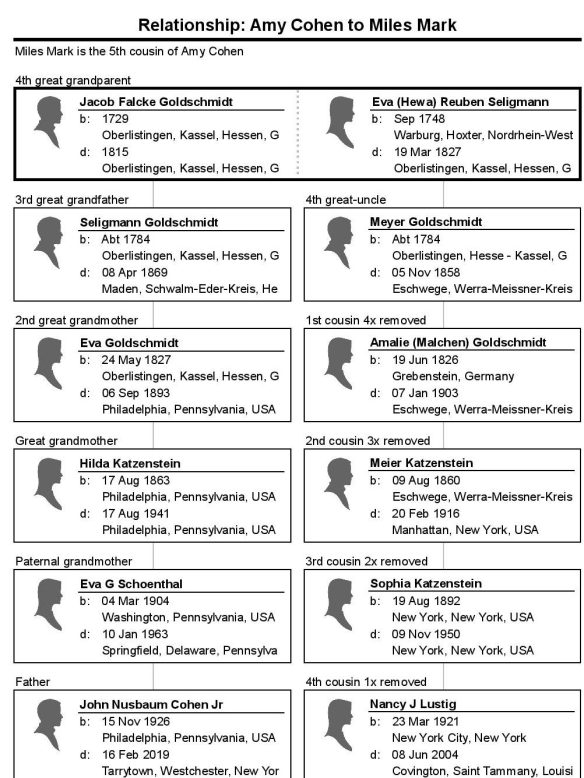
So what did we conclude regarding the relationship between Ruth and Jette Goldschmidt, assuming that David Gruenewald was married to my four-times great-aunt Jette?

There is no genetic connection, only one by marriage. Here is an abbreviated family report for the Gruenewalds of Poembsen.

As you can see, Levi Jehuda had a son Moses. Moses had two sons—David Gruenewald I, who married (we believe) Jette Goldschmidt, and Ruth’s great-great-grandfather Simon Gruenewald I.

But it gets more complicated.  Simon Gruenewald I had a son David Gruenewald II. David Gruenewald II married his first cousin, Minna Gruenewald, the daughter of David Gruenewald I with his second wife, Klara Karenmeyer. Minna Gruenewald was Ruth’s great-grandmother and also the half-sister of my relative Jacob Gruenewald I, David Gruenewald I and Jette Goldschmidt’s son.

Here are some charts, though I am not sure they really help. The first chart shows how Ruth’s great-grandparents were first cousins, Minna the daughter of David Gruenewald I, her husband David Gruenewald II the son of Simon Gruenewald I.

The second chart shows how Ruth is the step-great-great-granddauaghter of Jette Goldschmidt, my three-times great-aunt.

Thus, it appears that my four-times great-aunt Jette Goldschmidt was Ruth’s step-great-great-grandmother. Crazy, isn’t it?

And then David Baron discovered yet another connection. He wrote: “I found another connection with your families. In our Katz/Katzenstein trees we have Bertha Pes Katz daughter of Bonum Katz and Zerline Nussbaum of Jesberg who married Feist Joseph LInz. Pes and Feist Joseph had Betty LInz and Berthold Linz. Betty LInz married Albert Gruenwald and Berthold married Albert’s sister Rebecca Paula Gruenwald, Both Albert and Betty were the children of Hirsch Gruenwald and his wife Mina Gruenwald (born 1834) According to a family tree I found on My Heritage at https://www.myheritage.com/site-family-tree-550062631/fastre – Mina was the daughter of Simon Grunewald and Malchen Rose.”

I admit that I am still working on sorting through that one!

So Ruth is related to me genetically through our shared Seligmann line and also related to me by marriage, albeit distantly, through my Goldschmidt/Gruenewald line and through my Katzenstein/Katz line.

And who knows where else our family lines may have crossed.

In the meantime, Ruth’s grandfather’s tree has provided  clues as to what happened to the descendants of Jette Goldschmidt and David Gruenewald I. I have just connected with one of those descendants and hope to be able to fill out the family tree so that my four-times greataunt Jette Goldschmidt Gruenewald will no longer be relegated to just a footnote.


Family History in Truth or Fiction

Thanks so much to Linda Austin of Moonbridgebooks for interviewing me about my novel, Santa Fe Love Song.

moonbridgebooks's avatarmoonbridgebooks

Back in May 2017 I posted “Writing the Immigrant Story in Truth or Fiction” about Amy Cohen and her family history novel Pacific Street based on her immigrant ancestors’ stories. She explained why she decided to write her family history as fiction. There are a number of other reasons for writers to do this—to avoid hurting family or to protect the guilty and not have to worry about a lawsuit or being disowned, because there’s a bigger story to tell outside the confines of one true story, or just because they want to.

Amy recently published another family historical fiction book based on another set of ancestors. Santa Fe Love Song is about a young Jewish immigrant to the US who became a pioneer on the Santa Fe Trail and settled in Santa Fe. But he wanted to marry a Jewish woman, so he had to go back…

View original post 1,069 more words

Things People Find on eBay

Back in May 2020, I wrote about Ferdinand Meyer, my third cousin, twice removed, a great-grandson of Meyer Goldschmidt.

As I described in that post, Ferdinand and his two children, Eleanora and Erich, both left Germany in the 1930s to escape from the Nazis. But Ferdinand’s wife Friedericke Jaenecke Meyer stayed behind and did not leave Germany until the summer of 1941, when she came to the US and settled with Ferdinand in the Boston area.

Friedericke was not born Jewish, and I wondered whether she had stayed behind to protect the family’s assets, assuming that she would be safe (though she faced some persecution in Germany for being married to a Jew or perhaps for converting). I still have no answers to that question.

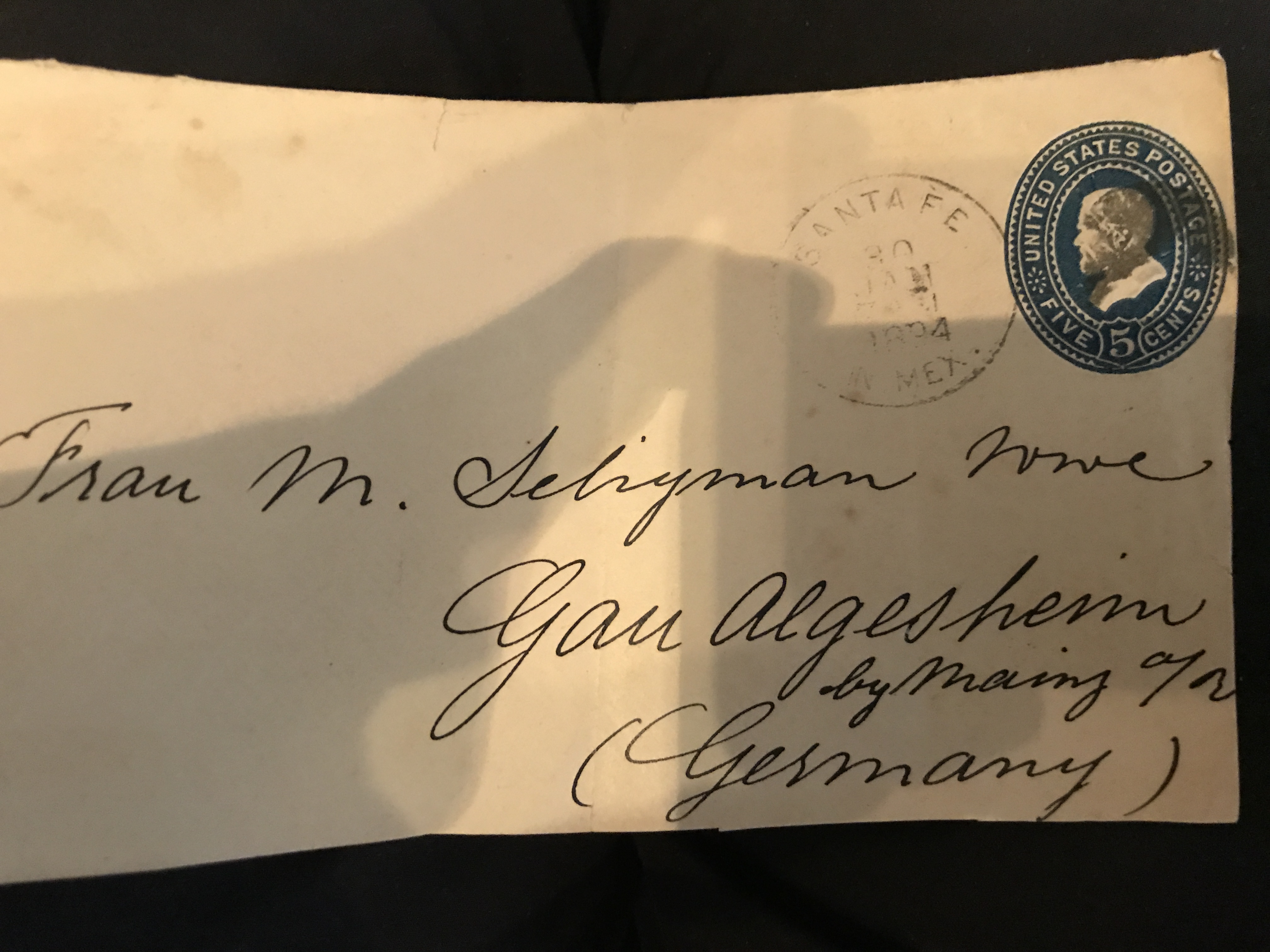
Nevertheless, I was quite tickled when a blog reader commented that he had found on eBay an envelope for a letter sent by Friedericke to Ferdinand, postmarked January 24, 1941.

As you can see, Friedericke was still living in Frankfurt at the time she sent this letter to Ferdinand, who was living on Beacon Street in Boston.

Unfortunately, there was no letter inside the envelope to reveal what was going on in Friedericke’s life and what her thoughts were about what was happening in Germany. By that time the war was raging across Europe, but the US was still a year away from entering the war. What were Friedericke and Ferdinand feeling and thinking? How was Friedericke able to escape when so many Jews were trapped inside Germany by that time?

And how in the world did this envelope end up on eBay?

Life is just filled with mysteries.

Amalie Schoenthal Wolfe and Etta Wolfe Wise: Photo Analysis Part III

In this third and final post devoted to photographs of Amalie Schoenthal Wolfe and her daughter Etta, I will look at two more photographs that my cousin Alan sent me and try and identify the others in the photo.

In this photograph, I’ve assumed Amalie is on the left and possibly Etta on the right. Then who are the three young women?

I don’t know. But Amalie had four granddaughters: Flora’s daughters Helen and Marjorie, Lee’s daughter Ruth, and Etta’s daughter Florence. My guess is that this is three of those four.

Here are some photos of Florence. This one is of Etta and her six children; Florence, her only daughter, is seated on our right.

Etta and her children. Courtesy of the family.

Here are another two of the children of Etta and Max Wise:

Do you see Florence in the photo above? Is she the tall girl standing between Amalie and Etta? I don’t think so, but am not sure. And as for the other two girls in the forefront? I have no idea. So maybe they are Helen, Marjorie, and/or Ruth. Or maybe not!

Finally, there is this photograph, which I will refer to as the living room photo:

The Wise Family Courtesy of the family

Seated in the middle rear are Etta, Amalie, and Max. The girl sitting right in front of Etta is her daughter Florence, and the four little boys on the floor and the little boy sitting on the lap of the man next to Max are the five sons of Etta and Max: Irving (Bud), Richard, Max, Jr., Robert, and Warren. From the ages of the children, I would guess that this photograph was taken in the early 1920s since Warren was born in 1920, Robert in 1919. You can compare the children to those in the photo of Etta surrounded by her children, probably taken a year before, and see the similarities.

So who are the other people in the living room photograph? Are they other relatives of Amalie and Etta? Or are they relatives of Max Wise? This photograph of Etta and Max with Max’s brothers and their wives shows what two of his brothers looked like. Alan agreed with me that the Wise brothers are not in the living room photograph with Etta’s children.

I think therefore that these are Etta’s relatives in the living room photo. Maybe the three older men are three of Etta’s four brothers: Maurice, Lee, Ira, and Herbert.  Maurice was living in Middletown, Ohio in 1920, as were Etta and Max, so it’s likely he is in the photograph.In 1920 Lee was in Pittsburgh, and Herbert in Detroit. Ira was living in Illinois in 1920 and died in 1924.

As for the two women sitting to Etta’s right, perhaps one is a sister-in-law, maybe both are. Perhaps one is Flora’s daughter Helen or her daughter Marjorie. And maybe the younger man perched on a table on our far left is Flora’s son Leroy. Or maybe her son Donald.

At this point it’s far too much speculation, but perhaps a cousin will find me who knows the answers. I am open to suggestions!

And please, everyone, label your photographs and spare some future family member from doing all this impossible guesswork.

Amalie Schoenthal Wolfe and Etta Wolfe Wise: Photo Analysis Part II

Looking back at my prior post, let’s assume for purposes of this post that I have correctly identified Amalie Schoenthal Wolfe and her daughter Etta Wolfe Wise in the two photographs below.

Etta Wolfe Wise to far right, upper. Courtesy of the family

Courtesy of the Family

Then who are the other people in these two photographs? Are they other relatives of mine, relatives of Amalie and Etta?

Starting with the first photograph, which I will refer to as the porch photo, I am assuming that the older woman standing on the porch is Amalie and Etta is to her left. Who is the woman on the other side of Amalie, and who are those five adorable little children in front of them?

Looking at the second photograph, which I will refer to as the formal photograph, I identified the older woman as Amalie and the woman standing in the rear next to her as Etta. So who is the other woman? Is she the same woman as the woman standing on the porch with Amalie and Etta in the other photo?

When I compare those two women, I believe they are the same woman, and my guess is that she is Etta’s only sister and Amalie’s only other daughter, Flora Wolfe Goldman.

The hair and how it is parted and the mouth seem so similar that I think they are the same person. What do you think?

I think the formal photograph was taken some years before the porch photograph, and that the two children in the formal photograph are mostly likely two of Flora’s children. Flora had four children: Leroy (1901), Helen (1903), Donald (1905), and Marjorie (1908). I am guessing that the little boy in the photo is Leroy and the little girl is Helen. My guess is that the photo was taken between 1904 and 1905 and perhaps Flora was pregnant with Donald when it was taken.

So that brings me to the next question: Who are those five little children in the porch photograph?

Assuming that is Flora in the porch photograph, it had to have been taken before September 30, 1910, when Flora died. She died from puerperal fever—a fever caused by a uterine infection after childbirth.1 Since Flora does not look obviously pregnant in the porch photograph and since it looks like the weather must have been relatively warm or at least not wintry, I am going to assume that the photograph was taken no later than the fall of 1909, but after 1905 or so when the formal photograph was taken.

At the time Flora died, her mother Amalie had six grandchildren. Flora’s four, Leroy, Helen, Donald, and Marjorie, and Amalie’s two grandchildren through her son Lee: Lloyd, born in 1902, and Ruth, born in 1905.

I would guess that the children in the photograph range in age from about fifteen months old to four years old. If the photograph was taken in 1906 or so, Flora’s children would have been five, three, and one (Marjorie would not yet have been born).  Lee’s two children would have been four and one in 1906.  Since there are only five children in the photo, maybe they are Flora’s older three (Leroy, Helen, and Donald) and Lee’s two (Lloyd and Ruth). And although they all look like girls, I know that little boys often wore dresses back in those days.

So I have no idea. Maybe they’re cousins from another branch of the family or neighbors. Without more photographs and information, I am grasping at straws!

But I do feel pretty comfortable identifying Etta, Flora, and Amalie.

I have a few more Etta/Amalie photographs to analyze. Maybe they will shed more light.


  1. There was no death certificate for a baby born in 1910 to Flora Wolfe Goldman so I assume the baby was stillborn or perhaps was miscarried. If Flora had an early miscarriage that led to a uterine infection, I suppose the photograph might have been taken in the spring of 1910. 

Amalie Schoenthal Wolfe and Her Daughter Etta Wolfe Wise: Some Photo Analysis

I have already written about Amalie Schoenthal Wolfe, the sister of my great-grandfather Isidore Schoenthal. Amalie was born in Sielen, Germany, in 1847, and came to the US as a young woman in 1867. In 1872 she married Elias Wolfe, and together they had six children, including her daughter Etta Wolfe Wise, who was born in Pittsburgh in 1883.

A few weeks ago I heard from Alan, one of Etta’s descendants, and he shared with me numerous photographs of the family, including two that were labeled in part “Etta’s mother.” I was excited to see photographs of Amalie.

Alan said this one was labeled as Etta’s mother Amalie on the right:

And that this one labeled Etta’s mother Amalie as the woman on the left:

I can see that the two older women in these two photos are the same person—do you agree? The shape of their chins and their cheekbones are the most obvious similarities.

This is Amalie’s daughter Etta Wolfe Wise, my grandmother Eva Schoenthal’s first cousin. It might have been taken on her wedding day, June 2, 1910:

Etta Wolfe Wise, c. 1910. Courtesy of the family

And this is her husband, Max Wise, perhaps taken around the same time:

Max Wise Courtesy of the family

Knowing what Etta looked like made it easy to identify her in other photos, such as this one. That looks like Etta standing in the rear to our right.

Etta Wolfe Wise to far right, upper. Courtesy of the family

I think that the older woman standing next to Etta is the same woman as the older woman in the first two photos above and so presumably Amalie.

And I think Amalie is also the woman sitting between Etta and Max Wise in the next photo, Max sitting highest on the chair fourth from the left, then Amalie to his right, and then Etta to Amalie’s right.

The Wise Family Courtesy of the family

Here are closeups of the four faces of the older woman cropped from those photographs:

What do you think? Are these all the same woman?

That left me puzzled about the people in the other photos of Amalie. For example, in this one, is that Etta standing next to her? At first glance I thought so, but then I wasn’t sure.  Etta has such distinctive deep-set eyes, and the eyes of the woman in this photo looked different.

Here are some closeups of Etta from the known photos and from this one:

The more I look, the more I think it is Etta. And is this Etta in the more recent photo showing Amalie on the far left?

I think so, although the glasses and her squint make is hard to be sure. She certainly looks like the woman in the last of the cropped photos above.

So…what do you think? Is that Amalie in all those photos? Have I correctly identified Etta in the photos?

If so, then I need to figure out who the other people are in those photographs. To be continued…

New Year’s Eve 1919-1920 in Frankfurt, Germany

Two weeks ago I said I was taking a break, trying to figure out where to go next with my research and clearing my head. Well, my head is still not clear, and I still am on the fence about what to do next.

But while I was taking that breather, I heard from multiple new cousins as well as new communications from cousins I’d already found. New photos, new stories, new people. These include new DNA matches on my Brotman line, new photos for my Schoenthal line, new photos for my Seligmann line, a new connection from a Seligmann cousin who also appears to be a Goldschmidt cousin, a new Katzenstein cousin, a set of documents sent by a man living in Oberlistingen about the Goldschmidts, and numerous other questions, comments, or requests coming from my blog, Facebook, or email.  I will blog about many of these once I get my arms wrapped around the details.

All of this has given me a shot in the arm (and yes, I now am fully vaccinated against COVID as well) that I sorely needed. It’s so hard to transition from one research project to another, especially after three years. So these smaller, more focused projects are what I need right now. Especially since I also want to spend some time promoting my new book, Santa Fe Love Song.

Today I want to share an amazing photograph that my cousin Greg Rapp sent me. He cannot identify anyone in the photograph, but Greg is a Goldschmidt cousin (a descendant of Jacob Meier Goldschmidt), and the photo was labeled “New Year’s Eve 1919-1920.” Whether or not we can ever identify anyone in the photograph, it is nevertheless worth sharing. It captures German society during the Weimar Republic. The young women smoking cigarettes evoke that era as does the energy, the expressions, and the postures of all the young people in the picture.

If anyone can identify anyone in this photograph, please let me know.

Santa Fe Love Song: A Family History Novel

I am delighted to announce that my newest novel, Santa Fe Love Song, has been published and is available in both paperback and e-book format on Amazon here. Like my first novel, Pacific Street, Santa Fe Love Song was inspired by the lives of real people—in this case, my great-great-grandparents Bernard Seligman and Frances Nusbaum—and informed by my family history research. But as with my first book, Santa Fe Love Song is first and foremost a work of fiction.

Bernard Seligman, my great-great-grandfather

Frances Nusbaum Seligman, my great-great-grandmother

It is a double love story—a story of Bernard’s passion for his newly adopted home in New Mexico and of his deep love for a young woman in Philadelphia. How will he resolve the conflict between those two loves? That is the heart of the novel.

But this is also an adventure story because the first part of the book tells of Bernard’s arrival from Gau-Algesheim, Germany, his adjustment to life in Philadelphia, and then his challenging and exciting trip on the Santa Fe Trail when he moves out west to work with his brother Sigmund. On that trip Bernard faces many different obstacles and learns to love the American landscape. He transforms from a German Jewish immigrant into an American pioneer and businessman.

Upper left, Bernard Seligman with other merchants and Indians on the Santa Fe Trail

As with Pacific Street, I wrote Santa Fe Love Song with my children and grandchildren in mind. This time I also decided to get my grandsons involved in the project. Nate, 10, and Remy, 6, became my illustrators. As I told them stories about Bernard and Frances, they created drawings that told those stories visually. I am ever so grateful to my two wonderful grandsons for their work, and I hope that someday their grandchildren will cherish these books and the illustrations and honor the memories of their ancestors Bernard and Frances.

I hope that you also will find Santa Fe Love Song a worthwhile and enjoyable read. If you do, please leave a review on Amazon. Thank you! I appreciate all your support.

My Goldschmidt Family Project: Looking Back and Looking Forward

With this post, I come to the end of my Goldschmidt research—at least until I get new updates or make new discoveries. I’ve done my best to find whatever records, stories, and photographs exist for Jacob Falcke Goldschmidt and Eva Reuben Seligmann, my four-times great-grandparents, and their descendants.1

I started blogging about my Goldschmidt relatives a little over three years ago on January 12, 2018, making it the longest of any of my family research projects.  And it’s been such a rich and rewarding journey. I’ve connected with Goldschmidt/Goldsmith cousins in France, England, and all over the United States. Some of those cousins have roots in the US that are as deep as mine—going back to the 1840s when Simon Goldschmidt/Goldsmith arrived or the 1850s when my great-great-grandmother Eva Goldschmidt Katzenstein arrived; some are the children of those who were born and raised in Frankfurt, Germany, and were forced to leave their comfortable and successful lives to escape from the Nazis as recently as the 1930s or 1940s.

One thread that runs through so much of the Goldschmidt family is an interest in the arts and literature—whether in writing, as with Milton Goldsmith and Anna Seghers, or an interest in antiquarian books, as with Alfred Goldsmith and Emil Offenbacher, or in music like Florence Goldsmith, or  in creating art like William Sigmund and Martha Loewenthal Wolff, or by working as an art historian and curator like Yvonne Hackenbroch, and, of course, then there are the many, many Goldschmidt family members involved in collecting and dealing in art—from the Goldschmidt brothers Jacob Meier and Selig to Julius Falk Goldschmidt to the Freres Tedesco family and so on.

Alfred Goldsmith self-portrait, Joseph J. Felcone, The Old Book Table. A Record of its First Seventy-Five Years, 1931–2005 (New York: The Old Book Table, 2006), p. 5.

Painting by Martha Loewenthal Wolff

Of course, there were also many merchants, entrepreneurs, doctors, lawyers, engineers, and scientists in the Goldschmidt clan. But when I think of my father’s artistic ability and his passion for art, architecture, music, and literature, I attribute it to his Goldschmidt DNA. His mother was artistic, and she was the granddaughter of Eva Goldschmidt. My great-uncle Harold Schoenthal, also a grandchild of Eva Goldschmidt, was also an artist and an architect. My daughter is also very artistic, though she did not pursue it as a career. When I see my grandsons drawing, I think, “It must be their Goldschmidt DNA.” I may not be artistic, but I’d like to think that my love of reading and writing comes from that Goldschmidt DNA as well.

The Seventh Cross by Anna Seghers

The Rabbi and The Priest by Milton Goldsmith

After three years of research, it’s hard to boil down in one post all that I have learned. That research has exposed me to so much of American Jewish history and German Jewish history—from the late eighteenth century right up to 2020. The Goldschmidts kept my brain busy during this pandemic time, and they provided me with some truly memorable Zoom calls with cousins.

It has been an amazing experience. I am indebted to so many of my Goldschmidt cousins that I fear if I make a list, I will leave someone out. But thank you to all of you who shared your family’s photographs, letters, memoirs, documents, and stories. I hope that I’ve served our extended family well by recording the stories of their lives for posterity. And please stay in touch! I want to meet as many of you as I can in person someday soon.

Jean-Baptiste-Camille Corot, Madame Stumpf and Her Daughter, 1872. Courtesy of the National Gallery.
Once owned by the Freres Tedesco Gallery, Paris

A work from the Guelph Treasure
Reliquary of the arm of Saint Blaise (Herzog Anton Ulrich Museum, Dankwarderode Castle). User:Brunswyk, CC BY-SA 3.0 , via Wikimedia Commons. Once owned by J&S Goldschmidt

It’s bittersweet to reach this point and know it’s time to move on to the next project. But I’ve gone as far as I can go in the Goldschmidt research—at least for now.  I need to decide what to do next. I’ve been dipping my toes in several ponds to see which one grabs my attention.

Before I reveal where I am going next, however, I need to take a break for a bit to catch my breath and to catch up on the research it will take to start that new project, whatever it may be. But first, I will introduce my new novel. So stay tuned!


  1. I would be remiss in my duties as a family historian if I didn’t mention that in addition to their four sons Meyer, Seligmann, Lehmann, and Simon, whom I’ve studied in depth, my four-times great-grandparents Jacob Falcke Goldschmidt and Eva Seligmann had a daughter Jette Goldschmidt. She married David Gruenwald of Poembsen, Germany, and they had two children. One died as an infant or was stillborn, but the other, Jacob Gruenwald, was born in 1820, lived to adulthood, married Sarah Nethe, and had fourteen children born between 1847 and 1872. All of this information, however, is based purely on a secondary source, a report in the Alex Bernstein Collection at the Leo Baeck Institute. I’ve tried to locate more information about Jette’s descendants, but so far have not succeeded. If the day comes when I can, I will add Jette’s family to the blog.