Unknown's avatar

About Amy

I am interested in genealogy and family research, books, movies, cats, dogs, and baseball.

What Happened to Adolf Michel?

In looking through my email exchanges with my cousin Wolfgang and my friend Aaron Knappstein, I remembered one of the unsolved mysteries that remain on our Seligmann family tree, the mystery of Adolf Michel, father of Fred Michel and ex-husband of Franziska Seligmann.

I have written a number of posts about my cousin Fred (born Fritz) Michel. Aaron Knappstein was able to locate several records related to Fred Michel and his parents, including Fred’s birth record. He was born in Bingen on June 6, 1906, to Adolf Michel and Franziska Seligmann.

Fred Michel and Franziska Seligmann Michel
Courtesy of the Family of Fred and Ilse Michel

Birth record of Fritz Michel

Franziska was the daughter of August Seligmann and Rosa Bergmann and brother of Julius Seligmann, Wolfgang’s grandfather.  Since August Seligmann was a brother of my great-great-grandfather Bernard, Franziska was my great-grandmother Eva Seligman Cohen’s first cousin. Here is Franziska’s birth record, also located by Aaron Knappstein:
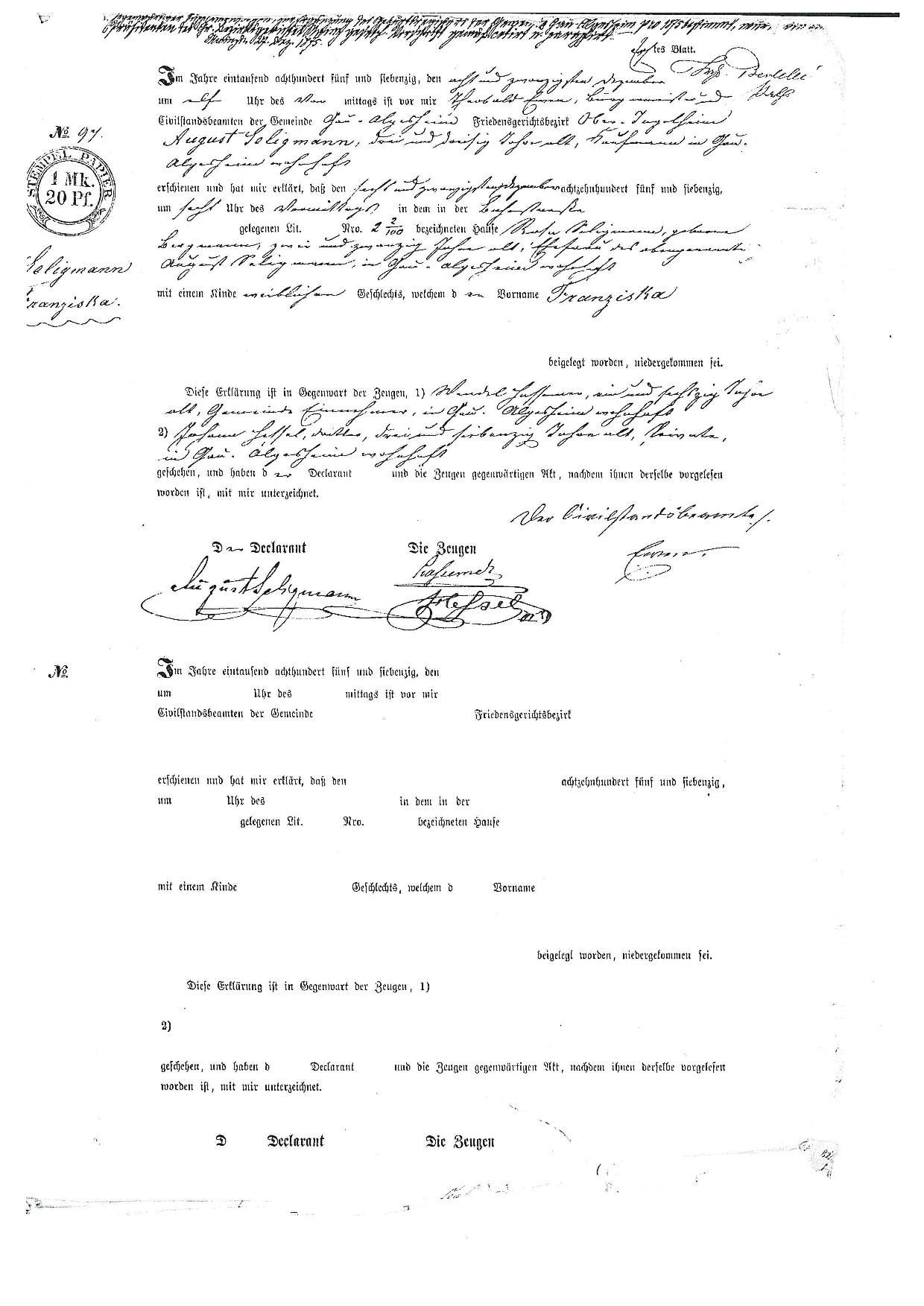
Birth record of Franziska Seligmann

Although the stories of Fred’s life and his mother’s life have been told on the blog, his father Adolf Michel has remained a mystery. Aaron Knappstein located the marriage record of Adolf Michel and Franziska Seligmann, which shows that they were married on July 11, 1904, and divorced on February 16, 1915.

Marriage record of Franziska Seligmann and Adolf Michel

Aaron also located Franziska’s death certificate.
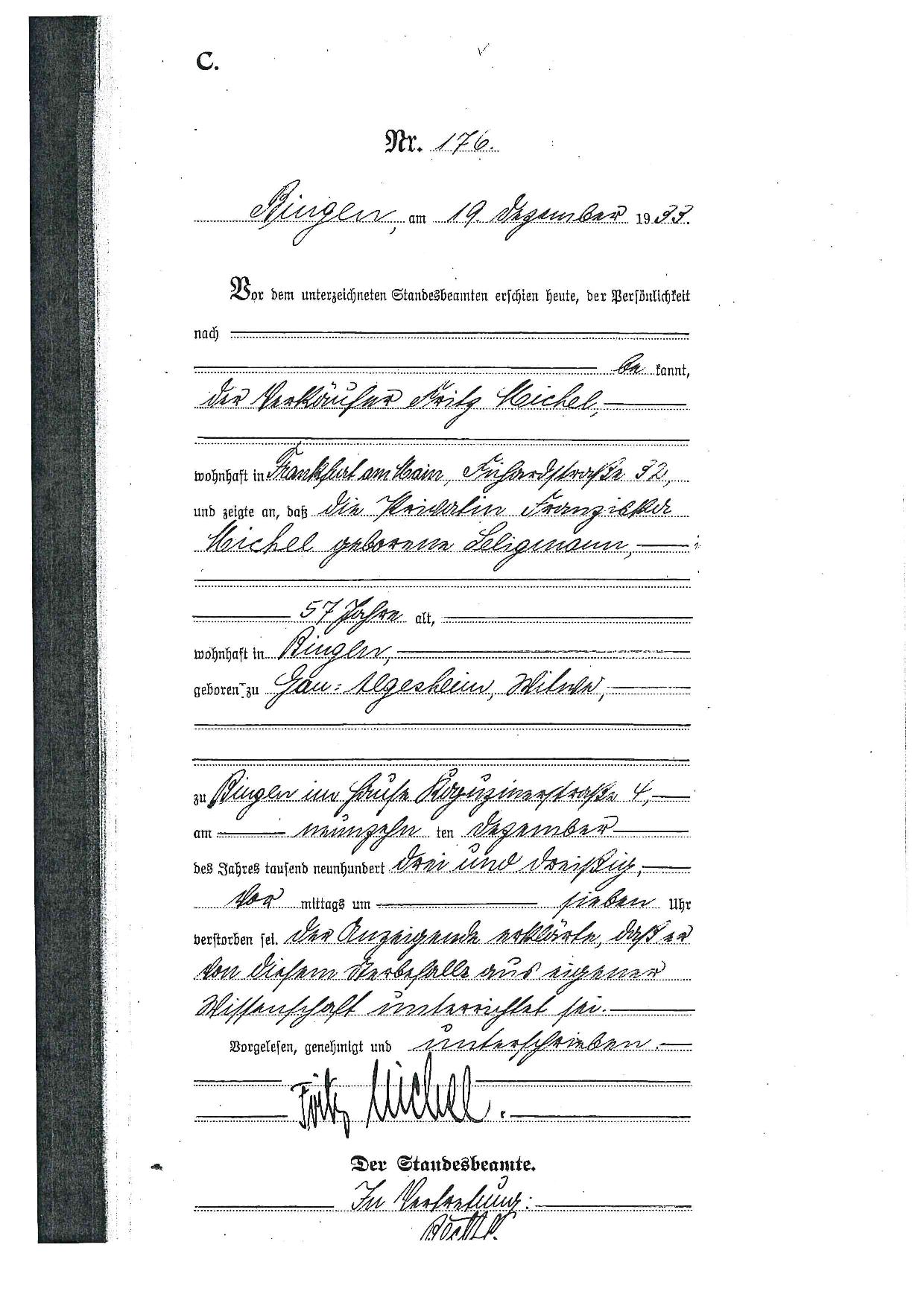
Death record for Franziska Seligmann Michel

Matthias Steinke from the German Genealogy group on Facebook translated the death record for me:

Nr. 176
Bingen, at the 19th December 1933
To the sigming registrar came today the personally known seller Fritz Michel, residing in Frankfurt am Main, Fuhardstreet 32, and reported that the privateer Franziska Michel born Seligmann, 57 years old, residing in Bingen, born in Algesheim, widow, in Bingen in the house Kapuzinerstreet 4, at the 19th December of the year 1933, pre midday at seven o’clock is deceased.
The reporter declared, that he knew about the death due to his own knowledge.
Readed, confirmed and signed
Fritz Michel
The registrar
In representation
Signature

Although it identified Franziska as a widow when she died in 1933, it is impossible to know whether that meant Adolf had died or whether their son Fritz (Fred), the informant, was just saving his mother from the stigma of divorce.

In any event, despite searches by Wolfgang, Beate Goetz, and Aaron Knappstein, no other records for Adolf Michel after that marriage certificate have been located. Fred Michel’s children also have no information about the fate of their grandfather Adolf.

We thought we had a possible lead when Wolfgang discovered this remarkable letter that Fred Michel wrote on August 18, 1958, to the International Tracing Service in Bad Arolsen, Germany (now known as the Arolsen Archives and searchable online), searching for his missing relatives.
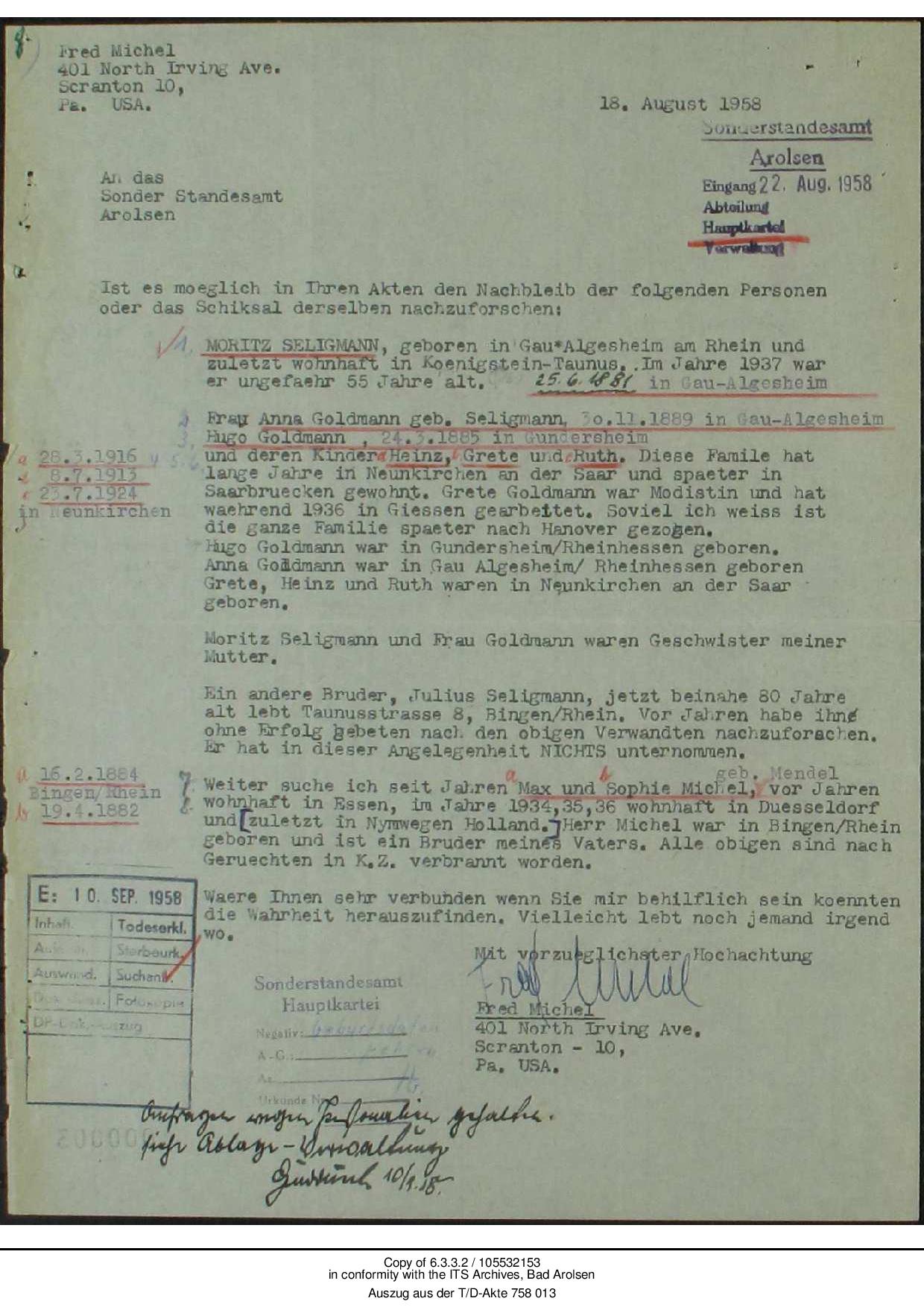
There is much in this letter to discuss later in this post, but for now I want to focus on the last paragraph where Fred wrote:

Weiter such ich seit Jahren Max und Sophie [geb. Mendel] Michel vor Jahren wohnhaft in Essen, im Jahre 1934, 1935, 1936 in Duesseldorf und zuletzt im Nimwegen Holland. Herr Michel war in Bingen/Rhein geboren und ist ein Bruder meines Vaters. Alle obigen sind nach  Geruechten in K.Z. verbrannt worden.

For years I have been looking for Max and Sophie (nee. Mendel) Michel lived in Essen years ago, in 1934, 1935, 1936 in Duesseldorf and most recently in Nijmegen Holland. Mr. Michel was born in Bingen/ Rhein and is a brother of my father. All the above are rumored to have been burned in the concentration camps.

We were excited to learn that Adolf Michel had a brother and hoped that if we found that brother’s family, we might learn what happened to Adolf. Unfortunately, the rumors Fred mentioned in his letter were true; both Max and his wife Sophie were killed in the Holocaust. They were deported to Auschwitz and murdered there on May 22, 1944, according to records at Yad Vashem. As far as we can tell, Max and Sophie did not have any children, and so far we have not found anyone one else to ask about the fate of Adolf Michel.

As for the other relatives Fred was asking about in his 1958 letter, sadly they also were murdered in the Holocaust. I wrote here about Moritz Seligmann (son of August Seligmann and Rosa Bergmann), who was killed in the Holocaust in 1942, and here about his sister Anna Seligmann and her husband Hugo Goldmann and their three children, all of whom also were killed during the Holocaust (the Goldmann family information will be updated in a post to come). Moritz and Anna were the siblings of Fred’s mother Franziska and Wolfgang’s grandfather Julius.

About his uncle Julius, the remaining child of August and Rosa, Fred wrote:

Eine andere Bruder Julius jetzt beinahe 80 Jahre alt lebt Taunusstrasse 8 Bingen. Vor Jahre habe ihne ohne Erfolg gebeten nach den Verwandten nachzuforachen. Er hat in dieser Angelgenheit NICHTS unternommen.

Another brother Julius now almost 80 years old lives at Taunusstrasse 8 in Bingen. Years ago I had asked him without success to trace the relatives. He has done NOTHING in this matter.

Julius was Wolfgang’s grandfather, and Wolfgang and I were puzzled by this paragraph. We are not sure what Fred meant here or why he was expressing his frustration with Julius to the ITS. The use of ALL CAPS seems to suggest that Fred was angry with Julius.

Wolfgang wondered why his grandfather would not have helped look for his lost siblings. There is probably more to that story, given that, as discussed before on the blog, there was a family dispute between Julius and the rest of the family when Julius married a Catholic woman, Magdalene Kleisinger, and Julius ended up leaving the family business and moving away from Gau-Algesheim. More on Julius to come in a subsequent post.

Julius and Magdalena Seligmann

One thing, however, that we may be able infer from this letter is that Fred Michel knew what had happened to his father since he did not list him among the many relatives he was seeking. Either Adolf Michel died before or after the Holocaust, or he was killed during the Holocaust (though he is not in the Yad Vashem or Arolsen records) and Fred already knew when and how his father was killed. It’s also possible that Adolf Michel was still alive in 1958. He would have been 89 years old at that time. I just wish we knew the answer.

UPDATE: Although I still have no information about Adolf’s death or whereabouts after his divorce from Franziska in 1915, Aaron Knappstein was able to locate Adolf’s birth record:
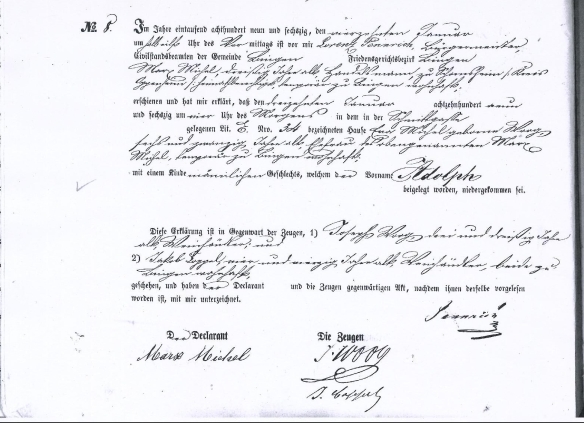
Adolf Michel birth cert from AK-page-001

Birth record for Adolph Michel. father: Marx Michel, 30years old, tradesman *13.01.1869 in Bingen mother: Eva Michel née Woog, 26years old

Aaron also wrote to the archives in Berlin for any information about Adolf’s death, but he did not appear in their index. So the brickwall remains. Thank you, Aaron!


Seligman Update, II: James Seligman, Vintner and Hotelier

My second Seligmann update is about James Seligman, who was born Jakob Seligmann in Gau-Algesheim, Germany in about 1853; he died in Birmingham, England on March 11, 1930.1

Birmingham Daily Gazette, March 14, 1930, p. 3

James Seligman was the son of Moritz Seligmann and Babette Schoenfeld and the younger brother of my great-great-grandfather Bernard and Wolfgang’s great-grandfather August. I wrote a post about James and his life back on December 8, 2017, describing his life and business in England and Scotland. James went to England as a young man to represent Seligman Brothers, the wine business that he was in with his brothers August and Hieronymous. In 1890, the partnership with his brothers was dissolved, and James continued the wine business on his own in England and then Scotland as Seligman & Co. He also became involved in the hotel business in both Scotland and England. A good portion of the information and images in that earlier post came from Wolfgang.

London Gazette, March 20, 1891

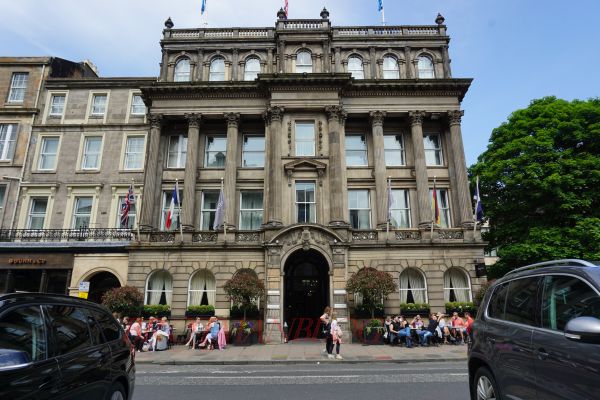
In looking through old emails recently, I realized that I had never posted some of the photographs that Wolfgang later sent me of one of James Seligman’s hotels, the George Hotel in Edinburgh, Scotland. I also had forgotten to post some of the photographs my cousin-by-marriage Shirley had sent me of the Grand Hotel in Birmingham, England, where James had been the managing director.  My apologies to Wolfgang, Shirley, and my three-times great-uncle James Seligman for somehow letting these wonderful images slip through the cracks.

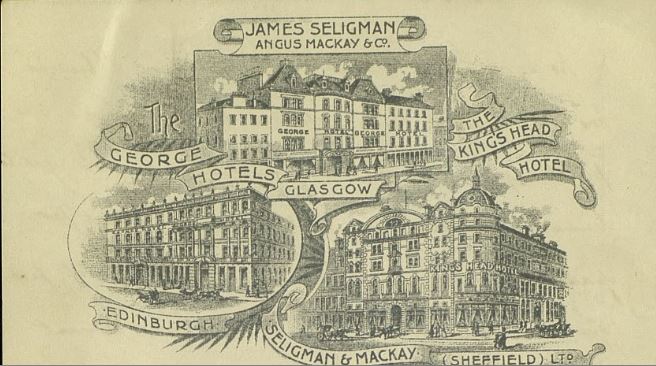
Here are the photographs and other images that Wolfgang sent of the George Hotel in Edinburgh and some stationery letterhead that Wolfgang found on the internet showing the hotels owned in 1911 by James Seligman and August Mackay.

It looks like a gracious old hotel with a beautiful lobby. It is still in business and just had extensive renovations done. If I ever get to Edinburgh, this is where I will stay.

Shirley’s photographs are of the Grand Hotel in Birmingham where James was the managing director. It also is a grand and gracious old hotel:

I was able to learn a lot more about this hotel from its website:

The Grand Hotel first occupied part of the building constructed by Isaac Horton, on Colmore Row and Church Street between 1877 and 1879, with 100 bedrooms and a first floor reception. It was let to Arthur Field, a hotel operator from Newcastle-upon-Tyne, and opened on 1st February 1879…. For the next 74 years the hotel was operated by Hortons. During this time it played host to royalty, politicians and film stars as well as staging many dinners, concerts and dances in the Grosvenor Suite. The room had many admirers including Sir John Betjeman who described it as “a unique, simply stunning, masterpiece.” The list of those attending functions at or staying in the hotel included King George VI, the Duke of Windsor, Winston Churchill, Neville Chamberlain, Charlie Chaplin, James Cagney and Joe Louis to name but a few.

Maybe some of those people stayed in the hotel while James Seligman was the managing director.  According to its website, the Grand Hotel is currently in the process of substantial renovations. Maybe someday I will get to stay there also.

As for the wine business, Seligman & Co stayed in business long after James’ death. In fact, Wolfgang found an obituary for a man named David Smith who was also in the wine business and who had been a director of Seligman & Co. in Birmingham as late as 1989. Shirley took a photograph of the location that once housed the Seligman & Co. wine business in Birmingham.

Thank you to Wolfgang and Shirley for their help in telling the story of James Seligman.


  1.  General Register Office; United Kingdom; Volume: 6d; Page: 198, Ancestry.com. England & Wales, Civil Registration Death Index, 1916-2007 

Seligmann updates: The work is never done

Next in my series of updates from my cousins are a number of research discoveries made by my cousin Wolfgang Seligmann, the first of my cousins who found me through my blog. That was over four years ago, and together Wolfgang, his mother Annlis, and I were able to reconstruct major parts of the Seligmann family tree going back as far as my fifth-great-grandfather Seligmann ben Hirsch, the father of Jacob Seligmann, my fourth-great-grandfather, who was born in 1773 and gave the family Seligmann as its surname.

Some of you may remember the “magic suitcase” that Wolfgang and his mother had, filled with letters and papers about the Seligmann family. When I visited Wolfgang and Annlis in Mainz in 2017, I saw this wonderful suitcase. There were still many, many papers yet to be read and digested, and still much work to be done to uncover the rest of the story of the Seligmann family in Germany. So while I have gone on to other family lines, Wolfgang has continued to dig into our Seligmann family history and share his discoveries with me. Although I have updated my tree with this information, I haven’t updated the blog in quite a while. I want to take some time now to do that and share the other information that Wolfgang has uncovered.

First, Wolfgang found several directories that included listings for various members of the Seligmann family, including this 1845 directory from the city of Mainz where a number of our Seligmann relatives resided. On this page Salomon Seligmann is listed as a Handelsmann or merchant.

Mainz Adressbuch, 1845

Mainz Adressbuch, 1845

Salomon was a son of Jacob Seligmann and younger brother of Moritz Seligmann, my three-times great-grandfather (and Wolfgang’s great-great-grandfather). He was born in Gaulsheim, Germany, on March 26, 1812, and married Anna Chailly on August 8, 1843, in Mainz.1 They had four children: Emilie (born 1844), Mathilde (1846), Siegmund (1847), and Jacob (1853).2 Salomon died on January 12, 1876, in Mainz.3

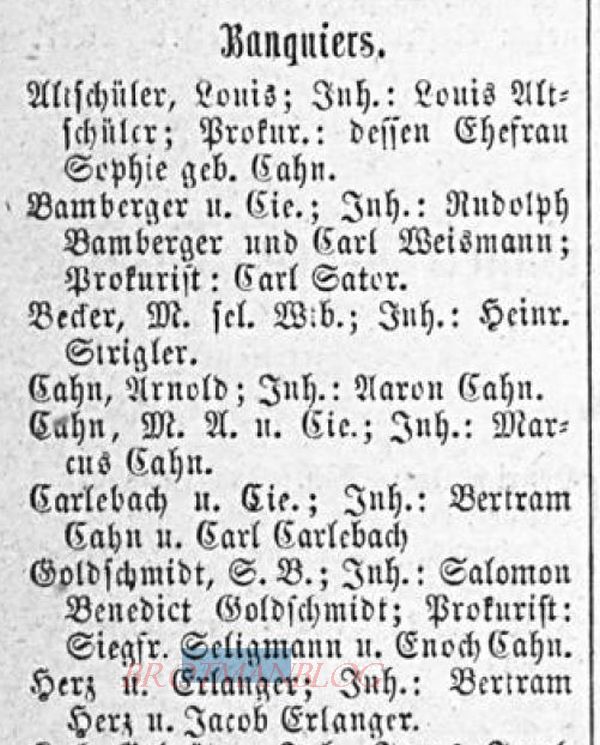
The second directory listing Wolfgang shared was also from Mainz, this one dated 1868. It lists as a “Banquier” our cousin Siegfried Seligmann. More specifically, Siegfried is described as a Prokurist or authorized officer of the bank. This is consistent with the description of him in Mathilde Mayer’s book, Die Alte und Die Neu Welt.  [The Old and The New World] (1951). Siegfried Seligmann was the son of Martha Seligmann, who was the sister of Moritz Seligmann and thus my four-times great-aunt. Martha Seligmann had married her own first cousin, Benjamin Seligmann, son of Hirsh Seligmann, Jacob Seligmann’s brother. So Siegfried was his own second cousin. He was born in Bingen on June 18, 1824.4

To make matters even more convoluted, Siegfried married his first cousin, Carolina Seligmann, daughter of Moritz Seligmann and my three-times great-aunt. Carolina was born in Gau-Algesheim on March 18, 1833,5 and she was the half-sister of my great-great-grandfather Bernard Seligman, the one who traveled the Santa Fe trail and became a successful business leader and political leader in Santa Fe. As I’ve already written, Caroline and Siegfried had seven children, only one of whom lived long enough to survive the Holocaust.

Mainz Adressbuch, 1868

The third directory Wolfgang shared with me is dated 1906 and is a listing from the Hessen-Rheinhessen directory for Bingen that includes a number of our relatives. One is Ferdinand Seligmann. Ferdinand was the son of Martha Seligmann and Benjamin Seligmann and was thus the first cousin of my great-great-grandfather Bernard Seligmann. His niece Martha Mayer wrote about him in her book Die Alte und Die Neu Welt, describing him as “Onkel Hut” or Uncle Hat because he was known for wearing a distinctive hat. He was a successful businessman in Bingen, born on April 23, 1836, and died in Bingen on November 21, 1906.6

Adressbuch Hessen-Rheinhessen 1906

Also listed is Emil Jacob Seligmann, son of Siegfried and Carolina Seligmann. He was born in Mainz on December 23, 1863, and married Anna Maria Angelika Illien, according to his death record.7 They had two children, Emil and Christine. Emil Jacob Seligmann was perhaps the first Seligmann family historian; it was his family tree that helped Wolfgang, Annlis, and me unlock many of the mysteries in the Seligmann family. Emil died from arteriosclerosis on August 9, 1942, in Wiesbaden.8

There are two men listed here who may be our relatives, but since both died before the 1906 directory was issued, I am not sure. Ludwig Seligmann and Richard Seligmann were the sons of Isaac Seligmann, brother of Moritz Seligmann, and Rosine Blad. Ludwig was born in Bingen on December 6, 1827, and died there on May 9, 1887, long before this directory was published. He was married to Auguste Gumbel, and they had five children. Since Auguste was still living in 1906, perhaps she had left this listing under her husband’s name. She died in 1910. Ludwig is listed here as a coal merchant (Holhenhandler).

Living at the same address as “Ludwig Seligmann” were at least two other Seligmanns: Karolina, a pensioner, and Ferdinand, another pensioner, and then a third Ferdinand in the wood and coal business with his son (this couldn’t be Uncle Hat as he never married or had children). I do not know who these people were, so perhaps this Ludwig and these other Seligmanns were not our relatives at all.

According to Emil Seligmann’s family tree, Richard Seligmann was born in Bingen on November 4, 1831, and died there on January 17, 1906. He must have died after the 1906 directory went to print. He is listed there as a merchant. He was married to Jeanette Gumbel. I’ve not been able to determine whether Auguste Gumbel and Jeanette Gumbel were related. Emil reported that Richard and Jeanette had three children, Wilhelmina (born 1864), Florentine (1866), and Heinrich (1870). I have not found much about any of them. Looking at these names on my tree has reminded me how much more work I still have to do on the Seligmann family.

The last directory listing that Wolfgang sent to me, also dated 1906 and from Hessen-Rheinhessen, must be the most precious to him as it includes his great-grandfather August Seligmann, brother of my great-great-grandfather Bernard, and their younger brother Jacob, later known as James when he immigrated to England (more on James to come). August is listed as an iron merchant, and Jacob is listed as a wine merchant.

Adressbuch Hessen-Rheinhessen, 1906

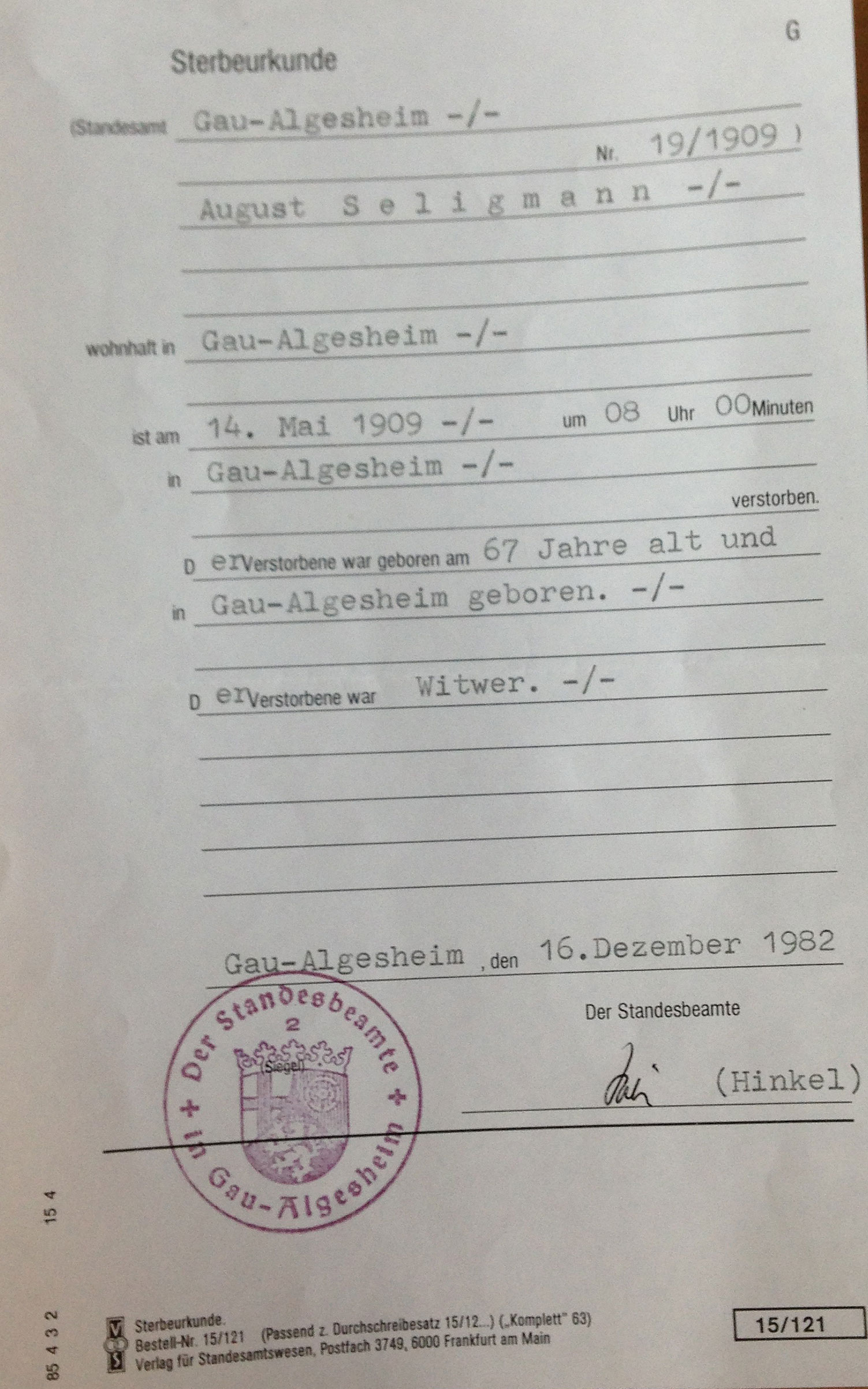
August was born on December 10, 1841,9 and died in Gau-Algesheim on May 14, 1909.10 He was married to Rosa Bergmann, and they had four children, including Wolfgang’s grandfather Julius, who was born in 1877 and died in 1967. (More on Julius to come as well.) I have written about August and Rosa and their children previously; two were killed during the Holocaust, Moritz and Anna. Their oldest child, Franziska, married Adolf Michel, and had one child Fred Michel, about whom I’ve written and about whom I have more to report. Franziska died in 1933.11

August Seligmann death certificate

Thus, as you can see, the story of the Seligmanns is not yet finished. Some of what I have is based on an unsourced family tree that I since learned has numerous errors. I need to go back and verify all that information if I can.

And that’s an important lesson for all of us involved in family history. The stories are never finished, the work is never done. Thank you, Wolfgang, once again, for all your generosity and hard work and for keeping me on task! There are more Seligmann updates to come.


  1. Marriage record, Certificate Number: 179, Stadtarchiv Mainz; Mainz, Deutschland; Zivilstandsregister, 1798-1875; Signatur: 50 / 124, Ancestry.com. Mainz, Germany, Births, Marriages and Deaths, 1798-1875 
  2. Family Number: 10393, Ancestry.com. Mainz, Germany, Family Registers 1760-1900 
  3. Civil Registration Office: Mainz, Certificate Number: 49, Laufendenummer: 866,
    Ancestry.com. Mainz, Germany, Deaths, 1876-1950 
  4. Certificate Number: 294, Personenstandsregister Sterberegister; Bestand: 903; Signatur: 10482, Ancestry.com. Hesse, Germany, Deaths, 1851-1958 
  5. Certificate Number: 1614, Stadtarchiv Mainz; Mainz, Deutschland; Zivilstandsregister, 1798-1875; Signatur: 50 / 234, Ancestry.com. Mainz, Germany, Births, Marriages and Deaths, 1798-1875 
  6. http://www.steinheim-institut.de/cgi-bin/epidat?id=bng-0541 
  7.  Personenstandsregister Sterberegister; Bestand: 925; Laufende Nummer: 2934,
    Year Range: 1942, Ancestry.com. Hesse, Germany, Deaths, 1851-1958 
  8. Civil Registration Office: Wiesbaden, Certificate Number: 1691, Personenstandsregister Sterberegister; Bestand: 925; Laufende Nummer: 2934Ancestry.com. Hesse, Germany, Deaths, 1851-1958 
  9. FHL Film Number: 342201, Ancestry.com. Germany, Select Births and Baptisms, 1558-1898. 
  10. Die Geschichte der Gau-Algesheimer Juden by Ludwig Hellriegel (1986, revised 2008)[The History of the Jews of Gau-Algesheim]. 
  11. http://www.steinheim-institut.de/cgi-bin/epidat?id=bng-745&lang=de 

Another Cousin Discovered: The Granddaughter of Etta Wolfe Wise, My Third Cousin Sally

For me, genetic genealogy has been disappointing as a tool for finding new ancestors and breaking down brickwalls, but it has occasionally been useful for confirming what I already knew through traditional research. For example, in March I contacted a DNA match named Sally who came up as a fourth cousin on Ancestry, and after contacting her and checking my tree and hers, we realized that we were both the great-great-granddaughters of Levi Schoenthal and Henrietta Hamberg.  That is, Sally is in fact my third cousin, even closer than the DNA estimate on Ancestry.

Sally is descended from Levi and Henrietta’s daughter Amalie Schoenthal, and I am descended through their son Isidore Schoenthal. Sally and I exchanged family stories and information and photographs, and she generously agreed to let me share those stories and photographs on the blog. As you will see, there are some apparent family resemblances traceable to our shared Schoenthal ancestry.

As I’ve already written about on the blog, Sally’s great-grandmother (and my great-great-aunt) Amalie Schoenthal married Elias Wolfe. Their daughter Etta Wolfe was Sally’s grandmother. Etta was my grandmother Eva Schoenthal Cohen’s first cousin.

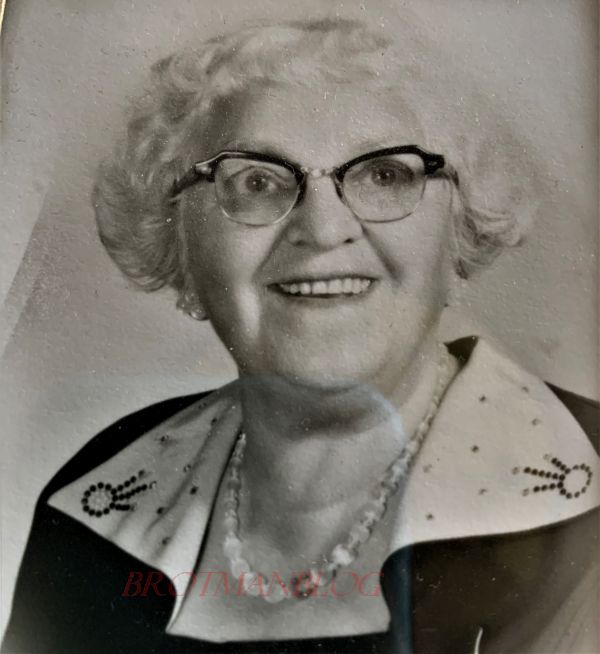
Sally has no photographs of her great-grandparents, but shared with me photographs of her grandmother Etta, all taken when she was a grandmother.  I will start with this one as it is the clearest photograph of her and shows much of her personality, as described to me by Sally. Sally knew Etta well because she died when Sally was eight years old. She remembers her grandmother lovingly and described her as easy-going and soft spoken and as someone who always enjoyed family trips and outings. Sally remembers that when she was just four or five, her grandmother would share shrimp cocktails with her. Can’t you see that sweetness in her face in this photo?

Etta Wolfe Wise, Courtesy of her Granddaughter Sally

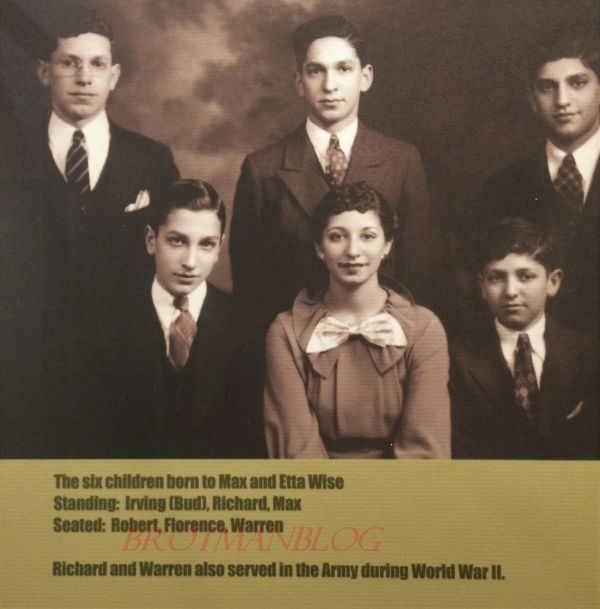
Etta Wolfe married Maximilian Wise in 1910 in Pittsburgh, as noted here on the blog. Etta and Max had six children, a daughter Florence and then five boys, Irving, Richard, Max Jr., Robert, and Warren. Sally’s father Robert was their fifth child and fourth son. Here are two pictures of Max and Etta’s children.

Courtesy of Sally Wise Myers

Irving, Richard, Max, Jr. Robert, and Warren Wise.  Courtesy of Sally Wise Myers

Sally told me that Etta and Max converted from Judaism to Christian Science because they believed that their daughter Florence’s clubfoot was cured by Christian Science. Unfortunately, according to Sally, several other members of the family were not so fortunate with their faith in Christian Science and died fairly young after refusing traditional medical care.

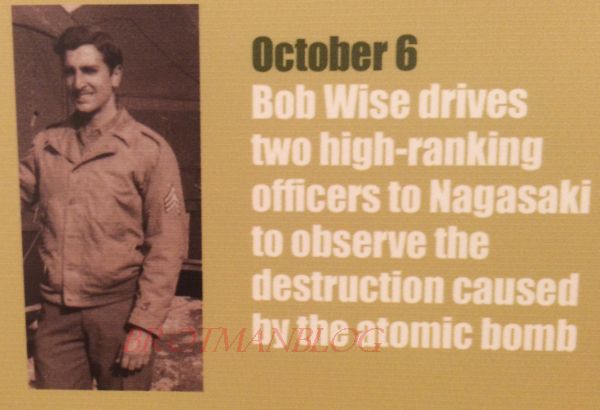
Sally’s father Robert Wise enlisted in the Army on April 19, 1943, and served until February 20, 1946.1 Sally told me that her father was an Army Staff Sergeant Engineer, Aviation Battalion, and was stationed most of his time in the service during World War II in the South Pacific, building an airport and serving in combat.  After the atomic bomb was dropped on Nagasaki in August 1945, Bob drove two generals in his Jeep to see the devastation there and photographed what he saw. He also was at the airport when the Japanese planes landed for the signing of the peace treaty; he climbed over a wall and took pictures of the two planes. Unfortunately, Sally does not have access to those historically important photographs.

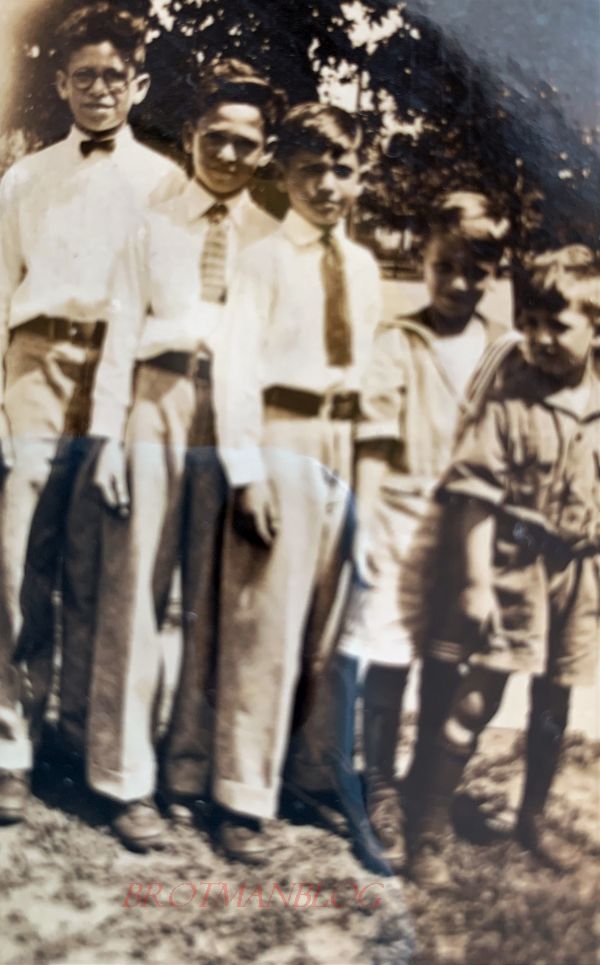
Bob Wise’s army experience was part of an exhibit about local veterans who served in World War II that was curated by the Middletown (Ohio) Historical Society and shown at the Fine Arts Center in Middletown in 2015.  These photographs of Robert were part of that exhibit, as was the one above of the six children of Max and Etta:

Robert Wise as a young boy in Middetown. Courtesy of Sally Wise Myers

Courtesy of Sally Wise Myers

Sally also shared these additional photographs of her father taken during his service in World War II:

Robert Wise. Courtesy of Sally Wise Myers

Robert Wise. Courtesy of Sally Wise Myers

After the war, Robert married Mildred Myers on January 10, 1948, in Ohio. Sally sent me this photograph from their wedding:

Courtesy of Sally Wise Myers

The next few photographs made me sit back with amazement at some of the family resemblances. Here are photographs of my father, his mother Eva Schoenthal Cohen, and his grandfather Isidore Schoenthal and then some of the photographs of Bob Wise and Sally.

Isidore Schoenthal

Eva Schoenthal and John Cohen, Sr. 1923

John Cohen, Jr.

Bob Wise and Sally. Courtesy of Sally Wise Myers

The family of Bob Wise. Courtesy of Sally Wise Myers

Mildred and Bob WIse, 1982. Courtesy of Sally Wise Myers

Look at the eyes. Do you see the resemblances that Sally and I see? Or are we just seeing what we want to see?

Finally, two photographs of Etta Wolfe and Max Wise’s descendants—their children and their grandchildren. What a legacy!

The grandchildren and children of Etta Wolfe Wise. Front Row includes Florence Wise Keuthan. The second row, lefet to right, is Bob Wise, Mary Stephenson Wise (Max, Jr’s wife), and Millie Lunford Wise (Richard’s wife). Last row, left to right, is Mildren Myers Wise (Bob’s wife) , Max Wise Jr.,e Fred Keuthan (husband of Florence Wise, Richard Wise and Irving Wise. Courtesy of Sally Wise Myers (The grandchildren are not named for privacy reasons).

Etta Wolfe Wise and all of her grandchildren. Courtesy of Sally Wise Myers.

Thank you, Sally, for sharing the stories and photographs with me. I am so glad we found each other.


  1. Ancestry.com. U.S., World War II Army Enlistment Records, 1938-1946; SSN: 277015114, Branch 1: AAC, Enlistment Date 1: 26 Apr 1943, Release Date 1: 20 Feb 1946, Ancestry.com. U.S., Department of Veterans Affairs BIRLS Death File, 1850-2010 

An Update on My Dannenberg Cousins

I now have blogged about Seligmann Goldschmidt and Hincka Alexander, my three-times great-grandparents, and all their children, grandchildren, and great-grandchildren. I also have blogged about two of Seligmann’s brothers, Lehmann and Simon, and their families. Seligmann had one other full brother, Meyer, a full sister, Jette, and two half-siblings, Elieser and Jude. I will turn to Meyer next. I have not yet found any primary or even secondary sources for Jette, Elieser and Jude and their families—just the family trees of others—so I may not blog about them. Time will tell. Maybe I will find more to add to those trees.

But before I turn to Meyer Goldschmidt and his family, I have some other things to write about. In the many months that I’ve been working on my Goldschmidt/Goldsmith family, I’ve also been in touch with a number of cousins who have provided me with additional photographs of and documents about other relatives. Being the somewhat-compulsive person that I am, I didn’t want to break the chronology of the Goldschmidt story, so I kept folders and notes for all those new items and decided I’d return to them once I found a place to take a break in the Goldschmidt/Goldsmith story. So the next couple of weeks will be devoted to these new materials. Then I will return to Meyer Goldschmidt.

To start, I want to share some photographs I received back in March and April from my fourth cousin Arlene, who is also a great-great-great-granddaughter of Seligmann Goldschmidt and Hincka Alexander. Arlene is descended from their daughter Sarah Goldschmidt Mansbach, sister of my great-great-grandmother Eva Goldschmidt Katzenstein. (For more background on the individuals named in this post, please follow the links from their names.)

Arlene’s great-grandmother was Hannah Mansbach, who was my great-grandmother Hilda Katzenstein’s first cousin. Hannah married Gerson Dannenberg. I wrote about the Dannenberg family here. Arlene is the granddaughter of Hannah’s son Arthur M. Dannenberg, Sr., and she is the daughter of his son, Arthur M. Dannenberg, Jr.

Arlene shared these images of two wonderful photographs of her great-grandparents Hannah Mansbach and Gerson Dannenberg:

Gerson Dannenberg. Courtesy of Arlene Dannenberg Bowes

Hannah Mansbach Dannenberg. Courtesy of Arlene Dannenberg Bowes

Both are signed at the bottom by Elias Goldensky 39 (which I assume is the year the photographs were taken when Hannah would have been 81 and Gerson 77; Hannah died in 1940, Gerson in 1943). Elias Goldensky was a very well-known professional portrait photographer in Philadelphia whose works were exhibited world-wide and who even photographed Franklin Roosevelt in the White House in 1932.1

I think I even see a slight resemblance between Hannah and my great-grandmother Hilda, her first cousin, especially around the mouth and nose.  What do you think?

Hilda Katzenstein Schoenthal

In addition, Arlene sent me this image of a photograph of a Passover gathering of the extended Dannenberg-Loeb family in 1937. Most of those depicted are not my blood relatives, but are the family of Arthur M. Dannenberg, Sr.’s wife, Marion Loeb. But Arthur M. Dannenberg, Sr,, and his two sons, Arthur M. Dannenberg, Jr., and James Dannenberg, are included in this photograph, as labeled at the bottom. James stands to the far left in the top row, Arthur Jr. to the far right in the top row, and their father, the much-beloved pediatrician whom I wrote about here, Dr. Arthur M. Dannenberg, Sr., is the tall gentleman standing third from the left in the top row.

Passover, 1937. The Dannenberg-Loeb family. Courtesy of Arlene Dannenberg Bowes

Arlene commented on my blog back in March 2019 that her father, Arthur, Jr., had also become a physician and that he had devoted his career to researching tuberculosis, a cause that was important to him because his mother Marion’s first husband, Milton Stein, had died from TB while Milton and Marion were on their honeymoon in 1915, as I wrote about here. In fact, Arthur was not a true “junior” as his middle name was Milton (for Milton Stein), not Mansbach, his father’s middle name.

Arthur M. Dannenberg, Jr. 1965. Photograph by Julian Hart Fisher. Courtesy of Arlene Dannenberg Bowes.

Arthur M. Dannenberg, Jr., died on June 15, 2018. The American Association of Immunologists published a lovely tribute written by Ellen J. Mackenzie, Dean of the Bloomberg School of Public Health at Johns Hopkins University, where Arthur has spent much of his career as a professor and researcher. The entire tribute can be found here. I will post just a few excerpts from Dr. Mackenzie’s tribute to Arthur Milton Dannenberg, Jr.:

Art’s research explored cellular pathways to preventing and treating tuberculosis, and he was passionate about finding new vaccines against the disease. He was affiliated with the Johns Hopkins Vaccine Initiative as well as the Johns Hopkins Center for Tuberculosis Research, which established a student achievement award in his honor.

His work made a lasting contribution to our understanding of a disease that still, despite significant progress in saving lives through diagnosis and treatment, remains one of the top 10 leading causes of death worldwide.

A graduate of Swarthmore College, Art obtained his medical degree from Harvard in 1947. He continued his studies at the University of Pennsylvania, where, in 1952, he received a Ph.D. in microbiology and immunology, followed by a postdoctoral fellowship in experimental pathology.

….

All of us who worked with Art over the years were impressed by his tireless pursuit and devotion to unraveling the mysteries of one of the most important infections plaguing humans throughout history – tuberculosis. We will sorely miss his enthusiasm and devotion to medical research and to educating the next generation of scientists.

My deep gratitude to my cousin Arlene for sharing these photographs and stories with me. It is always wonderful to see the faces of my cousins and learn more about them.


  1. “Elias Goldensky, Photographer, Dies,” The Philadelphia Inquirer, March 11, 1943, p. 11. 

Hannah Goldsmith, Final Chapter: My Cousins the Scientists

This final post about the family of Hannah Goldsmith Benedict is about Hannah’s youngest son, C. Harry Benedict, and his two sons, Manson and William, and their lives after 1940. In an earlier post, we saw how both Manson and William went to Cornell and then on to MIT to get a Ph.D. in chemistry.

In the 1940 census, C. Harry Benedict was enumerated not in his longtime home, Lake Linden, Michigan, but in New York City, where he was, at least at the time of the census enumeration, living at the Waldorf Astoria Hotel. Since his occupation was listed as a metallurgist for a copper mining company and since I know he continued to work at Calumet and Hecla Mining Company for many years after 1940, I assume this was just a temporary residence while doing some work for the company in New York.1

Or perhaps he was just there visiting his sons, both of whom were working as research chemists in the New York City area in 1940, Manson for M.W. Kellogg Company2 and William for General Chemical Company.3

Both Manson and William changed jobs during World War II. In 1942 William moved to Washington, DC, to work for the Carnegie Institution as a theoretical spectroscopist. Spectroscopy is “the study of the interaction between matter and electromagnetic radiation.” After the war William worked for the National Bureau of Standards for six years and then joined the faculty of Johns Hopkins University as part of the “infrared group.” (I’ve no idea what that means.) He remained at Johns Hopkins for fifteen years. In 1967 he became a research professor at the Institute for Physical Science and Technology at the University of Maryland where he remained until his retirement in 1979.4

Meanwhile, his brother Manson left M.W. Kellogg in 1943 to work for Hydrocarbon Research, Inc. According to his obituary, “Dr. Benedict was well known for his pioneering role in nuclear engineering. He developed the gaseous diffusion method for separating the isotopes of uranium and supervised the engineering and process development of the K-25 plant in Oak Ridge, TN, where fissionable material for the atomic bomb was produced. He received many awards for his work on the Manhattan Project during WW II and for his later career as a scientist, educator and public servant, which focused on nuclear power and other peaceful uses of atomic energy.”5

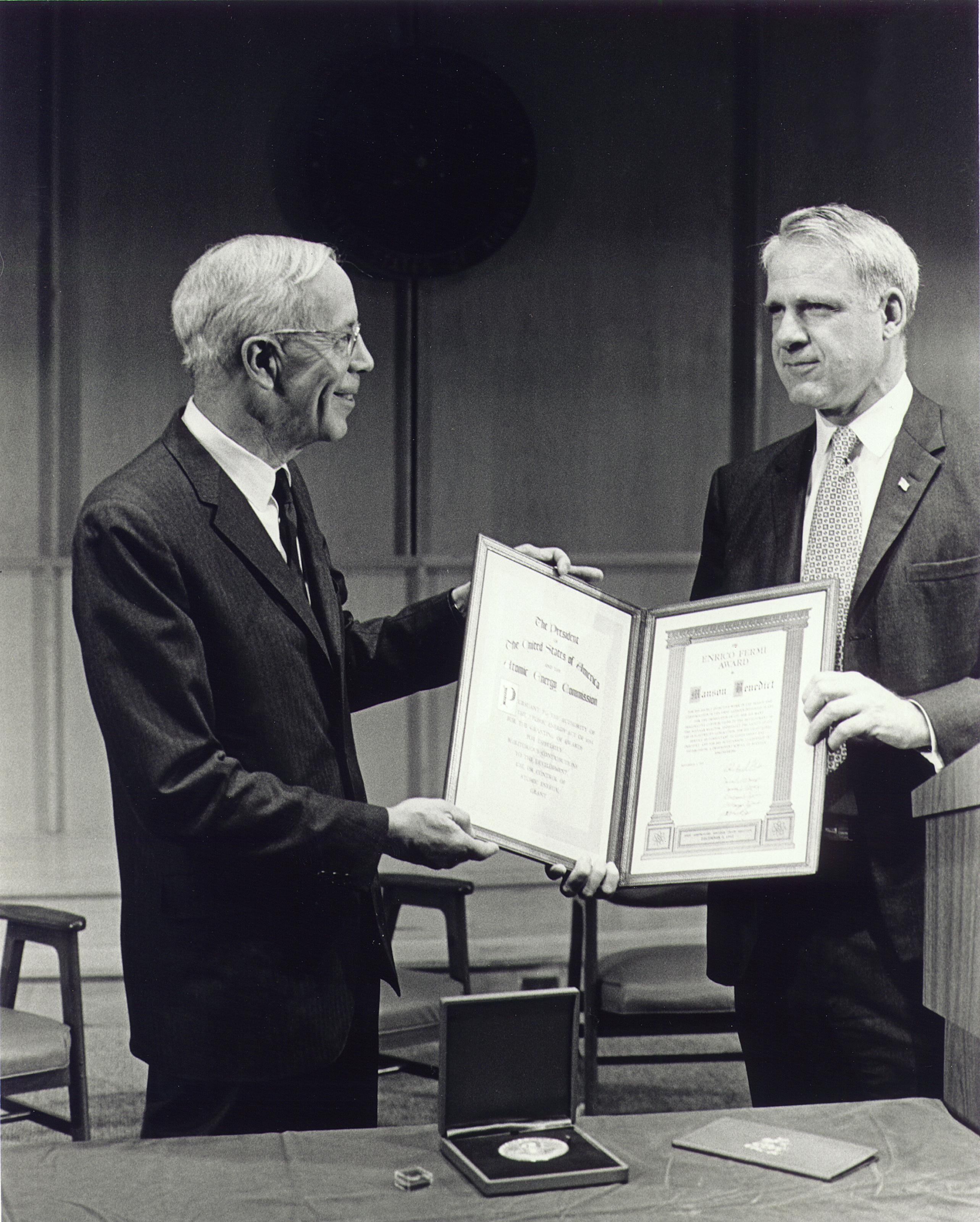
After the war Manson stayed with Hydrocarbon Research until 1951 when he served for a year as the chief of the Operational Analysis Staff at the Atomic Energy Commission. Soon thereafter he returned to Massachusetts and joined the faculty of MIT as a professor of nuclear engineering. In 1972 he received the Enrico Fermi Award, which was described as follows on the Los Alamos website:

The Fermi Award is a Presidential award and is one of the oldest and most prestigious science and technology honors bestowed by the U.S. Government. The Enrico Fermi Award is given to encourage excellence in research in energy science and technology benefiting mankind; to recognize scientists, engineers, and science policymakers who have given unstintingly over their careers to advance energy science and technology; and to inspire people of all ages through the examples of Enrico Fermi, and the Fermi Award laureates who followed in his footsteps, to explore new scientific and technological horizons.

Manson remained at MIT until his retirement in 1973.6

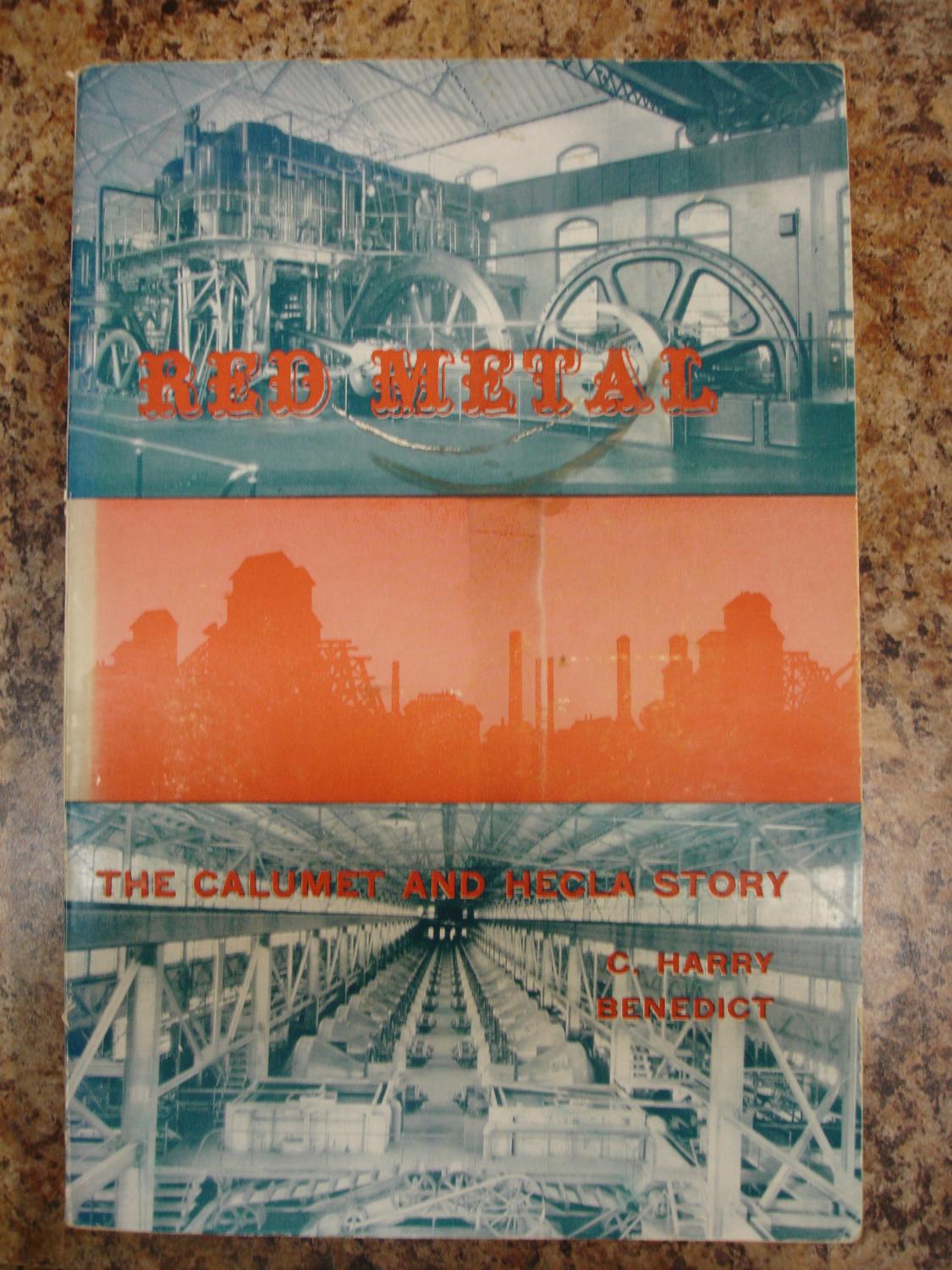
Both Manson and William must have inherited or developed their love for science from their father C. Harry, who, like his sons, had gone to Cornell for his undergraduate training and then had spent his career devoted to science, in his case to metallurgy. Harry even wrote a book about his long-term employer, Calamet and Hecla, entitled Red Metal. It was published in 1952 by the University of Michigan Press.

After fifty years or so in Michigan, Harry and his wife Lena relocated to Brookline, Massachusetts, in 1961, presumably to be closer to their son Manson and his family.7 C. Harry died at the age of 86 in Brookline on April 3, 1963;8 his wife Lena followed just two years later on October 2, 1965.9 She and Harry are buried in Syracuse, New York, where Lena was born and raised and where she and Harry were married in 1902.10 They were survived by their two sons and three grandchildren.

William Benedict died suddenly at the age of seventy on January 10, 1980, in Washington, DC. He had had a serious heart attack a few years earlier.11 His wife Ruth died on October 2, 1993, in Washington. She was eighty years old. They were survived by their son and grandchildren.

Manson Benedict outlived his younger brother and his wife Marjorie. She died in Naples, Florida, on May 17, 1995; she was 85.12 Manson survived her by over ten years. He died on September 18, 2006, at the age of 98.13 Manson and Marjorie were survived by their two daughters and grandchildren and great-grandchildren.

I must admit that I have no real understanding of the work that C. Harry, Manson, and William did in their long and distinguished careers. Science has never been my strong suit, to say the least. But obviously each of these men left their marks on those with and for whom they worked and on the world.

That completes my research and writing about not only the children of Hannah Goldsmith Benedict, but also the entire family of Hannah’s father, Simon Goldschmidt/Goldsmith. Could Simon have ever imagined that after spending time in prison in Oberlistingen, Germany, and immigrating to America to start over in a new country, he would have grandchildren and great-grandchildren who would go to some of the most elite educational institutions in the country and become lawyers, doctors, dentists, teachers, musicians, business leaders, and scientists?  He may have had hopes that his descendants would rise above his own humble beginnings, but I doubt he could ever have imagined just how high above those humble beginnings his American-born descendants would go.

Next—a number of updates on other matters before I turn to Meyer Goldschmidt, another brother of my three-times great-grandfather Seligmann Goldschmidt.


  1. C Harry Benedict, 1940 US census, Census Place: New York, New York, New York; Roll: m-t0627-02657; Page: 84B; Enumeration District: 31-1406,
    Ancestry.com. 1940 United States Federal Census. I don’t know where Harry’s wife Lena was as she was not listed with Harry in New York nor was she enumerated back in Michigan, but I know that she and Harry remained married for the rest of their lives, so perhaps Harry just forgot to tell the enumerator that she was with him in New York. 
  2. Oral History interview of Manson Benedict by James J. Bohning, January 24, 1991, for the Science History Institute, found at https://oh.sciencehistory.org/oral-histories/benedict-manson 
  3. J.-M. Flaud, C. Camy-Peyret, R. A. Toth, Water Vapour Line Parameters from Microwave to Medium Infrared: An Atlas of H216O, H217O and H218O Line Positions and Intensities between 0 and 4350 cm-1, Pergamon, 1981 (dedication). 
  4. J.-M. Flaud, C. Camy-Peyret, R. A. Toth, Water Vapour Line Parameters from Microwave to Medium Infrared: An Atlas of H216O, H217O and H218O Line Positions and Intensities between 0 and 4350 cm-1, Pergamon, 1981 (dedication). 
  5. Naples Daily News, obit for Manson Benedict, GenealogyBank.com (https://www.genealogybank.com/doc/obituaries/obit/1143FE1BF2CFFAF8-1143FE1BF2CFFAF8 : accessed 5 May 2019). For more information about Manson’s work on the Manhattan Project as well as the rest of his life and career, please see the wonderful oral history interview of Manson Benedict by James J. Bohning, January 24, 1991, for the Science History Institute, found at https://oh.sciencehistory.org/oral-histories/benedict-manson 
  6. Oral History interview of Manson Benedict by James J. Bohning, January 24, 1991, for the Science History Institute, found at https://oh.sciencehistory.org/oral-histories/benedict-manson 
  7. “Harry Benedict of C & H Dead,” Ironwood (MI) Daily Globe, 04 Apr 1963, p. 15 
  8. Number: 369-03-5832; Issue State: Michigan; Issue Date: Before 1951, Ancestry.com. U.S., Social Security Death Index, 1935-2014 
  9. Obituary, The (Syracuse, NY) Post-Standard, 04 Oct 1965, p. 23 
  10. https://www.findagrave.com/memorial/107277978 
  11.  Number: 143-01-8383; Issue State: New Jersey; Issue Date: Before 1951, Ancestry.com. U.S., Social Security Death Index, 1935-2014. J.-M. Flaud, C. Camy-Peyret, R. A. Toth, Water Vapour Line Parameters from Microwave to Medium Infrared: An Atlas of H216O, H217O and H218O Line Positions and Intensities between 0 and 4350 cm-1, Pergamon, 1981 (dedication). 
  12. Ancestry.com. Florida Death Index, 1877-1998 
  13. SSN: 122057823, Ancestry.com. U.S., Social Security Applications and Claims Index, 1936-2007. 

Hannah Goldsmith Part IV: Her Granddaughters

We saw in the last post the academic accomplishments of Hannah Goldsmith Benedict’s two grandsons, Manson and William Benedict, the sons of her son C. Harry Benedict. Both had degrees from Cornell and MIT and were working as research chemists for different corporations in the New York City metropolitan area in 1940.

Meanwhile, Hannah’s granddaughters, Helen and Marian Benedict, the daughters of Jacob Benedict, were also growing up between 1920 and 1940. Helen graduated from Schenley High School in 1924 and went on to graduate in 1928 from the Carnegie Institute of Technology (now Carnegie Mellon University) in Pittsburgh, where she studied social work.1 In 1930, she was living in Cleveland, Ohio, working as a “girls’ worker” in a social agency.2

“U.S., School Yearbooks, 1880-2012”; School Name: Schenley High School; Year: 1924
Ancestry.com. U.S., School Yearbooks, 1900-1999

Marian Benedict was a member of the class of 1929 at the University of Pittsburgh, where she was a member of the Women’s Debating Association.3 In 1930 she was living in Pittsburgh with her father Jacob; she was working as a lab technician in a doctor’s office, and Jacob was working as an insurance agent.4

In 1930, Helen Benedict married John Engstrom Booher, the son of Wayne Booher and Dora Engstrom, who was born in Altoona, Pennsylvania on May 28, 1908. Helen and John had two children, one of whom was stillborn,5 before John’s tragic death from carbon monoxide poisoning on August 30, 1936, at the age of 24.6

Helen and her surviving child were living in Pittsburgh with her father Jacob and sister Marian in 1940, and Helen was working as a probation officer in juvenile court. Marian was working at the US Marine Hospital as a lab technician, and Jacob continued to work in the life insurance business.7

As for Hannah Goldsmith Benedict, she continued to live with her youngest son, C. Harry Benedict, in Lake Linden, Michigan. Hannah died there on November 30, 1939, at the age of 91. Every time I look at her death certificate, I am taken aback to see two of my ancestral names—Goldsmith and Schoenthal—and reminded again that Hannah and her brother Henry were my double cousins. Hannah was buried back in Pittsburgh at West View Cemetery with her husband Joseph Benedict.

Hannah Goldsmith Benedict death certificate, Michigan Department of Community Health, Division for Vital Records and Health Statistics; Lansing, Michigan; Death Records
Description: 167: Houghton, 1938-1943, Ancestry.com. Michigan, Death Records, 1867-1952

Herschel Benedict and his wife Mary remained in Pittsburgh between 1920 and 1940. In 1929 Herschel was working as a department manager for Shipley-Massingham Company, a wholesale drug company in Pittsburgh; he continued in that occupation in 1930. Later Pittsburgh directories in the 1930s listed Herschel without any occupation so perhaps he retired shortly after 1930 or lost his job due to the Depression.8

By 1940, Herschel and Mary had moved to Los Angeles, California, where he is listed on the 1940 census again with no occupation.9 But unfortunately, Herschel became embroiled in some controversy in the years after World War II. He was working as the associate deputy administrator of the aircraft and electronics disposal division of the War Assets Administration agency and was forced to resign when he and the deputy administrator of the division admitted that a sales agent of the WAA in Florida had helped them procure new cars for their personal use.10

Herschel Benedict died in Los Angeles on July 31, 1957, at the age of 86.11 His wife Mary had predeceased him. She died in Los Angeles on May 28, 1951, when she was 74.12 Both Herschel and Mary were buried back in Pittsburgh.13 They had no children and thus no descendants.

Jacob Benedict, the oldest son of Hannah and Joseph Benedict, died on January 19, 1953, in Pittsburgh; he was 82 and died from coronary thrombosis and arteriosclerosis. His first cousin Milton Goldsmith, son of Hannah’s brother Henry, was the doctor who signed the death certificate. His daughter Helen was the informant. Jacob was survived by his two daughters and grandchild.

Jacob Benedict death certificate, Pennsylvania Historic and Museum Commission; Harrisburg, Pennsylvania; Pennsylvania (State). Death certificates, 1906–1967; Certificate Number Range: 000001-002250, Ancestry.com. Pennsylvania, Death Certificates, 1906-1967

His daughter Marian only outlived him by twelve years. She was only 56 when she died on March 24, 1965, from bilateral pleural effusion due to reticulum cell sarcoma, a form of cancer. Her death certificate and obituary indicate that Marian was an x-ray technician.14 I wonder whether her illness was due to overexposure to radiation. Marian had never married and has no descendants.

Marian Benedict death certificate, Pennsylvania Historic and Museum Commission; Harrisburg, Pennsylvania; Pennsylvania (State). Death certificates, 1906–1967; Box Number: 2424; Certificate Number Range: 020251-023100, Ancestry.com. Pennsylvania, Death Certificates, 1906-1967

Marian’s sister Helen lived a much longer life.  She was 82 when she died on July 1, 1989, in Pittsburgh. According to one obituary, she died from complications of Crohn’s disease. Helen was survived by her child and grandchildren.15

In my next post, the last one about the family of Hannah Goldsmith Benedict, I will discuss the post-1940 lives of Hannah’s youngest son, C. Harry Benedict, and his two sons, Manson and William.


  1.  “U.S., School Yearbooks, 1880-2012”; School Name: Carnegie Institute of Technology; Year: 1927, Ancestry.com. U.S., School Yearbooks, 1900-1999 
  2. Helen Benedict, 1930 US census, Census Place: Cleveland, Cuyahoga, Ohio; Page: 8B; Enumeration District: 0479; FHL microfilm: 2341512, Ancestry.com. 1930 United States Federal Census 
  3. “U.S., School Yearbooks, 1880-2012”; School Name: University of Pittsburgh; Year: 1928, Ancestry.com. U.S., School Yearbooks, 1900-1999 
  4. Jacob Benedict and daughter, 1930 US census, Census Place: Pittsburgh, Allegheny, Pennsylvania; Page: 8A; Enumeration District: 0233; FHL microfilm: 2341713, Ancestry.com. 1930 United States Federal Census 
  5. The exact date of the marriage is somewhat unclear. A marriage license was taken out in March, 1931. New Castle (PA) News, 16 Mar 1931, p. 7. But Helen’s father Jacob placed an announcement in the The Pittsburgh Sun-Telegraph on April 9, 1931 (p. 26), stating that the marriage had taken place in the fall of 1930. Their first child was born October 1, 1931.  I will leave it to you to make whatever inferences you wish about why Jacob might have wanted to “backdate” the wedding date. The second child was stillborn on June 27, 1934. Certificate Number: 56394, Search for Infant Booher in Pennsylvania Wills & Probates collection, Pennsylvania Historic and Museum Commission; Harrisburg, Pennsylvania; Pennsylvania (State). Death certificates, 1906–1967; Certificate Number Range: 054501-057500, Ancestry.com. Pennsylvania, Death Certificates, 1906-1967 
  6. John E. Booher death certificate, Certificate Number: 74864, Pennsylvania Historic and Museum Commission; Harrisburg, Pennsylvania; Pennsylvania (State). Death certificates, 1906–1967; Certificate Number Range: 072501-075500, Ancestry.com. Pennsylvania, Death Certificates, 1906-1967 
  7. Jacob Benedict and family, 1940 US census, Census Place: Pittsburgh, Allegheny, Pennsylvania; Roll: m-t0627-03663; Page: 2B; Enumeration District: 69-390, Ancestry.com. 1940 United States Federal Census 
  8. Pittsburgh, Pennsylvania, City Directories, 1929-1934, Ancestry.com. U.S. City Directories, 1822-1995. Herschel Benedict, 1930 US census, Census Place: Pittsburgh, Allegheny, Pennsylvania; Page: 12A; Enumeration District: 0231; FHL microfilm: 2341713, Ancestry.com. 1930 United States Federal Census 
  9. Herschel Benedict, 1940 US census, Census Place: Los Angeles, Los Angeles, California; Roll: m-t0627-00401; Page: 15A; Enumeration District: 60-278, Ancestry.com. 1940 United States Federal Census 
  10. “Two WAA Officials Quit after Criticism,” Fresno (CA) Bee Republican, December 17, 1947, p. 15. 
  11. Ancestry.com. California, Death Index, 1940-1997 
  12. Ancestry.com. California, Death Index, 1940-1997 
  13. https://www.findagrave.com/memorial/169508860/herschel-newton-benedict 
  14. Obituary, Pittsburgh Post-Gazette, 26 Mar 1965 – Page Page 19 
  15. SSN: 182329199, Ancestry.com. U.S., Social Security Applications and Claims Index, 1936-2007. Obituaries, Pittsburgh Post-Gazette, 06 Jul 1989, p. 10 

Hannah Goldsmith Part III: Her Grandsons

We saw that as of 1920, Hannah Goldsmith Benedict was a widow, having lost her husband Joseph in 1917. She was living with her son C. Harry Benedict and his wife Lena and two sons, Manson (13) and William (11), in Lake Linden, Michigan. Harry was a metallurgist for a copper mining corporation.

Hannah’s other two sons were living in Pittsburgh, and both had been affected by Prohibition. Herschel, who’d owned a liquor distribution business, was without an occupation at the time of the 1920 census; he was living with his wife, Mary. Jacob, who had worked in the liquor industry in Kentucky and then in Pittsburgh, was now working in the food business, and he was a widower after losing his wife Clara in 1917. In 1920 Jacob was living with his two daughters, Helen (13) and Marian (12).

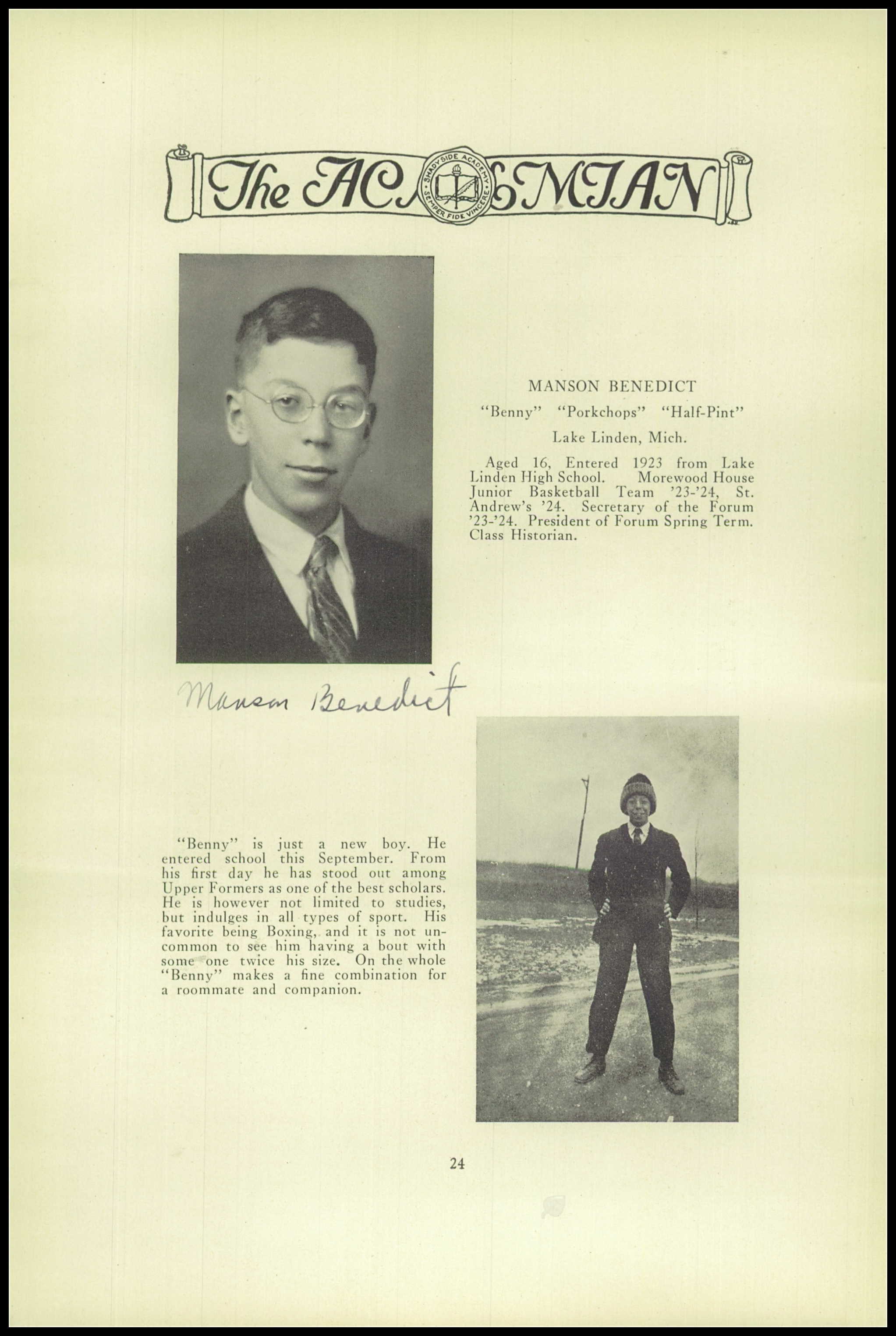
The 1920s saw Hannah’s four grandchildren become young adults and pursue higher education. Her two grandsons, Manson and William, achieved academic success in chemistry. Manson Benedict attended the Shady Side Academy, where the 1924 yearbook included this portrayal of him at sixteen:

Manson Benedict, Shady Side Academy, Pittsburgh, Pennsylvania, “U.S., School Yearbooks, 1880-2012”; Year: 1924,Ancestry.com. U.S., School Yearbooks, 1900-1990

After graduating from Shady Side, Manson attended Cornell University where he was elected to Phi Beta Kappa and graduated with a Bachelor of Science degree in Chemistry in 1928. He was listed a faculty member there the following year.1 In 1930, he was working as a chemist for National Aniline and Chemical Company in Buffalo, New York.2

“U.S., School Yearbooks, 1880-2012”; Yearbook Title: Cornellian; Year: 1928, Ancestry.com. U.S., School Yearbooks, 1900-1990

Meanwhile, his brother William was following a similar path. He also attended Shady Side Academy:

William Benedict, Shady Side Academy, 1925, “U.S., School Yearbooks, 1880-2012”; Year: 1925
Ancestry.com. U.S., School Yearbooks, 1900-1990

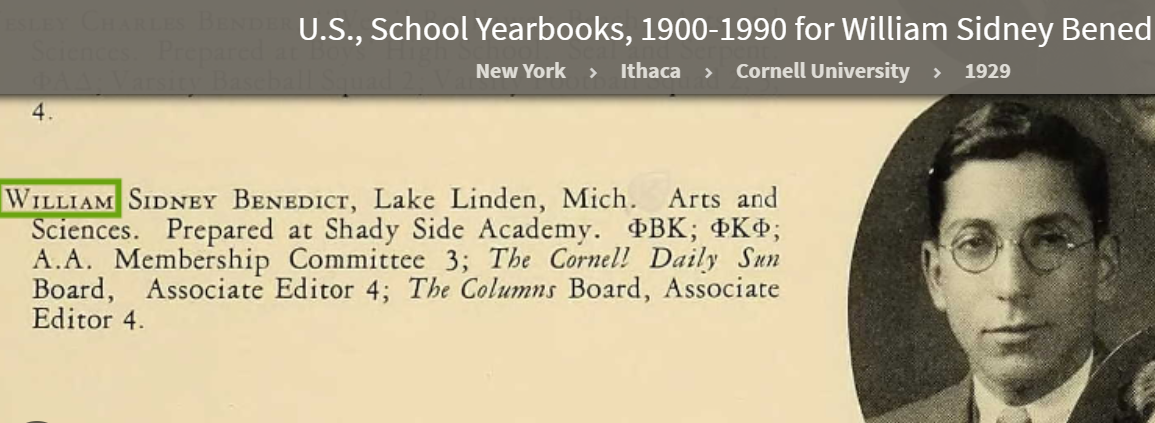
As noted in that yearbook biography, he was planning to attend Cornell like his older brother and their father, and in fact he graduated from Cornell a year after his brother and was also elected to Phi Beta Kappa. And like his brother Manson, William was also a chemist.

“U.S., School Yearbooks, 1880-2012”; Yearbook Title: Cornellian; Year: 1929
Ancestry.com. U.S., School Yearbooks, 1900-1990

In 1930 William was back in Michigan, living with his parents and grandmother Hannah, and had no occupation listed. His father continued to work as a metallurgist.3

Both Manson and William continued their studies in the 1930s at the Massachusetts Institute of Technology, where both received Ph.Ds. William actually received his first—in 1933—and wrote his dissertation on the structure of nitrogen dioxide, a paper that became the basis of a “landmark paper.”4 Manson completed his Ph.D. two years after his younger brother, having spent some time working and then studying philosophy at the University of Chicago. His area of specialization was physical chemistry.5

The brothers then went in different geographic directions. Manson stayed in Cambridge, Massachusetts, where he became a National Research Council Fellow and a research associate in geophysics. While studying at MIT, he met a fellow Ph.D. student, Marjorie Oliver Allen, whom he married in 1935.6 Marjorie, the daughter of Ivan J Allen and Lucy M Oliver, was born in Cincinnati, Ohio, on July 24, 1909.7 She graduated from Mount Holyoke College in 1931 and then, like her husband Manson, received a Ph.D. in physical chemistry from MIT.8 Manson and Marjorie had two children in the 1930s.

Manson’s brother William headed south to Princeton University after completing his doctorate at MIT and became a research fellow there from 1933 until 1935 when he then left academia to become a research chemist at the General Chemical Company in New York.9 He married Ruth Boschwitz on December 24, 1936, in New York City.10 Ruth was born in Berlin, Germany, on July 15, 1913,11 and immigrated to the US on November 24, 1920.12 She and her parents, Carl Boschwitz and Sophie Philipp, settled in New York City, where in 1930, her father was a bank executive.13 Ruth was a student at NYU Medical School when she married William Benedict.14 In 1940, Ruth and William were living with Ruth’s mother in New York City where William continued to work as a chemist in the chemical industry and Ruth was a doctor at a hospital.15 They would have one child born in the 1940s.

Manson Benedict also left academia in the late 1930s. In 1937, he returned to National Aniline and Chemical Company in Buffalo, New York, and worked there as a research chemist until 1938 when he joined the M.W. Kellogg Company in Jersey City, New Jersey, as a research chemist. He remained there for five years.16 Unfortunately, I could not find Manson and Marjorie on the 1940 census despite having their exact address in Radburn, New Jersey.

Manson and William both went on to have distinguished careers in their fields. More on that in a post to come.


  1. “U.S., School Yearbooks, 1880-2012”; Yearbook Title: Cornellian; Year: 1929,
    Ancestry.com. U.S., School Yearbooks, 1900-1990 
  2. Manson Benedict, 1930 US census, Census Place: Buffalo, Erie, New York; Page: 37B; Enumeration District: 0025; FHL microfilm: 2341158, Ancestry.com. 1930 United States Federal Census. Oral History interview of Manson Benedict by James J. Bohning, January 24, 1991, for the Science History Institute, found at https://oh.sciencehistory.org/oral-histories/benedict-manson 
  3. C.Harry Benedict and family, 1930 US census, Census Place: Torch Lake, Houghton, Michigan; Page: 3A; Enumeration District: 0040; FHL microfilm: 2340729, Ancestry.com. 1930 United States Federal Census 
  4. J.-M. Flaud, C. Camy-Peyret, R. A. Toth, Water Vapour Line Parameters from Microwave to Medium Infrared: An Atlas of H216O, H217O and H218O Line Positions and Intensities between 0 and 4350 cm-1, Pergamon, 1981 (dedication). 
  5. Oral History interview of Manson Benedict by James J. Bohning, January 24, 1991, for the Science History Institute, found at https://oh.sciencehistory.org/oral-histories/benedict-manson 
  6. Oral History interview of Manson Benedict by James J. Bohning, January 24, 1991, for the Science History Institute, found at https://oh.sciencehistory.org/oral-histories/benedict-manson 
  7. SSN: 017369908, Ancestry.com. U.S., Social Security Applications and Claims Index, 1936-2007 
  8. Marjorie Allen, 1934 Mt Holyoke College yearbook, “U.S., School Yearbooks, 1880-2012”; Yearbook Title: Llamarada_Yearbook; Year: 1934, Ancestry.com. U.S., School Yearbooks, 1900-1990 
  9. J.-M. Flaud, C. Camy-Peyret, R. A. Toth, Water Vapour Line Parameters from Microwave to Medium Infrared: An Atlas of H216O, H217O and H218O Line Positions and Intensities between 0 and 4350 cm-1, Pergamon, 1981 (dedication). 
  10. License Number: 30940, New York City Municipal Archives; New York, New York; Borough: Manhattan; Volume Number: 13, Ancestry.com. New York, New York, Marriage License Indexes, 1907-2018 
  11. SSN: 578387103, Ancestry.com. U.S., Social Security Applications and Claims Index, 1936-2007 
  12.  Year: 1920; Arrival: New York, New York; Microfilm Serial: T715, 1897-1957; Microfilm Roll: Roll 2879; Line: 4; Page Number: 126, Ancestry.com. New York, Passenger and Crew Lists (including Castle Garden and Ellis Island), 1820-1957 
  13. Carl Boschwitz and family, 1930 US census, Census Place: Manhattan, New York, New York; Page: 29A; Enumeration District: 0542; FHL microfilm: 2341301,
    Ancestry.com. 1930 United States Federal Census 
  14. Ruth Boschwitz, 1936 NYU Medical School yearbook, “U.S., School Yearbooks, 1880-2012”; Yearbook Title: Medical Violet; Year: 1936, Ancestry.com. U.S., School Yearbooks, 1900-1990 
  15. William Benedict, 1940 US census, Census Place: New York, New York, New York; Roll: m-t0627-02655; Page: 61B; Enumeration District: 31-1337, Ancestry.com. 1940 United States Federal Census 
  16. Oral History interview of Manson Benedict by James J. Bohning, January 24, 1991, for the Science History Institute, found at https://oh.sciencehistory.org/oral-histories/benedict-manson 

Hannah Goldsmith Benedict 1900-1920: Gains, Losses, and Laws

As of 1900, Hannah and Joseph Benedict’s three sons were all adults, and Joseph had retired from his rag and paper business. Their two older sons, Jacob and Herschel, were still living with their parents in Pittsburgh, and the youngest son, C. Harry, was living in Michigan and working as an engineer after graduating from Cornell University. Soon all three would be married.

Joseph Benedict, 1900 US census, Census Place: Pittsburgh Ward 11, Allegheny, Pennsylvania; Page: 6; Enumeration District: 0142; FHL microfilm: 1241359
Ancestry.com. 1900 United States Federal Census

Not long after the 1900 census was taken, the middle brother, Herschel, married Mary Ullman on August 7, 1900, in Titusville, Pennsylvania. Mary was born on December 25, 1876, in Titusville to Jacob Ullman and Henrietta Rothschild.1 Jacob was born in the Alsace region of France, and Henrietta in Wurttemberg, Germany. Jacob was in the dry goods business.2

Herschel Benedict and Mary Ullman marriage record, Film Number: 000878594
Ancestry.com. Pennsylvania, Marriages, 1852-1968

A year after Herschel’s marriage, the youngest Benedict brother, C. Harry, was engaged to Lena Manson:

Pittsburgh Daily Post, Pittsburgh, Pennsylvania, 21 Jul 1901, Sun • Page 15

As the article reports, Lena was from Syracuse, New York, where she was born on July 21, 1876.3 Her parents, Lewis and Jennie Manson, were immigrants from Russia-Poland, and her father was in the jewelry business in Syracuse.4 Lena, like Harry, had studied at Cornell, she for two years as a special student of English literature, and in 1897 she was working as a teacher in Syracuse. She also taught for three years at a high school in Erie, Pennsylvania.5

Harry and Lena were married on February 7, 1902, in Syracuse, New York.6

The last of the three sons of Hannah and Joseph to marry was their oldest son, Jacob or Jake. He married Clara R. Kaufman on February 14, 1905, in Pittsburgh. Like Jacob, Clara was a native of Pittsburgh, born on September 13, 1874, to Solomon Kaufman and Helena Marks, who were German immigrants. Clara’s father was a livestock dealer.7

Jacob Benedict and Clara Kaufman marriage record, Pennsylvania Historical and Museum Commission; Harrisburg, Pennsylvania; Pennsylvania County Marriages, 1852-1973; County: Allegheny; Year Range: 1905; Roll Number: 549855, Ancestry.com. Pennsylvania, County Marriage Records, 1845-1963

In 1910, Hannah and Joseph were living with their son, Herschel and his wife Mary. Joseph was retired, and Herschel was in the wholesale liquor business. By 1912, Herschel had formed his own liquor distribution business, Benedict & Eberle, of which he was the president.8

Herschel Benedict and family, 1910 US census, Census Place: Pittsburgh Ward 14, Allegheny, Pennsylvania; Roll: T624_1304; Page: 7A; Enumeration District: 0465; FHL microfilm: 1375317
Ancestry.com. 1910 United States Federal Census

By that time, Hannah and Joseph  had four grandchildren, but all were living quite a distance from Pittsburgh where Hannah and Joseph continued to live. The first was Jacob and Clara’s daughter, Helen, who was born on January 18, 1907, in Paducah, Kentucky,9 where Jacob and Clara had relocated from Pittsburgh sometime in the prior year and where Jacob was working for Dreyfuss Weil, a liquor distributor.10 Jacob and Clara’s second child, Marian, was also born in Paducah; she was born April 14, 1908.11

Meanwhile, Jacob’s brother C. Harry and his wife Lena also had two children during these years. Their first child, Manson, was born on October 9, 1907, in Lake Linden, Michigan,12 with a second son, William, arriving on July 4, 1909, also in Lake Linden. 13 C. Harry continued to work as a metallurgical engineer in Michigan for a company called Calumet & Hecla, a copper mining company.14

Sometime after the 1910 census, Hannah and Joseph must have decided that they did not want to live so far from all their grandchildren because by December 1912, they had left Pittsburgh and were living in Lake Linden, Michigan, where Harry and his family were residing.

Pittsburgh Post-Gazette, 14 Dec 1912, Page 12

Then just two years after Hannah and Joseph left Pittsburgh, their son Jacob returned to Pittsburgh with his family after the company where Jacob worked in Paducah, Kentucky was sold, as reported in the February 4, 1914, edition of the Paducah Sun-Democrat (p. 5):

“Jacob Benedict Leaves for His New Home,” The Paducah Sun-Democrat, 04 Feb 1914, Page 5

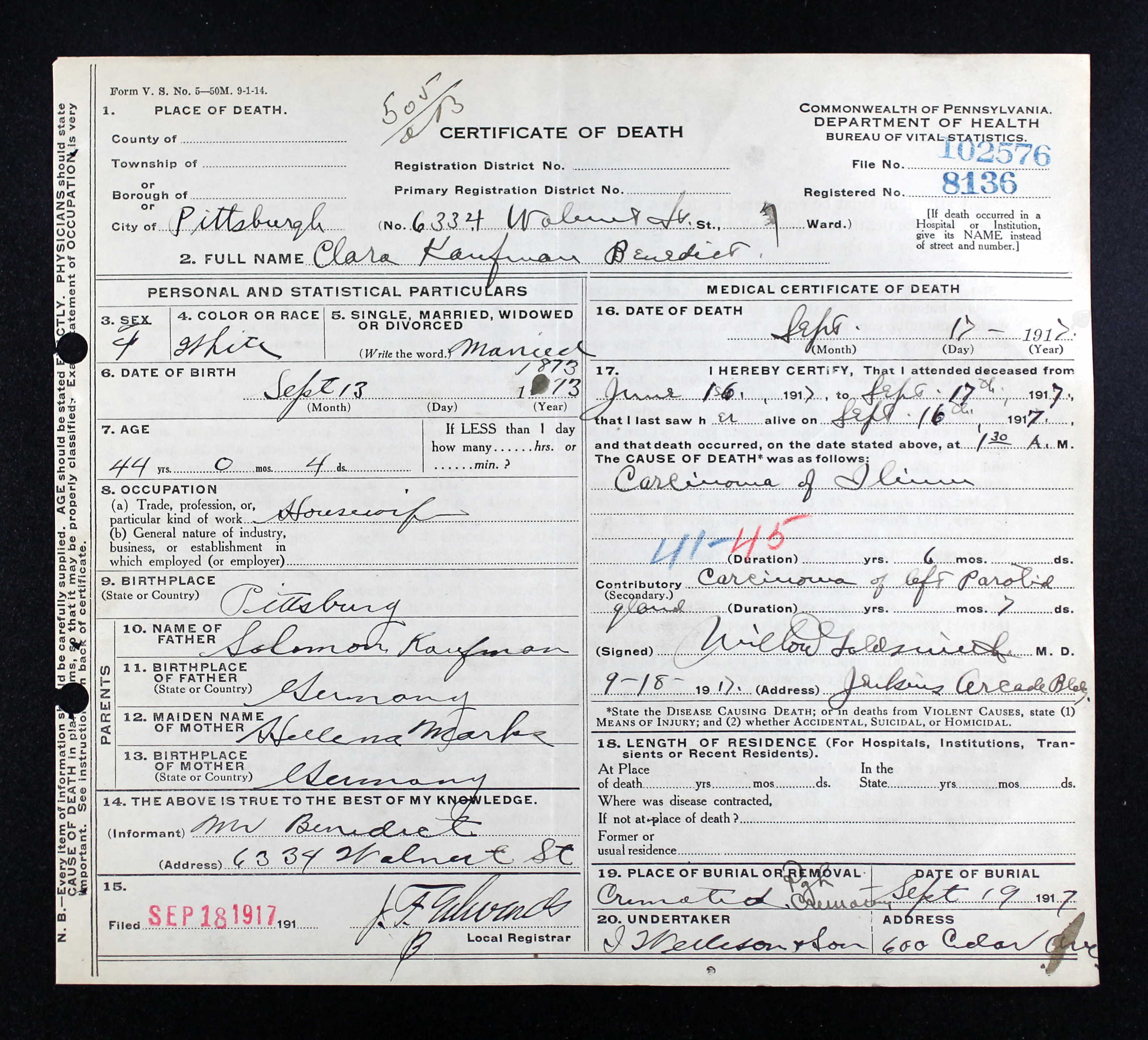
Sadly, just three years after their move to Pittsburgh, Jacob suffered a terrible loss when his wife Clara died on September 17, 1917, from left parotid gland cancer. She had turned 43 just three days earlier, and she left behind her two young daughters, Helen (10) and Marian (9), as well as her husband Jacob.

Pennsylvania Historic and Museum Commission; Harrisburg, Pennsylvania; Pennsylvania (State). Death certificates, 1906–1967; Certificate Number Range: 101201-104500
Ancestry.com. Pennsylvania, Death Certificates, 1906-1967

The family was soon dealt another blow when Joseph Benedict died on December 23, 1917, at Harry’s home in Lake Linden, Michigan. Joseph was 83 and died from fibroid myocarditis. He was buried back in Pittsburgh, his long-time home.

Michigan Department of Community Health, Division for Vital Records and Health Statistics; Lansing, Michigan; Death Records
Ancestry.com. Michigan, Death Records, 1867-1952

Hannah remained in Lake Linden, Michigan, and was living with her son Harry and his family in 1920, where Harry continued to work for Calumet & Hecla as a metallurgical engineer.15

Hannah’s other two sons were living in Pittsburgh in 1920. Jacob was living with his daughters as well as a live-in caretaker for the children; he was employed as a salesman for a food company, though just two years earlier he’d been working for a bottling company.16 Herschel was living with his wife Mary as well as a servant, and he had no employment listed on the 1920 census record.17

At first I was puzzled by the changes in both Jacob’s and Herschel’s occupations, but then the lightbulb went on.

Both Jacob and Herschel had been in the liquor business. By 1920, liquor sales were prohibited throughout the US after the ratification of the Eighteenth Amendment on January 29, 1919. In fact, liquor sales had been under severe restrictions even earlier, as discussed on this website:

In 1917, after the United States entered World War I, President Woodrow Wilson instituted a temporary wartime prohibition in order to save grain for producing food. That same year, Congress submitted the 18th Amendment, which banned the manufacture, transportation and sale of intoxicating liquors, for state ratification. Though Congress had stipulated a seven-year time limit for the process, the amendment received the support of the necessary three-quarters of U.S. states in just 11 months. Ratified on January 29, 1919, the 18th Amendment went into effect a year later, by which time no fewer than 33 states had already enacted their own prohibition legislation.

The_Pittsburgh_Press, January 16, 1919, p. 1

So Herschel was forced out of business and Jacob had to change industries as a result of Prohibition. That must have been a difficult transition for both of them.

The first two decades of the 20th century were thus exciting and challenging ones for Hannah and her family. There were marriages and children but also deaths as well as the business challenges created by Prohibition.


  1. Film Number: 000878594, Ancestry.com. Pennsylvania, Marriages, 1852-1968; Year: 1928; Arrival: New York, New York; Microfilm Serial: T715, 1897-1957; Microfilm Roll: Roll 4263; Line: 13; Page Number: 29, Ancestry.com. New York, Passenger and Crew Lists (including Castle Garden and Ellis Island), 1820-1957; Jacob Ullman and family, 1880 US census, Census Place: Titusville, Crawford, Pennsylvania; Roll: 1121; Page: 220D; Enumeration District: 122, Ancestry.com and The Church of Jesus Christ of Latter-day Saints. 1880 United States Federal Census; Marriage Registers, Extracts from Manhattan (1869-1880) and Brooklyn (1895-1897), Publisher: Dept. of Health, Division of Vital Statistics, New York, Ancestry.com. New York City, Compiled Marriage Index, 1600s-1800s. 
  2. Flora Ullman death certificate, Pennsylvania Historic and Museum Commission; Harrisburg, Pennsylvania; Pennsylvania (State). Death certificates, 1906–1967; Certificate Number Range: 103201-105750, Ancestry.com. Pennsylvania, Death Certificates, 1906-1967. Jacob Ullman and family, 1880 US census, Census Place: Titusville, Crawford, Pennsylvania; Roll: 1121; Page: 220D; Enumeration District: 122, Ancestry.com and The Church of Jesus Christ of Latter-day Saints. 1880 United States Federal Census. 
  3.  The National Archives at Washington, D.C.; Washington, D.C.; Series Title: U.S. Citizen Passenger Lists of Vessels Arriving at Miami, Florida; NAI Number: 2774842; Record Group Title: Records of the Immigration and Naturalization Service, 1787-2004; Record Group Number: 85, Ancestry.com. Florida, Passenger Lists, 1898-1963 
  4. Lewis Manson and family, 1880 US census, Census Place: Syracuse, Onondaga, New York; Roll: 908; Page: 439A; Enumeration District: 219, Ancestry.com and The Church of Jesus Christ of Latter-day Saints. 1880 United States Federal Census 
  5.  “U.S., School Yearbooks, 1880-2012”; Yearbook Title: Cornellian; Year: 1902,
    Ancestry.com. U.S., School Yearbooks, 1900-1990. Lena Manson Benedict obituary,
    The Post-Standard, Syracuse, New York, 04 Oct 1965, Page 23. 
  6.  New York State Department of Health; Albany, NY, USA; New York State Marriage Index, Ancestry.com. New York State, Marriage Index, 1881-1967 
  7. Clara Kaufman Benedict death certificate, Pennsylvania Historic and Museum Commission; Harrisburg, Pennsylvania; Pennsylvania (State). Death certificates, 1906–1967; Certificate Number Range: 101201-104500, Ancestry.com. Pennsylvania, Death Certificates, 1906-1967. Solomon Kaufman and family, 1880 US census, Census Place: Allegheny, Allegheny, Pennsylvania; Roll: 1086; Page: 158A; Enumeration District: 006,
    Ancestry.com and The Church of Jesus Christ of Latter-day Saints. 1880 United States Federal Census 
  8.  Pittsburgh, Pennsylvania, City Directory, 1912, Ancestry.com. U.S. City Directories, 1822-1995 
  9.  Year: 1927; Arrival: New York, New York; Microfilm Serial: T715, 1897-1957; Microfilm Roll: Roll 4101; Line: 1; Page Number: 187, Ancestry.com. New York, Passenger and Crew Lists (including Castle Garden and Ellis Island), 1820-1957; SSN: 182329199, Ancestry.com. U.S., Social Security Applications and Claims Index, 1936-2007 
  10. Paducah, Kentucky, City Directory, 1906, Ancestry.com. U.S. City Directories, 1822-1995 
  11. Marian Benedict death certificate, Pennsylvania Historic and Museum Commission; Harrisburg, Pennsylvania; Pennsylvania (State). Death certificates, 1906–1967; Box Number: 2424; Certificate Number Range: 020251-023100, Ancestry.com. Pennsylvania, Death Certificates, 1906-1967; Year: 1927; Arrival: New York, New York; Microfilm Serial: T715, 1897-1957; Microfilm Roll: Roll 4101; Line: 1; Page Number: 187, Ancestry.com. New York, Passenger and Crew Lists (including Castle Garden and Ellis Island), 1820-1957 
  12. “Michigan, County Births, 1867-1917,” database with images, FamilySearch (https://familysearch.org/ark:/61903/3:1:33SQ-GBZD-ZS1?cc=1923472&wc=4VWM-MT6%3A218907401%2C219048301 : 8 June 2018), Houghton > Births 1906-1908 > image 229 of 493; various county courts, Michigan. 
  13. “Michigan, County Births, 1867-1917,” database with images, FamilySearch (https://familysearch.org/ark:/61903/3:1:33S7-LBZC-55L?cc=1923472&wc=4VWM-MT1%3A218907401%2C219072901 : 7 September 2018), Houghton > Births 1908-1910 > image 169 of 438; various county courts, Michigan. 
  14. C Harry Benedict and family, 1910 US census, Census Place: Torch Lake, Houghton, Michigan; Roll: T624_647;Page: 16B; Enumeration District: 0135;FHL microfilm: 1374660, Ancestry.com. 1910 United States Federal Census. Title: Calumet, Michigan, City Directory, 1912, Ancestry.com. U.S. City Directories, 1822-1995 
  15. C. Harry Benedict, 1920 US census, Census Place: Torch Lake, Houghton, Michigan; Roll: T625_769; Page: 12A; Enumeration District: 173, Ancestry.com. 1920 United States Federal Census.  I found it interesting that Hannah chose to stay in Michigan rather than return to Pittsburgh. Joseph was buried there, and two of her sons, Jacob and Herschel, were living there, and Jacob must have needed extra help with his daughters. But Hannah must have been very happy where she was living in Michigan and thus stayed put rather than going back to Pittsburgh. She remained in Lake Linden, Michigan, for the rest of her life. 
  16. Jacob Benedict, 1920 US census, Census Place: Pittsburgh Ward 14, Allegheny, Pennsylvania; Roll: T625_1522; Page: 12B; Enumeration District: 550,
    Ancestry.com. 1920 United States Federal Census 
  17. Herschel Benedict, 1920 US census, Census Place: Pittsburgh Ward 14, Allegheny, Pennsylvania; Roll: T625_1522; Page: 9B; Enumeration District: 546, Ancestry.com. 1920 United States Federal Census 

Hannah Goldsmith Benedict, 1848-1900: Litigation and Fires Beleaguer The Family

The youngest of Simon Goldsmith’s children was his daughter Hannah; she was born to Simon’s second wife, Fradchen Schoenthal, my three-times great-aunt, making Hannah, like her brother Henry, my double cousin. Hannah was born in Baltimore, Maryland, on June 5, 1848. Since I have not written about Hannah in quite a while, let me recap what I’ve already written about her.

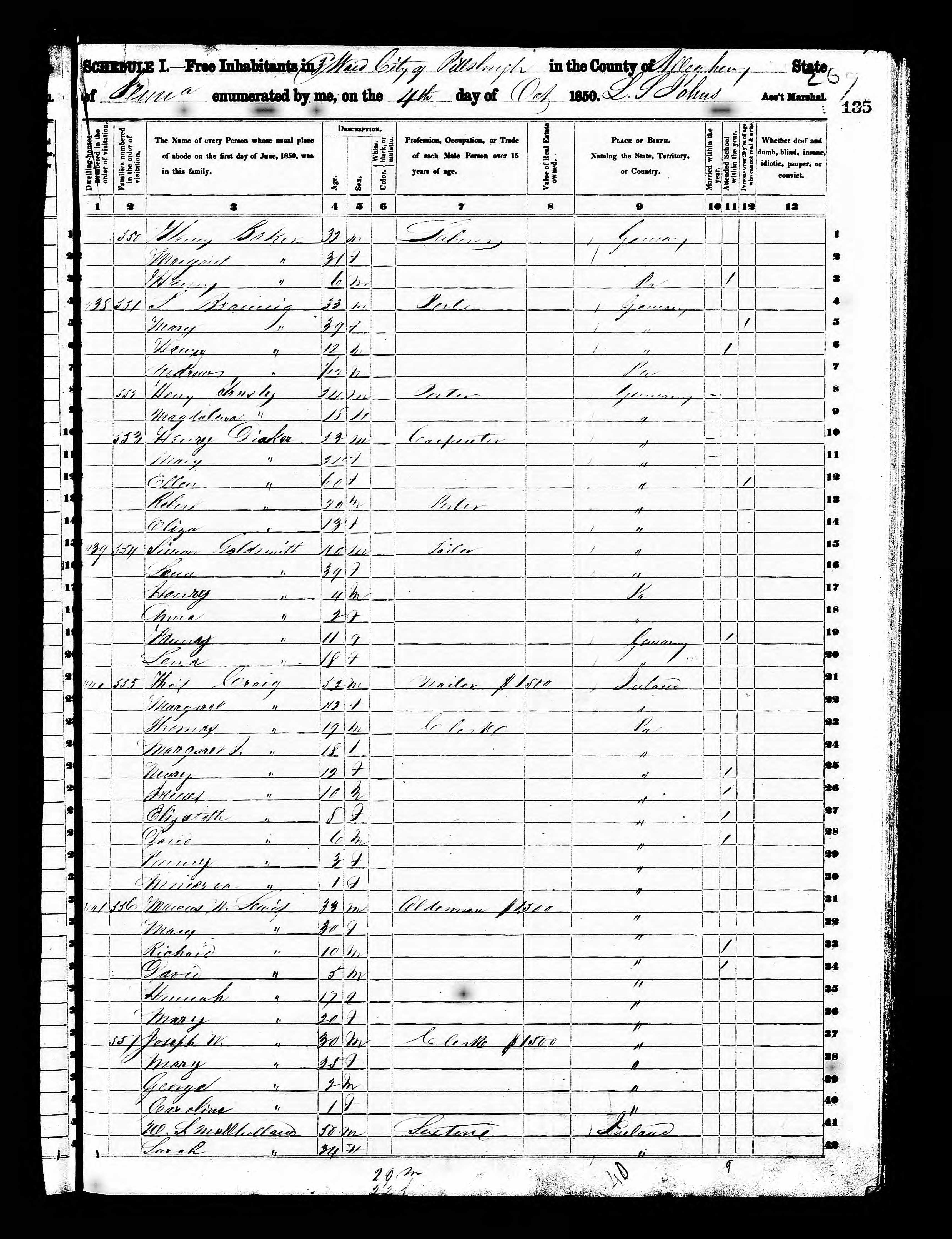
In 1850, Simon and Fradchen were living in Pittsburgh with Henry and Hannah as well Simon’s two daughters from his first marriage, Lena and Eva. Fradchen died later that year, leaving Hannah motherless when she was just two years old.

Simon Goldsmith and family, 1850 US census, Census Place: Pittsburgh Ward 3, Allegheny, Pennsylvania; Roll: M432_745; Page: 135A; Image: 274 Source Information Ancestry.com. 1850 United States Federal Census

Simon then moved to Washington, Pennsylvania, to live with his oldest child Jacob, presumably so that he would have support to raise his two youngest children.

Simon Goldsmith and family 1860 US census, Census Place: Washington, Washington, Pennsylvania; Roll: M653_1192; Page: 1188; Image: 627; Family History Library Film: 805192

In 1867, Hannah married Joseph Benedict. She was only nineteen, and he was 33. Joseph was born July 3, 1834, in Germany and had immigrated in 1857, according to the 1900 census. Hannah and Joseph settled in Pittsburgh after marrying. The 1870 Pittsburgh directory lists Joseph as a junk dealer. By the time the 1870 census was enumerated Joseph and Hannah had a five-month-old son named Jacob, born January 24, 1870, in Pittsburgh. Also living with them in 1870 were Hannah’s father, Simon Goldsmith, now a retired tailor, and Amelia Schoenthal, who was Hannah’s first cousin, her mother Fradchen’s niece and the older sister of my great-grandfather Isidore Schoenthal.

Joseph and Hannah Benedict, 1870 US census, ensus Place: Pittsburgh Ward 5, Allegheny, Pennsylvania; Roll: M593_1295; Page: 567A; Family History Library Film: 552794
Ancestry.com. 1870 United States Federal Census

On June 6, 1871, Hannah gave birth to a second child, Herschel Newton Benedict, in Pittsburgh. Five years later, Hannah gave birth to her third son, Centennial Harry Benedict, born on September 24, 1876, in Pittsburgh (named for the 100th anniversary of the Declaration of Independence).1 Hannah and her husband Joseph Benedict continued to live in Pittsburgh where Joseph is listed on the 1880 census as a rag dealer.

Joseph and Hannah Benedict and family, 1880 US census, Census Place: Pittsburgh, Allegheny, Pennsylvania; Roll: 1092; Page: 508D; Enumeration District: 122,  Ancestry.com and The Church of Jesus Christ of Latter-day Saints. 1880 United States Federal Census

Unfortunately, the 1880s presented some difficult issues for Joseph Benedict and thus his family. In 1882 he became embroiled in litigation against the Antietam Paper Company. Joseph sold this company $813.03 worth of rags for which they had refused to pay, alleging that the rags were infected with the smallpox virus. The company argued that as a result of the infected rags, many people both in the paper company’s employ and in the surrounding area became ill and even died, causing the company to shut down its operations. The lower court rejected the paper company’s defense, and judgment in favor of Joseph was upheld on appeal.

Pittsburgh Post-Gazette, 5 Sep 1882, Tue, Page 1

[To my former Contracts students—why do you think Joseph won this case?]

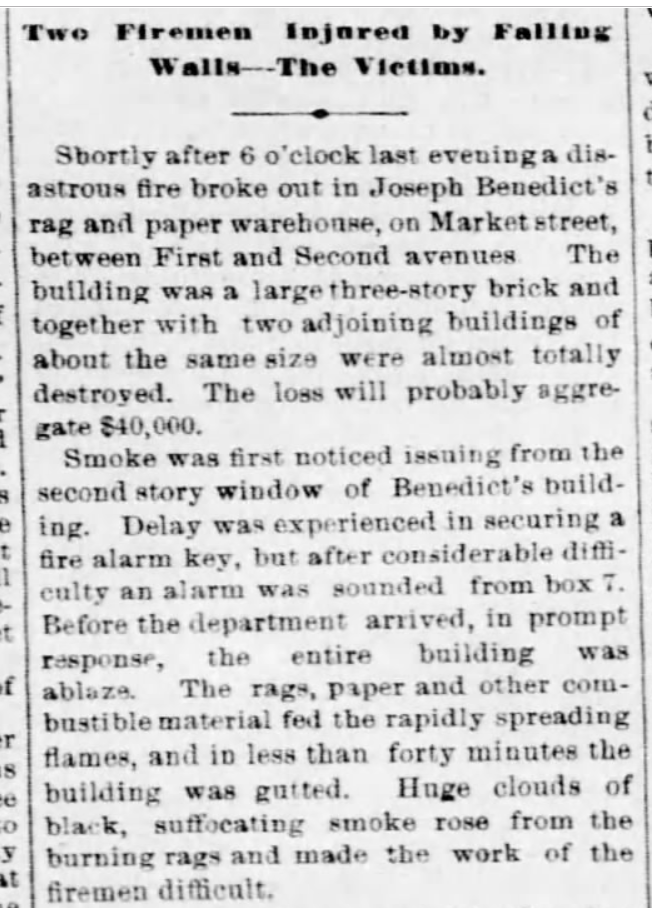
Just two years later in September 1884, the warehouse where Joseph’s rag and paper business was located was severely damaged by fire. Not only was there serious property damage, two firefighters were injured while trying to control the fire. The newspaper reports differed on their coverage of the fire. The Pittsburgh Daily Post wrote:

Pittsburgh Daily Post, 10 Sep 1884, Page 4

According to this article, the owners of the building were fully insured for the $5000 loss, though the aggregate loss (including the property of the tenants) was more like $40,000.

But an article from the same date published by The Pittsburgh Post-Gazette had a very different report on the insurance coverage for damages:

“Rags and Tea,” Pittsburgh Post-Gazette,
10 Sep 1884, Page 2

So did the owners have insurance or not? Which paper had a more accurate report of the facts?

Joseph’s loss was partially covered by insurance, at least according to the Pittsburgh Post-Gazette, but he nevertheless suffered a very significant loss. The Post-Gazette account noted that the fire was presumed to have started by spontaneous combustion of Joseph’s rags.

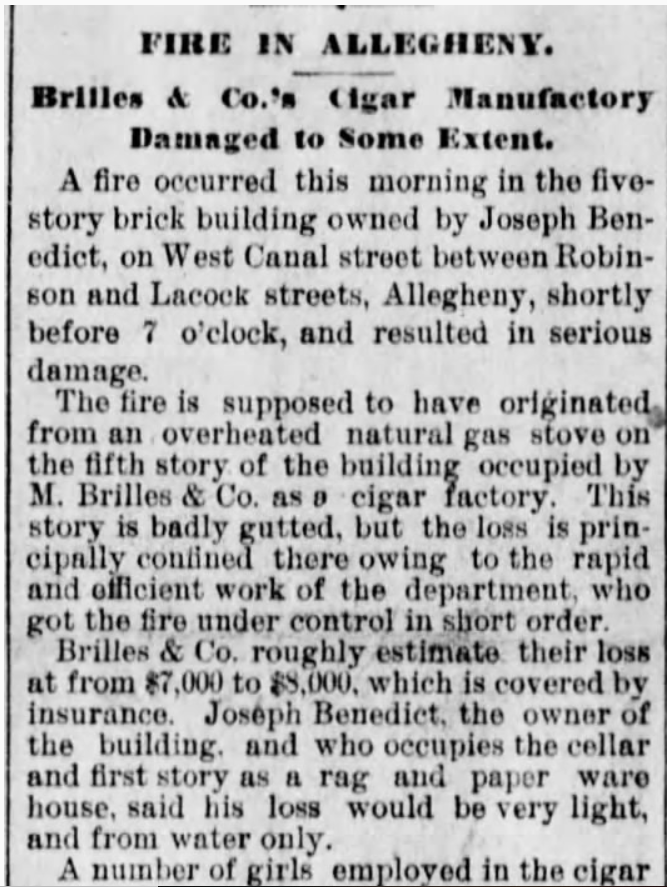
That was not the last time Joseph’s business was damaged by fire. In 1892, Joseph was now the owner of the building that housed his rag and paper business. A fire started when a gas stove overheated in the space in his building that was being used by a cigar business. Joseph’s business suffered only minor damage, according to the paper, because the fire did not reach the cellar where his business was located and thus only suffered water damage. The paper noted, however, that this was the third fire at this building within eighteen months.

“Fire in Allegheny,” The Pittsburgh Press – 23 Nov 1892 – Page 1

But Joseph was still operating his paper business at that location in 1894.2

Meanwhile, Hannah and Joseph’s sons were growing up in these years. In 1889, Jacob, the oldest son who was then nineteen, was working as a bookkeeper. The following year both Jacob and his brother Herschel were listed as bookkeepers in the Pittsburgh directory. Both were still listed as bookkeepers in 1898.3

At that time the youngest brother, C. Harry Benedict, was a student at Cornell University.

U.S., School Yearbooks, 1880-2012; Yearbook Title: Cornell Class Book; Year: 1897
Ancestry.com. U.S., School Yearbooks, 1900-1990

In 1900, Hannah and Joseph and their two older sons were living in Pittsburgh, where Joseph, now 65, was retired, Jacob was working as a bookkeeper, and Herschel was a salesman.

Joseph Benedict, 1900 US census, Census Place: Pittsburgh Ward 11, Allegheny, Pennsylvania; Page: 6; Enumeration District: 0142; FHL microfilm: 1241359
Ancestry.com. 1900 United States Federal Census

C. Harry was living in Lake Linden, Michigan in 1900, working as a mechanical engineer, according to the census record. But “chemical” was crossed out, and later records indicate that Harry was a metallurgical engineer, so I think either the enumerator or the person reporting to the enumerator was confused.

C Harry Benedict, 1900 US census, Census Place: Schoolcraft, Houghton, Michigan; Page: 19; Enumeration District: 0196; FHL microfilm: 1240715, Ancestry.com. 1900 United States Federal Census

Thus, by 1900, all three of Hannah and Joseph Benedict’s sons were adults, and their father had retired from his fire-prone business.  Soon there would be weddings and grandchildren.

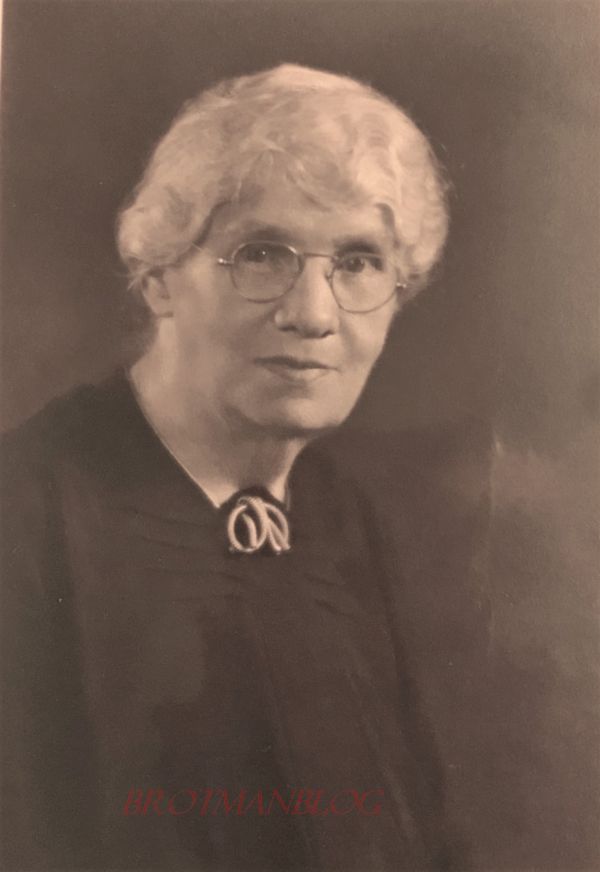
UPDATE: Thank you to the great-great-grandson of Hannah and Joseph Benedict, I now have these photographs of Hannah, Joseph, and their three sons, taken in about 1890.


  1. J.-M. Flaud, C. Camy-Peyret, R. A. Toth, Water Vapour Line Parameters from Microwave to Medium Infrared: An Atlas of H216O, H217O and H218O Line Positions and Intensities between 0 and 4350 cm-1, Pergamon, 1981 (dedication). 
  2. Pittsburgh, Pennsylvania, City Directory, 1894, Ancestry.com. U.S. City Directories, 1822-1995 
  3. Pittsburgh, Pennsylvania, City Directory, 1889, 1890, 1898, Ancestry.com. U.S. City Directories, 1822-1995