Unknown's avatar

About Amy

I am interested in genealogy and family research, books, movies, cats, dogs, and baseball.

Over Sixty Killed in Train Wreck in 1903, including My Cousin Edison Goldsmith

In 1900, Henry Goldsmith and his wife Sarah Jaffa were living with eight of their nine surviving children in Connellsville, Pennsylvania, where Henry was in the insurance business.  Their oldest child, JW, was already married and working as a merchant in Connellsville. Two of their sons were professionals: Milton was a doctor and Samuel was in law school. Henry and Sarah had lost one child, Albert, as a young boy, in 1891, but otherwise life must have seemed very good.

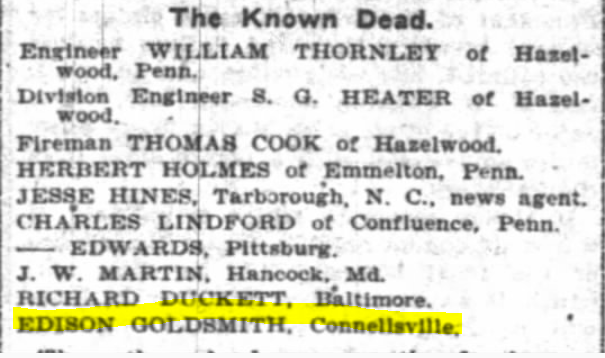
Then on December 23, 1903, their son Edison Goldsmith, just 23 years old, was one of over sixty people killed in a horrendous train accident.
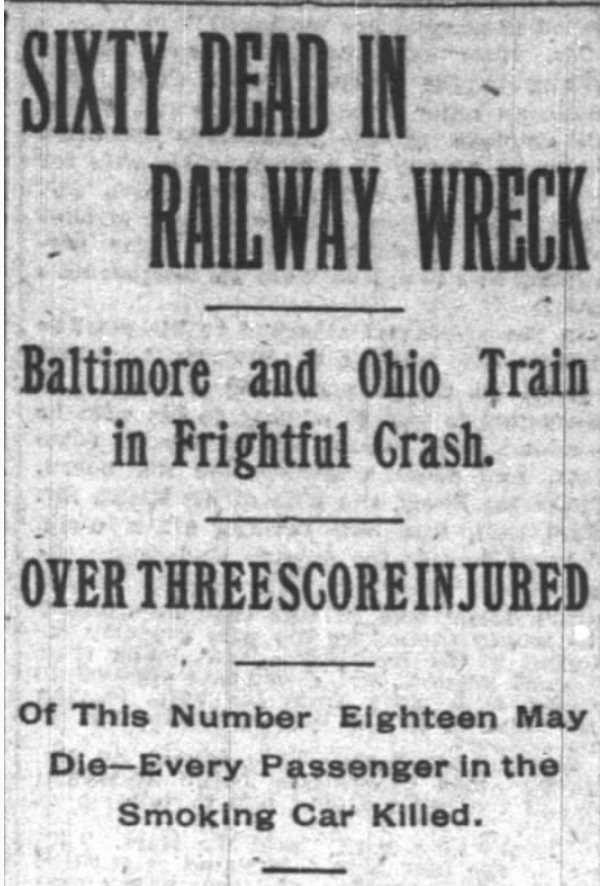
“Sixty Dead in Railway Wreck,” The New York Times, December 24, 1903, p. 1

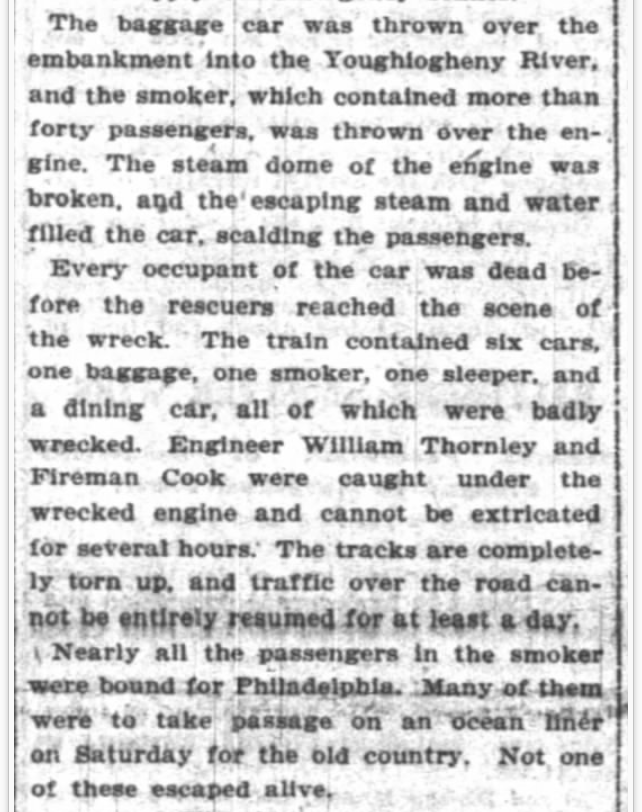
One of the worst wrecks in the history of the Baltimore and Ohio Railroad occurred at 7:45 o’clock to-night at Laurel Run, eight miles west of Connellsville, on the Pittsburg Division of the Baltimore and Ohio.  The “Duquesne Limited,” the fastest train on the road, was wrecked, killing sixty-outright, fatally injuring eighteen, and slightly injuring more than fifty.

The wreck was caused by the breaking of the castings on a carload of bridge timbers on a freight train that passed Laurel Run not more than fifteen minutes before the arrival of the limited. The freight proceeded without noticing the accident, and the express train, running at a speed of more than sixty miles an hour, crashed into the timbers before the engineer even had time to apply the emergency brakes.

The baggage car was thrown over the embankment into the Youghiogheny River, and the smoker, which contained more than forty passengers, was thrown over the engine. The steam dome of the engine was broken, and the escaping steam and water filled the car, scalding the passengers.

Every occupant of the car was dead before the rescuers reached the scene of the wreck. The train contained six cars, one baggage, one smoker, one sleeper, and a dining car, all of which were badly wrecked. Engineer William Thornley and Fireman Cook were caught under the wrecked engine and cannot be extricated for several hours.  The tracks are completely torn up, and traffic over the road cannot be entirely resumed for at least a day.

Nearly all the passengers in the smoker were bound for Philadelphia. Many of them were to take passage on an ocean liner on Saturday for the old country. Not one of these escaped alive.

[Lists of the known dead and injured followed the text of the article, with Edison Goldsmith being among those listed as dead.]

Edison’s funeral was held on December 25, 1903. The newspaper described him as “a popular young man” and said that “an immense concourse attended the services.”1

Edison’s parents, Henry and Sarah, sued the railroad for $20,000 for negligently causing the death of their son. A jury awarded them $3,345, after being instructed by the judge that they should put a reasonable limit on the award. The judge told the jury, “The young man might or might not come up to the expectations of his parents had he not been killed. That should be determined by you in fixing a value on his life.” The news article also noted that an appeal would probably be taken from the verdict, but I could not find any reports of further legal proceedings.2

Losing another son must have broken Henry and Sarah’s hearts. In Sarah’s case, perhaps in a more literal way. She died of heart failure on October 25, 1907, just six days after her 56th birthday.
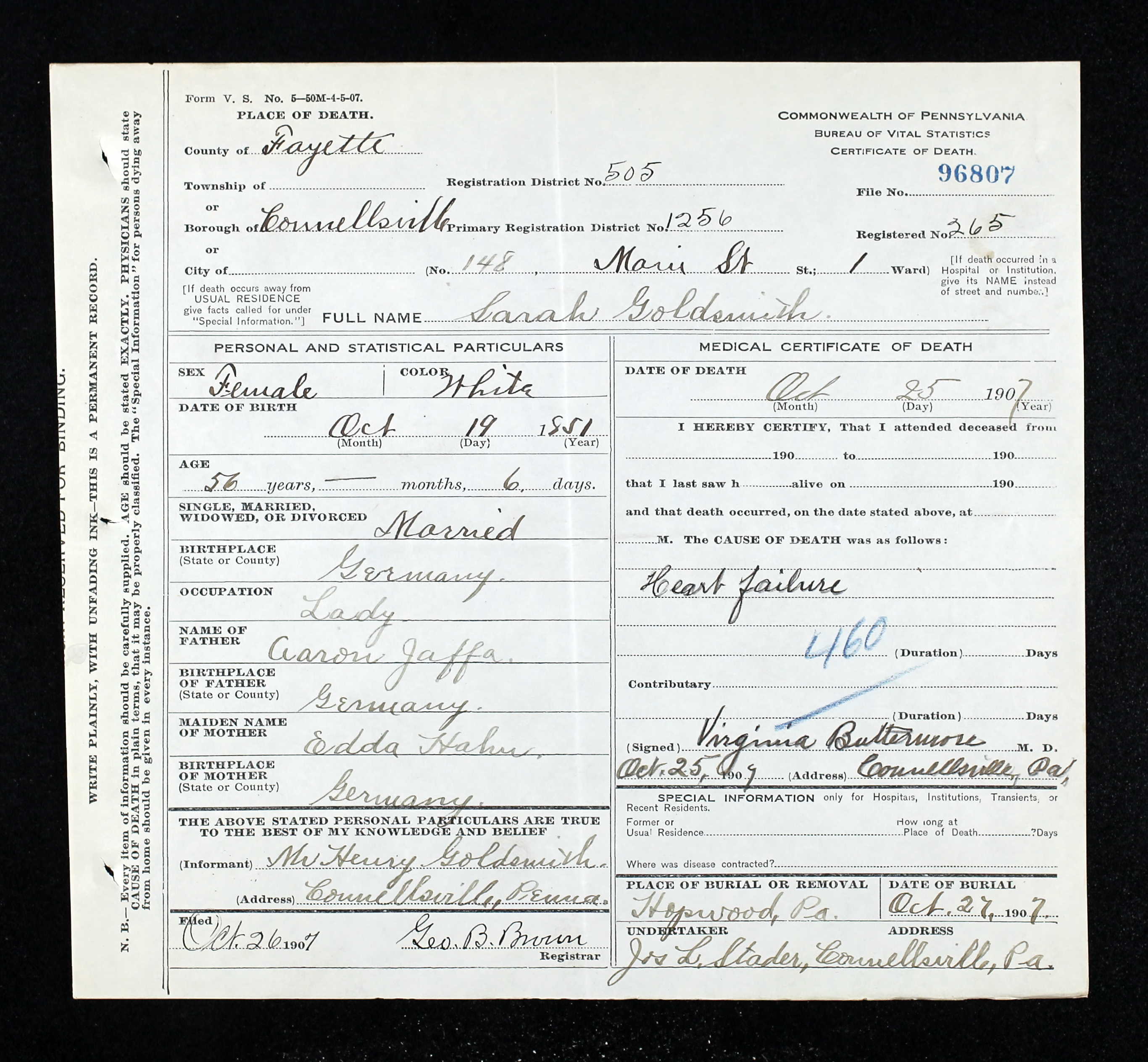
Sarah Jaffa Goldsmith death certificate, Pennsylvania Historic and Museum Commission; Pennsylvania, USA; Pennsylvania, Death Certificates, 1906-1965; Certificate Number Range: 093741-097660, Ancestry.com. Pennsylvania, Death Certificates, 1906-1966

But fortunately, there was also some good news for Henry and his eight surviving children in the first decade of the 20th century. More on that in my next post.


  1. “Railroad to Aid City in Giving All A Burial,” The Rochester (NY) Democrat & Chronicle, December 26, 1903, p. 1. 
  2. “Verdict of $3,345 In Goldsmith Case,” The Connellsville (PA) Weekly Courier, November 30, 1905, p, 5. 

Milton Goldsmith’s Family Album, Part XI: Tributes to His Father Abraham

This is Part X of an ongoing series of posts based on the family album of Milton Goldsmith, so generously shared with me by his granddaughter Sue. See Part I, Part II, Part IIIPart IVPart V,  Part VI, Part VII , Part VIII,  Part IX and Part X at the links.

The next two pages in Milton Goldsmith’s family album focus on his father Abraham. The first of those two pages consists of newspaper articles about Abraham.

Unfortunately I do not know the actual papers from which these articles were clipped, but this obituary was dated within the week after Abraham’s death on January 27, 1902, in Philadelphia:

Abraham was certainly active in his community.  How he had the time while raising all those children and earning a living is bewildering.

The next article that appears on this page relates to a tribute paid to Abraham by United Hebrew Charities at the time of his death:

The next article must have been published while Abraham was still alive. It relates to a resolution adopted by United Hebrew Charities to honor Abraham at the time he resigned from his position as secretary of that organization. Unfortunately the clipping is not in good condition and some of the words are not legible.

The second page of Milton’s tributes to his father Abraham has some items that are more personal.

This biography appears on that page. Again, Milton did not indicate where or when this was published:

This note written by Abraham when his wife Cecelia died seems almost journalistic in tone except for the opening and the last sentence:

My dear Cecilia died on Nov 8th 1874 after a short illness.

She complained of not feeling well on Monday evening the 2nd [?] but did not get [?] sick until the 5th in the PM. 

She was buried on Thursday the 12th November 11 o’clk am at Mount Sinai Cemetery.

Peace to her asked.

To the left and under Abraham’s note about his wife’s death, there is a poem by Milton written sometime in the 1890s, long after his mother died:

I assume this poem was somehow inspired by Milton’s experience losing his mother when he was just thirteen.

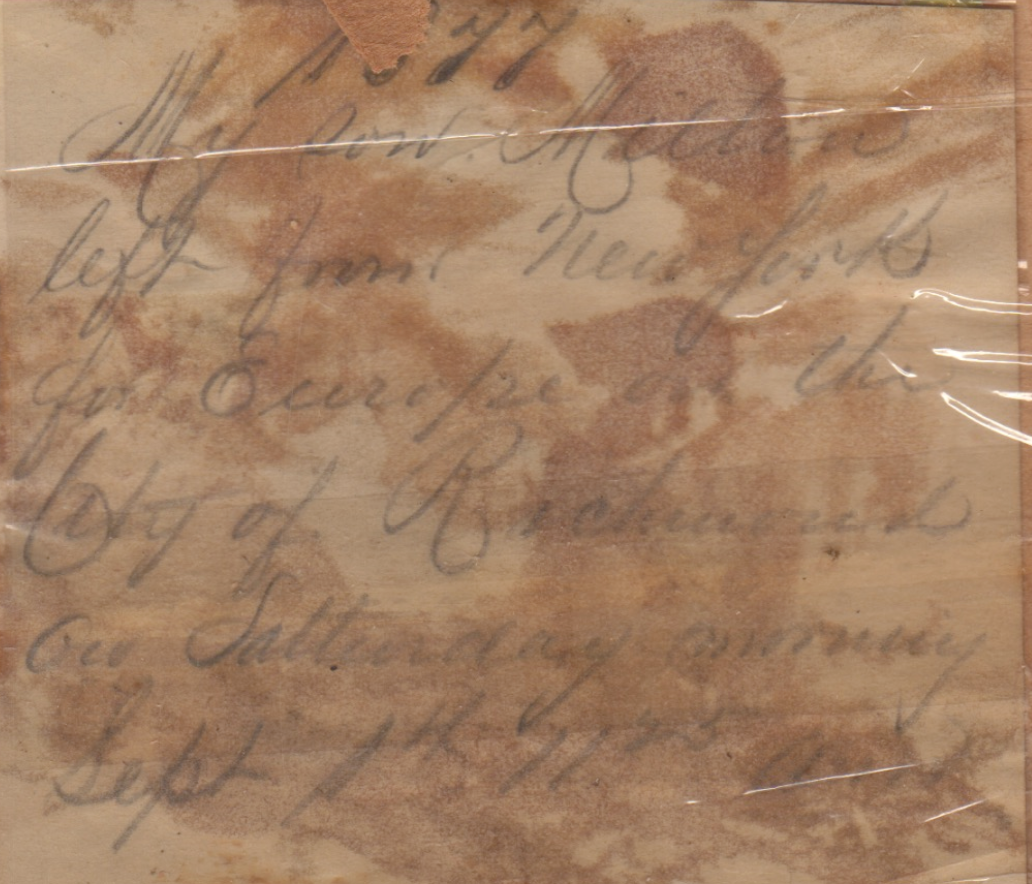
Under the poem he pasted this note written by his father Abraham in 1877:

My son Milton left from New York for Europe on the City of Richmond on Saturday morning Sept [?] 11:25

I do wonder whether there is some connection between the poem and the note. Anyone have any ideas?

The remaining two notes are in German.  I turned to the German Genealogy group for help.

The first note is dated around the same time as the note about Milton’s trip to Europe, September 1877:

The members of the German Genealogy group transcribed this as follows, “Gott sei mit dir! Der liebe Gott behüte und beschütze dich und gebe dir seinen Segen. Amen”

And translated it as, “May God be with you! May the good God keep and protect you and give you His blessing. From your father, Abr(aham) Goldsmith.”

Alfred, Abraham’s first child with Francis, his second wife, was born on August 11, 1877, just 20 days before Abraham wrote this note. I assume this was a prayer for his newborn son. I wonder where it had been kept that Milton found it and preserved it for posterity.

And then finally there is this note:

This one was transcribed by a German Genealogy group member as, “Auf Alle deiner Wegen, bleib Tugendhaft und rein; dann wird der himmlische Segen, stets deine Begleiter sein. Dein Papa, Abr. Goldsmith”

That translates to, “In all your ways, remain virtuous and pure, then heavenly blessings will always be your companions. Your papa, Abr. Goldsmith.”

As this one is dated 1880, I think Abraham wrote this blessing for his daughter Alice, who was born on August 29, 1880.

I wonder whether Abraham wrote these notes of blessing for each of his many children and if so, why only these two have survived. And where did he keep them that Milton found them and preserved them so that they could be read on the internet almost 140 years later?

My Double-Cousin Henry Goldsmith, Part I

Having completed the stories of my four times great-uncle Simon Goldsmith’s two oldest children, Jacob and Lena, I will now turn to the stories of his two youngest children, Henry and Hannah, who were born to Simon’s second wife, Fradchen Schoenthal, the sister of my great-great-grandfather Levi Schoenthal.

As I’ve discussed earlier, Henry (1847) and Hannah (1848), who were thus my double cousins, were born in Baltimore after Simon and Fradchen had immigrated to the US.  They lost their mother Fradchen (also known as Fanny) in 1850 when they were both very young—Henry was three, Hannah was two. Simon then lived with his oldest child Jacob in Washington, Pennsylvania, so that he would have support to raise these two young motherless children. This set of posts will focus on Henry and his adulthood.

By 1870 when he was 23, Henry had moved to Connellsville, Pennsylvania, where his older half-sister Lena had been living, and in 1871, he married Sarah Jaffe, whose brother Solomon would later marry Henry’s niece Leonora. Henry was a clothing merchant. Between 1871 and 1889, Sarah gave birth to ten children: Jacob W. Goldsmith (1871), Benjamin (1873), Milton (1877), Samuel (1879), Edison (1880), Walter (1881), Florence (1883), Albert (1884), Oliver (1887), and Helen (1889). In total, Henry and Sarah had eight boys and two girls. All were born in Connellsville.

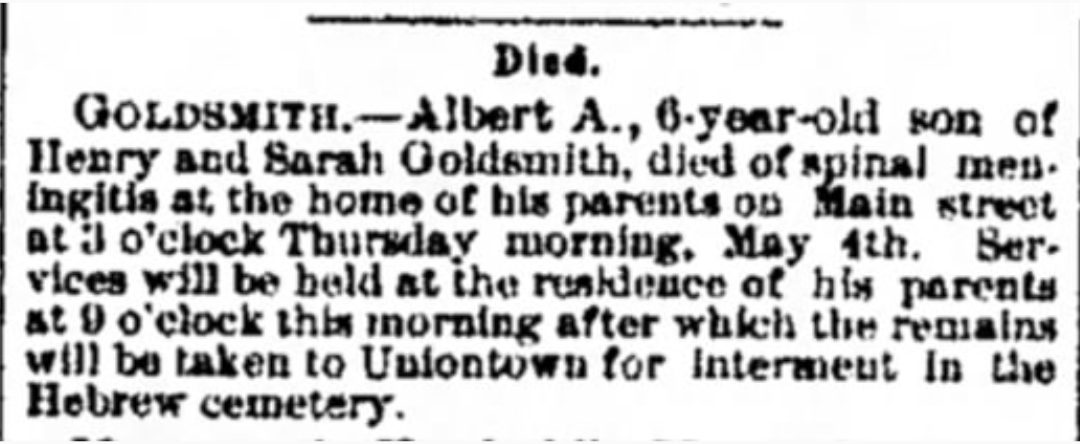
The family suffered a tragic loss when little Albert, just six years old, died on June 4, 1891, from spinal meningitis.

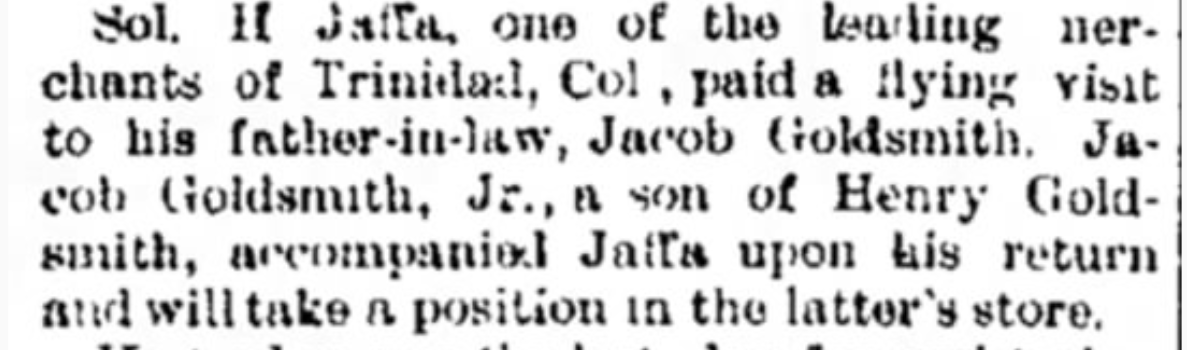
The surviving nine children were growing up in the 1890s. The oldest child, Jacob, known as J.W. (perhaps to prevent confusion with his uncle Jacob Goldsmith and cousin Jacob Goldsmith) at one point went to Trinidad, Colorado, to work for Sol Jaffa,  his mother’s brother.

The Connellsville (PA) Weekly Courier, September 9, 1892, p. 5

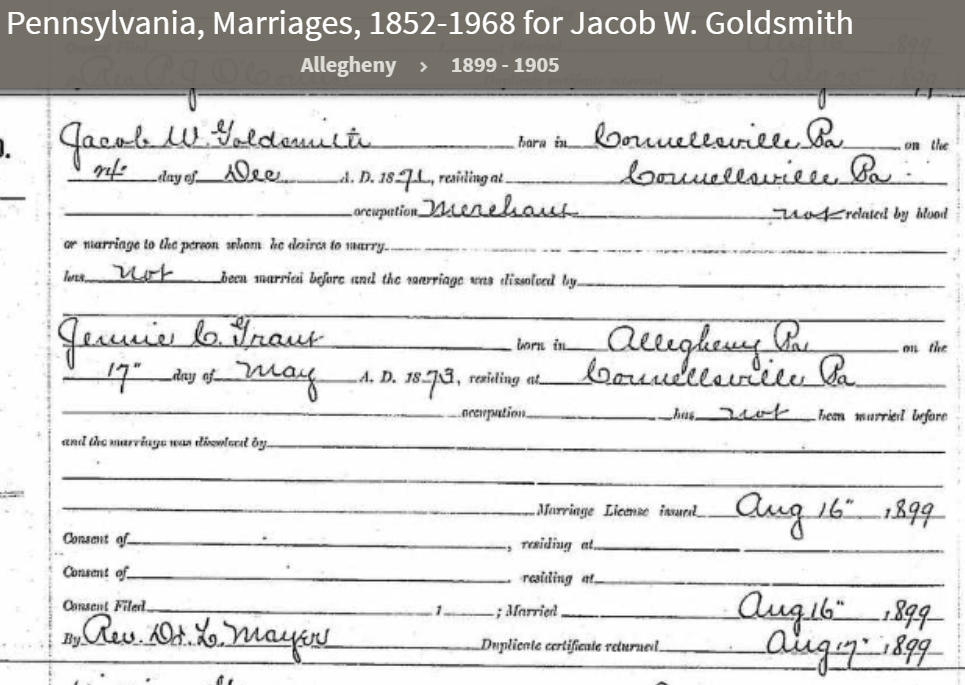
But J.W. returned to Connellsville, and on August 16, 1899, he married Jennie Clark Grant, the daughter of Scottish immigrants, William Grant and Jessy Russell.1 Jennie was born in Pittsburgh on May 17, 1873, and in 1880, she and her parents were living in Allegheny, Pennsylvania, where her father was an iron peddler.2 According to their marriage record, Jennie was residing in Connellsville at the time of their marriage, and J.W. was working as a merchant:

Pennsylvania Historical and Museum Commission; Harrisburg, Pennsylvania; Pennsylvania County Marriages, 1852-1973; County: Allegheny; Year Range: 1899; Roll Number: 549736
Ancestry.com. Pennsylvania, County Marriage Records, 1845-1963

They settled in Connellsville where J.W. continued to work as a merchant.3

Milton Goldsmith, the third oldest child of Henry and Sarah (Jaffa) Goldsmith, was a star student. (This Milton Goldsmith, born in 1877, should not be confused with the Milton Goldsmith, the author, who was his older cousin and the son of Abraham Goldsmith, not Henry Goldsmith.) He was tied for number one in his class at the Connellsville high school in 1895 with a 98 2/5 grade point average4 and was praised in the local paper for his speech at commencement. The words the newspaper quoted from his speech hold just as true today and are needed even more so- that they were in 1895:

“Just so surely as the Press demands some needed reform, so certainly will it expose some proposed fraud. Take its freedom and our doom is certain. Foster and maintain it, and we move onward, ever onward.”

"Commencement Last Night," The Connellsville (PA) Weekly Courier, May 24, 1895, p. 1.

“Commencement Last Night,” The Connellsville (PA) Weekly Courier, May 24, 1895, p. 1.

Milton then studied medicine at the University of Pennsylvania, where he graduated seventh in his class in 1899. He then commenced a residency at the University of Pennsylvania Hospital.5

Milton’s younger brother Samuel also must have been a good student. In 1899 he was studying law at the University of Michigan.6

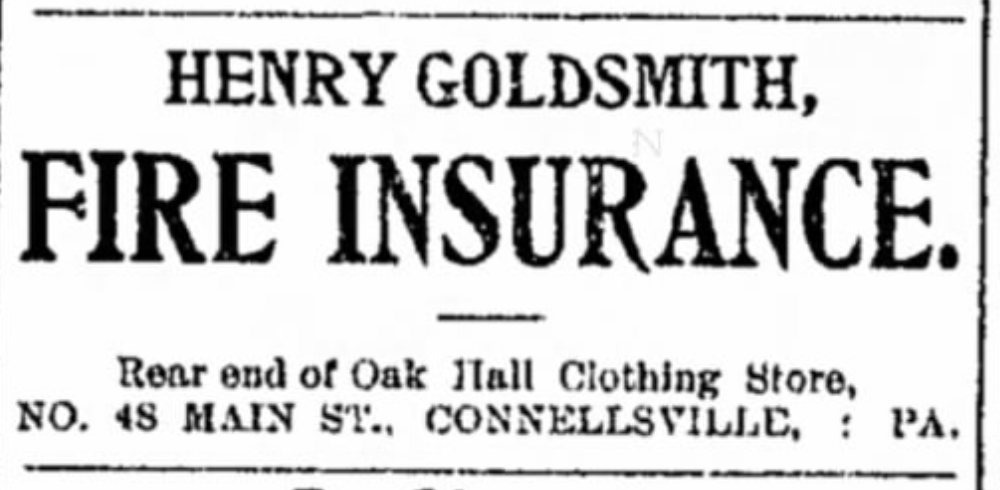
Meanwhile, Henry Goldsmith had changed careers by the 1890s. As seen in numerous ads that ran regularly in the Connellsville newspaper, The Weekly Courier, Henry Goldsmith had gone into the business of selling fire insurance in the 1890s:

The Connellsville (PA) Weekly Courier, October 15, 1897, p. 4

The 1900 census found eight of Henry and Sarah’s surviving nine children living at home. Benjamin (27) was working as a clothing merchant, Milton (23) was a physician, Samuel (21) was in school, Edison (20) was a clerk in the insurance office, and Walter (18) was a shoe salesman. The youngest three children were still in school: Florence (17), Oliver (13), and Helen (9). In addition, Sarah’s niece Lena Katz, daughter of her sister Juetel Jaffa Katz, was also living with Henry and Sarah and their children.  The only child not still living at home was J.W., but he and his wife Jennie were living close by in Connellsville, where J.W. was working as a merchant.7

Henry Goldsmith and family, 1900 US census,Census Place: Connellsville, Fayette, Pennsylvania; Page: 8; Enumeration District: 0007; FHL microfilm: 1241409
Ancestry.com. 1900 United States Federal Census

The first decade of the 20th century would bring some terrible heartache to the family, but also some great joy.


  1. Jessy Russell and William Grant, 1870 census, Census Place: Allegheny Ward 4, Allegheny, Pennsylvania; Roll: M593_1291; Page: 398A; Family History Library Film: 552790, Ancestry.com. 1870 United States Federal Census 
  2. Grant family, 1880 US census, Census Place: Allegheny, Allegheny, Pennsylvania; Roll: 1087; Page: 409C; Enumeration District: 015, Ancestry.com and The Church of Jesus Christ of Latter-day Saints. 1880 United States Federal Census 
  3. JW Goldsmith, 1900 US census, Census Place: Connellsville, Fayette, Pennsylvania; Page: 8; Enumeration District: 0008; FHL microfilm: 1241409,
    Ancestry.com. 1900 United States Federal Census 
  4. “Commencement Last Night,” The Connellsville (PA) Weekly Courier, May 24, 1895, p. 1. 
  5. The Connellsville (PA) Weekly Courier, June 30, 1899, p. 7; The Connellsville (PA) Weekly Courier, August 24, 1900, p. 6. 
  6. The Connellsville (PA) Weekly Courier, December 15, 1899, p. 28.# 
  7. JW Goldsmith, 1900 US census, Census Place: Connellsville, Fayette, Pennsylvania; Page: 8; Enumeration District: 0008; FHL microfilm: 1241409, Ancestry.com. 1900 United States Federal Census 

Lena Goldsmith Basch, Final Chapter: Joseph Basch’s Twins

In 1930, Joseph Basch and his wife Ida Steinhauser were living in Columbus, Ohio, with their twin children, Elene, a Smith College graduate, and Joseph, Jr., a graduate of Ohio State University. Joseph, Sr., continued to work in the tobacco business with his brother Joel.

Elene Basch married Robert Weiler on October 14, 1931, in Columbus. Robert, the son of Adolph Weiler and Blanche Kahn, was born on December 31, 1902, in Hartford, Indiana.1 His father was born in Germany, and his mother was born in Indiana. By 1910, the family had moved to Columbus, where Adolph Weiler was a clothing merchant.2 Robert graduated from the University of Pennsylvania and in 1930 was living in Marion, Ohio, working in real estate sales.3

Ancestry.com. Ohio, County Marriage Records, 1774-1993

Elene and Robert settled in Bexley, Ohio, and had two children during the 1930s. In 1940, they were still living in Bexley, and Robert was working as an insurance broker.4 Elene’s parents Joseph and Ida were living in Columbus, and Joseph continued to own Levy Mendel, the tobacco business.5

Elene’s twin, Joseph, Jr., had moved to Highland Park, Michigan, by 1930, where he was working as a taxi driver and lodging with a family.6 (He was enumerated twice in 1930, once with his parents in Columbus and once in Highland Park.7) By 1935 he was living in Detroit and was still there in 1940, working as a parking lot attendant.8

I was able to get more insight about Joseph, Jr., and his mother Ida from these excerpts from the oral history interview conducted by the Columbus Jewish Historical Society with Alan Weiler on April 8, 2008.

Weiler: … My uncle Joseph moved to Detroit, Michigan where he lived an unusual life. He worked for General Motors on the assembly line, married a woman, but never had nerve enough to tell his mom that he was married. When she went up to visit him he introduced her as his maid. … He lived on Second Avenue in downtown Detroit where it was unlikely to have a maid. My grandmother thought that her son had a maid rather than a wife.

Interviewer: Why was he afraid to tell her? If he were married, he thought she wouldn’t approve?

Weiler: Exactly. My Uncle Joseph was a stutterer. His mother, my grandmother Ida Basch, was a very domineering woman. After he finished Ohio State he just wanted to get out of town and he ended up living in Detroit, I think became an alcoholic, really lived a very unusual life. The lady he married, Winola, was a lovely lady. ….

I found Joseph Basch, Jr. traveling with a woman named Lola Basch in 1958; I assume this was the woman Alan Weiler remembered as Winola.

The National Archives at Washington, D.C.; Washington, D.C.; Series Title: Passenger and Crew Lists of Vessels and Airplanes Arriving at Miami, Florida.; NAI Number: 2771998; Record Group Title: Records of the Immigration and Naturalization Service, 1787 – 2004; Record Group Number: 85,  Ancestry.com. Florida, Passenger Lists, 1898-1963

She was born Lola Brown, daughter of James Brown and Lisa Sparks, on October 31, 1916, in Ivyton, Kentucky.9 In 1940, she was working as a servant in a household in Johnson County, Kentucky. So maybe in some sense Joseph did not lie to his mother—Lola had been at one time a maid, although in someone else’s home.10

Joseph Basch, Sr., died June 17, 1953,11 and his wife Ida died two years later on March 3, 1955.12 They were survived by their two children and two grandchildren. Their daughter Elene died in Columbus on November 25, 1973,13 followed just two months later by her husband Robert Weiler on January 28, 1974.14  For more about Elene and Robert and their lives, I highly recommend the oral interview done with their son Alan in 2008, which you can find here.

Joseph Basch, Jr., died on December 31, 1988, at the age of 82.15 I found this intriguing death notice in the January 2, 1989 Detroit News (p. 26):

“Basch,” Detroit News, January 2, 1989, p. 26.

Who are these stepchildren? Is “Lois” really Lola? The only seemingly relevant link I could locate was to Charles Fryman. I found a Charles W. Fryman born in Perry, Kentucky, on November 27, 1943, on the Kentucky Birth Index listed with a mother named Lola Ball.16  The Social Security Applications and Claims Index lists Charles Willie Fryman born November 27, 1941, with parents Charlie I Fryman and Lola Brown.17 I could not find any marriage record for Lola Brown and/or Charlie Fryman, however, so perhaps Charles W. Fryman was born outside of wedlock. He is listed on the Social Security Death Index with a birth date of November 27, 1942, and a date of death of July 15, 2000.18 He certainly appears to have been Lola Brown’s son. I could not find any connections to Lee Compton or Lucy Jacobs, however.

At any rate, although Joseph Basch, Jr., may never have had children with Lola, he certainly seemed to have a large family of stepchildren and step-grandchildren in his life.

With this post, I close another chapter in the family of my four-times great-uncle Simon Goldsmith and his children with his first wife Eveline Katzenstein and specifically the story of their daughter Lena. Lena Goldsmith Basch seems to have been a strong and smart woman, a woman who not only raised her children and cared for her husband Gustavus, but who ran a business and helped to support her family financially. She and her children left their mark on their long-time home of Columbus, Ohio.

Now I will turn back to and complete the stories of Simon’s children with his second wife, my three-times great-aunt Fradchen Schoenthal—my double cousins Henry and Hannah Goldsmith.


  1.  National Archives and Records Administration (NARA); Washington D.C.; Roll #: 2481; Volume #: Roll 2481 – Certificates: 397850-398349, 21 Apr 1924-22 Apr 1924,
    Ancestry.com. U.S. Passport Applications, 1795-1925 
  2. Adolph Weiler and family, 1910 US census, Census Place: Columbus Ward 4, Franklin, Ohio; Roll: T624_1181; Page: 5B; Enumeration District: 0074; FHL microfilm: 1375194, Ancestry.com. 1910 United States Federal Census 
  3. Columbus (OH) Dispatch, October 26, 1930, p. 39; Robert Weiler, 1930 US census, Census Place: Marion, Franklin, Ohio; Page: 14A; Enumeration District: 0191; FHL microfilm: 2341527, Ancestry.com. 1930 United States Federal Census 
  4. Robert Weiler and family, 1940 US census, Census Place: Bexley, Franklin, Ohio; Roll: m-t0627-03068; Page: 7B; Enumeration District: 25-4, Ancestry.com. 1940 United States Federal Census  
  5. Joseph and Ida Basch, 1940 US census, Census Place: Columbus, Franklin, Ohio; Roll: m-t0627-03242; Page: 12B; Enumeration District: 93-55, Ancestry.com. 1940 United States Federal Census 
  6. Joseph Basch, Jr., 1930 US census, Census Place: Highland Park, Wayne, Michigan; Page: 10A; Enumeration District: 0994; FHL microfilm: 2340809,
    Ancestry.com. 1930 United States Federal Census 
  7. Basch family, 1930 US census, Census Place: Columbus, Franklin, Ohio; Page: 22A; Enumeration District: 0029; FHL microfilm: 2341529, Ancestry.com. 1930 United States Federal Census 
  8. Joseph Basch, Jr., 1940 US census, Census Place: Detroit, Wayne, Michigan; Roll: m-t0627-01844; Page: 10B; Enumeration District: 84-158, Ancestry.com. 1940 United States Federal Census 
  9. SSN: 400363565, Ancestry.com. U.S., Social Security Applications and Claims Index, 1936-2007 
  10. Lola Brown, 1940 US census, Census Place: Johnson, Kentucky; Roll: m-t0627-01322; Page: 13A; Enumeration District: 58-13, Ancestry.com. 1940 United States Federal Census 
  11. SSN 297323868, Ancestry.com. U.S., Social Security Applications and Claims Index, 1936-2007 
  12. “Mrs. Ida Basch,” Columbus (OH) Dispatch, March 4, 1955, p. 48. Ancestry.com. Web: Columbus, Ohio, Green Lawn Cemetery Index, 1780-2010 
  13.  Certificate: 085726; Volume: 21489, Ancestry.com and Ohio Department of Health. Ohio, Death Records, 1908-1932, 1938-2007 
  14.  Certificate: 002636; Volume: 21563, Ancestry.com and Ohio Department of Health. Ohio, Death Records, 1908-1932, 1938-2007 
  15. SSN: 365167257, Ancestry.com. U.S., Social Security Applications and Claims Index, 1936-2007 
  16. Volume Number: 058, Certificate Number: 28711, Volume Year: 1945, Ancestry.com. Kentucky, Birth Index, 1911-1999 
  17. SSN: 405567939, Ancestry.com. U.S., Social Security Applications and Claims Index, 1936-2007 
  18.  Number: 405-56-7939; Issue State: Kentucky; Issue Date: 1959, Ancestry.com. U.S., Social Security Death Index, 1935-2014 

Milton Goldsmith’s Family Album, Part X: A Son’s Loving Tribute to His Mother

This is Part X of an ongoing series of posts based on the family album of Milton Goldsmith, so generously shared with me by his granddaughter Sue. See Part I, Part II, Part IIIPart IVPart VPart VI, Part VII , Part VIII,  and Part IX at the links.

This is by far the sweetest and saddest page in Milton Goldsmith’s album, a page dedicated to his beloved mother, Cecelia Adler Goldsmith, who died in 1874 when Milton was thirteen years old:

It reads:

Our beloved Mother, who alas, passed away too early and whose death brought not only sorrow, but all kinds of misfortune.

She was the only child of Samuel and Sarah Adler, was born in Germany, but arrived in Philadelphia at the age of one year.  She grew to womanhood, a very beautiful girl;- rather short in stature, round in figure, a head of brown ringlets, – a belle among the Jewesses of her day and circle. She had many admirers.  Father proposed to her over a plate of ice-cream on “Simchas Torah”, a Jewish holiday.  It was in every way a “Love-match” which was only terminated at her death.  She died of peritonitis, which to-day would be called Apendicitis [sic]. A perfect wife, – a wonderful mother, – A woman whose children call her blessed.

She died Nov. 8th 1874, at the age of 35 years. I was 13 at the time of her death, the oldest of six children.

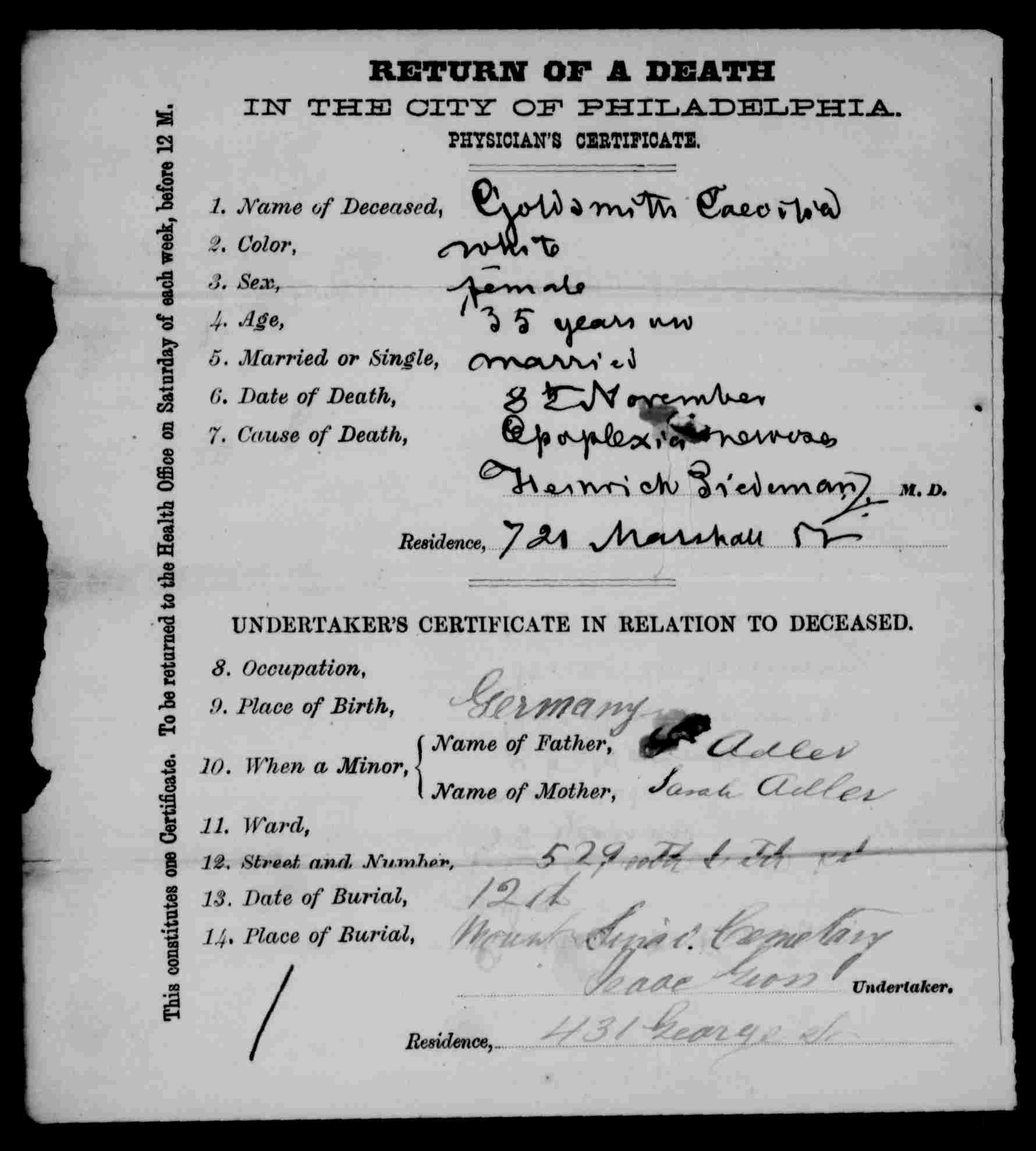
It’s interesting to read what Milton thought was the cause of his mother’s death, which conflicts with her death certificate. According to the death certificate, she died from apoplexia nervosa:

“Pennsylvania, Philadelphia City Death Certificates, 1803-1915,” database with images, FamilySearch (https://familysearch.org/ark:/61903/3:1:S3HT-69HW-K75?cc=1320976&wc=9F52-L29%3A1073307201 : 16 May 2014), 004010206 > image 874 of 1214; Philadelphia City Archives and Historical Society of Pennsylvania, Philadelphia.

In the upper left corner, Milton inserted a piece of Cecelia’s wedding veil:

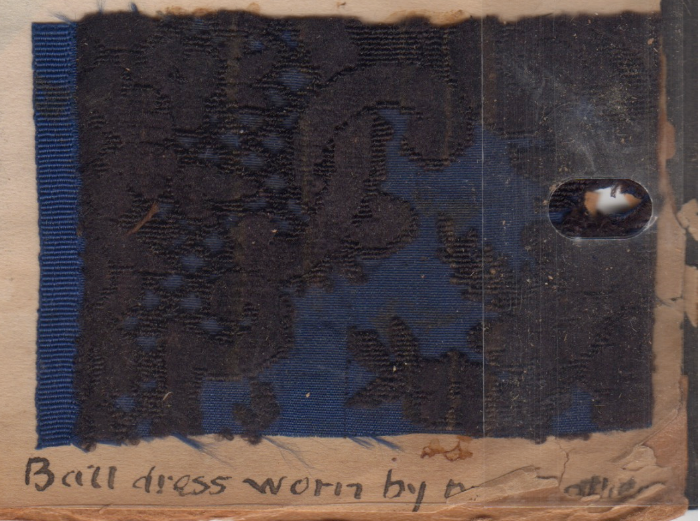
In the lower right corner, he inserted a piece of fabric from one of her ball gowns.

What a sweet and sentimental thing for a son to do. How devastated he and his father and siblings must have been when Cecelia died.


Happy Passover and Happy Easter

This year the lunar calendar has aligned Passover and Easter perfectly.  The first seder takes place on the evening of Good Friday, so this weekend Jews and Christians (except Eastern Orthodox Christians) will all be celebrating an important holiday. At least in my part of the world, it is also spring. My lawn is green, the daffodils are blooming, and there are buds on the trees about to burst into flower. It should be a joyous time. After all, Passover celebrates the liberation of the Jews from slavery, and Easter celebrates the resurrection of Christ. I hope that for all who celebrate (and for those who don’t) this weekend brings lots of joy.

For me, this year Passover is tinged with sadness. This is the first year my father will not be with us. It’s just two months since he died, but somehow it feels so much longer. So for today’s post, I want to ponder Passovers past and my father’s role in them.

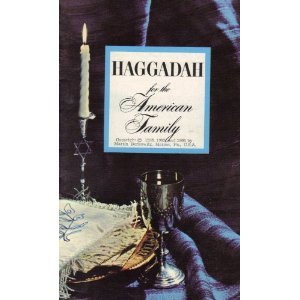
When we first celebrated Passover, it was at my Aunt Elaine’s house. Her husband, my Uncle Phil, had grown up in a more traditional home than my mother and her sister or than my father. Uncle Phil could read Hebrew, and he knew the traditional songs and the blessings. So, of course, he led the seder. We used the Haggadah for the American Family—almost all in English, except for the blessings, the four questions, and some other passages. It was perfect for our assimilated, non-affiliated, non-religious family.  I was enchanted by the whole experience. It was my first and for the longest time only exposure to Judaism, and I loved the story, the music, the rituals, and, of course, searching for the afikomen.

Uncle Phil and Aunt Elaine

After the first couple of years, my mother must have decided that she also wanted to have seders at our home, and so we began to have one seder at my aunt and uncle’s house and one at our house. At our house, my father took over the leader’s role (with my uncle helping on all the Hebrew and the songs). Given that my father was not at all religious, it was perhaps an uncomfortable role for him to assume, but he certainly wasn’t going to let another man lead the seder in his house. If he was uncomfortable, he certainly did not show it. He always did a great job, and I can still hear his voice, reading the English text, admonishing us to be quiet and listen, and then giving up and moving on to the next page.

When my aunt and uncle moved to Florida, my father was all on his own as the leader. By then I was an adult and married with children, and we did one seder with my husband’s family, one with mine. My husband’s family’s seders were far more traditional and educational, but also always warm and filled with love. The seders at my parents’ house continued to be somewhat chaotic—too many people talking, too many people getting up and down, chasing the children, helping with the food and the dishes. My father continued to lead the seder, and we all read from the Haggadah and said the blessings and sang the songs. Our children read the four questions.  And in the midst of all the noise and chaos, the seders continued to be cherished by us all.

Then I became a grandmother. And we wanted our grandchildren to experience Passover at our home. Now my grandsons read the four questions. Now my husband and I hide the afikomen. And now my husband leads the seder.

Passover, 2016.

My father graciously moved out of the leader’s chair. I wonder whether that was hard for him—recognizing that another generation was taking over and that his time as the leader after over fifty years in that role was over. If so, he never showed it. He seemed to relish the opportunity to watch over the younger generations without having to worry about keeping the seder rolling along.

My dad, Passover 2016

This year there will be a missing chair at the table, a missing voice adding to the chaos, a missing mouth to feed. That missing chair, that missing voice, that missing mouth will be noticed and felt by us all. When we open the door for Elijah and wait for him to sip the wine, I will be watching for my father instead. Not, of course, literally. I don’t believe in ghosts. But I know that his spirit will be there inside each and every one of us as we hear, once again, the words of the Haggadah.


Final Chapter for Joel Basch and His Family: Tragedy and Generosity

In 1930, Joel Basch was still in the tobacco business and living with his wife Jeanette and sons Sidney and Gustavus in Columbus, Ohio. Sidney was working as a clerk in a finance company and Gustavus as a salesman in a furniture store.

Joel Basch, 1930 US census, Census Place: Columbus, Franklin, Ohio; Page: 13A; Enumeration District: 0042; FHL microfilm: 2341530
Ancestry.com. 1930 United States Federal Census

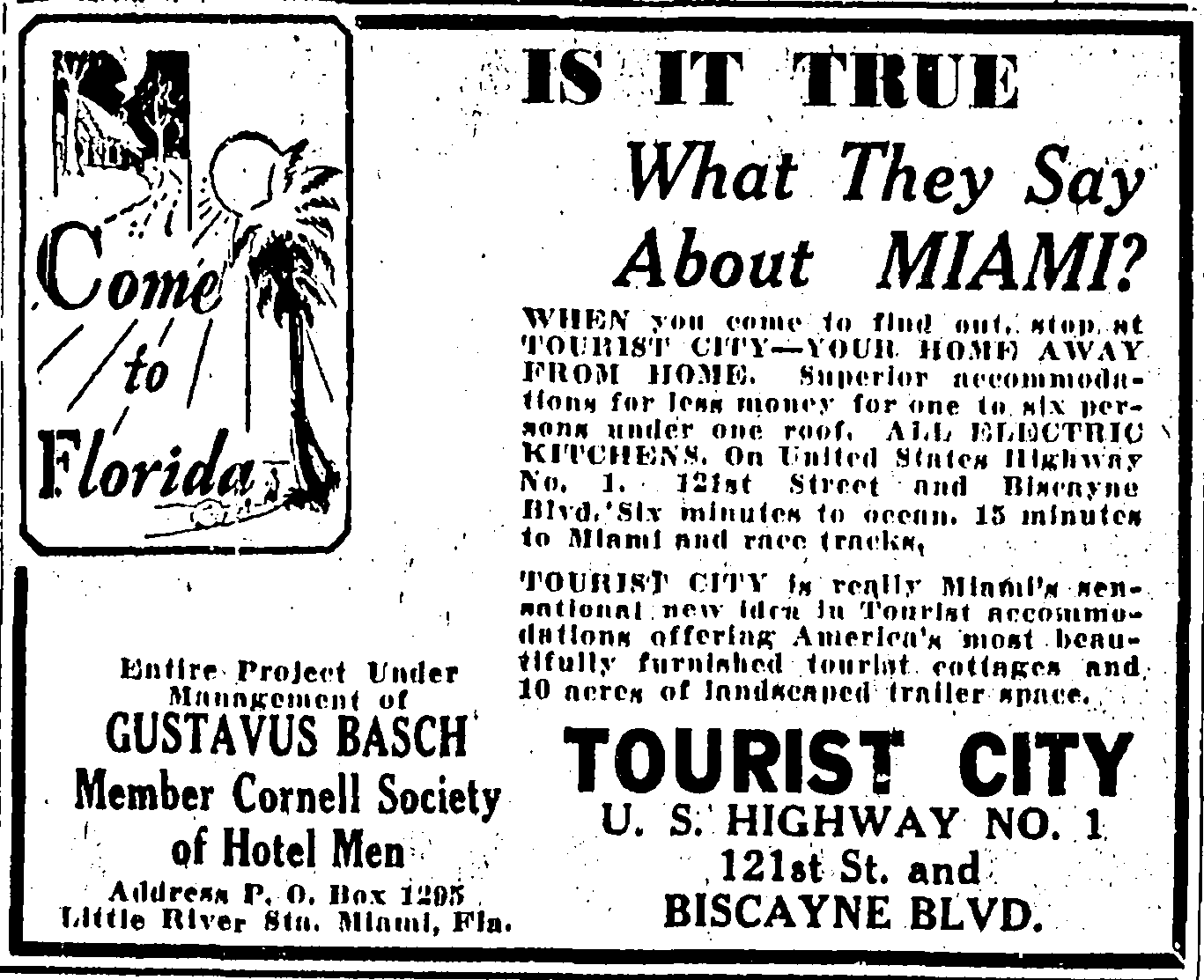
In the 1930s, Gustavus moved to Miami. In 1940, he was still living in Miami, where he was the manager of a tourist camp.1 I wondered what that meant and searched for Gustavus in the newspaper databases and found this advertisement from the December 6, 1936, Miami Herald (p. 72):

Apparently a “tourist camp” was a place for tourists to stay while vacationing in Miami—a place to park a trailer or rent a cottage. As indicated in the advertisement as well as on Gustavus’ World War II draft registration, this was his own business.

His parents, Joel and Jeanette, were listed right above him on the 1940 census, but they were enumerated twice in 1940—once in Columbus living with their older son Sidney, once in Miami with their younger son Gustavus. The Columbus enumeration was done on April 11, 1940, and the Miami enumeration was done on April 30, 1940. The Columbus enumeration reported that Joel, now 73, was retired, and that Sidney, 43, was a clerk at an insurance company.

Joel and Jeanette Basch, 1940 US census, Census Place: Columbus, Franklin, Ohio; Roll: m-t0627-03243; Page: 9A; Enumeration District: 93-77
Ancestry.com. 1940 United States Federal Census

Joel and Jeanette Basch and Gustavus Basch, 1940 US census, Census Place: Dade, Florida; Roll: m-t0627-00580; Page: 4A; Enumeration District: 13-22
Ancestry.com. 1940 United States Federal Census

Gustavus enlisted into the US Army on August 11, 1942,2 when he was 38 years old. He was serving as the “chief of the radio nets for his fighter squadron in 1943.” According to Wikipedia, a radio net is “essentially a moderated conference call conducted over two-way radio…. A net manager is the person who supervises the creation and operation of a net over multiple sessions. This person will specify the format, date, time, participants, and the net control script.”

“Visits Parents,” Columbus (OH) Dispatch, October 8, 1943, p. 14

The family suffered a terrible loss on January 10, 1945, when Sidney Basch had a cerebral hemorrhage and died in the family’s garage in Columbus.  According to his death certificate, his body was not discovered until ten hours later. The newspaper reported that a neighbor found Sidney’s body, lying between the garage door and the rear bumper of his car; the paper also reported that Sidney had a history of heart attacks. He was 48 years old when he died.3

Sidney Basch, death certificate, Ohio Deaths, 1908-1953,” database with images, FamilySearch (https://familysearch.org/ark:/61903/3:1:S3HY-DH64-VL8?cc=1307272&wc=MD96-DTP%3A287601701%2C287601302 : 21 May 2014), 1945 > 00001-03300 > image 1423 of 3510.

His brother Gustavus was serving in Europe at the time of Sidney’s death, but must have been discharged not long afterwards. He spent several months with his parents in Columbus after his discharge before returning to Florida in October of 1945.4

Two years later Jeanette Mendel Basch died on December 26, 1947. According to her obituary, she had been ill for a year. Jeanette had outlived two of her sons—Robert, who’d died as a young child, and Sidney. She was survived by her husband Joel and son Gustavus.5

But Joel only outlived Jeanette by three years. He died on December 8, 1950, from a heart attack and arteriosclerosis. He was 87.

Joel Basch, death certificate, Ohio Deaths, 1908-1953,” database with images, FamilySearch (https://familysearch.org/ark:/61903/3:1:S3HY-6Q67-VC2?cc=1307272&wc=MD9N-9P8%3A287599801%2C294723701 : 21 May 2014), 1950 > 74601-76700 > image 303 of 2329.

Gustavus, who according to Joel’s obituary 6 was the secretary-treasurer of Tourist City Corporation in Miami when his father died in 1950, continued to live in Florida for the rest of his life. He died on November 13, 1989, in Miami, at age 85. Gustavus had not married or had children.7

An article that ran in numerous Florida newspapers revealed that Gustavus had died a wealthy man. In his early years he had invested in real estate in Miami that he sold after World War II; he had successfully invested his profits in the stock market and died with an estate worth five million dollars. He left two million dollars to the Miami Metrozoo and smaller amounts to his alma mater, Ohio State University, the United Negro College Fund, and South Miami Hospital. I found it ironic that Gustavus had done so well “gambling” on the stock market, given that his father Joel had lost his business as a young man due to gambling debts.8

As neither of Joel and Jeanette’s sons had children, there are no living descendants of Joel and Jeanette (Mendel) Basch. But their stories are not forgotten.


  1. Gustavus Basch, 1940 US census, Census Place: Dade, Florida; Roll: m-t0627-00580; Page: 4A; Enumeration District: 13-22, Ancestry.com. 1940 United States Federal Census 
  2. Ancestry.com. U.S., World War II Army Enlistment Records, 1938-1946. 
  3. “Solicitor’s Body Found in Garage,” Columbus (OH) Dispatch, January 10, 1945, p. 1. 
  4. “To Miami,” Columbus (OH) Dispatch, October 2, 1945, p. 12. 
  5. “Mrs. Jeannette Basch,” Columbus (OH) Dispatch, December 27, 1947, p. 3. 
  6. “Joel Basch,” Columbus (OH) Dispatch, December 9, 1950, p. 11. 
  7. SSN: 265019585, Ancestry.com. U.S., Social Security Applications and Claims Index, 1936-2007 
  8. “Frugal Man Leaves $2 Million to Zoo,” The Tampa Tribune, 25 Nov 1990, p. 29. 

Milton Goldsmith’s Family Album, Part IX: The Missing Babies

This is Part IX of an ongoing series of posts based on the family album of Milton Goldsmith, so generously shared with me by his granddaughter Sue. See Part I, Part II, Part IIIPart IVPart V,  Part VI, Part VII,  and Part VIII at the links.

After reading last week’s post about the birth records found in her grandfather’s family album and the speculation as to why only five of Abraham Goldsmith’s ten children were listed, my cousin Sue went back to the album and realized that she could remove the page with the birth records. On the back were not only birth records for Abraham’s other five children; there was also a sad entry for the death of his first wife Cecelia:

All of the birth entries again confirmed what I’d found in the official records, and once again Abraham entered not only the dates, but the times the babies were born.

For Estella, who often was referred to in records as Estelle, he introduced her as “our sixth baby.”

Then there is the heartbreaking entry for Cecelia:

My beloved wife Cecelia Goldsmith died on Sunday the 8th day of November 1874 at 6 o’clock PM after an illness of 6 days. Hebrew date [inserted in Hebrew]

May she rest in peace.

Abr.Goldsmith

Abraham’s signature here confirmed my hunch that he was the one who wrote all these entries (except the dates of death that occurred after his own death).

The next entry is for Alfred, who was Abraham’s first child with his second wife, Frances Spanier, But there is no break in the record to reflect that Alfred had a different mother from the first six children. He is introduced as “Our seventh boy” [emphasis added], despite the fact that he is the first child of Frances. You may notice that Alfred is the only one on this page who has a date of death.  That’s because those dates were entered by Milton, and the other four on this page—Estella, Bertha, Alice, and Louis—all outlived Milton.

Similarly Bertha is introduced as “Our Baby Bertha.” Then Abraham records the birth of “Baby Alice,” and finally the last child, Louis Seligman. At the end of the entry for Louis, Abraham wrote, “Louis Spanier his [?].”

Can anyone decipher what that says? From a later page in the album I learned who Louis Spanier was—Frances Spanier’s uncle—so Louis Goldsmith’s great-uncle. But that does not say “great-uncle” or “namesake” as far as I can tell.

And I got quite a kick out of the last word on this page: Finished. I don’t know whether Abraham wrote that to indicate the records were now completed or to emphasize that he was ready to be done having children after Number 10!


Lena Goldsmith Basch, Final Chapters: Frank and Hinda

In 1930, four of Lena Goldsmith’s six children were still living—Frank, Hinda, Joel, and Joseph. They ranged in age from Joseph at 63 to Frank at 73. Their children, Lena’s grandchildren, were all adults by 1930. In fact, by 1930 Frank had five grandchildren himself, and one more would arrive in the 1930s. Joel and Joseph would also have grandchildren born in the 1930s. And there were also more marriages among the grandchildren in the years that followed.

The next three posts will conclude the saga of the Basch family of Columbus, Ohio. This post will complete the stories of Frank and Hinda; Joel and Joseph will be discussed in subsequent posts.

Frank Basch’s family

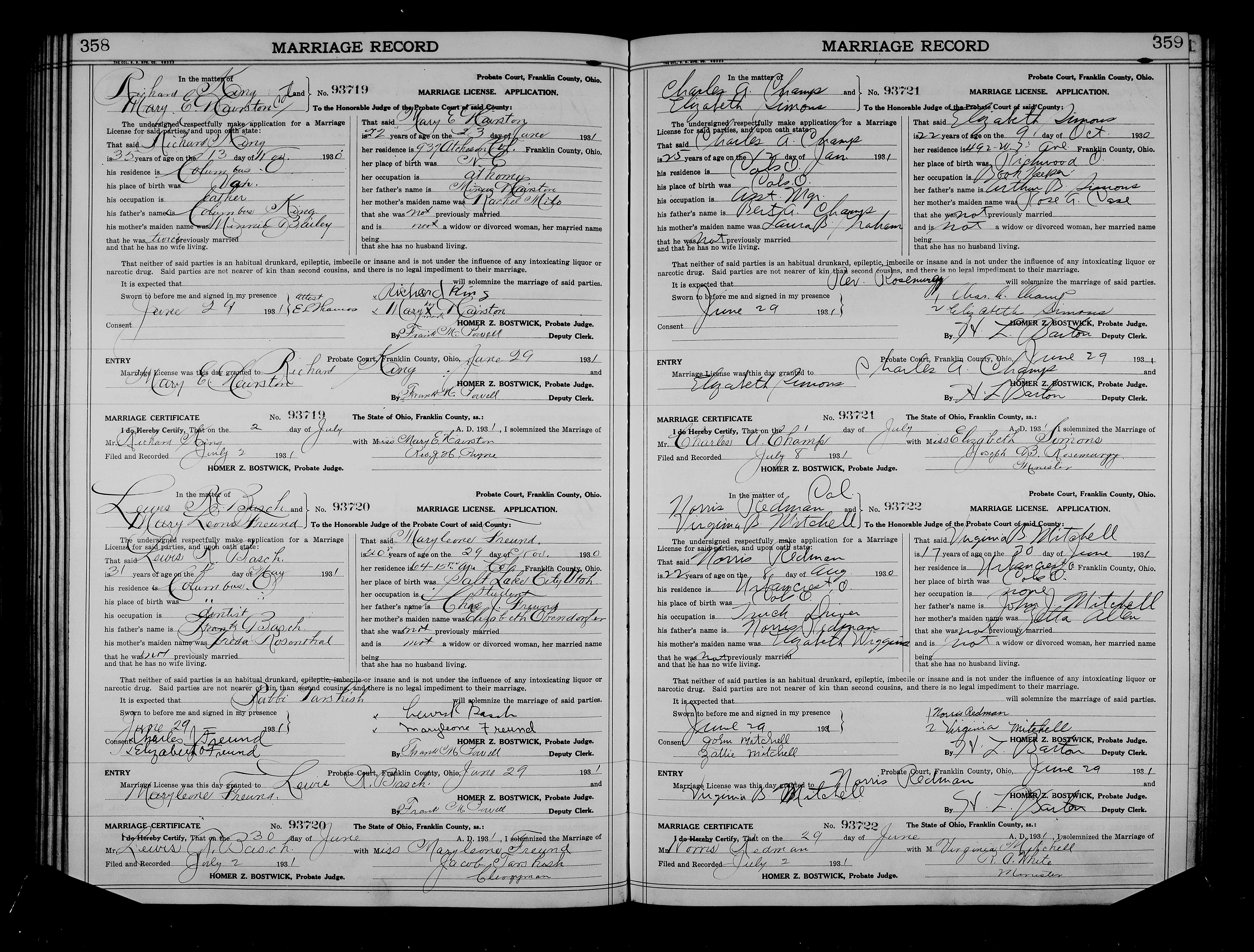
Lewis Basch, Frank and Freda (Rosenthal) Basch’s son, married Maryleone Freund on June 30, 1931. Maryleone was the daughter of a rabbi, Charles J. Freund, and Elizabeth “Bertie” Oberdorfer. She was born in Salt Lake City, Utah, on November 29, 1910, but also lived in Grand Rapids, Michigan. In 1930 she was living with her parents in Toledo, Ohio.1

Lewis Basch, marriage record, “Ohio, County Marriages, 1789-2013,” database with images, FamilySearch (https://familysearch.org/ark:/61903/3:1:939L-FZFC?cc=1614804&wc=Q6SP-NLG%3A121350601%2C123701101 : 15 July 2014), Franklin > Marriage index and records 1935-1937 vol 108 > image 208 of 330; county courthouses, Ohio.

After marrying Lewis, Maryleone completed her undergraduate degree at Ohio State University. Lewis and Maryleone would have two children in the 1930s.

U.S., School Yearbooks, 1880-2012″; Yearbook Title: The Makio; Year: 1932
Ancestry.com. U.S., School Yearbooks, 1900-1990

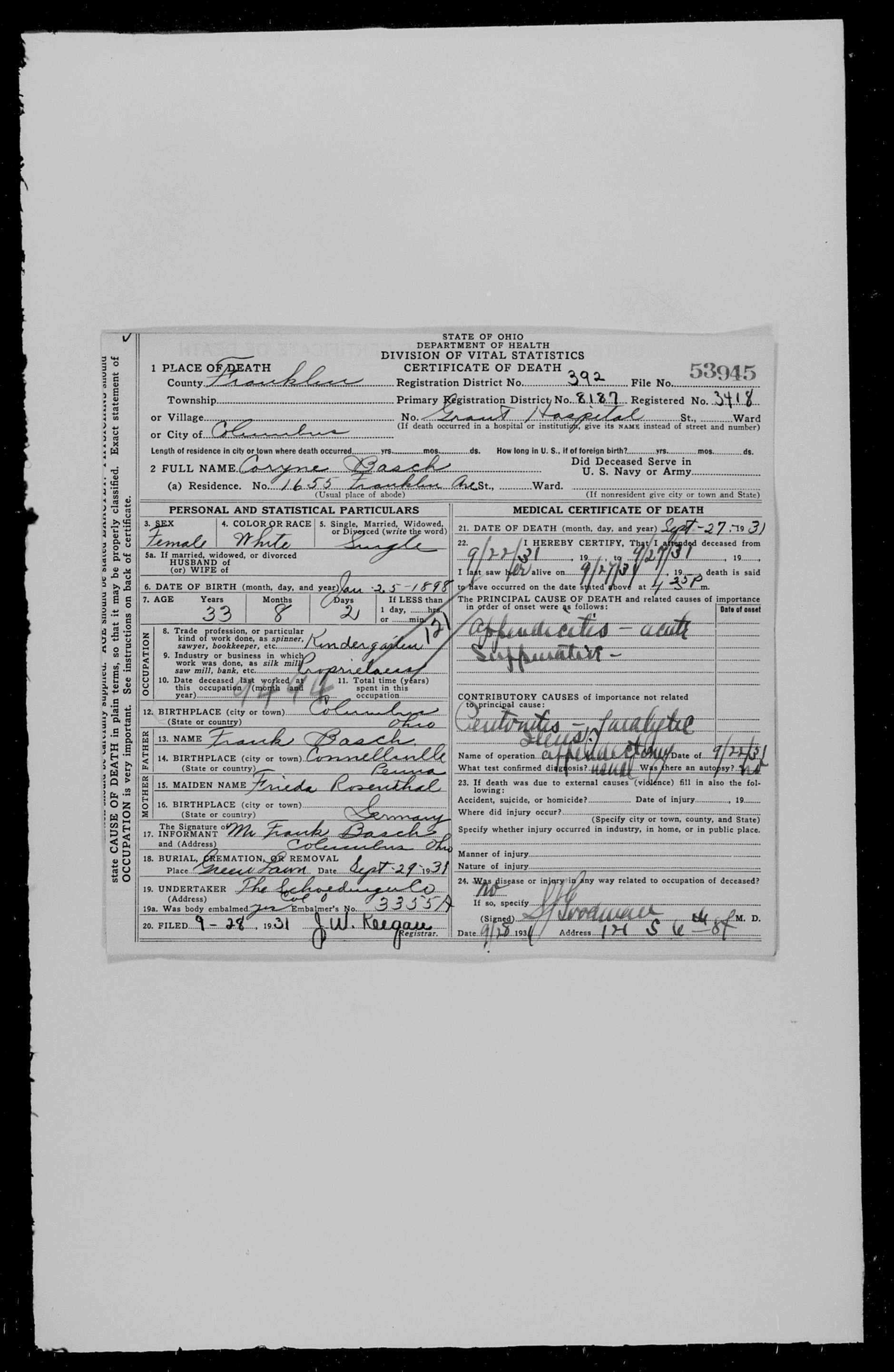
Just three months after her brother Lewis’ wedding, Coryne Basch, Frank and Freda’s daughter, died at age 33 from appendicitis on September 27, 1931.  According to her death certificate, Coryne was the owner of a kindergarten. Coryne was survived by her parents, her sisters Rae and Ruth, and her brother Lewis. She had never married or had children.

Coryne Basch, death certificate, Ohio Deaths, 1908-1953,” database with images, FamilySearch (https://familysearch.org/ark:/61903/1:1:X6HL-K9C : 8 March 2018), Coryne Basch, 27 Sep 1931; citing Columbus, Franklin, Ohio, reference fn 53945; FHL microfilm 1,992,473.

Frank Basch died on January 5, 1934, in Columbus, from coronary disease and hypertension. He was 76 years old. With his death, only three of his siblings remained.

Frank Basch, death certificate, Ohio, County Death Records, 1840-2001,” database with images, FamilySearch (https://familysearch.org/ark:/61903/3:1:S3HY-6QM9-HSN?cc=2128172&wc=7DZ2-PQB%3A1296032501%2C1296824302 : 2 October 2014), Franklin > Death certificates, 1926-1927 > image 1504 of 3280; county courthouses, Ohio.

In 1940, Frank’s three surviving children were all living in different places. Lewis and his family were living in Bexley, Ohio, a suburb less than four miles east of Columbus. Lewis was a dentist in private practice.2 His sister Rae was living with her family in Chillicothe, Ohio, fifty miles south of Columbus; her husband Sidney Katz continued to be a clothing merchant.3  Ruth and her husband Sigmund Front and their children were living in Wheeling, West Virginia, in 1940, where Sigmund was managing an electrical supply store.4 Sigmund’s 1942 World War II draft registration revealed that he was no longer working in his father’s Front Company business, but for Westinghouse. I could not locate Freda Rosenthal Basch, Frank’s widow, on the 1940 census.

Sigmund Front, World War II draft registration, The National Archives at St. Louis; St. Louis, Missouri; WWII Draft Cards (Fourth Registration) for the State of West Virginia; Record Group Title: Records of the Selective Service System, 1926-1975; Record Group Number: 147; Series Number: M1937, Ancestry.com. U.S., World War II Draft Registration Cards, 1942

Rae Basch Katz lost her husband Sidney six years later. He was 57 years old when he died on July 6, 1946.5 She outlived him by 23 years; she died on October 25, 1969, at the age of 73.6 Rae and Sidney were survived by their three daughters.

Freda Rosenthal Basch died on September 16, 1954, twenty years after her husband Frank. She was 85 years old.7

Ruth Basch Front’s husband Sigmund died in Wheeling, West Virginia, on November 2, 1960. He was 66.8 Ruth later moved to Florida, where she died at age 83 on June 1, 1988. Ruth and Sigmund were survived by their two sons.9

Tragically, Lewis Basch lost his son Richard, who, like his father, was a dentist, on July 3, 1970, when Richard was killed in a car accident after his car crossed the median on the Kentucky Turnpike and struck another vehicle. Richard was only 33 and was survived by his wife and two children.10

Lewis Basch and his wife Maryleone remained in the Columbus area, and Lewis died there on July 5, 1986, when he was 86 years old.11 He was survived by his wife Maryleone, who died at 90 on February 14, 2001, in Columbus.12 Their daughter survived them as well as their grandchildren.

Hinda Basch

In 1940 Hinda Basch was living alone in Columbus without an occupation.13 She died four years later on June 23, 1944, from hypostatic pneumonia and myocardial degeneration. She was 83. She was survived by her brothers Joel and Joseph and a number of nieces and nephews. She had no direct descendants.

Hinda Basch, death certificate, Ohio Deaths, 1908-1953,” database with images, FamilySearch (https://familysearch.org/ark:/61903/3:1:33S7-9PKP-W466?cc=1307272&wc=MD9X-TP8%3A287599501%2C294550101 : 21 May 2014), 1944 > 36501-39300 > image 1707 of 3268.


  1. State File Number: 2830A, Ancestry.com. Utah, Birth Certificates, 1903-1911. Charles Freund and family, 1910 US census, Census Place: Salt Lake City Ward 5, Salt Lake, Utah; Roll: T624_1607; Page: 5B; Enumeration District: 0142; FHL microfilm: 1375620, Ancestry.com. 1910 United States Federal Census  Freund family, 1930 US census, Census Place: Toledo, Lucas, Ohio; Page: 15A; Enumeration District: 0080; FHL microfilm: 2341570, Ancestry.com. 1930 United States Federal Census 
  2. Lewis Basch and family, 1940 US census, Census Place: Bexley, Franklin, Ohio; Roll: m-t0627-03068; Page: 10B; Enumeration District: 25-1, Ancestry.com. 1940 United States Federal Census 
  3. Sidney Katz and family, 1940 US census, Census Place: Chillicothe, Ross, Ohio; Roll: m-t0627-03138; Page: 18A; Enumeration District: 71-22, Ancestry.com. 1940 United States Federal Census 
  4. Sigmund Front and family, 1940 US census, Census Place: Wheeling, Ohio, West Virginia; Roll: m-t0627-04436; Page: 6B; Enumeration District: 35-37, Ancestry.com. 1940 United States Federal Census 
  5. Ancestry.com and Ohio Department of Health. Ohio, Death Records, 1908-1932, 1938-2007 
  6.  Certificate: 202624; Volume: 90023, Ancestry.com and Ohio Department of Health. Ohio, Death Records, 1908-1932, 1938-2007 
  7. Ancestry.com. Web: Columbus, Ohio, Green Lawn Cemetery Index, 1780-2010; Original data: Green Lawn Cemetery Burials. Columbus, Ohio. Joe and Dick Fleshman. http://greenlawn.delaohio.com/greenlawn/Greenlawn/index.htm: accessed 09 February 2012. 
  8. FHL Film Number: 857652, Ancestry.com. West Virginia, Deaths Index, 1853-1973 
  9. Ancestry.com. Florida Death Index, 1877-1998 
  10. “Son-in-Law of Dr. King Dies, The Newark (OH) Advocate, 09 Jul 1970, p. 22; “Dental Surgeon, Farmer Die in Separate Accidents,” The (Louisville, KY) Courier-Journal, 04 Jul 1970, p. 15. 
  11.  Certificate: 052193; Volume: 26521, Ancestry.com and Ohio Department of Health. Ohio, Death Records, 1908-1932, 1938-2007 
  12.  Certificate: 010106; Volume: 32734, Ancestry.com and Ohio Department of Health. Ohio, Death Records, 1908-1932, 1938-2007 
  13. Hinda Basch, 1940 US census, Census Place: Columbus, Franklin, Ohio; Roll: m-t0627-03244; Page: 81A; Enumeration District: 93-119B, Ancestry.com. 1940 United States Federal Census 

Lena Goldsmith Basch’s Grandchildren Reach Adulthood

As seen in my last post about the Basch family, the children of Lena Goldsmith Basch suffered two losses in 1915. Their brother Jacob died on April 5, 1915, and Ella’s husband Isidor Shatz died seven months later. But not all the events of the 1910s were sad ones.

On February 5, 1917, Lena and Gustavus Basch’s oldest granddaughter, Frank’s daughter Rae, married Sidney Katz in Columbus.  She was twenty years old, and he was 28.

Ancestry.com. Ohio, County Marriage Records, 1774-1993

Sidney was born in Ohio on January 13, 1889,1 and grew up in Cincinnati, where in 1900 he was living with his widowed mother, Dina Bing Katz, and siblings.2 Sidney’s father Henry Katz had died when Sidney was just ten on December 24, 1899.3 Both of Sidney’s parents were German immigrants. In 1910, Sidney was living with his mother and sister in Cincinnati, working as a traveling millinery salesman.4

Rae and Sidney settled in Chillicothe, Ohio, about fifty miles from Columbus, where their first child, Dorothy Basch Katz, was born on March 19, 1919.5 In 1920 they were still living in Chillicothe, and Sidney was working as a dry goods merchant.6 Rae and Sidney had a second child, Jean, born on June 19, 1920,7 and then a year later a third daughter Frances was born on November 5, 1921.8

Rae’s younger brother Lewis served in World War I. He enlisted on October 18, 1918, when he was just eighteen. He was discharged two months later after the war ended.9 In 1920 he was back in Columbus, living with his parents Frank and Fred and his sisters and attending Ohio State University. According to the 1920 census, no one in the household was employed.

Frank Basch, 1910 US census, Census Place: Columbus Ward 3, Franklin, Ohio; Roll: T624_1180; Page: 8A; Enumeration District: 0057; FHL microfilm: 1375193
Ancestry.com. 1910 United States Federal Census

Joel’s son Sidney Basch also served in World War I. He served from November 1917 until April 25, 1919.10 In 1920, he also was safely back home and living with his parents Joel and Jeanette and brother Gustavus. Joel was still in the tobacco business, and Sidney was a clerk in the industrial slate business.11

In 1920, Joseph Basch and his wife Ida were living with their twins, Elene and Joseph, Jr. Their father Joseph, Sr., was working with his brother Joel in the tobacco business.12

The two sisters, Hinda and Ella, were living together in 1920. Neither had children, and neither was working. The bequests left by their brother Jacob (and perhaps by Isidor Shatz also) must have left them sufficiently comfortable that they did not need other income.13

Thus, as of 1920, the surviving five children of Lena Goldsmith and Gustavus Basch were all living in Columbus, Ohio.

The 1920s brought another marriage and more children to the extended family. On March 9, 1925, Frank and Freda (Rosenthal) Basch’s youngest child Ruth married Sigmund S. Front in Columbus.

Ancestry.com. Ohio, County Marriage Records, 1774-1993

Sigmund was born on November 4, 1893, in Krakow, Poland, to Henry Elias Front and Rose Thieberger.14 He immigrated with his mother and siblings in August, 1899, joining his father who was already here.15 By 1901 the family was settled in Wheeling, West Virginia, where his father was working as a laborer in a brewery in 1910.16 In 1920 Sigmund was living with his family and working, along with his brothers, as a salesman for the gas and electric supplies business now owned by his father in Wheeling and known as The Front Company.17

Their wedding received a lovely detailed write-up in the Columbus newspaper, which also reported that they would be living in Wheeling after their honeymoon:

Columbia (OH) Dispatch, March 10, 1925, p. 16

Wheeling is about 130 miles east of Columbus, Ohio, and I have no idea how Ruth and Sigmund met. After marrying and settling in Wheeling, they had two sons born in the 1920s. In 1930, Ruth and Sigmund and their children were living in Wheeling, and Sigmund was now the secretary of the Front Company, according to the census, although the 1930 Wheeling directory lists him as its president.18

Meanwhile, Ruth’s father Frank Basch and his wife Freda and their two unmarried children, Coryne and Lewis, were still living in Columbus in the 1920s. Lewis studied dentistry at Ohio State University graduating in 1925,  and then he served in the dental reserves.19 In 1930, Lewis was living with his sister Coryne and his parents in Columbus where he was practicing dentistry. He was the only family member with an occupation listed.20

Frank and Freda’s oldest child Rae, who had married Sidney Katz in 1917 and moved to Chillicothe, Ohio, was still living with Sidney and their three daughters in 1930. Sidney was a clothing merchant.21

As for the other Basch siblings, the 1920s were relatively quiet. Joel Basch and his family continued to live in Columbus. In 1926, Joel purchased for investment a building in Columbus, perhaps with his inheritance from his brother Jacob.22 In 1930, Joel was still in the tobacco business and living with his wife Jeanette and sons Sidney and Gustavus in Columbus. Sidney was working as a clerk in a finance company and Gustavus as a salesman in a furniture store.

Joel Basch, 1930 US census, Census Place: Columbus, Franklin, Ohio; Page: 13A; Enumeration District: 0042; FHL microfilm: 2341530
Ancestry.com. 1930 United States Federal Census

The youngest brother Joseph and his wife Ida were also still in Columbus during the 1920s. Their daughter Elene was studying at Smith College in the 1920s,23 and her twin brother Joseph was a student at Ohio State University.24  In 1930 both Joseph and Elene were living at home in Columbus, where their father continued to work in the tobacco business with his brother Joel. Neither Elene nor Joseph, Jr. was employed.25

There also do not appear to have been any noteworthy events in the lives of the two sisters, Hinda Basch and Ella Basch Shatz, during the 1920s. Ella, however, was not destined to enjoy the next decade. She died on January 29, 1930, from heart failure; she was sixty-four. According to her obituary, she had been a social worker, although I never saw any indication of that on any of the census records.26 She had been a widow for almost fifteen years and had no children who survived her. Under the terms of her brother Jacob’s will, the property that she had inherited from him now passed to her sister Hinda. Hinda continued to live in Columbus in 1930.27

“Ohio Deaths, 1908-1953,” database with images, FamilySearch (https://familysearch.org/ark:/61903/3:1:S3HT-D4LQ-GG4?cc=1307272&wc=MD96-DN5%3A287601401%2C287598802 : 21 May 2014), 1930 > 00001-02900 > image 2674 of 3183.

There were now four remaining siblings left in the Basch family: Frank, Hinda, Joel, and Joseph, all living in Columbus, Ohio. By 1940, there would only be three left.


  1. Sidney Katz, World War I draft registration, Registration State: Ohio; Registration County: Ross; Roll: 1851088, Ancestry.com. U.S., World War I Draft Registration Cards, 1917-1918 
  2. Sidney Katz, 1900 US census, Census Place: Cincinnati Ward 2, Hamilton, Ohio; Page: 3; Enumeration District: 0017; FHL microfilm: 1241274, Ancestry.com. 1900 United States Federal Census 
  3. https://www.findagrave.com/memorial/156611817 
  4. Sidney Katz, 1910 US census, Census Place: Cincinnati Ward 2, Hamilton, Ohio; Roll: T624_1188; Page: 4A; Enumeration District: 0023; FHL microfilm: 1375201, Ancestry.com. 1910 United States Federal Census 
  5. SSN: 300184495, Ancestry.com. U.S., Social Security Applications and Claims Index, 1936-2007 
  6. Sidney and Rae Katz, 1920 US census, Census Place: Chillicothe Ward 1, Ross, Ohio; Roll: T625_1431; Page: 10A; Enumeration District: 132, Ancestry.com. 1920 United States Federal Census 
  7. Ancestry.com. U.S. Public Records Index, 1950-1993, Volume 1 
  8. Ancestry.com. Ohio, Birth Index, 1908-1964 
  9. SSN: 273365982, Branch 1: ARMY, Enlistment Date 1: 18 Oct 1918, Release Date 1: 11 Dec 1918, Ancestry.com. U.S., Department of Veterans Affairs BIRLS Death File, 1850-2010 
  10. Ancestry.com. Ohio Soldiers in WWI, 1917-1918. 
  11. Joel Basch and family, 1920 US census, Census Place: Columbus Ward 5, Franklin, Ohio; Roll: T625_1381; Page: 3B; Enumeration District: 96, Ancestry.com. 1920 United States Federal Census 
  12. Joseph Basch and family, 1920 US census, Census Place: Columbus Ward 4, Franklin, Ohio; Roll: T625_1381; Page: 4B; Enumeration District: 86, Ancestry.com. 1920 United States Federal Census 
  13. Hinda Basch and Ella Basch Shatz, 1920 US census, Census Place: Columbus Ward 7, Franklin, Ohio; Roll: T625_1381; Page: 3A; Enumeration District: 138, Ancestry.com. 1920 United States Federal Census 
  14. SSN: 233053103, Ancestry.com. U.S., Social Security Applications and Claims Index, 1936-2007 
  15.  The National Archives at Washington, D.C.; Washington, D.C.; Records of the US Customs Service, RG36; NAI Number: 2655153; Record Group Title: Records of the Immigration and Naturalization Service, 1787-2004; Record Group Number: 85, Ancestry.com. Baltimore, Passenger Lists, 1820-1964 
  16. Wheeling, West Virginia, City Directory, 1901, Ancestry.com. U.S. City Directories, 1822-1995. Sigmund Front, 1910 US census, Census Place: Wheeling Ward 7, Ohio, West Virginia; Roll: T624_1692; Page: 15B; Enumeration District: 0108; FHL microfilm: 1375705, Ancestry.com. 1910 United States Federal Census 
  17. Sigmund Front, 1920 US census, Census Place: Wheeling Ward 7, Ohio, West Virginia; Roll: T625_1966; Page: 4B; Enumeration District: 102, Ancestry.com. 1920 United States Federal Census 
  18. Sigmund Front and family, 1930 US census, Census Place: Wheeling, Ohio, West Virginia; Page: 13B; Enumeration District: 0036; FHL microfilm: 2342284, Ancestry.com. 1930 United States Federal Census 
  19. “Play Will Open Graduation Days at University,” Columbus Dispatch, Friday, Jun 12, 1925, Page: 6. “More Reserve Officers,” Columbus Dispatch, Wednesday, Jul 15, 1925 Columbus, OH Page: 5. 
  20. Frank Basch and family, 1930 US census, Census Place: Columbus, Franklin, Ohio; Page: 3B; Enumeration District: 0044; FHL microfilm: 2341530, Ancestry.com. 1930 United States Federal Census 
  21. Sidney and Rae Katz and family, 1930 US census, Census Place: Chillicothe, Ross, Ohio; Page: 1B; Enumeration District: 0021; FHL microfilm: 2341599, Ancestry.com. 1930 United States Federal Census 
  22. “Store Building Sold,” Columbus Dispatch, June 13, 1926, p. 27. 
  23. Columbia Dispatch, December 28, 1924, p. 30 
  24. School: Ohio State University, School Location: Columbus, Ohio, USA, Yearbook Title: Makio Yearbook, “U.S., School Yearbooks, 1880-2012”; Yearbook Title: Makio Yearbook; Year: 1926 
  25. Joseph Basch, 1930 US census, Census Place: Columbus, Franklin, Ohio; Page: 22A; Enumeration District: 0029; FHL microfilm: 2341529, Ancestry.com. 1930 United States Federal Census [Elene is listed a number of lines below her parents and brother on the page.] 
  26. “Mrs. Ella Schatz, Social Worker, Passes Away,” Columbus Dispatch, January 30, 1930, p. 2 
  27. Hinda Basch, 1930 US census, Census Place: Columbus, Franklin, Ohio; Page: 3A; Enumeration District: 0056; FHL microfilm: 2341528, Ancestry.com. 1930 United States Federal Census