Unknown's avatar

About Amy

I am interested in genealogy and family research, books, movies, cats, dogs, and baseball.

Introducing The Katz and Katzenstein Families of Jesberg

According to the work done by David Baron, the earliest known Jesberg Katz/enstein ancestor was Bonum Katz ,who was also known as Pinchas ha Kohen.  Those two surnames actually share the same meaning and origins. The name “Katz” is an acronym for Kohen Tzedek or “priest of justice” in Hebrew and is another name like Cohen usually indicating that the father’s family descended from the Cohanim, the priestly tribe traced back to Aaron, Moses’ brother.  It is a fairly common Jewish surname as is Cohen.

All I know about Bonum Katz is that he died in Jesberg sometime after 1720 and that he had at least two children: a son named Schalum Ha Cohen, and a daughter named Jitl Katz.  I don’t know when or where Pinchas was born, what he did for a living, who he married, or when he died.

Deutsch: Reste der Allee im Prinzessingarten b...

Deutsch: Reste der Allee im Prinzessingarten bei Jesberg (Photo credit: Wikipedia)

Nor do I know very much about his son Schalum, though I know a little more about him than I do about Pinchas.  According to the research done by David Baron, Schalum was born about 1720 in Jesberg and died there on February 3, 1774.  He married a woman named Brendelchen, who was born in Treysa, Germany, and who died on May 17, 1776, in Jesberg.

According to David Baron, Schalum and Brendelchen had at least two children: my 4th great-grandfather, Meier Katz, born sometime before 1744, in Jesberg, and his brother Schneuer ha Kohen, also known as Salomon Katz, born in Jesberg on November 11, 1752.[1]  Salomon had ten children with two different wives.

Barbara Greve disagrees with David Baron as to whether or not the Katzenstein line began with Bonum Katz; she believes that that line is separate from the Katzenstein line. Whereas David believes that Schalum and Brendelchen had two sons, Salomon and Meier, Barbara believes that Meier was not their son but part of a separate family.  I have at this point no way of knowing who is right and thus have included both views here for the moment. If Barbara is right, my Katzenstein line would begin with Meier Katz.

Meier Katz, my four times great-grandfather, only had one child: my third great-grandfather Abraham Schalom Ha Cohen, also known as Scholem Meier Katzenstein.  It is interesting that whereas Meier used the surname Katz, his son Scholem used Katzenstein.

Deutsch: Burg Jesberg

Deutsch: Burg Jesberg (Photo credit: Wikipedia)


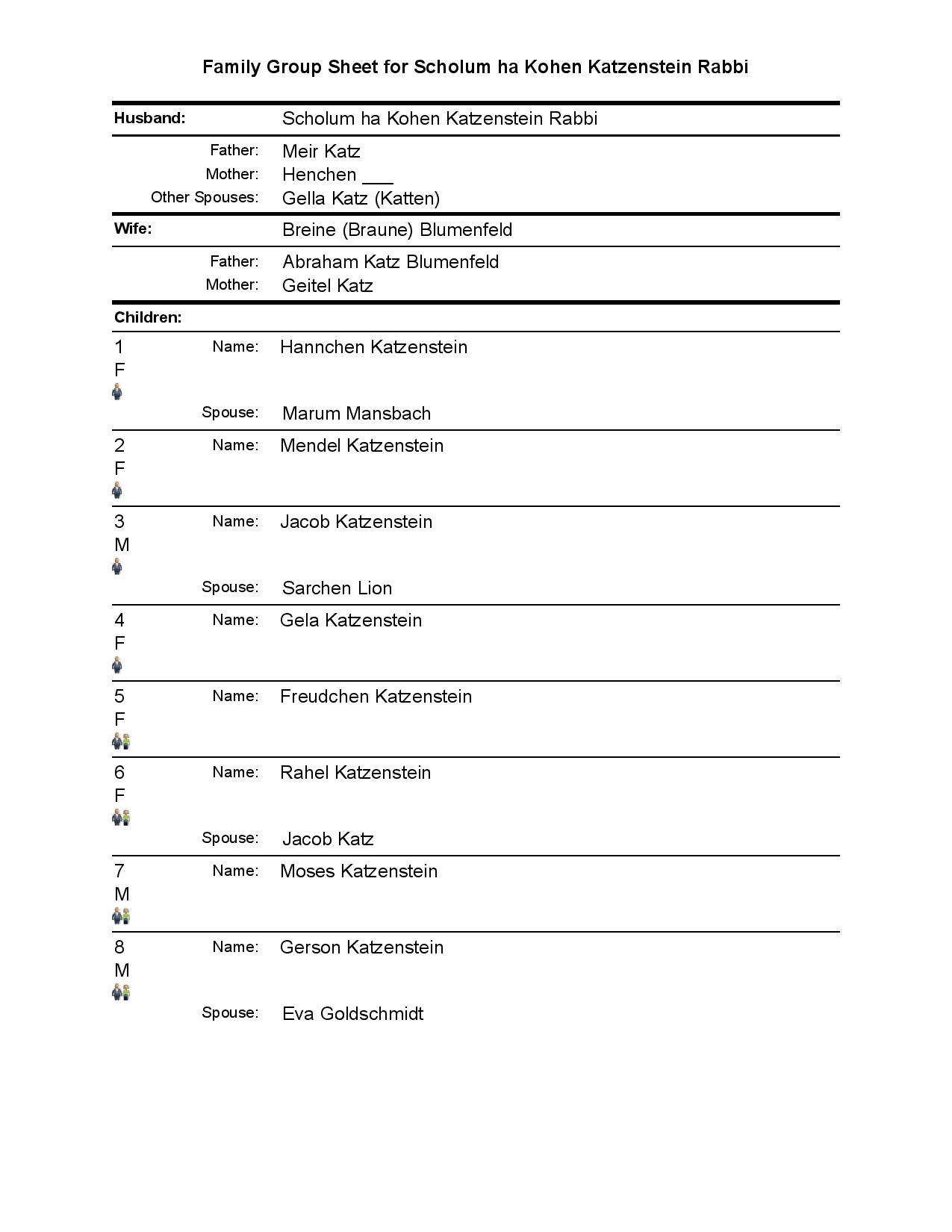
Scholem Meier Katzenstein, my third great-grandfather, thus may have been the first in my direct line to use the name Katzenstein.  He was born in September 1769 and died on October 13, 1826, in Jesberg. He was an “Ellenwarenhandler,” according to Barbara Greve.  Thanks to the help of the German Genealogy group on Facebook, I learned that Ellenwarenhandler is a term that was used to describe someone who sold dry goods according to specific measurements.

Scholem Katzenstein was married twice, first to Gella Katz (Katten) in January 1795 in Jesberg.[2]  Gella died on January 31, 1808, after giving birth to her fourth child with Scholem, Gela.  The four children born to Gella and Scholem Meier were Hannchen (1798-1840), Mendel (1799-1799), Jacob (1803-1880), and Gela (1808-1808). Only Hannchen and Jacob survived infancy.

Scholem remarried on September 29, 1808; his second wife was my third-great-grandmother, Breine Katz Blumenfeld.  She was born in Momberg, Germany, and David Baron thought was she probably the daughter of Abraham Katz Blumenfeld, and Geidel Katz, who would thus be my fourth-great-grandparents.

Deutsch: Gilsabrücke in Jesberg

Deutsch: Gilsabrücke in Jesberg (Photo credit: Wikipedia)

Scholem and Breine had four children.  The first was Freudchen, born on November 4 1809 in Jesberg; she died September 8, 1818 when she was not yet nine years old.

A second daughter, Rahel, was born on January 15, 1813, in Jesberg.  She married Jacob Katz, also of Jesberg; he and Rahel were cousins.  Jacob was the great-grandson of Bonum Katz; Rahel was the great-great-grandaughter of Bonum Katz. Thus, Rahel and Jacob were second cousins, once removed. Rahel and Jacob had five children.  Rahel died on December 7, 1861, in Jesberg.

(Since Barbara Greve believes that Bonum Katz was not the great-great-grandfather of Rahel, this statement may not be correct.  For the moment I will let it stand, subject to change.)

Scholem and Breine also had a son named Moses, who was born in Jesberg on November 4, 1814.  There was no further information about Moses on David’s family tree.

But most important to me was the remaining child of Scholem and Breine, Gerson Katzenstein, my great-great-grandfather.  Although most American records have Gerson’s birth year at roughly 1815, the German records show that he was born on August 11, 1811, making him the second oldest child and oldest son of Scholem and Breine.  Since Freudchen had died as a child, Gerson was effectively the oldest child, assuming that the Jesberg record as transcribed is more accurate than the US records.

family-group-sheet-for-scholum-ha-kohen-katzenstein-rabbi-page-001

So where do I begin to tell the story of this large family that extends back 300 years? I think it makes sense to start with my great-great-grandfather Gerson Katzenstein and his siblings.


[1] Given the seven year age gap between Salomon and Meier, it seems likely that Schalum and Brendelchen had other children who have not yet been found; the 1744 Jesberg census, for example, lists another son named Mendel, but no other information about him has been found.

[2] Despite the Katz surname, it does not appear that Gella was closely related to the Jesberg Katz/Katzenstein family as she was born in Halsdorf, another Hessian town; but given the marriage patterns in these families, there is likely some connection.

Herding Katz

The title of this post has a double meaning, as you will see.

As I wrote in my last post, about ten years ago when I first found the genealogy page about the Katzenstein and Goldschmidt family compiled by David Baron and Roger Cibella, David (who is their family genealogist) at that point had traced the Katzenstein family line back as far as Gerson Katzenstein, my great-great-grandfather.

Fast forward to 2012 when I began to explore my family’s history and discovered, with the help of others, Barbara Greve’s work, which took the Katzenstein line back yet another generation to Scholum Katzenstein, my three-times great-grandfather.  Now I could trace the family back as early as 1769 when Scholum was born in Jesberg, Germany.  I entered all the data into my Ancestry family tree and thought, “Well, that’s incredible.  But that must be as far as it can go, for sure.”

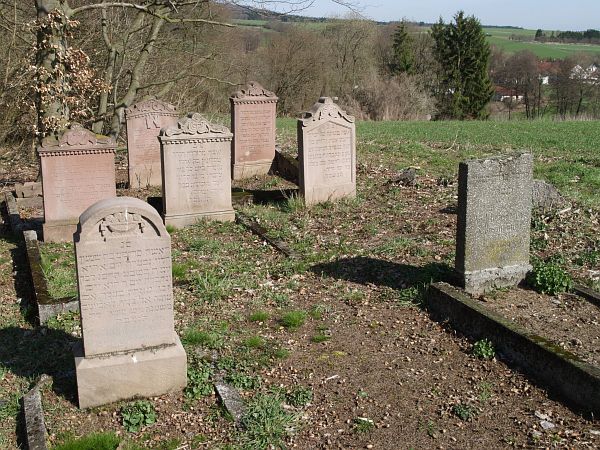
But I was wrong.  Just recently I spoke again to David Baron, and he provided me with his new 2016 update to the Katzenstein family tree.  Based on more recent data from Barbara Greve’s transcriptions of birth, marriage and death records from Jesberg and from photographs and transcriptions of headstones from the Jewish cemetery for Jesberg, David had been able to extrapolate even more information about the Katzenstein line.

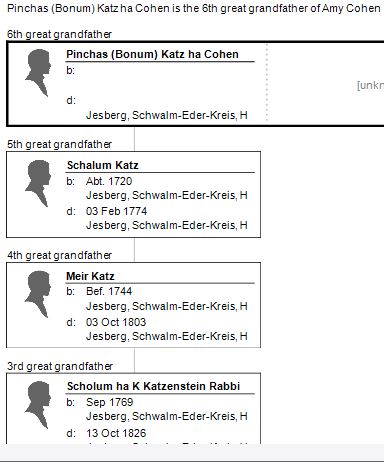
Now he was able to go back three more generations. Scholum Katzenstein’s father was Meier Katz, my four-times great-grandfather.  Meier was the son of Scholum ha Kohen, who was born in about 1720 in Jesberg; he was my five-times great-grandfather; his wife was Brendelchen, my five-times great-grandmother.  Scholum’s father was Pinchas ha Kohen, also known as Bonum Katz.  He was my six-times great-grandfather.  Like all those who followed until Gerson emigrated, Pinchas had died in Jesberg, Germany.

pinchas-to-scholem

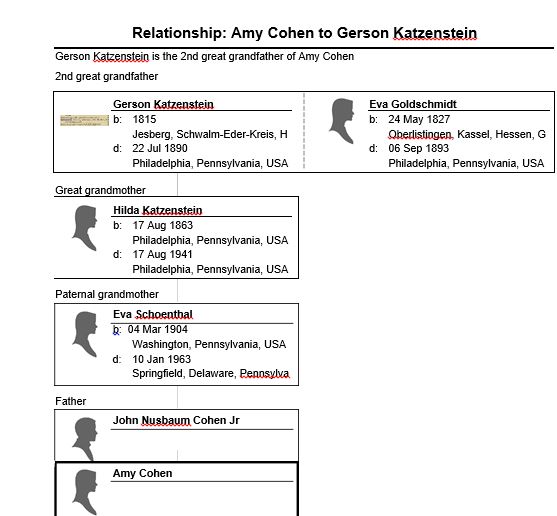
gerson-to-me

(Update: As I described in a later post, there is disagreement between Barbara Greve and David Baron as to whether or not Bonum Katz/Pinchas ha Cohen was an ancestor of Meir Katz and thus my Katzenstein line.  I’ve left this post as written subject to reaching some resolution of that disagreement.)

Now that I know how deep my family’s roots are in Jesberg, Germany, I am even more excited that I will be there next year, seeing the place where my Katzenstein ancestors lived at least as far back as the early 1700s.  I will be able to see where they were born, where they lived, where they died, and where they are buried.

So I’ve done some research about this little town in Germany.

Location of Jesberg in district Schwalm-Eder-Kreis

Location of Jesberg in district Schwalm-Eder-Kreis (Photo credit: Wikipedia)

Jesberg is a small town located in the Schwalm-Eder-Kreis district of the state of Hesse in Germany.  It is about forty miles south of Breuna, where my Hamberg relatives lived, and about fifty miles south of Sielen, where my Schoenthal relatives lived.  According to Wikipedia, as of the end of 2015, the population of Jesberg was 2,347 people, and the town’s area is 19.22 square miles.

I could not find much of the history of Jesberg online, but Wikipedia reports that the Linsingen family built the Burg Jesberg, the castle, in 1241.  Beyond that and a reference to the Prinzessgarten built by Maximilian von Hessen, I could not anything else online that describes the general history of Jesberg.  I have written to the town to see if I can learn more about the history and the current economic and social aspects of the town.

Deutsch: Burg Jesberg, Gewölbe

Deutsch: Burg Jesberg, Gewölbe (Photo credit: Wikipedia)

I was surprisingly able to find more information about Jesberg’s Jewish history from several different sources. (See below.) There was first a Jewish presence in Jesberg in 1664. In 1774, there were five Jewish families in Jesberg; two years later there were seven Jewish families.  At least one of those seven families had to have been members of my Katzenstein family.

Although Jews prayed together before 1832 in Jesberg, it wasn’t until that year that a synagogue was built.  It was a two-story building that accommodated 44 men and 41 women; there was also space for a school and an apartment for the teacher, who generally also acted as the cantor and schochet (Kosher butcher).

By 1835, there were 53 Jewish residents of Jesberg.  There was a mikveh and a cemetery, shared with a nearby community.  Jews were engaged in farming, horse and cattle trading, trading of goods, and various other trades.  Jesberg itself was a center for the cattle trade, and David Baron believes that many members of  the Katz/enstein family were engaged in the cattle business.

By 1871, the Jewish population had grown to 77 people, constituting 8% of the overall population of 960 people.  The Jewish population continued to grow, peaking at 89 people in 1905, which was more than 10% of the overall population of the town at that time. During that time period, there were also twenty to thirty children enrolled in the Jewish school.

As the twentieth century progressed, the Jewish population started to decline.  The school closed in 1922, and in 1931, there were only six children receiving religious instruction in Jesberg.  In 1932, the synagogue was renovated in honor of its 100th anniversary.  The Jewish population in 1933 when Hitler came to power was 53 people.

Between 1933, and 1938, 27 Jesberg Jews emigrated from Germany; twenty went to the United States, seven to Palestine.  Two families moved to Frankfurt. After the synagogue was destroyed in November 1938 during Kristallnacht, more Jews left.  But not enough.  At least 25 Jews from Jesberg were killed in the Holocaust, including a number of those from the extended Katz and Katzenstein families.

Jesberg was never a big town, and its Jewish population never exceeded much more than ten percent of the overall population.  But there was once a real Jewish community there: a synagogue, a school, a mikveh, a kosher butcher, and a cemetery. Today there is no Jewish community there.  Nevertheless, I want to see Jesberg just as I want to see Sielen, Breuna, Gau-Algesheim, Bingen, Schopfloch, and all the other towns where my ancestors lived in Germany.

English: Jesberg (Hessen) viewed from the castle

English: Jesberg (Hessen) viewed from the castle (Photo credit: Wikipedia)

Fortunately for me, my last direct ancestor to have been born in Jesberg, Gerson Katzenstein, my great-great-grandfather, emigrated from Germany in the mid-19th century.   Because of that courageous move, my Katzenstein line has flourished.  Not the same can be said for the families of most of Gerson’s siblings and cousins.  More on that in posts to come.


Sources:

The Encyclopedia of Jewish Life Before and During the Holocaust: A-J (Shmuel Spector, Geoffrey Wigoder,  eds., NYU Press, 2001) p. 573.  Found here.

Destroyed German Synagogues and Communities website, found here.

The Alemannia-Judaica site:  http://www.alemannia-judaica.de/jesberg_synagoge.htm

The Work is Never Done

It’s time to move on to the next family line, although there is still so much to do on those I’ve started.  As my most recent discoveries about the Brotman line reveal, there is always more to learn, more to find. I still have collateral lines to complete in the Schoenthal family—the families of my great-great-great-aunts, Mina Schoenthal Rosenberg and Fradchen (Fanny) Schoenthal Goldschmidt. In fact, however, Fanny’s family is intertwined with the next family’s story as well.

Because now it is time to turn to my remaining great-grandparent—my father’s maternal grandmother, Hilda Katzenstein Schoenthal, wife of Isidor Schoenthal and mother of my grandmother, Eva Schoenthal.  Hilda was the daughter of Gerson Katzenstein of Jesberg, Germany, and Eva Goldschmidt of Oberlistingen, Germany.  My grandmother Eva was presumably named for her grandmother, Eva Goldschmidt.

Hilda Katzenstein Schoenthal

Hilda Katzenstein Schoenthal

Just over a year ago, I wrote about the crazy twist in my family tree involving Eva Goldschmidt, my great-great-grandmother.  She was the daughter of Seligmann Goldschmidt, a brother of Simon Goldschmidt, who married Fanny Schoenthal, my great-great-grandfather’s brother.


Marriage of Simon Goldschmidt and Fradchen Schoenthal HHStAW Abt. 365 Nr. 669, S. 11

Marriage of Simon Goldschmidt and Fradchen Schoenthal
HHStAW Abt. 365 Nr. 669, S. 11

In other words, my great-grandmother Hilda was a Goldschmidt, and her husband, my great-grandfather Isidore Schoenthal, was the nephew of Fanny Schoenthal Goldschmidt and thus had cousins named Goldschmidt.  In fact, one of those cousins, Simon’s son Jacob Goldschmidt from his first marriage, was likely the first member of the extended family to settle in Washington, Pennsylvania, where my grandmother was born in 1904.   More on the Goldschmidt family tree twist here. And more on the Goldschmidt family to come.

But for now I am going to focus on the Katzenstein side of my great-grandmother Hilda’s family. As I’ve indicated before, when I first started looking into my family’s history, this was the one line that had already been extensively researched by others.  Long before I started my own research, David Baron and Roger Cibella had posted their research on an old Geocities page.  And who even remembers Geocities!? Roger is my third cousin, once removed. I had contacted David and Roger years ago when I somehow fell upon their website (I don’t remember how), and was amazed that they were able to trace my family back to Gerson Katzenstein, my great-great-grandfather.gerson-to-me


And although I was fascinated by their research, I didn’t pursue it further. I hadn’t yet been bitten by the genealogy bug.

Isidore, Hilda (Katzenstein), and Eva Schoenthal

Isidore, Hilda (Katzenstein), and Eva Schoenthal

Then when I was first bitten in 2012 and started to explore genealogy on my own, I found a family tree on Ancestry that included some of my Katzenstein relatives, and I contacted the tree owner, a woman named Jennifer with whom I’ve been in contact ever since as we continue to find ways that our families overlap.  Back in June 2012, Jennifer put me in touch with an entire group of people with ties to the Katzenstein family, and from that group I also received a copy of the extensive report on the Jesberg Katzenstein family that had been done by a researcher named Barbara Greve.

Barbara Greve was born in Berlin, Germany after World War II.  As an adult, she developed an interest in the history of the Jewish communities that had once lived in the Hesse region where she now lived and taught school. She began to research those communities and what had happened to the people who had lived in them, compiling extensive information and genealogies for those Jewish families, including the Katzensteins of Jesberg. In 2010, Greve received the esteemed Obermayer German Jewish History award.  You can read more about her here.

I was both awestruck and overwhelmed by Barbara Greve’s research.  At that point in time I was a total newbie and knew nothing about genealogy research or about my family’s history.  All I had done at that point was the fourteen day free trial on Ancestry, where I had randomly searched for any name I knew from my family’s history. She had traced the Katzenstein line back another whole generation before Gerson Katzenstein to Scholum Katzenstein, my three-times great-grandfather, and included not only Gerson and his descendants, but Gerson’s four siblings and many of their descendants.  Now I could trace the family back as early as 1769 when Scholum was born in Jesberg, Germany.

family-sheet-for-scholem-meier-katzenstein

I had no idea that there were ancient records still in existence in places like Germany.  Seeing all those names and dates going back over 200 years was amazing to me.

My reaction to the Katzenstein research at that time in 2012 was—well, I guess it’s all done.  Nothing much left for me to do.  This was over a year before I started blogging.  I thought just collecting the names and dates was all I needed to do, and someone else had done it.  So I moved away from the Katzensteins and returned to the other lines where the research was not as complete.

And along the way I learned that genealogy is not just about collecting names and dates, although that is a big part of the work.  It’s also about trying to learn the stories of the lives of all those people behind the names and dates.  It’s about putting yourselves in their shoes and recognizing the legacy that we have all inherited from our ancestors.

HIlda (Katzenstein) Schoenthal, Eva (Schoenthal) Cohen, Eva HIlda Cohen, and Harold Schoenthal

HIlda (Katzenstein) Schoenthal, Eva (Schoenthal) Cohen, Eva HIlda Cohen, and Harold Schoenthal

Thus, I now return to the Katzensteins knowing that there is still work to be done.  There are stories to tell about these people, questions to ask, memories to honor. The work is never done.


Ernest Lion’s The Fountain at the Crossroad: An Unforgettable Book

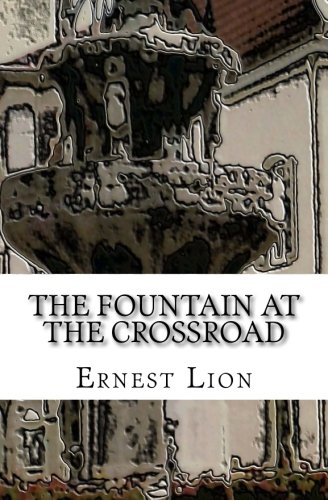
I am very excited to announce that Ernest Lion’s memoir, The Fountain at the Crossroad, has now been published and is available on Amazon.com both as a paperback ($10.50) and an ebook ($2.99). [UPDATE: the Kindle version is now available!] It has been my honor and privilege to bring this book to the public with the permission and assistance of Ernest’s son Tom.  I did this because I found the book unforgettable and because I don’t want Ernest or his life to be forgotten.  Tom and I are not deriving any financial gain from sales of the book. All net proceeds received from sales of the book will be donated to the United States Holocaust Memorial Museum in memory of Ernest Lion.

I have written about some aspects of Ernest’s life on the blog as he was married to my cousin, Liesel Mosbach, granddaughter of Rosalie Schoenthal, my grandfather’s sister.  Ernest and Liesel were deported from Germany to Auschwitz in early 1943; Liesel was murdered there, but Ernest survived.

The story of what he endured and how he survived is moving and horrifying.  His determination and courage in the face of unimaginable suffering is a story of what it means to be human when you are surrounded by inhumanity. And Ernest’s escape from the Nazis kept me on the edge of my seat even though I knew that he would survive.

But the book is not only about Ernest’s experience during the Holocaust.  It also tells the story of his childhood growing up with his parents in Germany and of his early adulthood when he dreamed of being an actor.  In addition, Ernest wrote about his life after the war—how he rebuilt his life in the US, starting all over, scarred by his experiences, but nevertheless determined to have a full and meaningful life.

Ernest only started talking about his Holocaust experiences late in his life, and then he was persuaded to write his memoirs.  In doing so, he relived much of the pain, but also reached a very poignant conclusion about the value of his own life.

If you have an interest in history, in World War II, in the Holocaust, in fact, if you have an interest in human beings and what they are made of, you should read this book. You can find it here.

Mark Twain on Learning German

I am continuing to try and learn German, studying about thirty minutes a day on Duolingo, and at times I feel like I have reached a plateau.  The more words I learn, the more I forget the ones I learned just a month ago.  All those words that end in –ung and/or start with ver- are getting too hard to keep straight.  And why are there at least two words for so many things?  Sure, I know that’s true in English also, but it was a lot easier learning English when my brain was young and flexible and everyone around me spoke it all the time.  Learning German at my age without some immersion is, to the say least, a challenge.

So I took great comfort in Mark Twain’s 1880 essay, “The Awful German Language.” Vera Meyer of the Facebook group “JEWS—Jekkes Engaged Worldwide” (“Jekke” or “yekke” has various specific meanings, but most broadly refers to a person of German-Jewish background) sent me a link to Twain’s essay the other day, and it made me laugh out loud several times over.

By Mathew Brady [Public domain], via Wikimedia Commons

Mark Twain (Samuel Clemens) By Matthew Brady [Public domain], via Wikimedia Commons https://commons.wikimedia.org/wiki/File%3AMark_Twain%2C_Brady-Handy_photo_portrait%2C_Feb_7%2C_1871%2C_cropped.jpg

Twain is one of my favorite authors, but I’d never before read this essay, and if I had, I would not have appreciated it before my own struggles with German.  You can find the entire essay here and I recommend it highly, but I want to quote just a few of my favorite passages.  Favorite because I relate so well to what Twain is saying.

This complaint is one that also gives me great frustration:

Personal pronouns and adjectives are a fruitful nuisance in this language, and should have been left out. For instance, the same sound, sie, means you, and it means she, and it means her, and it means it, and it means they, and it means them. Think of the ragged poverty of a language which has to make one word do the work of six — and a poor little weak thing of only three letters at that. But mainly, think of the exasperation of never knowing which of these meanings the speaker is trying to convey. This explains why, whenever a person says sie to me, I generally try to kill him, if a stranger.

And then there is the endless battle to figure out what is the gender of a particular noun so that you know what articles, pronouns, and adjectives to use:

Every noun has a gender, and there is no sense or system in the distribution; so the gender of each must be learned separately and by heart. There is no other way. To do this one has to have a memory like a memorandum-book. In German, a young lady has no sex, while a turnip has. Think what overwrought reverence that shows for the turnip, and what callous disrespect for the girl. ….

To continue with the German genders: a tree is male, its buds are female, its leaves are neuter; horses are sexless, dogs are male, cats are female — tomcats included, of course; a person’s mouth, neck, bosom, elbows, fingers, nails, feet, and body are of the male sex, and his head is male or neuter according to the word selected to signify it, and not according to the sex of the individual who wears it — for in Germany all the women either male heads or sexless ones; a person’s nose, lips, shoulders, breast, hands, and toes are of the female sex; and his hair, ears, eyes, chin, legs, knees, heart, and conscience haven’t any sex at all. The inventor of the language probably got what he knew about a conscience from hearsay.

And then finally, Twain’s overall lament about learning German:

My philological studies have satisfied me that a gifted person ought to learn English (barring spelling and pronouncing) in thirty hours, French in thirty days, and German in thirty years. It seems manifest, then, that the latter tongue ought to be trimmed down and repaired. If it is to remain as it is, it ought to be gently and reverently set aside among the dead languages, for only the dead have time to learn it.

Alas, at my age, if it really takes thirty years, it will take the rest of my life (if I am very lucky) to learn German.

But like Mark Twain, I will continue to muddle along, at least knowing that I am in good company in my struggles.

Sliding Doors

Back in April, I wrote about the family of Rosalie Schoenthal, my great-grandfather’s sister, the one who stayed in Germany to marry Willy Heymann.  Most of what I knew of their fate I learned from the memoir written by Ernest Lion, the man who married Rosalie and Willy’s granddaughter, Liesel Mosbach.  Liesel, her sister, her parents, and her aunt, were all victims of the Holocaust. Ernest Lion memorialized them all in his heartbreaking memoir, The Fountain at the Crossroad.

As I mentioned in a subsequent post written for Yom Hashoah in May, I was so moved by Ernest’s story that I tracked down his son Tom to ask about getting it published so that it could be more widely read.  Since then, I have been working with Tom to edit and format the memoir for publication.  (We’ve run into a few obstacles, but that’s a story for another day.)  I am hoping that sometime soon the book will be available for distribution. When it is, I will post the relevant information on the blog.

But none of this would be possible without the help of another of my cousins by marriage, Sharon.  Sharon is married to the great-grandson of Simon Schoenthal, who was also my great-grandfather’s brother as well as Rosalie Schoenthal Heymann’s brother.  And Sharon, who writes the blog The Heart and Craft of Life Writing, has a great deal of knowledge not only about writing, but also about getting your writing published.  Sharon and her husband were the ones who shared with me the remarkable memoir written by Hettie Schoenthal Stein.  So when I decided to try and get Ernest Lion’s book into a publishable format, I turned to Sharon for help.

Sharon spent hours through email and Skype instructing me on how to turn a typed manuscript into a format that is not only more readable, but also professional looking.  She has been incredibly patient with me, as all this was new to me, and the old brain isn’t quite as flexible as it once was.  I cannot possibly express how grateful I am to her for her help.

One of the last things we worked on was inserting photographs into the memoir, and as she was doing this, Sharon was struck by the resemblance she saw between Liesel Mosbach Lion, Ernest’s first wife and our mutual cousin, and Sharon’s mother-in-law, Blanche Stein Lippincott.  She sent me a photograph of Blanche and her family that I had not previously seen.

ezzie-blanche-parvin-1940

Blanche Stein Lippincott and her family 1940 Courtesy of the Lippincott family

And here is a photograph of Liesel Mosbach and Ernest Lion that I obtained from Ernest’s son to put into his book:

wedding-ernest-liesel-dec-18-1940-600-dpi

Liesel Mosbach and Ernest Lion Courtesy of the Lion Family


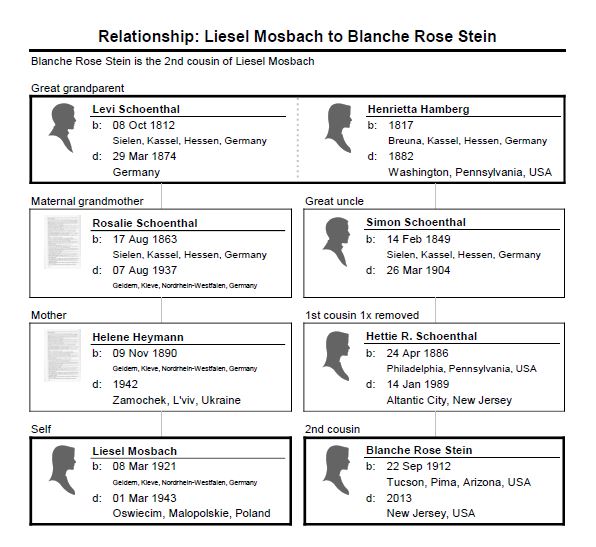
The resemblance is striking.  Blanche and Liesel were second cousins, but from these two photographs, they could have been sisters.

jpg-blanche-to-liesel


But what different lives and fates they had, and the expressions on their faces in these two photographs reflect those differences. While Blanche looks healthy and happy, Liesel looks drawn and sad, even on her wedding day.

Blanche was born in 1912 in Tucson, Arizona, and grew up living on the American frontier in the 1910s and 1920s.  Her mother Hattie and her aunt Gertrude had ventured out west after growing up in Philadelphia and Atlantic City.  They did later return to the East, as I’ve written, and Blanche spent the rest of her life living in New Jersey.  She married in 1937 and raised two children with her husband Ezra.  Blanche lived a long and happy life, making it to almost 101 years old before dying in 2013.  Her mother Hettie had made it to 103.

Blanche Stein Lippincott with her great-granddaughter 1996

Blanche Stein Lippincott with her great-granddaughter 1996

In contrast, Liesel lived a short and tragic life.  She was born in 1921 in Germany, where her father Julius Mosbach owned a fruit and vegetable stand. The family was probably living a comfortable enough life until Hitler came to power.  When Liesel married Ernest Lion on December 18, 1939, conditions for Jews were terrible in Germany, and the young couple had no idea what the future would bring.

There would, in fact, be no future. As a result of the Nazi oppression and the loss of his business, Julius Mosbach suffered a nervous breakdown; in 1941, he was sent to an institution where instead of being treated, he was murdered by the Nazis. In 1942, Liesel’s mother, sister, and aunt, and Ernest’s father were all deported and eventually killed in a Nazi concentration camp.  In 1943, Liesel and Ernest were deported to Auschwitz, where Liesel was killed.  Ernest survived and eventually escaped; he became the voice for the whole family.

Thus, Blanche and Liesel, second cousins who looked like sisters, had far different lives and fates.  I can’t help but think, what if Rosalie and Willie had come to the US like almost all of Rosalie’s siblings? What if Liesel and her sister Grete had grown up in Pennsylvania or anywhere else in the United States?

As the president of our synagogue reminded us on Rosh Hashanah, we cannot control where we are born, when we are born, or to whom we are born.  Some of us are blessed with good luck in all of those things while others are not.  We should never take that for granted.

Double Cousins…Everywhere!

The best part of my discoveries of the Goldfarb and Hecht families is that I have found more new cousins, three of whom are my double cousins—Sue, Debrah, and Lisa. They are descendants of Julius Goldfarb and Ida Hecht. Sue’s daughter Lisa shared this wonderful wedding photograph of Julius and Ida.

julius-ida-goldfarb-wedding-from-lisa-wartur

Wedding photograph of Julius Goldfarb, my grandmother’s first cousin, and Ida Hecht, my grandmother’s niece. Courtesy of the Goldfarb/Hecht family


Julius was the son of Sarah Goldfarb, my great-grandmother’s sister; Ida was the daughter of Tillie Hecht, my grandmother’s half-sister.   So I am related to both of them.

Julius and Ida had four daughters, Sylvia, Gertrude, Ethel and Evelyn. Sue, Sylvia’s daughter, shared with me this precious photograph of her grandmother Ida holding her as a baby:

ida-hecht-goldfarb-and-her-granddaughter-sue-1938

Ida Hecht Goldfarb and granddaughter Sue

And Debrah shared this photograph of her grandparents, Julius and Ida, with her mother Evelyn:


Julius, Evelyn, and Ida (Hecht) Goldfarb

Julius, Evelyn, and Ida (Hecht) Goldfarb

One thing I wanted to define is how, if at all, Julius and Ida were related to each other, aside from being husband and wife.  Hecht/Goldfarb family lore says Julius and Ida were “distant cousins.”

Julius was the son of Sarah Goldfarb.  Sarah’s sister Bessie Brotman was the stepmother of Ida’s mother, Toba, as Bessie married Toba’s father Joseph after his Toba’s mother died.  Although that makes things complicated, it does not alone create any genetic connection between Julius and Ida since Bessie (and thus Sarah) had no blood relationship with Toba.

relationship-bessie-brod-to-tillie-brotman

But if Brotman family lore is correct and Bessie and her husband Joseph Brotman were first cousins, then Joseph Brotman and Bessie’s sister Sarah were also first cousins. Sarah’s son Julius married Ida, who was the granddaughter of Sarah’s first cousin Joseph, making Julius and Ida second cousins, once removed.

relationship-of-julius-goldfarb-to-ida-hecht-better

That is, assuming that Joseph and Sarah were first cousins as Brotman family lore reports, Ida and Julius were in fact “distant cousins,” as Hecht/Goldfarb family lore indicates.  So maybe together the Brotman family lore and the Hecht/Goldfarb family lore validate each other.

Sue and Debrah, who are granddaughters of Julius Goldfarb and Ida Hecht, thus are both the great-granddaughters of Sarah Brotman Goldfarb, making them my third cousins on my great-grandmother Bessie’s side, and the great-great-granddaughters of Joseph Brotman, making them also my second cousins, once removed, on my great-grandfather Joseph’s side. (Lisa is one more step removed on both sides.) Renee is my second cousin; her mother Jean Hecht was my mother’s first cousin; her grandmother Toba was my grandmother Gussie’s half-sister. And then I’ve also found a cousin Jan, whose grandfather was Harry Hecht, Toba’s son, and my mother’s first cousin.

inset-from-harry-hecht-photo

Harry Hecht and his wife and children 1945 Courtesy of the family

And, of course, if my great-grandparents Joseph and Bessie Brotman were in fact first cousins, the relationships get even more convoluted. But I think I will skip that calculation.  At least for now.  Maybe some brave soul out there wants to try and figure it out?

With all this shared DNA, I was very curious to see if there were any family resemblances among the various members of the Goldfarb, Hecht, and Brotman families.  My newly found double cousins Debrah, Sue, and Lisa shared some family photos with me, including this one of Toba/ Taube/Tillie Brotman Hecht:

toba-tillie-brotman-hecht

Toba/Taube/Tillie Brotman Hecht Courtesy of the Goldfarb/Hecht family

Here is a photograph of her brother Max Brotman that I’d earlier received from his family:

Max Brotman

Max Brotman, courtesy of the family

Do you see a resemblance? Unfortunately I don’t have any photographs of Toba’s other full siblings, Abraham and David, to help with the comparison.

But here are photographs of Toba’s half-siblings, Hyman, Tillie (Ressler), Sam, and my grandmother Gussie:

Hyman Brotman

Hyman Brotman

Tilly Brotman

Tilly Brotman Ressler

Sam Brotman

Sam Brotman

Gussie Brotman

Gussie Brotman Goldschlager

I can see some similarities—in particular in the shape of the noses.  But it appears that Max and Toba do not have faces that are as round as those of their half-siblings.  Perhaps the shape of their faces was a genetic trait they inherited from their mother Chaye, not their father Joseph Brotman.

Here is one other photograph of the extended Goldfarb and Hecht family.

goldfarb-hecht-family-gathering

Goldfarb Hecht family gathering for Chanukah

Standing on the far left is Julius Goldfarb.  Seated at the head of the table is Ida Hecht Goldfarb.  On the right side of the table starting at the front are two of Ida’s sister, Etta and Jean Hecht.  Also in the photograph are Julius and Ida’s four daughters as well as their spouses and a few of the grandchildren and other cousins.

It’s sad to think that in 1917 Julius and Ida were close enough to my grandmother that they came to visit when my aunt was born, as did Ida’s mother, my grandmother’s sister Toba Hecht, but somehow the families all lost touch, and my mother only has a few  memories of some of the Goldfarbs from her childhood.

On the other hand, I feel very fortunate that now, almost a century after my aunt was born, I know who the Goldfarbs and Hechts were and I am in touch with a number of these “new”  cousins of mine.


The Goldfarbs and the Hechts: Some Lingering Questions and Some Answers

Finding the woman I believe to have been my grandmother’s long missing sister was definitely one of those high points in my research that I will always remember.  I had spent hours and hours searching for the elusive Sophie years before. I had completely given up on ever finding her.  I even wondered whether she’d been a figment of my aunt’s very creative imagination. But she wasn’t.  My aunt just had the wrong name.

That she ended up being named Toba or Taube or Tillie and not Sophie certainly is a lesson in not relying too heavily on family lore, and it is also one of the many perplexing things about this discovery and how it fits with family stories.

max mason

Hecht family lore said that Taube had two brothers who had arrived in the US before she did, but I have no evidence that there were two Brotman brothers here before 1887 when Taube arrived.  Joseph Brotman had three sons in Galicia with his first wife Chaye and one with his second wife, my great-grandmother, Bessie.  His oldest sons, Abraham and David, came to the US in 1889, the same year that Joseph immigrated; Max came in 1890. His next son, Hyman, was born in 1883 and came to the US with my great-grandmother Bessie in 1891.  None of these European born sons was here in 1887 when Taube arrived, at least as far as I can tell.

Of course, it is possible that I have missed a child or missed an earlier manifest.  Or it is possible that the Hecht family lore is not correct, just as my aunt’s document naming the missing sister as Sophie is seemingly not correct.  I don’t know which is more likely.

There’s also the mystery of Eva Singer and Ascher Singer, the two people who sailed from Tarnobrzeg on the Moravia apparently with Taube Brodt.  Were they really sailing with her or just bracketed on the manifest to show they were all from the same town? And what happened to the Singers after they got to the United States?

Taube Brodt ship manifest 1887 Staatsarchiv Hamburg; Hamburg, Deutschland; Hamburger Passagierlisten; Microfilm No.: K_1736 Description Month : Direkt Band 059 (3 Jul 1887 - 29 Dez 1887)

Taube Brodt ship manifest 1887
Staatsarchiv Hamburg; Hamburg, Deutschland; Hamburger Passagierlisten; Microfilm No.: K_1736
Description
Month : Direkt Band 059 (3 Jul 1887 – 29 Dez 1887)

More importantly, what happened to Taube after she arrived if, in fact, she did not have two brothers living here already? Did she really go to St. Louis, as Hecht family lore indicates?

How I wish we had the 1890 census.  Perhaps if it still existed, I would have found that my great-grandfather Joseph Brotman was living in 1890 with his four children from his first marriage: Abraham, David, Max, and Taube.  But the 1890 census was destroyed in a fire, taking the answers with it.

I searched the 1890 New York City police census and the 1892 New York census on Ancestry, but alas, none of the Brotmans appears on those either.  I’ve searched in city directories for both New York and St. Louis, but again with no luck. There is a J. Brodman in the 1891 NYC directory, a “pedlar” living on Ridge Street; that could be my great-grandfather, but I certainly can’t tell for sure; plus it doesn’t help me find Taube as there is no listing for her nor, for that matter, for Abraham, David, or Max.

I thus don’t know where Taube was from the time she arrived in the US in 1887 until she gave birth to her first son, Harry, in 1892.  But from there on, I have been able to find her story—up to her sad death in 1944.

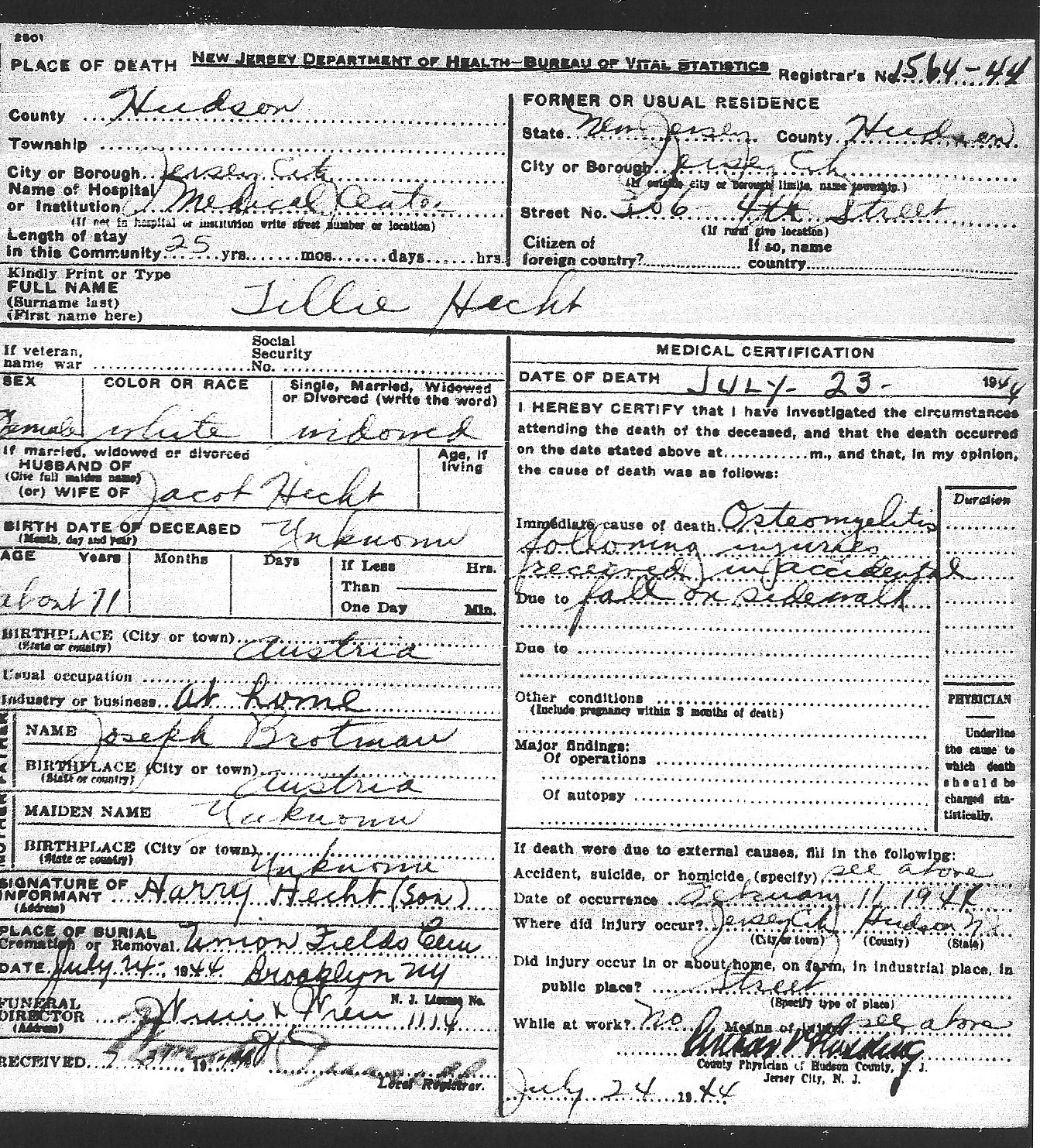
tillie-hecht-death-certificate

As her death certificate reported. she died from osteomyelitis after a fall on the sidewalk. The Mayo Clinic defined osteomyelitis as follows: “Osteomyelitis is an infection in a bone. Infections can reach a bone by traveling through the bloodstream or spreading from nearby tissue. Infections can also begin in the bone itself if an injury exposes the bone to germs.”  According to my medical consultant, today osteomyelitis rarely results in death, but back in 1944, antibiotic treatment was not as effective.

I also have an answer to the question I posed in my last post; I had asked for help in deciphering Ida Hecht’s occupation on the 1910 census:

Ida Hecht occupation on 1910 census

Ida Hecht occupation on 1910 census

Several readers, here and on Facebook, responded to my question with “button holer.” I wasn’t sure what that was, but another commenter did.  Bob Brotman (no relationship yet found to my Brotmans) wrote that it meant buttonhole maker, and explained, “In 1910 it was a specialized skill in the sweat shops and worth higher pay than most of the piece work. Women who sewed their own clothing at home would take the almost finished garments to a buttonhole maker for this final touch. Special buttonhole making machines were used commercially in the late 1800’s. Home sewing machines could not make decent buttonholes until the 1950’s.” Live and learn—always something new!

But other questions remain unanswered. There is the question of whether Brod, Brodman, Brotman, etc., are different names or different versions of the same name.  Were my great-grandparents both really named Brod or Brotman? Or was one a Brod, the other a Brotman?

I posted a question on the JewishGen listserv about whether Brod and Brotman were the same or different names, and I received conflicting responses.  One person, referring to Alexander Beider’s Dictionary of Surnames for the Russian Empire, wrote that Brotman is just another form of the surname Brot, meaning bread or bread man. Another person suggested that Brotman was an Americanization of Brod and that people often forgot the original name once they immigrated.

But another person said that they are two different names; this person said Brotman means “bread man” whereas Brot is a toponym for the place where people “ford” rivers, Brodt being a Slavic word for “ford.”  And then Stanley Diamond of JRI Poland wrote that both names existed in the Tarnobrzeg region and seemed to come from different families. So I am just as confused as I was before I asked the question.

Also, I still don’t know how, if at all, my great-grandparents Joseph and Bessie were related to each other. If they were first cousins, through what relationship? Were their fathers brothers? Or was it that one’s mother and the other’s father were siblings? Or were their mother’s sisters? I don’t know.

As has happened time and again with my Brotman line, I can only move forward in inches, but at least I am moving forward.  I have found a woman I believe to have been my great-grandmother’s sister—Sarah Brod/Brotman Goldfarb.  I have also found a woman I believe to have been my grandmother’s half-sister—Toba/Taube/Tillie Brotman Hecht.  And it all started with the discovery of my aunt’s 1917 baby book and two names that were not familiar to me.[1]  Once again, I am indebted to my Aunt Elaine, who would have been 99 years old tomorrow.

Aunt Elaine baby book 5

Can I say with 100% certainty that I am right about either one? No, but I am probably as right about it as I can get.  Having checked again to see if there were any new records discovered in Tarnobrzeg and learning that there have not been (and will not be, apparently), this may be the best I can do.

In my next post I will share some of the photos of my Hecht and Goldfarb cousins and compare them to my known Brotman relatives to see if there are any family resemblances.


[1] There are still other names in the baby that I will investigate more completely, though nothing has yet turned up that’s been helpful.

Oh, Happy Day! Tillie Hecht Mystery, Part II

I was just about to throw in the towel.  I couldn’t find one additional clue about Taube Brotman Hecht and whether she was related to me.  There were no records online to help.

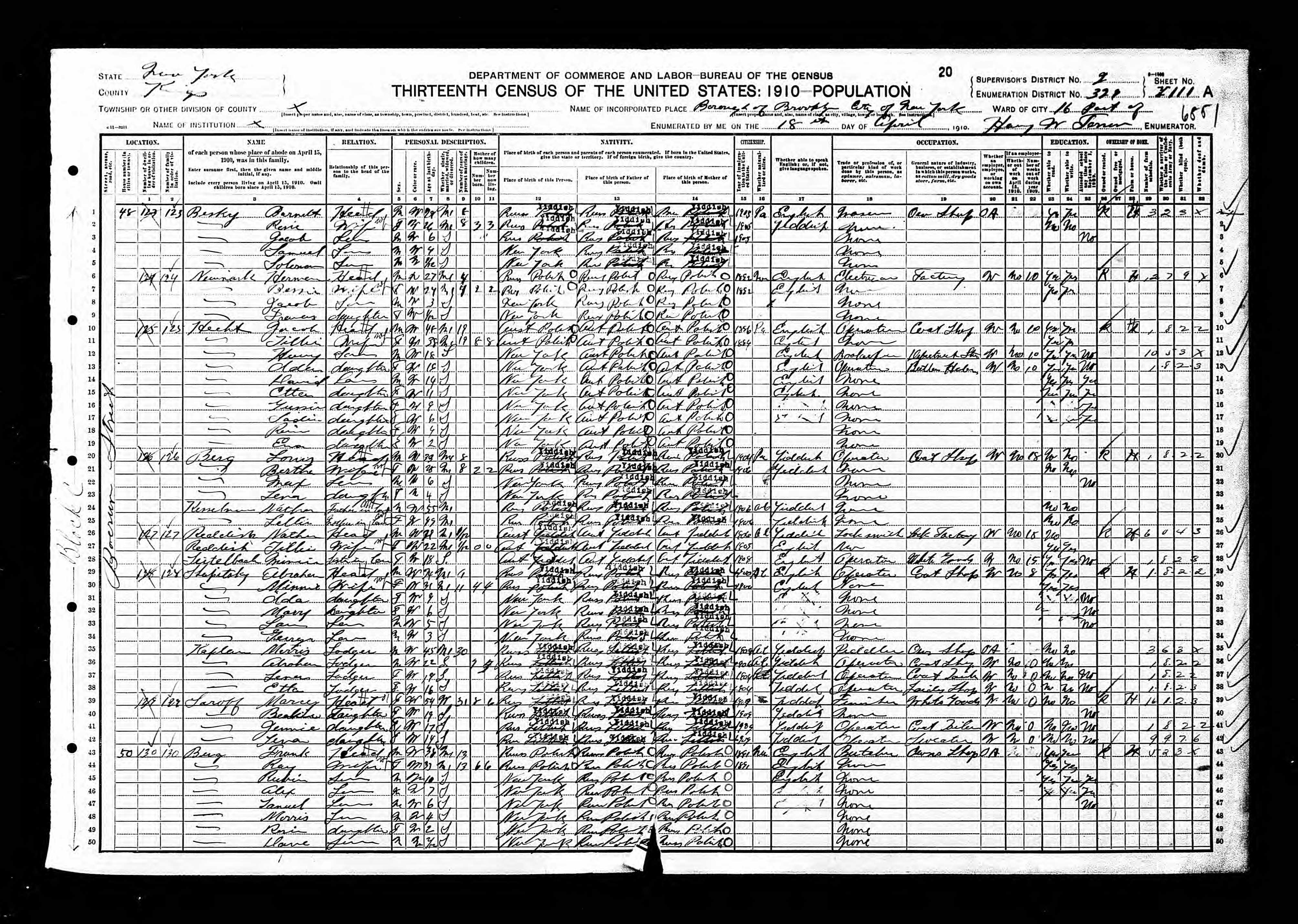
According to the 1900 and 1905 census records, Jacob Hecht and his wife Tillie lived in the Lower East Side and then by 1910 had moved to Brooklyn.  Jacob was a tailor, and in 1910 their son Harry was working as a bookkeeper in a department store and their daughter Ida was also employed, but I can’t quite make out her job: operator in a button or butter something?
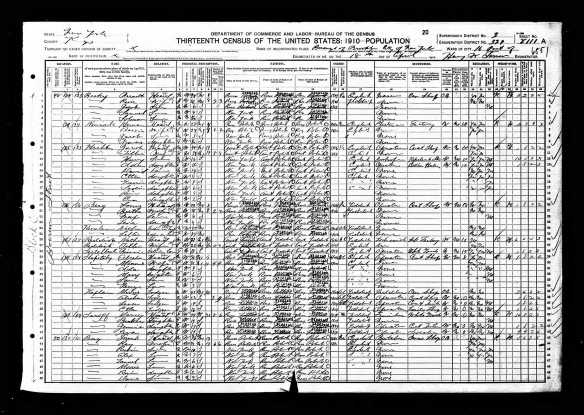
jacob-and-tillie-hecht-1910-census

Jacob and Tillie Hecht 1910 US census Year: 1910; Census Place: Brooklyn Ward 16, Kings, New York; Roll: T624_964; Page: 8A; Enumeration District: 0329; FHL microfilm: 1374977

Ida Hecht occupation on 1910 census

Ida Hecht occupation on 1910 census

In 1913, Ida married Julius Goldfarb, as noted in an earlier post.  In 1915, Jacob and Tillie Hecht and their other seven children were living in the same building as Sam and Sarah Goldfarb, Ida’s in-laws, and Hyman and Sophie Brotman, my grandmother’s brother and his wife.  Jacob was working as a tailor, and Harry was working as a salesman; the other children were still in school.
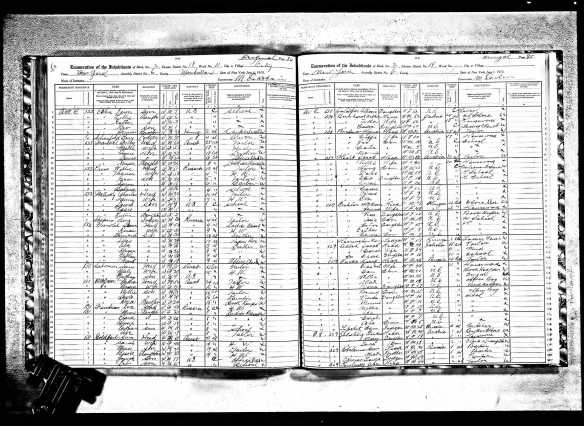
sam-goldfarb-and-family-1915-ny-census-bottom-left-and-top-right

Hecht family 1915 NY census;  New York State Archives; Albany, New York; State Population Census Schedules, 1915; Election District: 18; Assembly District: 06; City: New York; County: New York; Page: 85

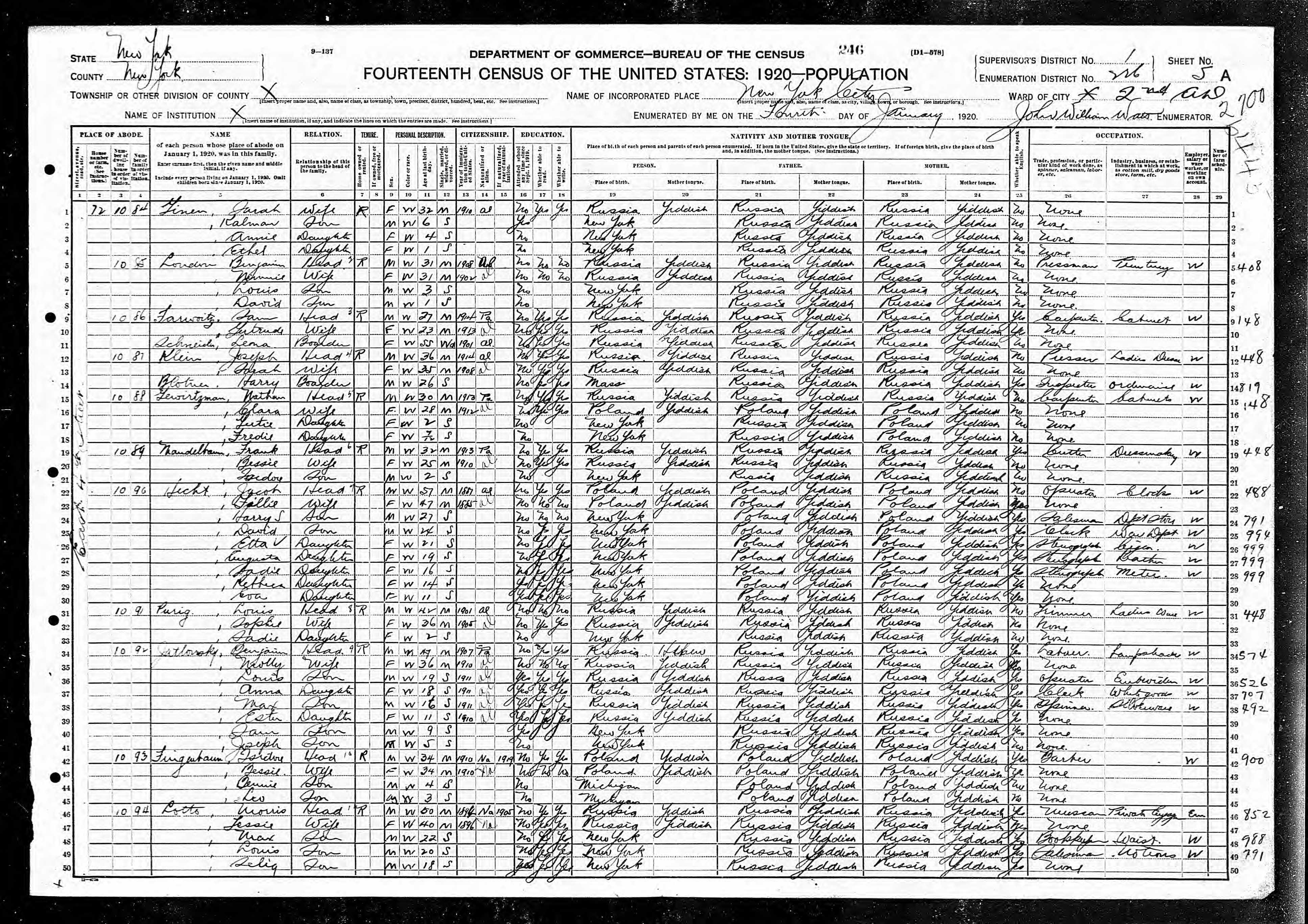
Jacob and Tillie Hecht still had the seven other children living with them in 1920, now on East 4th Street in New York City; Jacob continued to work as an operator in a cloak factory and Harry as a salesman in a department store.  David Hecht was working as a clerk for the War Department, and Etta, Gussie (listed as Augusta here) and Sadie were all working as stenographers.  The two youngest children, Rose (listed as Rebecca here) and Eva, were not yet employed.
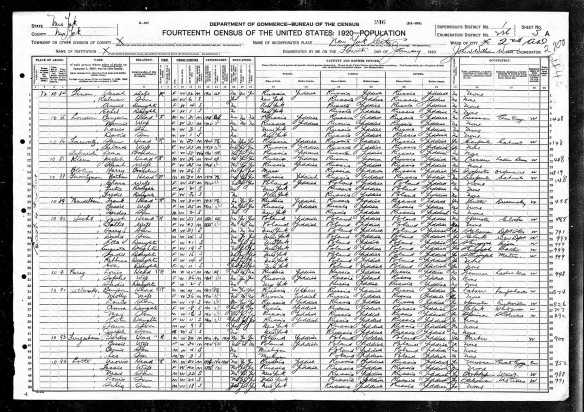
jacob-and-tillie-hecht-1920-us-census

Jacob and Tillie Hecht and family, 1920 US census Year: 1920; Census Place: Manhattan Assembly District 2, New York, New York; Roll: T625_1188; Page: 5A; Enumeration District: 226; Image: 1055

Meanwhile, Ida and her husband Julius Goldfarb and their children had by 1920 moved to Jersey City, NJ, where Julius was in the liquor business.  Within five years, almost all of the Hecht family had followed them to Jersey City, including Jacob and Tillie.  As you can see from this segment from the 1925 Jersey City directory, Jacob and Tillie were now living at 306 4th Street, and right above their listing is a listing for their son Harry.  He was working as a clerk for none other than Herman Brotman: my great-uncle, my grandmother’s brother Hymie.  Another piece of the puzzle was fitting together.

Hechts in 1925 Jersey City directory Title : Jersey City, New Jersey, City Directory, 1925 Source Information Ancestry.com. U.S. City Directories, 1822-1995 [database on-line]. Provo, UT, USA: Ancestry.com Operations, Inc., 2011.

Hechts in 1925 Jersey City directory
Title : Jersey City, New Jersey, City Directory, 1925
Source Information
Ancestry.com. U.S. City Directories, 1822-1995 [database on-line]. Provo, UT, USA: Ancestry.com Operations, Inc., 2011.

But there were two other Hechts listed here at the same address as Jacob and Tillie: Jean and Shirley, both working as stenographers.  I wasn’t sure which daughter was now using Jean and which was now using Shirley, but I guessed that Jean was probably Gussie and Shirley was probably Sadie. David, Etta, Rose, and Eva were not listed.  I could not find them elsewhere either.  Was Etta married? Rose and Eva were young enough that they could have still been in school, but where was David, who would have been 29 in 1925?

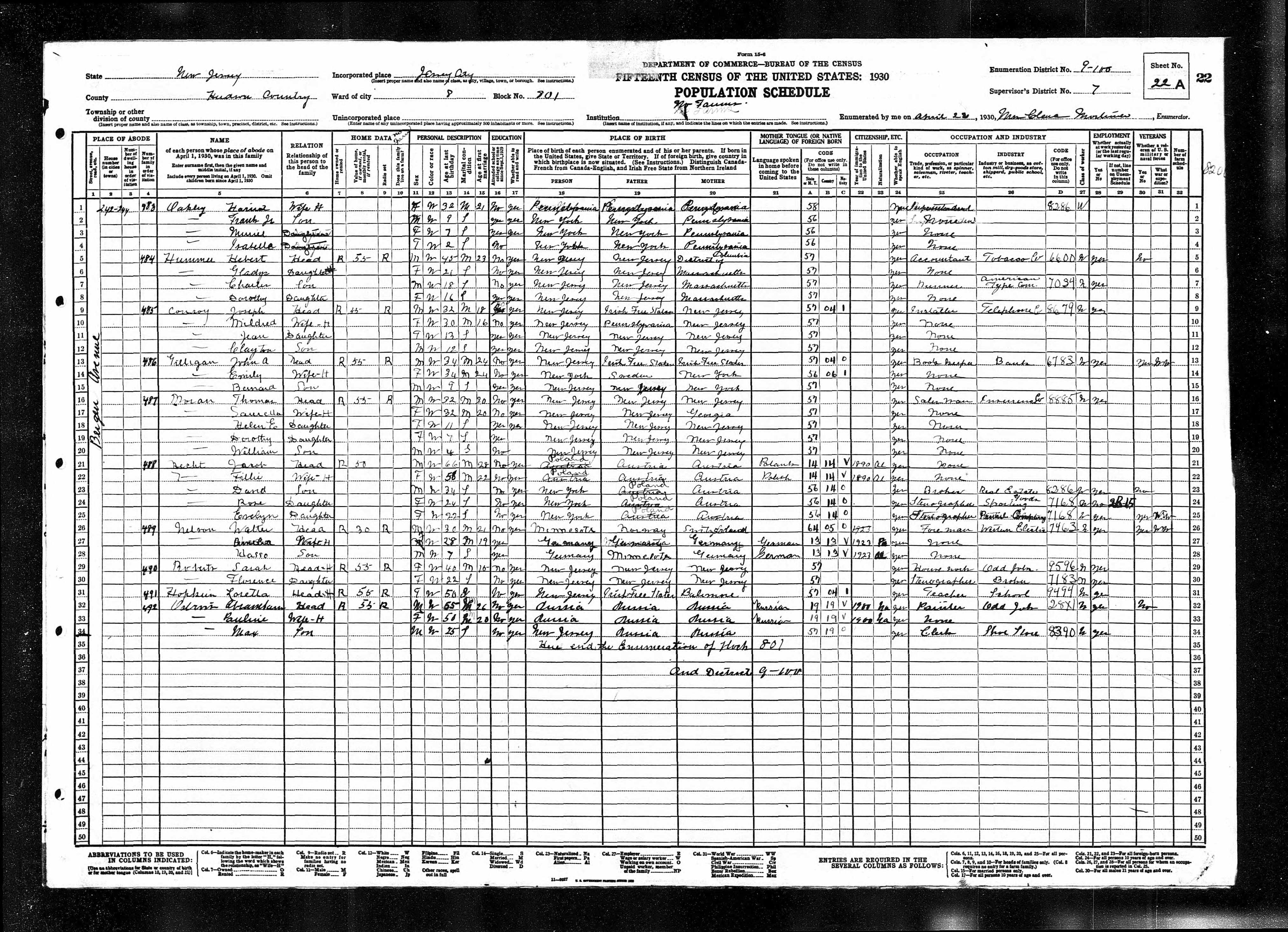
Fortunately, I was able to find a few of the Hechts on the 1930 census, which answered some of those questions.  In 1930, Jacob and Tillie were still living in Jersey City with David, Rose, and Eva (listed as Evelyn here).  Jacob was no longer working, but David was working as a real estate broker and Rose and Eva were both working as stenographers.
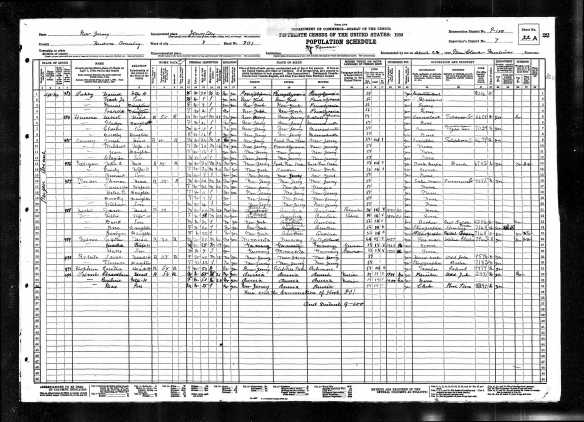
Jacob and Tillie Hecht 1930 US census Year: 1930; Census Place: Jersey City, Hudson, New Jersey; Roll: 1353; Page: 22A; Enumeration District: 0100; Image: 602.0; FHL microfilm: 2341088

Jacob and Tillie Hecht 1930 US census
Year: 1930; Census Place: Jersey City, Hudson, New Jersey; Roll: 1353; Page: 22A; Enumeration District: 0100; Image: 602.0; FHL microfilm: 2341088

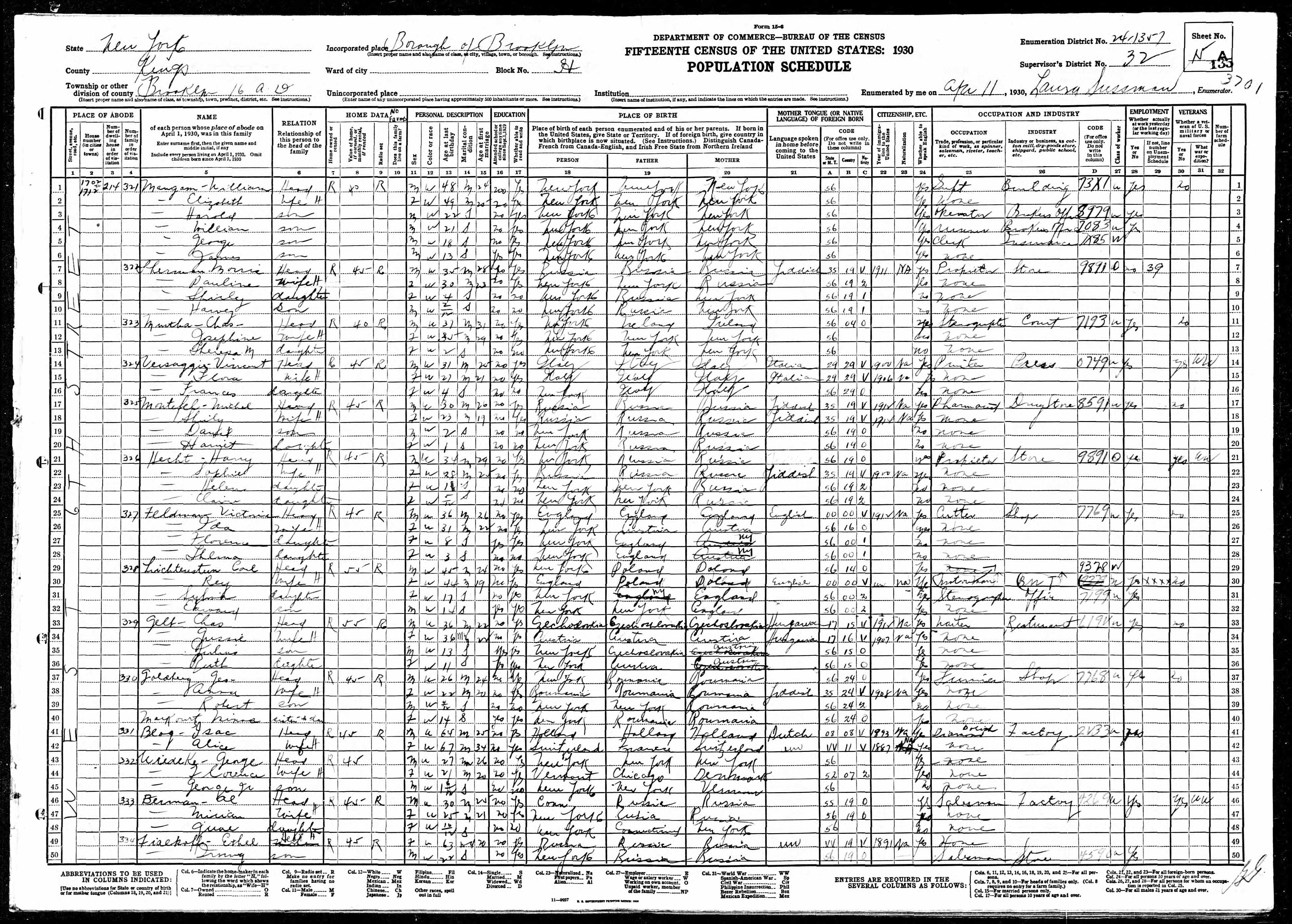
Their son Harry Hecht had moved to Brooklyn by 1930 and was now married to a woman named Sophie; they had two children.  Harry was the proprietor of a store.
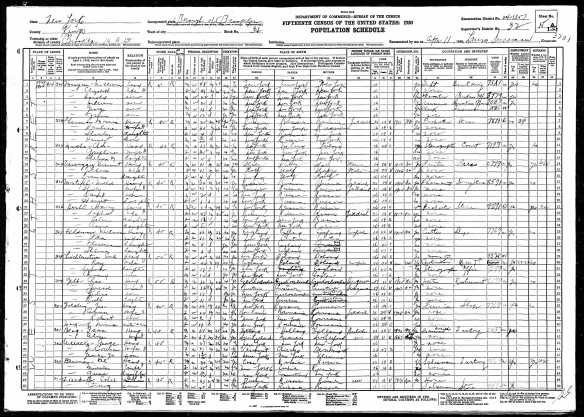
Harry Hecht and family 1930 US census Year: 1930; Census Place: Brooklyn, Kings, New York; Roll: 1522; Page: 15A; Enumeration District: 1357; Image: 271.0; FHL microfilm: 2341257

Harry Hecht and family 1930 US census
Year: 1930; Census Place: Brooklyn, Kings, New York; Roll: 1522; Page: 15A; Enumeration District: 1357; Image: 271.0; FHL microfilm: 2341257

As for Etta, Gussie, and Sadie, I assumed they were married, but I couldn’t find them.  And at that point I hit a wall. I could not find any of the Hecht daughters on the NYC marriage index.  Because the family had moved to New Jersey, and New Jersey has so far refused to put even an index of its birth, marriage, or death records online, there was no simple way for me to find marriage records for them in New Jersey. I assumed that Gussie/Jean and Sadie/Shirley had married between 1925 and 1930 and that Etta had married between 1920 and 1925, but paying for a search for these certificates did not seem like a wise use of my resources.

I already had two documents that said that Tillie Hecht’s birth name had been Taube or Toba Brotman: her son Harry’s birth certificate and her daughter Ida’s marriage certificate; there was also a ship manifest for a Taube Brodt from Tarnobrzeg.    In addition, I had found this entry on the SSACI for a Jean Gross, giving me not only information about Jean Hecht’s married name, but also another confirmation that Taube’s birth name was Toba Brotman:

Ancestry.com. U.S., Social Security Applications and Claims Index, 1936-2007 [database on-line]. Provo, UT, USA: Ancestry.com Operations, Inc., 2015.

Ancestry.com. U.S., Social Security Applications and Claims Index, 1936-2007 [database on-line]. Provo, UT, USA: Ancestry.com Operations, Inc., 2015.

The additional marriage certificates for the remaining daughters might have given me further confirmation that their mother’s birth name was Taube/Toba Brotman, but what I really wanted to know was who Taube’s parents were.  And that meant finding either her marriage certificate or her death certificate, not her children’s marriage certificates.  But before I could do that, I wanted some rough idea of when she died so that I could make a reasonable request of my researcher in Trenton.

That meant finding the 1940 census to see if Tillie Hecht was still alive in 1940.  The New Jersey archives allows public access to death certificates up to 1955; I had to hope that Tillie had died in New Jersey before 1955.


I was able to find Tillie Hecht on the 1940 census; she was still living in Jersey City at 306 East 4th Street.
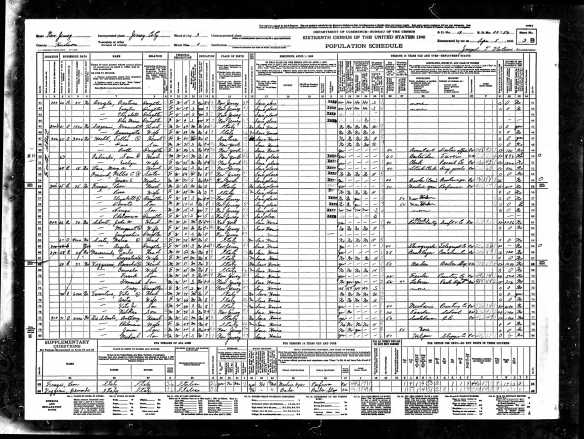
Tillie Hecht and family 1940 US census Year: 1940; Census Place: Jersey City, Hudson, New Jersey; Roll: T627_2401; Page: 3B; Enumeration District: 24-50

Tillie Hecht and family 1940 US census
Year: 1940; Census Place: Jersey City, Hudson, New Jersey; Roll: T627_2401; Page: 3B; Enumeration District: 24-50

She was now a widow, so Jacob had died since the 1930 census. It also says she was sixty years old whereas Tillie would really have been at least sixty-four.  There were two adult children living with her: Dave, who was listed as 35 and not employed, and Ruth, who was 26 and working as an assistant in a doctor’s office.  David Hecht should have been 45 in 1950, and Rose would have been 36. Had Rose changed her name from Rebecca (1930) to Ruth in 1940?  Had Tillie shaved ten years off the ages of herself and both of her children, or was there possibly another Tillie Hecht living in Jersey City, born in Austria?

I decided to assume for search purposes that this was the right Tillie Hecht and to ask my researcher to see if she could find a death certificate for a Taube or Tillie Hecht between 1940 and 1955.  And then I waited.

But while I was waiting, I also emailed Tillie’s great-granddaughter Sue and asked her what she knew about her Hecht relatives: what were the married names of her grandmother’s sisters? When did Jacob and Tillie and their children die? Did she know anything else that might help me find out how Tillie Brotman Hecht was related to my Brotmans, if at all?

Sue then spoke to her cousin Renee, one of Tillie’s grandchildren (Jean Hecht’s daughter), and filled me in on what Renee had told her.  It was an email filled with a great deal of information, but the part that was most critical to solving my question about Tillie Hecht was this one:

Tillie (Toba) Brotman came to U.S. at 10 years of age she thinks. 2 brothers were already here…redheads …or at least one was. The brothers sent Tillie to a house in St. Louis…to work…learn English, or both. Renee remembers her mother and Aunt Etta (also a Hecht girl) taking the subway to Brooklyn to see “The Uncle” who must have been one of Tillie’s brothers.

I read this paragraph several times, trying to sort out what it meant.  First, the fact that Tillie had come to the US at ten was consistent with the Taube Brodt I’d found on the 1887 ship manifest, listing Taube as eleven at that time.

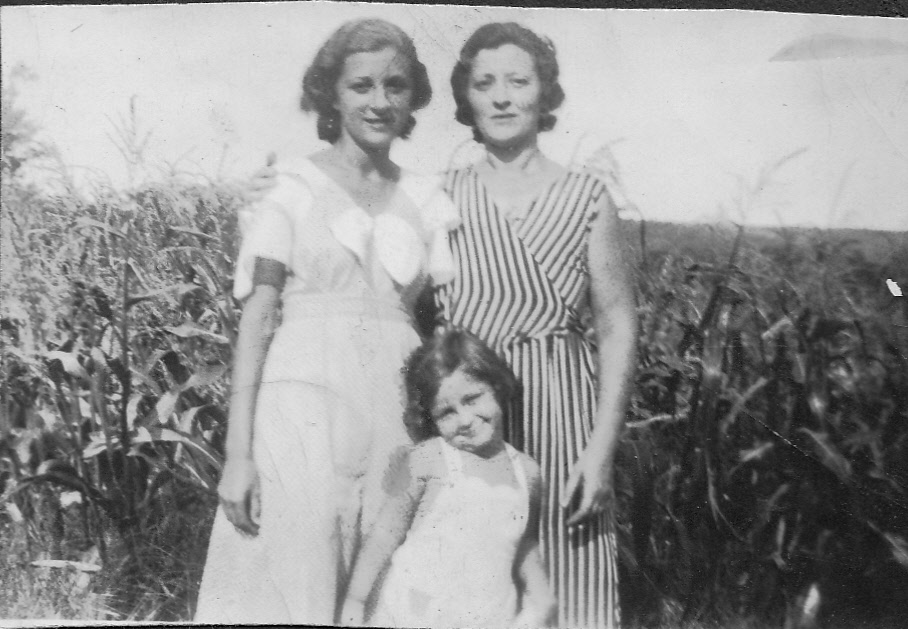
Second, Renee reported that Taube had had two brothers here already— and that they were redheads.  That stopped me in my tracks—my mother, my aunt, my grandmother, my grandmother’s sisters—all were redheads.  Red hair is recessive and not all that common.  Could this just be coincidence? A Brotman from Tarnobrzeg with red hair had to be related to my family.
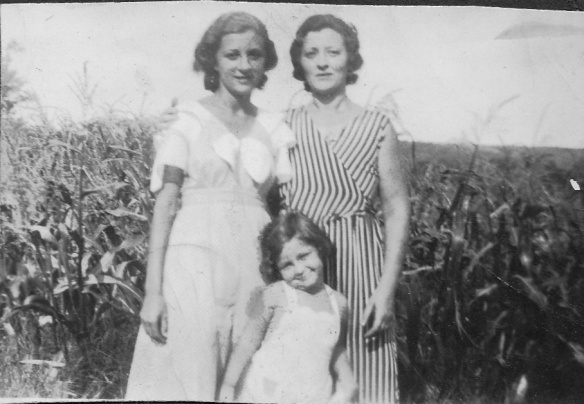
My grandmother with her two daughters, my Aunt Elaine and my mother 1933

My grandmother with her two daughters, my Aunt Elaine and my mother 1933.  All redheads.

But who were these two brothers? And why did they send Taube to St. Louis? I had no record of any Brotman from my family arriving before 1887 when Taube Brodt arrived.

I then read Sue’s email again.  This time a different paragraph jumped out at me:

Renee recalls meeting a cousin also named Renee who she thinks was the daughter of one of Tillie’s brothers. As she recalls, they owned a hardware store on Lexington Ave. and 59th in NYC.  Renee thought that both Renees were named for an Aunt Irene.

A big, loud bell went off in my slow-witted brain.  I knew who that second Renee was.  She was Renee Brotman, daughter of Max Brotman, my grandmother’s older half-brother.  Renee had married Charles Haber, and they owned a hardware store on Lexington Avenue and 59th Street in New York City.  I emailed Renee’s daughter Judy to confirm that that was in fact the address.
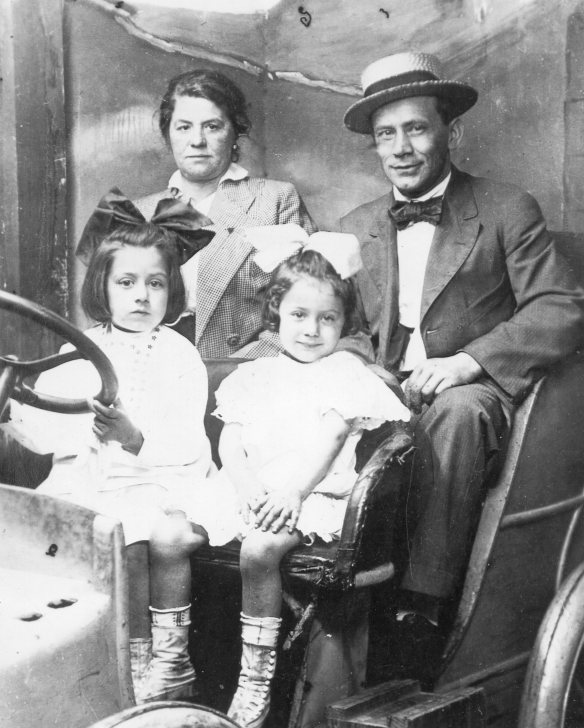
Max, Sophie, Rosalie and Renee

Max, Sophie, Rosalie and Renee Brotman. Max was my grandmother’s half-brother.

Suddenly I knew exactly who Toba Brotman, aka Taube Brodt, aka Tillie Hecht, was.

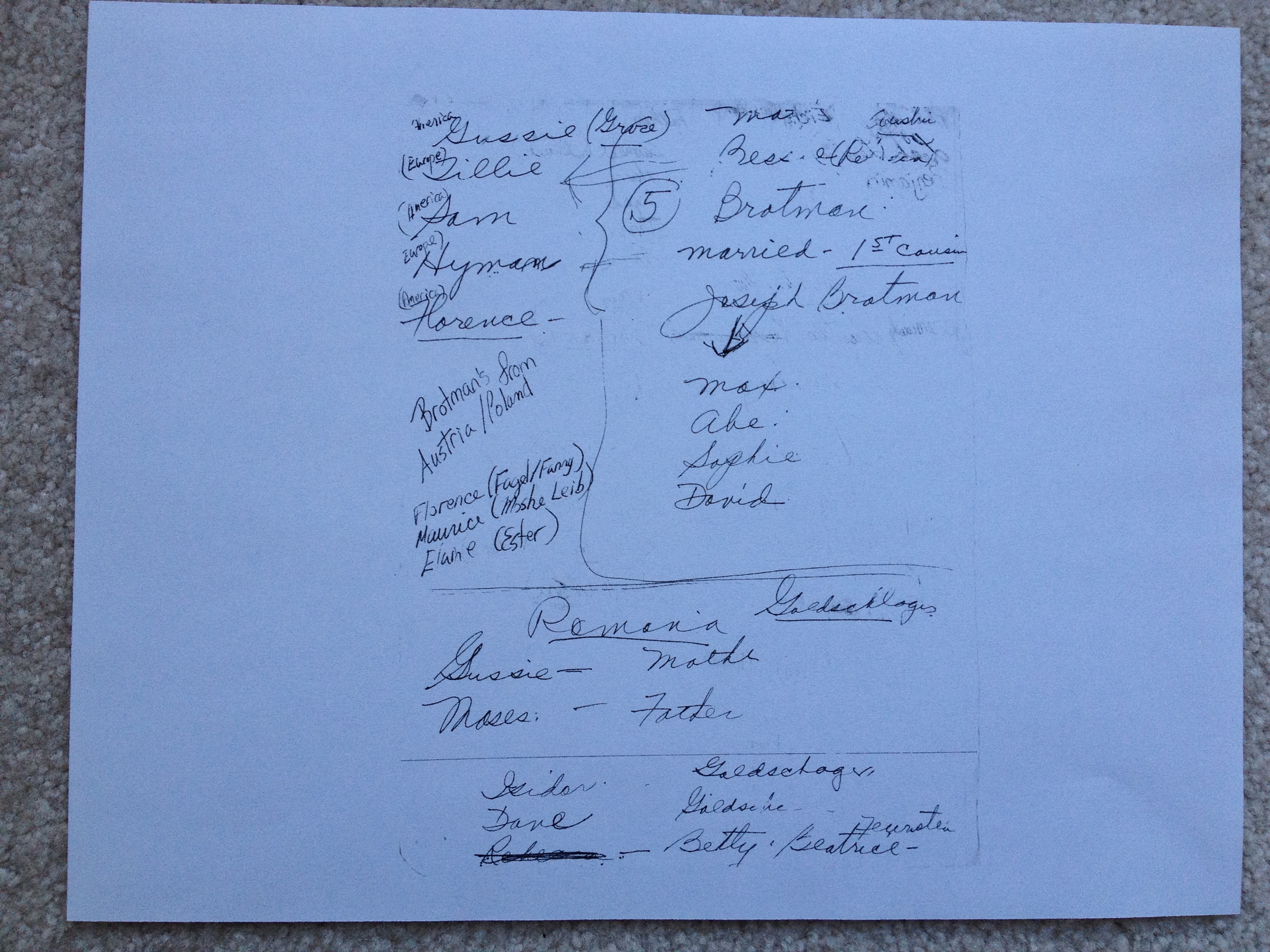
She was my grandmother’s half-sister, the missing sibling I had long ago, years ago, given up on ever finding.  I had searched and searched and found not one shred of a clue.  I only knew she existed because my Aunt Elaine had listed all of the children of Joseph Brotman, including those with his first wife Chaye, on her family tree.  There had been a daughter named Sophie, according to my aunt.
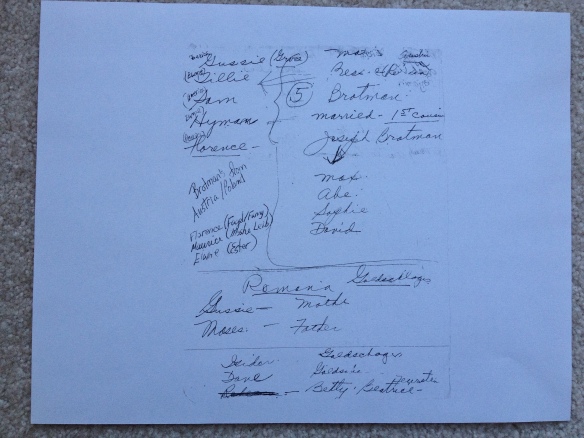
Family Tree drawn by Elaine Goldschlager Lehbraum
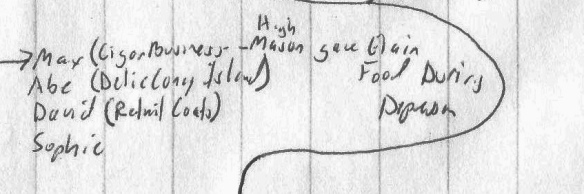
Family Tree drawn by Elaine Goldschlager Lehbraum

max mason

My aunt had all the other names right—could she have been mistaken about Sophie’s name? Was it really Toba or Taube or Tillie?

Plus there was another thing that troubled me: if Tillie Hecht was really my grandmother’s sister, it meant that my grandmother had two sisters using the name Tillie: her full sister Tillie, the one my mother knew well, Tillie Brotman Ressler, and this other half-sister Tillie Brotman Hecht.  How could there be two sisters with the same first name?
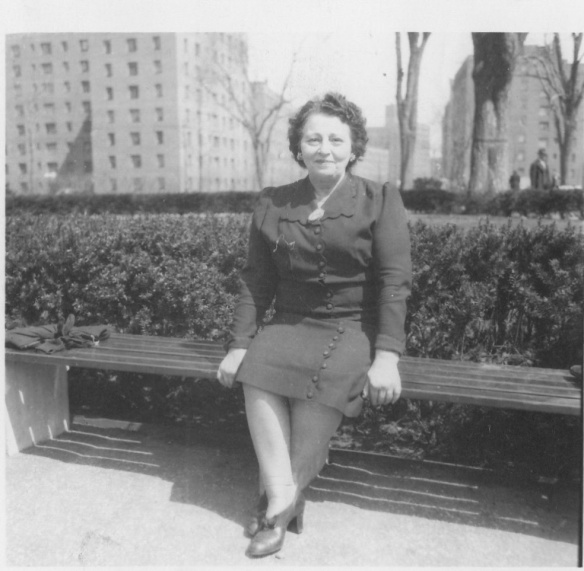
Tilly Ressler 1944

Tilly Brotman Ressler 1944.  My grandmother’s sister. And also a redhead.

But then I thought some more.  Tillie Hecht’s original name had been Toba; Tillie Ressler’s original name had been Tema.  They were not given the same name at birth; they both had just adopted the same Americanized nickname in the United States.  Maybe that’s why my aunt thought of Tillie Hecht as Sophie? Maybe some in the family still called her Toba or Taube and that sounded like Sophie to my aunt? (Those of us who knew her well knew how my Aunt Elaine could mangle a name.)

And who was this Aunt Irene that the two Renees were named for? A clue for that came from my cousin Judy; she said her mother Renee had originally been named Ida, but it was changed to Irene soon after she was born.  Irene then evolved into Renee.  When I saw “Ida,” I recalled that Ida was often a secular name for girls named Chaye.  Chaye was the name of Joseph Brotman’s first wife, the mother of Abraham, David, Max, and “Sophie.” Max Brotman had named his daughter Ida (then Irene) for his mother Chaye.  If Tillie Brotman Hecht was in fact “Sophie,” it made sense that she also named her first daughter Ida for her mother Chaye.

It all made sense.  But I knew better than to rely on family lore.  I needed some kind of official record to back up my hypothesis.

And then it arrived.  Tillie Hecht’s death certificate:
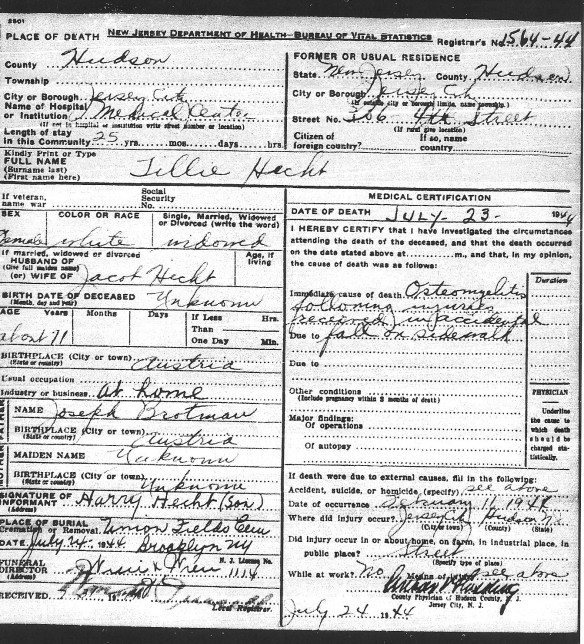
tillie-hecht-death-certificate

Her father was Joseph Brotman, my great-grandfather. Tillie Hecht, born Toba Brotman, was my grandmother’s half-sister.  The Hecht children, all eight of them, were my mother’s first cousins.  I had found the long missing Sophie, only she was really Toba.

There were still questions to address, but for the moment, I just was content to wallow in the joyous mud of discovery.

 

Who was Tillie Hecht? Another Brotman Mystery

If you had asked me three years ago when I started this blog whether I’d still be finding new Brotman relatives three years later, I’d have laughed. I had so little information about even my great-grandparents.  And yet here I am in 2016 having found a whole new Brotman/Brod family of relatives based on a name in a baby book from 1917.

The discovery of Julius Goldfarb and his family, in particular his mother Sarah Brotman/Brod, was a true blessing.  Now I have corroboration of where my great-grandparents lived in Poland, and I have a better picture of my grandmother’s extended family and the people who were part of her life when she was a child and an adult.  I also have several newly discovered living cousins who have already enriched my life.

Even more amazing to me is the most recent discovery of Taube Hecht because that discovery was even more far-fetched.  Remember that in my aunt’s baby book the last name on the list of visitors was Mrs. Taube Hecht.  At first I’d had no idea who she was.

Aunt Elaine baby book 5

Then while researching Julius Goldfarb to figure out how he was related to my grandmother, I obtained a copy of his marriage certificate.  Julius Goldfarb had married Ida Hecht, and on their marriage certificate it said her father was Jacob Hecht and her mother’s name was originally Taube Brotman, now Taube Hecht.  I had wondered whether Ida’s mother was also somehow related to my grandmother’s family.

goldfarb-hecht-marriage-page-3

In researching Taube Brotman Hecht, I learned that she was also known as Tillie and that she’d had eight children with Jacob Hecht: Harry (1892); Ida (1894); David (1896); Gussie (1899?); Etta (1900); Sadie (1903); Rose (1906); and Eva (1908).

On the 1915 New York State census, the Hecht family was living in the same building on Avenue C in New York City as Sam and Sarah Brotman/Brod Goldfarb and as Hyman Brotman, my great-uncle, and his family.  It certainly seemed possible that Taube was related to my Brotman great-grandparents and to Sarah Brotman/Brod Goldfarb.

sam-goldfarb-and-family-1915-ny-census-bottom-left-and-top-right

1915 NYS census with the Hecht family, the Goldfarb family, and the family of Hyman Brotman

So I jumped for joy—perhaps another relative, another set of clues about my Brod/Brotman relatives.  And then I jumped back into the research, hoping that Taube Brotman Hecht would provide more clues about my elusive relatives from Galicia.  I figured that with eight Hecht children to research, I would undoubtedly find more clues from birth, marriage, and death certificates.  But alas, the Hechts proved to be far more elusive than I’d hoped.

I started by searching for birth certificates.  Since I knew from the Goldfarb family records provided to me by my cousin Sue that Ida Hecht Goldfarb was born in New York City on October 19, 1894, and that the Hechts were still living in New York City in 1910 when the US census was taken, it seemed quite likely that all eight children, born between 1892 and 1908, were also born in New York City.  I searched the New York City birth records databases on Ancestry, FamilySearch, and Steve Morse’s website, and I could only find birth records listed for two of those eight children: the firstborn, Harry, and the last born child, Eva.  The other six children are just not there at all, no matter how I spelled their names, no matter how many wildcards I used.  Jacob and Taube must not have filed a birth certificate at all for those other six children.

In addition, when I asked my regular researcher at the Family History Library in Salt Lake City to find Harry’s birth certificate, she was unable to do so because it was a certificate marked “S,” meaning a later filed certificate.  Those are not on the microfilms at the FHL.  Instead I had to ask someone in NYC to go to the archives there to dig up Harry’s birth certificate.  It hadn’t been filed until 1906 when Harry was already fourteen years old.  I wonder what would have prompted the family to file it at that point in time.

harry-hecht-birth-certificate-resized

But the certificate is quite interesting.  It shows that in 1892, Jacob and Taube (“Toba” here, the Hebrew name) were living at 33 East Houston Street in New York City, that they were both born in Austria, and that Jacob (like Sam Goldfarb) was a cloaks operator.  Jacob was 25 when Harry was born, Toba only twenty, meaning they were born in about 1867 and 1872, respectively.

And most importantly, Harry’s birth certificate records Toba’s name before marriage as Toba Brotman.  Brotman! I was right that Ida’s marriage certificate said “Brotman,” not Braitmer as it had been indexed.  And, of course, this meant that there was a real chance that Toba, like Sarah Goldfarb, was related to my great-grandparents in some way.

And then I looked at the certificate I’d ordered for Eva Hecht.

eva-hecht-birth-certificate-resized

She was born on January 30, 1908, at 38 Montrose Avenue in Brooklyn.  On the 1910 census, the Hecht family was living at 48 Boerum Street in Brooklyn, which is right around the block from 38 Montrose Avenue.  So far, so good.  But then I looked at her parents’ names: JOSEPH Hecht and Tillie ROTHMAN.  Was this in fact the same Eva Hecht? The father was 40 years old, meaning born in about 1868; the mother was 37, so born about 1871. Those years were very close to the ages Jacob and Taube would have been in 1908.  Both parents were born in Austria, as were Jacob and Taube.  And the father “Joseph” was a tailor, as was Jacob Hecht.

Given all these similarities and the fact that by that time Taube was using Tillie on the census records, I have to believe that this is in fact a birth certificate for Eva Hecht, daughter of Jacob and Tillie/Taube/Toba Hecht.  And if it has Jacob’s first name wrong, it could very well have Tillie’s birth surname wrong.  Rothman does sound like Brotman, and many family members spelled Brotman as Brothman.  Perhaps the person filing the birth certificate, Mrs. Ida Goldman, just had bad hearing or the family’s accents were hard for her to understand.

So I had one new solid piece of evidence that Taube Hecht was born Toba Brotman and one rather shaky document that was at least somewhat supportive of that assumption. And, of course, I had Ida’s marriage certificate as well.  What else might I find? If there were no more birth certificates, could I find other marriage certificates or death certificates? Would the census records provide any more clues? So I decided to start from the beginning and search for records about the Hecht family.

The earliest census on which they appear is the 1900 US census.  The family was then living at 64 Broome Street on the Lower East Side.  The information for Jacob Hecht (spelled “Hect” here and indexed by Ancestry as “Hast,” making this a tough one to find) has some inconsistencies.   His birth year is 1870, so a year or two later than the other records indicated.  His birth place is Russia, not Austria.  But he is working as a tailor.  His wife’s name is listed as Mitilda, which certainly could be Tillie, and she also is listed as born in Russia, not Austria.  Her birth year is given as 1875, also several years later than her children’s birth records indicated.

Hecht family 1900 US census Year: 1900; Census Place: Manhattan, New York, New York; Roll: 1094; Page: 14A; Enumeration District: 0290; FHL microfilm: 1241094

Hecht family 1900 US census
Year: 1900; Census Place: Manhattan, New York, New York; Roll: 1094; Page: 14A; Enumeration District: 0290; FHL microfilm: 1241094

The names of their children also have some consistencies, some differences.  The first born, Harry, was born in 1892; that was consistent with Harry Hecht’s birth record.  The second child, however, is listed as Annie, born in 1893.  That should be Ida, the second child, who, according to the Goldfarb family papers, was born in 1894.  The third child, David, was reported to be four years old (the birth year is not very legible); that is consistent with David’s name and birth year on later census reports.  The fourth child is Yetta, who is listed on later reports as Etta; she is reported to have been seven months old when the census was enumerated in June 9, 1900, meaning she would have been born in October, 1899, not October 1889, as the census record has it recorded.  A birth year of 1899 is consistent with later census reports for Etta.

What this census record also revealed was that Jacob and “Miltilda” had been married for nine years, or in 1891.  It also said that Jacob had been in the US for only twelve years and arrived in 1887 (though it looks like 1777).  “Mitilda” had arrived earlier and had been in the country for fifteen years or since 1885 (though it looks like 1875 was written over it).  With this additional information, I searched for both a marriage record for Jacob and Taube/Tillie/Mitilda and for immigration records.

I had no luck finding a marriage record in the New York City marriage databases on Ancestry, FamilySearch, or Steve Morse’s website.  I guess it’s not surprising that a couple who failed to file birth certificates for their children also had failed to file a marriage record.  I am still hoping that some record will show up.

As for immigration records, I am fairly certain that I found the ship manifests for Taube.  I found two manifests, first a German manifest for the ship Moravia, dated July 9, 1887, sailing to New York from Hamburg.  On that manifest is a passenger named Taube Brodt, an eleven year old girl, and her name is bracketed with two other passengers, Eva Singer, a 38 year old woman, and an eleven month old baby named Ascher Singer, presumably the son of Eva.  And all three are listed as last residing in “Tarnobchek.”  That is, Tarnobrzeg—the home of my great-grandparents Joseph Brotman and Bessie Brod.

Taube Brodt ship manifest 1887 Staatsarchiv Hamburg; Hamburg, Deutschland; Hamburger Passagierlisten; Microfilm No.: K_1736 Description Month : Direkt Band 059 (3 Jul 1887 - 29 Dez 1887)

Taube Brodt ship manifest 1887
Staatsarchiv Hamburg; Hamburg, Deutschland; Hamburger Passagierlisten; Microfilm No.: K_1736
Description
Month : Direkt Band 059 (3 Jul 1887 – 29 Dez 1887)

The second manifest is also for the Moravia, but is the American manifest, written in English, and dated July 21, 1887, the arrival date in New York; it also lists Taube Brodt and the Singers as coming from Tarnobchek.

Taube Brodt 1887 NY ship manifest Year: 1887; Arrival: New York, New York; Microfilm Serial: M237, 1820-1897; Microfilm Roll: Roll 509; Line: 1; List Number: 911

Taube Brodt 1887 NY ship manifest
Year: 1887; Arrival: New York, New York; Microfilm Serial: M237, 1820-1897; Microfilm Roll: Roll 509; Line: 1; List Number: 911

But who were Eva and Ascher Singer? And why was this eleven year old child traveling with them? My great-grandfather arrived in 1889, my great-grandmother 1891; Sarah Brod/Brotman Goldfarb didn’t arrive until 1896.  So if Taube Brodt was their relative, who was she going to and why was she leaving home at such a young age? And where did Taube Brodt and Eva and Ascher Singer end up after they disembarked in New York City in July 1887?

Although I can find many women named Eva Singer, there is only one born in Austria who arrived in 1887 and who had a son who would have been born in 1886.  But that Eva’s son’s name is Herman, and that Eva was older than the one who sailed on the Moravia with Taube.  Maybe that is the right Eva, and Ascher became Herman.  That Eva’s birth name was Goldman, according to the listings in the SSCAI for two of her children.

And I had little luck finding an Ascher Singer.  The only record I could find that might fit was a marriage record dated 1910 for an Ascher Singer marrying Lena Laufer.  I ordered that marriage record, and it shows that Ascher’s parents were Seide Singer and Taube Druckman.

singer-laufer-marriage-page-1

When I saw the name Taube, I wondered—could Ascher have been Taube Brodt’s baby, not Eva’s? Maybe Taube wasn’t only eleven.  Taube’s age on the census records and her children’s birth certificates suggest she was born in 1871 or 1872, not 1876, as the ship manifest would suggest.  So maybe she was really fifteen, not eleven, when she emigrated.

But that is the only record I can find for Ascher Singer, and there is no way to know for sure whether it is the same person who sailed with Taube on the Moravia in 1887 or whether Taube Druckman was really Taube Brodt.

Plus even if this is the right Eva or the right Ascher, I’ve no idea how they are connected to Taube Brodt or anyone else in my family. And maybe they weren’t.  Maybe Taube just happened to be traveling with them.  But then where was she going and to whom? And was this even the same person who married Jacob Hecht in about 1891? If so, she would have been only 15 in 1891 if she was eleven in 1887.  Maybe Taube Brodt isn’t even Toba/Taube/Tillie Brotman Hecht?

Now what could I do?  Besides pull my hair out.  I kept on looking.

And then the most amazing thing happened. One of my toughest brick walls came tumbling down and when I least expected it.