Lotte’s Story, Part II:  Life in Nazi Germany

This is the second part of a three-part post about the life of my cousin Lotte, who was born in Germany, left in 1938, and came to the United States in 1939.  You can read Part One here.

Although Lotte was only eleven years old on January 30, 1933, when Adolf Hitler became the Chancellor of Germany, she has vivid memories of that day and the events leading up to it.

Lotte wrote:

For years, the Nazis had been a minority party. Many people thought they could not possibly rise to power. But in 1933, Germany was in the grip of the world-wide depression precipitated by the crash of the American stock market and an enormous scandal involving Ivar Kreuger, the Swedish Match King, whose pyramid scam had caused the collapse of the European markets. Unemployment was widespread and severe. In addition, Germany’s pride, so badly hurt by the harsh and unrealistic provisions of the Treaty of Versailles, was crying for revenge. Thus the stage had been set for the dramatic rise of the Nazis whose promise of hope, and whose message of antisemitism, fell on accepting ears. In November of 1932 they succeeded in winning an election and joined up with the “German National Party”, a very rightist holdout of frustrated generals and army protagonists, frustrated because the German army was severely limited by the peace treaty. …But then, on that ominous day in January, President Paul von Hindenburg, a tottering and senile ex- general, appointed Adolf Hitler to be the chancellor.

Adolf Hitler and Hermann Göring performing the...

Adolf Hitler and Hermann Göring performing the salute at a Nazi party rally in Nuremberg (ca. 1928) (Photo credit: Wikipedia)

Like many Jewish residents of Germany, Lotte’s father at first was not overly concerned about Hitler and his party.  Her mother was more worried.

My father, who was a decorated veteran of World War One, owner of the Iron Cross medal, and a respected physician in the community, kept on stating that nothing could really happen to us. That the whole thing would blow over. My mother, always a realist, an activist and somewhat of a pessimist, painted a different picture. She was a convinced Social Democrat with a leftist leaning, whereas my father supported the more centrist “Zentrum” party. There had been many heated arguments about politics in our house, and both Doris and I were quite up-to-date on what had been going on.

It did not take long for Lotte’s mother to be proven right about her concerns about the Nazis.  By February, 1933, the father of one of Lotte’s close friends was sent to Dachau, and when he returned, he and his family left Germany.  While the father was still in Dachau, his daughter and Lotte were assaulted on the street by three boys, leaving Lotte with a bloody lip.

Lotte soon became fearful of saying the wrong thing and getting her family into trouble.  Lotte wrote:

A few days into February [1933] I found that a large picture of Adolf Hitler was hanging in my classroom. Without thinking I exclaimed more or less to myself: “Does that guy have to stare right into my face?” The boy sitting in front of me, known to be a “Nazi”, turned around and said “what did you say?” I don’t remember what I answered, but I was scared to death about the possibility that some harm could come to my father. Fortunately, the boy did not report the incidence, and nothing happened. But from there on I knew that I had to be extremely careful with what I said or did. There was always a certain pressure, a certain fear looming over my head, not a very healthy state for a child and then a teenager. And that fear increased as time went on.

By April, the Nazis had instituted a boycott of Jewish businesses, and Lotte’s father was directly affected by this:

A yellow sign with a Magen David (Jewish star) bearing the inscription “Jewish Enterprise” was plastered over my father’s medical shingle. An S.A. man (Nazi stormtrooper) was planted at the entrance to the building with instructions to prevent anyone other than residents from entering. But one well-meaning elderly woman told him to be ashamed of himself, that my father, who handled many deliveries, had actually brought him into this world, and the young man shamefacedly trotted away.

https://commons.wikimedia.org/wiki/File%3ABoycot_of_Jewish_shops_april_1_1933.jpeg

A stormtrooper stands in front of a store being boycotted (Not Lotte’s family) https://commons.wikimedia.org/wiki/File%3ABoycot_of_Jewish_shops_april_1_1933.jpeg

In her memoirs, Lotte describes the various ways that life for Jews in Germany became increasingly intolerable between 1933 and 1935, when the Nuremberg Laws were enacted.  Jews were not allowed in restaurants, theaters, and concert halls.  They could not ice skate or swim in public pools.  Blatant expressions of anti-Semitism by storm troopers and others became commonplace.  Even one of Lotte’s teachers espoused anti-Semitic rhetoric:

My French teacher, who had been known to have been a Social Democrat and who had quite opportunistically converted to Naziism, actually had the gall to try to console me by stating that none of the shenanigans were really meant to be antisemitic, but that the day would come when it would be discovered that the blood in Jewish veins actually was different from that of “Aryans”, the true Germans.

Although most Jewish children were forced to leave the public schools, Lotte was able to stay at the Gymnasium because her father had served in the army during World War I.  However, she knew she was facing discrimination:

At the end of each school year the three best scholars received prizes donated by local merchants. Being Jewish, I never received such a prize. My home room teacher used excuses, or I was given an undeserved “C” in a minor subject. Twice I just received an “honorable mention”.  Later on they no longer bothered to cover up, and I knew why.

Another incident occurred when Lotte attended a concert, violating the prohibition:

I attend a concert by the fourteen year old Yehudi Menuhin who, wearing shorts, looks like a little boy but plays beautifully. Of course being Jewish I am not supposed to be in the concert hall where I meet the grandmother of one of my non-Jewish friends. The lady looks the other way, completely ignoring me, although I have spent many hours at her house in friendlier times.
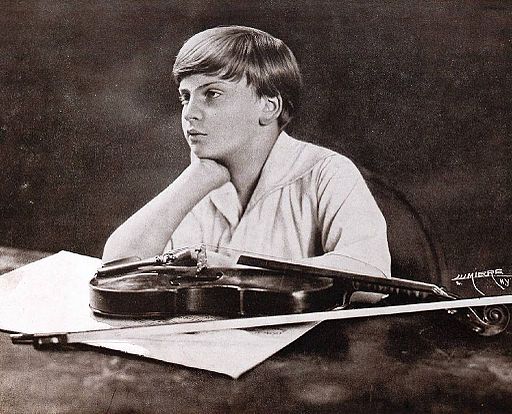
Meanwhile, Lotte became more interested in learning about her Jewish identity.  As described last time, her father had left the Jewish community, and Lotte’s upbringing had been completely secular.  Her limited exposure to Judaism had occurred when she had visited her maternal grandparents in Neunkirchen.  But once Hitler came to power, Lotte’s father Joseph rejoined the Jewish community, and Lotte felt a desire to learn more about what it meant to be Jewish.

First, she tried a class for Jewish religious instruction.  Her description may seem familiar to many who attended Hebrew School growing up in the US:

The teacher had one look at me and promptly asked what I was doing there, but condescended to let me stay. There was a lot of noise in the classroom, nobody was paying any attention, and the teacher could only try to keep some order by slapping the faces of some and shouting louder than the others. After attending twice I was completely turned off and never went there again. Nobody ever asked me to come back.

Lotte then enrolled in a Zionist youth group, Die Werkleute, where she found a group of like-minded Jewish youth and learned a lot more about Judaism.  Although her parents did not support the Zionist movement, for Lotte it became a political, religious, and social outlet.

As far as I was concerned, the concept of Zionism fell on fertile ears. I remembered the KKL box on my grandparents’ chest, and I needed something positive to look forward to, seeing how my future in Germany was being destroyed systematically. A few of my friends actually went to Israel by enrolling in the Youth Aliyah program which was in full force by then and was instrumental in to rescuing Jewish children. Others were planning to spend some time in preparation for their move to the Kibbutz by gaining work experience in agriculture, gardening and some of the trades. I was not quite ready to do just that, but I certainly expected to emigrate to Israel somehow at some time in the future. Fate had it that things worked out differently for me. But more about that later. 

I learned a lot about Judaism at that time. Some of the members were very observant, and everybody respected that, but on the whole religion was downplayed. It was discussed in a more or less theoretical context. Jewish history, especially the history of Zionism, and Jewish peoplehood were the thrust of our education. At the same time the value of our background of German culture was stressed. We took our mission very seriously.
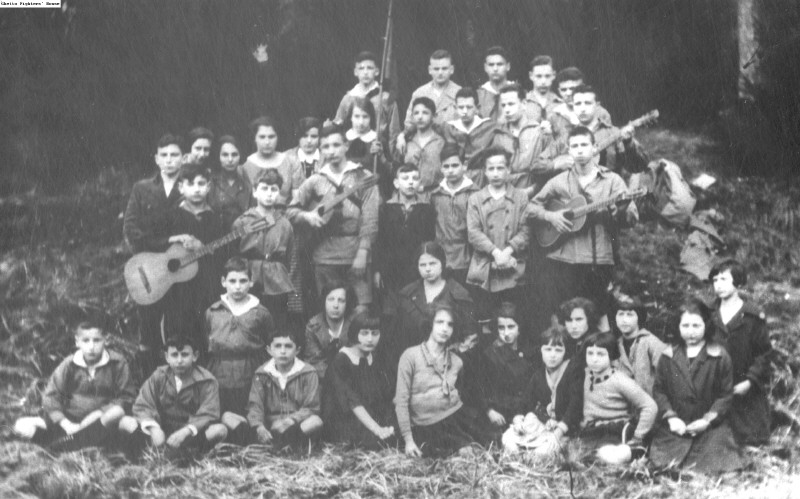
Werkleute group in Frankfort, Germany 1927 (not Lotte's group) http://www.infocenters.co.il/gfh/multimedia/GFH/0000065842/0000065842_1_web.jpg

Werkleute group in Frankfort, Germany 1927 (not Lotte’s group)
http://www.infocenters.co.il/gfh/multimedia/GFH/0000065842/0000065842_1_web.jpg

In 1936, Lotte’s father was excluded from the state-run insurance system which had provided him with many of his patients.  He finally realized that it might be time to leave Germany before it was too late.  First, the family arranged for Lotte’s older sister Doris to emigrate; she left for the United States in 1937.  Lotte’s parents then began to make plans for their own emigration.  .

Lotte’s grandparents Laura (Seligmann) and Samuel Winter and her great-uncle Jakob Seligmann had already left Germany for Luxembourg a few years earlier.  As explained by Lotte, Neunkirchen was located in the Saar region, which had been under French control after World War I, as agreed to in the Treaty of Versailles.  In 1935, there was a plebiscite to determine whether or not the region should be returned to Germany, and the residents of the Saar region voted overwhelmingly to rejoin Germany (over 90%).  Under the terms of the Treaty, however, anyone dissatisfied with the result could leave the area.  Thus, Lotte’s grandparents and great-uncle had gone to Luxembourg, where German was spoken.  Lotte beautifully described where her grandparents lived in Luxembourg:

With my mother’s help they managed to move to a lovely small apartment at the foot of a hill in the fairytale-like city of Luxembourg. The view toward the skyline silhouette, way above, was breathtaking. The ruins of an ancient watchtower and of fortifications lay on the way up to the city. Grand-duchess Charlotte ruled the country which had an army of about 100 men. At times you could see two or three of the soldiers marching behind each other, rifles on their shoulders. Had it not been for a shortage of funds, it would have been an idyllic place to live.


Embed from Getty Images
Luxembourg


Lotte’s mother Anna persuaded her husband to move to Luxembourg when they made the decision to emigrate. Lotte wrote:

Once the decision was made, all the following steps fell into place. I had to leave school and take the courses needed to prepare me for a different life. My father closed his office. We obtained the necessary passports featuring the addition of the name “Sara” for my mother and me. “Joseph”, my father’s name, was sufficiently Jewish to avoid any changes. The passports were not hard to get since one of the officials at the office was known to oblige when a DM 10.00 note was slipped into each application. Ours was the last family in Mannheim to be allowed to pack most of its belongings.

Lotte remembers what this meant for her education.

Unfortunately my schooling was rudely interrupted when my parents began to make preparations for emigration. Much to my chagrin I had to quit school in the middle of the equivalent of my junior year. Instead, I took courses in English and French shorthand, typing and commercial correspondence at a private school. I also learned the rudiments of using a sewing machine, courtesy of a school run by nuns. I must add that for a couple of years I had also studied English with a very proper Oxford-trained teacher at the private Berlitz School.

On a more positive note, Lotte’s parents saw to it that she would have a good violin before they left Germany.

In preparation for eventual emigration my father and I travel to Stuttgart to buy a new violin for me. Or rather, it is a beautiful old Italian instrument, bearing a label stating that it was made by Matteo Albani in 1698. It has a gorgeous flamed wood back, gracefully molded. The sound is magnificent. My teacher assists in the purchase which also includes a light brown case lined with light blue plush. A piece of matching blue silk serves as a wrapper for the instrument. It will soon become a part of me. I am ecstatic.
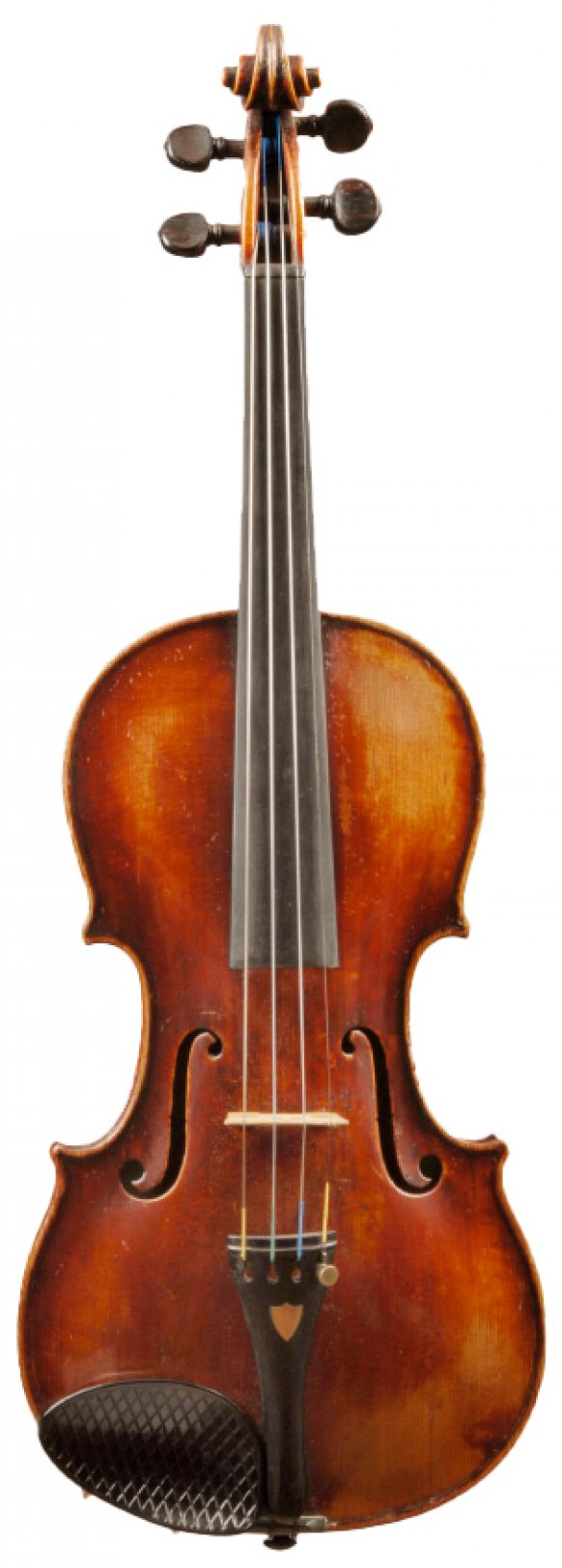
An Albani violin

An Albani violin  http://www.bromptons.co/reference/articles/details/sears-danelectro-history.html


I would imagine that that feeling of ecstasy was tempered by some sadness about leaving behind her childhood home, the city of Mannheim where she’d grown up, and her birth country.  But Lotte’s memoirs do not convey sadness, just relief.

On the day scheduled for the packing, an inspector appeared whose job it was to supervise what we were doing. He was quite a jovial man. At lunchtime he attached a yellow ribbon across the doorway and announced that he was now going to be gone for about one hour. My mother took the hint and promptly hid a box with jewelry and cash in one of the suitcases destined for Luxembourg. After exactly one hour the good man returned. Luckily he did not ask any questions and did not inspect anything.

For a few more days we stayed at the home of some friends. On May 9, 1938 my parents and I boarded a train heading for Luxembourg. Again luck was with us. Our compartment was shared with a gentleman who turned out to be the Luxembourg consul posted in Stuttgart. The German border control officers of whom we had been afraid and who might have made a lot of trouble for us, they tipped their hats in deference and did not search the compartment very thoroughly. The Luxembourg officials were considered harmless.

Not long after settling in Luxembourg, Lotte’s mother traveled to New York to attend her daughter Doris’ wedding.  When she returned better informed about what was going on in Europe, she persuaded her husband that they should leave Luxembourg and immigrate to the United States.  How fortunate it was that Doris had moved to the United States a year earlier and that her mother had come to the US to attend her wedding.  If the Wiener family had not left Luxembourg, it is very likely that Lotte would not be here today to share this remarkable story.

Next, the family’s departure from Europe, journey to America, and Lotte’s life in the new country.


My Cousin Lotte’s Story, Part I: A Childhood in Germany during the Weimar Republic (1918-1933)
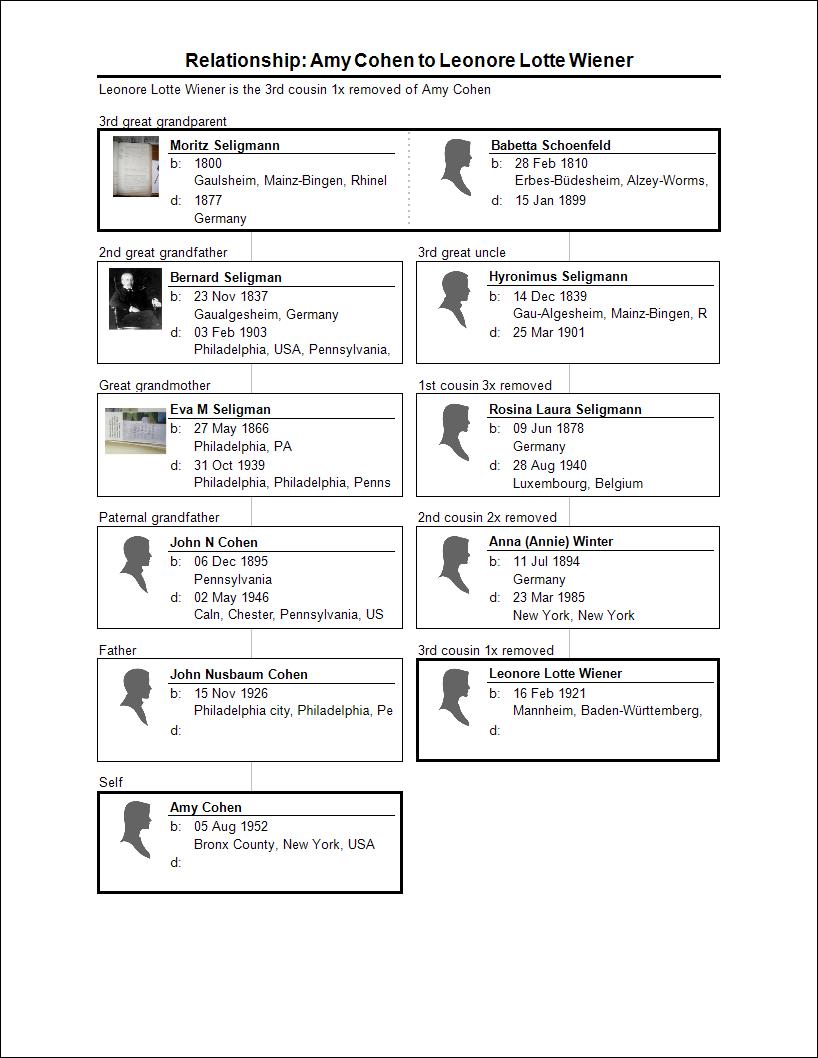
It has been a true blessing to connect with my cousin Lotte.   Lotte is the daughter of Joseph and Anna (nee Winter) Wiener.  Her mother Anna was the daughter of Rosina Laura Seligmann. Laura was the daughter of Hieronymous Seligmann, brother of my great-great-grandfather Bernard and son of Moritz and Babetta Seligmann, my three-times great-grandparents.  Thus, Lotte is my third cousin, once removed.  Her story is a remarkable story.
Relationship_ Amy Cohen to Leonore Lotte Wiener

Lotte was born in Mannheim, Germany, in 1921, and she left Germany with her parents in the late 1930s to escape Hitler and the Nazis.  Her education in Germany was cut short as a result, yet she came to the United States and successfully completed a nursing program in New York City shortly after immigrating.  But I cannot do Lotte’s story justice.  Fortunately, I do not have to because Lotte shared with me her memoirs and much of her other writing as well as some anecdotes she shared by email.  With Lotte’s permission, I am going to share some excerpts from her own writing and some of those anecdotes.

I am also including a link to her memoirs for anyone who wants to read them in their entirety.  You won’t be disappointed.  Lotte’s writing is poetic, evocative, and very moving.  This post will cover Lotte’s early life in Germany; subsequent posts will cover her life once Hitler came to power and then Lotte’s early years adjusting to life in the United States.  (To read Lotte’s memoirs in their entirety, click on My Story Lotte Wiener Furst. Copyright Lotte Wiener Furst 2015. Not to be reproduced in whole or in part without permission of the author.)

Lotte described her maternal grandparents Samuel Oskar Winter and Rosalind Laura Seligmann in these words:

My grandfather, born in Hülchrath, Westphalia, founded and owned a large dry-goods store. He had served his apprenticeship in a similar but larger store in Düsseldorf, having had to leave school at age fourteen because his mother was impoverished. He had a sister who never married, and a brother who later lived in Saarbrücken with his wife and two daughters, where he died quite young of syphilis. My grandfather was small of stature, but had a formidable mind and a keen, dry sense of humor. For quite a few years he served as a trustee of the local synagogue although he was not particularly observant.

My maternal grandmother was one of five siblings. Her family owned a vineyard in Gau-Algesheim, near Bingen, a place where my mother spent part of her childhood and which she always remembered very fondly. My grandmother also had left school at the age of fourteen in order to take care of her mother who was dying of tuberculosis, and to whom she had promised to always fast on Yom Kippur, and to observe Passover, promises she kept very faithfully. She loved poetry and could recite beautifully many of the sometimes very lengthy poems by the beloved German poets Goethe and Schiller. While my mother was growing up, my grandmother kept the books and otherwise assisted in the store. Keeping house was the task of Tante Yettchen, her spinster sister-in-law.

Laura Seligmann Wiener with two of her sisters, Bettina Seligmann Arnfeld and Johanna Seligmann Bielefeld Courtesy of Lotte Furst

Laura Seligmann Winter with two of her sisters, Bettina Seligmann Arnfeld and Johanna Seligmann Bielefeld
Courtesy of Lotte Furst

Samuel and Laura Winter had two children, Lotte’s mother Anna and her uncle Ernst.  Ernst was killed fighting for the Kaiser’s army in World War I:

My mother had one brother, Ernst, one year her junior. At the beginning of World War I he enlisted in the German army along with all of his classmates, much to the horror of his parents. He was killed six weeks later in the first Marne battle. My grandparents never recovered from the shock. I never saw my grandmother in anything but grey or black clothing. My uncle’s room was left untouched, and I was never allowed to enter it. My grandfather lost all his drive for maintaining the business, gave up his large store and became a partner in a much smaller one which was now mostly run by my grandmother’s brother, Uncle Jack, a very distinguished-looking but not very capable gentleman.

(“Uncle Jack” was Laura’s older brother Jacob, about whom I wrote here.)

Ernst Winter Courtesy of Lotte Furst

Ernst Winter
Courtesy of Lotte Furst

How painful it must have been for Samuel and Laura to lose their son and then have the country he fought for betray them less than twenty years later.

As for Lotte’s mother Anna or Aennie, she was afforded a fine education as the daughter of a successful merchant:

My mother’s higher education consisted of a year or two in a finishing school, followed by some time in England where one of my grandmother’s uncles had established his residence. Her stay there was cut short, however, because this uncle, who owned several hotels and was very wealthy, made some unsolicited advances, and she fled in terror. The time spent in England provided her with an excellent chance to learn the language, which turned out to be quite an asset later on. She also was an accomplished pianist. Actually she aspired to become a concert pianist or at least a teacher of piano, but my grandparents felt that to be entirely inappropriate for a young lady of good bourgois upbringing. Their denial made her very unhappy but was mitigated somewhat when she received a beautiful black Bechstein grand piano as a wedding gift.

Samuel, Laura, and Anna Winter and Jakob Seligmann

Samuel, Laura, and Anna Winter and Jakob Seligmann (Laura’s brother) Courtesy of Lotte Furst

The uncle in England referred to above was, of course, James Seligman, born Jakob Seligmann, the younger brother of Hieronymous and Bernard Seligmann, the same James Seligman whose estate created quite a ripple of activity in the family and provided me with all those Westminster Bank family trees.  Lotte also shared with me her own memories of James Seligman.  According to Lotte, “[James] owned one or several hotels in Scotland/England. He lived in one of them. Together with his wife Hedy he visited his family on the continent once. She was a big and very pompous woman. After her death he visited the family again to distribute her belongings. Everybody went out of the way to serve him fancy dinners. My mother hired a caterer and we had “omelet surprise” for dessert. My grandmother Laura made a very simple home-cooked meal which he found the best he’d had. “

James married Claire, his second wife, shortly after his first wife Hedy died.  Claire had been his nurse.  When James died, Claire had the right to the income from his estate for her life; when she died, the principal was distributed to the various heirs found by the Westminster Bank.  According to Lotte, her mother’s estate received $200 in 1985.  I guess I can’t cry too much over the fact that the Westminster Bank failed to find my father and my aunt while doing their investigation since it seems their inheritance would have been about $100 each, if that much.

My heart went out to Lotte’s mother Anna Winter, a young girl with dreams of being a concert pianist, whose dreams were thwarted by society’s limited ideas of what a woman could be back in those times.  Anna married Joseph Wiener in December, 1915.  Joseph was in the Germany army at the time and was a doctor; after completing his service during World War I, he and Anna and their first daughter Doris moved to Mannheim where he established his medical practice.  Lotte was born there a few years later during the years of the Weimar Republic.

Lotte’s description of her childhood home creates a vivid picture:

We lived on the second floor of a six story apartment building. There were two units on each floor. Our living quarters occupied one of these units while my father’s office and the maids’ quarters were situated in the other half. The office consisted of my father’s consultation room and a large waiting area where 20 – 30 chairs were lined up along the four walls, together with a coat rack and a spittoon. Doris and I shared one of the two family bedrooms, while the maids had to sleep in a very small and primitively furnished room, I am ashamed to say. They were not allowed to use our toilet, I am ashamed to say. … In addition to the maids, we had a part-time nanny and, for a few years at least, a part-time chauffeur who was mostly busy driving my father who had to make innumerable house calls. In 1923 or 1924 my parents had bought their first car, a black Benz, which unfortunately came to a sad ending when the chauffeur “borrowed” it for a joy ride and totally crashed it. The car was replaced by a green Buick, the driver was fired, and my father did his own navigating from then on.

****

Originally we had separate stoves in the various rooms, one of them a real pot-belly stove called “Der Amerikaner”. But in approximately 1928 my parents obtained permission to remodel our two apartments, and central heating was installed. The furnace, placed in the kitchen, had a large flat surface on which to keep pots of hot water and to make baked apples at times. It also provided a lot of soot. The noise of one of our maids stoking the fire early in the morning usually woke us up.

The living room featured three wall-to-ceiling bookcase units, separated by two bay windows. There was a wealth of information in those books, and my parents placed no restrictions on our choice of reading material. I devoured almost everything: fiction, classics, history, you name it. But I certainly did not retain most of the material I read. Other furniture included three caned armchairs, a round coffee table with marble top, a green velvet-upholstered sofa, and a large oak desk.

A doorway, equipped with a curtain, led to the dining room half a small step above. For a while Doris and I used this setting to put on some improvised shows. The oak dining room table was large and massive. Other than for dining we used it as an improvised ping-pong table when extended. Of course the proportions were not right, and the ball would bounce off when it hit the extension crack in the middle.

…  My parents’ bedroom had mahogany furniture and yellow wallpaper with green and red intertwined garlands. I would stare at them at the times when I was allowed to lie on Mutti’s bed when I was sick, and I thought they were ugly. Doris’ and my bedroom was not so fancy. It was equipped only with two iron beds, a dresser, a night stand, and a clothes closet.

Between the bedrooms was a bathroom, used only for bathing. We had a separate toilet a little further down the hall and next to the kitchen which featured to a stove, oven, furnace, table and two chairs and an icebox, later replaced by a Frigidaire which was usually kept locked.

By Snapshots Of The Past (Parade Place and Kaufhaus Karlsruhe Baden Germany) [CC BY-SA 2.0 (http://creativecommons.org/licenses/by-sa/2.0)], via Wikimedia Commons

Mannheim, Germany  By Snapshots Of The Past (Parade Place and Kaufhaus Karlsruhe Baden Germany) [CC BY-SA 2.0 (http://creativecommons.org/licenses/by-sa/2.0)%5D, via Wikimedia Commons

Lotte also wrote about her parents’ various responsibilities in the household:

My father (Vati) was a very busy general practitioner. He had long office hours and also made numerous house calls every day, frequently to people who lived on the fourth, fifth or sixth floor of walk-up apartments. Elevators were non-existent in the working-class neighborhood where we lived. But he was always home for lunch, the main meal of the day, which was served at 1 PM. Breakfast was not a family affair – Doris and I had rolls with butter and jelly, delivered fresh every morning from the bakery across th street, and a cup of tea before leaving for school which started at 8 AM. During morning recess we had a “second breakfast” consisting of a sandwich which we brought from home. The light evening meal was served at about 7 PM. 

My mother (Mutti) attended to the household: instructing, supervising and hiring and firing the maid(s), and doing the marketing which in itself was a very complicated job. Because many of the nearby merchants were my father’s patients, she had to keep track of with which grocer, which butcher, which baker she had done business last in order to keep all of them happy. Butchers were especially difficult. There were some who had the best and most aged beef, suitable for roasts, and some who carried a poorer quality and therefore were only good for meat that had to be boiled or braised. Sausage came from other sources: regular, ordinary sausage was bought at a nearby store, but kosher sausage with its distinctively different taste came from a Jewish butcher who lived quite a distance away. Vati frequently questioned where the meat came from, and Mutti, quite peeved, would answer “from the fish store”.

In addition to the household chores, Mutti kept my father’s books. At the beginning of each calendar quarter she had to add up all the patients’ slips pertaining to their insurance coverage, and submit them to the local health insurance office and to the few private insurance companies involved. Since Bismarck’s time in the 1880’s Germany had compulsory and comprehensive health insurance laws covering most of the working population. Self-employed and professional people took out their own private insurance. During those busy quarterly events Mutti was extremely nervous and tense. We knew better than asking her any silly questions.

After lunch, Vati usually took a short nap on the living-room sofa, followed, at least in the early years, by a cigar which I helped him light. He then resumed his afternoon office hours while I went back to school or to my music lessons or other activities. At some time during the afternoon I did my homework, never too much of a chore, and practiced my violin music for which I did not need any coaxing because I enjoyed it.

Lotte and her sister spent school vacations visiting Anna’s parents Laura (Seligmann) and Samuel Winter in Neunkirchen:

My grandparents’ (Oma and Opa’s) house had four stories: a large basement with a fruit cellar, a downstairs “salon” and formal dining room with a large veranda which was hardly ever used, another floor with the actual living quarters (living room, bedroom, bathroom and kitchen), and three more bedrooms above that. The rooms were rather small, however. A rarely used dumb waiter connected the kitchen with the downstairs dining room. A mostly unkempt and unplanted  backyard, except for some large clumps of rhubarb, was also featured. The house overlooked a large and frequently used soccer field.

There was not very much to do at the house. I usually accompanied Opa to the store where he spent most of his time. The salesladies and the office help all were very nice. They gave me odds and ends of fancy yarns, remnants of cloth, and various sundries. The secretary let me use the typewriter where, one index finger at a time, I would compose never to be published letters and poems.

Oma meanwhile would be busy with her household chores. Once a week she attended meetings at a housewives’ club, and I would come with her whenever I was visiting. I believe they did some charitable work, but all I know for sure is that they gossiped a lot and always had a big “Kaffeeklatsch”. Every time they saw me, some of these ladies would ask whether I remembered who they were, followed by “my, how you have grown”. The club was the only outside activity Oma allowed herself.

By Daniel Arnold (Photo taken by Daniel Arnold) [CC BY-SA 2.0 de (http://creativecommons.org/licenses/by-sa/2.0/de/deed.en), GFDL (http://www.gnu.org/copyleft/fdl.html) or CC-BY-SA-3.0 (http://creativecommons.org/licenses/by-sa/3.0/)], via Wikimedia Commons

Town Gate, Neunkirchen By Daniel Arnold (Photo taken by Daniel Arnold) [CC BY-SA 2.0 de (http://creativecommons.org/licenses/by-sa/2.0/de/deed.en), GFDL (http://www.gnu.org/copyleft/fdl.html) or CC-BY-SA-3.0 (http://creativecommons.org/licenses/by-sa/3.0/)%5D, via Wikimedia Commons

Lotte wrote a wonderful description of a day she spent with her Opa, but it is quite long, so I will leave it for those who wish to read her entire memoir.  I do want to include this description of her Oma, Laura Seligmann Winter:

My grandmother, Oma, was a fairly short, fairly plump woman. Her body, always dressed in rather shapeless grey clothes and bulging a bit in the center, did not seem to have any remarkable form of its own. But her oval face was kind and full of expression. Severely myopic, she had protuberant grey eyes. To help her poor eyesight, she used a lorgnette for reading. I don’t recall her ever wearing glasses. She also suffered from rheumatic heart disease, the result of rheumatic fever early in life, which incapacitated her a lot and finally contributed to her death.

To maintain her wavy, well-coiffured hairdo, Oma allowed herself the only luxury I was aware of. Once or twice a month she used the services of a hairdresser who came to her home to wash and set her hair, embellished by the use of a hot iron. She probably coordinated those appointments with the meeting dates of the “Hausfrauenverein” ( housewives’ club), a gathering of mostly Jewish old – or so it seemed to me – women who fairly fell over me when Oma took me along during my visits, exclaiming how I had grown and wondering if I still remembered their names. Whether the club members did anything socially worthwhile I do not know. I suppose they did. But I do know that they gossiped a lot while enjoying afternoon coffee and cake.

Oma’s most remarkable talent was her gift to recite poetry. With only a grade-school education, she had managed to memorize a great many of the famous German poems written in the eighteenth and nineteenth century, noticeably poems by Goethe, her hero, and also by Schiller. A glorified picture of Goethe adorned a wall in her kitchen, leading, to her bemusement, to a question by her milkman who wondered if that handsome man had been her father.

Laura Rosina Winter nee Seligmann

Rosina Laura Seligmann Winter, Lotte’s grandmother

For more on Lotte’s grandparents and their home, read MY GRANDPARENTS HOUSE by Lotte (Copyright Lotte Wiener Furst 2015. Not to be reproduced in whole or in part without permission of the author.)

Lotte, an exceptional student, also wrote about her early school experiences:

From first through fourth grade I attended the Hildaschule, the public school for girls in the district where I lived and about three blocks from our apartment. My first impression of the first grade classroom was that it smelled bad and was very noisy, featuring an enrollment of about 40 anxious little girls. The teacher was very strict – a real no-nonsense person by the name of Mrs. Seltenreich. The slightest kind of misdemeanor was usually punished by a sharp blow with a cane on the poor kid’s outstretched fingers. It required a great deal of courage to oblige her. I must admit that I never was in that predicament since I was a very good little girl. But I had one great shortcoming: From the very beginning my handwriting was very poor. I never earned anything better than a “3″ (on a scale of 1-5) in that course. Later, when we started to write with ink, I did not produce one paper without a smudge or an inkblot. I never could shake that weakness, and only with the advent of the computer did I learn to produce more or less perfect papers without any visible corrections.

Mrs. Seltenreich was replaced by Fräulein Unger from second to fourth grade. She was a very kind, stout elderly lady who really loved teaching, trying some innovative methods, thus commanding respect without the cruelty shown by her predecessor. I had one girlfriend at that time but did not spend much time with her. Once I accompanied her to the Catholic church across the street from the school, and she showed me how to make the sign of the cross and how to kneel, which I did because I did not know any better. When I told my mother, she instructed me never to do that again. I, however, knew hardly anything about my own religion except for the fact that I was Jewish and therefore different.

School hours were during the morning.  In the afternoon I usually went to a park with my nanny during the early school years. There I mostly played by myself or perhaps with one other child, sheltered kid that I was. In school we also had to attend an outdoor playtime session once a week. I did not like it too much because I did not know the games which most of the girls had played frequently. I was rather ignorant in social skills and did not participate very well.

In fourth grade I befriended a girl by the name of Johanna who lived on a river boat which made periodic stops in Mannheim, traveling up the Rhine from Holland. During those stops she attended my school. I proudly presented her to the handicrafts instructor (embroidery, crocheting and knitting were compulsory and part of the curriculum), only to be asked if she was also a Yid (which she was not). My mother was infuriated when I told her about this, so much so that she went to the School Board to complain. After all, we were living in Germany during the time of the democratic Weimar Republic. Discrimination supposedly was not allowed. I never found out if the teacher was reprimanded.

Reading this made me realize how drastically German society changed once Hitler came to power.  Here was Lotte’s mother, a Jewish woman, daring to complain about an anti-Semitic remark made by a teacher.  Just a few years later such anti-Semitism was the official law of the land.

After her early years in the girls’ school, Lotte was one of a small number of girls who were admitted to the almost all-male Karl-Friedrich Gymnasium, where she had to work extra hard and even box some of the boys in order to prove herself and win approval from her teachers. Lotte also spent many hours in the nearby art museum. She loved music and was exposed to music throughout her childhood.  She started taking violin lessons when she was eight years old and had the same teacher for nine years until she and her family emigrated.

Karl-Friedrich-Gymnasium Mannheim

Karl-Friedrich-Gymnasium Mannheim (Photo credit: Wikipedia)

Although her grandmother Laura always fasted on Yom Kippur and observed Passover, as she had promised her mother, Lotte grew up with very little exposure to Judasim.  She wrote:

Prior to the Nazi rise to power I had a very cursory knowledge of the fact that I was Jewish. My parents were totally non‑religious. They agreed with Karl Marx that religion was “the opiate of the masses”. My father even resigned from the Jewish community since he did not see why he should pay the obligatory cultural tax. In school I was listed as “without religious affiliation.” None of the Jewish holidays were observed at our house.

But Lotte’s grandparents and other relatives of her grandmother Laura did provide her with some knowledge and experience with Jewish rituals and holidays:

But at my grandparent’s house I learned a little more about Jewish customs. My grandmother fasted on Yom Kippur. They only ate matzot during Passover. Best of all, they had a blue and white KKL (Jewish National Fund) box on their living room chest. Only pennies were inside, as I found out when I tried to fish out the money with a crochet hook (I always replaced the money, I only did it because 1 was utterly bored and had nothing else to do). But I do remember the outline of Palestine on the box, and I learned that it was the Jewish homeland far away.

Gilabrand at en.wikipedia [CC BY 3.0 (http://creativecommons.org/licenses/by/3.0)], from Wikimedia Commons

Gilabrand at en.wikipedia [CC BY 3.0 (http://creativecommons.org/licenses/by/3.0)%5D, from Wikimedia Commons

There also were some more observant relatives in Neunkirchen. One, a cousin of my grandmother, was married to the orthodox owner of a dairy store who did not make much money but beat up his poor wife and his three children every once in a while. I remember their son celebrating his bar‑mitzvah. A lot of complete strangers (to me) were assembled, including a very distinguished‑looking rabbi. Following the ceremony and the lunch people sat around talking and telling jokes. Since the rabbi looked so distinguished with his white beard, I asked him to write a word on a slip of paper as part of a puzzle I wanted to present. Well … The good rabbi told me very kindly that he did not write on schabbes, and that’s how 1 learned one of the basic rules of Judaism.

Lotte told me that the bar mitzvah boy was Heinz Goldmann, son of Anna Seligmann and Hugo Goldmann.  Anna was the daughter of August Seligmann, my three-times great-uncle.  Anna, Hugo, and their children were all killed in the Holocaust.

Overall, Lotte’s description of her childhood suggests that she had a very happy and comfortable childhood: a childhood free of economic or other struggles, a loving family, vacations and trips, school and art and music, and grandparents whom she adored.  All of this would come to what must have been a shocking, heart-wrenching, and tragic end as Lotte entered adolescence and Hitler came to power.


The Last of the Children of Marx and Sarah Seligmann: Mary Kornfeld and Her Descendants

In this post I will complete the story (as far as I know it thus far) of the descendants of Marx and Sarah (Koppel) Seligmann.  Marx, the younger brother of my three-times great-grandfather, came to the US with his second wife Sarah in 1849 and had four children:  Sigmund, Jacob, Charlotte, and Mary.  I have already written about the first three.

As I posted before, the youngest child of Marx and Sarah Seligmann, their daughter Mary, was the first to marry.  She and her husband Oscar Kornfeld, a cigar maker, married in 1873 and by 1882 had four children: Marx (later Max) (1874), Rose (1877), Carrie (1879), and Lillian (1882).  In 1900 Mary, Oscar, and their three daughters were living at 1883 Madison Avenue.  Their son Max had already married Emma Pisko that year prior to the 1900 census.

Two of their daughters also married during 1900. On March 22, 1900, Carrie Kornfeld married Berthold Weiss.  He was the son of Sigmund Weiss and Rose Hecht, who were Hungarian immigrants.  Sigmund was a woodturner, according to the 1900 census, and Berthold was a hosiery salesman.

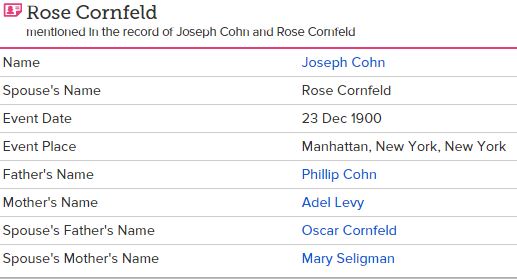
On December 23, 1900, Rose Kornfeld married Joseph Cohn.  Joseph was the son of Philip and Adele Cohen, German immigrants.  His father was a baker. Joseph was born in New York in 1876.  In 1900, before marrying Rose, he had been living with his parents and brother and working as a printer.

New York, Marriages, 1686-1980," , FamilySearch (https://familysearch.org/ark:/61903/1:1:F6HY-Z96 : accessed 8 August 2015), Joseph Cohn and Rose Cornfeld, 23 Dec 1900; citing reference ; FHL microfilm 1,570,443.

New York, Marriages, 1686-1980,” , FamilySearch (https://familysearch.org/ark:/61903/1:1:F6HY-Z96 : accessed 8 August 2015), Joseph Cohn and Rose Cornfeld, 23 Dec 1900; citing reference ; FHL microfilm 1,570,443.

Thus, within one year, three of the four children of Mary and Oscar Kornfeld had married.  Their youngest child, Lillian, married two years later.  She married Emil Nardin on May 4, 1902.

"New York, Marriages, 1686-1980," , FamilySearch (https://familysearch.org/ark:/61903/1:1:F6QW-TVL : accessed 8 August 2015), Emile Nardin and Lillian Kornfeld, 04 May 1902; citing reference ; FHL microfilm 1,570,816.

“New York, Marriages, 1686-1980,” , FamilySearch (https://familysearch.org/ark:/61903/1:1:F6QW-TVL : accessed 8 August 2015), Emile Nardin and Lillian Kornfeld, 04 May 1902; citing reference ; FHL microfilm 1,570,816.

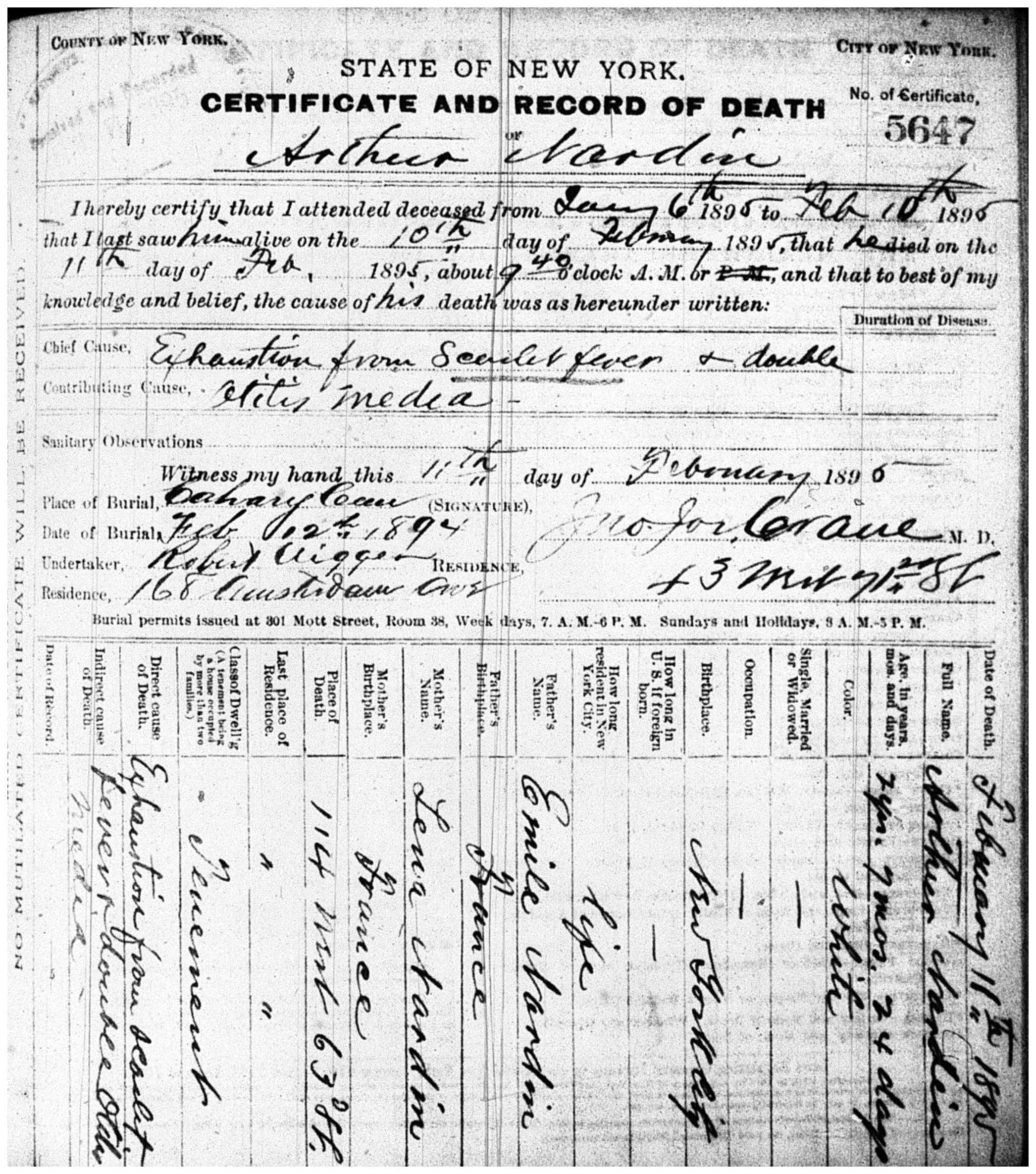
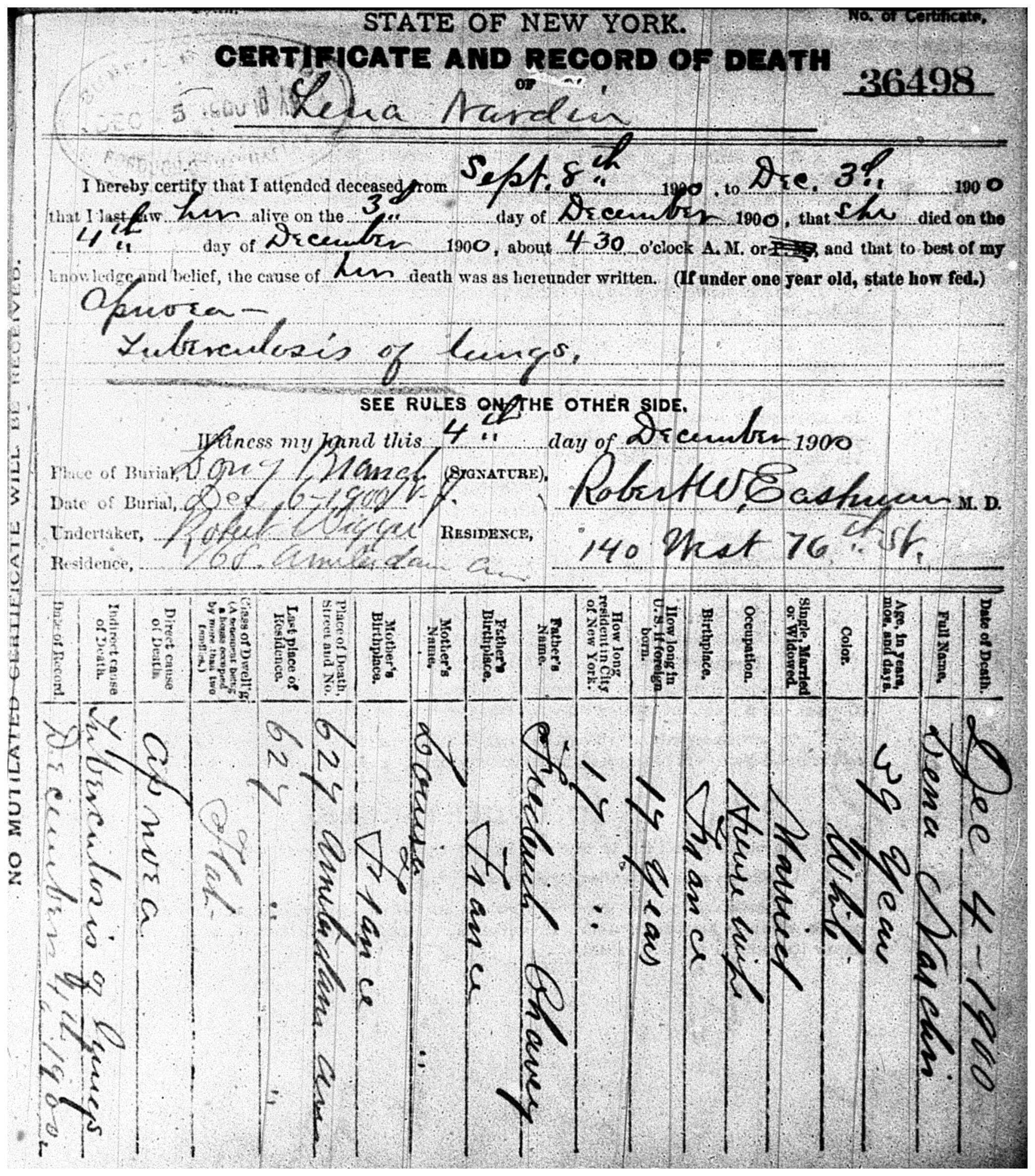
Emil was born in France, the son of Fredric and Susanne Nardin, and had arrived in the US in about 1886 when he was about twenty years old.   He had been married previously to Lena Chavey, also French born, and they had had three children together: Ida, born in 1888, whom I cannot find on any subsequent record, Henri Arthur, who was born in 1892 and who died in 1895 from scarlet fever, and Helen Edith (known as Edith), born in 1896. On the 1900 census, Emil and Lena were living with just Edith.  The census record reported that although Lena had had three children, only one was alive, so Ida must have died also.  Emil was working as a cook. (A French chef in the family!)  The family was living at 627 Amsterdam Avenue in New York. Sadly, Emil’s first wife Lena died from tuberculosis on December 4, 1900, leaving him with four year old Edith.  Lena was 39 years old.

Nardin, Arthur death Nardin, Lena

Thus, Emil had lost two young children and his wife before marrying Lillian Kornfeld in 1902.  Lillian and Emil had a child of their own, a son named Arthur, born on June 26, 1903.

Mary and Oscar Kornfeld had two other grandchildren born in the early years of the 20th century.  Carrie and Berthold Weiss had a daughter, Edna Hazel, on February 27, 1903. Rose and Joseph Cohn had a son Harold, born on January 18, 1905. Arthur Nardin, Edith Weiss, and Harold Cohn were the only grandchildren Mary and Oscar would have.

Overall, these should have been happy years for the extended Kornfeld family. Unfortunately, Max Kornfeld soon ran into serious legal problems.  In 1903, he was convicted on several counts of insurance fraud and sentenced to Sing Sing prison in Ossining, New York.  As reported in the November 20, 1903, edition of The Standard, an insurance industry trade publication, Max Kornfeld was a public fire insurance adjuster and had been convicted of making a false insurance claim for $2000, claiming that his wife Emma’s wardrobe had been destroyed in a fire at the Hotel Richelieu.  A later article dated December 10, 1903, in The Spectator, another trade publication, reported that Max was in fact part of a much larger insurance fraud scheme.  It reported that Max had confessed to over 300 fraudulent fire insurance claims.  He had testified that in these claims the adjuster received 40% of the proceeds, and he described some of the methods used to make these claims.


Embed from Getty Images
Sing Sing Prison

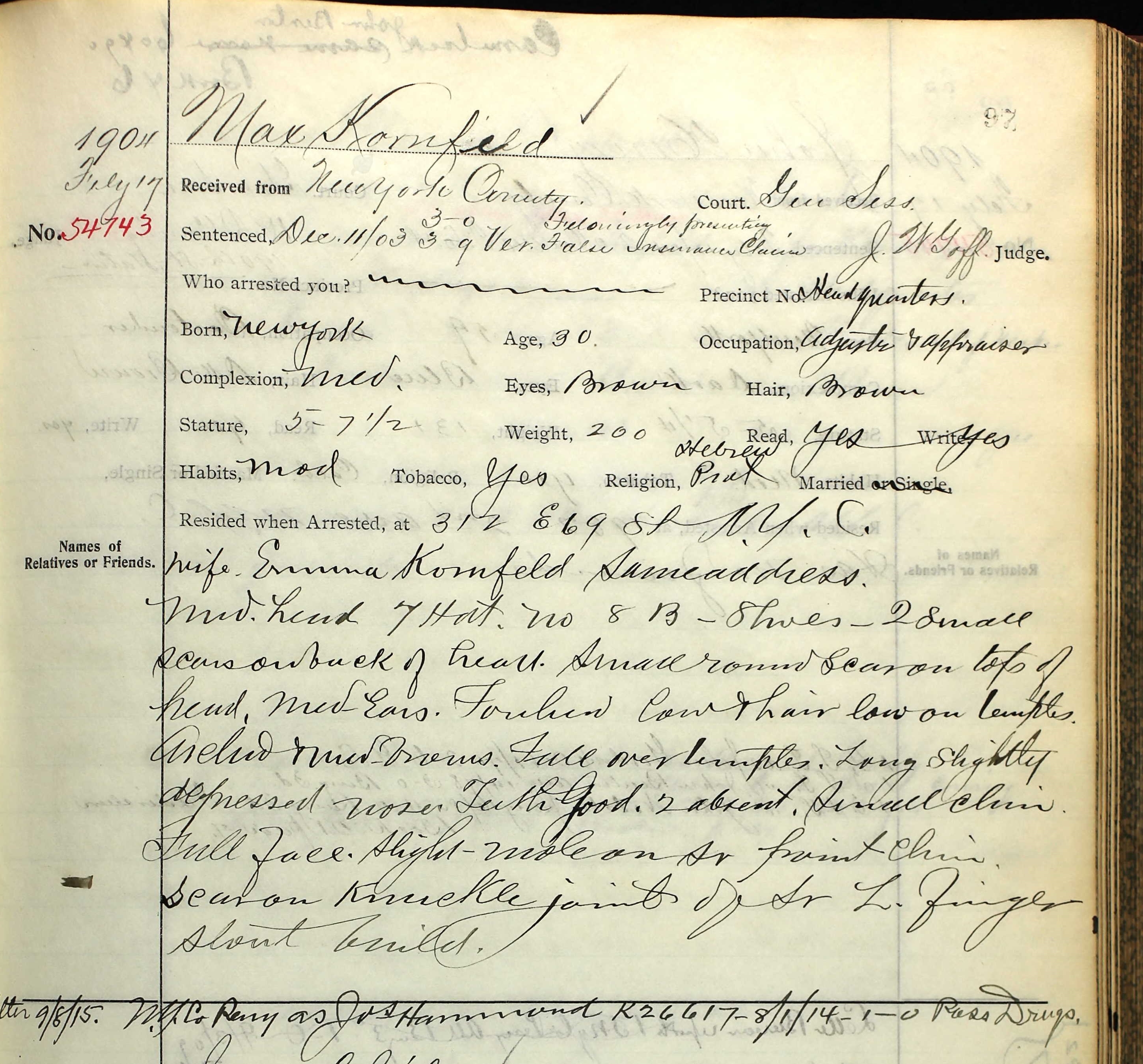
Max was admitted to Sing Sing prison on July 17, 1904, and according to the admission record below, it looks like he was sentenced for three to nine years;  he was still in prison at the time of the 1905 New York State census.  One thing I found interesting on the Sing Sing admission record is the recording of his religion as Protestant and Hebrew.  There is also a detailed physical description; Max had a number of scars on his head as well as on his hand.

New York State Archives; Albany, New York; Sing Sing Prison, 1852-1938; Box: 14; Volume: 36

New York State Archives; Albany, New York; Sing Sing Prison, 1852-1938; Box: 14; Volume: 36

As for the rest of the family in 1905, I could only find Mary and Oscar Kornfeld and their daughter Rose on the 1905 NY census.  In 1905, Mary (nee Seligman) and Oscar Kornfeld were living as lodgers without any of their children in the household of a woman named Anna Bohl, residing at 274-276 West 19th Street in Manhattan.  Oscar was still working as a cigar maker.  According to the 1905 NY census, their daughter Rose, her husband Joseph Cohn, and their son Harold were living at 10 West 118th Street, and Joseph was working as a printer.

Although I could not find Carrie Kornfeld Weiss or Lillian Kornfeld Nardin on the 1905 NY census, I had better luck locating all the Kornfelds but Mary and Oscar on the 1910 census.  Max was out of prison, and he and Emma had moved to Philadelphia, where Max was working as a real estate broker.  They did not have any children.  Rose and Joseph Cohn were living on West 148th Street with their six year old son Harold, and Joseph had his own printing business.  Carrie and Berthold Weiss were living on Lenox Avenue with their seven year old daughter Edna, and Bert was still a hosiery salesman.  Lillian and Emil Nardin were living on West 17th Street with their six year old son Arthur and Emil’s daughter Edith, who was now fourteen; Emil was a chef in a hotel.  Thus, it appeared that all four of the Kornfeld children were doing fairly well in 1910.

The next five years were harder. Their father Oscar died on November 27, 1911; he was 58 years old.  He died from cirrhosis of the liver.

Kornfeld, Oscar death

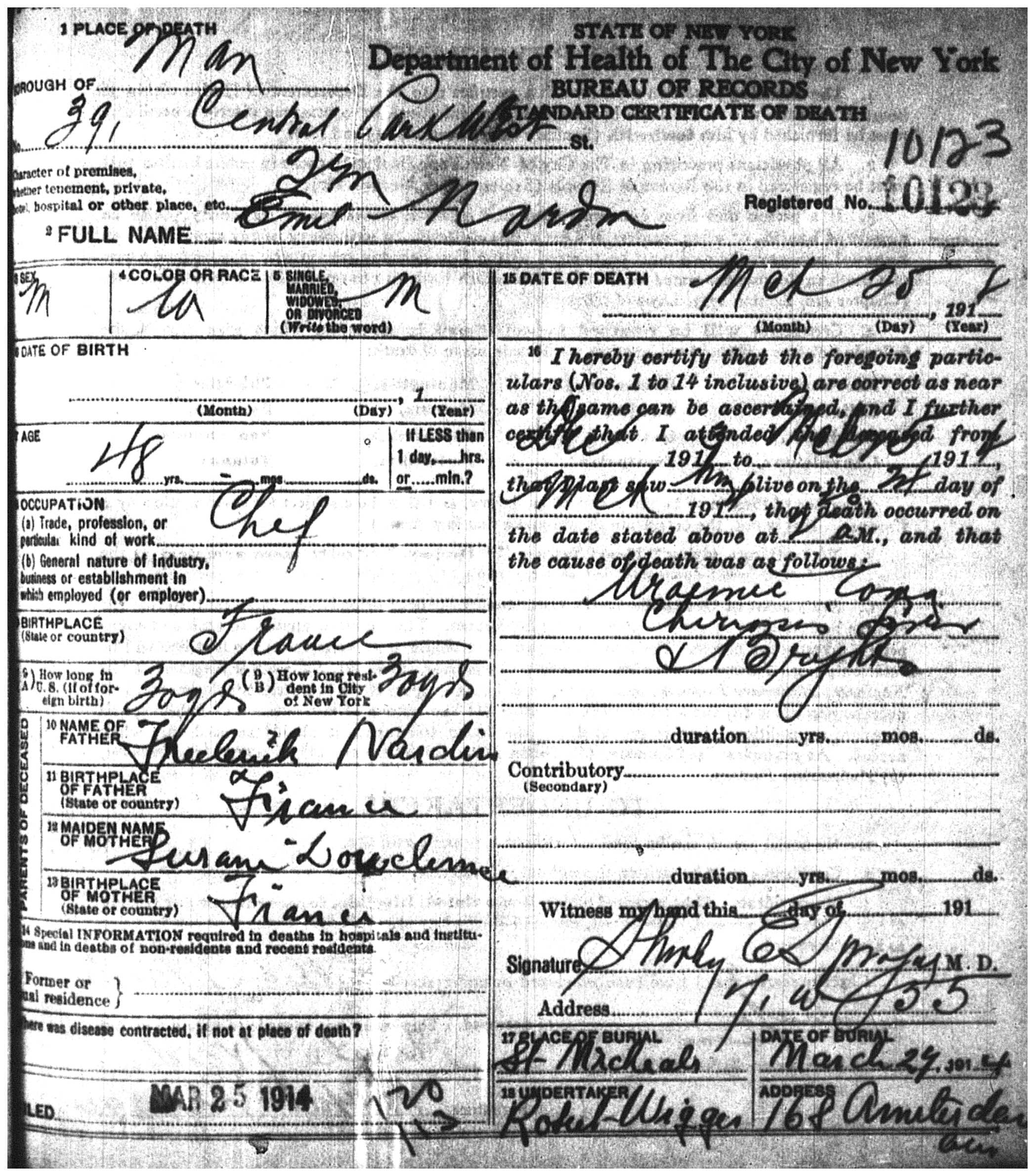
Then Lillian’s husband Emil died on March 28, 1914, also from cirrhosis of the liver as well as a uremic coma; he was only 48 years old and left not only Lillian, but his daughter Edith, who was only 18, and his son Arthur, who was only ten years old.

Nardin, Emil death

Poor Edith Nardin had lost her mother Lena in 1900 and now her father in 1911. By 1915 she was married to Arthur Downing Holmes, and the couple was living with Edith’s stepmother, Lillian Kornfeld Nardin, and Edith’s half-brother, Arthur Nardin, on West 92nd Street.  Arthur Holmes was 25 and working as a real estate agent. He had been born in New Haven, Connecticut, and was a graduate of Yale.

New York State Archives; Albany, New York; State Population Census Schedules, 1915; Election District: 10; Assembly District: 17; City: New York; County: New York; Page: 14

New York State Archives; Albany, New York; State Population Census Schedules, 1915; Election District: 10; Assembly District: 17; City: New York; County: New York; Page: 14

According to his World War I draft registration, Arthur D. Holmes was in the construction business.  At the time of his registration and on the 1920 census, their address was on West 84th Street.  By 1920, Arthur and Edith had two sons, William and Lawrence.  In 1922 they had a third son Robert.  (Although Arthur and Edith were still together on the 1930 census, by 1940 Arthur was married to a much younger woman named Ann.  I cannot find what happened to Edith after 1930 except for a 1974 Florida death record for an Edith H. Thomson with the same birth date.)

Meanwhile, eighteen months after Emil’s death, his wife Lillian Kornfeld Nardin remarried.  On September 27, 1915, she married Arthur Rosenberg.  He was born in England in 1885 and had immigrated to the US in 1898 with his parents.  In 1910, he had been a chauffeur for a private family.  According to his 1918 World War I draft registration, he and Lillian were living at 3440 Broadway, and he was now a rental agent for L.J. Phillips, a real estate company.

Registration State: New York; Registration County: New York; Roll: 1786675; Draft Board: 141

Registration State: New York; Registration County: New York; Roll: 1786675; Draft Board: 141


Carrie (nee Kornfeld) and Bert Weiss and their daughter Edna were living at 2400 Seventh Avenue in 1915.  The 1915 NY census reports that Bert was working in the wholesale dental supplies business, but according to his draft registration for World War I three years later, he was back in hosiery sales in what appears to be his own business, Weiss and Goldstein.  The family was then living at 555 West 115th Street.

Registration State: New York; Roll: 1786805; Draft Board: 146

Registration State: New York; Roll: 1786805; Draft Board: 146

In 1920 Rose and Joseph Cohn were living at 253 West 146th Street, and Joseph had his own printing business.  Their son Harold was now 15.

According to his World War I draft registration, Max Kornfeld and his wife Emma were living at 1628 Diamond Street in Philadelphia in 1918, and Max was self-employed as a merchandise man and insurance adjuster. I was surprised to see that he was back in the insurance business, given his criminal record for insurance fraud.  In 1920, however, Max reported his occupation as a real estate adjuster.

Registration State: Pennsylvania; Registration County: Philadelphia; Roll: 1907649; Draft Board: 29

Registration State: Pennsylvania; Registration County: Philadelphia; Roll: 1907649; Draft Board: 29

Mary Seligman Kornfeld must have moved in with her son Max and daughter-in-law Emma sometime after the 1920 census because when she died on January 13, 1921, her address was 1628 Diamond Street in Philadelphia, where Max and Emma had been living in 1920.  Mary was 64 years old and had died from cardiac dilatation and pulmonary edema. I thought it interesting that she had moved from New York where her three daughters and her grandchildren lived to live with her son in a city where she had never before lived.  I also thought it odd that Max could not provide the name of his mother’s parents as the informant on her death certificate.

Ancestry.com. Pennsylvania, Death Certificates, 1906-1963 [database on-line]. Provo, UT, USA: Ancestry.com Operations, Inc., 2014. Original data: Pennsylvania (State). Death certificates, 1906–1963. Series 11.90 (1,905 cartons). Records of the Pennsylvania Department of Health, Record Group 11. Pennsylvania Historical and Museum Commission, Harrisburg, Pennsylvania.

Ancestry.com. Pennsylvania, Death Certificates, 1906-1963 [database on-line]. Provo, UT, USA: Ancestry.com Operations, Inc., 2014.
Original data: Pennsylvania (State). Death certificates, 1906–1963. Series 11.90 (1,905 cartons). Records of the Pennsylvania Department of Health, Record Group 11. Pennsylvania Historical and Museum Commission, Harrisburg, Pennsylvania.

Two years later Mary’s youngest child, Lillian Kornfeld Nardin Rosenberg, died at age 41.  (Her death certificate says she was 39, born in 1884, but that is not consistent with the birth records from the NYC birth index I have for her.)  She died from chronic endocarditis and cerebral edema.

Rosenberg, Lillian death page 1 Rosenberg, Lillian death page 2


Lillian’s son Arthur Nardin was 20 years old when she died.  On March 6, 1925, Arthur married Jane Burns; they were both 21 years old at the time.  Their son Arthur Nardin, Jr., was born two years later.  According to the 1930 census, Arthur, Sr., was a car salesman.  The family was living on West 181st Street at that time.

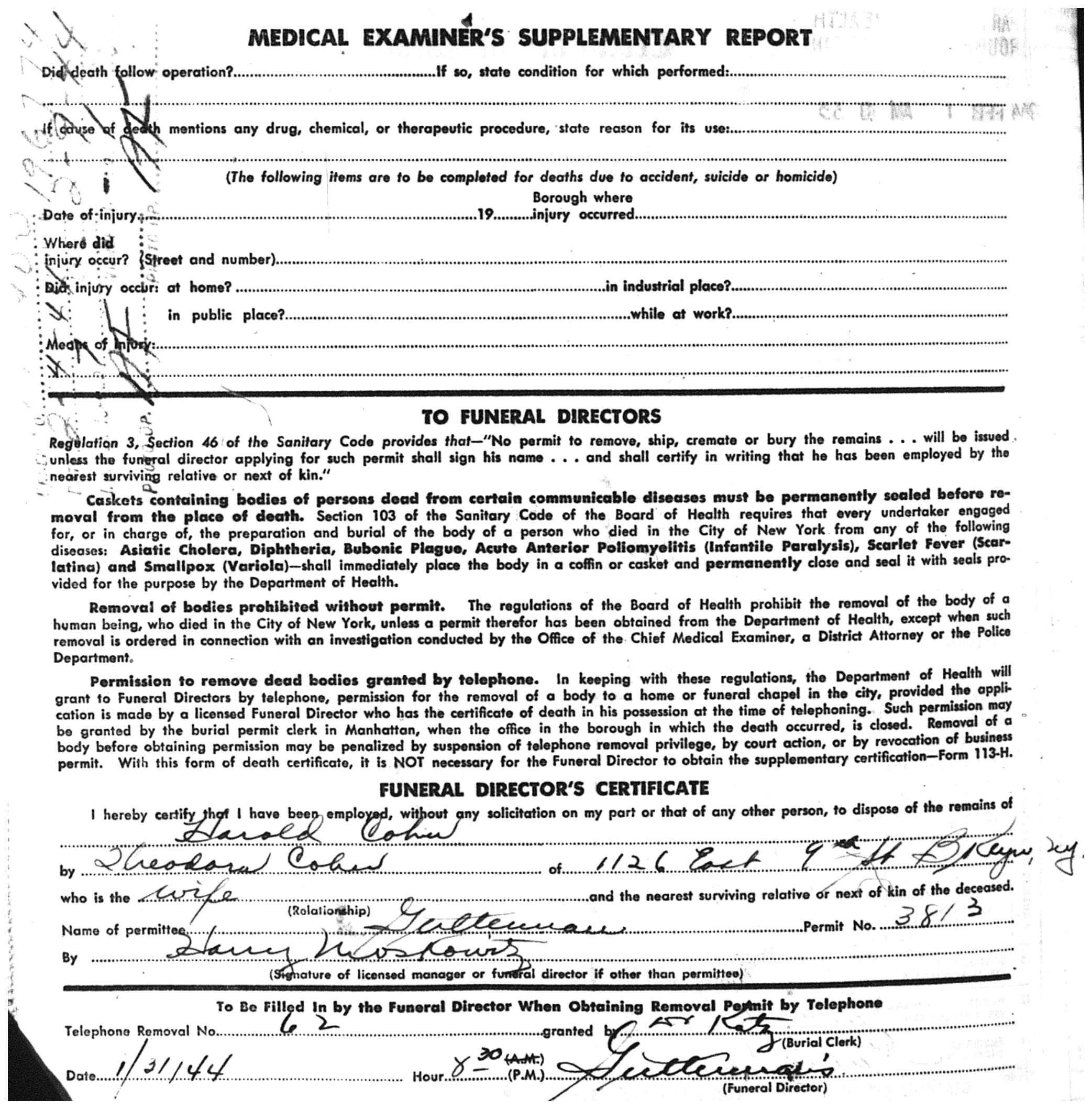
In 1930, Lillian’s sister Rose and her husband Joseph Cohn were living on West 90th Street, and Joseph was no longer a printer, but now an investor in securities. Their son Harold had married Tillie or Teddi or Theodora Kremenko, a Russian immigrant, on October 6, 1928.  Thus far, I cannot locate Harold or Tillie on the 1930 or 1940 census, but did find that Harold died on January 31, 1944.  He was only 39 years old and died from coronary thrombosis.  I am now following a lead to someone who might be Harold and Tillie’s son, so I hope to get more information and some photographs.

Cohn, Harold death page 1 Cohn, Harold death page 2

The third Kornfeld sister, Carrie, and her husband Bert Weiss were living on West 103rd Street in 1930, and Bert was still a dry goods salesman.  Their daughter Edna had married Harry Rosenberg on December 14, 1924.  Harry was born in New York City, and in 1920 he and his father Edward were both selling dry goods.  In 1925, Harry and Edna were living on West 176th Street, and Harry was selling real estate.  Unfortunately, as with Harold and Tillie, I cannot find them on the 1930 or 1940 census.

Finally, Max Kornfeld and his wife Emma had moved to Atlantic City by 1923, according to the directory for that year for that city.  They were still there in 1926, and Max was working again as an insurance agent. I could not find Max and Emma on the 1930 census.  (What is it with this family and the 1930 census? How did they elude the census takers?), but they were still living in Atlantic City when Max died on October 25, 1931.  Max was 57 years old. He was buried at Rodeph Shalom cemetery in Philadelphia.

Historical Society of Pennsylvania; Philadelphia, Pennsylvania; Collection Name: Historic Pennsylvania Church and Town Records; Reel: 1112

Historical Society of Pennsylvania; Philadelphia, Pennsylvania; Collection Name: Historic Pennsylvania Church and Town Records; Reel: 1112

Thus, by 1931, two of the Kornfeld siblings had died, Max and Lillian.  I cannot find Rose and her husband Joseph Cohn on the 1940 census, nor can I find their death records, and thus I do not know anything about them after 1930.  The only Kornfeld sibling I located on the 1940 census was Carrie and her husband Bert Weiss.  They were then living at 607 Broadway, and Bert was still selling hosiery.  I do not have any information about them after 1940.

As for the three grandchildren of Mary Seligman and Oscar Kornfeld, as noted above, I cannot find Carrie’s daughter Edna and her husband Harry Rosenberg on either the 1930 or 1940 census, nor can I find Rose’s son Harold and his wife Tillie on any census after their marriage in 1928.  I only know that Harold died in 1944.  The only grandchild about whom I could find any real information after 1930 was Arthur Nardin, the son of Lillian and her husband Emil Nardin.  In 1940, Arthur and his wife Jane and his two children, Arthur, Jr. and Edith, were still living on West 181st Street, and Arthur was a car dealer.  By 1958, Arthur and Jane had moved to Miami, where he died in 1983 at the age of 80.

That brings me to the end of the line started by Marx Seligmann and his wife Sarah Koppel, who immigrated to the United States in 1849 shortly after Marx’s divorce from his first wife.  Marx and Sarah must have come to the US to begin their lives together as a married couple in a new country, far away from their home country of Germany.  From that marriage came four children, eighteen grandchildren, and fifteen known great-grandchildren as well as many great-great-grandchildren, all my previously unknown American-born Seligman cousins, including my wonderful cousin Steve who supplied me with so many family stories and photos.


A Few New Tidbits about Moritz and Babetta, My Great-great-great-grandparents

I am working on a blog post about the descendants of the last child of Marx and Sarah Seligmann, Mary Seligman Kornfeld, but am awaiting some documents before I can post it.  So I am going to digress in this post from that line and return to my three-times great-grandfather, Moritz Seligmann (who was, of course, an older brother to Marx Seligmann).  When my cousin Wolfgang sent me the handwritten family tree he and his mother found in their magic suitcase, he had originally not included the pages about Moritz, thinking I had all the information I needed about Moritz and his children.  I asked him to send them to me anyway so that I would have the full document, even if there was no new information.

But in fact there was some new information or at least information that corroborated or clarified assumptions I had made based on inference, anecdotes, and other documents.


The first page names Moritz and his first wife, Eva Schoenfeld.

Handwritten notes about Moritz 1


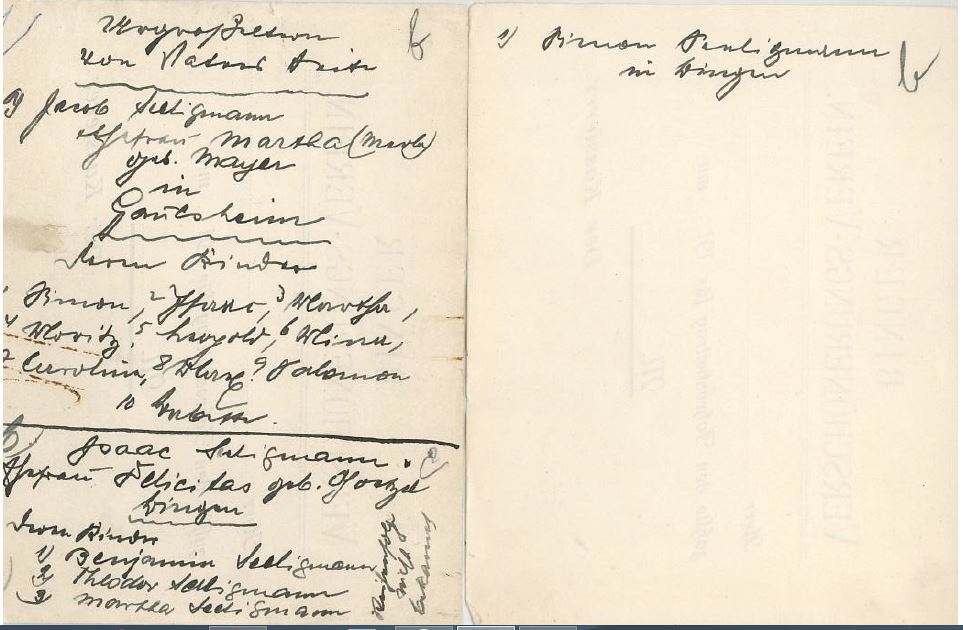
The next page lists the children of Moritz and Eva Schoenfeld.  I had wondered what had caused Eva’s death and also what had happened to their son Benjamin.  This page answered both questions.  Benjamin died shortly after his birth as did his mother, so I assume it was related to childbirth.

This page also provided confirmation and new information about when the other children died.

Handwritten notes about Moritz 2


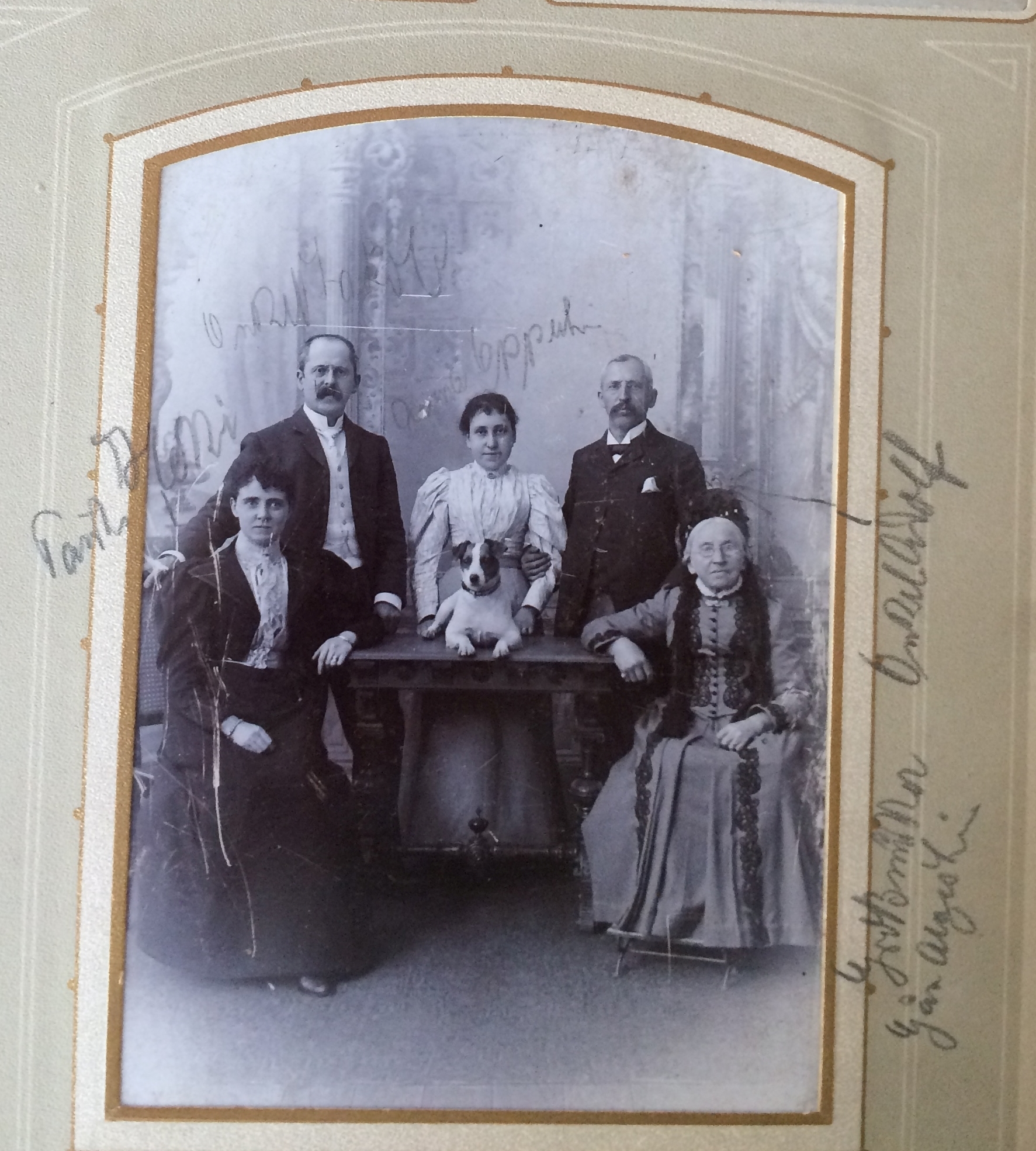
On the third page, the writer identified Babetta Schoenfeld as the second wife of Moritz Seligmann and lists their children.  There were several bits of important new information here. One is the date of Babetta’s death: January 15, 1899.  It also states that she was 89 years old.  This information helps to confirm that the photograph of the family group with the elderly woman was in fact a photograph of my three-times great-grandmother Babetta.

Handwritten notes about Moritz 3

The other bit of interesting information on this page is in the list of children.  The last child listed is Jacob, and it indicates that he was in England.  This is further corroboration of the fact that Moritz’s brother James Seligman who immigrated to England was in fact named Jacob at birth and is most likely the Onkel Jakob in the family photograph with Babetta, below.

Uncle Adolf and Grandmother Gau Algesheim

In addition, from this page I was able to learn when several of the other children of Moritz and Babetta had died.

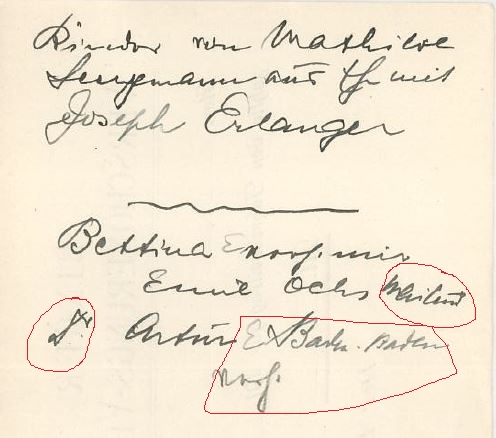
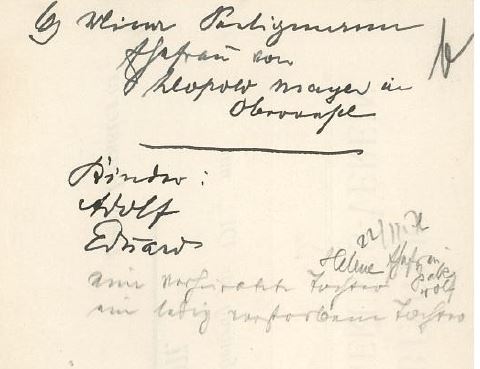
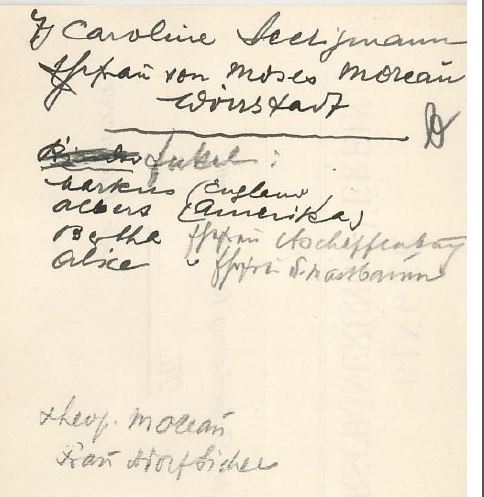
The remaining pages cover some of the children of Moritz: Pauline, Hieronymous, August, and Mathilde.  Although I did not find any really new information on these pages, they do provide additional confirmation of the information I already had as well as some dates I did not have.  Unfortunately, some of the writing is not legible, and so I cannot determine what those additional words say.  If anyone can read them, let me know.  I’ve circled the words I cannot read.

Handwritten notes about Moritz 4 to be translated

UPDATE:  My friend Dorothee in Germany tells me that the words after Joseph and Moritz indicate that they were both married and also both divorced.  Thank you, Dorothee!  My friend Ralph added to this, saying the words to the far right of Joseph say, “Son and daughter.” Unfortunately, I have no records for Joseph’s children.  Ralph also said that to the right of Martha, it says in part “Floersheimer,” which was her married name.  Thank you, Ralph!


Handwritten notes about Moritz 5 and 6 Handwritten notes about Moritz 7 to be translated

UPDATE:  Dorothee says that the symbol before Artur means “doctor” and the words after Artur say “in Baden-Baden, married.”  Thank you again, Dorothee!  Ralph added that the word next to Emil Ochs could be Mailand (Milan), which would make sense since Bettina entered Switzerland from Italy, as I wrote here.  Thank you again, Ralph!


Brick Walls Everywhere


Embed from Getty Images

I’ve run into some tough brick walls in my research, but never as many as I have with the descendants of Charlotte Seligman, the third child of Marx and Sarah Seligman. It’s been one frustration after another, searching for her children and grandchildren.

As noted in my earlier post, Charlotte (or Lottie) married Max Schlesinger in 1874, and they had four children: Harriet (1875), Arthur (1876), Lillie (1877), and Louis (1884).  Max was in the tie manufacturing business. Lillie and Louis were still living at home in 1900.

By 1900, Harriet (or Hattie) had married George Cain and had had one child, originally named Edith, but then renamed Lucie in memory of George’s sister.  The following year Harriet and George had a second daughter named Ethel.

I could not locate Arthur at all on the 1900 census, nor have I found him on any other record aside from the 1880 census and the NYC birth record index.  There is one possible military enlistment record for him dated March 4, 1895, but I can’t even be sure it is the same Arthur Schlesinger from the record.

On December 14, 1904, Max and Charlotte’s third child Lillie married Solomon Sondheim. Solomon, or Sol, was born in New Hampshire in 1867, making him ten years older than Lillie.  His father, a German immigrant, was in the dry goods business.  After living in New Hampshire, Sol had lived in Buffalo, New York, and then Bradford, Pennsylvania.  By 1900 when he was 33, Sol was working as a salesman and living in New York City as a boarder in what appears to be a large boarding house at 589 Second Avenue.  After marrying, Lillie and Sol were living on East 116th Street, and Sol listed his occupation on the 1905 NY census as a merchant.

In searching to learn more about Sol Sondheim, I found numerous articles about the suicide of his brother Philip.   From these articles, I learned that Sol’s father had been a wealthy man, leaving quite a large estate to be divided among his four children (which apparently Philip squandered through gambling).

New_York_Times_December_9_1900_page_1 Philip Sondheim

Sondheim suicide from Herald

Boston Herald December 13, 1900 p. 8

As for the rest of the family of Charlotte and Max Schlesinger, the 1905 NY census just presented me with problems. First, I cannot find Hattie and George Cain at all on the 1905 census (and Arthur still was missing).  What’s even more confusing, Charlotte Schlesinger is listed twice on the 1905 census (both with the date June 1, 1905, preprinted on the page).  On one page, Charlotte and Max were living at 231 West 116th Street, and Max was still working in manufacturing (presumably ties).

Max and Charlotte Schlesinger 1905 NY census New York State Archives; Albany, New York; State Population Census Schedules, 1905; Election District: A.D. 21 E.D. 39; City: Manhattan; County: New York; Page: 24

Max and Charlotte Schlesinger 1905 NY census New York State Archives; Albany, New York; State Population Census Schedules, 1905; Election District: A.D. 21 E.D. 39; City: Manhattan; County: New York; Page: 24

On another page of the 1905 census, Charlotte is listed with her son Louis and his wife Alice, living at 1838 Seventh Avenue.  Louis was only 21, and Alice was only 19.

Louis Schlesinger 1905 census New York State Archives; Albany, New York; State Population Census Schedules, 1905; Election District: A.D. 21 E.D. 35; City: Manhattan; County: New York; Page: 38

Louis Schlesinger 1905 census
New York State Archives; Albany, New York; State Population Census Schedules, 1905; Election District: A.D. 21 E.D. 35; City: Manhattan; County: New York; Page: 38

I assume Max died sometime between the first census listing and the second, but I cannot find any record for Max’s death.  There is no listing in the NYC death index, no obituary, nothing that explains what happened to him. Moreover, the NYC marriage index has Louis marrying Alice Stacke on April 26, 1906, a year after the 1905 census. Is it possible that this second census entry was filled in and filed a year late? Or perhaps it is more likely the marriage certificate was filed a year late.  Or they weren’t legally married until April 1906?

According to the 1910 US census, Louis and Alice were still living with Charlotte, now listed as a widow (the NY 1905 census had not asked about marital status).  They were living at 200 West 136th Street, and Louis was working as a clothing salesman.  Harriet and George Cain and their two daughters were living at 2308 Seventh Avenue, and George was the secretary of a bank.  Lillie and Sol Sondheim were living on West 122nd Street, and Sol was a traveling salesman.  Arthur remained missing.

On June 4, 1914, Harriet’s husband George Cain died.  I could not find a death record for him, but did find this death notice in the June 5, 1914, New York Times.

New York Times, June 4, 1914

New York Times, June 5, 1914

Since there is no listing for George Cain in the NYC death index, I assume George died someplace outside of New York City.  He left behind two young daughters, just 14 and 13, as well as his wife Harriet.  On the 1915 NY census, Harriet was living with her two daughters Lucie and Ethel as well as her mother Charlotte at 2308 Seventh Avenue.  No one in the household was employed outside the home.

Harriet Schlesinger Cain 1915 NY census New York State Archives; Albany, New York; State Population Census Schedules, 1915; Election District: 23; Assembly District: 21; City: New York; County: New York; Page: 11

Harriet Schlesinger Cain 1915 NY census
New York State Archives; Albany, New York; State Population Census Schedules, 1915; Election District: 23; Assembly District: 21; City: New York; County: New York; Page: 11

In 1920, Harriet was living with Lucie and Ethel, now 19 and 18, at 465 Central Park West.  Harriet’s occupation was reported as “renting rooms” at home, and there was one lodger listed in the household, but her name was crossed out.  Lucie was working in the bonding department of a security company, and Ethel was not employed.

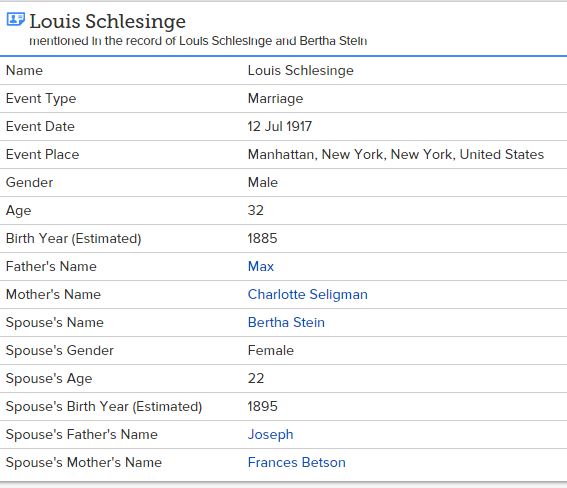
I cannot find either Louis Schlesinger or Lillie Schlesinger Sondheim on the 1915 NY census.  (These people are just incredibly elusive, no matter how I search.) But between 1910 and 1920, much had changed for both of them.  First, on July 12, 1917, Louis married a second time, this time to Bertha Stein.

New York, New York City Marriage Records, 1829-1940," database, FamilySearch (https://familysearch.org/ark:/61903/1:1:24HM-6GL : accessed 4 August 2015), Louis Schlesinge and Bertha Stein, 12 Jul 1917; citing Marriage, Manhattan, New York, New York, United States, New York City Municipal Archives, New York; FHL microfilm .

New York, New York City Marriage Records, 1829-1940,” database, FamilySearch (https://familysearch.org/ark:/61903/1:1:24HM-6GL : accessed 4 August 2015), Louis Schlesinge and Bertha Stein, 12 Jul 1917; citing Marriage, Manhattan, New York, New York, United States, New York City Municipal Archives, New York; FHL microfilm .


I would have thought this was a different Louis, except that the marriage record reveals his parents’ names as Charlotte Seligman and Max Schlesinger.  What had happened to Alice, his first wife? I don’t know.  There is no death record for her, but neither was there one for George Cain or for Max Schlesinger.  There are a number of later records for women named Alice Schlesinger, but none is obviously the right one.  If she remarried, I haven’t found her.

At any rate, Louis and Bertha Schlesinger had a child on June 14, 1918, less than a year after marrying.  They named him Arthur, which makes me believe that Louis’ older brother Arthur had died.  According to his draft registration for World War I, Louis was the financial secretary for the Joe Morris Music Publishing Company, and he, Bertha, and their son Arthur were living at 301 St. Nicholas Avenue in New York City.  Their residence remained the same on the 1920 census.

Louis Schlesinger World War I draft registration Registration State: New York; Registration County: New York; Roll: 1786672; Draft Board: 139


As for Lillie, her life also changed dramatically between 1910 and 1920.  Her husband Sol died on March 12, 1919, while he was in Chicago; I assume he was traveling there as part of his job as a salesman as he died at a hotel.  He died from heart and kidney disease.  He was 52 years old.

Sondheim, Sol. death

Six months later Lillie married William Lindsay on September 24, 1919.  William was born in Philadelphia, the son of Joseph Lindsay and Mary Thomson, who were born in Scotland and Ireland, respectively. William grew up in Philadelphia, where his father was a shirt manufacturer.  In 1920, William was working as an advertising solicitor for a trade magazine, and he and Lillie were living on 112th Street.

Thus, between 1910 and 1920, three of the children of Charlotte Seligman and Max Schlesinger had had  major marital status changes in their lives.  Harriet had become a widow; Lillie also had become a widow and then remarried; and Louis had either become a widower or had his marriage end, and he had remarried.  Meanwhile, their mother Charlotte was living on her own at 2040 Seventh Avenue.  Charlotte died three years later on January 19, 1923, when she was 69 years old.

I cannot find Harriet on the 1925 NY census, but according to a directory listing, she was still living at 465 Central Park West in 1925.  Her younger daughter Ethel had married Milton Robitchek on June 29, 1922, when she was 21, and had a daughter Georgia in 1928.  By 1930, however, Ethel was divorced, and she and two year old Georgia were living with Harriet on West End Avenue.  Ethel was a public school teacher. (I can’t seem to find Milton Robitchek at all after the 1922 marriage record. How could someone with such an unusual name just disappear?)

Harriet Schlesinger Cain 1930 US census Year: 1930; Census Place: Manhattan, New York, New York; Roll: 1557; Page: 12B; Enumeration District: 0465; Image: 685.0; FHL microfilm: 2341292

Harriet Schlesinger Cain 1930 US census
Year: 1930; Census Place: Manhattan, New York, New York; Roll: 1557; Page: 12B; Enumeration District: 0465; Image: 685.0; FHL microfilm: 2341292


Harriet’s older daughter Lucie was living on her own on Clinton Street in Brooklyn, according to the 1930 census, which reported that her occupation was “child placing” for an accountant.  I have no clue what that means.

In 1940, Harriet was still living with her daughter Ethel, now on East 68th Street, and with her granddaughter Georgia, now twelve.  Ethel was still working as a teacher.  Lucie was still living on her own in Brooklyn, and her occupation now clearly states that she was a public accountant.   I have not found any later records for Harriet, Lucie, Ethel, or Georgia.  I have searched as many ways as I can, but have found no documents, no news stories, no obituaries.

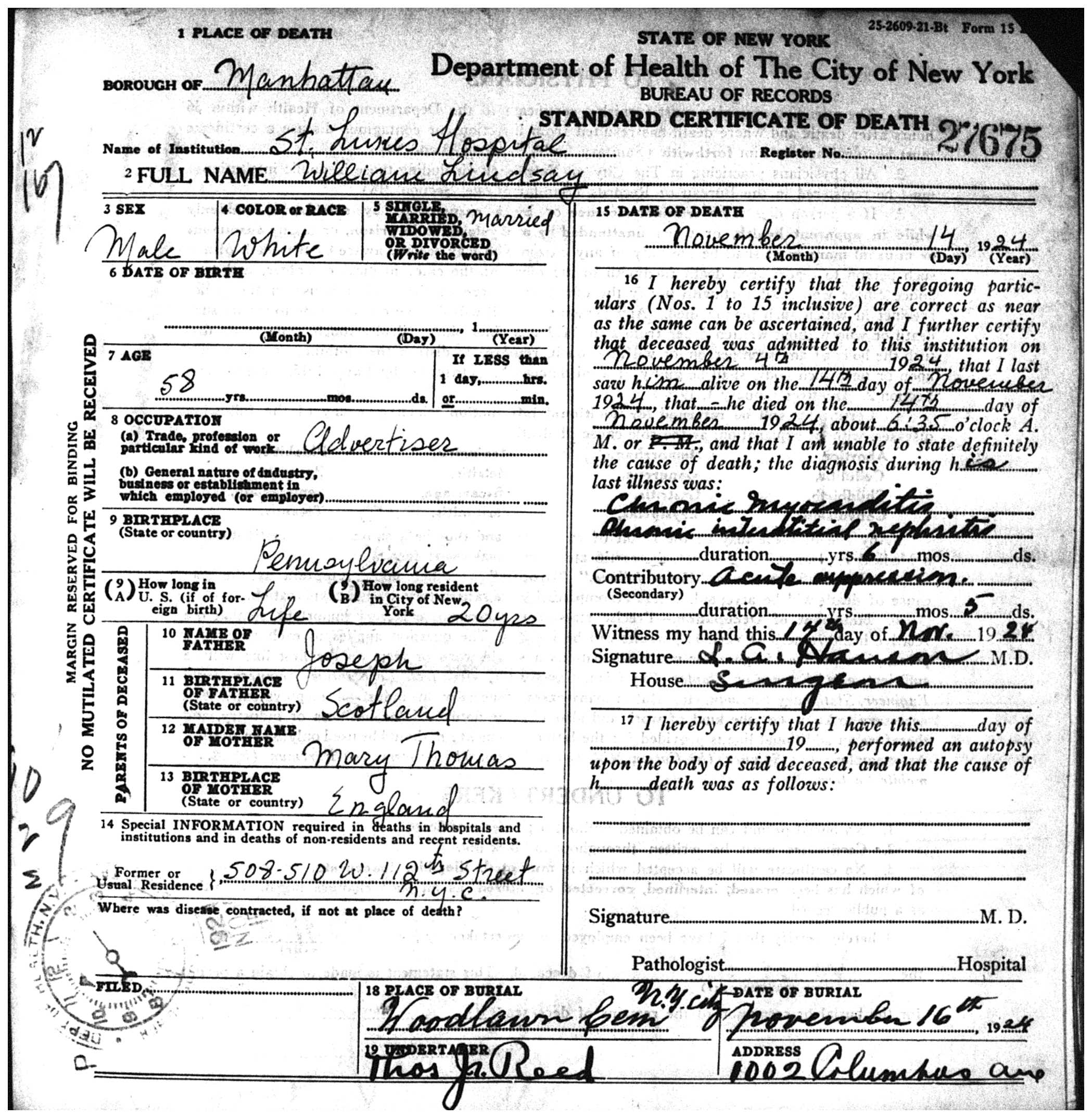
As for Harriet’s sister Lillie, she became a widow again on November 14, 1924, when her husband William Lindsay died at age 58.  Like Harriet’s first husband Sol, William died of both heart and kidney disease.

Lindsay, William death page 1

I’ve had no luck finding Lillie on either the 1925 NY census or the 1930 US census, but did find her on the 1940 census.  She was 62 years old, living at the Wyndham Hotel, and not employed.  That is the last record I have for Lillie.

Finally, there is Charlotte and Max’s youngest child Louis Schlesinger.  In 1925, he was still married to Bertha, and they were still living on St. Nicholas Avenue with their son Arthur, now six years old.  Louis was still employed in music publishing.  Although the family had moved to West 180th Street by 1930, all else remained the same (though everyone was five years older, of course).

But then the big mystery for me surrounding Louis and his family surfaced in the 1940 census.  Now Louis, Bertha, and Arthur are living on West 164th Street, but there are two more children living with them: Henry, listed as their son, 17 years old, and Matilda, listed as their daughter, 12 years old.  Where did these two children come from? If they were in fact Louis and Bertha’s children, they should have been listed with them on the 1930 census, but they were not.  Had they been adopted after 1930? They both had the surname Schlesinger, at least on the census record.  I don’t know, and what’s even more mystifying, I cannot find either of them on any later record or document.  I would think Henry would have served in World War II, but I cannot find any record that would match him, if his name in fact was Henry Schlesinger.

Louis Schlesinger 1940 US census Year: 1940; Census Place: New York, New York, New York; Roll: T627_2677; Page: 8B; Enumeration District: 31-2144

Louis Schlesinger 1940 US census
Year: 1940; Census Place: New York, New York, New York; Roll: T627_2677; Page: 8B; Enumeration District: 31-2144

At any rate, in 1940 Louis was still in music sales, and his son Arthur, now 21, was a clerk in an advertising firm.  On his draft registration for World War II, Louis reported that he was a music salesman and the president of Lewis Music Company.

Arthur Schlesinger, Louis and Bertha’s son, died on February 20, 1943.  He was 24 years old.  His death certificate does not report the cause of death, but it does indicate that he had been under a doctor’s care since October, 1942.  He had been working as a clerk in federal court.

Schlesinger, Arthur 1943 death page 1


That, unfortunately, is the last record I have for Louis Schlesinger and his family.  As with his siblings Harriet, Arthur, and Lillie, I do not know when he died.  I don’t know when his wife Bertha died, what happened to his first wife Alice, or what happened to the two children who were living with him as his children in 1940, Henry and Matilda.

Since I cannot find out what happened to Ethel Cain Robitchek’s daughter Georgia either, I don’t know whether there are any living descendants of Charlotte Seligman and her husband Max Schlesinger.  Harriet’s other daughter Lucie did not marry.  Lillie had no children.  Louis’s son Arthur died at a young age.  But what I did learn about Charlotte and her family is that this was a family where many marriages ended early either due to divorce or death.  Lillie was widowed twice.  Harriet was left a widow at a young age with her two young daughters.  Her daughter Ethel’s marriage was over by the time Ethel’s daughter Georgia was only two.  And Louis married twice, though I don’t know if the first ended because his first wife died or because they divorced.

So many unanswered questions.  I am hoping that with further digging, some answers will turn up, but for now I must say that searching for the family of Charlotte Seligman has made me feel like a very poor researcher and a very frustrated genealogist!  If any of you out there reading have any suggestions on how I might find more about these people, please let me know.


Embed from Getty Images


From Cigars to Security, and Heartbreak and Heart Disease: The Family of Jacob Seligman

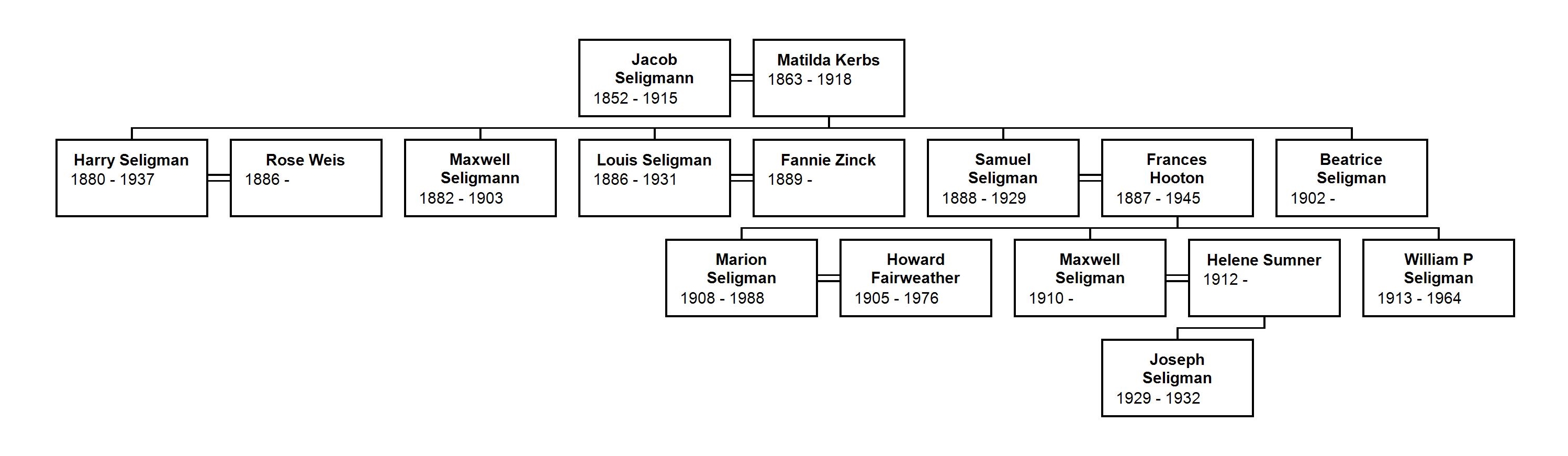
The second child of Marx and Sarah Seligmann was Jacob.  As I wrote in an earlier post, he married Mathilde Kerbs in 1881, and they had four sons and one daughter: Max (1882), Harry (1883), Louis (1885), Samuel (1888), and Beatrice (1902).  Jacob was a cigar packer, and the family was living at 303 East 69th Street in 1900.  Max and Harry were both working as salesman, according to the 1900 census.


Embed from Getty Images


The family suffered a terrible loss when Max died on November 25, 1903.   He was only 21 years old.  He died from typhoid fever and pneumonia.

Maxwell Seligman death certificate 1903

Maxwell Seligman death certificate 1903

In 1905, the remaining members of the family were living at 212 East 40th Street.  Harry was a police officer, Louis an errand boy, and Samuel a stock keeper (I assume in a store).  Their father Jacob was still a cigar packer.

On July 17, 1907, Samuel, the youngest son, married Frances Hooton, the daughter of William Proctor Hooton and Hannah Newman.

Marriage certificate of Samuel Seligman and Frances Hooton

Marriage certificate of Samuel Seligman and Frances Hooton

Seligman - Horton marriage page 2

William was born in England and was a shipping clerk; Hannah (usually referred to as Annie) was his second wife.  His first wife Deborah Newman (perhaps Annie’s sister?) died in 1879, leaving him with four children.  After having two children with Annie, including Frances in 1886, William lost his second wife Annie when she died on November 27, 1887.  William himself died in 1901 when Frances was only fifteen, and she ended up living with one of her sisters, working as a dressmaker. [Thanks to the generosity of Chip Bennett, a relative of the Hootons, I am able to share some photographs of Frances Hooton Seligman and her children.]  When Samuel and Frances married, he was only nineteen and she was 21.

Their first child Marion was born a year later in July, 1908.

Marion Seligman photo courtesy of Chip Bennett

Marion Seligman
photo courtesy of Chip Bennett

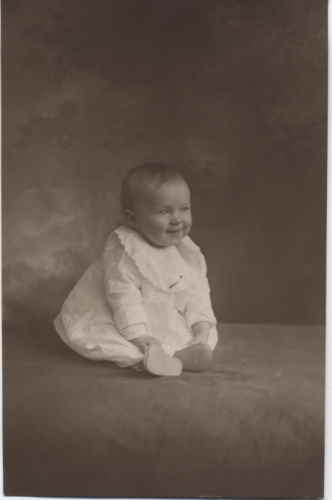
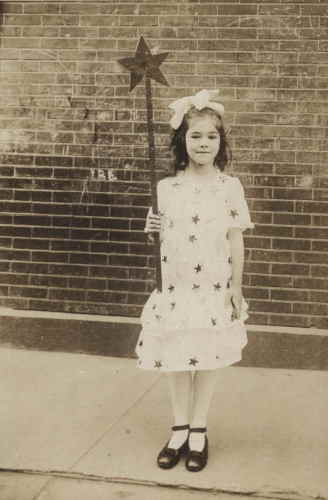
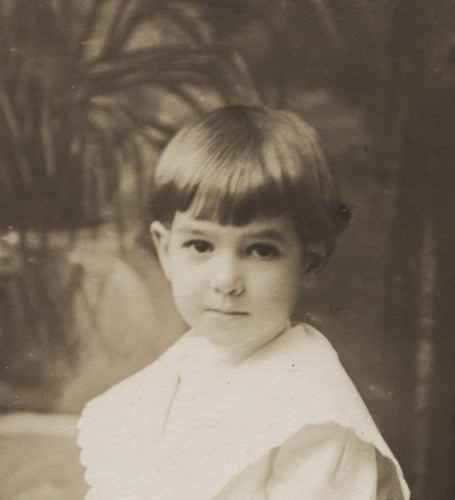
In February 1910, their second child Maxwell was born.  According to the 1910 census, the family was living at 349 East 82nd Street, and Samuel was working as a special officer for the Highway Department.   A third child was born to Samuel and Frances in 1913; his name was William.

Frances Hooton Seligman with Max and Marion and her niece Ethel   Photo courtesy of Chip Bennett

Frances Hooton Seligman with Max and Marion and her niece Ethel
Photo courtesy of Chip Bennett


Meanwhile, the other children of Jacob and Mathilde Seligman were still living with their parents in 1910.  Jacob was still in the cigar business, and Harry was still working as a city police officer.  Louis had no occupation listed, and Beatrice was only eight years old.

Harry married Rose Weis on March 24, 1912.  Rose was the daughter of Joseph/Ignatz Weis and Henrietta Schoen, Hungarian immigrants.  Her father was an upholsterer.  As far as I can tell, Harry and Rose did not have any children.  In 1915, Harry continued to work as a police officer.  He and Rose were living at 349 East 84th Street, according to the 1915 census.

Jacob Seligman died on December 16, 1915.  He was 63 years old.  His son Louis was married a year and a half later; he married Fannie Zinck on June 2, 1917.  She was born in Alsace-Lorraine in about 1889 and immigrated to the US around 1902.  Unfortunately, I have not been able to find any more about Fannie’s background.  Louis and Fannie did not have any children.

According to his World War I draft registration, Louis was employed as a canvasser by his brother Samuel in 1918; according to Samuel’s registration, he was self-employed as a watchman.  What would Louis have been doing as a canvasser for a watchman?  They were living not far from each other, Louis and Fannie at 506 East 83rd Street, Sam and Frances and their children at 242 East 85th Street.  Harry and Rose were also nearby—at 409 East 84th Street; Harry (using the name Henry on his draft registration) was still a New York City patrolman.  I found it interesting that all three brothers were in some aspect of the security business.

Their mother Mathilde Kerbs Seligman died on March 12, 1918; she was 54 years old.  Beatrice, the youngest sibling, was only sixteen years old and orphaned.  She moved in with her brother Louis and his wife Fannie, according to the 1920 census.  They were then living at 307 East 78th Street; Louis listed his occupation as special officer on night patrol, and Beatrice was a typist. In 1920, Harry and Rose continued to live at 409 East 84th Street, and Harry continued to work as a police officer.  Sam, Frances, and their three children were still living at 242 East 85th Street, and Sam was still working as a night watchman.

Things remained pretty much the same in 1925.  Louis, Fannie, and Beatrice were still living on 78th Street.  Louis was now working as a mechanic, according to the 1925 New York census; it looks like Beatrice’s occupation was a correspondent.  I am not sure what that means.  Samuel and his family were still on 85th Street.  Sam had his own business, and his two oldest children were working: Marion doing clerical work and Maxwell as a helper—perhaps in their father’s business?  I have not been able to locate Harry and Rose on the 1925 New York census.

Marion Seligman as a young girl photo courtesy of Chip Bennett

Marion Seligman as a young girl
photo courtesy of Chip Bennett

Samuel and Frances Seligman’s son Maxwell married Helene Sumner on August 25, 1927.  Helene was the daughter of Edward Sumner and Priscilla nee McCarthy, who were English-born immigrants; her father was an engineer. Maxwell was only 17 years old when they married (although listed as 22 on the marriage record, all other records indicate he was born in 1910); Helene was listed as 17, but all her earlier records say she was born in 1912, making her only 15 in 1927. Given how young they were, I might have thought that Helene was pregnant (and maybe she was), but their first and only child, Joseph, was not born until 1929.

Maxwell Seligman as a young boy Photo courtesy of Chip Bennett

Maxwell Seligman as a young boy
Photo courtesy of Chip Bennett

The 1920s ended very sadly for the family.  On March 9, 1929, Samuel Seligman died; he was only 40 years old and left behind his wife Frances and their three children.  He died from angina pectoris and myocarditis—heart disease.

Samuel Seligman death certificate 1929

Samuel Seligman death certificate 1929


Marion was 21, Maxwell 19, and William only 16 years old when their father died.  Frances remarried a man named Frank Mildrum on February 16, 1931, according to the records in the New York marriage index on Ancestry, although according to the 1930 census, she was already married to Frank, as she is listed as his wife and living with him and two of her children, Marion and William, in the Bronx.  Frank also had a thirteen year old daughter Florence from his prior marriage.  Frank was a private detective.  Marion Seligman was working as an office clerk.

Louis Seligman did not live much longer than his brother Samuel.  In 1930 he and Fannie as well as his sister Beatrice were still living at 308 East 78th Street.  Louis had his own business in protective alarms, and Beatrice was a clerk for an express company, according to the census.  But on October 23, 1931, Louis died from luetic aortitis and chronic myocarditis at age 44. Heart disease had contributed to the death of yet another family member.  Of the four sons born to Jacob and Mathilde Kerbs Seligman, only Harry was still alive.

Louis Seligman death certificate 1931

Louis Seligman death certificate 1931

By 1930 Harry and his wife Rose had moved in with her parents and siblings in Brooklyn, and Harry was no longer working as a police officer, but instead as a clerk in a brokerage house.  Harry was 49 years old; he had been working for the police force since at least 1905. Why would he and Rose have moved in with her family after all those years living on their own? Was Harry disabled? Had he reached eligibility for retirement? Did the police force even have a pension back then? According to this article from the official New York City website, there was some form of pension for police officers dating back to the 19th century.

I don’t know the answers to these questions, but I do know that Harry died just seven years later on March 6, 1937.  He was fifty-six years old and died from “coronary thrombosis with cerebral and pulmonary emboli induced by generalized arteriosclerosis.” (The parents’ names on this certificate are clearly in error, but this is also clearly the correct Harry Seligman, son of Jacob and Mathilde.)

Harry (Henry) Seligman death certificate 1937

Harry (Henry) Seligman death certificate 1937

The New York Times March 7, 1937

The New York Times March 7, 1937


Beatrice Seligman had been orphaned by the time she was sixteen, and now she had lost all of her siblings by time she was 35 years old.  In 1940 she was living as a lodger on West 99th Street and still working for the express company as a stenographer.  She was single and 38 years old.  After that, I cannot find her.  I don’t know whether she ever married or what happened to her after 1940.  I don’t know when she died.

Of the five children born to Jacob and Mathilde Seligman, only one, Samuel, had had any children.  As noted above, Samuel and Frances Seligman’s son Maxwell married Helene Sumner as a teenager, and they had a son Joseph born in 1929.  I saw on Ancestry that Joseph died when he was three years old in 1932.  When I received the death certificate, I was shocked.  Joseph had been hit by a car on 85th Street between Second and Third Avenue and had sustained a fractured skull.  How could something like this happen to a three year old child?

Seligman, Joseph death page 1 Seligman, Joseph death page 2

It appears that the marriage between Maxwell and Helene did not survive the death of their son.  In 1939, Maxwell traveled with his brother William to Key West, Florida.  On the 1940 census Maxwell and William were both living with their mother Frances Hooton Seligman Mildrum, who had been widowed again when Frank Mildrum died in June, 1939.  Frank’s daughter Florence was also living with them.  Maxwell and William were both working as collectors for a detective agency; according to the 1940 census, both Maxwell and William had been living in the same house in 1935, suggesting that Maxwell’s marriage had ended by then.

William Seligman as a young boy Photo courtesy of Chip Bennett

William Seligman as a young boy
Photo courtesy of Chip Bennett

As for Marion, Samuel and Frances Seligman’s other child, she married Howard Fairweather on July 3, 1932.  He was the son of Howard and Margaret (Duffy) Fairweather.  This also appears to be a marriage that did not last.  On the 1940 census, Howard and Marion were living on Undercliff Avenue in the Bronx.  Although Marion was working as a secretary at Star Protection Company, Howard had no occupation listed.

Marion may have been more than a secretary; she may have been THE secretary of the company.  According to an article from the New York Times dated January 27, 1940 about a labor strike at the company (Star Electric Protective Company, a burglar alarm company), Marion Fairweather was at that time the treasurer of the company.

Marion Fairweather burglar alarm strike

Marion and Howard had no children.  In 1942 Howard was serving in the armed forces as a private and still listed his status as married.  He reported that his occupation was as a non-public police officer, so I assume a private detective.  After that I have no records for them together.  Marion traveled alone several times in the 1950s.  Perhaps they were still married, but I have no documentation for either of them until their deaths.  Howard Fairweather died in Atlantic City in 1976; Marion Seligman Fairweather died July 27, 1988. Her last residence had been in New York City.

William had enlisted in the military on 1942.  In July, 1953, he traveled  to Bermuda. It appears that William never married.  William P. Seligman is listed in the New York City telephone directory in 1959 and 1960, and there is a Max Seligman as well, but I don’t know if it is the correct Max since even within the family there were several Max Seligmans.  William died on June 2, 1964.  His death notice in the New York Times mentioned only his sister Marion Fairweather as a survivor so Max must have predeceased him.  Unfortunately I cannot locate a death record or obituary for Max.

The New York Times, June 4, 1964

The New York Times, June 4, 1964

None of the children of Samuel Seligman had children, and Samuel was the only child of Jacob Seligman to have children, and thus the line of Jacob Seligman, son of Marx and Sarah Seligmann, ended when Marion Seligman Fairweather died in 1988.  Looking back at their story, this seemed to be a family that was succeeding in America—three sons who were all involved in personal and property security in some form or another.  But they were also three sons who died far too young in addition to the fourth son who died as a very young man.  There was the tragedy of a three year old child killed by a car and the marriage between his two young parents that failed not long after that death.  It is also a family that has no living descendants to carry on the names or the stories of these people.

Descendants of Jacob Seligman and Mathilde Kerbs

Descendants of Jacob Seligman and Mathilde Kerbs


Gifts from My Cousin Steve

How very lucky I have been in finding my Seligman cousins.  Starting with my cousin Pete from Santa Fe, then my cousin Wolfgang in Germany, then my cousin Suzanne from Scranton, and now two more cousins: Lotte, a descendant of Hieronymous Seligmann, brother of my great-great-grandfather Bernard, and Steve, a descendant of Marx Seligman, brother of my three-times-great-grandfather Moritz.  I will talk about Lotte in subsequent posts, but for now I will continue the story of Marx Seligman and his descendants.

Steve is a grandson of Sigmund Seligman, the oldest child of Marx and Sarah Seligman, and as I mentioned last time, he has generously shared with me many photographs of his family as well as personal anecdotes about them.  All the photographs in this post are courtesy of Steve.  I am filled with gratitude to him for bringing to life his father Leo, his aunt Mary, and his uncles Max and Albert.

In my earlier post about Marx and his descendants, I wrote that “Sigmund and Charlotte had five children between 1883 and 1896: Mary (1883), Max (1884), Leo (1891), Theresa (1894), and Albert (1896).  Sigmund was employed in the insurance industry.  In 1900, they were living at 304 East 117th Street.”  As posted last time, here is a family photograph of Sigmund and Charlotte and their children from about that time, estimated to be taken in 1901.

Sigmund Seligman and family about 1901. Standing rear: Mary, Max.  Sitting middle row: Sigmund, Albert, Leo, and Charlotte.  In front: Theresa Photo courtesy of Steve Seligman

Sigmund Seligman and family about 1901. Standing rear: Mary, Max. Sitting middle row: Sigmund, Albert, Leo, and Charlotte. In front: Theresa
Photo courtesy of Steve Seligman

Tragedy struck this happy family on September 27, 1902, when eight year old Theresa, the little girl seated in front, died from tubercular meningitis.

Theresa Seligman death certificate

Theresa Seligman death certificate


In 1905, the remaining children were all still living with their parents at 89 East 121st Street; Sigmund was a supervisor in an insurance company, Max was working as a bookkeeper, and the other boys were in school.  Mary was home.

As noted last time, Mary married Joseph Brandenburg (later Brandt) in 1907.  By 1910, her parents and brothers had moved to 275 East 123rd Street.  Sigmund was still working as a supervisor in the insurance company, now identified as Metropolitan Life.  Both Max and Leo were working as clerks for American Pencil Company, and Albert was only fourteen and presumably in school.

In 1915, the family had relocated again to 60 West 129th Street; Sigmund was still in the insurance business.  The census does not report what businesses they were working in, but Max was working as an assistant manager, Leo as a salesman, and Albert as a stock clerk.

Sigmund Seligman and family 1915 NY census New York State Archives; Albany, New York; State Population Census Schedules, 1915; Election District: 09; Assembly District: 21; City: New York; County: New York; Page: 35

Sigmund Seligman and family 1915 NY census New York State Archives; Albany, New York; State Population Census Schedules, 1915; Election District: 09; Assembly District: 21; City: New York; County: New York; Page: 35

Sigmund and Charlotte’s first grandchild, Jerrold Thurston Brandt, son of Joseph and Mary (Seligman) Brandt, was born on June 15, 1913.

On October 12, 1915, Max married Pauline Hirsch. Pauline’s father Samuel was a German immigrant working as a watchman; her mother had died in 1901. Pauline had been working as a bookkeeper for a clothing company in 1910.  Pauline and Max had a daughter Theresa born August 15, 1916, presumably named for Max’s little sister Theresa, who had died in 1902.

Both Leo and Albert served in World War I.  Leo served stateside near Jacksonville, Florida; Albert was sent overseas where he was gassed on the battlefields of France.  According to his nephew Steve, Albert never fully regained his health, suffering from heart problems and pneumonia all his life.

Leo Seligman World War I courtesy of Steve Seligman

Leo Seligman World War I courtesy of Steve Seligman

Albert Seligman ww1

Albert Seligman World War I photo courtesy of Steve Seligman

By 1920 Sigmund had retired.  He and Charlotte were still living with two of their sons, Leo and Albert, as well as a boarder. Home from the war, Leo was a salesman for a cloak company, and Albert was a merchant in ladies’ clothing.

On April 18, 1920, Leo married Jeanette Freundlich, the daughter of Morris and Martha Freundlich.  Morris was an immigrant from the Austria-Hungary Empire, and according to his passport application, he was born in Krakow.  Morris was a furrier and had his own business.  According to the 1920 census, Jeanette and her brothers Julian and Edwin were all helping their father in his business.  Jeanette and Leo had three children in the 1920s, Joan, my newly-found cousin Steven, and Edward.

Leo Seligman and his family

Leo Seligman and his family

Joan Seligman

Joan Seligman

Edward, Joan and Steven Seligman

Edward, Joan and Steven Seligman

EDDIE & STEVE ABOUT 1938 001

Edward and Steven Seligman about 1938

Joan Seligman, age 13

Joan Seligman, age 13

In 1920 Max was working as the assistant manager in the pencil company, and he and his family were living at 424 East 51st Street.

Albert Seligman married Bella Heftler on November 20, 1921. Bella was the youngest of ten children of Max and Sarah Heftler, who were Hungarian immigrants.  Max Heflter was supporting that large family as a tailor, with his two oldest daughters working in a shirt factory in 1900. By 1920, Max had died, and Bella was working as a bookkeeper, still living with her mother and five of her siblings.  In 1923, Bella and Albert Seligman had a son Maxwell, named presumably for Bella’s father.

Albert Seligman courtesy of Steve Seligman

Albert Seligman courtesy of Steve Seligman

Bella Heftler Seligman

Bella Heftler Seligman courtesy of Steve Seligman

Maxwell Seligman courtesy of Steve Seligman

Maxwell Seligman courtesy of Steve Seligman

Sigmund Seligman died on June 15, 1924.  He was 74 years old.  His wife Charlotte survived him by ten years, dying on July 18, 1934.  She was 75 years old.

Sigmund Seligman and Charlotte Koppel Seligman

Sigmund Seligman and Charlotte Koppel Seligman

As for their children, in 1930 Max was working as the manager of a movie theater and living with his family on West 97th Street.  Leo was living with his family on Cathedral Parkway (110th Street) and working in coat manufacturing.  Albert and his family were living on Jesup Avenue in the Bronx, and Albert was a salesman in the film industry.  Mary and Joe Brandt were living with their son Jerrold at 23 West 73rd Street, and Joe was one of the owners of what was now called Columbia Pictures.

By 1940, all three brothers were somehow connected to the film industry.  Joe Brandt had left Columbia Pictures in 1932 and had died in 1939, but he somehow must have connected his three brothers-in-law to the movie industry.  According to the 1940 census, Max Seligman was working as a purchasing agent for Columbia Pictures.  His draft registration for World War II says that Columbia Pictures was his employer.  Leo reported that he had his own office as a film distributor on the 1940 census, and on his World War II draft registration he said his employer was Max Seligman.  According to Steve, his father distributed foreign films as well as children’s cartoons for a local movie theater.  As for Albert, the 1940 census reports his occupation as a movie theater manager, but on his World War II draft registration he listed his employer as Columbia Pictures.  Steve said that Albert was in the publicity department.  Thus, by 1942 all three brothers appear to have been working in the film business.

Max (front left), Leo (rear on right), and Mary (front right) and two friends playing cards  Courtesy of Steve Seligman

Max (front left), Leo (rear on right), and Mary (front right) and two friends playing cards
Courtesy of Steve Seligman

Mary had also moved back from Hollywood to New York at some point after Joe died, and her nephew Steve remembers that she would often take him and his siblings to the movies.  Steve wrote, “Aunt Mary would march up to the box office and demand to see the manager.  When he came out she would come up with the same pitch.  ‘My husband was President and co-founder of Columbia Pictures and this child and I would like to see this picture.’ I never remember being turned away.”

Mary Seligman Brandt Photo courtesy of Steve Seligman

Mary Seligman Brandt
Photo courtesy of Steve Seligman

About his Uncle Max, Steve wrote, “Uncle Max had a habit of saying almost everything twice.  When I would go and visit him and my Aunt Pauline, Uncle Max would invariably open the door and say, ‘Hello my boy, hello my boy, how are you, how are you.’  Even during conversations it would happen.  I don’t know whether he thought we were hard of hearing or if he just wanted to emphasize what he said.    Not everything was repeated, of course, but enough times for my brother Eddie and my cousin Maxwell to refer to him as Uncle Max, Uncle Max.”

Steve also wrote this loving tribute to his father, Leo Seligman, the middle brother:

One thing you could say about my father was that he was a lousy ballplayer.  He couldn’t throw, he couldn’t catch, he didn’t even follow the baseball teams. When my brother Eddie and I would be in our room listening to a replay of the day’s games, my father would be in the living room reading the paper and surely not the sports page. But in other ways he managed to spend quality time with us. In the summer almost every Sunday we would go up to the roof of our apartment building with bridge chairs and hang out for a couple of hours. He would have contests between Eddie and me testing our spelling, math and memory skills. Eddie would always win the math contest but I managed to hold my own in the other games. I think whoever won would get a nickel, nothing to get crazy over but enough to tide us over in the candy store.  In my early teens on Sundays in the spring he and I would rent bikes and go bike riding in Central Park. It’s amazing but I still remember the store. The owners name was Aug, it was on 81st St. and he charged a quarter an hour. That was fun. What my father lacked in ball playing he made up on a bike. One other thing; he never spanked us. When I misbehaved he would “flick” my ear, hard.  It’s hard to describe what “flicking” an ear is but if you put your forefinger against your thumb and release it strongly, that’s flicking. It really didn’t hurt much but it didn’t matter, we knew we were being punished.

Leo Seligman

Leo Seligman

Leo and Jeanette (Freundlich) Seligman

Leo and Jeanette (Freundlich) Seligman

All three brothers died within five years of each other.  Albert, the youngest, died first on October 6, 1948.  He was only 52 years old and had been plagued with poor health since his service during World War I.  Leo died on January 1, 1952; he was just sixty years old.  Max, the oldest of the three, died the following year on March 9, 1953; he was 68.


Max Seligman NYT Obit

Mary Seligman Brandt, the oldest of the children of Sigmund and Charlotte Koppel Seligman, lived the longest.  She died in February, 1977, at the age of 94.

Thank you once again to my cousin Steve Seligman for sharing his photographs and his stories with me.  I am so pleased that we have found each other.  These new contacts and the pleasure they bring me continue to be the most meaningful benefits I get from doing genealogy and writing this blog.  Here are some additional photographs of Steve’s family:

Steve's brother Eddie Seligman

Steve’s brother Eddie Seligman

Steve's wife Arline

Steve’s wife Arline

Joan Seligman's husband Bennett Pollard

Joan Seligman’s husband Bennett Pollard

Steve and Arline Seligman

Steve and Arline Seligman

Nancy (nee Seligman) and Barry Buzzuro

Nancy (nee Seligman) and Barry Buzzuro

Steve and Arline Seligman and daughter Nancy

Steve and Arline Seligman and daughter Nancy

Jane Brenwasser Jacobs, great-granddaughter of Sigmund Seligman

Jane Brenwasser Jacobs, great-granddaughter of Sigmund Seligman


I Could Have Been A Contender*


The original CBC Film Sales logo used from 191...

The original CBC Film Sales logo used from 1919 through 1924 (Photo credit: Wikipedia)

As I continued to research the descendants of my four-times-great-uncle Marx Seligman, one thing kept bothering me. I had not yet confirmed one of the facts asserted in the second handwritten tree discovered by my cousin Wolfgang.  That second handwritten tree, which had led me to Marx and his family, claimed (1) that Marx had remarried and moved to New York.  That was true about the Marx I was following—he had married Sara Koppel and moved to New York City.

The creator of that second tree also claimed that (2) Marx and Sara had had a son who (also) married a woman whose surname was Koppel (or Coppel).  That also proved to be true of the Marx I was following: his son Sigmund had married a woman named Charlotte Koppel, born in Germany (and likely related to Sigmund’s mother).

tree 2 page 8

But there was one more specific fact that the tree had mentioned that I had not yet confirmed:  (3) that the son had had a daughter who married a film agent. As I researched up to 1900, I had not yet uncovered anyone involved in the film industry who was related to Marx.  Being a big movie fan, I was disappointed not to find a connection to Hollywood.

But then I entered the 20th century in my research.  While researching the children of Sigmund Seligman as they entered adulthood, I found the answer.  According to another family tree I found on Ancestry owned by Sharon Bolton, Sigmund and Charlotte’s first child, Mary, married a man named Joseph Brandt, who was born on July 20, 1882, in Troy, New York.  I am always very reluctant to rely on anyone else’s tree, having seen so many that are unsourced and clearly carelessly done, but this one seemed very thorough and included many photographs as well as personal stories by Sigmund’s grandson, Steve. (I am now in touch with both Sharon and Steve, and they generously shared wonderful photographs and stories about Sigmund’s family.  I will post more photographs in a subsequent post.)

Sigmund Seligman and family about 1901. Standing rear: Mary, Max.  Sitting middle row: Sigmund, Albert, Leo, and Charlotte.  In front: Theresa Photo courtesy of Steve Seligman

Sigmund Seligman and family about 1901. Standing rear: Mary, Max. Sitting middle row: Sigmund, Albert, Leo, and Charlotte. In front: Theresa
Photo courtesy of Steve Seligman

According to Joseph Brandt’s record on the 1920 census, his father was born in Russia and spoke Yiddish; his mother was born in Germany.

Joseph Brandt and family 1920 census  Source Citation Year: 1920; Census Place: Manhattan Assembly District 23, New York, New York; Roll: T625_1227; Page: 38B; Enumeration District: 1506; Image: 543

Joseph Brandt and family 1920 census
Source Citation
Year: 1920; Census Place: Manhattan Assembly District 23, New York, New York; Roll: T625_1227; Page: 38B; Enumeration District: 1506; Image: 543


I could not find Joseph on any census before or after 1920, and I could not find anything else about his parents or family.  (Sharon also had nothing about his background on her tree.) Based on his birth date and birth place as recorded on Sharon’s family tree, the only other official records I could find for him were his 1913 passport application, his 1918 World War I draft registration card, and several ship manifests for his travels with Mary.

But his draft registration corroborated that third missing fact from the handwritten family tree.  According to his 1918 draft registration card, Joseph was then employed as an attorney and assistant treasurer for Universal Film Manufacturing Company.  Now I had evidence that the Marx Seligman I had been following was the same man discussed in the handwritten family tree: Marx’s son Sigmund had married a woman named Koppel; they had had a daughter (Mary) who married a “film agent.”

Registration State: New York; Registration County: New York; Roll: 1787086; Draft Board: 170

Registration State: New York; Registration County: New York; Roll: 1787086; Draft Board: 170

Of course, Joe Brandt was more than a film agent.  In fact, he was much, much more.  Once I saw that he was in fact involved in the film industry, I googled his name and learned more.  From Wikipedia and his obituary in the New York Times on February 23, 1939, p.28,  I learned that Joe Brandt was one of the founders and the first president of Columbia Pictures.  Joe had graduated from NYU Law School in 1906 and had worked in the advertising industry for several years before being hired in 1912 by Carl Laemmle, the founder of Universal Film Manufacturing, today known as Universal Studios.  In 1919 he and two brothers he had known at Universal,, Harry and Jack Cohn, formed their own film production company, known first as C.B.C. Film Sales (for Cohn Brandt Cohn) and later known as Columbia Pictures.

Christmas ad in The Film Daily December 1920  p 1484

Christmas ad in The Film Daily December 1920 p 1484


Joe sold his interest in Columbia Pictures in 1932 and then became president of two other film companies before retiring due to poor health in 1935.  Joe died at the age of 56 on February 22, 1939. Joe and Mary had had one child, a son named Jerrold Thurston Brandt, who would also enter the movie industry.

Joe Brandt obit NYTimes February 23, 1939

But why couldn’t I find out anything about Joe’s background before entering the film industry other than his birth in Troy, New York, in 1882?  From a link in the Wikipedia entry, I found this little snippet about him from a journal called Moving Picture World dated April 6, 1912:

Joe Brandt goes to Laemmle

Joe had changed his name from Brandenburg to Brandt.  There is also a reference to his name change in this article from the February 1, 1913 edition of Motography:

Motography part 1

Motography part 2

Motography part 3

Once I knew his original name, I had no trouble locating his parents and his siblings. Joseph Brandenburg was the son of Daniel and Rosa Brandenburg.  Daniel was born in 1846 in Russia, and according to the 1900 census, had arrived in the United States in 1870.   His wife Rosa was born in Prussia in 1847 and had immigrated to the US in 1865, according to the 1900 census.  Daniel and Rosa had married in 1871, and by 1880 they were living in Troy, New York, where Daniel was working as a tailor.  They had three children by that time: Albert, Lilly, and Anna.   Joseph was their youngest child, born in 1882. At some point the family must have moved to New York City because the article reprinted above from Motography states that Joe was educated in the NYC public schools.  On the 1900 census, Daniel and Rosa were living in New York City with all of their children, including Joe, who was already a lawyer, according to the census report.  Daniel was still working as a tailor.  Joe was still living with his parents as of the 1905 New York census and was still listed as a lawyer on that census record.

On October 20, 1907, Joseph Brandenburg married Mary Seligman in New York City.

New York, New York City Marriage Records, 1829-1940," database, FamilySearch (https://familysearch.org/ark:/61903/1:1:24HY-X9K : accessed 15 July 2015), Joseph Brandenburg and Mary Seligman, 20 Oct 1907; citing Marriage, Manhattan, New York, New York, United States, New York City Municipal Archives, New York; FHL microfilm .

New York, New York City Marriage Records, 1829-1940,” database, FamilySearch (https://familysearch.org/ark:/61903/1:1:24HY-X9K : accessed 15 July 2015), Joseph Brandenburg and Mary Seligman, 20 Oct 1907; citing Marriage, Manhattan, New York, New York, United States, New York City Municipal Archives, New York; FHL microfilm .

He was still using the Brandenburg surname as of 1910, when according to the census, he was working in advertising for Billboard magazine.   He and Mary were living at 3161 Broadway in NYC.  Sometime between 1910 and 1913 when he applied for a passport, Joe changed his surname to Brandt, as that is how he appears on every document thereafter.

Joseph Brandt passport application 1913 National Archives and Records Administration (NARA); Washington D.C.; NARA Series: Passport Applications, January 2, 1906 - March 31, 1925; Roll #: 194; Volume #: Roll 0194 - Certificates: 14182-15185, 07 Aug 1913-30 Aug 1913

Joe Brandt passport application 1913
National Archives and Records Administration (NARA); Washington D.C.; NARA Series: Passport Applications, January 2, 1906 – March 31, 1925; Roll #: 194; Volume #: Roll 0194 – Certificates: 14182-15185, 07 Aug 1913-30 Aug 1913

Joe Brandt’s story is another one of those remarkable American dreams come true.  The son of a Russian Jewish immigrant who worked as a tailor, Joe not only went to college and law school.  He became a major figure in the burgeoning American film industry of the early 20th century and an extremely wealthy man, according to his nephew Steve. In fact, if I hadn’t found the facts myself, I’d say it was just a Hollywood story made to perpetuate the myth of the American dream.  But it is in fact a real story.

Mary Seligman Brandt Photo courtesy of Steve Seligman

Mary Seligman Brandt, my second cousin, three times removed
Photo courtesy of Steve Seligman

Moving Picture World July-September 1913, p. 728  http://archive.org/stream/movingpicturewor17newy#page/727/mode/1up

Moving Picture World July-September 1913, p. 728 http://archive.org/stream/movingpicturewor17newy#page/727/mode/1up


————-

* From On the Waterfront, a Columbia Pictures film


Marx Seligmann, My Four-Times Great-Uncle: His American Family


Embed from Getty Images

Genealogy research is like peeling an onion.  You peel back a layer, study that layer, and feel a good degree of sweet satisfaction, but there are always more layers, and if you are as lucky as I have been with my Seligmann family, you can keep peeling back more and more layers.  Sometimes a new layer brings new tears, sometimes it brings more joy.  The two handwritten family trees that Wolfgang and his mother found in their suitcase revealed several new layers of the Seligmann and Schoenfeld families, including the names of all the siblings of my three-times great-grandparents Moritz Seligmann and Babetta Schoenfeld.

One of those siblings was a younger brother of Moritz named Marx Seligmann.  From the handwritten trees I knew that Marx had married Rosina Loeser and had two daughters with her, Mathilde and Sophie.  I also knew that Marx and Rosina had divorced about ten years after they married or in 1849.  I don’t believe I had seen any evidence of a divorce that far back in time in my family, and I assume that divorce was probably pretty unusual back then, or at least not as common as it is now.

tree 2 page 8

The first tree had a confusing comment about someone coming later to America, but it wasn’t clear whether that was Marx or his ex-wife or his daughters.  The second handwritten tree was more explicit: Marx had remarried and had gone to New York .  The tree seemed to suggest that he’d had a son who married a woman with the birth name Coppel, and that they’d had a daughter who married a film agent.  I searched for Marx based on those assumptions and found the record I posted last time.

Charlotte Seligmann marriage record

Assuming that this is the same Marx Seligmann, he had himself married a woman named Sara Koppel, and they had had a daughter named Charlotte.  Charlotte had married someone named Max Schlesinger.  From that one record, I was able to research further and put together a more complete picture of Marx Seligmann and his descendants.

It appears that Marx and Sara had married not long after Marx’s divorce from Rosina and before leaving Germany because they sailed together as Marx and Sara Seligmann and arrived in New York on August 18, 1849. Marx was 39, Sara 27, and Marx listed his occupation as a merchant. (They are the third and fourth entries from the bottom on the document shown here.)

Marx and Sara Seligmann passenger manifest

Source: Year: 1849; Arrival: New York, New York; Microfilm Serial: M237, 1820-1897; Microfilm Roll: Roll 082; Line: 49; List Number: 1146


A year later according to the census taken on August 26, 1850, they were living in New York City and had a four month old son Siegmund (later Sigmund), so Sara must have been just pregnant when they arrived in New York.  Marx was working as a cigar maker.  They were living in the 13th Ward or the Lower East Side, which then had a large population of German immigrants.

Marx and Sara Seligman 1855 US census

Marx and Sara Seligman 1855 US censusSource Citation Year: 1850; Census Place: New York Ward 13, New York, New York; Roll: M432_550; Page: 200A; Image: 148


Marx filed a declaration of intent to become a US citizen on November 25, 1850.

Marx Seeligman petition for naturalization

By 1860, Marx and Sara had three more children: Jacob, born in 1852; Charlotte, born in 1855; and Mary, born in 1856.  The family was still living in the 13th Ward, and Marx was still employed as a cigar maker.  The only thing that disturbs me about this census record is that it reports that both Marx and Sara were born in Darmstadt.  I assume that Marx, like his siblings, was born in Gaulsheim.  However, given how unreliable census records can be, I am willing to put that aside.

Marx Seligmann 1860 census

Year: 1860; Census Place: New York Ward 13 District 2, New York, New York; Roll: M653_803; Page: 418; Image: 422; Family History Library Film: 803803


By 1870, it appears that Marx had died.  He is not listed with his family on the 1870 census, and in the 1872 NYC directory, Sara is listed as a widow.  I contacted the cemetery where Sara was later buried, but they had no listing for a Marx or Max Seligmann.

According to the 1870 census, Sarah (now spelled with the H) was the head of household.  Sigmund, now 20, was working as a clerk.  Jacob, 17, was working in a cigar store, perhaps following in his father’s footsteps.  Charlotte was 16 and at home, and Mary was 14 and a dressmaker.  They were now living in the 17th Ward, also in the Lower East Side in a neighborhood inhabited by mostly German immigrants.

Sarah Seligmann and family 1870 census

Year: 1870; Census Place: New York Ward 17 District 20, New York, New York; Roll: M593_999; Page: 188A; Image: 377; Family History Library Film: 552498


The first of the children of Marx and Sarah to marry was their youngest child, Mary.  She married Oscar Kornfeld on September 11, 1873, when she was only seventeen years old.  Oscar was only twenty.  Oscar was the son of Charles and Julia Kornfeld, who were born in Austria, according to the 1860 and 1880 census, or Baden, according to the 1870 census.  Oscar’s father was a cigar maker like Mary’s father had been, so I wonder if they had met through their fathers.  Oscar also followed his father into the cigar business.

By 1880, Mary and Oscar had three children.  Their first child, born in 1874, was named Marx, presumably for his grandfather.  In 1877, Rose was born, and then Carrie was born in 1879.  In addition, Mary’s mother Sarah and her brother Sigmund were living with them at 239 East 51st Street in New York.  Both Sigmund and Oscar were working as cigar packers.

Mary and Oscar Kornfeld 1880 census

Mary and Oscar Kornfeld 1880 census Year: 1880; Census Place: New York City, New York, New York; Roll: 893; Family History Film: 1254893; Page: 358B; Enumeration District: 557; Image: 0720

Mary and Oscar had another daughter, Lillian, in 1882.  According to the 1892 New York State census, Mary and Oscar and their family were living in Long Island City in Queens, where Oscar continued to work in the cigar business.

Mary Seligmann and Oscar Kornfeld 1892 NY census

Mary Seligmann and Oscar Kornfeld 1892 NY census  Ancestry.com. New York, State Census, 1892 [database on-line]. Provo, UT, USA: Ancestry.com Operations, Inc., 2012. Original data: New York State Education Department, Office of Cultural Education. 1892 New York State Census. Albany, NY: New York State Library.

By 1900 they were living at 1883 Madison Avenue, and Oscar was still working in the cigar business.  Their three daughters were still living with them, Rose doing housework, Carrie doing office work, and Lillian working as a cashier.  Their son Marx (later Max) married Emma Pisko on April 1, 1900.  I cannot locate them on the 1900 census—perhaps they were away on their honeymoon?

Oscar and Mary Kornfeld 1900 US census Year: 1900; Census Place: Manhattan, New York, New York; Roll: 1119; Enumeration District: 0849; FHL microfilm: 1241119

Oscar and Mary Kornfeld 1900 US census
Year: 1900; Census Place: Manhattan, New York, New York; Roll: 1119; Enumeration District: 0849; FHL microfilm: 1241119


As seen in the first record above, Charlotte Seligmann was the second child of Marx and Sarah Seligmann to marry; she married Max Schlesinger in 1874.  According to the 1880 census, Max Schleslinger was born in Berlin and was working in 1880 as a supervisor in a tie factory, and by 1880 he and Charlotte had three children:  Hattie (or Harriet), born in 1875; Arthur, born in 1876; and Lena, born in 1877.

Max Schlesinger and Charlotte Seligman 1880 US census

Max Schlesinger and Charlotte Seligman 1880 US census Year: 1880; Census Place: New York City, New York, New York; Roll: 894; Family History Film: 1254894; Page: 52C; Enumeration District: 564; Image: 0096

I found a card for Max in the ancestry.com database for U.S. Naturalization Record Indexes indicating that he became a citizen on October 5, 1877, and was living at 315 East 56th Street, not too far from where Charlotte’s mother and siblings were living at that time.  In 1884, they had a fourth child, Louis.

National Archives and Records Administration (NARA); Washington, D.C.; Soundex Index to Petitions for Naturalizations Filed in Federal, State, and Local Courts in New York City, 1792-1906 (M1674); Microfilm Serial: M1674; Microfilm Roll: 251

National Archives and Records Administration (NARA); Washington, D.C.; Soundex Index to Petitions for Naturalizations Filed in Federal, State, and Local Courts in New York City, 1792-1906 (M1674); Microfilm Serial: M1674; Microfilm Roll: 251


In 1900, Charlotte and Max were living at 202 East 123rd Street with just their two youngest children, Lena (listed here as Lillie) and Louis.  Max was still employed in tie manufacturing. Their daughter Hattie (or Harriet) had married George Cain in 1897.  George was a banker, and in 1900, they had a daughter Edith, just born that year. They also were living with George’s sister Lucie.

Max Schlesinger and Charlotte Seligman 1900 census

Max Schlesinger and Charlotte Seligman 1900 census Year: 1900; Census Place: Manhattan, New York, New York; Roll: 1119; Page: 13A; Enumeration District: 0854; FHL microfilm: 1241119

I unfortunately have had no luck locating Max and Charlotte’s son Arthur on the 1900 census or elsewhere.  The name Arthur Schlesinger is more common than you’d think (and that doesn’t include the famous historian Arthur Schlesinger, Jr. or his father, with whom there is no apparent tie), so I’ve not been able to figure out (yet) whether any of the men with that name in New York is the correct one.

Jacob was the next child of Marx and Sarah Seligmann to marry. He married Mathilde Kerbs on April 3, 1881, in New York City.[1]  Mathilde was a German immigrant, and at the time of the 1880 census she was living with her siblings in New York City.  Both of her brothers were in the cigar business as was Jacob, and so once again I think this was a connection made through the family ties to the cigar industry.  Between 1882 and 1888, Jacob and Mathilde had four sons. The first, Max (presumably for his grandfather Marx), was born in 1882, then came Harry (1883), Louis (1885), and Samuel (1888).  In 1900, Jacob was still a cigar packer, and the family was living at 303 East 69th Street.  They would have one more child, Beatrice, in 1902.

Jacob Seligman and Mathilde Kerbs 1900 census

Jacob Seligman and Mathilde Kerbs 1900 census Year: 1900; Census Place: Manhattan, New York, New York; Roll: 1112; Page: 1B; Enumeration District: 0700; FHL microfilm: 1241112

Sigmund, the oldest child of Marx and Sarah Seligmann, was the last to marry.  According to the 1900 census, he married his wife Charlotte in 1882.  From a death notice I found for Sigmund in the New York Times, I learned that Charlotte’s birth name was Koppel.

Sigmund Seligman death notice NYT June 1924

Ancestry.com. Historical Newspapers, Birth, Marriage, & Death Announcements, 1851-2003 [database on-line]. Provo, UT, USA: Ancestry.com Operations Inc, 2006. Original data: The New York Times. New York, NY, USA: The New York Times, 1851-2001.

Thus, the story posted about Marx on the second handwritten tree—that one of his sons had married someone whose birth name was Koppel (or Coppel, as spelled there) —was in fact true.  Both Marx and his son Sigmund married women with that surname.  My guess is that Charlotte Koppel was a relative of Sarah Koppel, Sigmund’s mother.  That guess is supported by two clues: one, Sarah’s mother’s first name was also Charlotte, according to Sarah’s death record, and two, Sigmund’s grandson posted a story on Ancestry.com saying that Sigmund had gone back to Germany to marry Charlotte and suggesting that it had been an arranged marriage.

Death Certificate for Sarah Koppel Seligman, wife of Sigmund

Death Certificate for Sarah Koppel Seligman, wife of Marx

Sigmund and Charlotte had five children between 1883 and 1896: Mary (1883), Max (1884) (another namesake for Marx or perhaps for Sarah’s father Max Koppel?), Leo (1891), Theresa (1894), and Albert (1896).  Sigmund was employed in the insurance industry.  In 1900, they were living at 304 East 117th Street.

Sigmund and Sarah Seligman 1900 US census  Year: 1900; Census Place: Manhattan, New York, New York; Roll: 1123; Page: 3A; Enumeration District: 0933; FHL microfilm: 1241123

Sigmund and Charlotte Seligman 1900 US census
Year: 1900; Census Place: Manhattan, New York, New York; Roll: 1123; Page: 3A; Enumeration District: 0933; FHL microfilm: 1241123


Thus, by 1900, Marx Seligmann had not only four grown children surviving him in the United States (plus the two daughters born of his first marriage); there were also eighteen grandchildren and one great-grandchild to follow him in the United States, including several named Max or Marx in his honor.  Sometimes it amazes me to see just how many descendants one person can have.  As I follow the descendants of Marx Seligmann into the 20th century in my next post, I cannot help but think about all the potential lives that were lost for every person whose life was cut short.


[1] I cannot find Jacob on the 1880 US census.

And The Suitcase Just Keeps on Giving!

As I mentioned briefly in my last post, as I was finishing up my write-up about the handwritten family tree we are calling Emil’s tree, Wolfgang’s mother discovered another handwritten tree. It appears to be written by someone else, but I don’t know who. It covers only the ten children of Jacob Seligmann and Marta/Martha Mayer and their grandchildren so is not as wide or deep in scope as the first one, but it contains some useful extra tidbits that have helped me locate more family members.  (Each page has a letter “b” written in the upper right hand corner.  I have no idea what that means, unless to show these page were about one particular line in the family.)

tree 2 cover and page 1

tree 2 pages 2 and 3

tree 2 page 5


The cover page lists the children of Jacob and Mart(h)a and also the children of Isaac Seeligmann and Felicia Goetzel, that is, the two sets of Emil’s great-grandparents.  Page 1 simply has Simon Seligmann’s name and that he was from Bingen, and Page 2 just has Isaac Seligmann (son of Jacob and Marta) and that he lived in Gensingen, a town near Bingen.  Martha Seligmann and her children with her husband Benjamin Seeligmann are listed on Page 3. Page 4 (to be posted) covers the family of Moritz Seligmann, my three-times great-grandfather, and the family of Leopold Seligmann is on Page 5.   So far all this information is consistent with what was on Emil’s tree and does not add anything very important.

On Page 6, however, there is some new information about the family of Mina Seligmann.  The first tree reported, as in this one, that she married Leopold Mayer of Oberursel and had a son Adolf Eduard.  Here it is clear that there were two sons, Adolf and Eduard, and also two daughters: Helene, who married Jakob or Jak (or maybe Isak?) Wolf, and an unnamed daughter who died and was not married.

tree 2 page 6

Page 7 also contains some new information.  This page is devoted to Caroline Seligmann, who married Moses Moreau from Worrstadt, another town not very far from Bingen.  Underneath are four names that the creator of this tree originally labeled as the children of Caroline and Moses, but then crossed out and wrote “grandchildren.”  The names are the same as those on the earlier tree—Markus, Albert, Bertha, and Alice.  Next to Markus it says “England,” and next to Albert it says “Amerika.”  I searched for both with the surname Moreau, but so far have had no luck.  Perhaps, however, they were the sons of a daughter of Caroline and Moses Moreau and had their father’s surname and not Moreau.  For Bertha, the notation says that she was the wife of Aschaffenburg (which Wolfgang told me is also a town in Bavaria), and for Alice it says that she was the wife of D. Mastbaum.  But why are the grandchildren listed and not the children? And what are the two names at the very bottom?

tree 2 page 7

The page that has provided me with the most new information is Page 8.  In my last post I talked about the confusing passage at the end of the tree’s notes on Marx Seligmann.  Someone had gone to America later—but who? Was it the children, the ex-wife, or Marx himself?  Well, this new tree provides more clues and led me to more answers.

tree 2 page 8

The first part of Page 8 repeats the information about Marx’s marriage and divorce from Rosina Loeser, and then on the bottom of the page, according to my wonderful helpers in the German Genealogy group on Facebook, it says that Marx (or Max) remarried in New York and that his son married someone named Coppel, and that they had a daughter who married a film agent, but when I went to search for Marx Seligmann in New York, I found this marriage record:

Charlotte Seligmann marriage record

“New York, New York City Marriage Records, 1829-1940,” database, FamilySearch (https://familysearch.org/ark:/61903/1:1:2492-DVZ : accessed 8 July 2015), Max Schlesinger and Charlotte Seligmann, 17 Jun 1874; citing Marriage, Manhattan, New York, New York, United States, New York City Municipal Archives, New York; FHL microfilm .


Although this record indicates that Marx Seligmann himself was married Sara Koppel, not a son of Marx, it can’t be just coincidence that someone named Marx Seligmann had a wife named Koppel.  Also, Marx and Sara did have a daughter, Charlotte, and she married someone named Max Schlesinger.  I don’t think, however, that he was a film agent.

If this second family tree is accurate and I am making correct assumptions that this is in fact the same Marx Seligmann who was a son of Jacob Seligmann and Marta Mayer and thus my four-times great-uncle, then this new tree just opened up a huge door to learn about more Seligmann cousins living in the United States.  In my next post, I will write about what I’ve learned about Marx and his descendants.

For now, to finish the second family tree, Pages 9 and 10 add no information about Salomon Seligmann and Babette Seligmann that was not already included on Emil’s tree.  The only thing I can’t decipher here are the faintly written words at the bottom of page 9.

tree 2 pages 9 and 10


Thus, once again I have been blessed with a treasure from that suitcase in Germany.  What if Wolfgang had not found my blog and contacted me? I would know nothing about all these people.  Sometimes you just have to be thankful for good luck.