Impressions of Vienna and Some Concluding Thoughts on our Trip

To be honest, Vienna was not originally on our itinerary.  We wanted to go to Prague and Budapest and, of course, Poland, and we felt that given the number of days we could travel that that was already an ambitious itinerary.  But we could not find non-stop flights even out of NYC to any of those places, and we hate layovers, so we decided to fly in and out of Vienna.  It may not make sense to those of you who are regular jetsetters, but getting me on a plane is a big enough accomplishment; making me change planes might send me…flying?

Anyway, we were going to fly in and out of Vienna so we added a day to our trip.  It seemed crazy not to spend at least 24 hours in one of the world’s great cities, even though we knew that 24 hours would not be enough to scratch the surface of what there is to see there.  It would take some intense prioritizing and great organization to pack even a few top sights into our day.

We actually ended up with a day and a half, as our train from Budapest to Vienna arrived around 2:15 pm, and we were able to check into our hotel (Radisson Blu) quickly and be on our way.  The hotel was extremely well-situated for us to see many of the important sites just a short walking distance away.  It’s not the Boscolo, but it is a very clean, contemporary, and small boutique hotel.

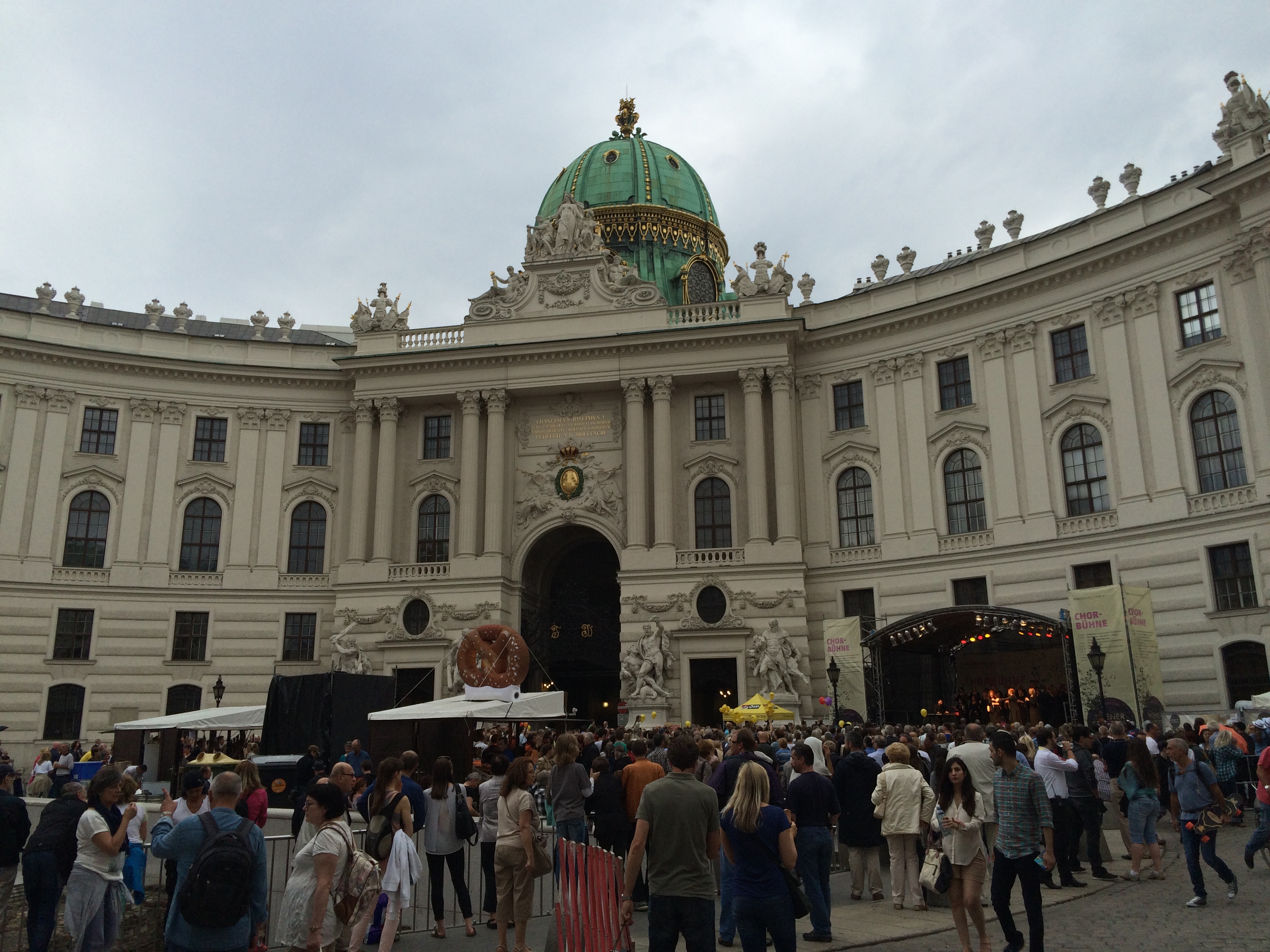
Just two blocks down the street was the Hofburg Palace where the Habsurgs lived in Vienna.  An outdoor music festival was going on that day, and there were crowds gathered to listen to the music—young choral groups performing primarily American music.  A bit incongruous—standing in front of an Austrian royal palace, listening to a group singing, “When the Saints Go Marching In.”  Our global world at work.

Hofburg Palace

Hofburg Palace

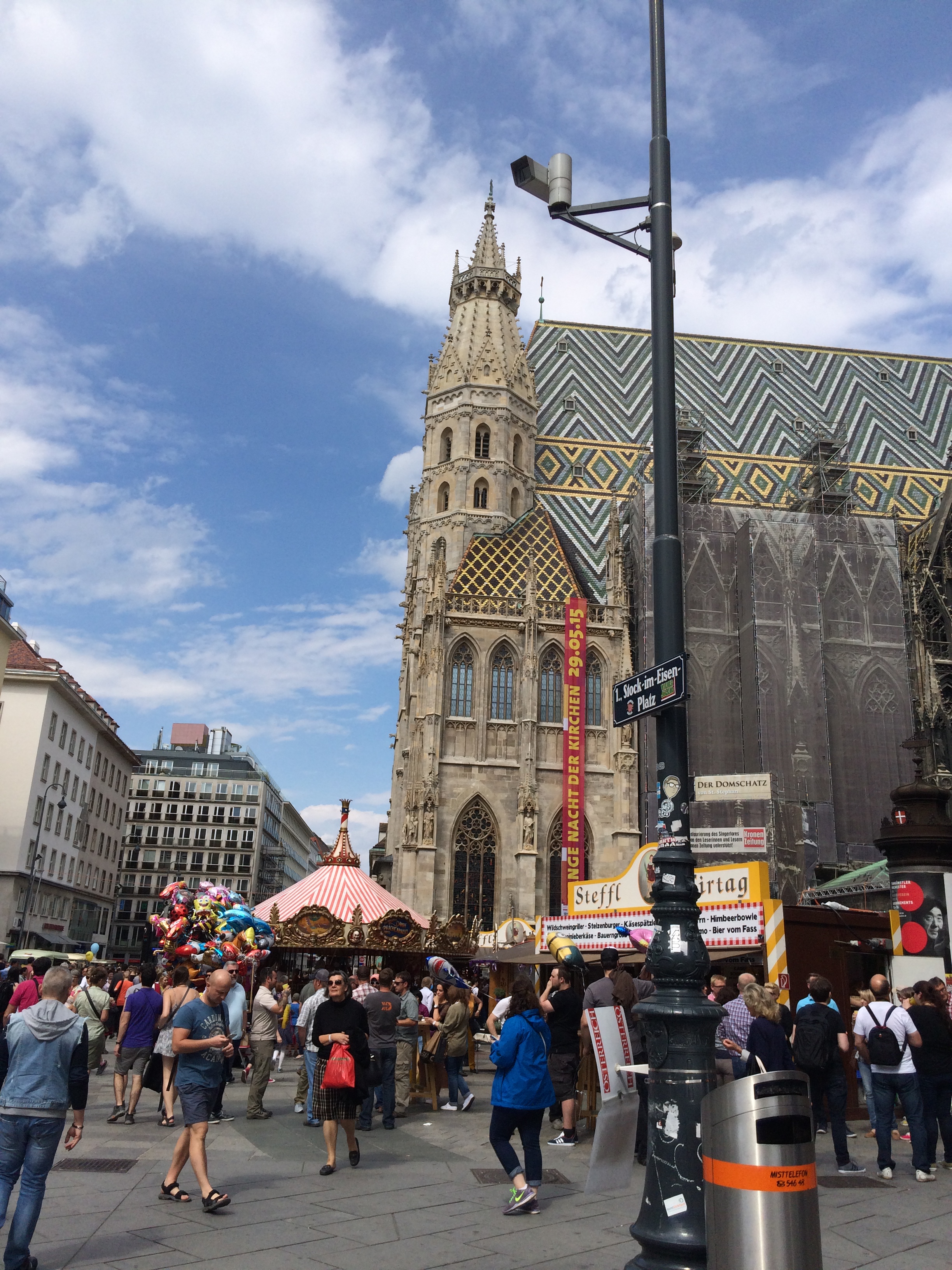
We wandered through the streets, passing many chic stores on Kohlmarket, and reached Graben, where there is a huge square lined with cafes and more fancy shops.  We stopped to see St. Stephen’s Cathedral and the all glass Haus Haus across the street.  Unlike the Hilton in Buda, this modern structure somehow blended in with the older buildings surrounding it.

IMG_2895 IMG_2896 IMG_2897 IMG_2898

We just had to stop and have some Viennese pastry, right?  It’s mandatory, I think. If one must drink beer in Prague, one must eat pastry in Vienna.  It was very much worth the unnecessary calories.  Vienna’s streets were packed with tourists, and there was lots of good people-watching to do from the café.

But we had miles to go in order to see at least some of the city, so off we marched towards the Opera House.  Like the Opera House in Budapest, it was a stately and beautiful building.  We opted not to do the tour inside this time, preferring to use our time to visit one of the art museums.

IMG_2907

It was already late in the afternoon, and we realized that we only had an hour until closing time, so we opted for the smaller Leopold Museum rather than the tremendous Kunsthistorische museum.  We were very glad that we did.  The museum focuses on the works of Gustav Klimt and Oskar Kokoschka as well as that of some of their less well-known contemporaries, and it does a masterful job of teaching about their art, their lives, and the politics and psychology that lie behind their art.  The room dedicated to the influence of Sigmund Freud was particularly well-done; a plaque with a quote from Freud hung near each painting, leaving it to the viewer to see the connection between the words and the art.

IMG_2909

We stayed until the museum closed and then wandered back to our hotel, not even realizing how close it was.  (We had basically walked a full circle from one side of the center of the city to the other and back without realizing it and were essentially behind the Hofburg Palace when we exited the museum quarter.)  We were amazed by how much we had seen in the few short hours since we’d arrived in Vienna.

The next day was jam-packed on my itinerary, but I quickly realized that there was no way we would get to the Schonbrunn Palace, even though I had pre-purchased tickets to go there.  It’s about 20 minutes outside of the city center, and since we were seeing the Hofburg Palace that morning, we decided that if you’ve seen one palace, you’ve seen them all. (Where is Spiro Agnew when you need him?)  Eliminating the Schonbrunn from the agenda loosened up our day considerably.

The Hofburg Palace was worth seeing; it tells the story of Emperor Franz Joseph and his wife Empress Elizabeth, commonly known as Sisi.  In particular, it tells the story of Sisi, who grew up as a young and independent child and married the emperor somewhat reluctantly, knowing that she would lose her freedom by doing so.  Eventually she became very unhappy living such a restricted life, and after one of her children died, she became severely depressed.  Although she contemplated suicide, in the end she was assassinated in Geneva by an Italian anarchist.  Her life story is well-told in the first several rooms in the palace.  After that, you then can see many of the lavish rooms where the emperor and empress lived and entertained in the palace.

After the palace tour, we went to see the performance of the Lipizzaner stallions at the Spanish Riding School.  This was another event that, like the baths in Budapest, several people said we could not miss.  We had standing room tickets, and the place was packed.  Within five minutes of the show starting, I almost left.  The first “act” involved some newer horses, and it was clear that at least one of them was not at all happy performing.  I couldn’t watch as the horse bucked and resisted his trainer’s attempts to control him.  We did stay for the next hour, and although the rest of the show involved more experienced horses, I just couldn’t shake the idea that these animals were being forced to do something they were not intended to do.  The horses are gorgeous, and if you love horses, you will either love this event or you will hate it.  I still am not sure how I feel about it. (We were not allowed to take photos, so I’ve inserted one from the internet.)


Embed from Getty Images

After lunch, I went to see the jewels at the Imperial Treasury while Harvey went to finalize our boarding passes for our flight the next morning.  The jewels were amazing.  I will let the pictures reveal what I saw.

IMG_2917

This opal was the size of a large pear. My Aunt Elaine would have loved it.

IMG_2920 IMG_2922 IMG_2927

The last thing we wanted to do before leaving Vienna was see some evidence of the Jewish world that once existed there.  Vienna had a large and thriving Jewish population before the Holocaust, including many famous artists, writers, musicians, and, of course, Freud.  Yet unlike Prague or Krakow or Budapest, there is almost nothing left in what was once the oldest Jewish section of the city to let you know that there once was a vibrant Jewish community there.  In that place, called Judenplatz, there are two reminders of the Jewish community: a museum which contains the remains of a medieval synagogue and a Holocaust memorial sculpture.  The museum’s exhibit is fascinating.  You can actually walk through the remains and see where the bima was, where the ark was, where the men sat to pray.

As for the Holocaust sculpture, it stands in the center of the square, and it is a large cube placed in the center of a larger platform.  On the sides of the cube are engraved the names of all the concentration and death camps.  I think it is supposed to evoke the sense of being locked inside, given the locked door on the exterior.  What was very disturbing about the memorial was the fact that there were many people sitting on the platform, idly eating ice cream and chatting, seemingly oblivious to the purpose of the sculpture.


The memorial to the 65,000 murdered Austrian J...

The memorial to the 65,000 murdered Austrian Jews in the Holocaust at Judenplatz in Vienna. (Photo credit: Wikipedia)

That perhaps is itself a metaphor for the Austrian attitude towards the Holocaust for many years after the war: denial.  As we learned at the main building of Jewish museum, it was not until fifty years after the war that Austrian officials apologized for their country’s role in the Holocaust.  They refused to acknowledge their complicity with the Nazis in the persecution and eventual murders of their Jewish citizens.  What had been a large and wealthy and intellectual community had been almost entirely wiped out.  Today there is some revival of Jewish life in Vienna, mostly made up of immigrants from the former Soviet Union.

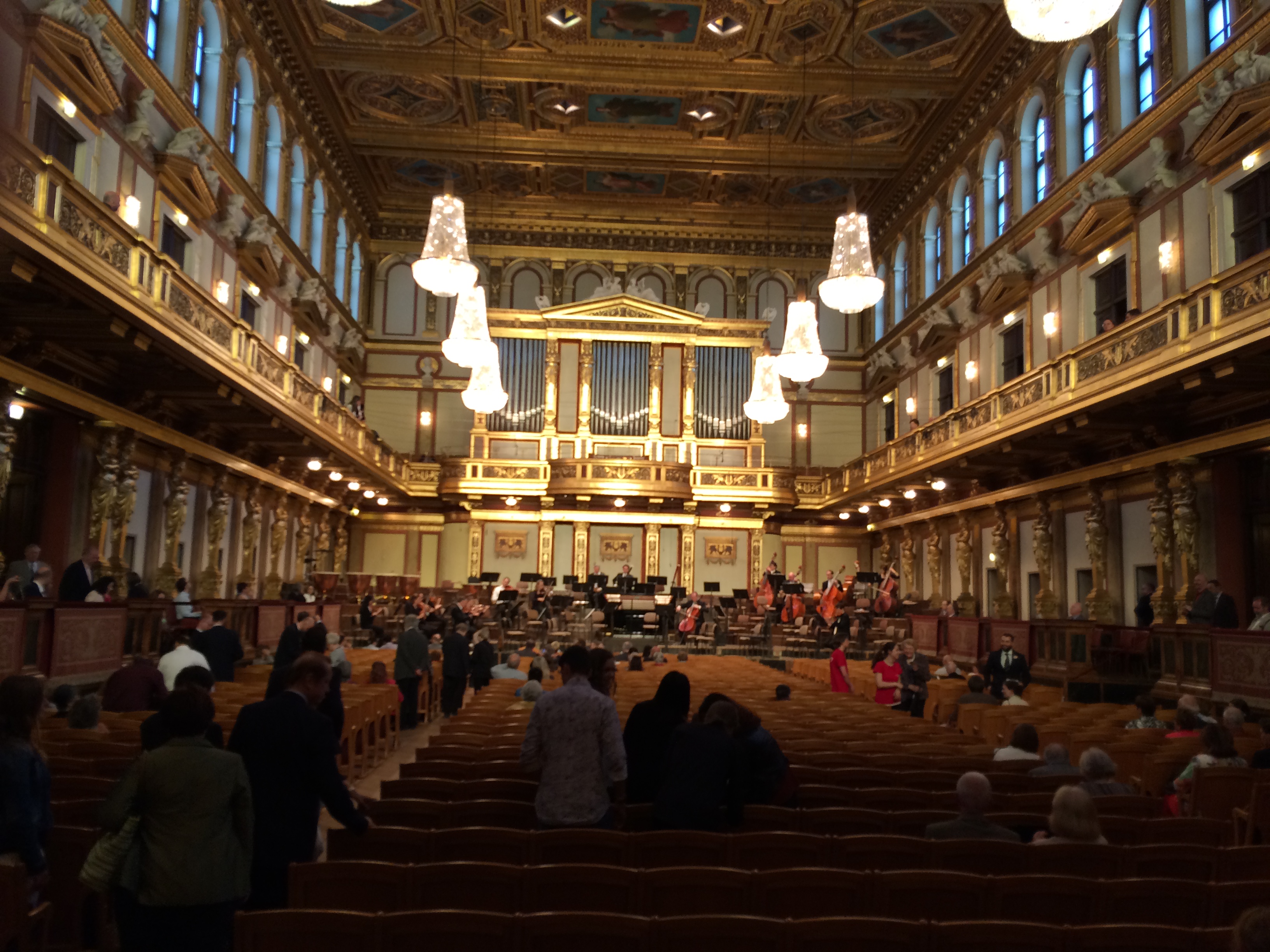
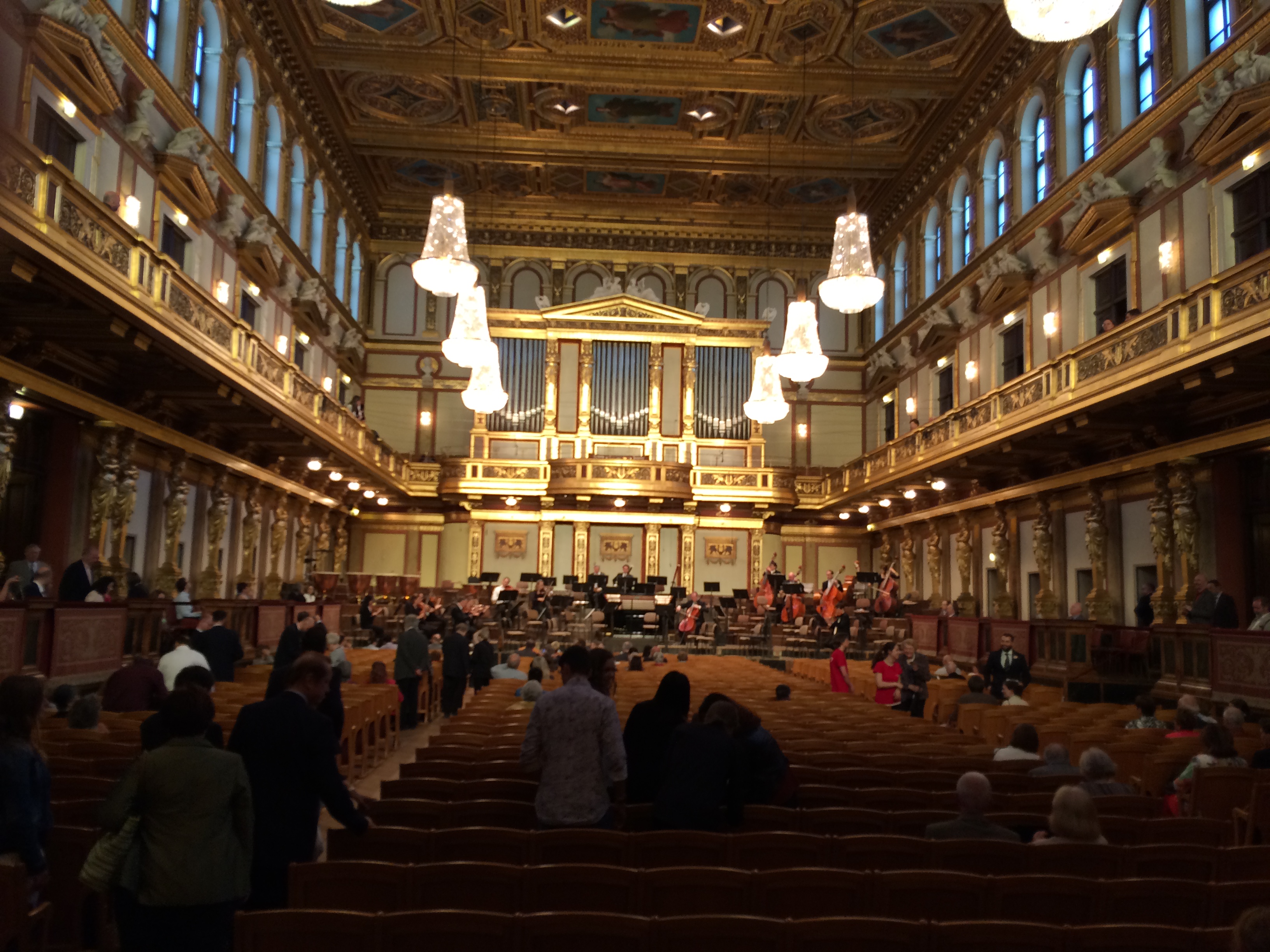
We ended our trip going to the Musikverein, a great music hall in Vienna, where we heard Haydn, Poulenc, and Sibelius.  The sounds were as clear as could be, and the music was just wonderful.

IMG_2935

Musikverein Concert Hall

Although we saw so much of great beauty in Vienna—the buildings, the pastries, the jewels, the art, and the music, our visit to Judenplatz and to the Jewish museums put an overall damper on my feelings for Vienna.  Perhaps I am not being fair; we were there for such a short time, and perhaps a longer visit would have provided me with more perspective.  We had no guides in Vienna, just our handy Rick Steve’s guidebook and TripAdviser. I understand that there are a number of stolpersteins in the Second District where the Jewish community was located right before World War II.  We did not get there nor did we see where the current synagogues are located or talk to anyone familiar with the city and its history as we had in the other cities.  I am sure there is more than what we saw in such a short time—an important lesson to keep in mind in visiting any place.  You can’t see it all in a short visit as a tourist.

****

Thus ends my travelogue of our trip to Central Europe.  Some concluding thoughts:

  1. The best way to learn about the history, values, and people of another country is to go there and walk where they walk. If you do, be sure to find a way to talk to someone who lives in that place.  Guidebooks are great, group tours may be fine—but nothing beats developing a personal relationship with someone who knows that city like you know your home town and your history. Talk to them about their families, their personal history, and you will learn so much more than you ever could from a book or recorded tour.
  2. Take notes, take pictures. Memories vanish very quickly.  In writing this, I had to go back to my books, notes, photographs, and, yes, the internet, to be sure I had the right name for the right place and the right numbers and dates.
  3. Travel the way you want to travel.  I know many people prefer to travel on organized tours or at least with a group of friends.  Call us anti-social, but we have learned that traveling with others means compromising our own priorities.  We don’t get to travel as often as we’d like, and when we do, we want to go where we want to go, eat when and where we want to eat, and see and hear what we want to see and hear.  It’s really not that hard to research and plan your own trip.  Just my opinion, of course.  I fully understand that for other people, traveling with others is more comfortable and more fun.  Like I said, travel the way you want to travel.
  4. There is both incredible beauty in the world and incredible evil. Human beings have created incredibly awe-inspiring buildings, music, and art.  Each place we visited was a testament to man’s ability to create beauty.  Sadly, each place was also a testament to man’s ability to do incredible evil.  We tried always to let the beauty remind us that for the most part, human beings are good.
  5. If you know where your ancestors lived, go there, even if it’s a small town in the middle of nowhere where no traces are left of your ancestors or their community. I understand that some people have too many feelings of anger about the past to do this, but if you don’t feel that way and can go, go there.  You will be forever changed.

Thank you to all who have followed me through this telling of our trip.  I will now return to a focus on genealogy, but I felt a real need to write about this trip for so many reasons, not the least of which is to keep a record for me about what I saw and what I felt.  It is not an experience I ever want to forget.


Three Days in Budapest

Although leaving Poland was hard, arriving in Budapest was delightful.  We weren’t even ripped off by the cabbie this time.  We arrived at our hotel at 9 am after another overnight train, and when we walked into our hotel, the Boscolo, we were a bit in awe.  We’ve never been in a hotel as beautiful as the Boscolo.  The atrium in the lobby is glamorous and gorgeous.  It may be a bit ornate for our usual taste, but there was no denying the way that large, well-lit, and finely decorated space made us feel.  After a breakfast in their famous New York café, we were able to get an early check-in to our room, which also stopped us in our tracks—-a very large and well-appointed room with a little balcony.  It felt like we were in some fantasy world.

The Boscolo

The Boscolo

Breakfast at the New York Cafe in the Boscolo

Breakfast at the New York Cafe in the Boscolo

IMG_2729 atrium IMG_2731 skylight

Although it would have been tempting just to enjoy our surroundings, we had things to see and do.  Although the concierge at the hotel warned us that our destinations would require a long walk, we were not intimidated.  And as it turned out, although we walked quite a bit, we did not regret it.  We love walking in cities (and beaches and just about anywhere); only by walking do you get a feel for the scale of a city and its buildings and only by walking do you make eye to eye contact with the people around you.  So we ventured out for our first day in Budapest.

First, we went to the House of Terror, a museum that primarily tells the story of what life was like in Budapest under Soviet domination.  The museum is in the building which the Soviets used as their headquarters and where they also imprisoned, interrogated, and tortured prisoners.   The cells and the instruments of torture are still there.  It is a powerful museum; the use of symbols is particularly effective.  We were very moved by our experience there.

Our next stop was the Budapest Opera House, where we had tickets for a tour and a mini-concert.  The opera house was impressive and uplifting, especially after the darkness of the House of Terror.  The gold and red colors which ran throughout the building gave it a truly regal feeling.  And the mini-concert was fun—one opera singer came out and performed two arias for us.  (Don’t ask me what they were—-I am not really an opera fan.)

Hungarian State Opera House

Hungarian State Opera House

IMG_2741 Budapest Opera IMG_2748 opera house boxes IMG_2749 mini opera

We headed to our final stop for the afternoon, the Parliament, where we also had tickets for a tour.  The Parliament is huge—I don’t think I’ve ever seen such a large building.  It sits right on the Danube River, extending fairly far along its shore, and there is a huge open plaza surrounding the building.  We strolled around, looking at the not-at-all blue Danube and across the river to Buda and then entered the building in time for our tour.

Hungarian Parliament

Hungarian Parliament

IMG_2754 Danube

Danube River

The security to enter the building was more intense than what we had gone through at any airport, which was a bit unnerving.  But once we were in, the guide led our group through the building, which was originally intended to be finished for the 1896 Millennial Celebration, but was not finished in time.  Hungarians believe that the Magyars arrived from Asia to the Carpathian plains where Hungary is located around 895, but because plans for the millennial could not be completed in time for 1895, they postponed it a year and claim now that the country was founded in 896.  Like so many countries in Central Europe, Hungary was subjected to many invasions and wars over the year, eventually becoming part of the Austria-Hungary Empire as the result of a compromise with the Habsburgs in 1867.  The Parliament building was originally meant to be the Habsburg’s palace, but after World War I and the end of the Austria-Hungary Empire, it became the home of the Hungarian Parliament.

Like the Opera House and the hotel and many of the other buildings we would see in Budapest, it is an ornate and beautiful building, conveying a sense of prosperity and power.  The crown jewels sit in a case under a large dome (we were not allowed to photograph them), evidence of the royalty who once ruled the land.  We also saw the chambers of the Parliament, equipped with modern digital voting machines at each desk—a strange mix of the old and the new.  It was a very interesting tour and gave us a quick overview of Hungarian history.

IMG_2758 parliament budapest IMG_2760 Parliament staircase IMG_2764 chamber

By that time we were a bit tired and hungry and ready to find a place to eat.  We strolled along the river watching the Viking Cruise and other companies’ “river boats,” then turned to walk through the center of the city, where we happened upon a restaurant called Rezkaka.  The menu looked creative, and the atmosphere seemed relaxing, so we took a chance.  It was our best meal of the trip.  The violin and piano playing in the background didn’t hurt either.

As we left the restaurant, the night sky was getting dark (it was about 9 pm), the ferris wheel in the city center was lit up as were many of the buildings.  It was magical.  We decided to keep on walking (despite what the concierge had said), and we passed the Dohany Synagogue, all lit up.  We were using the GPS on my iPhone to guide us back to the hotel, and it led us through the Jewish quarter, which has become a hip place, filled with “ruin bars” patronized by 20-somethings.  It was an entertaining walk back, and by the time we reached the hotel, we were quite proud of ourselves for the distance we had walked and quite enamored with Budapest.

St Stephen's Basilica, Budapest

St Stephen’s Basilica, Budapest

IMG_2777

Dohany Synagogue

IMG_2774

Our next day started with a tram ride (we decided to give our feet a little break) to the Central Market in Budapest—an amazing place filled with fresh fruit, vegetables, meat of all kinds, paprika, and flowers.  And it’s a real market—not a tourist joint.  We could see regular people with shopping bags and carts, buying their groceries.

IMG_2786 IMG_2787 IMG_2788 IMG_2789 IMG_2790

From there we walked somewhat aimlessly through several streets and squares, passing the university buildings, a street of touristy shops, a street of high fashion designer shops, and the second McDonalds to open behind the Iron Curtain.

McDonalds in Budapest

We were aiming for the Holocaust Memorial on the river.  During the Holocaust, Jews were rounded up and brought to the river, where three people would remove their shoes, be tied together, and one would be shot, forcing all three to fall into the river and die.  The memorial captures this atrocity very simply and poignantly with sculptures of many pairs of empty shoes, lining the wall that abuts the river.

Holocaust Memorial, Budapest

Holocaust Memorial, Budapest

IMG_2798


plaque

For the afternoon we had signed up for a tour of the Budapest Jewish Quarter with Budapest Jewish Heritage Tours.  It was supposed to be a group tour, but luckily for us, no one else had signed up at that time, so we ended up with a private tour.  We actually had three guides.  Ann, our first guide, gave us a general introduction; she then brought us to the Jewish Museum, which is right next to the Dohany synagogue.  At the museum we were guided by Esther, who works for the museum.  After we finished at the museum, Fatima met us to take us to see the synagogues in the quarter.  Each guide was knowledgeable and personable, and we learned a great deal about the history of Budapest’s Jewish community.

There were Jews in Budapest from as early as Roman times, though not a permanent settlement.  As in the other countries in Central Europe we visited, Jews came to Hungary as traders and bankers.  They faced a great deal of violence and anti-Semitism, and for a long time were required to live on the Buda side of the river while working on the Pest side.  Eventually they were allowed to live on the Pest side, but outside the city walls.  The area where they settled in the 18th century became the Jewish Quarter where even today there are numerous active synagogues, kosher restaurants, and other Jewish institutions.  The community flourished in the 19th century, and by the 1930s there were over 200,000 Jews in Budapest.

Perhaps the best indication of the size and prosperity of the Jewish community in Budapest is the Dohany Synagogue, the second largest synagogue in the world and a magnificent structure built in the middle of the 19th century.  It was built for a congregation that wanted to be more modern in its practice of Judaism. They called themselves Neologs (new law).  Although men and women were still separated for services, there was an organ (played by Franz Liszt at the inauguration of the building), and the interior was designed to be more church-like than like a traditional synagogue.  Like the Spanish Synagogue in Prague, the design reflects a Moorish influence both inside and out.

Dohany Synagogue

Dohany Synagogue

IMG_2801 IMG_2806 IMG_2809

Our guides pointed out, however, that Hungary had a long history of anti-Semitism, and in the 1920s a law was passed establishing quotas at the universities.  In the 1930s. Hungary adopted laws stripping Jews of their rights even before the Nazis began their occupation of the country.  Although Hungarian Jews were among the last to be deported to concentration camps, our guide in Poland, Tomasz, had explained that that was simply because the Hungarians wanted to exploit the Jews for free labor, not because they were trying to protect them.  In the end, most of Hungary’s 600,000 Jews were killed, 400,000 of them at Auschwitz on some of the last transports to arrive there.

The Dohany Synagogue survived the war because it was used by the Nazis both for storage and as a place for radio towers since it had the two high spires on its roof.  Behind the Dohany Synagogue is a memorial garden dedicated to those who were killed in the Holocaust.  I found the sculpture of the Tree of Life that resembles an upside down menorah particularly moving.

IMG_2813

We saw two other synagogues after leaving the Dohany.  First we visited the Orthodox synagogue, built in 1912, another very beautiful building, and then we saw the Rumbach Street synagogue.  From what Vatima told us, this last synagogue was formed by a group that spit off from the Neologs; they felt the Neologs had moved too far away from traditional Judaism, but they also did not agree with the strict practice of the Orthodox synagogue.  This building was under renovation and not open to visitors, so we only got to see its exterior, which was quite beautiful.

IMG_2817 IMG_2820 IMG_2821 IMG_2822

Rumbach Synagogue

Rumbach Synagogue

Overall, our experience in the Jewish Quarter in Budapest was much more uplifting than in either Prague or Krakow in large part because we learned that there is still a very substantial and active Jewish community in Budapest, consisting of about 80,000 people.  Although that is less than half of the Jewish population of Budapest in 1939, it is nevertheless a promising sign of rebirth and hope for the future.

Our day in Budapest ended with a quick dinner and an organ concert at St. Stephen’s Basilica, the largest church in Budapest—and yet again, a magnificent building.

St Stephen's Basilica

St Stephen’s Basilica

IMG_2832 IMG_2835

For our third and last day in Budapest, we had arranged for a driving tour to see those sites that really are too far for walking, even for us.  Our guide Magdi took us out to Heroes Square and through the City Park, two more spaces that were developed specifically for the Millennial Celebration in 1896. We saw Hungarian soldiers practicing for a parade while we were there.

IMG_2850

Legend says if you touch this guy’s pen, your writing will be successful. FIgured it was worth a try….

IMG_2839 IMG_2840 IMG_2847 IMG_2848


Then we crossed the Danube to Buda where the Castle is—where once again we learned that almost everything there was either built or redone for the Millennial Celebration.  What impressed us most were the incredible panoramic views we could see from the Fishermen’s Bastion and from the Castle itself.  Magdi did point out some older buildings in Buda that dated back to earlier times, but overall most of what we saw dated from 1896 or so.  The glaring (literally and figuratively) exception was the Hilton, a modern building of reflective glass that just does not fit into the setting.

IMG_2868 IMG_2866 IMG_2861 IMG_2852 IMG_2851

IMG_2869

Finally we went to Gellert Hill, where we were able to view Budapest from yet another perspective and see the fortress built there.

IMG_2875 IMG_2877 IMG_2878 IMG_2879

Our tour ended by dropping us off at the Gellert Spa and Baths.  Everyone had told us that we had to try the baths while in Budapest, and so we did.  It was an interesting experience—soaking in a hot pool with a bunch of elderly Hungarian women who did not really look so pleased to have us invading their space.  But we were glad we tried it, and that hot water was very relaxing.  After all the walking we had done in our three days in Budapest, our feet certainly deserved the break!

Looking back on our time in Budapest, I would say it was the city where we had the most light-hearted moments in our trip.  Maybe we just needed to focus more on the beauty, less on the tragic, after seeing Terezin, Krakow, and Auschwitz.  Maybe it was the Hungarian people or the energy of the city, where the streets were crowded with young people at night.  Maybe it was all the beautiful buildings and breath-taking views and sights we saw.  For whatever reason, we left Budapest the next morning feeling uplifted.

IMG_2889 IMG_2890 IMG_2891

Our trip was almost over.  We had a train ride to Vienna and a day and a half in that city before returning home.   And home was starting to sound like a good place to be.


Walking in the Shadows of My Brotman Great-Grandparents

My third day in Poland was undoubtedly the highlight of the trip for me.  Visiting the town where my great-grandparents lived was the initial motivation for going to Central Europe in the first place.  The stops in Prague, Budapest, and Vienna were the icing on the cake, but the cake was Poland and, more specifically, Tarnobrzeg.  (I finally learned how to pronounce it, thanks to our guide Tomasz: TarNOBjeg.)  I had high and emotional expectations; they were exceeded by the reality.

First, some background.  When I first started doing genealogy research, I had no idea where my maternal grandmother’s family had lived in Europe other than they were Galitzianers—from Galicia.  My mother had no idea what town in Galicia had been their home, and for a long time the only location given on the records I could find was Austria, which made sense since Galicia was part of the Austria-Hungary Empire when the Brotmans lived there.

Then a few pieces came together—first, I obtained my great-uncle Hyman Brotman’s naturalization application giving his home town as Jeekief, which is a decent phonetic spelling of Dzikow, once a separate village but later incorporated into Tarnobrzeg, a much larger town.  Then I found a ship manifest for Yossel Brod, most likely my great-grandfather, from Tarnobchiek, another phonetic spelling, this time of Tarnobrzeg.  The ship manifests for my great-uncles Abraham and David Brotman gave their home town at Grebow, a small village less than ten miles from Tarnobrzeg.  It seemed clear to me that Tarnobrzeg was the area where my Brotman ancestors had lived in Galicia.  And I had to go there.

SelectedU.S.NaturalizationRecords-OriginalDocuments1790-1974ForHermanBrotman

Hyman Brotman’s Naturalization Application (Click twice to zoom in.)


David and Abe Brodmann on the Portia 1889

David and Abe Brodmann on the Portia 1889


Joseph Brotman ship manifest

Joseph Brotman ship manifest

I had originally hoped that there might be some records left in Tarnobrzeg that had not yet been digitized and put on line by JewishGen, Gesher Galicia, or JRI Poland, but our guide Tomasz warned me that he believed that whatever records still existed had in fact been found already and that we would not find any more in the town.  I adjusted my expectations accordingly, and I decided to enjoy the trip for the experience of being there rather than as a research opportunity.

Tomasz picked us up at our hotel at 9 am that morning, and we got to meet my recently found cousin Phyllis for the first time.  Phyllis and I had connected through DNA testing, which showed us as third cousins and showed her aunt Frieda and my mother as second cousins.  By comparing our family trees we had reached the conclusion that the likely connection was through my great-grandmother Bessie Brot Brotman and her grandmother Sabina Brot, whose father we believe was my great-grandmother’s brother.  Sabina’s home town in Galicia was Radomysl nad Sanem, another town about ten miles from Tarnobrzeg, which we would also visit that day.  The common surname and the proximity of residences seemed to support our hypothesis.  We quickly connected in person, chatting excitedly about our research, our travels, and our hopes for that day.

IMG_2705 cousins

As we drove from Krakow to Tarnobrzeg, Tomasz spoke about the history of Jews in Poland. By the 19th century Jews made up 10% of the population of Poland, and they lived all over the country—in the cities and in small towns and in villages.  The land we drove through was mostly rural even today, and Tomasz said that Jews were often invited by the kings or the aristocracy to live in the towns to support the local economy; Jews had the education and the skills to provide bookkeeping, trade, banking, and other economic necessities to the farmers who lived in these regions.  In Tarnobrzeg it was the Tarnowski family that owned the land and invited the Jews to come live there.


Castle of the Tarnowski family in Tarnobrzeg

Castle of the Tarnowski family in Tarnobrzeg


IMG_2697

When I asked him about the level of religious observance of the Jewish residents who lived in places like Tarnobrzeg, Tomasz said that there was a diverse range of religious observance—-from Hasidim to more traditional Orthodox to more liberal Jews and to secular Jews. Other sources point out that Tarnobrzeg was an important Hasidic center with well-regarded Hasidic leaders and rabbis.

Tomasz also spoke about the fact that Tarnobrzeg was one of the leading Jewish population and industrial centers in Galicia outside of Krakow.  The main industry aside from agriculture was the production of sulfur, a product that it still important to the local economy of the region.  Tarnobrzeg is located where two rivers meet—the Vistula (which also runs through Krakow) and the San, and thus was an important trade location.  It also is very close to what was once the border with the Russian Empire, and when Russia obtained that land, families were often separated, some living in Austria-Hungary, some in the Russian Empire.  In the 19th century when my great-grandparents lived there, the population of Tarnobrzeg was more than 75% Jewish.  There were about 2800 Jews living there in the 1880s when my great-grandparents decided to leave.

I asked Tomasz why people like my great-grandparents would ever have left a place like Tarnobrzeg, where Jews were doing well and treated well and were more than a majority of the town’s residents.  He said that in the late 19th century, there was both an economic crisis in Poland and a significant increase in the population. (There was also a great deal of anti-Semitism in Poland, as other sources describe.)  Jews and non-Jews left for greater economic opportunities.  When I pondered how a family would be able to tear themselves away from their home, both emotionally and financially, Tomasz explained that there were emigration agents facilitating these departures.  They would circulate brochures touting the advantages of going to America, and the fact that many others were leaving made it easier for a family like mine to make a similar choice.  I asked how they would actually leave, and Tomasz said there was a train that came to Tarnobrzeg that would take them to one of the port cities, like Gdansk or Hamburg, where they would catch a ship for America.  It would be costly, but the potential benefits made it all seem worth the risk.

Finally we arrived in Tarnobrzeg itself.  It was not exactly what I expected, as it is a large town, not a little shtetl, and it is a thriving town—lots of people, lots of stores, lots of cars.  Not a quiet little romantic village out of Fiddler on the Roof at all.  There was even a Lego store right on the main square.


Lego store on main square in Tarnobrzeg

Lego store on main square in Tarnobrzeg

But once we got out of the car and started to walk around, I felt some almost eerie connection—that this was a place where my great-grandparents had walked, had shopped, had worked.  Many of the buildings that surround the square were there back in the 1870s and 1880s when my great-grandparents and their children lived there.  Maybe one of those buildings contained a shop where my great-grandfather worked (on that ship manifest his occupation was given as “kaufmann” or merchant).  Maybe my family lived in one of them.


Main square in Tarnobrzeg

Main square in Tarnobrzeg


IMG_2657 old buildings on square in Tarnobrzeg


I stood in that square, imagining it 150 years ago as a place filled with families like my own, Jewish families of all sorts, living in a safe and comfortable way in a safe and comfortable place. I could imagine my great-uncle Chaim who became Hyman and then Herman and my great-aunt Tema who became Tillie, just small children, holding their mother’s hands as they walked through that square.   I could block out the Lego store and the ugly modern supermarket and see just the old buildings as they might have looked in the 1880s.


IMG_2663 Tomasz our guide in Tarnobrzeg

Our guide Tomasz Cebulski leading the way in Tarnobrzeg


IMG_2658 square in Tarnobrzeg IMG_2662 street in Tarnobrzeg IMG_2664 my ancestral town

Tomasz took us to the building which was once the synagogue. According to the official Tarnobrzeg website, it was heavily damaged by the Nazis and used to store grain.  It was renovated in the 1970s into a public library, and there is almost no sign today that it was ever a synagogue building.  The windows were changed, and inside where there was once a prayer hall and aron kodesh are now stacks filled with books.  When we asked in the library whether they had any photographs or books or records about the synagogue or the former Jewish community, all they could find was one copy of a brochure that had only been created a few years ago.

IMG_2659 where the prayer hall stood, now a library

Space where the prayer hall once was in the Tarnobrzeg synagogue

IMG_2661 former synagogue building

Exterior of building where the synagogue entrance had been


Tarnobrzeg Synagogue

Tarnobrzeg Synagogue (Photo credit: Wikipedia)

Here are some photographs of the building when it was a synagogue:

The only visible sign that the building was built as a synagogue is a small plaque on the exterior of the building in a location that almost no one could ever see or read if they were not looking for it.  We had to walk around the building through the lawn to get this photograph. The only small comfort was that the building was being used for books and education, not for commerce or worse.

IMG_2660 marker on library marking it as location of synagogue

Memorial plaque on the former synagogue building


Tomasz also pointed out that the first Jewish cemetery was located just a block away, but was now a parking lot for the shopping area that now exists there.  According to this video prepared in 2008, the Nazis destroyed the synagogue and used the headstones to pave a road. (I suggest downloading the hi-def version and watching it; it will give you a better sense of the town and its history.)

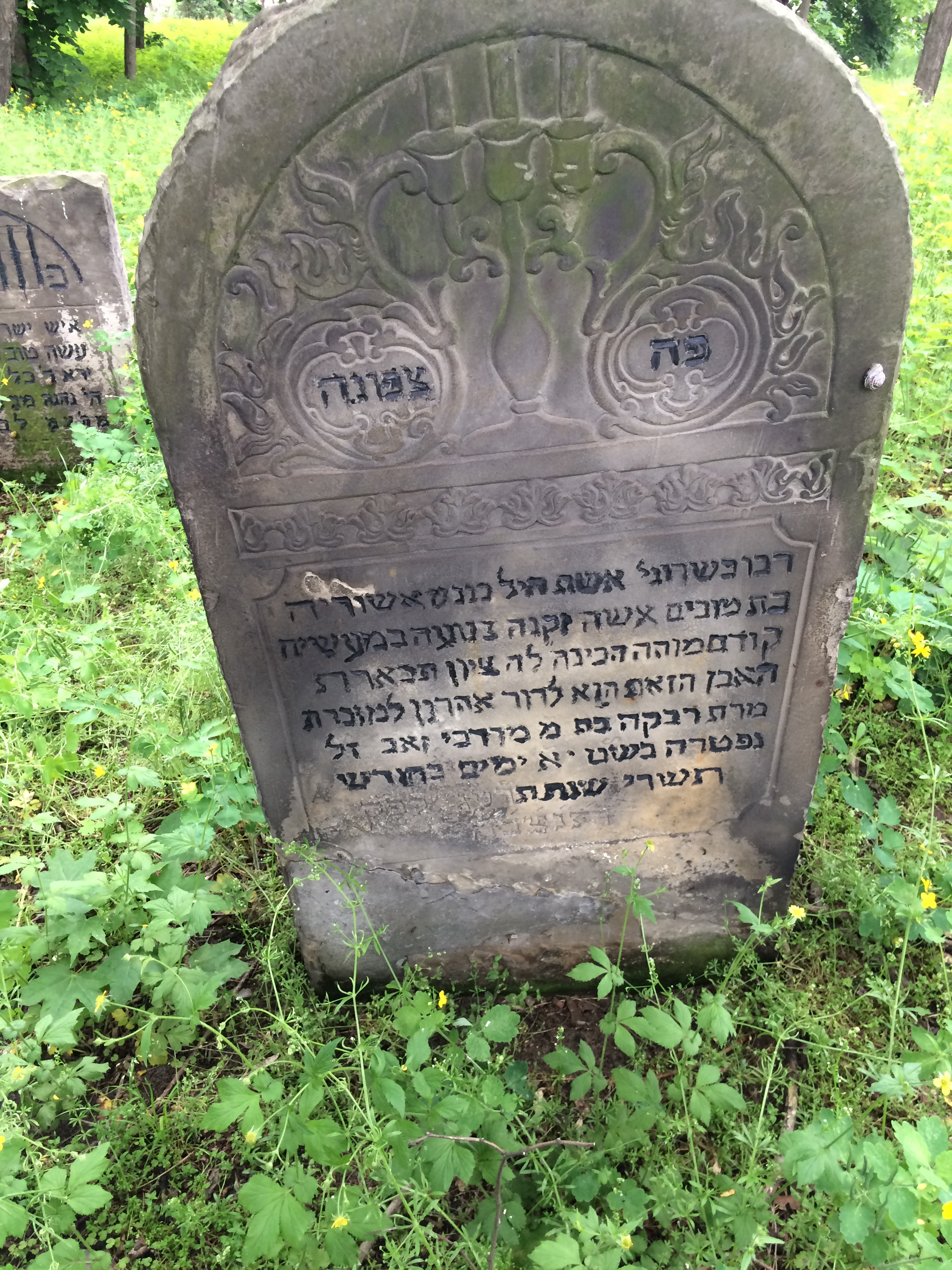
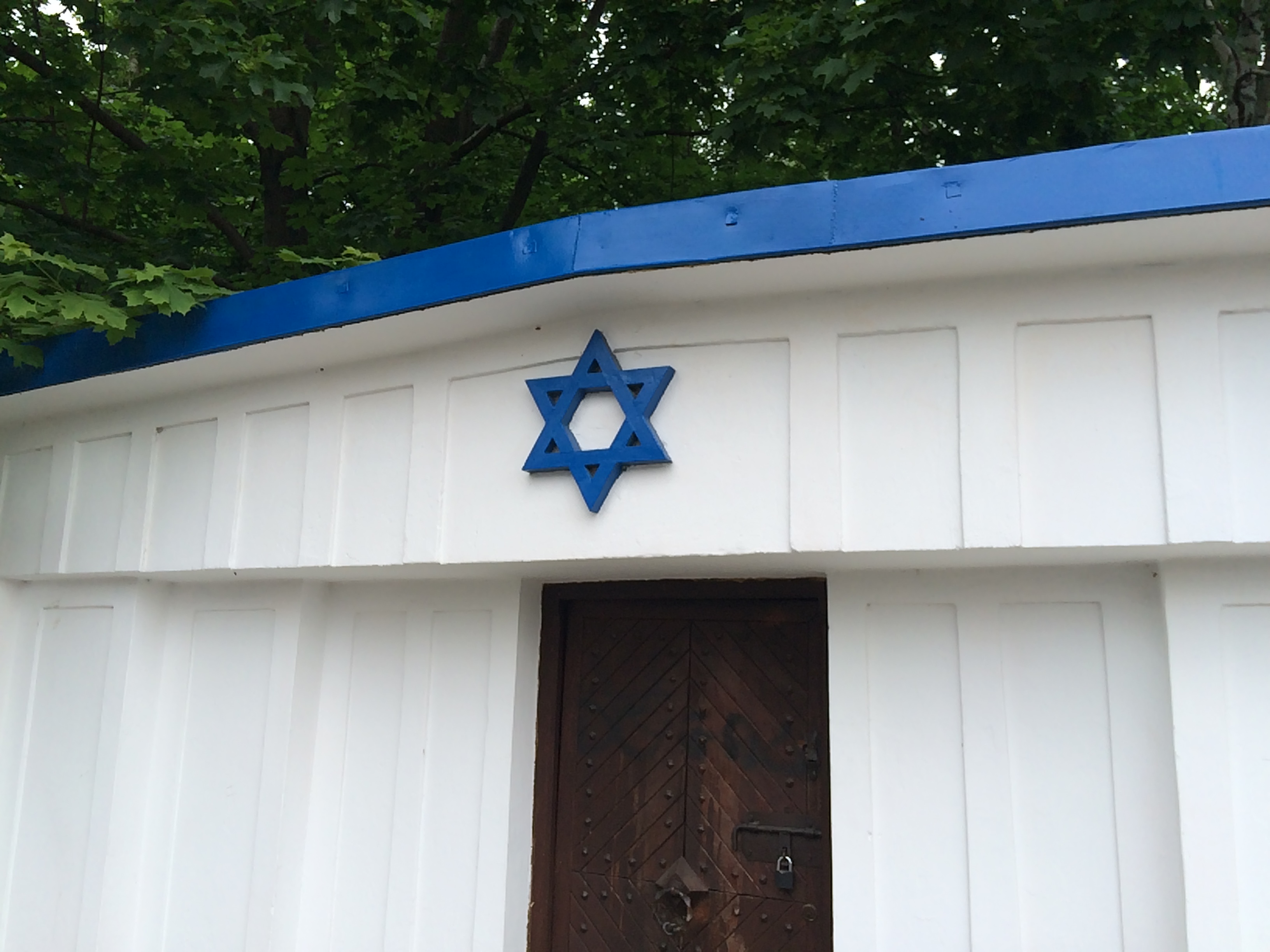
We then drove to the other Jewish cemetery in Tarnobrzeg, which was opened in the 20th century and  where there is still an ohel with a Star of David.  Sadly, the cemetery is not maintained at all, and there are just a handful of headstones still standing, most covered with weeds and snails.  I took photographs of as many as I could and now hope to get these translated.

IMG_2665 ohel for cemetery Tarnobrzeg IMG_2666 cemetery in Tarnobrzeg cemetery IMG_2668 IMG_2669 IMG_2670 IMG_2671 IMG_2672 IMG_2673 birdhouse in the cemetery IMG_2674 cemetery

After visiting the cemetery, we went to a small museum Tomasz knew about, where we met with an incredibly helpful woman who did not speak any English, but when Tomasz explained why I was there, she was very excited and anxious to help.  She provided us with some books with drawings and  photographs of Tarnobrzeg before World War II.

IMG_2677 images from books at the museum in Dzykow IMG_2678 IMG_2679 IMG_2685

The woman at the museum also explained where Dzikow had been located before it merged into Tarnobrzeg, so we drove there and saw some very old homes, built almost like log cabins.  I was enchanted and wondered whether one of these buildings had once been my great-grandparents’ home.

IMG_2690 IMG_2692 IMG_2693

As we left Tarnobrzeg, Tomasz told us what had happened to the Jews there during the Holocaust. Many were shot and killed just outside of town and buried there.  Many others were taken to the San River and shot, their bodies falling into the water.  The rest were eventually transported to a concentration camp or a death camp.  If any survived, they have not returned to Tarnobrzeg.  There are no known Jews living there today.  What would my great-grandparents, both of whom died before the Holocaust, have thought if they returned to their hometown today? It would no longer be the place they knew in almost any way, except for the old buildings that survive.

Nazis rounding up the Jews of Tarnobrzeg 1939

Nazis rounding up the Jews of Tarnobrzeg near the San River 1939


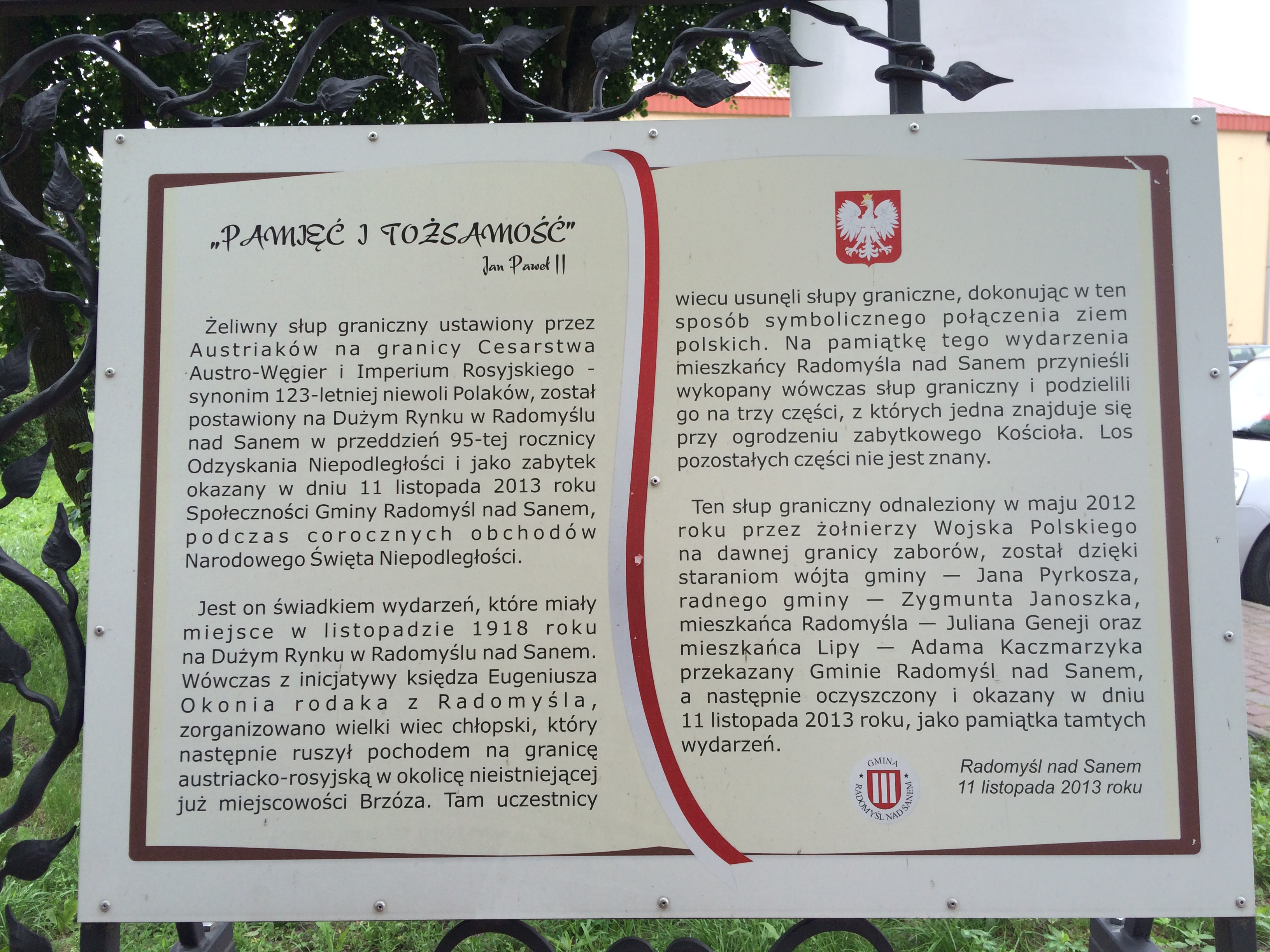
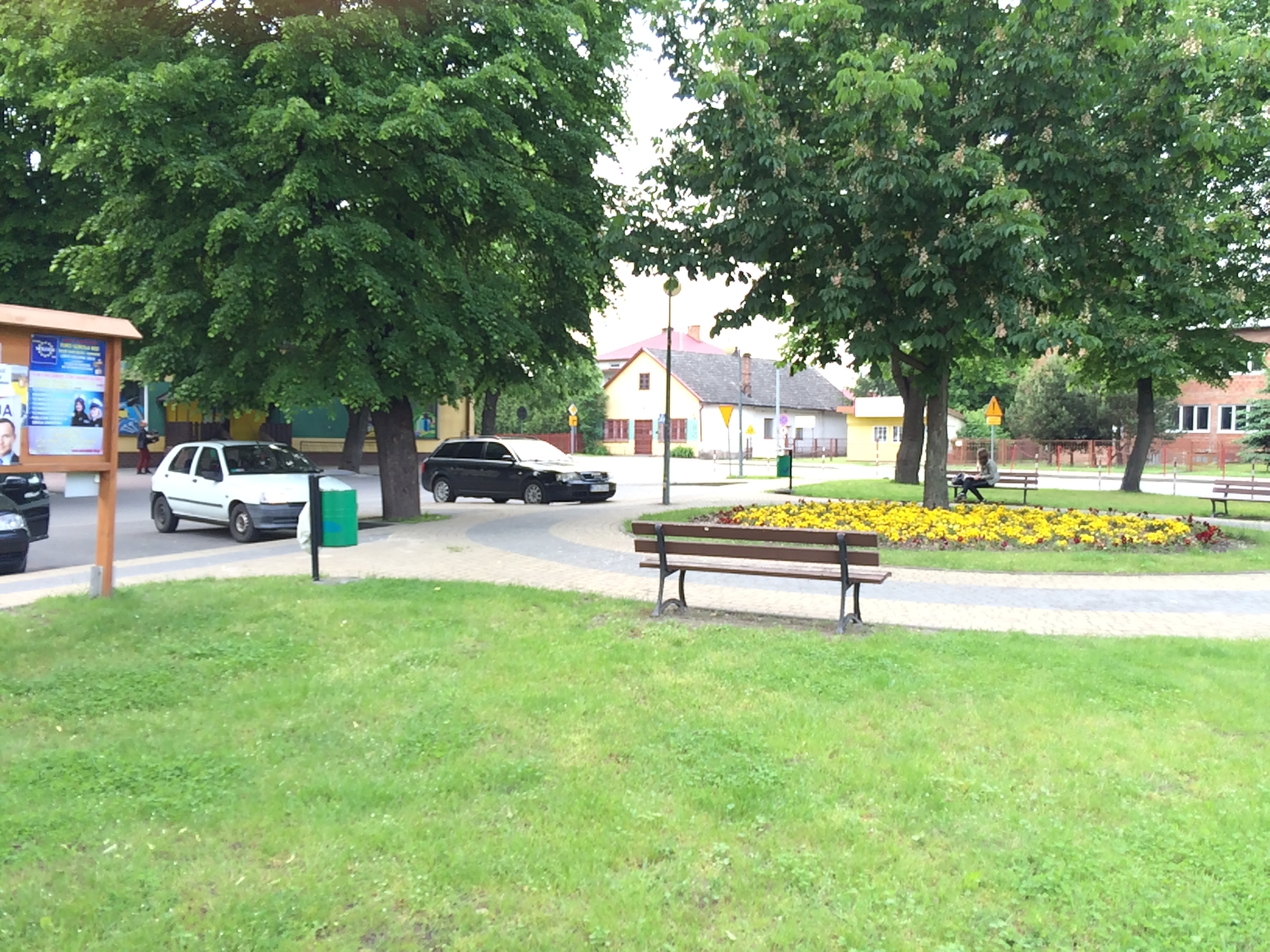
I could have stayed and wandered around Tarnobrzeg for hours, but we had two more stops to make: Radomysl nad Sanem and Grebow.  We headed first to Radomysl nad Sanem, where Phyllis’ grandmother had lived. It is on the other side of the San River and is a very small little town with a small town square and municipal building and perhaps fifty homes, if that many.  Its Jewish population before World War II was less than 400 people, and the village was mostly Jewish.  We drove from one end of the town to the other, and it took only a few minutes.  Even more so than in Tarnobrzeg, there is no sign that there were ever Jews there.  Phyllis was able to obtain some brochures about the town from the library there, but nothing that discussed the former Jewish community.

IMG_2698 Radomysl nad Sanem where Sabina Brot lived IMG_2699 IMG_2700 IMG_2701 IMG_2703


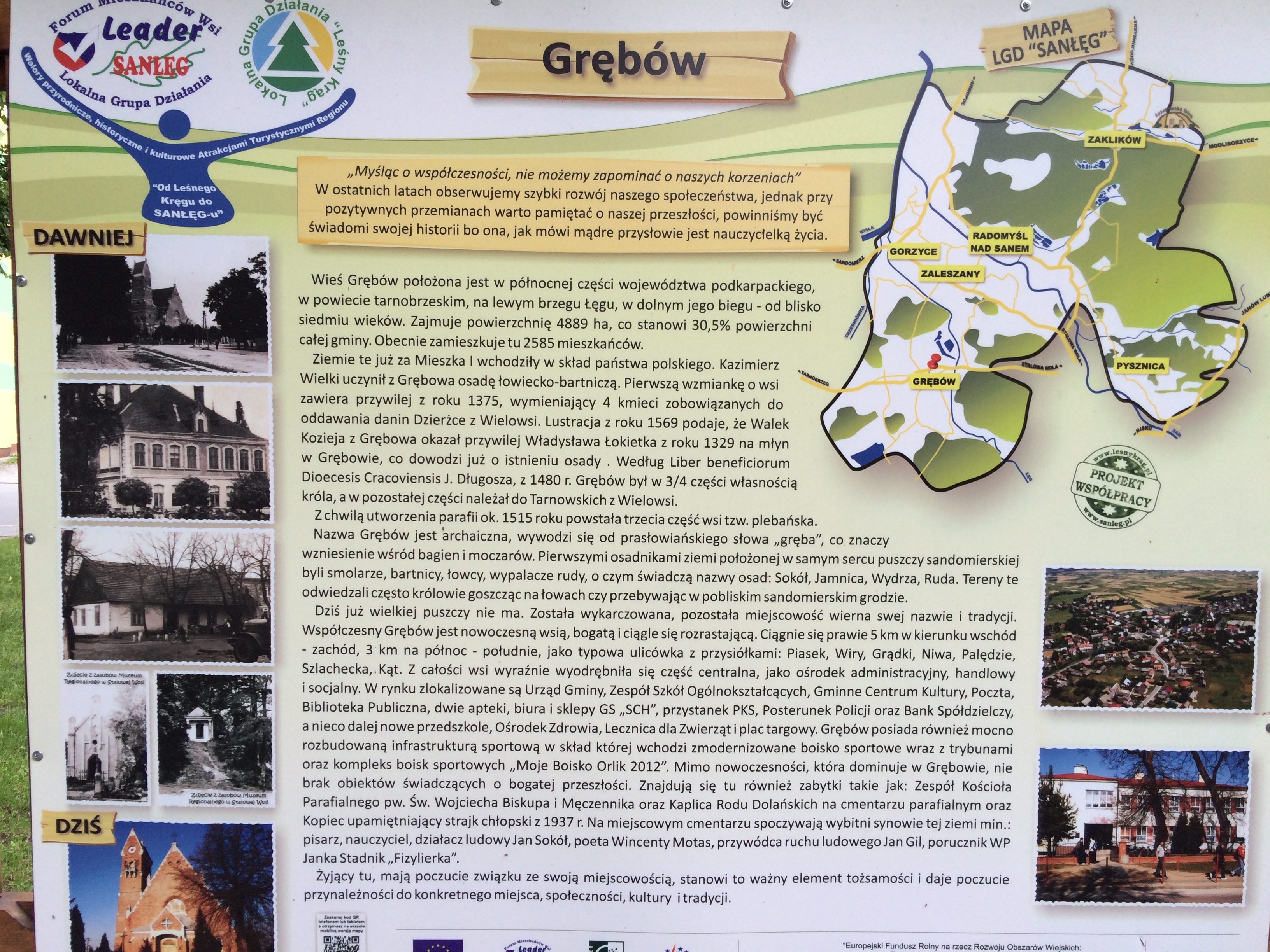
Our last stop was a quick one in Grebow, a town even smaller than Radomysl nad Sanem where there was not even a library we could visit.  I don’t know whether this was where Abraham and David Brotman were born or simply where they were living at the time they emigrated.  Perhaps they had moved here for greater opportunities than they could find in Tarnobrzeg.  I don’t know.  It’s such a tiny village that all I can do is imagine them living there and then wonder what they must have thought when they landed in a place as large and crowded and dirty as late 19th century New York City’s Lower East Side.

IMG_2706 tiny town of Grebow IMG_2707 Grebow IMG_2709 public building Grebow IMG_2710


We then headed back to Krakow.  I was exhausted and emotionally drained and filled with thoughts and feelings.  We were taking another night train that night, this time to Budapest.  As we ate a quick dinner at our hotel, I found myself overwhelmed with emotion in a way that surprised me.  My eyes filled with tears—tears for the people who had been killed, tears for my great-grandparents who had left this country for better things, tears of gratitude that they had done that, and tears of sadness that I was leaving a place that part of me truly felt was my homeland.


Auschwitz

I have really been struggling to figure out how to write about our second day in Poland, which started with a trip to the ghetto established by the Nazis in Podgorze, across the river from Krakow, and ended with a trip to Auschwitz.  We had an incredible guide, Tomasz Cebulski from Polin Travel.  He is a scholar in the field of the history of Polish Jewry and the Holocaust as well as an articulate, thoughtful, and sensitive person, and he wanted us to understand on a deeper level the methodology used by the Nazis during the Holocaust.  Without Tomasz and his way of preparing us for Auschwitz, I do not think we would have fully appreciated the horror of what we were seeing.

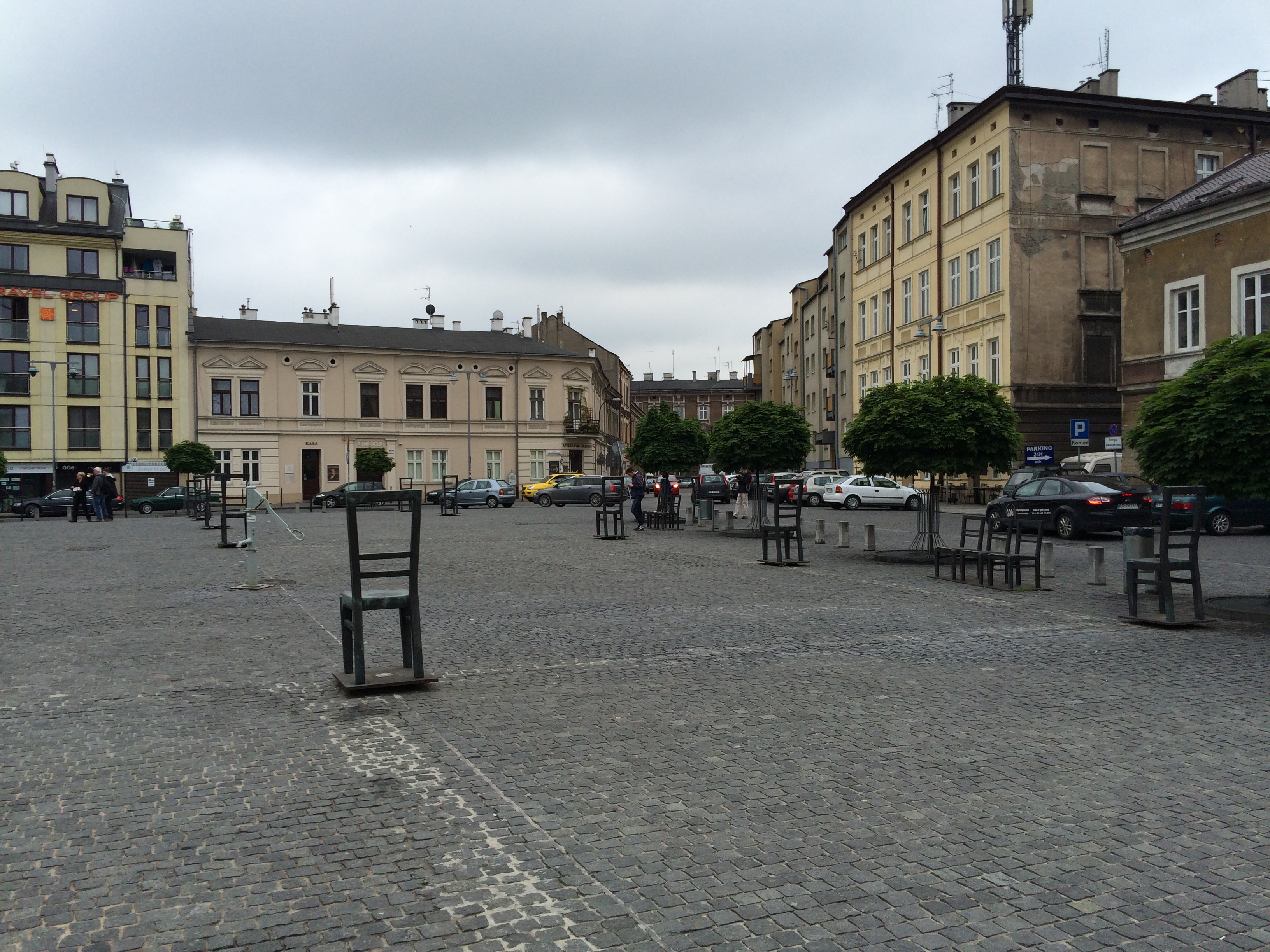
The ghetto in Podgorze.  The empty chairs evoke the chairs that were left behind by those who had been sitting while awaiting the transports that took them to the camps

The ghetto in Podgorze. The empty chairs evoke the chairs that were left behind by those who had been sitting while awaiting the transports that took them to the camps

Having said that, there is just no way that I can do the same for anyone reading this post.  Most of us have seen photographs; we’ve seen movies and read books about Auschwitz. Many of us have been to Yad Vashem and/or the Holocaust Museum in Washington. We think we understand what happened there.  But we don’t.  Even being there, I still don’t.  The more you learn about it, the less you understand.

What we learned from Tomasz was how ingenious the Nazis were in using psychology and technology and the instinct for greed to enlist not only Germans but citizens of other countries including France, Austria, Hungary, and Poland into their program for annihilating the Jewish population of the world.  And Jews weren’t helpless sheep being led to the slaughter; they also were the victims of the Nazi propaganda machine and its use of psychology to create the impression that somehow all would be fine in the end.   Corporations like IBM and many others saw the opportunities for making fortunes in developing the technology and equipment needed to facilitate the operation of the Nazi death machine.  Jews were also used as slave labor in the companies of many industrialists; Oskar Schindler was the exception, doing something to protect these people who were being forced to work in his factory across the river from Krakow and close to the concentration camp at Plaszow, which we also visited.


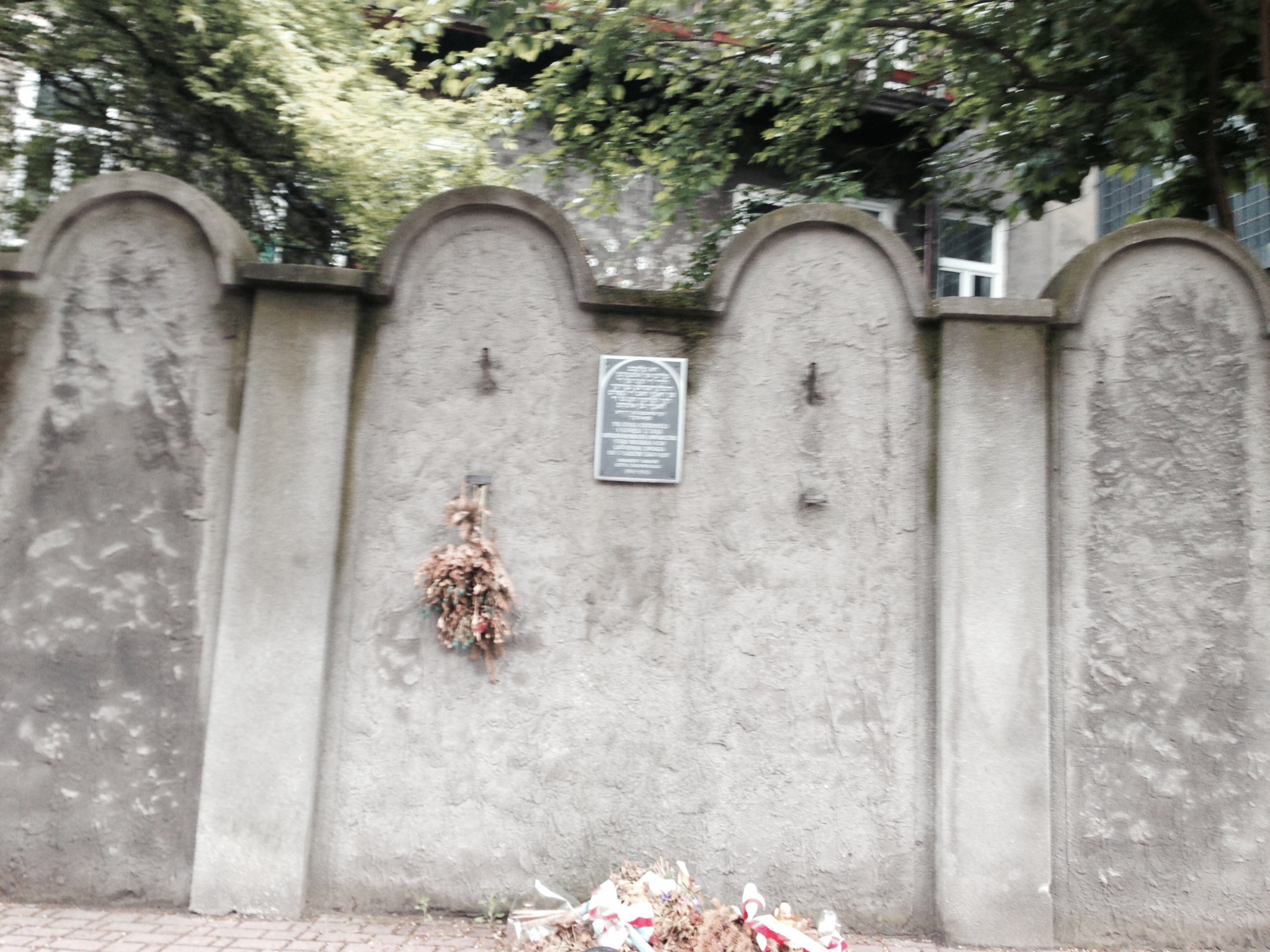
Ghetto Wall in Podgorze, built to look like headstones to demoralize the Jewish residents

Ghetto Wall in Podgorze, built to look like headstones to demoralize the Jewish residents

And the world sat back and let it happen, pretending that things could not be that bad, that focusing on the war effort itself was sufficient, and that there really could not be such things as death camps.  That a place like Auschwitz could not exist.  Are we any better today? Just as the Jews could not believe that they would be slaughtered like animals but that things would be okay in the end, so do we all.  We delude ourselves over and over again into believing that we can’t do anything to stop genocide, just as the world did during World War II.  We bend to the profit motive, and we buy into propaganda.  We forget, and we move on.

But Auschwitz is still there.  Although the other death camps were destroyed by the Nazis when they realized that they were losing the war (see Note below), Auschwitz survived more or less intact.  The Nazis did bomb the gas chambers and the crematoria, but there was enough evidence left to show the world what happened there.  And the fact that the Nazis made one serious error—placing the gas chambers and crematoria adjacent to barracks for concentration camp prisoners who could witness how they were being used—also ensured that history would not allow the Nazis to cover up their satanic ways completely.

Auschwitz memorial

Auschwitz is still there.  You can stand on the watchtower, and you can see the foundations of hundreds of barracks almost as far as the eye can see.  You can see the crematoria, the remains of the gas chambers, the barracks, the train tracks.  You can see the confiscated property of the people who were killed there—glasses, suitcases, clothing, ritual objects. Their hair and their prosthetic devices.  The glass case exhibiting baby clothes made me weep.  The clothes of children younger than my grandsons—evidence of the complete evil of these animals who watched babies get carried to their deaths with their mothers.  More than anything else, that devastated me.

How do you walk away from this and still have faith in humanity?  How can you have hope that good and beauty and love will prevail when there is so much capacity for evil? How can you ever trust anyone to be compassionate, fair, understanding?

You just have to.  Because it is just too painful to think that people can be so evil.  Because in fact most of us are good and loving and compassionate and fair.  Because we have no choice but to see the beauty and the love and the hope or we would all just give up and fall into the darkness.  We have to walk away, and we have to get up the next day and embrace life.  Otherwise, the Nazis and all the other evildoers in the world defeat us.  Yes, we need to stand up to evil.  Yes, we cannot close our eyes and hide.  But we also have to go on seeing the good in each other and loving each other as best we can.


*************************

Important Note: Although the other death camps were substantially destroyed by the Nazis to hide their genocidal activities, there is a movement to preserve the limited remains of the Belzec death camp in eastern Poland.  You can read about that project here.  It’s in German, but you can use Google Translate to read it in English.  There is some urgency as the property is to be sold at a public auction on June 22.  Please help preserve this place as another reminder us of our potential for evil and our need to fight against it.

UPDATE:  Due to public pressure, the auction has been cancelled, and the money already collected will be used for preservation.  The organization is no longer collecting donations.

Krakow

We arrived in Krakow after a pretty much sleepless night on the train, and the weather was nasty—very cool and raining hard.  Once again, we overpaid a cabdriver (though not by nearly as much) to get to our hotel at 7 am, where our room was, as expected, not ready.  (Check-in wasn’t until 3 pm.)  But the young man at the reception desk was so friendly and helpful that it immediately changed my outlook.  I highly recommend the Metropolitan Boutique Hotel in Krakow—a small and friendly hotel with an incredibly professional, efficient, and friendly staff.  Although the location on a small side street at first seemed odd, we soon realized how ideal that location was—about ten minutes from the main square in Krakow and even closer to the Jewish Quarter in Kazimierz.

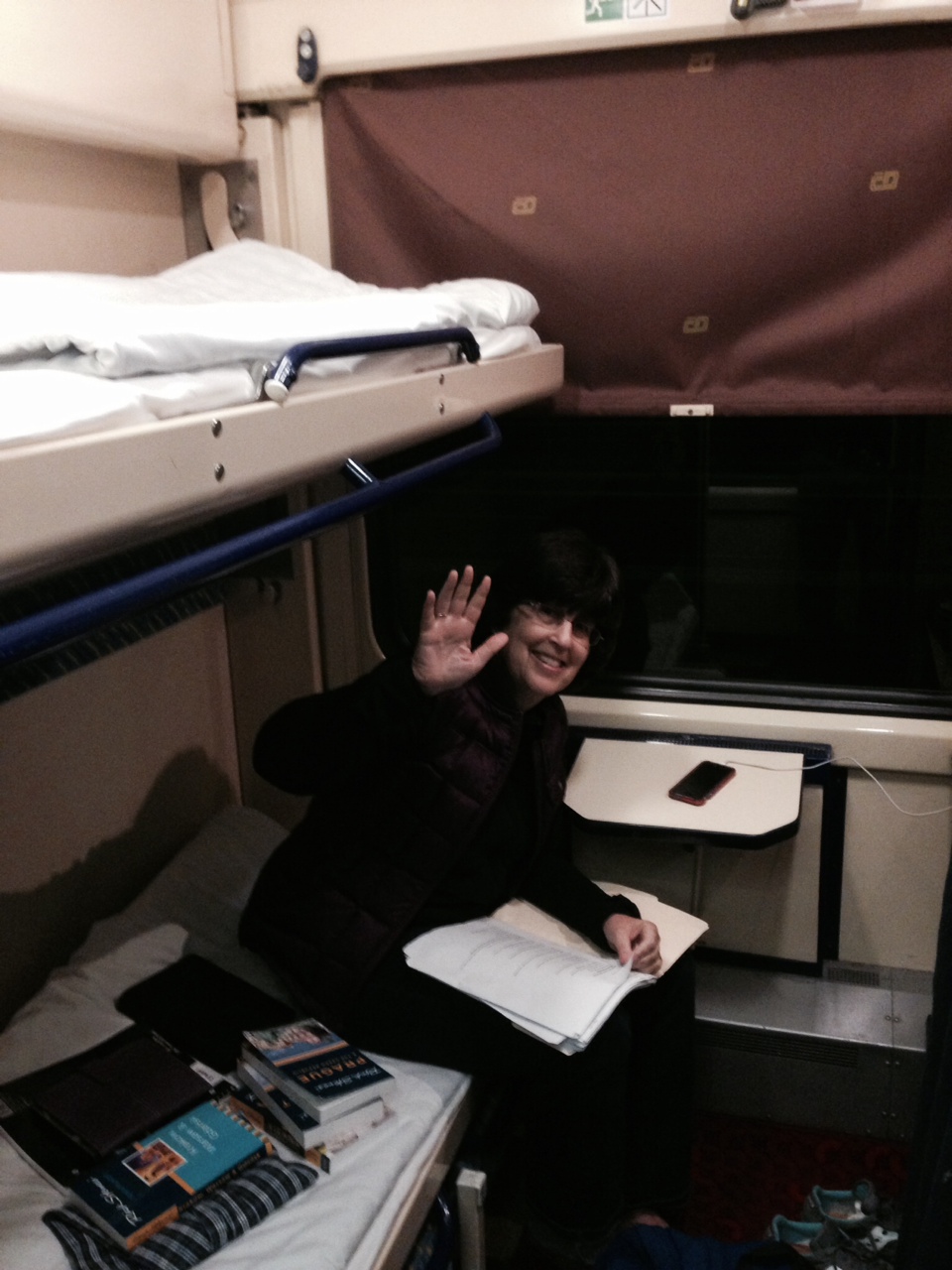
Our sleeping accommodations from Prague to Krakow

Our sleeping accommodations from Prague to Krakow

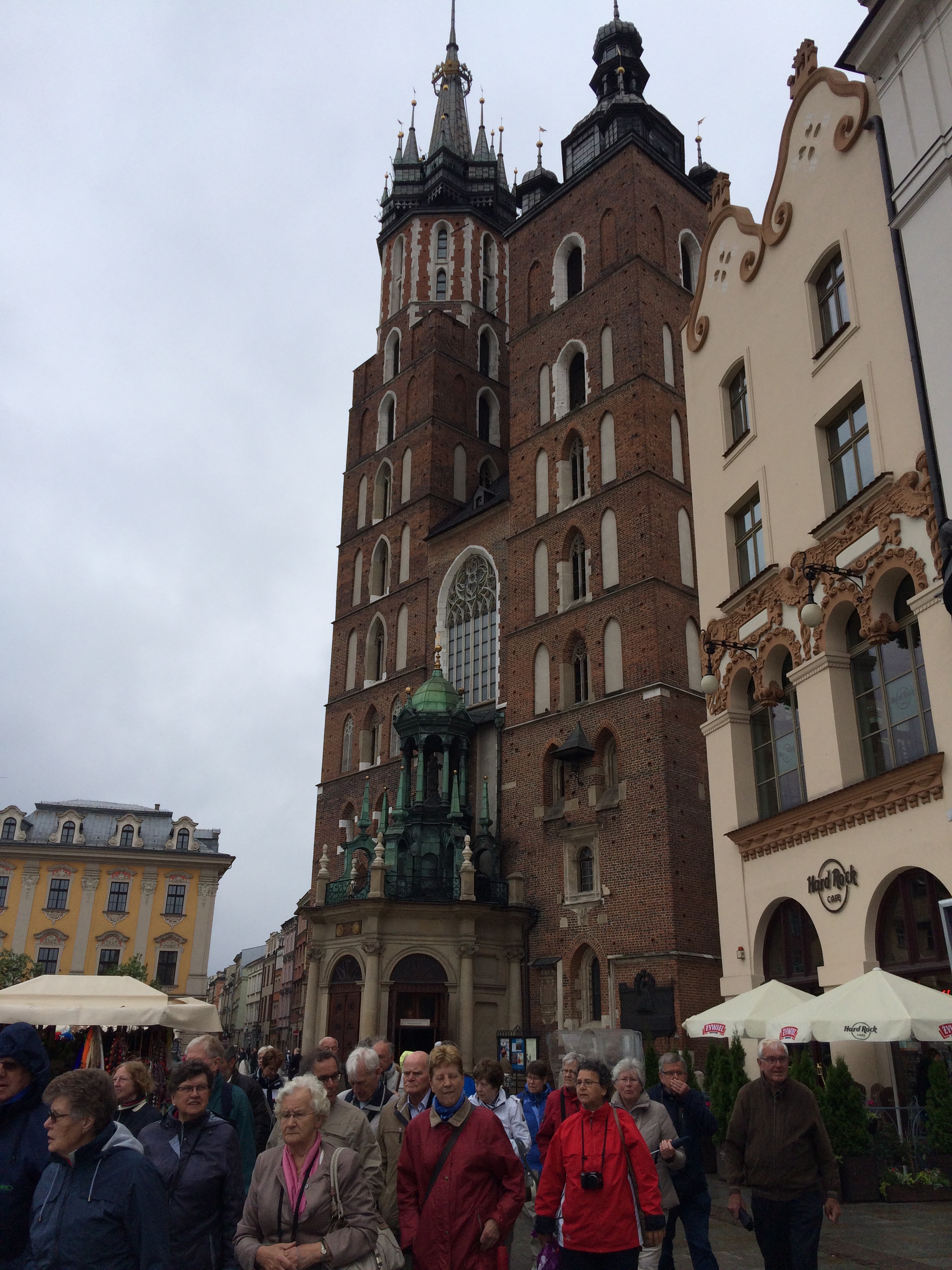
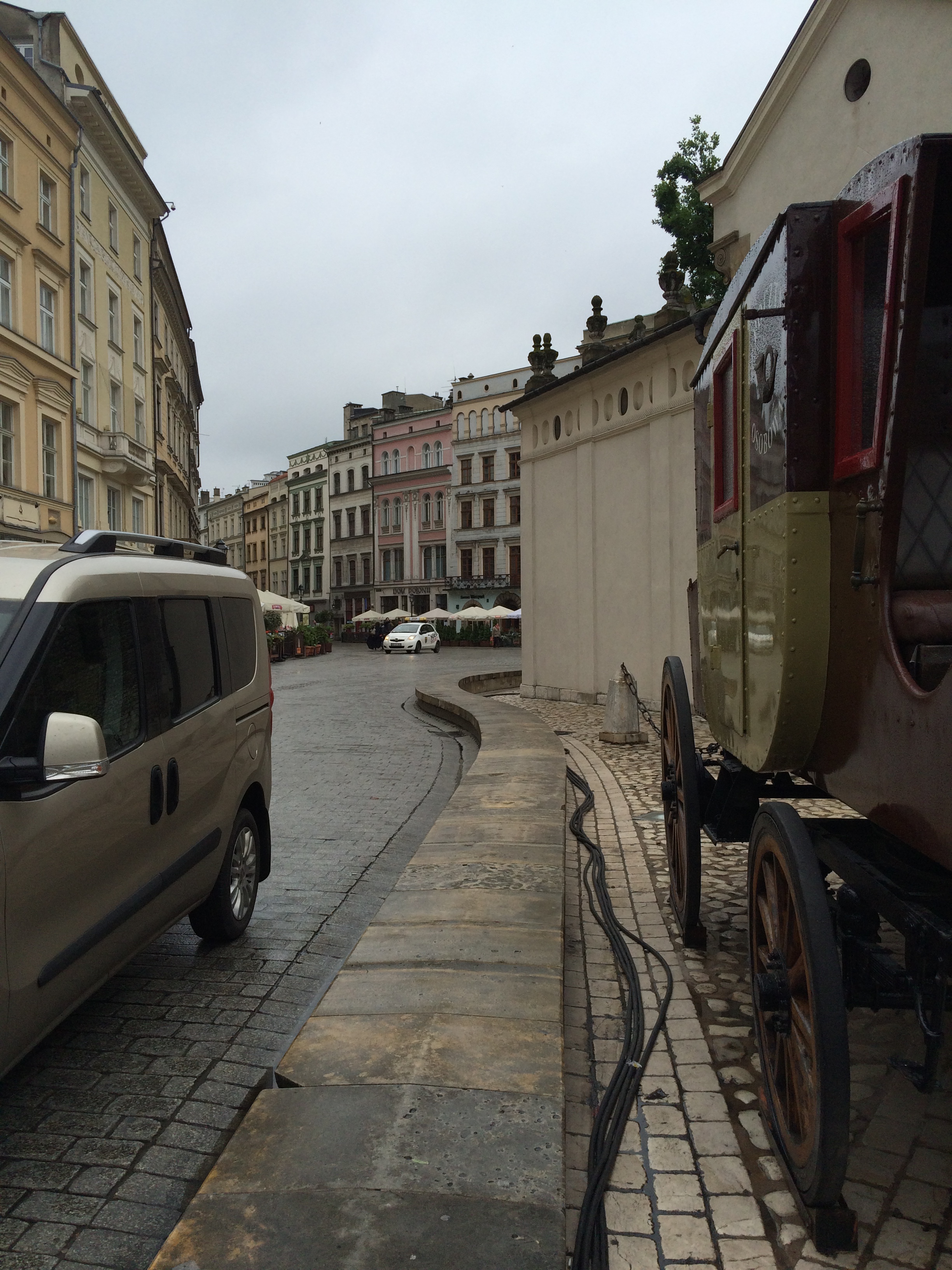
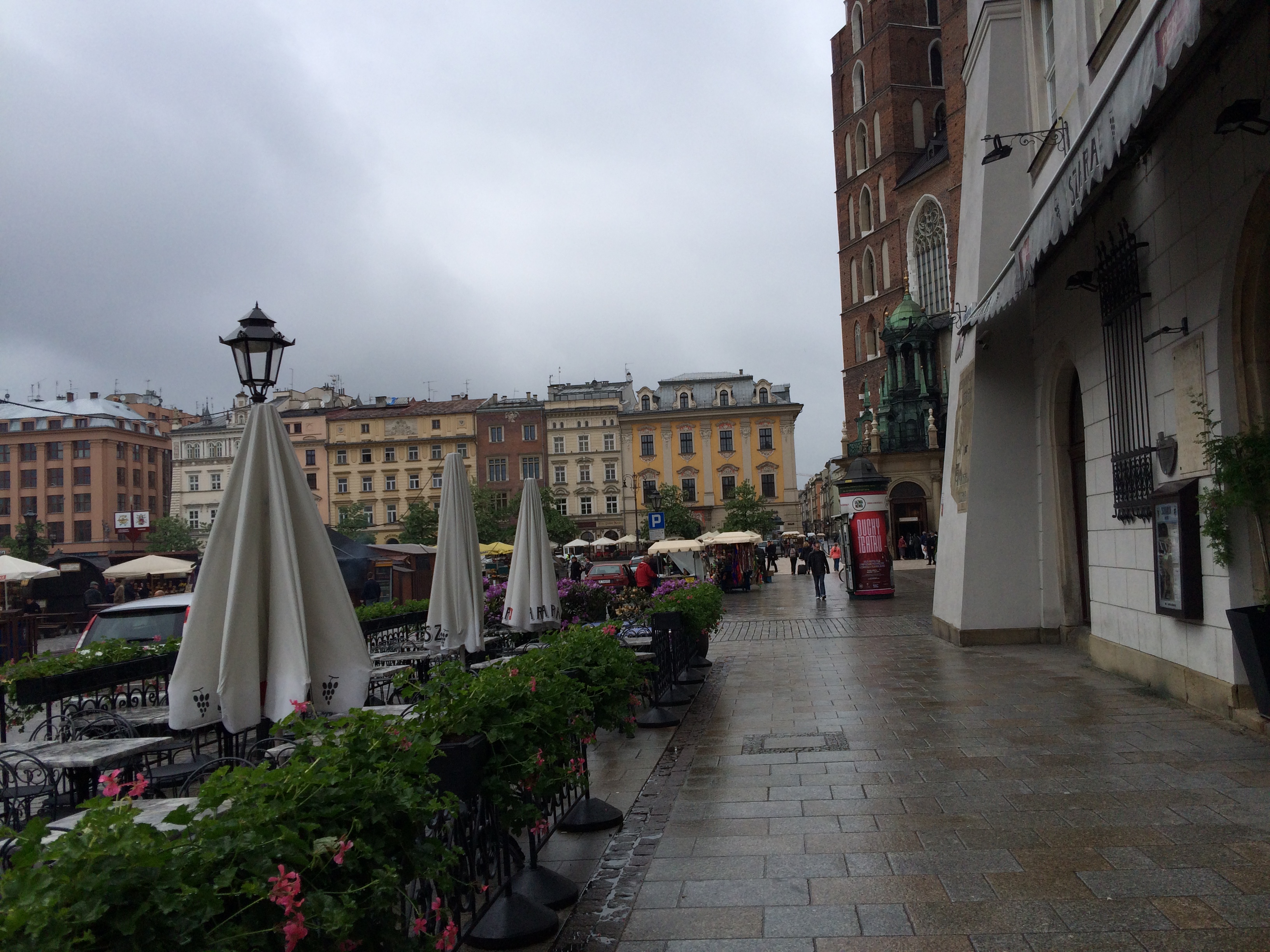
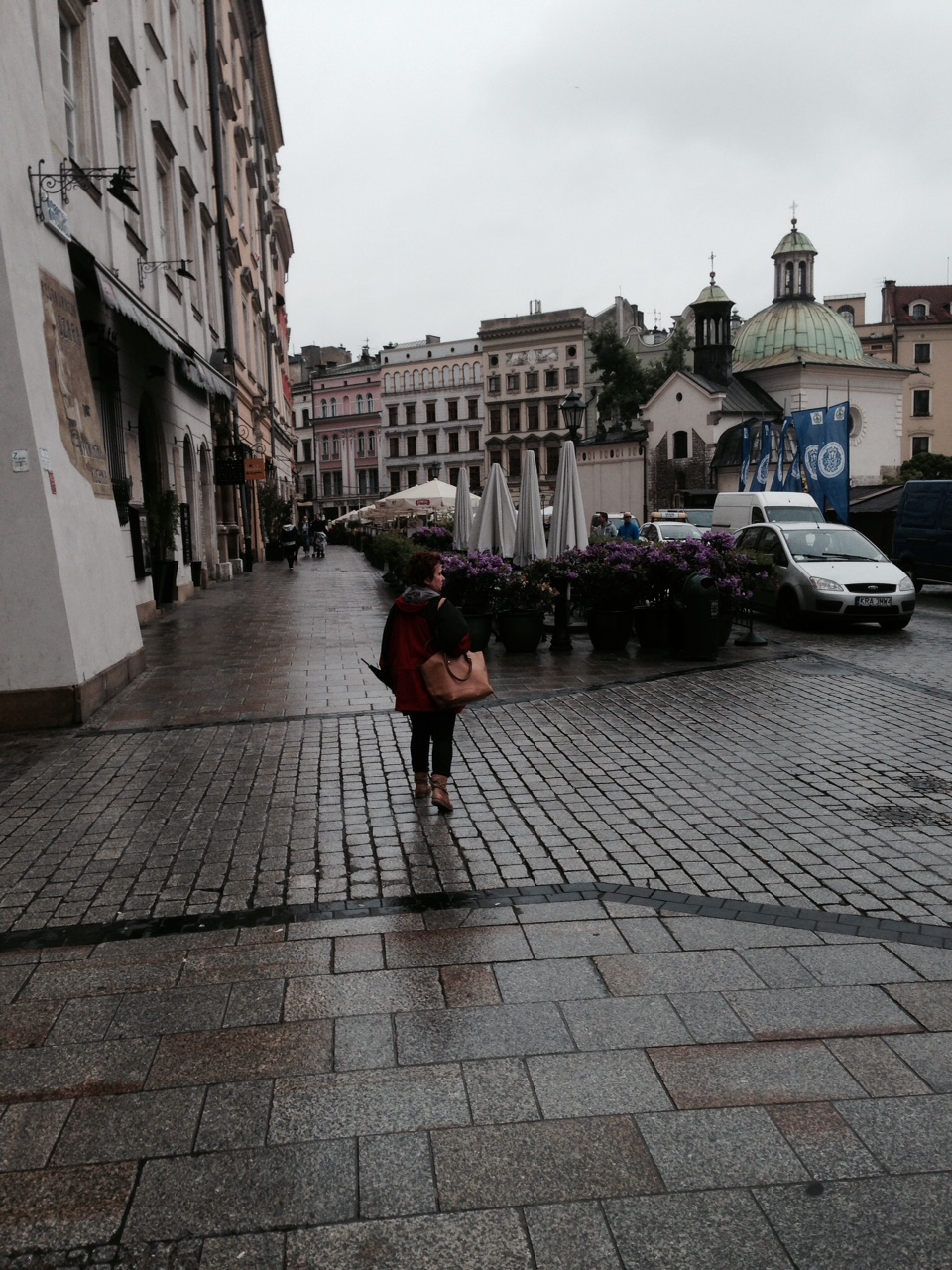
After breakfast at the hotel, we decided to venture out and see the city.  We took umbrellas, but fortunately we never had to open them; the skies never turned blue, but the rain was gone.  We walked to the market in the main square of Krakow where we had planned to go on two group walking tours that day, one of the Old Town, the other of the Jewish quarter.  When we got to the main square, vendors were just starting to open their stands, and the square itself was fairly empty.  The square is magnificent in size—reportedly, the largest public square in Europe.  There are cafes and shops surrounding the square as well as a number of churches and government buildings.  We wandered around a bit, and there was almost a Fanueil Hall feel to the place—a large indoor market lined with souvenir stands.  Unfortunately, the weather really was not great, but we did take a few photographs.

IMG_2625 Main Square Old Town Krakow 5 24 IMG_2626 Cloth Hall Main Square Old Town Krakow IMG_2627 Krakow Street IMG_2628 Krakow Street scene

Krakow main square krakow

After some deliberation, we decided to go on a tour of the Jewish Quarter in the morning and Old Town in the afternoon with SeeKrakow.  Our tour guide was a middle-aged Polish man who spoke English well, and the group of about sixteen people was quite diverse in background.  We were the only people from an English speaking country.  There were people from Spain, France, Belgium, and Switzerland.  They all understood English; it was embarrassing.  We were the only people in the group who could not speak a second language.  Most of the others could speak three.  The American educational system is an utter failure in preparing our children for the global world we live in.

Anyway, we marched off with our leader (whose name escapes me, perhaps for good reason), and after a few stops, I realized that he was not a good fit for me.  Maybe it was the contrast to Andrea and Helena, our guides in Prague; maybe it was the nature of being on a group rather than private tour.  The tour leader was knowledgeable and pleasant, but I felt that he had a personal agenda to promote instead of providing an in-depth and historical view of the Jewish Quarter.  Over and over his message seemed to be that Poland had always been tolerant and accepting of its Jewish citizens and that the Polish people were also victims of the Holocaust.  What he said is historically accurate in many ways, but it was the way he delivered his message and his seeming defensiveness that troubled me.

After about the first hour, I started to think that (a) I didn’t want to go on the Old Town afternoon tour with this guide, and (b) I didn’t want to continue on the Jewish Quarter tour with this guide.  When we realized that his tour would not give us a chance to enter into any of the synagogues we passed (which he did describe, but at times showed us only the back or side of the building), we made a decision to leave the tour and explained to the guide that we wanted to spend more time in the Quarter rather than continue with the group.

Unfortunately, I had made one serious error in planning our itinerary—I had failed to check a Jewish calendar beforehand, and I had not realized that our one day in Krakow would be the holiday of Shavuot.  That meant that many of the synagogues, at least those still operating as synagogues, would not be open to the public for tours that day.  (It was also the Catholic holiday Pentecost, meaning that many stores and offices were also closed that day.)  If I could have changed one thing on our trip itinerary, I would have added at least another day to our stay in Krakow—not only because of the conflict with Shavuot, but also because we just did not have enough time to do the city justice.

But when you are traveling, you do what you can do.  So over lunch, we realized that we did not have time to see many of the sites in Krakow outside the Jewish Quarter—the Wawel Castle and the churches and other buildings we’d only glimpsed in Old Town.  We also realized that our sleepless night was catching up with us.  So we spent the afternoon wandering through the Jewish Quarter, soaking up what we could, and visiting the places we could enter.  I hope that someday we can return to Krakow and see the city in more depth.

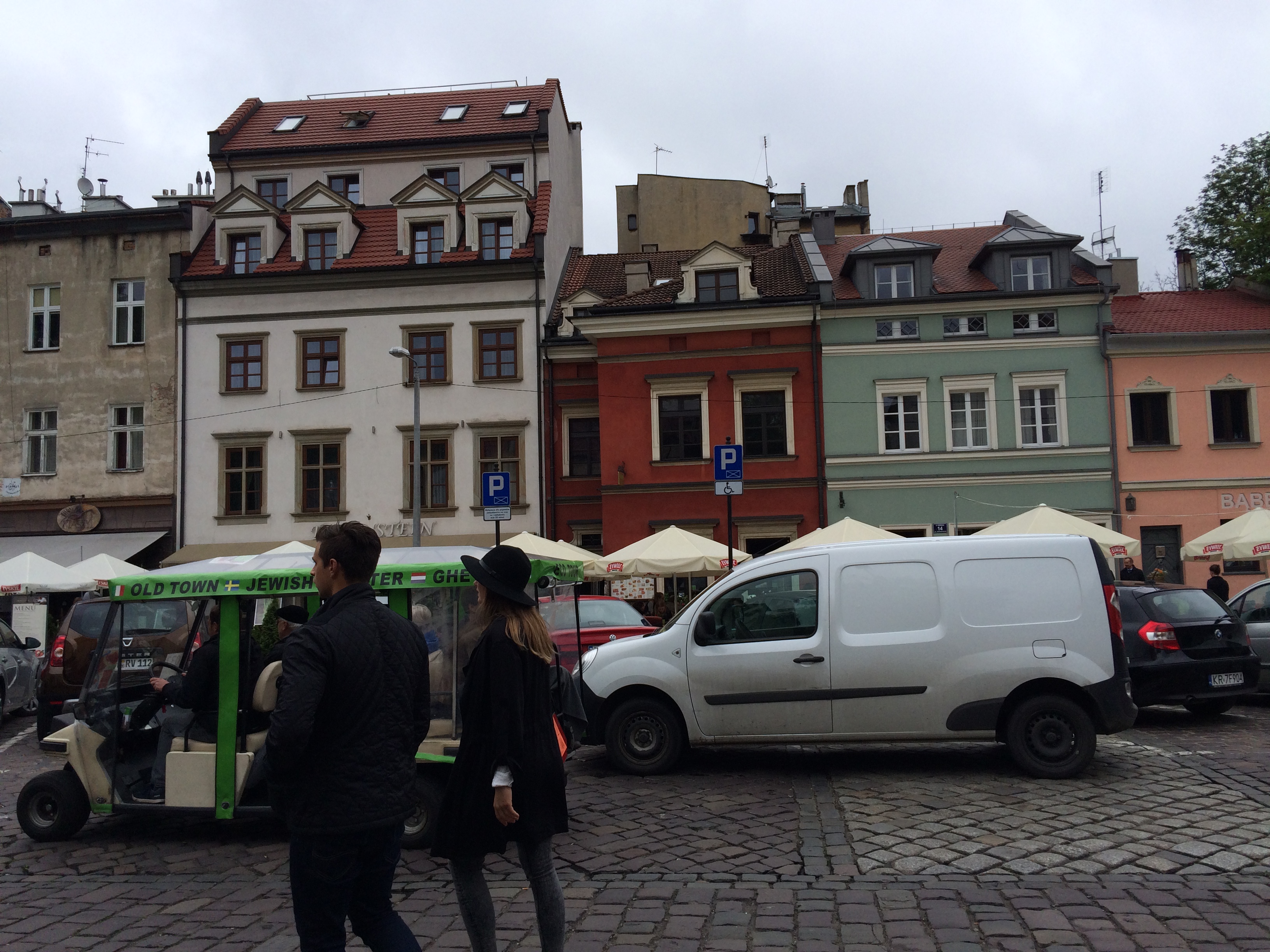
Unlike the Jewish Quarter in Prague, which as I wrote was substantially torn down in the late 19th century, most of the structures from the original Jewish Quarter in Krakow are still standing—the winding cobblestones streets and old worn buildings have been there for hundreds of years.  As our guide said, Krakow’s Jewish quarter is much more “authentic” than that in Prague because it reflects the way the ghetto looked when it was a ghetto. It also reflects more of the wear and tear of time, neglect, and the war.  Here are some photos of the square where the Jewish market once operated; it still operates as a market—a flea market when we were there, although, of course, there are no Jewish vendors or customers today.

IMG_2631 former Jewish marketplace, still a market 5 24 IMG_2633 former Jewish marketplace

We saw six still-existing buildings in the Krakow Jewish Quarter that were once operating synagogues. As with the synagogues in Prague, the only reason they are still standing is that the Nazis found the spaces useful for storage.  The oldest of the existing synagogue buildings, appropriately referred to as the Old Synagogue, was built at the beginning of the 15th century.  Its interior was destroyed by the Nazis, and it was then used for storage during their occupation of Poland.  Today the building is operated as a museum, displaying Jewish ritual objects and a historical exhibition of Krakow before and during the Nazi occupation.

IMG_2641 Old Synagogue IMG_2642 front of Old Synagogue old synagogue 2 old synagogue krakow

The second oldest synagogue still standing is the Remu’h Synagogue.  It is still an active congregation, so we were not able to enter it during our visit, nor we could enter the Old Jewish cemetery that is located adjacent to the synagogue building.  All I could get was the one photograph through the gate.  The Remu’h synagogue was built in the mid-16th century, and its interior also was substantially destroyed by the Nazis and then used for storage.

Remu'h Synagogue

Remu’h Synagogue

Both the Old and the Remu’h synagogues are located on what was the main square in the Jewish quarter where today there are numerous restaurants, many providing “Jewish” dishes on their menus (but not kosher) and klezmer music at night.  It’s a very pretty square, but the faux Jewishness is clearly intended to manipulate Jewish tourists like us, coming to see a world that no longer exists.

IMG_2643 main square in Jewish Quarter Krakow 5 24 IMG_2644 Jewish Quarter Krakow

The High Synagogue was the third synagogue built in Krakow, sometime after the Remu’h but also in the 16th century.  It was called the High Synagogue because the prayer hall was located upstairs.  We were able to climb those stairs and visit the former prayer hall because today it is a museum.  The exhibit there was very moving.  Several families of former Krakow Jews provided photographs to the museum of their families, depicting what their lives were like in the 1920s and 1930s before the Nazis arrived.  I was surprised to see very modern-looking families, engaged in activities like skiing and boating, as opposed to the images I had had in my head of ultra-Orthodox men with payes and long black coats.  As in Prague, by the early 20th century Jews in Krakow were full citizens, no longer required to live in a ghetto.  Many were quite successful merchants, and their families lived very comfortable and modern lives.

IMG_2639 High Synagogue IMG_2640 Jewish quarter Jewish school

Of course, it doesn’t matter whether they were Hasidim or assimilated, but I have to admit it made it easier for me to identify with these people, knowing their lives were not unlike mine.  Reading the stories of what happened to these families was heartbreaking.  Even though someone survived in these families and was thus able to preserve the photographs and the stories, each of these families lost many members during the Holocaust.

The only other synagogue building we could enter was that of the former Kupa Synagogue.  It was built in the 17th century, and like the other synagogues, was severely damaged by the Nazis.  We were able to enter the building and see the prayer hall, where people seemed to be setting up for some event.  We are not sure exactly how this synagogue is used today since it was open for visitors on the holiday.

Back of Kupa Synagogue

Back of Kupa Synagogue showing the ghetto wall


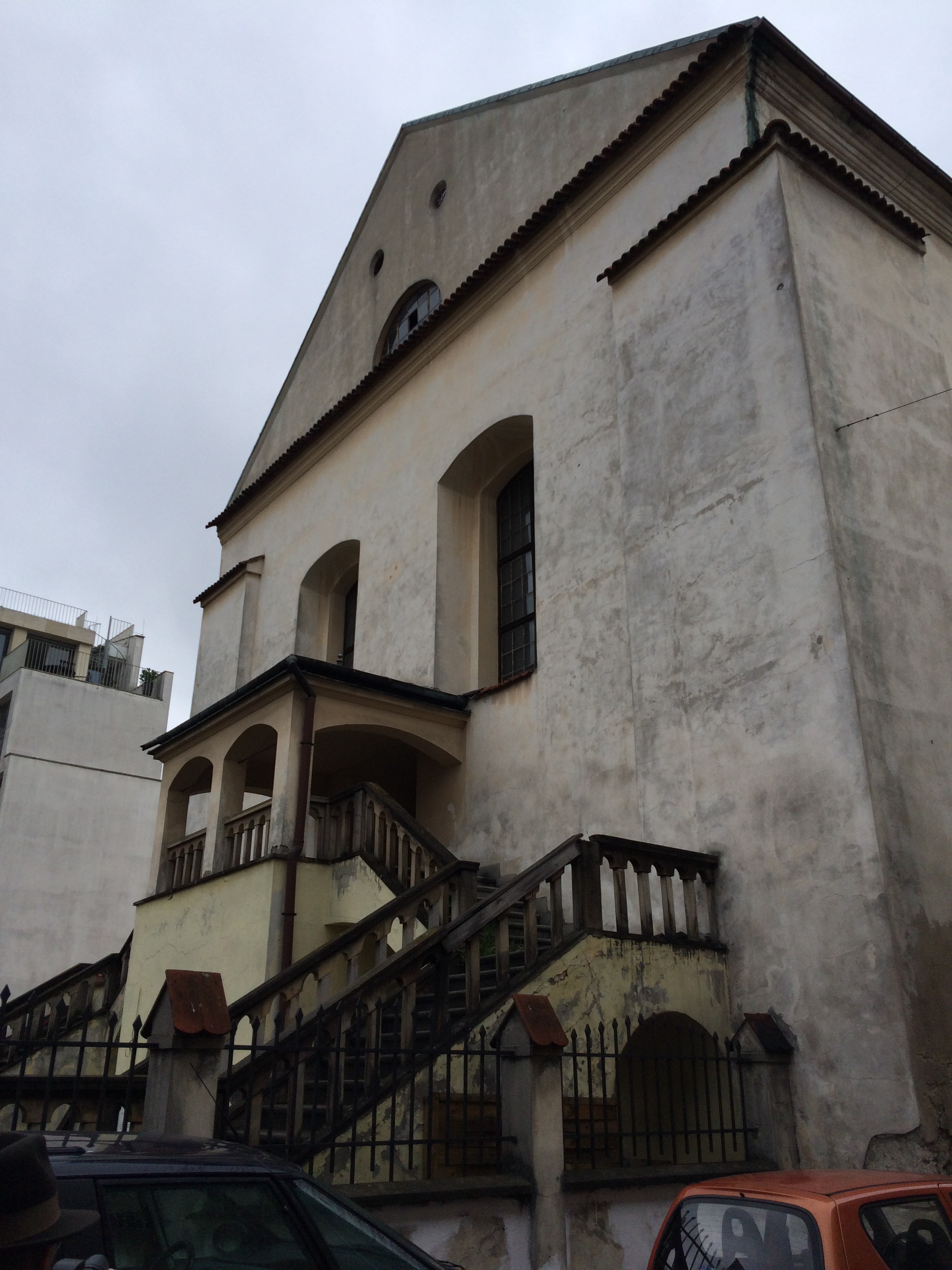
We also stopped to see the outside of the Isaac Synagogue, also built in the 17th century and now the headquarters for Chabad in Krakow, and the newest of the synagogues, the Tempel Synagogue, a Reform synagogue built in the mid-19th century.  Neither was open to visitors.

Tempel Synagogue

Tempel Synagogue

IMG_2638 Izaak Synagogue now Chabad

Isaac Synagogue


But next to the Tempel Synagogue is the JCC of Krakow, which was open and where we spoke with a woman at the reception desk.  She told us that they have 500 members, although only 120 are “registered” Jews.  The JCC provides educational and cultural programming, Shabbat dinners, and holiday celebrations, and aims to revive a Jewish community in Krakow.  It was uplifting to be in this new building and see some signs of hope for the very small Jewish community that exists today in Krakow.

jcc krakow

We ended our walk through the Jewish Quarter on that somewhat high note.  We later returned for dinner at the Klezmer Huis, where we ate “Jewish-style” food and listened to Klezmer music (sung by three young people who I assume are not Jewish, but who were excellent).

IMG_2646 Klezmer Huis IMG_2648 Klezmer Huis harvey IMG_2649 interior of Klezmer Huis IMG_2650 IMG_2652 Klezmer peformers

But although that was fun (if somewhat corny), it did not really cover up the reality.  Before World War II, there were about 65,000 Jews in Krakow, and they made up about 25% of the city’s population.  Today, as I said, there are 120 Jews living in Krakow.  Walking those streets and seeing the old houses once occupied by Jewish families, entering those once flourishing synagogues that are now just museums, seeing those photographs of the families who were destroyed, I could not help but feel thousands of ghosts following us around.  What would Krakow be like today if the descendants of those 65,000 people were alive? My day in Krakow left me angry and very sad.

The second day of our visit to Poland we learned more about what happened to those people.  More on that in my next post.


Home Sweet Home

We are back from our trip, and I have so much to say that I don’t even know where or how to start.  Traveling to a different place can change your whole view of the world, of your place in the world, and of yourself.  This trip did that in so many different ways.  I have hundreds of photographs to sort and label, a lot of notes to transcribe and ponder, and so many thoughts and memories floating through my head that I need to write them all down before I forget them.  So I can’t just start blogging in detail about the trip right away.  I will certainly report about the parts of the trip that related directly to my own family—the trip to Poland in particular—once I have it all digested.

For now I have these overall thoughts and a few photographs to share.  First, standing in the former Jewish quarters in Prague, Krakow, Budapest, and Vienna, some of which still have several synagogues (a few even still in operation), is a chilling and horrifying experience.  For me, these places that once bustled with Jewish grandparents, mothers, fathers, and children, going to work and going to school and going to shul, were a graphic and vivid reminder of what the world lost in the Holocaust.  Had it not been for the Nazis, these Jewish communities could and likely would still exist, adding to the culture and economy of these places and of the world just as they did for hundreds of years before their Jewish citizens were murdered.

A street in the former Jewish Quarter of Krakow

A street in the former Jewish Quarter of Krakow

Nothing made this more painfully vivid for me than standing in Tarnobrzeg, the town where my Brotman great-grandparents lived, a town that was once 75% Jewish and where not one Jew lives today.  The only signs that there were once Jews there were a small plaque on the library, a building that had once been the synagogue, and a Star of David near the gate to the neglected Jewish cemetery, where only a handful of headstones remain.

gravestone on the ground in the Jewish cemetery in Tarnobrzeg

gravestone on the ground in the Jewish cemetery in Tarnobrzeg

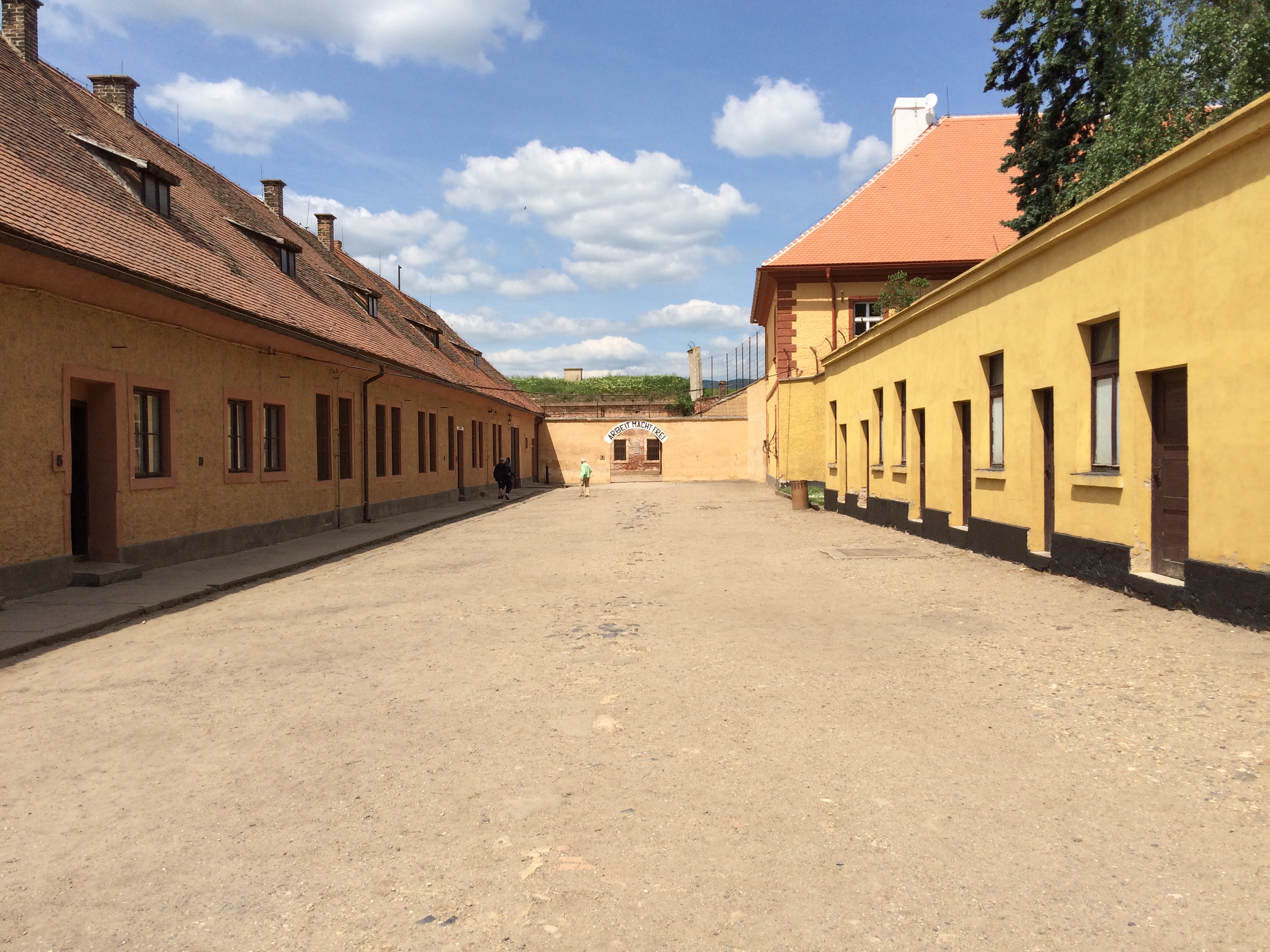
Second, every person, Jewish or not, should visit Terezin and Auschwitz.  I cannot say more.  The places say it all.  You cannot go to these places and not be changed.  No matter what you may have read or seen or heard about the Holocaust, you cannot be prepared for what you experience walking in those places of terror and death.  I have only two photographs of Terezin and no photographs of Auschwitz.  I could not bear to think about taking a photograph while standing where so many were slaughtered.

Terezin

Terezin

Third, I had little idea what life was like under Soviet domination in the Czech Republic, Poland, and Hungary until we met several people who had lived during that era.  We were lucky to have guides in Prague, Poland, and Budapest who had witnessed the changes and were able to describe to us how different life was before and after the Soviets left in the late 1980s, early 1990s.  Today all these places are clearly capitalist, for better in many ways, for worse in others.  Seeing Starbucks and McDonalds and KFC everywhere amidst the old buildings in these gorgeous cities is jolting, but much better than seeing empty store windows and children forced to march at rallies to support the “state.”

Despite all the sadness that we felt as we learned about the past in these places, overall we experienced these cities as places of joyfulness, liveliness, and overall comfort.  Yes, there were beggars and homeless people, especially in Budapest, and I am sure that outside the areas where tourists congregate there is plenty of poverty and misery.  But each of the cities we visited were beautiful places filled with incredible and fascinating architecture, a huge number of cafes and restaurants and bars, museums teeming with people, cobblestone streets crowded with tourists and tour groups, and the sounds of happy, excited people.  There was music everywhere—in the streets, in the churches, and in the concert halls.

Dohany Synagogue in Budapest

Dohany Synagogue in Budapest

We had an incredible time.  Our tears and sadness were well-balanced with times of pure joy—climbing the tower to see all of Prague, clapping to Klezmer music in Krakow, walking along the river in Budapest, and eating unbelievable pastries in Vienna.  We heard music in every city, we stood in awe in Gothic cathedrals, we watched people laughing and drinking and eating in the cafes, and we walked and walked and walked until our feet were numb.  We had an incredible time.

Musikverein in Vienna

Musikverein in Vienna


A Difficult Life: Julius Seligmann


http://www.gettyimages.com/detail/158503169

Julius Seligmann, son of August and grandfather of Wolfgang, lived a life filled with conflict.  As I’ve written previously, he was shunned by his family for converting to Catholicism and marrying Magdalena Kleisinger, a Catholic woman. Since their first child Walter was born in February, 1925, I assume that Julius and Magdalena must have married by 1924.  According to family lore, he had to pay his family a substantial sum of money, causing him great financial distress.

Since writing previously about the challenges Julius faced, I’ve learned a bit more, thanks to Wolfgang and some documents he was able to find.  One thing that Julius tried to do to address his financial condition was to secure some money from the estate of his uncle, the James Seligman who moved to England and died in 1930.  Although we now know that James’ widow had control over the estate for the duration of her life and the principal was not to be distributed for over another fifty years, Julius was obviously in great need of money and hoped to be able to get some of what must have been a substantial amount of money.

In April, 1931, he wrote the following letter to the lawyers handling the estate of his uncle James:

Lawyers-page-001


As translated by Wolfgang, in this letter Julius was asking the bank how to contact James’ widow in order to ask her for some money.  He wrote that he was having a lot of financial problems after the bank closed down and that he had had to apply for a “Vergleichsverfahren,” which is apparently a method used by debtors that is somewhat like a bankruptcy proceeding.  Julius told the lawyers he was looking for a thousand Reichsmarks in order to take care of his most urgent debts.

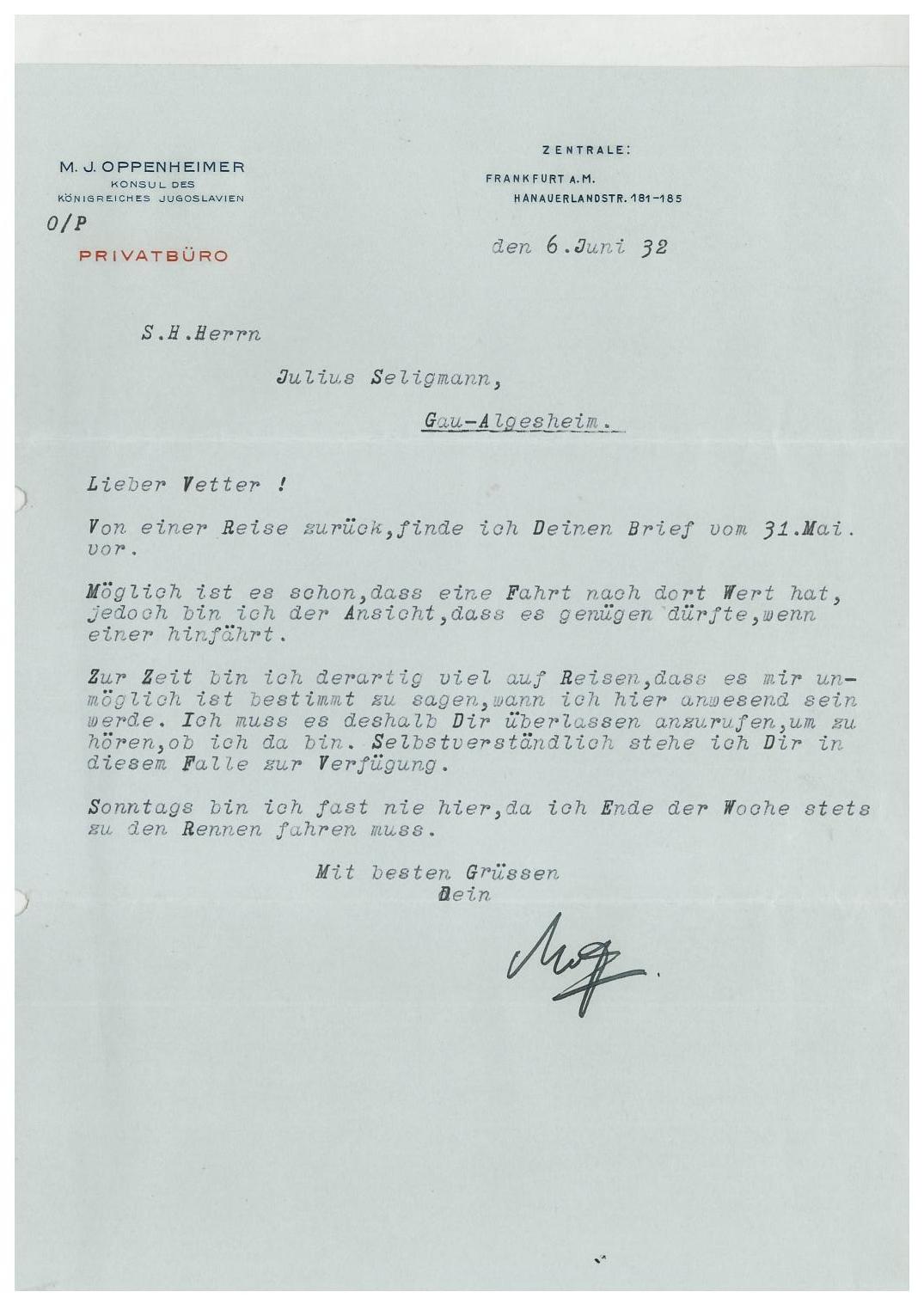
In June, 1932, Julius received the following letter from his cousin Moritz Oppenheimer.  Moritz, who I wrote about here, was both a successful businessman and a horse breeder with a large stud farm.

Oppenheimer-page-001

From this letter, as translated by Wolfgang, it would appear that Julius had asked Moritz to go to England to see if they could resolve their claims against the estate of James Seligman.  Moritz had responded that he thought such a trip might be successful and that it was only necessary for one person to go.  (It’s not clear who he thought should go.) But Moritz also wrote that he was traveling and not at home and that Julius should contact him and he would be glad to help.   He also wrote that he was not available on Sundays as he was at the races—horse races, I’d assume.[1]

In September, 1932, Julius wrote the following letter to the German embassy in London, seeking a lawyer there to help him with his claim against the estate of his uncle.

julius letter front-page-001

julius letter front-page-002

According to Wolfgang, Julius wrote in this letter that he had been notified that since his uncle had not had any children, he and other relatives were to inherit 150 to 300 pounds as their inheritance.  He asserted that the widow had promised to pay this money, but had never done so, and that now neither she nor her attorneys were responding to his requests for payment.  He commented that his economic situation was not good and that they needed to do something quickly.

I do not think anything came from any of these attempts to get money from the estate back in 1932 as we know that Julius eventually was forced to close his store in Gau-Algesheim in 1935 and move to Bingen in 1939.

Both the Hellriegel book about Gau-Algesheim and Wolfgang suggested that the chief of police in Bingen had extended protection to Julius and his family despite knowing that Julius had Jewish roots.  Wolfgang recently spoke with someone who knew his father Walter during the war; he told Wolfgang that everyone in the community knew that Julius had come from a Jewish family, but that no one cared.  This man’s father, like the prior in the Rochus chapel I wrote about last time, spoke out against Hitler and the Nazis.  It would appear that there were a good number of people in Bingen who were opposed to the Nazis and did what they could to protect the Jewish citizens. Sadly, however, it was not enough.

Deutsch: Rochus-Kapelle in Bingen am Rhein/Deu...

Deutsch: Rochus-Kapelle in Bingen am Rhein/Deutschland (Photo credit: Wikipedia)


****


[1] Wolfgang also found some discussion of Moritz Oppenheimer on a German internet horse-racing enthusiast’s forum back in 2010.  The participants were discussing the history of the stud farm once owned by Oppenheimer and how he had been driven to bankruptcy by the Nazis, forced to sell the stud farm for a price far below its value, and then died either by his own hand or executed by the Nazis.  http://www.galopper-forum.de/viewtopic.php?f=50&t=2473

Too Many Missing Pieces: Part II

In my last post, I wrote about the list of English James Seligmann’s heirs that my cousin Wolfgang found in his family’s papers.  There were 21 principals named as heirs on that document, and I had discussed all the easily identified ones and some of those that were more difficult to figure out.  I had discussed Numbers 1, 2, 6-13, 15, 16, 19-21.  That left Numbers 3-5,  14, 17, and 18.  Here again is the list of heirs:

heirs list p 1

Heirs List p 2

So let’s start with Number 3, Johanna Bielefeld, the one whom Elsa Oppenheimer had claimed was not a daughter of Hieronymus Seligmann in her July, 1984 letter.

Elsa Oppenheimer 1984 letter-page-001

Elsa Oppenheimer 1984 letter-page-002

Perhaps Elsa was wrong; after all, she was wrong about Adolph Seligman not being the child of Moritz and Babetta, as discussed last time.  Or maybe Johanna was the daughter of Benjamin Seligmann.  I am not sure yet, but I do know that she was born in Gau-Algesheim.  Wolfgang found this registration card for her, dated January 12, 1939, issued by the police in Mainz.  It gives her birth name as Seligmann, her birth date as March 15, 1881, and her birthplace as Gau-Algesheim.  I have written to my contact in Gau-Algesheim, asking him to see if he can find a birth record for Johanna so I can determine who her parents were.  Notice also the large J on her card, indicating that she was Jewish.

Here is the companion card for her husband Alfred Bielefeld:

The list of heirs provided the names of Johanna and Alfred’s children, Hans and Lili (or Lily).  It indicated that Johanna had died as had Hans, he in 1948.  Then it provided a married name for Lili, Mrs. Fred Hecht, and an address on West 97th Street in New York City.  Searching for Hans Bielefeld brought me to someone with that name on the 1940 census, living in Cleveland, Ohio. He was working as an insurance agent, was 37 years old, and had been residing in Mainz, Germany, in 1935.

Year: 1940; Census Place: Cleveland, Cuyahoga, Ohio; Roll: T627_3221; Page: 5A; Enumeration District: 92-451

Year: 1940; Census Place: Cleveland, Cuyahoga, Ohio; Roll: T627_3221; Page: 5A; Enumeration District: 92-451

Further searching found an index listing in the Ohio Deaths database on Ancestry for Hans Bielefeld, indicating he had died on September 13, 1948, the same year of death given on the list of heirs document.  On Fold3.com, I then found naturalization papers for Hans Ludwig Bielefeld, indicating that he was divorced, that he was born on July 1, 1902 in Maine (sic), Germany, and that he had arrived in the US on the SS Gerolstein on July 14, 1938.

Publication Number: M1995 Publication Title: Naturalization Petition and Record Books for the US District Court for the Northern District of Ohio, Eastern Division, Cleveland, 1907-1946 Content Source: NARA National Archives Catalog ID: 1127790 National Archives Catalog Title: Naturalization Petitions, compiled 1867 - 1967 Record Group: 21 Partner: NARA State: Ohio Court: Northern District, Eastern Division Catalog Keywords: Petitions Naturalization Immigration Citizenship Fold3 Publication Year: 2008

Publication Number: M1995
Publication Title: Naturalization Petition and Record Books for the US District Court for the Northern District of Ohio, Eastern Division, Cleveland, 1907-1946
Content Source: NARA
National Archives Catalog ID: 1127790
National Archives Catalog Title: Naturalization Petitions, compiled 1867 – 1967
Record Group: 21
Partner: NARA
State: Ohio
Court: Northern District, Eastern Division
Catalog Keywords: Petitions Naturalization Immigration Citizenship
Fold3 Publication Year: 2008


That led me to a passenger manifest for the SS Gerolstein, where I found Hans listed as a divorced merchant from Mainz.  It seemed like this could be the son of Johanna Seligmann Bielefeld, but I couldn’t be sure.

So I searched for his sister Lili.  I first searched for her as Lili Hecht, but had no luck, so I searched for Lili Bielefeld and found her first on an English ship manifest dated September 18, 1940, from Liverpool bound for Montreal, Quebec.  Lili was listed as 36, having last resided in London, but born in Germany.  Her occupation was given as a domestic.  The age, birthplace and name seemed correct, so I considered it likely that this was the right person.

Ancestry.com. UK, Outward Passenger Lists, 1890-1960 [database on-line]. Provo, UT, USA: Ancestry.com Operations, Inc., 2012.

Ancestry.com. UK, Outward Passenger Lists, 1890-1960 [database on-line]. Provo, UT, USA: Ancestry.com Operations, Inc., 2012.

Then I found her listed with the same information on a US manifest for passengers entering the United States from Canada.  But since Lili did not arrive until September, 1940, she is not listed on the 1940 census, making it extremely difficult to find her in the online databases on Ancestry.  There were a number of Fred Hechts, but how would I know if any of them were married to Lili?

So I turned to Google and entered “Lili Bielenfeld Fred Hecht,” and once again I hit the jackpot.  Like Fred and Ilse Michel, Fred Hecht and Lili Bielenfeld have papers in the collection at the Leo Baeck Institute entitled “Hecht and Gottschalk Family Collection; AR 5605.”  In the biographical note included with this collection, I learned that Fred Hecht came from a German Jewish family with a long history.  I will quote here only the sections relevant to Fred, Lili and Hans:

Jakob and Therese Hecht had a son, Siegfried Max Hecht (alternatively Fritz, later Fred, 1892-1970). Siegfried Hecht became a merchant and served in the German military during World War I. Siegfried and his wife Emma née Cahn divorced in 1939, and he immigrated to the United States in 1940, where he took on the name Fred. He settled in New York City and became a jewelry salesman. In December of 1944, he and Lili née Bielefeld (1904-1977) were married.

The Bielefeld family can be traced back to the late 18th century. The family lived in Karlsruhe, Mainz, and Mannheim until the 1930s, when some members immigrated to the United States. Lili Hecht née Bielefeld was the daughter of Alfred Bielefeld, a wine merchant, and Johanna Bielefeld née Seligmann. Despite efforts to procure passage to the U.S., both Alfred and Johanna perished in the Holocaust. Alfred died in Theresienstadt, and Johanna was deported from Theresienstadt to Auschwitz, where she perished.

Lili Hecht née Bielefeld’s brother Hans Ludwig Bielefeld (1902-1948) was a merchant. He married Lilli née Kiritz in 1933, and the couple divorced in 1936. Hans Ludwig immigrated to the United States under the sponsorship of his cousin, Irma Rosenfeld, and settled in Cleveland, Ohio, where he worked in insurance. After his death, his sister Lili Hecht née Bielefeld was the sole heir to the Bielefeld family property, which she claimed in the 1960s alongside restitution for her parents’ deaths.

Thus, from these papers and this biographical note, I was able to find out a great deal about what had happened to Johanna Seligmann Bielefeld, her husband, and her two children, Hans and Lili.  I will write more about them in a separate post once I have a chance to examine the LBI collection more carefully and obtain translations where necessary.

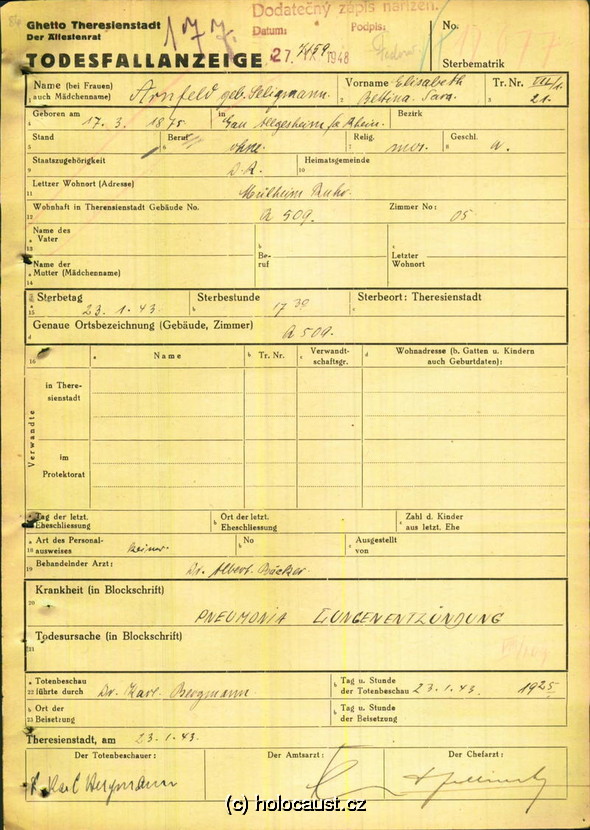
Number 4 on the list, Bettina Arnfeld, was more difficult to locate, but I found a Bettina Elizabeth Arnfeld listed on FindAGrave  with the notation, “Body Lost or Destroyed.” Her birthdate was given as March 17, 1875.  This may have been the “Elizabeth” whom Elsa claimed was not a child of Hieronymus Seligmann.  I then looked for and found Bettina Elizabeth Arnfeld in the Yad Vashem Database.  The entries there confirmed that her birth name was Seligmann, that she was born on March 17, 1875, and that she had resided in Muelheim Ruhr in Germany at the time she was deported.  She was exterminated at Thieresenstadt on January 23, 1943.

The list of heirs indicated that Bettina had a son, Heinz Arnfeld, living on 22 Gloucester Square in London, and he was not difficult to locate.  I found several entries for Heinz and Liselotte Arnfeld at that address in London, England, Electoral Registers on Ancestry.  I also found Heinz and Liselotte listed in the England & Wales Marriage Index on Ancestry.  They were married in Doncaster, Yorkshire West Riding in 1945. Heinz is also listed as a survivor of the Holocaust in the Shārit ha-plātah database on JewishGen.

Heinz died in 1961 and left his estate to Liselotte; she died in 1988. I do not know whether they had any children.  Since they were married in 1945 when Liselotte was 37, it does not seem likely.

That brings me to Numbers 17 and 18 on the list, putting Numbers 5 and 14 aside for now.  Who were Eva Hansu and Rosa Reisz?  If these were nieces of English James Seligmann, then they had married and changed their surnames, so how could I find them?  Since they were listed right after Emil and Eugen, sons of Carolina Seligmann and Siegfried Seligmann, I went back to the list of Carolina’s children and realized that she had daughters named Eva and Rosa.  Thus, I assumed that Eva became Eva Hansu and Rosa became Rosa Reisz.
I had good luck searching for Rosa Seligmann Reisz.  I knew her daughter’s name was Hedwig Neter from the list of heirs, and that seemed unusual enough that I decided to search for it first.  Sure enough the name came up on a passenger’s manifest dated August 31, 1940, for the ship Cameronia departing from Glasgow, Scotland, for New York.  Sailing with Hedwig was her husband Emil Neter and her mother Rosa Reis.  Emil was a 61 year old manufacturer, Hedwig a 48 year old housewife, and Rosa was 73 without occupation.  They all had last been residing in London and said the US was their intended permanent residence.

Ancestry.com. UK, Outward Passenger Lists, 1890-1960 [database on-line]. Provo, UT, USA: Ancestry.com Operations, Inc., 2012.

Ancestry.com. UK, Outward Passenger Lists, 1890-1960 [database on-line]. Provo, UT, USA: Ancestry.com Operations, Inc., 2012.

According to FindAGrave, Rosa Seligmann Reis died on January 29, 1958, and is buried at Hauptfriedhof in Mannheim, Germany.  Her son-in-law Emil Neter died on July 8, 1971, in Washington, DC, and is also buried at Hauptfriedhof in Mannheim, as is her daughter Hedwig Reis Neter, who died on May 28, 1979, in Washington.  I found it very interesting that after living in the United States all those years, Rosa, Emil, and Hedwig chose as their burial place the country they had escaped so many years before.  A little more searching turned up Hedwig’s birth certificate and a family record from 1891, both of which revealed that Rosa’s husband’s name was Ludwig Reis, son of Callman Reis, a merchant.

Ancestry.com. Mannheim, Germany, Births, 1870-1900 [database on-line]. Provo, UT, USA: Ancestry.com Operations, Inc., 2014. Original data: Personenstandsregister: Geburtsregister Standesamt Mannheim und Vororte 1876-1900, Stadtarchiv Mannheim, Mannheim. Deutschland.

Hedwig Reis Birth Certificiate Ancestry.com. Mannheim, Germany, Births, 1870-1900 [database on-line]. Provo, UT, USA: Ancestry.com Operations, Inc., 2014.
Original data: Personenstandsregister: Geburtsregister Standesamt Mannheim und Vororte 1876-1900, Stadtarchiv Mannheim, Mannheim. Deutschland.

Ancestry.com. Mannheim, Germany, Family Registers, 1760-1900 [database on-line]. Provo, UT, USA: Ancestry.com Operations, Inc., 2014. Original data: Polizeipräsidium Mannheim Familienbögen, 1800-1900. Digital images. Stadtarchiv Mannheim — Institut für Stadtgeschichte, Mannheim, Germany

Ancestry.com. Mannheim, Germany, Family Registers, 1760-1900 [database on-line]. Provo, UT, USA: Ancestry.com Operations, Inc., 2014.
Original data: Polizeipräsidium Mannheim Familienbögen, 1800-1900. Digital images. Stadtarchiv Mannheim — Institut für Stadtgeschichte, Mannheim, Germany

Searching at Hauptfriedhof on FindAGrave, I found that Ludwig had died in 1928 and had been buried at Hauptfriedhof.  It seems that Rosa and her daughter Hedwig wanted to be buried where Ludwig had been buried years before.  With the help of Matthias Steinke in the German Genealogy group on Facebook, I was able to locate the headstone for all four of them at the  Stadtarchiv Mannheim website.


At first I couldn’t find anything about Eva Hansu, Number 17.  I couldn’t find her husband’s first name, and although the heirs’ list gives her daughter’s married name as Alice Kauffman of France, I had not been able to find her either.  Then after Matthias introduced me to the Stadtarchiv Mannheim website where he had found the headstones for Rosa and her family, I decided to search for all people with the birth name Seligmann and found Eva as Eva Seligmann Hanau, not Eva Hansu as I had mistakenly read it on the list of heirs.  It provided the same birth date I’d already found for Eva, March 18, 1861, and it reported her date of death as March 18, 1939.  Her husband was Lion Hanau, born May 24, 1854, in Altforweiler, Germany, and he died February 7, 1921.  The archive also included photographs of their headstone.

As for their daughter, now that I had the correct spelling of her birth name Hanau, I was able to find her marriage certificate for her marriage to Ernst Kaufmann on August 10, 1911.

Marriage cert of Alice Hanau and Ernst Kaufmann

Marriage cert of Hanau Kaufmann p 2

Ancestry.com. Mannheim, Germany, Marriages, 1870-1920 [database on-line]. Provo, UT, USA: Ancestry.com Operations, Inc., 2014. Original data: Personenstandsregister: Heiratsregister Standesamt Mannheim und Vororte, Stadtarchiv Mannheim, Mannheim. Deutschland.

I do not know what happened to either Alice or Ernst during or after the war.

So that leaves me with only two names on the list of heirs for whom I as yet have no answers: Anna Wolf, Number 5, and Bettina Ochs, Number 14.  Anna Wolf is listed as a fraulein, so that is her birth name, not a married name.  It says that Johanna Bielfeld was her aunt, so presumably Anna’s mother was a sister of Johanna.  If, in fact, Johanna was a child of Hieronymus Seligmann, she had two sisters, Mathilde and  Auguste and perhaps Bettina.  I don’t have any information about them aside from what was listed in Elsa’s letter, posted above.  More work to be done.

And Number 14, Bettina Ochs, is even more of a puzzle.  I’d have assumed that Ochs was her married name, Seligmann her birth name.  But the note on the document mentions a brother as her next of kin, and his name was Arthur Erlanger.  That would suggest that Bettina Ochs was born Bettina Erlanger, not Seligmann.  So how is she related? Who was her husband? Which one is the blood relative of English James Seligmann?  I found one listing on JewishGen.org for Bettina Ochs-Erlanger with a secondary name as Bettina Oberdorfer.  She was born May 7, 1870, and her nationality was Italian, consistent with the Milan address provided on the heirs list.  She was listed in the Switzerland, Jewish Arrivals, 1938-1945 database; I can’t see the original document, but the index indicates that she arrived in Switzerland on August 5, 1944.

It’s amazing how much information I could mine from this one little document.  Unfortunately, although I should have gotten great satisfaction from finding so many people and so much information, I ended up feeling very sad and very drained as I added all these names of my cousins to the list of those killed in the Holocaust.  It is beginning to overwhelm me.  So much loss, so much evil.  Incomprehensible.

Putting The Puzzle Together:  Too Many Missing Pieces

Sometimes it is amazing to me how much information you can get from one document—an obituary, a death certificate, a news article.  This time it was a document my cousin Wolfgang Seligmann found in a suitcase.  In fact, I learned so much from this document that I have to divide this post into two separate posts to make each a reasonable length.

What Wolfgang found was a list of names of the heirs to the estate of James Seligman, the son of Moritz and Babetta who had moved to England. (I will refer to him as English James Seligman to distinguish him from the US James Seligman, my great-grandmother’s brother.)   The document is entitled: “J. Seligman Deceased: Statement as of 1st January 1950 of Nephews and Nieces and their Issue, who may take an interest under the Intestacy in the above Estate.”  There are 21 principals named on the document as well as the names of several of the children or relatives of those 21 who might inherit in their place, if the principals were deceased.

heirs list p 1

Heirs List p 2

I have spent a lot of time trying to figure out who these 21 people were and how they were related to English James and also thus to me.  Some of them were very easy to identify.  Number 21 was the easiest:  Mrs. Eva Cohen of Philadelphia was my great-grandmother.  She was deceased by 1950, and unfortunately there was no listing on the document of her heirs, which would have included my father, my aunt, my great-uncle Stanley, and the sons of Maurice Cohen, Buddy and Junior.

Numbers 19 and 20 were also easily identified: Arthur and US James Seligman, my great-grandmother’s brothers and the two other surviving children of Bernard Seligman, English James Seligman’s older brother.  For US James Seligman, Morton is listed as his surviving son.  For Arthur, there is mention of his “oldest son” (he had only one, Otis), and a note that he had been “Governor of Santa Fe” and might be able to find other relatives.  By 1950, however, Arthur and his son Otis were both deceased.  (These careless errors made me a bit skeptical of the Bank’s attention to detail.)

I also knew who Numbers 15 and 16 were: Emil and Eugen Seligmann were the sons of Carolina Seligmann, the half-sister of James, Bernard, and the others, and they were the grandsons of Moritz Seligmann and Eva Schoenfeld.  Emil had died from heart disease in 1942, and Eugen had died at Thierenstadt concentration camp in 1942.  Emil’s son also died during the Holocaust at Buchenwald in 1945.   His daughter Christine was still alive in 1950 when this document was created.

Number 6 is Wolfgang’s grandfather Julius, a son of August Seligmann and grandson of Moritz and Babetta.  He was still alive in 1950.  Number 7 is Moritz Seligmann, the brother of Julius about whom I wrote here.  He had served in World War I for Germany and been awarded the Cross of Honor, but was nevertheless killed during the Holocaust.  Number 8 is Franziska or Frances Seligmann Michel, the mother of Fred Michel, about whom I wrote here.  She was also the child of August Seligmann and the granddaughter of Moritz and Babetta, and had died in 1933.  Her son Fritz (Fred) is also mentioned on the heirs list.

Number 9 is Anna Seligmann Goldmann, the sister of Julius, Moritz, and Franziska and husband of Hugo Goldmann.  Anna, Hugo, and their three young children, Ruth, Grete, and Heinz, were all killed in the Holocaust.

The next four people, Numbers 10 through 13, are all from the Oppenheimer family, written about here.  Joseph, Martha, and Ella were the children of Paulina Seligmann and Meier Oppenheimer.  Paulina was the sister of Bernard, August, and James, and the daughter of Moritz and Babetta Seligmann.  Joseph and Ella both died during the Holocaust.  Martha survived, but her two children Gertrud and Paul did not.  With this document, I now learned that Martha’s married name was Floersheimer, and was able to find Gertrud and Paul in the Yad Vashem database.  Gertrud died at an unknown camp in 1942 after being deported on June 10 of that year from Wiesbaden, and her brother Paul died at a camp in Majdanek, Poland, on August 16, 1942.

Emma Oppenheimer, Number 13, I assume was Emma Neuhoff, the widow of Moritz James Oppenheimer, son of Paulina and a brother of Joseph, Martha, and Ella.  Moritz Oppenheimer, discussed here, had been a successful business person and horse breeder; he was reported to have committed suicide after being visited by the Gestapo in 1942.

That left me with eight unknowns: Numbers 1 through 5 and Numbers 14, 17 and 18.  Some of these I believe I have figured out; others I am not as certain about.  For example, Jack Seligmann, Number 1, has to be the son of a brother of James to have the Seligmann surname.  I knew he was not the son of Sigmund (never married, lived in the US), Bernard (lived in the US), or Adolph (lived in the US).  I assumed I had all the sons of August Seligmann from the records I found and records Wolfgang shared with me.  Salomon Seligmann died when he was 21, so I eliminated him.  That left only two of James’ brothers: Benjamin, a half-brother, and Hyronimus, a full-brother.  I had no records other than birth records for either Benjamin or Hyronimus, and thus, I had no way to determine whether Jack was a son of Benjamin or Hyronimus, but assumed he was the son of one or the other.

Then, while I was trying to puzzle this out, Wolfgang found another document.  It was a letter written in 1984 by Elsa Oppenheimer to the National Westminster Bank regarding the estate of English James Seligman.   (I think Elsa Oppenheimer was the daughter of Jur Oppenheimer, son of Moritz James Oppenheimer, based on the family tree I received from Wolfgang a few weeks ago.)  In her letter to the bank on July 9, 1984, Elsa attempted to correct some errors she felt the bank had made in identifying heirs of English James.    She claimed, for example, that the Bank had incorrectly listed Adolph as a son of Moritz and Babetta because she could not locate a birth record for him; she was wrong about that, however, as here is a copy of his birth record, naming Moritz and Babetta as his parents.

adolph seligman birth record


Elsa also claimed that she knew of all of the children of Hieronymous Seligmann based on birth records, and that they were Jacob and Auguste, twins born on April 8, 1869; Mathilde, born October 4, 1872; and Rosina Laura, born June 9, 1878.  Elsa asserted that Hieronymous did not have daughters named Elizabeth or Johanna.

Elsa Oppenheimer 1984 letter-page-001

Elsa Oppenheimer 1984 letter-page-002

From this letter, I am assuming that Jack Seligmann, Number 1 on the heirs’ list, was Jacob Seligmann, son of Hieronymous Seligmann and thus a grandson of Moritz and Babetta and a nephew of English James Seligman.  His wife Anna is named here as living in Luxembourg as of 1950, so I looked on Yad Vashem and found an entry for a Jacob Seligmann, born on April 8, 1869, married to Anna, a clear match to my Jacob Seligmann.  He was killed in Luxembourg in 1941, according to the Yad Vashem site.    I don’t know whether Jacob and Anna had had any children.

That brings me to Number 2, Laura Winter.  I am assuming that Laura Winter was born Rosina Laura, a daughter of Hieronymous, and married a man named Winter.  The document names a Frau Aennie Wiener as her next of kin and states that Laura and her husband also died in Luxembourg, reinforcing my assumption that she and Jacob were siblings.  Aennie Wiener is listed as residing at 8409 Talbot Street, Kew Gardens, Long Island.

For a while I didn’t know what had happened to Laura Seligmann Winter or her husband, although they were deceased by 1950 according to the list of heirs.  Included, however, in the Ilse and Fritz Michel Collection at the Leo Baeck Institute is one handwritten note that provided some clues.  The note has no title, but is just a list of names: Anna Goldmann, Hugo Goldmann, Grete Goldmann, Heinz Goldmann, Ruth Goldmann, Helene Hess [mother of Ilse Hess Michel], Max Michel, Sophie Michel, Moritz Seligmann, Jacob Seligmann, S Winter, Laura Winter, Martha Florsheimer, Paul Florsheimer, Trude Florsheimer.

Handwritten list of names Fred Michel

What can I infer from this list? I know that Ilse and Fred Michel were actively involved in trying to find family members who were missing after the war.  I know that the Goldmann family, Helene Hess, Moritz Seligmann, Jacob Seligmann, and Paul and Trude Florsheimer were all killed in the Holocaust.  Martha was not, but nevertheless my guess is that these were all people whom Fred and Ilse could not locate after the war.  My hunch was that since the Winters were listed as deceased on the list of heirs document that they also were killed in the Holocaust.

I then searched Yad Vashem’s database again, this time for anyone named Winter living in Luxembourg, and found just one listing—for a Samuel Winter.  It said he was born on October 27, 1863, in Dusseldorf, Germany, and that he was married to Martha Seligmann.  Could Martha Seligmann really be Laura Seligmann? Could there really be two German men with the surname Winter and first initial S living in Luxembourg and married to a woman whose birth name was Seligmann?  I thought the odds were slim, so I used the Related Search function on the Yad Vashem database, searching for anyone with the same surname and from the same residence.

This time I got a list of other Winters from Luxembourg, including a Laura Winter.  The entry did not have a birth date or birth place for Laura, but it said she was the widow of Samuel and that she had been murdered on August 28, 1940. But the entry for Samuel said he was not deported until April, 1943, and died on April 21, 1943, at Thieresenstadt.  So how could Laura have been a widow in 1940?  Was this a different Samuel Winter who was really married to a Martha Seligmann?  I don’t know.


Embed from Getty Images

Fortunately, it was not very difficult to find their daughter, Aennie Wiener since I had her address at 8409 Talbot Avenue in Kew Gardens, a section of Queens in New York City, was listed on the heirs’ document.  Searching for her on Ancestry quickly uncovered Anna and Joseph Wiener living at 8409 Talbot Avenue in Queens.  Their residence in 1935 had been Mannheim, Germany, and they were now 46 and 58 years old, respectively.  Living with them were their daughter Doris Grunewald, her husband Ernst Grunewald, also both German immigrants, and their one year old daughter, Hannah Grunewald, born in New York.

Year: 1940; Census Place: New York, Queens, New York; Roll: T627_2746; Page: 1B; Enumeration District: 41-1373

Year: 1940; Census Place: New York, Queens, New York; Roll: T627_2746; Page: 1B; Enumeration District: 41-1373

I also was able to find ship manifests for Anna, Doris, and Ernst, all of whom came between 1937 and 1938.  Four more who escaped from Nazi Germany. I’ve not yet found any records for any of them after the 1940 census, but I am still looking.  I am particularly interested in finding Hannah.


To be continued…


Two Who Got Away

Way back on November 22, 2014, I wrote very briefly about a cousin named Fred Michel.   He was mentioned in Ludwig Hellriegel’s book about the Jews of Gau-Algesheim as the son of Frances (Franziska) Seligmann and Max (Adolf?) Michel. Frances was the daughter of August Seligmann.  Since August Seligmann was my great-great-grandfather Bernard Seligman’s brother, his grandson Fred Michel would be my second cousin, twice removed.  According to Hellriegel’s book, Fred had escaped to the United States in 1937 after his mother died in 1933.  That was all I knew, and the name Fred Michel was common enough in the US that I had no way of narrowing it down to the right person based on the name alone.

Well, one email from my cousin Wolfgang opened up an entirely new door of research for me.  In his email, Wolfgang mentioned Fred Michel, the nephew of his grandfather Julius.  In that email, Wolfgang said that Fred had settled in Scranton, Pennsylvania.  From that one additional bit of information, I was able to find Fred and his wife Ilse on the 1940 census in Scranton living as boarders in the household of other German immigrants.  I also found them in several Scranton directories.

Year: 1940; Census Place: Scranton, Lackawanna, Pennsylvania; Roll: T627_3685; Page: 7A; Enumeration District: 71-106

Year: 1940; Census Place: Scranton, Lackawanna, Pennsylvania; Roll: T627_3685; Page: 7A; Enumeration District: 71-106

I also found Fred’s enlistment record in the US army in July 1943 on the Ancestry index.   That led me to his Veteran’s Burial Card, showing that he had served from July 1943 until September 1945 and that he had died on August 5, 1992, and was buried at Temple Hesed cemetery in Scranton.

Pennsylvania Historical and Museum Commission; Harrisburg, Pennsylvania; Pennsylvania Veterans Burial Cards, 1929-1990; Archive Collection Number: Series 2-4; Folder Number: 655

Pennsylvania Historical and Museum Commission; Harrisburg, Pennsylvania; Pennsylvania Veterans Burial Cards, 1929-1990; Archive Collection Number: Series 2-4; Folder Number: 655

Since I also had learned that his wife’s name was Ilse, I researched what I could about Ilse.  She was also born in Germany, and at least according to the 1940 census, she’d been living in Frankfort, Germany in 1935.  I found various public records indicating that Ilse and Fred were still living in Scranton as of 1989, and I also found Ilse on the Social Security Death Index, indicating that she had died on July 22, 2002.

But I wanted to know more, and so I googled their names, Fred and Ilse Michel, with Scranton, and I found a gold mine.  Fred and Ilse donated their papers to the Leo Baeck Institute, and the papers have been digitized and are available online.   This is the description provided for the Michel papers, known as the Ilse and Fritz Michel Family Collection, AR 25502, at the Leo Baeck Institute:

“This collection contains personal and official documents pertaining to the family’s immigration to the United States and their situation in Germany as the political climate deteriorated. Included are a large amount of personal letters, supplemented by various other documents from government and military offices, some genealogical and tracing certificates, as well as other various material.”

In addition, the Leo Baeck Institute provided this biographical note for Ilse and Fred Michel:

Fritz (Fred) Michel (1902-1992) was born in Bingen am Rhein, Germany, the son of Adolf Michel and Franziska Michel, née Seligmann. Fred Michel’s wife, Ilse Hess (1911-2003), was born in Leipzig, daughter of Hermann Hess and Helene Hess, née Hirschfeld (1866-1943). Hermann Hess died in 1922 in Frankfurt am Main. After having been denied immigration to the U.S., Ilse’s mother Helene was deported to Theresienstadt in 1942, where she died in 1943.

Fritz (Fred) Michel emigrated from Frankfurt am Main to the U.S. via Antwerp, Belgium, in 1937. In the U.S. he changed his name to Fred. Ilse emigrated a year after that, via Hamburg, in 1938. Upon immigration Fred and Ilse remained separated for about two years, working in various areas in the state of New York, before they eventually settled in Scranton, Pennsylvania, in 1939, where they were married in 1940. There, Ilse started up a millinery business, while Fred maintained a position as bartender. They became naturalized citizens in 1943. The same year Fritz joined the U.S. army and served until 1945. They remained in Scranton for the rest of their lives.

There is truly a treasure trove in the collection—letters, documents, passports, photographs.  Many of the letters are in German, and I am hoping to find some way to translate them.  I also want to obtain permission to post some of the documents included in the collection if I can.

For now I can highlight some of the facts I was able to learn from the documents that are in English. Before coming to the United States in 1937, Fred had worked for Bamberger and Hertz, a men’s clothing store with several locations in Germany; Fred had worked for them in Cologne, Frankfort, and Munich between 1931 and 1936. On the website for the Jewish Museum in Berlin,  I found an article and photograph about Bamberger and Hertz and the effect Nazism had on the business.  The photograph depicts Nazi storm troopers posting leaflets on the store windows, warning people not to patronize this Jewish-owned business.


The article reports:

After the April Boycott sales declined at all the stores. The Saarbrücken branch closed in 1934 and a buyer was found for the Frankfurt store in 1935. The branches in Cologne, Stuttgart and Leipzig were forcibly sold or dissolved in 1938. In October of the same year Siegfried Bamberger managed to sell the Munich business to his trusted long-time employee Johann Hirmer. Although the transaction aroused the Nazis’ suspicions, it was carried out within the bounds of the law.

It is thus not surprising that Fred Michel would have left his home and his long-time employer in 1937.

According to Fred’s application for naturalization as a US citizen, he arrived in the United States on September 24, 1937, aboard the SS Koenigstein, departing from Antwerp, Belgium, and traveling tourist class. He had been examined by US immigration officials in Stuttgart before departing.

Of great interest to me was that Fred listed his sponsor as James Seligman of 324 Hillside Drive in Santa Fe, New MexicoJames Seligman.  This must have been my great-grandmother Eva Seligman’s younger brother James.  How did Fred Michel know him? To me, this makes it evident that my great-grandmother’s family was very much in touch with their relatives still in Germany when Hitler came to power.  What were they thinking about Hitler and the Nazis? How did James get involved with helping Fred?  Perhaps one of those letters in German will reveal more.[1]

James Seligman in Swarthmore register 1920

After arriving in the United States, Fred first lived in New York City and worked at a business called Burrus and Burrus for a year.  He then worked at the Hebrew National Orphan House in Yonkers, New York.  After that, he worked for a furniture company in Canonsburg, Pennsylvania, for a year, and then finally settled in Scranton in June, 1939. He worked in a couple of dress shops and then as a bartender at various clubs up to the time of his citizenship application in 1942.

Washington Avenue, Scranton, Pennsylvania, Uni...

Washington Avenue, Scranton, Pennsylvania, United States. (Photo credit: Wikipedia)

Fred and Ilse were married by a rabbi on January 16, 1940, in Scranton.  As of September, 1942, when they applied for citizenship, Fred and Ilse did not have any children.  After studying at night school, Fred became a naturalized citizen in June, 1943, shortly before he enlisted in the Army, as described above.  According to Fred’s honorable discharge papers from the Army in 1945, he served in Panama during World War II and received a Good Conduct medal, an American Theater Medal, and a World War II Victory medal.  He was responsible for handling secret documents, correspondence, and publications during the war.

World War II Victory Medal.

World War II Victory Medal. (Photo credit: Wikipedia)

Ilse became a naturalized citizen in December, 1943.  She had arrived in New York in April, 1938, after being examined by US immigration in Stuttgart.  She had lived in Woodmere, Long Island, New York, and Mt. Vernon, New York, and New York City before settling in Scranton in December, 1939.  She had worked as a bank teller and for various millinery houses during that time.  Like Fred, she had attended night school to become a US citizen.

After the war, Fred and Ilse attempted to learn what had happened to their family members back home.  Since most of these documents are in German and need to be translated, I will report on their heart-breaking efforts once I can be sure I am reading the documents correctly.

I don’t know from the collection much about Fred and Ilse’s life after the war.  I did find a Letter to the Editor of Life Magazine in the July 20, 1962, issue; it reveals some of the obstacles Fred had to overcome as a young boy and also some of his own nostalgia for his native country, even after all the horrors of the Holocaust:

Wolfgang has a number of letters written by Fred to Walter Seligmann, Wolfgang’s uncle, and he is going to translate those for me.  Wolfgang also sent me a copy of a letter that Fred received from the National Westminster Bank in England in December, 1982, regarding the estate of the other James Seligman, brother of Bernard and August and the other children of Moritz Seligmann and Babetta Schoenfeld.  Like Pete’s family and Wolfgang’s family, Fred received notification of his rights to inherit some of James estate.

Bank to Fred 1

Bank to Fred 2 Bank to Fred 3

I don’t know whether or not Fred ever obtained his share of the estate.  He died ten years after receiving this letter. From Fred’s death certificate, I learned that he had been a quality control officer for a clothing manufacturer.  He and Ilse were members of Temple Hesed in Scranton, and both are buried in its cemetery.

I  have written to the Leo Baeck Institute and am hoping they can help me as well as give me permission to post some of the documents included in the collection.  From what I have read, I only know the surface of what is obviously a much deeper story, a story of two people who escaped and survived, tearing themselves away from their homeland and their family just in time.  What was it like for them to leave? What did they know of what was happening in Germany once they left? How did they adjust to living in the United States? How were they received?

There are so many questions, and I am hoping that the materials I cannot yet read in the collection will answer some of them.


[1] This is also the same James Seligman whose son was Morton Tinslar Seligman, the Navy Commander whose career I described extensively here, here, and here.