Another Update from Another Cousin! The Story of Karl Gutmann

Once again, I have been very fortunate because another cousin found my blog and connected with me, sharing information and photographs of members of my ever-growing family tree. This time it was my fifth cousin, once removed, Jennifer, the granddaughter of Karl Gutmann, who has enriched my understanding of my family history. The information in this post, except where otherwise noted, came from my email correspondence with Jennifer, as did all the photographs.

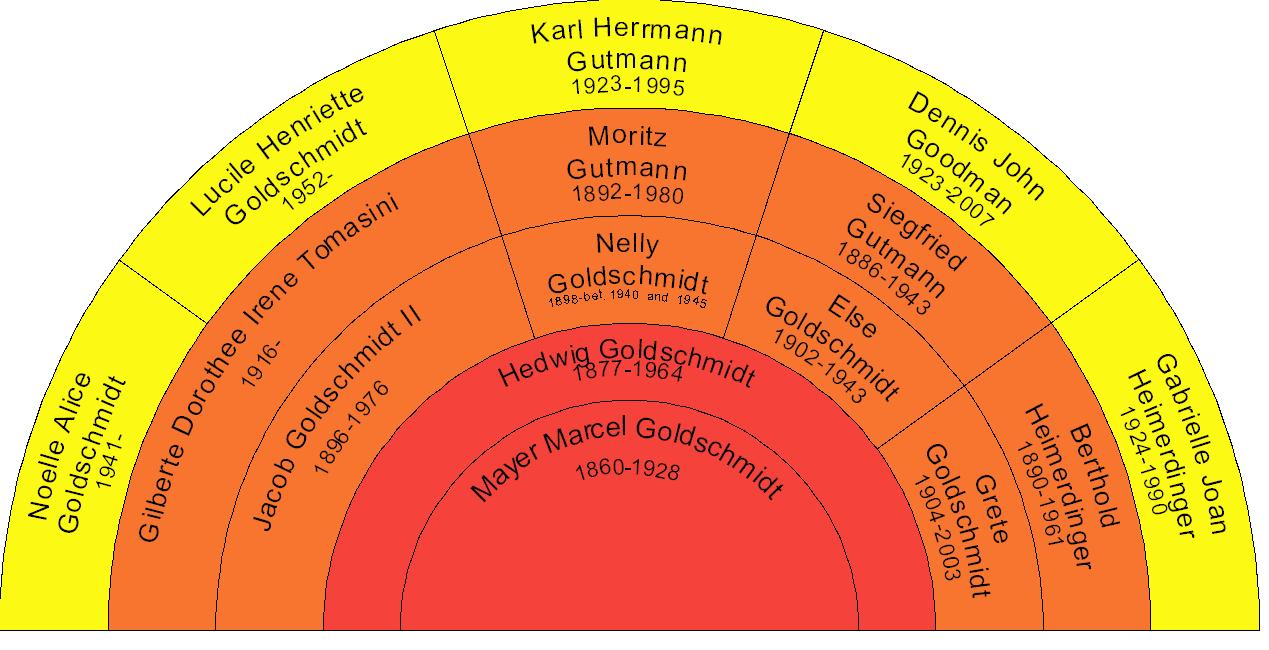
You can read more about Karl and his family here and here, but let me provide a brief overview. Karl, born in 1923, was the only child of Moritz Gutmann and my cousin Nelly Goldschmidt; Nelly was the daughter of Hedwig Goldschmidt and Marcel Goldschmidt who themselves were first cousins, the grandchildren of Meyer Goldschmidt, my four-times great-uncle.

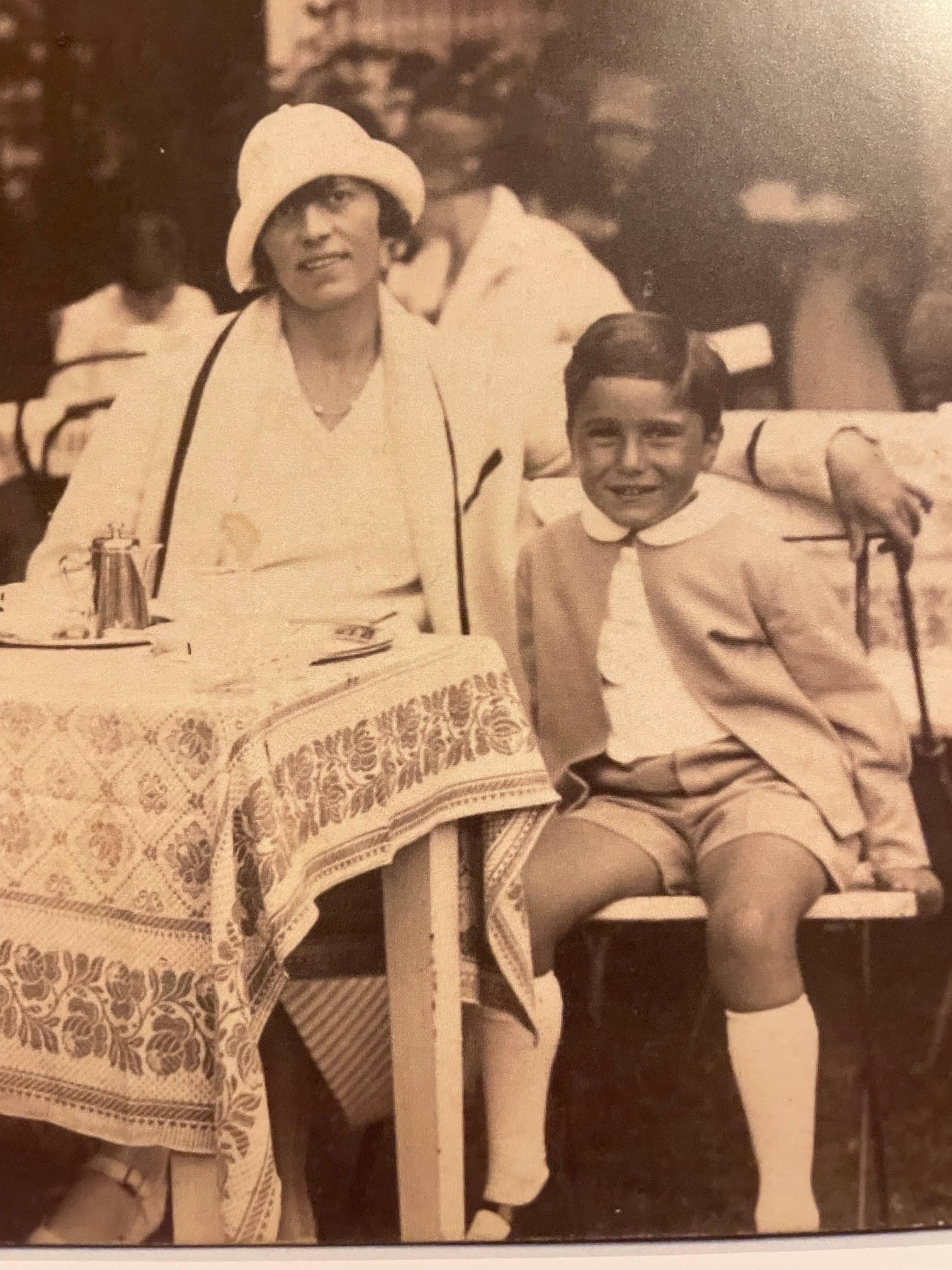
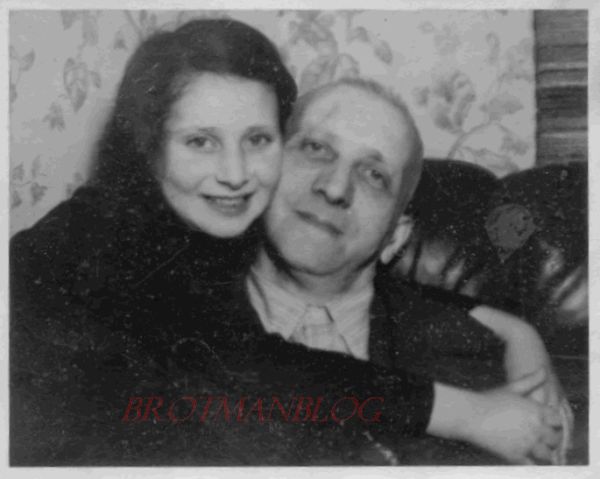
Jennifer shared with me this photograph of her grandfather Karl with his mother Nelly as well as the one that follows of Karl as a young boy.

Nelly Goldschmidt Gutmann and her son Karl Gutmann, c. 1927-1928 Courtesy of the family

Karl Gutmann Courtesy of the family

Nelly’s sister Else was married to Siegfried Gutmann, brother of Moritz Gutmann. Else and Siegfried, like Nelly and Moritz, had only one child, a son named Hermann Gutmann, later known as Dennis Goodman. I wrote about Dennis and his experiences here and here. Thus, Karl and Dennis were first cousins, and according to Jennifer, the two boys were very close growing up in Germany. They were both born in 1923, Dennis in February, Karl in May. They must have been like brothers to each other.

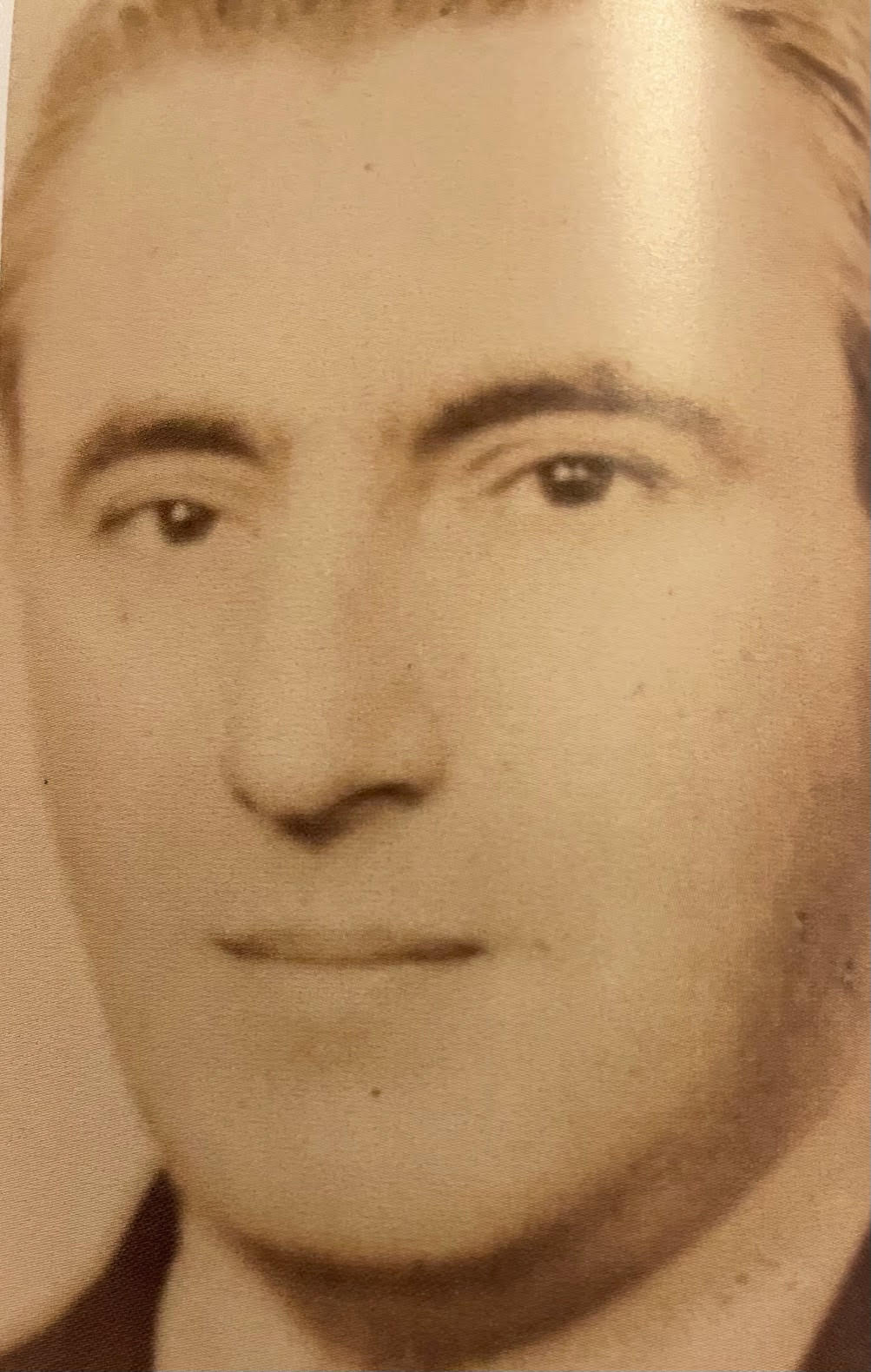
Tragically, Karl and Dennis were separated from each other because of the Nazis. As I wrote in my earlier post, Karl’s father Moritz came to the US in 1936, leaving his wife Nelly and Karl behind. What Jennifer shared with me was that her great-grandmother Nelly had long suffered from mental illness and had been institutionalized for some time before the Holocaust. Moritz, who resented the fact that her family had failed to disclose her mental health issues before they married, filed for divorce once he was in the United States. Jennifer shared this photograph of her great-grandfather Moritz Gutmann, whom she described as a very difficult man.

Moritz Gutmann Courtesy of the family

Meanwhile, Moritz and Nelly’s son Karl was living in Amsterdam as were his grandmother Hedwig Goldschmidt and his aunt Else Goldschmidt and uncle Siegfried Gutmann.  His cousin Hermann (Dennis) was sent in 1936 to England where he attended a Jewish boarding school, and the following year Karl went to the US.

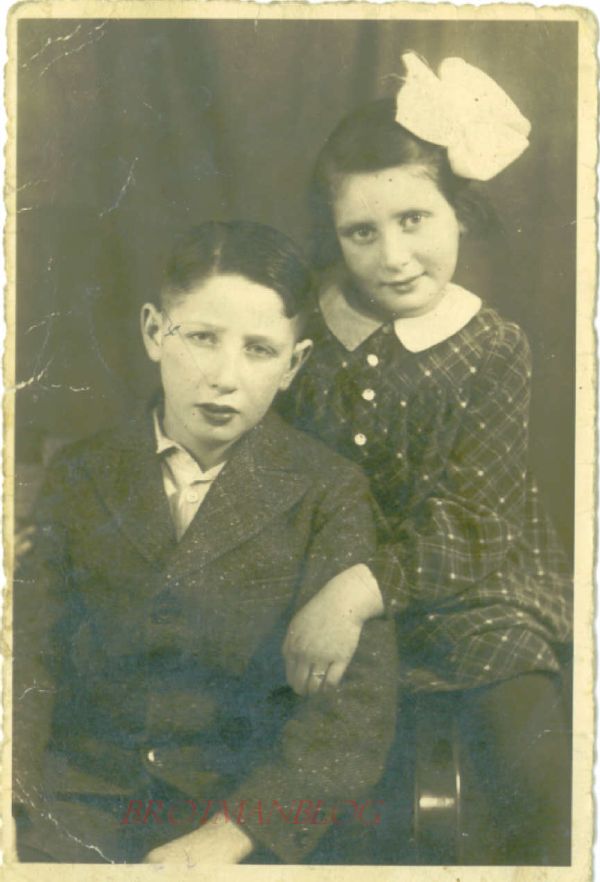
From the apparent age of Karl in this photograph (he appears to be at least thirteen), I would guess that this photograph was taken either in Amsterdam or after he came to the US. I don’t know who the other boy was.

Karl Gutman and friend Courtesy of the family

What I did not know until Jennifer shared it with me was that Karl’s father Moritz traveled to Amsterdam to get his son and bring him back to the US; I now was able to locate Moritz on the same ship as the one that brought Karl to the US. Moritz, however, was sailing in a second class cabin whereas his fourteen-year-old son was sailing third class in a separate cabin (last line on second image below).

Moritz Gutmann, Year: 1937; Arrival: New York, New York, USA; Microfilm Serial: T715, 1897-1957; Line: 1; Page Number: 124,  Statendam, Ancestry.com. New York, U.S., Arriving Passenger and Crew Lists (including Castle Garden and Ellis Island), 1820-1957

Karl Gutmann (last line), Year: 1937; Arrival: New York, New York, USA; Microfilm Serial: T715, 1897-1957; Line: 1; Page Number: 143,  Statendam, Ancestry.com. New York, U.S., Arriving Passenger and Crew Lists (including Castle Garden and Ellis Island), 1820-1957

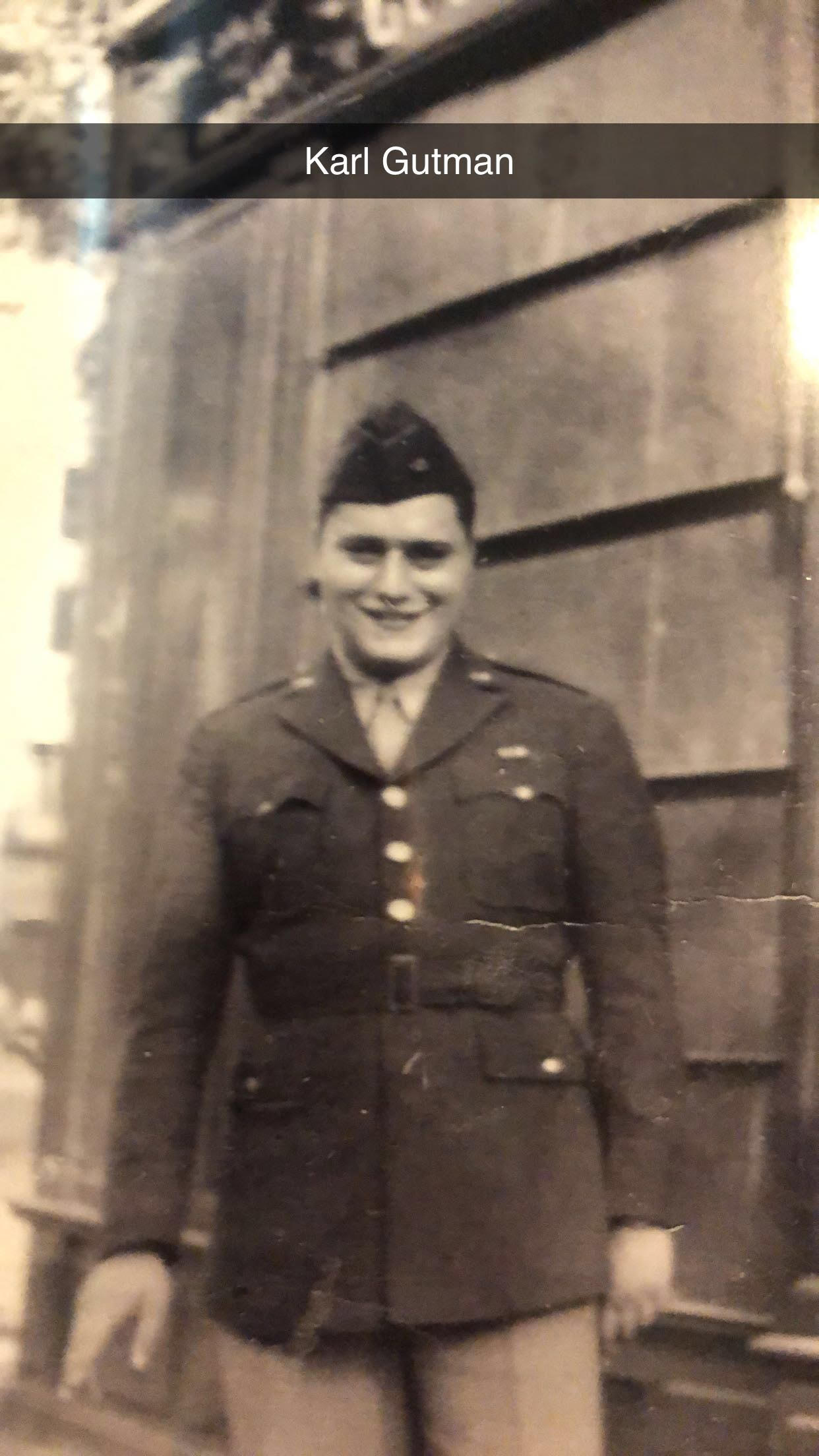
Karl earned money selling newspapers when he first got to the US, but then enlisted in the US Army in 1943. By that time he had joined his father in the art dealing business and brought art work back and forth between Europe and the US during the war. Karl became one of the Ritchie Boys, the elite espionage unit made up of German Jewish refugees who used their knowledge of Germany and German to spy on the Nazis and obtain critical military intelligence for the Allies. Here is Karl in uniform during World War II.

Karl Gutmann, c. 1945 Courtesy of the family

But it was too late to save his mother Nelly, who was killed by the Nazis in 1940. Tragically, both of Dennis Goodman’s parents were also murdered in the Holocaust. Karl and Dennis’s grandmother Hedwig Goldschmidt, however, miraculously survived after hiding in the Netherlands during the war, as described here. Jennifer shared this photograph of Hedwig, taken after she had safely immigrated to the US after the war.

Hedwig Goldschmidt Gutmann  Courtesy of the family

When Karl returned to the US after the war, he married Joan Fenton. What I had not known before Jennifer contacted me was that Joan, her grandmother, was the best friend of Karl’s first cousin Gabrielle Heimerdinger, the daughter of Greta Goldschmidt, Karl’s aunt, his mother Nelly’s sister. Gabrielle introduced Joan to Karl, and together they had three children. Jennifer, Karl and Joan’s granddaughter, has many memories of visiting her relatives in New York, including her grandfather’s first cousin Gabrielle, whose children I wrote about here. Karl went into the television repair business after the war and became quite successful.

While serving overseas as one of the Ritchie Boys, Karl had run into his cousin Dennis, Karl fighting the Nazis for the US, Dennis fighting the Nazis for England. Once the two cousins reconnected, they remained close for the rest of their lives, traveling back and forth between England and the US after the war many times. Thanks to Jennifer, I can share this photograph of Karl and Dennis joyfully reunited after the war. The other man on the left is their paternal cousin John Gutmann, and the woman is Karl’s second wife Gisela.

John Gutmann, Karl Gutmann, Gisela Bartels Gutmann, and Dennis Goodman Courtesy of the family

Jennifer remembered her grandfather Karl as a man with a strong work ethic and one who never wanted to talk about his past. But through her grandmother Joan and other family members, Jennifer was able to learn more about her grandfather’s story and the tragedies that her other relatives suffered during the Holocaust. I am so grateful that she shared their stories and her photographs with me.


The Children of Thekla and Felix Blumenfeld, Part IV: The Survivors

Thekla Blumenfeld Gruenbaum and her brother Felix Blumenfeld lost their lives in the Holocaust as did Thekla’s son-in-law Walter Herzog; Thekla’s grandson Manfred Herzog was killed fighting against Nazi Germany. But Thekla and Felix’s children and the other grandchildren all survived because most of them were able to leave Germany before it was too late.

Thekla Blumenfeld Gruenbaum’s Children and Grandchildren

Franz Moritz Gruenbaum, Thekla’s younger son, was in South Africa by 19351 and on March 18, 1937, he immigrated to the United States.2  Franz soon settled in Springfield, Massachusetts, just a few miles from where I now live, where he married a woman named Maria Pauline Strasser in 1938.3 Maria was born in Munich, Germany, on April 21, 1901, and was previously married to Richard Bachmann.4 Maria had known Franz in Kassel before they all immigrated, and she and Franz had spent time together in South Africa and traveled back to the US together in March 1937 as you can see on this ship manifest.5

Maria Bachmann and Franz Gruenbaum, ship manifest, Year: 1937; Arrival: New York, New York, USA; Microfilm Serial: T715, 1897-1957; Line: 1; Page Number: 16, Ship or Roll Number: Rex
Ancestry.com. New York, U.S., Arriving Passenger and Crew Lists (including Castle Garden and Ellis Island), 1820-1957

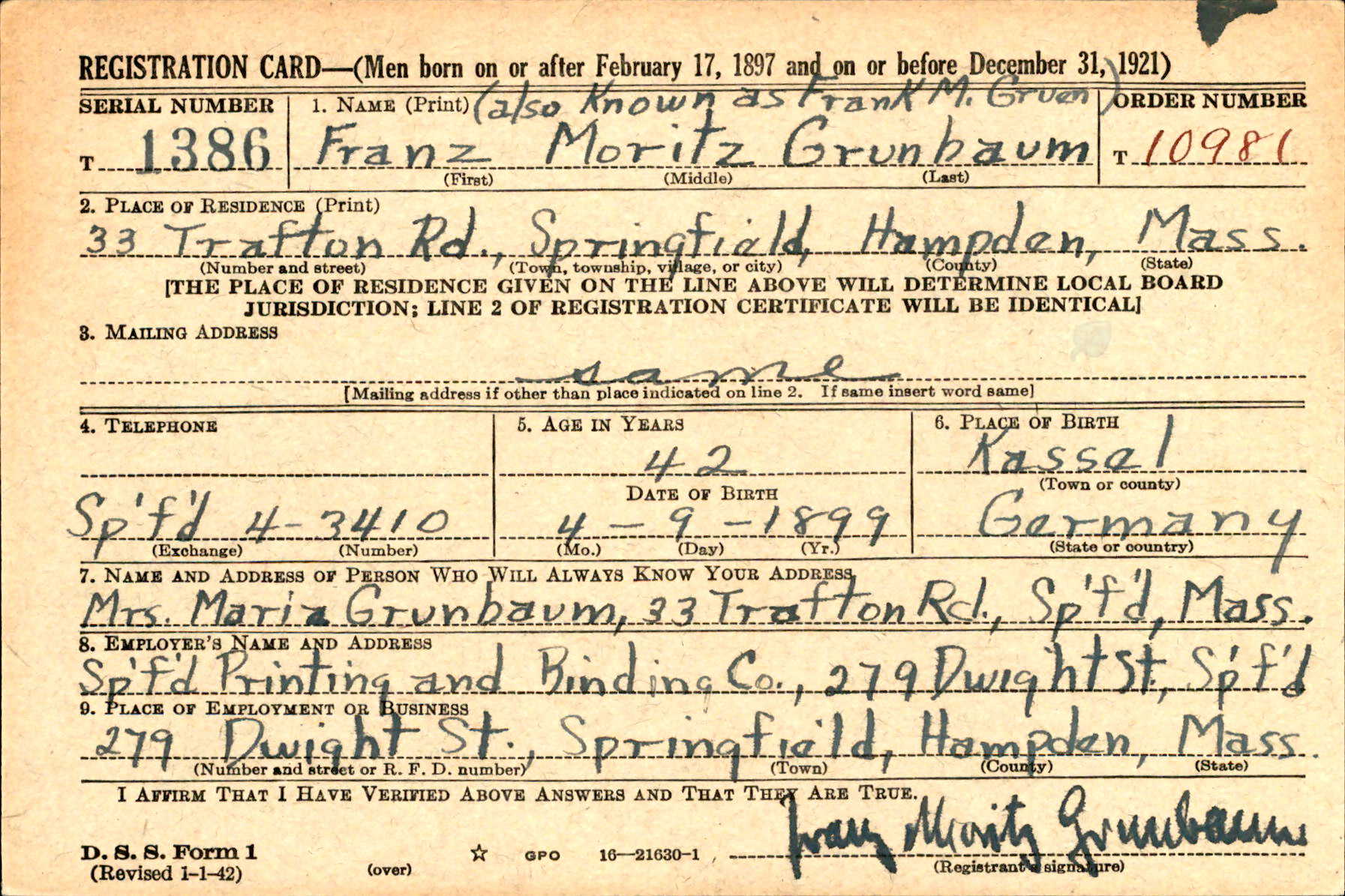
Sometime after immigrating, Franz changed his name to Frank Gruen. He and Maria settled in Springfield and lived there for at least twenty years where Frank worked in the printing business6 and Maria taught German.7 At some point they relocated to Cambridge, Massachusetts, where they were living in 1980 when they died. Frank and Maria died within months of each other, Maria in January 1980,8 Frank two months later in March.9 She was 78, and he 80.

Franz Grunbaum World War II draft registration, National Archives at St. Louis; St. Louis, Missouri; Draft Registration Cards for Massachusetts, 10/16/1940-03/31/1947; Record Group: Records of the Selective Service System, 147; Box: 402, Name Range: Gross, Abraham-Grundstrum, Edwin, Ancestry.com. U.S., World War II Draft Cards Young Men, 1940-1947

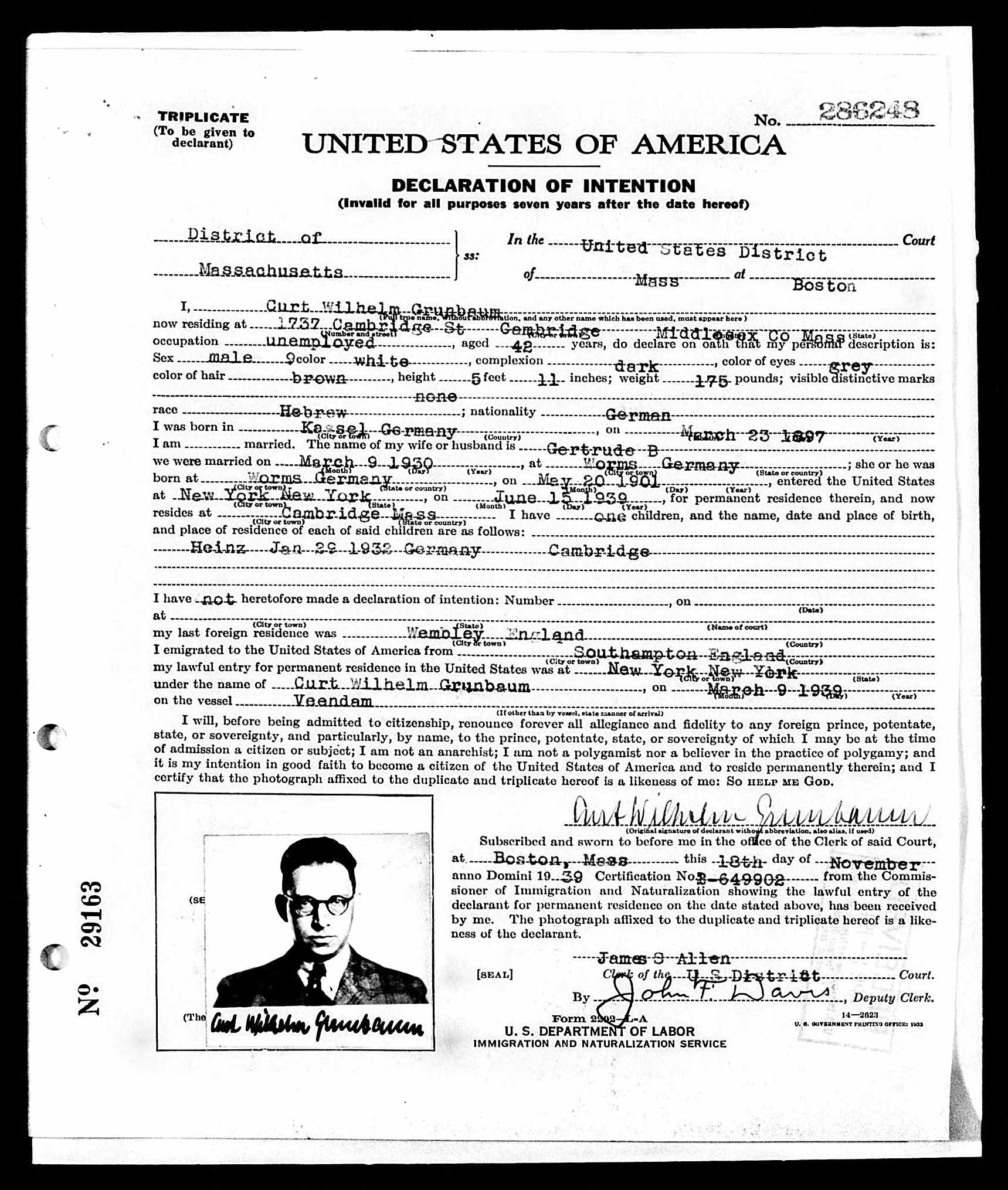
Thekla’s older son Curt Wilhelm Gruenbaum was still in Kassel, Germany, in 1935,10 but thereafter left for England and then arrived in the US on May 9, 1939. He was living with his brother Franz in Springfield by 1939, and his wife Gertrude and son Heinz joined him in Springfield on May 25, 1939.11 By 1940 Curt and his family had relocated from Springfield to Cambridge, Massachusetts, where Curt, like his brother Franz, was working in the printing business.12

Curt Wilhelm Gruenbaum, declaration of intention, National Archives at Boston; Waltham, Massachusetts; ARC Title: Petitions and Records of Naturalization , 8/1845 – 12/1911; NAI Number: 3000057; Record Group Title: Records of District Courts of the United States, 1685-2009; Record Group Number: RG 21, Description: Petition No 277730, Jayme Gonzalez – Petition No 278386, Sarah Govenar. Ancestry.com. Massachusetts, U.S., State and Federal Naturalization Records, 1798-1950

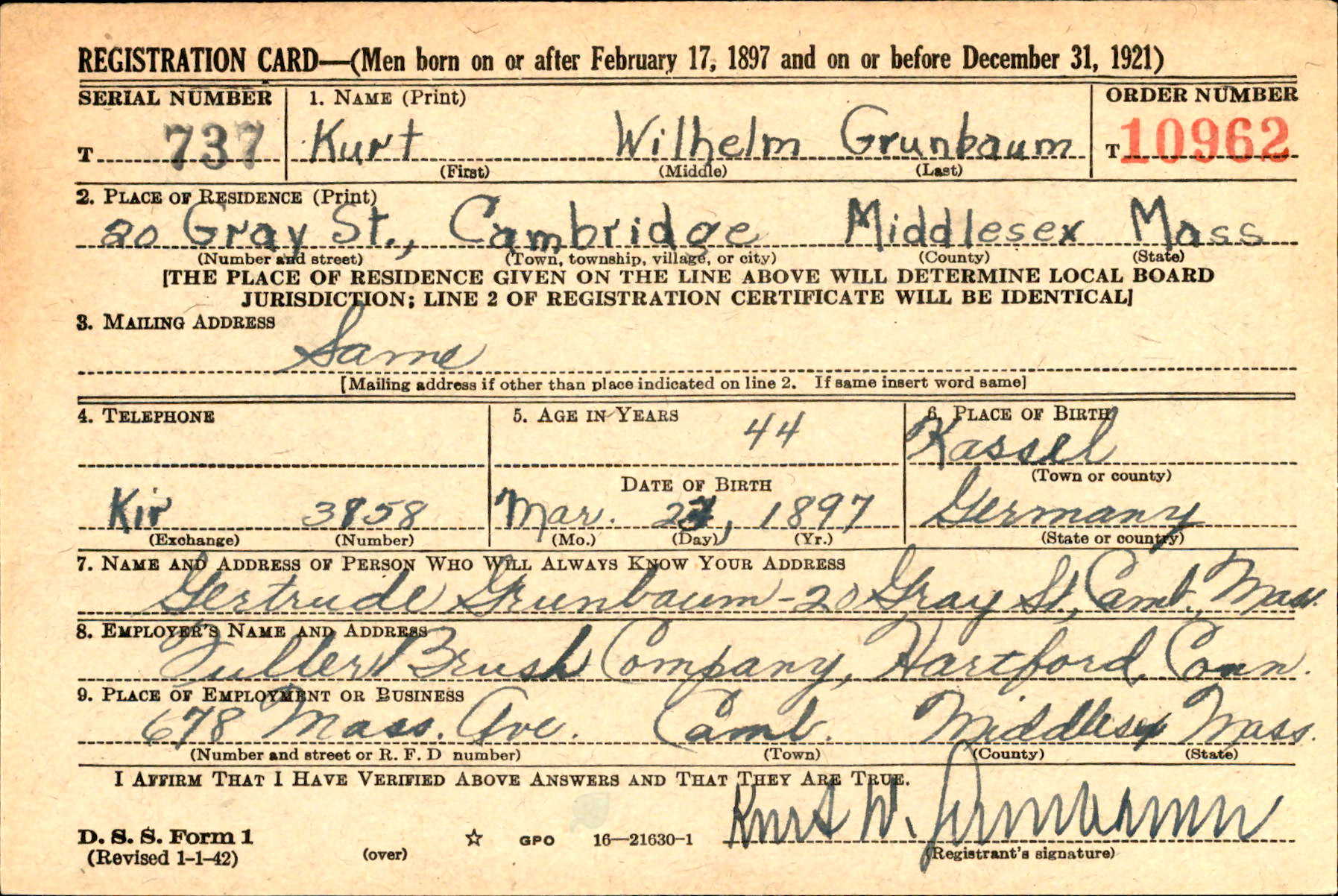
In 1942, Curt, who changed the spelling of his name to Kurt, was working for the Fuller Brush Company.

Kurt Grunbaum, World War II draft registration, National Archives at St. Louis; St. Louis, Missouri; Draft Registration Cards for Massachusetts, 10/16/1940-03/31/1947; Record Group: Records of the Selective Service System, 147; Box: 402, Name Range: Gross, Abraham-Grundstrum, Edwin, Ancestry.com. U.S., World War II Draft Cards Young Men, 1940-1947

Kurt and Gertrude’s son Heinz, who changed his name to Henry, married Barbara Ann Gillespie in 1955 in Cambridge, Massachusetts.13 She was born on December 23, 1933, in Boston to Leslie and Pearl Gillespie.14 Henry and Barbara Ann had two sons.

Kurt and his wife Gertrude remained in Cambridge for the rest of their lives, which may explain why his brother Frank and Maria relocated there. Gertrude died at the age of 76 on July 7, 1977;15 Kurt died eight years later on February 6, 1985.16 He was 87 years old. They were survived by their son Henry and his wife and children. Henry died October 22, 2008;17 he was 76; his wife Barbara Ann survived him by seven years. She died on April 24, 2015, at 81. The family created a tribute page to Henry and his family with many photos of Henry and his parents Kurt and Gertrude here.

While the two sons of Thekla Blumenfeld Gruenbaum ended up in Massachusetts, her two daughters Caecile and Rosemarie ended up in New York.

Rosemarie Gruenbaum first immigrated to England. I don’t know when, but she is listed with her husband Ernest Heymann on the 1939 England and Wales Register.18 Ernest, a silk merchant like Rosemarie’s brother-in-law Walter Herzog, was born January 24, 1902, in Brussels.19 I was unable to learn more about Ernest’s family background or to find a record for their marriage. They had one child born in England in 1940.

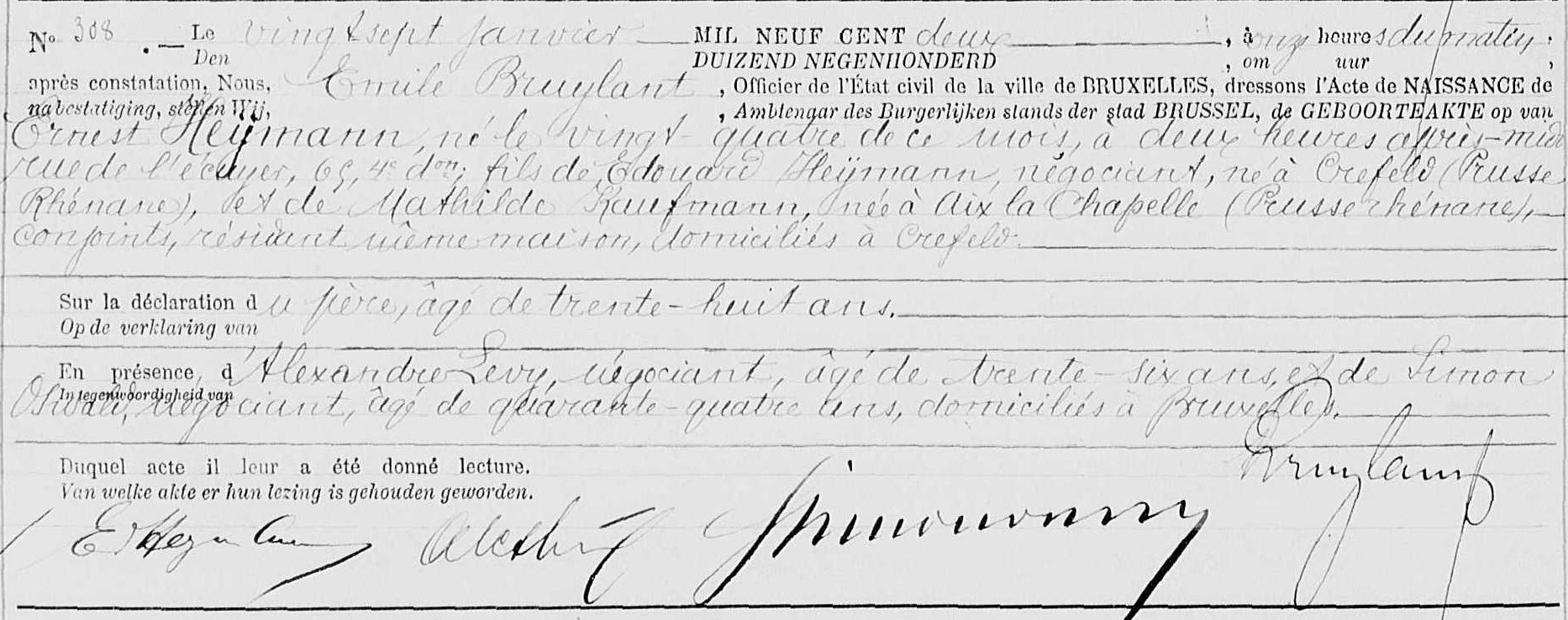
UPDATE: Thank you so much to Cathy Meder-Dempsey who read this post and on her own decided to look up Ernest Heymann’s birth record. Now I know that he was the son of Edouard Heymann, a trader who was  born in Krefeld, Germany, and Mathilde Kaufmann, who born in Aachen (Aix-la-Chapelle), Germany. Although I was able to go back another generation and find Eduoard’s parents’ names, I am still looking for a marriage record for Ernest and Rosemarie.

Birth record of Ernest Heymann, “Belgique, Brabant, registres d’état civil, 1582-1914,” database with images, FamilySearch (https://familysearch.org/ark:/61903/3:1:S3HT-DYHS-SBC?cc=1482191&wc=ST2N-6TG%3A966896201%2C967103401 : 22 May 2014), Brussel > Geboorten 14 dec (nr. 4370) 1901-sept 1902 > image 166 of 833; België Nationaal Archief, Brussels (Belgium National Archives, Brussels).

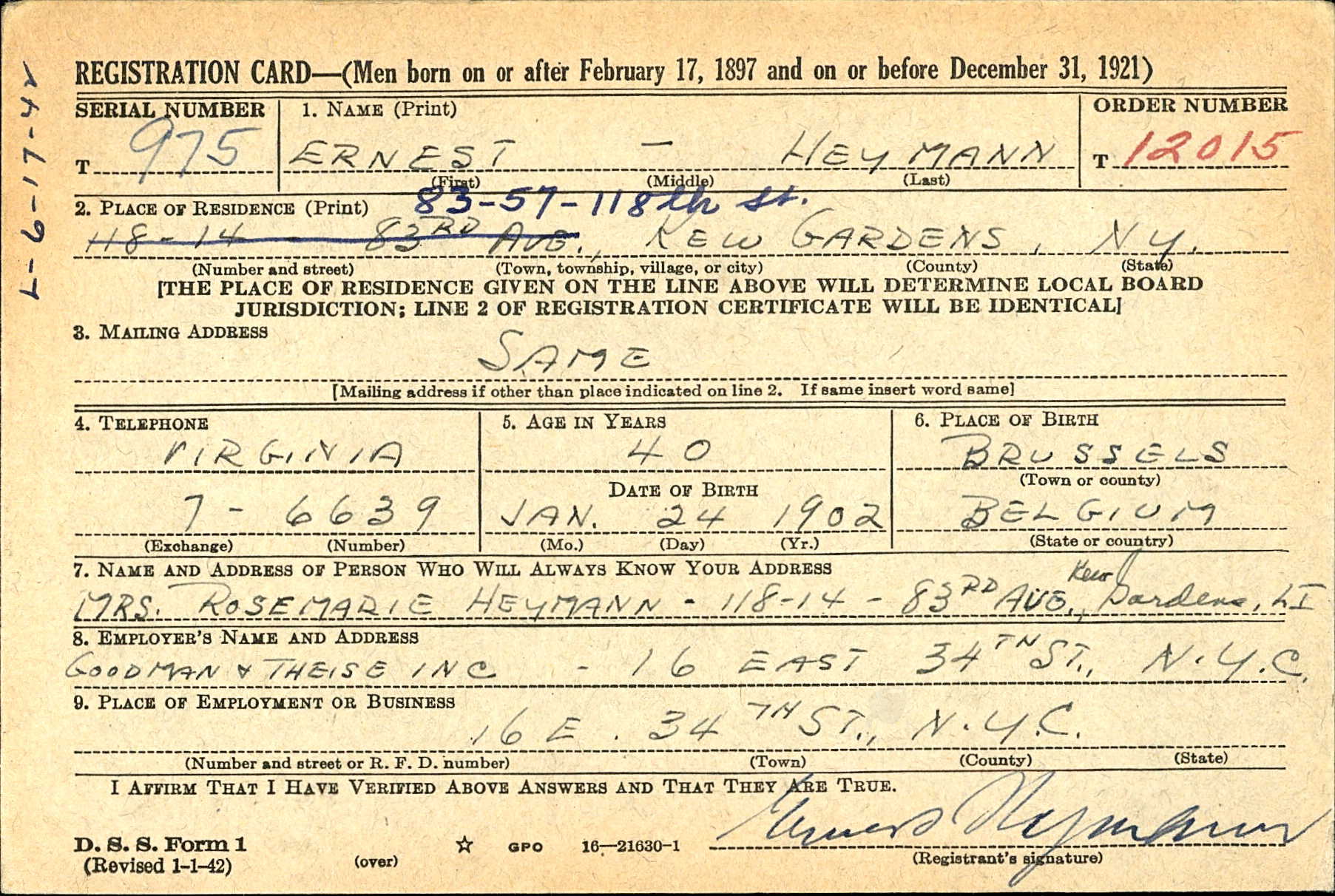
On November November 19, 1940, Rosemarie, Ernest, and their daughter left England for the US, arriving in the US in Boston on December 5, 1940.20 By February 1942 when he registered for the draft, Ernest and his family were living in Kew Gardens, Queens, New York, and he was working for Goodman and Theise, Inc., a textile company in New York City.

Ernest Heymann, World War II draft registration, National Archives at St. Louis; St. Louis, Missouri; WWII Draft Registration Cards for New York City, 10/16/1940 – 03/31/1947; Record Group: Records of the Selective Service System, 147, Ancestry.com. U.S., World War II Draft Cards Young Men, 1940-1947

Ernest Heyman (he later dropped the second N) died when he was 74 in 1976.21 His wife Rosemarie Gruenbaum Heyman outlived him by almost thirty years. She died at the age of 91 on April 14, 2004. They were survived by their daughter and her family.

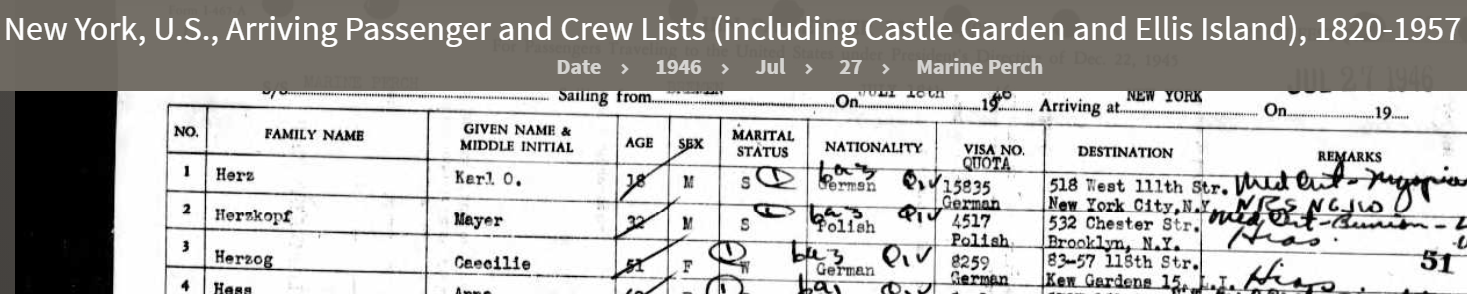
After surviving persecution in two concentration camps—at Riga and Stuffhof, Caecilie Gruenbaum Herzog arrived in New York on July 17, 1946. The manifest indicates that she was headed to 83-57 118th Street in Kew Gardens, Queens, New York, the same address listed on Ernest Heyman’s draft registration depicted above.  I have no records for Caecile between 1946 and when she died on December 13, 1990, at the age of 95 in New York.22

Year: 1946; Arrival: New York, New York, USA; Microfilm Serial: T715, 1897-1957; Line: 1; Page Number: 51, Ship or Roll Number: Marine Perch, Ancestry.com. New York, U.S., Arriving Passenger and Crew Lists (including Castle Garden and Ellis Island), 1820-1957

Caecile’s daughter Renata married Hermann Luedecke in London in the summer of 194423 and had one child with him in 1947.24 She later married Gunther Cahn in 1952,25 and they immigrated to Canada in 1955.26 Renata died in Toronto in 1995 Her husband Gunther died in 2012 in Canada.27

Felix Blumenfeld’s Children and Grandchildren

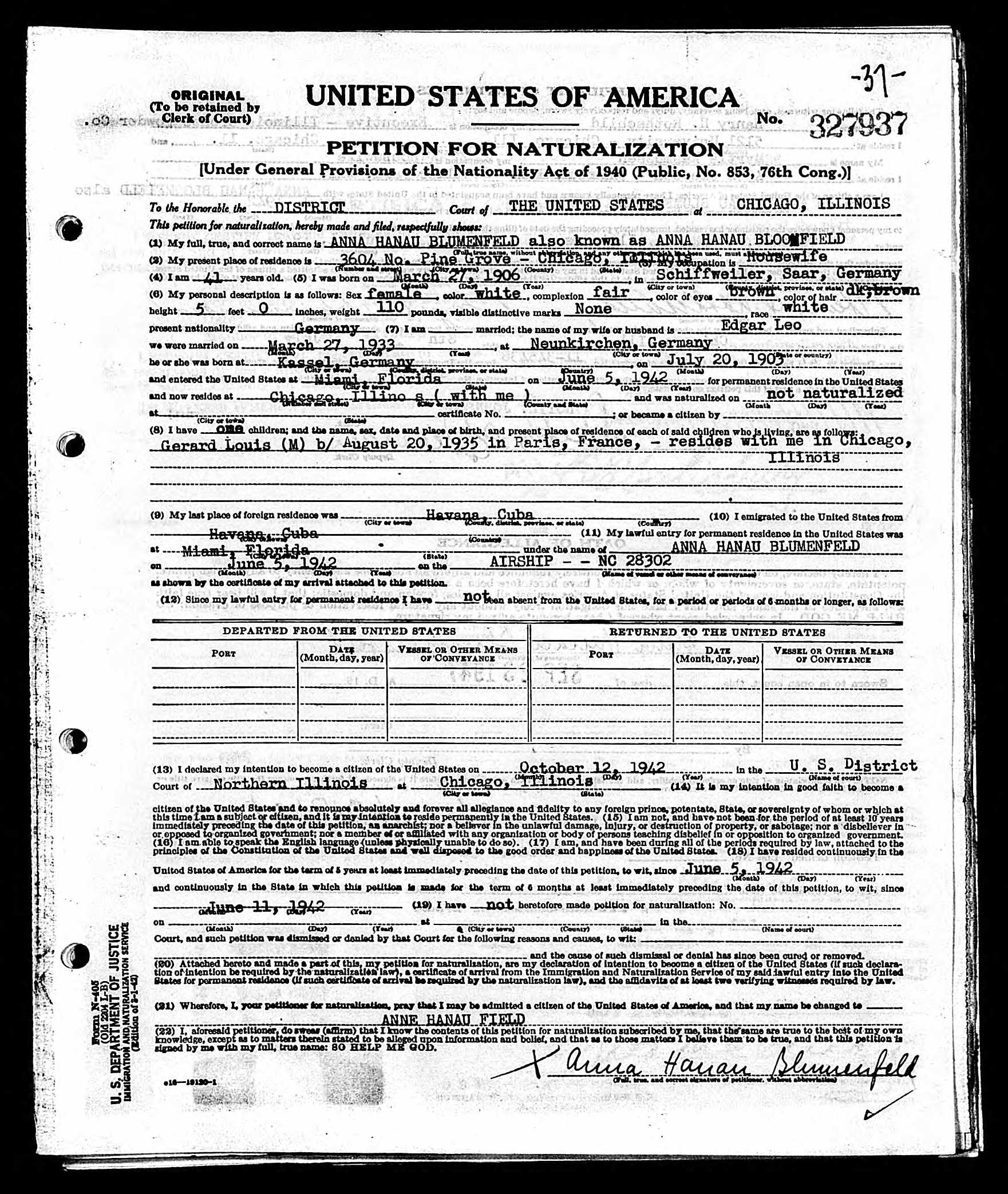
As for the children of Felix Blumenfeld, Felix’s son Edgar Blumenfeld and his wife Anna Hanau left Germany by 1935 and were living in Paris, France, when their son Gerard Blumenfeld was born on August 20, 1935. They later left for Cuba and finally immigrated to the US on October 13, 1942.

Gerhard Blumenfeld naturalization papers, National Archives at Chicago; Chicago, Illinois; ARC Title: Petitions for Naturalization, 1906-1991; Record Group Title: Records of District Courts of the United States, 1685-2009; Record Group Number: RG 21, Petitions, V· 1323-1325, No· 327901-328515, 1945, Ancestry.com. Illinois, U.S., Federal Naturalization Records, 1856-1991

They settled in Chicago and first changed their surname to Bloomfield and then to just Field. Edgar was a chemical engineer. Edgar died on June 23, 1954, in Chicago. He was only fifty years old.28 His wife Anna later remarried and died in 1997 when she was 91.29

Edgar’s brother Gerhard Blumenfeld was still in Germany when he married Lotte Hedwig Rosenthal on June 21, 1936, in Giessen.30 Lotte was born in Giessen on February 27, 1915; her parents were Max and Emma Rosenthal. By 1939 Gerhard (known as Gerd) and Lotte were living in London with Lotte’s parents and siblings. I wonder whether the two blacked out names under the names of Gerd and Lotte Blumenfeld on the 1939 England and Wales Register are the two children of Gerd’s cousin Caecilie Gruenbaum Herzog, Renata and Manfred.

The National Archives; Kew, London, England; 1939 Register; Reference: RG 101/244A
Ancestry.com. 1939 England and Wales Register

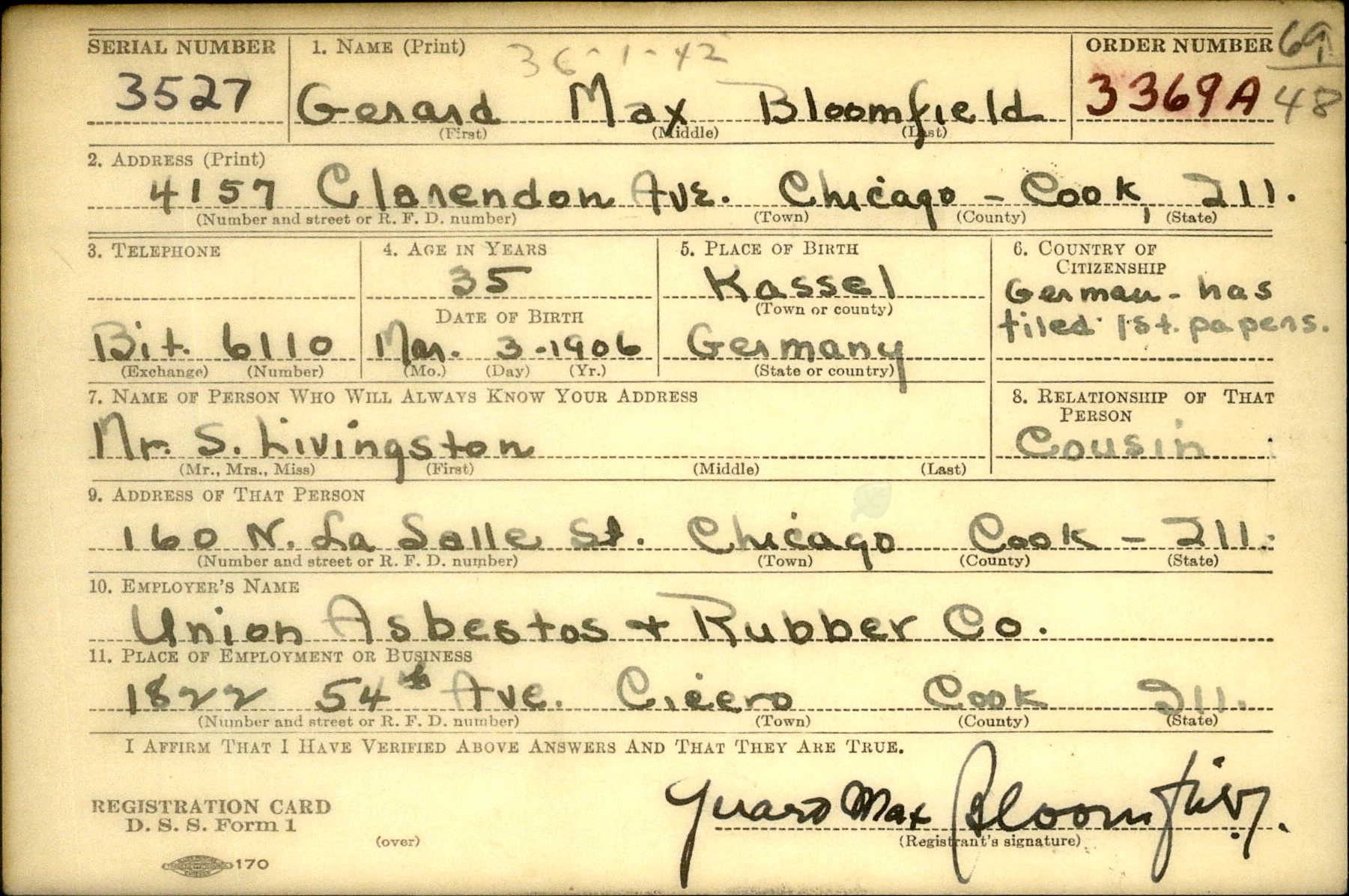
Gerd and Lotte came to the US on November 16, 194031 and settled in Chicago also. Gerd also changed his surname to Bloomfield (but not later to Field). He was an engineer like his brother Edgar and worked for Union Asbestos & Rubber Company.

Gerard Max Bloomfield, World War II draft registration, National Archives at St. Louis; St. Louis, Missouri; WWII Draft Registration Cards for Illinois, 10/16/1940-03/31/1947; Record Group: Records of the Selective Service System, 147; Box: 150, Ancestry.com. U.S., World War II Draft Cards Young Men, 1940-1947

Gerd and Lotte had two sons born in Chicago after the war. Like his brother Edgar, Gerd died in his fifties. He was fifty-three years old when he died on August 11, 1959,32 leaving behind his wife and young children. Like her sister-in-law Anna, Gerd’s wife Lotte remarried after Gerd’s early death. Lotte died on October 18, 2010, at the age of 95.33

Thus, although Thekla Blumenfeld Gruenbaum and Felix Blumenfeld,  Salomon Blumenfeld’s two children with his first wife, both were killed during the Holocaust, they have living descendants today to carry on their legacy.

Salomon Blumenfeld’s connection to his children Thekla and Felix may have been long ago broken after their mother Caecilie Erlanger died and he remarried and moved to Spain, but he has descendants today only through those children.


  1. Franz Grunbaum, 1940 US census, Year: 1940; Census Place: Springfield, Hampden, Massachusetts; Roll: m-t0627-01710; Page: 62A; Enumeration District: 22-129, Ancestry.com. 1940 United States Federal Census 
  2. Franz Moritz Grunbaum, ship manifest, Year: 1937; Arrival: New York, New York, USA; Microfilm Serial: T715, 1897-1957; Line: 1; Page Number: 16, Ship or Roll Number: Rex, Ancestry.com. New York, U.S., Arriving Passenger and Crew Lists (including Castle Garden and Ellis Island), 1820-1957 
  3. Franz Moritz Grunbaum, Marriage Year: 1938, Marriage Place: Springfield, Massachusetts, USA, Index Volume Number: 119, Reference Number: F63.M36 v.119
    Ancestry.com. Massachusetts, U.S., Marriage Index, 1901-1955 and 1966-1970 
  4. Marriage record of Maria Strasser and Richard Bachmann, Hessisches Hauptstaatsarchiv; Wiesbaden, Deutschland; Bestand: 910, Year Range: 1924, Ancestry.com. Hesse, Germany, Marriages, 1849-1930 
  5. “Asks Dedham Court to Cancel Divorce,” The Boston Globe, 28 May 1937, p. 5. 
  6. Frank Gruen, Title: Springfield, Massachusetts, City Directory, 1959, Ancestry.com. U.S., City Directories, 1822-1995 
  7. E.g., “German Again to be Taught,” Springfield Union, September 16, 1959, p. 27. 
  8.  Maria Gruen, Social Security Number: 017-20-3941, Birth Date: 21 Apr 1901
    Issue Year: Before 1951, Issue State: Massachusetts, Last Residence: 02138, Cambridge, Middlesex, Massachusetts, USA, Death Date: Jan 1980, Social Security Administration; Washington D.C., USA; Social Security Death Index, Master File,
    Ancestry.com. U.S., Social Security Death Index, 1935-2014 
  9.  Frank Gruen, Social Security Number: 031-01-6909, Birth Date: 9 Apr 1899
    Issue Year: Before 1951, Issue State: Massachusetts, Last Residence: 02138, Cambridge, Middlesex, Massachusetts, USA, Death Date: Mar 1980, Social Security Administration; Washington D.C., USA; Social Security Death Index, Master File,
    Ancestry.com. U.S., Social Security Death Index, 1935-2014 
  10. Curt Gruenbaum, 1940 US census, Year: 1940; Census Place: Cambridge, Middlesex, Massachusetts; Roll: m-t0627-01685; Page: 10A; Enumeration District: 16-82,  Ancestry.com. 1940 United States Federal Census 
  11. Gertrude and Heinz Gruenbaum, ship manifest, Year: 1939; Arrival: New York, New York, USA; Microfilm Serial: T715, 1897-1957; Line: 4; Page Number: 122, Ancestry.com. New York, U.S., Arriving Passenger and Crew Lists (including Castle Garden and Ellis Island), 1820-1957 
  12. See note 10. 
  13. Henry Walter Grunbaum, Marriage Year: 1955, Marriage Place: Cambridge, Massachusetts, USA, Index Volume Number: 159, Reference Number: F63.M36 v.159,
    Ancestry.com. Massachusetts, U.S., Marriage Index, 1901-1955 and 1966-1970 
  14. Barbara Ann Gillespie, Birth Date: 1933, Birth Place: Boston, Massachusetts, USA, Volume Number: 35, Page Number: 201, Index Volume Number: 128
    Reference Number: F63.M362 v.128, Ancestry.com. Massachusetts, U.S., Birth Index, 1860-1970; Barbara G Grunbaum, Birth Date: 23 Dec 1933, Residence Date: 1993
    Address: 29 Huron Ave, Residence: Cambridge, MA, Postal Code: 02138-6705, Ancestry.com. U.S., Public Records Index, 1950-1993, Volume 1. 
  15. Gertrude B Grunbaum, Certificate: 034745, Death Place: Cambridge. Death Date: 7 Jul 1977, Birth Place: Other, Ancestry.com. Massachusetts, U.S., Death Index, 1970-2003 
  16. Kurt W Grunbaum, Certificate: 017505, Death Place: Cambridge, Death Date: 6 Feb 1985, Birth Place: Other, Birth Date: 23 Mar 1897, Ancestry.com. Massachusetts, U.S., Death Index, 1970-2003 
  17.  Henry W. Grunbaum, Social Security Number: 024-26-8623, Birth Date: 29 Jan 1932, Issue Year: 1951-1952, Issue State: Massachusetts, Last Residence: 02138, Cambridge, Middlesex, Massachusetts, Death Date: 22 Oct 2008, Social Security Administration; Washington D.C., USA; Social Security Death Index, Master File, Ancestry.com. U.S., Social Security Death Index, 1935-2014 
  18.  The National Archives; Kew, London, England; 1939 Register; Reference: RG 101/950H, Enumeration District: BWCO, Ancestry.com. 1939 England and Wales Register 
  19. Ernest Heyman, Race: White, Age: 40, Birth Date: 24 Jan 1902, Birth Place: Brussels, Belgium, Registration Date: 15 Feb 1942, Registration Place: Kew Gardens, New York, New York. Employer: Goodman and Theise Inc., National Archives at St. Louis; St. Louis, Missouri; WWII Draft Registration Cards for New York City, 10/16/1940 – 03/31/1947; Record Group: Records of the Selective Service System, 147, Ancestry.com. U.S., World War II Draft Cards Young Men, 1940-1947 
  20. Ernst Heymann and family, ship manifests, The National Archives; Kew, Surrey, England; BT27 Board of Trade: Commercial and Statistical Department and Successors: Outwards Passenger Lists; Reference Number: Series BT27-147363, Month: Nov, Ancestry.com. UK and Ireland, Outward Passenger Lists, 1890-1960; The National Archives at Washington, D.C.; Washington, D.C.; Series Title: Passenger Lists of Vessels Arriving at Boston, Massachusetts, 1891-1943; NAI Number: 4319742; Record Group Title: Records of the Immigration and Naturalization Service, 1787-2004; Record Group Number: 85; Series Number: T843; NARA Roll Number: 451, Month or Roll: 451, Ancestry.com. Massachusetts, U.S., Arriving Passenger and Crew Lists, 1820-1963 
  21.  Ernest Heyman, Social Security Number: 100-12-9367, Birth Date: 24 Jan 1902
    Issue Year: Before 1951, Issue State: New York, Last Residence: 11375, Flushing, Queens, New York, USA, Death Date: Mar 1976, Social Security Administration; Washington D.C., USA; Social Security Death Index, Master File, Ancestry.com. U.S., Social Security Death Index, 1935-2014 
  22. Ceci Herzog, Birth Date: 26 Apr 1895, Death Date: 13 Dec 1990, Claim Date: 3 Aug 1960, SSN: 110267687, Death Certificate Number: 169466, Ancestry.com. U.S., Social Security Applications and Claims Index, 1936-2007 
  23.  Renate Herzoz, Registration Quarter: Jul-Aug-Sep, Registration District: Hampstead, Inferred County: London, Spouse: Hermann K A Luedecke, Volume Number: 1a, Page Number: 1109, General Register Office; United Kingdom; Volume: 1a; Page: 1109, Ancestry.com. England & Wales, Civil Registration Marriage Index, 1916-2005 
  24.  Carol A Luedioke [sic], Registration Quarter: Jul-Aug-Sep, Registration District: Hampstead, Inferred County: Greater London, Mother’s Maiden Name: Herzog, Volume Number: 5c, Page Number: 1526, General Register Office; United Kingdom; Reference: Volume 5c, Page 1526, Ancestry.com. England & Wales, Civil Registration Birth Index, 1916-2007 
  25.  Guenther Cahn, Registration Quarter: Jan-Feb-Mar, Registration District: Hendon
    Inferred County: Middlesex, Spouse: Renate Luedecke Or Herzog, Volume Number: 5e
    Page Number: 1431, General Register Office; United Kingdom; Volume: 5e; Page: 1431, Ancestry.com. England & Wales, Civil Registration Marriage Index, 1916-2005 
  26.  The National Archives; Kew, Surrey, England; BT27 Board of Trade: Commercial and Statistical Department and Successors: Outwards Passenger Lists; Reference Number: Series BT27-, Ancestry.com. UK and Ireland, Outward Passenger Lists, 1890-1960 
  27. I could not locate any records or obituaries for the deaths of Renata and Gunther Cahn so am referring to their profiles on MyHeritage for this information. 
  28. “Illinois, Cook County Deaths, 1871-1998,” database, FamilySearch (https://familysearch.org/ark:/61903/1:1:Q2MH-PGMM : 17 March 2018), Edgar L Field, 23 Jun 1954; citing Lincolnwood, Cook, Illinois, United States, source reference , record number , Cook County Courthouse, Chicago; FHL microfilm. 
  29. Anne Bloomfield, [Anne Prower] [Anne Field] [Anne Hanau]Gender: Female
    Race: White, Birth Date: 27 Mar 1906, Birth Place: Schiffweiler, France, Death Date: 24 Dec 1997, Father: Victor Hanau Mother:Mina May, SSN: 361208715
    Notes: Jul 1943: Name listed as ANNE BLOOMFIELD; : Name listed as ANNE PROWER; : Name listed as ANNE H FIELD; 04 Feb 1998: Name listed as ANNE H PROWER, Ancestry.com. U.S., Social Security Applications and Claims Index, 1936-2007 
  30. Gerhard Max Bloomfield, petition for naturalization, National Archives at Chicago; Chicago, Illinois; ARC Title: Petitions for Naturalization, 1906-1991; Record Group Title: Records of District Courts of the United States, 1685-2009; Record Group Number: RG 21, Description: Petitions For Naturalization, V· 1291, No· 320051-320300, Ca· 1944-1946, Ancestry.com. Illinois, U.S., Federal Naturalization Records, 1856-1991 
  31. Gerd and Lotte Blumenfeld, ship manifest, The National Archives at Washington, D.C.; Washington, D.C.; Series Title: Passenger Lists of Vessels Arriving at Boston, Massachusetts, 1891-1943; NAI Number: 4319742; Record Group Title: Records of the Immigration and Naturalization Service, 1787-2004; Record Group Number: 85; Series Number: T843; NARA Roll Number: 451, Ancestry.com. Massachusetts, U.S., Arriving Passenger and Crew Lists, 1820-1963 
  32. Find a Grave, database and images (https://www.findagrave.com/memorial/9198671/gerd-m-bloomfield : accessed 16 October 2021), memorial page for Gerd M Bloomfield (3 Mar 1906–11 Aug 1959), Find a Grave Memorial ID 9198671, citing Jewish Cemetery, Bloomington, McLean County, Illinois, USA ; Maintained by Robin Farley Dixson Coon (contributor 46558224) . 
  33. Find a Grave, database and images (https://www.findagrave.com/memorial/137430315/lottie-rosenthal-klein : accessed 16 October 2021), memorial page for Lottie Rosenthal Bloomfield Klein (27 Feb 1915–18 Oct 2010), Find a Grave Memorial ID 137430315, citing Jewish Cemetery, Bloomington, McLean County, Illinois, USA ; Maintained by Gary Ayers (contributor 48159041) . 

Salomon Blumenfeld’s Children Thekla and Felix: Killed by the Nazis

In April, 1933,  Salomon Blumenfeld’s two children from his first marriage, Thekla Blumenfeld Gruenbaum and Felix Blumenfeld, were both living in Kassel, Germany. All of their children and grandchildren were also still in Germany. With Hitler’s rise to power, some of the family members left Germany not long afterwards. But others were not so fortunate.

Thekla Blumenfeld Gruenbaum was murdered by the Nazis. She was first deported to Theriesenstadt on July 25, 1942.  Two months later on September 26, 1942, she was sent to the extermination camp at Treblinka where she was killed. She was seventy years old. She had lived a hard life—losing her mother when she was just a toddler, being left behind by her father a few years later, losing her husband, and then being killed at Treblinka.

Thekla’s daughter Caecilie and her husband Walter Herzog were living in Krefeld, Germany, before the war. I am still researching where and when, but the evidence indicates that the two children of Caecilie and Walter, Renata and Manfred, were sent to England before the war.1 Walter was a successful silk tie manufacturer and had deposited a fair amount of money in a Swiss banking account; that account was confiscated by the Nazis.2 In December 1941, both Walter and Caecile3 were deported to the concentration camp in Riga, Latvia. Walter was later transferred to Buchenwald where he was “declared dead” on May 8, 1945.

Caecile was sent from Riga to the Stutthof concentration camp.4 The Holocaust Encyclopedia provided this information about the Stutthof camp:5

Conditions in the camp were brutal. Many prisoners died in typhus epidemics that swept the camp in the winter of 1942 and again in 1944. Those whom the SS guards judged too weak or sick to work were gassed in the camp’s small gas chamber. Gassing with Zyklon B View This Term in the Glossary gas began in June 1944. Camp doctors also killed sick or injured prisoners in the infirmary with lethal injections. More than 60,000 people died in the camp.

The Germans used Stutthof prisoners as forced laborers. … In 1944, as forced labor by concentration camp prisoners became increasingly important in armaments production, a Focke-Wulff airplane factory was constructed at Stutthof. Eventually, the Stutthof camp system became a vast network of forced-labor camps….

The evacuation of prisoners from the Stutthof camp system in northern Poland began in January 1945. When the final evacuation began, there were nearly 50,000 prisoners, the overwhelming majority of them Jews, in the Stutthof camp system. About 5,000 prisoners from Stutthof subcamps were marched to the Baltic Sea coast, forced into the water, and machine gunned. The rest of the prisoners were marched in the direction of Lauenburg in eastern Germany. They were cut off by advancing Soviet forces. The Germans forced the surviving prisoners back to Stutthof. Marching in severe winter conditions and treated brutally by SS guards, thousands died during the march.

In late April 1945, the remaining prisoners were removed from Stutthof by sea, since Stutthof was completely encircled by Soviet forces. Again, hundreds of prisoners were forced into the sea and shot. … It has been estimated that over 25,000 prisoners, one in two, died during the evacuation from Stutthof and its subcamps. 

Soviet forces liberated Stutthof on May 9, 1945, and liberated about 100 prisoners who had managed to hide during the final evacuation of the camp.

How did Caecilie manage to survive this ordeal? Was she one of the hundred who were hiding in the camp during its final evacuation? Her odds for survival were overwhelmingly low, yet somehow she did. After time as a displaced person and with the help of HIAS (Hebrew Immigrant Aid Society), she was able to immigrate to the US in July 1946.

Arolesn Archives; Bad Arlosen, Germany, Resettlement Year: 1946, Ancestry.com. Free Acces Africa, Asia and Europe, Passenger Lists of Displaced Persons, 1946-1971

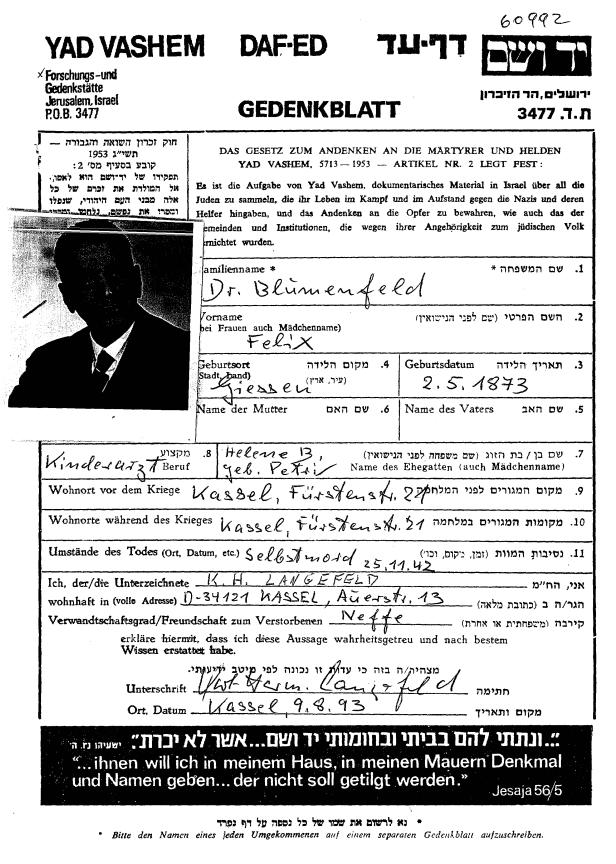
I was able to locate more information about Thekla’s brother Felix Blumenfeld through several sources, including a detailed and well-sourced biography online. Felix had studied medicine at both the University of Marburg and the University of Munich. He served as a ship’s doctor and later as doctor in a POW camp during World War I. As we saw, Felix lost his first wife Thekla Wertheim in 1917, and on February 16, 1920, in Nordhausen, Germany, he married his second wife Helene Petri, who was not Jewish. She was born on October 20, 1894, in Nordhausen, the daughter of Fritz Petri and Bertha Peter. Felix and Helene were living in Kassel, where Felix was a practicing pediatrician.

The detailed biography of Felix I found online describes in great detail all the contributions that Felix made as a doctor and citizen in Kassel.

Encouraged by the high infant mortality rate among children of poor parents, he began to use his position as a doctor and to get involved in society. At his suggestion, milk kitchens were built in which perfectly hygienic milk-grain mixtures were produced as baby food and sold using a deposit bottle system . The products were also given free of charge to the poor.

He also served as the medical director of the children and infant’s home/hospital in the city and also was involved in other charitable and civic organizations.

Despite his service in World War I and all these contributions he made as a doctor and citizen, Felix was persecuted by the Nazis. 

Just a few weeks after the National Socialists came to power on April 1, 1933, as a Jew, he was deprived of the management of the children’s hospital, he was banned from working and had to give up his apartment and practice…. His property and library were confiscated and owing to the fact that his wife Leni was not Jewish, he was initially allowed to live in his summer house a…. He was forced to do auxiliary and road construction work and had to collect rags and scrap at the municipal scrap yard . He was exposed to constant discrimination and surveillance by the Gestapo.

A second biography written for the occasion of the installation of Stolpersteine in Felix Blumenfeld’s honor in Kassel also reported this information and explained that Felix ultimately decided to end his own life in order to avoid deportation and also to protect his wife Helene.

Before killing himself on January 25, 1942, Felix wrote a long letter to his two sons in America, Edgar and Gerd, explaining why he had decided to take his own life. The first part of the letter details some of the abuse and persecution he had endured, and then he ends with these paragraphs, as translated by DeepL:

But enough of that ! Let’s get to the main thing ! Life is no longer bearable for me! All my hope, to which I had clung, was to get out of this hell and to be united with you in a near or distant time. I dare not count on that hope any longer. For with the years of war my years of life also increase. But the worst thing at the present moment is that out of sheer arbitrariness they have deprived me of all my property and referred me to my hands work or to public welfare. Subsequently, they also “expropriated the wife of the Jew”, although since 1939 there had been a legal separation of property, i.e. there was no legal basis for this. Leni was in Berlin and has the prospect of getting part of her property back if she gets a divorce. I want to agree to this divorce in order not to endanger Lenimutter’s livelihood again and again through my person. In that case, however, my life, which has been ruined through no fault of my own, has lost all the more meaning, especially since it is not known what else will be done to us.

Under these circumstances, death seems more desirable to me than an existence with ever new torments. I am therefore leaving this world of meanness, baseness and inhumanity in order to enter eternal peace and to seek the path that leads from darkness to light.

My last thoughts belong to my faithful comrade, on an often thorny path, and to you my beloved children, my Edgar, Gerd, Annchen, Lotte and Little Gerard ! You will be with me in the hour that demands strength and courage. Especially with you, my Gerd, I would have liked to hold a conversation, you dear, you good one! Stay as good as you have been so far, and be the one who makes sure that you always stay together faithfully. Then I am always in your midst and remain eternally connected with you. Without looking backwards, move forward and build a more beautiful life in a hopefully better world. May it be a comforting thought to you that your father is relieved of all fear, worry and pain after his departure. We remain united ! ! You will never forget me, I know that, because my love for you was, is and will be infinite.

V a t e r

*** Translated with http://www.DeepL.com/Translator (free version) ***

Like his sister Thekla, Felix Blumenfeld lost his mother as a baby, then his father, and then his first wife. Nevertheless, he grew up to be a devoted father and pediatrician who contributed greatly to his community. Although not technically murdered by the Nazis, Felix is also rightfully counted among those whose deaths were caused by Nazi persecution.

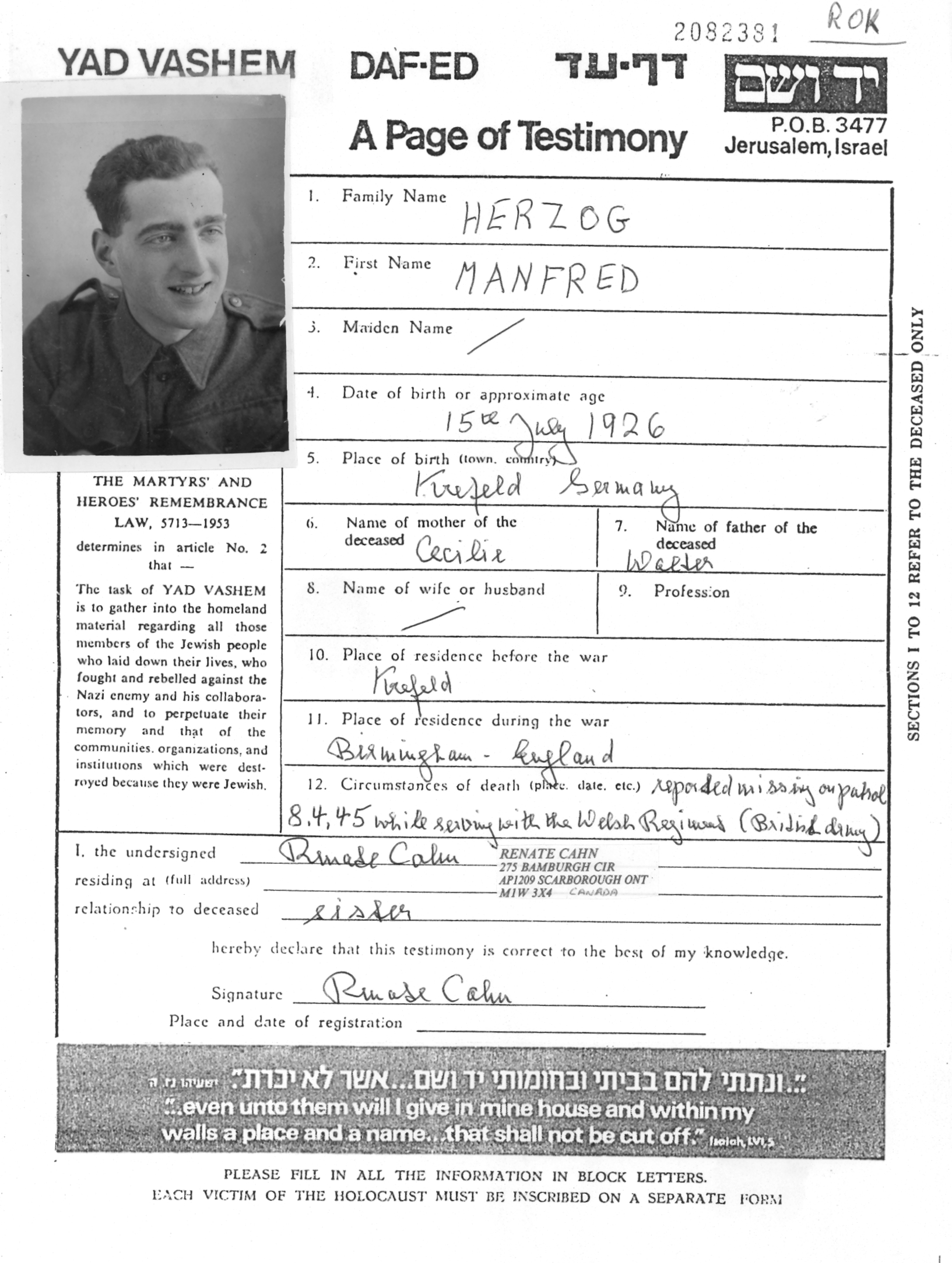
There was one more death in the family attributable to Nazi Germany. Thekla Blumenfeld Gruenbaum’s grandson, Caecilie and Walter Herzog’s son Manfred, was killed in action while fighting for the Allies in Europe sometime in the spring of 1945.

Thus, the Nazis killed both Thekla and Felix, the two children Salomon Blumenfeld had with his first wife Caecilie Erlanger, as well as Thekla’s son-in-law Walter Herzog; in addition, Thekla’s grandson Manfred Herzog died fighting the Nazis in World War II. I can’t help but think about how Felix and Thekla’s lives would have been different if their father Salomon had taken them with him when he moved to Spain.

They were survived by the rest of the family. Their stories will be told in the next post.


  1. To be discussed in the next post. 
  2. Special Master’s Final Report on the Holocaust Victim Assets Litigation (Swiss Banks Settlement), Case No. CV 96-4849 (ERK)(MDG) (Consolidated with CV 96-5161 and CV 97-461) United States District Court, Eastern District of New York, pp.28-30. 
  3. Cecilia Herzog [Cecilia Gruenbaum] Birth Date: 26 Apr 1900 Birth Place: Kassel
    Residence: Krefeld Camp: Riga/Stutthof Ancestry.com. Poland, German Jews at Stutthof Concentration Camp, 1940-1945; Entry at the US Holocaust Memorial and Museum at https://www.ushmm.org/online/hsv/person_view.php?PersonId=3187531 
  4. See Note 3. 
  5. United States Holocaust Memorial Museum. “Stutthof.” Holocaust Encyclopedia. https://encyclopedia.ushmm.org/content/en/article/stutthof Accessed October 5, 2021. 

The Final Chapter of Baruch Blumenfeld’s Family: His Daughter Charlotte

Having told the story of Antonie Blumenfeld Engelbert and that of her children Margot, Julius, and Elfriede and of her grandchildren Edith, Werner, Gunther, and Inge, I now turn to the story of Antonie’s younger sister, Charlotte Blumenfeld, daughter of Baruch Blumenfeld and Emma Docter.

Charlotte Jeanette Blumenfeld, as we saw, married Hermann Hammel on January 24, 1900, and they had one daughter, Klara, who was born on February 17, 1901, in Frankfurt, Germany, where Charlotte and Hermann resided. Hermann was a merchant.

On July 26, 1920, in Frankfurt, Klara Hammel married Siegfried Braun. He was more than eleven years older than Klara and was born in Nuernberg on August 27, 1889. His parents were Isidor Braun and Kathi Hermann; both had died by the time Siegfried served in the German army during World War I. Siegfried served for at least three years of the war in the infantry and in the automobile replacement unit. When he married Klara in 1920, he was living in Frankfurt and working as a merchant.

Marriage record, Klara Hammel to Siegfried Braun, Hessisches Hauptstaatsarchiv; Wiesbaden, Deutschland; Bestand: 903, Ancestry.com. Hesse, Germany, Marriages, 1849-1930

Bayerisches Hauptstaatsarchiv; München; Abteilung IV Kriegsarchiv. Kriegstammrollen, 1914-1918; Volume: 18828. Kriegsstammrolle: Bd. 6, Volume: 18828- Kriegsstammrolle: Bd- 6, Ancestry.com. Bavaria, Germany, World War I Personnel Rosters, 1914-1918

Klara and Siegfried’s first child Lieselotte was born in Frankfurt on September 4, 1922.1 Her brother Walter Isidor Braun was born a year later on December 7, 1923, also in Frankfurt.2 A third child was stillborn on January 25, 1926, in Frankfurt.3

The life of this family changed dramatically once Hitler came to power. I am very grateful to Klara and Siegfried’s grandson Stephen for sharing their stories with me. They all immigrated to Amsterdam not long after Hitler’s rise to power. While there, Lieselotte, then a teenager, met the man who would later become her husband, Fritz (later Fred) Rothschild. He was son of Daniel Rothschild and Martha Aumann and was born in Bruchsal, Germany, on August 22, 1921. His family also had left Germany for Amsterdam to escape the Nazis.4

Hermann Hammel, Charlotte Blumenfeld’s husband, died in Amsterdam on February 19, 1939; he was 71 years old. After World War II started in September, 1939, the rest of the Hammel family left Amsterdam for Wales, where they were living at the time of the enumeration of the 1939 England and Wales Register. Lieselotte was thus separated from her boyfriend Fred Rothschild, but the two corresponded during the war; his family had also left Amsterdam and immigrated to Canada.5

Braun and Hammel, The National Archives; Kew, London, England; 1939 Register; Reference: RG 101/7534J, Enumeration District: ZDGM, Ancestry.com. 1939 England and Wales Register (the two children of Siegfried and Claire Braun are hidden)

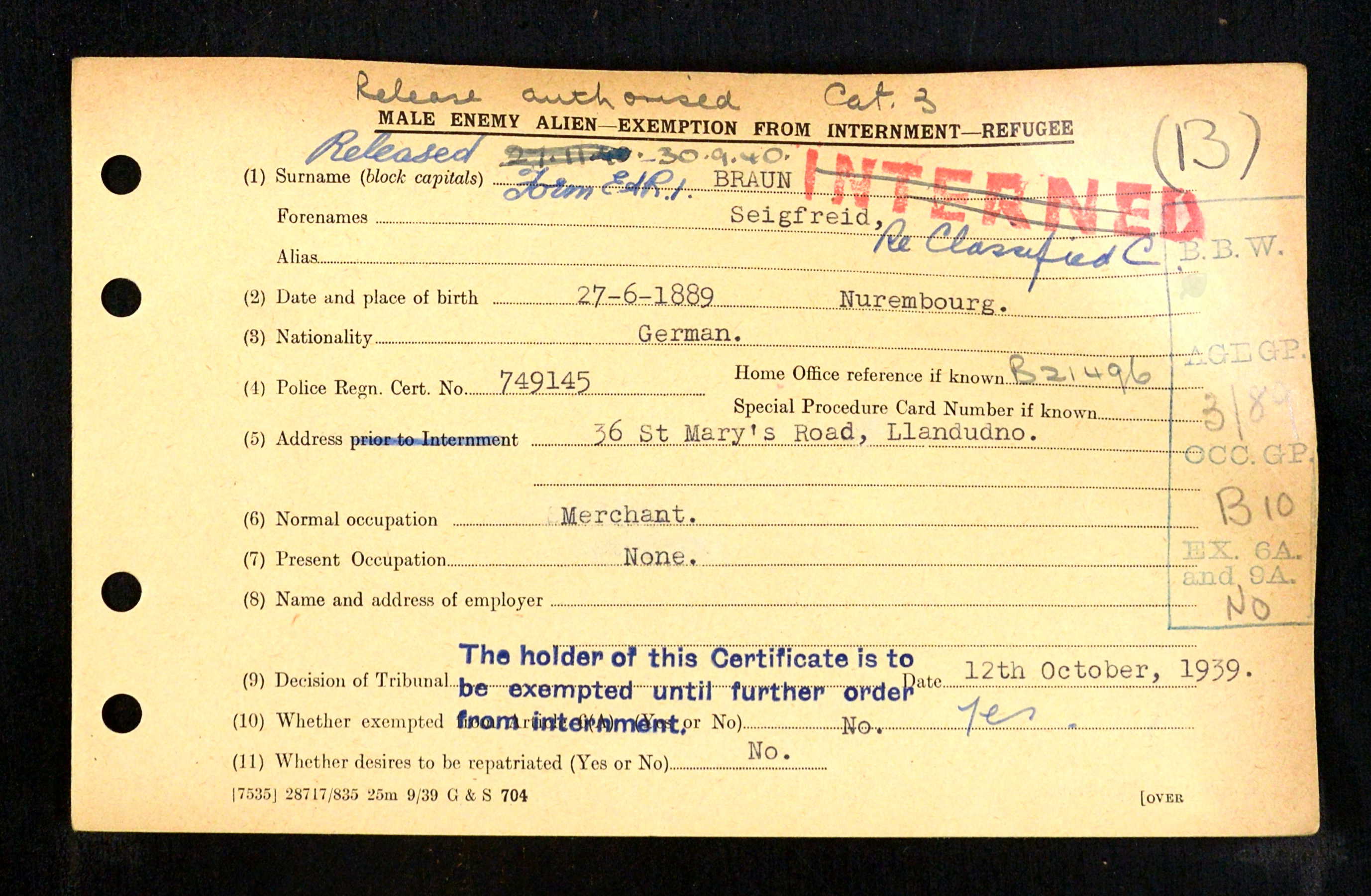
But even the UK was not a true safe harbor for the family. Siegfried was determined to be an enemy alien on October 12, 1939, and he and his family were sent to the Isle of Man like so many other Jewish refugees from Germany. Only Charlotte was not interned. They were released on September 30, 1940, and relocated to London where they lived for the duration of the war.6

Siegfried Braun, The National Archives; Kew, London, England; HO 396 WW2 Internees (Aliens) Index Cards 1939-1947; Reference Number: HO 396/168, Piece Number Description: 168: German Internees Released in UK 1939-1942: Bohrman-Bud, Ancestry.com. UK, World War II Alien Internees, 1939-1945

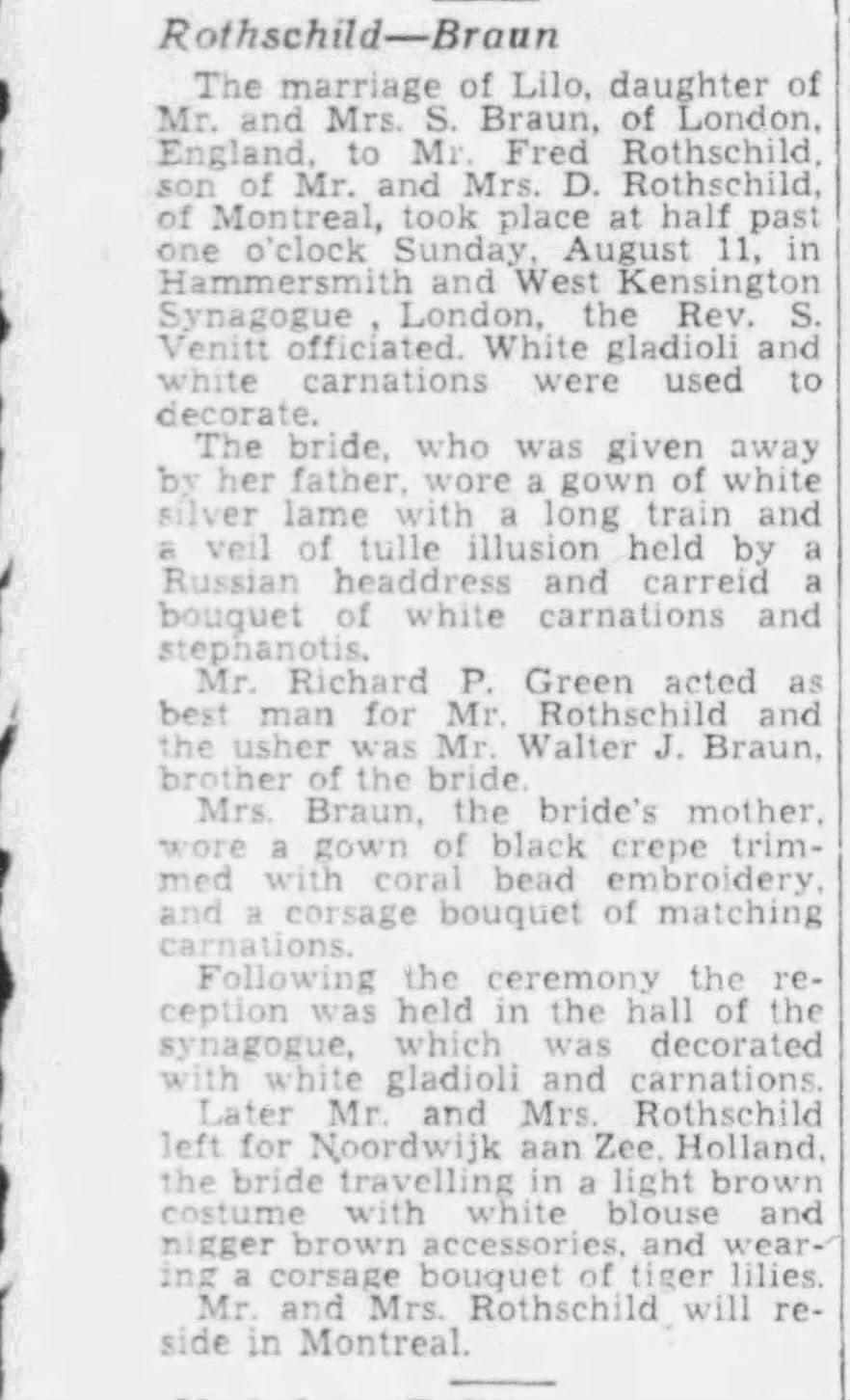
Once the war ended, Lieselotte Braun was reunited with Fred Rothschild, and they were married in London on August 11, 1946.

The Montreal Gazette, August 23, 1946, p. 13

After marrying, Lieselotte and Fred immigrated to Canada and then the US and eventually settled in New York City; they would have two children.

A year after Lieselotte’s marriage, the rest of her family—her grandmother Charlotte, her parents Klara (now Claire) Hammel and Siegfried Braun, and her brother Walter—also immigrated to the US and settled in New York. They eventually owned a women’s clothing store in Washington Heights in New York.7

Walter Braun married Hannelore Delheim in 1954.8 She was born in Ludwigschafen, Germany, in August 1931, and came to the US with her parents, Friedericke and Rosette Delheim, and her brother in 1939.9 Walter and Hannelore had two children.

Charlotte Blumenfeld Hammel died on July 11, 1958; she was 83 years old.10 I found it poignant that she ended up in New York living not far from where her father Baruch had been living in 1920. I wonder whether she ever knew that.

Her son-in-law Siegfried Braun died on August 8, 1961 at the age of 71.11 His wife Claire Hammel Braun survived him by over twenty years. She died July 19, 1983, in Ridgewood, New Jersey. She was 83 and was survived by her children and grandchildren.12

Claire’s son Walter Braun only survived her by three years. He was 62 when he died on March 15, 1986, in Ridgewood, New Jersey. He was survived by his wife and children as well as his sister Lieselotte.13

Lieselotte lived to age 91 and died on October 13, 2013, in Palm Beach, Florida. Her husband Fred Rothschild died the following year, also in Palm Beach. He was 92 when he died on March 27, 2014.14 They are survived by their children, grandchildren, and great-grandchildren.

Thus, Baruch Blumenfeld, who left his family in Germany sometime before 1900 and came to the US where he died in 1923, has numerous descendants now living in the US. They are here because their parents and grandparents and great-grandparents were either able to leave Germany before it was too late like Charlotte and her family and Antonie’s son Julius and his family and Gunther Goldschmidt or because they somehow managed to survive the tortures of the Holocaust like Antonie’s daughter Elfriede, her husband Rudolf and their daughter Inge.

Tragically, Baruch’s granddaughter—Antonie’s daughter—Margot, her husband Gustav, and their daughter Edith were not among those who survived or escaped in time. They are among the six million who must never be forgotten.


  1. Lieselotte Rothschild Arrival Age 38, Birth Date 4 Sep 1922, Birth Place, Frankfurt/Main, Arrival Date7 May 1961, Arrival Place New York, New York, USA, The National Archives at Washington, D.C.; Washington, D.C.; NAI Number: 2848504; Record Group Title: Records of the Immigration and Naturalization Service, 1787-2004; Record Group Number: 85; Series Number: A3998; NARA Roll Number: 482, Ancestry.com. New York State, Passenger and Crew Lists, 1917-1967 
  2. Walter Isidore Braun, Gender: Male, Race: White, Birth Date: 7 Dec 1923
    Birth Place: Frankfort, Federal Republic of Germany, Death Date: Mar 1986
    Father: Frederick S Braun, Mother: Claire Hammel, SSN: 082240422, Ancestry.com. U.S., Social Security Applications and Claims Index, 1936-2007 
  3.  Knabe Braun, Gender: männlich (Male), Death Date: 25 Jan 1926, Death Place: Frankfurt, Hessen (Hesse), Deutschland (Germany), Civil Registration Office: Frankfurt I
    Father: Siegfried Braun, Mother: Klara Braun. Certificate Number: 106, Personenstandsregister Sterberegister; Bestand: 903; Signatur: 10913, Ancestry.com. Hesse, Germany, Deaths, 1851-1958 
  4. Email from Steve Rothschild, August 27, 2021. Fred Rothschild, Age: 31
    Birth Date: 22 Aug 1921, Issue Date: 11 Aug 1953, State: New York
    Locality, Court: Eastern District of New York, District Court, National Archives and Records Administration (NARA); Washington, D.C.; Index to Naturalization Petitions of the United States District Court for the Eastern District of New York, 1865-1957; Microfilm Serial: M1164; Microfilm Roll: 114, Ancestry.com. U.S., Naturalization Records Indexes, 1794-1995. Geni Profile at https://www.geni.com/people/Fred-Fritz-Rothschild/6000000017506676383?through=6000000017506915284#name=Fred%20(Fritz)%20Rothschild? 
  5. Email from Steve Rothschild, August 27, 2021. 
  6. Email from Steve Rothschild, August 30, 2021. 
  7. Clara and Siegfried Braun, Walter Braun, Charlotte Hammel, ship manifest, Year: 1947; Arrival: New York, New York, USA; Microfilm Serial: T715, 1897-1957; Line: 1; Page Numbers: 190, 238, Ship or Roll Number: America,Ancestry.com. New York, U.S., Arriving Passenger and Crew Lists (including Castle Garden and Ellis Island), 1820-1957. Email from Steve Rothschild, August 30, 2021. 
  8. Walter Braun, Gender: Male, Marriage License Date: 1954, Marriage License Place: Bronx, New York City, New York, USA, Spouse: Hannelore Dellheim, License Number: 423, New York City Municipal Archives; New York, New York; Borough: Bronx,
    Ancestry.com. New York, New York, U.S., Marriage License Indexes, 1907-2018 
  9. Delheim family, ship manifest, Year: 1939; Arrival: New York, New York, USA; Microfilm Serial: T715, 1897-1957; Line: 4; Page Number: 127, Ancestry.com. New York, U.S., Arriving Passenger and Crew Lists (including Castle Garden and Ellis Island), 1820-1957 
  10. Charlotte Hammel, Age: 63, Birth Date: abt 1895, Death Date: 11 Jul 1958
    Death Place: Manhattan, New York, New York, USA, Certificate Number: 15348, Ancestry.com. New York, New York, U.S., Death Index, 1949-1965 
  11. Frederick Braun, Age: 71, Birth Date: abt 1890, Death Date: 8 Aug 1961, Death Place: Manhattan, New York, New York, USA, Certificate Number: 17272, Ancestry.com. New York, New York, U.S., Death Index, 1949-1965 
  12.  Claire Braun, Social Security Number: 088-28-7956, Birth Date: 17 Feb 1901
    Issue Year: 1951-1953, Issue State: New York, Last Residence: 10964, Palisades, Rockland, New York, USA, Death Date: Jul 1983, Social Security Administration; Washington D.C., USA; Social Security Death Index, Master File, Ancestry.com. U.S., Social Security Death Index, 1935-2014 
  13. Walter Isidore Braun, Gender: Male, Race: White, Birth Date: 7 Dec 1923
    Birth Place: Frankfort, Federal Republic of Germany, Death Date: Mar 1986
    Father: Frederick S Braun, Mother: Claire Hammel, SSN: 082240422, Ancestry.com. U.S., Social Security Applications and Claims Index, 1936-2007 
  14. “Fred Rothschild,” Palm Beach Daily News, Palm Beach, Florida
    30 Mar 2014, Sun • Page A002 

A Survivor’s Story: The Shoah Foundation Testimony of Inge Goldschmidt Oppenheimer, Part II

By the time she turned sixteen on April 13, 1945, Inge Goldschmidt had been to three concentration camps and beaten by Nazi youth in Kassel and by guards at the concentration camps at Auschwitz and Oederan. She had been separated from her brother, who was sent to the US in October 1938, and then from her parents in 1944 when she was sent from Theriesenstadt to Auschwitz. She had no idea whether her parents were alive and assumed that they were not.1

The day after her sixteenth birthday, she and the others imprisoned at the Oederan camp were transported in cattle wagons away from the Eastern front where Russia was making headway into Germany. They stopped at many camps, and finally on April 21, 1945, Inge and the others were dropped off at Theriesenstadt, the place where she had last seen her parents, Elfriede Engelbert and Rudolf Goldschmidt. She had not seen them in close to a year and did not expect to find them alive. They also assumed she had been killed at Auschwitz.

Someone recognized Inge as she entered Theriesenstadt, and when she told Inge that her parents were still alive and still at Theriesenstadt, Inge passed out. Inge was dangerously sick with typhoid, weighing only sixty pounds. Her mother didn’t recognize her when she saw her. Slowly Inge was nursed back to health and joyfully reunited with her parents.

The war ended, and the Russians took over Theriesenstadt. Even though they were no longer at war, the people had nowhere to go and no way to get anywhere because of the destruction of the train lines and roads by Allied bombing during the war. Inge and her parents stayed at Theriesenstadt until July 1945 when they then returned to Cologne, where they were provided with an apartment.

Transit card from Terezin, Elfriede Goldschmidt, 1945. Courtesy of the family

You can see from their eyes and expressions in this photograph taken after the war some of the effects of their experiences during the Holocaust.

Elfriede, Rudolf, and Inge Goldschmidt c. 1945 Courtesy of the family

Inge joined a youth group of other Jewish survivors; most did not have any family members who survived, and her parents helped many of them, becoming like surrogate parents to her friends. Here is a photograph of her with some of her friends in post-war Cologne.

Inge Goldschmidt and friends in Cologne, c. 1947-1948. Courtesy of the family

These two photographs of Inge taken in post-war Cologne show some of the rubble caused by the bombing of Cologne.

Inge Goldschmidt, c. 1947-1948, Cologne. Courtesy of the family

Inge Goldschmidt, c. 1949 Courtesy of the family

Inge’s brother Gunther sent her this photograph for her nineteenth birthday in April, 1948.

Gunther Goldschmidt, 1948. Courtesy of the family

Elfriede and Rudolf desperately wanted to get to the US and be reunited with their son Gunther, but because Cologne was in the British Sector, they could not get permission to do so. So for three and a half years they waited until Gunther was able to get his parents out, and then once they arrived in the US, Elfriede and Rudolph were able to get Inge out. Apparently children could get visas for parents and vice versa, but siblings could not get them for siblings.

Rudolf and Elfriede Goldschmidt in Bremen, leaving for the US, 1949. Courtesy of the family

Finally in July 1949, the family was reunited. Inge was now twenty years old. Her parents were working at a hotel in the Catskills and had no money.

Rudolf and Elfriede Goldschmidt in the Catskills (Fleishmans) in the summer of 1949. Courtesy of the family

Inge got a job in a factory in New York, and in the fall her parents joined her in New York also where they all lived in a furnished room together. Gunther was in school in Boston; although he came and lived with his family for some period of time, he remained closest to his foster family, never fully recovering from the long separation from his parents and sister. But this photograph captures Gunther and Inge in a joyful moment together.

Inge and Gunther Goldschmidt c. 1950-1951 Courtesy of the family

Inge married Ernst Oppenheimer on October 14, 1950.2 Ernst was born in Augsburg, Germany, on October 17, 1919, to David Oppenheimer and Maria Kraus.3 Ernst had been sent to Dachau Concentration Camp in November 1938  after Kristallnacht, and after he was released, he was immediately sent to England, where he was in the Kushner displaced person camp until he left for the US in March, 1940. He then served in the US Army, where he was stationed at Fort Knox. He also worked on the Manhattan Project.4 Ernst and Inge had two children. Inge, who had been forced to end her formal education at age ten, passed her GED test and went to college and received not only her bachelor’s degree but also a master’s degree. She became a teacher and a librarian and worked in the New York City schools for many years.

Ernst Oppenheimer and Inge Goldschmidt, 1950 Courtesy of the family

I also learned from Gunther Goldschmidt’s daughter Lisa more about his life after World War II. He married Barbara Cohen on May 16, 1959. They had three children and had moved to southern California by 1962, eventually settling in Encino. Gunther started his own advertising business there and was very successful; more importantly, Lisa described him as a devoted father.He remained close to his foster family for the rest of his life.1

Gunther and Inge’s father Rudolf Goldschmidt died on February 25, 1960, in New York; he was 73 years old.5

Tragically Gunther died from a heart attack when he was only 47; he died on November 30, 1972, in San Francisco, and was survived by his wife and young children.6

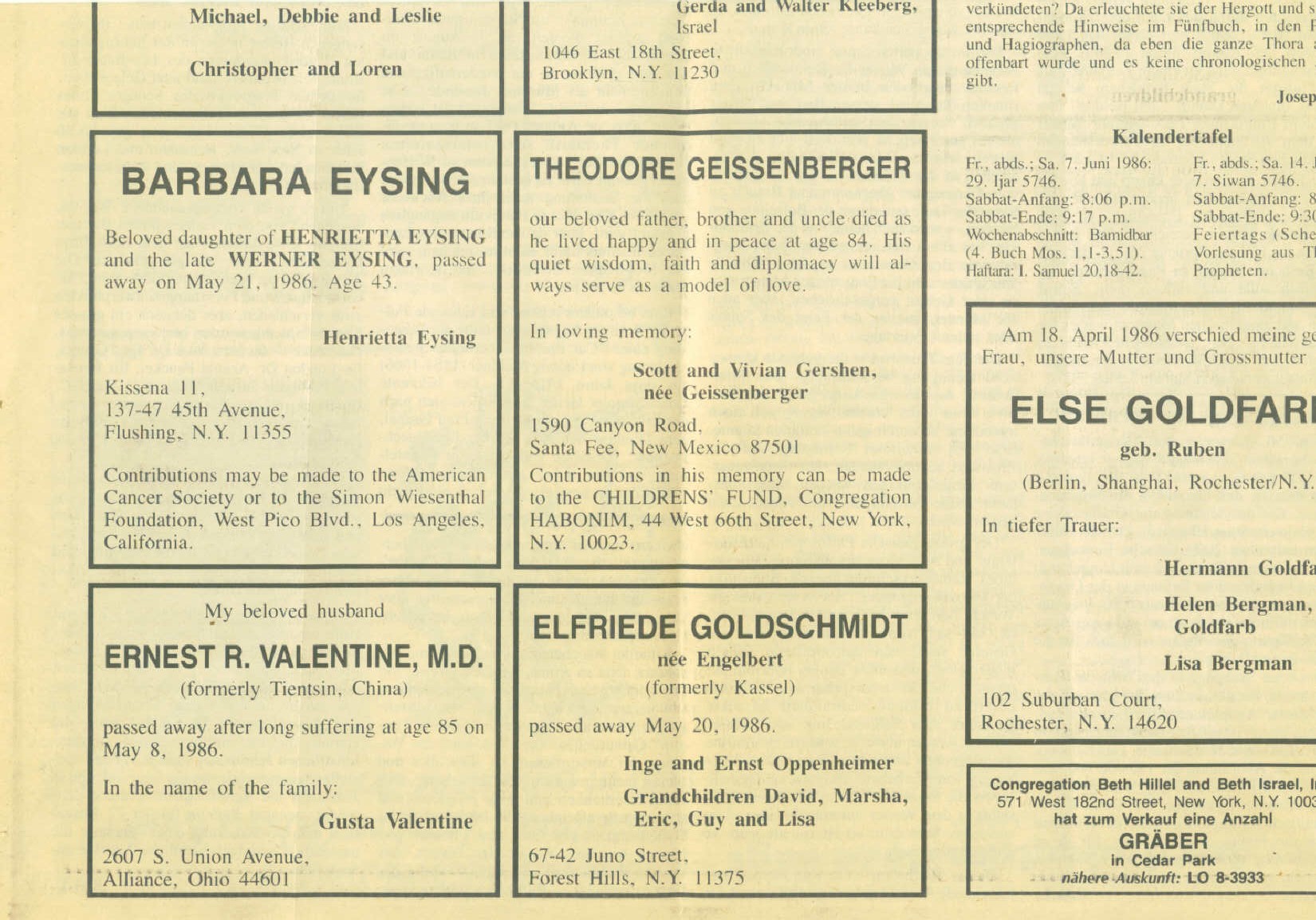
Inge and Gunther’s mother Elfriede Engelbert Goldschmidt made the surprising decision to return to Germany when she grew older. She wanted to live in a Jewish home for the elderly there and not burden her daughter. She died there on May 20, 1986; she was 85 years old.7

Inge Goldschmidt Oppenheimer, who gave this interview in 1996, died twenty years later on January 24, 2016, at the age of 86.8 She was survived by her children and grandchildren, her husband Ernst having died on July 2, 2010,9 when he was ninety years old.

We should all be forever grateful to Inge Goldschmidt Oppenheimer and those like her who shared their stories and allowed us all to understand not only the cruel side of human nature, but also the strength and resilience of human nature. Inge’s will to survive as a young teenager under the worst of circumstances was remarkable, and her ability to move forward—to marry and have children, to go back and receive a college education and to pursue a career as a teacher and librarian—is an inspiration and a lesson in hope for all of us.


  1. The information in this post, except where otherwise noted, is from the Shoah Foundation interview with Inge Oppenheimer. Inge Oppenheimer, Interview 11370. Visual History Archive, USC Shoah Foundation, 1996. Accessed 17 August 2021. The photographs are all courtesy of Marsha Eidlin.
  2. Ernst Oppenheimer, Gender: Male, Marriage License Date: 1950
    Marriage License Place: Manhattan, New York City, New York, USA, Spouse:
    Ingeborg Goldschmidt, License Number: 26365, New York City Municipal Archives; New York, New York; Borough: Manhattan, Ancestry.com. New York, New York, U.S., Marriage License Indexes, 1907-2018. Email from Marsha Eidlin, daughter of Ernst and Inge Oppenheimer, August 31, 2021. 
  3.  Ernst Oppenheimer, Declaration Age: 24, Record Type: Petition, Birth Date: 17 Oct 1919, Birth Place: Rugsburg, Bavaria, Germany, Declaration Date: 13 Jan 1944
    Declaration Place: Jackson, Mississippi, USA, Court District: U.S. District Court for the Jackson Division of the Southern District of Mississippi, Petition Number: 400, The National Archives at Atlanta; Atlanta, Georgia; Record Group Title: Records of District Courts of the United States; Record Group Number: 21, Ancestry.com. Mississippi, U.S., Naturalization Records, 1907-2008. Name: Max Oscar Oppenheimer
    [brother of Ernst Oppenheimer], Gender: Male, Race: White, Birth Date: 19 Apr 1915
    Birth Place: Schrobenhaus, Federal Republic of Germany, Death Date: 16 Oct 2006
    Father: David Oppenheimer, Mother: Maria Kraus, SSN: 092147186, Ancestry.com. U.S., Social Security Applications and Claims Index, 1936-2007. 
  4. Email from Marsha Eidlin, daughter of Ernst and Inge Oppenheimer, August 31, 2021. 
  5. Rudo Goldschmidt, Age: 73, Birth Date: abt 1887, Death Date: 25 Feb 1960
    Death Place: Brooklyn, New York, New York, USA, Certificate Number: 4206, Ancestry.com. New York, New York, U.S., Death Index, 1949-1965 
  6. Gunther Goldschmidt, Social Security #: 488207584, Gender: Male
    Birth Date: 17 Jul 1925, Death Date: 30 Nov 1972, Death Place: San Francisco, Place: San Francisco; Date: 30 Nov 1972; Social Security: 488207584, Ancestry.com. California, U.S., Death Index, 1940-1997. Inge Oppenheimer, Interview 11370. Visual History Archive, USC Shoah Foundation, 1996. Accessed 17 August 2021. 
  7. Inge Oppenheimer, Interview 11370. Visual History Archive, USC Shoah Foundation, 1996. Accessed 17 August 2021. 
  8. New York Times obituary at https://archive.nytimes.com/query.nytimes.com/gst/fullpage-9C04EFD71F3AF932A05752C0A9609D8B63.html; Find a Grave, database and images (https://www.findagrave.com/memorial/214436745/inge-oppenheimer : accessed 12 September 2021), memorial page for Inge Goldschmidt Oppenheimer (unknown–24 Jan 2016), Find a Grave Memorial ID 214436745, citing Beth-El Cemetery, Paramus, Bergen County, New Jersey, USA ; Maintained by Lauren A. Hubberman Cohen (contributor 49135178) Burial Details Unknown. 
  9. Ernest Oppenheimer, Social Security Number: 094-14-0365, Birth Date: 17 Oct 1919, Issue Year: Before 1951, Issue State: New York, Last Residence: 11375, Flushing, Queens, New York, USA, Last Benefit: 11375, Flushing, Queens, New York, USA, Death Date: 2 Jul 2010, Social Security Administration; Washington D.C., USA; Social Security Death Index, Master File, Ancestry.com. U.S., Social Security Death Index, 1935-2014 

  1. Email from Lisa Goldschmidt, September 25, 2021. Gunther Goldschmidt, Spouse: Barbara Anne Cohen, Marriage Date: 2 Sep 1958, Recorded county: Clark, Page: F01, Ancestry.com. Nevada, U.S., Marriage Index, 1956-2005 

A Survivor’s Story: The Shoah Foundation Testimony of Inge Goldschmidt Oppenheimer

Antonie Blumenfeld and her husband Siegfried Engelbert died before Hitler came to power in Germany in 1933 and thus were spared seeing that their daughter Margot and her husband Gustav Neuhaus were sent to the Warsaw Ghetto and killed there in September 1942 and that their granddaughter Edith Neuhaus Kempner was killed at Auschwitz just two months later.

They were also spared knowing that their son Julius and his wife Ilse and son Werner were forced to leave Germany in 1939 to escape Hitler, but eventually survived and settled in the United States.

And they were spared knowing the terrible ordeals endured by their youngest child Elfriede and her husband Rudolf Goldschmidt and their children Gunther and Inge.

But we must remember their experiences and honor their memories. Thanks to the Shoah Foundation, we now have extensive interviews with many of the Holocaust survivors, including one with Inge Goldschmidt Oppenheimer, my fifth cousin.

I was privileged to listen to Inge’s interview and will attempt in my own words to tell her story. I am grateful to the Shoah Foundation for allowing me to do so. Except where noted, all the information below came from Inge’s interview.1 All the photographs are courtesy of Inge’s daughter Marsha.

Inge was born to Elfriede Engelbert and Rudolf Goldschmidt on April 13, 1929, in Kassel, Germany, just four years before Hitler came to power. She had almost no memory of life in Germany before the Nazis took control. She and her family lived in Kassel until 1938 when they moved to Cologne. Her memories of life in Kassel were terrible because of the persecution and harassment they faced as Jews. She and her brother Gunther went to a Jewish school and were often beaten up on the way home by Nazi youth members. As a result of incidents like that, the school decided to close fifteen minutes before the non-Jewish schools so that children could get home safely.

Here is a photograph of Inge with her brother Gunther taken in about 1934.

Gunther and Inge Goldschmidt. c. 1934-1935. Courtesy of the family

Inge’s father Rudolf was a veteran of World War I and had suffered a serious head injury while fighting for Germany. As a result, he eventually became paralyzed and wheelchair-bound. The family was living on the pension he received for his service in the war while also being forced to endure the anti-Semitism promoted by the government. Rudolf was very well-informed and followed the news on a radio tuned to the BBC, and although he wanted to leave Germany, his disability and their limited resources made that impossible.

Here is a photograph of Rudolf in uniform during World War I.

Rudolf Goldschmidt, c. 1914-1918. Courtesy of the family

Instead the family decided to leave Kassel and move to Cologne in 1938, believing that in the larger city they would be safer and also that life would be easier because it was less hilly than Kassel and thus easier for Elfriede to push Rudolf’s wheelchair. Here are two photographs of Inge from around this time.

Inge Goldschmidt, c. 1938-1939. Courtesy of the family

Inge and Rudolf Goldschmidt. Courtesy of the family

Gunther celebrated his bar mitzvah in Cologne in the summer of 1938, and a few months later in October his parents registered him for a children’s transport out of Germany to the United States. He ended up in St. Louis living with a foster family for many years. He was only thirteen. Inge was only nine and too young for those transports, so she stayed in Cologne with her parents. The photograph below shows the family at the train station in Cologne the day Gunther left for the US.

Margot Engelbert Neuhaus, Gustav Neuhas, Elfriede Engelbert Goldschmidt, Rudolf Goldschmidt, Inge Goldschmidt, unknown man. 1938. Courtesy of the family

Although things were initially better in Cologne than they had been in Kassel, after Kristallnacht and then once the war started in September 1939, conditions worsened. Their phones were taken, then their bicycles, and they lived in constant fear of being arrested. Then when the Allies started bombing Cologne in the early 1940s, they lived in fear of the bombs and poison gas as well. They moved frequently from one apartment to another and were later rounded up with other Jews and taken to a temporary camp outside of the city. By then they were required to wear the yellow star to identify them as Jews. Inge had hers pinned instead of sewn on as required so that she could sneak out of the camp and shop for the family, removing her star to do so without revealing that she was Jewish.

The star Inge Goldschmidt wore in Germany. Courtesy of the family

Elfriede Engelbert Goldschmidt identity card, 1939. Courtesy of the family

Then in 1942 the family was deported to Theriesenstadt. Inge and her mother Elfriede were in one of the barracks together, and her father Rudolf was in a separate men’s barrack. Interestingly, he was living with other men who were disabled World War I veterans. Inge speculated that but for his service in World War I he never would have been allowed to survive at all, given his physical disability.

Inge’s memories of life in Theriesenstadt are horrendous. She was scared and hungry all the time and often very ill. Her knee became infected, and she had to have it drained in the camp hospital without receiving anesthesia. They lived with bed bugs, lice, and a lack of sanitary facilities. They had no news of what was happening in the war or outside the camp itself.

Inge lived at Theriesenstadt for two years, and then in 1944 she was sent to Auschwitz and separated from her family. She was now fifteen years old and sick with typhus. Despite being sick, she knew enough not to let on and so did not get transported with those who were ill and were instantly killed when they arrived at Auschwitz. The train to Auschwitz was a nightmare—all of them standing packed into the cars with no food and sleeping standing up with only a bucket for a toilet.

She remembered vividly her arrival at Auschwitz. They arrived at night, and it was bitterly cold. The Kapos (Jewish prisoners forced to act as guards and agents for the Nazis) were screaming at them all to move out of the train while armed Nazi guards surrounded them. Inge went with the other women into one large room where they were forced to strip and have their heads shaved. They took cold showers and were disinfected and given rags to wear. She recalled one woman going into labor and giving birth during this ordeal and remembered hearing the women around her screaming when they realized they would never see their children again.

Inge was only at Auschwitz for a few weeks, but her memories of that time and place were seared in her memory. She recalled standing for hours each day in the snow for inspection while the guards selected those who would go to the gas chambers. Once she needed to urinate so badly that she just squatted on the ground and was beaten by the guard for doing so. At one point she was so despondent that she was going to run into the electric fence and kill herself, as she’d seen others do. But a kind woman convinced her not to, and so she survived.

After a few weeks she was selected to be sent to another camp near Leipzig, Germany, called Oederan. Oederan opened in September 1944; three transports brought five hundred women from Auschwitz to work in a munitions factory in a converted thread factory. Inge worked in the munitions factory making bullets; she recounted how she and the other prisoners tried to do things to sabotage the machines, although they knew they could be killed if they were caught. While at Oederan, she saw bright lights in the distance and asked innocently if that was the sun. It was in fact the fires from the Allied bombing of Dresden, which was about 35 miles away. A guard, thinking she was being disrespectful, punched her in the mouth and knocked out one of her teeth.

On April 12, 1945, the day before her 16th birthday, Inge heard that FDR had died, and she was bereft, believing that America was their one hope for survival and that FDR was a hero. But the news about the war was also starting to break through, and there were rumors that the Russians were coming to liberate them. What would she do if she survived to be liberated? What would she learn about the fate of her parents?

To be continued…


  1. Inge Oppenheimer, Interview 11370. Visual History Archive, USC Shoah Foundation, 1996. Accessed 17 August 2021. 

Antonie’s Children Margot Engelbert Neuhaus and Julius Engelbert

Antonie Blumenfeld Engelbert, daughter of Baruch Blumenfeld and Emma Docter, died in 1929, and her husband Siegfried Engelbert died three years later. They never knew what was going to happen to their family just a decade after their deaths.

Their oldest daughter Margot and her husband Gustav stayed in Goettingen after Hitler came to power in 1933. After Kristallnacht in November 1938, Gustav was forced by the Nazis to sell his cattle trading business far below its market value, a business that had been in his family since 1858 when it was started by his grandfather. Margot and Gustav were transported on March 31, 1942, to the Warsaw Ghetto, where they were killed on September 30, 1942. Here are the Pages of Testimony on file with Yad Vashem:1

Margot and Gustav’s daughter Edith also was murdered by the Nazis. After she was prohibited from attending the local high school for girls in Goettingen in 1938, she went to Hamburg and then to Berlin, where she met and married her husband Herbert Kempner in 1942. But Herbert and Edith’s marriage was short-lived because on November 29, 1942, they were both deported to Auschwitz and murdered there. I am so grateful to Dennis Aron, who shared with me the entries about Gustav, Margot, and Edith from Die Juedischen Buerger im Kreis Goettingen 1933-1945: Ein Gedenkbuch, including this photograph of Edith. 2

Tragically, Margot and Gustav and their daughter Edith have no living descendants because of the Nazis. Thus, we must all remember them instead.

The other two children of Antonie Blumenfeld and Siegfried Engelbert survived the Holocaust, but not without facing Nazi persecution.

Their son Julius Engelbert, his wife Ilse, and their nine-year-old son Werner fled to Bolivia on September 23, 1939.3 Six years later the family immigrated to the United States, arriving on December 23, 1945.4 They settled in Brooklyn, New York, and they all became US citizens in 1952. Werner Engelbert became a pharmacist after graduating from the College of Pharmacy of the City of New York in 1952.5 According to his niece Marsha, Julius saved the many wonderful photographs published in this series of posts when he fled Germany in 1939. How fortunate we all are that he did.

Ancestry.com. U.S., Naturalization Records Indexes, 1794-1995

Julius Engelbert died in New York on July 25, 1965; he was 67. He was killed in a car accident driving to or from the Catskills.6 His wife Ilse survived him by twenty years, dying in February 1985 at the age of 78.7 Their son Werner died in 2019.8 He was survived by his wife and children and grandchildren.

Elfriede Engelbert Goldschmidt and her family also survived the Holocaust, but their path to survival was more complicated than that of her brother Julius and his family. I was privileged to listen to the testimony that Inge Goldschmidt Oppenheimer, Elfriede’s daughter, gave to the Shoah Foundation in 1996,9 and her story is both heartbreaking and inspiring. I will share her story in my next post.


  1. Margot Engelbert Neuhaus, Yad Vashem, at https://yvng.yadvashem.org/nameDetails.html?language=en&itemId=1306232&ind=2;  Gustav Neuhaus, Yad Vashem at https://yvng.yadvashem.org/nameDetails.html?language=en&itemId=1306229&ind=2. See also Uta Schaefer-Richter and Joerg Klein, Die Juedischen Buerger im Kreis Goettingen 1933-1945: Ein Gedenkbuch (Wallstein Verlag 1992), pp. 190-191. 
  2. Uta Schaefer-Richter and Joerg Klein, Die Juedischen Buerger im Kreis Goettingen 1933-1945: Ein Gedenkbuch (Wallstein Verlag 1992), p.190.Die Juedischen Buerger im Kreis Goettingen 1933-1945: Ein Gedenkbuch (Wallstein Verlag Goettingen), p. 126. 
  3. Julius Engelbert, Nationality: Deutsch Juden, Record Type: Miscellaneous
    Birth Date: 18 Okt 1897 (18 Oct 1897), Birth Place: Kassel, Residence Place: Kassel Kassel, Notes: Lists of judicial and official files concerning foreigners and German Jews
    Reference Number: 02010101 oS, Document ID: 70443285, Arolsen Archives, Digital Archive; Bad Arolsen, Germany; Lists of Persecutees 2.1.1.1, Ancestry.com. Free Access: Europe, Registration of Foreigners and German Persecutees, 1939-1947 
  4. Joseph Julius Engelbert, ship manifest, Year: 1945; Arrival: New York, New York, USA; Microfilm Serial: T715, 1897-1957; Line: 22; Page Number: 41, Ancestry.com. New York, U.S., Arriving Passenger and Crew Lists (including Castle Garden and Ellis Island), 1820-1957 
  5. Werner J Engelbert, Yearbook Date: 1952, School: College of Pharmacy of the City of New York, School Location: New York, New York, USA, U.S., School Yearbooks, 1880-2012″; School Name: College of Pharmacy of the City of New York; Year: 1952,
    Ancestry.com. U.S., School Yearbooks, 1900-1999 
  6. Julius Engelbert, Gender: Male, Age: 67, Birth Date: abt 1898, Residence Place: Adelphi, Kings, New York, USA, Death Date: 25 Jul 1965, Death Place: New York, USA, New York State Department of Health; Albany, NY, USA; New York State Death Index,
    Ancestry.com. New York State, U.S., Death Index, 1957-1969. Email from Marsha Eidlin, September 25, 2021. 
  7. Ilse Engelbert, Social Security Number: 129-22-5815, Birth Date: 31 Mar 1906
    Issue Year: Before 1951, Issue State: New York, Last Residence: 11210, Brooklyn, Kings, New York, USA, Death Date: Feb 1985, Social Security Administration; Washington D.C., USA; Social Security Death Index, Master File, Ancestry.com. U.S., Social Security Death Index, 1935-2014 
  8. https://jewishfunerals.com/service/werner-j-engelbert/ 
  9. Inge Oppenheimer, Interview 11370. Visual History Archive, USC Shoah Foundation, 1996. Accessed 17 August 2021. 

Baruch Blumenfeld’s Daughter Antonie: Life Before the Nazis

Although I have no definitive answer as to when Baruch Blumenfeld left his family in Germany, I do have information about what happened to his two daughters and their children.

As we saw, Baruch and Emma had two daughters: Antonie and Charlotte Jeanette, born in 1872 and 1875, respectively. This post and the three that follow will focus on Antonie and her descendants. I am deeply grateful to Antonie’s great-granddaughter Marsha for sharing her collection of family photos with me so that I can bring Antonie and her family to life.

Antonie married Sussel Siegfried (known as Siegfried) Engelbert in Neustadt, Germany, in 1894, and they had three children: Margot (born 1895), Joseph Julius (known as Julius) (born 1897), and Elfriede (born 1900). Siegfried owned a clothing store in Kassel, shown in this photograph.

Engelbert store, c. 1900, Kassel. Courtesy of the family.

The photograph below is of Antonie and below that are three photographs of her children, one taken in 1911 of Elfriede and Margot and an unknown little girl, the other taken in about 1920 of all three of Antonie and Siegfried Engelbert’s children, and the last a photograph of Julius Engelbert with his parents Antonie and Siegfried.

Antonie Blumenfeld Engelbert undated. Courtesy of the family

Elfriede Engelbert, unknown girl, Margot Engelbert, 1911. Courtesy of the family

Margot, Julius, and Elfriede Engelbert, c. 1920. Courtesy of the family

Julius, Antonie, and Siegfried Engelbert. Courtesy of the family

Margot married Gustav Neuhaus on December 3, 1920. He was born on December 5, 1884, in Bremke, Germany, to Hermann Neuhaus and Bernhardine Neuhaus. He was a cattle dealer in Goettingen, Germany; his grandfather had started the business in 1858.1

Marriage record of Margot Engelbert and Gustav Neuhaus, Hessisches Hauptstaatsarchiv; Wiesbaden, Deutschland; Bestand: 910, Year Range: 1920, Ancestry.com. Hesse, Germany, Marriages, 1849-1930

Margot and Gustav had one child, a daughter Edith, born on March 9, 1922.

Elfriede Caroline Engelbert married Ruben Rudolf (known as Rudolf) Goldschmidt on August 19, 1924, in Kassel, Germany. Rudolf, the son of Gabriel Goldschmidt and Jettchen Levi, was born in Spangenburg, Germany, on January 23, 1887.2

Marriage record of Elfriede Engelbert and Ruben Goldschmidt, Hessisches Hauptstaatsarchiv; Wiesbaden, Deutschland; Bestand: 910, Year Range: 1924, Ancestry.com. Hesse, Germany, Marriages, 1849-1930

Here is a photograph of Elfriede and Rudolf taken when they were engaged in 1924.

Elfriede Engelbert and Rudolf Goldschmidt, 1924. Courtesy of the family

Marsha also shared the menu from Elfriede and Rudolf’s wedding. It must have been quite a lavish celebration.

Elfriede and Rudolf had two children, Gunther, born July 17, 1925,3 and Inge, born April 13, 1929,4 in Kassel where they resided.

Here are some photographs of Gunther and Inge as young children.

Gunther and Elfriede Engelbert Goldschmidt, 1925. Courtesy of the family

Inge and Gunther Goldschmidt, 1931. Courtesy of the family

Inge and Gunther Goldschmidt, c. 1931. Courtesy of the family

Elfriede, Gunther, and Inge Goldschmidt c. 1931. Courtesy of the family

Antonie lived long enough to see her three grandchildren born, but she died on May 23, 1929, a month after Inge’s birth. She was survived by her husband and her children and grandchildren.

Antonie Blumenfeld Engelbert death record, Personenstandsregister Sterberegister; Bestand: 910; Signatur: 5619, Year Range: 1929, Ancestry.com. Hesse, Germany, Deaths, 1851-1958

Here is one more photograph of Antonie and Julius and a photograph of Antonie’s headstone.

Siegfried Engelbert and Antonie Blumenfeld Engelbert. Courtesy of the family

Courtesy of the family

Julius Engelbert married a few months after his mother’s death. On August 29, 1929, he married Ilse Wolf in Marburg, Germany. She was born in Marburg on March 31, 1906. Julius and Ilse had one child, Werner, born in Kassel in 1930.5

Julius Engelbert and Ilse Wolf marriage record, Hessisches Hauptstaatsarchiv; Wiesbaden, Deutschland; Bestand: 915; Laufende Nummer: 5652, Year Range: 1929, Ancestry.com. Hesse, Germany, Marriages, 1849-1930

Two years later Siegfried Engelbert died on July 12, 1932, in Kassel.6 He was 65 and died before the Nazi takeover of Germany the following year.  He and Antonie were spared seeing what would happen to their children.

In this photograph are Elfriede, Rudolf, and Inge with Margot and her daughter Edith taken in 1936.  No one could have predicted what was to happen to them all in the next decade.

Elfriede Engelbert Goldschmidt, Inge Goldschmidt, Rudolf Goldschmidt, Edith Neuhaus, Margot Neuhaus, 1936. Courtesy of the family

To be continued.


  1. Gustav Neuhaus, Yad Vashem entry,  https://yvng.yadvashem.org/nameDetails.html?language=en&itemId=1306229&ind=2 and from the Neuhaus Family Tree on Ancestry found at https://www.ancestry.com/family-tree/person/tree/60044058/person/342252900990/facts. See also Uta Schaefer-Richter and Joerg Klein, Die Juedischen Buerger im Kreis Goettingen 1933-1945: Ein Gedenkbuch (Wallstein Verlag 1992), p.190. 
  2. Arcinsys Archives Hessen, HHStAW Fonds 365 No 782, p. 63. Inge Oppenheimer, Interview 11370. Visual History Archive, USC Shoah Foundation, 1996. Accessed 17 August 2021. 
  3. Gunther Goldschmidt, Social Security #: 488207584, Gender: Male
    Birth Date: 17 Jul 1925, Death Date: 30 Nov 1972, Death Place: San Francisco, Ancestry.com. California, U.S., Death Index, 1940-1997 
  4. Inge Oppenheimer, Interview 11370. Visual History Archive, USC Shoah Foundation, 1996. Accessed 17 August 2021. 
  5. Arolsen Archives, Digital Archive; Bad Arolsen, Germany; Lists of Persecutees 2.1.1.1, Reference Code: 02010101 oS, Ancestry.com. Free Access: Europe, Registration of Foreigners and German Persecutees, 1939-1947; Werner Jack Engelbert, Age: 22, Birth Date: 21 Jul 1930, Issue Date: 29 Jan 1952, State: New York
    Locality, Court: Eastern District of New York, District Court, National Archives and Records Administration (NARA); Washington, D.C.; Index to Naturalization Petitions of the United States District Court for the Eastern District of New York, 1865-1957; Microfilm Serial: M1164; Microfilm Roll: 53, Ancestry.com. U.S., Naturalization Records Indexes, 1794-1995 
  6. LAGIS Hessen Archives, Nr 587, p. 291, Standesamt Kassel I Sterberegister 1932, Eintrags-Nr. 301-600 (StadtAKS Best. A 3.35.1 Nr. 3.1.310) Autor Stadtarchiv Kassel Erscheinungsort Kassel IErscheinungsjahr 1932 

My Cousins Karoline, Franziska, and Rosa: Unanswered Questions, Tragic Endings

The second, third and sixth children of Meier Blumenfeld and Sarah Strauss, Karoline, Franziska, and Johanna are three about whom I know very little, but I will report what I do know and hope that eventually I will discover more information. (I will discuss the fourth child Rosa and fifth child Sophie out of order in the next post.)

Karoline Blumenfeld was born on February 27, 1869, in Momberg.

Arcinsys Archives of Hessen, HHStAW Fonds 365 No 608, p. 6

She must have married a man named Dannenberg because her death record shows her surname as Dannenberg. That death record is unfortunately the only other record I have for Karoline. I cannot find a marriage record, even after searching on Ancestry and JewishGen and on two databases of vital records for the Hesse region. One profile on Geni and several Ancestry trees report that her husband’s name was Sally Dannenberg, but there are no sources given to corroborate that information.

Karoline died on August 18, 1919, in Frankfurt at the age of fifty. Sadly, that is all I could learn about her life. I don’t know when she married or whether they had children.

Personenstandsregister Sterberegister; Bestand: 903; Signatur: 10823
Year Range: 1919, Ancestry.com. Hesse, Germany, Deaths, 1851-1958

Meier and Sarah’s third child Franziska was born on November 3, 1870, in Momberg.

Arcinsys Archives of Hessen, HHStAW Fonds 365 No 608, p. 7

She married Aron Oppenheim on October 10, 1905, in Marburg, Germany. Aron was fifteen years older than Franziska; he was born on February 5, 1855, in Rhina, Germany, to Salomon Oppenheim and Ester Klebe. He had been previously married to Hannchen Klebe, with whom he’d had a number of children. Franziska was thirty-four when they married, and Aron was fifty. I could not find any record of children born to Franziska and Aron.

Franziska Blumenfeld, Gender: weiblich (Female), Age: 34, Birth Date: 3 Nov 1870
Marriage Date: 10 Okt 1905 (10 Oct 1905), Marriage Place: Marburg, Hessen (Hesse), Deutschland (Germany), Civil Registration Office: Marburg, Father: Meine Blumenfeld, Mother: Sarchen Blumenfeld, Spouse: Aron Oppenheim, Certificate Number: 101, Hessisches Hauptstaatsarchiv; Wiesbaden, Deutschland; Bestand: 915; Laufende Nummer: 5620, Ancestry.com. Hesse, Germany, Marriages, 1849-1930

Aron died on June 7, 1921, in Halle, Germany. He was 66 years old.1 Franziska survived him, but tragically she was sent to the Therienstadt Concentration Camp by the Nazis on August 18, 1942, from Frankfurt where she was then living. She died there a month later on September 28, 1942. She was 71 years old.

Meier and Sarah’s sixth child, Johanna, like Karoline and Franziska, is a sibling about whom I know very little. Johanna was born on December 22, 1878, in Marburg, Germany.

Johanna Blumenfeld birth record, Hessisches Hauptstaatsarchiv; Wiesbaden, Deutschland; Bestand: 915; Laufende Nummer: 5557 Description Year Range: 1878 Source Information Ancestry.com. Hesse, Germany, Births, 1851-1901

Tragically, the only other record I have for Johanna is her record with Yad Vashem. According to that record, Johanna was deported on October 20, 1941, from her home in Frankfurt to the Litzmannstadt Ghetto in Poland, where she was murdered on March 15, 1942. I had never heard of the Litzmannstadt Ghetto before seeing this listing at Yad Vashem, but learned it was another name for the Lodz Ghetto, which I had known about. You can read more about it here. Johanna was 63 when she was killed.

Thus, two of Meier and Sarah (Strauss) Blumenfeld’s daughters were murdered by the Nazis, Franziska and Johanna. As far as I know, neither of them had children nor did their sister Karoline. They thus have no living descendants.

Fortunately, the remaining three siblings—Rosa, Sophie, and Hugo—left Germany long before the rise of Hitler and have stories that do not end tragically. Their stories come next.


  1.  Aron Oppenheim, Age: 66, Birth Date: abt 1855, Death Date: 7 Jun 1921
    Death Place: Halle-Nord, Sachsen-Anhalt (Saxony-Anhalt), Deutschland (Germany)
    Civil Registration Office: Halle-Nord, Spouse: Franziska Oppenheim, Certificate Number: 417, Stadtarchiv Halle (Saale); Halle (Saale), Deutschland; Personenstandsregister Sterberegister; Bestand: A 2.1; Signatur: A 2.1 3_S_1921_1,
    Ancestry.com. Halle (Saale), Germany, Deaths, 1874-1957 

Abraham Blumenfeld II’s Granddaughter Dina and Her Sons Ernst and Otto Blum

Tackling the Blumenfeld branch of my family tree will be a long process, given that the limb I am starting on—the limb based on my four-times great-uncle Moses Blumenfeld and his children—is already such a long limb. As we saw, Moses had only three children—Abraham II, Isaak, and Gelle. But Abraham II had eight children, seven of whom lived to adulthood.

And his first child Meier had nine, seven of whom lived to adulthood, as seen on this chart.

As discussed in my prior post, Meier was born on December 11, 1840 in Momberg and married Sarah Strauss, his first cousin, on January 10, 1866, in Amoeneburg. The first child of their eight children was Dina, who was born on April 20, 1867, in Momberg.

Arcinsys Archives of Hessen, HHStAW Fonds 365 No 608, p. 6

She married Moritz Blum on November 2, 1896, in Marburg, Germany. Moritz was born in Battenfeld, Germany, on December 14, 1861, to David Blum and Roschen Herstein. He was a merchant.

Hessisches Hauptstaatsarchiv; Wiesbaden, Deutschland; Bestand: 915; Laufende Nummer: 5609
Year Range: 1896, Ancestry.com. Hesse, Germany, Marriages, 1849-1930

Dina and Moritz had two children. Ernst Jacob Blum was born in Frankenburg, Germany, on November 10, 1897, and his brother Otto Blum was born on July 20, 1900, in Frankenburg.

Ernst Blum birth record, Hessisches Hauptstaatsarchiv; Wiesbaden, Deutschland; Signatur: 3586
Year Range: 1897, Ancestry.com. Hesse, Germany, Births, 1851-1901

Otto Blum birth record, Hessisches Hauptstaatsarchiv; Wiesbaden, Deutschland; Signatur: 3589
Year Range: 1900, Ancestry.com. Hesse, Germany, Births, 1851-1901

Moritz Blum died when he was 61 on February 17, 1923, in Frankenburg.1

Three years later Dina and Moritz’s younger son Otto left for the United States. He arrived in the US on November 1, 1926. According to the ship manifest, he was a clerk and was heading to Chicago where his uncle Hugo Blumenfeld, Dina’s younger brother, was then living.2 Indeed the 1930 US census finds him living with Hugo and his family in Chicago where Otto was working as a clerk in a mail order factory.

Otto Blum on 1930 US census with Hugo Blumenfeld, Year: 1930; Census Place: Chicago, Cook, Illinois; Page: 27B; Enumeration District: 0260; FHL microfilm: 2340159, Ancestry.com. 1930 United States Federal Census

Meanwhile, back in Germany, Otto’s older brother Ernst Jacob had married Erna Bachrach on January 25, 1925, in Marburg.3 Erna was the daughter of Solomon Bachrach and Frederike Heilbrunn and was born in Frielendorf, Germany, on May 19, 1901.4 In 1926 their first child was born in Frankenburg, and a second child was born three years later.

Unfortunately Dina did not live to see the birth of this second grandchild. She died in Frankenburg on May 21, 1928, when she was 61.

Personenstandsregister Sterberegister; Signatur: 3706
Year Range: 1928, Ancestry.com. Hesse, Germany, Deaths, 1851-1958

Dina also did not live to endure the Nazi persecution of the Jews that began a few years after her death. Fortunately, her son Otto was already in the United States, and in 1936, Ernst and his family also immigrated to escape the Nazis. Like his brother Otto, Ernst was headed for Chicago. He listed his uncle Ignaz Herzka as the person he was going to on the ship manifest. Ignaz Herzka was married to Rosa Blumenfeld, younger sister of Ernst’s (and Otto’s) mother Dina. Ernst reported that he was a merchant on the ship manifest.5

Ernst and his family settled in Chicago where in 1940 he was working as a salesman.6 His brother Otto is not listed in his household on the 1940 census, but by 1942 he was living at the same address as his brother Ernst, 5340 Cornell Avenue in Chicago. Otto was working for his uncle Ignaz Herzka who was a tailor. Ernst was working for a company called Hillman’s in Chicago. His 1942 petition for naturalization stated that he was working as a food clerk.

Ernst Blum, World War II draft registration, National Archives at St. Louis; St. Louis, Missouri; WWII Draft Registration Cards for Illinois, 10/16/1940-03/31/1947; Record Group: Records of the Selective Service System, 147; Box: 151, Ancestry.com. U.S., World War II Draft Cards Young Men, 1940-1947

Otto Blum, World War II draft registration, National Archives at St. Louis; St. Louis, Missouri; WWII Draft Registration Cards for Illinois, 10/16/1940-03/31/1947; Record Group: Records of the Selective Service System, 147; Box: 151, Ancestry.com. U.S., World War II Draft Cards Young Men, 1940-1947

Ernst Blum petition for naturalization, National Archives at Chicago; Chicago, Illinois; ARC Title: Petitions for Naturalization, 1906-1991; Record Group Title: Records of District Courts of the United States, 1685-2009; Record Group Number: RG 21,  Petitions, V· 1032-1034, No· 254210-254835, 1942, Ancestry.com. Illinois, U.S., Federal Naturalization Records, 1856-1991

Otto served in the US Army during World War II from October 16, 1942, until June 23, 1943. He was a private in the 976th Field Artillery Battalion, fighting against his native country and against Hitler.7 It does not appear that Ernst served during the war.

After the war Otto married Mary Shields on February 11, 1949, in Chicago.8 She was born in Indiana on February 23, 1904. I do not know her father’s name, but her mother was Mary Jane (Medda) Shields. Mary had been previously married to Irving Bartlett with whom she’d had one child.9 Otto and Mary did not have children together.

Otto Blum died on October 9, 1967, in Chicago; he was 61.10 He was survived by his widow Mary, who died sixteen years later on April 6, 1983, at 79.11

Ernst Jacob Blum also survived his younger brother Otto. He died October 2, 1985 at the age of 87 in Chicago.12 His wife Erna had predeceased him; she was 70 when she died on October 11, 1971, in Chicago.13 They were survived by one of their daughters and their grandchildren.

Thus, Dina Blumenfeld Blum was fortunate that her sons left Germany in time to survive the Holocaust, and she has living descendants today because of that.

Next, Dina’s younger sisters Karoline, about whom I know very little, and Franziska and Johanna, who were not as fortunate as Dina’s family when it came to the Holocaust.


  1.  Moriz Blum, Gender: männlich (Male), Age: 61, Birth Date: abt 1862
    Death Date: 17 Feb 1923, Death Place: Stadtbezirk-Frankenberg, Hessen (Hesse), Deutschland (Germany), Civil Registration Office: Stadtbezirk-Frankenberg, Spouse: Dina, Certificate Number: 10, Personenstandsregister Sterberegister; Signatur: 3701,
    Ancestry.com. Hesse, Germany, Deaths, 1851-1958 
  2. Otto Blum, ship manifest, Year: 1926; Arrival: New York, New York, USA; Microfilm Serial: T715, 1897-1957; Line: 8; Page Number: 42, Ship or Roll Number: Deutschland,
    Ancestry.com. New York, U.S., Arriving Passenger and Crew Lists (including Castle Garden and Ellis Island), 1820-1957 
  3. Erna Blum, Declaration of Intention, National Archives at Chicago; Chicago, Illinois; ARC Title: Petitions for Naturalization, 1906-1991; Record Group Title: Records of District Courts of the United States, 1685-2009; Record Group Number: RG 21,
    Ancestry.com. Illinois, U.S., Federal Naturalization Records, 1856-1991 
  4. Arcinsys Archives of Hessen, HHStAW Fonds 365 No 191, p. 54. 
  5.  Ernst Blum, Gender: Male, Ethnicity/ Nationality: German;Hebrew (German), Marital status: Married, Age: 38, Birth Date: abt 1898, Birth Place: Germany
    Other Birth Place: Frankenberg, Last Known Residence: Frankenberg, Germany
    Place of Origin: Germany,Departure Port: Hamburg, Germany, Arrival Date: 29 May 1936, Arrival Port: New York, New York, USA, Final Destination: Chicago, Illinois
    Years in US: Permanently, Citizenship Intention: Yes, Height: 5 Feet, 10 Inches
    Hair Color: Dark Blonde, Eye Color: Brown, Complexion: Fair, Money in Possession: $50, Person in Old Country: Salomon Bachrach, Person in Old Country Relationship: Son-In-Law, Person in Old Country Residence: Frielendorf, Person in US: Ignatz Hertzka, Person in US Relationship: Uncle, Ship Name: Hamburg, Year: 1936; Arrival: New York, New York, USA; Microfilm Serial: T715, 1897-1957; Line: 9; Page Number: 64, Ancestry.com. New York, U.S., Arriving Passenger and Crew Lists (including Castle Garden and Ellis Island), 1820-1957 
  6. Ernst Blum and family, 1940 US census, Year: 1940; Census Place: Chicago, Cook, Illinois; Roll: m-t0627-00929; Page: 3A; Enumeration District: 103-262, Ancestry.com. 1940 United States Federal Census 
  7. Otto Blum, Rank: PVT, Birth Date: 20 Jul 1900, Service Number: 36617489
    Service Branch: Army, Unit: Hq Battery 976th Field Artillery Battalion, Enlistment Date: 16 Oct 1942, Discharge Date: 23 Jun 1943, Death Date: 9 Oct 1967, Cemetery: Oak Woods, Cemetery Location: Chicago, Illinois, USA, National Archives at St. Louis, MO; St. Louis, MO, USA; Applications for Headstones, 1/1/1925 – 6/30/1970; NAID: NAID 596118; Record Group Number: 92; Record Group Title: Records of the Office of the Quartermaster General, Ancestry.com. U.S., Headstone Applications for Military Veterans, 1925-1970 
  8. Otto Blum Marriage Date 11 Feb 1949 Spouse Mary BartlettMarriage Location Cook County, IL Marriage license{4D14C476-31B6-41F4-AF45-4CAA7C27AE2D} File Number 2071238 Archive collection name Cook County Genealogy Records (Marriages) Archive repository location Chicago, IL Archive repository name Cook County Clerk, Ancestry.com. Cook County, Illinois Marriage Index, 1930-1960 
  9. Mary E Fogarty, Spouse Name: Irving G Bartlett, Marriage Date: 3 Jun 1924
    Marriage County: Tippecanoe, Birth Date: 23 Feb 1903, Age: 21, Tippecanoe County, Indiana; Index to Marriage Record Jan. 1, 1921 to Dec. 31,, W. P. A. Original Record Located: County Clerk’s O; Book: M-39; Page: 558, Ancestry.com. Indiana, U.S., Marriage Index, 1800-1941. Mary E. Shields, [Mary E. Bartlett], Gender: Female
    Registration Year: 1929, Spouse: Irving Bartlett, Child: Mary Jane Bartlett, Certificate Number: 52941, Roll Number: 022, Agency: Indiana State Dept. of Health, Volume Range: 106 – 110, Ancestry.com. Indiana, U.S., Birth Certificates, 1907-1940 
  10. Otto Blum, Death Date: 9 Oct 1967, Death Location: Cook County, IL
    File Number: 672811, Archive collection name: Cook County Genealogy Records (Deaths), Archive repository location: Chicago, IL, Archive repository name: Cook County Clerk, Ancestry.com. Cook County, Illinois Death Index, 1908-1988 
  11. Obituary for Mary E. Blum, News-Press, Fort Myers, Florida
    08 Apr 1983, Fri • Page 30 
  12. Ernst Blum, Death Date: 2 Oct 1985, Death Location: Cook County, IL
    File Number: 6019403, Archive collection name: Cook County Genealogy Records (Deaths), Archive repository location: Chicago, IL, Archive repository name: Cook County Clerk, Ancestry.com. Cook County, Illinois Death Index, 1908-1988 
  13. Erna Blum, Death Date: 11 Oct 1971, Death Location: Cook County, IL
    File Number: 628510, Archive collection name: Cook County Genealogy Records (Deaths), Archive repository location: Chicago, IL, Archive repository name: Cook County Clerk, Ancestry.com. Cook County, Illinois Death Index, 1908-1988