Another Mystery Solved: Who was “Leonara Morreau”?

It still amazes me that people find my blog, leave a comment, and then lead me to answers to questions about my family’s history.  Just a month ago someone named Shyanne left a comment that led me to answers to another question I had been unable to resolve several years ago.

First, some background: Back in November 2014, I posted about a book I had received from Bernie Brettschneider of Gau-Algesheim, Die Geschichte der Gau-Algesheimer Juden by Ludwig Hellriegel (1986, revised 2008)[The History of the Jews of Gau-Algesheim]. It was my first source of detailed information about my Seligmann relatives, and I had struggled to translate as much as I can.

One of the entries in the book mentioned a woman named Leonara Morreau, as I wrote back then:

There is also an entry for Elizabeth nee Seligman Arnfeld, who was born March 17, 1875.  She had moved to Mulheim on the Ruhr in 1938 and wanted to emigrate to the United States.  A woman named Leonara Morreau[1] had vouched for them, but for unknown reasons they were never able to emigrate.  Elizabeth died on January 23, 1943 at Theresienstadt.  Her son Heinz survived the war.

Eventually, once my cousin Wolfgang Seligmann found me, I learned more about “Elizabeth” Bettina Seligmann Arnfeld and her family, as I wrote about here and here. But back in November, 2014, I had not yet found Wolfgang nor had I yet found Beate Goetz, and my knowledge of my Seligmann relatives in Germany was very, very limited.

Bettina (Elizabeth) Arnfeld nee Seligmann

But I had been curious about this woman “Leonara Morreau,” and had tried to figure out her connection to the Seligmanns. Why had she vouched for them? Why hadn’t she been able to save them? As I wrote back then:

I found Leonara Morreau’s obituary and researched her a bit, but know of no reason that she would have had a connection to the Seligmanns in Germany.  She was born, married, and lived in Cleveland.  Her husband died in 1933, and she died in 1947.  As far as I can tell, they never traveled to Germany.  Leonara’s brother was Isaac Heller, who was also born in Cleveland, as was their father, Charles Heller.  Although their grandfather was born in Germany, it was not even in the same region as the Seligmanns.  Perhaps Leonara was active in trying to bring German Jews to the United States during Hitler’s reign, but I can find no evidence of that.  Her obituary only states that she was active in charitable and religious causes.

Stolperstein for Bettina Seligmann Arnfeld

And that was as far as I got. I put it aside and continued to work on my Seligmann family.  Beate connected with me a few weeks after that post in November, 2014, and Wolfgang found me in February, 2015, and I was then on an amazing and exciting run of good luck with their help and the help of Wolfgang’s mother Annlis. Many if not most of the holes in the Seligmann family tree were filled with our collective efforts. But I never returned to the question of Leonara Morreau.

Until last month when Shyanne commented on my blog:

Leonara Morreau. Now, I’m unsure if there are multiples in the same family, but in my ancestry, my great great grandfather Albert Morreau was married to a Lea Nora Morreau, multiple docuuments spell it differently, though. But she too, was born an Heller. Here in the states. However, Albert was born in Germany, which is where the connection from Germany could be.

When I read Shyanne’s comment, I could barely remember the whole question of “Leonara” Morreau (whose name is generally spelled Leanora but sometimes Lenora or Lea Nora). After all it had been almost three years before and just a passing question in the overall search for information about my Seligmann family. But I was intrigued and emailed Shyanne right away.
After a flurry of emails, exchanges of information, and a review of the Seligmann family tree, Shyanne and I had the answer. And it was right before my eyes. In all my initial research about Leanora back in the fall of 2014, I’d never thought to search for information about her husband, only about Leanora herself. The answer lay with her husband.

As Shyanne had said, Leanora was married to a man named Albert Morreau. And although there’d been no Morreaus in my tree in November 2014 when I wrote that blog post that mentioned Leanora, there was now an Albert Morreau in my Seligmann family tree. I had entered him back in July 2015, just eight months after I’d written the post about Leonara Morreau, but I’d never made the connection.

Albert was one of three children named on the handwritten family tree Wolfgang had sent me that we believe was written by Emil Seligmann.  I had written this on the blog on July 7, 2015, describing Emil’s tree:

The next child of Jacob and Marta, Caroline, married Moses Moreau (?) of Worrstadt, and they had four children whose names are written underneath; the first I cannot decipher (maybe Markus?), but the other three are Albert, Bertha, and Alice.

Page 1 of Emil Seligmann’s handwritten tree (snip)

That is, the Albert Morreau who married Leanora Heller was my cousin—he was a descendant of Jacob Seligmann and Martha Mayer, my four-times great-grandparents, through their daughter Caroline, the sister of my 3x-great-grandfather, Moritz Seligmann. Caroline had married Moses Morreau (it is correctly spelled with two Rs) of Worrstadt.  According to this tree, Albert was Caroline’s son.

I shared this information with Shyanne, but then found a biography of Albert from A History of Cleveland, Ohio: Biographical (Samuel Peter Orth, S.J. Clarke Publishing Company, 1910), that said that Albert’s parents were not Moses and Caroline Morreau, but in fact were named Leopold and Amelia Morreau:

Albert Morreau biography excerpt, A History of Cleveland, Ohio: Biographical (Samuel Peter Orth, S.J. Clarke Publishing Company, 1910), pp. 843-844

Shyanne found several other sources providing the same information. Shyanne and I were confused—was this the same Albert Morreau? And if so, who were Leopold and Amelia Morreau? Could all these sources be wrong?

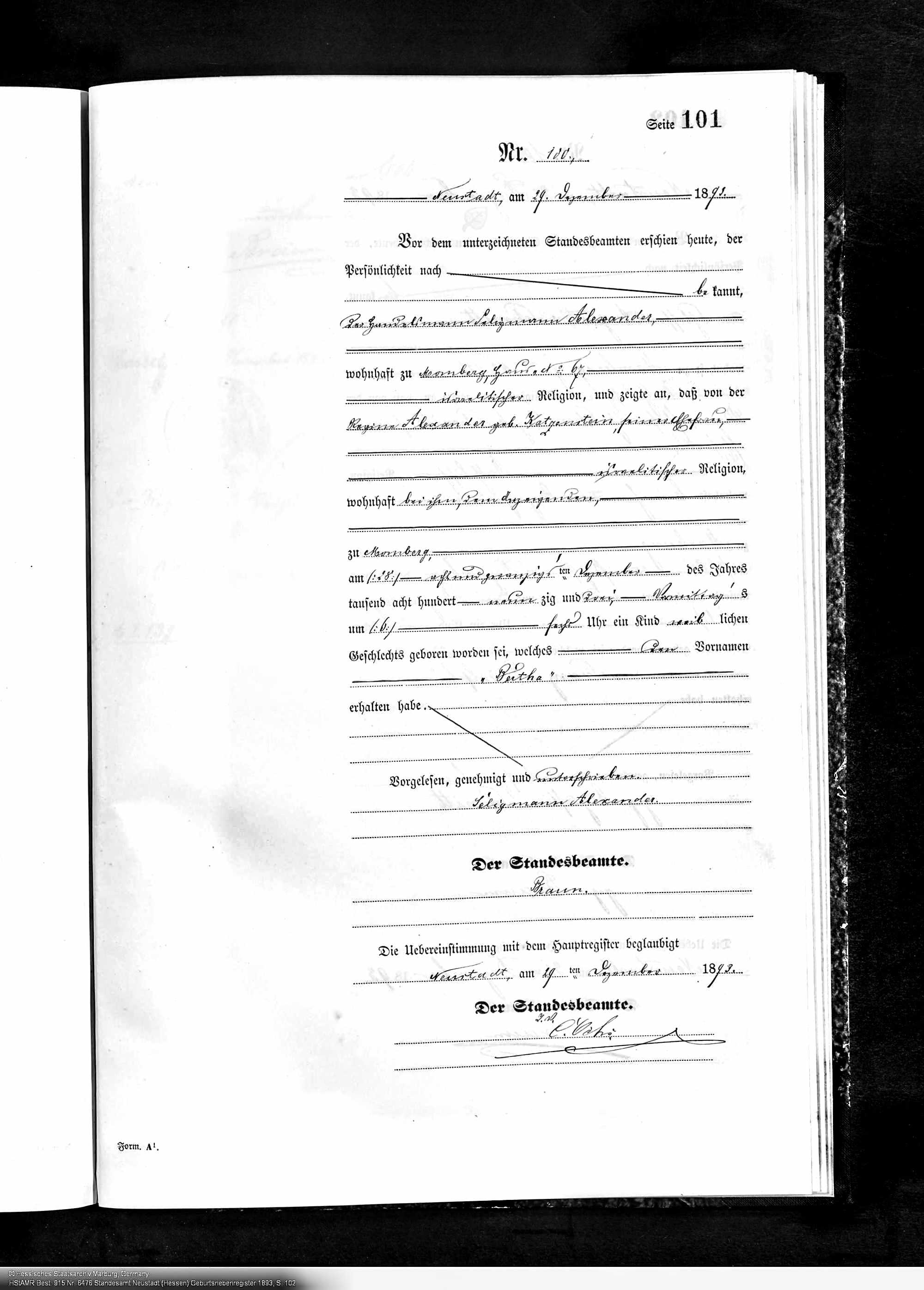
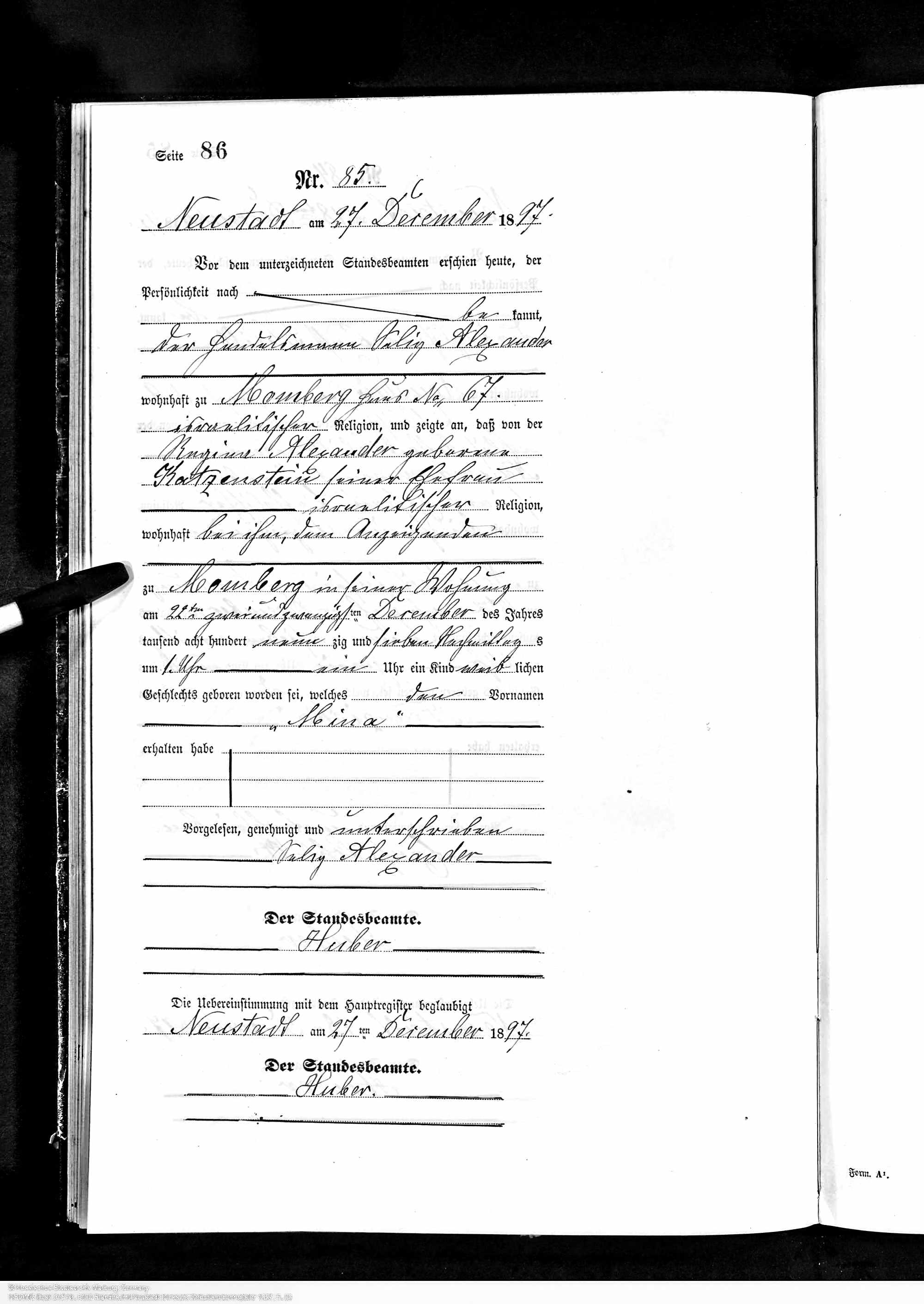
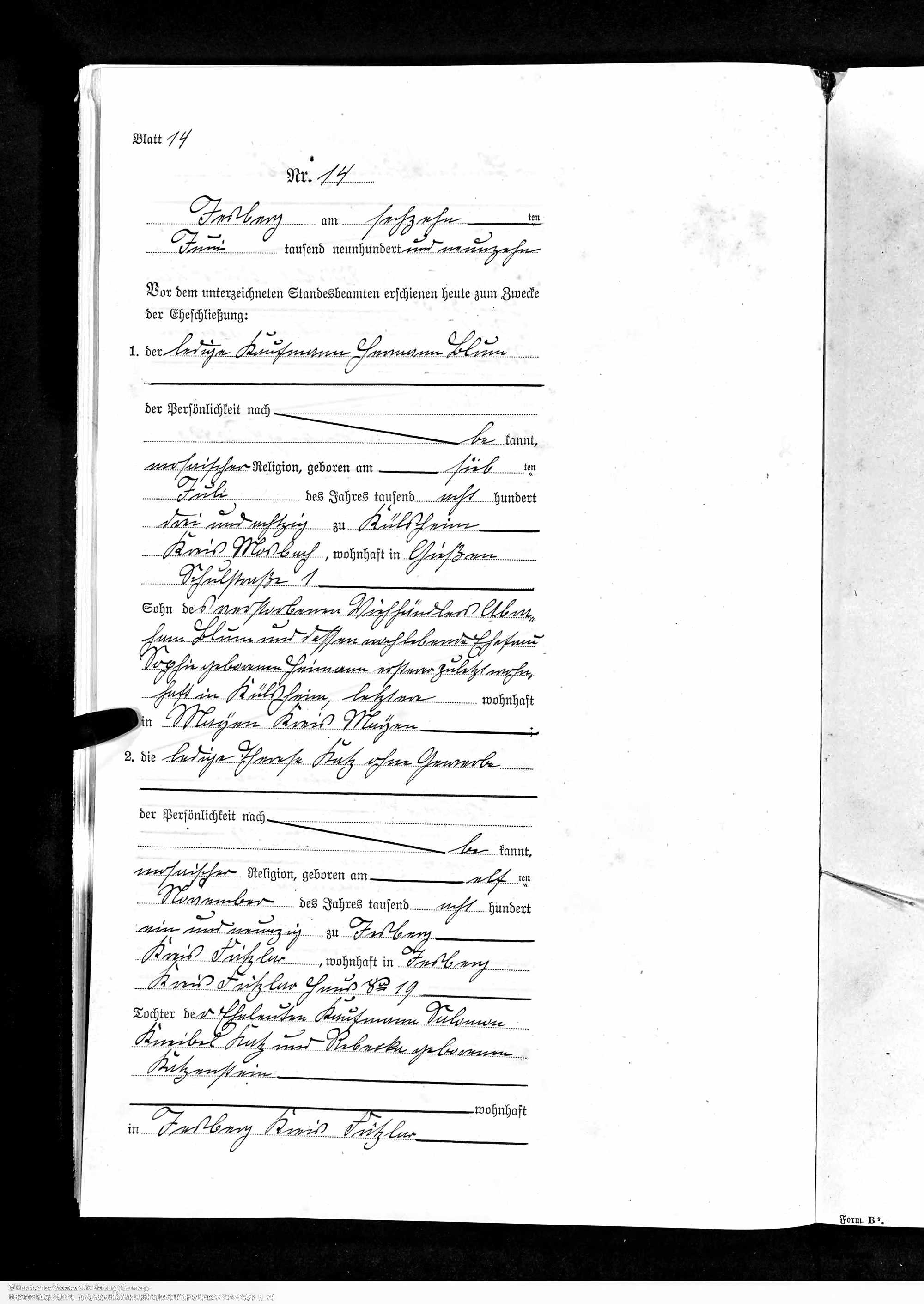
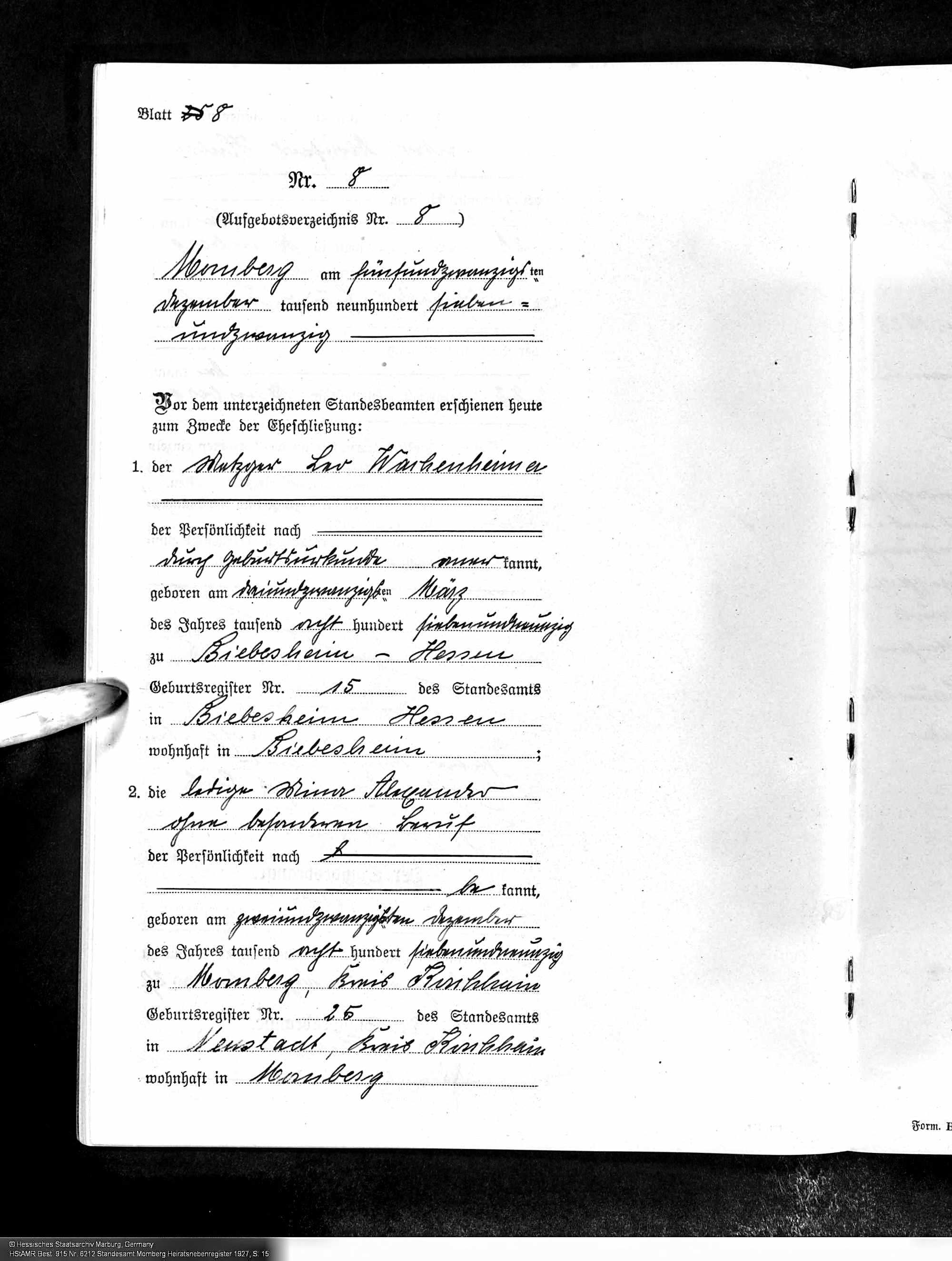
Then I found UK naturalization papers for Markus Morreau, the brother of Albert, and those also stated this his parents were Leopold and Emilia Morreau. So why did Emil list Albert and Markus as the sons of Moses and Caroline on his family tree? And who was Leopold Morreau?

UK Naturalization papers for Markus Morreau
The National Archives; Kew, Surrey, England; Duplicate Certificates of Naturalisation, Declarations of British Nationality, and Declarations of Alienage; Class: HO 334; Piece: 19
Description
Description : Piece 019: Certificate Numbers A6901 – A7300

When I looked again at the papers I’d received from Wolfgang, I realized that Wolfgang had sent a second handwritten family tree a few days after he’d sent the tree done by Emil.  On July 9, I wrote this on the blog:

This page [page seven of the second handwritten tree] is devoted to Caroline Seligmann, who married Moses Moreau from Worrstadt, another town not very far from Bingen.  Underneath are four names that the creator of this tree originally labeled as the children of Caroline and Moses, but then crossed out and wrote “grandchildren.”  The names are the same as those on the earlier tree—Markus, Albert, Bertha, and Alice.  Next to Markus it says “England,” and next to Albert it says “Amerika.” 

Second Seligmann handwritten tree, page 7

So Albert and his siblings Markus, Bertha, and Alice were not the children of Caroline Seligmann and Moses Morreau, but their grandchildren.

If the sources naming Albert’s father as Leopold Morreau were correct, that meant that Caroline and Moses Morreau had a son named Leopold. When Shyanne and I re-examined the page from the second handwritten family tree, we both concluded that one of the two names at the very bottom was Leopold Moreau. What do you think (see image directly above)? What do you think the second name at the bottom is?

UPDATE: I just figured out what the second name is! I will reveal it in a later post. 🙂

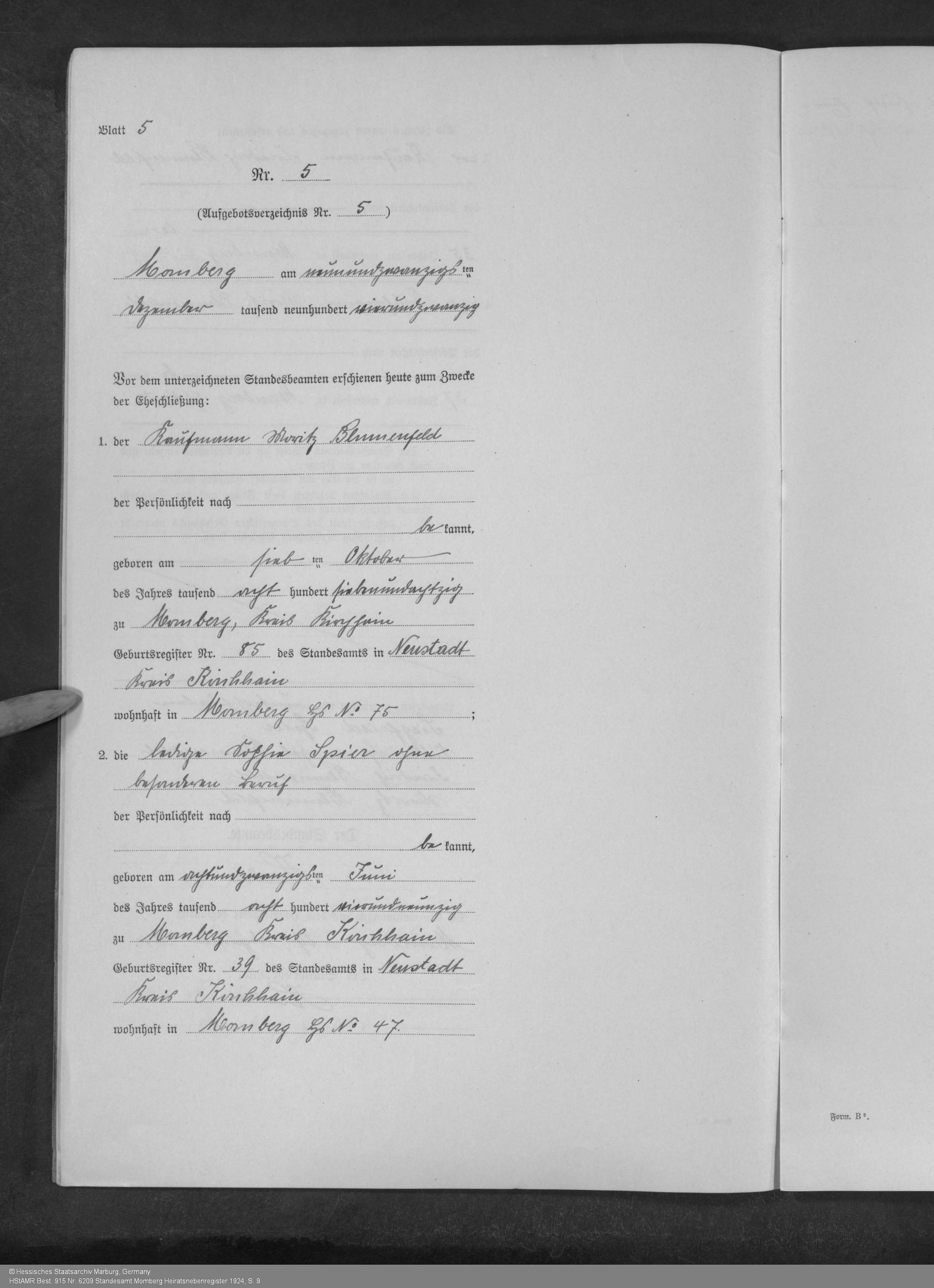
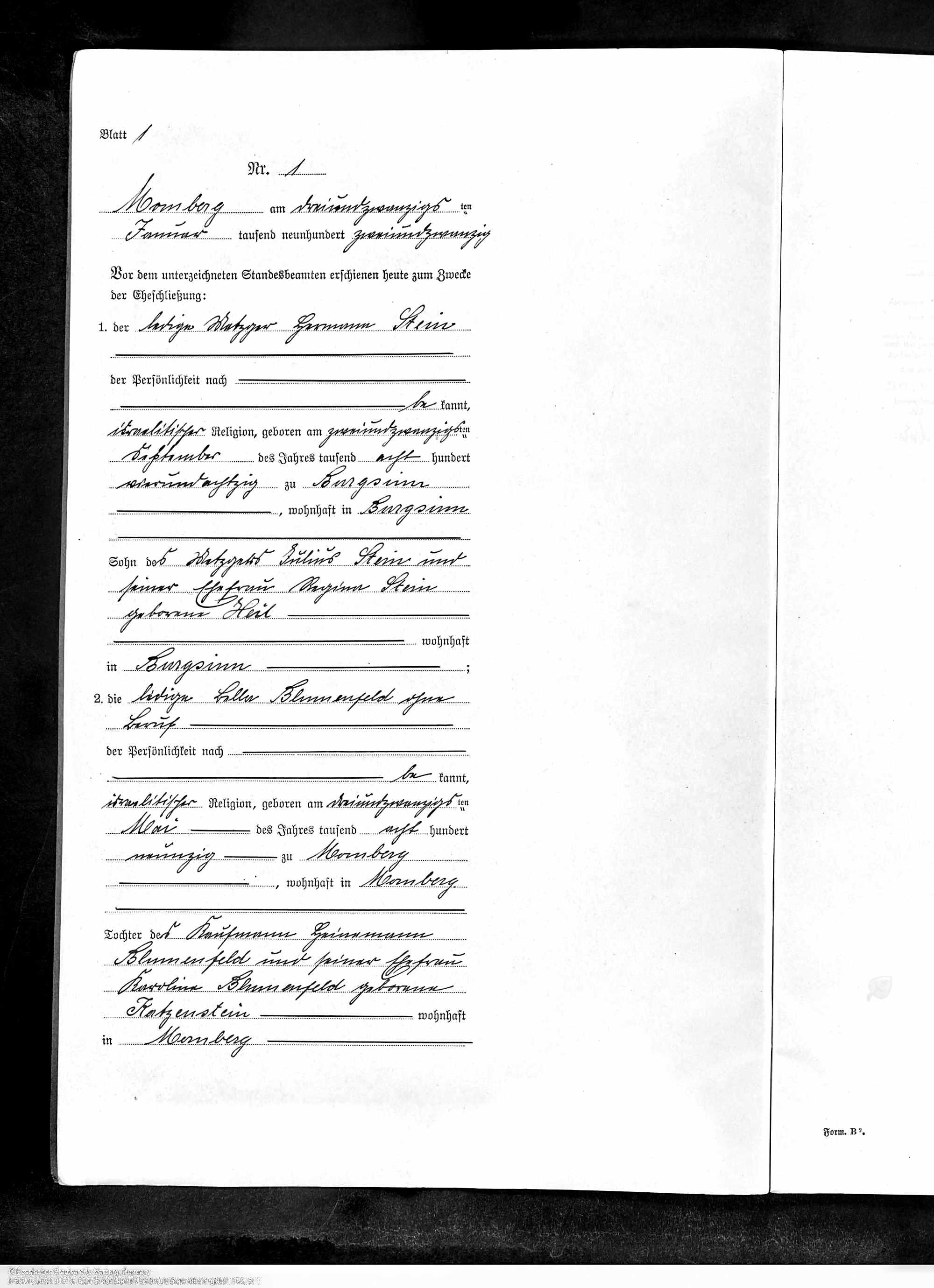
Meanwhile, Shyanne kept researching and so did I. And we ran into some incredible luck when I contacted Michael S. Phillips, a tree owner on Ancestry who generously shared with us his research on the Morreau family. Then two weeks after Shyanne’s initial comment, I received another comment about the Morreau family from a man named Paul; I emailed Paul and learned that he was related to Otto Mastbaum, who had married Albert Morreau’s sister Alice. Otto Mastbaum was Paul’s great-grandmother’s brother. And Paul filled in more gaps on the Morreau family. And I also learned more about Bertha Morreau and her husband Isidor Aschaffenburg with help from my friend in Cologne, Aaron Knappstein. And then my friend Dorothee connected me with Friedemann Hofmann, a man in Worrstadt who was able to send me the birth, death, and marriage records for the entire Morreau family from Worrstadt.

In subsequent posts, I will follow up and fill in these details and tell the full story of my Morreau cousins. But for now I just want to thank Shyanne (who I now know is my fifth cousin, once removed,), Paul, Aaron, Michael, Dorothee, and Friedemann for all their help in filling in these gaps in the Seligmann family tree.

This whole experience has been a real lesson to me. Even when you think you are “done,” there is always more to learn. And there are always incredibly generous people out there to help you do so.


In the Footsteps of the Ancestors by Beate Goetz: We Make the Newspaper in Bingen

In July, I received an email from my friend Beate Goetz; Beate is the woman who not only was our guide when we visited Bingen in May—she was one of the first people from Germany who helped me with my research, starting back almost three years ago. We’d had a lovely time with Beate while in Bingen, and she wrote an article about our visit for the local newspaper, Allegemeine Zeitung.  It was wonderful to relive the experience through Beate’s eyes and remember our time together.

With some help from Google Translate and Wolfgang, I’ve translated her article; my apologies to Beate for any errors, for which I take full responsibility:[1]

In the Footsteps of the Ancestors

Jewish Bingen

US-American Amy B. Cohen and Wolfgang Seligmann have Common Bingen roots.

In November 2014, Amy Cohen from Massachusetts turned to the Arbeitskreis Judische and asked for help.  She was in search of meaningful documents about her ancestor Moses, later Moritz, Seligmann, who was born in either Gau-Algesheim or Gaulsheim in the 19th century.

It soon became apparent that Moritz Seligmann was born on January 10, 1800, in Gaulsheim, the son of the merchant Jacob Seligmann and his wife Martha nee Mayer, who came from Oberingelheim. Also, his grandfather Hirsch Seligmann was born in Gaulsheim.

Moritz Seligmann was married twice: first with Eva Schoenfeld from Erbes-Buedesheim. The wedding was on February 27, 1829, in Gaulsheim.

The year before, Moritz Seligmann had wanted to transfer his place of residence to Gau-Algesheim, as Ludwig Hellriegel wrote in his little book, The History of the Jews of Gau-Algesheim. However, the town council rejected this and stated that “there are already a large number of Jews in the local community.” And “that it is not advisable to overpower the church with Jews.” But when Moritz Seligmann submitted a testimony to the mayor’s office of Gaulsheim of his unblemished reputation, he was allowed to become a citizen of the city.

After the death of his first wife Eva on the birth of their son Benjamin, Moritz Seligmann married her sister Babetta Schönfeld, as was customary at that time.  Bernard Seligmann, Amy Cohen’s ancestor, came from this marriage. He and his brothers Adolph and Sigismund (from the marriage with Eva) went to America around 1850. The brothers settled in Santa Fe and established the prosperous business, Seligman Brothers. They transported goods from the East Coast on the Santa Fe Trail and sold them in Santa Fe.

Since 2013 Amy Cohen has been collecting her family history research in a blog. The coincidence was that radiojournalist Wolfgang Seligmann found Amy’s blog and soon they found out that they have the same ancestor in Moritz Seligmann. While Amy’s ancestor Bernard Seligman was finding happiness in America, Wolfgang’s great-grandfather August had stayed in Gau-Algesheim. His grandfather Julius Seligmann had started the Christian line in the family as he converted when he married Magdalena Kleisinger, who was Catholic. From 1939, the family lived in Bingen.

Wolfgang Seligmann had strong support in his family research from his recently deceased mother, Annlis, who tirelessly gathered the documents and mastered the old German script.

So a few weeks ago the two Seligmann descendants met when Amy Cohen came with her husband Harvey. In addition to Mainz and Gau-Algesheim, Bingen was on the travel schedule of the guests. Together we went on a tour of the town that led along the houses and stolpersteine to remember the extensive family associations of the Seligmann, Gross, and Mayer families.

Also, we visited the synagogues and the Memorial and Meeting Center of Judische Bingen in Rochusstraße and also took countless photos before the visit to the Jewish cemetery ended the tour.

Shortly after her journey, which led the couple to Koblenz, Koln, and Heidelberg, Amy Cohen wrote how impressed she was by visiting the cemetery. “The people behind the names and stories I had researched seemed to me so close and very real, and I realized how close my Seligmann relatives were to the Bingen local community.”


[1] Only one correction to the caption under the photo: Harvey’s surname is not Cohen. I kept my birth name, just to make things easier for future genealogists. 😊

One Mystery Laid to Rest: Baby Rose Schoenthal

One of the most frustrating brick walls I’ve encountered is the mystery of Baby Rose Schoenthal.  I have written several blog posts about Baby Rose, and I have never had any success in finding this child. I stopped looking because I was troubled by the possibility that if I did find her or a descendant, I might be stirring up trouble for some unknowing person.

Some background for those who may not remember the story. On the 1930 census, my grandmother’s first cousin Jacob Schoenthal and his wife Florence are listed with a 15 month old daughter named Rose, living in Atlantic City, New Jersey.

Jacob Schoenthal and family 1930 US census Year: 1930; Census Place: Atlantic City, Atlantic, New Jersey; Roll: 1308; Page: 10B; Enumeration District: 0003; Image: 129.0; FHL microfilm: 2341043

But that there is not one whit of evidence to support the existence of that child aside from that census entry. I have searched for birth records, death records, marriage records. Nothing. I found Jacob’s will—no mention of a daughter. There was no daughter buried with Jacob and Florence. She would have been only eleven in 1940, but she does not appear on the 1940 census.

I had decided that either (1) she never existed or (2) she’d been given up for adoption or (3) she had been a foster child returned to her own parents.

Then in March 2017,  a Schoenthal cousin found me through the blog.  Barbara wrote that she was the granddaughter of Estella Schoenthal, who was my grandmother Eva Schoenthal’s first cousin and Jacob Schoenthal’s sister. Barbara and I are third cousins.

We exchanged information, and she filled me in on the names and dates of the descendants of Estella Schoenthal and Leon Klein. But perhaps most importantly, she gave me closure on that nagging question: Did Estella’s brother Jacob Schoenthal and his wife Florence Truempy have a daughter named Rose born in 1928 or 1929?

Barbara asked her mother, who said without hesitation that Jacob and Florence never had children. Could she be wrong? Of course.  Barbara’s mother might not have been born in 1930 and she definitely was not yet married to Barbara’s father in 1930, and so it’s entirely possible that IF Jacob and Florence had a child who was given up for adoption or only lived with them for a brief period, Barbara’s mother would never have known.

But I have chosen to believe that Barbara’s mother is right. I have chosen to believe that Baby Rose never existed. It never made sense to me that she’d been given up for adoption because she was already 15 months old (if she existed) in 1930, and there’s no reason to think her parents would have given her up at that point: they were mature adults and married, living comfortably, and had plenty of family around for support.

Also, the child’s name was Rose Maxine or Maime (it’s hard to read). Jacob’s mother’s name was Rose Mansbach Schoenthal. She had died in May, 1929, four months after the supposed birth of the child Rose in February, 1929. It seemed very unlikely that Jacob would have named a child for his mother before she died.

Rose Mansbach Schoenthal
courtesy of the family of Hettie Schoenthal Stein

I also didn’t buy that “Rose” had been a foster child. It seems quite an unlikely coincidence that a foster child would have the same name and middle initial as the mother of the man acting as her foster father.

So with the statement by Barbara’s mother that Jacob and Florence never had children, I am willing to close the door on the mystery of Baby Rose M Schoenthal. I think the census enumerator made a mistake. My working theory? That the enumerator was told that a Rose M had lived in the household until fifteen months before, and somehow the enumerator recorded that as meaning a fifteen month old child named Rose M was currently living in the household.

In addition to helping me with that mystery, Barbara also provided me with this handsome photograph of Sidney Schoenthal, her great-uncle and my grandmother’s first cousin.

Sidney Schoenthal

I see a resemblance to my grandmother (first photo below) and to my father (second photo below)—what do you think?

Eva Schoenthal and John Cohen, Sr. 1923

Florence and John Cohen, Jr., 1951

I am very grateful to Barbara for helping me get closure on Baby Rose. And for sharing this photograph of my cousin Sidney Schoenthal.

Kin Types by Luanne Castle: A Review

Most of us who engage in family history research probably try in some way to put ourselves in the shoes of our ancestors. We try to imagine—what were they really like? How did they cope with the failures and successes, the heartbreak and the joys that colored their lives? We want to get beyond the surface details of birth, marriage, and death, and understand who these people were.

Luanne Castle, the author of the wonderful genealogy blog The Family Kalamazoo, has done just that in her new remarkable collection of prose-poems, Kin Types (Finishing Line Press, 2017). In these clear and beautifully written poems, she has brought to life the people she has researched and studied for many years.  Collectively, her poems evoke the hard and often bitter lives of her ancestors while also piercing beneath the surfaces of those hard lives to uncover the love and the beauty that each one of these people experienced.

For example, in “An Account of a Poor Oil Stove Bought Off Dutch Pete,” a poem that describes in horrifying detail how a fire envelops a home and the woman living in it, Castle creates this image:

Under the smoke, she can make out the sliced strawberries centered on the oilcloth nailed to the tabletop

In these few simple words, Castle uses the image of strawberries sliced by a caring wife and mother to remind the reader that this is a loving family woman who is threatened by a deadly fire. It evokes birth and life amidst the threat of death and destruction.

And when Castle wonders about the history of an old house that is in serious disrepair in “The Fat Little House,” she creates a story about the man who built the house and his family. Her words convey the love between the husband and wife through the man’s response to his wife’s description of the house as “short and fat:”

He laughed, I like my houses like apples.

And swaddled inside the crisp

sugary walls she nurtured and nestled

babies, slippery as fruit flesh…

From these few words and the images created, you can imagine the sweetness between these two people. Once again, fruit becomes a metaphor for love, for life, for birth.

In other poems Castle describes the fears of a dying mother that her children will be separated and sent to orphanages where “Teachers like scavengers pick at the remains of my family,” the anxiety of a mother as her teenage daughter gives birth on the kitchen table, the joy and sadness of a mother seeing in the face of her young son the face of her now deceased brother, and the guilt and love shared by another family whose lives are torn apart because of a fire in the family home. These are just a few of the stories Castle tells in this book of poetry. Each poem made my heart ache for the lives of these people—people I never knew, people Castle herself never knew, but whom she has given new life through her words.

If you also have ever imagined what life was like for your ancestors, you will enjoy this wonderful collection. In fact, anyone—whether interested in family history or not—should read this book for the beauty of its language and for the light it sheds on our shared humanity.

You can find Kin Types here or here.

Meeting New Cousins

There is one more sibling of my great-great-grandfather Gerson Katzenstein to research and write about—his half-brother Jakob.

But before I move on to the next step in the Katzenstein research, I have several other topics to discuss—updates and items of interest that have accumulated over the months but that were put on the back burner. So the next few posts will be about these varied topics including some interesting discoveries and meetings with cousins. Today I want to talk about two recent meetings with “new” cousins.

On August 4, my cousin Jan and her husband Richard made a trip to Provincetown to meet Harvey and me and spend the day together. We met them at the wharf where the ferry from Boston arrives, walked around Provincetown, and had a wonderful lunch overlooking Cape Cod Bay and Provincetown Harbor. We had a great time together—the conversation flowed naturally, and we all hit it off very easily.

Jan and me and a new friend in Provincetown

Jan is my second cousin, once removed. Her great-grandmother Toba/Tillie/Taube Brotman Hecht was the half-sister of my grandmother Gussie Brotman Goldschlager. I had “discovered” Jan after the amazing breakthrough I had finding my grandmother’s long missing half-sister Toba through the pure serendipity of a list of names in my aunt’s baby book from 1917.

Aunt Elaine’s baby book. Note the last name in the list on the left—Mrs. Taube Hecht; that is my grandmother’s half-sister Toba/Tillie/Taube Brotman Hecht and Jan’s great-grandmother.


While we were together, Jan completed a DNA testing kit, which I mailed the next day.  I am hoping that her DNA results will help me with my Brotman research since Jan is descended  from Joseph Brotman and his first wife and not from Bessie, my great-grandmother. Perhaps her results will help me identify which genes came from Joseph and not Bessie as I search for more answers to the many questions that remain about the Brotmans, for example, about the relationship between Joseph and Bessie.

Then on Tuesday, August 8, we had dinner with another “new” cousin, Mike and his wife Wendy. Mike is my fourth cousin through my Hamberg line. We are both the three-times great-grandchildren of Moses Hamberg of Breuna. Mike’s great-grandmother was Malchen Hamberg, who married Jacob Baer; Mike’s grandmother was Tilda Baer, who married Samuel Einstein/Stone, the co-founder with Maurice Baer (Tilda’s brother, Mike’s great-uncle) of Attleboro Manufacturing Company, the jewelry company now known as Swank.

Samuel Einstein/Stone, Sr., Samuel Stone, Jr. standing Sitting: Harriet, Stephanie (Mike’s mother), Tilda, and Babette (Betty) Stone Courtesy of the family


Mike and I found each other back in March, 2017, as a result of a comment left on my blog by a man named Dr. Rainer Schimpf. Dr. Schimpf wrote then:

I am so excited to read your blog! We are doing research on Samuel Einstein, born in Laupheim, Wuerttemberg. He was connected to Carl Laemmle, founder and president of Universal Pictures, who was also born in Laupheim. Could you please get in contact with me? Thank you so much!

Best, Rainer

I contacted Rainer immediately, excited by this connection to Hollywood since I’ve always been a movie fan and trivia nut. Rainer told me that he was curating an exhibit about Carl Laemmle for the Haus der Geschichte Baden-Wuerttemberg, which is the state museum in Stuttgart for the history of southwest Germany. Laemmle was born in Laupheim, Germany, and had immigrated to the United States in 1884. The story of his career in the United States is quite fascinating (though beyond the scope of my blog). You can read it about it here and here.

Carl Laemmle
From Wikimedia Commons, public domain
https://commons.wikimedia.org/wiki/File:CarlLaemmle.jpg#file

Rainer said that in the course of his research about Laemmle, he had found a newspaper article describing a party celebrating Laemmle’s fiftieth birthday in 1917; one of the guests mentioned in the article was Samuel Einstein from Attleboro, Massachusetts. (Einstein had not yet changed his surname to Stone.)

Motion Picture Weekly, January 1917

Rainer had been trying to learn more about Samuel Einstein and had learned quite a bit, including that Einstein was one of the founders of Attleboro Manufacturing, now known as Swank.  He also had learned that Samuel Einstein was “one of four Jewish boys of Laupheim, who made unique careers in the US. All four were meeting at the birthday party of Laemmle in 1917 (Leo Hirschfeld [inventor of the Tootsie Roll] and Isidor Landauer [of International Handkerchief Manufacturing] are the other two boys).” (email from Dr. Rainer Schimpf, March, 2017)

Rainer wanted to learn more about Einstein, his family, and his connection to Laupheim, Germany, and to Laemmle. I shared with Rainer what I knew, and then I searched for and contacted as many of the Baer/Stone family members as I could, and one of them, Faith, a great-granddaughter of Tilda and Samuel Stone, responded with great interest and then connected me to her cousin, Mike. Thanks to that one comment by Rainer on the blog, I now not only know more about Samuel Einstein/Stone, I also am connected to many more of my Hamberg cousins.

Together Rainer, Mike, and I were able to pull together a fuller picture of Samuel Einstein, his family of origin, and his life in Germany and in the United States.  Although I won’t go into complete detail here about the Einstein family, I will point out one interesting bit of information we learned that answered a question I’d had while researching the Baer family: how did Maurice Baer and Samuel Einstein end up as business partners?[1]

The Baers lived in Pittsburgh, and Samuel Einstein lived in Attleboro, Massachusetts. How could they have met each other? Even today, it would take almost ten hours to drive the more than 500 miles between the two cities. It would have taken days to get from one to the other back then.


Well, Rainer discovered that Samuel Einstein had three uncles who lived in Pittsburgh who had been in the US since the mid-19th century. Perhaps Samuel met Maurice Baer when he visited his relatives in Pittsburgh; maybe the Baers and Pittsburgh Einsteins were well-acquainted. If and when I have time, these are questions I’d like to pursue.

When Mike learned that I spend the summer on the Cape where he would be visiting this summer, we arranged to have dinner together. It was a lovely evening with Mike and Wendy with lots of stories and laughs and good food.  We felt an immediate connection to these warm and friendly people. Mike shared some old photographs and even showed me Maurice Baer’s walking stick. It was a lot of fun.

Harvey, me, Mike, and Wendy

It is always such a pleasure to meet new cousins—whether they are as distant as fourth or fifth cousins or as close as a second cousin.  It reinforces the idea that we are all connected in some ways to everyone else, and it inspires me to keep looking and researching and writing.

There are so many more cousins I’d like to meet in person—or as Jan said, IRL FTF. Some live nearby, and I hope to get to see them within the next several months. Others live much further away, making it harder to get together. But I’ve gone as far as Germany to meet a cousin, so eventually I hope I can meet many of those who live in the United States.


[1] Since Samuel is only related to me by his marriage to Tilda Baer, I had not previously researched his background too deeply. For the same reason, I won’t go into detail here on all that we discovered about his family.

The Fate of the Children of Moses Katz, Part II

This was a painful post to research and write. It was made even more painful by the events in Charlottesville this past weekend. How can we still be seeing swastikas and Nazis in 2017? How do people learn to hate those who differ from them? When will we ever conquer racism and prejudice of all kinds?

***************

In my last post, I wrote about the family of Markus Katz, the oldest son of Moses Katz and Malchen Wetterhahn. Markus died before the Holocaust, and his wife Nanny was murdered by the Nazis. Fortunately, however, their three children—Maurice, Mali, and Senta—escaped in time.

Tragically, not all of Moses and Malchen’s descendants were able to escape. My thanks to David Baron and Barbara Greve for their research and help in uncovering some of the records and facts included in this post.

Rickchen Katz, the oldest child of Moses and Amalia Katz, died of cancer in Frielendorf on September 15, 1933. Given the ultimate fate of her husband and children, that might very well have been a blessing.

Death record of Rickchen Katz Moses, HHStAW Fonds 365 No 166,p. 54

I don’t know the details of what happened to the family in the 1930s, but according to the research done by Barbara Greve and reported on the Juden in Nordhessen website, Rickchen’s husband Abraham Moses committed suicide on June 13, 1940. He had moved to Frankfurt with his three daughters, Rosa/Rebecca, Amalie, and Recha. Imagine how intolerable his life must have become under Nazi rule for him to take such drastic action.

In November, 1941, Rickchen and Abraham’s daughter Rosa/Rebecca and her husband, Julius Katz, and their teenage son Guenther, were deported from Frankfurt to Minsk, where it is presumed that all three were killed. Amalie, Rosa’s sister, also was deported to Minsk at that time and is also presumed to have been killed there. I have no further record for Amalie’s twin Recha. I assume she also was a victim of the Holocaust. (All the links here are to the Yad Vashem entries for those individuals.) Thus, all of the children of Rickchen Katz and Abraham Moses were murdered by the Nazis.

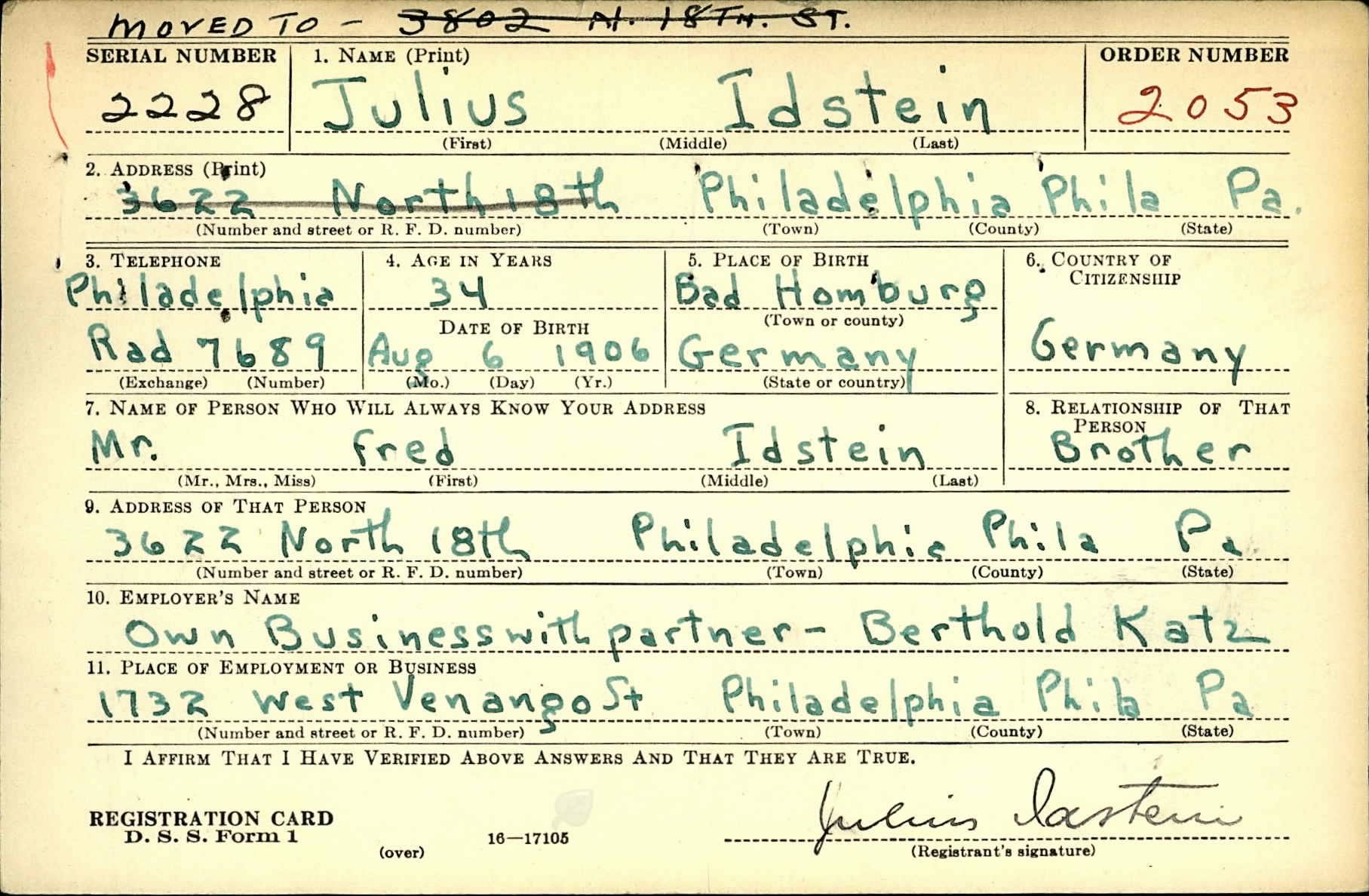
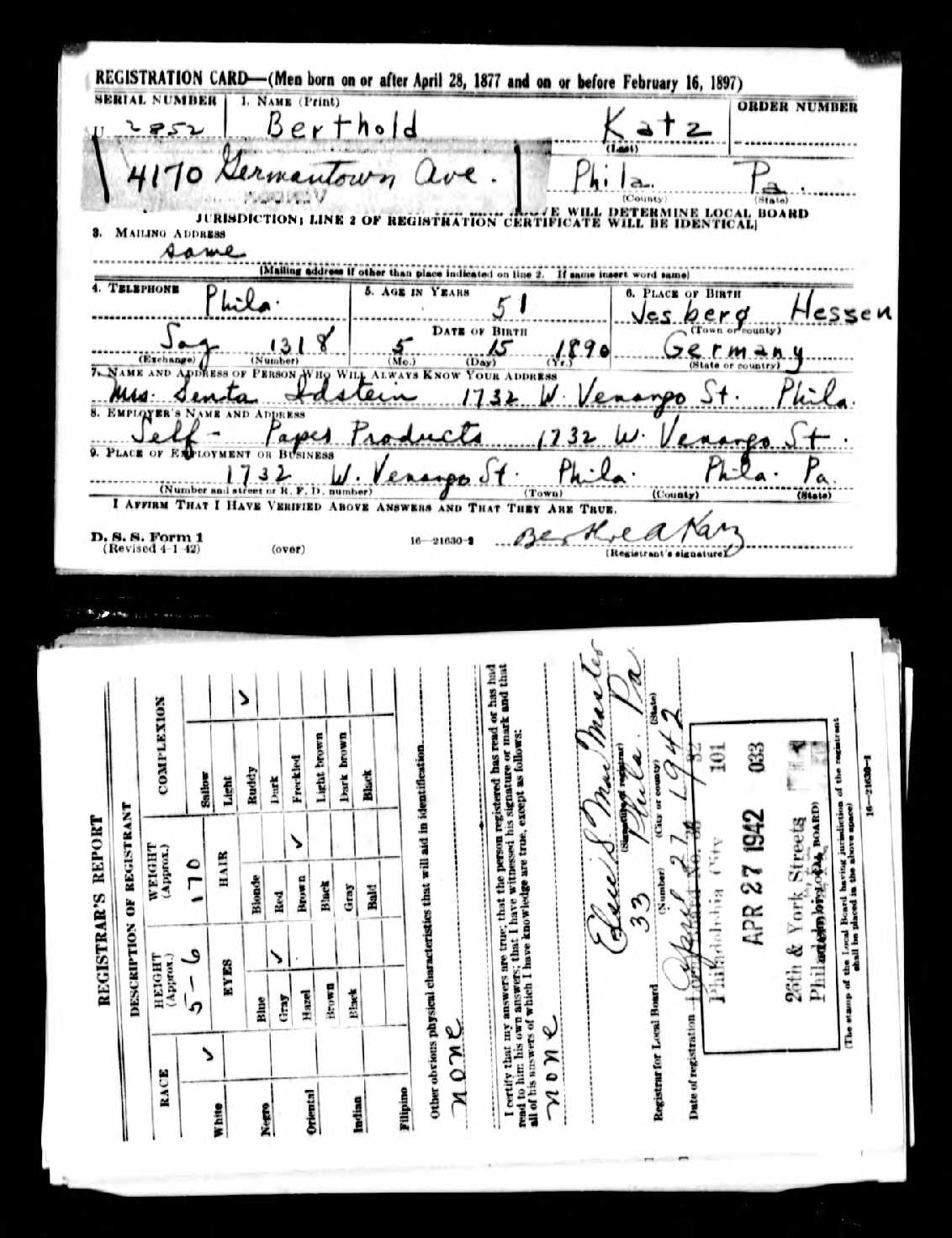
Jacob M Katz, the second oldest son of Moses and Malchen Katzhad been in the US for many years by 1930, having arrived in 1908, as I wrote about here.  He had settled in Oklahoma, where in 1930 he was married to Julia Meyer and had a teenage son, Julian. They were living in Wolf, Oklahoma, where Jacob was working in a dry goods store.  According to the 1940 census, by 1935 Jacob and Julia had moved to Pawnee, Oklahoma, and in 1940 Jacob was a men’s clothing merchant there. Julia’s sister Rose was also living with them.

Jacob M Katz and family, 1940 census, Year: 1940; Census Place: Pawnee, Pawnee, Oklahoma; Roll: T627_3322; Page: 16A; Enumeration District: 59-21

But by 1942 when he registered for the World War II draft, Jacob and Julia had moved to Vallejo, California, where Jacob was working for the Kirby Shoe Company.  I do not know what took them to California; their son Julian had married by then, but was still living in Oklahoma. Jacob died in San Francisco in 1956; Julia died the following year, also in San Francisco.

Jacob M Katz, World War II draft registration, The National Archives at St. Louis; St. Louis, Missouri; Record Group Title: Records of the Selective Service System, 1926-1975; Record Group Number: 147

Lena Katz, one of the three children of Moses and Malchen still in Germany in the 1930s and their third oldest child, survived the Holocaust. Her husband Hermann Katz had died on November 2, 1929, in Marburg, Germany, but Lena and their three children—Bertha, Moritz, and Amalie—all left Germany before 1940.

Her son Moritz left first, arriving in the US on November 14, 1936.  He listed his occupation as a butcher and listed Maurice Mink, his aunt Julias husband, as the person he knew in the United States.  His final destination was listed as Cleveland, Oklahoma, where Julia Katz Mink (the youngest daughter of Moses and Malchen) and her husband Maurice Mink were then living.  Perhaps not coincidentally, his cousin Julius Katz, son of Aron Katz, was on the same ship, as noted in an earlier post.

Moritz Katz manifest, line 19, Year: 1936; Arrival: New York, New York; Microfilm Serial: T715, 1897-1957; Microfilm Roll: Roll 5900; Line: 1; Page Number: 146
Ancestry.com. New York, Passenger Lists, 1820-1957,

Lena and her daughter Amalie were the next to arrive; they sailed together along with Amalie’s husband Max Blum and their daughter and arrived in New York on April 1, 1938.  They all listed Jacob M. Katz in Pawnee, Oklahoma, Lena’s brother, as the person they were going to in the United States. Max listed his occupation as a cattle trader. (Lena, spelled Lina here, is listed on a separate page of the manifest from the Blum family.)

Lina Katz on manifest, Year: 1938; Arrival: New York, New York; Microfilm Serial: T715, 1897-1957; Microfilm Roll: Roll 6134; Line: 1; Page Number: 98

Max and Amalie (Katz) Blum and family, lines 3-5, Year: 1938; Arrival: New York, New York; Microfilm Serial: T715, 1897-1957; Microfilm Roll: Roll 6134; Line: 1; Page Number: 88
Ancestry.com. New York, Passenger Lists, 1820-1957

The next family members to arrive were the three young children of Lena’s daughter Bertha and her husband Siegmund Sieferheld; they were only twelve and eight years old (the younger two were twins) and sailed on a ship that seemed to have many children; it arrived in New York on February 6, 1940.  The ship manifest listed the German Jewish Children’s Aid Society as the entity responsible for receiving these children.

Children of Bertha Katz Sieferheld, passenger manifest, lines 5-7. Year: 1940; Arrival: New York, New York; Microfilm Serial: T715, 1897-1957; Microfilm Roll: Roll 6443; Line: 1; Page Number: 40
Description
Ship or Roll Number : Roll 6443
Source Information
Ancestry.com. New York, Passenger Lists, 1820-1957

According to the Leo Baeck Institute, “The German-Jewish Children’s Aid Society was formed in New York in 1934 by a coalition consisting of the New York Foundation, the Baron de Hirsch Fund, B’nai B’rith, the Hofmeimer Foundation, the American Jewish Committee and the Women’s Committee of the American Jewish Congress. These organizations contributed the funds for the German-Jewish Children’s Aid to operate. The purpose of the German-Jewish Children’s Aid was to act as the receiving organization for unaccompanied or orphaned children emigrating from Europe to the United States. It acted as financial sponsor for the children (to avoid their “becoming a public charge”) and attempted to secure housing or foster home placement. ”

A more extensive description of the organization can be found here.  It describes the incredible work done by Americans, Jews and non-Jews, to rescue over a thousand children from the Nazis—certainly a small drop in the bucket considering the number of children who were murdered, but without organizations like the German-Jewish Children’s Aid Society, many more, perhaps including the three children of Bertha Katz and Siegmund Sieferheld, would also have been killed.

When I try to imagine the desperation of these parents—sending their young children off on a ship, not knowing whether they’d ever see them again—and the fear of those children, leaving their parents and the only home they’d ever known, I have to stop and catch my breath. I think of my seven year old grandson, just a year younger than Bertha’s twins. It is just too painful, too unimaginable, to visualize him being torn away from his parents and his parents being torn away from him.

The 1940 census shows Lena and almost all of her children and grandchildren living together in Detroit; Moritz, listed as the head of household on the 1940 census, was working as a sausage maker in a butcher shop.  Lena’s daughter Mali and her husband Max Blum were both working in a packing house. And the three young children of Bertha  and Siegmund Sieferheld, Tillie, Werner, and Henry, were also living with Lena, Moritz, and Mali. Their parents Bertha and Siegmund were still in Germany, separated from the rest of their family.

In addition, Lena’s younger sister Julia Katz Mink (listed as a widow here) was also living with them. Julia had apparently separated from her husband Maurice by 1930, when they were living separately in Cleveland, Oklahoma. Her daughter had married by 1940 and was living elsewhere. Julia died in 1971 in Montclair, New Jersey.

Lena Katz and extended family, 1940 census, Year: 1940; Census Place: Detroit, Wayne, Michigan; Roll: T627_1881; Page: 2B; Enumeration District: 84-1383

So as of 1940, all but Lena’s daughter Bertha and her husband Siegmund had escaped from Germany; their three young children, however, were safely with their grandmother Lena and aunt Amalie and uncle Moritz.

And then finally Bertha and Siegmund arrived on April 15, 1940.  They were sailing with two older women also named Sieferheld—perhaps Siegmund’s mother and aunt. They listed Detroit as their destination and M. Katz, Bertha’s brother Moritz, as the person they were going to. Siegmund listed no occupation.


Siegmund and Bertha (Katz) Sieferheld manifest, lines 18-21, Year: 1940; Arrival: New York, New York; Microfilm Serial: T715, 1897-1957; Microfilm Roll: Roll 6458; Line: 1; Page Number: 130
Description
Ship or Roll Number : Roll 6458
Source Information
Ancestry.com. New York, Passenger Lists, 1820-1957

How very fortunate Lena and her family were—all of them reunited safely in Detroit by April, 1940. Sadly, Lena died from cancer on December 25, 1941, just twenty months after having her whole family reunited in Detroit.  She was 69 years old.

Thus, almost all of the children of Moses Katz survived the Holocaust—all but the children of Rickchen, who were murdered. Even those who were fortunate enough to survive, however, must have borne some scars from what they had experienced. Words like “fortunate” and “survived” are just not the right words to use in writing about something as horrific as the Holocaust.  I find myself just unable to find any right words. I don’t think there are any.

And to think that there are still people out there, chanting for hate and waving Nazi flags.

**************

This brings me to the end of the story of the children of Rahel Katzenstein and Jacob Katz. From Abraham Katz and Samuel Katz, who came as young men in the 1860s and settled first in Kentucky before moving to Oklahoma and Nebraska, to Jake and Ike Katz who came thirty years later as young men and started a department store business that grew to be a small empire in Oklahoma, to the many family members  who were killed in the Holocaust and those who were able to escape the Nazis in the 1930s, the Katzenstein/Katz family demonstrated over and over that they were willing to take risks, to help each other, and to work hard for success.  I am so fortunate to have been able to connect with so many of their descendants, who continue to exhibit that strong sense of family and that drive to succeed. To me that seems quite remarkable, but given the spirit of adventure and commitment to family exhibited by all the children of Rahel Katzenstein and Jacob Katz, perhaps it really is not.


The Family of Moses Katz, Part I: Markus Katz

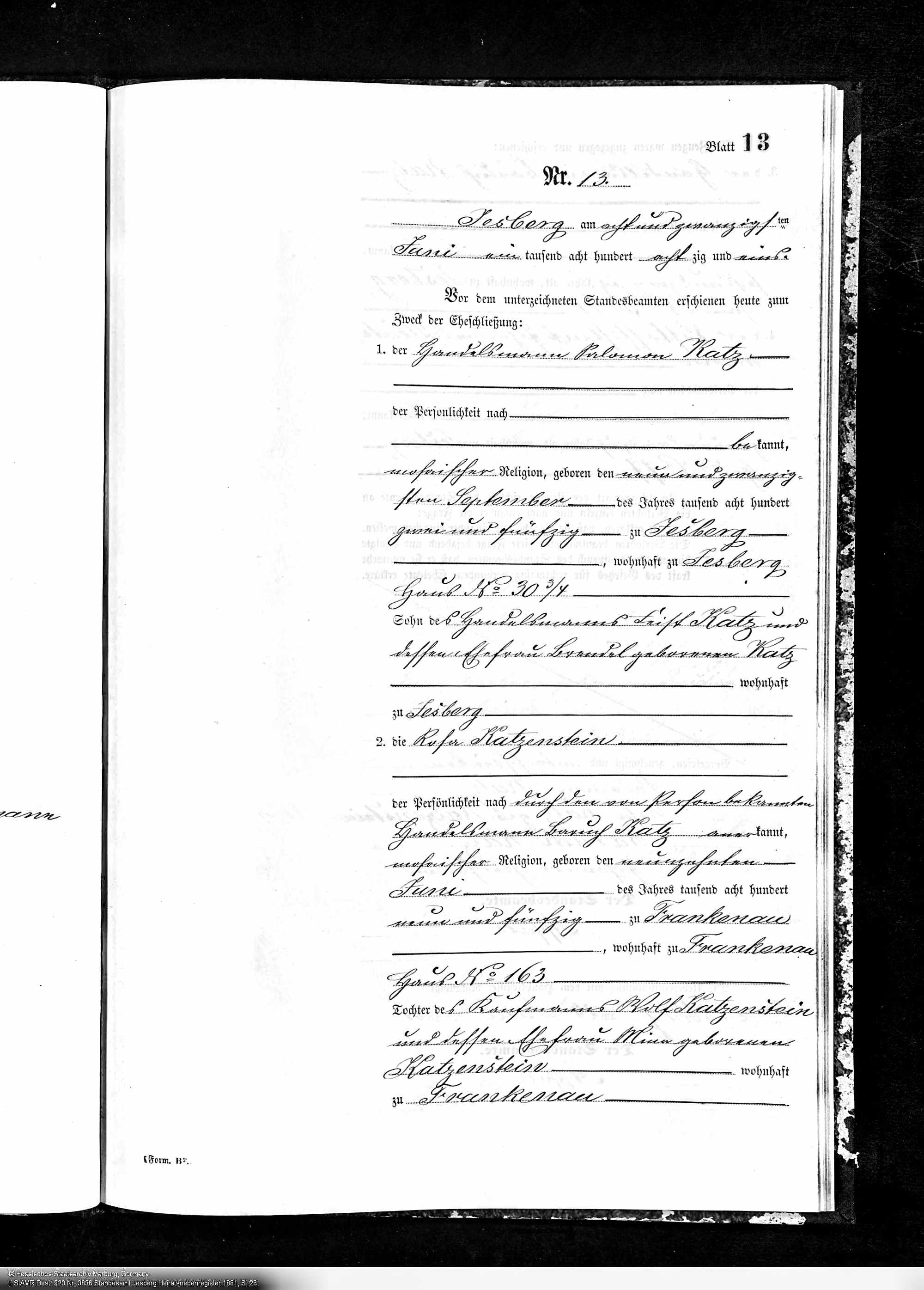
In earlier posts I discussed the families of the two sons of Rahel Katzenstein and Jacob Katz who were still living in Germany as of 1930: Moses and Meier. Moses had died in 1898 and Meier in 1925, but some of their children were still in Germany when Hitler came to power.  My last four posts described how the children and grandchildren of Meier Katz were able to survive by leaving Germany and coming to the US in the 1930s.

In this post and the one to follow, I will describe what happened to the children of Meier’s brother Moses Katz, three of whom had remained in Germany after 1930: Rickchen, Markus, and Lena. I will also report on what happened to the two children of Moses who had emigrated before the 1930s, Jacob M Katz and Julia Katz, and also Moses’ grandson Maurice (son of Markus), who also had immigrated to the US before 1930. This post will focus on the family of Markus Katz, the one to follow on the other four.

Markus Katz died before he had to experience the horrors of the Holocaust.  He died on August 3, 1931, in Jesberg, where he is buried. As I wrote about here, his grave is marked by a double stone where half was reserved for his wife Minna(also known as Nanna or Nanny) Wallach, but Minna is not buried there.  She was deported by the Nazis on June 16, 1942, and was presumed to have been killed sometime thereafter. That is why the other half of the gravestone is blank.

Markus Katz death record, HStAMR Best. 920 Nr. 3922 Standesamt Jesberg Sterbenebenregister 1931, S. 21

Gravestone of Markus Katz, son of Moses Katz, grandson of Rahel Katzenstein, with the blank half for his wife Minna (Nanny) Wallach Katz

Thanks to the generosity of their grandsons, I have this wonderful photograph of Markus and Nanny:

Minna (Nanny) Wallach and Markus Katz
Courtesy of the Abrahams family

Here is Nanny with her daughter Senta, grandson Martin, and mother Jenchen:

Nanny Wallach Katz, Senta Katz Abraham, Martin Abraham, and Jenchen Wolf Wallach
Courtesy of the Abrahams family

This beautiful photograph is of the three children of Markus and Nanny: Mali, Senta, and Maurice (Moritz):

Amalie (Mali), Senta, and Moritz (Maurice) Katz, 1908
Courtesy of the Abrahams family

Fortunately, all three of the children of Markus and Minna fared better than their mother.

As I wrote earlier, Moritz (later known as Maurice) left Germany for the US in April, 1925, and settled near his Katz relatives in Oklahoma. In the 1930s he was living in Oklahoma City and working as a salesman in a clothing store.  In 1940 he was living as a lodger with the family of Herman Mararsk in Oklahoma City, still working as a clothing salesman.

Maurice Katz, 1930 census
Year: 1930; Census Place: Oklahoma City, Oklahoma, Oklahoma; Roll: 1920; Page: 6A; Enumeration District: 0102; Image: 345.0; FHL microfilm: 2341654

Maurice Katz, 1940 census
Year: 1940; Census Place: Oklahoma City, Oklahoma, Oklahoma; Roll: T627_3342; Page: 10A; Enumeration District: 78-20

Maurice married Mollie Krisman on May 23, 1943, in Oklahoma City. That marriage apparently did not last, because on January 21, 1948, Maurice married Sarah Ross in Chicago. Obituary of Sarah Ross Katz, The Daily Oklahoman, Monday, November 30, 1998.

Maurice Katz marriage to Mollie Krisman 1943 Ancestry.com. Oklahoma, County Marriages, 1890-1995 [database on-line]. Lehi, UT, USA: Ancestry.com Operations, Inc., 2016. Original data: Marriage Records. Oklahoma Marriages. FamilySearch, Salt Lake City, UT.

For many years, Maurice owned a pawnshop in Oklahoma City. He died on October 7, 1994, and was survived by his wife Sarah. His obituary said this about him: “Maurice “Morris”, ended 91 years of a wonderful life when he died on October 7, 1994. Morris was born in Jesberg, Germany, Sept. 8, 1903 and came to the U.S. in 1925. He operated his business in Oklahoma City for 30 years before his retirement in 1972. … The wonderful memories of early Oklahoma City through the eyes of an immigrant that he shared with all who knew him will live on with his memory.” The Daily Oklahoman, October 10, 1994.  His wife Sarah died in 1998; there were no children.

Maurice’s two sisters, Mali and Senta, also survived the war.  Although I’ve yet to find any official records of what happened to Mali, her nephews and one tree on Ancestry show that she and her husband Siegfried Baumann and their daughters ended up in Brazil. Her nephew told me that she had tried to enter the US, but had been refused. I am still searching for more information about Mali and her family.

Senta and her husband Julius Abraham and their two sons immigrated to the United States on July 2, 1937. What I did not discover until the last week or so was that Julius was also a cousin of mine as well as a cousin to his wife Senta.  Julius was born in Niederurff in the Hesse region on January 2, 1894. He was the son of Hirsh Abraham and Pauline Ruelf. His mother Pauline was the daughter of Moses Ruelf and Gelle Katzenstein. Gelle Katzenstein was the daughter of Jacob Katzenstein, who was the half-brother of Rahel Katzenstein, Senta’s great-grandmother. In other words, Senta Katz and Julius Abraham were half-third-cousins, and Julius was my half-third cousin, once removed; Senta my full third cousin, once removed:

Julius and Senta’s son Fred Abrahams has generously shared with me his memoir and allowed me to share those portions that reflect the family’s life in Niederurff, Germany, and their decision to leave in 1937. Fred was only three years old when the family left Germany, which makes the clarity of his memories quite remarkable.  I think his writing movingly captures the innocence of childhood amidst the chaos of a world filled with hate:

The name, “Niederurrf”, the town where we lived means “lower-urrf (gothic for “stream”). The “urrf” was indeed a stream, probably no more than 10 feet across which ran by the back of our house. There it was spanned by a rude arched wooden foot bridge. I have many memories of playing and wading in the cool, clear waters of the slow moving rock marbled stream. In one of them:

My cousin from Frankfurt, Paul, is showing us how to fold paper hats out of newspaper. We are on the little bridge. Then, wonder of wonders, he places the hats in the stream and they become sailboats. But the water is not flowing fast enough to carry them very far downstream. My father appears. Across the stream, just above the bridge there is a long wooden board stretched lengthwise on edge across the stream and held in place by long pegs. The “urrf” forms a pool of water beyond this small dam. My father raises the board, releasing the water and the boats float and sail away out of sight. I cry because of the lost boats.

I am playing in the cobbled yard in front of our house. some boys who live a few streets away are shouting at me. I am upset. They are loud, angry…something to do with “Juden”. I don’t understand. I hardly know them. Opa (my Grandfather) Max says,” they are ignorant, you are much better than they are, ignore them. Come inside when you see them. They are louts!” I feel a little better, but I am still concerned. It still bothers me today. My Grandfather unlocks the gate to the garden behind our house. He shows me where he hides the key in a niche in a wall of slate slabs. It is our secret. 

My father comes into the living room. The atmosphere is strange, tense, nervous. Something important is taking place. He is excited and is holding a small book in his hand. We are going to America he tells us. Looking at the book in his hand he begins teaching us English words. He looks up a word and points at an object in the room. “Window” he says pointing to the fenster. “Door” pointing to the kitchen tur. “Chair” he indicates the stuhl he is sitting on. This is a strange new game but I know somehow that it is very important.

We are on a train, facing each other across the car, my mother and father on one side, my brother and I on the other. We sit on facing benches that line the walls of the car. My mother has brought salami sandwiches. An indoor picnic, as we eat I can hear the click-clack of the wheels of the train and see the countryside streaming by. I am excited but also sense that my parents are worried. We stop to visit my Grandmother in Frankfurt. I am playing and jumping on her white metal frame bed. She seems to be ill (diabetes I later learn) and we are saying goodbye. She will be left behind. We are going on to Bremen! Then, we are going on a big boat to America, the German Lloyd liner Hansa. To America (wherever that is). It is a great adventure!

I’m running all around a big boat. There is a wide long alley like deck with the water far below on one side. I am fascinated by the water streaming by. A brass band is playing, a real concert with a band stand. The bandsmen are in dark blue uniforms with white hats. I stand in front of the bandleader and make believe I am the conductor, aping his movements, leading the band. The bystanders watch me, laughing and applauding.

Later I am sick and miserable lying on an upper bunk. I can’t climb the ladder and my father lifts me up. After a while I feel better. Then my mother gets sick. The doctor comes to our cabin. I am left free to run around again. I explore this huge complex boat, bigger than any place I have ever known. More people at once than I have ever seen. Playing hide and seek in the life boats with sailors and other kids. Sitting in all the deck chairs. Trying to play shuffleboard. What an adventure.

Then the trip is over. We dock and wave to people waiting on the pier.

[From the memoirs of Fred J. Abrahams, unpublished.]

When the family left Germany, they were heading to New York, where Julius’ sisters (and thus also Senta’s cousins) Meta and Recha were living. Julius had been a businessman and tailor in Niederurff as well as a shop owner and farmer; on the ship manifest he listed his occupation as a tailor.

Family of Julius and Senta Katz Abraham, passenger manifest, lines 5-8, Year: 1937; Arrival: New York, New York; Microfilm Serial: T715, 1897-1957; Microfilm Roll: Roll 6003; Line: 1; Page Number: 18
Ancestry.com. New York, Passenger Lists, 1820-1957

In 1940, the family was living at 325 West 93rd Street in New York City, and Julius was working in the family business, Abrahams Brothers, a clothing business. Julius had an uncle, Max Abrahams, who had come to the United States in the early 1870s and ultimately settled in Davenport, Iowa, where he and his sons established a clothing business known as Abrahams Brothers. The business grew to about a dozen stores throughout the Midwest. In 1940, Julius was working in the fur department of the New York office, where the administration and buying for the many stores was handled. He continued to work for the business for the rest of his life.

Senta Katz Abrahams and family, 1940 census
Year: 1940; Census Place: New York, New York, New York; Roll: T627_2642; Page: 16A; Enumeration District: 31-777

Julius died on December 22, 1959; Senta lived to 93, dying on October 15, 2000, in Stamford, Connecticut. Their sons Martin and Fred have both been very kind and generous in sharing the photographs and the story of their family, and I look forward to meeting them both.


The Legacy of Jake Katz: One More Family Rescued and a Remarkable Life

The last child of Meier and Sprinzchen Katz to leave Germany was their son Aron, who had been his younger brother Karl’s partner in the cattle trading business in Jesberg.

The family of Aron Katz and Sara Leiser: rear, Julius, Aron, Jack; front, Sara.
Courtesy of the family of Fred Katz

As noted in an earlier post, Aron’s son Jacob, known as Jack, had left Germany for the US in 1926 and was living with Jake Katz and his family in Stillwater in the 1930s, working in the Katz department store there.

Aron’s son Julius arrived on November 4, 1936, on the same ship as his cousin Moritz Katz, son of Moses Katz’s daughter Lena. Julius listed himself as a cattle trader and said he was headed to his uncle “Jakob” Katz in “Chillwater,” Oklahoma.

Julius Katz manifest, line 6Year: 1936; Arrival: New York, New York; Microfilm Serial: T715, 1897-1957; Microfilm Roll: Roll 5900; Line: 1; Page Number: 146
Ancestry.com. New York, Passenger Lists, 1820-1957,

On February 22, 1939, Aron and his wife Sara finally arrived from Germany. Fred Katz told me that Aron had been quite resistant to leaving Germany, believing like so many others that things would not get too bad. Thank goodness Aron realized how wrong he was before it was too late.  When the war in Europe started just a little over six months later, it became much more difficult for Jews to leave Germany.

Aron and Sara listed their son Jacob (Jack) Katz of Stillwater, Oklahoma, as the person who was receiving them, but handwritten in is the additional notation that they were also going to Aron’s brother Jake at the same address. Aron reported that he was a merchant.

Aron and Sara Katz, ship manifest, lines 4-5, Year: 1939; Arrival: New York, New York; Microfilm Serial: T715, 1897-1957; Microfilm Roll: Roll 6291; Line: 1; Page Number: 141
Ancestry.com. New York, Passenger Lists, 1820-1957

In 1940, Aron and Sara were living in Stillwater like so many other members of the extended family.

As mentioned in the post about Walter  and Max Katz, Aron and Sara’s older son Jack Katz was in the US Army during World War II and stationed for some time in Germany. Jack was 31 when he registered for the draft in October, 1940.  He was living in Stillwater and working Katz Department Store there. I don’t know the details of his service other than what was described by Walter, but his draft card indicates that he was discharged on November 2, 1945.

Jack Katz Draft Registration
Page 1 – Selective Service Registration Cards, World War II: Multiple Registrations 15-Oct-1909

After he returned home Jack married Helen Oppenheimer of Jackson, Missouri, on August 18, 1947.

Jack’s brother Julius registered for the draft in October, 1940. At the time he was living in Oklahoma City and listed his employer as Humpty Dumpty. Humpty Dumpty was a supermarket chain owned by Sylvan Goldman, the son-in-law of Jake Katz and husband of his daughter Margaret Katz. As I wrote previously, Sylvan and his brother Alfred had married the two daughters of Jake Katz, Margaret and Helen (respectively). The Goldman brothers were in the grocery business together.

The Oklahoma Historical Society website provides this description of the history of the Goldman brothers’ grocery business:

After World War I… [Sylvan and] Alfred opened Goldman Brother’s Wholesale Fruits and Produce in Breckenridge, Texas. Years later, while living in California, Sylvan and Alfred were intrigued by a new type of grocery store that offered all products under one roof—the supermarket. The brothers returned to Oklahoma in order to bring this new way of shopping to their home state. With Sylvan serving as president and Alfred as vice president of Sun Grocery Company, they opened a store on April 3, 1920, at 1403 East Fifteenth Street in Tulsa, Oklahoma. One year later there were twenty-one Sun Grocery markets throughout the state.

In 1929 Sylvan and Alfred sold the Sun chain to Skaggs-Safeway Stores, and in 1934 Sylvan purchased the faltering Humpty-Dumpty grocery chain. The chain was revived in part due to Goldman’s revolutionary advertising and enlightened personnel policies. His greatest contribution was the shopping cart, invented in 1936 and patented by Goldman. He established the Folding Basket Carrier Company to manufacture his invention. It was just the beginning of a list of creations that revolutionized the grocery industry: the grocery sacker, the folding interoffice basket carrier, and the handy milk bottle rack.

The New York Times described Sylvan’s invention of the shopping cart in Sylvan’s 1984 obituary:

With help from a carpenter and a maintenance man, and with a folding chair as a model, he built the first grocery cart in the mid-1930’s. Shoppers were reluctant to use it, so Mr. Goldman hired people to push loaded carts back and forth in front of a store. He also hired a woman to offer the carts to customers as they entered.  “Sylvan N. Goldman, 86, Dies; Inventor of the Shopping Cart,” The New York Times, November 27, 1984.

After Alfred Goldman died on July 9, 1937, while vacationing in New York City, Sylvan continued the business, and Julius Katz, Aron’s son, was working for him in the Oklahoma City store at the time he registered for the draft in 1940. More information about Sylvan Goldman can be found here, here, here, and in this video:

Julius Katz was still living in Oklahoma City in 1943 when he became a naturalized citizen. He listed his occupation as farming in 1937 when he filed his Declaration of Intent, but the Petition for Naturalization does not reveal what his occupation was at the time.

Julius Katz Declaration of Intent
National Archives and Records Administration; Washington, D.C.; ARC Title: Declarations of Intention for Citizenship , compiled 1908 – 1932; ARC Number: 731206; Record Group Title: Records of District Courts of the United States; Record Group Number: 21
Oklahoma City Declarations of Intention, 1932-1974 (Box 1)
Ancestry.com. Oklahoma, Naturalization Records, 1889-1991

Aron Katz died on October 19, 1950. He was seventy-five years old and was buried in Stillwater.

On November 15, 1953, his son Julius married Seena Hana Kaufman in Kansas City, Missouri:

Marriage record of Julius Katz and Seena Kaufman
Ancestry.com. Missouri, Marriage Records, 1805-2002 [database on-line]. Provo, UT, USA: Ancestry.com Operations, Inc., 2007.
Original data: Missouri Marriage Records. Jefferson City, MO, USA: Missouri State Archives. Microfilm.

The marriage must not have lasted, however, because two years later in 1955, Seena is listed under her birth name in the Kansas City directory.

Julius died on August 7, 1963.  According to his obituary, his body was discovered at his farm by his brother. The obituary described Julius as a “well-known Payne County farmer and rancher with operations north of Stillwater.”  The only survivors mentioned were his mother and his brother Jack. “Funeral Services Slated  Friday for Julius Katz, Stillwater Newspress, August 8, 1963, p. 8.

Aron’s wife Sarah died three years after her son at age 88 on December 18, 1966. She was survived by her son Jack, who died in Dallas, Texas, on August 27, 1997.  He was 87 years old. Like his father, mother, and brother, he was buried in Fairlawn Cemetery in Stillwater.

Thus, all of the children of Meier Katz and Sprinzchen Jungenheim—Jake, Aron, Ike, Regina, and Karl and all their children—ultimately left Germany and settled safely in the United States, almost all of them in Oklahoma. Some came as early as the 1890s, other as late as the 1930s. As for those who came in the 1930s, it is tempting to think that it was a miracle that the entire family survived the Holocaust, but it was probably more a combination of luck, courage, and their own determined efforts and those of their family in America—especially those of Jake Katz—that got them out of Germany in time.

As for Jake Katz himself, recall that by 1930 he had lost his wife Sophia as well as his son Albert Jerome. Thanks to Jake’s great-granddaughter, I now have photographs of Jake and Sophia’s three children, Albert Jerome, Margaret, and Helen:

Albert Jerome Katz in rear, Helen Katz and Margaret “Babe” Katz seated with unknown cousins on laps
Courtesy of the Goldman family

Perhaps some Katz family member can identify the two unknown little cousins? Since we know Albert Jerome died in 1919, I am assuming this photo was taken in about 1918, meaning the two young children were likely born in 1916-1917. I am thinking one might be the daughter of Lester Katz and Mayme Salzenstein, Mildred “Bobbie,” since she was born in January 1916 and was related to Jake and Sophia on both sides, Lester being Jake’s cousin and Mayme being Sophia’s sister.

Here is Jake Katz with all three of his children:

Albert Jerome Katz in rear,
Margaret “Babe” Katz, Jake Katz, and Helen Katz seated
Courtesy of the Goldman family

Family members tell me that after Albert Jerome died, Sophia did not want to continue living in the house where their son had lived, so Jake sold it to a sorority.  After Sophia died, he bought the house back from the sorority. Family members recall his home as a family gathering place where children played hide and seek.  There were frequent Sunday dinners where the extended family would come to visit, and Jake always had either a silver dollar or a Hershey’s kiss for every child. Jake’s great-niece Ester wrote about Jake and his role in saving the family on her blog, It’s All from Hashem in her post Thoughts of a Libra. 

Jake Katz died on July 2, 1968, in Stillwater, Oklahoma. He was 94 years old. His obituary made the front page of the Stillwater Newspress (July 3, 1968)[There is one error here; Sophia Salzenstein Katz did not die fifteen years after they were married; she died in 1930.]

Stillwater Newspress, July 3, 1968, p. 1
Jake Katz obituary

Jake Katz was truly a remarkable man. He came to the US as a young teenager, traveling alone. He worked with family members until he was able to strike out on his own, and then he started a department store business that expanded over the years and ultimately supported many members of his extended family. He rescued several of his siblings and their children from Nazi Germany. And he did all of this despite suffering the tragic loss of his son Albert Jerome and the premature death of his wife. He is remembered with great love and admiration by many members of the family who knew him.  It is quite a legacy.

His daughters Margaret and Helen survived him. Margaret died in 1984, followed just a few weeks later by her husband, the grocery store magnate and shopping cart inventor Sylvan Goldman. Helen died in 1999. Jake’s three grandsons also have passed away, but he is survived today by two great-grandchildren.


The Family of Regina Katz and Nathan Goldenberg—Escaping the Nazis

When Hitler came to power in 1933, three of the five children of Meier Katz and Sprinzchen Jungheim were still living in Germany: Aron, Regina, and Karl.  Through the moving memoir of Fred Katz  and the oral history of Walter Katz, we’ve seen how Karl Katz and his family were finally able to leave Jesberg by December, 1938. His sons Walter and Max had left earlier, and Karl, his wife Jettchen, and youngest son Fred left soon after Kristallnacht. All had settled in Stillwater, Oklahoma, with the help of Karl’s oldest brother, Jake.

Jake wasn’t only helpful to Karl’s family. Karl and his family had been preceded by his sister Regina and her family—her husband Nathan Goldenberg and their three children, Bernice, Theo and Albert.

Theo, Bernice, and Albert Goldenberg
Courtesy of the Goldenberg family

Theo was the first of Regina and Nathan’s family to leave Germany, arriving in New York on August 17, 1934, when he was twenty years old. Thanks to Theo’s granddaughter Abbi, I have some documents that reflect Theo’s work history and reputation before he left Germany. Special thanks to Doris Strohmenger and Heike Keohane of the German Genealogy group on Facebook for translating these documents for me.

This first letter, written November 14, 1932, when Theo was eighteen, is from his employer, A. Bachenheimer, a clothing manufacturing company, where Theo had been first an apprentice and then a salesman; he’d started when he was fourteen years old. The letter describes him as an honest, efficient and diligent salesman.

The second letter is from the next employer, Josef Volk, another clothing manufacturer, where Theo worked from December, 1932, until July 1933; this letter also describes him as willing, honest, and industrious. I am not sure where Theo went next or why he left this company, but given that Hitler had been elected by then and the boycott of Jewish businesses had been declared in April 1933, I assume there was some connection.

Theo left Germany a little over a year later. He filed a certificate of deregistration with the community of Kestrich on August 6, 1934, indicating that he was leaving the community.

He sailed on the SS New York with his cousin, Helma Goldenberg, who was 22 and a nurse. Theo listed his occupation as “clerk” and his final destination as Stillwater, Oklahoma, where he was going to his uncle Jake Katz. (Helma was going to Georg Goldenberg, her uncle, who was in New York City.) As my cousin Marsha learned when she interviewed Theo in 1993, Jake met Theo at the boat in New York when he arrived and provided him with land to farm when they returned to Oklahoma.  Theo told Marsha he “owed it all to Jake.”

Theo Goldenberg ship manifest, line 19, Year: 1934; Arrival: New York, New York; Microfilm Serial: T715, 1897-1957; Microfilm Roll: Roll 5531; Line: 1; Page Number: 39
Ancestry.com. New York, Passenger Lists, 1820-1957

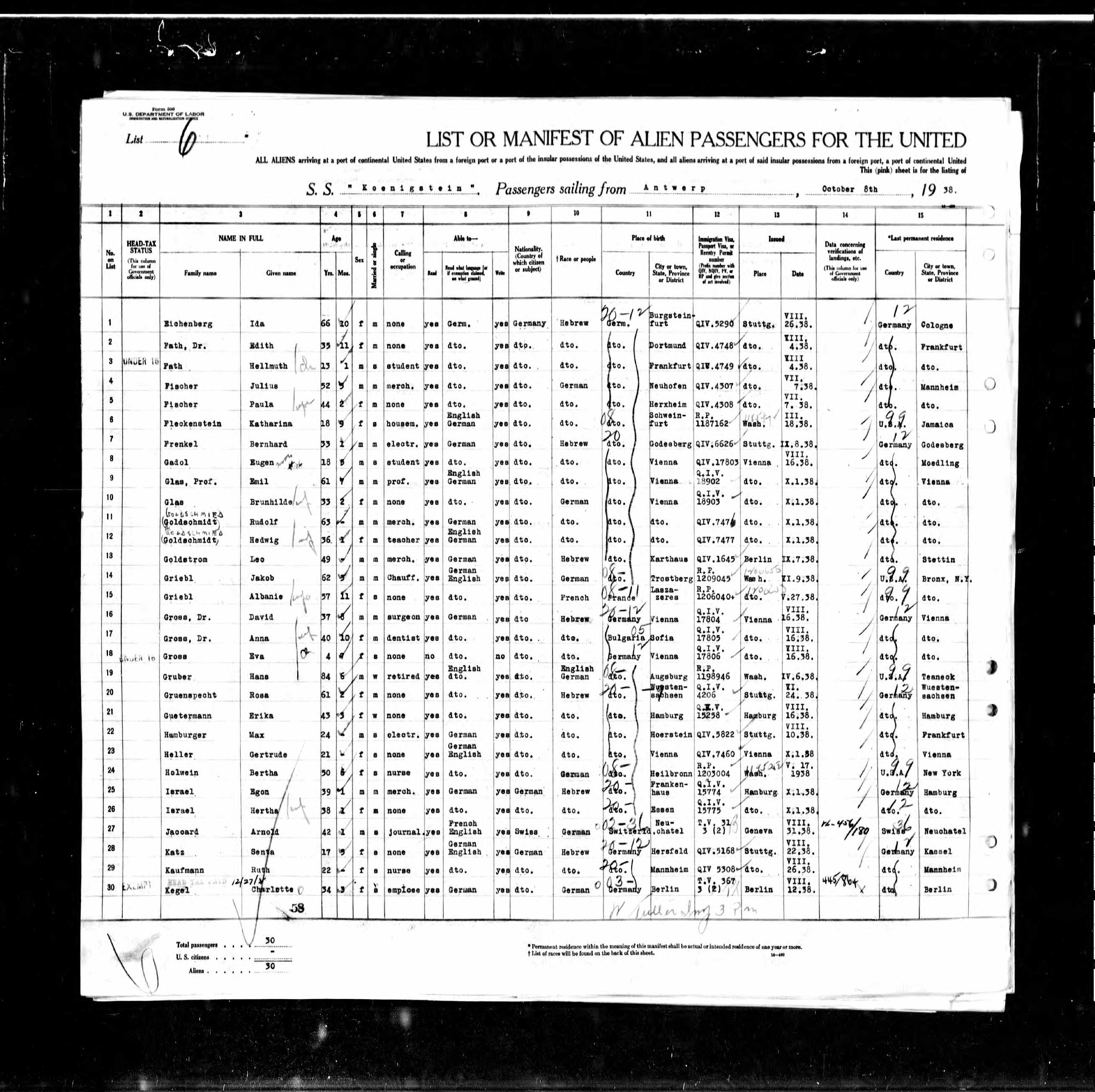
Theo’s sister Bernice and her family were the next to arrive in the US.  Bernice was married to Julius Katz, who was born in Steinbach, Germany. They had a son Henry.  I knew that the family had arrived by 1940 because they are listed as living in Brooklyn on the 1940 census. Julius was working as a wholesale butcher, and Bernice as a dressmaker. But I could not find a passenger manifest for them.  When I look back on it, I am not sure why it was so hard to locate. But I thought it might be worthwhile sharing what I did and how I finally found them.

Because all I had was the 1940 census, I used the names and ages on that census to search for a manifest. I searched for Bernice Katz, Julius Katz, Henry Katz, and Julius’ mother and sister, Violet and Bette Katz. I searched for any ship arriving between 1935 and 1940 because I knew from the census that they were still in Germany in 1935. But nothing came up that seemed right.

Bernice Goldenberg and Julius Katz and family, 1940 census, Year: 1940; Census Place: New York, Kings, New York; Roll: T627_2611; Page: 8A; Enumeration District: 24-2457

Then I searched to see if I could find more specific information about Julius and his mother and sister—when and where were they born? Nothing came up. Finally, I searched for obituaries, and although I found a SSDI record showing that Bernice had died in Fairfield, Connecticut in 1985, I could not find any obituaries. I was stumped.

So I decided to ask the family for help.  I sent Theo’s son Nate a message on Facebook, asking whether he knew when Bernice had arrived and whether her son Henry was still alive. Nate knew that Henry had died within the last few years so I narrowed my obituary search to the last few years, and Henry’s obituary immediately appeared.  It revealed, among other things, that Henry and his family had arrived in 1936. It also revealed that Henry was born in 1931, not 1933, as the 1940 census had indicated. (Hartford Courant, January 17, 2015)

That led me to a specific search for any Katz arriving in 1936 in New York City—with no limits on ages or names.  And this time the search immediately produced the right result: a ship manifest for Julius Katz, Berni Katz, Heinz [Henry] Katz, Veilchen [Violet] Katz, and Betty Katz arriving in New York on April 10, 1936.  Julius Katz listed his occupation as an animal dealer, and they were all heading to New York City where Julius’ brother Leopold Katz was living.

Bernice Goldenberg Katz and family on ship manifest, lines 9-13, Year: 1936; Arrival: New York, New York; Microfilm Serial: T715, 1897-1957; Microfilm Roll: Roll 5787; Line: 1; Page Number: 176
Ancestry.com. New York, Passenger Lists, 1820-1957

How had I missed this before? I am not sure.  Yes, all the ages were off.  Julius is listed as 37 on the 1936 manifest, but is listed as 48 four years later on the 1940 census; Bernice, who is listed as 29 on the manifest, is lasted as 37 on the 1940 census. Henry, as noted, was two years younger on the census than he was on the ship manifest. Had I searched too narrowly by those birth years? I don’t know.  All I know is that I was very grateful to my cousin Nate for providing me with enough information to narrow my search and find the passenger manifest for his aunt Bernice and her family.

On July 2, 1936, less than three months after Bernice and her family arrived, Nathan and Regina (Katz) Goldenberg and their son Albert arrived from Germany. (Regina is listed as Rosa here.) Nathan’s occupation was a cattle dealer, and Albert, who was sixteen, was an apprentice.  Here is Nathan’s business identification card from Germany:

They were headed to Stillwater, Oklahoma, going to Jake Katz and also joining their son Theo.

Nathan Goldenberg and family, ship manifest, lines 1-3, Year: 1936; Arrival: New York, New York; Microfilm Serial: T715, 1897-1957; Microfilm Roll: Roll 5825; Line: 1; Page Number: 20
Description
Ship or Roll Number : Roll 5825
Source Information
Ancestry.com. New York, Passenger Lists, 1820-1957

Here are their German passports:

Nathan Goldenberg passport

Regina Katz Goldenberg passport


Albert Goldenberg passport

In 1940, Nathan, Regina, Theo, and Albert were all living together in Stillwater where Nathan and Albert were farming, and Theo was a salesman in a clothing store—Katz Department Store in Stillwater.

Nathan Goldenberg and family, 1940 census, Year: 1940; Census Place: Stillwater, Payne, Oklahoma; Roll: T627_3323; Page: 19A; Enumeration District: 60-33
Description

Thus, the entire family of Nathan and Regina (Katz) Goldenberg had safely left Germany before 1940.. Theo filed a Declaration of Intent to become a US citizen on February 7, 1936, his brother filed on February 10, 1938, his father Nathan filed one on December 29, 1938, and his mother Regina had done the same on August 18, 1941.  All must have been very relieved to be safely living in Stillwater and anxious to become American citizens.

Theo Goldenberg Declaration of Intent
National Archives and Records Administration; Washington, D.C.; ARC Title: Petitions 1932 – 1991; ARC Number: 731222; Record Group Title: Records of District Courts of the United States; Record Group Number: 21
Oklahoma City Petitions, 1954-1957 (Box 6; Volume 14-17)
Ancestry.com. Oklahoma, Naturalization Records, 1889-1991

Albert Goldenberg Declaration of Intent
National Archives and Records Administration; Washington, D.C.; ARC Title: Declarations of Intention for Citizenship , compiled 1908 – 1932; ARC Number: 731206; Record Group Title: Records of District Courts of the United States; Record Group Number: 21
Oklahoma City Declarations of Intention, 1932-1974 (Box 1)
Ancestry.com. Oklahoma, Naturalization Records, 1889-1991

Nathan Goldenberg Declaration of Intention
National Archives and Records Administration; Washington, D.C.; ARC Title: Declarations of Intention for Citizenship , compiled 1908 – 1932; ARC Number: 731206; Record Group Title: Records of District Courts of the United States; Record Group Number: 21
Oklahoma City Declarations of Intention, 1932-1974 (Box 2)
Ancestry.com. Oklahoma, Naturalization Records, 1889-1991

Regina Katz Goldenberg Declaration of Intent
National Archives and Records Administration; Washington, D.C.; ARC Title: Declarations of Intention for Citizenship , compiled 1908 – 1932; ARC Number: 731206; Record Group Title: Records of District Courts of the United States; Record Group Number: 21
Oklahoma City Declarations of Intention, 1932-1974 (Box 2)
Ancestry.com. Oklahoma, Naturalization Records, 1889-1991

Albert and Theo both registered for the draft, Theo on October 16, 1940, and  Albert on July 1, 1941. Both were working at Katz Department Store in Stillwater at the time of their registrations.

Theo Goldenberg draft registration
Page 1 – Selective Service Registration Cards, World War II: Multiple Registrations 1940
Web Address
http://www.fold3.com/image/612584757?xid=1945

Albert Goldenberg draft card
Page 1 – Selective Service Registration Cards, World War II: Multiple Registrations 1941
Web Address
http://www.fold3.com/image/612584753?xid=1945

Tragically, the family was to suffer two terrible losses not that long after settling in the United States. First, on March 17, 1944, Nathan Goldenberg died. He was only 67 years old. According to his obituary, he had been ill for some time. His two sons were in the military at the time of his death; Theo was a corporal in the US Army stationed in Garden City, Kansas, and Albert was a private, first class, stationed in the Pacific Theater. “Goldenberg Rites Sunday,” Stillwater Newspress, March 17, 1944, p.3.

Just three months later on July 12, 1944, Albert was killed in action serving his adopted country. According to his obituary, he had been inducted into the army on December 1, 1941, just six days before Pearl Harbor.  He had trained at Camp Barkley in Texas and was serving with the medical corps attached to the 105th Infantry in Saipan when he was killed. He was only 24 years old at the time of his death. “Services Set for Goldenberg, Stillwater Newspress, June 16, 1948, p. 8.

Albert Goldenberg,  courtesy of the Goldenberg family

According to Theo’s son, after receiving training to join the intelligence service, Theo was en route to France when he received word that his brother had been killed; he was called back and discharged from the service as the sole surviving son. In the space of three months, Regina Katz Goldenberg had lost her husband and her youngest child, and her two remaining children, Theo and Bernice, had lost their father and younger brother.  How heartbreaking it must have been to have escaped the Nazis only to lose two family members so soon afterwards, one of whom was killed serving his new country.

After returning home to Stillwater, Theo returned to work at Katz Department Store with his uncle Jake, where he worked for over fifty years, and also operated a small dairy business for over forty years. He milked cows by hand and sold raw milk; he was the last dairyman to be able to sell raw milk in Payne County.

On October 15, 1950, Theo married Anne Marie Kunstler, who was born in Nuremburg, Germany. They were married in Stillwater.

Marriage License of Theo Goldenberg and Anne Marie Kunstler
Ancestry.com. Oklahoma, County Marriages, 1890-1995 [database on-line].
Original data: Marriage Records. Oklahoma Marriages. FamilySearch, Salt Lake City, UT.

According to family lore, Theo and Anne Marie met in New York City, and six days later Theo proposed to her. She told him she wouldn’t marry him without seeing Oklahoma first, and he told her he would buy her a one way ticket, and if she didn’t want to stay, she’d have to pay for her own ticket back home.

Apparently Oklahoma met her standards, and she and Theo were married for almost fifty years. Theo died on January 11, 2000. He was 86 years old. Anne Marie is still living.

As for Theo’s sister Bernice, she and her husband Julius and their son Henry lived in Brooklyn for many years, where Julius worked in the meat industry (a kosher hot dog company) and Bernice in the garment district. She would take her sewing machine back and forth from work so that she could work at home in the evenings. Bernice and Julius moved to Fairfield, Connecticut, in 1975, after Julius was mugged several times in Brooklyn.

Julius Katz died on November 26, 1977, in Fairfield. Bernice Goldenberg Katz, died at age 79 in Fairfield, Connecticut, on May 2, 1985. Their son Henry died on January 15, 2015, in West Hartford, Connecticut. He was a veteran of the Korean War and was a structural designer, having studied at Pratt Institute and New York City Community College. He worked for over thirty years at Dorr Oliver, a chemical engineering company in Stamford, Connecticut. (Obituary, Henry Herman “Hank” Katz, The Hartford Courant, January 17, 2015.)

Thus, another branch in the family of Meier Katz and Sprinzchen Jungheim survived the Holocaust and prospered in America.  But for the tragic death during World War II of young Albert Goldenberg, this would have been another happy story about Meier and Sprinzchen’s descendants.


Arthur “Pete” (Seligman) Scott 1938-2017

I am very sad to report that my cousin Pete passed away on July 11, 2017. Regular readers of this blog may recognize Pete’s name—his full name was Arthur George Scott, but he was born Arthur George Seligman. Pete was my father’s second cousin, and I found him several years back when I was researching my Seligman(n) family line.

My cousin Pete and one of his many much-loved dogs

Connecting with Pete was one of the most rewarding experiences I have had while researching my family history. Pete was fascinated by history and was extremely knowledgeable about the history of his hometown, Santa Fe, and about our family’s contribution to the history of that city.  Because of Pete’s extensive background and incredible generosity, I was able to learn a great deal about our American Seligman history. And I was able to share with him my delight in learning about our German ancestors and relatives. He quickly became a friend as well as a cousin.

Pete was the great-grandson of Bernard Seligman, who, along with his brothers Sigmund and Adolf, traveled the Santa Fe Trail in the 1850s and helped to establish Santa Fe as an important trading post. Their store Seligman Brothers was on the main plaza in Santa Fe for close to eighty years.

Bernard Seligman

Pete’s grandfather was Arthur Seligman, the governor of New Mexico from 1931 until his death in office in 1933. I wrote extensively about Arthur Seligman on the blog, as well as about Pete’s father Otis Seligman; without Pete’s help, I would not have been able to learn and share as much as I did about the contributions the Seligmans made to American history.

Arthur Seligman (second from left) with Franklin Roosevelt and others

Pete and his dear friend Mike Lord along with several others also created and contributed to a historical website called Voces de Santa Fe. If you enter Arthur Scott or Pete Scott into the search box there, you can see some of the incredible work Pete did, researching and writing about not only his family’s history, but also the general history of Santa Fe and the region. I relied on Voces for many of my stories about the Seligmans and early Santa Fe.

Pete was very proud of his family history, as well he should have been. Pete inherited the pioneer spirit of his great-grandfather Bernard and the commitment to public service of both his great-grandfather and his grandfather and namesake Arthur Seligman. Rather than try and write a biography of Pete myself, I am including in this post the beautiful obituary written by Pete’s daughter, Terri. Thank you, Terri, for allowing me to share this.

A Life Well Lived, Loved, and Learned

Arthur George Scott (Seligman), also known as Pete and Art, aged 79, last residing in Bradenton, FL, died on July 11, 2017 at home, in his sleep due to many complications from a lifetime of Type I Diabetes.

He was born on January 27, 1938 to Doris Seligman (Gardiner) and Otis Seligman in Santa Fe, NM. He was given his stepfather’s last name of Scott in 1943 after his father passed away when Pete was just starting public school in Santa Fe.

While obtaining his BS in Civil Engineering from New Mexico State University, he married his first wife Marilyn Bicksler. After participating in ROTC and graduating from NM State University, he provided service to the US Army as a Lieutenant, giving education to many younger recruits during the late 1950’s Cold War. After providing his service to the United States, he grew his hair long and never cut it short again; he added a beard and mustache for good measure.

He acquired Type I Diabetes just out of the US Army, while beginning a lifetime career in the United States Geological Survey. Lucky to survive the diabetic coma that announced a new path in his life, Pete moved forward and never gave up.

He loved his career and work friends at USGS in Santa Fe, NM, surveying rivers and dealing with Diamondback Rattle Snakes in the desert. And at USGS in Reston, VA, he travelled and wrote hydrologic journal papers on rivers and lakes from the Clinch River Valley to Canada/US Great Lakes, and to Brazil educating on water resources. He called it “The best job in the world”. Part of that “best job” involved a lot of travel, which he relished and he learned from the people in every society, city, or country he visited.

Pete inspired all of his creativity, scientific knowledge and self-sufficiency to his children, Terri and Janice. They remember his paintings, remodeling of the house, and collecting NM historical artifacts. Terri and Janice closely followed in his footsteps of science and creativity.

Pete and Bonnie on their wedding day

In 1980, while living in Reston, VA he met and married his current, devoted, and loving wife, Bonnie Sharpless Scott. Their marriage was 37 years strong. They spent many exciting and tumultuous times, helping to raise two teenagers, travelling, working, playing, and loving. Bonnie, a professional hairdresser, always took care of trimming Pete’s hair and beard to ultimate perfection. Now, that’s true love. Their travels were magical from the Galapagos Islands seeing Darwin’s creatures, to Africa viewing Mount Kenya and Mount Kilimanjaro, and hanging in Jamaica getting dreadlocks, and onto Thailand appreciating the majesty of nature, then sailing in the Caribbean, as well as a Brazilian cruise up the Amazon River.

Pete leaves behind many people, including his two daughters, Terri and Janice; Janice and husband Matthew’s children, Alexander and Wesley; Terri and husband Jeffrey’s children, Joshua and Nicholas; his niece, Jhette Diamond; and most significantly, his wife, Bonnie. In addition, Pete leaves behind very favored pets, including dogs: Koda II, Sunny, and Tipper, plus birds: Bubba, Tico, and Cisco. And very importantly, he leaves behind a legacy and brilliant history with many extended family and friends.

Type I Diabetes was a major obstacle in Pete’s life, as well as his family’s lives. He kept all his limbs, but lost most of his eyesight, most of the use of his hands, and his legs were very painful and eventually lost function, at which point he had to accept a wheel chair, all due to Diabetic peripheral neuropathy. However, he never gave up hope and learning. His last days were spent with Bonnie making cigar box guitars, and learning to play slide guitar blues.

If you would like to help his family heal from the loss of Pete, please learn everything you can about Type I Diabetes and feel free to make a donation to the American Diabetes Association (www.diabetes.org) or your local chapter of The Lighthouse for the Blind. We only ask this, in Pete’s name and memory, so that young people who have no choice and acquire this disease can live better and longer lives than Pete was allowed.

I will miss Pete very much; although we had long ago finished our collaboration on the family history, we had stayed in touch. In March, 2016, while in Florida, Harvey and I traveled to Bradenton, Florida, and had a very enjoyable and interesting evening with Pete and his beloved wife Bonnie.  We met their dogs and parrots and shared stories about our lives and our history. I feel so very fortunate that we were able to spend that time together. Here is a photo I took when we were together.

Pete and Bonnie when we visited in March 2016

My heart goes out to Pete’s family—his wife Bonnie, his daughters Terri and Janice, and his grandchildren.  May his memory be a blessing for his family and for all of us who knew him.