
You might want to open a bottle of wine as you read this post.
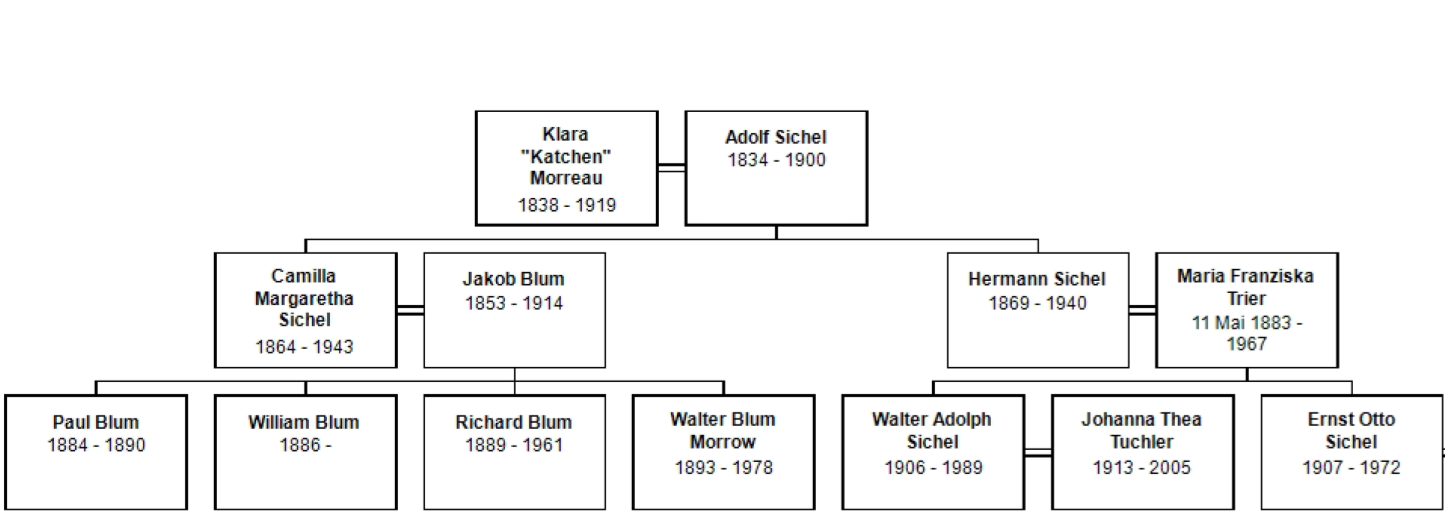
As I wrote last time, Caroline Seligmann (my 4x-great-aunt) and Moses Morreau had two children, Levi and Klara. This post will focus on Klara and her descendants.
Klara was born in Worrstadt on July 9, 1838:

Klara Morreau birth record, July 9 1838
Morreau birth records 1838-29
I have not had success in finding a marriage record for Klara, but I know from her death record and her son’s birth record that she married Adolph (sometimes Adolf) Sichel. I have neither a birth nor a death record for Adolph, but I do have a photograph of Adolph’s gravestone in Bingen, which identifies his birth date as April 10, 1834. [1]

Adolph Sichel gravestone at Bingen cemetery
http://www.steinheim-institut.de/cgi-bin/epidat?id=bng-818&lang=de
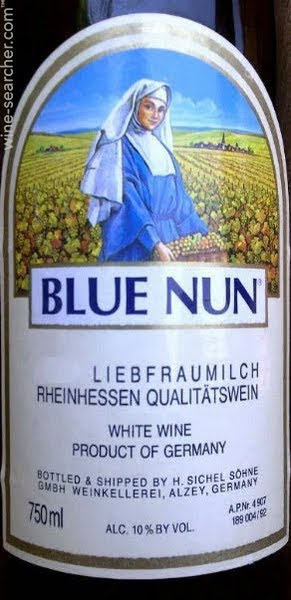
Adolph Sichel was the son of Hermann Sichel and Mathilde Neustadt of Sprendlingen, later Mainz. Hermann Sichel was the founder of the renowned wine producing and trading business, H. Sichel Sohne. Although it is beyond the scope of my blog to delve too deeply into the story of the Sichel wine business, a little background helps to shed light on Adolph, Klara, and their descendants. According to several sources, Hermann Sichel started the family wine business with his sons in 1856 in Mainz, Germany.
In 1883, the company expanded to Bordeaux, France, where it established an office to procure wines for sales by Sichel in Mainz, London, and New York City. The sons and eventually the grandsons worked in various branches of the business, some working in the French office, some in London, and some in Mainz. The business continued to expand and is still in business today; it is perhaps best known in popular culture as the maker of Blue Nun, a wine that was quite successful in the 1970s and 1980s. One writer described it as “a single, perfectly positioned product, a Liebfraumilch whose blandness seemed just the ticket for the hundreds of thousands of new wine drinkers, not just in the US but also in the UK. “
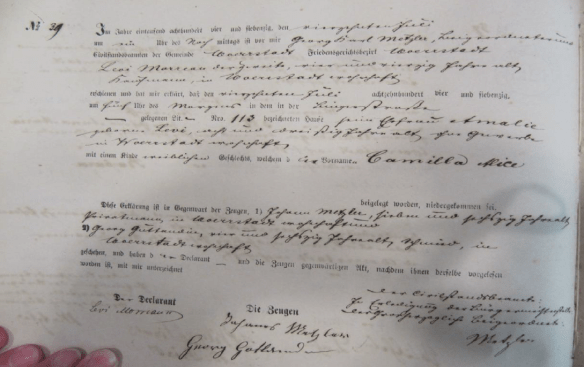
Adolph was not one of the sons who relocated from Germany. He and Klara had two children born and raised in Germany. Their daughter Camilla Margaretha Sichel was born on February 4, 1864, in Sprendlingen, according to Nazi documentation:

UPDATE: Aaron Knappstein was able to get a copy of Camilla’s birth record:
Camilla Sichel married Jakob Blum, who was born April 3, 1853, in Nierstein, Germany. They had four children, all born in Mainz: Paul (1884), Willy (1886), Richard (1889), and Walter (1893):

Paul Blum birth record, September 7, 1884
Ancestry.com. Mainz, Germany, Birth Records, 1872-1900 [database on-line]. Provo, UT, USA: Ancestry.com Operations, Inc., 2014.
Original data: Personenstandsregister Geburtenregister 1876-1900. Digital images. Stadtarchiv Mainz, Mainz, Germany.

Willy Blum birth record
February 21, 1886
Ancestry.com. Mainz, Germany, Birth Records, 1872-1900 [database on-line]. Provo, UT, USA: Ancestry.com Operations, Inc., 2014.
Original data: Personenstandsregister Geburtenregister 1876-1900. Digital images. Stadtarchiv Mainz, Mainz, Germany.

Richard Blum birth record
June 8, 1889
Ancestry.com. Mainz, Germany, Birth Records, 1872-1900 [database on-line]. Provo, UT, USA: Ancestry.com Operations, Inc., 2014.
Original data: Personenstandsregister Geburtenregister 1876-1900. Digital images. Stadtarchiv Mainz, Mainz, Germany.

Walter Blum birth record
August 4, 1893
Ancestry.com. Mainz, Germany, Birth Records, 1872-1900 [database on-line]. Provo, UT, USA: Ancestry.com Operations, Inc., 2014.
Original data: Personenstandsregister Geburtenregister 1876-1900. Digital images. Stadtarchiv Mainz, Mainz, Germany.

Paul Blum, Mainz Jewish Cemetery Courtesy of Camicalm Find A Grave Memorial# 176111502
Camilla Sichel Blum’s husband Jakob Blum died August 22, 1914; he was 61 years old:

Jakob Blum death record
Ancestry.com. Mainz, Germany, Deaths, 1876-1950 [database on-line]. Lehi, UT, USA: Ancestry.com Operations, Inc., 2015.
Original data: Personenstandsregister, Sterberegister, 1876-1950. Mainz Stadtarchiv.

Jakob Blum gravestone, Mainz Jewish Cemetery
Courtesy of Camicalm
Find A Grave Memorial# 177633476
His wife Camilla would survive him by almost thirrty years.
Adolph Sichel and Klara Morreau also had a son named Hermann. I found Hermann’s birth date and place, June 24, 1869, in Sprendlingen, in the Name Index of Jews Whose German Nationality Was Annulled by the Nazi Regime database on Ancestry, a horrifying but presumably reliable source, given the meticulousness with which the Nazis kept records on Jews:

Hermann Sichel in Ancestry.com. Germany, Index of Jews Whose German Nationality was Annulled by Nazi Regime, 1935-1944 [database on-line]. Provo, UT, USA: Ancestry.com Operations, Inc., 2011.

Marriage record of Hermann Sichel and Maria Trier
Hessisches Hauptstaatsarchiv; Wiesbaden, Deutschland; Collection: Personenstandsregister Heiratsregister; Signatur: 901; Laufende Nummer: 98
Hermann and Maria had two sons, Walter Adolph (1906) and Ernst Otto (1907).
Camilla and Hermann’s father Adolph Sichel died on April 30, 1900, as seen above on his gravestone; Hermann’s older son Walter Adolph was obviously named at least in part for Adolph. Klara Morreau Sichel died on April 2, 1919. Adolph and Klara are buried in Bingen.

Klara Morreau Sichel death record, Apr 2, 1919
Ancestry.com. Mainz, Germany, Deaths, 1876-1950 [database on-line]. Lehi, UT, USA: Ancestry.com Operations, Inc., 2015.
Original data: Personenstandsregister, Sterberegister, 1876-1950. Mainz Stadtarchiv.

Klara Morreau Sichel gravestone at Bingen Jewish cemetery
http://www.steinheim-institut.de/cgi-bin/epidat?id=bng-818&lang=de
The families of both Camilla Sichel Blum and Hermann Sichel remained in Germany until after Hitler came to power in 1933. Then they all left for either England or the United States.
Two of Camilla’s sons, Richard and Walter, ended up in the US. Walter arrived first—on April 27, 1939.
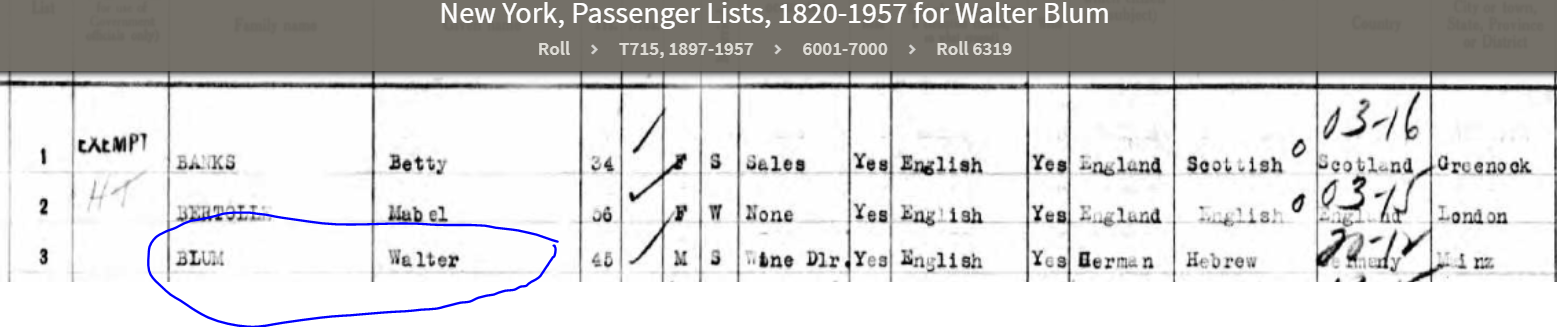
Walter Blum ship manifest 1939
Year: 1939; Arrival: New York, New York; Microfilm Serial: T715, 1897-1957; Microfilm Roll: Roll 6319; Line: 1; Page Number: 42
Description
Ship or Roll Number : Roll 6319
Source Information
Ancestry.com. New York, Passenger Lists, 1820-1957 [database on-line].
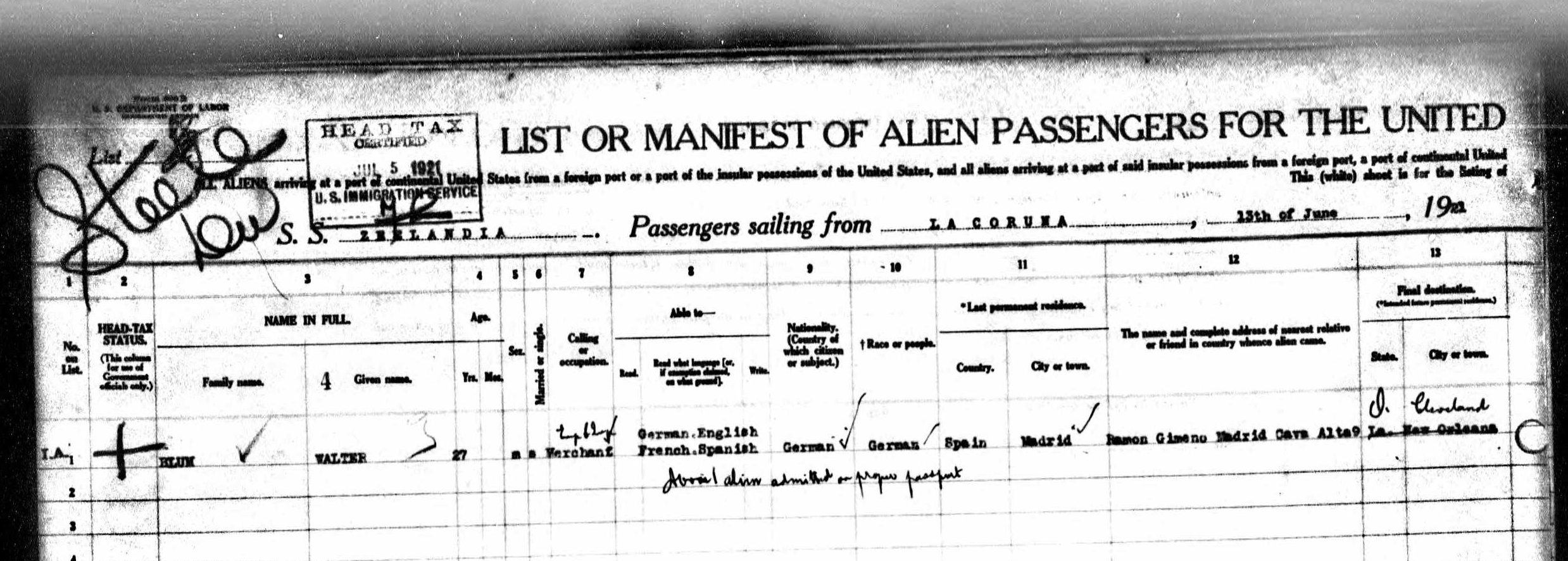

Walter Blum 1921 ship manifest
Ancestry.com. New Orleans, Passenger Lists, 1813-1963 [database on-line]. Provo, UT, USA: Ancestry.com Operations, Inc., 2006.
Original data: Selected Passenger and Crew Lists and Manifests. National Archives, Washington, D.C.View all sources.


Richard Blum 1939 ship manifest
Ancestry.com. New York, Passenger Lists, 1820-1957 [database on-line]. Provo, UT, USA: Ancestry.com Operations, Inc., 2010.
Original data: Passenger Lists of Vessels Arriving at New York, New York, 1820-1897. Microfilm Publication M237, 675 rolls. NAI: 6256867. Records of the U.S. Customs Service, Record Group 36. National Archives at Washington, D.C.
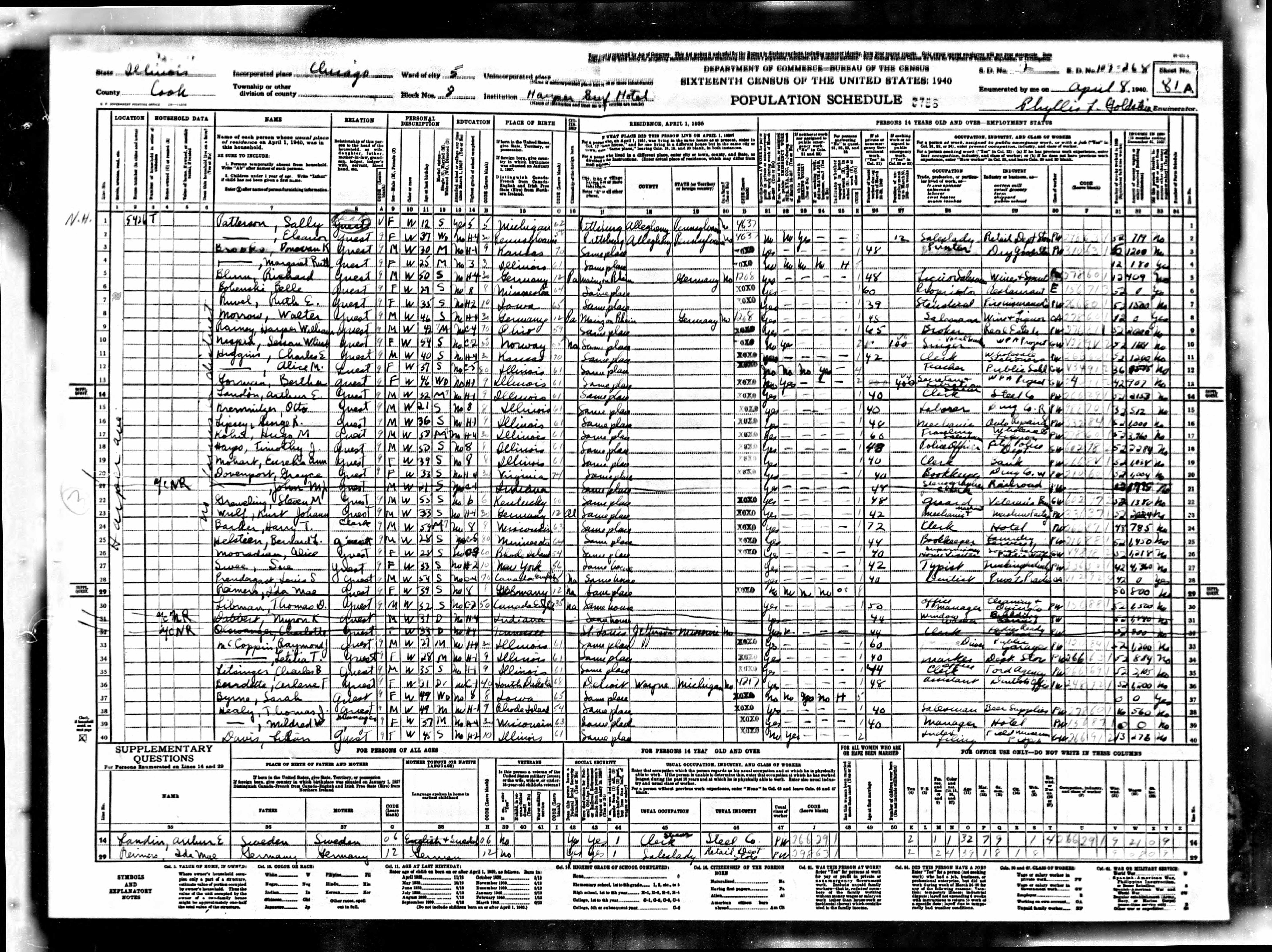
Richard Blum and Walter Morrow on 1940 US census
Year: 1940; Census Place: Chicago, Cook, Illinois; Roll: T627_929; Page: 81A; Enumeration District: 103-268
CHICAGO CITY WARD 5 (TRACT 613 – PART)
Ancestry.com. 1940 United States Federal Census [database on-line]
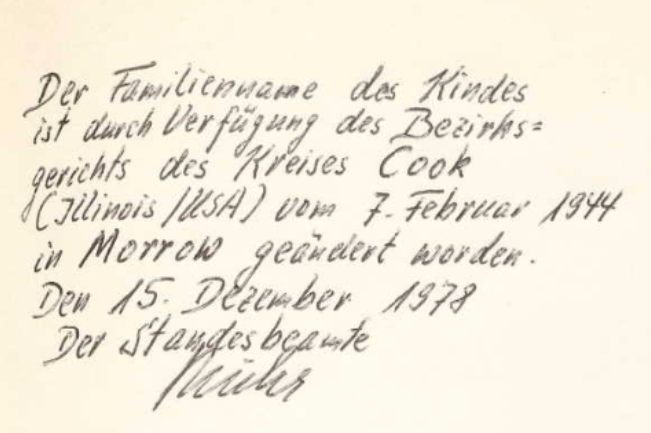
Notation on Walter Blum’s birth record regarding his name change; Walter Blum birth record
August 4, 1893
Ancestry.com. Mainz, Germany, Birth Records, 1872-1900 [database on-line]. Provo, UT, USA: Ancestry.com Operations, Inc., 2014.
Original data: Personenstandsregister Geburtenregister 1876-1900. Digital images. Stadtarchiv Mainz, Mainz, Germany.
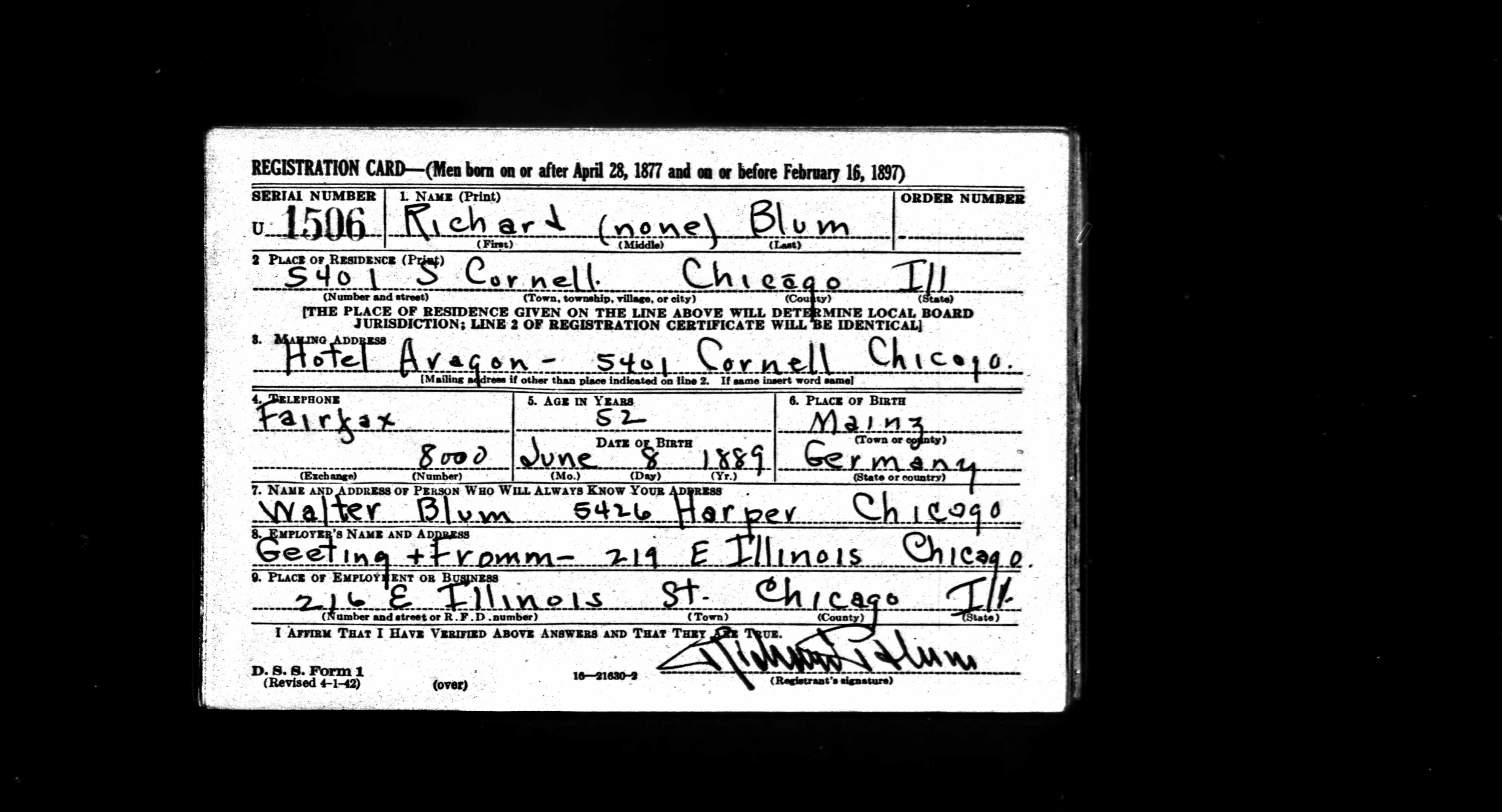
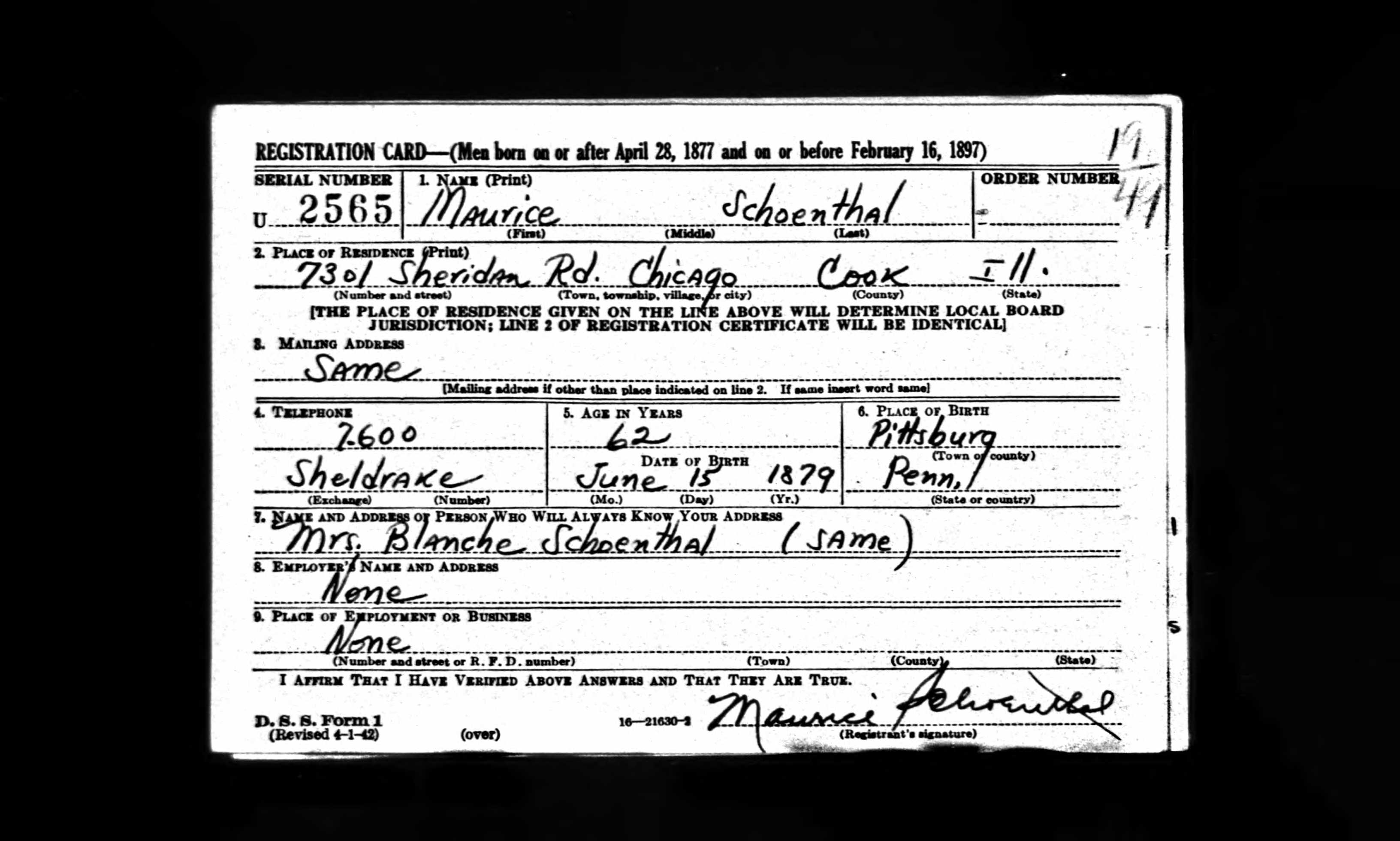
Richard Blum World War II draft registration
The National Archives at St. Louis; St. Louis, Missouri; World War II Draft Cards (Fourth Registration), for The State of Illinois; Record Group Title: Records of the Selective Service System, 1926-1975; Record Group Number: 147; Series Number: M2097
Walter was still living at the Harper-Surf Hotel and working for Schenley Import Corporation, a liquor importing business.

Walter Blum Morrow draft registration World War II
The National Archives at St. Louis; St. Louis, Missouri; World War II Draft Cards (Fourth Registration), for The State of Illinois; Record Group Title: Records of the Selective Service System, 1926-1975; Record Group Number: 147; Series Number: M2097
Both brothers also became naturalized citizens of the United States in 1944.
Richard died in 1961; his death notice reported that he was still a sales representative for Getting & Fromm at the time of his death.

Richard Blum death notice
July 9, 1961 Chicago Tribune, p. 71
Walter died on October 26, 1978, in Wiesbaden, German, according to a notation on his birth record; interestingly, he apparently had returned to live in Germany, as the US Social Security Death Index reported his last residence as Frankfurt, Germany.

Snip from Walter Blum Morrow’s birth record; Walter Blum birth record
August 4, 1893
Ancestry.com. Mainz, Germany, Birth Records, 1872-1900 [database on-line]. Provo, UT, USA: Ancestry.com Operations, Inc., 2014.
Original data: Personenstandsregister Geburtenregister 1876-1900. Digital images. Stadtarchiv Mainz, Mainz, Germany.

Willliam Blum 1956 ship manifest,
The National Archives of the UK; Kew, Surrey, England; Board of Trade: Commercial and Statistical Department and successors: Inwards Passenger Lists.; Class: BT26; Piece: 1364; Item: 65
That 1956 manifest reports that William was married, a wine merchant, living at 13 Maple Grove, Fulford Road, York, England, and a citizen and permanent resident of England. I also found him listed in several phone books at the same address from 1958 until 1964. Aside from that I have no records of his whereabouts or his family or his death. I don’t know whether he was involved in the Sichel wine business or a different wine company. I also don’t know whether he was married or had children. I have contacted the York library and have requested a search of the newspapers and other records there, so hope to have an update soon.
As for the sons of Hermann Sichel and Maria Trier, they appear to have remained more directly connected to the Sichel wine business than their Blum cousins. Walter Adolph Sichel, the older brother, was in charge of the British side of the Sichel import business. According to an article from the January 31, 1986 edition of The (London) Guardian (p. 10), Walter first came to England in 1928:
Anti-German feeling still lingered when young Sichel came to Britain in 1928 and travelled the country with his case of sample bottles from the family firm, H. Sichel Sohne of Mainz. Youthful persistence apart, he was lucky to have with him some of “the vintage of the century,” 1921. Potential customers found his wines easy to like, but impossible to pronounce.
(“The nun in the blue habit with something to smile about,” The (London) Guardian, January 31, 1986, p. 10)
Walter had moved permanently to England by 1935, as he is listed in the London Electoral Register for that year; also, he gave a London address on a ship manifest dated January 16, 1935.

Walter Sichel, 1935 ship manifest,
Year: 1935; Arrival: New York, New York; Microfilm Serial: T715, 1897-1957; Microfilm Roll: Roll 5597; Line: 1; Page Number: 93
Description
Ship or Roll Number : Roll 5597
Source Information
Ancestry.com. New York, Passenger Lists, 1820-1957
In December 1936, Walter Sichel married Johanna Tuchler in Marylebone, England; Johanna (known as Thea) was born in 1913 in Berlin. (Ancestry.com. England & Wales, Civil Registration Marriage Index, 1916-2005)
Walter Sichel’s younger brother, Ernst Otto Sichel (generally known as Otto), immigrated to the US.. He first arrived for a four month visit in October 1936, entering the country in Buffalo; he listed agents of the Taylor Company as those he was coming to see, so I assume this was a business trip with the Taylor Wine Company in upstate New York.

Ernst Otto Sichel 1936 arrival in Buffalo, NY
The National Archives at Washington, D.C.; Washington, D.C.; Manifests of Alien Arrivals at Buffalo, Lewiston, Niagara Falls, and Rochester, New York, 1902-1954; Record Group Title: Records of the Immigration and Naturalization Service, 1787 – 2004; Record Group Number: 85; Series Number: M1480; Roll Number: 127
But Otto returned to settle permanently in the US on September 30, 1937.

Otto Sichel 1937 ship manifest
Year: 1937; Arrival: New York, New York; Microfilm Serial: T715, 1897-1957; Microfilm Roll: Roll 6054; Line: 1; Page Number: 8
Ancestry.com. New York, Passenger Lists, 1820-1957
By May 1938, Hermann Sichel and Maria Trier, Otto and Walter Sichel’s parents, had also left Germany as they listed themselves as residing in London on a ship manifest when they traveled to New York on that date. In August 1939, Otto listed them on a ship manifest as residing in Buckinghamshire, England, when he sailed from New York to England at that time.

Hermann and Maria Sichel on 1938 ship manifest
Ancestry.com. UK, Outward Passenger Lists, 1890-1960 [database on-line]. Provo, UT, USA: Ancestry.com Operations, Inc., 2012.
Original data: Board of Trade: Commercial and Statistical Department and successors: Outwards Passenger Lists. BT27. Records of the Commercial, Companies, Labour, Railways and Statistics Departments. Records of the Board of Trade and of successor and related bodies. The National Archives, Kew, Richmond, Surrey, England.

Otto Sichel 1939 ship manifest—address of parents in England
Ancestry.com. New York, Passenger Lists, 1820-1957 [database on-line]. Provo, UT, USA: Ancestry.com Operations, Inc., 2010.
Original data: Passenger Lists of Vessels Arriving at New York, New York, 1820-1897. Microfilm Publication M237, 675 rolls. NAI: 6256867. Records of the U.S. Customs Service, Record Group 36. National Archives at Washington, D.C.
In 1940, their son Otto was listed on the US census as a paying guest in a home on East 84th Street in New York City. There was a notation on his entry that I’ve never seen before: “No response to this after many calls.” Was Otto avoiding the enumerator? Or was he just away on business?

Otto Sichel, 1940 US census
Year: 1940; Census Place: New York, New York, New York; Roll: T627_2655; Page: 2A; Enumeration District: 31-1339
Ancestry.com. 1940 United States Federal Census
Perhaps this seeming evasiveness created some suspicion about Otto because in 1943 a request was sent by the US Immigration and Naturalization Service to the FBI to request clearance for Otto because he was “pro-German but anti-Hitler, and may be guilty of subversive activity.” I consider myself pro-American even when I do not like my country’s leaders or actions at certain times; I assume that that was how Otto felt—affection for the country of his birth, but opposed to its actions under the Nazis.

Inquiry into Otto Sichel
Ancestry.com. U.S. Subject Index to Correspondence and Case Files of the Immigration and Naturalization Service, 1903-1959 [database on-line]. Provo, UT, USA: Ancestry.com Operations, Inc., 2010

Ernst Otto Sichel naturalization papers 1944
Ancestry.com. Selected U.S. Naturalization Records – Original Documents, 1790-1974 [
Otto died on May 10, 1972, in San Francisco. He was 65 years old. According to his obituary, he was the vice-president of Fromm & Sichel, a subsidiary of Jos. E. Seagram & Sons, at the time of his death and had been working for that company for twenty years. “E. Otto Sichel Dies; Wine Expert Was 65,” The New York Times, May 13, 1972 (p. 34).
Without going into the full corporate history, there are obvious links here between the various Sichel/Blum cousins—Richard Blum worked for the Chicago wine distributor Geeting & Fromm, which was founded in part by Paul Fromm, whose brother Alfred Fromm and Franz Sichel, first cousin of Walter Sichel and Richard Blum, founded the company where Walter Sichel worked, the San Francisco wine distributor Fromm & Sichel .
Finally, to bring this story back to its beginning, both Walter Blum and Otto Sichel listed a Mr. I(saac) Heller (“Hella” as spelled on Walter’s manifest) as the person sponsoring them in the US when they immigrated to the US in the 1930s:

Walter Blum 1939 manifest naming I Hella as friend going to in US
Ancestry.com. New York, Passenger Lists, 1820-1957 [database on-line]. Provo, UT, USA: Ancestry.com Operations, Inc., 2010.
Original data: Passenger Lists of Vessels Arriving at New York, New York, 1820-1897. Microfilm Publication M237, 675 rolls. NAI: 6256867
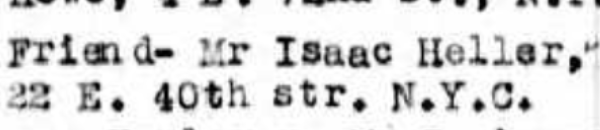
Isaac Heller named as person Otto Sichel was going to on 1937 manifest
Ancestry.com. New York, Passenger Lists, 1820-1957 [database on-line]. Provo, UT, USA: Ancestry.com Operations, Inc., 2010.
Original data: Passenger Lists of Vessels Arriving at New York, New York, 1820-1897. Microfilm Publication M237, 675 rolls. NAI: 6256867. Records of the U.S. Customs Service, Record Group 36. National Archives at Washington, D.C.
He was the brother of Leanora Heller Morreau. Yes, the Leanora I had researched back in 2014 to try and understand why she had tried to rescue Bettina Seligmann Arnfeld from Nazi Germany. The same Leanora whose husband Albert was the grandson of Caroline Seligmann Morreau and a first cousin of Camilla Sichel Blum, Walter’s mother, and Hermann Sichel, Otto’s father.
Leanora may not have been able to help her late husband’s cousin Bettina Seligmann Arnfeld, but obviously she and her brother Isaac were able to help Albert’s cousins Walter Blum and Otto Sichel.
And so I lift a glass of wine (not Blue Nun, preferably a prosecco) to toast Leanora Heller Morreau! L’chaim!

by tracy ducasse (Flickr: [1]) [CC BY 2.0 (http://creativecommons.org/licenses/by/2.0)%5D, via Wikimedia Commons
[1] Unfortunately, the online records for Sprendlingen do not cover the years before 1870, and although there are some death records for the 1900s, the year 1900 is not included.
![Ancestry.com. Historical Newspapers, Birth, Marriage, & Death Announcements, 1851-2003 [database on-line].](https://brotmanblog.com/wp-content/uploads/2016/03/lionel-heymann-obit-clipped.jpg)
![Ancestry.com. Historical Newspapers, Birth, Marriage, & Death Announcements, 1851-2003 [database on-line].](https://brotmanblog.com/wp-content/uploads/2016/03/lionel-heymann-death-notice.jpg)

![Photograph by Lionel Heymann of Robert Maynard Hutchins, University of Chicago president (1929-1945) and chancellor (1945-1951), with team members of the Manhattan Project, the program established by the United States government to build the atomic bomb. Standing, from left: Mr. Hutchins, Walter H. Zinn, and Sumner Pike; seated: Farrington Daniels, and Enrico Fermi. University of Chicago Photographic Archive, [apf digital item number, e.g., apf12345], Special Collections Research Center, University of Chicago Library. accessed at http://photoarchive.lib.uchicago.edu/db.xqy?one=apf1-05063.xml](https://brotmanblog.com/wp-content/uploads/2016/03/lionel-heymann-photograph-of-men-on-manhattan-project.jpg)


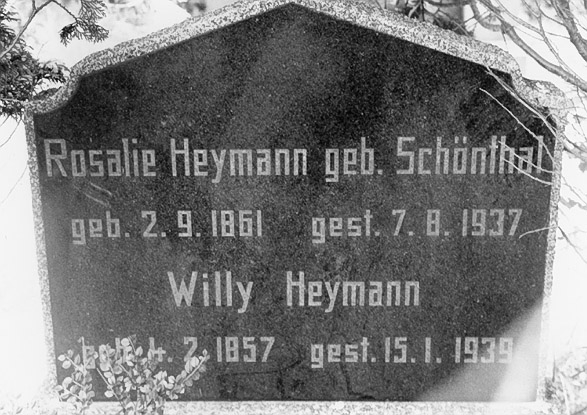

![Lionel Heymann 1911 UK census Ancestry.com. 1911 England Census [database on-line]. Provo, UT, USA: Ancestry.com Operations, Inc., 2011. Original data: Census Returns of England and Wales, 1911. Kew, Surrey, England: The National Archives of the UK (TNA), 1911. Data imaged from the National Archives, London, England.](https://brotmanblog.com/wp-content/uploads/2016/03/lionel-heymann-1911-uk-census.jpg)
![Lionel Heymann 1912 passenger manifest Ancestry.com. UK, Outward Passenger Lists, 1890-1960 [database on-line]. Provo, UT, USA: Ancestry.com Operations, Inc., 2012. Original data: Board of Trade: Commercial and Statistical Department and successors: Outwards Passenger Lists. BT27. Records of the Commercial, Companies, Labour, Railways and Statistics Departments. Records of the Board of Trade and of successor and related bodies. The National Archives, Kew, Richmond, Surrey, England.](https://brotmanblog.com/wp-content/uploads/2016/03/lionel-heymann-1912-passenger-manifest.jpg)
![Lionel Heymann 1924 passenger manifest Ancestry.com. New York, Passenger Lists, 1820-1957 [database on-line]. Provo, UT, USA: Ancestry.com Operations, Inc., 2010. Original data: Passenger Lists of Vessels Arriving at New York, New York, 1820-1897. Microfilm Publication M237, 675 rolls. NAI: 6256867.](https://brotmanblog.com/wp-content/uploads/2016/03/lionel-heymann-1924-passenger-manifest.jpg)
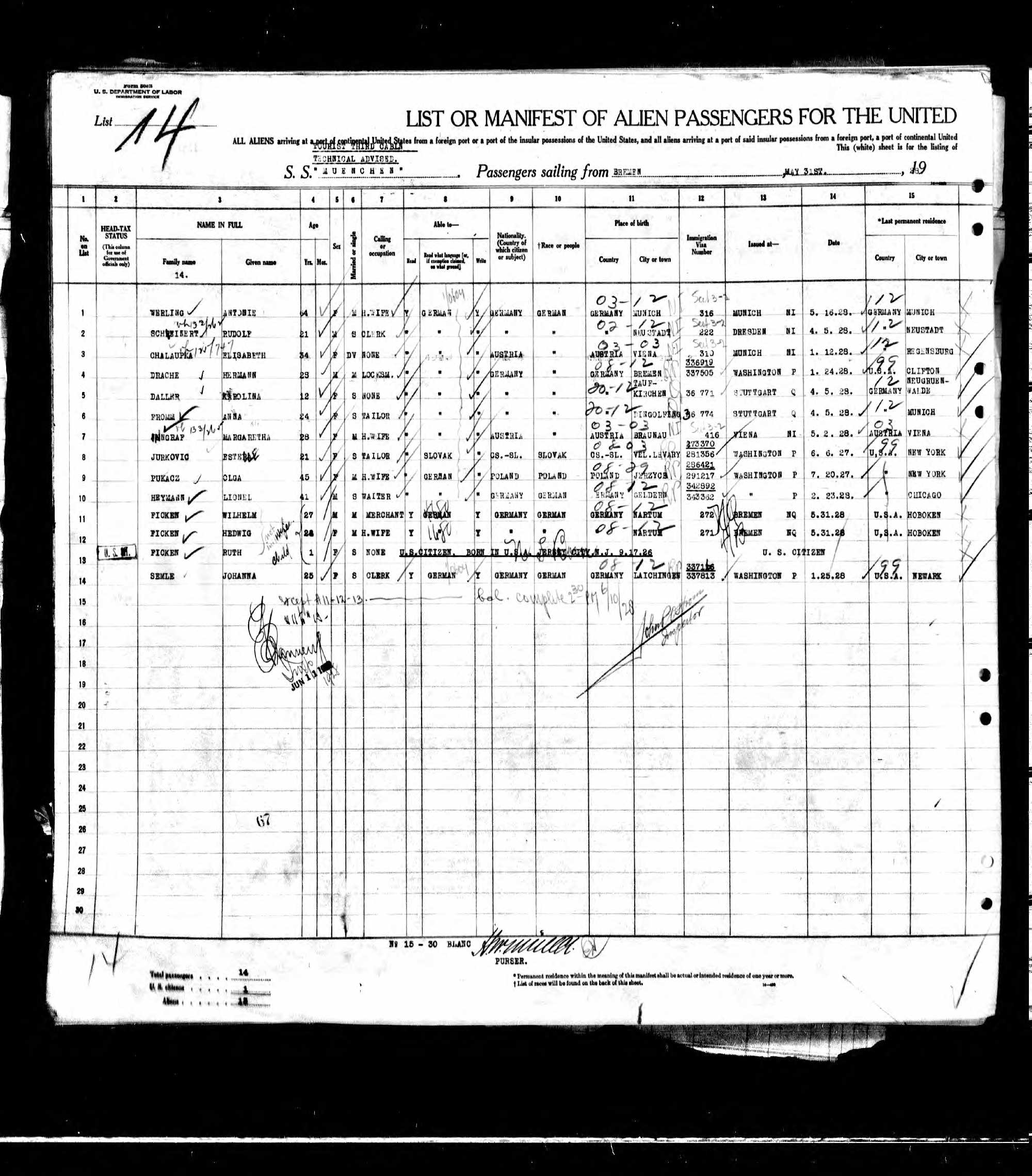

![Ancestry.com. U.S. Naturalization Record Indexes, 1791-1992 (Indexed in World Archives Project) [database on-line]. Provo, UT, USA: Ancestry.com Operations, Inc., 2010.](https://brotmanblog.com/wp-content/uploads/2016/03/lionel-heymann-1933-naturalization.jpg)

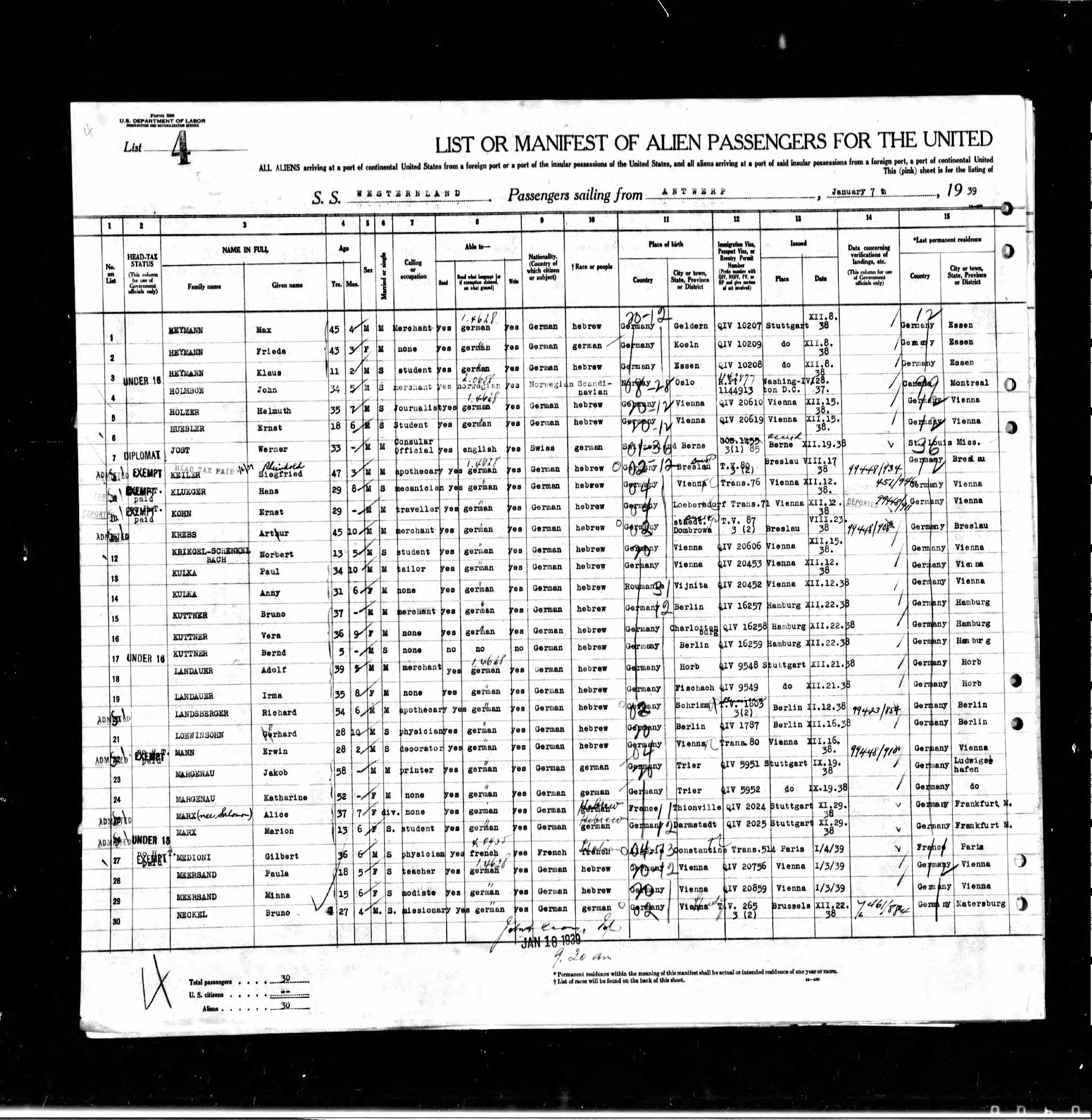
![Lionel Heymann World War II draft registration Ancestry.com. U.S., World War II Draft Registration Cards, 1942 [database on-line]. Provo, UT, USA: Ancestry.com Operations, Inc., 2010. Original data: United States, Selective Service System. Selective Service Registration Cards, World War II: Fourth Registration.](https://brotmanblog.com/wp-content/uploads/2016/03/lionel-heymann-ww2-draft-reg.jpg)
![Max Heymann World War II draft registration Ancestry.com. U.S., World War II Draft Registration Cards, 1942 [database on-line]. Provo, UT, USA: Ancestry.com Operations, Inc., 2010. Original data: United States, Selective Service System. Selective Service Registration Cards, World War II: Fourth Registration](https://brotmanblog.com/wp-content/uploads/2016/03/max-heymann-ww2-draft-registration.jpg)
![Walter Heymann World War II draft registration Ancestry.com. U.S., World War II Draft Registration Cards, 1942 [database on-line]. Provo, UT, USA: Ancestry.com Operations, Inc., 2010. Original data: United States, Selective Service System. Selective Service Registration Cards, World War II: Fourth Registrati](https://brotmanblog.com/wp-content/uploads/2016/03/walter-heymann-world-war-2-draft-reg.jpg)




![Ancestry.com. Historical Newspapers, Birth, Marriage, & Death Announcements, 1851-2003 [database on-line]. Provo, UT, USA: Ancestry.com Operations Inc, 2006.](https://brotmanblog.com/wp-content/uploads/2014/08/frances-cohen-death-notice.jpg)


 Brotmanblog: A Family Journey

