Don’t Wait to Make Those Calls: My Cousin Betty

This is a post I started back in May before my trip to Colorado and Santa Fe.  I had planned to finish it when I got back, but was distracted and put it aside.  Now I must finish it.  Unfortunately, it no longer has the happy ending it originally had.

As I wrote a few months ago, my newly found third cousin Maxine Schulherr Stein, the great-granddaughter of Hannah Schoenthal Stern (my great-grandfather Isidor Schoenthal’s sister), had lost touch with her second cousins Betty and Elaine, also great-granddaughters of Hannah Schoenthal Stern.

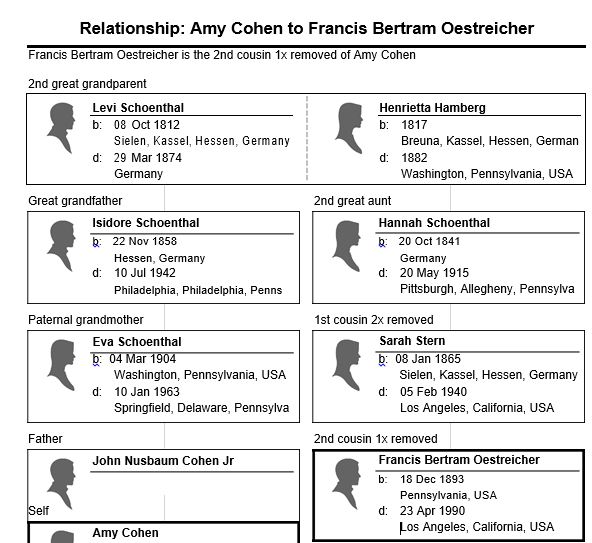
relationship of Maxine Schulherr to Betty Oestreicher

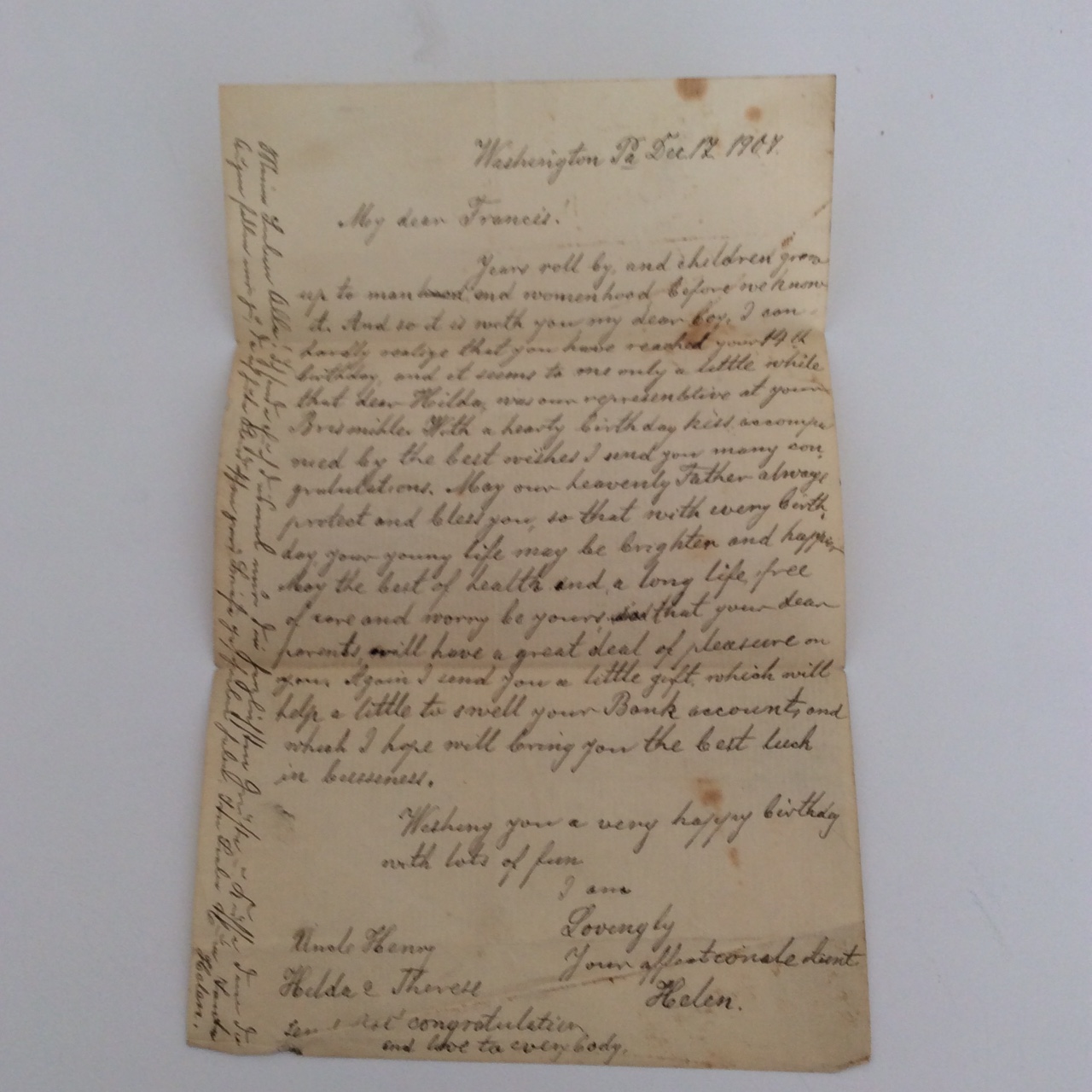
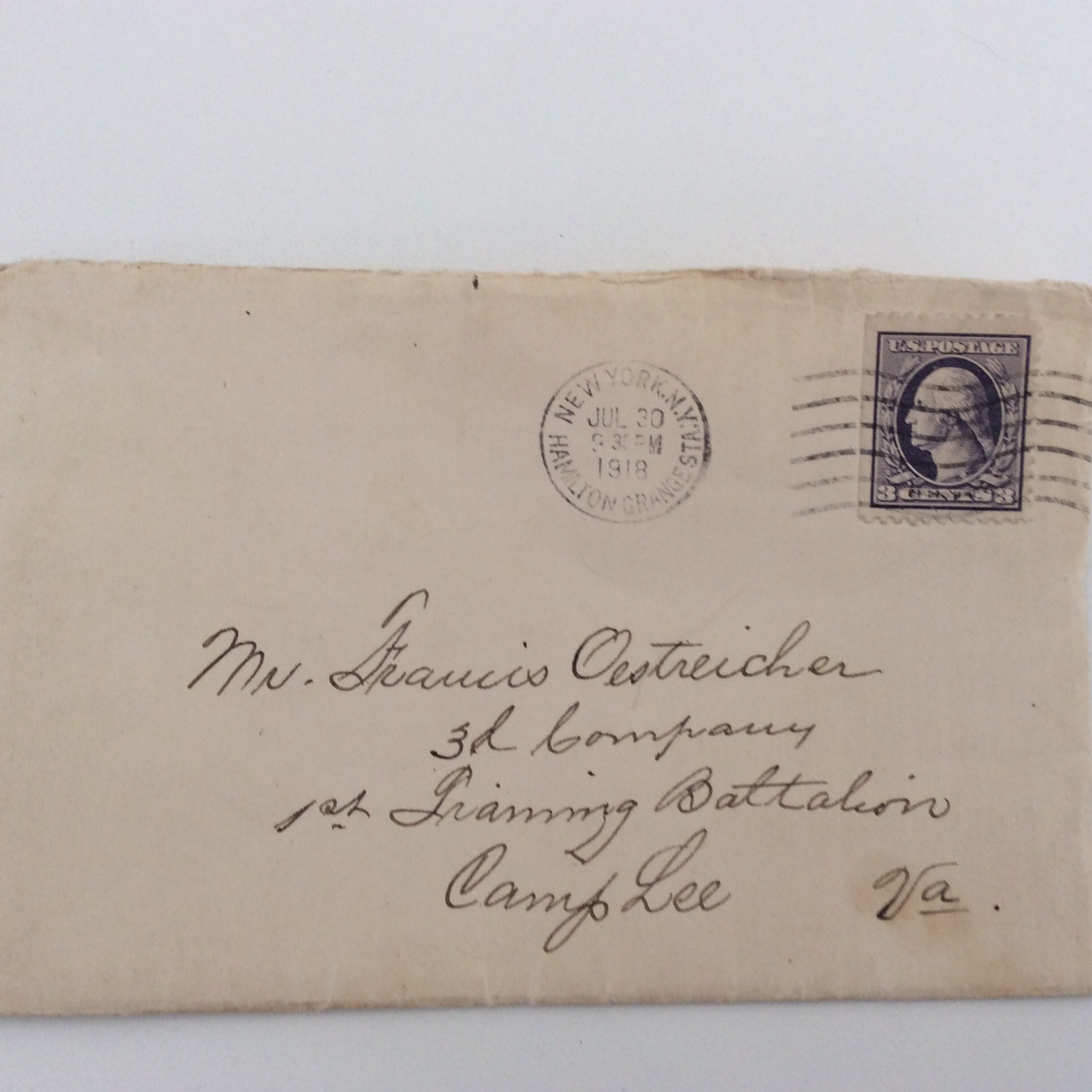
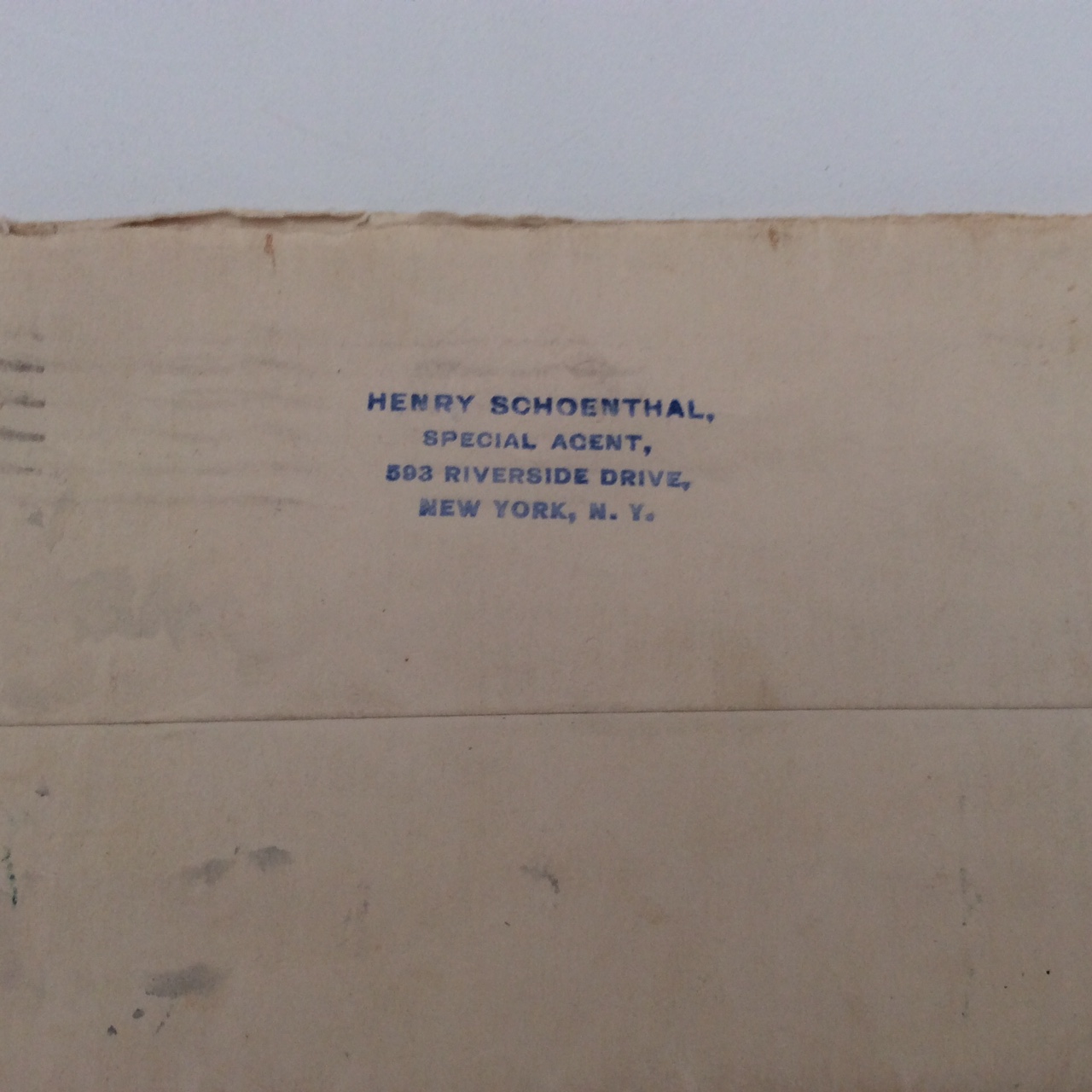
Betty and Elaine’s grandmother Sarah Stern and her husband Gustav Oestreicher had had three children: Sidney, born in 1891; Francis (known as Frank), born in 1893; and Helen, born in 1895.  They’d all lived in the Pittsburgh area at first, but as Sarah and Gustav’s children became adults, they’d eventually left the Pittsburgh area.

Helen had moved to California by 1935 where she and her husband Aaron Siegel and their daughter Betty lived in Los Angeles.  Frank also was living in Los Angeles by 1942.  It was Sidney Oestreicher and his family whom Maxine knew best. She knew that Sidney was married to Esther Siff, and they had had three children: Gerald, Florence Betty (known as Betty), and Elaine.

But Sidney Oestreicher also had left the Pittsburgh area when he moved to New York in the 1940s.  The family had left their youngest child Elaine behind with Maxine’s family so that she could finish the school year in Pittsburgh, according to Maxine.

By the 1950s, all of the members of Sidney Oestreicher’s family had moved to California to be closer to the other members of the family.  Given the distance and the limited modes of communication back then, the family members back in Pittsburgh eventually lost touch with the California branch of the family.   When I spoke with Maxine, she asked me to help her locate the cousins she’d known as a child.

Hattie Martin Maxine Alan Henrietta Stein Alan's mother

Hattie Arnold Schulherr, Martin Schulherr, Maxine Schulherr Stein, Alan Stein, Henrietta Stein

I knew from my own research that Gerald Oestreicher (who, like his father Sidney and his uncle Frank, changed his surname to Striker) had married Faye Krakower and had had two children.  Gerald died in 2014 and Faye in 2015.   But finding Gerald’s sisters Betty and Elaine had proven to be more difficult, as is generally the case with women.

Fortunately, I found one very important clue that helped me find both Betty and Elaine for Maxine (and for me).

Betty Oestreicher engagement announcement

I thus knew that Betty had married a man named Julius H. Jacob.  And from various other records for Julius, I knew that they had lived in the NYC area for some time and that they, like the other Oestreichers/Strikers, had eventually moved to California.  But I had not been able to find their current residence.

Newly motivated by Maxine’s request, I looked again at the engagement announcement and saw that Julius was described as the brother of Mr. and Mrs. Jacob Spear.  Who was that? I inferred that Julius was the brother of Mrs. Spear, not Mr. Spear, given the different surnames, and decided to see what I could find about the Spears.  I found Jacob Spear and his wife Else (presumably born with the surname Jacob) on the 1940 census, but more importantly, I found them both on several family trees on Ancestry.

Although I am generally skeptical of Ancestry trees, one of those trees belonged to a genealogy researcher whose work I trust: Jennifer Spier-Stern.  I contacted Jennifer, and after we exchanged more information and verified the connection between Julius Jacob and Elsie Jacob, Jennifer was able to put me in touch with the son of Jacob Spear and Else Jacob, John.  John is the nephew therefore of Julius Jacob, husband of my cousin Betty Oestreicher.  Not only did John know the whereabouts of his aunt Betty—he had contact information for her son Ron.  And he pointed out that the upcoming weekend would be her 97th birthday.  Now that gave me the chills!

I emailed Ron, and we exchanged several emails.  And Ron gave me the phone numbers for both his mother Betty and his aunt Elaine, who is also still living in California.  In May I had the great pleasure of speaking to two more of my third cousins, Betty Oestreicher Jacob and Elaine Oestreicher Wallace. The following information came from a combination of my conversations with Betty and Elaine and the emails and conversations I had with my cousin Ron.

Betty was remarkably lucid for a 97 year old woman, and she was delighted to answer my questions and reminisce about her family and her life.  Elaine also was warm and excited to share her stories with me.  I had hoped that one of them would have stories about their grandmother, Sarah Stern, who was the first child of Hannah Schoenthal and who had come without her family to the US when she was nineteen years old.  Unfortunately, as was so often the case, both Betty and Elaine said that their grandmother Sarah did not speak about her childhood or about the move to the United States.

I did learn, however, from Betty that Sarah met her future husband, Gustav Oestreicher, when he was staying at the boarding house in Pittsburgh run by her mother, Hannah Schoenthal, my great-grandfather’s oldest sibling.

Betty also told me that her grandmother Sarah suffered from migraines, and after they married, Gustav and she moved to Atlantic City because he thought it would be better for her health.  Sarah also converted to Christian Science, and although Betty and her family remained Jewish, Betty would often accompany her grandmother Sarah to church when she visited her in Atlantic City.

Ron shared with me a particular memory his mother Betty shared with him:

“Once, Sarah and Gustav purchased 300 ice cream cones for children at an orphanage/home for crippled children, and my mother and uncle (Jerry) got to ride along in the truck to deliver them.  Apparently, my mother was the apple of Gustav’s eye.”

I also asked Betty how her father Sidney met her mother Esther Siff, who lived in Chicago.  Betty explained that her father was a traveling salesman, working for a ladies’ lingerie company called Adelson’s.  While traveling to Chicago for work, he attended a dance where he met Esther Siff.  Sidney and Esther lived in Chicago for the early years of their marriage, and their first two children, Gerald and Betty, were born there.  By 1930, however, the family had moved back to Pittsburgh, where their youngest child Elaine was born.

betty-oestreicher-jacob-1940s-ft-devens

Betty Oestreicher Jacob. 1940s Courtesy of Ron Jacob

Betty said that her immediate family moved to New York in the 1940s for her father’s job.  She had married Julius Jacob by that time, and after spending some time in Massachusetts where Julius was stationed at Fort Devens during the war, they ended up moving to New York where Julius worked for Spear & Company.  In 1954 or so, they returned to Pittsburgh, where Julius continued to work for Spear & Company, but the company was not doing well at that point.

In 1956, the family moved to Los Angeles where Julius took a job with Broadway Department Stores.  Betty’s brother Gerald was already living there at that time as was her aunt Helen and uncle Frank.  Sidney and Esther soon followed their children to Los Angeles. Elaine arrived a few years later after her divorce from her first husband, Jerry Kruger. Sadly, Esther Siff Oestreicher/Striker died on her 68th birthday, March 11, 1961.

Thus, by the 1960s, all the members of the Oestreicher family were living in the Los Angeles area: the three children of Sarah Stern and Gustav Oestreicher, Sidney, Frank, and Helen, and all of their children, including Sidney’s three children, Gerald, Betty, and Elaine.

Ron shared with me his memories of his great-uncle Frank and his grandfather Sidney:

“My Uncle Frank, who I adored, was a lifelong bachelor.  He was also quite the world traveler and I was always fascinated to hear of the places he had been.  Spending a fair amount of time traveling by ship, he became quite an accomplished dancer and tennis table player.  (I believe he had trophies for both.)  When we got a ping pong table, he had fun annihilating me.  To be fair, my grandfather, Sidney, taught me how to play gin rummy (for points) and he also had the grandest smile every time he beat me.  Both men were true gentlemen, and they were loving, caring men and enjoyed spending time with us kids.  My grandfather died when he was 94 and my uncle died when he was 96.” 

Ron also sent me this picture of Faye Krakower Striker, his uncle Gerald’s wife:

faye-krakower-striker-professional-photo


Faye had quite an interesting life as a singer before marrying Gerald in 1946.  The following is an excerpt from the eulogy given at her funeral in 2015.

JPG Eulogy of Faye Striker

Even with all this information, I realized when I got off the phone with Betty that I still had more questions about her childhood and adolescence in Pittsburgh.  Did she know the other Schoenthal cousins? What was life like? Were they active in the Jewish community? There were many more things I wanted to discuss with her.

I had planned to call Betty and Elaine again after those initial conversations. But then I left for our trip to Colorado and New Mexico, and when I returned, I was distracted by a number of other matters, and I failed to follow up.

I recently learned that Betty’s health deteriorated while I was away, and sadly she passed away on July 19, 2016.  She had had a good long life with very few health issues, according to her son Ron.  And although I know that anyone who lives 97 years has had a remarkable journey, I am kicking myself for not making that second call.  Betty had been so excited to share her memories with me, and there were so many more questions to ask and stories to hear.

Life is unpredictable, and we can’t assume anything or take anything for granted.

May my cousin Betty rest in peace, and may her family find comfort in all their memories.


Where Am I? At A Crossroads

I am once again at a crossroads in my genealogy research.  I have, for now, found as much as I can find about the children of Levi Schoenthal and Henriette Hamberg.  And I have also exhausted, for now, the resources available for learning about the family of Amalia Hamberg.  There are more Hambergs and Schoenthals to research, however.  Levi Schoenthal had (at least) two sisters—Mina who married Marcus Rosenberg and Fradchen (Fanny), who married Simon Goldschmidt.  Both sisters immigrated to the US and settled at least for some time in western Pennsylvania.  I have written about them some, but there is much more to do.

There is also a lot more to do with the family of Henriette Hamberg, my great-great-grandmother.  Although I have written about some of the other Hambergs—Amalia, Charles/Baruch, Abraham, and Moses—who came to the US in the 19th century, there were many more who stayed in Germany, and their family story is one I need to research more deeply and write about.  It won’t be an easy one to research or to share.

And then there is also some additional information about my Seligmann relatives that has more recently come to light.

On my mother’s side, I have done a fair amount of work on the Goldfarb family, but have yet had a chance to write about them.  They were the cousins I discovered when my cousin shared with me my aunt’s baby book and my grandfather’s notebook.  I have been hoping to get to their story for quite a while, but wanted some closure on the Schoenthal family first.

And then there are my remaining two great-great-grandparents on my father’s side—Gerson Katzenstein and Eva Goldschmidt, parents of my great-grandmother Hilda Katzenstein, who married Isidore Schoenthal.

First, I have a few sad notices to post about recent losses in the family.  And then? Where do I go next?

crossroads-303896_1280

Do I finish the Schoenthals by focusing on Fanny and Mina? Do I complete the Hamberg line?

Do I turn back temporarily to the Seligmanns and fill in a few gaps?

Or should I move on to my next two paternal lines, the Katzensteins and Goldschmidts?

Or do I turn to something on my mother’s side—-the Goldfarbs?

This is why people say you are never finished with your family history.  As for where I turn next, I am going to give it some thought and see where I land.  The compulsive side of me says stick with the Schoenthals until I am done.  The less compulsive side (there is no non-compulsive side) says break free, don’t be so logical, jump to something else.  Let’s see which side wins.


The Mysterious Administratrix

As I wrote last week, Samuel Hamberg, my great-grandfather’s second cousin, was orphaned in 1879 in Columbia, South Carolina, when his father Charles committed suicide two years after Samuel’s mother Lena had died at age 28.  But how did Samuel end up in Pennsylvania? Looking for the answer to that question led to another mystery and, I think, more answers.

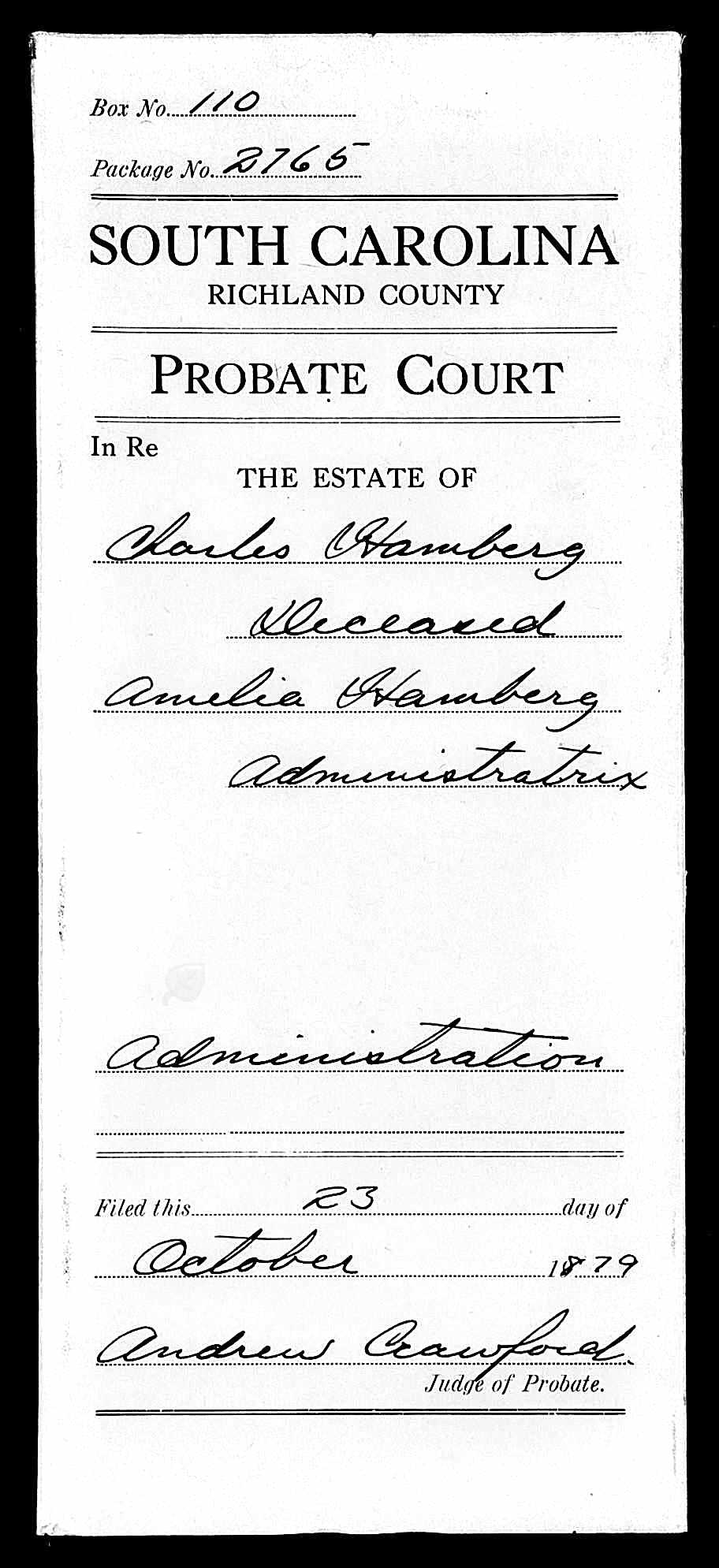
Charles Hamberg died without a will, leaving behind personal property consisting primarily of furniture and household items valued at that time at $487.71; today that would be equivalent to approximately $11,600.  The administratrix of his estate was someone named Amelia (or Amalia or Amalie[1] ) Hamberg.

Richland County, South Carolina Miscellaneous Estate Records, 1799-1955; Author: South Carolina. County Court (Richland County); Probate Place: Richland, South Carolina

Richland County, South Carolina Miscellaneous Estate Records, 1799-1955; Author: South Carolina. County Court (Richland County); Probate Place: Richland, South Carolina


Now who was she?  For a long time I assumed she was yet a third wife, someone Charles married after Mary, who’d been murdered, and Lena, mother of Samuel.  Lena had died in 1877, leaving Charles with their nine year old son.  I figured he had quickly married again, finding a mother for Samuel.  But I could not find one record for an Amalia or Amelia or Amalie Hamberg anywhere in South Carolina before or after Charles’ death. I couldn’t even find someone with just that first name who seemed a likely candidate.  I was working in circles, getting frustrated.

Then I searched for anyone named Amelia or Amalia or Amalie Hamberg anywhere in the US, and I found one Amalia Hamberg on a death record for her daughter Hattie Baer Herman, who had died in Philadelphia in 1910.  Hattie’s father was Jacob Baer.  Both parents were born in Germany, according to the death certificate.


Death certificate of Hattie Baer, daughter of Amalia Hamberg Ancestry.com. Pennsylvania, Death Certificates, 1906-1963 [database on-line]. Provo, UT, USA: Ancestry.com Operations, Inc., 2014. Original data: Pennsylvania (State). Death certificates, 1906–1963. Series 11.90 (1,905 cartons). Records of the Pennsylvania Department of Health, Record Group 11. Pennsylvania Historical and Museum Commission, Harrisburg, Pennsylvania.

Death certificate of Hattie Baer, daughter of Amalia Hamberg
Ancestry.com. Pennsylvania, Death Certificates, 1906-1963 [database on-line]. Provo, UT, USA: Ancestry.com Operations, Inc., 2014.
Original data: Pennsylvania (State). Death certificates, 1906–1963. Series 11.90 (1,905 cartons). Records of the Pennsylvania Department of Health, Record Group 11. Pennsylvania Historical and Museum Commission, Harrisburg, Pennsylvania.

Then it occurred to me: what if Amalia was not Charles Hamberg’s wife, but a sister or a cousin? If Charles died unmarried and intestate, some other family member might have been appointed to administer his estate.

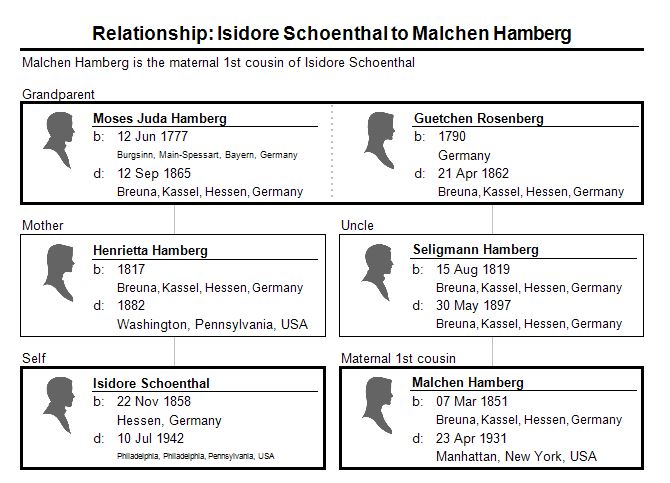
So I looked back at the Hamberg family tree, and I saw that there was a Malchen Hamberg on the tree.  Malchen was the daughter of Seligmann Hamberg and granddaughter of Moses Hamberg.  She was my great-grandfather’s first cousin.

corrected relationship isidore schoenthal to malchen hamberg


Malchen was born March 7, 1851, in Breuna, and according to the family report posted on the site maintained by Hans-Peter Klein, she had emigrated from Germany.  She certainly looked like a possible candidate for the Amalia Hamberg who had been appointed to administer Charles Hamberg’s estate.  She was, like my great-grandfather, a first cousin, once removed, of Charles Hamberg.

corrected chart charles hamberg to malchen hambeg


So I had found yet another Hamberg cousin who had immigrated to the US.  Further research revealed that Amalia had immigrated in 1871, arriving in Baltimore.

Amalie Hamberg passenger ship manifest for the USS Baltimore, arriving September 4, 1871, Baltimore, MD Maryland, Baltimore Passenger Lists, 1820-1948," database with images, FamilySearch (https://familysearch.org/ark:/61903/1:1:QK6L-H1ZK : accessed 2 May 2016), Amalie Hamberg, ; citing Immigration, Baltimore, Baltimore, Maryland, United States, NARA microfilm publications M255, M596, and T844 (Washington, D.C.: National Archives and Records Administration, n.d.); FHL film 417,401.

Amalie Hamberg passenger ship manifest for the USS Baltimore, arriving September 4, 1871, Baltimore, MD  Line 388
Maryland, Baltimore Passenger Lists, 1820-1948,” database with images, FamilySearch (https://familysearch.org/ark:/61903/1:1:QK6L-H1ZK : accessed 2 May 2016), Amalie Hamberg, ; citing Immigration, Baltimore, Baltimore, Maryland, United States, NARA microfilm publications M255, M596, and T844 (Washington, D.C.: National Archives and Records Administration, n.d.); FHL film 417,401.

According to the 1900 census, Amalia married Jacob Baer in 1873.  Reviewing the birth records of their children indicated that Amalia and Jacob lived in Pittsburgh for many years where they had nine children born between 1874 and 1891.  (More on Amalia and her family in a later post.)  The fact that Amalia ended up in Pittsburgh where her Schoenthal cousins were living further corroborated my assumption that she was in fact Malchen Hamberg of Breuna.

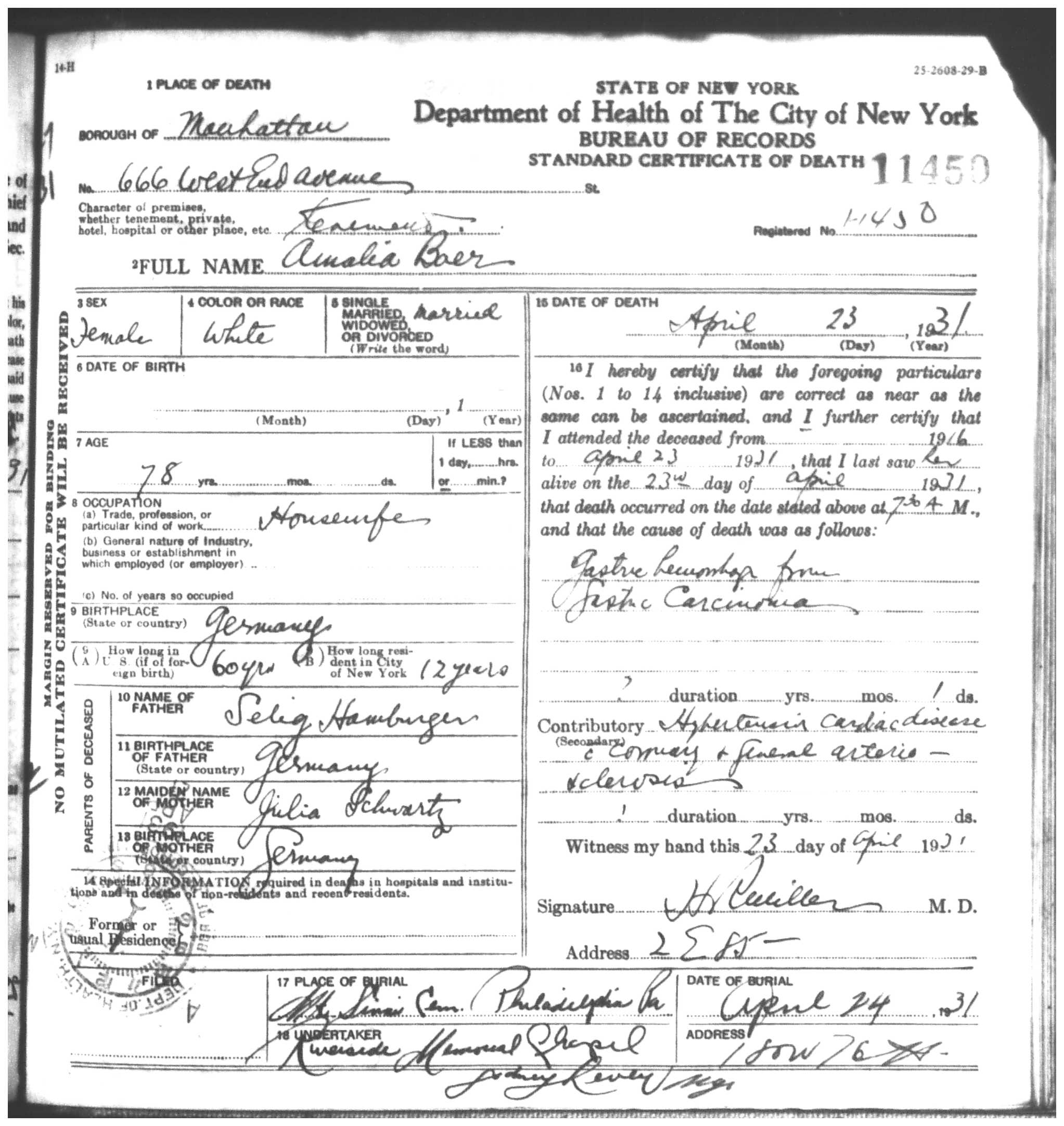
And then the icing on the cake: I received the death certificate for Amalia Baer.   Amalia Baer died on April 23, 1931, in New York City.  Her father’s name was Selig Hamburger.

Baer, Amalia death page 1

Baer, Amalia death page 2


Okay, it not precisely right.  Malchen’s father was Seligmann Hamberg.  So the informant cut off a syllable from the first name and added one to the surname.  I still think Amalia was Malchen.

The mother’s name was even further off—Julia Schwartz instead of Jette Gans.  But death certificates are often filled with mistakes, and it’s not surprising that the informant did not have completely accurate information about the parents of a 78 year old woman, parents that the informant had likely never met.

The certificate also stated that Amalia had been in the US for 60 years; Amalia Hamberg had arrived in 1871, sixty years before 1931, the year Amalia Baer died.

So I am 99% sure that Malchen Hamberg, granddaughter of my three-times great-grandfather Moses Hamberg, was Amalia Hamberg, wife of Jacob Baer, administratrix of Charles Hamberg’s estate.

Only one thing seemed strange.  If Amalia married Jacob Baer in 1873, why was she using the name Hamberg in 1879 when she was appointed to administer Charles’ estate? I don’t know.  Hence, that lingering one percent of doubt.

There are also other questions.  Why wasn’t Charles’ brother Moses made the administrator of his estate? He was the closest relative.  Why Amalia, his cousin and a woman, instead?

Well, I cannot find the Moses Hamberg from Breuna who immigrated in 1846 as a seventeen year old shoemaker on any subsequent record.  Having searched every census from 1850 forward using wild cards, misspellings, and several databases, I have hit that proverbial brick wall. I can find other men named Moses Hamberg, but none that fit the other criteria for being the correct person.  Either the age is off, the birth place is wrong, or the family members and structure are different.

Maybe Moses changed his name so drastically that it is undiscoverable.  Maybe he died and his death is not recorded anywhere I can find.  Maybe he returned to Germany or went to some third place.  I don’t know.  But I can’t find him.  That may explain why Amalia, not Moses, administered Charles Hamberg’s estate.

But there are other questions.  By 1879 Amalia had several young children of her own to care for.  Did she travel to South Carolina to deal with Samuel and with the estate?  Or was it all handled locally by Walter. S. Monteith, the Columbia attorney representing Amalia, according to the estate papers?

And how did Samuel get from Columbia, South Carolina, to Washington, Pennsylvania? Did Amalia go to get him? Or Henry? Or some other family member? Or did he take a train by himself? These are all questions for which I have no answers.

As for what happened to Samuel after he came to Pennsylvania—well, that’s a story for yet another post.


[1] The spelling varies according to the record; later records seem to consistently use Amalia so I will adopt that in this post.

Hettie’s Spirit Lives On: Her Children Walter and Blanche

In my last two posts about Hettie Schoenthal, I was very fortunate because Hettie and her son Walter had written down their own memories and stories, making their lives so much more vivid and authentic than I could have ever done myself.  The wonderful photographs that their family provided also helped me tell the story of Hettie Schoenthal, her husband Henry Stein, and their two children, Walter and Blanche.

Hettie Schoenthal, 1906 Courtesy of her family

Hettie Schoenthal, 1906
Courtesy of her family

It was a reminder of how important it is for all of us to write about our own lives and to take and preserve photographs so that someday our descendants will benefit from these shared words.  My newly discovered cousin Sharon Lippincott, daughter-in-law of Blanche Stein Lippincott, writes  about the art of writing memoirs at her blog, The Heart and Craft of Life Writing, and has also published books on that subject.

In this post, I hope to convey how Hettie’s optimistic and energetic personality left its mark on her two children, both of whom also lived long and happy lives and were well-loved by many.  All photos are courtesy of their family.

Hettie and Henry had moved east from Arizona to Philadelphia in 1924, and a few years later their son Walter left home and moved to Atlantic City to work in his aunt’s hotel there, as seen on the 1930 census.  Walter remained in the Atlantic City area for the rest of his life, working in a restaurant and as a salesman over the years.  He married Ruth Levaur in 1938, and they had one daughter.

His sister Blanche also married in the 1930s, marrying Ezra Parvin Lippincott in 1937.  Ezra was a New Jersey native and a graduate of Rutgers University, and he worked as a banker and in the insurance business. They lived in New Jersey and had two children, a son and a daughter.  Sadly, Ezra died in 1969, leaving Blanche as a widow at only 57.

Blanche Stein Lippincott, 1938

Blanche Stein Lippincott, 1938


Blanche Stein Lippincott 1962

Blanche Stein Lippincott 1962


I don’t have a lot of “official” records about Walter or Blanche after 1940, but I don’t need them to convey the character and personality of these two people. Other people have already written about them both.

Both Walter and Blanche must have inherited their mother’s gene for longevity.  Walter died in 2007 at age 96, and Blanche died in 2013 when she was 101 years old.

Walter Stein in Atlantic City, 1987 courtesy of the family

Walter Stein in Atlantic City, 1987
courtesy of the family

Walter’s obituary from the Press of Atlantic City gives a vivid portrait of the man who spent his childhood with burros and snakes in Ray, Arizona:

Walter was born in Tucson, Territory of Arizona on October 9, 1910. He was recognized as a pioneer. He spent his childhood in Ray, Arizona in a mining camp and took pleasure in saying that his boyhood was what every boy dreams of. The family moved to Philadelphia in 1923, where Walter graduated from high school. In 1929 he went to Atlantic City for a vacation and never left the area except for four years. He met and married Ruth Levaur in 1938. They recently celebrated their 68th anniversary.

Walter was a fine fisherman, a championship bowler and a prize-winning marksman. He served on many boards, but his favorite was the 23 years he served on the Board of Friends of the (PAC) Performing Arts Center of Stockton College. Walter had a deep love of the theater. Some of his happiest moments were spent with Ruth and friends at the Metropolitan Opera, the Philadelphia Orchestra, the Ballet, the theater and museums. He was Vice President of Atlantic Beverage for 35 years. ….

Walter was loved and respected by all who knew him. His sense of humor, his positive spirit and generous nature placed him in a class by himself. He was often referred to as a man of all seasons, and he truly was.


Walter and Ruth Stein, 2002 at Blanche's 90th birthday celebration

Walter and Ruth Stein, 2002 at Blanche’s 90th birthday celebration


Blanche also seems to have inherited her mother’s optimistic and adventurous spirit; her daughter-in-law Sharon wrote this about her on her blog on the occasion of Blanche’s 100th birthday:

Blanche was born 100 years ago in Tucson, in the newly admitted state of Arizona. Her family soon moved to Ray, Arizona, a now deserted copper mining community, where they lived until she was about twelve. When the copper industry declined, her parents, along with a few aunts and uncles, decided to move back to Philadelphia.  ….

If you asked her, she’d tell you she has had a rather ordinary life, and so it may seem to some. She’s never done anything truly flamboyant. She hasn’t set records, started a business, or written a best-seller. But she has tackled life with gusto, always open to new adventures and experiences. ….

Perhaps her  most important attribute is her devotion to family, friends and community. ….  No family member or friend ever has to ask for help – things are taken care of, often before the need is recognized. She always has something good to say about anyone she speaks of, and she excels at showing gratitude and appreciation. …

I could not ask for a sweeter, more supportive and helpful mother-in-law, nor is anyone prouder than she of her two children and their spouses, her five grandchildren and their spouses, and her six great-grandchildren. She is the most optimistic person I know, and should I live to be 100, I hope I’ll be as vital and involved as she continues to be.

Blanche Stein Lippincott, 1984

Blanche Stein Lippincott, 1984


Blanche Stein Lippincott with her great-granddaughter 1996

Blanche Stein Lippincott with her great-granddaughter 1996

You can read the rest of Sharon’s tribute to her mother-in-law Blanche at her blog here. 

I feel very privileged to be even distantly related to Hettie and her children, who were, respectively, my first cousin, twice removed (my grandmother’s first cousin) and my second cousins, once removed (my father’s second cousins).  It’s just too bad that I missed the opportunity to know them in person, given how long and how close by they all lived.

Blanche and Walter, August 9, 2006 courtesy of the family

Blanche and Walter, August 9, 2006
courtesy of the family


Blanche, Hettie, and Walter Stein

Blanche, Hettie, and Walter Stein

This post completes my research of the family of Simon Schoenthal and Rose Mansbach and their many children.  This has been a line of the family that has been a joy to research.  Although there were a few sad stories, this was a family of people who lived long lives and seemed to enjoy those lives.   They stayed close to one another even though at times they were separated by long distances.  And most of them spent much of their lives close to their childhood hometown of Atlantic City, New Jersey, once called the World’s Playground.

Unfortunately, the next chapter—the story of Simon’s brother Jakob and his family—is not as joyful.


Why I Love the Internet: The World Wide Web

Internet

Internet (Photo credit: Wikipedia)

The Internet continues to provide me with so much more than access to information.  Through my blog, Ancestry, Facebook, Google, and ordinary old email, I continue to find and be found by cousins all over the world.  In the last two weeks, I have seen my network of cousins expand and greatly enrich my knowledge and understanding of my family history.  So a few updates.

First, I heard from a relative of Margaret Swem, the wife of Felix Schoenthal, my Boston relative, and she filled me in on the background and family of Margaret.  Quite interesting information that I will add to the post about Felix and his family.  Once again, having a blog proved useful because Margaret’s relative found my blog by Googling Margaret Swem’s name.

Second, an Israeli second cousin, once removed, of my husband found me through my tree on Ancestry.  I haven’t even done very much yet on my husband’s family, but through this new cousin we’ve learned a great deal about the Shrage family in Zabarazh, a town once in Galicia but now part of Ukraine.  It’s been very exciting learning from our new Israeli cousin.

Third, I’ve heard from a descendant of Hettie Schoenthal, one of Simon Schoenthal’s younger children about whom I’ve yet to blog.  This new cousin has shared some of Hettie’s own remembrances of her life as well as other stories.  I am looking forward to incorporating some of those into the blog as well as some photographs.

Fourth, I’ve been in touch with two British relatives of the UK Selinger cousins, relatives of Julius, Alfred, and Frederick Selinger, all of whom married my Cohen relatives.  I then put the two of them in touch as they had not previously known each other despite being cousins.  That gave me great satisfaction, and now all three of us are hunting for answers about the connections among some of the Selingers.

Fifth, I am in touch with a Goldfarb cousin and hoping to learn more about this recently discovered branch of my Brotman family line.  I just received a huge package of information that I need to go through, enter into my tree, and research.

Sixth, another Hamberg cousin just contacted me this morning.

And last but definitely not least, my cousin Wolfgang in Germany sent me new information about our Seligmann family line.  He and his mother received four new documents about our ancestors.  The first reveals two more generations back in the line of Jacob Seligmann, my four-times great-grandfather from Gaulsheim, Germany.  I will be blogging separately about these documents and what they revealed in the next few days before I return again to the children of Simon Schoenthal.

English: internet Español: internet

English: internet Español: internet (Photo credit: Wikipedia)

Turning on my computer in the morning has become a real treat, waiting to see who has found me, who has responded to my inquiries, and which cousin has new information to share.  Sometimes I feel overwhelmed by my good fortune.  Sure, there are still many people who don’t reply to my emails or Facebook messages, but for every person I have found or who has found me, I am so deeply grateful.  The family tree keeps growing, and with it so does the world-wide web of fascinating and generous people whom  I can call my cousins.

My Grandfather’s Notebook: A Post-Script, And Merry Christmas to All Who Celebrate!

Although I do not celebrate Christmas, I always enjoy the lights and trees and music and spirit of these days, and it struck me as entirely consistent with that spirit when I received the following comment on my last post from TK, a fellow genealogy blogger:

Amy, I enjoyed your post, and I’ve staged a little concert for you based on your grandfather’s list of musical pieces. It’s on my blog, Before My Time. It’s video-intensive, so it takes time to load. I found videos for all but four of the songs. Enjoy!

You can see TK’s blog post here and listen to all the music yourself. What a truly generous and kind gift this was—a compilation of the music listed in my grandfather’s little pocket calendar.  Thank you so much, TK!  I truly enjoyed listening to every piece of music.

One thing that struck me after reading TK’s blog post and listening to the music was that many of these pieces of music seemed to be student pieces, fairly short and simple pieces of music that a student taking piano lessons might play. But my grandparents certainly did not have a piano in the house, nor had I ever heard of anyone in the family playing the piano.

But I then thought about my cousin Beth’s comment on Facebook that her father, my uncle, had played the violin for many years and was quite accomplished.  Were these pieces that he played?

I decided to go back and examine the handwriting more carefully.  After comparing the writing to that of my grandfather, grandmother, aunt, uncle, and mother, I now think that my uncle probably wrote the list.  What do you all think?

Here is the music page (you will have to click and zoom to see the handwriting clearly enough):

Grandpa notebook music

Here is my grandfather’s writing:

Grandpa notebook page 7 more notes about Maurice and hospital

This is what I thousht was my aunt’s handwriting as a child, which also looks somewhat like that on the music page: adult:

Grandpa Notebook 3 aunt elaine playing school

But this is her handwriting as an adult, and it’s very different, so maybe that’s not my aunt’s writing above?


Grandpa notebook Aunt Elaine names 1


My uncle wrote this page:

Grandpa notebook 8 maurice hunting notes 1934

This is my mother’s handwriting as a young child:

Grandpa Notebook 2 Mom note about teacher

And my grandmother wrote this page later in life in her 60s and probably wrote some of the entries on the page below it when she was in her 40s:

Grandpa notebook 1964 notes by Grandma

Grandpa Notebook 5 more addresses

So who wrote the page with all the pieces of music listed?  Anyone care to venture an opinion?

****************

For all of you who celebrate, I wish you a wonderful and joyous Christmas.  And if I may borrow and paraphrase the traditional saying, may there be peace on earth and good will to all.


The Pittsburgh Schoenthals, Part I: Hannah Schoenthal and Her Descendants

During the years that my great-grandfather Isidore Schoenthal and his brother Henry were living in Washington, PA, a number of their siblings and cousins were living in Pittsburgh about thirty miles away.  I wrote about these family members and their lives up to 1890 here, but now want to catch up with what they were doing in the years that followed.

I will start with the oldest sibling, Hannah, who was the last sibling to arrive, coming to Pittsburgh in 1888 as a widow with her three children from her marriage to Solomon Stern: Jennie, Edith, and Louis.  (I’ve already written about Hannah’s first born child, Sarah, and her life story here.) When they arrived, Jennie was thirteen, Edith was eleven, and Louis was nine.  I have no idea how Hannah supported herself and three growing children, but there is no occupation listed for her in the several listings included in Pittsburgh directories during the 1890s.  Perhaps her brothers and sisters helped her; perhaps her husband Solomon had left her enough money to support her family.  I don’t know.  But obviously her children were too young to be working, and there is no indication that Hannah was working outside the home.

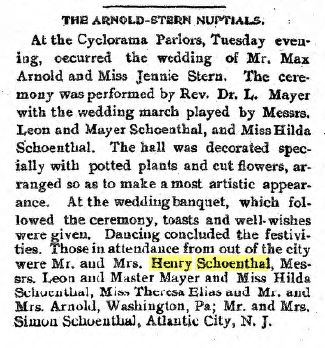
In 1896, Hannah’s daughter Jennie, then 21, was engaged to marry Max Arnold.

As you can see, it was quite an elaborate affair, and Jennie’s uncles Henry and Simon were there as were her cousins Lionel (Leon here), Meyer (Mayer here) and Hilda.  I wonder why my great-grandparents were not in attendance or at least not mentioned.

Jennie’s husband Max was also a recent immigrant from Germany; according to the 1900 census, he arrived in 1884.  He was ten years older than Jennie.  Within the first two years of their marriage, they had two children: Jerome, born October 20, 1897, and Hattie, born October 3, 1899.  Max was employed as a drover, like his brother-in-law Elias Wolfe.

Hannah was living with her two youngest children, Edith and Louis, in 1900, as well as with her stepson Morris Stern, who must have been Solomon Stern’s son from an earlier marriage; he was 44 years old in 1900.  Perhaps he had been a source of income for Hannah during the 1890s.  Morris was working as an oil merchant, Edith as a saleswoman, and Louis as a bookkeeper.  Interestingly, Hannah reported that she had had seven children, but only four were still living, meaning that sometime before emigrating, she had lost three children.

The first decade of the 20th century was one of growth for Hannah’s adult children.  Jennie (Stern) and Max Arnold had two more children in addition to Jerome and Hattie: Bernice, October 3, 1901 (same birthday as Hattie and third child born in October), and Sylvan, December 25, 1903.

Jennie’s sister Edith married Leo Good on October 24, 1904.

The wedding took place at her sister Sarah’s home, and this time the guest list did include my great-grandparents as well as Henry Schoenthal and his wife and daughter Hilda.

Edith’s husband Leo was four years younger than she and was a recent immigrant from Switzerland.  Their son Bernard was born on November 24, 1907.  Although the wedding article stated that Edith and Leo would be living in Johnstown, Pennsylvania, by 1910 they were living in Pittsburgh.  According to the 1910 census, Leo was a commercial traveler in dry goods, which I interpret to mean a traveling salesman.  Living with Edith, Leo, and their son Bernard in 1910 was Edith’s mother Hannah and Edith’s brother Louis, who was also working as a commercial traveler, but in bronze goods.  Leo’s cousin Sam Jacobs was also living with them.

In 1910 Jennie and Max Arnold and their children were still living in Pittsburgh, and Max continued to work as a cattle dealer.  On April 5, 1911, they would have one more child, Max, Jr., bringing the total number of children in their family to five.

Sometime shortly after the 1910 census, Edith and Leo Good and their son Bernard left Pittsburgh and moved to Chicago.  This article in The Jewish Criterion, dated September 8, 1911, reports that Edith had come to Pittsburgh to visit her sister Sarah (Mrs. Gus Oestreicher) and returned to home in Chicago.  There is also a 1914 article reporting that Hannah Stern, Edith’s mother, had gone to Chicago to visit Edith.


Hannah Schoenthal Stern died the following year in Pittsburgh on May 20, 1915.  She was 73 years old and died from arteriosclerosis and diabetes.  The informant on the death certificate was G. Oestreicher, the husband of Hannah’s first born child, Sarah.

Hannah Schoenthal Stern death certificate Ancestry.com. Pennsylvania, Death Certificates, 1906-1963 [database on-line]. Provo, UT, USA: Ancestry.com Operations, Inc., 2014. Original data: Pennsylvania (State). Death certificates, 1906–1963. Series 11.90 (1,905 cartons). Records of the Pennsylvania Department of Health, Record Group 11. Pennsylvania Historical and Museum Commission, Harrisburg, Pennsylvania

Hannah Schoenthal Stern death certificate
Ancestry.com. Pennsylvania, Death Certificates, 1906-1963 [database on-line]. Provo, UT, USA: Ancestry.com Operations, Inc., 2014.
Original data: Pennsylvania (State). Death certificates, 1906–1963. Series 11.90 (1,905 cartons). Records of the Pennsylvania Department of Health, Record Group 11. Pennsylvania Historical and Museum Commission, Harrisburg, Pennsylvania

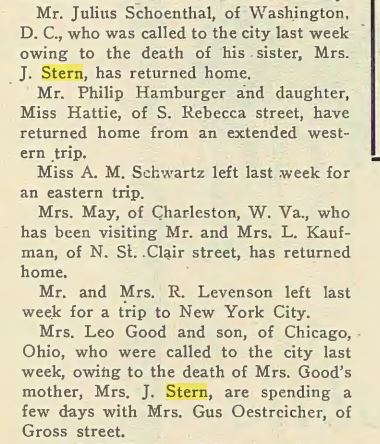
Although I could not find an obituary for Hannah, the Jewish Criterion did report that her brother Julius had come from Washington, DC, and her daughter Edith and her family from Chicago when she died.

Hannah’s story is one of resilience.  She had a child out of wedlock when she was quite young; then she married a much older man with whom she had three more children.   When he died in 1888 and those children were still young, Hannah brought them to Pittsburgh where they could grow up near their aunts, uncles, and cousins.   She raised them as a single mother in a new country.  That must have taken a lot of strength and a lot of courage.

Now to follow up with Hannah’s three children with Solomon Stern and their lives after the death of their mother:

Jennie Stern Arnold and Her Children

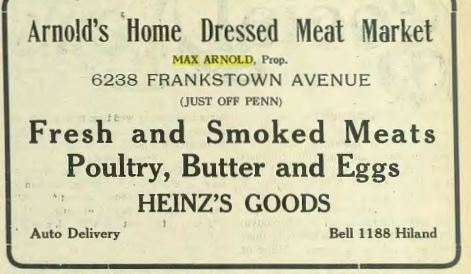
After losing her mother Hannah in 1915, Jennie would soon suffer another loss, her husband Max.  On the 1920 census, Max listed his occupation as “stock yards,” so he was still in the cattle business. From this ad in the March 12, 1915 Jewish Criterion, it would appear that Max was not only a livestock broker, but also the owner of a meat market:

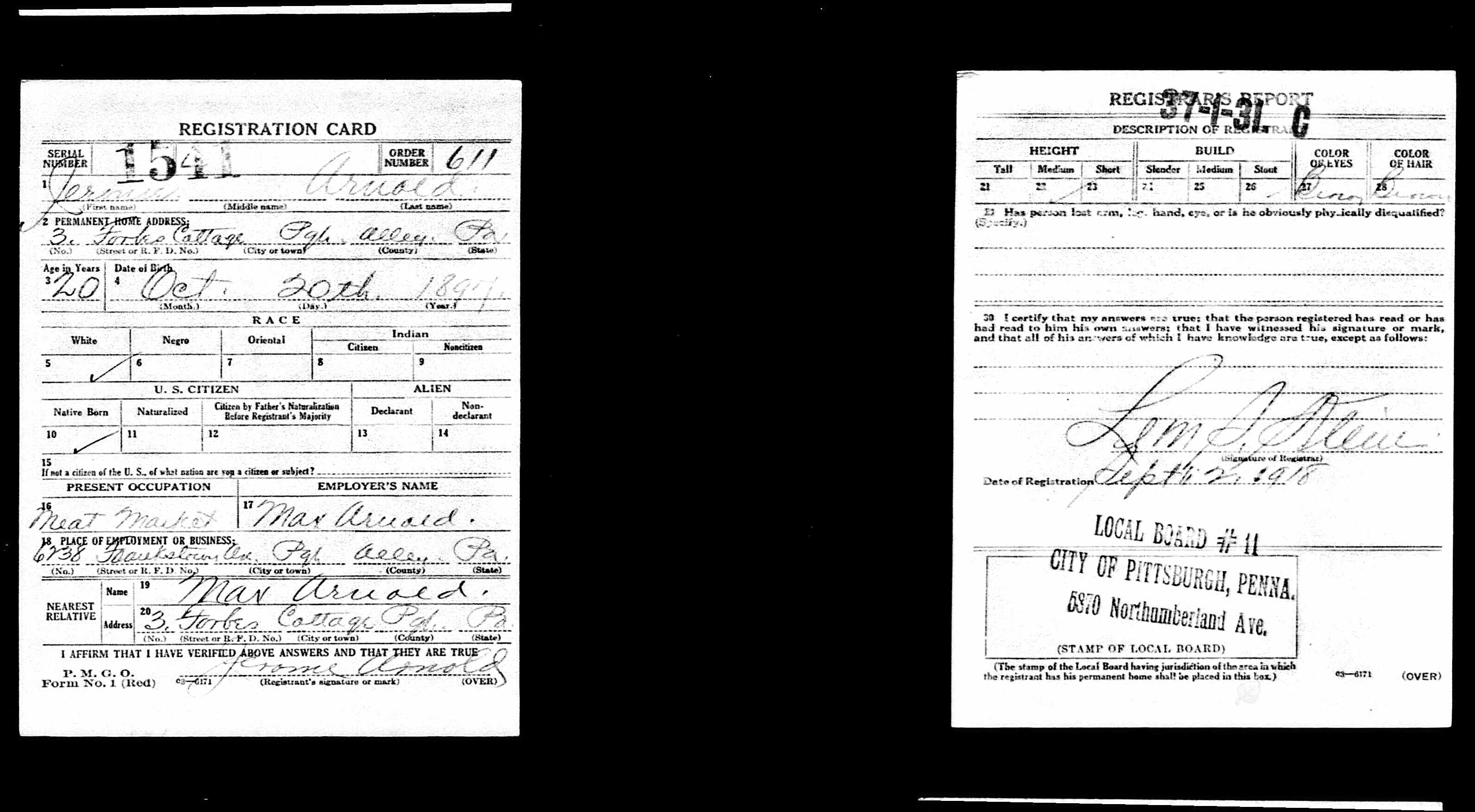
Their children were all still living at home; Jerome was now 22, Hattie 20, Bernice 18, Sylvan 16, and Max, Jr. was eight years old.  Although the census does not list an occupation for Jerome, according to his World War I draft registration, he was working for his father in the meat market.
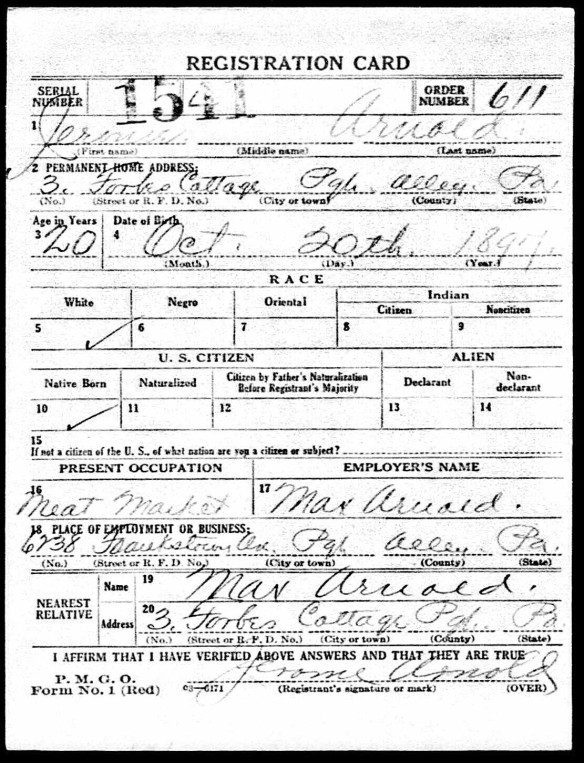
Registration State: Pennsylvania; Registration County: Allegheny; Roll: 1909238; Draft Board: 11

Registration State: Pennsylvania; Registration County: Allegheny; Roll: 1909238; Draft Board: 11

Ten months after the census was taken, Max died at age 55 on October 25, 1920, from diabetes.  His death certificate listed his occupation as livestock broker.  Like her mother, Jennie was a young widow, only 45 when Max died, and still housing and supporting four children, including little Max, Jr.

Max Arnold, Sr. death certificate Ancestry.com. Pennsylvania, Death Certificates, 1906-1963 [database on-line]. Provo, UT, USA: Ancestry.com Operations, Inc., 2014. Original data: Pennsylvania (State). Death certificates, 1906–1963. Series 11.90 (1,905 cartons). Records of the Pennsylvania Department of Health, Record Group 11. Pennsylvania Historical and Museum Commission, Harrisburg, Pennsylvania.

Max Arnold, Sr. death certificate
Ancestry.com. Pennsylvania, Death Certificates, 1906-1963 [database on-line]. Provo, UT, USA: Ancestry.com Operations, Inc., 2014.
Original data: Pennsylvania (State). Death certificates, 1906–1963. Series 11.90 (1,905 cartons). Records of the Pennsylvania Department of Health, Record Group 11. Pennsylvania Historical and Museum Commission, Harrisburg, Pennsylvania.

Soon, however, her older children would marry and move on.  Her daughter Hattie married Martin Schulherr, on May 10, 1921.

Martin was a German immigrant who had arrived just ten years before and who had become a naturalized citizen just a month before their marriage, according to his passport application.  On the 1920 census, he had been living with his uncle in Pittsburgh and working as a jewelry salesman.  Martin and Hattie would have one child, a daughter born in 1929.
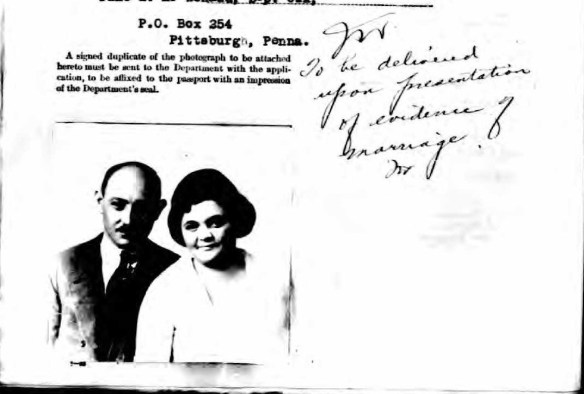
Martin Schulherr passport application, p 2 National Archives and Records Administration (NARA); Washington D.C.; NARA Series: Passport Applications, January 2, 1906 - March 31, 1925; Roll #: 1582; Volume #: Roll 1582 - Certificates: 24750-25125, 26 Apr 1921-27 Apr 1921

Martin Schulherr passport application, p 2
National Archives and Records Administration (NARA); Washington D.C.; NARA Series: Passport Applications, January 2, 1906 – March 31, 1925; Roll #: 1582; Volume #: Roll 1582 – Certificates: 24750-25125, 26 Apr 1921-27 Apr 1921


Hattie’s older brother Jerome also married in the 1920s.  In May, 1924, he married Ellen Schwabrow, with whom he had his first child in 1925 with two more to follow in the next ten years.  Ellen was born in upstate New York to German immigrant parents and had moved to Pittsburgh by the time she was twelve years old.

Bernice Arnold, Jennie’s second daughter, married Julius Averbach on September 5, 1926, according to this news item:
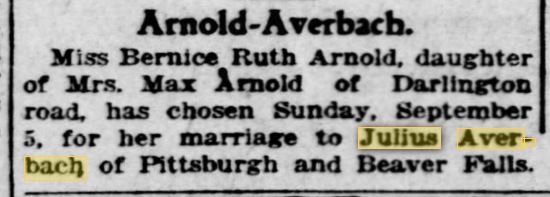
Pittsburgh Post Gazette August 29, 1926 p. 44

Pittsburgh Post Gazette August 29, 1926 p. 44


Julius was the youngest and only American-born child of Russian immigrants.  His father Meyer was a traveling dry goods salesman, living in Pittsburgh.

In August, 1927, the fourth of Jennie’s five children married.  Sylvan Arnold married Ada Feigenbaum, who was also born and raised in Pittsburgh.  Her father Morris was in the produce business, and Ada was the youngest of their ten children.  Sylvan and Ada would have two children born in 1929 and 1932.

Thus, by 1930 Jennie’s four oldest children were married, and she was living with just nineteen year old Max, Jr., who was working at what had been his father’s butcher shop.  His older brother Jerome was also working in the meat market and living with his wife Ellen, her parents, and their two sons in Pittsburgh.  Sylvan was also working in the family meat business and living with his wife Ada and their son in Pittsburgh.  Obviously Max Arnold, Sr., had established a very successful business that it could support his three sons and their families.

As for Jennie and Max Arnold’s daughters, in 1930, Hattie and her husband Martin Schulherr and their daughter were also living in Pittsburgh, and Martin was a jewelry importer.  The 1930 census reports that Bernice and her husband Julius Averbach were living in Beaver Falls; Julius was in the men’s furnishings business.

On November 24, 1932, Max Arnold, Jr., married Cecilia Lefkowitz, another Pittsburgh native.


Her parents were Hungarian immigrants, and her father Morris was a tailor.  By 1935, Max and Cecilia had moved to Morgantown, West Virginia, where Max was working as the manager of the Morgan Theater.  By 1937, however, Max is no longer listed in the Morgantown directory, and in 1940, he and Cecilia were living back in Pittsburgh where Max was now the owner of a beauty supply equipment business.  Their first child was born later that year. A second child was born in 1947.

In 1940, Jennie and four of her five children were still living in Pittsburgh.  Jennie was living with her daughter Hattie and her husband Martin, who was still in the jewelry business.  Jerome was still working as a butcher in the family grocery business, and two of his children were also working in the store.  Sylvan was also working as a butcher in the business.  Bernice was still married to Julius Averbach and living in Beaver Falls.

Bernice and Julius appear together on the 1930 and 1940 census reports; there are no children listed.  Sometime after 1940, Bernice married a second time.  Her second husband, Abe Sultanov, was a widower with two children, and Bernice is mentioned in various wedding and birth announcement as the grandmother of Abe’s grandchildren.

Jennie Stern Arnold, my first cousin twice removed, died on June 25, 1945.  She was seventy years old and died from coronary occlusion and other heart related ailments.

Jennie Stern Arnold death certificate Ancestry.com. Pennsylvania, Death Certificates, 1906-1963 [database on-line]. Provo, UT, USA: Ancestry.com Operations, Inc., 2014. Original data: Pennsylvania (State). Death certificates, 1906–1963. Series 11.90 (1,905 cartons). Records of the Pennsylvania Department of Health, Record Group 11. Pennsylvania Historical and Museum Commission, Harrisburg, Pennsylvania.

Jennie Stern Arnold death certificate
Ancestry.com. Pennsylvania, Death Certificates, 1906-1963 [database on-line]. Provo, UT, USA: Ancestry.com Operations, Inc., 2014.
Original data: Pennsylvania (State). Death certificates, 1906–1963. Series 11.90 (1,905 cartons). Records of the Pennsylvania Department of Health, Record Group 11. Pennsylvania Historical and Museum Commission, Harrisburg, Pennsylvania.

She had been a widow for 25 years, but was fortunate enough to have all five of her children plus many of her other relatives living close by in Pittsburgh and the surrounding area. Jennie was survived by all five of her children and ten grandchildren.

Edith Stern Good and Her Family

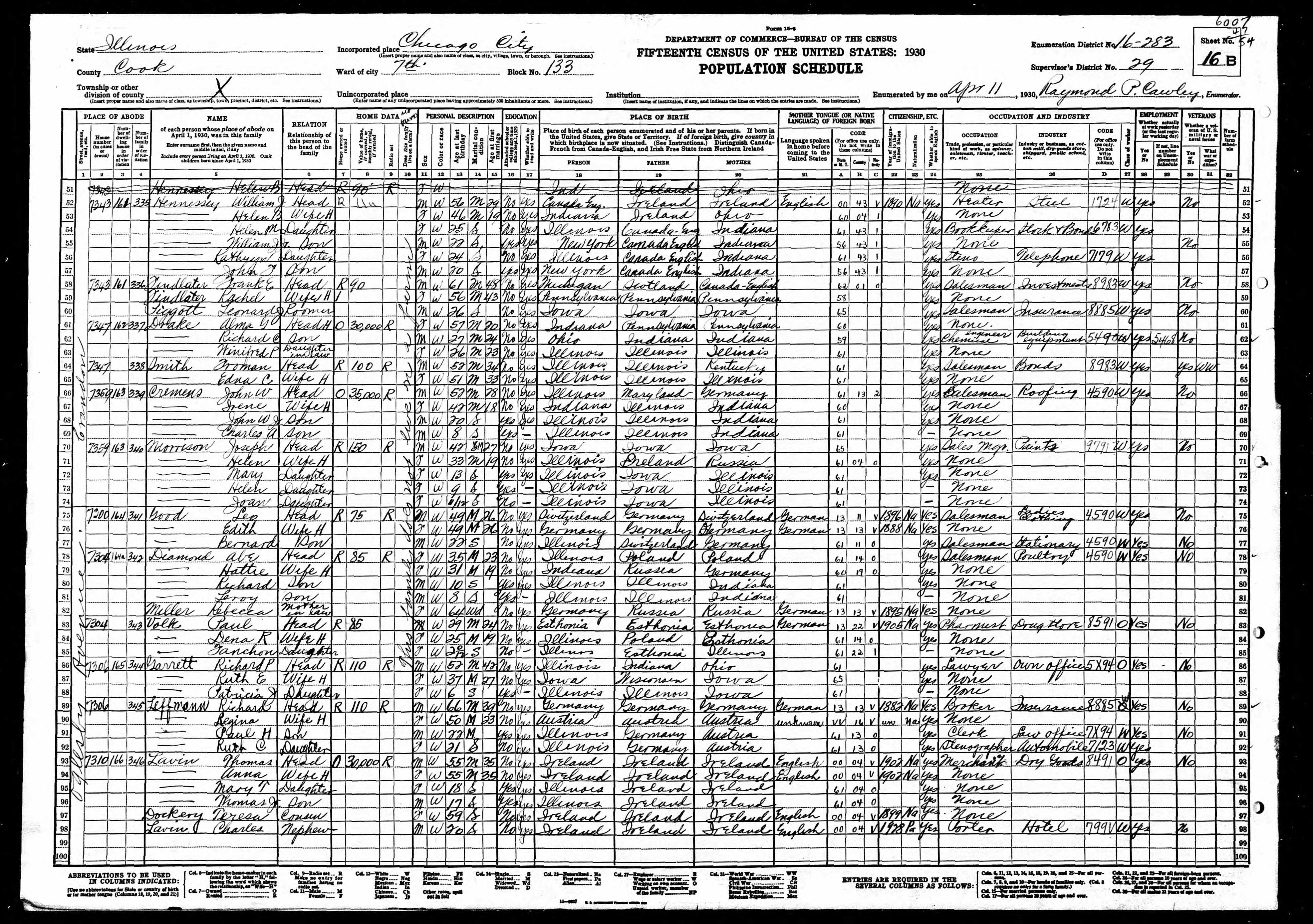
Unlike her sister Jennie, who remained in Pittsburgh her whole life after emigrating from Germany as a child, Edith Stern had left Pittsburgh by 1911 with her husband Leo Good and son Bernard to move to Chicago, where she lived for the rest of her life.  According to several Chicago directories between 1912 and 1920, Leo was a manufacturer’s agent, but I don’t know for which or what type of manufacturer.  I could not find Leo and Edith on the 1920 census, but on the 1930 census Leo described his occupation as a salesman of ladies’ clothing, so perhaps he had been engaged in that field all along.  By 1930 their son Bernard was 22 and working as a stationery salesman.
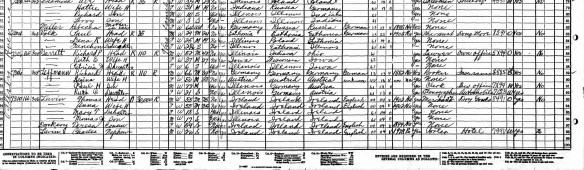
Leo, Edith, and Bernard Good 1930 census Year: 1930; Census Place: Chicago, Cook, Illinois; Roll: 425; Page: 16B; Enumeration District: 0283; Image: 561.0; FHL microfilm: 2340160

Leo, Edith, and Bernard Good 1930 census
Year: 1930; Census Place: Chicago, Cook, Illinois; Roll: 425; Page: 16B; Enumeration District: 0283; Image: 561.0; FHL microfilm: 2340160

Bernard Good married Fannie Dorothy Herzfeld in Dade County, Florida, in 1935.  Fannie Dorothy was born in Alabama and had been living with her parents in Miami in 1935. By 1939 (if not before) Bernard and Dorothy were living in Chicago where their one child was born that year.  In 1940 Bernard was working in sportswear sales, according to the 1940 census.

In 1940, Leo and Edith (Stern) Good were still living in Chicago, and Leo was a traveling salesman selling ladies’ ready-to-wear lingerie.  Four years later Edith died in Chicago on September 7, 1944; she was 66 years old.  Her husband Leo died five years later on April 19, 1949; he was 67.  Leo died in Los Angeles, where I assume his son Bernard had moved since Bernard died in Los Angeles also; he died on May 15, 1973.

Louis Wolf Stern

Hannah Schoenthal Stern’s youngest child was her only son, Louis.  In 1910 Louis had been living with his mother and his sister Edith and her family; he’d been working as a traveling salesman in bronze goods.  By 1918, Louis had moved to Newark, New Jersey, according to his World War I draft registration.  He was then working as a bookkeeper for H.H. Garfunkle.  He listed his sister Sarah (Mrs. G. Oestreicher) as his next of kin and also reported that he had filed his first papers for naturalization as a US citizen.  He was then 38 years old.

After that Louis disappears for a while.  I cannot find him on the 1920 census in New Jersey, Pennsylvania, New York, or anywhere else.  But in 1930 he resurfaced in New York City, working as a process server.  He was living as a lodger in the home of someone named Morris Cohn.  His marital status was single.  As far as I can tell, Louis never married.

According to the 1940 census, Louis was still living in New York in 1935, but by 1940 he had returned to Pittsburgh where he was working as a bookkeeper for a beauty supply equipment company, perhaps that owned by his nephew, Max Arnold, Jr.  As he had in New York, Louis was living as a lodger in someone’s home.

Louis died in Pittsburgh from a cerebral hemorrhage on January 29, 1942.  He was only 61 years old.  His sister Jennie was the informant on the death certificate.  Despite being Hannah’s youngest child, he was the second to die, two years after his oldest sister Sarah.

Louis W. Stern death certificate Ancestry.com. Pennsylvania, Death Certificates, 1906-1963 [database on-line]. Provo, UT, USA: Ancestry.com Operations, Inc., 2014. Original data: Pennsylvania (State). Death certificates, 1906–1963. Series 11.90 (1,905 cartons). Records of the Pennsylvania Department of Health, Record Group 11. Pennsylvania Historical and Museum Commission, Harrisburg, Pennsylvania.

Louis W. Stern death certificate
Ancestry.com. Pennsylvania, Death Certificates, 1906-1963 [database on-line]. Provo, UT, USA: Ancestry.com Operations, Inc., 2014.
Original data: Pennsylvania (State). Death certificates, 1906–1963. Series 11.90 (1,905 cartons). Records of the Pennsylvania Department of Health, Record Group 11. Pennsylvania Historical and Museum Commission, Harrisburg, Pennsylvania.

Thus, all of Hannah Schoenthal Stern’s children died within four years of each other: Sarah in 1940, Louis in 1942, Edith in 1944, and Jennie in 1945.  Only Jennie made it to seventy years old.   Hannah had had nine grandchildren,  Sarah’s three children, Jennie’s five children, and Edith’s one.  Because their grandmother had had the courage to bring her children to the US from Germany after her husband died in 1888, Hannah’s grandchildren were saved from the fate of their cousins and relatives who stayed in Germany.  Had Hannah’s husband not died and had she and her children stayed in Germany, those children might not have been able to continue the line of Levi Schoenthal and Henrietta Hamberg’s oldest child, Hannah.



Another Twisted Family Tree Story: The Goldsmiths/Goldschmidts

One thing that has amazed me before in my research is how often various lines in my family interconnect, like the Hano, Nusbaums, and Cohens in Philadelphia.  In researching the Schoenthals, I’ve once again encountered one of those twists in my family tree.

In my September 25 post I shared the numerous records I was able to find, with the help of several others, for my Schoenthal ancestors, including the marriage record of my great-great-grandparents, Levi Schoenthal and Jhette (or Henrietta) Hamberg in 1839.  That record revealed that Levi’s father was Heinemann Schoenthal and his mother Hendel (or Handel) Beerenstein.  For the moment that is as far back as I’ve been able to go with my Schoenthal line, though I hope to be able to find more about the earlier history of both the Schoenthal line and the Beerenstein line.

Marriage record for Levi Schoenthal and Jhette Hamberg HHStAW, 365, 386

Marriage record for Levi Schoenthal and Jhette Hamberg
HHStAW, 365, 386

Thanks to the research done by David Baron and my third cousin Roger Cibella, I now know that Heinemann and Hendel had at least one other child, a daughter named Fradchen or Fanny, who was born in 1800 in Sielen, making her twelve years older than her brother Levi. (Hans-Peter Klein has uncovered another sibling, Minna, but that’s a story for another day.)

Unfortunately I’ve not yet found a birth record for Fanny, but there is a marriage record to support that conclusion.  David and Roger sent me a copy of this marriage record dated September 10, 1844 from Oberlistingen, a town very close to Breuna (and now one of the districts of the town Breuna).

Marriage of Simon Goldschmidt and Fradchen Schoenthal HHStAW Abt. 365 Nr. 669, S. 11

Marriage of Simon Goldschmidt and Fradchen Schoenthal
HHStAW Abt. 365 Nr. 669, S. 11

As translated for me by Matthais Steinke, the record records the marriage of Fradchen Schoenthal, daughter of Heinemann Schoenthal and Hendel Beerentstein, to Simon Goldschmidt, son of Jacob Goldschmidt and Hewa Seligmann.  (No, I do not think Hewa Seligmann was related to my Seligmanns, but who knows? But that’s not the twist here.)  The record lists Fanny as 37 years old in 1844, thus born in 1807.  Simon is listed as 42 on the marriage record and is described as a master tailor.

According to David and Roger’s research, Simon had been married once before to Edeline or Ella Katzenstein. (I also don’t know if Simon’s first wife was related to my Katzensteins, but I am looking into that.  But that also is not the twist here.)  Simon and Ella had five children before Ella died in 1840. Their children ranged from Jacob, who was 16 when his mother died, down to Josias, who was only a year old when Ella died. There were also two daughters, Lena and Hewa (Eva), and another son, Joseph.  Four years after Ella died, Simon married Fanny.

Almost exactly a year after their wedding, Simon, Fanny, and Simon’s nine year old daughter Eva (Hewa) from his first marriage emigrated from Germany to the United States, arriving in Baltimore on the ship Marianne on September 20, 1845. Simon listed his occupation as a tailor on the ship manifest.

Passenger manifest for Simon Goldschmidt, Fanny Schoenthal and Eva Goldschmidt Ancestry.com. Baltimore, Passenger Lists, 1820-1964 [database on-line]. Provo, UT, USA: Ancestry.com Operations Inc, 2006. Original data: Selected Passenger and Crew Lists and Manifests. National Archives, Washington, D.C.

Passenger manifest for Simon Goldschmidt, Fanny Schoenthal and Eva Goldschmidt
Ancestry.com. Baltimore, Passenger Lists, 1820-1964 [database on-line]. Provo, UT, USA: Ancestry.com Operations Inc, 2006.
Original data: Selected Passenger and Crew Lists and Manifests. National Archives, Washington, D.C.

On January 10, 1847, Fanny gave birth to a son, Henry.  One year later Fanny and Simon had another child, a daughter named Hannah, born on June 5, 1848.  Both Henry and Hannah were born in Baltimore, Maryland.[1]  In 1850, the family was living in Pittsburgh along with Simon’s two daughters from his first marriage, Eva and Lena.  (The census record has many errors, but it is clear that this is Simon and Fanny’s family even though the record has the names mixed up and the ages inaccurate.)

Simon Goldsmith 1850 US census

Simon Goldsmith and family 1950 US Census Year: 1850; Census Place: Pittsburgh Ward 3, Allegheny, Pennsylvania; Roll: M432_745; Page: 135A; Image: 274

Tragically for the family, just two years after giving birth to Hannah, Fanny died in 1850.  She was buried at Troy Hill Jewish Cemetery in Pittsburgh.   Some readers might remember that that is also where the elusive Fanny Wiler is buried, another mother who left young children behind after an untimely death.

Fanny Schoenthal Goldsmith Troy Hill Pittsburgh

By 1860, Simon Goldsmith had moved with his two young children to Washington, Pennsylvania, a town about 28 miles to the southwest of Pittsburgh.    Simon, Henry, and Hannah were living with Simon’s son from his first marriage, Jacob, who was now 35 years old, according to the 1860 census, and working as a merchant.  Jacob and his wife had six young daughters of their own by 1860, so it must have been quite a crowded household.[2]

Simon Goldsmith and family 1860 US census Year: 1860; Census Place: Washington, Washington, Pennsylvania; Roll: M653_1192; Page: 1188; Image: 627; Family History Library Film: 805192

Simon Goldsmith and family 1860 US census
Year: 1860; Census Place: Washington, Washington, Pennsylvania; Roll: M653_1192; Page: 1188; Image: 627; Family History Library Film: 805192


Washington, Pennsylvania (called “Little Washington” by some locals) was then a town of 3,587 people, according to the 1860 census reports, and had grown by 34% since the prior census in 1850. There was not yet a railroad line to the town at that time.  What drew all those people to this town?  The town’s website does not provide many clues in its history section:

With immigrants from the west of Scotland and the north of Ireland, and with many transferring their homes from the eastern and central parts of Virginia, the vicinity of Washington was settled in 1768. The Pennsylvania legislature passed an act on March 28, 1781, erecting the County of Washington and naming Catfish Camp as the place for holding the first election. This was the first county in the U.S. to bear the name of Washington.

David Hoge laid out a plan of lots immediately after the action of the legislature. His original plot bears the name “Bassett, alias Dandridge Town,” but before the plot was recorded, lines were drawn through “Bassett, alias Dandridge Town” with ink, and the word “Washington” was written above.

The town started with every evidence of progressive tendencies, as the original plot dedicated a tract of ground to the people for recreational purposes. A lot was given for a courthouse where the current building now stands, and Lots 43 and 102, according to the plan, were presented by Mr. Hoge to “His Excellency, General Washington, and Mrs. Washington.” Part of the townsite had been the camp of Tingoocqua, who was a chief in the Kuskuskee tribe of Indians.

The town was incorporated as a borough on February 13, 1810, and became a city of the third class in 1924.

Map of Washington County, Pennsylvania, United...

Map of Washington County, Pennsylvania, United States Public School Districts (Photo credit: Wikipedia)

There is a very detailed history[3] of Washington, Pennsylvania, available online through the University of Pittsburgh Historic Pittsburgh websiteOne tidbit I picked up from this history was that Jacob Goldsmith served on the town council in 1858.

Unfortunately, most of this text is devoted to describing the political history of the area and the individuals who were political leaders, and I could not get a sense of what drew people to the area initially.  Was it the proximity to Pittsburgh? Was it a good location for trade? Was agriculture the primary source of income? Whatever the reason that drew people there initially, the town had existed for many years by the time my relatives arrived.   From the 1860 census, I know that Jacob was a merchant, and I assume that with a town of over 3,500 people, there would have been a large enough population to support many merchants.

English: Map of Washington Pennsylvania from 1897

English: Map of Washington Pennsylvania from 1897 (Photo credit: Wikipedia)

One thing seems clear, however.  When Simon Goldsmith lived in Washington, Pennsylvania, in 1860, there was no synagogue there.  The first synagogue in all of Washington County, Beth Israel, was not founded until 1891. Although my ancestors had lived in small towns in Germany with very small Jewish communities, they had at least had synagogues and schools and cemeteries for their community.  I am not sure that when Simon arrived, there were any such facilities.

Why, you might wonder, am I dwelling on this town in western Pennsylvania where the widower of my great-great-grandfather’s sister lived with his two children? Because six years later, my great-grandfather’s brother Henry Schoenthal arrived in Washington with his wife and children, and some of his siblings followed in the years after.  Last to come in 1881 was my great-grandfather Isidore, accompanied by his mother Henrietta and his sister Rosalie.  And 23 years later in 1904, my grandmother Eva Schoenthal was born in Washington, Pennsylvania, the youngest child and only daughter of Isidore Schoenthal and Hilda Katzenstein.  It seems to me that Henry did not choose Washington randomly, but rather based on the fact that his first cousin Jacob Goldsmith and his aunt’s widower Simon Goldsmith were living there.

But I promised you a twist, and I still haven’t delivered.  Here it is. Simon Goldsmith was not only my great-great-aunt’s husband; he was also my four-times great-uncle himself.   Simon Goldsmith, husband of Fanny Schoenthal, had a brother named Seligmann Goldschmidt.  Seligmann had a daughter named Eva, just as his brother Simon did (both named for their grandmother, Simon and Seligmann’s mother Hewa).  Seligmann’s daughter Eva Goldschmidt was my great-great-grandmother; she married Gerson Katzenstein, my great-great-grandfather, and they were the parents of Hilda Katzenstein, who married Isidore Schoenthal, nephew of Fanny Schoenthal. Hilda Katzenstein and Isidore Schoenthal were my great-grandparents.

Stated as simply as possible, Simon Goldsmith was my four times great-uncle.  His wife Fanny Schoenthal was my three times great-aunt.   My grandmother Eva Schoenthal was a first cousin once removed from Henry Goldsmith, Simon and Fanny’s son, through her father’s side and his mother’s side:

Relationship_ Henry Goldsmith to Eva Schoenthal

She was also his first cousin twice removed through her mother’s side and his father’s side:

Relationship_ Henry Goldsmith to Eva GoldschmidtRelationship_ Eva Schoenthal to Eva Goldschmidt


They may have all left Germany, but they were still marrying within families they knew from back home.  Just another twist in my increasingly twisted family tree.  And more evidence of the limited gene pool created by endogamy and of the limited value of DNA predictions for Ashkenazi Jews.


[1] Fanny’s headstone says she was born in 1800.  I think it’s unlikely that Fanny had two children at ages 47 and 48, which is what she would have been if born in 1800 as her headstone indicates.  If, as her marriage record and the passenger manifest suggest, she was born in 1807, then she would have been having children at 40 and 41, which seems much more realistic.

[2] One thing that bothers me is that I cannot find out what happened to some of the other children of Simon Goldsmith and Ella Katzenstein.  Lena moved to Columbus, Ohio, after marrying Gustav Basch, and Joseph had died as a baby in Germany even before Ella died.  Eva immigrated with her father and step-mother, but then disappeared after the 1850 census; I assume she married. I’ve no idea what happened to Josias; perhaps he died before Simon left Germany, or maybe Simon left him behind with another family member.  Since they are not directly related to me, I am trying not to get too distracted looking for them, but eventually I will have to try and find out what happened to Josias and Eva.

[3] Title: History of Washington County, Pennsylvania: with biographical sketches of many of its pioneers and prominent men

Authors: Crumrine, Boyd, 1838-1916, Ellis, Franklin, 1828-1885, Hungerford, Austin N.

Collection: Historic Pittsburgh General Text Collection

Quick Blog Update


Embed from Getty Images


I am deep into researching both the Schoenthals and the Hambergs, and I am not sure which way to turn first.  The resources are so rich, and I keep stepping further into both lines, going backwards, forwards, and sideways!  I've been so fascinated with the research that I've not had much time to write about what I am finding, but I will get there.  Right now my biggest question is---do I finish researching the Hambergs or spend time writing about the Schoenthals?  I am not good at being torn in two different directions.  I've got one post ready to go for tomorrow about the Hambergs, but I think after that I will go back to the Schoenthal side.

Anyway, in between digging through German birth, marriage, and death records, I realized that I had neglected to update the family tree pages on the blog.  I’ve now updated the Seligmann family tree page and added a family tree page for the Nusbaum and Dreyfuss lines.  I have also added a Schoenthal page, subject to more updating (as are they all), and eventually I will also add a Hamberg page.  These pages can all be found in the header at the top of the page.

Now back to struggling between more research or some writing….


http://www.gettyimages.com/detail/171139712


Moritz James Oppenheimer: The (More) Complete Story

Several weeks ago I received a comment on the blog from Angelika Oppenheimer, the granddaughter of Moritz James Oppenheimer, whose life I wrote about here.  He was the successful businessman who owned the horse breeding farm in Germany that was appropriated by the Nazis.  Moritz Oppenheimer died in 1941, an apparent suicide after being “visited” by the Gestapo.

Angelika found the blog because she was interested in knowing more about her grandfather’s family, and I am grateful because I now have learned more about her grandfather’s life and about the lives of his children and grandchildren.

Angelika Oppenheimer

Angelika Oppenheimer photo courtesy of Angelika

Angelika is my third cousin, once removed.  Here is a chart explaining our relationship:

Angelika to me chart


Moritz James Oppenheimer was born in 1879 in Butzbach, Germany, the youngest child of Maier Oppenheimer and Pauline Seligmann.  As seen above, he was the grandchild of Moritz Seligmann and Babetta Schoenfeld, my three-times great-grandparents.  Here is a photo of him as a young man from Fred Michel’s photo album,

Moritz Oppenheimer

Moritz Oppenheimer Photo courtesy of the Michel family

According to a resume provided to me by Angelika, in 1901 he founded the Mitteldeutsche Papierwarenfabrik situated in the Hanauer Landstraße and the Rheinische Sackfabrik.  Moritz was a member of the board of directors of several companies throughout Germany, including the Kostheimer Cellulose und Papierfabrik (Kostheim-Mainz), the Danziger Verpackungsindustrie at Danzig, the Fabbrica Italiana Sacchi Ercole at Villanovetta, the Mechanische Papiersackfabrik A.G. at Saarbrücken, the Sankt Georg Verlag at Berlin and the Bayrische Reitschule at Munich.

Emma Neuhoff and Moritz James Oppenheimer photo courtesy of Angelika Oppenheimer

Emma Neuhoff and Moritz James Oppenheimer
photo courtesy of Angelika Oppenheimer

Sometime before 1902, Moritz married Emma Katherina Neuhoff, who was not Jewish.  According to Angelika, she was a descendant of Theodor Neuhoff, born in Cologne, Germany, who traveled throughout Europe and was at one time the king of Corsica.  According to Wikipedia, “At Genoa, Neuhoff made the acquaintance of some Corsican rebels and exiles, and persuaded them that he could free their country from Genoese tyranny if they made him king of the island. With the help of the Bey of Tunis, he landed in Corsica in March 1736 with military aid. The islanders, whose campaign had not been successful, elected and crowned him king. He assumed the title of King Theodore I, issued edicts, instituted an order of knighthood, and waged war on the Genoese, at first with some success. But in-fighting among the rebels soon led to their defeat.”

Theodore Neuhoff

Theodor Neuhoff

Emma Neuhoff was a gifted musician and an excellent horsewoman, according to her granddaughter Angelika.

Emma Neuhoff Oppenheimer

Emma Neuhoff Oppenheimer  Photo courtesy of Angelika Oppenheimer

Here are two pages from a German magazine discussing M.J Oppenheimer and his wife Emma.  I think it’s a publication about thoroughbred breeding and racing, but I cannot read the pages.  Perhaps some kind German-speaking reader can help?

Familiengeschiche 2 Familiengeschichte3

(Angelika told me that the drawing of Emma illustrating this article was commissioned by the Historical Museum of Frankfort based on Emma’s reputation as an excellent horsewoman.)

Moritz and Emma had two children: Paula (1902) and Walter (1904), Angelika’s father.  Paula married a Catholic man named Rudolf Spiegler, a doctor, and converted to Catholicism; they had two children, Gabriele and Wolfgang. Paula and her family did not face any persecution during the war.

As for Angelika’s father Walter, he married Suzanne Zier on December 23, 1933.  Walter had been raised and baptized as a Christian, and his wife also was not Jewish, yet Walter faced substantial discrimination during the Nazi era.  In April 1945, as the war in Europe was ending, he wrote the following essay, describing both his own life and what happened to his father Moritz after the Nazis came to power:

27 April 1945

Biographical memorandum

I was born on 10 July 1904, son of the industrialist and thoroughbred horse-breeder Consul M.J. Oppenheimer, in Frankfurt am Main. After three years at preparatory school, I attended the Goethe Gymnasium in that city for nine years; I left school, having obtained my school leaving certificate (Abitur), at Easter 1923. After studying for six terms at Frankfurt University (Law and National Economy), I sat the examination for articled clerk at the Frankfurt Higher Regional Court [Oberlandesgericht]. After a period as an articled clerk at the court in Frankfurt, in 1927 I took my doctorate under Professor de Boor. After a lengthy period of practical training as a fitter in an engineering works, and as a paper-maker in paper-mills, I then joined my father’s paper-products company, the Mitteldeutsche mechanische Papierwarenfabrik, in Frankfurt. From 1931 I was Chief Company Secretary of this company belonging to my father as sole owner. At that time it was the largest company of its kind in Germany, and for a period employed together with its subsidiaries more than 1,000 people. In 1932 I built a major subsidiary factory for my father’s company in Berlin.

My father was arrested in the autumn of 1933, at the instigation of two [NSDAP] party members (August Hartmann and Helmut Vögler) working in collaboration with the NSDAP. His entire assets were put in the hands of the lawyer [Rechtsanwalt] Max-Ernst Cuntz as prospective administrator. A bankruptcy was thus brought about, and the assets liquidated at the lowest rate, the said lawyer Cuntz selling each item at a rate far below its value, for the most part at one twentieth of purchase value. The stud farm and stables, for example (probably the biggest and best of their kind in Germany), were disposed of at a price below the level of profits from racing for the following year. The case was similar in respect of the factories, share portfolios, Hippodrome A (whose director I also was, and all shares in which belonged to my father), etc. I myself was immediately removed without compensation from all my posts by the lawyer Cuntz, on the grounds of my non-Arian status. I was also compelled to surrender my own stables, representing an approximate worth of between 70,000 and 100,000 Reichsmark, without receiving any compensation. My father was also quite illegally disqualified from receiving the stud prize. To satisfy the rules in this latter regard, for years my mother and I continued to hold two mares for my father, so that he could legally be assigned 10% of all racing prizes won by horses bred by him, in accordance with stud rules: except with the proviso that no stud prizes could be paid out to a Jew; the authorities retained this annual sum, comprising up to 100,000 Reichsmark, and finally had it credited either to themselves or to the Union Klub. My father, who was perfectly healthy, became ill owing to ill-treatment during his detention. He was declared unfit for detention in 1934/5, and finally took his own life when he was about to be arrested again in 1941 preparatory to being sent to a camp.

I myself with my mother had founded the company Paverk, Gesellschaft für Papierverarbeitung in December 1933. As I could not appear in person as a holder of shares in a limited company, an Arian uncle of my mother acted for me. Then, in 1937, I transferred this share in trust to my father-in-law Otto Zier, now [April 1945] of Friedberg in Hessen, Dieffenbachstrasse 25, together with a further 20,000 Reichsmark of shares created in settlement of my assets, so that, of the total sum of 40,000 Reichsmark in shares of the above company, 10,000 Reichsmark of my mother’s and 30,000 of mine belonged in trust to my father-in-law. By the beginning of the war, however, with a nominal capital of 40,000 Reichsmark the company had an actual value of some 250,000 to 300,000 Reichsmark, as, thanks to the diligent efforts of my employees, the company had been highly successful under my stewardship.

My wife having died suddenly from pneumonia in April 1935, at the beginning of 1941 my father-in-law saw fit to attempt to misappropriate the shares that had been transferred to him in trust. As, owing to my status as a person of mixed blood, I myself could not appear as a plaintiff, I assigned my claim to my mother, who instituted legal proceedings and won her case, at both first and second instance. The papers relating to the case are still available in their entirety: reference 2/5 2/9 0 30/41. These papers clearly demonstrate how Zier attempted to influence the court using the entire gamut of National-Socialist arguments, with reports against me and the company being sent to all sections of the Party, including district and financial counsellors (Kreis- und Wirtschafts-berater – [advisors to the Gauleiter under National Socialism]) Eckhardt, Degenhardt, and Avieny, the DAF [Deutsche ArbeitsFront – national trades union organisation under the National Socialists], the Gestapo, etc. At last instance, the High Court [Reichsgericht] awarded my mother only 10,000 Reichsmark unconditionally, while presuming improper concealment [unsittliche Tarnung] in respect of the remaining 20,000 Reichsmark. This finding is the subject of a new trial before the District Court [Landgericht] in Frankfurt (2/5 0 36/44), over whose outcome in my mother’s favour there may be little reason to doubt. Quite apart from these machinations on Zier’s part, which caused not only the Paverk company but also my mother and myself endless spiritual and material harm, we had also much else to suffer at the hands of the NSDAP.

When the company was heavily bombed in 1943, and totally bombed out in February 1944, Herr Hermann of the Gauwirtschaftskammer [regional economic organization under National Socialism] prevented the rebuilding of the plant and re-acquisition of machines. In addition, I myself was arrested by the Gestapo in the autumn of 1942, the only charge against me being my engagement to an Arian woman in contravention of the rules. I was not released again until 28 May 1943. My entire household effects to the value of about 70,000 Reichsmark (peacetime value), including art collections etc., had meanwhile been taken, and the Gestapo official Wildhirt installed in my flat. In 1943, my fiancée was conscripted to work at the Mayfahrt company under the harshest of conditions at the direct instigation of the Gestapo. The main initiator in these matters was Zier, who did not, however, proceed in his own name, but employed the services of his friends Fabian-Gramlich (insofar as I have been able to determine up to now), while my furniture was removed by a painter by the name of Baumann, who did work for the police.

I married on 11 April 1945, immediately after the liberation by the Americans. I was allocated a flat at Freiherr vom Stein Strasse 56/1, which I immediately had redecorated and furnished with furniture belonging to my wife, only to have the flat abruptly requisitioned by US soldiers on 26 April 1945.

Initialled “W.O.” at Frankfurt am Main on 27 April 1945

I, David M.B. Richardson MCIoL, certify this to be a true and fair translation of a photocopied document in German provided to me by Frau Angelika Oppenheimer, daughter of Walter Oppenheimer.

Westcliff-on-Sea, 11 August 2015.

Walter’s essay reveals so much about the hate-filled and carefully plotted system used by the Nazis to crush, humiliate, and destroy the Jews.  First, they stripped them of their property, then they stripped them of their dignity, and finally they killed them and stripped them of their lives.  Moritz Oppenheimer, a man of great wealth, was brought to his knees by the Nazis and demoralized to the point that he took his own life rather than be subjected to further humiliation and abuse and ultimately murdered. One aspect of that humiliation and abuse not mentioned in Walter’s essay was the forced annulment of his marriage to Emma Neuhoff because of Moritz’s Jewish background.

Moritz and Emma’s son Walter, a highly educated and successful man in his own right and not even raised as a Jew, was denied his property and his rights and had his own father-in-law betray him and his trust after his first wife died in 1935.  According to Angelika, Walter’s brother-in-law was in the SS.  Only because Walter had a non-Jewish mother who bribed the local Nazi official in Frankfort was he allowed to survive.

As he wrote above, Walter married his second wife, Elsa Lina Wiegandt, in 1945, and they had a daughter, my cousin Angelika.   In 1946, Walter sought the return of the property that had been taken from him by the Gestapo, primarily the books he treasured so much.  Here is the letter he wrote and Angelika’s translation of that letter:

Walter Oppenheimer letter

Dr. Walter Oppenheimer                                  Frankfurt a. M., den 25. Oktober 1946          Niedenau 45

An das Archival Depot

Offenbach am Main

Mainstraße 167

Concerning: stolen books

With polite reference to the notice published the 22nd October under the above mentioned headword in the ‘Frankfurter Rundschau’, I take the liberty of presenting you the following:

I was arrested by the Gestapo the 26th October 1942 for purely political and racial reasons. My apartment was handed over to the Gestapo officer Wildhirt while my furniture was first and foremost transferred by a Gestapo agent to the second principal of the Gestapo here, Mister Grosse. The biggest part of my library was taken away with it. A part of the books was rubber-stamped with my name but the bigger part of it was without the name of the legitimate owner.

If there are any books of mine in your office, I ask you nicely to furnish information to me. Especially the following books mean much to me:

A 17-vlume gilt-edged edition of GOETHE in red morocco leather;

A complete half leather edition of HAUFF with gold ornament on the spine;

A half leather edition of KLEIST’s writings with gold ornament on the spine;

MUTHER: 3 volumes of history of painting, green cloth binding;

SPRINGER: 5 volumes on art history, half cloth binding and cloth binding respectively;

20 – 25 volumes of monographs on artists, partly half leather editions, partly with half cloth binding and cloth binding respectively, red with gold ornament, edition of the Stuttgarter Verlagsanstalt;

A five volume edition of HÖLDERLIN, grey pasteboards.

Many thanks indeed for your efforts in anticipation.

With all due respect to you!

I was impressed by the diversity of subjects in his library and by how much he valued his books. I also was struck by how polite and almost deferential he was in asking for the return of what was already rightfully his own.   At least some of the books were returned and remain today with Angelika.  Here is a photo of her father Walter.

Walter Oppenheimer 1972 courtesy of Angelika Oppenheimer

Walter Oppenheimer 
courtesy of Angelika Oppenheimer

Angelika shared this photograph of her family and friends at her Lutheran confirmation celebration taken in about 1961.

Angelika's confirmation Courtesy of Angelika Oppenheimer

Angelika’s confirmation c. 1961
Courtesy of Angelika Oppenheimer

From left to right: Paula Oppenheimer Spiegler (paternal aunt) , Emma Neuhoff Oppenheimer (grandmother), Christiane Wiegandt (Angelika’s maternal cousin), Christiane Bott (classmate), Sylvia Berres (classmate), Elsa (nee Wiegandt) Oppenheimer (Angelika’s mother), Angelika,, Walter Oppenheimer (Angelika’s father), Karl Wiegandt (Angelika’s maternal uncle), Karli (Angelika’s maternal cousin), Annie Wiegandt (wife of Karl), Herta Dorner (friend), Gabriele Spiegler (Paula’s daughter), either Wolfgang Spiegler or Gabriele’s husband.

I feel very fortunate that Angelika was able to find me through this blog.  Her family’s story is yet another lesson in the destructive power of prejudice, on the one hand, and the ultimate power that human beings have to survive and overcome those destructive forces, on the other.

Angelika and I have lived very different lives; we grew up with different religious backgrounds, we live in different countries, we speak different languages.  My immediate family lived through World War II in relative safety; hers was scarred forever.  But despite those differences, we know that we share a common history that ties us together as cousins.  Isn’t that remarkable?