Escaping from Germany, Part II: Julius Loewenthal’s Family

Although the story of Selma Loewenthal Schwabacher’s family had happy endings in that the entire family safely left Germany and made new lives for themselves in the US, the story of Selma’s brother Julius is more complicated and more heartbreaking.

Julius Loewenthal and his wife Elsa Werner had four children, as we have seen: Ruth, born in 1905, Herbert, born in 1907, Hilda, born in 1911, and Karl Werner Loewenthal, born in 1918. Ruth had married Leonhard Fulda on March 16, 1928, in Eschwege, where her family lived.
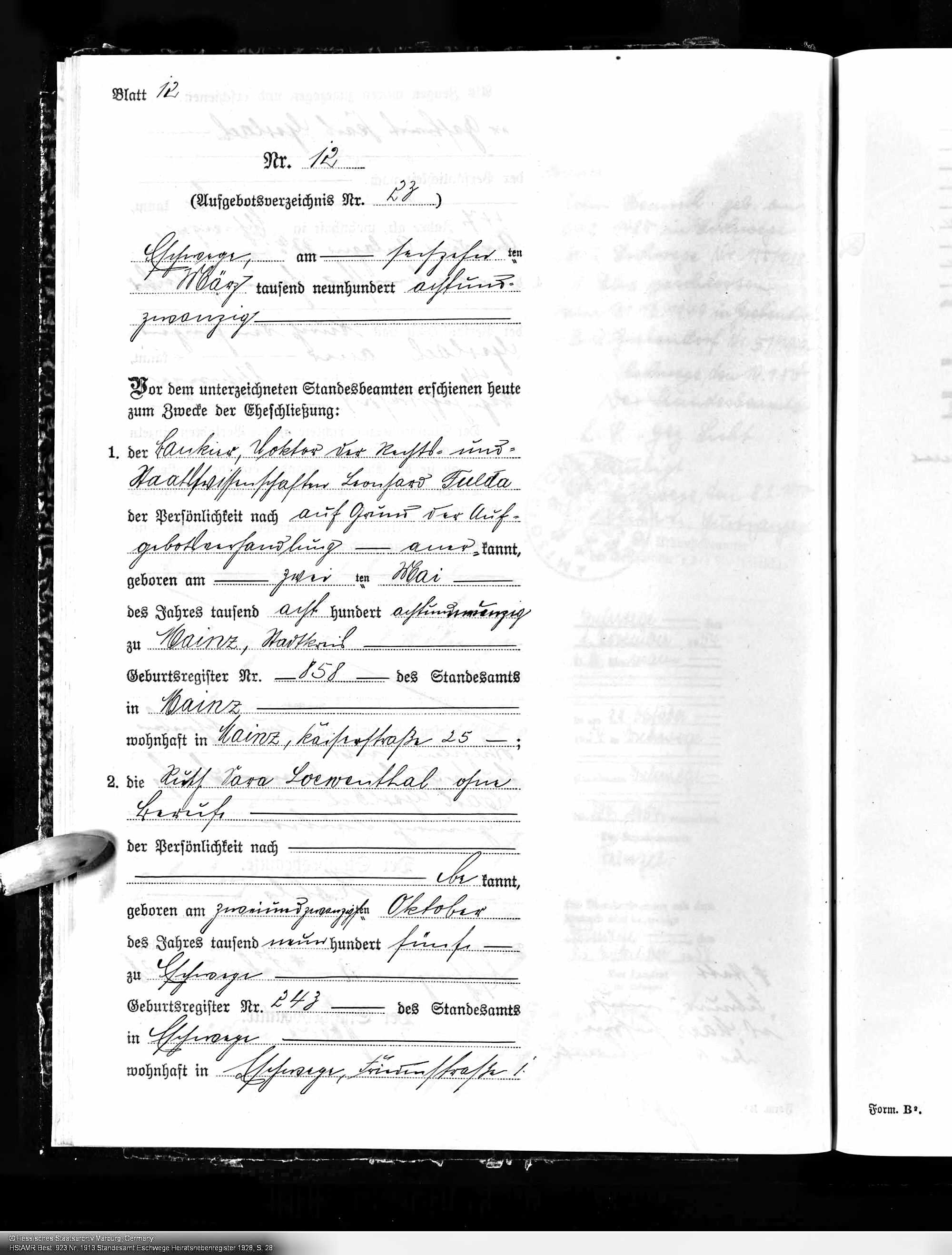
Marriage Record of Ruth Loewenthal and Leonhard Fulda, Hessisches Hauptstaatsarchiv; Wiesbaden, Deutschland; Bestand: 923; Laufende Nummer: 1913
Ancestry.com. Hesse, Germany, Marriages, 1849-1930

On September 21, 1930, Ruth gave birth to their daughter, Margot Fulda, in Mainz, Germany.1

That happy event was followed by the marriage of Julius and Elsa’s younger daughter Hilda Loewenthal to Max Stern on July 25, 1934, in Hamburg.

Hilda Loewenthal and Max Stern marriage record (found in a biography of Max Stern posted on Ancestry)

Max Stern was born in Fulda, Germany, on October 22, 1898, to Emanuel and Caroline Stern,2 and had immigrated to the United States in 1926.3 He brought with him a shipment of five thousand singing canaries he’d accepted as repayment for a debt4 and started a bird store, as seen on the 1930 census. That business eventually grew into the highly successful pet and pet food company, Hartz Mountain Corporation.

Max had returned to Germany to marry Hilda Loewenthal, and then he and his bride returned to New York in August 1934.5 They visited Germany in 1935,6 but returned to New York, where their three children were thereafter born.
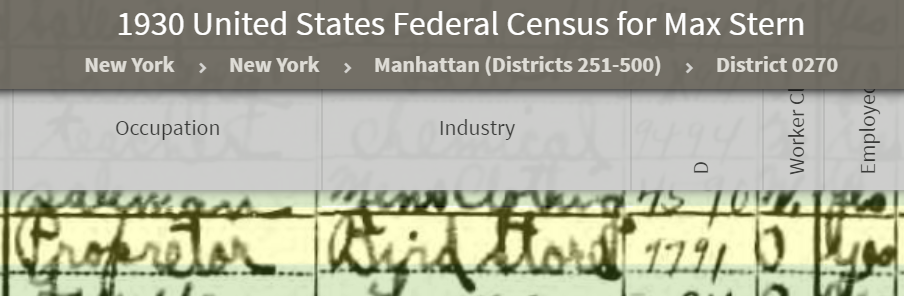
Max Stern, 1930 US census, Census Place: Manhattan, New York, New York; Page: 9A; Enumeration District: 0270; FHL microfilm: 2341293, Ancestry.com. 1930 United States Federal Census

Meanwhile, during these years, Hitler had taken power in Germany, and the Nazi persecution of the Jews had begun by the time Hilda and Max married in 1934. Herbert Loewenthal, Julius and Elsa’s second child and older son, left Germany and arrived in New York on February 22, 1935, with the intention of remaining permanently. He filed a declaration of intention to become a citizen on September 20, 1935, describing his occupation as international clearing and barter.

Herbert Loewenthal, Declaration of Intention, The National Archives at Philadelphia; Philadelphia, Pennsylvania; NAI Title: Declarations of Intention for Citizenship, 1/19/1842 – 10/29/1959; NAI Number: 4713410; Record Group Title: Records of District Courts of the United States, 1685-2009; Record Group Number: 21, Description: (Roll 489) Declarations of Intention for Citizenship, 1842-1959 (No 367301-368300), Ancestry.com. New York, State and Federal Naturalization Records, 1794-1943

Julius and Elsa came to New York to visit their children in February, 1936, but only for sixty days, according to the ship manifest.7

To learn more details about what happened to the family of Julius Loewenthal thereafter, I was fortunate to find the award and decision of the Claims Resolution Tribunal (hereinafter referred to as the “Warner-Loewenthal Claims Resolution Tribunal Opinion”) issued in response to a claim filed in the Holocaust Victim Assets Litigation by Julius and Elsa’s youngest child Karl Werner Loewenthal, also known as Garry Warner-Loewenthal .

According to the official website for the Holocaust Victim Assets Litigation:

In 1996 and 1997, a series of class action lawsuits were filed in several United States federal courts against Swiss banks and other Swiss entities, alleging that financial institutions in Switzerland collaborated with and aided the Nazi Regime by knowingly retaining and concealing assets of Holocaust victims, and by accepting and laundering illegally obtained Nazi loot and profits of slave labor. All of the cases were consolidated in the United States District Court for the Eastern District of New York (“the Court”). ….

The lawsuits were filed because in the decades after the Holocaust, Swiss financial institutions had failed to return deposits to the Nazi victims (or their relatives) who had entrusted their assets to the banks. Although the issue of these bank accounts had been raised many times during the decades after the Holocaust, in the late 1990s, the banks’ behavior came under scrutiny of a type that Switzerland had not experienced before.

The litigation was settled in 2000, and a special master was appointed to establish a process for distributing compensation to claimants. Garry Warner-Loewenthal filed a claim for the account of his father, and the tribunal’s full decision on his claim can be found here. It details the facts alleged by Julius’ son in support of his claim, for which he was awarded 47,400 Swiss francs.

According to the Warner-Loewenthal Claims Resolution Tribunal Opinion, Herbert Loewenthal moved from the US to Zurich, Switzerland before 1937. Ruth Loewenthal and her husband Leonhard Fulda were planning to move to the US and in the fall of 1937, they went to visit Ruth’s brother Herbert in Switzerland before immigrating, accompanied by Ruth and Herbert’s father Julius Loewenthal. Central to the claim was the allegation that Julius had deposited money in a Swiss bank while in Zurich.

Tragically, Ruth and Leonhard were killed in a terrible automobile accident on October 3, 1937, while returning to Germany from Switzerland. Julius was seriously injured, but survived. Ruth and Leonhard’s daughter Margot, orphaned at seven years old, went to live with her father’s parents, Isaak and Joanna Fulda in Mainz.

In November 1937, just a month after the accident that killed their daughter and son-in-law, Julius and Elsa again visited New York for a limited time but returned to Germany.8 I have to wonder whether at this point they wanted to immigrate, given what was happening in Germany. Perhaps they could not get a visa allowing them to stay permanently. According to information given to Warner-Loewenthal Claims Resolution Tribunal Opinion, after the Nazis confiscated Julius’ business, he and Elsa fled to the Netherlands in 1938 and then to London. Finally, in May 1939, they were able to immigrate permanently to the United States.9

Julius and Elsa Loewenthal, ship manifest from England to New York, Ancestry.com. UK and Ireland, Outward Passenger Lists, 1890-1960 . Original data: Board of Trade: Commercial and Statistical Department and successors: Outwards Passenger Lists. BT27. Records of the Commercial, Companies, Labour, Railways and Statistics Departments. Records of the Board of Trade and of successor and related bodies. The National Archives, Kew, Richmond, Surrey, England.

By the time the 1940 census was enumerated, Julius and Elsa were living in Kew Gardens, Queens, New York. Neither listed an occupation.10 Their daughter Hilda and her family were living in Manhattan, and Max Stern listed his occupation as a bird food merchant.11

Julius and Elsa’s youngest child Karl had fled to England in 1938, according to the Warner-Loewenthal Claims Resolution Tribunal Opinion. In November, 1939, Karl was found exempt from being interned as an enemy alien. He was working as a trainee in a hosiery factory in Leicester.

The National Archives; Kew, London, England; HO 396 WW2 Internees (Aliens) Index Cards 1939-1947; Reference Number: HO 396/56,  056: Internees at Liberty in UK 1939-1942: Lir-Lov
Ancestry.com. UK, WWII Alien Internees, 1939-1945

During the war Karl joined the British Armed Forces and was advised to change his name to Garry Charles Warner “for his own protection.”  When he immigrated to the United States after the war in August, 1946, he added “Loewenthal” back to his name and was known as Garry Charles Warner-Loewenthal, as described in the Warner-Loewenthal Claims Resolution Tribunal Opinion.

It might seem that Julius Loewenthal’s family was relatively fortunate as Julius, Elsa, Hilda and her husband Max Stern, Herbert, and Karl/Garry all survived the Holocaust and the war. Ruth and her husband Leonhard Fulda were killed, but not by the Nazis; they died in a car accident. Of course, Ruth and Leonhard might never have been involved in an accident if they hadn’t gone to Switzerland to visit Herbert, who had been forced to leave Germany because of the Nazis.

But that is not the end of the story. Recall that Ruth and Leonhard’s daughter Margot had gone to live with her paternal grandparents, the Fuldas, in Mainz after losing her parents in October 1937. The Fulda family—Isaac and Johanna, their son Ernst and his wife Emma, and Margot, Ruth and Leonhard’s orphaned daughter—all escaped to Amsterdam in 1939. But they were ultimately deported from there to Sobibor, where every single one of them was murdered by the Nazis in 1943, including little Margot, who was not yet thirteen years old.12

Julius Loewenthal had survived a terrible car accident that caused him serious harm, the deaths of his daughter Ruth and her husband Leonhard in that accident, the confiscation of his business, the loss of his homeland, the escape first to the Netherlands, then England, and finally to the US, and, worst of all, the murder of his granddaughter Margot. Having survived all that, he died not long after the war ended on November 20, 1946, at the age of 72.13

Four years later, his daughter Hilda divorced Max Stern. She would marry again, but that marriage also did not last.14 Her mother Elsa Werner Loewenthal died in 1961 in New York at the age of 77,15 and then her brother Herbert died in Zurich in 1962; he was only 53 and had never married.16 Hilda Loewenthal Stern Duschinsky died on July 29, 1980; she was 68 and was survived by her children and grandchildren.17

That left only Garry Charles Warner-Loewenthal, born Karl Werner Loewenthal. He had married after the war and had one child.18 I could not find much other information about Garry, but we do know that just a few years before he died when he was already in his eighties, he filed a claim in the Holocaust Victim Assets Litigation and received some compensation for all that his family had lost. Garry died at the age of 87 in West Palm Beach, Florida, on March 1, 2005.19

The story of the family of Julius Loewenthal serves as a painful reminder that even those who survived the Holocaust suffered greatly and lived with those scars forever after.


  1. German Federal Archives Residents’ List Annotations:Für tot erklärt.,
    1939 Census ID Number(s):VZ392415, German Federal Archive ID Number: 871897, found at https://tinyurl.com/vb6ntsu 
  2. Birth record of Max Stern, Familien- und Geburtsregister der Juden von Fulda 1748-1899 (HHStAW Abt. 365 Nr. 345)AutorHessisches Hauptstaatsarchiv, Wiesbaden, p. 202. 
  3.  Staats Archiv Bremen; Bremen, Germany; Bremen Passenger Lists; Archive Number: AIII15-18.08.1926-2_N, Ancestry.com. Web: Bremen, Germany, Passenger Lists Index, 1907-1939 
  4. “Max Stern, Founder of Hartz Mountain,” The Herald-News
    Passaic, New Jersey, 21 May 1982, Fri • Page 31 
  5. Max and Hilda Stern, ship manifest, Year: 1934; Arrival: New York, New York; Microfilm Serial: T715, 1897-1957; Microfilm Roll: Roll 5526; Line: 1; Page Number: 118, Ancestry.com. New York, Passenger and Crew Lists (including Castle Garden and Ellis Island) 
  6. Max and Hilda Stern, ship manifest, Year: 1935; Arrival: New York, New York; Microfilm Serial: T715, 1897-1957; Microfilm Roll: Roll 5683; Line: 1; Page Number: 8,
    Ancestry.com. New York, Passenger and Crew Lists (including Castle Garden and Ellis Island), 1820-1957 
  7. Julius and Elsa Loewenthal, ship manifest, Year: 1936; Arrival: New York, New York; Microfilm Serial: T715, 1897-1957; Microfilm Roll: Roll 5769; Line: 1; Page Number: 4, Ancestry.com. New York, Passenger and Crew Lists (including Castle Garden and Ellis Island), 1820-1957 
  8. Julius and Elsa Loewenthal, ship manifest, Year: 1937; Arrival: New York, New York; Microfilm Serial: T715, 1897-1957; Microfilm Roll: Roll 6081; Line: 25; Page Number: 48, Ancestry.com. New York, Passenger and Crew Lists (including Castle Garden and Ellis Island), 1820-1957 
  9. Julius and Elsa Loewenthal, ship manifest, Year: 1939; Arrival: New York, New York; Microfilm Serial: T715, 1897-1957; Microfilm Roll: Roll 6328; Line: 1; Page Number: 6, Ancestry.com. New York, Passenger and Crew Lists (including Castle Garden and Ellis Island), 1820-1957 
  10. Julius and Elsa Loewenthal, 1940 US census, Census Place: New York, Queens, New York; Roll: m-t0627-02746; Page: 2B; Enumeration District: 41-1374B, Ancestry.com. 1940 United States Federal Census 
  11. Max and Hilda Stern and family, 1940 US census, Census Place: New York, New York, New York; Roll: m-t0627-02642; Page: 4B; Enumeration District: 31-774, Ancestry.com. 1940 United States Federal Census 
  12. German Federal Archives Residents’ List Annotations:Für tot erklärt.
    1939 Census ID Number(s):VZ392415, German Federal Archive ID Number: 871897 at https://tinyurl.com/vb6ntsu  Also, see the entries at Yad Vashem, https://tinyurl.com/ts3xacc 
  13. Certificate Number: 9313, Ancestry.com. New York, New York, Extracted Death Index, 1862-1948 
  14. Divorce Date: Mar 1950, County: Elmore, Ancestry.com. Alabama Divorce Index, 1950-1959. Original data: Alabama Center for Health Statistics. Alabama Divorce Index, 1950-1959. Montgomery, AL, USA: Alabama Center for Health Statistics. Marriage of Hilda Stern to Eugene Duschinsky, License Number: 609, New York City Municipal Archives; New York, New York; Borough: Manhattan, Ancestry.com. New York, New York, Marriage License Indexes, 1907-2018 
  15. Death Date: 22 Mar 1961, Death Place: Queens, New York, New York, USA
    Certificate Number: 3535, Ancestry.com. New York, New York, Death Index, 1949-1965 
  16. See Warner-Loewenthal Claims Resolution Tribunal Opinion 
  17.  Social Security Number: 057-38-8878, Birth Date: 22 Oct 1911, Death Date: Jul 1980, Social Security Administration; Washington D.C., USA; Social Security Death Index, Master File, Ancestry.com. U.S., Social Security Death Index, 1935-2014 
  18.  License Number: 650, New York City Municipal Archives; New York, New York; Borough: Queens, Ancestry.com. New York, New York, Marriage License Indexes, 1907-2018 
  19. Death Date: 1 Mar 2005, SSN: 056244639, Ancestry.com. U.S., Social Security Applications and Claims Index, 1936-2007 

Escaping from Germany, Part I: Selma Loewenthal Schwabacher’s Family

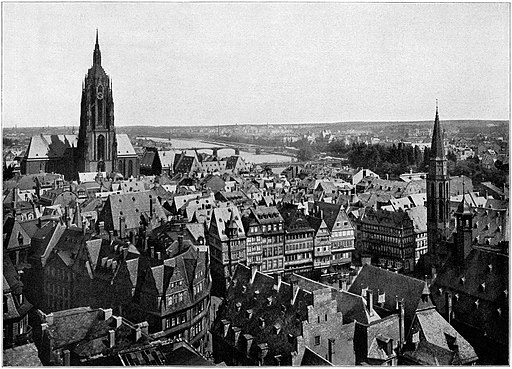
As discussed in an earlier post, by the late 19th century, the city of Frankfurt had the second largest Jewish population in Germany. During the early decades of the 20th century, that community continued to grow and prosper, as described in this source, the February 2005 issue of Hadassah Magazine:

As the 20th century got under way Frankfurt’s Jews were at the peak of their influence. They were bankers, brokers, manufacturers, retailers, lawyers and doctors. They fought in World War I under the Kaiser and Frankfurt became a center of learning in the Weimar Republic. Jewish Frankfurters were active in politics, and in 1925 Ludwig Landmann became the city’s first Jewish mayor.

And this source added to this picture of the thriving Jewish community in Frankfurt during the first three decades of the 20th century:

Before 1933, Frankfurt am Main had the largest percentage of Jewish citizens in Germany, and its Jewish community was the second largest in Germany following Berlin. In finance, education, science, and through numerous associations and foundations, Jewish citizens influenced the city of Frankfurt in a distinct way.

It is quite evident that Frankfurt was a comfortable place for Jews to live and do business in those early decades of the 20th century.

All that changed, of course, in 1933 when Hitler came to power. And certainly by 1935 with the enactment of the Nuremberg Laws, life became miserable for Jews all over Germany. Thus, it is not surprising that Sarah Goldschmidt’s descendants began to leave Germany, some for the United States, some for England, and some for what was then Palestine, today’s Israel.

The next series of posts will tell the story of what happened to the descendants of Sarah Goldschmidt and Abraham Stern during and after the Holocaust. This post will tell the story of Kiele Stern Loewenthal’s oldest child, Selma Loewenthal Schwabacher, and her children, Alice, Julius, and Gerhard, and their children.

UPDATE: Thanks to the kindness of my cousin Carrie, great-great-granddaughter of Selma Loewenthal Schwabacher, I can now add photographs to this blog post of the family in the US.

Selma’s three children all went to the United States after Hitler’s rise to power, as did her grandchildren. Selma’s youngest child Gerhard Schwabacher had in fact left for the United States before Hitler came to power. According to his naturalization papers, he arrived in the United States on February 9, 1927, and by September 6, 1927, had declared his intention to become a United States citizen.

Gerhard Schwabacher, Petition for US Citizenship, National Archives at Boston; Waltham, Massachusetts; ARC Title: Naturalization Record Books, 12/1893 – 9/1906; NAI Number: 2838938; Record Group Title: Records of District Courts of the United States, 1685-2009; Record Group Number: RG 21, Petition for naturalization, v 67-69, petition no 17330-17847
Ancestry.com. Connecticut, Federal Naturalization Records, 1790-1996

Gerhard married Alice Ferron, a Connecticut native, on September 4, 1931.1 Alice was born on April 18, 1905 to Charles J. and Alice Ferron.2 Gerhard and Alice were living in Bridgeport, Connecticut, in 1933 when he filed his petition for citizenship, and Gerhard was working as an electrical engineer for General Electric.3

On September 8, 1934, his mother Selma Loewenthal Schwabacher (who was a widow) arrived in New York to stay with Gerhard in Bridgeport. The manifest listed Berlin as her place of residence  and indicated that she only planned to stay in the US for six months.4  It appears that Selma did not stay in the US;  the research done by my cousins Roger Cibella and David Baron indicates that she died in Berlin on February 20, 1937.

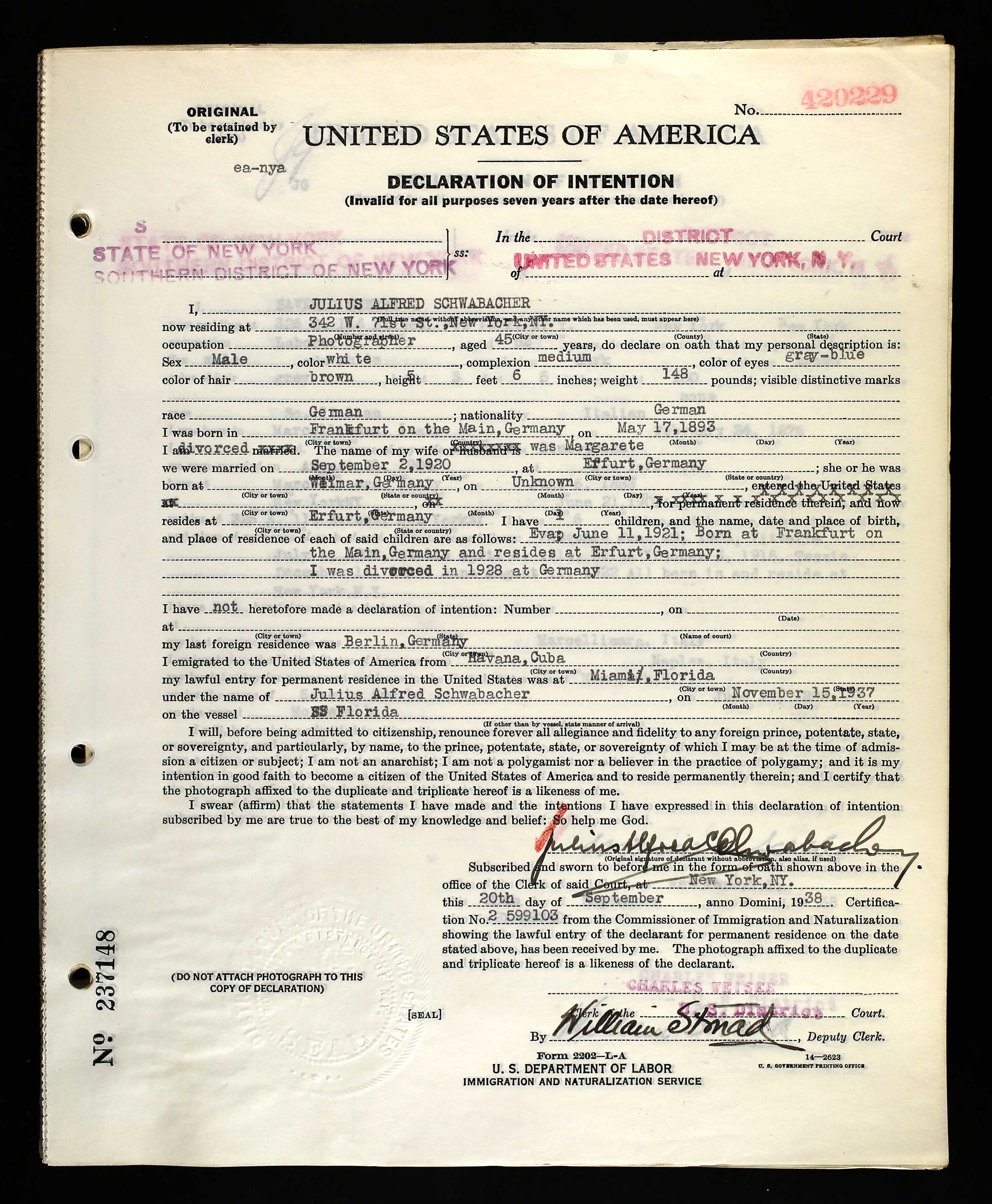
Julius Schwabacher arrived in the US on September 30, 1935. Like his mother, he indicated that Berlin was his place of residence in Germany and that he was going to see his brother Gerhard in Bridgeport. The manifest reports that Julius was a reporter and that he was going to stay only 30 days,5 and it appears he also returned to Germany. But on November 14, 1937, Julius sailed from Havana, Cuba, to Florida, ultimately heading to Bridgeport where his brother lived. This time Julius indicated he intended to stay in the US permanently and that his occupation was a journalist.

And on September 20, 1938, he filed his Declaration of Intention to become a US citizen.

Julius Schwabacher, The National Archives at Philadelphia; Philadelphia, Pennsylvania; NAI Title: Declarations of Intention for Citizenship, 1/19/1842 – 10/29/1959; NAI Number: 4713410; Record Group Title: Records of District Courts of the United States, 1685-2009; Record Group Number: 21, (Roll 541) Declarations of Intention for Citizenship, 1842-1959 (No 419501-420500)
Ancestry.com. New York, State and Federal Naturalization Records, 1794-1943

Julius’ daughter Eva Lore Schwabacher arrived two years later on July 29, 1940, heading to New York where her father, now using the surname Wenton, was living. Eva Lore had been residing in London before immigrating to the US.6  Julius and Eva Lore’s mother Margarete had divorced in 1928, as Julius’s declaration indicates, and tragically, Margarete did not leave Germany and was murdered at Auschwitz.7

Selma’s daughter Alice Schwabacher Weinstein and her husband David and son Wolfgang also left Germany in time. Wolfgang left first; he arrived in the US on December 7, 1935, heading to his uncle Gerhard in Bridgeport.8 He filed his Declaration of Intent the following year and by that time had changed his surname to Wenten.

Wolfgang Weinstein (Wenten), Declaration of Intent, National Archives at Boston; Waltham, Massachusetts; ARC Title: Naturalization Record Books, 12/1893 – 9/1906; NAI Number: 2838938; Record Group Title: Records of District Courts of the United States, 1685-2009; Record Group Number: RG 21, Petition for naturalization, v 100-103, petition no 25563-26184, Ancestry.com. Connecticut, Federal Naturalization Records, 1790-1996

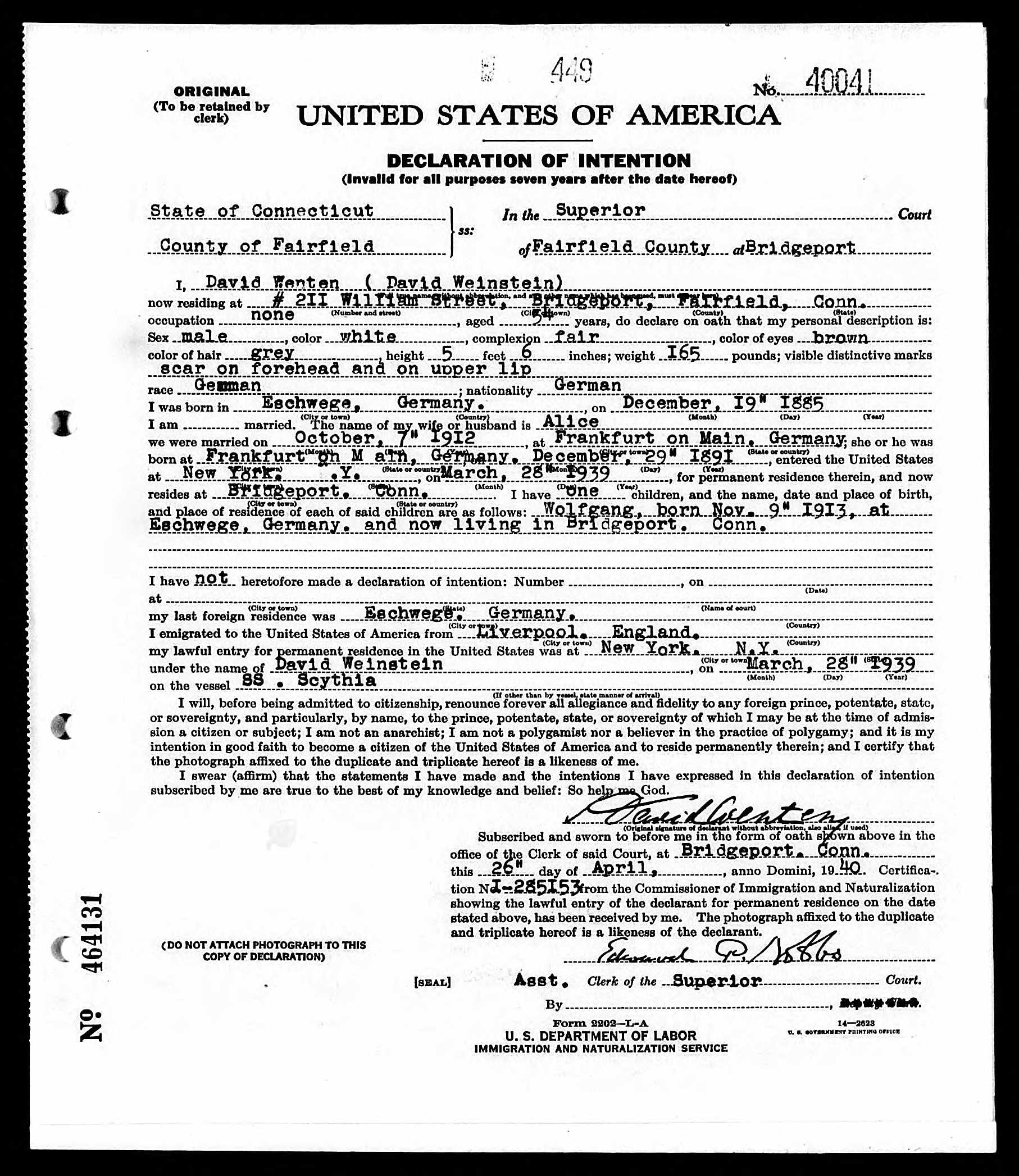
Wolfgang’s parents Alice and David arrived on March 28, 1939,9 and like their son Wolfgang and Gerhard, settled in Bridgeport. David would also change his surname to Wenten and filed a Declaration of Intent for them to become US citizens in 1940.

David Wenten, Declaration of Intent, National Archives at Boston; Waltham, Massachusetts; ARC Title: Naturalization Record Books, 12/1893 – 9/1906; NAI Number: 2838938; Record Group Title: Records of District Courts of the United States, 1685-2009; Record Group Number: RG 21
Declaration of intention, no 38436-40677, 1938-1940, Ancestry.com. Connecticut, Federal Naturalization Records, 1790-1996

Thus, in 1940, all of Selma Loewenthal Schwabacher’s children and grandchildren were safely settled in the US. The 1940 US census shows Gerhard living with his wife and two American-born young sons in Bridgeport, working as an electrical engineer.10 His sister Alice and her husband David were also living in Bridgeport where David was in the real estate business. Their son Wolfgang was living with them and working as a shipping clerk for a novelty store.11

I could not locate Julius or his daughter Eva Lore on the 1940 US census, but in 1942 when he registered for the World War II draft, Julius was also living in Bridgeport, working for the Surgical Shears Company.

Julius Wenteo, World War II draft registration, The National Archives at St. Louis; St. Louis, Missouri; World War II Draft Cards (Fourth Registration) for the State of Connecticut; Record Group Title: Records of the Selective Service System; Record Group Number: 147; Series Number: M1962, Ancestry.com. U.S., World War II Draft Registration Cards, 1942

Unfortunately, the story of the Selma’s children’s transition to the United States ends on a sad note. David Weinstein aka Wenten died on September 25, 1941, at the age of 55.12 One must wonder whether the stress of leaving his homeland and adjusting to life in a new country contributed to his death.

As for the other members of the family, they safely survived the war in the United States. Gerhard Schwabacher remained in Bridgeport for the rest of his life, working as an engineer for General Electric. He died on July 26, 1971, at the age of 69.13 His wife Alice died the following year.14 They were survived by their two sons.

Julius Schwabacher Wenton died a year after his brother on September 29, 1972, in Laguna Hills, California; he was 79.15 He was survived by his second wife, Elsie Simon, whom he had married in Fairfield, Connecticut on March 13, 1943,16 and his daughter Eva Lore. Eva Lore had married twice, first to Jack Stern in 1943, and then, after divorcing Jack Stern in 1946, to Henry Corton, in April, 1951.17 As far as I’ve been able to determine, she did not have children with either man. Eva Lore Corton passed away on March 3, 2003.18

Alice Schwabacher outlived both of her younger brothers. After losing her first husband David Weinstein/Wenten in 1941, she married Arthur Kingsley (originally Koenigsberger) on August 1, 1951.19 She outlived him as well; he died in January 1972.20 Alice lived to the age of 93; she died on her 93rd birthday on December 29, 1984.21 She was survived by her son Wolfgang Wenten, who was in the construction estimating business in Bridgeport. Sadly, Wolfgang did not inherit the same longevity as his mother. He died less than six years after she did on March 20, 1990; he was 76 and was survived by his wife Ruth and their two children.22

Selma Loewenthal Schwabacher still has numerous descendants living in the United States—her great-grandchildren and their children and grandchildren. She and her family were among the fortunate ones who left Germany in time.

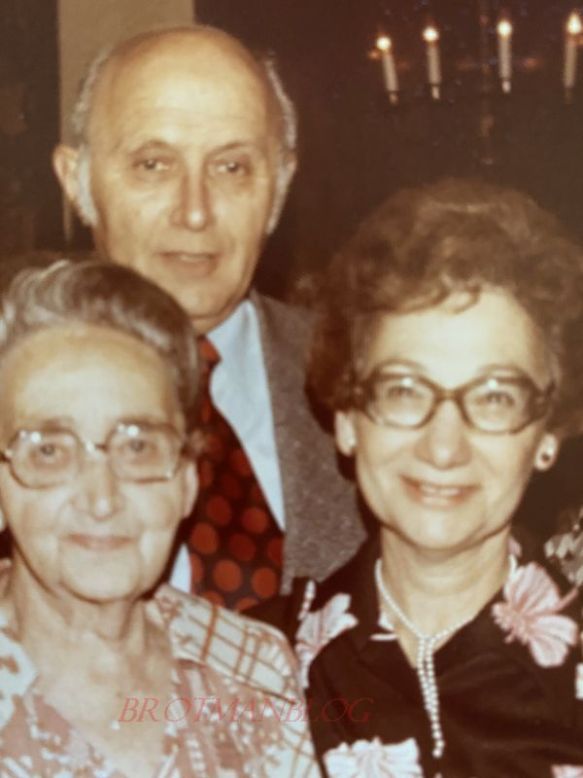
Alice Schwabacher Kingsley, Wolfgang Wenten, Ruth Wenten

Alice Schwabacher Wenten Kingsley, Wolfgang Wenten, Ruth Pollinger Wenten Courtesy of the family

IMG_0325

IMG_0316

Eva Lore Schwabacher and Henry Corton

See email 5 30 for names

Arthur Kingsley, Alice Schwabacher Kingsley, Julius (Fred Wenten) Schwabacher, Else Wenten, Alice Ferron Schwabacher, Gerhard Schwabacher Courtesy of the family

Julius Alfred Schwabacher

Fred Wenten (born Julius Alfred Schwabacher) Courtesy of the family


  1.  Connecticut State Department of Health; Hartford, CT; Connecticut Vital Records — Index of Marriages, 1897-1968; Ancestry.com. WEB: Connecticut Marriage Records, 1897-1968 
  2. Charles Farron (sic) and family, 1920 US census, Census Place: Bridgeport Ward 5, Fairfield, Connecticut; Roll: T625_175; Page: 3A; Enumeration District: 26, Ancestry.com. 1920 United States Federal Census 
  3. “Gerhard P. Schwabacher,” The Bridgeport Post, Bridgeport, Connecticut
    27 Jul 1971, Tue • Page 45 
  4. Selma Schwabacher, ship manifest, Year: 1934; Arrival: New York, New York; Microfilm Serial: T715, 1897-1957; Microfilm Roll: Roll 5554; Line: 1; Page Number: 112, Ancestry.com. New York, Passenger and Crew Lists (including Castle Garden and Ellis Island), 1820-1957 
  5. Julius Schwabacher, ship manifest, Year: 1935; Arrival: New York, New York; Microfilm Serial: T715, 1897-1957; Microfilm Roll: Roll 5713; Line: 1; Page Number: 128, Ancestry.com. New York, Passenger and Crew Lists (including Castle Garden and Ellis Island), 1820-1957 
  6. Eva Lore Schwabacher, ship manifest, Year: 1940; Arrival: New York, New York; Microfilm Serial: T715, 1897-1957; Microfilm Roll: Roll 6485; Line: 15; Page Number: 126, Ancestry.com. New York, Passenger and Crew Lists (including Castle Garden and Ellis Island), 1820-1957 
  7. Entries for Margarete Schwabacher at Yad Vashem https://tinyurl.com/wlm399u 
  8. Wolfgang Weinstein, ship manifest, Year: 1935; Arrival: New York, New York; Microfilm Serial: T715, 1897-1957; Microfilm Roll: Roll 5739; Line: 18; Page Number: 21, Ancestry.com. New York, Passenger and Crew Lists (including Castle Garden and Ellis Island), 1820-1957 
  9. David and Alice Weinstein, ship manifest, Year: 1939; Arrival: New York, New York; Microfilm Serial: T715, 1897-1957; Microfilm Roll: Roll 6303; Line: 18; Page Number: 104, Ancestry.com. New York, Passenger and Crew Lists (including Castle Garden and Ellis Island), 1820-1957 
  10. Family of Gerhard Schwabacher, 1940 US census, Year: 1940; Census Place: Bridgeport, Fairfield, Connecticut; Roll: m-t0627-00531; Page: 5A; Enumeration District: 9-69, Ancestry.com. 1940 United States Federal Census 
  11. Family of David Wenten, 1940 US census, ear: 1940; Census Place: Bridgeport, Fairfield, Connecticut; Roll: m-t0627-00533; Page: 1B; Enumeration District: 9-125,
    Ancestry.com. 1940 United States Federal Census 
  12.  State Vital Records Office; Hartford, Connecticut; Connecticut Vital Records — Index of Deaths, 1897-1968, Ancestry.com. WEB: Connecticut Death Records, 1897-1968 
  13. “Gerhard P. Schwabacher,” The Bridgeport Post, Bridgeport, Connecticut
    27 Jul 1971, Tue • Page 45. Social Security Number: 041-09-0962, Birth Date: 27 Jun 1902, Last Residence: 06492, Wallingford, New Haven, Connecticut, USA, Death Date: Jul 1971, Social Security Administration; Washington D.C., USA; Social Security Death Index, Master File, Ancestry.com. U.S., Social Security Death Index, 1935-2014 
  14. State File #: 02273, Connecticut Department of Health. Connecticut Death Index, 1949-2012 
  15.  Social Security Number: 104-10-6866, Birth Date: 17 May 1893, Last Residence: 92653, Laguna Hills, Orange, California, USA, Death Date: Sep 1972, Social Security Administration; Washington D.C., USA; Social Security Death Index, Master File,
    Ancestry.com. U.S., Social Security Death Index, 1935-2014 
  16.  Connecticut State Department of Health; Hartford, CT; Connecticut Vital Records — Index of Marriages, 1897-1968, Ancestry.com. WEB: Connecticut Marriage Records, 1897-1968 
  17. Marriage of Eva Lore Schwabacher to Jack Stern, Marriage certificates 1943 vol 57A, Ancestry.com. Washington, County Marriages, 1855-2008. Divorce of Eva Lore Schwabacher and Jack Stern, Ancestry.com. Florida, Divorce Index, 1927-2001,
    Original data: Florida Department of Health. Florida Divorce Index, 1927-2001. Jacksonville, FL, USA: Florida Department of Health. Marriage of Eva Lore Schwabacher Stern to Henry Corton, License Number: 9785, New York City Municipal Archives; New York, New York; Borough: Manhattan; Volume Number: 14,
    Ancestry.com. New York, New York, Marriage License Indexes, 1907-2018 
  18. SSN: 045121672, Ancestry.com. U.S., Social Security Applications and Claims Index, 1936-2007 
  19.  License Number: 20152, New York City Municipal Archives; New York, New York; Borough: Manhattan, Ancestry.com. New York, New York, Marriage License Indexes, 1907-2018 
  20.  Social Security Number: 112-26-6899, Death Date: Jan 1972, Social Security Administration; Washington D.C., USA; Social Security Death Index, Master File,
    Ancestry.com. U.S., Social Security Death Index, 1935-2014 
  21.  Social Security Number: 044-12-5712, Birth Date: 29 Dec 1891,
    Last Residence: 10040, New York, New York, New York, USA, Death Date: Dec 1984
    Social Security Administration; Washington D.C., USA; Social Security Death Index, Master File, Ancestry.com. U.S., Social Security Death Index, 1935-2014. JewishGen, comp. JewishGen Online Worldwide Burial Registry (JOWBR), 
  22. “Wenten Named to Head County School,” The Bridgeport Post, Bridgeport, Connecticut, 28 Jul 1968, Sun • Page 66. SSN: 041105870, Ancestry.com. U.S., Social Security Applications and Claims Index, 1936-2007 

My Vogel Cousins: From Germany to Argentina

Before I return to the family of Meyer Goldschmidt, I have two more posts to share relating to other family members.

Today I want to share some wonderful photographs I received from my fourth cousin, once removed, Patricia, the daughter of Heinz Vogel, granddaughter of Sophie Katz and Isaak Vogel, great-granddaughter of Rosa Katzenstein and Salomon Feist Katz.

On September 10, 2019, I wrote about this family and told the story of the escape of Sophie and Isaak and their sons Heinz and Carl to Argentina from Nazi Germany in the 1930s. It was due to the generosity of Patricia and also Carl Vogel’s daughter that I was able to share details of the Vogel’s story and how they rebuilt their lives in Buenos Aires as well as many wonderful photographs.

In November, Patricia shared several more wonderful family photographs.

This is a photograph of Rosa Katzenstein in 1887 when she was 28 and married to Salomon Feist Katz for six years. (I’ve edited these photographs a little to improve clarity.) Rosa was my great-grandmother Hilda Katzenstein’s second cousin, once removed. I see a resemblance to Hilda. What do you think?

Rosa Katzenstein Katz, 1887

Hilda Katzenstein Schoenthal

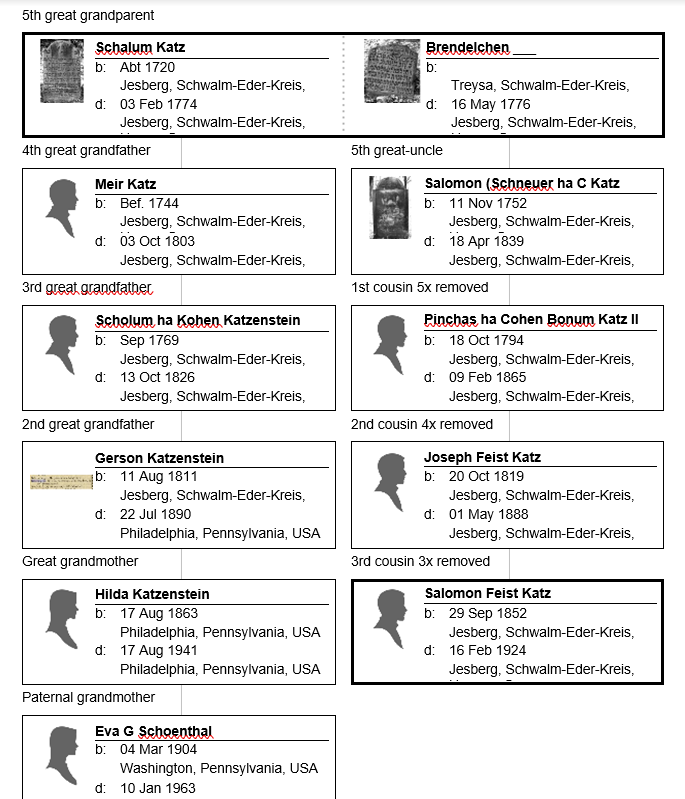
Taken that same year is this photograph of Salomon, who was 35 at that time. Salomon was also my cousin (and Rosa’s cousin). He was my third cousin, three times removed, through our shared ancestors, Schalum and Brendelchen Katz, my fifth great-grandparents. He was Hilda’s third cousin.

Salomon Feist Katz, 1887

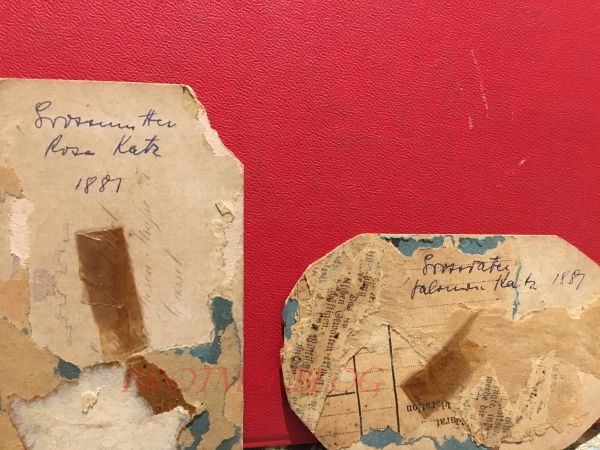
Patricia also sent me images of what was on the reverse of these photographs. Can anyone read the words above their names?

UPDATE: Thank you to Cathy Meder-Dempsey for transcribing the top words as Grossmutter (grandmother) and Grossvater (grandfather).

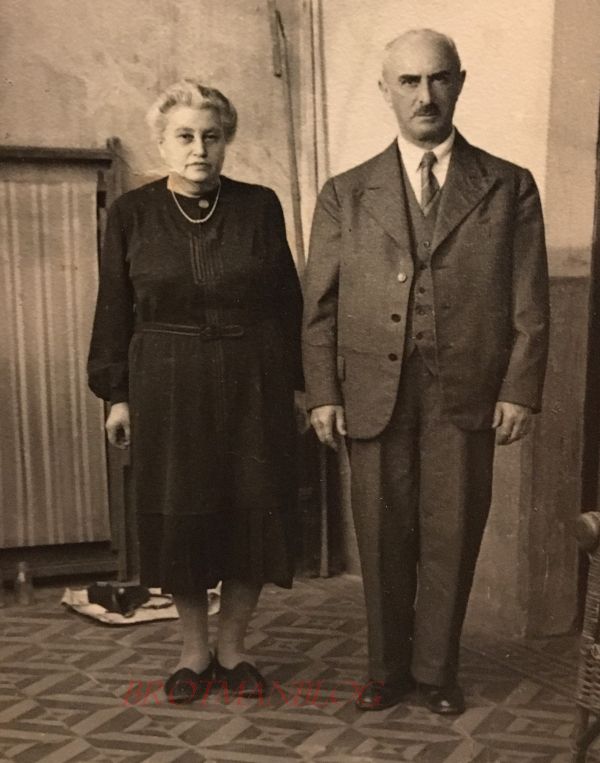
This photograph of Rosa and Salomon’s daughter Sophie Katz and her husband Isaak Vogel was taken in July, 1948, after they had immigrated to Argentina; the inscription on the reverse appears below it. Can someone decipher what it says? The second line says “63(?) Geburtstag 10 Jul 1948.”  Sophie was born on July 10, 1885, so this would have been her 63rd birthday. She and Isaak don’t look very happy, however.

UPDATE: Thank you again to Cathy Meder-Dempsey for transcribing the first word in the top line as aufgenommen, meaning “taken.” She wasn’t certain whether the next word was “bei,’ indicating where the photo was taken, or “von,” indicating who took the photo. And the third word was not legible.

SECOND UPDATE: Thank you to Eric, who commented below and was able to read that last word. It says Aufgenommen bei meinem 63rd geburtstag or Taken at my 63rd birthday. Thanks, Eric!

Sophie Katz and Isaak Vogel, 1948

Finally, Patricia shared a photograph taken at Sophie and Isaak’s 50th anniversary celebration on June 9, 1959. That adorable little girl in the center of the photograph is Patricia herself.

In the front row from left to right are Sophie Katz Vogel, Isaak Vogel, and Rosa Hamburger, Carl Vogel’s mother-in-law. Standing behind them from left to right is Carl Vogel, Gertrud Lippman Vogel (Heinz Vogel’s wife), Heinz Vogel, and Beate Hamburger Vogel (Carl’s wife).

When I look at this photograph and see the love and the smiles that permeate it and compare it to the stern expressions on the faces of Sophie and Isaak in 1948, it makes me think of how hard their adjustment to Argentina must have been, but also how fortunate they must have felt to have left Germany behind and to have made a whole new life for themselves in their new homeland.

I am so grateful to Patricia for sharing these with me.


My Cousin’s Case before the US Supreme Court: Philipp v. Germany

My second Goldschmidt update involves the descendants of Selig Goldschmidt, specifically his great-great-grandson, my fifth cousin, Alan Philipp.

Right now there is a case pending before the United States Supreme Court that was brought by Alan Philipp and two other plaintiffs. They brought a lawsuit against the Federal Republic of Germany and the Stiftung Preussischer Kulturbesitz (“SPK”), or in English, the Prussian Cultural Foundation.

The SPK is described on its website as “the largest employer in the cultural sector in Germany. It is a federal foundation and is shaped by the federal structure of Germany. The federal government and all sixteen federal states support and finance it jointly.” It was formed in 1957 after “the final dissolution of the state of Prussia ten years earlier. As a result, the question of ownership of its important public collections had to be reorganized. These collections were given to the foundation as property by the establishment law.” (translations by Google Translate)

Among those properties that were transferred by the government to the SPK was a very valuable collection of medieval works of art known as the Welfenschatz or in English, the Guelph Treasure. The Welfenschatz had been acquired in 1929 by three art collectors who had formed a consortium (“the Consortium”) to acquire art.

One of those art collectors was the firm of J&S Goldschmidt, founded in the mid-19th century by my cousins Jacob Meier and Selig Goldschmidt; another was Zacharias Hackenbroch, the grandson-in-law of Selig Goldschmidt, the son-in-law of Recha Goldschmidt, and husband of Clementine Schwarzschild. Alan Philipp shared with me a photograph of three of the investors, his grandfather Zacharias Hackenbroch, his cousin Julius Falk Goldschmidt, and Saemy Rosenberg:

Zacharias M. Hackenbroch, Julius Falk Goldschmidt, and Saemy Rosenberg. Courtesy of Alan Philipp

According to the allegations made by the plaintiffs, heirs to the Consortium, in 1935 the Consortium was coerced by economic duress, fraud, and bad faith to sell the Welfenschatz to the Nazis for about a third of its value   After unsuccessfully pursuing their claim for compensation first in Germany, the plaintiffs sued both the Federal Republic of Germany and the SPK in the US District Court for the District of Columbia for either the return of the Welfenschatz, which is currently located in the collection of the SPK in Germany, or for damages equivalent to the current value of the collection, claiming that the property had been wrongfully misappropriated from the Consortium in 1935.

Germany and the SPK moved to dismiss the lawsuit, arguing in part that the United States courts did not have jurisdiction over the plaintiffs’ claims against a foreign state. Before getting too far into the weeds of the legal issues and all their complexities, let me stop here to explain just a few procedural matters.

There has not been a trial in this case. The defendants moved to dismiss the case on the basis of the plaintiff’s pleadings alone; a court can dismiss a lawsuit if it finds that the plaintiffs have no basis for a legal claim even if they can eventually prove every fact they have alleged in their pleadings. So for purposes of this case—at all three levels of the federal court system, the District Court, the Court of Appeals, and the Supreme Court—the courts are assuming the truth of the facts claimed in the plaintiff’s complaint. The only issues the lower courts have determined and the only issues the Supreme Court will decide is whether this case should be dismissed because the American federal courts do not have jurisdiction over these claims even if the plaintiffs can eventually prove the truth of their allegations.

So what were those allegations? The District Court for the District of Columbia summarized them in their opinion (the paragraph numbers are references to the plaintiff’s complaint):

Plaintiffs’ position is that the 1935 sale between the Consortium and the State of Prussia, a political subdivision of the German Weimar Republic and later the Third Reich, was coerced as part of the Nazi persecution of the Jewish sellers of the Welfenschatz and, as such, the Court shall briefly summarize the allegations in the complaint that Plaintiffs rely on in support of this position. Id. ¶ 22. Specifically, Plaintiffs allege the 1935 transaction was spearheaded by Nazi-leaders Hermann Goering and Adolf Hitler, who were involved in explicit correspondence to “save the Welfenschatz” for the German Reich. Id. ¶¶ 2, 9. Further, the 1935 sale resulted in a payment of 4.25 million RM, which Plaintiffs assert demonstrates the lack of an arms’-length transaction because it was barely 35% of the market value of the Welfenschatz. Id. ¶¶ 4, 12.  Further, the money exchanged was never fully accessible to the Consortium because it was split and partly paid into a blocked account, and was subject to “flight taxes” that Jews had to pay in order to escape. Id. ¶¶ 4, 12. Moreover, in November of 1935, Goering presented the Welfenschatz as a personal “surprise gift” to Hitler during a ceremony. Id. ¶¶ 13, 179.

Philipp v. Fed. Republic of Ger., 248 F. Supp. 3d 59, 65 (D.D.C. 2017)

The District Court’s opinion then listed the plaintiff’s allegations describing some of the specific steps the Nazis took to coerce and defraud the Consortium into selling them the Welfenschatz, knowing the enormous economic pressure they were under as a result of the Nazi persecution of Jews at that time.

The defendants moved to dismiss on numerous grounds, but the ones that are still being pressed at the Supreme Court boil down to two arguments:  one, that the US courts have no jurisdiction to adjudicate the claims based on a federal statute, the Federal Sovereign Immunity Act (“FSIA”), and two, that US courts should not allow such a claim out of respect for the laws and procedures of a foreign country under principles of comity.

For lawyers, these issues are fascinating. But this is not a blog about legal matters, and there are many resources out there for those who are interested in all the ins and outs of the issues presented. (See the list below for a few.) I just want to say a little more about the issues involving the FSIA.

The FSIA generally grants immunity from liability to foreign states, preventing lawsuits against those states and their agents (in this case SPK) in American courts. But there are exceptions provided in the statute; the plaintiffs are relying on one of those exceptions as the basis of the court’s jurisdiction over their claims, the so-called “expropriation exception.” It provides that a party can proceed against a foreign state where their claim is one “in which rights in property taken in violation of international law are in issue and that property or any property exchanged for such property is present in the United States in connection with a commercial activity carried on in the United States by the foreign state….” 28 U.S.C. § 1605(a)(3).

The defendants raised several arguments against the application of this exception to the plaintiffs’ claims, but I want to focus on just one of those arguments—whether or not this was a taking of the Consortium’s property that violated international law. The plaintiffs argued, relying on an earlier decision of the Court of Appeals of the District of Columbia, that when a taking of property bears a “sufficient connection” to genocide, the taking is itself a violation of international law.

The District Court agreed, focusing on the plaintiffs’ allegations that “the coerced sale of the Welfenschatz was accomplished to deprive the Consortium of their ability to earn a living and the motivation for the taking was to deprive the Consortium of resources needed to survive as a people in furtherance of the genocide of the German Jews during the Holocaust.” Philipp v. Fed. Republic of Ger., 248 F. Supp. 3d 59, 71 (D.D.C. 2017) The District Court also concluded that the plaintiffs had satisfied the commercial nexus requirement of the expropriation exception and that therefore the case should not be dismissed.

A work from the Guelph Treasure
Reliquary of the arm of Saint Blaise (Herzog Anton Ulrich Museum, Dankwarderode Castle). User:Brunswyk, CC BY-SA 3.0 <http://creativecommons.org/licenses/by-sa/3.0/&gt;, via Wikimedia Commons

The defendants appealed this decision to the Court of Appeals of the District of Columbia, and the Court of Appeals agreed with the District Court on the issue of whether there was a taking of property in violation of international law, reasoning in part:

Congress has twice made clear that it considers Nazi art-looting part of the Holocaust. In enacting the Holocaust Victims Redress Act, which encouraged nations to return Nazi-seized assets, Congress “f[ound]” that “[t]he Nazis’ policy of looting art was a critical element and incentive in their campaign of genocide against individuals of Jewish … heritage.” Holocaust Victims Recovery Act, Pub. L. No. 105-158, § 201, 112 Stat. 15, 15 (1998). And in the Holocaust Expropriated Art Recovery Act (HEAR Act), which extended statutes of limitation for Nazi art-looting claims, Congress again “f[ound]” that “the Nazis confiscated or otherwise misappropriated hundreds of thousands of works of art and other property throughout Europe as part of their genocidal campaign against the Jewish people and other persecuted groups.” Holocaust Expropriated Art Recovery Act of 2016, Pub. L. No. 114-308, § 2, 130 Stat. 1524, 1524 (emphasis added)

Philipp v. Fed. Republic of Germany, 894 F.3d 406, 411-12 (D.C. Cir. 2018)

The Court of Appeals, however, disagreed with the District Court with respect to the application of the expropriation exception to Germany based on the second requirement of the exception: that for a claim against a foreign state to fit within the exception, the property that was confiscated must be located in the United States, which was not the case here with the Welfenschatz. Thus, the appellate court dismissed the claim against Germany itself.

With respect to the claim against the SPK, the appellate court concluded that the requirements of the statute were different with respect to an instrumentality of a foreign state and that because there was a “sufficient commercial nexus” between the SPK, an instrumentality of Germany, and the United States, the case against the SPK could go forward even though the disputed property was in Germany, not the United States.

A work from the Welfenschatz in the Bode Museum in Germany
User:FA2010, Public domain, via Wikimedia Commons

It will be very interesting to see how the Supreme Court rules in this case. The issues go beyond this one case, of course. Sadly, genocide has occurred and continues to occur in all parts of the world, and those who have been damaged—whose property has been stolen, as was the case with so much of the art owned by German Jews—may want to seek recourse in American courts.

Foreign policy concerns and the principles of comity lie behind the arguments of the defendants that these matters should be pursued in the country where the wrongful acts occurred. One argument made by the defendants was that if claims against a country by a national of that country can be brought in other countries, foreign courts could end up litigating claims by US nationals against the US, e.g., claims brought by Japanese-Americans who were interned during World War II against the US might be litigated outside the US or claims brought against the US by African-Americans for reparations for slavery could be litigated in another country.

The plaintiffs distinguish those cases by pointing out that Nazi Germany stripped their ancestors of their citizenship as part of their persecution of Jews and that therefore they were no longer nationals of Germany but stateless. Thus, these are not claims against Germany or its agents by German nationals. They also argue that the Holocaust has been treated as unique by both American law and international law, and thus special treatment needs to be provided for those seeking redress for harms done as part of the Holocaust.

I listened to the oral arguments made by the lawyers before the Supreme Court on December 7, and although I thought that the defendant’s lawyer was persuasive with regard to the meaning and scope of the statutory language, the plaintiffs’ arguments have the stronger moral position. I will be watching carefully to see whether the heirs of my Goldschmidt cousins are able to pursue their claims and ultimately obtain compensation for the harm that was done to their ancestors almost 90 years ago.

For those who want to learn more about the case, I suggest the following resources:

I have included links to the lower court opinions in the body of the text of the blog.

Here is a link to a recording of the oral arguments made before the Supreme Court on December 7, 2020.

The Scotus Blog has links to the briefs filed by the parties and by amicus curiae.

The Art Newspaper has a recent article about the case.

The New York Times has a good summary of the case.

This is a short piece written by the plaintiffs’ lawyer Nicholas O’Donnell of Sullivan & Worcester.

For more in-depth analysis of the FSIA and the international law regarding Nazi appropriation of art, see the following law review articles about FSIA:

Vivian Grosswald Currana, “THE FOREIGN SOVEREIGN IMMUNITIES ACT’S EVOLVING GENOCIDE EXCEPTION, ” UCLA Journal of International Law and Foreign Affairs, Spring, 2019

Michael J. Birnkrant, “THE FAILURE OF SOFT LAW TO PROVIDE AN EQUITABLE FRAMEWORK FOR RESTITUTION OF NAZI-LOOTED ART, ” Washington University Global Studies Law Review, 2019

Ugboaja, Ikenna (2020) “Exhaustion of Local Remedies and the FSIA Takings Exception: The Case for Deferring to the Executive’s Recommendation,” University of Chicago Law Review: Vol. 87 : Iss. 7 , Article 5.
Available at: https://chicagounbound.uchicago.edu/uclrev/vol87/iss7/5


Sophie Katz Vogel and Her Family: A Brick Wall Falls in My Katzenstein Family

Back in October 2017, I wrote about a brick wall I could not break down involving the children of my cousin Rosa Katzenstein. Rosa was my second cousin, twice removed. She was the granddaughter of Jacob Katzenstein, the older brother of my great-great-grandfather Gerson Katzenstein.

Rosa was the oldest child of Mina and Wolf Katzenstein, born on June 19, 1859, in Frankenau, Germany.

Rosa Katzenstein birth record arcinsys
HHStAW Fonds 365 No 174, p. 7

She married her third cousin, once removed, Salomon Feist Katz, son of Joseph Feist Katz and Brendel Katz of Jesberg. Rosa and Salomon were married on June 28, 1881, in Jesberg. They had four daughters, one of whom died as a child, but three survived to adulthood: Sara, Sophie, and Recha.

Marriage record of Rosa Katzenstein and Salomon Feist Katz
Hessisches Hauptstaatsarchiv; Wiesbaden, Deutschland; Collection: Personenstandsregister Heiratsregister; Signatur: 920; Laufende Nummer: 3836

I had a great deal of trouble learning what happened to two of those daughters, Sara and Sophie. I knew that Sara had married Otto Loew and had two children and that Sophie had married Isaac Vogel, with whom she’d had two sons, Heinz and Carl, but that was all I could find. Then, with incredible help from my friend Aaron Knappstein, I learned that Sara and Sophie as well as their sister Recha had all left Germany in the 1930s and escaped to Argentina.

But I did not know what had happened to the two sons of Sophie Katz Vogel, Carl and Heinz. Now, thanks to more wonderful research done by Aaron Knappstein, I not only know more about their story, I actually have photographs of the family and am in touch with two new cousins.

In April, 2019, Aaron received an email with a packet of information and photographs from Ingo Sieloff, the director of the Borken museum. Back in 2009, Carl Vogel’s daughter had exchanged emails with Heinrich Broz, then the archivist for the town of Borken, and had sent him photographs and other documents and a history of her family. Mr. Sieloff sent all of this to Aaron, and  Aaron sent them on to me. Last week I took a chance and sent Carl’s daughter an email using the email address she’d had in 2009. That same day she responded and shared it with Heinz’s daughter, and now I have two new cousins with whom to share and exchange family information.

Here is more of the story of Sophie Katz and Isaac Vogel. Most of the information in this post came from my correspondence with their granddaughters and the documents and photographs they shared with me.

Sophie Katz married Isaac Vogel on June 9, 1909:

Sophie Katz marriage to Isaak Vogel
Hessisches Hauptstaatsarchiv; Wiesbaden, Deutschland; Collection: Personenstandsregister Heiratsregister; Signatur: 915; Laufende Nummer: 5624

Their son Carl was born on March 30, 1910, in Borken, Germany:

Birth record of Carl Vogel

His brother Heinz was born two years later on July 18, 1912, also in Borken:

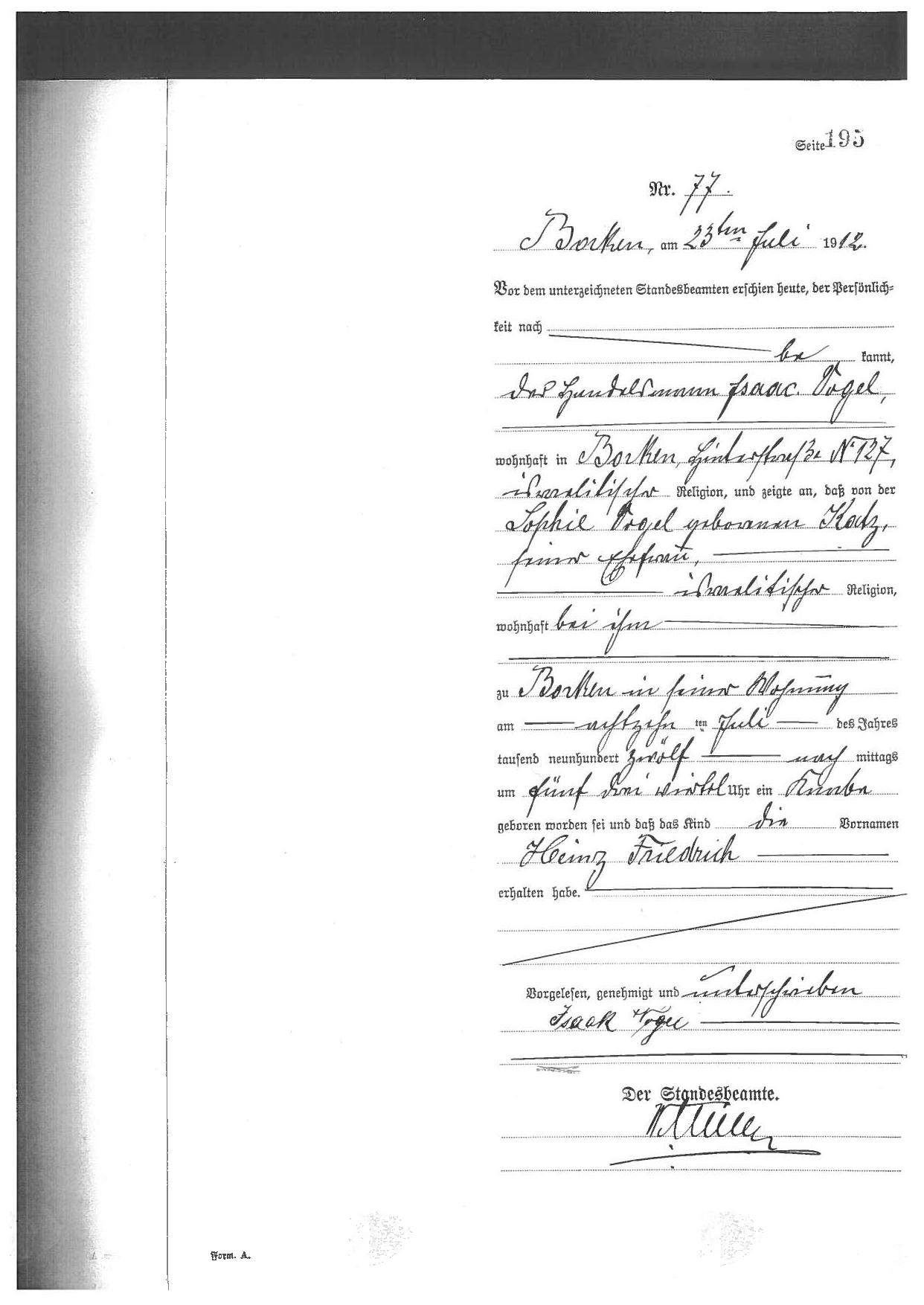
Birth record of Heinz Vogel. Courtesy of the Vogel family

During World War I Isaac Vogel served in the Germany military, fighting in France, and then was a city councilor in Borken in the 1920s.

Isaac Vogel (right). Courtesy of the Vogel family

Isaac Vogel, seated far right. Courtesy of the Vogel family

Isaac worked with his brother Moritz as a cattle trader. It was a business that Isaac and Moritz had taken over from their father Ephraim. It was a small business, but enough to support two families adequately.

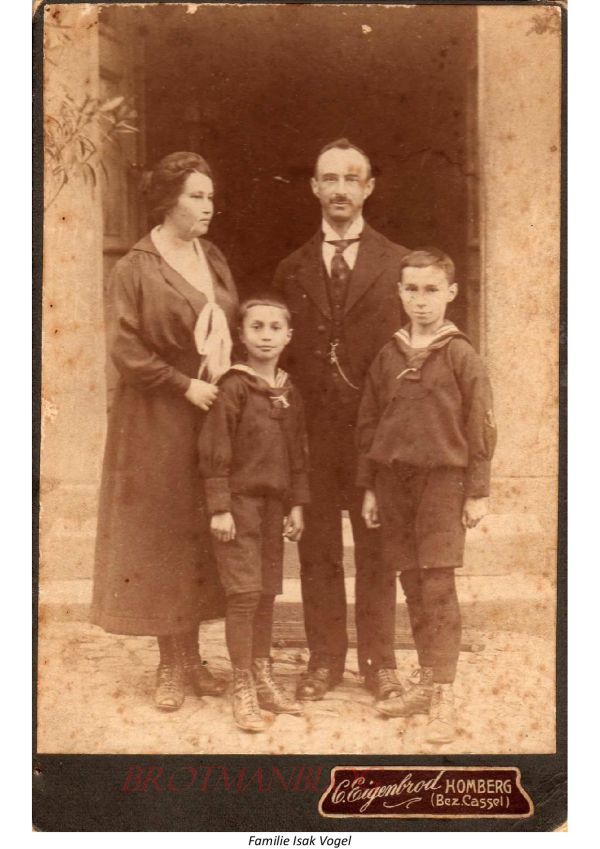
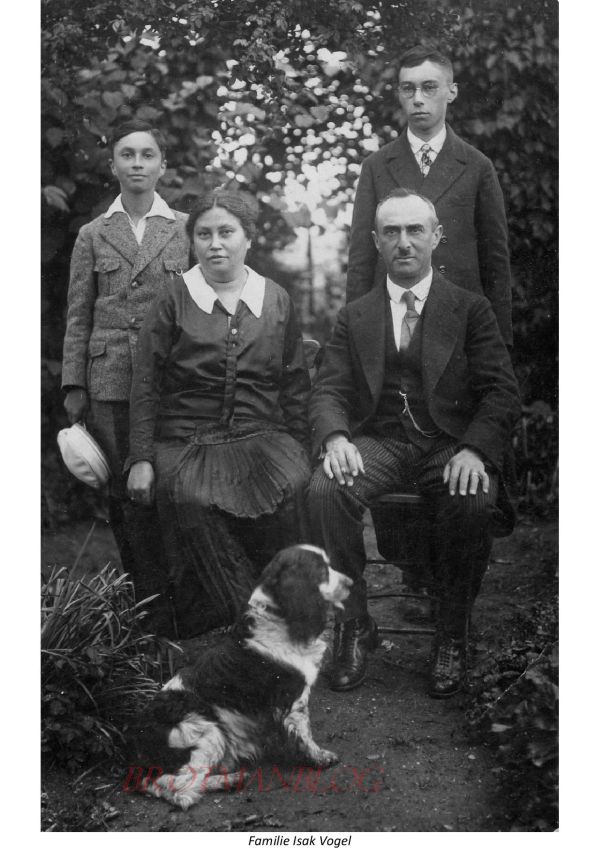
Here are three photos of Carl and Heinz and their parents taken between about 1910 to about 1924 in Borken, Germany:

Heinz and Carl Vogel, c. 1910. Courtesy of the Vogel family

Sophie, Heinz, Isaac, and Carl Vogel, c. 1917. Courtesy of the Vogel family

Vogel family, c. 1924. Courtesy of the Vogel family

According to Ingo Sieloff,  the Vogel home in Borken was located at Hintergasse 125 and included a house and a stable; the house was 105 square meters or about 1130 square feet in area. It appears to be larger than that in this photograph:

Hintergasse 125, Borken. Courtesy of the Vogel family

I don’t know when this photograph was taken or the identities of the people standing in front.

As a child, Carl Vogel was an avid reader and a good student, and his parents decided to send him to grammar school in Kassel. During the week he lived with his uncle Moritz Vogel. Carl graduated from high school and then studied at the Philosophical Faculty of Friedrich Wilhelm University in Berlin. He also attended lectures at Rabbinerseminar and worked as a religion teacher.

These three photographs are labeled “Schule,” one with year 1921. I can find Carl in the Gymnasium photograph below (the third one); he is the young man standing fourth from the left in the back row. I assume that either Carl or Heinz is somewhere in the other two photos. Can you find them? I have guesses, but am not sure.

Courtesy of the Vogel family

Courtesy of the Vogel family

Courtesy of the Vogel family

Heinz Vogel was also a very talented boy, but his parents could not afford to send both boys to high school. Instead, Heinz completed his apprenticeship as a retail merchant in Kassel at the Tietz department store.

Until 1933, the family lived a normal life. They saw themselves as Jews and as good Germans. They lived a quiet life, although there were occasional verbal anti-Semitic attacks .  But once the Nazis came to power, the Vogel cattle business suffered because farmers were not allowed to do business with Jews. Heinz Vogel also found his livelihood affected; although he was considered the best salesman in the store, he was released from his job. He then completed an apprenticeship in a practical trade in Frankfurt to prepare for emigration.

Carl read Hitler’s book “Mein Kampf” and recognized that the family needed to leave Germany. Sophie’s sister Recha Katz Goldschmidt had already left  for Argentina by 1932 after her husband Julius was beaten by the Nazis.

Carl and Heinz prepared to emigrate to Palestine, but then decided to go to Argentina since they already had relatives living there. Heinz and Carl first emigrated in 1935, and one year later their parents Isaac and Sophie and Sophie’s mother Rosa Katzenstein Katz followed. They sold their home in Borken for 9113 Reichsmarks. One source says that there were 2.5 Reichsmarks to a US dollar during World War II, so the price of the house would have been about $3,645 in US currency or about $48,000 in today’s dollars, according to this inflation calculator. They settled in Buenos Aires.

In Argentina, Carl and Heinz had to start their lives all over. But the family adapted well to their life in Argentina. The philanthropic association Asociación Filantrópica Israelita or Jüdischer Hillfsverein helped the newcomers adjust to their new country. In Buenos Aires, Isaac and Sophie continued to have a traditional Jewish home and went regularly to the liberal synagogue founded by German Jews; services were conducted in German and Hebrew and in later years, also in Spanish. Isaac and Sophie never learned Spanish, but it did not matter because they were living amidst other German Jews who had escaped from the Nazis. Isaac also tutored boys for their bar mitzvahs.

In 1943 Carl Vogel married Beate Hamburger from Frankfurt; Carl was very active and well known in the Jewish community and served as a deputy rabbi and as a bar mitzvah tutor. He also taught German and Latin. Beate also was a teacher; she gave private instruction in German and English. Carl and Beate had two children.

Heinz Vogel married Gertrud Lippman from Ludwigshafen in 1943. They had one child. Heinz started work in Argentina as an industrial worker in the meat business. Then he became a white collar worker in a big Argentina-owned multinational firm called Bunge & Born. For his job he was required to travel all over the world, including a six-month stay in India in 1954. He became the General Manager of the Jute department and traveled many times to India, Pakistan, and Bangladesh.

Although Heinz lacked the formal education his brother Carl had received in Germany, his daughter described him as a “very cultured and interesting person.” She said that her parents lived a secular life and had friends from many different backgrounds; their connection to the synagogue was limited to Yom Kippur and lifecycle events for family and friends. Heinz’s daughter also told me that Heinz was very proud to be an Argentine citizen and that when he received a diploma from the Argentine government on the fiftieth anniversary of his becoming a citizen, he was very emotional.

Isaac Vogel died on April 16, 1960, in Buenos Aires;1 his wife Sophie died five years later on May 5, 1965.2  Carl died in 1981, and Heinz in 2005.

I feel so fortunate to have found the granddaughters of Sophie and Isaac and to have learned so much more about the courage and determination of Sophie, Isaac, Carl, and Heinz, who all started their lives over in a new place after being forced to escape from Nazi Germany in the 1930s.


How the Nazis Treated Children of Mixed Marriages, Part II: Christine Seligmann

My last post told the tragic story of Emil-Jacob Seligmann, Jr., the great-grandson of my three-times great-grandfather Moritz Seligmann. This post will tell the story of his sister, Christine, known by the family as Christel. Emil, Jr. and Christel were the children of Emil Seligmann, Sr., who was Jewish, and Anna Maria Angelika Illian, who was Catholic, and they were raised as Catholics. But, as we saw in the prior post, Nazis treated those who had two Jewish grandparents as Mischlings in the First Degree. Although they were not thus identified as wholly Jewish, they were nevertheless not Aryan either and, as we saw with Emil, often persecuted. Emil was sent to Buchenwald in August 1944 and died there six months later on February 14, 1945, from poor health and a heart attack.

Christel was not sent to a concentration camp, but she faced persecution as well. In going through various papers that were found in Christel’s apartment after she died in 1982, my cousin Wolfgang located documents that revealed that Christel had applied for reparations from the German government for the harm and losses she suffered during the Nazi era. Those documents (which he has shared with me) reveal what Christel experienced and endured at the hands of the Nazis. The documents are all in German, but with a lot of help from Wolfgang and my elementary understanding of German, I have been able to piece together Christel’s story. You can see the documents I received here: Christine Seligmann dox

The first document was written by Christel on January 3, 1947, outlining her life in Wiesbaden before and during the Nazi era and World War II. She wrote that she was born on July 30, 1903 in Erbach, Germany. Her parents were quite wealthy, so Christel did not need to work. But in 1933 she became a certified baby nurse and began working for mostly Jewish families in that capacity. She was out of work due to poor health (rheumatism) from 1938 to 1942, but in 1942 returned to work for various families.

After losing both of her parents in 1942, Christel stopped working as a baby nurse and instead made a living by renting rooms in her family home. But in August 1944, her situation became much worse. Her brother Emil was arrested and sent to Buchenwald, where he died six months later.

Wolfgang found among Christel’s papers two cards that she received from her brother Emil while he was at Buchenwald. Wolfgang translated and summarized these cards for me.

The first card is dated September 10, 1944. At the top of the page are pre-printed instructions regarding written communications to and from prisoners. Prisoners were allowed to send and receive just two letters a month. The letters had to be written clearly. The rules also state that prisoners were allowed to receive food.

In the body of his message, Emil informed Christel that he was living at Buchenwald and that he was doing well, but he made several requests that he considered urgent. He asked her to send him money (30 Reichsmarken) and a long list of food items: marmalade, canned blackberries and raspberries, sugar, salt, cigarettes, and some cutlery. He also asked for something to treat fleas. He thanked her several times.

His second letter sounded more desperate. It was written in December, 1944, and it is obvious that the conditions and weather had become worse since his first card two months earlier. We can’t tell whether the siblings had exchanged other letters between September and December, but from the content of Emil’s December letter, we know that Christel had at least sent him one package. He wrote that he was happy to have received the package from her because he had been very worried and was glad to know that she was alive. He asked her to write him a letter—so perhaps she had not written to him, just sent the package.

He said that everything in that package was perfect, but that he now needed more money (50 Reichsmarken) and some winter clothing—gloves, earflaps (like ear muffs, I assume), and a winter jacket. He also asked for towels, handkerchiefs, a pen, a spoon, salt, cigarettes, glasses, and marmalade. Emil acknowledged that Christel might be too busy with work to get the items to him quickly and said she should ask the other women in her house for help. He closed by wishing her a good Christmas and sending her kisses.

We don’t know whether Emil heard from Christel again or whether she heard from him. He died less than two months after Christmas on February 14, 1945.

Meanwhile, Christel was having her own problems with the Nazis.  On the same day that Emil was arrested in August, 1944, the Gestapo raided their family’s apartment and forced her to move out on one day’s notice at great cost and with no help. They told her that if her furniture was not removed by the next morning, she would find it on the street. She was able to salvage some, but not all, of her belongings.

From October 1944 until December 1944, she was able to work as a nanny for a Christian woman, but then the Gestapo forced her to take a job in a cardboard factory. She found this work very difficult, and the long walk back and forth every day made matters even worse. Her feet became frostbitten and she developed bladder problems, but despite consulting three different doctors, she was unable to get any of them to give her a medical note to excuse her from work.

Once the war ended and the US army occupied Wiesbaden, Christel’s home was returned to her, but then was soon taken back by the US army to use as living quarters for American soldiers. Christel had just one room to live in. Nine months later her home was returned to her.

Christel filed a claim for reparations from the German government in November, 1953, for the loss of income and value she suffered by being forced from her home by the Gestapo, for the loss of her profession, for the damage to her health, and for the insults and humiliation she endured. She also claimed that a possible marriage was thwarted by the laws imposed by the Nazis. Wolfgang located in Christel’s papers a five-page petition filed by her attorney, Georg Marx, detailing her claims. Unfortunately, the copy I received is a bit too blurry (making it even more difficult to translate the German), but Wolfgang told me that it reiterates much of what Christel herself wrote in 1947 but with more details about her medical ailments.

According to Wolfgang, Christel did receive some money for reparations, but not very much.  She continued to live in her apartment in Wiesbaden for the rest of her life. When she died in 1982, Wolfgang and his father and uncle cleaned out the apartment. Christel was a bit of a hoarder, and there were many, many papers that were simply thrown away, papers that today might tell more of her story and that of her family.

Fortunately, however, Wolfgang’s uncle Herbert saved the “magic suitcase” that was in Christel’s apartment and that has become so critical to the family research that Wolfgang and his mother have done and have shared with me.


Martha Oppenheimer Floersheimer: A Mother in Search of Her Children

For any of you who have done or are doing research about relatives who were persecuted or killed in the Holocaust, you may want to check out the newly organized database released by the Arolsen Archives in May, 2019. In the press release they issued on May 21, 2019, they wrote:

People from all over the world can now conduct research online to discover thefates of victims of National Socialist persecution: the Arolsen Archives havepublished a new online archive in partnership with the World HolocaustRemembrance Center, Yad Vashem (https://collections.arolsen-archives.org/en/). The database contains a comprehensive collection of documents from concentration camps, including prisoner cards and death notices. The more than 13 million documents featuring information on over 2.2 million people persecuted by the Nazi Regime are part of the UNESCO’s World Documentary Heritage and are a key focus of the collection of the Arolsen Archives. This database is the first of several large collections scheduled to go online in future. 

I first learned of this new resource from my cousin Wolfgang Seligmann, who emailed me on May 28, 2019, about new discoveries he’d made by searching the newly updated Arolsen Archives.

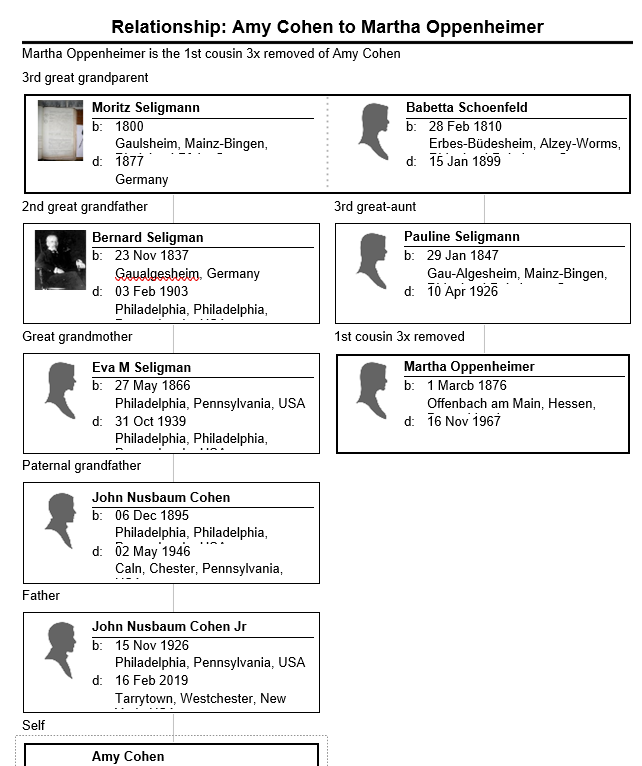
This post will be about the first—documents he found about Martha Oppenheimer Floersheimer, the daughter of Pauline Seligmann and Maier Oppenheimer and granddaughter of Moritz Seligmann, my three-times great-grandfather. Pauline was the younger sister of my great-great-grandfather Bernard Seligman and Wolfgang’s great-grandfather August Seligmann. So Martha was Wolfgang’s first cousin, twice removed, and my first cousin, three times removed.

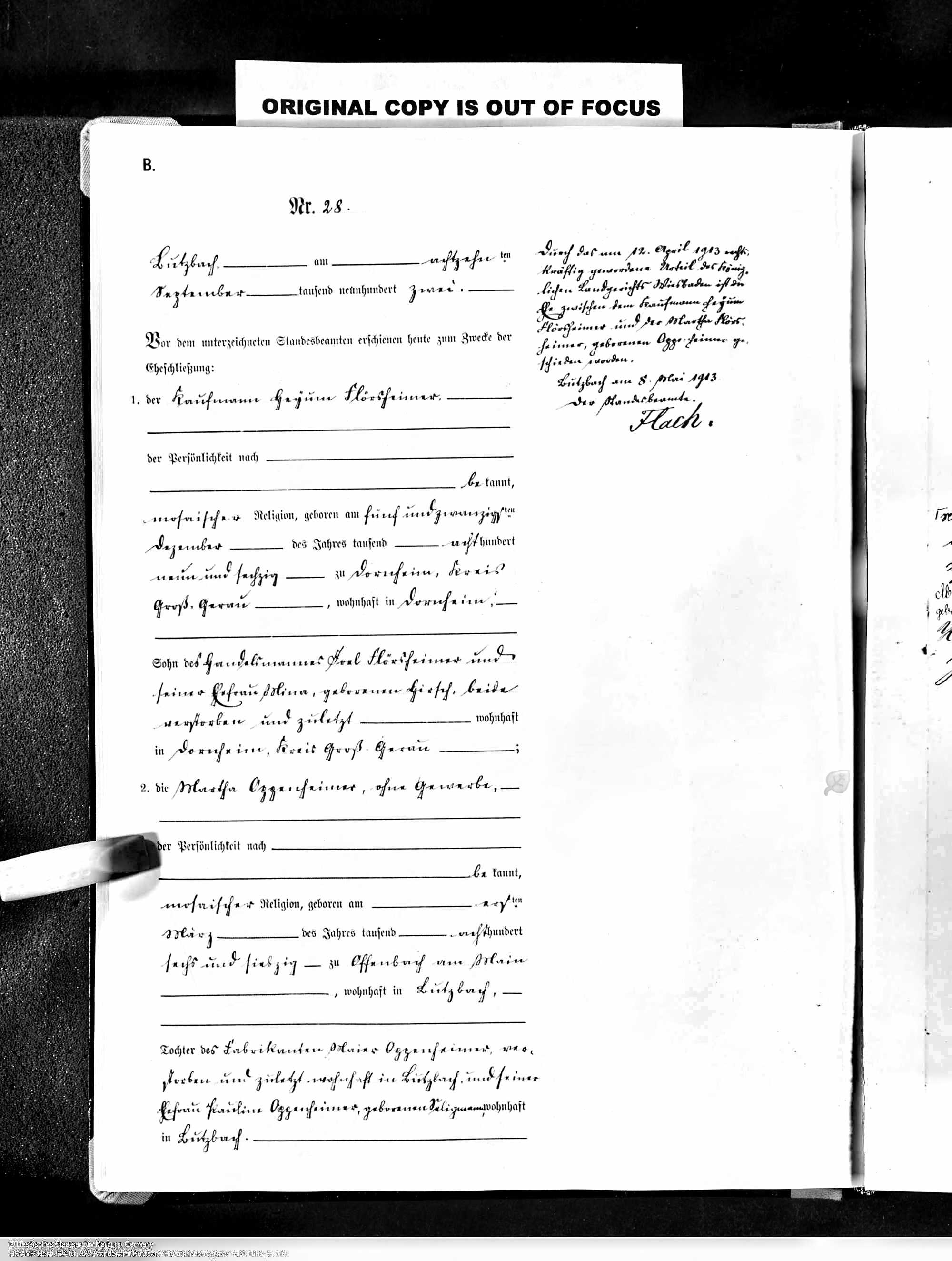
Although I have written about Martha before, since I last wrote about her, additional documents have become available on Ancestry that provide more details of her life before the Holocaust. Martha was born on March 1, 1876, in Offenbach, Germany. She married Heinrich Floersheimer on September 18, 1902, in Butzbach, Germany. Together they had two children: Trude, born January 24, 1904, in Gross-Gerau, Germany,1 and Paul, born August 9, 1906, in Wiesbaden, Germany.2  Martha and Heinrich were divorced in 1913.

Martha Oppenheimer birth record, Hessisches Hauptstaatsarchiv; Wiesbaden, Deutschland; Bestand: 918; Laufende Nummer: 323, Ancestry.com. Hesse, Germany, Births, 1851-1901

Martha Oppenheimer marriage and divorce record, Hessisches Hauptstaatsarchiv; Wiesbaden, Deutschland; Bestand: 924; Laufende Nummer: 323, Ancestry.com. Hesse, Germany, Marriages, 1849-1930

From Yad Vashem and other family sources, I’d earlier learned that both Trude and Paul were murdered during the Holocaust. Trude was deported from Frankfurt on June 11, 1942, and sent to the Sobibor concentration camp where she was murdered; she was 38.3 Paul was deported on June 10, 1942, to the concentration camp at Majdanek, Poland, and was murdered there; he was 35.4 As for their mother Martha, she was sent to Thereisenstadt and somehow survived.

What Wolfgang found at the Arolsen Archives website were forms that Martha completed after she was liberated from Thereisenstadt in 1945. These were forms used by the International Refugee Organization to help displaced persons obtain assistance after the war. The first page in Martha’s file is a form she submitted to the International Tracing Service; it’s heartbreaking to read this because it reveals that at the time Martha filled out this form, she still had hope that her two children were still alive.

CM/1 files from Germany for the family FLÖRSHEIMER, envelope F-3042, 3.2.1.1 / 79088827, ITS Digital Archive, Arolsen Archives

The second form is a questionnaire that the US Army asked displaced persons to complete. One question was, “Fuehren Sie de Namen irgendwelcher anderer naechster Familienangehoeriger auf, die sich zur Zeit in Deutschland aufhalten.“ In English—List the names of any other family members currently in Germany—and again, Martha listed her two children.  Since the form was created on June 1, 1946, this indicates that Martha still believed her children could be alive a year after she was released from Thereisenstadt.

CM/1 files from Germany for the family FLÖRSHEIMER, envelope F-3042, 3.2.1.1 / 79088828, ITS Digital Archive, Arolsen Archives

The next two pages of that questionnaire ask numerous questions about Martha’s background. Of most interest here are two responses. One question asks whether she wants to return home, and she responded yes. Another question asked whether she had ever been persecuted for her race, religion, or political views, and she answered yes to race and religion; asked to describe how she was persecuted, Martha wrote that she was sent to Thereisenstadt concentration camp from September 2, 1942 until July 8, 1945.

CM/1 files from Germany for the family FLÖRSHEIMER, envelope F-3042, 3.2.1.1 / 79088828, ITS Digital Archive, Arolsen Archives

In February 1948, Martha filled out a third form, this one a Request for Assistance. On this form Martha described herself as a widow and wrote that she had been living back in Wiesbaden since July 1945.

CM/1 files from Germany for the family FLÖRSHEIMER, envelope F-3042, 3.2.1.1 / 79088829, ITS Digital Archive, Arolsen Archives

CM/1 files from Germany for the family FLÖRSHEIMER, envelope F-3042, 3.2.1.1 / 79088829, ITS Digital Archive, Arolsen Archives

CM/1 files from Germany for the family FLÖRSHEIMER, envelope F-3042, 3.2.1.1 / 7908889, ITS Digital Archive, Arolsen Archives

The saddest part of this form is the last page where Martha was asked whether she wanted to remain in Germany, to which she answered yes, and then whether she had any relatives living in Germany. Now her answer was no. By this time she must have learned that her children had been murdered.

I don’t have any other records for Martha after this point, but what I know from my cousin Angelika Oppenheimer and the Seligmann family tree is that Martha continued to live in Wiesbaden until her death on November 16, 1967, when she was 91 years old. That she survived almost three years at Thereisenstadt when she was almost seventy years old and then another twenty-two years in Wiesbaden after losing her children is amazing to me.

But Martha was wrong about one thing when she answered the questionnaire in February, 1948. She did have relatives who survived the war. Our cousin Angelika Oppenheimer, Martha’s great-niece and the granddaughter of Martha’s brother Moritz James Oppenheimer, remembers visiting her in Wiesbaden with her family when she was a child. And Wolfgang’s father and uncle were also still alive and living not far from Wiesbaden. Perhaps in some way Martha found the strength to survive from those family members who remained.


  1. From the Yad Vashem website at https://yvng.yadvashem.org/nameDetails.html?language=en&itemId=11497651&ind=1&#160;
  2. Paul Floersheimer death record, Personenstandsregister Sterberegister; Bestand: 926; Signatur: 333, Ancestry.com. Hesse, Germany, Deaths, 1851-1958 
  3. See Note 1, above. 
  4. https://yvng.yadvashem.org/nameDetails.html?language=en&itemId=11497658&ind=1&#160;

The Story of Julius Seligmann, Scorned for Not Being Jewish and for Being Jewish

In my recent post about Adolf Michel, I included the letter his son Fred had written to the International Tracing Service after the war in which he expressed obvious anger with his uncle Julius Seligmann for his failure to help learn what had happened to their mutual relatives. This post will shed light on Julius and his relationships with his siblings.

When my cousin Wolfgang first contacted me back in February 2015, he shared with me what he knew of the story of his grandfather Julius Seligmann. Julius was the second child of August Seligmann and Rosa Bergmann and was born February 5, 1877, in Gau-Algesheim. He was the nephew of my great-great-grandfather Bernard Seligmann and first cousin of my great-grandmother Eva Seligman Cohen.

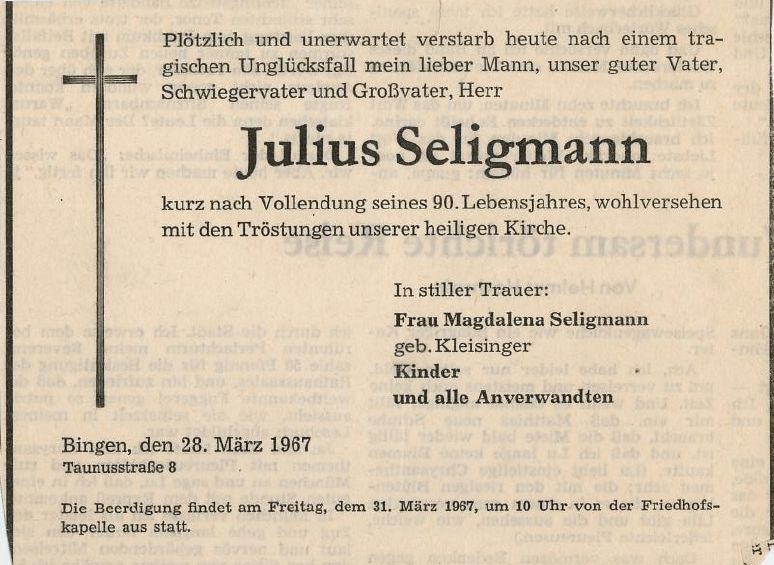
Julius and his younger brother Moritz were for many years in business together in Gau-Algesheim as merchants, but from family lore, Wolfgang learned that after his grandfather married Magdalena Kleissinger on December 1, 1922, and converted to Catholicism, there was a falling out between Julius and his family. Julius was already 45 when he married Magdalena and fifty years old when his younger son Herbert was born in 1927.

Then, according to the book by Ludwig Hellriegel about the Jews of Gau-Algesheim, Julius was forced to close his store in Gau-Algesheim in December 1935 and moved with his wife and sons to Bingen in September, 1939.1 I had speculated back in November 2014 that these actions were somehow connected to Nazi persecution, but Wolfgang did not think so. Although he did not know the details of what happened to Julius and his family or why he ended up leaving Gau-Algesheim in 1939, Wolfgang had heard from his family that Julius had suffered financial hardship after being forced to pay his brother Moritz some kind of financial settlement that led to the move to Bingen, where the family lived with Magdalena’s relatives for some time.

Recently, Wolfgang decided to try and learn more about his grandfather’s life, and he searched the Landesarchiv Speyer, the archives for the Rhine-Palatinate region in Germany.  First, he searched online and found that there were court records available regarding a criminal prosecution of his grandfather Julius in 1937. The records themselves were not accessible online, so Wolfgang visited the archives in person and reviewed the many pages of court records there. He was not allowed to copy or photograph the records themselves, but took copious notes and reported back to me what he had learned. Thus, all the information that follows came from Wolfgang’s research of those court records.2

The records provided information not only about the criminal trial in 1937, but also background information about Julius and his life. The records reported that Julius was a good student and was in school through the sixth year at the Bingen schools. From 1897 to 1898, Julius served in the First Hessian Guard Regiment in Darmstadt.

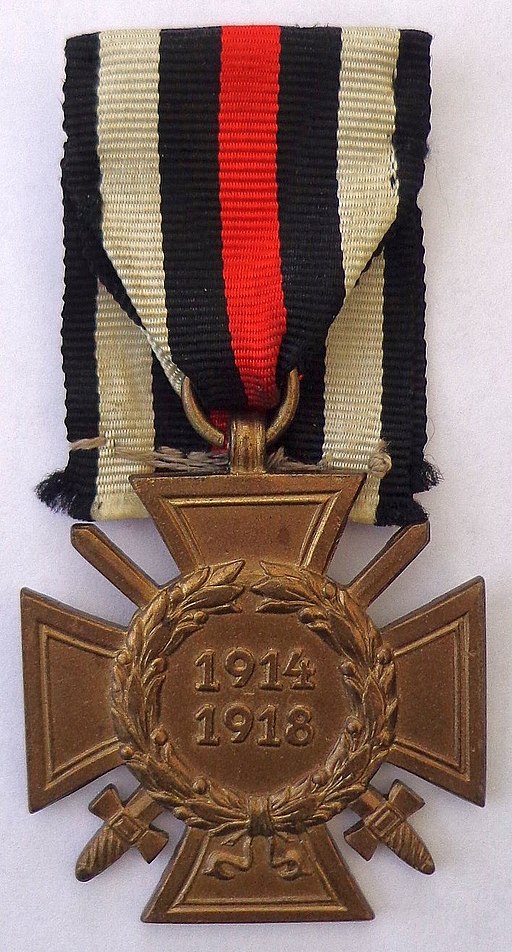
After their father August died in 1909, Julius and his brother Moritz took over the family house as well as their father’s business. But Julius returned to military service on Germany’s behalf during World War I from 1914 through 1918. He was a sergeant in the infantry, battled malaria while in service, and received the Frontkämpferkreuz for his service on the front lines during the war. After the ceasefire, he helped bring the German battalions back to safety.

Honor Cross of World War I or Frontkampferkreuz
PicturePrince [CC BY-SA 4.0 (https://creativecommons.org/licenses/by-sa/4.0)%5D

After the war Julius returned to Gau-Algesheim and continued to work with his brother Moritz in what had been their father’s store. As noted above, he married Magdalena in 1922 and converted to Catholicism. Then Julius had an unfortunate injury in 1927 when he fell off his bicycle and suffered a concussion. The court records report that he suffered seizures for many years as a result of this accident.

The records indicate that there were many disputes between Julius and Moritz during this time, perhaps relating to Julius’ marriage and conversion or perhaps for unrelated family or business reasons. In May 1929, Julius bought out his brother Moritz of his share of the family home and business for 14,000 Reichmarks. There is a note in the records from a notary from Ingelheim saying this price was too high, that is, that Julius paid more than a fair price. Moritz then left Gau-Algesheim and moved to Koenigstein, and Julius ran the business on his own. But having overpaid for his brother’s half of the business, Julius soon ran into financial difficulties.

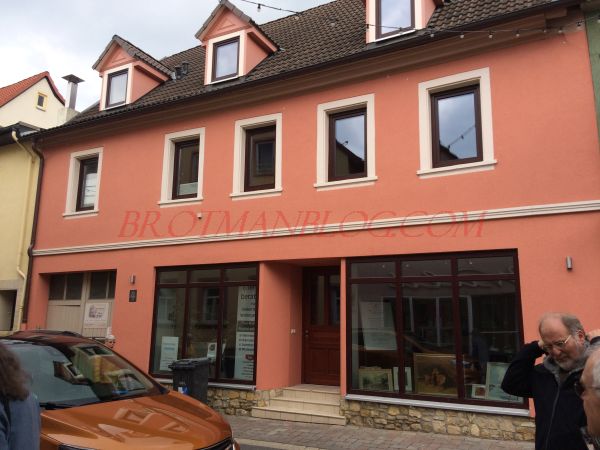
Location in Gau-Algesheim of Julius Seligmann’s store

Things then got worse after Hitler came to power. The mayor watched to see who went into Julius’ store as he was apparently considered non-Aryan despite his conversion to Catholicism. Under the Nuremberg laws, he was still considered Jewish for he had four Jewish grandparents. As a result of his financial difficulties, Julius was forced to borrow money from a man named Hammen so that he could pay off his debts. As part of the process of obtaining that loan, Julius had to provide a statement of his assets.

Apparently, there was some error in that statement of assets, and that led to Julius being prosecuted for “negligent perjury.” Hammen himself testified that Julius was always a reliable businessperson and thus did not think he had intended to misstate his assets. There were also other witnesses who testified to Julius’ good character. Nevertheless, Julius was convicted and sentenced to prison from September 16, 1937 until April 16, 1938. A request for clemency was rejected. One has to wonder whether an “Aryan” business owner would have been treated as harshly as one who was born Jewish.

After being released from prison, Julius was forced to sell the family home because of financial difficulties. That led to further legal problems. Julius sold the house in April 1938 to Philip Wendelin Rohleder, a toolmaker. Rohleder had visited Julius in prison accompanied by Magdalena to convince him to sell the house. Julius agreed, but later claimed that Rohleder never paid the agreed-to price and that he was a Nazi and had told Julius he didn’t need to pay him at all. Rohleder denied this and said that he had to pay off some of Julius’ creditors and that’s why Julius had not received the whole purchase price. This dispute was not resolved until 1959 when Rohleder finally agreed to pay Julius 5000 Deutschmarks as a settlement.

Julius and Magdalena Seligmann

Putting all this together, the story of Julius Seligmann now is more complete. Disputes between Julius and Moritz may have been the first step towards Julius’ financial problems. Overpaying his brother Moritz for the house and business in Gau-Algesheim left Julius financially vulnerable in 1929. Then the Nazis came to power, and despite his conversion to Catholicism, Julius was treated as a Jewish business owner and thus suffered as a result of the Nuremberg laws. Forced to borrow money, he became entangled in what to my mind appear to be trumped up charges as a way of getting him out of business completely. That then led to the sale of his house for less than its worth and thus his family’s need to leave Gau-Algesheim and seek help from his wife’s family in Bingen.

It is a sad story in so many ways. By marrying a Catholic woman, Julius lost the support of his family and the Jewish community of Gau-Algesheim. Then, despite being a hero for the German army in World War I, he was essentially treated as unworthy by the government in the Nazi era. He lost his family of origin, the family business and home, and his home community. At age 62 he was forced to move with his wife and two teenaged sons to Bingen and live with his in-laws.

But Julius was a survivor. He lived to 90 years old and was killed in a car accident coming home from church on March 28, 1967, three days before the first birthday of his grandson Wolfgang, who has now preserved the story of his grandfather Julius.

Julius Seligmann death notice


  1. Ludwig Hellriegel, Die Geschichte der Gau-Algesheimer Juden (1986, revised 2008)[The History of the Jews of Gau-Algesheim]. 
  2. References to the records can be found at http://www.archivdatenbank.lha-rlp.de/ under Landesarchiv Speyer, Justizvollzuganstalt Mainz, Bestand J 85, Findbuch, Akten, 03 Gefangene, Strafprozess 6142, Julius Seligmann, 367/37; Bestand J 83, Findbuch, Akten, 02 Gefangene, Gefangenepersonalakten, Sachakten 3142, Seligmann, Julius; Bestand J 10, Findbuch, Akten, 12 Prozessurteil und -akten, Zivilprozess 298 Seligmann, Julius. 

Holocaust Education in Germany

In June 2018, my cousin Wolfgang Seligmann sent me a paper written by a German high school student named Johanna Petry. Johanna’s paper1 was done as part of a school project about the Holocaust. I am really impressed by Johanna’s work, and she has graciously allowed me to share it on my blog.

Johanna researched the family of my cousin Anna Seligmann, who once lived in Johanna’s hometown of Neuenkirchen. Anna Seligmann was the daughter of August Seligmann and Rosa Bergmann and a sister of Wolfgang’s grandfather, Julius. She was also the first cousin of my great-grandmother Eva Seligman Cohen.

Johanna researched and wrote about Anna, her husband Hugo Goldmann, and their children, Grete, Heinz, and Ruth Goldmann, and what happened to them during the Holocaust. As I have written before, Hugo and Anna and their three adult children were all killed in the Holocaust, but until I read Johanna’s report, I did not know the details.

Johanna obtained documents from the International Tracing Service at Arolsen and also searched Yad Vashem, the archives in Neunkirchen, and other sources she found on the internet. In the course of doing her research about the Goldmann family, Johanna discovered my blog and then found Wolfgang as a result of finding my blog. Wolfgang provided her with more information about the Goldmanns and the extended Seligmann family.  Using what she learned in all this research, Johanna wrote a detailed and well-researched report on the fate of Hugo and Anna and their children.

The report is written in German, and with Johanna Petry’s very gracious permission, I am providing a link to it here so that those who are interested in the full report can read it. Unpublished paper by Johanna Petry, “Juden in Neunkirchen,” May 9, 2018, for the Gymnasium am Krebsberg, Neunkirchen.

For others, I will translate and summarize Ms. Petry’s overall findings, which are near the end of her report:

Anna Seligmann was born on November 30, 1889 in Gau-Algesheim near Bingen, where her father August ran a successful wine trade. She had three siblings and married Hugo Goldmann, who was born on March 24, 1885, in Gundersheim. Professionally, Hugo worked as managing director and moved to Neunkirchen in 1906.

From 1912 Hugo and Anna lived in Neunkirchen where they had three children. First, Grete Rosa Goldmann was born on July 8, 1913. Then, Heinz Leo Goldmann was born on March 28, 1916, and the youngest daughter Ruth Goldmann was born on July 23, 1924.

In 1935 the Goldmann family moved to nearby Saarbrücken. Grete moved in 1936 to Giessen [140 miles from Saarbrucken] where she worked as a milliner. In 1937 she was forced to move into the “Jew’s House” in Bergstrasse 8 in Hannover [340 miles from Saarbrucken, 188 miles from Giessen].

Johanna was interested in the term “Jew’s House” and did some further research. She wrote:

I had never encountered the term “Jewish house” before, but I suspected that it was a place of residence for Jews. My internet research revealed that “Jewish houses” were actually the homes of Jews who were forced to live there. The houses were often Jewish owned and many Jews had to live in very small spaces. In addition, they should prevent the maintenance of social contacts with non-Jews and contributed to the ghettoization. In Hanover on 3 and 4 September 1941, 1,200 Jews had to move into 15 Jewish houses, which were completely overcrowded. The Judenhaus in Bergstraße 8 was the Alte Synagoge.

Hugo Goldmann was imprisoned from November to December 1938 in the Dachau concentration camp and after his release did forced labor for a family. When parts of the Saarland and the Rhine-Palatinate were evacuated in 1939-1940, Hugo, Anna and their youngest daughter Ruth moved together to Halle [345 miles from Saarbrucken]. Ruth worked there as an intern in a retirement home of the Jewish community.

On May 30, 1942, Hugo, Anna, and their daughter Ruth were deported to Lublin in Poland, where they died immediately after their arrival at the Sobibor death camp on June 3, 1942.

Their son Heinz Leo worked in Berlin and was taken to the Auschwitz extermination and concentration camp on January 29, 1943. He died there three weeks later on February 19, 1943.

Anna and Hugo’s daughter Grete was deported from Hannover in 1941 to the Riga ghetto. She was transferred to the Riga-Kaiserwald concentration camp when it opened in 1943.  When this camp was evacuated by the Nazis as the Allied forces approached, Grete and the others being kept at Riga-Kaiserwald were taken to the Stutthof concentration camp, where Grete died on December 27, 1944.

Here is a map showing the places where the Goldmann family lived and then were forced to live and die:


Reading Johanna’s report not only provided me with more specific details about the Goldmann family; it also gave me insight into the mind and feelings of a young woman in Germany today as she learned what happened to a family that once lived in her town. Johanna’s personal reflection on her findings is both sad and uplifting:2

The sober, objective style of writing does not fit in with this terrible fate of this family – a destiny shared by millions of Jews at that time, and yet every life story is special to itself.

During the evaluation of the documents and the search my thoughts wandered again and again. I wondered how Anna, Hugo, Ruth, Grete and Heinz Leo went, what they thought and what they were most afraid of. I would like to know more personal details from their lives, because I find these much more exciting than dates and dates. Unfortunately, such information is extremely rare. All the more I was pleased that we were able to locate a descendant of the Seligmann family and, thanks to him, learned still more details.

And yet the fates of the victims of the National Socialist regime repeatedly make me deeply affected and thoughtful, especially since there are currently again racist and anti-Semitic tendencies in Germany. That’s why I find it all the more important to do commemoration work and to deal with this dark part of German history.

I find it very heartening that German schools are providing their students not only with an education about the Holocaust but with the research skills necessary to learn more about those who were killed during the Holocaust. Given the anti-Semitism and hatred of others that continues to exist in all parts of the world, including the United States and Germany, it is critical that all children and adults learn these same lessons that Johanna Petry learned. We all must remember the past and do all we can to prevent it from ever happening again.


  1. Unpublished paper by Johanna Petry, “Juden in Neunkirchen,” May 9, 2018, for the Gymnasium am Krebsberg, Neunkirchen. 
  2. Unpublished paper by Johanna Petry, “Juden in Neunkirchen,” May 9, 2018, for the Gymnasium am Krebsberg, Neunkirchen. 

Max Goldschmidt: A Survivor

As seen in my last few posts, although my cousin Betty Goldschmidt and her husband (and our cousin) Jacob Goldschmidt had eight children, I only have adult records for one of them, their son Berthold. Berthold and his wife Mathilde Freudenstein had seven children, but their son Siegfried Goldschmidt was the only child of the seven to live long enough to marry and have a child of his own; Siegfried and his wife Frieda Fanny Pless had one child, a son Max born November 30, 1924, in Frankfurt, Germany.

Siegfried and his wife were among the six million murdered in the Holocaust, but their young son Max, the last known remaining descendant of Betty and Jacob, survived. Max was only eight years old when Hitler came to power and not yet eighteen when his parents were deported in 1942. How had he survived? At first all I knew was that he had immigrated to the US from Israel in 1948, but thanks  to the generous assistance of Elan Oren of the Tracing the Tribe group on Facebook, I have been able to piece together much of the story of Max’s life.

Elan located Max’s file in the Israeli archives, which revealed that Max had escaped to Switzerland at some point during the Nazi era. After the war, Max sailed on the ship Plus Ultra from Barcelona, Spain, to Haifa, arriving in Haifa on June 19, 1945.

From Max Goldschmidt Israeli immigration file: Ship manifest for the Plus Ultra from Barcelona to Haifa, arriving June 19, 1945. Max is on line 94. http://www.archives.gov.il/en/archives/?fbclid=IwAR1y3d5C1X3pi2R1_jyX0MAbgeHLQoNhL6TM7F5P7ZT7CE4sFJgPPuql11A#/Archive/0b0717068002258e/File/0b071706856dcab1

Max’s file in the Israeli archives did not reveal how or when he got to Switzerland or to Barcelona, but Max’s A-file—his US immigration file—from the US Customs and Immigration Service (USCIS) revealed further details.1 According to a German police certificate included in Max’s application to the US Consul in Palestine for an immigration visa in 1947, Max lived in Warburg, Germany, from April 1927 until September 1936. That is also where his parents were residing during that time, according to records  at Yad Vashem.

On Max’s 1947 US visa application he stated that he’d immigrated to Switzerland in January 1939. He was only fourteen at that time. He lived in Basel, Switzerland, from January, 1939, until May, 1945, when he must then have left for Barcelona and ultimately Palestine. As for how he escaped from Germany in 1939, Elan Oren suggested that a Zionist youth group such as HeHalutz  might have helped him get out of Germany.

After arriving in Haifa, Max was transferred to Atlit, a detention camp built by the British, who were then in control of what was then Palestine. With the help of Elan Oren and his translation of Max’s Israeli naturalization file, I learned that Max left Atlit and first lived in Petach Tikvah and then moved to Tel Aviv to live with the Laks family. (More on them in a bit.)

Document that states that Max moved from Petah Tikvah to Tel Aviv where the Laks family lived. Translated by Elan Oren. http://www.archives.gov.il/en/archives/?fbclid=IwAR1y3d5C1X3pi2R1_jyX0MAbgeHLQoNhL6TM7F5P7ZT7CE4sFJgPPuql11A#/Archive/0b0717068002258e/File/0b071706856dcab1

But Max decided not to settle permanently in Israel. Max left Haifa on January 29, 1948, and arrived in New York on February 14, 1948. The manifest lists Max’s occupation as a gardener, his primary languages as English and Hebrew, his last residence as Tel Aviv, Palestine, and his birthplace as Frankfort [sic], Germany.

Max Goldschmidt passenger manifest, Year: 1948; Arrival: New York, New York; Microfilm Serial: T715, 1897-1957; Microfilm Roll: Roll 7546; Line: 19; Page Number: 197, Ancestry.com. New York, Passenger and Crew Lists (including Castle Garden and Ellis Island), 1820-1957

The second page of the manifest lists a friend named Pinil Laks as the contact person from Max’s prior residence of Tel Aviv and an uncle “Bernh Laks” of Blackwood, New Jersey, as the person he was going to join in the United States.

So who were the Laks? Bernhard Laks, also known as Bernhard Lachs, Berek Laks, and Bernard Laks, was married to Rosa Pless,2 who must have been a sister of Frieda Pless Goldschmidt, Max’s mother, since Max identified Bernard as his uncle and Rosa as his aunt on various documents.  Moreover, Bernard Laks (then spelled Bernhard Lachs) was one of the witnesses on the marriage record for Max’s parents, Siegfried and Frieda.

Bernhard Lachs as witness on the marriage record of Siegfried Goldschmidt and Frieda Fanny Pless. Hessisches Hauptstaatsarchiv; Wiesbaden, Deutschland; Bestand: 903
Ancestry.com. Hesse, Germany, Marriages, 1849-1930

When Max arrived at Ellis Island on February 14, 1948, he was denied admission to the United States because he did not have in his possession the immigration visa that he had been granted by the US consul in Palestine on November 17, 1947. A hearing was held on February 18, 1948 before a Board of Special Inquiry, at which Max testified that he had last seen his visa on the day he embarked from Haifa while at customs, that he had left it with his other papers in his baggage, and that while at sea he’d discovered that the visa was missing.

Max also testified that he had no relatives living outside of the US and no money. He stated that he was coming to the US in order to join his relatives, the Laks family of Blackwood, New Jersey, and that his uncle Bernard Laks had paid for his ticket from Haifa. In addition, Max presented an affidavit from Bernard and Rosa Laks in which they, as “his sole surviving relatives,” promised to “receive and care for [Max] and …not permit him to became a public charge.”

Although the Board of Special Inquiry found that Max had a valid Palestinian passport with a stamp indicating that a visa had been issued to him by the US Consulate in Jerusalem, they concluded that he was not admissible without possession of the actual visa. On February 20, 1948, however, the Commissioner of Immigration and Naturalization (INS) recommended that the decision to deport Max be deferred for ninety days to give him time to locate the visa or to obtain a certified copy.

On March 3, 1948, the ninety day stay was granted, and Max was also granted parole during that period, meaning that on March 4, 1948, he was allowed to enter the country though he was required to report in writing on a monthly basis to the Deportation and Parole Section at Ellis Island. Max had thus been detained for eighteen days at Ellis Island before his parole.

On March 18, 1948, his attorney wrote to INS to notify them that the American Consulate in Jerusalem had confirmed that Max had been granted a visa on November 17, 1947, and that the Visa Division in Washington, DC, had been so notified.  On April 8, 1948, the State Department submitted a certified copy of the visa. However, it was not until four months later on August 11, 1948, that an order was entered to re-open Max’s case. A new hearing was scheduled for September 15, 1948.  Fortunately, Max had better luck at this hearing, and he was granted legal admission into the country on September 15, 1948, more than seven months after arriving at Ellis Island on February 14, 1948. (I assume Max had received extensions of the 90 day parole period initially granted in March, 1948.)

Then began the next chapter of his life and more experiences with the slowly grinding wheels of American bureaucracy. He started the process of becoming a US citizen on October 1, 1948, just two weeks after entering the country officially.  But before Max’s papers could be processed, he was inducted into the US Army on January 1, 1949, the very day the government had scheduled a meeting to discuss his citizenship application. He amended his address to reflect that he was now stationed at Fort Dix in New Jersey as a member of the 9th Infantry Division. He was honorably discharged from the army on November 2, 1951, and on March 11, 1955, a certification of his service was issued to INS. His formal petition for naturalization was filed on October 14, 1955, with Bernard and Rosa Laks attesting to his character.

On January 24, 1956, the government received reports from the army that on January 2, 1951, while serving in the army, Max had “stated in substance … that if the Army is an example of democracy, he would take communism” and that on June 4, 1951 while giving a training lecture to his unit, “he introduced the Crusades as an illustrative example in this history of warfare, and then proceeded to interject his own thoughts on the persecution of Jews by Christians at the time of the Crusades, allegedly making rather strong remarks about the Roman Catholic Church. [Max] has at various times in the past tried to turn a topic of conversation into ‘making a case’ for Zionism.”

I suppose Max took the meaning of the First Amendment more literally than the US Army thought appropriate. Whether this had any impact on his citizenship application is not clear. On a page of examiner’s notes dated November 9, 1956, the examiner gave Max a final rating of “deny,” but then that was crossed out, and on May 17, 1957, his application was granted and he was finally issued a certificate of naturalization; he also changed his name to Goldsmith at that time. Despite his service in the US Army, it had taken almost eight years to complete the process of becoming a citizen.

Two months later in July 1957, Max married Shirley Larve in Trenton, New Jersey.3 Shirley was born in Trenton on May 29, 1923, to Joseph and Anna Larve.4 She was 34 when they married, and Max was 32. They did not have any children.

Shirley died at age 70 on July 24, 1993, in Broward County in Florida.5 Her obituary in the South Florida Sun-Sentinel on August 15, 1993, filled in some of the gaps in their lives between 1957 and 1993.  Here are some excerpts:

…Shirley worked during WWII for the U.S. Army Finance Dept. and later for 25 years for the Department of Motor Vehicles, State of NJ, retired supervisor in 1985. Married Max Goldsmith July, 1957, an immigrant to the U.S.A. They resided at various locations throughout the U.S.A. … Her life was devoted to her husband, being a true companion to him who had lost his family of 68 members during the Nazi era.

She served two terms as President of the Ladys Auxiliary of the Jewish War Veterans of the U.S.A. Post 697 in Levittown, PA. A life member in the American Red Star of David for Israel. In 1989 she received the Lady of the Year award of the Star-Faye Post 672. She was very mild mannered, yet forceful. A lady in her own right. Always unpretending with an inherent sense of justice. She had her golds [goals?] and she never let go until accomplished. She had little patience for people who sat around and complained. Although small in stature yet big in ability and courage.

Shirley and Max thus lived in or near Trenton, New Jersey until 1985 when she retired after 25 years working for the Department of Motor Vehicles. (Levittown, Pennsylvania, is less than eight miles from Trenton.) By 1990, they had moved to Pompano Beach, Florida.6

I am troubled by the reference in her obituary to 68 members of Max’s family being killed in the Holocaust. Who were those 68 people? How were they related to Max? Were they his mother’s relatives? Or were they Goldschmidts I just haven’t found? It haunts me.

Max died in Fort Lauderdale, Florida, eleven years after Shirley on July 2, 2004, at age 80.7  He’d endured a great deal in his life—fleeing from his homeland and his family as a young teenager, the murder of his parents, the move to Palestine and then to the US, and all the hassles he endured to become first a legal resident and then a  citizen of the United States.

But I was very comforted after reading Shirley’s obituary; I assume that Max wrote it himself. It is clear from his words that he loved her very deeply and that he felt loved and taken care of by her.  It is wonderful to know how devoted they were to each other, especially after all he’d been through in the first 32 years of his life.

Max Goldsmith, my third cousin, once removed, was a true survivor.  As best I can tell, he was the only and last surviving descendant of  his great-grandparents, Betty Goldschmidt and Jacob Goldschmidt, two first cousins who married each other, both grandchildren of Jacob Falcke Goldschmidt and Eva Reuben Seligmann, my four-times great-grandparents. By remembering Max, I hope to honor not only him, but all those who came before him.


  1. The references in this post to documents relating to Max’s immigration to the US are all from his A-file from USCIS, copies of which are in my possession. References to his immigration to Palestine and his time there are from the Israeli archives here
  2. On the 1937 passenger manifest for Berek and Rosa Laks, the person they named as their closest relative living in their former residence of Frankfurt was E.Pless, identified as Berek’s mother-in-law and Rosa’s mother. From this I inferred that Rosa’s birth name was Pless and that she was the sister of Frieda Pless Goldschmidt, Max’s mother.  Laks family, passenger manifest, Year: 1937; Arrival: New York, New York;Microfilm Serial: T715, 1897-1957;Microfilm Roll: Roll 6022; Line: 1; Page Number: 127, Ancestry.com. New York, Passenger and Crew Lists (including Castle Garden and Ellis Island), 1820-1957 
  3. Certificate Number: 21705, New Jersey State Archives; Trenton, New Jersey; Marriage Indexes; Index Type: Bride; Year Range: 1957; Surname Range: L – Z, Ancestry.com. New Jersey, Marriage Index, 1901-2016 
  4. Ancestry.com. U.S., Social Security Applications and Claims Index, 1936-2007,SSN: 146160447 
  5. Ancestry.com. U.S., Social Security Applications and Claims Index, 1936-2007,SSN: 146160447 
  6.  Ancestry.com. U.S. Public Records Index, 1950-1993, Volume 1. Original data: Voter Registration Lists, Public Record Filings, Historical Residential Records, and Other Household Database Listings. 
  7.  Ancestry.com. U.S., Social Security Applications and Claims Index, 1936-2007, SSN: 129240166