Amalie Schoenthal Wolfe and Etta Wolfe Wise: Photo Analysis Part III

In this third and final post devoted to photographs of Amalie Schoenthal Wolfe and her daughter Etta, I will look at two more photographs that my cousin Alan sent me and try and identify the others in the photo.

In this photograph, I’ve assumed Amalie is on the left and possibly Etta on the right. Then who are the three young women?

I don’t know. But Amalie had four granddaughters: Flora’s daughters Helen and Marjorie, Lee’s daughter Ruth, and Etta’s daughter Florence. My guess is that this is three of those four.

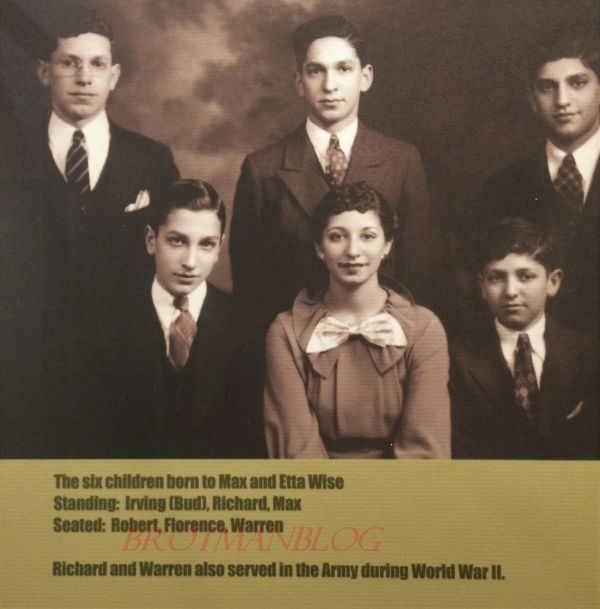
Here are some photos of Florence. This one is of Etta and her six children; Florence, her only daughter, is seated on our right.

Etta and her children. Courtesy of the family.

Here are another two of the children of Etta and Max Wise:

Do you see Florence in the photo above? Is she the tall girl standing between Amalie and Etta? I don’t think so, but am not sure. And as for the other two girls in the forefront? I have no idea. So maybe they are Helen, Marjorie, and/or Ruth. Or maybe not!

Finally, there is this photograph, which I will refer to as the living room photo:

The Wise Family Courtesy of the family

Seated in the middle rear are Etta, Amalie, and Max. The girl sitting right in front of Etta is her daughter Florence, and the four little boys on the floor and the little boy sitting on the lap of the man next to Max are the five sons of Etta and Max: Irving (Bud), Richard, Max, Jr., Robert, and Warren. From the ages of the children, I would guess that this photograph was taken in the early 1920s since Warren was born in 1920, Robert in 1919. You can compare the children to those in the photo of Etta surrounded by her children, probably taken a year before, and see the similarities.

So who are the other people in the living room photograph? Are they other relatives of Amalie and Etta? Or are they relatives of Max Wise? This photograph of Etta and Max with Max’s brothers and their wives shows what two of his brothers looked like. Alan agreed with me that the Wise brothers are not in the living room photograph with Etta’s children.

I think therefore that these are Etta’s relatives in the living room photo. Maybe the three older men are three of Etta’s four brothers: Maurice, Lee, Ira, and Herbert.  Maurice was living in Middletown, Ohio in 1920, as were Etta and Max, so it’s likely he is in the photograph.In 1920 Lee was in Pittsburgh, and Herbert in Detroit. Ira was living in Illinois in 1920 and died in 1924.

As for the two women sitting to Etta’s right, perhaps one is a sister-in-law, maybe both are. Perhaps one is Flora’s daughter Helen or her daughter Marjorie. And maybe the younger man perched on a table on our far left is Flora’s son Leroy. Or maybe her son Donald.

At this point it’s far too much speculation, but perhaps a cousin will find me who knows the answers. I am open to suggestions!

And please, everyone, label your photographs and spare some future family member from doing all this impossible guesswork.

Amalie Schoenthal Wolfe and Etta Wolfe Wise: Photo Analysis Part II

Looking back at my prior post, let’s assume for purposes of this post that I have correctly identified Amalie Schoenthal Wolfe and her daughter Etta Wolfe Wise in the two photographs below.

Etta Wolfe Wise to far right, upper. Courtesy of the family

Courtesy of the Family

Then who are the other people in these two photographs? Are they other relatives of mine, relatives of Amalie and Etta?

Starting with the first photograph, which I will refer to as the porch photo, I am assuming that the older woman standing on the porch is Amalie and Etta is to her left. Who is the woman on the other side of Amalie, and who are those five adorable little children in front of them?

Looking at the second photograph, which I will refer to as the formal photograph, I identified the older woman as Amalie and the woman standing in the rear next to her as Etta. So who is the other woman? Is she the same woman as the woman standing on the porch with Amalie and Etta in the other photo?

When I compare those two women, I believe they are the same woman, and my guess is that she is Etta’s only sister and Amalie’s only other daughter, Flora Wolfe Goldman.

The hair and how it is parted and the mouth seem so similar that I think they are the same person. What do you think?

I think the formal photograph was taken some years before the porch photograph, and that the two children in the formal photograph are mostly likely two of Flora’s children. Flora had four children: Leroy (1901), Helen (1903), Donald (1905), and Marjorie (1908). I am guessing that the little boy in the photo is Leroy and the little girl is Helen. My guess is that the photo was taken between 1904 and 1905 and perhaps Flora was pregnant with Donald when it was taken.

So that brings me to the next question: Who are those five little children in the porch photograph?

Assuming that is Flora in the porch photograph, it had to have been taken before September 30, 1910, when Flora died. She died from puerperal fever—a fever caused by a uterine infection after childbirth.1 Since Flora does not look obviously pregnant in the porch photograph and since it looks like the weather must have been relatively warm or at least not wintry, I am going to assume that the photograph was taken no later than the fall of 1909, but after 1905 or so when the formal photograph was taken.

At the time Flora died, her mother Amalie had six grandchildren. Flora’s four, Leroy, Helen, Donald, and Marjorie, and Amalie’s two grandchildren through her son Lee: Lloyd, born in 1902, and Ruth, born in 1905.

I would guess that the children in the photograph range in age from about fifteen months old to four years old. If the photograph was taken in 1906 or so, Flora’s children would have been five, three, and one (Marjorie would not yet have been born).  Lee’s two children would have been four and one in 1906.  Since there are only five children in the photo, maybe they are Flora’s older three (Leroy, Helen, and Donald) and Lee’s two (Lloyd and Ruth). And although they all look like girls, I know that little boys often wore dresses back in those days.

So I have no idea. Maybe they’re cousins from another branch of the family or neighbors. Without more photographs and information, I am grasping at straws!

But I do feel pretty comfortable identifying Etta, Flora, and Amalie.

I have a few more Etta/Amalie photographs to analyze. Maybe they will shed more light.


  1. There was no death certificate for a baby born in 1910 to Flora Wolfe Goldman so I assume the baby was stillborn or perhaps was miscarried. If Flora had an early miscarriage that led to a uterine infection, I suppose the photograph might have been taken in the spring of 1910. 

Amalie Schoenthal Wolfe and Her Daughter Etta Wolfe Wise: Some Photo Analysis

I have already written about Amalie Schoenthal Wolfe, the sister of my great-grandfather Isidore Schoenthal. Amalie was born in Sielen, Germany, in 1847, and came to the US as a young woman in 1867. In 1872 she married Elias Wolfe, and together they had six children, including her daughter Etta Wolfe Wise, who was born in Pittsburgh in 1883.

A few weeks ago I heard from Alan, one of Etta’s descendants, and he shared with me numerous photographs of the family, including two that were labeled in part “Etta’s mother.” I was excited to see photographs of Amalie.

Alan said this one was labeled as Etta’s mother Amalie on the right:

And that this one labeled Etta’s mother Amalie as the woman on the left:

I can see that the two older women in these two photos are the same person—do you agree? The shape of their chins and their cheekbones are the most obvious similarities.

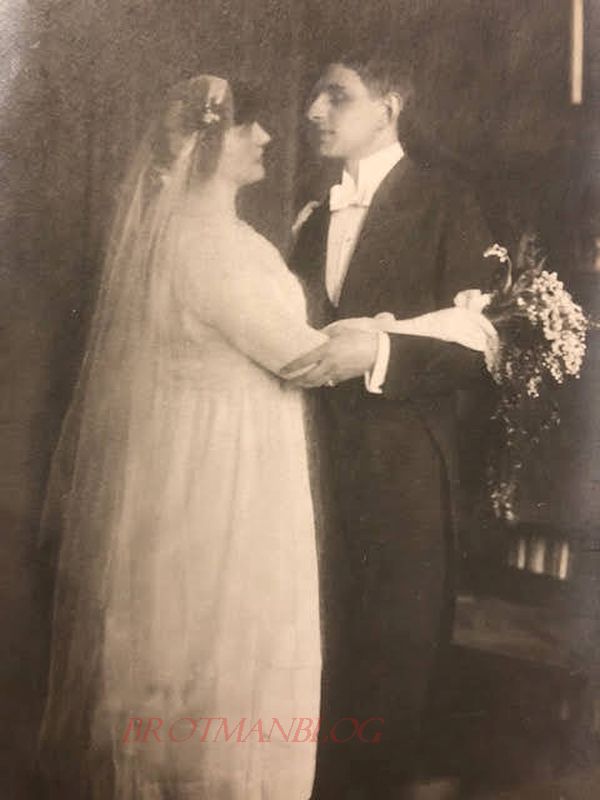
This is Amalie’s daughter Etta Wolfe Wise, my grandmother Eva Schoenthal’s first cousin. It might have been taken on her wedding day, June 2, 1910:

Etta Wolfe Wise, c. 1910. Courtesy of the family

And this is her husband, Max Wise, perhaps taken around the same time:

Max Wise Courtesy of the family

Knowing what Etta looked like made it easy to identify her in other photos, such as this one. That looks like Etta standing in the rear to our right.

Etta Wolfe Wise to far right, upper. Courtesy of the family

I think that the older woman standing next to Etta is the same woman as the older woman in the first two photos above and so presumably Amalie.

And I think Amalie is also the woman sitting between Etta and Max Wise in the next photo, Max sitting highest on the chair fourth from the left, then Amalie to his right, and then Etta to Amalie’s right.

The Wise Family Courtesy of the family

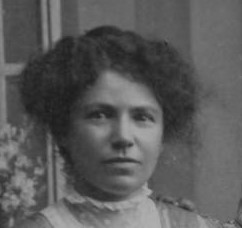
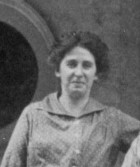
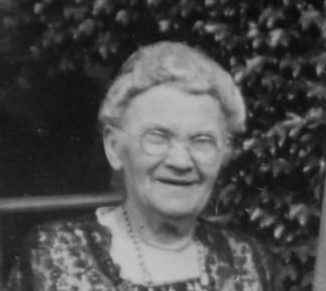
Here are closeups of the four faces of the older woman cropped from those photographs:

What do you think? Are these all the same woman?

That left me puzzled about the people in the other photos of Amalie. For example, in this one, is that Etta standing next to her? At first glance I thought so, but then I wasn’t sure.  Etta has such distinctive deep-set eyes, and the eyes of the woman in this photo looked different.

Here are some closeups of Etta from the known photos and from this one:

The more I look, the more I think it is Etta. And is this Etta in the more recent photo showing Amalie on the far left?

I think so, although the glasses and her squint make is hard to be sure. She certainly looks like the woman in the last of the cropped photos above.

So…what do you think? Is that Amalie in all those photos? Have I correctly identified Etta in the photos?

If so, then I need to figure out who the other people are in those photographs. To be continued…

New Year’s Eve 1919-1920 in Frankfurt, Germany

Two weeks ago I said I was taking a break, trying to figure out where to go next with my research and clearing my head. Well, my head is still not clear, and I still am on the fence about what to do next.

But while I was taking that breather, I heard from multiple new cousins as well as new communications from cousins I’d already found. New photos, new stories, new people. These include new DNA matches on my Brotman line, new photos for my Schoenthal line, new photos for my Seligmann line, a new connection from a Seligmann cousin who also appears to be a Goldschmidt cousin, a new Katzenstein cousin, a set of documents sent by a man living in Oberlistingen about the Goldschmidts, and numerous other questions, comments, or requests coming from my blog, Facebook, or email.  I will blog about many of these once I get my arms wrapped around the details.

All of this has given me a shot in the arm (and yes, I now am fully vaccinated against COVID as well) that I sorely needed. It’s so hard to transition from one research project to another, especially after three years. So these smaller, more focused projects are what I need right now. Especially since I also want to spend some time promoting my new book, Santa Fe Love Song.

Today I want to share an amazing photograph that my cousin Greg Rapp sent me. He cannot identify anyone in the photograph, but Greg is a Goldschmidt cousin (a descendant of Jacob Meier Goldschmidt), and the photo was labeled “New Year’s Eve 1919-1920.” Whether or not we can ever identify anyone in the photograph, it is nevertheless worth sharing. It captures German society during the Weimar Republic. The young women smoking cigarettes evoke that era as does the energy, the expressions, and the postures of all the young people in the picture.

If anyone can identify anyone in this photograph, please let me know.

The Drey Family: More Cousins, More Small World Connections, More Photographs

A few weeks ago another new cousin found me through my blog, and the ensuing emails and additional new cousin connections have resulted in many small-world coincidences as well as a collection of family photographs. So even when I thought I was just about finished with my Goldschmidt family line, I have been reminded once again that this work is never really finished.

Let me start at the beginning. The cousin who first contacted me through my blog, Diane, is my fifth cousin, once removed. She is the daughter of Claude Drey, whose photographs I wrote about here, and the granddaughter of Arthur Drey and Caroline Lilly Cramer, who I now know was always called Lilly, not Caroline. Caroline was the daughter of David Cramer and Clementine Fuld. Here’s a chart showing the rest of our connection:

Diane and I both have children and grandchildren living in Brooklyn. She then connected me to other members of her family, including her first cousins Florence, George, and Linda, who are also my fifth cousins, once removed. They are the children of Dorothy Drey, Claude’s sister and the daughter of Arthur Drey and Lilly Cramer. And here’s where the small world connections piled up. Florence, George, and Linda grew up in White Plains, New York, where I went to junior high and high school. In fact, we lived around the corner from each other. Linda was just one year ahead of me in school. But we never knew of each other’s existence.

Then I learned that George’s wife grew up in Springfield, Massachusetts, and Florence went to college there. I’ve lived right outside of Springfield since 1983. George is a lawyer, and Florence is engaged in genealogical research and activities. And finally, George, Florence, and I are now currently in Florida and not far from each other. But for COVID, we could all easily get together and meet in person. As a result of all these overlapping connections, we all likely know many of the same people, and when we do get together, it will be fun to discover more connections.

And then Diane sent me a collection of family photographs and has given me permission to share them here. Here are some of those photographs.

First, this is a photograph of Clementine Fuld Cramer with her two children Sally and Lilly. Clementine was the daughter of Helene Goldschmidt and Salomon Fuld and the granddaughter of Jacob Meier Goldschmidt. I wrote about Clementine here and here. I am not sure when this would have been taken. If Lilly was not yet married, it had to be taken before January 27, 1919.

Sally Cramer, Clementine Fuld Cramer, Caroline Lilly Cramer. Courtesy of the Drey family

Here are photographs taken on January 27, 1919, when Lilly married Arthur Drey:

Arthur Drey and Lily Cramer, January 1919. Courtesy of the Drey family

Arthur Drey and Lily Cramer, January 1919. Courtesy of the Drey family

Lilly and Arthur Drey had three children. This photograph shows Lilly with their first two children, Claude and Dorothy in 1921 when Dorothy was born.

Lilly Cramer Drey, Claude Drey, Dorothy Drey. c. 1921. Courtesy of the Drey family

Their third child Elizabeth was born five years later in 1926. Here she is as a young child:

Elizabeth Drey c. 1927 Courtesy of the Drey family

This photograph of the entire family was taken in Frankfurt in about 1927 before their lives were forever altered by the Nazis:

Drey family in Frankfurt c. 1927. Courtesy of the Drey family

These photographs of Claude and Dorothy as children were also taken in Germany before the family escaped from Germany to Milan, Italy, in 1933:

Claude Drey c. 1928 Courtesy of the Drey family

Dorothy Drey c. 1932-1933 Courtesy of the Drey family

Diane also shared photographs taken in the US in the 1940s and beyond. What I found most remarkable about those were the photographs of Clementine Fuld Cramer with her great-grandchildren, including Diane, George, and Florence. Clementine died in 1962 at 87. She had lived through the early years of a unified Germany, World War I, the oppression of Jews by the Nazis in the 1930s, immigration to the US during World War II, and the post-war years adjusting to the United States. She lived to see the births of not only her grandchildren but also a number of great-grandchildren. What a remarkable life she had. I bet she had some amazing stories to share.

Clementine Fuld Cramer with one of her great-grandchildren in the US

Finally, I love this photograph of Caroline Lilly Cramer Drey taken in New York City sometime in the 1950s or 1960s. She had held on to the grace and sophisticaion of the world she’d known as a well-to-do woman living in the Frankfurt Jewish community before the Nazi era.

Lilly Cramer Drey in New York City
Courtesy of the Drey family


The Cohen Family Photograph: Who Are These People?

Ordinarily finding a large collection of photographs would be cause for much celebration, but when almost none of those photographs is labeled, it can be cause for much frustration.

That is the case with the collection of photographs my cousin Ken inherited from his great-grandparents, Lilian Katz and Isaac S. Cohen. Isaac S. Cohen was my grandfather’s first cousin. Isaac’s father Joseph Cohen was my great-grandfather Emanuel Cohen’s older brother. Thus, Ken and I are third cousins, once removed, both descended from Jacob Cohen and Sarah Jacobs, my great-great-grandparents. (All photos in this post are courtesy of my cousin Ken except where noted.)

Fortunately, some of the photographs in Ken’s collection were labeled. Most important to me was this photograph labeled “Cohen Family.” Ken and I assumed that the couple sitting second and third from the left  in the front row are Joseph Cohen and his wife Caroline Snellenburg Cohen, parents of Isaac S. Cohen, and that Isaac was one of the other men in the photograph.

Joseph Cohen and Family c. 1915-1917

“Cohen Family” Courtesy of Ken Newbury

To help us identify the people in the photograph, I once again retained the services of Ava Cohn a/k/a Sherlock Cohn, the Photogenealogist. She concluded that the Cohen Family photograph was likely taken around 1915-1916 based on the clothing. Joseph Cohen would have been 67 in 1915, and the man who is sitting second from the left in the front row could be in that age range.

The other three men in the Cohen Family photograph all resemble each other, but who are they? Here are closeups of those three. You can see that they all have similar hairlines, long noses, and similar mouths and ears. To me, they look like brothers, although the third looks much younger than the first two, who have graying hair.

My hunch was that these three men were three of Joseph Cohen’s five sons who were still living in 1915. In 1915 the five living sons were Jacob, who would have been 43, Isaac, who would have been 41, Nathan, who would have been 39, and Samuel and Morris (the twins), who would have been 28.

I found a passport photograph of Jacob Cohen taken in 1922 when he was 51, and I do not see a resemblance to the men in the photograph. He has more hair and a different shaped head. Ava agreed that Jacob is not in the Cohen Family photograph.

So that leaves Isaac, Nathan, and the two twins Samuel and Morris. Since the photograph was in Isaac’s possession, Ken and I assumed that Isaac was in the photograph, and we knew what Isaac looked like from other photographs in Ken’s collection.

For example, this photograph is of Isaac S. Cohen and Lilian Katz and their son Jac, Ken’s grandfather, who was born in April 1907. Ava estimated that this photograph was taken in about 1908, when Isaac would have been about 34.

Isaac, Jack, and Lillian Cohen, c. 1908

Isaac, Jac, and Lillian Cohen, c. 1908

Ava opined that Jac was about nine years old in this photograph of Isaac, Lillian and Jac, meaning it was taken in about 1916.

Isaac S., Jac, and Lillian Katz Cohen. c. 1917

Jac is also in this photograph, sitting at the piano, and Ava thought he  was about six or seven when it was taken, meaning it dates to about 1913. A closeup of Isaac from this photograph appears below it.

Isaac S Cohen, c. 1913

These two profile shots were snipped from two other photographs also taken around the same time. One was from a large photograph of men promoting the sale of war bonds for World War I; the other from a photograph that Ava dated as about 1915  of Isaac with Lillian and Jac and Lillian’s father Leo Katz.

Here’s a lineup of three of the photographs of Isaac and the closeup of the man on the left in the second row in the Cohen Family photograph. Based on all the above photographs, Ava concluded that the man on the left in the second row of the Cohen Family photograph was Isaac S. Cohen, Ken’s great-grandfather.

But who are the other two men in the family photo? Ava did not have enough information to reach a conclusion on that question. I have no photographs of Joseph’s son Nathan, so we have no way to identify him in the photograph. And I have no photographs of Morris, one of the twins, so cannot identify him either.

I was able to obtain two photographs of Samuel Cohen from his grandson Sam, but they were taken when Samuel was older. Even so, Ava and I both concluded that Samuel Cohen had ears that were closer to his head than any of the men in the Cohen Family photograph as well as a different shaped nose and thus was not in this photograph.

So without photographs of Joseph’s other sons, it’s impossible to make any identifcation of the other two men in the Cohen Family photograph.

And what about the women in the photograph? Assuming that Caroline Snellenburg Cohen is sitting next to Joseph, who are the other four women? They certainly appear to be much younger than Caroline. Joseph and Caroline Cohen had four daughters, and Ava thought it was likely that the four women are their daughters. In 1915 Bertha would have been 42, Sallye 38, Fannie 33, and Julia 31. The woman seated on the far right is the spitting image of Caroline. I’d be shocked if she was not her daughter.  So this could be a photograph of Joseph and Caroline, their four daughters, and three of their five sons. But we can’t be certain.

The other mystery is….who was cut out of the photograph?  Ava focused on the sleeves and the size of the hands and concluded that it was a woman. But who could she have been?

One possibility is that it was Lillian Katz, Isaac S. Cohen’s wife. Why, you ask, would she have been cut out of the picture?

Well, it appears that sometime between 1915, when they were living together in Atlantic City, and 1919, Isaac and Lillian separated and then filed for divorce in Allegheny County, Pennsylvania, in April 1919. They were divorced on February 20, 1920, on grounds of desertion. In 1920 Lillian was living with her parents in Pittsburgh with her son Jac (incorrectly listed here as John) and listed as divorced, and Isaac was living in Philadelphia with his sister Julia and her husband.1

Lillian Katz Cohen, 1920 US census, Census Place: Pittsburgh Ward 14, Allegheny, Pennsylvania; Roll: T625_1522; Page: 20B; Enumeration District: 550
Ancestry.com. 1920 United States Federal Census

Isaac Cohen 1920 US census, Census Place: Philadelphia Ward 38, Philadelphia, Pennsylvania; Roll: T625_1635; Page: 7A; Enumeration District: 1328
Ancestry.com. 1920 United States Federal Census

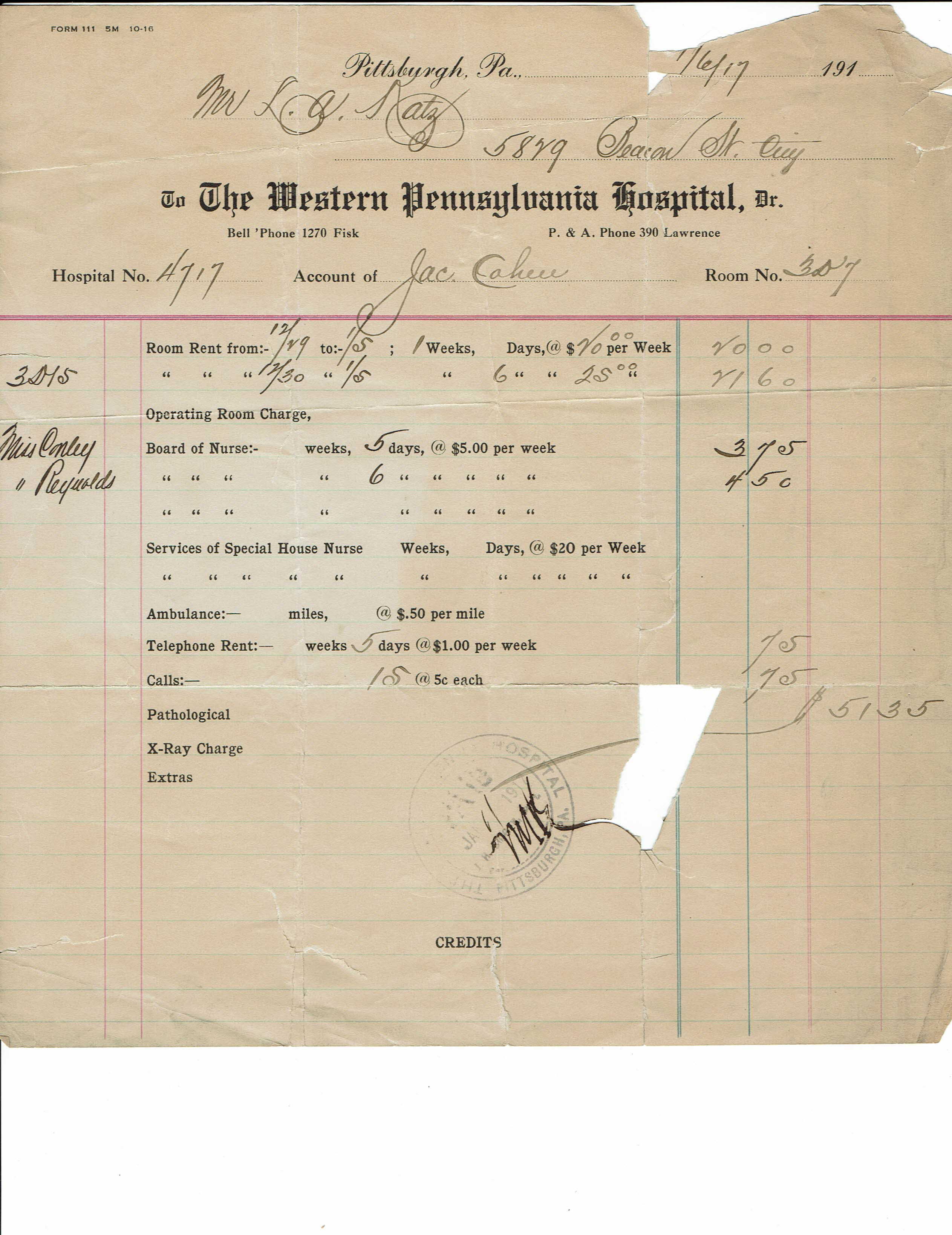
Ken told me that  when his grandfather Jac was a boy, he was run over by a trolley car while sledding; as a result, he lost an arm. We have the hospital record from Jac’s accident, and it’s dated January 6, 1917.  Ken wondered whether the injury to their son caused a rift between Isaac and Lillian, as sadly often happens when a child is seriously sick or injured and upset parents find it difficult to deal with the tragedy.

But the story has a happy ending. On August 12, 1921, Isaac and Lillian applied for a marriage license in Philadelphia and were remarried:

And records suggest that they remained married for the rest of their lives.

But maybe someone cut Lillian out of the family picture during the brief period when she and Isaac were divorced. It would seem odd that Lillian saved a photograph from which she had been removed, but stranger things have happened. But as Ava said, we really have no idea who was cut out or why. It’s just speculation.

In the end, we still have many questions but at least a few answers about the Cohen Family photograph. It’s a good reminder that I really should do my descendants a favor and go label all those photos from my own life.

Thank you to my cousin Ken for sharing the photographs and to Ava Cohn, aka Sherlock Cohn the Photogenealogist for her invaluable insights and her determination to get this right!


  1. Isaac listed his marital status as married; the divorce didn’t take effect until February 20, 1920, and the census was enumerated on January 17, 1920. Obviously Lillian was already considering herself divorced. 

A Photo And Its Story: Amalie Meyer Bloch in the Netherlands

Before turning to the fourth child of Meyer Goldschmidt and Lea Katzenstein, a quick update from my cousin-by-marriage Ralph Dannheisser, the stepson of my cousin Elizabeth Stern and grandson of Johanna Bloch Dannheisser, the sister of Charles Bloch, who was married to my cousin Amalie Meyer Bloch.

Ralph sent me this photograph of his grandparents, Ludwig and Johanna Bloch Dannheisser, himself as an adorable toddler, and, in the center wearing the lovely hat, his grandmother’s sister-in-law Amalie Meyer Bloch.

Ludwig Dannheisser, Amalie Meyer Bloch, Ralph Dannheisser, Johanna Bloch Dannheisser.  The Hague, May, 1939. Courtesy of Ralph Dannheisser

According to the inscription on the back, it was taken in May, 1939, in The Hague in the Netherlands, when Ralph was a year old. Ralph’s grandparents and his parents had already escaped from Germany to the Netherlands by that time, and Ralph and his parents would leave for the US early in 1940. Tragically, his grandparents did not leave Europe and were sent to the concentration camps where they were murdered in 1944.

This is the first photograph I’ve seen of my cousin Amalie, and it raises more questions that I cannot answer. Why was she in the Netherlands in May, 1939? Had she left Germany for good by that point? Her naturalization papers say that when she came to the US in August 1941, her last residence was in Lisbon, but the ship manifest for her arrival in the US stated that her last permanent residence was Frankfurt, Germany. Neither mentions the Netherlands.

Was her husband Charles with her in the Netherlands in May 1939? He probably had already immigrated to France by then, so perhaps he and Amalie met in the Netherlands as a neutral meeting place? Perhaps Charles took this photograph? Or maybe Charles wasn’t there at all.

We don’t know the answers to any of these questions. But Ralph is certain that the woman standing in the center of this photograph with the big smile was Amalie Meyer Bloch, my third cousin, twice removed, and his great-uncle’s wife.

What amazes me is how happy Ralph, Johanna, and Amalie look. They’d left Germany, faced terrible acts of anti-Semitism, but were still finding something to smile about. Quite remarkable. Another sign of the resilience of human beings and our desire for love over hate.

Thank you, Ralph!

Berthold Goldschmidt Revisited: His Second Family

A year and a half ago I wrote about the tragic life of my cousin Berthold Goldschmidt, who outlived not only his wife Mathilde Freudenstein but six of their seven children. Their only surviving child, their son Siegfried Goldschmidt, was murdered in the Holocaust. I believed that Berthold had only one grandchild, Siegfried’s son Max, who had no children. Thus, I believed that Berthold Goldschmidt had no living descendants.

I’ve received two updates about Berthold’s family since then. In February, my friend in Germany, Julia Drinnenberg, sent me these photographs of two of Berthold and Mathilde’s sons taken during their service in World War I, Leopold, who was killed in the war, and the above-mentioned Siegfried.

Siegfried Goldschmidt

Leopold Goldschmidt

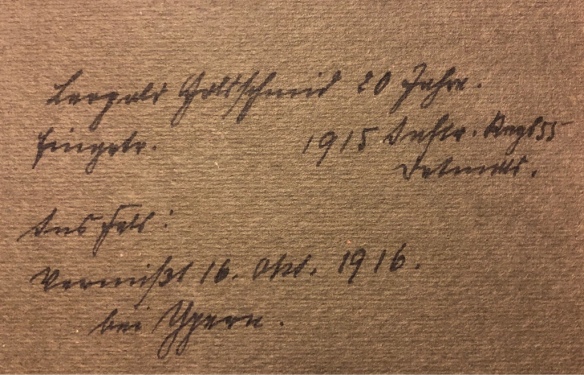
Then back in April, I received an email from David Baron, asking if I wanted to Zoom with a cousin named Rickey Slezak. I had no idea who Rickey was or how she was related to me, but soon discovered that she is a descendant of none other than Berthold Goldschmidt.

How does he have any descendants, you might wonder?

Well, in telling Berthold’s story I totally overlooked the fact that he had remarried after Mathilde’s death and had in fact had six more children with his second wife, Rika Giesberg, Rickey’s namesake. You can imagine how embarrassing this is!

Not that this takes away from the tragedies suffered by Berthold; that is still unimaginable. But Berthold’s story is somewhat softened by the fact that he went on to have a second family. And I was delighted not only to learn about this, but to make the connection to Rickey, my third cousin, once removed. Rickey shared with me an amazing album of old photographs of Berthold’s second family. This post is devoted to their story.

After losing his first wife Mathilde in 1911, Berthold Goldschmidt was left with four surviving children from that marriage: Paul, Leopold, Siegfried, and Hedwig. They were all still teenagers at that time.

On August 25, 1912, Berthold married Rika (sometimes spelled Richa or referred to as Rickchen) Giesberg, daughter of Jonas Giesberg and Henriette Loewenstein, in Trendelburg, Germany. Rika was born in Trendelburg on May 29, 1882, and was little more than ten to fifteen years older than her four stepchildren.

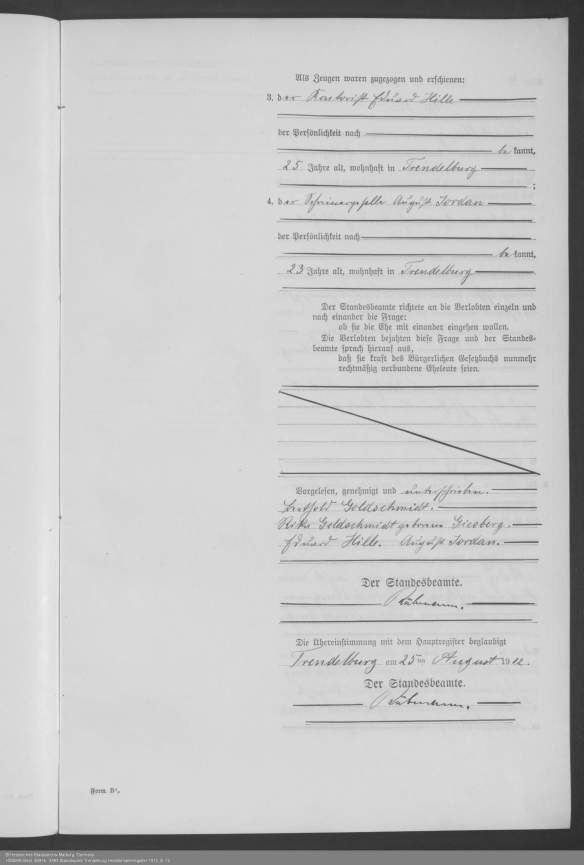
TitelStandesamt Trendelburg Heiratsnebenregister 1912 (HStAMR Best. 909 Nr. 9383)AutorHessisches Staatsarchiv MarburgErscheinungsortTrendelburg

Here are photographs of Berthold and Rika, courtesy of their granddaughter and my cousin, Rickey.

Berthold Goldschmidt, courtesy of the family

Rika Giesberg Goldschmidt, courtesy of the family

Rika and Berthold’s first child together, Walter Goldschmidt, was born in Oberlistingen, Germany, on April 24, 1913.1 A second son Herbert was born on December 20, 1914.2

Three of Berthold’s children from his first marriage died between 1915 and 1916, as discussed here. By 1917, Siegfried was then the only surviving child of the children Berthold had with Mathilde Freudenstein.

After those losses, Berthold and Rika had their first daughter, Hedwig, born June 1, 1918. She presumably was named for Berthold’s deceased daughter Hedwig from his first marriage.3

Here is a photograph of their family in about 1920 before their three youngest children were born:
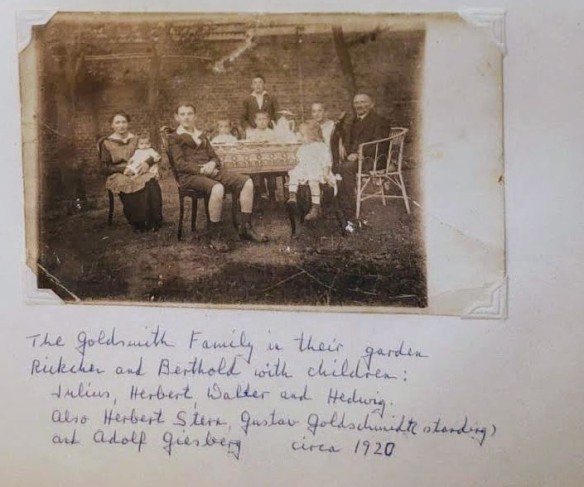
Berthold and Rika (Rickchen) Goldschmidt and family, c. 1920. Courtesy of the family

Their third son Jacob Julius Goldschmidt (known as Julius) was born on March 17, 1921.4 Albert Goldschmidt was born on September 9, 1924.5 Finally, their sixth and final child Elfriede was born August 17, 1926.6

This is a photograph of their home in Oberlistingen:

Berthold Goldschmidt family home in Oberlistingen. Courtesy of the family

Berthold Goldschmidt died on November 8, 1927. He was survived by his son Siegfried from his first marriage and the six children he had with Rika. Those six children lost their father before they reached adulthood. Their oldest child Walter was just fourteen, and their youngest child Elfriede just a year old. Rika was herself only 45 and left to care for the six children including four who were under ten years old.

Berthold Goldschmidt death record, Personenstandsregister Sterberegister; Signatur: 8196
Ancestry.com. Hesse, Germany, Deaths, 1851-1958 [

Rika was not destined to live a long life. She died at the age of 52 in Merxhausen, Germany, on March 1, 1935.7 I wondered why she died in Merxhausen, which is about 35 kilometers from Oberlistingen, and learned that there was a hospital there.

By that time Walter was almost 22, Herbert going on 21, Hedwig was almost seventeen, Julius almost fourteen, and the two youngest were still quite young; Albert was ten, and Elfriede only nine. I wonder who took care of these children, especially the three youngest, after they were orphaned.

Here are some photographs of some of the siblings taken in Germany before their lives changed forever:

Walter Goldschmidt
Courtesy of the family

Hedwig Goldschmidt Courtesy of the family

Julius Goldschmidt
Courtesy of the family

By the time of Rika’s death, the Nazis had taken power in Germany, and the Nuremberg Laws were adopted six months after her death.  It’s thus not surprising that by 1937 her two oldest sons decided to leave for the United States. Herbert left first, arriving in New York on July 30, 1937. According to the ship manifest, he left behind his brother Walter in Oberlistingen and was  going to a cousin, Leighton Steele, in Detroit, Michigan.  Leighton Steele was the son of Hedwig Goldschmidt Steele, a younger sister of Berthold Goldschmidt. Thus, Leighton, who was American-born, was Herbert’s first cousin, but they probably had never met.8

Walter Goldschmidt arrived just a few months after his brother Herbert; he arrived in New York on October 1, 1937. According to the ship manifest, he was heading to New York to a “cousin” named Joseph Guhl and was leaving behind an “uncle,” Salomon Strauss in Frankfurt. Salomon Strauss was married to Jenny Giesberg, Rika Giesberg Goldschmidt’s sister. Joseph Guhl was married to Meta Giesberg, the daughter of Leopold Giesberg, Rika’s brother.9

This photograph is labeled “Leaving for America” and shows Walter in Hamburg:

Courtesy of the family

The next sibling to arrive in the US was the youngest, Elfriede. She was only twelve years old when she arrived on March 24, 1939, and was sailing with her aunt Jenny Giesberg Strauss, her husband Salomon Strauss, and their son Walter. The ship manifest indicates that they all had been living in Frankfurt, so perhaps Elfriede had been taken in by her aunt after Rika died in 1935. They were leaving behind Salomon’s brother Julius and going to his cousin, Max Schoenmann, who lived at 1770 Andrews Avenue in the Bronx. I mention that only because my husband grew up down the block from there at 1940 Andrews Avenue. Small world.10

I don’t know whether or not Herbert ever went to Detroit to see Leighton Steele, but in 1940 both he and Walter were working as waiters for a restaurant in North Castle, New York, where they were both also living, according to the 1940 census.11  My cousin Rickey told me that the restaurant where they worked was a spot that became extremely popular as a music venue during the Big Band era, called Log Cabin Farms. You can see it mentioned on Herbert’s World War II draft registration.

Walter Goldschmidt, World War II draft registration, Ancestry.com. U.S. WWII Draft Cards Young Men, 1940-1947

Herbert Goldschmidt, World War II draft registration, Ancestry.com. U.S. WWII Draft Cards Young Men, 1940-1947

The North Castle Historical Society published an article about the Log Cabin Farms and all the performers who came there; you can find it here. As you can see from this postcard, the restaurant had a seating capacity of 1500!

Meanwhile, their sister Elfriede was living in the Bronx with their aunt Jenny Giesberg Strauss and her family in 1940.12 Rickey told me that her father revered his aunt Jenny, at least in part because of the care she gave to his little sister.

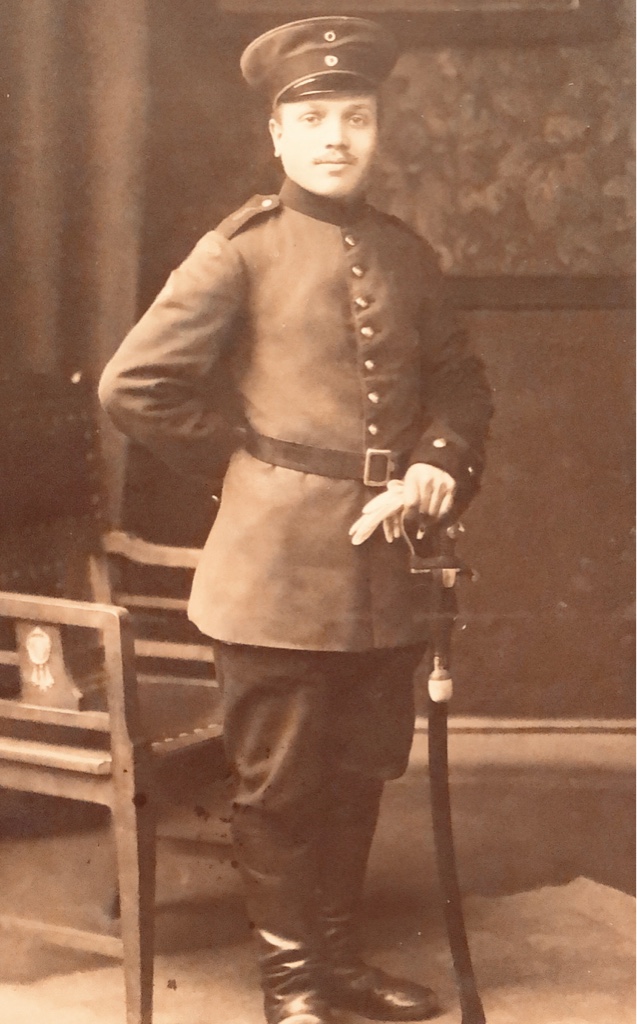
Herbert enlisted in the US military on January 22, 1941, almost a year before Pearl Harbor.13 I don’t know anything specific about his military service, but here is a photograph of him in uniform.

Herbert Goldschmidt/Goldsmith
Courtesy of the family

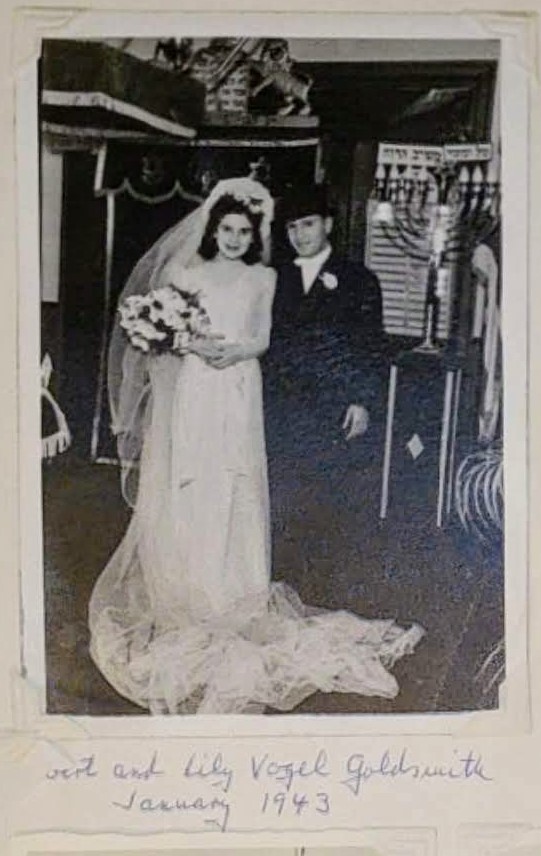
He applied for a marriage license to marry Lilly Vogel on January 19, 1943, in New York City.14

courtesy of the family

They did not have any children. According to my cousin Rickey, her uncle Herbert died in 1963.

His brother Walter enlisted on January 29, 1943, just ten days after Herbert and Lilly’s wedding.15 According to records his daughter Rickey has, Walter served three years including a year overseas. He was decorated several times, receiving the following medals: American Service Medal; Good Conduct Medal; European African Middle Eastern Service Medal; and a World War II Victory Medal.

On February 12, 1944, Walter married Hilda Weis,16 who was born on October 8, 1922, to Siegfried Weis and Else Scheuer in Gelnhausen, Germany.17 They had one child, my cousin Rickey, the source of all these wonderful photographs. Walter died on October 4, 1991; his widow Hilda died in 2001.18 They are survived by their daughter Rickey as well as several grandchildren and great-grandchildren.

Hilda Weis and Walter Goldschmidt/Goldsmith
Courtesy of their daughter Rickey

Elfriede married Alvin Kruger Colin with whom she had two children. This is a picture of them taken in March 1948. Given the way they are dressed, I assume this was their wedding day.19

Elfriede Goldschmidt and Al March 1948
Courtesy of the family

Elfriede died on January 6, 2011; she was survived by her children and grandchildren.20

Here is a photograph of the three siblings who made it to the US. I’d guess it was taken sometime after the war.

Courtesy of the family

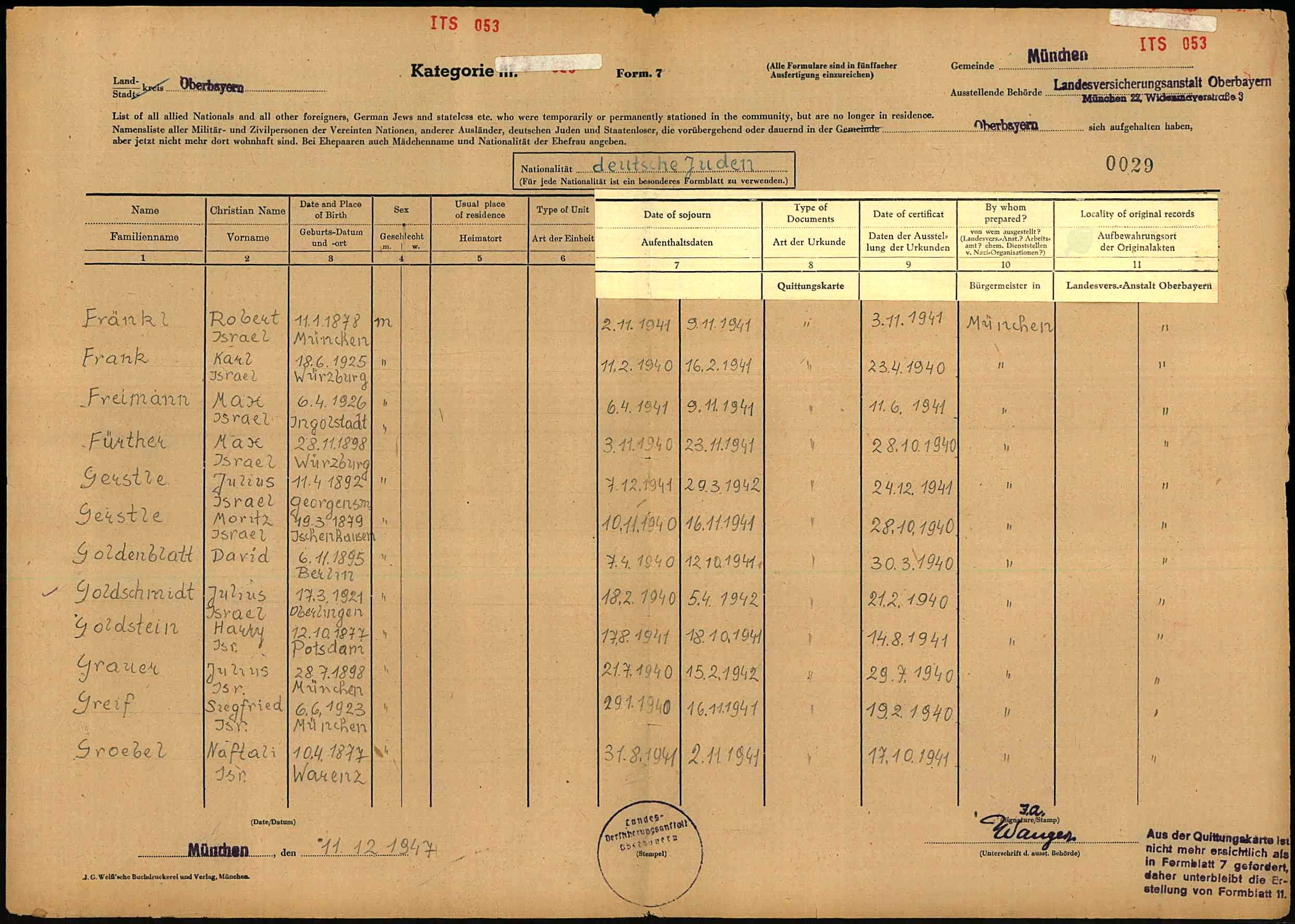
Unfortunately, two of the other children of Berthold and Rika did not leave Germany and were killed in the Holocaust. According to the Memorial Book for Victims of the Persecution of Jews under the National Socialist Tyranny in Germany 1933 – 1945, Jacob Julius Goldschmidt was sent to Dachau concentration camp on November 10, 1938, after Kristallnacht and was released from Dachau on December 8, 1938. He still, however, did not leave Germany. According to this document, he was living in Munich from February 18, 1940, until April 5, 1942.

UPDATE: Thank you to barb276 for finding more information about Jacob Julius Goldschmidt here. According to this page from the Munich archives, Jacob Julius had moved from Kassel to Munich by January 1, 1936, and was living there until October 26, 1940, when he went to a Hachsharah, a Zionist training camp in Steinhofel, where Jews were trained for life in Palestine/Israel. Unfortunately, Jacob Julius never got there.

Arolsen Archives, Digital Archive; Bad Arolsen, Germany; Lists of Persecutees 2.1.1.1
Reference Code: 02010101 oS, Ancestry.com. Europe, Registration of Foreigners and German Persecutees, 1939-1947

He was then deported to Poland and murdered at some unnamed location.

Hedwig Goldschmidt was also murdered by the Nazis. She had married Horst Starsky, who was born on July 10, 1909, in Wingeruppen, Germany. According to the Memorial Book for Victims of the Persecution of Jews under the National Socialist Tyranny in Germany 1933 – 1945, they were living in Berlin, and both were first imprisoned in a Jewish forestry labor camp in Kersdorf-Briesen. They were then deported to Auschwitz on April 19, 1943, where they were killed. As far as I’ve been able to determine, they did not have any children.

The fate of Albert Goldschmidt, Berthold and Rika’s youngest son, is less clear. My cousin Rickey believes that he ended up immigrating to Buenos Aires, Argentina, but I have no documentation showing that. Rickey also believed he married and had a child there, but again, we have no documentation. What we do have is this photograph of Albert apparently taken in front of a restaurant that has a Spanish name, I think—Coveteria Vievo Viena? Google Translate could not make sense of coveteria but translated Vievo Viena as I come Vienna. Possibly a restaurant serving Viennese (or German-style) food?

UPDATE: Thank you to my cousin Susana, who also came from Buenos Aires, for helping me to translate what this says. She said that it says “Confitería Viejo Viena” (Old Vienna tearoom) and would have been a patisserie or tearoom that likely specialized in German/Austrian pastries and cakes.

Courtesy of the family

Thus, Berthold Goldschmidt’s family with his second wife Rika endured a great deal of tragedy just as his family with his first wife Mathilde Freudenstein had. But the record must stand corrected. Berthold Goldschmidt does indeed have living descendants—his grandchildren, his great-grandchildren, and even some great-great-grandchildren.  And one of them is my wonderful cousin Rickey who helped me tell and illustrate their family’s story.



  1. Walter Goldschmidt, Birth Date: 24 Apr 1913, Birth Place: Oberlistingen, Germany,
    Ancestry.com. U.S. WWII Draft Cards Young Men, 1940-1947 
  2. Herbert Goldschmidt, Birth Date: 20 Dec 1914, Birth Place: Oberlistingen, Germany, Ancestry.com. U.S. WWII Draft Cards Young Men, 1940-1947 
  3.  Hedwig Goldschmidt, Birth Date: 1 Jun 1918, Birth Place: Oberlistingen, Reference Number: 02010101 oS, Document ID: 70442392, Arolsen Archives, Digital Archive; Bad Arolsen, Germany; Lists of Persecutees 2.1.1.1, Ancestry.com. Europe, Registration of Foreigners and German Persecutees, 1939-1947 
  4.  Julius Israel Goldschmidt, Birth Date: 17 Mrz 1921 (17 Mar 1921), Birth Place: Oberlingen, Reference Number: 02010101 oS, Document ID: 70126154, Arolsen Archives, Digital Archive; Bad Arolsen, Germany; Lists of Persecutees 2.1.1.1, Ancestry.com. Europe, Registration of Foreigners and German Persecutees, 1939-1947 
  5. I have no record of Albert’s birth date; this comes from the Goldschmidt family report done by Roger Cibella and David Baron. 
  6.  Elfriede Colin, Social Security Number: 112-16-3514, Birth Date: 17 Aug 1926
    Death Date: 6 Jan 2011, Social Security Administration; Washington D.C., USA; Social Security Death Index, Master File, Ancestry.com. U.S., Social Security Death Index, 1935-2014 
  7.  Richa Goldschmidt, Maiden Name: Giesberg, Gender: weiblich (Female)
    Age: 52, Birth Date: 29 Mai 1882 (29 May 1882), Death Date: 1 Mrz 1935 (1 Mar 1935)
    Death Place: Merxhausen, Hessen (Hesse), Deutschland (Germany), Civil Registration Office: Merxhausen, Certificate Number: 16, Personenstandsregister Sterberegister; Signatur: 6991, Ancestry.com. Hesse, Germany, Deaths, 1851-1958 
  8. Herbert Goldschmidt, ship manifest, Year: 1937; Arrival: New York, New York, USA; Microfilm Serial: T715, 1897-1957; Line: 25; Page Number: 38, Ancestry.com. New York, Passenger and Crew Lists (including Castle Garden and Ellis Island), 1820-1957 
  9. Walter Goldschmidt, ship manifest, Year: 1937; Arrival: New York, New York, USA; Microfilm Serial: T715, 1897-1957; Line: 8; Page Number: 36, Ancestry.com. New York, Passenger and Crew Lists (including Castle Garden and Ellis Island), 1820-1957. Salomon Strauss and Jenny Giesbech [sic], Arolsen Archives, Digital Archive; Bad Arolsen, Germany; Lists of Persecutees 2.1.1.1, Reference Code: 02010101 oS, Ancestry.com. Europe, Registration of Foreigners and German Persecutees, 1939-1947. Meta Giesberg, Marriage Date: 30 Apr 1936, Marriage Place: Manhattan, New York, USA, Spouse: Joseph A Guhl, Certificate Number: 11992, Ancestry.com. New York, New York, Extracted Marriage Index, 1866-1937 
  10. Elfriede Goldschmidt, ship manifest, Year: 1939; Arrival: New York, New York, USA; Microfilm Serial: T715, 1897-1957; Line: 6; Page Number: 8, Ancestry.com. New York, Passenger and Crew Lists (including Castle Garden and Ellis Island), 1820-1957 
  11. Walter Goldschmidt and Herbert Goldschmidt, 1940 US census, Year: 1940; Census Place: North Castle, Westchester, New York; Roll: m-t0627-02811; Page: 3B and Page 24A, Enumeration District: 60-250, Ancestry.com. 1940 United States Federal Census 
  12. Elfriede Goldschmidt, 1940 US census, Census Place: New York, Bronx, New York; Roll: m-t0627-02497; Page: 10B; Enumeration District: 3-1449, Ancestry.com. 1940 United States Federal Census 
  13. Ancestry.com. U.S., World War II Army Enlistment Records, 1938-1946 
  14.  Herbert Goldschmidt, Gender: Male, Marriage License Date: 19 Jan 1943
    Marriage License Place: Manhattan, New York City, New York, USA, Spouse: Lilly Vogel
    License Number: 1202, New York City Municipal Archives; New York, New York; Borough: Manhattan; Volume Number: 1, Ancestry.com. New York, New York, Marriage License Indexes, 1907-2018 
  15. Ancestry.com. U.S., Department of Veterans Affairs BIRLS Death File, 1850-2010 
  16.  Hilda Weis, Gender: Female, Marriage License Date: 10 Feb 1944
    Marriage License Place: Manhattan, New York City, New York, USA. Spouse: Walter Goldschmidt, License Number: 3826, New York City Municipal Archives; New York, New York; Borough: Manhattan; Volume Number: 6, Ancestry.com. New York, New York, Marriage License Indexes, 1907-2018 
  17. Hilda Goldsmith, [Hildegard Weis], [Hilda Goldschmidt] , Gender: Female,
    Birth Date: 8 Oct 1922, Birth Place: Gelnhausen, Federal Republic of Germany
    Death Date: 18 Sep 2001, Father: Siegfried Weis, Mother: Else Scheuer
    SSN: 085180692, Ancestry.com. U.S., Social Security Applications and Claims Index, 1936-2007 
  18. Name: Walter Goldsmith, Gender: Male, Birth Date: 24 Apr 1913, Death Date: 4 Oct 1991, Claim Date: 6 Mar 1975, SSN: 077165081, Ancestry.com. U.S., Social Security Applications and Claims Index, 1936-2007. For Hilda, see Note 17. 
  19.  Elfriede Goldsmith, Marriage License Date: 27 Feb 1948, Marriage License Place: Bronx, New York City, New York, USA, License Number: 1705, New York City Municipal Archives; New York, New York; Borough: Bronx, Ancestry.com. New York, New York, Marriage License Indexes, 1907-2018 
  20. Elfriede Colin, Social Security Number: 112-16-3514, Birth Date: 17 Aug 1926
    Issue Year: Before 1951, Issue State: New York, Last Residence: 33308, Fort Lauderdale, Broward, Florida, USA, Death Date: 6 Jan 2011, Social Security Administration; Washington D.C., USA; Social Security Death Index, Master File, Ancestry.com. U.S., Social Security Death Index, 1935-2014 

Hannah and Henry Goldsmith, My Double Cousins: An Update

I have been working on the family of Jacob Meier Goldschmidt, the oldest son of Meyer Goldschmidt, my four-times great-uncle, for months. We have already discussed four of Jacob’s five children: Helene, Regina, Julius, and Mayer/Marcel, and there is one more child to discuss. Then I can move on to Jacob’s sister Malchen and his two younger brothers, Selig and Falk. As you can see, there are still a lot of Goldschmidts to discuss. Given that I started writing about the Goldschmidts almost two and a half years ago, it looks like I will still be writing about them at least until the end of 2020 if not into 2021. That’s more time than I’ve spent on any of my other family lines. Wow.

But before I go on to Jacob Meier Goldschmidt’s youngest child, I need to do some catching up. It seems that the COVID19 pandemic has led many people stuck at home to research their family history. And I’ve heard from quite a few new Goldschmidt/Goldsmith cousins who Googled an ancestor’s name and found my blog. I’ve gotten new photographs, new stories, and new names to add to the family tree. So for the next few weeks, I am going to post this new information and update the posts where I first wrote about the relevant family.

Today’s post is about the families of two of Simon Goldschmidt’s children, the two born in the US, Hannah Goldsmith Benedict and Henry Goldsmith, who were my double cousins as their mother was my three-times great-aunt  Fradchen Schoenthal, my great-great-grandfather Levi Schoenthal’s sister.

First, I want to share some photographs and documents and a story about the family of Hannah Goldsmith Benedict, my first cousin, three times removed.  She was born in Baltimore in 1848 and had three sons who survived to adulthood, Jake, Herschel, and Centennial Harry Benedict.

In April, 2020, I heard from Hannah’s great-great-grandson Bruce Velzy, who is also the great-grandson of Jake Benedict; he had found my blog posts about his ancestors and wanted to share some photographs, including this one of Hannah Goldsmith Benedict that I posted earlier and had restored by the Free Photo Restoration group on Facebook.

Hannah Goldsmith Benedict, restored photo. Courtesy of her family

This is Hannah’s husband, Joseph Benedict:

Joseph Benedict, courtesy of Bruce Velzy

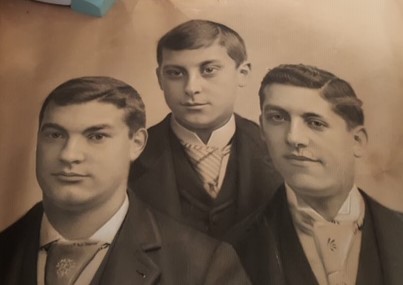
Bruce also shared a photograph of Hannah’s three sons. We weren’t completely sure who was who, but since Harry was the youngest, six years younger than Jake, five years younger than Hershel, I think he is the boy in the center.

Sons of Hannah Goldsmith and Joseph Benedict, c. 1890. Courtesy of the family

Bruce also had some very interesting documents, including this application for a Civil War pension filed by Joseph Benedict:

I learned several things from this document—that Joseph and Hannah were married by Rabbi Naumberg on April 17, 1867, in Pittsburgh. Even more important is the fact that Joseph and Hannah had two children who died as infants whom I’d not discovered. Their first child Emily, born October 19, 1868, died just three months later in December, and their fifth child Sydney was born on March 29, 1889, and died two months later in May, 1889. I am so glad I can add them to the family tree and preserve their memory for I am sure they were loved and mourned by their family.

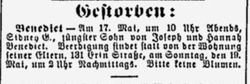
I looked for birth and death certificates for Emily and Sydney, but did not find any. I did, however, find their gravestones on FindAGrave and also a death notice for Sydney on his FindAGrave memorial.

Find a Grave, database and images (https://www.findagrave.com : accessed 06 June 2020), memorial page for Emilie Benedict (Oct 1868–Dec 1868), Find a Grave Memorial no. 109102550, citing Troy Hill Jewish Cemetery, Pittsburgh, Allegheny County, Pennsylvania, USA ; Maintained by Corey & Douglas Marshall-Steele (contributor 47477063) .

Find a Grave, database and images (https://www.findagrave.com : accessed 06 June 2020), memorial page for Sidney G. Benedict (29 Mar 1889–17 May 1889), Find a Grave Memorial no. 90777547, citing Troy Hill Jewish Cemetery, Pittsburgh, Allegheny County, Pennsylvania, USA ; Maintained by DGG (contributor 47020054) .


Find a Grave, database and images (https://www.findagrave.com : accessed 06 June 2020), memorial page for Sidney G. Benedict (29 Mar 1889–17 May 1889), Find a Grave Memorial no. 90777547, citing Troy Hill Jewish Cemetery, Pittsburgh, Allegheny County, Pennsylvania, USA ; Maintained by DGG (contributor 47020054) .

Death: Benedict—on May 17 at 10 in the evening, Sidney G., youngest son of Joseph and Hannah Benedict. Funeral to be held at the parents’ home, [address], on Sunday, May 19, at 2 in the afternoon. Please no flowers.

(Note that the spelling of their first names on the gravestones and in the death notice is different from that used on the pension application written years later.)

In order for Hannah to receive the Civil War pension benefits as a widow after Joseph died, she had to prove her marriage. The pension application asked for a marriage record, and Joseph had written there was none as no records were kept at the time.

So in 1918 after Joseph died, Hannah applied for widow’s benefits and submitted this affidavit to prove her marriage:

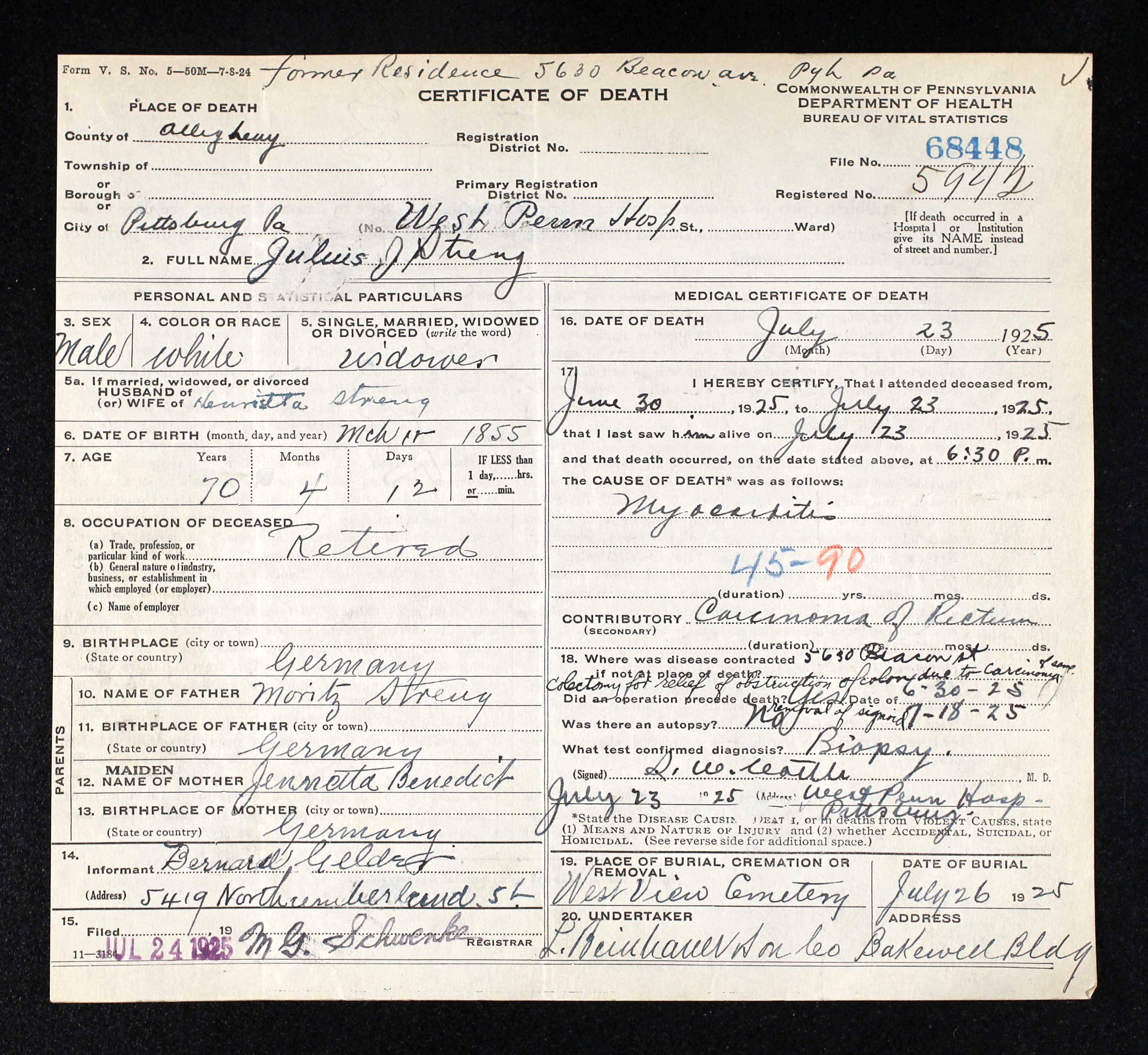
Notice that Julius J. Streng, the witness, was 63 in 1918, meaning that at the time of the wedding in 1867 he would have been only twelve years old. So who was he and why was he at Hannah and Joseph’s wedding?

Well, I found his death certificate, and his mother’s birth name was Jenetta Benedict. I haven’t yet found evidence to prove it, but my hunch is that Jenetta was Joseph Benedict’s sister and that young Julius was his nephew.

UPDATE: My hunch was confirmed when I found Jeanette/Jenetta’s obituary in 1913 and it described Joseph Benedict as her brother.

Pennsylvania Historic and Museum Commission; Harrisburg, Pennsylvania; Pennsylvania (State). Death certificates, 1906–1967; Certificate Number Range: 066001-069000
Ancestry.com. Pennsylvania, Death Certificates, 1906-1967

Bruce also had a copy of Hannah’s death certificate:

Hannah Goldsmith Benedict death certificate

Of course, I love this because it is evidence of my double connection to Hannah as a Goldschmidt and as a Schoenthal.

Bruce shared with me that Joseph and Hannah’s two older sons, his great-grandfather Jake and great-great-uncle Herschel, dropped out of school in ninth grade in order to earn money so that their youngest brother Harry, who was an excellent student, would be able to attend college. Harry, as I wrote about here, ended up graduating from Cornell University as did his two sons Manson and William, and all three became highly successful and brilliant engineers.

In addition, Bruce’s sister Suzanne Midford left this comment on my blog post about her grandmother Helen Benedict Booher, Jake Benedict’s daughter:

My “Grandmommy Booher” was what’s now known as a social worker, one of the professions that grew out of the Jane Addams Hull House movement and the professionalization of women workers who helped to socialize new American immigrants in the 1920s and 30s. One aspect of this was the desire by members of the earlier (and more prosperous) German Jewish immigrant waves to give a leg up to, and help “Americanize” the (mostly poorer) Jewish immigrants from the later eastern European waves. To that end, the new immigrants were taught hygiene, cooking, language, ‘manners’ (American ones anyhow), and comportment. One of my dearest possessions is my grandmother’s bound copy of The Settlement Cookbook, which was a German-Jewish cookbook meant to teach a new immigrant Jewish housewife all the ways she should “be American”, from translating her old world dishes to new world methods and ingredients, to introducing her to “modern” culinary ideas, how to use unfamiliar kitchen implements, how to keep a clean house (by American standards), and a million little details about “life in America”. As a historian, I find it an invaluable window through which to understand my grandmother’s generation and the immigrant assimilations that characterized that period in our national history.

I am so happy that my cousins Suzanne and Bruce, my fourth cousins, once removed, found my blog and so generously shared with me these photographs, documents, and family stories that add new and important dimensions to their personalities and their lives.

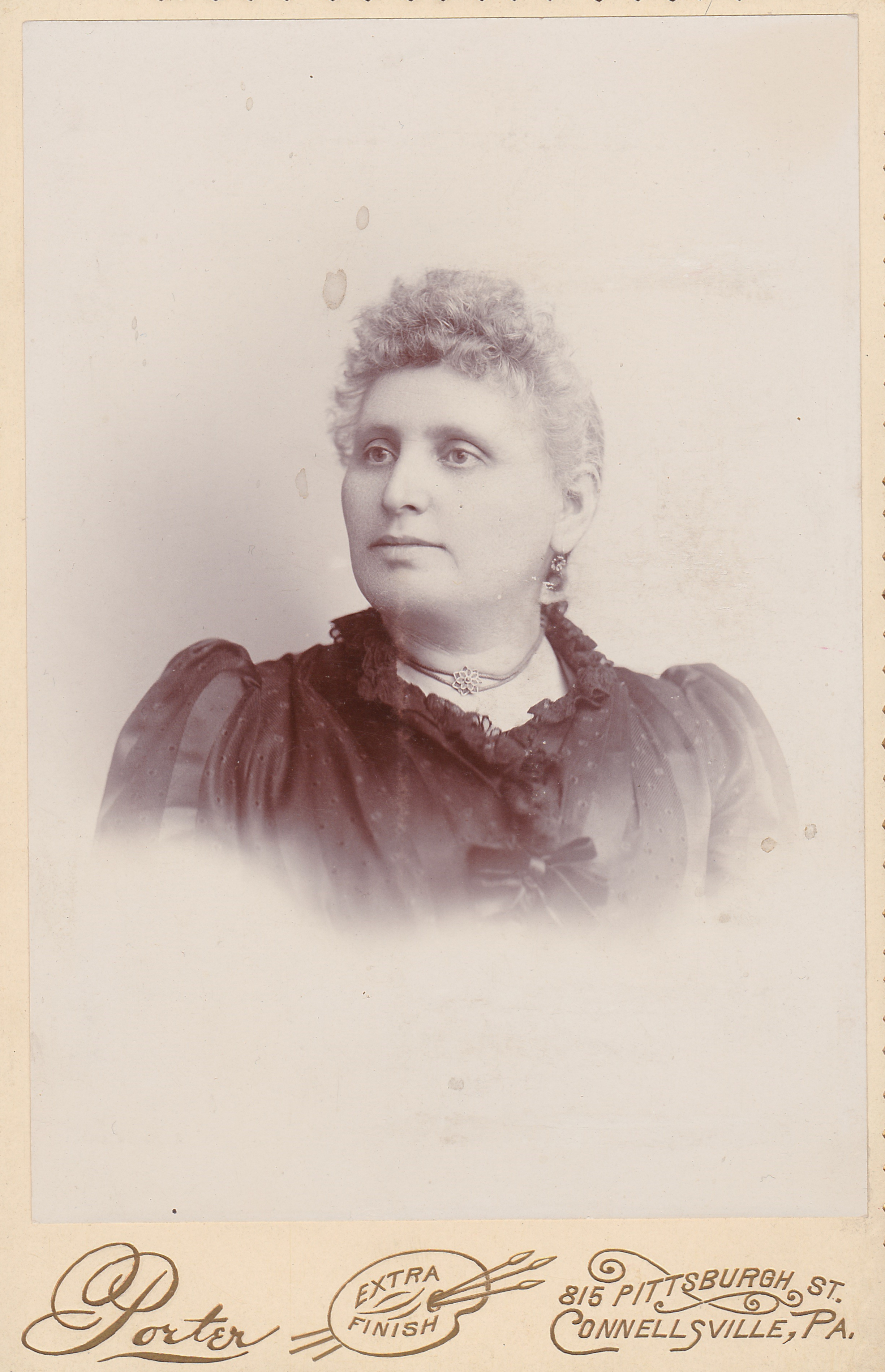
One final addition, this one about Hannah Goldsmith Benedict’s sister-in-law, Sarah Jaffa Goldsmith, wife of Henry Goldsmith, Hannah’s brother. This photograph of Sarah was sent to me by my cousin Christian, Sarah and Henry’s great-great-grandson.

The story behind this photograph is that Christian received it in the mail from someone who found it in an antique shop in Portland, Oregon. Given that Sarah lived in Connellsville, Pennsylvania, her entire married life and that, as far as I know, none of her children or grandchildren or other descendants ended up near Oregon, it’s a mystery as to how this photograph traveled all the way to the Pacific Northwest and landed in an antique shop in Portland.

These little windfalls, these gifts, have brightened my days during the dark and scary time we’re living in.


Blogging in a Pandemic, Part II

As we enter our third or really our fourth week of social distancing, self-quarantine, or whatever else you want to call it (no closer than six feet from anyone but each other, washing our hands religiously, no restaurants, no stores except when we can’t get delivery of groceries, and so on), I have to say that this week things suddenly seem much harder and much sadder. But we are still fortunately feeling fine despite having flown twice in March, and we feel very, very relieved, and are so grateful to be home.

And we also feel very grateful that so far our families are also okay and our friends. I almost am afraid to write that for fear of tempting the corona gods. But I know that magical thinking is just superstition. We all just have to keep staying apart, staying safe, and staying home. The anxiety sometimes feels unbearable, but my mantra has always been and continues to be—one day at a time.

We’ve taken some wonderful walks in places nearby, a few of which we’d never been to before. And we’ve taken many walks in our neighborhood, chatting with neighbors from at least six feet apart, and feeling a sense of community and warmth that can be overlooked when we all just drive in and out of our garages.

I’ve cleared out a drawer filled with expired medicines and other products, organized our “junk” drawer, and discovered dust in places you cannot imagine. Every day I try to think of at least one small project to accomplish, even if it is simply remembering to mail a check.

I’ve also started to accept that I will never do some of the things the internet keeps throwing at us: free courses online, free tours of museums and national parks, free videos of exercise classes, and so on. I just can’t focus long enough to do those things. Fortunately, doing genealogy in shorter spurts than usual and writing my blog still provide me with a way to escape from the pandemic pandemonium.

Now we are preparing for a Zoom seder. The planning has given me an opportunity to work with my nine-year-old grandson on that project. In fact, we’ve had more contact with our kids and grandsons during these weeks than we usually do, though not in person. I am reading the wonderful book Hatchet by Gary Paulsen with the older grandson and playing chess online with the younger one. And we’ve had Zoom cocktail hours with friends and with family. So it’s not all bad.

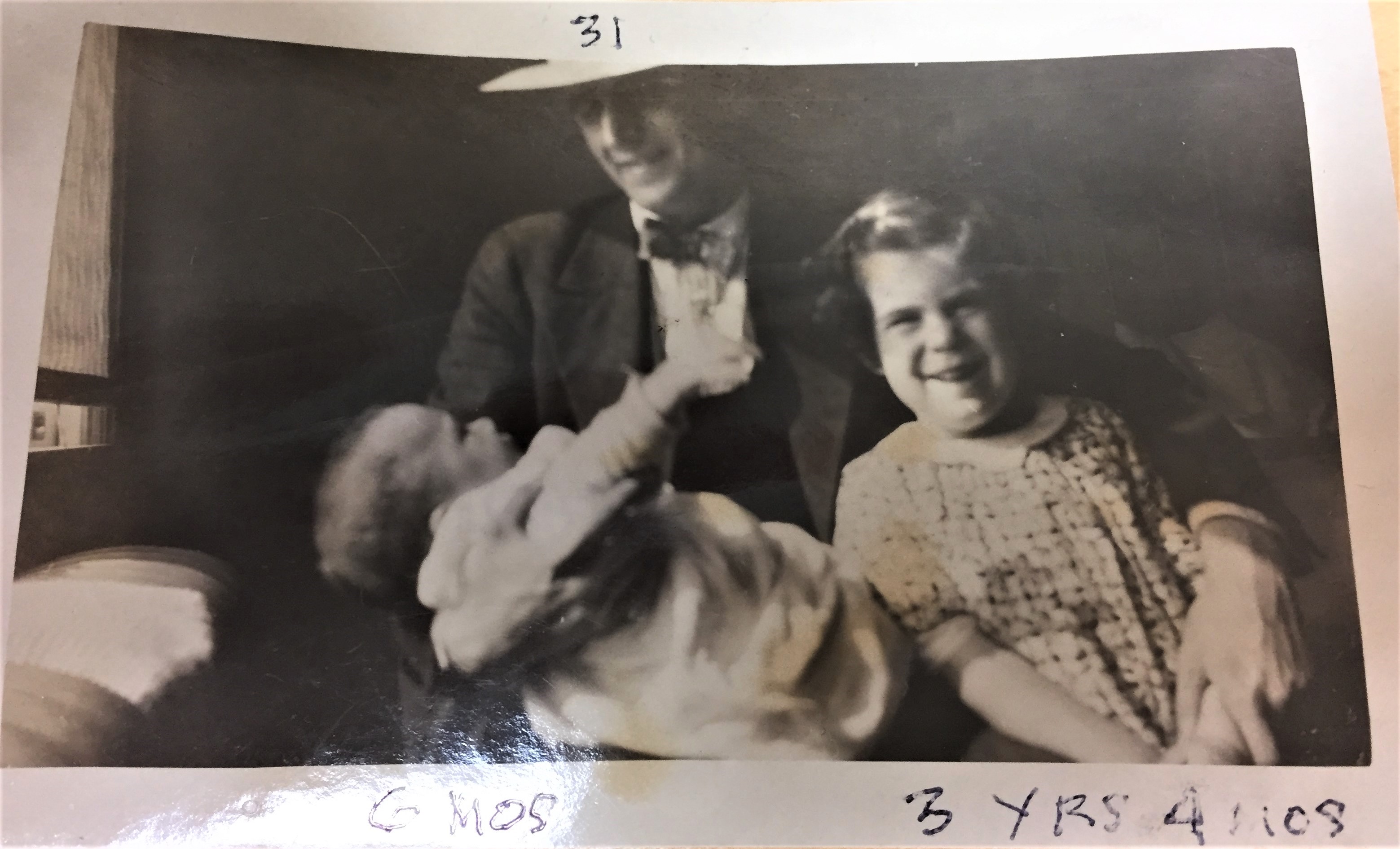
What really prompted me to write this particular post was one of those little benefits I’ve gotten from people spending all this time at home. My brother, who also has been spending more time at home than usual (but who is still working since he is a doctor), was going through a box of papers and photographs that had been my father’s and discovered this photograph.

I know this is not great quality (and my brother’s scan of it does not help). But I am so excited by this photograph. Let me explain why.

This is a photograph of my father as a baby being held by his father with my aunt sitting on her father’s left. My father had written the ages in the margins, and although he had not written the names, it was easy to deduce the identities from the relative ages and the facial characteristics using other photographs of my grandfather, of my aunt as a young child, and even of my father as a baby.
Eva Schoenthal and John Cohen, Sr. 1923

My aunt Eva Hilda Cohen and my grandmother Eva Schoenthal Cohen, c. 1925

My grandmother and my father, c. 1927

But what made this so special is that I had never seen a photograph of my grandfather with his children. All the photographs I had of him were either of him alone or with my grandmother. So seeing this photograph was really touching. Look at how he is looking at his son. There is such joy and love on his face.

It was especially touching because I knew that my father had had very few years living with his father before my grandfather became disabled from multiple sclerosis and was ultimately institutionalized for the rest of his life.  He died long before I was born, and for most of my life I knew almost nothing about him. I didn’t ask when I was young because my father seemed to be reluctant to talk about him. I didn’t know if that was out of sadness or anger or indifference. But I didn’t want to upset him either way.

One of the gifts of doing genealogy and talking to my father in the five or six years before he died in February 2019 was that he finally did talk a bit about his father. And in doing so, I realized that even though he had not spent many years living with his father, my father had loved him. His reluctance to talk about him was due to pain and sadness, not anger or indifference.

The fact that my father saved this photograph and hid it away in a box we never saw before is telling. This must have been a photograph he cherished, something special that he didn’t want mixed in with the hundreds of other photographs he had taken over the years of vacations and friends and family. I am so glad that my brother discovered it and that he shared it with me. It gave me new insights into my father and his father.

Have you discovered any wonderful photographs or other treasures while staying at home? Have you always planned to label and/or scan your family photographs? Maybe now is a good time.