Nusbaum Album: Are These My Seligmann Relatives from Germany?

With more realistic expectations but nevertheless high hopes, I awaited Ava’s final work on the Nusbaum Album, some of the photographs from Germany. Although there were some photographs from Stuttgart, Berlin, and Wiesbaden, since I did not know of any relatives living in those places in the mid to late 19th century, I focused on the photographs taken in Bingen and Mainz. Although my closest Seligmann relatives lived in the small town of Gau-Algesheim, both Bingen and Mainz were relatively close by and the closest cities to Gau-Algesheim, and many relatives eventually moved there. It seemed most likely that that my Seligmann relatives would have gone to one of those two cities to be photographed.

I selected three photographs from Mainz, all taken by the same photographer, Carl Hertel, and two from Bingen, both taken by J.B. Hilsdorf. These were all on the back of the first four pages at the beginning of the album whereas other photographs from Germany including from Mainz and Bingen were much later in the album. I hoped that meant the ones earlier in the album were more likely closer relatives.

The first Mainz photograph was dated by Ava as taken between 1873 and 1874; she noted that in 1874, Hertel became a court photographer. She wrote, “Generally, when a photographer was appointed as a court photographer that information would appear on the mounting card in the imprint and after the photographer’s name with the letters HOF. Since there is no indication of this appointment, I am placing the date of the photograph before 1874.”1 In addition, another photograph of Hertel’s found elsewhere with the same imprint was dated 1873.

Ava estimated the age of the man as mid to late 70s based on the lines on his face and the style of his tie. That meant the man was born in about 1800-1804. Ava speculated that this could be my three-times great-grandfather Moritz Seligmann, who was born in 1800. And this time I was able to confirm that speculation because I belatedly remembered that I have an actual photograph of Moritz that I had obtained from a cousin years back:

Moritz Seligmann

So bingo! We had a positive identification!

Moving on to the next two Mainz photos, Ava concluded that they also were taken between 1873 and 1874 based on the information she’d already found about Hertel. The first one she believed to be of a man who was in his thirties, perhaps 35, so born in about 1838-1839. The younger man on that same page appeared to her to be eighteen so born in about 1855. Since these photographs were all taken by the same photographer at about the same time, I thought that perhaps these two younger men were sons of Moritz Seligmann, that is, brothers of Bernard, my great-great-grandfather. In addition, they appeared on the second page of Germany photographs right after the photograph of Moritz, who appeared on the first page of the Germany photographs in the album.

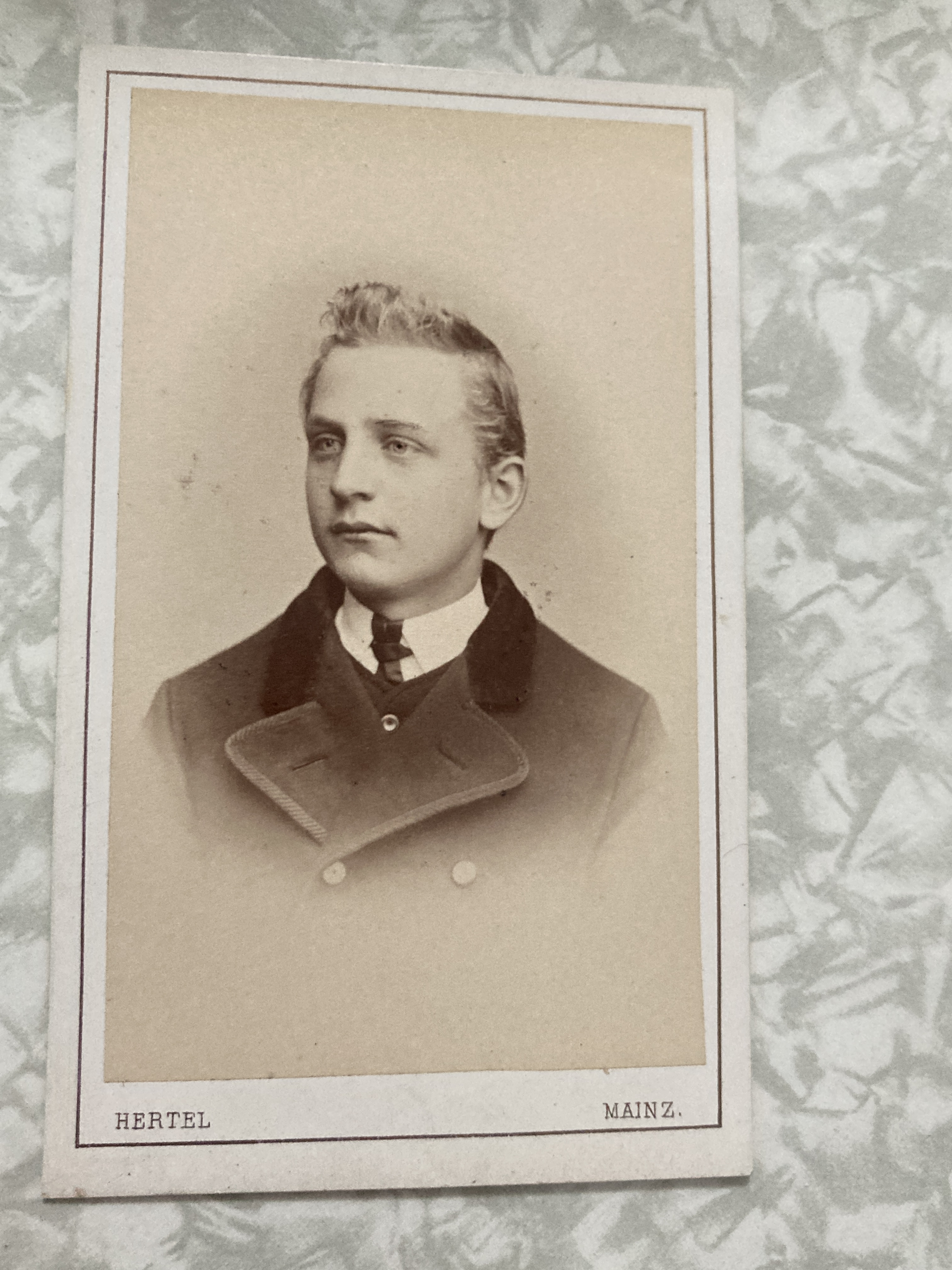
Looking at the family tree, I found two possibilities. The older “son” could be Hieronymous Seligmann, born in 1839. The younger “son” could be Moritz’s youngest child, Jakob Seligmann, born in 1853. I was excited at the thought that perhaps I finally had found some relatives I could identify in the album.

I shared my analysis with Ava. She was skeptical that the younger man was Jakob Seligmann because she had identified Jakob in a photograph from a different set of photographs that she had worked on during an earlier project, and she did not see any similarities or enough to believe that the blonde teenager photographed in Mainz was the same person identified as Onkle Jakob in the later photograph.
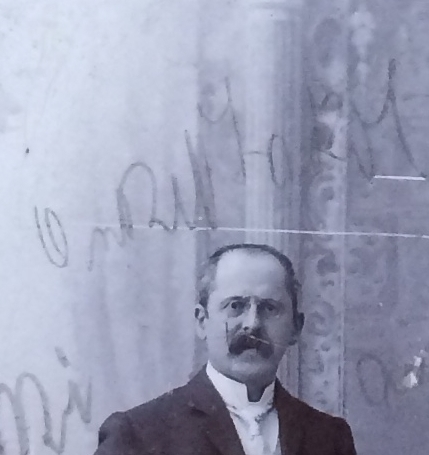
We went back and forth with me trying my lawyerly best to persuade her that the blonde man could have grown up to be the dark haired Oncle Jakob. But in the end I failed to do so. I have to defer to Ava. She’s the expert, and I am a biased viewer hoping to see what I want to see. But if this was not Jakob Seligmann, who was it? I don’t know. Maybe a nephew or a cousin. Maybe not anyone in the family at all.

Knowing now that the Hertel photographs were likely taken before 1874 as Ava concluded, I looked on my own at the other three Hertel photographs taken in Mainz that appear later in the album:


Who are these three women? I don’t know since I have no photographs to use for comparison. Two of them look too young to be Bernard Seligman’s sisters Mathilde and Pauline, who were born in 1845 and 1847, respectively, and certainly too young to be his half-sister Caroline born in 1833, if the photographs were taken around 1873 as Ava concluded about the other Hertel photographs. And they are too old looking to be the children of any of Bernard’s siblings. So sadly they also will remain unidentified.

The next photograph I asked Ava to analyze is on the same page as the two blonde men except this photograph was taken in Bingen, not Mainz, by J.B. Hilsdorf, who was in business in Bingen from 1861 to 1891, according to Ava’s research. When I believed that the other two men on that page were Hieronymous and Jakob, I speculated that this third man could be their brother August, the only other son of Moritz Seligmann who survived beyond 1853 and was living in Germany.

Based on the size of this particular photograph, Ava dated it in the mid-1860s. She thought the man was between 30 and 35 so born between 1827 and 1834.2 August Seligmann was born in 1841 so too young to be the man in this photograph. In addition, Ava compared this photograph to one I have of August and found them to be dissimilar. It didn’t take as much to persuade me this time.

August Seligmann

That left one last photograph for Ava to analyze, the second photograph from Bingen that I had selected.
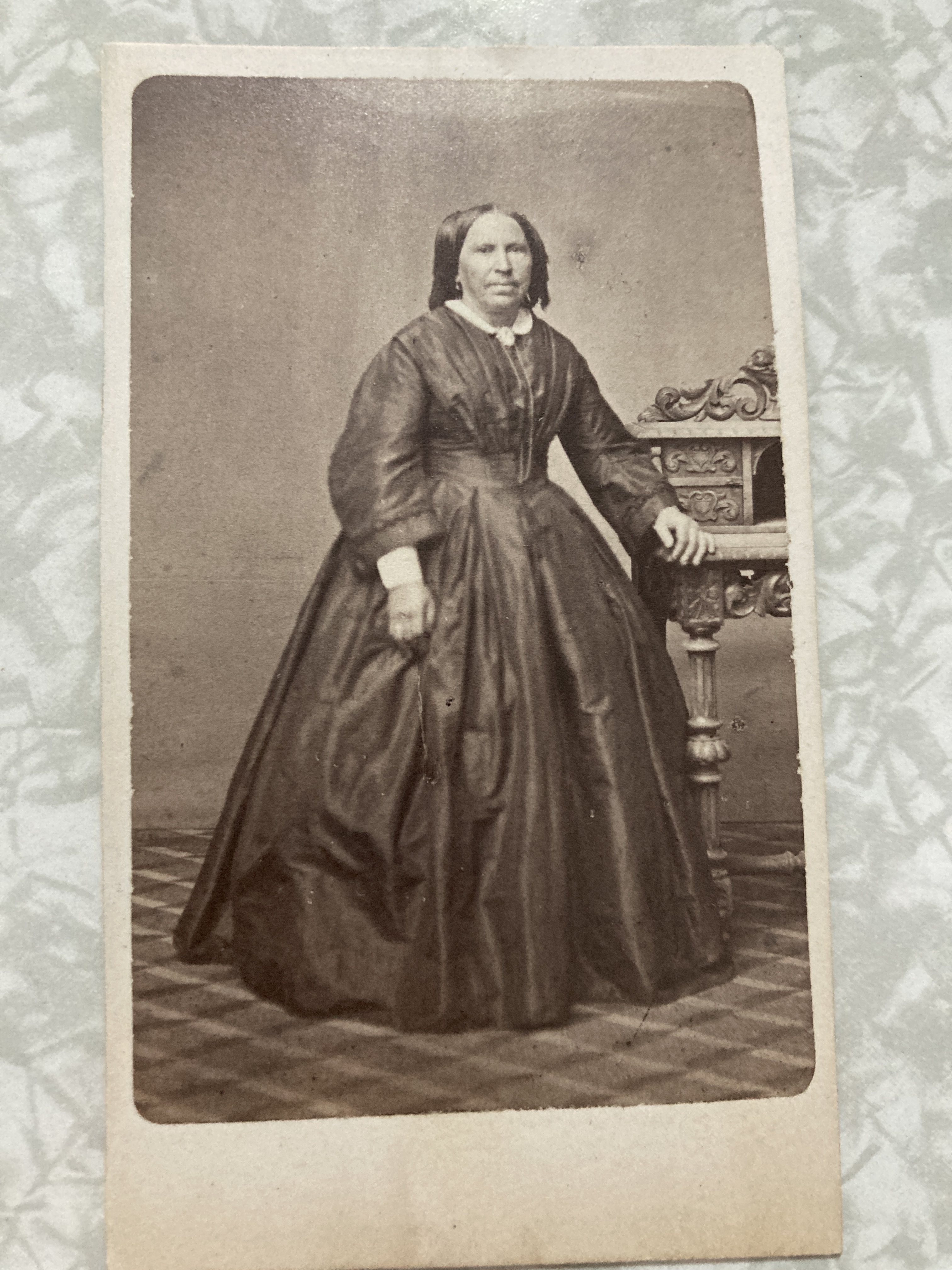
It also was taken by J.B. Hilsdorf, and for the same reasons Ava dated it in the mid-1860s. She estimated the woman’s age to be in her late 40s, early 50s, giving her a birth year range of 1812 to 1817. Based on the age and other photographs I have of my three-times great-grandmother Babette Schoenfeld Seligmann, Ava thought there was a good possibility that this photograph was also Babette. Here are the other photographs of Babette that Ava used for comparison.
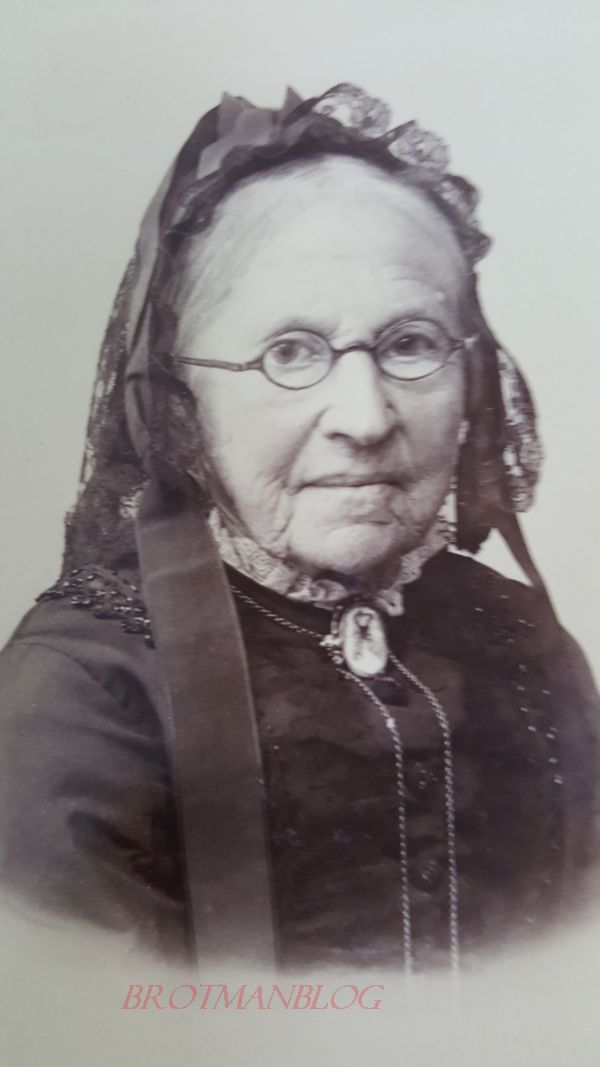
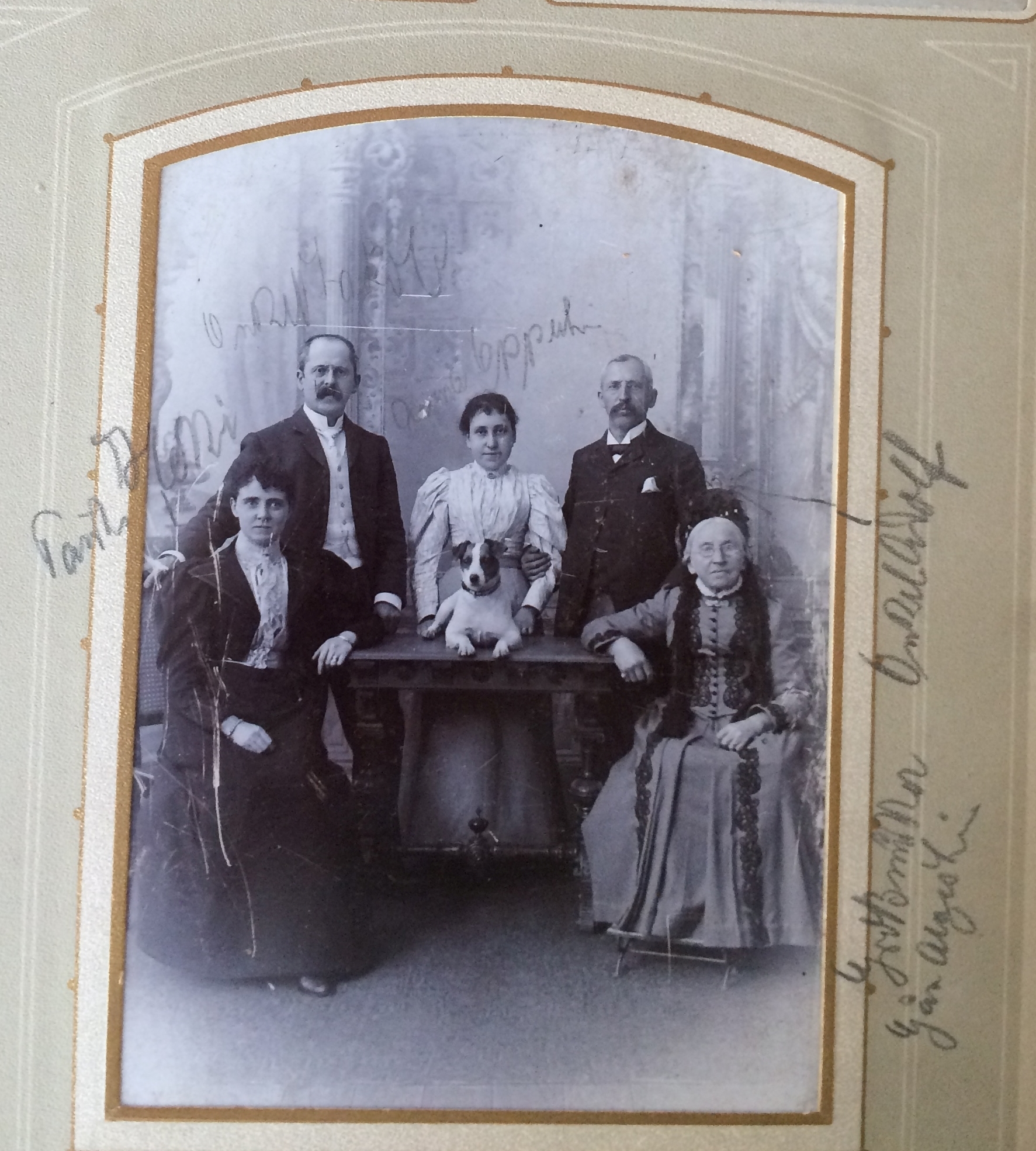
Ava did an incredible job of researching the photographers and the photographs they’ve taken to come up with reliable time frames for when the album photographs were likely taken. But it is only possible to go so far with identification without known photographs of the people in your family to use for comparison. You can narrow down the possibilities and eliminate those who clearly do not fit within the parameters of the dates, but you can never be 100% confident of the specific identity of the person in the photograph based just on dates and locations. I wish I had more photographs that Ava could have used to make facial comparisons, but I don’t. I have to accept that I may never know who most of these people were.

Fortunately, there were a handful of photographs in the Nusbaum Album that were labeled and that I could on my own identify and place in my family tree. More on those in my next few posts.


  1. Ava Cohn, Analysis of Nusbaum Album #4, March 17, 2024 
  2. Ava Cohn, Analysis of Nusbaum Album #5, April 3 ,2024

The Nusbaum Album: An Introduction

Some of you may recall that last fall I received a call from an antique dealer in Santa Fe who had in her shop a photograph album with the names John Nusbaum and Frances Nusbaum engraved on the front and rear covers, respectively. I immediately knew that this album had belonged to my three-times great-grandfather John Nusbaum and his daughter Frances, my great-great-grandmother. Frances had married my great-great-grandfather Bernard Seligman and moved from Philadelphia to Sante Fe, where they raised their children, as I told in my family history novel, Santa Fe Love Song.

I agreed to purchase the album and when it arrived, I marveled at the collection of almost two hundred photographs of people I hoped were my relatives—or at least I hoped that some of them would be. But except for a handful of those photographs, there were no labels or names to identify the people in them. Almost all, however, had a photographers’ stamp that indicated where they were taken.

The largest group of photographs (43) were taken in Philadelphia, where John Nusbaum had settled after immigrating from Schopfloch, Germany, in about 1840. He had initially been a peddler traveling throughout Pennsylvania, but eventually settled in Philadelphia and established a dry goods store there. He married Jeanette Dreyfuss, another German immigrant, and had six children, my great-grandmother Frances being the third child and oldest daughter. Thus, I assumed many of the Philadelphia photographs were of John and his family as well as of other family members and friends. But who was who? I had no idea.

Not surprisingly, the next largest group of photographs were taken in Germany, including some taken in Mainz and some in Bingen, the two larger cities closest to Gau-Algesheim where Bernard Seligman and his siblings were born and raised. There were also photographs taken in other German cities, such as Stuttgart, Berlin, and Wiesbaden.

There were eight photographs taken in Santa Fe, where Frances Nusbaum had moved with her husband Bernard and their three older children in about 1870. Their youngest child Arthur Seligman was born in Santa Fe, but my great-grandmother Eva Seligman was born in 1866 in Philadelphia.

Three photographs were taken in Harrisburg, Pennsylvania, and several were taken in Lewistown, Pennsylvania, two locations where John and Jeanette’s siblings lived in Pennsylvania, so I assumed that those photographs were likely of those Nusbaum/Dreyfuss cousins. The remaining photographs were taken in other places such as New York City; Montgomery, Alabama; Wheeling, West Virginia; Peoria, Illinois; and St. Louis, Missouri.

Each page in the album has four slots for photographs. On the first four pages of the album, there are two photos, back-to-back, in each slot so that you cannot see the reverse of the photos without pulling them out of the slots. Then starting on the fifth page in the album, there are only four photos on each page, and the reverse of those photos shows through on the back of the slot on the back of the page.

What it took me a long time to realize is that all the photos squeezed into the back of those on the first four pages are photographs from Germany. I think that these photographs from Germany may have been added once all the other slots were filled. They likely belonged to Bernard Seligman and were added after he married Frances. I will get to these photographs in a later post, but my reason for mentioning this here is to indicate that I think that aside from those German photos, the others were probably placed by John, Jeanette, or Frances Nusbaum.

The photographs appear to be somewhat grouped together by the location where the photographs were taken and by photographer. The photographs seem to follow roughly this geographical order: Pennsylvania, including many from Philadelphia, but also Harrisburg and Lewistown; then two pages from Peoria, Illinois; then three pages of Santa Fe photographs; then some from New York City and other places; and then photographs from Germany (plus the ones on the reverse of the first few pages). There are also some that appear in random places within the album, but overall this is how the album is arranged.

Since I only had names on a handful of photographs and since I had no idea when the photographs were taken, I decided to retain the expert services of Ava Cohn, aka Sherlock Cohn, the Photo Genealogist. Long time readers of my blog know that I have had great success hiring Ava in the past to help me identify people in old photographs.

With the financial support of my brother and my cousins Marcia and Terry, I asked Ava to help me with this new project. I also agreed to sell the album after Ava and I were done with it to my cousin Jhette for the price I paid to the antique dealer; that way I had more money to hire Ava. Although I was sad to think that I would not be able to keep the album, I knew that Jhette, another descendant of Bernard Seligman and Frances Nusbaum, would take good care of it.

Because of the large number of photographs and my limited resources, I had to limit the scope of Ava’s work. I asked her only to date the photographs and to estimate the ages of the people in them. I was not asking her to do any identification of the people. I was hoping that with those two bits of dating information, I’d be able to deduce who the people were in the photographs—or at least narrow down the possibilities—by studying my family tree.

I also had to limit her work to about 20-25 of the almost two hundred photographs in the album. I decided to focus on those taken in Philadelphia, Santa Fe, Mainz, and Bingen because I knew that those would most likely be of my direct ancestors. As noted above, I figured that the Harrisburg, Peoria, and Lewistown photographs were of Nusbaum/Dreyfuss cousins. I had no idea who in the family (if anyone) lived in Berlin, Stuttgart, or Wiesbaden, Germany, or for that matter in St. Louis, Wheeling, or Montgomery. I knew of one branch that lived in New York, but not direct ancestors.

But because there were so many photographs taken in Philadelphia, I had to find some way to narrow down Ava’s work so that she could have the best chance of identifying the people in the photographs I chose. Based on her suggestions, we started with the photographs on the first page, figuring that those would most likely be the closest relatives if not the owners of the album; three of those were taken by the same photographer in Philadelphia. The fourth and the very first photograph in the album was taken in Harrisburg. There were two men and two women. In my wildest dreams, I was hoping that they were of John and Jeanette and Frances and Bernard.

Here are those first four photographs:

In my next two posts I will share what I learned from Ava about these four photographs and how I decided to choose the remaining 15-20 photographs for her to analyze. This will be a multipart series of posts devoted to the Nusbaum album.


An Exciting New Project in the Works!

Before I move on to the next child of Moses Blumenfeld I, I have two other matters to write about. In my next post I will share some wonderful photographs that my cousin Robin shared with me. Robin, my fifth cousin, once removed, is descended from Abraham Blumenfeld and Geitel Katz through their son Moses I. More details to follow in the next post.

But today’s post is about some other amazing photographs. A couple of months ago I received an email out of the blue from an antiques dealer in Santa Fe named Peggy Gonzalez. Peggy had found me through my blog while looking for a descendant of John Nusbaum, my three times great-grandfather and my father’s namesake. Over thirty years ago at an estate sale, she had acquired a photograph album engraved with the name John Nusbaum on the front. She wanted to know whether I would be interested in buying the album.

At first I was skeptical. There are so many scams out there today. Anyone could have found my blog and made this up. But Peggy sounded honest, and she sent me these scans of the front and back of the album as well as a few representative photos. The back is engraved with “To F. Nusbaum.” My great-great-grandmother was John Nusbaum’s daughter Frances Nusbaum Seligman, and she had lived much of her adult life in Santa Fe with her husband Bernard, my great-great-grandfather. Peggy’s story seemed to be authentic.


I was extremely excited—as you might imagine. I’ve never seen a photograph of John Nusbaum or Frances, and here was a whole album of photos. Almost 200 photos. Thanks to the generosity of some of my Seligman/Nusbaum/Cohen relatives, I arranged to purchase the album. I also got extraordinary help from Mike Lord, our guide in Santa Fe from 2014 and a close friend of my cousin Pete. He acted as the middleman between Peggy and me, retrieving the album and giving Peggy my check and then sending me the album.

The album is now safely in my house, back in the hands of one of John Nusbaum’s descendants. I have retained the services of Ava Cohn, aka Sherlock Cohn, the Photogenealogist, and am now waiting in her queue for her to have time to devote to this project. I’ve scanned the front and back of all the photos. They are all studio photographs—cabinet photos, I think they are called. Small, but very clear. And they all have the names and addresses of the photographers on the reverse side. But only three have any identification of the people in the photograph.

There are photographs that were taken in several cities in Germany as well as all over the US: Philadelphia, New York, Santa Fe, Peoria, Lewistown (PA), and St. Louis. I am hoping that if Ava can provide dates for when they were taken and perhaps the ages of the people, I can then figure out who these people are.

I will wait to share the photos until after I have had the benefits of Ava’s help, but I wanted to share now my excitement about this. Stay tuned for more!


Irmgard Johanna (Joan) Lorch Staple (1923-2022): A Woman Ahead of Her Times

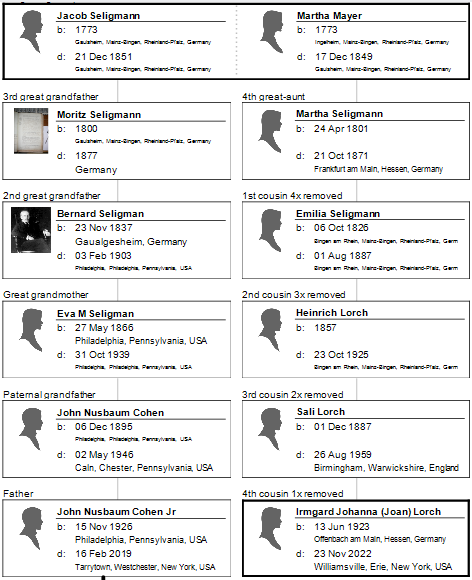
Last month my cousin Wink Lorch informed me that her aunt and my fourth cousin, once removed, Joan Lorch Staple had passed away on November 27, 2022, after living a remarkable life for more than 99 years. Joan was related to me through our mutual ancestors, Jacob Seligmann and Martha Mayer, she through their daughter Martha and me through their son Moritz, my three-times great-grandfather.

Joan was born in Offenbach, Germany, on June 13, 1923, escaped from Nazi Germany to England with her parents during the 1930s, and married Peter Staple in England in 1952. Together they had two sons and immigrated to the US, settling first in Alabama and later in Buffalo, New York. Joan also had a long and successful career while raising her family; she was truly a woman ahead of her times..

Joan had a remarkable career as a scientist and as a scholar and teacher, as described below in her obituary, and she wrote two memoirs about her life: Chance and Choice: My First Thirty Years (2007) and Change and Challenge: My Life After Thirty (2009). I have read them both, and they are fascinating. They tell not only the story of Joan and her family, but provide valuable historical insights into living in Germany before the Nazi era, the persecution of Jews during the Nazi era in Germany in the 1930s, life in England during World War II, and racism in Alabama before and during the Civil Rights movement, as well as the struggles of being a woman scientist in the years before, during, and after the Women’s Movement.

But the obituary written by Joan’s sons tells her story much better than I can. Thank you to my cousin Wink Lorch, Joan’s niece, for sharing it with me.  

Irmgard Joan Staple: Path-Breaking Canisius Scientist and Women’s Advocate Has Died

Joan Staple (known professionally as Dr. I.J. Lorch) passed away at the age of 99 on November 27, 2022, in her home at Canterbury Woods, Williamsville, New York.

A Professor of Biology at Canisius College for more than 30 years, Dr. Lorch also pioneered women’s studies programs at Canisius. Her ground-breaking research in the field of cell biology at the University of Buffalo was recognized by the New York Times and led to more than 30 publications in peer-reviewed scientific journals.

Early Life and Education

Dr. Lorch was born into a Jewish family in Offenbach am Main, Germany. Her father was a co-owner of Rowenta, the innovative electric appliance brand. Her family escaped the Nazis by fleeing to Birmingham, England in 1938. Lorch’s forced emigration from Germany is marked by a series of Stolpersteine — commemorative bronze plaques — set into the sidewalk outside her former home at 19 August Bebel Ring.

She attended public schools in Offenbach until 1935 when Jewish children were banned from secondary education. After emigrating, she continued her education at King Edwards High School for Girls and later graduated from Birmingham University. She went on to earn a PhD in histochemistry from the University of London in 1949.

Scientific Career

As one of the very few women working in the ‘hard sciences’ at that time, she continued her post-doctoral research on cellular aging at Kings College, London. Rosalind Franklin worked in the lab next door. The many challenges facing women in building scientific careers are well documented in the struggle to properly credit Franklin for her critical role in discovering the structure of DNA.

In 1952, Dr. Lorch married Dr. Peter H. Staple, research dentist and fellow post-doctoral student. For the next 10 years she became a homemaker raising two sons and over-seeing the family’s move to Birmingham, Alabama in 1959, and then to Buffalo in 1963.

Once in Buffalo, Dr. Lorch rejoined her King’s College mentor and colleague, James Danielli, who was then the Director of The Center for Theoretical Biology at the University of Buffalo. The team was funded by NASA and carried out pioneering work on how cells age and whether living cells can be created from cellular components. This work came to a spectacular conclusion from the controversy created by the Nov. 13, 1970 New York Times article declaring that University of Buffalo scientists had documented “the first artificial synthesis of a living and reproducing cells”. Hundreds of media outlets picked up on the story that UB scientists were creating living cells that might be shipped by NASA on spaceships to Mars.

These reports misrepresented the research and the ensuing publicity upended the  research agenda. In 1973, Dr. Lorch left the University of Buffalo accepting an offer from Canisius College. 

She shifted her professional focus from research to teaching becoming Professor and Chair of the Department of Biology. To address the discrimination against women in scientific fields, with the support of the Canisius College leadership, she spent over 20 years training and hiring women scientists and also broadening the scope for women’s participation in the management of the College. Dr. Lorch founded the women’s studies program at Canisius, now called Women and Gender Studies. She created a course for non-majors called the Biology of Women (sex ed for college kids) that soon attracted so many men that she had to limit enrollment.

In recognition of her devoted advocacy for women, in 1992 Canisius established the annual I. Joan Lorch Award to “honor a person who has made a significant contribution to women and who exemplifies the pursuit of liberation and justice regarding sex, gender, and sexuality.”

Following her retirement from Canisius in 2003, Dr. Lorch published a two-volume memoir: Chance and Choice (2007) and Change and Challenge (2009).

As recounted in her memoir, Dr. Lorch witnessed many of the 20th century’s historic events. She saw Hitler speak at the opening of an autobahn near Frankfurt in 1935, and Martin Luther King at Kleinhans Music Hall in Buffalo in 1967. She personally knew the discoverers of DNA (Watson, Crick and Franklin) and saw the fruits of her own research on amoeba used for cloning new organisms.

In 2019, Canisius College awarded Dr. Lorch the degree of Doctor of Humane Letters to celebrate “her exceptional achievements in scientific research, unwavering dedication as an educator and for being a steadfast advocate for women.”

Since learning to ski as child in Switzerland, Dr. Lorch was also an avid outdoors woman. She skied well into her eighth decade in Europe and North America and was also an active member of the Adirondack Mountain Club. In recent years, she loved playing Scrabble with her family and connecting on-line daily with other players of “Words with Friends”.

She was pre-deceased by her husband of almost 60 years, Dr. Peter Staple, Professor of Oral Biology at the University of Buffalo’s Dental School. She is survived by her sons Gregory (Siobhan) of Chevy Chase, Maryland, and Alan of Chestertown, Maryland; four grandchildren, Nicole, Nico, Justin and Camille; and one great grandchild, Naomi Joan.

A memorial service will be held at the Unitarian Universalist Church of Amherst in 2023. Donations, in lieu of flowers, should be made to Hospice & Palliative Care Buffalo. https://www.hospicebuffalo.com/give-get-involved/donate-now

A more abbreviated version of her obituary appeared here in The Buffalo News on December 4, 2022.

Joan’s life and career are an inspiration. She overcame leaving her homeland, adjusting to two different countries (and two different regions within the US), learning English, separating from her family, facing prejudice and discrimination, and nevertheless having a highly successful career balanced with a highly successful family life. Her two memoirs taught me so much about grace and strength and persistence.

I Am Back!

After two glorious weeks with my kids on the Cape, I am back to my blog and my family history work.

While I was researching and writing about my Goldfarb cousins, a few other interesting discoveries came in on other matters. Before I turn to my next big topic—the family of my great-aunt Toba/Taube/Tille Brotman Hecht—I want to share these other discoveries.

First, my cousin Wolfgang found an envelope that I found very exciting in the “magic suitcase” of Seligmann family history documents .

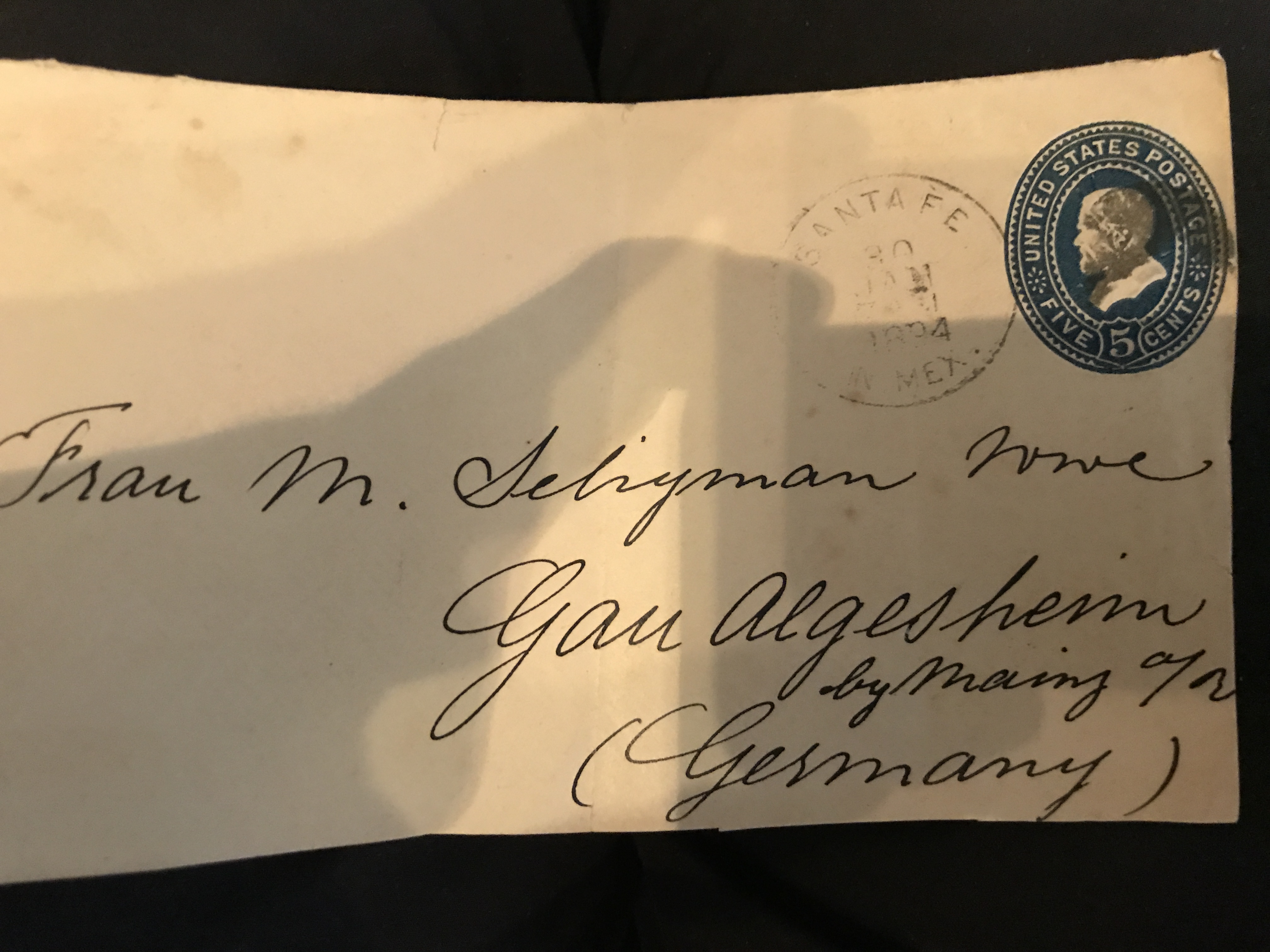
You can see that it is addressed to Frau M. Seligman in Gau-Algesheim, Germany, and postmarked on January 30, 1894, from Santa Fe, New Mexico.  This was most likely a letter from my great-great-grandfather Bernard Seligman to his mother, Babette Schoenfeld Seligmann, or Frau Moritz Seligmann. It could also have been a letter from Bernard’s brother Adolf to his mother or a letter from one of Bernard’s children to his or her grandmother. Unfortunately, there was no letter inside the envelope. But it is evidence that the American Seligmans were still in touch with their family back in Gau -Algesheim many decades after leaving Germany and coming to the US.

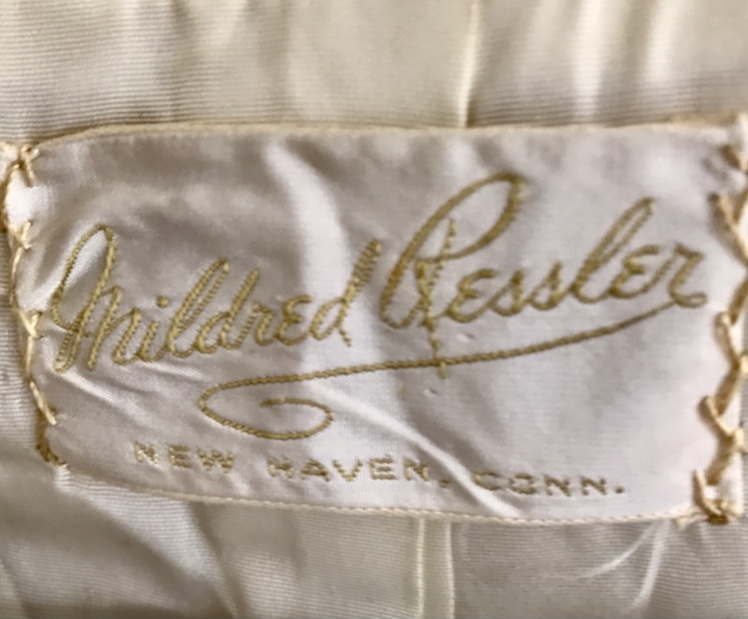
The other interesting discovery related to my great-aunt Tillie Brotman Ressler’s family. Her son Leo and his wife Mildred owned a dress shop in New Haven, Connecticut for many years. A woman was cleaning out her mother’s closet and found the dress depicted below. She googled the name Mildred Ressler and found my blog and then was so kind to contact me and share these photos of the dress. I shared them with Leo and Mildred’s son Peter, my second cousin. We were both very moved by seeing these pictures.

I love to see these little mementos capturing part of the lives of my relatives. The material objects somehow makes those lives real to me in ways that are different from photographs.

Abq Jew Blog: A Post about Santa Fe Love Song

Thank you so much to Marc Yellin, the author of the blog Abq Jew, for his delightful blog about my latest novel, Santa Fe Love Song. You can read his blog post here.

Abq Jew ® Blog

Was Moritz Oppenheimer Forced by the Nazis to Divorce His Wife and Declare Bankruptcy?

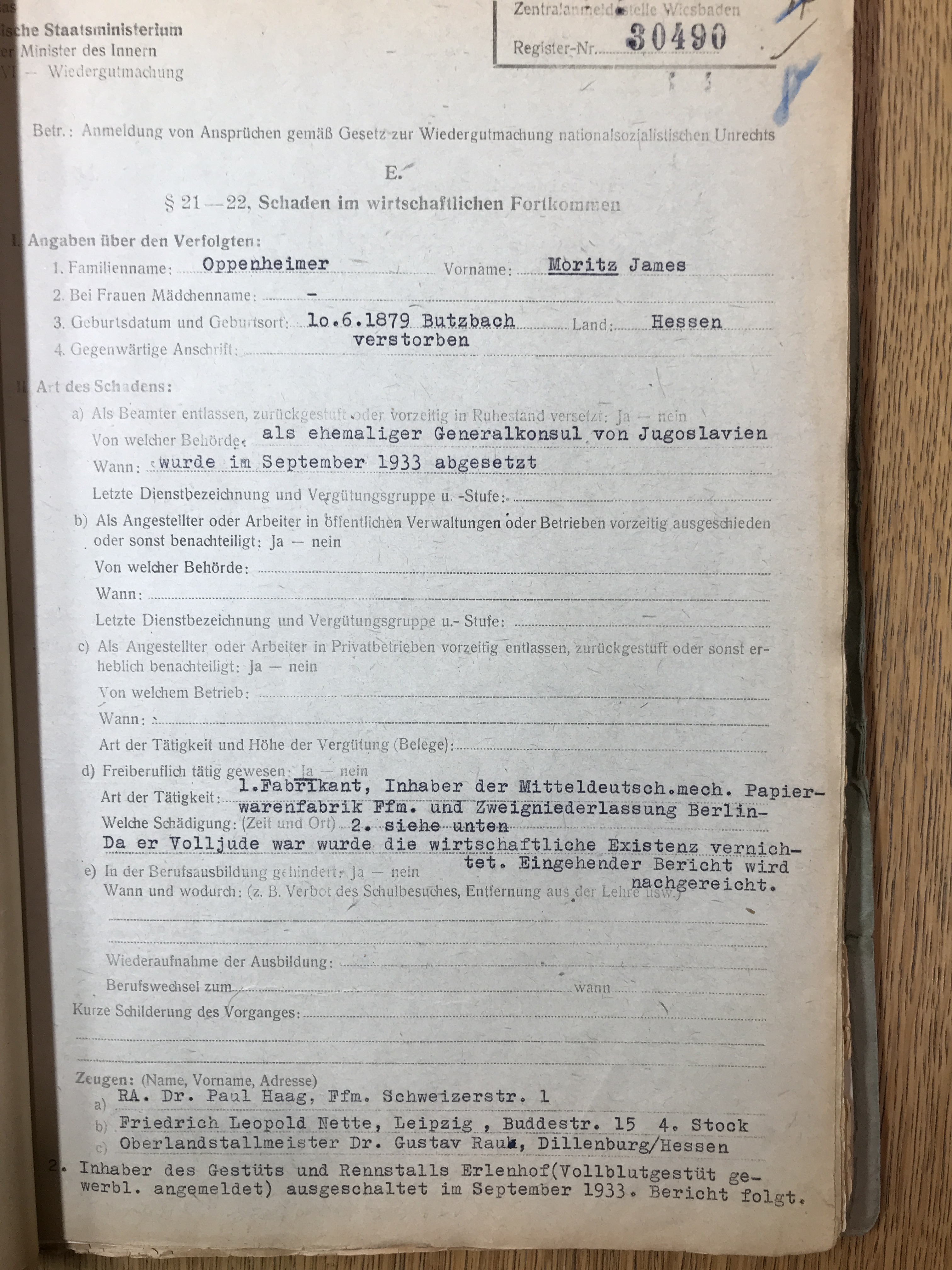
I have written several posts about my cousin, Moritz Oppenheimer, the nephew of my great-great-grandfather Bernard Seligman. Moritz was an extremely successful business owner and also racehorse breeder and owner who ended up committing suicide as a result of the persecution he experienced by the Nazis.

Emma Neuhoff and Moritz James Oppenheimer
photo courtesy of Angelika Oppenheimer

My cousin Wolfgang Seligmann recently discovered additional information about Moritz and his family, including an application filed in 1966 in Wiesbaden by Moritz Oppenheimer’s widow Emma Neuhoff, seeking compensation for the harm done to her husband and the financial losses suffered.

Emma Neuhoff Oppenheimer 1966 application for reparations

In reviewing those documents (with invaluable help from Wolfgang), I focused on two questions that had been raised by readers who commented on my earlier posts about Moritz Oppenheimer. First, were Moritz and his non-Jewish wife Emma forced to divorce by the Nazis in 1936, or did they choose to divorce? Second, was Moritz forced into bankruptcy by the Nazis in 1933, or were his businesses already failing before the Nazis came to power?

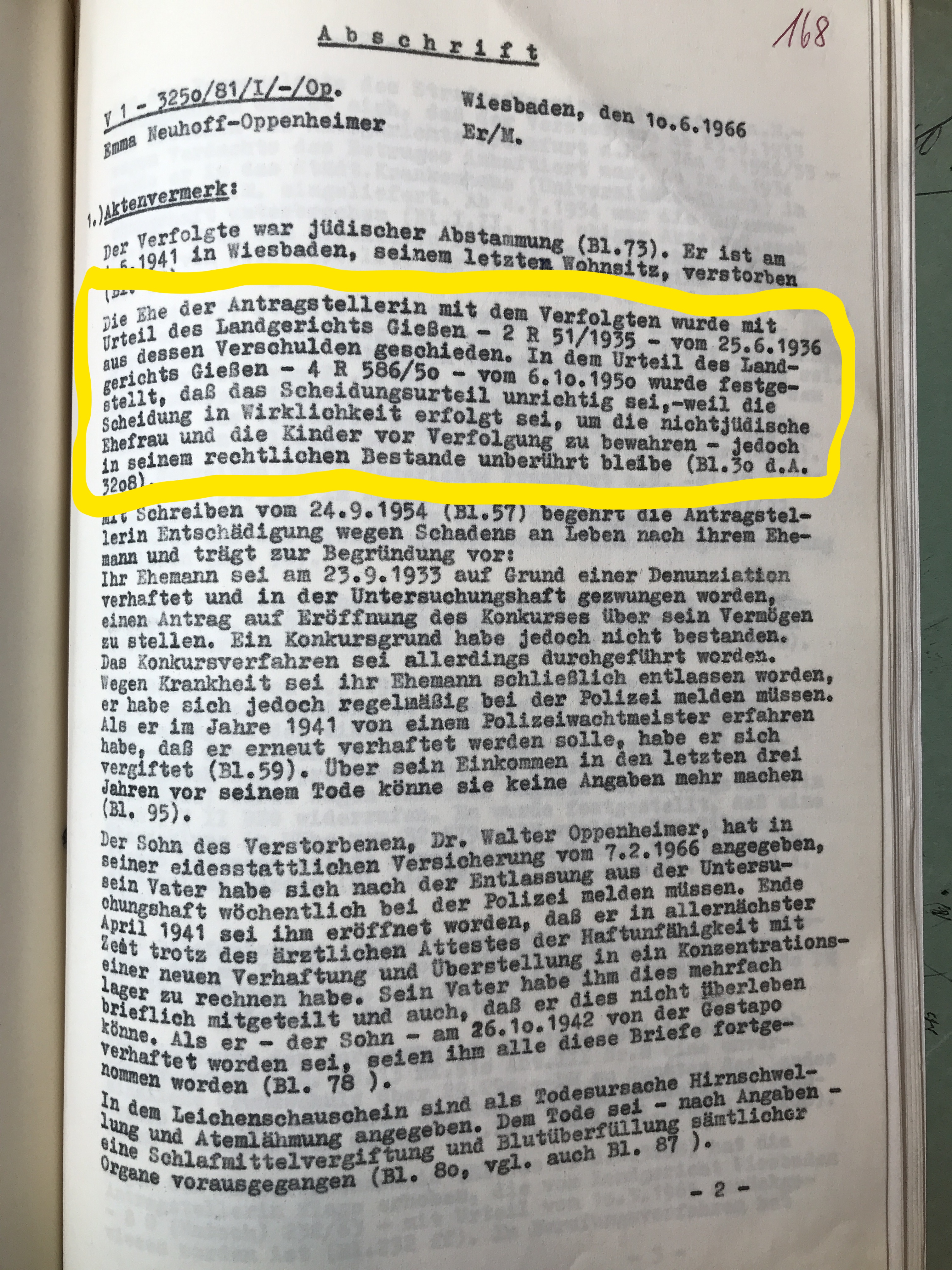
The first question is addressed by the court in its opinion approving the settlement between Emma and the government. The court recognized that Emma and Moritz had only divorced to protect Emma and their two children, who were not Jewish.

Court notes on divorce of Emma and Moritz Oppenheimer in decision approving settlement of Oppenheimer 1966 reparations claim

I used DeepL to translate this language and for the other translations in this post:

The marriage of the applicant with the persecuted person was divorced by judgment of the regional court Giessen 2 R 51/1935 of June 25, 1936 through his fault. In the judgment of the regional court Giessen 4 R 585/50 dated 6 October 1950 it was determined that the divorce judgment was incorrect because the divorce had actually taken place in order to protect the non-Jewish wife and children from persecution — but its legal validity remained unaffected.

With respect to Emma’s application for compensation, the court concluded that even if Emma was no longer legally married to Moritz at the time of his death and thus not technically his widow, she was nevertheless entitled to pursue her claim for compensation for the harm done to her husband and her family.

The applicant is entitled to claim. It can be left open whether she is the widow of the deceased, … or this is treated as a blameless divorced wife.

Thus, Emma and Moritz chose to divorce to protect Emma and their two children. It was a decision based on love, not a lack of it.  Although the Nazis did not require the Oppenheimers to divorce, the circumstances the Nazis created compelled the couple to divorce.

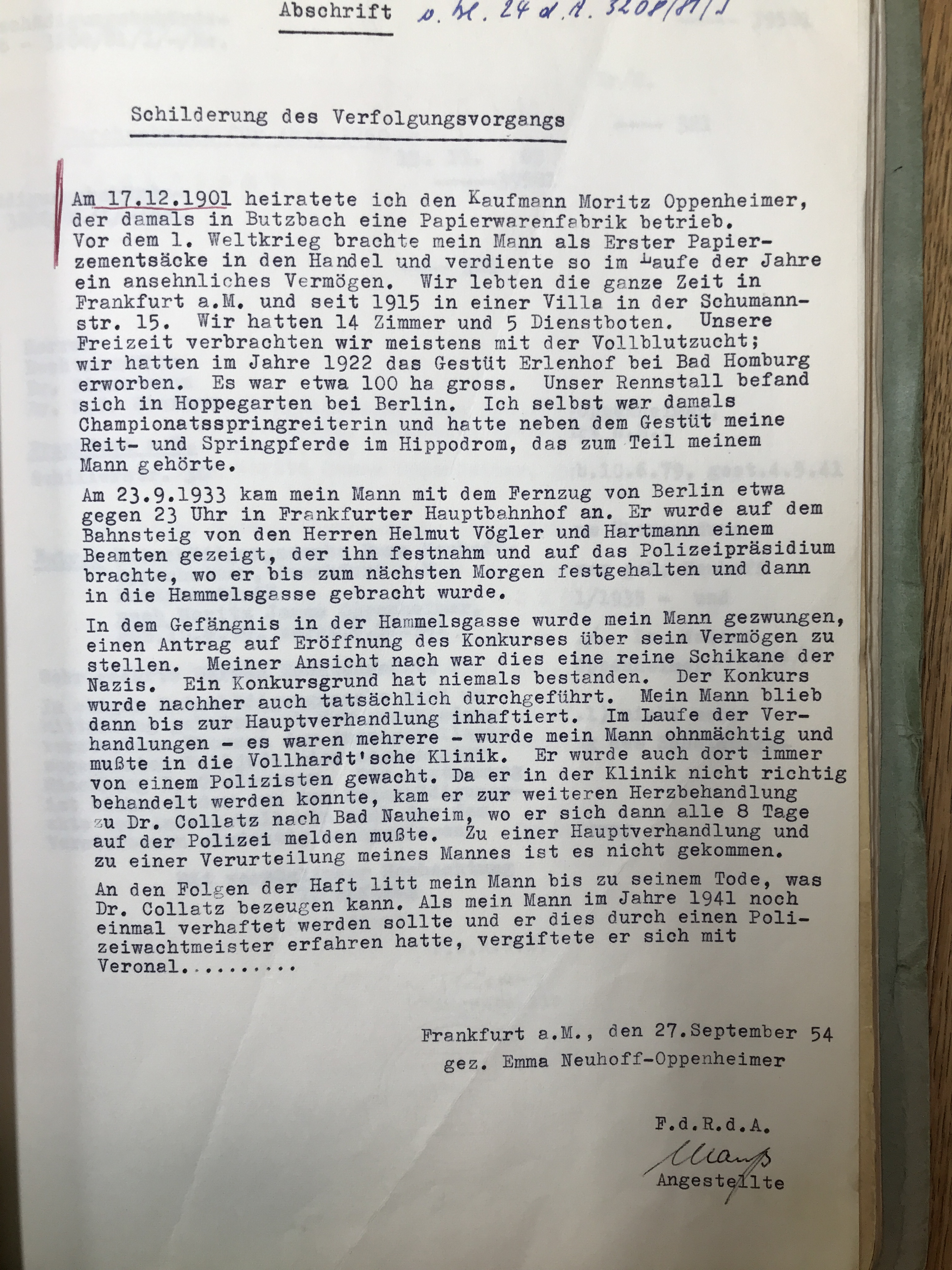
The question regarding the bankruptcy is more complicated. Emma contended that Moritz was forced into bankruptcy by the Nazis when he was arrested in September, 1933, the first of many arrests that eventually drove him to suicide in 1941, as has been described in earlier posts. Emma wrote in the third paragraph of her statement in support of her application for compensation in 1966:

Emma Neuhoff Oppenheimer statement filed in support of her 1966 application for reparations

In the prison in Hammelgasse, my husband was forced to file for bankruptcy on his property. In my opinion, this was pure Nazi harassment. There was never a reason for bankruptcy. The bankruptcy was actually carried out afterwards.

But a man named August Hartmann filed an accusation against Moritz with the Nazi party in which he claimed that Moritz had defrauded a family from Frankfurt out of almost one and a half million Reich Marks;  these fraud claims were never fully litigated because Moritz died before that could happen. Hartmann also claimed that the businesses owned by Moritz were heavily in debt and that Moritz was a flight risk.

Statement of August Hartmann regarding claims against Moritz Oppenheimer

Here is the DeepL translation of Hartmann’s statement:

The well-known industrialist and racing stable owner Consul Moritz Oppenheimer has lived for many years only on credit fraud. In the years 1931 and 1932 he swindled a very respectable Frankfurt family out of the round sum of one and three-quarter million Reichsmark in cash under false pretences. This case is all the more blatant because this amount of money came from assets confiscated during the war in America. That was only released at the end of 1929 and taken to Germany by the family, out of national interest in making this large amount of money available to the ailing German economy.  Despite the fact that this fraudulently damaged creditor has known for half a year now how the finances of Consul Oppenheimer are, he has now refrained from taking radical steps which were in his personal interest, in order not to make more than 250 German workers unemployed. But because of the great expenses of Mr. Consul O., for example maintenance of the Erlenhof Stud Farm, which requires a monthly subsidy of about 15,000, financial conditions have deteriorated to such an extent that bankruptcy is only a question of time, the strong suspicion arises that this Jew wants to run off to a foreign country where he in all probability has stashed a considerable fortune.

It was this letter from August Hartmann that led to the arrest of Moritz Oppenheimer in September 1933 and then to his alleged forced bankruptcy. Thus, Moritz may have been pushed into bankruptcy proceedings, but if Hartmann’s letter is true, Moritz was already in serious financial trouble.

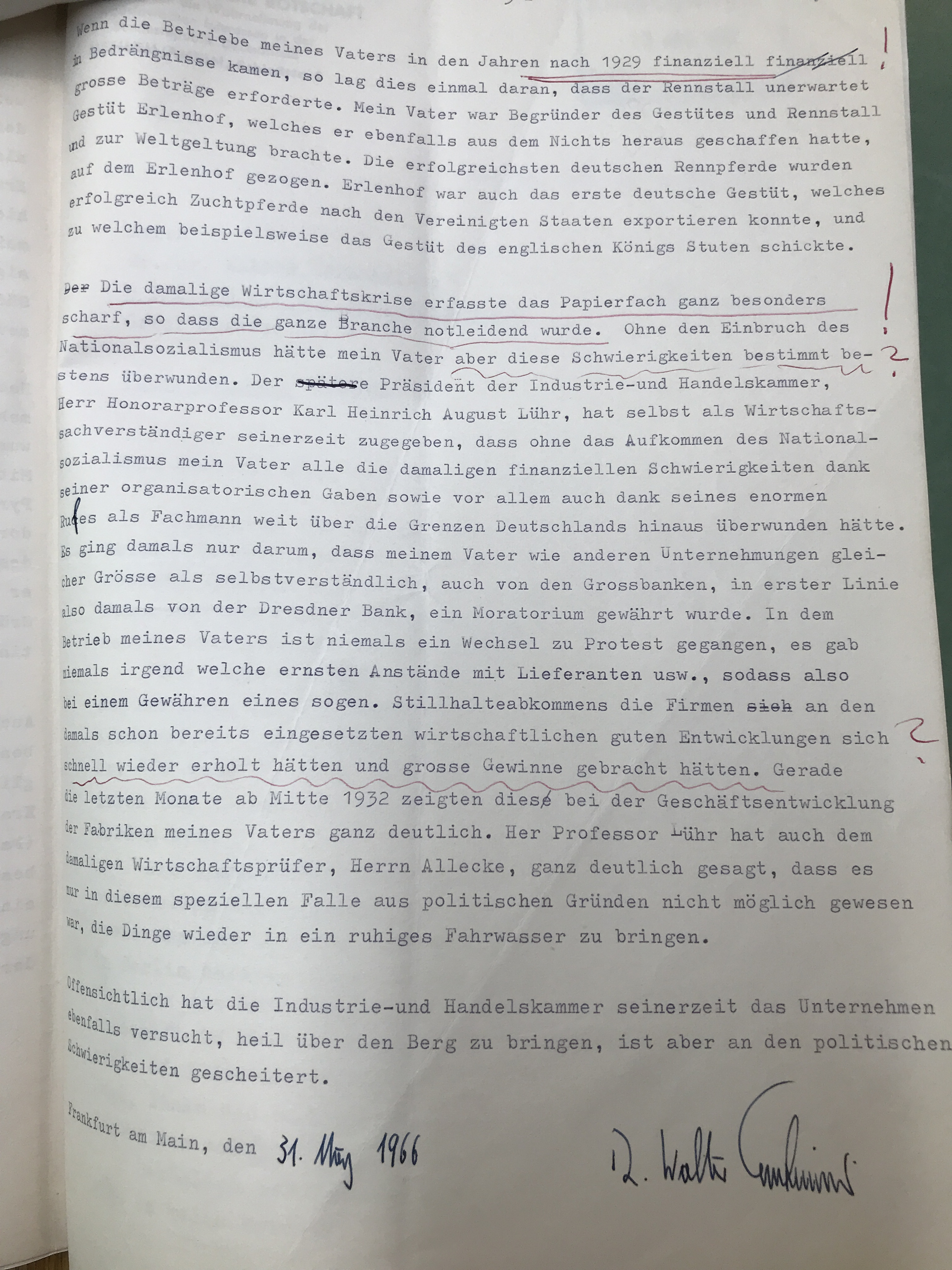
Moritz’s son Walter Oppenheimer, in his affidavit in 1966, admitted that his father had incurred a great deal of debt by 1929, but argued that he would have been able to overcome these financial reversals but for the Nazis. He wrote in part (and translated as best I could, with help from DeepL and Google Translate):

Portion of the letter Walter Oppenheimer filed in support of 1966 reparations claim

If my father’s business got into financial difficulties in the years after 1929, it was because the racing stable required unexpectedly large sums. My father was the founder of the stud and racing stable Erlenhof, which he had also created out of nothing and brought to world fame. The most successful German racehorses were bred at Erlenhof. Erlenhof was also the first German stud farm which was able to export breeding horses to the United States, and to which, for example, the stud farm of the English king sent mares.

The economic crisis at that time hit the paper trade particularly hard, so that the whole industry was in dire straits. But without the advent of National Socialism, my father could have certainly overcome these difficulties perfectly. The President of the Chamber of Industry and Commerce, Honorary Professor Karl Heinrich August Luhr, himself an economic expert of his time, admitted that without the advent of National Socialism, my father could have overcome all the financial difficulties of the time far beyond the borders of Germany, thanks to his organizational gifts and, above all, thanks to his enormous expertise. … So that if a so-called standstill agreement was maintained, the companies could have recovered quickly from the good economic developments that had already begun and had brought large profits. Especially the last months from the middle of 1932 onwards showed this very clearly in the business development of my father’s factories. Professor Luhr also told Mr. Allecke, who was an accountant at the time, very clearly that it was only for political reasons that it became impossible to put things back on a level playing field.

Where the truth lies is impossible to determine. It certainly appears that Moritz was having serious financial troubles before 1933, but were they serious enough to require bankruptcy? Would the business have recovered if he had not been arrested and persecuted by the Nazis? If he had been given more time, could he have turned around his companies’ financial situation?

In the end, the 1966 court approved a settlement that provided Emma with some compensation for the loss of her husband and the suffering he endured as well as for her own economic losses. It was less than what she wanted, but it did recognize that despite the divorce, she was entitled to compensation, implicitly recognizing that they had not freely chosen to divorce. But the settlement did not compensate her for the failure of her husband’s businesses.

Almost twenty years later in 1984, the descendants of Moritz and Emma Oppenheimer filed another claim, this time with the District President in Darmstadt, seeking compensation for the economic damage sustained to the business of Moritz Oppenheimer, according to another set of documents that Wolfgang discovered in the Wiesbaden archives. As Wolfgang explained to me, the Germany government adopted new laws over time that updated the process for obtaining reparations by those who suffered harm because of the Nazis. This new claim was presented under a statute called Bundesentschadeugungsgesetz-Schlussgesetz or Federal Compensation Act-Final Act.

1984 decision on the application for reparations by the heirs of Moritz and Emma Oppenheimer

As with the claim filed back in 1966, this claim for compensation for the financial losses suffered by Moritz’s business was rejected. The district president found that Moritz would not have been able to sell the stables or racehorses to cover his business losses, given the economic conditions of that period and the extent of his business liabiltiies.  Thus, he concluded that the economic damage was not the result of Nazi persecution. In addition, the district president concluded that Moritz’s medical condition disabled him from seeking other employment, not the Nazis, so there would be no compensation for lost income from such potential employment.

Of course, Moritz’s medical condition could very well have been and probably was caused by or at least exacerbated by his arrest and persecution. And no one can know with absolute certainty that he would not have been able to rescue his business but for that arrest and persecution. But at least two different decision-making bodies concluded otherwise and rejected the family’s claims.

Four Years of Learning German

Just about four years ago in the summer of 2016, I decided to learn German. It’s been an interesting and mostly enjoyable challenge. First, I used the app Duolingo for almost a year. I learned a fair amount of German vocabulary. I was disciplined and practiced every day. It was fun.

But then I tried to read some simple texts written in German, and I realized Duolingo was fine for vocabulary building, but it wasn’t enough if I really want to read, write, and speak German.  We were going to Germany in the spring of 2017 and I wanted to be able to speak to the people in their own language, so I bought a few German textbooks to learn how to conjugate verbs and some other basic grammar.

But that also wasn’t enough. That became glaringly obvious when I tried to speak German on our trip. I couldn’t string together a grammatically correct sentence, and often I would get blank stares when I tried to ask a simple question in a German store or restaurant. And if someone answered me in German? I had no idea what they were saying. So in the fall of 2017, I signed up for a German class offered by a local adult education program.

That course was good for grammar. Lots of grammar. Lots and lots of grammar. Rules, rules, rules. But no conversation and no opportunities to read texts or ask questions. So I formed a German conversation group with people from the class. That’s been lots of fun, but I remain the worst German speaker in the group. My reading has improved, my writing is coming along (with help from Google Translate), but it still is very hard for me to speak or understand spoken German. Mark Twain was right. Learning German is not for the faint of heart.

Mark Twain By Mathew Brady [Public domain], via Wikimedia Commons

Why am I writing about this now, you may wonder?

Well, I’ve had reason recently to reminisce about why I started learning German. Why did I want to learn German? Of course, it was related to genealogy. My paternal roots in Germany are deep and wide. Knowing German would therefore be helpful. But to be honest, most of what I need to know for genealogy purposes can be reduced to some very basic terms: geboren (born), heiratet (married), gestorben (died). Really, you don’t need to know much more than that to read German vital records for basic information. And even knowing those terms won’t help much unless you can also read German script. Which I can’t.

No, it wasn’t a desire to read German vital records or even longer letters or texts that motivated me to learn German. It was rather a particular book that I very much wanted to read: Die Alte und Die Neu Welt, written by my cousin Mathilde Gross Mayer in 1951, as I discussed here.

Mathilde was born in Bingen, Germany, in April 1869. Mathilde’s grandmother Martha Seligmann and my three-time great-grandfather Moritz Seligmann were sister and brother, so we were second cousins, three times removed, both being direct descendants of Jacob Seligmann and Martha Mayer. Mathilde left Germany in 1937 to escape from Nazi persecution when she was almost 68 years old and a grandmother; she lived over thirty years in the United States after leaving Germany, dying in September, 1969, when she was a hundred years old.  I was fascinated by her life and wanted to read her book. So I started learning German.

But despite studying for four years and having a fairly decent basic German vocabulary, every time I picked up Mathilde’s book, I got frustrated. I still had to look up so many words that I could not just read this book. It was exhausting and too time consuming. Using Google Translate to translate one letter is one thing, but a whole book? So I gave up.

And then? Then my cousin Elizabeth found me this spring. Elizabeth is Mathilde Mayer’s great-granddaughter. She found my blog and contacted me. We exchanged a number of emails, finding many common interests and places in our lives as well as our shared family roots. And in the course of those emails Elizabeth shared with me that she had an ENGLISH version of Mathilde’s book in pdf format. And that she would send it to me. Which she did.

So one day a couple of weeks ago I sat at my computer and read Mathilde’s book in English. And I am so glad that I did rather than ruining it by trying to read it in German. It is just a wonderfully touching book—full of colorful portraits of many of my Seligmann cousins and warm and loving anecdotes about Mathilde’s life growing up in Bingen and then raising a family in Bingen. She shares the tragedies and challenges her family suffered as well as many of their joys and successes. I never would have been able to get the feel for her personality if I’d suffered through reading her book in German.

Sure, if I were fluent in German, that would have been even better—to read it as she wrote it. But to butcher it by reading it all chopped up would have been a terrible mistake. Elizabeth has asked me not to share the book on the blog, and so, of course, I am respecting her wishes. But I am so grateful that she shared the English version with me. Mathilde’s story will now always be with me.

So do I regret four years of struggling to learn German? Not one bit! I will continue studying it as best I can, and maybe someday I will actually be able to read Mathilde’s story in her native tongue.


How The Nazis Destroyed My Cousin Moritz Oppenheimer

Last time I shared the documents my cousin Wolfgang Seligmann found at the Wiesbaden archives about our mutual cousin Martha Oppenheimer Florsheimer. Today I want to share the documents Wolfgang found about Martha’s brother Moritz James Oppenheimer. Martha and Moritz were my great-grandmother Eva Seligman Cohen’s first cousins; they were the children of Pauline Seligmann, the sister of my great-great-grandfather Bernard Seligman.

As I’ve previously written, Moritz Oppenheimer was born on June 10, 1879, in Butzbach, Germany. Sometime before 1902, Moritz married Emma Katherina Neuhoff, who was not Jewish. Moritz and Emma had two children: Paula (1902) and Walter (1904). Moritz owned a paper factory in Frankfurt before the war as well as a large and very successful horse stud farm where thoroughbred horses were raised and sold. As his granddaughter Angelika reported to me, Moritz was a member of the board of directors of several companies throughout Germany. He was a very successful and wealthy man.

Emma Neuhoff and Moritz James Oppenheimer
photo courtesy of Angelika Oppenheimer

Moritz was arrested in the autumn of 1933. His marriage to Emma was dissolved because mixed marriages were not legal under the Nazi regime. Then his assets including his horse farm were confiscated and put into the hands of an administrator, who sold them at far below their market value. According to his son Walter, Moritz had been in good health up to this time, but these actions caused him to become quite ill. After being visited by Gestapo, he reportedly took his own life on May 4, 1941.

Wolfgang found three documents that illustrate just how desperate Moritz’s situation was. I am deeply grateful to Cathy Meder-Dempsey of the blog, Opening Doors in Brick Walls, who translated all three of these documents.

The first is a letter written by Moritz in early 1941 regarding his taxes for the year 1940.

Letter by Moritz James Oppenheimer 1941

Transcribing and translating this letter presented some real challenges because, as you can see, the first several letters of the first word on the left side of the letter were not visible, but somehow Cathy was able to make sense of it all.

Here is her transcription and her translation of the letter:

[…] 10.6.1879 in Butzbach (Hessen)

[…]kenkarte H 0240/39

An das Finanzamt Wiesbaden

Im Jahre 1933 wurde über mein Vermögen das Konkurs

[verfahren] eröffnet (Frankfurt a. Main)

[Ich] besitze weder irgend welches Vermögen noch Wertgegen-

[stande], noch Möbel, Wäsche, etc.

Im Jahre 1934 wurde ich in Folge schwerer Erkrankung,

[…Er]weiterung und Verlagerung, Wasserbildung, Angina pektoris

[…auf]störungen, Kopfbeschwerden etc. nach Bad-Nanheim

[…] Dort war ich bis vergangenes Jahr in ärztlicher

behandlung und Aufsicht.

[…] schwerer Gelenkrheumatismus hinzutrat, kam ich

[ein art]ztliche Verordnung nach Wiesbaden zur Kur.

[Einko]mmen aus irgend welchen Möglichkeiten habe ich

[nicht]. Ich wohne möbliert.

[…]welche Neuanschaffungen habe nicht seit 1933 in Folge

meiner Mittellosigkeit nicht gemacht.

[Meine]Lebensunterhalt sowie Arzt, Apotheke, Zimmer und Kur

hatte ich aus Unterstützungen von ?200 Mk (monatlich)

[nur] von Verwandten gegeben werden.

[Diese] Zuwendungen stammen aus bereits versteuerten

[…]gen, Einkünfte meiner Verwandten.

Nach wie vor bin ich schwer erkrankt

[Meine] Ehe was Mischehe, Frau Arierin. Meine Kinder sind

[…]ft, konfirmiert und gelten nicht als Juden.

[…] ich eine andere Steuerklärung abgeben müssen,

[…] um Zusendung eines Formulares.

Moritz Israel Oppenheimer

Weisbaden

Pagenstecherstrasse 4 (?? Marx)

Zur Abgabe einer (Einkommen) Eink. Erklarung

fur 1940 aufgefordert.

Translation:

To the tax office in Wiesbaden

In 1933, bankruptcy was declared on my assets (Frankfurt a. Main). I have neither assets nor other things of value, furniture, laundry, etc. In 1934, as a result of serious illness, (enlargement and relocation – ??), water retention, angina pectoris, (other) disorders, headache etc. I was sent to Bad-Nanheim. Until last year I was there under medical treatment and supervision. As severe rheumatoid arthritis set in, I received medical orders to take a cure in Wiesbaden. I don’t have any income possibilities and live in a furnished place. No new acquisitions have been made since 1933 as I am penniless. My livelihood as well as doctor, pharmacy, room and spa expenses have been supported with [?] 200 Mk (monthly) from my relatives. This support came from already taxed income of my relatives. I am still seriously ill.

My marriage was a mixed marriage, my wife was Aryan. My children are ____, confirmed and are not considered Jews. [I assume that the word that we cannot see was Mischling.]

I have to file another tax return, and request a form be sent.

Signature and address

Notation in pencil: He was asked to submit a declaration of income for the year 1940.

Cathy thought he was writing to get the correct tax form for someone in his financial position.

Although I had read his son Walter’s description of Moritz’s financial and medical condition, reading this letter written by Moritz himself was just heartbreaking. Here was a man who had found incredible success in business brought down to being very sick and penniless.

The second document I received from Wolfgang was a letter written by Walter Oppenheimer, Moritz’s son.

Letter by Walter Oppenheimer 1941

Cathy translated the typed section, written by Walter, as follows:

In an immediate polite reply to your letter of the 15th of this month that I received only today, I inform you that my father died on May 4th, 1941. Who the legal heirs are now I am not able to tell you as the two children, my sister and I, refused the inheritance in a publicly certified declaration before the local court.

Heil Hitler!

Walter Georg Oppenheimer

I was very disturbed to see that Walter had used “Heil Hitler” in this letter, but Cathy explained that that was to be expected in a letter to officials during Hitler’s reign. Nevertheless, it made the hair on my arms stand to see a relative of mine use that expression.

I wondered why Walter and his sister Paula would have refused the inheritance, and Cathy suggested that it was a means of avoiding taking on their father’s debts since there were apparently no assets to inherit.

The handwritten notes on the bottom of the letter appear to have been made by some official commenting on the status of Moritz’s inheritance, as transcribed and translated by Cathy:

Anfrage beim Amtsgericht Frankfurt am Main

wer Nachlassverwalter ist, und

wer die gesetzlichen Erben sind,

nachdem die Kinder ausgeschlagen

haben.

Translation:

Inquiry to the district court Frankfurt am Main

who is administrator, and who are the legal heirs, after the children refused inheritance.


An das Amtsgericht ffm (Frankfurt am Main)

Der fruher dort wohnhaft gewesene Moritz Israel Oppenheimer

geb. am 10.6.1879 ist hier am 4.5.41 verstorben.

Der Sohn des selbend Dr. Walter Georg Oppenheimer ffm. Schumannstr. 47 wohnhaft, hat mitgeteilt daß seine Schwester und er ? haben.

Ich bitte nur ____ von 2 zu 4 Wochen.

Translation

To the district court Frankfurt am Main

Moritz Israel Oppenheimer, who previously lived there, born on June 10, 1879 died here on May 4, 1941. The son of the same, Dr. Walter Georg Oppenheimer, a resident of Frankfurt am Main, Schumannstrasse 47, announced that his sister and he (symbols? probably mean disclaimed inheritance). I only ask ____ from 2 to 4 weeks.

Finally, the third document Wolfgang found in the Wiesbaden archives about Moritz is this handwritten page of notes about Moritz’s “income” for the first few months of 1941 before his death:

Oppenheimer ist am 4.5.41 gestorben.

Eink. 41 wurde geschätzt und wie folgt errechnet: freiwillige zuwandungen seines Sohnes 1940 = 4060 Rm : 12 = 338

von 1.1 – 30.4.41 je 338 Rm = 1352 Rm

                                       4x

./. Sondereingaben 4 x 15   =       60                                                1292

                                                   -60         1432 Rm

angaben des Nachlasspflegers Spring:  Bl. 22

__                                    

Translation

Oppenheimer died on 4.5.41. Income for 1941 was estimated and calculated as follows: voluntary contributions of his son 1940 = 4060 Rm : 12 = 338 per monthfrom 1.1 – 30.4.41 338 Rm = 1352 Rm

                                    4x

./. Special income 4 x 15           – 60

                                                 1292

                                                    -60      1432 Rm 

information from the estate administrator Spring: Bl. 22

I’m not really sure what to make of all the numbers or the value in today’s money. I also have no idea what were the practical consequences of these calculations. Did Moritz (or his estate) owe taxes based on the money he was getting from his son?

What I think I can safely infer from these last two documents is that even after seizing all of the assets of Moritz Oppenheimer and driving him into bankruptcy, poor health, and ultimately suicide, the German government was still looking for some way to collect more money from his family.

Thank you again to Cathy Meder-Dempsey for her hard work in transcribing and translating these difficult to read documents. They add insights into the awful suffering of my cousin Moritz Oppenheimer.

Moritz Oppenheimer

UPDATE: A few readers asked me what I know about Emma Neuhoff-Oppenheimer’s life after Moritz died in 1941. I asked Angelika, Emma’s granddaughter, and she sent me this article:

Emma Neuhoff article-page-001

Most of it is about her life as a horseback rider, but the last part of the article addresses her life during and after the Nazi era. I will translate just that section:

“Ms. Emma never lost her dignity and discipline. Even in the bitter years of the ghost, when the beloved man fell victim to the Nazi regime, when her life became dark, often lonely. A courage deeply rooted in her and the quiet cheerfulness accompanied her to the age that she now enjoys with good reading with the two children and children-in-law, the two grandchildren, and many loyal friends.”

Emma Neuhoff-Oppenheimer died on February 2, 1968, at the age of 86, three years after this article was written. Angelika also told me that her grandmother owned a shop in Frankfurt and played the piano.


Seligmann Updates: Martha Oppenheimer Florsheimer

Turning for a bit from the Goldschmidt family, I need to discuss some updates involving the Seligmann family. Some of this information came from my cousin Wolfgang, some from Aaron Knappstein.  In this post I will look at some documents that Wolfgang located about Martha Oppenheimer Florsheimer, and then in the next post some relating to her brother Moritz Oppenheimer.

Martha and Moritz were the children of Pauline Seligmann and Maier Oppenheimer. Pauline was the sister of my great-great-grandfather Bernard Seligman and Wolfgang’s great-grandfather August Seligmann. So Martha and Moritz were my first cousins, three times removed, or the first cousins of my great-grandmother Eva Seligman Cohen. I’ve written about them both before.

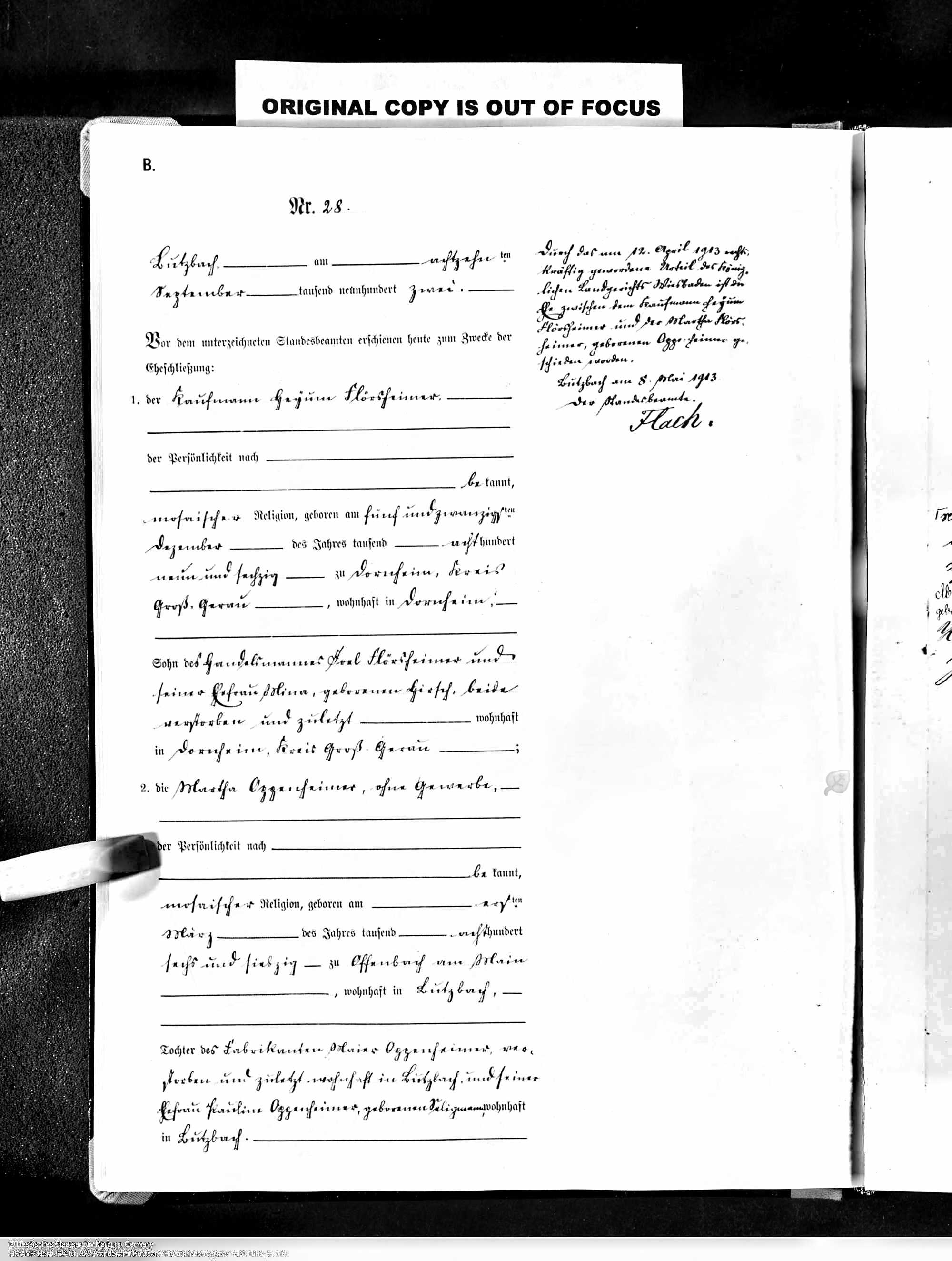
Martha married Heinrich Florsheimer on September 18, 1902, in Butzbach, Germany. They had two children, Gertrud and Paul. Martha and Heinrich were divorced on April 12, 1913. Martha was sent to the concentration camp at Theriesenstadt on September 2, 1942, and was released from there on July 8, 1945. She returned to Wiesbaden, where she’d been living before the Holocaust, only to learn that both of her children had been murdered by the Nazis, Gertrud at Sobibor and Paul at Majdanek.

The earliest of the new documents that Wolfgang located at the archives in Wiesbaden about Martha was dated March 7, 1940, and appears to be a form Martha submitted to report her assets and expenses. She appears to have reported no assets, and under expenses she reported 78.50 Reich Marks a month (I’m not sure what the 65 refers to) for rent, heat, gas, electricity, and water.

On page 2 of this document, Martha wrote the following note:

Ich werde unterstützt von meiner bis jetzt beschäftigte Tochter und meinem beschäftigt gewesenen Sohn.

Matthias Steinke of the German Genealogy group kindly translated this for me as, “I am supported by my still working daughter and my formerly employed son.”


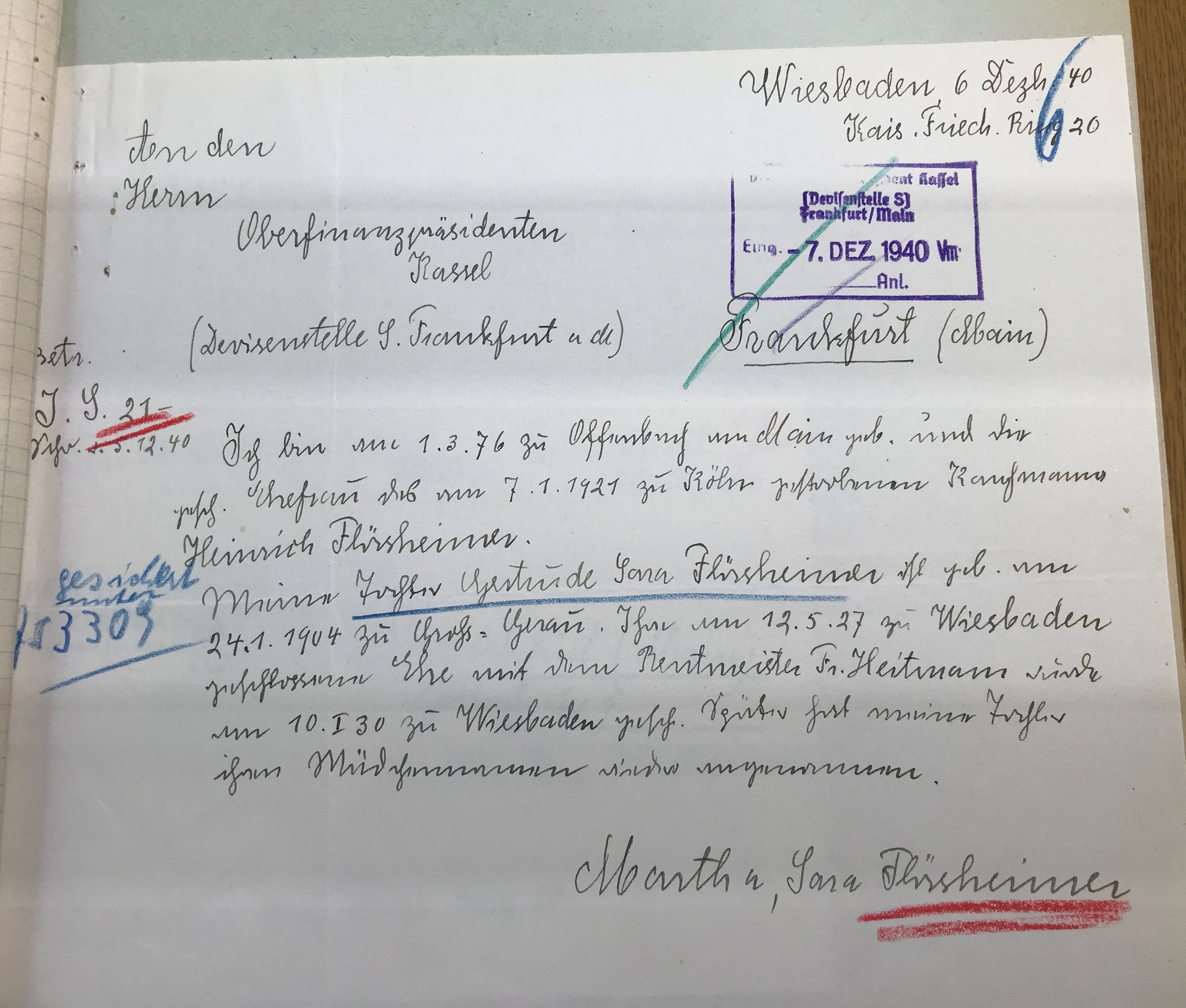
On December 6, 1940, Martha wrote this note in Wiesbaden:

Thank you to the members of the German Genealogy group who worked to decipher this difficult handwriting. This was the translation done by Matthias Steinke:

Wiesbaden, 6th December 40

Kaiser Friedrich Ring 20

I am at the 1st march 1876 in Offenbach/Main born and the wife of the at the 7th January 1921 in Cologne deceased merchant Heinrich Flörsheimer.

My daughter Gertrude Sara Flörsheimer was born at the 24th january 1904 in Gross Gerau. Her at the 12th May 1927 in Wiesbaden happened matrimony with the administrator Fr. Heitmann was at the 10th January 1930 in Wiesbaden divorced. My daughter took her maiden-name back later.

Martha Sara Flörsheimer

I am not sure who this note was written to or for what purpose, except perhaps to register their names and marital status with the officials in Wiesbaden. Or perhaps it was a follow-up to the earlier document seen above.

This typewritten letter is dated March 23, 1943, three years later:

We hereby indicate that the aforementioned Jewish woman has been restricted due to your security order from 9 14 40 to 25 8 42, because she expected the receipt of a larger payment, coming from furniture sales. On 4 9 42, the only entry received the amount of RM 594. Due to the disposition of the Governmental Practitioner Wiesbaden from 27 8 42 I 9-337 / 42, the fortune of this Jewish woman has been confiscated in favor of the Reich. We have therefore transferred the above amount to Finanzkasse Wiesbaden under file number O. 5205/494. Heil Hitler.

I am not sure what all of this means, but I got the gist of this—that all of Martha’s assets had been confiscated by the Nazis.

Aaron Knappstein located Martha’s death record:

One thing of note on these forms is that Martha is identified as a widow, not as a divorcee, even though her marriage record records the divorce:

Martha Oppenheimer marriage and divorce record, Hessisches Hauptstaatsarchiv; Wiesbaden, Deutschland; Bestand: 924; Laufende Nummer: 323
Source Information
Ancestry.com. Hesse, Germany, Marriages, 1849-1930

And interestingly she did not hide her daughter’s status as a divorcee, as seen above. So why hide hers?

Finally, Aaron also sent me a photograph of Heinrich Florsheimer’s headstone, which confirms the date of death reported by his ex-wife Martha in 1940:

These extra documents fill in some of the gaps in Martha’s life. The documents from the Nazi era are particularly poignant. Martha lost so much. Of course, losing her children was the most horrific loss, but she also lost all her property to the Nazis.