The Goldschmidts Come to America

I was all set to be logical and sequential and report on each of the children of my three-times great-grandparents Seligmann and Hincka (Alexander) Goldschmidt, starting with their oldest child Sarah Goldschmidt and her husband Abraham Mansbach II. I began their story in this post, but then I realized that I could not tell the rest of the story of the children of Sarah and Abraham without some background regarding the other members of the Goldschmidt family.

What triggered this realization was this ship manifest:

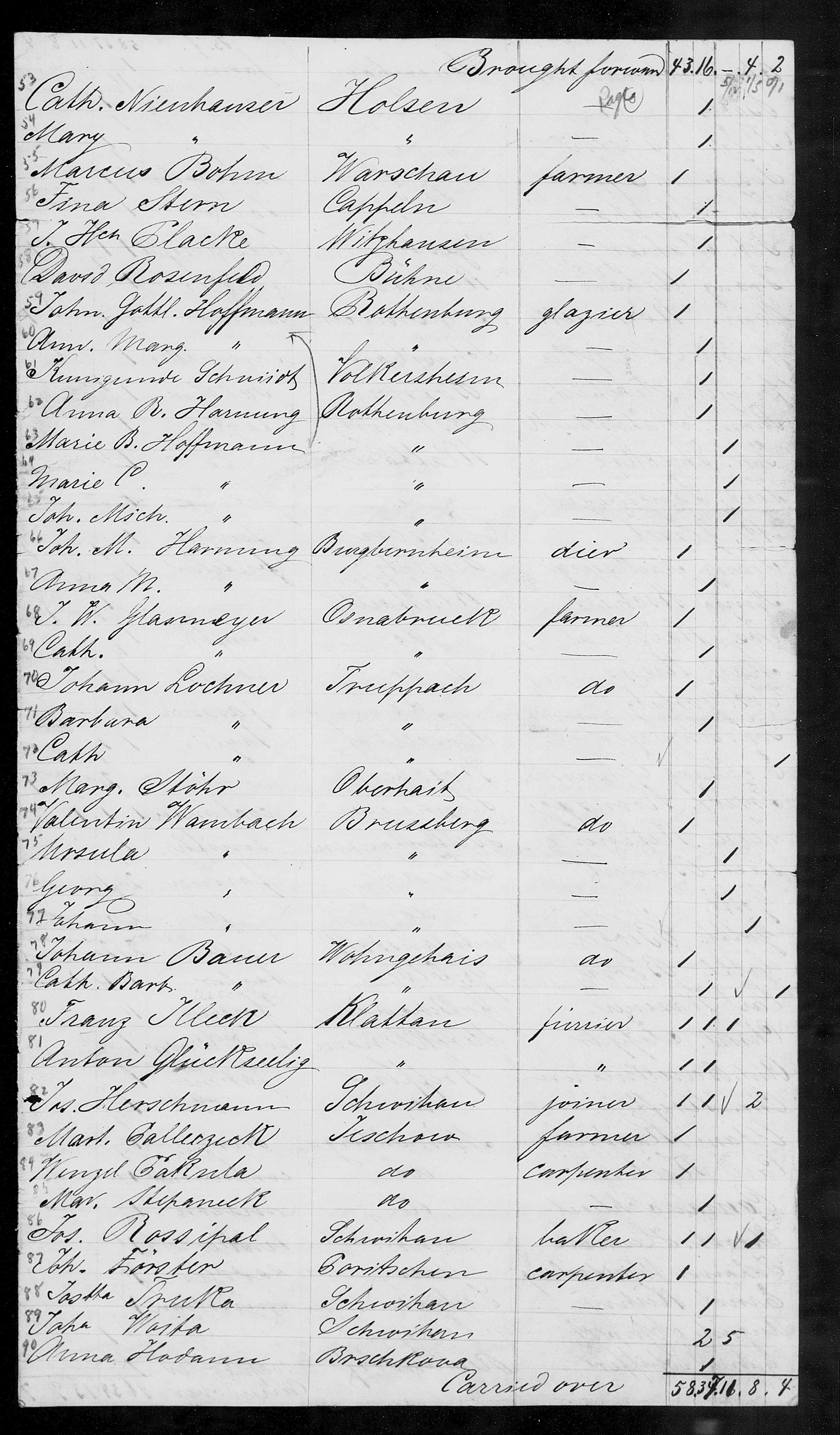
Henry Schoenthal and Helene Lilienfeld with Analie Mansbach on 1872 ship manifest lines 95 to 98
Year: 1872; Arrival: New York, New York; Microfilm Serial: M237, 1820-1897; Microfilm Roll: Roll 359; Line: 1; List Number: 484

Notice that this is the 1872 manifest for Henry Schoenthal, the brother of my great-grandfather Isidore Schoenthal. Henry had settled in Washington, Pennsylvania, in 1866, but then returned to Germany to marry Helen Lilienfeld. Then on May 24, 1872, Henry and Helen returned to the US, as shown on this manifest.

Why am I talking about a Schoenthal in the context of telling the story of the Goldschmidts?

Because on that manifest (lines 6 and 7, above) were two eighteen-year-old women both named Amalie Mansbach who were apparently sailing with Henry and Helen (lines 5 and 8). I believe that one of those two Amalie Mansbachs was Merla Mansbach, the daughter of Sarah Goldschmidt and Abraham Mansbach II. Merla Mansbach was born on December 10, 1853, meaning she would have been eighteen in May, 1872.

Birth record of Merla Mansbach
HHStAW Abt. 365 Nr. 384, p. 55

But why would Merla Mansbach be sailing with Henry Schoenthal? He was from Sielen, his wife Helen was from Gudensberg, and Merla was from Maden—all towns within a reasonable distance of each other in the Hesse region of Germany, with Maden and Gudensberg being very near each other. There had to be a connection.


And that drove me back to my earlier posts about Henry Schoenthal and how he ended up in Washington, Pennsylvania, a small town in western Pennsylvania about 30 miles from Pittsburgh. And those posts reminded me that Henry was not the first Schoenthal to settle in western Pennsylvania—his father Levi’s sister (my three-times great-aunt) Fradchen Schoenthal had preceded him some twenty years before.

And Fradchen Schoenthal was married to Simon Falcke Goldschmidt, the brother of Seligmann Goldschmidt and great-uncle of Merla/Amalie Mansbach:
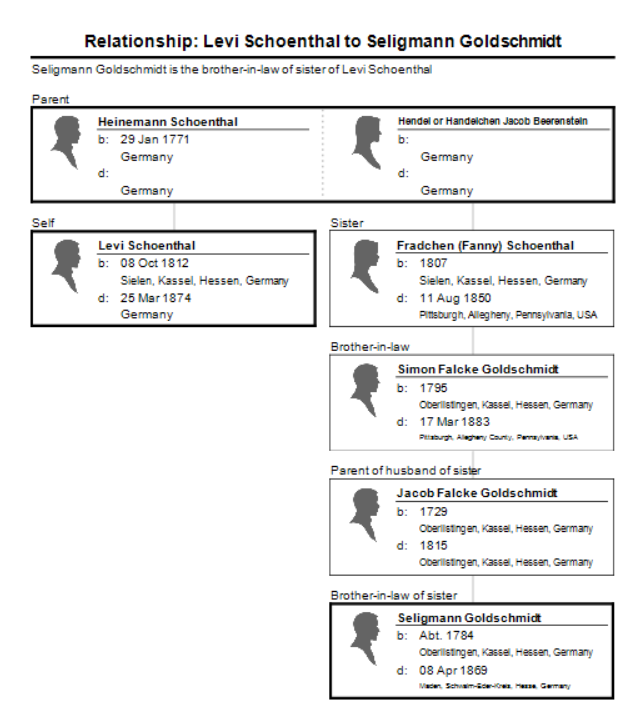
 

So I am going to digress a bit from the story of the family of my three-times great-grandfather Seligmann Goldschmidt to tell the story of his younger brother Simon Falcke Goldschmidt because telling the story of the Goldschmidt’s immigration to the United States has to start with Simon, who was the first to arrive.

Simon was the youngest of the four sons of Jacob Falcke Goldschmidt and Eva Reuben Seligmann; according to numerous US records, he was born in 1795. In 1822, he married Eveline Katzenstein of Grebenstein (no known familial connection to my Katzensteins). Together they had five children: Jacob (1825), Lena (1828), Hewa “Eva” (1836), Joseph (1837), and Jesajas (1839), all born in Oberlistingen.
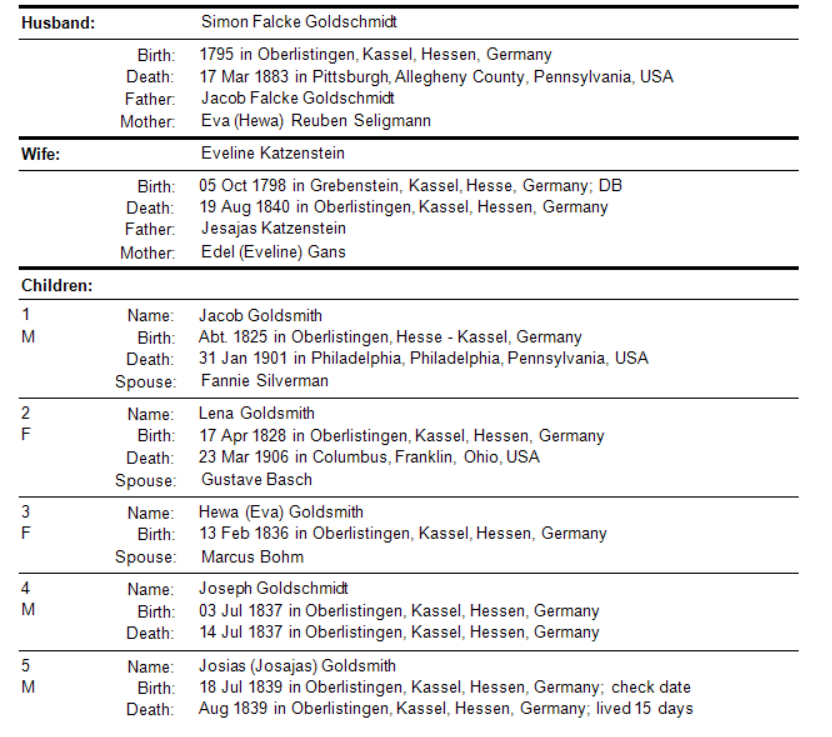
Notice the large gap between Lena, born in 1828, and the next child Hewa born in 1836.[1]

David Baron located a record that perhaps provides a reason for that gap; it seems that in 1826 Simon was charged with burglary and attempted robbery. (HStAM Fonds 261 Kriminalakten 1822-1836 No G 40.) I requested a copy of the file from the Marburg archives and learned that the file covers Simon’s appeal of a ten year sentence for his criminal activity. The listing online indicates that the date of appellate decision was December 24, 1830.

The contact person at the Marburg archives did not reveal the outcome of the appeal, so I am now hoping to find someone who might be able to go to Marburg and provide me with a summary (in English) of the judgment. (I could order a copy, but it would be costly and in German. My German has improved, but 130 pages of a legal decision would be too great a challenge!)

Since Simon and Eveline had three more children beginning in 1836, I suppose it’s possible he served some of that ten year sentence. Sadly, Simon and Eveline’s last two babies did not survive. Both Joseph and Jesajas died in infancy.

Joseph Goldschmidt death record
Sterberegister der Juden von Oberlistingen (Breuna) 1827-1852 (HHStAW Abt. 365 Nr. 671), p. 6

Josajas Goldschmidt death record
Sterberegister der Juden von Oberlistingen (Breuna) 1827-1852 (HHStAW Abt. 365 Nr. 671), p. 7

And then Simon lost his wife Eveline as well. She died on August 19, 1840, in Oberlistingen:

Eveline Katzenstein Goldschmidt death record
Sterberegister der Juden von Oberlistingen (Breuna) 1827-1852 (HHStAW Abt. 365 Nr. 671), p. 8

Simon was left on his own to raise his fifteen year old son Jacob, twelve year old daughter Lena, and four year old Hewa/Eva.

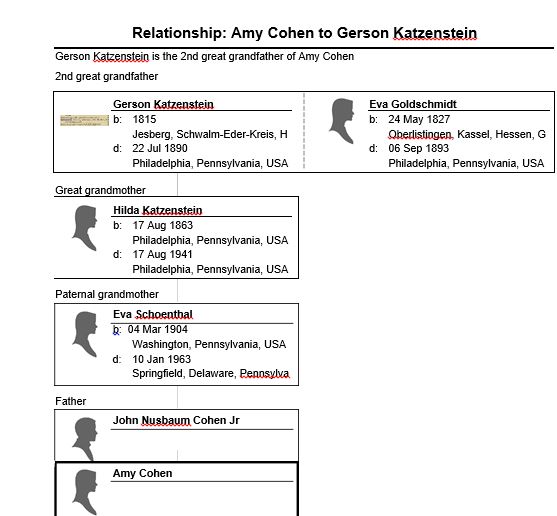
Four years after Eveline’s death he married my three-times great-aunt Fradchen Schoenthal on September 10, 1844. Fradchen, the daughter of my three-times great-grandparents Heinemann Schoenthal and Hendel Berenstein, was 37 years old when she married Simon. Thus, as early as 1844, my Schoenthal and Goldschmidt lines had merged, explaining why Merla/Amalia Mansbach would have been sailing with Henry Schoenthal in 1872.

Marriage of Simon Goldschmidt and Fradchen Schoenthal
HHStAW Abt. 365 Nr. 669, S. 11

A year after marrying, Simon and Fradchen left Germany for the United States, arriving in Baltimore with Simon’s youngest daughter Eva on September 20, 1845.

Passenger manifest for Simon Goldschmidt, Fanny Schoenthal and Eva Goldschmidt
Ancestry.com. Baltimore, Passenger Lists, 1820-1964 [database on-line]. Provo, UT, USA: Ancestry.com Operations Inc, 2006.
Original data: Selected Passenger and Crew Lists and Manifests. National Archives, Washington, D.C.

They must have settled first in Baltimore because Simon and Fradchen had two children who were born there, Henry on January 10, 1847, and Hannah on June 5, 1848. I assume that Henry was named for Heinemann Schoenthal and Hannah for Hendel Berenstein Schoenthal, their maternal grandparents and my three-times great-grandparents.

By 1850, Simon and Fradchen (also known as Fanny) were living in Pittsburgh with Henry and Hannah as well as two of Simon’s children from his first marriage, Lena and Eva. Simon was working as a tailor and had Americanized his surname to Goldsmith.[2]

Simon Goldschmidt and family 1850 census
Year: 1850; Census Place: Pittsburgh Ward 3, Allegheny, Pennsylvania; Roll: M432_745; Page: 135A; Image: 274

Simon lost his second wife Fradchen/Fanny soon thereafter; she died on August 11, 1850, at age 43. (The year on the headstone appears to be incorrect; based on the age given on both the marriage record and manifest, Fradchen’s birth year would have been 1807, not 1800. The 1850 census said she was then 39, not 50. Plus it’s unlikely she had children at ages 47 and 48.) She left behind two very young children, Henry and Hannah, as well as her three stepchildren, Jacob, Lena, and Eva, and her husband Simon.


Meanwhile, Simon’s son Jacob from his first marriage had settled in Washington, Pennsylvania, by 1850; he was working as a tailor and living with two other men who were tailors. Like his father Simon, Jacob had changed his surname to Goldsmith.

Jacob Goldsmith (Simon’s son) 1850 US census
Year: 1850; Census Place: Washington, Washington, Pennsylvania; Roll: M432_834; Page: 363A; Image: 244

Sometime after 1850 Jacob married Fannie Silverman. (The 1900 census reports that Jacob, who was then widowed, had been married 51 years, but given that he was still single in 1850, that seems unlikely).

Jacob and Fannie had thirteen children between 1853 and 1871—first, six daughters, then three sons, then another four daughters. Wow. I will report on them in more detail in a later post.  For now, I will only name those born between 1853 and 1860: Ellena (1853), Emma (1854), Anna (1855), Rachel (1857), Leonora (1858), and Celia (1860). Six daughters in seven years.

Sometime after Fradchen died, Simon moved to Washington, Pennsylvania, to be with his son Jacob. In 1860, Simon and his two youngest children, Henry and Hannah, were living with Simon’s son Jacob and Jacob’s wife Fannie and their six daughters. Henry and Hannah were only five and six years older than their oldest nieces, Emma and Anna. I assume that Simon needed Fannie and Jacob’s help in raising Henry and Hannah.

Jacob Goldsmith and family 1860 US census
Year: 1860; Census Place: Washington, Washington, Pennsylvania; Roll: M653_1192; Page: 1188; Image: 627; Family History Library Film: 805192

Simon’s other two children, Lena and Hewa/Eva, were married and on their own by 1860. Lena had married another German immigrant, Gustave Basch in 1856. In 1860, they were living in Connellsville, Pennsylvania, with their first two children, Frank (1858) and Jacob (1859).

Lena Goldschmidt and Gustave Basch and sons 1860 census Year: 1860; Census Place: Connellsville, Fayette, Pennsylvania; Roll: M653_1110; Page: 422; Family History Library Film: 805110


The story of Simon’s other daughter Eva has already been told. She married Marcus Bohm, an immigrant from Warsaw, Poland, and they had a daughter born in 1862 named Ella who married my great-great-uncle Jacob Katzenstein (son of Gerson Katzenstein and Eva Goldschmidt and thus also Ella’s cousin). Ella and one of her sons died in the Johnstown flood in 1889.  With Ella Bohm’s marriage to Jacob Katzenstein, my Goldschmidt and Katzenstein lines had merged.

I won’t repeat the research and story of Eva Goldsmith and Marcus Bohm, but despite further searching, I unfortunately have not yet found any record for either their marriage or Eva’s death. What I have concluded, however, is that Eva had died by 1870 because by then her daughter Ella was living with Eva’s brother Jacob Goldsmith.

Jacob Goldsmith and family on the 1870 census
Year: 1870; Census Place: Philadelphia Ward 12 District 36, Philadelphia, Pennsylvania

Thus, by 1860, all the members of the family of Simon Goldschmidt were living in western Pennsylvania, most of them in Washington, Pennsylvania, where Fradchen’s nephew Henry Schoenthal would arrive six years later, soon followed by his siblings.

By the 1880s, there were thus familial connections between the Goldschmidt family and the Schoenthal family and also between the Goldschmidt family and the Katzenstein family.  These overlapping connections laid the groundwork for the 1888 marriage of my great-grandparents, Isidore Schoenthal and Hilda Katzenstein, whose mother was a Goldschmidt. It’s amazing to see how the many lines in the family came together in the pairing of two of my direct ancestors.

——

[1] I do not have German birth records for Jacob or Lena, only US records. For the last three children, I was able to locate Oberlistingen birth records.

[2] The names on this census are switched around. Simon’s wife was Fanny, not Lena, and his daughter was Eva, not Fanny. Another reminder of how unreliable census records can be.

Yet Another Abraham Mansbach: More Twists in the Tree

As I mentioned in my last post, my three-times great-grandparents Seligmann Goldschmidt and Hincka Alexander had seven children.

Their oldest child was Sarah, born December 1, 1818, in Oberlistingen. Sarah married Abraham Mansbach on October 31, 1843. Abraham Mansbach was a name I’d encountered before when researching my Katzenstein relatives, so I knew I had to dig deeper to see if there was a connection.

Marriage record of Sarah (Sarchen) Goldschmidt and Abraham Mansbach
Trauregister der Juden von Gudensberg 1825-1900 (HHStAW Abt. 365 Nr. 386)AutorHessisches Hauptstaatsarchiv, Wiesbaden, p. 14

Back in November, 2016, I wrote a post entitled “Will the Real Abraham Mansbach Please Stand Up?,” in which I described my attempts to distinguish five different men (all related to each other) named Abraham Mansbach.  The first Abraham Mansbach (Abraham I) died around 1808; the other four included one of his grandsons and three of his great-grandsons.

Abraham I had three sons: Isaac, Leiser, and Marum I.  Leiser in turn had two sons, Abraham II and Marum II, both of whom married into my family. Abraham II married my three-times great-aunt Sarah Goldschmidt, as seen above.

Leiser’s other son, Marum II, married one of my other three-times-great-aunts, Hannchen Katzenstein. Thus, the Mansbachs are related to me both on the Katzenstein side and the Goldschmidt side. (And the Goldschmidts and Katzenstein lines also merged with the marriage of Gerson Katzenstein and Eva Goldschmidt, my great-great-grandparents.)
Marum Mansbach II and Hanchen Katzenstein also had a son named Abraham, whom I labeled Abraham Mansbach III.[1] The fourth and fifth Abraham Mansbachs were other great-grandsons of Abraham I not directly entangled with my relatives.


Anyway……all you need to know for this post is that Sarah Goldschmidt married Abraham Mansbach II, who was born January 12, 1809, in Maden, Germany.  Sarah and Abraham had ten children: Breine (1844), Hewa “Hedwig (1846), Leiser “Louis” (1849), Jacob (1851), Merla “Amelia” (1853), Berthold (1856), Hannah (1858), Meyer (1860), Kathinka (1862), and Julius (1865). In other words, Sarah gave birth to ten children over a 21 year period. All the children were born in Maden.

Thanks to my recently-found cousin Art Mansbach, a great-grandson of Abraham and Sarah, I have a number of photographs of Abraham and Sarah and their children. This one is of Abraham, Sarah, and their youngest child, Julius, Art’s grandfather. Julius appears to be about five years old in this photograph, so this would have been taken in around 1870:

Abraham Mansbach, Julius Mansbach, and Sarah Goldschmidt Mansbach c. 1870
Courtesy of the Mansbach family

Here is one of Sarah with her two youngest sons, Meyer and Juilus. From the ages of the boys, I would estimate that this was taken in the mid-1870s:

Julius Mansbach, Sarah Goldschmidt Mansbach, and Meyer Mansbach c. 1874
Courtesy of the Mansbach family

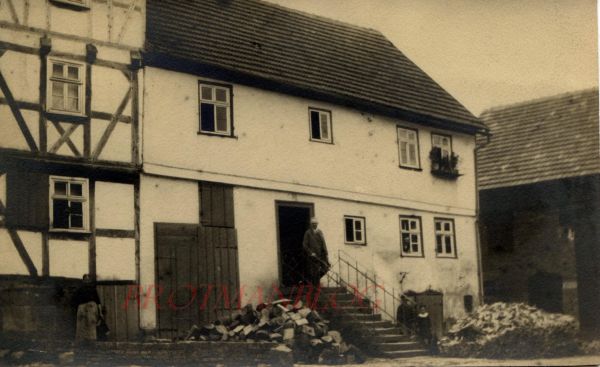
This was the Mansbach home in Maden, Germany:

Home of Abraham and Sarah Goldschmidt Mansbach, Maden, Germany
Courtesy of the Mansbach family

Remarkably, only one of those children did not grow to adulthood.  Jacob, the fourth child, who was born on June 23, 1851, died on September 13, 1853. He was just two years old.

Jacob Mansbach death record
HHStAW Fonds 365 No 387, p. 47


Two other children of Sarah and Abraham II predeceased one or both of their parents, but did live to adulthood: Hedwig and Kathinka.  Kathinka died in the US, so her story will come in a later post. But Hedwig died in Germany.

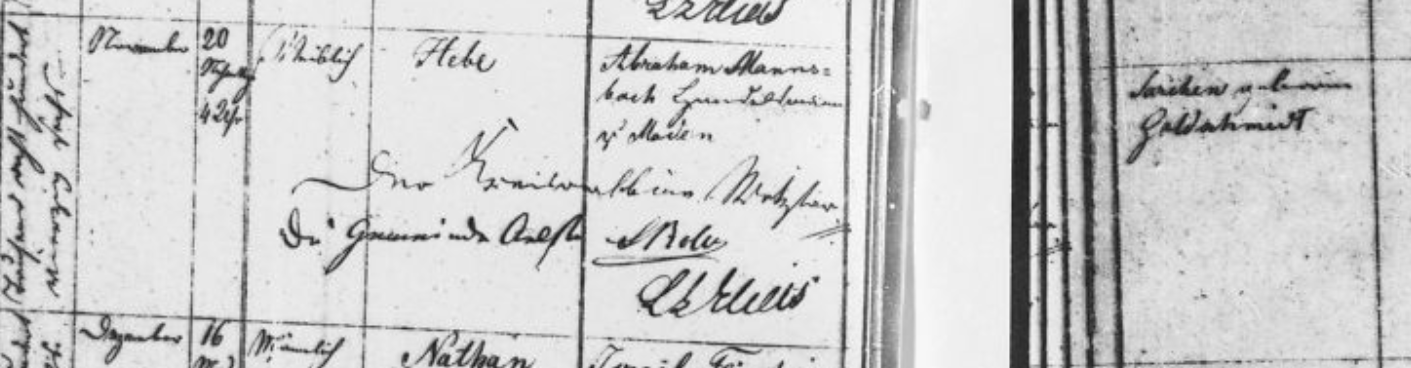
Hedwig was born on November 20, 1846.

Hedwig/Hewa Mansbach birth record HHStAW Fonds 365 No 384, p.43


On February 16, 1875, she married David Rothschild of Zierenberg, Germany.

Hewa Mansbach and David Rothschild marriage record
HHStAW Fonds 365 No 386, p. 40

Sadly, Hedwig died nine months to the day later on November 16, 1875. Had she died in childbirth? I don’t know. She was only 28 years old when she died. If there was a child, I have not found any record of him or her, and I checked all the births and deaths in Zierenberg in 1875.

Death record for Hedwig Mansbach Rothschild
Description: Geburten, Heiraten Tote 1874-1875
Source Information
Ancestry.com. Hesse, Germany, Lutheran Baptisms, Marriages, and Burials, 1730-1875


Not long after Hedwig’s death, many of her siblings began to leave Germany for the United States. In fact, all but one of the remaining siblings and their parents Sarah and Abraham themselves eventually emigrated. I will continue their stories in subsequent posts.

The only surviving child of Sarah and Abraham who did not emigrate was their first-born child, Breine.

Breine was born on September 27, 1844:

Breine Mansbach birth record
HHStAW Fonds 365 No 384, p. 39


She married Jacob Bensew on February 3, 1870; Jacob was born on January 15, 1840, in Malsfeld, Germany, the son of Heinemann Bensew and Roschen Goldberg.

marriage record for Breine Mansbach and Jacob Bensew
HHStAW Fonds 365 No 386, p. 35


Breine and Jacob had six children—five sons and one daughter: William (1872), Julius (1875), Siegmund (1877), Heinemann (1879), Max (1882), and Frieda (1886). All six of their children would eventually immigrate to the United States, but Breine and Jacob stayed behind and lived the rest of their lives in Germany.

Breine died in Melsungen, Germany, on May 31, 1922, and her husband Jacob in Kassel, Germany, on April 25, 1925.

Death record for Breine Mansbach Bensew
Hessisches Hauptstaatsarchiv; Wiesbaden, Deutschland; Personenstandsregister Sterberegister; Bestand: 920; Laufende Nummer: 4684

Because so much of the rest of the story of the the family of Sarah Goldschmidt and Abraham Mansbach II took place in the US, I will stop here and address the history of the Goldschmidt family’s migration to the US in my next post.

But first one final photograph, this one of Abraham with the four sons who grew to adulthood: Leiser/Louis, Berthold, Meyer, and Julius. I do not know which is which, but all four appear in this photograph with their father. They were all my first cousins, four times removed:

ABraham Mansbach with his four surviving sons: Meyer, Berthold, Louis, and Julius. (Not necessarily in that order.)


[1] Thus, Abraham II was the uncle of Abraham III, my first cousin-three times removed on my Katzenstein line, and he was the husband of my three-times great-aunt Sarah Goldschmidt.

Seligmann Goldschmidt and Hincka Alexander, My 3x-Great-Grandparents of Oberlistingen

I have once again been truly fortunate as I begin my in-depth research of my Goldschmidt line. Not only do I have the benefit of the research done by Roger Cibella and David Baron, but through Roger and David, I have now connected with another Goldschmidt cousin, Art Mansbach, my third cousin, once removed. And Art, the great-great-grandson of Seligmann Goldschmidt and Hincka Alexander, has a treasure trove of pictures and documents and other items related to the Goldschmidt family. Art discovered a box of photographs in his father’s attic, and fortunately most of them were labeled with the names of those depicted. From Roger, David, and Art, I now have a fair amount of information about our mutual ancestors, Seligmann Goldschmidt and Hincka Alexander, as well as pictures of them.

My three-times great-grandfather Seligmann Goldschmidt was born in about 1783-1784 in Oberlistingen, Germany. (His birth date is inferred from his death record, to be discussed below.) He was the oldest son of my four-times great-grandparents Jacob Falcke Goldschmidt and Eva Reuben Seligmann, though he had two older half-brothers from his father’s prior marriages.

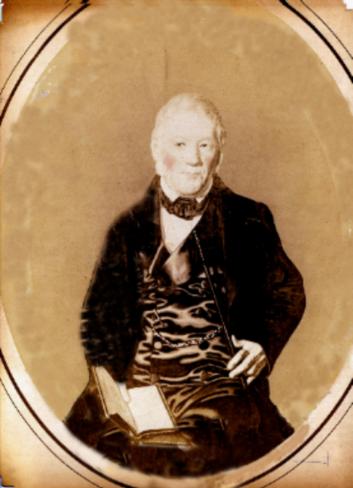
Seligmann Goldschmidt

According to Art and as reported on Roger Cibella and David Baron’s website, Seligmann was by trade a spice merchant. He also fought under General Bluecher against Napoleon at Waterloo and was cited for bravery and given a silver snuff box for his service. Art owns the snuff box and shared these photographs of this heirloom:

Sbox2

Sbox1


Although I have not found a marriage record, I assume that Seligmann married my three-times great-grandmother Hincka Alexander sometime before December 1, 1818, when their first child was born. According to her death record and gravestone, Hincka was born in Wolfhagen on September 14, 1797. I don’t yet know the names of her parents or whether she had any siblings.

Hincka Alexander Goldschmidt

Seligmann and Hincka had their first child, a daughter named Sarah, on December 1, 1818, according to her death record. Sarah was followed by seven other children: Jacob (1822), Levi (1824), my great-great-grandmother Eva (1827), Beile or Bette (1829 or 1830), Abraham (1832), Meyer (1834), and Rosa (1837).


All but Beile/Bette would end up immigrating to the United States, starting with Jacob who arrived before 1850 and ending with Sarah, who arrived in 1882. Thus, I will be able to report a fair amount about each of their lives and their families and will be devoting separate posts (probably multiple) to each one of them.

Seligmann and Hincka, however, did not leave Germany with their children. Hincka died on January 4, 1860, in Oberlistingen; according to her death record, she was 63 years old:

Hincka Alexander Goldschmidt death record
HHStAW Fonds 365 No 502, p.82


Although the part of the gravestone that included her name is broken off, it is obvious that this is her stone as it identifies her as the wife of Seligmann Goldschmidt and also because the date of death is consistent with that in the record above. Unfortunately, however, it did not enable me to learn Hincka’s full Hebrew name and thus her father’s name:

UPDATE: Thank you to Lara Diamond for pointing out that Hincka’s name is partially legible at the very top of the stone—it says Hincka Sara! But for some reason her father’s name was not included.  Thank you, Lara!

Goldschmidt, Hinka (1860) – Kassel-Bettenhausen“, in: Jüdische Grabstätten <http://www.lagis-hessen.de/en/subjects/idrec/sn/juf/id/6511&gt; (Stand: 24.3.2015)


The inscriptions is translated as follows:

Wife of Seligman Goldschmidt from Oberlistingen.

Born on the 23rd of Elul [5] 557

Died on Thursday, 10th Tewet,

and buried on Friday, the 11th Tewet [5] 620

Jewish era.

Her soul is bound in the bond of life.

Her husband Seligmann died nine years later on April 8, 1869; he was 85 or 86 years old, according to this death record:

Seligmann Goldschmidt death record
HHStAW Fonds 365 No 387, p.70


His headstone is in better shape than that of his wife Hincka:

Goldschmidt, Seligmann (1869) – Obervorschütz“, in: Jüdische Grabstätten <http://www.lagis-hessen.de/en/subjects/idrec/sn/juf/id/13188&gt; (Stand: 8.8.2014)


The inscription is translated as:

a sincere man among the generous ones.

He walked the path of the good.

He distributed his bread among the hungry.

He was God-fearing throughout his life.

Aaron, called Seligmann,

Son of Jacob. Died with a good reputation

on Thursday, the 27th Nisan, and buried

on Friday, the 28th of the month in the year

[5] 629 after the small count. His soul is bound in the bond of life.

One interesting insight here is that Seligmann’s Hebrew name was Aaron.

I love how this inscription revealed a bit about Seligmann’s personality and how he was perceived by his family; I wish the same had been done for Hincka. When Seligmann died in 1869, almost all of his children were in the United States, as had been many of them when their mother Hincka died in 1860. I wonder if they came home to Oberlistingen to bury their parents and whether they helped to determine the language that would go on their parents’ gravestones. Why was their mother’s inscription limited to the bare facts whereas their father’s was more descriptive and loving?

In posts to follow, I will explore the lives and families of each of the children of Seligmann and Hincka.


Several people raised questions about the meaning of “schutzbrief” in my prior post. I am researching those questions and will report back soon.


Introducing the Goldschmidts of Oberlistingen

It’s a new year, and it’s time to start the story of a new line in my family. As I was finishing the history of the Katzenstein family, I pondered which line I should work on next. Growing up, I’d only known the surnames of some of my ancestors: Cohen, Seligmann, Nusbaum, Schoenthal, Katzenstein, Brotman,  and Goldschlager, the lines I’ve focused on so far. I did not ever hear the names Jacobs, Schoenfeld, Hamberg, Goldschmidt, Brod, or Rosenzweig. Those names had disappeared when the women took their husbands’ names and gave their children only their husbands’ names. But after researching the husband’s lines, I learned the birth surnames of their wives. 

So now it’s time to go back and find the stories of these other families. I have decided to start with the Goldschmidt line—the family of my great-great-grandmother Eva Goldschmidt who married Gerson Katzenstein. She was the mother of my great-grandmother Hilda Katzenstein Schoenthal and the grandmother and namesake of my grandmother Eva Schoenthal Cohen. It made sense to start with the Goldschmidts because they are entangled in several ways with both my Katzenstein relatives and my Schoenthal relatives, as you will see. Also, I am intrigued by the idea of following the direct female line of my paternal grandmother–from Eva Schoenthal to Hilda Katzenstein to Eva Goldschmidt.

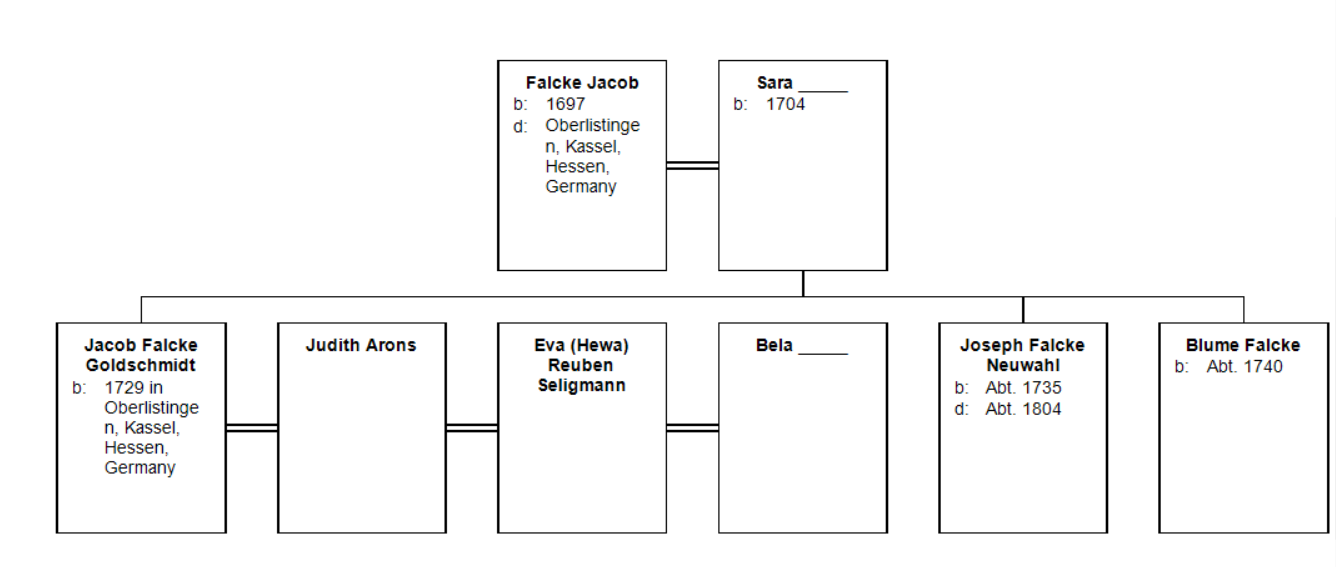
Thanks to the incredible work of David Baron and Roger Cibella, I can trace my Goldschmidt family back to my fifth-great-grandparents, Falcke Jacob, born in about 1697, and his wife Sara (surname unknown), born in about 1704.

My Goldschmidt ancestors came from Oberlistingen in the Hesse region of Germany, just a few miles from the village of Breuna, where my Hamberg ancestors once lived, about fourteen miles from Sielen where my Schoenthal ancestors lived, and about fifty miles north of Jesberg where my Katzenstein relatives lived.  Oberlistingen is in fact a small village within the larger township of Breuna, which also includes Niederlistingen, another small village very close to Oberlistingen. The two villages are sometimes referred together as the two “Listingens.”


Years ago David and Roger put together a website that traced the history of the Goldschmidt family and Oberlistingen and included excerpts from Chapter III of Dieter Carl’s book, Die Juden Geschichte Beider Listingen [The Jewish History of the Two Listingens] (Herausgegeben vom Gemeindevorstand der Gemeinde Breuna, 1999), as translated by Joseph Voss.

According to Dieter Carl, Jews had been expelled from the Hesse region by Duke Phillip the Generous in the mid-16th century in response to pressure from Martin Luther.  Then in 1592 Lord Moritz allowed a few Jews to settle in the region. Eventually more Jews settled in the Hesse region, but restrictions were imposed.

Carl provided this helpful background:

The unique position of the Jews derived from the nature of their religion, on one hand, and, on the other hand, stemmed from the nature of a people who had no citizens rights, who were not fully free, and stood outside of the established Christian society.  Therefore the Jews had gained the special protection of the Feudal lords needed for their security and livelihood for economical activity and housing.  Originally this protection was in the hands of the Kaiser, but in time it transmitted down to local Dukes.  ….  [T]he Dukes of Hessen … gave to certain families a letter “schutzbriefe” of protection–the legal basis for living in these rural areas.  The receiver of the schutzbriefe had to pay a reasonable sum and had to provide other services for the Lord.  The protection letter gave the Jews the legal right to trade and lend money.

For a long time Jews could not become artisans, farmers or civil servants, but only moneylenders or traders.  In order to limit the number of Jews in Hessian towns and villages, the letter could not be inheritable.  In reality though, the letter was passed down from father to eldest son with a small sum paid in order to continue that right.  This was beneficial for the right to do business and who could establish a family; hence the authorities could control the size of the Jewish population.  All the Jews for whatever reason did not possess the Schutzbrief, the youngest sons and unmarried daughters were the so-called “Unvergleitete” or disinherited.  From these large groups were created the Jewish under classes   or “Unterschicht”.  These consisted mainly as the “knechte, or the worker/ servants, the men and women who served the Schutzjuden in their employ.  In part they lived in great poverty and some resorted to begging for their livelihood.

According to Dieter Carl, the first Schutzbrief in Oberlistingen was given in 1724 to someone known as Juden Falcke, as seen in this letter dated October 19, 1724:

I, the undersigned am writing because I am protected by the esteemed sires of Malsburg.  I wish to become a member of the Oberlistingen community with permission to reside there.  I have obtained all of the rights to function in this community as a Jew and who has officially received these rights along with your right to cancel my contract.  Furthermore I am obligated, if the community is in need of money, and if I have the means to provide a loan without interest without damage to myself, I will make an advance to them if the need arises.  All of what is said here and recorded is based on free will and opinion, which my signature authenticates.

Signed 19 October 1724

Juden Falcke

Who was Juden Falcke? Was he related to me?

My fifth-great-grandparents Falcke Jacob and Sara had three children: Jacob Falcke, born in 1729; Joseph Falcke, born in 1734; and Blume Falcke, born in 1740.  Following the March 31, 1808 decree requiring Jews in the region to adopt surnames, Jacob Falcke adopted the surname Goldschmidt. Carl concluded that the “Juden Falcke” who received the first Schutzbrief for Oberlistingen was Jacob Falcke Goldschmidt, my four times great-grandfather. His brother Joseph adopted the surname Neuwahl and eventually also received a Schutzbrief to live in Oberlistingen.

Jacob Falcke Goldschmidt was married three times.  His first wife was named Bela, with whom he had one son; his second wife was Judith Arons, with whom he also had one son. Jacob’s third wife was my four-times great-grandmother, Eva Reuben Seligmann,[1] whom he married on November 24, 1780. [2]

Jacob Falcke Goldschmidt and Eva Reuben Seligmann had four sons:  my three-times great-grandfather Seligmann and his brothers Lehman, Meyer, and Simon. Dieter Carl also listed an unnamed daughter, and David Baron found a reference to this daughter in the Alex Bernstein Collection at the Leo Baeck Institute.  Her name was Jette, and she was born May 4, 1793; she married David Grunewald of Hoexter, Germany—the region that is the focus of Alex Bernstein’s research. According to his research, Jette died on August 4, 1822, and did not have any children.

CORRECTION: David Baron pointed out that I had misread Bernstein’s research. He found that Jette Goldschmidt did have children with David Grunewald before her death. First, a son Jacob Grunewald was born May 5, 1820; a second child was stillborn on July 30, 1822. Jette died five days later, presumably from complications from childbirth. Jacob Grunewald married and had fourteen children. Later I will return to these Goldschmidt cousins and report on them more fully.

Although I am primarily interested in my three-times great-grandfather Seligmann and his descendants, I will also write about his brothers, in part because his brother Simon was married to Fradchen Schoenthal, sister of Levi Schoenthal, my great-great-grandfather from Sielen.  Yes, my family tree continues to twist and bend.


[1] There is no known familial connection between Eva Reuben Seligmann, who was born in Warburg, Germany, and my Seligmann ancestors from Gau-Algesheim.

[2] This information all comes from Dieter Carl’s book as excerpted on the Cibella-Baron website. I will be focusing only on the children of my direct ancestor, Jacob Falcke Goldschmidt.

Volkmarsen and Breuna: A Remarkable Day

On Monday morning, May 8, we picked up our rental car (a cute little Nissan Juke) and started our drive northeast from Cologne to the Kassel region where we would spend the next three days.  I must admit I had some trepidation about driving in Germany (well, about Harvey driving in Germany; I certainly wasn’t going to drive).  I’d heard about the absence of speed limits on the Autobahn, and being a nervous passenger under any circumstances, I had visions of a combination of bumper cars and roller coasters.  Add to that the fact that the signs would be in German and distances in kilometers, and I figured this would not be a relaxing experience.

But I was wrong.  Our GPS was excellent (with a delightful British accent), the signs were clear, the roads were smooth, and we somehow managed to keep up (to some extent) with the pace of the German drivers.  The only part I didn’t like was the fact that the vehicles in the right lane were going about 30 mph slower than those in the left lane, making changing lanes at times nerve-wracking (for me, not for Harvey).

We made one visit to a rest stop along the way where I ran from the car to try and get ahead of the three busloads of teenagers going on a school trip.  I was only partly successful and had to wait amid a bunch of chatty teens before paying 70 cents to use the facilities.  When I received a voucher back for 50 cents, I had to ask one of the girls what it was for.  I learned we could redeem it for items in the rest stop store, so we bought a pretzel for the road and re-entered the Autobahn.

Our destination was Volkmarsen where we were to meet Ernst Klein, who would be our guide for the towns we were visiting that day. We arrived on time, and Ernst promptly met us in front of the rathaus (town hall) in the pretty center of the village. I had only emailed a few times with Ernst beforehand, and he had told me that his English was not great, but he was wrong.  His English was excellent, and I immediately warmed to this friendly and modest man.

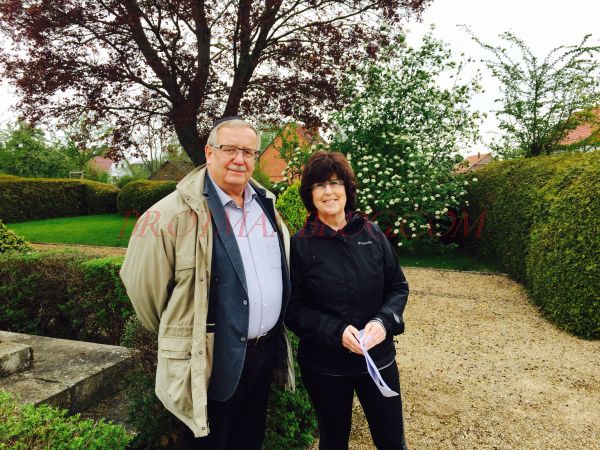
Ernst Klein and me

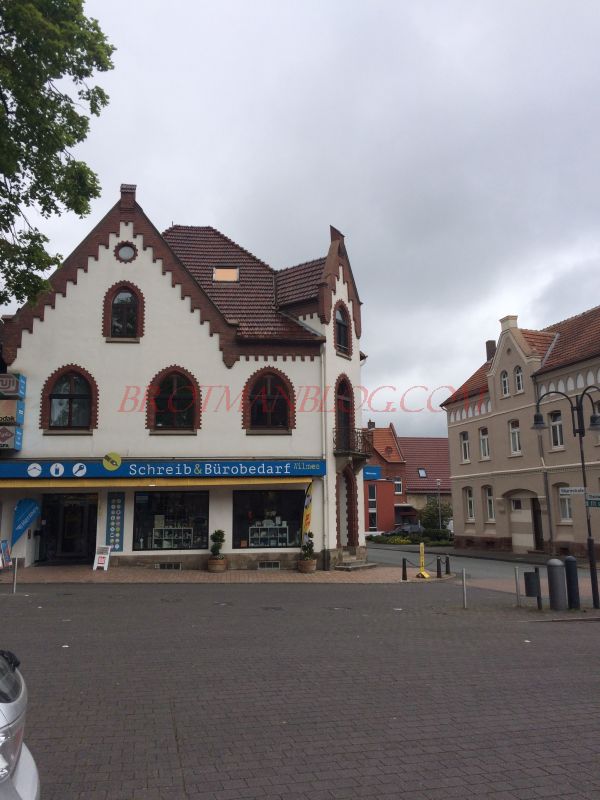
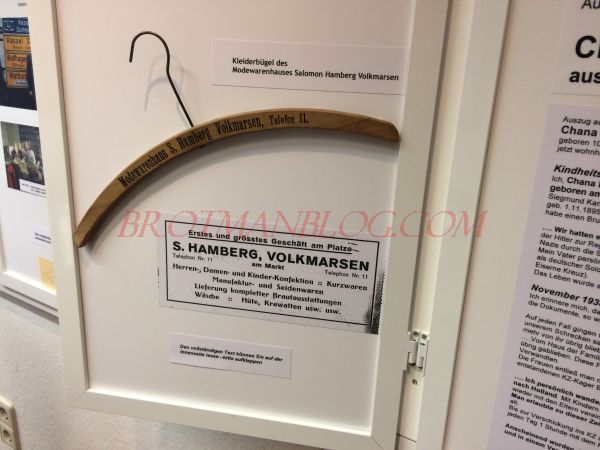
First, he showed us around Volkmarsen. I was at first not sure why I would be interested in Volkmarsen since, as far as I knew, I had no family from that town.  But Ernst pointed to a building right across from the rathaus and told us, showing us a photograph, that it had once been the store of Salomon Hamberg. I had to look him up to figure out the connection.  His father Juda Hamberg was a first cousin to my great-great-grandmother, Henrietta Hamberg, the mother of my great-grandfather Isidore Schoenthal. So Salomon was Isidore’s second cousin.

Salomon Hamberg’s store in Volkmarsen


Building where Salomon Hamberg once had a store

Ernst showed us the church in Volkmarsen and pointed out that several former Jewish homes were right nearby; he commented that before the Third Reich, Jews and Christians had lived and worked together peacefully as neighbors and friends. We then walked to one of the older homes in town where Ernst wanted to show us something special that he had discovered.

Rathaus in Volkmarsen

Church in Volkmarsen

Street in Volkmarsen where some Jewish families once lived

We went into the backyard of the home and entered a door into the basement at the back of the house.  It was dark inside, and I had no idea what we were going to see.  But Ernst turned on a spotlight that lit up a corner of the basement where we could see stone steps leading down into a rectangular opening—a mikveh!  A mikveh is a ritual bathing place where  traditional Jews go for a ritual purification at particular times in their lives—e.g., for women, before marriage and after each menstrual period. Ernst said he had had the stones dated by an expert and that it was believed that this mikveh was 500 years old, meaning Jews had been in this little town as early as 1500.  There is even visible water at the bottom, showing that natural waters could fill the mikveh.

Volkmarsen mikveh

He then told us how he had discovered the mikveh.  He had been looking for some evidence of an early Jewish community in Volkmarsen in the older buildings and homes in the village, and when he saw this decorative pillar in the basement of this home, he had a hunch that the basement had once been used for something special.

Pillar in basement where mikveh was found in Volkmarsen

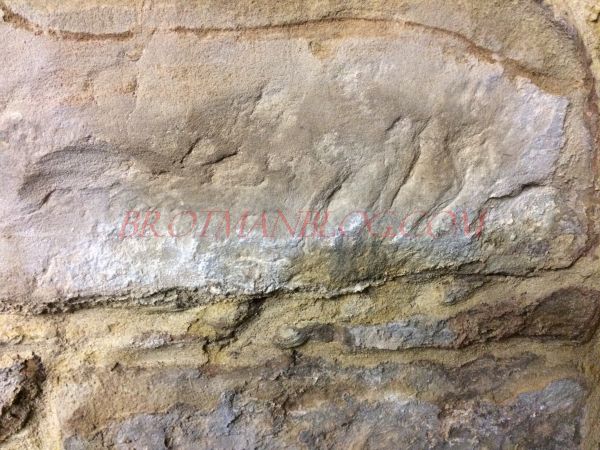
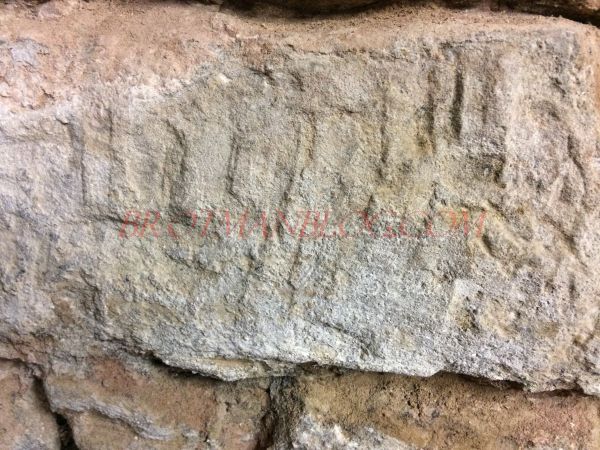
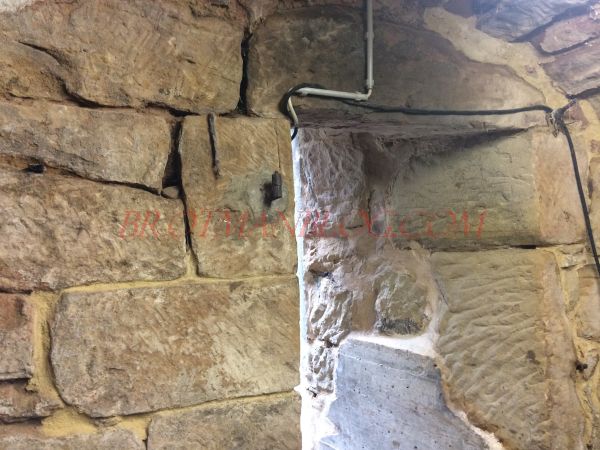
He asked the owner for permission to remove the brick flooring to see what was underneath, and the owner agreed, as long as Ernst promised to restore the flooring if there was nothing below it.  But there was, and further investigation indicates the possibility that the front part of the basement was used for prayer services.  There are marks on the walls that look like hand prints and Hebrew letters as well as an opening in the wall that might have housed the Torah scrolls.

Handprints on wall in Volkmarsen

Hebrew lettering ?

Possible location of ark holding Torah scrolls

We were very excited to see this space and wondered what would happen to it since the home is privately owned. Ernst described his hope that his organization could raise the funds to buy the house and convert it into a Jewish museum. I am hoping to help them accomplish this goal, and if you are interested in learning more about this fascinating project, here is more information from their website. I believe that this museum will serve a very important purpose in education and preservation of the Jewish history of the region, and I hope some of you will consider making a donation.

After a quick lunch at yet another great German bakery, we went to see the Volkmarsen cemetery.  The cemetery had been damaged by the Nazis during the war, the headstones smashed to pieces.  A memorial has been established by assembling pieces of the stones together along with a large stone commemorating those who had been buried there.

Broken stones at the Volkmarsen cemetery

Memorial made of broken stones at the Volkmarsen cemetery

In addition, Ernst saw that a memorial wall was created to include the names of Volkmarsen residents who had been killed during the Holocaust.  The empty spaces in the wall are meant to represent the holes now missing from the community, a brilliant and very powerful visual statement.

Memorial to those killed in the Holocaust from Volkmarsen

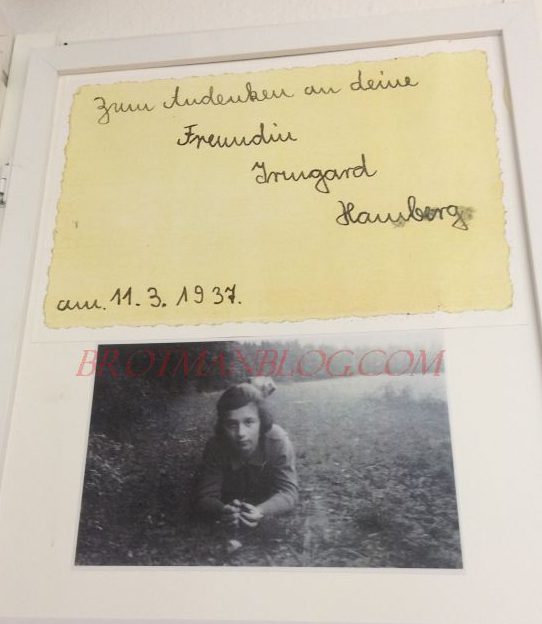
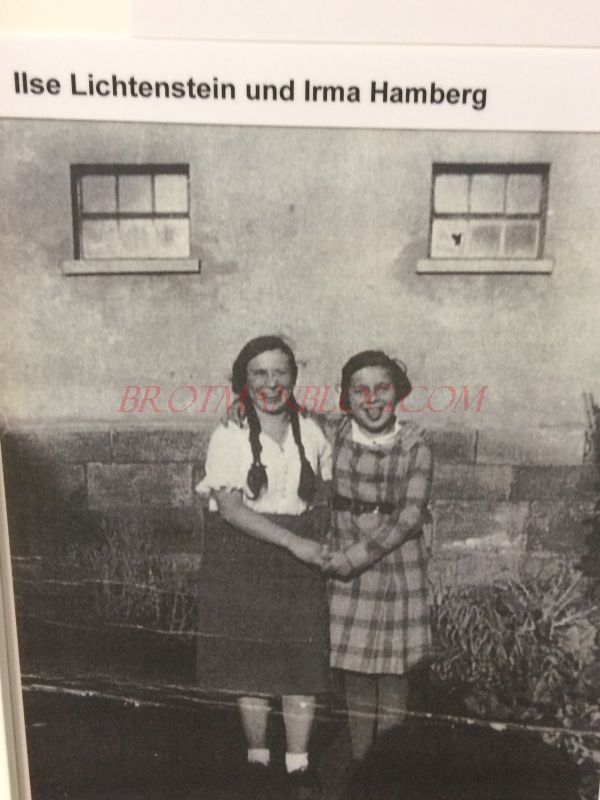
Ernst then took us to the current Jewish museum in the town, and I could see why he needs more space. He and his colleagues have created an incredible little museum packed with information and Judaica and photographs and records of Jewish history in the area.  The museum is visited by children and adults from the region and also from all parts of the world. There are copies of photographs and letters of members of the Hamberg family, including some of Rob Meyers’ mother and her family. (Rob is my fifth cousin, the one with whom we have very good mutual friends as well as mutual cousins from my father’s Cohen side, the Goldweins.)

Irmgaard Hamberg

Then we left for Breuna, the village where my great-great-grandmother Henriette Hamberg was born. Henriette was the daughter of Moses Hamberg and Guetchen Rotenberg, both of whom had died in Breuna in the 1860s. Henriette was one of ten siblings and at least some of her siblings had stayed in Breuna and died there.   Although I have yet to delve too deeply into the Hamberg genealogy and story, I wanted to see where they’d lived and where they are buried.

On the way to Breuna, Ernst had us pull over to the side of the road so we could see the small mountain that was the inspiration for the family name.  In the early 1800s when the government ordered Jews to adopt surnames for tax-collecting purposes, many Jews picked names based on locations or places that they knew.  Moses Hamberg’s family chose the small mountain outside of Breuna that was and is known as Hamberg.

Hamberg mountain

Breuna is a small village not dissimilar from Volkmarsen or Gau-Algesheim.  There is a church, a small open square, a town hall, and then many individual houses surrounding those public buildings. Ernst showed us the former synagogue, noting its proximity to the church, and two houses that were once the homes of Hamberg family members.

Plaque on former synagogue in Breuna

Former synagogue in Breuna

Former synagogue, left, and church, right, in Breuna

Hamberg home

The weather that day was the coldest and wettest of our days in Germany, and unfortunately we were too uncomfortable to spend much time walking around.  So we headed to the cemetery.  Along the way we passed the street named for Susanne Hamberg, Rob Meyer’s aunt who was, along with her parents, killed in the Holocaust. Susanne was only thirteen years old; she was my fourth cousin, once removed.

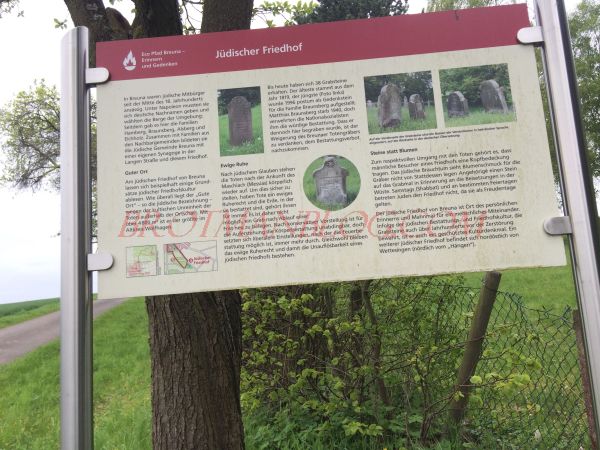
Outside the cemetery was a sign telling the history of Breuna’s Jewish community. It includes the Hamberg family as one of the families that made up that community.

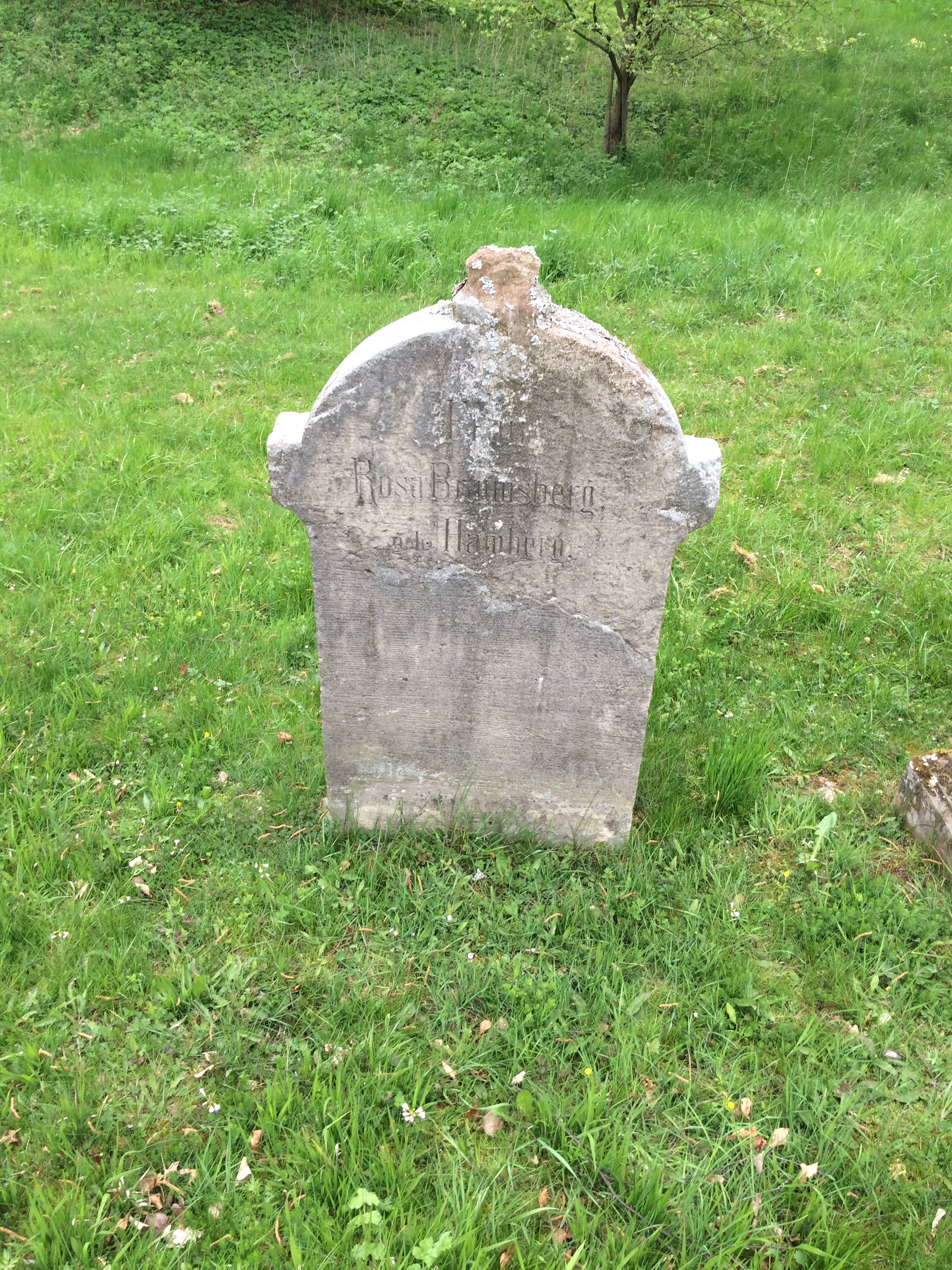
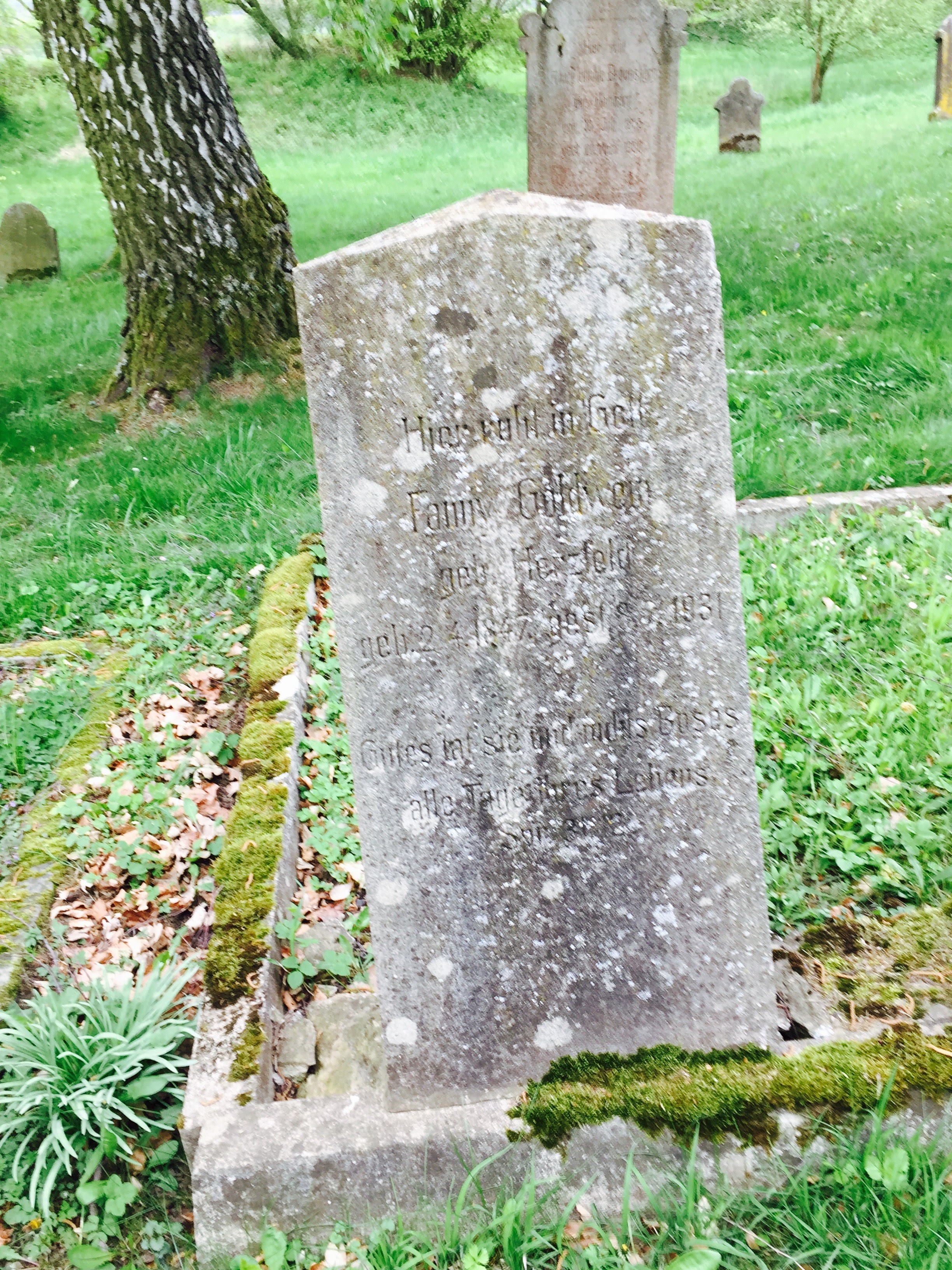
Inside the cemetery are many stones in about six or seven different rows.  It is quite a nice cemetery and very well maintained.  Many of the stones are only in Hebrew and somewhat eroded, so reading them was extremely difficult, but fortunately many stones also have German on the reverse side, revealing the secular name of the person buried in that spot. I looked at each stone, often seeing nothing that seemed relevant, and occasionally seeing a name that seemed a possible relative—a Goldschmidt or a Hamberg.

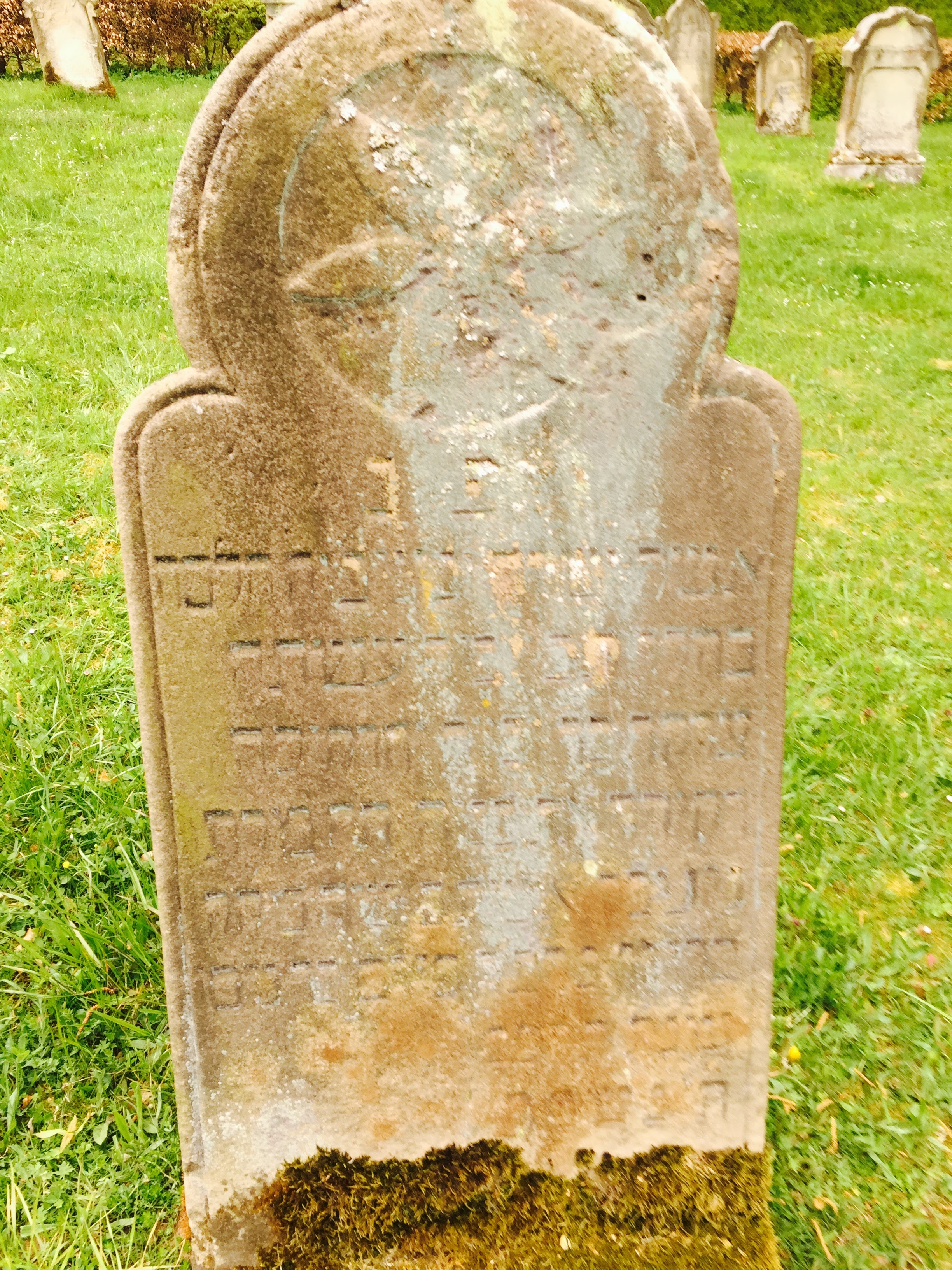
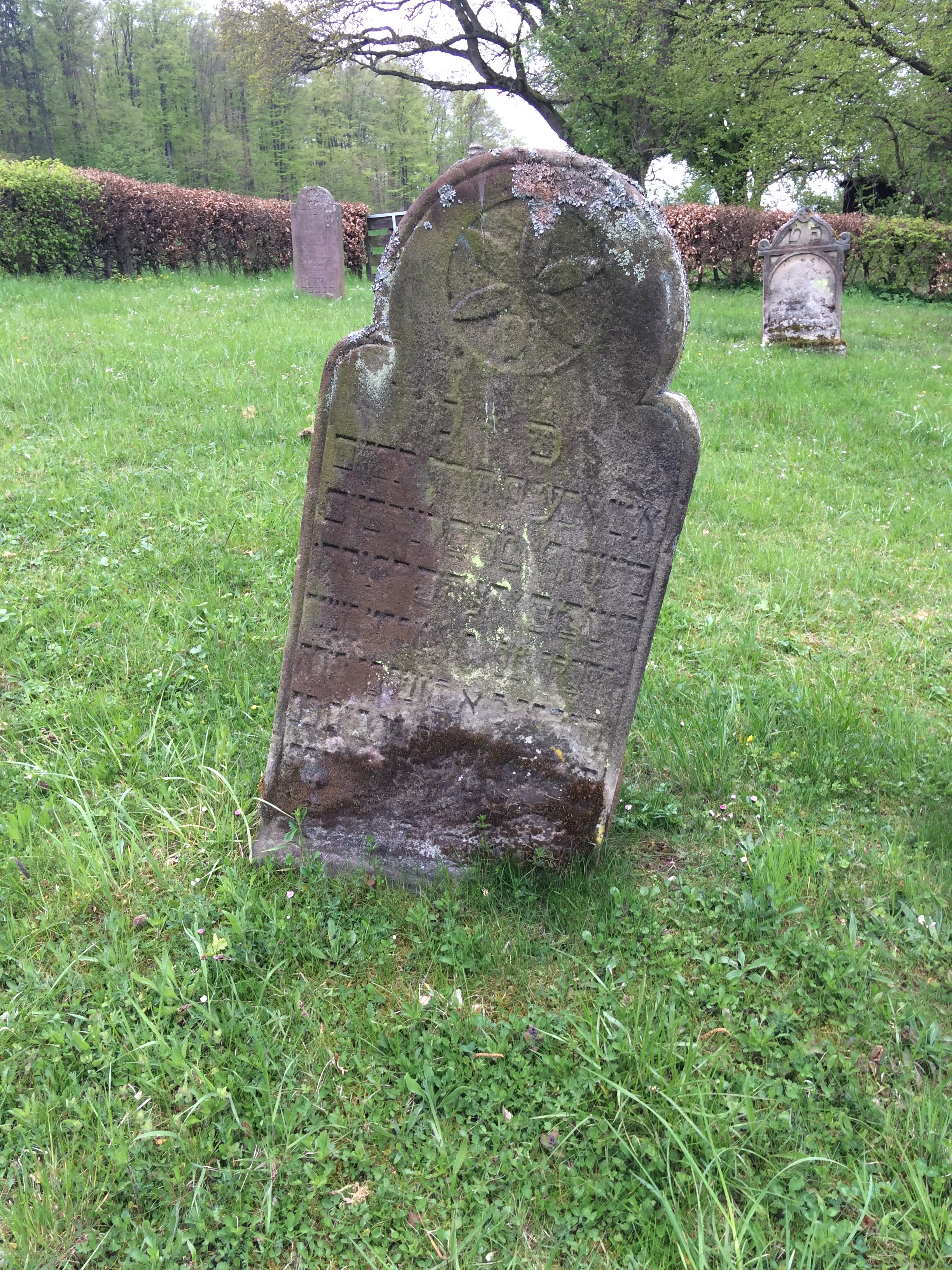
But my search was rewarded when I located these two stones:

Hebrew side of stone for Guetchen Rotenberg Hamberg

Hebrew side Moses Hamberg’s stone

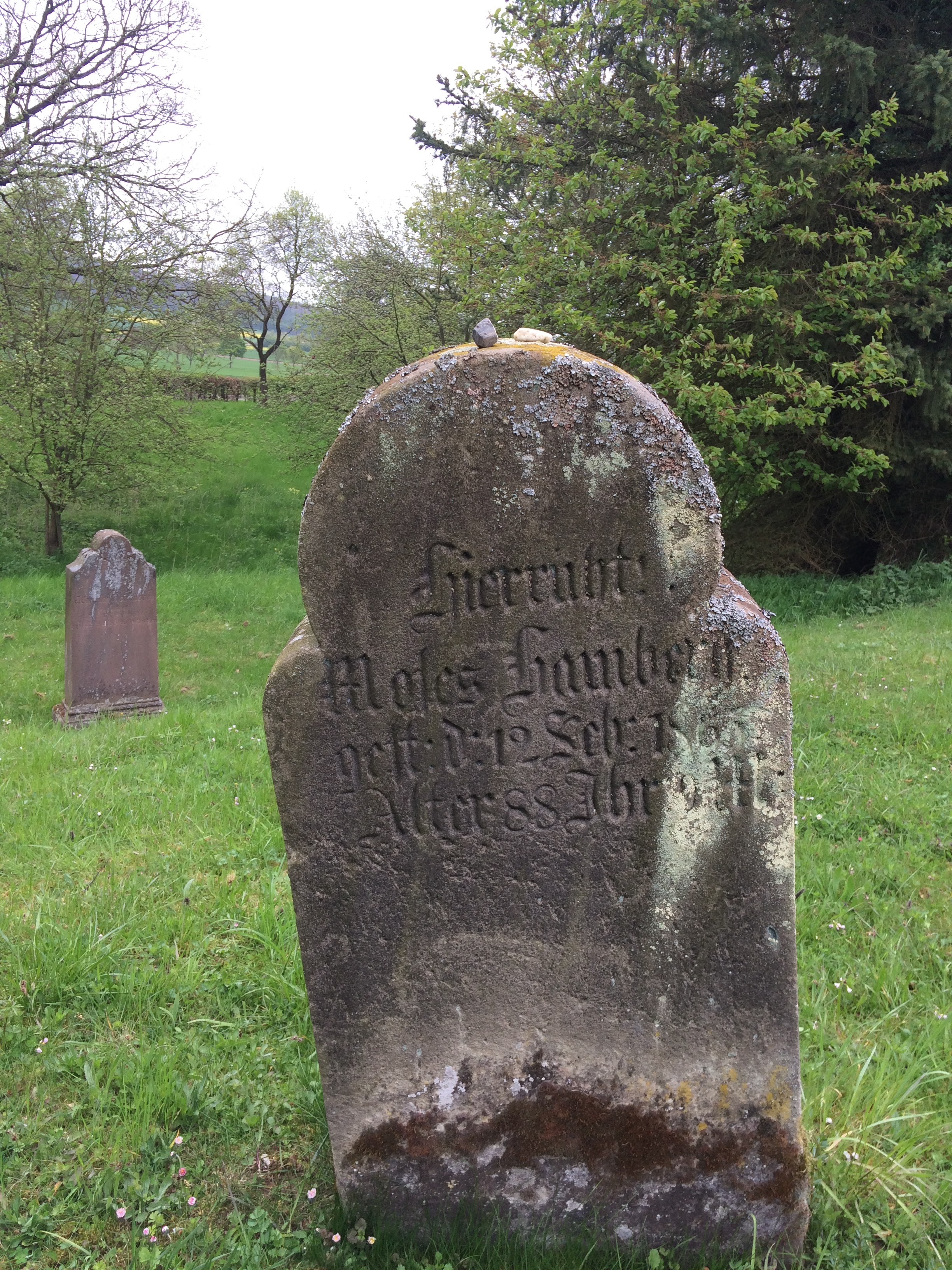
On the reverse were their German names:

Guetchen Rotenberg, reverse side

Moses Hamberg stone reverse side

These were the stones for my three-times great-grandparents, Moses Hamberg and Guetchen Rotenberg, the parents of Henriette Hamberg, the grandparents of Isidore Schoenthal.  Seeing them took my breath away.  I had not expected to find stones for my own direct ancestors.  Because of my experience in Gau-Algesheim, I had kept my expectations low. Yet here were the stones for my ancestors, the grandparents of my father’s maternal grandfather.

I never knew these people and in fact knew almost nothing about them beyond their names, birth dates, and death dates.  The birth record of their daughter Hannchen revealed that Moses was a cattle merchant.  Despite this thin amount of personal information, somehow I felt a connection to these people who died almost a hundred years before I was born.

In the cemetery there were also a number of stones for other people on my Hamberg family tree:

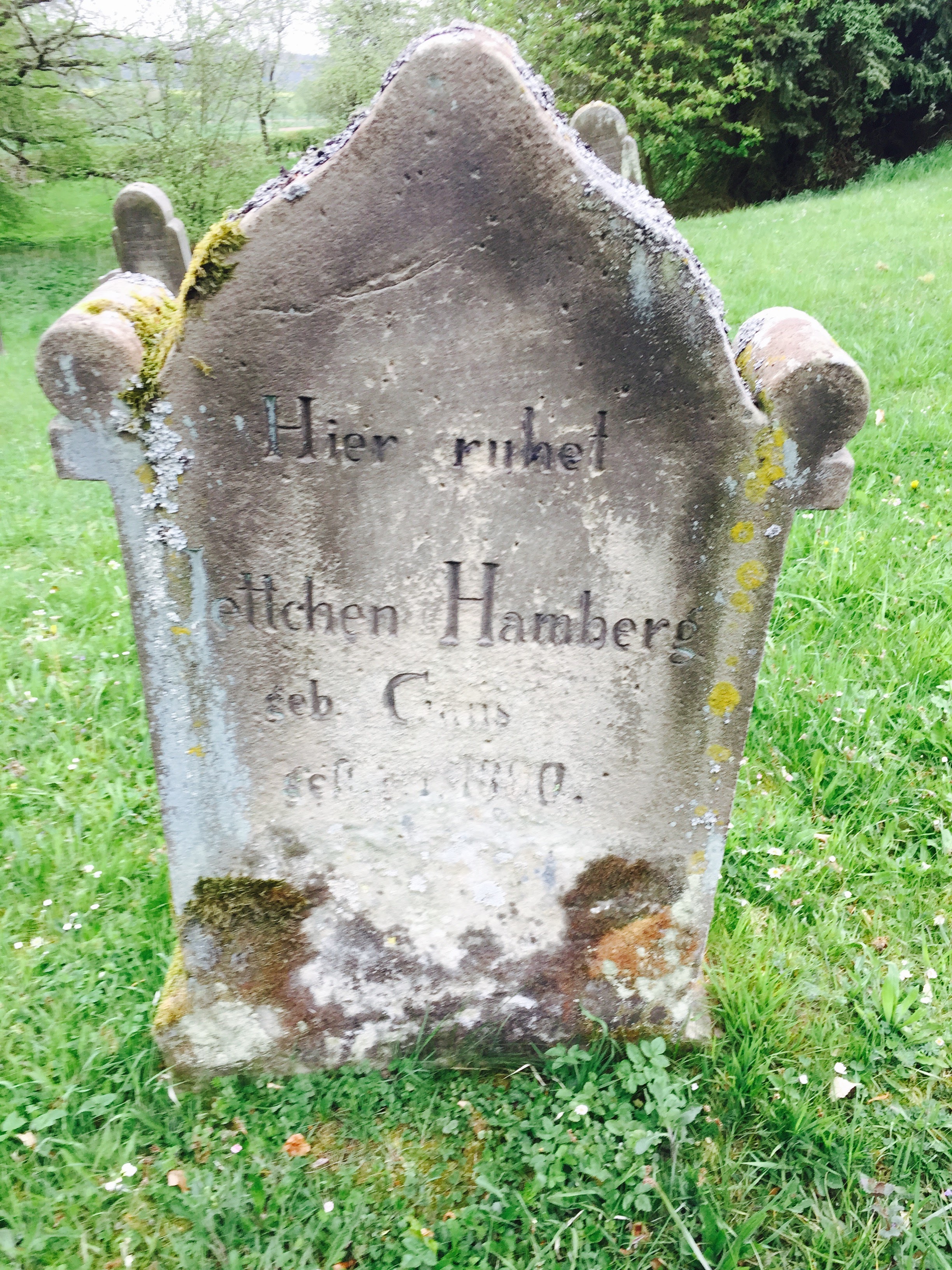
Jettchen Gans Hamberg, wife of Seligmann Hamberg, brother of my great-great-grandmother Henriette Hamberg.  Jettchen and Seligmann were the parents of Malchen/Amalia Hamberg who married Jacob Baer and had the children who founded and worked for the Attleboro Manufacturing Company, the large jewelry business in Attleboro Massachusetts.


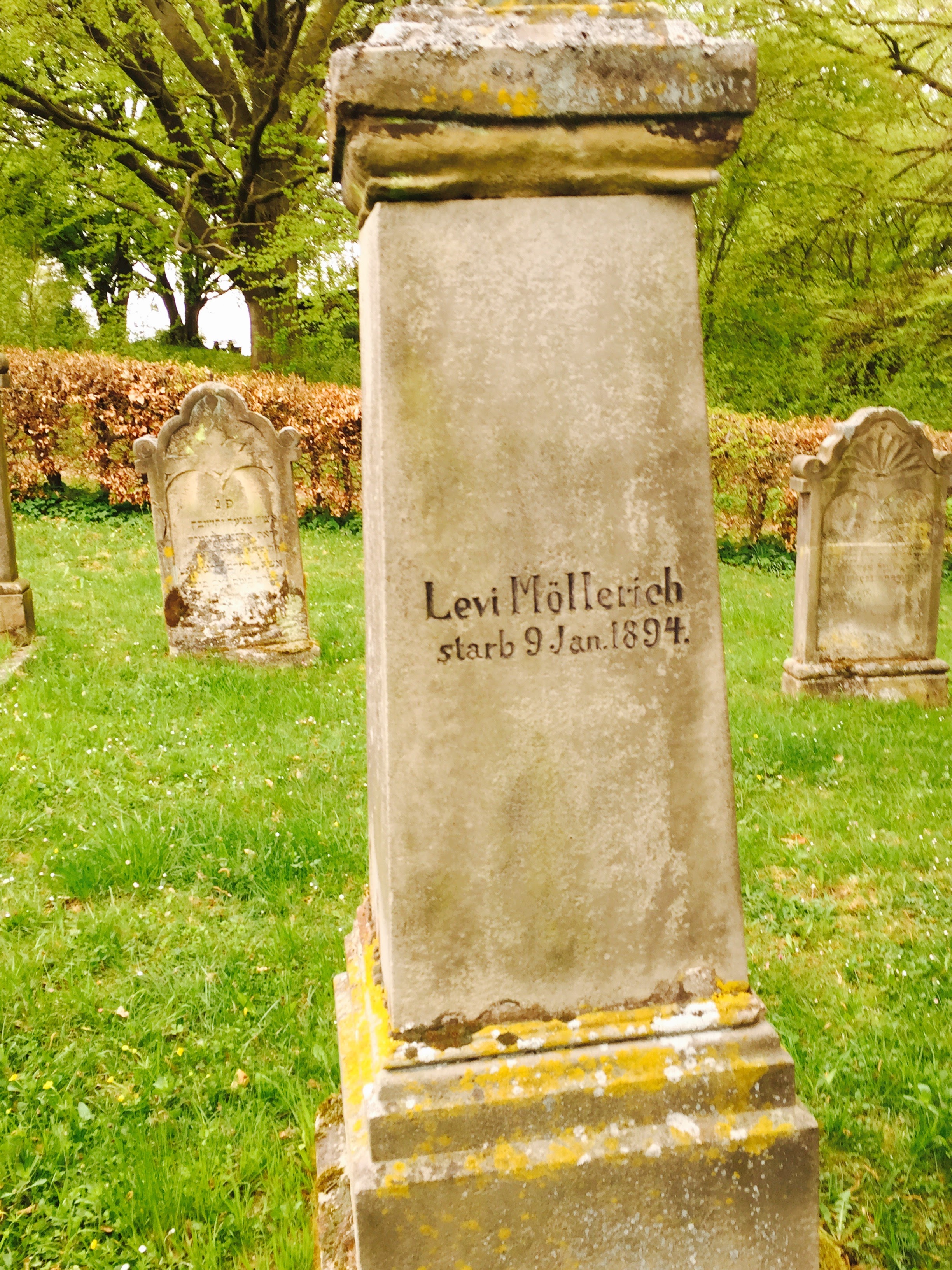
Levi Mollerich, husband of Miriam Hamberg, sister of my great-great-grandmother Henriette Hamberg.

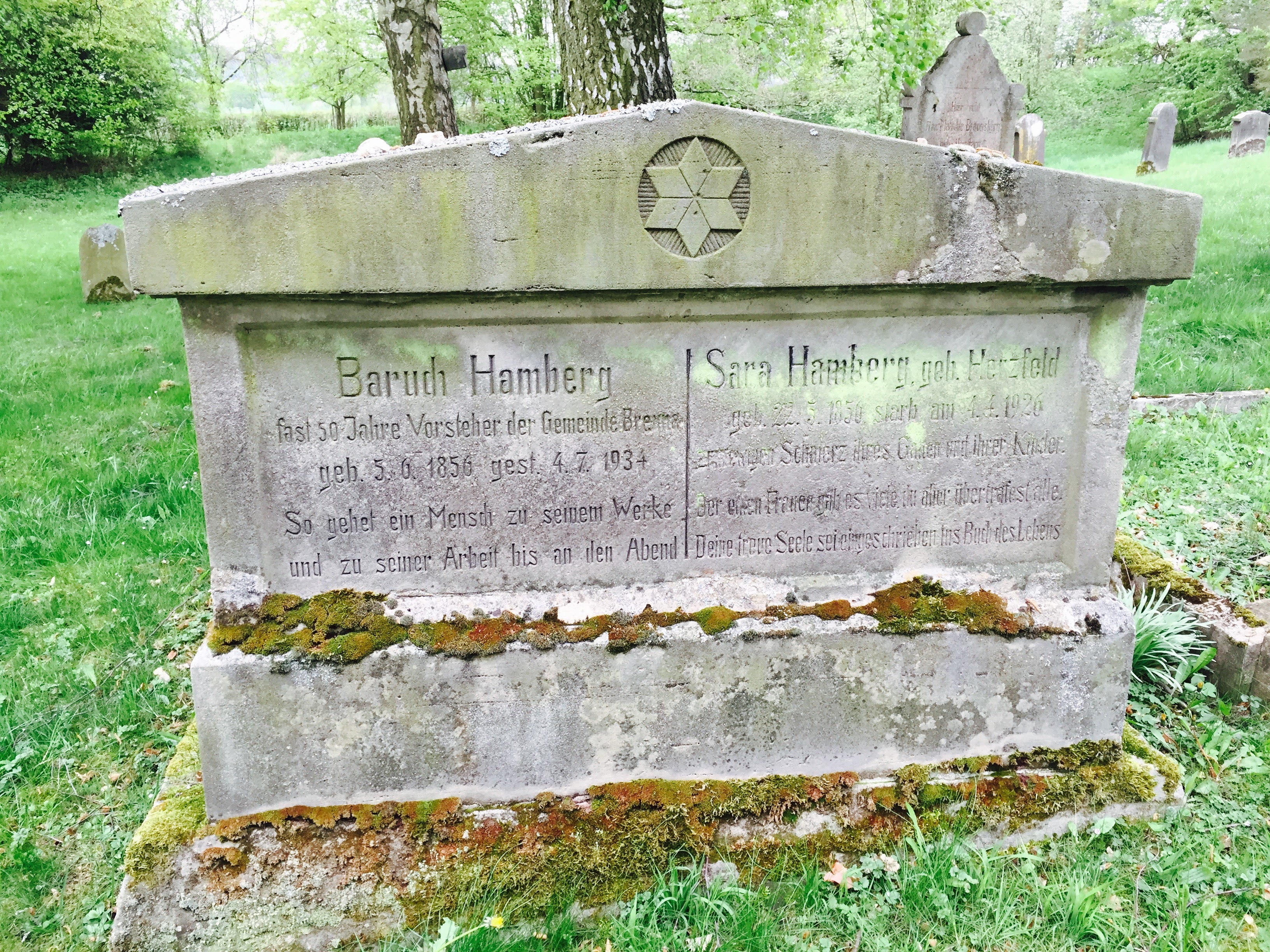
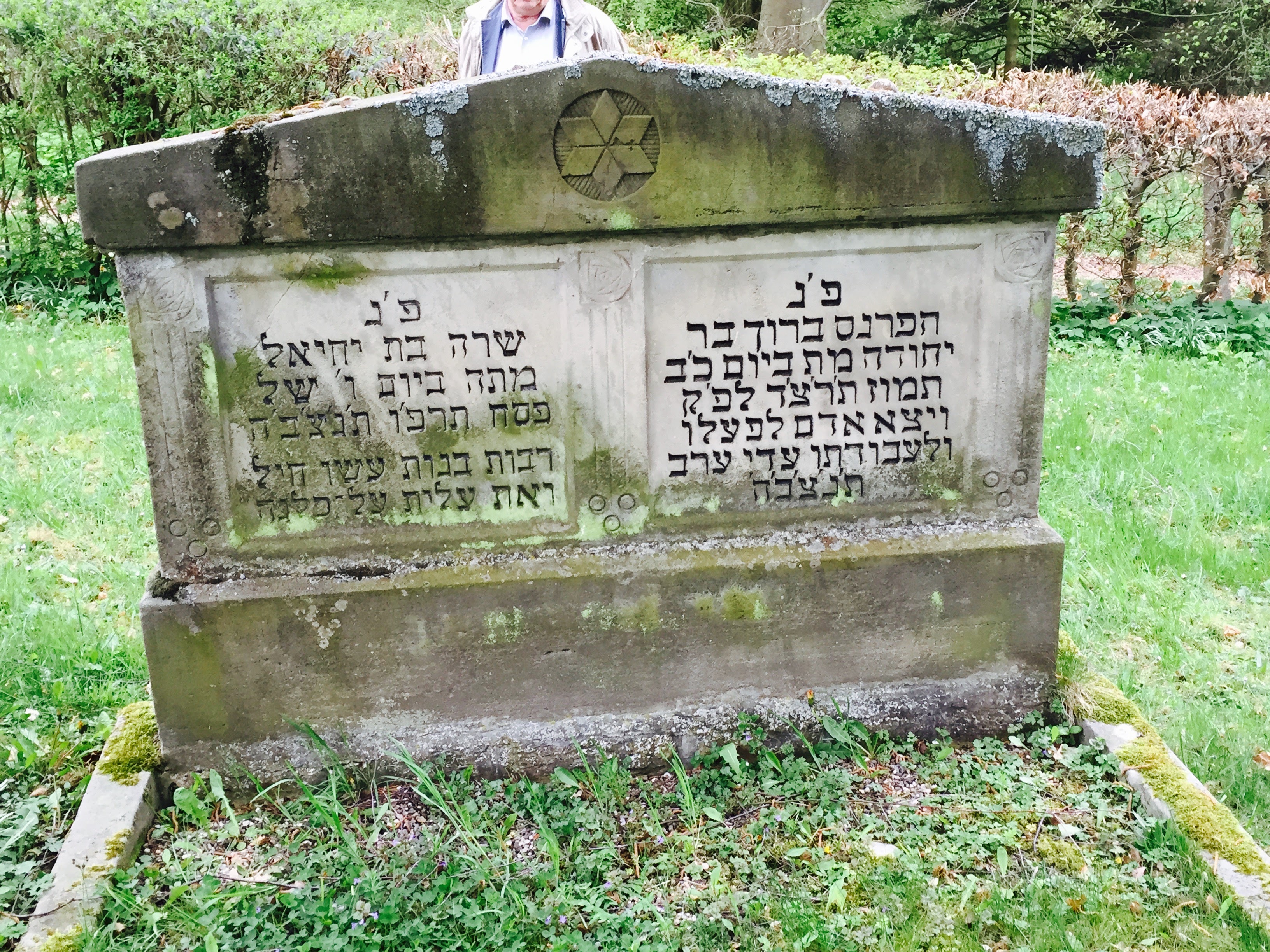
Baruch Hamberg and his wife Sara Herzfeld.  Baruch was my second cousin, three times removed; more importantly, he and Sara were my cousin Rob Meyer’s great-grandparents.  Baruch was also related to Joel Goldwein as Baruch’s mother Breine Goldwein was the sister of Joel’s great-grandfather Markus Goldwein.

Rosa Hamberg Braunsberg.  She was Baruch Hamberg’s sister, so another second cousin, three times removed.

Fanny Herzfeld Goldwein and Markus Goldwein.  Great-grandparents of Joel Goldwein, who is my cousin through my Cohen line and Rob’s cousin through the Goldwein line.

In addition there were some stones with names that might be a part of my family and then others that I need to have translated.  But overall, visiting that cemetery on that very cold and very dreary day left me feeling uplifted and strangely happy.  My ancestors were there, and I had been there to pay tribute and to remember them.  It was a very moving experience.

We drove through Oberlistingen, the home of my Goldschmidt ancestors, and then we said goodbye to our new friend Ernst—he and I both with tears in our eyes—and drove to our hotel in Kassel.  It had been a remarkable day, beginning with a 500 year old mikveh and ending with the discovery of my 3x-great-grandparents’ gravestones.  The next day we would go to Sielen, the home of my Schoenthal ancestors.


After the Flood, More Tears

In my last two posts I wrote about the tragedies the Katzenstein family endured in 1889 when Jacob Katzenstein, my great-grandmother Hilda’s brother, lost his son Edwin and his wife Ella (who may also have been related to me through my Goldschmidt line) in the devastating Johnstown flood of May 31, 1889. This post will follow up with the rest of my great-great-grandparents’ family.

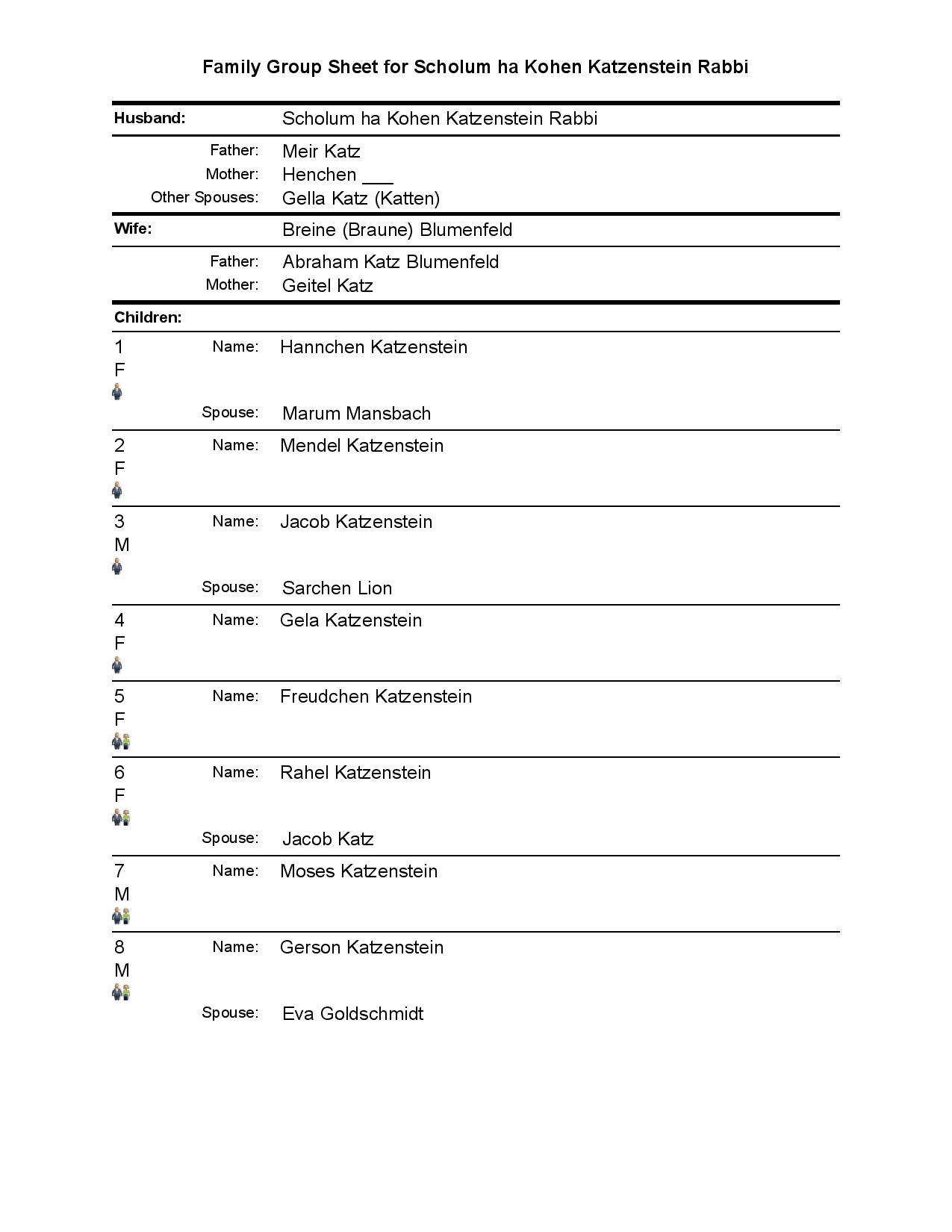
Here is a family group sheet for the family of my great-great-grandparents, Gerson Katzenstein and Eva Goldschmidt and their six children, five of whom survived to adulthood.

family-group-sheet-for-gerson-katzenstein

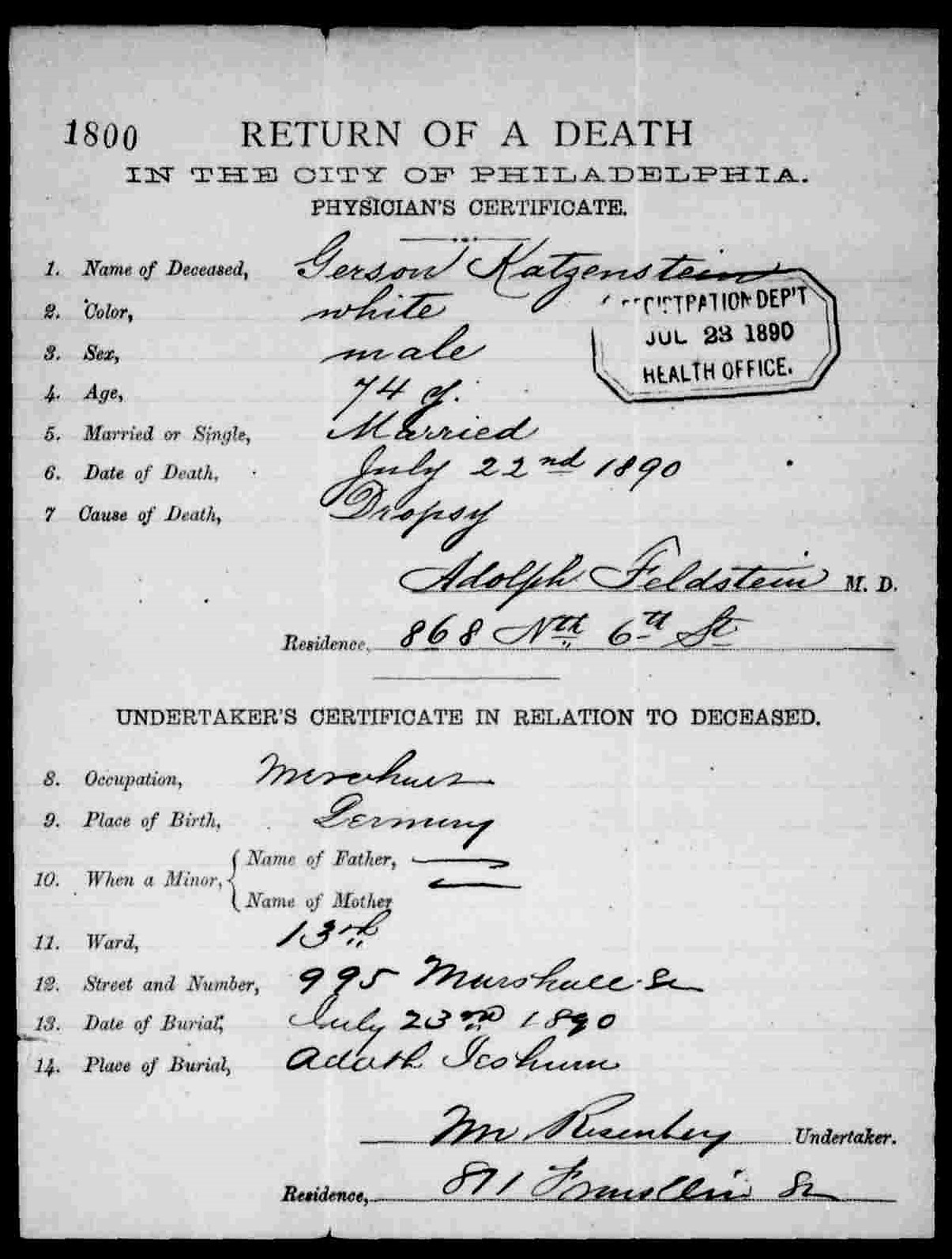
A little over a year after the flood, on July 22, 1890, my great-great-grandfather Gerson Katzenstein died of dropsy at age 75 in Philadelphia. According to several sources, “dropsy” is an old-fashioned term for edema or swelling of body tissues, whether it’s the brain, the heart, or some other body part or organ.  I don’t know what type of edema afflicted Gerson or why it killed him.  He was buried at Adath Jeshrun cemetery in Philadelphia.

gerson-katzenstein-death-cert

Gerson Katzenstein death certificate “Pennsylvania, Philadelphia City Death Certificates, 1803-1915,” database with images, FamilySearch (https://familysearch.org/ark:/61903/3:1:S3HT-68NW-375?cc=1320976&wc=9FR3-SP8%3A1073244201 : 16 May 2014), > image 340 of 1712; Philadelphia City Archives and Historical Society of Pennsylvania, Philadelphia.

In March, 1891, his son Jacob remarried two years after losing his wife and son in the Johnstown flood.  Jacob married Bertha Miller, the daughter of Samuel Miller and Eliza Leopold, whom I mentioned here.  (As I described, Jacob’s first father-in-law, Marcus Bohm, would later be living with Jacob’s second wife Bertha Miller’s aunt, Minnie Leopold Reineman, in 1910 in Johnstown.)  Bertha’s parents were both born in Germany, and her father Samuel was a “merchant tailor” in Pottstown, Pennsylvania, in 1880.

Jacob Katzenstein wedding to Bertha Miller PHiladelphia Times March 12 1891 p. 3

Jacob Katzenstein wedding to Bertha Miller
PHiladelphia Times March 12 1891 p. 3

Bertha and Jacob had a child Helen in 1892, and they had a second child on June 8, 1893, whom they named Gerald, presumably for Gerson Katzenstein, Jacob’s father, my great-great-grandfather.  He was not the only grandson named for Gerson.  On January 20, 1892, my great-uncle Gerson Schoenthal was born, son of my great-grandparents Hilda Katzenstein and Isidore Schoenthal. In addition, SJ Katzenstein and his wife Henrietta also had a child possibly named for Gerson: Vernon Glyde, born on February 8, 1892.

My great-great-grandmother, Eva Goldschmidt Katzenstein, died on September 6, 1893.  She was 66 years old and died of “carcinoma ventric omentum.”  According to my medical consultant, today that is called “carcinoma of the ventral omentum, which is a part of the lining of the abdomen near the stomach.”

Eva also had grandchildren named for her, including my grandmother, Eva Schoenthal.  Jacob and Bertha’s third child, born December 2, 1894, was also named Eva.

eva-goldschmidt-katzenstein-death-cert

Eva Goldschmidt Katzenstein death certificate “Pennsylvania, Philadelphia City Death Certificates, 1803-1915,” database with images, FamilySearch (https://familysearch.org/ark:/61903/3:1:S3HY-DY6W-VS?cc=1320976&wc=9FRF-GP8%3A1073237701 : 16 May 2014), > image 1467 of 1730; Philadelphia City Archives and Historical Society of Pennsylvania, Philadelphia.

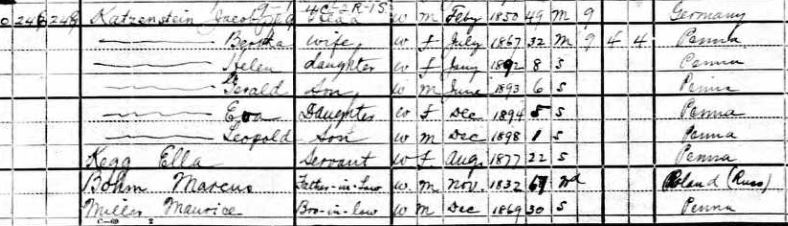
Jacob and Bertha had two more children by 1900: Leopold (1898) and Maurice (1900). As pointed our earlier, they were living in Johnstown in 1900 with Jacob’s first father-in-law Marcus Bohm and Bertha’s brother Maurice.  Jacob was working as a clothing merchant.

Jacob Katzenstein and family 1900 census Year: 1900; Census Place: Johnstown Ward 1, Cambria, Pennsylvania; Roll: 1388; Page: 12A; Enumeration District: 0124; FHL microfilm: 1241388

Jacob Katzenstein and family 1900 census
Year: 1900; Census Place: Johnstown Ward 1, Cambria, Pennsylvania; Roll: 1388; Page: 12A; Enumeration District: 0124; FHL microfilm: 1241388

SJ Katzenstein and his family were living in Washington, Pennsylvania in 1900, where he was still a clothing merchant as well.  Their children were all still at home and at school, except for Howard, who was working as a clerk.

SJ Katzenstein and family 1900 census Year: 1900; Census Place: Washington, Washington, Pennsylvania; Roll: 1494; Page: 16B; Enumeration District: 0173; FHL microfilm: 1241494

SJ Katzenstein and family 1900 census
Year: 1900; Census Place: Washington, Washington, Pennsylvania; Roll: 1494; Page: 16B; Enumeration District: 0173; FHL microfilm: 1241494

Brendina Katzenstein Schlesinger and her family were still in Philadelphia, and her husband Jacob listed his occupation on the 1900 census as a meat salesman.  Their oldest son, Solomon Joseph, was a manager of a laundry, and Alfred was managing a newspaper. Sidney was working as a clerk in a clothing store.  The two daughters, Heloise and Aimee, were not employed.

Brendina and Jacob Schlesinger 1900 census Year: 1900; Census Place: Philadelphia Ward 20, Philadelphia, Pennsylvania; Roll: 1463; Enumeration District: 0421; FHL microfilm: 1241462

Brendina and Jacob Schlesinger 1900 census
Year: 1900; Census Place: Philadelphia Ward 20, Philadelphia, Pennsylvania; Roll: 1463; Enumeration District: 0421; FHL microfilm: 1241462

Perry Katzenstein and his wife Rose were also living in Philadelphia where Perry was in the clothing business.  They had no children.  Rose’s sister Flora Elias was living with them.

Perry and Rose Katzenstein 1900 census Year: 1900; Census Place: Philadelphia Ward 32, Philadelphia, Pennsylvania; Roll: 1474; Page: 4A; Enumeration District: 0830; FHL microfilm: 1241474

Perry and Rose Katzenstein 1900 census
Year: 1900; Census Place: Philadelphia Ward 32, Philadelphia, Pennsylvania; Roll: 1474; Page: 4A; Enumeration District: 0830; FHL microfilm: 1241474

And, as I’ve written before, my great-grandparents Hilda Katzenstein and Isidore Schoenthal were living in Washington, Pennsylvania, with their two older sons, Lester and Gerson, and my great-grandfather was working in the china business there.

HIlda Katzenstein and Isidore Schoenthal 1900 census Year: 1900; Census Place: Washington, Washington, Pennsylvania; Roll: 1495; Page: 4A; Enumeration District: 0175; FHL microfilm: 1241495

HIlda Katzenstein and Isidore Schoenthal 1900 census Year: 1900; Census Place: Washington, Washington, Pennsylvania; Roll: 1495; Page: 4A; Enumeration District: 0175; FHL microfilm: 1241495

So as the century turned, my great-grandmother Hilda and her siblings had lost both of their parents, but the next generation of the family was growing. As of 1900, there were eighteen grandchildren—my grandmother’s first cousins and brothers— and my great-uncle Harold was born on August 28, 1901, bringing the total to nineteen.  My grandmother and one more first cousin were yet to be born.  All of them lived in Pennsylvania, spanning from Philadelphia in the east to Washington in the west with family living in Johnstown in between.

But the start of the 20th century was not very kind to the Katzenstein family.  On December 7, 1901, my great-great-uncle SJ Katzenstein died at age 53.  He left behind his wife Henrietta and six children, ranging in age from Moynelle, who was 22, to Vernon, who was only nine years old.

sj-katzenstein-obit

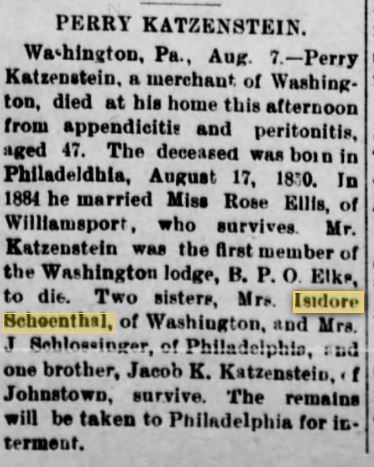
Then less than two years later, SJ’s younger brother Perry died.  He was just a few days shy of his 47th birthday.  According to his obituary, he had been living in Washington, Pennsylvania, not Philadelphia, at the time of his death.  Perhaps he had taken over SJ’s clothing business. Perry died from appendicitis and peritonitis. He was survived by his wife Rose.

Perry Katzenstein obituary Canonsburg PA Daily Notes August 8, 1903 p.2

Perry Katzenstein obituary Canonsburg PA Daily Notes August 8, 1903 p.2

perry-katzenstein-death-cert

But Rose did not last very long without him. While visiting her sister in Chicago on February 24, 1904, she took her own life.  Her death was ruled a suicide, strangulation by hanging.  Perry’s death must have been too much for her to bear.

rosa-elias-katzenstein-death-cert

Rose Elias Katzenstein death certificate “Pennsylvania, Philadelphia City Death Certificates, 1803-1915,” database with images, FamilySearch (https://familysearch.org/ark:/61903/3:1:S3HT-67QH-3T?cc=1320976&wc=9F5B-VZS%3A1073109202 : 16 May 2014), > image 232 of 538; Philadelphia City Archives and Historical Society of Pennsylvania, Philadelphia.

Rose Elias Katzenstein obituary Williamsport Sun-Gazette, February 26, 1904, p. 5

Rose Elias Katzenstein obituary
Williamsport Sun-Gazette, February 26, 1904, p. 5

Thus, by February, 1904, my great-grandmother Hilda had lost her parents, two of her three brothers, two nephews, and two sisters-in-law.  She also had her fourth and last child that year, my grandmother Eva, who was born on March 4, 1904, shortly after Rose’s death.

eva-schoenthal-cohen-watermarked

Eva Schoenthal Cohen, my grandmother

Jacob Katzenstein and his second wife Bertha also had their final child in 1904; he was born in August 1904 and was named Perry, obviously for Jacob’s brother Perry who had died the year before.

My great-great-grandparents Gerson and Eva (Goldschmidt) Katzenstein were thus survived by 21 grandchildren, including my grandmother Eva.  In posts to come, I will share their stories.

For now, I will be taking a short break from research, but will be sharing some of the photographs and records I’ve received but have not yet had a chance to post.


Who Was Ella Bohm Katzenstein? A Genealogy Adventure

This was truly a genealogy adventure. I’d written most of this post before I made two surprising discoveries that required me to rewrite substantial parts of it. The story of Jacob Katzenstein’s first wife Ella is heartbreaking. She was only 27 when she died in the 1889 Johnstown flood, and for a long time I knew almost nothing about her.  I’ve finally made some headway in learning more about her.

Here’s what I now know about her from various sources, more or less in the order I found them. Her first name was Ella, as seen from the birth record indexed on FamilySearch for her son, Milton B. Katzenstein.

milton-b-katzenstein-birth-record

Her birth surname was Bohm, as seen in a newspaper report of her death and as implicitly confirmed by the fact that Milton’s middle name was Bohm; that fact I learned from Milton’s burial record at Grandview Cemetery in Johnstown.

Philadelphia Jewish Exponent,, June 7, 1889, p. 3

Philadelphia Jewish Exponent,, June 7, 1889, p. 3

I know that Ella was probably born in February 1862, as indicated on the memorial stone placed at Eastview Cemetery in Cumberland, Maryland.   Her father’s name was apparently Marcus Bohm; that fact I inferred from the fact that Ella’s widower Jacob Katzenstein included Marcus in his household on the 1900 census and described him as his father-in-law (even though by that time Jacob had remarried). Ella presumably married Jacob sometime before or around January, 1886, since their son Milton was born in September, 1886. Milton died on April 18, 1889.  I also know that a second child, Edwin, was born June 5, 1887, and that he and Ella were killed in the Johnstown flood on May 31, 1889.

ella-katzenstein-and-edwin-katzenstein-headstone-from-findagrave

But where was Ella before marrying Jacob and having these two little boys?

For the longest time, I could not find her on the 1870  census, no matter how many ways I tried to spell her name, with and without wildcards. And then somehow she popped up after I’d just about given up.  I decided to search for any Ella with a surname starting with Bo born anywhere in about 1862 living in Pennsylvania or any state bordering it.  And there she was, listed as Ella Bohn, living in Philadelphia, an eight year old child born in Pennsylvania.  Her father was not living with her, nor was there anyone else in the household named Bohn or Bohm. So who was she living with?

Ella Bohm (Bohn) on the 1870 census Year: 1870; Census Place: Philadelphia Ward 12 District 36, Philadelphia, Pennsylvania

Ella Bohm (Bohn) on the 1870 census
Year: 1870; Census Place: Philadelphia Ward 12 District 36, Philadelphia, Pennsylvania

I took a deep breath when I saw.  She was living with Jacob Goldsmith. Who was he? The son of Simon Goldschmidt and Fradchen Schoenthal.  Simon Goldschmidt was the brother of my three-times great-grandfather Seligmann Goldschmidt, the father of Eva Goldschmidt Katzenstein, whose son Jacob would later marry Ella Bohm.  And Fradchen Schoenthal was the sister of my three-times great-grandfather Levi Schoenthal, father of Isidore Schoenthal who would later marry Hilda Katzenstein, daughter of Eva Goldschmidt Katzenstein and brother of Jacob Katzenstein, who would later marry Ella Bohm.

jacob-katzenstein-to-jacob-goldsmith

So little Ella Bohm was for some reason living with the first cousin, once removed, of her future husband Jacob Katzenstein.  And with in-law relatives of her future sister-in-law, Hilda Katzenstein, my great-grandmother. And they were all related to me.  Yikes.

But where was her father? Why wasn’t Ella living with him? Why was she living with Jacob Goldsmith? Unfortunately, the 1870 census did not include information about the relationships among those in a household, so I couldn’t tell.

A search for information about Ella’s father Marcus Bohm turned up nothing explicit connecting him to Ella, though I was able to piece together some information about Marcus. He was born November 9, 1834, in Warsaw, Poland, and immigrated to the United States in 1849, arriving in Baltimore.

marcus-bohm-manifest-from-family-search

Maryland, Baltimore Passenger Lists, 1820-1948,” database with images, FamilySearch (https://familysearch.org/ark:/61903/3:1:3QS7-897J-P6W?cc=2018318&wc=MKZ4-GPF%3A1004777901%2C1004778901 : 25 September 2015), 1820-1891 (NARA M255, M596) > image 404 of 688; citing NARA microfilm publications M255, M596 and T844 (Washington, D.C.: National Archives and Records Administration, n.d.).

One document indicates that he was living in Washington, Pennsylvania, in 1853, which, of course, is where many members of my extended family also settled, including Jacob Goldsmith, who was a clothing merchant there as early as 1850, and Jacob Katzenstein’s brother SJ, who arrived around there in about 1871.

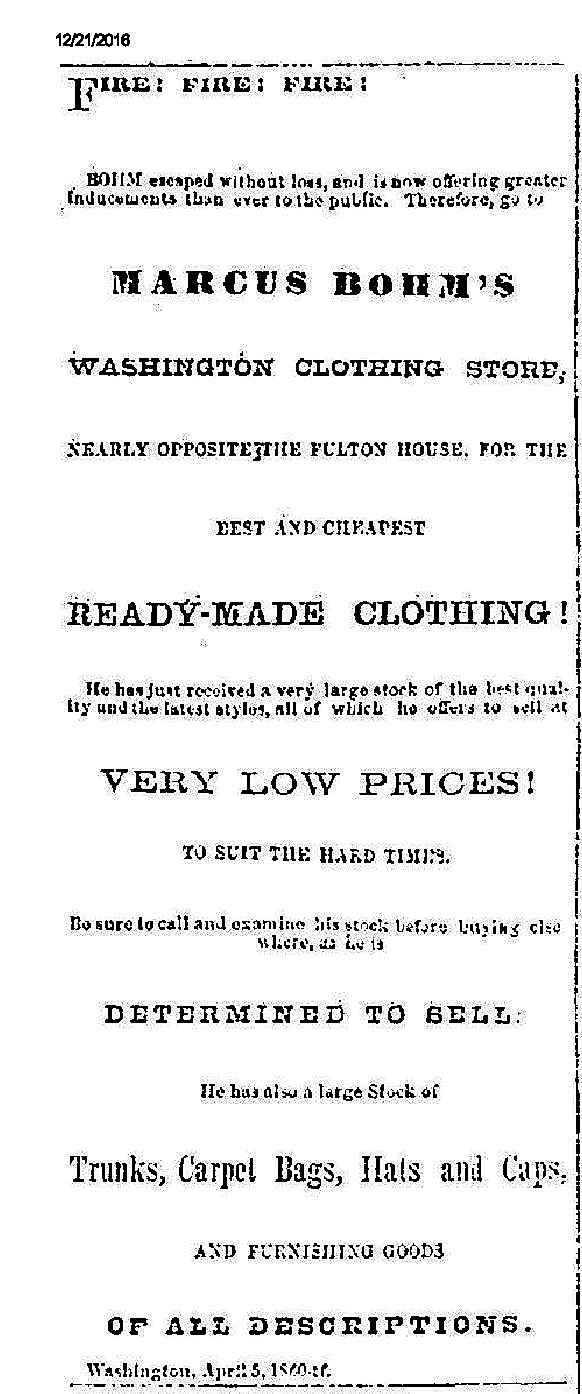
It appears that Marcus Bohm owned a clothing store there from at least 1853 from ads I found online in the Washington newspaper.  There was a fire at his store in April, 1860:

Washington Reporter, April 12, 1860, p. 3

Washington Reporter, April 12, 1860, p. 3

I also found an advertisement for Marcus Bohm’s clothing store in the Washington Reporter of August 30, 1860 (p.3):

ad-for-marcus-bohm-1860


But by November, 1860, Marcus was closing down his Washington store:

marcus-bohm-closing-down-store-in-wash-pa-page-001

It seems he then left Washington, Pennsylvania, because according to a New Jersey index of the 1860 census, Marcus was living in Hudson Township, New Jersey, in 1860, although I cannot find him on the actual 1860 census records.  He is listed in the 1867 Trenton, New Jersey, directory as working in the clothing business and living at Madison House. On the 1870 census, he is listed as living in a hotel in Trenton and working as a clothier. There is no wife or child living with him.

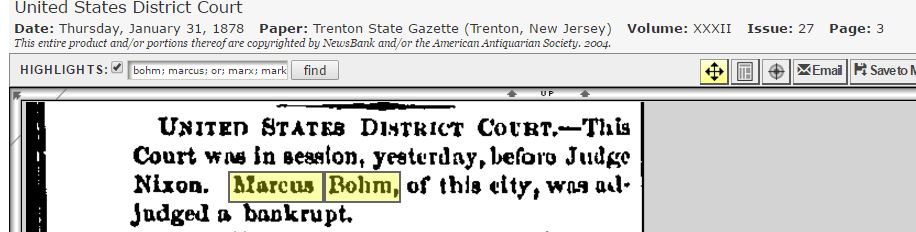
Marcus continued to be listed in Trenton city directories in the 1870s up through 1876, and he is consistently listed as a clothing merchant and tailor and living in various hotels in Trenton. But in 1878, he declared bankruptcy in Trenton:

marcus-bohm-bankrupt

Why was his daughter Ella  living with the Goldsmiths in Philadelphia in 1870 and not with her father in Trenton? I decided to dig deeper into the background of Jacob Goldsmith, someone I had not yet really researched as I am (ahem) not yet focused on my Goldschmidt line (yet somehow they keep popping up everywhere).  I searched for him on the 1880 census, and this is what I found:

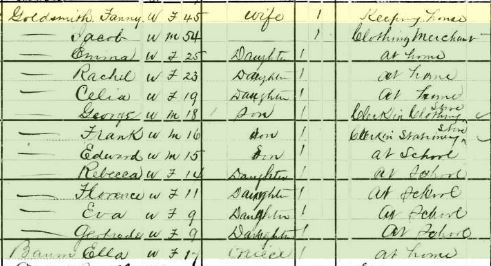
Jacob Goldsmith's family on 1880 census with Ella "Baum" Year: 1880; Census Place: Philadelphia, Philadelphia, Pennsylvania; Roll: 1173; Family History Film: 1255173; Page: 158D; Enumeration District: 210; Image: 0325

Jacob Goldsmith’s family on 1880 census with Ella “Baum”
Year: 1880; Census Place: Philadelphia, Philadelphia, Pennsylvania; Roll: 1173; Family History Film: 1255173; Page: 158D; Enumeration District: 210; Image: 0325

Jacob, Fanny, and their many children were living in Philadelphia, and living with them was a niece named Ella Baum, age 17.  This had to be Ella Bohm, who would have been turning 18 in 1880.  She was living with Jacob and Fanny Goldsmith because she was their niece! So her mother had to be either Fanny’s sister or Jacob’s sister. For reasons described below, I believe she was the daughter of Jacob’s sister Eva.

Jacob had several sisters, but for all but one, I’d found married names, and they had not married Marcus Bohm.  But there was one sister for whom I’d been unable to find anything more than her name on the passenger manifest with her father Simon and stepmother Fradchen in 1845 and her listing on the 1850 census with her father Simon and stepmother Fanny and several siblings. Her name was Eva Goldschmidt/Goldsmith.

Simon, Fradchen, and Eva Goldschmidt on 1845 passenger manifest The National Archives at Washington, D.C.; Washington, D.C.; Records of the US Customs Service, RG36; NAI Number: 2655153; Record Group Title: Records of the Immigration and Naturalization Service, 1787-2004; Record Group Number: 85

Simon, Fradchen, and Eva Goldschmidt on 1845 passenger manifest
The National Archives at Washington, D.C.; Washington, D.C.; Records of the US Customs Service, RG36; NAI Number: 2655153; Record Group Title: Records of the Immigration and Naturalization Service, 1787-2004; Record Group Number: 85

On the 1850 census, the names seem confused. It shows Simon’s wife’s name as Lena. Her name was Fradchen or Fanny in the US. Simon had a daughter Lena, who is also listed on the census.  And then there is a daughter named Fanny.  I think that daughter was really Eva, and the enumerator somehow thought Fanny was the daughter’s name instead of the wife and heard “Lena” instead of “Eva” for the other daughter’s name and thought that was the wife’s name. (Remember these were recent immigrants whose English might not have been very understandable.)

Simon Goldschmidt and family 1850 census Year: 1850; Census Place: Pittsburgh Ward 3, Allegheny, Pennsylvania; Roll: M432_745; Page: 135A; Image: 274

Simon Goldschmidt and family 1850 census
Year: 1850; Census Place: Pittsburgh Ward 3, Allegheny, Pennsylvania; Roll: M432_745; Page: 135A; Image: 274

But Eva is not listed as living with Simon in 1860 when he and two of her younger half-siblings had moved to Washington, Pennsylvania, to live with her older brother Jacob. So where was she then?  I don’t know, but here’s my theory.

My guess is that Marcus Bohm and Eva Goldsmith, Jacob’s sister, were married sometime around 1860. After their daughter Ella Bohm was born in 1862, Eva either died in childbirth or sometime shortly thereafter and before 1870. Supporting the theory that Eva had died is the fact that her brother Jacob named a child born in 1871 Eva.

I believe that Ella’s widowed father Marcus Bohm moved to New Jersey after losing his wife and his business in Washington, and he left his little daughter to be raised by her uncle, Jacob Goldsmith. That little girl then grew up and married Jacob Katzenstein, who was her second cousin.

I don’t know when she married Jacob. I cannot find Jacob or Ella on the 1880 census, although Jacob was listed in the Pittsburgh directories for 1879 and 1881, the Johnstown directory in 1884, both the Philadelphia and Johnstown directories for 1887, and the Johnstown directory in 1889. When their son Milton was born in 1886, Jacob and Ella must have been living in Philadelphia. And by 1889 they were living in Johnstown.

Where was Ella’s father Marcus in the 1880s? The 1880 census report shows that he was then living in Washington, Pennsylvania, boarding in a hotel there and working in a clothing store.  But by 1884, Marcus had moved to Johnstown, as the 1884 Johnstown directory lists Marcus living at 251 Main Street and working at 272 Main Street in the clothing business. That same directory lists Jacob Katzenstein as a commercial traveler living at 241 Main Street, just a few houses away from Marcus. I assume that Marcus moved to Johnstown because his daughter Ella had by that time married Jacob and was living there, but I don’t know for sure.

After the tragic deaths of his daughter Ella and his two grandsons Milton and Edwin in 1889, Marcus seemed to disappear for some years and does not appear in any city directories. The next record that does include Ella’s father Marcus is the 1900 census where, as noted above, he was living in Johnstown with Jacob Katzenstein and Jacob’s second wife Bertha Miller, their three children, Bertha’s brother Maurice, and a servant.  Marcus is described as Jacob’s father-in-law, widowed, and retired.

Jacob Katzenstein and family 1900 census Year: 1900; Census Place: Johnstown Ward 1, Cambria, Pennsylvania; Roll: 1388; Page: 12A; Enumeration District: 0124; FHL microfilm: 1241388

Jacob Katzenstein and family 1900 census
Year: 1900; Census Place: Johnstown Ward 1, Cambria, Pennsylvania; Roll: 1388; Page: 12A; Enumeration District: 0124; FHL microfilm: 1241388

I find it rather heartwarming that Bertha Miller took in the father of Jacob’s first wife.

Ten years later Marcus was still living in Johnstown, boarding in the household of Solomon Reineman, according to the 1910 census. I thought perhaps Solomon was a relative or married to a relative, but Solomon was born in Germany, not Poland. In 1880, Solomon had been living in Johnstown, so I assume that Marcus had become friendly with him during the 1880s when both were living in Johnstown.

And then I found a connection to Solomon’s wife, Minnie Leopold, though not directly. While researching Jacob’s second wife, Bertha Miller, I saw that her mother was named Eliza Leopold.  The name jumped out at me, and I thought—could there be a connection to Minnie Leopold? A few more steps of research, and lo and behold, I learned that Eliza and Minnie Leopold were sisters! So somehow Marcus Bohm ended up living with his son-in-law’s second wife’s aunt and her husband.

Two years later, however, Marcus had moved to Philadelphia. The 1912 Philadelphia directory lists Marcus Bohm living at 3333 North Broad Street. Four years later on February 25, 1916, Marcus died in Philadelphia.  He was 81 years old and died of chronic emphysema.

Pennsylvania Historic and Museum Commission; Pennsylvania, USA; Certificate Number Range: 021751-024880

Pennsylvania Historic and Museum Commission; Pennsylvania, USA; Certificate Number Range: 021751-024880

He’d been living at the Masonic Home of Pennsylvania, and the informant was William H. Sivel, the superintendent at 3333 North Broad Street, which I assume is the location of the Masonic Home and where Marcus had been residing.  There is no other personal information on the certificate except for Marcus Bohm’s birth date, birth place (Poland), age, and occupation, which the informant described as “gentleman.”  I was unable to find an obituary or any other document that would reveal family information for Marcus, only this death notice.

Philadelphia Inquirer, February 26, 1916, p. 18

Philadelphia Inquirer, February 26, 1916, p. 18

Thus, I was lucky enough to learn a little more about Ella Bohm Katzenstein and can only speculate that her mother was Eva Goldsmith, that Eva Goldsmith Bohm had died, and that Ella had been left to live with the family of Jacob Goldsmith while her father tried to recover from losing his wife and his store in Washington, Pennsylvania.

If I am right in this speculation, it makes her short life even more tragic. It was heartbreaking enough to know that she’d lost her first son Milton and then was killed along with her other son in the Johnstown flood of 1889 when she was only 27. But adding to that the loss of her mother and in some ways her father as a young child makes her story especially poignant.


Of Rabbit Holes and Twisted Trees and the Curse of Endogamy

Now that I have emerged from the Mansbach rabbit hole I dove into weeks ago, I can return to the story of my direct ancestors, Gerson Katzenstein and Eva Goldschmidt and their children, including my great-grandmother Hilda Katzenstein.  As I wrote previously, Gerson was one of eight children of Scholum Katzenstein, including four full siblings, two of whom died as children, and three half-siblings, one of whom died as a child. As best I can tell Gerson was the only one of the eight to leave Germany and come to the United States.

Gerson and Eva were married in Oberlistingen in June 1847, and then settled in Gerson’s home town of Jesberg, where they had three children: Scholum (1848, named for Gerson’s father), Jacob (1851), and Brendina (1853, named for Gerson’s mother, Breine Blumenfeld).

marriage-record-of-gerson-katzenstein-and-eva-goldschmidt

Marriage record of Gerson Katzenstein and Eva Goldschmidt HHStAW fonds 365 No 673, Arcinsys Hessen

Gerson and Eva immigrated to the US in 1856 with Scholum, Jacob, and Brendina. A fourth child Perry was born a few months after they had settled in Philadelphia. In 1858, they had a fifth child, Hannah, and in 1860 they were all living in Philadelphia where Gerson was working as a salesman.  As noted in an earlier post, there were three others living in the household, Abraham “Anspach,” who I believe was actually Abraham Mansbach (III), David Frank, a bookkeeper, and Marley Mansbach, who I believe was Abraham Mansbach’s cousin and only related to Gerson through his sister Hannchen’s marriage into the Mansbach family.

Gerson Katzenstein in the 1856 Philadelphia directory

Gerson Katzenstein in the 1856 Philadelphia directory

Gerson Katzenstein and family 1860 US census Year: 1860; Census Place: Philadelphia Ward 13, Philadelphia, Pennsylvania; Roll: M653_1163; Page: 519; Image: 105; Family History Library Film: 805163

Gerson Katzenstein and family 1860 US census
Year: 1860; Census Place: Philadelphia Ward 13, Philadelphia, Pennsylvania; Roll: M653_1163; Page: 519; Image: 105; Family History Library Film: 805163

On August 17, 1863, Gerson and Eva had their sixth and final child, my great-grandmother Hilda.

The family suffered a terrible loss on December 17, 1866, when their eight year old daughter Hannah died from scarlet fever.  She was buried at Adath Jeshurun cemetery in Philadelphia. I have to wonder what impact that had on the family, especially little three year old Hilda, who must have been very frightened and confused.

Hannah Katzenstein death certificate "Pennsylvania, Philadelphia City Death Certificates, 1803-1915," database with images, FamilySearch (https://familysearch.org/ark:/61903/3:1:S3HY-DTXQ-JWY?cc=1320976&wc=9FRX-W38%3A1073285701 : 16 May 2014), > image 316 of 1079; Philadelphia City Archives and Historical Society of Pennsylvania, Philadelphia.

Hannah Katzenstein death certificate
“Pennsylvania, Philadelphia City Death Certificates, 1803-1915,” database with images, FamilySearch (https://familysearch.org/ark:/61903/3:1:S3HY-DTXQ-JWY?cc=1320976&wc=9FRX-W38%3A1073285701 : 16 May 2014), > image 316 of 1079; Philadelphia City Archives and Historical Society of Pennsylvania, Philadelphia.

In 1870, Gerson and Eva were living with their five surviving children.  Scholum was listed as Joseph and was 22; Jacob was 18, Brendina 15, Perry 14, and Hilda was seven.  The 1870 census was taken twice because there were felt to be errors in the first enumeration.  For the Katzenstein family, the first enumeration is barely legible and is missing some of the children, but indicates that Gerson was working as a clerk in a store.  The second enumeration is quite clear and includes all the children, but has no information about occupations.

gerson-katzenstein-1870-census-2

Gerson Katzenstein on 1870 census, first enumeration Year: 1870; Census Place: Philadelphia Ward 16 District 48, Philadelphia, Pennsylvania

gerson-katzenstein-1870-census-1

Gerson Katzenstein and family 1870 census, second enumeration Year: 1870; Census Place: Philadelphia Ward 16 Dist 48 (2nd Enum), Philadelphia, Pennsylvania; Roll: M593_1429; Page: 708B; Image: 258; Family History Library Film: 552928

Brendina Katzenstein, the oldest daughter and third child of Gerson and Eva, was the first to marry.  According to the 1900 census, she married Jacob Schlesinger in 1871 when she was only eighteen years old.  It took some serious digging and the help of the German Genealogy Facebook group to find some background on Jacob.  First, from his death notice, I saw that he was born in “Epplagan” in Germany.

jacob-schlesinger-death-notice

Nick in the German Genealogy group figured out that that was Eppingen.  I then searched the Landesarchiv for Baden Wurttemburg and found Jacob’s birth record, which Nick helped me translate:

Jacob Schlesinger birth record from Eppingen

Jacob Schlesinger birth record from Eppingen,  Landesarchiv Baden-Wurtenberg, 390 Nr. 1320, 1 Band Gliederungssymbol Eppingen, israelitische Gemeinde: Standesbuch 1811-1870 Bild 235

The child was born on March 3rd, 1843 and named Jacob. The father was Jacob (?) Schlesinger, a schützbürger (see note below) and hand[e]lsmann (merchant) and his wife Guste? born Sülzberger.

[UPDATE: Thanks to Dorothee Lottmann-Kaeseler for explaining the word “schutzburger” and providing a cite with this explanation: The “Law on the Situation of the Jews” (“Gesetz über die Verhältnisse der Juden”) from 1809 recognized the Jewish religious community as a church. Constitutionally, Jews were to be treated as free citizens. Their position in the municipalities did not change however, they remained only “protected citizens” (“Schutzbürger”) who did not have the right to be elected to a local council and did not have rights of usage of the common land.]

Nick wasn’t sure whether Jacob’s father’s name was Jacob, and I was skeptical of the fact that his father would also have been a Jacob.  Looking at the record itself, it certainly looks like “Jacob” was crossed out and something else was written over it.  Perhaps the scribe who entered the record confused the child’s name and the father’s name.

Although I could not find Jacob Schlesinger on any US census record before 1880, I was able to locate him in a number of Philadelphia directories where he was living at the same address with men named Abraham, Israel, and Myer Schlesinger, all of whom, like Jacob, were working as butchers.  I assumed these were his relatives, and so I searched for information about them.

I found a passenger manifest that shows an Israel Schlesinger and his family arriving in the US in 1860; along with Israel was his wife Gustel or Gurtel, sons Maier (26) and Abraham (11), and two daughters, Fanny (20) and Malchen (15).  There was no son named Jacob on this manifest.

Family of Israel Schlesinger 1860 ship manifest Year: 1860; Arrival: New York, New York; Microfilm Serial: M237, 1820-1897; Microfilm Roll: Roll 205; Line: 1; List Number: 918 Description Ship or Roll Number : Roll 205 Source Information Ancestry.com. New York, Passenger Lists, 1820-1957

Family of Israel Schlesinger 1860 ship manifest
Year: 1860; Arrival: New York, New York; Microfilm Serial: M237, 1820-1897; Microfilm Roll: Roll 205; Line: 1; List Number: 918
Description
Ship or Roll Number : Roll 205
Source Information
Ancestry.com. New York, Passenger Lists, 1820-1957

Then I found another manifest listing a fourteen year old named Jacob Schlesinger arriving in 1857 with what appears to be an older sibling named Hagar.  Since my Jacob Schlesinger reported on the 1910 census that he’d arrived in 1857 (and in 1855 according to the 1900 census) and he would have been fourteen in 1857, I assumed that this was the right Jacob.  Further research uncovered a Hagar Schlesinger, a woman of the right age, who was living in Philadelphia in 1885, so she was probably his sister.

Jacob and Hagar Schlesinger 1857 ship manifest Year: 1857; Arrival: New York, New York; Microfilm Serial: M237, 1820-1897; Microfilm Roll: Roll 173; Line: 1; List Number: 497

Jacob and Hagar Schlesinger 1857 ship manifest
Year: 1857; Arrival: New York, New York; Microfilm Serial: M237, 1820-1897; Microfilm Roll: Roll 173; Line: 1; List Number: 497

But I still had no proof that this Jacob was the son of Israel Schlesinger.  He could have been just a nephew or a cousin.  So I searched for a birth record for one of Israel’s sons and found this one for Myer, as translated by Nick:

Myer Schlesinger birth record landesarchiv_baden-wuerttemberg_generallandesarchiv_karlsruhe_390_nr-_1320_bild_174_4-1128670-174.jpg

Myer Schlesinger birth record
landesarchiv_baden-wuerttemberg_generallandesarchiv_karlsruhe_390_nr-_1320_bild_174_4-1128670-174.jpg

The child was born June 4th, 1834, named Mozes and the parents are Israel Schlesinger and Geitel Si?lzberger.

Myer was also the son of Geitel Sulzberger and Israel (not Jacob) Schlesinger.  Looking back at Jacob’s birth record, it does seem that “Israel” was written over “Jacob” and that thus Jacob’s father was also Israel Schlesinger.  I also found a birth record for Hagar Schlesinger; she also was the daughter of Israel and Geitel.

Thus, I feel fairly comfortable concluding that my Jacob Schlesinger was a son of Israel Schlesinger from Eppingen, especially since he and Israel were living at the same address in 1865, according to the Philadelphia directory for that year. In addition, Jacob, like Israel, Myer, and Abraham, was a butcher in Philadelphia, as seen in numerous entries in the Philadelphia city directories as well as census reports.

Brendina and Jacob Schlesinger had three children listed on the 1880 census: Heloise (5), Solomon (4), and Alfred (1). Jacob was still working as a butcher.  Brendina and Jacob would have a fourth child, Sidney, in 1880, and a fifth, Aimee, born in 1887.

Jacob and Brendina Schlesinger and family 1880 census Year: 1880; Census Place: Philadelphia, Philadelphia, Pennsylvania; Roll: 1176; Family History Film: 1255176; Page: 156A; Enumeration District: 301; Image: 0314

Jacob and Brendina Schlesinger and family
1880 census
Year: 1880; Census Place: Philadelphia, Philadelphia, Pennsylvania; Roll: 1176; Family History Film: 1255176; Page: 156A; Enumeration District: 301; Image: 0314


The 1870s were also active years for Brendina’s three brothers. The oldest brother, Scholum Joseph, had lived in many places since coming with his family to the US.  An 1896 profile of him reported that he had left his family for Leavenworth, Kansas, when he was fourteen to learn how to be a cigar maker, but since he did not arrive until he was eighteen in 1856, that seems more myth than truth.  The profile goes on to state that after being in Kansas for a number of years, he returned to Philadelphia, but eventually gave up the cigar trade because of health concerns.  The article continues by saying that he then “went to Winchester, VA., and took a clerkship, remaining for five years. Thence he went to Uhrichsville, Ohio, thence to New Castle and on the nineteenth of April 1871, he came to Washington [Pennsylvania].”  “The Saturday Evening Supper Table,” Washington, Pennsylvania, June 27, 1896, found here (my cousin Roger Cibella’s genealogy website).

The U.S. and Canada, Passenger and Immigration Lists Index, 1500s-1900s, database on Ancestry, confirms that by 1873, Scholum, also known as S.J. or Joseph Katzenstein, had moved to Washington, Pennsylvania.  That is, he moved to the small town in western Pennsylvania where his mother’s uncle Simon Goldschmidt and his children were living at that time.  Readers with excellent memories may recall that Simon Goldschmidt was married to Fanny Schoenthal, my great-grandfather Isidore Schoenthal’s sister. By 1881 Isidore was also living in Washington, Pennsylvania.

S.J.’s move to Washington, Pennsylvania, may have had long lasting repercussions for my family, as I am fairly confident that he was the one who engineered the introduction of his younger sister, my great-grandmother Hilda, to Isidore Schoenthal, my great-grandfather.

The Daily Republican (Monongahela, Pennsylvania) 11 Aug 1887, Thu • Page 4

The Daily Republican
(Monongahela, Pennsylvania)
11 Aug 1887, Thu • Page 4

S.J Katzenstein married Henrietta Sigmund in 1875.  Henrietta was born in 1851 in Baltimore to Ella Goldschmidt and Albert Sigmund. That added yet another twist to my family tree because Ella Goldschmidt was the daughter of Meyer Goldschmidt whose brothers were Seligmann Goldschmidt, father of Eva Goldschmidt Katzenstein, and Simon Goldschmidt, husband of Fanny Schoenthal.  In other words, Eva Goldschmidt Katzenstein was Ella Goldschmidt Sigmund’s first cousin, meaning that S.J. Katzenstein married his maternal second cousin, Henrietta Sigmund.

ella-goldschmidt-to-eva-goldschmidt

But let me stay focused on the Katzensteins rather than diving into the Goldschmidt rabbit hole.

S.J. and Henrietta, who was also known as Dot or Dottie, had a daughter Moynelle in 1879.  S.J., who is listed as Joseph on the 1880 census, was working as a clothing merchant in Washington, Pennsylvania. He and Henrietta would have five more children: Milton (1881), Howard (1882), Ivan (1884), Earl (1885), and Vernon (1892).

S. Joseph Katzenstein and family 1880 census Year: 1880; Census Place: Washington, Washington, Pennsylvania; Roll: 1202; Family History Film: 1255202; Page: 577A; Enumeration District: 270

S. Joseph Katzenstein and family 1880 census
Year: 1880; Census Place: Washington, Washington, Pennsylvania; Roll: 1202; Family History Film: 1255202; Page: 577A; Enumeration District: 270

S.J. was not the only child of Gerson and Eva Katzenstein to leave Philadelphia for western Pennsylvania in the 1870s.  In 1878, Perry Katzenstein, the third brother, was listed in the Pittsburgh directory as a clerk; the following year his brother Jacob joined him.  Both were living at 25 Second Avenue and working as salesmen.  Although I cannot find either of them on the 1880 census, both were listed in the 1881 Pittsburgh directory, still working as salesmen and still living together, though now at 188 Wylie Avenue. (Perry also appears in the 1880 directory, but Jacob does not.)

As for their parents and little sister Hilda, they were still living in Philadelphia in 1880.  Gerson continued to work as a clerk in a store.  Living with them, in addition to a number of boarders, was Louis Mansbach, listed as Gerson’s nephew, age 31, and born in “Prussia.” At first I thought this was Louis Mansbach, son of H.H. Mansbach, who would have been Gerson’s great-nephew.  But that Louis Mansbach was far too young and born in the US. So who was this Louis Mansbach?

Year: 1880; Census Place: Philadelphia, Philadelphia, Pennsylvania; Roll: 1173; Family History Film: 1255173; Page: 274B; Enumeration District: 219; Image: 0561

Year: 1880; Census Place: Philadelphia, Philadelphia, Pennsylvania; Roll: 1173; Family History Film: 1255173; Page: 274B; Enumeration District: 219; Image: 0561

Well, remember that post where I was trying to sort out all the different men named Abraham Mansbach? One of them, whom I called Abraham II, was the son of Leiser Mansbach and grandson of Abraham Mansbach I.  Abraham II was the brother of Marum Mansbach who married Hannchen Katzenstein, Gerson Katzenstein’s half-sister.  And Abraham II had a son in 1849 who was named for his grandfather: Leiser Mansbach II. He was therefore the nephew of Marum Mansbach and Hannchen Katzenstein.  Leiser became Louis, and he was living with Gerson and Eva Katzenstein in 1880, working as a veterinary surgeon.

And so you might be thinking, “Well, he wasn’t Gerson’s nephew.  He was Gerson’s brother-in-law’s nephew.” And you might be thinking, “Perhaps Gerson was just being liberal in using the term ‘nephew.’”

But, alas, it’s not that simple. Once again there is a twist in the tree.  Louis Mansbach’s mother was Sarah Goldschmidt, Eva Goldschmidt’s sister.  So Louis Mansbach was in fact Eva Goldschmidt Katzenstein’s nephew as well as Gerson’s brother-in-law’s nephew.

leiser-mansbach-to-gerson-katzenstein


And on that confusing note, I am going to go get a breath of fresh air and curse the endogamy gods who make using DNA results so utterly pointless in my family research.


The Katzenstein Clan: Who Got Here First?

One of the main questions I had about Gerson Katzenstein, my great-great-grandfather, was why did he come to the United States?  Did he have other relatives who had paved the way, or was he the first in his family to arrive?

When I first did some research about Gerson almost five years ago, I was unable to find any relatives aside from his wife and children, and so I had no information about the rest of his family.  But thanks to the work of Barbara Greve and David Baron, I now have a long list of names of relatives, including the names of Gerson’s siblings.  I thought that there might have been other relatives living in the United States when Gerson arrived that I’d not known about during my initial research several years ago.

What I learned from Barbara Greve’s work was that Gerson was one of the eight children of Scholem Katzenstein; there were four half-siblings born to Scholem’s first wife, Gella: Hannchen (1798-1840), Mendel, who died as an infant in 1799, Jacob (1803-?), and Gela, who also died as an infant in 1808.  Gerson had three full siblings born to his mother, Breine Blumenfeld: Freudchen (1809-1818), Rahel (1813-1861), and Moses, for whom the only record is a birth record dated November 4, 1814.  Perhaps Moses also had died as an infant. Thus, of the eight children of Scholem Katzenstein, the only ones for whom there are records indicating survival to adulthood are Gerson, Hannchen, Jacob, and Rahel.

family-group-sheet-for-scholum-ha-kohen-katzenstein-rabbi-page-001


Gerson’s birth is recorded as somewhere between 1811 and 1815, depending on the source.  He married Eva Goldschmidt of Oberlistingen sometime before 1848, when their first child, Scholem, was born in Jesberg.  Two more children followed, Jacob in 1851 and Brendina (Branche in German—presumably named for Gerson’s mother) in 1853.

Gerson, Eva, and their three children left Germany and arrived in New York City on July 3, 1856.  On the ship manifest, Gerson listed his occupation as a butcher and their final destination as Philadelphia.

Gerson Katzenstein and family on 1856 ship manifest Year: 1856; Arrival: New York, New York; Microfilm Serial: M237, 1820-1897; Microfilm Roll: Roll 164; Line: 1; List Number: 589

Gerson Katzenstein and family on 1856 ship manifest
Year: 1856; Arrival: New York, New York; Microfilm Serial: M237, 1820-1897; Microfilm Roll: Roll 164; Line: 1; List Number: 589

Just a little over a month later, Eva gave birth to their fourth child, Perry, who was born in Philadelphia on August 19, 1856.  Eva had obviously been far into her pregnancy when they left Germany. Why did they leave then? Why did they go to Philadelphia? Was there another family member there? Had any of Gerson’s siblings preceded them? Or a cousin?[i] Did his wife Eva have family there?

I knew that Eva Goldschmidt had relatives already in the US.  Her uncle Simon Goldschmidt had arrived in 1845 with his wife Fradchen Schoenthal, who was the aunt of Eva’s future son-in-law, Isidore Schoenthal, my great-grandfather.  They were living in Pittsburgh in 1850.  In 1860, Simon, at that point a widower, was living with his son Jacob in Washington, Pennsylvania. But no one from the Goldschmidt family was living in Philadelphia in 1856 when Gerson and Eva and their family arrived, at least as far as I can tell.

I decided to look more closely at Gerson’s siblings to see whether they or their children had emigrated.  According to the work done by Barbara Greve and David Baron, Gerson’s half-brother Jacob married Sarchen Lion in 1829 in Jesberg, and they had nine children: Gelle (1829), presumably named for Jacob’s deceased mother, Michaele (1832), Schalum (1834); Rebecca (1826), Johanna (1838), Pauline (1841), Baruch (1844), Meier (1849), and Levi (1851).  From the Greve/Baron research, it appears that neither Jacob nor any of these children left Germany.

As for Gerson’s sister, Rahel, she married Jacob Katz, and they had six children: Blumchen (1838), Moses (1839), Meier (1842), Abraham (1852), Samuel (1853), and Sanchen (1854). Of these six children, only Abraham and Samuel emigrated from Germany.  According to the 1900 census, Abraham immigrated to the United States in 1872, many years after Gerson’s departure from Jesberg; he lived in Kentucky for many years.

Abraham J Katz and family 1900 US census Year: 1900; Census Place: Louisville Ward 5, Jefferson, Kentucky; Roll: 530; Page: 3A; Enumeration District: 0053; FHL microfilm: 1240530

Abraham J Katz and family 1900 US census, line 39
Year: 1900; Census Place: Louisville Ward 5, Jefferson, Kentucky; Roll: 530; Page: 3A; Enumeration District: 0053; FHL microfilm: 1240530

Samuel also emigrated in 1872, and also lived in Kentucky before moving and settling in Omaha, Nebraska. Rahel’s other four children did not leave Germany, although some of the next generation did. Both Samuel and Abraham thus arrived in the United States long after their uncle Gerson had emigrated in 1856, and they settled far from Philadelphia where their uncle was living.

Samuel Katz 1905 passport application National Archives and Records Administration (NARA); Washington D.C.; NARA Series: Passport Applications, 1795-1905; Roll #: 669; Volume #: Roll 669 - 01 Feb 1905-28 Feb 1905

Samuel Katz 1905 passport application
National Archives and Records Administration (NARA); Washington D.C.; NARA Series: Passport Applications, 1795-1905; Roll #: 669; Volume #: Roll 669 – 01 Feb 1905-28 Feb 1905


The remaining sibling who survived to adulthood was Gerson’s half-sister, Hannchen. She married Marum Mansbach, who was from Maden, Germany, which is where Hannchen and Marum lived after marrying.  They had three children born in Maden: Gelle (later Henrietta) (b. 1833), Abraham (b. 1835), and Hendel (later Harry) (b. 1840).  Hannchen died the day Harry was born, so Marum was left with three young children including a newborn to raise on his own. These children and their father ended up in the US, but when had they emigrated? Were they the ones who led the way for Gerson, Eva, and their children in 1856?

I went back to look at the documents relating to Gerson that I’d collected years back, and I started with the ship manifest pictured above.  This time I noticed something I’d not seen before.  Right below the family of Gerson Katzenstein were the names of two more people: Heinemann Mansbach, a sixteen year old male who was a peddler and headed for “Libanon,” and Malchen Mansbach, a sixteen year old female headed to Baltimore.  Both were from Maden, Germany.

Ship manifest close up Year: 1856; Arrival: New York, New York; Microfilm Serial: M237, 1820-1897; Microfilm Roll: Roll 164; Line: 1; List Number: 589

Ship manifest close up
Year: 1856; Arrival: New York, New York; Microfilm Serial: M237, 1820-1897; Microfilm Roll: Roll 164; Line: 1; List Number: 589

I hadn’t seen any connection to the Katzensteins originally since the two Mansbachs were from Maden, not Jesberg, and because they were headed to different cities, not Philadelphia.  Plus I had no reason to see any connection to anyone named Mansbach.  But now, thanks to the Greve/Baron work, I knew that Gerson had a niece and nephew from Maden with the surname Mansbach.  Could Heinemann Mansbach be the person known later as Harry Mansbach? Could Malchen Mansbach be Henrietta, his older sister? She would have been 23 in 1856, not 16, but perhaps she, like so many others, had lied about her age.  Or could this be an entirely different Mansbach not even related to Gerson Katzenstein?

And was there anyone from the Mansbach family already in the US, and if so, where? Why was Malchen going to Baltimore and Heinemann to “Libanon”? And where is “Libanon”?  There is a Lebanon, Pennsylvania about 90 miles west of Philadelphia, so perhaps that is where Heinemann was headed.  But why? A search of the 1860 census for Lebanon, PA, for those born in Germany did not uncover anyone who appears to have been connected to the Mansbach/Katzenstein family.

Map of Pennsylvania highlighting Lebanon County

Map of Pennsylvania highlighting Lebanon County (Photo credit: Wikipedia)

Then I wondered about Hannchen Katzenstein and Marum Mansbach’s older son Abraham. Where was he when his brother was apparently sailing with their uncle Gerson? I searched for him and found an Abraham Mansbach on an 1852 ship manifest; no age was given, but he was a merchant from Hesse. The ship arrived in Baltimore on December 14, 1852. Gerson’s nephew Abraham Mansbach would have been seventeen in 1852.  This could have been him.

abraham-mansbach-1852-passenger-list

Abraham Mansbach on 1852 passenger list “Maryland, Baltimore Passenger Lists, 1820-1948,” database with images, FamilySearch (https://familysearch.org/pal:/MM9.3.1/TH-1961-32011-12875-22?cc=2018318 : 25 September 2015), 1820-1891 (NARA M255, M596) > 9 – Jun 2, 1852-Aug 29, 1853 > image 503 of 890; citing NARA microfilm publications M255, M596 and T844 (Washington, D.C.: National Archives and Records Administration, n.d.).

abraham-mansbach-1852-immigration-card

Abraham Mansbach 1852 immigration card “Maryland, Baltimore Passenger Lists Index, 1820-1897,” database with images, FamilySearch (https://familysearch.org/pal:/MM9.3.1/TH-1942-37337-15431-34?cc=2173933 : 17 June 2014), NARA M327, Roll 98, No. M462-M524, 1820-1897 > image 2545 of 3335; citing NARA microfilm publication M327 (Washington, D.C.: National Archives and Records Administration, n.d.).


So perhaps Abraham Mansbach, Gerson’s nephew, was the first of the Katzenstein clan to come to the US.  I don’t know whether he stayed in Baltimore or not, but by 1860, it appears that he was living in Philadelphia with his uncle Gerson and the other members of the Katzenstein family:

Gerson Katzenstein and family 1860 US census Year: 1860; Census Place: Philadelphia Ward 13, Philadelphia, Pennsylvania; Roll: M653_1163; Page: 519; Image: 105; Family History Library Film: 805163

Gerson Katzenstein and family 1860 US census
Year: 1860; Census Place: Philadelphia Ward 13, Philadelphia, Pennsylvania; Roll: M653_1163; Page: 519; Image: 105; Family History Library Film: 805163


Gerson was working as a salesman and had a personal estate worth $400.  He and Eva had had a fifth child, Hannah, who was a year old.  Their oldest child Scholem was now using the name Joe and was twelve years old; Jacob was nine, Brendina was six, and Perry was three.

Gerson Katzenstein in the 1859 Philadelphia directory

Gerson Katzenstein in the 1859 Philadelphia directory

Living with them were a seventeen year old clerk named Benjamin Levi and a 24 year old bookkeeper named David Frank.  In addition, there was a 25 year old salesman named Abraham Anspach; this could have been Abraham Mansbach, Gerson’s nephew.  Finally, there was a twenty year old domestic named “Marley Manspach;” perhaps this was the same person as the Malchen Mansbach who was listed on the ship manifest.

Closeup of Katzensteins and Mansbachs on 1860 census

Closeup of Katzensteins and Mansbachs on 1860 census

But was Malchen/Marley really the daughter named Henrietta who would have been 29 in 1860, not 20? And where was Heinemann/Harry living if not with his brother and uncle? It’s too bad that the 1860 census did not include information about the relationships among those living in a household.  That might have cleared some of this up.

But what did seem clear was that by 1860 my Katzenstein great-great-grandparents and the first four of their children were living in Philadelphia.  It also seemed likely that at least two of the children of Gerson’s half-sister Hannchen and her husband Marum Mansbach had also arrived in the United States by then.

But many questions remained.  Fortunately, David Baron helped me find some answers.

**************************

I admit that it’s been hard for me to get back into genealogy right now, but I am trying to find ways to deal with all my anger and grief, and while I look for ways of fighting back against Trumpism, I also am trying to find ways of clearing my head.  Genealogy has done that for me before, and I am hoping it will help me now. This post was written before the election, and now I am trying to work on the next one.


[i] I also went through the rest of the family report prepared by David Baron to see if any of the more distant Katzenstein or Katz relatives had arrived in the US before 1856.  There were none who arrived that early, although there were a few who were in the US by the 1890s and more who came after Hitler came to power.

The Work is Never Done

It’s time to move on to the next family line, although there is still so much to do on those I’ve started.  As my most recent discoveries about the Brotman line reveal, there is always more to learn, more to find. I still have collateral lines to complete in the Schoenthal family—the families of my great-great-great-aunts, Mina Schoenthal Rosenberg and Fradchen (Fanny) Schoenthal Goldschmidt. In fact, however, Fanny’s family is intertwined with the next family’s story as well.

Because now it is time to turn to my remaining great-grandparent—my father’s maternal grandmother, Hilda Katzenstein Schoenthal, wife of Isidor Schoenthal and mother of my grandmother, Eva Schoenthal.  Hilda was the daughter of Gerson Katzenstein of Jesberg, Germany, and Eva Goldschmidt of Oberlistingen, Germany.  My grandmother Eva was presumably named for her grandmother, Eva Goldschmidt.

Hilda Katzenstein Schoenthal

Hilda Katzenstein Schoenthal

Just over a year ago, I wrote about the crazy twist in my family tree involving Eva Goldschmidt, my great-great-grandmother.  She was the daughter of Seligmann Goldschmidt, a brother of Simon Goldschmidt, who married Fanny Schoenthal, my great-great-grandfather’s brother.


Marriage of Simon Goldschmidt and Fradchen Schoenthal HHStAW Abt. 365 Nr. 669, S. 11

Marriage of Simon Goldschmidt and Fradchen Schoenthal
HHStAW Abt. 365 Nr. 669, S. 11

In other words, my great-grandmother Hilda was a Goldschmidt, and her husband, my great-grandfather Isidore Schoenthal, was the nephew of Fanny Schoenthal Goldschmidt and thus had cousins named Goldschmidt.  In fact, one of those cousins, Simon’s son Jacob Goldschmidt from his first marriage, was likely the first member of the extended family to settle in Washington, Pennsylvania, where my grandmother was born in 1904.   More on the Goldschmidt family tree twist here. And more on the Goldschmidt family to come.

But for now I am going to focus on the Katzenstein side of my great-grandmother Hilda’s family. As I’ve indicated before, when I first started looking into my family’s history, this was the one line that had already been extensively researched by others.  Long before I started my own research, David Baron and Roger Cibella had posted their research on an old Geocities page.  And who even remembers Geocities!? Roger is my third cousin, once removed. I had contacted David and Roger years ago when I somehow fell upon their website (I don’t remember how), and was amazed that they were able to trace my family back to Gerson Katzenstein, my great-great-grandfather.gerson-to-me


And although I was fascinated by their research, I didn’t pursue it further. I hadn’t yet been bitten by the genealogy bug.

Isidore, Hilda (Katzenstein), and Eva Schoenthal

Isidore, Hilda (Katzenstein), and Eva Schoenthal

Then when I was first bitten in 2012 and started to explore genealogy on my own, I found a family tree on Ancestry that included some of my Katzenstein relatives, and I contacted the tree owner, a woman named Jennifer with whom I’ve been in contact ever since as we continue to find ways that our families overlap.  Back in June 2012, Jennifer put me in touch with an entire group of people with ties to the Katzenstein family, and from that group I also received a copy of the extensive report on the Jesberg Katzenstein family that had been done by a researcher named Barbara Greve.

Barbara Greve was born in Berlin, Germany after World War II.  As an adult, she developed an interest in the history of the Jewish communities that had once lived in the Hesse region where she now lived and taught school. She began to research those communities and what had happened to the people who had lived in them, compiling extensive information and genealogies for those Jewish families, including the Katzensteins of Jesberg. In 2010, Greve received the esteemed Obermayer German Jewish History award.  You can read more about her here.

I was both awestruck and overwhelmed by Barbara Greve’s research.  At that point in time I was a total newbie and knew nothing about genealogy research or about my family’s history.  All I had done at that point was the fourteen day free trial on Ancestry, where I had randomly searched for any name I knew from my family’s history. She had traced the Katzenstein line back another whole generation before Gerson Katzenstein to Scholum Katzenstein, my three-times great-grandfather, and included not only Gerson and his descendants, but Gerson’s four siblings and many of their descendants.  Now I could trace the family back as early as 1769 when Scholum was born in Jesberg, Germany.

family-sheet-for-scholem-meier-katzenstein

I had no idea that there were ancient records still in existence in places like Germany.  Seeing all those names and dates going back over 200 years was amazing to me.

My reaction to the Katzenstein research at that time in 2012 was—well, I guess it’s all done.  Nothing much left for me to do.  This was over a year before I started blogging.  I thought just collecting the names and dates was all I needed to do, and someone else had done it.  So I moved away from the Katzensteins and returned to the other lines where the research was not as complete.

And along the way I learned that genealogy is not just about collecting names and dates, although that is a big part of the work.  It’s also about trying to learn the stories of the lives of all those people behind the names and dates.  It’s about putting yourselves in their shoes and recognizing the legacy that we have all inherited from our ancestors.

HIlda (Katzenstein) Schoenthal, Eva (Schoenthal) Cohen, Eva HIlda Cohen, and Harold Schoenthal

HIlda (Katzenstein) Schoenthal, Eva (Schoenthal) Cohen, Eva HIlda Cohen, and Harold Schoenthal

Thus, I now return to the Katzensteins knowing that there is still work to be done.  There are stories to tell about these people, questions to ask, memories to honor. The work is never done.